

Page 1

Description of Functions 11/2002 Edition
ISO Dialects for SINUMERIK
SINUMERIK 840D/840Di/810D
Page 2

Page 3

SINUMERIK 840D/840Di/810D
ISO Dialects for SINUMERIK
Brief Description 1
Programming 2
Cycles and Contour
Definition 3
Start-Up 4
Boundary Conditions 5
Data Description (MD, SD) 6
Description of Functions
Valid for
Signal Description 7
Example 8
Data Fields, Lists 9
Alarms 10
References A
Index
Control Software version
SINUMERIK 840D 6
SINUMERIK 840DE (export version) 6
SINUMERIK 840D powerline 6
SINUMERIK 840DE powerline 6
SINUMERIK 840Di 2
SINUMERIK 840DiE (export version) 2
SINUMERIK 810D 3
SINUMERIK 810DE (export version) 3
SINUMERIK 810D powerline 6
SINUMERIK 810DE powerline 6
11.2002 Edition
Page 4

3ls
SINUMERIK Documentation
Printing history
Brief details of this edition and previous editions are listed below.
The status of each edition is shown by the code in the “Remarks” column.
Status code in the “Remarks” column:
A New documentation.. . . . .
B Unrevised reprint with new order no.. . . . .
C Revised edition with new status. . . . . .
If factual changes have been made on the page in relation to the same software
version, this is indicated by a new edition coding in the header on that page.
Edition Order No. Remarks
08.99 6FC5297–5AE10–0BP0 A
04.00 6FC5297–5AE10–0BP1 C
10.00 6FC5297–6AE10–0BP0 C
09.01 6FC5297–6AE10–0BP1 C
12.01 6FC5297–6AE10–0BP2 C
11.02 6FC5297–6AE10–0BP3 C
This book is part of the documentation on CD-ROM (DOCONCD)
Edition Order No. Remarks
11.02 6FC5 298-6CA00-0BG3 C
Trademarks
SIMATICr, SIMATIC HMIr, SIMATIC NETr, SIROTECr, SINUMERIKr and SIMODRIVEr are trademarks of
Siemens. Other product names used in this documentation may be trademarks which, if used by third
parties, could infringe the rights of their owners.
Other functions not described in this documentation might be
executable in the control. However, no claim can be made regarding
Further information is available on the Internet under:
http://www.ad.siemens.de/sinumerik
This publication was produced with Interleaf V7.
The reproduction, transmission or use of this document or its
contents is not permitted without express written authority. Offenders
will be liable for damages. All rights, including those created by patent
grant or registration of a utility model or design, are reserved.
Siemens AG, 1999–2002. All rights reserved
the availability of these functions when the equipment is first supplied
or for service cases.
We have checked that the contents of this document correspond to
the hardware and software described. Nonetheless, differences might
exist and therefore we cannot guarantee that they are completely
identical. The information contained in this document is, however,
reviewed regularly and any necessary changes will be included in the
next edition. We welcome suggestions for improvement.
Subject to changes without prior notice.
Printed in Germany
Siemens AktiengesellschaftOrder No. 6FC5-297-6AE10-0BP3
Page 5

Preface
Structure of the
documentation
Reader group
Hotline
The SINUMERIK documentation is structured in three levels:
S General documentation
S User documentation
S Manufacturer/service documentation.
For detailed information on further publications on SINUMERIK 840D/840Di/
810D, as well as on publications applicable to all SINUMERIK control systems,
please contact your regional Siemens branch office.
This documentation is intended for use by manufacturers of machine tools with
SINUMERIK 840D or SINUMERIK 810D and SIMODRIVE 611D.
If you have any questions about the control, please contact the hotline:
A&D Technical Support Phone.: ++49-180-5050-222
Fax: ++49-180-5050-223
Email: [email protected]
Please send any questions about the documentation (suggestions for
improvement, corrections) to the following fax number or email address:
Fax: ++49-9131-98-2176
Email: [email protected]
Fax form: see reply form at the end of the manual.
Internet address
SINUMERIK 840D
powerline
http://www.ad.siemens.de/sinumerik
With effect from 09.2001 the
S SINUMERIK 840D powerline and
S SINUMERIK 840DE powerline
have been given improved performance. See the hardware description below
for the list of the available powerline modules:
References: /PHD/, Configuring Manual SINUMERIK 840D
Siemens AG, 2002. All rights reserved
SINUMERIK 840D/840Di/810D, Description of Functions ISO Dialects (FBFA) – 11.02 Edition
v
Page 6

Preface
10.02
SINUMERIK 810D
powerline
Target readers
The purpose of
this manual
Indexes and
references
With effect from 12.2001 the
S SINUMERIK 810D powerline and
S SINUMERIK 810DE powerline
have been given improved performance. See the hardware description below
for the list of the available powerline modules:
References: /PHC/, Configuring Manual SINUMERIK 810D
S Configuring engineers,
S Electricians and start-up specialists
S Service and operating personnel
The information in this manual makes it possible to import and use parts
programs from external CNC systems.
For your better orientation, this manual offers a list of contents and the following
appendices:
S References
S Index
S Index of commands
vi
SINUMERIK 840D/840Di/810D, Description of Functions ISO Dialects (FBFA) – 11.02 Edition
Siemens AG, 2002. All rights reserved
Page 7

10.02
Preface
Warning notes
!
!
!
The following warning notes with graded degrees of importance are used in this
documentation:
Danger
Indicates an imminently hazardous situation which, if not avoided, will result in
death or serious injury or in substantial property damage.
Warning
Indicates a potentially hazardous situation which, if not avoided, could result in
death or serious injury or in substantial property damage.
Caution
Used with the safety alert symbol indicates a potentially hazardous situation
which, if not avoided, may result in minor or moderate injury or in property
damage.
Caution
Used without safety alert symbol indicates a potentially hazardous situation
which, if not avoided, may result in property damage.
Further
information
Notice
Used without the safety alert symbol indicates a potential situation which, if not
avoided, may result in an undesirable result or state.
Important
!
Important indicates an important or especially relevant item of information.
Note
The “note” symbol is displayed in this document to draw your attention to
information relevant to the subject in hand.
Machine manufacturer
The symbol shown is found in this documentation whenever the machine
manufacturer can influence or amend the feature described. Please note the
machine manufacturer’s specifications.
Siemens AG, 2002. All rights reserved
SINUMERIK 840D/840Di/810D, Description of Functions ISO Dialects (FBFA) – 11.02 Edition
vii
Page 8

Preface
10.02
Trademarks
IBM is a registered trademark of the International Business Corporation.
MS DOS and WINDOWS
Corporation.
TM
are registered tradmarks of the Microsoft
viii
SINUMERIK 840D/840Di/810D, Description of Functions ISO Dialects (FBFA) – 11.02 Edition
Siemens AG, 2002. All rights reserved
Page 9

10.02
Contents
1 Brief Description 1-13. . . . . . . . . . . . . . . . . . . . . . . . . . . . . . . . . . . . . . . . . . . . . . . . . . . .
2 Programming 2-15. . . . . . . . . . . . . . . . . . . . . . . . . . . . . . . . . . . . . . . . . . . . . . . . . . . . . . .
2.1 Activation of functions 2-15. . . . . . . . . . . . . . . . . . . . . . . . . . . . . . . . . . . . . . . .
2.1.1 Switchover from ISO mode to Siemens mode 2-16. . . . . . . . . . . . . . . . . . .
2.2 G commands 2-18. . . . . . . . . . . . . . . . . . . . . . . . . . . . . . . . . . . . . . . . . . . . . . . .
2.2.1 G code display 2-23. . . . . . . . . . . . . . . . . . . . . . . . . . . . . . . . . . . . . . . . . . . . . .
2.2.2 Display of non–modal G codes 2-23. . . . . . . . . . . . . . . . . . . . . . . . . . . . . . . .
2.2.3 G code output to PLC (as from SW 6.4) 2-24. . . . . . . . . . . . . . . . . . . . . . . .
2.2.4 Zero offset 2-26. . . . . . . . . . . . . . . . . . . . . . . . . . . . . . . . . . . . . . . . . . . . . . . . . .
2.2.5 Writing a zero offset with G10 2-27. . . . . . . . . . . . . . . . . . . . . . . . . . . . . . . . .
2.2.6 Decimal point programming 2-27. . . . . . . . . . . . . . . . . . . . . . . . . . . . . . . . . . .
2.2.7 Dwell time in spindle revolutions G04 2-29. . . . . . . . . . . . . . . . . . . . . . . . . . .
2.2.8 Scaling and mirroring: G51, G51.1 (ISO Dialect M) 2-29. . . . . . . . . . . . . . .
2.2.9 2D/3D rotation G68 / G69 (ISO Dialect M) 2-32. . . . . . . . . . . . . . . . . . . . . . .
2.2.10 Polar coordinates: G15 (ISO Dialect M) 2-33. . . . . . . . . . . . . . . . . . . . . . . . .
2.2.11 Polar coordinate interpolation G12.1 / G13.1 (G112/G113) 2-34. . . . . . . . .
2.2.12 Cylindrical interpolation G07.1 (G107) 2-35. . . . . . . . . . . . . . . . . . . . . . . . . .
2.2.13 Interrupt program with M96 / M97 (ASUB) 2-37. . . . . . . . . . . . . . . . . . . . . . .
2.2.14 Comments 2-39. . . . . . . . . . . . . . . . . . . . . . . . . . . . . . . . . . . . . . . . . . . . . . . . . .
2.2.15 Block skip 2-40. . . . . . . . . . . . . . . . . . . . . . . . . . . . . . . . . . . . . . . . . . . . . . . . . .
2.2.16 Auxiliary function output 2-41. . . . . . . . . . . . . . . . . . . . . . . . . . . . . . . . . . . . . .
2.2.17 Align first reference point G28 2-42. . . . . . . . . . . . . . . . . . . . . . . . . . . . . . . . .
2.2.18 Enable/disable feed–forward control using G08 P.. 2-42. . . . . . . . . . . . . . .
2.2.19 Compressor in ISO dialect mode 2-43. . . . . . . . . . . . . . . . . . . . . . . . . . . . . . .
2.2.20 Automatic corner override G62 2-44. . . . . . . . . . . . . . . . . . . . . . . . . . . . . . . .
2.3 Subprogram and macro technology 2-46. . . . . . . . . . . . . . . . . . . . . . . . . . . .
2.3.1 Subprogram technology: M98 2-46. . . . . . . . . . . . . . . . . . . . . . . . . . . . . . . . .
2.3.2 Siemens language commands in ISO Dialect mode 2-48. . . . . . . . . . . . . .
2.3.3 Extending the subprogram call for contour preparation
with CONTPRON 2-49. . . . . . . . . . . . . . . . . . . . . . . . . . . . . . . . . . . . . . . . . . . .
2.3.4 Macro commands with G65, G66 and G67 2-51. . . . . . . . . . . . . . . . . . . . . .
2.3.5 Mode changing in macro calls with G65 / G66 2-54. . . . . . . . . . . . . . . . . . .
2.3.6 Macro call with M function 2-55. . . . . . . . . . . . . . . . . . . . . . . . . . . . . . . . . . . .
2.3.7 Macro call with G function 2-56. . . . . . . . . . . . . . . . . . . . . . . . . . . . . . . . . . . . .
2.3.8 High-speed cycle cutting G05 P.. 2-58. . . . . . . . . . . . . . . . . . . . . . . . . . . . . . .
2.3.9 Switchover modes for DryRun and skip levels 2-59. . . . . . . . . . . . . . . . . . .
2.3.10 Eight–digit program numbers 2-60. . . . . . . . . . . . . . . . . . . . . . . . . . . . . . . . . .
2.4 Tool change and tool offsets 2-61. . . . . . . . . . . . . . . . . . . . . . . . . . . . . . . . . . .
2.4.1 Tool offsets: T, D, M (ISO Dialect M) 2-61. . . . . . . . . . . . . . . . . . . . . . . . . . . .
2.4.2 Possible H numbers 2-62. . . . . . . . . . . . . . . . . . . . . . . . . . . . . . . . . . . . . . . . . .
2.4.3 Tool offset: T (ISO Dialect T) 2-65. . . . . . . . . . . . . . . . . . . . . . . . . . . . . . . . . .
2.4.4 Tool-changing cycle 2-67. . . . . . . . . . . . . . . . . . . . . . . . . . . . . . . . . . . . . . . . . .
3 Cycles and Contour Definition 3-69. . . . . . . . . . . . . . . . . . . . . . . . . . . . . . . . . . . . . . . .
3.1 Calling cycles in the external CNC system using G commands 3-69. . . . .
3.2 Global user data (GUD) 3-71. . . . . . . . . . . . . . . . . . . . . . . . . . . . . . . . . . . . . .
3.3 Drilling cycles (ISO Dialect M) 3-74. . . . . . . . . . . . . . . . . . . . . . . . . . . . . . . . .
Siemens AG, 2002. All rights reserved
SINUMERIK 840D/840Di/810D, Description of Functions ISO Dialects (FBFA) – 11.02 Edition
ix
Page 10

3.3.1 Overview and parameter description 3-74. . . . . . . . . . . . . . . . . . . . . . . . . . .
3.3.2 Description of shell cycle CYCLE381M 3-77. . . . . . . . . . . . . . . . . . . . . . . . .
3.3.3 Description of shell cycle CYCLE383M 3-77. . . . . . . . . . . . . . . . . . . . . . . . .
3.3.4 Description of shell cycle CYCLE384M 3-78. . . . . . . . . . . . . . . . . . . . . . . . .
3.3.5 Description of shell cycle CYCLE387M 3-79. . . . . . . . . . . . . . . . . . . . . . . . .
3.4 Turning and drilling cycles (ISO Dialect T) 3-80. . . . . . . . . . . . . . . . . . . . . . .
3.4.1 Turning cycles G70 to G76 3-80. . . . . . . . . . . . . . . . . . . . . . . . . . . . . . . . . . . .
3.4.2 Turning cycles G77 to G79 3-86. . . . . . . . . . . . . . . . . . . . . . . . . . . . . . . . . . . .
3.4.3 Drilling cycles G80 to G89 3-88. . . . . . . . . . . . . . . . . . . . . . . . . . . . . . . . . . . .
3.4.4 Description of shell cycle CYCLE383T 3-90. . . . . . . . . . . . . . . . . . . . . . . . . .
3.4.5 Description of shell cycle CYCLE384T 3-91. . . . . . . . . . . . . . . . . . . . . . . . . .
3.4.6 Description of shell cycle CYCLE385T 3-92. . . . . . . . . . . . . . . . . . . . . . . . . .
3.5 System variables 3-93. . . . . . . . . . . . . . . . . . . . . . . . . . . . . . . . . . . . . . . . . . . .
3.6 Programming contour definitions (ISO Dialect T) 3-96. . . . . . . . . . . . . . . . .
3.6.1 End point programming with angles 3-97. . . . . . . . . . . . . . . . . . . . . . . . . . . .
3.6.2 Straight line with angle 3-98. . . . . . . . . . . . . . . . . . . . . . . . . . . . . . . . . . . . . . .
3.6.3 Two straight lines 3-99. . . . . . . . . . . . . . . . . . . . . . . . . . . . . . . . . . . . . . . . . . . .
3.6.4 Three straight lines 3-101. . . . . . . . . . . . . . . . . . . . . . . . . . . . . . . . . . . . . . . . . .
3.6.5 Polygon turning with G51.2 3-103. . . . . . . . . . . . . . . . . . . . . . . . . . . . . . . . . . . .
3.6.6 Contour repetition G72.1 / G72.2 3-104. . . . . . . . . . . . . . . . . . . . . . . . . . . . . .
10.02
4 Start-Up 4-107. . . . . . . . . . . . . . . . . . . . . . . . . . . . . . . . . . . . . . . . . . . . . . . . . . . . . . . . . . . . .
4.1 Machine data 4-107. . . . . . . . . . . . . . . . . . . . . . . . . . . . . . . . . . . . . . . . . . . . . . .
4.1.1 Active G command to PLC 4-112. . . . . . . . . . . . . . . . . . . . . . . . . . . . . . . . . . . .
4.1.2 Tool change, tool data 4-112. . . . . . . . . . . . . . . . . . . . . . . . . . . . . . . . . . . . . . . .
4.1.3 G00 always with exact stop 4-113. . . . . . . . . . . . . . . . . . . . . . . . . . . . . . . . . . .
4.1.4 Response to syntax errors 4-113. . . . . . . . . . . . . . . . . . . . . . . . . . . . . . . . . . . .
4.1.5 Selection of code system A, B, C (ISO Dialect T) 4-114. . . . . . . . . . . . . . . .
4.1.6 Fixed feedrates F0–F9 4-115. . . . . . . . . . . . . . . . . . . . . . . . . . . . . . . . . . . . . . .
4.1.7 Parallel axes G17<axis name>.. (G18 / G19) 4-116. . . . . . . . . . . . . . . . . . . .
4.1.8 Insertion of chamfers and radii 4-117. . . . . . . . . . . . . . . . . . . . . . . . . . . . . . . . .
4.1.9 Rotary axis function 4-118. . . . . . . . . . . . . . . . . . . . . . . . . . . . . . . . . . . . . . . . . .
4.1.10 Program coordination between two channels and M functions 4-119. . . . . .
4.2 Default assignment of machine data for ISO Dialect 4-120. . . . . . . . . . . . . .
5 Boundary Conditions 5-123. . . . . . . . . . . . . . . . . . . . . . . . . . . . . . . . . . . . . . . . . . . . . . . .
5.1 Restrictions 5-123. . . . . . . . . . . . . . . . . . . . . . . . . . . . . . . . . . . . . . . . . . . . . . . . .
5.1.1 Program commands 5-124. . . . . . . . . . . . . . . . . . . . . . . . . . . . . . . . . . . . . . . . .
5.1.2 Tool management 5-126. . . . . . . . . . . . . . . . . . . . . . . . . . . . . . . . . . . . . . . . . . . .
5.1.3 Control system response to Power ON, Reset and block search 5-127. . .
6 Data Descriptions (MD, SD) 6-129. . . . . . . . . . . . . . . . . . . . . . . . . . . . . . . . . . . . . . . . . . .
6.1 General machine data 6-129. . . . . . . . . . . . . . . . . . . . . . . . . . . . . . . . . . . . . . . .
6.2 Channel-specific machine data 6-145. . . . . . . . . . . . . . . . . . . . . . . . . . . . . . . .
6.3 Axis-specific setting data 6-152. . . . . . . . . . . . . . . . . . . . . . . . . . . . . . . . . . . . .
6.4 Channel-specific setting data 6-153. . . . . . . . . . . . . . . . . . . . . . . . . . . . . . . . . .
x
SINUMERIK 840D/840Di/810D, Description of Functions ISO Dialects (FBFA) – 11.02 Edition
Siemens AG, 2002. All rights reserved
Page 11

10.02
7 Signal Descriptions 8-157. . . . . . . . . . . . . . . . . . . . . . . . . . . . . . . . . . . . . . . . . . . . . . . . . .
8 Example 8-157. . . . . . . . . . . . . . . . . . . . . . . . . . . . . . . . . . . . . . . . . . . . . . . . . . . . . . . . . . . .
9 Data Fields, Lists 9-159. . . . . . . . . . . . . . . . . . . . . . . . . . . . . . . . . . . . . . . . . . . . . . . . . . . .
9.1 Machine data 9-159. . . . . . . . . . . . . . . . . . . . . . . . . . . . . . . . . . . . . . . . . . . . . . .
9.2 Setting data 9-161. . . . . . . . . . . . . . . . . . . . . . . . . . . . . . . . . . . . . . . . . . . . . . . . .
10 Alarms 10-163. . . . . . . . . . . . . . . . . . . . . . . . . . . . . . . . . . . . . . . . . . . . . . . . . . . . . . . . . . . . . .
A References A-167. . . . . . . . . . . . . . . . . . . . . . . . . . . . . . . . . . . . . . . . . . . . . . . . . . . . . . . . . .
Index I-179. . . . . . . . . . . . . . . . . . . . . . . . . . . . . . . . . . . . . . . . . . . . . . . . . . . . . . . . . . . . . . .
Commands I-181. . . . . . . . . . . . . . . . . . . . . . . . . . . . . . . . . . . . . . . . . . . . . . . . . . . . . . . . . .
Siemens AG, 2002. All rights reserved
SINUMERIK 840D/840Di/810D, Description of Functions ISO Dialects (FBFA) – 11.02 Edition
xi
Page 12

Notes
10.02
xii
SINUMERIK 840D/840Di/810D, Description of Functions ISO Dialects (FBFA) – 11.02 Edition
Siemens AG, 2002. All rights reserved
Page 13

Brief Description
1
Introduction
Terms used
Parts programs can be read in from external CNC systems, and can then be
edited and executed.
This manual describes the startup measures and procedures necessary to run
NC programs created on an external CNC system. Functional differences are
also explained.
Note
For a detailed description of the external programming functions, please refer
to the original documentation of the external CNC system.
The following terms are defined for this manual:
S ISO Dialect M is similar to the G code of the “Fanuc16 Milling” control
S ISO Dialect T is similar to the G code of the “Fanuc16 Turning” control
System B
S ISO Dialect Original is equivalent to the original Fanuc16 control.
J
Siemens AG, 2002. All rights reserved
SINUMERIK 840D/840Di/810D, Description of Functions ISO Dialects (FBFA) – 11.02 Edition
1-13
Page 14

1 Brief Description
Notes
10.02
1-14
SINUMERIK 840D/840Di/810D, Description of Functions ISO Dialects (FBFA) – 11.02 Edition
Siemens AG, 2002. All rights reserved
Page 15

Programming
2.1 Activation of functions
Machine data 18800 $MN_EXTERN_LANGUAGE is used to activate the
external language. The language type, ISO Dialect–M or T is selected with
machine data 10880 $MN_EXTERN_CNC_SYSTEM.
The external language can be activated separately for each channel. For
example, channel 1 can operate in ISO mode but channel 2 is active in
Siemens mode.
2
Switchover
Siemens mode
ISO Dialect mode
The following two G commands from Group 47 are used to switch between
Siemens mode and ISO Dialect mode:
S G290 Siemens NC programming language active
S G291 ISO Dialect NC programming language active
The active tool, tool offsets and zero offsets remain active here (see Subsection
2.2.4 and Section 2.4).
The following conditions apply when Siemens mode is active:
S Siemens G commands are interpreted on the control by default.
S It is not possible to extend the Siemens programming system with ISO
Dialect functions because some of the G functions have different meanings.
S Downloadable MD files can be used to switch the control to ISO Dialect
mode. In this case, the user sees the ISO Dialect mode by default.
The following conditions apply when ISO Dialect mode is active:
S Only ISO Dialect G codes can be programmed, not Siemens G codes.
S It is not possible to use a mixture of ISO Dialect code and Siemens code in
the same NC block.
S It is not possible to switch between ISO Dialect M and ISO Dialect T via
G command
S If further Siemens functions are to be used, it is necessary to switch to
Siemens mode first (exception: program branches and subprogram calls,
see Subsection 2.3.2)
Siemens AG, 2002. All rights reserved
SINUMERIK 840D/840Di/810D, Description of Functions ISO Dialects (FBFA) – 11.02 Edition
2-15
Page 16

2 Programming
2.1 Activation of functions
Power ON/Reset Table 2-1 shows the possible combinations of machine data
$MN_EXTERN_CNC_SYSTEM and $MC_GCODE_RESET_VALUE. This
specifies the Power ON/Reset response.
Table 2-1 Activation of functions
10.02
After Power ON/Reset... $MC_GCODE_RESET_VA-
LUES[46] =
Siemens mode active, switchover to ISO Dialect M possible
Siemens mode active, switchover to ISO Dialect T possible
ISO Dialect M active, switchover
to Siemens mode possible
ISO Dialect T active, switchover
to Siemens mode possible
Modal
G commands
Data management
Modal G commands which have the same function in both systems (Siemens
and ISO Dialect) are treated as follows.
When these G codes are programmed in one language, the equivalent G code
in the other language is determined and activated. The following G codes are
affected:
ISO programs can be both read into and output from the MMC 103 in
punchtape format.
ISO programs which have been read in are stored in the NC data management
system as main programs in the default path:
_N_WKS_DIR/_N_SHOPMILL_WPD.
Y ou can change the entry by editing the file DINO.INI in the USER directory. You
will find further information in the publication
References: /IAM/, IM3: MMC Installation and Startup Guide, Section 3.1.
1 G290 Siemens mode 1 ISO Dialect M
1 G290 Siemens mode 2 ISO Dialect T
2 G291 ISO Dialect mode 1 ISO Dialect M
2 G291 ISO Dialect mode 2 ISO Dialect T
$MN_EXTERN_CNC_SYSTEM
=
2.1.1 Switchover from ISO mode to Siemens mode
G290/291
G65/66
2-16
G commands 290/291 can be used from the parts program to change mode.
On switchover, the display of current G codes also changes.
Non-modal and modal macro:
The programmed subprogram is called. Switchover to Siemens mode only
takes place when the PROC instruction is used in the first line of the
subprogram.
If a program of this type is terminated with M17 or RET, when the subprogram
returns, the mode is switched back to ISO mode.
SINUMERIK 840D/840Di/810D, Description of Functions ISO Dialects (FBFA) – 11.02 Edition
Siemens AG, 2002. All rights reserved
Page 17

10.02
Modal and non-modal subprogram calls, e.g.
Siemens
subprogram call in
ISO mode
N100 CALL “SHAFT”
or
N100 MCALL SHAFT
or
N100 SHAFT
Modal and non–modal subprogram calls with parameter passing
N100 MCALL SHAFT(”ABC”, 33.5) or
N100 SHAFT(“ABC”, 33.5)
Subprogram calls with path name
N100 CALL “/_N_SPF_DIR/SHAFT or
N100 MCALL /_N_SPF_DIR/SHAFT or
N100 PCALL /_N_SPF_DIR/SHAFT
Siemens mode is selected implicitly on subprogram calls, and the system is
switched back to ISO Dialect mode at the end of the subprogram.
2 Programming
2.1 Activation of functions
Modal, non-modal
cycles
If a modal or non-modal cycle is programmed in ISO mode, a shell cycle will be
called.
This call results in switchover to Siemens mode.
Siemens AG, 2002. All rights reserved
SINUMERIK 840D/840Di/810D, Description of Functions ISO Dialects (FBFA) – 11.02 Edition
2-17
Page 18
2 Programming
2.2 G commands
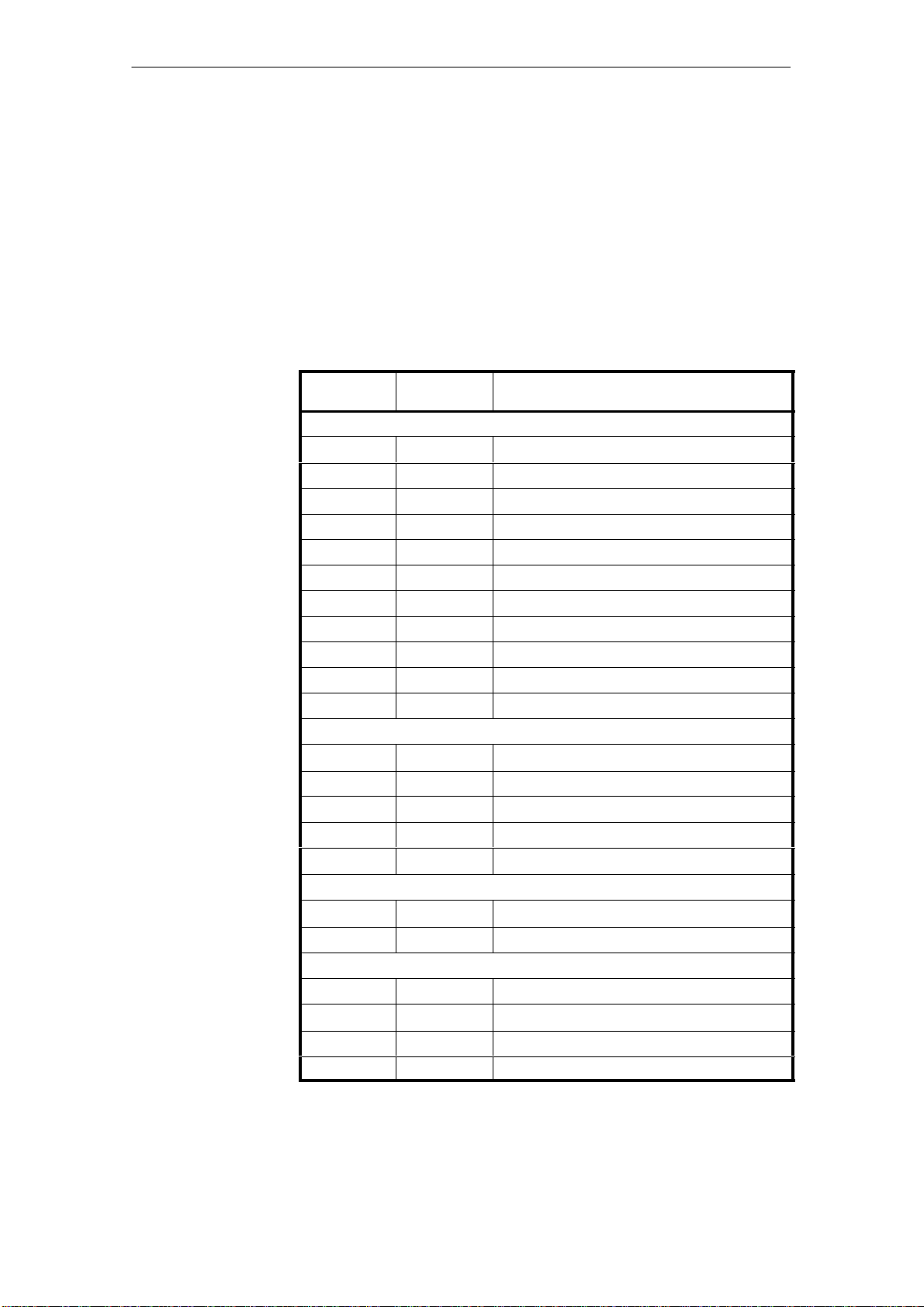
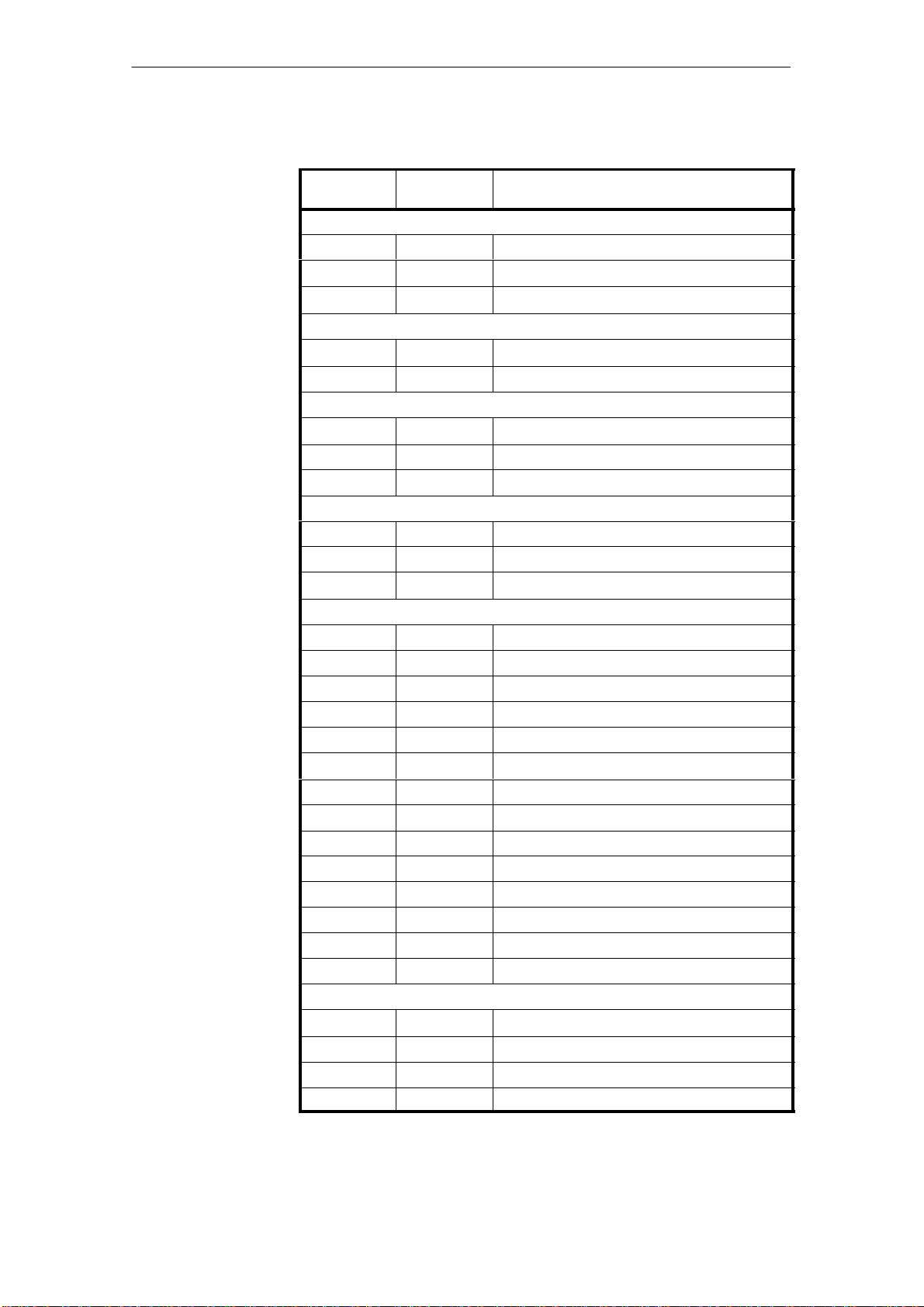
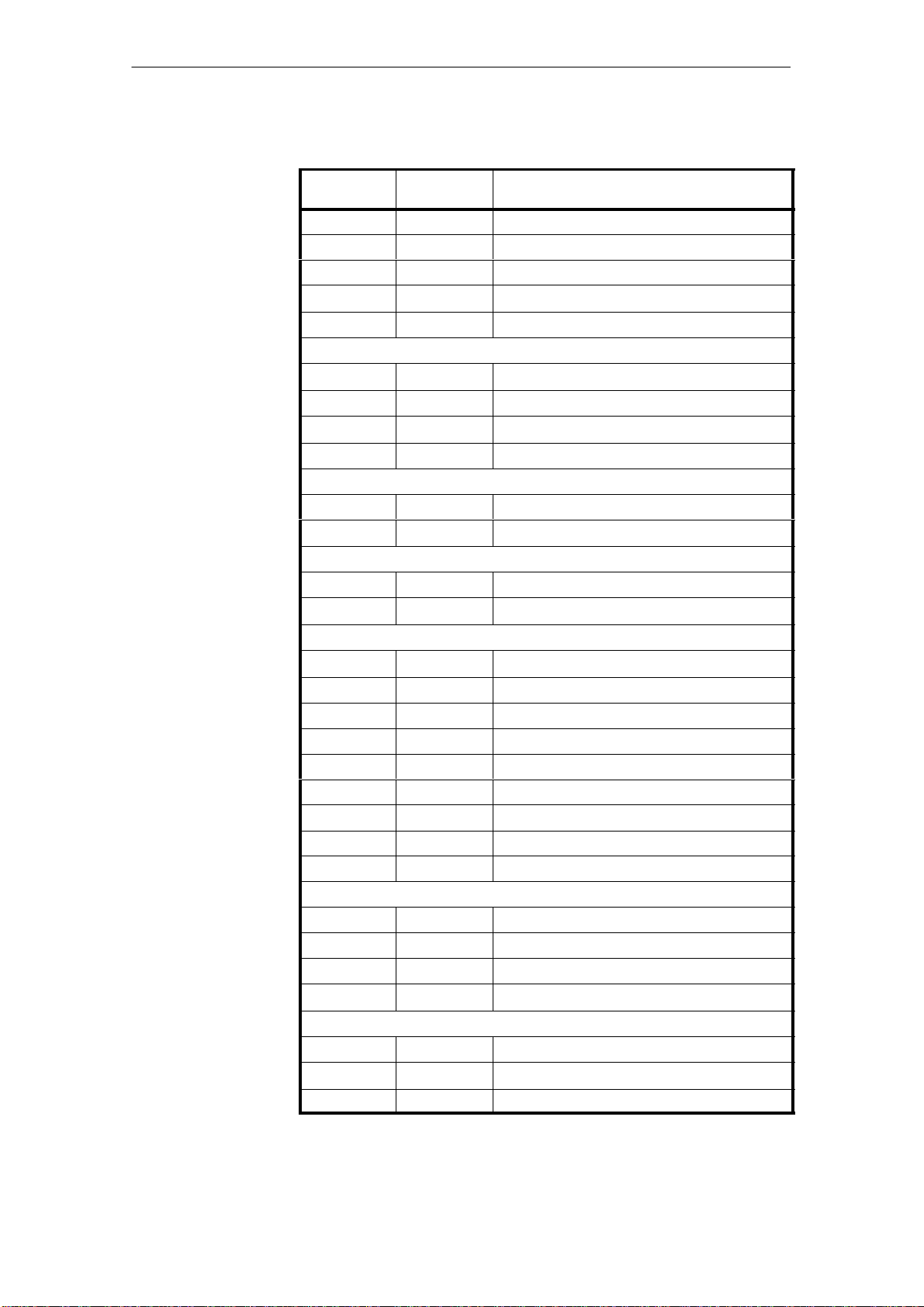
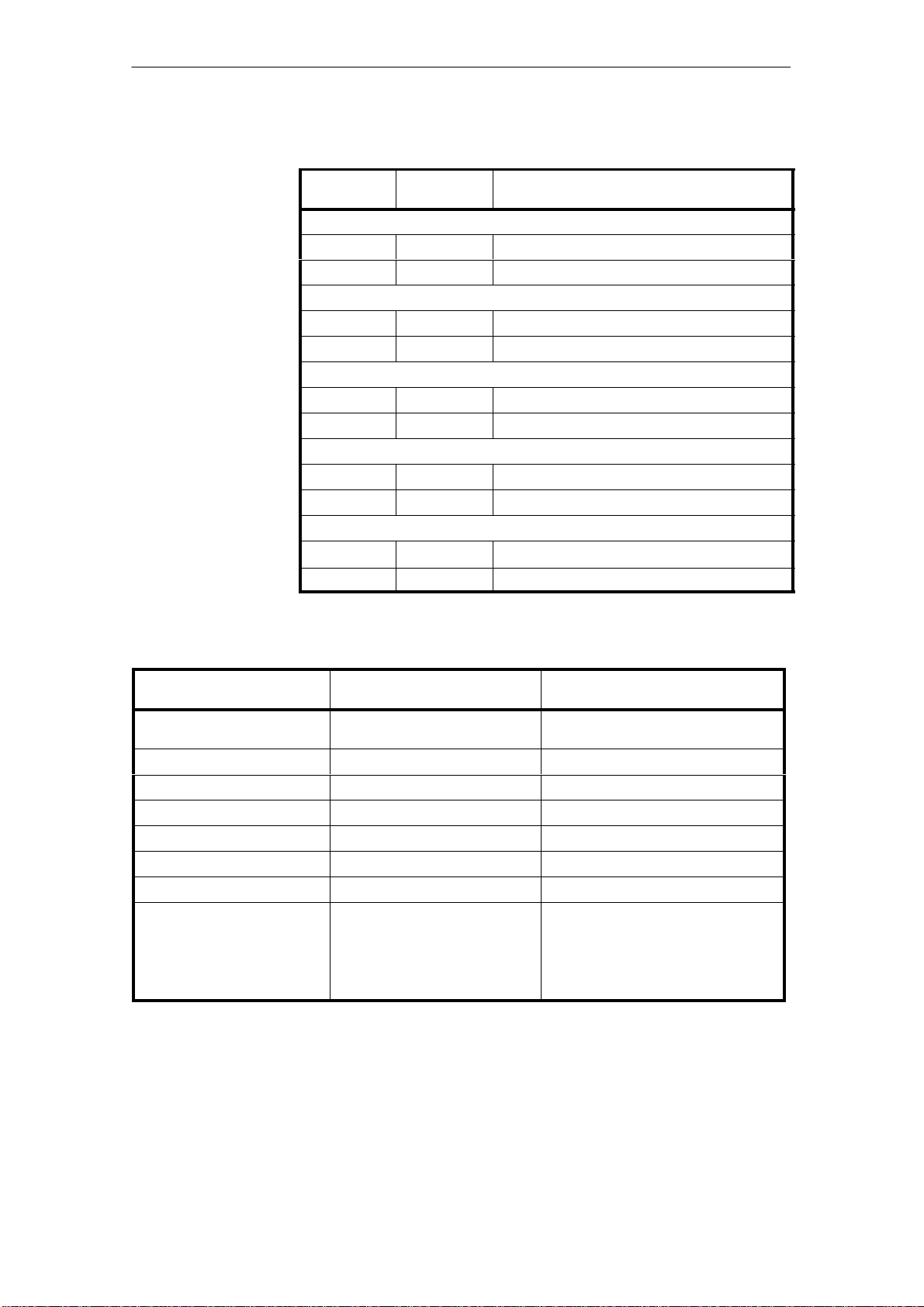
2.2 G commands
The G codes of ISO Dialect T refer to G code system B (see also 4.1.5).
The active G codes in ISO mode can be read using system variable
$P_EXTGG[...]. The numbers alongside the G code specify the respective
value in $P_EXTGG[...]. Machine data 20154
EXTERN_GCODE_RESET_VALUES[n]: 0, ..., 30 is used to specify the G
codes that are effective on start–up when the NC channel is not operating in
Siemens mode.
10.02
Table 2-2 The default setting is indicated by
ISO
Dialect T
Group 1
1)
G00
G01 2 G01 2 Linear motion
G02 3 G02 3 Circle/helix, clockwise
G03 4 G03 4 Circle/helix, counterclockwise
G33 5 G33 5 Thread cutting with constant lead
G34 9 Thread cutting with variable lead
G77 6 Longitudinal turning cycle
G78 7 Thread cutting cycle
G79 8 Face turning cycle
Group 2
G96 1 Constant cutting rate ON
G97
Group 3
G90
G91 2 G91 2 Incremental programming
Group 4
G68 1 Double turret/slide on
G69 2 Double turret/slide off
1 G00
1)
2
1)
1 G90
ISO
Dialect M
1)
G02.2 6 Involute, clockwise
G03.2 7 Involute, counterclockwise
1)
G17
G18 2 ZX plane
G19 3 YZ plane
1)
G22 1 Working area limitation, protection zone 3 ON
1)
G23
Rapid traverse
1
XY plane
1
Constant cutting rate OFF
Absolute programming
1
Working area limitation, protection zone 3 OFF
2
1)
Description
2-18
SINUMERIK 840D/840Di/810D, Description of Functions ISO Dialects (FBFA) – 11.02 Edition
Siemens AG, 2002. All rights reserved
Page 19
10.02
2 Programming
2.2 G commands
Table 2-2 The default setting is indicated by
ISO
Dialect T
Dialect M
1)
DescriptionISO
Group 5
G93 3 Inverse–time feedrate (rpm)
G94 1
1)
G95
2
G94
1)
Feed in [mm/min, inch/min]
1
G95 2 Revolutional feedrate in [mm/rev, inch/rev]
Group 6
G20
1)
1 G20
1)
(G70) 1
Input system inch
G21 2 G21 (G71) 2 Input system metric
Group 7
G40
1)
1 G40
1)
Deselect cutter radius compensation
1
G41 2 G41 2 Compensation to left of contour
G42 3 G42 3 Compensation to right of contour
Group 8
G43 1 Tool length compensation positive ON
G44 2 Tool length compensation negative ON
G49
1)
Tool length compensation OFF
3
Group 9
G22 1 Working area limitation, protection zone 3 ON
G23 2 Working area limitation, protection zone 3 OFF
G73 1 Deep hole drilling cycle with chipbreaking
G74 2 Counterclockwise tapping cycle
G76 3 Fine drilling cycle
G80
1)
4
Cycle OFF
G81 5 Counterbore drilling cycle
G82 6 Countersink drilling cycle
G83 7 Deep hole drilling cycle with swarf removal
G84 8 Clockwise tapping cycle
G85 9 Drilling cycle
G86 10 Drilling cycle, retraction with G00
G87 11 Reverse countersinking
G89 13 Drilling cycle, retraction with machining feed
Group 10
G80
1)
1
Drilling cycle OFF
G83 2 Face deep hole drilling
G84 3 Face tapping
G85 4 End face drilling cycle
Siemens AG, 2002. All rights reserved
SINUMERIK 840D/840Di/810D, Description of Functions ISO Dialects (FBFA) – 11.02 Edition
2-19
Page 20
2 Programming
2.2 G commands
10.02
Table 2-2 The default setting is indicated by
ISO
Dialect T
Dialect M
1)
DescriptionISO
G87 5 Side deep hole drilling
G88 6 Side tapping
G89 7 Side drilling
G98
1)
Return to starting point for fixed cycles
1
G99 2 Return to point R for fixed cycles
Group 11
G98
1)
1
Return to starting point for drilling cycles
G99 2 Return to point R for drilling cycles
G50
1)
Scaling OFF
1
G51 2 Scaling ON
Group 12
G66 1 G66 1 Modal macro call
G67
1)
2 G67
1)
Delete modal macro call
Group 13
G96 1 Constant cutting rate ON
G97
1)
Constant cutting rate OFF
2
Group 14
G54 1
G54
1)
Select zero offset
1
G55 2 G55 2 Select zero offset
G56 3 G56 3 Select zero offset
G57 4 G57 4 Select zero offset
G58 5 G58 5 Select zero offset
G59 6 G59 6 Select zero offset
G54 P{1...48}1 G54 P{1...48}1 Extended zero offsets
G54.1 7 Extended zero offset
G54 P0 1 G54 P0 1 “External ZO extOffset”
Group 15
G61 1 Exact stop modal
G62 4 Automatic corner override
G63 2 Tapping mode
G64
1)
Continuous-path mode
3
Group 16
G17 1 XY plane
G18
1)
2
ZX plane
G19 3 YZ plane
2-20
SINUMERIK 840D/840Di/810D, Description of Functions ISO Dialects (FBFA) – 11.02 Edition
Siemens AG, 2002. All rights reserved
Page 21

10.02
2 Programming
2.2 G commands
Table 2-2 The default setting is indicated by
ISO
Dialect T
Group 17
Group 18 (non-modal)
G04 1 G04 1 Dwell time in [s] or spindle revolutions
G05 20 G05 18 High–speed cycle cutting
G05.1 22 G05.1 20 High speed cycle –> call CYCLE305
G07.1 18 G07.1 16 Cylindrical interpolation
G10 2 G10 3 Write zero offset/tool offset
G10.6 19 G10.6 17 Rapid lift ON/OFF (T)
G27 16 G27 13 Referencing check (available soon)
G28 3 G28 5 Approach 1st reference point
G30 4 G30 6 Approach 1st reference point
G30.1 21 G30.1 19 Floating reference position
G31 5 G31 7 Measurement with touch-trigger probe
G52 6 G52 8 Programmable zero offset
G53 17 G53 9 Approach position in machine coordinate system
G65 7 G65 10 Call macro
G70 8 Finishing cycle
G71 9 Stock removal cycle longitudinal axis
G72 10 Stock removal cycle transverse axis
G73 11 Repeat contour
G74 12 Deep hole drilling and recessing in longitudinal axis
G75 13 Deep hole drilling and recessing in facing axis (X)
G76 14 Multiple thread cutting cycle
G92 15 G92 11 Preset actual value memory, spindle speed limitation
G92.1 23 G92.1 21 Reset actual value, reset WCS
Dialect M
G68 1 Rotation ON 2D 3D
G69 2 Rotation OFF
1)
G15
G16 2 Polar coordinates ON
G08 12 Feedforward control ON/OFF
G09 2 Exact stop
G11 4 Terminate parameter input
G72.1 14 Contour repetition with rotation
G72.2 15 Contour repetition, linear
Polar coordinates OFF
1
Retraction from contour (POLF) (M)
(Z)
1)
DescriptionISO
Siemens AG, 2002. All rights reserved
SINUMERIK 840D/840Di/810D, Description of Functions ISO Dialects (FBFA) – 11.02 Edition
2-21
Page 22
2 Programming
2.2 G commands
10.02
Table 2-2 The default setting is indicated by
ISO
Dialect T
Group 20
G50.2 1 Polygon turning OFF
G51.2 2 Polygon turning ON
Group 21
G13.1 1 TRANSMIT OFF
G12.1 2 TRANSMIT ON
Group 22
Group 25
Group 31
1)
G290
G291 2 G291 2 Select ISO Dialect mode
Dialect M
G50.1 1 Mirroring on programmed axis OFF
G51.1 2 Mirroring on programmed axis ON
G13.1 1 Polar coordinates, interpolation
G12.1 2 Polar coordinates, interpolation
1 G290
1)
Select Siemens mode
1
1)
DescriptionISO
Table 2-3 G commands are functionally identical in Siemens mode and in ISO Dialect mode
G commands in Siemens mode Corresponding G commands in
Group 1: G00, G01, G02, G03,
G33
Group 6: G17, G18, G19 Group 16: G17, G18, G19 Group 2: G17, G18, G19
Group 7: G40, G41, G42 Group 7: G40, G41, G42 Group 7: G40, G41, G42
Group 8: G54 to G554 Group 14: G54 to G59, G54 P1 to P48
Group 10: G60, G64 Group 15: G60, G64
Group 13: G700, G710 Group 6: G20, G21 Group 6: G20, G21
Group 14: G90, G91 Group 3: G90, G91 Group 3: G90, G91
Group 15: G94
G95
G96
G961
G97
G971
Group 1: G00, G01, G02, G03, G33 Group 1: G00, G01, G02, G03, G33
Group 5: G94 Group 2: G97
Group 5: G95 Group 2: G97
Group 5: G95 Group 2: G96
Group 5: G94 Group 2: G96
Group 5: G95 Group 2: G97
Group 5: G94 Group 2: G97
ISO Dialect T
Corresponding G commands in
ISO Dialect M
Group 5: G94 Group 13: G97
Group 5: G95 Group 13: G97
Group 5: G95 Group 13: G96
Group 5: G94 Group 13: G96
Group 5: G95 Group 13: G97
Group 5: G94 Group 13: G97
2-22
SINUMERIK 840D/840Di/810D, Description of Functions ISO Dialects (FBFA) – 11.02 Edition
Siemens AG, 2002. All rights reserved
Page 23

10.02
2 Programming
2.2 G commands
Note
If individual G codes of the groups in Table 2-3 cannot be mapped, the default
setting in machine data
$MC_EXTERN_GCODE_RESET_VALUES and/or
$MC_GCODE_RESET_VALUES
is activated.
Example: ISO mode
N5 G00 X100. Y100.
N10 G90 ;Activate G90 in ISO mode Group 3
;In Siemens mode Group 14
N15 G290 ;Switch over to Siemens, G90 is active
N20 G91 ;Activate G91 in ISO mode Group 3
;In Siemens mode Group 14
N25 G291 ;Switch over to ISO mode
N30 G291 ;G91 is active
2.2.1 G code display
In the G code display, the G codes for the currently active language are
displayed. G290/G291 also causes the G code display to switch over.
Example:
The Siemens standard cycles are called up using some of the ISO Dialect
mode G functions (e.g. G28). DISPLOF is programmed at the start of the cycle,
with the result that the ISO Dialect G commands remain active for the display.
PROC CYCLE328 SAVE DISPLOF
N10 ...
...
N99 RET
Sequence:
S External main program calls Siemens shell cycle.
Siemens mode is selected implicitly on the shell cycle call.
S DISPLOF freezes the block display at the call block;
the G code display remains in external mode. This display is refreshed while
the Siemens cycle is running.
2.2.2 Display of non–modal G codes
As of SW 6.4 the external non–modal G codes (group 18) will no longer be reset
on block change if these G codes call up subprograms. The G codes remain
visible on the display until the next jump out of this subprogram.
Switching to external language mode in the subprogram and programming
another G code from group 18 overwrites the previous value and the new value
is retained until the return jump.
Example:
Siemens AG, 2002. All rights reserved
SINUMERIK 840D/840Di/810D, Description of Functions ISO Dialects (FBFA) – 11.02 Edition
2-23
Page 24

2 Programming
2.2 G commands
Main program Display group 18
N05 G00 X0 Y0 empty
N08 G27 X10 –> calls Cycle328 empty
N09 M0 empty
N40 M30 empty
Subprogram Cycle328
N100 G290 G27
N102 X=$C_X G27
N103 M0 G27
N104 G291 G27
N105 G30 X10 Y12 Z13 G30
N120 M99 G30
2.2.3 G code output to PLC (as from SW 6.4)
The behavior of G group transfer to PLC is described in machine data
$MC_GCODE_GROUPS_TO_PLC_MODE.
The previous behavior was for the G group to be the array index of a 64 byte
field (DBB 208 – DBB 271). That way, up to the 64th G group can be reached.
Only the G groups of the standard or external language can be displayed.
The new behavior is for the data storage in the PLC to be up to 8 bytes (DBB
208 – DBB 215), i.e. up to 8 G groups can be output.
This method has the array index of machine data
$MC_GCODE_GROUPS_TO_PLC[ ] or
$MC_EXTERN_GCODE_GROUPS_TO_PLC[ ] equal to the array index of the
data storage in the PLC (DBB 208 – DBB215).
The G code group from MD $MC_GCODE_GROUPS_TO_PLC[ ] is output in
DBB 208.
The advantage is that Siemens mode and ISO mode G codes can be output
simultaneously.
Because only the G code of one language can be output in a DBB2xx, each
index (0 –7) can only be set on one of the two machine data, and the value 0
must be entered in the other MD. Errors are signaled with Alarm 4045.
10.02
Display group 18
Example
2-24
$MC_GCODE_GROUPS_TO_PLC[0]=3
$MC_GCODE_GROUPS_TO_PLC[1]=0
$MC_GCODE_GROUPS_TO_PLC[2]=0
$MC_GCODE_GROUPS_TO_PLC[3]=0
$MC_GCODE_GROUPS_TO_PLC[4]=1
$MC_GCODE_GROUPS_TO_PLC[5]=2
$MC_GCODE_GROUPS_TO_PLC[6]=0
$MC_GCODE_GROUPS_TO_PLC[7]=0
$MC_EXTERN_GCODE_GROUPS_TO_PLC[0]=0
$MC_EXTERN_GCODE_GROUPS_TO_PLC[1]=3
$MC_EXTERN_GCODE_GROUPS_TO_PLC[2]=18
$MC_EXTERN_GCODE_GROUPS_TO_PLC[3]=1
$MC_EXTERN_GCODE_GROUPS_TO_PLC[4]=0
$MC_EXTERN_GCODE_GROUPS_TO_PLC[5]=0
$MC_EXTERN_GCODE_GROUPS_TO_PLC[6]=6
$MC_EXTERN_GCODE_GROUPS_TO_PLC[7]=31
The following G codes are then available on the PLC
SINUMERIK 840D/840Di/810D, Description of Functions ISO Dialects (FBFA) – 11.02 Edition
Siemens AG, 2002. All rights reserved
Page 25

10.02
2 Programming
2.2 G commands
DBB 208 = group 03 Siemens
DBB 209 = group 03 ISO dialect
DBB 210 = group 18 ISO dialect
DBB 211 = group 01 ISO dialect
DBB 212 = group 01 Siemens
DBB 213 = group 02 Siemens
DBB 214 = group 06 ISO dialect
DBB 215 = group 31 ISO dialect
Example of faulty configuration:
$MC_GCODE_GROUPS_TO_PLC[0]=3
$MC_GCODE_GROUPS_TO_PLC[1]=0
$MC_GCODE_GROUPS_TO_PLC[2]=0
$MC_EXTERN_GCODE_GROUPS_TO_PLC[0]=3 –>
Alarm 4045, channel K1 conflict between machine data
{S$MC_GCODE_GROUPS_TO_PLC} and machine data
{S$MC_EXTERN_GCODE_GROUPS_TO_PLC}
$MC_EXTERN_GCODE_GROUPS_TO_PLC[1]=0
$MC_EXTERN_GCODE_GROUPS_TO_PLC[2]=18
The method enables simultaneous display of G codes of standard mode and
ISO dialect mode.
Siemens AG, 2002. All rights reserved
SINUMERIK 840D/840Di/810D, Description of Functions ISO Dialects (FBFA) – 11.02 Edition
2-25
Page 26
2 Programming
2.2 G commands
2.2.4 Zero offset
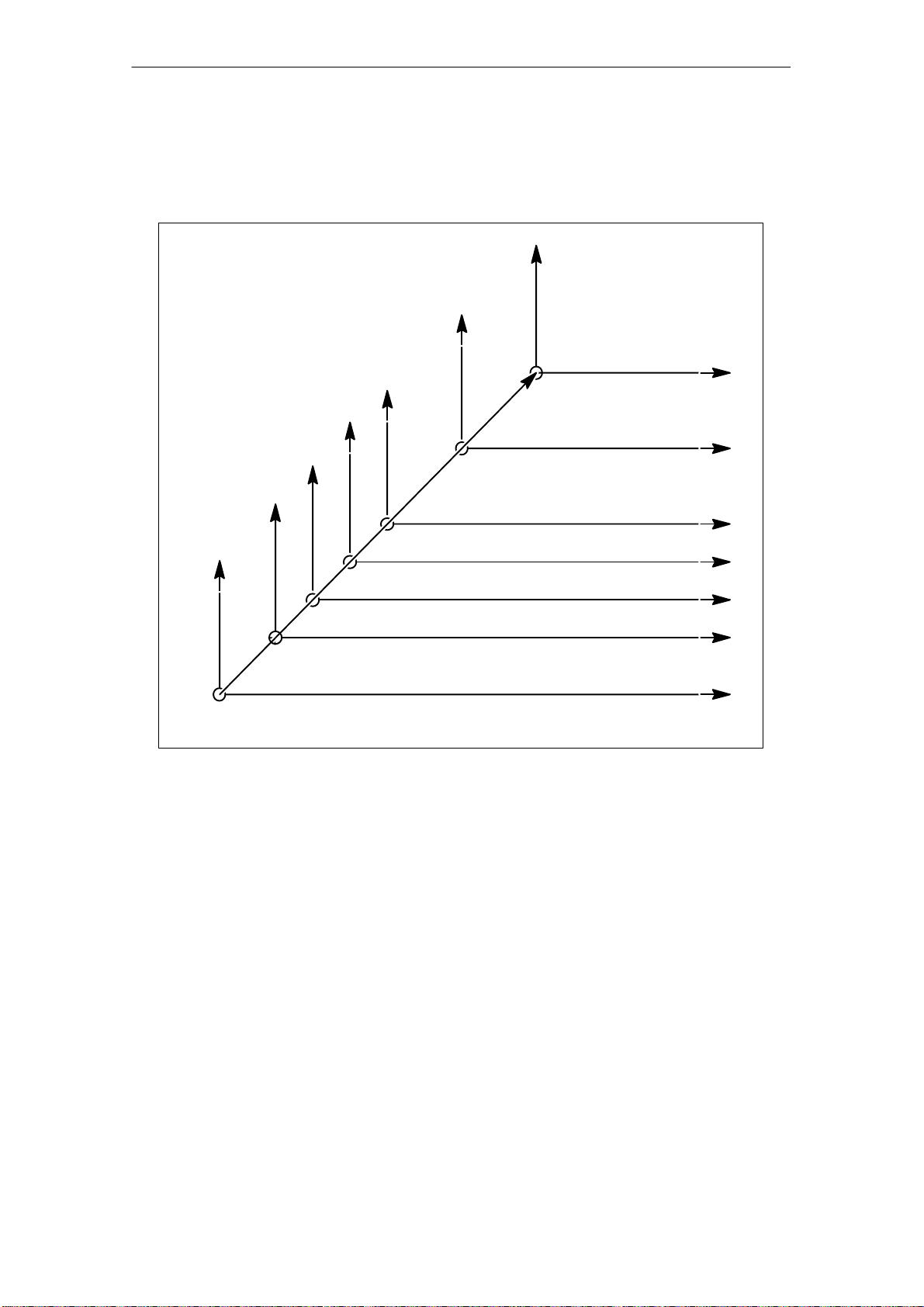
10.02
The zero offsets (ZO) of Siemens mode are shown in Fig. 2-1.
Progr . frame G52 ZO
$P_BFRAME G51 scale
Settable frame G54 – G59 ZO
$P_UIFR G54 P1..100 ZO
Channel-specific base frame
$P_CHBFRAME[3] G68 3DRot
$P_CHBFRAME[2] G68 2DRot/3DRot
$P_CHBFRAME[1] Mirroring on progr. axis
$P_CHBFRAME[0] G92 Preset actual value memory
$P_CHBFRAME[0] ZO extOffset
Fig. 2-1 Instantaneous mapping of the ISO functions onto the Siemens frames
The zero offsets that are available in ISO mode are mapped onto the existing
Siemens frames. No separate frames exist for ISO mode. Active zero offsets
are incorporated in both language modes.
Changes in ISO mode have an immediate effect in Siemens mode and
vice–versa.
Zero offsets exist in both ISO Dialect T and ISO Dialect M:
S G52 is a programmable, additive ZO that remains active until the end of the
program or a reset
S G54 to G59 are settable zero offsets
2-26
S G54 P1...P100 are additional settable zero offsets
S G54 P0 is an “external ZO” extOffset
SINUMERIK 840D/840Di/810D, Description of Functions ISO Dialects (FBFA) – 11.02 Edition
Siemens AG, 2002. All rights reserved
Page 27

10.02
2 Programming
2.2 G commands
G54.1
G54.1 Pxx is provided as an alternative notation to G54 Pxx. The functionality is
identical. With G54.1 the P address must always be programmed in the block. If
P is not programmed, alarm 12080 (syntax error) is produced.
2.2.5 Writing a zero offset with G10
G10 can be used from the parts program to write the zero offsets.
G10 L2 P1...P6 X.. Y.. ; G54.. G59
G10 L20 P1...P100 ; Additional, settable ZO
G10 L2 P0 External ZO extOffset
These zero offsets are mapped onto the same frames as the zero offsets that
already exist in ISO Dialect M.
The G10 command is extended for ISO dialect T :
Writing of system data
G10 Pxx X Y Z ;writing of tool offset data
Depending on machine data $MC_EXTERN_FUNCTION_MASK, bit1, G10
Pxx is used to write either tool geometry or tool wear.
$MC_EXTERN_FUNCTION_MASK, bit1 = 0:
P > 100 write geometry values
P < 100 write wear values
$MC_EXTERN_FUNCTION_MASK, bit 1=1:
P > 10000 write geometry values
P < 10000 write wear values
2.2.6 Decimal point programming
There are two notations for the interpretation of programming values without a
decimal point in ISO Dialect mode:
S Pocket calculator type notation
Values without decimal points are interpreted as mm, inch or degrees.
S Standard notation
Values without decimal points are multiplied by a conversion factor.
The setting is defined by MD 10884, see Chapter 4 “Startup”.
There are two different conversion factors, IS-B and IS-C. This evaluation refers
to addresses X Y Z U V W A B C I J K Q R and F.
Example of linear axis in mm:
X 100.5 corresponds to value with decimal point: 100.5mm
X 1000 pocket calculator type notation: 1000mm
standard notation: IS-B: 1000* 0.001= 1mm
IS-C: 1000* 0.0001 = 0.1mm
Siemens AG, 2002. All rights reserved
SINUMERIK 840D/840Di/810D, Description of Functions ISO Dialects (FBFA) – 11.02 Edition
2-27
Page 28

2 Programming
2.2 G commands
ISO dialect Milling
10.02
Table 2-4 Different conversion factors for IS-B and IS-C
Address
Linear axis mm
Rotary axis deg 0.001 0.0001
F feed G94 (mm/inch per min.) mm
F feed G95 (mm/inch per min.) mm
F thread pitch mm
C chamfer mm
R radius, G10 toolcorr mm
Q mm
I, J, K interpolation parameters mm
G04 X or U S 0.001 0.001
A contour angle deg 0.001 0.0001
G74, G84 thread drilling cycles
$MC_EXTERN_FUNCTION_MASK
Bit8 = 0 F feedrate like G94, G95
Bit8 = 1 F thread pitch
Unit IS-B IS-C
inch
inch
inch
inch
inch
inch
inch
inch
0.001
0.0001
1
0.01
0.01
0.0001
0.01
0.0001
0.001
0.0001
0.001
0.0001
0.001
0.0001
0.001
0.0001
0.0001
0.00001
1
0.01
0.01
0.0001
0.01
0.0001
0.0001
0.00001
0.0001
0.00001
0.0001
0.00001
0.0001
0.00001
ISO dialect
Turning
Table 2-5 Different conversion factors for IS-B and IS-C
Address Unit IS-B IS-C
Linear axis mm
inch
Rotary axis deg 0.001 0.0001
F feed G94 (mm/inch per min.) mm
inch
F feed G95 (mm/inch per rev)
$MC_EXTERN_FUNCTION_MASK
Bit8 = 0 mm
inch
Bit8 = 1 mm
inch
F thread pitch mm
inch
C chamfer mm
inch
R radius, G10 toolcorr mm
inch
0.001
0.0001
1
0.01
0.01
0.0001
0.0001
0.000001
0.0001
0.000001
0.001
0.0001
0.001
0.0001
0.0001
0.00001
1
0.01
0.01
0.0001
0.0001
0.000001
0.0001
0.000001
0.0001
0.00001
0.0001
0.00001
2-28
SINUMERIK 840D/840Di/810D, Description of Functions ISO Dialects (FBFA) – 11.02 Edition
Siemens AG, 2002. All rights reserved
Page 29

10.02
Table 2-5 Different conversion factors for IS-B and IS-C
Address IS-CIS-BUnit
I, J, K interpolation parameters mm
G04 X or U 0.001 0.001
A contour angle 0.001 0.0001
G76, G78 thread drilling cycles
$MC_EXTERN_FUNCTION_MASK
Bit8 = 0 F feedrate like G94, G95
Bit8 = 1 F thread pitch
G84, G88 thread drilling cycles
$MC_EXTERN_FUNCTION_MASK
Bit9 = 0 G95 F mm
Bit8 = 1 G95 F mm
2.2.7 Dwell time in spindle revolutions G04
inch
inch
inch
2 Programming
2.2 G commands
0.001
0.0001
0.01
0.0001
0.0001
0.000001
0.0001
0.00001
0.01
0.0001
0.0001
0.000001
MD $MC_EXTERN_FUNCTION_MASK, bit 2 defines how the programmed
dwell time will be interpreted in a G04 block. The hold time can be programmed
using G04 X U or P.
Bit 2 = 0: Dwell time is always interpreted in [s].
Bit 2 = 1: If G95 is active, dwell time is interpreted in spindle
revolutions.
In the case of standard notation, X and U values without a decimal point are
converted into internal units depending on IS-B or IS-C. P is always interpreted
in internal units.
Example:
N5 G95 G04 X1000 Standard notation 1000 * 0.001 = 1 spindle revolution
pocket calculator notation: 1000 spindle revolutions
2.2.8 Scaling and mirroring: G51, G51.1 (ISO Dialect M)
G51 selects scaling and mirroring, G51.1.
There are two scaling modes:
S Axial scaling with parameters I, J, K
If I, J, K is not programmed in the G51 block, the default value from the setting
data is effective.
Negative axial scaling factors have the additional effect of mirroring.
S Scaling in all axes with scale factor P
If P is not programmed in the G51 block, the default value from the setting data
is effective. Negative P values are not possible.
The scale factors are multiplied by either 0.001 or 0.00001.
Siemens AG, 2002. All rights reserved
SINUMERIK 840D/840Di/810D, Description of Functions ISO Dialects (FBFA) – 11.02 Edition
2-29
Page 30
2 Programming
2.2 G commands
10.02
Note
If a factor other than “1” is programmed for parameters I, J, K or if the address
is missing (default value is active for I, J, K), the contour is also scaled.
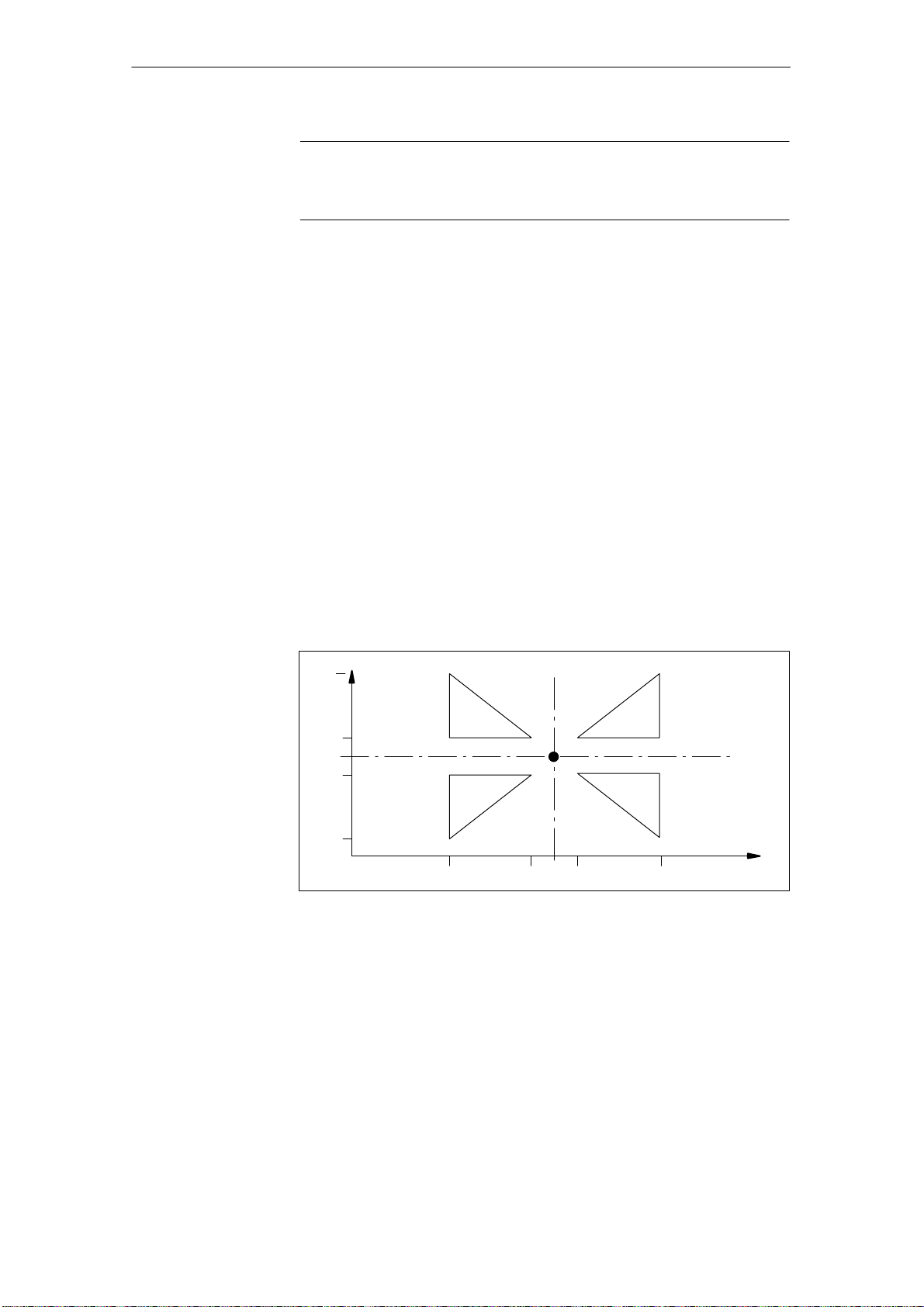
Example
00512 (parts program)
N10 G17 G90 G00 X0 Y0 Approach start position
N30 G90 G01 G94 F6000
N32 M98 P0513 1) Contour programmed as in the
subprogam
N34 G51 X0. Y0. I-1000 J1000 2) Mirror contour around X
N36 M98 P0513
N38 G51 X0. Y0. I-1000 J-1000 3) Mirror contour around X and Y
N40 M98 P0513
N42 G51 X0. Y0. I1000 J-1000 4) Mirror contour around Y
N44 M98 P0513
N46 G50 Deselect scaling and mirroring
N50 G00 X0 Y0
N60 M30
00513 (subprogram)
N10 G90 X10. Y10.
N20 X50
N30 Y50
N40 X10. Y10.
N50 M99
50
10
0
–10
2)
Starting point
3)
1)
4)
2-30
–50
–50 –10
Fig. 2-2 Scaling and mirroring
System parameter settings for the scaling and mirroring example:
MD 22910 $MC_WEIGHTING_FACTOR_FOR_SCALE = 0
MD 22914 $MC_AXES_SCALE_ENABLE = 1
MD 10884 $MN_EXTERN_FLOATINGPOINT_PROG = 0
MD 10886 $MN_EXTERN_INCREMENT_SYSTEM = 0
Axial scaling is not possible when MD $MC_AXES_SCALE_ENABLE = 0.
SINUMERIK 840D/840Di/810D, Description of Functions ISO Dialects (FBFA) – 11.02 Edition
0
10
Siemens AG, 2002. All rights reserved
50
Page 31
10.02
2 Programming
2.2 G commands
The reference point during scaling is always the workpiece zero; it is not
possible to program a reference point.
Mirroring
G51.1 selects mirroring.
Mirroring is performed around a mirror axis that runs parallel to X, Y or Z and
whose position is programmed with X, Y or Z. G51.1 X0 is used to mirror about
the X axis and G51.1 X10 is used to mirror about an axis that runs parallel to
the X axis at a distance of 10mm.
All axes in the channel and not just the geometry axes can be mirrored.
G51.1 functions additively, i.e. following N5 G51.1 X10 and N10 G51.1 Y10,
mirroring in X and V is active.
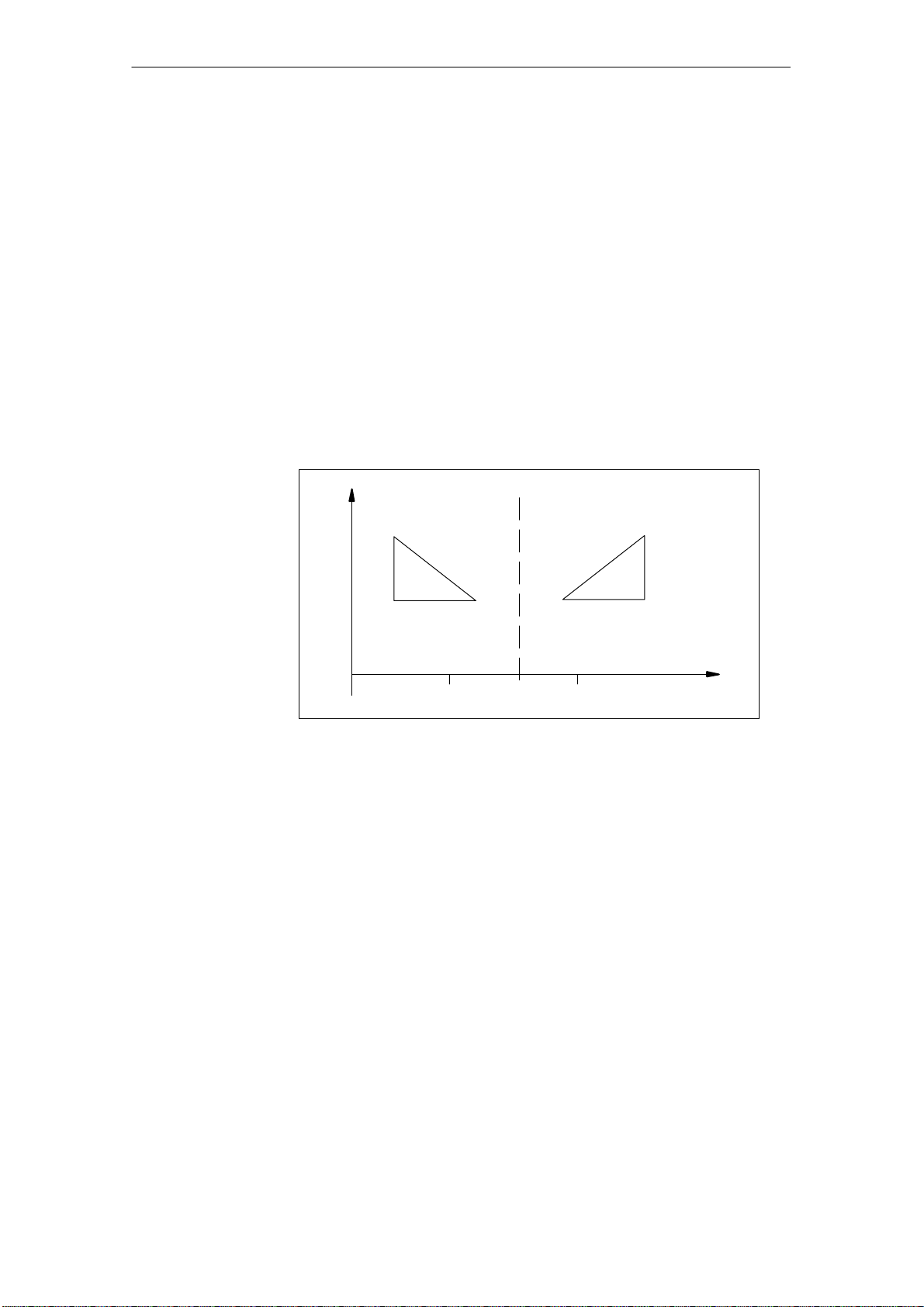
Example G51.1 X80.
Mirroring is performed around a mirror axis that runs parallel to Y and that
crosses the X axis at position 80.
Y
Mirrored
Original
G51.1 X80
60
Fig. 2-3 Mirroring around a mirror axis parallel to Y
80
100
X
If the standard notation is active (see Subsection 2.2.6), the axis positions
without a decimal point are interpreted in internal units.
Mirroring is deselected with G50.1 X0 Y0. It can also be deselected for
individual axes. Following G50.1 X0, mirroring is only deselected for the X axis;
mirroring around all other axes remains active.
G51.1 and G50.1 must be in a block of their own.
G51.1 is mapped onto channel–specific base frame [1]. For this purpose, MD
28081 $MC_MM_NUM_BASE_FRAMES >=2 must be set.
When base frame[1] is changed in Siemens mode, it directly affects the function
in ISO mode.
If the frame is deleted in every frame component, this corresponds to a G50.1
X0 Y0.. in all axes.
G51.1 is deselected on a Reset.
Siemens AG, 2002. All rights reserved
SINUMERIK 840D/840Di/810D, Description of Functions ISO Dialects (FBFA) – 11.02 Edition
2-31
Page 32

2 Programming
2.2 G commands
2.2.9 2D/3D rotation G68 / G69 (ISO Dialect M)
10.02
2D rotation
Programming
The coordinate system is rotated about the vertical axis of the selected plane.
G68 X.. Y.. R..
X.. Y..: Coordinates of the pivot point related to the current
workpiece zero. If a coordinate is not programmed, the
pivot point is taken from the actual value memory.
The value is always interpreted as an absolute value.
R: The angle of rotation is interpreted as an absolute or
incremental value depending on G90/G91. If an angle is not
programmed, the angle from setting data
$SA_DEFAULT_ROT_FACTOR_R is active.
G68 must be in a block of its own.
G69 Rotation Off; Additional codes can be programmed
in this block.
G68 is mapped onto channel–specific base frame 2. For this purpose, machine
data $MC_MM_NUM_BASE_FRAMES >= 3 must be set.
A programmed angle R is not entered in setting data
$SA_DEFAULT_ROT_FACTOR_R. This setting data can only be written
manually and is effective provided that no R has been programmed in the G68
block.
3D rotation
Programming
G code G68 has been expanded for 3D rotation.
G68 X.. Y.. Z.. I.. J.. K.. R..
X.. Y.. Z..: Coordinates of the pivot point related to the current
workpiece zero. If a coordinate is not programmed
the pivot point is at the workpiece zero. The value is always
interpreted as anabsolute value. The coordinates of the pivot
point act likea zero offset. A G90/91 in the block hasno effect
on the G68 command.
I.. J.. K..: Vector in the pivot point. The coordinate system is rotated
about this vector by the angle R.
R: Angle of rotation, always interpreted as an absolute value.
If an angleis not programmed, the angle from setting
data 42150 $SA_DEFAULT_ROT_FACTOR_R is active.
G68 must be in a block of its own.
The distinction between 2D and 3D rotation is determined solely by
programming the vector I, J, K. If no vector exists in the block, G68 2DRot is
selected. If a vector exists in the block, G68 3DRot is selected.
If a vector of length 0 (I0, Y0, K0) is programmed, the alarm 12560
“Programmed value lies outside the permissible limits” is output.
2-32
SINUMERIK 840D/840Di/810D, Description of Functions ISO Dialects (FBFA) – 11.02 Edition
Siemens AG, 2002. All rights reserved
Page 33

10.02
With G68, two rotations can be connected in series. If a G68 is not already
active in a block containing G68, the rotation is written into channel-specific
base frame 2. If G68 is already active, the rotation is written in channel-specific
base frame 3. This means that both rotations are activated in sequence.
With G69, 3D rotation is terminated. If two rotations are active, they are both
deactivated with G69. G69 does not have to be in a block of its own.
2.2.10 Polar coordinates: G15 (ISO Dialect M)
In ISO Dialect mode, NC program sections programmed with polar coordinates
must commence with start command G16. Until the end command G15 is
reached, the coordinates of the end points are interpreted as the polar
coordinate values for radius and angle in the current plane.
The first axis of the plane is the polar radius, the second axis is the polar angle,
i.e. X is the radius and Y is the angle for G17.
After G16 a new pole is set in each block up to G15, with the result as follows
for G17:
S G90 X The pole is at the workpiece zero
2 Programming
2.2 G commands
Programmed angle
S G91 X The pole is at the current position
S No X in the block The pole is at the workpiece zero
If the pole is moved from the current position to the workpiece zero, the radius is
calculated as the distance from the current position to the workpiece zero.
Example:
N5 G17 G90 X0 Y0
N10 G16 X100. Y45. Polar coordinates ON, pole is the workpiece zero,
Position X 70,711 Y 70,711 in the Cartesian
coordinate system
N15 G91 X100 G90 Y0 Pole is the current position, position X 170,711
Y 70,711
N20 Y90. No X in block, pole is at workpiece zero,
Radius = SORT(X*X +Y*Y) = 184,776
The polar radius is always traversed as an absolute distance; the polar angle
can be interpreted as an absolute or incremental value.
In the case of active polar coordinate programming, the programmed angle can
be read via the system variable $P_AP.
This variable is inserted in the shell cycle. Before the new pole is set, with
incremental programming, the angle must be stored because the angle will be
deleted.
Polar programming is terminated by G15. The polar radius is set to 0.
Siemens AG, 2002. All rights reserved
SINUMERIK 840D/840Di/810D, Description of Functions ISO Dialects (FBFA) – 11.02 Edition
2-33
Page 34
2 Programming
2.2 G commands
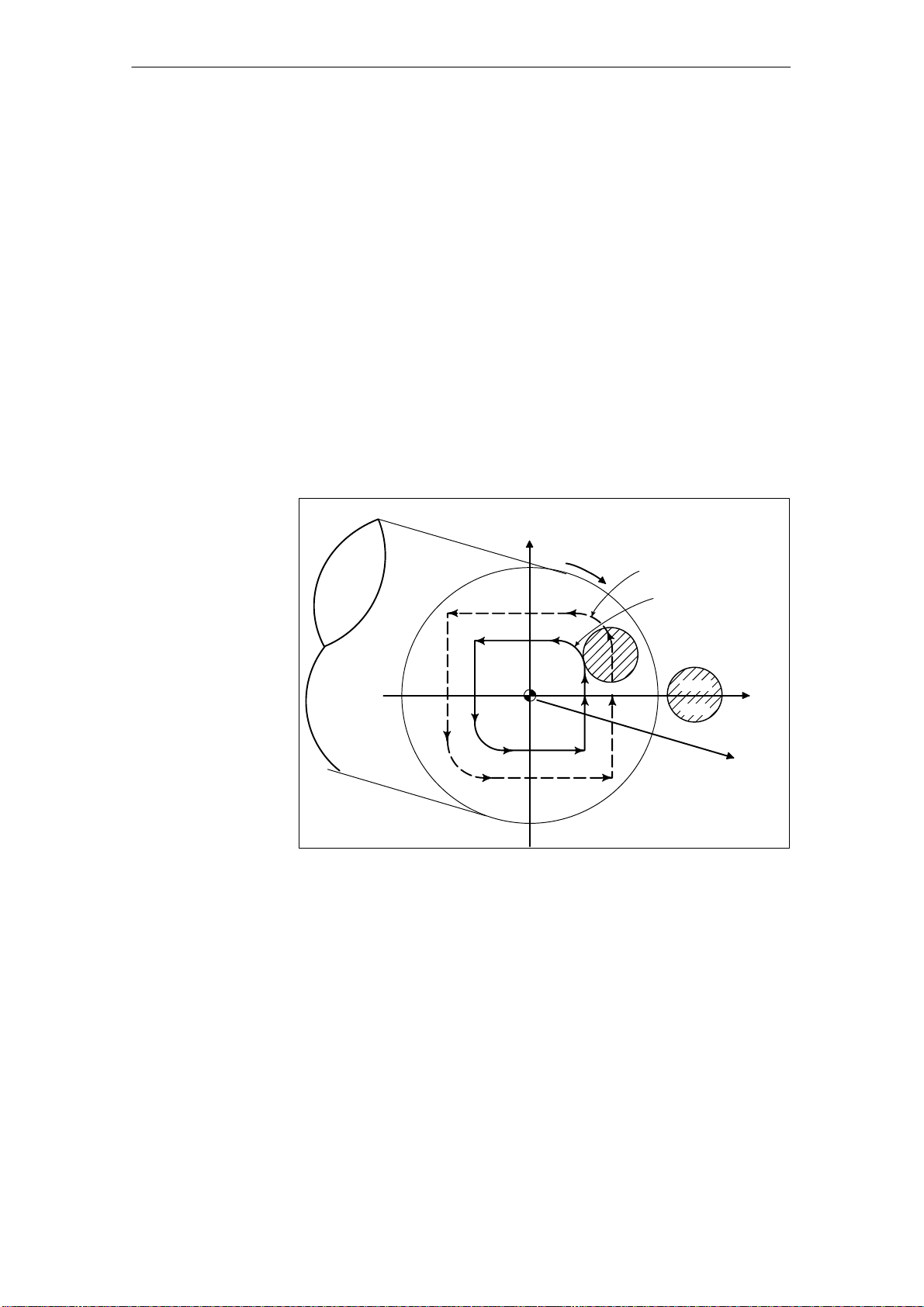
2.2.11 Polar coordinate interpolation G12.1 / G13.1 (G112/G113)
G12.1 and G13.1 are used to switch on and switch off an interpolation in the
processing level between an axis of rotation and a linear axis. A second linear
axis passes vertically through this plane. This function corresponds to the
Transmit function in Siemens mode. In Siemens mode, two Transmit
transformations can be parameterized. For G12.1 the first TRANSMIT data
block is always the one which must correspond to the second transformation
record. For a detailed description of the TRANSMIT function please refer to the
following documentation:
/FB2/ SINUMERIK 840D/810D(CCU2)
Description of Functions, Extended Functions, chapter M1 and
/PGA/ SINUMERIK 840D/810D
Programming Guide, Advanced, chapter
“Transformations”
Example:
10.02
N204
N205
N206
Fig. 2-4 Example of polar coordinate interpolation
N203
N208
N207
Rotary axis C
N201
N202
N200
X axis
Z axis
2-34
SINUMERIK 840D/840Di/810D, Description of Functions ISO Dialects (FBFA) – 11.02 Edition
Siemens AG, 2002. All rights reserved
Page 35

10.02
2 Programming
2.2 G commands
O0001
N010 T0101
N0100 G90 G00 X60.0 C0 Z..
N0200 G12.1 ;TRANSMIT selection
N0201 G42 G01 X20.0 F1000
N0202 C10.0 ;
N0203 G03 X10.0 C20.0 R10.0
N0204 G01 X–20.0
N0205 C–10.0
N0206 G03 X–10.0 C–20.0 I10.0 J0
N0207 G01 X20.0
N0208 C0
N0209 G40 X60.0
N0210 G13.1 ;TRANSMIT deselection
N0300 Z . .
N0400 X.. C..
N0900 M30
Note
Geo axis exchange (parallel axes with G17 (g18, G19)) must not be active.
2.2.12 Cylindrical interpolation G07.1 (G107)
Function G07.1 (cylindrical interpolation) can be used to mill any kind of
grooving on cylindrical bodies. The path of the grooving is programmed by
reference to the developed, level surface of the cylinder barrel. Cylindrical
interpolation is started in function G07.1 by specifying the cylindrical radius
G07.1 C<cylindrical radius> and ended with G07.1 C0 (radius = 0).
The function is mapped internally onto the Siemens functionality TRACYL. In
ISO Dialect mode, G07.1 always activates the first TRACYL transformation and
the first transformation record. The second TRACYL function cannot be
activated in ISO Dialect mode. For a detailed description and the parameter
setting for the first TRACYL function, please refer to the following
documentation:
/FB2/ SINUMERIK 840D/810D(CCU2)
Description of Functions, Extended Functions, chapter M1 and
/PGA/ SINUMERIK 840D/810D
Programming Guide, Advanced, chapter
“Transformations”
Restrictions:
In Siemens mode the axis of rotation for cylindrical interpolation must
be defined in machine data.
In ISO Dialect mode the axis of rotation for cylindrical interpolation is
defined by programming G07.1 <axis of rotation>... .
Siemens AG, 2002. All rights reserved
SINUMERIK 840D/840Di/810D, Description of Functions ISO Dialects (FBFA) – 11.02 Edition
2-35
Page 36
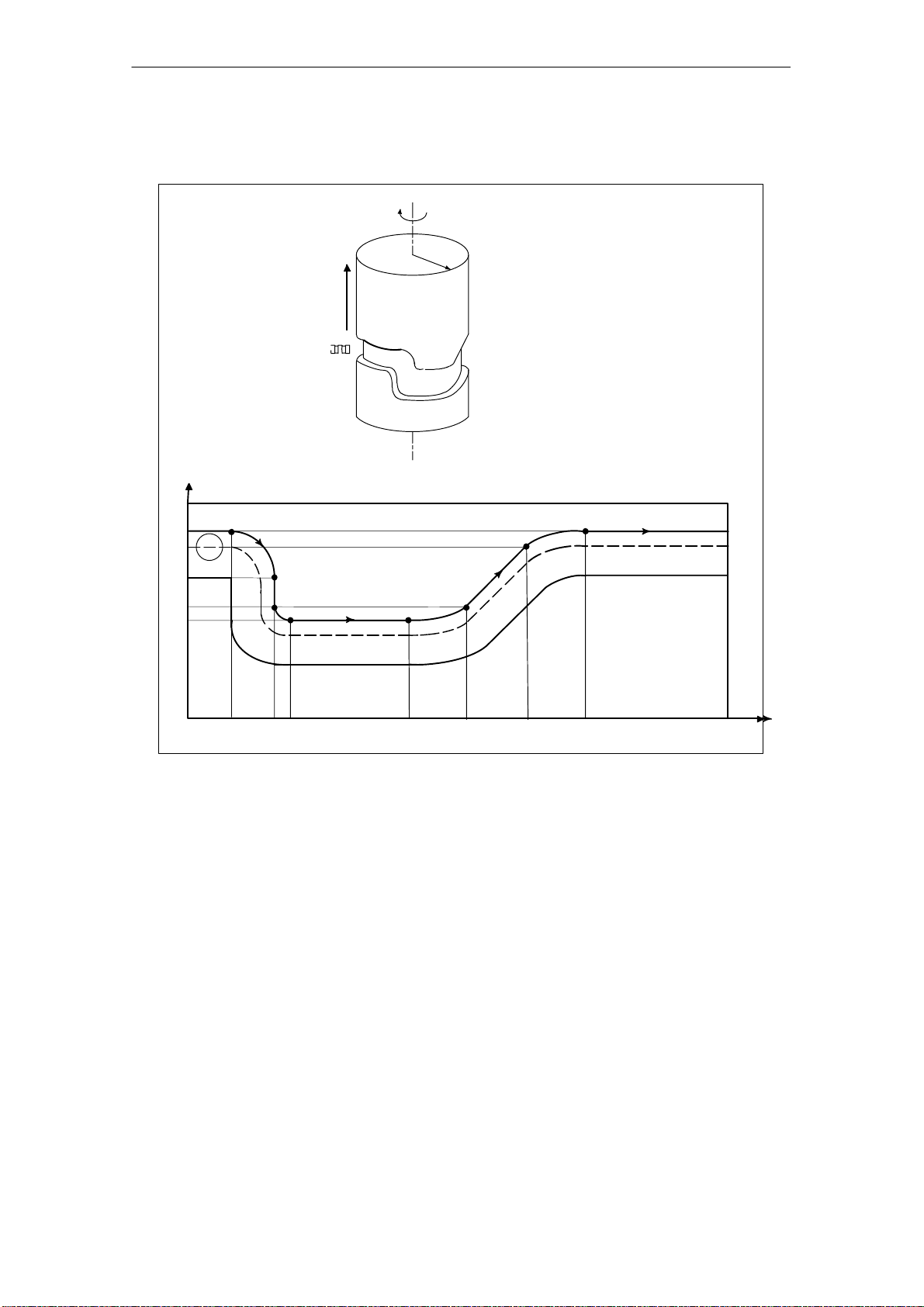
2 Programming
2.2 G commands
Example:
Z
mm
N05
120
90
70
50
N10
N20
N30
10.02
C
Radius
Z
N80
N70
N60
N40
N50
Degr.
0
30
60 70
Fig. 2-5 Example of cylindrical interpolation G07.1
150
230190
270
360
Programming example in ISO Dialect mode:
%0001
N05 G00 G90 Z100.0 C0
N10 G01 G91 G18 Z0 C0
N20 G07.1 C57299 ;Select cylindrical interpolation with radius
; 57.299mm
N30 G90 G01 G42 Z120.0 D01 F250
N40 C30.0
N50 G02 Z90.0 C60.0 R30.0
N60 G01 Z70.0
N70 G03 Z60.0 C70.0 R10.0
N80 G01 C150.0
N90 G03 Z70.0 C190.0 R75.0
N100 G01 Z110.0 C230.0
N110 G02 Z120.0 C270.0 R75.0
N120 G01 C360.0
N130 G40 Z100.0
N140 G07.1 C0 ;Deselect cylindrical interpolation
N150 M30 ;
2-36
SINUMERIK 840D/840Di/810D, Description of Functions ISO Dialects (FBFA) – 11.02 Edition
Siemens AG, 2002. All rights reserved
Page 37

10.02
2 Programming
2.2 G commands
Programming example in Siemens mode: The Y axis is assigned to the axis of
rotation as a linear axis.
%0001
N05 G00 G90 Z100 C0
N10 G01 G91 G18 Z0 C0;
N20 TRACYL(114.598) ;Select cylindrical interpolation with
; radius 57.299mm
N30 G90 G01 G42 Z120 D01 F250
N40 Y30
N50 G02 Z90 Y60 RND=30
N60 G01 Z70
N70 G03 Z60.0 Y70 RND=10
N80 G01 Y150
N90 G03 Z70 Y190 RND=75
N100 G01 Z110 Y230
N110 G02 Z120 Y270 RND=75
N120 G01 Y360
N130 G40 Z100
N140 TRAFOOF ;Deselect cylindrical interpolation
N150 M30 ;
2.2.13 Interrupt program with M96 / M97 (ASUB)
M96
A subprogram can be defined as an interrupt routine with M96 P <program
number>.
This program is started by an external signal. The first high–speed NC input of
the 8 inputs available in Siemens mode is always used to start the interrupt
routine. Machine data $MN_EXTERN_INTERRUPT_NUM_ASUP lets you
select an other fast input (1 – 8).
The function is mapped onto standard syntax: SETINT(1) <program name>
[PRIO=1].
In shell cycle CYCLE396, the interrupt program programmed with Pxxxx is
called in ISO mode. The program number is in $C_PI. At the end of the shell
cycle, machine data $MN_EXTERN_INTERRUPT_BITS_M96 BIT1 is
evaluated, resulting either in positioning at the interruption point with REPOSA
or in continuation with the next block. The new cycle variable $C_PI contains
the value programmed with “P” without leading zeroes. These must be added to
fill out to four digits in the shell cycle before the subprogram is called.
Example: N0020 M96 P5
Call in shell cycle
progName = “000” << $C_PI
ISOCALLprogName
See treatment of 8–digit program numbers, if MD
$MC_EXTERN_FUNCTION_MASK, bit6 is set.
M97
Siemens AG, 2002. All rights reserved
SINUMERIK 840D/840Di/810D, Description of Functions ISO Dialects (FBFA) – 11.02 Edition
M97 is used to suppress starting of the interrupt routine. The interrupt routine
can then only be started by the external signal following activation with M96.
2-37
Page 38

2 Programming
2.2 G commands
10.02
This corresponds to Standard syntax: ENABLE(1).
x = content of $MN_EXTERN_INTERRUPT_NUM_ASUP
If the interrupt program programmed with M96 Pxx is called up directly with the
interrupt signal (without the intermediate step with CYCLE396), machine data
$MC_EXTERN_FUNCTION_MASK BIT10 must be set. The subprogram
programmed with Pxx is then called on a 0 –> 1 signal transition in Siemens
mode.
The M function numbers for the interrupt function are set via machine data. With
machine data 10804: $MN_EXTERN_M_NO_SET_INT, the M number is used
to activate an interrupt routine and with MD 10806:
$MN_EXTERN_M_NO_DISABLE_INT the M number is used to suppress an
interrupt routine.
Only non-standard M functions are permitted to be set. M functions M96 and
M97 are set as defaults. To activate the function, bit 0 must be set in machine
data 10808: $MN_EXTERN_INTERRUPT_BITS_M96. These M functions will
not be output to the PLC in this case. If bit 0 is not set, the M functions will be
interpreted as conventional auxiliary functions.
On completion of the “Interrupt” program, the end position of the parts program
block that follows the interruption block is approached. If processing of the parts
program has to continue starting from the interruption point, there must be a
REPOS instruction at the end of the “Interrupt” program, e.g. REPOSA. For this
purpose the interrupt program must be written in Siemens mode.
The M functions for activating and deactivating an interrupt program must be in
a block of their own. If further addresses other than “M” and “P” are
programmed in the block, alarm 12080 (syntax error) is output.
Note about
machining cycles
Machine data MD $MN_EXTERN_INTERRUPT_BITS_M96:
For ISO dialect original, you can set whether a machining cycle will be
interrupted by an interrupt routine immediately or not until the end. The shell
cycles must evaluate machine data $MN_INTERRUPT_BITS_M96 bit 3 for that
purpose. If bit=1, the interrupt must be disabled at the beginning of the cycle
with DISABLE(1) and reactivated at the end of the cycle with ENABLE(1) to
avoid interrupting the machining cycle.
Because the interrupt program is only started on a 0/1 signal transition, the
interrupt input must be monitored with a disabled interrupt during the cycle
runtime with a synchronized action in the shell cycle. If the interrupt signal
switches from 0 to 1, the interrupt signal after the ENABLE(1) must be set once
again at the end of the shell cycle, so that the interrupt program will then start.
To permit writing to the interrupt input in the shell cycle, the machine data
$MN_FASTO_DIG_SHORT_CIRCUIT[1] must be parameterized.
Bit 0: = 0: Interrupt program is not possible, M96/M97 are conventional
M functions
= 1: Activation of an interrupt program with M96/M97 permitted
2-38
SINUMERIK 840D/840Di/810D, Description of Functions ISO Dialects (FBFA) – 11.02 Edition
Siemens AG, 2002. All rights reserved
Page 39

10.02
2 Programming
2.2 G commands
Bit 1: = 0: Execution of parts program continues from the final position
of the next block after the interruption block
= 1: Continue parts program as from interruption position
(evaluated in interrupt program (ASUB), return with/without
REPOSL)
Bit 2: = 0: The interrupt signal interrupts the current block immediately and
starts the interrupt routine
= 1: The interrupt routine is not started until the block has been
completed.
Bit 3: = 0: The machining cycle is interrupted on an interrupt signal
= 1: The interrupt program is not started until the machining cycle
has been completed.
(evaluated in the shell cycles)
Bit 3 must be evaluated in the shell cycles and the cycle sequence must be
adapted accordingly.
Bit 1 must be evaluated in the interrupt program. If bit 1 = TRUE, on completion
of the program, REPOSL must be used to reposition at the interruption point.
Example:
N1000 M96 P1234 ;Activate ASUB 1234.spf in the case of a rising
; edge on the first high-speed input, program 1234.spf
; is activated
“
“
N3000 M97 ;Deactivate the ASUB
Rapid lifting (LIFTFAST) is not performed before the interrupt program is called.
On the rising flank of the interrupt signal, depending on machine data
$MN_EXTERN_INTERRUPT_BITS_M96, the interrupt program is started
immediately.
Limitations in
Siemens mode
Limitations in ISO
Dialect mode
2.2.14 Comments
The interrupt routine is handled like a conventional subprogram. This means
that in order to execute the interrupt routine, at least one subprogram level must
be free. (12 program levels are available in Siemens mode, there are 5 in ISO
Dialect mode).
The interrupt routine is only started on a signal transition of the interrupt signal
from 0 to 1. If the interrupt signal remains permanently set to 1, the interrupt
routine will not be restarted.
One program level is reserved for the interrupt routine so that all permissible
program levels can be reserved before the interrupt program is called.
Depending on the machine data, the interrupt program will also be started when
the signal is permanently on.
Parentheses are interpreted as comment characters in ISO Dialect mode. In
Siemens mode, “;” is interpreted as a comment. As a simplification, “;” is also
interpreted as a comment in ISO Dialect mode.
Siemens AG, 2002. All rights reserved
SINUMERIK 840D/840Di/810D, Description of Functions ISO Dialects (FBFA) – 11.02 Edition
2-39
Page 40

2 Programming
2.2 G commands
2.2.15 Block skip
10.02
The skip character “/” can be anywhere within the block, even in the middle. If
the programmed skip level is active at the moment of compiling, the block will
not be compiled from this position to the end of the block. An active skip level
therefore has the same effect as an end of block.
Example:
N5 G00 X100. /3 YY100 ––> Alarm 12080,
N5 G00 X100. /3 YY100 ––> No alarm when skip level 3 is active
Skip characters within a comment are not interpreted as skip characters.
Example:
N5 G00 X100. ( /3 part1 ) Y100 ;even when skip level 3 is active, the
;Y axis will be traversed
The skip level can be /1 to /9. Skip values <1 >9 give rise to alarm 14060
The function is mapped onto the existing Siemens skip levels. In contrast to ISO
Dialect Original, / and /1 are separate skip levels and therefore have to be
activated separately.
2-40
SINUMERIK 840D/840Di/810D, Description of Functions ISO Dialects (FBFA) – 11.02 Edition
Siemens AG, 2002. All rights reserved
Page 41

10.02
2.2.16 Auxiliary function output
2 Programming
2.2 G commands
M
Spindle axis
changeover using
M29
H
ISO Dialect mode
M functions are output to the PLC as auxiliary functions. Only M98 and M99 are
exceptions. All other predefined M functions are transferred to the PLC as
auxiliary functions.
The following are predefined M functions:
M17, M40, M41, M42, M43, M44, M45, M70, M96, M97, M98, M99.
In ISO Dialect mode the spindle is switched to axis operation with the aid of
M29. The M function number can also be set variably with machine data.
MD 20095 $MC_EXTERN_RIGID_TAPPING_M_NR is used to preset the
M function number. The machine data is only effective in external language
mode and is initialized with M29. It may only be assigned M function numbers
which are not used as default M functions. M function numbers M0-M5, M30,
M98, M99 are not allowed.
The same function is executed in Siemens mode with M70.
MD 20094 $MC_SPIND_RIGID_TAPPING_M_NR is used to preset the M
function number. The machine data is only effective in Siemens mode and is
initialized with M70. This allows an M function other than M70 to be used for the
spindle switchover in Siemens mode. The machine data may only be assigned
M function numbers which are not used as default M functions. The following
are not allowed: M0–M5, M17, M19, M30, M40–M45.
All H functions are output to the PLC as auxiliary functions with ISO Dialect M.
In ISO Dialect T, G code system A, H is the incremental distance of the 4th axis
provided that a 4th axis exists.
T
D
B
T functions are output to the PLC as auxiliary functions. T has the additional
meaning of a tool selection.
Die The D function is output to the PLC as an auxiliary function. With ISO
Dialect M, tool length compensation is activated with address D.
If B is not an axis, the B function is output to the PLC as an auxiliary function
with address extension H1=.
Example: B1234 is output as H1=1234.
Siemens AG, 2002. All rights reserved
SINUMERIK 840D/840Di/810D, Description of Functions ISO Dialects (FBFA) – 11.02 Edition
2-41
Page 42

2 Programming
2.2 G commands
2.2.17 Align first reference point G28
CYCLE328 is called up automatically when ISO Dialect command “G28 <Axis>”
is read in. <Axis> specifies the intermediate position (incremental or absolute)
via which the reference point is to be approached. The intermediate position
and the reference position are then approached in positioning mode.
The cycle is only valid for the axes supported by ISO Dialect:
S ISO Dialect M: X, Y, Z (A, B, C, U, V, W)
S ISO Dialect T: X, Z, Y (C)
The cycle always runs with radius programming (DIAMOF). When the cycle is
terminated, the G commands that were active before the cycle was called are
effective again.
Before the 1st reference point is approached, various machine data must be
set, see Chapter 4 “Start-Up”.
2.2.18 Enable/disable feed–forward control using G08 P..
10.02
Feed-forward control reduces speed-related overtravel during contouring to
virtually nil. Traversing with feed-forward control enables higher contouring
precision and thus better finished results.
Note
Machine data is used to define the type of feed-forward control and which path
axes are to be traversed under pilot actuation.
Default: Speed-dependent feed–forward control.
Option: Acceleration-dependent feed–forward control.
Example: N0010 G08 P1 ; Enable feed-forward control
N0020 G1 X10 Y50 F900
N0030 G1 X10 Y50 F900
N1000 G08 P0 ; Disable feed-forward control
If G08 is programmed without “P”, alarm 12470 is produced.
To make it more convenient to use G08 P1 to activate other functions such as
SOFT, BRISK etc., G08 P.. is used to call the CYCLE308.spf cycle.
G08 P1 has to be in a block of its own.
2-42
SINUMERIK 840D/840Di/810D, Description of Functions ISO Dialects (FBFA) – 11.02 Edition
Siemens AG, 2002. All rights reserved
Page 43

10.02
2.2.19 Compressor in ISO dialect mode
The commands COMPON, COMPCURV, COMPCAD are commands in the
Siemens language and activate a compressor function grouping several linear
blocks to form one machining section.
It is now possible to compress linear blocks, too, in ISO dialect mode with this
function, if this function is activated in Siemens mode.
The blocks must consist of only the following commands:
S Block number
S G01, modal or in the block
S Axis assignments
S Feedrate
S Comments
If a block contains other commands (e.g. aux. functions, other G codes, etc.),
compression is not performed.
Value assignments with $x for G, axes, and feedrate are possible, as is the Skip
function.
Example: These blocks are compressed
N5 G290
N10 COMPON
N15 G291
N20 G01 X100. Y100. F1000
N25 X100 Y100 F$3
N30 X$3 /1 Y100
N35 X100 (axis 1)
These blocks are not compressed
N5 G290
N10 COMPON
N20 G291
N25 G01 X100 G17 ;G17
N30 X100 M22 ;aux. function in the block
N35 X100 S200 ;spindle speed in the block
2 Programming
2.2 G commands
Siemens AG, 2002. All rights reserved
SINUMERIK 840D/840Di/810D, Description of Functions ISO Dialects (FBFA) – 11.02 Edition
2-43
Page 44
2 Programming
2.2 G commands
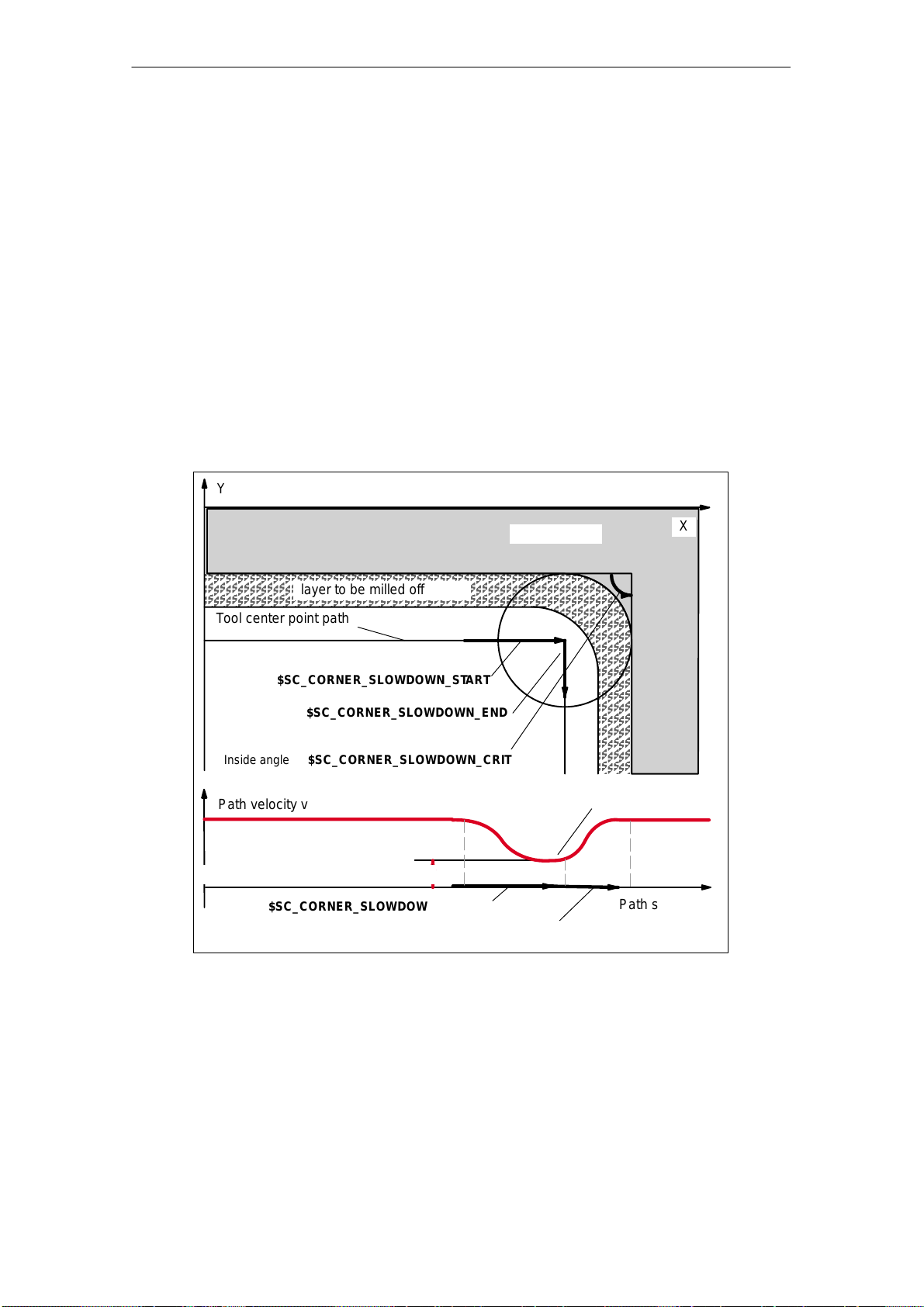
2.2.20 Automatic corner override G62
At inside corners with active tool radius compensation it is often better to reduce
the feedrate.
G62 only acts at inside corners with active tool radius compensation and active
continuous–path operation. It only takes account of corners whose inside angle
is smaller than $SC_CORNER_SLOWDOWN_CRIT. The inside angle is
determined from the bend in the contour.
The feedrate is reduced by factor $SC_CORNER_SLOWDOWN_OVR:
traveled feedrate = F * $SC_CORNER_SLOWDOWN_OVR * feedrate override.
The feedrate override is now composed of the multiplied feedrate override from
the machine control panel and the override from synchronized actions.
The feedrate reduction is started at distance
$SC_CORNER_SLOWDOWN_START before the corner. It ends at distance
$SC_CORNER_SLOWDOWN_END after the corner (see Fig. 2-6). An
appropriate path is used at curved contours.
Y
10.02
layer to be milled off
Tool center point path
$SC_CORNER_SLOWDOWN_START
$SC_CORNER_SLOWDOWN_END
Inside angle $SC_CORNER_SLOWDOWN_CRIT
Path velocity v
F
F * $SC_CORNER_SLOWDOWN_OVR
$SC_CORNER_SLOWDOWN_START
$SC_CORNER_SLOWDOWN_END
Fig. 2-6 Parameterization of feedrate reduction G62, example of a 90_ corner
Workpiece
Feedrate reduction at corners
Path s
X
2-44
The override value is set in the following setting data:Parameterization
SINUMERIK 840D/840Di/810D, Description of Functions ISO Dialects (FBFA) – 11.02 Edition
Siemens AG, 2002. All rights reserved
Page 45

10.02
2 Programming
2.2 G commands
42520: $SC_CORNER_SLOWDOWN_START
42522: $SC_CORNER_SLOWDOWN_END
42524: $SC_CORNER_SLOWDOWN_OVR
42526: $SC_CORNER_SLOWDOWN_CRIT
The setting data has default value 0.
S If $SC_CORNER_SLOWDOWN_CRIT == 0, the corner deceleration will
only take effect at reversing points.
S If $SC_CORNER_SLOWDOWN_START and
$SC_CORNER_SLOWDOWN_END are equal to 0, the feedrate reduction
will be approached with the permissible dynamic response.
S If $SC_CORNER_SLOWDOWN_OVR == 0, a brief stop will be inserted.
S $SC_CORNER_SLOWDOWN_CRIT refers to geometry axes with G62. It
defines the maximum inside angle in the current machining plane up to
which the corner deceleration will be applied. – G62 is not active on rapid
traverse.
Activation
Examples
The function is activated with G62 or G621. The G code is activated either with
the corresponding parts program command or with
$MC_GCODE_RESET_VALUES[56].
$TC_DP1[1,1]=120
$TC_DP3[1,1]=0. ;length offset vector
$TC_DP4[1,1]=0.
$TC_DP5[1,1]=0.
N1000 G0 X0 Y0 Z0 F5000 G64 SOFT
N1010 STOPRE
N1020 $SC_CORNER_SLOWDOWN_START = 5.
N1030 $SC_CORNER_SLOWDOWN_END = 8.
N1040 $SC_CORNER_SLOWDOWN_OVR = 20.
N1050 $SC_CORNER_SLOWDOWN_CRIT = 100.
N2010 G1 X00 Y30 G90 T1 D1 G64
N2020 G1 X40 Y0 G62 G41; Inside corner to N2030,
but TRC still being selected
N2030 G1 X80 Y30; Inside corner to N2040 127 degrees
N2040 G1 Y70; Inside corner to N2050 53 degrees
N2050 G1 X40 Y40; Outside corner to N2060
N2060 G1 X20 Y70; Inside corner to N2070 97 degrees
N2070 G1 X00 Y60; Inside corner to N2080 90 degrees
N2080 G1 X20 Y20; Outside corner to N2090,
irrelevant because TRC
deselection
N2090 G1 X00 Y00 G40 FENDNORM
M30
Siemens AG, 2002. All rights reserved
SINUMERIK 840D/840Di/810D, Description of Functions ISO Dialects (FBFA) – 11.02 Edition
2-45
Page 46

2 Programming
2.3 Subprogram and macro technology
2.3 Subprogram and macro technology
2.3.1 Subprogram technology: M98
10.02
Subprogram calls
SW 6 upwards Until now the number of program executions (number of repeats) has been
Subprogram calls are programmed with M98 in ISO Dialect.
For the program syntax, see Fig. 2-7.
M98 P xxxxyyyy
Program number (max. 4 digits)
Number of repetitions (max. 4 digits)
Fig. 2-7 Description of parameters allowed
The program syntax M98 Pxxxxyyyy is used to call a subprogram with the
number yyyy and repeat it xxxx times. If the xxxx is not programmed, the
subprogram is executed only once. The subprogram name always consists of 4
digits or is extended to 4 digits by adding 0’s.
For example, if M98 P21 is programmed, the parts program memory is
searched for program name 0021.spf and the subprogram is executed once. To
execute the subprogram 3 times, program M98 P30021.
programmed in ISO Dialect M/T in conjunction with the subprogram number at
address “P”.
As an alternative, the number of subprogram executions can now also be
programmed at address “L”. The number of the subprogram is still programmed
as Pxxxx. If the number of executions is programmed at both addresses, the
number of executions programmed at address “L” is valid. The number of
subprogram executions lies between 1 and 9999.
Example:
N20 M98 P20123 ;Subprogram 123.spf will be executed
; twice
N40 M98 P55 L4 ;Subprogram 55.spf will be executed
; four times
N60 M98 P30077 L2 ;Subprogram 77.spf will be executed
; twice
;The number of executions programmed
; at address “P” =3 is ignored
2-46
SINUMERIK 840D/840Di/810D, Description of Functions ISO Dialects (FBFA) – 11.02 Edition
Siemens AG, 2002. All rights reserved
Page 47

10.02
2 Programming
2.3 Subprogram and macro technology
Subprogram
termination
Subprogram return
jump with “RET”
M99 terminates the subprogram.
If M99 Pxxxx is programmed, execution resumes at block number Nxxxx on the
return jump to the main program. The block number must always begin with “N”.
The system initially searches forwards for the block number (from the
subprogram call towards the end of the program). If a matching block number is
not found, the parts program is then scanned backwards (towards the start of
the program).
If M99 appears without a block number (Pxxxx) in a subprogram, the
subprogram is terminated and the processor jumps back to the main program to
the block following the subprogram call.
If M99 appears without a block number (Pxxxx) in a main program, the
processor jumps back to the start of the main program and runs the program
again.
These M commands are not output to the PLC.
V alid only for ISO Dialect T.
In the Siemens shell cycles for stock removal (as in ISO Dialect), it is necessary
after roughing to resume program execution in the main program after the
contour definition. To achieve this, the shell cycle must contain a subprogram
return jump to the block after the end of the contour definition. The RET
command has been extended with two optional parameters for skipping the
blocks with the contour definition in the stock removal cycles after the
subprogram call (with G71–G73).
The command RET (STRING: <block number/label>) is used to resume
program execution in the calling program (main program) at the block with
<block number/label>.
If program execution is to be resumed at the next block after <block
number/label>, the 2nd parameter in the RET command must be > 0; RET (
<block number/label>, 1). If a value > 1 is programmed for the 2nd parameter,
the subprogram also jumps back to the block after the block with <block
number/label>.
In G70–G73 cycles, the contour to be machined is stored in the main program.
The extended RET command is required in order to resume execution after the
contour definition in the main program at the end of G70 (finish cut via contour
with stock removal cycle). To jump to the next NC block after the contour
definition at the end of the shell cycle for G70, the shell cycle must be
terminated with the following return syntax:
RET (“N” << $C_Q, 1)
Search direction:
The search direction for <block number/label> is always forwards first (towards
the end of the program) and then backwards (towards the start of the program).
Siemens AG, 2002. All rights reserved
SINUMERIK 840D/840Di/810D, Description of Functions ISO Dialects (FBFA) – 11.02 Edition
2-47
Page 48

2 Programming
2.3 Subprogram and macro technology
10.02
Example
N10 X10. Y20.
N20 G71 P30 Q60 U1 W1 F1000 S1500
N10 ... ;Shell cycle for stock removal cycle
N20 DEF STRING[6]BACK
N30 ...
N90
N100 RET (”N”<<$C_Q, 1) ;Return jump to block after
;contour def. -> N70
N30 X50. Z20.
N40 X60.
N50 Z55.
N60 X100. Z70.
N70 G70 P30 Q60
N80 G0 X150. Z200.
N90 M30
Note
M30 in Siemens mode: is interpreted as a return jump in a subprogram.
M30 in ISO Dialect mode: is also interpreted as the end of the parts program in
a subprogram.
2.3.2 Siemens language commands in ISO Dialect mode
Certain Siemens language commands are also required in ISO Dialect mode for
Shopmill. These commands are executed in ISO Dialect mode. They include
subprogram calls with and without passed parameters (not calls with Lxx,
because address L has a different meaning for ISO Dialect), program section
repetition and control structures. All other Siemens language commands are
denied with an alarm in ISO Dialect mode.
The following Siemens language commands can be programmed when ISO
Dialect mode is active:
REPEAT:
REPEAT <Block number> [<Block number>] [P..]
REPEAT UNTIL
REPEATB <Block number> [P..]
Only block numbers, not labels are allowed as start and end identifiers.
IF – ELSE – ENDIF
FOR – ENDFOR
WHILE – ENDWHILE
IF<Condition> – GOTO F<Condition>
CASE
2-48
SINUMERIK 840D/840Di/810D, Description of Functions ISO Dialects (FBFA) – 11.02 Edition
Siemens AG, 2002. All rights reserved
Page 49

10.02
2 Programming
2.3 Subprogram and macro technology
Modal and non–modal subprogram calls
N100 CALL “SHAFT” or
N100 MCALL SHAFT or
N100 SHAFT
Modal and non–modal subprogram call with parameter passing
N100 MCALL SHAFT (“ABC”; 33.5) or
N100 SHAFT (“ABC”; 33.5) subprogram call specifying path
N100 CALL”/_N_SPF_DIR/SHAFT or
N100 MCALL/_N_SPF_DIR/ SHAFT or
N100 PCALL/_N_SPF_DIR/SHAFT
2.3.3 Extending the subprogram call for contour preparation
with CONTPRON
In ISO Dialect, the contour definition for stock removal cycles G70 – G73 is not
stored separately in a subprogram (as in SINUMERIK), but appears in the parts
program (main program). When the cycles are called, the contour definition
section is defined by a start and end block number. The cycles receive this
block number as a passed parameter. The indirect subprogram call has been
extended for Siemens adaptation cycles.
Previously , subprograms were called indirectly with CALL <program name>.
The indirect subprogram call has been extended as follows for access to the
contour definition in the main program:
CALL [<program name>] BLOCK <start label> TO <end label>
If no program name or an empty string is specified as the program name, i.e.
CALL BLOCK <start label> TO <end label>, the search for the program section
(start/end label) is made in the program which is currently selected. The search
for the labels is also performed in the selected program with MDA, ASUB etc.
(i.e. in the case of MDA, the search for the labels is performed not in the MDA
buffer but in the program with the selected program name). Programming this
syntax directly in a main program has the same effect as repeating a program
section in a loop with REPEAT <start label> <end label>, i.e. the search for the
start and end label is performed in the program containing the CALL BLOCK ...
command.
If a program name is specified, e.g. CALL <progName> BLOCK <start label>
TO <end label>, the system searches for the program section (surrounded by
the start/end label) in subprogram “progName”.
Example
Siemens AG, 2002. All rights reserved
SINUMERIK 840D/840Di/810D, Description of Functions ISO Dialects (FBFA) – 11.02 Edition
Nxx G71 Pxx Q1110 U.. W.. ;ISO Dialect G function calls
; shell cycle CYCLE395.spf
; _N_CYCLE395_SPF
N10 .......
.......
Nxxx CYCLE95(....., “N”<<$C_P, “N”<<$C_Q)
; Stock removal cycle with additional
; parameters for start and end label
2-49
Page 50

2 Programming
2.3 Subprogram and macro technology
STRING[20]
N10 ........
.........
Nxxx .....
Nxxx RET (”N”<<$C_Q, 1) ;Return jump to the next block after
N1120 ....
Nxxx M30
10.02
PROC CYCLE95(....., STRING[20] startlab,
endelab)
Nxxx CONTPRON(...)
N.... CALL “” BLOCK startlab TO endelab
;Read contour definition or
N.... CALL BLOCK startlab TO endelab
;call the contour program
EXECUTE(...)
........
Nxx M17
; the contour definition
Search for
start block number
Note
The actual CONTPRON and EXECUTE calls do not have to be modified.
The start block number (start label) of the contour definition is always searched
first toward the end of the program (forward) and then toward the start of the
program (backward).
If the same block number is programmed more than once, the next block
number (label) after the current block in the program in which the contour
definition is contained, is recognized as the start of the contour definition (see
example). The current block is usually the block in which the stock removal
cycle (shell cycle) was called in the main program.
Example
In stock removal cycle CYCLE395, the contour definition which appears
between blocks N10–N30 in the main program is to be used (with CALL BLOCK
N10 TO N30 in CYCLE395). N40 is the current program line in the main
program.
The contour definition block is printed in bold lettering in the example.
N10 X10. Y20.
N20 X30.
N30 Y10.
N40 G71 P10 Q30... ;Call shell cycle for stock removal cycle
... ; (In the stock removal cycle
... ; “CALL BLOCK N10 TO N30” is programmed)
... ; The contour definition is found in the
; lines printed in bold
2-50
SINUMERIK 840D/840Di/810D, Description of Functions ISO Dialects (FBFA) – 11.02 Edition
Siemens AG, 2002. All rights reserved
Page 51

10.02
2.3 Subprogram and macro technology
N50 G90 G54
N60 F1000 G94
N10 X50. Y10.
N20 X33. Y11.
N30 X10.
N50 ....
N.. .....
N800 G71 P10 Q30 ;Call shell cycle for stock removal cycle
... ; (In the stock removal cycle, “CALL BLOCK N10 TO
; N30” is programmed)
... ; The contour definition is found in
... ; the lines printed in italics
N999 ....
N10 X15.
N20 Y25.
N30 X33.
N1010 ....
N1020 .....
2.3.4 Macro commands with G65, G66 and G67
2 Programming
ISO Dialect
Siemens
In ISO Dialect mode, macros are called in the parts program with G65 Pxx, G66
Pxx. A macro is a set of parts program blocks that are terminated with M17.
When the subprogram is called, the mode is switched from ISO mode to
Siemens mode.
The following commands are used for selection and deselection:
S G65 Macro call, non-modal
S G66 Macro call, modal
S G67 Deselect modal macro call
G commands G65 Pxx and G66 Pxx are used to start macro xx. G65 calls
subprogram Pxx once. G66 activates the Pxx subprogram call modally, and the
subprogram is then executed in every block containing axis movements (same
as MCALL xx). G67 deactivates the modal subprogram call again (equivalent to
G80 for cycle calls).
In a parts program block with G65 or G66, the address Pxx is interpreted as the
program number of the subprogram containing the macro functionality. Address
Lxx can be used to define the number of passes of the macro. If a number of
passes is not programmed in the calling block, the macro is executed once. All
further addresses in this parts program block are interpreted (as in ISO Dialect
“Macro B”) as passed parameters, and their programmed values are saved in
system variables $C_A–$C_Z. These system variables can be read in the
subprograms and evaluated for the macro functionality. If further macros are
called with parameters within a macro (subprogram), the passed parameters
must be saved in internal variables in the subprogram before the new macro
call.
Siemens AG, 2002. All rights reserved
SINUMERIK 840D/840Di/810D, Description of Functions ISO Dialects (FBFA) – 11.02 Edition
2-51
Page 52

2 Programming
2.3 Subprogram and macro technology
As in the case of the machining cycles, the language mode is switched implicitly
to Siemens mode to allow the definition of internal variables. Therefore, if a
further macro call appears in the subprogram, ISO Dialect mode must be
selected again first.
10.02
System variables
for the addresses
I, J, K
Because addresses I, J, and K can be programmed up to ten times in a block
by macro call, an array index must be used to access the system variables for
these addresses. The syntax for these three system variables is then $C_I[..],
$C_J[..], $C_K[..]. The values are stored in the array in the order programmed.
The number of addresses I, J, K programmed in the block is stored in variables
$C_I_NUM, $C_J_NUM, $C_K_NUM.
The passed parameters I, J, K for macro calls are treated as one block, even if
individual addresses are not programmed. If a parameter is programmed again
or a following parameter has been programmed with reference to the sequence
I, J, K, it belongs to the next block.
To recognize the programming sequence in ISO mode, system variables
$C_I_ORDER, $C_J_ORDER, $C_K_ORDER are set. These are identical
arrays to $C_I, $C_K and contain the associated number of parameters.
Example:
N5 I10 J10 K30 J22 K55 I44 K33
set1 set2 set3
$C_I[0]=10
$C_I[1]=44
$C_I_ORDER[0]=1
$C_I_ORDER[1]=3
$C_J[0]=10
$C_J[1]=22
$C_J_ORDER[0]=1
$C_J_ORDER[1]=2
Cycle parameter
$C_x_PROG
$C_K[0]=30
$C_K[1]=55
$C_K[2]=33
$C_K_ORDER[0]=1
$C_K_ORDER[1]=2
$C_K_ORDER[2]=3
In ISO dialect 0 mode, the programmed values can be evaluated differently
depending on the programming method (integer or real value). The different
evaluation is activated via machine data.
If the MD is set, the control will behave as in the following example:
X100. ;X axis is traveled 100 mm (100. with point => real value
Y200 ;Y axis is traveled 0.2 mm (200 without point => integer value
If the addresses programmed in the block are passed as parameters for cycles,
the programmed values are always real values in the $C_x variables. In the
case of integer values, the cycles do not indicate the programming method
(real/integer) and therefore no evaluation of the programmed value with the
correct conversion factor.
2-52
SINUMERIK 840D/840Di/810D, Description of Functions ISO Dialects (FBFA) – 11.02 Edition
Siemens AG, 2002. All rights reserved
Page 53

10.02
2 Programming
2.3 Subprogram and macro technology
To indicate whether REAL or INTEGER has been programmed, there is the
system variable $C_TYP_PROG. $C_TYP_PROG has the same structure as
$C_ALL_PROG and $C_INC_PROG. For each address (A–Z) there is one bit.
If the value is programmed as an INTEGER, the bit is set to 0, for REAL it is set
to 1. If the value is programmed in variable $<number>, bit 2 = 1 is set.
Example:
M98 A100. X100 –> $C_TYP_PROG == 1.
Only bit 0 is set because only A is programmed as a REAL.
M98 A100. C20. X100 –> $C_TYP_PROG == 5.
Only bits 1 and 3 are set (A and C).
Restrictions:
Up to ten I, J, K parameters can be programmed in each block. Variable
$C_TYP_PROG only contains one bit each for I, J, K. For that reason bit 2 is
always set to 0 for I, J, and K in $C_TYP_PROG. It is therefore not possible to
ascertain whether I, J or K have been programmed as REAL or INTEGER.
Parameters P, L, O, N can only be programmed as integers. A real value
generates an NC alarm. For that reason the bit in $C_TYP_PROG is always 0.
Modal macro calls
With modal macro calls, the programmed addresses are only copied into the
system variables in the block containing the call (block with G66). The macro is
then executed in every block with an axis movement until it is deselected by
G67 or a new macro call is programmed with G66. Only the macro parameters
are passed in the block containing the call (= block with G66) for modal macros.
The macro is executed for the first time in the next block containing an axis
movement. (Same procedure as MCALL xx in Siemens mode)
Example of a macro call:
_N_M10_MPF:
N10 M3 S1000 F1000
N20 X100. Y50. Z33.
N30 G65 P10 F55 X150. Y100. S2000
N40 X50.
N50 ....
N200 M30
Example of a subprogram as macro in Siemens mode:
_N_10_SPF:
N10 DEF REAL X_AXIS, Y_AXIS, SPEED, FEEDRATE
N15 X_AXIS = $C_X Y_AXIS = $C_Y SPEED = $C_S FEEDRATE = $C_F
N20 G01 F=FEEDRATE G95 S=SPEED
...
M17
Siemens AG, 2002. All rights reserved
SINUMERIK 840D/840Di/810D, Description of Functions ISO Dialects (FBFA) – 11.02 Edition
2-53
Page 54

2 Programming
2.3 Subprogram and macro technology
2.3.5 Mode changing in macro calls with G65 / G66
Until now, automatic switchover to Siemens mode was performed for macro
calls with G65/G66.
The user now has the choice whether switchover to Siemens mode takes place
when the macro starts or not. Switchover to Siemens mode only takes place
when the PROC<program name> instruction is used in the first line of the macro
program. If this instruction is missing, ISO mode will remain active during
execution of the macro program.
The user can therefore decide whether to create local variables (with DEF...) for
the purpose of storing transfer variables. It is necessary to switch to Siemens
mode to do this using the PROC instruction. The user can also specify that the
macro program (e.g. an existing ISO Dialect M/T macro) is executed in ISO
mode.
Example of a macro call:
_N_M10_MPF:
N10 M3 S1000 F1000
N20 X100. Y50. Z33.
N30 G65 P10 F55 X150. Y100. S2000
N40 X50.
N50....
N200 M30
Example of a subprogram as macro in Siemens mode:
_N_0010_SPF:
PROC 0010 ;Switchover to Siemens mode
N10 DEF REAL X_AXIS, Y_AXIS, SPEED, FEEDRATE
N15 X_AXIS=$C_X Y_AXIS=$C_Y SPEED=$C_S FEEDRATE=$C_F
N20 G01 F=FEEDRATE G95 S=SPEED
....
N80 M17
Example of a subprogram as macro in ISO mode:
_N_0010_SPF:
G290 ;Switchover to Siemens mode
;If transfer variables have to be read
N15 X_AXIS=$C_X Y_AXIS=$C_Y SPEED=$C_S
N20 G01 F=$C_F G95 S=$C_S
N10 G1 X=$C_X Y=$C_Y
G291 ;switch to ISO mode
N15 M3 G54 T1
N20
....
N80 M99
10.02
2-54
SINUMERIK 840D/840Di/810D, Description of Functions ISO Dialects (FBFA) – 11.02 Edition
Siemens AG, 2002. All rights reserved
Page 55

10.02
2.3.6 Macro call with M function
A macro can be called using M numbers in the same way as G65 (see 2.3.5).
10 M function substitutions are configured with machine data
$MN_EXTERN_M_NO_MAC_CYCLE and
$MN_EXTERN_M_NO_MAC_CYCLE_NAME.
Parameter transfer is executed in exactly the same way as with G65.
Repetitions can be programmed with address L.
2 Programming
2.3 Subprogram and macro technology
Restrictions
Configuration
examples
Only one M function substitution (and/or only one subprogram call) can be
executed in each line of a parts program. Conflicts with other subprogram calls
are output with alarm 12722. No further M function substitutions are made in the
replaced subprogram.
Otherwise, the same restrictions apply as for G65
Conflicts with predefined and other defined M numbers are rejected with an
alarm.
Subprogram M101_MACRO call with M function M101
$MN_EXTERN_M_NO_MAC_CYCLE[0] = 101
$MN_EXTERN_M_NO_MAC_CYCLE_NAME[0] = “M101_MACRO”
Subprogram M6_MAKRO call with M function M6.
$MN_EXTERN_M_NO_MAC_CYCLE[1] = 6
$MN_EXTERN_M_NO_MAC_CYCLE_NAME[1] = “M6_MACRO”
Programming example for tool change with M function:
PROC MAIN
...
N10 M6 X10 V20
...
N90 M30
PROC M6_MACRO
...
N0010 R10 = R10 + 11.11
N0020 IF $C_X_PROG == 1 GOTOF N40
display($C_X_PROG)
N0030 SETAL(61000) ;programmed variable incorrectly
;transferred
N0040 IF $C_V == 20 GTOF N60
display($C_V)
N0050 SETAL(61001)
N0060 M17
Siemens AG, 2002. All rights reserved
SINUMERIK 840D/840Di/810D, Description of Functions ISO Dialects (FBFA) – 11.02 Edition
2-55
Page 56

2 Programming
2.3 Subprogram and macro technology
2.3.7 Macro call with G function
A macro can be called using G numbers in the same way as G65 (see 2.3.5).
50 G function substitutions are configured with machine data
$MN_EXTERN_G_NO_MAC_CYCLE and
$MN_EXTERN_G_NO_MAC_CYCLE_NAME.
The parameters programmed in the block are saved in the $C_ variables.
Address L is used to define the number of times a macro is repeated. The
number of the programmed G_macro is stored in variable $C_G. All other G
functions programmed in the block are treated like normal G functions. The
sequence in which addresses and G functions are programmed in the block is
irrelevant and has no effect on the functionality.
All ISO G codes, even G codes with a decimal point (= real value) can be
replaced by a macro call.
G functions that are replaced by a macro do not exist in the control and can be
redefined with $MN_NC_USER_EXTERN_GCODES_TAB[ ].
10.02
Restrictions
Configuration
examples
Only one G/M function substitution (and/or only one subprogram call) can be
executed in each line of a parts program. Conflicts with other subprogram calls,
e.g. when a modal subprogram call is active, are signaled with alarm 12722.
If a G macro is active no more G/M macros or M subprograms are called. M
macros/subprograms are then executed as M functions, and G macros as G
functions if the relevant G function exists. Otherwise alarm 12470 is output.
Otherwise, the same restrictions apply as for G65
Subprogram G21_MAKRO call with G function G21
$MN_EXTERN_G_NO_MAC_CYCLE[0] = 21
$MN_EXTERN_G_NO_MAC_CYCLE_NAME[0] = “G21_MACRO”
$MN_EXTERN_G_NO_MAC_CYCLE[1] = 123
$MN_EXTERN_G_NO_MAC_CYCLE_NAME[1] = “G123_MACRO”
$MN_EXTERN_G_NO_MAC_CYCLE[2] = 421
$MN_EXTERN_G_NO_MAC_CYCLE_NAME[2] = “G123_MACRO”
Programming example:
PROC MAIN
...
N0090 G291 ;ISO mode
N0100 G1 G21 X10 V20 F1000 G90 ;G21_MACRO.spf, G1, and
;G90 calls activated
;before G21_MACRO.spf
;is called
...
N0500 G90 X20 Y30 G123 G1 G54 ;G123_MACRO.spf, G1,
;G54, and G90 calls
;activated before
:G123_MACRO.spf
;is called
2-56
SINUMERIK 840D/840Di/810D, Description of Functions ISO Dialects (FBFA) – 11.02 Edition
Siemens AG, 2002. All rights reserved
Page 57

10.02
2 Programming
2.3 Subprogram and macro technology
...
N0800 G90 X20 Y30 G421 G1 G54 ;G421_MACRO.spf, G1,
;G54, and G90 calls
;activated before
;G123_MACRO.spf is called
...
N0900 M30
PROC G21_MACRO
...
N0010 R10 = R10 + 11.11
N0020 IF $C_X_PROG == 0
N0030 SETAL(61000) ;programmed variable incorrectly
;transferred
N0040 ENDIF
N0050 IF $C_V_PROG == 0
N0060 SETAL(61001)
N0070 ENDIF
N0080 IF $C_F_PROG == 0
N0090 SETAL(61002
N0100 ENDIF
N0110 G90 X=$C_X V=$C_V
N0120 G291
N0130 G21 M6 X100 ;G21–>activates metric system of
;units (no macro call)
N0140 G290
...
N0150 M17
PROC G123_MACRO
...
N0010 R10 = R10 + 11.11
N0020 IF $C_G == 421 GOTOF label_G421
;macro functionality for G123
N0040 G91 X=$C_X Y=$C_Y F500
...
...
N1990 GOTOF label_end
N2000 label_G421: ;macro functionality for G421
N2010 G90 X=$C_X Y=$C_Y F1000
N2020
...
...
N3000 G291
N2010 G123 ;alarm 12470 because G123 is not a G function
;and a macro cannot be called when a macro is
;active. Exception: the macro was called as
;a subprogram with CALL G123_MACRO.
N4000 label_end: G290
N4010 M17
Siemens AG, 2002. All rights reserved
SINUMERIK 840D/840Di/810D, Description of Functions ISO Dialects (FBFA) – 11.02 Edition
2-57
Page 58

2 Programming
2.3 Subprogram and macro technology
2.3.8 High-speed cycle cutting G05 P..
G05 P.. high-speed cycle cutting takes the form of a subprogram call.
Programming G05 P.. L..
Pxxxxx Subprogram number, max. 10 characters
When called it is not necessary to fill with zeros as is the case
with M98.
Lxxxx Number of passes. If L is not programmed, L1 is assumed.
Example:
G05 P10123 L3 10123.mpf is passed through three times.
This call can be used to fetch any subprogam. This subprogam can be a
precompiled program, but does not have to be. However, only a Siemens parts
program can be precompiled.
There is not equivalent of ISO Dialect function G05 in Siemens mode.
CYCLE305 enables users to program their own functionality in the context of
the Siemens functionality.
CYCLE305.spf is called when programming G05 in the following cases:
10.02
S G05 without P in the block is skipped without an alarm.
S G05.1 with and without P is skipped without an alarm.
S G05 P0 or P01 are reserved for high-speed remote buffer B. This function is
not supported.
In the cases mentioned, all addresses programmed in the block are defined in
cycle parameter $C_xx. When CYCLE305 is called there is no automatic
change of mode from ISO to Siemens. If it is intended to process
CYCLE305.spf in Siemens mode, the first program line must contain a PROC
instruction as in the case of macro calls with G65/G66.
All functions programmed in the block are executed, as previously mentioned in
the case of programming G05, that is to say, programmed axes are traversed,
auxiliary functions are produced, etc. The programmed addresses are defined
in the cycle parameters only for the purpose of supplementary information.
If G05 and a subprogram call (M98 P..) are programmed in the same block,
alarm 12722 is produced.
2-58
SINUMERIK 840D/840Di/810D, Description of Functions ISO Dialects (FBFA) – 11.02 Edition
Siemens AG, 2002. All rights reserved
Page 59

10.02
2.3 Subprogram and macro technology
2.3.9 Switchover modes for DryRun and skip levels
Switching over the skip levels (DB21 DBB2) always meant intervening in the
program run which until now resulted in a momentary drop in velocity along the
path. The same applies when the dry run mode DryRunOff (DryRun = dry-run
feedrate DB21.DBB0.BIT6) it switched to DryRunOn and vice versa.
This drop in voltage can now be avoided with a new switchover mode which
has a restricted functionality.
With machine data assignment $MN_SLASH_MASK==2 a drop in voltage is
no longer necessary when switching skip levels (i.e. a new value in
PLC–>NCK–Chan interface DB21.DBB2).
Note
The NCK processes blocks in two stages, preliminary or preprocessing and
main processing. The result of preprocessing is put into the preprocessing
memory. The main processing stage takes the oldest block from the
prepro-cessing memory and traverses its geometry.
2 Programming
Achtung
With machine data assignment $MN_SLASH_MASK==2, preprocessing is
switched over when the skip levels are switched! All blocks in the preprocessing memory are executed with the old skip level. As a rule, the user has no
influence over the level of the preprocessing memory. The user observes the
following: The new skip level can take effect at any time after switchover!
Note
The parts program command STOPRE empties the preprocessing memory. If
the skip level is switched over before STOPRE, it is certain that all blocks after
STOPRE will be switched over . The same applies to an implicit STOPRE.
Switching over DryRun mode results in the same restrictions.
With machine data assignment $MN_DRYRUN_MASK==2 no drop in velocity is
necessary when DryRun mode is changed. However, here too, only preprocessing is switched over, which results in the above restrictions. Analogously
the following applies: Caution DryRun mode can become active any time
after switchover!
Siemens AG, 2002. All rights reserved
SINUMERIK 840D/840Di/810D, Description of Functions ISO Dialects (FBFA) – 11.02 Edition
2-59
Page 60

2 Programming
2.3 Subprogram and macro technology
2.3.10 Eight–digit program numbers
Eight–digit program number selection is activated with machine data
$MC_EXTERN_FUNCTION_MASK, bit6=1. This function has an effect on M98
(see Chapter 2.3.1), G65/66 (see Chapter 2.3.5), and M96 see Chapter 2.2.13).
y: Number of program runs
x: Program number
10.02
Subprogram call
M98
Modal and
block–by–block
macro G65/G66
$MC_EXTERN_FUNCTION_MASK, bit6 = 0
M98 Pyyyyxxxx or
M98 Pxxxx Lyyyy
program number max. four digits
Extension of program number always to four digits with 0
E.g.: M98 P20012 calls 0012.mpf 2 passes
M98 P123 L2 calls 0123.mpf 2 passes
$MC_EXTERN_FUNCTION_MASK, bit6 = 1
M98 Pxxxxxxxx Lyyyy
No extension with 0 even if the program number is less than four digits long.
It is not possible to program the number of passes and program number in P
(Pyyyyxxxxx),
the number of passes must always be programmed with L!
E.g.: M98 P123 calls 123.mpf 1 pass
M98 P20012 calls 20012.mpf 1 pass,
Caution: This is no longer compatible with the ISO dialect
original
M98 P12345 L2 calls 12345.mpf 2 passes
$MC_EXTERN_FUNCTION_MASK, bit6 = 0
G65 Pxxxx Lyyyy
Extension of program number always to four digits with 0. Program number with
more than four digits triggers an alarm.
$MC_EXTERN_FUNCTION_MASK, bit6 = 1
G65 Pxxxxxxxx Lyyyy
No extension with 0 even if the program number is less than four digits long.
Program number with more than eight digits triggers an alarm.
Interrupt M96
2-60
$MC_EXTERN_FUNCTION_MASK, bit6 = 0
M96 Pxxxx
Extension of program number always to four digits with 0.
$MC_EXTERN_FUNCTION_MASK, bit6 = 1
M96 Pxxxx
No extension with 0 even if the program number is less than four digits long.
Program number with more than eight digits triggers an alarm.
SINUMERIK 840D/840Di/810D, Description of Functions ISO Dialects (FBFA) – 11.02 Edition
Siemens AG, 2002. All rights reserved
Page 61
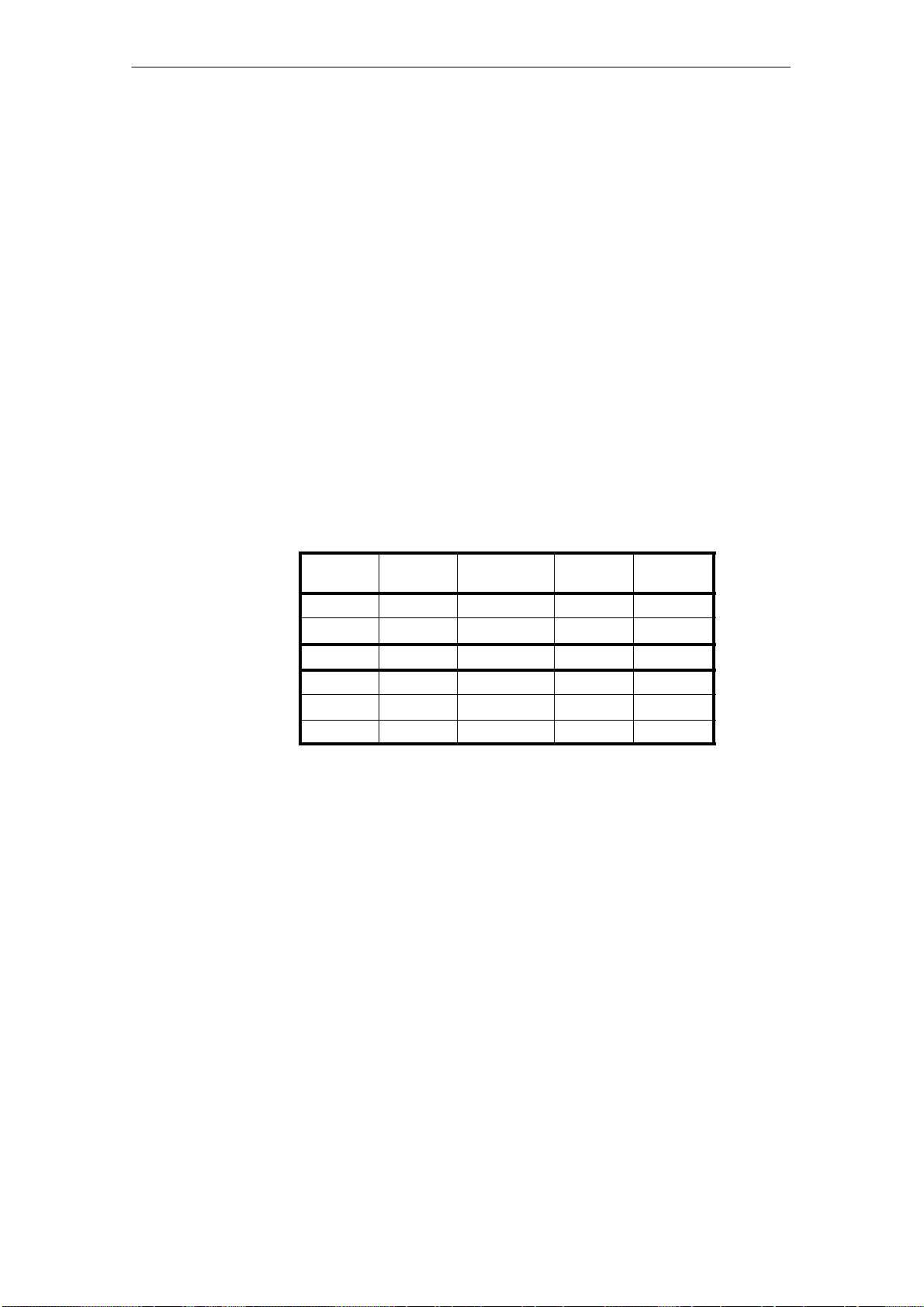
10.02
2.4 Tool change and tool offsets
2.4.1 Tool offsets: T, D, M (ISO Dialect M)
2 Programming
2.4 Tool change and tool offsets
Tool data
T/D number
H number
As Siemens and ISO dialect programs are intended to run alternately in the
control they must be implemented with the Siemens tool data memory.
In each offset memory that exists for a tool, the length, geometry and wear in
each case are specified.
In Siemens mode, the offset memory is addressed with T (tool number) and D
(cutting edge number), or T/D number for short.
In ISO Dialect M programs, the offset memory is addressed with D (radius) or H
(length). This is referred to below as the H number.
In order to establish a unique assignment between this H number and a T/D
number, an element $TC_DPH[t,d] has been added to the offset data set. The H
number of the ISO Dialect is entered in this element.
Table 2-6 Example: Tool offset data set
T D/cutting
edge
1 1 10
1 2 11
1 3 12 100.00 250.00
2 1 13
2 2 14
2 3 15
H number
$TC_DPH
Radius Length
Example:
Siemens program ISO Dialect program
N5 T1 N5 T1
N10 G41 D3 N10 G41 H12 or G41 D12
When the H value is programmed in the ISO dialect M program, the system
searches for and activates the matching $TC_DPH in the active T after the
correction block.
If the correction block does not contain an H number, the compensation cannot
be activated in ISO Dialect mode.
If an H is programmed but a correction block with the corresponding H number
is not found or the associated tool T is not selected, an alarm is output.
Siemens AG, 2002. All rights reserved
SINUMERIK 840D/840Di/810D, Description of Functions ISO Dialects (FBFA) – 11.02 Edition
2-61
Page 62
2 Programming
2.4 Tool change and tool offsets
2.4.2 Possible H numbers
10.02
H = 0
H = eindeutig
Changing the
offset memory
All data of the tool edges with H number 0 are not linked. Every tool edge has
its own parameters.
An H number in a TO-Einheit must exist only once otherwise clear addressing of
the compensation block is not possible. In case an H number has been allocated for a second time, alarm ”17183 channel %1 block %2 H number already
exists in T= %3 with D=%4” is given when writing from the program,. The alarm
is compensation block compatible with NC Start clear.
Example:
N5 $TC_DPH[1,1] = 5
N10 $TC_DPH[2,1] = 5
An attempt to allocate an H number twice via OPI (HMI, PLC) will lead to a ne-
gative acknowledgement when writing.
Existing tool offsets can be overwritten with G10. New tool offsets are not
created by G10.
Tool length compensation, geometry: G10 L10 Pxx Ryy
Tool length compensation, wear: G10 L11 Pxx Ryy
Tool radius compensation, geometry: G10 L12 Pxx Ryy
Tool radius compensation, wear: G10 L13 Pxx Ryy
P specifies the H number of the compensation memory and R specifies the
value.
L1 can be programmed instead of L11.
Active plane
Selecting the tool
length
Setting data $SC_TOOL_LENGTH_CONST must be assigned value 17 if the
assignment of tool length offsets to geometry axes is to be independent of plane
selection. Length 1 is then always assigned to the Z axis.
The tool length and the tool radius are always programmed with D or H.
Example:
T D/cutting
edge
2 3 4 10 15
ISO Dialect M:
T2
G43 H4 or D4 ;Length selection
G42 D4 or H4 ;Radius selection
The offset value must be entered twice for ISO Dialect M programs which are
programmed with different D and H numbers.
Example:
H number
$TC_DPH
Radius Length
2-62
SINUMERIK 840D/840Di/810D, Description of Functions ISO Dialects (FBFA) – 11.02 Edition
Siemens AG, 2002. All rights reserved
Page 63

10.02
2 Programming
2.4 Tool change and tool offsets
T D/cutting
edge
2 3 4 10 15
2 4 5 10 15
H number
$TC_DPH
Radius Length
ISO Dialect M:
T2
G43 H4 ;Length offset from T2 D3
G42 D5 ;Radius and length offset from T2 D4
Flat D number
If flat D numbers are active, the T is programmed independently of the H
number. The H number is no longer checked for compatibility with the selected
tool.
An H number must be assigned to every offset memory, even with flat D
numbers.
Tool management If tool management is active, replacement tools have the same H number.
Duplo numbers are used in order to differentiate.
Offset D1 is activated for the currently selected tool on H99 with active tool
management.
In ISO Dialect M, only numerical expressions are permitted as tool identifiers.
Strings are no longer permitted as identifiers.
Example: T = “2”, selection with T2.
Siemens AG, 2002. All rights reserved
SINUMERIK 840D/840Di/810D, Description of Functions ISO Dialects (FBFA) – 11.02 Edition
2-63
Page 64

2 Programming
2.4 Tool change and tool offsets
10.02
Tool length
compensation in
multiple axes
Example Tool selection in ISO Dialect M:
Tool length offsets can be activated on multiple axes. However, the resulting tool
length compensation cannot be displayed.
The Siemens T and D numbers appear in the display for active T and D
numbers.
New OPI variables which can be displayed are available for the active ISO
Dialect H and D number.
Machine data 22220 $MC_AUXFU_T_SYNC_TYPE is used to define whether
the output to PLC takes place during or after the movement.
Machine data 20110 $MC_RESET_MODE_MASK, bit 6 can be used to activate
tool length compensation beyond a reset.
; (Fanuc 0 M tool offset with T, cutting edge number
; (the offsets are written)
; (with G10)
G290
; Tool offset memory T2 cutting edge 1:
N5000 $TC_DP1[2,1]=10 ;type
N5000 $ TC_DP1[2,1]=7 ;ISO H number
; Tool offset memory T3 cutting edge 2:
N5000 $TC_DP1[3,2]=10 ;type
N5000 $TC_DP1[3,2]=3 ;ISO H number
; Tool offset memory T4 cutting edge 3:
N5000 $TC_DP1[4,3]=10 ;type
N5000 $TC_DP1[4,3]=8 ;ISO H number
G291
;write tools offsets
;-–––––––––––––––––––––––
;T2 cutting edge 1 also writes T4 cutting edge 3, because
also H7
G10 L10 P7 R10
G10 L12 P7 R5
; T3 cutting edge 2
G10 L10 P3 R15
G10 L12 P3 R10
N8 G01 G40 F5000 X0 Y0 Z0
N10 X50.
N15 50
N17 Z10.
N20 X0
N25 Y0
N30 X–10 Y-10
N30 T2 ;Tool 2
N33 G43 H7 Z0 ;H number 7
N35 G41 X0 Y0 Z0 D7
N40 X50.
N45 Y50.
2-64
SINUMERIK 840D/840Di/810D, Description of Functions ISO Dialects (FBFA) – 11.02 Edition
Siemens AG, 2002. All rights reserved
Page 65

10.02
2 Programming
2.4 Tool change and tool offsets
N48 Z10.
N50 X0
N55 Y0
N60 G40 X-10 Y-10
N65 T3
N68 G43 H3 Z0
N70 G42 X0 Y0 Z0 D3
N75 X50.
N77 Y50.
N78 Z10.
N80 X0
N85 Y0
N90 G40 X-10 Y-10
N95 T4
N98 G43 H8 Z0
N100 G41 X0 Y0 Z0 D8
N105 X50.
N110 Y50.
N112 Z10.
N115 X0
N120 Y0
N125 G40 X-10 Y-10
M30
Machine data 20382 $MC_TOOL_CORR_MOVE_MODE defines whether the
compensation is applied in the block containing the selection or the next time
the axis is programmed.
2.4.3 Tool offset: T (ISO Dialect T)
The tool data are stored in the Siemens tool data memory.
Each tool consists of four entries, one each for the X and Z axes, radius and
tool point direction. The range of values for length and radius compensation is
999.999mm. The value range 0–9 is used for the tool point direction, where 0
and 9 are identical.
The meaning is equivalent to the tool point direction on Siemens turning tools.
You can use either flat D numbers or the conventional tool compensation
memory management.
Tool management can also be used.
Selection is made by means of T, whereby T contains the tool number and the
cutting edge number. The H number of ISO Dialect M does not exist.
Txxxxyyyy: xxxx = tool number, yyyy = cutting edge number
Machine data 10890 $MN_EXTERN_TOOLPROG_MODE, bit 0 is used to
define how the T value is interpreted.
Machine data 10888 $MN_EXTERN_DIGITS_TOOL_NO is used to specify the
number of digits for the tool number. The digit positions are counted from the
left. Subsequent digits specify the offset number.
If bit 0=1 in MD 10890, the cutting edge number is set equal to the tool number.
Example:
Siemens AG, 2002. All rights reserved
SINUMERIK 840D/840Di/810D, Description of Functions ISO Dialects (FBFA) – 11.02 Edition
2-65
Page 66

2 Programming
2.4 Tool change and tool offsets
$MN_EXTERN_TOOLPROG_MODE=0
$MN_EXTERN_DIGITS_TOOL_NO=2
T1234 ;Auxiliary function T1234 to PLC
T123 ;Auxiliary function T123 to PLC
$MN_EXTERN_TOOLPROG_MODE, bit 0=1
T12 ;Auxiliary function T12 to PLC
Machine data 20382 $MC_TOOL_CORR_MOVE_MODE defines when the
compensation is applied: In the block containing the selection or the next time
the axis is programmed.
MD 20110 $MC_RESET_MODE_MASK, bit 6 determines whether or not the
tool compensation remains active after a reset.
MD 20360 $MC_TOOL_PARAMETER_DEF_MASK, bit 0 can be used to define
that the wear value of the transverse axis is calculated as a diameter value. The
geometry offset is always interpreted as a radius value.
10.02
;Tool number 12
;Offset selection D34
;Tool number 12
;Offset selection D3
;Tool number 12
;Offset selection 12
Example Tool selection in ISO Dialect T:
G290
N5000 ;Definition of the tool offset memory D1:
N5000 $TC_DP1[1,1]=10 ;Type
N5000 $TC_DP2[1,1]=9 ;Tool point direction
N5000 $TC_DP6[1,1]=5 ;Radius
N5000 ;Definition of the tool offset memory D2:
N5000 $TC_DP1[2,1]=10 ;Type
N5000 $TC_DP2[2,1]=1 ;Tool point direction
N5000 $TC_DP6[2,1]=5 ;Radius
G291
;Write tool offset data
N3 G10 P1 X10 Z20 Y30
N5 G10 P2 X20 Y20 Z100
N10 G00 G18 X0 Y0 Z0
N10 T0101 ;Tool 1, cutting edge 1
N15 G00 X10 Y10 Z10
N20 T0201 ;Tool 1, cutting edge 1
N25 G00 X10 Y10 Z10
...
M30
Changing the
offset memory
2-66
Existing tool offsets can be overwritten with G10. New tool offsets are not
created by G10.
G10 P<100 / 10000 X Y R Q Geometry
G10 P>100 / 10000 X Y R Q Wear
SINUMERIK 840D/840Di/810D, Description of Functions ISO Dialects (FBFA) – 11.02 Edition
Siemens AG, 2002. All rights reserved
Page 67

04.00
10.02
P100 / 10000 ;MD EXTERN_FUNCTION_MASK, bit 1 is used to select
X Y Z ;Offset values absolute or incremental, depending on
U V W ;Incremental offset values
R ;Radius
Q ;Tool point direction
2.4.4 Tool-changing cycle
2 Programming
2.4 Tool change and tool offsets
;whether with P<100 or 10000 geometry or wear
;is applicable.
;G90/91
ISO Dialect mode
MD 10717 T_NO_FCT_CYCLE_NAME is used to assign a subprogram to the T
command. Every block that contains a T command is executed and the
subprogram is subsequently called up. The T value is not output; the T
command must be programmed again in the cycle.
System variable $C_T_PROG or $C_D_PROG can be used in the subprogram
to check whether the T or D command was programmed. The values can be
read out with system variable $C_T or $C_D. If another T command is
programmed in the subprogram, no substitution takes place, but the T word is
output to the PLC.
Siemens AG, 2002. All rights reserved
SINUMERIK 840D/840Di/810D, Description of Functions ISO Dialects (FBFA) – 11.02 Edition
2-67
Page 68

2 Programming
2.4 Tool change and tool offsets
The machine data 10715 M_NO_FCT_CYCLE and 10716
M_NO_FCT_CYCLE_NAME can be used to assign a subprogram to an
M function (e.g. M06).
The mapping of M and T programming onto cycle calls has the same effect in
ISO Dialect mode as in Siemens mode.
If T and M6 are programmed in the same block, the programmed T number can
be scanned with $P_TOOL in the cycle called by M6. The M/T call is also
mapped onto the cycle call in the block search. The start of the change cycle
after the end of the search run must be initiated by the PLC.
Sequence:
N20 T1234
N30 M6 ;Change tool
N40 H3 G43 ;Activate tool length compensation in T1234
N50 T333 ;Tool preselection
N60 G1 X10 ;Offset T1234 is active
N70 M6 ;Load tool 333, D0 H0 active
N80 H4 ;Activate new tool length compensation
N90 .....
10.02
J
2-68
SINUMERIK 840D/840Di/810D, Description of Functions ISO Dialects (FBFA) – 11.02 Edition
Siemens AG, 2002. All rights reserved
Page 69
Cycles and Contour Definition
3.1 Calling cycles in the external CNC system using G
commands
3
General
description
Cycle parameters
Procedure for
cycle call via
G command
The functionality of the ISO Dialect cycles is implemented in the standard
Siemens cycles:
A shell cycle is called from the ISO Dialect program. All addresses programmed
in the block are passed to this shell cycle in the form of system variables. The
shell cycle matches the data to the standard Siemens cycle and calls it by
name.
Machine manufacturers can replace these shell cycles with their own cycles.
Various cycle parameters in channel-specific GUD (Global User Data) must be
initialized for the machining cycles. The names and meanings of the GUD are
listed in Section 3.2.
Part program
e.g. ISO Dialect
N10 G...
N20 X.. Y..
N30 ...
N40 ...
(external CNC system)
Shell cycle
Siemens standard cycle
Fig. 3-1 General cycle call in ISO Dialect mode
Siemens AG, 2002. All rights reserved
SINUMERIK 840D/840Di/810D, Description of Functions ISO Dialects (FBFA) – 11.02 Edition
3-69
Page 70

3 Cycles and Contour Definition
3.1 Calling cycles in the external CNC system using G commands
10.02
Shell cycle
!
Modal cycles
The modifications required due to the ISO Dialect programming syntax are
made in the shell cycle. This means that the existing SINUMERIK cycles do not
have to be changed. The name of the shell cycle is permanently defined.
Procedure:
1. The cycle (e.g. G81) is programmed in ISO Dialect mode
2. Siemens mode is activated automatically and the associated shell cycle is
called (see Fig. 3-2)
3. The shell cycle calls the associated Siemens standard cycle
It is not necessary to program G290. The external CNC system is automatically
activated on the return jump.
Important
The cycles must only be called with G commands.
This ensures that the appropriate cycle parameters are passed to the shell
cycle.
The shell cycle must not be activated directly with CALL CYCLE3xx!
If a modal cycle is active, the shell cycle is called in every NC block. If no axis
positions (X, Y or Z) are programmed in the NC block, the Siemens standard
cycle is not called.
Addresses programmed in the block (F etc.) are activated via the shell cycle. If
no feedrate was programmed, for example, the current feedrate is used as the
path feed.
Cycle parameters can be programmed in the following blocks while a modal
cycle is active. These parameters are copied into the system variables so that
the shell cycle uses the modified parameters.
Modal cycles are, in contrast to modal macros, already executed in the calling
block (e.g. block with G81 etc.).
Deselecting the cycle:
Deselection is performed with G80 or with a function of the 1st G group.
3-70
Example:
N10 G81 X10. Y20. Z–15. R5 F1000
Drilling position X10mm, Y20mm
Drilling depth Z-15mm
Reference plane 5mm
Drilling feed F.. (mm/min or mm/rev)
N20 X50. Y30. R10 Drilling position X50mm, Y30mm,
New reference plane 10mm
N30 G80 Delete cycle G81
SINUMERIK 840D/840Di/810D, Description of Functions ISO Dialects (FBFA) – 11.02 Edition
Siemens AG, 2002. All rights reserved
Page 71

10.02
3.2 Global user data (GUD)
Table 3-1 GUD7 for programmed cycle values (ISO Dialect program data), continued
GUD Description/use CYCLE
Real values
_ZFPR[0] Initial plane (current position on 1st call with G..), retraction position
active on G98
_ZFPR[1] Reference plane, retraction position active on G99 (retraction only
possible to initial position with G87).
_ZFPR[2] Final drilling depth, absolute 381M, 383M,
_ZFPR[3] Retraction position, depending on G98/G99 (initial plane/R plane) 381M, 383M,
_ZFPR[4] Drilling feed 381M, 383M,
_ZFPR[5] Dwell time (s) at final depth (G82/G89/G76/G87) 381M, 384M,
_ZFPR[6] 1st drilling depth (single drilling depth) incr. (G73/G83) 383M
_ZFPR[7] 1st drilling depth, absolute (G73/G83) 383M
_ZFPR[8] Lift-off/infeed distance (G76) 387M
_ZFPR[9] Speed for tapping (G74/G84) 384M
_ZFPR[20] Initial plane (current position on 1st call) 383T, 384T,
_ZFPR[21] R plane 383T, 384T,
_ZFPR[22] Final drilling depth, absolute 383T, 384T,
_ZFPR[23] Retraction position (1=G98, 2=G99) 383T, 384T,
_ZFPR[24] Thread pitch/drilling feed 376T, 383T,
_ZFPR[25] Dwell time at final depth 383T, 384T,
_ZFPR[26] Speed for tapping 384T
_ZFPR[27] End point X 371T, 372T,
_ZFPR[28] End point Z 371T, 372T,
_ZFPR[29] Start point offset X (taper thread) 371T, 372T,
_ZFPR[30] Thread start point X 376T
_ZFPR[31] Thread start point Z 376T
_ZFPR[32] First drilling depth 383T
Integer values
_ZFPI[0] Current G code of ISO Dialect drilling cycle 381M, 383M,
_ZFPI[1] M function for spindle start (M3, M4) after spindle stop 381M, 384M
_ZFPI[20] Current G code of threading cycle/drilling cycle 383T, 384T,
3 Cycles and Contour Definition
3.2 Global user data (GUD)
381M, 383M,
384M, 387M
381M, 383M,
384M, 387M
384M, 387M
384M, 387M
384M, 387M
387M
385T
385T
385T
385T
384T, 385T
385T
373T, 376T
373T, 376T
376T
384M
385T
Siemens AG, 2002. All rights reserved
SINUMERIK 840D/840Di/810D, Description of Functions ISO Dialects (FBFA) – 11.02 Edition
3-71
Page 72

3 Cycles and Contour Definition
3.2 Global user data (GUD)
Table 3-1 GUD7 for programmed cycle values (ISO Dialect program data), continued
GUD CYCLEDescription/use
_ZFPI[21] Spindle direction (3=M3, 4=M4) 383T, 384T,
_ZFPI[22] Stock removal mode Roughing 370T, 371T,
_ZFPI[23] Machining mode Deep hole/Drilling 383T
Table 3-2 GUD7 for cycle setting data (ISO Dialect setting data)
10.02
385T
372T, 373T
GUD
Real values
_ZSFR[0] Safety clearance to reference plane 381M, 383M
_ZSFR[1] Retraction amount for chipbreaking (G73) 383M
_ZSFR[2] Angle offset for oriented spindle stop, tool must be oriented in +X
direction (G76)
Retraction direction:
–X G17 plane XY
–Z G18 plane ZX
–Y G19 plane YZ
_ZSFR[20] Safety clearance to reference plane 383T, 384T
_ZSFR[21] Safety clearance to chip break 383T, 385T
Integer values
_ZSFI[0] 0 = Drilling axis is perpendicular to plane (default)
1 = Drilling axis always “Z”
_ZSFI[1] 0 = Rigid tapping
1 = Tapping with compensating chuck
2 = Deep hole tapping with chipbreaking
3 = Deep hole tapping with swarf removal
_ZSFI[2] Retraction speed factor (1–200%) for tapping (G74/G84) 384M
_ZSFI[3] Polar coordinates 0 = OFF 1 = ON 381M, 383M,
_ZSFI[20] Deep hole drilling with chip breaking/removal 383T, 385T
_ZSFI[22] Factor for retraction speed 384T
_ZSFI[23] Dwell time with G95, 0 = seconds, 1 = revolution 383T
_ZSFI[24] Number of noncuts 376T
_ZSFI[25] Cutting edge angle 376T
_ZSFI[26] Thread run-out distance (n*pitch) 376T
_ZSFI[27] Min. infeed depth 376T
_ZSFI[28] Final machining allowance 376T
_ZSFI[29] Distance traversed for grooving cycle 374T
_ZSFI[30] Cutting depth for stock removal cycle 371T, 372T
_ZSFI[31] Distance traversed for stock removal cycle 371T, 372T
_ZSFI[32] X axis infeed value for contour repetition 373T
_ZSFI[33] Z axis infeed value for contour repetition 373T
Description/use
387M
381M, 383M,
384M, 387M
384M,387M
384M, 387M
3-72
SINUMERIK 840D/840Di/810D, Description of Functions ISO Dialects (FBFA) – 11.02 Edition
Siemens AG, 2002. All rights reserved
Page 73

10.02
3 Cycles and Contour Definition
3.2 Global user data (GUD)
Table 3-2 GUD7 for cycle setting data (ISO Dialect setting data)
GUD Description/use
_ZSFI[34] Number of divisions for contour repetition 373T
_ZSFI[39] G code system 2 = B, 1 = A, 3 = C 300, 328,
330, 370T,
371T, 372T,
373T, 374T,
376T
Siemens AG, 2002. All rights reserved
SINUMERIK 840D/840Di/810D, Description of Functions ISO Dialects (FBFA) – 11.02 Edition
3-73
Page 74

3 Cycles and Contour Definition
3.3 Drilling cycles (ISO Dialect M)
3.3 Drilling cycles (ISO Dialect M)
3.3.1 Overview and parameter description
The drilling cycles are modal. While a drilling mode is active, you only have to
program the new parameters in order to make parameter modifications.
There is no traversing movement if:
S No value is programmed in the NC block for X, Y and Z
S The number of repetitions K = 0 was programmed
The retraction position is valid for all drilling cycles
S G98 Retraction to initial plane
S G99 Retraction to reference plane
Overview
Table 3-3 Overview of drilling cycles
10.02
External cycle call Description
G73 X.. Y.. Z.. R.. F.. Q.. Deep hole drilling cycle with chipbreaking
G74 X.. Y.. Z.. R.. F.. P.. Counterclockwise tapping cycle
G76 X.. Y.. Z.. R.. F.. Q.. P.. Fine drilling cycle
G80 Cycle off; the cycle is also deselected by programming a G
G81 X.. Y.. Z.. R.. F.. Drilling cycle; drilling, retraction with G00
G82 X.. Y.. Z.. R.. F.. P.. Drilling cycle; drilling, dwell, retraction with G00
G83 X.. Y.. Z.. R.. F.. Q.. Deep hole drilling cycle with swarf removal
G84 X.. Y.. Z.. R.. F.. P.. Clockwise tapping cycle
G85 X.. Y.. Z.. R.. F.. Drilling cycle; drilling, retraction with drilling feed
G86 X.. Y.. Z.. F.. R.. K.. Drilling cycle, retraction with G00
G87 X.. Y.. Z.. F.. R.. P.. Q.. K.. Reverse countersinking
G89 X.. Y.. Z.. F.. R.. P.. K.. Drilling cycle, retraction with machining feed
function of the 1st G group.
3-74
SINUMERIK 840D/840Di/810D, Description of Functions ISO Dialects (FBFA) – 11.02 Edition
Siemens AG, 2002. All rights reserved
Page 75
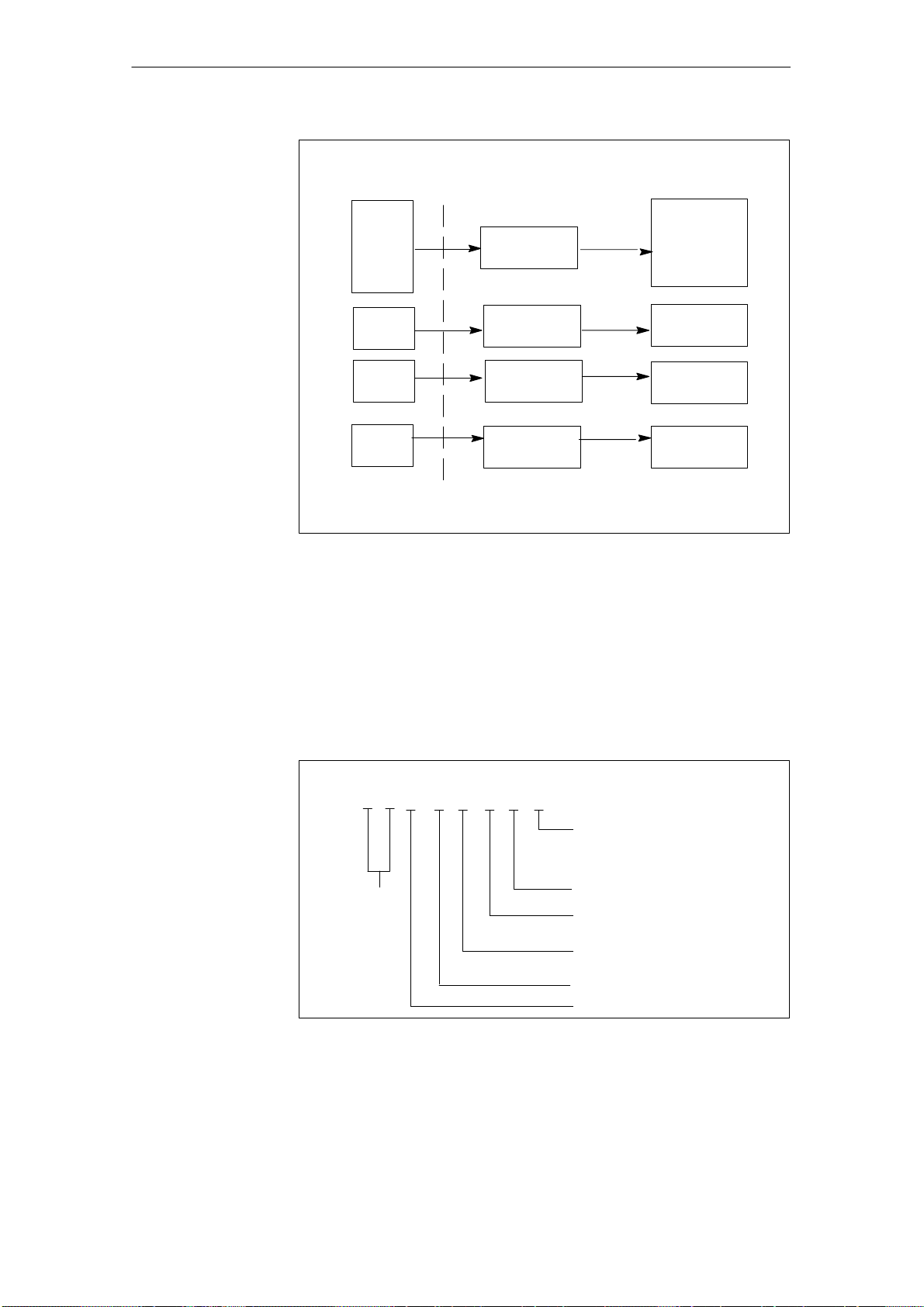
10.02
3 Cycles and Contour Definition
3.3 Drilling cycles (ISO Dialect M)
Cycle call from ISO
Dialect M mode
Shell cycle
Siemens
standard cycle
G81
G82
G85
G86
CYCLE381M
CYCLE82
CYCLE85
CYCLE88
G89
G73
G83
G84
G74
G76
G87
CYCLE383M
CYCLE384M
CYCLE387M
CYCLE83
CYCLE3841
CYCLE86
CYCLE861
Switchover to Siemens mode
Fig. 3-2 Assignment of the cycle call in ISO Dialect M mode via shell cycle for Siemens
standard cycle
Example: ISO Dialect M
N10 G81 X100. Z–50. R20 F100
G81 automatically calls the shell cycle CYCLE381M.
The calculations are performed in the shell cycle and the standard drilling cycle
CYCLE81 is then called.
Parameter
description
G7V or
G8V X.. Y.. Z.. R.. P.. Q.. F.. K..
Number of repetitions
If K was not programmed,
the cycle is executed once;
Drill-hole
position
Fig. 3-3 Description of parameters allowed for G17 (X/Y plane)
Machining feed
Const. single drilling depth for G73,
G83
Lift-off distance for G76
Dwell time at drill-hole depth
for G82, G84, G76, G89
Reference plane
Drill-hole depth
Siemens AG, 2002. All rights reserved
SINUMERIK 840D/840Di/810D, Description of Functions ISO Dialects (FBFA) – 11.02 Edition
3-75
Page 76
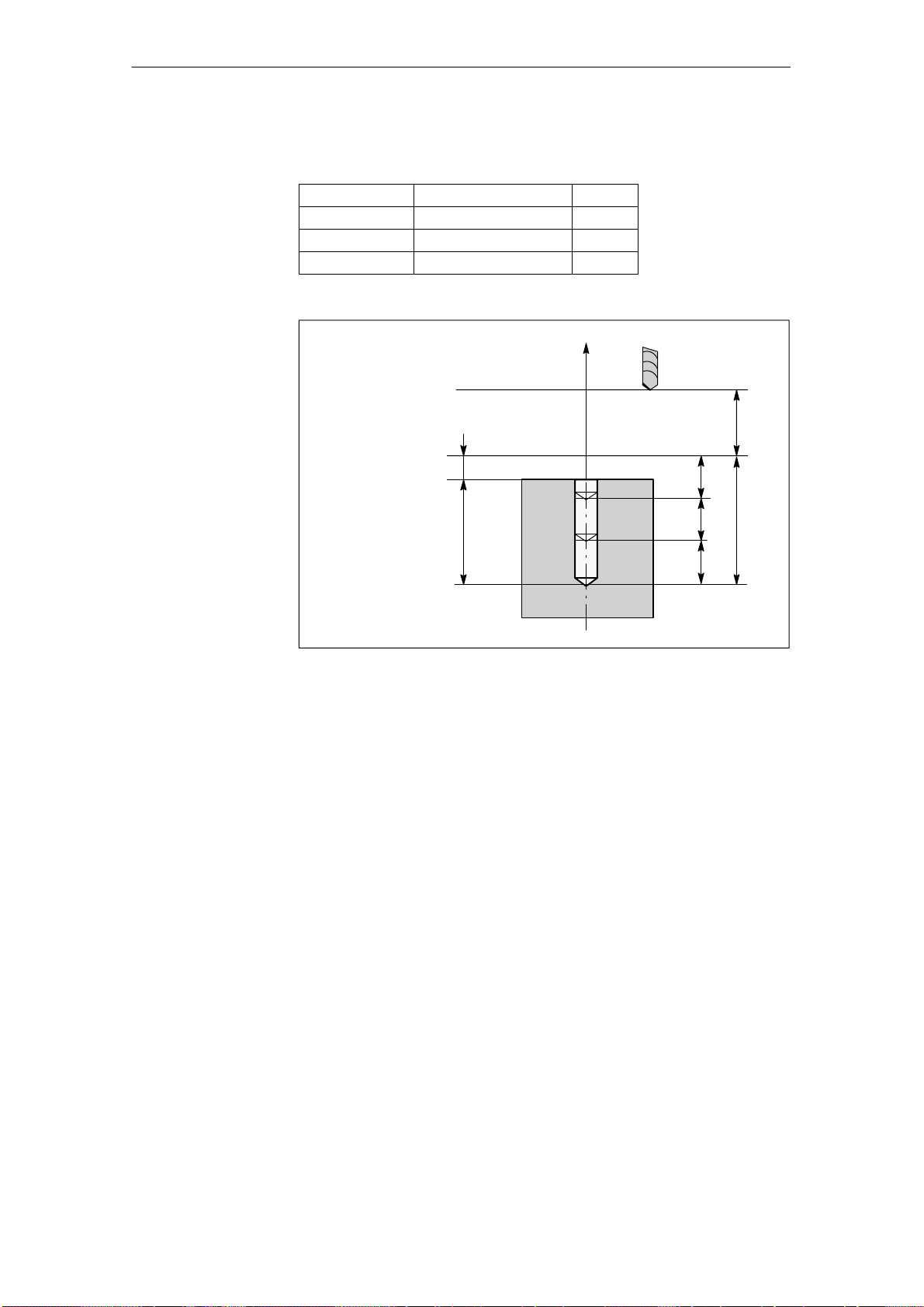
3 Cycles and Contour Definition
3.3 Drilling cycles (ISO Dialect M)
Plane
Table 3-4 Definition of the plane
Defined plane Position of hole Depth
G17 X, Y Z
G18 Z, X Y
G19 Y, Z X
10.02
Z
Drilling tool
Initial plane (G98)
Reference plane (G99)
R (abs.)
Workpiece surface
Z (abs.)
Fig. 3-4 Example of deep hole drilling cycle G83 with defined plane G17
Representation of initial plane, reference plane and parameters
Q
Q
Q
R incr.
Z (incr.)
3-76
SINUMERIK 840D/840Di/810D, Description of Functions ISO Dialects (FBFA) – 11.02 Edition
Siemens AG, 2002. All rights reserved
Page 77

10.02
3.3.2 Description of shell cycle CYCLE381M
In ISO Dialect M mode, the call is performed with G commands
G81, G82, G85.
3 Cycles and Contour Definition
3.3 Drilling cycles (ISO Dialect M)
Notes
The drilling axis must be defined via GUD _ZSFI[0] (see Section 3.2).
The direction from initial plane to reference plane must be identical to the
direction from reference plane to final depth.
GUD _ZSFR[0] can be used to enter a safety clearance. If the safety clearance
was already allowed for when programming the reference plane, the value 0
must be entered in _ZSFR[0].
If no reference plane was programmed, the drilling is performed starting on the
initial plane (current position).
The final drilling depth must be programmed. Otherwise, an alarm is displayed.
If no feedrate is programmed, the current feedrate is used as the drilling feed.
Note
Alarms are listed with their alarm number and description in Chapter “Alarms”.
3.3.3 Description of shell cycle CYCLE383M
In ISO Dialect M mode, the call is performed with G commands G73, G83.
Notes
The drilling axis must be defined via GUD _ZSFI[0] (see Section 3.2).
The direction from initial plane to reference plane must be identical to the
direction from reference plane to final depth.
GUD _ZSFR[0] can be used to enter a safety clearance. If the safety clearance
was already allowed for when programming the reference plane, the value 0
must be entered in _ZSFR[0].
If no reference plane was programmed, the drilling is performed (in steps)
starting on the initial plane (current position).
The final drilling depth and the single drilling depth Q must be programmed.
Otherwise, an alarm is displayed.
If no feedrate is programmed, the current feedrate is used as the drilling feed.
Note
Alarms are listed with their alarm number and description in Chapter “Alarms”.
Siemens AG, 2002. All rights reserved
SINUMERIK 840D/840Di/810D, Description of Functions ISO Dialects (FBFA) – 11.02 Edition
3-77
Page 78

3 Cycles and Contour Definition
3.3 Drilling cycles (ISO Dialect M)
10.02
Deep hole drilling
with chip removal
Deep hole drilling
with chipbreaking
The safety clearance in the standard Siemens cycle is determined by a formula,
i.e. it cannot be selected by the user.
For stock removal, retraction is to the reference plane.
Single drilling depth “Q”:
– If “Q” is missing or Q
– If Q > total depth, one drilling operation is executed up to the final depth.
– If Q
– If Q
The amount of retraction for chipbreaking is defined via GUD _ZSFR[1].
– _ZSFR[1]
– _ZSFR[1] 0 Retraction amount is always 1mm
Single drilling depth “Q”:
– If “Q” is missing or Q
– If Q > total depth, one drilling operation is executed up to the final depth.
– If Q
> total depth/2, the 1st drilling operation is performed with the value
of Q. The remainder is then drilled in one drilling operation.
< total depth/2, the single depth is machined until the remaining
depth < Q/2. The remainder is then subdivided into 2 infeed movements
of the same size.
> 0 Retraction amount as entered
< total depth, the single drilling depth is machined until the
remaining depth Q. The remainder is then machined in one drilling
operation.
0, an alarm is displayed.
0, an alarm is displayed.
3.3.4 Description of shell cycle CYCLE384M
In ISO Dialect M mode, the call is performed with G commands G74, G84.
Notes
The drilling axis must be defined via GUD _ZSFI[0] (see Section 3.2).
The direction from initial plane to reference plane must be identical to the
direction from reference plane to final depth.
GUD _ZSFR[0] can be used to enter a safety clearance. If the safety clearance
was already allowed for when programming the reference plane, the value 0
must be entered in _ZSFR[0].
The speed of rotation during retraction can be controlled via GUD _ZSFI[2].
Example: _ZSFI[2]=80, the retraction takes place with 80 % of the drilling
speed.
If no reference plane was programmed, the drilling is performed starting on the
initial plane (current position).
The final drilling depth must be programmed. Otherwise, an alarm is displayed.
If no feedrate is programmed, the current feedrate is used as the drilling feed.
If the drilling feed is specified in mm/min (inch/min), the programmed feed value
is converted to the appropriate revolutional feedrate, depending on the speed
last programmed, and passed to the standard tapping cycle CYCLE84 as a lead
value.
3-78
SINUMERIK 840D/840Di/810D, Description of Functions ISO Dialects (FBFA) – 11.02 Edition
Siemens AG, 2002. All rights reserved
Page 79

10.02
Note
Alarms are listed with their alarm number and description in Chapter “Alarms”.
3.3.5 Description of shell cycle CYCLE387M
In ISO Dialect M mode, the call is performed with G commands G76 and G87.
3 Cycles and Contour Definition
3.3 Drilling cycles (ISO Dialect M)
Notes
The drilling axis must be defined via GUD _ZSFI[0] (see Section 3.2).
The direction from initial plane to reference plane must be identical to the
direction from reference plane to final depth.
GUD _ZSFR[0] can be used to enter a safety clearance. If the safety clearance
was already allowed for when programming the reference plane, the value 0
must be entered in _ZSFR[0].
The lift-off path is always with reference to the negative direction of the first
geometry axis
For plane G17 Lift-off path in –X
For plane G18 Lift-off path in –Z
For plane G19 Lift-off path in –Y
The angle must be therefore be entered such that the tool tip points in the
positive direction (+) in the defined plane after the spindle stop.
Example: If plane G17 is active, the tool tip must point in the +X direction.
If no reference plane was programmed, the drilling is performed starting on the
initial plane (current position).
The final drilling depth must be programmed. Otherwise, an alarm is displayed.
If no feedrate is programmed, the current feedrate is used as the drilling feed.
If no lift-off amount is programmed, Q = 0 is set. In this case, the cycle is
executed without lift-off.
After retracting to the return plane, the tool is moved back to the center of the
drill-hole and the spindle is started in the direction of rotation for machining.
Note
Alarms are listed with their alarm number and description in Chapter “Alarms”.
Siemens AG, 2002. All rights reserved
SINUMERIK 840D/840Di/810D, Description of Functions ISO Dialects (FBFA) – 11.02 Edition
3-79
Page 80
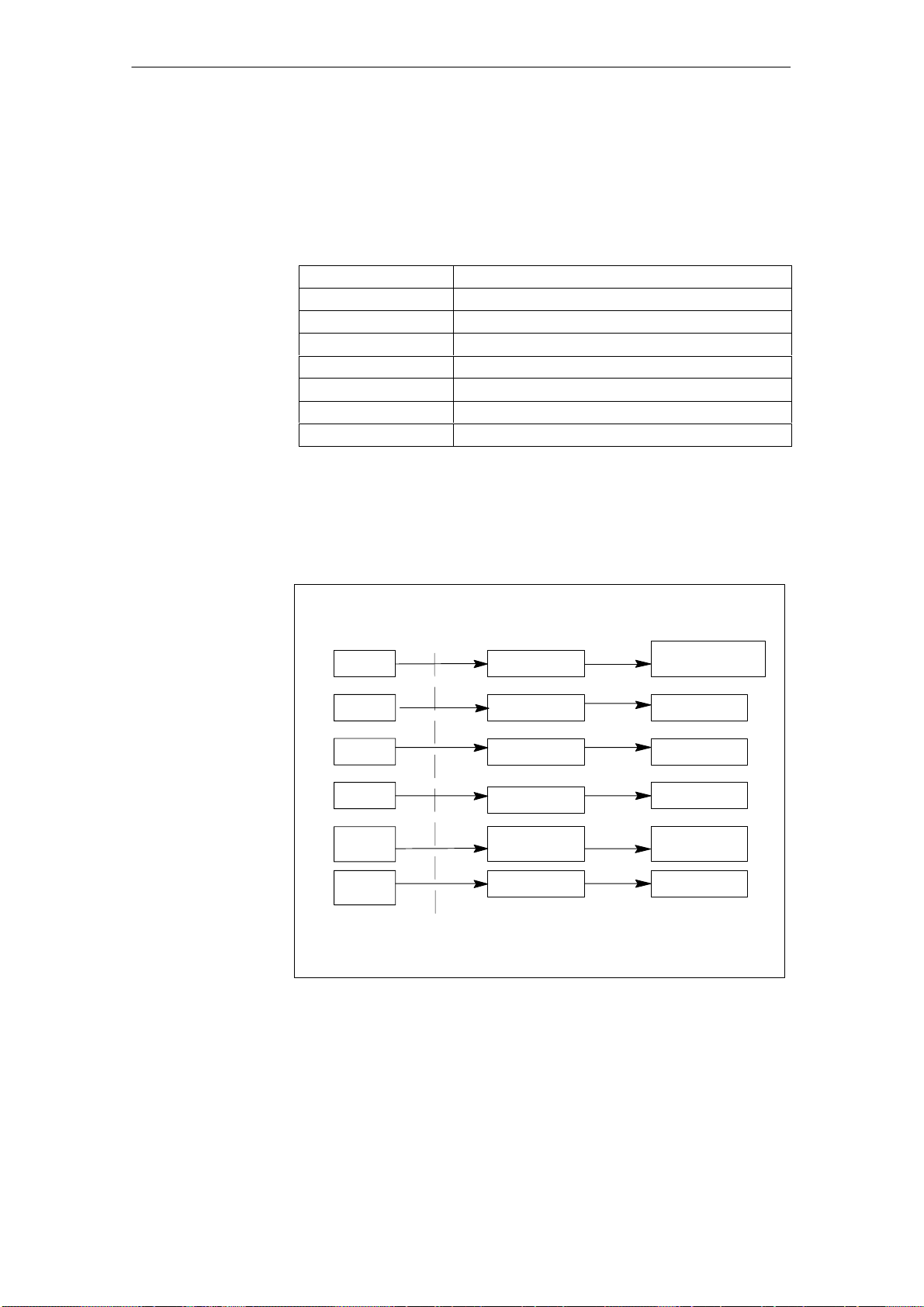
3 Cycles and Contour Definition
3.4 Turning and drilling cycles (ISO Dialect T)
3.4 Turning and drilling cycles (ISO Dialect T)
3.4.1 Turning cycles G70 to G76
Table 3-5 Overview of turning cycles
G command Description
G70 Finishing cycle
G71 Stock removal cycle longitudinal axis
G72 Stock removal cycle transverse axis
G73 Repeat contour
G74 Deep hole drilling and recessing in longitudinal axis (Z)
G75 Deep hole drilling and recessing in facing axis (X)
G76 Multiple thread cutting cycle
The cycle parameters for G71 to G76 can comprise two G commands.
Depending on the addresses programmed in the block, the values of the
addresses programmed in the NC block are only saved for use in a subsequent
cycle call, or the actual cycle is started. The evaluation of the two cases is
performed within the shell cycle.
10.00
10.02
Cycle call from
ISO Dialect T mode
G70 CYCLE 370T
G71
G72
G73
G74
G75
G76
G76
Switchover to Siemens mode
Fig. 3-5 Assignment of the cycle call in ISO Dialect T mode via shell cycle for Siemens
standard cycle
Shell cycle
CYCLE 371T
CYCLE 372T
CYCLE 373T
CYCLE 374T
CYCLE 376T
Siemens
standard cycle
running without
standard cycle
CYCLE395
CYCLE395
CYCLE395
CYCLE375T
CYCLE398
3-80
SINUMERIK 840D/840Di/810D, Description of Functions ISO Dialects (FBFA) – 11.02 Edition
Siemens AG, 2002. All rights reserved
Page 81
10.02
Finishing cycle
G70
3 Cycles and Contour Definition
3.4 Turning and drilling cycles (ISO Dialect T)
G70 P.. Q..
Block number in main program at which the contour definition ends
Block number in main program at which the contour definition begins
Fig. 3-6 Description of parameters allowed
In ISO Dialect mode, the contour in the main program is not skipped with G70.
The program is always resumed at the next parts program block following the
cycle call.
Example:
When the cycle is called, the contour in N20–N50 is traversed; the parts
program continues running at N20 after the end of the cycle. G70 is naturally
always called up after the contour definition.
N10 G70 P20 Q50
N20 X100. Z50.
N30 X200.
N40 Z100.
N50 X250. Z111.
N60 M30
Blocks N20–N50 are executed once by the finishing cycle and again by the
normal program run.
Stock removal
cycle, longitudinal
axis G71
G71 U.. R..
Retraction path
Infeed depth for stock removal
Fig. 3-7 Description of parameters allowed; saving values in GUD
G71 P.. Q.. U.. W.. F.. S.. T..
Tool selection
Spindle speed
Machining feed
Final machining allowance in Z axis
Final machining allowance in X axis
Block number at which the contour definition ends
Block number at which the contour definition begins
Fig. 3-8 Description of parameters allowed; running cycles
Siemens AG, 2002. All rights reserved
SINUMERIK 840D/840Di/810D, Description of Functions ISO Dialects (FBFA) – 11.02 Edition
3-81
Page 82

3 Cycles and Contour Definition
3.4 Turning and drilling cycles (ISO Dialect T)
With G71 in ISO Dialect T, the contour is followed with the final machining
allowance in the main program after stock removal (to remove any remaining
straight edges). The program is always resumed at the parts program block
following the last block of the contour definition. parts program blocks between
the cycle call and the first block of the contour description are not executed.
N10 G71 P50 Q80 U4 W3 F1000 ...
N20 G1 F0.5 G95 S1000
N30 X30. Z10.
N40 M30
N50 X100. Z50.
N60 X200.
N70 Z100.
N80 X250. Z111.
N90 M30
Blocks N20–N40 are skipped and are not executed. If G71 is called in the parts
program after the contour definition, the program goes into an infinite loop.
Allowance must be made for the different continuation patterns of the parts
program in the shell cycles.
Example: G71 U6 R5 Saving values in GUD
In the example, the values programmed in the shell cycle are read from
the system variables ($C_xx) and stored in channel-specific GUD.
Separate GUD are available for each cycle (G71–G76); the programmed
values therefore remain valid until the next time they are programmed (in
an NC block with G71–G76). Case 1 does not have to be programmed,
therefore it is advisable to initialize the assigned GUD.
Example: G71 P30 Q50 U3 Starting cycle execution
In the example, the programmed values are only saved in system
variables ($C_xx). The system variables are overwritten in every NC
block containing a G function for a cycle call. With G71–G73, the cycle
always starts running on the G command after which the “P” and “Q” are
programmed. With G74–G76, the cycle starts running on the G
command after which the X/U or Z/W addresses are programmed. The F,
S and T commands in the call line of the cycle are also stored in system
variables. A cycle-specific distinction does not therefore have to be
made between the addresses. The shell cycle assigns the meaning to
the parameters (e.g. for G76, the address F means pitch and not feed).
For G70, the feed, speed and tool selection commands (F, S, T) from the
program section of the contour definition are relevant.
The same shell cycle is always called in both cases.
10.02
3-82
SINUMERIK 840D/840Di/810D, Description of Functions ISO Dialects (FBFA) – 11.02 Edition
Siemens AG, 2002. All rights reserved
Page 83
10.02
3 Cycles and Contour Definition
3.4 Turning and drilling cycles (ISO Dialect T)
Stock removal
cycle, transverse
axis G72
Contour repetition
G73
Parameters allowed: see G71 (stock removal cycle, longitudinal axis)
G72 W.. R..
Retraction path
Infeed depth for stock removal
Fig. 3-9 Description of parameters allowed; saving values in GUD
G73 U.. W.. R..
Number of cuts parallel to the contour
Offset from start point to current tool position
in Z axis
Offset from start point to current tool position
in X axis
Fig. 3-10 Description of parameters allowed; saving values in GUD
G73 P.. Q.. U.. W.. F.. S.. T..
Tool selection
Spindle speed
Machining feed
Final machining allowance in Z axis
Final machining allowance in X axis
Block number at which the contour definition ends
Block number at which the contour definition begins
Deep hole drilling
and recessing in
longitudinal axis
G74
Fig. 3-11 Description of parameters allowed; running cycles
G74 R..
Retraction path for chipbreaking
Fig. 3-12 Description of parameters allowed; saving values in GUD
Siemens AG, 2002. All rights reserved
SINUMERIK 840D/840Di/810D, Description of Functions ISO Dialects (FBFA) – 11.02 Edition
3-83
Page 84
3 Cycles and Contour Definition
3.4 Turning and drilling cycles (ISO Dialect T)
G74 X/U.. Z/W... P.. Q.. R.. F..
Fig. 3-13 Description of parameters allowed; running cycles
Note
The cycle can be used as a drilling or recessing cycle. If the cycle is used for
drilling, addresses X/U and P must not be used.
10.02
Machining feed
Retraction path at entry base
Infeed in longitudinal axis (Z axis) until
chipbreaking
Infeed in transverse axis (X axis) for
the next recessing cut
Start position in Z axis
Z=absolute position
W=incremental position
Start position in X axis
X=absolute position or
U=incremental position
Deep hole drilling
and recessing in
the transverse axis
G75
G75 R..
Retraction path for chipbreaking
Fig. 3-14 Description of parameters allowed; saving values in GUD
G75 X/U.. Z/W.. P.. Q.. R.. F..
Machining feed
Retraction path at recess base
Infeed in longitudinal axis (Z axis) until
chipbreaking
Amount of infeed in transverse axis (X axis)
until chipbreaking
Start position in Z axis
Z=absolute position
W=incremental position
Start position in X axis
X=absolute position or
U=incremental position
3-84
Fig. 3-15 Description of parameters allowed; running cycles
SINUMERIK 840D/840Di/810D, Description of Functions ISO Dialects (FBFA) – 11.02 Edition
Siemens AG, 2002. All rights reserved
Page 85
10.02
Multiple thread
cutting cycle
G76
3 Cycles and Contour Definition
3.4 Turning and drilling cycles (ISO Dialect T)
Note
The cycle can be used as a drilling or recessing cycle. If the cycle is used for
drilling, addresses Z/W and Q must not be used.
G76 Pxxxxxxx Q.. R..
Final machining allowance
Minimum infeed depth; the depth is never below this value
during infeed not exceeded
Angle of tool cutting edge
Size of the chamfer at the end of the thread in 1/10x
thread pitch
Number of finish cuts
Fig. 3-16 Description of parameters allowed; saving values in GUD
G76 X/U.. Z/W.. R.. P.. Q.. F..
Lead
Amount of first infeed
Thread depth/total infeed in X axis
Radius difference for taper thread
Thread end point in Z axis
Z=absolute position
W=incremental position
Thread end point in X axis
X=absolute position or
U=incremental position
Fig. 3-17 Description of parameters allowed; running cycles
Example for address P:
G76 P012055 Q4 R0.5
P = 012055
Angle of tool cutting edge = 55 degrees
Chamfer at the end of the thread=2.0 x thread pitch
1 finish cut
Siemens AG, 2002. All rights reserved
SINUMERIK 840D/840Di/810D, Description of Functions ISO Dialects (FBFA) – 11.02 Edition
3-85
Page 86
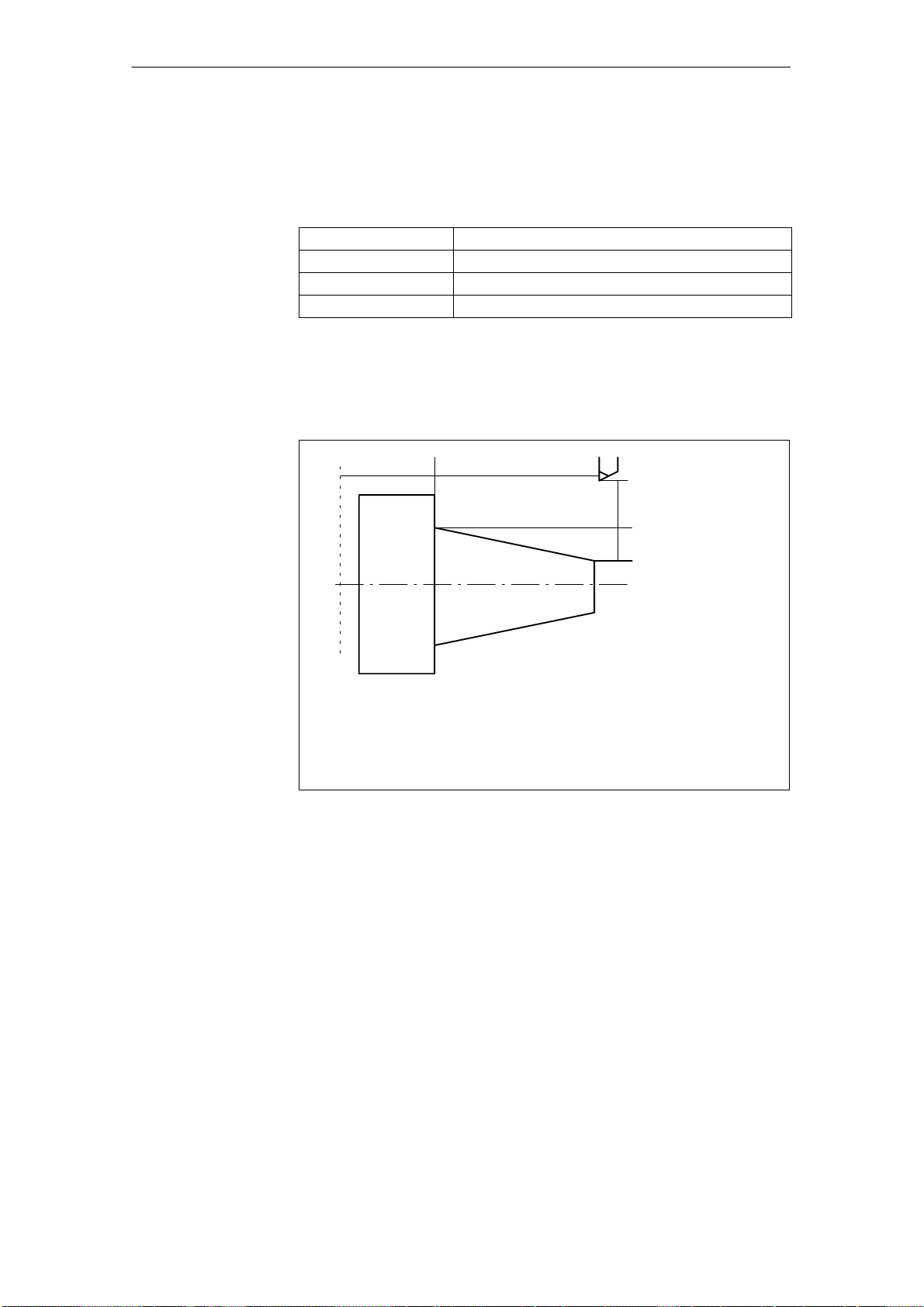
3 Cycles and Contour Definition
3.4 Turning and drilling cycles (ISO Dialect T)
3.4.2 Turning cycles G77 to G79
Table 3-6 Overview of turning cycles G77 to G79
G command Description
G77 Longitudinal stock removal
G78 Thread cutting
G79 Transverse stock removal
These cycle calls are modal and are called in every NC block containing axis
movements. The machining movements are defined in the call parameters after
the G function. The following parameters are allowed in NC blocks with cycle
calls via G77–G79:
10.02
X
Fig. 3-18 Parameters for cycle calls via G77 to G79
ZW
U = End position of contour in X (incr.)
Z = End position of contour in Z (abs.) or
W = End position of contour in Z (incr.)
R = Incremental radius difference to
end position in X for taper turning
R = Machining feed for G77/G79
Thread lead for G78
U
R
Z
3-86
SINUMERIK 840D/840Di/810D, Description of Functions ISO Dialects (FBFA) – 11.02 Edition
Siemens AG, 2002. All rights reserved
Page 87

10.02
Longitudinal stock
removal G77
Thread cutting
G78
3 Cycles and Contour Definition
3.4 Turning and drilling cycles (ISO Dialect T)
G77 X(U).. Z(W).. R.. F..
Machining feed
Incremental offset of end position
in X axis for taper turning
Cylinder turning: R not programmed or R=0
Position in Z axis
Z=absolute position
W=incremental position
Position in X axis
X=absolute position
U=incremental position
Fig. 3-19 Description of parameters allowed; running cycles
G78 X(U).. Z(W).. R.. F..
Transverse stock
removal G79
Lead
Incremental offset of end position
in X axis for taper turning
Cylinder turning: R not programmed or R=0
Position in Z axis
Z=absolute position
W=incremental position
Position in X axis
X=absolute position
U=incremental position
Fig. 3-20 Description of parameters allowed; running cycles
G79 X(U).. Z(W).. R.. F..
Machining feed
Incremental offset of end position
in Z axis for taper turning
Cylinder turning: R not programmed or R=0
Position in Z axis
Z=absolute position
W=incremental position
Position in X axis
X=absolute position
U=incremental position
Fig. 3-21 Description of parameters allowed; running cycles
Siemens AG, 2002. All rights reserved
SINUMERIK 840D/840Di/810D, Description of Functions ISO Dialects (FBFA) – 11.02 Edition
3-87
Page 88
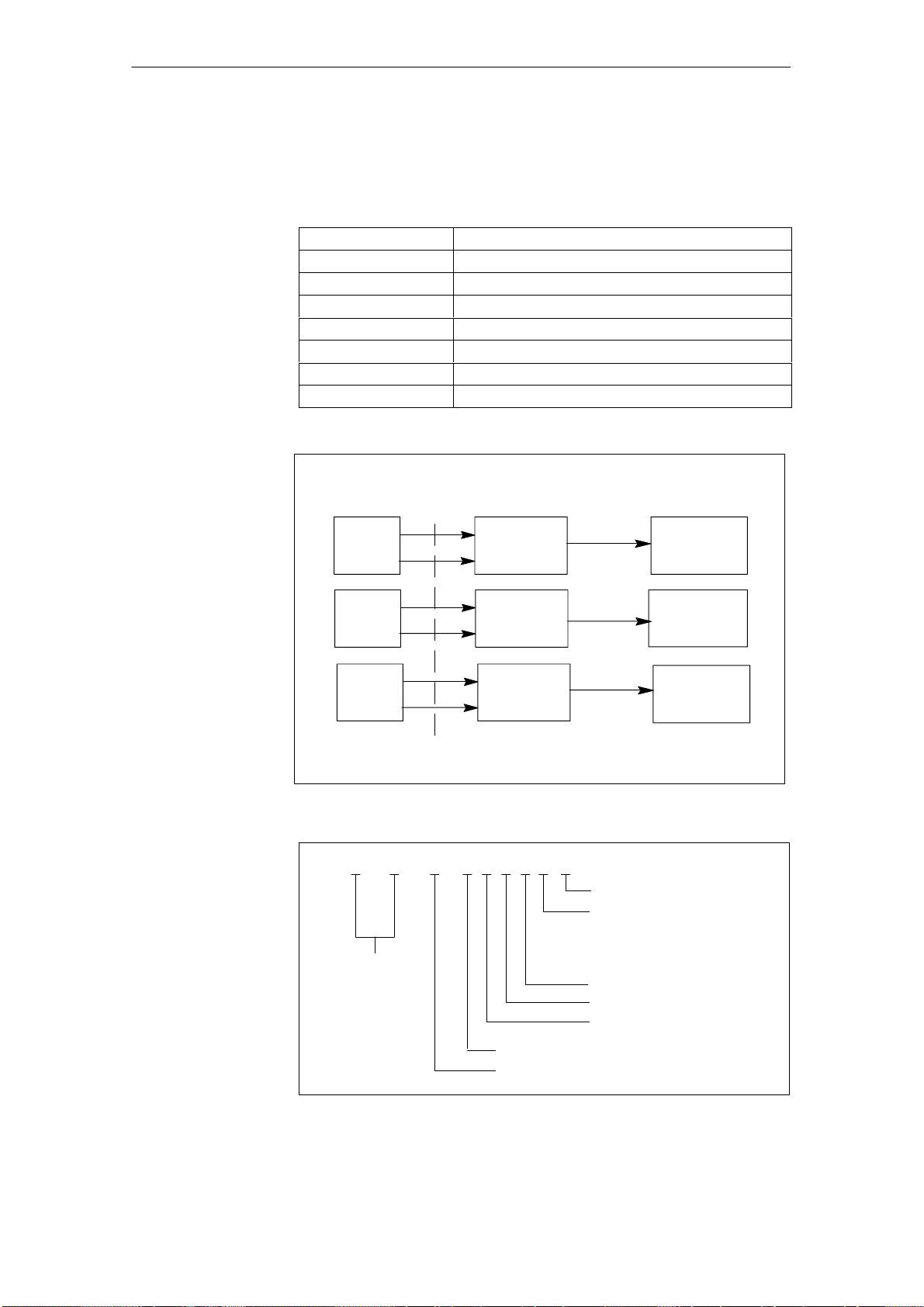
3 Cycles and Contour Definition
3.4 Turning and drilling cycles (ISO Dialect T)
3.4.3 Drilling cycles G80 to G89
Table 3-7 Overview of drilling cycles
G command Description
G80 Drilling cycle off
G83 Face deep hole drilling
G84 Face tapping
G85 Face drilling
G87 Side deep hole drilling
G88 Side tapping
G89 Side drilling
10.02
Cycle call from
ISO Dialect T mode
G84
Shell cycle
CYCLE 384T
Siemens
standard cycle
CYCLE84
G88
G85
G89
G83
CYCLE 385T
CYCLE 383T
CYCLE375T
CYCLE375T
G87
Switchover to Siemens
mode
Fig. 3-22 Assignment of the drilling cycle in ISO Dialect T mode via shell cycle for
Siemens standard cycle
G83 X(U).. C(H).. Z(W).. R.. P.. Q.. F.. K.. M..
G84
G85
Drill-hole position
M code for clamping C axis
Number of repetitions
If K was not programmed,
the cycle is executed once;
K=0 The cycle is not executed
Machining feed
Infeed
Dwell time at drill-hole depth
3-88
Distance between return plane and drilling plane
Drill-hole depth
Fig. 3-23 Description of parameters allowed; running cycles
SINUMERIK 840D/840Di/810D, Description of Functions ISO Dialects (FBFA) – 11.02 Edition
Siemens AG, 2002. All rights reserved
Page 89
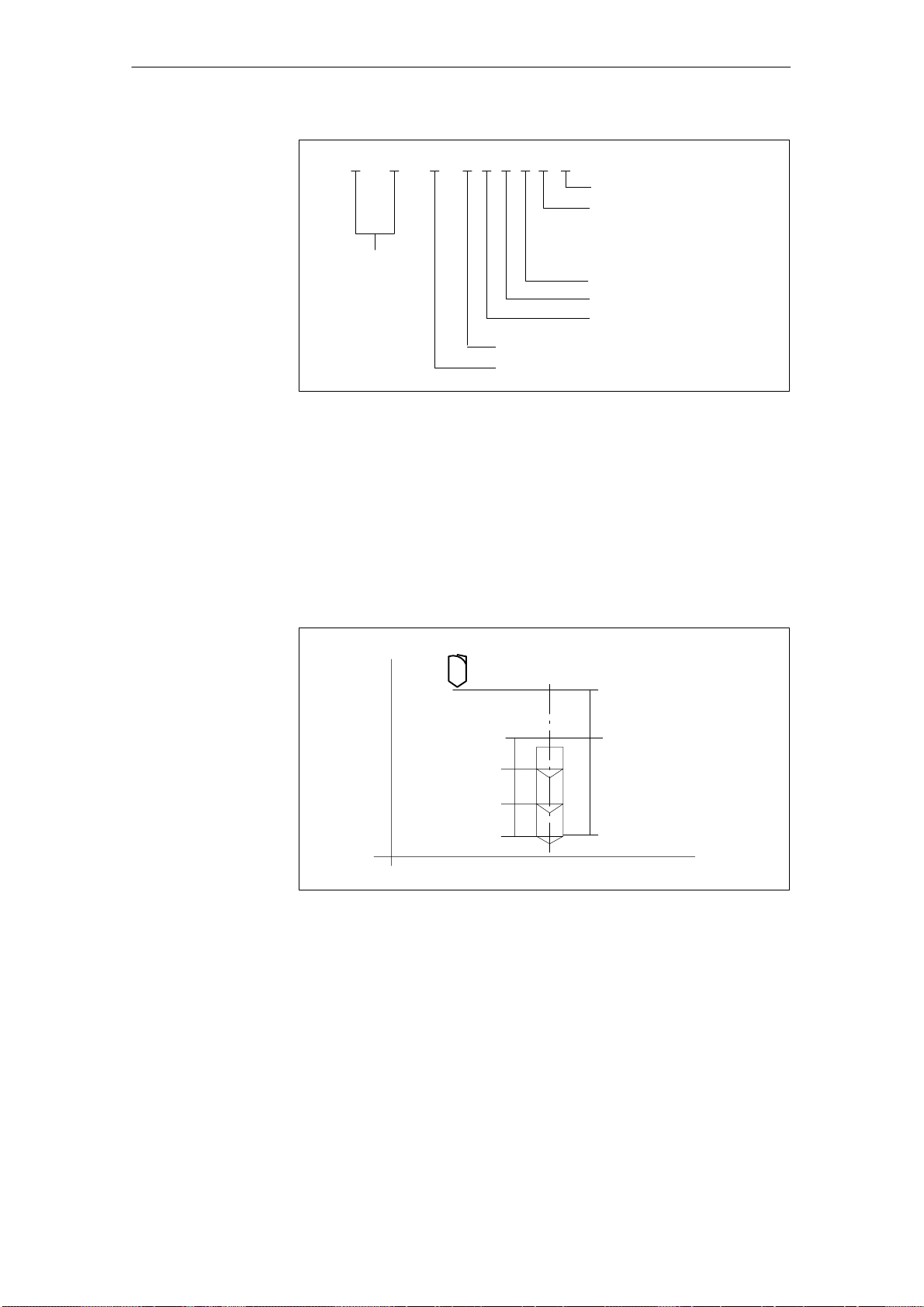
10.02
3 Cycles and Contour Definition
3.4 Turning and drilling cycles (ISO Dialect T)
G87 Z(W).. C(H).. X(U).. R.. P.. Q.. F.. K.. M..
G88
G89
Drill-hole position
Distance between return plane and drilling plane
Drill-hole depth
Fig. 3-24 Description of parameters allowed; running cycles
The drilling cycles are modal and are executed in every NC block in which axis
movements for axes X, Y, and Z are programmed. While a drilling mode is
active, you only have to program the new parameters in order to make
parameter modifications. The parameters are stored in system variables $C_xx
(xx = Nc address) which are read by the cycles.
The cycle is not executed if a G function of the first G group appears after the
cycle G function in the same NC block. Only the axes programmed in the NC
block are moved. Addresses R, Q, P, K are not copied into the system variables.
The feed programmed in this block is activated.
Set M code for C axis
Number of repetitions
If K was not programmed,
the cycle is executed once;
K=0 The cycle is not executed
Machining feed
Infeed
Dwell time at drill-hole depth
X
Fig. 3-25 Drilling cycle
R
Q
Q
Z (X)
Q
Z
Siemens AG, 2002. All rights reserved
SINUMERIK 840D/840Di/810D, Description of Functions ISO Dialects (FBFA) – 11.02 Edition
3-89
Page 90

3 Cycles and Contour Definition
3.4 Turning and drilling cycles (ISO Dialect T)
10.02
Modal cycles
All modal cycles are deselected in ISO Dialect mode with G80 or with a G
function of the first G group (G00–G03, G33, G34, except for G77–G79).
Cycle parameters can be programmed in the following blocks while a modal
cycle is active. These parameters are copied into the system variables so that
the shell cycle uses the modified parameters.
Example:
N10 G81 X10. Z15. R5 Q4 P10 F1000
N20 X50. ;Drilling cycle at position X50
3.4.4 Description of shell cycle CYCLE383T
In ISO Dialect T mode, the call is performed with G commands G83 and G87.
Notes
The direction from initial plane to reference plane must be identical to the
direction from reference plane to final depth. Otherwise this results in an error
message from the Siemens drilling cycle.
In ISO Dialect T, the programmer must take into account the safety clearance
when defining the reference plane. In Siemens mode, the safety clearance to
the R plane can be specified independently.
This possibility has also been implemented for the ISO cycles. GUD _ZSFR[20]
can be used if necessary to enter a safety clearance. If the safety clearance
was already allowed for when programming the R plane, the value “NULL” must
be entered in GUD_ZSFR[20].
GUD_ZSFR[23] is used to specify whether the dwell time for G95 (only in the
case of deep hole drilling) must be executed in seconds or revolutions.
A shell cycle is only permitted to be called from the external G code (G83/G87).
A call in Siemens mode (after switching over with G290 and calling
CYCLE383T) is not permitted.
If the G83/G87 block contains axis names other than X/Z (U/W), this results in
the alarm (61811) “ISO axis name is not permitted”.
GUD_ZSFR[2] is used to determine whether the cycle is executed with chip
breaking or chip removal.
In ISO Dialect, the constant individual depth is maintained until the remainder is
removed on the floor of the drilled hole with an infeed. In Siemens mode, the
remainder (less 2*individual depth) on the floor of the drilled hole is subdivided
into two equal infeeds.
3-90
Note
Alarms are listed with their alarm number and description in Chapter “Alarms”.
SINUMERIK 840D/840Di/810D, Description of Functions ISO Dialects (FBFA) – 11.02 Edition
Siemens AG, 2002. All rights reserved
Page 91

10.02
3.4 Turning and drilling cycles (ISO Dialect T)
3.4.5 Description of shell cycle CYCLE384T
In ISO Dialect T mode, the call is performed with G commands G84 and G88.
3 Cycles and Contour Definition
Notes
The direction from initial plane to reference plane must be identical to the
direction from reference plane to final depth. Otherwise this results in an error
message from the Siemens drilling cycle. ISO Dialect does not monitor this.
In ISO Dialect T, the programmer must take into account the safety clearance
when defining the reference plane. In Siemens mode, the safety clearance to
the R plane can be specified independently.
This possibility has also been implemented for the ISO cycles. GUD _ZSFR[20]
can be used if necessary to enter a safety clearance. If the safety clearance
was already allowed for when programming the R plane, the value “NULL” must
be entered in GUD_ZSFR[20].
A shell cycle is only permitted to be called from the external G code (G84/G88).
A call in Siemens mode (after switching over with G290 and calling
CYCLE384T) is not permitted.
If the G84/G88 block contains axis names other than X/Z (U/W), this results in
the alarm (61811) “ISO axis name is not permitted”.
The drilling speed during retraction can be controlled via GUD _ZSFI[22]
(value in %).
Example: _ZSFI[22]=95, the retraction takes place with 95% of the drilling
depth.
Note
Alarms are listed with their alarm number and description in Chapter “Alarms”.
Siemens AG, 2002. All rights reserved
SINUMERIK 840D/840Di/810D, Description of Functions ISO Dialects (FBFA) – 11.02 Edition
3-91
Page 92

3 Cycles and Contour Definition
3.4 Turning and drilling cycles (ISO Dialect T)
3.4.6 Description of shell cycle CYCLE385T
In ISO Dialect T mode, the call is performed with G commands G85 and G89.
10.02
Notes
The direction from initial plane to reference plane must be identical to the
direction from reference plane to final depth. Otherwise this results in an error
message from the Siemens drilling cycle. ISO Dialect does not monitor this.
In ISO Dialect T, the programmer must take into account the safety clearance
when defining the reference plane. In Siemens mode, the safety clearance to
the R plane can be specified independently.
This possibility has also been implemented for the ISO cycles. GUD _ZSFR[20]
can be used if necessary to enter a safety clearance. If the safety clearance
was already allowed for when programming the R plane, the value “NULL” must
be entered in GUD_ZSFR[20].
A shell cycle is only permitted to be called from the external G code (G85/G89).
A call in Siemens mode (after switching over with G290 and calling
CYCLE385T) is not permitted.
If the G85/G89 block contains axis names other than X/Z (U/W), this results in
the alarm (61811) “ISO axis name is not permitted”.
If the G84 block contains axis names other than X/Z (U/W), this results in the
alarm (61811) “ISO axis name is not permitted”.
Note
Alarms are listed with their alarm number and description in Chapter “Alarms”.
3-92
SINUMERIK 840D/840Di/810D, Description of Functions ISO Dialects (FBFA) – 11.02 Edition
Siemens AG, 2002. All rights reserved
Page 93

10.02
3.5 System variables
The names of the system variables all begin with $C_ xx. The NC address,
whose value is stored in the system variable, appears in the name extension xx.
The G number used to call a cycle is always stored in variable $C_G.
For all addresses, bit 0 is set in system variables $C_x_PROG if the address is
programmed.
In addition, bit 1 is set in variable $C_x_PROG for axis addresses programmed
incrementally.
$C_x_PROG is set to FALSE at the end of the subprogram (M17, RET).
Example 1:
N10 G01 G81 X100. Z–50. R20 F100
Shell cycle CYCLE381M for G81 is called automatically. The calculations are
performed in the shell cycle and the Siemens standard drilling cycle CYCLE82
is then called. The G01 command is not required.
The values of the programmed addresses are written into the following system
variables:
Address X is written to system variable $C_X;
Address Z is written to system variable $C_Z;
Address R is written to system variable $C_R;
Address F is written to system variable $C_F;
Example 2:
Axis Z is programmed in incremental dimensions (G91) $C_Z_PROG=3
Axis Z is programmed in absolute dimensions (G90) $C_Z_PROG =1
Example 3: Siemens shell cycle for Gxy
N10 PROC CYCLE377 DISPLOF ;Block display remains at G77 block,
N20 DEF REAL DELTA_X, pos_X, pos_Z, FEED
N30 DEF BOOL R_prog, X_prog, Z_prog
N50 DELTA_X = 0
N60 IF $C_R_PROG ;Only load DEL TA_X if address R
N70 DELTA_X = $C_R ;was programmed
N75 ENDIF
N110 CYCLE...(DELTA_X, $C_X, $C_Z, $C_R_PROG, $C_X_PROG,
$C_Z_PROG, $C_F) ;Call Siemens cycle
N230 RET ;End of shell cycle
3 Cycles and Contour Definition
3.5 System variables
;Freeze G code display
Siemens AG, 2002. All rights reserved
SINUMERIK 840D/840Di/810D, Description of Functions ISO Dialects (FBFA) – 11.02 Edition
3-93
Page 94

3 Cycles and Contour Definition
3.5 System variables
Table 3-8 List and description of system variables
10.02
Identifier
$C_A REAL Value of programmed address A in ISO Dialect mode for cycle programming
$C_B REAL Value of programmed address B in ISO Dialect mode for cycle programming
.... .... .....
$C_G INT G number for cycle calls in external mode
$C_H REAL Value of programmed address H in ISO Dialect mode for cycle programming
$C_I[ ] REAL Value of programmed address I in ISO Dialect mode for cycle programming and macro
$C_I_ORDER[ ] REAL For description see $C_I[ ], used to define the programming sequence
$C_J[ ] REAL For description see $C_I[ ]
$C_J_ORDER[ ] REAL For description see $C_I[ ], used to define the programming sequence
$C_K[ ] REAL For description see $C_I[ ]
$C_K_ORDER[ ] REAL For description see $C_I[ ], used to define the programming sequence
$C_L REAL Value of programmed address L in ISO Dialect mode for cycle programming
.... .... ....
$C_Z REAL Value of programmed address Z in ISO Dialect mode for cycle programming
$C_TS STRING String of tool name programmed at address T
$C_A_PROG INT Address A is programmed in a block with a cycle call.
$C_B_PROG INT Address B is programmed in a block with a cycle call.
.... .... ....
$C_G_PROG INT The shell cycle call is programmed with a G function
$C_Z_PROG INT Address Z is programmed in a block with a cycle call.
$C_TS_PROG INT A tool name was programmed at address T
$C_ALL_PROG INT Bitmap of all programmed addresses in a block with a cycle call
$P_EXTGG[n] INT Active G code of the external language
$C_INC_PROG INT Bitmap of all programmed incremental addresses in a block with a cycle call
$C_I_NUM INT Cycle programming: Value is always 1 if bit 0 set in $C_I_PROG.
Type Description
programming with G65/G66. Up to 10 items are possible in one block for macro
programming. The values are stored in the array in the order in which they are
programmed.
0 = not programmed
1 = programmed (absolute)
3 = programmed (incremental)
0 = not programmed
1 = programmed (absolute)
3 = programmed (incremental)
0 = not programmed
1 = programmed (absolute)
3 = programmed (incremental)
TRUE = programmed, FALSE = not programmed
Bit 0 = address A
Bit 25 = address Z
Bit = 1 address programmed in incremental dimensions
Bit = 0 address not programmed
Bit 0 = address A
Bit 25 = address Z
Bit = 1 address programmed in incremental dimensions
Bit = 0 address programmed in absolute dimensions
Macro programming: Number of I addresses programmed in block (max. 10).
3-94
SINUMERIK 840D/840Di/810D, Description of Functions ISO Dialects (FBFA) – 11.02 Edition
Siemens AG, 2002. All rights reserved
Page 95

10.02
3 Cycles and Contour Definition
3.5 System variables
Table 3-8 List and description of system variables
Identifier DescriptionType
$C_J_NUM INT For description see $C_I_NUM
$C_K_NUM INT For description see $C_I_NUM
$P_AP INT Polar coordinates 0 = OFF 1 = ON
$C_TYP_PROG INT Bit map of all programmed addresses in a block with a cycle call
$C_PI INT Program number of the interrupt routine that was programmed with M96
Bit 0 = A
Bit 25 = Z
Bit = 0 axis programmed as INT
Bit = 1 axis programmed as REAL
Siemens AG, 2002. All rights reserved
SINUMERIK 840D/840Di/810D, Description of Functions ISO Dialects (FBFA) – 11.02 Edition
3-95
Page 96

3 Cycles and Contour Definition
3.6 Programming contour definitions (ISO Dialect T)
3.6 Programming contour definitions (ISO Dialect T)
Contour definitions can be programmed in both ISO Dialect T mode and
Siemens mode.
There are 3 basic shapes of contour
S A straight line
The end point is programmed with a Cartesian coordinate and an angle
S Two straight lines
The transition is programmed with a rounding or chamfer
S Three straight lines
The transitions are programmed with a rounding or chamfer
In the descriptions below, indices are occasionally assigned to the address
letters X, Z, A, R and C to establish a unique assignment between the NC block
and the associated drawing. These indices do not appear in the NC program.
The assignment is always derived uniquely from the block containing the
address letter. Address letter Q is used as a placeholder for R or C, where either
of these letters can appear. Q can also be omitted. In this case, no chamfer or
rounding is inserted at the transition between the two linear sections.
Any number of other NC addresses can be used in blocks defining contours,
e.g. address letters for further axes (individual axes or an axis perpendicular to
the machining plane), auxiliary function parameters, G codes, velocities, etc.
In the following examples, it is assumed that G18 is active. Programming of
contours is also possible without restriction with G17 or G19, however.
10.02
ISO Dialect mode
Siemens mode
Address C is used in ISO Dialect mode both as an axis identifier and as an
identifier for a chamfer on the contour.
Address R can be a cycle parameter or an identifier for the radius in a contour.
In order to distinguish between these two options, a “,” must be placed in front of
the C or R address during contour definition programming (as in ISO Dialect). A
comma does not have to be entered if an angle is programmed before C or R. If
a radius and a chamfer are programmed together in the same block, e.g. N333
X100 A10 C20 R15, regardless of the programming sequence, a radius will
always be inserted in the contour. The chamfer is ignored.
The identifiers for angle, radius and chamfer are defined by machine data in
Siemens mode. This prevents the occurrence of name conflicts. A comma must
not be programmed before the identifier for radius or chamfer.
3-96
SINUMERIK 840D/840Di/810D, Description of Functions ISO Dialects (FBFA) – 11.02 Edition
Siemens AG, 2002. All rights reserved
Page 97

10.02
3.6 Programming contour definitions (ISO Dialect T)
Note
MD 10652 for angle: $MN_CONTEUR_DEF_ANGLE_NAME
MD 10654 for radius: $MN_RADIUS_NAME
MD 10656 for chamfer: $MN_CHAMFER_NAME
(applies in Siemens mode only)
3.6.1 End point programming with angles
If address letter A appears in an NC block, one, both or none of the axes on the
active plane can be programmed.
If no axis on the active plane is programmed, the block is either the first or the
second block of a contour totaling two blocks. If the block is the second block of
such a contour definition, the start and end point in the active plane are
identical. In this case, the contour merely consists of a movement perpendicular
to the active plane.
If one axis on the active plane is programmed, either a single straight line is
being described, whose end point is determined exactly by the angle and the
programmed Cartesian coordinate, or we are dealing with the second block of a
contour totaling two blocks. In the latter case, the missing coordinate will be set
equal to the last (modal) position reached.
If two axes on the active plane are programmed, the block is the second block
of a contour comprising two blocks. If the current block was not preceded by a
block with angle programming without programmed axes of the active plane, the
block is not permitted.
Angle A must only be programmed with linear or spindle interpolation. (Spline
interpolation only in Siemens mode.)
Alarms are generated in the following situations:
3 Cycles and Contour Definition
S In a contour consisting of two blocks, the active plane was changed during
the transition from the first to the second block.
S In a contour consisting of two straight lines, a valid intermediate point cannot
be generated from the programmed angles.
S Neither linear nor spline interpolation is active in a block with address A.
S A block with address A without a programmed axis on the active plane is not
followed by a block with which the end point of the contour can be
determined. This is the case if the block is the last block in a program or if
the following block contains a preprocessor stop.
S No angle was programmed in the second block of a contour consisting of
two straight lines.
S Both axes on the active plane are programmed in a block with address A
which is not the second block of a contour consisting of two straight lines.
S Programmed Cartesian coordinate and programmed angle are incompatible.
Siemens AG, 2002. All rights reserved
SINUMERIK 840D/840Di/810D, Description of Functions ISO Dialects (FBFA) – 11.02 Edition
3-97
Page 98
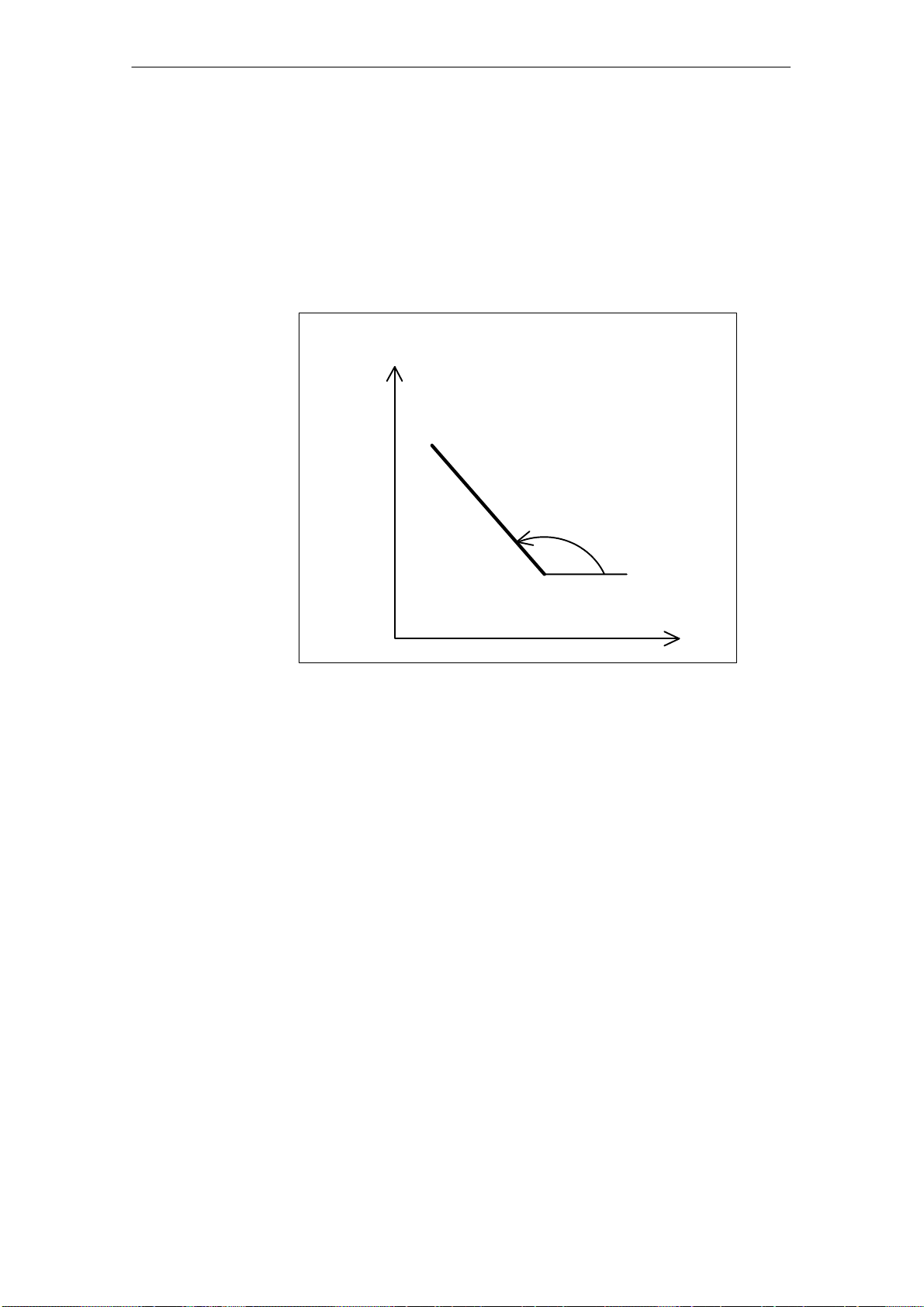
3 Cycles and Contour Definition
3.6 Programming contour definitions (ISO Dialect T)
3.6.2 Straight line with angle
The end point is defined by specifying the angle A and one of the two
coordinates X
Programming syntax:
.. A.. or
X
2
Z2.. A..
or Z2.
2
X
(X2, Z2)
10.02
A
(X1, Z1)
Fig. 3-26 Straight line with angle
Example (Fig. 3-24):
Programming in ISO Dialect T mode:
N10 G1 X5. Z70. F1000 G18
N 20 X88.8 A 110 or (Z39.5 A110)
Programming in Siemens mode:
N10 X5. Z70. F1000 G18
N20 X88.8 ANG=110 or (Z39.5 ANG=110)
Z
3-98
SINUMERIK 840D/840Di/810D, Description of Functions ISO Dialects (FBFA) – 11.02 Edition
Siemens AG, 2002. All rights reserved
Page 99
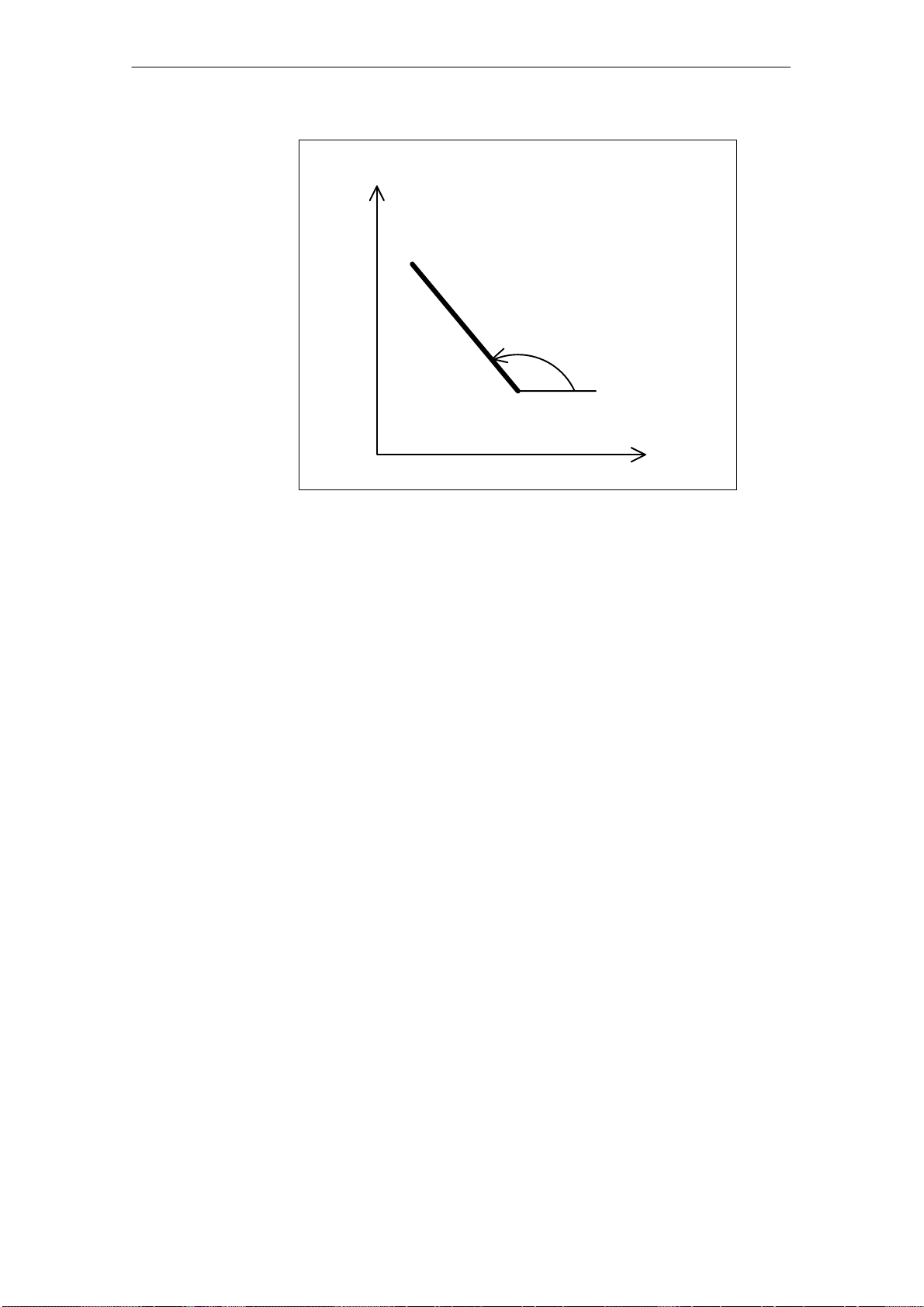
10.02
3 Cycles and Contour Definition
3.6 Programming contour definitions (ISO Dialect T)
X
X88.8, Z39.5)
110 degrees
(X5, 70)
Z
Fig. 3-27 Straight line with angle
3.6.3 Two straight lines
The end point of the first straight line can be programmed either by specifying
the Cartesian coordinates or by specifying the angle of the two straight lines
relative to the abscissa.
Programming syntax:
N10 A
N20 X3.. Z3.. A2..
or
N10 X
N20 X
.. (Q..)
1
.. Z1.. (Q..)
1
.. Z3..
3
Siemens AG, 2002. All rights reserved
SINUMERIK 840D/840Di/810D, Description of Functions ISO Dialects (FBFA) – 11.02 Edition
3-99
Page 100
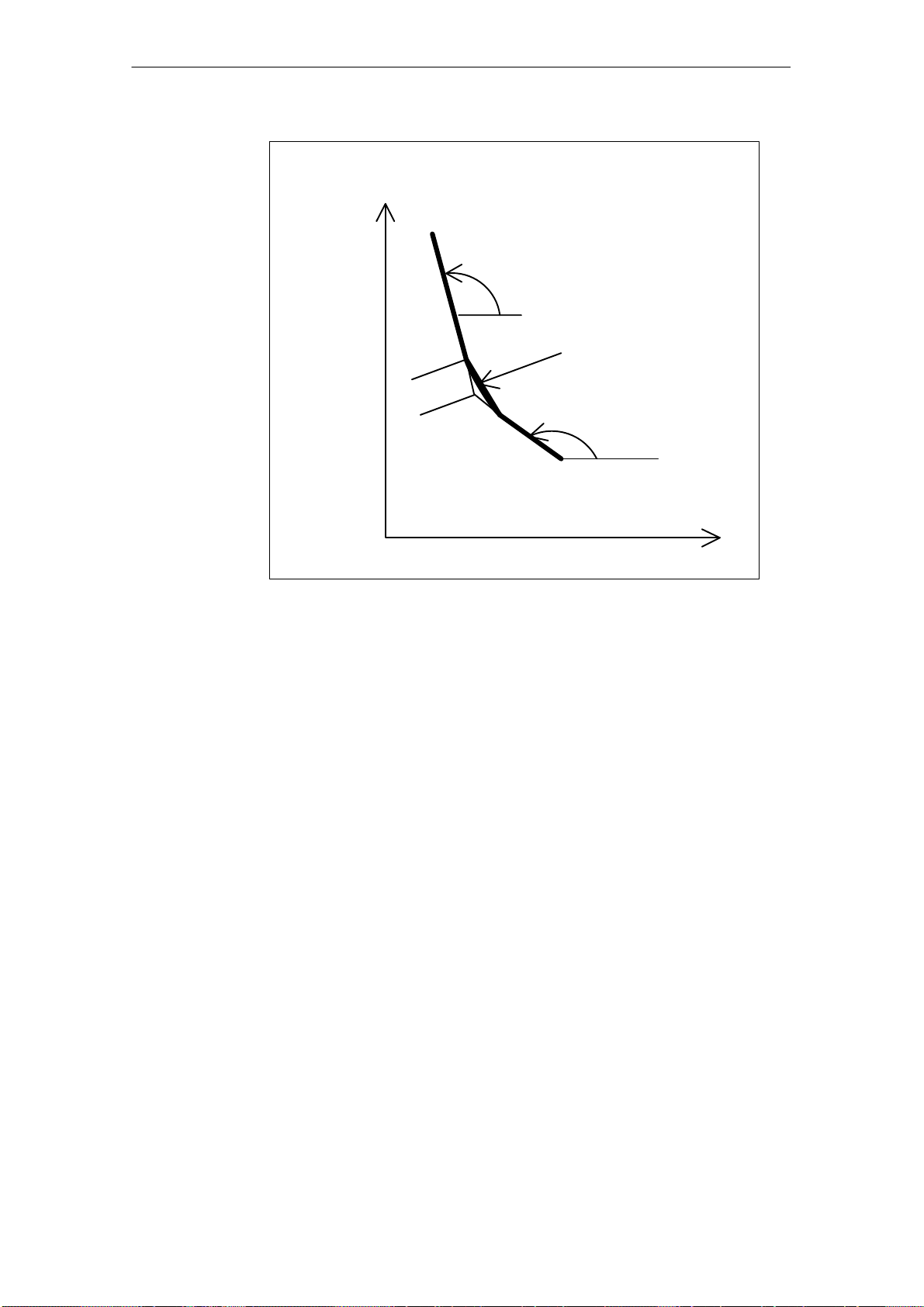
3 Cycles and Contour Definition
3.6 Programming contour definitions (ISO Dialect T)
X
(X3, Z3)
C
(X2, Z2)
10.02
A
2
R
A
1
(X1, Z1)
Fig. 3-28 Two straight lines
Example (Fig. 3-26):
Programming in ISO Dialect T mode:
N10 G1 X10. Z80. F1000 G18
N20 A 1.48.64 C5.5
N30 X85. Z40. A100
Programming in Siemens mode:
N10 X10. Z80. F1000 G18
N20 ANG=148.65 CHR=5.5
N30 X85. Z40. ANG=100
Z
3-100
SINUMERIK 840D/840Di/810D, Description of Functions ISO Dialects (FBFA) – 11.02 Edition
Siemens AG, 2002. All rights reserved
 Loading...