IMPORTANT!
READ CAREFULLY BEFORE USE.
KEEP THIS GUIDE FOR FUTURE REFERENCE.
This is a User’s Guide for a series of products. Not all products support all firmware features.
Screenshots and graphics in this book may differ slightly from your product due to differences in
your product firmware or your computer operating system. Every effort has been made to ensure
that the information in this manual is accurate.
Related Documentation
•Quick Start Guide
The Quick Start Guide shows how to connect the NWA and access the Web Configurator.

LAN .........................................................................................................................................................91
System ....................................................................................................................................................97
2.2.1 Methods of Restoring Factory-Defaults ...................................................................................21
2.3 Navigating the Web Configurator ........ ... ... ... .... ... ... ... .... ... ... .......................................... ... ... ..............22
2.3.1 Title Bar ............................................................................... ... ... ..............................................22
5.2 What You Can Do ............................... ... ... ... .... ... ... ... ........................................................................49
LAN ......................................................................................................................................................91
7.2 What You Can Do in this Chapter .....................................................................................................91
7.3 What You Need to Know ..................................... ... ... .... ... ... ... .... ...................................... .................91
7.4 LAN IP Screen .................................... ... ....................................... ... ... ... .... .......................................93
8.1.1 What You Can Do in This Chapter ...........................................................................................95
8.2 What You Need to Know ..................................... ... ... .... ... ... ... .... ...................................... .................95
10.2 What You Can Do in this Chapter ........ ... ... .... ... ... ... .... ... ... ... .... ... .......................................... ........ 111
10.3 What You Need To Know ..............................................................................................................112
12.2 NWA Access and Login ................................................................................................................124
12.3 Internet Access .............................................................................................................................125
12.4 Wireless LAN ................................................................................................................................126
Appendix A Setting Up Your Computer’s IP Address......................................................................129
Appendix B Pop-up Windows, JavaScript and Java Permissions...................................................157
Appendix C IP Addresses and Subnetting.......................................................................................169
Appendix D IPv6..............................................................................................................................177
Appendix E Wireless LANs..............................................................................................................187
Appendix F Legal Information..........................................................................................................201
Index ..................................................................................................................................................207
8
NWA1120 Series User’s Guide
Page 9
PART I
User’s Guide
9
Page 10
10
Page 11
This chapter introduces the main applications and features of the NWA. It also discusses the ways
you can manage your NWA.
1.1 Introducing the NWA
This User’s Guide covers the following models: NWA1121-NI, and NWA1123-NI. Your NWA is an
IPv6 wireless AP (Access Point) that can function in several wireless modes. It extends the range of
your existing wired network without additional wiring, providing easy network access to mobile
users.
Table 1 NWA Series Comparison Table
FEATURESNWA1121-NINWA1123-NI
Supported Wireless Standards
Supported Frequency Bands
Available Security ModesNone
Number of SSID Profiles832
Layer-2 IsolationYesYes
The NWA controls network access with MAC address filtering and RADIUS server authentication. It
also provides a high level of network traffic security, supporting IEEE 802.1x, Wi-Fi Protected
Access (WPA), WPA2 and WEP data encryption. Its Quality of Service (QoS) features allow you to
prioritize time-sensitive or highly important applications such as VoIP.
Your NWA is easy to install, configure and use. The embedded Web-based configurator enables
simple, straightforward management and maintenance.
See the Quick Start Guide for instructions on how to make hardware connections.
NWA1120 Series User’s Guide11
Page 12
Chapter 1 Introducing the NWA
1.1.1 Dual-Band
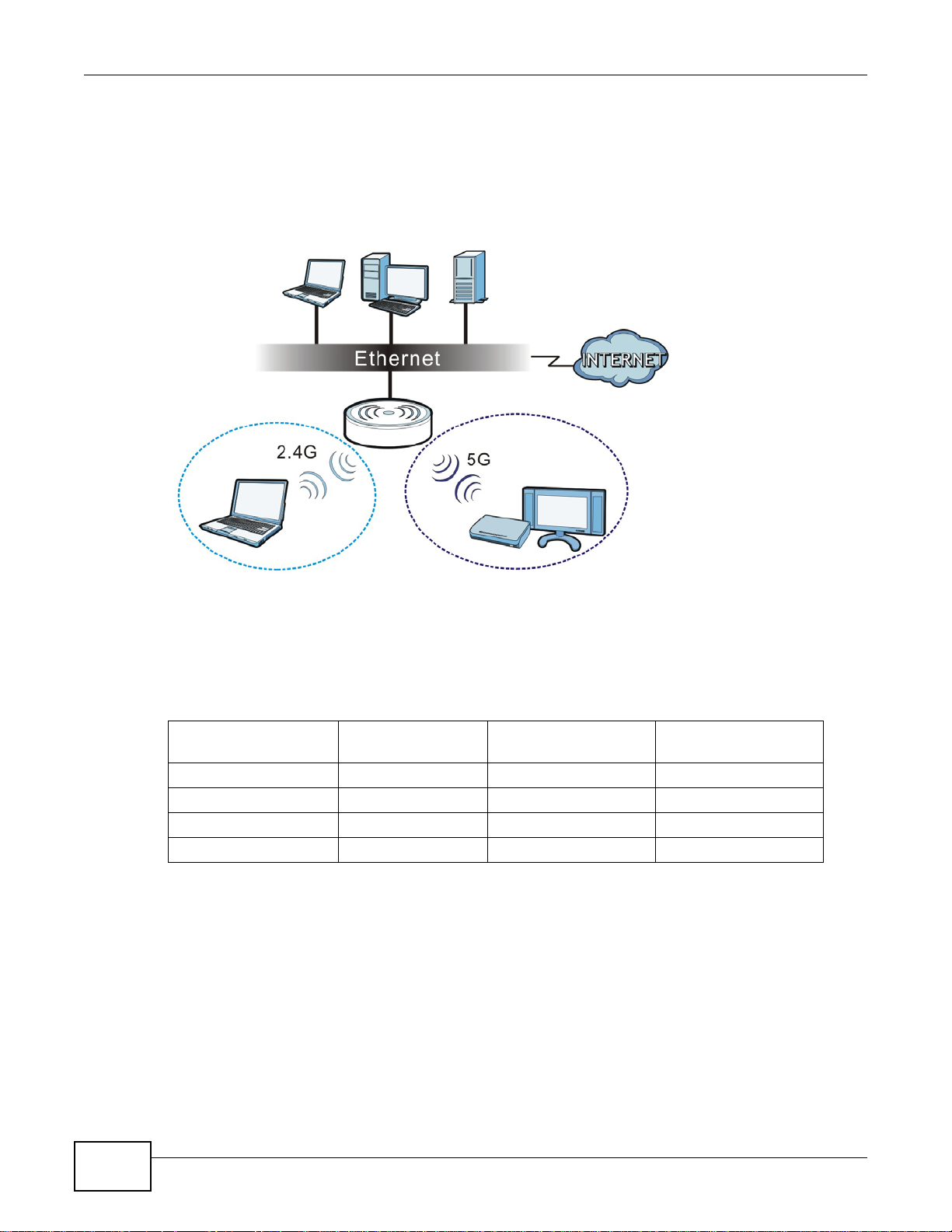
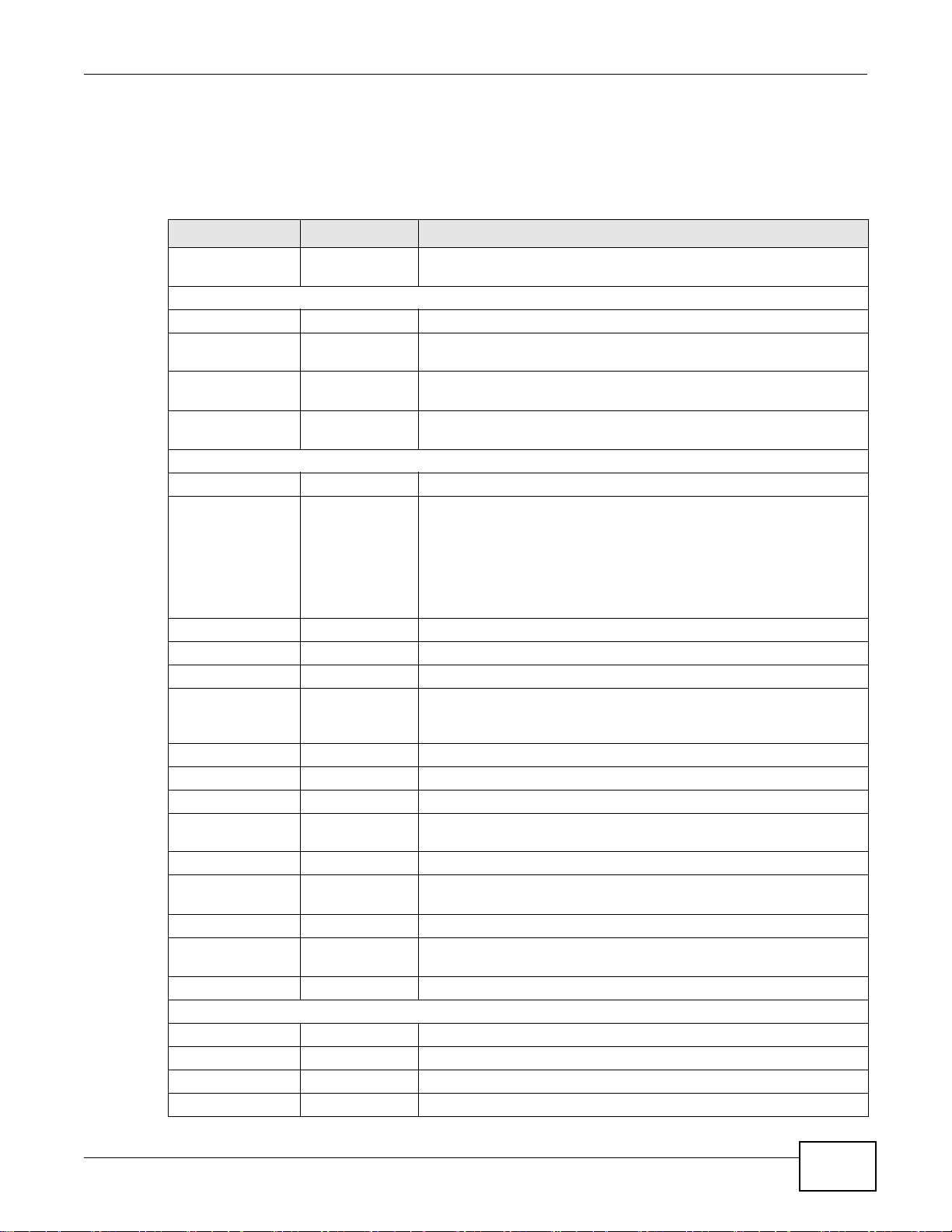
The NWA1123-NI is a dual-band AP and able to function both 2.4G and 5G networks at the same
time. You could use the 2.4 GHz band for regular Internet surfing and downloading while using the
5 GHz band for time sensitive traffic like high-definition video, music, and gaming.
Figure 1 Dual-Band Application
1.2 Wireless Modes
The NWA can be configured to use the following WLAN operating modes:
Applications for each operating mode are shown below.
1.2.1 MBSSID
A Basic Service Set (BSS) is the set of devices forming a single wireless network (usually an access
point and one or more wireless clients). The Service Set IDentifier (SSID) is the name of a BSS. In
Multiple BSS (MBSSID) mode, the NWA provides multiple virtual APs, each forming its own BSS and
using its own individual SSID profile.
You can configure multiple SSID profiles, and have all of them active at any one time.
NUMBER OF
SUPPORTED SSID
UNIVERSAL
REPEATER FUNCTION
AP FUNCTION
12
NWA1120 Series User’s Guide
Page 13
Chapter 1 Introducing the NWA
You can assign different wireless and security settings to each SSID profile. This allows you to
compartmentalize groups of users, set varying access privileges, and prioritize network traffic to
and from certain BSSs.
To the wireless clients in the network, each SSID appears to be a different access point. As in any
wireless network, clients can associate only with the SSIDs for which they have the correct security
settings.
For example, you might want to set up a wireless network in your office where Internet telephony
(VoIP) users have priority. You also want a regular wireless network for standard users, as well as a
‘guest’ wireless network for visitors. In the following figure, VoIP_SSID users have QoS priority,
SSID01 is the wireless network for standard users, and Guest_SSID is the wireless network for
guest users. In this example, the guest user is forbidden access to the wired Land Area Network
(LAN) behind the AP and can access only the Internet.
Figure 2 Multiple BSSs
1.2.2 Wireless Client
The NWA can be used as a wireless client to communicate with an existing network.
Note: The NWA1123-NI is a dual-band AP which contains two different types of wireless
radios to transmit at 2.4 GHz and 5 GHz bands separately and simultaneously. If
one of the NWA1123-NI wireless radio is set to work in client mode, the other radio
will be disabled automatically.
NWA1120 Series User’s Guide
13
Page 14
Chapter 1 Introducing the NWA
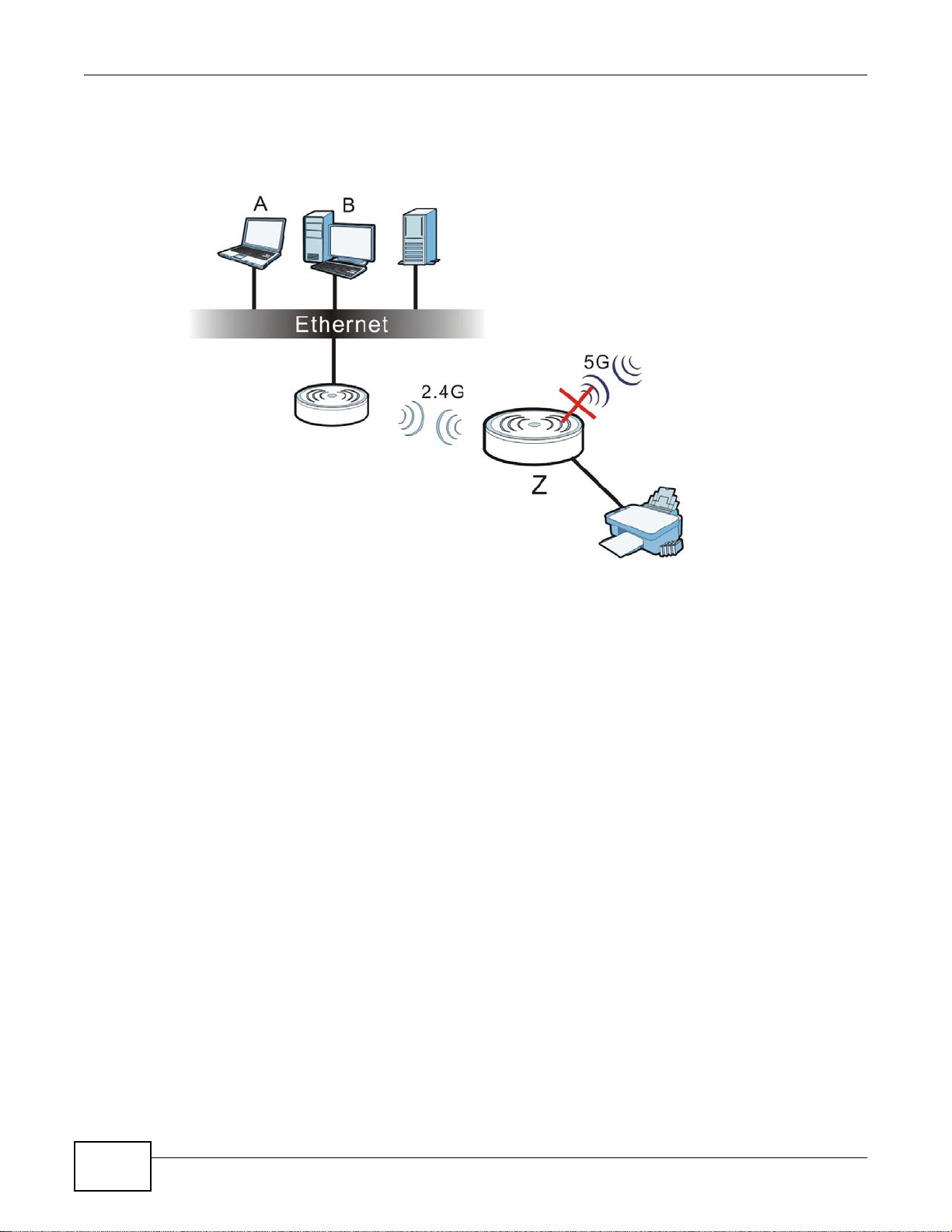
In the figure below, the printer can receive requests from the wired computer clients A and B via
the NWA in Client mode (Z) using only the 2.4 GHz band.
Figure 3 Wireless Client Application
14
NWA1120 Series User’s Guide
Page 15
1.2.3 Root AP
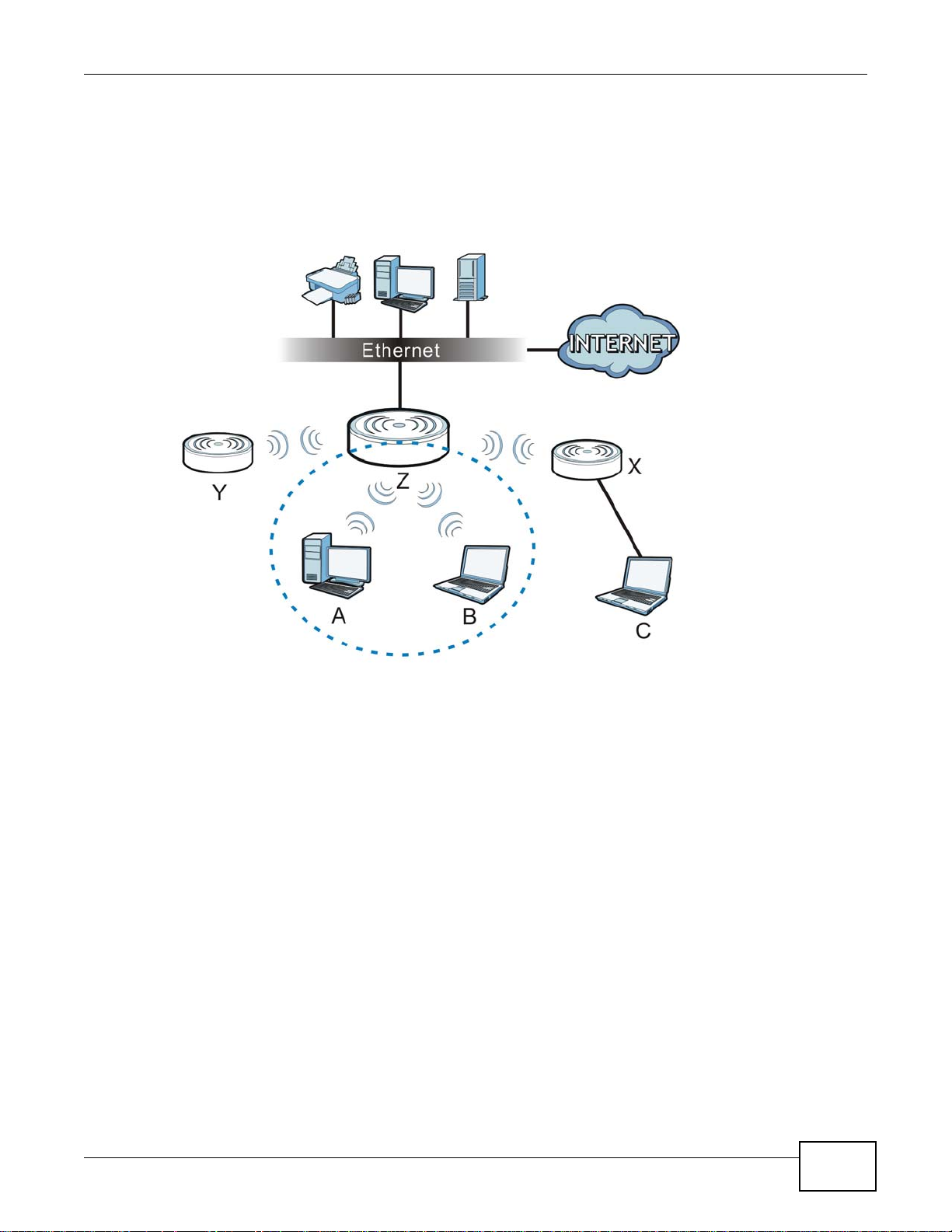
In Root AP mode, the NWA (Z) can act as the root AP in a wireless network and also allow repeaters
(X and Y) to extend the range of its wireless network at the same time. In the figure below, both
clients A, B and C can access the wired network through the root AP.
Figure 4 Root AP Application
Chapter 1 Introducing the NWA
On the NWA in Root AP mode, you can have multiple SSIDs active for reqular wireless connections
and one SSID for the connection with a repeater (universal repeater SSID). Wireless clients can use
either SSID to associate with the NWA in Root AP mode. A repeater must use the universal repeater
SSID to connect to the NWA in Root AP mode.
When the NWA is in Root AP mode, universal repeater security between the NWA and other
repeater is independent of the security between the wireless clients and the AP or repeater. If you
do not enable universal repeater security, traffic between APs is not encrypted. When universal
repeater security is enabled, both APs and repeaters must use the same pre-shared key. See
Section 6.6 on page 76 for more details.
Unless specified, the term “security settings” refers to the traffic between the wireless clients and
the AP. At the time of writing, universal repeater security is compatible with the NWA only.
1.2.4 Repeater
The NWA can act as a wireless network repeater to extend a root AP’s wireless network range, and
also establish wireless connections with wireless clients.
Using Repeater mode, your NWA can extend the range of the WLAN. In the figure below, the NWA
in Repeater mode (Z) has a wireless connection to the NWA in Root AP mode (X) which is
connected to a wired network and also has a wireless connection to another NWA in Repeater mode
(Y) at the same time. Z and Y act as repeaters that forward traffic between associated wireless
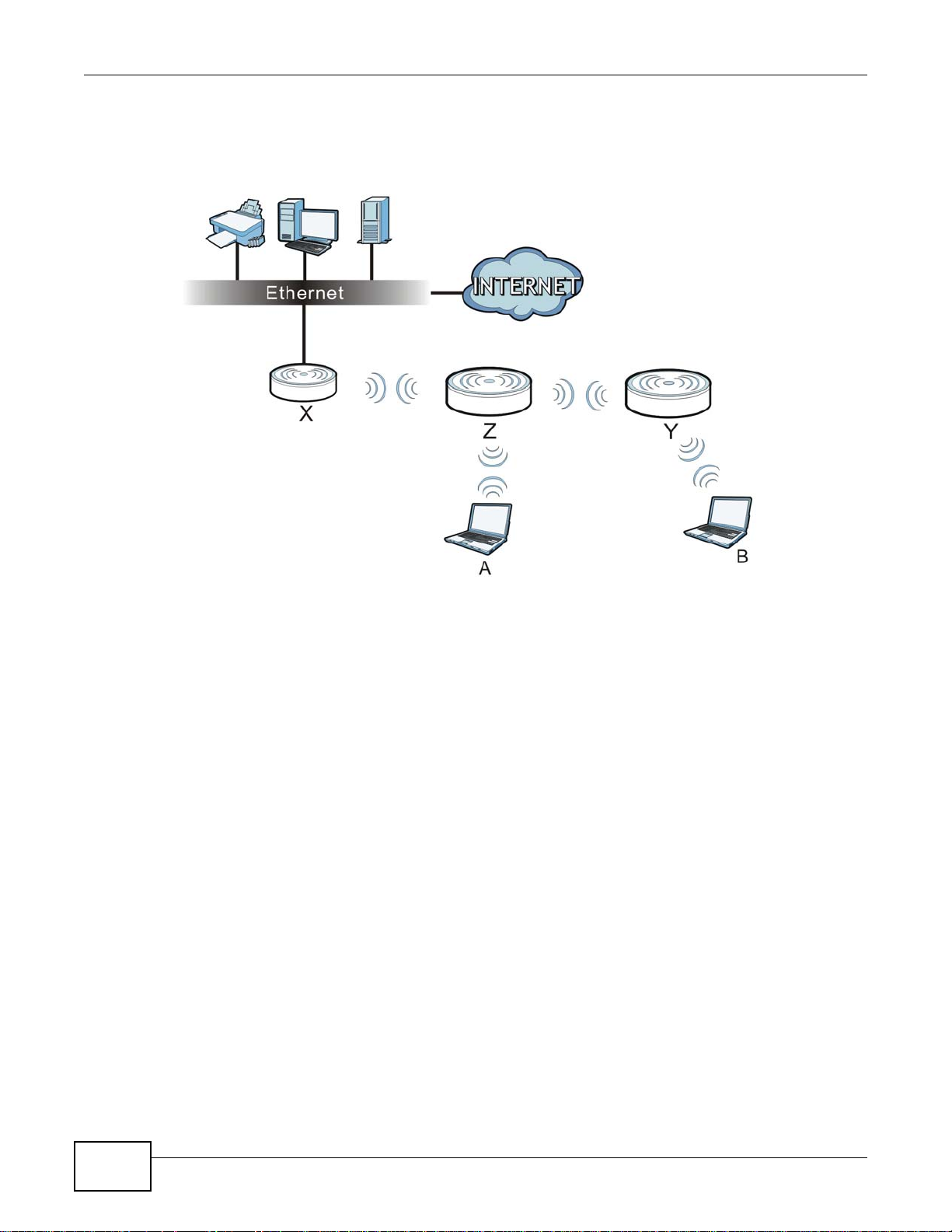
NWA1120 Series User’s Guide
15
Page 16
Chapter 1 Introducing the NWA
clients and the wired LAN. Clients A and B access the AP and the wired network behind the AP
throught repeaters Z and Y.
Figure 5 Repeater Application
When the NWA is in Repeater mode, universal repeater security between the NWA and other
repeater is independent of the security between the wireless clients and the AP or repeater. If you
do not enable universal repeater security, traffic between APs is not encrypted. When universal
repeater security is enabled, both APs and repeaters must use the same pre-shared key. See
Section 6.6 on page 76 for more details.
Once the security settings of peer sides match one another, the connection between devices is
made.
At the time of writing, universal repeater security is compatible with the NWA only.
1.3 Ways to Manage the NWA
Use any of the following methods to manage the NWA.
• Web Configurator. This is recommended for everyday management of the NWA using a
(supported) web browser.
• FTP (File Transfer Protocol) for firmware upgrades and configuration backup and restore.
• SNMP (Simple Network Management Protocol). The device can be monitored by an SNMP
manager.

16
NWA1120 Series User’s Guide
Page 17
Chapter 1 Introducing the NWA
1.4 Configuring Your NWA’s Security Features
Your NWA comes with a variety of security features. This section summarizes these features and
provides links to sections in the User’s Guide to configure security settings on your NWA. Follow the
suggestions below to improve security on your NWA and network.
1.4.1 Control Access to Your Device
Ensure only people with permission can access your NWA.
• Control physical access by locating devices in secure areas, such as locked rooms. Most NWAs
have a reset button. If an unauthorized person has access to the reset button, they can then
reset the device’s password to its default password, log in and reconfigure its settings.
• Change any default passwords on the NWA, such as the password used for accessing the NWA’s
web configurator (if it has a web configurator). Use a password with a combination of letters and
numbers and change your password regularly. Write down the password and put it in a safe
place.
•See Section 11.5 on page 117 for instructions on changing your password.
• Configure remote management to control who can manage your NWA. See Chapter 9 on page 97
for more information. If you enable remote management, ensure you have enabled remote
management only on the IP addresses, services or interfaces you intended and that other remote
management settings are disabled.
1.4.2 Wireless Security
Wireless devices are especially vulnerable to attack. Take the following measures to improve
wireless security.
• Enable wireless security on your NWA. Choose the most secure encryption method that all
devices on your network support. See Section 6.6 on page 76 for directions on configuring
encryption. If you have a RADIUS server, enable IEEE 802.1x or WPA(2) user identification on
your network so users must log in. This method is more common in business environments.
• Hide your wireless network name (SSID). The SSID can be regularly broadcast and unauthorized
users may use this information to access your network. See Section 6.5 on page 74 for directions
on using the web configurator to hide the SSID.
• Enable the MAC filter to allow only trusted users to access your wireless network or deny
unwanted users access based on their MAC address. See Section 6.9 on page 86 for directions on
configuring the MAC filter.
1.5 Good Habits for Managing the NWA
Do the following things regularly to make the NWA more secure and to manage it more effectively.
• Change the password. Use a password that’s not easy to guess and that consists of different
types of characters, such as numbers and letters.
• Write down the password and put it in a safe place.
NWA1120 Series User’s Guide
17
Page 18
Chapter 1 Introducing the NWA
• Back up the configuration (and make sure you know how to restore it). Restoring an earlier
working configuration may be useful if the device becomes unstable or even crashes. If you
forget your password, you will have to reset the NWA to its factory default settings. If you backed
up an earlier configuration file, you would not have to totally re-configure the NWA. You could
simply restore your last configuration.
1.6 Hardware Connections
See your Quick Start Guide for information on making hardware connections.
1.7 LED
Figure 6 LED
18
Table 2 LED
COLORSTATUSDESCRIPTION
AmberOnThere is system error and the NWA cannot boot up, or the NWA doesn’t
have an Ethernet connection with the LAN.
FlashingThe NWA is starting up.
OffThe NWA is receiving power and ready for use.
GreenOnThe WLAN is active.
BlinkingThe WLAN is active, and transmitting or receiving data.
OffThe WLAN is not active.
NWA1120 Series User’s Guide
Page 19
CHAPTER 2
Introducing the Web Configurator
This chapter describes how to access the NWA’s web configurator and provides an overview of its
screens.
2.1 Accessing the Web Configurator
1Make sure your hardware is properly connected and prepare your computer or computer network to
connect to the NWA (refer to the Quick Start Guide).
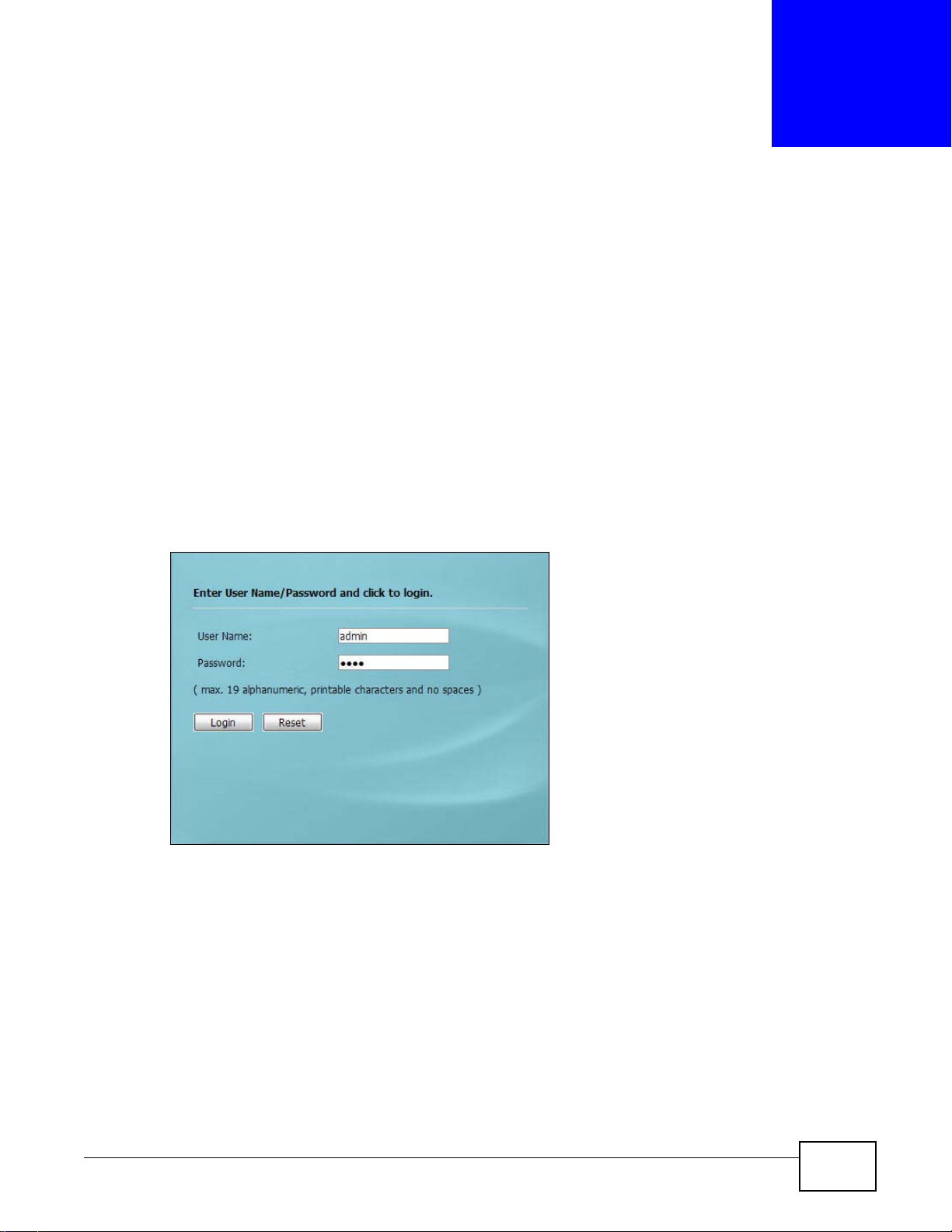
2Launch your web browser.
3Type "192.168.1.2" as the URL (default). The login screen appears.
Figure 7 The Login Screen
4Type “admin” as the (default) username and “1234” as the (default) password. Click Login.
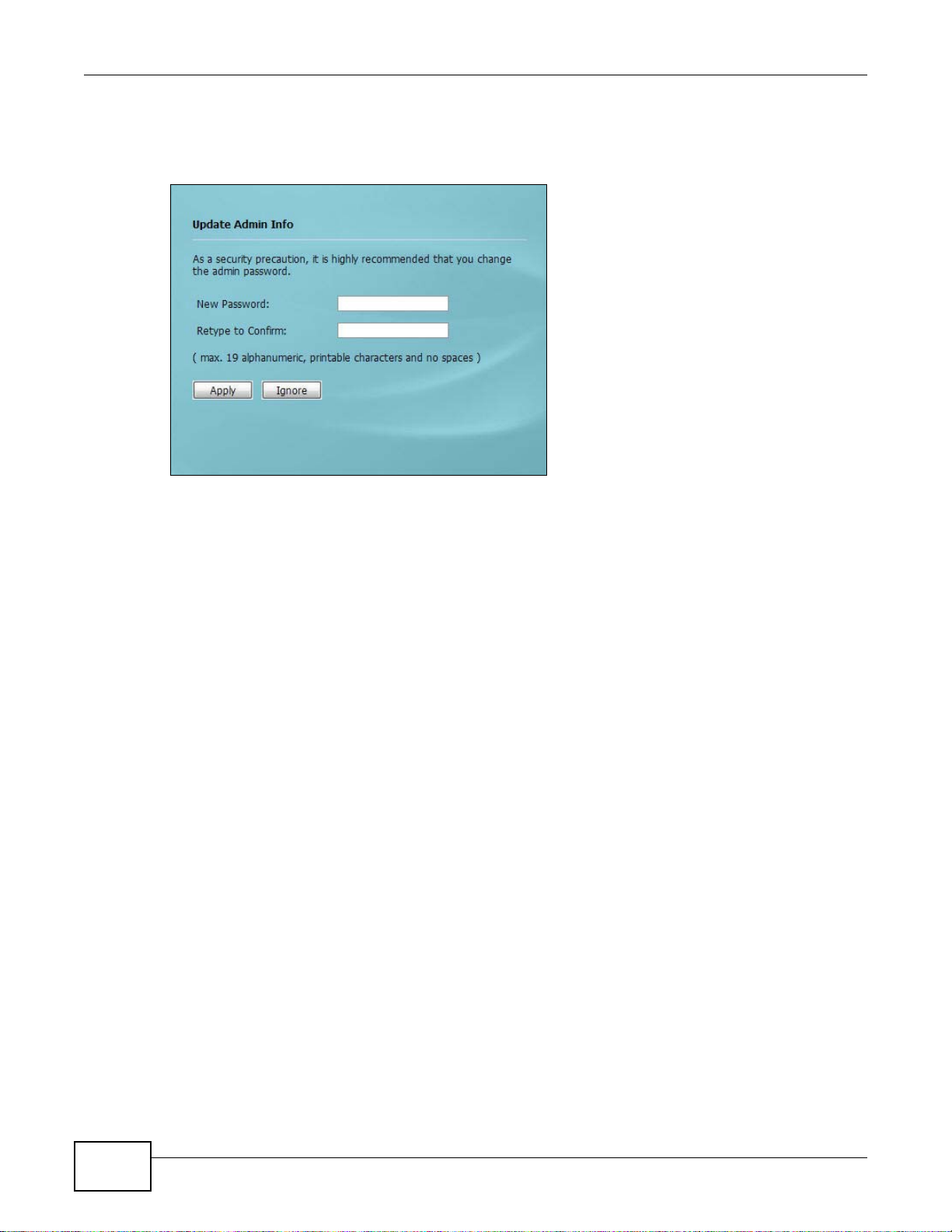
5You should see a screen asking you to change your password (highly recommended) as shown
next. Type a new password (and retype it to confirm) then click Apply. Alternatively, click Ignore.
NWA1120 Series User’s Guide19
Page 20
Chapter 2 Introducing the Web Configurator
Note: If you do not change the password, the following screen appears every time you
login.
Figure 8 Change Password Screen
You should now see the Dashboard screen. See Chapter 2 on page 19 for details about the
Dashboard screen.
2.2 Resetting the NWA
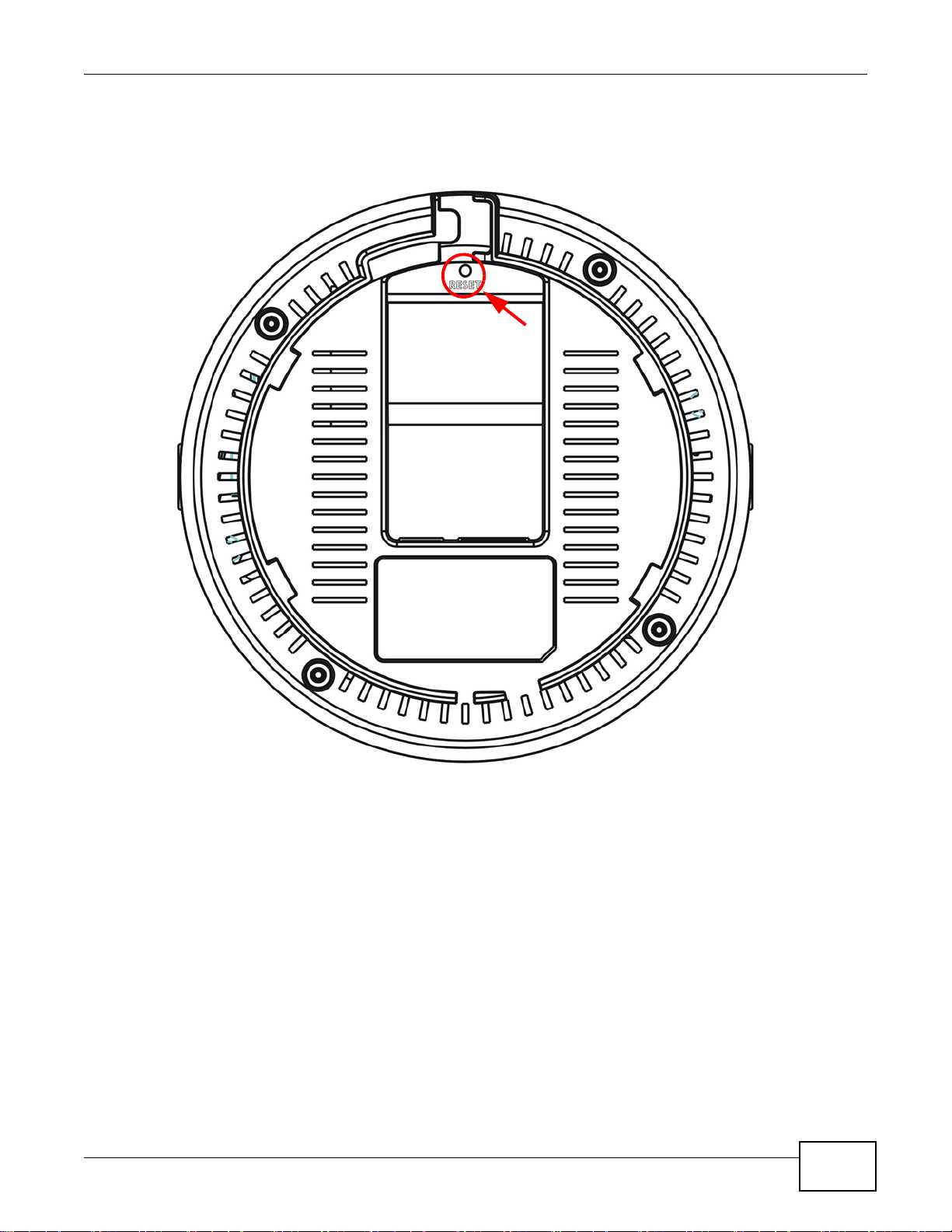
If you forget your password or cannot access the web configurator, you will need to use the RESET
button at the rear panel of the NWA. This replaces the current configuration file with the factory-
20
NWA1120 Series User’s Guide
Page 21
Chapter 2 Introducing the Web Configurator
default configuration file. This means that you will lose all the settings you previously configured.
The password will be reset to “1234”.
Figure 9 The RESET Button
2.2.1 Methods of Restoring Factory-Defaults
You can erase the current configuration and restore factory defaults in two ways:
Use the RESET button to upload the default configuration file. Hold this button in for about 3
seconds (the light will begin to blink). Use this method for cases when the password or IP address
of the NWA is not known.
Use the web configurator to restore defaults (refer to Section 11.8 on page 120).
NWA1120 Series User’s Guide
21
Page 22
Chapter 2 Introducing the Web Configurator
A
B
C
2.3 Navigating the Web Configurator
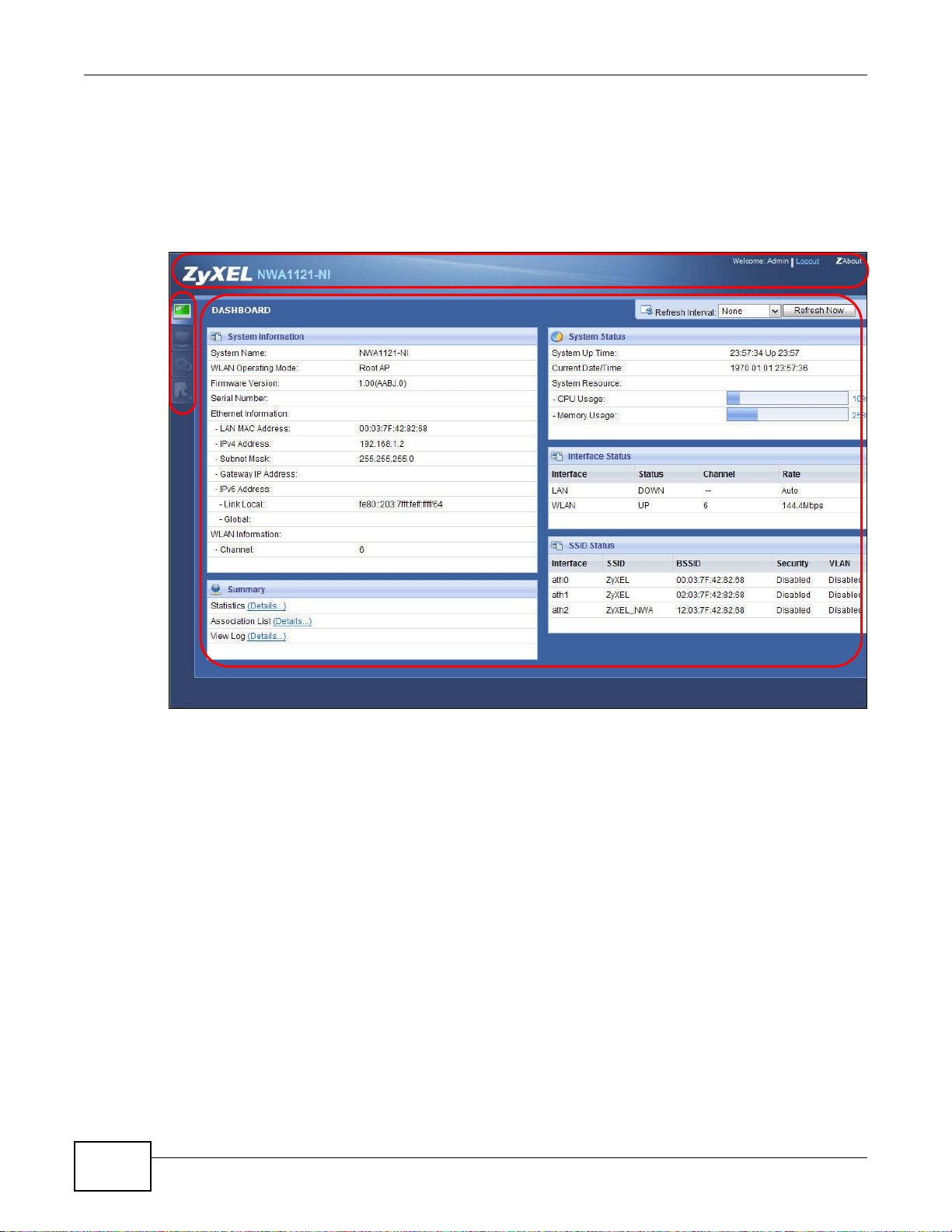
The following summarizes how to navigate the web configurator from the Dashboard screen. This
guide uses the NWA1121-NI screens as an example. The screens may vary slightly for different
models.
Figure 10 Status Screen of the Web Configurator
As illustrated above, the Web Configurator screen is divided into these parts:
• A - title bar
• B - navigation panel
• C - main window
2.3.1 Title Bar
Click Logout at any time to exit the Web Configurator.
Click ZAbout to open the about window, which provides information of the boot module and driver
versions.
22
NWA1120 Series User’s Guide
Page 23
2.3.2 Navigation Panel
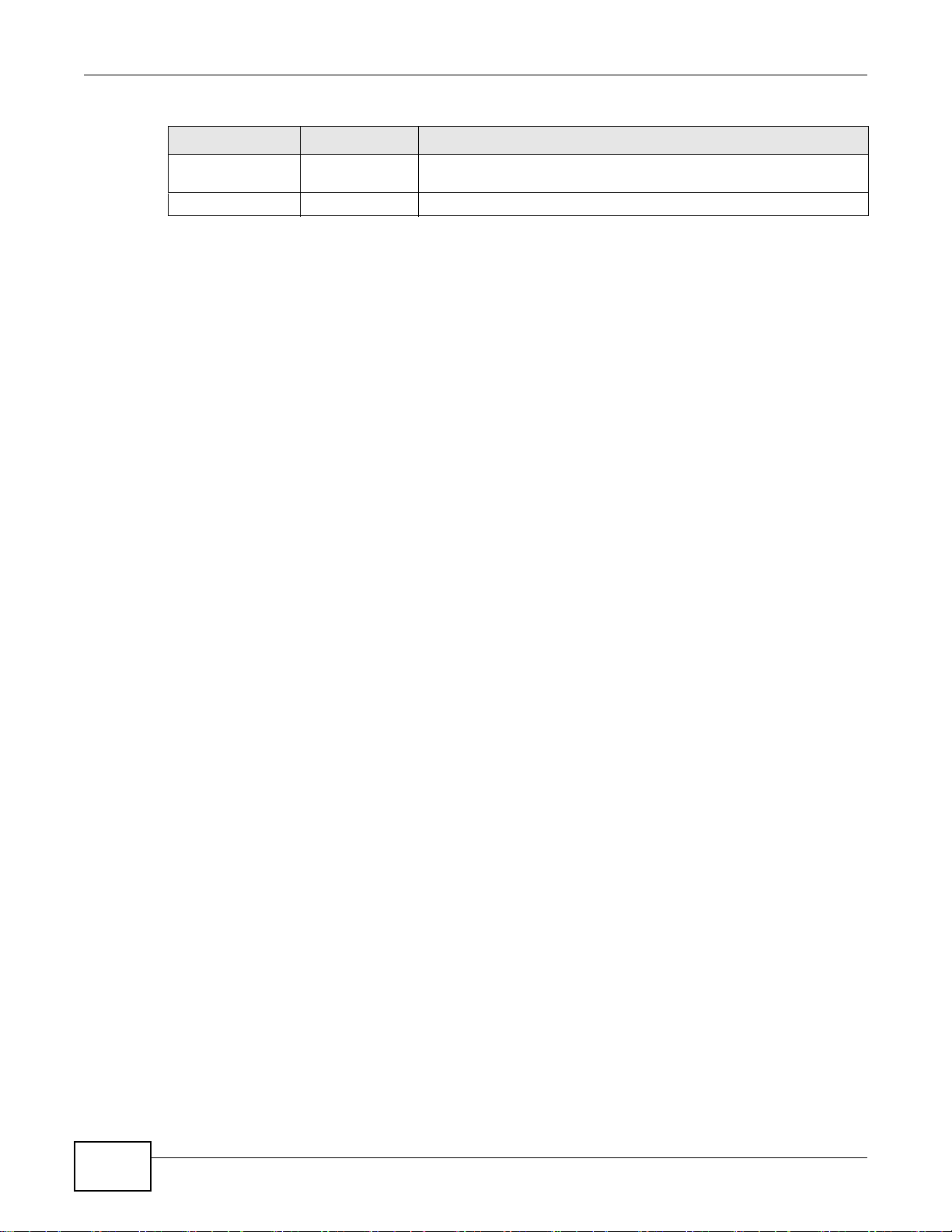
Use the menu items on the navigation panel to open screens to configure NWA features. The
following tables describe each menu item.
Table 3 Navigation Panel Summary
LINKTABFUNCTION
DashboardThis screen shows the NWA’s general device and network status
Monitor
LogsView LogUse this screen to view the logs for the categories that you selected.
StatisticsUse this screen to view port status, packet specific statistics, the
Association ListUse this screen to view the wireless stations that are currently
Channel UsageUse this screen to know whether a channel is used by another
Configuration
Network
Wireless LANWireless
Settings
Wireless
Settings - 2.4G
Wireless
Settings - 5G
SSIDUse this screen to configure up to eight SSID profiles for your NWA.
SecurityUse this screen to configure wireless security profiles on the NWA.
RADIUSUse this screen to configure up to four RADIUS profiles.
Layer-2 Isolation Use this screen to configure the MAC addresses of the devices that
MAC FilterUse this screen to configure MAC filtering profiles.
LANUse this screen to configure the NWA’s LAN IP address.
VLANUse this screen to configure the NWA’s VLAN settings.
SystemWWWUse this screen to configure through which interface(s) and from
CertificatesUse this screen to import or remove a certificate from the NWA.
Telen tUse this screen to configure through which interface(s) and from
SNMPUse this screen to configure the NWA for SNMP management.
FTPUse this screen to configure through which interface(s) and from
Log SettingsUse this screen to change your log settings.
Maintenance
GeneralUse this screen to configure your device’s name.
PasswordUse this screen to configure your device’s password.
TimeUse this screen to change your NWA’s time and date.
Firmware UpgradeUse this screen to upload firmware to your device.
Chapter 2 Introducing the Web Configurator
information. Use this screen to access the statistics and client list.
"system up time" and so on.
associated to the NWA.
wireless network or not.
Use this screen to configure the wireless LAN settings and NWA’s
operation mode.
you want to allow the associated wireless clients to have access to
when layer-2 isolation is enabled
which IP address(es) users can use HTTP to manage the NWA.
which IP address(es) users can use Telnet to manage the NWA.
which IP address(es) users can use FTP to access the NWA.
NWA1120 Series User’s Guide
23
Page 24
Chapter 2 Introducing the Web Configurator
Table 3 Navigation Panel Summary
LINKTABFUNCTION
Configuration FileUse this screen to backup and restore your device’s configuration
RestartUse this screen to reboot the NWA without turning the power off.
2.3.3 Main Window
The main window displays information and configuration fields. It is discussed in the rest of this
document.
(settings) or reset the factory default settings.
24
NWA1120 Series User’s Guide
Page 25
The Dashboard screens display when you log into the NWA, or click Dashboard in the navigation
menu.
Use the Dashboard screen to look at the current status of the device, system resources, and
interfaces. The Dashboard screens also provide detailed information about system statistics,
associated wireless clients, and logs.
3.1 The Dashboard Screen
Use this screen to get a quick view of system, Ethernet, WLAN and other information regarding
your NWA.
CHAPTER 3
Dashboard
NWA1120 Series User’s Guide25
Page 26
Chapter 3 Dashboard
Click Dashboard. The following screen displays.
Figure 11 The Dashboard Screen (NWA1121-NI)
Figure 12 The Dashboard Screen (NWA1123-NI)
26
NWA1120 Series User’s Guide
Page 27
Chapter 3 Dashboard
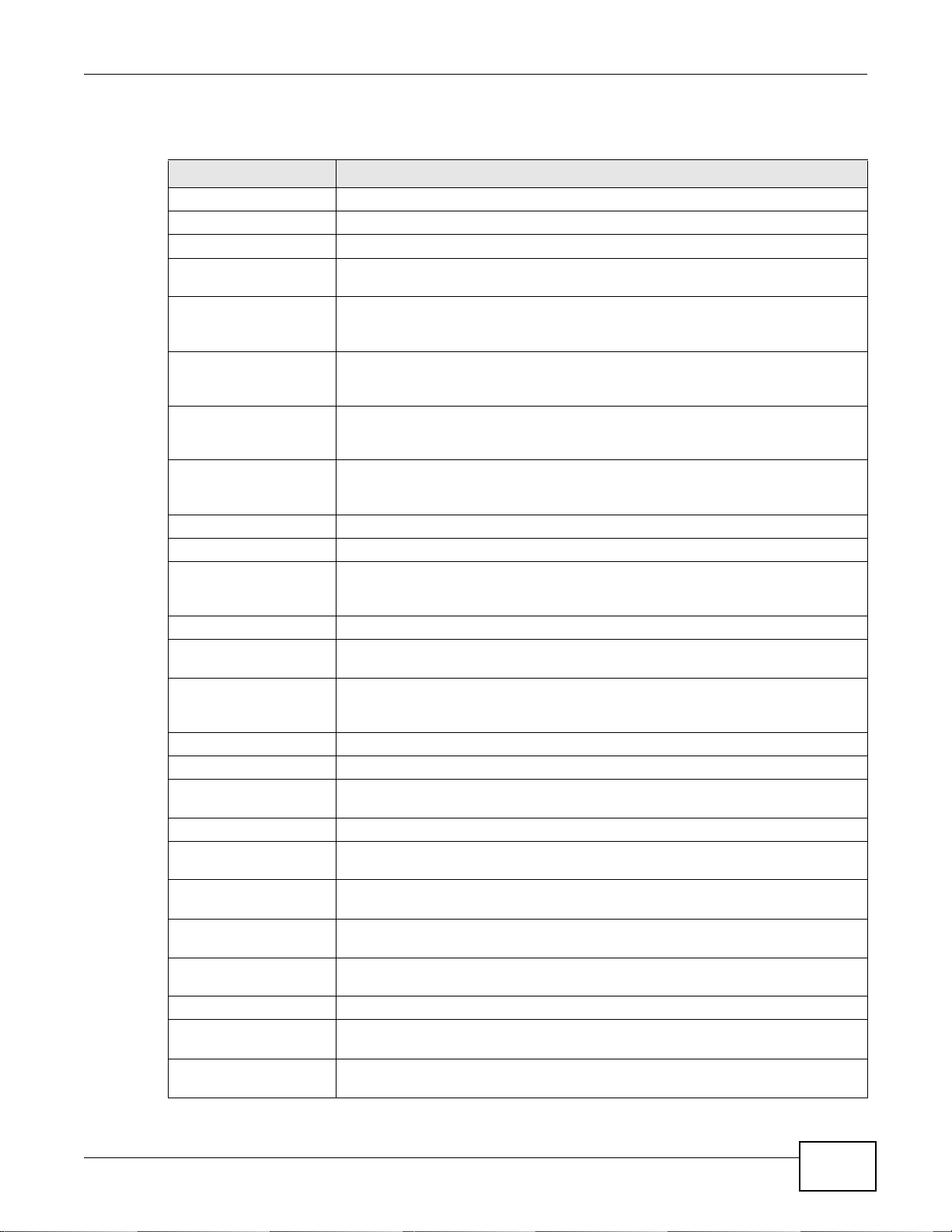
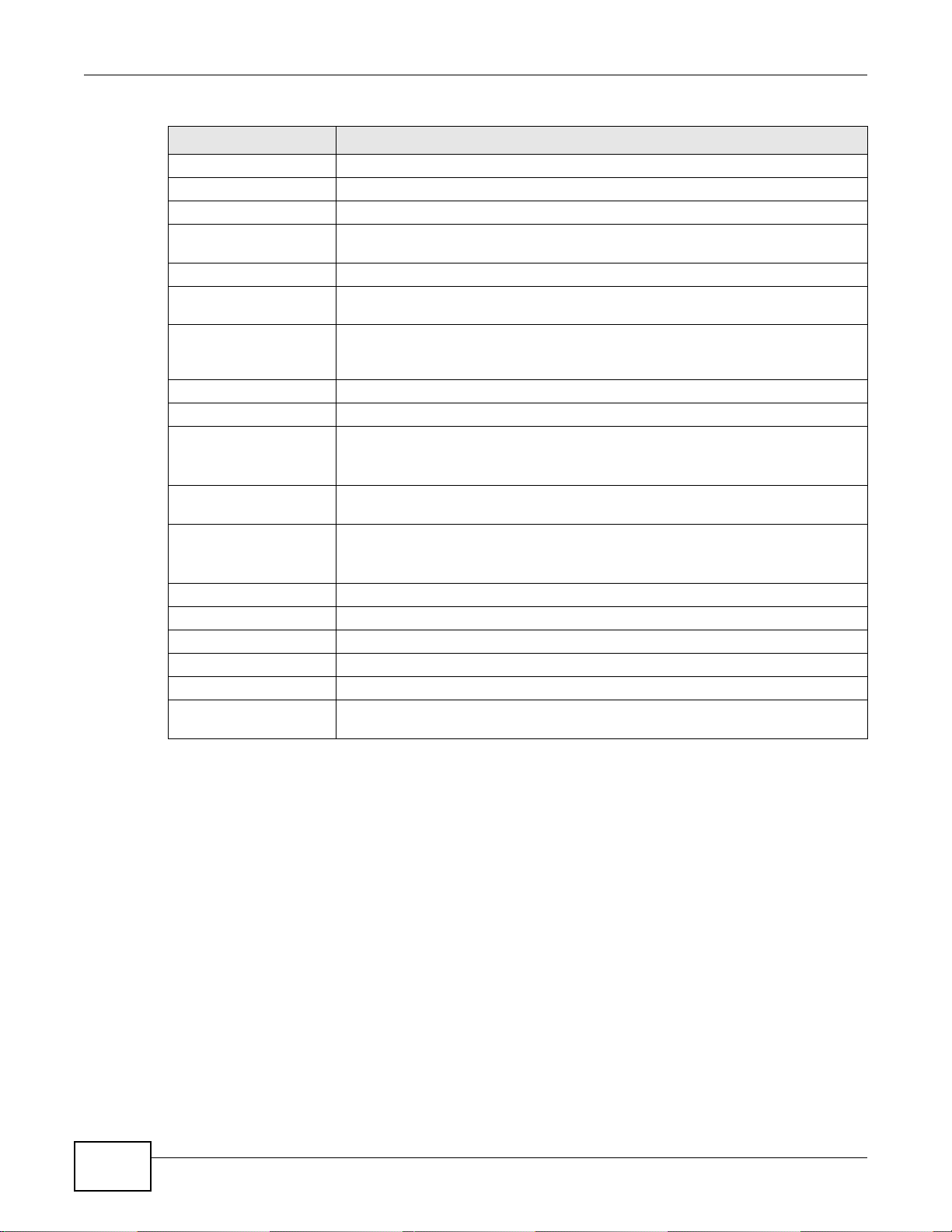
The following table describes the labels in this screen.
Table 4 The Dashboard Screen
LABELDESCRIPTION
Refresh IntervalSelect how often you want the NWA to update this screen.
Refresh NowClick this to update this screen immediately.
System Information
System NameThis field displays the NWA system name. It is used for identification. You can
change this in the Maintenance > General screen’s System Name field.
WLAN Operating
Mode
2.4GThis field displays the current operating mode of the 2.4G wireless module (Root
5GThis field displays the current operating mode of the 5G wireless module (Root AP,
Firmware VersionThis field displays the current version of the firmware inside the device. It also
Serial NumberThis field displays the serial number of the NWA.
Ethernet Information
LAN MAC AddressThis displays the MAC (Media Access Control) address of the NWA on the LAN.
IPv4 AddressThis field displays the current IPv4 address of the NWA on the network.
Subnet MaskSubnet masks determine the maximum number of possible hosts on a network.
Gateway IP AddressThis is the IP address of the gateway. The gateway is a router or switch on the
IPv6 AddressThis field displays the current IPv6 address(es) of the NWA on the network.
Link LocalThis is the IPv6 link-local address that the NWA generates automatically.
GlobalThis is the NWA’s IPv6 global address that you specify manually in the
WLAN Information
SSIDThis field displays the SSID (Service Set Identifier). This is available only when the
ChannelThe channel or frequency used by the NWA to send and receive information (in the
StatusThis shows the current status of the wireless LAN. This is available only when the
Security ModeThis displays the security mode the NWA is using. This is available only when the
Summary
StatisticsClick this link to view port status and packet specific statistics. See Section 5.4 on
Association ListClick this to see a list of wireless clients currently associated to each of the NWA’s
This field displays the current operating mode of the wireless module (Root AP,
Repeater, Client, or MBSSID). You can change the operating mode in the
Configuration > Wireless LAN > Wireless Settings screen.
AP, Repeater, Client, or MBSSID). You can change the operating mode in the
Configuration > Wireless LAN > Wireless Settings - 2.4G screen.
Repeater, Client, or MBSSID). You can change the operating mode in the
Configuration > Wireless LAN > Wireless Settings - 5G screen.
shows the date the firmware version was created. You can change the firmware
version by uploading new firmware in Maintenance > Firmware Upgrade.
Every network device has a unique MAC address which identifies it across the
network.
You can also use subnet masks to divide one network into multiple sub-networks.
same network segment as the device's LAN port. The gateway helps forward
packets to their destinations.
Configuration > LAN screen.
WLAN operation mode is Client.
2.4G or 5G wireless network).
WLAN operation mode is Client.
page 50.
wireless modules. See Section 5.5 on page 51.
NWA1120 Series User’s Guide
27
Page 28
Chapter 3 Dashboard
Table 4 The Dashboard Screen (continued)
LABELDESCRIPTION
View LogClick this to see a list of logs produced by the NWA. See Section 5.3 on page 49.
System Status
System Up TimeThis field displays the elapsed time since the NWA was turned on.
Current Date/TimeThis field displays the date and time configured on the NWA. You can change this in
System Resource
CPU UsageThis field displays what percentage of the NWA’s processing ability is currently
Memory UsageThis field displays what percentage of the NWA’s volatile memory is currently in
Interface Status
InterfaceThis column displays each interface of the NWA.
StatusThis field indicates whether or not the NWA is using the interface.
ChannelThis shows the channel number which the NWA is currently using over the wireless
RateFor the LAN port this displays the port speed and duplex setting.
SSID StatusThis section is not available when the WLAN operation mode is Client.
InterfaceThis column displays each of the NWA’s wireless interfaces.
SSIDThis field displays the SSID(s) currently used by each wireless module.
BSSIDThis field displays the MAC address of the wireless module.
SecurityThis field displays the type of wireless security used by each SSID.
VLANThis field displays the VLAN ID of each SSID in use, or Disabled if the SSID does
the Maintenance > Time screen.
being used. The higher the CPU usage, the more likely the NWA is to slow down.
use. The higher the memory usage, the more likely the NWA is to slow down. Some
memory is required just to start the NWA and to run the web configurator.
For each interface, this field displays Up when the NWA is using the interface and
Down when the NWA is not using the interface.
LAN.
For the WLAN interface, it displays the downstream and upstream transmission
rate or N/A if the interface is not in use.
not use VLAN.
28
NWA1120 Series User’s Guide
Page 29
CHAPTER 4
This chapter first provides an overview of how to configure the wireless LAN on your NWA, and then
gives step-by-step guidelines showing how to configure your NWA for some example scenarios.
4.1 How to Configure the Wireless LAN
This section illustrates how to choose which wireless operating mode to use on the NWA and how to
set up the wireless LAN in each wireless mode. See Section 4.1.2 on page 29 for links to more
information on each step.
4.1.1 Choosing the Wireless Mode
•Use MBSSID (Multiple Basic Service Set Identifier) operating mode if you want to use the NWA
as an access point with some groups of users having different security or QoS settings from other
groups of users. See Section 1.2.1 on page 12 for details.
•Use Client operating mode if you want to use the NWA to access a wireless network. See Section
1.2.2 on page 13 for details.
•Use Root AP operating mode if you want to allow wireless clients to access your wired network
through the NWA and also have repeaters communicate with the NWA to expand wireleass
coverage. See Section 1.2.3 on page 15 for details.
•Use Repeater operating mode if you want to use the NWA to communicate with the root AP or
other repeaters. See Section 1.2.4 on page 15 for details.
Tutorial
4.1.2 Further Reading
Use these links to find more information on the steps:
• Choosing 802.11 Mode: see Section 6.4 on page 60.
• Choosing a wireless Channel ID: see Section 6.4 on page 60.
• Choosing a Security mode: see Section 6.6 on page 76.
• Configuring an external RADIUS server: see Section 6.7 on page 82.
•Configuring MAC Filtering: see Section 6.9 on page 86.
4.2 How to Configure Multiple Wireless Networks
In this example, you have been using your NWA as an access point for your office network. Now
your network is expanding and you want to make use of the MBSSID feature (see Section 6.4.4 on
NWA1120 Series User’s Guide29
Page 30
Chapter 4 Tutorial
Z
A
B
page 71) to provide multiple wireless networks. Each wireless network will cater to a different type
of user.
You want to make three wireless networks: one standard office wireless network with all the same
settings you already have, another wireless network with high priority QoS settings for Voice over
IP (VoIP) users, and a guest network that allows visitors to access only the Internet and the
network printer.
To do this, you will take the following steps:
1Edit the SSID profiles.
2Change the operating mode from Root AP to MBSSID and reactivate the standard network.
3Configure different security modes for the networks.
4Configure a wireless network for standard office use.
5Configure a wireless network for VoIP users.
6Configure a wireless network for guests to your office.
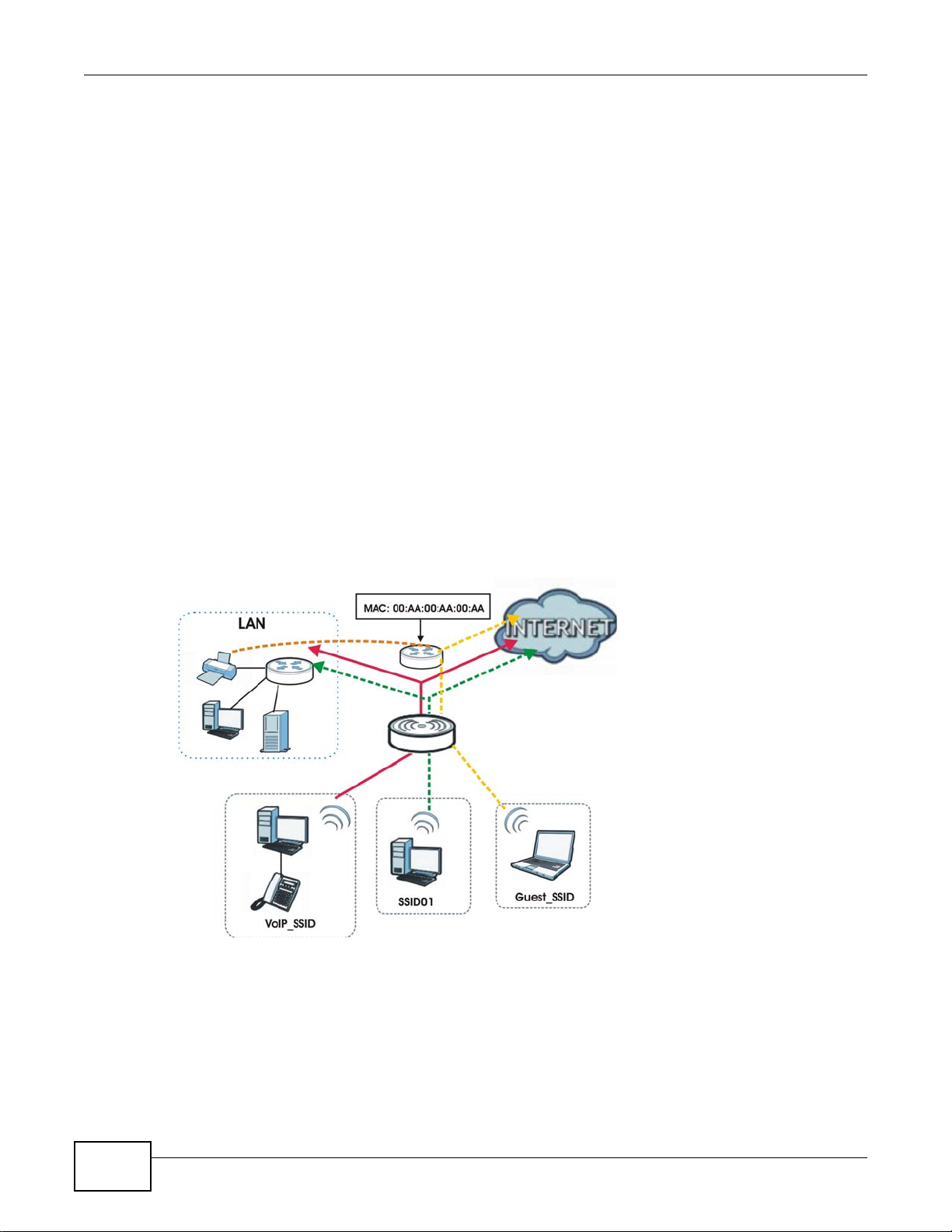
The following figure shows the multiple networks you want to set up. Your NWA is marked Z, the
main network router is marked A, and your network printer is marked B.
The standard network (SSID01) has access to all resources. The VoIP network (VoIP_SSID) has
access to all resources and a high QoS priority. The guest network (Guest_SSID) has access to the
Internet and the network printer only, and a low QoS priority.
30
NWA1120 Series User’s Guide
Page 31
To configure these settings, you need to know the Media Access Control (MAC) addresses of the
devices you want to allow users of the guest network to access. The following table shows the
addresses used in this example.
Table 5 Tutorial: Example Information
Network router (A) MAC address00:AA:00:AA:00:AA
Network printer (B) MAC addressAA:00:AA:00:AA:00
4.2.1 Configure the SSID Profiles
1Log in to the NWA (see Section 2.1 on page 19). Click Wireless LAN > SSID. The SSID screen
appears.
2Click the Edit icon next to the Profile1.
Chapter 4 Tutorial
3Rename the Profile Name and SSID as SSID01. Click Apply.
4Repeat Step 2 and 3 to change Profile2 and Profile3 to VoIP_SSID and Guest_SSID.
NWA1120 Series User’s Guide
31
Page 32
Chapter 4 Tutorial
4.2.1.1 MBSSID
1Go to Wireless LAN > Wireless Settings. Select MBSSID from the Operation Mode drop-down
list box.
2SSID01 is the standard network, so select SSID01 as the first profile. It is always active.
3Select VoIP_SSID as the second profile, and Guest_SSID as the third profile. Select the
corresponding Active check-boxes.
4Click Apply to save your settings. Now the three SSIDs are activated.
32
NWA1120 Series User’s Guide
Page 33
4.2.2 Configure the Standard Network
1Click Wireless LAN > SSID. Click the Edit icon next to SSID01.
2Select SecProfile1 as SSID01’s security profile. Select the Hidden SSID checkbox as you want
only authorized company employees to use this network, so there is no need to broadcast the SSID
to wireless clients scanning the area.
Chapter 4 Tutorial
Also, the clients on SSID01 might need to access other clients on the same wireless network. Do
not select the Intra-BSS Traffic blocking check-box.
Click Apply.
NWA1120 Series User’s Guide
33
Page 34
Chapter 4 Tutorial
3Next, click Wireless LAN > Security. Click the Edit icon next to SecProfile1.
4Since SSID01 is the standard network that has access to all resources, assign a more secure
security mode. Select WPA2-PSK-MIX as the Security Mode, and enter the Pre-Shared Key. In
this example, use ThisisSSID01PreSharedKey. Click Apply.
5You have finished configuring the standard network, SSID01.
4.2.3 Configure the VoIP Network
1Go to Wireless LAN > SSID. Click the Edit icon next to VoIP_SSID.
2Select SecProfile2 as the Security Profile for the VoIP network. Select the Hidden SSID check-
box.
34
NWA1120 Series User’s Guide
Page 35
Chapter 4 Tutorial
3Select WMM_VOICE in the QoS field to give VoIP the highest priority in the wireless network. Click
Apply.
4Next, click Wireless LAN > Security. Click the Edit icon next to SecProfile2.
NWA1120 Series User’s Guide
35
Page 36
Chapter 4 Tutorial
5Select WPA2-PSK as the Security Mode, and enter the Pre-Shared Key. In this example, use
ThisisVoIPPreSharedKey. Click Apply.
6Your VoIP wireless network is now ready to use. Any traffic using the VoIP_SSID profile will be
given the highest priority across the wireless network.
4.2.4 Configure the Guest Network
When you are setting up the wireless network for guests to your office, your primary concern is to
keep your network secure while allowing access to certain resources (such as a network printer, or
the Internet). For this reason, the pre-configured Guest_SSID profile has intra-BSS traffic blocking
enabled by default. “Intra-BSS traffic blocking” means that the client cannot access other clients on
the same wireless network.
1Click Wireless LAN > SSID. Click the Edit icon next to Guest_SSID.
2Select SecProfile3 in the Security field. Do not select the Hidden SSID check-box so the guests
can easily find the wireless network.
3Select WMM_BESTEFFORT in the QoS field to give the guest a lower QoS priority.
36
NWA1120 Series User’s Guide
Page 37
4Select the check-box of Intra-BSS Traffic blocking Enabled. Click Apply.
Chapter 4 Tutorial
5Next, click Wireless LAN > Security. Click the Edit icon next to SecProfile3.
6Select WPA-PSK in the Security Mode field. WPA-PSK provides strong security that is supported
by most wireless clients. Even though your Guest_SSID clients do not have access to sensitive
information on the network, you should not leave the network without security. An attacker could
still cause damage to the network or intercept unsecured communications or use your Internet
access for illegal activities.
NWA1120 Series User’s Guide
37
Page 38
Chapter 4 Tutorial
7Enter the PSK you want to use in your network in the Pre Shared Key field. In this example, the
PSK is ThisismyGuestWPApre-sharedkey. Click Apply.
8Your guest wireless network is now ready to use.
4.2.5 Testing the Wireless Networks
To make sure that the three networks are correctly configured, do the following.
• On a computer with a wireless client, scan for access points. You should see the Guest_SSID
network, but not the SSID01 and VoIP_SSID networks. If you can see the SSID01 and
VoIP_SSID networks, go to its SSID Edit screen and make sure to select the Hidden SSID
check-box and click Apply.
• Try to access each network using the correct security settings, and then using incorrect security
settings, such as the WPA-PSK for another active network. If the behavior is different from
expected (for example, if you can access the SSID01 or VoIP_SSID wireless network using the
security settings for the Guest_SSID wireless network) check that the SSID profile is set to use
the correct security profile, and that the settings of the security profile are correct.
4.3 NWA Setup in AP and Wireless Client Modes
This example shows you how to restrict wireless access to your NWA.
4.3.1 Scenario
In the figure below, there are two NWAs (A and B) in the network. A is in MBSSID or root AP mode
while station B is in wireless client mode. Station B is connected to a File Transfer Protocol (FTP)
server. You want only specified wireless clients to be able to access station B. You also want to allow
38
NWA1120 Series User’s Guide
Page 39
Chapter 4 Tutorial
wireless traffic between B and wireless clients connected to A (W, Y and Z). Other wireless devices
(X) must not be able to connect to the FTP server.
Figure 13 FTP Server Connected to a Wireless Client
4.3.2 Configuring the NWA in MBSSID or Root AP Mode
Before setting up the NWA as a wireless client (B), you need to make sure there is an access point
to connect to. Use the Ethernet port on NWA (A) to configure it via a wired connection.
NWA1120 Series User’s Guide
39
Page 40
Chapter 4 Tutorial
Log into the Web Configurator on NWA (A) and go to the Wireless LAN > Wireless Settings
screen.
1Set the Operation Mode to Root AP.
2Select the Wireless Mode. In this example, select 802.11b/g/n.
3Select Profile1 as the SSID Profile.
4Choose the Channel you want NWA (A) to use.
5Click Apply.
40
NWA1120 Series User’s Guide
Page 41
Chapter 4 Tutorial
6Go to Wireless LAN > SSID. Click the Edit icon next to Profile1.
7Change the SSID to AP-A.
8Select SecProfile1 in the Security field.
9Select the check-box for Intra-BSS Traffic blocking Enabled so the client cannot access other
clients on the same wireless network.
10 Click Apply.
NWA1120 Series User’s Guide
41
Page 42
Chapter 4 Tutorial
11 Go to Wireless LAN > Security. Click the Edit icon next to SecProfile1.
12 Configure WPA-PSK as the Security Mode and enter ThisisMyPreSharedKey in the Pre-
Shared Key field.
13 Click Apply to finish configuration for NWA (A).
4.3.3 Configuring the NWA in Wireless Client Mode
The NWA (B) should have a wired connection before it can be set to wireless client operating mode.
Connect your NWA to the FTP server. Login to NWA (B)’s Web Configurator and go to the Wireless LAN > Wireless Settings screen. Follow these steps to configure station B.
42
NWA1120 Series User’s Guide
Page 43
1Select Client as Operation Mode. Click Apply.
Chapter 4 Tutorial
2Click on the Site Survey button. A window should pop up which contains a list of all available
wireless devices within your NWA’s range.
3Find and select NWA (A)’s SSID: AP-A.
NWA1120 Series User’s Guide
43
Page 44
Chapter 4 Tutorial
4Go to Wireless LAN > Security to configure the NWA to use the same security mode and Pre-
Shared Key as NWA (A): WPA-PSK/ThisisMyPreSharedKey. Click Apply.
Figure 14
4.3.4 MAC Filter Setup
One way to ensure that only specified wireless clients can access the FTP server is by enabling MAC
filtering on NWA (B) (See Section 6.9 on page 86 for more information on MAC Filter).
1Go to Wireless LAN > MAC Filter. Click the Edit icon next to MacProfile1.
2Select Allow in the Access Control Mode field. Enter the MAC addresses of the wireless clients
(W, Y and Z) you want to associate with the NWA. Click Apply.
Now, only the authorized wireless clients (W, Y and Z) can access the FTP server.
44
NWA1120 Series User’s Guide
Page 45
4.3.5 Testing the Connection and Troubleshooting
This section discusses how you can check if you have correctly configured your network setup as
described in this tutorial.
• Try accessing the FTP server from wireless clients W, Y or Z. Test if you can send or retrieve a
file. If you cannot establish a connection with the FTP server, do the following steps.
1Make sure W, Y and Z use the same wireless security settings as A and can access A.
2Make sure B uses the same wireless and wireless security settings as A and can access A.
3Make sure intra-BSS traffic is enabled on A.
• Try accessing the FTP server from X. If you are able to access the FTP server, do the following.
1Make sure MAC filtering is enabled.
2Make sure X’s MAC address is not entered in the list of allowed devices.
Chapter 4 Tutorial
NWA1120 Series User’s Guide
45
Page 46
Chapter 4 Tutorial
46
NWA1120 Series User’s Guide
Page 47
PART II
Technical Reference
The appendices provide general information. Some details may not apply to your NWA.
47
Page 48
48
Page 49
5.1 Overview
This chapter discusses read-only information related to the device state of the NWA.
Note: To access the Monitor screens, you can also click the links in the Summary table of
the Dashboard screen to view the wireless packets sent/received as well as the
status of clients connected to the NWA.
5.2 What You Can Do
•Use the Logs screen to see the logs for the categories that you selected in the Configuration >
Log Settings screen (see Section 5.3 on page 49). You can view logs in this page. Once the log
entries are all used, the log will wrap around and the old logs will be deleted.
•use the Statistics screen to view 802.11 mode, channel number, wireless packet specific
statistics and so on (see Section 5.4 on page 50).
•Use the Association List screen to view the wireless devices that are currently associated to the
NWA (see Section 5.5 on page 51).
•Use the Channel Usage screen to view whether a channel is used by another wireless network
or not. If a channel is being used, you should select a channel removed from it by five channels
to completely avoid overlap (see Section 5.6 on page 52).
CHAPTER 5
Monitor
5.3 View Logs
Use the Logs screen to see the logged messages for the NWA.
Log entries in red indicate system error logs. The log wraps around and deletes the old entries after
it fills.
NWA1120 Series User’s Guide49
Page 50
Chapter 5 Monitor
Click Monitor > Logs.
Figure 15 Logs
The following table describes the labels in this screen.
Table 6 Logs
LABELDESCRIPTION
Display Select a category of logs to view. Select All Log to view logs from all of the log
E-Mail Log NowClick E-Mail Log Now to send the log screen to the e-mail address specified in the Log
RefreshClick Refresh to renew the log screen.
Clear LogClick Clear Log to delete all the logs.
#This field is a sequential value and is not associated with a specific entry.
Time This field displays the time the log was recorded.
MessageThis field states the reason for the log.
SourceThis field lists the source IP address and the port number of the incoming packet.
5.4 Statistics
Use this screen to view read-only information, including 802.11 Mode, Channel ID, Retry Count and
FCS Error Count. Also provided is the "poll interval". The Poll Interval field is configurable and is
used for refreshing the screen.
categories that you selected in the Configuration > Log Settings screen.
Settings page (make sure that you have first filled in the E-mail Log Settings fields in
Configuration > Log Settings).
50
NWA1120 Series User’s Guide
Page 51
Chapter 5 Monitor
Click Monitor > Statistics. The following screen pops up.
Figure 16 Statistics
The following table describes the labels in this screen.
Table 7 Statistics
LABELDESCRIPTION
DescriptionThis is the wireless interface on the NWA.
802.11 ModeThis field shows which 802.11 mode the NWA is using.
Channel IDThis shows the channel number which the NWA is currently using over the wireless
RX PktsThis is the number of received packets on this port.
TX PktsThis is the number of transmitted packets on this port.
Retry CountThis is the total number of retries for transmitted packets (TX).
FCS Error CountThis is the total number of checksum error of received packets (RX).
Poll IntervalEnter the time interval for refreshing statistics.
Set IntervalClick this button to apply the new poll interval you entered above.
StopClick this button to stop refreshing statistics.
LAN.
5.5 Association List
View the wireless devices that are currently associated with the NWA in the Association List
screen. Association means that a wireless client (for example, your network or computer with a
wireless network card) has connected successfully to the AP (or wireless router) using the same
SSID, channel and security settings.
NWA1120 Series User’s Guide
51
Page 52
Chapter 5 Monitor
Click Monitor > Association List to display the screen as shown next.
Figure 17 Association List
The following table describes the labels in this screen.
Table 8 Association List
LABELDESCRIPTION
#This is the index number of an associated wireless device.
MAC AddressThis field displays the MAC address of an associated wireless device.
SSIDThis field displays the SSID to which the wireless device is associated.
Association TimeThis field displays the time a wireless device first associated with the NWA’s wireless
Signal StrengthThis field displays the RSSI (Received Signal Strength Indicator) of the wireless
RefreshClick Refresh to reload the list.
network.
connection.
5.6 Channel Usage
Use this screen to know whether a channel is used by another wireless network or not. If a channel
is being used, you should select a channel removed from it by five channels to completely avoid
overlap.
Click Monitor > Channel Usage to display the screen shown next.
52
NWA1120 Series User’s Guide
Page 53
Wait a moment while the NWA compiles the information.
Figure 18 Channel Usage
Chapter 5 Monitor
The following table describes the labels in this screen.
Table 9 Channel Usage
LABELDESCRIPTION
SSIDThis is the Service Set IDentification (SSID) name of the AP in an Infrastructure
wireless network or wireless station in an Ad-Hoc wireless network. For our purposes,
we define an Infrastructure network as a wireless network that uses an AP and an AdHoc network (also known as Independent Basic Service Set (IBSS)) as one that
doesn’t. See the chapter on wireless configuration for more information on basic
service sets (BSS) and extended service sets (ESS).
ChannelThis is the index number of the channel currently used by the associated AP in an
Infrastructure wireless network or wireless station in an Ad-Hoc wireless network.
MAC AddressThis field displays the MAC address of the AP in an Infrastructure wireless network. It
is randomly generated (so ignore it) in an Ad-Hoc wireless network.
Wireless ModeThis is the IEEE 802.1x standard used by the wireless network.
Signal StrengthThis field displays the strength of the AP’s signal. If you must choose a channel that is
SecurityThis is the wireless security method used by the wireless network to protect wireless
RefreshClick Refresh to reload the screen.
currently in use, choose one with low signal strength for minimum interference.
communication between wireless stations, access points and the wired network.
NWA1120 Series User’s Guide
53
Page 54
Chapter 5 Monitor
54
NWA1120 Series User’s Guide
Page 55
6.1 Overview
This chapter discusses the steps to configure the Wireless Settings screen on the NWA. It also
introduces the wireless LAN (WLAN) and some basic scenarios.
Figure 19 Wireless Mode
CHAPTER 6
Wireless LAN
In the figure above, the NWA allows access to another bridge device (A) and a notebook computer
(B) upon verifying their settings and credentials. It denies access to other devices (C and D) with
configurations that do not match those specified in your NWA.
6.2 What You Can Do in this Chapter
•Use the Wireless Settings screen to configure the NWA’s operation mode (see Section 6.4 on
page 60).
•Uee the SSID screen to configure up to eight SSID profiles for your NWA (see Section 6.5 on
page 74).
•Use the Security screen to choose the wireless security mode for your NWA (see Section 6.6 on
page 76).
•Use the RADIUS screen if you want to authenticate wireless users using a RADIUS Server and/or
accounting server (see Section 6.7 on page 82).
•Use the Layer-2 Isolation screen to configure the MAC addresses of the devices that you want
to allow the associated wireless clients to have access to when layer-2 isolation is enabled. (see
Section 6.8 on page 84).
NWA1120 Series User’s Guide55
Page 56
Chapter 6 Wireless LAN
•Use the MAC Filter screen to specify which wireless station is allowed or denied access to the
NWA (see Section 6.9 on page 86).
6.3 What You Need To Know
BSS
A Basic Service Set (BSS) exists when all communications between wireless clients or between a
wireless client and a wired network client go through one access point (AP). Intra-BSS traffic is
traffic between wireless clients in the BSS.
ESS
An Extended Service Set (ESS) consists of a series of overlapping BSSs, each containing an access
point, with each access point connected together by a wired network. This wired connection
between APs is called a Distribution System (DS).
Operating Mode
The NWA can run in four operating modes as follows:
• Root AP. The NWA is a wireless access point that allows wireless communication to other
devices in the network.
• Repeater. The NWA acts as a wireless repeater and increase a root AP’s wireless coverage
area.
• Client. The NWA acts as a wireless client to access a wireless network.
• MBSSID. The Multiple Basic Service Set Identifier (MBSSID) mode allows you to use one
access point to provide several BSSs simultaneously.
Refer to Chapter 1 on page 11 for illustrations of these wireless applications.
SSID
The SSID (Service Set IDentifier) is the name that identifies the Service Set with which a wireless
station is associated. Wireless stations associating to the access point (AP) must have the same
SSID. In other words, it is the name of the wireless network that clients use to connect to it.
Normally, the NWA acts like a beacon and regularly broadcasts the SSID in the area. You can hide
the SSID instead, in which case the NWA does not broadcast the SSID. In addition, you should
change the default SSID to something that is difficult to guess.
This type of security is fairly weak, however, because there are ways for unauthorized wireless
devices to get the SSID. In addition, unauthorized wireless devices can still see the information that
is sent in the wireless network.
56
NWA1120 Series User’s Guide
Page 57
Chapter 6 Wireless LAN
Channel
A channel is the radio frequency(ies) used by wireless devices. Channels available depend on your
geographical area. You may have a choice of channels (for your region) so you should use a
different channel than an adjacent AP (access point) to reduce interference.
Wireless Mode
The IEEE 802.1x standard was designed to extend the features of IEEE 802.11 to support extended
authentication as well as providing additional accounting and control features.
MBSSID
Traditionally, you needed to use different APs to configure different Basic Service Sets (BSSs). As
well as the cost of buying extra APs, there was also the possibility of channel interference. The
NWA’s MBSSID (Multiple Basic Service Set IDentifier) function allows you to use one access point to
provide several BSSs simultaneously. You can then assign varying levels of privilege to different
SSIDs.
Wireless stations can use different BSSIDs to associate with the same AP.
The following are some notes on multiple BSS.
• A maximum of four BSSs are allowed on one AP simultaneously.
• You must use different WEP keys for different BSSs. If two stations have different BSSIDs (they
are in different BSSs), but have the same WEP keys, they may hear each other’s communications
(but not communicate with each other).
• MBSSID should not replace but rather be used in conjunction with 802.1x security.
Wireless Security
Wireless security is vital to your network. It protects communications between wireless stations,
access points and the wired network.
Figure 20 Securing the Wireless Network
In the figure above, the NWA checks the identity of devices before giving them access to the
network. In this scenario, Computer A is denied access to the network, while Computer B is
granted connectivity.
NWA1120 Series User’s Guide
57
Page 58
Chapter 6 Wireless LAN
The NWA secure communications via data encryption, wireless client authentication and MAC
address filtering. It can also hide its identity in the network.
User Authentication
Authentication is the process of verifying whether a wireless device is allowed to use the wireless
network. You can make every user log in to the wireless network before they can use it. However,
every device in the wireless network has to support IEEE 802.1x to do this.
For wireless networks, you can store the user names and passwords for each user in a RADIUS
server. This is a server used in businesses more than in homes. If you do not have a RADIUS server,
you cannot set up user names and passwords for your users.
Unauthorized wireless devices can still see the information that is sent in the wireless network,
even if they cannot use the wireless network. Furthermore, there are ways for unauthorized
wireless users to get a valid user name and password. Then, they can use that user name and
password to use the wireless network.
The following table shows the relative effectiveness of wireless security methods:.
Table 10 Wireless Security Levels
SECURITY
LEVEL
Least
Secure
Most Secure
SECURITY TYPE
Unique SSID (Default)
Unique SSID with Hide SSID Enabled
MAC Address Filtering
WEP Encryption
IEEE802.1x EAP with RADIUS Server Authentication
Wi-Fi Protected Access (WPA)
WPA2
58
The available security modes in your NWA are as follows:
• None. No data encryption.
• WEP. Wired Equivalent Privacy (WEP) encryption scrambles the data transmitted between the
wireless stations and the access points to keep network communications private.
• WPA. Wi-Fi Protected Access (WPA) is a subset of the IEEE 802.11i standard.
• WPA2. WPA2 (IEEE 802.11i) is a wireless security standard that defines stronger encryption,
authentication and key management than WPA.
• WPA2-MIX. This commands the NWA to use either WPA2 or WPA depending on which security
mode the wireless client uses.
• WPA-PSK. This adds a pre-shared key on top of WPA standard.
• WPA2-PSK. This adds a pre-shared key on top of WPA2 standard.
• WPA2-PSK-MIX. This commands the NWA to use either WPA-PSK or WPA2-PSK depending on
which security mode the wireless client uses.
Note: To guarantee 802.11n wireless speed, please only use WPA2 or WPA2-PSK security
mode. Other security modes may degrate the wireless speed performance to
802.11g.
NWA1120 Series User’s Guide
Page 59
Chapter 6 Wireless LAN
Passphrase
A passphrase functions like a password. In WEP security mode, it is further converted by the NWA
into a complicated string that is referred to as the “key”. This key is requested from all devices
wishing to connect to a wireless network.
PSK
The Pre-Shared Key (PSK) is a password shared by a wireless access point and a client during a
previous secure connection. The key can then be used to establish a connection between the two
parties.
Encryption
Wireless networks can use encryption to protect the information that is sent in the wireless
network. Encryption is like a secret code. If you do not know the secret code, you cannot
understand the message. Encryption is the process of converting data into unreadable text. This
secures information in network communications. The intended recipient of the data can “unlock” it
with a pre-assigned key, making the information readable only to him. The NWA when used as a
wireless client employs Temporal Key Integrity Protocol (TKIP) data encryption.
EAP
Extensible Authentication Protocol (EAP) is a protocol used by a wireless client, an access point and
an authentication server to negotiate a connection.
The EAP methods employed by the NWA when in Wireless Client operating mode are Transport
Layer Security (TLS), Protected Extensible Authentication Protocol (PEAP), Lightweight Extensible
Authentication Protocol (LEAP) and Tunneled Transport Layer Security (TTLS). The authentication
protocol may either be Microsoft Challenge Handshake Authentication Protocol Version 2
(MSCHAPv2) or Generic Token Card (GTC).
Further information on these terms can be found in Appendix E on page 187.
RADIUS
Remote Authentication Dial In User Service (RADIUS) is a protocol that can be used to manage user
access to large networks. It is based on a client-server model that supports authentication,
authorization and accounting. The access point is the client and the server is the RADIUS server.
Figure 21 RADIUS Server Setup
NWA1120 Series User’s Guide
59
Page 60
Chapter 6 Wireless LAN
In the figure above, wireless clients A and B are trying to access the Internet via the NWA. The
NWA in turn queries the RADIUS server if the identity of clients A and U are allowed access to the
Internet. In this scenario, only client U’s identity is verified by the RADIUS server and allowed
access to the Internet.
The RADIUS server handles the following tasks:
• Authentication which determines the identity of the users.
• Authorization which determines the network services available to authenticated users once
they are connected to the network.
• Accounting which keeps track of the client’s network activity.
RADIUS is a simple package exchange in which your AP acts as a message relay between the
wireless client and the network RADIUS server.
You should know the IP addresses, ports and share secrets of the external RADIUS server and/or
the external RADIUS accounting server you want to use with your NWA. You can configure a
primary and backup RADIUS and RADIUS accounting server for your NWA.
6.4 Wireless Settings Screen
Use this screen to choose the operating mode for your NWA. Click Network > Wireless LAN >
Wireless Settings, Network > Wireless LAN > Wireless Settings- 2.4G or Network >
Wireless LAN > Wireless Settings - 5G. The screen varies depending upon the operating mode
you select.
60
NWA1120 Series User’s Guide
Page 61
6.4.1 Root AP Mode
Use this screen to use your NWA as an access point. Select Root AP as the Operation Mode. The
following screen displays.
Figure 22 Wireless LAN > Wireless Settings: Root AP
Chapter 6 Wireless LAN
NWA1120 Series User’s Guide
61
Page 62
Chapter 6 Wireless LAN
The following table describes the general wireless LAN labels in this screen.
Table 11 Wireless LAN > Wireless Settings: Root AP
LABELDESCRIPTION
Basic Settings
Wireless LAN
Interface
Operation ModeSelect Root AP from the drop-down list.
Wireless ModeIf you are in the Wireless LAN > Wireless Settings or Wireless LAN > Wireless
ChannelSelect the operating frequency/channel depending on your particular region from the
Channel Width This field displays only when you select 802.11n, 802.11a/n or 802.11b/g/n in the
Select the check box to turn on the wireless LAN on the NWA.
Settings- 2.4G screen, you can select from the following:
•802.11b/g to allow both IEEE802.11b and IEEE802.11g compliant WLAN devices to
associate with the NWA. The transmission rate of your NWA might be reduced.
•802.11b/g/n to allow IEEE802.11b, IEEE802.11g and IEEE802.11n compliant WLAN
devices to associate with the NWA. The transmission rate of the NWA might be
reduced.
•802.11n to allow only IEEE802.11n compliant WLAN devices to associate with the
NWA.
If you are in the Wireless LAN > Wireless Settings- 5G screen, you can select from
the following:
•802.11a/n to allow IEEE802.11a and IEEE802.11n compliant WLAN devices to
associate with the NWA.
•802.11a to allow only IEEE802.11a compliant WLAN devices to associate with the
NWA.
•802.11n to allow only IEEE802.11n compliant WLAN devices to associate with the
NWA.
drop-down list box.
Wireless Mode field.
A standard 20MHz channel offers transfer speeds of up to 150Mbps whereas a 40MHz
channel uses two standard channels and offers speeds of up to 300Mbps. However, not all
devices support 40MHz channels.
Select the channel bandwidth you want to use for your wireless network.
It is recommended that you select 20/40MHz. This allows the NWA to adjust the channel
bandwidth depending on network conditions.
Select 20MHz if you want to lessen radio interference with other wireless devices in your
neighborhood or the wireless clients do not support channel bonding.
Select SSID
Profile
The SSID (Service Set IDentifier) identifies the Service Set with which a wireless station is
associated. Wireless stations associating to the access point (AP) must have the same
SSID. You can have up to four SSIDs active at the same time.
Note: If you are configuring the NWA from a computer connected to the wireless LAN and
you change the NWA’s SSID or security settings, you will lose your wireless
connection when you press Apply to confirm. You must then change the wireless
settings of your computer to match the NWA’s new settings.
#This is the index number of each SSID profile.
ActivveSelect the check box to enable an SSID profile. Otherwise, clear the check box.
ProfileSelect an SSID P rofile from the drop-down list box.
62
NWA1120 Series User’s Guide
Page 63
Chapter 6 Wireless LAN
Table 11 Wireless LAN > Wireless Settings: Root AP (continued)
LABELDESCRIPTION
Universal Repeater Settings
The Universal repeater function allows the NWA in root AP or repeater mode to set up a wireless connection
between it and another NWA in root AP or repeater mode.
Note: Universal repeater security is independent of the security settings between the NWA and any wireless
clients.
Local MAC
Address
Universal
Repeater SSID
Profile
Local MAC Address is the MAC address of your NWA.
Select the SSID profile you want to use for universal repeater connections.
Note: You can only configure None, WPA-PSK or WPA2-PSK security mode for the SSID
used by a universal repeater connection.
Advanced Settings
Beacon IntervalWhen a wirelessly network device sends a beacon, it includes with it a beacon interval.
This specifies the time period before the device sends the beacon again. The interval tells
receiving devices on the network how long they can wait in lowpower mode before waking
up to handle the beacon. A high value helps save current consumption of the access point.
DTIM IntervalDelivery Traffic Indication Message (DTIM) is the time period after which broadcast and
multicast packets are transmitted to mobile clients in the Active Power Management
mode. A high DTIM value can cause clients to lose connectivity with the network.
Output Power Set the output power of the NWA in this field. If there is a high density of APs in an area,
Preamble TypeSelect Dynamic to have the AP automatically use short preamble when wireless adapters
decrease the output power of the NWA to reduce interference with other APs. Select one
of the following Full (Full Power), 50%, 25%, or 12.5%. See the product specifications
for more information on your NWA’s output power.
support it, otherwise the AP uses long preamble.
Select Long if you are unsure what preamble mode the wireless adapters support, and to
provide more reliable communications in busy wireless networks.
RTS/CTS
Threshold
FragmentationThe threshold (number of bytes) for the fragmentation boundary for directed messages. It
Extension
Channel
Protection Mode
A-MPDU
Aggregation
Short GI This field is available only when 802.11n, 802.11b/g/n or 802.11a/n is selected as
(Request To Send) The threshold (number of bytes) for enabling RTS/CTS handshake.
Data with its frame size larger than this value will perform the RTS/CTS handshake.
Setting this attribute to be larger than the maximum MSDU (MAC service data unit) size
turns off the RTS/CTS handshake. Setting this attribute to its smallest value (1) turns on
the RTS/CTS handshake.
is the maximum data fragment size that can be sent.
You can use CTS to self or RTS-CTS protection mechanism to reduce conflicts with other
wireless networks or hidden wireless clients. The throughput of RTS-CTS is much lower
than CTS to self. Using this mode may decrease your wireless performance.
This field is available only when 802.11n, 802.11b/g/n or 802.11a/n is selected as
the Wireless Mode.
Select to enable A-MPDU aggregation.
Message Protocol Data Unit (MPDU) aggregation collects Ethernet frames along with their
802.11n headers and wraps them in a 802.11n MAC header. This method is useful for
increasing bandwidth throughput in environments that are prone to high error rates.
the Wireless Mode.
Select Enabled to use Short GI (Guard Interval). The guard interval is the gap
introduced between data transmission from users in order to reduce interference.
Reducing the GI increases data transfer rates but also increases interference. Increasing
the GI reduces data transfer rates but also reduces interference.
NWA1120 Series User’s Guide
63
Page 64
Chapter 6 Wireless LAN
Table 11 Wireless LAN > Wireless Settings: Root AP (continued)
LABELDESCRIPTION
MCS RateThe MC S Rate table is available only when 802.11n, 802.11b/g/n or 802.11a/n is
ApplyClick Apply to save your changes.
CancelClick Cancel to begin configuring this screen afresh.
selected in the Wireless Mode field.
IEEE 802.11n supports many different data rates which are called MCS rates. MCS stands
for Modulation and Coding Scheme. This is an 802.11n feature that increases the wireless
network performance in terms of throughput.
For each MCS Rate (0-15), select either Enabled to have the NWA use the data rate.
Clear the Enabled check box if you do not want the NWA to use the data rate.
Turn on t he Auto option to have the NWA set the data rates automatically to optimize the
throughput.
Note: You can set the NWA to use up to four MCS rates at a time.
64
NWA1120 Series User’s Guide
Page 65
6.4.2 Repeater Mode
Use this screen to have the NWA act as a wireless repeater. You need to know the MAC address of
the peer device, which also must be in Repeater or Root AP mode.
Figure 23 Wireless LAN > Wireless Settings: Repeater
Chapter 6 Wireless LAN
The following table describes the bridge labels in this screen.
Table 12 Wireless LAN > Wireless Settings: Repeater
LABELDESCRIPTION
Basic Settings
Wireless LAN
Interface
Operation ModeSelect Repeater from the drop-down list.
NWA1120 Series User’s Guide
Select the check box to turn on the wireless LAN on the NWA.
65
Page 66
Chapter 6 Wireless LAN
Table 12 Wireless LAN > Wireless Settings: Repeater (continued)
LABELDESCRIPTION
Wireless ModeIf you are in the Wireless LAN > Wireless Settings or Wireless LAN > Wireless
ChannelSelect the operating frequency/channel depending on your particular region from the
Channel Width This field displays only when you select 802.11n, 802.11a/n or 802.11b/g/n in the
Settings- 2.4G screen, you can select from the following:
•802.11b/g to allow both IEEE802.11b and IEEE802.11g compliant WLAN devices to
associate with the NWA. The transmission rate of your NWA might be reduced.
•802.11b/g/n to allow IEEE802.11b, IEEE802.11g and IEEE802.11n compliant WLAN
devices to associate with the NWA. The transmission rate of the NWA might be
reduced.
•802.11n to allow only IEEE802.11n compliant WLAN devices to associate with the
NWA.
If you are in the Wireless LAN > Wireless Settings- 5G screen, you can select from
the following:
•802.11a/n to allow IEEE802.11a and IEEE802.11n compliant WLAN devices to
associate with the NWA.
•802.11a to allow only IEEE802.11a compliant WLAN devices to associate with the
NWA.
•802.11n to allow only IEEE802.11n compliant WLAN devices to associate with the
NWA.
drop-down list box.
Wireless Mode field.
A standard 20MHz channel offers transfer speeds of up to 150Mbps whereas a 40MHz
channel uses two standard channels and offers speeds of up to 300Mbps. However, not all
devices support 40MHz channels.
Select the channel bandwidth you want to use for your wireless network.
It is recommended that you select 20/40MHz. This allows the NWA to adjust the channel
bandwidth depending on network conditions.
Select 20MHz if you want to lessen radio interference with other wireless devices in your
neighborhood or the wireless clients do not support channel bonding.
Universal Repeater Settings
The Universal repeater function allows the NWA in root AP or repeater mode to set up a wireless connection
between it and another NWA in root AP or repeater mode.
Note: Universal repeater security is independent of the security settings between the NWA and any wireless
clients.
Local MAC
Address
Universal
Repeater SSID
Profile
Local MAC Address is the MAC address of your NWA.
Select the SSID profile you want to use for universal repeater connections with an AP or
repeater or regular wireless connections with wireless clients.
Note: You can only configure None, WPA-PSK or WPA2-PSK security mode for the SSID
used by a universal repeater connection.
Root MAC
Address
Advanced Settings
Beacon IntervalWhen a wirelessly network device sends a beacon, it includes with it a beacon interval.
DTIM IntervalDelivery Traffic Indication Message (DTIM) is the time period after which broadcast and
Specify the peer device’s MAC address. The peer device can be a NWA in either root AP
mode or repeater mode.
This specifies the time period before the device sends the beacon again. The interval tells
receiving devices on the network how long they can wait in lowpower mode before waking
up to handle the beacon. A high value helps save current consumption of the access point.
multicast packets are transmitted to mobile clients in the Active Power Management
mode. A high DTIM value can cause clients to lose connectivity with the network.
66
NWA1120 Series User’s Guide
Page 67
Chapter 6 Wireless LAN
Table 12 Wireless LAN > Wireless Settings: Repeater (continued)
LABELDESCRIPTION
Output Power Set the output power of the NWA in this field. If there is a high density of APs in an area,
decrease the output power of the NWA to reduce interference with other APs. Select one
of the following Full (Full Power), 50%, 25% or 12.5%. See the product specifications
for more information on your NWA’s output power.
Preamble TypeSelect Dynamic to have the AP automatically use short preamble when wireless adapters
support it, otherwise the AP uses long preamble.
Select Long if you are unsure what preamble mode the wireless adapters support, and to
provide more reliable communications in busy wireless networks.
RTS/CTS
Threshold
FragmentationThe threshold (number of bytes) for the fragmentation boundary for directed messages. It
Extension
Channel
Protection Mode
A-MPDU
Aggregation
Short GI This field is available only when 802.11n, 802.11b/g/n or 802.11a/n is selected as
(Request To Send) The threshold (number of bytes) for enabling RTS/CTS handshake.
Data with its frame size larger than this value will perform the RTS/CTS handshake.
Setting this attribute to be larger than the maximum MSDU (MAC service data unit) size
turns off the RTS/CTS handshake. Setting this attribute to its smallest value (1) turns on
the RTS/CTS handshake.
is the maximum data fragment size that can be sent.
You can use CTS to self or RTS-CTS protection mechanism to reduce conflicts with other
wireless networks or hidden wireless clients. The throughput of RTS-CTS is much lower
than CTS to self. Using this mode may decrease your wireless performance.
This field is available only when 802.11n, 802.11b/g/n or 802.11a/n is selected as
the Wireless Mode.
Select to enable A-MPDU aggregation.
Message Protocol Data Unit (MPDU) aggregation collects Ethernet frames along with their
802.11n headers and wraps them in a 802.11n MAC header. This method is useful for
increasing bandwidth throughput in environments that are prone to high error rates.
the Wireless Mode.
Select Enabled to use Short GI (Guard Interval). The guard interval is the gap
introduced between data transmission from users in order to reduce interference.
Reducing the GI increases data transfer rates but also increases interference. Increasing
the GI reduces data transfer rates but also reduces interference.
MCS RateThe MC S Rate table is available only when 802.11n, 802.11b/g/n or 802.11a/n is
selected in the Wireless Mode field.
IEEE 802.11n supports many different data rates which are called MCS rates. MCS stands
for Modulation and Coding Scheme. This is an 802.11n feature that increases the wireless
network performance in terms of throughput.
For each MCS Rate (0-15), select either Enabled to have the NWA use the data rate.
Clear the Enabled check box if you do not want the NWA to use the data rate.
Turn on t he Auto option to have the NWA set the data rates automatically to optimize the
throughput.
Note: You can set the NWA to use up to four MCS rates at a time.
ApplyClick Apply to save your changes.
CancelClick Cancel to begin configuring this screen afresh.
NWA1120 Series User’s Guide
67
Page 68
Chapter 6 Wireless LAN
6.4.3 Wireless Client Mode
Use this screen to turn your NWA into a wireless client. Select Client as the Operation Mode. The
following screen displays.
Figure 24 Wireless LAN > Wireless Settings: Wireless Client
The following table describes the general wireless LAN labels in this screen.
Table 13 Wireless LAN > Wireless Settings: Wireless Client
LABELDESCRIPTION
Basic Settings
Wireless LAN
Interface
Operation ModeSelect Client in this field.
Site SurveyClick this to view a list of available wireless access points within the range. Select the AP
Select the check box to turn on the wireless LAN on the NWA.
you want to use.
Note: After selecting Client as the Operation Mode in the Basic Settings section, you must
click Apply to be able to select from the AP list.
68
NWA1120 Series User’s Guide
Page 69
Chapter 6 Wireless LAN
Table 13 Wireless LAN > Wireless Settings: Wireless Client (continued)
LABELDESCRIPTION
SSID ProfileThe SSID (Service Set IDentifier) identifies the Service Set with which a wireless station is
associated. Wireless stations associating to the access point (AP) must have the same
SSID.
In this field, select the SSID profile of the AP you want to use. Click Apply.
The SSID used in the selected SSID profile automatically changes to be the one you select
in the Site Survey screen.
Set the security configuration for this operating mode in the Wireless LAN > Security
screen. Check the Dashboard screen to check if the settings you set show in the WLAN
information.
Note: If you are configuring the NWA from a computer connected to the wireless LAN and you
change the NWA’s SSID or security settings, you will lose your wireless connection
when you press Apply to confirm. You must then change the wireless settings of your
computer to match the NWA’s new settings.
ChannelThis shows the operating frequency/channel in use. This field is read-only when you select
Client as your operation mode.
Channel Width This field is not available in the NWA1123-NI.
A standard 20MHz channel offers transfer speeds of up to 150Mbps whereas a 40MHz
channel uses two standard channels and offers speeds of up to 300Mbps. However, not all
devices support 40MHz channels.
Select the channel bandwidth you want to use for your wireless network.
It is recommended that you select 20/40MHz. This allows the NWA to adjust the channel
bandwidth depending on network conditions.
Select 20MHz if you want to lessen radio interference with other wireless devices in your
neighborhood or the AP do not support channel bonding.
Advanced Settings
Output Power Set the output power of the NWA in this field. If there is a high density of APs in an area,
decrease the output power of the NWA to reduce interference with other APs. Select one of
the following Full (Full Power), 50%, 25% or 12.5%. See the product specifications for
more information on your NWA’s output power.
Preamble TypeSelect Dynamic to have the NWA automatically use short preamble when the wireless
network your NWA is connected to supports it, otherwise the NWA uses long preamble.
Select Long preamble if you are unsure what preamble mode the wireless device your NWA
is connected to supports, and to provide more reliable communications in busy wireless
networks.
RTS/CTS
Threshold
FragmentationThis field is not available in the NWA1123-NI.
Extension
channel
protection mode
(Request To Send) The threshold (number of bytes) for enabling RTS/CTS handshake. Data
with its frame size larger than this value will perform the RTS/CTS handshake. Setting this
attribute to be larger than the maximum MSDU (MAC service data unit) size turns off the
RTS/CTS handshake. Setting this attribute to its smallest value (1) turns on the RTS/CTS
handshake.
The threshold (number of bytes) for the fragmentation boundary for directed messages. It
is the maximum data fragment size that can be sent.
You can use CTS to self or RTS-CTS protection mechanism to reduce conflicts with other
wireless networks or hidden wireless clients. The throughput of RTS-CTS is much lower
than CTS to self. Using this mode may decrease your wireless performance.
NWA1120 Series User’s Guide
69
Page 70
Chapter 6 Wireless LAN
Table 13 Wireless LAN > Wireless Settings: Wireless Client (continued)
LABELDESCRIPTION
A-MPDU
Aggregation
Short GI This field is not available in the NWA1123-NI.
ApplyClick Apply to save your changes.
CancelClick Cancel to begin configuring this screen afresh.
This field is not available in the NWA1123-NI.
Select to enable A-MPDU aggregation.
Message Protocol Data Unit (MPDU) aggregation collects Ethernet frames along with their
802.11n headers and wraps them in a 802.11n MAC header. This method is useful for
increasing bandwidth throughput in environments that are prone to high error rates.
Select Enabled to use Short GI (Guard Interval). The guard interval is the gap introduced
between data transmission from users in order to reduce interference. Reducing the GI
increases data transfer rates but also increases interference. Increasing the GI reduces data
transfer rates but also reduces interference.
70
NWA1120 Series User’s Guide
Page 71
6.4.4 MBSSID Mode
Use this screen to have the NWA function in MBSSID mode. Select MBSSID as the Operation
Mode. The following screen diplays.
Figure 25 Wireless LAN > Wireless Settings: MBSSID
Chapter 6 Wireless LAN
The following table describes the labels in this screen.
Table 14 Wireless LAN > Wireless Settings: MBSSID
LABELDESCRIPTION
Basic Settings
Wireless LAN
Interface
Operation ModeSelect MBSSID from the drop-down list.
NWA1120 Series User’s Guide
Select the check box to turn on the wireless LAN on the NWA.
71
Page 72
Chapter 6 Wireless LAN
Table 14 Wireless LAN > Wireless Settings: MBSSID (continued)
LABELDESCRIPTION
Wireless ModeIf you are in the Wireless LAN > Wireless Settings or Wireless LAN > Wireless
ChannelSelect the operating frequency/channel depending on your particular region from the
Channel Width This field displays only when you select 802.11n, 802.11a/n or 802.11b/g/n in the
Settings- 2.4G screen, you can select from the following:
•802.11b/g to allow both IEEE802.11b and IEEE802.11g compliant WLAN devices to
associate with the NWA. The transmission rate of your NWA might be reduced.
•802.11b/g/n to allow IEEE802.11b, IEEE802.11g and IEEE802.11n compliant WLAN
devices to associate with the NWA. The transmission rate of the NWA might be
reduced.
•802.11n to allow only IEEE802.11n compliant WLAN devices to associate with the
NWA.
If you are in the Wireless LAN > Wireless Settings- 5G screen, you can select from
the following:
•802.11a/n to allow IEEE802.11a and IEEE802.11n compliant WLAN devices to
associate with the NWA.
•802.11a to allow only IEEE802.11a compliant WLAN devices to associate with the
NWA.
•802.11n to allow only IEEE802.11n compliant WLAN devices to associate with the
NWA.
drop-down list box.
Wireless Mode field.
A standard 20MHz channel offers transfer speeds of up to 150Mbps whereas a 40MHz
channel uses two standard channels and offers speeds of up to 300Mbps. However, not all
devices support 40MHz channels.
Select the channel bandwidth you want to use for your wireless network.
Select 20MHz if you want to lessen radio interference with other wireless devices in your
neighborhood or the wireless clients do not support channel bonding.
Select SSID
Profile
The SSID (Service Set IDentifier) identifies the Service Set with which a wireless station is
associated. Wireless stations associating to the access point (AP) must have the same
SSID. You can have up to eight SSIDs active at the same time.
Note: If you are configuring the NWA from a computer connected to the wireless LAN and
you change the NWA’s SSID or security settings, you will lose your wireless
connection when you press Apply to confirm. You must then change the wireless
settings of your computer to match the NWA’s new settings.
#This is the index number of each SSID profile.
ActivveSelect the check box to enable an SSID profile. Otherwise, clear the check box.
ProfileSelect an SSID P rofile from the drop-down list box.
Advanced Settings
Beacon IntervalWhen a wirelessly network device sends a beacon, it includes with it a beacon interval.
DTIM IntervalDelivery Traffic Indication Message (DTIM) is the time period after which broadcast and
Output Power Set the output power of the NWA in this field. If there is a high density of APs in an area,
This specifies the time period before the device sends the beacon again. The interval tells
receiving devices on the network how long they can wait in lowpower mode before waking
up to handle the beacon. A high value helps save current consumption of the access point.
multicast packets are transmitted to mobile clients in the Active Power Management
mode. A high DTIM value can cause clients to lose connectivity with the network.
decrease the output power of the NWA to reduce interference with other APs. Select one
of the following Full (Full Power), 50%, 25% or 12.5%. See the product specifications
for more information on your NWA’s output power.
72
NWA1120 Series User’s Guide
Page 73
Chapter 6 Wireless LAN
Table 14 Wireless LAN > Wireless Settings: MBSSID (continued)
LABELDESCRIPTION
Preamble TypeSelect Dynamic to have the AP automatically use short preamble when wireless adapters
support it, otherwise the AP uses long preamble.
Select Long if you are unsure what preamble mode the wireless adapters support, and to
provide more reliable communications in busy wireless networks.
RTS/CTS
Threshold
Extension
Channel
Protection Mode
A-MPDU
Aggregation
Short GI This field is available only when 802.11n, 802.11b/g/n or 802.11a/n is selected as
MCS RateThe MC S Rate table is available only when 802.11n, 802.11b/g/n or 802.11a/n is
(Request To Send) The threshold (number of bytes) for enabling RTS/CTS handshake.
Data with its frame size larger than this value will perform the RTS/CTS handshake.
Setting this attribute to be larger than the maximum MSDU (MAC service data unit) size
turns off the RTS/CTS handshake. Setting this attribute to its smallest value (1) turns on
the RTS/CTS handshake.
You can use CTS to self or RTS-CTS protection mechanism to reduce conflicts with other
wireless networks or hidden wireless clients. The throughput of RTS-CTS is much lower
than CTS to self. Using this mode may decrease your wireless performance.
This field is available only when 802.11n, 802.11b/g/n or 802.11a/n is selected as
the Wireless Mode.
Select to enable A-MPDU aggregation.
Message Protocol Data Unit (MPDU) aggregation collects Ethernet frames along with their
802.11n headers and wraps them in a 802.11n MAC header. This method is useful for
increasing bandwidth throughput in environments that are prone to high error rates.
the Wireless Mode.
Select Enabled to use Short GI (Guard Interval). The guard interval is the gap
introduced between data transmission from users in order to reduce interference.
Reducing the GI increases data transfer rates but also increases interference. Increasing
the GI reduces data transfer rates but also reduces interference.
selected in the Wireless Mode field.
IEEE 802.11n supports many different data rates which are called MCS rates. MCS stands
for Modulation and Coding Scheme. This is an 802.11n feature that increases the wireless
network performance in terms of throughput.
ApplyClick Apply to save your changes.
CancelClick Cancel to begin configuring this screen afresh.
NWA1120 Series User’s Guide
For each MCS Rate (0-15), select either Enabled to have the NWA use the data rate.
Clear the Enabled check box if you do not want the NWA to use the data rate.
Turn on t he Auto option to have the NWA set the data rates automatically to optimize the
throughput.
Note: You can set the NWA to use up to four MCS rates at a time.
73
Page 74
Chapter 6 Wireless LAN
6.5 SSID Screen
Use this screen to view and modify the settings of the SSID profiles on the NWA. Click Wireless
LAN > SSID to display the screen as shown.
Figure 26 Wireless LAN > SSID
The following table describes the labels in this screen.
Table 15 Wireless LAN > SSID
LABELDESCRIPTION
Profile Settings
#This field displays the index number of each SSID profile.
Profile NameThis field displays the identification name of each SSID profile on the NWA.
SSIDThis field displays the SSID (Service Set IDentifier), that is, the name of the wireless
network to which a wireless client can connect. When a wireless client scans for an AP
to associate with, this is the name that is broadcast and seen in the wireless client
utility.
SecurityThis field indicates which security profile is currently associated with each SSID
profile. See Section 6.6 on page 76 for more information.
RADIUSThis field displays which RADIUS profile is currently associated with each SSID
QoSThis field displays the Quality of Service setting for this profile or NONE if QoS is not
MAC FilterThis field displays which MAC filter profile is currently associated with each SSID
ModifyClick Edit to go to the SSID configuration screen where you can modify settings in an
profile, if you have a RADIUS server configured.
configured on a profile.
profile, or Disable if MAC filtering is not configured on an SSID profile.
SSID profile.
74
NWA1120 Series User’s Guide
Page 75
6.5.1 Configuring SSID
Use this screen to configure an SSID profile. In the Wireless LAN > SSID screen, click Edit next
to the SSID profile you want to configure to display the following screen.
Figure 27 SSID: Edit
Chapter 6 Wireless LAN
The following table describes the labels in this screen.
Table 16 SSID: Edit
LABELDESCRIPTION
Profile NameThis is the name that identifying this profile.
SSIDWhen a wireless client scans for an AP to associate with, this is the name that is
SecuritySelect a security profile to use with this SSID profile. See Section 6.6 on page 76 for
RADIUSSelect a RADIUS profile from the drop-down list box, if you have a RADIUS server
MAC Filtering
broadcast and seen in the wireless client utility.
more information. If you do not want this profile to use wireless security, select
Disabled.
configured. If you do not need to use RADIUS authentication, ignore this field. See
Section 6.7 on page 82 for more information.
Select a MAC filter profile from the drop-down list box. If you do not want to use MAC
filtering on this profile, select Disabled.
NWA1120 Series User’s Guide
75
Page 76
Chapter 6 Wireless LAN
Table 16 SSID: Edit (continued)
LABELDESCRIPTION
QoSSelect the Quality of Service priority for this BSS’s traffic.
BSSID VLAN IDEnter a VLAN ID for the SSID profile.
Number of Wireless
Stations Allowed to
Associate
Hidden SSIDIf you do not select the checkbox, the NWA broadcasts this SSID (a wireless client
Intra-BSS Traffic
Blocking
Enable Layer-2
Isolation
•If you select WMM from the QoS list, the priority of a data packet depends on the
packet’s IEEE 802.1q or DSCP header. If a packet has no WMM value assigned to
it, it is assigned the default priority.
•If you select WMM_VOICE, WMM_VIDEO, WMM_BESTEFFORT or
WMM_BACKGROUND, the NWA applies that QoS setting to all of that SSID’s
traffic.
•If you select None, the NWA applies no priority to traffic on this SSID.
Note: When you configure an SSID profile’s QoS settings, the NWA applies the same
QoS setting to all of the profile’s traffic.
Packets coming from the WLAN using this SSID profile are tagged with the VLAN ID
number by the NWA.
Use this field to set a maximum number of wireless stations that may connect to the
device.
scanning for an AP will find this SSID). Alternatively, if you select the checkbox, the
NWA hides this SSID (a wireless client scanning for an AP will not find this SSID).
Select this to prevent wireless clients in this profile’s BSS from communicating with
one another.
Select this to enable layer-2 isolation for this profile. Wireless clients that connect to
the WLAN using this SSID can access only certain pre-defined devices. See Section
6.8 on page 84.
Intra-BSS traffic blocking is enabled automatically when you enable layer-2 isolation.
BackClick Back to return to the previous screen.
ApplyClick Apply to save your changes.
CancelClick Cancel to begin configuring this screen afresh.
6.6 Wireless Security Screen
Use this screen to choose the security mode for your NWA.
76
NWA1120 Series User’s Guide
Page 77
Chapter 6 Wireless LAN
Click Wireless LAN > Security. Select the profile that you want to configure and click Edit.
Figure 28 Wireless > Security
The Security Settings screen varies depending upon the security mode you select.
Figure 29 Security: None
Note that some screens display differently depending on the operating mode selected in the
Wireless LAN > Wireless Settings, Network > Wireless LAN > Wireless Settings- 2.4G or
Network > Wireless LAN > Wireless Settings - 5G screen.
Note: You must enable the same wireless security settings on the NWA and on all wireless
clients that you want to associate with it.
NWA1120 Series User’s Guide
77
Page 78
Chapter 6 Wireless LAN
6.6.1 Security: WEP
Use this screen to use WEP as the security mode for your NWA. Select WEP in the Security Mode
field to display the following screen.
Figure 30 Security: WEP
78
The following table describes the labels in this screen.
Table 17 Security: WEP
LABELDESCRIPTION
Profile NameThis is the name that identifying this profile.
Security ModeChoose WEP in this field.
Authentication
Type
Data EncryptionSelect 64-bit WEP or 128-bit WEP to enable data encryption.
PassphraseEnter the passphrase or string of text used for automatic WEP key generation on wireless
GenerateClick this to get the keys from the Passphrase you entered.
Select Open or Shared from the drop-down list box.
client adapters.
NWA1120 Series User’s Guide
Page 79
Table 17 Security: WEP (continued)
LABELDESCRIPTION
Key 1 to
Key 4
BackClick Back to return to the previous screen.
ApplyClick Apply to save your changes.
CancelClick Cancel to begin configuring this screen afresh.
The WEP keys are used to encrypt data. Both the NWA and the wireless stations must use
the same WEP key for data transmission.
If you chose 64-bit WEP, then enter any 5 ASCII characters or 10 hexadecimal
characters ("0-9", "A-F").
If you chose 128-bit WEP, then enter 13 ASCII characters or 26 hexadecimal characters
("0-9", "A-F").
You can configure up to four keys, but only one key can be activated at any one time.
6.6.2 Security: WPA, WPA2, WPA2-MIX
This screen varies depending on the operating mode you select in the Wireless LAN > Wireless
Settings screen.
6.6.2.1 Access Point
Chapter 6 Wireless LAN
Use this screen to employ WPA or WPA2 as the security mode for your NWA that is in root AP,
MBSSID or repeater operating mode. Select WPA, WPA2 or WPA2-MIX in the Security Mode
field to display the following screen.
Figure 31 Security: WPA/WPA2 for Access Point
The following table describes the labels in this screen.
Table 18 Security: WPA/WPA2 for Access Point
LABELDESCRIPTION
Security Settings
Profile NameThis is the name that identifying this profile.
Security ModeChoose WPA, WPA2 or WPA-MIX in this field.
Rekey Options
NWA1120 Series User’s Guide
79
Page 80
Chapter 6 Wireless LAN
Table 18 Security: WPA/WPA2 for Access Point (continued)
LABELDESCRIPTION
Reauthentication
Time
Enable Group-Key
Update
BackClick Back to return to the previous screen.
ApplyClick Apply to save your changes.
CancelClick Cancel to begin configuring this screen afresh.
6.6.2.2 Wireless Client
Use this screen to employ WPA or WPA2 as the security mode for your NWA that is in wireless client
operating mode. Select WPA or WPA2 in the Security Mode field to display the following screen.
Specify how often wireless stations have to resend user names and passwords in order to
stay connected.
Enter a time interval between 100 and 3600 seconds. Alternatively, enter “0” to turn
reauthentication off.
Note: If wireless station authentication is done using a RADIUS server, the reauthentication
timer on the RADIUS server has priority.
Select this option to have the NWA automatically disconnect a wireless station from the
wired network after a period of inactivity. The wireless station needs to enter the user
name and password again before access to the wired network is allowed.
Enter a time interval between 100 and 3600 seconds.
Figure 32 Security: WPA for Wireless Client
80
NWA1120 Series User’s Guide
Page 81
Chapter 6 Wireless LAN
The following table describes the labels in this screen.
Table 19 Security: WPA/WPA2 for Wireless Client
LABELDESCRIPTION
Security Settings
Profile NameThis is the name that identifying this profile.
Security ModeChoose the same security mode used by the AP.
Data EncryptionThis shows the encryption method used by the NWA.
IEEE802.1x Authentication
Eap TypeThe options on the left refer to EAP methods. You can choose either TLS, LEAP, PEAP or
User Information
Username
Login Name
PasswordSupply the password of the account created in the RADIUS server.
Certificate
User CertificateIf you select TLS, enter the name of the certificate used to to verify the identity of clients.
BackClick Back to return to the previous screen.
ApplyClick Apply to save your changes.
CancelClick Cancel to begin configuring this screen afresh.
TTLS.
If you select TTLS or PEAP, the options on the right refer to authentication protocols. You
can choose between PAP, CHAP, MSCHAP, MSCHAPv2 and/or GTC.
Supply the user name of the account created in the RADIUS server.
6.6.3 Security: WPA-PSK, WPA2-PSK, WPA2-PSK-MIX
Use this screen to employ WPA-PSK, WPA2-PSK or WPA2-PSK-MIX as the security mode of your
NWA. Select WPA-PSK, WPA2-PSK or WPA2-PSK-MIX in the Security Mode field to display the
following screen.
Figure 33 Security: WPA-PSK, WPA2-PSK or WPA2-PSK-MIX
NWA1120 Series User’s Guide
81
Page 82
Chapter 6 Wireless LAN
The following table describes the labels not previously discussed
Table 20 Security: WPA-PSK, WPA2-PSK or WPA2-PSK-MIX
LABELDESCRIPTION
Profile NameThis is the name that identifying this profile.
Security ModeChoose WPA-PSK, WPA2-PSK or WPA2-PSK-MIX in this field.
Pre-Shared KeyThe encryption mechanisms used for WPA and WPA-PSK are the same. The only
BackClick Back to return to the previous screen.
ApplyClick Apply to save your changes.
CancelClick Cancel to begin configuring this screen afresh.
difference between the two is that WPA-PSK uses a simple common password, instead
of user-specific credentials.
Type a pre-shared key from 8 to 63 case-sensitive ASCII characters (including spaces
and symbols).
6.7 RADIUS Screen
Use this screen to set up your NWA’s RADIUS server settings. Click Wireless LAN > RADIUS. The
screen appears as shown.
Figure 34 Wireless LAN > RADIUS
82
NWA1120 Series User’s Guide
Page 83
Select a profile you want to configure and click Edit.
Figure 35 Wireless LAN > RADIUS
Chapter 6 Wireless LAN
The following table describes the labels in this screen.
Table 21 Wireless LAN > RADIUS
LABELDESCRIPTION
Profile NameThis is the name that identifying this RADIUS profile.
Primary RADIUS
Server
Primary Server IP
Address
Primary Server
Port
Primary Share
Secret
NWA1120 Series User’s Guide
Select the check box to enable user authentication through an external authentication
server.
Enter the IP address of the RADIUS server to be used for authentication.
Enter the port number of the RADIUS server to be used for authentication.
Enter a password (up to 64 alphanumeric characters) as the key to be shared
between the external authentication server and the NWA. The key must be the same
on the external authentication server and your NWA. The key is not sent over the
network.
83
Page 84
Chapter 6 Wireless LAN
Table 21 Wireless LAN > RADIUS (continued)
LABELDESCRIPTION
Backup RADIUS
Server
Backup Server IP
Address
Backup Server
Port
Backup Share
Secret
Primary Accounting
Server
Primary Server IP
Address
Primary Server
Port
Primary Share
Secret
Backup Accounting
Server
Backup Server IP
Address
Backup Server
Port
Backup Share
Secret
BackClick Back to return to the previous screen.
ApplyClick Apply to save your changes.
CancelClick Cancel to begin configuring this screen afresh.
If the NWA cannot communicate with the primary RADIUS server, you can have the
NWA use a backup RADIUS server. Make sure the check boxe is selected if you want
to use the backup server.
The NWA will attempt to communicate three times before using the backup server.
Requests can be issued from the client interface to use the backup server. The length
of time for each authentication is decided by the wireless client or based on the
configuration of the Reauthentication Time field in the Wireless LAN > Security
screen.
Enter the IP address of the RADIUS server to be used for authentication.
Enter the port number of the RADIUS server to be used for authentication.
Enter a password (up to 64 alphanumeric characters) as the key to be shared
between the external authentication server and the NWA. The key must be the same
on the external authentication server and your NWA. The key is not sent over the
network.
Select the check box to enable user accounting through an external authentication
server.
Enter the IP address of the external accounting server in dotted decimal notation.
Enter the port number of the external accounting server.
Enter a password (up to 64 alphanumeric characters) as the key to be shared
between the external accounting server and the NWA. The key must be the same on
the external accounting server and your NWA. The key is not sent over the network.
If the NWA cannot communicate with the primary accounting server, you can have
the NWA use a backup accounting server. Make sure the check boxe is selected if you
want to use the backup server.
The NWA will attempt to communicate three times before using the backup server.
Enter the IP address of the external accounting server in dotted decimal notation.
Enter the port number of the external accounting server.
Enter a password (up to 64 alphanumeric characters) as the key to be shared
between the external accounting server and the NWA. The key must be the same on
the external accounting and your NWA. The key is not sent over the network.
6.8 Layer-2 Isolation
Layer-2 isolation is used to prevent wireless clients associated with your NWA from communicating
with other wireless clients, APs, computers or routers in a network.
In the following example, layer-2 isolation is enabled on the NWA to allow a guest wireless client
(A) to access the main network router (B). The router provides access to the Internet and the
network printer (C) while preventing the client from accessing other computers and servers on the
84
NWA1120 Series User’s Guide
Page 85
Chapter 6 Wireless LAN
network. The client can communicate with other wireless clients only if Intra-BSS Traffic blocking is
disabled.
Note: Intra-BSS Traffic Blocking is activated when you enable layer-2 isolation.
Figure 36 Layer-2 Isolation Application
MAC addresses that are not listed in the layer-2 isolation table are blocked from communicating
with the NWA’s wireless clients except for broadcast packets. Layer-2 isolation does not check the
traffic between wireless clients that are associated with the same AP. Intra-BSS Traffic allows
wireless clients associated with the same AP to communicate with each other.
6.8.1 Layer-2 Isolation Screen
Use this screen to specify devices you want the users on your wireless networks to access. Click
Wireless LAN > Layer-2 Isolation. The screen displays as shown.
NWA1120 Series User’s Guide
85
Page 86
Chapter 6 Wireless LAN
Note: You need to know the MAC address of each wireless client, AP, computer or router
that you want to allow to communicate with the NWA's wireless clients.
Figure 37 Wireless LAN > Layer-2 Isolation
The following table describes the labels in this screen.
Table 22 Wireless LAN > Layer-2 Isolation
LABELDESCRIPTION
IndexThis is the index number of the MAC address listed.
MAC AddressEnter the MAC addresses of the wireless client, AP, computer or router that you want to
allow the associated wireless clients to have access to in these address fields. Enter the
MAC address in a valid MAC address format (six hexadecimal character pairs, for
example 12:34:56:78:9a:bc).
DescriptionEnter a name to identify this device.
ApplyClick Apply to save your changes.
CancelClick Cancel to begin configuring this screen afresh.
6.9 MAC Filter Screen
Every Ethernet device has a unique MAC (Media Access Control) address. The MAC address is
assigned at the factory and consists of six pairs of hexadecimal characters, for example,
86
NWA1120 Series User’s Guide
Page 87
Chapter 6 Wireless LAN
00:A0:C5:00:00:02. You need to know the MAC address of each device to configure MAC filtering
on the NWA.
The MAC filter function allows you to configure the NWA to grant access to the NWA from other
wireless devices (Allow Association) or exclude devices from accessing the NWA (Deny Association).
Figure 38 MAC Filtering
In the figure above, wireless client U is able to connect to the Internet because its MAC address is
in the allowed association list specified in the NWA. The MAC address of client A is either denied
association or is not in the list of allowed wireless clients specified in the NWA.
Use this screen to enable MAC address filtering in your NWA. You can specify MAC addresses to
either allow or deny association with your NWA. Click Wireless LAN > MAC Filter. The screen
displays as shown.
Figure 39 Wireless LAN > MAC Filter
NWA1120 Series User’s Guide
87
Page 88
Chapter 6 Wireless LAN
Select a profile you want to configure and click Edit.
Figure 40 MAC Filter: Edit
The following table describes the labels in this screen.
Table 23 Wireless LAN > MAC Filter
LABELDESCRIPTION
Profile NameThis is the name that identifying this profile.
Access Control Mode Select Disabled if you do not want to use this feature.
Select Allow to permit access to the NWA. MAC addresses not listed will be denied
access to the NWA.
Select Deny to block access to theNWA. MAC addresses not listed will be allowed to
access the NWA.
#This is the index number of the MAC address listed.
MAC AddressEnter the MAC addresses (in XX:XX:XX:XX:XX:XX format) of the wireless station to be
BackClick Back to return to the previous screen.
ApplyClick Apply to save your changes.
CancelClick Cancel to begin configuring this screen afresh.
allowed or denied access to the NWA.
6.10 Technical Reference
This section provides technical background information about the topics covered in this chapter.
Refer to Appendix E on page 187 for further readings on Wireless LAN.
88
NWA1120 Series User’s Guide
Page 89
6.10.1 Additional Wireless Terms
Table 24 Additional Wireless Terms
TERMDESCRIPTION
Intra-BSS TrafficThis describes direct communication (not through the NWA) between two wireless
RTS/CTS ThresholdIn a wireless network which covers a large area, wireless devices are sometimes not
PreambleA preamble affects the timing in your wireless network. There are two preamble
Fragmentation
Threshold
RoamingIf you have two or more NWAs (or other wireless access points) on your wireless
AntennaAn antenna couples Radio Frequency (RF) signals onto air. A transmitter within a
devices within a wireless network. You might disable this kind of communication to
enhance security within your wireless network.
aware of each other’s presence. This may cause them to send information to the AP
at the same time and result in information colliding and not getting through.
By setting this value lower than the default value, the wireless devices must
sometimes get permission to send information to the NWA. The lower the value, the
more often the devices must get permission.
If this value is greater than the fragmentation threshold value (see below), then
wireless devices never have to get permission to send information to the NWA.
modes: long and short.If a device uses a different preamble mode than the NWA
does, it cannot communicate with the NWA.
A small fragmentation threshold is recommended for busy networks, while a larger
threshold provides faster performance if the network is not very busy.
network, you can enable this option so that wireless devices can change locations
without having to log in again. This is useful for devices, such as notebooks, that
move around a lot.
wireless device sends an RF signal to the antenna, which propagates the signal
through the air. The antenna also operates in reverse by capturing RF signals from
the air.
Chapter 6 Wireless LAN
6.10.2 WMM QoS
WMM (Wi-Fi MultiMedia) QoS (Quality of Service) ensures quality of service in wireless networks. It
controls WLAN transmission priority on packets to be transmitted over the wireless network.
WMM QoS prioritizes wireless traffic according to the delivery requirements of the individual and
applications. WMM QoS is a part of the IEEE 802.11e QoS enhancement to certified Wi-Fi wireless
networks.
On APs without WMM QoS, all traffic streams are given the same access priority to the wireless
network. If the introduction of another traffic stream creates a data transmission demand that
exceeds the current network capacity, then the new traffic stream reduces the throughput of the
other traffic streams.
The NWA uses WMM QoS to prioritize traffic streams according to the IEEE 802.1q or DSCP
information in each packet’s header. The NWA automatically determines the priority to use for an
individual traffic stream. This prevents reductions in data transmission for applications that are
sensitive to latency and jitter (variations in delay).
Positioning the antennas properly increases the range and coverage area of a wireless
LAN.
NWA1120 Series User’s Guide
89
Page 90
Chapter 6 Wireless LAN
6.10.2.1 WMM QoS Priorities
The following table describes the WMM QoS priority levels that the NWA uses.
Table 25 WMM QoS Priorities
Priority Leveldescription
voice
(WMM_VOICE)
video
(WMM_VIDEO)
best effort
(WMM_BESTEFFORT)
background
(WMM_BACKGROUND)
Typically used for traffic that is especially sensitive to jitter. Use this priority to
reduce latency for improved voice quality.
Typically used for traffic which has some tolerance for jitter but needs to be
prioritized over other data traffic.
Typically used for traffic from applications or devices that lack QoS capabilities. Use
best effort priority for traffic that is less sensitive to latency, but is affected by long
delays, such as Internet surfing.
This is typically used for non-critical traffic such as bulk transfers and print jobs
that are allowed but that should not affect other applications and users. Use
background priority for applications that do not have strict latency and throughput
requirements.
6.10.3 Security Mode Guideline
The following is a general guideline in choosing the security mode for your NWA.
• Use WPA(2)-PSK if you have WPA(2)-aware wireless clients but no RADIUS server.
• Use WPA(2) security if you have WPA(2)-aware wireless clients and a RADIUS server. WPA has
user authentication and improved data encryption over WEP.
• Use WPA(2)-PSK if you have WPA(2)-aware wireless clients but no RADIUS server.
• If you don’t have WPA(2)-aware wireless clients, then use WEP key encrypting. A higher bit key
offers better security. You can manually enter 64-bit or 128-bit WEP keys.
More information on Wireless Security can be found in Appendix E on page 187.
90
NWA1120 Series User’s Guide
Page 91
7.1 Overview
This chapter describes how you can configure the IP address of your NWA.
The Internet Protocol (IP) address identifies a device on a network. Every networking device
(including computers, servers, routers, printers, etc.) needs an IP address to communicate across
the network. These networking devices are also known as hosts.
Figure 41 IPv4 Setup
CHAPTER 7
LAN
The figure above illustrates one possible setup of your NWA. The gateway IPv4 address is
192.168.1.1 and the IPv4 address of the NWA is 192.168.1.2 (default). The gateway and the device
must belong in the same subnet mask to be able to communicate with each other.
7.2 What You Can Do in this Chapter
Use the LAN IP screen to configure the IP address of your NWA (see Section 7.4 on page 93).
7.3 What You Need to Know
The Ethernet parameters of the NWA are preset in the factory with the following values:
1IP address of 192.168.1.2
2Subnet mask of 255.255.255.0 (24 bits)
NWA1120 Series User’s Guide91
Page 92
Chapter 7 LAN
IPv6
IPv6 (Internet Protocol version 6), is designed to enhance IP address size and features. The
increase in IPv6 address size to 128 bits (from the 32-bit IPv4 address) allows up to 3.4 x 10
addresses.
38
IP
IPv6 Addressing
The 128-bit IPv6 address is written as eight 16-bit hexadecimal blocks separated by colons (:). This
is an example IPv6 address 2001:0db8:1a2b:0015:0000:0000:1a2f:0000.
IPv6 addresses can be abbreviated in two ways:
• Leading zeros in a block can be omitted. So 2001:0db8:1a2b:0015:0000:0000:1a2f:0000 can
be written as 2001:db8:1a2b:15:0:0:1a2f:0.
• Any number of consecutive blocks of zeros can be replaced by a double colon. A double colon can
only appear once in an IPv6 address. So 2001:0db8:0000:0000:1a2f:0000:0000:0015 can be
written as 2001:0db8::1a2f:0000:0000:0015, 2001:0db8:0000:0000:1a2f::0015, 2001:db8::1a2f:0:0:15 or 2001:db8:0:0:1a2f::15.
Prefix and Prefix Length
Similar to an IPv4 subnet mask, IPv6 uses an address prefix to represent the network address. An
IPv6 prefix length specifies how many most significant bits (start from the left) in the address
compose the network address. The prefix length is written as “/x” where x is a number. For
example,
2001:db8:1a2b:15::1a2f:0/32
means that the first 32 bits (2001:db8) is the subnet prefix.
Link-local Address
A link-local address uniquely identifies a device on the local network (the LAN). It is similar to a
“private IP address” in IPv4. You can have the same link-local address on multiple interfaces on a
device. A link-local unicast address has a predefined prefix of fe80::/10. The link-local unicast
address format is as follows.
Table 26 Link-local Unicast Address Format
1111 1110 100Interface ID
10 bits54 bits64 bits
Global Address
A global address uniquely identifies a device on the Internet. It is similar to a “public IP address” in
IPv4. A global unicast address starts with a 2 or 3.
92
NWA1120 Series User’s Guide
Page 93
7.4 LAN IP Screen
Use this screen to configure the IP address for your NWA. Click Network > LAN to display the
following screen.
Figure 42 LAN IP
Chapter 7 LAN
The following table describes the labels in this screen.
Table 27 LAN IP
LABELDESCRIPTION
IPv4 Address
Assignment
Obtain IP Address
Automatically
Select this option if your NWA is using a dynamically assigned IPv4 address from a
DHCP server each time.
Note: You must know the IP address assigned to the NWA (by the DHCP server) to
access the NWA again.
Use Fixed IP AddressSelect this option if your NWA is using a static IPv4 address. When you select this
IP AddressEnter the IP address of your NWA in dotted decimal notation.
option, fill in the fields below.
Note: If you change the NWA's IP address, you must use the new IP address if you
want to access the web configurator again.
Subnet MaskType the subnet mask.
Gateway IP
Address
Type the IPv4 address of the gateway. The gateway is an immediate neighbor of your
NWA that will forward the packet to the destination. On the LAN, the gateway must
be a router on the same segment as your NWA; over the WAN, the gateway must be
the IP address of one of the remote nodes.
NWA1120 Series User’s Guide
93
Page 94
Chapter 7 LAN
Table 27 LAN IP (continued)
LABELDESCRIPTION
IPv6 Address
Assignment
Enable Stateful
Address Autoconfiguration
IPv6 Address/Prefix
Length
System DNS Servers
Primary DNS ServerEnter the IPv4 address of the first DNS (Domain Name Service) server, if provided.
Secondary DNS Server Enter the IPv4 address of the second DNS (Domain Name Service) server address, if
ApplyClick Apply to save your changes.
CancelClick Cancel to begin configuring this screen afresh.
Select this to turn on IPv6 stateful autoconfiguration to have the NWA obtain an IPv6
global address from a DHCPv6 server in your network.
Enter your IPv6 address and prefix manually.
provided.
94
NWA1120 Series User’s Guide
Page 95
8.1 Overview
A
B
This chapter discusses how to configure the NWA’s VLAN settings.
Figure 43 Management VLAN Setup
CHAPTER 8
VLAN
In the figure above, to access and manage the NWA from computer A, the NWA and switch B’s
ports to which computer A and the NWA are connected should be in the same VLAN.
8.1.1 What You Can Do in This Chapter
The VLAN screens let you set up the NWA’s mangement VLAN (Section 8.3 on page 96).
8.2 What You Need to Know
Introduction to VLANs
A Virtual Local Area Network (VLAN) allows a physical network to be partitioned into multiple logical
networks. Devices on a logical network belong to one group. A device can belong to more than one
group. With VLAN, a device cannot directly talk to or hear from devices that are not in the same
group(s); the traffic must first go through a router.
In Multi-Tenant Unit (MTU) applications, VLAN is vital in providing isolation and security among the
subscribers. When properly configured, VLAN prevents one subscriber from accessing the network
resources of another on the same LAN, thus a user will not see the printers and hard disks of
another user in the same building.
NWA1120 Series User’s Guide95
Page 96
Chapter 8 VLAN
VLAN also increases network performance by limiting broadcasts to a smaller and more
manageable logical broadcast domain. In traditional switched environments, all broadcast packets
go to each and every individual port. With VLAN, all broadcasts are confined to a specific broadcast
domain.
IEEE 802.1Q Tag
The IEEE 802.1Q standard defines an explicit VLAN tag in the MAC header to identify the VLAN
membership of a frame across bridges. A VLAN tag includes the 12-bit VLAN ID and 3-bit user
priority. The VLAN ID associates a frame with a specific VLAN and provides the information that
devices need to process the frame across the network.
8.3 VLAN Screen
Use this screen to set up the VLAN for managing the NWA. Click Network > VLAN to display the
screen as shown.
Figure 44 Network > VLAN
96
The following table describes the labels in this screen.
Figure 45 Network > VLAN
LABELDESCRIPTION
802.1Q VLAN Select this to enable VLAN tagging on the NWA.
Management VLANSelect this to enable VLAN management. Only traffic tagged with the management
VLAN ID can access the NWA. At least one device in your network must belong to the
VLAN specified below in order to manage the NWA.
Management VLAN IDEnter a number from 1 to 4094 to define the NWA’s management VLAN group.
ApplyClick Apply to save your changes.
CancelClick Cancel to begin configuring this screen afresh.
NWA1120 Series User’s Guide
Page 97
9.1 Overview
This chapter shows you how to enable remote management of your NWA. It provides information
on determining which services or protocols can access which of the NWA’s interfaces.
Remote Management allows a user to administrate the device over the network. You can manage
your NWA from a remote location via the following interfaces:
•WLAN
•LAN
•Both WLAN and LAN
• Neither (Disable)
Figure 46 Remote Management Example
CHAPTER 9
System
In the figure above, the NWA (A) is being managed by a desktop computer (B) connected via LAN
(Land Area Network). It is also being accessed by a notebook (C) connected via WLAN (Wireless
LAN).
9.2 What You Can Do in this Chapter
•Use the WWW screen to configure through which interface(s) and from which IP address(es) you
can use the Web Browser to manage the NWA (see Section 9.4 on page 100).
•Use the Certificates screen to delete and import certificates (seen Section 9.5 on page 101).
•Use the Telnet screen to configure through which interface(s) and from which IP address(es)
you can use Telnet to manage the NWA. A Telnet connection is prioritized by the NWA over other
remote management sessions (see Section 9.6 on page 102).
NWA1120 Series User’s Guide97
Page 98
Chapter 9 System
•Use the SNMP screen to configure through which interface(s) and from which IP address(es) a
network systems manager can access the NWA (see Section 9.7 on page 104).
•Use the FTP screen to configure through which interface(s) and from which IP address(es) you
can use File Transfer Protocol (FTP) to manage the NWA. You can use FTP to upload the latest
firmware for example (see Section 9.8 on page 106).
9.3 What You Need To Know
WWW
The World Wide Web allows you to access files hosted in a remote server. For example, you can
view text files (usually referred to as ‘pages’) using your web browser via HyperText Transfer
Protocol (HTTP).
Telnet
Telnet is short for Telecommunications Network, which is a client-side protocol that enables you to
access a device over the network.
FTP
File Transfer Protocol (FTP) allows you to upload or download a file or several files to and from a
remote location using a client or the command console.
SNMP
Simple Network Management Protocol (SNMP) is a member of the TCP/IP protocol suite used for
exchanging management information between network devices.
Your NWA supports SNMP agent functionality, which allows a manager station to manage and
monitor the NWA through the network. The NWA supports SNMP version one (SNMPv1), version
two (SNMPv2c) and version three (SNMPv3).
98
NWA1120 Series User’s Guide
Page 99
The next figure illustrates an SNMP management operation.
Figure 47 SNMP Management Mode
Chapter 9 System
An SNMP managed network consists of two main types of component: agents and a manager.
An agent is a management software module that resides in a managed device (the NWA). An agent
translates the local management information from the managed device into a form compatible with
SNMP. The manager is the console through which network administrators perform network
management functions. It executes applications that control and monitor managed devices.
SNMP allows a manager and agents to communicate for the purpose of accessing information such
as packets received, node port status, etc.
SNMP v3 and Security
SNMP v3 enhances security for SNMP management. SNMP managers can be required to
authenticate with agents before conducting SNMP management sessions.
Security can be further enhanced by encrypting the SNMP messages sent from the managers.
Encryption protects the contents of the SNMP messages. When the contents of the SNMP messages
are encrypted, only the intended recipients can read them.
Remote Management Limitations
Remote management over LAN or WLAN will not work when:
• You have disabled that service in one of the remote management screens.
• The IP address in the Secured Client IP Address field does not match the client IP address. If
it does not match, the NWA will disconnect the session immediately.
• You may only have one remote management session running at one time. The NWA
automatically disconnects a remote management session of lower priority when another remote
management session of higher priority starts. The priorities for the different types of remote
management sessions are as follows:
NWA1120 Series User’s Guide
99
Page 100
Chapter 9 System
1Teln et
2HTTP
Certificate
A certificate contains the certificate owner’s identity and public key. Certificates provide a way to
exchange public keys for use in authentication.
Figure 48 Certificates Example
In the figure above, the NWA (Z) checks the identity of the notebook (A) using a certificate before
granting access to the network.
The certification authority certificate that you can import to your NWA should be in PFX PKCS#12
file format. This format referred to as the Personal Information Exchange Syntax Standard is
comprised of a private key-public certificate pair that is further encrypted with a password. Before
you import a certificate into the NWA, you should verify that you have the correct certificate.
Key distribution is simple and very secure since you can freely distribute public keys and you never
need to transmit private keys.
9.4 WWW Screen
Use this screen to configure your NWA via the World Wide Web (WWW) using a Web browser. This
lets you specify which IP addresses or computers are able to communicate with and access the
NWA.
100
NWA1120 Series User’s Guide
Loading...
+ hidden pages
You need points to download manuals.
1 point = 1 manual.
You can buy points or you can get point for every manual you upload.