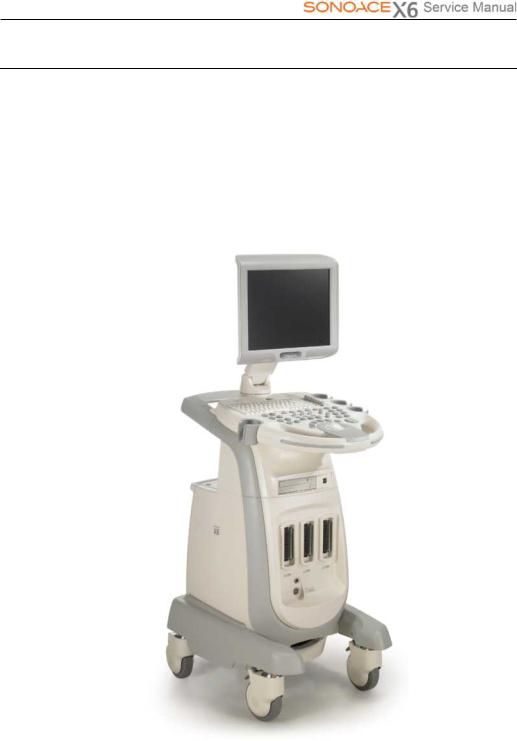
Samsung SonoAce X6 Service manual

Page 1
SONOACE X6 Service Manual
ENGLISH Document No. CSD-SMEX6 Revision 00
Copyrightⓒ2008 by MEDISON
Page 2
Safety Requirements
- Type of protection against electrical shock: Class I
- Degree of protection against electrical shock (Patient connection):Type BF equipment
- Degree of protection against harmful ingress of water: Ordinary equipment
- Degree of safety of application in the presence of a flammable anesthetic material with air
or with oxygen or nitrous oxide: Equipment not suitable for use in the presence of a
flammable anesthetic mixture with air or with oxygen or nitrous oxide.
- Mode of operation: Continuous operation
Electromechanical safety standards met:
- IEC/EN 60601-1 Medical Electrical Eqiupment, Part 1General Requirements for Safety.
- IEC/EN 60601-1-1 Safety requirements for medicalelectrical systems.
- IEC/EN 60601-1-2 Electromagnetic compatibility -Requirements and tests.
- IEC/EN 60601-2-37 Particular requirements for the safety of ultrasonic medical diagnostic
and monitoring equipment.
- IEC 61157 Declaration of acoustic output parameters.
- ISO 10993-1 Biological evaluation of medical devices.
- UL 2601-1 Medical Electrical Equipment, Part 1 General Requirements for Safety.

- CSA 22.2, 601.1 Medical Electrical Equipment, Part 1 General Requirements for Safety.
Page 3
Declarations;
0123
This is CSA symbol for Canada and United States of America
This is manufacturer’s declaration of product compliance with applicable EEC directive(s) and the European notified body.
This is manufacturer’s declaration of product compliance with applicable EEC directive(s).
Page 4
READ THIS FIRST
Before asking for the product to be repaired, read this service manual thoroughly, learn how to troubleshoot, and make sure you understand the precautions fully.
The repair of the system and the replacement of parts must be carried out by an authorized dealer or the customer care department of MEDISON Co., Ltd.
The company shall not be held liable for any injury and damage caused by not following this warning.
For safe use of this product, you should read ‘Chapter 2. Safety’ in this manual, prior to starting
to useing this system.
DANGER
WARNING
CAUTION
NOTE
Describes precautions necessary to prevent user hazards of great urgency. Ignoring a DANGER warning will risk life-threatening injury.
Used to indicate the presence of a hazard that can cause serious personal injury, or substantial property damage.
Indicates the presence of a hazard that can cause equipment damage.
A piece of information useful for installing, operating and maintaining a system. Not related to any hazard.
Page 5
`````Contents
Chapter 1. General Information 1-1
1.1 Overview 1-1
1.2 Features and Advantages of SONOACE X6 1-2
1.3 Product Configuration 1-3
1.3.1 Console 1-3
1.3.2 LCD Monitor 1-5
1.3.3 Control Panel 1-6
1.3.4 Probe 1-7
1.4 Specifications 1-8
Chapter 2. Safety 2-1
2.1 Overview 2-1
2.2 Safety – Related Information 2-2
2.2.1 Safety Symbols 2-2
2.2.2 Label 2-4
2.3 Electrical Safety 2-6
2.3.1 Prevention Electric Shock 2-6
2.3.2 ECG - Related Information 2-7
2.3.3 ESD 2-8
2.3.4 EMI 2-8
2.3.5 EMC 2-9
2.4 Mechanical Safety 2-15
2.4.1 Moving the Equipment 2-15
2.4.2Safety Note 2-16
2.5 Biological Safety 2-17
2.5.1 ALARA Principle 2-17
2.6 Environmental Protection 2-29
Contents
Page 6
Contents
Chapter 3. Installing the Product 3-1
3.1 Overview 3-1
3.2 Transportation 3-3
3.2.1 Precautions for Transportation 3-3
3.2.2 Temperature and Humidity 3-3
3.2.3 Transportation of the Product 3-4
3.3 Unpacking 3-5
3.3.1 Unpacking the Box 3-5
3.3.2 Checking Package Contents 3-6
3.4 Precautions for Installation 3-7
3.4.1 Precautions 3-7
3.4.2 Installation Location 3-8
3.5 Installation Procedure 3-9
3.5.1 Installation Safety 3-9
3.5.2 Connecting the Power Cord 3-10
3.5.3 Connecting the Network Cable 3-11
3.5.4 Connecting the Foot switch 3-11
3.5.5 Connecting the Probe 3-12
3.6 Starting the Product 3-13
3.7 Shutting down the Product 3-15
3.7.1 Power Switch 3-15
3.7.2 Cut-off Switch 3-15
3.8 Connecting the Peripherals 3-16
3.8.1 BW Printer 3-16
3.8.2 Color Printer 3-17
3.8.3 Line Printer 3-18
3.8.4 VCR 3-18
3.8.5 USB Storage Device 3-19
3.9 System Setting 3-20
3.9.1 General System Setup 3-20
3.9.2 Display Setup 3-22
3.9.3 Misc 3-24
3.9.4 Peripherals Setup 3-25
3.9.5 Information 3-26
3.9.6 DICOM Setup (Option) 3-27
3.9.7 Option Setup 3-34
Contents
Page 7
Contents
Chapter 4. Checking the Product 4-1
4.1Overview 4-1
4.2 Starting the Product 4-2
4.3Monitor 4-6
4.3.1Monitor Display 4-4
4.4 Control Panel 4-6
4.4.1Power On/Off 4-6
4.4.2 Starting and Finishing Exam 4-6
4.4.3 Selecting Diagnosis mode and Gain Control 4-7
4.4.4 Image Adjustment 4-9
4.4.5TGC 4-10
4.4.6 Measurement and Annotation 4-10
4.4.7 Trackball and its related control 4-11
4.4.8 SONOVIEW and Report 4-12
4.4.9 Save and Print 4-12
4.4.10 Alphanumeric keyboard 4-13
4.4.11 Flexible Soft Buttons 4-13
4.4.12 Function Buttons 4-14
4.5 Checking the Performance 4-15
4.5.1 Basic Check 4-15
4.5.2 Detail Check 4-16
Contents
Page 8
Contents
Chapter 5. Product Structure 5-1
5.1 Overview 5-1
5.2 System Block Diagram 5-3
5.3 Basic Structure of SONOACE X6 5-4
5.3.1 Overview 5-4
5.3.2 Ultrasound System Part 5-5
5.3.3 User Interface Part 5-5
5.3.4 Power Part 5-5
5.4 PSA 5-6
5.5 Front End Board 5-9
5.6 CW Board 5-13
5.7 Back End Board 5-15
5.8 Rear Board 5-22
5.9 Control Panel 5-23
5.10 Power Supply 5-24
Chapter 6. Basic Maintenance 6-1
6.1 Overview 6-1
6.2 System Information 6-2
6.3 Entering Admin Mode 6-3
6.4 Upgrade 6-6
6.4.1 Software Upgrade 6-6
6.4.2 Hardware Upgrade 6-9
6.5 Backup & Restore 6-10
6.5.1 Backup User Setting 6-10
6.5.2 Restore User Setting 6-11
6.6 Adding and Deleting Options 6-13
6.6.1Option type 6-13
6.6.2 Registering Options 6-13
6.6.3 Deleting Options 6-14
6.7 Control Panel Test 6-15
Contents
Page 9
Contents
Chapter 7. Troubleshooting 7-1
7.1 Overview 7-1
7.2 Power 7-2
7.2.1 Power Failure 7-2
7.2.2 Power cannot be turned off 7-2
7.2.3 Power is automatically turned off 7-3
7.3 Monitor 7-4
7.3.1Blank Screen 7-4
7.3.2 Screen Color is Abnormal 7-4
7.4 Error Messages 7-5
7.4.1 System hangs after an error during booting 7-5
7.4.2 System works even if error occurred 7-5
7.4.3 Error code 7-5
7.5 Image 7-6
7.5.1 No BW Image Echo 7-6
7.5.2 No BW Mode Image Format 7-6
7.5.3 Noise Link Rain over the BW Mode Image (Noise) 7-6
7.5.4 PW Doppler Mode Trouble 7-7
7.5.5 CW Doppler Mode Trouble 7-7
7.5.6 Color Doppler Mode Trouble 7-7
7.5.7 Motion Mode Trouble 7-7
Contents
Page 10
Contents
Chapter 8. Disassembly and Reassembly 8-1
8.1 Overview 8-1
8.2 Disassembly and Reassembly of the External Case 8-4
8.2.1 Preparations 8-4
8.2.2 Cover Front Lower 8-4
8.2.3 Cover Top Plate 8-5
8.2.4 Cover Rear Lower 8-6
8.3 Disassembly and Reassembly of the LCD Monitor 8-7
8.3.1 Preparations 8-7
8.3.2 LCD Monitor 8-7
8.3.3 LCD Monitor Arm 8-8
8.4 Disassembly and Reassembly of the Ultrasound System PCB Part 8-9
8.4.1 Preparations 8-9
8.4.2 PSA ASSY 8-9
8.4.3 CW Board, FE Board, BE Board 8-10
8.4.4 DC to DC Power Module 8-11
8.5 Disassembly and Reassembly of the HDD & DVD 8-12
8.5.1 Preparations 8-12
8.5.2 HDD & DVD 8-12
8.6 Disassembly and Reassembly of the Rear Panel 8-13
8.6.1 Preparations 8-13
8.6.2 Rear Right Board & Rear Left Board 8-13
8.6.3 Back Fan 8-14
8.7 Disassembly and Reassembly of the Power Supply 8-16
8.7.1 Preparations 8-16
8.7.2 AC to DC Power Module 8-16
8.7.3 DC to DC Power Module 8-16
8.8 Disassembly and Reassembly of the Control Panel 8-17
8.8.1 Preparations 8-17
8.8.2 Control Panel 8-17
8.8.3 Key Matrix Board 8-18
8.8.4 Track Ball 8-19
8.8.5 Alpha Numeric Keyboard 8-20
8.8.6 Speaker 8-20
Contents
Page 11
Content
Chapter 9. Probe 9-1
9.1 Overview 9-1
9.2 Probe List 9-2
9.3 Thermal Index (TI Table) 9-3
9.4 Ultrasound Transmission Gel 9-4
9.5 Sheaths 9-5
9.6 Probe Precautions 9-5
9.7 Cleaning and Disinfecting the Probe 9-8
Chapter 10. User Maintenance 10-1
10.1 Overview 10-1
10.2 System Maintenance 10-2
10.2.1 Installation Maintenance 10-2
10.2.2 Cleaning and Disinfections 10-3
10.2.3 Fuse Replacement 10-5
10.2.4 Cleaning the Air Filter 10-6
10.2.5 Accuracy Check 10-6
10.3 Administration of Information 10-7
10.3.1 User Setting Back-up 10-7
10.3.2 Patient Information Back-up 10-7
10.3.3 Software 10-7
Chapter 11. Service Part List 11-1
11.1 Overview 11-1
11.2 Cover 11-2
11.3 Ultrasound System Part 11-4
11.4 Rear Plan 11-5
11.5 Power Part 11-6
11.6 LCD Monitor 11-7
11.7 Control Panel 11-9
11.8 Probe 11-10
Contents
Page 12
1 General Information
1.1 Overview
Chapter 1 contains the information necessary to plan the Troubleshooting of SONOACE X6
1.1 Overview 1-1
1.2 Features and Advantages of SONOACE X6 1-2
1.3 Product Configuration 1-3
1.3.1 Console 1-3
1.3.2 LCD Monitor 1-5
1.3.3 Control Panel 1-6
1.3.4 Probes 1-7
1.4 Specifications 1-8
The SONOACE X6 is a high-resolution color ultrasound system with high penetration and a variety of measurement functions
Contents General Information
Chapter 1. General Information
1-1
Page 13
p
1.2 Features and Advantages of SONOACE X6
y High-end Digital Beamforming : The SONOACE X6 utilizes the newly developed
Digital Beam forming technology.
y A variety of applications : The SONOACE X6 is o
timized for use in a variety of ultrasound departments, including general, abdomen, obstetrics, gynecology, vascular, extremity, pediatric, cardiac, breast, urology, and etc.
y Various diagnostic Modes : 2D Mode, M Mode, Color Doppler Mode, Power
Doppler Mode, PW Spectral Doppler Mode, CW Spectral Doppler Mode(Option), etc.
y 3D images can be obtained. y Measurement and Report Functions : Besides the basic distance, area,
circumference and volume measurement functions, the SONOACE X6 also provides application-specific measurement functions. The report function collates measurement data.
y Review of Scanned Images : The SONOACE X6 displays Cine images of 512
frames and loop images of 4096 lines.
y SonoView
TM
: This is a total ultrasound image management system, which
allows a user to archive, view and exchange documents.
y Digital Imaging and Communications in Medicine (DICOM) Function : This is
used to archive, transmit and print DICOM images through a network.
y Peripheral/Accessory Connection : A variety of peripheral devices including
VCRs and printers can be easily connected to the SONOACE X6.
Chapter 1. General Information
1-2
Page 14
1.3 Product Configuration
This Product consists of the monitor, the control panel, the console and the probes.
1.3.1 Console
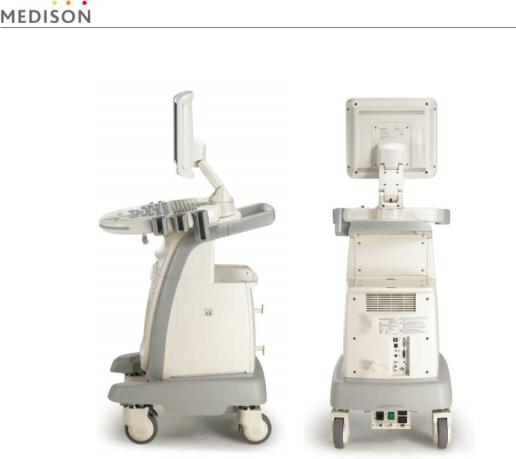
The console consists of two parts – the inner unit and the outer unit.
The interior of the console mainly contains devices that produce ultrasound images. On the exterior of the console is composed of various connectors, probe holders, storage compartments, handles, wheels, etc.
LCD Arm
DVD-RW Drive
Pencil probe Connector
LCD Monitor
Control Panel
Probe Connector
Wheel
[Figure 1-1] Console of SONOACE X6
Chapter 1. General Information
1-3
Page 15
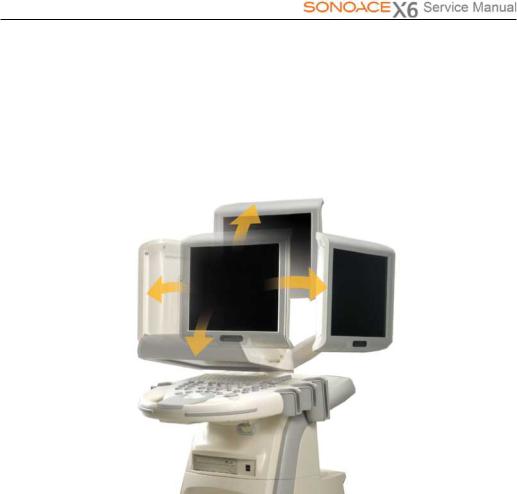
[Figure 1-2] Rear and side of SONOACE X6
Chapter 1. General Information
1-4
Page 16
p
1.3.2 LCD Monitor
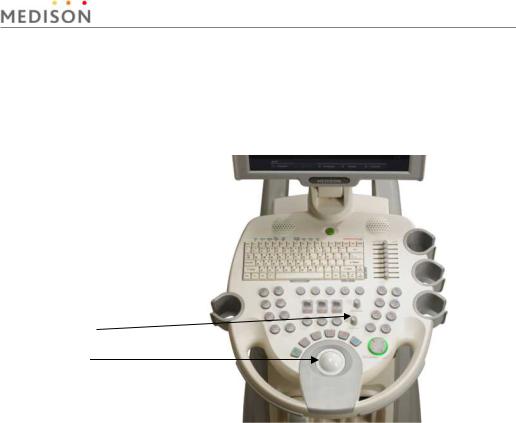
The LCD monitor of this system is a color VGA monitor, which dis images and additional information. Use the monitor arm to adjust the height or
lays ultrasound
position of the monitor.
[Figure 1-3] LCD Arm
Chapter 1. General Information
1-5
Page 17
1.3.3 Control Panel
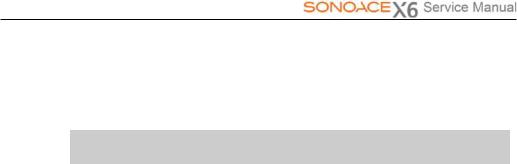
The control panel can be used for controlling the system. It consists of the
following four sections:
Alphanumerics Keyboard
Slide Volume

Button

Dial Button
Track Ball
[Figure 1-4] Control Panel
Chapter 1. General Information
1-6
Page 18
1.3.4 Probe
Probes are devices that generate ultrasound waves and process reflected wave data for the purpose of image formation.
NOTE
For more information, refer to `Chapter 9 Probes’.
Chapter 1. General Information
1-7

Page 19
1.4 Specifications
Height: 1378mm (with monitor)
Physical Dimensions
Monitor 15 inch LCD monitor
Electrical Parameters 100-120V/200-240VAC, 8/5A, 50/60Hz
Width: 483mm Depth: 691mm Weight: More than 60.75kg
Pressure Limits
Humidity Limits
Temperature Limits
Imaging modes
Focusing
Operating: 700hPa to 1060hPa Storage: 700hPa to 1060hPa
Operating: 30% to 75% Storage & Shipping: 20% to 90%
O
Operating: 10 Storage & Shipping: -25
C ~ 35OC
O
C ~ 60OC
2D imaging mode Dual 2D imaging mode M imaging mode 2D/M imaging mode Color Doppler Imaging (CDI) mode Power Doppler Imaging (PDI) mode Pulse Wave (PW) Spectral Doppler imaging mode Continuous Wave (CW) Spectral Doppler imaging mode 3D imaging mode (Freehand) Simultaneous mode
Transmit focusing, maximum of eight points (four points simultaneously selectable) Digital dynamic receive focusing (continuous)
General, Gynecology, Abdomen, OB, Renal, Urology, Vascular,
Application
Small Part, Fetal Heart, Breast, Musculoskeletal, Pediatric, Cardiac, TCD, Neonatal
Chapter 1. General Information
1-8
Page 20
Trackball operation of multiple cursors 2D: Linear measurements and area measurements using elliptical
Measurement Packages
approximation or trace M-mode: Continuous readout of distance, time, and slope rate
Doppler: Velocity and trace
Maximum 512 frames for CINE memory
Image Storage
Maximum 4096 Lines for LOOP memory Image filing system
Gray Scale 256 (8 bits)
TGC control Mode-independent gain control Acoustic power control (adjustable) Dynamic aperture Dynamic apodization Dynamic range control (adjustable)
Signal processing (Pre-processing)
Image view area control M-mode sweep speed control HD zoom Frame average Gamma-scale windowing Image orientation (left/right and up/down) White on black/black on white
Probes
Curved Linear Array C3-7EP C4-9ED Linear Array HL5-12ED L5-12/50EP Endocavity Curved Linear Array NER4-9ES NEV4-9ES Phased Array P2-4AH CW CW2.0 CW4.0
Chapter 1. General Information
1-9
Page 21
Probe connections
Rear Panel Input / Output Connections
Auxiliary
Three probe connectors
Four probe connectors for option
※ Including one CW probe connector.
VHS and S-VHS VCR left and right audio ECG Microphone Patient monitor video and 9V dc power B/W printer video and remote control VGA monitor Parallel port USB
Black-and white printer Color printer VCR
Monitor Foot switch
Chapter 1. General Information
1-10
Page 22
2 Safety
2.1 Overview
2.1 Overview 2-1
2.2 Safety – Related Information 2-2
2.2.1 Safety Symbols 2-2
2.2.2 Label 2-4
2.3 Electrical Safety 2-6
2.3.1 Prevention Electric Shock 2-6
2.3.2 ECG - Related Information 2-7
2.3.3 ESD 2-8
2.3.4 EMI 2-8
2.3.5 EMC 2-9
2.4 Mechanical Safety 2-15
2.4.1 Moving the Equipment 2-15
2.4.2Safety Note 2-16
2.5 Biological Safety 2-17
2.5.1 ALARA Principle 2-17
2.6 Environmental Protection 2-29
Chapter 2 contains the information necessary to Safety.
Contents Safety
Ch apt e r 2. Safety
2-1
Page 23
2.2 Safety - Related Information
2.2.1
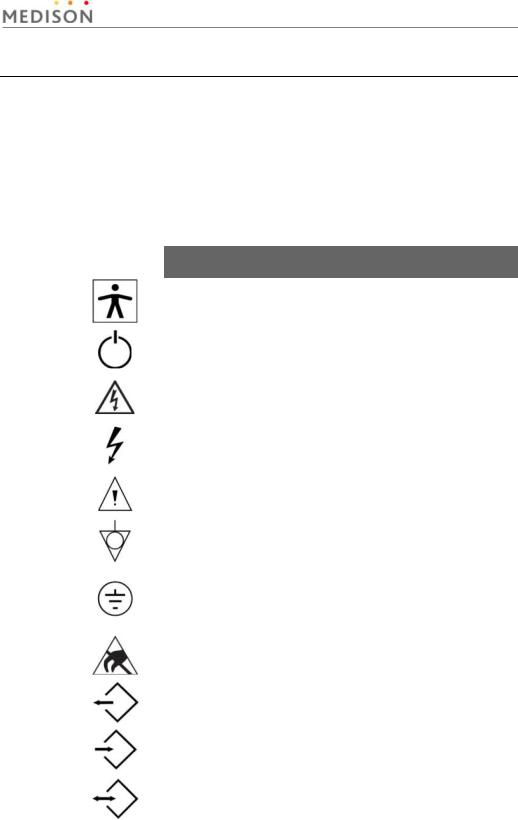
Safety Symbols
The International Electro Technical Commission (IEC) has established a
set of symbols for medical electronic equipment, which classifies a connection or warn of potential hazards. The classifications and symbols are shown below.
Symbols Description
Isolated patient connection (Type BF applied part).
Power switch (Supplies/cuts the power for product)
Indicates a caution for risk of electric shock.
Indicates dangerous voltages over 1000V AC or over 1500V DC.
Chapter 2. Safety
2-2
Warning, Caution
Identifies an equipotential ground.
Identifies the point where the system safety ground is fastened to the chassis. Protective earth connected to conductive parts of Class I equipment for safety purposes.
Electrostatic discharge
Data Output port
Data Input port
Data Input/Output port
Page 24
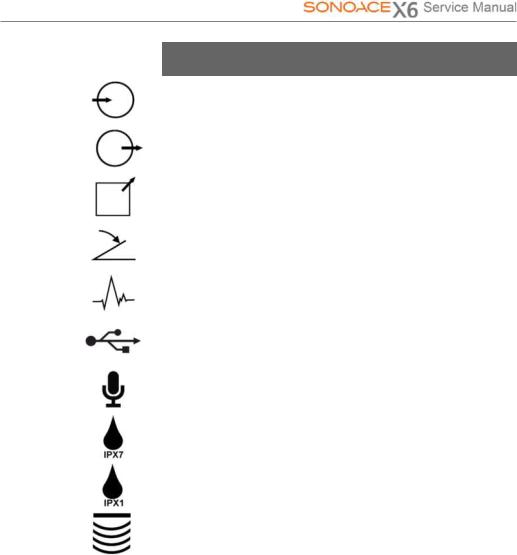
Symbols Description
Left and right Audio / Video input
Left and right Audio / Video output
Print remote output
Foot switch connector
ECG connector
USB connector
Microphone connector
Protection against the effects of immersion.
Protection against dripping water.
Probe connector
Ch apt e r 2. Safety
2-3
Page 25
2.2.2 Labels
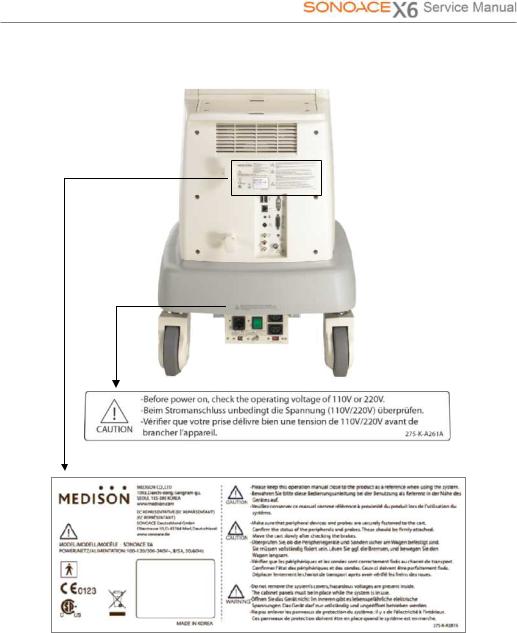
To protect the system, you may see ‘Warning’ or ‘Caution’ marked on the surface
of the product
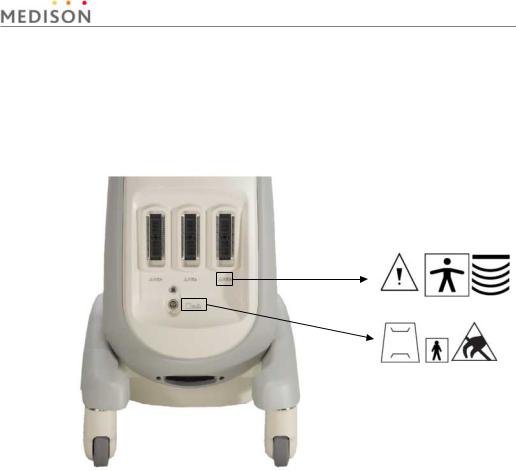
1) Front
[Figure 2-1] Labels of Front
Chapter 2. Safety
2-4
Page 26
2) Rear
[ Figure 2-2] Labels of Rear
Ch apt e r 2. Safety
2-5
Page 27
p
p
p
2.3 Electrical Safety
This equipment has been verified as a Class I device with Type BF applied parts.
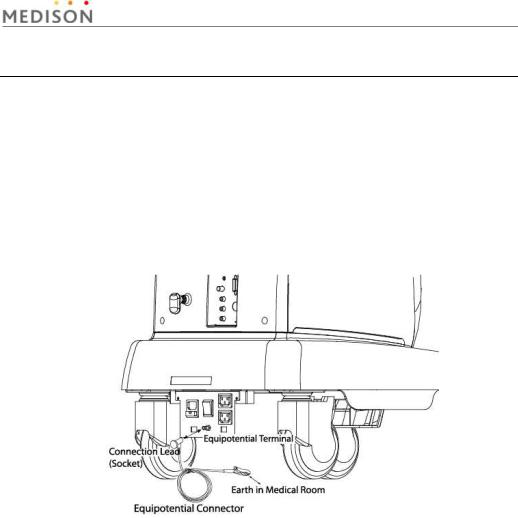
2.3.1 Prevention of Electric Shock
In a hospital, dangerous currents are due to the potential differences between
connected equipment and touchable conducting parts found in medical rooms. The solution to the is connected with connecting leads made u
roblem is consistent equipotential bonding. Medical equipment
of angled sockets to the equipotential
bonding network in medical rooms.
[Figure 2-3] Equipotential bonding
Additional equipment connected to medical electrical equipment must comply
with the respective IEC or ISO standards (e.g. IEC 60950 for data processing equipment). Furthermore all configurations shall comply with the requirements for medical electrical systems (see IEC 60601-1-1 or clause 16 of the 3 Ed. of IEC 60601-1, respectively). Anybody connecting additional equipment to medical electrical equipment configures a medical system and is therefore responsible that the system com
lies with the requirements for medical electrical systems. Attention is drawn to the fact that local laws take priority over the above-mentioned requirements. If in doubt, consult your local distributor or the technical service department.
Chapter 2. Safety
2-6
Page 28
WARNING
CAUTION
y Electric shock may exist result if this system, including and all of its
externally mounted recording and monitoring devices, is not properly grounded.
y Do not remove the covers on the system; hazardous voltages are present
inside. Cabinet panels must be in place while the system is in use. All internal adjustments and replacements must be made by a qualified MEDISON Customer Service Department.
y Check the face, housing, and cable before use. Do not use, if the face is
cracked, chipped, or torn, the housing is damaged, or if the cable is abraded.
y Always disconnect the system from the wall outlet prior to cleaning the
system.
y All patient contact devices, such as probes and ECG leads, must be
removed from the patient prior to application of a high voltage defibrillation pulse.
y The use of flammable anesthetic gas or oxidizing gases (N20) should be
avoided.
y The system has been designed for 100-120VAC and 200-240VAC; you
should select the input voltage of monitor, printer and VCR. Prior to connecting an OEM power cord, verify that the voltage indicated on the power cord matches the voltage rating of the OEM device.
y An isolation transformer protects the system from power surges. The
isolation transformer continues to operate when the system is in standby.
y Do not immerse the cable in liquids. Cables are not waterproof. y The operator does not contact the parts (SIP/SOP) and the patient
simultaneously
2.3.2 ECG-Related Information
WARNING
y This device is not intended to provide a primary ECG monitoring function,
and therefore does not have means of indicating an inoperative electrocardiograph.
y Do not use ECG electrodes of HF surgical equipment. Any malfunctions in
the HF surgical equipment may result in burns to the patient.
y Do not use ECG electrodes during cardiac pacemaker procedures or other
electrical stimulators.
y Do not use ECG leads and electrodes in an operating room.
Ch apt e r 2. Safety
2-7
Page 29
2.3.3
CAUTION
ESD
Electrostatic discharge (ESD), commonly referred to as a static shock, is a naturally occurring phenomenon. ESD is most prevalent during conditions of low humidity, which can be caused by heating or air conditioning. During low humidity conditions, electrical charges naturally build up on individuals, creating static electricity. An ESD occurs when an individual with an electrical energy build-up comes in contact with conductive objects such as metal doorknobs, file cabinets, computer equipment, and even other individuals. The static shock or ESD is a discharge of the electrical energy build-up from a charged individual to a lesser or non-charged individual or object. The ESD caution symbol is on the probe connector and the rear panel.
[Figure 2-4] ESD symbol
y The level of electrical energy discharged from a system user or
patient to an ultrasound system can be significant enough to cause damage to the system or probes.
2.3.4 EMI Although this system has been manufactured in compliance with existing EMI (Electromagnetic Interference) requirements, use of this system in the presence of an electromagnetic field can cause momentary degradation of the ultrasound image. If this occurs often, MEDISON suggests a review of the environment in which the system is being used, to identify possible sources of radiated emissions. These emissions could be from other electrical devices used within the same room or an adjacent room. Communication devices such as cellular phones and pagers can cause these emissions. The existence of radios, TVs, or microwave transmission equipment nearby can also cause interference.
Chapter 2. Safety
y The following precautions can help to reduce ESD:
- Anti-static sprays on carpets or linoleum
- Anti-static mats
- A ground wire connection between the system and the patient table or bed.
2-8
Page 30
CAUTION
In cases where EMI is causing disturbances, it may be necessary to relocate this system.
2.3.5 EMC The testing for EMC(Electromagnetic Compatibility) of this system has been performed according to the international standard for EMC with medical devices (IEC60601-1-2). This IEC standard was adopted in Europe as the European norm (EN60601-1-2).
2.3.5.1 Guidance and manufacturer’s declaration - electromagnetic emission
This product is intended for use in the electromagnetic environment specified
below. The customer or the user of this product should assure that it is used in such an environment.
Emission test Compliance Electromagnetic environment -guidance
RF Emission
(Radiation)
CISPR 11
RF Emission
(Radiation)
CISPR 11
Harmonic Emission
IEC 61000-3-2
Group 1
Class B
Group 1
Class B
Class A
The Ultrasound System uses RF energy only for its internal function. Therefore, its RF emissions are very low and are not likely to cause any interference in nearby electronic equipment. The Ultrasound System is suitable for use in all establishments, including domestic establishments and those directly connected to the public low-voltage power supply
Flicker Emission
IEC 61000-3-3
Complies
network that supplies building used for domestic purpose.
Ch apt e r 2. Safety
2-9
Page 31
p
2.3.5.2 Approved Cables, Transducers and Accessories for EMC
1) Approved Cable for Electromagnetic Compliance Cables connected to this product may affect its emissions; Use only the cable types and lengths listed below table.
Cable Type Length
VGA Shielded Normal
Parallel Shielded Normal
RS232C Shielded Normal
USB Shielded Normal
LAN(RJ45) Twisted pair Any
S-Video Shielded Normal
Foot Switch Shielded 2.5m
B/W Printer Unshielded Coaxial Normal
MIC Unshielded Any
Printer Remote Unshielded Any
Audio R.L Shielded Normal
VHS Shielded Normal
ECG AUX input Shielded < 3m
2) Approved Transducer for Electromagnetic Compliance The probe listed in ‘Chapter 8. Probes’ when used with this tested to comply with the group1 class B emission as required by International Standard CISPR 11.
3) Approved Accessories for Electromagnetic Compliance
roduct, have been
Accessories used with this product may effect its emissions.
CAUTION
When connecting other customer-supplied accessories to the system, such as a remote printer or VCR, it is the user’s responsibility to ensure the electromagnetic compatibility of the system. Use only CISPR 11 or CISPR 22, CLASS B compliant devices.
Chapter 2. Safety
2-10
Page 32
Immunity test
Electrostatic
discharge (ESD)
IEC 61000-4-2
Electrical fast
transient/burst
IEC 61000-4-4
Surge
IEC 61000-4-5
Voltage dips, short interruptions and voltage variations on power supply input lines
IEC 61000-4-11
Power frequency (50/60Hz) magnetic field
IEC 61000-4-8
IEC 60601
Test level
±6KV Contact
±8KV air
±2KV for power supply lines
±1KV for input/output lines
±1KV differential mode
±2KV common mode
<5% Uт (>95% dip in for 0.5cycle
U
40% (60% dip in for 5 cycle
U
70% (30% dip in for 25 cycle
U
<5% (<95% dip in for 5 s
3 A/m 3 A/m
U
т)
т
U
т )
т
U
т)
т
U
т )
Compliance level
±6KV Contact
±8KV air
±2KV for power supply lines ±1KV for input/ output lines
±1KV differential mode ±2KV common mode
<5% (>95% dip in for 0.5cycle
40% (60% dip in for 5 cycle
70% (30% dip in for 25 cycle
<5% (<95% dip in for 5 s
Electromagnetic environment -
guidance
Floors should be wood, concrete or ceramic tile. If floors are covered with synthetic material, the relative humidity should be at least 30%.
Mains power quality should be that of a typical commercial or hospital environment.
U
т
U
т)
U
т
U
т )
U
т
U
т)
U
т
U
т )
Mains power quality should be that of a typical commercial or hospital environment. If the user of this product requires continued operation during power mains interruptions, it is recommended that this product be powered from an uninterruptible power supply or a battery.
Power frequency magnetic fields should be at levels characteristic of a typical location in a typical commercial or hospital environment.
NOTE Uт is the a.c. mains voltage prior to application of the test level.
Chapter 2. Safety
2-11
Page 33
Conducted RF
IEC 61000-4-6
Radiated RF
IEC 61000-4-3
3 Vrms
150 kHz to 80MHz
3 V/m
80 MHz to 2.5GHz
0.01V
3 V/m
Portable and mobile RF communications equipment should be used no closer to any part of the Ultrasound System, including cables, than the recommended separation distance calculated from the equation applicable to the frequency of the transmitter. Recommended separation distance
80MHz to 800MHZ
800MHz to 2.5GHz
Where
P
of the transmitter in watts (W) according to the transmitter manufacturer and recommended separation distance in meters (m).
Field strengths from fixed RF transmitters, as deter-mined by an electromagnetic site survey, level in each frequency range.
Interference may occur in the vicinity of equipment marked with the following symbol :
is the maximum output power rating
d
is the
a
should be less than the compliance
b
NOTE 1) At 80MHz and 800MHz, the higher frequency range applies. NOTE 2) These guidelines may not apply in all situations. Electromagnetic propagation is affected by absorption and reflection from structures, objects and people.
a Field strengths from fixed transmitters, such as base stations for radio (cellular/cordless) telephones and
land mobile radios, amateur radio, AM and FM radio broadcast and TV broadcast cannot be predicted theoretically with accuracy. To assess the electromagnetic environment due to fixed RF transmitters, an electromagnetic site survey should be considered. If the measured field strength in the location in which the Ultrasound System is used exceeds the applicable RF compliance level above, the Ultrasound System should be observed to verify normal operation. If abnormal performance is observed, additional measures may be necessary, such as re-orienting or relocating the Ultrasound System or using a shielded location with a higher RF shielding effectiveness and filter attenuation.
b Over the frequency range 150kHz to 80MHz, field strengths should be less than [V
] V/m.
1
Chapter 2. Safety
2-12
Page 34
quip
2.3.5.3 Recommended separation distances between portable and mobile RF communications equipment and the SONOACE X6
This product is intended for use in an electromagnetic environment in which
radiated RF disturbances are controlled. The customer or the user of this product can help Prevent electromagnetic interference by maintaining a minimum distance between portable and mobile RF communications e
ment (transmitters) and this product as recommended below, according
to the maximum output power of the communications equipment.
Separation distance according to frequency of transmitter [m]
Rated maximum
output power of
transmitter [W]
0.01 35.00 0.11 0.23
0.1 110.68 0.36 0.73 1 350.00 1.16 2.33
10 1106.80 3.68 7.37
100 3500.00 11.66 23.33
For transmitters rated at a maximum output power not listed above, the recommended
separation distance d in meters (m) can be estimated using the equation applicable to
the frequency of the transmitter, where p is the maximum output power rating of the
transmitter in watts (W) according to the transmitter manufacturer.
NOTE 1) At 80MHz and 800MHz, the separation distance for the higher frequency
range applies.
NOTE 2) These guidelines may not apply in all situations. Electromagnetic propagation
is affected by absorption and reflection from structures, objects and people.
150kHz to 80MHz
V1=0.01Vrms E1=3 V/m E1=3V/m
80MHz to 800MHz
800MHz to 2.5GHz
2.3.5.4 Electromagnet ic envir onment – guidance The Ultrasound System must be used only in a shielded location with a minimum RF shielding effectiveness and, for each cable that enters the shielded location. Field strengths outside the shielded location from fixed RF transmitters, as determined by an electromagnetic site survey, should be less than 3V/m.
It is essential that the actual shielding effectiveness and filter attenuation of the shielded location be verified to assure that they meet the minimum specification.
Chapter 2. Safety
2-13
Page 35
If the system is connected to other customer-supplied equipment, such as a
CAUTION
local area network (LAN) or a remote printer, Medison cannot guarantee that the remote equipment will work correctly in the presence of electromagnetic phenomena.
2.3.5.5 Avoiding Electromagnetic Interference A medical device can either generate or receive electromagnetic interference. The EMC standards describe tests for both emitted and received interference. Medison Ultrasound System does not generate interference in excess of the referenced standards. An Ultrasound System is designed to receive signals at radio frequency and is therefore susceptible to interference generated by RF energy sources. Examples of other source of interference are medical device, information technology products, and radio and television transmission towers. Tracing the source of radiated interference can be a difficult task. Customers should consider the following in an attempt to locate the source:
y Is the interference intermittent or constant? y Does the interference show up only with one transducers operating
at the same frequency or with several transducer?
y Do two different transducer operating at the same frequency have
the same problem?
y Is the interference present if the system is moved to a different
location in the facility?
The answers to these questions will help determine if the problem reside with the system or the scanning environment. After you answer the question, contact your local MEDISON customer service department.
Chapter 2. Safety
2-14
Page 36
p
p
2.4 Mechanical Safety
2.4.1
Moving the Equipment
Before transporting the product, check that the brakes on the front wheels are
unlocked. Also, make sure to retract the monitor arm completely so that it is secured in a stationary position.
Always use the handles at the back of the console and move the product slowly.
This product is designed to resist shocks. However, excessive shock, for example if the product falls over, may cause serious damage.
If the system operates abnormally after repositioning, please contact the MEDISON Customer Service Department.
WARNING
The product weighs more than 60kg. Be extra careful when transporting it. Careless transportation of the product may result in product damage or personal injury
2.4.1.1 The Brakes
Brakes are mounted to the front wheels of the console only. To lock the brakes, press the top part of the brake with your foot. To unlock them,
ress the part
labeled Off at the bottom of the brake with your foot.
You can use the brakes to control the movement of the
roduct. We recommend
that you lock the brakes when using the product.
[Figure 2-5] Precautions on Ramps
Chapter 2. Safety
2-15
Page 37
2.4.1.2 Precautions on Ramps
Always make sure that control panel is facing the direction of movement
When moving the product down a ramp or resting it temporarily on a ramp, the product may tilt over even with the brakes on depending on the direction of the product. Do not rest the product on ramps.
WARNING
Be aware of the castors, especially when moving the system. MEDISON recommends that you exercise caution when moving the product up or down ramps
2.4.2 Safety Note
y Do not press the control panel excessively. y Never attempt to modify the product in any way.
y Check the operational safety when using the product after a prolonged break
in service.
y Make sure that other objects, such as metal pieces, do not enter the
CAUTION
system.
y Do not block the ventilation slots. y To prevent damage to the power cord, be sure to grip the plug head
– not the cord – when unplugging.
y Excessive bending or twisting of cables on patient-applied parts may
cause failure or intermittent operation of the system.
y Improper cleaning or sterilization of a patient-applied part may cause
permanent damage.
Chapter 2. Safety
2-16
Page 38
2.5 Biological Safety
Verify the alignment of the Probe before use. See the “Chapter 9. Probes” section
of this manual.
WARNING
2.5.1 ALARA Principle
y Ultrasound waves may have damaging effects on cells and,
therefore, may be harmful to the patient. If there is no medical benefit, minimize the exposure time and maintain the ultrasound wave output level at low. Please refer to the ALARA principle.
y Do not use the system if an error message appears on the video
display indicating that a hazardous condition exists. Note the error code, turn off the power to the system, and call your local MEDISON Customer Service Department.
y Do not use a system that exhibits erratic or inconsistent updating.
Discontinuities in the scanning sequence are indicative of a hardware failure that should be corrected before use.
y The system limits the maximum contact temperature to 43 degree
Celsius, and the ultrasonic waves output observes American FDA regulations.
Guidance for the use of diagnostic ultrasound is defined by the “as low as reasonably achievable” (ALARA) principle. The decision as to what is reasonable has been left to the judgment and insight of qualified personnel. No set of rules can be formulated that would be sufficiently complete to dictate the correct response for every circumstance. By keeping ultrasound exposure as low as possible, while obtaining diagnostic images, users can minimize ultrasonic bioeffects. Since the threshold for diagnostic ultrasound bioeffects is undetermined, it is the sonographer’s responsibility to control the total energy transmitted into the patient. The sonographer must reconcile exposure time with diagnostic image quality. To ensure diagnostic image quality and limit exposure time, the ultrasound system provides controls that can be manipulated during the exam to optimize the results of the exam. The ability of the user to abide by the ALARA principle is important. Advances in diagnostic ultrasound not only in the technology but also in the applications of the technology, have resulted in the need for more and better information to guide the user. The output indices are designed to provide that important information There are a number of variables, which affect the way in which the output display indices can be used to implement the ALARA principle. These variables include mass, body size, location of the bone relative to the focal point, attenuation in the body, and ultrasound exposure time. Exposure time is an especially useful variable, because the user controls it. The ability to limit the index values over time support the ALARA principle.
Chapter 2. Safety
2-17
Page 39
2.5.1.1 Applying ALARA
The system-imaging mode used depends upon the information needed. 2D-mode and M-mode imaging provide anatomical information, while Doppler, Power, and Color imaging provide information about blood flow. Scanned modes, like 2D­mode, Power, or Color, disperse or scatter the ultrasonic energy over an area, while an unscanned mode, like M-mode or Doppler, concentrates ultrasonic energy. Understanding the nature of the imaging mode being used allows the sonographer to apply the ALARA principle with informed judgment. The probe frequency, system set-up values, scanning techniques, and operator experience aid the sonographer in meeting the definition of the ALARA principle. The decision as to the amount of acoustic output is, in the final analysis, up to the system operator. This decision must be based on the following factors: type of patient, type of exam, patient history, ease or difficulty of obtaining diagnostically useful information, and the potential localized heating of the patient due to probe surface temperatures. Prudent use of the system occurs when patient exposure is limited to the lowest index reading for the shortest amount of time necessary to achieve acceptable diagnostic results. Although a high index reading does not mean that a bioeffect is actually occurring, a high index reading should be taken seriously. Every effort should be made to reduce the possible effects of a high index reading. Limiting exposure time is an effective way to accomplish this goal. There are several system controls that the operator can use to adjust the image quality and limit the acoustic intensity. These controls are related to the techniques that an operator might use to implement ALARA. These controls can be divided into three categories: direct, indirect, and receiver control.
2.5.1.2 Direct Controls
Application selection and the output intensity control directly affect acoustic intensity. There are different ranges of allowable intensity or output based on your selection. Selecting the correct range of acoustic intensity for the application is one of the first things required during any exam. For example, peripheral vascular intensity levels are not recommended for fetal exams. Some systems automatically select the proper range for a particular procedure, while others require manual selection. Ultimately, the user bears the responsibility for proper clinical use. The MEDISON system provides both automatic and user-definable settings. Output has direct impact on acoustic intensity. Once the application has been established, the output control can be used to increase or decrease the intensity output. The output control allows you to select intensity levels less than the defined maximum. Prudent use dictates that you select the lowest output intensity consistent with good image quality.
Chapter 2. Safety
2-18
Page 40
2.5.1.3 Indirect Controls
The indirect controls are those that have an indirect effect on acoustic intensity. These controls affect imaging mode, pulse repetition frequency, focus depth, pulse length, and probe selection. The choice of imaging mode determines the nature of the ultrasound beam. 2D­mode is a scanning mode, Doppler is a stationary or unscanned mode. A stationary ultrasound beam concentrates energy on a single location. A moving or scanned ultrasound beam disperses the energy over a wide area and the beam is only concentrated on a given area for a fraction of the time necessary in unscanned mode. Pulse repetition frequency or rate refers to the number of ultrasound bursts of energy over a specific period of time. The higher the pulse repetition frequency, the more pulses of energy in a given period of time. Several controls affect pulse repetition frequency: focal depth, display depth, sample volume depth, color sensitivity, number of focal zones, and sector width controls. Focus of the ultrasound beam affects the image resolution. To maintain or increase resolution at a different focus requires a variation in output over the focal zone. This variation of output is a function of system optimization. Different exams require different focal depths. Setting the focus to the proper depth improves the resolution of the structure of interest. Pulse length is the time during which the ultrasonic burst is turned on. The longer the pulse, the greater the time-average intensity value. The greater the time­average intensity, the greater the likelihood of temperature increase and cavitations. Pulse length or burst length or pulse duration is the output pulse duration in pulsed Doppler. Increasing the Doppler sample volume increases the pulse length. Probe selection affects intensity indirectly. Tissue attenuation changes with frequency. The higher the probe operating frequency, the greater the attenuation of the ultrasonic energy. Higher probe operating frequencies require higher output intensity to scan at a deeper depth. To scan deeper at the same output intensity, a lower probe frequency is required. Using more gain and output beyond a point, without corresponding increases in image quality, can mean that a lower frequency probe is needed.
2.5.1.4 Receiver Controls
Receiver controls are used by the operator to improve image quality. These controls have no effect on output. Receiver controls only affect how the ultrasound echo is received. These controls include gain, TGC, dynamic range, and image processing. The important thing to remember, relative to output, is that receiver controls should be optimized before increasing output. For example; before increasing output, optimize gain to improve image quality.
2.5.1.5 Additional Considerations
Ensure that scanning time is kept to a minimum, and ensure that only medically required scanning is performed. Never compromise quality by rushing through an exam. A poor exam will require a follow-up, which ultimately increases the time. Diagnostic ultrasound is an important tool in medicine, and, like any tool, should be used efficiently and effectively.
Chapter 2. Safety
2-19
Page 41
2.5.1.6 Output Display Features
The system output display comprises two basic indices: a mechanical index and a
thermal index. The thermal index consists of the following indices: soft tissue (TIs), bone (TIb) and cranial bone (TIc). One of these three thermal indices will be displayed at all times. Which one depends upon the system preset or user choice, depending upon the application at hand. The mechanical index is continuously displayed over the range of 0.0 to 1.9, in increments of 0.1. The thermal index consists of the three indices, and only one of these is displayed at any one time. Each probe application has a default selection that is appropriate for that combination. The TIb or TIs is continuously displayed over the range of 0.0 to maximum output, based on the probe and application, in increments of 0.1. The application-specific nature of the default setting is also an important factor of index behavior. A default setting is a system control state which is preset by the manufacturer or the operator. The system has default index settings for the probe application. The default settings are invoked automatically by the ultrasound system when power is turned on, new patient data is entered into the system database, or a change in application takes place. The decision as to which of the three thermal indices to display should be based on the following criteria: Appropriate index for the application: TIs is used for imaging soft tissue; and TIb for a focus at or near bone. Some factors might create artificially high or low thermal index readings e.g. presence of fluid or bone, or the flow of blood. A highly attenuating tissue path, for example, will cause the potential for local zone heating to be less than the thermal index displays. Scanned modes versus unscanned modes of operation affect the thermal index. For scanned modes, heating tends to be near the surface; for unscanned modes, the potential for heating tends to be deeper in the focal zone. Always limit ultrasound exposure time. Do not rush the exam. Ensure that the indices are kept to a minimum and that exposure time is limited without compromising diagnostic sensitivity.
1) Mechanical Index (MI) Display Mechanical bioeffects are threshold phenomena that occur when a certain level of output is exceeded. The threshold level varies, however, with the type of tissue. The potential for mechanical bioeffects varies with peak pressure and ultrasound frequency. The MI accounts for these two factors. The higher the MI value, the greater the likelihood of mechanical bioeffects occurring but there is no specific MI value that means that a mechanical effect will actually occur. The MI should be used as a guide for implementing the ALARA principle
2) Thermal Index (TI) Display The TI informs the user about the potential for temperature increase occuring at the body surface, within body tissue, or at the point of focus of the ultrasound beam on bone. The TI is an estimate of the temperature increase in specific body tissues. The actual amount of any temperature rise is influenced by factors such as tissue type, vascularity, and mode of operation etc. The TI should be used as a guide for implementing the ALARA principle. The bone thermal index (TIb) informs the user about potential heating at or near the focus after the ultrasound beam has passed through soft tissue or fluid, for
Chapter 2. Safety
2-20
Page 42
example, at or near second or third trimester fetal bone. The cranial bone thermal index (TIc) informs the user about the potential heating of bone at or near the surface, for example, cranial bone. The soft tissue thermal index (TIs) informs the user about the potential for heating within soft homogeneous tissue. You can select either TIs or TIb using the TIs/TIb selection on the Miscellaneous system setups. TIc is displayed when you select a trans-cranial application.
3) Mechanical and Thermal indices Display Precision and Accuracy The Mechanical and Thermal Indices on the system are precise to 0.1 units. The MI and TI display accuracy estimates for the system are given in the Acoustic Output Tables manual. These accuracy estimates are based on the variability range of probes and systems, inherent acoustic output modeling errors and measurement variability, as described below. The displayed values should be interpreted as relative information to help the system operator achieve the ALARA principle through prudent use of the system. The values should not be interpreted as actual physical values investigated tissue or organs. The initial data that is used to support the output display is derived from laboratory measurements based on the AIUM measurement standard. The measurements are then put into algorithms for calculating the displayed output values. Many of the assumptions used in the process of measurement and calculation are conservative in nature. Over-estimation of actual in situ exposure, for the vast majority of tissue paths, is built into the measurement and calculation process. For example: The measured water tank values are de-rated using a conservative, industry standard, attenuation coefficient of 0.3dB/cm-MHz. Conservative values for tissue characteristics were selected for use in the TI models. Conservative values for tissue or bone absorption rates, blood perfusion rates, blood heat capacity, and tissue thermal conductivity were selected. Steady state temperature rise is assumed in the industry standard TI models, and the assumption is made that the ultrasound probe is held steady in one position long enough for steady state to be reached. A number of factors are considered when estimating the accuracy of display values: hardware variations, algorithm accuracy estimation and measurement variability. Variability among probes and systems is a significant factor. Probe variability results from piezoelectric crystal efficiencies, process-related impedance differences, and sensitive lens focusing parameter variations. Differences in the system pulse voltage control and efficiencies are also a contributor to variability. There are inherent uncertainties in the algorithms used for estimating acoustic output values over the range of possible system operating conditions and pulse voltages. Inaccuracies in laboratory measurements are related to differences in hydrophone calibration and performance, positioning, alignment and digitization tolerances, and variability among test operators. The conservative assumptions of the output estimation algorithms of linear propagation, at all depths, through a 0.3dB/cm-MHz attenuated m taken into account in calculation of the accuracy estimate displayed. Neither linear propagation, nor uniform attenuation at the 0.3dB/cm-MHz rate, occurs in water tank measurements or in most tissue paths in the body. In the body,
edium are not
Chapter 2. Safety
2-21
Page 43
different tissues and organs have dissimilar attenuation characteristics. In water, there is almost no attenuation. In the body, and particularly in water tank measurements, non-linear propagation and saturation losses occur as pulse voltages increase. The display accuracy estimates take into account the variability ranges of probes and systems, inherent acoustic output modeling errors, and measurement variability. Display accuracy estimates are not based on errors in, or caused by measuring according to, the AIUM measurement standards. They are also independent of the effects of non-linear loss on the measured values.
2.5.1.7 Control Affecting the indices
As various system controls are adjusted, the TI and MI values may change. This will be most apparent as the POWER control is adjusted; however, other system controls will affect the on-screen output values.
1) POWER Power controls the system acoustic output. Two real-time output values are on the screen: a TI and a MI. They change as the system responds to POWER adjustments. In combined modes, such as simultaneous Color, 2D-mode and pulsed Doppler, the individual modes each add to the total TI. One mode will be the dominant contributor to this total. The displayed MI will be from the mode with the largest peak pressure.
2.5.1.8 2D Mode Controls
1) 2D-mode size Narrowing the sector angle may increase the frame rate. This action will increase the TI. Pulse voltage may be automatically adjusted down with software controls to keep the TI below the system maximums. A decrease in pulse voltage will decrease MI.
2) Zoom Increasing the zoom magnification may increase frame rate. This action will increase the TI. The number of focal zones may also increase automatically to improve resolution. This action may change MI since the peak intensity can occur at a different depth.
3) Persistence A lower persistence will decrease the TI. Pulse voltage may be automatically increased. An increase in pulse voltage will increase MI.
4) Focal no. More focal zones may change both the TI and MI by changing frame rate or focal depth automatically. Lower frame rates decrease the TI. MI displayed will correspond to the zone with the largest peak intensity.
5) Focus Changing the focal depth will change the MI. Generally, higher MI values will occur when the focal depth is near the natural focus of the transducer.
Chapter 2. Safety
2-22
Page 44
2.5.1.9 Color and Power Controls
1) Color Sensitivity Increasing the color sensitivity may increase the TI. More time is spent scanning for color images. Color pulses are the dominant pulse type in this mode.
2) Color Sector Width Narrower color sector width will increase color frame rate and the TI will increase. The system may automatically decrease pulse voltage to stay below the system maximum. A decrease in pulse voltage will decrease the MI. If pulsed Doppler is also enabled then pulsed Doppler will remain the dominant mode and the TI change will be small.
3) Color Sector Depth Deeper color sector depth may automatically decrease color frame rate or select a new color focal zone or color pulse length. The TI will change due to the combination of these effects. Generally, the TI will decrease with increased color sector depth. MI will correspond to the peak intensity of the dominant pulse type, which is a color pulse. However, if pulsed Doppler is also enabled then pulsed Doppler will remain the dominant mode and the TI change will be small.
4) Scale Using the SCALE control to increase the color velocity range may increase the TI. The system will automatically adjust pulse voltage to stay below the system maximums. A decrease in pulse voltage will also decrease MI.
5) Sec Width A narrower 2D-mode sector width in Color imaging will increase color frame rate. The TI will increase. MI will not change. If pulsed Doppler is also enabled, then pulsed Doppler will remain as the primary mode and the TI change will be small.
2.5.1.10 M mode and Doppler Controls
1) Speed M-mode and Doppler sweep speed adjustments will not affect the MI. When M­mode sweep speed changes, TI changes.
2) Simultaneous and Update Methods Use of combination modes affects both the TI and MI through the combination of pulse types. During simultaneous mode, the TI is additive. During auto­update and duplex, the TI will display the dominant pulse type. The displayed MI will be from the mode with the largest peak pressure.
3) Sample Volume Depth When Doppler sample volume depth is increased the Doppler PRF may automatically decrease. A decrease in PRF will decrease the TI. The system may also automatically decrease the pulse voltage to remain below the system maximum. A decrease in pulse voltage will decrease MI.
Chapter 2. Safety
2-23
Page 45
2.5.1.11 DOPPLER, CW, M MODE, and COLOR Imaging Controls
When a new imaging mode is selected, both the TI and the MI will change to default settings. Each mode has a corresponding pulse repetition frequency and maximum intensity point. In combined or simultaneous modes, the TI is the sum of the contribution from the modes enabled and MI is the MI for the focal zone and mode with the largest derated intensity. If a mode is turned off and then reselected, the system will return to the previously selected settings.
1) Probe Each probe model available has unique specifications for contact area, beam shape, and center frequency. Defaults are initialized when you select a probe. MEDISON factory defaults vary with probe, application, and selected mode. Defaults have been chosen below the FDA limits for intended use.
2) Depth An increase in 2D-mode depth will automatically decrease the 2D-mode frame rate. This would decrease the TI. The system may also automatically choose a deeper 2D-mode focal depth. A change of focal depth may change the MI. The MI displayed is that of the zone with the largest peak intensity.
3) Application Acoustic output defaults are set when you select an application. MEDISON factory defaults vary with probe, application, and mode. Defaults have been chosen below the FDA limits for intended use.
2.5.1.12 Related Guidance Documents
For more information about ultrasonic bioeffects and related topics refer to the
following;
y AIUM Report, January 28, 1993, “Bioeffects and Safety of Diagnostic
Ultrasound”
y Bioeffects Considerations for the Safety of Diagnostic Ultrasound, J
Ultrasound Med., Sept. 1998: Vol. 7, No. 9 Supplement
y Acoustic Output Measurement Standard for Diagnostic Ultrasound
Equipment. (AIUM, NEMA. 1998)
y Acoustic Output Labeling Standard for Diagnostic Ultrasound Equipment
(AIUM, 1998)
y Second Edition of the AIUM Output Display Standard Brochure, Dated March
10, 1994. (A copy of this document is shipped with each system.)
y Information for Manufacturer Seeking Marketing Clearance of Diagnostic
Ultrasound Systems and Transducers. FDA. September 1997. FDA.
y Standard for Real-Time Display of Thermal and Mechanical Acoustic Output
Indices on Diagnostic Ultrasound Equipment. (Revision 1, AIUM, NEMA.
1998)
y WFUMB. Symposium on Safety of Ultrasound in Medicine: Conclusions and
Recommendations on Thermal and Non-Thermal Mechanisms for Biological Effects of Ultrasound, Ultrasound in Medicine and Biology, 1998: Vol. 24, Supplement1.
Chapter 2. Safety
2-24
Page 46
2.5.1.13 Acoustic Output and Measurement
Since the first usage of diagnostic ultrasound, the possible human biological effects (bioeffects) of ultrasound exposure have been studied by various scientific and medical institutions. In October 1987, the American Institute of Ultrasound in Medicine(AIUM) ratified a report prepared by its Bioeffects Committee (Bioeffects Considerations for the Safety of Diagnostic Ultrasound, J Ultrasound Med., Sept. 1988: Vol.7, No.9 Supplement), sometimes referred to as the Stowe Report, which reviewed available data on possible effects of ultrasound exposure. Another report “Bioeffects and Safety of Diagnostic Ultrasound,” dated January 28, 1993 provides more up to date information. The acoustic output for this system has been measured and calculated in accordance with the December 1985 “510(K) Guide for Measuring and Reporting Acoustic Output of Diagnostic Ultrasound Medical Devices,” except that the hydrophone meets the requirements of “Acoustic Output Measurement Standard for Diagnostic Ultrasound Equipment” (NEMA UD 2-1992)
2.5.1.14 In Situ, Derated, and Water Value Intensities
All intensity parameters are measured in water. Since water does not absorb acoustic energy, these water measurements represent a worst case value. Biological tissue does absorb acoustic energy. The true value of the intensity at any point depends on the amount and type of tissue and the frequency of the ultrasound that passes through the tissue. The intensity value in the tissue, In Situ, has been estimated using the following formula:
In Situ = Water [
where: In Situ = In Situ Intensity Value
Water = Water Value Intensity
e = 2.7183
a = Attenuation Factor
Tissue a(dB/cm-MHz)
Brain .53
Heart .66
Kidney .79
Liver .43
e
)23.0( alf
]
Muscle .55
l = skin line to measurement depth (cm)
f = Center frequency of the transducer/system/mode combination(MHz)
Since the ultrasonic path during an examination is likely to pass through varying lengths and types of tissue, it is difficult to estimate the true attenuation factor of 0.3 is used for general reporting purpose; therefore, the
Situ
value which is commonly reported uses the formula:
In Situ (derated
) = Water [
e
In Situ
intensity. An
In
)069.0( lf
]
In Situ
Since this value is not the true The maximum derated and the maximum water values do not always occur at the
intensity, the term “derated” is used.
Chapter 2. Safety
2-25
Page 47
same operating condition; therefore, the reported maximum water and derated values may not be related to the multi-zone array transducer that has maximum water value intensities in its deepest zone: the same transducer may have its largest derated intensity in one if its shallowest focal zones.
2.5.1.15 Acoustic Output and Measurement
The terms and symbols used in the acoustic output tables are defined in the following
paragraphs.
ISPTA.3 The derated spatial-peak temporal-average intensity (milliwatts
per square centimeter).
ISPPA.3 The derated spatial-peak pulse-average intensity (watts per square
centimeter). The value of IPA.3 at the position of global maximum MI (IPA.3@MI) may be reported instead of ISPPA.3 if the global maximum MI is reported.
MI The Mechanical Index. The value of MI at the position of ISPPA.3,
(MI@ISPPA.3) may be reported instead of MI (global maximum value) if ISPPA.3 is 190W/cm
Pr.3 The derated peak rarefactional pressure (megapascals) associated
with the transmit pattern giving rise to the reported MI value.
WO The ultrasonic power (milliwatts). For the operating condition giving
rise to ISPTA.3, WO is the total time-average power;. For operating conditions subject to reporting under ISPPA.3, WO is the ultrasonic power associated with the transmit pattern giving rise to the value reported under ISPPA.3
fc The center frequency (MHz). For MI and ISPPA.3, fc is the center
frequency associated with the transmit pattern giving rise to the global maximum value of the respective parameter. For ISPTA.3, for combined modes involving beam types of unequal center frequency, fc is defined as the overall ranges of center frequencies of the respective transmit patterns.
ZSP The axial distance at which the reported parameter is measured
(centimeters).
x-6,y-6 are respectively the in-plane (azimuth) and out-of-plane
(elevation) -6 dimensions in the x-y plane where ZSP is found (centimeters).
PD The pulse duration (microseconds) associated with the transmit
pattern giving rise to the reported value of the respective parameter.
PRF The pulse repetition frequency (Hz) associated with the transmit
pattern giving rise to the reported value of the respective
parameter.
In Situ
(derated) formula. Take for example a
2
Chapter 2. Safety
2-26
Page 48
EBD The entrance beam dimensions for the azimuth and elevation planes
(centimeters).
EDS The entrance dimensions of the scan for the azimuth and elevation
planes (centimeters).
2.5.1.16 Acoustic Measurement Precision and Uncertainty
The Acoustic Measurement Precision and Acoustic Measurement Uncertainty are described below
Quantity Precision Total Uncertainty
PII.3 (derated pulse intensity integral) 3.2 % +21 % to - 24 %
Wo (acoustic power) 6.2 % +/- 19 %
Pr.3 (derated rarefaction pressure) 5.4 % +/- 15 %
Fc (center frequency) < 1 % +/- 4.5 %
1) Systematic Uncertainties For the pulse intensity integral, derated rarefaction pressure Pr.3, center frequency and pulse duration, the analysis includes considerations of the effects on accuracy of:
Hydrophone calibration drift or errors.
Hydrophone / Amp frequency response.
Spatial averaging.
Alignment errors.
Voltage measurement accuracy, including.
y Oscilloscope vertical accuracy.
y Oscilloscope offset accuracy.
y Oscilloscope clock accuracy.
y Oscilloscope Digitization rates.
y Noise.
The systematic uncertainties Acoustic power measurements using a Radiation Force are measured through the use of calibrated NIST acoustic power sources. We also refer to a September 1993 analysis done by a working group of the IEC technical committee 87 and prepared by K. Beissner, as a first supplement to IEC publication 1161.
The document includes analysis and discussion of the sources of error / measurement effects due to:
y Balance system calibration.
y Absorbing (or reflecting) target suspension mechanisms.
y Linearity of the balance system.
y Extrapolation to the moment of switching the ultrasonic transducer (compensation for
Chapter 2. Safety
2-27
Page 49
ringing and thermal drift).
y Target imperfections.
y Absorbing (reflecting) target geometry and finite target size.
y Target misalignment.
y Ultrasonic transducer misalignment.
y Water temperature.
y Ultrasonic attenuation and acoustic streaming.
y Coupling or shielding foil properties.
y Plane-wave assumption.
y Environmental influences.
y Excitation voltage measurement.
y Ultrasonic transducer temperature.
y Effects due to nonlinear propagation and saturation loss.
The overall findings of the analysis give a rough Acoustic Power accuracy figure of
+/- 10% for the frequency range of 1 - 10 MHz.
Chapter 2. Safety
2-28
Page 50
2.6 Environmental Protection
CAUTION
y The console and peripherals could be sent back to manufacturers for
recycling or proper disposal after their useful lives.
y Disposal of waste shall be disposed in accordance with national laws.
y The waste sheaths are to be disposed of safely and national regulations
must be observed.
Waste Electrical and Electronic Equipment
NOTE
This symbol is applied in the European Union and other European countries
This symbol on the product indicates that this product shall not be treated as household waste. Instead it shall be handed over to the applicable collection point for the recycling of electrical and electronic equipment. By ensuring this product is disposed of correctly, you will help prevent potential negative consequences for the environment and human health, which could otherwise be caused by inappropriate waste handling of this product. The recycling of materials will help to conserve natural resources. For more detailed information about recycling of this product, please contact your local city office, your electrical and electronic waste disposal service or the shop where you purchased the product.
Chapter 2. Safety
2-29
Page 51
3 Installing the Product
3.1 Overview
Chapter 3 contains the information necessary to plan the installation of SONOACE X6 and install it. This chapter describes the requirements for the transportation and installation
3.1 Overview 3-1
3.2 Transportation 3-3
3.2.1 Precautions for Transportation 3-3
3.2.2 Temperature and Humidity 3-3
3.2.3 Transportation of the Product 3-4
3.3 Unpacking 3-5
3.3.1 Unpacking the Box 3-5
3.3.2 Checking Package Contents 3-6
3.4 Precautions for Installation 3-7
3.4.1 Precautions 3-7
3.4.2 Installation Location 3-8
3.5 Installation Procedure 3-9
3.5.1 Installation Safety 3-9
3.5.2 Connecting the Power Cord 3-10
3.5.3 Connecting the Network Cable 3-11
3.5.4 Connecting the Foot switch 3-11
3.5.5 Connecting the Probe 3-12
3.6 Starting the Product 3-13
3.7 Shutting down the Product 3-15
3.7.1 Power Switch 3-15
3.7.2 Cut-off Switch 3-15
environment for the product, so that the product is installed in the best condition. Also included are product installation and set up procedures and electrical security check procedures. In addition, procedures for connecting probes and external equipment are included.
Contents Installing the Product
Chapter 3. Installing the Product
3-1
Page 52
3.8 Connecting the Peripherals 3-16
3.8.1 BW Printer 3-16
3.8.2 Color Printer 3-17
3.8.3 Line Printer 3-18
3.8.4 VCR 3-18
3.8.5 USB Storage Device 3-19
3.9 System Setting 3-20
3.9.1 General System Setup 3-20
3.9.2 Display Setup 3-22
3.9.3 Misc 3-24
3.9.4 Peripherals Setup 3-25
3.9.5 Information 3-26
3.9.6 DICOM Setup (Option) 3-27
3.9.7 Option Setup 3-34
Chapter 3. Installing the Product
3-2
Page 53
3.2 Transportation
3.2.1 Precautions for Transportation
1) The box packaging is designed to diminish the effects of any impact to the
SONOACE X6 is a sensitive piece of electronic medical equipment. Take care when moving it.
product. However, take care not to subject the product to any external impact.
2) If the box is subjected to an impact or is dropped, the shock sensor as illustrated below will indicate that a shock has occurred. In this case, contact the customer service department of MEDISON Co., Ltd. or an authorized engineer immediately.
NOTE
Direct impact to the shock sensor may cause an error.
[Figure 3-1] Shock Sensor to identify damage during transportation
3.2.2 Temperature and Humidity
The following [Table 3-1], “Temperature and Humidity Requirements” shows
the required temperature and humidity for the transportation, care and operation of the product.
Type Temperature [
Transportation
& Care
-25 ~ 60 20 ~ 90
O
C] Humidity [%]
Operation 10 ~ 35 30 ~ 75
[Table 3-1] Temperature and Humidity Requirements
Chapter 3. Installing the Product
3-3
Page 54
3.2.3 Transportation of the Product
1) Moving the product package by forklift, or with not less than 4 persons, is recommended.
2) The product should be delivered to the end user without removing the packaging, to avoid external shocks to the product.
Chapter 3. Installing the Product
3-4
Page 55
3.3 Unpacking
3.3.1 Unpacking the Box.
1) Remove the box strap.
2) Lift the top side of the box up and remove it
3) Lift the box body up and remove it.
4) Remove the protective plastic packaging.
5) Take the probe and accessory boxes out and put them in a safe place.
6) Fix the panel for carrying the product.
7) Unlock the wheel.
8) Hold the rear handle and move the product to its installation location, pulling it gently by the handle.
9) It is recommended to use two persons when wheeling the product.
[Figure 3-2] Unpacking the Box
Chapter 3. Installing the Product
3-5
Page 56
CAUTION When moving the product up a steep incline or over a long distance, there is a
danger of injury.
3.3.2 Checking Package Contents
Unpack the product’s packaging and check the package contents.
If there are any missing parts, contact your dealer.
[Figure 3-3] Contents of SONOACE X6 Package
Chapter 3. Installing the Product
3-6
Page 57
3.4 Precautions for Installation
3.4.1 Precautions
Please follow the precautions below.
1) Avoid installing the product where water may get into it.
2) Avoid installing the product in direct sunlight.
3) Avoid installing the product in places where there are high temperature
fluctuations.
CAUTION
4) Temperatures of 10°C ~ 35°C and a humidity of 30% ~ 75% are required for
normal operation..
5) Avoid installing the product near a heater.
6) Avoid installing the product in a dusty location, or where there is a lack of
ventilation.
7) Avoid installing the product in a location subject to vibration.
8) Avoid installing the product where there are chemicals or gas.
If you use the product near a generator, X-Ray equipment, or a broadcasting transmission cable, the screen may not work normally due to interference.
In addition, sharing the same wall outlet with other electric equipment may cause noise.
Chapter 3. Installing the Product
3-7
Page 58
3.4.2 Installation Location
1) The width of the door must be at least 60cm for the product to pass through.
2) The distance between the wall and the product must be at least 30cm.
3) The wall outlet, grounding terminal and LAN connector (Ethernet Connector or
4) The illumination should be capable of being brightened or dimmed.
5) There must be sufficient ventilation in the room.
Power Connector
LAN Connector
GND
LAN Connector) should be within 1m of the product.
60
[Figure 3-4] Installation location
Vent
Chapter 3. Installing the Product
3-8
Page 59
3.5 Installation Procedure
3.5.1 Installation Safety
DANGER
If you use the product near a generator, X-Ray equipment, or a broadcasting transmission cable, the screen may not work normally due to interference.
In addition, sharing the same wall outlet with other electric equipment may cause noise.
[Figure 3-5] Equal Electric Potential Terminal (Ground) Connection
CAUTION
Temperature
Time to Wait
y When moving or storing the product for a long time, you should check the
temperature and humidity of the environment.
y Turn the power on after referring to the information in the following [Table 3-
2] “Product Operation Temperature”.
y Sudden temperature change causes dew and may generate problems in the
product.
-20 -15 -10 -5 0 5 10 ~ 40 45 50 55 60
16 10 8 6 4 2 Immediate 2 4 6 10
[Table 3-2] Product Operation Temperature
Chapter 3. Installing the Product
3-9
Page 60
3.5.2 Connecting the Power Cord
Make sure to check the output voltage of the wall outlet in the installation location.
For the stable operation of SONOACE X6, use it within the voltage range specified in the following [Table 3-3] “Product Voltage”.
Connect the power cord to the power port on the rear panel of SONOACE X6.
NOTE
The product and the power cord may be connected before shipping.
Connect the Power Cord
Power Cord
[Figure 3-6] Product Power
Voltage
Allowable Voltage
Range
Frequency
110VAC +/- 10% 50~60Hz
220VAC +/- 10% 50~60Hz
Chapter 3. Installing the Product
[Table 3-3] Product Voltage
3-10
Page 61
3.5.3 Connecting the Network Cable
Connect the network cable to the LAN port on the rear panel of SONOACE X6.
Connect the Network Cable (LAN)
[Figure 3-7] Network Cable Connection
3.5.4 Connecting the Foot Switch
Connect the foot switch to the port on the rear panel of SONOACE X6.
Connect the Foot Switch
[Figure 3-8] Foot Switch Cable Connection
Chapter 3. Installing the Product
3-11
Page 62
e
3.5.5 Connecting the Probe
SONOACE X6 provides 3 probe connections on its front panel.
CAUTION
The probe connections are numbered 1, 2 and 3 from the left. SONOACE X6 can b connected to any of these probe connections.
Place a probe in the probe holder and connect it up.
y Do not connect with excessive force, to prevent damage to the probe
connection pin and the connector PCB.
y Be sure to connect or disconnect probes when the power is off to ensure
the safety of the system and the probes.
1) Connect probes when the probe handle is unlocked (when the knob is turned counterclockwise).
2) Connect probes with the probe cable pointing downwards.
3) Turn the probe handle clockwise until it is fixed at the opposite direction of the cable.
Unlocked State Locked State
[Figure 3-9] Probe Connections
CAUTION
Although you can connect a probe when the power is on, do not connect or disconnect a probe during the booting sequence of the product.
Chapter 3. Installing the Product
3-12
Page 63
3.6 Starting the Product
1) Check again if the power capacity is compliant with SONOACE X6 and connect
Cut-Off Switch
the power cord to the wall outlet.
2) Check if the SONOACE X6 power cord is properly connected and switch on the cut-off switch for the AC power. [ F i g ure 3-10]
[Figure 3-10] AC Power
CAUTION
y The product should be turned on about 10 seconds after the AC
power switch at the back of the product is turned on.
y During booting the system, do not press any key of the alphanumeric
keyboard. It may cause malfunction.
y If you turn on the power after turning off forcibly, the system can
turn on and off momentary. It is one of the character of PC main board, not system error.
3) To start SONOACE X6, press the On/Off switch at the center of the control panel (keyboard).
Power Switch
[Figure 3-11] Power Switch
The booting sequence is displayed on the LCD monitor. As the SONOACE X6
logo disappears and loading bar appear.
The loading bar fills with color. This represents data being copied to the Front
End and Back End of system by the PC software.
Chapter 3. Installing the Product
3-13
Page 64
When software data copying is completed, the ultrasound picture appears and
the system becomes ready. The booting sequence of the product takes approximately 1 minute.
Chapter 3. Installing the Product
3-14
Page 65
p
p
r
3.7 Shutting down the Product
You can shut down SONOACE X6 by either turning the system off or switching off
3.7.1 Power Switch
the cut-off switch.
1) Turning the system off: Press the On/Off switch at the right side of the control panel (keyboard). Press and hold down the button for 2 seconds to turn the product On
Power Switch
[Figure 3-12] Power Switch
CAUTION
y Pressing the On/Off button over five seconds turn off the power
forcibly. It can cause hard disk damage.
y If this problem repeats, contact the customer service department of
MEDISON Co., Ltd. or an authorized engineer.
3.7.2 Cut-off Switch
1) Switching off the cut-off switch : You can cut off the cut-off switch after turning the system off.
2) Cut the power off in the event of storing the
roduct for a long period of time, o
when repairing the product.
Cut-Off Switch
[Figure 3-13] AC Power
ower by switching off the
Chapter 3. Installing the Product
3-15
Page 66
3.8 Connecting the Peripherals
SONOACE X6 provides various connectors so that various external devices can be connected. Peripherals can include a mono printer, color printer, line printer, USB storage device, and VCR.
These are peripheral devices that can be connected for use when needed and are connected via the USB port located at the rear panel.
CAUTION
When using a peripheral device from a USB port, always turn the power off before connecting/disconnecting the device. Connection / disconnection of USB devices during power-on may lead to malfunction of the system and USB devices.
NOTE
y USB ports are located both on the front panel and the rear panel of the
console.
y We recommend that you connect USB storage devices (MO drive, flash
memory media, etc.) to the ports on the front panel and other USB peripheral devices to the rear panel for added convenience.
3.8.1 BW Printer Connect a mono printer to either the BNC or USB interface connector. the following products are recommended :
Mitsubishi P91W, Mitsubishi P93W, SONY UP-897MD
[Figure 3-14] BW Printer Connector
BW Printer Connector
Chapter 3. Installing the Product
3-16
Page 67
p
3.8.2 Color Printer Connect a color printer to either the VHS, S-VHS or USB interface connector. the following products are recommended :
SONY UP-20, SONY UP-21MD
[Figure 3-15] Color Printer Connector
3.8.3 Line Printer Connect a line printer to either the USB port. ‘Line printer’ means an Inkjet Printer or a Laser Printer. following recommended :
HP DeskJet 5650, HP DeskJet 5940, HP DeskJet 6540, HP DeskJet 6940, HP DeskJet 6980, HP LaserJet 1320, HP LaserJet 2420, HP LaserJet P2015, HP Color LaserJet 3600, HP OfficeJet J5780, HP OfficeJetProK550
[Figure 3-16] Line Printer Connector
Color Printer Connector
roducts are
Line Printer Connector
Chapter 3. Installing the Product
3-17
Page 68
CAUTION
y You must install a Linux or above (English) compatible printer and driver.
Contact MEDISON customer service department for inquiries about printer driver installation.
y When connecting the printer, ensure that the printer is configured under Linux
or system setup and has been chosen as the default printer.
y Please check the port used in printer before connecting. Printers should be
connected to the Printer port while the USB printer connected to the USB port.
3.8.4 VCR
Connect a VCR to either the connector of Image signal and voice signal.
3.8.5 USB Storage Device You can use USB port on both of the front and rear side of the system to connect a USB storage device. the following products are recommended :
[Figure 3-17] VCR Connector
VCR
USB Magnetic Optical (MO) Disk Drive : Fujitsu DynaMO1300U2B or later version
USB RS-232C serial cable : USB to Serial (RS-232C) Converter with FTDI
Chipset (FTDI FT232BM Compatible)
USB Flash Memory media : Imation iFLASH USB2.01GB, Imation USB Swing
Blue 1G
Chapter 3. Installing the Product
3-18
Page 69
USB Port
[Figure 3-18] USB Port
CAUTION
NOTE
The USB MO Drive should not be used with other USB storage devices simultaneously.
If you use the USB 1.1 flash memory, the system cannot recognize it. In the case of this, delete the flash memory from the console and quip again.
Chapter 3. Installing the Product
3-19
Page 70
p
3.9 System Settings
This mode is used for system settings. It does not affect image output. The setup may be modified depending on specific needs or preferences.
1) Press the [F8] SetUp button on the keyboard.
3.9.1 General System Setup
2) Select System in the Setup menu.
3) Set the specific system values according to each item on the screen.
4) Press Ok to finish the setup. To close the screen, press Cancel or X.
Select the General tab in the as title settings.
Setup
window is appeared.
Setting
screen. You can specify general settings such
3.9.1.1 Institution
Enter the name of the hospital/institution
3.9.1.2 Language
This sets the language to be used. English, Deutsch, Français, Italiano, Español, Russian, and Simplified Chinese are available. To dis language, reboot the system after completing setup. The input setup of key button is automatically updated
Chapter 3. Installing the Product
[Figure 3-19] General System Setup
3-20
lay the screen in the selected
Page 71
p
r
p
3.9.1.3 Date
Set the date and its format
3.9.1.4 Time
Set the time and its format
Tip! How to set the date and time
Click Set in the Title tab of System menu.
Set the Date/Time using the Trackball and Set button.
After finishing setup correctly, click Ok. To cancel setup, click Cancel.
3.9.1.5 Boot Up Caps Lock Status
This menu sets the initial status of Caps Lock after system boot-up. Its default value is ‘Off’. This Ca Shift key.
s Lock enables capital letter entry without the need to press the
3.9.1.6 Autotext Set
Select Autotext Set to use the Autotext text function. Its default value is ‘Off’.
Using the Autotext text function allows fast and easy input of text statements. Fo exam
le, to enter the text ‘Tumor’, you only need to enter ‘Tu’ and the system will
search the word from the abbreviation list and automatically enter the word ‘Tumor’.
[Figure 3-20] System Setup Date/Time
Chapter 3. Installing the Product
3-21
Page 72
p
y
How to edit the Autotext Set
Press the Edit button on the screen. The Autotext Table Edit table window will be appeared. To add a new abbreviation, click New, and to completely delete an existing abbreviation, click the entry to be deleted and then click Delete.
Delay(msec) sets seconds to input the full word after enter the abbreviation. The unit value is msec, and 1000msec is 1second.
3.9.2 Display
To set the information about images and related data, select the Display tab in the System menu.
3.9.2.1 Auto Freeze
After the preset time span (Minute) of inactivity, the scan mode is automatically frozen.
3.9.2.2 Screen Saver
After the preset time s started
[Figure 3-21] Autotext Set Edit
an (Minute) of inactivity, the screen saver is automaticall
Chapter 3. Installing the Product
3-22
Page 73
o
pp
W
W
3.9.2.3 Post Map
This sets the display of the Post Map in the Feedback section at the bottom of the screen
3.9.2.4 TGC Line
This sets whether or not the TGC line is displayed. If ‘Off’ is selected, the TGC Line is not shown. If ‘Off after 3 seconds’ is selected, the TGC value appears when a TGC value is adjusted, but disappears after 3 seconds. If ‘On’ is selected, the TGC Line is always shown
3.9.2.5 TI(Thermal Index) Display
The system sets TI values automatically. However, this menu allows the user t choose manually from one of the three TI parameters as desired: Default, TIs or TIb.
3.9.2.6 HPRF Set
Enable or disable High Pulse Repetition Frequency (HPRF) supported in the PW Spectral Doppler mode. If it is set to ‘On,’ HPRF is supported by default.
3.9.2.7 Bodymarker After Freeze
Determine whether the system will automatically switch to the Body Marker mode when the Freeze button is pressed. If it is set to ‘On,’ a Body Marker a the Freeze button is pressed during scanning. If it is set to ‘Off,’ a Body Marker appear only when BodyMarker is pressed during scanning.
3.9.2.8 2D Image Size
The Image size can be set to 100%, 95% or 90%.
3.9.2.9 Simultaneous Mode
This menu determines whether or not simultaneous mode is enabled in P Spectral Doppler Mode.
‘Off’: Select this if you do not wish use simultaneous mode.
‘Allow 2D/PW: Select this if you wish to use simultaneous mode in 2D/ P
mode.
ears when
Chapter 3. Installing the Product
3-23
Page 74
[Figure 3-22] Setup-Display
3.9.3 Misc
Select the Misc. tab in the System menu.
3.9.3.1 OB Measure Shortcut Key
Assign commonly used obstetrics measurement items to number keys in the alphanumeric keyboard. You can use this feature to start a desired obstetrics measurement instantly while scanning.
Chapter 3. Installing the Product
[Figure 3-23] Setup-Misc
3-24
Page 75
p
3.9.3.2 Hibernation
To booting speed up, set this item as ‘On’.
NOTE
The system turns off with normal shutdown after 30th booting with ‘Hibernation On’. However the system will start with ‘Hibernation On’ on the next booting.
3.9.3.3 Thumbnail
To use thumbnail list, set this item as ‘On’. Thumbnails of saved images are showed up on the right side of the screen.
3.9.3.4 Set/Exit Key Setup
Set the position of the Set and Exit buttons.
3.9.4 Setting Peripheral D evices
The following describes how to set u printer, foot switch and network. Select the Peripherals tab in the Setup menu.
the video output type, video input type,
[Figure 3-24] Setup-Peripherals
3.9.4.1 Video Output Type
Set the video input type as VHS or S-VHS.
Chapter 3. Installing the Product
3-25
Page 76
p
p
p
3.9.4.2 Foot Switch
Assign functions to the left and right available: Dual, Store, Freeze and Update.
3.9.4.3 Printer
Select a printer to use. After connecting a USB system, select the printer type on the screen and click Ok. The used immediately.
The USB printer can only be used to print out Report and SonoView screens.
- HP DeskJet 5650
- HP DeskJet 5940
- HP DeskJet 6540
- HP DeskJet 6940
3.9.5 Information
The information menu displays information about the system S/W version. Select the Information tab in the Setup menu. Press the Detail Info. to view more detailed information.
edals of the foot switch. Four options are
- HP DeskJet 6980
- HP LaserJet 1320
- HP LaserJet 2420
- HP LaserJet P2015
rinter to the USB port of the
rinter can then be
- HP Color LaserJet 3600
- HP OfficeJet J5780
- HP OfficeJetProK550
Chapter 3. Installing the Product
[Figure 3-25] Setup-Information
3-26
Page 77
pp
y
3.9.6 DICOM Setup (Option)
Select the DICOM tab in the Setup menu. This function is used to set up the DICOM server and other DICOM-related functions.
For more information, please refer to the user manual for the server equipment or
NOTE
the DICOM Conformance Statement.
3.9.6.1 Setting DICOM Information
The information on the DICOM server used by the system is displayed.
You can change the information, or add or delete a server. The server information is used to identify DICOM for the system in a network. It is also used to transfer data between other DICOM servers.
NOTE
Please consult your network administrator to set IP Address, AE Title and Port No.
1) AE Title
Enter the name of the DICOM AE (A
[Figure 3-26] Setup-DICOM
lication Entity). The title is used to identif
Chapter 3. Installing the Product
3-27
Page 78
pp
devices that use DICOM in a network. (Ex. US1, US2, etc.)
2) Station Name
Enter the name of the system. Along with AE Title, it is often used to identify the system in the DICOM network. (Ex. SONOACE1, SONOACE2, etc.)
3) Port No.
Enter the port number of the server being used.
4) Network status
Display the current status of the network.
3.9.6.2 Network Setup
To set the network like IP address, press System Network Settings. To set the IP value automatically, press ‘Using Dynamic IP Configuration’. If you enter the wrong IP address, the network will not run.
To finish the network setup, press the Apply. To cancel setup, press the Close.
3.9.6.3 Adding DICOM Service
Press Add on the screen. The system is switched to a screen where you can enter a DICOM service to add. After adding a service, press Save to save the information. Press Cancel to cancel
3.9.6.3.1Storage Server Information
Select STORAGE under Services. Configure the Image Storage Service using DICOM.
1) Services
Select the type of service to use via DICOM. The su Storage, Print, Worklist, Modality PPS, SC and Storage SR.
2) Alias
Enter the name of the DICOM server.
3) AE Title
Enter the AE title of the DICOM server. Consult your network administrator before specifying this option.
orted DICOM servers are
Chapter 3. Installing the Product
3-28
Page 79
4) Transfer Mode
Select a transfer method:
Batch: Send all saved images when you click the End Exam button.
Send As You Go: Send an image whenever you press the Save button to
save it.
Manual: Send the specified image in Exam List or SonoView
5) Connect Timeout
Specify how long the system will wait until it receives a response from the DICOM server. You can specify it in seconds.
6) IP Address
Enter the IP address of the server being used. Consult your network administrator before specifying this option.
7) Port
Enter the port number of the server being used. Consult your network administrator before specifying this option
8) Retry Interval
Specify how long the system will wait before it retries when transmission fails. You can specify it in seconds.
9) Maximum Retries
Specify how many times the system will retry when transmission fails.
[Figure 3-27] DICOM Configuration-Storage
Chapter 3. Installing the Product
3-29
Page 80
pap
p
t
p
t
p
r
3.9.6.3.2
NOTE
Print Server Information
Select PRINT under Services. Configure the Print Service using DICOM
y You can configure a printer connected to the DICOM network only.
y Depending on the printer, some of the following functions may not be
available. Before configuring a printer service, please refer to the user manual for the printer or the DICOM Conformance Statement.
1) Color
Specify whether to use colors. Select Grayscale or RGB.
2) Format
Specify the
er layout. Select from 1ⅹ1, 1ⅹ2, 2ⅹ2, 2ⅹ3, 3ⅹ3, 3ⅹ4, 3ⅹ5,
4ⅹ4, 4ⅹ5 and 4ⅹ6.
3) Orientation
Specify the paper orientation. Select Landscape or Portrait.
4) Magnification
When resizing an image to print, specify the interpolation. Select from Replicate, Bilinear, Cubic and None.
5) Border Density
Specify the border density of an image to print. Select Black or White.
6) Empty Density
Specify the background color of an image to print. Select Black or White.
7) Min Density
Specify the minimum brightness of an image to specified, the default value is applied.
8) Max Density
S
ecify the maximum brightness of an image to print. If this option is no
specified, the default value is applied.
9) Medium Type
Specify the paper ty Film and Mammo Blue Film.
Chapter 3. Installing the Product
rint. If this option is no
e. Select from Paper, Clear Film, Blue Film, Mammo Clea
3-30
Page 81
p
4
10) Film Size
ecify the paper size. Select from 8 inchⅹ10 inch, 5 inchⅹ11 inch, 10
S inchⅹ12 inch, 10 inchⅹ14 inch, 11 inchⅹ14 inch, 11 inchⅹ17 inch, 1 inchⅹ14 inch, 14 inchⅹ17 inch, 24cmⅹ24cm, 24cmⅹ30cm, A4 and A3.
11) Destination
Specify the paper pathway. Select Magazine or Processor.
12) Smoothing Type
This option is available only when Magnification is set to CUBIC. Enter a value specified in the DICOM Conformance Statement for the printer.
13) Priority
Specify a priority for the print command. Select from High, Med and Low.
14) Copies
Enter the number of copies between 1 and 99.
15) Configuration Info
Specify the unique value for a printer. Please refer to the DICOM Conformance Statement for the printer.
[Figure 3-28] DICOM Configuration-Print
Chapter 3. Installing the Product
3-31
Page 82
e
3.9.6.3.3 Worklist Server Information
Select WORKLIST under Services. Configure the Modality Worklist Service using DICOM.
[Figure 3-29] DICOM Configuration–Worklist
1) Open MWL on Patient key
Sets the screen that appears when pressing the Patient button on the control panel.
If this function is selected, pressing the Patient button opens the Modality Worklist window. If not selected, pressing the Patient button opens the Patient Information screen.
2) Update Method
Specify the update method for Worklist.
Only on user Request: Update only when asked by the user.
TIP!
To update a worklist, in the Search tab on the Worklist for Search Source and press Search.
On Startup and Every : Update automatically at a specified interval after th
system boots and Worklist is updated.
3) Scheduled Station AE Title
Specify the range of AE Title to retrieve from the Worklist server in a hospital.
Any : Retrieve the patient list stored in all AE Titles in the server.
Patient Information
screen, select
This System : Retrieve the patient list specified under the DICOM tab.
Another : Retrieve the patient list stored in the AE Title specified by the user.
Chapter 3. Installing the Product
3-32
Page 83
p
t
NOTE
This option is available only when the Worklist server is enabled.
3) Start Date
Specify the range of dates to search.
Today: Retrieve the patient list for the current date.
Prior_days, Next_days: Retrieve the
after the current date.
Period: Retrieve the patient list for the period specified by the user.
3.9.6.4 Changing DICOM Information
Select a service and press Edit on the screen. The information on the selected service will appear.
After changing the information, press Save to save the changes. Press Cancel to cancel.
Deleting DICOM Service
3.9.6.5
Select a service and press Delete on the screen. A message appears asking whether to delete it. Press Ok to delete the selected service. Press Cancel to cancel
atient list for n days before and n days
3.9.6.6
Testing DICOM Server
Select a service and press Test on the screen. The connection with the selected service is tested and the results are shown under the Ping and Verify items. If the result is Normal, it indicates that the connection is normal.
DIOCM Log
3.9.6.7
Press the Log in the setting DICOM window, and the screen will be changed. Se or copy the current DICOM log file.
DICOM log file is the history of all DICOM services performed so far on the product.
Press the Close to finish the DICOM log.
Chapter 3. Installing the Product
3-33
Page 84
p
r
p
p
p
1) Log Settings
Set the DICOM Log.
Delete archived log file after: set the number of days to wait before deleting
the archived history. After that
eriod, the log file will be deleted. Howeve
there is only one log file, it will not be deleted.
Log File Maximum Size: set the maximum size of each history file archived.
Set the unit as Kbytes.
2) Explanation
View the log setting.
3) DICOM Log
View, copy, or delete the DICOM log files.
View Selected File: Select the log file from ‘Select log files to copy’ and
press the View selected file.
Copy Selected Files:
Select the log files and set the storage file format on the ‘Copy to’.
Set the ‘Delete files after copy’ whether to delete the log files saved in the hard disk of the system.
Press the Copy selected files.
Delete Selected Files: Select the log file and press the Delete Selected
Files.
3.9.7 Option Setup
The S/W serial No information of the system is shown in this window. You can select/cancel S/W options. A user cannot modify options. Select the Option tab in the Setup menu.
If the
assword you enter is not correct, the options are not activated. If the
password is not correct, click Cancel.
Options: Shows the ty The following table shows the list of o SONOACE X6 :
es of optional software that can be installed on the product.
tional software that is available with
Chapter 3. Installing the Product
3-34
Page 85
y Image filing-SONOVIEW
y DICOM
y Freehand 3D
y Pulse wave Doppler
y Color Doppler
y Cardiac S/W Package
[Figure 3-30] Set-up Options
Chapter 3. Installing the Product
3-35
Page 86
4 Checking the Product
4.1 Overview
4.1Overview 4-1
4.2 Starting the Product 4-2
4.3 Monitor 4-6
4.3.1Monitor Display 4-4
4.4 Control Panel 4-6
4.4.1Power On/Off 4-6
4.4.2 Starting and Finishing Exam 4-6
4.4.3 Selecting Diagnosis mode and Gain Control 4-7
4.4.4 Image Adjustment 4-9
4.4.5 TGC 4-10
4.4.6 Measurement and Annotation 4-10
4.4.7 Trackball and its related control 4-11
4.4.8 SONOVIEW and Report 4-12
4.4.9 Save and Print 4-12
4.4.10 Alphanumeric keyboard 4-13
4.4.11 Flexible Soft Buttons 4-13
4.4.12 Function Buttons 4-14
4.5 Checking the Performance 4-15
4.5.1 Basic Check 4-15
4.5.2 Detail Check 4-16
Chapter 4 describes how to check SONOACE X6 and how to check if its major functions and the power supply are working properly.
Contents Checking the Product
Chapter 4. Checking the Product
4-1
Page 87
4.2 Starting the Product
CAUTION
1) Check again if the power capacity is compliant with SONOACE X6 and connect the power cord to the wall outlet.
2) Check if the SONOACE X6 power cord is properly connected and switch on the cut-off switch for the AC power.
Cut-Off Switch
[Figure 4-1] AC Power
y The product should be turned on about 10 seconds after the AC
power switch at the back of the product is turned on.
y During booting the system, do not press any key of the
alphanumeric keyboard. It may cause malfunction.
y If you turn on the power after turning off forcibly, the system can
turn on and off momentary. It is one of the character of PC main board, not system error.
3) To start SONOACE X6, press the On/Off switch at the center of the control panel (keyboard).
Power Switch
The booting sequence is displayed on the LCD monitor. As the SONOACE X6
logo disappears and loading bar appear.
The loading bar fills with color. This represents data being copied to the Front
End and Back End of system by the PC software.
Chapter 4. Checking the Product
[Figure 4-2] Power Switch
4-2
Page 88
When software data copying is completed, the ultrasound picture appears and
the system becomes ready. The booting sequence of the product takes approximately 1 minute.
Chapter 4. Checking the Product
4-3
Page 89
p
p
4.3 Monitor
The monitor of this system is a color LCD monitor, which displays ultrasound images and additional information. Use the monitor arm to adjust the height or position of the monitor.
4.3.1 Monitor Display
The monitor displays ultrasound images, operation menus and a variety of other
information. The screen is divided into six sections: ①Title, ②Menu, ③Image, ④Thumbnail, ⑤Feedback, and ⑥Flexible Soft Menu sections.
① Title Area
This section dis Frame Rate & De & Time.
② Menu
The menu is divided into 3 kinds: Image adjustment menu, Measurement menu, and Utility menu. Use Menu dial-button to select an item from the menu.
③ Image Area
The ultrasound image, image information, annotation, and measurement are
Chapter 4. Checking the Product
[Figure 4-3] Monitor Display
lays the Logo, Patient Name, Hospital Name, Application,
th, Probe Information, Acoustic Output Information and Date
4-4
Page 90
p
displayed in the image area.
④ Thumbnails Area
Saved images, by pressing the Save button on the control
anel, are displayed
in the thumbnails area.
Click a thumbnail with a pointer to enlarge. When there are more than 9 images, the arrow button on the screen can be used for navigation.
NOTE
Refer to ‘Chapter 3. Settings’ in user manual for detail.
⑤ Feedback Area
This feedback area provides a variety of information necessary for system use e.g. current system status and Body Markers.
⑥ Fiexible Soft Menu
The Flexible Soft Menu is displayed on the screen at all times. The items shown on the monitor vary, depending on the status of the system.
Chapter 4. Checking the Product
4-5
Page 91
e
4.4 Control Panel
The control panel can be used for controlling the system. It consists of the following fiv sections:
Up-down Switch
Track Ball
Dial Button
Dial
Slide
Button
[Figure 4-4] Control Panel
The following are descriptions and instructions for the controls on the control panel.
For more information on the buttons with multiple functions, see Chapter 3 and later of user manual
4.4.1 Power On/Off
This is used to Turn the system on/off.
Press the button for about 1 second to turn the product On for use, and press and hold down the button for 2 seconds to turn the product Off after use. Once turned Off, the system needs a 5-second interval before restarting by pressing the button.
4.4.2 Starting and Finishing Exam
End Exam
Patient
Probe
[Figure 4-5] Starting and Finishing Exam
Chapter 4. Checking the Product
4-6
Page 92
Probe
Patient
End Exam
This is used to change another probe.
This is used to appear a window for patient selection and information entry.
This is used to finish the exam of the currently selected patient and reset the related data.
4.4.3 Selecting Diagnosis mode and Gain Control
NOTE
For further information on each Mode, refer to ‘Chapter 4. Diagnosis Modes’ in user manual
2D
Color
PW
[Figure 4-6] Selecting Diagnosis mode and Gain Control
Dual
M
PD CW Harmonic
Gain/ Freeze/ PGC
Gain/PGC
2D
M
This is used to view two-dimensional anatomy images in the direction of scanning in real time. Pressing this button while in 2D mode does not turn it off. However, pressing the 2D button will return the system to 2D Mode from other image modes.
This is used to turn M Mode on. The M Mode is used to observe the motion patterns of objects occurring over time along a single vector. Press this button again to turn M Mode off.
Chapter 4. Checking the Product
4-7
Page 93
This is used to turn Color Doppler Mode on. Color Doppler Mode shows
C
PD
PW
(Option)
the pattern of blood flow on 2D image in real time. Press C button again to turn Color Doppler Mode off.
This is used to turn Power Doppler Mode on. Power Doppler Mode displays the color intensity of blood flow within the ROI in the 2D image. Press PD button again to turn Power Doppler Mode off.
This is used to turn PW Spectral Doppler Mode on. This mode is used to show vascular or cardiac blood flow. 2D Mode can be used simultaneously. Press this button again to turn PW Spectral Doppler Mode off.
CW
(Optional)
Dual
Harmonic
Gain/
Freeze/
PGC
This is used to turn CW Spectral Doppler Mode on. CW Spectral Doppler Mode gives information on the speed/direction of blood flow in the form of a spectral trace and audio signal.
This is used to turn Dual Mode on. Dual Mode is used to compare two 2D images. Use the Set button Dual button or Update button to change the activated image in Dual Mode. Press 2D button to turn Dual Mode off.
This is used to turn Harmonic Imaging on. Press this button again to turn the mode off. This button is only activated with the specific probe.
This adjusts 2D Gain, 2D Post Gain or activates the Freeze function.
2D Gain function – Use the dial in 2D mode to adjust Gain. Freeze function – Press the button while scanning to stop the
video scanning. LED of this button in frozen state is displayed as blue and Cine, Save, Echo Print, and Measurements are available. Press this button again, LED is displayed as green.
2D PGC(Post Gain Control) function - Changes the post curve in
the frozen state to provide effects similar to changing Gain, TGC, DR, etc.
Gain/
PGC
Chapter 4. Checking the Product
This adjusts Gain or Post Gain.
4-8
Page 94
4.4.4 Image Adjustment
Quick Scan
[Figure 4-7] Image Adjustment
Focus
Depth
This switch is used to focus on the area of interest. Raise/ lower the switch to raise/lower the focusing point.
This switch is used to adjust the scanning depth of the image. Raise/ lower the switch to decrease/ increase the scanning depth of an image.
Focus
Depth
HD Zoom
Menu/ Angle
Raising this switch causes a Zoom box to appear. Modify the size of Zoom box with the Change button and Trackball, and press Set button
HD Zoom
Zoom
Quick Scan
Menu/ Angle
to apply it to the image.
Press Exit button or adjust Depth switch to exit. The position of the magnified area can be adjusted with the Trackball.
This is used to perform the Read Zoom function. Adjust the size/position of a 2D image with Change button and the Trackball. Roll the Trackball upwards to view the lower portion of the image, and vice versa. To observe the right/left portion of the image, move the Trackball to the left/right. Press Exit button or Zoom button to exit Zoom mode. This is used to adjust Gain, TGC, etc. automatically to optimize Contrast and Brightness. The ‘Q’ mark is displayed on the top of the image. Press this button again to exit.
Menu function - Press dial button to activate the available menu item of current scan mode. Rotate the dial button to the right/left to move up/down a menu. Angle function - Adjust the angle of sample volume in PW Spectral Doppler Mode. It is also used to adjust the Indicator angle or the Probe angle of Body Marker.
Chapter 4. Checking the Product
4-9
Page 95
4.4.5 TGC (Time Gain Control)
TGC (Time Gain Control)
TGC
[Figure 4-8] TCG
8 Eight slides are used to adjust TGC (Time Gain Compensation)
values.
CAUTION
Care should be taken when adjusting TGC values. Too large difference in the gain value settings of two adjacent slides may lead to inaccurate image generation.
4.4.6 Measurement and Annotation
Body Marker
Indicator
[Figure 4-9] Measurement and Annotation
This is used to measure distance, volume, circum-ference, and
Caliper
Calculator
area. Press the button repeatedly to cycle through all the available measurement methods.
This is used to appear a different measurement menu, depending on the examination subject and diagnosis mode. The examination subject changes each time the button is pressed. Select an appropriate item to perform the measurement.
Caliper
Calculator
Clear
Chapter 4. Checking the Product
4-10
Page 96
Indicator
Clear
Body Marker
This button is used to appear an arrow marker. It points the parts of the displayed image.
This button is used to erase the text, Indicator, Body Marker, and measurement data from the displayed image.
This button is used to appear a Body Marker list.
NOTE
For more information about Measurement, refer to `Chapter 5 Measurements and Calculations’. For more information about annotation, refer to `Chapter 6 Image
Managements’ in user manual
4.4.7 Trackball and its related control
Change
Set/ Exit
Trackball
[Figure 4-10] Trackball and its related control
Trackball
Change
Set / Exit
This is used to move the cursor on the display and to scroll through CINE images.
This is used to change the current Trackball function. It is used during measurements to alter the position of the last point. It is also used to adjust the position of the text cursor.
There are two buttons on each side of the Trackball.
SET; This is used in conjunction with the Trackball to set a specific item or value. In Spectral Doppler Mode and 3D mode, it is also used as update function. It shows as green color.
EXIT; This is used to exit the current mode and return to initial settings. It shows as blue color.
The function of each button can be set in Utility > Setup > Peripherals > Key Setup.
Chapter 4. Checking the Product
4-11
Page 97
4.4.8 SONOVIEW and Report
Report
SONOVIEW
SONOVIEW
Report
NOTE
For more information about SonoView, refer to `Chapter 6 Image Managements’ and for more information about Report, refer to `Chapter 5 Measurements and Calculations’ in user manual
4.4.9 Save and Print
[Figure 4-11] SONOVIEW and Report
When this is pressed on the keyboard, SonoView, the Image Filing program, is activated.
When this is pressed on the keyboard, a report program containing measurement results from the current diagnosis mode appears.
Save
Echo Printer
This is used to save a currently displayed image or measurement report in
Save
Echo Print
Chapter 4. Checking the Product
the system database. The user can manage the saved image and report with SonoView.
This is used to print out the current image via an Echo printer.
[Figure 4-11] Save and Print
4-12
Page 98
Alp
T
4.4.10
hanumeric keyboard
[Figure 4-13] Alphanumeric keyboard
The alphanumeric keyboards are used to type in text. Some function keys are
related to measurement.
Z Key
Press this button in HD Zoom mode to hide the Zoom Navigation Box. Press it again to show the box.
4.4.11 Flexible Soft Buttons
hese buttons activate the corresponding Flexible Soft Menu at the bottom of the
screen. ( 1 ~ 5 )
[Figure 4-14] Flexible Soft Buttons
Flexible 소프트 버튼
Chapter 4. Checking the Product
4-13
Page 99
4.4.12 Function Buttons
[F1]
Text
[F2]
M Line
[F3]
Biopsy
[F4]
Data on / off
[F5]
3D
[F7]
Storage
Manager
[F8]
Setup
This is used to input text.
This is used to display M line or hide.
This is used to start the biopsy.
This button is used to display information of image on the upper right side of screen or hide.
This is used to start 3D Mode.
This button is used to appear the Storage Manager window, where saving, transmission, backup and other functions are available.
This button is used to appear the Setup window for setting system parameters.
[F9]
Utility
[F10]
Application
Chapter 4. Checking the Product
This button is used to appear the utility menu.
This is used to appear a window to select/change probes and applications.
4-14
Page 100
4.5 Checking the Performance
4.5.1 Basic Check
1) Monitor
Check the screen color, focus, dots, residual image, spot, blurring, etc. Check the screen status when a shock is applied to the monitor and check the
signal when you shake the cable.
2) Control Panel and LED Status Press on control panel key and check if the corresponding character is displayed on the screen.
Check if the Keyboard LED is turned on.
3) Body Mark Key
Check if the Body Mark [Body Mark Key] is properly displayed and if the key works properly.
4) Indicator Key
Check if the trackball works properly by moving it up, down, left and right.
5) Clear Key
Check if TEXT and measurement data is erased properly when this key is pressed.
6) Zoom Operation Examination
Check that the Zoom works properly.
7) SONO VIEW Examination
Save an IMAGE and CINE IMAGE in each mode. Check if the images are properly saved.
Check if Backup & Restore works properly.
8) Measure
Check if DISTANCE, CALIPER, and CALC works properly.
9) Patient
Enter information in PATIENT and check if the entered contents appear in the
report or Sono View.
10) End Exam
Measure for a New Patient and check if the measured data is cleared when End Exam is selected.
11) Probe Key
Check if it works properly when the probe is changed.
Chapter 4. Checking the Product
4-15
Loading...