

Page 1
Remote
Commander
4-227-952-13(1)
Operating Instructions
RM-LJ304
2000 by Sony Corporation
Page 2
Precautions
On safety
Should any solid object or liquid fall into the cabinet, unplug the
receiver and have it checked by qualified personnel before
operating it any further.
On operation
Before connecting other components, be sure to turn off and
unplug the receiver.
On cleaning
Clean the cabinet, panel and controls with a soft cloth slightly
moistened with a mild detergent solution. Do not use any type of
abrasive pad, scouring powder or solvent such as alcohol or
benzine.
Before You Use Your
Remote
Check that you received the following item with the
remote:
LR6 (size-AA) alkaline batteries (3)
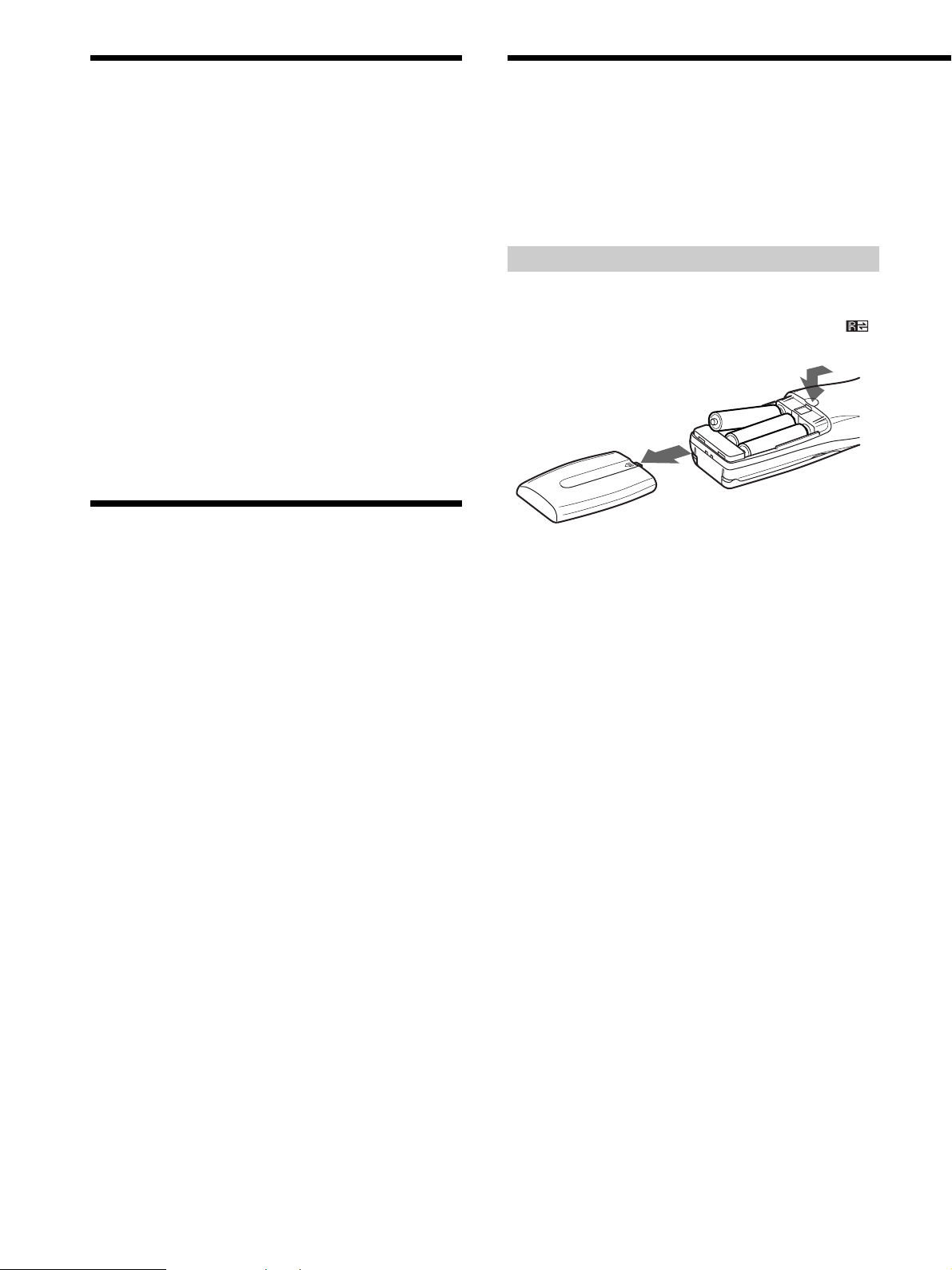
Inserting batteries into the remote
Insert three LR6 (size-AA) alkaline batteries with the +
and – properly oriented in the battery compartment.
When using the remote, point it at the remote sensor
on the receiver.
If you have any question or problem concerning your
receiver, please consult your nearest Sony dealer.
About This Manual
The instructions in this manual are for model RM-LJ304.
Check your model number by looking at the lower left
corner of the front side.
Conventions
The following icon is used in this manual:
z
Indicates hints and tips for making the task easier.
}
]
z
When to replace batteries
Under normal conditions, the batteries should last for about 3
months. When the remote no longer operates the receiver,
replace all the batteries with new ones.
Notes
• Do not leave the remote in an extremely hot or humid place.
• Do not use a new battery with old ones.
• Do not mix the alkaline batteries and other kinds of batteries.
This remote is designed for use with the alkaline batteries only.
• Do not expose the remote sensor of the receiver to direct
sunlight or lighting apparatuses. Doing so may cause a
malfunction.
• If you don’t use the remote for an extended period of time,
remove the batteries to avoid possible damage from battery
leakage and corrosion.
]
}
}
]
2
Page 3
Understanding the 2 way remote system
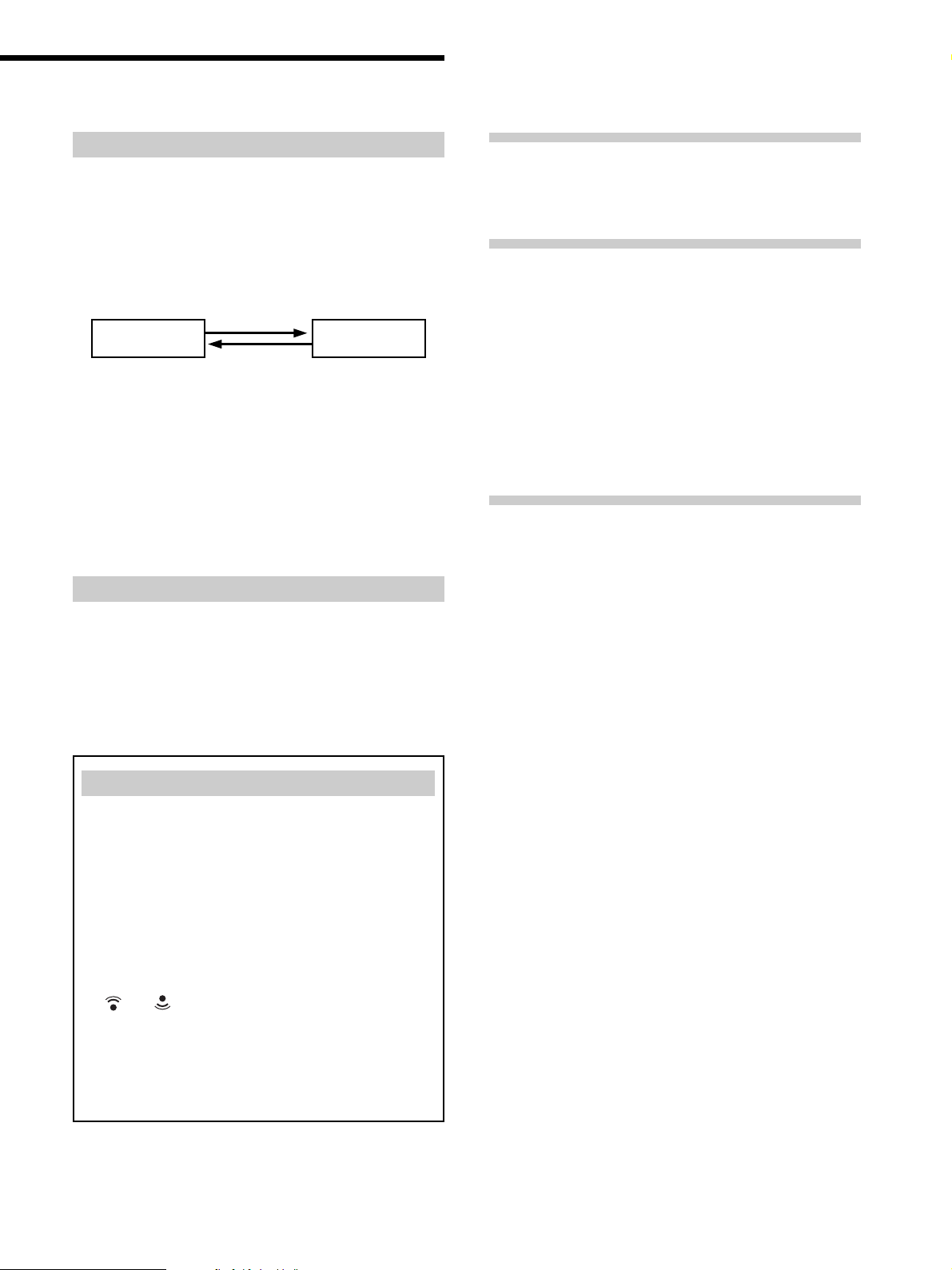
This remote operates under a 2 way remote system. With
the two way remote system, the component responds to
signals sent from the remote by sending additional signals
(information about the status of the component, text data,
etc.) back to the remote. Thus, operations are performed
as a result of communication between the remote and the
component.
Remote
When using a home entertainment system comprised of
several components compatible with the 2 way remote
system, please restrict 2 way remote system operation to a
single component. Normally, turn off the 2 way remote
system on all components except the receiver.
If you would like to turn off the receiver’s 2 way remote
system, see “Setting up the 2 way remote” in the
operating instructions supplied with the receiver.
The COMMAND MODE
If the receiver’s COMMAND MODE and the remote’s
COMMAND MODE do not match, transmission is not
possible between the remote and the receiver. If you have
not changed the COMMAND MODE of the remote and
the receiver after purchase, it is not necessary to set the
COMMAND MODE. For details, see page 21.
Component
TABLE OF CONTENTS
Location of Parts and Basic Remote
Operations 4
Parts Description 4
Using the Lists 12
Chart of Lists 13
Selecting a Component 14
Selecting a Sound Field 15
Programming the Remote 16
Performing Several Commands in Sequence
Automatically (Macro Play) 17
Learning the Commands of your components 18
Downloading Data From the Receiver 19
Other Operations 21
Additional Information 22
Troubleshooting 22
Specifications 23
Setting up the remote
At the time of shipping, the remote has not been
customized to your receiver yet. Before you use the
remote for the first time, do the procedure below to set
up the remote so that it can control your receiver
properly.
1 Press?/1 on the receiver to turn it on.
2 Point the remote towards the receiver and press
SOUND FIELD, FUNCTION, or SUB.
and appear in the display window of the
remote while it communicates with the receiver and
identifies the receiver model.
When the communication ends, the remote is
customized and provides the operation lists that
match your receiver.
3
Page 4
Location of Parts and Basic Remote Operations
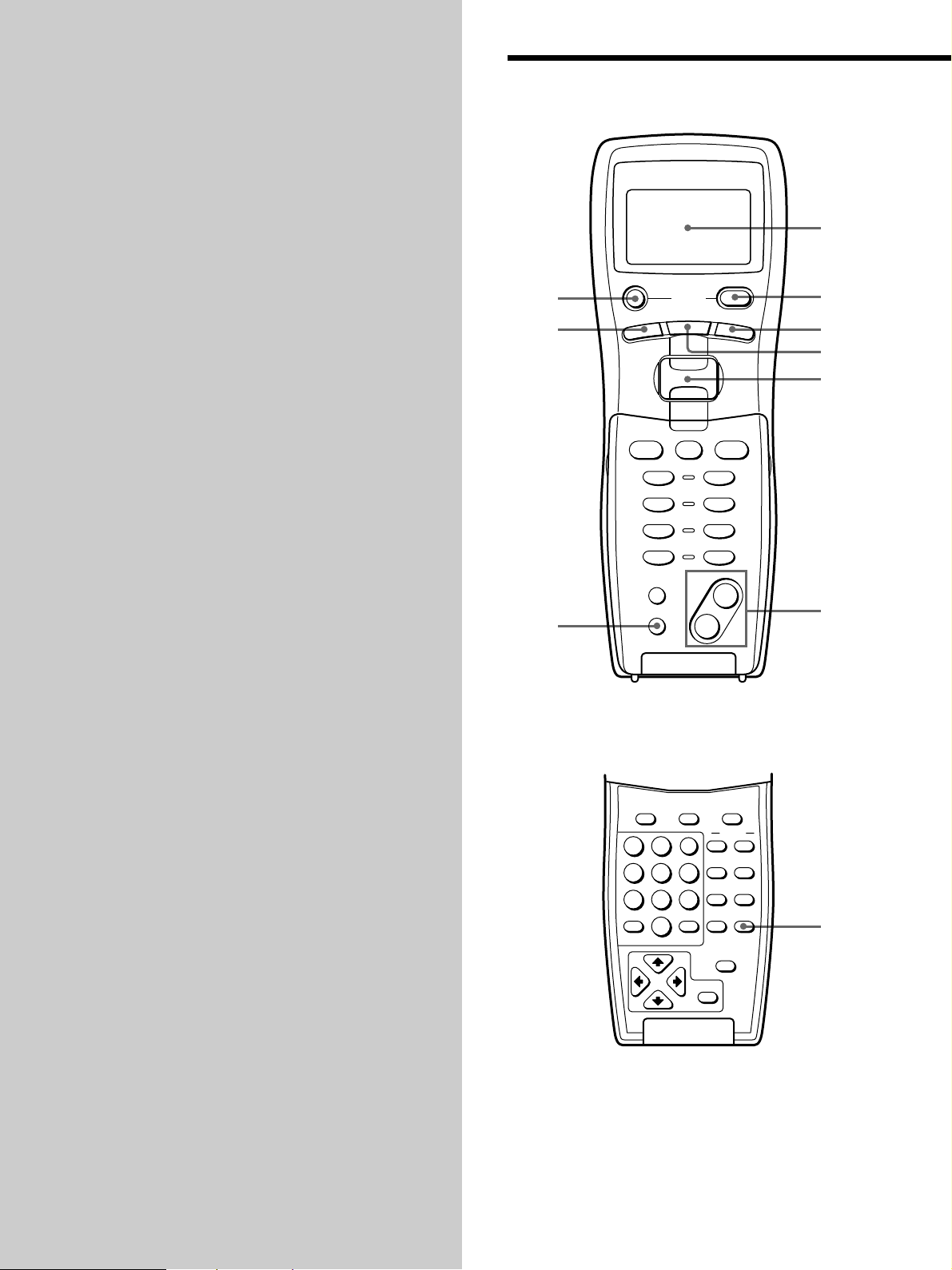
Parts Description
2
This chapter provides information on
the location of buttons and how to use
them to perform basic operations.
However, some functions explained in
this section may not operate
depending on the receiver.
1
0
6
AV ?/1
SOUND FIELD
SYSTEM
STANDBY
FUNCTION
?/1
3
SET UP
8
7
PUSH ENTER
SUB
h
Xx
.>
mM
CH/PRESET/D.SKIP
–+
BASS
BOOST
H
MASTER
VOL
+
MUTING
–
Open up the cover.
9
5
v
SUB
3
654
987
D.TUNING
EXECUTE
ON SCREEN
LEVEL
++
CENTER
REAR
––
TEST
EQ/TONE
TONE
CURSOR
SLEEP
MODE
EXIT/RETURN
4
MENU
21
SHIFT
0>10
- / - - ENTER
4
Page 5

1 AV ?/1 switch
Press to turn on or off the components that the remote
is programmed to operate. For details on
programming procedure, see “Programming the
Remote” on page 16.
If you press the ?/1 switch (3) at the same time, it
will turn off the main component and other Sony
audio/video components (SYSTEM STANDBY).
Note
The function of the AV ?/1 switch changes automatically
each time you press the FUNCTION button (7). Depending
on the component, the above operation may not be possible
or may operate differently than described.
2 Display window
The current status of the selected component or a list
of selectable items appears here.
4 SLEEP button
Press repeatedly to activate the sleep function and
select the duration after which the receiver turns off
automatically.
5 MASTER VOL +/– buttons
Press to adjust the volume level of all speakers at the
same time.
6 MUTING button
Press to mute the sound. The MUTING indicator on
the receiver lights up when the sound is muted.
7 FUNCTION button
Press to display the function (component) list. Press
again to revert back to the component information.
See the table on page 9 for information on the buttons
you can use to control each component.
Location of Parts and Basic Remote Operations
Note
Characters other than letters of the alphabet or numbers may
be displayed incorrectly on the remote, even if they appear
correctly in the display window on the main unit.
3 ?/1 switch
Press to turn the receiver on or off.
Note
Before you turn on the receiver, make sure that you have
turned the MASTER VOLUME control on the receiver to the
leftmost position to avoid damaging your speakers.
If you want to change the contents of the function list
to match your particular components, do the
procedure “Programming the Remote” on page 16.
8 SET UP button
Press to display the set up list. Press again to revert
back to the component information.
9 Easy scroll key
While displaying a list, move up or down to select an
item from the list, and then press to enter the selection.
0 SOUND FIELD button
Press to display the sound field list. Press again to
revert back to the component information.
5
Page 6
Parts Description
Location of Parts and Basic Remote Operations
AV ?/1
SOUND FIELD
SYSTEM
STANDBY
FUNCTION
PUSH ENTER
?/1
SET UP
w;
SUB
qa
h
Xx
.>
mM
CH/PRESET/D.SKIP
–
BASS
BOOST
MUTING
H
+
MASTER
VOL
+
–
wa
ws
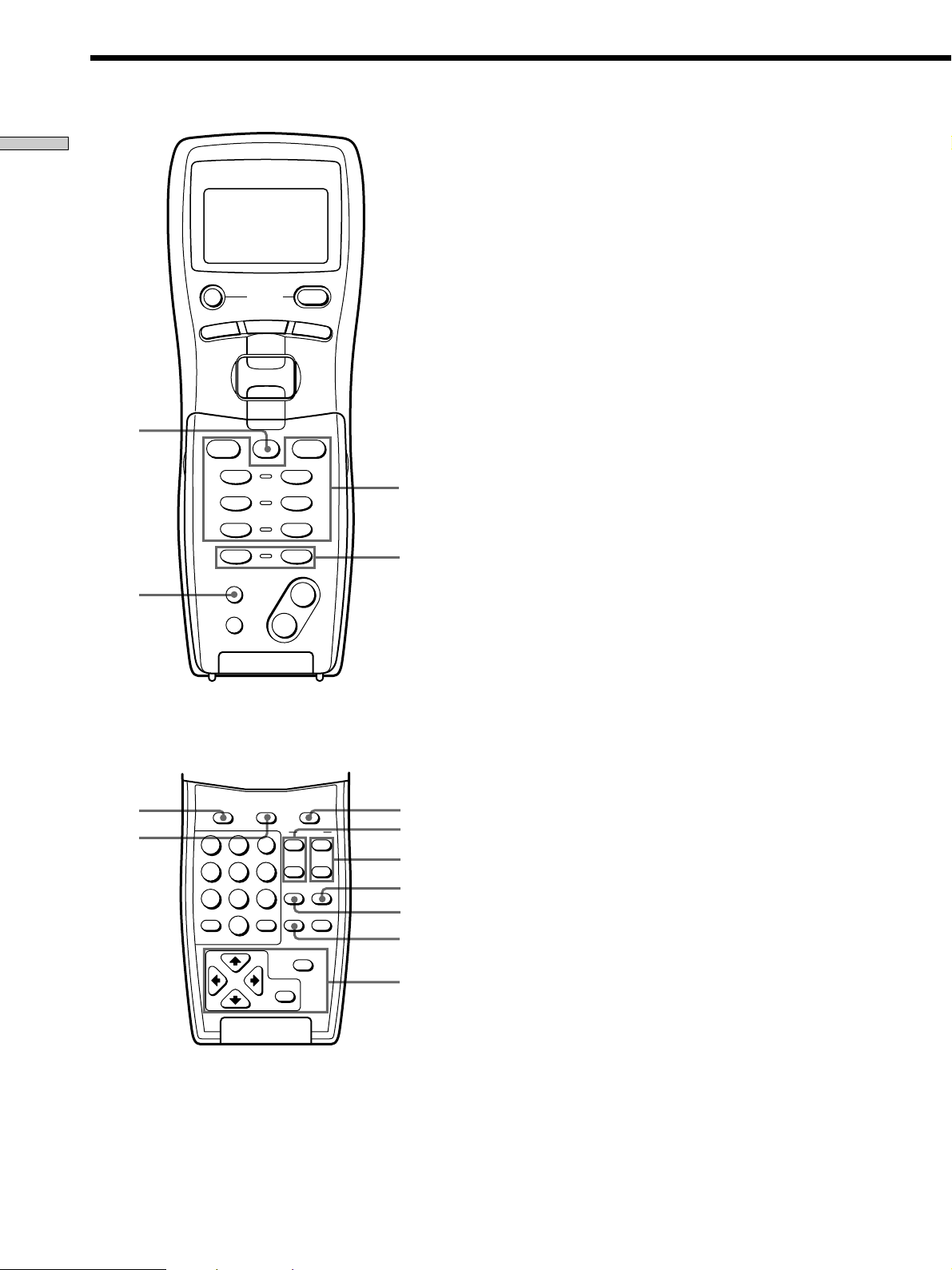
qa BASS BOOST button
Press to increase the bass of the front speakers. The
BASS BOOST indicator on the receiver lights up when
the function is turned on.
qs ON SCREEN button
For receivers with the on-screen function, press to turn
on/off the menu display on the TV screen.
qd LEVEL REAR +/– buttons
Press to adjust the volume level of the rear speakers.
qf LEVEL CENTER +/– buttons
Press to adjust the volume level of the center speaker.
qg EQ/TONE button
Press to turn the equalizer or tone effect on or off. The
TONE indicator on the receiver lights up when the
effect is turned on.
Note that if you have adjusted the equalization or tone
using the CURSOR MODE button and cursor buttons,
the adjusted equalization or tone will be produced
whenever you turn on the equalizer or tone effect.
qh TEST TONE button
Press to output a test tone.
qk
w;
v
MENU
21
SHIFT
- / - - ENTER
0>10
D.TUNING
SUB
3
654
987
Open up the cover.
ON SCREEN
LEVEL
++
CENTER
REAR
––
TEST
EQ/TONE
TONE
CURSOR
SLEEP
MODE
EXIT/RETURN
EXECUTE
qj CURSOR MODE button
Press repeatedly to select a cursor mode, SURROUND,
BASS/TREBLE (EQ), etc. The indicator for the selected
cursor mode lights up on the receiver.
qs
qd
qf
qg
qh
qj
ql
6
Page 7
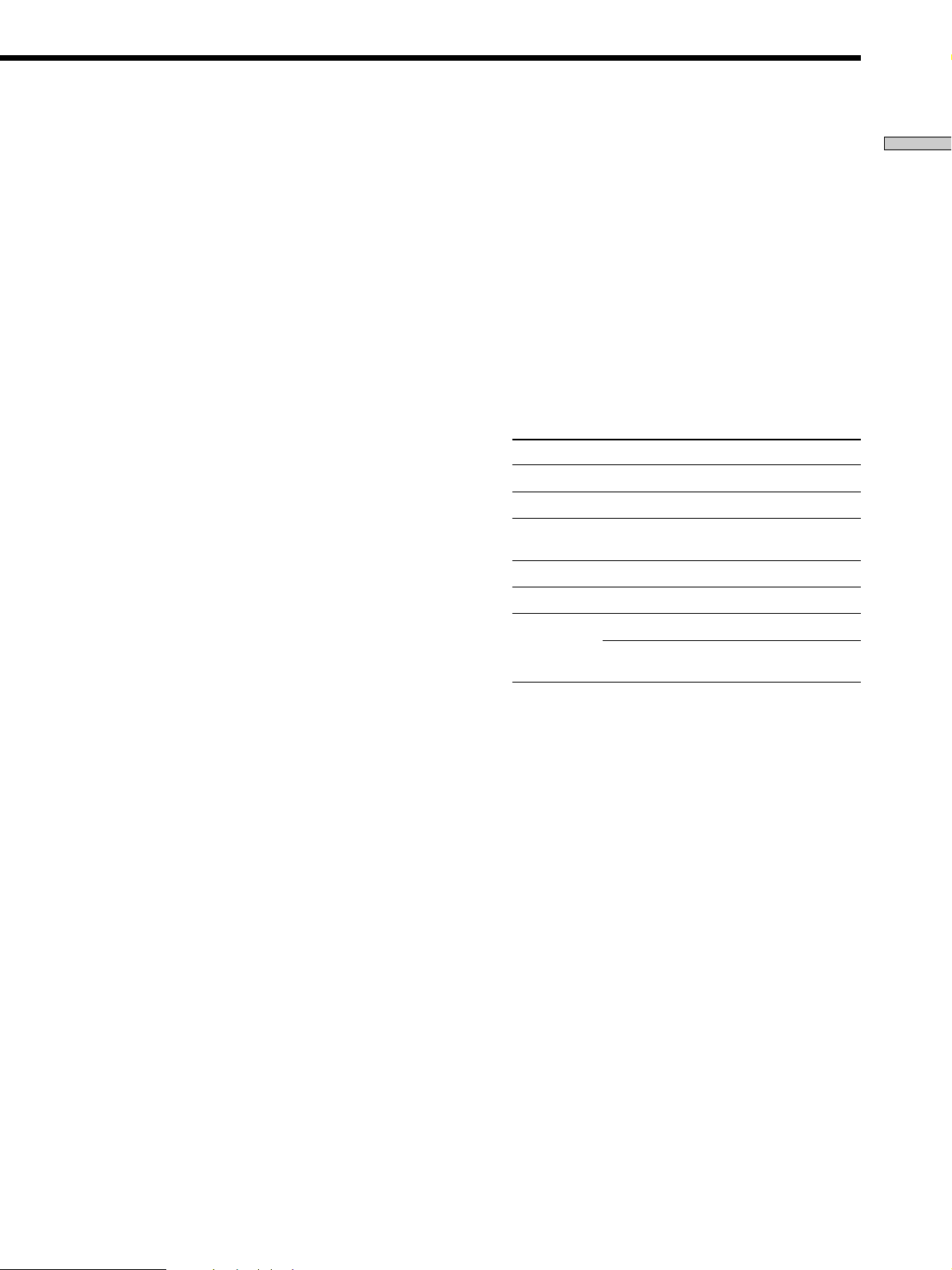
qk MENU button
When you have selected the VCR, DVD player,
or SAT tuner, press this button to display VCR, DVD,
or SAT menu on the TV screen. Then use the cursor
buttons to perform the menu operations (see “ql
Cursor buttons (V/v/B/b),” “EXECUTE button,” and
“EXIT/RETURN button” on this page).
w; SUB button
While operating a component, press to display a list of
operations that the corresponding buttons are not
found on the remote. Then move the easy scroll key to
select the operation, and then press the key to enter
the selection. Press again to revert back to the
component information.
Location of Parts and Basic Remote Operations
Note
When you have selected VCR, the remote is set to control the
VCR that corresponds with VCR 1 after you press the MENU
button. Before pressing the button, make sure to set the VCR
input mode to VCR 1.
ql Cursor buttons (V/v/B/b)
After pressing the CURSOR MODE button or SET UP
button on the receiver, use the cursor buttons to make
specific settings. For details refer to the Operating
Instructions supplied with your receiver.
To perform menu operations on the VCR, DVD player,
or SAT tuner, do the procedure below. If you do not
do this, the cursor buttons merely operate the receiver.
1 Press FUNCTION and move the easy scroll key to
select the VCR, DVD player, or SAT tuner.
2 Open up the cover on the remote.
CURSOR TYPE list appears.
If the list has disappeared before you go on to Step
3, press any of the cursor buttons to restore the list.
3 Move the easy scroll key to select the component
that you selected in Step 1, then press the key to
enter the selection.
EXECUTE button
After pressing the MENU (or SAT guide), use the
cursor buttons to select a menu item, then press the
EXECUTE button to enter the selection.
See the table on pages 10 and 11 for information on the
operations that appear when you press the SUB
button.
wa Tape/disc operation buttons
The following table shows what components are
operated by each button and the function of the
buttons.
Button(s) Function
H Starts play of the playback medium
h Starts play on the reverse side of the cassette
X Pauses play or recording or starts recording
when the component is in recording standby
x Stops play
./> Skips tracks
m/M Fastwinds or rewinds
Searches tracks in the forward or backward
direction
See the table on page 9 for information on the buttons
that you can use to control each component.
ws CH/PRESET/D.SKIP +/– buttons
Press repeatedly to select a preset station, channel,
track, or a disc.
EXIT/RETURN button
Press to return to the previous menu or exit the menu
while VCR, DVD, or SAT menu or SAT guide is
displayed on the TV screen.
7
Page 8
Parts Description
Location of Parts and Basic Remote Operations
AV ?/1
SOUND FIELD
SYSTEM
STANDBY
FUNCTION
PUSH ENTER
h
Xx
.>
mM
CH/PRESET/D.SKIP
– +
BASS
BOOST
SET UP
SUB
H
MASTER
VOL
?/1
+
MUTING
–
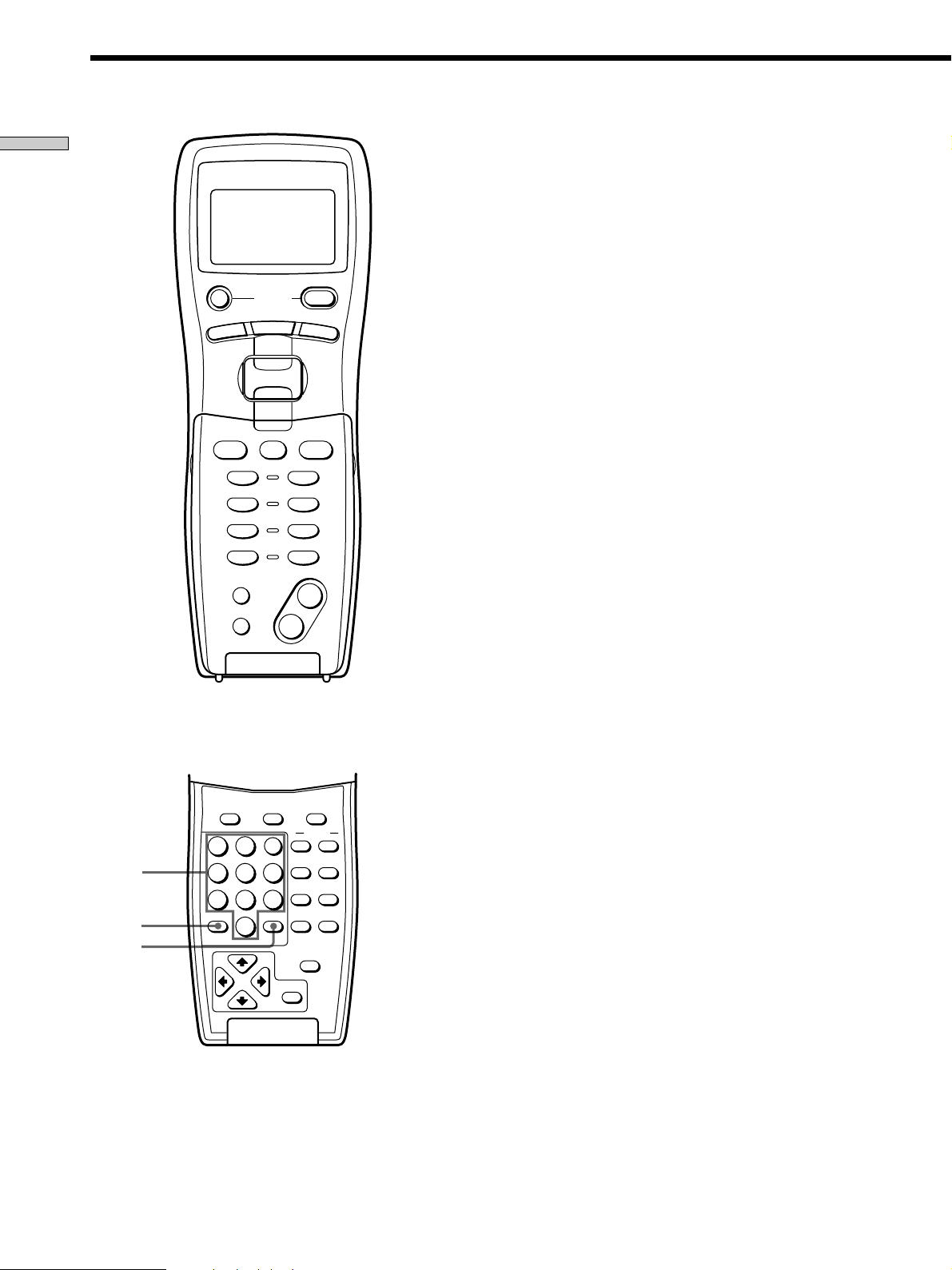
wd D.TUNING ENTER button
If you have selected tuner:
Press to enter Direct Tuning mode. For details on
Direct Tuning procedure, refer to the Operating
Instructions supplied with your receiver.
If you have selected VCR, DVD player, LD player,
TV, cable box, satellite tuner, MD deck, CD player, or
DAT deck:
After selecting a channel, disc, or track using the
numeric buttons, press this button to enter the
selection. For details, refer to the operation manual
supplied with the respective components.
wf SHIFT >10 -/-- button
If you have selected tuner:
Press repeatedly to select a memory page for
presetting radio stations or tuning to preset stations.
If you selected VCR, TV, tape deck, LD player, video
CD player, MD deck, or CD player:
Press before inputting a channel, disc, or track number
of eleven or higher. For details, refer to the operation
manual supplied with the respective components.
wg
wf
wd
v
SUB
MENU ON SCREEN
++
3
21
SHIFT
0>10
- / - - ENTER
654
987
D.TUNING
EXECUTE
REAR
––
TEST
TONE
CURSOR
MODE
EXIT/RETURN
Open up the cover.
LEVEL
CENTER
EQ/TONE
SLEEP
wg Numeric buttons (1 to 0)
Inputs the correponding numeric value. On some
components, pressing 0 selects 10. For details, refer to
the operation manual supplied with the respective
components.
8
Page 9
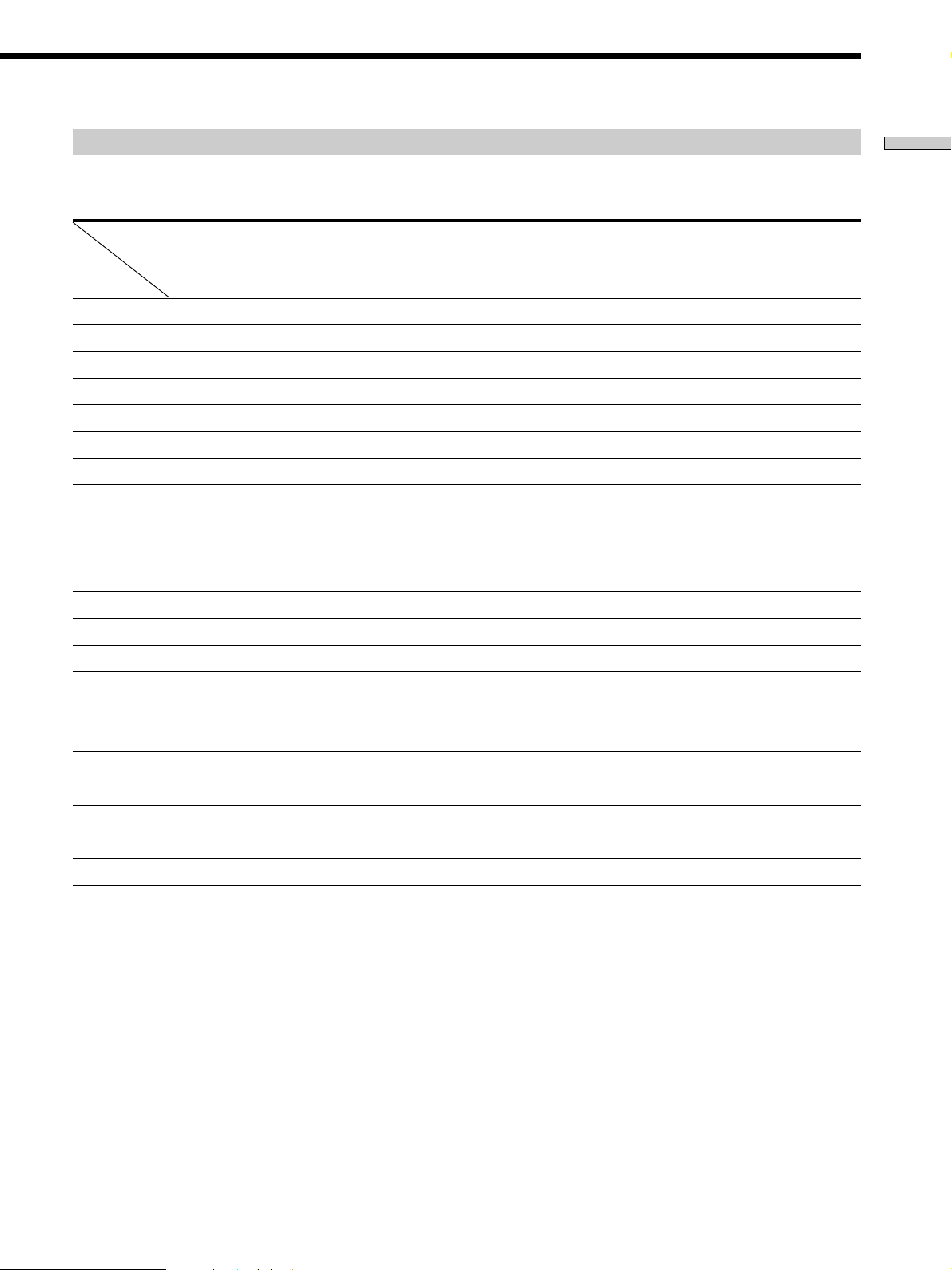
Table of buttons used to control each component
When you program the remote to control the following Sony or non-Sony components, you can use the buttons on the
remote that are marked with circles. Note, however, that some buttons may not operate your component.
Component VCR Satellite DVD LD TV Cable Tuner Video CD CD MD DAT Tape Projector
tuner player player box player player deck deck deck
(A and B)
Button
AV ?/1 zzzzzz zzz
1)
SUB
h z
H z zz zzzzz
X z zz zzzzz
x z zz zzzzz
./> z zz zzzzz
m/M z zz zzzzz
CH
PRESET
D.SKIP +/–
3)
Cursor buttons zzz z
MENU zzz
Numeric buttons zzzzz zzzzzz
SHIFT z
>10 z z zzz z
-/-- z
D.TUNING z
ENTER zzzzz zzzz4)z
EXIT z
RETURN zz z
EXECUTE zzz
1)
For information on the operations that become available when you press the button, see the table on pages 10 and 11.
2)
Deck B only.
3)
Multi disc changer only.
4)
RMS/START.
zzzzzzzzzzzzz
2)
zz zz
z
z zzz
Location of Parts and Basic Remote Operations
9
Page 10

Parts Description
Location of Parts and Basic Remote Operations
Table of operations that appear when you press the SUB button
Press the SUB button to display a list of operations that the corresponding buttons are not found on the remote. The
contents of the lists will vary according to the currently selected component. The following table shows the items in each
list and the function of each item.
Component Item(s) Function
VCR REC Starts recording
DISPLAY Selects information displayed
INPUT SEL. Changes the input mode of
ANT TV/VTR Selects the signal to be
SP/LP Selects the playback speed
Satellite tuner GUIDE Displays the SAT guide
JUMP Toggles between the
DISPLAY Selects information displayed
FAVORITE Displays the Favorite Station
CATEGORY Displays the Guide Category
INDEX Displays the Station Index
DVD player DISPLAY Selects information displayed
TITLE Displays the Title menu. For
SET UP Displays the Set up menu.
S.TITLE CHG Changes the Subtitle
SUBTITLE Displays the Subtitles
AUDIO CHG. Changes the sounds
SEARCH MODE Changes the search mode
CLEAR Returns to the Continuous
INDEX + Selects a index
INDEX –
on the TV screen
the VCR
output from the antenna
terminal of the VCR (TV
signal or video signal)
previous and current
channels
on the TV screen
Guides
list
on the TV screen
details on the menu
operation, see “To perform
title and set up menu
operations on the DVD
player” on page 11.
For details on the menu
operation, see “To perform
title and set up menu
operations on the DVD
player” on page 11.
Language
Play etc.
Component Item(s) Function
SIDE B
a)
a)
Selects side A of the disc
Selects the side B of the disc
DISPLAY Selects information displayed
on the TV screen
PROGRAM Programs the tracks
REPEAT Repeats current track or
programmed tracks
VOL + Raises the volume
VOL – lowers the volume
JUMP Toggles between the
previous and current
channels
DISPLAY Selects information displayed
on the TV screen
TV/VTR Changes the input mode of
the TV
P IN P Activates the picture-in
picture function
POSITION Changes the position of the
small picture
SWAP Swaps the small and large
pictures
WIDE Selects the wide-picture
SUB CH +
SUB CH –
c)
mode
Selects preset channels for the
small picture
b)
b)
b)
b)
TIME Changes the time
information
INDEX + Selects a index
INDEX –
d)
TRACK Selects a track
d)
CONTINUE Selects Continuous Play
SHUFFLE Selects Shuffle Play
PROGRAM Selects Program Play
REPEAT Selects Repeat Play
LD Player SIDE A
TV MUTING Mutes the sound
Cable box
Tuner FM/AM Selects the FM or AM band
VIDEO CD
Player
CD Player DISC Selects a disc
10
Page 11

Component Item(s) Function
MD deck CONTINUE Selects Continuous Play
SHUFFLE Selects Shuffle Play
PROGRAM Selects Program Play
REPEAT Selects Repeat Play
DISPLAY Changes the information on
MENU/NO Selects editing operation or
(EDIT) cancels editing
YES Performs editing operation
REC Pauses for recording
DAT deck REC Pauses for recording
REPEAT Starts Repeat Play
CLEAR Erases a track in the program
Tape deck A-REC Makes deck A pause for
B-REC Makes deck B pause for
Projector POWER ON Turn on the projector
POWER OFF Turn off the projector
INPUT A Switch to the input from
INPUT B Switch to the input from
INPUT VIDEO Switch to the input from
INPUT SELECT Switch to the input from
MEMORY Store the adjusted data in
BRIGHT + Adjust the brightness
BRIGHT –
CONTRAST + Adjust the contrast
CONTRAST –
ZOOM +
ZOOM –
SHIFT +
SHIFT –
FOCUS +
FOCUS –
the display
etc.
recording
recording
INPUT A jacks
INPUT B jacks
VIDEO jacks
VIDEO IN or S VIDEO IN
jacks
memory
Adjust the zoom of the
picture
Adjust the lens shift of the
picture
Adjust the focus of the
picture
a) “SIDE A/B” appears for non-Sony LD players.
b) Only with Sony TVs with the picture-in-picture function.
c) Only with Sony TVs that supports the wide-picture mode.
d) Only with the Sony CD changer.
Note
If you have programmed the remote to control non-Sony
components, note the following:
— All the items may not appear when you select a component.
— All the items displayed may not function.
z
To perform title and set up menu operations on the DVD
player
1 Select the DVD player from the function list.
2 Press SUB.
3 Move the easy scroll key to select “TITLE” (for the title menu)
or “SET UP” (for the set up menu), then press the key to enter
the selection.
4 Open up the cover on the remote and move the easy scroll key
to select ”DVD” from the CURSOR TYPE list, then press the
key to enter the selection.
5 Use the cursor buttons and the EXECUTE button to perform
menu operations on the DVD player.
To exit the menu operation
1 Close the cover on the remote.
2 Press SUB.
3 Move the easy scroll key to select “TITLE” or “SET UP”, then
press the key to enter the selection.
To display the DVD menu, use the MENU button. For details,
see “qk MENU button” on page 7.
z
You can freely assign codes to SUB1 through SUB5
Select when you transmit learned codes. For details, see
“Learning the Commands of your components” on page 18.
Location of Parts and Basic Remote Operations
11
Page 12
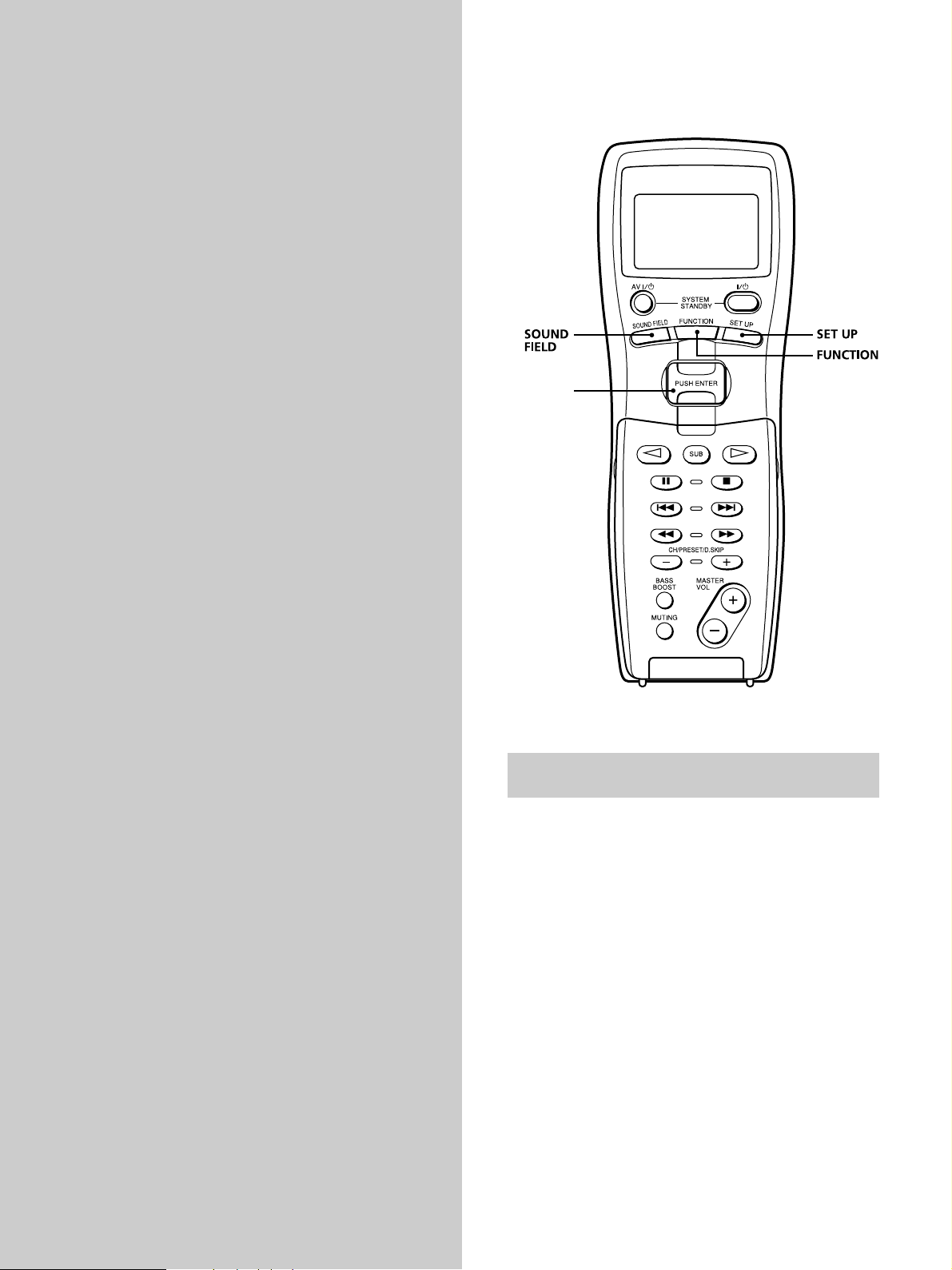
Using the Lists
This chapter describes how to display
and use various lists. It also includes
a chart showing all of the various lists.
Easy scroll
key
12
Brief descriptions of buttons for list
operations
SOUND FIELD button: Press to display the sound field
list. Press again to revert back to the component
information.
FUNCTION button: Press to display the function
(component) list. Press again to revert back to the
component information.
SET UP button: Press to display the set up list. Press
again to revert back to the component information.
Easy scroll key: While displaying a list, move this key up
or down to select an item from the list, then press the key
to enter the selection.
Page 13
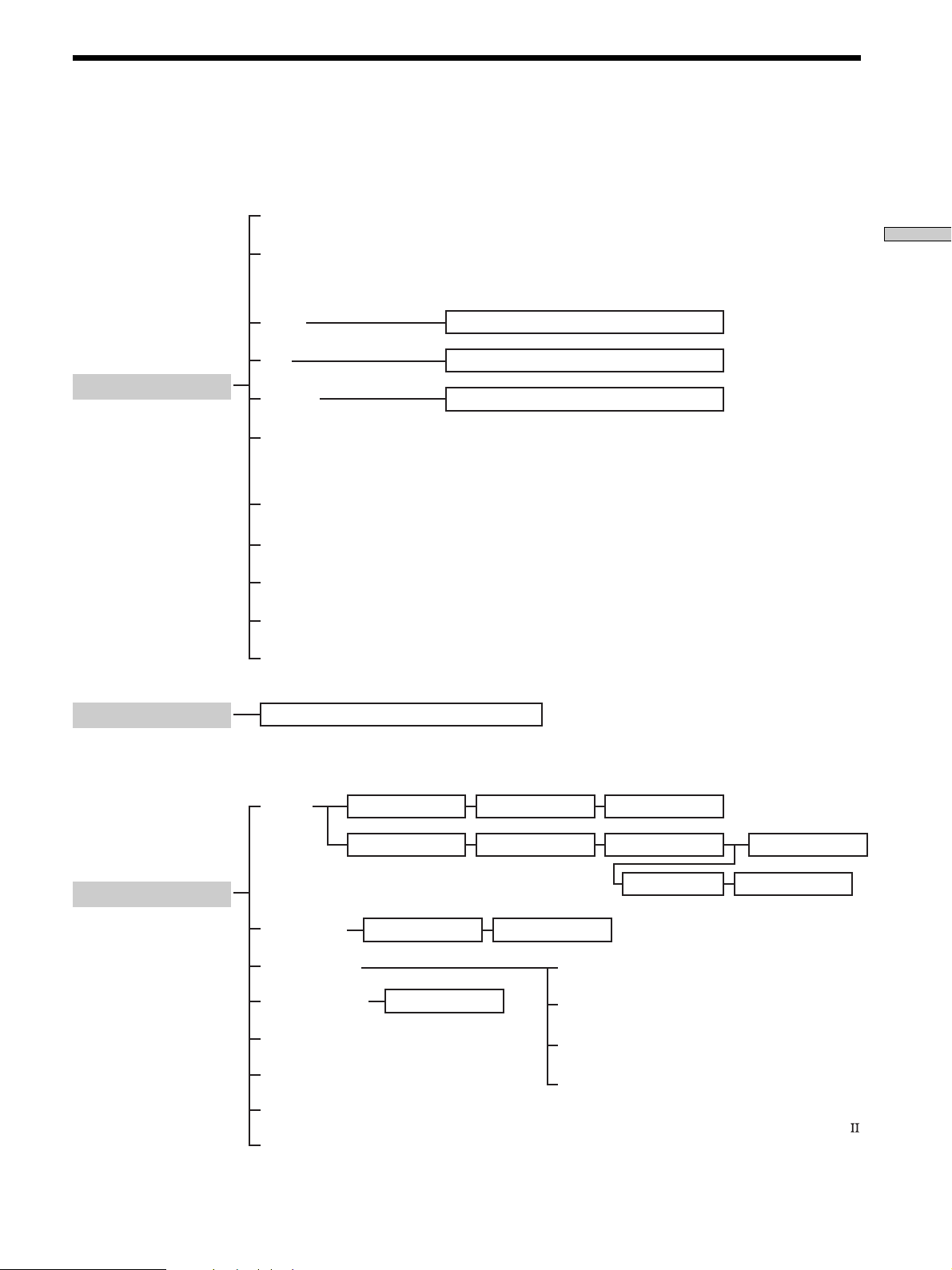
Chart of Lists
See the treelike chart below for the list hierarchy. Details on how to access each list is given from page 14. Some items have
sub-lists that appear when you press the SUB button (see pages 10 and 11).
The configuration of the lists will vary depending on the receiver.
VIDEO1
Press
FUNCTION
Press
VIDEO2
.
.
.
TAPE
CD
2)
TUNER
Deck A/B status information
Disc name (memo) LIST
Preset station list
1)
Using the Lists
PHONO
.
.
.
USER1
USER2
MACRO1
MACRO2
2ND AV/2ND AUDIO
SOUND FIELD
Press
SET UP
2)
IR SET
LEARNING
DOWNLOAD
AUTO POWER
BACK LIGHT
CONTRAST
Sound field list
IR SET list CATEGORY list MAKER list
MACRO 1/2 list PROGRAM list CATEGORY list
MAKER list FUNCTION list
FUNCTION list BUTTON list
FUNCTION
TV INPUT list
TUNER INFO
CD DISC NAME
EXIT
BUTTON list
COMMAND MODE
1)
ALL CLEAR
Appears only when the receiver is connected to CONTROL A1/A1
compatible CD changer (5, 50, 200, 300 or 400 discs).
2)
The displayed information varies depending on the receiver.
13
Page 14
Selecting a Component
Basic procedure for selecting a component
Do the procedure below to select a component from the
function list. Note that the components contained in the
list will vary depending on the receiver.
Using the Lists
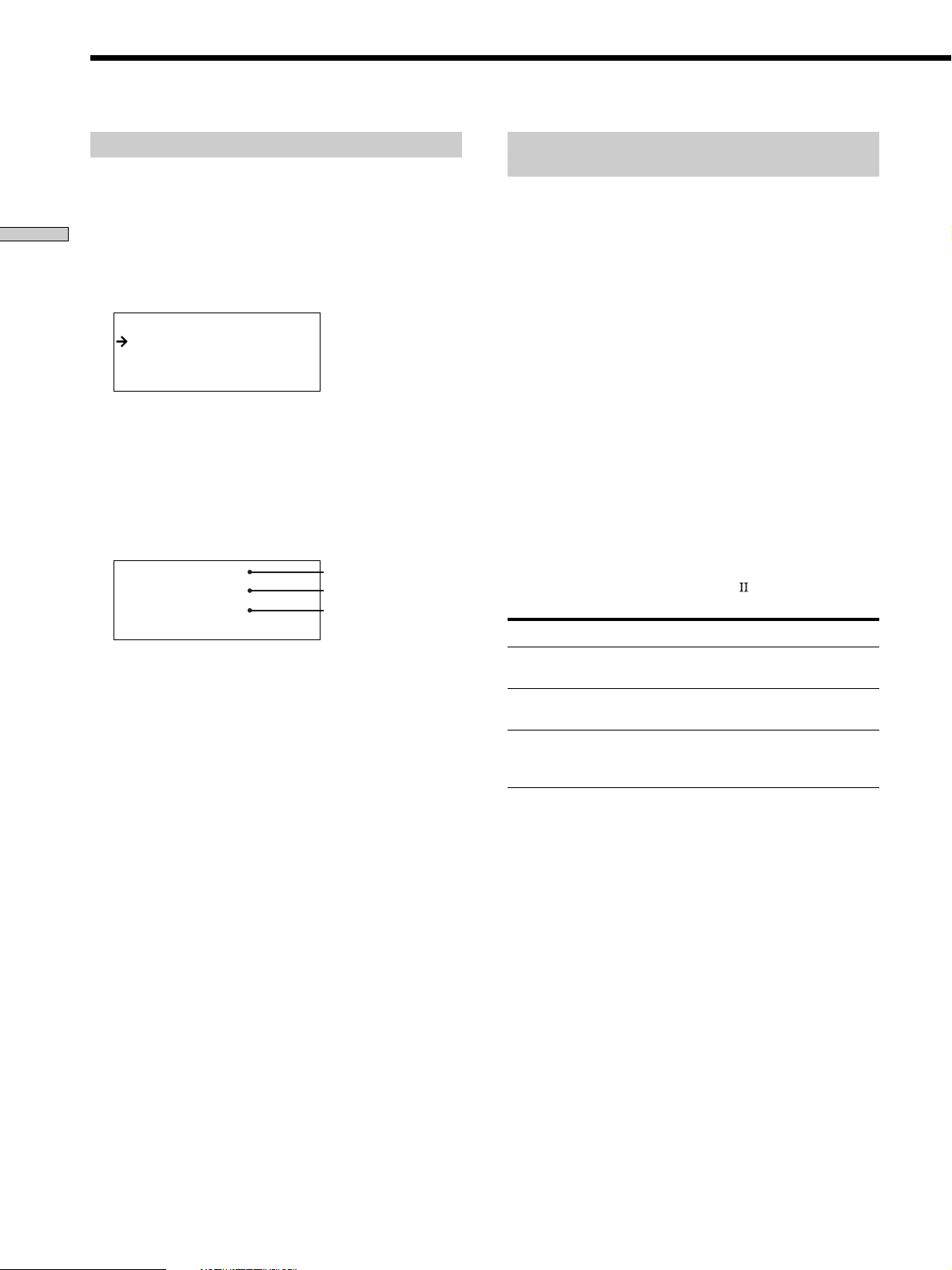
1 Press FUNCTION.
The function list appears. The items in the list
correspond with the jacks on the receiver.
TUNER
PHONO
5.1CH
2 Move the easy scroll key to select a component
from the list, then press the key to enter the
selection.
Information about the component appears in the
display window.
A display example
< C D >
CD1
Sony
z
You can modify the category indication
The category indication tells you what component is actually
connected to the jacks on the receiver. If a component is
connected to jacks for which they are not originally meant, you
can modify the category indication to match the component. For
details, see “Programming the Remote” on page 16.
z
You can turn components on automatically
You can set the remote to automatically turn on a component
when it is selected from the function list. For details, see “Using
the auto power function” on page 21.
Depending on the component that you selected, you may
have to do an additional procedure, or you may be able to
obtain detailed information about the component by
doing an additional procedure. For details, see
“Additional procedures after selecting a component” on
this page.
C D
Selected component
Category
Maker of the
component
Additional procedures after selecting a
component
If you have selected tuner
Do the procedure below after you have selected the tuner.
1 Move the easy scroll key.
The preset station list appears.
2 Move the easy scroll key to select the preset
station, then press the key to enter the selection.
The current status of the component appears in the
display window.
Note
If you have changed the contents of the preset station memory of
the receiver, be sure to download the preset station memory from
the receiver (see page 19) before you tune in to a preset station.
If you have selected CD player, tape deck, or MD
deck
Detailed information about the component appears in the
display window of the remote only if the component is
compatible with CONTROL A1/A1
The information that appears is as follows:
If you have selected The following information appears
CD player
MD deck
tape deck, CD player,
or MD deck
If you selected a Sony CD changer
The first 12 characters of the disc
memo, track number, and track text
The first 12 characters of the disc
name, track number, and track name
The current deck operation (N, X or
x) to the right of the component
indication
.
1 Move the easy scroll key.
The DISC MEMO list appears.
2 Move the easy scroll key to select a disc, then press
the key to enter the selection.
3 Start playback.
14
Note
If you have changed the discs in the changer, be sure to
download the CD memos from the receiver (see page 19) or play
the newly inserted disc(s) before you select a disc from the
changer.
Page 15
Selecting a Sound Field
If you selected the tape deck
Move the easy scroll key to display the information about
deck A or B.
Note
When the remote is programmed to control a non-Sony tape
deck, the following may occur:
— The information about deck B is not displayed and you
cannot switch between tape deck A and B.
— “TAPE A/B” is displayed and tape deck A and B switch
automatically each time you press the easy scroll key, etc.
If you selected the 2ND AV/2ND AUDIO source
Move the easy scroll key to select the source of 2ND AV/
2ND AUDIO, then press the key.
Note
Depending on the component you are using, “2ND AUDIO” or
“2ND AV” may not be displayed.
Do the procedure below to select a sound field from the
sound field list. Note that the sound fields contained in
each list will vary depending on the receiver.
1 Press SOUND FIELD.
The sound field list appears.
2 Move the easy scroll key to select the sound field,
then press the key to enter the selection.
A display example
NORMAL SURROUND
CINEMA ST.EX.A
CINEMA ST.EX.B
CINEMA ST.EX.C
To turn off the sound field
Move the easy scroll key to select either “2CH STEREO”
or “A.F.D.” in the sound field list in the display. The
sound field list that is displayed is different depending on
the model.
Using the Lists
15
Page 16
Programming the Remote
You can customize the remote to match the components
connected to your receiver. You can even program the
remote to control non-Sony components and also Sony
components that the remote is normally unable to control.
The procedure below uses as an example a case in which a
Using the Lists
Kenwood LD player is connected to the VIDEO 2 jacks on
the receiver.
Before you begin note that:
— You cannot change the settings of TUNER and
PHONO.
— The remote can control only components that accept
infrared wireless control signals.
Be sure to turn on the receiver and point the remote
towards the receiver when performing the following
procedure.
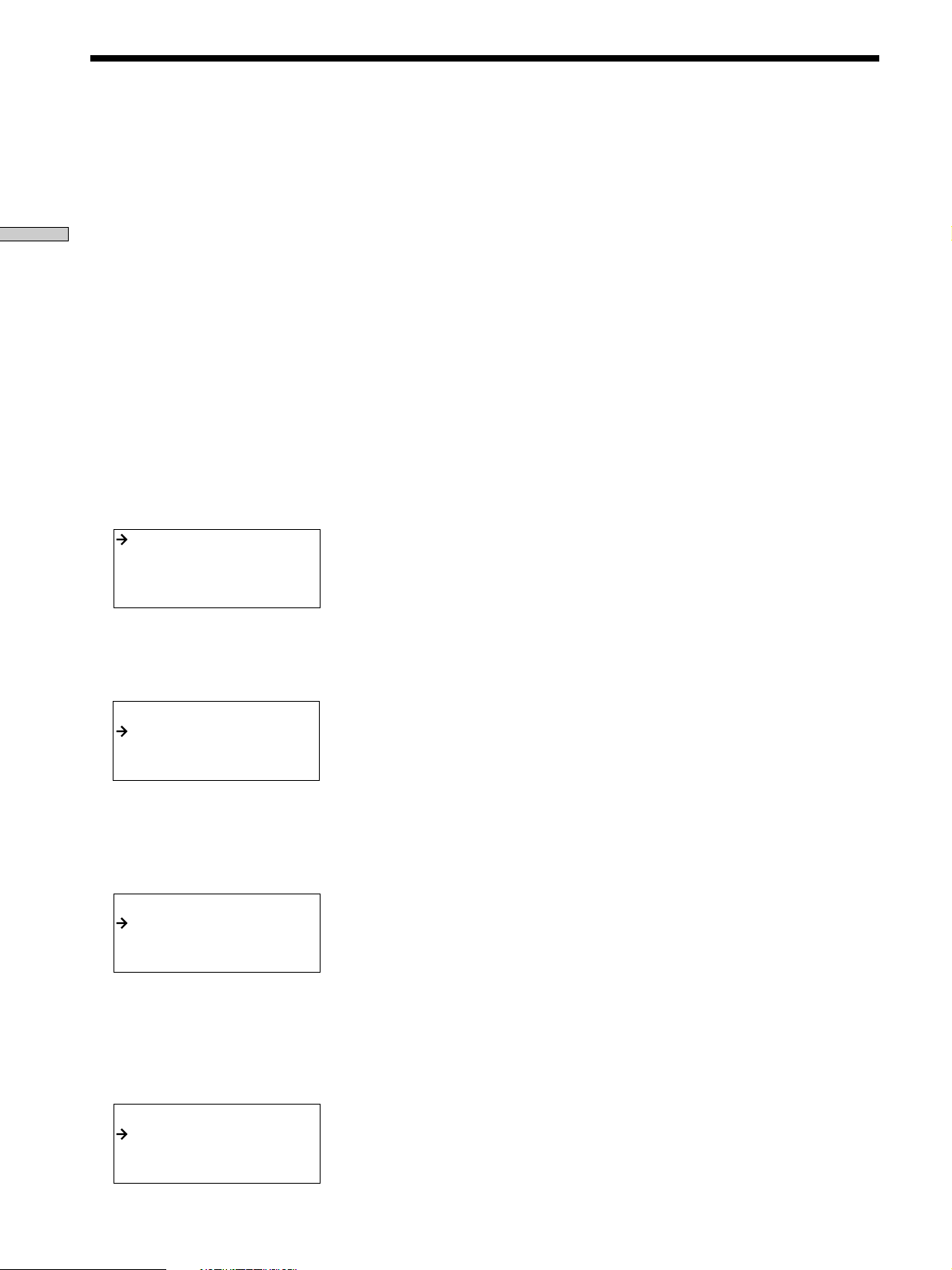
1 Press SET UP.
The set up list appears.
IR SET
LEARNING
DOWNLOAD
AUTO POWER
2 Move the easy scroll key to select “IR SET,” then
press the key to enter the selection.
The IR SET list appears.
<IR SET>
[VIDEO 1 ]
[VIDEO 2 ]
[VIDEO 3 ]
5 Move the easy scroll key to select the maker of the
component (“Kenwood,” for example), then press
the key to enter the selection.
When programming the remote to control
Sony component
Select “Sony.”
Programming is now completed.
To cancel programming
Move the easy scroll key to select “EXIT” from the IR SET
list, or “CANCEL” from the CATEGORY list or MAKER
list, then press the key to enter the selection.
z
You can freely assign any component to USER 1 and 2 items
in the IR SET list
1 Do Steps 1 and 2 in “Programming the Remote”.
2 Move the easy scroll key to select “USER 1” or “USER 2,” then
press the key to enter the selection.
3 Continue from Step 3 in “Programming the Remote” to select
the category and maker of the component.
Note
If you select “IR SET” for a component that already has a learned
button setting, the learned codes for that component are cleared.
Furthermore, if the cleared learned button is used in a Macro Play
setting, the setting for that button will be changed to “NO SET”.
3 Move the easy scroll key to select the component
(“VIDEO 2,” for example), then press the key to
enter the selection.
The CATEGORY list appears.
CATEGORY?
VCR
T V
L D
4 Move the easy scroll key to select the category
(i.e., the component that is actually connected to
the corresponding jacks; in this case, “LD”), then
press the key to enter the selection.
The MAKER list appears.
MAKER?
Sony
DENON
Kenwood
16
Page 17

Performing Several Commands in Sequence Automatically (Macro Play)
The Macro Play function lets you link several IR codes in
a sequential order as a single command. The remote
provides 2 macro lists (MACRO 1 and 2). You can specify
up to 8 IR codes for each macro list.
Setting the sequence of IR codes
1 Press SET UP.
The set up list appears.
IR SET
LEARNING
DOWNLOAD
AUTO POWER
2 Move the easy scroll key to select “IR SET,” then
press the key to enter the selection.
The IR SET list appears.
<IR SET>
[ MACRO 1 ]
[ MACRO 2 ]
EXIT
3 Move the easy scroll key to select “MACRO 1” (or
“MACRO 2”), then press the key to enter the
selection.
The PROGRAM list appears.
Program No.?
Macro 1-1
Macro 1-2
Macro 1-3
4 Move the easy scroll key to select the macro step
number (“Macro 1-1” for example) then press the
key to enter the selection.
The CATEGORY list appears.
CATEGORY?
Button
VCR
T V
5 Move the easy scroll key to select the component
category (“VCR” for example) then press the key to
enter the selection.
The MAKER list appears.
MAKER?
Sony VTR1
Sony VTR2
Sony VTR3
6 Move the easy scroll key to select the maker, then
press the key to enter the selection.
The FUNCTION list appears.
FUNCTION?
* NO SET
* ALL/OFF
* WAIT TIME
7 Move the easy scroll key to select the IR code for
the operation you want to perform, then press the
key to enter the selection.
The PROGRAM list reappears.
Program No.?
Macro 1-1 x
Macro 1-2
Macro 1-3
8 Repeat steps 4 through 7 to program up to 8 IR
codes.
When you have finished programming IR codes,
select “EXIT” in step 7.
To use learned codes under the Macro Play
function
Move the easy scroll key to select “Button” in step 4, then
press the key to enter selection.
Similarly, move the easy scroll key to select the button of
the learned codes. When selecting a button, you can press
the button directly, instead of scrolling down the list, to
jump to the desired button in the list and transmit the IR
code.
To cancel programming
Move the easy scroll key to select “EXIT” or “CANCEL”
during any step, then press the key to enter the selection.
To erase a programmed IR code
Move the easy scroll key to select “NO SET” from the
FUNCTION list, then press the key to enter the selection.
To turn off all connected Sony components
(SYSTEM STANDBY)
Move the easy scroll key to select “ALL OFF” from the
FUNCTION list, then press the key to enter the selection.
However, this function cannot apply to some Sony
components.
To delay the output of an IR code
Move the easy scroll key to select “WAIT TIME” from the
FUNCTION list, then press the key to enter the selection.
This allows you to specify a 1 to 10 second delay (in
1 second increments) before outputting the IR code.
Using the Lists
17
Page 18
Performing Several Commands in Sequence
AV ?/1
FUNCTION
SET UP
SOUND FIELD
?/1
PUSH ENTER
SUB
BASS
BOOST
MASTER
VOL
MUTING
CH/PRESET/D.SKIP
–
+
+
–
SYSTEM
STANDBY
h
Xx
H
.>
mM
Automatically (Macro Play)
z
In step 6, when “*” is displayed in front of the function
The function is pre-programmed.
z
In step 3 and 7, when “x” is displayed after the program
number.
The codes have already been programmed.
Using the Lists
Note
If you select “IR SET” for a component that already has a learned
button setting, the learned codes for that component are cleared.
Furthermore, if the cleared learned button is used in a Macro Play
setting, the setting for that button will be changed to “NO SET”.
Starting macro play
Learning the Commands of your components
By using the Learning function, it is possible for this
commander to perform learned operations.
Setting remote control codes that are not
stored in the commander
When a remote control code is not one of the presets
stored in the commander, it is possible for the commander
to learn the code using the Learning function.
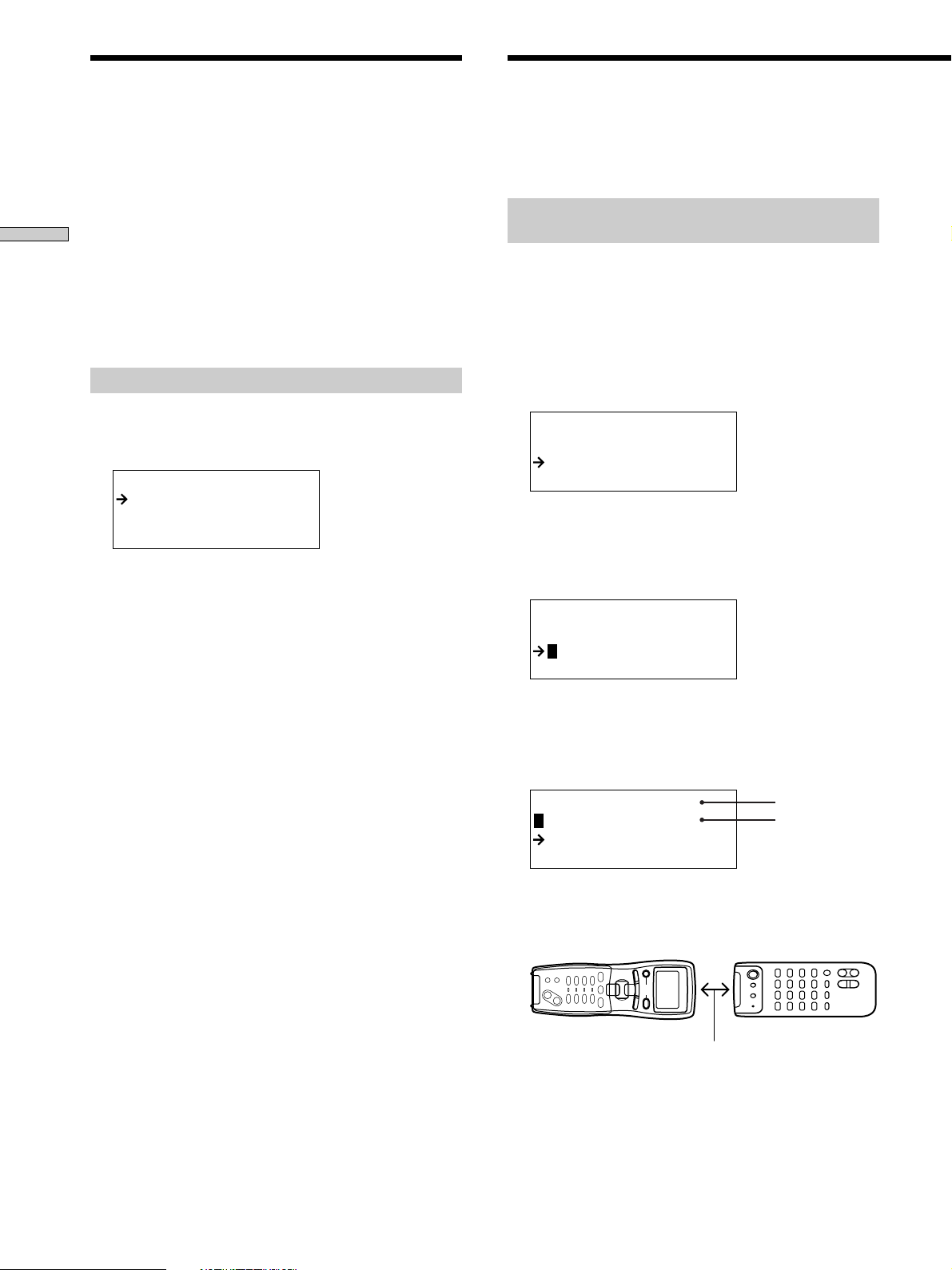
1 Press SET UP and move the easy scroll key to select
“LEARNING”, then press the key to enter the
selection.
The function list appears.
1 Press FUNCTION.
The function list appears.
C D
TUNER
PHONO
5.1CH
2 Move the easy scroll key to select “MACRO 1” or
“MACRO 2”, then press the key to enter the
selection.
The IR codes appear in the display window as they are
performed.
Notes
• Pressing any of the following buttons during a macro play
operation will cancel the macro play sequence before it is
complete.
–AV ?/1
– ?/1
– SYSTEM STANDBY
– SOUND FIELD
– FUNCTION
– SET UP
• When the Macro Play function does not work properly, set
“WAIT TIME” between each operation.
<LEARNING>
[VIDEO 1 ]
[VIDEO 2 ]
[VIDEO 3 ]
2 Move the easy scroll key to select the function you
want to use the Learning function, then press the
key to enter the selection.
The button list appears.
Button[VIDEO 2 ]
*POWER
REVERSE
*PLAY
3 Move the easy scroll key to select the button you
want to use for the Learning function, then press
the key to enter the selection.
The learning display appears.
[VIDEO 2 ]
(REVERSE)
Function
Button
LEARNING Start
CLEAR
4 Point the remote code receiver section of the
commander toward the receiver/transmitter on the
remote control to be learned.
About 5 cm ~ 15 cm
5 Move the easy scroll key to select “Learning Start”,
then press the key to enter the selection.
“Learning Now!!” is displayed.
18
Page 19
Downloading Data From the Receiver
6 Press the appropriate button on the remote control
to send the remote control code.
Lightly pressing the button once should be sufficient.
In about 3 to 5 seconds, it is displayed whether
learning was successful or not.
When the learning completes successfully, “Learning
OK!”, the number of keys, and the capacity used for
learning are displayed.
[VIDEO 2 ]
(PLAY)
Learning OK!
(15/80 20%)
When the learning does not complete successfully, the
cause is displayed.
Learning NG!
*(PLAY)
FULL (Keys)
information*
EXIT
*FULL (Keys): shortage of buttons
FULL (memory): shortage of memory
ERROR: other causes
To cancel learning
Move the easy scroll key to select “EXIT” or “CANCEL”
during any step, then press the key to enter the selection.
The remote communicates with the receiver every time a
button is pressed on the remote and displays the current
operation status of the receiver on the display window.
The remote can also download index names of the
program sources, preset stations, CD disc names
(memos)*, and information indicating the presence or
absence of a CD in each slot of a CD changer* from the
receiver.
Appears only when you have selected a Sony CD changer (5, 50, 200,
*
300, or 400 discs) connected to the receiver using the CONTROL A1
cable.
Be sure to turn on the receiver and point the remote
towards the receiver when performing the following
procedure.
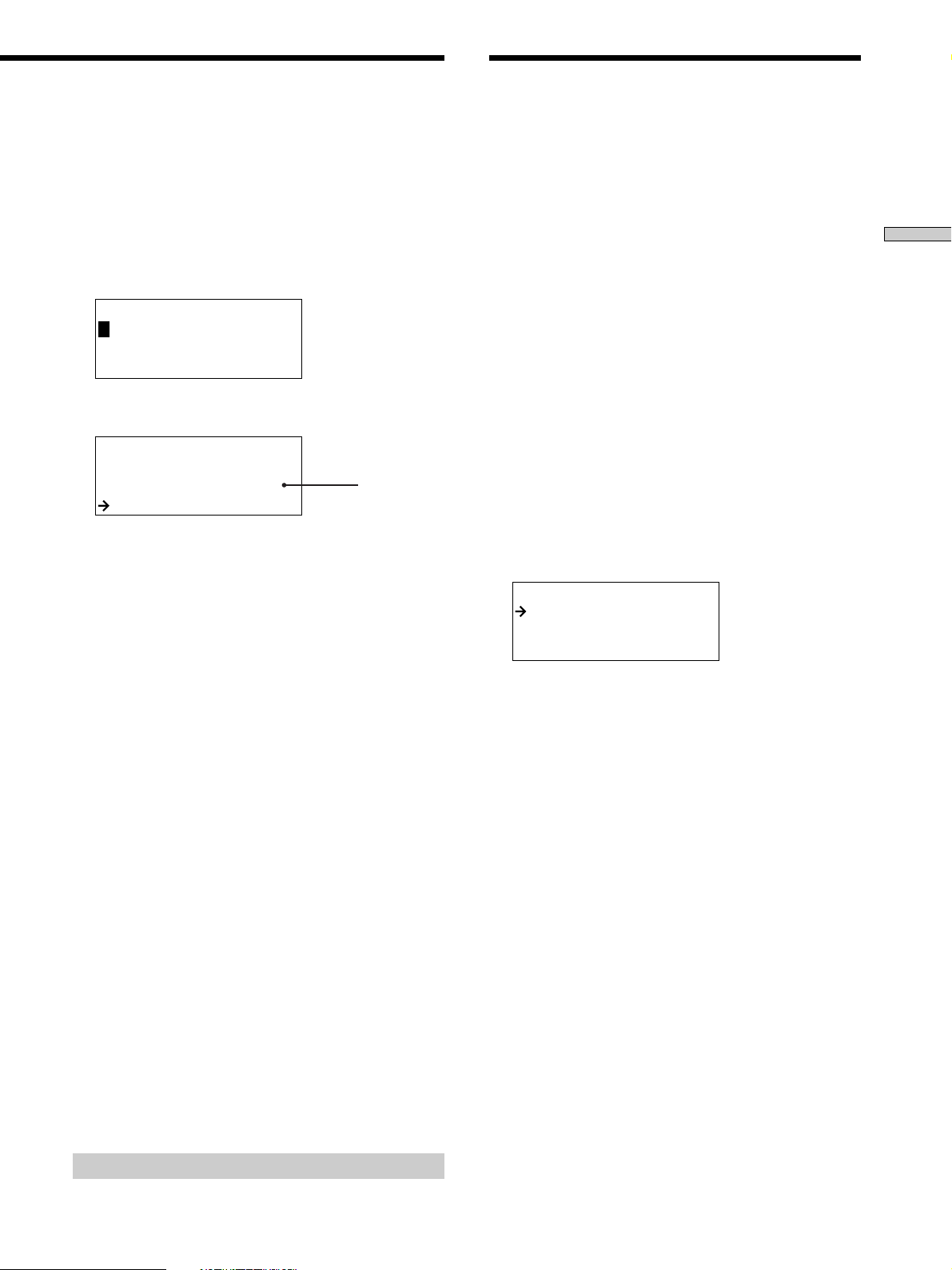
1 Press SET UP.
The set up list appears.
2 Move the easy scroll key to select “DOWNLOAD,”
then press the key to enter the selection.
The DOWNLOAD list appears.
<DOWNLOAD>
FUNCTION
TUNER INFO
CD DISC NAME
Using the Lists
To erase the learned code
In step 6 above, Move the easy scroll key to select “CLEAR”,
then press the key to enter the selection. The number of
buttons and the capacity used for learning are displayed.
z
The marks that are displayed in front of the button name
indicate the following
x : already learned
* : pre-programmed
z
In step 3, learned buttons can be selected directly
If you press the button you want to use for the Learned function,
the list will jump to the same button.
z
The Learned function can be applied to the SUB menus
SUB 1 ~ SUB 5 can be learned.
Notes
•
You can program up to 80 buttons for the Learned function.
In some cases, you may not be able to program even if you have not
programmed 80 buttons.
•
If you select “IR SET” for a component that already has a learned
button setting, the learned codes for that component are cleared.
Furthermore, if the cleared learned button is used in a Macro Play
setting, the setting for that button will be changed to “NO SET”.
3 To download index names
Move the easy scroll key to select “FUNCTION,”
then press the key to enter the selection.
To download preset stations
Move the easy scroll key to select “TUNER INFO,”
then press the key to enter the selection.
Using a command that has been learned
When selecting a learned function, press the button used
to learn that function.
19
Page 20

Downloading Data From the Receiver
To download CD disc names (memos) and
information on the presence or absence of a
CD in each slot of a CD changer
1 Move the easy scroll key to select “CD DISC
Using the Lists
NAME,” then press the key to enter the selection.
The SORT menu appears in the display.
<SORT? >
NUMBER
ALPHABET
2 Move the easy scroll key to select “NUMBER” or
“ALPHABET,” then press the key to enter the
selection.
The remote starts to download the data.
<LOADING>
To cancel the downloading process
Move the easy scroll key to select “EXIT” from the
DOWNLOAD list, then press the key to enter the
selection.
Notes
• If you have changed the discs in the CD changer, be sure to
download the CD disc names (memos) from the receiver or
play the newly inserted disc(s) before you select a disc from the
changer.
• You can download the data only from the Sony CD changer (5,
50, 200, 300, or 400 discs) connected to the receiver using the
CONTROL A1 cable.
• CD DISC NAME is available for up to 400 discs when
COMMAND MODE is set to “CD 1” or “CD 2”. When
COMMAND MODE is set to “CD 3”, CD DISC NAME is only
available for 1 CD.
[
]
CANCEL
Note on downloading CD disc names
from the CD players
You can download CD disc names (memos) only from
the CONTROL A1/A1
Depending on the CD player setting, it may take
several minutes to download CD disc names
(memos). For faster transmission, make the following
CD player settings.
When an CONTROL A1/A1
CD player is connected to the receiver
Check the following:
• The category for the CD function in the IR SET list is set to
“CD1.”
• The category for all other functions in the IR SET list is not
set to “CD2.”
You can check the current category setting by selecting a
component from the function list (see page 14). Category
indication appears on the second column in the display
window.
When multiple CONTROL A1/A1 -compatible
Sony CD players are connected to the receiver
When you use two CD players, set the COMMAND MODE
selector on the back panel of the CD players to “CD1” or
“CD2,” respectively, and set the category in the IR SET list to
match the corresponding player’s COMMAND MODE
selector position (see page 16). When you use three CD
players, set the COMMAND MODE selector to “CD1,”
“CD2,” or “CD3,” respectively, and set the category in the IR
SET list to match the corresponding player’s COMMAND
MODE selector position.
When setting category for the CD players, do not skip the
number or select the same number to the multiple players.
When an CONTROL A1/A1 -compatible Sony
CD player and a non-compatible Sony CD
player are connected to the receiver
Set the COMMAND MODE selector on the back panel of the
CONTROL A1/A1 -compatible CD player to “CD2” and
set the category in the IR SET list for the player to “CD2”
(see page 16).
Set the COMMAND MODE selector on the back panel of the
non-compatible CD player to “CD1” and set the category in
the IR SET list for the player to “CD1” (see page 16).
Before downloading CD disc names (memos) from the
CONTROL A1/A1 -compatible CD player, temporarily
change the category setting of the non-compatible CD player
to some other category (“VideoCD,” for example). After
downloading is completed, set the category setting of the
non-compatible CD player to “CD1” again.
-compatible Sony CD players.
-compatible Sony
20
When using a non-Sony CD player in
conjunction with Sony CD players
Program the remote to control the non-Sony CD player (see
page 16).
See the sections above for settings of the Sony CD players.
Page 21

Other Operations
Using the auto power function
With the auto power function turned on, the commander
sends numerous codes to the appropriate Sony AV
components when you select a video function.
Automatically, the components and the TV you have done
IR setting turn on and the TV switches to the selected
input mode. This function works for Sony components
only.
1 Press SET UP.
The set up list appears.
2 Move the easy scroll key to select “AUTO POWER”,
then press the key to enter the selection.
The AUTO POWER list appears .
<AUTO POWER>
ON
OFF
3 Move the easy scroll key to select “ON” or “OFF”,
then press the key to enter the selection.
Adjusting the contrast of the display
You can adjust the contrast of the display.
1 Press SET UP.
The set up list appears.
Using the Lists
2 Move the easy scroll key to select “CONTRAST”,
then press the key to enter the selection.
3 Move the easy scroll key to select “+” or “–”, then
press the key to enter the selection.
To cancel adjusting
Select “EXIT” in step 3.
Switching the COMMAND MODE
1 Press SET UP.
The set up list appears.
2 Move the easy scroll key to select “COMMAND
MODE”, then press the key to enter the selection.
4 When you select “ON”, move the easy scroll key to
select the video input of the TV, then press the key
to enter the selection.
<TV INPUT>
TV-VIDEO1
TV-VIDEO2
TV-VIDEO3
Note
Switching to VIDEO 1~4 input may not be automatic on all Sony
TVs. This is because some TVs cannot receive remote control
codes immediately after being turned on.
Turning the backlight on or off
Each time you press a button on the remote, the backlight
turns on. If you do the procedure below to turn off the
backlight, you can make the batteries last longer.
1 Press SET UP.
The set up list appears.
2 Move the easy scroll key to select “BACK LIGHT,”
then press the key to enter the selection.
The BACK LIGHT list appears .
3 Move the easy scroll key to select “ON” or “OFF,”
then press the key to enter the selection.
3 Move the easy scroll key to select “AV SYSTEM1”
or “AV SYSTEM2”, then press the key to enter the
selection.
4 Move the easy scroll key to select “YES”, the press
the key to enter the selection.
Clearing all the contents of remote‘s
memory
Be sure to turn on the receiver and point the remote
towards the receiver when performing the following
procedure.
1 Press SET UP.
The set up list appears.
2 Move the easy scroll key to select “ALL CLEAR”,
then press the key to enter the selection.
3 Move the easy scroll key to select “YES”, then press
the key to enter the selection.
“CLEAR OK?” appears.
4 Move the easy scroll key to select “YES” again,
then press the key.
All the contents of the remote’s memory (i.e., all the
programmed data) are cleared.
21
Page 22

Additional
Troubleshooting
Information
If you experience any of the following difficulties while
using the remote, use this troubleshooting guide to help
you remedy the problem. Should any problem persist,
consult your nearest Sony dealer.
The remote does not function.
, Point the remote at the remote sensor
receiver.
, Remove any obstacles in the path between the
remote and the receiver.
, Replace all the batteries in the remote with new
ones, if they are weak.
/ If the receiver’s COMMAND MODE and the
remote’s COMMAND MODE do not match,
transmission is not possible between the remote
and the receiver.
, Make sure you select the correct function on the
remote.
, When you operate a programmed non-Sony
component, the remote may not function properly
depending on the model and the make of the
component.
The component names appearing in the function
list do not correspond to the jacks on the
receiver./The sound field list does not appear.
, The remote has not been initialized. Turn on the
receiver, point the remote at the receiver, and press
the SOUND FIELD, FUNCTION, or SUB button on
the remote (see page 3).
on the
22
The SOUND FIELD button does not work.
, If the receiver has the 5.1CH (/DVD) INPUT jacks,
the SOUND FIELD button becomes inoperable
whenever you select the component connected to
these jacks.
E appears in the display window of the remote.
, The batteries are running out. Replace all the
batteries with new ones.
The function names that appear in the display
windows of the receiver and the remote are
different.
, Select the correct function using the remote.
When the CD player, tape deck, or MD deck is
connected to the receiver via CONTROL A1/A1
jacks, Auto Function does not work properly.
, Reprogram the remote (see page 16).
“5.1CH” cannot be selected from the function list
even though the receiver has 5.1CH (/DVD) INPUT
jacks.
, A communication error has occurred. Point the
remote towards the receiver and select “5.1CH”
from the function list again.
Page 23
Specifications
General
Remote control system Infrared control
Power requirements 4.5 V DC with three LR6 (size-
AA) alkaline batteries
Dimensions 175 × 62 × 33 mm
Mass (approx.) 135 g excluding batteries
Design and specifications are subject to change without
notice.
Additional Information
23
Page 24

Additional Information
24
Sony Corporation Printed in Malaysia
 Loading...