

Page 1
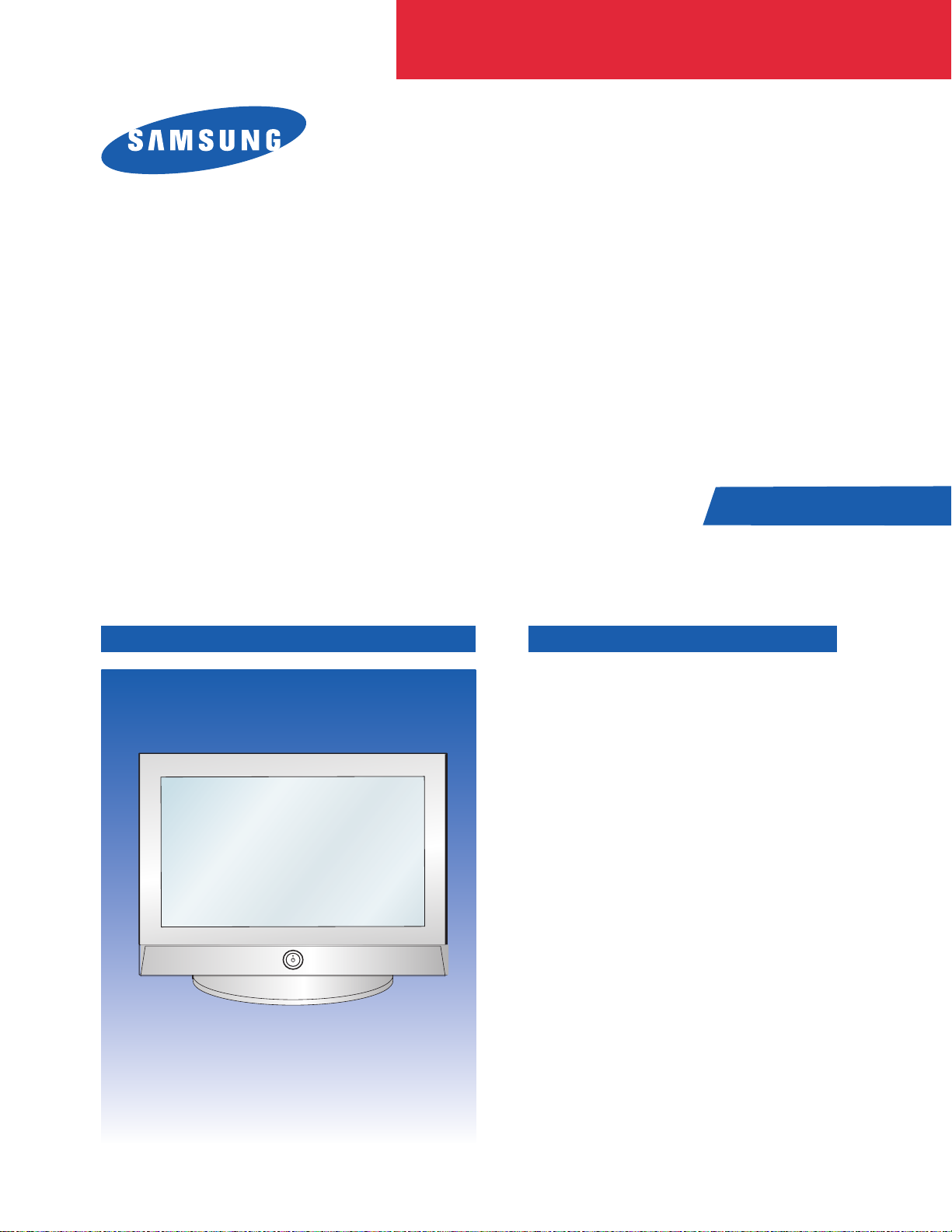
PLASMA DISPLAY TV
Chassis : D72A(P) Puccini_42D5
Model : PS42D5SX/XEC
PS42D5SX/XSG
PS42D5SX/XTL
PLASMA DISPLAY TV FEATURES
■■
DTV Ready PDP TV
■
2 Way 4 Speakers
■
■
1 HDMI input
■
Slim line design
■
■
Energy Saving
■
12 Bit image processing
(687 billion color)
SERVICE
Manual
42D5
Page 2

Table of Contents
Chapter 1 Precaution
■ 1-1 Safety Precautions . . . . . . . . . . . . . . . . . . . . . . . . . . . . . . . . . . . . . . . . . . . . . . . . . . . . . . . . . . . 1-1
■ 1-2 Servicing Precautions . . . . . . . . . . . . . . . . . . . . . . . . . . . . . . . . . . . . . . . . . . . . . . . . . . . . . . . . 1-3
■ 1-3 Static Electricity Precautions . . . . . . . . . . . . . . . . . . . . . . . . . . . . . . . . . . . . . . . . . . . . . . . . . . . 1-4
■ 1-4 Installation Precautions . . . . . . . . . . . . . . . . . . . . . . . . . . . . . . . . . . . . . . . . . . . . . . . . . . . . . . . 1-5
Chapter 2 Product Specification
■ 2-1 Product Features . . . . . . . . . . . . . . . . . . . . . . . . . . . . . . . . . . . . . . . . . . . . . . . . . . . . . . . . . . . . 2-1
■ 2-2 Key Features . . . . . . . . . . . . . . . . . . . . . . . . . . . . . . . . . . . . . . . . . . . . . . . . . . . . . . . . . . . . . . . 2-2
■ 2-3 Specifications Analysis . . . . . . . . . . . . . . . . . . . . . . . . . . . . . . . . . . . . . . . . . . . . . . . . . . . . . . . . 2-5
■ 2-4 Accessories . . . . . . . . . . . . . . . . . . . . . . . . . . . . . . . . . . . . . . . . . . . . . . . . . . . . . . . . . . . . . . . . 2-6
Chapter 3 Alignment & Adjustment
■ 3-1 Service Instruction . . . . . . . . . . . . . . . . . . . . . . . . . . . . . . . . . . . . . . . . . . . . . . . . . . . . . . . . . . . 3-1
■ 3-2 How to Access Service Mode . . . . . . . . . . . . . . . . . . . . . . . . . . . . . . . . . . . . . . . . . . . . . . . . . . . 3-2
■ 3-3 Factory Data . . . . . . . . . . . . . . . . . . . . . . . . . . . . . . . . . . . . . . . . . . . . . . . . . . . . . . . . . . . . . . . . 3-3
■ 3-4 Service Adjustment . . . . . . . . . . . . . . . . . . . . . . . . . . . . . . . . . . . . . . . . . . . . . . . . . . . . . . . . . . 3-8
■ 3-5 Software Upgrade . . . . . . . . . . . . . . . . . . . . . . . . . . . . . . . . . . . . . . . . . . . . . . . . . . . . . . . . . . . 3-10
■ 3-6 Replacements & Calibration . . . . . . . . . . . . . . . . . . . . . . . . . . . . . . . . . . . . . . . . . . . . . . . . . . . . 3-14
Chapter 4 Exploded View & Part List
■ 4-1 PS42D5SX/XEC . . . . . . . . . . . . . . . . . . . . . . . . . . . . . . . . . . . . . . . . . . . . . . . . . . . . . . . . . . . . . 4-1
■ 4-2 PS42D5SX/XSG . . . . . . . . . . . . . . . . . . . . . . . . . . . . . . . . . . . . . . . . . . . . . . . . . . . . . . . . . . . . 4-2
■ 4-3 PS42D5SX/STL . . . . . . . . . . . . . . . . . . . . . . . . . . . . . . . . . . . . . . . . . . . . . . . . . . . . . . . . . . . . . 4-3
Chapter 5 Electrical Part List
■ 5-1 PS42D5SX/XEC . . . . . . . . . . . . . . . . . . . . . . . . . . . . . . . . . . . . . . . . . . . . . . . . . . . . . . . . . . . . . 5-1
■ 5-2 PS42D5SX/XSG . . . . . . . . . . . . . . . . . . . . . . . . . . . . . . . . . . . . . . . . . . . . . . . . . . . . . . . . . . . . 5-2
■ 5-3 PS42D5SX/STL . . . . . . . . . . . . . . . . . . . . . . . . . . . . . . . . . . . . . . . . . . . . . . . . . . . . . . . . . . . . . 5-3
Chapter 6 Troubleshooting
■ 6-1 First Checklist for Troubleshooting . . . . . . . . . . . . . . . . . . . . . . . . . . . . . . . . . . . . . . . . . . . . . . . 6-1
■ 6-2 Checkpoints by Error Mode . . . . . . . . . . . . . . . . . . . . . . . . . . . . . . . . . . . . . . . . . . . . . . . . . . . . 6-2
■ 6-3 Trouble-shooting with New Features . . . . . . . . . . . . . . . . . . . . . . . . . . . . . . . . . . . . . . . . . . . . . 6-6
■ 6-4 Troubleshooting Procedures by ASS'Y . . . . . . . . . . . . . . . . . . . . . . . . . . . . . . . . . . . . . . . . . . . 6-9
Chapter 7 Block Diagram
■ 7-1 Overall Block Diagram . . . . . . . . . . . . . . . . . . . . . . . . . . . . . . . . . . . . . . . . . . . . . . . . . . . . . . . . 7-1
■ 7-2 Partial Block Diagram . . . . . . . . . . . . . . . . . . . . . . . . . . . . . . . . . . . . . . . . . . . . . . . . . . . . . . . . . 7-2
Page 3

Chapter 8 Wiring Diagram
■ 8-1 Overall Wiring . . . . . . . . . . . . . . . . . . . . . . . . . . . . . . . . . . . . . . . . . . . . . . . . . . . . . . . . . . . . . . . 8-1
■ 8-2 Partial Wiring . . . . . . . . . . . . . . . . . . . . . . . . . . . . . . . . . . . . . . . . . . . . . . . . . . . . . . . . . . . . . . . 8-2
Chapter 9 PCB Diagram
■ 9-1 PDP Module, SMPS . . . . . . . . . . . . . . . . . . . . . . . . . . . . . . . . . . . . . . . . . . . . . . . . . . . . . . . . . . 9-1
■ 9-2 Video Board, Function Key Borad, Power Button Board . . . . . . . . . . . . . . . . . . . . . . . . . . . . . . 9-4
Chapter 10 Schematic Diagram
■ 10-1 Main . . . . . . . . . . . . . . . . . . . . . . . . . . . . . . . . . . . . . . . . . . . . . . . . . . . . . . . . . . . . . . . . . . . . . 10-1
■ 10-2 Function . . . . . . . . . . . . . . . . . . . . . . . . . . . . . . . . . . . . . . . . . . . . . . . . . . . . . . . . . . . . . . . . . . 10-2
■ 10-3 Power/IR . . . . . . . . . . . . . . . . . . . . . . . . . . . . . . . . . . . . . . . . . . . . . . . . . . . . . . . . . . . . . . . . . 10-3
Chapter 11 Operation Instruction & Installation
■ 11-1 Product Features and Functions . . . . . . . . . . . . . . . . . . . . . . . . . . . . . . . . . . . . . . . . . . . . . . . 11-1
■ 11-2 New Features . . . . . . . . . . . . . . . . . . . . . . . . . . . . . . . . . . . . . . . . . . . . . . . . . . . . . . . . . . . . . . 11-6
■ 11-3 Installation Notes and Precautions . . . . . . . . . . . . . . . . . . . . . . . . . . . . . . . . . . . . . . . . . . . . . . 11-8
Chapter 12 Disassembly & Reassembly
■ 12-1 Overhaul Disassembly & Reassembly . . . . . . . . . . . . . . . . . . . . . . . . . . . . . . . . . . . . . . . . . . . 12-1
Chapter 13 Circuit Description
■ 13-1 Partial Block Descriptio . . . . . . . . . . . . . . . . . . . . . . . . . . . . . . . . . . . . . . . . . . . . . . . . . . . . . . 13-1
■ 13-2 New Circuit Description . . . . . . . . . . . . . . . . . . . . . . . . . . . . . . . . . . . . . . . . . . . . . . . . . . . . . . 13-25
Chapter 14 Reference Information
■ 14-1 Connection to a 3rd Party Device . . . . . . . . . . . . . . . . . . . . . . . . . . . . . . . . . . . . . . . . . . . . . . . 14-1
■ 14-2 Technical Terms . . . . . . . . . . . . . . . . . . . . . . . . . . . . . . . . . . . . . . . . . . . . . . . . . . . . . . . . . . . . 14-9
Page 4

Alignment & Adjustment
Samsung Electronics 3-1
3. Alignment & Adjustment
3-1 Service Instruction
* Check items listed after changing each
1. Main Board replace : ATM Channel fixing and White Balance adjustment
2. Main SMPS Board replace: Vs, Va Voltage check and adjust
5. DC-DC SMPS Board replace : Output voltage check and adjust
6. Logic Board replace : Not adjustment
7 : Y-Main Board replace : Not adjustment
8 : X-Main Board replace : Not adjustment
9 : Buffer Board replace : Not adjustment
Page 5
Alignment & Adjustment
3-2 Samsung Electronics
3-2 How to Access Service Mode
■ Using the Customer Remote
1. Turn the power off and set to stand-by mode.
2. Press the remote buttons in this order; POWER OFF-MUTE-1-8-2- POWER ON to turn the set on.
3. The set turns on and enters service mode.
4. Press the Power button to exit and store data in memory.
※ If you fail to enter service mode, repeat steps 1 and 2 above.
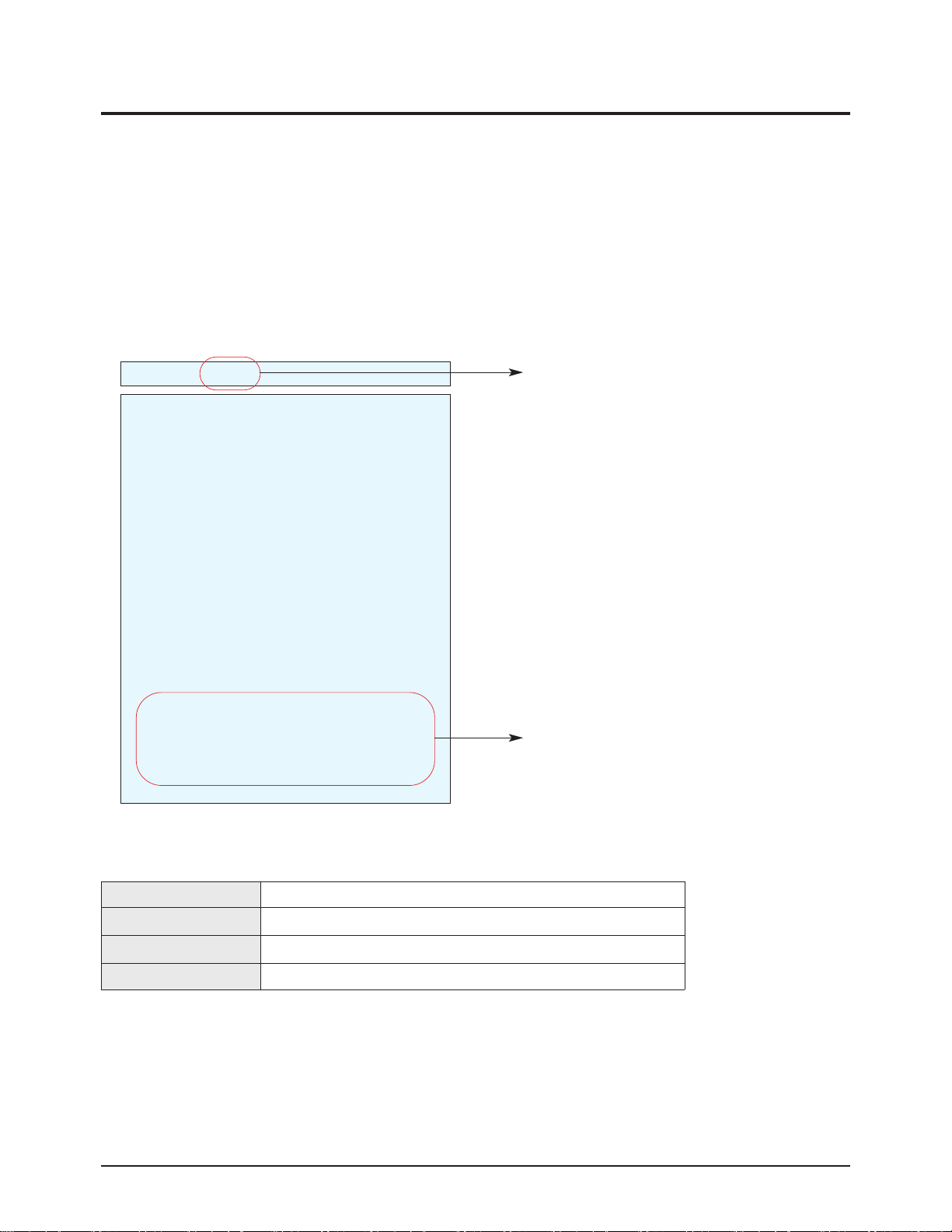
5. Initial SERVICE MODE DISPLAY State
※ The firmware version is subject to change without notice.
4. Buttons operations within Service Mode
Factory AIR 10
White Balance
uPD64083
ADV7402 Main
SDP51
MST9883
ADV7402 Sub
DNIe
Logic
PW318
Option
PW318 Upgrade
TL945 Upgrade
Reset
Release Date : XXX XX XXXX XX:XX:XX
Code No. : M1 Micom XX
PW318 T_XXXXXXXXX-XXXX
TL945 0.XX
Current input mode
Firmware version
MENU Full Menu Display / Move to Parent Menu
Direction keys ▲ / ▼
Item Selection by Moving the Cursor
Direction keys ◀ / ▶
Data Increase/Decrease for the Selected Item
Source Cycles through the active input source that are connected to the unit
Page 6
Alignment & Adjustment
Samsung Electronics 3-3
3-3 Factory Data
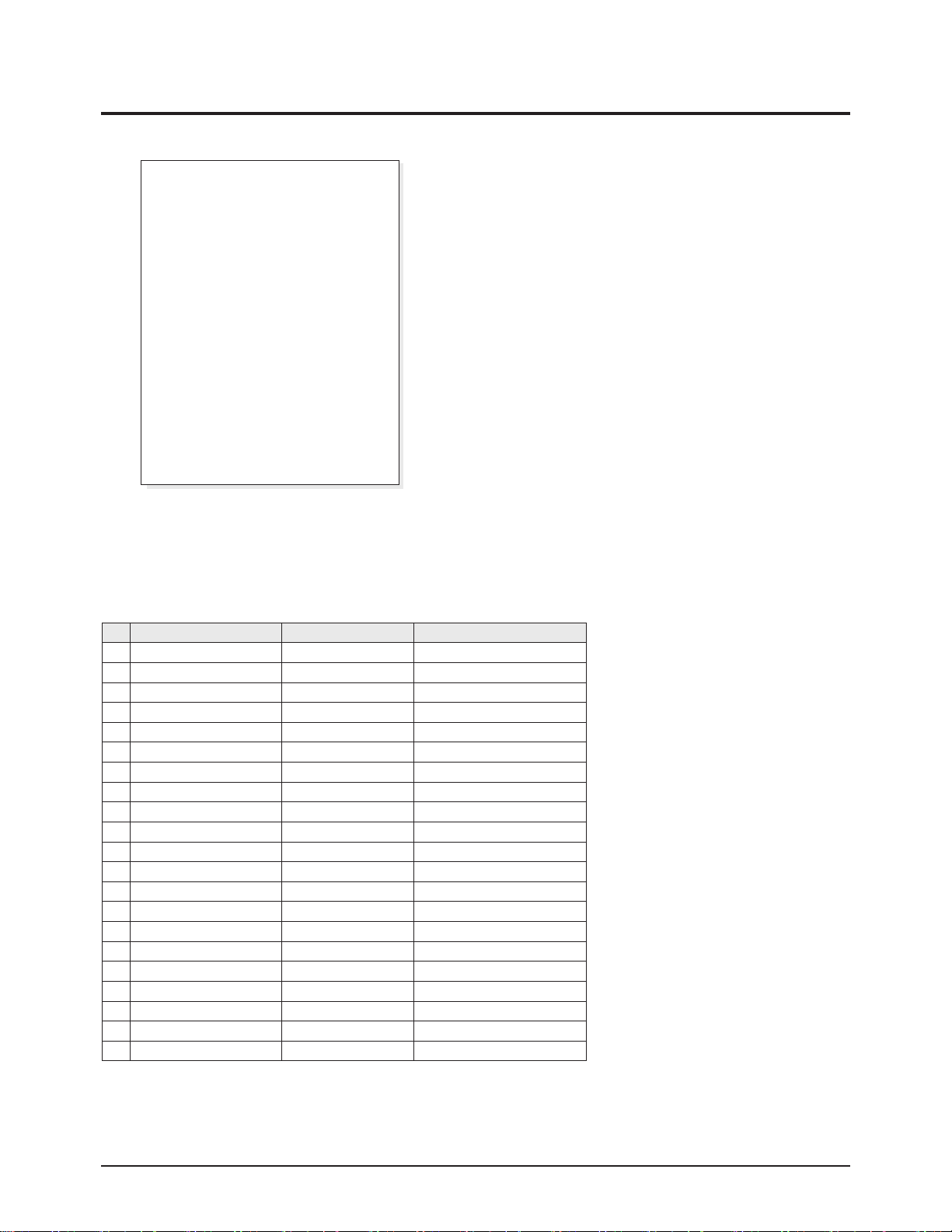
★ The underlined are items applied during the service adjustment. None of the others should be adjusted.
No ITEM Initial Value Remark
1 Panel Option 42S5S 42S5S/42D5S/42S5H
2 Gamma Mode - 2 Mode - 1,2,3,4
3 Analog Dimming Mode - 3 Mode - 1,2,3,4
4 Auto Power On ON/OFF
5 Key Lock OFF ON/OFF
6 Anynet OFF ON/OFF
7 DDC Write OFF ON/OFF
8 LNA ON ON/OFF
9 Ant. Gain Display OFF ON/OFF
10 Language English Osd language
11 Auto FM OFF ON/OFF
12 High Deviation Off ON/OFF
13 TTX On ON/OFF
14 TTX List Flop Flop/List
15 TTX TOP Off ON/OFF
16 TTX Group Auto Language TTX language
17 TTX Level Level 1.5 LEVEL 1.5 / 2.5
18 Shift Test OFF ON/OFF
19 Sound Delay1 OFF ON/OFF
20 Sound Delay2 OFF ON/OFF
21 Debug OFF ON/OFF
2. Option Table
1. Calibration
2. Option Table
3. White Balance
4. SVP-EX
5. SAA7119
6. MSP34XX/44XX
7. YC Delay
8. Adjust
9. DNIe
10. Chip Debugger OFF
11. Checksum
12. Reset
13. Spread Spectrum
14. Logic
T-PCN42PEUS-XXXX
SUB Micom Ver-xxxx
Fatory mode OSD Display
1. Calibration
① AV Calibration
② PC Calibration
③ DTV Calibration
Page 7
Alignment & Adjustment
3-4 Samsung Electronics
No Item Range TV/AV Component PC DVI(HDMI)
1 Sub-Briteness 0~255 7 128 130 130
2 R-offset 0~255 138 128 138 138
3 G-offset 0~255 128 128 128 128
4 B-offset 0~255 146 128 144 144
5 Sub-Contrast 0~63 36 32 32 32
6 R-offset 0~255 128 128 128 128
7 G-offset 0~255 128 128 128 128
8 B-offset 0~255 148 128 128 128
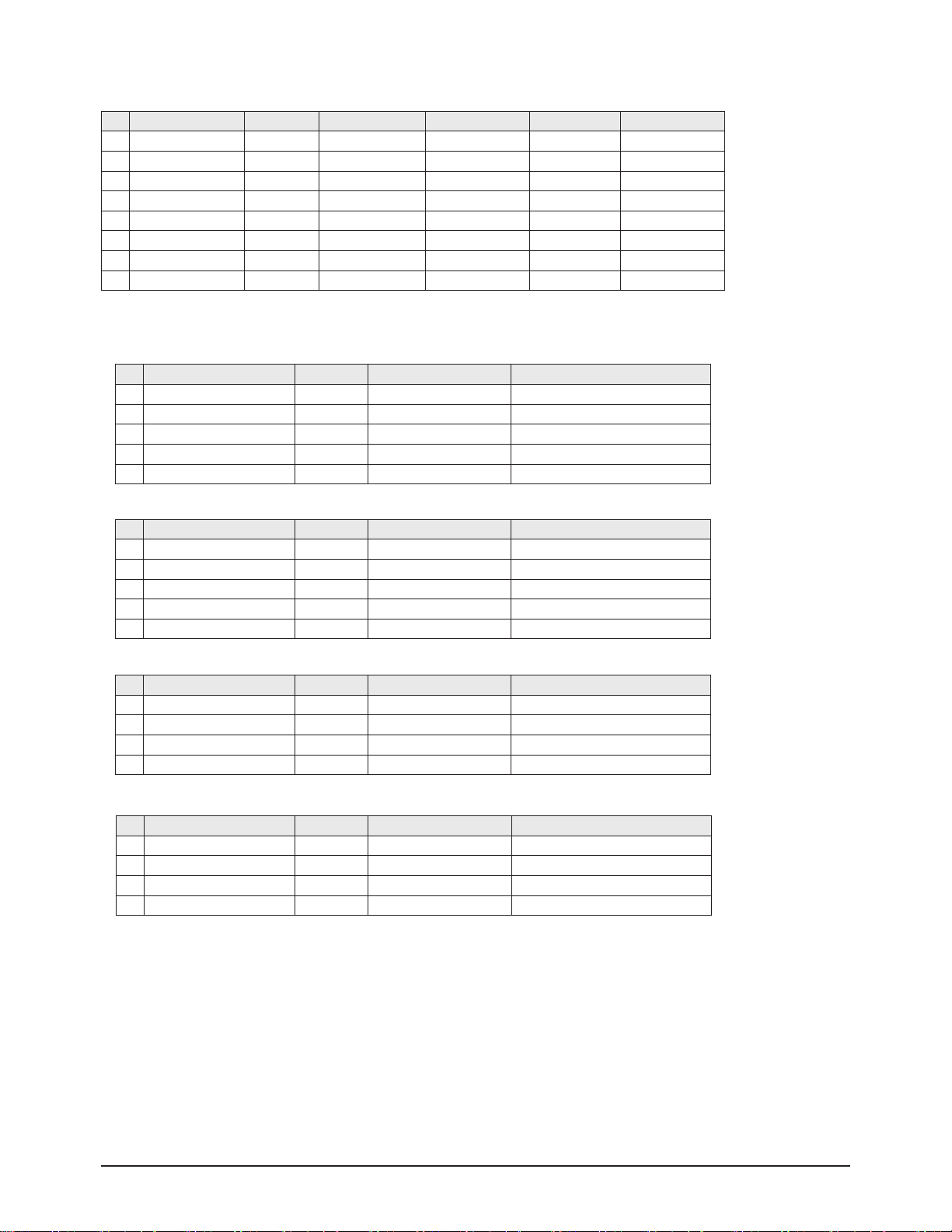
3. White Balance
4. SVP-EX
No Item Range Initial Value Remark
1 Y-Filter 0 ~ 255 80H
2 0 ~ 255 80H
3 0 ~ 255 80H
4 0 ~ 255 80H
5 0 ~ 255 80H
①ComB Filter
②Peaking
No Item Range Initial Value Remark
1 V-Peaking 0 ~ 255 80H
2 Peaking Delay 0 ~ 255 80H
3 Peaking Gain 0 ~ 255 80H
4 Peaking Width 0 ~ 255 80H
5 Praking f0 0 ~ 255 80H
③NR
No Item Range Initial Value Remark
1 Y-NR-Off 0 ~ 255 80H
2 C-NR-Off 0 ~ 255 80H
3 Y-NR-ON 0 ~ 255 80H
4 C-NR-ON 0 ~ 255 80H
④Deinterlace
No Item Range Initial Value Remark
1 Motion 0 ~ 255 80H
2 80H
3 80H
4 80H
Page 8
Alignment & Adjustment
Samsung Electronics 3-5
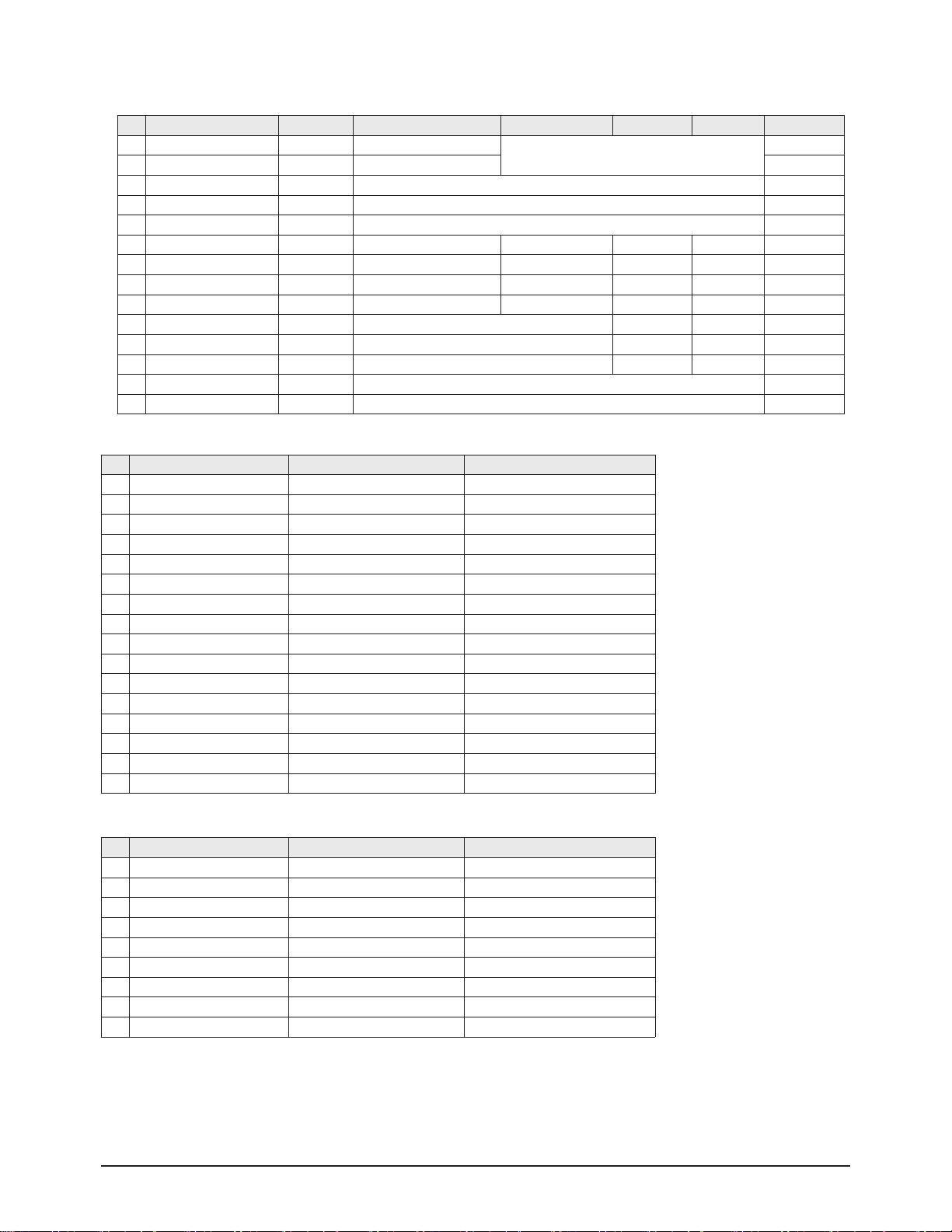
⑤Picture Gain Adjust
No Item Range TV/AV/S_Video Component PC DVI/HDMI
1 TCD3 Contrast 0 ~ 255 AV Calibration
78h
20h
2 TCD3 Brightness 0 ~ 255 AV Calibration
3 TCD3 CR Saturation 0 ~ 255 78h
4 TCD3 CB Saturation 0 ~ 255 78h
5 TCD3 YC Delay 0 ~ 15 00h
Range 480I/576I/480P/576P/1080I 720P PC HDMI
6 Analog Y/G offset 00 ~ 255 DTV Calibration PC Calibration 00 40h
7 Analog PB/B offset 00 ~ 255 DTV Calibration PC Calibration 02 00h
8 Analog PR/R offset 00 ~ 255 DTV Calibration PC Calibration 02 00h
9 Analog Y/G Gain 00 ~ 255 D6h E9h D6h
10 Analog PB/B Gain 00 ~ 255 FEh E9h FEh
11 Analog PR/R Gain 00 ~ 255 FEh E9h FEh
12 Black Level Setting 00 ~ 255 00h
13 Brightness(SVP) 0 ~ 255 00h
No Item Range Initial Value
1 HTC 00 ~ 255 2
2 ATVT 00 ~ 255 1
3 LUFI 00 ~ 255 5
4 NAICO_Brig 00 ~ 255 128
5 NAICO_Cont 00 ~ 255 64
6 NAICO_Satu 00 ~ 255 64
7 NAICO_Hue 00 ~ 255 3
8 COMP_Brig 00 ~ 255 162
9 COMP_Cont 00 ~ 255 92
10 COMP_Satu 00 ~ 255 64
11 TASKA_Brig 00 ~ 255 140
12 TASKA_Cont 00 ~ 255 64
13 TASKA_Satu 00 ~ 255 64
14 LIMOD 00 ~ 255 0
15 LIFIL 00 ~ 255 2
16 LIWGT 00 ~ 255 3
5. SAA7119
No Item Range Initial Value
1 FM-Prescale 00 ~ 255 20h
2 NT-M-Prescale 00 ~ 255 20h
3 SECAM-L-Prescale 00 ~ 255 22h
4 AV-Prescale 00 ~ 255 1Ah
5 I2S_1 Prescale 00 ~ 255 10h
6 I2S_2 Prescale 00 ~ 255 10h
7 Carrier Mute 00 ~ 255 42h
8 Pilot High 00 ~ 255 0Eh
9 Pilot Low 00 ~ 255 07h
6. MSP34XX/44XX
Page 9
Alignment & Adjustment
3-6 Samsung Electronics
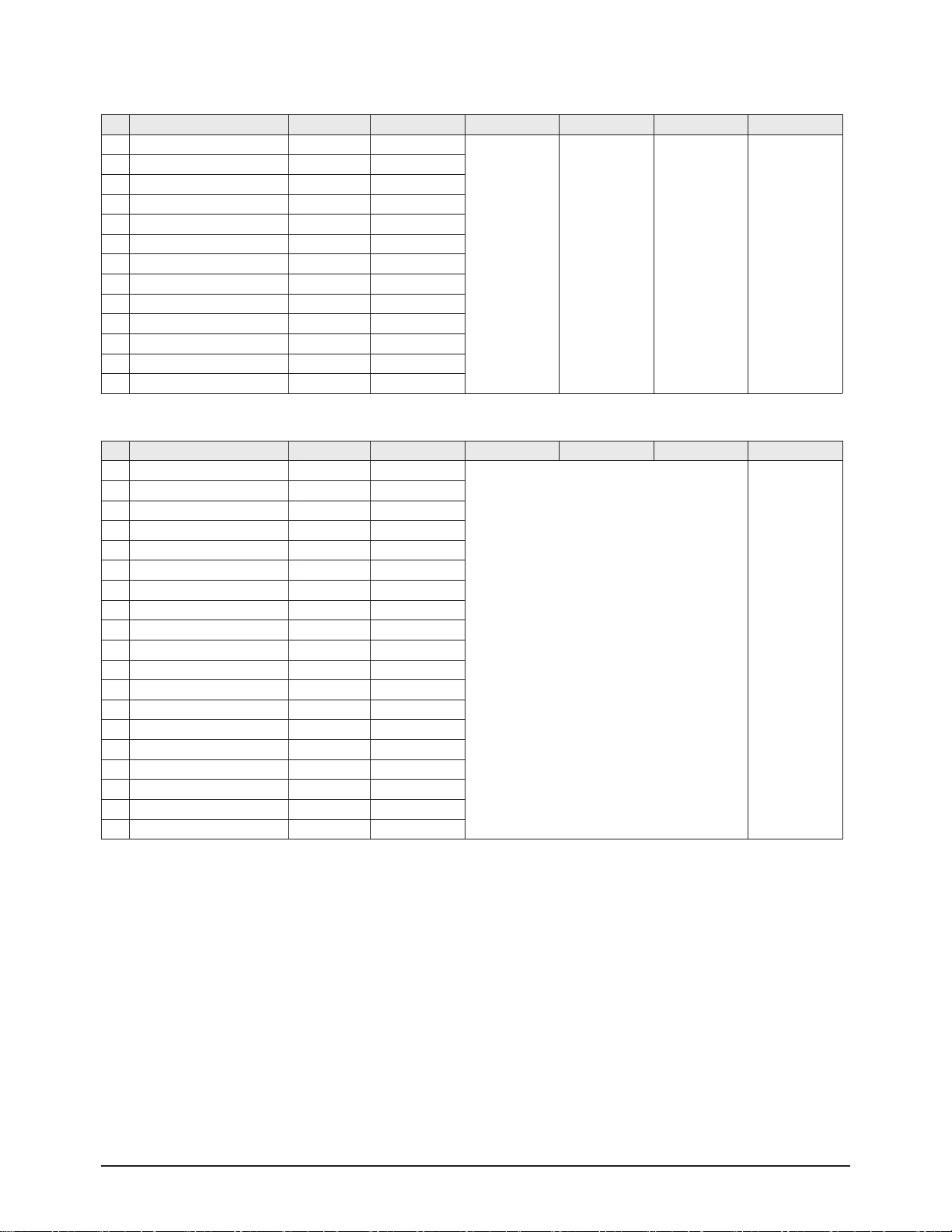
7. YC Delay
No Item Range TV/AV/S_Video Component PC DVI/HDMI Remark
1 RF PAL-B/G 00 ~ 255 102
77h 77h 77h
-
2 RF PAL-D/K 00 ~ 255 136
3 RF PAL- I 00 ~ 255 102
4 RF SECAM-B/G 00 ~ 255 51
5 RF SECAM-D/K 00 ~ 255 34
6 RF SECAM-L/L' 00 ~ 255 51
7 RF NTSC3.58 00 ~ 255 187
8 RF NTSC4.43 00 ~ 255 187
9 AV PAL 00 ~ 255 67
10 AV SECAM 00 ~ 255 34
11 AV NTSC 3.58 00 ~ 255 102
12 AV NTSC4.43 00 ~ 255 102
13 AV PAL60 00 ~ 255 119
8. Adjust
No Item Range TV/AV/S_Video Component PC DVI/HDMI Remark
1 Video Mute Time 10
-
2 Melody Volume 0 ~ 20 5
3 TTX Contrast 0 ~ 100 50
4 TTX Brightness 0 ~ 100 50
5 TTX Color 0 ~ 100 50
6 Dynamic Contrast 0 ~ 100 100
7 Dynamic Color 0 ~ 100 50
8 Dynamic Sharpness 0 ~ 100 60
9 Standard Contrast 0 ~ 100 90
10 Standard Brightness 0 ~ 100 80
11 Standard Color 0 ~ 100 70
12 Standard Sharpness 0 ~ 100 70
13 Movie Contrast 0 ~ 100 60
14 Movie Brightness 0 ~ 100 50
15 Movie Color 0 ~ 100 50
16 Movie Sharpness 0 ~ 100 40
17 RF_dB_1 0 ~ 255 0
18 RF_dB_2 0 ~ 255 0
19 RF_dB_3 0 ~ 255 0
Page 10
Alignment & Adjustment
Samsung Electronics 3-7
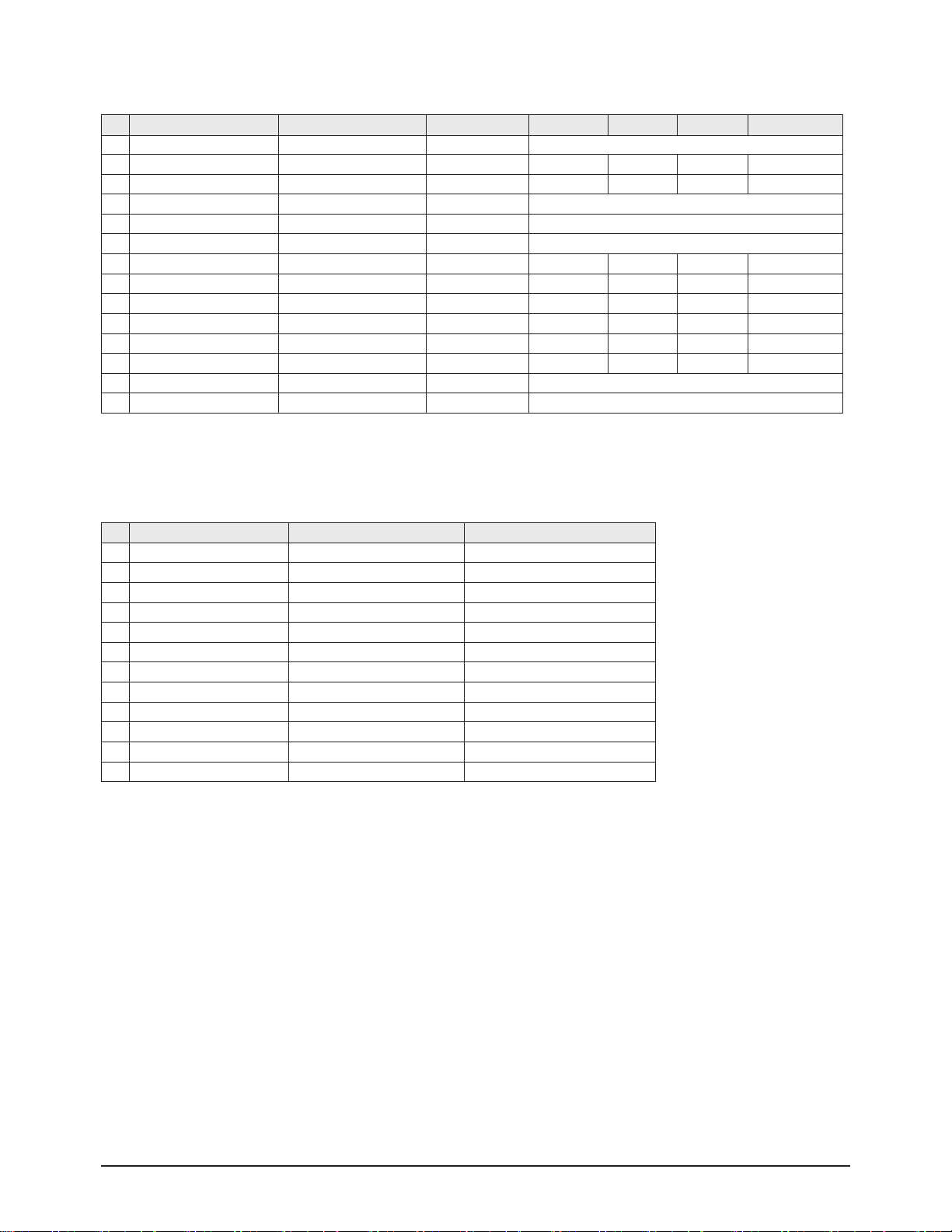
9. DNIe Lite
No Item Range TV/AV/S_Video TV/AV/S_Video Component PC DVI/HDMI
1 PATT_SEL DNIe Lite 0x002C [13:08] 0 ~ 63 0
2 BLACK_TILT DNIe Lite 0x005E [15:08] 00 ~ 255 120 120 80 120
3 BLACK_GAINMAX DNIe Lite 0x00B9 [09:00] 00 ~ 1023 85 85 93 95
4 TEST_MCC DNIe Lite 0x00C1 [12] 0 ~ 1 0
5 OVERLAP_MCM DNIe Lite 0x00C1 [11:10] 00 ~ 03 0
6 AREA_EN_MCC DNIe Lite 0x0062 [15:11] 00 ~ 31 31
7 R-Offset(Post) DNIe Lite 0x0080 [09:00] -512 ~ 511 0 0 0 0
8 G-Offset(Post) DNIe Lite 0x0081 [09:00] -512 ~ 511 0 0 0 0
9 B-Offset(Post) DNIe Lite 0x0082 [09:00] -512 ~ 511 0 0 0 0
10 R-Gain(Post) DNIe Lite 0x007B [07 : 00] 0 ~ 255 128 128 128 128
11 G-Gain(Post) DNIe Lite 0x007C [15 : 08] 0 ~ 255 128 128 128 128
12 B-Gain(Post) DNIe Lite 0x007C [07 : 00] 0 ~ 255 128 128 128 128
13 Com_Offset_Sel(Post) DNIe Lite 0x00F2 [13] 0 , 1 1
14 Com_Gain_Sel(Post) DNIe Lite 0x00F2 [14] 0 , 1 1
10. Chip Debugger : ON/OFF
11. Checksum XXXX XXXX
12. Reset
13. Spread Spectrum
14. Logic
No Item Range Initial Value
1 Int/Ext Sel 0
2 Pat Sel 0
3 FCRL CON 0
4 Image Sticking 0
5 Error Mode Check 0
6 Error Code Table 0
7 Vs Reference 0
8 Vs Average 0
9 Vs to D/A 0
10 Va Reference 0
11 Va Average 0
12 Va to D/A 0
Page 11
Alignment & Adjustment
3-8 Samsung Electronics
3-4 Service Adjustment
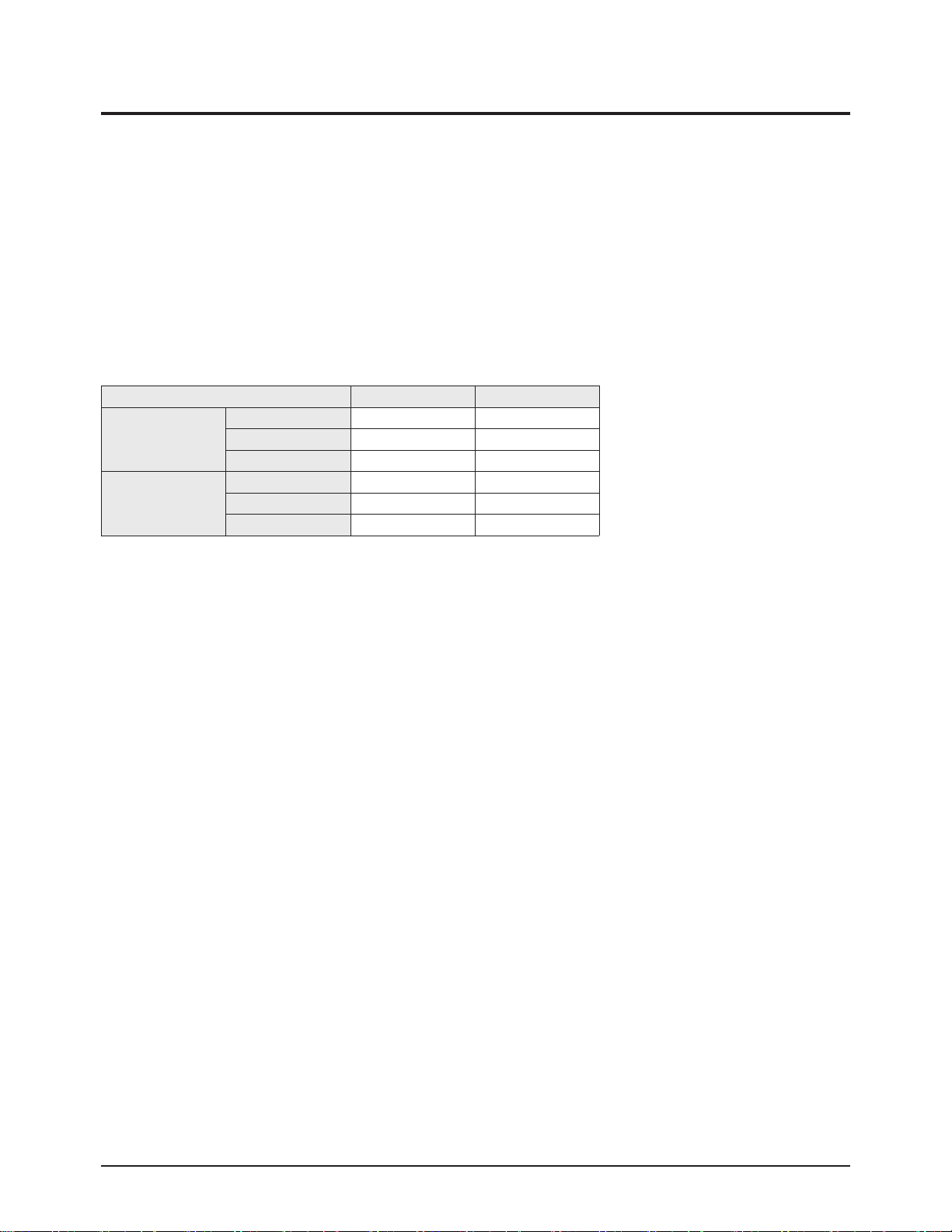
3-4-1 White Balance Adjustment
1. W/B Adjustment is required for the following two modes : : Component → Video
(Signal equipment : MSPG-925LTH, Measurement equipment : CA210)
※ To adjust HDMI, use the HDMI ↔ DVI conversion cable, and connect the DVI output from MSPG-925LTH to the HDMI input.
2. Adjustment Method
-Component and Video mode Adjustment PC, HDMI mode offset.
※ Thus, Micom saves the PS42S5S W/B data separately for each memory mode of the block
- White Balance Coordinates by Mode
VIDEO COMPONENT
H/L
(High Light)
x 265 265
y 265 265
Y(fL) 31 21
L/L
Low Light
x 280 280
y 285 285
Y(fL) 1.3 0.8
1. Pattern Generator Device: 925 LTH (Manufacturer: Master)
2. Adjust Pattern : ABL Pattern(Master 925LTH #16 Pattern)
3. Adjust Timing : Video - PAL(Master 925LTH Model #2)
Component - 720P(Master 925LTH Model # 6)
4. The adjustment procedures for each mode are described as follows:
1) Component
① Send the Toshiba ABL Pattern (Pattern #16) of the 1080i (Model #5) resolution signal to theComponent in port using
the Master 925 LTH.
② Enter Factory mode, move to "White Balance" and click Select.
③ Set the coordinates of H/Land L/L by adjusting "Sub Contrast", "Sub Bright", "R Drive", "G Drive", "B Drive", "R Cutoff"
, "G Cutoff" , and "B Cutoff".
2) Video
① Send the Toshiba ABL Pattern (Pattern #16) of the 1080i (Model #5) resolution signal to the Video in port using the
Master 925 LTH.
② Enter Factory mode, move to "White Balance" and click Select.
③ Set the coordinates of H/Land L/L by adjusting "Sub Contrast", "Sub Bright", "R Drive", "G Drive", "B Drive", "R Cutoff"
, "G Cutoff" , and "B Cutoff".
Page 12
Alignment & Adjustment
Samsung Electronics 3-9
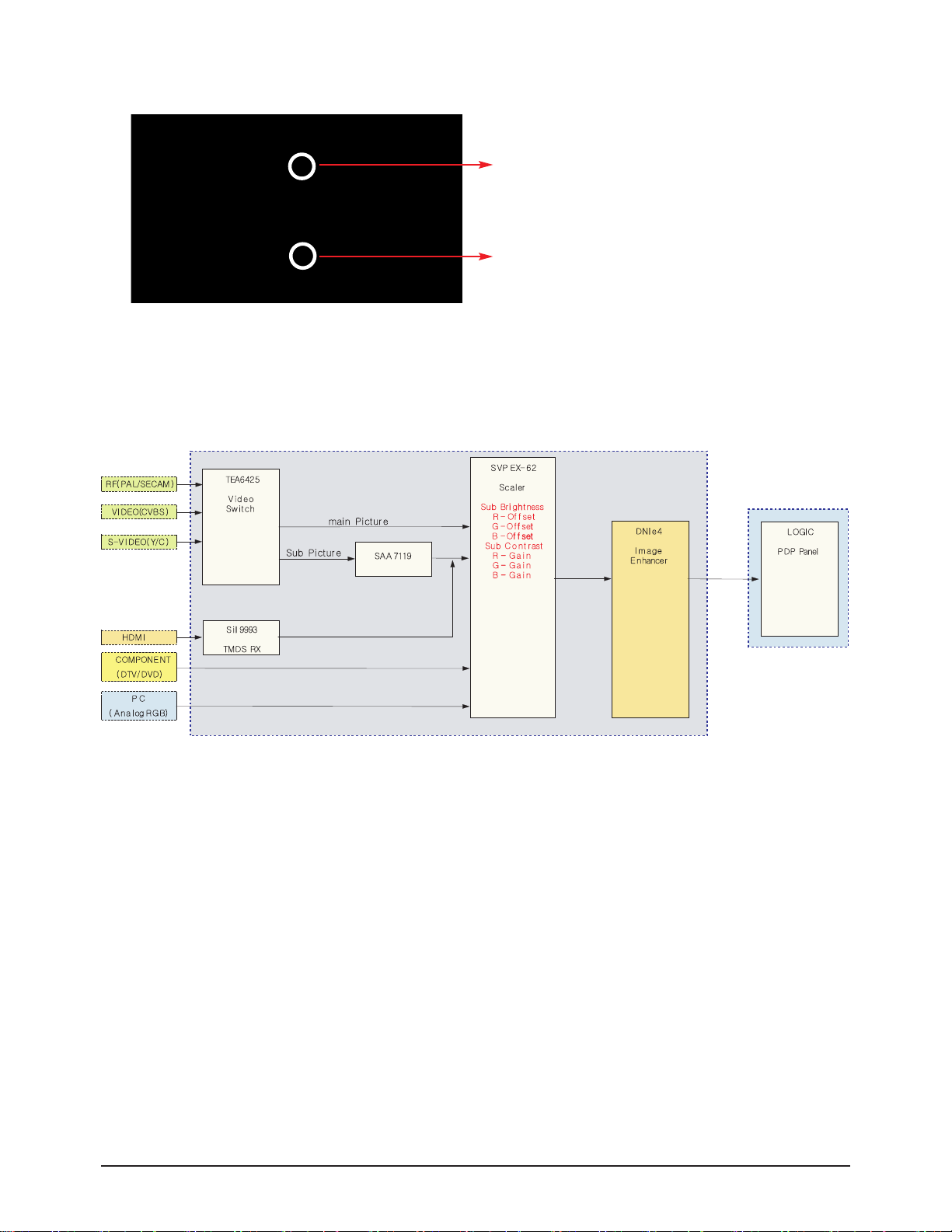
H/L Point
L/L Point
Page 13
Alignment & Adjustment
3-10 Samsung Electronics
3-5 Software Upgrade
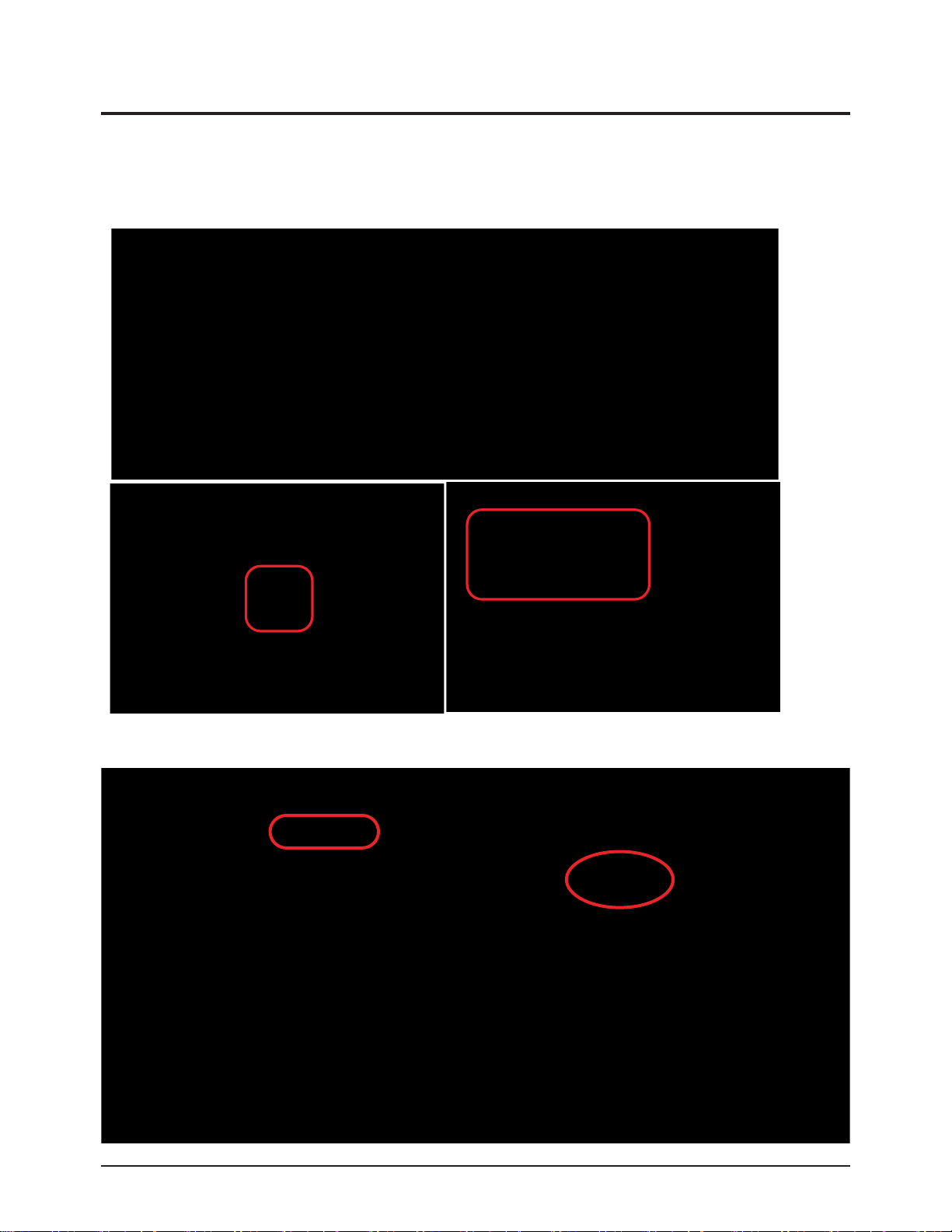
3-5-1 Digital Board TL945 Flash Upgrade
1. Connect one end of the RS-232C cable to the PC COM port and the other end of the cable to the PDP Service port while the
power of the PDP is off.
2. Rome Flash Downloader.
Page 14
Alignment & Adjustment
Samsung Electronics 3-11
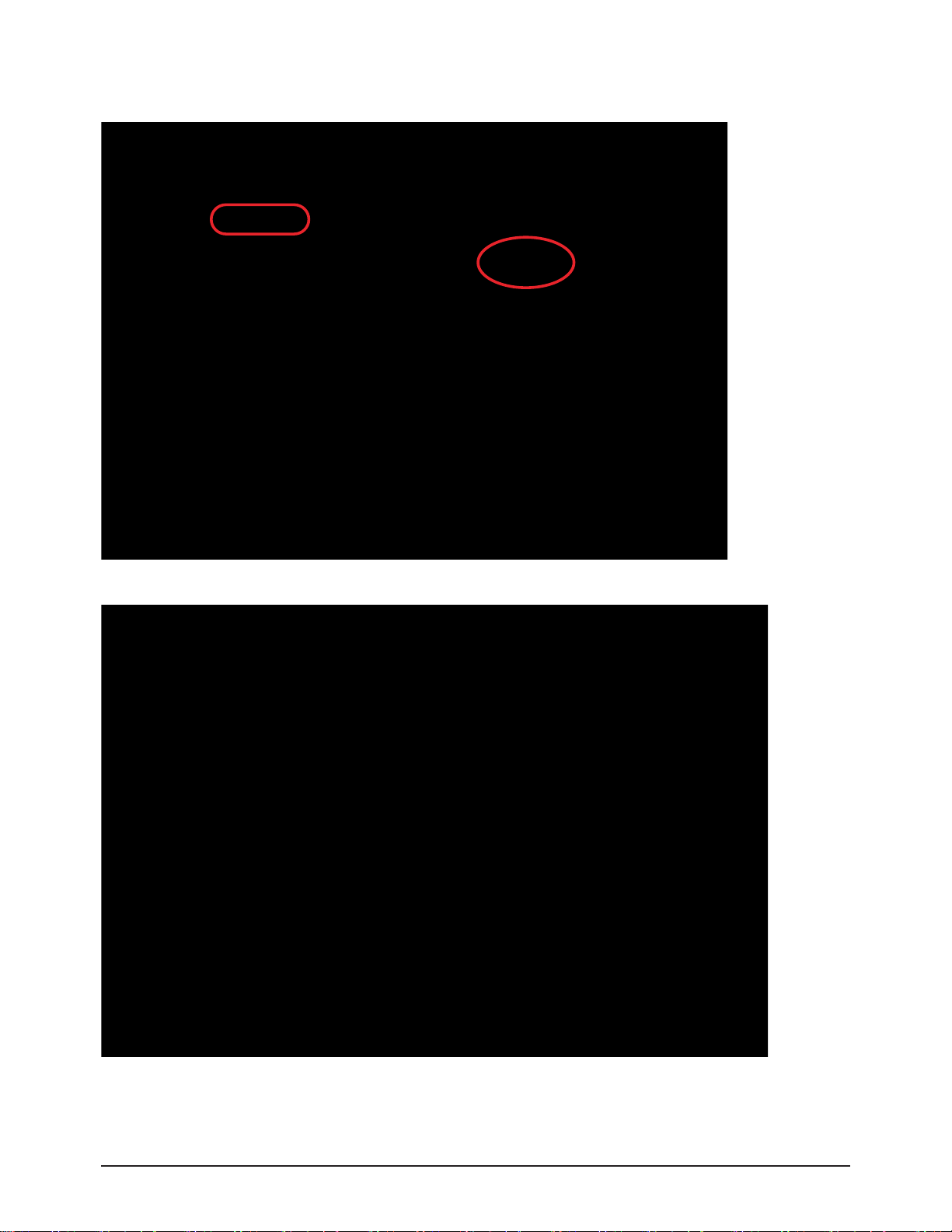
3. When the Flash Downloader is launched, click the Open button.
4. Select a file to be downloaded from the computer.
Page 15

Alignment & Adjustment
3-12 Samsung Electronics
5. After selecting a target file, click the Connect button and turn the power on. When the program is activated, Ready click.
6. Note that the power must not be turned off during the download.
Page 16

Alignment & Adjustment
Samsung Electronics 3-13
7. After the download is finished, the Flash Download Completed popup window opens. That indicates S/W upgrade is completed.
Page 17

Alignment & Adjustment
3-14 Samsung Electronics
3-6 Replacements & Calibration
3-6-1 Voltage Adjustment
※ When the SMPS is replaced, the Va, Vs voltages must be checked and adjusted to the proper levels indicated on the panel
sticker.
adjustment
adjustment
Voltage Label
adjustment
Vscan
Vset
Ve
VR514 Va
adjustment
VR432 Vs
adjustment
Page 18
Block Diagram
Samsung Electronics 7-1
7. Block Diagram
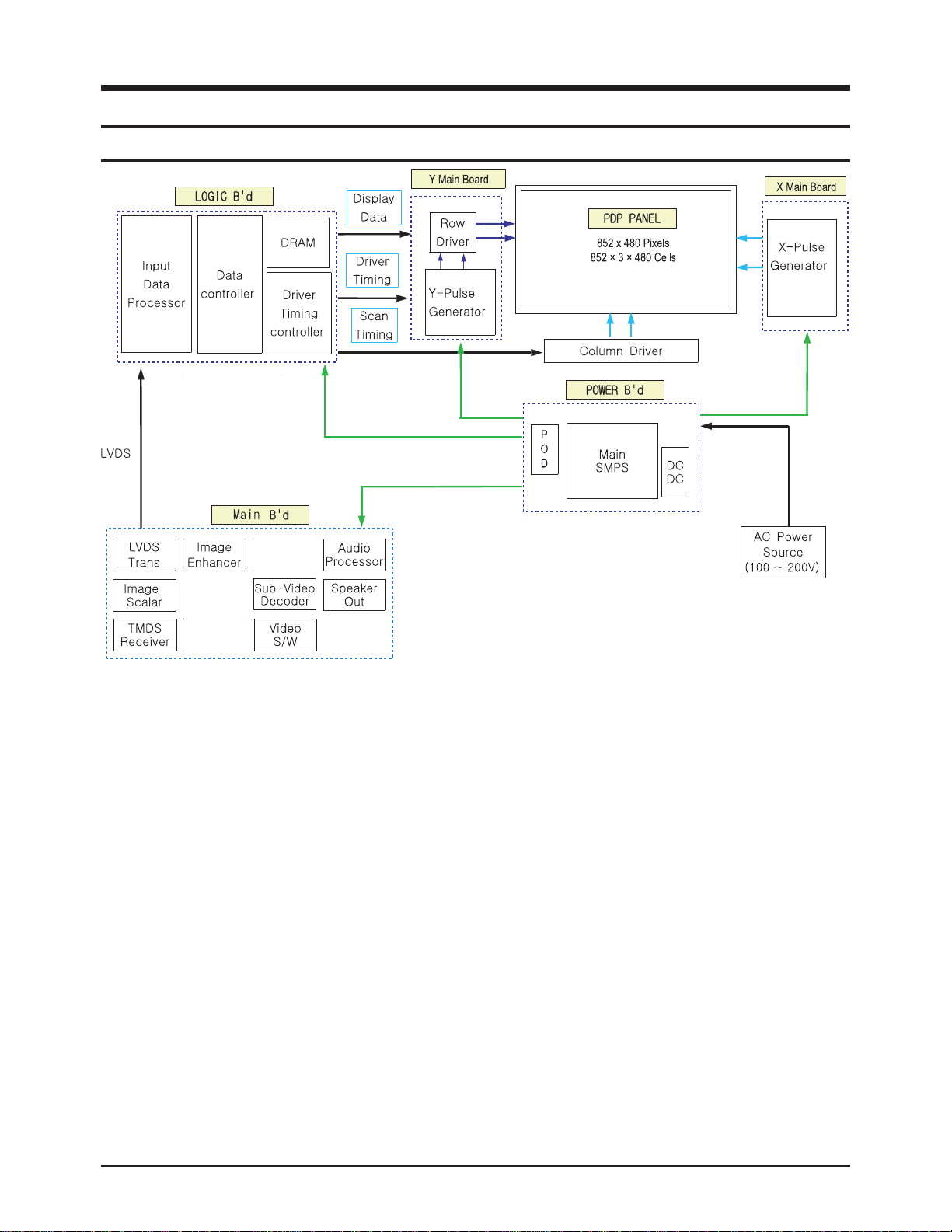
7-1 Overall Block Diagram
Page 19
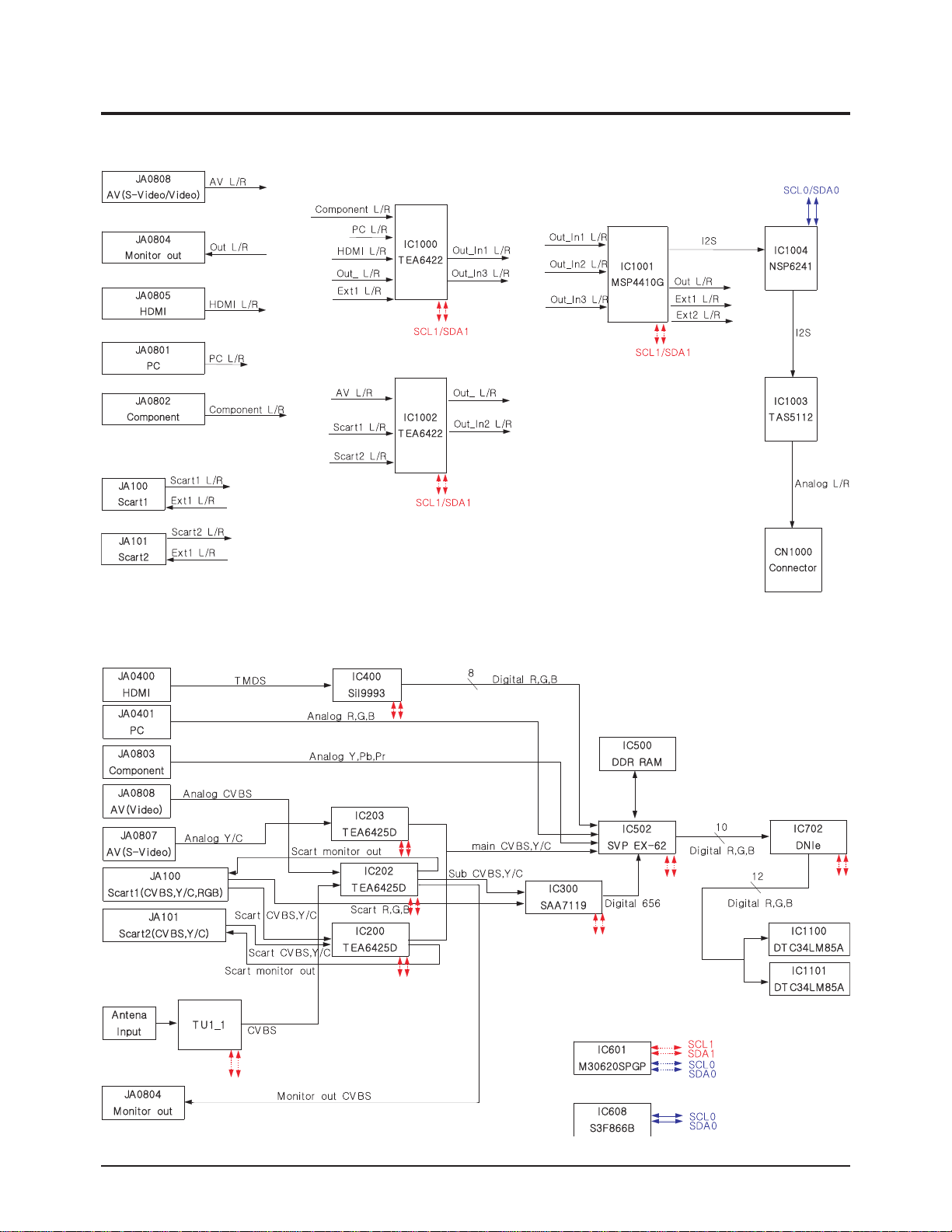
Block Diagram
7-2 Samsung Electronics
7-2 Partial Block Diagram
7-2-1 Audio Signal Block Diagram
7-2-2 Video Signal Block Diagram
Page 20
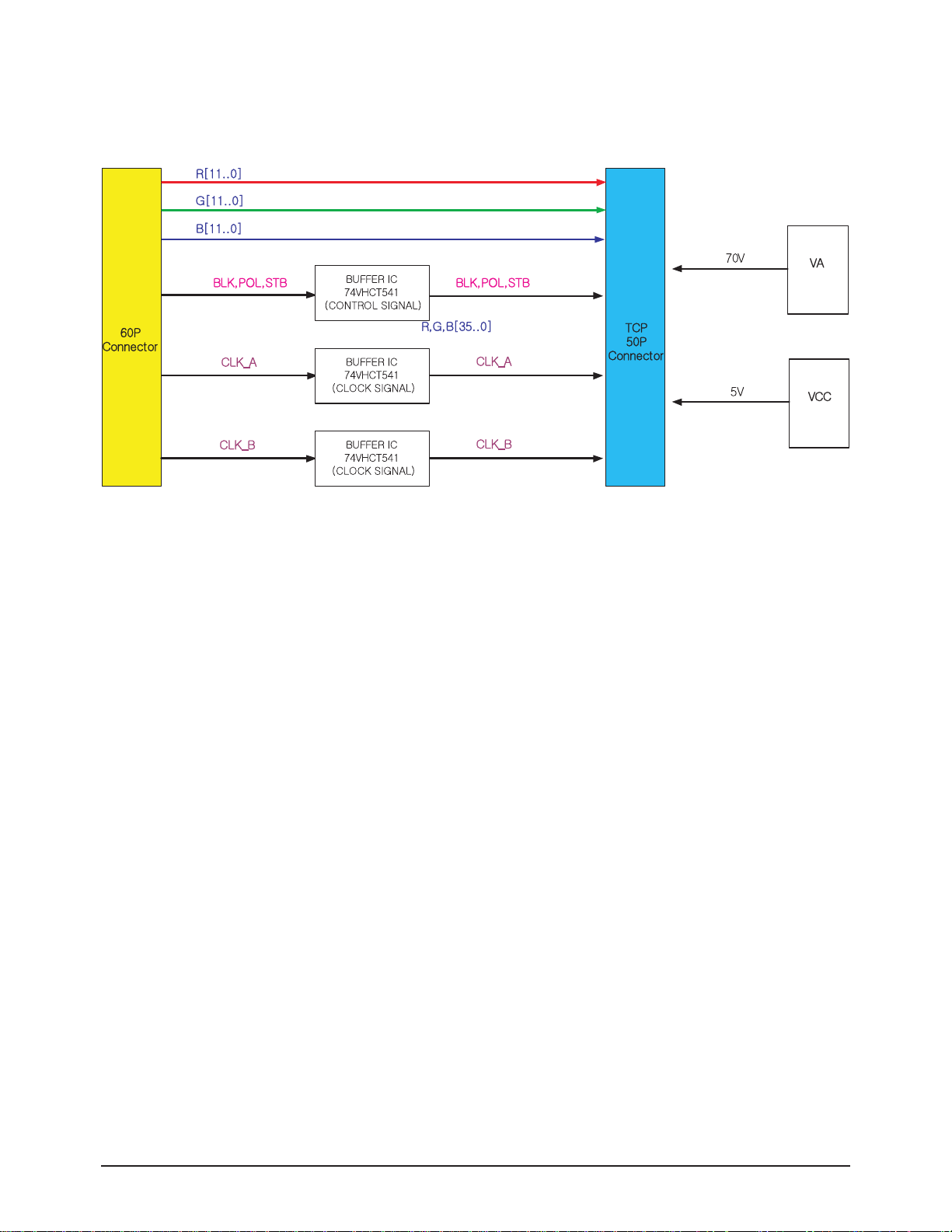
Block Diagram
Samsung Electronics 7-3
7-2-3 Logic Board Block Diagram
Page 21

7-4 Samsung Electronics
MEMO
Page 22
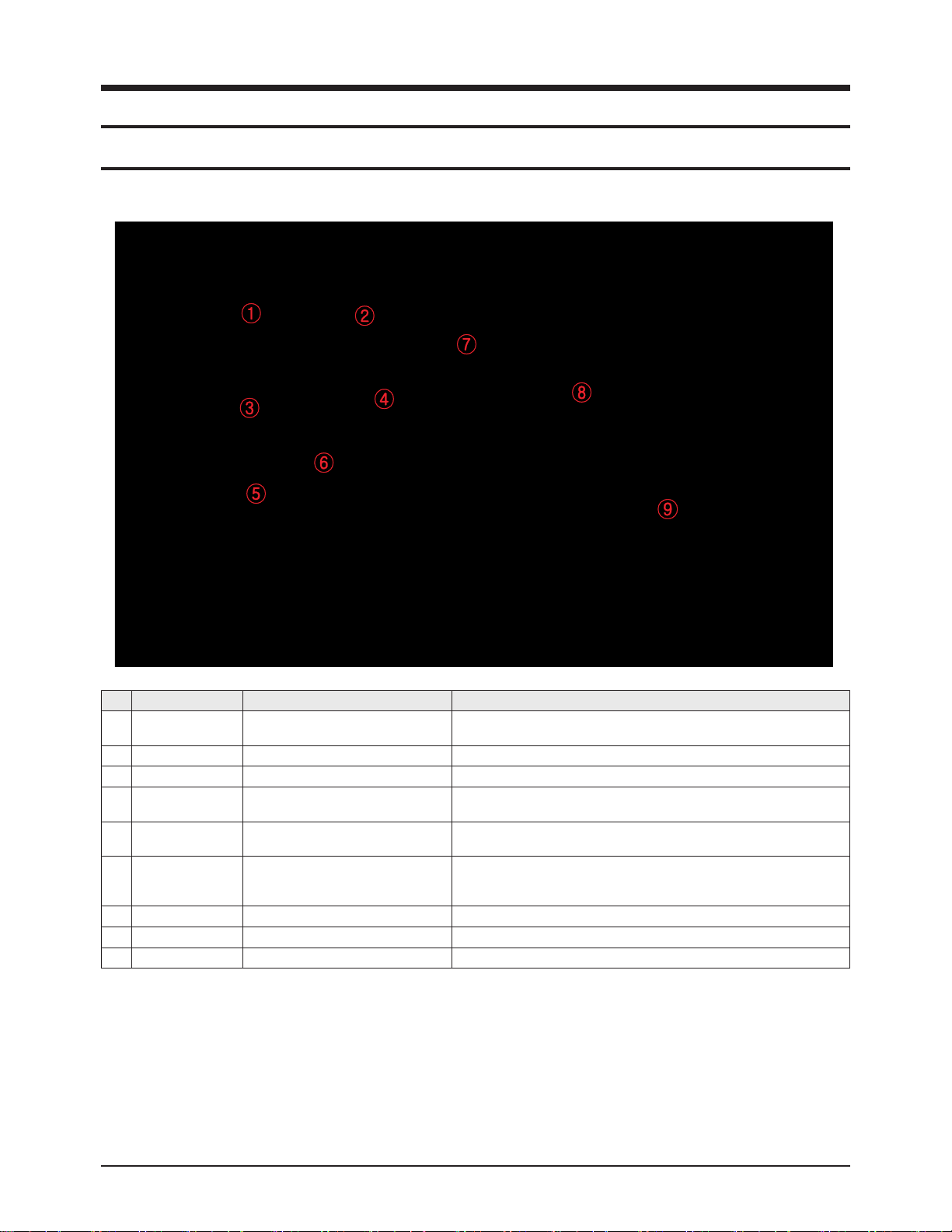
Circuit Description
Samsung Electronics 13-1
13. Circuit Description
13-1 Partial Block Description
13-1-1 Main Board
No Name Function Description
①
SVP-EX62 main Video Decorder+Deinterlacer+Scaler
AScaler IC that generates the output resolution appropriate to the PDP panel and
generates the PIP screen.
②
DNIe-L Image Enhancer The DNIe IC for visual quality improvement.
③
M30620SPGP main Micom Generates various control signals required for operating the circuit.
④
SAA7119 sub Video Decorder
The Video Decoder IC that converts the Y/C and Scart RGB signals for the main
screen into 10 bit digita R, G, B signals.
⑤
SIL9993 HDMI Decorder Converts the TMDS signal on the HDMI input into 8 bit digital R, G, B signals
⑥
S3F8668 sub Micom
Detects the Power on/off signal from the remote control and the Power button and
turns SMPS on or off, handles the Caption signal, and controls the signal for the
LEDs on the front panel.
⑦
MSP4410G Sound processor Sound Processing IC
⑧
NSP6241 Sound Effect chip Sound PWM IC
⑨
TMQZ6-405A Tuner Tuner CH Tuning and CVBS, SIF
Page 23
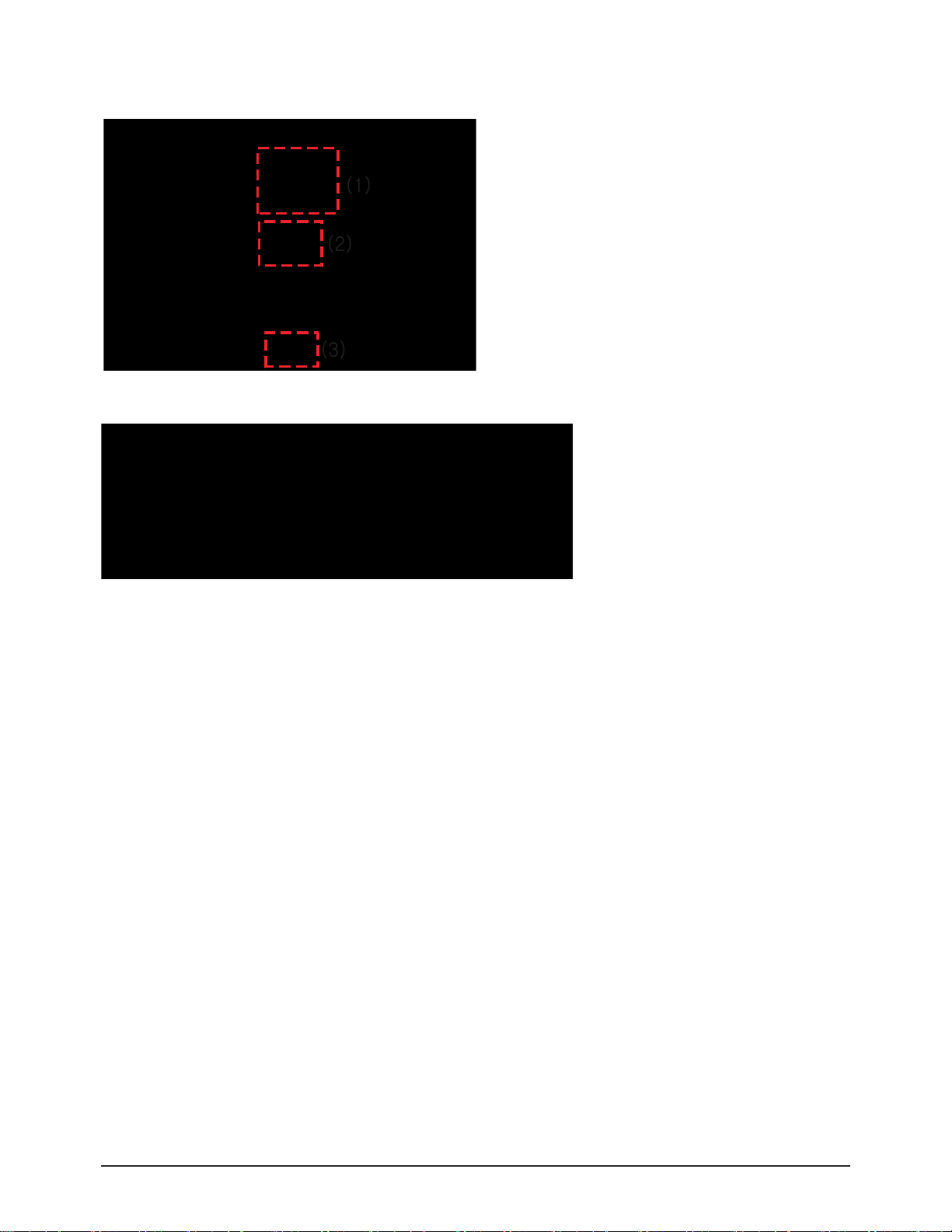
Circuit Description
13-2 Samsung Electronics
13-1-2 Power Button Board
(1) RM01: Remote Control Sensor.
(2) SW001: Power button
(3) OP001: The Illumination sensor that senses the quantity
of light. It senses the illumination and automati
cally adjusts the screen brightness according to
the surrounding brightness when the Power
Saving Mode of the User menu is set to Auto.
13-1-3 Function Key Board
Function Key. Located on the side of the unit.
Page 24
Circuit Description
Samsung Electronics 13-3
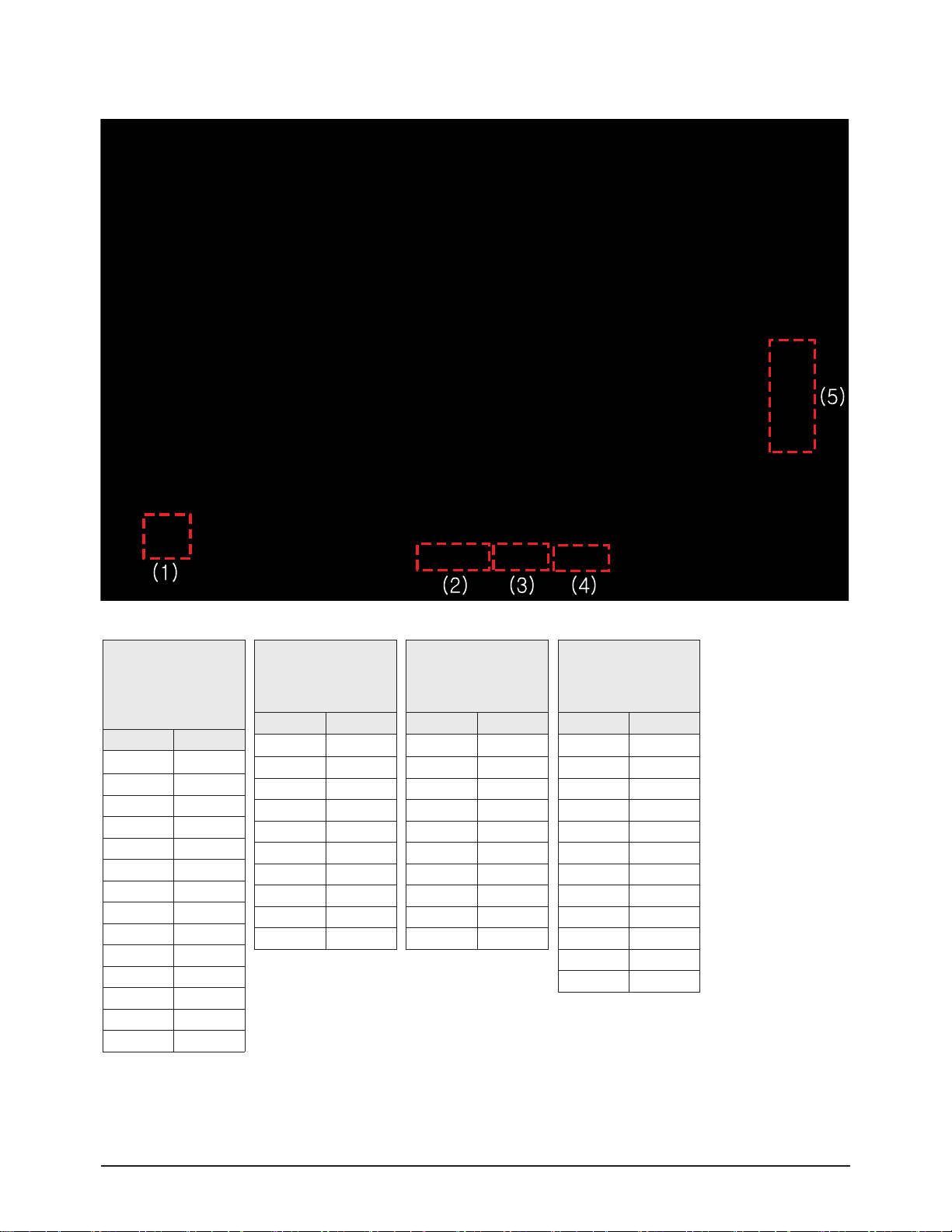
(1) CN800: AC IN (90 ~ 264V)
※ CN811, CN806, CN807 and CN808 are not used.
13-2-4 Main SMPS
(2)
CN804-2
(MAIN SMPS)
↔
CN109(READY B'D)
Pin No Signal
1 ■
FAN-D
2 FAN-ON
3 STB5V
4 RTN
5 PS-ON
6 12V
7 RTN
8 RTN
9 VCA
10 VCS
11 RTN
12 5.3V
13 RTN
14 5.3V
(3)
CN803(MAIN SMPS)
↔
CN108(READY B'D)
Pin No Signal
1 ■
RTN
2 VT(33V)
3 RTN_AMP
4 RTN_AMP
5 18V_AMP
6 18V_AMP
7 RTN
8 12V
9 RTN
10 6V
(4)
CN810(Main SMPS)
↔
CN2013(Logic B'D)
Pin No Signal
1 ■
5.3V
2 5.3V
3 RTN
4 RTN
5 5.3V
6 RTN
7 PS-ON
8 N.C
9 VS-ON
10 STB 5V
(5)
CN809(Main SMPS)
↔
CN3(DC-DC SMPS)
Pin No Signal
1 ■
5.3V
2 Vg
3 RTN
4 RTN
5 RTN
6 RTN
7 RTN
8 Va
9 Va
10 N.C
11 Vs
12 Vs
Page 25
Circuit Description
13-4 Samsung Electronics
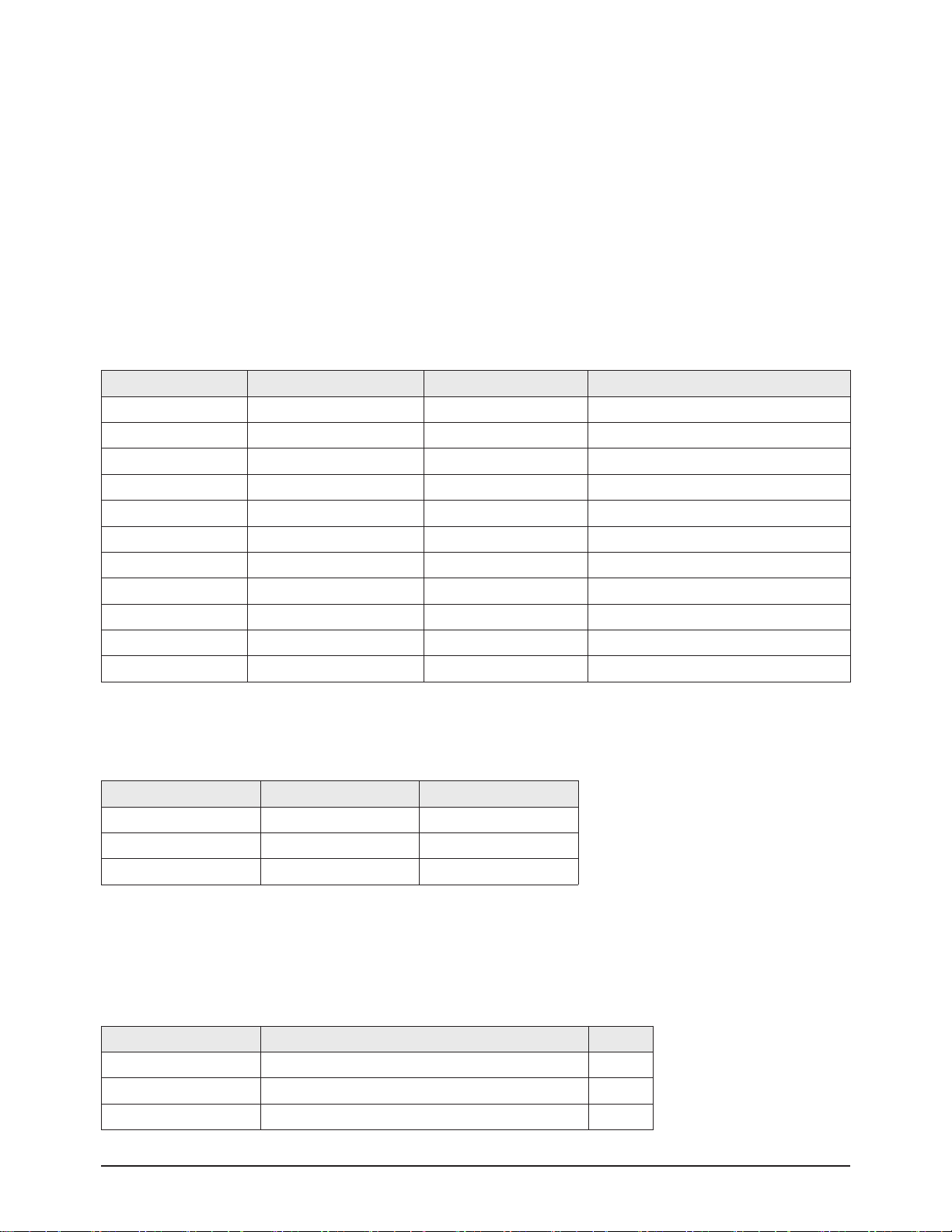
1. Outline (PDP 42inch/50inch SMPS)
Considering various related conditions, the switching regulator with good efficiency and allowing for its small size and light weight
was used as the power supply for PDP 42inch(Schubert)/50inch(Strauss), VS requiring high power consumption Asymmetrical Half
Bridge converter and flyback converter. To comply with the international harmonics standards and improve the power factor, active
PFC(Power Factor Correction) was used to rectify AC input into +400V DC output, which in turns used as input to the switching
regulator.
2. Input
The power supply shall be capable of supplying full rated output power over free voltage ranges that are rated 100 VAC - 240 VAC
RMS nominal. Operating voltage : 90 VAC - 264 VAC
The power supply must be able to start up under peak loading at 90V AC. The power supply shall automatically recover from AC
power loss. (Note that nominal voltages for test purposes are considered to be with +/- 1.0V of nominal).
STD_5V & Vpr2(3.3V) is a SELV standby voltage that is always present when AC mains voltage present.
3. Output
4. Over Voltage Protection
The over voltage sense circuitry and reference shall reside in package that are separate and distinct from the regulator control
circuitry and reference. No single point fault shall be able to cause a sustained over voltage condition on any of all outputs.
The supply shall provide latch-mode Over Voltage Protection as defined below.
5. Short Circuit and Over current Protection
An output short circuit is defined as output impedance of less than 300mohms. The power supply shall shutdown and latch off for
shorting VS DC rails to return. Shorts between main output rails and STD_5V shall not cause any damages to the power supply.
The power supply shall either shutdown and latch off for shorting is removed, the P/S shall recover. The power supply shall be
capable of withstanding a continuous short-circuit to the output without damage or over stress to the unit (components, PCB
traces,connectors,etc.) under the input conditions specified in Section 3 above. Current Protection as defined below.
Output Name Output Voltage Output Current(Max.) Using in PDP Driving
VS +190V ~ 220V (210V) 2.0A Sustain Voltage of Drive Board
VA +60V ~ 80V (70V) 3.0A Address Voltage of Drive Board
D5.3V +5.3V 5.0A
A6.5V +6.5V 3.0A
FAN_9V +9V 0.2A
VG +15V 1.0A
D12V +12V 1.5A
A12V +5.3V 0.5A
18VAMP +18V 2.5A Amp Voltage of Audio Board
VT +33V 0.006A
STD_5V +5V 1.0A Standby for Remote Control
Parameter Min Unit
VS(210V) 250 ~ V
VA(70V) 100 ~ V
VCC(+5.3V) 6.8 ~ V
Output Over Current Limit Unit
VS(210V) 20A, Constant Current.(TBD) A
VA(70V) 10A, Constant Current.(TBD) A
Output except Vs,Va No damage (Auto Recovery or Shut down.) A
Page 26
Circuit Description
Samsung Electronics 13-5
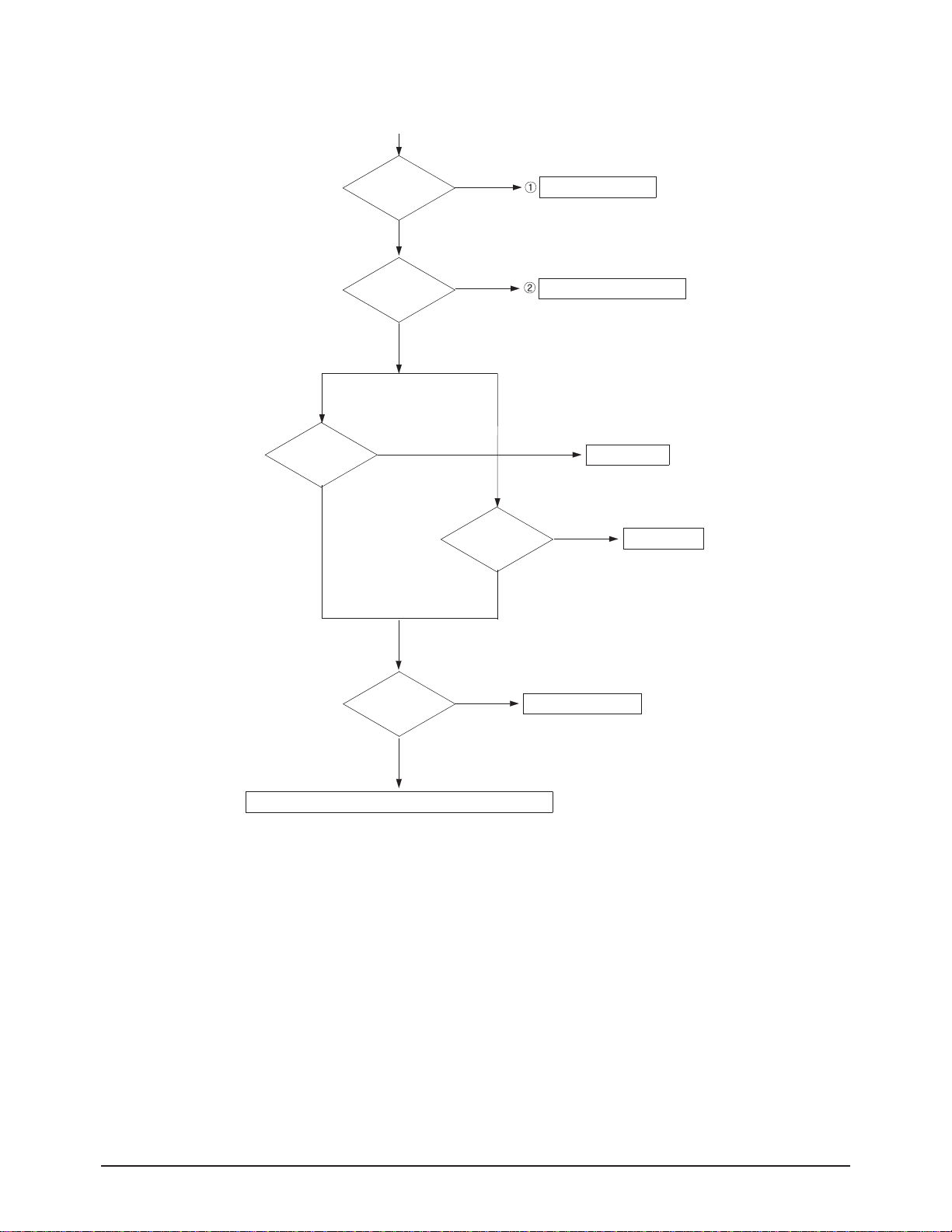
6. Troubleshooting
Normal
Power ON
STD_5V
Abnormal
Check the U101, D108
VA
Normal
Normal
PFC
Abnormal
VS
Abnormal
Abnormal
Multi
Check the Q401, Q402
Check the U201, Q203, Q204
Check the U501
Abnormal
Check the U601
Normal
Check the Other board (Image Board or Driver Board) or Cable.
Page 27
Circuit Description
13-6 Samsung Electronics
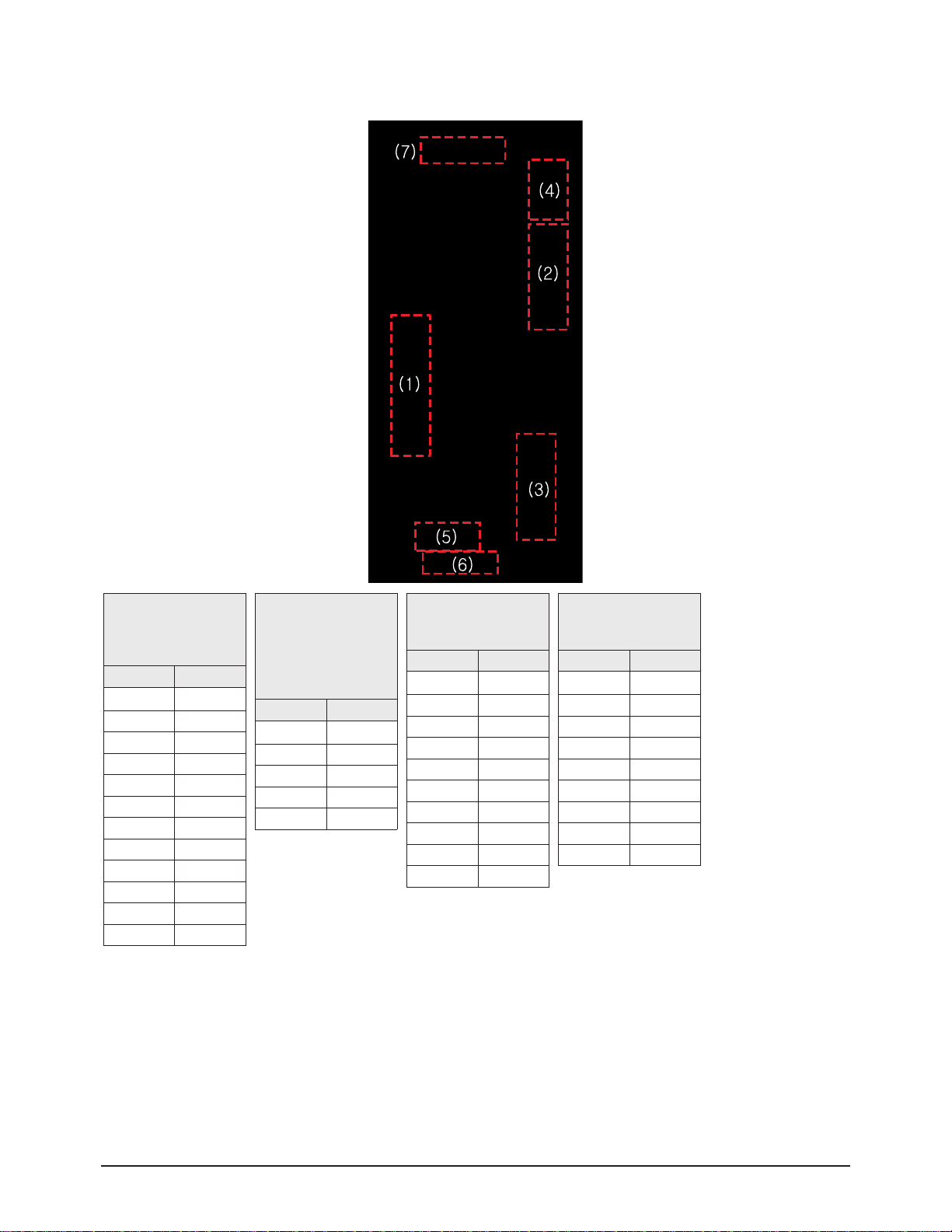
(6) D5.3V, Vg, Ve Test Point
(7) Va, Vset, Vscan Test Point
13-1-5 DC-DC SMPS
(1)
CN809(Main SMPS)
↔
CN3(DC-DC SMPS)
Pin No Signal
1 ■
5.3V
2 Vg
3 RTN
4 RTN
5 RTN
6 RTN
7 RTN
8 Va
9 Va
10 N.C
11 Vs
12 Vs
(4), (5)
CN1, CN6
(DC-DC SMPS)
↔
CN2501(E-Buffer),
CN2701(G-Buffer)
Pin No Signal
1 ■
RTN
2 N.C
3 5.3V
4 N.C
5 Va
(2)
CN2(DC-DC SMPS)
↔ CN5007(YB'D)
Pin No Signal
1 ■
Vs
2 Vs
3 RTN
4 RTN
5 Vset
6 RTN
7 Vscan
8 RTN
9 Vg
10 5.3V
(3)
CN4(DC-DC SMPS)
↔ CN4000(X B'D)
Pin No Signal
1 ■
Vs
2 Vs
3 RTN
4 RTN
5 Ve
6 RTN
7 RTN
8 Vg
9 5.3V
Page 28
Circuit Description
Samsung Electronics 13-7
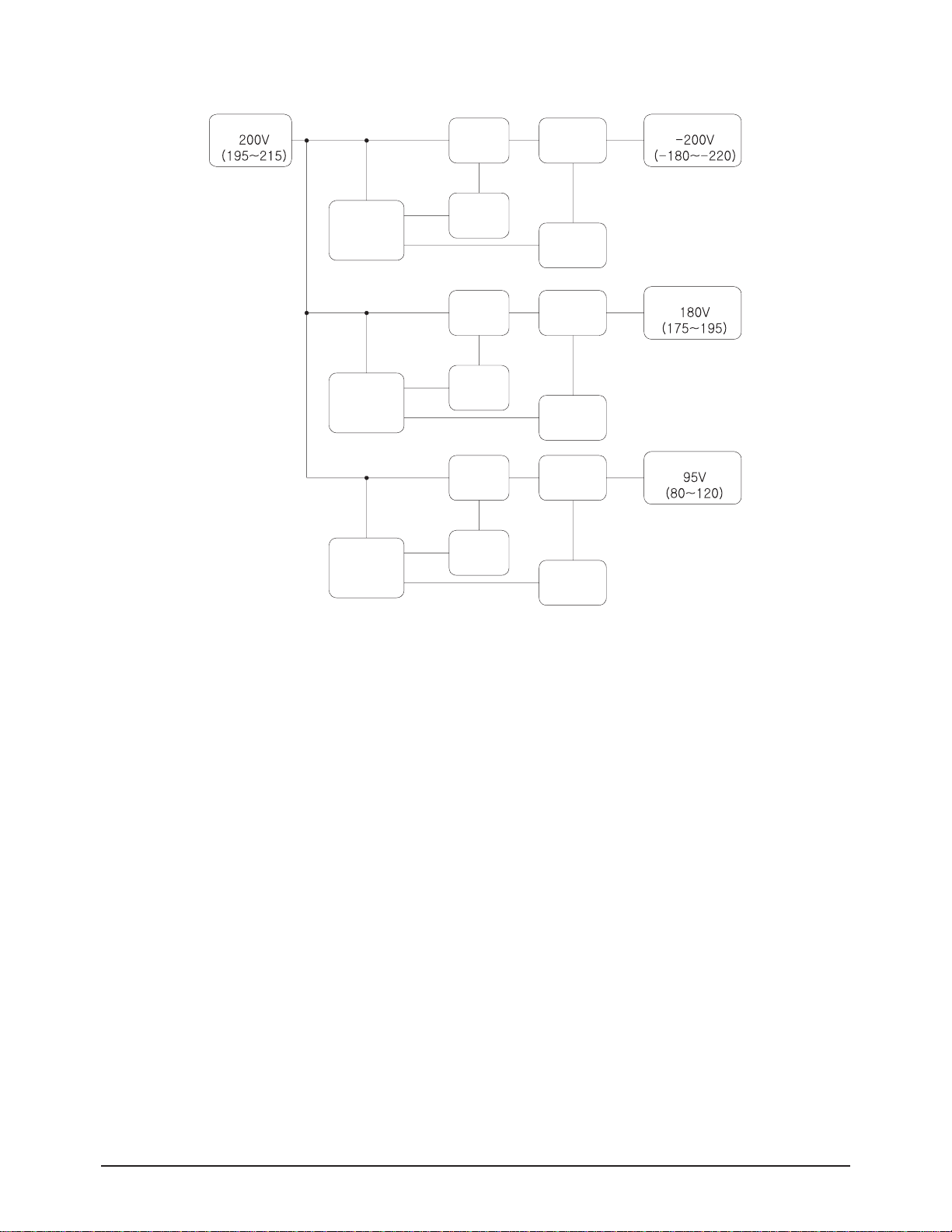
DC DC SMPS receives Vs input (195~215V) from the Main SMPS and the necessary Vscan, Vset and Ve voltages are output to
operate the PDP Module as shown in the block diagram above.
1. Block Diagram
Vs Input Part Vscan Output
Transformer
Control
and
Switching Block
Control
and
Switching Block
Control
and
Switching Block
Auxiliary
Power
Transformer
Auxiliary
Power
Transformer
Auxiliary
Power
Rectification
Block
Feedback
Block
Rectification
Block
Feedback
Block
Rectification
Block
Feedback
Block
Vset Output
Ve Output
Page 29
Circuit Description
13-8 Samsung Electronics
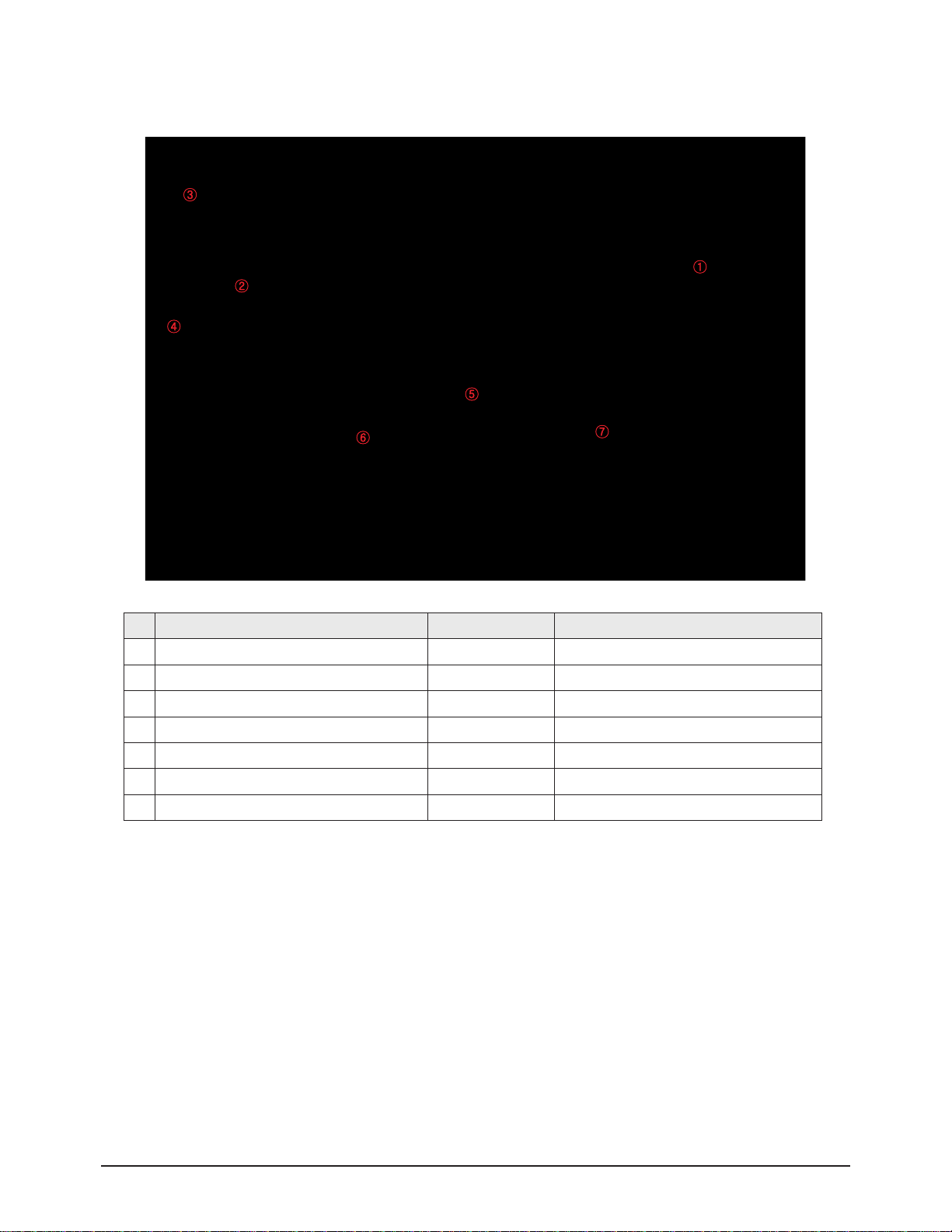
13-1-6 PDP Module
No Name Parts Code Description
1 ASSY PDPP-X MAIN BOARD BN96-02038A X Drive Board
2 ASSY PDP P-Y MAIN BOARD BN96-02039A Y Drive Board
3 ASSY PDP P-Y BUFF UPPER BOARD BN96-02040A Y Buffer Upper Board
4 ASSY PDP P-Y BUFF LOWER BOARD BN96-02041A Y Buffer Lower Board
5 ASSY PDP P-LOGIC BOARD BN96-02042A Logic Board
6 ASSY PDP P-ADDRESS E BUFF BOARD BN96-02043A Address E Buffer Board
7 ASSY PDP P-ADDRESS F BUFF BOARD BN96-02044A Address f Buffer Board
Page 30
Circuit Description
Samsung Electronics 13-9
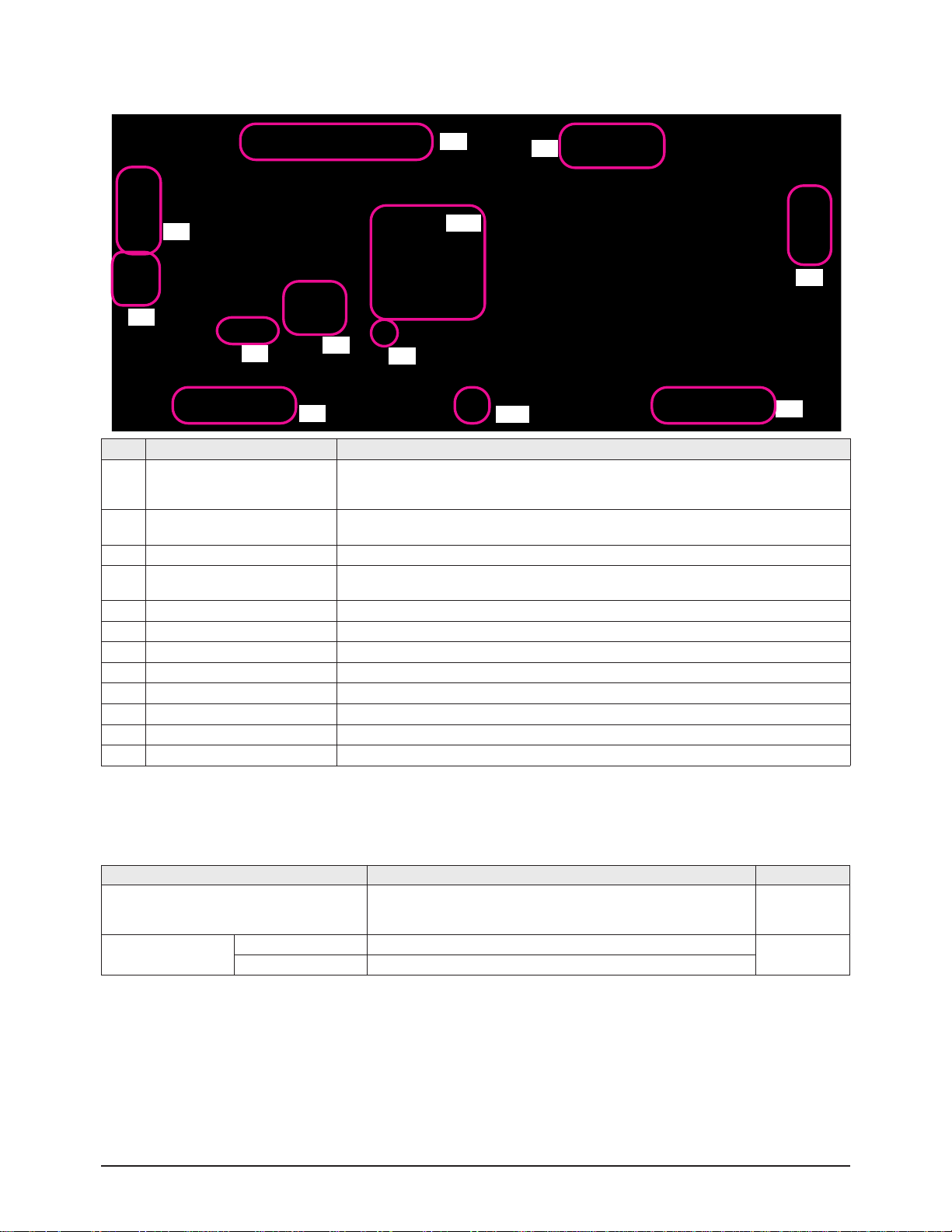
■ A name of main part of Logic Board and vocabulary.
Item Name Explanation
①
LVDS Connector
The connector to receive the RGB, H, V, DATAEN and DCLK signals that have been LVDS encoded through the
video board. At present, there are 2 LVDS, both internal and external, and only LVDS will be provided in the final
version of the board.
②
Operating Status LED
The LED that shows whether the Sync and Clock signal is properly supplied to the logic board (Normal Status:
Blinks at 0.8 second intervals)
③
I2C Connector The connector for the Key Scan board that checks and controls the 512K data.
④
MICOM(ARM-PROCESSOR)
512K including the Gamma Table, APC Table, drive waveform timing and other options is saved to internal flash
memory.
⑤
Y Connector The connector to output the control signal for the Y drive board.
⑥
X Connector The connector to output the control signal for the X drive board.
⑦
CN2075(E-Adderss Buffer Connector) The connector to output the address data and the control signal to the E-buffer board.
⑧
CN2076(F-Adderss Buffer Connector) The connector to output the address data and the control signal to the F-buffer board.
⑨
Power Connector The connector to receive power (5V, 3.3V) for the Logic board.
⑩
ASIC CHIP The main processor that generates and outputs the logic drive signal and the address data.
⑪
MICOM LOADING 5PIN CONNECTOR The connector to load the Micom drive program. The program is loaded by connecting to the GA-WRITER.
⑫
VTOGG TP for V Sync Check
■ About Logic Board
The Logic Board consists of a Logic Main board, which processes the video signal input through LVDS and creates the address
driver output and XY drive signals, and a Buffer board, which buffers the output signal and outputs the signal to the Address Driver
IC (TCP IC).
Logic Board Function Remark
Logic Main
- Video Signal Processing (W/L, error diffusion, APC)
- Outputs the Address Driver Control and Data Signals to the Buffer board.
- Outputs the XY Drive Board Control Signal
Buffer Board
E Buffer Board Outputs data and control signals to the bottom left TCP IC.
F Buffer Board Outputs data and control signals to the bottom right TCP IC.
1
5
01
9
3
11
4
7
2
21
6
8
Page 31
Circuit Description
13-10 Samsung Electronics
■ Major Check Points and Waveforms
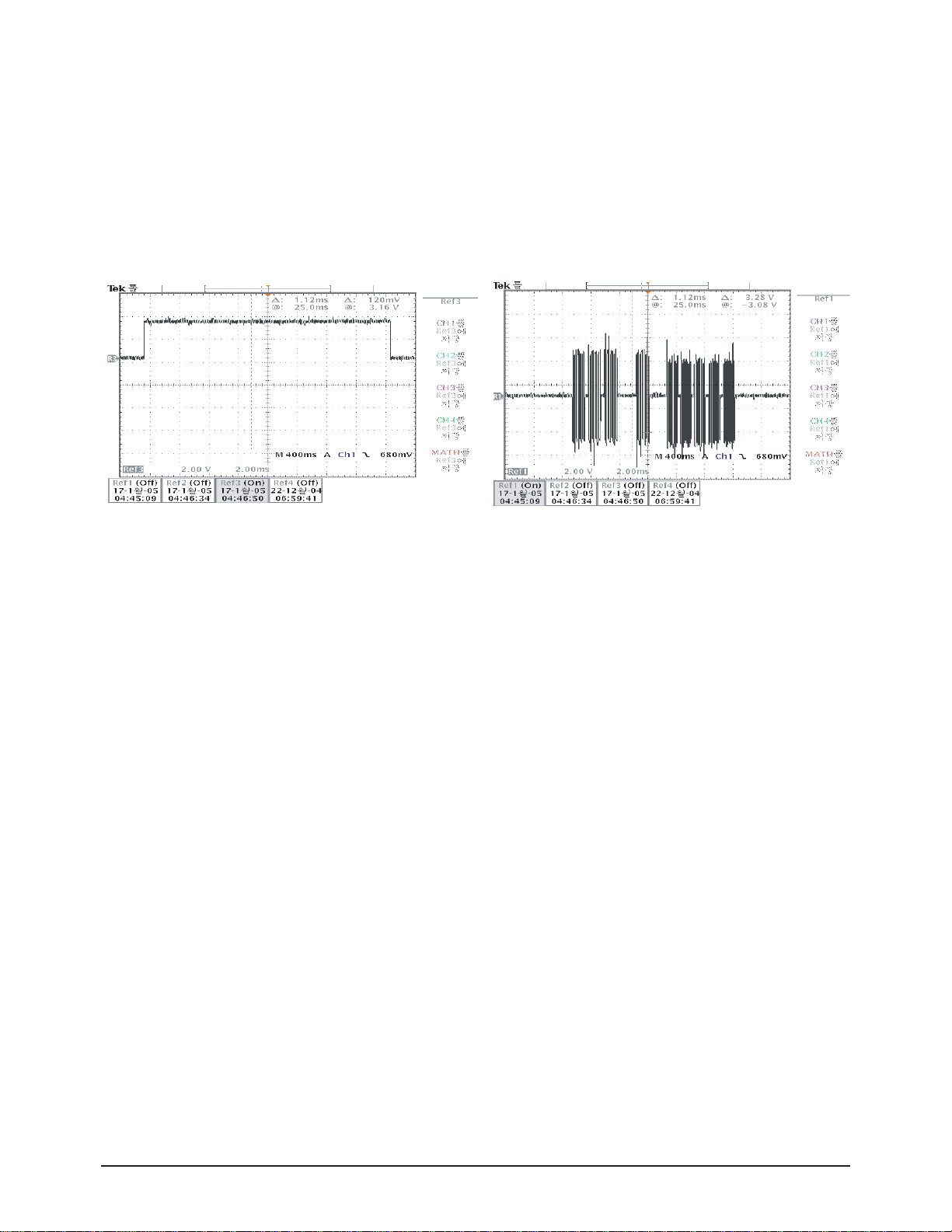
- The waveform during a Normal Operation
When the PDP set and the Logic Board are properly operating, the Operation Status LED blinks at approximately 0.8 second
interval as shown in Figure 1.
If the set is out of order, check the Operation Status LED first, and check that the output waveform is normal using an
oscilloscope.
Check if the waveform is the same as shown in Figure 2 by connecting the oscilloscope to the No. 12 TP in Figure 1. Check if
the waveform is the same as in Figure 3 by connecting the oscilloscope to the connector that is connected to the Buffer board.
If the measured waveform is different from the following waveforms, the board must be replaced.
To check the waveforms, refer to the following waveform patterns.
Figure 2. Normal V-SYNC Output Waveform Figure 3. Normal Address Data Output Waveform
Page 32
Circuit Description
Samsung Electronics 13-11
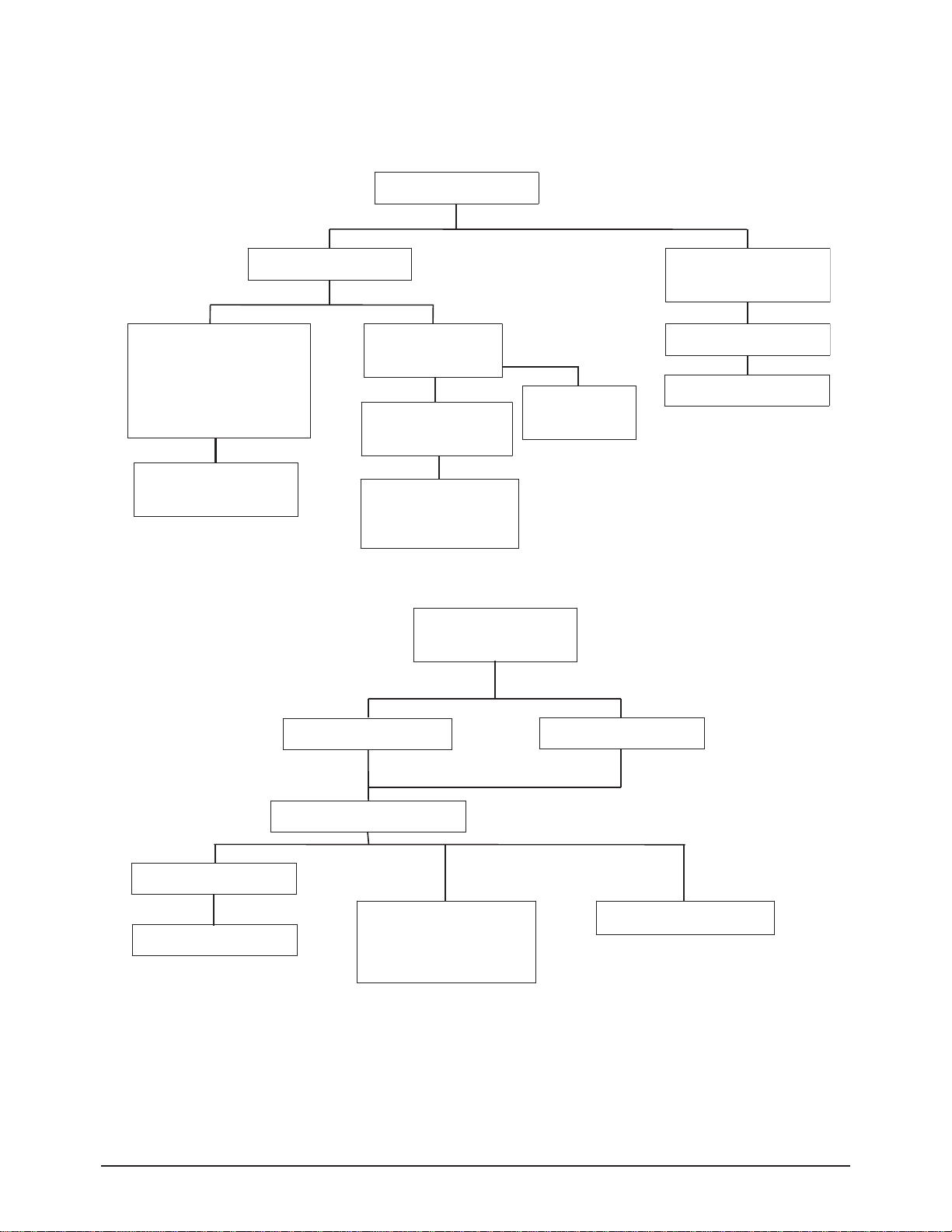
■ Troubleshooting
There are various problems caused by the Logic Board and these have been classified by the Flow Chart.
- No picture on the screen
- Screen Error
Check Power Input
Yes
Check that the internal
default is black.
(Using key scan. Address: 0080
0000: Black
0001: Full White)
Yes
Check to see if the ADDRESS
DATA output is normal.
Yes
Check the Operating Status LED
Check to see if MICOM
is operating properly.
Check the ASIC
control signal output
Check that the data and
control signals between
DDR and ASIC are normal.
No
Yes
Yes
Check the
Operating Status LED
No
Check the power cord
connectivity.
Check the fuse
No
Check the Input Voltage Level
MICOM
Downloading
Discharge Trouble
Check the Detailed Waveform
MICOM Downloading
Check the Internal Waveform Pattern
Screen Trouble with
Missing Vertical Lines
The Buffer Board and the Logic
Main Address Data Output
Check the Short/Open Defect
of the TCP Part.
Check the Video Board
Yes
Screen Trouble with
Missing Horizontal Lines
Check the Drive Y-Buffer Output
Page 33

Circuit Description
13-12 Samsung Electronics
1. X, Y Control Block
■ Drive Circuit Definition
The Drive Circuit is a circuit that generates a waveform (high-voltage pulse) for the X and Y electrode group of the panel's external
port so as to control the panel. The high-voltage switching pulse is generated through the combination of the IC HYBRID (Drive
block + IGBT) and FET.
■ Drive Circuit Mechanism
Apicture is displayed on the PDP by applying voltage to the X, Y and ADDRESS electrodes of each pixel according to the appropriate condition. The drive waveform applied to 42HD V4 is of the ISSS (ISSS: Interweaving Scan and Selective Sustain with Scan
IC) type and has IDS (InDependent Sustain) in the Scan section unlike the existing ADS. Discharges within a PDPpixel can be
classified into 3 types:
① Address Discharge: To form a wall voltage within the pixel by giving information (applying DATAvoltage) to the pixel to be lit.
② Sustain Discharge: Sustain Discharge is a display section that voluntarily maintains the discharge of the pixels whose wall
voltage has been formed by the Address Discharge. (Optical output for displaying a picture is generated).
③ Erase Discharge: To selectively perform Address Discharge for each pixel, all pixels on the panel should be in the same status
(the wall electric charge status and space electric charge status must be the same). Therefore, the Erase
Discharge section is an important component for guaranteeing the drive margin, and is implemented by
various methods such as applying a log waveform. However, the current 42HD V4 has adopted a wall voltage
control through an RA(Repeated Auto-quenching) reset that separates the discharge area and performs
switching to perform an efficient erase operation, while the gradient was the same in the RAMP section in the
existing approach.
1) Address Discharge
Adischarge that is caused by the difference between the plus electric potential (Va apply voltage of 65~70V + Positive Wall
Charge) of the electrode and the negative electric potential (Applied GND Level + Negative Wall Charge) of the Yelectrode. The
Address discharge forms a wall voltage within the pixel to display color (to be discharged) before the Sustain Discharge period.
That is, the pixel whose wall charge has been formed by the Address Discharge forms a Sustain Discharge vis the following
Sustain pulse.
2) Sustain Discharge
ASustain Discharge is a Self-Sustaining Discharge formed by the accumulation of the electric potential of the Sustain pulse (generally 200 ~ 210 Volt) alternating over the X and Yelectrodes during the sustain period, and the wall charge depending on whether
the pixel has previously been discharged or not. That is, it is controlled by the memory characteristics, one of the basic characteristics of the AC PDP(in that the past operating conditions determine the current status). That is, if a wall voltage exists on the pixel
(if the pixel is on), a discharge is formed again because the applied voltage, which is the sum of the following applied Sustain voltage and the wall voltage, is higher than the discharge threshold voltage. If no wall voltage exists on the pixel (if the pixel is off), a
discharge will not occur because the Sustain voltage is not higher than the discharge threshold voltage. The Sustain Discharge
period is the period for generating actual optical output so as to display a picture on the PDP screen.
3) Erase Discharge
The purpose of a Reset (Erase) Discharge is to create uniformity of the wall voltage within all panel pixels. It evens the wall voltages regardless of the Sustain Discharge in the previous stage. The Erase Discharge has to remove the wall voltage introduced by
the Sustain Discharge by supplying ions or electrons by a discharge. When the wall voltage is removed through a discharge, the
time when the reverse polarity is applied to the wall voltage (fine width erasing) is to be limited or ions or electrons are to be supplied by a weak discharge (low voltage erasing) so as to prevent a wall charge in reverse polarity.
There are 2 known weak discharge (low-voltage) erase methods. 1) Alog waveform adopted by F company and 2) a weak erase
discharge via a ramp waveform adopted by Matsushita and other companies. Both methods control the externally applied voltage
by the difference of the wall voltage of the pixel by applying the rising gradient of the erasing waveform slowly, because the discharge begins when the sum of the existing remaining wall voltage and the rising waveform voltage exceeds the drive threshold
voltage. In addition, a weak discharge is introduced, because the applied voltage is low.
Page 34
Circuit Description
Samsung Electronics 13-13
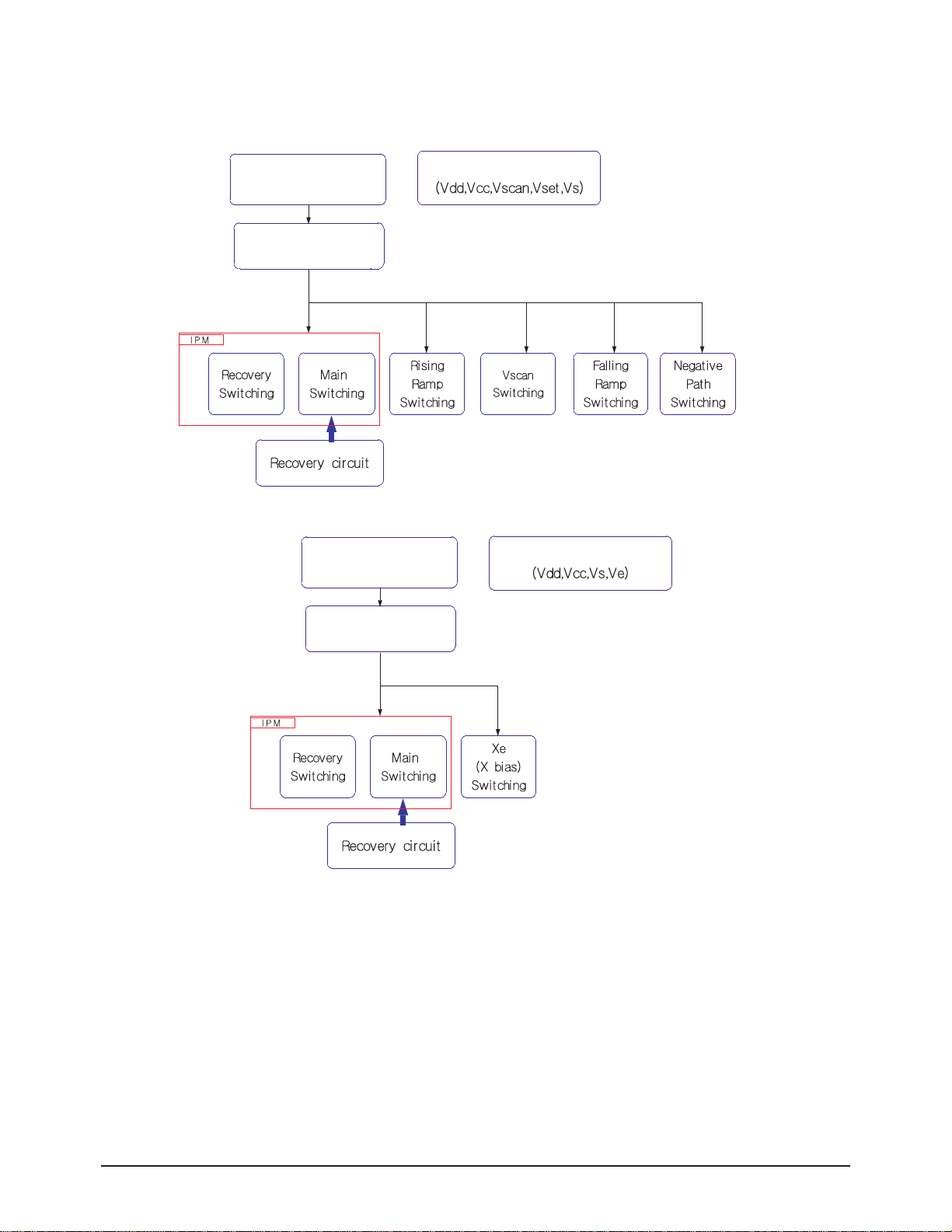
■ Drive Circuit Operating Block Diagram
- Y Drive Board
- X Drive Board
■ Requisite Components Necessary for Drive Board Operation
- Power : Supplied from the power board. The optimal value may differ from the following:
a) Vs : 205V - Sustain
b) Vset : 195V - Y Rising Ramp
c) Ve : 100V - Ve bias
d) Vscan : -190V - Scan low bias
e) Vnf : -175V - Y falling Ramp (Created by the DC-DC power block of the Y Drive board)
f) Vsc_h : -70V - Scan high bias (Created by the DC-DC power block of the Y Drive board)
g) Vdd : 5V - Logic signal buffer IC and IPM
h) Vcc : 15V - Gate drive IC ¹× IPM
- Logic Signal : Supplied by the Logic board. Gate signal of each switch
Logic Signal Input Part
Logic Signal Buffer
Logic Signal Input Part
Power Input Part
Power Input Part
Logic Signal Buffer
Page 35
Circuit Description
13-14 Samsung Electronics
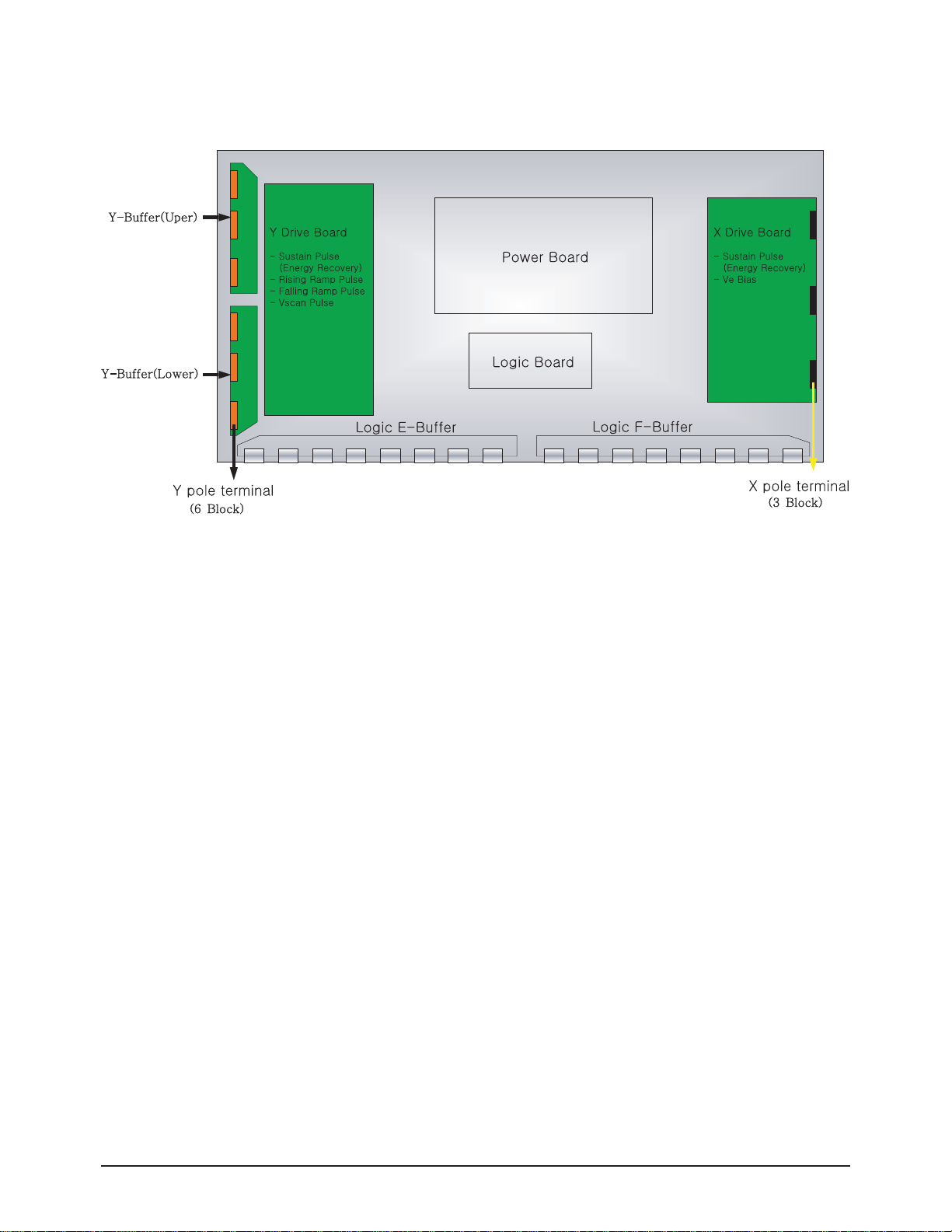
■ Drive Circuit Architecture and Function Description
- Description of the function of each board
1) X Drive Board
This is connected to the X port part of the panel. 1) Sustain voltage waveform (including ERC) is output, and 2) Ve bias in the Scan
section is maintained.
2) Y Drive Board
This is connected to the Y port part of the panel. It outputs 1) Sustain voltage wave form (including ERC), and 2) Y Rising, Falling
Ramp waveform, and maintains 3) Vscan bias.
3) Y Buffer Board (Upper, Lower)
This board supplies the Scan waveform to the Y port and consists of Upper and Lower boards. For an HD grade unit, 6 scan driver ICs (TEXAS INSTRUMENT SN755867APZP: 64 outputs) are mounted on the board.
Page 36
Circuit Description
Samsung Electronics 13-15
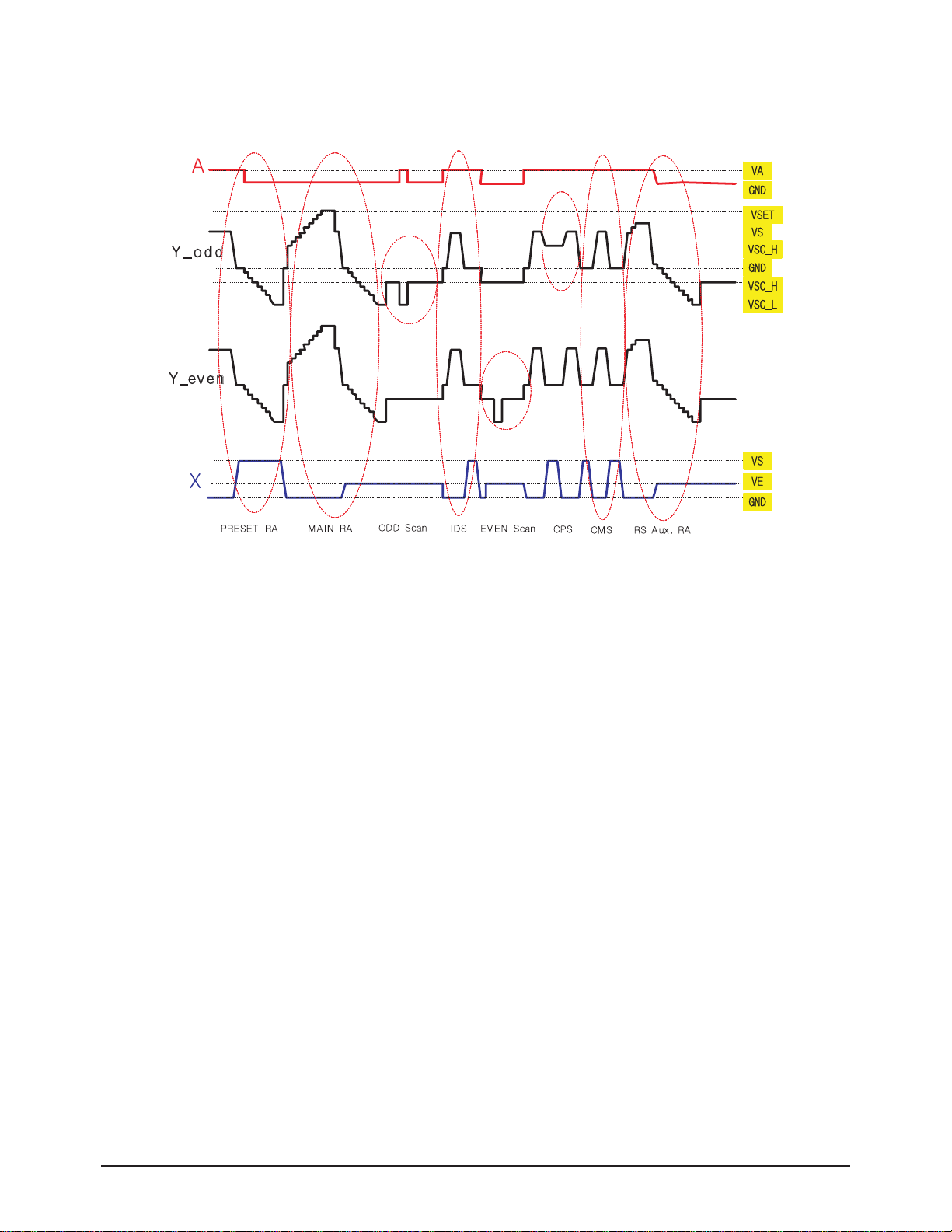
■ Drive Waveform Specifications
- Drive Waveform
- Description of the function of each pulse
1) Y Preset RA Pulse
This is supplied to the first sub-field and erases the discharge status of the previous subfield.
2) Y Main RA Pulse
During the Y Rising Ramp section, approximately 300V~350V (Vscan-h + Vset) of external voltage is supplied to the Y electrode,
and a weak discharge is started when each gap voltage is equal to the discharge start voltage. While maintaining the weak discharge, as a whole, negative wall charges are accumulated on the Y electrode and positive wall charges on the X electrode and
the address electrode.
During the Y Falling Ramp section, the negative wall charges accumulated on the Y electrode by the approximately 105V of X bias
are used to erase the positive wall charges on the X electrode, and the address electrode maintains most of the positive wall
charges accumulated during the (0V) Rising Ramp section preparing for the next address discharge.
3) Y Scan Pulse (Odd/Even)
Ascan pulse classifies the Y electrode into Odd and Even lines and selects FPC output electrodes sequentially (one line-at-atime). At this time, Vscan is called the Scan Bias Voltage.
AVscan voltage of approximately -175 Volt (Vsc_1) is supplied to the electrode lines. For the other lines, -56 volt (Vsc_h is higher
than Vscan-l by 120V) is supplied. However, negative wall charges are accumulated on the Yelectrode by the Ramp pulse, and
positive wall charges are accumulated on the address electrode, and the voltage applied to the cells, to which the Address pulse
(70V~75V) has been applied, becomes higher than the discharge voltage. An address Discharge occurs as a result. Since the
Scan and Data pulse is applied one line at a time as above, the address time of PDP is very long.
4) IDS Pulse (InDependent Sustain Pulse)
Since an Odd Scan is performed first, the Odd line output sustains optical twice during the IDS section. At this time, a Sustain
Discharge does not occur for the Even line because the Even line is not scanned.
5) CPS Pulse (ComPare Sustain Pulse)
By floating the Odd line that caused the Sustain Discharge in the IDS section to the Vscan-h level, and introducing the Sustain
Discharge only for Even lines, it compensates for the optical output difference between the Even and Odd lines.
6) CMS Pulse (ComMon Sustain Pulse)
Actual optical is output during the common Sustain Discharge section.
Page 37
Circuit Description
13-16 Samsung Electronics
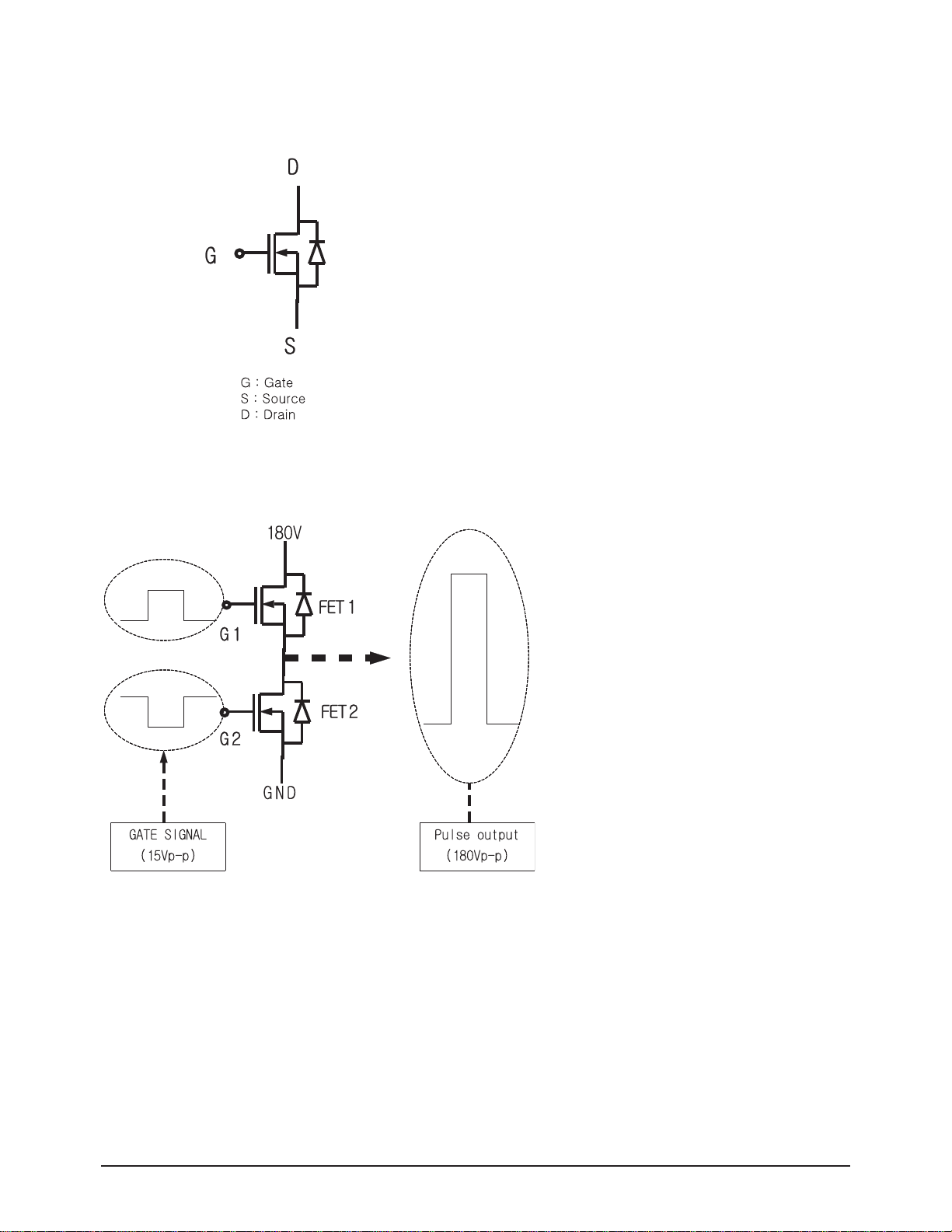
■ Mechanism of the FET Operation and High-Voltage Switching
Mechanism of the FET Operation
1) When the signal is output to the gate, (positive electric
potential) FET short circuits
(i.e. Conductor of resistance 0)
2) When no signal is output to the gate (GND), FET changes
to an open circuit (i.e. an insulator of resistance ∞).
High-Voltage Switching of the FET Operation
1) When no signal is applied to G1, FET1 is
opened and when the signal is applied to G2,
FET2 short circuits, GND is output via the output
terminal.
2) When a signal is applied to G1, FET1 short cir
cuits and when no signal is applied to G2, FET2
is opened, and 180V is output via the output
terminal.
Page 38
Circuit Description
Samsung Electronics 13-17
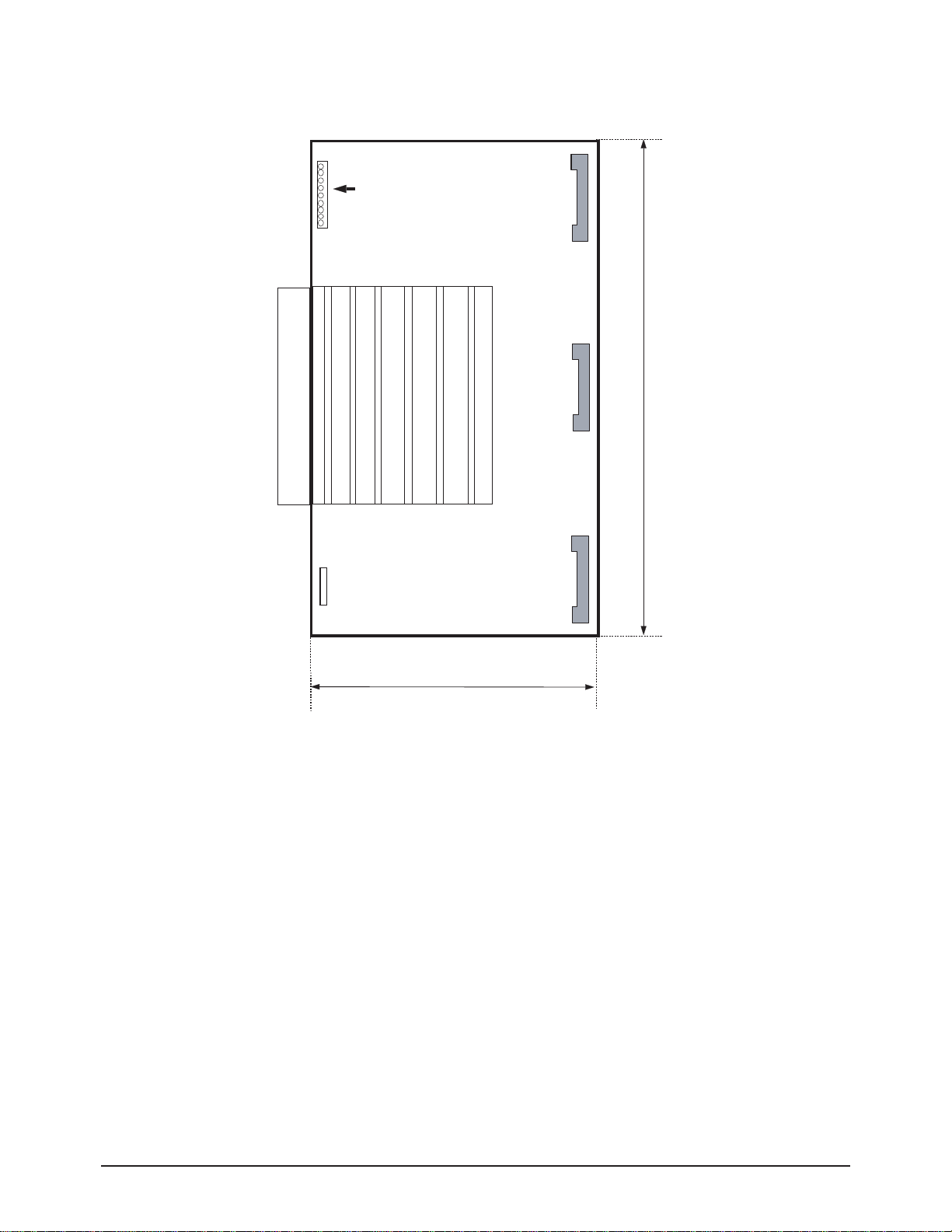
■ Drive Board Connector Layout
1) X-Main
CN4004
- Power
1. VDD
2. VCC
3. GND
4. NC
5. Ve
6. NC
7. GND
8. GND
9. NC
10. Vs
11. Vs
CN4000
- Panel
310mm
CN4002
- Panel
CN4003
- Signal
CN4001
- Panel
140mm
Page 39
Circuit Description
13-18 Samsung Electronics
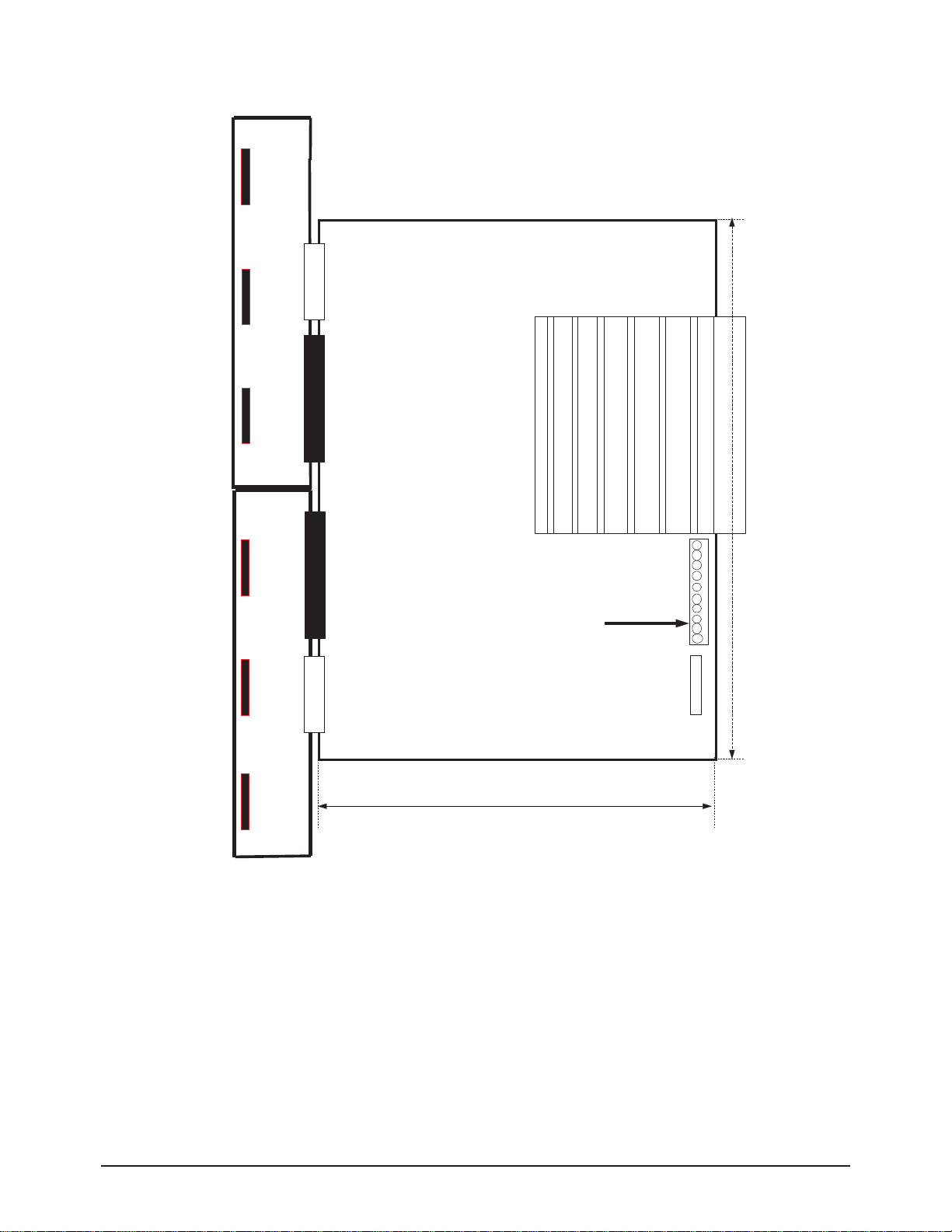
2) Y-Main
CN5401
- Panel
CN5402
- Panel
CN5403
- Panel
CN5006
CN5002
CN5404
CN5501
- Panel
CN5502
- Panel
CN5503
- Panel
CN5504
CN5001
CN5005
185mm
1. Vs
2. Vs
3. NC
4. GND
5. NC
6. Vset
7. NC
8. GND
9. Vscan
10. GND
11. VCC
12. VDD
CN5003
- Power
CN5004
- Signal
310mm
Page 40
Circuit Description
Samsung Electronics 13-19
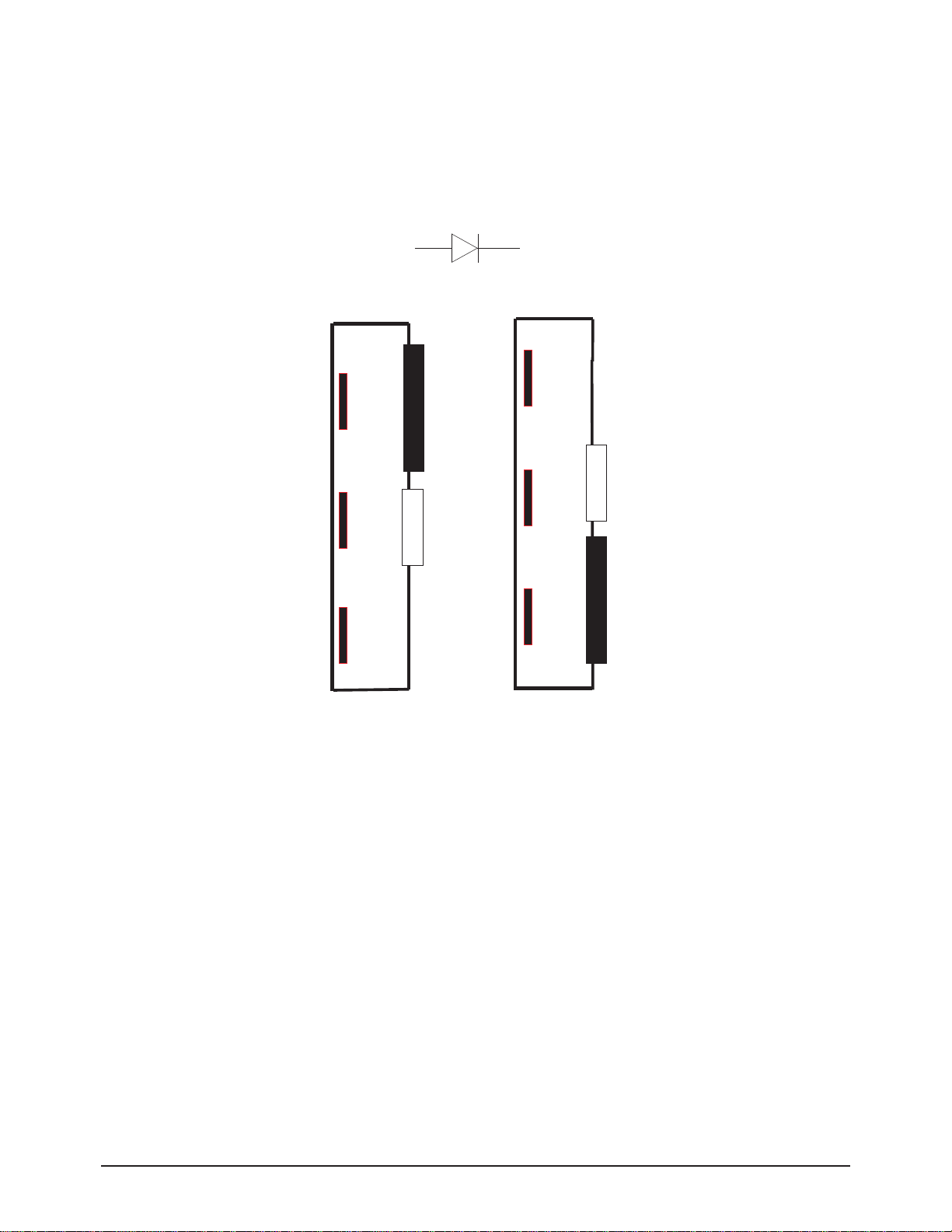
■ Troubleshooting the Drive Board
1) Y Buffer
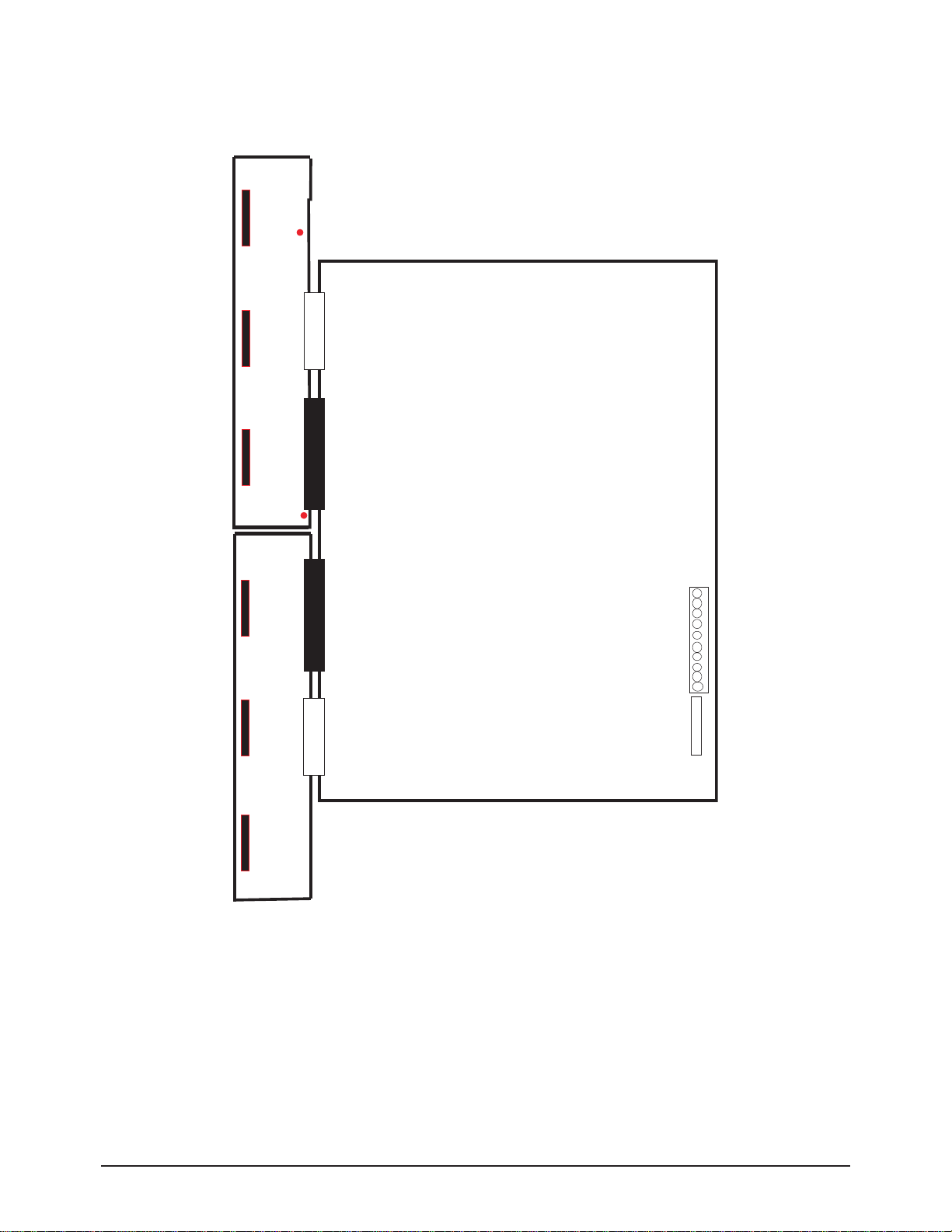
- To check whether the Y Main board is properly working, check the operation of the Y Buffer first.
- Separate the connector of the Y Buffer from the Y Main board
- Check OUTL and OUTH and confirm that the forward voltage reduction is between 0.4V ~ 0.5V.
UP - CN5407 1~10pin - OUTH / 11~33pin - OUTL
LOW - CN5507 50~41pin - OUTH / 40~17pin - OUTL
- In addition, the resistance between the points must be higher than a few kΩ .
OUTL OUTH
Y- Buffer(Low) Y- Buffer(UP)
CN5404
OUTL(17~ 34)
CN5504
OUTL(35~ 38)
OULH(1~ 4)
OUTL(5~ 24)
Page 41
Circuit Description
13-20 Samsung Electronics
2) Y Main
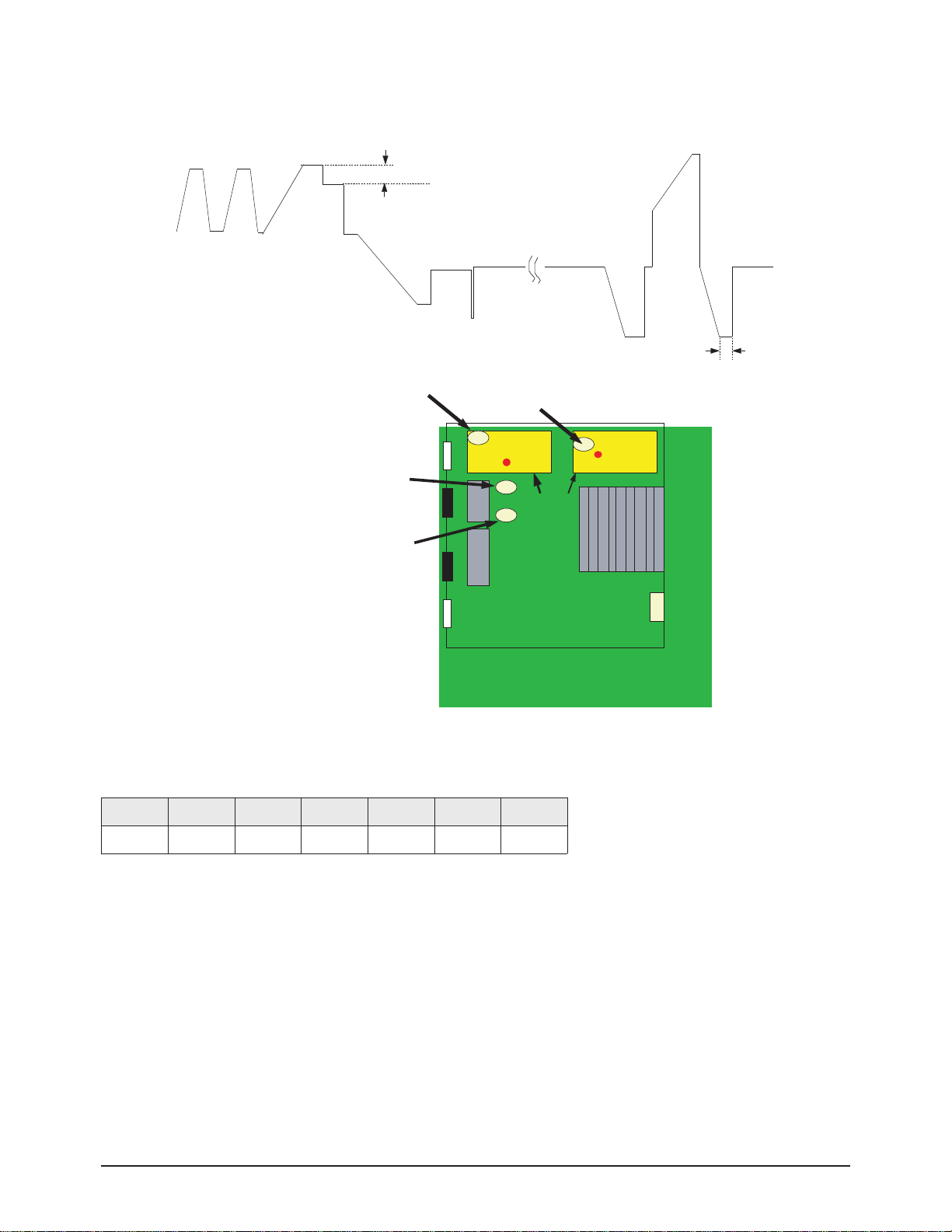
- Connect the Y Main and Y Buffer, and confirm that the output from TP(line4, line383) of the Y Buffer UP is the same as
#Attachment 1 when the power is supplied.
T P(line4)
T P(line383)
Page 42
Circuit Description
Samsung Electronics 13-21
▶ Adjust the drive waveform so that the last sustain (rising: 15V) and the main reset (falling: 30usec) are the same as those in the
figure.
※ The Vsc_h and Vnf voltages are controlled by the DC-DC power part of the Y Main board.
<Voltage Adjustment Specifications>
Vset Vs Vsc_l Vsc_h Ve Va Vnf
195V 210V -190V -70V 100V 70V -175
Last Sustain
Vnf:- 175V
Vnf variable resistor
Rising Ramp variable resistor
Falling Ramp variable resistor
20V
Vscl:- 190V
Vsc_h variable resistor
Vnf T P
DC-DC
Power
Main Reset
30uSEC
Vsc_h T P
<Y-Main>
Page 43
Circuit Description
13-22 Samsung Electronics
3) X
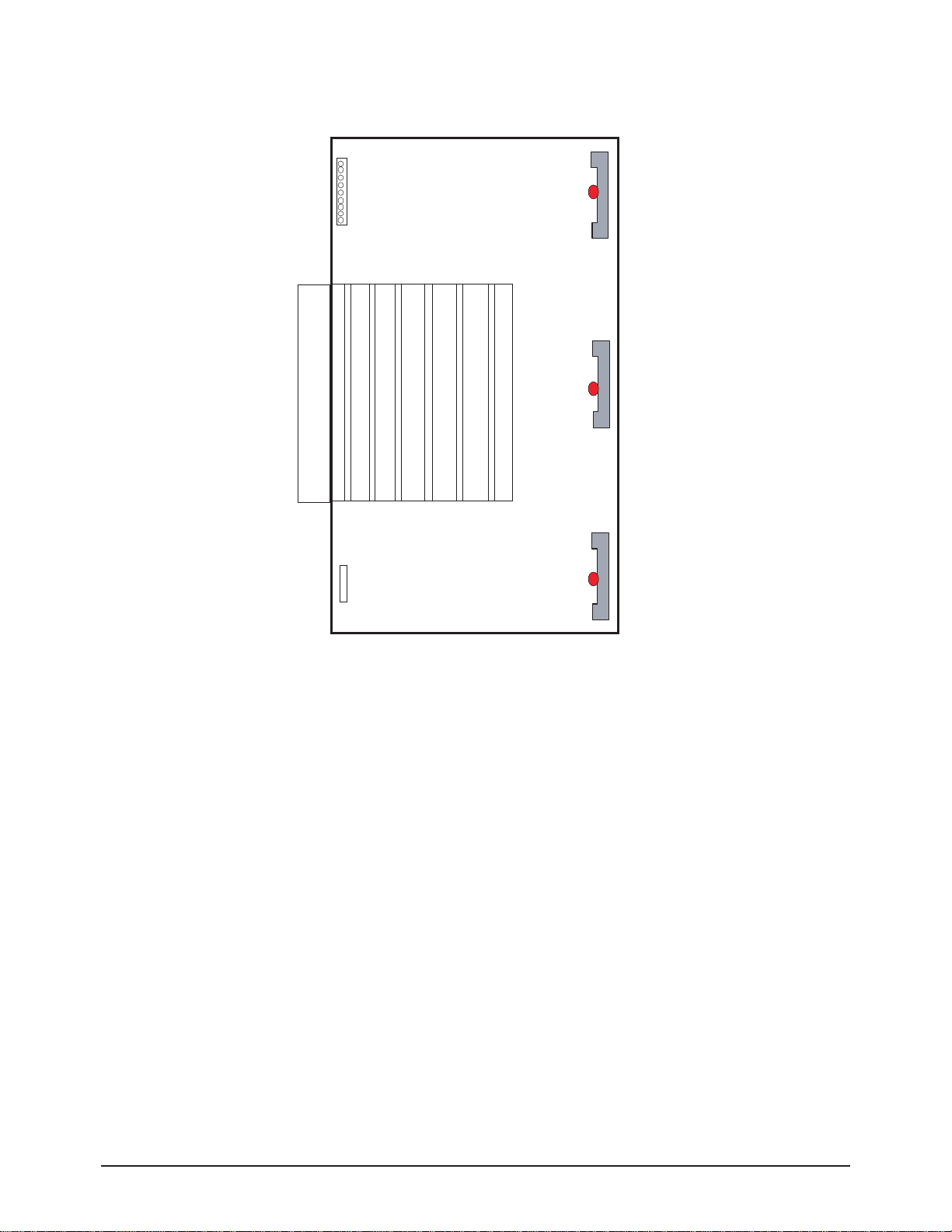
- Check that the output of X-Out of the X board follows the waveform of #Attachment 2 when the power is supplied.
CN4004
- Power
CN4003
- Signal
X- OUT
CN4000
- Panel
CN4002
- Panel
CN4001
- Panel
Page 44
Circuit Description
Samsung Electronics 13-23
※ Attachment 1
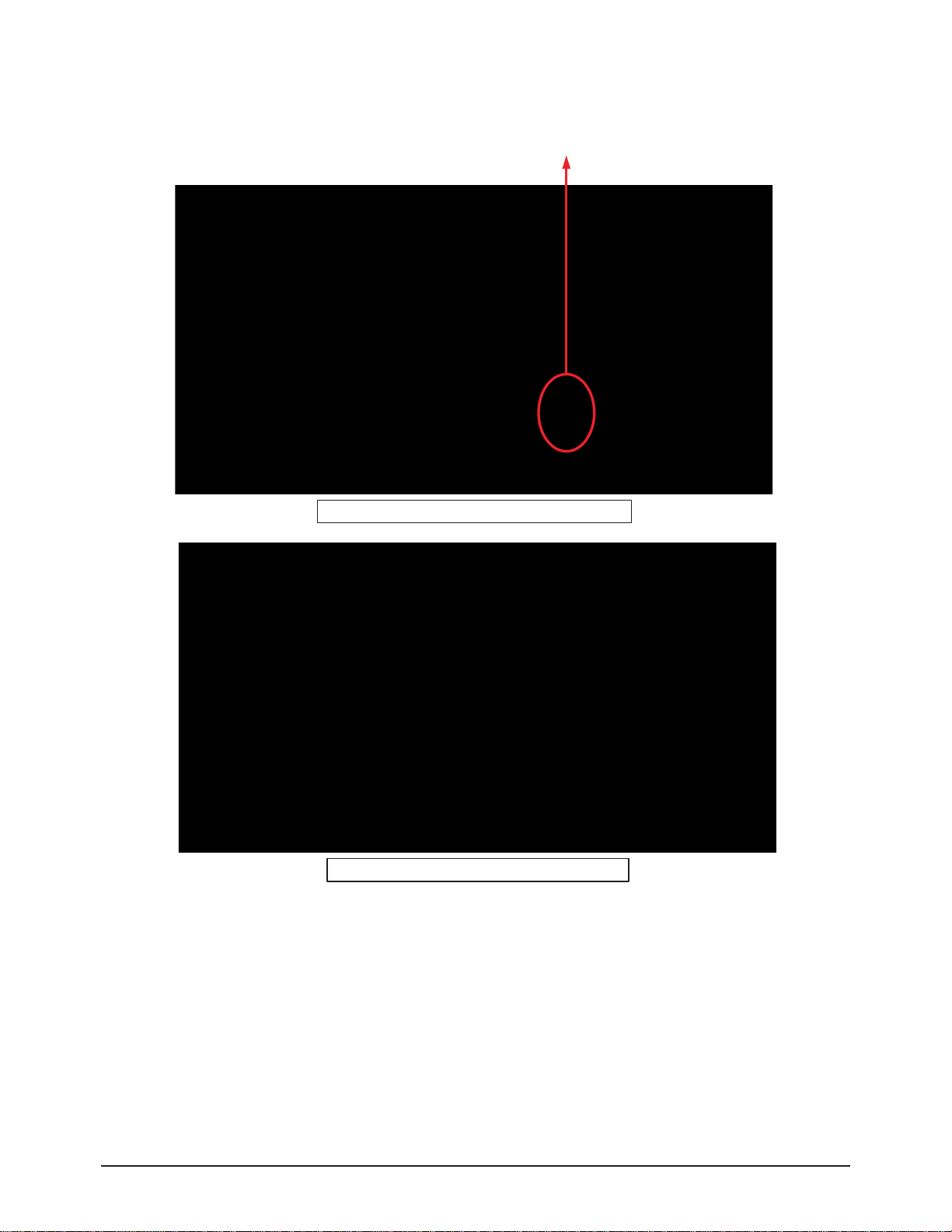
■ Y Output Waveform
The Scan Waveform Must Be Observed
Y Output Waveform (200us/div, 100V/div)
1us/div, 100V/div (Sustain Waveform)
Page 45

Circuit Description
13-24 Samsung Electronics
※ Attachment 2
■ X Output Waveform
X Output Waveform (200us/div, 100V/div)
2us/div, 100V/div (Sustain Waveform)
Page 46
Circuit Description
Samsung Electronics 13-25
Ambient Light Sensor
(TSL2550 Lux Calculation IC)
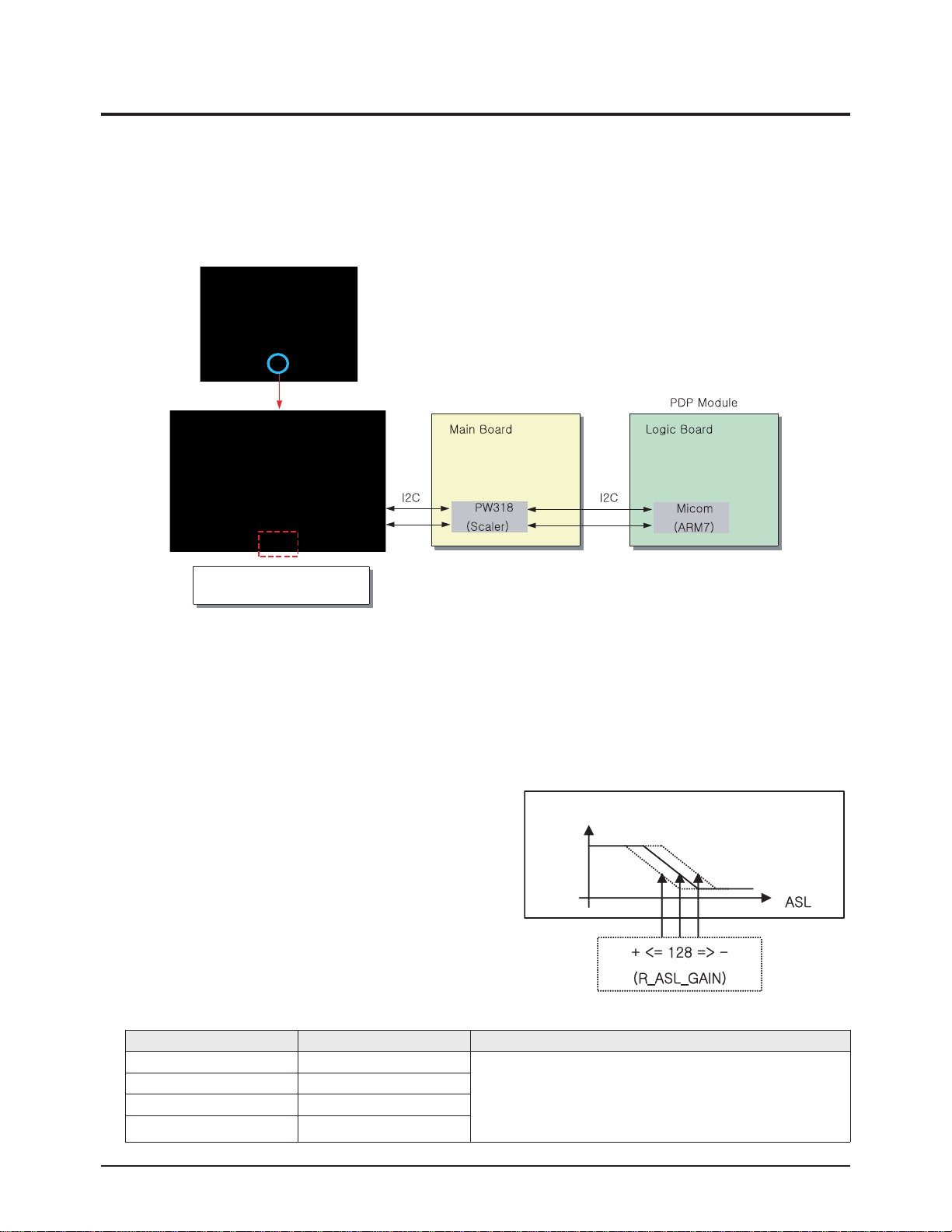
13-2-1 Power Saving Modes (Standard, Automatic, Super Power Saving)
1. Objective
To enhance a sensible visual quality by maintaining an appropriate screen brightness according to the ambient brightness and to
reduce power consumption.
2. Circuit Architecture
The CPU PW318 of the Video Board takes the current ambient brightness (in Lux units), stored in the Ambient Light Sensor of
Power Assy., which is attached at the front of the PDP, at given intervals through SMBUS communication (identical to I2C) and
controls the PDP module to operate with the appropriate illuminance. The I2C bus is used to communicate with the PDP module,
and the communication method is the same as the existing communication method.
3. Descriptions of Each Mode
1) Standard Mode
Standard Mode is set as standard visual quality.
2) Auto Power Saving Mode (Ambient Light Sensor)
This uses the TAOS 4 pin TSL2550 and is currently being used in
LCD TVs. It also uses SMBUS, which is the same type as I2C, for
communication. The Ambient Light Sensor can detect up to 1846
Lux in normal mode. The data of the sensor can be measured for
Lux operations once every 800ms.
Control is implemented by using R_ASL_GAIN. The number of
sustain pulses moves left or right as shown in the figure on the right.
For a low gradation condition, the change by R_ASL_GAIN has
been minimized considering the degradation of the visual quality.
That is, the Auto Power Saving mode screen controlled by the
ambient light sensor aims at normal video of medium gradation.
※ The following values are for a normal air signal with 80 Watt attenuation at maximum
Detected Lux R_ASL_GAIN (Address 0xE9) Remarks
0 ~ 8 250
- Read the Lux value once per second and change it the target
R_ASL_GAIN value by 5 per second according to the changed Lux
value.
- If more than 3 communication errors or saturation (count1>count0) is
detected, the default value is set (R_ASL_GAIN=128).
9 ~ 22 210
23 ~ 35 170
Else 128 (default)
13-2 New Circuit Description
Number of Sustain Pulses
Page 47
Circuit Description
13-26 Samsung Electronics
3) Super Power Saving Mode
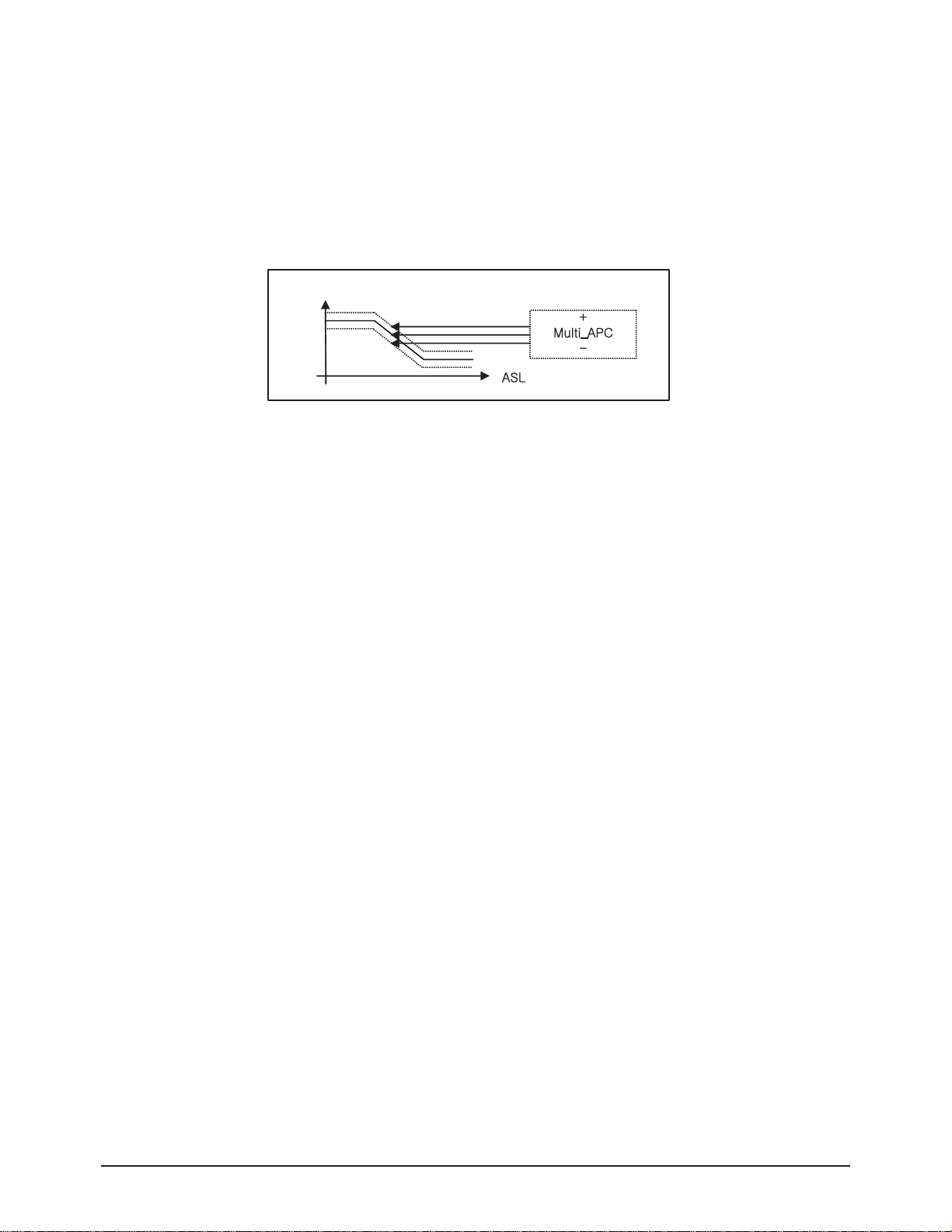
This uses the Multi APC function of the PDPmodule, and aims at reducing power consumption more than 100 W for the white
pattern, which is similar to the power consumption reduction of other manufacturers.
- Concept of Multi APC
: Controls the number of sustain pulses according to the ASL(Average Signal Level) by R_P_Lower_Gain value.
In the PDP Logic, R_Multi_APC is set to 0X01, Multi_APC operates, and R_P_CM_Gain_SW is set to 0X01 so that the
upper and lower limits of the APC Table can be shifted by adjusting the R_P_Lower_Gain value only.
Therefore, the sustain pulse is controllable for the white pattern, even though it was formerly not controllable.
※ Caution: The Super Power Saving Mode screen is darker than that of Standard Mode.
Number of Sustain Pulses
Page 48
Disassembly & Reassembly
Samsung Electronics 12-1
12. Disassembly & Reassembly
12-1 Overall Disassembly & Reassembly
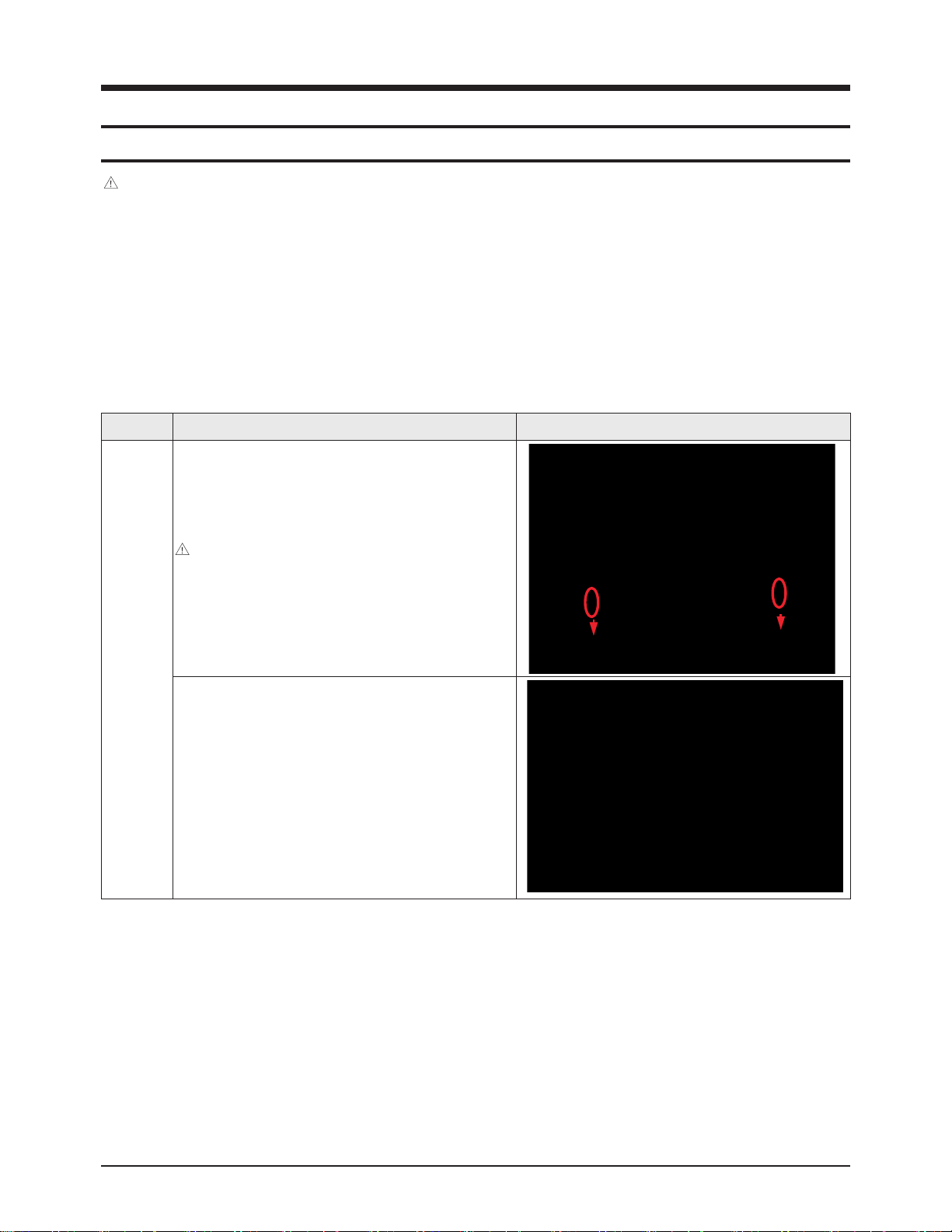
12-1-1 Separation of Stand
Caution
- Be sure to separate the power cord before disassembling the unit.
- Discharge the capacitors first when separating PCB's with high capacity capacitors such as SMPS, X Drive Board, Y Drive
Board,etc. (Sparks may be generated by an electric charge, and there is a danger of electronic shock.)
- Check that the cables are properly connected referring to the circuit diagram, when disassembling or assembling the unit and
take care not to damage the cables.
- Take care not to damage the Glass Filter at the front.
- Assemble the boards in the reverse order of the disassembly.
Part Name Description Description Photo
Stand
① Place the unit down and remove the 4 screws to
separate the stand.
: BH,+,S,M4,L35,ZPC(BLK)
Caution: Take care not to damage the front glass
when placing the unit down.
② Loosen and remove the screws and Stand remove.
Page 49
Disassembly & Reassembly
12-2 Samsung Electronics
12-1-2 Separation of Cable Holder
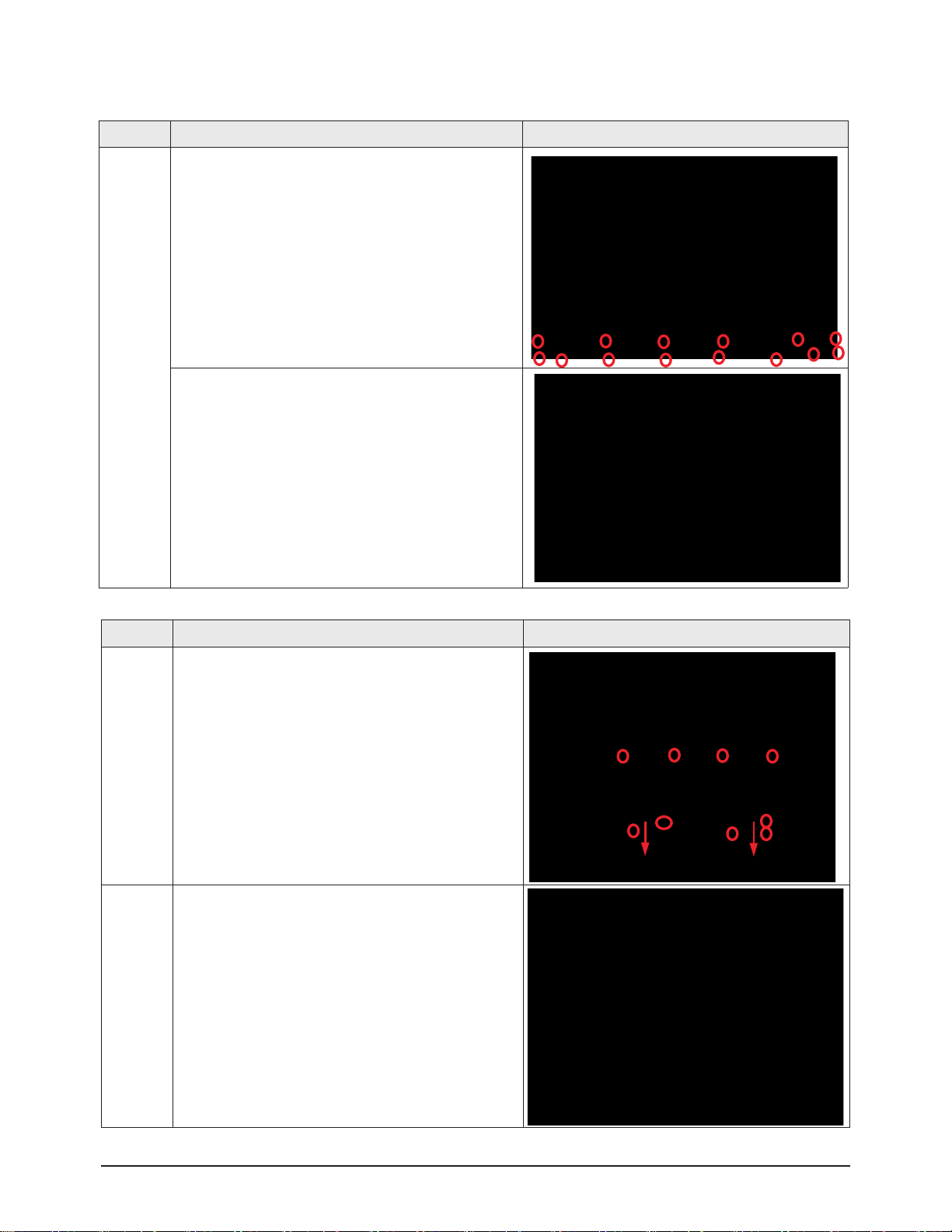
Part Name Description Description Photo
Cable
Holder
① Remove all marked screws
② Loosen and remove the screws and Cable Holder
remove.
12-1-3 Separation of Sub Cover Back
Part Name Description Description Photo
Sub Cover
Back
① Remove all marked screws
② Loosen and remove the screws and Sub cover
pull remove.
Page 50
Disassembly & Reassembly
Samsung Electronics 12-3
12-1-4 Separation of Video Board
Part Name Description Description Photo
Video
Board
① Separate the cables connected to the Main Board
remove
② Loosen and remove the 4 screws.
③ Separation of Power Button,Ambient Light
Sensor,IR Receiver PCB.
Page 51
Disassembly & Reassembly
12-4 Samsung Electronics
12-1-5 Separation of Back Cover
Part Name Description Description Photo
Back
Cover
① Remove all marked screws
② Take care not to damage the back cover when
removing it.
12-1-6 Separation of Function Key
Part Name Description Description Photo
Function Key
① Remove all marked screws
Page 52
Disassembly & Reassembly
Samsung Electronics 12-5
12-1-7 Separation of Video Board Sub Back
Part Name Description Description Photo
Video
Board Sub
Back
①Remove all marked screws
②Remove the Sub Back.
12-1-8 Separation of Power Inlet socket
Part Name Description Description Photo
Power Inlet
socket
① Loosen and remove the 2 screws.
Page 53
Disassembly & Reassembly
12-6 Samsung Electronics
Part Name Description Description Photo
Main
SMPS
① Separate the cables connected to the Main SMPS
and then remove the screws.
DC-DC
SMPS
② Separate the cables connected to the DC-DC SMPS
and then remove the screws.
12-1-9 Separation of Main SMPS, DC-DC SMPS
Page 54
Disassembly & Reassembly
Samsung Electronics 12-7
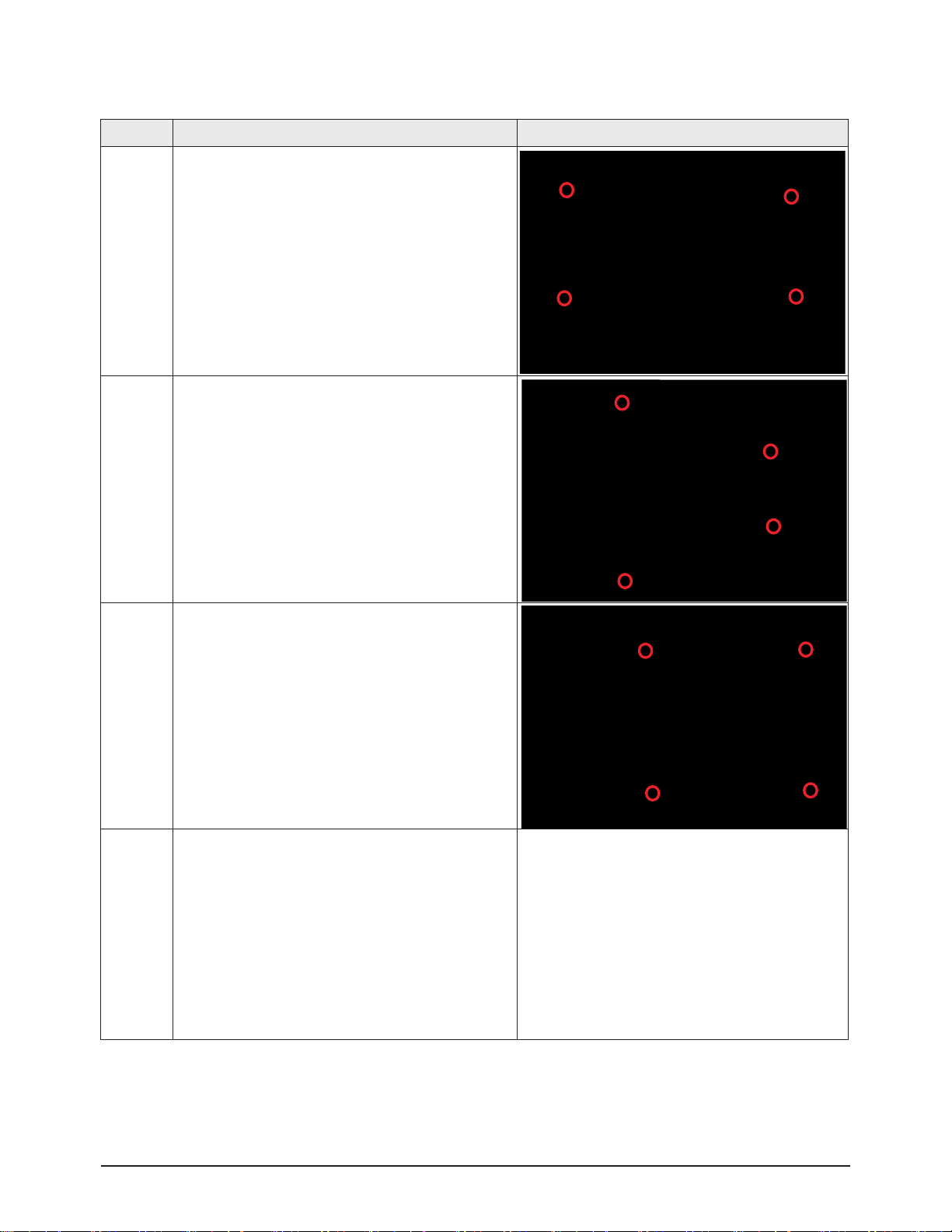
Part Name Description Description Photo
Logic
Board
① Separate the cables connected to the Logic Board and
then remove the screws.
X-Board
② Separate the cables connected to the X Drive Board
and remove the screws.
Y-Board
③Separate the cables connected to the Y Drive Board
and remove the screws.
Address
Buffer
Board
④Separate the Y Buffer Board and the Address Buffer
Board depending on the problem
12-1-11 Separation of Board
Page 55

12-8 Samsung Electronics
MEMO
Page 56
Electrical Part List
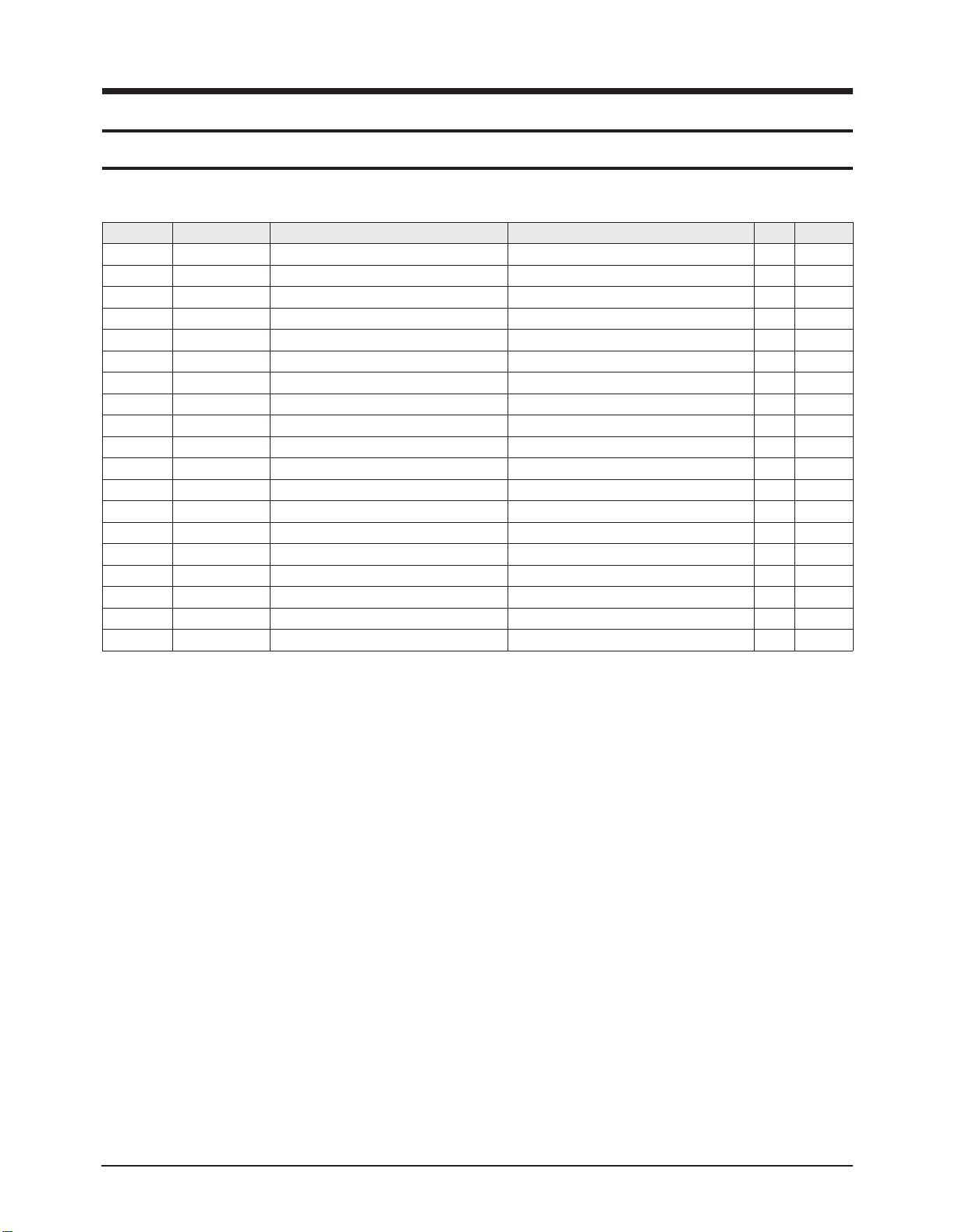
5. Electrical Part List
5-1 PS42D5SX/XEC Service Item
Yon can search for the updated part code through ITSELF web site.
URL:http://itself.sec.samsung.co.kr
Loc.No. Code No. Description Specification Q'ty SA/SNA
T0074 BN59-00471A REMOCON PS42D5S,TM79,17.5x4.5x2,SAMSUNG 1 S.A
T0054 BN64-00122A SCREEN-EMI,FILTER FILTER,42P3,984*584,T3 1 S.A
T0079 BN94-00682B ASSY PCB MISC-MAIN PS42D4S,D72A,EU,BN41- 1 S.A
M0013 BN96-01786C ASSY COVER P-REAR SP-R4232,SECC,BLM 5113 1 S.A
T0159 BN96-01856A ASSY PCB P-SMPS SPD-50P5HD(DC_DC),200Vin 1 S.A
T0159 BN96-01923A ASSY PCB P-SMPS PS-42S5S,100~240V 1 S.A
T0044 BN96-01887A ASSY PDP MODULE P M1,PS42S5S,D,V4,1002?¢ç?? 1 S.A
T0003 BN96-01911B ASSY COVER P-FRONT 42D5,XEC,ABS HB,STEAM 1 S.A
M0045 BN96-01912B ASSY STAND P-SET 42D5S,XEC,HIPS HB,SV012 1 S.A
T0175 BN96-01955A ASSY SPEAKER P 8ohm,D5,42,15W 1 S.A
T0073 BN96-02038A ASSY PDP P-X MAIN BOARD M1,PS42S5S,D,V4, 1 S.A
T0096 BN96-02039A ASSY PDP P-Y MAIN BOARD M1,PS42S5S,D,V4, 1 S.A
T0048 BN96-02040A ASSY PDP P-Y BUFF UPPER BOARD M1,PS42S5S 1 S.A
T0049 BN96-02041A ASSY PDP P-Y BUFF LOWER BOARD M1,PS42S5S 1 S.A
T0142 BN96-02042A ASSY PDP P-LOGIC BOARD M1,PS42S5S,D,V4,1 1 S.A
T0937 BN96-02043A ASSY PDP P-ADDRESS E BUFF BOAR M1,PS42S5 1 S.A
T0938 BN96-02044A ASSY PDP P-ADDRESS F BUFF BOAR M1,PS42S5 1 S.A
M0013 BN96-02128B ASSY COVER P-REAR BOTTOM SP-R4232,HIPS,G 1 S.A
M0018 BN97-00515A ASSY MICOM PS42S5S,D72A,49BV802A,T-PCN42 1 S.A
5-1Samsung Electronics
Page 57
Electrical Part List
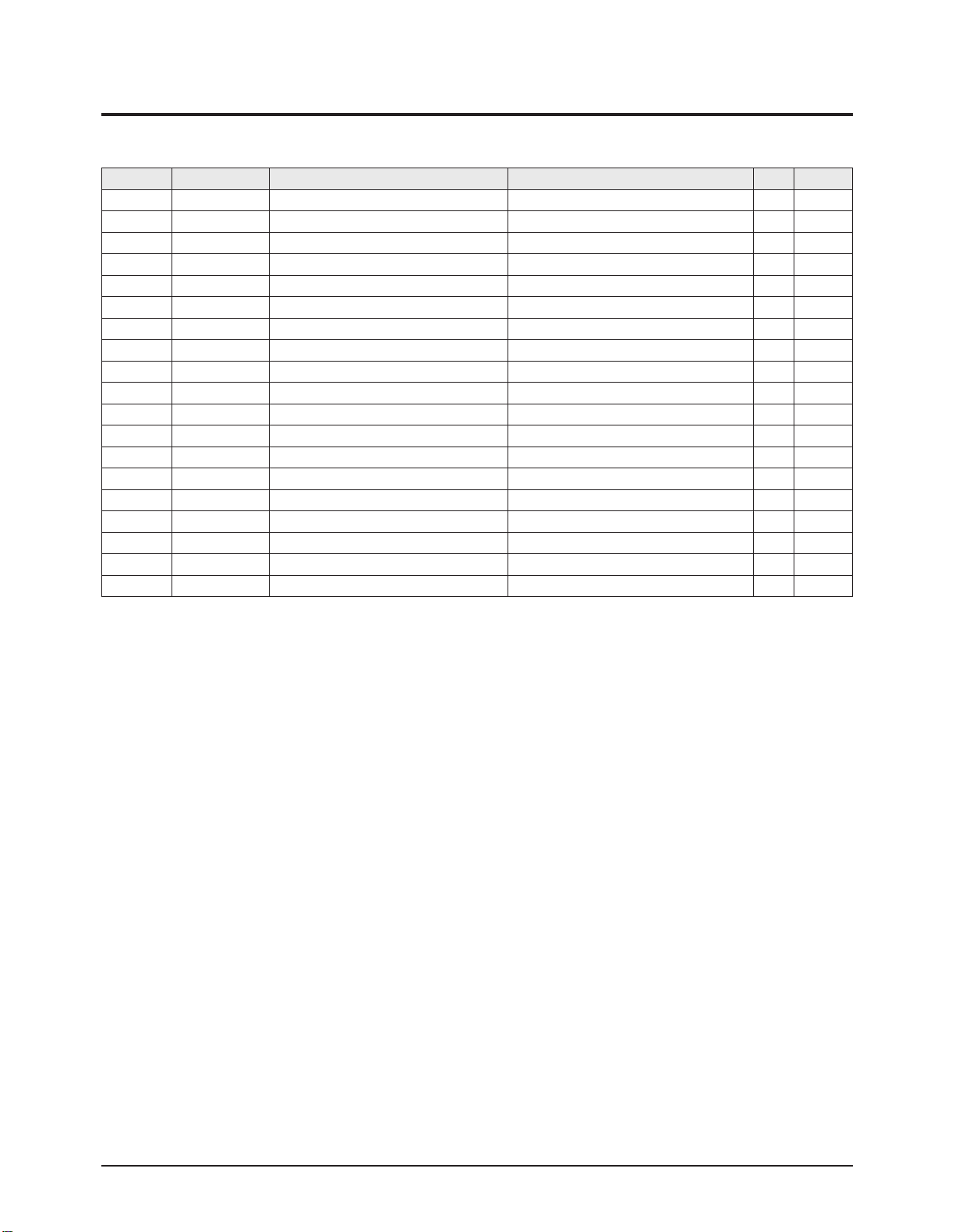
5-2 PS42D5SX/XSG Service Item
Yon can search for the updated part code through ITSELF web site.
URL:http://itself.sec.samsung.co.kr
Loc.No. Code No. Description Specification Q'ty SA/SNA
T0074 BN59-00471A REMOCON PS42D5S,TM79,17.5x4.5x2,SAMSUNG 1 S.A
T0054 BN64-00122A SCREEN-EMI,FILTER FILTER,42P3,984*584,T3 1 S.A
T0079 BN94-00687A ASSY PCB MISC-MAIN PS42D5S,ASIA,D72A,Puc 1 S.A
M0013 BN96-01786C ASSY COVER P-REAR SP-R4232,SECC,BLM 5113 1 S.A
T0159 BN96-01856A ASSY PCB P-SMPS SPD-50P5HD(DC_DC),200Vin 1 S.A
T0159 BN96-01923A ASSY PCB P-SMPS PS-42S5S,100~240V 1 S.A
T0044 BN96-01887A ASSY PDP MODULE P M1,PS42S5S,D,V4,1002?¢ç?? 1 S.A
T0003 BN96-01911C ASSY COVER P-FRONT 42D5,ASIA,M/EAST,ABS 1 S.A
M0045 BN96-01912B ASSY STAND P-SET 42D5S,XEC,HIPS HB,SV012 1 S.A
T0175 BN96-01955A ASSY SPEAKER P 8ohm,D5,42,15W 1 S.A
T0073 BN96-02038A ASSY PDP P-X MAIN BOARD M1,PS42S5S,D,V4, 1 S.A
T0096 BN96-02039A ASSY PDP P-Y MAIN BOARD M1,PS42S5S,D,V4, 1 S.A
T0048 BN96-02040A ASSY PDP P-Y BUFF UPPER BOARD M1,PS42S5S 1 S.A
T0049 BN96-02041A ASSY PDP P-Y BUFF LOWER BOARD M1,PS42S5S 1 S.A
T0142 BN96-02042A ASSY PDP P-LOGIC BOARD M1,PS42S5S,D,V4,1 1 S.A
T0937 BN96-02043A ASSY PDP P-ADDRESS E BUFF BOAR M1,PS42S5 1 S.A
T0938 BN96-02044A ASSY PDP P-ADDRESS F BUFF BOAR M1,PS42S5 1 S.A
M0013 BN96-02128B ASSY COVER P-REAR BOTTOM SP-R4232,HIPS,G 1 S.A
M0018 BN97-00555A ASSY MICOM PS42D5S,D72A,49BV802A,T_XXXX_ 1 S.A
Samsung Electronics5-2
Page 58
Electrical Part List
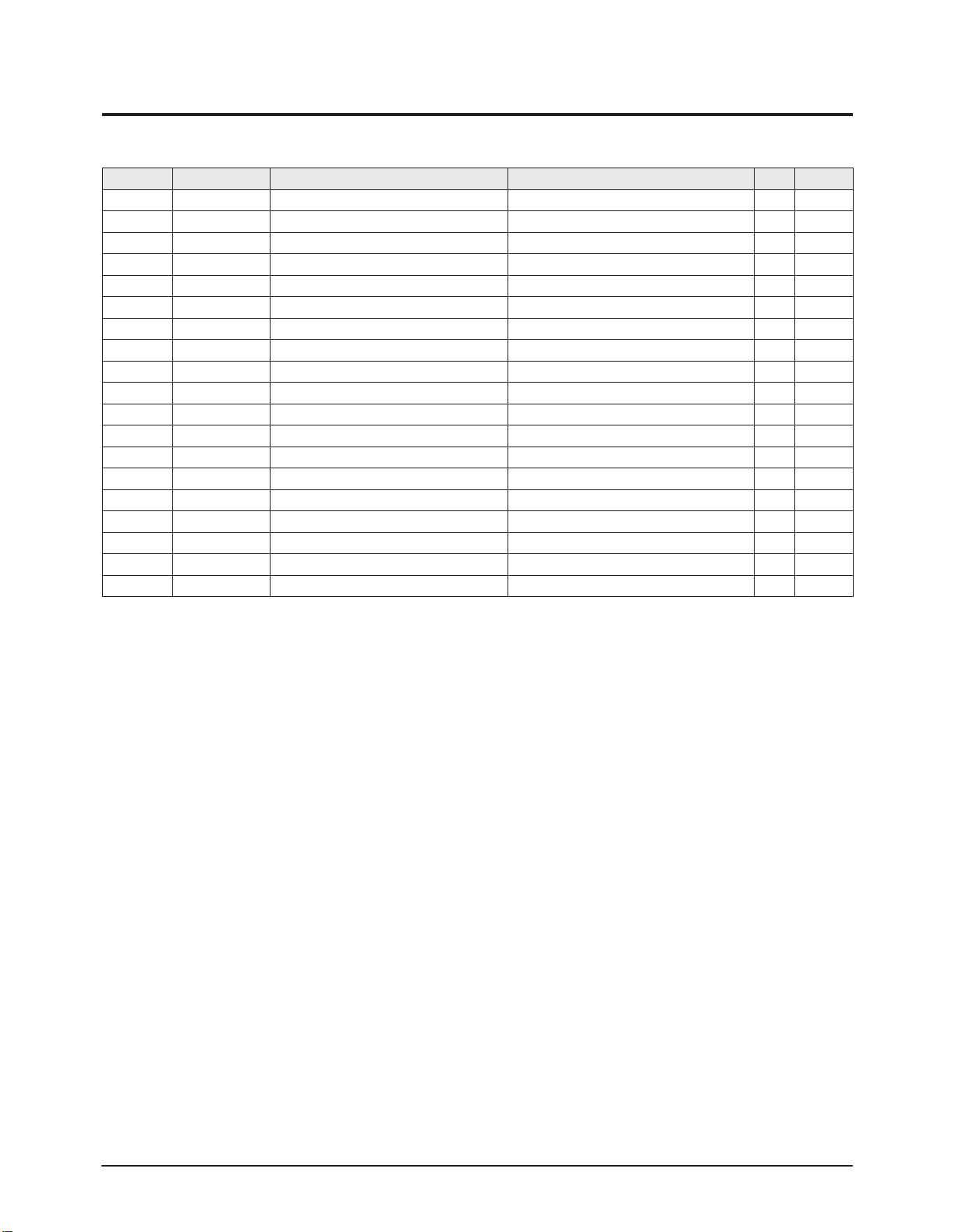
5-3 PS42D5SX/XTL Service Item
Yon can search for the updated part code through ITSELF web site.
URL:http://itself.sec.samsung.co.kr
Loc.No. Code No. Description Specification Q'ty SA/SNA
T0074 BN59-00471A REMOCON PS42D5S,TM79,17.5x4.5x2,SAMSUNG 1 S.A
T0054 BN64-00122A SCREEN-EMI,FILTER FILTER,42P3,984*584,T3 1 S.A
T0079 BN94-00687A ASSY PCB MISC-MAIN PS42D5S,ASIA,D72A,Puc 1 S.A
M0013 BN96-01786C ASSY COVER P-REAR SP-R4232,SECC,BLM 5113 1 S.A
T0159 BN96-01856A ASSY PCB P-SMPS SPD-50P5HD(DC_DC),200Vin 1 S.A
T0159 BN96-01923A ASSY PCB P-SMPS PS-42S5S,100~240V 1 S.A
T0044 BN96-01887A ASSY PDP MODULE P M1,PS42S5S,D,V4,1002¢®¢¯ 1 S.A
T0003 BN96-01911C ASSY COVER P-FRONT 42D5,ASIA,M/EAST,ABS 1 S.A
M0045 BN96-01912B ASSY STAND P-SET 42D5S,XEC,HIPS HB,SV012 1 S.A
T0175 BN96-01955A ASSY SPEAKER P 8ohm,D5,42,15W 1 S.A
T0073 BN96-02038A ASSY PDP P-X MAIN BOARD M1,PS42S5S,D,V4, 1 S.A
T0096 BN96-02039A ASSY PDP P-Y MAIN BOARD M1,PS42S5S,D,V4, 1 S.A
T0048 BN96-02040A ASSY PDP P-Y BUFF UPPER BOARD M1,PS42S5S 1 S.A
T0049 BN96-02041A ASSY PDP P-Y BUFF LOWER BOARD M1,PS42S5S 1 S.A
T0142 BN96-02042A ASSY PDP P-LOGIC BOARD M1,PS42S5S,D,V4,1 1 S.A
T0937 BN96-02043A ASSY PDP P-ADDRESS E BUFF BOAR M1,PS42S5 1 S.A
T0938 BN96-02044A ASSY PDP P-ADDRESS F BUFF BOAR M1,PS42S5 1 S.A
M0013 BN96-02128B ASSY COVER P-REAR BOTTOM SP-R4232,HIPS,G 1 S.A
M0018 BN97-00555A ASSY MICOM PS42D5S,D72A,49BV802A,T_XXXX_ 1 S.A
5-3Samsung Electronics
Page 59
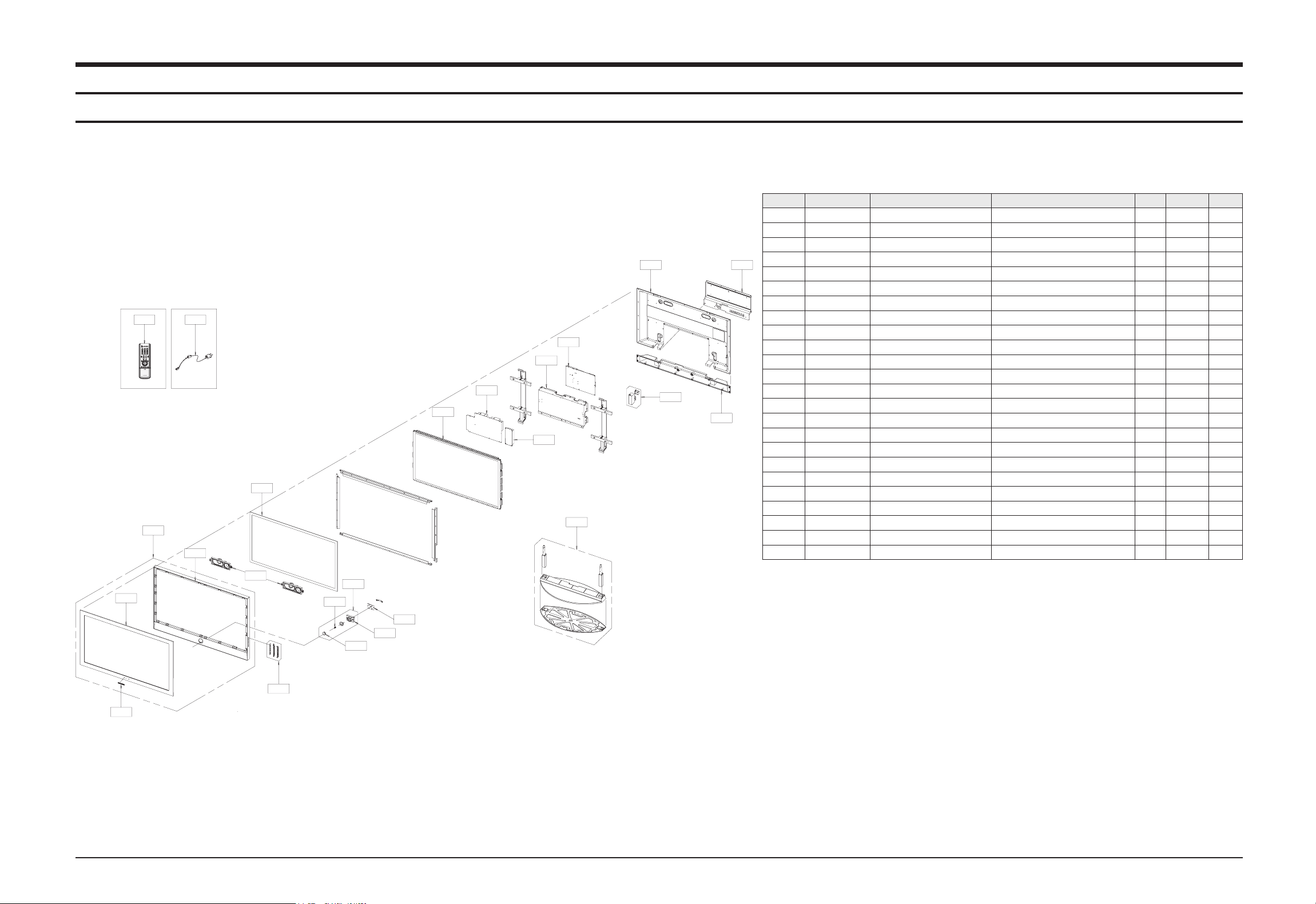
4. Exploded View & Part List
Exploded View & Part List
Samsung Electronics 4-1
Yon can search for the updated part code through ITSELF web site.
URL:http://itself.sec.samsung.co.kr
4-1 PS42D5SX/XEC
Loc.No. Code No. Description Specification Q'ty SA/SNA Remark
CIS7 AA61-60003B SPRING ETC-CS -,SUS304,-,-,OD11.2,N7,OD1 1 S.N.A
M0006 BN63-01634C COVER-REAR SUB 42S5,SECC,T1.0 1 S.N.A
M0006 BN63-01815A COVER-REAR BOTTOM 42D5,HIPS,T3.0,HB,GR50 1 S.N.A
M0013 BN96-01786C ASSY COVER P-REAR SP-R4232,SECC,BLM 5113 1 S.A
M0045 BN96-01912B ASSY STAND P-SET 42D5S,XEC,HIPS HB,SV012 1 S.A
M0112 BN63-01822A COVER-FRONT 42D5,SF0507,T3.5,HB,BK23,STE 1 S.N.A
M0145 BN96-02049A ASSY BOARD P-FUNCTION SCHUBERT,CT5000-32 1 S.A
M0146 BN96-02050B ASSY BOARD P-POWER & IR SCHUBERT,CT5000- 1 S.N.A
T0003 BN96-01911B ASSY COVER P-FRONT 42D5,XEC,ABS HB,STEAM 1 S.A
T0023 BN96-01788A ASSY COVER P-KNOB POWER 1 S.N.A
T0023 BN64-00336A KNOB POWER 42P5,PC,VIOLET 1 S.N.A
T0044 BN96-01887A ASSY PDP MODULE P M1,PS42S5S,D,V4,1002¢®¢¯ 1 S.A
T0054 BN64-00122A SCREEN-EMI,FILTER FILTER,42P3,984*584,T3 1 S.A
T0057 BP64-00177A BADGE-BRAND ALL,AL,T1.5,70,11.3,BLK,SILI 1 S.N.A
T0069 BN63-01814B COVER-MIDDLE 42D5,HIPS,T3.5,HB,XEC,GRAY, 1 S.N.A
T0074 BN59-00471A REMOCON PS42D5S,TM79,17.5x4.5x2,SAMSUNG 1 S.A
T0079 BN94-00682B ASSY PCB MISC-MAIN PS42D4S,D72A,EU,BN41- 1 S.A
T0159 BN96-01856A ASSY PCB P-SMPS SPD-50P5HD(DC_DC),200Vin 1 S.A
T0159 BN96-01923A ASSY PCB P-SMPS PS-42S5S,100~240V 1 S.A
T0175 BN96-01955A ASSY SPEAKER P 8ohm,D5,42,15W 1 S.A
T0268 3903-000145 CBF-POWER CORD DT,EU,FP3/YES,U(IEC C13-R 1 S.A
T0275 BN96-02369A ASSY MISC P-INLET HP-R4252,STRAUSS,DOCUM 1 S.A
T0555 BN96-01392C ASSY MISC P-BRKT TERMINAL 42D5,XEC,SECC 1 S.N.A
T0603 BN64-00338A WINDOW-RMC 42P5,ACRYL,5% 1 S.N.A
T0074
T0003
T0268
T0054
T0069
T0044
T0159
M0006
T0159
T0079
M0045
M0013
T0275
M0006
T0555
T0175
M0112
M0145
T0057
T0023
CIS7
M0146
T0603
T0023
Page 60
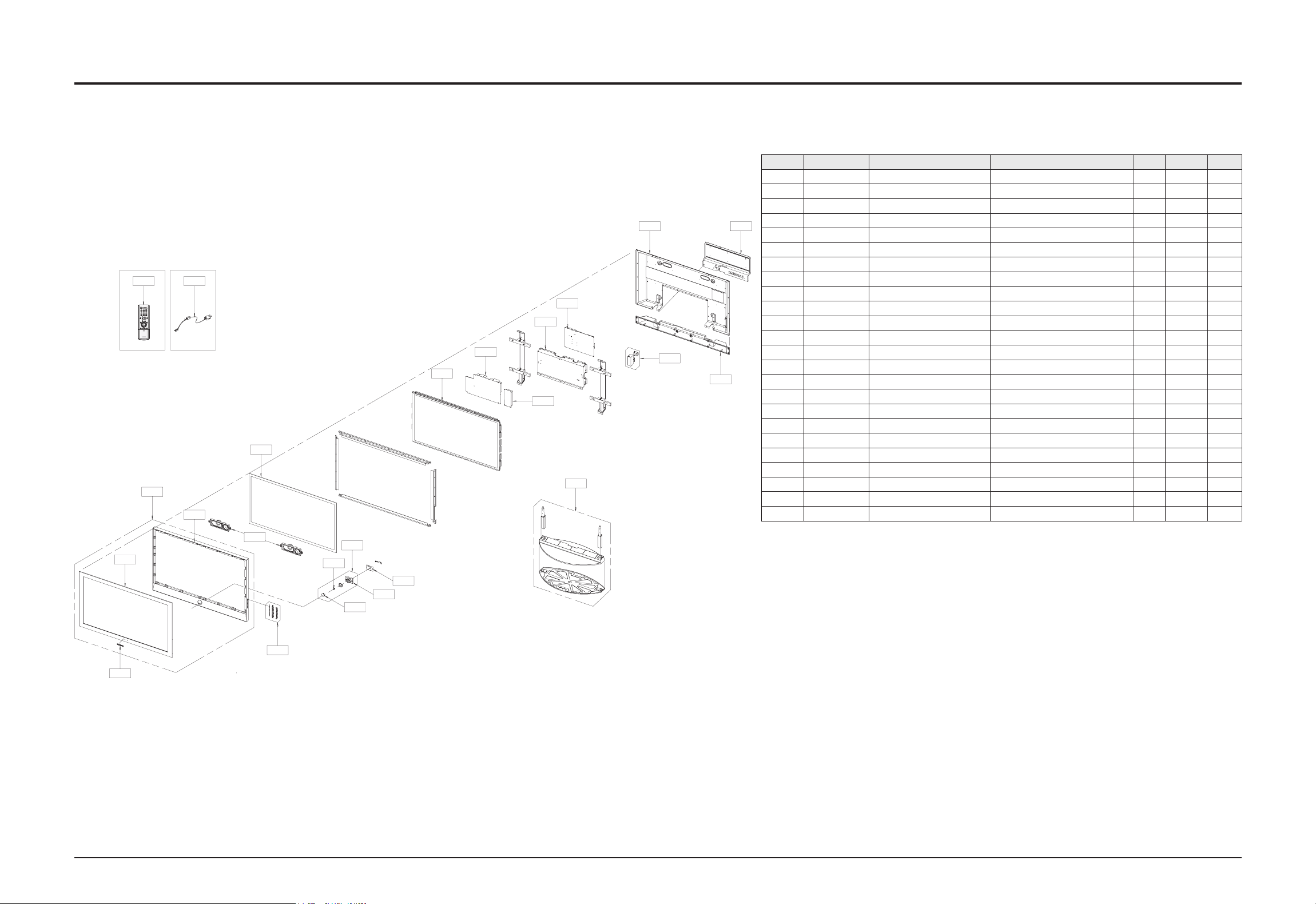
Exploded View & Part List
4-2 Samsung Electronics
Yon can search for the updated part code through ITSELF web site.
URL:http://itself.sec.samsung.co.kr
4-2 PS42D5SX/XSG
Loc.No. Code No. Description Specification Q'ty SA/SNA Remark
CIS7 AA61-60003B SPRING ETC-CS -,SUS304,-,-,OD11.2,N7,OD1 1 S.N.A
M0006 BN63-01815A COVER-REAR BOTTOM 42D5,HIPS,T3.0,HB,GR50 1 S.N.A
M0006 BN63-01634C COVER-REAR SUB 42S5,SECC,T1.0 1 S.N.A
M0013 BN96-01786C ASSY COVER P-REAR SP-R4232,SECC,BLM 5113 1 S.A
M0045 BN96-01912B ASSY STAND P-SET 42D5S,XEC,HIPS HB,SV012 1 S.A
M0112 BN63-01822A COVER-FRONT 42D5,SF0507,T3.5,HB,BK23,STE 1 S.N.A
M0145 BN96-02049A ASSY BOARD P-FUNCTION SCHUBERT,CT5000-32 1 S.A
M0146 BN96-02050B ASSY BOARD P-POWER & IR SCHUBERT,CT5000- 1 S.N.A
T0003 BN96-01911C ASSY COVER P-FRONT 42D5,ASIA,M/EAST,ABS 1 S.A
T0023 BN96-01788A ASSY COVER P-KNOB POWER 1 S.N.A
T0023 BN64-00336A KNOB POWER 42P5,PC,VIOLET 1 S.N.A
T0044 BN96-01887A ASSY PDP MODULE P M1,PS42S5S,D,V4,1002¢®¢¯ 1 S.A
T0054 BN64-00122A SCREEN-EMI,FILTER FILTER,42P3,984*584,T3 1 S.A
T0057 BP64-00177A BADGE-BRAND ALL,AL,T1.5,70,11.3,BLK,SILI 1 S.N.A
T0069 BN63-01814C COVER-MIDDLE 42D5,HIPS,T3.5,HB,ASIA,M/EA 1 S.N.A
T0074 BN59-00471A REMOCON PS42D5S,TM79,17.5x4.5x2,SAMSUNG 1 S.A
T0079 BN94-00687A ASSY PCB MISC-MAIN PS42D5S,ASIA,D72A,Puc 1 S.A
T0159 BN96-01856A ASSY PCB P-SMPS SPD-50P5HD(DC_DC),200Vin 1 S.A
T0159 BN96-01923A ASSY PCB P-SMPS PS-42S5S,100~240V 1 S.A
T0175 BN96-01955A ASSY SPEAKER P 8ohm,D5,42,15W 1 S.A
T0268 3903-000145 CBF-POWER CORD DT,EU,FP3/YES,U(IEC C13-R 1 S.A
T0275 BN96-02369A ASSY MISC P-INLET HP-R4252,STRAUSS,DOCUM 1 S.A
T0555 BN96-01392E ASSY MISC P-BRKT TERMINAL 42D5,ASIA,M/EA 1 S.N.A
T0603 BN64-00338A WINDOW-RMC 42P5,ACRYL,5% 1 S.N.A
T0074
T0003
T0268
T0054
T0069
T0044
T0159
M0006
T0159
T0079
M0045
M0013
T0275
M0006
T0555
M0112
T0057
T0175
T0023
CIS7
M0146
T0603
T0023
M0145
Page 61
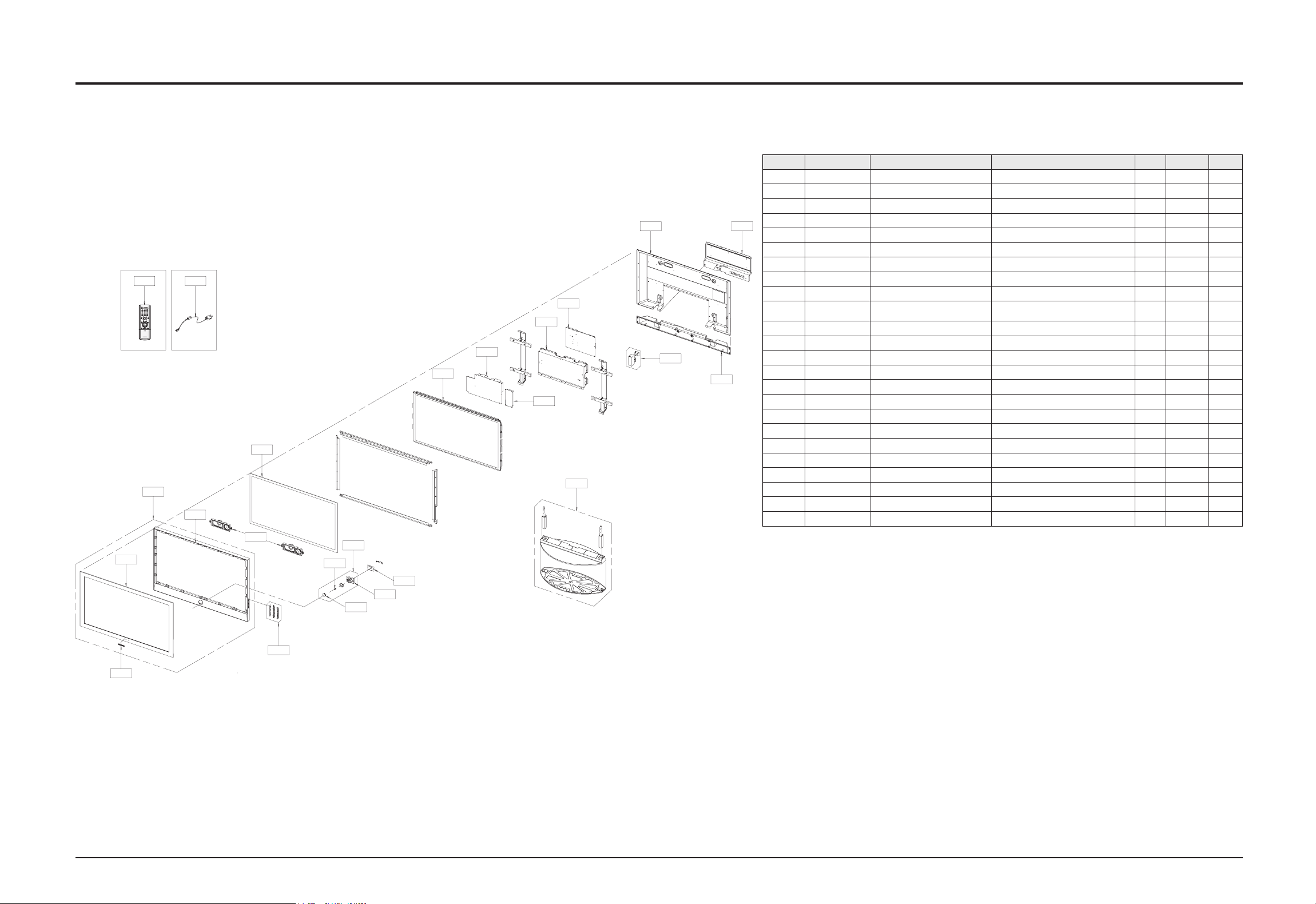
Exploded View & Part List
Samsung Electronics 4-3
Yon can search for the updated part code through ITSELF web site.
URL:http://itself.sec.samsung.co.kr
4-3 PS42D5SX/XTL
Loc.No. Code No. Description Specification Q'ty SA/SNA Remark
CIS7 AA61-60003B SPRING ETC-CS -,SUS304,-,-,OD11.2,N7,OD1 1 S.N.A
M0006 BN63-01815A COVER-REAR BOTTOM 42D5,HIPS,T3.0,HB,GR50 1 S.N.A
M0006 BN63-01634C COVER-REAR SUB 42S5,SECC,T1.0 1 S.N.A
M0013 BN96-01786C ASSY COVER P-REAR SP-R4232,SECC,BLM 5113 1 S.A
M0045 BN96-01912B ASSY STAND P-SET 42D5S,XEC,HIPS HB,SV012 1 S.A
M0112 BN63-01822A COVER-FRONT 42D5,SF0507,T3.5,HB,BK23,STE 1 S.N.A
M0145 BN96-02049A ASSY BOARD P-FUNCTION SCHUBERT,CT5000-32 1 S.A
M0146 BN96-02050B ASSY BOARD P-POWER & IR SCHUBERT,CT5000- 1 S.N.A
T0003 BN96-01911C ASSY COVER P-FRONT 42D5,ASIA,M/EAST,ABS 1 S.A
T0023 BN96-01788A ASSY COVER P-KNOB POWER SPD-42P5HD 1 S.N.A
T0023 BN64-00336A KNOB POWER 42P5,PC,VIOLET 1 S.N.A
T0044 BN96-01887A ASSY PDP MODULE P M1,PS42S5S,D,V4,1002¡¿ 1 S.A
T0054 BN64-00122A SCREEN-EMI,FILTER FILTER,42P3,984*584,T3 1 S.A
T0057 BP64-00177A BADGE-BRAND ALL,AL,T1.5,70,11.3,BLK,SILI 1 S.N.A
T0069 BN63-01814C COVER-MIDDLE 42D5,HIPS,T3.5,HB,ASIA,M/EA 1 S.N.A
T0074 BN59-00471A REMOCON PS42D5S,TM79,17.5x4.5x2,SAMSUNG 1 S.A
T0079 BN94-00687A ASSY PCB MISC-MAIN PS42D5S,ASIA,D72A,Puc 1 S.A
T0159 BN96-01856A ASSY PCB P-SMPS SPD-50P5HD(DC_DC),200Vin 1 S.A
T0159 BN96-01923A ASSY PCB P-SMPS PS-42S5S,100~240V 1 S.A
T0175 BN96-01955A ASSY SPEAKER P 8ohm,D5,42,15W 1 S.A
T0268 3903-000217 CBF-POWER CORD DT,IN,DP3/Y(A),U(IEC C13- 1 S.N.A
T0275 BN96-02369A ASSY MISC P-INLET HP-R4252,STRAUSS,DOCUM 1 S.A
T0555 BN96-01392E ASSY MISC P-BRKT TERMINAL 42D5,ASIA,M/EA 1 S.N.A
T0603 BN64-00338A WINDOW-RMC 42P5,ACRYL,5% 1 S.N.A
T0074
T0003
M0112
T0268
T0069
T0054
T0175
T0023
CIS7
T0023
T0603
M0146
T0044
T0159
M0006
T0159
T0079
M0045
M0013
T0275
M0006
T0555
M0145
T0057
Page 62
Operation Instruction & Installation
Samsung Electronics 11-1
11. Operation Instruction & Installation
11-1 Product Features and Functions
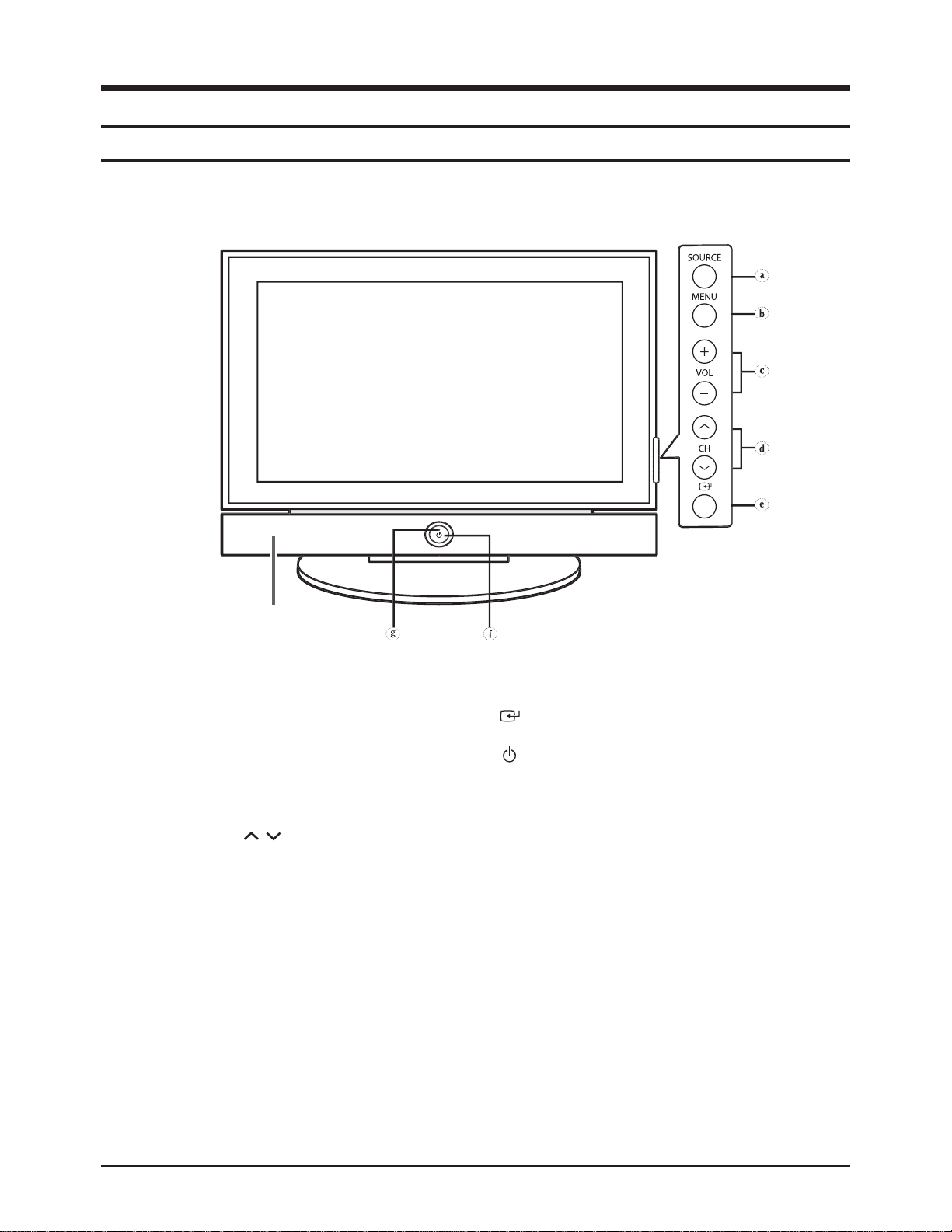
11-1-1 Front Panel
Speaker
a) SOURCE button
Select the external input source.
b) MENU button
Display the on-screen menu.
c) VOL + ,-buttons
Adjust the volume.
d) CH , buttons
Select channels.
e)
(
ENTER) button
Confirm your choice (Store or Enter).
f)
(
POWER) button
Press to turn the TV on and off.
Power Indicator
- Power Off: Blue
- Power On: Off
g) Remote Control Sensor
Aim the remote control towards this spot on the TV.
Page 63
Operation Instruction & Installation
11-2 Samsung Electronics
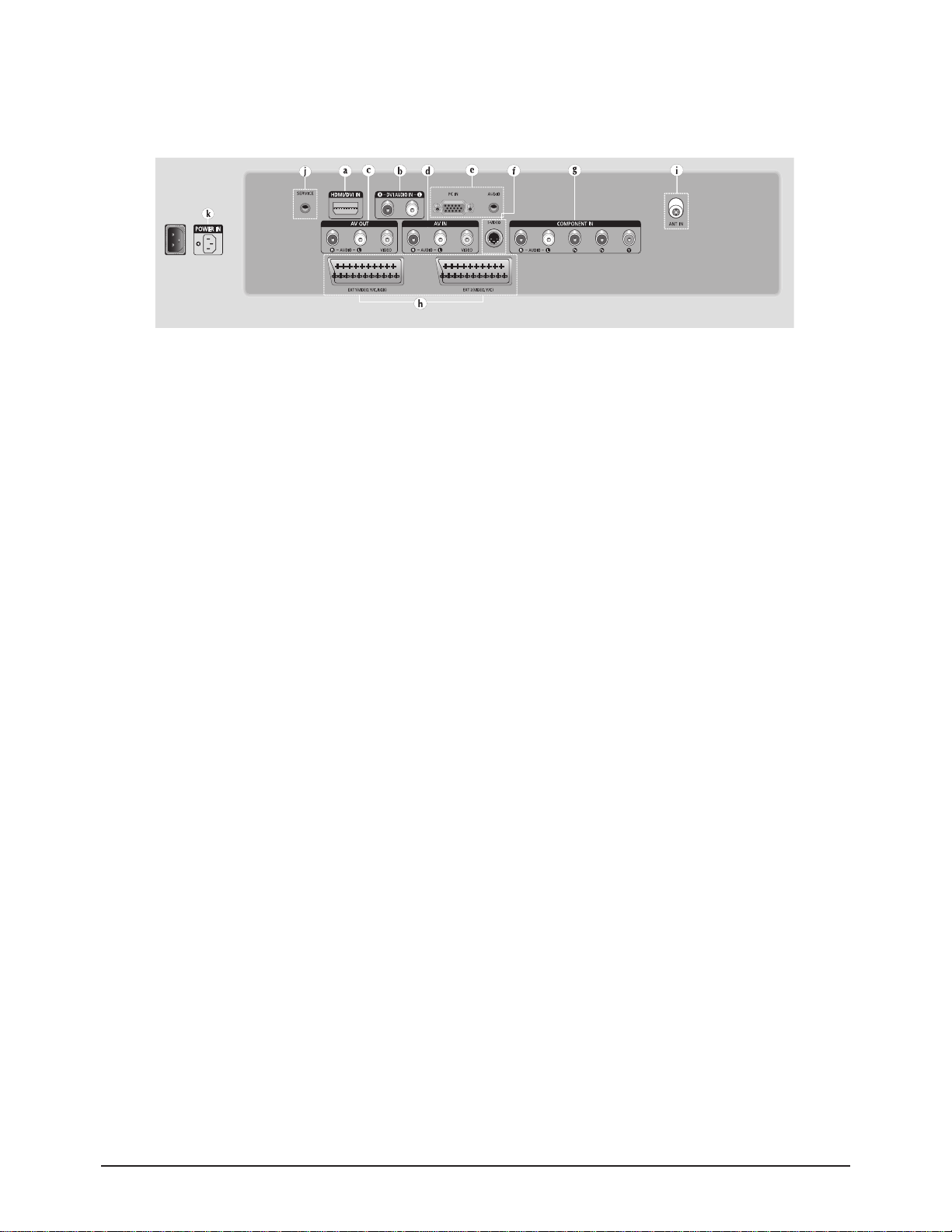
11-1-2 Rear Panel
a) HDMI/DVI IN
Connect to the HDMI jack of a device with
HDMI output. These inputs can also be used
as a DVI connection with separate analog
audio inputs. An optional HDMI/DVI cable
will be necessary to make this connection.
When using the optional HDMI/DVI adapter,
the DVI analog audio inputs on your TV allow
you to receive left and right audio from your
DVI device. (Not compatible with PC)
b) DVI AUDIO IN L/R
DVI audio outputs for external devices.
c) AV OUT (VIDEO / AUDIO L/R)
Outputs for external devices.
d) AV IN (VIDEO / AUDIO L/R)
Video and audio inputs for external devices, such
as a camcorder or VCR.
e) PC IN / AUDIO
Connect to the video and audio output jack on
your PC.
f) S-VIDEO
Video input for external devices with an S-Video
output, such as a camcorder or VCR.
g) COMPONENT IN
Video ( Y/P B/P R) and audio ( AUDIO L/R ) inputs for
Component.
h) EXT 1, EXT 2
Inputs or outputs for external devices, such as
VCR, DVD, video game device or video disc
players.
i) ANT IN (75 Ω)
75 Ω Coaxial connector for Aerial/Cable Network.
j) SERVICE
Connector for service only.
k) POWER IN
Connect the supplied power cord.
Page 64
Operation Instruction & Installation
Samsung Electronics 11-3
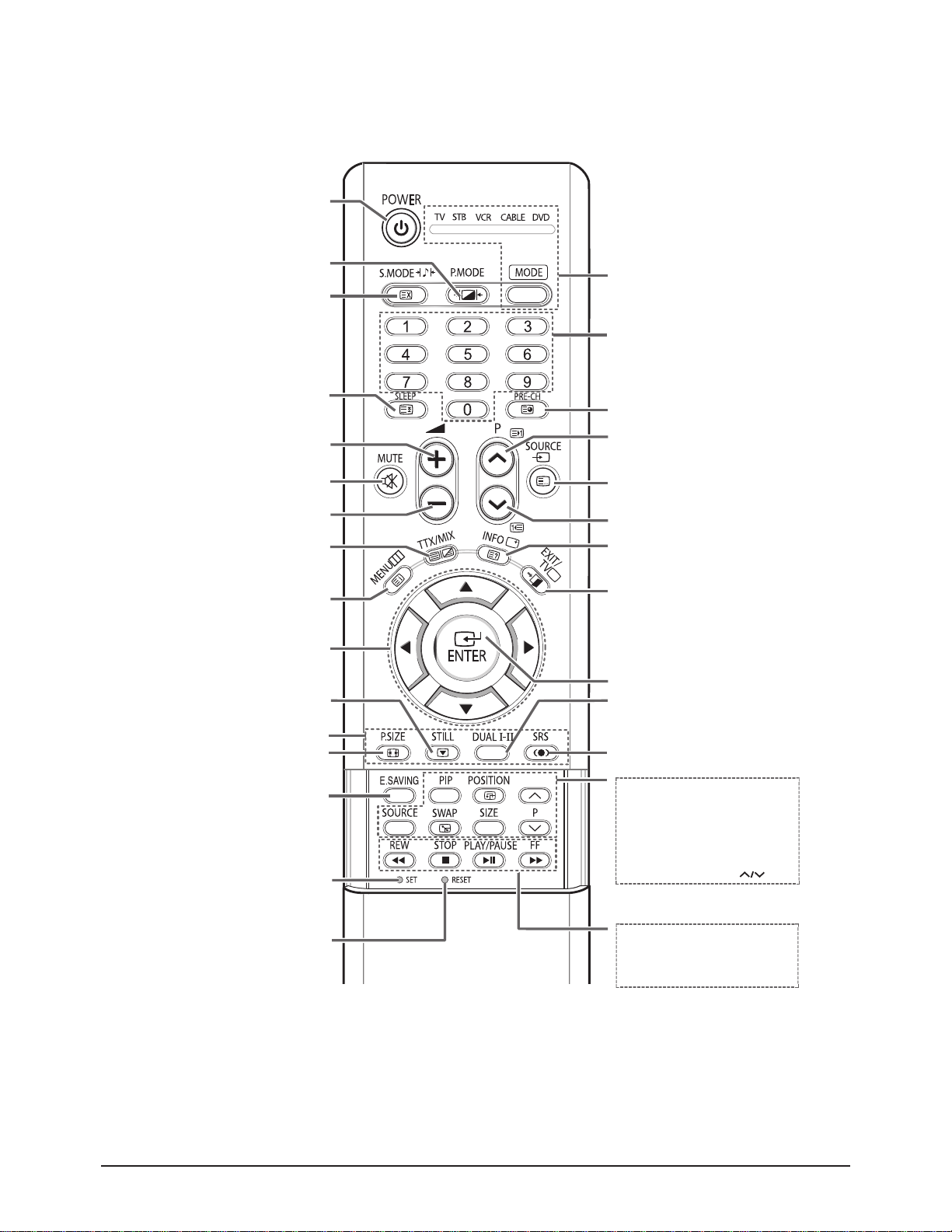
11-1-3 Remote Control
TURNS THE TV ON AND OFF
PICTURE EFFECT SELECTION
SOUND EFFECT SELECTION/
TELETEXT CANCEL
AUTOMATIC SWITCH-OFF/
TELETEXT PAGE HOLD
VOLUME INCREASE
TEMPORARY SOUND SWITCH-OFF
VOLUME DECREASE
MIX BOTH TELETEXT INFORMATION
AND THE NORMAL BROADCAST
TELETEXT DISPLAY/
MENU DISPLAY/
TELETEXT INDEX
MOVE TO THE REQUIRED
ADJUST AN OPTION VALUE
MENU OPTION/
RESPECTIVELY
PICTURE STILL
MAKE THE REMOTE CONTROL WORK
FOR TV, STB, VCR, CABLE, OR DVD
DIRECT CHANNEL SELECTION
SWITCH REPEATEDLY BETWEEN THE
LAST TWO CHANNELS DISPLAYED/
TELETEXT SUB-PAGE
NEXT CHANNEL/
TELETEXT NEXT PAGE
EXTERNAL INPUT SELECTION/
TELETEXT MODE SELECTION
LIST/FASTEXT (UK)
PREVIOUS CHANNEL/
TELETEXT PREVIOUS PAGE
INFORMATION DISPLAY/
TELETEXT REVEAL
TV MODE SELECTION/
EXIT TELETEXT
(DEPENDING ON THE MODEL)
CONFIRM YOUR CHOICE
(STORE OR ENTER)
SOUND MODE SELECTION
FASTEXT TOPIC SELECTION
PICTURE SIZE
ADJUST SCREEN BRIGHTNESS
IF YOUR REMOTE CONTROL IS NOT
FUNCTIONING PROPERLY, TAKE
OUT THE BATTERIES AND PRESS
THE RESET BUTTON FOR ABOUT
2~3 SECONDS. RE-INSERT THE
BATTERIES AND TRY USING THE
TO SURROUNDING
ENVIRONMENT
REMOTE CONTROL SETUP
REMOTE CONTROL AGAIN.
TruSurround XT
MODE SELECTION
PIP FUNCTIONS:
- PIP ACTIVATION OR DEACTIVATION
(PIP)
- SWAPPING THE MAIN AND THE SUB
PICTURE (SWAP)
- LOCATION SELECTION (POSITION)
- SOURCE SELECTION (SOURCE)
- SIZE SELECTION (SIZE)
- CHANNEL SELECTION (P )
VCR/DVD FUNCTIONS:
- REWIND (REW)
- STOP
- PLAY/PAUSE
- FAST FORWARD (FF)
Page 65
Operation Instruction & Installation
11-4 Samsung Electronics
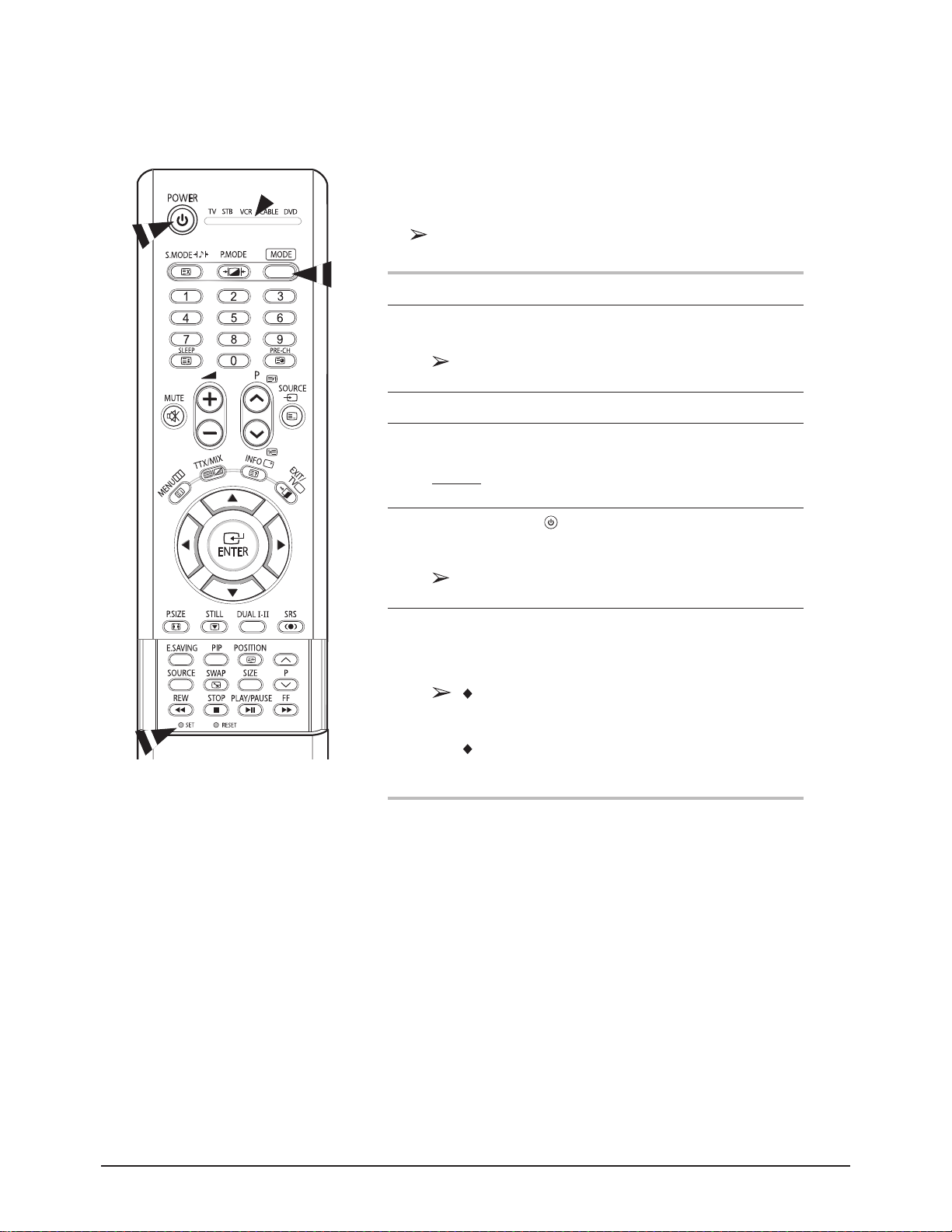
■ Programming the Remote Control for Other Component
Your TV comes equipped with a universal remote control. In
addition to controlling the TV, the universal remote control can
also operate a VCR, Cable box, DVD, and Set-Top Box (even if your
VCR, Cable box and DVD are made by manufacturers other than
Samsung).
The remote control might not be compatible with all
VCRs, DVD players, Cable boxes, and Set-Top Boxs.
1 Turn off your VCR (Cable box or DVD).
2 Press the MODE button to switch the remote control to the VCR
(CATV or DVD) mode.
The remote control has five modes : TV, STB, VCR,
CABLE and DVD.
3 Press the SET button.
4 Enter 3 digits of the VCR (Cable box or DVD) code listed on the
next page for your VCR (Cable box or DVD).
Example: To enter code “6”, press 0, 0, and 6.
To enter code “76”, press 0, 7, and 6.
5 Press the POWER ( ) button. Your VCR (Cable box or DVD)
should turn on. If it turns on, your remote control is now set
correctly.
If it does not turn on, repeat the steps above, but try one of
the other codes listed for your particular brand.
6 Once your remote control is set up, press the MODE button any
time you want to use the remote control to operate the VCR
(Cable box or DVD).
When your remote control is in STB, VCR, CABLE or
DVD mode, the volume buttons still control your
television’s volume.
When your remote control is in TV mode, the VCR or
DVD control buttons (rewind, stop, play/pause, and fast
forword) still operate your VCR or DVD.
Page 66
Operation Instruction & Installation
Samsung Electronics 11-5
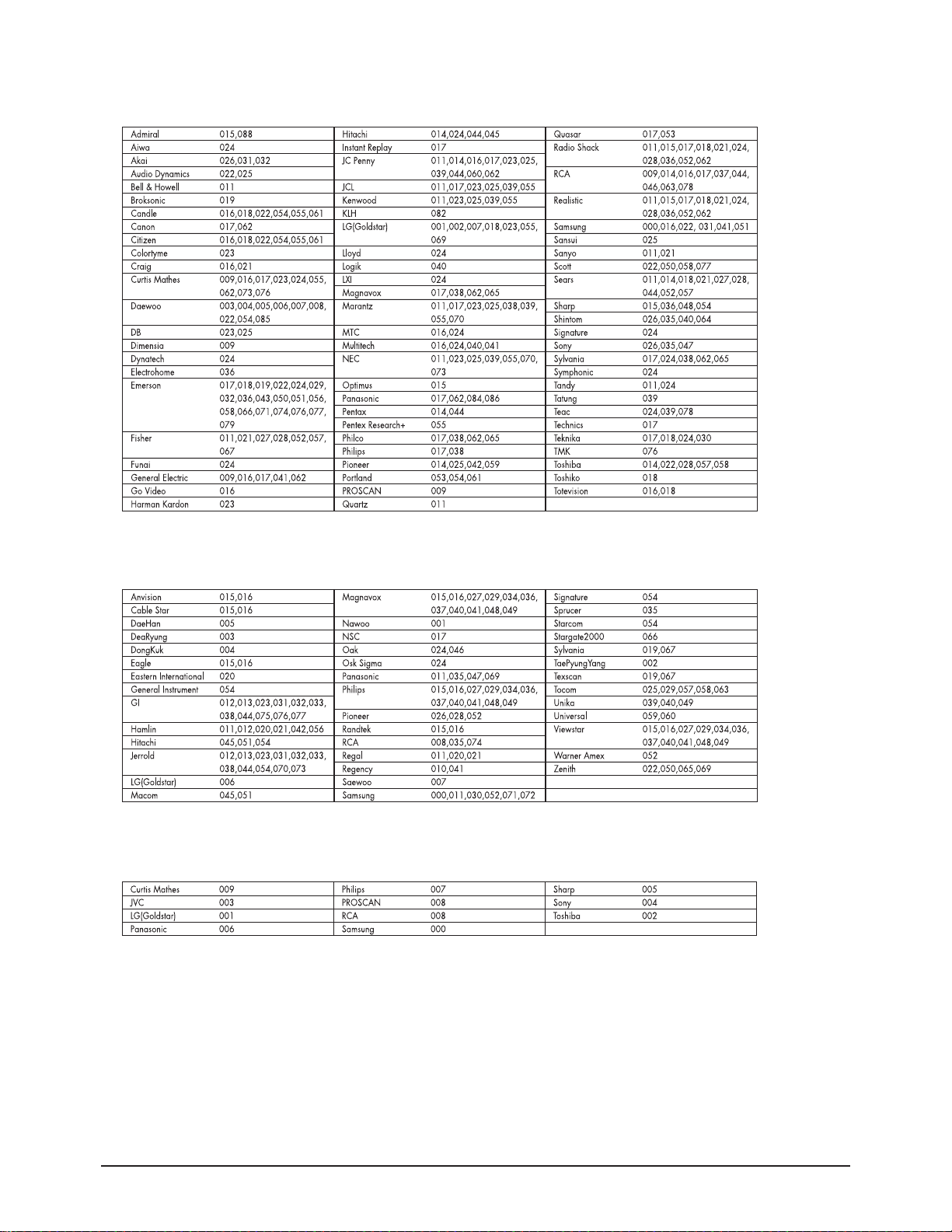
VCR Remote Control Codes
Cable Box (CATV) Remote Control Codes
DVD Remote Control Codes
Page 67
Operation Instruction & Installation
11-6 Samsung Electronics
11-2 New Features
11-2-1 Power Saving Mode (Applies to the "Settings" of the User Menu)
1. Objectives
- To enhance a sensible visual quality by maintaining an appropriate screen brightness according to the ambient brightness and
to reduce power consumption.
- To improve the power consumption efficiency when Power Saving Mode is selected.
2. Details
The CPU PW318 of the Video Board takes the current ambient brightness (in Lux units) stored in the Ambient Light Sensor of the
Power Assy., which is attached at the front of the PDP, at given intervals through SMBUS communication (identical to I2C) and
controls the PDP module to operate with the appropriate illuminance. The I2C bus is used to communicate with the PDP module,
and the communication method is the same as the existing communication method.
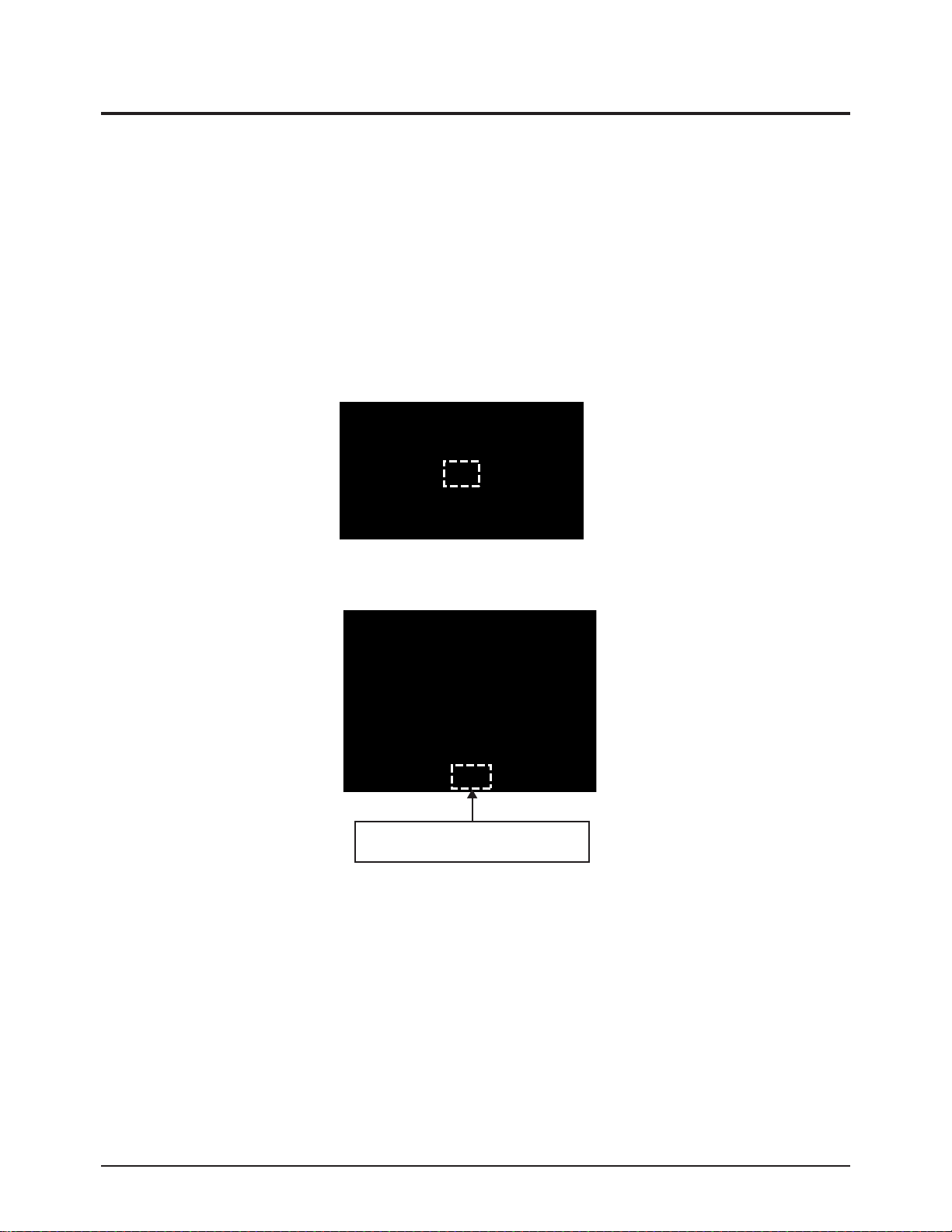
- Location of the Ambient Light Sensor
The sensor is attached to the Power Assy., which is on the front of the PDP. The location of the sensor on the Power Assy. is
displayed in the figure below. External light reaches the sensor through the guide of the Power Assy.
The screen brightness is adjusted according to the brightness measured by the Ambient Light Sensor, using the Multi APC
function (controls the number of sustain pulses according to the average signal levels) of the PDP panel, thus reducing power
consumption.
The Ambient Light Sensor IC
detects the amount of illumination.
Page 68
Operation Instruction & Installation
Samsung Electronics 11-7
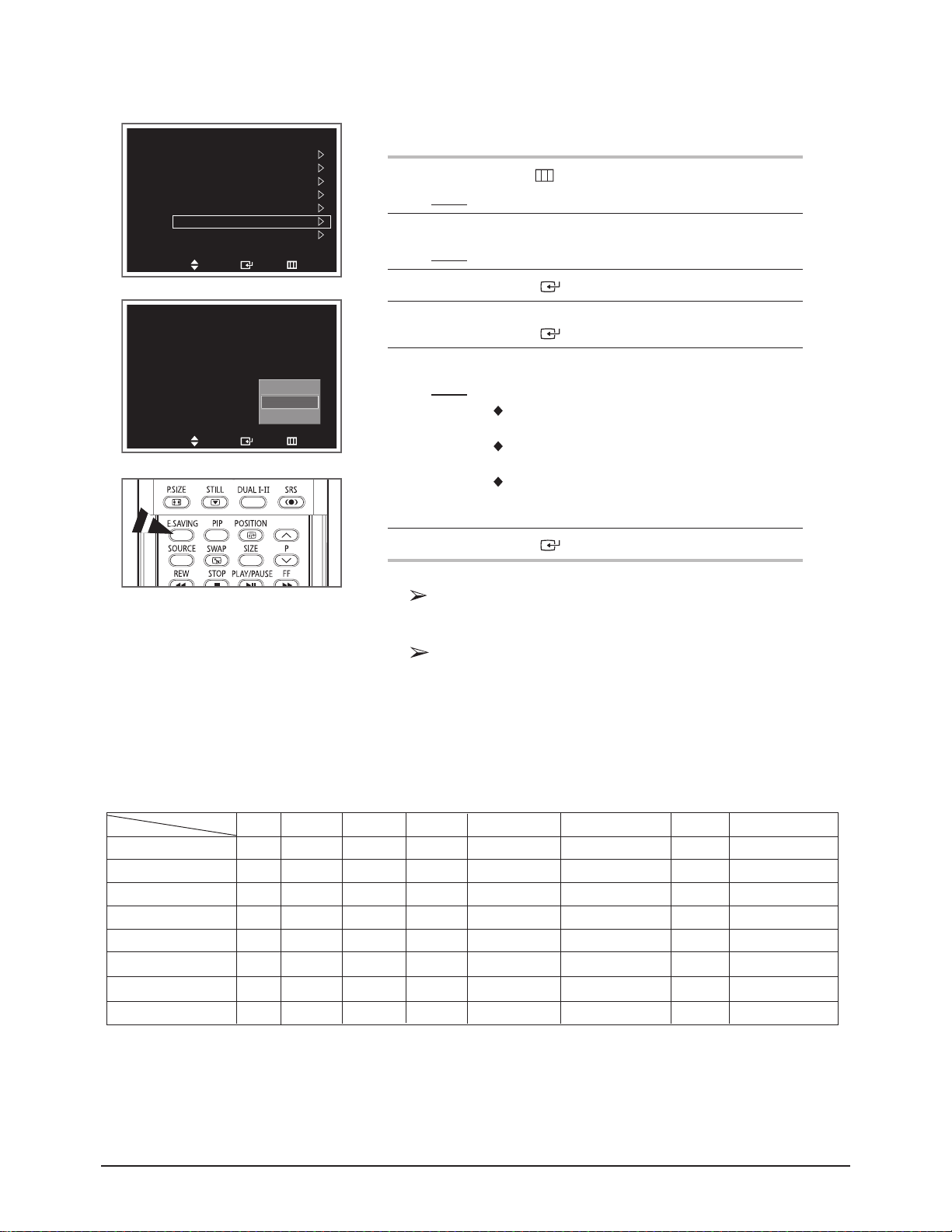
11-2-2 PIP Settings (X - This PIPcombination is not available, O - This PIP combination is available)
TV
Mode : Dynamic
Size : Auto Wide
Digital NR : On
DNIe Demo : Off
My Colour Control
Energy Saving : St andard
PIP
Move Enter Return
TV
Mode : Dynamic
Size : Auto Wide
Digital NR : On
DNIe Demo : Off
My Colour Control
Energy Saving : Standard
PIP
Move Enter Return
Picture
Picture
Auto Saving
Super Saving
Standard
1 Press the MENU ( ) button.
Result
: The main menu is displayed.
2 Press the … or † button to select Picture .
Result: The Picture menu is displayed.
3 Press the ENTER ( ) button.
4 Press the … or † button to select Energy Saving .
Press the ENTER ( ) button.
5 Select the required option by pressing the … or † button.
Result: The following
Auto Saving:
surrounding illumination.
Standard:
regardless of the surrounding illumination.
Super Saving:
saving mode regardless of the surrounding
illumination.
options
are available.
Automatically adjusts to the
Operates in standard mode
Enters maximum power
6 Press the ENTER ( ) button.
This feature is not available when the input source is in PC or
HDMI mode.
You can select these options by simply pressing the
E.SAVINGbutton on the remote control.
Main
Sub
TV Ext.1 Ext.2 AV
TV X O O O O O O O
Ext.1 O X O O O O O
Ext.2 O O X O O O O O
AV O O O X O O O O
S-Video O O O O X O O O
Component
PC
XXXX X X X X
XXXX X X X X
HDMI X X X X X X X X
S-Video
Component
PC HDMI
O
(RGB Excluded)
Page 69
Operation Instruction & Installation
11-8 Samsung Electronics
11-3 Installation Notes and Precautions
11-3-1 Installation Notes
1. Contact a technician for installing the wall bracket.
2. Samsung Electronics is not responsible for any damage to the product or injury to yourself or others if you elect to perform the
wall installation.
3. This product is for installing on cement walls. The product may not stay in place when installed on plaster or wood.
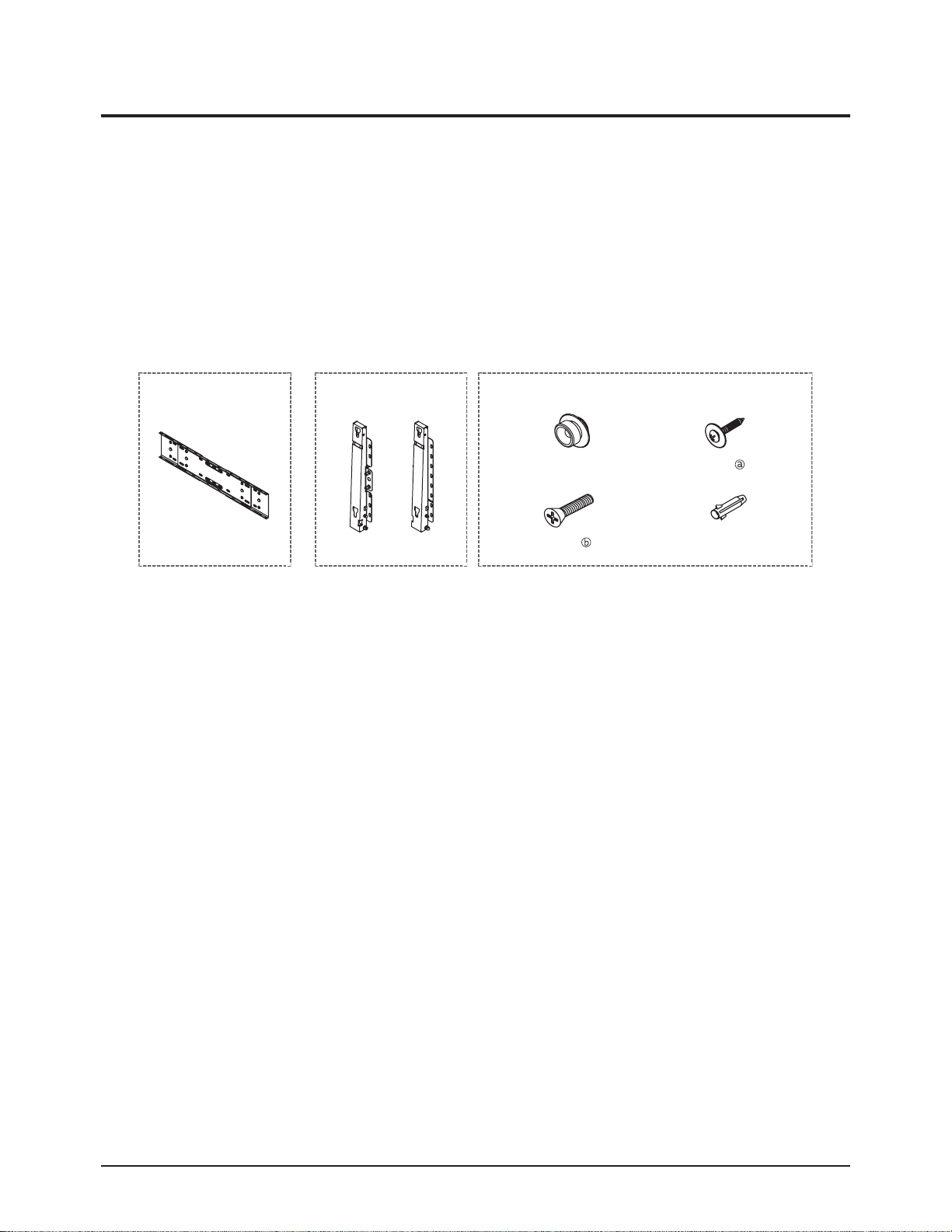
11-3-2 Parts (Wall attachment panel is sold separately)
Wall Bracket
Hinge
1 Left: 1 Right: 1
Accessories
Plastic Hanger: 4
Screw : 4
Screw : 11
Anchor : 11
Page 70
Operation Instruction & Installation
Samsung Electronics 11-9
11-3-3 How to assemble the Wall Mount Bracket
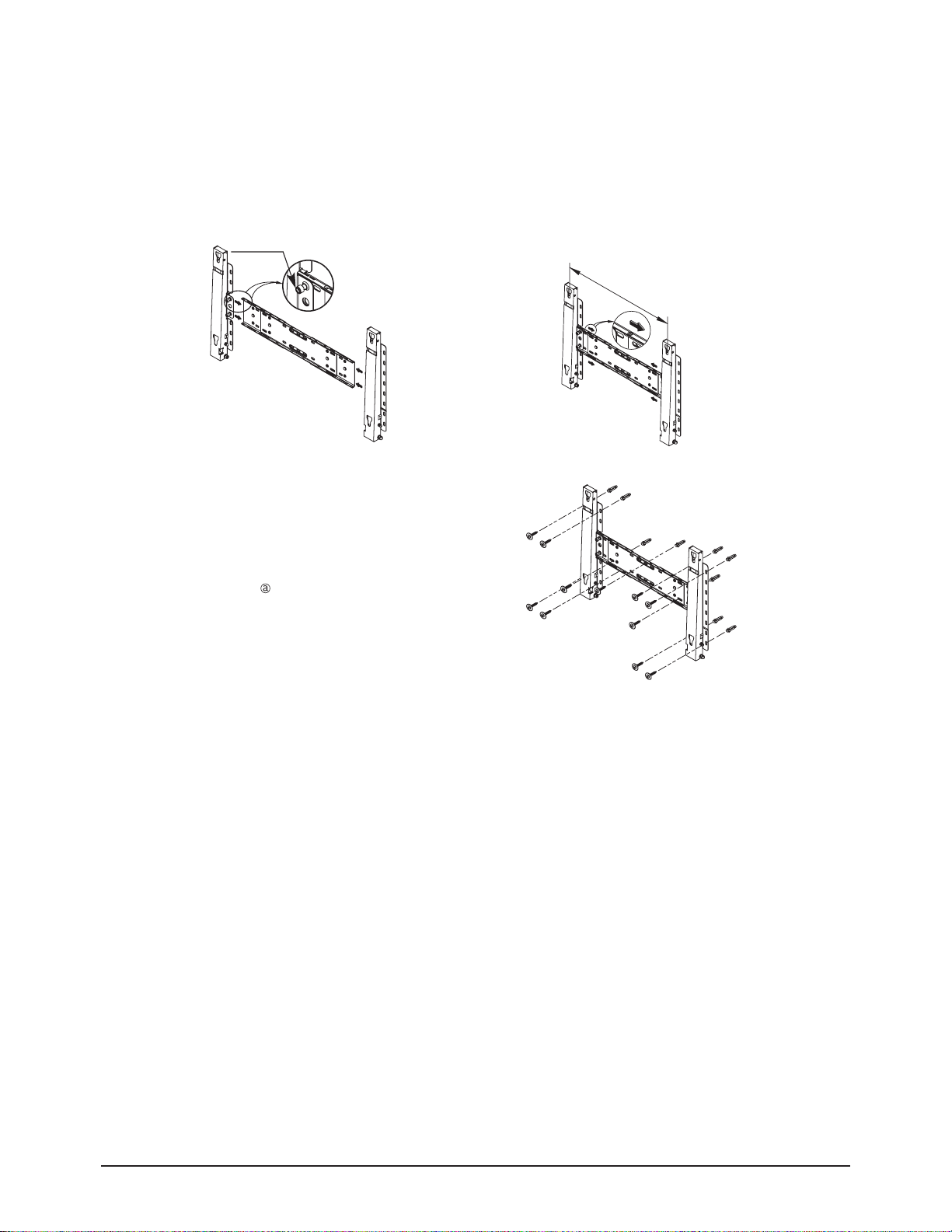
1 Insert and tighten the Captive Screw in
2 Before drilling into the wall, check if the length
the direction of the arrow.
When done, mount the wall bracket on
the wall.
Captive Screw
Hinge (Left)
There are two hinges
(left and right). Use the
correct one.
Wall Bracket
Hinge (Right)
3 Check the installation diagram and mark the drill
points on the wall. Use the 5.0 mm bit to drill holes
deeper than 35 mm.
Fix each anchor in the corresponding hole.
Match each of the brackets and hinge holes to the
corresponding anchor holes and insert and tighten
the 11 screws .
between the two locking holes at the back of
the product is correct.
If the length is too short or long, loosen all or
some of the 4 screws on the wall bracket to
adjust the length.
Length between the
two locking holes
Page 71
Operation Instruction & Installation
11-10 Samsung Electronics
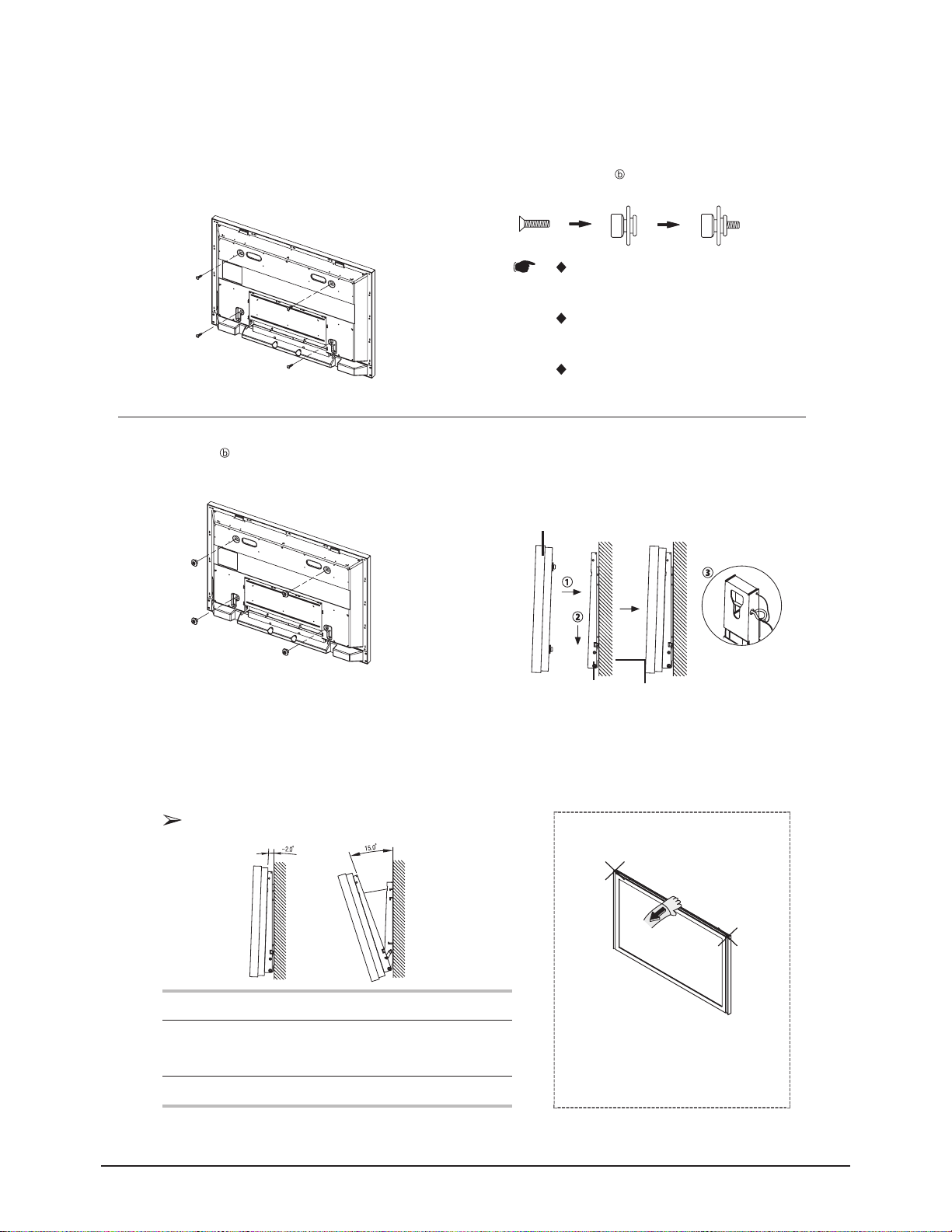
11-3-4 Fixing the TV panel to the wall attachment panel bracket
11-3-5 How to Adjust Mounting Angle
1 Remove the 4 screws on the back of the product.
3 Tighten the 4 screws in step 2 (plastic hanger
+ screw ) to the rear holes of the product.
2 Insert the screw into the plastic hanger.
(See the figure below)
Mount the product on the wall bracket
and make sure it is properly fixed to
the left and right plastic hangers.
Be careful when installing the product
on the bracket as fingers can be
caught in the holes.
Make sure the wall bracket is securely
fixed to the wall, or the product may not
stay in place after installation.
4
Remove safety pin ( # ) and insert the 4 product
holders into the corresponding bracket holes ( ! ). Then
place the product (@) so that it is firmly fixed to the
bracket. Make sure to reinsert and tighten the safety
pin (# ) to securely hold the product to the bracket.
PDP
Adjust the bracket angle to -
1 Fix the product to the wall bracket.
2 Hold the product at the top in the center and pull it
forward (direction of the arrow) to adjust the angle.
(See the figure to the right)
3 You can adjust the bracket angle between -2° and 15°.
2obefore installing it on the wall.
Wall Bracket
Make sure to use the top center,
and not the left or the right side of
the product to adjust the angle.
Wall
Page 72
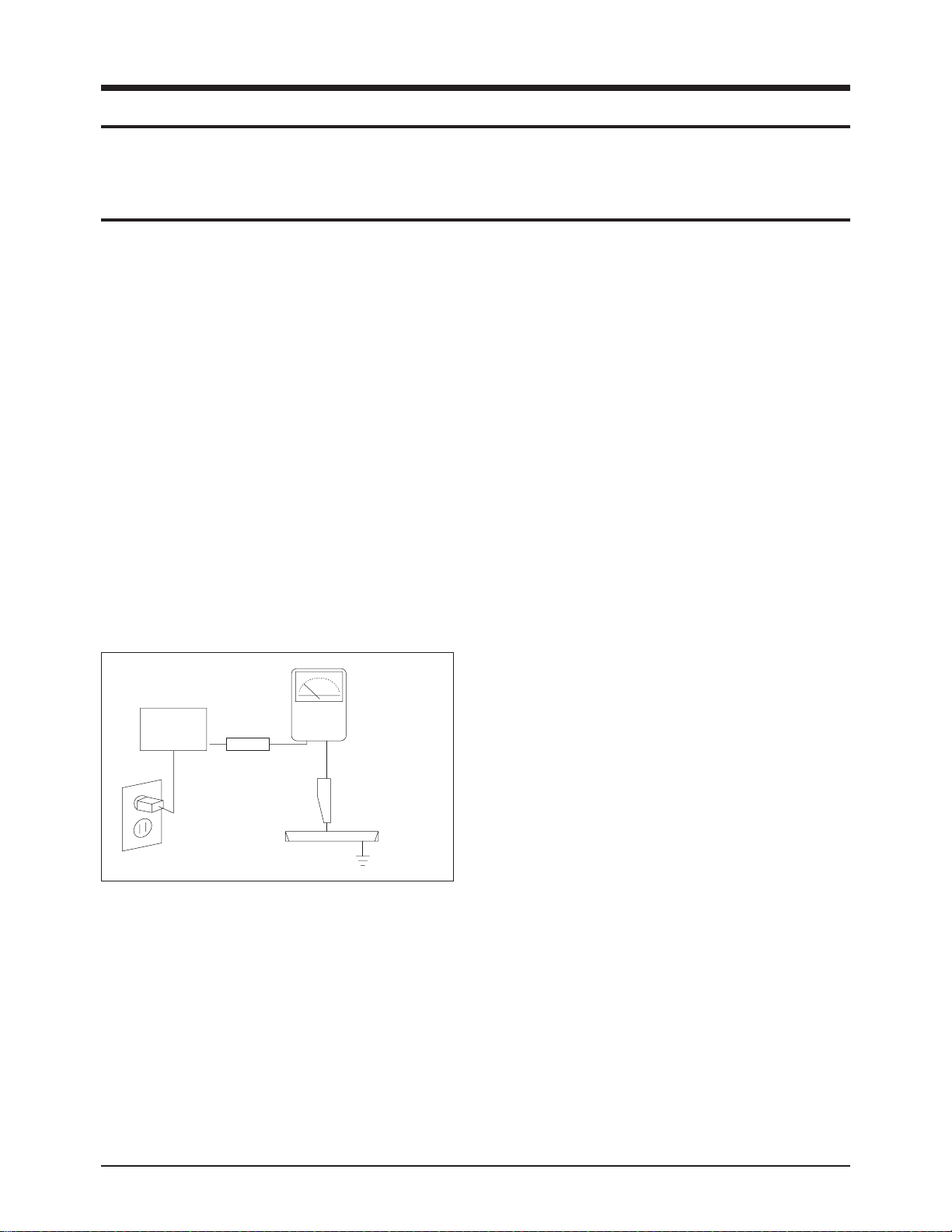
1. Make sure all protective devices are properly installed
including non-metallic handles and compartment covers
when installing or re-installing the chassis or chassis
assemblies.
2. Make sure that no gaps exist between the cabinets for
children to insert their fingers in to prevent children from
receiving electric shocks. Gaps mentioned above include
ventilation holes of a too great magnitude between the
vaccum tube and the cabinet mask, and the improper
installation of the rear cabinet.
Errors may occur when the resistance is below 1.0 ㏁ or
over 5.2 ㏁.
In these cases, make sure that the device is repaired
before sending it back to the customer.
3. Check for Electricity Leakage (Figure 1-1)
Warning: Do not use an insulated transistor for checking
the leakage. Use only those current leakage testers or
mirroring systems that comply with ANSIC 101.1 and the
Underwriter Laboratory's specifications (UL1410, 59.7).
Fig. 1-1 AC Leakage Test
4. Ahigh voltage is maintained within the specified limits
using safety parts, calibration and tolerances. When
voltage exceeds the specified limits, check each special
part.
5. Warning for Engineering Changes:
Never make any changes or additions to the circuit
design or the internal part for this product.
Ex: Do not add any audio or video accessory
connectors. This might cause physical damage.
Furthermore, any changes or additions to the original
design/engineering will invalidate the warranty.
6. Warning - Hot Chassis:
Some TV chassis are directly connected to one end of
the AC power cord for electrical reasons.
Without insulated transistors, the product can only be
repaired safely when the chassis is connected to the
earthed end of the AC power source.
To make sure the AC power cord is properly connected,
follow the instructions below. Use the voltmeter to
measure the voltage between the chassis and the
earthed ground. If the measurement is over 1.0V, unplug
the AC power cord and change the polarity before reinserting it. Measure the voltage between the chassis
and the ground again.
7. Some TV chassis are shipped with an additional
secondary grounding system. The secondary system is
adjacent to the AC power line. These two grounding
systems are separated in the circuit using an
unbreakable/unchangeable insulation material.
8. When any parts, material or wiring appear overheated or
damaged, replace them with new regular ones
immediately. When any damage or overheating is
detected, correct this immediately and make a regular
check of possible errors.
9. Check for the original shape of the lead, especially that
of the antenna wiring, any sharp edges, the AC power
and the high voltage power. Carefully check if the wiring
is too tight, incorrectly placed or loose. Never change the
space between the part and the printed circuit board.
Check the AC power cord for possible damages. Keep
the part or the lead away from any heat-emitting
materials.
Precaution
Samsung Electronics 1-1
To avoid possible damages or electric shocks or exposure to radiation, follow the instructions below with regard to safety,
installation, service and ESD..
1. Precaution
1-1 Safety Precautions
(READING SHOULD
DEVICE
UNDER
TEST
EXPOSED METAL
2-WIRE CORD
ALSO TEST WITH
PLUG REVERSED
(USING AC ADAPTER
PLUG AS REQUIRED)
TEST ALL
SURFACES
LEAKAGE
CURRENT
TESTER
NOT BE ABOVE
0.5mA)
EARTH
GROUND
Page 73

10. Safety Indication:
Some electrical circuits or device related materials
require special attention to their safety features, which
cannot be viewed by the naked eye. If an original part is
replaced with another irregular one, the safety or
protective features will be lost even if the new one has a
higher voltage or more watts.
Critical safety parts should be bracketed with ( ).
Use only regular parts for replacements (in particular,
flame resistance and dielectric strength specifications).
Irregular parts or materials may cause electric shock or
fire.
11. Pay additional attention to the current leakage as the
voltage between the power board and the ballast is 220
to 440v, i.e. very high.
And also beware of possible electric shock from the
primary power source.
Precaution
1-2 Samsung Electronics
!
Page 74

1. The service instructions are printed on the cabinet, and
should be followed by any service personnel.
2. Make sure to unplug the AC power cord from the power
source before starting any repairs.
(a) Remove or re-install parts or assemblies.
(b) Disconnect the electric plug or connector, if any.
(c) Connect the test part in parallel with the electrolytic
capacitor.
3. Some parts are placed at a higher position than the
printed board. Insulated tubes or tapes are used for this
purpose. The internal wiring is clamped using buckles to
avoid contact with heat emitting parts. These parts are
installed back to their original position.
4. After the repair, make sure to check if the screws, parts
or cables are properly installed. Make sure no damage is
caused to the repaired part and its surroundings.
5. Check for insulation between the blade of the AC plug
and that of any conductive materials (i.e. the metal
panel, input terminal, earphone jack, etc).
6. Insulation Check Process: Unplug the power cord from
the AC source and turn the switch on. Connect the insulating resistance meter (500v) to the AC plug blade.
The insulating resistance between the blade of the AC
plug and that of the conductive material should be more
than 1 ㏁.
7. Any B+ interlock should not be damaged.
If the metal heat sink is not properly installed, no
connection to the AC power should be made.
8. Make sure the grounding lead of the tester is connected
to the chassis ground before connecting to the positive
lead. The ground lead of the tester should be removed
last.
9. Beware of risks of any current leakage coming into
contact with the high-capacity capacitor.
10. The sharp edges of the metal material may cause
physical damage, so ensure wearing protective gloves
during the repair.
11. Due to the nature of plasma display panels, partial afterimages may appear if a still picture is displayed on the
screen for a long period of time.
This is caused by brightness deterioration due to the
storage effect of the panel, and to prevent this from
happening, we recommend that the brightness and contrast are reduced.
(e.g.) Contrast: 25, Brightness: 50
12. Aplasma panel is a device which consists of a set of
clustered pixels (cells).
Aplasma panel is approved if over 99.9% of the
components satisfy the necessary conditions. Afew cells
may stay illuminated or may be always off, but you do
not have to worry as this is an approved panel and well
within the standard.
Precaution
Samsung Electronics 1-3
Warning 1: First carefully read the "Safety Instruction" in this service manual.
When there is a conflict between the service and the safety instructions, follow the safety instruction at all times.
Warning 2: Any electrolytic capacitor with the wrong polarity will explode.
1-2 Servicing Precautions
Page 75

1-3 Static Electricity Precautions
1. Some semi-conductive ("solid state") devices are
vulnerable to static electricity. These devices are known
as ESD. ESD includes the integrated circuit and the field
effect transistor. To avoid any materials damage from
electrostatic shock, follow the instructions described
below.
2. Remove any static electricity from your body by
connecting the earth ground before handling any
semi-conductive parts or ass'ys. Alternatively, wear a
dischargeable wrist-belt.
(Make sure to remove any static electricity before
connecting the power source - this is a safety instruction
for avoiding electric shock)
3. Remove the ESD ass'y and place it on a conductive
surface such as aluminum foil to prevent accumulating
static electricity.
4. Do not use any Freon-based chemicals.
Such chemicals will generate static electricity that
causes damage to the ESD.
5. Use only grounded-tip irons for soldering purposes.
6. Use only anti-static solder removal devices.
Most solder removal devices do not support an
anti-static feature. Asolder removal device without an
anti-static feature can store enough static electricity to
cause damage to the ESD.
7. Do not remove the ESD from the protective box until the
replacement is ready. Most ESD replacements are
covered with lead, which will cause a short to the entire
unit due to the conductive foam, aluminum foil or other
conductive materials.
8. Remove the protective material from the ESD
replacement lead immediately after connecting it to the
chassis or circuit ass'y.
9. Take extreme caution in handling any uncovered ESD
replacements. Actions such as brushing clothes or lifting
your leg from the carpet floor can generate enough static
electricity to damage the ESD.
Precaution
1-4 Samsung Electronics
CAUTION
These servicing instructions are for use by
qualified service personnel only.
To reduce the risk of electric shock do not
perform any servicing other than that contained in the
operating instructions unless you are qualified to do so.
Page 76

Precaution
Samsung Electronics 1-5
1-4 Installation Precautions
1. For safety reasons, more than two people are required
for carrying the product.
2. Keep the power cord away from any heat emitting
devices, as a melted covering may cause fire or electric
shock.
3. Do not place the product in areas with poor ventilation
such as a bookshelf or closet. The increased internal
temperature may cause fire.
4. Bend the external antenna cable when connecting it to
the product. This is a measure to protect it from being
exposed to moisture. Otherwise, it may cause a fire or
electric shock.
5. Make sure to turn the power off and unplug the power
cord from the outlet before removing the product. Also
check the antenna cable or the external connectors if
they are fully unplugged. Damage to the cord may cause
fire or electric shock.
6. Keep the antenna far away from any high-voltage cables
and install it firmly. Contacting the high-voltage cable or
the antenna falling over may cause fire or electric shock.
7. When connecting the RF antenna, check for a DTV
receiving system and install a separate DTV reception
antenna for areas with no DTV signal.
8. When installing the product, leave enough space (10cm)
between the product and the wall for ventilation
purposes.
Arise in temperature within the product may cause fire.
9. When moving a PDP with attached speakers, detach the
speakers first before moving the main body.
Moving the PDP main body without separating the
speakers may cause the speakers to detach, possibly
causing damage or injury.
Page 77

1-6 Samsung Electronics
MEMO
Page 78
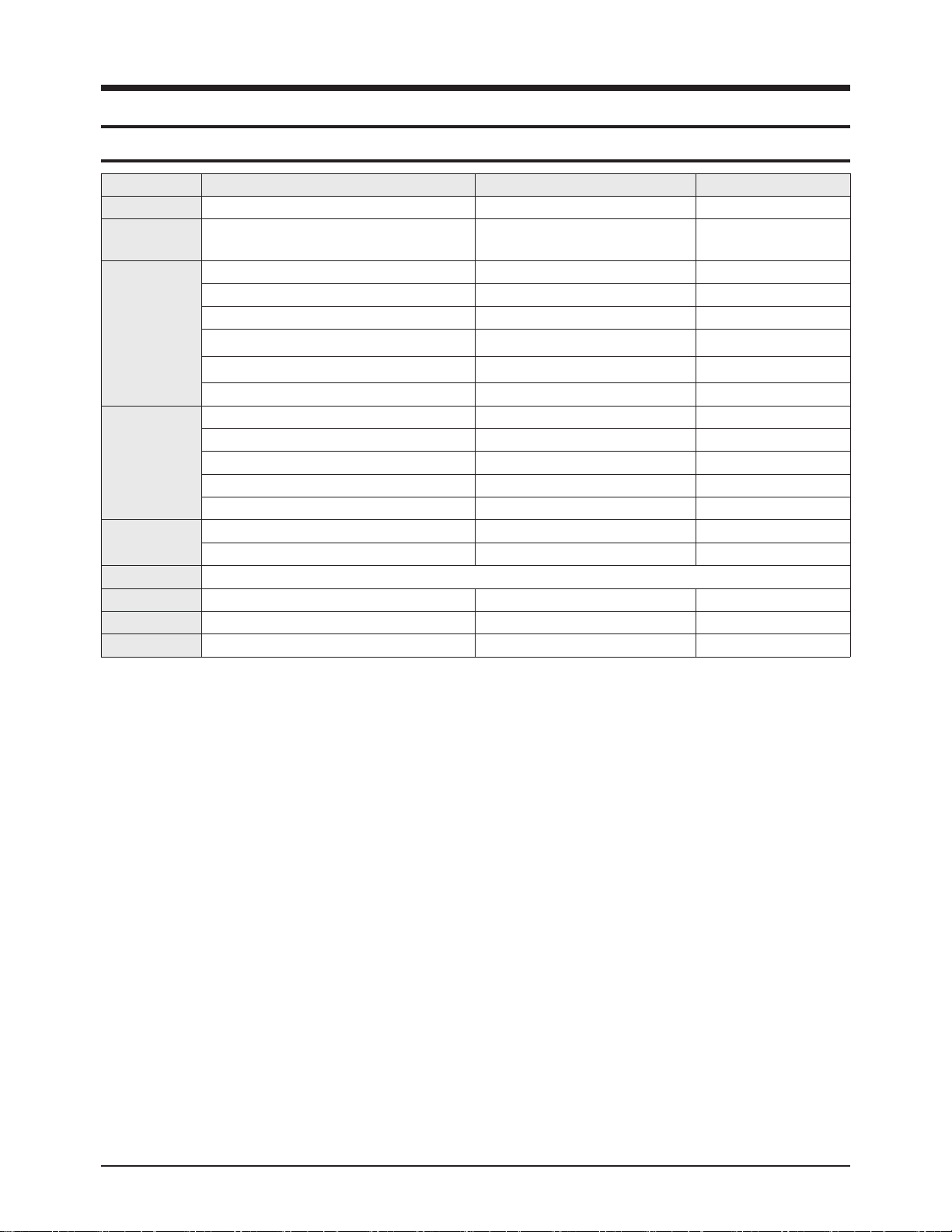
Product Specification
Samsung Electronics 2-1
2. Product Specification
2-1 Product Features
■ Chip Description
- SVP-EX62 : 480i/576i, CVBS, Y/C, HDMI, PC input Video signal processing
- SAA7119 : CVBS, Y/C Sub Video signal , Scart RGB signal processing
- DNIe-Lite : Image Enhancer
- Sii9993 : HDMI signal receiver (S5 Option)
- MSP4410G : SIF, Analog Audio Decoder
- NSP6241A: Sound Output Control
- TAS5122 : Sound Amp
- M30620 : Main Micom
- 3F8668 : Sub Micom
Block Specfication Major IC Remark
RF Tuner Alps TMQZ6-407A
Power
Input Voltage : AC 100V ~ 220V
Stand-By : 3W less
Video
Scaler SVP-EX62 (Trident)
Sub Decoder SAA7119 (Philips)
Picture Enhance DNIe-Lite (Samsung)
Video S/W TEA6425*2
Component S/W BA7657
HDMI Sii9993 S5 Option
Sound
Sound Processor MSP4410G (Micronas)
Sound Control NSP6241A
Audio S/W TEA6422*2
Sound Amp TAS5122
Sound Output 15W+15W
Control
CPU M30620 (Renesas)
Sub Micom 3F8668 (Samsung)
Remocon TM76
etc. Cabinet D5
Product Model PS42D5S
Module V4 42"SD
Page 79
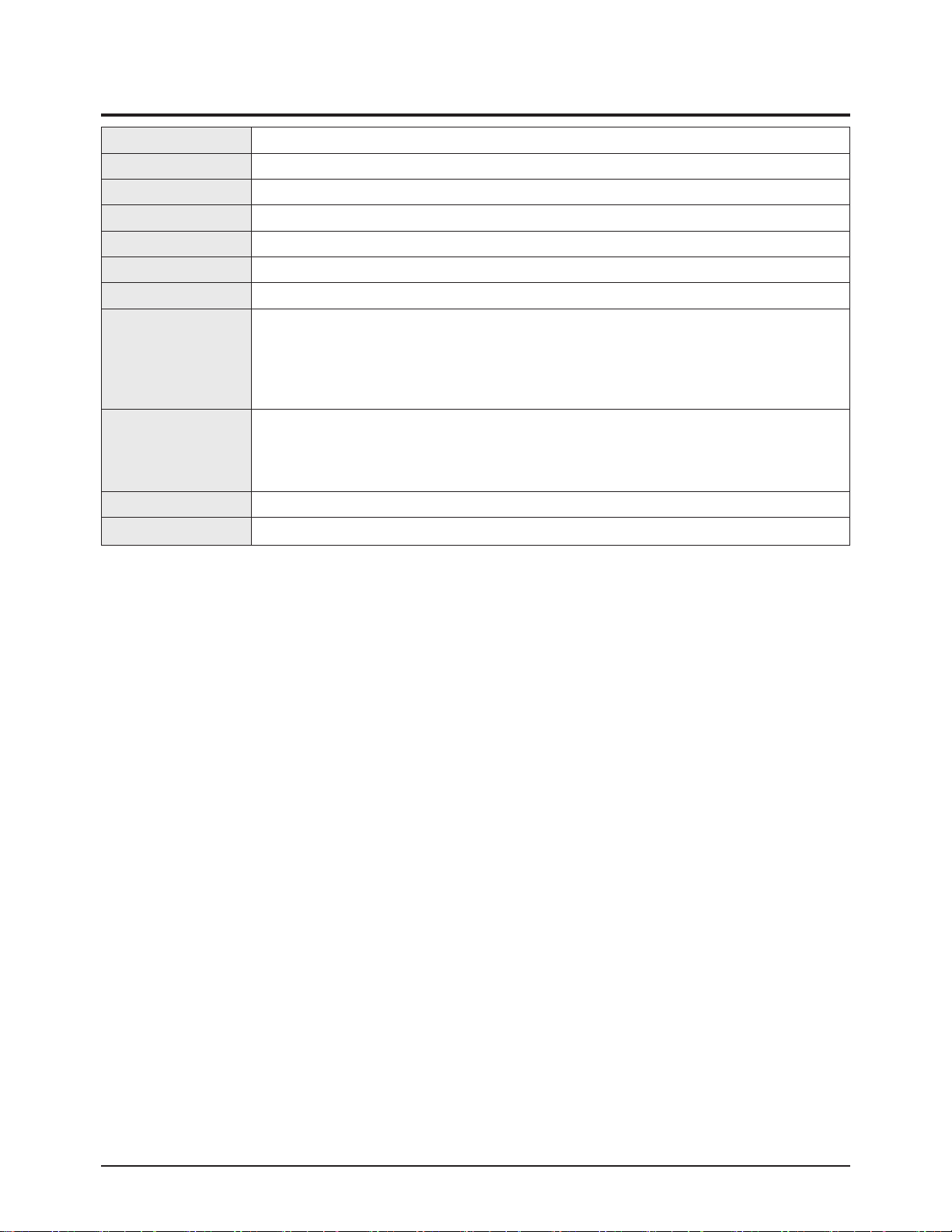
Product Specification
2-2 Samsung Electronics
2-2 Key Features
Model PS-42D5S
Dimensions 1057.8 (W) x 98.3 (D) x 763.7 (H) mm
Weight 48 kg
Voltage AC 100 - 240V~ , 50 Hz
Power Consumption 290W
Number of Pixels 852 (H) x 480 (V)
Screen Size 42 inches
VIDEO input
TV (VHF, UHF Antenna)
External input :CVBS/S-Video
COMPONENT1:480i/480p/720p/1080i
COMPONENT1:480i/480p/720p/1080i
PC
AUDIO input
External input
COMPONENT1
COMPONENT2
PC
AV Output VIDEO (CVBS), AUDIO (L/R)
Audio Output
15W + 15W (8Ω)
■ H/W Configuration
- Video : SVP-EX62, TEA6425, BA7657F, DNIe-L
- Sound : MSP4440G, NSP6241A, TAS5122
- Tuner : TMQZ6-407A
■ S/W Configuration
- SVP-EX62 Trident Chip Control , DNIe-L
- CPU Master Control + Sub Micom, TTX Software
- Favorite CH, Label CH
■ Picture
- System : Video → PAL/SECAM/NTSC4.43,
Sound → Analog
- Progressive
- Output resolution : 852*480
- OSD : Smart user Interface Grade1
- Picture Enhancement : DNIe-L
- Still picture, Noise reduction
- Comb Filter : 3D comb filter
- PIP : D/W, Large
- Panorama : Wide
Page 80

Product Specification
Samsung Electronics 2-3
■ Sound
- System : Stereo
- Dolby Digital : Tru Surround XT
- Output : 15W + 15W
- Speaker : built-in.
■ Feature
- Component Interface(480i/480p/720p/1080i, Y/Pb/Pr)
- Digital Interface : HDMI
- Picture Size : Wide/Wide 4:3/Panorama/Zoom/4:3
- Auto Program
- Sleep Timer : 180 minute
- Clock
- Zoom, Previous channel, White Screen, Color Tone
■ In/Out Terminals(Rear)
- 1 AV Input, 1 SVHS Input
- AV Monitor Output
- 2 Component Input : 480i / 480p / 720p / 1080i
- 15 Pin D-sub Input : ~ XGA(1024 x 768)
- 1 RF Input
■ Remocon
- Normal : TM76
■ Power Supply
- 100V ~ 240V
■ Power
- Standy-by : 3W less
- Max Power : 380W
Page 81
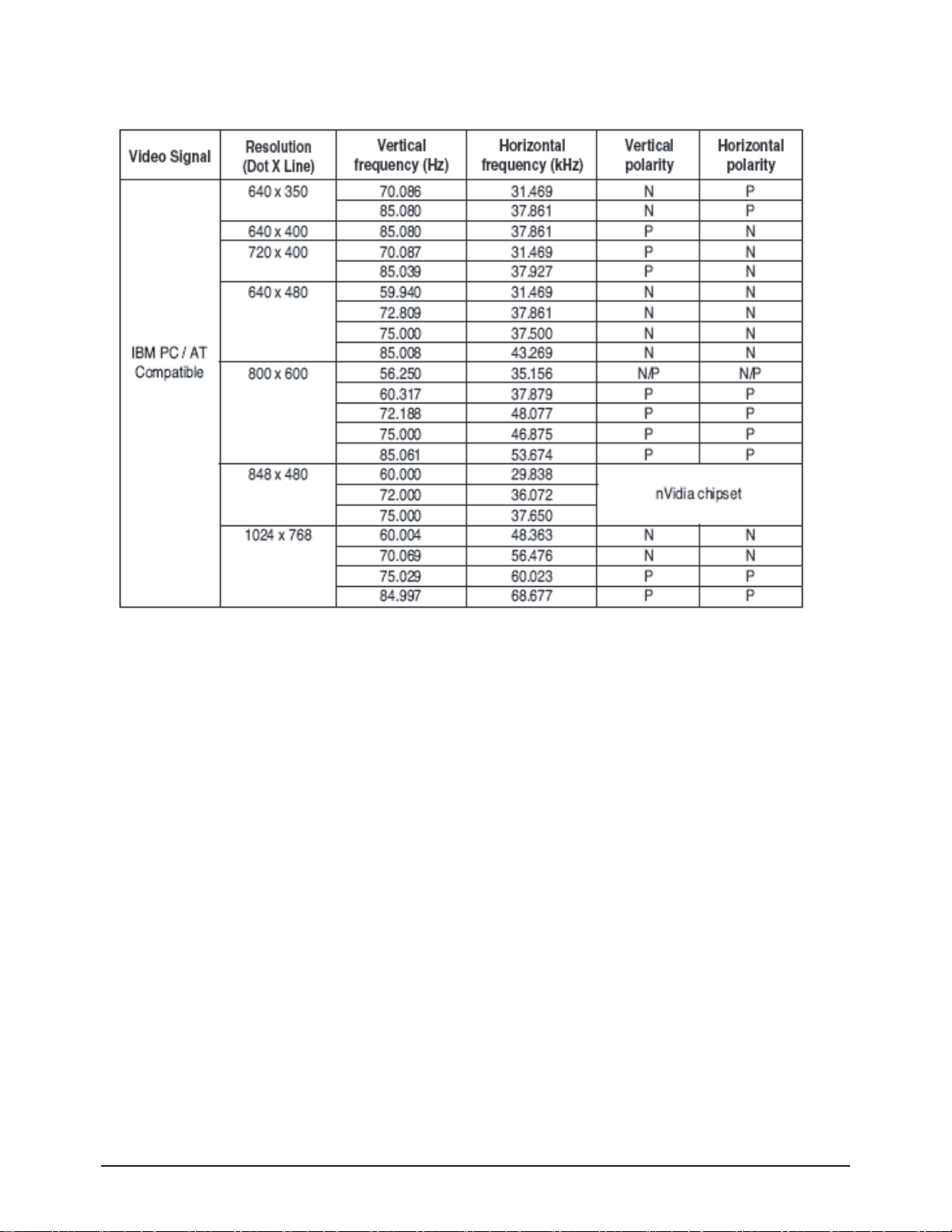
Product Specification
2-4 Samsung Electronics
■ The table below shows all of the display modes that are supported. (N : Negative, P : Positive)
▶ The interlace mode is not supported.
▶ The television might operate abnormally if a non-standard video format is selected.
▶ 480i/p, 576i/p, 720p, or 1080i is not available in pc mode.
Page 82
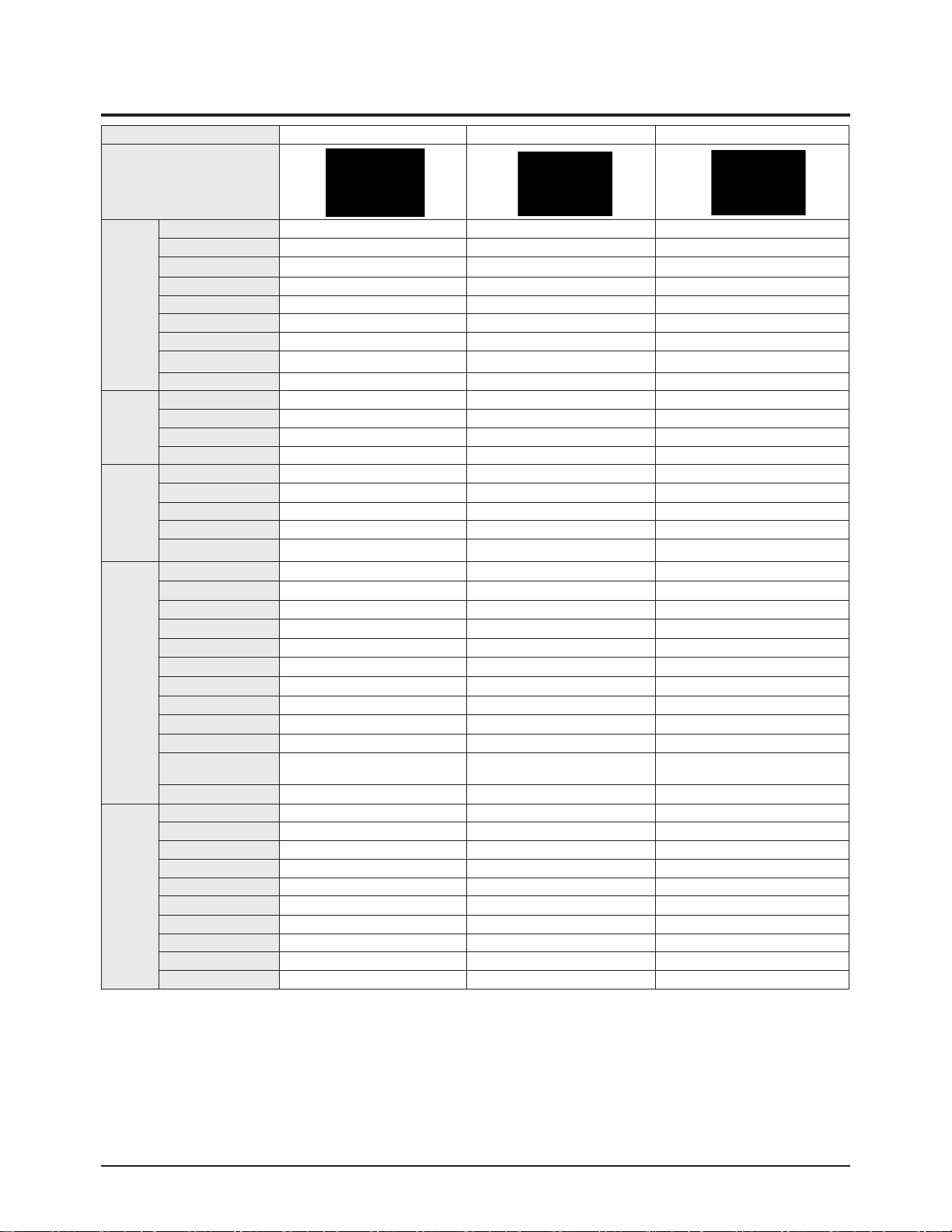
Product Specification
Samsung Electronics 2-5
2-3 Specifications Analysis
Model Puccini(V4) Mozart (V3) Nelson (V3)
Design
Basic
Display Type PDPTV PDP TV PDPTV
Built-In Tuner O O O
Resolution
852*480 852*480 852*480
PDP Module V4 V3 V3
Screen Size 42 inches 42 inches 42 inches
Aspect Ratio 16:09 16:09 16:09
Power Consumption 290W 330W 330W
Dimensions 14255 (W) x 114 (D) x 825.4 (H) mm 14255 (W) x 114 (D) x 825.4 (H) mm 14255 (W) x 114 (D) x 825.4 (H) mm
Weight 59.2 kg 59.2 kg 59.2 kg
Picture
Brightness 1300cd/m2 1000cd/m2 1000cd/m2
Contrast Ratio 10000:1 3000:01:00 3000:01:00
Image Enhacer DNIe-L DNIe 3 DNIe 3
Digital Comb Filter O O O
Audio
Equalizer O O O
Auto Volume O O O
Surround Sound SRS TreSurround XT SRS TreSurround XT SRS TreSurround XT
Speaker Output 15W +15W 15W +15W 15W +15W
Speaker Included Included Included
Features
PIP O O O
Double Screen O O O
Caption X X X
Still Image O O O
My Color Control O O O
Color Weakness O O O
Energy Saving O X X
Anynet X X X
D-Net(IEEE1394 S.400) X X X
POD X X X
Gemstar
(TV Guide On Screen)
X X X
Screen Burn Protection O O O
Connections
Antenna 1Input 1Input 1Input
CVBS 1AV 3AV 1AV
S-Video 1Input 2Input 1Input
Component(Y/PB/PR) 1Input 1Input 1Input
PC(D-SUB) 1Input(15Pin D-Sub) 1Input(15Pin D-Sub) 1Input(15Pin D-Sub)
DVI X O O
HDMI 1Input X X
Sub Woofer X X X
Optical X X X
Coaxial X X X
Page 83
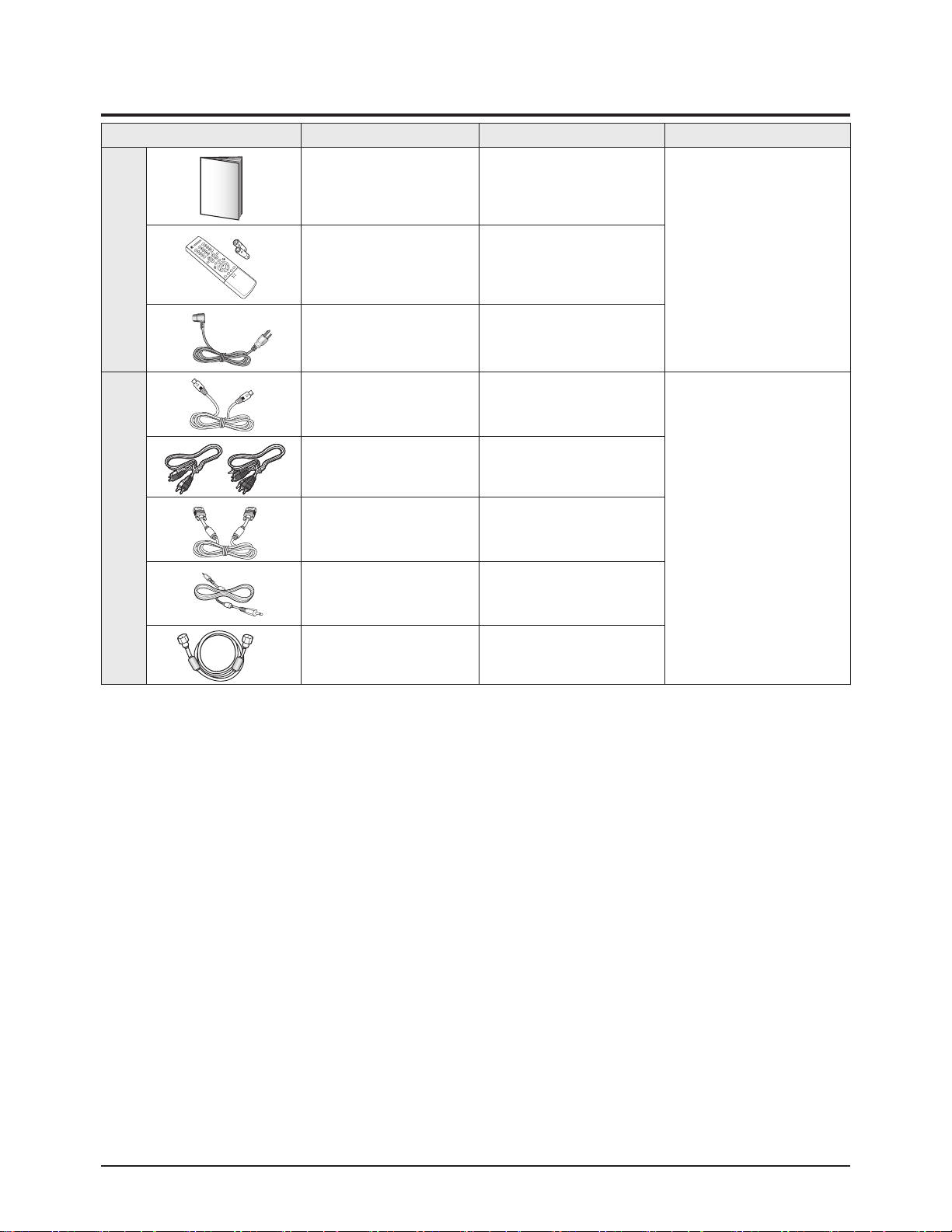
Product Specification
2-6 Samsung Electronics
2-4 Accessories
Accessories Item Item code Remark
SuppliedAccessories
User Manual BN68-00868A
Samsung Service center
Remote Control
AAABatteries
BN59-00471A
4301-000103
Power Cord 3903-000193
Accessories that can be purchased
additionally
S-VIDEO Cable -
Internal shopping mall
Component Cables (RCA) -
PC Cable -
PC Audio Cable -
Antenna Cable -
Page 84
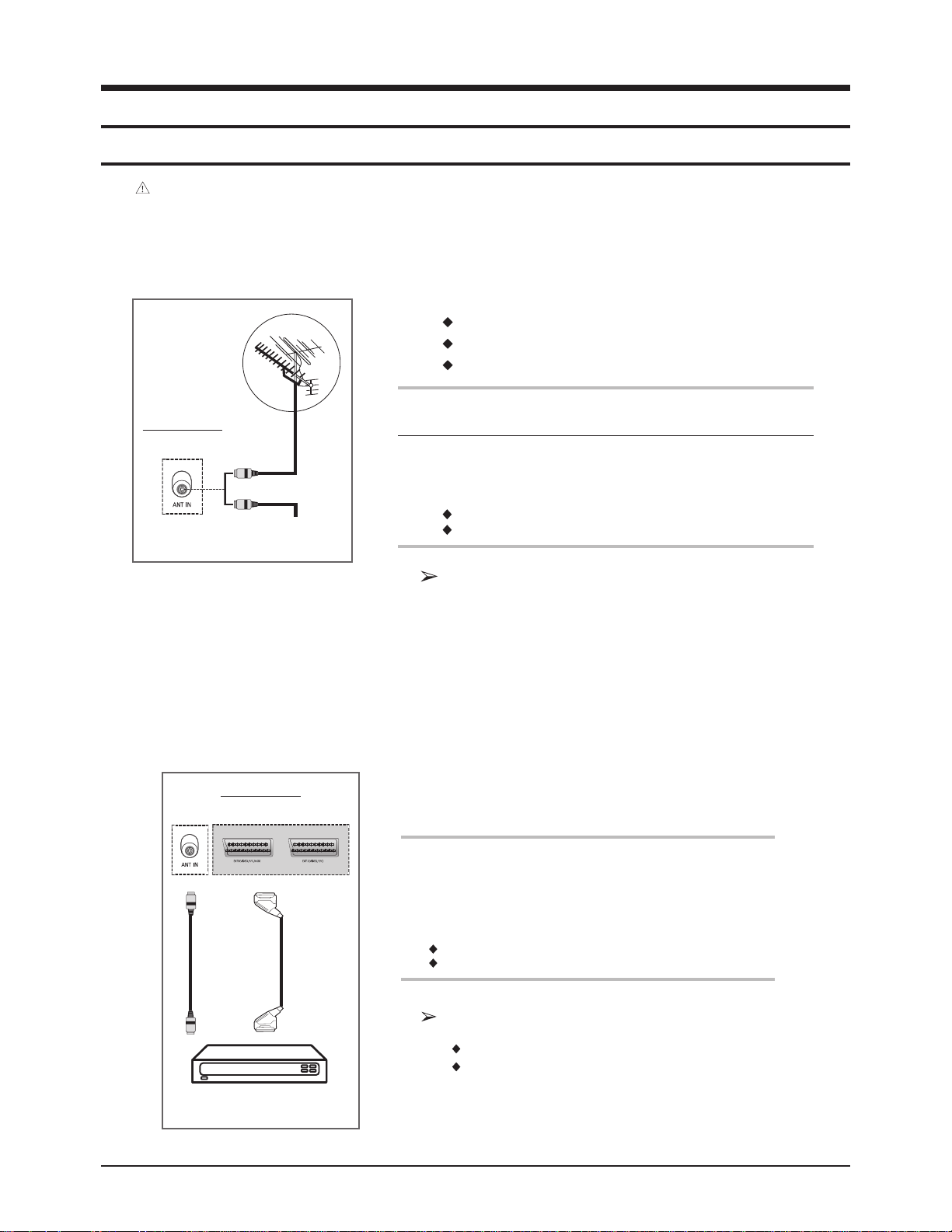
Reference Information
Samsung Electronics 14-1
14. Reference Information
14-1 Connection to a 3rd Party Device
Notice: 1. Do not connect to the power source until all connections are done, as this will cause damage to the product.
2. Make sure the sound port is properly connected (right: red, left: white).
14-1-1 Connecting to an Aerial or Cable Television Network
14-1-2 Connecting a Satellite Receiver or Decoder
To view television channels correctly, a signal must be received by
the set from one of the following sources:
An outdoor aerial
A cable television network
A satellite network
1 In the first three cases, connect the aerial or network input cable to
Rear of the TV
or
Cable Television
Network
the ANT IN jack on the rear of the television.
2 If you are using an indoor aerial, you may need to turn it when
tuning your television until you obtain a picture that is both sharp
and clear.
For further details, refer to:
“Storing Channels Automatically” on page 17
“Storing Channels Manually” on page 18
In order to watch television programmes broadcast via a satellite network,
Rear of the TV
Satellite receiver/
Decoder
you must connect a satellite receiver to the rear of TV. Also, in order to
descramble a coded transmission signal, you must connect a decoder to
the rear of TV.
Using a SCART cable
Connect the receiver (or decoder) SCART cable to one of the
SCART connectors on the rear of the television.
Using a coaxial cable
Connect a coaxial cable to the:
Receiver (or Decoder) output socket.
Television aerial input socket.
If you wish to connect both a satellite receiver (or decoder) and
a VCR, you should connect the:
Otherwise, connect the receiver (or decoder) directly to the
television.
When installing or re-installing your TV, be sure to use the
supplied coaxial antenna cable. If you connect using a different
coaxial cable, there is risk of noise or interference to the screen
image. (You must not use another general purpose cable.
Use the 3M/5M/7M cable supplied by Samsung.)
Receiver (or Decoder) to the VCR
VCR to the television
Page 85
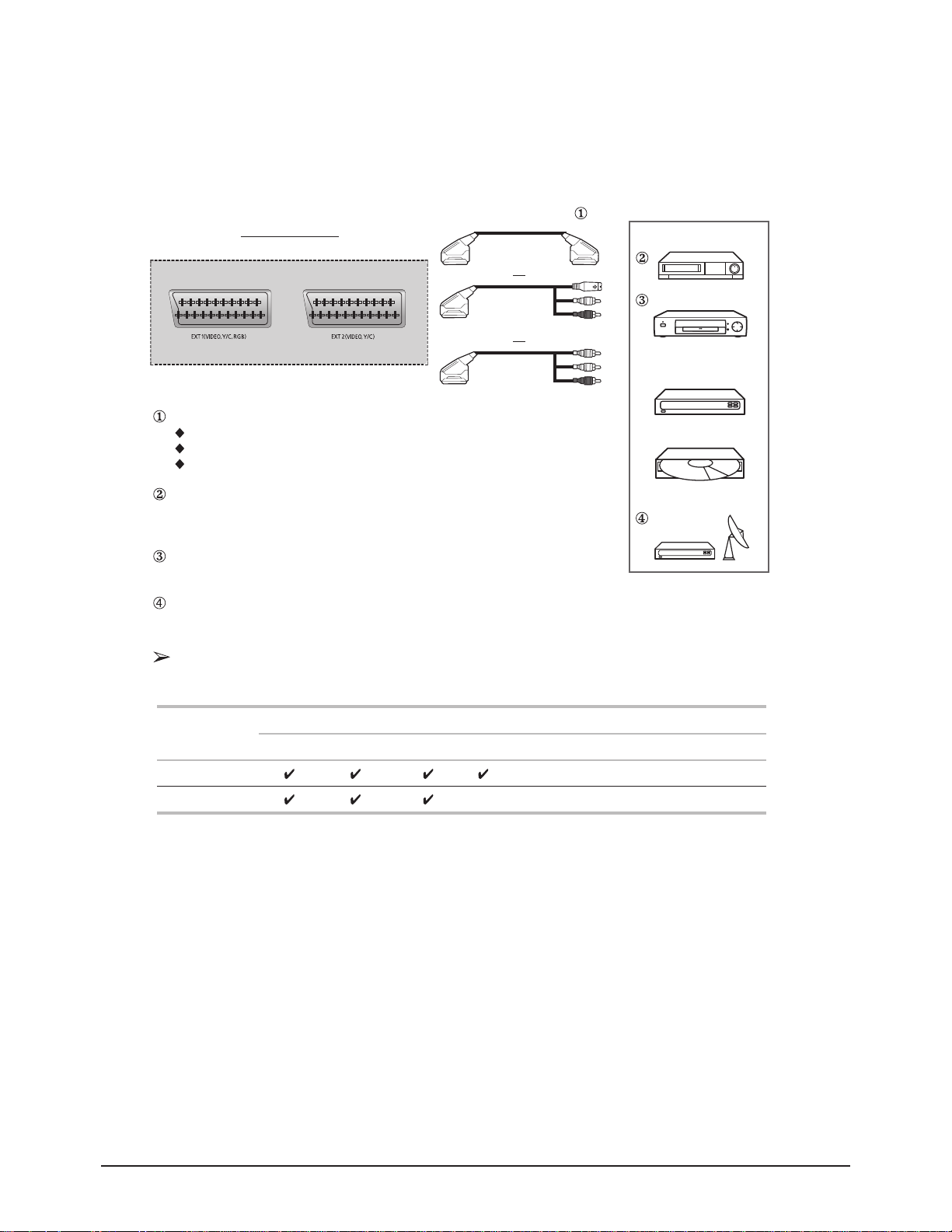
Reference Information
14-2 Samsung Electronics
14-1-3 Connecting to External Input/Output
“EXT 1” is used for the equipment with an RGB output, such as video game devices or video disc players.
Rear of the TV
or
or
This end can be fitted with:
A SCART connector
An S-Video connector and two audio RCA connectors (L+R); EXT 2
Three RCA connectors (VIDEO + AUDIO-L and R)
If you have a second VCR and wish to copy cassette tapes, connect the
source VCR to EXT 1 and the target VCR to EXT 2 so that you can
redirect the signal from EXT 1 to EXT 2.
If you have a decoder, connect the decoder to the VCR and the VCR to
the television.
When you wish to record a programme, connect the receiver to EXT 1 and
the VCR to EXT 2 so that you can redirect the signal from EXT 1 to EXT 2.
Please be sure to match the color coded input terminals and cable jacks.
VCR
DVD
Decoder /
Video Game Device
Video Disc Player
Satellite Receiver
Input/Output Specification
Connector
Input Output
Video Audio (L/R) S-Video RGB Video + Audio (L/R)
EXT 1 Only TV output is available.
EXT 2 Output you can choose.
Page 86
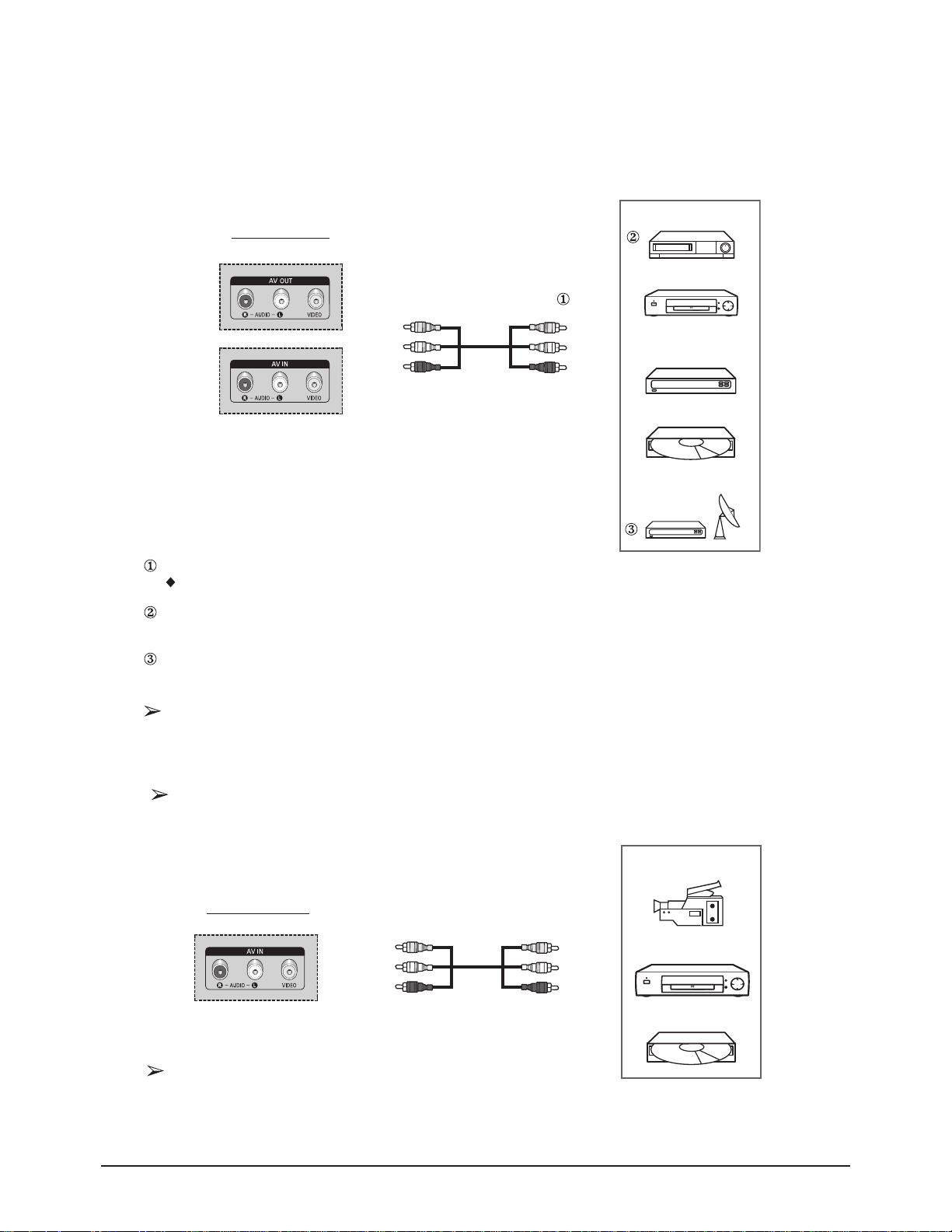
Reference Information
Samsung Electronics 14-3
14-1-4 Connecting to the AV Output
14-1-5 Connecting to the RCA Input
“AV OUT” are used for the equipment with an RGB output, such as video game devices or video disc players.
Rear of the TV
This end can be fitted with:
Three RCA connectors (VIDEO + AUDIO L/R)
If you have a second VCR and wish to copy cassette tapes, connect the source VCR to
target VCR to “AV OUT” so that you can redirect the signal from
When you wish to record a programme, connect the receiver to
that you can redirect the signal from
“
AV IN” to “AV OUT” .
“
AV IN” to “AV OUT” .
“
AV IN” and the VCR to “AV OUT” so
VCR
DVD
Decoder /
Video Game Device
Video Disc Player
Satellite Receiver
“
AV IN” and the
Please be sure to match the color coded input terminals and cable jacks.
The RCA (VIDEO + AUDIO L /R) connectors are used for equipment, such as camcorders, video disc
players, and some video game devices.
Rear of the TV
Please be sure to match the color coded input terminals and cable jacks.
Camcorder
Video game device
Video disc player
Page 87
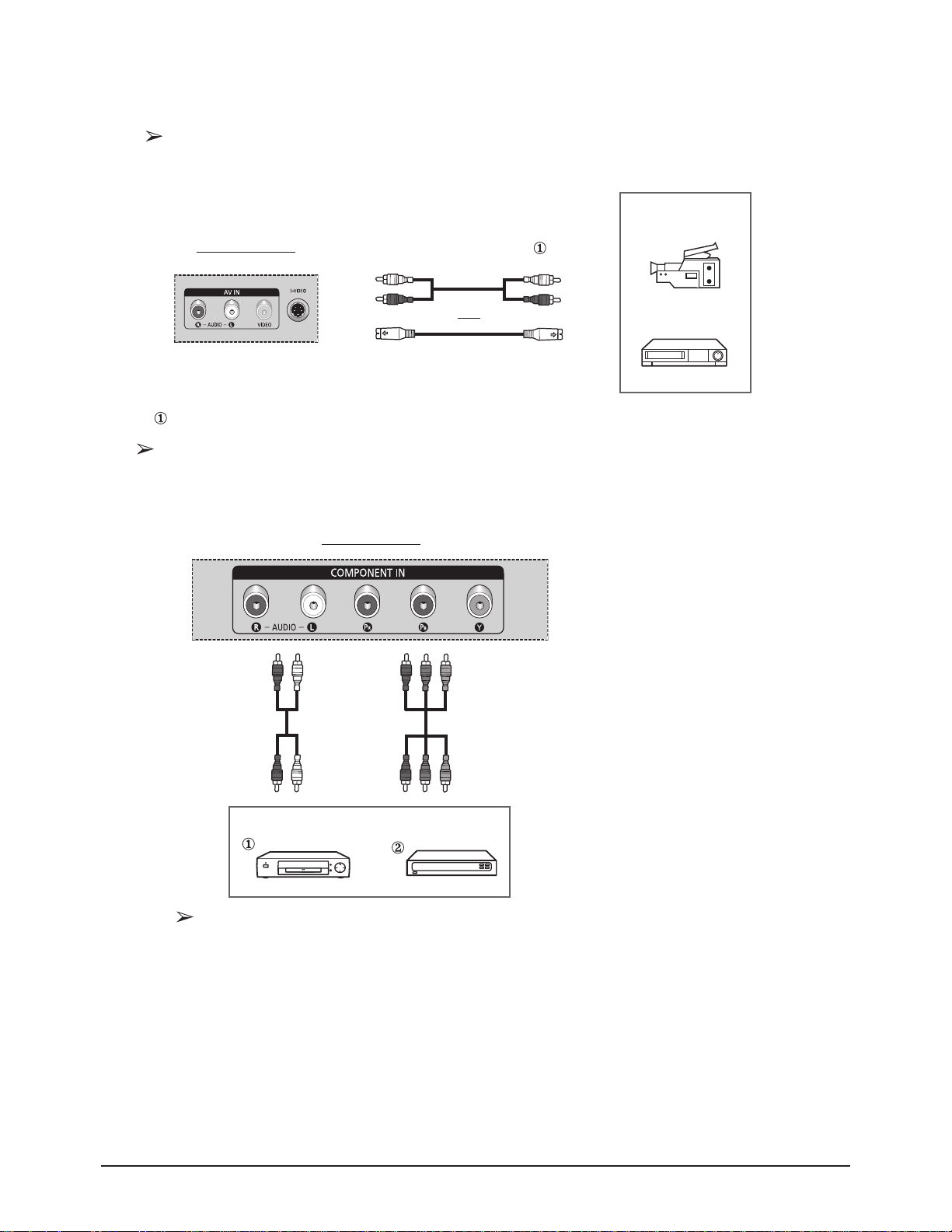
14-1-7 Connecting to the Component Input
Reference Information
14-4 Samsung Electronics
14-1-6 Connecting to the S-Video Input
The S-VIDEO and AUDIO L /R connectors are used for equipment with an S-Video output, such as a
camcorder or VCR.
Rear of the TV
Camcorder
To play pictures and sound, both the S-VIDEO and AUDIO L /R connectors must be used.
Please be sure to match the color coded input terminals and cable jacks.
Rear of the TV
and
VCR
The COMPONENT IN connectors are used
DVD
Please be sure to match the color coded input terminals and cable jacks.
DTV receiver
for equipment with a DVD or DTV receiver
output.
(480i/480p/576i/576p/1080i)
Page 88
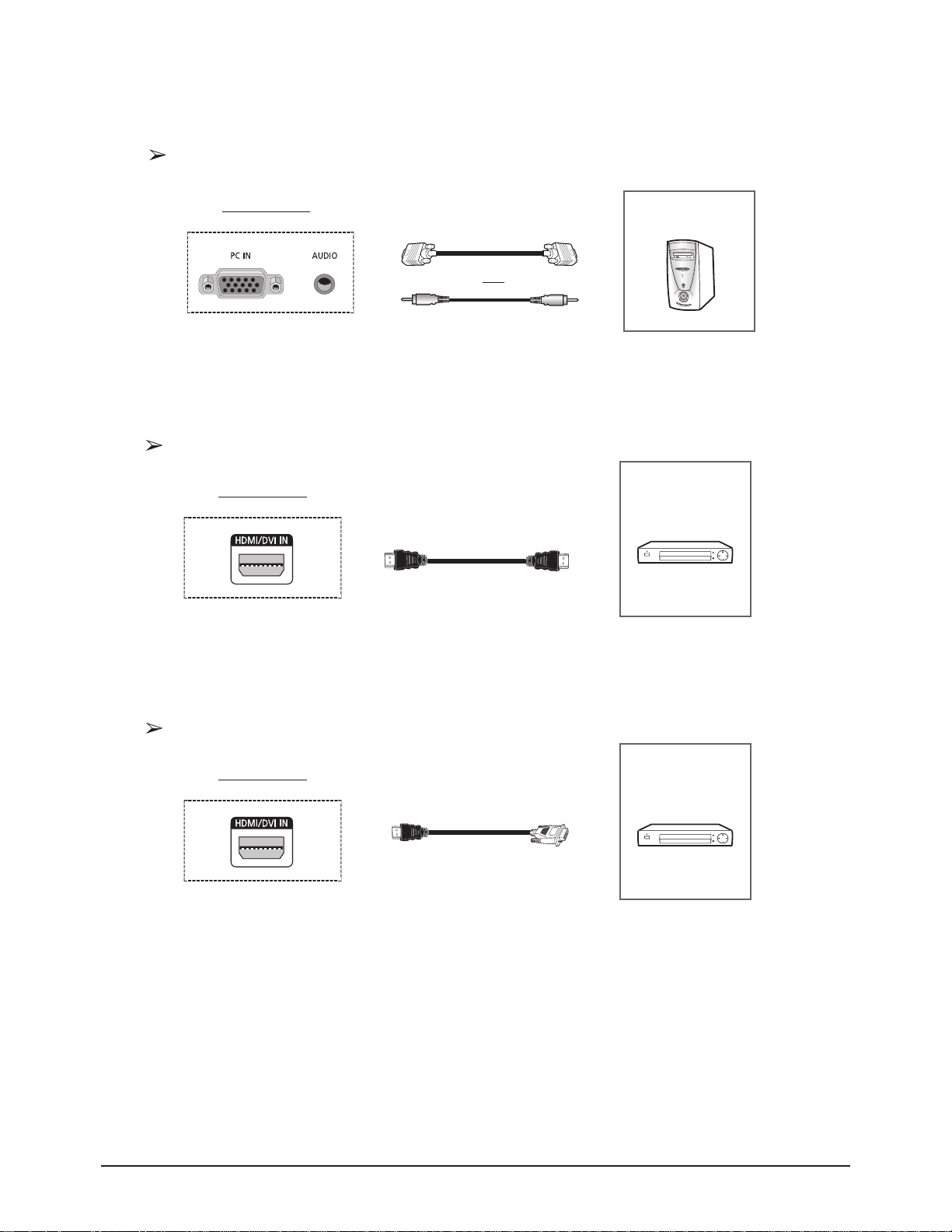
Reference Information
Samsung Electronics 14-5
14-1-8 Connecting to the PC Input
14-1-9 Connecting to the HDMI Input
14-1-10 Connecting to the HDMI/DVI Compatible
The “PC IN” (video) and “AUDIO” connectors are used for interfacing with your PC.
Rear of the TV
The “HDMI/DVI IN” connector is used for equipment with a HDMI out.
Rear of the TV
Personal Computer
and
DTV Set-Top Box
The “HDMI/DVI IN” connector is used for equipment with a DVI out.
Rear of the TV
(HDMI/DVI cable)
DTV Set-Top Box
Page 89
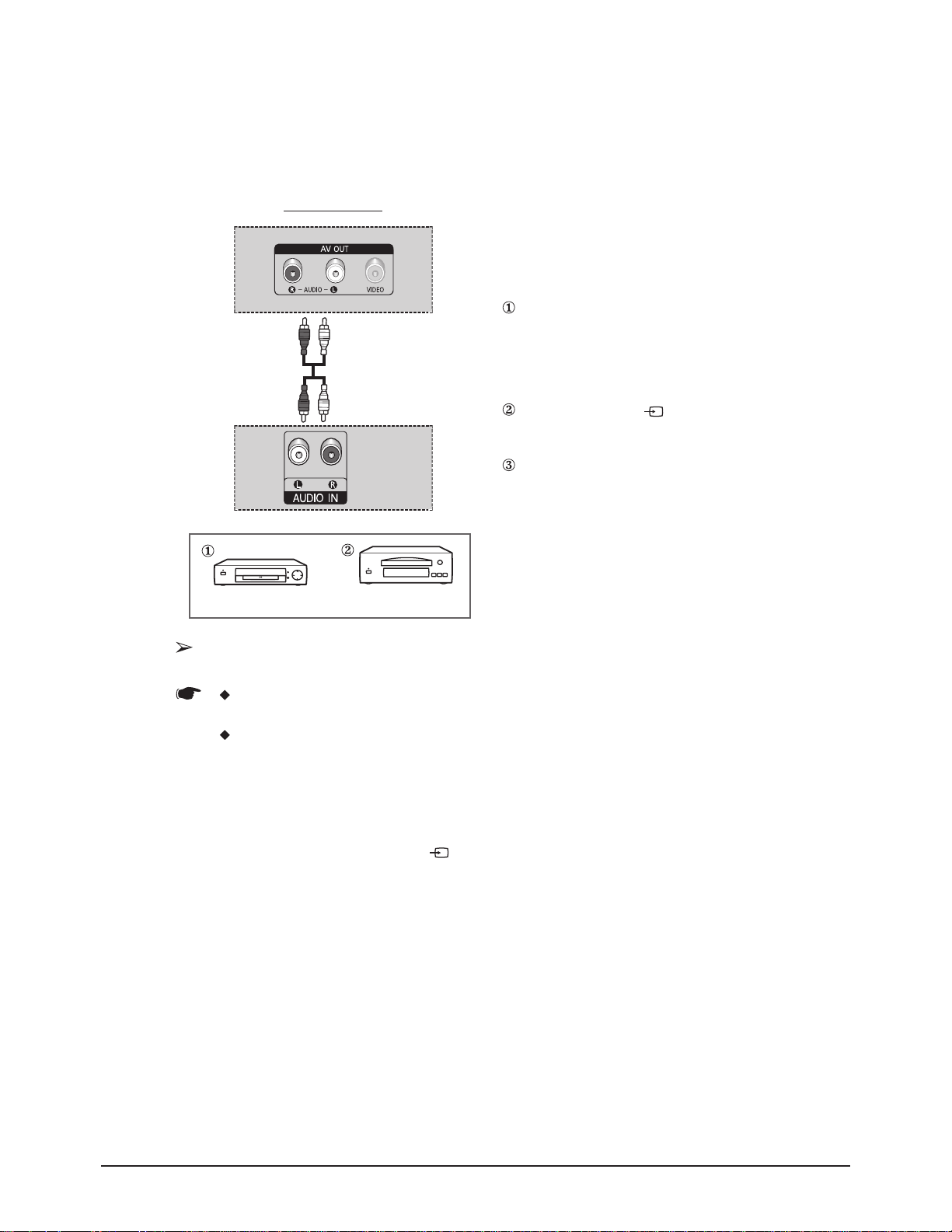
Reference Information
14-6 Samsung Electronics
14-1-11 Connecting Home Theater System
Use the “AV OUT” ports of the PDP for Home Theater System Connections.
Rear of the TV
Connecting the Home Theater System
Connect the monitoring audio out L and
R jacks of the AV OUT on the rear-side
connection panel of the PDP TV to the
AUDIO IN jacks of the DVD Home
Theater System (or AV Receiver) using
the audio cable.
Press the SOURCE ( ) button to
select the desired external device
connected to the PDP TV.
If you want to hear the sound through
separate speakers, cancel the internal
amplifier.
DVD Home Theater
Please be sure to match the color coded input terminals and cable jacks.
Refer to corresponding user’s manual from the manufacturer for wiring the
speakers to the DVD Home Theater System (or AV Receiver).
Disable the PDP TV internal speaker to enjoy the rich sound through the
speakers of your Home Theater System.
To Display the DVD Home Theater
!
Turn the PDP on and press the SOURCE ( ) button to select the Ext.1, Ext.2, or Component .
@
Be sure to connect the video cable properly if desired external input ( Ext.1, Ext.2, or
Component ) cannot be selected.
#
Play the DVD after activating the DVD Home Theater System.
$
Use the volume control of the Home Theater System while watching the PDP using the DVD
Home Theater, where the PDP TV does not produce the audio.
AV Receiver Amplifier
Page 90
Reference Information
Samsung Electronics 14-7
14-1-12 Other issues related to other products
Problem Descriptions
Afixed screen can cause
permanent damage to the TV
Braun tube.
Braun, PDP and LCD TVs can all be damaged. When a still image is displayed in a sequence,
this can leave stains or after-images due to the characteristics of the panel.
However, the DLPTV has the advantage that no stains or after-images are left on the screen.
The DLP TV has mirror pixels on the DMD panel that project the beam onto the screen, in
which the mirror is a digital representation of 0s and 1s, leaving no trace of light.
The mirror returns to a blank state so that no stains or after-images are left.
Confusion between the
ANYNET Port and the
SERVICE Jack Port
The SAMSUNG SKY500N model has both an ANYNETport and a SERVICE jack port.
Because the shape of the ANYNETport on the DLP TV is the same as that of the SERVICE
jack port of the SKY500N, it fails to turn the TV off after a connection has been reported.
The ANYNETport uses an RS232 port called Phone Jack, and the SERVICE jack port also
uses the RS232 port. However, you must not connect the SERVICE port and the ANYNET port.
Check if the port is the ANYNETport or the SERVICE port before connecting the port.
Even if the TV cannot be turned on after connecting, the TV will turn on if you disconnect the
connection.
Length of DVI Cable / PC RGB
Cable
- Atoo long DVI cable may cause a malfunction or degradation of the visual quality due to an
attenuation of the signal. There is no recommendation for the cable length at present.
In general, although a cable length of up to 5 meters should work, please check if video is
properly displayed on the screen after connecting. If you think the length of the cable is longer
than for normal use, check the visual quality of the video on the screen and shorten the
length, if necessary.
- This also applies to the PC RGB (D-Sub) cable. When the length of the cable is longer than
for normal use, video may not be displayed on the screen. In this case, shorten the cable
length.
When a digitally distributed TV
user receives HD-rated
broadcasts:
The digital distributed TV (Ready Technique) can render HD sources as HD-rated.
However, you need to install a set-top box for this purpose. The digital TV alone cannot render
HD broadcasting as HD-rated. Install the formal set-top box for HD broadcasts.
When a digital distributed TV
user selects normal size (4:3) to
receive SD-rated digita
broadcasts:
The digitally distributed TV (Ready Technique) renders any broadcasting service as SD-rated.
However, when connected to a set-top box, the digital TV renders HD broadcasts as HD-rated
and renders SD as SD-rated. The screen size is scaled to 4:3.
When a digitally built-in TV user
receives SD (air) broadcasting:
The digitally integrated TV ("built-in" type) renders SD broadcasting as SD-rated.
This can be understood easily.
Even a high-resolution TV cannot improve a low resolution picture into high quality.
In contrast, an SD-rated TV cannot represent HD broadcasting as HD because the resolution of
the TV is lower than the original.
When selecting a picture size of
4:3 in connection with a
computer or a multimedia
device:
The representation capability of SD or HD-rated depend entirely on the TV set. The HD TV can
render HD broadcasting as HD-rated only when it receives HD sources.
In the meantime, the HD TV renders SD as SD-rated when it receives SD sources.
The picture size has nothing to do with the resolution; TV models like SVP-XXL3HD or
SVP-XXL6HD have a size adjustment feature to 16:9, 4:3, Panorama, Zoom1, Zoom2 and Auto
Wide. This is about the aspect ratio of the top and bottom boundaries to the overall screen and
users can select their preference.
Page 91
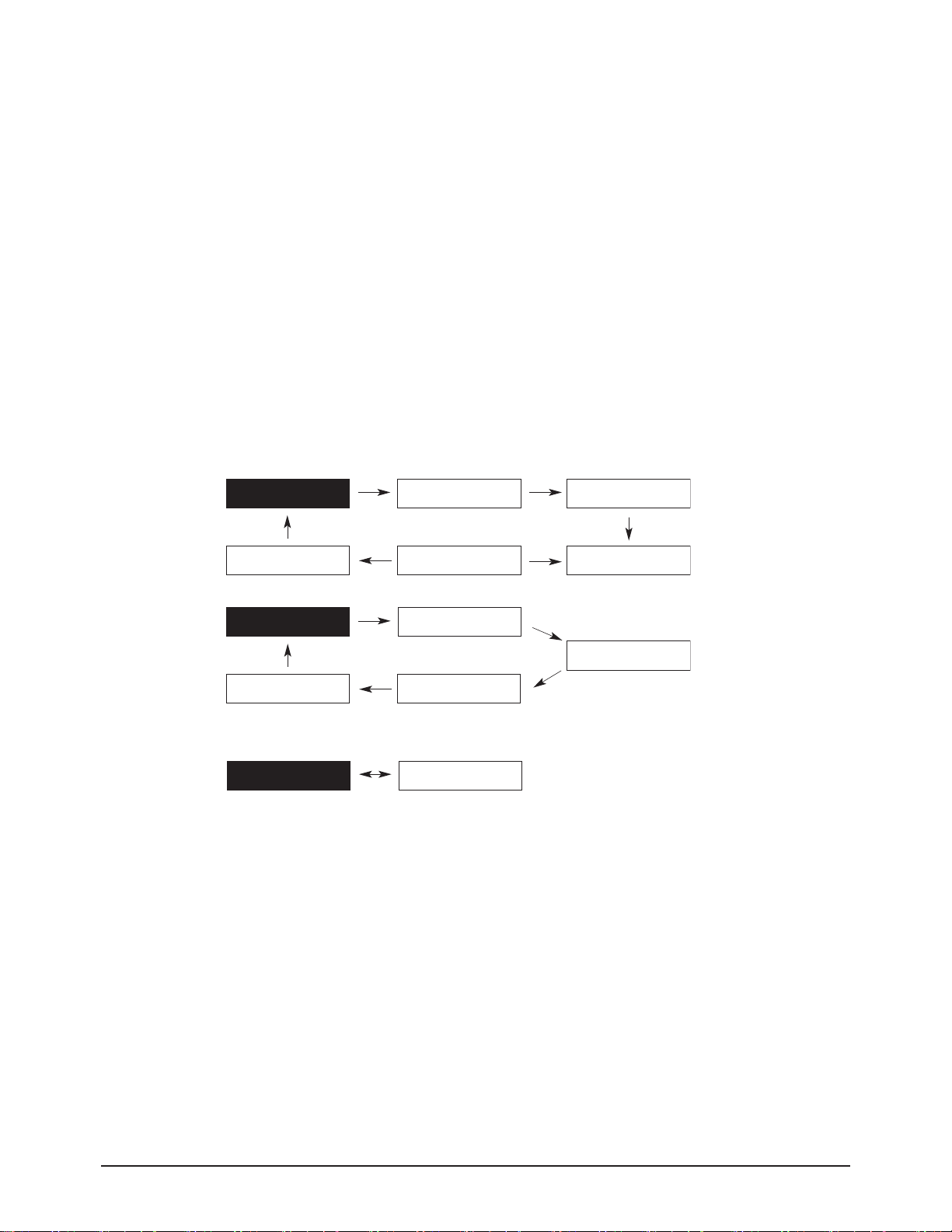
Reference Information
14-8 Samsung Electronics
■ SD/HD broadcasts and the TV's display capability are related
1. Adigital broadcast should be transmitted in wide screen (an aspect ratio of 16:9) HD. If the broadcasting station converts a
conventional program created in normal screen (aspect ratio of 4:3) into a digital signal and broadcasts the signal, the left and
right of the picture will not be displayed.
This symptom also appears in other manufacturer's TV's. The three appliance companies are trying to resolve the problem
through the Ministry of Information and Communication.
* When watching an SD (normal) broadcast through a Digital (Wide) TV (480P normal broadcast)
* When watching an SD (normal) broadcast through a Digital Ready (Wide) TV (Using a set-top-box)
* When watching an analog (normal) broadcast through a wide TV
(When watching a broadcast after changing the aspect ratio of the TV from 16:9 (wide screen) to 4:3)
2. When watching a DVD title or video tape in wide screen (21:9) through a wide (16:9) TV, watching video from a computer or
game console by selecting the aspect ratio to 4:3, or watching video from a DVD, VCR, computer or game console through a
wide TV by selecting the aspect ratio to normal (4:3) or wide (21:9), the left and right, or top and bottom of the picture will not be
displayed.
This symptom appears in other manufacturer's TV's. The three appliance companies are trying to resolve the problem through
the Ministry of Information and Communication.
■ Changing the Order of the Picture Size for 16:9 Display Devices
■ Changing the Order of the Picture Size for DTV 1080i/720p Sources
■ Restrictions
1. When you want to change the picture size in PIP 'ON', you must turn the PIP off before changing the size.
However, you can change the main picture size even in PIPON for products with no restrictions.
2. When the picture size is not Normal (4:3 for 4:3 display devices, 16:9 for 16:9 display devices) and you turn PIP on, the picture
size is changed to Normal.
However, you can turn PIPon without changing the picture size for products with no restrictions.
3. In the OSD notation for the picture size, 16:9 is represented as "Wide" instead of "16:9" for devices other than with 16:9 dislays.
Ex: For LCD 15:9 devices, "Wide" is displayed on the OSD instead of "16:9".
4. The picture size can be changed even in the blue screen.
However, the picture size should be controlled by the product specifications if the change is impossible due to hardware
restrictions.
Video/RF
Component
Auto Wide Wide
4 : 3
Wide
Zoom
Wide 4:3
Wide 4:3
Panorama
Panorama
4 : 3
PC/HDMI
Wide
Zoom
4 : 3
Page 92

Reference Information
Samsung Electronics 14-9
14-2 Technical Terms
Virtual Channel
In digital channels, a virtual channel is used. Avirtual channel
is a function that enables users to watch a channel by selecting
a virtual channel number regardless of the region of the user.
Run Auto Channel Scan for digital broadcasts, tune in to a UHF
channel number according to the region for terrestrial broadcasts, or tune into a channel number allocated by the cable
broadcasting station for a cable TV network, and then select a
displayed virtual channel.
For example, even if you tune into channels UHF 14(MBC),
15(KBS1), 16(SBS), 17(KBS2) and 18(EBS) broadcast from
Kwanak mountain in Seoul, you can watch the channels using
virtual channels such as 11-1(MBC), 9-1(KBS1), 6-1(SBS), 71(KBS2) and 10-1(EBS) regardless of your region and the
actual local channel number. The virtual channel numbers may
be used nationwide, but the virtual channel numbers may vary
depending on the local broadcasting stations.
(Since the digital channel numbers may vary depending on
your region and can be changed by the broadcasting policy,
ask your local broadcasting station or regional cable TV network company about the channel numbers.) If the virtual channel numbers are saved and the TV set can receive digital
broadcasting, you can watch a digital channel by pressing the
DTV+ button and pressing the first two digits of the corresponding virtual channel number.
Custom Color Adjustment
Using this function, a user can adjust the color according to
personal preferences (Red, Grass-Color, Sky-Color, GoldColor, Skin-Color, White, Standard, Custom) without affecting
other colors using automatic selection mode or fine adjustment
mode.
Simultaneous Screen
Using this function, a user can view two video signals from
separate video sources on a single screen at the same time.
For example, you can watch TV and video simultaneously.
Dolby Digital
This is the digital sound standard developed by the Dolby
Laboratory. You can select your preferred digital surround
mode after connecting external speakers.
Digital Broadcasting
Digital Broadcasting is a television broadcasting signal digitized
and transmitted according to the United States' terrestrial digital
broadcast standard, or ATSC.
Mono
Atype of audio interface that transmits the audio signal through
a single channel only.
Through a mono interface, it is hard to experience stereophonic
sound and the sound is played using only one speaker.
Reception Sensitivity Amplification (LNA)
Asignal amplification technique that amplifies a weak broadcasting signal by applying satellite technology to provide better
visual quality even for users in regions where only a weak
broadcasting signal is available. (LNA: Low Noise Amplifier)
Sub Woofer
ASub Woofer is a speaker for ultra bass sound output only
whose frequency is as low as 150Hz. There are two types: an
active type which includes an amplifier, and a passive type,
which requires an additional amplifier.
Stereo
Atype of audio interface that transmits audio signal through 2
channels.
Stereo transmits audio signals for right and left sound so that
you can experience stereophonic sound, and the sound is
played through 2 speakers.
Partial Color Blind Person Mode
Using this function, a user can adjust the red, green or blue
colors according to the preferences of the partially color-blind
person so that he or she can view the clearest possible picture
on the screen.
Analog Broadcasting
Analog Broadcasting is a television broadcasting signal transmitted according to the NTSC standard.
ANTENNA IN Port
The port connecting the TV aerial via a coaxial cable. It is generally used for watching public broadcast programs.
English Caption
Afunction that displays English captions or text information
included in the broadcast signal or video tape. You can use this
function for your English studies by watching AFKN or CC
marked video tapes.
Video/Audio Ports
You may experience poor visual and audio quality when watching a video tape on channel 3 or 4 through the antenna cable.
You can experience better visual and audio quality by connecting the TV and VCR through the Video/Audio ports. The video
port is in yellow, and the audio ports are in white and red.
Wide Screen
Wide Screen refers to a screen that is horizontally longer than
a conventional TV screen.
While the aspect ratio of a normal TV is 4:3, that of a wide
screen is 16:9.
Page 93

Reference Information
14-10 Samsung Electronics
External Input
External Input is a connected video device such as a VCR,
camcorder, DTV receiver, DVD, etc. as a video source.
Satellite Broadcasting
Satellite Broadcasting transmits programs via satellite so that a
program can be viable in all areas at a high visual and sound
quality. Approximately 100 channels including public broadcast
channels are provided. To view a satellite broadcast, you have
to install an additional receiver.
Wire Broadcasting
Wire Broadcasting refers to movie, entertainment and educational programs transmitted by a broadcasting station within a
hotel or school.
Audio Multimix
Audio Multimix provides 2 audio languages when foreign
movie, drama, news, etc. are broadcast. You can select and listen to one of the supported languages or you can select and
listen to both languages simultaneously.
After-Image Protection
Using this function, a user can configure the options necessary
for protecting the PDP TV screen.
Power Saving Mode
This function adjusts the screen brightness according to the
ambient brightness so as to conserve power.
Component Port
The Component Port transmits a separate luminance signal as
well as the green, blue, and red color signal and provides the
best quality of all video connection types.
Cable Broadcasting
Cable Broadcasting transmits programs via cable instead of via
the air. To view cable broadcasting, you have to subscribe to
your local cable broadcast service provider and install an additional receiver.
Tuner
Adevice that enables the selecting of specific channel frequencies for TV or radio.
Panorama Screen
This refers to a screen that corrects the picture distortion due
to a screen size mismatch on the TV.
Progressive Scan
Progressive scan displays the entire frame in a single sweep
so as to provide clearer and sharper visual quality.
Anynet
Anynet is an AV network system that enables an easy-to-use
AV interface for users by controlling all connected AV devices
through the Anynet menu when the AV devices of Samsung
Electronics are connected.
DVD (Digital Versatile Disc)
DVD is a large capacity storage media that can store multimedia content such as video, games, audio applications, etc.
using MPEG-2 video compression technology on a CD sized
disc
DRC
This is a sound quality enhancement function that automatically
controls audio output so as to prevent sound quality distortion
even at loud volumes and correct the sound to the speakers so
that you can listen to the sound at the original sound quality.
DVI (Digital Visual Interface) Port
ADVI interface is a standard for high definition television connectivity. It provides a clear picture on the screen using TMDS
which minimizes video signal loss.
DVI-D Cable
Atype of DVI connector. Using this cable you can only transmit
digital signals.
DVI-I Cable
Atype of DVI connector. Using this cable you can transmit
either digital or analog signals.
HDMI
HDMI (High-Definition Multimedia Interface) is the first industrysupported, uncompressed, all-digital audio/video interface.
HDMI provides an interface between any audio/video source,
such as a set-top box, DVD player, and A/V receiver and an
audio and/or video monitor, such as a digital television (DTV).
HDMI supports standard, enhanced, or high-definition video,
plus multi-channel digital audio on a single cable. It transmits
all ATSC HDTV standards and supports 8-channel digital audio,
with bandwidth to spare to accommodate future enhancements
and requirements.
PCM
PCM (Pulse Coded Modulation): This refers to an uncompressed digital signal. Use this for an AV amplifier that does not
support 5.1 channels when connecting the audio output via
optical or coaxial cable.
SRS TruSurround XT
This function provides 5.1 channel surround sound using 2
channel speakers when inputting a stereo audio signal.
Page 94
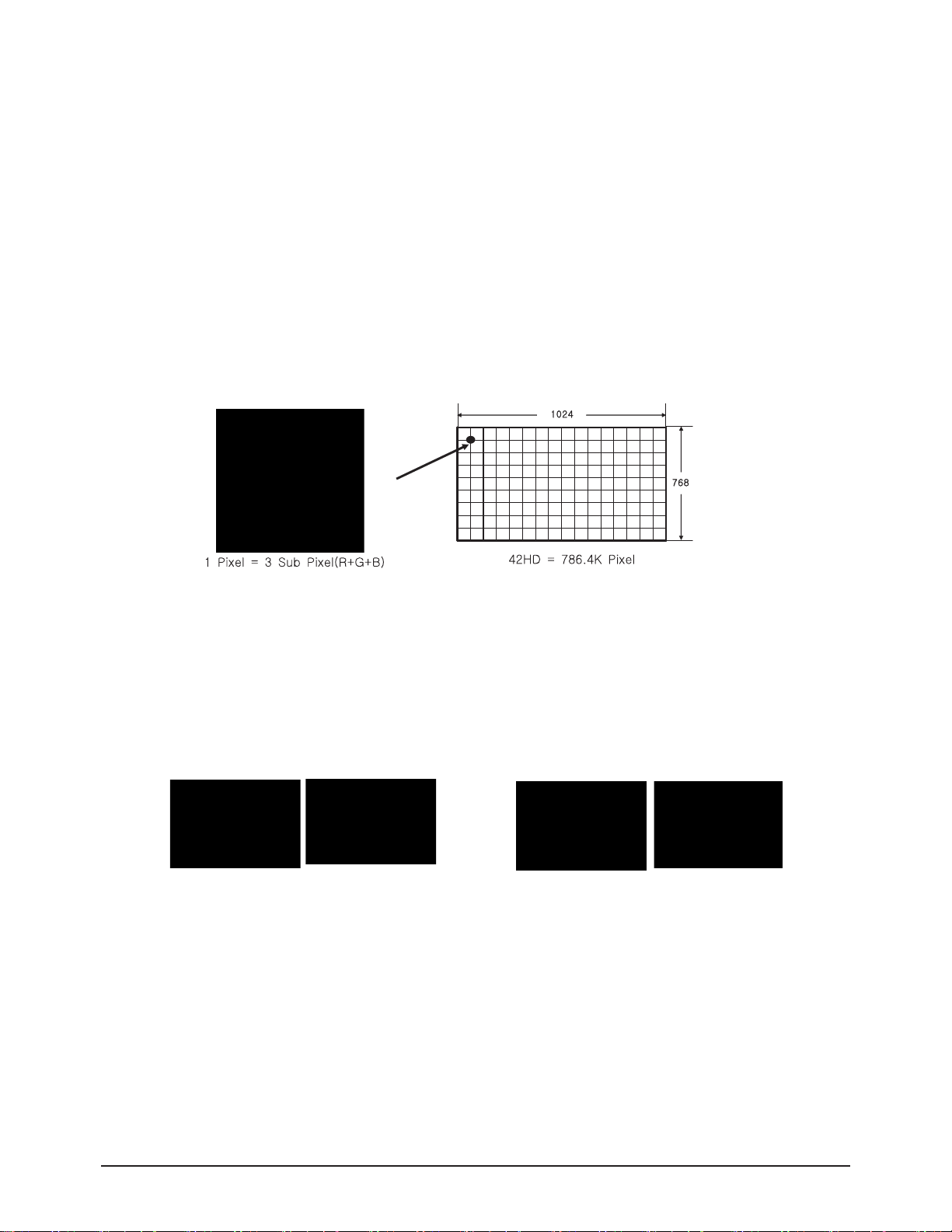
Reference Information
Samsung Electronics 14-11
VESA Plug & Play
This function enables the automatic recognition of devices
when connecting the TV to the computer without additional settings.
S-VIDEO IN Port
This is called super video. S-Video is a type of video signal
which has the video luminance and the color signal separated
in order to provide better visual quality.
VHF/UHF
VHF refers to TV channels 2 to 13, and UHF refers to TV channels 14 to 69.
Pixels, Resolution
The pixels are the number of small dots that make up the TV screen. The resolution represents the number of pixels on a screen.
For example, if the resolution of a TV is 1366 * 768, it means the width of the screen consists of 1366 pixel columns and the height
of the screen consists of 768 pixel rows. In this case, the total number of pixels on the screen is 1,049,088. The more pixels there
are, the higher the visual quality that can be achieved because the picture on the screen is displayed with more pixels and therefore with more detail.
Gradation, Color Depth
Gradation describes the number of gradual brightness levels. Since all information is represented by binary numbers in a digital
system, the Gradation is determined by the number of bits used to represent the brightness levels of a pixel on the TV screen. For
example, if a pixel is represented by 8 bits, the Gradation is 28 or 256. Since a TV uses the three primary colors of light, R, G and
B, the number of possible colors for a pixel is 256 x 256 x 256, 16,777,216, or 16.7 million colors. If 12 bits are used for a pixel, the
gradation is 212 or 4096 for a color. Since three colors R, G and B are used, 4096 x 4096 x 4096 or 68.7 billion colors are supported per pixel. Since 68.7 billion colors are far more than 16.7 million colors, the picture will be displayed by far more abundant and
natural colors using a 12 bit pixel. That is, since Gradation means the number of brightness levels, color represented by 4096 levels appears more natural than color represented by 256 levels.
Contrast
The contrast is the ratio of brightness of the brightest color to the darkest color. The contrast is calculated by dividing the brightness of the brightest color by the brightness of the darkest color. For example, if the brightness of the darkest color is 1 and the
brightness of the brightest color is 3000, then the Contrast is 3000/1 or 3000. Ahigher contrast means that a dark color is displayed darker and bright color is displayed brighter so that the screen contrast can be easily distinguished. The contrast differs
from the Gradient which means the number of brightness levels.
Therefore, if someone says that a 5000:1 contrast displays a color by 5000 levels, he is confusing Contrast with Gradation.
Brightness
Brightness is the brightness per unit screen area, the unit for brightness is candela (cd). For example, 1000cd/m2 means the
brightness that is measured when 1000 candles are lit within 1 square meters area.
Page 95

Reference Information
14-12 Samsung Electronics
Color Reproductivity
Each color displayed on the TV screen is implemented by a pixel on color coordinates which have an X and Yaxis.
For example, when a pixel on the X coordinate 0.65 and the Y coordinate 0.74 is displayed as a
color and it becomes visible on the TV screen. While the possible color coordinate area is very
wide, the color coordinate area of the signal broadcast from a broadcast station is smaller than
that of possible color coordinates. Moreover, a TV provides a smaller color coordinate area than
that of the signal from the broadcasting station even though the size of the color coordinate area
varies depending on the TV model. In general, Color Reproductivity is used as follows:
The Color reproductivity of a TV is a certain % of NTSC. This means the TV displays that
particular % of the color coordinate area of the NTSC signal broadcast by the broadcasting
station. In general, a CRTTV provides the highest functional color reproductivity.
Page 96
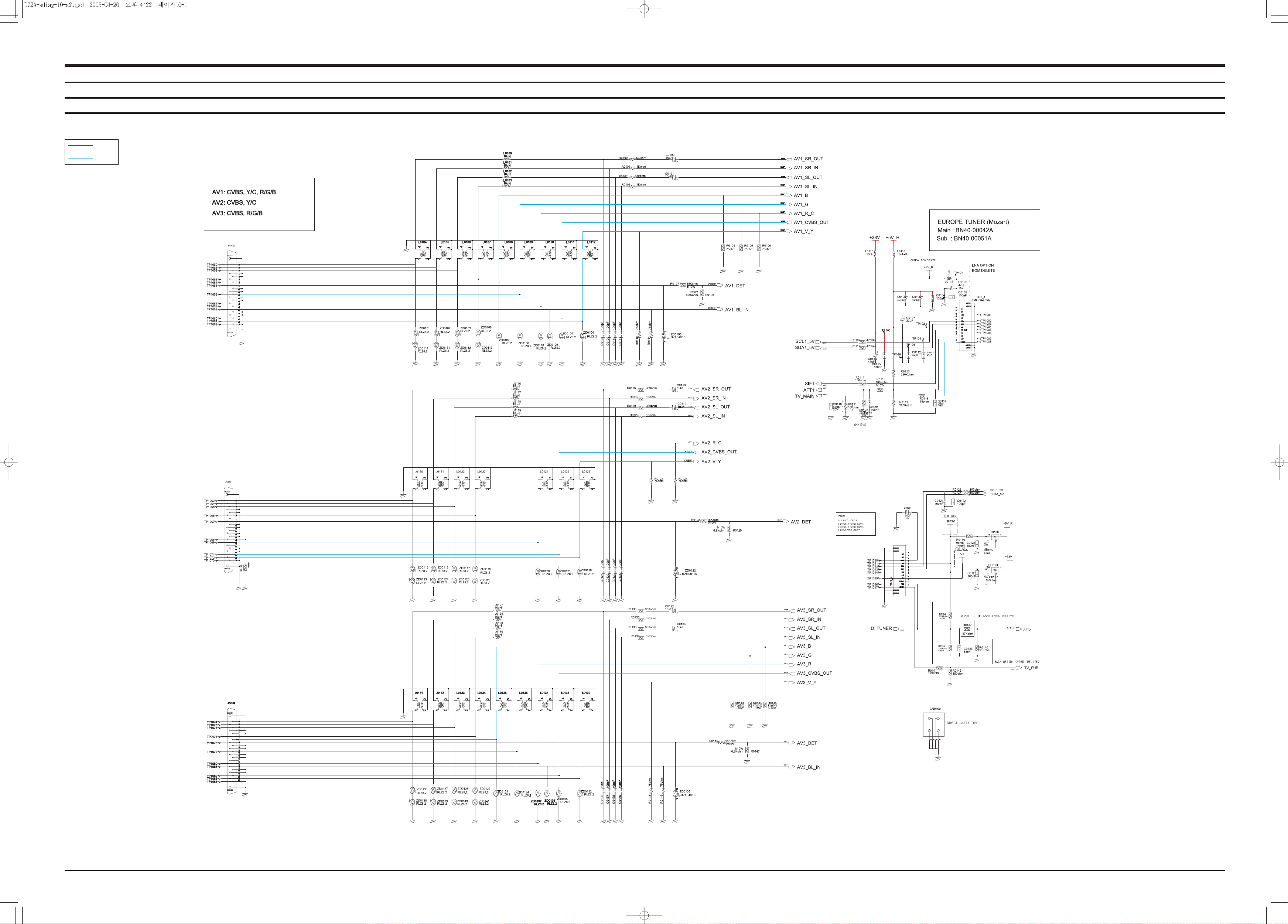
Schematic Diagram
10-1
Samsung Electronics
10. Schematic Diagram
This Document can not be used without Samsung’s authorization.
10-1 MAIN
10-1-1 Scart Jack
Power
Signal
Page 97
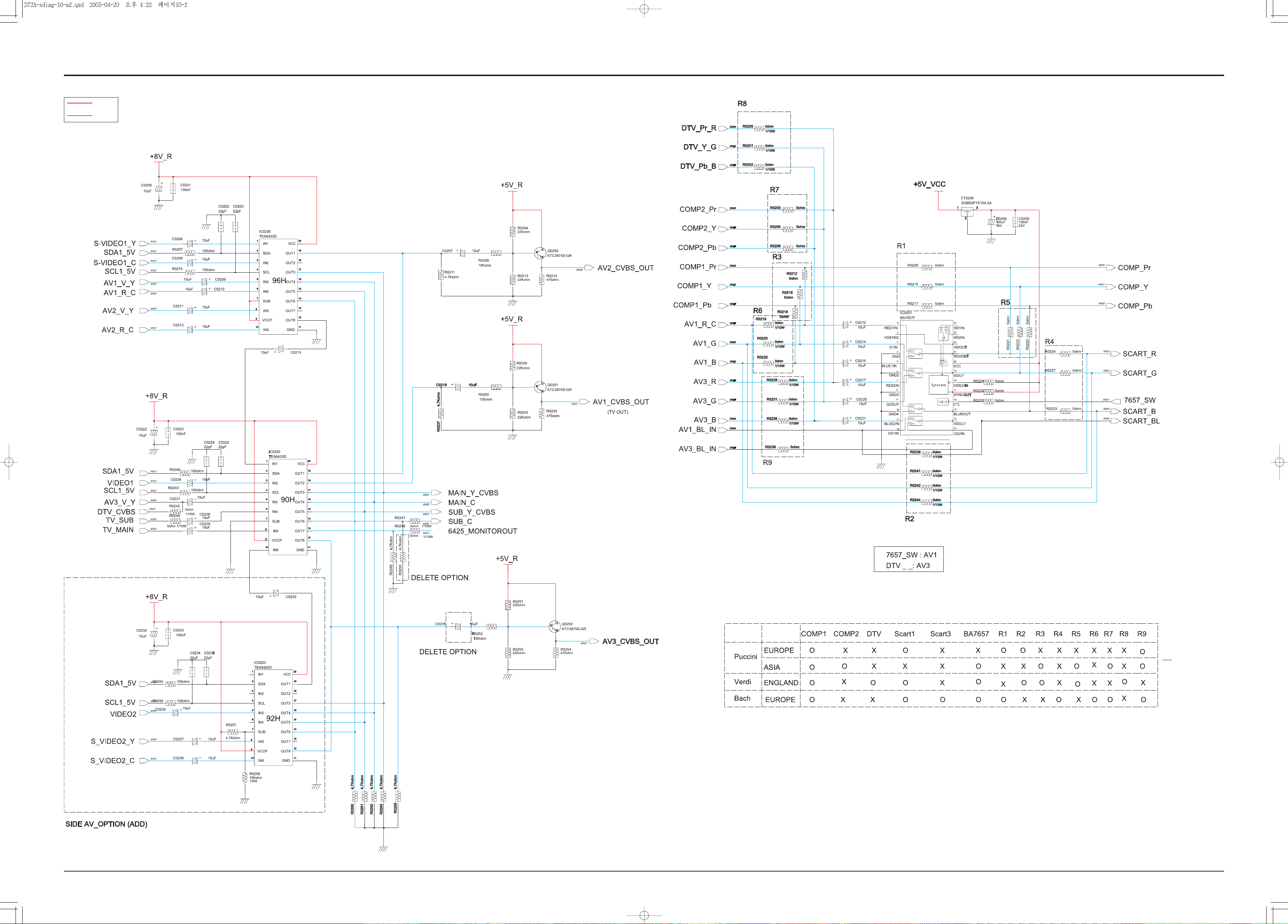
10-2
Schematic Diagram
Samsung Electronics
10-1-2 Video switch
This Document can not be used without Samsung’s authorization.
Power
Signal
Page 98
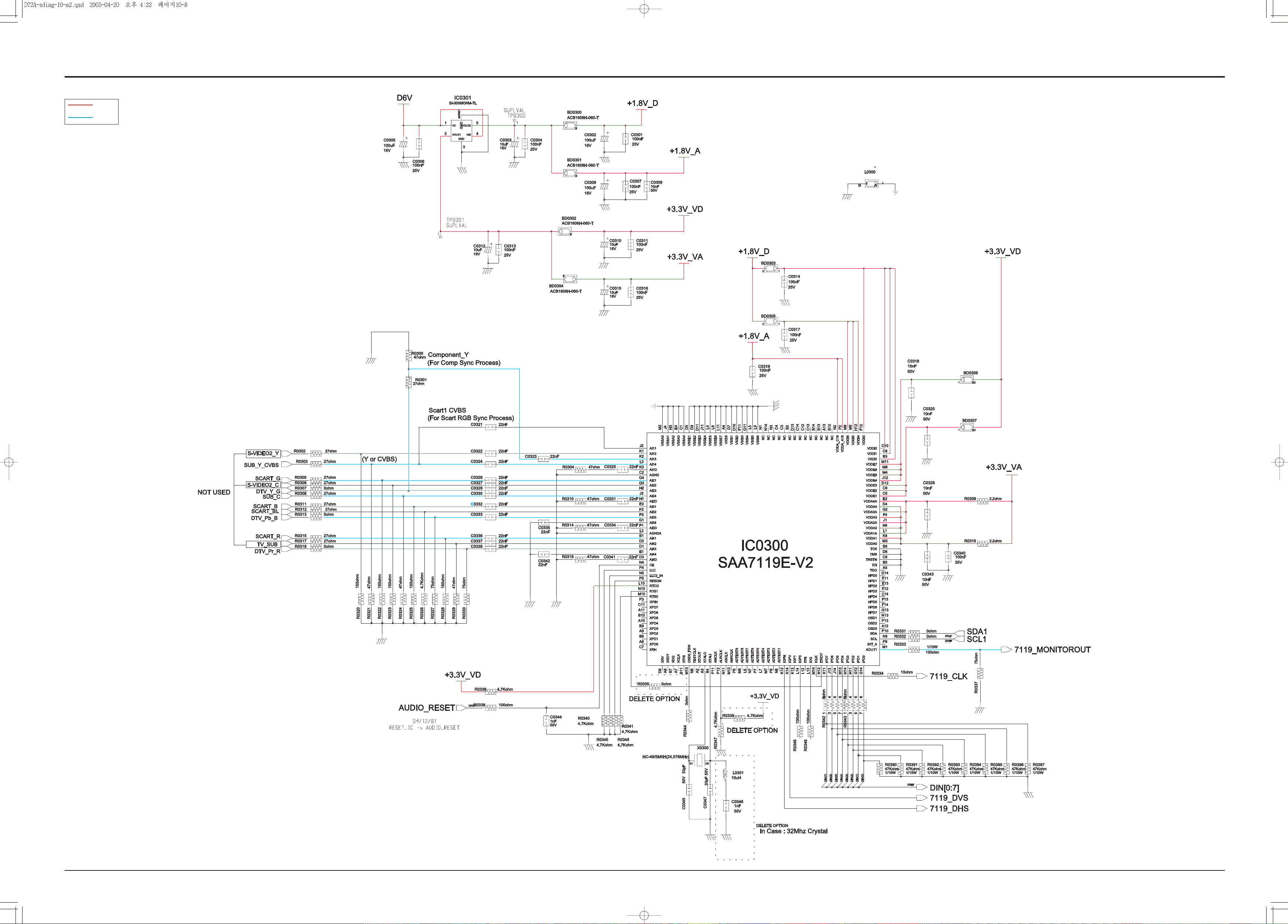
Samsung Electronics
Schematic Diagram
10-8
10-1-3 SAA7119
This Document can not be used without Samsung’s authorization.
Power
Signal
Page 99
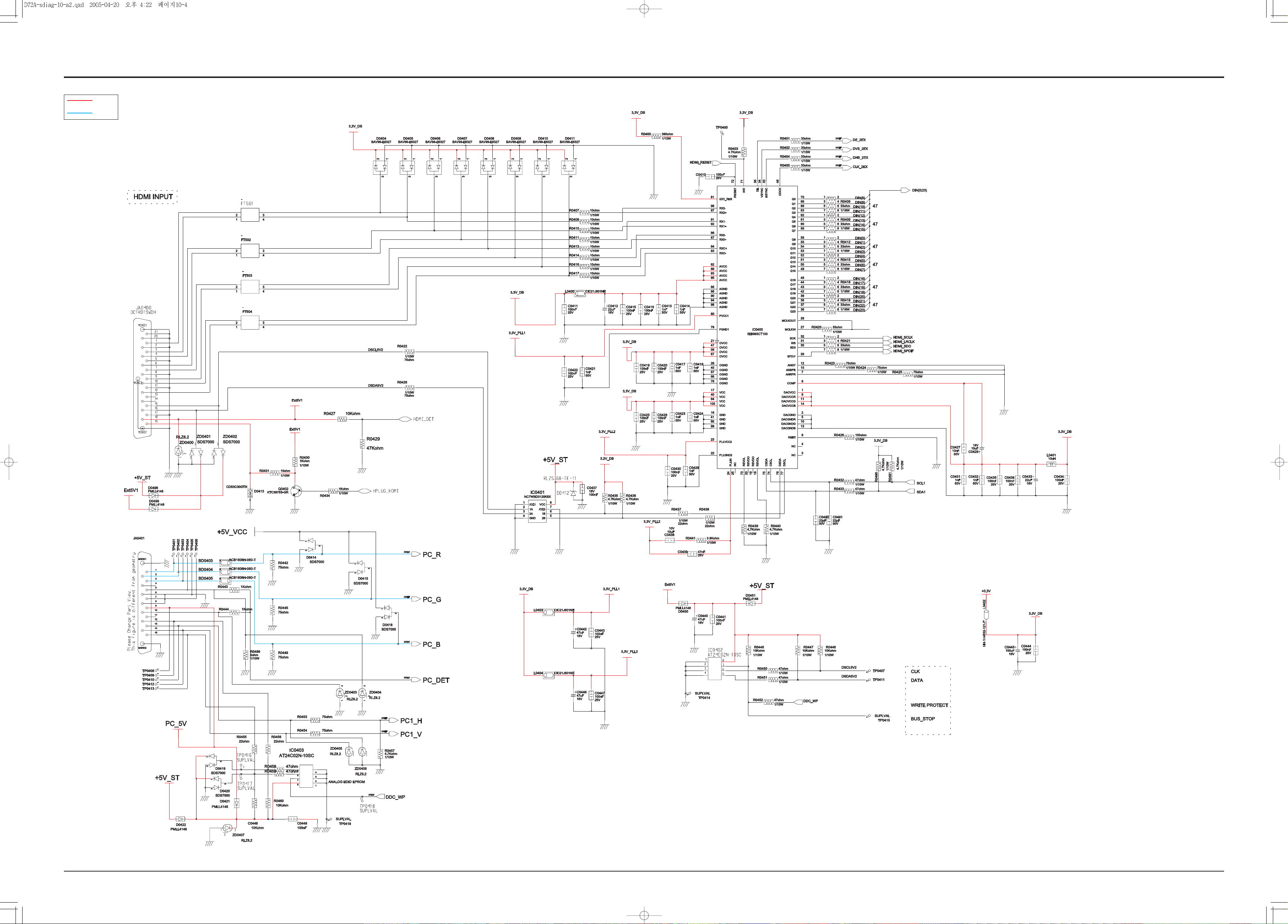
10-4
Schematic Diagram
Samsung Electronics
10-1-4 HDMI_PC IN
This Document can not be used without Samsung’s authorization.
Power
Signal
Page 100
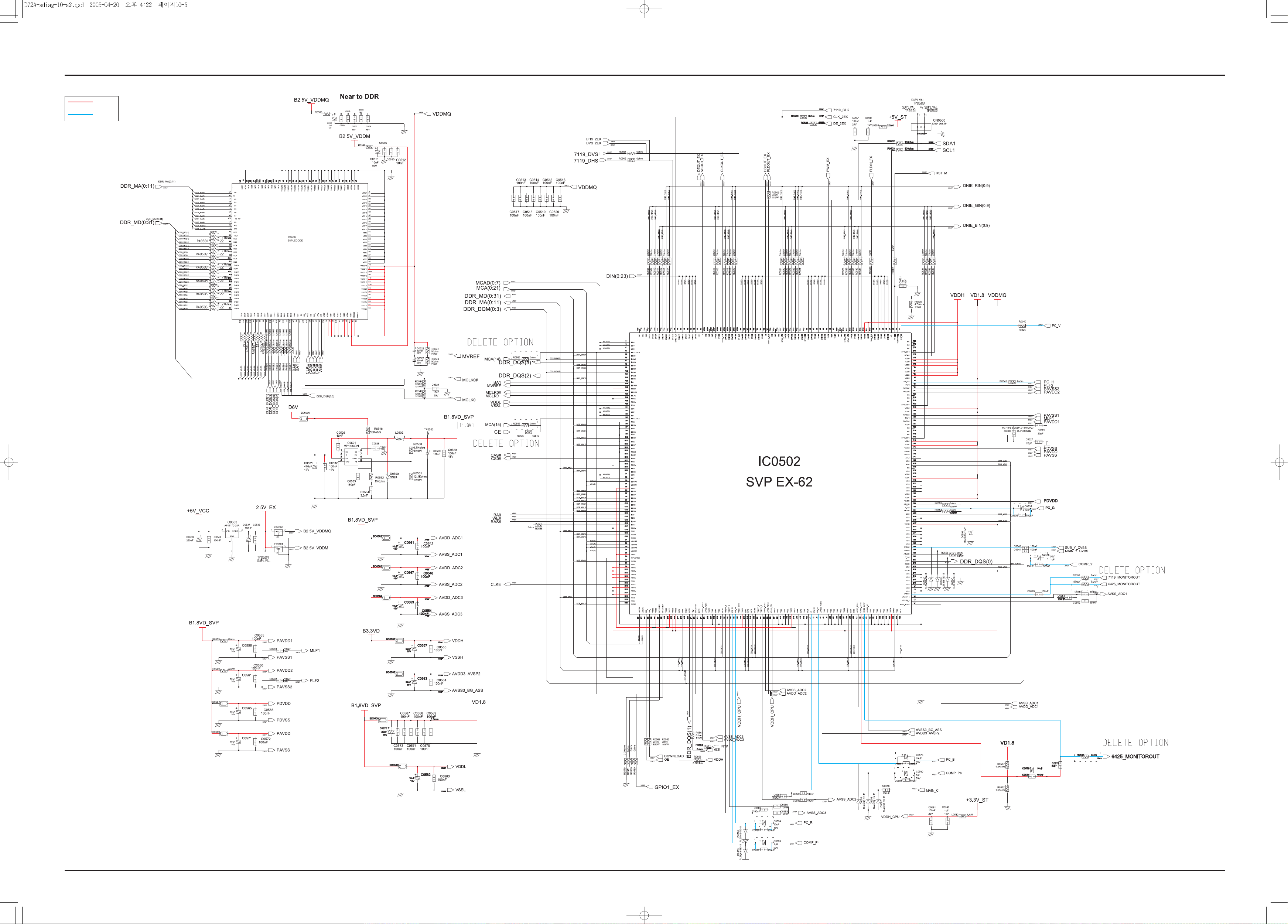
Samsung Electronics
Schematic Diagram
10-5
10-1-5 SVP EX
This Document can not be used without Samsung’s authorization.
Power
Signal
 Loading...