

Page 1
24926 Highway 108
m
Sierra Village, CA 95346
Phone: (800) 545-1022
E-Mail: sales @olsontech.co
Fax: (209) 586-1026
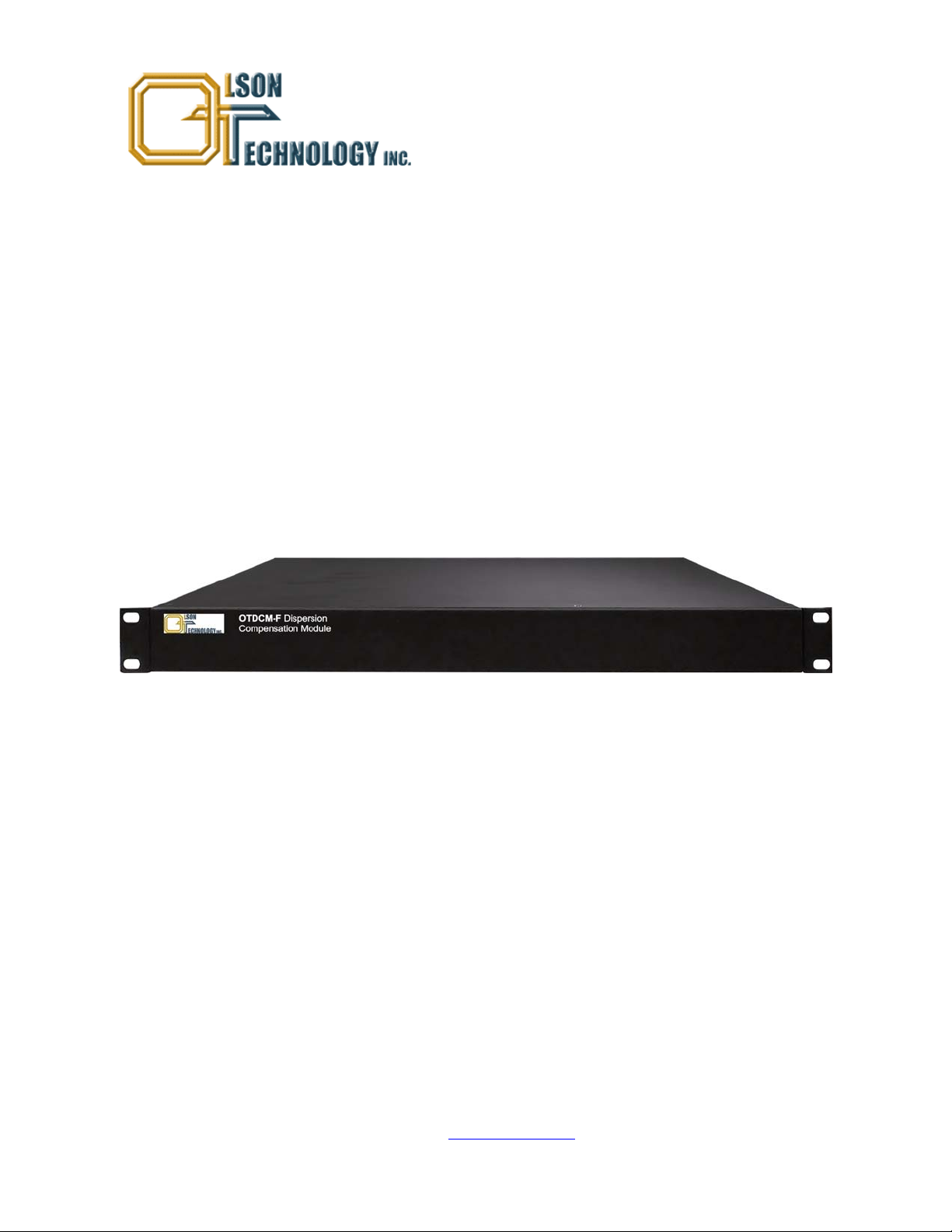
Model OT-DCM-Fxx
Dispersion Compensation Module
OPERATING MANUAL
24926 Highway 108
Sierra Village, CA 95346
Phone: (800) 545-1022
Fax: (209 586-1022
025-000566 Rev. X3 E-mail: sales@olsontech.com
10/28/10
Page 2

TABLE OF CONTENTS
Table of Contents............................... ....................................................... ............................................................ 1
SAFETY ................................................................................................................................................................. 2
Safety Precautions......................................................................................................................................... ..... 2
Laser Safety Procedure............................................................................... ....................................................... 2
THEORY OF OPERAT ION..................................................................................................................................... 3
Figure 1 - Dispersion Characteristics of NDSF..............................................................................................3
Figure 2 - The Effect of a DCM on a Long Fiber Run .................................................................................... 3
Figure 3 - Typical DCM Application................................................................................................................ 4
GENERAL FEATURES............................................................................................ .............................................. 4
Figure 4 - OT-DCM-Fxx Front Panel................................ ....................................................... ....................... 4
Figure 5 - OT-DCM-Fxx Rear Panel.............................................................................................................. 4
Typical Parameters of OT-DCM-Fxx Dispersion Compensation Module........................ ..................................... 5
025-000566 Rev. X3 www.olsontech.com 1
Page 3

SAFETY
Safety Precautions
While this DCM is a totally passive device, it typically handles high light levels that can present a hazard,
Laser Safety Procedure
ALWAYS read the product data sheet and the laser safety label before powering the product. Note the operation
wavelength, optical output power and safety classifications.
If safety goggles or other eye protection is used, be cer tain that t he pro tecti on is effective at the wavelength emitted by the
device under test BEFORE
applying power.
ALWAYS
an attached fiber. If the device has a connector output, a connector shoul d be attached tha t is connec ted to a fiber. This will
ensure that all light is confined within the fiber waveguide, virtually eliminating all potential hazard.
NEVER
and 1550nm) are totally invisible to the unaided eye and will cause permanent damage. Shorter wavelengths lasers (e.g.,
780nm) are visible and are very damaging. Always use ins truments, such as an optical power meter, to verify light output.
NEVER, NEVER, NEVER
includes microscopes, eye loupes and magnifying glasses. This WILL
retina. Always double check that power is disconnected before using such devices. If possible, completely disconnect the
unit or transmitter from any power source.
If you have questions about laser safety procedures, please call Olson Technology before powering your product.
connect a fiber to the output of the device BEFORE power is applied. Power should never be applied without
look at the end of the fiber to see if light is coming out. NEVER! Most fiber optic laser wavelengths (1310nm
look into the end of a fiber on a powered device with ANY sort of magnifying device. This
cause a permanent and irreversible burn on your
025-000566 Rev. X3 www.olsontech.com 2
Page 4

THEORY OF OPERATION
The most commonly used fiber in the world today is NDSF (non-dispersion shifted fiber) such as Corning SMF-28®. For
long distance applications, a wavelength near 1550nm is usually used resulting in dispersion of about 17ps/nm/km as
shown in Figure 1 below. Dispersion causes the bit error rate (BER) to increase in digital systems and the analog
distortion, primarily CSO and 2
way to nullify most of this dispersion allowing very long fiber links to be achieved.
nd
order distortion, to increase sharply with increasing fiber distance. The DCM offers a
Figure 1 - Dispersion Characteristics of NDSF
A DCM is a device that has negative dispersion. The Olson OT-DCM-F series module contains a special fiber that has a
very high negative dispersion equivalent to “xx” km (ranging from 10 to 100 in 10’s) of Corning SMF-28
operates over a wide wavelength range. Figure 2 below shows the benefit of using a DCM.
® fiber. It
Figure 2 - The Effect of a DCM on a Long Fiber Run
025-000566 Rev. X3 www.olsontech.com 3
Page 5

In Figure 2, an OT-DCM-F100 (optimized for 100km or Corning SMF-28®) was inserted in-line at the 100km distance.
This resets the dispersion to nearly zero and allows an additional 100km distance can be achieved with essentially the
same results as were achieved at 100km. One downside of a DCM is its relatively high insertion loss. Figure 3 illustrates
how this is usually circumvented.
Figure 3 - Typical DCM Application
GENERAL FEATURES
The Olson Technology OT-DCM-F Series Dispersion Compensation Module operates near 1550nm where NDSF
dispersion has a typical value of 17ps/nm/km. The DCM is a totally passive device consisting of a spool of special fiber
(Dispersion Compensating Fiber (DCF)) that has high negative dispersion. Unlike Fiber Bragg Gratings (FBG’s), DCM’s
based on DCF work over a continuous range of wavelengths. The front panel of the DCM, shown in Figure 4, only has
vendor and part number markings. The rear panel of the DCM, shown in Figure 5, has the optical input and output
connectors. These are always angle polished c onnector (APC) types.
Figure 4 - OT-DCM-F Front Panel
Figure 5 - OT-DCM-F Rear Panel
025-000566 Rev. X3 www.olsontech.com 4
Page 6

Typical Parameters of OT-DCM-F10 Dispersion Compensation Module
SMF-28 Fiber
Model
OT-DCM-F10 10 -170 1.2 1.8
OT-DCM-F20 20 -340 1.5 3.6
OT-DCM-F30 30 -510 1.9 4.3
OT-DCM-F40 40 -680 2.2 5.0
OT-DCM-F50 50 -850 2.4 6.0
OT-DCM-F60 60 -1,020 2.6 7.0
OT-DCM-F70 70 -1,190 2.8 7.7
OT-DCM-F80 80 -1,360 3.0 8.5
OT-DCM-F90 90 -1,510 3.2 9.2
OT-DCM-F100 100 -1,700 3.4 10.0
Compensation
Distance (km)
Dispersion
(typical value)
(ps/nm)
Polarization
Dispersion
(dB)
Typical
Insertion Loss
(dB)
025-000566 Rev. X3 www.olsontech.com 5
 Loading...