

Page 1

THE MclNTOSH MR 80 DIGITAL FM TUNER
Reading Time: 32 Minutes
Price: $2.00
Page 2

VARIOUS REGULATORY AGENCIES REQUIRE THAT WE BRING THE FOLLOWING
INFORMATION TO YOUR ATTENTION. PLEASE READ IT CAREFULLY.
WARNING: TO PREVENT FIRE OR SHOCK
HAZARD, DO NOT EXPOSE THIS UNIT TO
RAIN OR MOISTURE.
The Mclntosh you have purchased is a Model
MR 80. It has a serial number located on the rear
panel of the chassis. Record that serial number
here:
Serial Number
The model, serial number and purchase date are
important to you for any future service. Record the
purchase date here:
Purchase date
Upon application, Mclntosh Laboratory provides a
Three-Year Service Contract. Your Mclntosh authorized service agency can expedite repairs when you
provide the Service Contract with the instrument for
repair. To assist, record your Service Contract
number here:
Service Contract Number
Page 3

Your MR 80 Digital FM Tuner
can give you many years of
satisfactory performance. If you
have any questions, please contact:
CUSTOMER SERVICE
Mclntosh Laboratory Inc.
2 Chambers Street
Binghamton, New York 13903-9990
Phone: 607-723-3512
Take Advantage of 3 years
of Contract Service ...
Fill in the Application NOW.
Contents
SERVICE CONTRACT INFORMATION . . . 1
INSTALLATION ..2
HOW TO CONNECT AND
BACK PANEL INFORMATION...4
FRONT PANEL INFORMATION
AND USE OF CONTROLS. . .6
TOP PANEL INFORMATION
AND SECONDARY CONTROLS . . .8
PERFORMANCE LIMITS . . .9
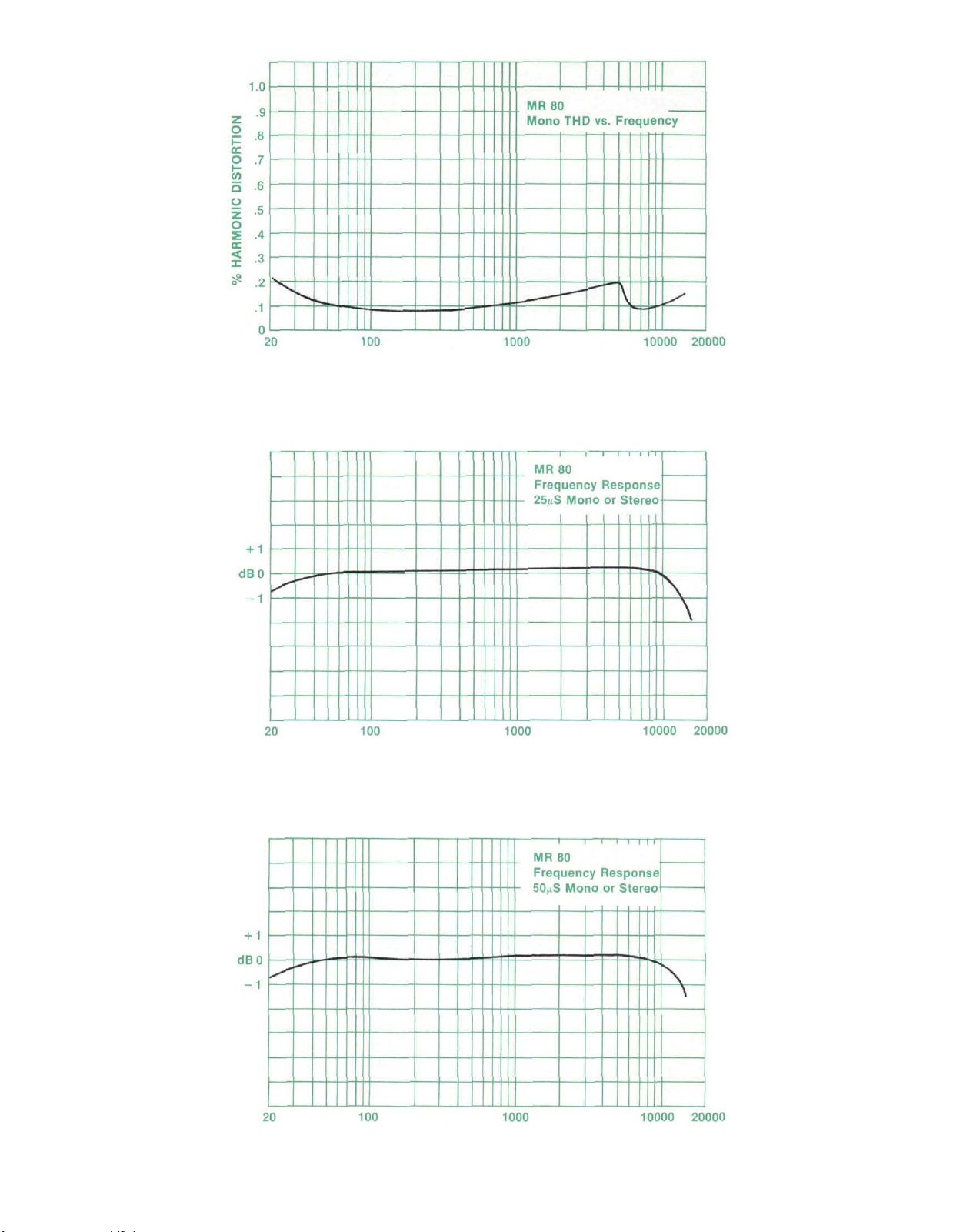
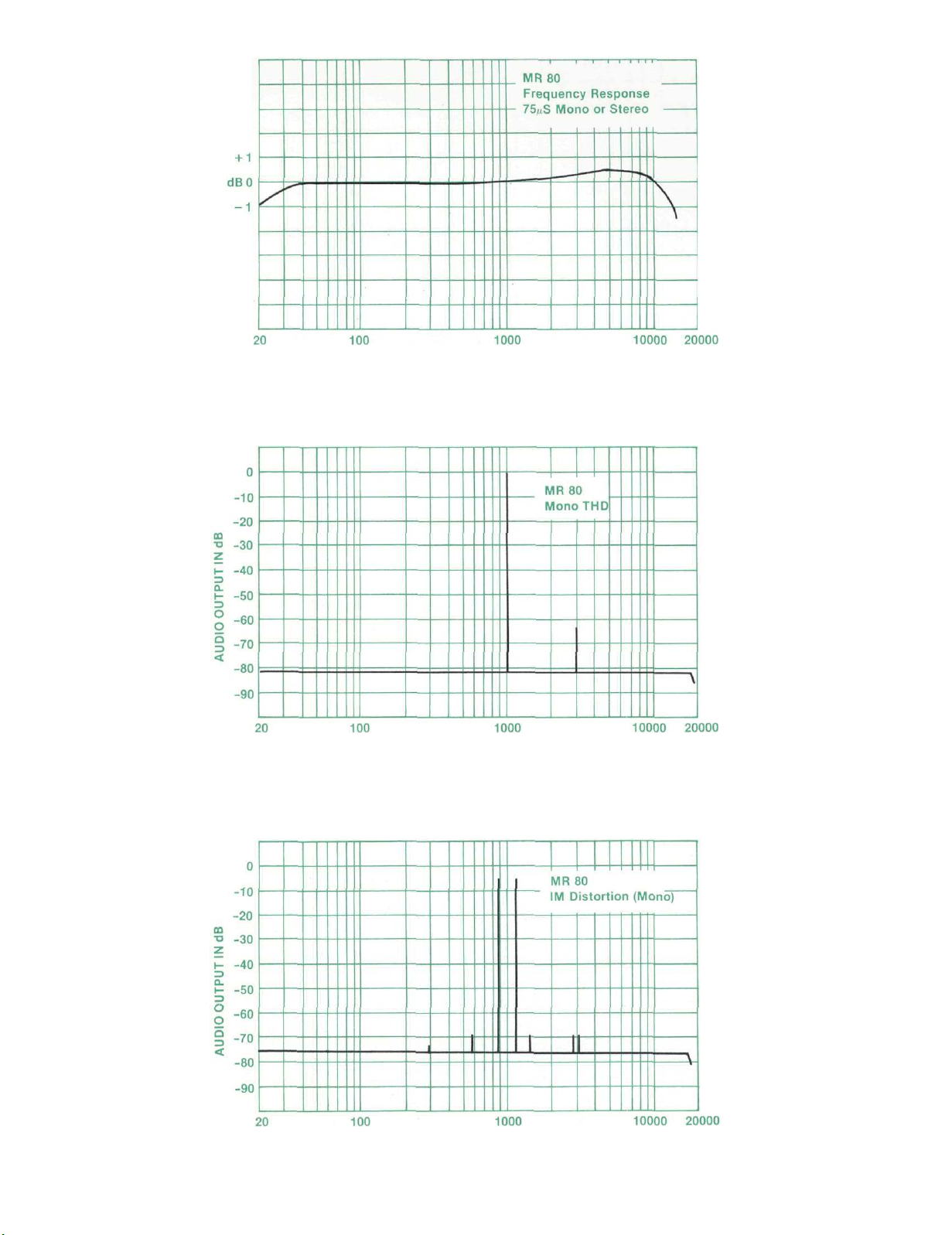
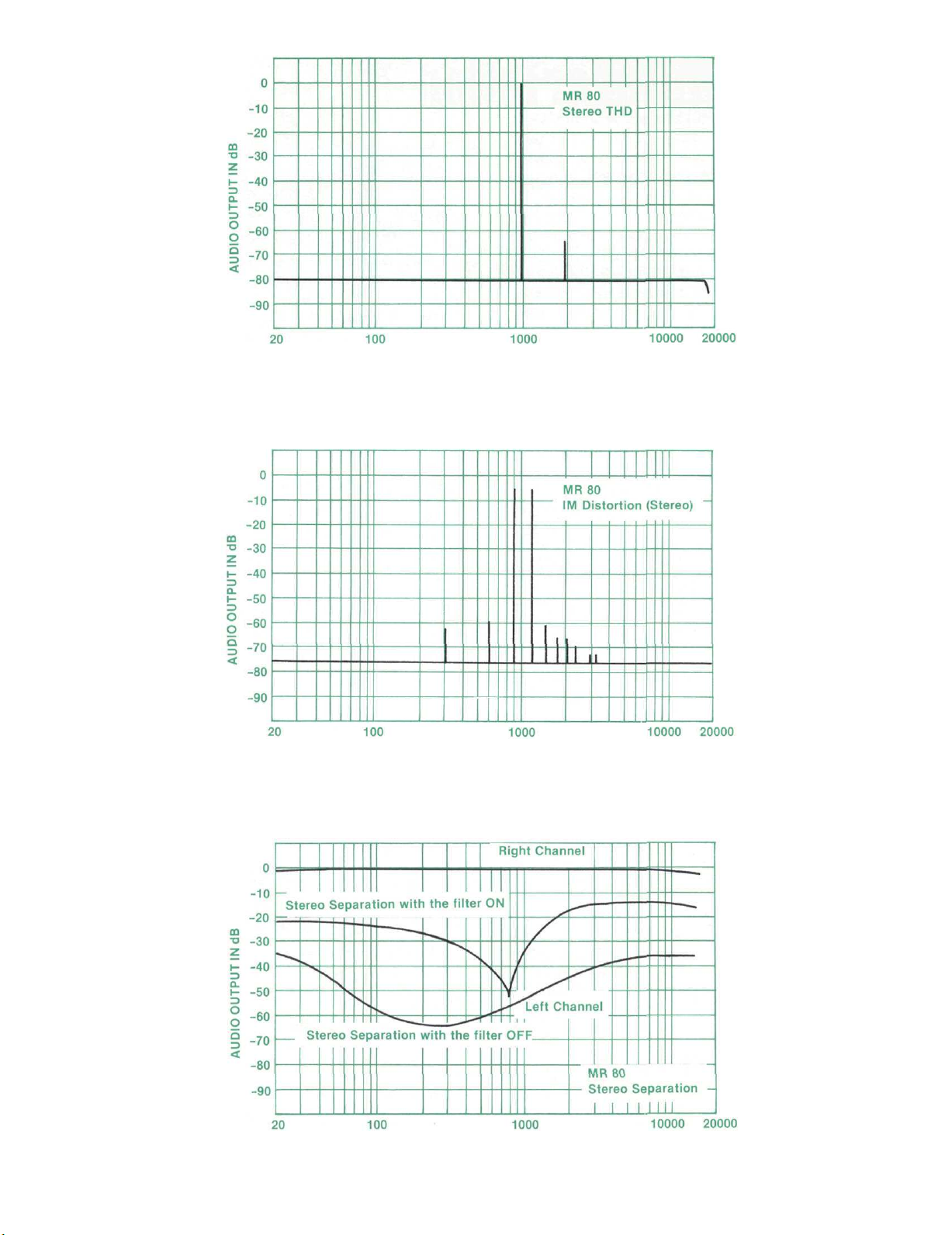
PERFORMANCE CHARTS. -10
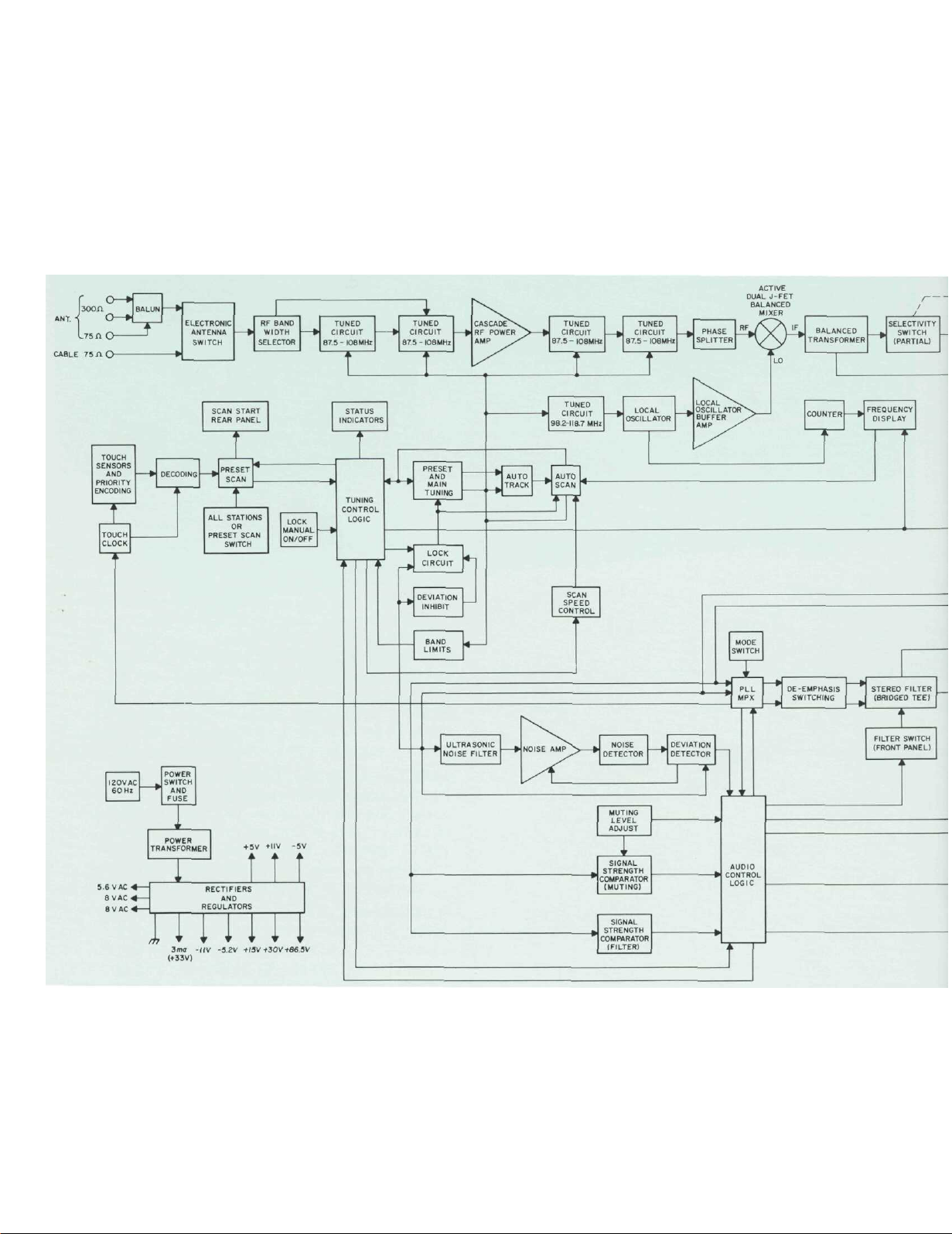
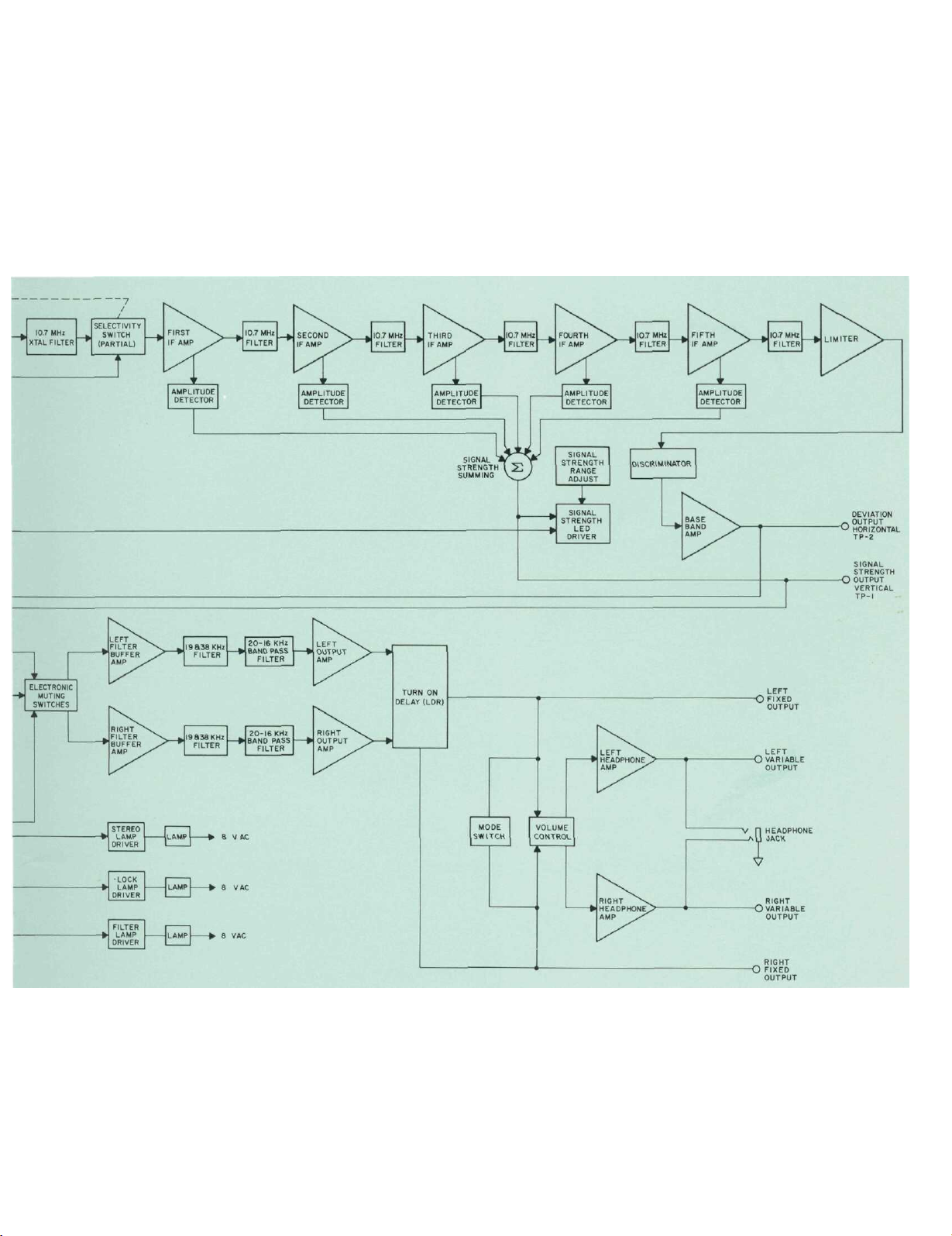
TECHNICAL DESCRIPTION. 14
BLOCK DIAGRAM..20
MclNTOSH THREE YEAR SERVICE CONTRACT
An application for A THREE YEAR SERVICE CONTRACT is included with this manual.
The terms of the contract are:
1. Mclntosh will provide all parts, materials
and labor needed to return the measured
performance of the instrument to the
original performance limits. The SERVICE CONTRACT does not cover any
shipping costs to and from the authorized service agency or the factory.
2. Any Mclntosh authorized service agency
will repair Mclntosh instruments at nor-
mal service rates. To receive service
under the terms of the SERVICE CONTRACT, the SERVICE CONTRACT CER-
TIFICATE must be presented when the
instrument is taken to the service agency.
3. Always have service done by a
Mclntosh authorized service agency. If
the instrument is modified or damaged
as a result of unauthorized repair, the
SERVICE CONTRACT will be cancelled.
Damage by improper use or mishandling is not covered by the SERVICE
CONTRACT.
4. The SERVICE CONTRACT is issued to
you as the original purchaser. To protect you from misrepresentation, this
contract cannot be transferred to a second owner.
5. To receive the SERVICE CONTRACT,
your purchase must be made from a
Mclntosh franchised dealer.
6. Your completely filled in application for
the SERVICE CONTRACT must be postmarked within 30 days of the date of
purchase of the instrument.
7. To receive the SERVICE CONTRACT, all
information on the application must be
filled in. The SERVICE CONTRACT will
be issued when the completely filled in
application is received by Mclntosh
Laboratory Incorporated in Binghamton,
New York.
8. Units in operation outside the United
States and Canada are not covered by
the Mclntosh Factory Service Contract,
irrespective of the place of purchase.
Nor are units acquired outside the
U.S.A. and Canada, the purchasers of
which should consult with their dealer
to ascertain what, if any, service contract or warranty may be available locally.
Copyright 1980 © by Mclntosh Laboratory Inc.
1
Page 4

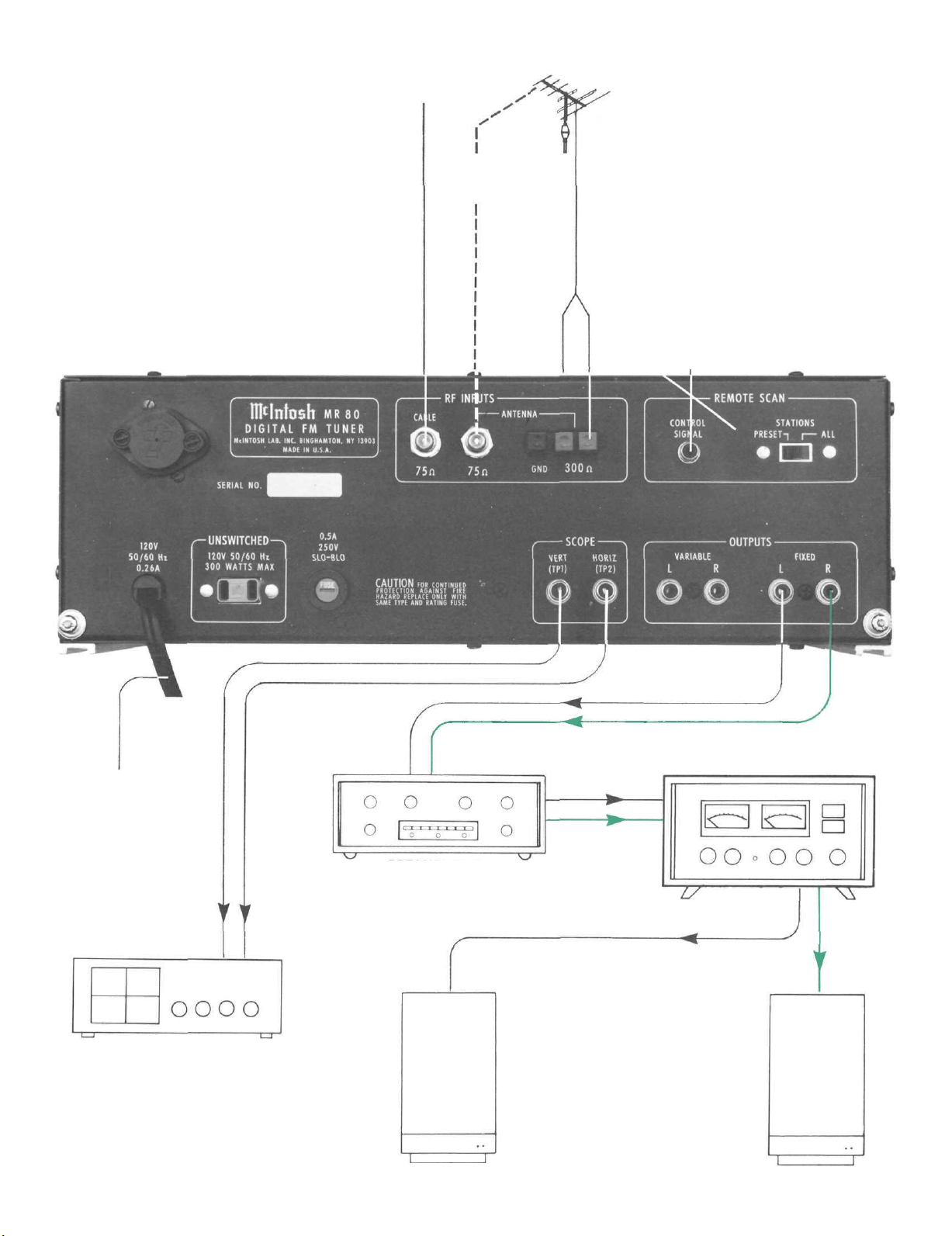
How to Connect and
Back Panel Information
Refer to page 5.
AUDIO OUTPUTS
Use the FIXED OUTPUT jacks on the rear panel to
feed program to a stereo control preamplifier or
other equipment which has its own volume control.
The front panel VOLUME control does not affect the
loudness of the tuner at the FIXED OUTPUT jacks.
The output level is a nominal 1 volt for 100% FM
modulation.
Use the VARIABLE OUTPUT jacks to connect to
equipment such as a power amplifier or a tape
recorder where control of the volume at the tuner is
desired. The output at the VARIABLE OUTPUT jacks
is a nominal 2.5 volts for 100% FM modulation.
There is no difference in the signal quality at either
pair of output jacks.
Both pairs of OUTPUT jacks may be used simultaneously. The output impedance at both outputs is
very low so that long audio cables can be used
without a loss of high frequencies due to cable
capacity.
RF INPUTS — ANTENNA CONNECTIONS
Two of four different antenna systems can be
used with your MR 80. 1) an outdoor FM antenna, 2)
an all channel (UHF-VHF-FM) antenna, 3) a cable input from your local cable company, or 4) the indoor
dipole supplied with the MR 80. A switch is provided
on the top level set panel to select between two of
the four systems mentioned.
An outdoor antenna is recommended for optimum
performance in all areas. In fringe areas, best results
will be obtained with a highly directional FM antenna used in connection with a rotator. Rotate the
antenna until the best reception is obtained. Connect a 300 ohm outdoor antenna to the 300W ANTENNA (red) terminals. Connect a 75 ohm antenna
and/or 75 ohm cable system to the coaxial antenna
jack.
A flexible folded dipole antenna supplied with
your MR 80 may be used in urban or in high signal
strength areas. The flexibility of the thin flat wire
assembly permits it to be placed under a rug. tacked
behind the stereo or placed in any other convenient
location. In some cases it may be necessary to position the antenna for best signal reception. This
should be done before it is permanently located.
Avoid locating this antenna next to other wires or
metal objects. This antenna may not prove effective
in houses having metal siding or metal clad insula-
tion.
The cable signal from a local cable company or a
second FM antenna with 75 ohms impedance may
be connected to the coaxial cable jack.
REMOTE SCAN
The REMOTE SCAN CONTROL SIGNAL jack is to
be connected to the cable push button assembly
supplied with the MR 80 for remote tuning. Plug the
cable into the CONTROL SIGNAL jack. Pressing the
push button at the end of the cable causes the MR
80 to scan to the next station. The mode of scan can
be selected by the STATION'S slide switch. In the
PRESET position every time the push button is
depressed the MR 80 will scan to the next preset station. In the ALL position depressing the button will
cause the MR 80 to scan to the next station.
If REMOTE tuning is not used, leave the jack free
of any connection.
SCOPE
The vertical and horizontal scope jacks are provided to connect to a maximum performance indicator or an oscilloscope for indication of FM
multipath and signal strength. Connect the vertical
jack to the vertical input of the indicator and the
horizontal jack to the horizontal input.
UNSWITCHED AC POWER OUTLET
This outlet may be used to power auxiliary equip-
ment such as an antenna rotator or a maximum performance indicator. Power is available whenever the
MR 80 is connected to a power source.
4
Page 5
FM CABLE
INPUT OR
2ND 75W ANTENNA
LEAD-IN
OPTIONAL
75W
ANTENNA
LEAD-IN
FM ANTENNA
REMOTE CONTROL
PUSH BUTTON
TO AC
POWER
SOURCE
MAXIMUM PERFORMANCE
INDICATOR
OR
OSCILLOSCOPE
PREAMPLIFIER
LEFT SPEAKER
5
POWER AMPLIFIER
RIGHT SPEAKER
Page 6

Front Panel Information and
Use of Controls
The MR 80 Tuner has the most flexible control
system ever designed in a stereo FM tuner. Correct
use of these controls will yield a higher level of performance than previously possible with conventional tuners.
VOLUME CONTROL AND AC POWER SWITCH
The VOLUME control has been precision tracked
throughout the listening range (0 to - 65 dB) for ac-
curate stereo balance.
It sets the output level of the VARIABLE OUTPUT
jacks and the front panel HEADPHONE jack. The
FIXED OUTPUT jacks are not affected by the position of the VOLUME control. The AC power switch is
part of the VOLUME control. Turning the VOLUME
control fully counterclockwise turns the AC power
off.
TUNING CONTROLS AND FREQUENCY DISPLAY
Frequency Display
The Frequency Display indicates the received fre-
quency to the nearest 100 kHz.
Tuning
There are four methods of tuning your MR 80.
Automatic selection of the tuning method is provided by touch sensors associated with each of the
tuning controls.
Manual Tuning
When power is applied to the MR 80, the circuitry
automatically selects the manual or knob tuning
control mode. Turning the tuning knob clockwise
will increase the received frequency. Counterclockwise decreases the received frequency.
Note: When the MR 80 is operated but is not connected to any other device (preamp, power amp,
antenna, test equipment, etc.), there is a chance the
frequency display will blank out when tuning with
the main tuning knob. This is normal and can easily
be corrected by reversing the 120V AC line plug or by
connecting the MR 80 to any other equipment.
Auto Scan
AUTO SCAN is provided by two touch pads immediately to the left of the tuning knob. These two
touch pads start the tuner searching for a new station. The small arrow will light next to the pad
touched and indicate the direction of scanning. It
will scan in the direction chosen until it stops at a
station or reaches the end of the band. At the band
end the tuner will reverse its scan direction.
Preset 1, 2, 3 & 4
These touch pads located to the left of the frequency display select one of the four preset stations. Just touch to operate. A small rectangle will
light above the pad indicating which preset has been
selected.
Remote SCAN
Remote SCAN of either the presets or all stations
is provided for as described under back panel information.
INDICATOR LIGHTS
Three indicator lights are provided immediately to
the left of the preset touch pads. The uppermost
STEREO indicates when a stereo broadcast is being
received. The second, LOCK, indicates when the
tuner is locked to the station. The lock circuit in the
MR 80 is unique in that tuned frequency is locked to
the station, not to an internal standard as in the case
of many digital tuners. This allows the MR 80 to be
tuned to any frequency within the FM band and lock
on that frequency. Other digital tuners can only lock
on specific channel assignments. This lock circuit is
so powerful that it must be disabled in order to tune
the tuner. You will notice that the moment that you
touch any one of the tuning controls the lock light
extinguishes and only comes on when the station is
properly tuned. Once lock has been established it
will remain on even if the station being received
should drift up to 2 megacycles either side of the
center of the carrier. Thus, perfect tuning is always
assured. The third indicator light, FILTER, indicates
when the stereo noise filter is in operation. The in-
dicator lights are in three different colors: red for
STEREO, amber for LOCK, and green for FILTER.
SELECTIVITY SWITCH
Two degrees of IF selectivity are selectable by the
SELECTIVITY switch. The NARROW or normal position provides adequate selectivity for stereo reception even under severe receiving conditions. Five
linear phase piezoelectric IF filters provide low
distortion reception with this high degree of selectivity. Setting the SELECTIVITY switch to SUPER
NARROW adds an additional 4-pole 4-zero quartz
crystal filter to the five previously mentioned filters.
Use the SUPER NARROW position to receive stations from distant cities which are on channels adjacent to local stations. There may be useable signals
which were never heard before with ordinary FM
tuners.
6
Page 7
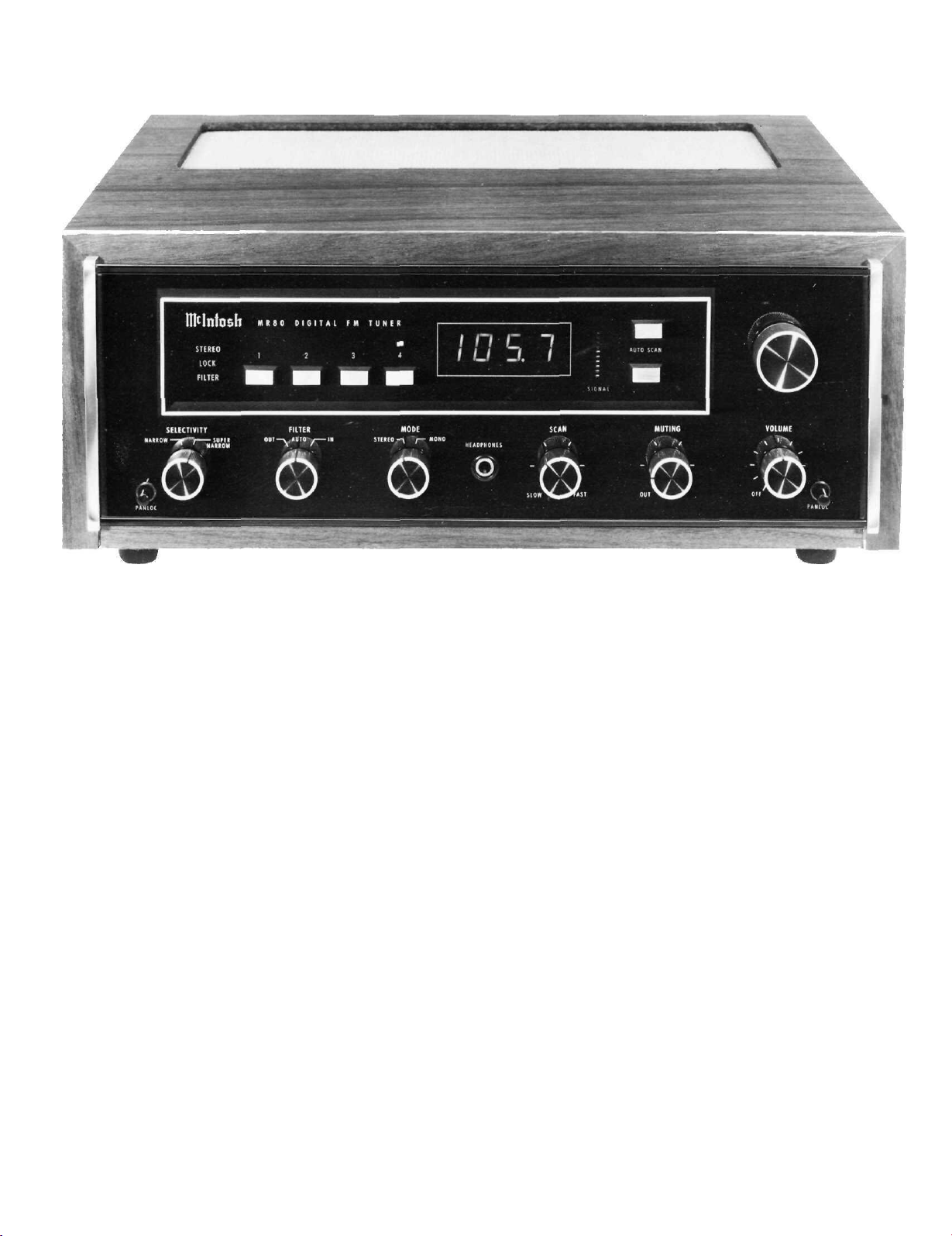
SIGNAL COLUMN
A column of LED lamps respond to the signal
strength of the station being received. The stronger
the signal the higher the column reaches. There is a
control on the tuner top panel to adjust the column
height for full scale when receiving the strongest
signal in your listening area.
FILTER SWITCH AND FUNCTION INDICATOR
The MR 80 FILTER switch provides automatic
stereo noise reduction on weak stereo stations. With
the switch in the AUTO position the filter will be on
only when the station is broadcasting a stereo pilot
tone and the signal strength is below 100 microvolts.
With the switch in the IN position the filter is connected at all times. The filter has no affect on mono
stations. The filter function indicator light glows
green when the filter is on.
MODE SWITCH
A two position MODE switch is provided so that
you may select either automatic stereo or mono
reception. In the STEREO position the tuner
automatically switches from mono to stereo mode
when a pre-determined signal to noise ratio has
been reached. In the MONO position all stations will
be received monophonically but the STEREO indicator
will light if the station is broadcasting in stereo.
HEADPHONE JACK
A HEADPHONE jack is provided to drive low impedance dynamic headphones from an internal
power amplfier.
SCAN CONTROL
The SCAN control adjusts the speed at which the
tuner searches for the next station, when using the
AUTO SCAN mode of tuning. If the dial is crowded
with stations use a slow scan speed. If there are few
stations fast scanning can be used.
MUTING CONTROL
MUTING suppresses the background noise and
hiss normally heard between stations. Turning the
control counterclockwise to the OUT position disables the muting circuits. Turning the control clockwise increases the signal level required to unmute.
This control also adjusts the sensitivity of the AUTO
SCAN tuning circuits and the number of stations
you will receive when using this tuning mode.
7
Page 8
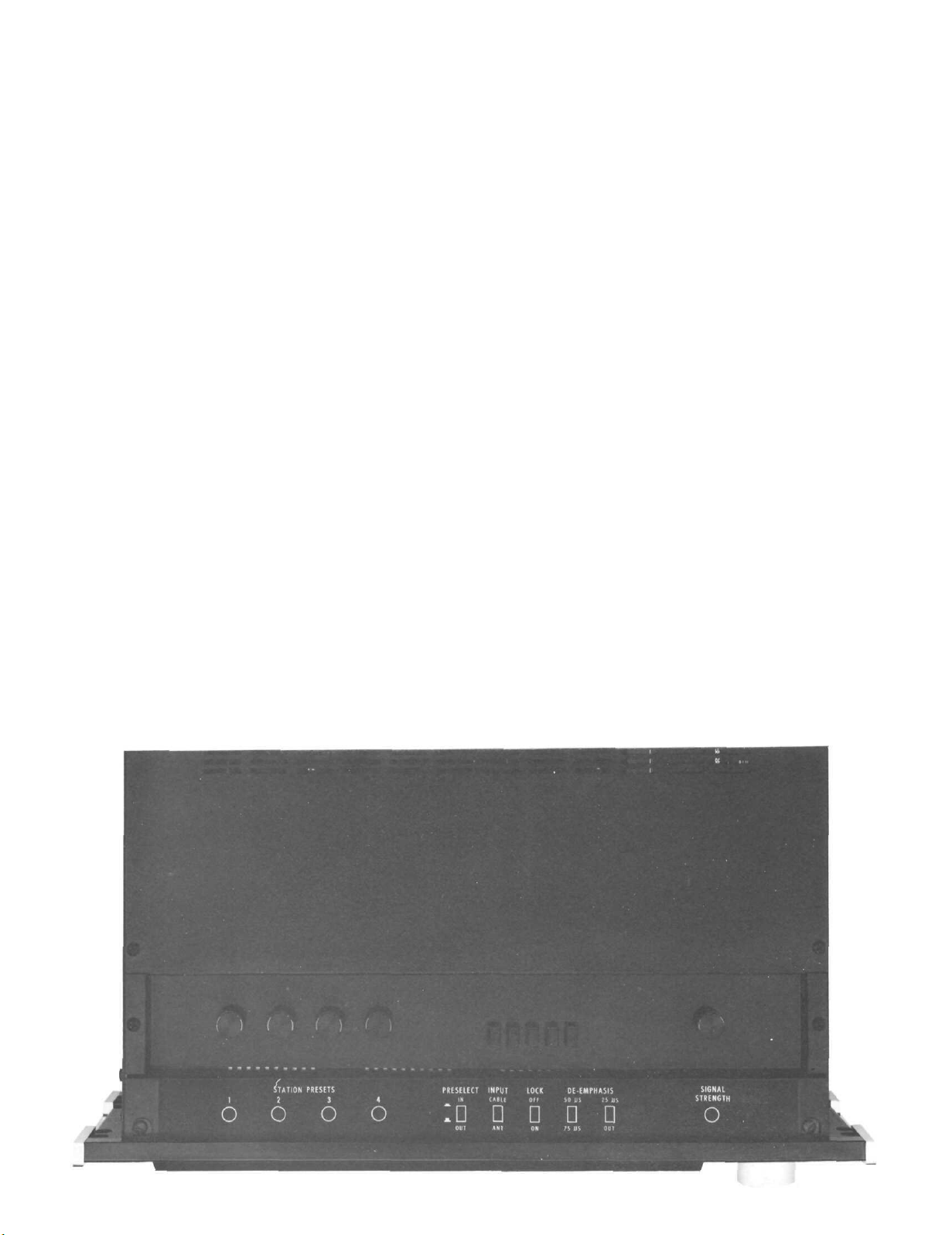
Top Panel Information and
Secondary Controls
On the top of the chassis behind the front panel a
recessed panel contains the secondary controls.
When the MR 80 is installed in the cabinet access to
this panel may be gained by depressing the two
PANLOC buttons and slipping the unit partially forward.
Preset 1 thru 4
The PRESET tuning adjustments are used to set
the received frequency for each preset. To set a
preset to the desired station, touch the correspond-
ing preset pad and at the same time adjust the
preset control on the top panel for the desired frequency indication. You must touch the pad while
tuning to hold the frequency lock circuit inactive,
otherwise erroneous tuning will result.
Preselect
The RF PRESELECT switch switches an additional tuned circuit between the antenna and the
first RF stage to immunize against overload. Use the
preselector in very strong signal areas.
Input
The INPUT switch selects either an antenna or
cable as the RF input source. The CABLE input may
also be used as a second antenna input.
Lock
This switch will disable the lock circuits only
when the main tuning knob is in use. Use the ON
position for all normal reception. Switch to the OFF
position when the received station has a deep fade.
This prevents the frequency lock circuit from chang-
ing tuning to lock to an adjacent stronger station.
De-emphasis
The 50/75ms button selects the correct de-
emphasis for your country. 75ms is used on the North
American continent and 50ms is used in Western
Europe and the Far East. 25ms de-emphasis is also
available by depressing the button marked
Note: The normal operating position of the five
pushbutton switches is for the switches to be in the
out or up position.
Signal Strength
Use this control to set the signal strength column
to full scale for the strongest station in your area.
This control is a sensitivity adjustment for the solid
state signal strength indicator. It merely adjusts the
height of the column. It does not affect the sensitivity of the tuner.
8
Page 9

Performance Limits
Performance Guarantee
Performance limits are the maximum deviation from
perfection permitted for a Mclntosh instrument. We
promise you that the MR 80, at the time of its purchase, is capable of performance at or exceeding
these limits or you get your money back. Mclntosh is
the only manufacturer that makes this guarantee.
Tuning:
88 to 108MHz
Antenna Inputs:
One 300W balanced and two 75W unbalanced.
Intermediate Frequency:
10.7MHz
Sensitivity:
9.3dBf (1.6mV) for 35dB of quieting
14.7dBf (3mV) for 50dB of quieting
13.2dBf (2.5mV) for 3% total noise and harmonic dis-
tortion
Signal to Noise Ratio:
75dB below 100% modulation
Harmonic Distortion:
0.2% 20Hz to 15kHz, mono or stereo
Typically, 0.08% at 1000Hz
Intermodulation Distortion:
0.15% mono or stereo for any combination of frequencies from 20Hz to 15,000Hz with peak modulation equal to 100% or less. Typically 0.1%
Frequency Response:
Mono and Stereo ± 1dB 20Hz to 15kHz with 75, 50
or 25mS deemphasis
Capture Ratio:
1.5dB
Selectivity:
Narrow
Adjacent channel
Alternate channel
Spurious Rejection:
110dB
Tuner IM (RF):
-23dBm for 2 signals 1MHz apart
Tuner Intercept Point:
-10dBm 75W
Image Rejection:
90dB
Maximum Signal Input:
8 volts across 75W (1W) antenna terminal will not
increase harmonic or intermodulation distortion.
Audio Hum:
75 dB down from 100% modulation
8dB
90dB
Super Narrow
60dB
110dB
Muting:
70dB noise reduction between stations
Muting Threshold:
2mV to 1000mV
SCA Rejection:
60dB minimum
Stereo Separation:
50dB to 1000Hz
Stereo Filter:
10dB noise reduction
Audio Output:
Variable:
2.5V into 47k
Fixed:
1V into 47k
General Information
Power Requirements:
120 volts 50/60Hz. 25 watts
Semiconductor Complement:
57 Transistors
68 Integrated Circuits
81 Diodes
4 LED Displays
18 LED's
7 Neon Lamps
Mechanical Information
SIZE: Front panel measures 16 inches wide (40.6 cm)
by 5 7/16 inches high (13.8 cm). Chassis measures
14 3/4 inches wide (37.5 cm) by 4 13/16 inches high
(12.2 cm) by 13 inches deep (33 cm), including con-
nectors. Knob clearance required is 1 1/4 inches (3.2
cm) in front of mounting panel.
FINISH: Front panel is anodized gold and black with
special gold/teal nomenclature illumination.
Chassis is black.
MOUNTING: Exclusive Mclntosh developed professional PANLOC
WEIGHT: 27 pounds (12.2 kg) net, 39 pounds (17.7 kg)
in shipping carton
9
Page 10
Performance Charts
SIGNAL INPUT
SIGNALINPUT
10
Page 11
FREQUENCY IN HERTZ
FREQUENCY IN HERTZ
FREQUENCY IN HERTZ
11
Page 12
FREQUENCY IN HERTZ
FREQUENCY IN HERTZ
FREQUENCY IN HERTZ
12
Page 13
FREQUENCY IN HERTZ
FREQUENCY IN HERTZ
FREQUENCY IN HERTZ
13
Page 14

Technical Description
Engineering direction dictated a tuner design
governed by insistence on great flexibility and ease
of use. This had to be done while designing an RF
section with great sensitivity and the world's best
selectivity in keeping with the needs of low distortion. These values were achieved and they retain the
Mclntosh reputation of outstanding performance,
long life and reliability.
RF-IF SECTION
In the ANT SWITCH six RF PIN diodes are con-
nected as a single pole double throw switch. This
allows the use of two antennas or the use of an
antenna and a cable. Input to output isolation of this
switch is greater than 75dB.
Following the ANT SWITCH is an RF tuner of exceptional performance. This performance is achieved by the use of a low noise junction FET and a high
power bipolar transistor (a heatsink is used) con-
nected as a cascode amplifier. This connection
allows high gain, low noise, and high output levels
without the need for neutralization. Two additional
PIN diodes are used to insert a second tuned anten-
na Preselector circuit during strong signal reception. For lower intermodulation distortion the tuned
circuits are tuned by a series parallel connection of
four matched varactor diodes. This circuit and the
high tuning voltage (5-26 volts) eliminates the RF intermodulation distortion caused by diode non-
linearities.
After the RF amplifier two parallel tuned circuits
are used to provide the proper load impedance for
the bipolar transistor. The use of two tuned circuits
at this location greatly improves the image rejection
and overload performance of the tuner, as well as increasing the RF selectivity.
The following balanced mixer is a matched dual
J-FET and bipolar transistor circuit. A low loss
toroidal phase splitting transformer is used as an
impedance matching network in the gate circuit of
the mixer. At the output a balanced double tuned
transformer is used as the drain load. This arrange-
ment gives great immunity to mixer overload in the
presence of a very strong signal. A bipolar transistor
is used as an oscillator buffer to prevent oscillator
pulling on strong signals, and as the constant cur-
rent source for the dual J-FET mixer.
The MR 80 has the narrowest IF bandwidth ever
used in a stereo tuner. It is the correct width to let
just one FM station through. The excellent selectivity of the MR 80 (210kHz wide at 60dB down) permits
tuning to stations that are impossible to receive on
ordinary tuners.
Constant delay design techniques are used in the
4-pole 4-zero crystal filter used in the SUPER NAR-
ROW position. However, due to the extreme selectivity, delay distortion is very slightly increased over
the NARROW selectivity position.
Four differential amplifiers, coupled with PHASE-
LINEAR monolithic filters, comprise the NARROW
selectivity and signal strength sections of the IF
amplifier. One half of each differential amplifier output drives a filter and the second output drives a full
wave rectifier circuit. The outputs of these four
rectifier circuits are summed at the inverting input of
an operational amplifier. A fifth rectifier circuit that
is driven from the limiter is also summed at the input
to the operational amplifier. The output of the operational amplifier is a voltage that is proportional to
the log of the RF input level. Dynamic range is from
2mV to over 2V, that is, greater than 120dB. A solid
state signal strength meter is used as a front panel
indication of the incoming RF signal level. Twelve
LED's are used in place of the conventional meter
movement. The LED's have an almost unlimited life.
The fast response of the LED's plainly shows
multipath signals and antenna misorientation. To
better use the wide dynamic range of the five signal
strength detectors, an adjustment is provided to
reduce the full scale signal from 100,000mV to any
value below that. This meter can be set to give a full
scale indication on a signal as low as 2mV. This
allows setting the signal meter to indicate full scale
on the strongest station in the users area. Then the
signal strength meter indicates the RF level of all
stations received relative to the strongest in the
listener's area.
The signal strength voltage is also used to control
mono/stereo switching, stereo filter insertion,
muting, and automatic scan stop. Because of it's
wide range and high repeatability this control
voltage is also used to adjust the stereo separation
at low RF signal levels. This produces the maximum
signal to noise ratio possible for all signal levels.
Following the selectivity section of the IF ampli-
fier is the LIMITER. A total gain of 80dB is used in
this circuit. The use of very high gain in the limiter
circuit produces hard limiting with very good impulse noise rejection. Limiter bandwidth is greater
than 50MHz, producing excellent detector capture
characteristics.
A broadband Foster-Seeley discriminator is used
as the detector. This detector coupled with the
broadband limiter produces unmeasurable noise
and distortion. A high speed buffer amplifier following the detector isolates the detector from all varia-
14
Page 15

tions in load impedance. This prevents changes in
audio cable lengths outside the tuner from affecting
the detector performance.
FM STEREO MULTIPLEX
The heart of the multiplex section is a new third
generation phase locked loop (PLL) stereo decoder
integrated circuit (IC). This PLL IC incorporates two
special systems, an automatic variable separation
control circuit to reduce background noise when
receiving weak stereo stations, and tri-level digital
waveform generation which eliminates interference
from SCA signals and from the sidebands of adjacent channel FM signals.
The variable separation control is operated from
the IF amplifier's signal strength detector. A smooth
transition is provided from mono to stereo or from
stereo to mono at weak signal levels to provide the
optimum signal to noise ratio and best stereo
separation for the prevailing signal conditions. The
circuit operates only during stereo reception. It switches automatically to monophonic if the 19kHz pilot
tone is absent.
In the PLL the internal oscillator operates at
228kHz, locked onto the 19kHz pilot tone. The
228kHz feeds a 3 stage Johnson countervia a binary
divider to generate a series of square waves.
Suitably connected NAND gates and exclusive OR
gates produce the tri-level drive waveform for the
various demodulators in the circuit. The usual
square waveforms have been replaced in the PLL
and decoder sections by tri-level waveforms. These
tri-level forms contain no harmonics which are
multiples of 2 or 3. This eliminates frequency
translation and detection of interference from the
side-bands of adjacent stations since the third harmonic of the sub-carrier (114kHz) is excluded. It also
eliminates interference from SCA broadcasts since
the third harmonic of the pilot tone (57kHz) is excluded. Unwanted spurious audible components and
phase jitter in the PLL are inherently eliminated by
this technique.
Additional advantages of the phase locked loop
stereo demodulation are the elimination of inductors to minimize drift, integral lamp driving capability to indicate the presence of the 19kHz pilot carrier,
excellent channel separation over the entire audio
frequency range, extremely low distortion, low output impedance, and transient-free mono/stereo
switching.
AUDIO CIRCUITS
Following the MPX decoder is the three position
deemphasis switch. The three different positions
allow the MR 80 to be used in North America with
standard 75ms deemphasis and in Western Europe
and the Far East with 50ms deemphasis. The 25ms
position is for use with an external noise reduction
adapter.
An electronically switched filter circuit, implemented with two J-FETs of a quad J-FET
package, is used to reduce out of phase noise when
in the stereo mode and tuned to a weak station. This
filter is actually a twin-T bandpass that blends the
high and low frequencies, leaving separation unaffected at mid-frequencies. This results in a greatly
improved stereo image when the filter is required.
A combination of three inputs are used to control
the switch point of the filter. The first is the front
panel switch. The filter is only active when this
switch is in the AUTO or ON position. In the ON position the filter is in the circuit for all stations mono or
stereo. In the AUTO position the filter will switch in
when the station is transmitting a stereo pilot signal
and the signal strength is below 100mV.
In the same quad J-FET package are the two FETs
that are used for the muting circuit. These FETs are
controlled by the logical ANDing of three signals.
The first signal is the deviation or center tune, this
detects when the tuner is correctly tuned to the
center of the FM channel. The second signal is the
signal to noise ratio. Only when there is sufficient
signal will the tuner be allowed to unmute. Signal to
noise ratio is measured by a special bandpass
amplifier centered around 138kHz. This frequency is
used to prevent false triggering due to adjacent
channel and overmodulation products. The third
signal is the RF signal level that is derived from the
five signal detector circuits. A front panel control
(MUTING LEVEL) adjusts the reference level to a
voltage comparator. The other input to the com-
parator is the signal strength voltage. When the RF
level exceeds the preset reference level, a signal is
sent to the muting logic to be ANDed with the other
two signals. This adjustment allows the unmute
level to be set to any value from 2mV to greater than
1000mV.
This wide range is necessary for the tuner to scan
properly in all signal conditions and provide the best
combination of ease of use with maximum interstation noise suppression.
19 AND 38kHz FILTER
An LC tuned notch filter is used to eliminate any
beatnote interference with the bias oscillator in a
users tape recorder. This filter is driven from a filter
buffer amplifier and terminated by the output operational amplifier. These amplifiers provide the
necessary input and output impedances for proper
phase response. The output amplifier is also used as
an audio bandpass filter to prevent unwanted noise
and transients from being passed on to the head-
phone amplifier.
HEADPHONE AMPLIFIER
The headphone amplifier is capable of driving a
pair of dynamic headphones with less than .02%
15
Page 16

harmonic distortion. Because of its extremely low
THD and power capability, it is also the main output
amplifier.
TOUCH SENSOR
The touch sensor consists of three functional
elements: 1) Input buffers and static protection circuits. 2) Latches, and 3) Encoder. The seven sensors:
KNOB, PRESET 1 to 4, UP and DOWN SCAN are inputs to the seven input buffer amplifiers. These per-
form a dual function. First the inputs are biased to a
high level by a very high resistance. Second the buffers are designed to detect a negative transition
from a reference level. When a sensor is touched,
the stray capacity of the human body shunts some
of this reference signal to ground. This reference
signal is derived from the 228kHz oscillator on the
multiplex circuit board. This means alt noise com-
ponents of the reference signal are a multiple of
19kHz, and will be filtered out by the 19 and 38kHz
filters. The second phase of this reference signal is
used to transfer the output of the buffer amplifiers
into the latches. The latches are used as temporary
storage to prevent false triggering due to static and
voltage transients.
The output from the latched inputs are supplied to
the encoder, which performs two functions. First, it
puts in order the inputs, assigning highest priority to
the tuning knob and the lowest to the down scan
sensor. Second, it encodes the input with the
highest priority into a binary coded decimal word
and outputs this to the decoder circuit. This decoder
reconverts the BCD word back into a 1 of seven line
code, indicating the sensor that is touched. An additional input to the decoder is the reference phase input that inhibits the decoder during clock edge transitions. This is done to prevent false triggering due
to noise glitches and partial contact with the touch
sensor.
PRESET SCAN
The seven outputs from the touch control and
decoder go to the preset scan circuits. In the preset
scan is an electronic switch and a counter. A switch
on the rear panel selects whether the tuner scans all
stations or only the preset stations. The circuit
operates in the preset scan mode as follows: When a
pulse is received at the rear panel connector the
counter is indexed by one, then the seven pole dou-
ble throw switch connects the input to the tuning
control logic to the output of the counter. The control logic then selects the preset that is represented
by the counter output. At the end of the pulse the
counter is disconnected and the lock circuit auto-
matically fine tunes the tuner to the center of the
channel.
When in the scan all stations mode, the input
pulse is routed to the scan circuitry on the tuning
control logic board. The logic circuitry will then
select the auto scan circuit and start searching for
the next acceptable station. The direction of scan
will be the last selected scan direction and will
change when the band limit is reached.
The remote input to the tuner is a ground asserted
logic level that is normally at + 15 volts. When this
line is grounded the tuner will start scanning. The
use of this logic permits any number of remote
cables to be connected to the MR 80.
CONTROL LOGIC
The control logic portion of the tuner is made up
of very low power complementary MOS integrated
circuits. By using this logic family a very significant
power reduction was realized in the design. With the
lower power consumption, a very real reduction in
the operating temperature and an improvement in
the operating life is achieved.
A very important consideration in the design of a
digital tuner is the amount of radiated noise from the
digital integrated circuits. To achieve low noise the
control logic was made to operate in a static mode
to entirely eliminate any interference. This allows
the control logic board to be built without the
shielding necessary to reduce interference.
The seven touch sensor inputs from the preset
scan board are stored in eight C-MOS flip-flop's. The
state of the flip-flop's indicate which input was active last. One bit is used for the main tuning knob, 4
bits are used to represent the 4 presets. The scan circuitry uses 3 bits to tell if the scan is on or off, set to
scan up or down, and the third is set to a zero when
the tuner reaches an acceptable station. This complex group of circuits provides a level of sophistication and ease of operation not possible before in a
tuner.
Several timing circuits are used to provide the
various time sequences and delays for the proper
noise free operation of the preset and scan circuits.
The first of these monostable circuits is used as a
power on clear that resets the circuits to the main
tuning knob mode. During the four second delay the
lock circuit is inhibited and the high speed muting
input to the multiplex is held high to mute the tuner
and prevent any noise or transient from affecting the
rest of the users system. At the completion of this
four second delay the lock circuit is enabled, locking
the tuner to the incoming frequency and unmuting
the tuner.
When one of the four presets is activated, the
display and audio are inhibited for two seconds from
when the sensor is touched. The lock circuit is
disabled during the time the sensor is touched, to
allow the presets to be set to the proper frequency.
When the sensor is released the lock circuit then
tunes to the center of the FM station. During normal
operation (not setting of the presets) the touch sen-
16
Page 17

sor reacts in a small fraction of a second so the
tuner appears to change stations instantaneously,
without any interstation noise even with the muting
turned off.
When either of the scan sensors is touched the
tuner is muted and the display blanked for two
seconds, this allows the tuner to reach the next sta-
tion under normal listening conditions without any
interstation noise. If the scan speed is set to a slow
setting and the muting is turned off, interstation
noise and very weak stations will be heard after the
two second delay, which is very useful when remote
tuning is used.
Driven from the tuning control logic are six LED
lamps. Four are used to indicate which of the
presets are in use. The other two lamps indicate the
direction of scan. These six lamps and the frequency
display indicate at a glance how the tuner is
operating and what preset or scan direction has
been chosen.
LOCK CIRCUIT
An innovative new circuit was developed for use in
the MR 80. This new circuit allows correct tuning
without the use of a center tune meter. The MR 80
will be correctly tuned even if the station or the
cable company is not on its correct frequency. This
is done by the use of two operational amplifiers,
A deviation signal from the detector is fed into the
first amplifier. This circuit is a log amplifier that produces an output voltage proportional to the log of
the DC component in the detector output. Because
the output voltage contains audio signals, a second
amplifier, connected as a switched gain low pass
filter, removes the audio signals. This amplifier has
a very high gain when the lock circuit is on and unity
gain when the lock circuit is off. An N-channel J-FET
is used as the gain switching element in the
negative feedback path. The filter output, now called
the correction voltage, is fed into a scaling circuit
that compensates for the tuning diodes nonlinear
frequency to voltage response. Both of the
amplifiers operate with greater than 50dB of gain at
DC. With a closed loop gain of greater than 100dB
the tuning error when locked is less than 1kHz at
100MHz, or 1 part in 100,000. This error is the same
as a crystal controlled synthesizer with the additional benefit of being correctly tuned even if the
station or the cable signal is not on the proper
frequency.
Because the lock circuit will track a station even if
it drifts 1MHz, the lock circuit must be turned off for
the operator to be able to tune the MR 80. This is the
reason for the touch sensor on the main tuning
knob. To prevent the tuner from locking onto a
strong signal next to a weak signal, a circuit is used
to sense the strong adjacent channel signal and in-
hibit the lock circuit under these conditions. On the
top cover control panel is a manual lock ON/OFF
switch that inhibits the lock circuit only if the tuner
is in the main tuning knob mode. This provision is
made for testing the tuner and for cases where the
station being received has a deep fade to the point
of losing lock. If the switch is set to the off position
the lock circuit will work normally for all the presets
and the scan circuit, but not for the tuning knob.
SCAN CIRCUIT
With the voltage tuned RF section, automatic
scanning is implemented without any moving parts
such as motors, flywheels, or strings. By the elimination of all moving parts, a much greater degree of
reliability is achieved and tuning convenience improves.
The MR 80 scan circuit consists of five sections:
1) switching circuit; 2) bipolar current source; 3) integrator; 4) band limit detector; and 5} the auto-track
circuit. The scan switching circuit controls the scan
function by switching two flip-flops, the scan on/off
flip-flop and the scan run/stop flip-flop. When either
of the scan buttons or the remote control starts a
scan cycle, the preset buttons and tuning knob circuits are switched off, the lock circuit is inhibited,
the display is blanked, the audio is muted, and the
scan on/off flip-flop turns on. The display is blanked
and the audio is muted for two seconds. The scan
on/off flip-flop switches the RF tuning control to the
scan ramp voltage.
Depending on the scan sensor touched, the
bipolar current source is set to the proper value
(negative for scan up, positive for scan down). This
current is adjusted by the front panel SCAN SPEED
control for the proper search speed. The run/stop
flip-flop stops or starts the scan sequence. This flipflop is set whenever a scan stop signal is sent from
the multiplex. To reset the flip-flop one of the scan
sensors must be touched.
In the integrator portion of the scan circuit the current is converted into a time dependent ramp voltage
until a stop signal is received from the multiplex.
When the tuner has stopped on a station the tuning
voltage is stored on a special low leakage capacitor.
To prevent drift due to leakage currents, guard
tracks were employed around the negative input to
the integrator operational amplifier. This amplifier is
a special type with MOS-FET input transistors that
have an input resistance of greater than 100 million
megohms. With special circuit components and
printed circuit layout, drift in the scan circuit has
been eliminated. The positive input to the opera-
tional amplifier is used as the input for the lock cor-
rection voltage. The correction voltage is only applied after the tuner has stopped scanning and fine
tunes the tuner to the center of the station.
Two comparators connected to the tuning voltage
input in the RF section are used for band limit detec-
17
Page 18

tion. The comparators sense when the tuning
voltage exceeds the value needed for 87.5 or
108.1MHz and generates a pulse that toggles the
flip-flop controlling the bipolar current source,
changing the direction of scan. If a person attempts
to scan past the band ends, both scan indicators will
light and the tuner will hang at the band limit until
the sensor is released.
When any of the presets or the tuning knob are active the auto track circuit is used to force the output
of the integrator to a value equal to the current tuning voltage. During the turn on delay the auto track
ensures that the integrator's output voltage is within
the band limits. This circuit allows the tuner to start
searching for the next station from the current location.
FREQUENCY COUNTER
The counter and display form the digital
equivalent to the slide rule dial and pointer, but with
greater accuracy and readability. In the RF section a
small portion of the oscillator signal is coupled into
the buffer amplifier on the counter circuit board.
This buffer amplifier is made with emitter coupled
logic circuits and is used to change the small
oscillator signal into a level acceptable by the high
speed ECL divide-by-four circuit. The output of the
divider is level shifted to low power Schottky levels
for use in the rest of the counter circuit. The divided
local oscillator signal is sampled for 40.96mS by a
synchronous gate, made from a J-K flip-flop to
eliminate the ± 1 count error. The actual counting is
done by low power Schottky integrated decade
counters. IF frequency offset is accomplished by
presetting the counters to the complement of the IF
frequency, 893. This allows subtracting the IF offset
by adding the negative of the IF frequency.
The gate signal is derived from a stable 200kHz
crystal oscillator and a binary divider made from LS
integrated circuits. Two other signals are derived
from the divider chain. The first is used to transfer
the information in the decade counters to the
display buffer. The second is used to reset the
counter to the complement of the IF frequency.
In the display portion, three TTL integrated circuits are used as a latch to store the frequency information and as constant current sources to drive the
LED frequency displays. By using the latches, a
flicker free display is assured even when the display
is changing. The constant current sources improve
reliability by reducing the number of components.
LED displays were used because of their visibility,
character font, and very long life.
5, 15 and 30v use integrated circuit 3 terminal
regulators, while the 3ma current source is made
with discrete transistors because of the high voltage
on the input terminal. The remaining voltages are used for the headphone amplifier and the touch control
reference signal driver.
LAMP DRIVERS
Mclntosh, recognizing the need for improved relia-
bility, has designed a new circuit to drive incandecent lamps. This new circuit prevents the filaments
from failing due to notching when operated on direct
current. This failure mode can reduce lamp life from
one half to one tenth of the data sheet value. In the
MR 80 the three lamps that are used for STEREO,
LOCK and FILTER indicators are operated on AC at
lower than rated voltage to extend the useful life to
well in excess of 15 years. Only Mclntosh brings you
this feature.
POWER SUPPLY
Special design attention has been given to the
power supply section. Nine separate power circuits
are used. Six of these are regulated to prevent loss
of performance during a brown out. The - 15, - 5.2.
18
Page 19
19
Page 20
Block Diagram
20
MclNTOSH MR 80
Page 21
DIGITAL FM TUNER
21
Page 22

MclNTOSH LABORATORY INC.
2 CHAMBERS ST., BINGHAMTON, N.Y. 13903-9990
607-723-3512
The continuous improvement of its products is the policy of
Mclntosh Laboratory Incorporated who reserve the right to
improve design and price without notice.
Printed in U.S.A.
039227
 Loading...