All rights reserved. No part of this manual may be reproduced, copied, transmitted, disseminated, transcribed,
downloaded or stored in any storage medium, in any form or for any purpose without the express prior written
consent of Funai. Furthermore, any unauthorized commercial distribution of this manual or any revision hereto
is strictly prohibited.
Information in this document is subject to change without notice. Funai reserves the right to change the content
herein without the obligation to notify any person or organization of such changes.
with the design is a registered trademark of Funai Electric Co., Ltd and may not be used in any way
without the express written consent of Funai. All other trademarks used herein remain the exclusive property of
their respective owners. Nothing contained in this manual should be construed as granting, by implication or
otherwise, any license or right to use any of the trademarks displayed herein. Misuse of any trademarks or any
other content in this manual is strictly prohibited. Funai shall aggressively enforce its intellectual property rights
to the fullest extent of the law.
120215
Page 2
IMPORTANT SAFETY NOTICE
Proper service and repair is important to the safe, reliable operation of all
Funai Equipment. The service procedures recommended by Funai and
described in this service manual are effective methods of performing
service operations. Some of these service special tools should be used
when and as recommended.
It is important to note that this service manual contains various CAUTIONS
and NOTICES which should be carefully read in order to minimize the risk
of personal injury to service personnel. The possibility exists that improper
service methods may damage the equipment. It also is important to
understand that these CAUTIONS and NOTICES ARE NOT EXHAUSTIVE.
Funai could not possibly know, evaluate and advice the service trade of all
conceivable ways in which service might be done or of the possible
hazardous consequences of each way. Consequently, Funai has not
undertaken any such broad evaluation. Accordingly, a servicer who uses a
service procedure or tool which is not recommended by Funai must first
use all precautions thoroughly so that neither his safety nor the safe
operation of the equipment will be jeopardized by the service method
selected.
The LCD panel is manufactured to provide many years of useful life.
Occasionally a few non active pixels may appear as a tiny spec of color.
This is not to be considered a defect in the LCD screen.
Prior to shipment from the factory, our products are strictly inspected for recognized product safety and electrical
codes of the countries in which they are to be sold. However, in order to maintain such compliance, it is equally
important to implement the following precautions when a set is being serviced.
Safety Precautions for LCD TV
Circuit
1. Before returning an instrument to the
customer, always make a safety check of the
entire instrument, including, but not limited to, the
following items:
a. Be sure that no built-in protective devices are
defective and have been defeated during
servicing. (1) Protective shields are provided
on this chassis to protect both the technician
and the customer. Correctly replace all missing
protective shields, including any removed for
servicing convenience. (2) When reinstalling
the chassis and/or other assembly in the
cabinet, be sure to put back in place all
protective devices, including but not limited to,
nonmetallic control knobs, insulating
fishpapers, adjustment and compartment
covers/shields, and isolation resistor/capacitor
networks. Do not operate this instrument or
permit it to be operated without all
protective devices correctly installed and
functioning. Servicers who defeat safety
features or fail to perform safety checks
may be liable for any resulting damage.
b. Be sure that there are no cabinet openings
through which an adult or child might be able to
insert their fingers and contact a hazardous
voltage. Such openings include, but are not
limited to, (1) spacing between the Liquid
Crystal Panel and the cabinet mask, (2)
excessively wide cabinet ventilation slots, and
(3) an improperly fitted and/or incorrectly
secured cabinet back cover.
c. Antenna Cold Check - With the instrument AC
plug removed from any AC source, connect an
electrical jumper across the two AC plug
prongs. Place the instrument AC switch in the
on position. Connect one lead of an ohmmeter
to the AC plug prongs tied together and touch
the other ohmmeter lead in turn to each tuner
antenna input exposed terminal screw and, if
applicable, to the coaxial connector. If the
measured resistance is less than 1.0 megohm
or greater than 5.2 megohm, an abnormality
exists that must be corrected before the
instrument is returned to the customer. Repeat
this test with the instrument AC switch in the off
position.
d. Leakage Current Hot Check - With the
instrument completely reassembled, plug the
AC line cord directly into a 120 V AC outlet. (Do
not use an isolation transformer during this
test.) Use a leakage current tester or a
metering system that complies with American
National Standards Institute (ANSI) C101.1
Leakage Current for Appliances and
Underwriters Laboratories (UL) 1410, (50.7).
With the instrument AC switch first in the on
position and then in the off position, measure
from a known earth ground (metal water pipe,
conduit, etc.) to all exposed metal parts of the
instrument (antennas, handle brackets, metal
cabinet, screw heads, metallic overlays, control
shafts, etc.), especially any exposed metal
parts that offer an electrical return path to the
chassis. Any current measured must not
exceed 0.5 milli-ampere. Reverse the
instrument power cord plug in the outlet and
repeat the test.
READING SHOULD
NOT BE ABOVE 0.5 mA
LEAKAGE
DEVICE
BEING
TESTED
TEST ALL EXPOSED
METAL SURFACES
ALSO TEST WITH
PLUG REVERSED
USING AC
ADAPTER PLUG
AS REQUIRED
ANY MEASUREMENTS NOT WITHIN THE
LIMITS SPECIFIED HEREIN INDICATE A
POTENTIAL SHOCK HAZARD THAT MUST
BE ELIMINATED BEFORE RETURNING THE
INSTRUMENT TO THE CUSTOMER OR
BEFORE CONNECTING THE ANTENNA OR
ACCESSORIES.
2. Read and comply with all caution and safety-
related notes on or inside the receiver cabinet, on
the receiver chassis, or on the Liquid Crystal
Panel.
CURRENT
TESTER
+
EARTH
GROUND
_
2-1LTVN_ISP
Page 6
3. Design Alteration Warning - Do not alter or add
to the mechanical or electrical design of this TV
receiver. Design alterations and additions,
including, but not limited to circuit modifications
and the addition of items such as auxiliary audio
and/or video output connections, might alter the
safety characteristics of this receiver and create a
hazard to the user. Any design alterations or
additions will void the manufacturer's warranty and
may make you, the servicer, responsible for
personal injury or property damage resulting
therefrom.
4. Hot Chassis Warning a. Some TV receiver chassis are electrically
connected directly to one conductor of the AC
power cord and maybe safety-serviced without
an isolation transformer only if the AC power
plug is inserted so that the chassis is
connected to the ground side of the AC power
source. To confirm that the AC power plug is
inserted correctly, with an AC voltmeter,
measure between the chassis and a known
earth ground. If a voltage reading in excess of
1.0 V is obtained, remove and reinsert the AC
power plug in the opposite polarity and again
measure the voltage potential between the
chassis and a known earth ground.
b. Some TV receiver chassis normally have 85V
AC(RMS) between chassis and earth ground
regardless of the AC plug polarity. This chassis
can be safety-serviced only with an isolation
transformer inserted in the power line between
the receiver and the AC power source, for both
personnel and test equipment protection.
c. Some TV receiver chassis have a secondary
ground system in addition to the main chassis
ground. This secondary ground system is not
isolated from the AC power line. The two
ground systems are electrically separated by
insulation material that must not be defeated or
altered.
5. Observe original lead dress. Take extra care to
assure correct lead dress in the following areas: a.
near sharp edges, b. near thermally hot parts-be
sure that leads and components do not touch
thermally hot parts, c. the AC supply, d. high
voltage, and, e. antenna wiring. Always inspect in
all areas for pinched, out of place, or frayed wiring.
Check AC power cord for damage.
6. Components, parts, and/or wiring that appear to
have overheated or are otherwise damaged
should be replaced with components, parts, or
wiring that meet original specifications.
Additionally, determine the cause of overheating
and/or damage and, if necessary, take corrective
action to remove any potential safety hazard.
7. Product Safety Notice - Some electrical and
mechanical parts have special safety-related
characteristics which are often not evident from
visual inspection, nor can the protection they give
necessarily be obtained by replacing them with
components rated for higher voltage, wattage, etc.
Parts that have special safety characteristics are
identified by a # on schematics and in parts lists.
Use of a substitute replacement that does not
have the same safety characteristics as the
recommended replacement part might create
shock, fire, and/or other hazards. The product's
safety is under review continuously and new
instructions are issued whenever appropriate.
Prior to shipment from the factory, our products
are strictly inspected to confirm they comply with
the recognized product safety and electrical codes
of the countries in which they are to be sold.
However, in order to maintain such compliance, it
is equally important to implement the following
precautions when a set is being serviced.
2-2LTVN_ISP
Page 7
Precautions during Servicing
A. Parts identified by the # symbol are critical for
safety.
Replace only with part number specified.
B. In addition to safety, other parts and assemblies
are specified for conformance with regulations
applying to spurious radiation. These must also be
replaced only with specified replacements.
Examples: RF converters, RF cables, noise
blocking capacitors, and noise blocking filters, etc.
C. Use specified internal wiring. Note especially:
1) Wires covered with PVC tubing
2) Double insulated wires
3) High voltage leads
D. Use specified insulating materials for hazardous
live parts. Note especially:
1) Insulation Tape
2) PVC tubing
3) Spacers
4) Insulators for transistors.
E. When replacing AC primary side components
(transformers, power cord, etc.), wrap ends of
wires securely about the terminals before
soldering.
F.Observe that the wires do not contact heat
producing parts (heat sinks, oxide metal film
resistors, fusible resistors, etc.)
G. Check that replaced wires do not contact sharp
edged or pointed parts.
H. When a power cord has been replaced, check that
11~13 lb (5~6 kg) of force in any direction will not
loosen it.
I.Also check areas surrounding repaired locations.
J. Use care that foreign objects (screws, solder
droplets, etc.) do not remain inside the set.
K. When connecting or disconnecting the internal
connectors, first, disconnect the AC plug from the
AC supply outlet.
L. When installing parts or assembling the cabinet
parts, be sure to use the proper screws and
tighten certainly.
2-3LTVN_ISP
Page 8
Safety Check after Servicing
Examine the area surrounding the repaired location for damage or deterioration. Observe that screws, parts and
wires have been returned to original positions. Afterwards, perform the following tests and confirm the specified
values in order to verify compliance with safety standards.
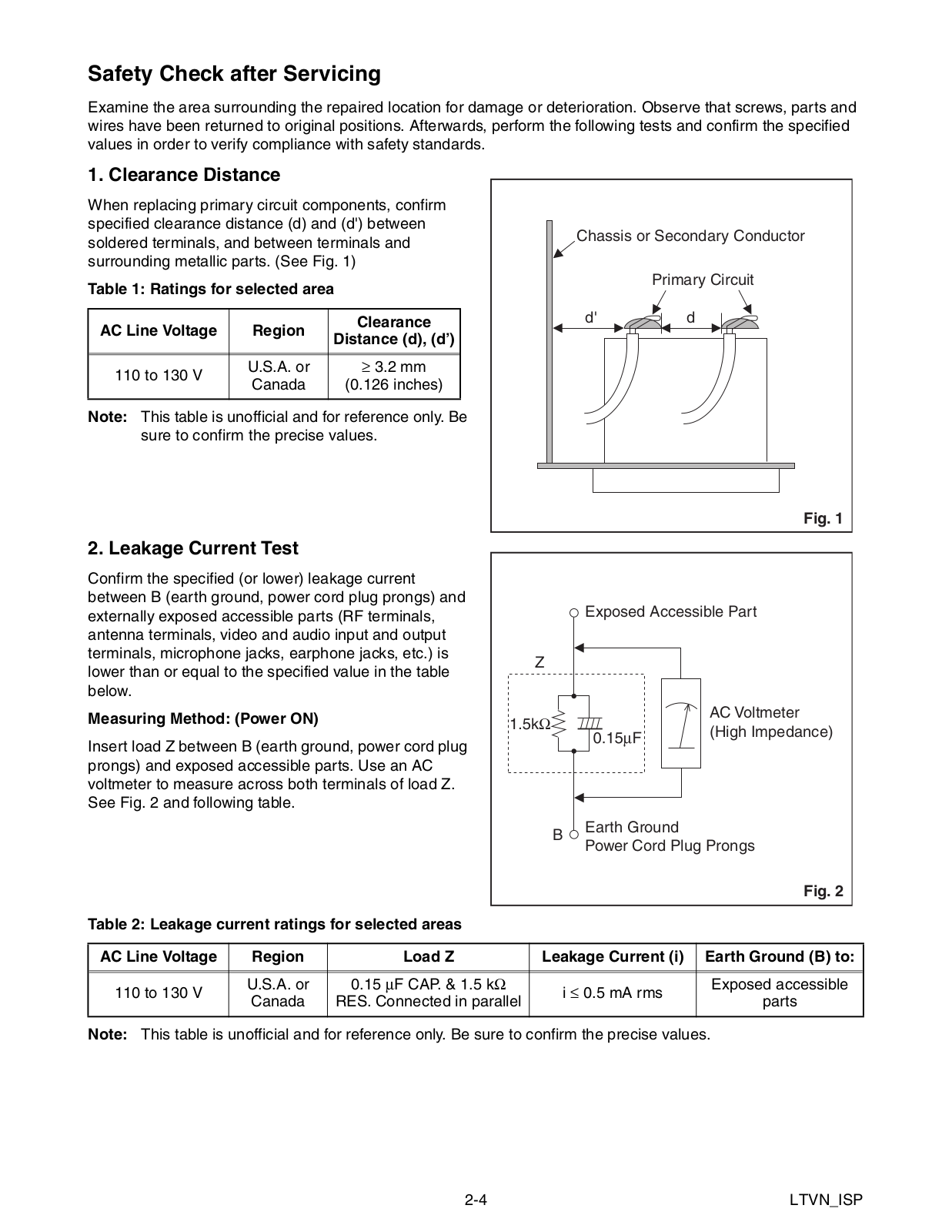
1. Clearance Distance
When replacing primary circuit components, confirm
specified clearance distance (d) and (d') between
soldered terminals, and between terminals and
surrounding metallic parts. (See Fig. 1)
Table 1: Ratings for selected area
Chassis or Secondary Conductor
Primary Circuit
AC Line VoltageRegion
110 to 130 V
Note: This table is unofficial and for reference only. Be
sure to confirm the precise values.
U.S.A. or
Canada
Clearance
Distance (d), (d’)
≥ 3.2 mm
(0.126 inches)
2. Leakage Current Test
Confirm the specified (or lower) leakage current
between B (earth ground, power cord plug prongs) and
externally exposed accessible parts (RF terminals,
antenna terminals, video and audio input and output
terminals, microphone jacks, earphone jacks, etc.) is
lower than or equal to the specified value in the table
below.
Measuring Method: (Power ON)
Insert load Z between B (earth ground, power cord plug
prongs) and exposed accessible parts. Use an AC
voltmeter to measure across both terminals of load Z.
See Fig. 2 and following table.
d'd
Fig. 1
Exposed Accessible Part
Z
AC Voltmeter
(High Impedance)
Earth Ground
B
Power Cord Plug Prongs
Fig. 2
Table 2: Leakage current ratings for selected areas
AC Line VoltageRegionLoad ZLeakage Current (i)Earth Ground (B) to:
110 to 130 V
Note: This table is unofficial and for reference only. Be sure to confirm the precise values.
U.S.A. or
Canada
0.15 µF CAP. & 1.5 kΩ
RES. Connected in parallel
2-4LTVN_ISP
i ≤ 0.5 mA rms
Exposed accessible
parts
Page 9
STANDARD NOTES FOR SERVICING
Circuit Board Indications
1. The output pin of the 3 pin Regulator ICs is
indicated as shown.
Top Vi ew
Out
2. For other ICs, pin 1 and every fifth pin are
indicated as shown.
Pin 1
3. The 1st pin of every male connector is indicated as
shown.
Pin 1
Input
In
Bottom View
5
10
Pb (Lead) Free Solder
Pb free mark will be found on PCBs which use Pb
free solder. (Refer to figure.) For PCBs with Pb free
mark, be sure to use Pb free solder. For PCBs
without Pb free mark, use standard solder.
Pb free mark
How to Remove / Install Flat Pack-IC
1. Removal
With Hot-Air Flat Pack-IC Desoldering Machine:
1. Prepare the hot-air flat pack-IC desoldering
machine, then apply hot air to the Flat Pack-IC
(about 5 to 6 seconds). (Fig. S-1-1)
Fig. S-1-1
2. Remove the flat pack-IC with tweezers while
applying the hot air.
3. Bottom of the flat pack-IC is fixed with glue to the
CBA; when removing entire flat pack-IC, first apply
soldering iron to center of the flat pack-IC and heat
up. Then remove (glue will be melted). (Fig. S-1-6)
4. Release the flat pack-IC from the CBA using
tweezers. (Fig. S-1-6)
CAUTION:
1. The Flat Pack-IC shape may differ by models. Use
an appropriate hot-air flat pack-IC desoldering
machine, whose shape matches that of the Flat
Pack-IC.
2. Do not supply hot air to the chip parts around the
flat pack-IC for over 6 seconds because damage
to the chip parts may occur. Put masking tape
around the flat pack-IC to protect other parts from
damage. (Fig. S-1-2)
3-1TVN_SN
Page 10
3. The flat pack-IC on the CBA is affixed with glue, so
be careful not to break or damage the foil of each
pin or the solder lands under the IC when
removing it.
With Soldering Iron:
1. Using desoldering braid, remove the solder from
all pins of the flat pack-IC. When you use solder
flux which is applied to all pins of the flat pack-IC,
you can remove it easily. (Fig. S-1-3)
CBA
Masking
Ta pe
Tweezers
Hot-air
Flat Pack-IC
Desoldering
Machine
Flat Pack-IC
Fig. S-1-2
Flat Pack-IC
Desoldering Braid
Soldering Iron
Fig. S-1-3
2. Lift each lead of the flat pack-IC upward one by
one, using a sharp pin or wire to which solder will
not adhere (iron wire). When heating the pins, use
a fine tip soldering iron or a hot air desoldering
machine. (Fig. S-1-4)
Sharp
Pin
Fine Tip
Soldering Iron
3. Bottom of the flat pack-IC is fixed with glue to the
CBA; when removing entire flat pack-IC, first apply
soldering iron to center of the flat pack-IC and heat
up. Then remove (glue will be melted). (Fig. S-1-6)
4. Release the flat pack-IC from the CBA using
tweezers. (Fig. S-1-6)
Fig. S-1-4
3-2TVN_SN
Page 11
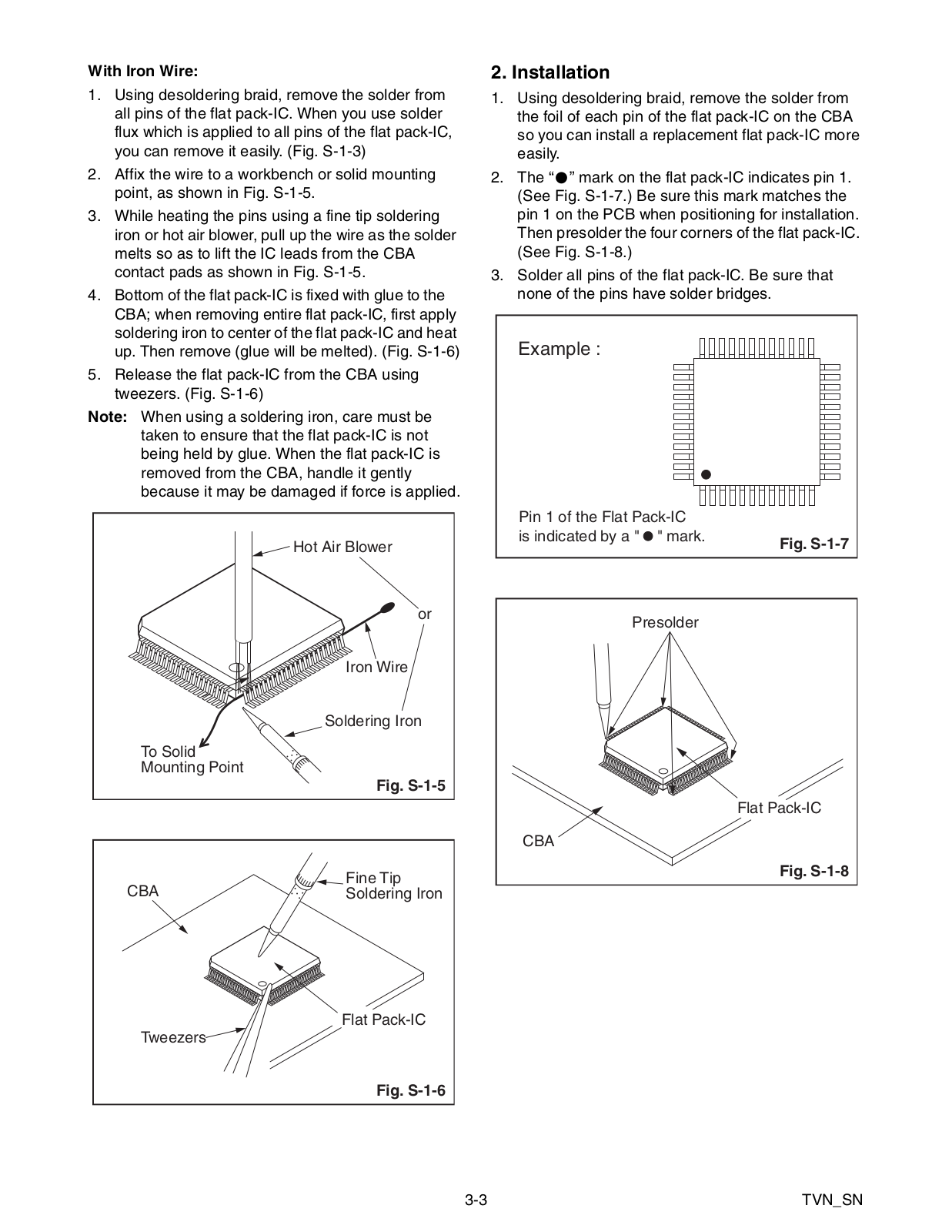
With Iron Wire:
1. Using desoldering braid, remove the solder from
all pins of the flat pack-IC. When you use solder
flux which is applied to all pins of the flat pack-IC,
you can remove it easily. (Fig. S-1-3)
2. Affix the wire to a workbench or solid mounting
point, as shown in Fig. S-1-5.
3. While heating the pins using a fine tip soldering
iron or hot air blower, pull up the wire as the solder
melts so as to lift the IC leads from the CBA
contact pads as shown in Fig. S-1-5.
4. Bottom of the flat pack-IC is fixed with glue to the
CBA; when removing entire flat pack-IC, first apply
soldering iron to center of the flat pack-IC and heat
up. Then remove (glue will be melted). (Fig. S-1-6)
5. Release the flat pack-IC from the CBA using
tweezers. (Fig. S-1-6)
Note: When using a soldering iron, care must be
taken to ensure that the flat pack-IC is not
being held by glue. When the flat pack-IC is
removed from the CBA, handle it gently
because it may be damaged if force is applied.
Hot Air Blower
2. Installation
1. Using desoldering braid, remove the solder from
the foil of each pin of the flat pack-IC on the CBA
so you can install a replacement flat pack-IC more
easily.
2. The “ I ” mark on the flat pack-IC indicates pin 1.
(See Fig. S-1-7.) Be sure this mark matches the
pin 1 on the PCB when positioning for installation.
Then presolder the four corners of the flat pack-IC.
(See Fig. S-1-8.)
3. Solder all pins of the flat pack-IC. Be sure that
none of the pins have solder bridges.
Example :
Pin 1 of the Flat Pack-IC
is indicated by a " " mark.
Fig. S-1-7
To Solid
Mounting Point
CBA
Tweezers
Iron Wire
Soldering Iron
Fig. S-1-5
Fine Tip
Soldering Iron
Flat Pack-IC
or
Presolder
Flat Pack-IC
CBA
Fig. S-1-8
Fig. S-1-6
3-3TVN_SN
Page 12
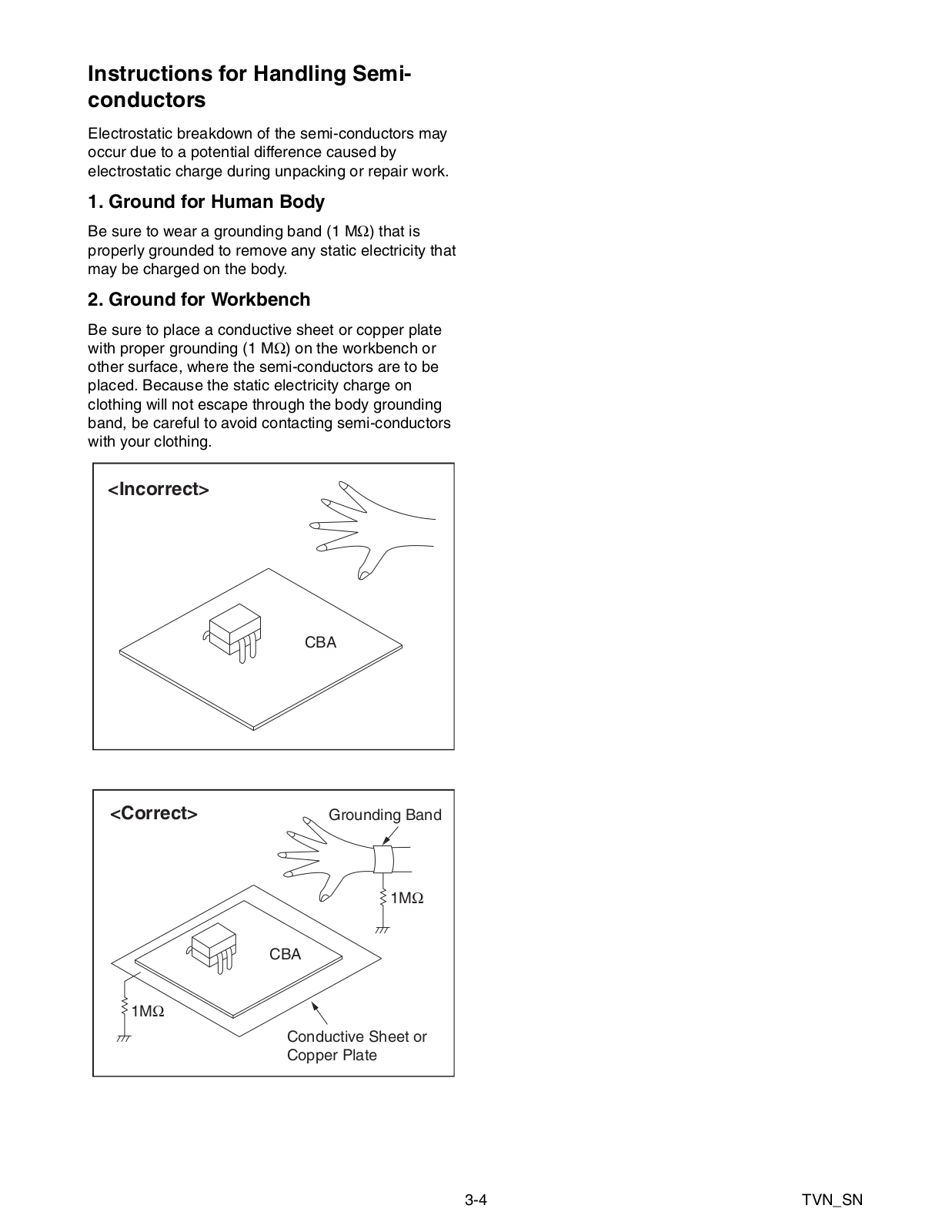
Instructions for Handling Semiconductors
Electrostatic breakdown of the semi-conductors may
occur due to a potential difference caused by
electrostatic charge during unpacking or repair work.
1. Ground for Human Body
Be sure to wear a grounding band (1 MΩ) that is
properly grounded to remove any static electricity that
may be charged on the body.
2. Ground for Workbench
Be sure to place a conductive sheet or copper plate
with proper grounding (1 MΩ) on the workbench or
other surface, where the semi-conductors are to be
placed. Because the static electricity charge on
clothing will not escape through the body grounding
band, be careful to avoid contacting semi-conductors
with your clothing.
<Incorrect>
<Correct>
1MΩ
CBA
Grounding Band
1MΩ
CBA
Conductive Sheet or
Copper Plate
3-4TVN_SN
Page 13
CABINET DISASSEMBLY INSTRUCTIONS
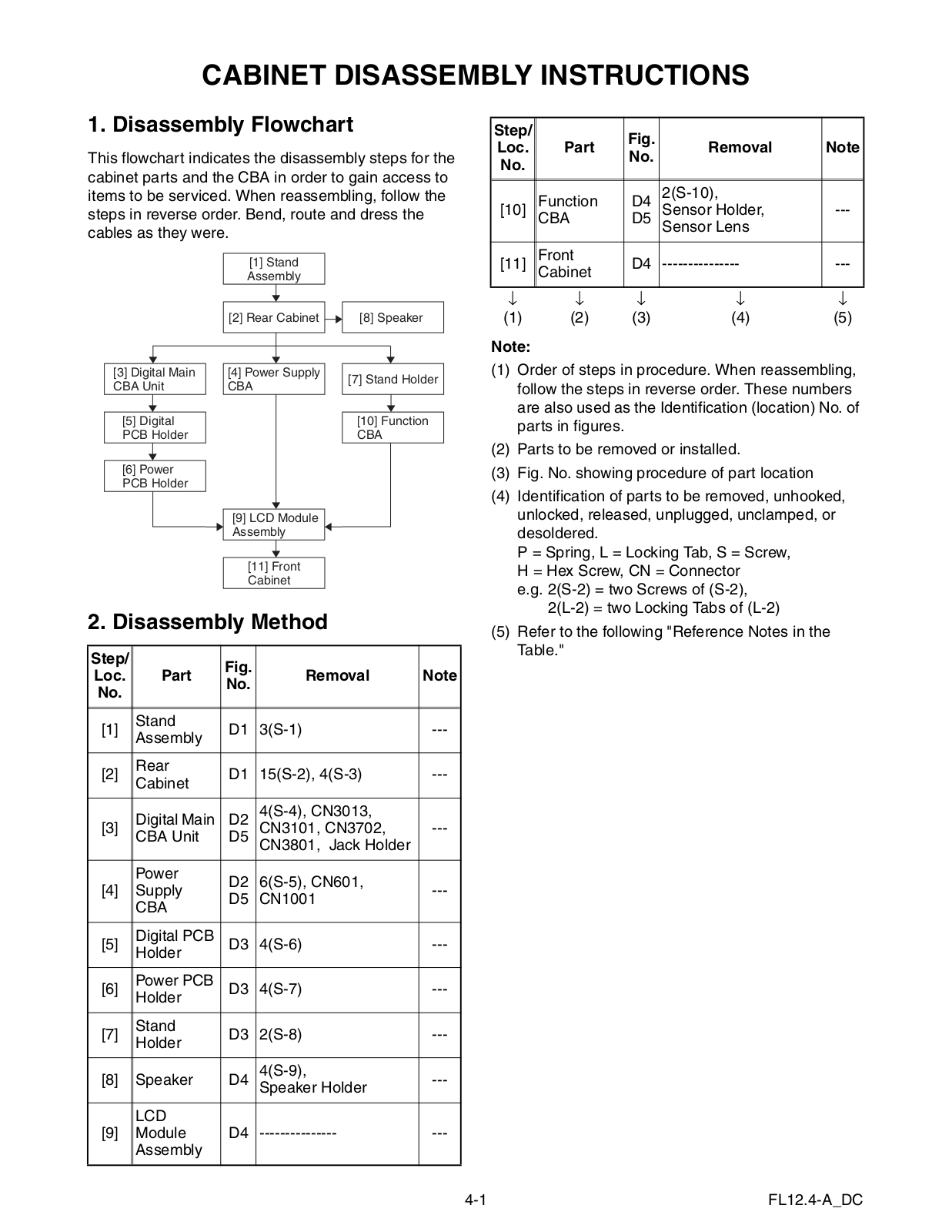
1. Disassembly Flowchart
This flowchart indicates the disassembly steps for the
cabinet parts and the CBA in order to gain access to
items to be serviced. When reassembling, follow the
steps in reverse order. Bend, route and dress the
cables as they were.
[1] Stand
Assembly
[3] Digital Main
CBA Unit
[5] Digital
PCB Holder
[6] Power
PCB Holder
[2] Rear Cabinet
[4] Power Supply
CBA
[9] LCD Module
Assembly
[11] Front
Cabinet
[8] Speaker
[7] Stand Holder
[10] Function
CBA
2. Disassembly Method
Step/
Loc.
No.
Part
Fig.
No.
RemovalNote
Step/
Loc.
No.
[10]
[11]
↓
(1)
Part
Function
CBA
Front
Cabinet
↓
(2)
Fig.
No.
D4
D5
RemovalNote
2(S-10),
Sensor Holder,
Sensor Lens
D4 ------------------
↓
(3)
↓
(4)
---
↓
(5)
Note:
(1) Order of steps in procedure. When reassembling,
follow the steps in reverse order. These numbers
are also used as the Identification (location) No. of
parts in figures.
(2) Parts to be removed or installed.
(3) Fig. No. showing procedure of part location
(4) Identification of parts to be removed, unhooked,
unlocked, released, unplugged, unclamped, or
desoldered.
P = Spring, L = Locking Tab, S = Screw,
H = Hex Screw, CN = Connector
e.g. 2(S-2) = two Screws of (S-2),
2(L-2) = two Locking Tabs of (L-2)
(5) Refer to the following "Reference Notes in the
Table."
Stand
[1]
Assembly
Rear
[2]
Cabinet
Digital Main
[3]
CBA UnitD2D5
Power
[4]
Supply
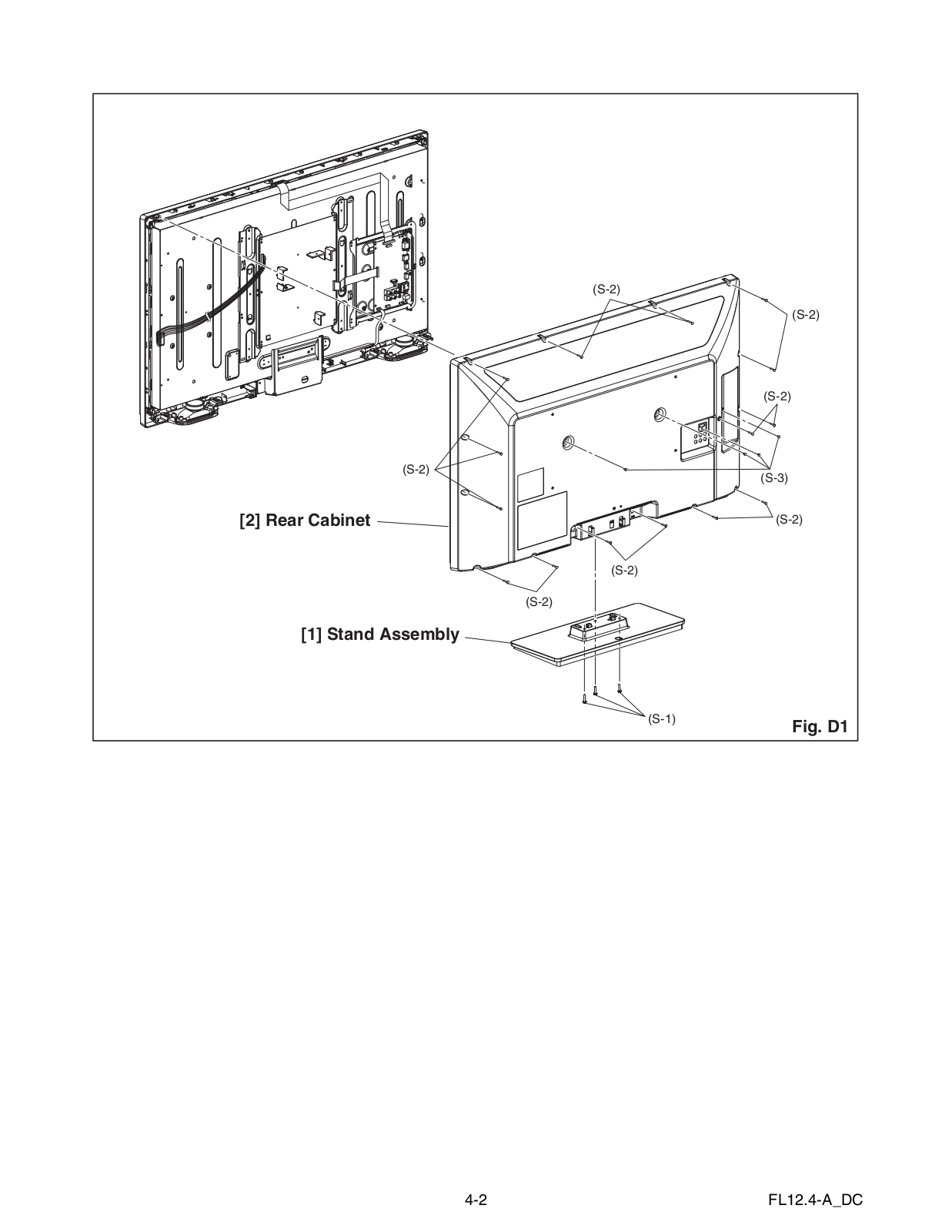
D1 3(S-1)---
D1 15(S-2), 4(S-3)---
D2D56(S-5), CN601,
CBA
Digital PCB
[5]
Holder
Power PCB
[6]
Holder
Stand
[7]
Holder
D3 4(S-6)---
D3 4(S-7)---
D3 2(S-8)---
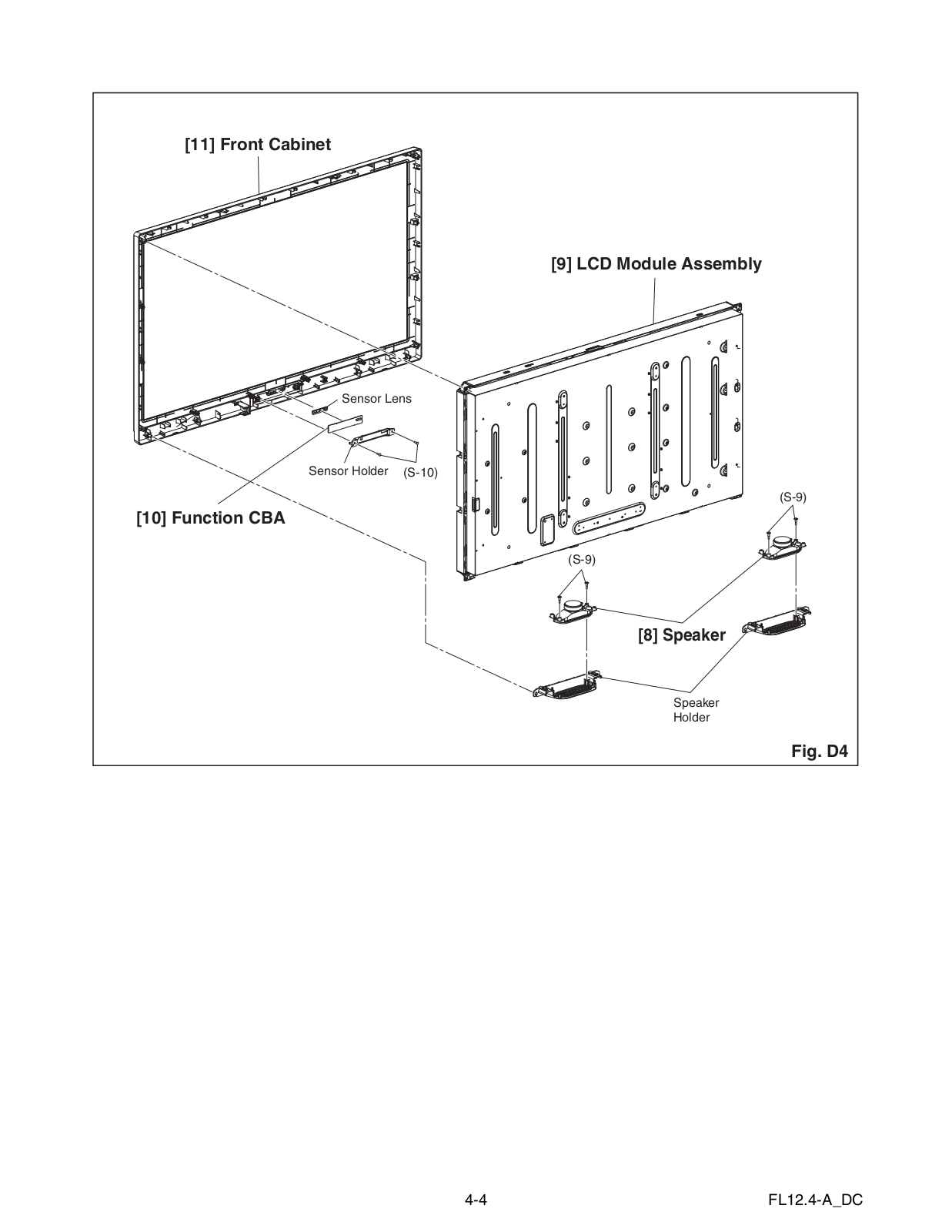
[8]SpeakerD4
LCD
[9]
Module
D4 ------------------
Assembly
4(S-4), CN3013,
CN3101, CN3702,
CN3801, Jack Holder
CN1001
4(S-9),
Speaker Holder
---
---
---
4-1FL12.4-A_DC
Page 14
(S-2)
(S-2)
(S-2)
[2] Rear Cabinet
[1] Stand Assembly
(S-2)
(S-2)
(S-2)
(S-1)
(S-3)
(S-2)
Fig. D1
4-2FL12.4-A_DC
Page 15
[4] Power Supply CBA
[3] Digital Main CBA Unit
Jack Holder
(S-4)
(S-5)
Fig. D2
[7] Stand Holder
[6] Power PCB Holder
[5] Digital PCB Holder
(S-7)
(S-6)
(S-6)
(S-7)
(S-8)
Fig. D3
4-3FL12.4-A_DC
Page 16
[11] Front Cabinet
[9] LCD Module Assembly
Sensor Lens
[10] Function CBA
Sensor Holder
(S-10)
(S-9)
(S-9)
[8] Speaker
Speaker
Holder
Fig. D4
4-4FL12.4-A_DC
Page 17
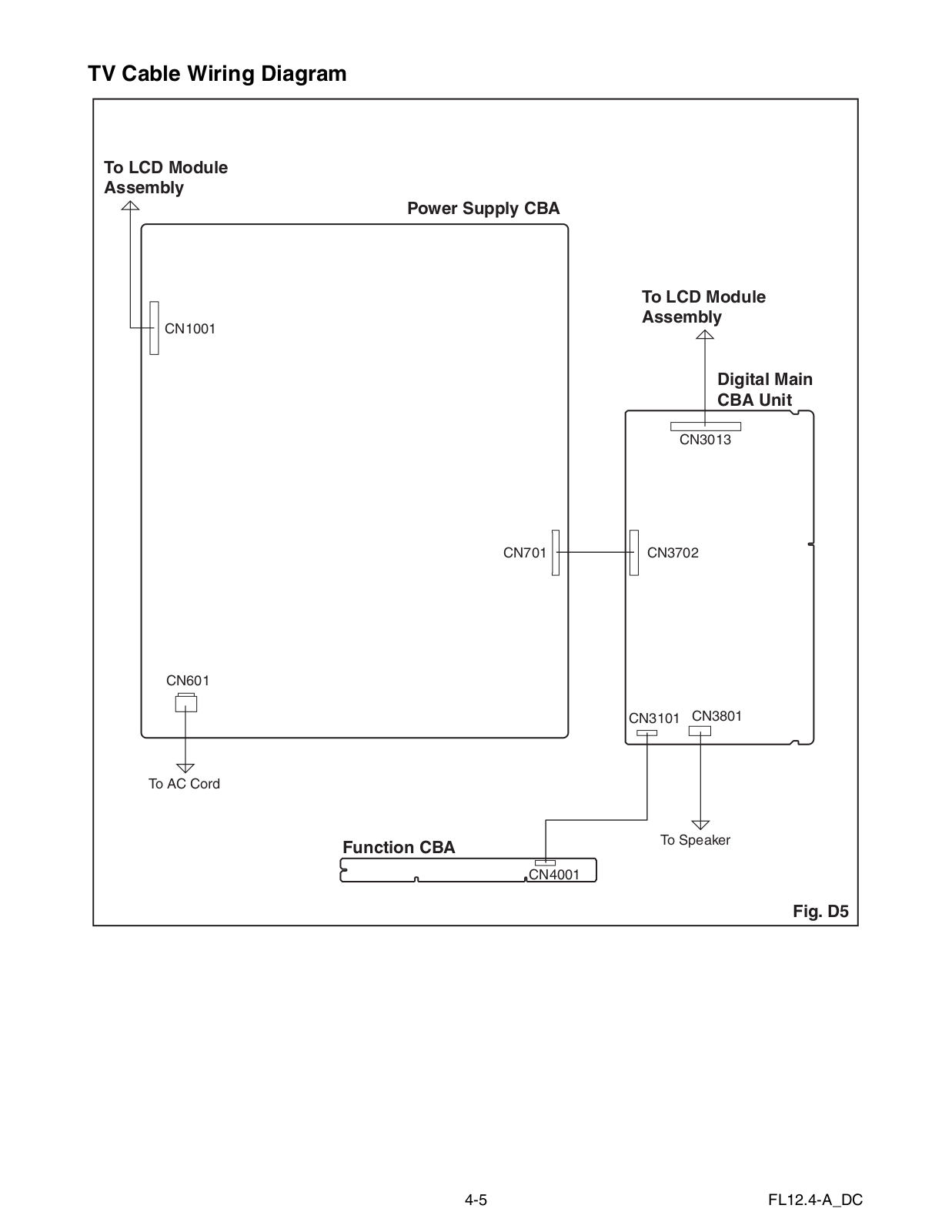
TV Cable Wiring Diagram
To LCD Module
Assembly
CN1001
Power Supply CBA
To LCD Module
Assembly
Digital Main
CBA Unit
CN3013
CN601
To AC Cord
Function CBA
CN701
CN4001
CN3702
CN3101
To Speaker
CN3801
Fig. D5
4-5FL12.4-A_DC
Page 18
ELECTRICAL ADJUSTMENT INSTRUCTIONS
General Note: “CBA” is abbreviation for
“Circuit Board Assembly.”
Note: Electrical adjustments are required after
replacing circuit components and certain
mechanical parts. It is important to perform
these adjustments only after all repairs and
replacements have been completed.
Also, do not attempt these adjustments unless
the proper equipment is available.
Test Equipment Required
1. Remote control unit
2. Color Analyzer,
CA-310 (KONICA MINOLTA Luminance meter) or
measuring instrument as good as CA-310.
How to set up the service mode:
Service mode:
1. Turn the power on.
2. Press [MENU] button to display Setup menu.
3. Select “Features”.
4. Select “Software Upgrade”.
5. Select “Current Software Info”.
6. Press [0], [4], [2], [5], [7], [4] and [INFO] buttons on
the remote control unit in this order. The following
screen appears.
This mode cycles through full-screen displays of red,
green, blue, and white to check for non-active pixels.
1. Enter the service mode.
2. Each time the [7] button on the remote control unit
is pressed, the display changes as follows.
Purity Check Mode
White mode
[7] button
[7] button
Black mode
[7] button
White 50% mode
[7] button
Red, Green, Blue mode
[7] button
V-ramp mode
Test PointAdj. Point
Screen
[CHANNEL UP/DOWN]
buttons
M. EQ.Spec.
Color analyzerSee below
Figure
To avoid interference from ambient
light, this adjustment should be
performed in a dark room.
Perpendicularity
Color Analyzer
1. Operate the unit for more than 60 minutes.
2. Set the color analyzer at the zero point calibration
and bring the optical receptor pointing at the
center of the LCD-Panel.
Note: The optical receptor must be set
perpendicularly to the LCD Panel surface.
3. Enter the Service mode.
4. Press [3] button on the remote control unit.
5. Press [CHANNEL UP/DOWN] buttons on the
remote control unit so that the color analyzer value
becomes minimum.
6. To cancel or to exit from the VCOM Adjustment,
press [CH RETURN] or [PREV CH] button.
[7] button
White 20% mode
Note:
When entering this mode, the default setting is White mode.
3. To cancel or to exit from the Purity Check Mode,
press [CH RETURN] or [PREV CH] button.
5-2FL12.4(LC10)EA
Page 20
The White Balance Adjustment should be
performed when replacing the LCD Panel
or Digital Main CBA.
3. White Balance Adjustment
Purpose: To mix red and blue beams correctly for
pure white.
Symptom of Misadjustment: White becomes bluish
or reddish.
6. Press [MENU] button. The internal Raster signal
appears in the screen. (“Internal (Single)” appears
in the upper right of the screen as shown below.)
Internal (Single)
ITEM
Color temperature
Input Signal
SPECIFICATION
x= 0.272 ± 0.002
y= 0.278 ± 0.002
Internal pattern
(40/80% raster)
Measurement pointScreen center
CA-310 (KONICA MINOLTA
M. EQ.
Luminance meter) or
measuring instrument as
good as CA-310.
60min.
Aging time
(Retail MODE/100IRE Raster
HDMI 1080i@60)
MODE setting of TV
Ambient
temperature
Shipment setting/
Retail MODE
25°C ± 5°C
1. Operate the unit for more than 60 minutes.
2. Enter the service mode.
3. Press [VOLUME DOWN] button three times on the
remote control unit to select “Drive setting” mode.
“Drive” appears in the screen.
4. Set the color analyzer at the CHROMA mode and
zero point calibration. Bring the optical receptor
pointing at the center of the LCD-Panel.
To avoid interference from ambient
light, this adjustment should be
performed in a dark room.
Perpendicularity
Color Analyzer
Note: The optical receptor must be set
perpendicularly to the LCD Panel surface.
5. Press [3] button to select the “HDB” for High Drive
Blue adjustment. (“HDB” appears in the screen.)
HDB 0
7. Press [CHANNEL UP/DOWN] buttons to adjust
the color temperature becomes 12000°K
(x
=
0.272 / y= 0.278 ± 0.002).
8. Press [1] button to select the “HDR” for High Drive
Red adjustment (“HDR” appears in the screen.)
and press [CHANNEL UP/DOWN] buttons to
adjust the color temperature.
9. If necessary, adjust the “HDB” or “HDR” again.
10. Press [6] button to select the “LDB” for Low Drive
Blue adjustment (“LDB” appears in the screen.)
and press [CHANNEL UP/DOWN] buttons to
adjust the color temperature.
Internal (Single)
LDB 0
11. Press [4] button to select the “LDR” for Low Drive
Red adjustment (“LDR” appears in the screen.)
and press [CHANNEL UP/DOWN] buttons to
adjust the color temperature.
12. If necessary, adjust the “LDB” or “LDR” again.
13. Press [VOLUME DOWN] button to shift to the
“Debugging Message” mode.
If there is no message under “[WB]” section, this
adjustment completes.
If “Drive settings are NG. Retry.” is displayed,
repeat above steps from 5. to 12. Then check
“Debugging Message” again. If “Drive settings are
NG. Retry.” is displayed, replace the LCD Panel or
Digital Main CBA.
14. To cancel or to exit from the White Balance
Adjustment, press [CH RETURN] or [PREV CH]
button.
5-3FL12.4(LC10)EA
Page 21
HOW TO INITIALIZE THE LCD TV
The purpose of initialization is to place the set in a new out of box condition. The customer will be prompted to
select a language and program channels after the set has been initialized.
To put the program back at the factory-default, initialize the LCD TV using the following procedure.
NOTE: Disconnect any device from the USB Port
before you conduct on this procedure.
1. Turn the power on.
2. Enter the service mode.
- To cancel the service mode, press [POWER]
button on the remote control unit.
3. Press [BACK] button to enter the Panel Key
Confirmation Menu.
4. Press any button on the touch sensor panel.
5. Press [INFO] button to proceed with the self check
mode.
6. Make sure to confirm the “INITIALIZED FINISH”
appears in the green screen.
7. Unplug the AC Cord and plug it back on again.
6-1LC10_INT
Page 22
FIRMWARE RENEWAL MODE
Equipment Required
a. USB storage device
b. Remote Control Unit
Firmware Update Procedure
User Upgrade (Filename example: TVNB012_00_UF_XX91_AA.ecc)
Upgrade the firmware only. The setting values will not be initialized.
The User Upgrade and the Firmware Upgrade (Factory Upgrade) will be done by the same file. If you want to
upgrade the firmware and initialize the setting values also, add “FACT_” at the beginning of the filename.
If you want to upgrade the firmware only and leave the setting values as they are, eliminate the “FACT_” from the
filename.
Update procedure
1. Turn the power on.
2. Press [MENU] button to display Menu.
3. Select “Features”.
4. Select “Software Upgrade”.
5. Select “Upgrade” to display Upgrade screen.
6. Press [OK] button to display Software Upgrade
screen.
7. Select “USB” and press [OK] button.
8. Insert the USB storage device to the USB port as
shown below.
Rear Cabinet
Rear Cabinet
USB port
USB port
USB storage
USB storage
device
device
11. The update will start and the following will appear
in the screen.
"*" differs depending on the models.
Software Upgrade
Software upgrade in progress. Please wait.
Do not remove the USB storage device or
turn the TV off while upgrade is in progress.
*1
Current Version:
New Version:
Downloading...
0%
*******-***-*-***-****
*******-***-*-***-****
Note: If the above screen isn’t displayed, repeat from
step 1.
The appearance shown in *1 is described as follows.
AppearanceState
Downloading...
Writing...
Downloading the firmware from
the USB storage device.
Writing the downloaded firmware
in flash memory.
Checking...Checking the new firmware.
9. Select “Check” and press [OK] button.
10. Select “Upgrade” and press [OK] button to start
software upgrade.
12. When the firmware update is completed, the
following will appear in the screen.
Software Upgrade
The software upgrade is completed.
Remove USB storage device, turn TV off then on again.
Remove the USB storage device from the USB
port.
Turn the power off and turn the power on again.
Upgrade the firmware and initialize the setting values.
The User Upgrade and the Firmware Upgrade (Factory Upgrade) will be done by the same file. If you want to
upgrade the firmware and initialize the setting values also, add “FACT_” at the beginning of the filename.
If you want to upgrade the firmware only and leave the setting values as they are, eliminate the “FACT_” from the
filename.
Flash Upgrade (Filename example: ALL_TVNB012_00_UF_XX91_AA.ecc)
Upgrade the firmware and initialize the setting values along with the factory default such as White Balance, etc.
Before the upgrade, you will need to make a note of all the factory default so you will be able to set it back on the
TV after the initialization.
The Flash Upgrade will be done by it's unique file.
The User Upgrade/Firmware Upgrade (Factory Upgrade) file cannot be used for this upgrade.
Update procedure
1. Turn the power off.
2. Insert the USB storage device to the USB port as
shown below.
Rear Cabinet
USB port
The appearance shown in *1 is described as follows.
AppearanceState
Downloading...
Writing...
Downloading the firmware from
the USB storage device.
Writing the downloaded firmware
in flash memory.
Checking...Checking the new firmware.
USB storage
device
3. Turn the power on.
4. The update will start and the following will appear
in the screen.
"*" differs depending on the models.
Software Upgrade
Software upgrade in progress. Please wait.
Do not remove the USB storage device or
turn the TV off while upgrade is in progress.
*1
Current Version:
New Version:
Downloading...
0%
*******-***-*-***-****
*******-***-*-***-****
5. When the firmware update is completed, the
following will appear in the screen.
Software Upgrade
The software upgrade is completed.
Remove USB storage device, turn TV off then on again.
Remove the USB storage device from the USB
port.
Turn the power off and turn the power on again.
Service mode initial screen with a word
“INITIALIZED” will appear in the screen. The color
of the word “INITIALIZED” will change from red to
green when initialization is completed.
Note: If the above screen isn’t displayed, repeat from
step 1.
7-2FL12.4FW
Page 24
[Power Supply Section]
FLOW CHART NO.1
The power cannot be turned on.
TROUBLESHOOTING
Is the fuse (F601) normal?
Ye s
Is normal state restored when once unplugged
power cord is plugged again after several seconds?
Ye s
Is the P-ON+12V line voltage normal?
Ye s
Check each rectifying circuit of the secondary
circuit and service it if defec
FLOW CHART NO.2
The fuse blows out.
Check the presence that the primary component
is leaking or shorted and service it if defective.
After servicing, replace the fus
tive.
e (F601).
No
No
No
See FLOW CHART No.2 <The fuse blows out.>
Check if there is any leak or short-circuiting on the
primary circuit component, and service it if defective.
(D601, D602, D603, D604, D612, IC602, Q601,
Q602, T601, R613)
Check the presence that the rectifying diode or circuit
is shorted in each rectifying circuit of secondary side,
and service it if defective.
FLOW CHART NO.3
When the output voltage fluctuates.
Does the photocoupler circuit on
secondary side operate normally?
Check D607, D608, D609,
IC602 and their per
defective.
FLOW CHART NO.4
When buzz sound can be heard in the vicinity of power circuit.
Check if there is
and service it if def
iphery circuit, and service it if
any short-circuit on the rectifying diode and the circ
ective. (D701, D703, Q701, Q70
the
Ye s
D610, D611, Q601, Q60
No
2,
2)
Check IC602, IC701 and their periphery circuit,
and service it if defective.
uit in each rectifying circuit of the secondar
y side,
8-1FL12.4ATR
Page 25
FLOW CHART NO.5
AMP+24V is not output.
Is approximately +24V voltage supplied to the
cathode of D701?
Ye s
Check for short-circuiting or leak on the load ci
and service it if def
FLOW CHART NO.6
P-ON+12V is not output.
Is approximately +12V voltage supp
of D703?
Check for short-circuiting or leak on the load ci
and service it if defec
FLOW CHART NO.7
P-ON+5V is not output.
Is approximately +12V voltage supplied to the collector
of Q702?
ective.
lied to the cathode
Ye s
tive.
Ye s
rcuit,
rcuit,
No
No
No
Check C707, C708, D701, D702 and their periphery
circuit, and service it if defective.
Check C710, C711, D703 and their periphery circuit,
and service it if defective.
See FLOW CHART NO.6 <P-ON+12V is not output.>
Is approximately +
Q702?
Replace Q702.
FLOW CHART NO.8
AL+3.3V is not output.
Is approximately +12V voltage supplied to the collector
of Q701?
Is approximately +
Q701?
Replace Q701.
5V voltage supplied to the base of
Ye s
Ye s
6V voltage supplied to the base of
Ye s
No
No
No
Check D706, Q703, Q706, P-ON-H1 line and their
periphery circuit, and service it if defective.
See FLOW CHART NO.6 <P-ON+12V is not output.>
Check IC702 and their periphery circuit, and service
it if defective.
8-2FL12.4ATR
Page 26
[Video Signal Section]
FLOW CHART NO.1
The key operation is not functioning.
When touching each buttons do the voltage of Pin(6)
of CN4001 decrease?
Ye sYe s
Replace Digital Main CBA Unit.Replace IC4001
FLOW CHART NO.2
No operation is possible from the remote control unit. (Operation is possible from the unit.)
Is approximately +3.3V voltage supplied to Pin(3)
terminal of the remote co
Is the "L" pulse sent ou
control receiver (RS4051) when the
control is activated?
Is the "L" pulse supplied to Pin(5) of CN4001?
Replace Digital Main CBA Unit.
ntrol receiver (RS4051)?
Ye s
t Pin(1) terminal of remote
infrared remote
Ye s
Ye s
No
No
No
No
Is approximately +3.3V voltage supplied to Pin(1)
of CN4001?
or Function CBA.
Check AL+3.3V line and service it if defective.
Replace the remote control receiver (RS4051)
or the remote control unit.
Check the line between Pin(1) of remote control
receiver (RS4051) and Pin(5) of CN4001, and
service it if defective.
No
Check AL+3.3V line and
service it if defective.
FLOW CHART NO.3
Picture does not appear normally.
Is approximately +12V voltage supplied to
Pin(16, 17, 22, 23) of CN701?
Ye s
Is approximately +24V voltage supplied to Pin(13, 14)
of CN701?
Ye s
approximately +
Is
CN701?
Digital Main CBA Unit or LCD Module Ass
be defective.
Check and replace these parts.
3.3V voltage sup
plied to Pin(11) of
Ye s
embly may
No
No
No
See FLOW CHART NO.6 <P-ON+12V is not output.
[Power Supply Section]>
See FLOW CHART NO.5 <AMP+24V is not output.
[Power Supply Section]>
See FLOW CHART NO.8 <AL+3.3V is not output.
[Power Supply Section]>
8-3FL12.4ATR
Page 27
[Audio Signal Section]
FLOW CHART NO.1
Audio is not outputted normally.
Is approximately +12V voltage supplied to
Pin(16, 17, 22, 23) of CN701?
Ye s
Is approximately +24V voltage supplied to Pin(13, 14)
of CN701?
Ye s
approximately +
Is
CN701?
Are the audio signals outputted to Pin(1, 4) of C
SP3801, SP3802 or CL3801 may be defective.
Check and replace these parts.
3.3V voltage supplied to Pin(11) of
Ye s
N3801?
Ye s
No
No
No
No
See FLOW CHART NO.6 <P-ON+12V is not output.
[Power Supply Section]>
See FLOW CHART NO.5 <AMP+24V is not output.
[Power Supply Section]>
See FLOW CHART NO.8 <AL+3.3V is not output.
[Power Supply Section]>
Replace Digital Main CBA Unit.
8-4FL12.4ATR
Page 28
BLOCK DIAGRAMS
1. System Control Block Diagram
POWER
SOURCE
MENU
CH UP
CH DOWN
VOL UP
161718
19
212223
MENU
CH UP
CH DOWN
MENU
SOURCE
3
2
VOL UP
AL+3.3V
REMOTE
RS4051
POWER
SOURCE
SCL
SDA
POWER
(TOUCH SENSOR)
4
5
1
KEY-IN146
SDA19
SCL28
REMOTE55
LED164
D4051
POWER
SENSOR
IC4001
CN3101CN4001
VOL DOWN
VOL DOWN
CH UP
6
CH DOWN
11
VOL UP
12
VOL DOWN
13
TO
POWER SUPPLY
BLOCK DIAGRAM
RESET
P-ON-H2
P-ON-H1
FUNCTION CBA
PROTECT3
BACKLIGHT-SW
BACKLIGHT-ADJ
POWER SUPPLY CBA
CN701
P-ON-H2
P-ON-H1
RESET
PROTECT3
BACKLIGHT-SW
BACKLIGHT-ADJ
177
186
168
204
222
213
CN3702
IC3005
(MAIN MICRO CONTROLLER)
A15
KEY-IN1
LED DRIVE
D14
C14
LED1
REMOTE
Q3501, Q3502
AUDIO-MUTE
C1
AUDIO-MUTE
SCL
SDA
TU3901 (TUNER UNIT)
4
3
T12
R12
SCL
SDA
TO
VIDEO/AUDIO
BLOCK DIAGRAM
AL+3.3V
Q3006
B16
P-ON-H2
Q3005
IC3009
G13
P-ON-H1
RESET
J15
B13
RESET
PROTECT3
E2
BACKLIGHT-SW
BACKLIGHT-SW
F3
BACKLIGHT-ADJ
DIGITAL MAIN CBA UNIT
XOUT25
X3001
XIN25
H15
H16
25MHz
OSC
SCK
SIN
SOUT
CS
T11
P11
P12
R11
652
1
SI
CS
SO
SCK
IC3006 (MEMORY)
TO
VIDEO/AUDIO
BLOCK DIAGRAM
9-1
FL12.4BLS
Page 29
2. Video/Audio Block Diagram
AUDIO SIGNAL
TO DIGITAL
SIGNAL PROCESS
BLOCK DIAGRAM
TO SYSTEM CONTROL
BLOCK DIAGRAM
VIDEO SIGNAL
VGA-R-IN
VGA-B-IN
VGA-G-IN
VGA-SCL
VGA-VSYNC
VGA-HSYNC
VGA-SDA
(TUNER UNIT)
TU3901
DIF-OUT1
DIF-OUT2
6
7
DIF-OUT1
DIF-OUT2
IF-AGC
5
IF-AGC
COMP-DET
COM-VIDEO-Pr-IN
COM-VIDEO-Pb-IN
COM-VIDEO-Y/VIDEO-IN
AUDIO(L)-IN
AUDIO(R)-IN
SPDIF
AMP(R)-OUT
32
DRIVEPWM19DRIVEPWM
IC3801 (AUDIO AMP)
39,40
AMP(L)-OUT
AUDIO-MUTE
Q3801
34
11,12
BACKLIGHT-SW
Q3802
P-ON+5V
Q3803
DIGITAL MAIN CBA UNIT
17
CONTROL LOGIC
123
BUFFER GATE
IC3013
131415
JK3001
PC-RGB
IN
BUFFER GATE
IC3014
BUFFER
Q3301
BUFFER
Q3302
12
JK3702
COMPONENT
-Y/VIDEO-IN
COMPONENT
-Pb-IN
COMPONENT
-Pr-IN
9-2
JK3701
AUDIO(L)-IN
BUFFER
Q3701
DIGITAL
AUDIO(R)-IN
AUDIO-OUT
(COAXIAL)
JK3703
HEADPHONE
JACK
1
CN3801
SP(L)
SP3801
4
2
GND
SP(R)
SPEAKER
L-CH
3
GND
SP3802
SPEAKER
FL12.4BLVA
R-CH
Page 30
3. Digital Signal Process Block Diagram
LCD MODULE
ASSEMBLY
LLV1(+)24
LLV1(-)23
LLV2(+)22
LLV2(-)21
LLV3(+)17
LLV3(-)16
LLV4(+)14
LLV4(-)13
TP37
POL35
CPV40
OE39
STV33
L16
CPV
L15
OE
M14
STV
OE238
L14
OE2
AUDIO SIGNAL
VIDEO SIGNAL
CN3013
N16
N15
P16
P15
T16
T15
R14
T14
LLVCLK(+)20
R16
LLVCLK(-)19
R15
L13
TP
M15
POL
IC3002
(DDR2 SDRAM)
B1,B9,C2,C8,
D1,D3,D7,D9,
N4,N7,N8,P3,P4,
DATA(0-15)
ADDRESS(0-12)
H1,H3,H7,H9
F1,F9,G2,G8,
M2,M3,M7,M8,
N2,N3,N7,N8,
P2,P3,P7,P8,R2
P6-P8,R3,R4,R6,
R8,T2-T5
H1,H2,J1,J2,J4,K1,
K3,L1,L2,M1-M3,N1
HSYNC
IC3005 (DIGITAL SIGNAL PROCESS)
A14
VGA-HSYNC
VSYNC
B14
C11
VGA-R-IN
VGA-G-IN
VGA-VSYNC
LVDS TX
A/D
CONVERTER
SW
A9
C7
D8
C9
B11
C10
COM-VIDEO-Pr-IN
COM-VIDEO-Pb-IN
COM-VIDEO-Y/VIDEO-IN
VGA-B-IN
DEMODULATOR
/MPEG DECODER
IF-AGC
A12
A16
B12
DIF-OUT1
DIF-OUT2
IF-AGC
COMP-DETB8AUDIO(R)-IN
COMP-DET
A8
N12
AUDIO(L)-IN
AUDIO I/F
N10
AMP(L)-OUT
SPDIF
A7
B7
AMP(R)-OUT
DIGITAL
SIGNAL
PROCESS
AUDI O
DECODER
B4A4B3A3B2A2B1
26272324202117
IC3018 (HDMI SW)
414544484739383637
HDMI
I/F
DIGITAL MAIN CBA UNIT
VIDEO
DECODER
79461
HDMI-IN3
JK3003
TMDS-D0(-)
TMDS-D0(+)
A1
18
575660596362545351
HDMI
SW
8
TMDS-D1(-)
TMDS-D1(+)
7
111014
3
101216
TMDS-D2(-)
TMDS-D2(+)
TMDS-CLOCK(+)
541
13
15
HDMI-DATA
HDMI-CLOCK
TMDS-CLOCK(-)
52
2
IC3011
(HDMI SERIAL EEPROM)
15
SCL2
SCL1
2
HDMI-SCL
G14
7
14
SCL0
SDA2
SDA1
SCL3
3
10
HDMI-SDA
SDA0
SDA3
F14
6
11
VGA-SDA
VGA-SCL
TO
VIDEO/AUDIO
BLOCK DIAGRAM
HDMI-IN1
JK3004
TMDS-D0(+)
TMDS-D0(-)
TMDS-D1(+)
742
94613
9-3
TMDS-D1(-)
TMDS-D2(+)
TMDS-D2(-)
TMDS-CLOCK(+)
TMDS-CLOCK(-)
HDMI-DATA
HDMI-CLOCK
101216
15
JK3002
HDMI-IN2
TMDS-D0(+)
TMDS-D0(-)
TMDS-D1(+)
79461
TMDS-D1(-)
TMDS-D2(+)
TMDS-D2(-)
3
TMDS-CLOCK(+)
TMDS-CLOCK(-)
HDMI-DATA
HDMI-CLOCK
101216
15
TO
VIDEO/AUDIO
BLOCK DIAGRAM
FL12.4BLD
Page 31
4. Power Supply Block Diagram
NOTE:
The voltage for parts in hot circuit is measured using
hot GND as a common terminal.
AL+5V
AMP+24V
P-ON+12V
DIGITAL MAIN CBA UNIT
CN3702
10,11
AMP+24V
13,14
CN701
7,8
AL+3.3V1113
P-ON+12V
16,17
1,2
P-ON+12V
22,23
LCD MODULE ASSEMBLY
CN1001
VBL+55V1,2
VBL-55V
VCC+5V10CNT+5V11PT+2V
4,5
FB113FB2
14
TO SYSTEM CONTROL
BLOCK DIAGRAM
RESET
P-ON-H1
P-ON-H2
PROTECT3
BACKLIGHT-SW
12
BACKLIGHT-ADJ
Q1002
POWER SUPPLY CBA
RESET
SW+3.3V
Q707
IC702, Q701
141513
T601
2
1
3
For continued protection against risk of fire,
replace only with same type 4A, 125V fuse.
CAUTION ! :
ATTENTION : Utiliser un fusible de rechange de même type de 4A, 125V.
4A 125V
BRIDGE
RECTIFIER
D601-D604
LINE
FILTER
L602
LINE
FILTER
L601
12
5
SWITCHING
Q601
6
Q702, Q703,
11
7
Q706
SW+5V
10
8
Q602
IC602
(FEED BACK)
CONTROL
SWITCHING
11
T1602
2
14
8
5
SWITCHING
Q1602
14
Q704
Q1001
Q1003
RL601
Q705
9
12
SENS
ANALOG
DINMING
CURRENT
DRIVE2
DRIVE1
IC1001
(INVERTER CONTROLLER)
1
16
3
T1604
4
5
2
6
8137
SENS
ENABLE
VOLTAGE
ZERO
CURRENT
3
9
PWM
DIMMING
SENS
1
10
T1606
L1002
14
151314
2
Q708
L1001
14
7
14
IC601
(ISOLATOR)
32
121011
4
5
SHUNT
REG.
IC701
32
HOTCOLD
8
11
T1601
2
5
Q606
SWITCHING
SWITCHING
Q1603
Q1604
SWITCHING
Q1601
11
HOT CIRCUIT. BE CAREFUL.
CAUTION !
Fixed voltage (or Auto voltage selectable) power supply circuit is used in this unit.
If Main Fuse (F601) is blown , check to see that all components in the power supply
circuit are not defective before you connect the AC plug to the AC power supply.
Otherwise it may cause some components in the power supply circuit to fail.
AC601
F601
4A/125V
CN601
AC CORD
CONTROL
8
11612
VCC
4A 125V
SWITCHING
IC1601
(SWITCHING CONTROL)
2
1
7
9-4
Q603
Q604
Q605
FL12.4BLP
Page 32
SCHEMATIC DIAGRAMS / CBA AND TEST POINTS
Standard Notes
WARNING
Many electrical and mechanical parts in this chassis
have special characteristics. These characteristics
often pass unnoticed and the protection afforded by
them cannot necessarily be obtained by using
replacement components rated for higher voltage,
wattage, etc. Replacement parts that have these
special safety characteristics are identified in this
manual and its supplements; electrical components
having such features are identified by the mark “#” in
the schematic diagram and the parts list. Before
replacing any of these components, read the parts list
in this manual carefully. The use of substitute
replacement parts that do not have the same safety
characteristics as specified in the parts list may create
shock, fire, or other hazards.
Notes:
1. Do not use the part number shown on these
drawings for ordering. The correct part number is
shown in the parts list, and may be slightly
different or amended since these drawings were
prepared.
2. All resistance values are indicated in ohms
(K = 10
3. Resistor wattages are 1/4W or 1/6W unless
otherwise specified.
4. All capacitance values are indicated in µF
(P = 10
5. All voltages are DC voltages unless otherwise
specified.
6.
This schematic diagrams are masterized version
that should cover the entire FL12.4 chassis models.
Thus some parts in detail illustrated on this
schematic diagrams may vary depend on the
model within the FL12.4 chassis.
Please refer to the parts lists for each models.
7. The Circuit Board layout illustrated on this service
manual is the latest version for this chassis at the
moment of making this service manual.
Depend on the mass production date of each
model, the actual layout of each Board may differ
slightly from this version.
3
, M = 106).
-6
µF).
10-1FL12.4SC
Page 33
LIST OF CAUTION, NOTES, AND SYMBOLS USED IN THE SCHEMATIC DIAGRAMS ON
r
THE FOLLOWING PAGES:
1. CAUTION:
CAUTION: FOR CONTINUED PROTECTION AGAINST RISK OF FIRE, REPLACE ONLY WITH SAME
TYPE_A,_V FUSE.
ATTENTION: UTILISER UN FUSIBLE DE RECHANGE DE MÊME TYPE DE_A,_V.
2. CAUTION:
Fixed Voltage (or Auto voltage selectable) power supply circuit is used in this unit.
If Main Fuse (F601) is blown, first check to see that all components in the power supply circuit are not
defective before you connect the AC plug to the AC power supply. Otherwise it may cause some components
in the power supply circuit to fail.
3. Note:
1. Do not use the part number shown on the drawings for ordering. The correct part number is shown in the
parts list, and may be slightly different or amended since the drawings were prepared.
2. To maintain original function and reliability of repaired units, use only original replacement parts which are
listed with their part numbers in the parts list section of the service manual.
4. Voltage indications on the schematics are as shown below:
Plug the TV power cord into a standard AC outlet.:
2
(Unit: Volt)
1
5.05.0
3
Power on mode
5. How to read converged lines
1-D3
Distinction Area
Line Number
(1 to 3 digits)
Examples:
1. "1-D3" means that line number "1" goes to the line numbe
"1" of the area "D3".
2. "1-B1" means that line number "1" goes to the line number
"1" of the area "B1".
6. Test Point Information
: Indicates a test point with a jumper wire across a hole in the PCB.
: Used to indicate a test point with a component lead on foil side.
: Used to indicate a test point with no test pin.
: Used to indicate a test point with a test pin.
Voltage
Indicates that the voltage
is not consistent here.
3
2
1
AREA D3
1-B1
AREA B1
1-D3
ABCD
The reference number of parts on Schematic Diagrams/CBA can be retrieved by
application search function.
10-2FL12.4SC
Page 34
Power Supply 1 Schematic Diagram
NOTE:
The voltage for parts in hot circuit is measured using
hot GND as a common terminal.
CAUTION !
Fixed voltage (or Auto voltage selectable) power supply circuit is used in this unit.
If Main Fuse (F601) is blown , check to see that all components in the power supply
circuit are not defective before you connect the AC plug to the AC power supply.
Otherwise it may cause some components in the power supply circuit to fail.
4A 125V
CAUTION ! :
For continued protection against risk of fire,
replace only with same type 4A, 125V fuse.
ATTENTION : Utiliser un fusible de rechange de même type de 4A, 125V.
4
3
2
1
AC601
AC CORD
CONTINUE
POWER SUPPLY 2
+345V
HOT+17V
HOT+15V
R1606
120K
C1607
1200P
R1609
5.6K
C1604
2.2
R1607
1.6K
R1608
36K
HOT CIRCUIT. BE CAREFUL.
F601
4A/125V
R1601
750K
R1602
750K
R1603
750K
R1604
750K
R1636
OPEN
4A 125V
C603
OPEN
R1617
750K
R1618
750K
R1619
750K
R1620
750K
R1616
47K
R1621
1.8K
C1610
22P
C1608
0.1
CN601
1
2
R1605
51K
R1610
2.2K
C1606
1000P
C1605
1200P
L601
LINE FILTER
R601
SA601
1.2M
SURGE
/1/2W
ABSORBER
C620
470P/250V
R1612
750K
R1613
750K
R1614
750K
R1615
750K
IC1601
UCC28060DR
(SWITCHING CONTROL)
0.9
1
ZCDB
6.0
2
VSENSE
4.4
3
TSET
6.0
4
PHB
1.1
COMP
5
0
GND
6
1.8
VINAC
7
4.3
HVSEN
89
ZCDA
VREF
GDA
GND
VCC
GDB
CS
PWMCNTL
C602
0.1
/310V
0.9
16
6.0
15
8.9
14
0
13
15.4
12
8.9
11
0
10
0
C1603
0.22
R1622
18K
C601
1/310V
R1622A
OPEN
C1601
1200P
R1625A
OPEN
D1602A
OPEN
L602
LINE FILTER
C1624
OPEN
Q1602
TK8A50D
(SWITCHING)
D1604A
OPEN
R1626
R1626A
4.7
OPEN
C1602
4.7/50V
C1614
330P/2KV
R1625
4.7
D1602
27BSB-T26
C605
0.22
/310V
C1613
330P/2KV
G
4.0
D1604
27BSB-T26
C1611
0.1
117.8
G
4.0
R1611A
OPEN
R1611
100
117.1
D
S
0
C1609
22P
C1618
100
/400V
D
S
0
D603
1N5406BH
D604
1N5406BH
C1615
1500P
/2KV
D1603
30PFB60
D1605
30PFB60
C1625
OPEN
Q1601
TK8A50D
(SWITCHING)
D616
OPEN
R1624
0.022
/5W
T1602
TE2415A3001
6
7
5
8
4
9
3
10
2
11
1
12
R1623
22K
C1622
150P/2KV
C1623
150P/2KV
T1601
TE2415A3001
6
7
5
8
4
9
3
10
2
11
1
12
R1627
22K
C1612
1/630V
D601
1N5406BH
D602
1N5406BH
D612
1N5406BH
D613
1N5406BH
C611
100/400V
C622
220P
/2KV
D609A
OPEN
R613
1.2/3W
419.1
C610
220P
/2KV
D609
1ZB36BB
D
(SWITCHING)
G
4.0
S
0
4.0
D610A
OPEN
D610
HSS4148TE-E
R604
0.56/2W
Q601
TK3A65D
0.4
0
Q602
2SC2120-Y
SWITCHING
CONTROL
D606A
OPEN
C609
1200P
D606
OPEN
R605A
OPEN
D607A
OPEN
R605
2.2K
R607
330K
R608
330K
R609
330K
R610
330K
C607
0.039
D607
1ZB27BB
R602
1.5K
R602A
OPEN
C606
470/35V
C621
0.056
BC602
BEAD
R612A
R611A
OPEN
OPEN
R611
R612
270
270
D608
MM5Z4V3B
D608A
OPEN
D611A
OPEN
R606A
OPEN
T601
POWER TRANS
1
2
3
5
6
7
8
BC601
BEAD
D605
FR103B/P
D611
HSS4148TE-E
IC602
R606
TLP781F(D4-FNUBLLF)
220
ERROR
VOLTAGE DET
22.2
4
0.5
32
C608
1000P
C619
1000P/250V
C618
OPEN
C612
OPEN
RL601
SDT-SS-105-DM
15
14
13
12
11
10
11.9
1
10.7
10.7
0
D710
HSS4148TE-E
C718
1500P/2KV
D701
SB3200BR
D703
SB3A0BH
R701
150
R701A
OPEN
C713
0.047
2.5
IC701
SL431A-AT
SHUNT
REGULATOR
HOTCOLD
D702
1ZB36BB
D704
OPEN
C714
OPEN
R713A
OPEN
R713
OPEN
R7128.2K
0
D710A
OPEN
POWER SUPPLY CBA
R741A
OPEN
R741
2.2
C706
OPEN
R703
R719
180
R704
2.2K
D702AC707
OPEN
D704A
OPEN
D705
5V6BSB-T26
R742
OPEN
R743
OPEN
Q704
KTC3875S
-Y-RTK/P
(SWITCHING)
Q705
KTC3875S
-Y-RTK/P
(SWITCHING)
470/35V
C710
470/16V
C708
R745
470/35V OPEN
C711
470/16V
D705A
OPEN
6.3
R720
10K
0
R724
0
3.3K
JS713
D713
OPEN
1ZB220-YBB
R723
0
10K
0.6
R722
0
22K
R745A
OPEN
R721
18K
CONTINUE
POWER SUPPLY 2
RESET
AMP+24V
P-ON+12V
P-ON+5V
P-ON-H2
ABCDEF
10-3
FL12.4SCP1
Page 35
Power Supply 2 Schematic Diagram
NOTE:
The voltage for parts in hot circuit is measured using
hot GND as a common terminal.
The order of pins shown in this diagram is different from that of actual IC3005.
IC3005 is divided into six and shown as IC3005 (1/6) ~ IC3005 (6/6) in this Digital Main Schematic Diagram Section.
The order of pins shown in this diagram is different from that of actual IC3005.
IC3005 is divided into six and shown as IC3005 (1/6) ~ IC3005 (6/6) in this Digital Main Schematic Diagram Section.
4
3
2
1
TU3901 TUNER UNIT
+3.3V2GND3SDA4SCL5IF-AGC6DIF-OUT17DIF-OUT2
1
C3901 D3901
OPEN
MM5Z5V6B
C3904
C3906
C3905
10
*1
IC3005(2/6)
R8A05011BG-U0
DIGITAL SIGNAL PROCESS
/MAIN MICRO CONTROLLER
OPEN
OPEN
TO DIGITAL
MAIN 5
IC3005(5/6)
DIGITAL
SIGNAL
PROCESS
TO DIGITAL
MAIN 6
IC3005(6/6)
A/D
CONVERTER
TO DIGITAL
MAIN 1
IC3005(1/6)
L3913
2.2uH
C3910
10P
DEMODULATOR
/MPEG
DECODER
SW
TO DIGITAL
MAIN 3
IC3005(3/6)
TO DIGITAL
MAIN 3
IC3005(3/6)
C3934
OPEN
MM5Z5V6B
C3907
OPEN
SCL R12
SDA T12
B12
A12
A16IF-AGC
A14HSYNC
B14VSYNC
A9
C7
C11
C10
C9
D8
B11
A10NU
C8NU
D9NU
B9NU
B10NU
A11NU
D10NU
C3909
OPEN
D3902
MM5Z5V6B
R3903 D3904
OPEN
MM5Z5V6B
47R3206
47R3207
R3202
2.7K
R3205
18K
0.1C3194
0.1C3195
0.1C3196
0.01C3198
0.1C3199
0.1C3200
0.1C3201
C3197
C3335
OPEN
C3175
33P
C3178
0.1
C3176
33P
C3908
OPEN
R3194
1K
C3177
1000P
C3291
33P
C3289
33P
0.1C32852.2
0.1C3286
1C3336
R3204
2.7K
R3203D3903
2.7K
C3292
33P
C3288
33P
0.1C3903
0.1C3902
C3173
33P
C3172
33P
C3293
33P
C3287
33P
R3251
10
R3250
10
R3285
R3286
R3284
DIGITAL MAIN CBA UNIT
IC3013
74LVC1G126GW
(BUFFER GATE)
1
VCC
5
2
34
GND
IC3014
74LVC1G126GW
(BUFFER GATE)
1
VCC
5
2
34
GND
R3298
10
47
47
47
R3364
R3377
R3356
75
10R3327
10R3328
10R3329
75
75
R3711
7.5K
C3716
OPEN
R3712
10K
C3707
1
C3717
OPEN
R3710
100
C3214
0.1
R3296
10
C3714
OPEN
Q3701
2SC4081UBTLQ
(BUFFER)
C3708
0.1
R3343
10
R3339
10
R3709
220
R3326
4.7K
D3041
OPEN
R3358
10K
R3347
10K
R3301
OPEN
R3302
OPEN
R3303
OPEN
R3708
110
C3715
OPEN
R3321
4.7K
D3054
OPEN
D3050
OPEN
D3045
OPEN
D3049
OPEN
D3053
OPEN
D3055
OPEN
C3706
1
Q3301
2SK3018
(BUFFER)
R3701
C3701
75
OPEN
R3702
C3702
75
OPEN
R3703
C3703
75
OPEN
C3709
100P
R3704
100K
R3705
100K
Q3302
2SK3018
JK3001
PC-RGB-IN
11156
12
13
14
JK3702
JK3701
DIGITAL
AUDIO-OUT
(COAXIAL)
1
2
7
3
8
4
9
5
10
COMPONENT
-Y/VIDEO-IN
COMPONENT
-Pb-IN
COMPONENT
-Pr-IN
AUDIO(L)-IN
AUDIO(R)-IN
CONTINUE
DIGITAL 6(BUFFER)
VGA-SDA
VGA-SCL
CONTINUE
DIGITAL 4
P-ON+3.3V
P-ON+5V
CONTINUE
DIGITAL 3
COMP-DET
CONTINUE
DIGITAL 5
SCL
SDA
AUDIO(L)-IN
AUDIO(R)-IN
CONTINUE
DIGITAL 5
SPDIF
GHK
JI
L
10-7
FL12.4SCD2
Page 39
Digital Main 3 Schematic Diagram
1 NOTE:
The order of pins shown in this diagram is different from that of actual IC3005.
IC3005 is divided into six and shown as IC3005 (1/6) ~ IC3005 (6/6) in this Digital Main Schematic Diagram Section.
The order of pins shown in this diagram is different from that of actual IC3005.
IC3005 is divided into six and shown as IC3005 (1/6) ~ IC3005 (6/6) in this Digital Main Schematic Diagram Section.
The order of pins shown in this diagram is different from that of actual IC3005.
IC3005 is divided into six and shown as IC3005 (1/6) ~ IC3005 (6/6) in this Digital Main Schematic Diagram Section.
The order of pins shown in this diagram is different from that of actual IC3005.
IC3005 is divided into six and shown as IC3005 (1/6) ~ IC3005 (6/6) in this Digital Main Schematic Diagram Section.
4
3
2
1
CONTINUE
DIGITAL 4
P-ON+3.3V
AL+3.3V
P-ON+3.3V(1)
P-ON+5V
CONTINUE
DIGITAL 5
HPD-SINK
CONTINUE
DIGITAL 2
VGA-SDA
VGA-SCL
PWR
*1
IC3005(6/6)
R8A05011BG-U0
DIGITAL SIGNAL PROCESS
/MAIN MICRO CONTROLLER
The voltage for parts in hot circuit is measured using
hot GND as a common terminal.
CAUTION !
Fixed voltage (or Auto voltage selectable) power supply circuit is used in this unit.
If Main Fuse (F601) is blown , check to see that all components in the power supply
circuit are not defective before you connect the AC plug to the AC power supply.
Otherwise it may cause some components in the power supply circuit to fail.
COLD
C1616
D1602
R1631
R1629
C1615
C1621
R1625
J722
C1622
D712
C1617
PFC+345V
J723
J806
OUTER-GND
J810
OUTER-GND
J788
BL-SW
J790
VIN
D1010
C1021
J778
ISEN
TOP
JS700
D1011
Protect3
J786
J782
BL-ADJ
COLD
HOT
D614
CS
J731
R1636
D1606
Q603
R1622
D1607
Q1603-Source
J814
R1611
VCC
J732
J733
C1614
Q1604
Q1603-Source
J738
Q1603-Gate
J739
C1602
VREF
HVSEN
C1625
PFC-GND
J724
PFC-GND
C1627
C1620
C1626
Q1603
R615
D615
PFC-GND
J735
C1623
D1605
Q1601
J725
T1601
PFC-GND
HOT
C613
J728
J727
PFC-GND
R628
J729
GDB
J796
PWMCNTL
ZCDB
J737
R1630
R1628
R614
J730
T1604
C1022
VREF
DRV2
GND
ZCS
J776
J780
J779
VSEN
D1005
R1046
J791
R1038
R1040
R1041
R1039
J771
C1024
A-GND
D1009
ISEN
J777
T1606
COLD
L1002
L1001
PFC+345V
J718
PFC-GND
PFC-GND
J721
J720
PFC-GND
P-ON-H1
JS712
PFC-GND
J719
P-ON+12V
J757
R714
J755
COLD
P-ON-H1
D711
JS711
IC601
HOT
GDA
J717
1D
06
3
PFC-VIN
T1602
ALL+3.3V
IC702
P-ON-H2
D713
JS713
J716
PFC-GND
C1613
J753
4A 125V
P-ON+5V
Q702
J759
P-ON+5V
R717
D706
J758
R741
J756
SEC-GND
J754
RELAY+5V
Q701
R706
D714
J751
SEC-GND
R705
ALL+3.3V
D705
Q1602
C1624
J726
CAUTION ! :
For continued protection against risk of fire,
replace only with same type 4A, 125V fuse.
ATTENTION : Utiliser un fusible de rechange de même type de 4A, 125V.
OUTER-GND
J805
OUTER-GND
C708
C707
D715
SEC-GND
PFC-GND
C715
R1626
J714
J748
D716
C705
J750
IC701
C1618
D1604
PFC-VIN
J752
J745
J744
R745
D709
SEC-GND
HOT
R1624
J787
J813
J715
PFC-GND
JS701
RESET
R744
R725
FB-from+24V
J763
PFC-VIN
D703
D701
C718
T601-30V
J749
R713
IC602
C1612
SEC-GND
SEC-GND
D702
CN701
J747
J746
P-ON+12V
J803
T601
D710
R701
J734
J804
ZCDA
J703
P-ON+12V
PFC-GND
SEC-GND
J700
J701
SEC-GND
PRI-GND
J702
PRI-GND
J704
PRI-GND
C612
VIN
HOT+17V
J705
J740
J741
D704
C711
SEC-GND
SEC-GND
C619
C710
J713
PRI-GND
J712
T601-Drive
D611
R602
R606
RL601
VIN
PFC-VIN
PFC-VIN
J706
J707
J708
D603
R612
PRI-GNDJ709
PRI-GND
J760
C601
COLD
HOT
BC601
J794
PRI-GND
B-601
J801
PRI-GND
Q601-Source
D610
C622
Q601
D609
Q602
J711
R605
D616
D604
BC602
D608A
L602
C610
Q601-Gate
J710
R611
J762
PRI-GND
C611
D613
OUTER-GND
D605
D601
C605
Because a hot chassis ground is present in the power supply
circuit, an isolation transformer must be used when repairing.
Also, in order to have the ability to increase the input slowly,
when troubleshooting this type of power supply circuit,
a variable isolation transformer is required.
J742
J743
OUTER-GND
D606
C606
R6
0
4
7
60
D
HOT
J800
J799
PFC-GND
R613
HOT+17V
D612
D602
COLD
UNDER
C618
OUTER-GND
J768
G
BA21T0F0102 1
C7A3A3
J812
J811
OUTER-GND
OUTER-GND
OUTER-GND
OUTER-GND
J767
J765
Vcc+5V
J764
Protect3
J766
INV-GND
R1011
R1012
D1002
D1003
J761
R1009
R1010
D1012
D1001
C1017
COLD
J783
J798
CN1001
HOT
TOOL NO.
OUTER-GND
OUTER-GND
C620
L601
CAUTION -
RISK OF FIRE -
HOT
87
4321
10
65
9
COLD
C603
C602
REPLACE FUSE AS MARKED
R601
FH602
SA601
F601
4A/125V
FH601
CN601
10-12
J802
OUTER-GND
BA21T0F01021
Page 44
Power Supply CBA Bottom View
NOTE:
The voltage for parts in hot circuit is measured using
hot GND as a common terminal.
CAUTION !
Fixed voltage (or Auto voltage selectable) power supply circuit is used in this unit.
If Main Fuse (F601) is blown , check to see that all components in the power supply
circuit are not defective before you connect the AC plug to the AC power supply.
Otherwise it may cause some components in the power supply circuit to fail.
J740
J741
SEC-GND
SEC-GND
C619
C711
C710
D704
D704A
SEC-GND
SEC-GND
C714
P-ON+12V
CN701
J747
J746
P-ON+12V
J804
J803
D702
JS701
RESET
J745
J744
R725
R745A
OUTER-GND
J743
D606
D606A
J742
OUTER-GND
PRI-GND
D605
C606
J762
COLD
HOT
C610
C622
PRI-GND
J794
BC601
BC602
COLD
C706
R701
PFC-GND
J703
ZCDA
T601
D710
J734
D701
C718
T601-30V
J749
D710A
R701A
D703
R713
IC602
PFC-VIN
R727
J763
R743
R713A
R712
HOT
C1612
D707
R1624
J787
J813
R1623
HOT
UNDER
C618
D612
HOT+17V
J799
R604
D607
J800
PFC-GND
D602
C609
D607A
R613
D601
C605
D609A
Q601
C611
Q601-Gate
Q602
J710
R611
R611A
C607
D
613
D616
D604
D609
R605
J711
D610A
B-601
PRI-GND
Q601-Source
J801
D608
D610
L602
R609
R610
D608A
R612A
R607R608
R612
PRI-GND
J709
C621
R602
PRI-GND
J760
C601
J712
R602A
J713
PRI-GND
R605A
C608
D603
R606
D611
R606A
RL601
PFC-VIN
J708
D611A
PFC-VIN
J707
C612
HOT+17V
PRI-GND
J704
J700
J705VIN
J706VIN
PRI-GND
J702
PRI-GND
J701
D709
R719
C713
R733
R744
R745
D702A
R703
R704
D1604A
OUTER-GND
J748
C702
C709
R742
Q707
D708
J752
J750
PFC-VIN
PFC-GND
J715
C705
C707
R728
Q704
IC701
C1618
D716
C708
C715
D705A
D1604
J714
OUTER-GND
J805
P-ON+5V
R741A
J756
R729
D715
D715A
D714
J751
R711
R724
R1626
PFC-GND
P-ON+5V
J758
R705
R721
R720
D705
R1626A
J726
J759
C717
D706
C703
J754
D714A
Q1602
R723
R706
Q705
D706A
Q701
R732
C1624
C701
R741
R708
R710
C712
R718
R705A
Q702
Q703
R726
R717
R707
C716
J753
C1613
PFC-VIN
R714A
R706A
R731
Q708
T1602
4A 125V
P-ON+12V
R716
R717A
Q706
R714
J755
R709
COLD
IC702
C704
P-ON-H1
P-ON-H2
JS711
JS713
D713
D711
R730
R722
IC601
HOT
PFC-GND
J716
03
6
1
D
J757
CAUTION ! :
For continued protection against risk of fire,
replace only with same type 4A, 125V fuse.
ATTENTION : Utiliser un fusible de rechange de même type de 4A, 125V.
COLD
R619
GDA
J717
R715
P-ON-H1
JS712
C614
PFC-GND
J719
R618
PFC-GND
J720
PFC-GND
PFC-GND
J721
J718
Q606
C1617
C615
C1622
PFC+345V
PFC+345V
J723
D712
J722
R1617
R626
C1621
R624
R1601
R1625
R1629
R623
D1602
C1615
C1616
R1618
R1631
R1602
R1629A
C617
D615
R1625A
T1601
R620
C1626
Q1603
R621
R622
R625
D615A
R1603
R1619
D1605
R1631A
HOT
Q605
R617
PFC-GND
J735
R1604
C1623
D1602A
J725
R615A
Q1601
Q1604
C1627
C1620
Q604
R616
R1611A
C1609
R1605
R1620
COLD
D1607A
Q1603-Source
Q1603-Gate
J738
J739
R615
R614A
C1611
R1611
VREF
R1610
C1607
C1610
C1625
PFC-GND
J724
C1614
PFC-GND
D1607
D1606A
D1606
Q1603-Source
J814
Q603
R1622
C1602
VCC
J732
J733
IC1601
R1609
C1606
R1606
C1604
C1603
CS
J731
C1605
R1636
R1612R1613
R1630
R1628
R1621
PFC-GND
J737
D614A
D614
R614
PWMCNTL
J730
J729
GDB
C1608
R1614
J796
R1622A
C1601
R1608
R1616
PFC-GND
R1630A
R1628A
HOT
R628A
R628
R1607
J728
J727
R1627
R1615
COLD
C613
T1604
C1019
BL-ADJ
J782
C1024
Protect3
Q1002
R1030
J786
C1015
D1009A
R1027
C1016
T1606
R1041
R1039
L1002
L1001
Q1003
D1009
R1038
R1040
A-GND
J777ISEN
J791
R1042
R1048
R1031
J780
C1011
VSEN
R1046A
C1022
VREF
IC1001
J779
C1023
R1050
R1028
C1012
R1045
D1005
R1046
R1043
R1049
ZCS
C1001
R1047
R1032
R1024
C1018
J771
D1005A
DRV2
Q1004
R1004
R1044
D1007
R1022
C1009
C1014
R1033
R1026
R1029
C1013
D1008
JS700
GND
C1010
R1053
Q1005
J776
J788
BL-SW
R1052
D1011A
D1011
J790
VIN
D716A
R1051
D1010A
D1010
C1021
J778
ISEN
J806
OUTER-GND
TOP
J810
OUTER-GND
BA21T0F0102 1
Because a hot chassis ground is present in the power supply
circuit, an isolation transformer must be used when repairing.
Also, in order to have the ability to increase the input slowly,
when troubleshooting this type of power supply circuit,
a variable isolation transformer is required.
OUTER-GND
J802
C620
CN601
FH601
4A/125V
FH602
F601
R601
SA601
C602
L601
C603
HOT
COLD
HOT
OUTER-GND
OUTER-GND
10-13
J783
J798
CN1001
C1017
COLD
D1001A
C1002
D1012A
D1001
Q1001
C1025
D1012
R1005
R1054
Protect3
R1002
R1007R1006
R1011
R1010
J765
Vcc+5V
J764
R1012
R1009
INV-GND
D1003A
OUTER-GND
J767
OUTER-GND
J766
OUTER-GND
R1008
D1003
R1003
J761
OUTER-GND
OUTER-GND
J768
D1002
D1002A
J812
J811
BA21T0F01021
Page 45
Function CBA Top View
P
b
NO.1
A30C5C7A3
POWER
Function CBA Bottom View
CN4003
SOURCE
A3
C4003
R4018
R4016
R4015
R4051
R4017
D4053
R4011
4R4009
R4008
C4056
R4010
C4051
R4001
IC4001
R4003
R4005
C4002
R4002
R4004
R4006
R4052
R4062
C4001
R4007
R4012
R4014
R4053
C4053
R4063
C4006
C4052
D4001
D4002
R4013
R4054
C4055
CHDOWNCHUPMENU
C4008
C4057C4058
R4057
R4022
R4059
D4004
D4003
R4021
TP4057
R4055
TP4058
TP4055
R4058
R4056
C4007
D4052
TP4059
TP4056
TP4060
BA21F0G0203 2
R4061
C4054
TP4061
CN4001
TP4062
TP4054
VOLDOWNVOLUP
IC4051
D4051
10-14
P
b
RS4051
BA21F0G02032
Page 46
WIRING DIAGRAM
9
CN4001
1
CN3101
FUNCTION CBA
CL3101
1
9
AC CORD
CN601
12
23
CN701
1
CN3702
CL3702
CL1001
CN1001
114
LCD MODULE ASSEMBLY
1
CL3013
23
1
CN3013
51
SP3802
SPEAKER
SP3801
SPEAKER
R-CH
L-CH
CL3801
CN3801
14
COMPONENT
-Y/VIDEO-IN
COMPONENT
-Pb-IN
TUNER UNIT
COMPONENT
-Pr-IN
AUDIO(L)-IN
AUDIO(R)-IN
DIGITAL
AUDIO-OUT
(COAXIAL)
DIGITAL MAIN CBA UNITPOWER SUPPLY CBA
HDMI-
CONNECTOR-1
HDMI-
CONNECTOR-2
HDMI-
CONNECTOR-3
PC-RGB-IN
USB JACK
HEADPHONE
JACK
REAR
SIDE
FL12.4WI11-1
Page 47
A1
EXPLODED VIEWS
A23
SP3801
Function CBA
L46
A9
B12
SP3802
B13
L3
L46
A20
CL1001
B9
L27
LCD-1
B14-1
L27
L27
Power Supply CBA
B14-2
L13
B3
L13
B3
L13
L13
L13
AC601
CL3013
L23
CL3702
L13
L23
CL3101
Digital Main CBA Unit
A14
L13
B18
CL3801
B18
B17
B17
A3
L56
L56
L56
S7
See Electrical Parts List
for parts with this mark.
L56
Stand Assembly
L56
L56
A18
S7
SSK1
L14
L56
12-1FL12.4-A_CEX
Page 48
Packing
S3
X1
Ta pe
SSK1
X4
X9
X3
Fixlon Tape
X6
X2
X7
S7
X12
S8
S1
S4
S7
S6
S4
Packing Tape
Some Ref. Numbers are
not in sequence.
Packing Tape
12-2FL12.4-A_PEX
Page 49
PARTS LIST [39MF412B/F7 (Serial No.: DS1)]
Mechanical Parts
PRODUCT SAFETY NOTE: Products marked with a
# have special characteristics important to safety.
Before replacing any of these components, read
carefully the product safety notice in this service
manual. Don't degrade the safety of the product
through improper servicing.
NOTE: Parts that are not assigned part numbers
(---------) are not available.
Ref. No.DescriptionPart No.
STAND ASSEMBLY A21T0UH1ESA31425
A1FRONT CABINET A21T0UH1EM029045
A3REAR CABINET A21T0UH1EM029046
A9SENSOR LENS A2170UT1EM332157
A14JACK HOLDER A21F0UH1EM226823
A18#RATING LABEL A21T0UH---------A20LOGO LABEL A21T0UH---------A23ENERGY GUIDE LABEL A21T0UH---------AC601# AC CORD W/O A GND WIRE UL/CSA/1825/NO/
# have special characteristics important to safety.
Before replacing any of these components, read
carefully the product safety notice in this service
manual. Don't degrade the safety of the product
through improper servicing.
NOTES:
1. Parts that are not assigned part numbers (---------)
are not available.
2. Tolerance of Capacitors and Resistors are noted
with the following symbols.
C.....±0.25%D.....±0.5%F.....±1%
G.....±2%J......±5%K.....±10%
M.....±20%N.....±30%Z.....+80/-20%
DIGITAL MAIN CBA UNIT
Ref. No.DescriptionPart No.
DIGITAL MAIN CBA UNITA21T0MMA-002
POWER SUPPLY CBA
Ref. No.DescriptionPart No.
POWER SUPPLY CBA
Consists of the following
CAPACITORS
C601#CAP METALIZED FILM 1.0µF/310V /K/LE-MXCTA1050DC001
C602#CAP METALIZED FILM 0.1µF/310V /K/LE-MXCTA1040DC001
C605#CAP METALIZED FILM 0.22µF/310V /K/LE-MX CTA2240DC001
C606CAP ELE 470µF/35V/M/85CEE4710V8006
C607CHIP CERAMIC CAP. B K 0.039µF/50VCHD1JK30B393
C608CHIP CERAMIC CAP.(1608) B K 1000pF/50VCHD1JK30B102
C609CHIP CERAMIC CAP. B K 1200pF/50VCHD1JK30B122
C610CERAMIC CAP. RB 220pF/2KVCA3D221TE006
C611CAP ELECTROLYTIC 100µF/400V/M/22/25CA2H101DYG17
C614CHIP CERAMIC CAP.(1608) B K 0.1µF/50VCHD1JK30B104
C615CHIP CERAMIC CAP.(1608) B K 0.022µF/50VCHD1JK30B223
C617CHIP CERAMIC CAP.(1608) B K 0.01µF/50VCHD1JK30B103
C619#SAFTY CAP. 1000pF/250V KXCA2E102MR101
C620#CAP CERAMIC 470pF/250V KXCA2E471MR100
C621CHIP CERAMIC CAP. B K 0.056µF/50VCHD1JK30B563
C622CERAMIC CAP. RB 220pF/2KVCA3D221TE006
C702CHIP CERAMIC CAP.(1608) B K 0.1µF/50VCHD1JK30B104
C707CAP ELE 470µF/35V/M/85CEE4710V8006
C708CAP ELE 470µF/35V/M/85CEE4710V8006
C710ELECTROLYTIC CAP. 470µF/16V MCE1CMASDL471
C711ELECTROLYTIC CAP. 470µF/16V MCE1CMASDL471
C712CHIP CERAMIC CAP.(1608) B K 0.1µF/50VCHD1JK30B104
C713CHIP CERAMIC CAP.(1608) B K 0.047µF/50VCHD1JK30B473
C715ELECTROLYTIC CAP. 1µF/50V MCE1JMASDL1R0
C716CHIP CERAMIC CAP.(1608) B K 0.01µF/50VCHD1JK30B103
C717CHIP CERAMIC CAP.(1608) B K 0.01µF/50VCHD1JK30B103
C718CERAMIC CAP RB 1500pF/2KVCA3D152TE006
C1001CHIP CERAMIC CAP. B K 2200pF/50VCHD1JK30B222
C1009CHIP CERAMIC CAP.(1608) B K 0.1µF/50VCHD1JK30B104
A21T0MPW-001
Ref. No.DescriptionPart No.
C1010CHIP CERAMIC CAP.(1608) B K 0.01µF/50VCHD1JK30B103
C1011CHIP CERAMIC CAP.(1608) B K 0.047µF/50VCHD1JK30B473
C1012CHIP CERAMIC CAP.(1608) B K 2.2µF/10VCHD1AK30B225
C1013CHIP CERAMIC CAP. CH J 330pF/50VCHD1JJ3CH331
C1014CHIP CERAMIC CAP.(1608) B K 1000pF/50VCHD1JK30B102
C1015CHIP CERAMIC CAP.(1608) B K 1000pF/50VCHD1JK30B102
C1016CHIP CERAMIC CAP.(1608) B K 4700pF/50VCHD1JK30B472
C1017CAP METALIZED FILM 0.033µF/630V/JCTA333PKR004
C1018CHIP CERAMIC CAP.(1608) B K 2.2µF/10VCHD1AK30B225
C1019CHIP CERAMIC CAP. B K 1µF/10VCHE1AK30B105
C1022ELECTROLYTIC CAP. 47µF/25V MCE1EMASDL470
C1023CHIP CERAMIC CAP.(1608) B K 1000pF/50VCHD1JK30B102
C1024ELECTROLYTIC CAP. 47µF/50V MCE1JMASDL470
C1601CHIP CERAMIC CAP. B K 1200pF/50VCHD1JK30B122
C1602ELECTROLYTIC CAP. 4.7µF/50V MCE1JMASDL4R7
C1603CHIP CERAMIC CAP.(1608) B K 0.22µF/25VCHD1EK30B224
C1604CHIP CERAMIC CAP.(1608) B K 2.2µF/10VCHD1AK30B225
C1605CHIP CERAMIC CAP. B K 1200pF/50VCHD1JK30B122
C1606CHIP CERAMIC CAP.(1608) B K 1000pF/50VCHD1JK30B102
C1607CHIP CERAMIC CAP. B K 1200pF/50VCHD1JK30B122
C1608CHIP CERAMIC CAP.(1608) B K 0.1µF/50VCHD1JK30B104
C1609CHIP CERAMIC CAP.(1608) CH J 22pF/50VCHD1JJ3CH220
C1610CHIP CERAMIC CAP.(1608) CH J 22pF/50VCHD1JJ3CH220
C1611CHIP CERAMIC CAP.(1608) B K 0.1µF/50VCHD1JK30B104
C1612CAP METALIZED FILM 1.0µF/630V/JCTA105PKR004
C1613CERAMIC CAP. RB 330pF/2KVCA3D331TE006
C1614CERAMIC CAP. RB 330pF/2KVCA3D331TE006
C1615CERAMIC CAP RB 1500pF/2KVCA3D152TE006
C1616CAP ELECTROLYTIC 100µF/400V/M/22/25CA2H101DYG17
C1617CAP ELECTROLYTIC 100µF/400V/M/22/25CA2H101DYG17
C1618CAP ELECTROLYTIC 100µF/400V/M/22/25CA2H101DYG17
C1620CERAMIC CAP. RB 680pF/2KVCA3D681TE006
C1621CERAMIC CAP. RB 680pF/2KVCA3D681TE006
C1622CERAMIC CAP. RB 150pF/2KVCA3D151TE006
C1623CERAMIC CAP. RB 150pF/2KVCA3D151TE006
CONNECTORS
CN601# CONNECTOR B2P3-VH(LF)(SN)J3VH020JG001
CN701FFC CONNECTOR IMSA-9615S-23A-PP-AJC96J23ER007
CN1001CONNECTOR PRINT OSU B14B-PH-K-
FH602FUSE HOLDER MSF-015-RS-SN (B110)XH001Z0LY001
JS700WIRE CP STP-S-0.50XZ40F0REN001
JS701WIRE CP STP-S-0.50XZ40F0REN001
L23SCREW B-TIGHT D3X8 BIND HEAD+GBJB3080
RL601# RELAY SDT-SS-105DMMRLEC05QN001
SA601# SURGE ABSORBER 470V+-10PERNVQZ10D471KB
T601#TRANS POWER BCK-28EMLTT2PCMEK043
T1601# COIL EF TE2415A3001LLEE0ZMEK002
T1602# COIL EF TE2415A3001LLEE0ZMEK002
T1604# TRANS POWER BCK-1666LTT1PCMEK003
T1606# TRANS POWER BCK-35CALTT3PCMEK019
FUNCTION CBA
Ref. No.DescriptionPart No.
FUNCTION CBA
Consists of the following
CAPACITORS
C4001CHIP CERAMIC CAP.(1005) B K 1µF/6.3VCHB0KK30B105
C4002CHIP CERAMIC CAP.(1005) B K 2200pF/50VCHB1JK30B222
C4051CHIP CERAMIC CAP.(2125) B K 10µF/6.3VCHE0KK30B106
C4052CHIP CERAMIC CAP.(1005) B K 1000pF/50VCHB1JK30B102
C4053CHIP CERAMIC CAP.(1005) F Z 0.1µF/16VCHB1CZ30F104
C4054CHIP CERAMIC CAP.(1005) F Z 0.1µF/16VCHB1CZ30F104
C4056CHIP CERAMIC CAP.(2125) B K 10µF/6.3VCHE0KK30B106
# have special characteristics important to safety.
Before replacing any of these components, read
carefully the product safety notice in this service
manual. Don't degrade the safety of the product
through improper servicing.
NOTE: Parts that are not assigned part numbers
(---------) are not available.
Different parts from the original model
39MF412B/F7 (Serial No. : DS1)
Ref. No.DescriptionPart No.
A1FRONT CABINET A21T1UH1EM127133
A18#RATING LABEL A21T1UH----------
A20LOGO LABEL A21T1UH----------
A23ENERGY GUIDE LABEL A21T1UH----------
S1CARTON A21T1UH1EM437621
X2#OWNERS MANUAL A21T1UH1EMN29300
X3REMOTE CONTROL NH301UDNH301UD
X6QUICK START GUIDE A21T1UH1EMN29240
X7REGISTRATION CARD (EMERSON) A17N1UH 1EMN27763
X9BROCHURE (EMERSON) A01N4UH1EMN26425
2012/02/1013-5A21T1CA
Page 54
Electrical Parts
PRODUCT SAFETY NOTE: Products marked with a
# have special characteristics important to safety.
Before replacing any of these components, read
carefully the product safety notice in this service
manual. Don't degrade the safety of the product
through improper servicing.
NOTES:
1. Parts that are not assigned part numbers (---------)
are not available.
2. Tolerance of Capacitors and Resistors are noted
with the following symbols.
C.....±0.25%D.....±0.5%F.....±1%
G.....±2%J......±5%K.....±10%
M.....±20%N.....±30%Z.....+80/-20%
Different parts from the original model
39MF412B/F7 (Serial No. : DS1)
Ref. No.DescriptionPart No.
DIGITAL MAIN CBA UNITA21T1MMA-002
2012/02/1013-6A21T1EL
Page 55
REVISION HISTORY
Chassis FL12.4
• 2012/02/1539MF412B/F7 (Serial No.: DS1) added
• 2012/02/15LC391EM3 (Serial No.: DS1) added
14-1FL12.4REV
Page 56
COMPARISON LIST OF MODEL NAMES
Chassis FL12.4
39MF412B/F7(DS1)A21T0UH
LC391EM3(DS1)A21T1UH
15-1FL12.4COM
Loading...
+ hidden pages
You need points to download manuals.
1 point = 1 manual.
You can buy points or you can get point for every manual you upload.