

Page 1
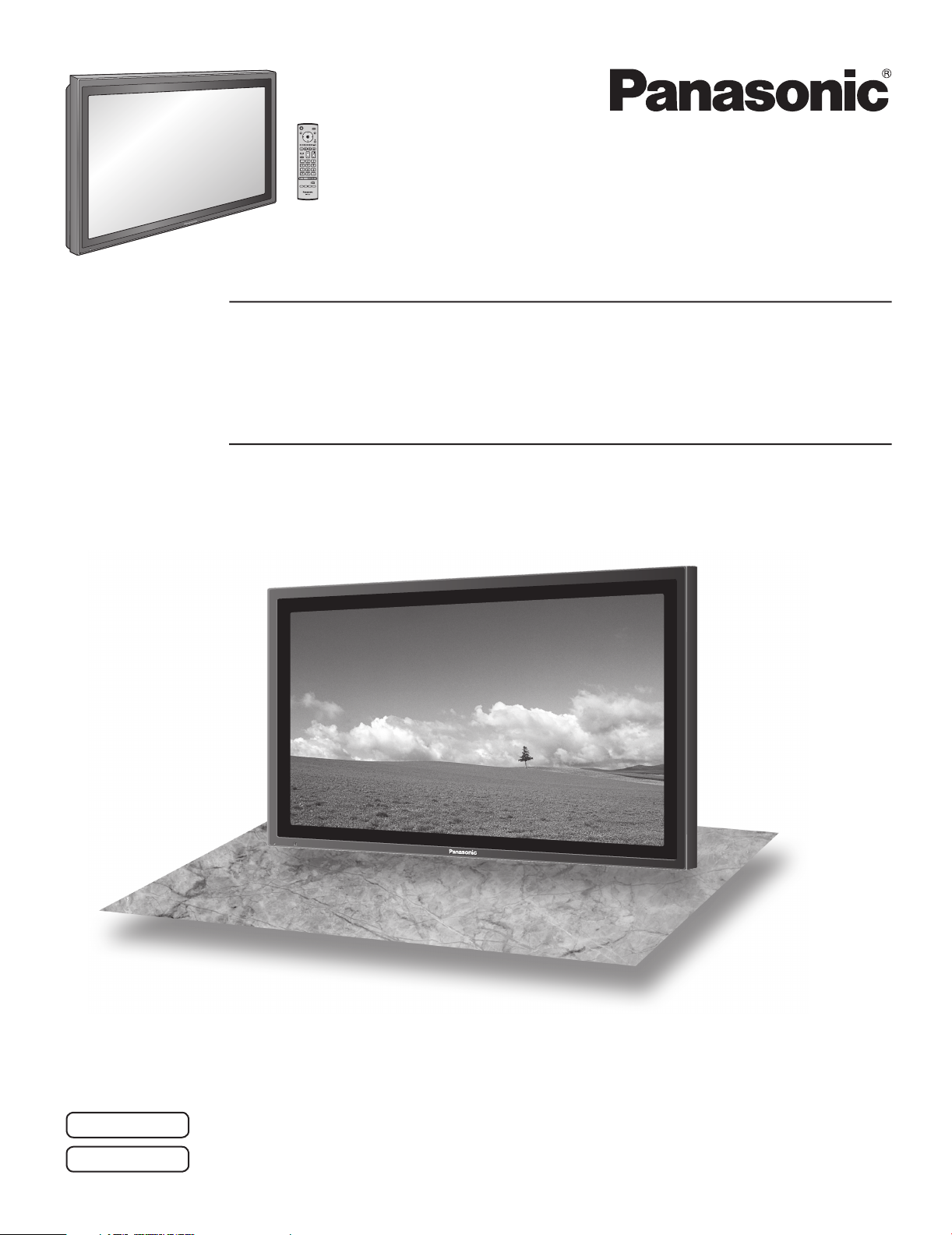
TH-42PS9
T
H
-4
2
P
S
9
Operating Instructions
Progressive Wide Plasma Display
Manual de instrucciones
Pantalla panorámica de plasma progresiva
Model No.
Número de modelo.
TH-42PS9UK
High Defi nition Plasma Display
Pantalla de Plasma de Alta Defi nición
Model No.
Número de modelo.
TH-37PH9UK
TH-42PH9UK
TH-50PH9UK
The illustration shown is an image.
Before connecting, operating or adjusting this product, please read these instructions completely.
Please keep this manual for future reference.
Antes de conectar, utilizar o ajustar este producto, lea completamente este manual de instrucciones;
y guárdelo para consultarlo en el futuro en caso de ser necesario.
La ilustración mostrada es una imagen.
English
Español
TQB2AA0691
Page 2
CAUTION
RISK OF ELECTRIC SHOCK
DO NOT OPEN
WARNING: To reduce the risk of electric shock, do not remove cover or back.
No user-serviceable parts inside. Refer servicing to qualifi ed service personnel.
The lightning flash with
arrow-head within a triangle
is in tend ed to tell the user
that parts inside the product
are a risk of electric shock
to per sons.
The exclamation point within
a triangle is intended to
tell the user that important
operating and servicing
instructions are in the papers
with the ap pli ance.
WARNING : To prevent damage which may result in fi re or shock hazard, do not expose this apparatus to rain
or mois ture.
Do not place containers with water (fl ower vase, cups, cosmetics, etc.) above the set.
(including on shelves above, etc.)
WARNING : 1) To prevent electric shock, do not remove cover. No user serviceable parts inside. Refer servicing to
qualifi ed service personnel.
2) Do not remove the grounding pin on the power plug. This apparatus is equipped with a three pin
grounding-type power plug. This plug will only fi t a grounding-type power outlet. This is a safety fea ture.
If you are unable to insert the plug into the outlet, contact an electrician.
Do not defeat the purpose of the grounding plug.
2
Page 3
Important Safety Instructions
1) Read these instructions.
2) Keep these instructions.
3) Heed all warnings.
4) Follow all instructions.
5) Do not use this apparatus near water.
6) Clean only with dry cloth.
7) Do not block any ventilation openings. Install in accordance with the manufacturer’s instructions.
8) Do not install near any heat sources such as radiators, heat registers, stoves, or other apparatus (including
amplifi ers) that produce heat.
9) Do not defeat the safety purpose of the polarized or grounding-type plug. A polarized plug has two blades with one
wider than the other. A grounding type plug has two blades and a third grounding prong. The wide blade or the
third prong are provided for your safety. If the provided plug does not fi t into your outlet, consult an electrician for
replacement of the obsolete outlet.
10) Protect the power cord from being walked on or pinched particularly at plugs, convenience receptacles, and the
point where they exit from the apparatus.
11) Only use attachments / accessories specifi ed by the manufacturer.
12) Use only with the cart, stand, tripod, bracket, or table specifi ed by the manufacturer, or sold with
the apparatus. When a cart is used, use caution when moving the cart / apparatus combination
to avoid injury from tip-over.
13) Unplug this apparatus during lightning storms or when unused for long periods of time.
14) Refer all servicing to qualifi ed service personnel. Servicing is required when the apparatus has been damaged
in any way, such as power-supply cord or plug is damaged, liquid has been spilled or objects have fallen into the
apparatus, the apparatus has been exposed to rain or moisture, does not operate normally, or has been dropped.
15) To prevent electric shock, ensure the grounding pin on the AC cord power plug is securely connected.
3
Page 4

Dear Panasonic Customer
Welcome to the Panasonic family of customers. We hope that you will have many years of enjoyment
from your new Plasma Display.
To obtain maximum benefit from your set, please read these Instructions before making any adjustments,
and retain them for future reference.
Retain your purchase receipt as well, and record the model number and serial number of your set in the
space provided on the rear cover of these instructions.
Table of Contents
Important Safety Instructions .................................. 3
FCC STATEMENT ...................................................... 5
Safety Precautions ................................................... 6
Maintenance .............................................................. 7
Accessories .............................................................. 8
Accessories Supplied .............................................. 8
Remote Control Batteries ........................................ 8
Connections .............................................................. 9
PC Input Terminals connection .............................. 10
SERIAL Terminals connection ............................... 11
AV & COMPONENT / RGB connection ................. 12
RGB signal (R, G, B) ............................................. 12
Power ON / OFF ..................................................... 13
Basic Controls ........................................................ 14
On-Screen Menu Displays ..................................... 16
Initial selections ..................................................... 18
Selecting the input signal ...................................... 18
Selecting the On-Screen Menu Language ............ 18
ASPECT Controls ................................................... 19
Adjusting POS. /SIZE ............................................. 20
MULTI PIP ................................................................ 21
Advanced PIP .......................................................... 22
PICTURE Adjustments ........................................... 23
ADVANCED SETTINGS ........................................ 24
SOUND Adjustment ................................................ 25
MUTE .................................................................... 25
Digital Zoom ............................................................ 26
PRESENT TIME SETUP / SET UP TIMER .............. 27
PRESENT TIME SETUP ....................................... 27
SET UP TIMER ..................................................... 28
SCREENSAVER (For preventing after-images) ... 29
Setup of SCREENSAVER Time ............................ 30
Reduces screen after-image ................................. 30
SIDE BAR ADJUST ............................................... 31
Reduces power consumption ............................... 32
Customizing the Input labels ................................. 32
SET UP for MULTI DISPLAY ................................... 33
(For TH-42PS9UK)
How to setup MULTI DISPLAY .............................. 33
How to set the Display location number
for each Plasma Display ....................................... 34
(For TH-37PH9UK, TH-42PH9UK, TH-50PH9UK)
How to setup MULTI DISPLAY ............................. 35
How to set the Display location number
for each Plasma Display ....................................... 36
F (SEAM HIDES VIDEO) Setting ......................... 37
ID Remote Control Function .................................. 37
SET UP for Input Signals ....................................... 38
COMPONENT / RGB IN SELECT ......................... 38
3D Y/C FILTER ...................................................... 38
COLOR SYSTEM / Panasonic AUTO ................... 39
3:2 PULLDOWN / VIDEO NR ................................ 39
SYNC .................................................................... 40
H-FREQ. (kHz) / V-FREQ. (Hz) ............................. 40
Options Adjustments ............................................. 41
Shipping condition ................................................. 44
Troubleshooting ..................................................... 45
VIDEO/COMPONENT/RGB/PC input signals ........ 46
Specifi cations ......................................................... 47
4
Page 5
FCC STATEMENT
This equipment has been tested and found to comply with the limits for a Class B digital device, pursuant to Part
15 of the FCC Rules. These limits are designed to provide reasonable protection against harmful interference in a
residential installation. This equipment generates, uses and can radiate radio frequency energy and, if not installed
and used in accordance with the instructions, may cause harmful interference to radio communications. However,
there is no guarantee that interference will not occur in a particular installation. If this equipment does cause harmful
interference to radio or television reception, which can be determined by turning the equipment off and on, the user
is encouraged to try to correct the interference by one or more of the following measures:
• Reorient or relocate the receiving antenna.
• Increase the separation between the equipment and receiver.
• Connect the equipment into an outlet on a circuit different from that to which the receiver is connected.
• Consult the dealer or an experienced technician for help.
This device complies with Part15 of the FCC Rules. Operation is subject to the following two conditions:(1) This
device may not cause harmful interference, and (2) this device must accept any interference received, including
interference that may cause undesired operation.
FCC CAUTION:
Pursuant to 47CFR, Part 15.21 of the FCC rules, any changes or modifi cations to this monitor not expressly
approved by Panasonic Corporation of North America could cause harmful interference and would void the
user’s authority to operate this device.
FCC Declaration of Conformity
Model No. TH-42PS9UK, TH-37PH9UK, TH-42PH9UK, TH-50PH9UK
Responsible Party: Panasonic Corporation of North America
One Panasonic Way, Secaucus, NJ 07094
Contact Source: Panasonic Broadcast & Television Systems Company
1-800-524-1448
email: [email protected]
CANADIAN NOTICE:
This Class B digital apparatus complies with Canadian ICES-003.
Note:
Do not allow a still picture to be displayed for an extended period, as this can cause permanent after-image to
remain on the Plasma Display.
Examples of still pictures include logos, video games, computer images, teletext and images displayed in NORMAL mode.
Trademark Credits
• VGA is a trademark of International Business Machines Corporation.
• Macintosh is a registered trademark of Apple Computer, USA.
• S-VGA is a registered trademark of the Video Electronics Standard Association.
Even if no special notation has been made of company or product trademarks, these trademarks have been fully
respected.
5
Page 6
Safety Precautions
CAUTION
This Plasma Display is for use only with the following optional accessories. Use with any other type of optional
accessories may cause instability which could result in the possibility of injury.
• Speakers .................................................................. TY-SP37P8W-K (TH-37PH9UK),
TY-SP42P8W-K (TH-42PS9UK, TH-42PH9UK),
TY-SP50P8W-K (TH-50PH9UK)
• Pedestal .................................................................... TY-ST07-K, TY-ST08-K
• Wall stand ................................................................. TY-ST42PW1
• Mobile stand ............................................................. TY-ST42PF3
• Wall-hanging bracket (vertical) ................................. TY-WK37PV3, TY-WK42PV7
• Wall-hanging bracket (angled) .................................. TY-WK42PR7
• Wall-hanging bracket (drawer type) .......................... TY-WK42DR1
• Ceiling-hanging bracket ............................................ TY-CE42PS7
• BNC Component Video Terminal Board ................... TY-42TM6A
• BNC Composite Video Terminal Board ..................... TY-42TM6B
• BNC Dual Video Terminal Board .............................. TY-FB9BD
• RCA Component Video Terminal Board ................... TY-42TM6Z
• RCA Composite Video Terminal Board ..................... TY-42TM6V
• RGB (Digital) Terminal Board ................................... TY-42TM6D
• RGB Active Through Terminal Board ........................ TY-42TM6G
• PC Input Terminal Board .......................................... TY-42TM6P
• Composite / Component Video Terminal Board ........ TY-42TM6Y
• SDI Terminal Board................................................... TY-FB7SD
• HD-SDI Terminal Board ........................................... TY-FB7HD, TY-FB9HD
• HDMI Terminal Board ............................................... TY-FB8HM
• Touch Panel .............................................................. TY-TP42P8-S (TH-42PS9UK, TH-42PH9UK),
TY-TP50P8-S (TH-50PH9UK)
(All of the following accessories are manufactured by Matsushita Electric Industrial Co., Ltd.)
Always be sure to ask a qualifi ed technician to carry out set-up.
Small parts can present choking hazard if accidentally swallowed. Keep small parts away from young children. Discard
unneeded small parts and other objects, including packaging materials and plastic bags/sheets to prevent them from being
played with by young children, creating the potential risk of suffocation.
When using the Plasma Display
Do not bring your hands, face or objects close to the
ventilation holes of the Plasma Display.
• Top of the Plasma Display is usually very hot due to the
high temperature of exhaust air being released through
the ventilation holes. Burns or personal injuries can
happen if any body parts are brought too close. Placing
any object near the top of the display could also result in
heat damages to the object as well as to the Display if its
ventilation holes are blocked.
Be sure to disconnect all cables before moving the
Plasma Display.
• Moving the Display with its cables attached might
damage the cables which, in turn, can cause fi re or
electric shock.
Disconnect the power plug from the wall outlet as a
safety precaution before carrying out any cleaning.
• Electric shocks can result if this is not done.
Clean the power cable regularly to prevent it from
becoming dusty.
• Built-up dust on the power cord plug can increase
humidity which might damage the insulation and cause
fi re. Unplug the cord from the wall outlet and clean it
with a dry cloth.
This Plasma Display radiates infrared rays, therefore it
may affect other infrared communication equipment.
Install your infrared sensor in a place away from direct
or refl ected light from your Plasma Display.
Note:
Do not allow a still picture to be displayed for an extended
period, as this can cause a permanent after-image to remain
on the Plasma Display.
Examples of still pictures include logos, video games,
computer images, teletext and images displayed in
NORMAL mode.
6
Page 7

Safety Precautions / Maintenance
WARNING
Setup
Do not place the Plasma Display on sloped or unstable
surfaces.
• The Plasma Display may fall off or tip over.
Do not place any objects on top of the Plasma
Display.
• If water spills onto the Plasma Display or foreign objects
get inside it, a short-circuit may occur which could
result in fi re or electric shock. If any foreign objects get
inside the Plasma Display, please consult an Authorized
Service Center.
Do not cover the ventilation holes.
• Doing so may cause the Plasma Display to overheat,
which can cause fire or damage to the Plasma
Display.
If using the pedestal (optional accessory), leave a space
of 3
15/16” (10 cm) or more at the top, left and right, 2 3/8”
(6 cm) or more at the bottom, and 2 3/4” (7 cm) or more at
the rear. If using some other setting-up method, leave a
space of 3 15/16” (10 cm) or more at the top, bottom, left
and right, and 2 3/4” (7 cm) or more at the rear.
AC Power Supply Cord
The Plasma Display is designed to operate on 120 V
AC, 50/60 Hz.
Securely insert the power cord plug as far as it will
go.
• If the plug is not fully inserted, heat may be generated
which could cause fi re. If the plug is damaged or the
wall socket plate is loose, they should not be used.
Do not handle the power cord plug with wet hands.
• Doing so may cause electric shocks.
Do not do anything that might damage the power cable.
When disconnecting the power cable, hold the plug,
not the cable.
• Do not make any modifi cations, place heavy objects on,
place near hot objects, heat, bend, twist or forcefully
pull the power cable. Doing so may cause damage to
the power cable which can cause fi re or electric shock.
If damage to the cable is suspected, have it repaired at
an Authorized Service Center.
If the Plasma Display will not be used for a long period
of time, unplug the power cord from the wall outlet.
If problems occur during use
If a problem occurs (such as no picture or no sound),
or if smoke or an abnormal odor is detected from the
Plasma Display, unplug the power cord immediately.
• Continuous use of the Display under these conditions
might cause fi re or permanent damage to the unit.
Have the Display evaluated at an Authorized Service
Center. Services to the Display by any unauthorized
personnel are strongly discouraged due to its high
voltage dangerous nature.
If water or foreign objects get inside the Plasma Display,
if the Plasma Display is dropped, or if the cabinet
becomes damaged, disconnect the power cord plug
immediately.
• A short may occur, which could cause fi re. Contact an
Authorized Service Center for any repairs that need to be
made.
Maintenance
The front of the display panel has been specially treated. Wipe the panel surface gently using only a cleaning
cloth or a soft, lint-free cloth.
• If the surface is particularly dirty, wipe with a soft, lint-free cloth which has been soaked in pure water or water to which
a small amount of neutral detergent has been added, and then wipe it evenly with a dry cloth of the same type until the
surface is dry.
• Do not scratch or hit the surface of the panel with fi ngernails or other hard objects, otherwise the surface may become
damaged. Furthermore, avoid contact with volatile substances such as insect sprays, solvents and thinner, otherwise
the quality of the surface may be adversely affected.
If the cabinet becomes dirty, wipe it with a soft, dry cloth.
• If the cabinet is particularly dirty, soak the cloth in water to which a small amount of neutral detergent has been added
and then wring the cloth dry. Use this cloth to wipe the cabinet, and then wipe it dry with a dry cloth.
• Do not allow any detergent to come into direct contact with the surface of the Plasma Display. If water droplets get
inside the unit, operating problems may result.
• Avoid contact with volatile substances such as insect sprays, solvents and thinner, otherwise the quality of the cabinet
surface may be adversely affected or the coating may peel off. Furthermore, do not leave it for long periods in contact
with articles made from rubber or PVC.
7
Page 8
Accessories
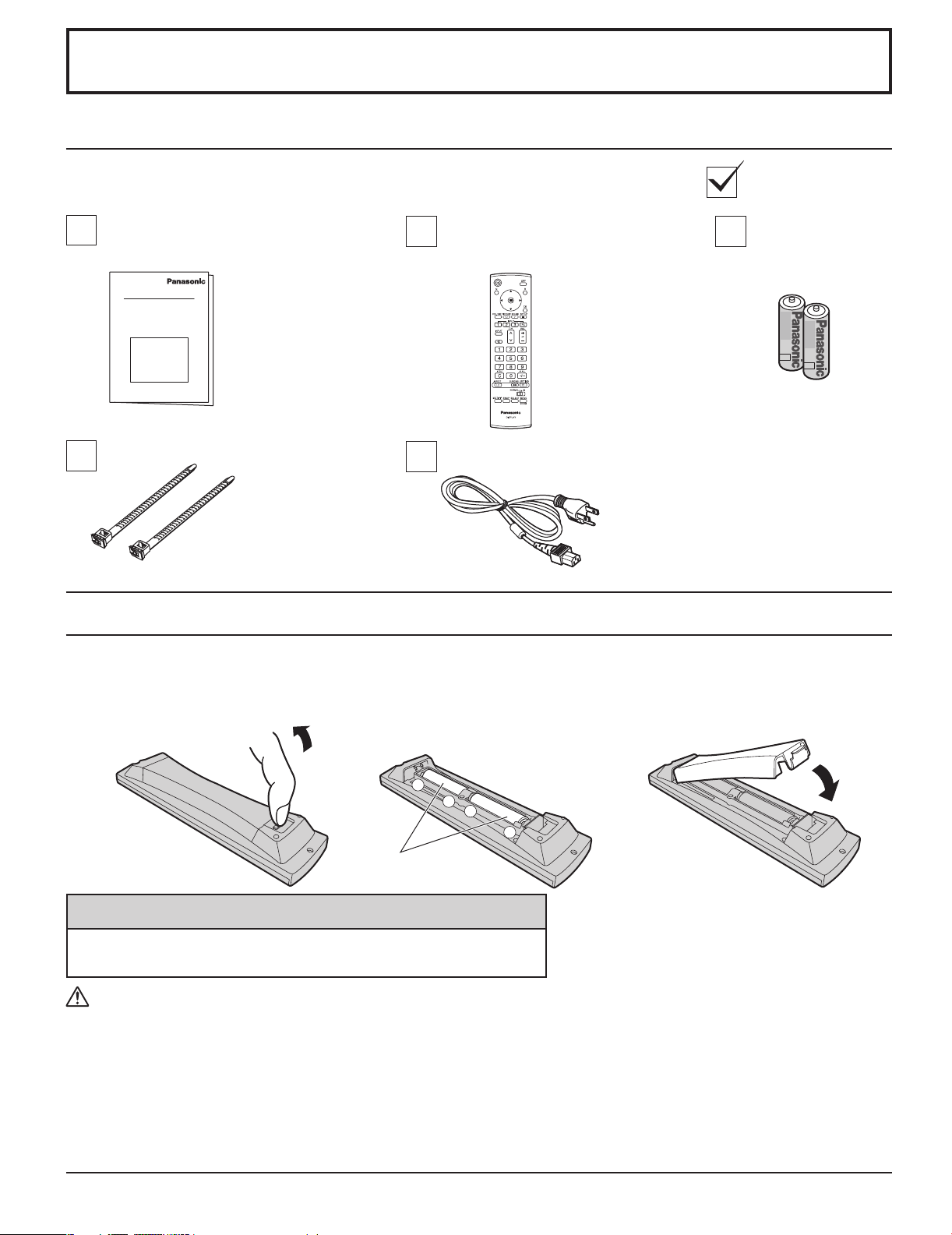
Accessories Supplied
Check that you have the Accessories and items shown
Operating
Instruction book
Remote Control Batteries
Requires two AA batteries.
1. Pull and hold the hook, then
open the battery cover.
2. Insert batteries - note correct
polarity ( + and -).
Remote Control
Transmitter
EUR7636070R
AC cordFixing bands × 2
Batteries for the
Remote Control
Transmitter
(2 × AA Size)
3. Replace the cover.
+
+
-
“AA” size
Helpful Hint:
For frequent remote control users, replace old batteries with Alkaline
batteries for longer life.
Precaution on battery use
Incorrect installation can cause battery leakage and corrosion that will damage the remote control transmitter.
Disposal of batteries should be in an environment-friendly manner.
Observe the following precautions:
1. Batteries should always be replaced as a pair. Always use new batteries when replacing the old set.
2. Do not combine a used battery with a new one.
3. Do not mix battery types (example: “Zinc Carbon” with “Alkaline”).
4. Do not attempt to charge, short-circuit, disassemble, heat or burn used batteries.
5. Battery replacement is necessary when the remote control acts sporadically or stops operating the Plasma Display.
8
Page 9
Connections
1
2
SERIALPC IN
AUDIO
SLOT1 SLOT2 SLOT3
VIDEO
PR/CR/R PB/CB/B
Y/G
AUDIO
RL
COMPONENT/RGB IN
AUDIO
RL
AUDIO
RL
AV I NBA
S VIDEO
1
2
1
2
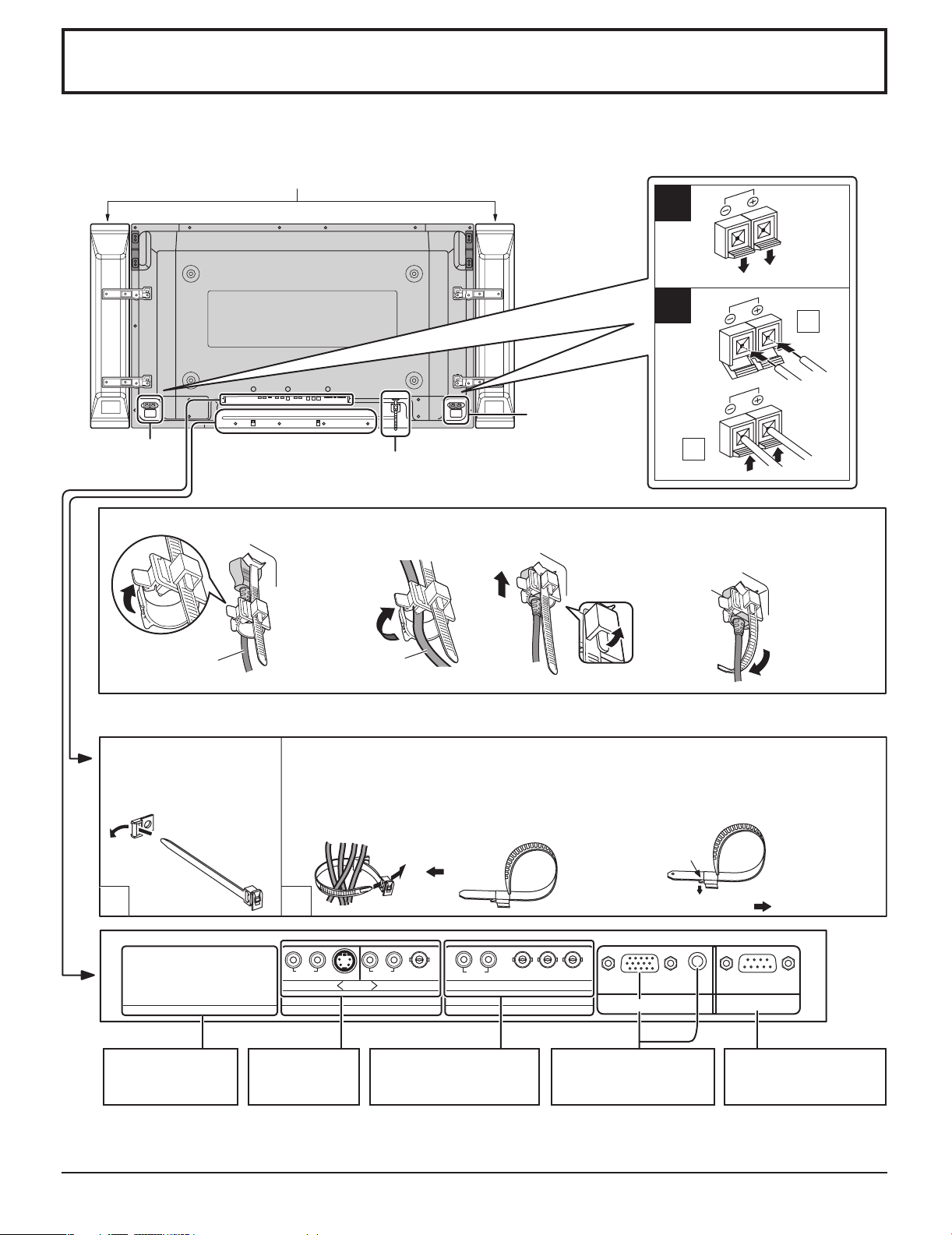
When connecting the speakers, be sure to use only the optional accessory speakers.
Refer to the speaker’s Installation Manual for details on speaker installation.
(Example: TH-42PS9UK)
Speakers (Optional accessories)
SPEAKERS
SPEAKERS
Terminals (R)
Terminals (L)
AC cord connection (see page 13)
– AC cord fi xing
1. Open the clamper.
2. Insert the AC cord
and close the clamper
3. Slide up the clamper and fi x
the AC cord plug securely.
securely.
Clamper
Note: The power plug in the illustration may not be the type fi tted to your set.
– Cable fi xing bands
AC cord
Secure any excess cables with bands as required.
Pass the attached cable
fi xing band through the
clip as shown in the
fi gure.
To secure cables connected to Terminals, wrap the cable fi xing band around them then
pass the pointed end through the locking block, as shown in the fi gure.
While ensuring there is suffi cient slack in cables to minimize stress (especially
in the power cord), fi rmly bind all cables with the supplied fi xing band.
To tighten:
Pull
When loosen
the clamper:
To loosen:
Push the catch
4. Insert the point of the
fi xed clamper into the
small hole on the lower
right of
the back
cover as
necessary.
Pull
Optional Terminal
Board Insert Slot
(covered)
Notes:
• At factory shipment, Terminal boards are installed in SLOT 2 and SLOT 3.
Dual Video
Terminals
(see page 12)
COMPONENT/RGB IN
and Audio IN Terminals
(see page 12)
• TH-37PH9UK has two slots only.
From EXTERNAL
monitor terminal on
Computer (see page 10)
From SERIAL
Terminal on Computer
(see page 11)
9
Page 10
Connections
6
7
8
13
4
14
5
10
15
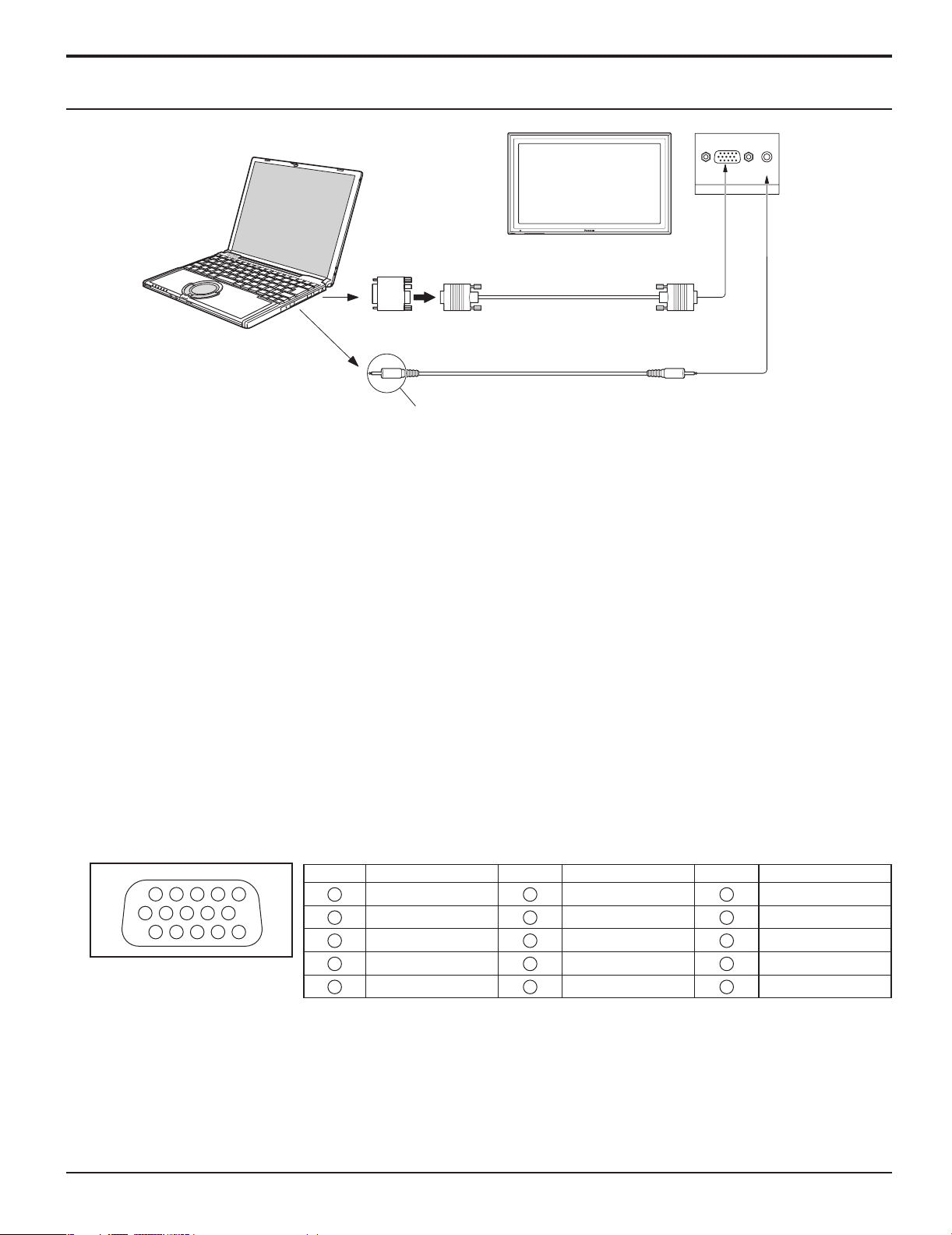
PC Input Terminals connection
COMPUTER
TH-42PS9
Conversion adapter
(if necessary)
RGB
PC cable
AUDIO
PC IN
Mini D-sub 15p
Audio
Connect a cable which matches
the audio output terminal on the computer.
Stereo plug
Notes:
• Due to space limitations, occasionally you may have trouble connecting Mini D-sub 15P cable with ferrite core to PC
input Terminal.
• Computer signals which can be input are those with a horizontal scanning frequency of 15 to 110 kHz and vertical scanning
frequency of 48 to 120 Hz. (However, the image will not be displayed properly if the signals exceed 1,200 lines.)
• The display resolution is a maximum of 640 × 480 dots (TH-42PS9UK), 768 × 720 dots (TH-37PH9UK), 768 × 768 dots
(TH-42PH9UK), 1,024 × 768 dots (TH-50PH9UK) when the aspect mode is set to “NORMAL”, and 852 × 480 dots
(TH-42PS9UK), 1,024 × 720 dots (TH-37PH9UK), 1,024 × 768 dots (TH-42PH9UK), 1,366 × 768 dots (TH-50PH9UK)
when the aspect mode is set to “FULL”. If the display resolution exceeds these maximums, it may not be possible to
show fi ne detail with suffi cient clarity.
• The PC input terminals are DDC1/2B-compatible. If the computer being connected is not DDC1/2B-compatible, you will
need to make setting changes to the computer at the time of connection.
• Some PC models cannot be connected to the set.
• There is no need to use an adapter for computers with DOS/V compatible Mini D-sub 15P terminal.
• The computer shown in the illustration is for example purposes only.
• Additional equipment and cables shown are not supplied with this set.
• Do not set the horizontal and vertical scanning frequencies for PC signals which are above or below the specifi ed
frequency range.
• Component Input is possible with the pin 1, 2, 3 of the D-sub 15P Connector.
Signal Names for Mini D-sub 15P Connector
1514131211
67839
1
2
10
45
Pin Layout for PC Input
Terminal
Pin No.
1
2
3
Signal Name
R (PR/CR)
G (Y)
B (PB/CB)
NC (not connected)
GND (Ground)
Pin No.
9
Signal Name
GND (Ground)
GND (Ground)
GND (Ground)
NC (not connected)
GND (Ground)
Pin No.
11
12
Signal Name
NC (not connected)
SDA
HD/SYNC
VD
SCL
10
Page 11
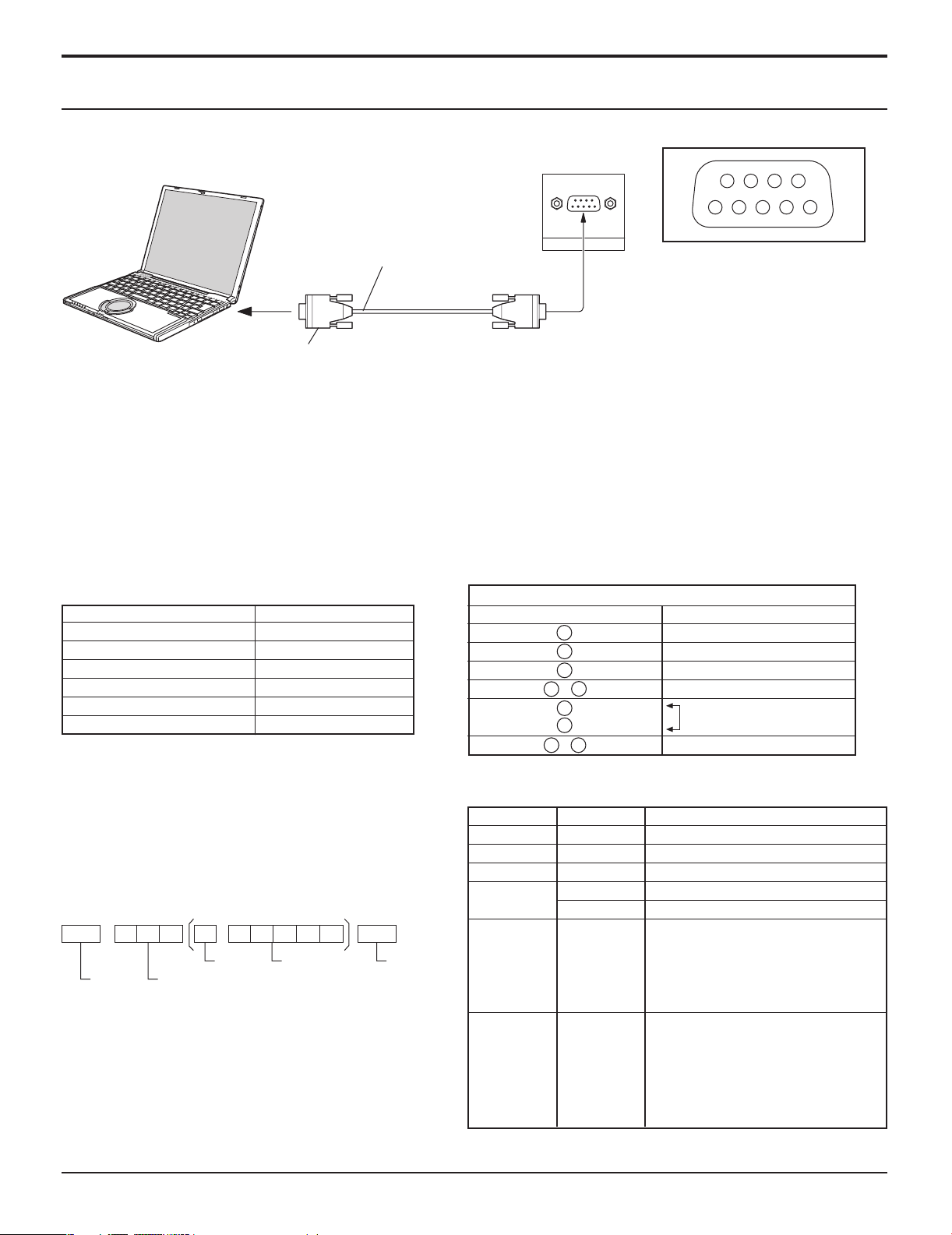
SERIAL Terminals connection
The SERIAL terminal is used when the Plasma Display is controlled by a computer.
Connections
COMPUTER
RS-232C Straight cable
SERIAL
Pin layout for RS-232C
9876
53214
D-sub 9p
Notes:
• Use the RS-232C cable to connect the computer to the Plasma Display.
• The computer shown is for example purposes only.
• Additional equipment and cables shown are not supplied with this set.
The SERIAL terminal conforms to the RS-232C interface specifi cation, so that the Plasma Display can be controlled by a
computer which is connected to this terminal.
The computer will require software which allows the sending and receiving of control data which satisfi es the conditions
given below. Use a computer application such as programming language software. Refer to the documentation for the
computer application for details.
Communication parameters
Signal level
Synchronization method
Baud rate
Parity
Character length
Stop bit
Flow control
RS-232C compliant
Asynchronous
9600 bps
None
8 bits
1 bit
-
D-sub 9-pin female Details
R X D
T X D
GND
• Non use
•
RS-232C Conversion cable
2
3
5
6
4
7
8
9
1
Shorted
NC
Basic format for control data
The transmission of control data from the computer
starts with a STX signal, followed by the command,
the parameters, and lastly an ETX signal in that order.
If there are no parameters, then the parameter signal
Command
Command
PON
POF
AVL
does not need to be sent.
AMT
STX C1 C2 C3 P1 P2 P3 P4:P5ETX
Start
(02h)
Colon Parameter(s)
3-character
command (3 bytes)
(1 - 5 bytes)
End
(03h)
IMS
DAM
Notes:
• If multiple commands are transmitted, be sure to wait
for the response for the fi rst command to come from
this unit before sending the next command.
• If an incorrect command is sent by mistake, this unit will
send an “ER401” command back to the computer.
With the power off, this display responds to PON command only.
Parameter
None
None
**
0
1
None
SL1
SL2
SL3
PC1
None
NORM
ZOOM
FULL
JUST
SELF
Control details
Power ON
Power OFF
Volume 00 - 63
Audio MUTE OFF
Audio MUTE ON
Input select (toggle)
Slot1 input
Slot2 input
Slot3 input
PC input
Screen mode select (toggle)
NORMAL (4 : 3)
ZOOM
FULL
JUST
Panasonic AUTO
11
Page 12
SERIALPC IN
AUDIO
SLOT1 SLOT2 SLOT3
VIDEO
PR/CR/R PB/CB/B
Y/G
AUDIO
RL
COMPONENT/RGB IN
AUDIO
RL
AUDIO
RL
AV I N
S VIDEO
VIDEO
OUT
S VIDEO
OUT
AUDIO
OUT
RL
AUDIO
OUT
Y, P
B, PR,
OUT
RR
PB
Y
L
R
COMPONENT VIDEO OUT
AUDIO
OUT
RL
BA
Connections
VIDEO
PR/CR/R PB/CB/B
Y/G
AUDIO
RL
COMPONENT/RGB IN
L
A
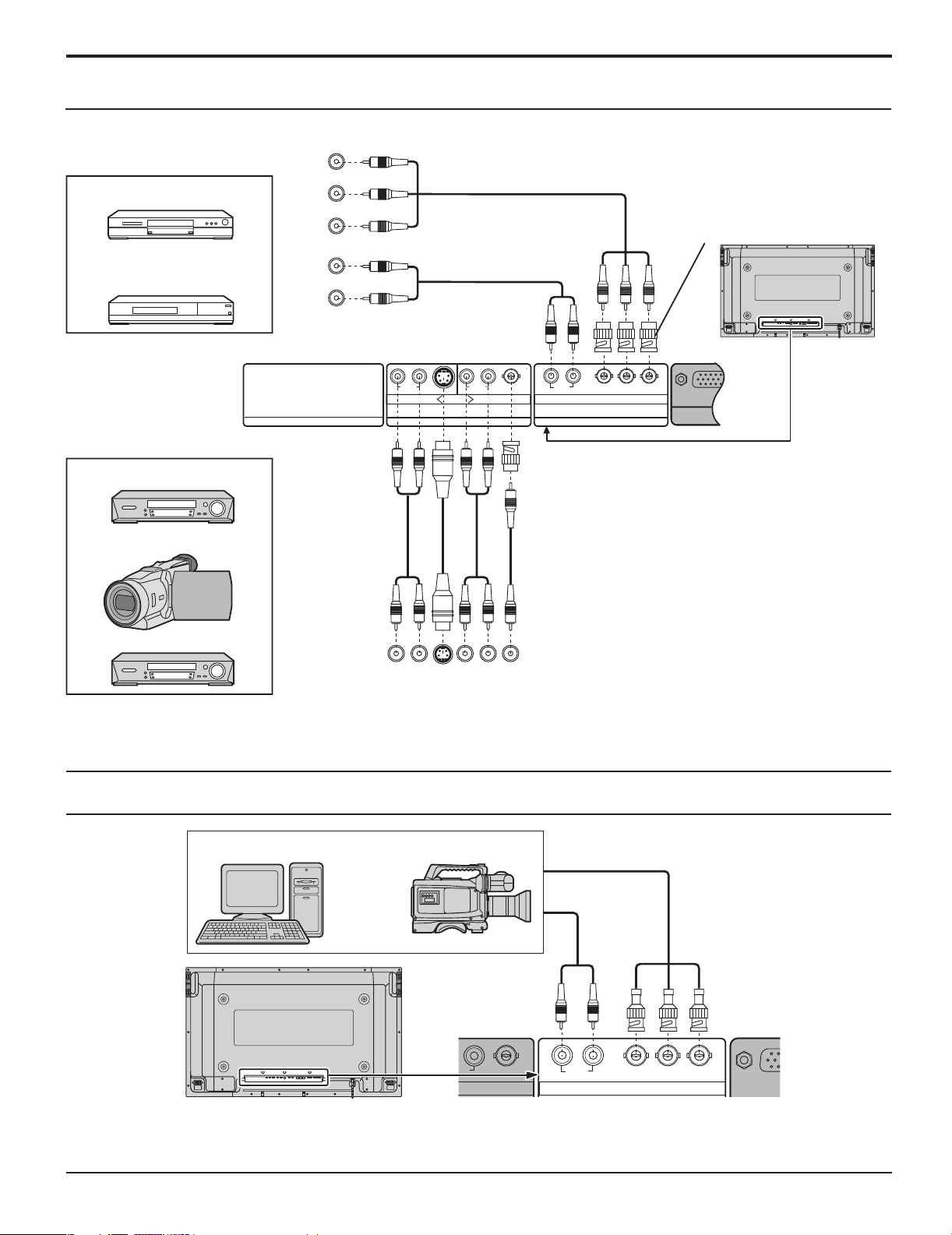
AV & COMPONENT / RGB connection
Example of input signal source
DVD
Digital TV-SET-TOP-BOX
(DTV-STB)
Example of input signal source
S VIDEO VCR
CAMCORDER
VCR
RCA-BNC
adapter
plug
Notes:
• Change the “COMPONENT/RGB-IN SELECT” setting in the “SET UP” menu to “COMPONENT”. (see page 38)
• Additional equipment, cables and adapter plugs shown are not supplied with this set.
RGB signal (R, G, B)
Computer
or
RGB Camcorder
Notes:
• Change the “COMPONENT/RGB-IN SELECT” setting in the “SET UP” menu to “RGB”. (see page 38)
• Additional equipment, cables and adapter plugs shown are not supplied with this set.
12
Page 13
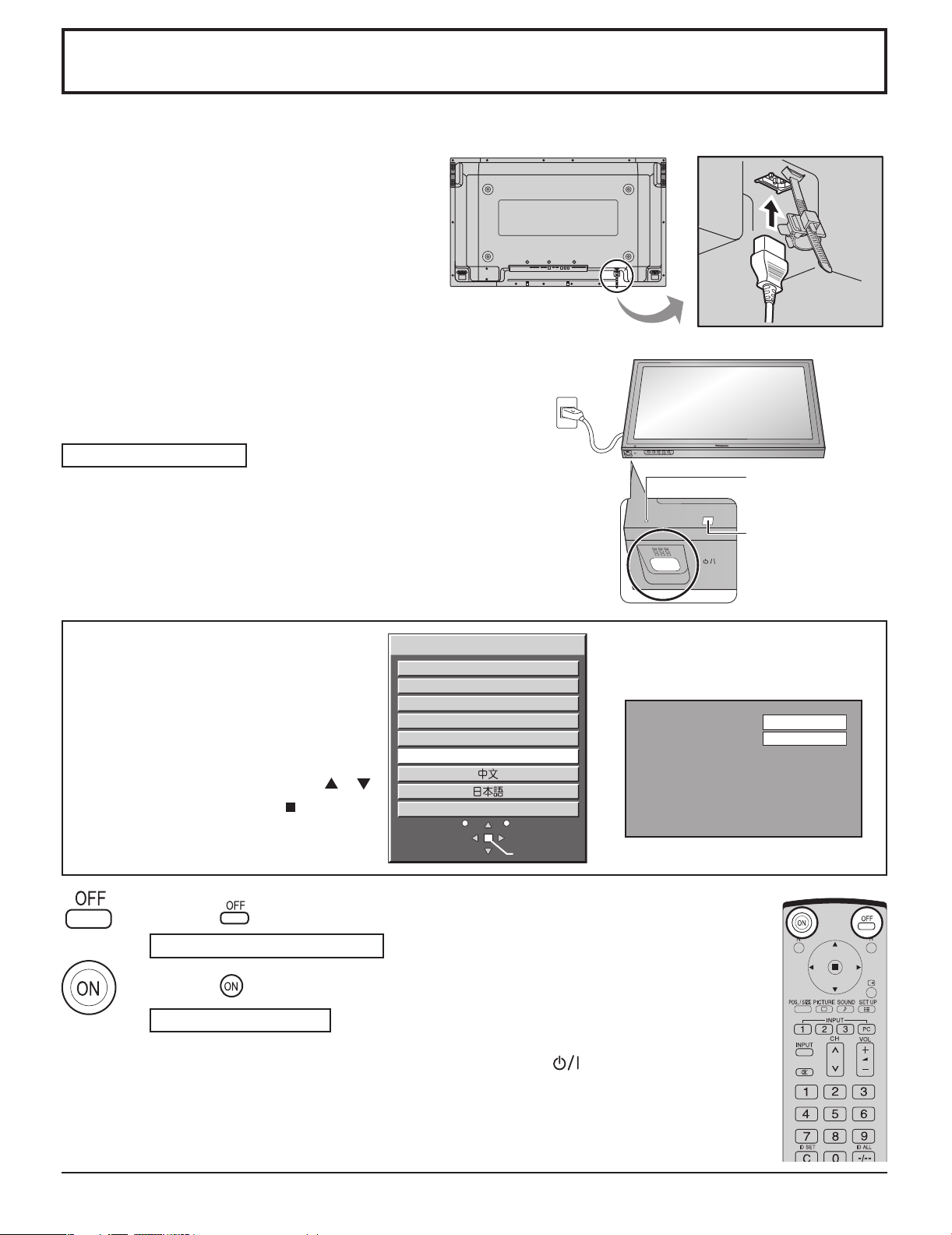
Power ON / OFF
TH-42PS9
Connecting the AC cord plug to the Plasma Display.
Fix the AC cord plug securely to the Plasma Display
with the clamper. (see page 9)
Connecting the plug to the Wall Outlet
Press the Power switch on the Plasma Display to turn the set
on: Power-On.
Power Indicator: Green
Example: The screen below is displayed for a while after the
Plasma Display is turned on. (setting condition is an
example.)
TH-42PWD8
INPUT MENU ENTER/+/VOL-/
Power Indicator
Remote Control
Sensor
When the POWER is turned on for the fi rst
time, the LANGUAGE selection screen is
displayed.
From the second time on, language selection
can be done from the setup menu. (see
page 18)
Select the desired language using the
or
button and press the ACTION ( ) button.
Press the button on the remote control to turn the Plasma Display off.
Power Indicator: Red (standby)
Press the
button on the remote control to turn the Plasma Display on.
Power Indicator: Green
Turn the power to the Plasma Display off by pressing the switch on the unit,
when the Plasma Display is on or in standby mode.
OSD Language
English (UK)
Deutsch
Français
Español
ENGLISH (US)
Русский
Italiano
From the second time on, the screen
shown below is displayed for a while
(setting condition is an example).
PC
FULL
SetSelect
Note:
During operation of the power management function, the power indicator turns
orange in the power off state.
13
Page 14
INPUT MENU ENTER/
+
/VOL
-
/
TH-42PS9
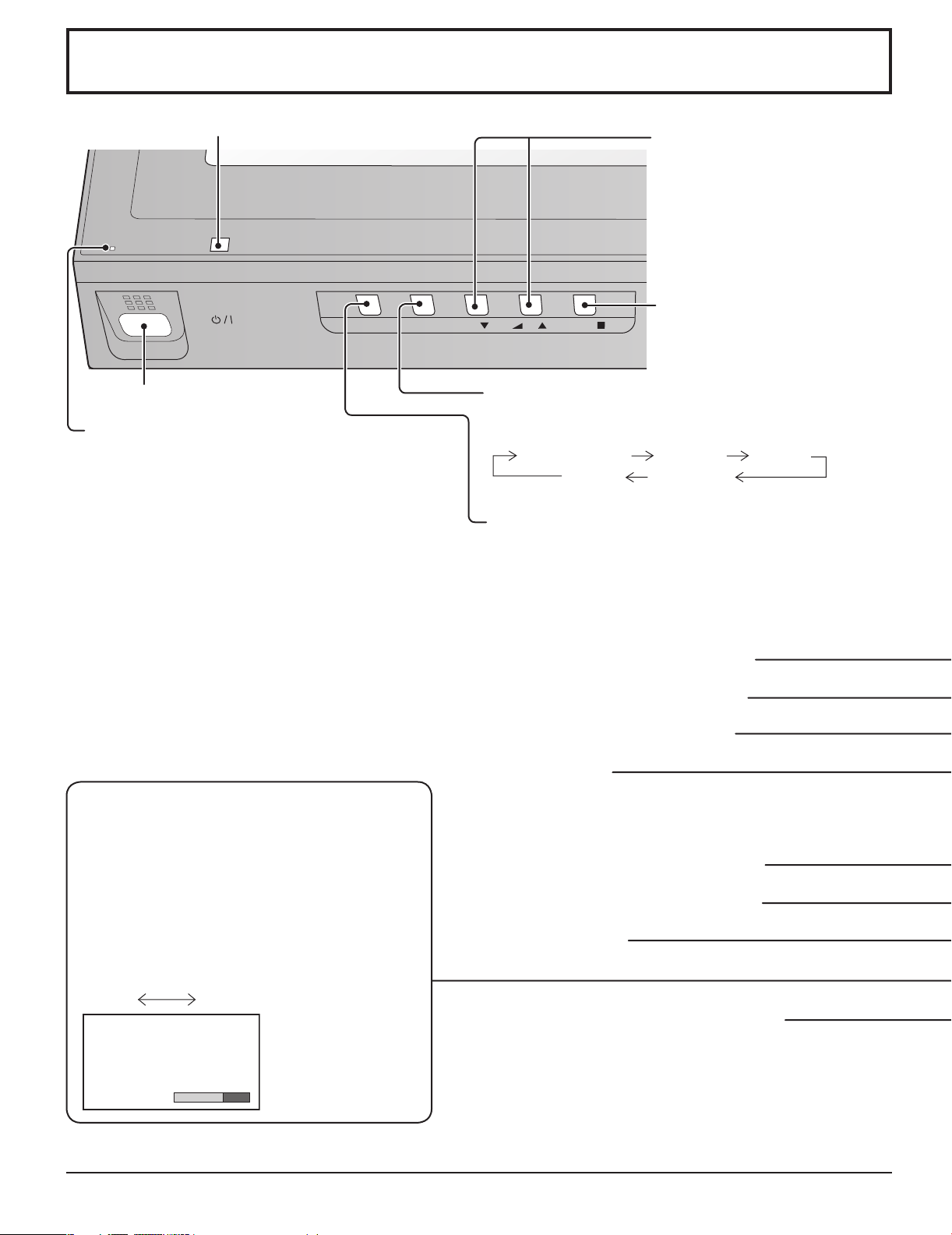
Basic Controls
Remote control sensor
Main Power On / Off Switch
Power Indicator
The Power Indicator will light.
• Power-OFF .... Indicator not illuminated (The unit
will still consume some power
as long as the power cord is still
inserted into the wall outlet.)
• Standby ......... Red
• Power-ON ...... Green
• DPMS .............Orange (With PC input signal
and during operation of PC’s
screensaver.)
Volume Adjustment
Volume Up “+” Down “–”
When the menu screen is
displayed:
“+” :
press to move the cursor up
“–” :
press to move the cursor down
(see page 16)
Enter / Aspect button
(see page 16, 19)
MENU Screen ON / OFF
Each time the MENU button is pressed, the menu screen
will switch. (see page 16)
Normal Viewing PICTURE SET UP
SOUND POS. /SIZE
INPUT button
(INPUT1, INPUT2, INPUT3 and PC IN selection)
(see page 18)
SURROUND button
The surround setting switches on and off each time
the SURROUND button is pressed.
The benefi ts of surround sound are enormous. You
can be completely enveloped in sound; just as if
you were at a concert hall or cinema.
Note:
The surround settings are memorized separately
for each AUDIO MENU (STANDARD, DYNAMIC,
CLEAR).
ON OFF
SURROUND
ON
N button (see page 20, 23, 24, 25)
POS. /SIZE button (see page 20)
PICTURE button (see page 23)
INPUT button
(INPUT1, INPUT2, INPUT3 and PC IN selection)
Press to select INPUT1, INPUT2, INPUT3 and PC IN input
SLOTS sequentially. (see page 18)
Sound mute On / Off (see page 25)
Numeric buttons (see page 37, 43)
ASPECT button
Press to adjust the aspect. (see page 19)
MULTI Window buttons (see page 21)
14
Page 15
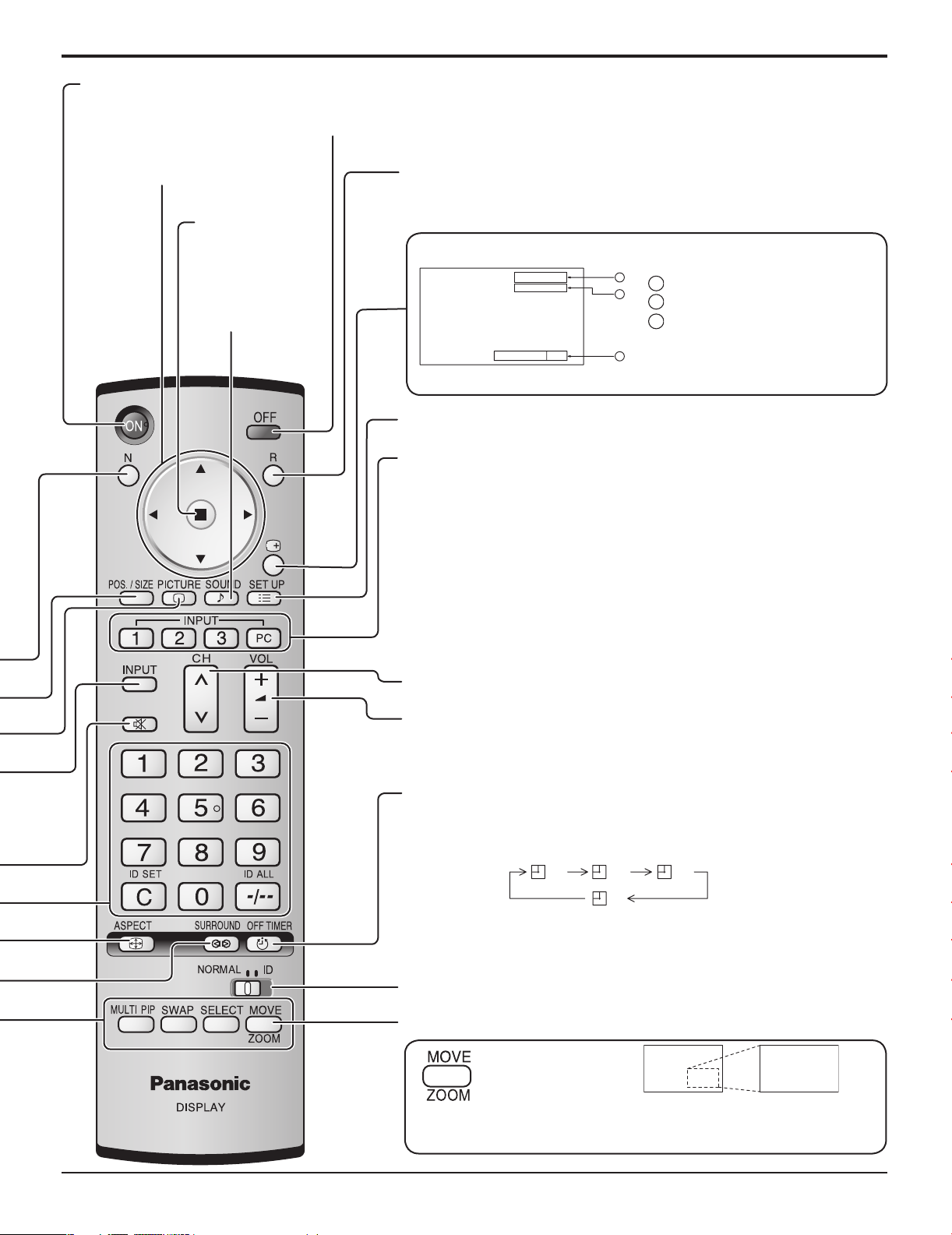
Basic Controls
1
2
3
Standby (ON / OFF) button
The Plasma Display must fi rst be plugged into the wall outlet and turned on at the power switch (see page 13).
Press ON to turn the Plasma Display On, from Standby mode. Press OFF to turn the Plasma Display Off
to Standby mode.
POSITION buttons
ACTION button
Press to make
selections.
SOUND button
(see page 25)
R button (see page 17)
Press the R button to return to previous menu screen.
Status button
Press the “Status” button to display the current system status.
PC
NORMAL
1
Input label
2
Aspect mode (see page 19)
Off timer
The off timer indicator is
OFF TIMER 90
3
displayed only when the off
timer has been set.
SET UP button (see page 16, 17)
DIRECT INPUT buttons
Press the INPUT “1”, “2”, “3” or “PC” input mode selection button to
select the INPUT mode.
This button is used to switch directly to INPUT mode.
These buttons can only display the slot which is installed. If you press the button
whose slot is not installed, it automatically displays the current input signal.
Note:
After-image (image lag) may occur on the plasma display panel when
a still picture is kept on the panel for an extended period. The function
that darkens the screen slightly is activated to prevent after-image (see
page 45), this function is not the perfect solution to after-image.
Channel Adjustment
This button cannot be used for this model.
Volume Adjustment
Press the Volume Up “+” or Down “–” button to increase or decrease
the sound volume level.
OFF TIMER button
The Plasma Display can be preset to switch to stand-by after a fi xed
period. The setting changes to 30 minutes, 60 minutes, 90 minutes and
0 minutes (off timer cancelled) each time the button is pressed.
30 60
90
0
When three minutes remain, “OFF TIMER 3” will fl ash.
The off timer is cancelled if a power interruption occurs.
Remote ID lock (see page 37)
Digital Zoom (see page 26)
Press to access
Digital Zoom.
This displays an enlargement of the designated part of the displayed
image.
15
Page 16
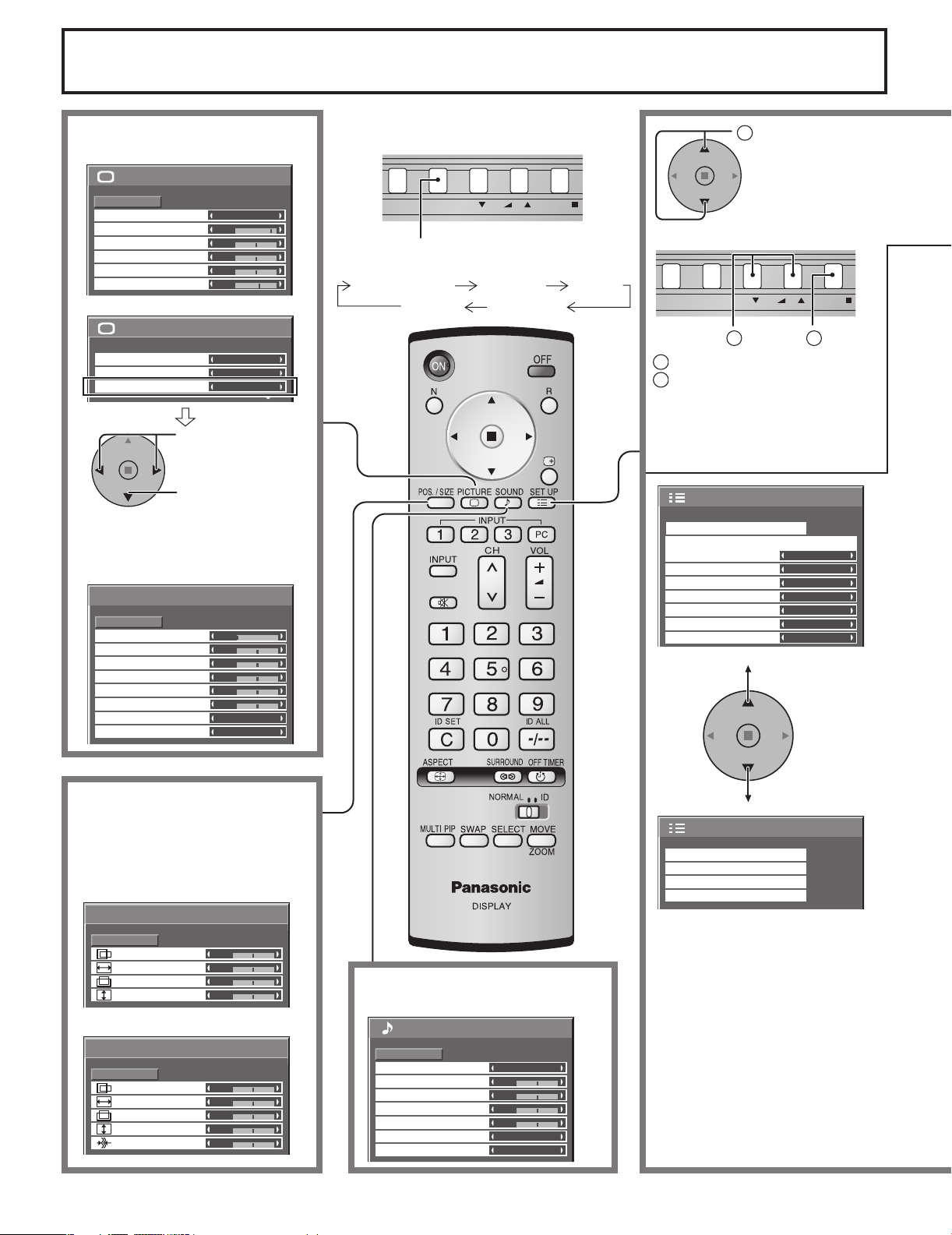
On-Screen Menu Displays
0
0
0
0
0
0
2.2
W/B LOW B
BLACK EXTENSION
W/B HIGH B
W/B LOW R
AGC
GAMMA
INPUT LEVEL
W/B HIGH R
ADVANCED SETTINGS
NORMAL
NORMALIZE
OFF
1/2
PC
OFF
STANDBY SAVE
OFF
POWER MANAGEMENT
OFF
AUTO POWER OFF
OFF
OSD LANGUAGE ENGLISH (US
)
COMPONENT/RGB-IN SELECT
RGB
INPUT LABEL
SIGNAL
POWER SAVE
SET UP
INPUT MENU ENTER/+/VOL-/
1
2
INPUT MENU ENTER/+/VOL-/
To PICTURE adjust menu
(see page 23)
1/2PICTURE
PICTURE
NORMAL
STANDARD
25
0
0
0
3
2/2
NORMAL
OFF
ON
NORMALIZE
PICTURE MENU
PICTURE
BRIGHTNESS
COLOR
TINT
SHARPNESS
COLOR TEMP
COLOR MANAGEMENT
ADVANCED SETTINGS
Press to select
“ON”.
Press to enter
ADVANCED
SETTINGS.
To ADVANCED SETTINGS
(see page 23, 24)
The MENU button on the unit can also be
pressed.
Each time the MENU button is pressed, the
menu screen will switch.
Normal Viewing PICTURE SETUP
SOUND
POS. /SIZE
Press to select .
1
[ from the unit ]
1
2
Press to select.
Press to access each adjust
screen.
To POS. /SIZE adjust menu (see
page 20)
During “VIDEO (S VIDEO)”,
“COMPONENT” and “DVI” input
signal.
POS. /SIZE
NORMALIZE
H-POS
H-SIZE
V-POS
V-SIZE
During “RGB/PC” input signal.
POS. /SIZE
16
NORMALIZE
H-POS
H-SIZE
V-POS
V-SIZE
CLOCK PHASE
NORMAL
NORMAL
2/2SET UP
SCREENSAVER
MULTI DISPLAY SETUP
SET UP TIMER
PRESENT TIME SETUP
0
0
0
0
0
0
0
0
0
To SOUND adjust menu
(see page 25)
SOUND
NORMALIZE
AUDIO MENU
BASS
MID
TREBLE
BALANCE
SURROUND
AUDIO OUT (PIP)
NORMAL
STANDARD
0
0
0
0
OFF
MAIN
Page 17
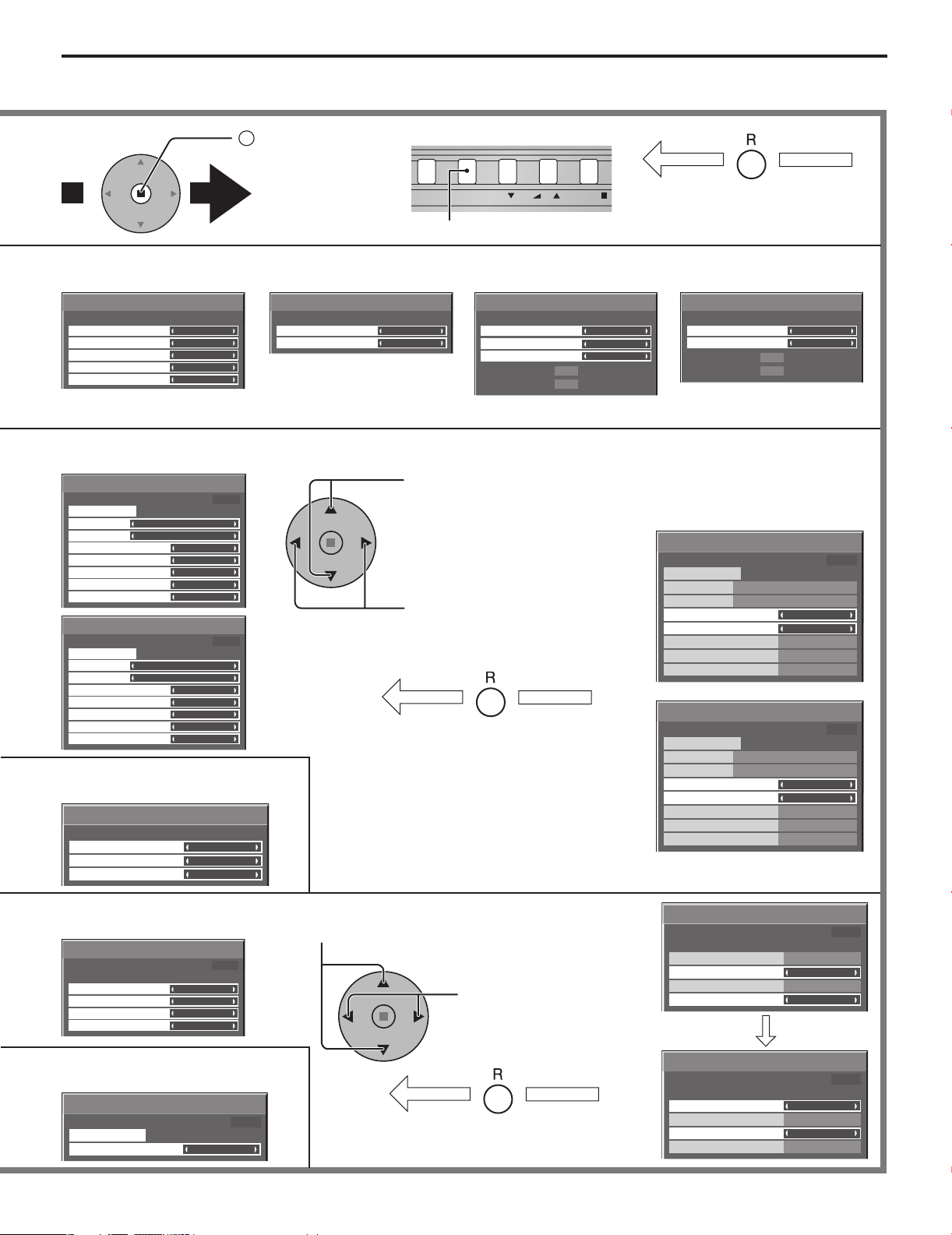
0:00
0:00
SET UP TIMER
POWER OFF FUNCTION
POWER OFF TIME
POWER ON TIME
POWER ON FUNCTION
OFF
OFF
PRESENT TIME OF DAY 99:99
0:00
0:00
SET UP TIMER
POWER OFF FUNCTION
POWER OFF TIME
POWER ON TIME
POWER ON FUNCTION
OFF
OFF
PRESENT TIME OF DAY 99:99
On-Screen Menu Displays
INPUT MENU ENTER/+/VOL-/
INTERVAL
SCREENSAVER
START
FUNCTION
MODE
WOBBLING
PEAK LIMIT
WHITE BAR SCROLL
6:15
12:30
OFF
OFF
SIDE BAR ADJUST
BRIGHT
SAVER DURATION
SHOW DURATION
PRESENT TIME OF DAY 99:99
SCREENSAVER
START
FUNCTION
MODE
WOBBLING
PEAK LIMIT
FINISH TIME
START TIME
WHITE BAR SCROLL
TIME OF DAY
6:15
12:30
OFF
OFF
SIDE BAR ADJUST
BRIGHT
PRESENT TIME OF DAY 99:99
2 × 2
A1
LOCATION
MULTI DISPLAY SETUP
ARRANGEMENT
OFF
MULTI DISPLAY SETUP
SCREENSAVER
START
FUNCTION
MODE
WOBBLING
PEAK LIMIT
FINISH TIME
START TIME
WHITE BAR SCROLL
TIME OF DAY
6:15
12:30
OFF
OFF
SIDE BAR ADJUST
BRIGHT
PRESENT TIME OF DAY 99:99
SCREENSAVER
START
FUNCTION
MODE
WOBBLING
PEAK LIMIT
SAVER DURATION
SHOW DURATION
WHITE BAR SCROLL
INTERVAL
6:15
12:30
OFF
OFF
SIDE BAR ADJUST
BRIGHT
PRESENT TIME OF DAY 99:99
2
Press to access
[ from the unit ]
each adjust
screen.
Press the R button to return
to previous menu.
[
]
RGB
OFF
OFF
To SIGNAL screen for DVI
(see page 39, 40)
SIGNAL
3 : 2 PULLDOWN
VIDEO NR
H-FREQ.
V-FREQ.
To SIGNAL screen for VIDEO
(S VIDEO) (see page 38, 39)
[
SIGNAL
3D Y/C FILTER (NTSC)
COLOR SYSTEM
3 : 2 PULLDOWN
Panasonic AUTO (4 : 3)
VIDEO NR
NORMAL
VIDEO
ON
AUTO
OFF
OFF
]
Press to return to next menu screen.
To SIGNAL screen for
COMPONENT (see page 39)
SIGNAL
3 : 2 PULLDOWN
VIDEO NR
[
COMPONENT
OFF
OFF
]
To SIGNAL screen for RGB
(see page 39, 40)
SIGNAL
SYNC
3 : 2 PULLDOWN
VIDEO NR
H-FREQ.
V-FREQ.
33.8
60.0
AUTO
kHz
Hz
Note: “SIGNAL” setup menu displays a different setting condition for each input signal. (see page 18)
To setup SCREENSAVER
(See page 29-31)
Press to select START TIME/ FINISH TIME (When TIME OF DAY
is selected).
Press to select SHOW DURATION/ SAVER DURATION (When
INTERVAL is selected).
33.8
60.0
kHz
Hz
[
OFF
OFF
Digital
]
To setup MULTIDISPLAY screen.
(See page 33)
To SET UP TIMER selection
screen. (see page 27, 28)
SET UP TIMER
POWER ON FUNCTION
POWER ON TIME
POWER OFF FUNCTION
POWER OFF TIME
To PRESENT TIME SETUP.
(see page 27)
PRESENT TIME SETUP
SET
PRESENT TIME OF DAY
PRESENT TIME OF DAY 99:99
OFF
0:00
OFF
0:00
PRESENT TIME OF DAY 99:99
99:99
Press to set up.
Press the R button to return to
“SET UP” menu.
Press to select POWER ON
TIME / POWER OFF TIME.
Press to set up POWER
ON TIME / POWER OFF
TIME.
Press the R button to return to
“SET UP” menu.
17
Page 18
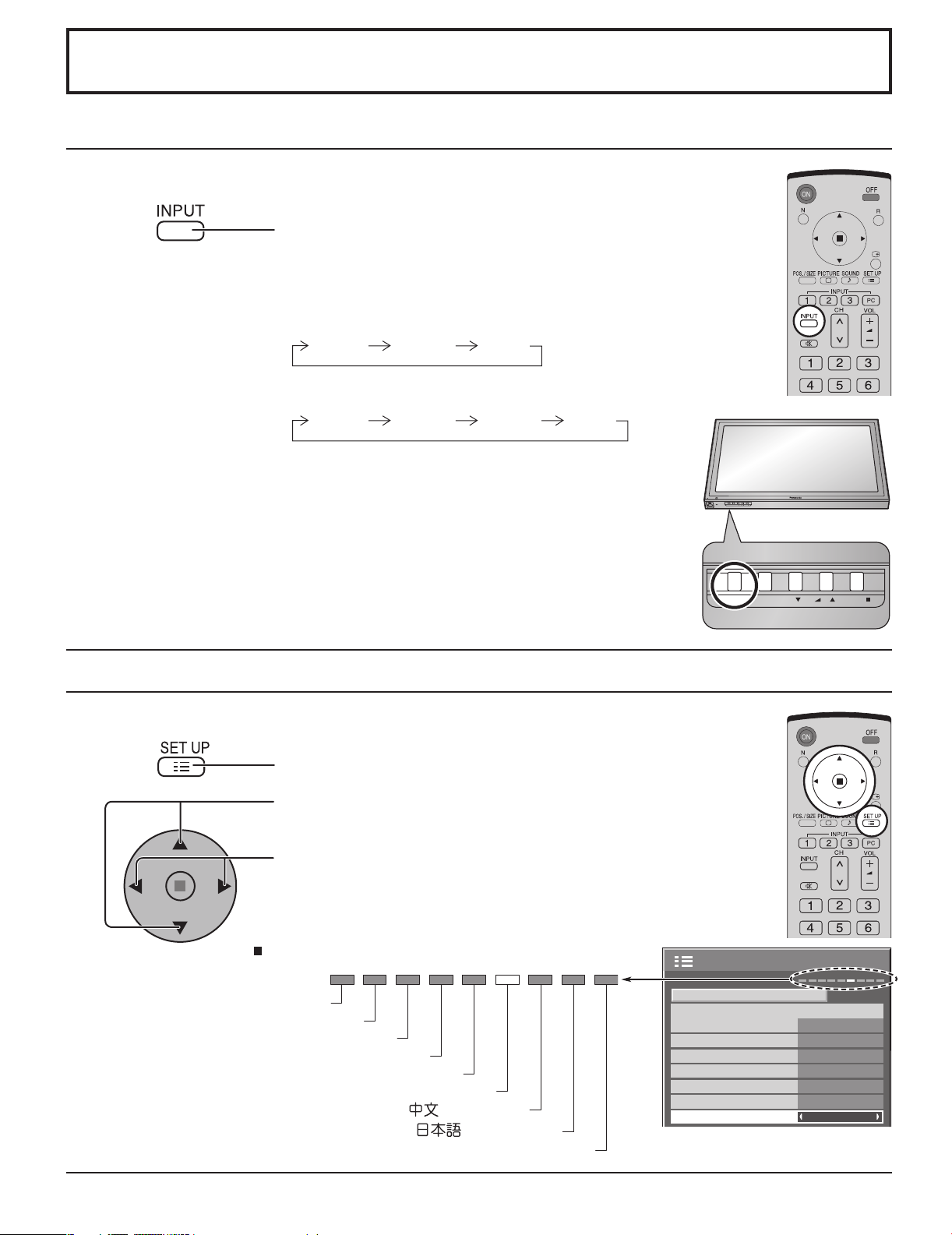
Initial selections
INPUT MENU ENTER/+/VOL-/
INPUT MENU ENTER/+/VOL-/
TH-42PS9
.......(Japanese)
.......(Chinese)
Italiano
Français
Deutsch
English(UK)
Español
ENGLISH(US)
.......(Russian)
Русский
Selecting the input signal
Select the input signals to be connected by installing the optional Terminal Boards.
Press to select the input signal to be played back from
the equipment which has been connected to the Plasma
Display.
Input signals will change as follows:
• TH-37PH9UK
INPUT1 INPUT2 PC IN
• TH-42PS9UK, TH-42PH9UK, TH-50PH9UK
INPUT1 INPUT2 PC ININPUT3
Notes:
• Selecting is also possible by pressing the INPUT button on the unit.
• Input terminal will not be selected if the terminal board is not installed into the SLOT.
• Select to match the signals from the source connected to the component/RGB input
terminals. (see page 38)
• In 2 screen display, the same input mode cannot be selected for the main picture and
sub picture.
Selecting the On-Screen Menu Language
Press to display the SET UP menu.
Press to select OSD LANGUAGE.
Press to select your preferred language.
Selectable languages
18
SET UP
SIGNAL
COMPONENT/RGB-IN SELECT
INPUT LABEL
POWER SAVE
STANDBY SAVE
POWER MANAGEMENT
AUTO POWER OFF
OSD LANGUAGE ENGLISH (US
1/2
RGB
PC
OFF
OFF
OFF
OFF
)
Page 19
ASPECT Controls
NORMAL
3
4
4
3
INPUT MENU ENTER/+/VOL-/
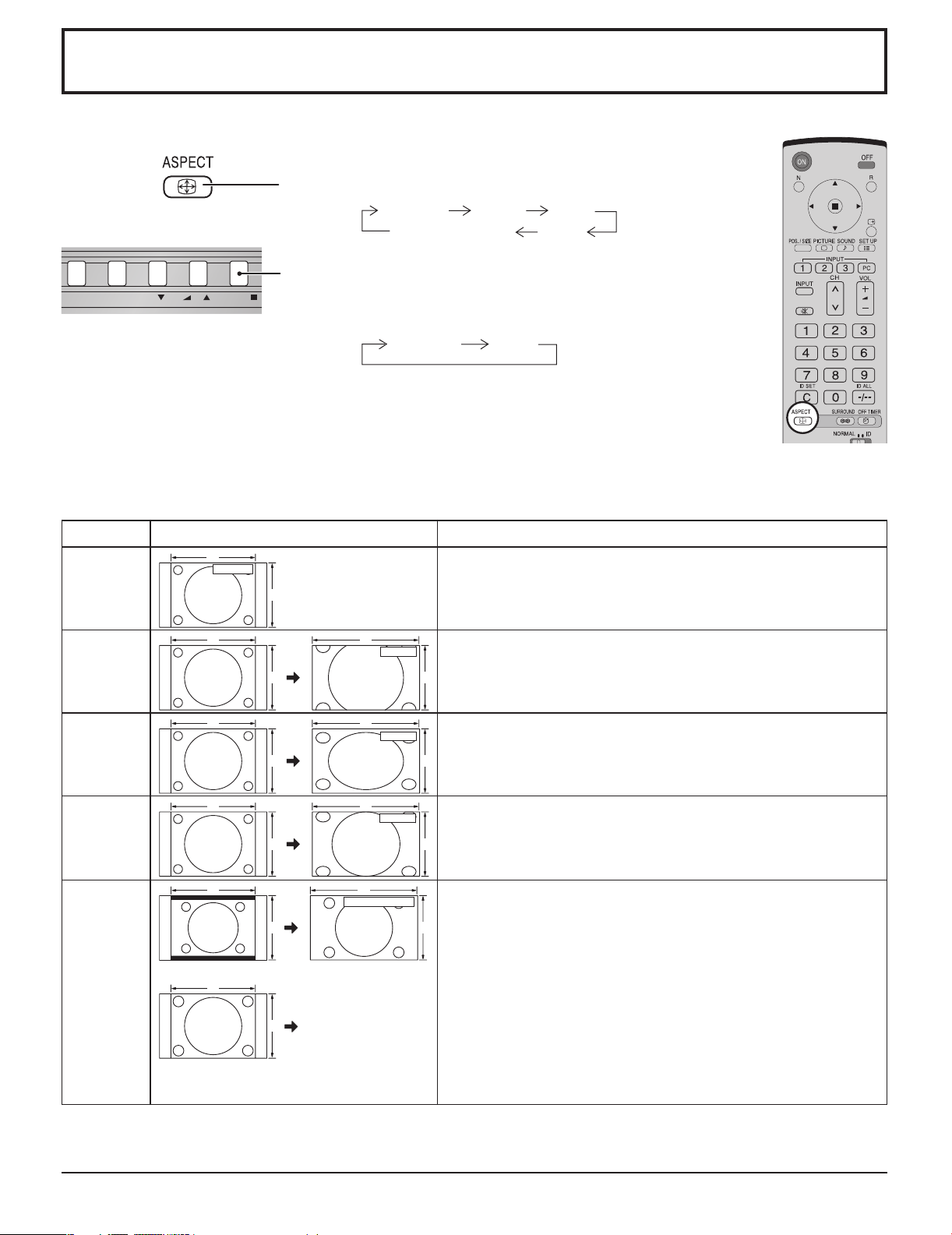
The Plasma Display will allow you to enjoy viewing the picture at its maximum size, including wide screen cinema format
picture.
Press repeatedly to move through the aspect options:
NORMAL ZOOM FULL
[from the unit]
The aspect mode changes each time the ENTER button
is pressed.
Panasonic AUTO JUST
[During MULTI PIP Operations]
• Picture and Picture, Picture in Picture :
NORMAL FULL
• Others : Aspect switching is not possible.
Notes:
• For PC signal input, the mode switches between “NORMAL”, “ZOOM” and “FULL” only.
• For a 1125 (1080) / 60i · 50i · 24p · 25p · 30p · 24sF, 1250 (1080) / 50i, 750 (720) / 60p · 50p signal input, the mode is
set to “FULL” mode, and switching is not possible.
• Panasonic AUTO can be selected only during Video signal input.
• The aspect mode is memorized separately for each input terminal.
Mode Picture Explanation
NORMAL will display a 4:3 picture at its standard 4:3 size.
NORMAL
ZOOM
FULL
4
3
4
3
16
16
ZOOM
FULL
ZOOM mode magnifi es the central section of the picture.
9
FULL will display the picture at its maximum size but with slight
elongation.
9
Panasonic
Note: Do not allow the picture to be displayed in NORMAL mode for an extended period, as this can cause a permanent
JUST
AUTO
4
3 9
416
39
For an elongated image
Image is expanded
Changes in
accordance with the
16
JUST
Panasonic AUTO
Panasonic AUTO
mode setting (see
page 39).
For a 4:3 image
after-image to remain on the Plasma Display Panel.
JUST mode will display a 4:3 picture at its maximum size but with aspect
correction applied to the center of the screen so that elongation is only
apparent at the left and right edges of the screen. The size of the picture
will depend on the original signal.
The display will automatically become enlarged (depending on the
picture source), allowing you to view the picture at its maximum size.
Notes:
• Panasonic AUTO mode is designed to automatically adjust the aspect
ratio to handle a mix of 16:9 and 4:3 program material. Certain 4:3
program material, such as stock market data screens, may occasionally
cause the image size to change unexpectedly. When viewing such
programs, it is recommended that the ASPECT be set to NORMAL.
• If adjusting the PICTURE V-POS/V-SIZE in Panasonic AUTO with FULL
mode, the adjustment is not memorized. When exiting the mode, the
screen will return to a former adjustment.
• Panasonic AUTO can not be selected while TY-FB9BD (optional BNC
Dual Video Terminal Board) is installed.
19
Page 20
Adjusting POS. /SIZE
1
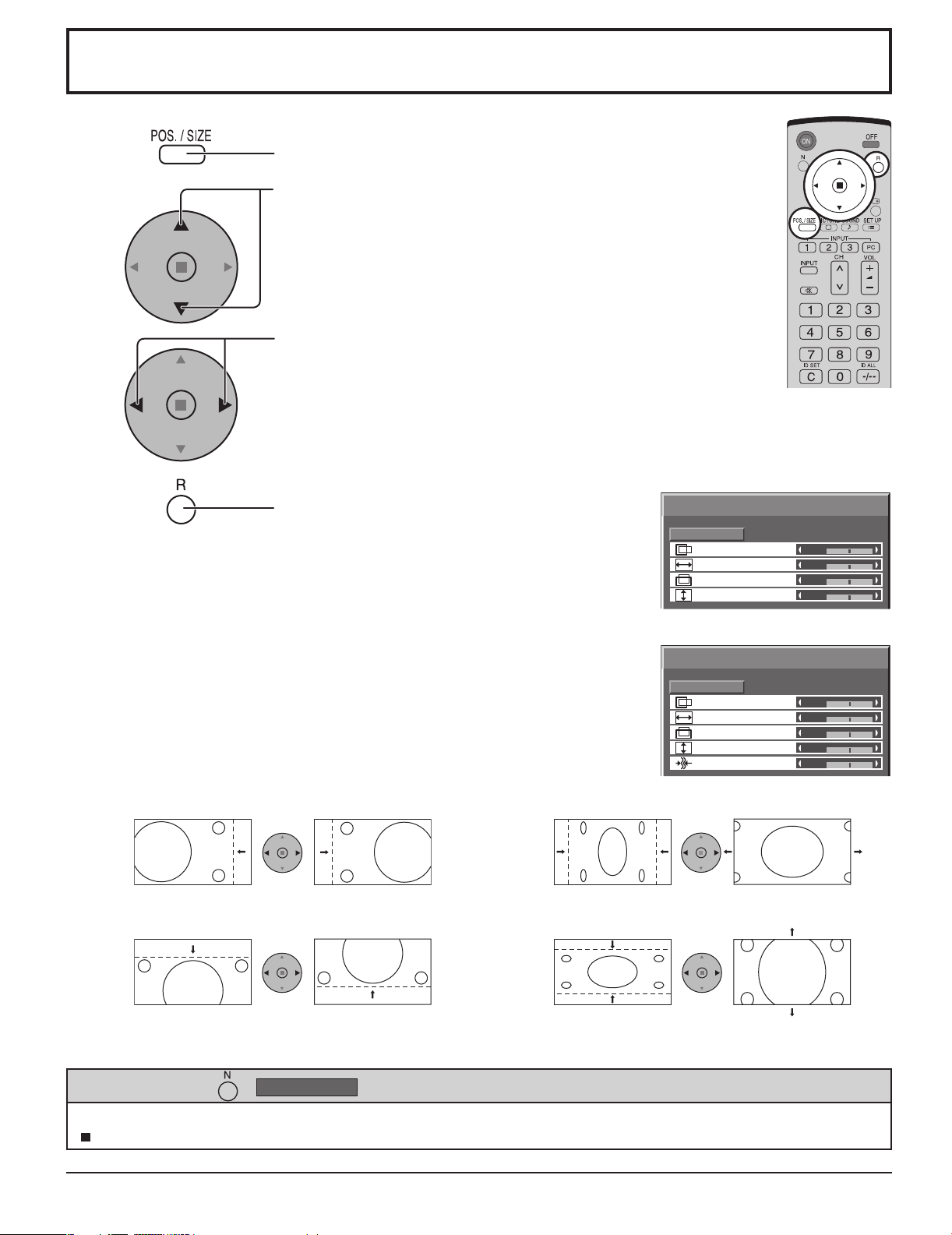
Press to display the POS. /SIZE menu.
2
Press to select H-POS / H-SIZE / V-POS / V-SIZE /
CLOCK PHASE.
Press to adjust POS. /SIZE.
3
4
Notes:
• Adjustment details are memorized separately for different input signal formats
(Adjustments for component signals are memorized for 525 (480) / 60i · 60p, 625
(575) / 50i · 50p, 1125 (1080) / 60i · 50i · 24p · 25p · 30p · 24sF, 1250 (1080) / 50i,
750 (720) / 60p · 50p each, and RGB/PC/DVI signals are memorized for each
frequency.)
• If a “Cue” or “Rew” signal from a VCR or DVD player is received, the picture position
will shift up or down. This picture position movement cannot be controlled by the
POS. /SIZE function.
• If adjusting the PICTURE V-POS / V-SIZE in Panasonic AUTO with FULL mode,
the adjustment is not memorized. When exiting the mode, the screen will return
to a former adjustment.
Press to exit from adjust mode.
During “VIDEO (S VIDEO)”,
“COMPONENT” and “DVI” input signal.
POS. /SIZE
NORMALIZE
H-POS
H-SIZE
V-POS
V-SIZE
During “RGB / PC” input signal.
POS. /SIZE
NORMALIZE
H-POS
H-SIZE
V-POS
V-SIZE
CLOCK PHASE
NORMAL
0
0
0
0
NORMAL
0
0
0
0
0
H-POS Adjust the horizontal position. H-SIZE Adjust the horizontal size.
V-POS Adjust the vertical position. V-SIZE Adjust the vertical size.
CLOCK PHASE
(RGB/PC in mode)
Helpful Hint ( /
While the POS. /SIZE display is active, if either the N button on the remote control is pressed at any time or the ACTION
( ) button is pressed during “NORMALIZE”, then all adjustment values are returned to the factory settings.
Eliminate the fl ickering and distortion.
NORMALIZE
Normalization)
20
Page 21
MULTI
PIP
MULTI
PIP
MULTI
PIP
AB
A
B
A
B
BA
B
A
B
A
PC1
VIDEO2
SELECT
SWAP SWAP SWAP
PC1
VIDEO2
VIDEO2
VIDEO1
PC1
VIDEO2
A
A
A
C
B
B
B
D
MULTI PIP
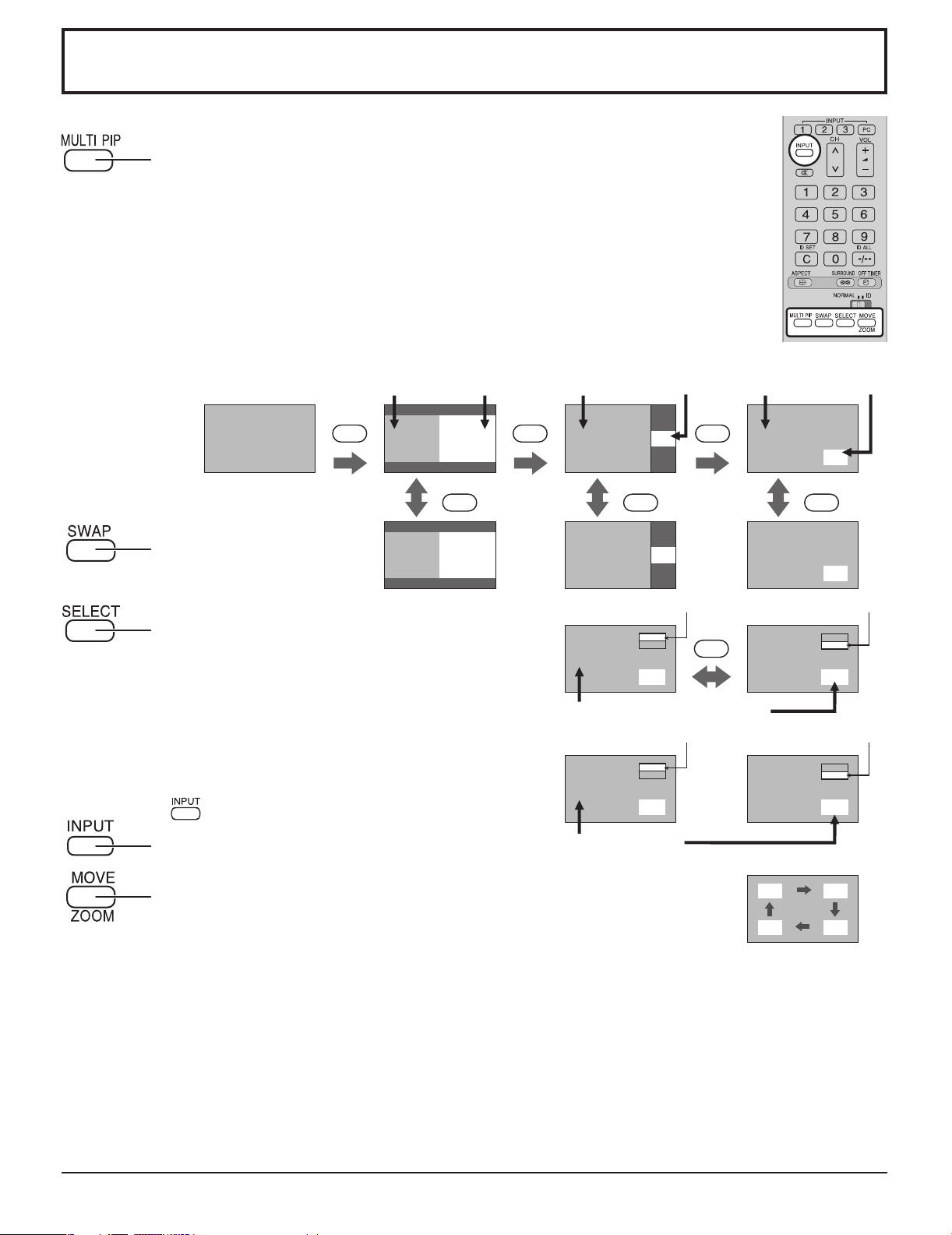
Press repeatedly.
Each time pressing this button main picture and sub picture will be displayed
as follows below.
[Picture and Picture] [Picture in Picture]
Main picture Sub picture
Normal
Viewing
Press to swap main
picture and sub picture.
Press to select the input mode.
Under main Picture and sub picture display, select the
picture which you would like to change input modes.
Notes:
• The sub picture sound is heard while a sub picture
operation is underway.
• The sub picture operation automatically returns to
the main picture operation if a sub picture operation
has not been performed for about 3 seconds or if
any of the remote control buttons is pressed (except
button).
[Example]
Main picture label is changed Sub picture label is changed
[Picture out Picture]
Main picture Sub picture Main picture Sub picture
Main picture label is bright Sub picture label is bright
Input modes switching is possible
Press to change input signal.
Picture is changed
Press to move the sub picture.
Each time the location of the sub picture will be moved.
Notes:
• This button is effective only in the picture in picture.
• The sub picture may be hidden by the on screen display, depending on its position.
Notes:
• Sound output is from the picture which is selected in Audio OUT(PIP) (See page 25).
• In 2 screen display, the same input mode cannot be selected for the main picture and sub picture.
• The main picture and sub picture are processed by different circuits, resulting in a slight difference in the clarity of the
pictures. There may also be a difference in the picture quality of the sub picture depending on the type of signals displayed
on the main picture and depending on the 2-picture display mode.
• Due to the small dimensions of the sub pictures, these sub pictures cannot be shown in detail.
• Computer screen picture is displayed in a simplifi ed format, and it may not be possible to discern details on them
satisfactorily.
•
Following combinations of two analog signals cannot be displayed simultaneously;
Component - Component, Component - PC (RGB), PC (RGB) - Component, PC (RGB) - PC (RGB)
21
Page 22
Advanced PIP
1/3
Options
Off-timer function
INPUT lock
Studio W/B
Advanced PIP
Display size
Initial VOL level
Maximum VOL level
Initial INPUT
Onscreen display
Off
Off
Off
Off
Enable
On
Off
0
Off
Off
0
1
2
3
4
5
Press to display the Setup menu.
Press to select “OSD Language”.
Press and hold until the Options menu is displayed.
Press to select Advanced PIP.
Press to adjust the menu.
Off : Sets normal two screen display mode
(see page 21).
On : Sets Advanced PIP mode.
6
Notes:
• Advanced PIP corresponding signal
NTSC, PAL, SECAM (tuner, video)
525i, 525p, 625i, 625p, 750/60p, 750/50p, 1125/60i,
1125/50i, 1250/50i (Component Video, RGB, DVI, SDI,
HDMI)
• Sound output is from the picture which is selected in Audio OUT (PIP) (See page 25).
• In 2 screen display, the same input mode cannot be selected for the main picture and sub picture.
• The main picture and sub picture are processed by different circuits, resulting in a slight difference in the clarity of the
pictures. There may also be a difference in the picture quality of the sub picture depending on the type of signals displayed
on the main picture and depending on the 2-picture display mode.
• Due to the small dimensions of the sub pictures, these sub pictures cannot be shown in detail.
• Computer screen picture is displayed in a simplifi ed format, and it may not be possible to discern details on them
satisfactorily.
Following combinations of two analog signals cannot be displayed simultaneously;
•
Component - Component, Component - PC (RGB), PC (RGB) - Component, PC (RGB) - PC (RGB)
• Refer to each board's operating instruction for DVI, SDI, HDMI's corresponding signals.
22
Press to confi rm.
One screen Advanced PIP
Press to exit from
Options menu.
Main screenSub screen
Sub screen Main screen
640x480@60Hz, 852x480@60Hz, 1024x768@60Hz,
1366x768@60Hz (RGB, DVI, HDMI)
1280x768@60Hz (DVI)
Page 23
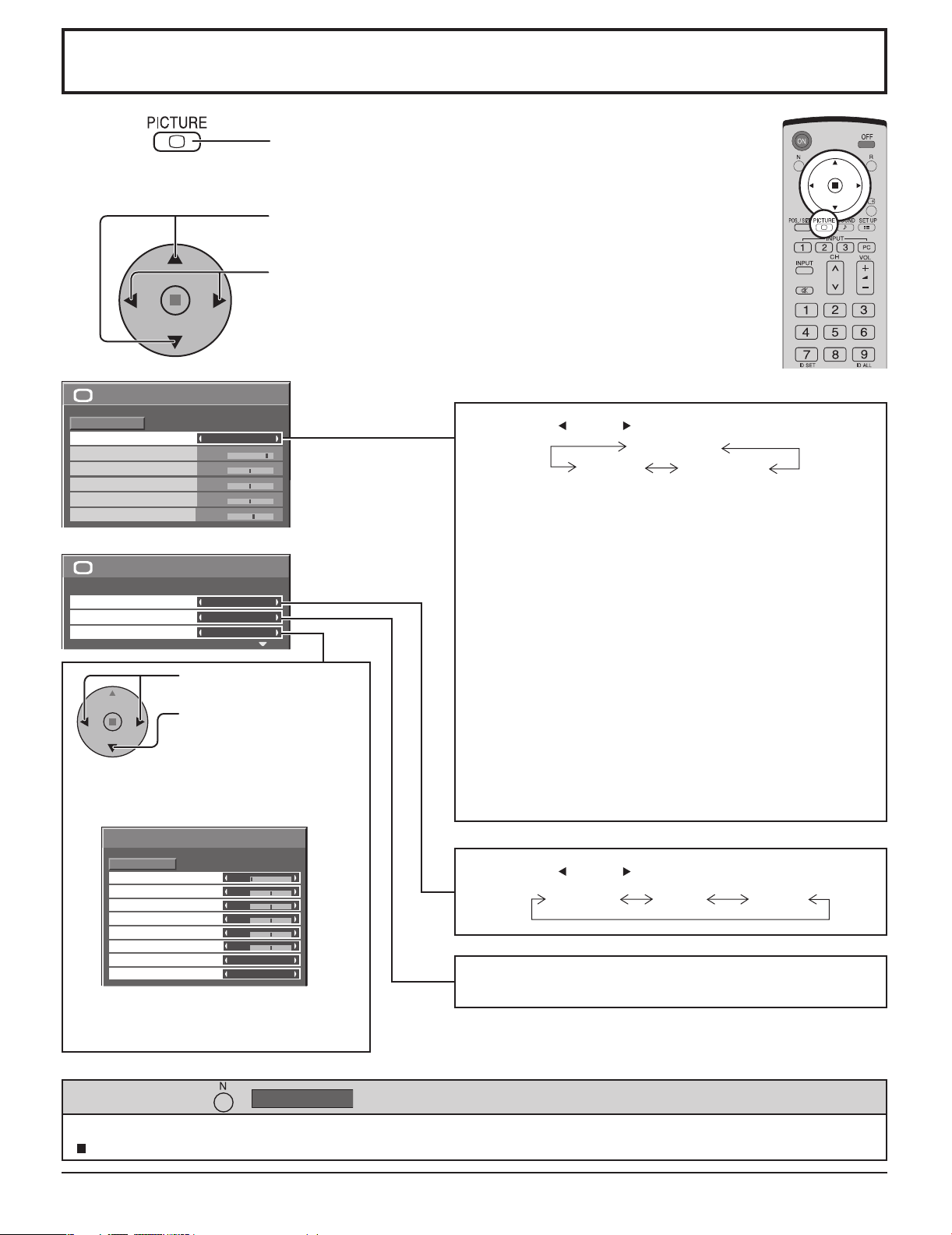
2/2
ADVANCED SETTINGS
COLOR TEMP
COLOR MANAGEMENT
NORMAL
OFF
ON
PICTURE
PICTURE Adjustments
1
Select to adjust each item.
2
PICTURE
NORMALIZE
PICTURE MENU
PICTURE
BRIGHTNESS
COLOR
TINT
SHARPNESS
NORMAL
STANDARD
25
0
0
0
3
Press to display the PICTURE menu.
Press to select the menu to adjust.
Select the desired level by looking at the picture behind
the menu.
1/2
Press the left or right button to switch between modes.
STANDARD
CINEMA DYNAMIC
STANDARD
For viewing in standard (evening lighting) environments.
This menu selects the normal levels of BRIGHTNESS
and PICTURE.
Press to select “ON”.
Press to enter
Advanced Settings.
ADVANCED SETTINGS ON
Enables fine picture adjustment at a
professional level (see next page).
ADVANCED SETTINGS
NORMALIZE
BLACK EXTENSION
INPUT LEVEL
W/B HIGH R
W/B HIGH B
W/B LOW R
W/B LOW B
GAMMA
AGC
NORMAL
0
0
0
0
0
0
2.2
OFF
ADVANCED SETTINGS OFF
Displays images with settings of the
PICTURE menu.
DYNAMIC
For viewing in brighter environments.
This menu selects higher than normal levels of
BRIGHTNESS and PICTURE.
CINEMA
Ideal for movies.
Note:
If you would like to change the picture and color of the selected
PICTURE menu to something else, adjust using the items in
the PICTURE menu. (see next page)
Press the left or right button to switch between modes.
NORMAL COOL WARM
COLOR MANAGEMENT ON
Enables vivid color adjustment automatically.
Helpful Hint ( /
While the “PICTURE” menu is displayed, if either the N button on the remote control is pressed at any time or the ACTION
( ) button is pressed during “NORMALIZE”, then all adjustment values are returned to the factory settings.
NORMALIZE
Normalization)
23
Page 24

PICTURE Adjustments
Item Effect Adjustments
PICTURE
BRIGHTNESS
COLOR
TINT
SHARPNESS
Less More
Darker Brighter
Less More
Reddish Greenish
Less More
Adjusts the proper picture contrast.
Adjusts for easier viewing of dark
pictures such as night scenes and
black hair.
Adjusts color saturation.
Adjusts for natural fl esh tones.
Adjusts picture sharpness.
ADVANCED SETTINGS
Item Effect Details
BLACK
EXTENSION
Less More
Adjusts the dark shades of the image in gradation.
Notes:
• “COLOR” and “TINT” settings cannot be
adjusted for “RGB/PC” and “DVI” input
signal.
•
You can change the level of each function
(PICTURE, BRIGHTNESS, COLOR, TINT,
SHARPNESS) for each PICTURE MENU.
• The setting details for STANDARD,
DYNAMIC and CINEMA respectively
are memorized separately for each input
terminal.
• The “TINT” setting can be adjusted
for NTSC signal only during “VIDEO
(S VIDEO)” input signal.
• In PICTURE, there is not a noticeable
change even when contrast is increased
with a bright picture or reduced with a dark
picture.
INPUT
LEVEL
W/B HIGH R
W/B HIGH B
W/B LOW R
W/B LOW B
GAMMA
AGC
Notes:
• Carry out “W/B” adjustment as follows.
1. Adjust the white balance of the bright sections using the “W/B HIGH R” and “W/B HIGH B” settings.
2. Adjust the white balance of the dark sections using the “W/B LOW R” and “W/B LOW B” settings.
3. Repeat steps 1 and 2 to adjust.
Steps 1 and 2 affect each other’s settings, so repeat each step in turn to make the adjustment.
• The adjustment values are memorized separately for each input terminal.
• The adjustment range values should be used as an adjustment reference.
Less More
Less More
Less More
Less More
Less More
Down Up
OFF ON
Adjustment of parts which are extremely bright and hard to see.
(This cannot be adjusted when the input signal is DVI.)
Adjusts the white balance for light red areas.
Adjusts the white balance for light blue areas.
Adjusts the white balance for dark red areas.
Adjusts the white balance for dark blue areas.
S CURVE 2.0 2.2 2.5
Increases the brightness of dark signal automatically.
Helpful Hint ( /
On the remote control unit, while the “ADVANCED SETTINGS” menu is displayed, if either the N button is pressed at
any time or the ACTION ( ) button is pressed during “NORMALIZE”, then all adjustment values are returned to the
factory settings.
NORMALIZE
Normalization)
24
Page 25
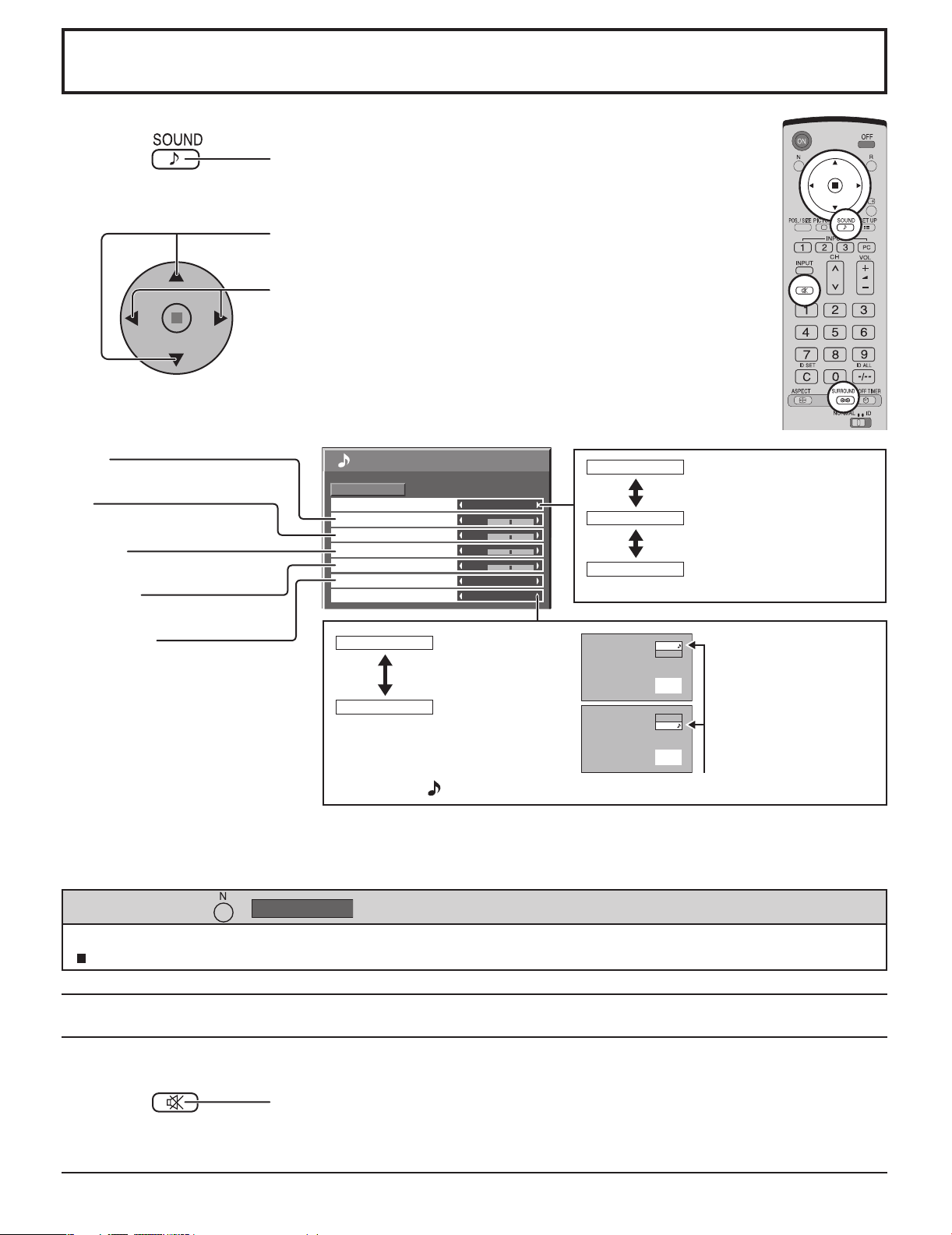
SOUND Adjustment
1
Press to display the SOUND menu.
Select to adjust each item.
2
Press to select the menu to adjust.
Select the desired level by listening to the sound.
BASS
Adjusts low pitch sounds
MID
Adjusts normal sounds
TREBLE
Adjusts pitch sounds
BALANCE
SOUND
NORMALIZE
AUDIO MENU
BASS
MID
TREBLE
BALANCE
SURROUND
AUDIO OUT (PIP)
NORMAL
STANDARD
0
0
0
0
OFF
MAIN
STANDARD
DYNAMIC
CLEAR
Emits the original sound.
Accentuates sharp sound.
Attenuates human voice.
Adjusts left and right volumes
SURROUND
Select On or Off
MAIN
Selects Main
picture sound.
INPUT1
PC
(When Main picture
sound is chosen.)
A
B
SUB
Selects PIP frame
sound.
INPUT1
PC
(When PIP frame
sound is chosen.)
A
B
Musical note is displayed on right side of the audio output screen label.
Notes:
• Press the SURROUND button to directly turn the surround effect ON and OFF. (see page 14)
• BASS, MID, TREBLE and SURROUND settings are memorized separately for each AUDIO MENU.
Helpful Hint ( /
NORMALIZE
Normalization)
While the “SOUND” menu is displayed, if either the N button on the remote control is pressed at any time or the ACTION
( ) button is pressed during “NORMALIZE”, then all adjustment values are returned to the factory settings.
MUTE
Useful when answering the phone or receiving unexpected visitors.
Press this button to mute the sound.
Press again to reactivate sound. Sound is also reactivated when power is turned off or
volume level is changed.
25
Page 26
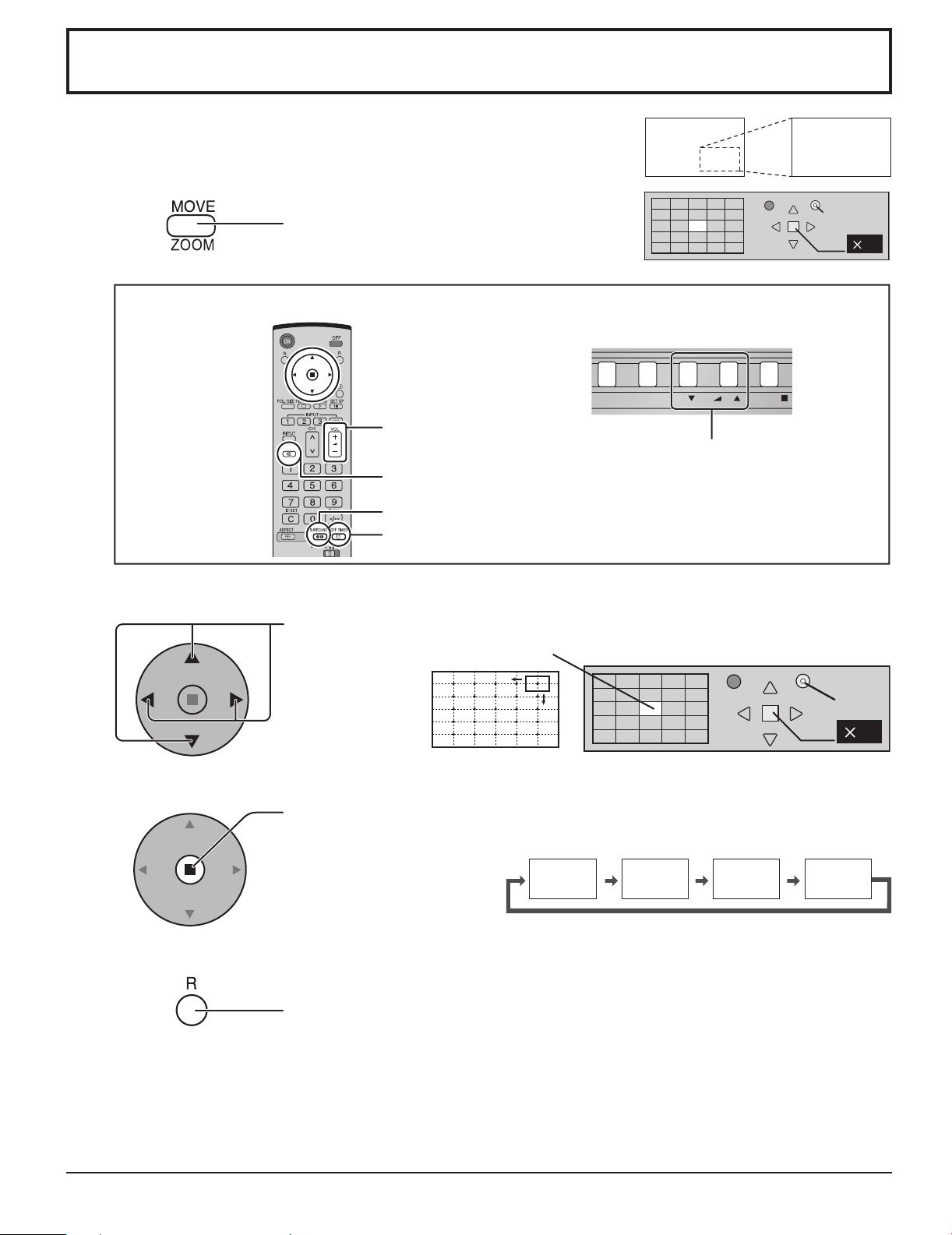
Digital Zoom
INPUT MENU ENTER/+/VOL-/
This displays an enlargement of the designated part of the displayed image.
1
2
Display the “Operation Guide”.
Press to access Digital Zoom.
The “Operation Guide” will be displayed.
During Digital Zoom, only the following buttons can be operated.
[Remote control]
VOL button
MUTE button
SURROUND button
OFF TIMER button
Select the area of the image to be enlarged.
EXIT
1
[Unit]
VOL button
Press on the enlargement location to select.
The cursor will move.
3
4
Notes:
• When power goes OFF (including “Off Timer” operation), Digital Zoom terminates.
• The Digital Zoom function cannot be selected while in the following operation state:
“Multi-viewer” (Picture in Picture, Picture out Picture, Picture and Picture) operation. (see page 21)
• While Digital Zoom is in operation, “Adjusting POS. /SIZE” cannot be used.
Select the magnifi cation required for the enlarged display.
Each time this is pressed, the magnifi cation factor changes.
This is shown in the image being displayed.
× 1 × 2 × 3 × 4
Return to normal display (quit Digital Zoom).
Press to exit from the Digital Zoom.
EXIT
2
1
26
Page 27
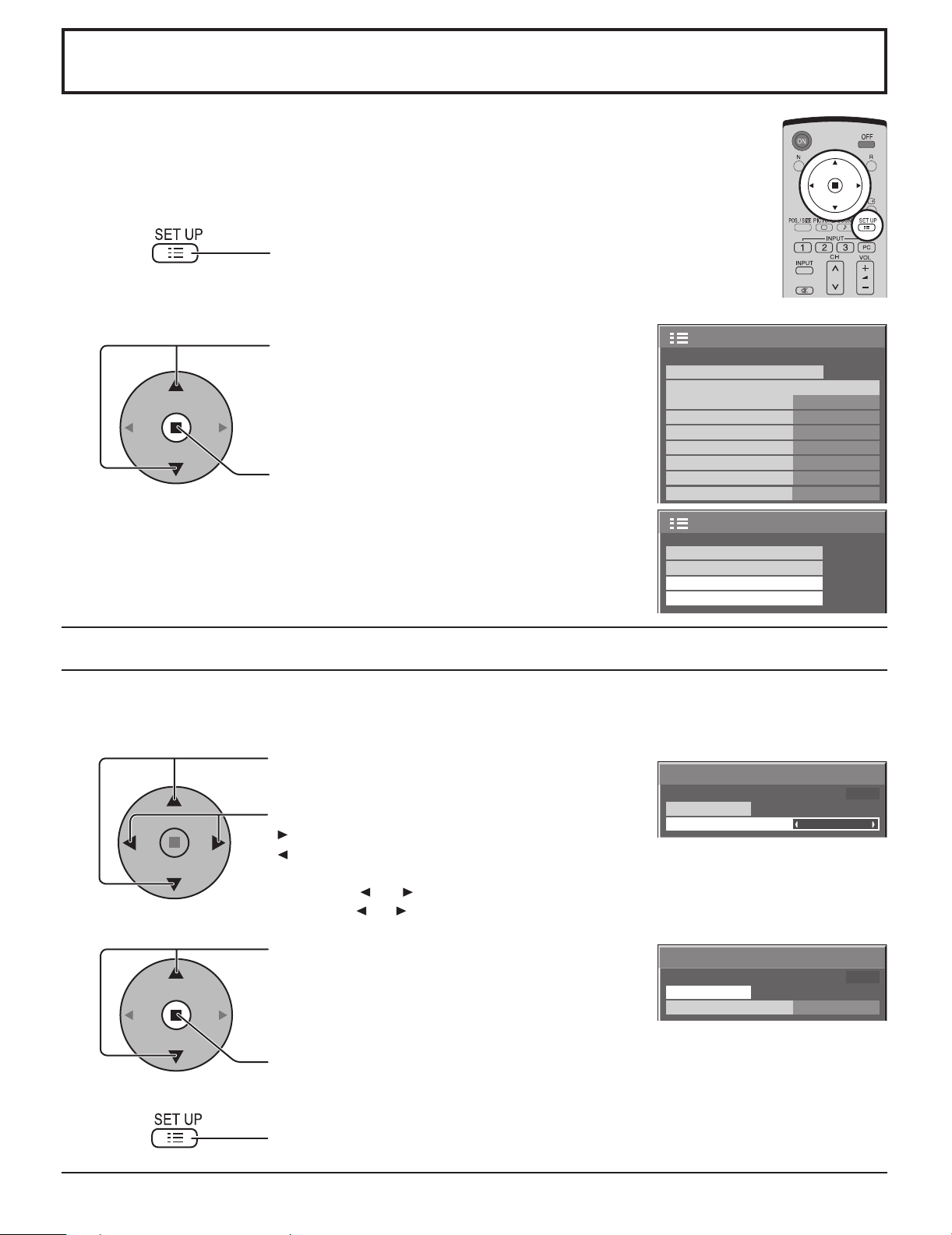
PRESENT TIME SETUP / SET UP TIMER
The timer can switch the Plasma Display ON or OFF.
Before attempting Timer Set, confi rm the PRESENT TIME OF DAY and adjust if necessary.
Then set POWER ON TIME / POWER OFF TIME.
1
2
Press to display the SET UP menu.
Press to select SET UP TIMER or
PRESENT TIME SETUP.
Press to display the SET UP TIMER screen or
PRESENT TIME SETUP screen.
PRESENT TIME SETUP
Display the PRESENT TIME SETUP screen.
SET UP
SIGNAL
COMPONENT/RGB-IN SELECT
INPUT LABEL
POWER SAVE
STANDBY SAVE
POWER MANAGEMENT
AUTO POWER OFF
OSD LANGUAGE ENGLISH (US
SCREENSAVER
MULTI DISPLAY SETUP
SET UP TIMER
PRESENT TIME SETUP
1/2
RGB
PC
OFF
OFF
OFF
OFF
2/2SET UP
)
To set up PRESENT TIME OF DAY, follow the procedure described below.
1
2
3
Press to select PRESENT TIME OF DAY.
Press to set up PRESENT TIME OF DAY.
button: Forward
button: Back
Notes:
• Pressing “ ” or “ ” button once changes PRESENT TIME OF DAY 1minute.
• Pressing “ ” or “ ” button continuously changes PRESENT TIME OF DAY by 15 minutes.
Press to select Set.
Press to store PRESENT TIME SETUP.
Note:
Set cannot be selected unless PRESENT TIME OF DAY is set.
Press to exit from PRESENT TIME SETUP.
PRESENT TIME SETUP
PRESENT TIME OF DAY 99:99
SET
PRESENT TIME OF DAY
PRESENT TIME SETUP
PRESENT TIME OF DAY 99:99
SET
PRESENT TIME OF DAY
99:99
99:99
27
Page 28
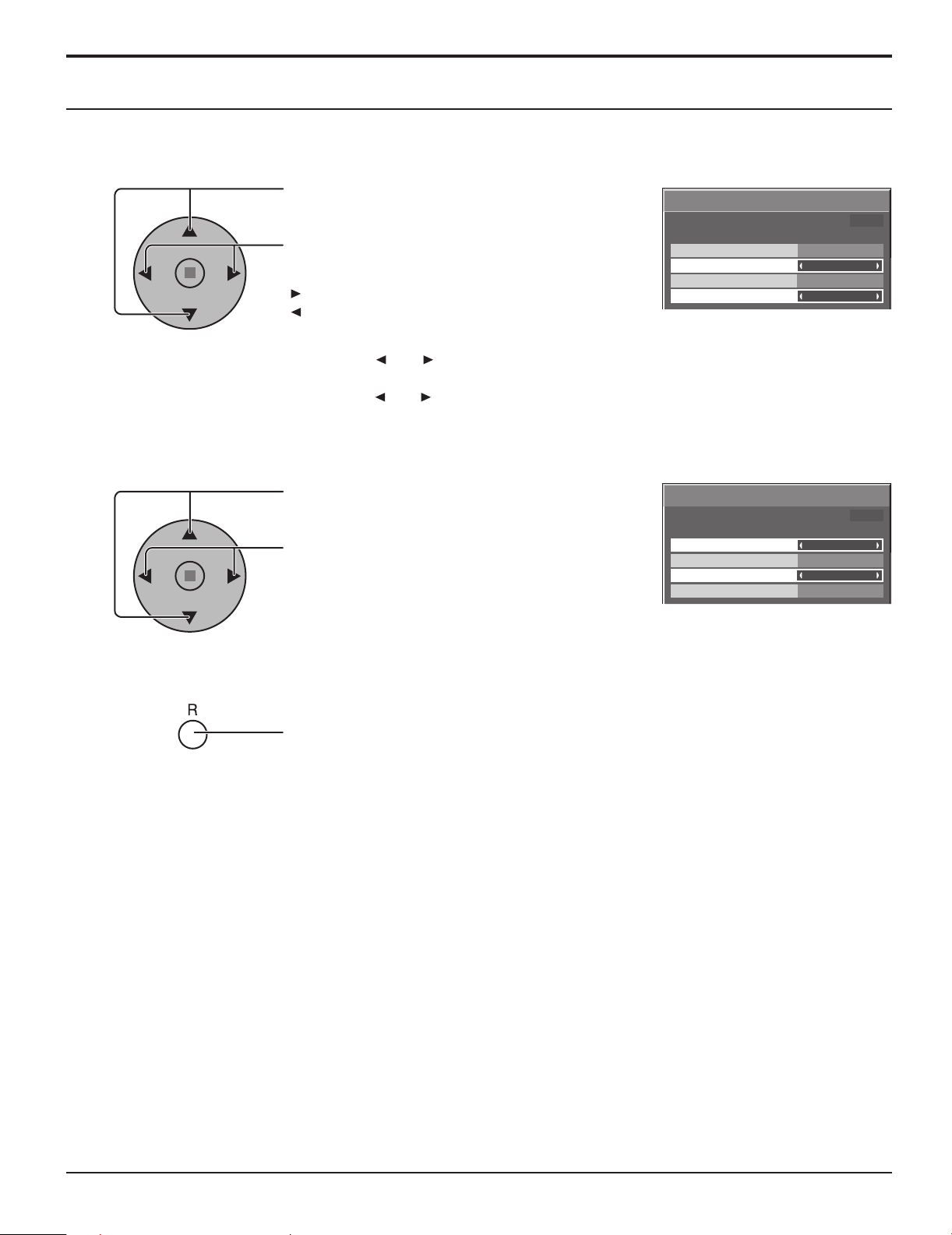
PRESENT TIME SETUP / SET UP TIMER
SET UP TIMER
Display the SET UP TIMER SCREEN.
1
2
Press to select
POWER ON TIME / POWER OFF TIME.
Press to set up POWER ON TIME / POWER OFF
TIME.
button: Forward
button: Back
Notes:
• Pressing “ ” or “ ” button once changes POWER ON TIME / POWER OFF TIME
1minute.
• Pressing “ ” or “ ” button continuously changes POWER ON TIME / POWER OFF
TIME by 15 minutes.
Press to select POWER ON FUNCTION
/ POWER OFF FUNCTION.
Press to select ON.
SET UP TIMER
PRESENT TIME OF DAY 99:99
POWER ON FUNCTION
POWER ON TIME
POWER OFF FUNCTION
POWER OFF TIME
SET UP TIMER
PRESENT TIME OF DAY 99:99
POWER ON FUNCTION
POWER ON TIME
POWER OFF FUNCTION
POWER OFF TIME
OFF
0:00
OFF
0:00
OFF
0:00
OFF
0:00
3
Note:
Timer function will not work unless “PRESENT TIME OF DAY” is set.
Press twice to exit from SET UP.
28
Page 29
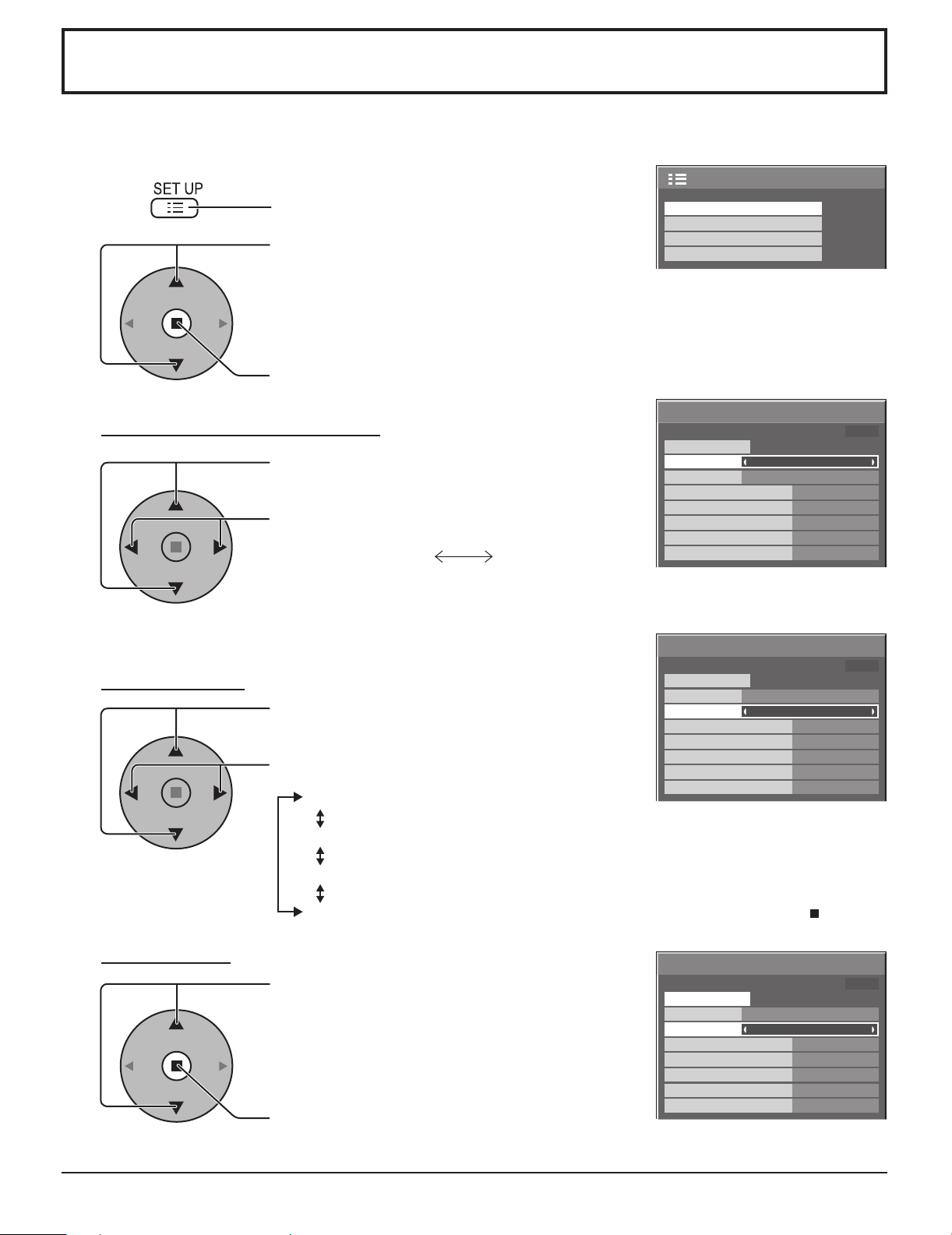
SCREENSAVER (For preventing after-images)
2/2SET UP
SCREENSAVER
MULTI DISPLAY SETUP
SET UP TIMER
PRESENT TIME SETUP
SCREENSAVER
START
FUNCTION
MODE
WOBBLING
PEAK LIMIT
FINISH TIME
START TIME
WHITE BAR SCROLL
OFF
6:15
12:30
OFF
OFF
SIDE BAR ADJUST
BRIGHT
PRESENT TIME OF DAY 99:99
SCREENSAVER
START
FUNCTION
MODE
WOBBLING
PEAK LIMIT
FINISH TIME
START TIME
WHITE BAR SCROLL
OFF
6:15
12:30
OFF
OFF
SIDE BAR ADJUST
BRIGHT
PRESENT TIME OF DAY 99:99
SCREENSAVER
START
FUNCTION
MODE
WOBBLING
PEAK LIMIT
FINISH TIME
START TIME
WHITE BAR SCROLL
ON
6:15
12:30
OFF
OFF
SIDE BAR ADJUST
BRIGHT
PRESENT TIME OF DAY 99:99
Do not display a still picture, especially in NORMAL mode, for any length of time.
If the display must remain on, a SCREENSAVER should be used.
1
Press to display the SET UP menu.
Press to select the SCREENSAVER.
2
Press to select the SCREENSAVER screen.
NEGATIVE / SCROLL selection
3
Press to select the FUNCTION.
Press to select the desired function.
WHITE BAR SCROLL NEGATIVE
WHITE BAR SCROLL : A white bar will scroll from left to right.
NEGATIVE : A negative image will be displayed on the screen.
4
5
MODE selection
START setting
Press to select the MODE.
Press to select each mode items.
OFF
INTERVAL : Operates when SHOW DURATION and SAVER DURATION are
set up and those times arrive.
TIME OF DAY : Operates when START TIME and FINISH TIME are set up and
those times arrive.
ON : Operates when START is selected and the ACTION ( ) button is
pressed.
When the MODE is set to ON, press to select
START.
Press to start SCREENSAVER.
The menu screen will disappear and the SCREENSAVER will be activated. To stop the
SCREENSAVER under ON, press the R button.
29
Page 30
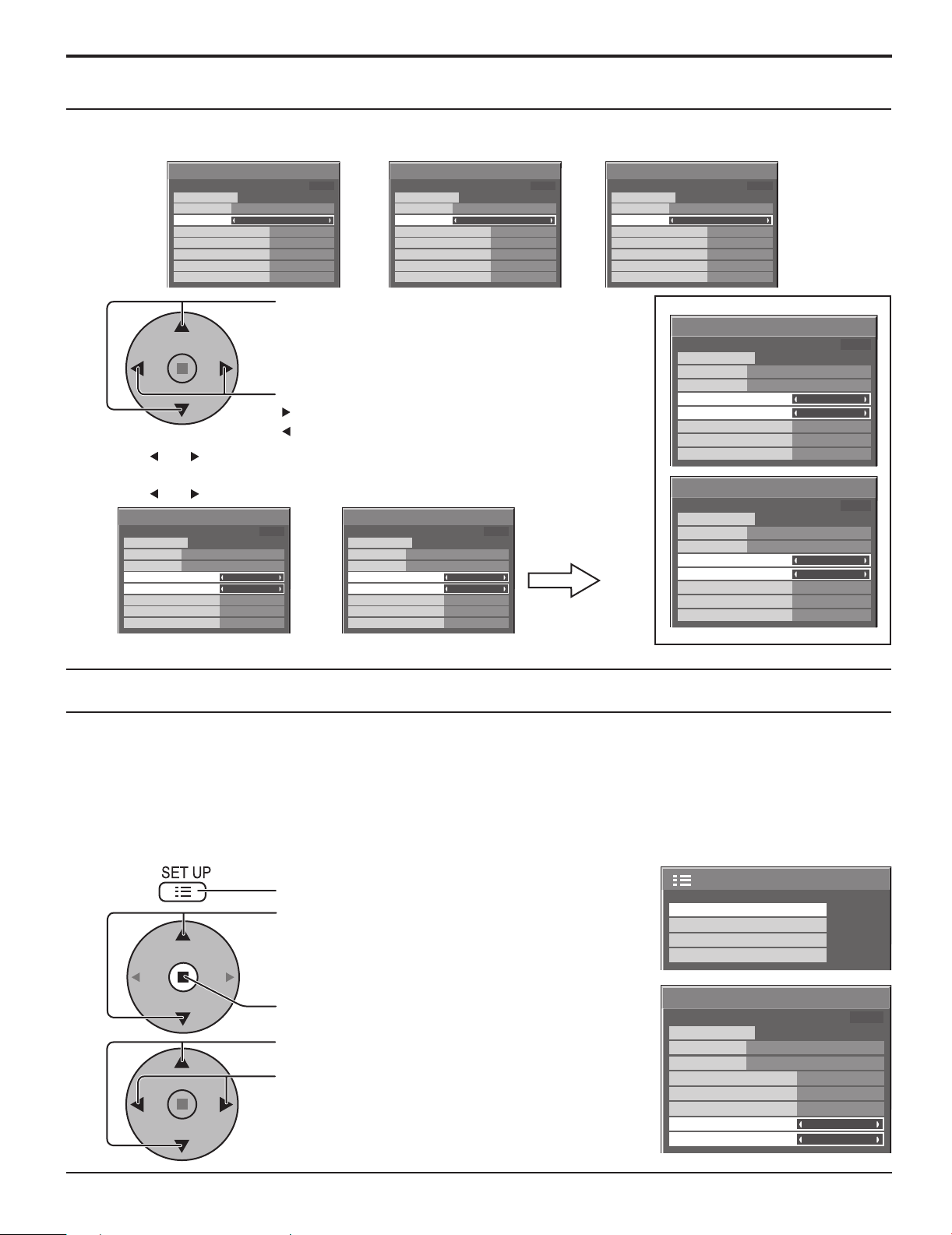
SCREENSAVER (For preventing after-images)
SCREENSAVER
START
FUNCTION
MODE
WOBBLING
PEAK LIMIT
FINISH TIME
START TIME
WHITE BAR SCROLL
OFF
6:15
12:30
OFF
OFF
SIDE BAR ADJUST
BRIGHT
PRESENT TIME OF DAY 99:99
SCREENSAVER
START
FUNCTION
MODE
WOBBLING
PEAK LIMIT
WHITE BAR SCROLL
6:15
12:30
OFF
OFF
INTERVAL
SIDE BAR ADJUST
BRIGHT
SAVER DURATION
SHOW DURATION
PRESENT TIME OF DAY 99:99
SCREENSAVER
START
FUNCTION
MODE
WOBBLING
PEAK LIMIT
FINISH TIME
START TIME
WHITE BAR SCROLL
6:15
12:30
OFF
OFF
TIME OF DAY
SIDE BAR ADJUST
BRIGHT
PRESENT TIME OF DAY 99:99
2/2SET UP
SCREENSAVER
MULTI DISPLAY SETUP
SET UP TIMER
PRESENT TIME SETUP
SCREENSAVER
START
FUNCTION
MODE
SIDE BAR ADJUST
WOBBLING
PEAK LIMIT
FINISH TIME
START TIME
WHITE BAR SCROLL
OFF
6:15
12:30
BRIGHT
OFF
OFF
PRESENT TIME OF DAY 99:99
SCREENSAVER
START
FUNCTION
MODE
WOBBLING
PEAK LIMIT
FINISH TIME
START TIME
WHITE BAR SCROLL
TIME OF DAY
0:00
0:00
OFF
OFF
SIDE BAR ADJUST
BRIGHT
PRESENT TIME OF DAY 99:99
SCREENSAVER
START
FUNCTION
MODE
WOBBLING
PEAK LIMIT
WHITE BAR SCROLL
INTERVAL
OFF
OFF
0:00
0:00
SIDE BAR ADJUST
BRIGHT
SAVER DURATION
SHOW DURATION
PRESENT TIME OF DAY 99:99
SCREENSAVER
START
FUNCTION
MODE
WOBBLING
PEAK LIMIT
FINISH TIME
START TIME
WHITE BAR SCROLL
TIME OF DAY
6:15
12:30
OFF
OFF
SIDE BAR ADJUST
BRIGHT
PRESENT TIME OF DAY 99:99
SCREENSAVER
START
FUNCTION
MODE
WOBBLING
PEAK LIMIT
SAVER DURATION
SHOW DURATION
WHITE BAR SCROLL
INTERVAL
6:15
12:30
OFF
OFF
SIDE BAR ADJUST
BRIGHT
PRESENT TIME OF DAY 99:99
Setup of SCREENSAVER Time
After selecting TIME OF DAY or INTERVAL, the relevant Time Setup will become available for selection and the Operating
Time may be set. (Time cannot be set when “MODE” is “ON” or “OFF”.)
Press to select START TIME / FINISH TIME
(When TIME OF DAY is selected).
Press to select SHOW DURATION / SAVER
DURATION (When INTERVAL is selected).
Press to setup.
button: Forward
Notes:
• Pressing “ ” or “ ” button once changes the Time 1minute.
[However, switching occurs every 15 minutes when Periodic Time is selected.]
• Pressing “ ” or “ ” button continuously changes the Time by 15 minutes.
button: Back
Note: Timer function will not work unless “PRESENT TIME OF DAY” is set.
Reduces screen after-image
These functions prevent the occurrence of an “after image” on the display when turned ON.
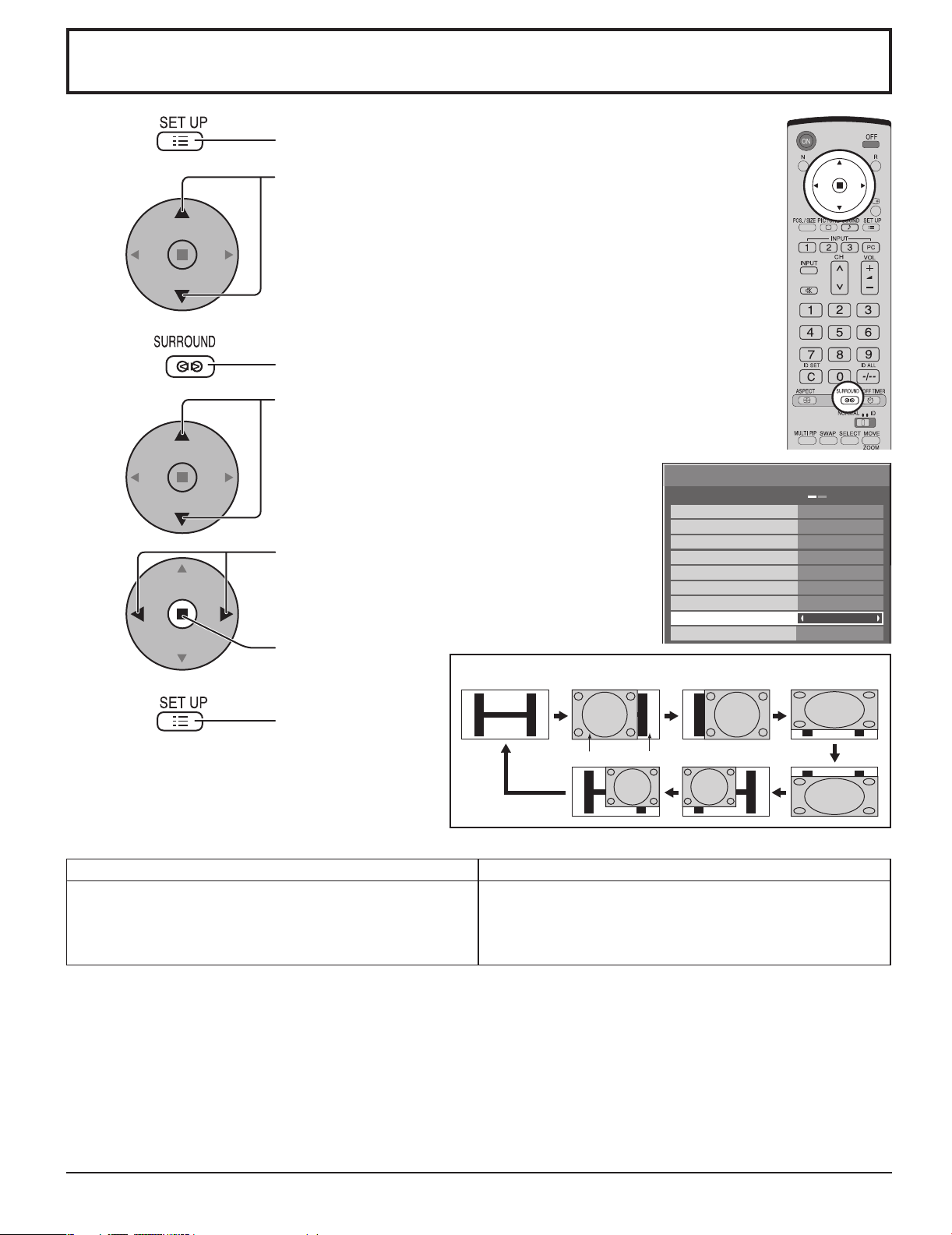
WOBBLING: Automatically shifts the display image at a dot level pitch (therefore unnoticeable to the eye) to prevent
PEAK LIMIT: Suppresses image contrast (peak brightness).
Note:
1
2
3
30
after image of sharper contour of image.
ON1: Shifts the image over time.
ON2: Shifts the image depending on screen-detection.
When a still picture is viewed for an extended time, the screen may become slightly darker. (see page 45)
Press to display the SET UP menu.
Press to select “SCREENSAVER”.
Press to display SCREENSAVER menu.
Press to select “WOBBLING” or “PEAK LIMIT”.
Press to select “ON1”, ”ON2” or ”OFF” (WOBBLING).
“ON” or “OFF” (PEAK LIMIT).
Page 31
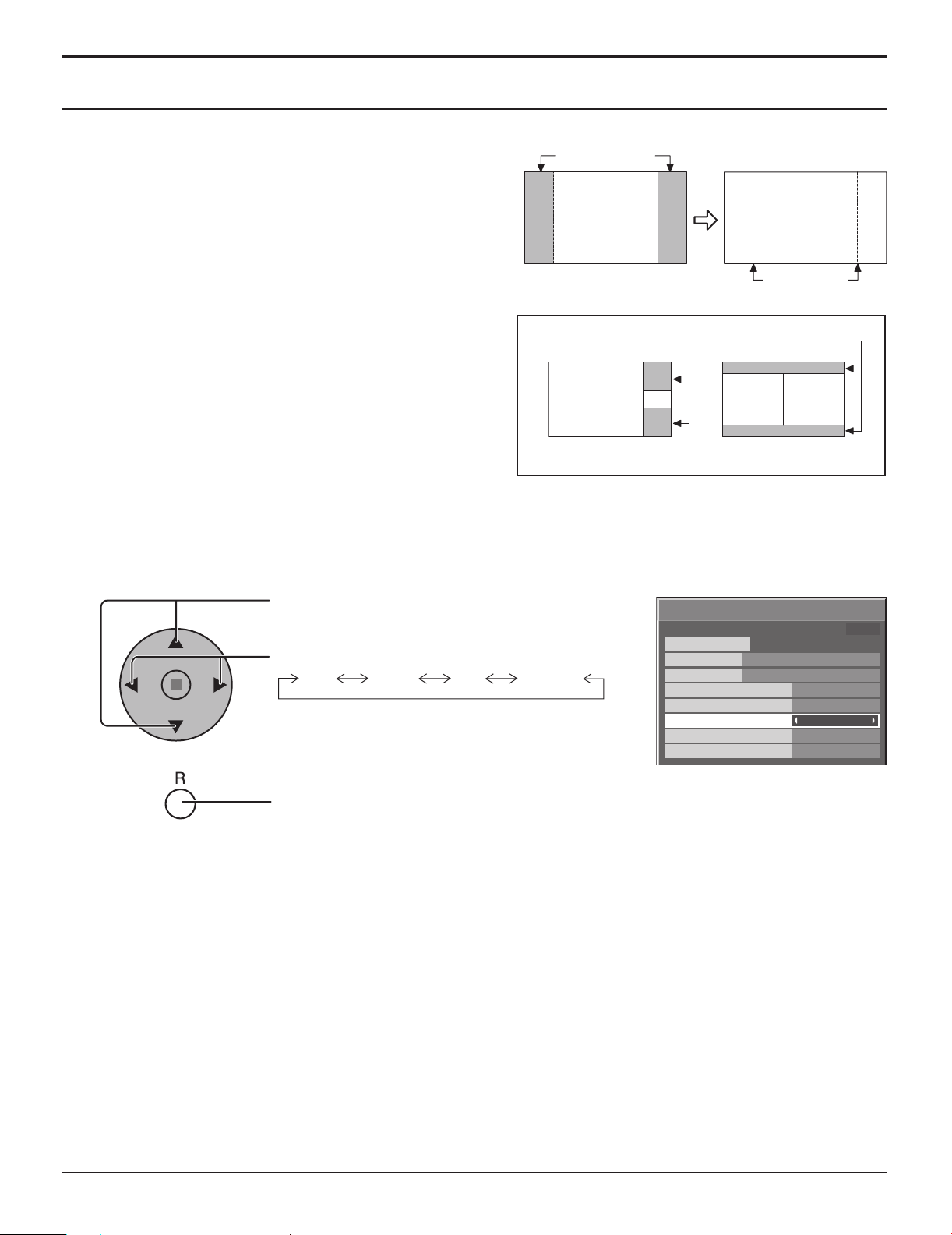
AB
SCREENSAVER (For preventing after-images )
SCREENSAVER
START
FUNCTION
MODE
WOBBLING
PEAK LIMIT
FINISH TIME
START TIME
WHITE BAR SCROLL
OFF
6:15
12:30
OFF
OFF
SIDE BAR ADJUST
BRIGHT
PRESENT TIME OF DAY 99:99
SIDE BAR ADJUST
Do not display a picture in NORMAL mode for an extended
period, as this can cause an after-image to remain on the
side bars on either side of the display fi eld.
To reduce the risk of such an after-image, change the
brightness of the side bars.
This function may be applicable to the non-picture area.
Display the SCREENSAVER screen.
(Refer to the previous page, operation guide steps 1 and 2)
1
Press to select the SIDE BAR ADJUST.
side bars
NORMAL mode
after-images
Non picture area
Picture out Picture Picture and Picture
2
Notes:
• To reduce the occurrence of after-images, set the SIDE BAR ADJUST to BRIGHT.
• The side bar may fl ash (alternate black/white) depending on the picture being shown on the screen. Using Cinema mode
will reduce such fl ashing.
Press to select OFF, DARK, MID, BRIGHT.
OFF MID BRIGHTDARK
Press to exit from SCREENSAVER.
31
Page 32
Reduces power consumption
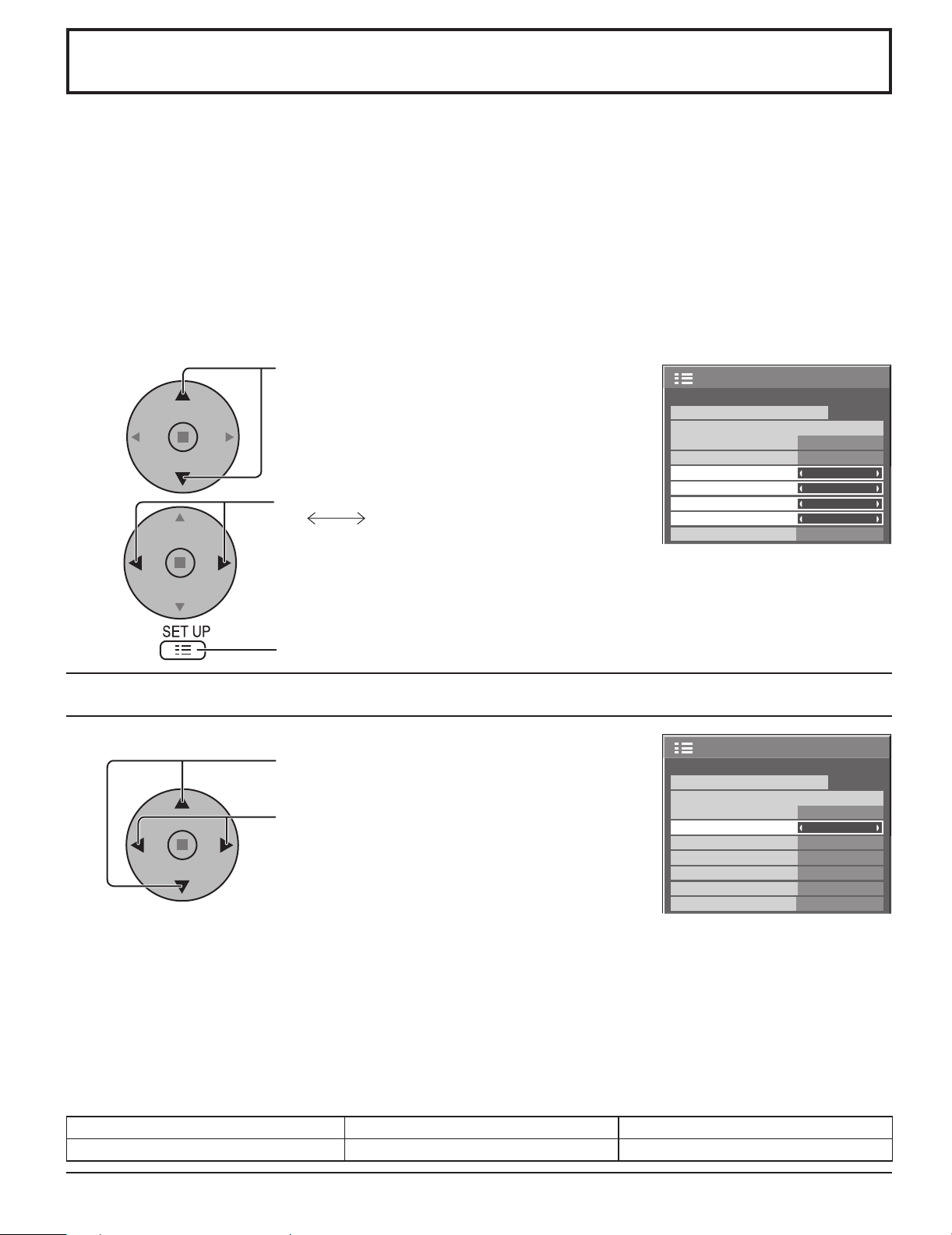
• POWER SAVE: When this function is turned ON, luminous level of the Plasma Display is suppressed, so
power consumption is reduced.
• STANDBY SAVE: When this function is turned ON, power consumption of the microcomputer is reduced
during power supply standby (see page 13-15), so standby power of the set is reduced.
• POWER MANAGEMENT: The unit power supply is turned ON or OFF depending on whether or not there is a signal
during PC input mode.
This function is enabled when it is turned ON. (Only during input from PC(Mini D-sub)
terminal)
• AUTO POWER OFF: Equipment power supply is turned OFF when there is no signal.
When this is set to On, the power supply of the unit goes Off 10 minutes after the input
signals stop.
This function is effective for input signals except input from PC (Mini D-sub) terminal.
1
2
Press to select
“POWER SAVE”
“STANDBY SAVE”
“POWER MANAGEMENT”
“AUTO POWER OFF”.
Press to select “ON” or “OFF”.
On Off
SET UP
SIGNAL
COMPONENT/RGB-IN SELECT
INPUT LABEL
POWER SAVE
STANDBY SAVE
POWER MANAGEMENT
AUTO POWER OFF
OSD LANGUAGE ENGLISH (US
1/2
RGB
PC
OFF
OFF
OFF
OFF
)
Note:
3
Press to exit from SET UP.
“POWER MANAGEMENT” and “AUTO POWER OFF” are
effective during normal viewing (one picture screen) only.
Customizing the Input labels
This function can change the label of the Input signal to be displayed.
SET UP
Press to select INPUT LABEL.
SIGNAL
Note:
Press to change the INPUT LABEL.
COMPONENT/RGB-IN SELECT
INPUT LABEL
POWER SAVE
STANDBY SAVE
POWER MANAGEMENT
AUTO POWER OFF
OSD LANGUAGE ENGLISH (US
While selecting a Input signal through Optional Terminal Board connected to Slot 1, Slot 2 and Slot 3, the Input label will
depend on each Optional Terminal Board.
INPUT LABELS for Slot 1, Slot 2, Slot 3 and miniD-sub:
[Slot1 Input] INPUT1/VIDEO1/COMPONENT1/RGB1/DIGITAL1/PC1/DVD1/CATV1/VCR1/STB1
[Slot2 Input] INPUT2/VIDEO2/COMPONENT2/RGB2/DIGITAL2/PC2/DVD2/CATV2/VCR2/STB2
[Slot3 Input] INPUT3/VIDEO3/COMPONENT3/RGB3/PC3/DVD3/CATV3/VCR3/STB3
[PC (MiniD-sub) input] PC/COMPONENT/RGB/DVD/STB
1/2
RGB
PC
OFF
OFF
OFF
OFF
)
When TY-FB9BD (optional BNC Dual Video Terminal Board) is used, an “A” or “B” is added at the end of each input label,
depending on the input selected (see below).
Addition sign “A” “B”
Selected Input Composite S VIDEO
32
Page 33
SET UP for MULTI DISPLAY
2/2SET UP
SCREENSAVER
MULTI DISPLAY SETUP
SET UP TIMER
PRESENT TIME SETUP
2 × 2
A1
LOCATION
MULTI DISPLAY SETUP
ARRANGEMENT
OFF
MULTI DISPLAY SETUP
(For TH-42PS9UK)
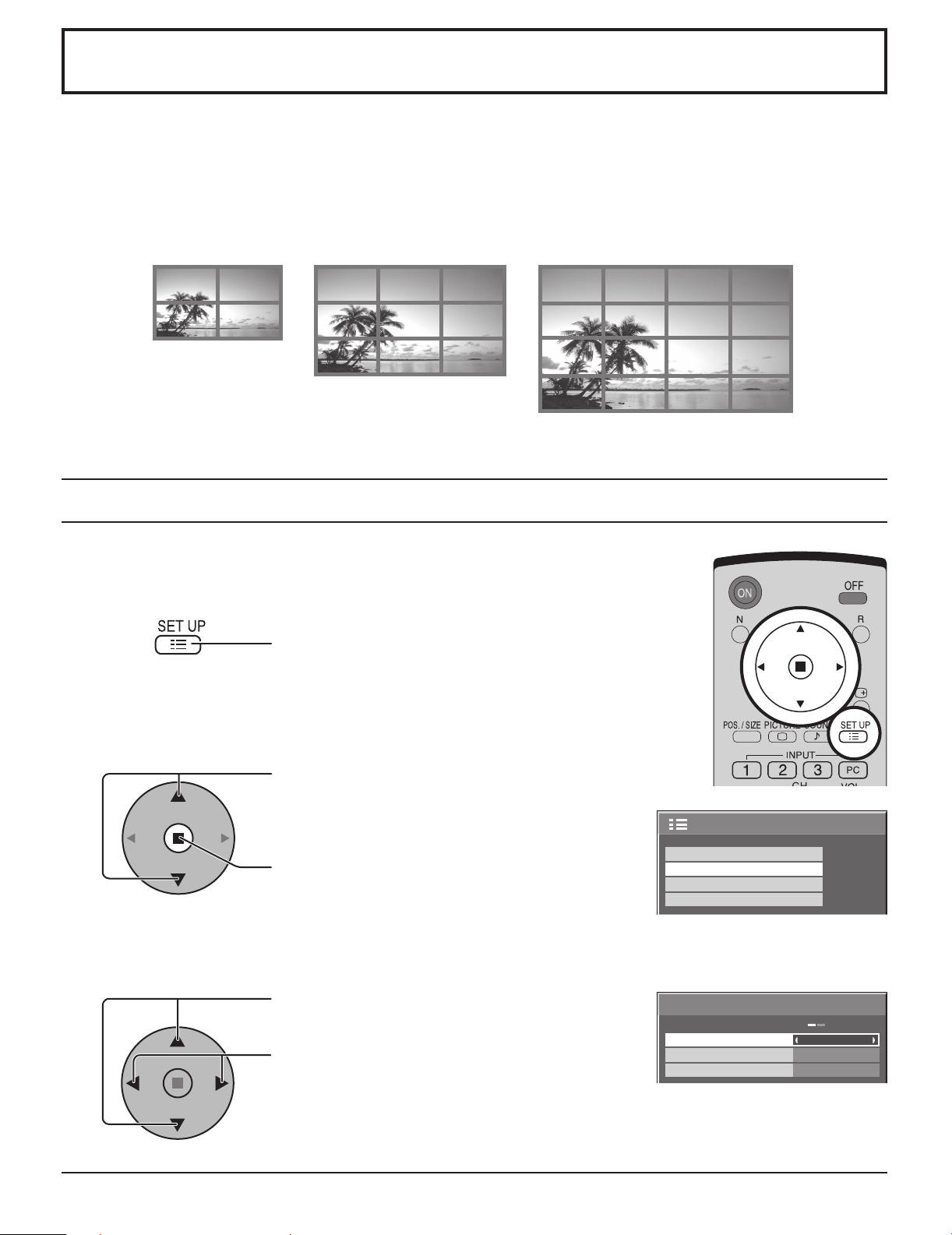
By lining up Plasma Displays in groups of 4, 9 or 16 as illustrated below, an enlarged picture may be displayed across all
screens.
For this mode of operation, each plasma display has to be set up with a Display number to determine its location.
group of 16 (4 × 4 (F))group of 4 (2 × 2 (F)) group of 9 (3 × 3 (F))
Two options are selectable for MULTI DISPLAY (See page 37).
How to setup MULTI DISPLAY
1
2
3
Press to display the SET UP menu.
Press to select the MULTI DISPLAY SETUP.
Press to display the “MULTI DISPLAY SETUP”
menu.
Press to select the MULTI DISPLAY SETUP.
Press to select “ON” or “OFF”.
33
Page 34
SET UP for MULTI DISPLAY
LOCATION
MULTI DISPLAY SETUP
ARRANGEMENT
OFF
2 × 2
A1
MULTI DISPLAY SETUP
2 × 2
A1
LOCATION
MULTI DISPLAY SETUP
ARRANGEMENT
OFF
MULTI DISPLAY SETUP
How to set the Display location number for each Plasma Display
4
5
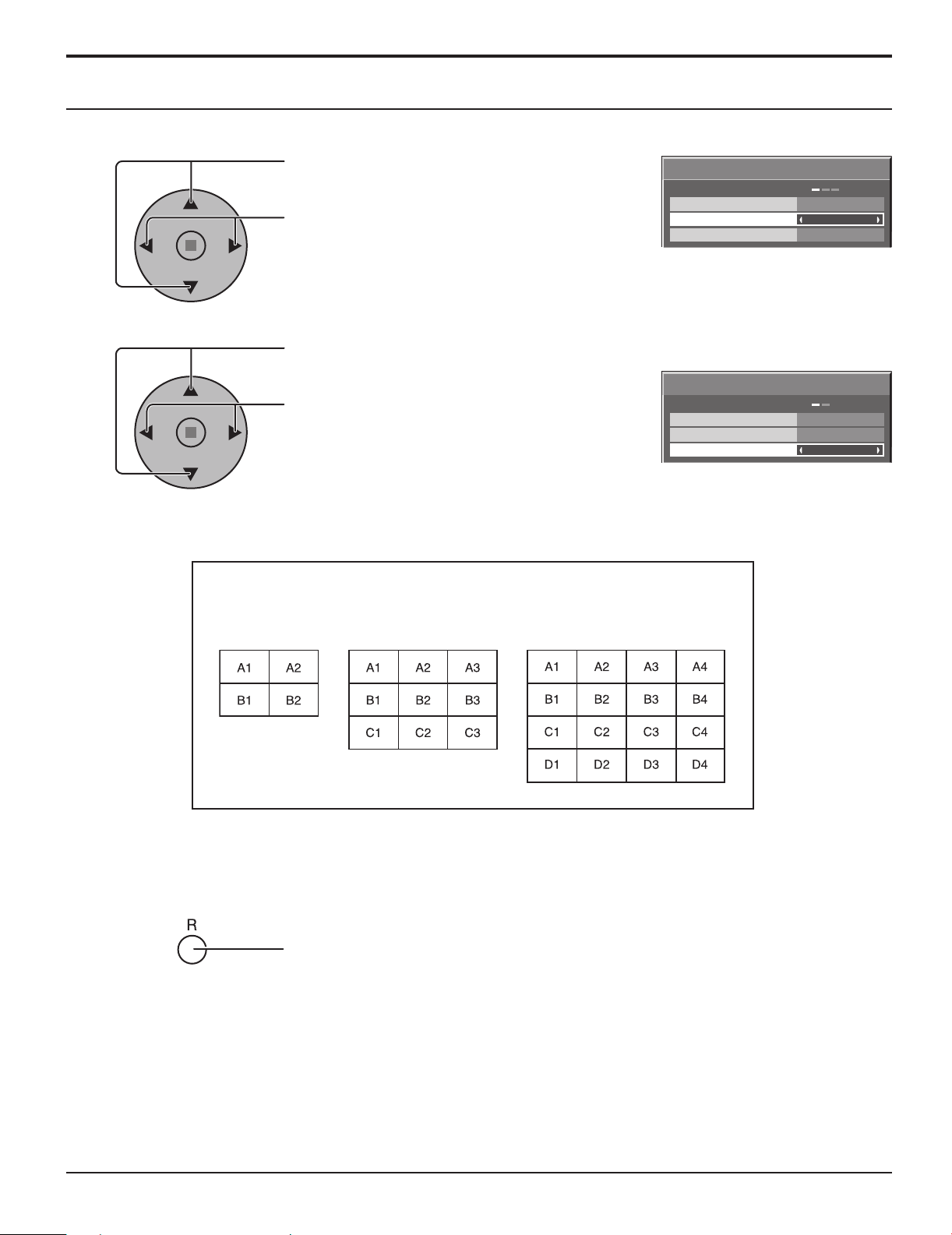
Press to select ARRANGEMENT (2nd step).
Press to select “2 × 2”, “2 × 2F”, “3 × 3”, “3 × 3F”,
“4 × 4”, “4 × 4F”.
Press to select LOCATION.
Press to select the required arrangement number.
(A1-D4 : Refer to the following)
Display Number locations for each arrangement.
6
( 2 × 2 (F) ) ( 3 × 3 (F) ) ( 4 × 4 (F) )
Press twice to exit from SET UP.
34
Page 35
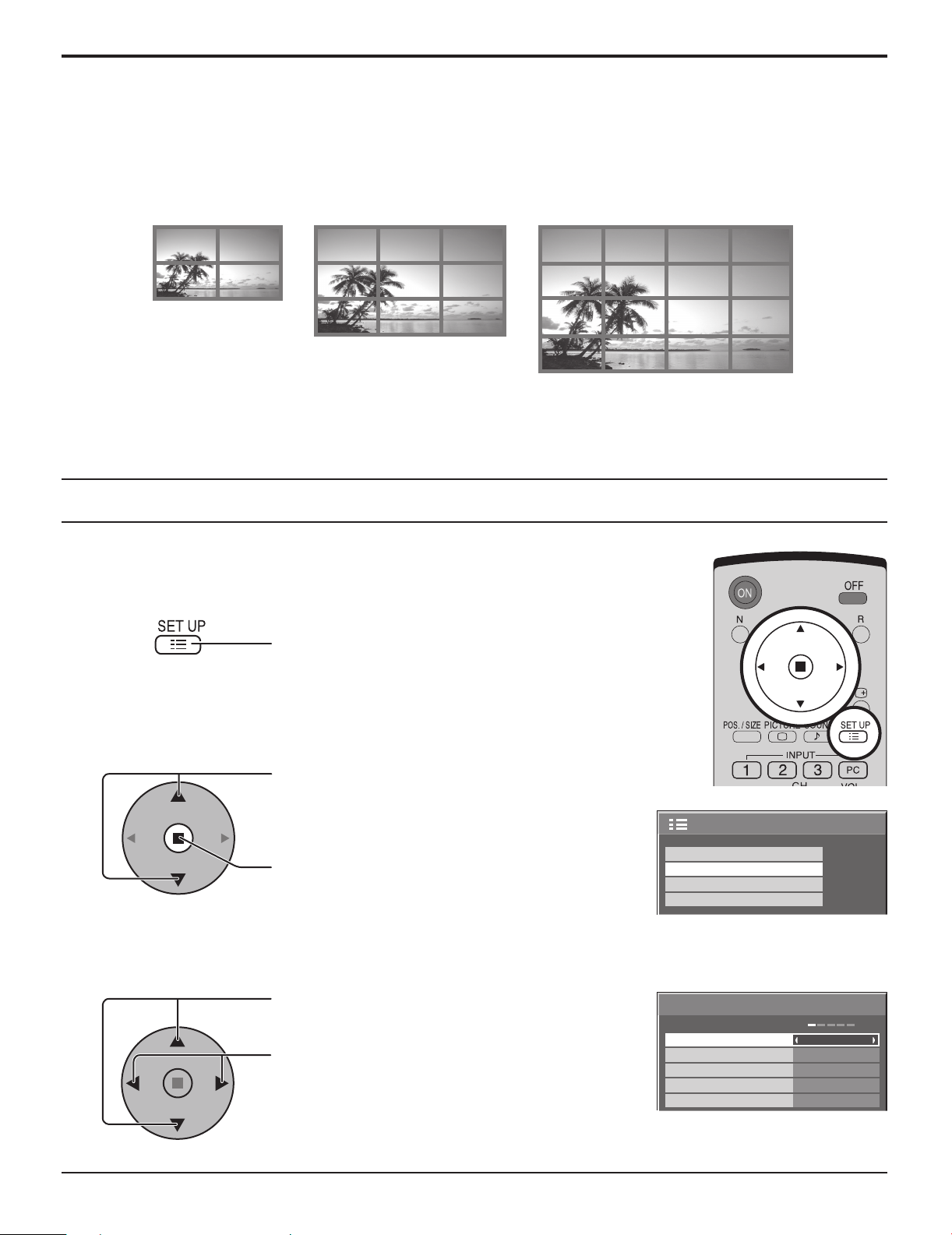
2/2SET UP
SCREENSAVER
MULTI DISPLAY SETUP
SET UP TIMER
PRESENT TIME SETUP
× 2
MULTI DISPLAY SETUP
HORIZONTAL SCALE
OFF
OFF
A1
LOCATION
VERTICAL SCALE
SEAM HIDES VIDEO
× 2
MULTI DISPLAY SETUP
SET UP for MULTI DISPLAY
(For TH-37PH9UK, TH-42PH9UK, TH-50PH9UK)
By lining up Plasma Displays in groups of 4, 9 or 16 as illustrated below, an enlarged picture may be displayed across all
screens.
For this mode of operation, each plasma display has to be set up with a Display number to determine its location.
group of 16 (4 × 4)group of 4 (2 × 2) group of 9 (3 × 3)
How to setup MULTI DISPLAY
1
Press to display the SET UP menu.
Press to select the MULTI DISPLAY SETUP.
2
Press to display the “MULTI DISPLAY SETUP”
menu.
3
Press to select the MULTI DISPLAY SETUP.
Press to select “ON” or “OFF”.
35
Page 36
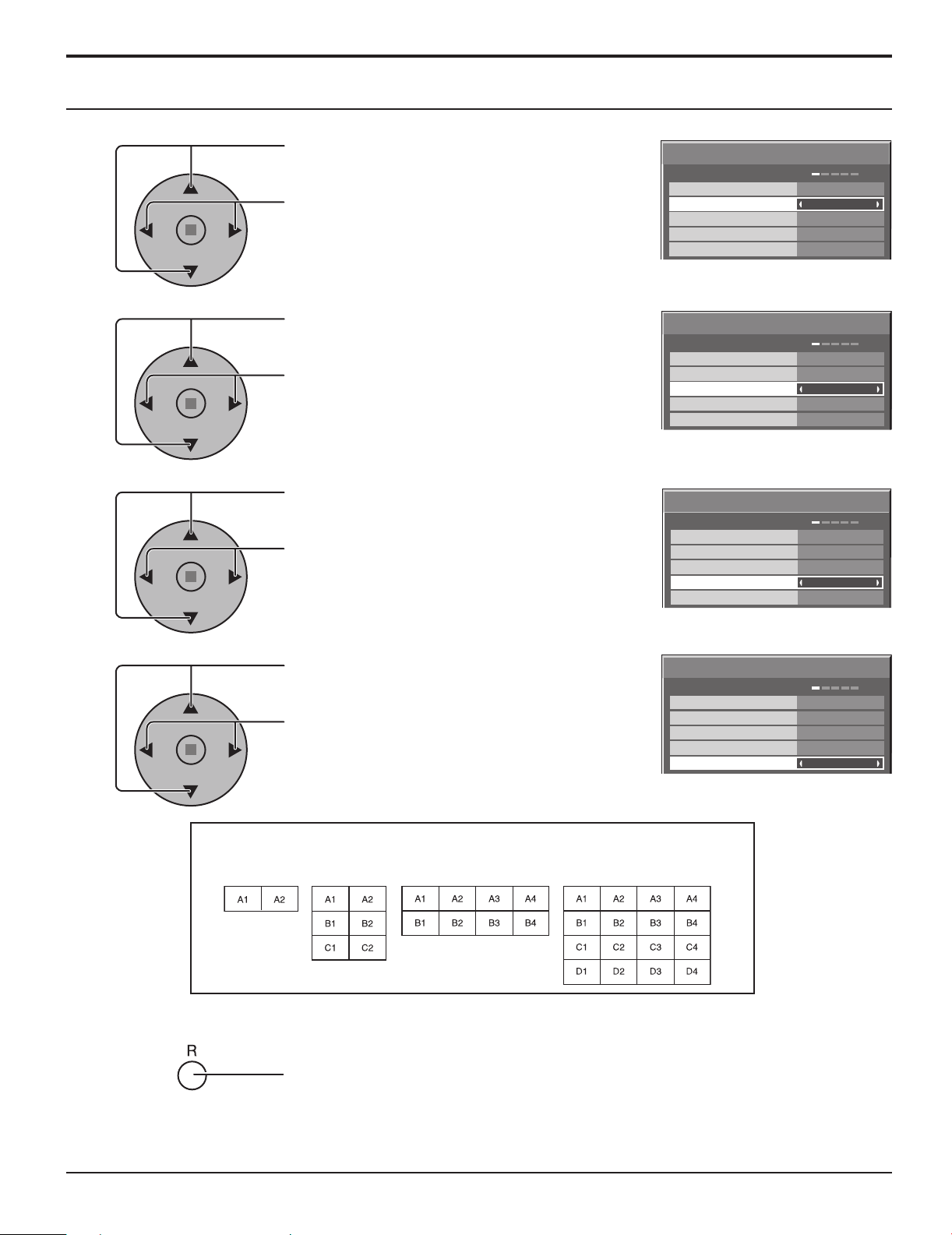
SET UP for MULTI DISPLAY
MULTI DISPLAY SETUP
OFF
OFF
A1
LOCATION
MULTI DISPLAY SETUP
HORIZONTAL SCALE
VERTICAL SCALE
SEAM HIDES VIDEO
× 2
× 2
MULTI DISPLAY SETUP
OFF
OFF
A1
LOCATION
MULTI DISPLAY SETUP
HORIZONTAL SCALE
VERTICAL SCALE
SEAM HIDES VIDEO
× 2
× 2
× 2
MULTI DISPLAY SETUP
HORIZONTAL SCALE
OFF
OFF
A1
LOCATION
VERTICAL SCALE
SEAM HIDES VIDEO
× 2
MULTI DISPLAY SETUP
How to set the Display location number for each Plasma Display
4
5
6
Press to select HORIZONTAL SCALE.
Press to select “× 1”, “× 2”, “× 3”, “× 4”.
Press to select VERTICAL SCALE.
Press to select “× 1”, “× 2”, “× 3”, “× 4”.
Press to select SEAM HIDES VIDEO.
Press to select “OFF”, “ON”.
MULTI DISPLAY SETUP
MULTI DISPLAY SETUP
HORIZONTAL SCALE
VERTICAL SCALE
SEAM HIDES VIDEO
LOCATION
OFF
× 2
× 2
OFF
A1
7
8
Press to select LOCATION.
Press to select the required arrangement number.
(A1-D4 : Refer to the following)
Display Number locations for each arrangement.
(Examples)
( 2 × 1) ( 2 × 3 )
( 4 × 2 )
Press twice to exit from SET UP.
( 4 × 4 )
36
Page 37
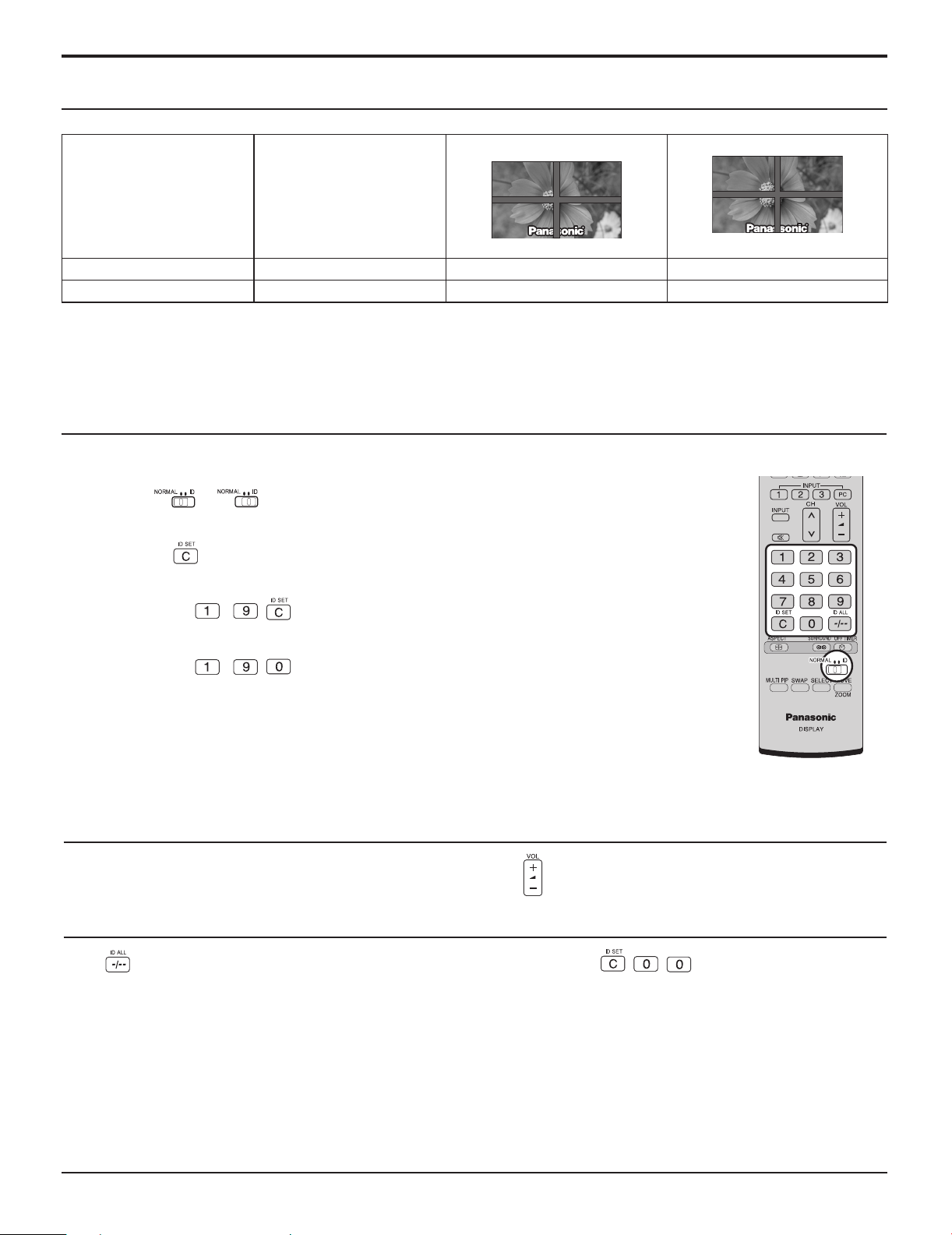
F (SEAM HIDES VIDEO) Setting
SET UP for MULTI DISPLAY
To hide joints between TVs.
model No. Reference
Suitable for moving image display.
TH-42PS9UK
TH-37/42/50PH9UK Step 6, Page 36 ON OFF
Step 4, Page 34 (2 × 2, 3 × 3, 4 × 4)
To show joints between TVs.
Suitable for still image display.
(2 × 2F, 3 × 3F, 4 × 4F)
ID Remote Control Function
You can set the remote control ID when you want to use this remote control on one of several different TVs.
Switch to on the right side.
1
Press the button on the remote control.
2
Press one of - , for the tens digit setting.
3
Press one of - , for the units digit setting.
4
Notes:
• The numbers in 2, 3 and 4 should be set up quickly.
• Adjustable ID number range is 0 - 99.
• If a number button is pressed more than two times, the fi rst two numbers become the ID number for the remote
control.
ID remote control button operation
The operation is the same as normal remote control except for the button.
ID Cancellation
Press button on remote control. (This has the same effect as pressing the , , buttons at the same time.)
Notes:
• Set the Remote ID “On” to operate the ID remote control.
If remote ID is set to “On”, you can use the remote control without identical ID number during option menu display.
(see page 43)
• The ID remote control cannot be used when ID select is set to anything other than 0, and the remote control ID is not
the same as the ID select number (see page 43).
37
Page 38
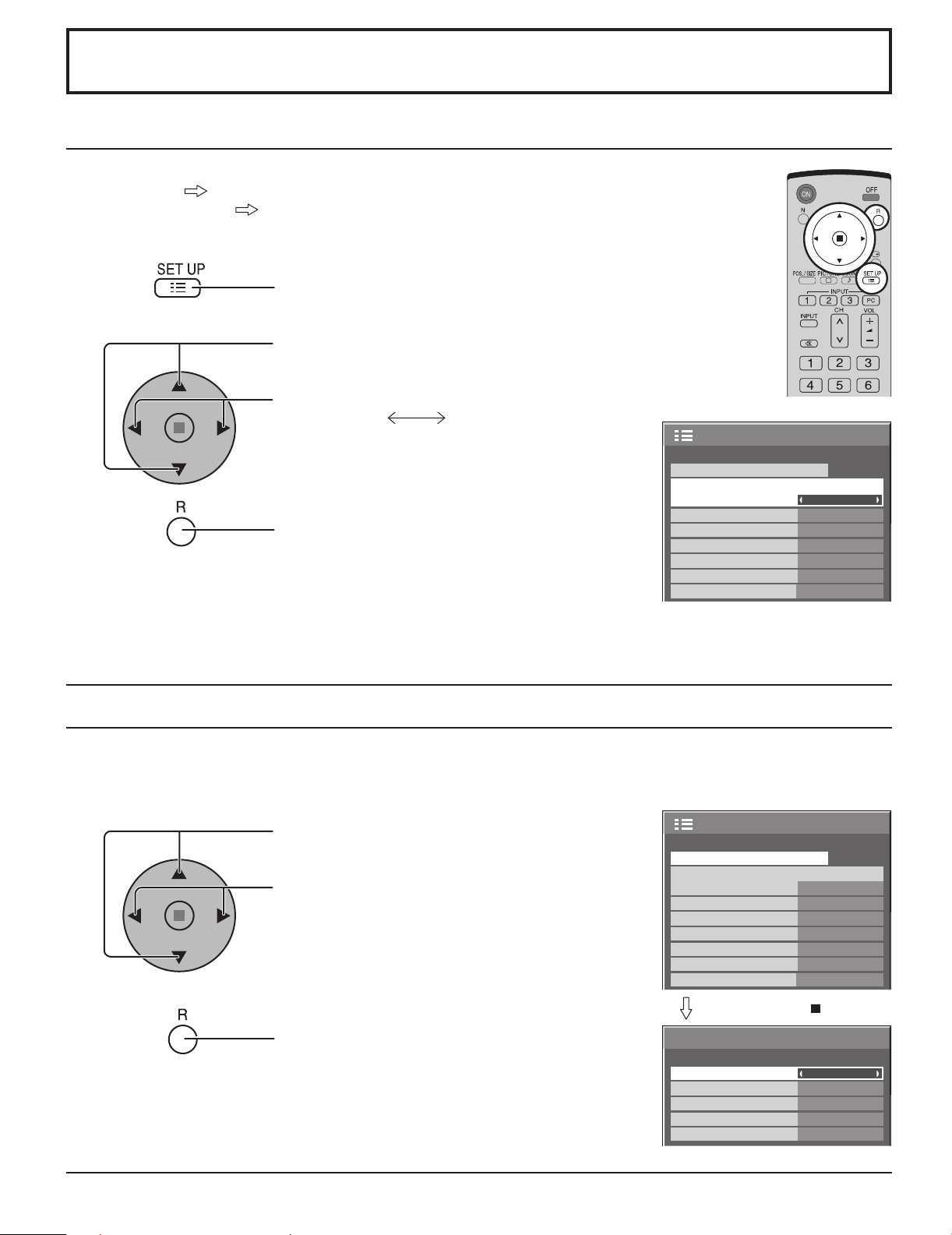
SET UP for Input Signals
COMPONENT / RGB IN SELECT
Select to match the signals from the source connected to the COMPONENT / RGB input terminals.
Y, PB, PR signals “COMPONENT”
R, G, B, HD, VD signals “RGB”
1
Press to display the SET UP menu.
2
Press to select the “COMPONENT / RGB-IN
SELECT”.
Press to select the desired mode.
COMPONENT RGB
3
Press to exit from adjust mode.
Note:
Selection may not be possible, depending on which optional board is installed.
3D Y/C FILTER – For NTSC AV images
Select “SIGNAL” from the “SET UP” menu during VIDEO (S VIDEO) input signal mode.
(“SIGNAL [VIDEO]” menu is displayed.)
SET UP
SIGNAL
COMPONENT/RGB-IN SELECT
INPUT LABEL
POWER SAVE
STANDBY SAVE
POWER MANAGEMENT
AUTO POWER OFF
OSD LANGUAGE ENGLISH (US
1/2
RGB
PC
OFF
OFF
OFF
OFF
)
1
Press to select the “3D Y/C FILTER (NTSC)”.
Press to set ON / OFF.
2
Press to exit from adjust mode.
Note:
When ON, this setting only affects NTSC input signals.
38
SET UP
COMPONENT/RGB-IN SELECT
INPUT LABEL
POWER SAVE
STANDBY SAVE
POWER MANAGEMENT
AUTO POWER OFF
OSD LANGUAGE ENGLISH (US
SIGNAL
RGB
PC
OFF
OFF
OFF
OFF
Press ACTION ( ) button
SIGNAL
3D Y/C FILTER (NTSC)
COLOR SYSTEM
3 : 2 PULLDOWN
Panasonic AUTO (4 : 3)
VIDEO NR
[
VIDEO
ON
AUTO
OFF
NORMAL
OFF
1/2
)
]
Page 39
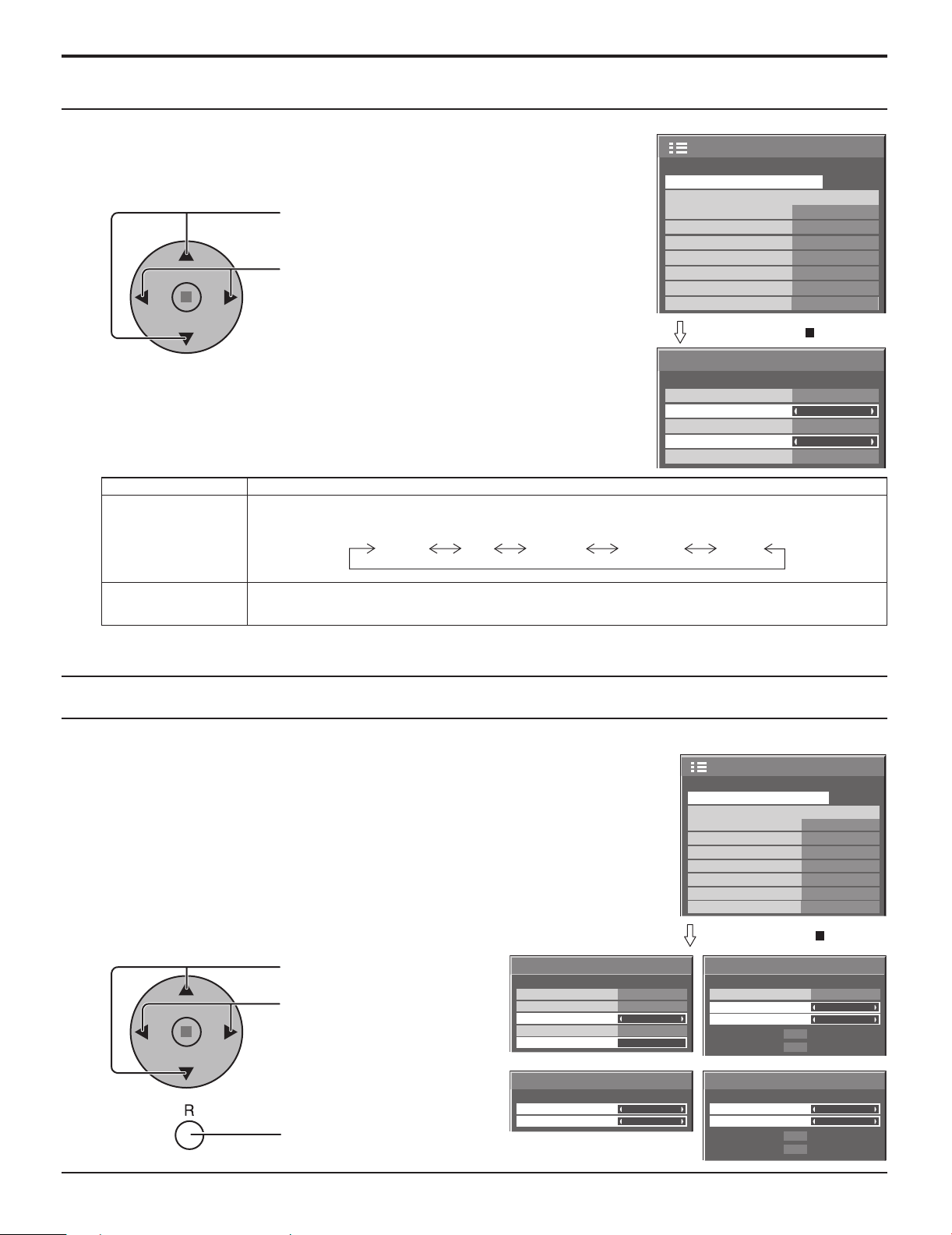
SET UP for Input Signals
SYNC
VIDEO NR
SIGNAL
AUTO
H-FREQ.
V-FREQ.
kHz
Hz
33.8
60.0
[
RGB
]
3 : 2 PULLDOWN
OFF
OFF
COLOR SYSTEM / Panasonic AUTO
Select SIGNAL from the “SET UP” menu during VIDEO (S VIDEO) input
SET UP
signal mode.(“SIGNAL [VIDEO]” menu is displayed.)
COMPONENT/RGB-IN SELECT
SIGNAL
Press to select the “COLOR SYSTEM” or “Panasonic
AUTO”.
Press to select each function.
If the image becomes unstable:
With the system set on Auto, under conditions of low
INPUT LABEL
POWER SAVE
STANDBY SAVE
POWER MANAGEMENT
AUTO POWER OFF
OSD LANGUAGE ENGLISH (US
Press ACTION ( ) button
level or noisy input signals the image may in rare
cases become unstable. Should this occur, set the
system to match the format of the input signal.
SIGNAL
3D Y/C FILTER (NTSC)
COLOR SYSTEM
3 : 2 PULLDOWN
Panasonic AUTO (4 : 3)
VIDEO NR
Mode Function
COLOR SYSTEM Set the color system to match the input signal. If set to “AUTO”, the color system is determined
automatically.
AUTO SECAM M.NTSC NTSCPAL
RGB
PC
OFF
OFF
OFF
OFF
[
VIDEO
ON
AUTO
OFF
NORMAL
OFF
1/2
)
]
Panasonic AUTO
(4 : 3 )
Set to “NORMAL” to view 4:3 images in an unchanged format when Panasonic AUTO is
selected. If you would like to view 4:3 images in Just format, set to “JUST”.
Note:
Panasonic AUTO does not function when TY-FB9BD (BNC Dual Video Terminal Board (option)) is used.
3:2 PULLDOWN / VIDEO NR
3:2 PULLDOWN: When ON, the display attempts to reproduce a more natural interpretation of sources such as movie
pictures, which are recorded at 24 frames per second.
If the picture is not stable, turn the setting to OFF.
Notes:
When ON, this setting only affects the following signal input:
• NTSC / PAL signal input during “VIDEO (S VIDEO)” input signal.
• 525i(480i) 625i(575i), 1125(1080)/60i signal input during “COMPONENT” input signal.
VIDEO NR: Automatically reduces unwanted picture noise.
Note:
VIDEO NR cannot be adjusted while a PC signal is being applied.
[
VIDEO
ON
AUTO
OFF
NORMAL
OFF
1
Press to select 3:2
PULLDOWN or VIDEO NR.
Press to set ON/OFF.
SIGNAL
3D Y/C FILTER (NTSC)
COLOR SYSTEM
3 : 2 PULLDOWN
Panasonic AUTO (4 : 3)
VIDEO NR
SET UP
SIGNAL
COMPONENT/RGB-IN SELECT
INPUT LABEL
POWER SAVE
STANDBY SAVE
POWER MANAGEMENT
AUTO POWER OFF
OSD LANGUAGE ENGLISH (US
Press ACTION ( ) button
]
RGB
PC
OFF
OFF
OFF
OFF
1/2
)
2
[
OFF
OFF
Digital
]
SIGNAL
3 : 2 PULLDOWN
VIDEO NR
Press to exit from adjust mode.
[
COMPONENT
OFF
OFF
]
SIGNAL
3 : 2 PULLDOWN
VIDEO NR
H-FREQ.
V-FREQ.
33.8
60.0
kHz
Hz
39
Page 40
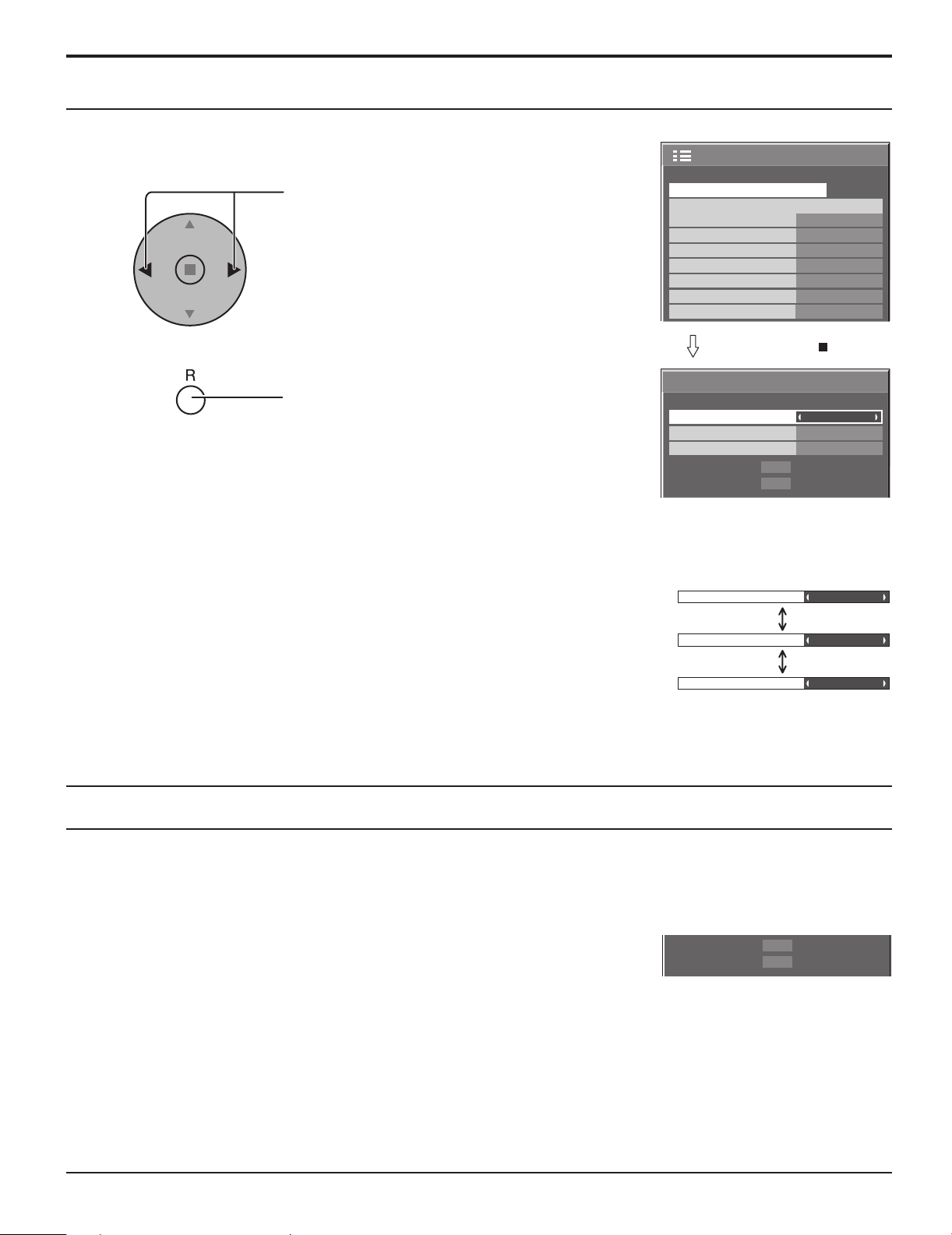
SET UP for Input Signals
SYNC
AUTO
SYNC
ON G
SYNC
VBS
H-FREQ.
V-FREQ.
kHz
Hz
33.8
60.0
SYNC
Select SIGNAL from the “SET UP” menu during RGB input signal.
1
2
Press to adjust.
Press to exit from adjust mode.
Setting RGB sync signal
Confi rm that the input is set to RGB INPUT (this setting is valid only for RGB INPUT
signal).
SET UP
COMPONENT/RGB-IN SELECT
INPUT LABEL
POWER SAVE
STANDBY SAVE
POWER MANAGEMENT
AUTO POWER OFF
OSD LANGUAGE ENGLISH (US
SIGNAL
RGB
PC
OFF
OFF
OFF
OFF
Press ACTION ( ) button
SIGNAL
SYNC
3 : 2 PULLDOWN
VIDEO NR
H-FREQ.
V-FREQ.
33.8
60.0
AUTO
OFF
OFF
kHz
Hz
[
RGB
1/2
)
]
AUTO: The H and V sync or synchronized signal are automatically selected.
If both input, it is selected the H and V sync.
ON G: Uses a synchronized signal on the Video G signal, which is input from
the G connector.
VBS: Uses a synchronized signal of Composite Sync input, which is input
from the HD connector.
H-FREQ. (kHz) / V-FREQ. (Hz)
Displays the H (Horizontal) / V (Vertical) frequencies.
This display is valid only for RGB/PC and DVI input signal.
Display range:
Horizontal 15 - 110 kHz
Vertical 48 - 120 Hz
40
Page 41
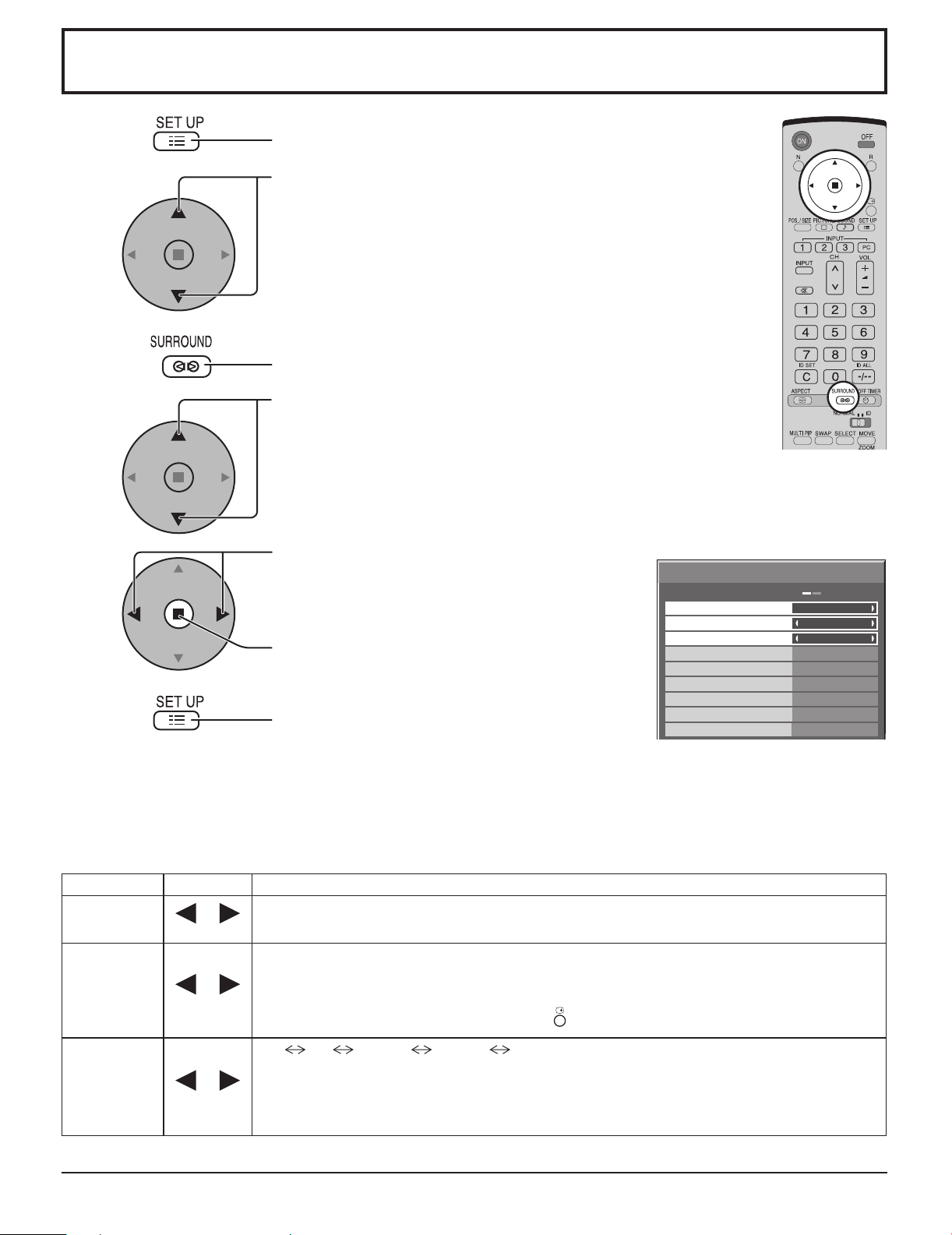
1/3
Options
Off-timer function
INPUT lock
Studio W/B
Advanced PIP
Display size
Initial VOL level
Maximum VOL level
Initial INPUT
Onscreen display
Off
Off
Off
Off
Enable
On
Off
0
Off
Off
0
Options Adjustments
1
2
3
4
5
Press to display the Setup menu.
Press to select “OSD Language”.
Press and hold until the Options menu is displayed.
Press to select your preferred menu.
Press to adjust the menu.
6
Off-timer
function
Onscreen
display
Initial INPUT
Press to confi rm.
Press to exit from
Options menu.
Item Effect Adjustments
Enable: Switches the “Off-timer function” “On”
Enable
On Off
Disable
Disable: Switches the “Off-timer function” “Off”
Note: When “Disable” is set, the Off-timer is cancelled.
On: Displays all the following on screen.
• Power on display
• Input signal switch display
• No signal display
• Mute and the remaining time of off-timer after
Off: Hides all the items above from view.
Off PC INPUT1 INPUT2 INPUT3
Adjusts the input signal when TV is turned on.
Notes:
• Only the adjusted signal is displayed. (see page 18).
• Signal can be displayed when the Terminal board is installed.
• This menu is available only when “INPUT lock” is “Off”.
was pressed.
41
Page 42
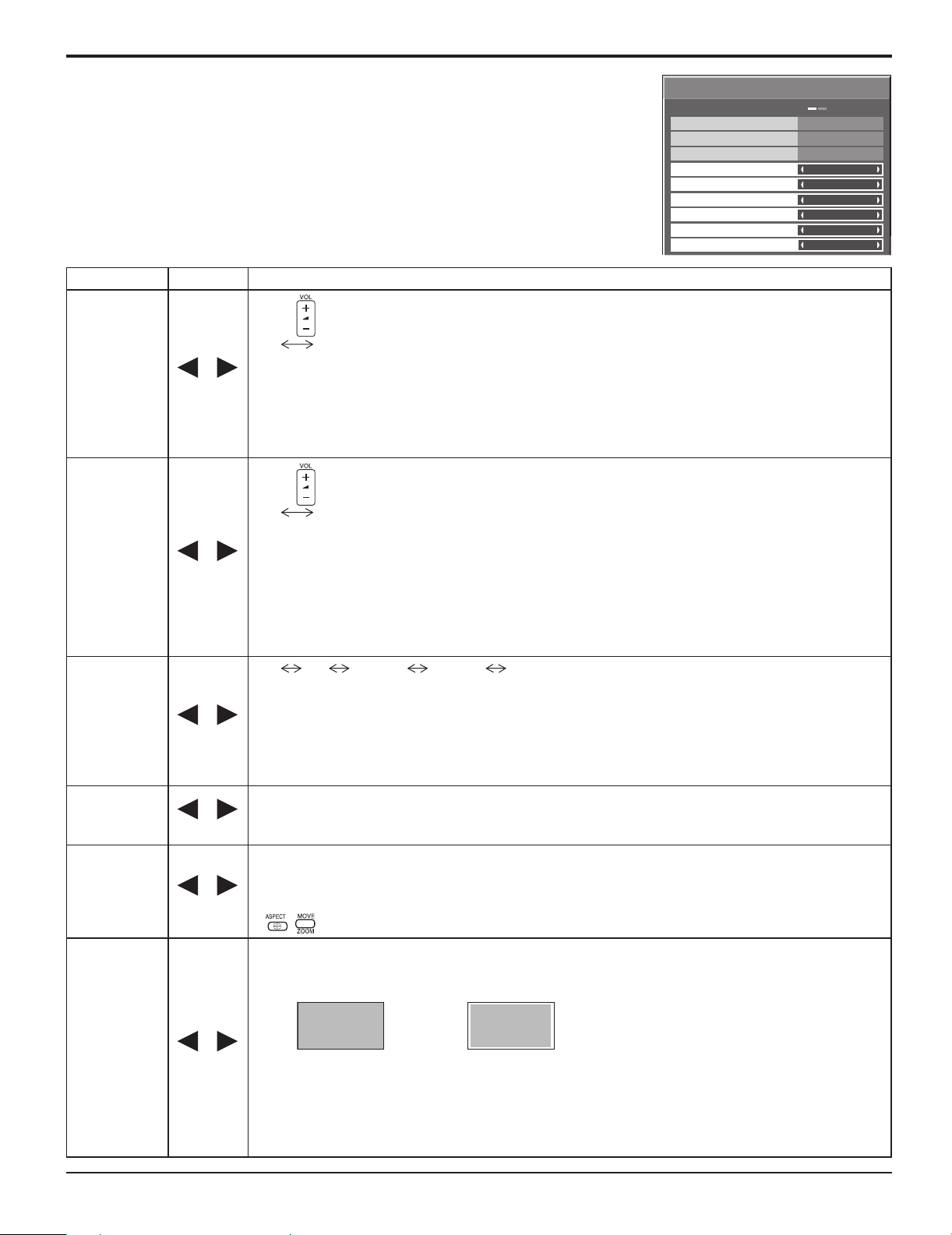
Options Adjustments
Item Effect Adjustments
Press button to adjust the volume when TV is turned on.
Off On
Initial VOL
level
Maximum VOL
level
Off On
Off On
Off: Sets normal volume.
On: Sets your preferred volume.
Notes:
•
When “Maximum VOL level” is “On”, the volume can only be adjusted between 0 and your maximum range.
•
You can hear the changed volume regardless of your volume setting before opening the options menu if you
adjust the volume when “Initial VOL level” is “On” and cursor is on the menu.
Press button to adjust the maximum volume.
Off On
Off: Sets auto maximum volume.
On: Sets your preferred maximum volume.
Notes:
• If the “Maximum VOL level” is set lower than the “Initial VOL level”, the “Initial VOL level” automatically
becomes the same as the “Maximum VOL level”.
• The volume display can go up to 63 regardless of the settings.
•
You can hear the changed volume regardless of your volume setting before opening the options menu if you
adjust the volume when “Maximum VOL level” is “On” and cursor is on the menu.
Options
Off-timer function
Onscreen display
Initial INPUT
Initial VOL level
Maximum VOL level
INPUT lock
Studio W/B
Advanced PIP
Display size
Enable
Off
Off
1/3
On
Off
0
0
Off
Off
Off
Off
INPUT lock
Studio W/B
Advanced PIP
Display size
Off On
Off On
Off On
Off PC INPUT1 INPUT2 INPUT3
Locks the input switch operation.
Notes:
• Only the adjusted signal is displayed (see page 18).
• Signal can be displayed when the Terminal board is installed.
• Input switch can be used when this is set to “Off”.
• In two screen display mode, if anything other than “Off” is set, the value will be fi xed as the value input
in the single screen display mode.
Off: Nullify all the settings adjusted.
On: Sets the color temperature for TV studio.
Note: Valid only when the low is set as color temperature on screen adjustment.
Off: Sets normal two screen display mode (see page 21).
On: Sets Advanced PIP mode (see page 22).
Notes:
• When “INPUT lock” is “On”, you cannot use all the two screen display functions.
•
, buttons are unavailable during Advanced PIP mode operation.
Adjusts the image display size on screen.
Off: Sets the normal image display size on screen.
On: Sets the image display size approximately 95 % of the normal image display.
Off On
Notes:
• This setting is valid only when the input signals are as follows; 525i, 525p, 625i, 625p, 750/60p,
750/50p, 1125/60i, 1125/50i, 1125/24sF, 1125/25p, 1125/24p, 1125/30p, 1250/50i (Component Video,
RGB, DVI, SDI, HDMI)
• This setting is invalid when two screen display, digital zoom or Multi screen is selected.
• When Display size is set to “On”, Pos. /Size adjustment cannot be used.
• Refer to each board's operating instruction for DVI, SDI, HDMI's corresponding signals.
42
Page 43
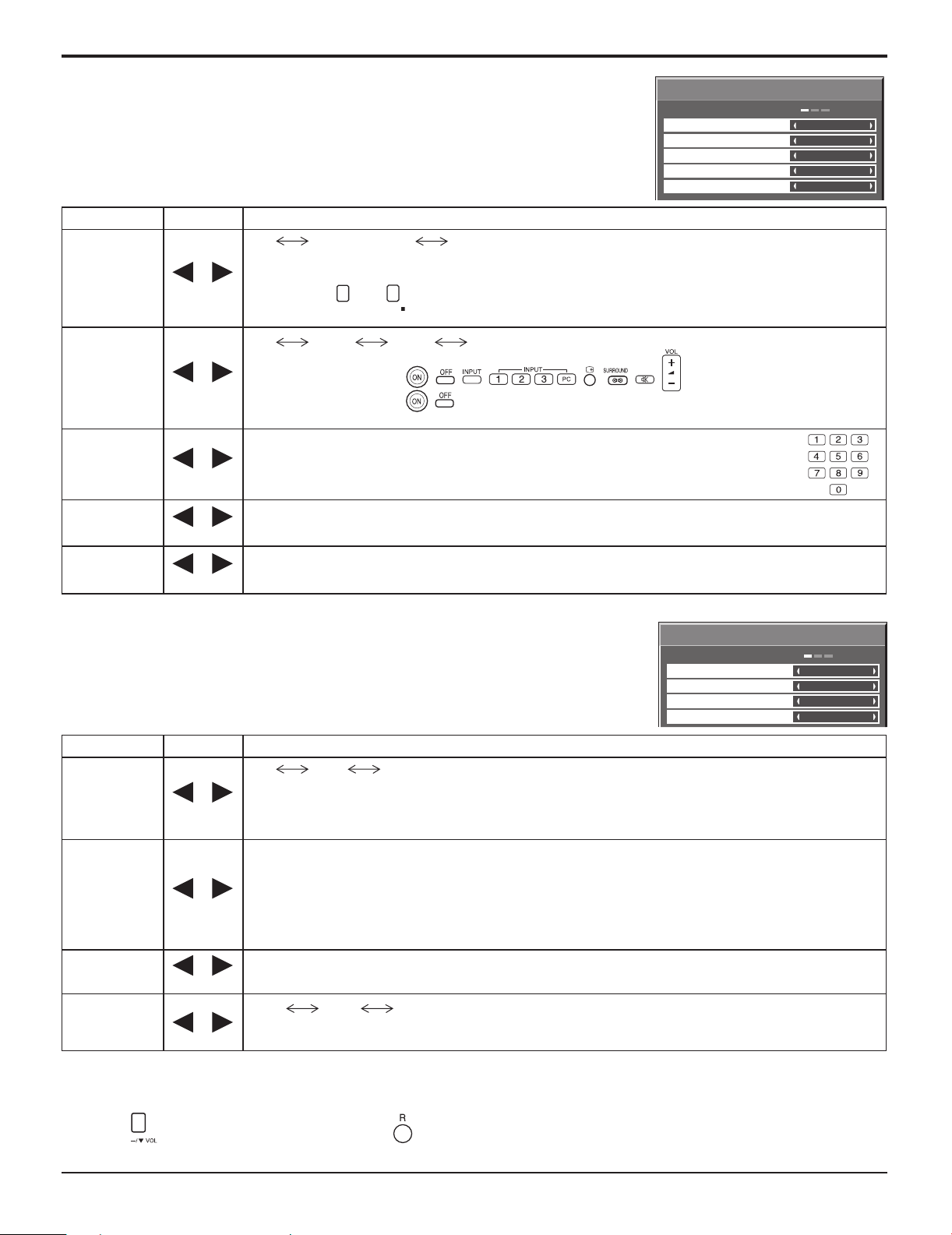
MENU
ENTER/
Options Adjustments
Item Effect Adjustments
Off MENU&ENTER On
Off: All the buttons at the bottom of the main unit can be used.
Button lock
Remocon
User level
ID select
Remote ID
Serial ID
Off On
Off On
MENU & ENTER:
Locks
and
buttons on bottom face of main unit.
On: Locks all the button on bottom face of main unit.
Off User1 User2 User3
Off: You can use all of the buttons on the remote control.
User1:
You can only use , , , , , , , buttons on the remote control.
You can only use
User2:
, , buttons on the remote control.
User3: Locks all the buttons on remote control.
Sets panel ID number when panel is used in “Remote ID” or “Serial ID”.
Set value range: 0 - 100
(Standard value: 0)
Off: Disables ID remote control functions. You can use normal remote control operations.
On: Enable ID remote control functions.
Sets the panel ID Control.
Off: Disables external control by the ID.
On: Enables the external control by the ID.
Options
Button lock
Remocon User level
ID select
Remote ID
Serial ID
2/3
Off
Off
0
Off
Off
Options
Slot power
V. lnstallation
Rotate
Serial Slot Select
3/3
Off
Off
Off
Slot1
Item Effect Adjustments
Off Auto On
Off: Power is not transmitted to the slot power.
Slot Power
Auto: Power is transmitted to the slot power only when main power is on.
On: Power is transmitted to the slot power when main power is on or in the standby state.
Note:
In some cases, power is transmitted to the slot power when main power is on or in the standby state regardless of the slot power setting.
Off: Sets fan to the horizontal installation mode.
On: Sets fan to the vertical installation mode.
Notes:
V.Installation
Off On
• This functions when display is turned on.
• This mode is available for TH-42PH9UK, TH-50PH9UK.
• Vertical installation is available for TH-42PS9UK without this mode setting.
• Turn up the power switch for the upward direction when you set Display vertically.
Rotate
Serial Slot
Select
Off On
Off: Does not rotate the image.
On: Rotates the image 180 degrees.
Slot1 Slot2 Slot3
Selects the slot which communicates serial.
Note:
The setting of an external command can be set only from the fi xed serial terminal (see page 11)
Normalization
When both main unit buttons and remote control are disabled due to the “Button lock”, “Remocon User level” or “Remote
ID” adjustments, set all the values “Off” so that all the buttons are enabled again.
Press the
button on main unit together with button on the remote control and hold for more than 5 seconds. The
“SHIPPING” menu is displayed and the lock is released when it disappears.
43
Page 44
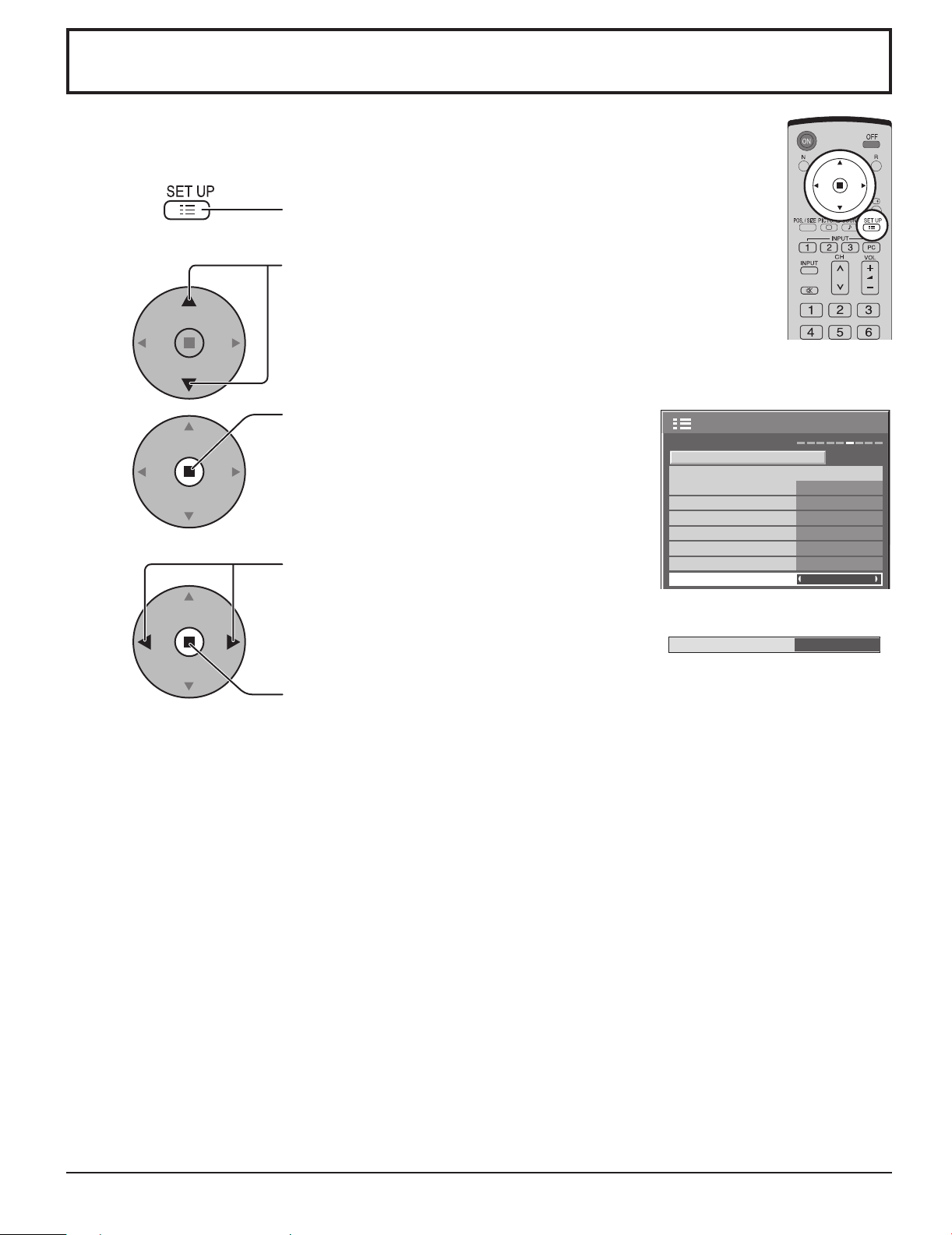
Shipping condition
This function allows you to reset the unit to the factory setting.
1
Press to display the SET UP menu.
2
3
4
Press to select “OSD LANGUAGE”.
Press and hold till the SHIPPING menu is
displayed.
Press to select “YES”.
Press to confi rm.
SET UP
COMPONENT/RGB-IN SELECT
INPUT LABEL
POWER SAVE
STANDBY SAVE
POWER MANAGEMENT
AUTO POWER OFF
OSD LANGUAGE ENGLISH (US
SHIPPING
SIGNAL
RGB
PC
OFF
OFF
OFF
OFF
YES
1/2
)
[from the unit]
1 Press the MENU button till the Setup menu is displayed.
2 Press the Volume Up “+” or Down “–” button to select “OSD LANGUAGE”.
3 Press and hold the ENTER button till the SHIPPING menu is displayed.
4 Press the Volume Up “+” or Down “–” button to select “YES”.
5 Press the ENTER button.
Note:
Press the R button to return to SET UP menu when SHIPPING menu is displayed.
44
Page 45
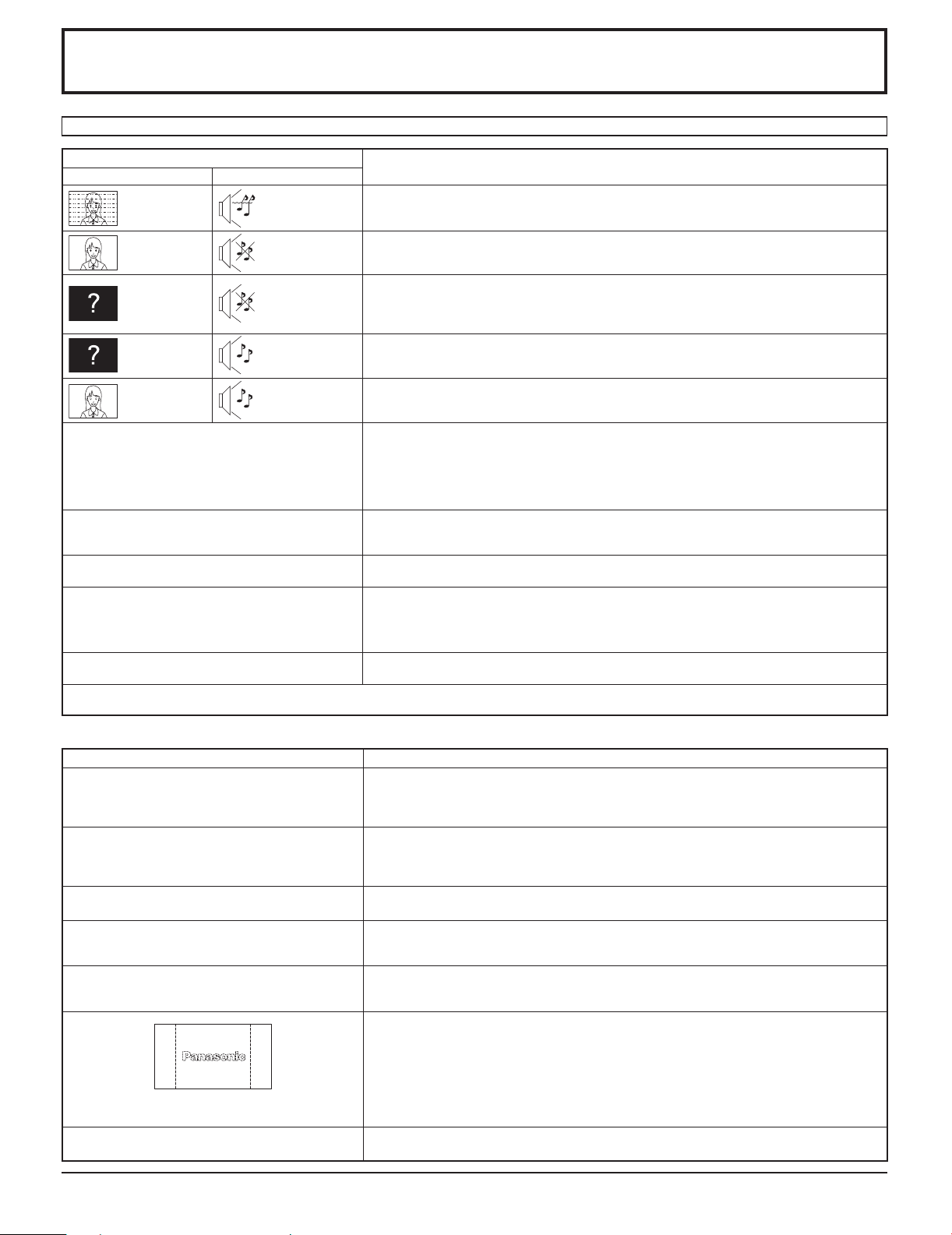
Troubleshooting
Before you call for service, determine the symptoms and make a few simple checks as shown below.
Symptoms
Picture Sound
Interference Noisy Sound
Normal Picture No Sound
No Picture No Sound
No Picture Normal Sound
No Color Normal Sound
No remote control operations can be performed. Check whether the batteries have discharged completely and, if they have not, whether they
A cracking sound is sometimes heard from the unit. If there is nothing wrong with the picture or sound, this is the sound of the cabinet undergoing
The top or bottom of the picture on the screen is cut
off when I use the zoom function.
Areas at the top and bottom of the screen where
the image is missing appear when I use the zoom
function.
Electrical Appliances
Cars / Motorcycles
Fluorescent light
Volume
(Check whether the mute function has been activated on the remote control.)
Not plugged into AC outlet
Not switched on
PICTURE and BRIGHTNESS/Volume setting
(Check by pressing the power switch or stand-by button on the remote control.)
If a signal with a non-applicable color system format, or frequency is input, only the input
terminal indication is displayed.
Color controls set at minimum level. (see page 23, 24)
COLOR SYSTEM (see page 39)
were inserted properly.
Check whether the remote control sensor is exposed to an outdoor light or a strong fl uorescent
light.
Check whether the remote control designed specifi cally for use with the unit is being used.
(The unit cannot be operated by any other remote control.)
very slight contractions in response to changes in the room temperature. There are no adverse
effects on the performance or other aspects.
Adjust the position of the picture on the screen.
When using a video software program (such as a cinema size program) with a screen wider
than one in the 16:9 mode, blank areas separate from the images are formed at the top and
bottom of the screen.
Checks
I can hear sounds coming from inside the unit. When the power is turned on, a sound of the display panel being driven may be heard: This is
This Plasma Display uses special image processing. Hence a slight time lag may occur between image and audio, depending on the type of input
signal. However, this is not a malfunction.
normal and not indicative of malfunctioning.
Plasma Display panel
Symptoms Check
The screen darkens slightly when bright pictures with
minimal movements are shown.
It takes a while for the picture to appear. The unit digitally processes the various signals in order to reproduce esthetically pleasing
The edges of the images fl icker. Due to the characteristics of the system used to drive the panel, the edges may appear to fl icker
The brightness on both sides of images in NORMAL
mode changes.
Some parts of the screen do not light up. The plasma display panel is manufactured using an extremely high level of precision technology,
After-images appear
[for TH-37PH9UK, TH-42PH9UK, TH-50PH9UK]
Whirring sounds can be heard from the display unit.
The screen will darken slightly when photos, still images of a computer or other pictures with
minimal movements are shown for an extended period. This is done to reduce after-image
on the screen and the shortening of the screen’s service life: It is normal and not indicative of
malfunctioning.
images. As such, it sometimes takes a few moments for the picture to appear when the power
has been turned on, when the input has been switched or when the images for the main picture
and sub picture on the two screens are swapped.
in the fast-moving parts of the images: This is normal and not indicative of malfunctioning.
When viewing the side panels at the “BRIGHT” or “MID” setting, the brightness on both sides
may change depending on the kind of program shown: This is normal and not indicative of
malfunctioning.
however, sometimes some parts of the screen may be missing picture elements or have luminous
spots. This is not a malfunction.
Do not allow a still picture to be displayed for an extended period, as this can cause a permanent
after-image to remain on the Plasma Display.
Examples of still pictures include logos, video games, computer images, teletext and images
displayed in NORMAL mode.
Note:
The permanent after-image on the Plasma Display resulting from fi xed image use is not an
operating defect and as such is not covered by the Warranty.
This product is not designed to display fi xed images for extended periods of time.
The display unit is fi tted with a cooling fan to dissipate heat generated during normal use. The
whirring sound is caused by rotation of the fan and is not a malfunction.
45
Page 46
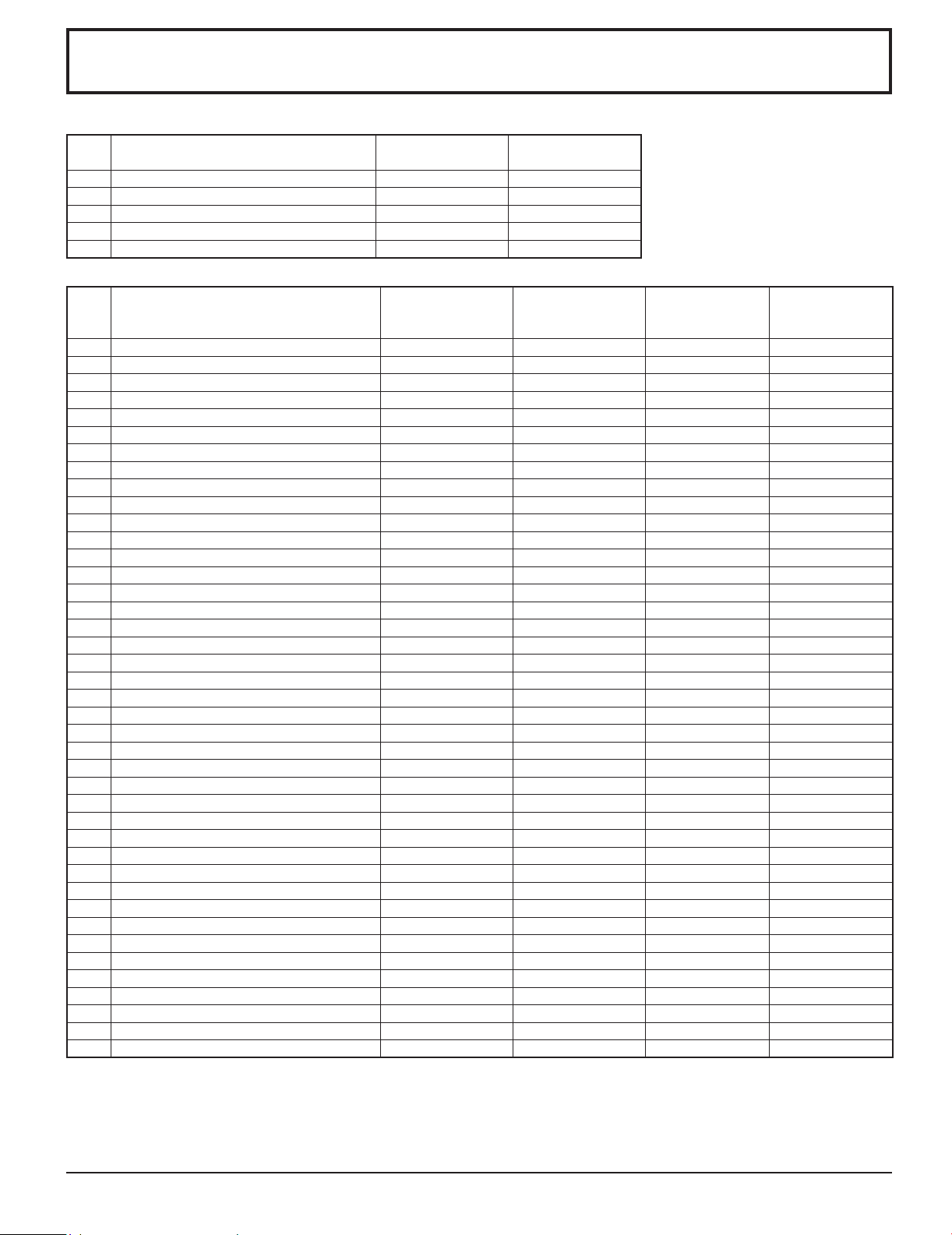
VIDEO/COMPONENT/RGB/PC input signals
VIDEO input
Signal name
1 NTSC 15.73 59.94
2 PAL 15.63 50.00
3 PAL60 15.73 59.94
4 SECAM 15.63 50.00
5 Modifi ed NTSC 15.73 59.94
Applicable input signals for Component / Mini D-sub 15P (Component) / RGB / Mini D-sub 15P (RGB) (∗ Mark)
Signal name
1 525 (480) / 60i 15.73 59.94
2 525 (480) / 60p 31.47 59.94
3 625 (575) / 50i 15.63 50.00
4 625 (575) / 50p 31.25 50.00
5 750 (720) / 60p 45.00 60.00
6 750 (720) / 50p 37.50 50.00
7 1,125 (1,080) / 60i 33.75 60.00
8 1,125 (1,080) / 50i 28.13 50.00
9 1,125 (1,080) / 24p 27.00 24.00
10 1,125 (1,080) / 24sF 27.00 47.92
11 1,125 (1,080) / 25p 28.13 25.00
12 1,125 (1,080) / 30p 33.75 30.00
13 1,250 (1,080) / 50i 31.25 50.00
14 640 × 400 @70 Hz 31.46 70.07
15 640 × 480 @60 Hz 31.47 59.94
16 640 × 480 @72 Hz 37.86 72.81
17 640 × 480 @75 Hz 37.50 75.00
18 640 × 480 @85 Hz 43.27 85.01
19 852 × 480 @60 Hz 31.47 59.94
20 800 × 600 @56 Hz 35.16 56.25
21 800 × 600 @60 Hz 37.88 60.32
22 800 × 600 @72 Hz 48.08 72.19
23 800 × 600 @75 Hz 46.88 75.00
24 800 × 600 @85 Hz 53.67 85.06
25 1,024 × 768 @60 Hz 48.36 60.00
26 1,024 × 768 @70 Hz 56.48 70.07
27 1,024 × 768 @75 Hz 60.02 75.03
28 1,024 × 768 @85 Hz 68.68 85.00
29 1,152 × 864 @75 Hz 67.50 75.00
30 1,280 × 960 @60 Hz 60.00 60.00
31 1,280 × 960 @85 Hz 85.94 85.00
32 1,280 × 1,024 @60 Hz 63.98 60.02
33 1,280 × 1,024 @75 Hz 79.98 75.03
34 1,280 × 1,024 @85 Hz 91.15 85.02
35 1,600 × 1,200 @60 Hz 75.00 60.00
36 1,600 × 1,200 @65 Hz 81.25 65.00
37 1,066 × 600 @60 Hz 37.88 60.32
38 1,366 × 768 @60 Hz 48.36 60.00
39 Macintosh13” (640 × 480) 35.00 66.67
40 Macintosh16” (832 × 624) 49.72 74.54
41 Macintosh21” (1,152 × 870) 68.68 75.06
Horizontal Vertical
frequency(kHz) frequency(Hz)
Horizontal
frequency (kHz)
Vertical
frequency (Hz)
Component /
Mini D-sub 15P
(Component)
∗∗
∗
∗∗
∗∗
∗∗
∗∗
∗∗
∗∗
∗∗
∗∗
∗∗
∗∗
∗∗
RGB /
Mini D-sub 15P
(RGB)
1
∗
∗
2
∗
∗
∗
∗
2
∗
∗
∗
∗
∗
∗
∗
∗
∗
∗
∗
∗
∗
∗
∗
∗
∗
∗
∗
∗
∗
∗
∗
∗
1:
When selected the RGB format and 525p signal input to the Mini D-sub 15P terminal, it is recognized as VGA 60Hz signal.
∗2:
When inputted VGA 60Hz format signal from the other than Mini D-sub 15P terminal, it is recognized as 525p signal.
Note: Signals without above specifi cation may not be displayed properly.
46
Page 47
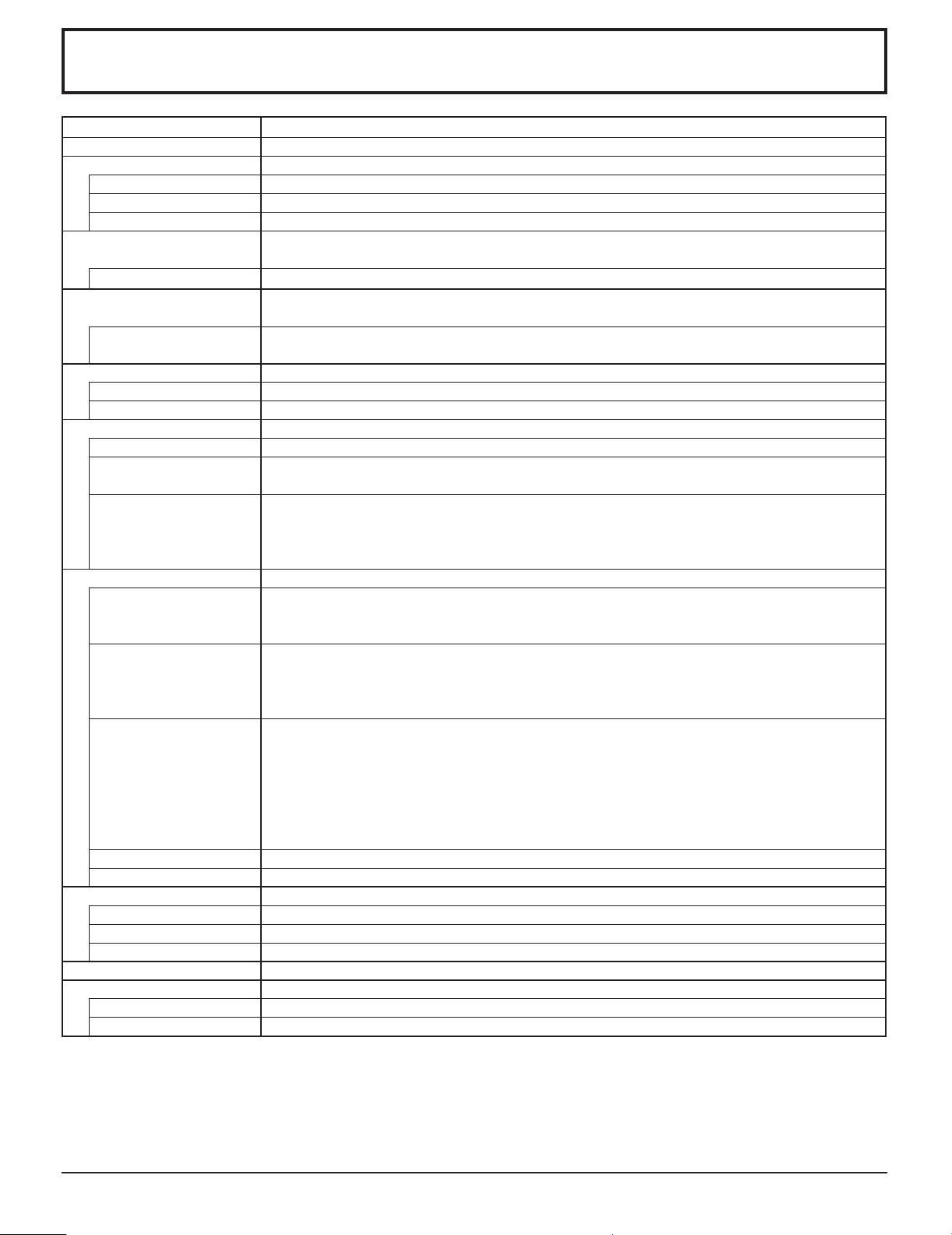
Specifi cations
TH-42PS9UK
Power Source 120 V AC, 50/60 Hz
Power Consumption
Power on 290W
Stand-by condition Save OFF 0.6 W, Save ON 0.4 W
Power off condition 0.1 W
Plasma Display panel Drive method : AC type 42-inch,
16:9 aspect ratio
Contrast Ratio Max 10000:1
Screen size
(No.of pixels) 408,960 (852 (W) × 480 (H))
Operating condition
Temperature 32 °F - 104 °F (0 °C - 40 °C)
Humidity 20 % - 80 %
Applicable signals
Color System NTSC, PAL, PAL60, SECAM, Modifi ed NTSC
Scanning format 525 (480) / 60i · 60p, 625 (575) / 50i · 50p, 750 (720) / 60p · 50p, 1125 (1080) / 60i · 50i · 24p · 25p
· 30p · 24sF ···· SMPTE274M, 1250 (1080) / 50i
PC signals VGA
Connection terminals
AV VIDEO IN (BNC) 1.0 Vp-p (75 Ω or high impedance)
S VIDEO IN (MINI DIN 4PIN) Y: 1 Vp-p (75 Ω), C: 0.286 Vp-p (75 Ω)
AUDIO IN (RCA PIN JACK × 4) 0.5 Vrms (high impedance)
COMPONENT/RGB Y/G (BNC) 1.0 Vp-p/with/sync (75 Ω)
0.7 Vp-p/without/sync (75 Ω)
P
B/B (BNC), PR/R (BNC) 0.7 Vp-p (75 Ω)
AUDIO IN (RCA PIN JACK × 2) 0.5 Vrms (high impedance)
PC (HIGH-DENSITY Mini-D-SUB 15PIN) R,G,B/0.7 Vp-p (75 Ω)
HD, VD/1.0 - 5.0 Vp-p (high impedance)
Component
Y : 1.0 Vp-p (75 Ω : include sync)
P
P
AUDIO IN (M3 JACK) 0.5 Vrms (high impedance)
SERIAL EXTERNAL CONTROL TERMINAL (D-SUB 9PIN) RS-232C COMPATIBLE
SPEAKERS (6 Ω) 16W [8 W + 8 W] (10 % THD)
Accessories Supplied
Remote Control Transmitter
Batteries 2 × AA Size
Fixing bands (TMME203 or TMME187) × 2
Dimensions (W × H × D)
Mass (weight)
main unit only approx. 57.3 lbs
with speakers approx. 66.1lbs
36.2” (920 mm) (W) × 20.4” (518 mm) (H)
× 42” (1,056 mm) (diagonal)
[2,556 × 480 dots]
SVGA, XGA, SXGA, UXGA ···· (compressed)
Horizontal scanning frequency 15 - 110 kHz
Vertical scanning frequency 48 - 120 Hz
B/CB : 0.7 Vp-p (75 Ω)
R/CR : 0.7 Vp-p (75 Ω)
EUR7636070R
40.2” (1,020 mm) × 24” (610 mm) × 3.5” (89 mm)
Note:
Design and specifi cations are subject to change without notice. Mass and dimensions shown are approximate.
47
Page 48
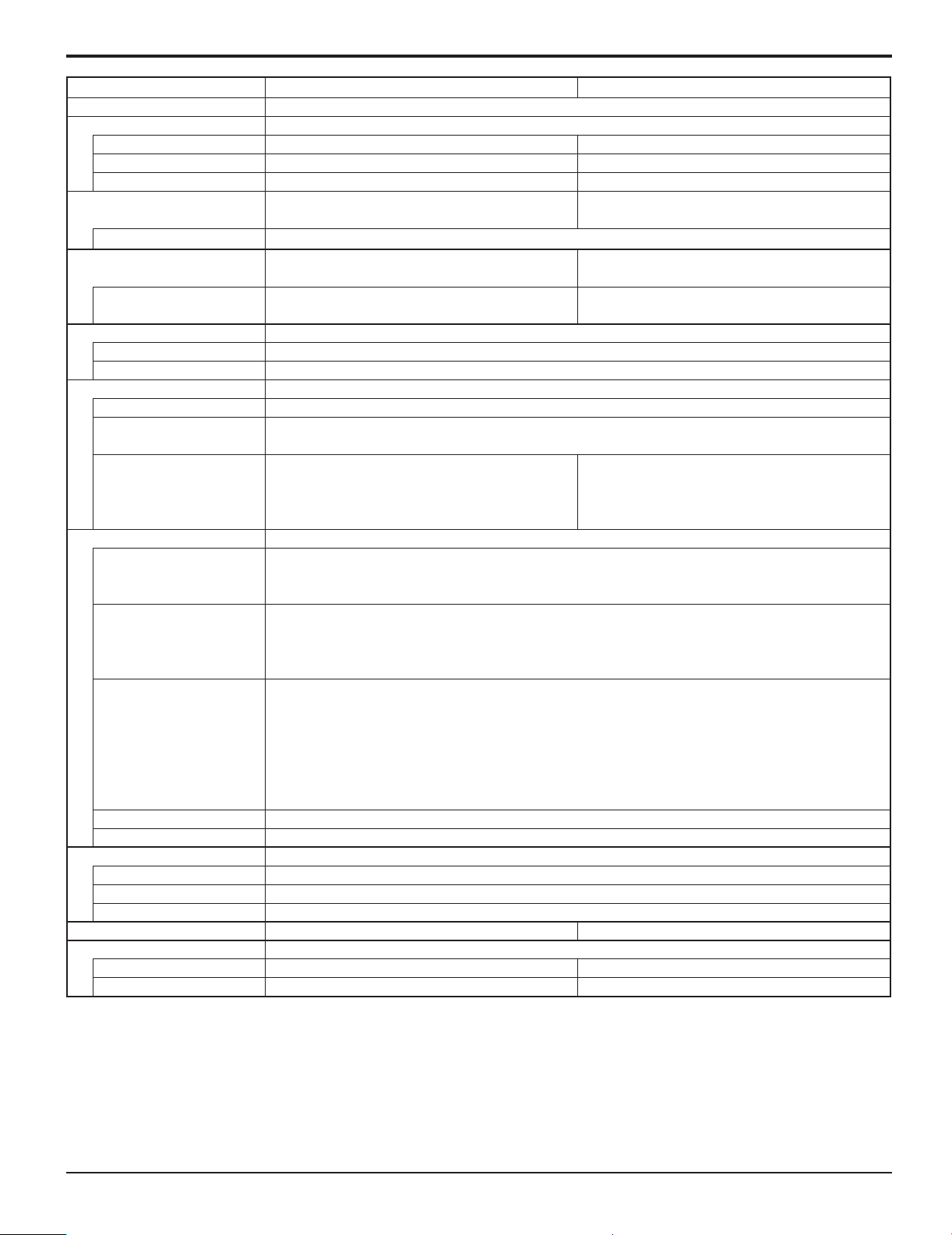
Specifi cations
TH-37PH9UK TH-42PH9UK
Power Source 120 V AC, 50/60 Hz
Power Consumption
Power on 300W 345W
Stand-by condition Save OFF 0.6 W, Save ON 0.4 W Save OFF 0.6 W, Save ON 0.4 W
Power off condition 0.1 W 0.1 W
Plasma Display panel Drive method : AC type 37-inch,
16:9 aspect ratio
Contrast Ratio
Screen size
(No.of pixels) 737,280 (1,024 (W) × 720 (H))
Operating condition
Temperature 32 °F - 104 °F (0 °C - 40 °C)
Humidity 20 % - 80 %
Applicable signals
Color System NTSC, PAL, PAL60, SECAM, Modifi ed NTSC
Scanning format 525 (480) / 60i · 60p, 625 (575) / 50i · 50p, 750 (720) / 60p · 50p, 1125 (1080) / 60i · 50i · 24p · 25p
PC signals VGA, SVGA,
Connection terminals
AV VIDEO IN (BNC) 1.0 Vp-p (75 Ω or high impedance)
COMPONENT/RGB Y/G (BNC) 1.0 Vp-p/with/sync (75 Ω)
PC (HIGH-DENSITY Mini-D-SUB 15PIN) R,G,B/0.7 Vp-p (75 Ω)
SERIAL EXTERNAL CONTROL TERMINAL (D-SUB 9PIN) RS-232C COMPATIBLE
SPEAKERS (6 Ω) 16W [8 W + 8 W] (10 % THD)
Accessories Supplied
Remote Control Transmitter
Batteries 2 × AA Size
Fixing bands (TMME203 or TMME187) × 2
Dimensions (W × H × D)
Mass (weight)
main unit only approx. 50.7 lbs approx. 59.5 lbs
with speakers approx. 59.5 lbs approx. 68.3 lbs
32.2” (818 mm) (W) × 18.1” (461 mm) (H)
× 37” (939 mm) (diagonal)
[3,072 × 720 dots]
· 30p · 24sF ···· SMPTE274M, 1250 (1080) / 50i
XGA, SXGA, UXGA ···· (compressed)
Horizontal scanning frequency 15 - 110 kHz
Vertical scanning frequency 48 - 120 Hz
S VIDEO IN (MINI DIN 4PIN) Y: 1 Vp-p (75 Ω), C: 0.286 Vp-p (75 Ω)
AUDIO IN (RCA PIN JACK × 4) 0.5 Vrms (high impedance)
0.7 Vp-p/without/sync (75 Ω)
P
B/B (BNC), PR/R (BNC) 0.7 Vp-p (75 Ω)
AUDIO IN (RCA PIN JACK × 2) 0.5 Vrms (high impedance)
HD, VD/1.0 - 5.0 Vp-p (high impedance)
Component
Y : 1.0 Vp-p (75 Ω : include sync)
P
P
AUDIO IN (M3 JACK) 0.5 Vrms (high impedance)
36.2” (920 mm) × 21.7” (550 mm) × 3.5” (89 mm)
B/CB : 0.7 Vp-p (75 Ω)
R/CR : 0.7 Vp-p (75 Ω)
Max 10000:1
36.2” (920 mm) (W) × 20.4” (518 mm) (H)
Horizontal scanning frequency 15 - 110 kHz
Vertical scanning frequency 48 - 120 Hz
EUR7636070R
40.2” (1,020 mm) × 24” (610 mm) × 3.5” (89 mm)
Drive method : AC type 42-inch,
16:9 aspect ratio
× 42” (1,056 mm) (diagonal)
786,432 (1,024 (W) × 768 (H))
[3,072 × 768 dots]
VGA, SVGA, XGA,
SXGA, UXGA ···· (compressed)
Note:
Design and specifi cations are subject to change without notice. Mass and dimensions shown are approximate.
48
Page 49
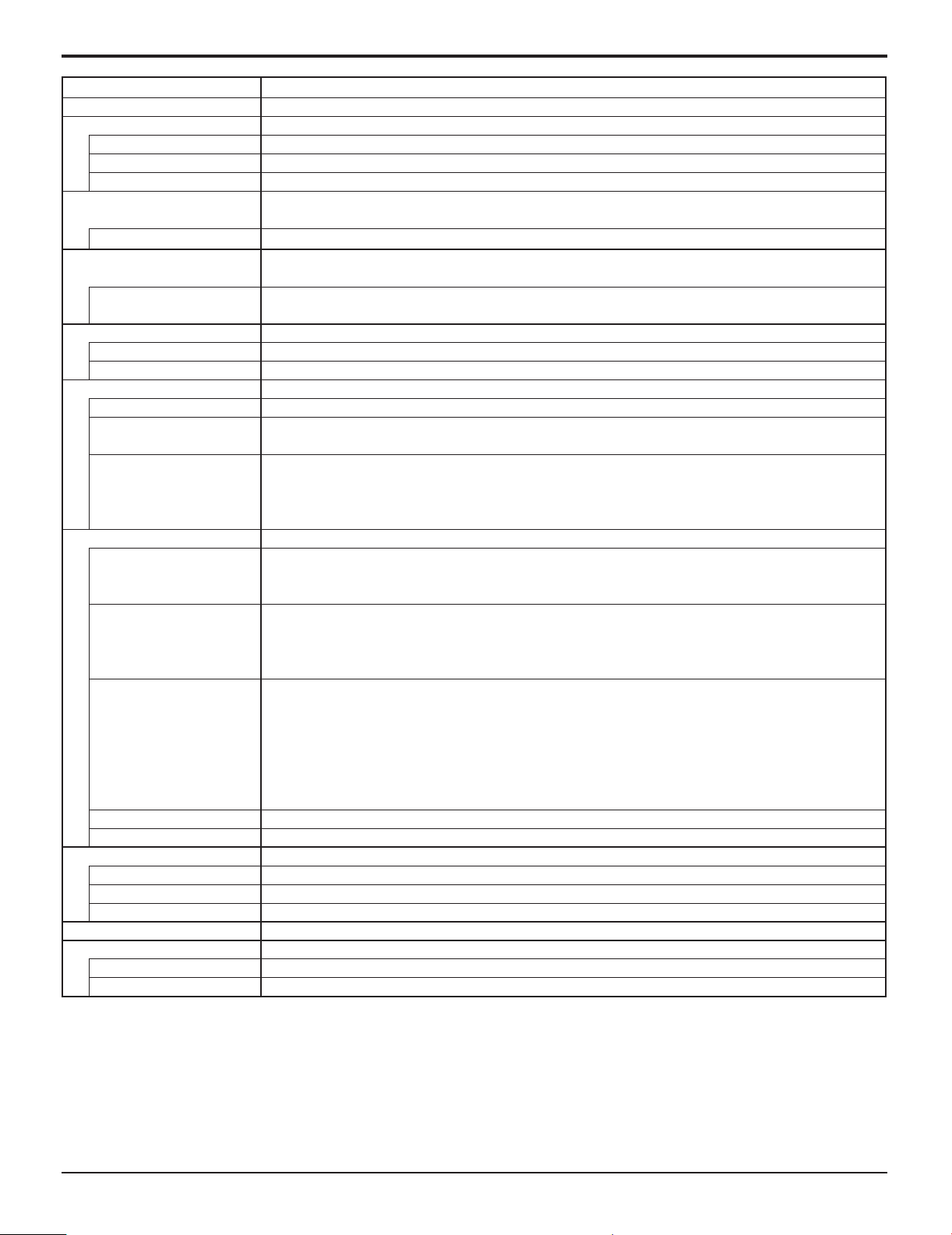
Specifi cations
TH-50PH9UK
Power Source 120 V AC, 50/60 Hz
Power Consumption
Power on 460W
Stand-by condition Save OFF 0.5 W, Save ON 0.3 W
Power off condition 0.1 W
Plasma Display panel Drive method : AC type 50-inch,
16:9 aspect ratio
Contrast Ratio
Screen size 43.5” (1,106 mm) (W) × 24.5” (622 mm) (H)
(No.of pixels) 1,049,088 (1,366 (W) × 768 (H))
Operating condition
Temperature 32 °F - 104 °F (0 °C - 40 °C)
Humidity 20 % - 80 %
Applicable signals
Color System NTSC, PAL, PAL60, SECAM, Modifi ed NTSC
Scanning format 525 (480) / 60i · 60p, 625 (575) / 50i · 50p, 750 (720) / 60p · 50p, 1125 (1080) / 60i · 50i · 24p · 25p
· 30p · 24sF ···· SMPTE274M, 1250 (1080) / 50i
PC signals VGA, SVGA, XGA,
SXGA, UXGA ···· (compressed)
Horizontal scanning frequency 15 - 110 kHz
Vertical scanning frequency 48 - 120 Hz
Connection terminals
AV VIDEO IN (BNC) 1.0 Vp-p (75 Ω or high impedance)
S VIDEO IN (MINI DIN 4PIN) Y: 1 Vp-p (75 Ω), C: 0.286 Vp-p (75 Ω)
AUDIO IN (RCA PIN JACK × 4) 0.5 Vrms (high impedance)
COMPONENT/RGB Y/G (BNC) 1.0 Vp-p/with/sync (75 Ω)
0.7 Vp-p/without/sync (75 Ω)
P
B/B (BNC), PR/R (BNC) 0.7 Vp-p (75 Ω)
AUDIO IN (RCA PIN JACK × 2) 0.5 Vrms (high impedance)
PC (HIGH-DENSITY Mini-D-SUB 15PIN) R,G,B/0.7 Vp-p (75 Ω)
HD, VD/1.0 - 5.0 Vp-p (high impedance)
Component
Y : 1.0 Vp-p (75 Ω : include sync)
P
P
AUDIO IN (M3 JACK) 0.5 Vrms (high impedance)
SERIAL EXTERNAL CONTROL TERMINAL (D-SUB 9PIN) RS-232C COMPATIBLE
SPEAKERS (6 Ω) 16W [8 W + 8 W] (10 % THD)
Accessories Supplied
Remote Control Transmitter
Batteries 2 × AA Size
Fixing bands (TMME203 or TMME187) × 2
Dimensions (W × H × D)
Mass (weight)
main unit only approx. 81.6 lbs
with speakers approx. 90.4 lbs
B/CB : 0.7 Vp-p (75 Ω)
R/CR : 0.7 Vp-p (75 Ω)
47.6” (1,210 mm) × 28.5” (724 mm) × 3.7” (95 mm)
Max 10000:1
× 50” (1,269 mm) (diagonal)
[4,098 × 768 dots]
EUR7636070R
Note:
Design and specifi cations are subject to change without notice. Mass and dimensions shown are approximate.
49
Page 50
Panasonic Broadcast & Television Systems
Company, Unit of Panasonic Corporation of
North America
One Panasonic Way 2A-4
Secaucus, NJ 07094
Panasonic Puerto Rico, Inc.
Ave. 65de Infanteria, Km.9.5
San Gabriel Industrial Park
Carolina, Puerto Rico 00985
PANASONIC PLASMA SCREEN
Limited Warranty
Panasonic Broadcast & Television Systems Company or
Panasonic Puerto Rico, Inc. (collectively referred to as
“the Warrantor”) will repair this product and all included
accessories with new or refurbished parts, free of charge
in the USA or Puerto Rico, of the original purchase in
the event of a defect in materials or workmanship as
follow:
Models or Parts
Part
Warranty
Labor
Warranty
Plasma Screen
1 Year
1 Year
Carry-in or mail-in service in the USA may be obtained
during the warranty period by contacting Panasonic
Broadcast & Television Systems Company Factory
Servicenter listed in the Service Directory or call toll
free 1-800-526-6610 to locate an authorized Servicenter.
Carry-in or mail-in service in Puerto Rico can be
obtained during the warranty period by 787-750-5135
This warranty is extended only to the original purchaser
and is non transferable. A purchase receipt or other
proof of date of original purchase will be required before
warranty service is rendered.
This warranty only covers failures due to defects in
materials or workmanship, which occur during normal
use. The warranty does not cover damage which occur
in shipment, or failures which are caused by products
not supplied by the warrantor
, or failures which result
installation, set-up adjustments, improper antenna,
inadequate signal pickup, maladjustment of consumer
controls, improper operation, power line surge, improper
voltage supply, lighting damage, or service by anyone
other than an authorized repair facility, or damaged this
attributable to acts of God.
LIMITS AND EXCLUSIONS
There are no express warranties except as listed above.
THE WARRANTOR SHALL NOT BE LIABLE FOR
INCIDENTAL OR CONSEQUENTIAL DAMAGES
(INCLUDING, WITHOUT LIMITION, DAMAGE
TO DISCS) RESULTING FROM THE USE OF THIS
PRODUCT, OR ARISING OUT OF ANY BREACH OF
THE WARRANTY. ALL EXPRESS AND IMPLIED
WARRANTIES, INCLUDING THE WARRANTIES
OF MERCHANTABILITY AND FITNESS FOR
PARTICULAR PURPOSE, ARE LIMITED TO THE
APPLICABLE WARRANTY PERIOD SET FORTH
ABOVE.
Some states do not allow the exclusion or limitation
of incidental or consequential damages, or limitations
on how long an implied warranty lasts, so the above
exclusions or limitations may nor apply to you. This
warranty gives you specific legal rights and you may
other rights, which vary from state to state.
If you have a problem with this product that is not
handled to your satisfaction, then
write the Consumer
Affairs Department at the Company
address indicated
above.
In the USA
FOR THE NEAREST SERVICE CENTER
1-800-526-6610
Regional Offi ces
New Jersey
50 Meadowlands Pkwy – 2A4
Secaucus, NJ 07094
201-348-7975
Illinois
1713 N. Randall – E1-E1
Elgin, IL 60123
847-468-5270
Georgia
1225 Northbrook Pkwy
Suwanee, GA 30093
770-338-6855
California
3330 Cahuenga Blvd West
Los Angeles, CA 90068
323-436-3505
In Puerto Rico
For service call 787-750-5135
Page 51
Customer’s Record
Panasonic Canada Inc.
Broadcast & Television Systems Division
5770 Ambler Drive, Mississauga, Ontario L4W 2T3
LIMITED WARRANTY STATEMENT
Panasonic Canada Inc. (also known as PCI) warrants this product to be free of
defects in material and workmanship under normal use during the applicable
warranty coverage period described below. PCI agrees to repair, or at its option,
exchange, any part that becomes defective. However, the product must be
purchased and serviced in Canada. The product or part that shows evidence of
defect must be delivered prepaid or carried in to an authorized Panasonic Broadcast
Service Center. This warranty does not cover shipping costs.
The warranty coverage period is one year for both parts and labour beginning with
the date of original end user purchase, subject to the exceptions as stated below.
Repaired or replacement parts supplied during the warranty coverage period carry
the unexpired portion of the original warranty coverage period. Proof of product
purchase is a condition of warranty service. The owner must produce the product
purchase receipt or other satisfactory evidence of date of original purchase.
This warranty does not apply to external appearance items, such as handles, knobs,
safety windows, etc. This warranty does not apply to any part, or parts, of the
product, installed, altered, repaired or misused in any way that, in the opinion of PCI,
affects the reliability of or detracts from the performance of the product.
For products requiring routine preventive maintenance, that maintenance must be
performed in order to maintain warranty coverage.
Serial numbers that have been altered, defaced or removed void this warranty. This
warranty does not cover replacements or repairs necessitated by loss or damage
resulting from any cause beyond the control of PCI.
Marking or retained images (sometimes called “burn-in”) resulting from the display of
fixed images on video display products are not defects and are not covered under
this warranty.
THIS EXPRESS, LIMITED WARRANTY IS IN LIEU OF ALL OTHER
WARRANTIES, EXPRESS OR IMPLIED, INCLUDING ANY IMPLIED
WARRANTIES OF MERCHANTABILITY AND FITNESS FOR A PARTICULAR
PURPOSE. IN NO EVENT WILL PANASONIC CANADA INC. BE LIABLE FOR
ANY SPECIAL, INDIRECT OR CONSEQUENTIAL DAMAGES.
In certain instances, some jurisdictions do not allow the exclusion or limitation of
incidental or consequential damages, or the exclusion of implied warranties, so the
above limitations and exclusions may not be applicable.
Warranty Service
If the product needs to be shipped for service, carefully pack (preferably in the
original carton) and enclose a letter, detailing the complaint. Send prepaid and
adequately insured to the local authorized Panasonic Broadcast Service Centre in
your area or to Panasonic Broadcast & Security Systems Service Department, 5770
Ambler Drive, Mississauga, Ontario, L4W 2T3. Shipping to the latter location
requires a return authorization before shipment. No liability is assumed for loss or
damage to the product while in transit.
Item
Video Tape
P2 Cards
Video Heads
D5 Video heads
Maintenance Items
Colour Camera CCD
Imaging Block
LCD/CRT Monitors
* DLP™ Projectors
* LCD Projectors above
2,500 ANSI Lumens
* LCD Projectors below
2,500 ANSI Lumens
Projector Lamps
Plasma Displays
Hard Drive Disk Unit
Parts
30 days— Replacement only
(content not covered)
(Content not covered)
1 year or 2,000 hrs. (prorated)
Whichever comes first
1 year or 500 hrs.
Whichever comes first
90 days
2 years
2 years
3 years or 5,000 hrs.
Whichever comes first
3 years or 2,500 hrs.
Whichever comes first
3 years or 1,500 hrs.
Whichever comes first
90 Days or 500 hrs.
Whichever comes first
1 year (burn-in not covered)
1 year plus balance (if any) of
any original Manufacturer’s
Limited Warranty.
(Content not covered)
Labour
N/A
N/A
1 year or 2,000 hrs.
Whichever comes first
1 year or 500 hrs.
Whichever comes first
90 days
1 year
1 year
3 years or 5,000 hrs.
Whichever comes first
3 years or 2,500 hrs.
Whichever comes first.
3 years or 1,500 hrs.
Whichever comes first
90 Days or 500 hrs.
Whichever comes first.
1 year (burn-in not covered)
1 year
≥Dust, smoke, rental/staging environment and twenty-four/seven operation, dramatically
decreases the interval between performances of routine preventive maintenance required
to maintain this warranty coverage.
WARRANTY COVERAGE PERIOD EXCEPTIONS
The model number and serial number of this product can be found on its back cover. You should note this serial number
in the space provided below and retain this book, plus your purchase receipt, as a permanent record of your purchase
to aid in identifi cation in the event of theft or loss, and for Warranty Service purposes.
Model Number Serial Number
2006 Matsushita Electric Industrial Co., Ltd. All Rights Reserved.
©
Panasonic Broadcast & Television Systems Company
Unit of Panasonic Corporation of North America
Executive Offi ce :
One Panasonic Way 4E-7, Secaucus, NJ 07094 (201) 348-7000
EASTERN ZONE : One Panasonic Way 4E-7 Secaucus, NJ 07094 (201) 348-7621
Mid-Atlantic/New England : One Panasonic Way 4E-7 Secaucus, NJ 07094 (201) 348-7621
Southeast Region : 1225 Northbrook Parkway, Ste 1-160 Suwanee GA 30024 (770)338-6835
Central Region : 1707 N Randall Road E1-C-1, Elgin, IL 60123 (847)468-5200
WESTERN ZONE : 3330 Cahuenga Blvd W., Los Angeles, CA 90068 (323) 436-3500
Dallas Region : 6226 Abington Way, Houston, TX 77008 (713) 802-2726
No. CA/Northwest Region : 5870 Stone Ridge, #3, Pleasanton, CA (925) 416-5108
Government Marketing Department : 52 West Gude Drive, Rockville, MD 20850 (301) 738-3840
Panasonic Canada Inc.
5770 Ambler Drive
Mississauga, Ontario
L4W 2T3
MBS0306A1046
Page 52
ADVERTENCIA
RIESGO DE DESCARGA ELÉTRICA
NO ABRIR
ADVERTENCIA: Para reducir el riesgo de sufrir una descarga eléctrica, no retire
la cubierta ni el panel posterior. En el interior no hay piezas que deba reparar el
usuario. Solicite las reparaciones al personal de servicio califi cado.
El rayo con punta de fl echa dentro de un
triángulo equilátero tiene la finalidad de
avisar al usuario de que hay piezas en
el interior del producto que si las tocan
las personas éstas pueden recibir una
descarga eléctrica.
El signo de exclamación dentro de un
triángulo equilátero tiene la finalidad
de avisar al usuario de la existencia de
instrucciones de utilización y servicio
importantes en el material impreso que
acompaña al aparato.
ADVERTENCIA : Para impedir los daños que podrían ser causados por una descarga eléctrica, no exponga
este aparato a la lluvia ni a la humedad.
No ponga recipientes con agua (fl oreros, tazas, cosméticos, etc.) encima del aparato
(incluyendo los estantes que estén encima de él, etc.).
ADVERTENCIA : 1) Para impedir recibir descargas eléctricas, no retire la cubierta. En el interior no hay piezas que
deba reparar el usuario. Solicite las reparaciones al personal de servicio califi cado.
2) No quite la clavija de puesta a tierra del enchufe de alimentación. Este aparato está equipado con
un enchufe de alimentación de tres clavijas, una de las cuales sirve para hacer la puesta a tierra.
Este enchufe sólo puede conectarse a un tomacorriente que también disponga de puesta a tierra.
Esto constituye una medida de seguridad. Si no puede introducir el enchufe en el tomacorriente,
póngase en contacto con un electricista.
No anule la fi nalidad de la clavija de puesta a tierra.
2
Page 53
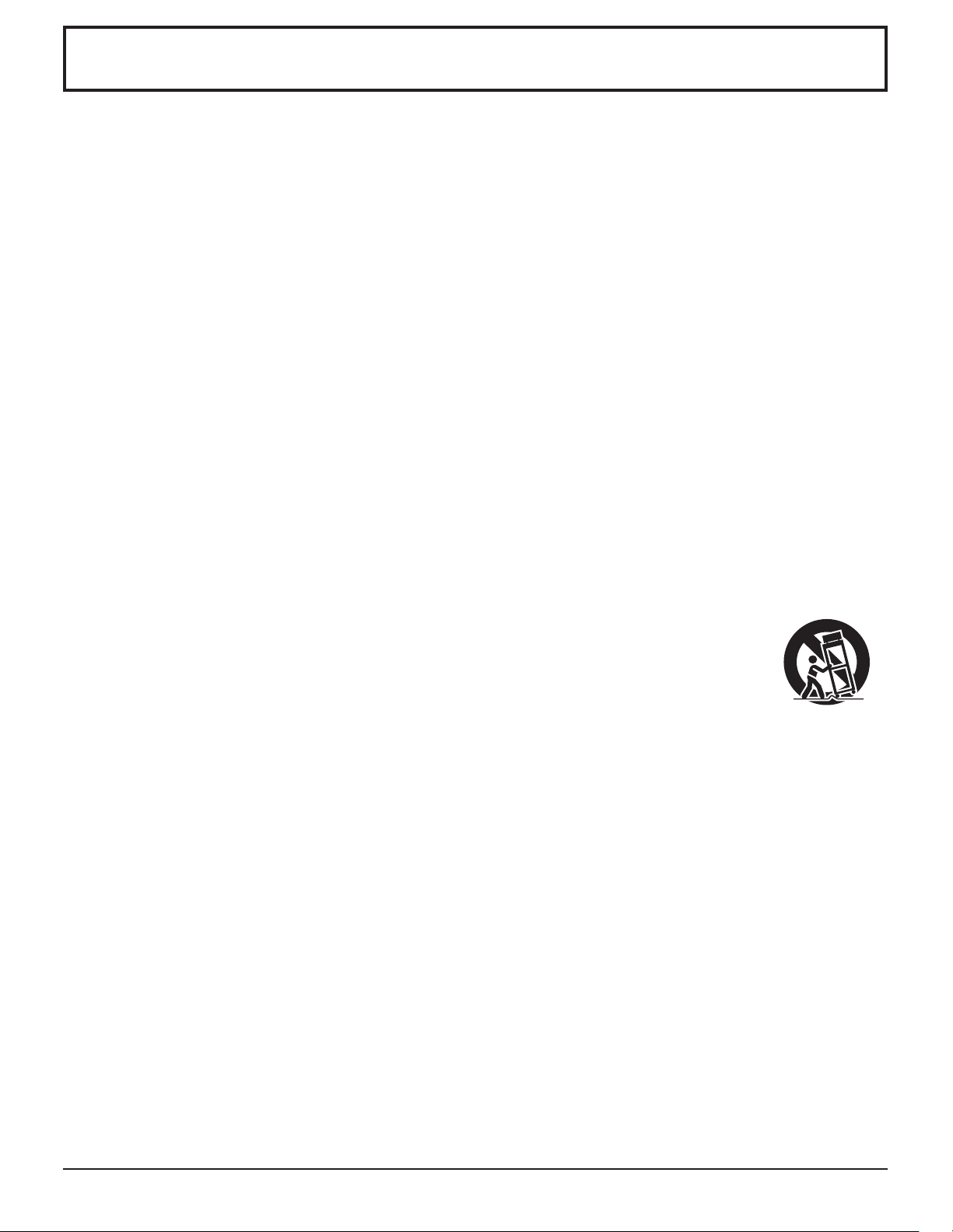
3
Instrucciones de seguridad importantes
1) Lea estas instrucciones.
2) Conserve estas instrucciones.
3) Preste atención a todas las advertencias.
4) Siga todas las instrucciones.
5) No utilice este aparato cerca del agua.
6) Limpie solamente con un paño seco.
7) No tape ninguna abertura de ventilación. Instale el aparato según las instrucciones del fabricante.
8) No instale el aparato cerca de fuentes de calor tales como radiadores, salidas de calor, estufas u otros aparatos
(incluyendo amplifi cadores) que produzcan calor.
9) No anule la característica de seguridad de la clavija polarizada o de la clavija del tipo con conexión a tierra. Una
clavija polarizada tiene dos patillas, una más ancha que la otra. Una clavija del tipo con conexión a tierra tiene dos
patillas y una espiga de conexión a tierra. La patilla ancha o la espiga ha sido suministrada para su seguridad. Si
la clavija suministrada no entra en su toma de corriente, consulte a un electricista para que le cambie la toma de
corriente obsoleta.
10) Proteja el cable de alimentación para que no sea pisado ni pellizcado, especialmente en las clavijas, tomas de
corriente y en el punto por donde sale del aparato.
11) Utilice solamente los aditamentos/accesorios que haya especifi cado el fabricante.
12) Utilice el aparato sólo con el mueble con ruedas, soporte, trípode, ménsula o mesa especifi cado
por el fabricante o vendido con el aparato. Cuando utilice un mueble con ruedas, tenga cuidado
al trasladar la combinación del mueble y el aparato para evitar lesionarse si se cae.
13) Desenchufe este aparato durante tormentas eléctricas o cuando no lo utilice durante mucho
tiempo.
14) Solicite todos los trabajos de reparación al personal de servicio cualificado. La reparación del aparato será
necesaria cuando éste se haya estropeado de cualquier forma; por ejemplo, cuando se haya estropeado la clavija
o el cable de alimentación, cuando se haya derramado líquido o hayan caído objetos en el interior del aparato,
cuando el aparato haya quedado expuesto a la lluvia o a la humedad, cuando no funcione normalmente o cuando
se haya caído.
15) Para impedir las descargas eléctricas, asegúrese de que la patilla de puesta a tierra de la clavija del cable de
alimentación de CA esté fi rmemente conectada.
Page 54

Estimado cliente de Panasonic
Bienvenido a la familia de clientes de Panasonic. Esperamos que pueda disfrutar durante muchos años
con su nueva Pantalla de plasma.
Para recibir el máximo beneficio de su aparato, lea estas instrucciones antes de hacer ajustes y
guárdelas para consultarlas en el futuro.
Guarde también el recibo y anote el número de modelo y número de serie de su aparato en el espacio
de la cubierta posterior de este manual.
Indice
Instrucciones de seguridad importantes ............... 3
Aviso de seguridad importante ............................... 5
Precauciones para su seguridad ............................ 6
Mantenimiento .......................................................... 7
Accesorios ................................................................ 8
Accesorios suministrados ....................................... 8
Pilas del mando a distancia .................................... 8
Conexiones ............................................................... 9
Conexión de los terminales de entrada PC ........... 10
Conexión de los terminales SERIAL ..................... 11
Conexión AV y COMPONENT / RGB .................... 12
Señales RGB (R, G, B) ......................................... 12
Encendido/apagado de la alimentación .............. 13
Controles básicos .................................................. 14
Indicación en pantalla ........................................... 16
Selecciones iniciales ............................................. 18
Selección de la señal de entrada .......................... 18
Selección del idioma del menú en pantalla .......... 18
Controles de ASPECTO ......................................... 19
Ajuste de Pos. /Tamaño ......................................... 20
MULTI PIP ............................................................... 21
Advanced PIP (PIP avanzado) .............................. 22
Ajuste de imagen ................................................... 23
Ajustes avanzados ................................................ 24
Ajuste del sonido ................................................... 25
Silenciamiento ...................................................... 25
Zoom digital ............................................................ 26
Puesta de HORA ACTUAL / TEMPORIZADOR ajuste
Puesta de HORA ACTUAL .................................... 27
TEMPORIZADOR ajuste ...................................... 28
.. 27
Protec. pantalla (Para impedir las imágenes
secundarias)
Establecimiento del tiempo de activación
de Protec. Pantalla ................................................ 30
Reducción del efecto de imagen secundaria
en la pantalla ......................................................... 30
Ajuste de paneles laterales ................................... 31
Reducción de consumo de energía ...................... 32
Personalización de las etiquetas de entrada ......... 32
Preparación para MULTI DISPLAY ........................ 33
(Para la TH-42PS9UK)
Cómo preparar la MULTI DISPLAY ....................... 33
Cómo establecer el número de ubicación
de cada pantalla de plasma ................................. 34
(Para la TH-37PH9UK, TH-42PH9UK, TH-50PH9UK)
Cómo preparar la MULTI DISPLAY ....................... 36
Cómo establecer el número de ubicación
de cada pantalla de plasma ................................. 36
Ajuste F (Franja oculta video) ............................... 37
Función de ID del mando a distancia .................... 37
Confi guración para las señales de entrada ......... 38
Selección de entrada de señal componente/RGB
Filtro 3D Y/C .......................................................... 38
Sistema de color / Panasonic Auto ........................ 39
Cinema reality / P-NR ............................................ 39
Sincronización ....................................................... 40
Frecuencia horizontal (kHz)/
Frecuencia vertical (Hz) ........................................ 40
Ajustes de Options (Opciones) ............................. 41
Estado de transporte.............................................. 44
Localización de averías ......................................... 45
Señales de entrada de AV/Componente/RGB/PC
Especifi caciones .................................................... 47
.............................................................. 29
.. 38
.. 46
4
Page 55
5
Aviso de seguridad importante
Este equipo ha sido probado y ha demostrado cumplir con los límites establecidos para dispositivos digitales de la Clase
B, de conformidad con el Apartado 15 de las Normas de la FCC. Estos límites han sido diseñados para proporcionar
una protección razonable contra las interferencias perjudiciales en una instalación residencial. Este equipo genera,
utiliza y puede radiar energía radioeléctrica, y si no se instala y utiliza de acuerdo con las instrucciones, puede causar
interferencias perjudiciales en las comunicaciones por radio. Sin embargo, no existe ninguna garantía de que las
interferencias no se produzcan en una instalación particular. Si este equipo causa interferencias perjudiciales en la
recepción de la radio o la televisión, lo que puede determinarse apagando y encendiendo el equipo, al usuario se le
recomienda intentar corregir la interferencia tomando una o más de las medidas siguientes:
• Cambie la orientación o el lugar de instalación de la antena.
• Aumente la separación entre el equipo y el receptor.
• Conecte el equipo a una toma de corriente diferente de aquella a la que está conectada el receptor.
• Consulte a su concesionario o a un técnico con experiencia para solicitar su ayuda.
Este aparato cumple con el Apartado 15 de las Normas de la FCC. El funcionamiento está sujeto a las dos
condiciones siguientes: (1) Este aparato no debe causar interferencias perjudiciales, y (2) debe aceptar cualquier
interferencia recibida, incluyendo aquellas que puedan causar un funcionamiento no deseado.
AVISO DE LA FCC:
Cualquier cambio o modifi cación que se hiciera sin contar con la aprobación de Panasonic Corporation of
North America podría causar interferencias perjudiciales y anularía la autorización que tiene el usuario para
utilizar este dispositivo.
Declaración de conformidad de la FCC
Número de modelo TH-42PS9UK, TH-37PH9UK, TH-42PH9UK, TH-50PH9UK
Responsable: Panasonic Corporation of North America
One Panasonic Way, Secaucus, NJ 07094
Dirección de contacto: Panasonic Broadcast & Television Systems Company
1-800-524-1448
correo electrónico: [email protected]
AVISO PARA CANADÁ:
Este aparato digital de la Clase B cumple con la norma canadiense ICES-003.
Nota:
No permita que una imagen fi ja se visualice durante mucho tiempo porque esto podrá ser la causa de que quede
una imagen secundaria en la pantalla panorámica de plasma.
Los ejemplos de imágenes fi jas incluyen logotipos, videojuegos, imágenes de computadora, teletexto e imágenes
mostradas en el formato 4:3.
Marcas comerciales y registradas
• VGA es una marca comercial de International Business Machines Corporation.
• Macintosh es una marca registrada de Apple Computer, EE.UU.
• S-VGA es una marca registrada de Video Electronics Standard Association.
Aunque no se mencionen especialmente marcas comerciales de compañías o productos, tales marcas
comerciales están plenamente reconocidas.
Page 56
Precauciones para su seguridad
PRECAUCION
Esta la pantalla de plasma puede utilizarse sólo con los siguientes accesorios opcionales. El uso con cualquier
otro tipo de accesorios opcionales puede causar inestabilidad y terminar provocando daños.
• Altavoces .............................................................................. TY-SP37P8W-K (TH-37PH9UK),
TY-SP42P8W-K (TH-42PS9UK, TH-42PH9UK),
TY-SP50P8W-K (TH-50PH9UK)
• Pedestal ................................................................................ TY-ST07-K, TY-ST08-K
• Pedestal de pared ................................................................ TY-ST42PW1
• Pedestal móvil ...................................................................... TY-ST42PF3
• Abrazadera de suspensión de pared (vertical) ..................... TY-WK37PV3, TY-WK42PV7
• Abrazadera de suspensión de pared (angular) .................... TY-WK42PR7
• Abrazadera de suspensión de pared (Tipo cajón) ................ TY-WK42DR1
• Abrazadera de suspensión de techo .................................... TY-CE42PS7
• Tablero de terminales de video componente BNC ............... TY-42TM6A
• Tablero de terminales de video compuesto BNC ................. TY-42TM6B
• Tarjeta de terminales de vídeo dual BNC ............................. TY-FB9BD
• Tablero de terminales de video componente RCA ............... TY-42TM6Z
• Tablero de terminales de video compuesto RCA .................. TY-42TM6V
• Tablero de terminales de (digiral) RGB ................................ TY-42TM6D
• Tarjeta de terminales pasante y activa RGB ........................ TY-42TM6G
• Tablero de terminales de entrada de PC .............................. TY-42TM6P
• Tablero de terminales de video compuesto / componente ... TY-42TM6Y
• Tablero de terminales SDI .................................................... TY-FB7SD
• Tablero de terminales HD-SDI .............................................. TY-FB7HD, TY-FB9HD
• Tablero de terminales HDMI ................................................. TY-FB8HM
• Panel sensible al tacto .......................................................... TY-TP42P8-S (TH-42PS9UK, TH-42PH9UK),
TY-TP50P8-S (TH-50PH9UK)
(Matsushita Electric Industrial Co., Ltd. fabrica todos los accesorios siguientes.)
Solicite ayuda de un técnico cualifi cado para realizar la instalación.
Las partes pequeñas pueden presentar un peligro ya que la persona puede atorarse si dichas partes se tragan
accidentalmente. En consecuencia, mantenga estas partes fuera del alcance de los niños pequeños. Tire las partes
pequeñas y objetos, incluyendo materiales para embalaje y bolsas/ papeles de plástico, para que los niños pequeños no
jueguen, ya que si lo hicieran corren un riesgo potencial de sofocación.
Cuando utilice la pantalla de plasma
No acerque sus manos, rostro u otros objetos cerca de
los orifi cios de ventilación de la pantalla de plasma.
• El aire que sale de los orifi cios de ventilación y de la parte
superior de la pantalla de plasma está caliente. No acerque
sus manos, cara u objetos que no puedan soportar el
calor, a estos orifi cios porque puede quemarse.
Desconecte todos los cables antes de mover la pantalla
de plasma.
• Si fuera necesario mover la pantalla de plasma a otro
lugar y se dejan algunos cables conectados, éstos
pueden dañarse, provocar un incendio o una descarga
eléctrica.
Desenchufe el cable eléctrico del tomacorriente como
medida de seguridad antes de realizar una limpieza.
• Puede sufrir una descarga eléctrica si no lo hace.
Limpie el cable eléctrico a intervalos regulares para
evitar que se cubra por el polvo.
• Si hay acumulación de polvo en el enchufe del cable
eléctrico, la humedad puede acumularse y dañar el
aislamiento, provocando un incendio. Desenchufe el
cable eléctrico del tomacorriente y limpie con un paño
seco.
Esta pantalla de plasma radia rayos infrarrojos, y por lo
tanto puede afectar a otros equipos de comunicación
por infrarrojos. Instale su sensor de infrarrojos en un
lugar alejado de la luz directa de su pantalla de plasma
o de la luz refl ejada por ella.
Nota:
No permita que una imagen fi ja se visualice durante mucho
tiempo porque esto podrá ser la causa de que quede una
imagen secundaria en la pantalla panorámica de plasma.
Los ejemplos de imágenes fijas incluyen logotipos,
videojuegos, imágenes de computadora, teletexto e
imágenes mostradas en el formato 4:3.
6
Page 57
7
ADVERTENCIA
Precauciones para su seguridad / Mantenimiento
Instalación
No instale la pantalla de plasma sobre superfi cies
inclinadas o poco estables.
• La pantalla de plasma puede caerse o darse vuelta.
No coloque objetos encima de la pantalla de plasma.
• Si se derrama agua en la pantalla de plasma o entran
objetos extraños en su interior, se puede provocar un
cortocircuito que causará fuego o descarga eléctrica. Si
entran objetos extraños en el interior de la pantalla de
plasma, consulte con su tienda local de Panasonic.
No cubra los orifi cios de ventilación.
• La pantalla de plasma puede calentarse excesivamente
provocado fuego o daños en la Pantalla de plasma.
Si se utiliza un pedestal (accesorio opcional), deje un
espacio de 3
izquierda y derecha, 2 3/8” (6 cm) o más en la parte
inferior y 2 3/4” (7 cm) o más en la parte posterior. Si
se utiliza algún otro método de instalación, deje un
espacio de 3 15/16” (10 cm) o más en la parte superior,
inferior, izquierda y derecha y 2 3/4” (7 cm) o más en la
parte posterior.
15/16” (10 cm) o más en la parte superior,
Cuando utilice la pantalla de plasma
La pantalla de plasma fue diseñada para funcionar con
una CA de 120 V, 50/60 Hz.
Inserte completamente el enchufe del cable eléctrico.
• Si el enchufe no ha entrado completamente puede
generar calor y ser el origen de un incendio. Si el
enchufe está dañado o el tomacorriente está fl ojo, no
los utilice.
No haga nada que pueda dañar el cable eléctrico.
Cuando desenchufe el cable eléctrico, sujete del
enchufe y no el cable.
• No dañe el cable eléctrico, no lo modifi que ni coloque
objetos pesados encima, ni coloque cerca de objetos
que desprendan calor, no tuerza ni tire excesivamente
del mismo. Esto puede provocar un fuego o descarga
eléctrica. Si el cable eléctrico está dañado, solicite la
reparación en su tienda local de Panasonic.
Si no se utiliza la pantalla de plasma durante un largo
período de tiempo, desenchufe el cable eléctrico del
tomacorriente.
Si se producen problemas durante el uso
Si se produce un problema (por ejemplo falta la imagen
o sonido), o si sale humo o hay olores no normales de
la pantalla de plasma, desenchufe inmediatamente el
cable eléctrico del tomacorriente.
• Si sigue utilizando la pantalla de plasma en estas
condiciones, puede provocar un fuego o descarga
eléctrica. Después de comprobar que ha dejado de
salir humo, llame a su tienda local de Panasonic para
solicitar las reparaciones necesarias. No repare la Alta
defi nición Pantalla de plasma por su cuenta ya que es
muy peligroso.
Si entra agua o materias extrañas en el interior de
la pantalla de plasma, si se ha caído la pantalla de
plasma o si el mueble exterior está dañado, desenchufe
inmediatamente el cable eléctrico.
• Puede provocar un cortocircuito que inicie un incendio.
Llame a su tienda local de Panasonic para hacer las
reparaciones necesarias.
No toque el enchufe del cable eléctrico con las manos
mojadas.
• Puede recibir una descargue eléctrica.
Mantenimiento
El frente del panel de la pantalla ha recibido un tratamiento especial. Limpie suavemente la superfi cie del panel
utilizando el paño de pulido o un paño suave.
• Si la superfi cie está especialmente sucia, limpie con un paño suave empapado en agua o agua mezclada con una
pequeña cantidad de detergente neutro, frote uniformemente con un paño seco del mismo tipo hasta que la superfi cie
quede completamente seca.
• No raye o golpee la superfi cie del panel con sus uñas u otros objetos duros ya que la superfi cie puede dañarse.
Además, evite el contacto con sustancias volátiles tales como rociadores de insecticida, disolventes y diluyentes de
pintura, de lo contrario puede verse afectada la calidad de la superfi cie.
Si el mueble se ensucia, limpie con un paño suave y seco.
• Si el mueble está muy sucio, empape el paño en agua mezclada con una pequeña cantidad de detergente neutro y
escurra el paño hasta eliminar el agua. Utilice el paño para limpiar el mueble y seque frotando con un paño seco.
• No permita que el detergente entre en contacto directo con la superfi cie de la Alta defi nición Pantalla de plasma. Si las
gotas de agua entran en el interior del aparato, pueden surgir problemas en el funcionamiento.
• Evite el contacto con sustancias volátiles tales como rociadores de insecticida, disolventes y diluyentes de pintura
debido a que puede verse afectada la superfi cie del mueble y puede desprenderse el revestimiento. Tampoco deje la
superfi cie por mucho tiempo en contacto con artículos de caucho o PVC.
Page 58
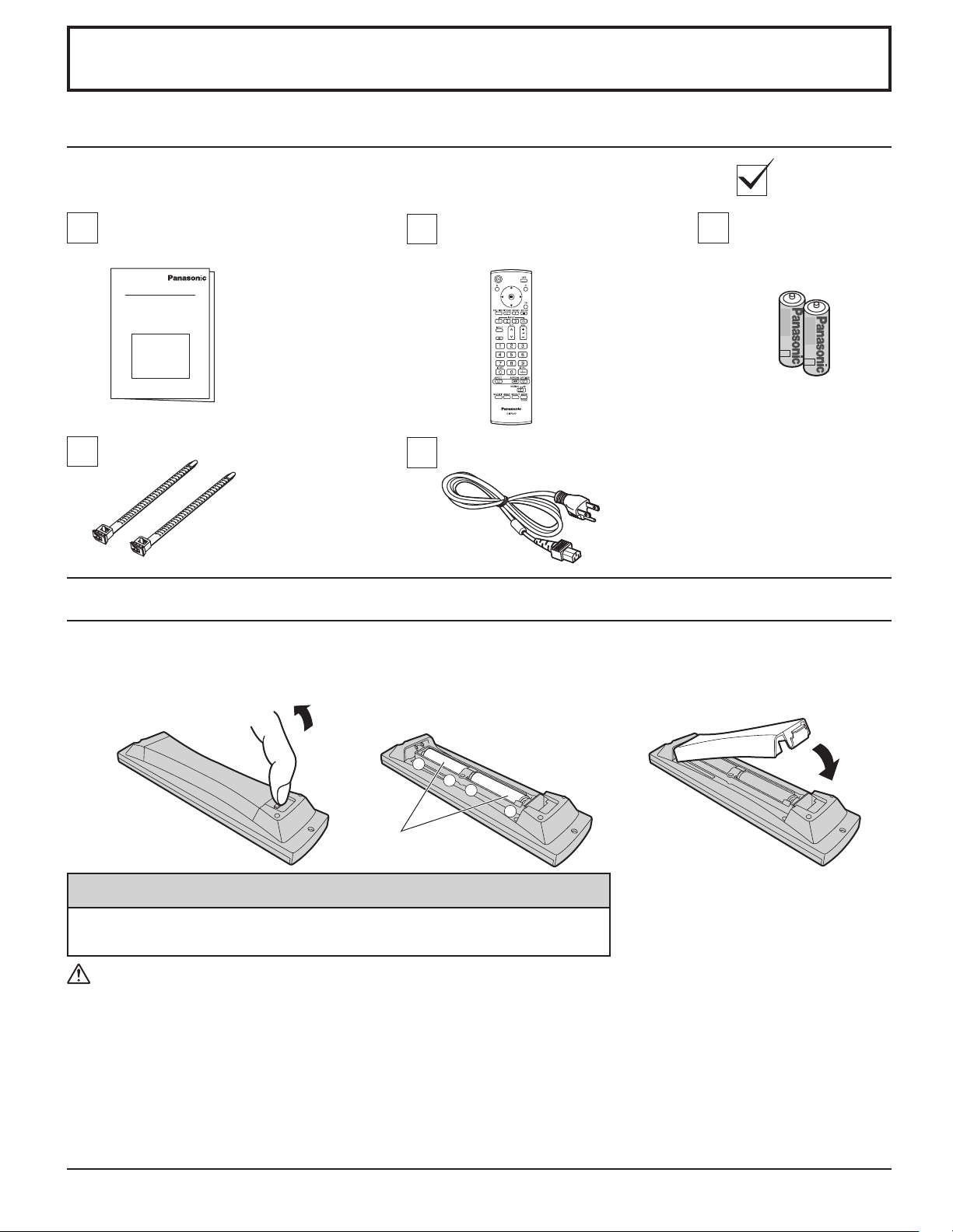
Accesorios
Accesorios suministrados
Compruebe que ha recibido todos los accesorios indicados
Manual de
instrucciones
Pilas del mando a distancia
Se necesitan dos pilas AA.
1. Tire del gancho para abrir la tapa
de las pilas.
2. Coloque las pilas correctamente
con las polaridades (+) y (–)
indicadas.
Transmisor del
mando a distancia
EUR7636070R
Cable de CABanda de fi jación × 2
Pilas para el transmisor
de mando a distancia
(2 × tamaño AA)
3. Vuelva a colocar la tapa.
+
+
-
tamaño “AA”
Consejo útil:
Para las personas que utilizan el mando a distancia con frecuencia, se
recomienda reemplazar las pilas usadas por pilas alcalinas que duran más.
Precaución relacionada con el uso de las pilas
La instalación mal hecha puede causar fugas de electrólito y corrosión, lo que estropeará el transmisor de mando a
distancia. Las pilas deben desecharse por medios ecológicos.
Tome las precauciones siguientes:
1. Las pilas deberán reemplazarse siempre juntas. Cuando reemplace pilas usadas, utilice siempre pilas nuevas.
2. No mezcle una pila usada con una nueva.
3. No mezcle distintos tipos de pilas (por ejemplo: pilas de carbón de zinc con alcalinas).
4. No intente cargar, cortocircuitar, desarmar, calentar o quemar las pilas usadas.
5. El reemplazo de las pilas es necesario cuando el mando a distancia funciona esporádicamente o no puede controlar
la pantalla de plasma.
8
Page 59
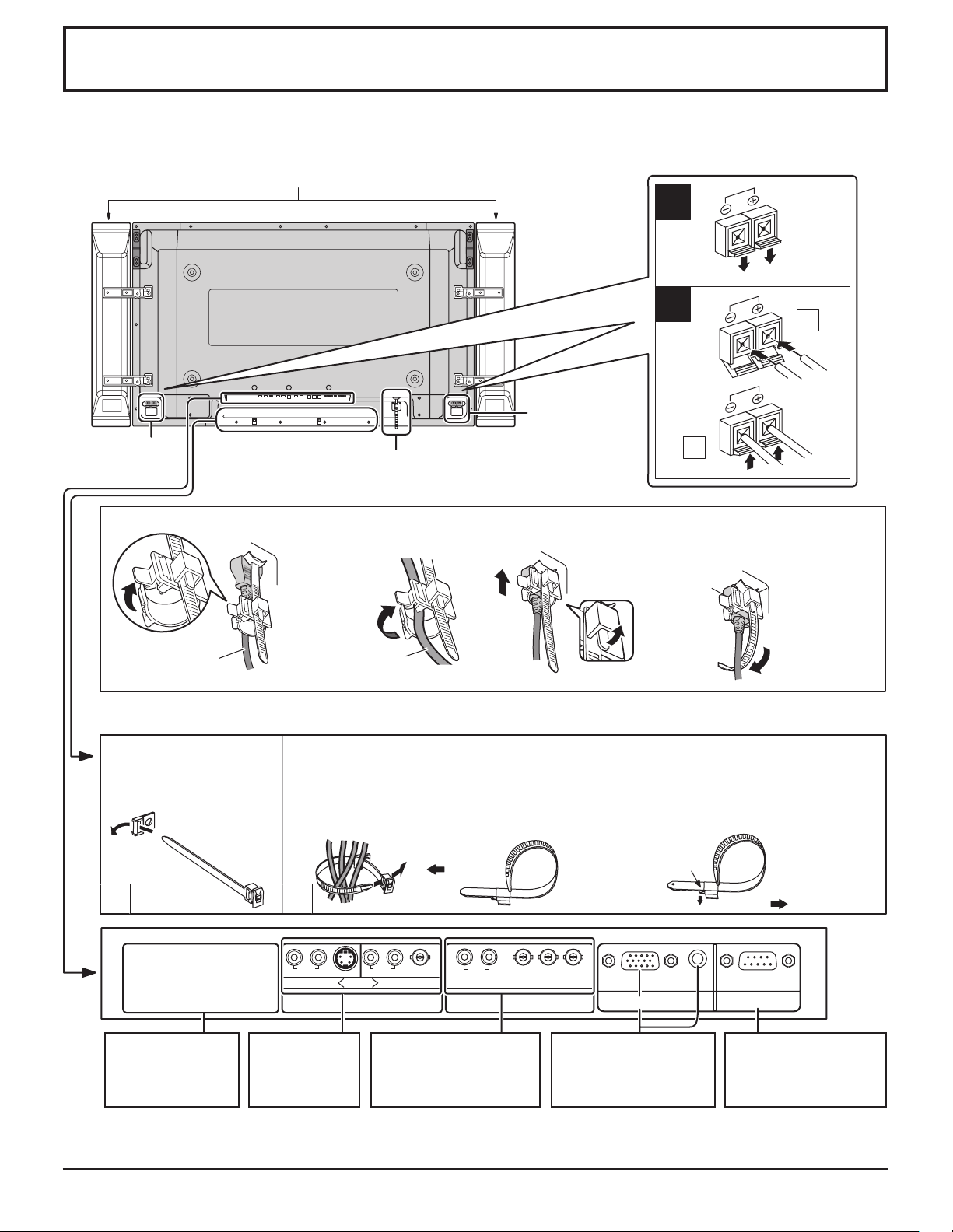
9
Conexiones
1
2
SERIALPC IN
AUDIO
SLOT1 SLOT2 SLOT3
VIDEO
PR/CR/R PB/CB/B
Y/G
AUDIO
RL
COMPONENT/RGB IN
AUDIO
RL
AUDIO
RL
AV I NBA
S VIDEO
1
2
1
2
Cuando conecte los altavoces, asegúrese de utilizar solamente los altavoces opcionales recomendados.
Consulte el manual de instalación de los altavoces para conocer detalles acerca de la instalación.
(Ejemplo: TH-42PS9UK)
Altavoces (Accesorios opcionales)
Terminales
Terminales
SPEAKERS (R)
SPEAKERS (L)
Conexión del cable de alimentación de CA (vea la página 13)
– Fijación del cable de alimentación de CA
3.
1. Abra el fi jador.
Fijador
Nota:
La clavija de alimentación mostrada en la ilustración puede que no sea del mismo tipo que la suministrada con su aparato.
– Bandas de fi jación de cables
2. Inserte el cable de
Cable de
alimentación de CA
alimentación de CA y
cierre el fi jador..
Deslice el fi jador y fi je fi rmemente
la clavija del cable de alimentación
de CA.
Cuando afl oje
el fi jador:
Asegure cualquier exceso de los cables con las bandas según sea necesario.
Pase la banda de fi jación
de cables suministrada a
través de la presilla como
se muestra en la fi gura.
Para asegurar los cables conectados a los terminales, ponga la banda de fi jación de
cables alrededor de los cables y luego pase el extremo de la banda que forma la punta
a través del bloque de cierre, como se muestra en la fi gura.
Asegurándose de que los cables estén lo sufi cientemente fl ojos como para reducir
al mínimo la tensión (especialmente el cable de la alimentación), una fi rmemente
todos los cables con la banda de fi jación suministrada.
Para apretar:
Tire
Para afl ojar:
Empuje la perilla
4. Inserte el punto del
fi jador en el pequeño
orifi cio situado en la parte
inferior
derecha de
la cubierta
posterior
según sea
necesario.
Tire
Ranuras de inserción
de tableros de
terminales opcionales
(tapadas)
Notas:
• Al salir de fábrica, las tarjetas de terminales están instaladas en las ranuras 2 y 3.
• TH-37PH9UK tiene sólo dos ranuras.
Terminales de
vídeo dual
(vea la página 12)
Terminales de entrada
de audio y entrada de
componente/RGB
(vea la página 12)
Del terminal de salida
del monitor de una
computadora
(vea la página 10)
Del terminal serial de
una computadora
(vea la página 11)
Page 60
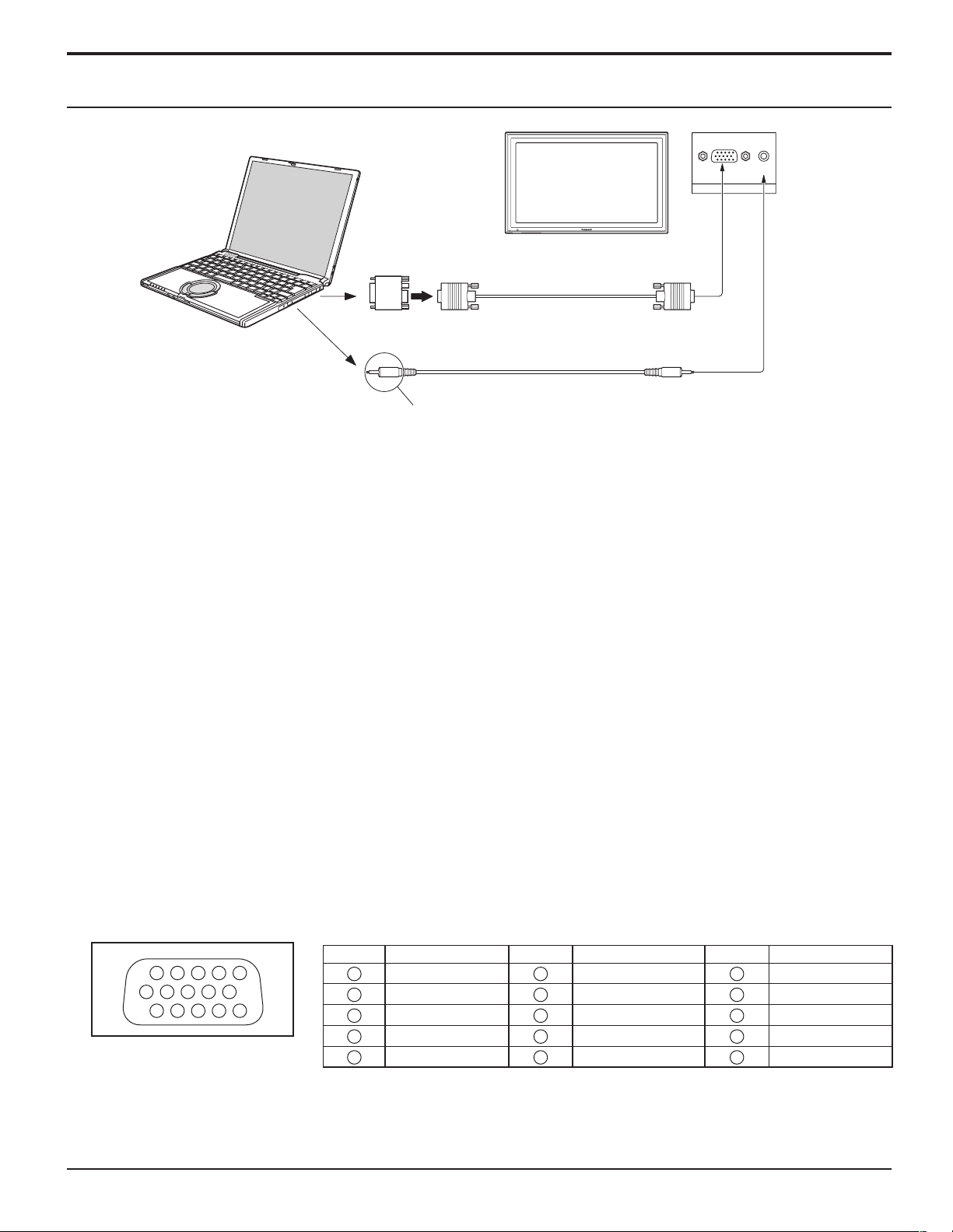
Conexiones
6
7
8
13
4
14
5
10
15
Conexión de los terminales de entrada PC
Ordenador
AUDIO
PC IN
Adaptador de conversión
(si fuera necesario)
Conecte un cable que coincida con el
terminal de salida de audio en la computadora.
TH-42PS9
Cable PC
Audio
mini D sub
15 patillas
RGB
Enchufe estéreo
Notas:
• Debido a la falta de espacio, a veces usted puede tener problemas al conectar el cable mini D-sub 15P con núcleo de
ferrita a un terminal de entrada de PC.
• Las señales de ordenador que pueden entrar son las que tienen una frecuencia de exploración horizontal de 15 a 110
kHz y una frecuencia de exploración vertical de 48 a 120 Hz. (Sin embargo, las señales que exceden 1.200 líneas no
se visualizarán correctamente.)
• La resolución del visor tiene un máximo de 640 × 480 puntos (TH-42PS9UK), 768 × 720 puntos (TH-37PH9UK), 768
× 768 puntos (TH-42PH9UK), 1.024 × 768 puntos (TH-50PH9UK) cuando el modo de aspecto se ajusta en “4:3”, y de
852 × 480 puntos (TH-42PS9UK), 1.024 × 720 puntos (TH-37PH9UK), 1.024 × 768 puntos (TH-42PH9UK), 1.366 × 768
puntos (TH-50PH9UK) cuando el modo de aspecto se ajusta en “16:9”. Si la resolución del visor excede estos máximos,
tal vez no sea posible mostrar los detalles fi nos con sufi ciente claridad.
• Los terminales de entrada PC son compatibles con DDC1/2B. Si que se conecta no es compatible con DDC1/2B,
necesitará hacer los cambios de ajuste en el momento de la conexión.
• Algunos modelos de PC no pueden conectarse a la pantalla de plasma.
• No es necesario un adaptador para con terminal mini D sub 15 patillas compatibles con DOS/V.
• Esta fi gura es sólo a modo de ejemplo.
• Los equipos y cables adicionales de la fi gura no se suministran con este equipo.
• No ajuste las frecuencias de exploración horizontal y vertical para las señales de PC a niveles que están por encima o
por debajo de la gama de frecuencias especifi cada.
• La entrada de componente es posible con las patillas 1, 2 y 3 del conector D sub de 15 patillas.
Nombres de las señales del conector mini D sub 15 patillas
N° patilla Nombre de la señal N° patilla Nombre de la señal N° patilla Nombre de la señal
1514131211
67839
1
2
10
45
Forma de las patillas para
el terminal de entrada
1
2
3
R (rojo)
G (verde)
B (azul)
NC (no conectado)
GND (tierra)
GND (tierra)
GND (tierra)
GND (tierra)
9
NC (no conectado)
GND (tierra)
11
12
NC (no conectado)
SDA
HD/SYNC
VD
SCL
PC
10
Page 61
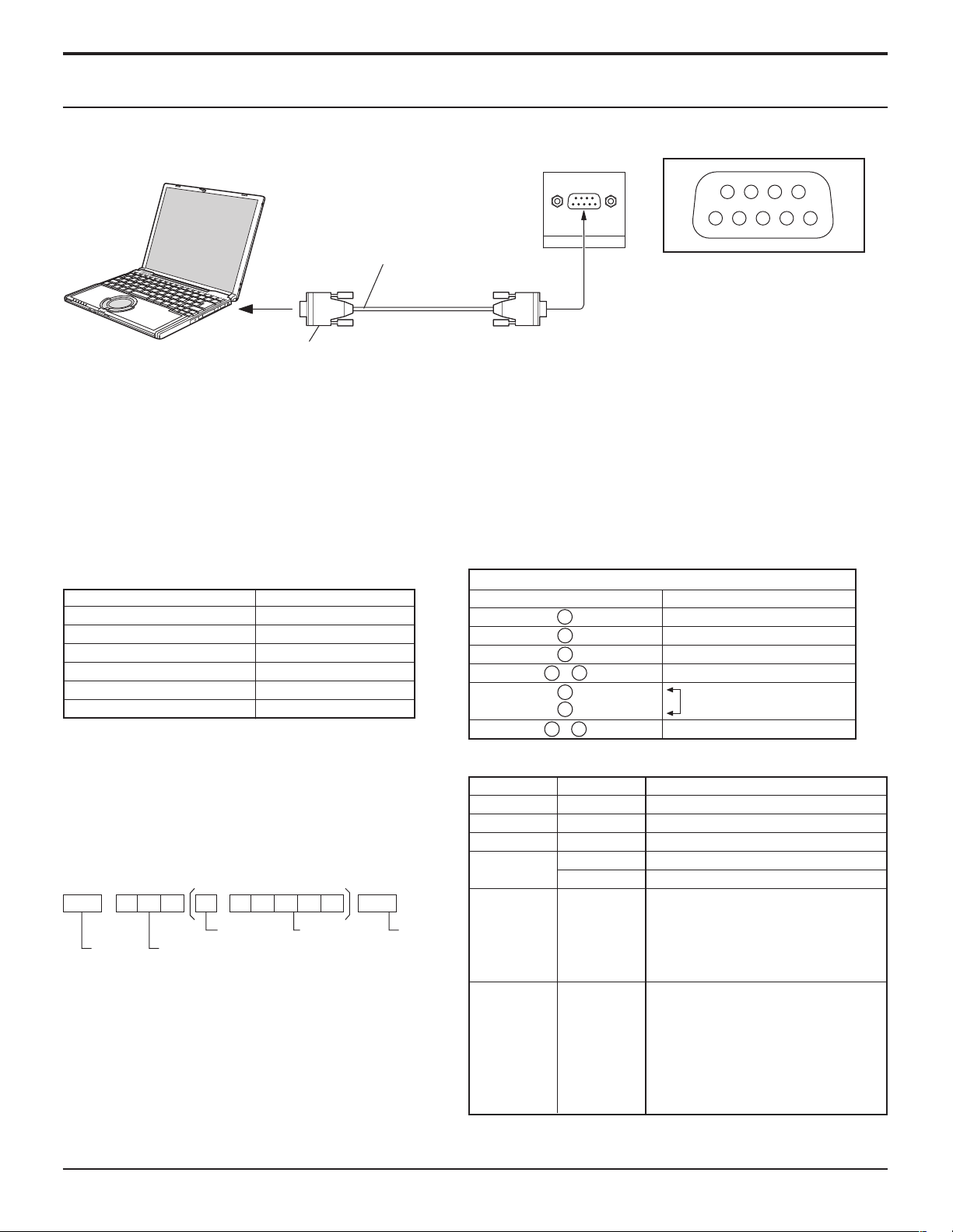
11
Conexiones
2
Conexión de los terminales SERIAL
El terminal SERIAL se utiliza cuando la pantalla de plasma se controla mediante una ordenador.
Ordenador
9876
Cable racto
RS-232C
SERIAL
Forma de patillas del cable
de conversión RS-232C
D-SUB 9 patillas
Notas:
• Utilice el cable RS-232C para conectar el ordenador a la pantalla de plasma.
• Los ordenadores mostrados sólo sirven como ejemplo.
• El equipo y los cables adicionales mostrados no son suministrados con este aparato.
El terminal SERIAL cumple con la especifi cación de interface RS-232C para que pueda controlar la pantalla de plasma
mediante un ordenador conectado en este terminal.
El ordenador requiere el uso de un software que permita transmitir y recibir los datos de control que satisfagan las
condiciones que se dan a continuación. Utilice una aplicación de ordenador tal como un idioma de programación para
crear el software. Para más detalles, consulte la documentación de la aplicación de ordenador.
53214
Parámetros de comunicación
Nivel de señal
Método de sincronización
Velocidad de baudios
Paridad
Longitud de carácter
Bit de parada
Operaciones de control
Cumple con RS-232C
Asincrónico
9600 bps
Ninguna
8 bits
1 bit
-
Formato básico para datos de control
La transmisión de los datos de control del ordenador
empieza con la señal STX seguida por el comando, los
parámetros y por último una señal ETX en ese orden. Si
no hay parámetros, la señal de parámetro no necesita
ser transmitida.
STX C1 C2 C3 P1 P2 P3 P4: P5 ETX
Inicio
(02h)
Dos puntos
Comando de 3
caracteres (3 bytes)
Parámetro(s)
(1 - 5 bytes)
Fin
(03h)
Notas:
• Si se transmiten múltiples comandos, espere que
venga la respuesta para el primer comando, de la
unidad, antes de enviar el siguiente comando.
• Si se envía un comando incorrecto por error, esta
unidad enviará un comando “ER401” al ordenador.
Cable de conversión RS-232C
Hembra de 9 patillas D sub Detalles
R X D
T X D
GND
• No se usa
•
3
5
6
4
7
8
9
1
Cortocircuitado
NC
Comando
Comando
PON
POF
AVL
AMT
IMS
DAM
Parámetro
None
None
**
0
1
None
SL1
SL2
SL3
PC1
None
Detalles de control
Alimentación encendido
Alimentación apagado
Volume 00 - 63
Silenciamiento apagado
Silenciamiento encendido
Selección de entrada (conmutación)
Entrée Slot1
Entrée Slot2
Entrée Slot3
Entrée PC
Selección de modo de pantalla
(conmutación)
NORM
ZOOM
FULL
JUST
SELF
4 : 3
Zoom
16:9
Preciso
Panasonic Auto
Con la alimentación desconectada, esta pantalla sólo responde
al comando PON.
Page 62
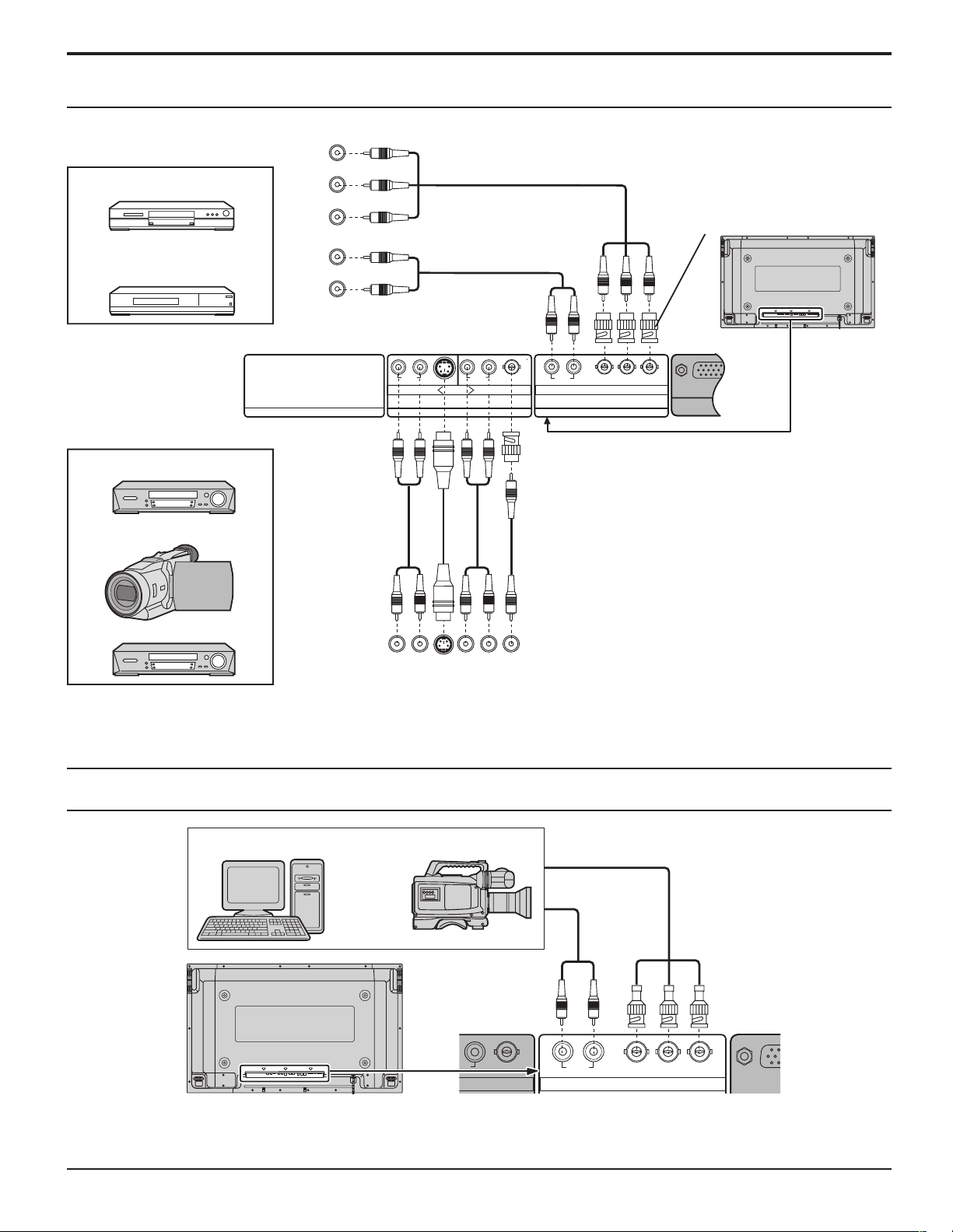
SERIALPC IN
AUDIO
SLOT1 SLOT2 SLOT3
VIDEO
PR/CR/R PB/CB/B
Y/G
AUDIO
RL
COMPONENT/RGB IN
AUDIO
RL
AUDIO
RL
AV I N
S VIDEO
VIDEO
OUT
S VIDEO
OUT
AUDIO
OUT
RL
AUDIO
OUT
Y, P
B, PR,
OUT
RR
PB
Y
L
R
COMPONENT VIDEO OUT
AUDIO
OUT
RL
BA
Conexiones
VIDEO
PR/CR/R PB/CB/B
Y/G
AUDIO
RL
COMPONENT/RGB IN
L
A
Conexión AV y COMPONENT / RGB
Ejemplo de fuente de señal de entrada
DVD
TV digital-SET-TOP-BOX
(DTV-STB) o DVD
Ejemplo de fuente de señal de entrada
VIDEOGRABADORA S VIDEO
VIDEOCÁMARA
VIDEOGRABADORA
Enchufe de
adaptador
RCA-BNC
Notas:
•
Cambie el ajuste “Seleccione entrada componente/RGB” en el menú “Confi guración” a “Componente”. (vea la página 38)
• El equipo adicional, los cables y los enchufes de adaptador no se suministran con este aparato.
Señales RGB (R, G, B)
Ordenador
Cáamara RGB
O
Notas:
• Cambie el ajuste “Seleccione entrada componente/RGB” en el menú “Confi guración” a “RGB”. (vea la página 38)
• El equipo adicional, los cables y los enchufes de adaptador no se suministran con este aparato.
12
Page 63
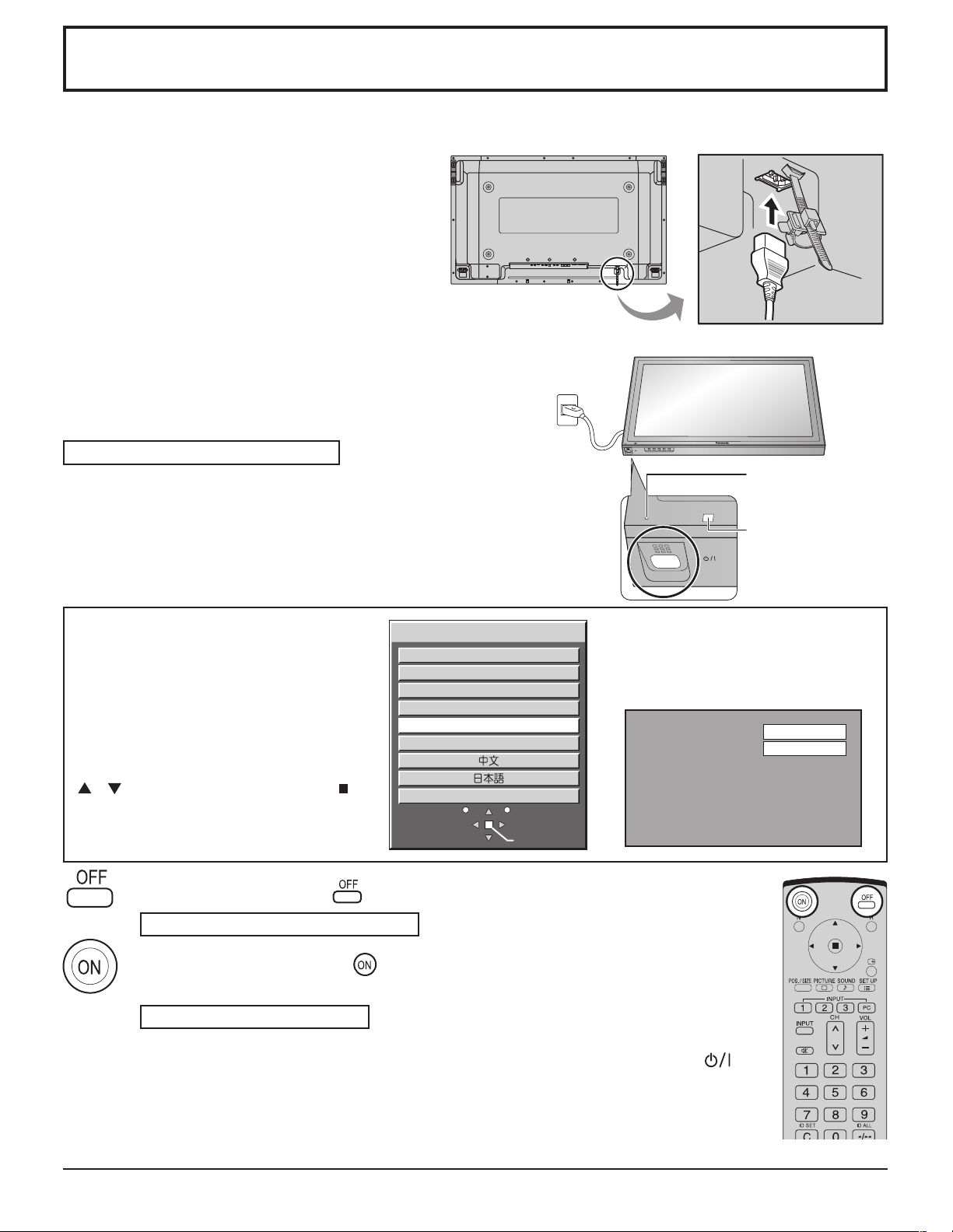
13
Encendido/apagado de la alimentación
TH-42PS9
Conexión de la clavija del cable de alimentación de CA a la pantalla de plasma.
Fije fi rmemente la clavija del cable de alimentación
de CA en la pantalla de plasma con el fi jador. (vea
la página 9)
Conexión de la clavija a una toma de corriente
Presione el interruptor principal de la pantalla de plasma para
encender el aparato.
Encendido de la alimentación: Verde
Ejemplo: La pantalla de abajo se mostrará durante un rato
después de encendida la pantalla de plasma. (La
condición del ajuste es un ejemplo.)
TH-42PWD8
INPUT MENU ENTER/+/VOL-/
Indicador de
alimentación
Sensor del mando a
distancia
Cuando se encienda la alimentación por
primera vez, se mostrará la pantalla de
selección de idioma.
A partir de la segunda vez, la selección del
idioma podrá realizarse desde el menú de
confi guración. (vea la página 18)
Seleccione el idioma deseado con las teclas
o
y presione la tecla de ACTION ( ).
Presione la tecla de espera del mando a distancia para apagar la pantalla de plasma.
Panorámica de Plasma: Rojo (espera)
Presione la tecla de espera del mando a distancia para encender la pantalla de
plasma.
Panorámica de Plasma: Verde
Desconecte la alimentación de la pantalla de plasma presionando el interruptor de la
unidad si la pantalla de plasma está encendida o en modo de espera.
Idioma de OSD
English (UK)
Deutsch
Français
Italiano
Español
ENGLISH (US)
Русский
AjustarSeleccionar
A partir de la segunda vez, la pantalla
de abajo se muestra durante un
rato. (La condición del ajuste es un
ejemplo.)
PC
16:9
Nota:
Durante la operación de gestión de la alimentación, el indicador de la alimentación se pone
naranja en el estado de alimentación desconectada.
Page 64
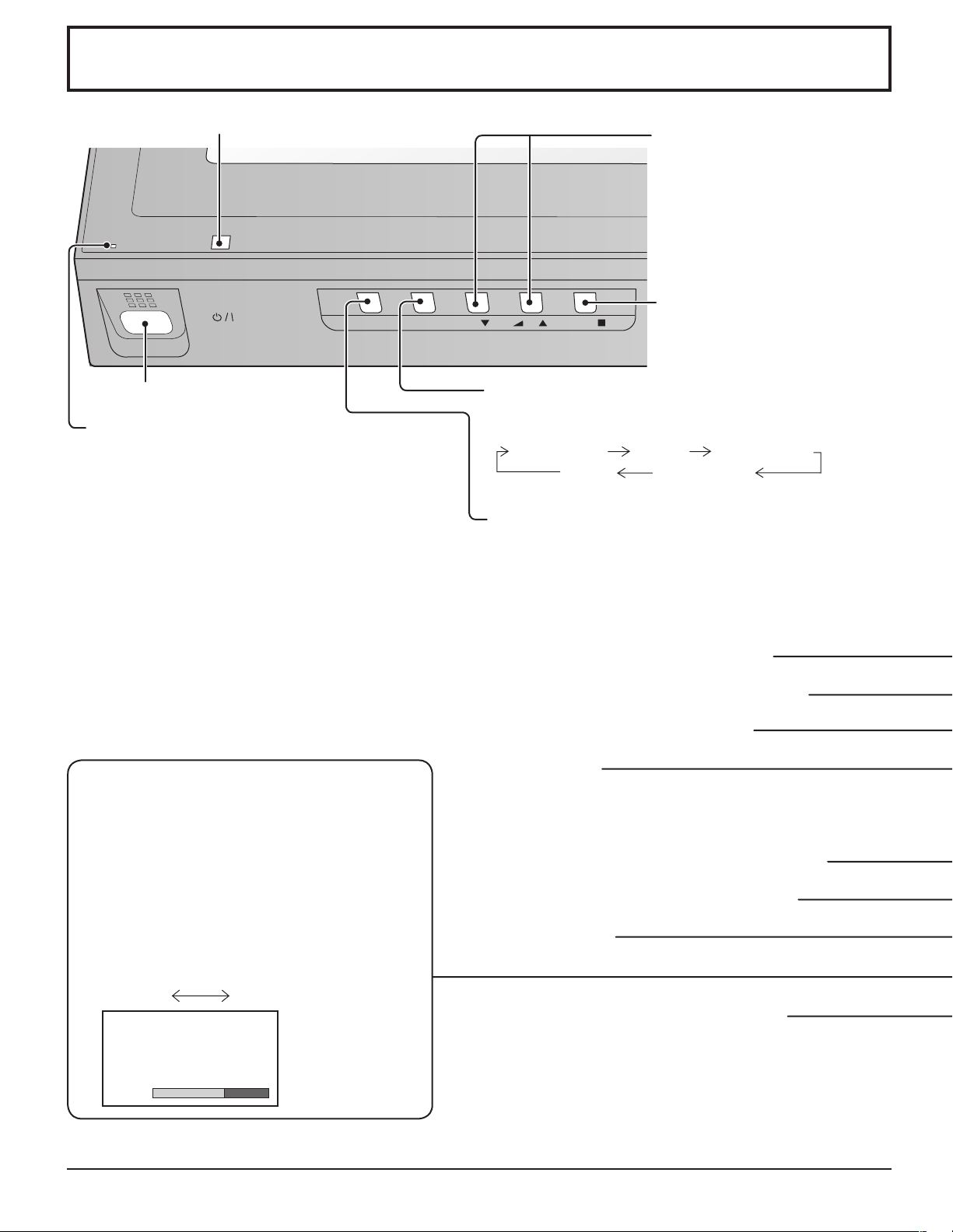
INPUT MENU ENTER/
+
/VOL
-
/
TH-42PS9
Controles básicos
Sensor de control remoto
Interruptor principal
Piloto de encendido
Se enciende el piloto de funcionamiento.
• Desconectado El indicador está apagado (La unidad
consume algo de energía siempre
que el cable de alimentación se
mantiene conectado a la toma de
corriente.)
• Espera ..........Rojo
• Conectado .....Verde
• DPMS .............Naranja (Con señal de entrada
de PC y durante la operación del
protector de pantalla del PC.)
Ajuste de volumen
Subida “+” y bajada “-” del volumen
Cuando se visualice la pantalla del
menú.
“+”: presione para mover el cursor
hacia arriba.
“–”: presione para mover el cursor
hacia abajo.
(vea la página 16)
Botón de introducción/
aspecto
(vea la página 16, 19)
Encendido/Apagado de la pantalla MENÚ
Cada vez que se pulsa el botón MENU, la pantalla de
menú se conmuta. (vea la página 16)
Visión normal Imagen Confi guración
Sonido Pos. /Tamaño
Tecla INPUT
(Selección del modo de INPUT1, INPUT2, INPUT3
y PC IN ) (vea la página 18)
Tecla N (vea la página 20, 23, 24, 25)
Tecla SURROUND
El ajuste del sonido ambiental se enciende y apaga
cada vez que se presiona la tecla SURROUND.
Los benefi cios del sonido ambiental son enormes.
Usted puede ser rodeado completamente por el
sonido; como si estuviera en
una sala de conciertos o en un cine.
Nota:
El ajuste del sonido ambiental se memoriza por
separado para cada Modo de sonido. (Normal,
Dinámico, Borrar)
Encendido
Sonido ambiental
Apagado
Encendido
Botón de Pos. /Tamaño (vea la página20)
Tecla PICTURE (vea la página 23)
Tecla INPUT
(Selección de INPUT1, INPUT2, INPUT3 y PC IN)
Pulse para seleccionar secuencialmente las ranuras de entrada
INPUT1, INPUT2, INPUT3 y PC IN. (vea la página18)
Silenciamiento de sonido (vea la página 25)
Teclas numéricas (vea la página 37, 43)
Tecla ASPECT
Presione para ajustar el aspecto. (vea la página 19)
Teclas multiventana (vea la página 21)
14
Page 65
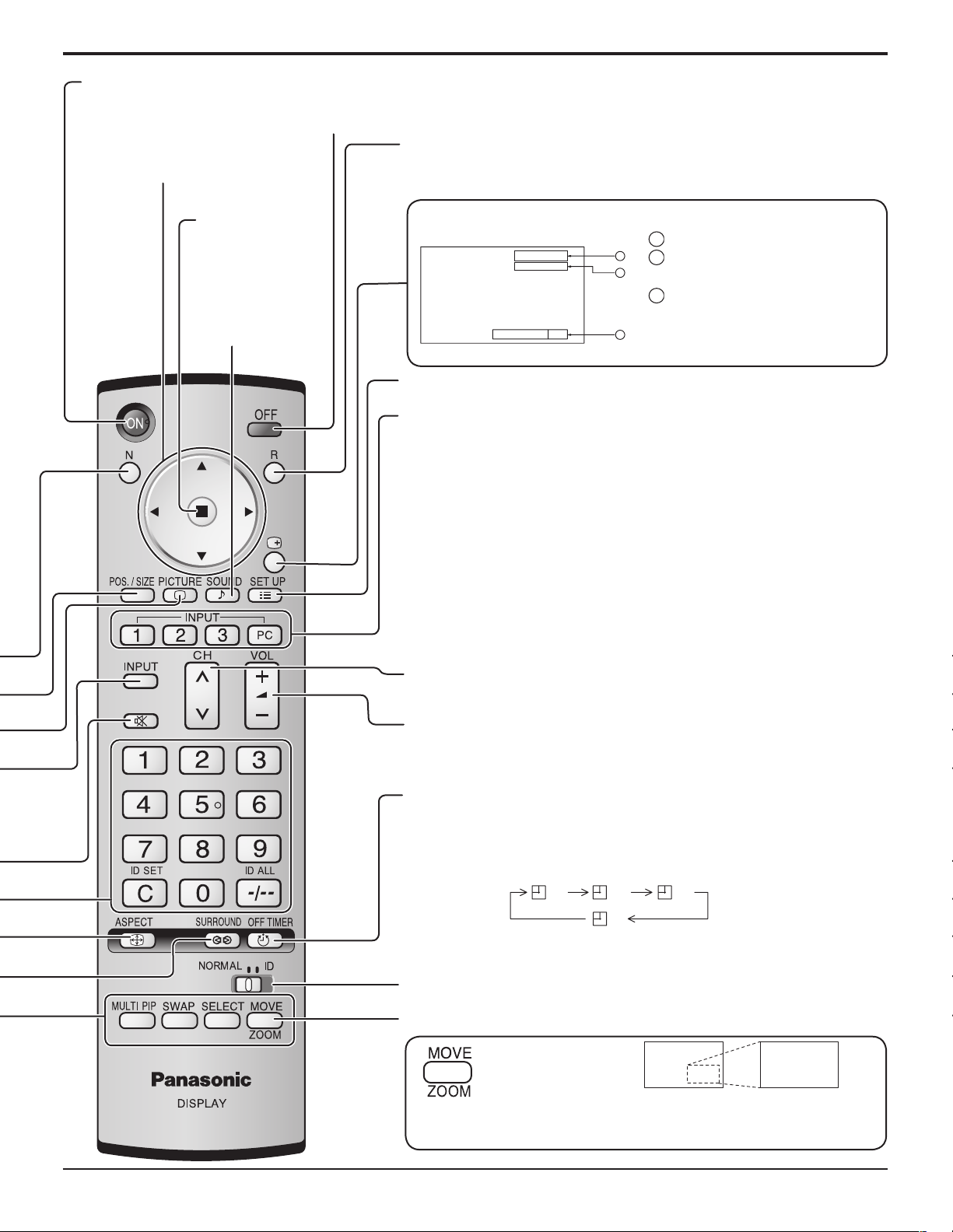
15
Controles básicos
1
2
3
Tecla de espera (Encendido/Apagado)
La pantalla de plasma debe conectarse primero en el tomacorriente y con el interruptor principal (vea la página 13).
Pulse ON para encender la Pantalla de Plasma desde el modo de Espera. Pulse OFF para apagar la Pantalla de
Plasma al modo de Espera.
Teclas de posición
Tecla R (vea la página 17)
Presione el botón R para volver a la pantalla de menú anterior.
Status button
Tecla de ACTION
Presiónelo para
seleccionar y hacer
ajustes.
Tecla SOUND
(vea la página 25)
Presione la tecla de estado para que aparezca el estado del sistema
actual.
PC
4:3
1
2
Etiqueta de entrada
Modo de relación de ASPECT
(vea la página 19)
Apagado de temporizador
El indicador del temporizador
Temporizador 90
3
aparece sólo cuando se ha
seleccionado el temporizador.
Tecla SET UP (vea la página 16, 17)
Botones DIRECT INPUT
Pulse INPUT “1”, “2”, “3” o la tecla de selección de modo de entrada de
“PC” para seleccionar el modo de entrada de PC. Este botón se utiliza
para pasar directamente al modo INPUT.
Estos botones solamente pueden mostrar la ranura en que está instalada. Si
usted pulsa el botón cuya ranura no está instalada, aparece automáticamente
la señal de entrada actual.
Nota:
Puede producirse un efecto de imagen secundaria (retardo de la imagen)
en el panel de la pantalla de plasma cuando se mantiene una imagen fi ja en
el panel durante un período de tiempo prolongado. Se activa la función que
oscurece ligeramente la pantalla para evitar el efecto de imagen secundaria
(vea la página 45), aunque no es la solución perfecta para este efecto.
Ajuste del canal
Este botón no puede utilizarse en este modelo.
Ajuste de volumen
Presione la tecla de volumen arriba “+” o abajo “–” para hacer subir o
bajar el nivel de volumen del sonido.
Tecla OFF TIMER
La pantalla de plasma puede programarse para cambiar al modo de
espera después de un intervalo predeterminado.El ajuste cambia
a 30 minutos, 60 minutos, 90 minutos y 0 minutos (se cancela el
temporizador) cada vez que se presiona la tecla.
30 60
90
0
Cuando quedan tres minutos, destella “Temporizador 3”.
El temporizador queda cancelado cuando se produce un corte eléctrico.
Bloqueo de ID remoto (vea la página 37)
Zoom digital (vea la página 26)
Pulse para tener
acceso al zoom
digital.
Esto muestra un aumento de la parte designada de la imagen
visualizada.
Page 66
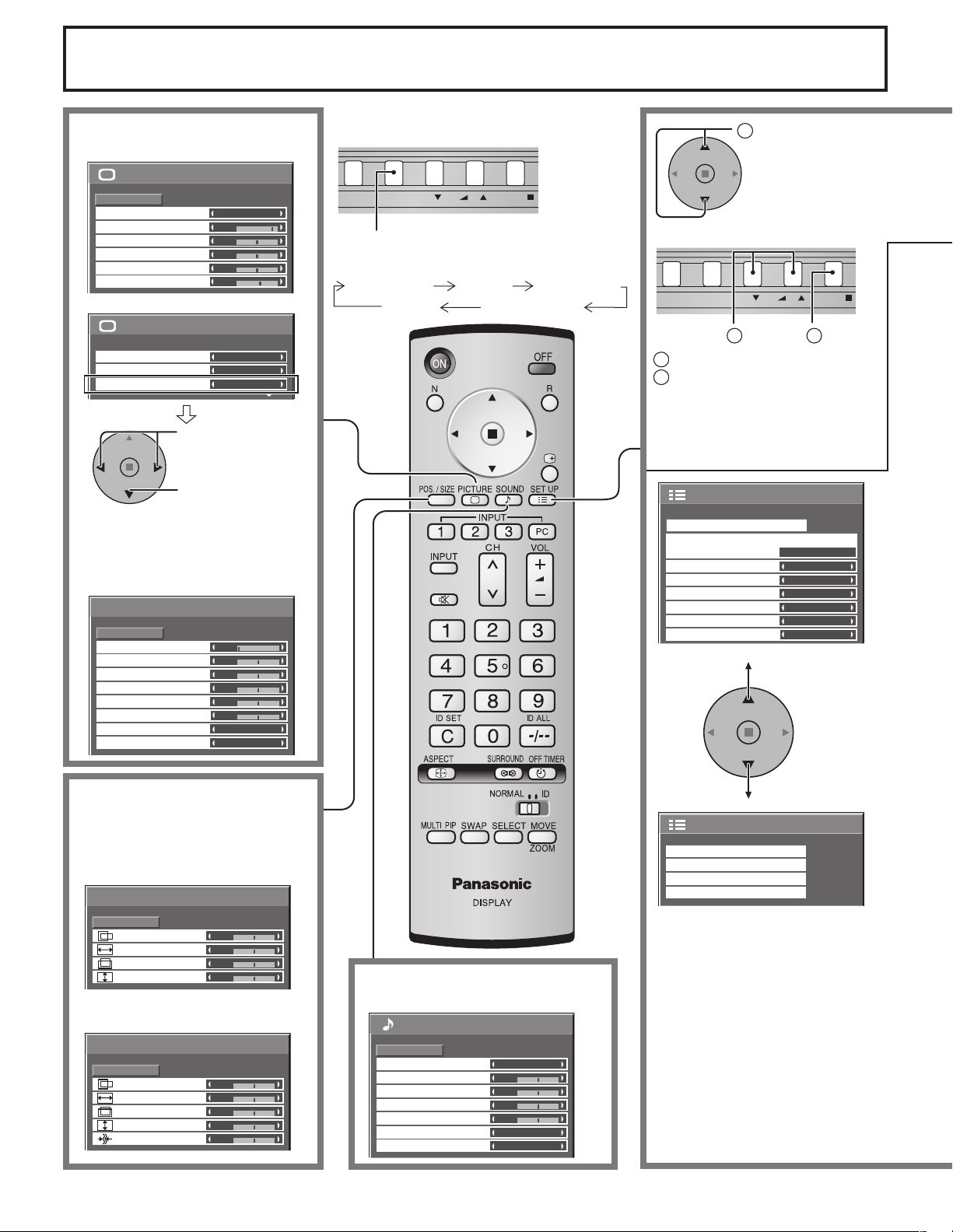
Indicación en pantalla
Normal
Normalizar
0
0
0
0
0
0
2.2
Apagado
W/B Low B
W/B High B
W/B Low R
Auto ganancia
Gamma
Extensión negro
Nivel de entrada
W/B High R
Ajuste avanzado
1/2
Señal
PC
Apagado
Ahorro en reposo
Apagado
Apagado
Apagado
Idioma de OSD Español
Seleccione entrada componente/RGB
RGB
Etiqueta de entrada
Ahorro de consumo
Configuración
Energía monitor
Autoapagado
2/2Configuración
Protec. pantalla
MULTI DISPLAY
TEMPORIZADOR ajuste
Puesta de HORA ACTUAL
INPUT MENU ENTER/+/VOL-/
1/2Imagen
Normal
Normalizar
Normal
25
0
0
0
3
Modo de Imagen
Color
Contraste
Brillo
Nitidez
Matiz
1
2
INPUT MENU ENTER/+/VOL-/
Al menú de ajuste de
“Imagen” (vea la página 23)
2/2Imagen
Temp. de color
Corrección de color
Ajuste avanzado
Normal
Apagado
Encendido
Presione para
seleccionar
“Encendido”.
Presione para
introducir “Ajuste
avanzado”.
A “Ajuste avanzado” bajo
el ajuste de imagen (vea la
página 23, 24)
También se puede pulsar el botón MENU
de la unidad.
Cada vez que se pulse el botón
MENU, la pantalla de menú cambiará.
Visión normal
Imagen
Confi guración
Sonido Pos. /Tamaño
Pulse para
1
seleccionar.
[desde la unidad]
1
2
Pulse para seleccionar.
Pulse para acceder a cada
pantalla de ajuste.
A la pantalla “Pos. /Tamaño”
(vea la página 20)
Durante los de señal de entrada
“AV (Video S)”, “Componente” y
“DVI”.
Pos. /Tamaño
Normalizar
Pos. horizontal
Tamaño horizontal
Posición vertical
Tamaño vertical
Durante los de señal de entrada
“RGB/PC”.
Pos. /Tamaño
16
Normalizar
Pos. horizontal
Tamaño horizontal
Posición vertical
Tamaño vertical
Fase de reloj
Normal
Normal
0
0
0
0
A la pantalla de ajuste
“Sonido” (vea la página 25)
Sonido
Normalizar
Modo de sonido
0
0
0
0
0
Graves
Mid
Agudos
Balance
Sonido ambiental
Salida Audio (PIP)
Normal
Normal
0
0
0
0
Apagado
Principal
Page 67
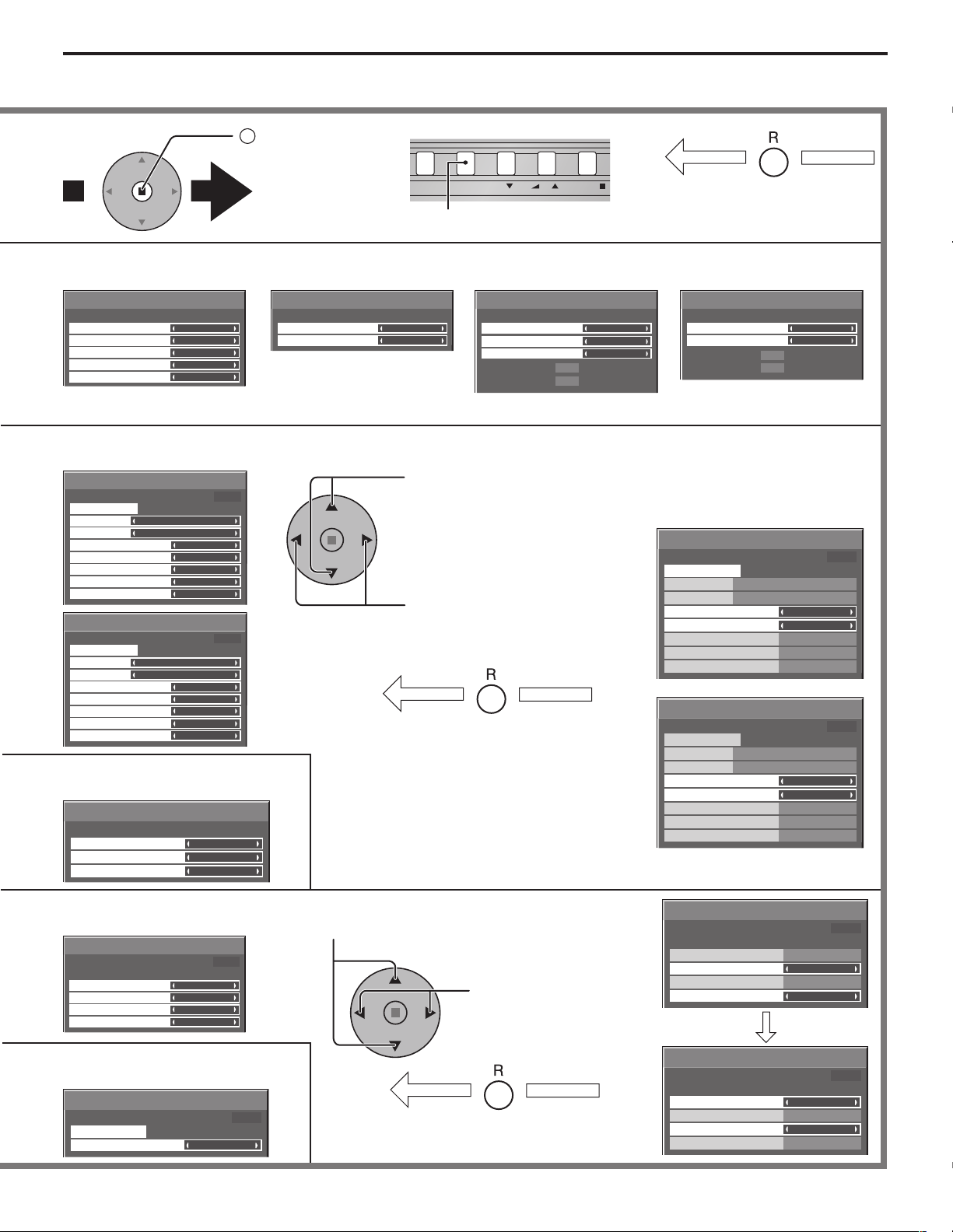
TEMPORIZADOR ajuste
Función de APAGADO
Hora de APAGADO
Función de ENCENDIDO
0:00
0:00
HORA ACTUAL 99:99
Apagado
Apagado
Hora de ENCENDIDO
TEMPORIZADOR ajuste
Función de APAGADO
Hora de APAGADO
Hora de ENCENDIDO
Función de ENCENDIDO
Apagado
0:00
Apagado
0:00
HORA ACTUAL 99:99
Indicación en pantalla
INPUT MENU ENTER/
+
/VOL-/
Modo
Autodesplazamiento
Protec. pantalla
lnicio
función
Panel lateral
Límite de brillo
Tiempo de operación
Tiempo periódico
De. barra blanca
Intervalo
6:15
12:30
Alto
Apagado
Apagado
HORA ACTUAL 99:99
Protec. pantalla
lnicio
función
Panel lateral
Límite de brillo
Hora de finalización
Hora de inicio
De. barra blanca
Designación de tiempo
6:15
12:30
Alto
Apagado
Apagado
Modo
Autodesplazamiento
HORA ACTUAL 99:99
MULTI DISPLAY
Ubicación
MULTI DISPLAY
Relación
Apagado
2 × 2
A1
Protec. pantalla
lnicio
Panel lateral
Hora de finalización
Hora de inicio
De. barra blanca
6:15
12:30
Alto
Apagado
Apagado
Modo
Autodesplazamiento
función
Límite de brillo
Designación de tiempo
HORA ACTUAL 99:99
Protec. pantalla
lnicio
Panel lateral
De. barra blanca
6:15
12:30
Alto
Apagado
Apagado
Modo
Autodesplazamiento
función
Límite de brillo
Intervalo
Tiempo de operación
Tiempo periódico
HORA ACTUAL 99:99
2
Pulse para tener
A la pantalla “Señal” para “AV”
(S Vidéo (vea la página 38, 39)
[
Auto
4 : 3
AV
]
Señal
F. Y/C 3D (NTSC)
Sistema de color
Cinema reality
Panasonic Auto (4 : 3)
P-NR
Nota:
El menú de preparación “Señal” visualiza condiciones de ajuste diferentes para cada señal de entrada. (Vea la página 18.)
Encendido
Apagado
Apagado
Para preparar Protec. pantalla
(vea las página 29-31)
[desde la unidad]
acceso a cada
pantalla de
ajuste.
Presione para volver a la siguiente pantalla de menú.
A la pantalla “Señal” para
“Componente” (vea la página 39)
Señal
Cinema reality
P-NR
[
Componente
Apagado
Apagado
A la pantalla “Señal” para
“RGB” (vea la página 39, 40)
]
Pulse para seleccionar Hora de inicio/Hora de fi nalización
(cuando se selecciona Designación de tiempo).
Pulse para seleccionar Tiempo periódico/Tiempo de operación
(cuando se selecciona Intervalo).
Señal
Sincro
Cinema reality
P-NR
Fre. H.
Fre. V.
33.8
60.0
Apagado
Apagado
kHz
Hz
Auto
[
RGB
Presione el botón R para
volver a la pantalla de menú
anterior.
A la pantalla “Señal” para “DVI”
(vea la página 39, 40)
]
Señal
Cinema reality
P-NR
Fre. H.
Fre. V.
33.8
60.0
Apagado
Apagado
kHz
Hz
[
Digital
]
Para preparar la pantalla MULTI
DISPLAY (vea la página 33)
A la pantalla de selección TEMPORIZADOR
ajuste (vea la página 27, 28)
TEMPORIZADOR ajuste
Función de ENCENDIDO
Hora de ENCENDIDO
Función de APAGADO
Hora de APAGADO
HORA ACTUAL 99:99
Para Puesta de HORA ACTUAL
(vea la página 27)
Puesta de HORA ACTUAL
Ajustar
HORA ACTUAL
HORA ACTUAL 99:99
Apagado
0:00
Apagado
0:00
99:99
Presione para confi gurar.
Pulse el botón R para volver
al menú “Confi guración”.
Pulse para seleccionar Hora de
ENCENDIDO/ Hora de APAGADO.
Presione para confi gurar la
Hora de Encendido/Hora
de Apagado.
Presione el botón R para volver
al menú “Confi guración”.
17
Page 68
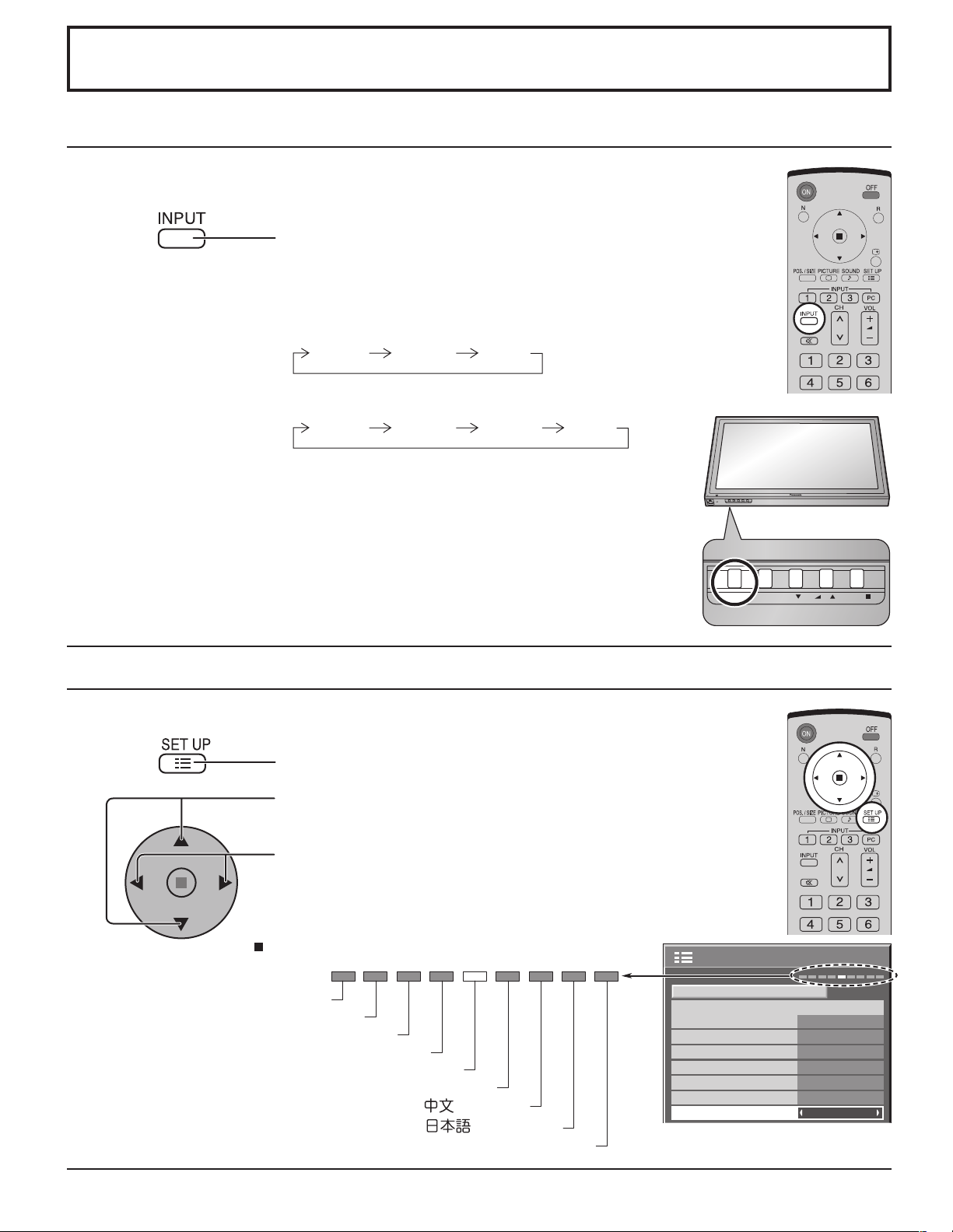
Selecciones iniciales
1/2
Señal
PC
Apagado
Ahorro en reposo
Apagado
Energía monitor
Apagado
Autoapagado
Apagado
Idioma de OSD Español
Seleccione entrada componente/RGB
RGB
Etiqueta de entrada
Ahorro de consumo
Configuración
INPUT MENU ENTER/+/VOL-/
INPUT MENU ENTER/+/VOL-/
TH-42PWD8
.......(Japonés)
.......(Ruso)
Русский
.......(Chino)
Italiano
Français
Deutsch
English(UK)
Español
ENGLISH(US)
Selección de la señal de entrada
Seleccione las señales de entrada que van a ser conectadas instalando el tablero de terminales
opcional.
Presione para seleccionar la señal de entrada que va a
reproducirse desde el equipo que se ha conectado a la
pantalla de plasma.
Las señales de entrada cambiarán de la forma siguiente:
• TH-37PH9UK
INPUT1 INPUT2 PC IN
• TH-42PS9UK, TH-42PH9UK, TH-50PH9UK
INPUT1 INPUT2 PC ININPUT3
Notas:
• También se puede seleccionar mediante la tecla INPUT de la unidad.
• El terminal de entrada no se seleccionará si la tarjeta de terminales no está instalada
en la SLOT(ranura).
• Seleccione de forma que las señales procedentes de la fuente conectada concuerden
con las de los terminales de entrada de vídeo componente/RGB. (vea la página 38)
• En la visualización de pantalla 2 no se puede seleccionar el mismo modo de entrada
para la imagen principal y la imagen secundaria.
Selección del idioma del menú en pantalla
18
Presione para mostrar la pantalla “Confi guración”.
Presione para seleccionar “Idioma de OSD”.
Presione para seleccionar su idioma preferido.
Idiomas seleccionables
Page 69
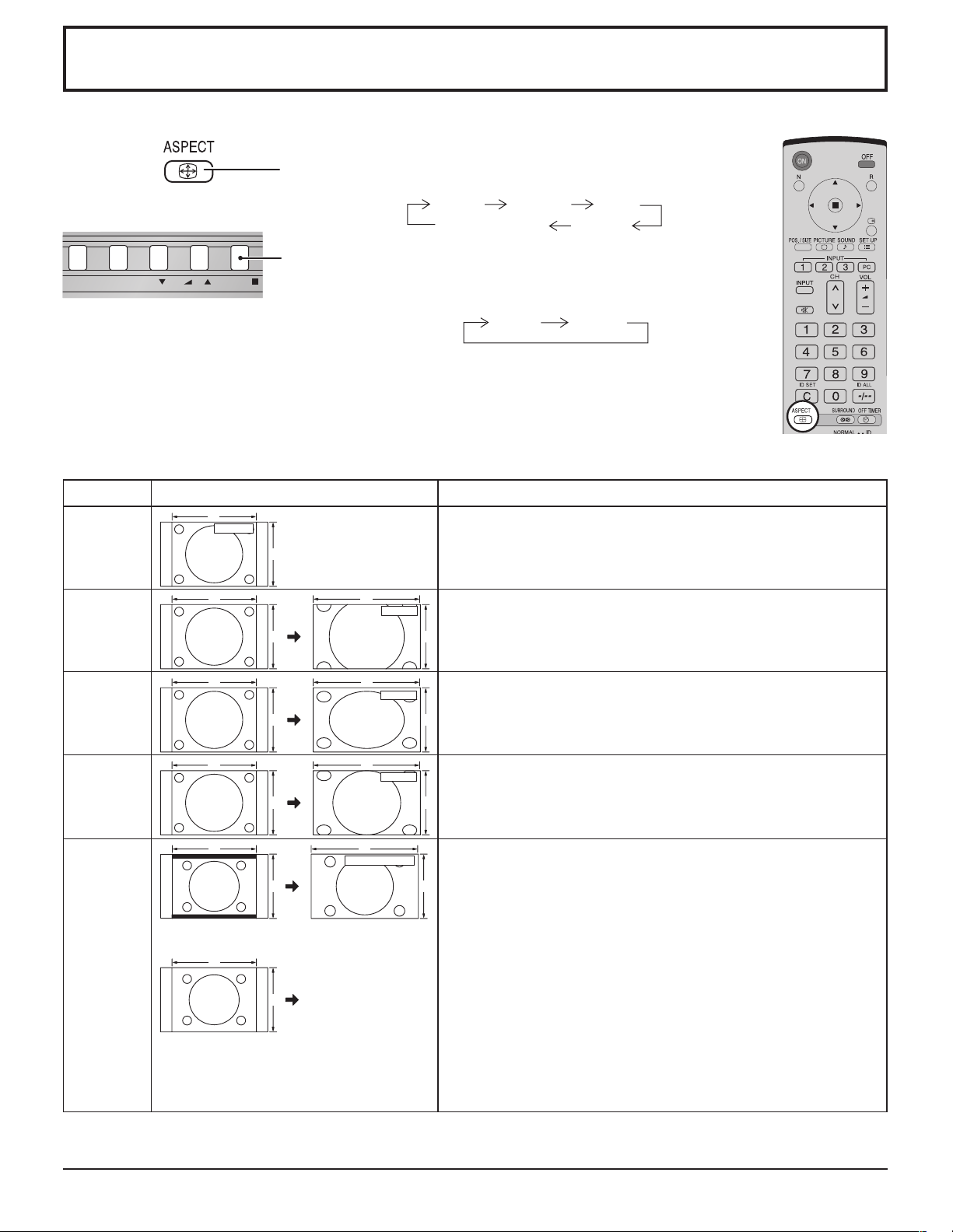
19
Controles de ASPECTO
Zoom
4
3
16
9
4
3
INPUT MENU ENTER/+/VOL-/
La pantalla de plasma le permite disfrutar viendo la imagen en su tamaño máximo, incluyendo las imágenes en el formato
de cine.
Presione repetidamente para desplazarse por las opciones de
aspecto:
[desde la unidad]
El modo de aspecto cambia cada vez que se presiona la
tecla ENTER.
4 : 3 Zoom 16 : 9
Panasonic Auto Preciso
[Durante las operaciones MULTI PIP]
• Una imagen al lado de la otra, imagen en imagen :
4 : 3 16 : 9
• Otras : No es posible conmutar el aspecto.
Notas:
• Para la entrada de señales PC, el modo cambia entre “4:3”, “Zoom” y “16:9” solamente.
• Para una entrada de señal de 1125 (1080) / 60i .50i. 24p. 25p. 30p. 24sF, 1250 (1 080) /
50i, 750 (720) / 60p. 50p , el modo se ajusta en “16:9”, y no es posible cambiar.
• Panasonic Auto sólo puede seleccionarse durante la entrada de señal de vídeo.
El modo de aspecto se memoriza separadamente para cada terminal de entrada).
•
Modo Imagen Explicaciones
4:3
Zoom
16:9
Preciso
4
4:3
3
4
3
4
3 9
16
16
16:9
Preciso
“4:3” mostrará una imagen 4:3 con un tamaño estándar 4:3.
El modo “Zoom” amplía la sección central de la imagen.
“16:9” mostrará la imagen con su tamaño máximo pero con cierto
alargamiento.
9
El modo “Preciso” mostrará una imagen 4:3 con su tamaño máximo,
pero con la corrección de aspecto aplicada al centro de la pantalla, por lo
que el alargue es sólo aparente en los bordes izquierdo y derecho de
la pantalla. El tamaño de la imagen dependerá de la señal original.
Panasonic
Nota: No deje que el modo 4:3 se muestre durante largos periodos de tiempo, porque esto puede dejar una imagen
416
39
Para una inagen
Panasonic Auto
Imagen expandida
alargada
Cambia de acuerdo
Auto
al ajuste del modo
Panasonic
automático (vea la
página 39).
Para una imagen 4:3
fantasma permanente en la pantalla de plasma.
La muestra de la imagen se ampliará automá-ticamente (dependiendo
de la fuente de imagen). Permitiéndole ver la imagen con su máximo
tamaño.
Notas:
• El modo “Panasonic Auto” ha sido diseñado para ajustar
automáticamente la relación de aspecto y poder manipular una
variedad de programas de 16:9 y 4:3. Ciertos programas de 4:3 como,
por ejemplo, los datos del mercado de valores, pueden hacer que el
tamaño de la pantalla cambie algunas veces de forma inesperada.
Cuando vea tales programas, se recomienda ajustar el ASPECTO a
4.3.
• Si ajusta la posición vertical y el tamaño vertical de la imagen en
Panasonic Auto en modo 16:9, el ajuste no se memorizará. Al salir
del modo, la pantalla volverá al ajuste anterior.
• Mientras esté instalada la TY-FB9BD (tarjeta de terminales de vídeo
dual BNC opcional) no se podrá seleccionar Panasonic AUTO.
Page 70
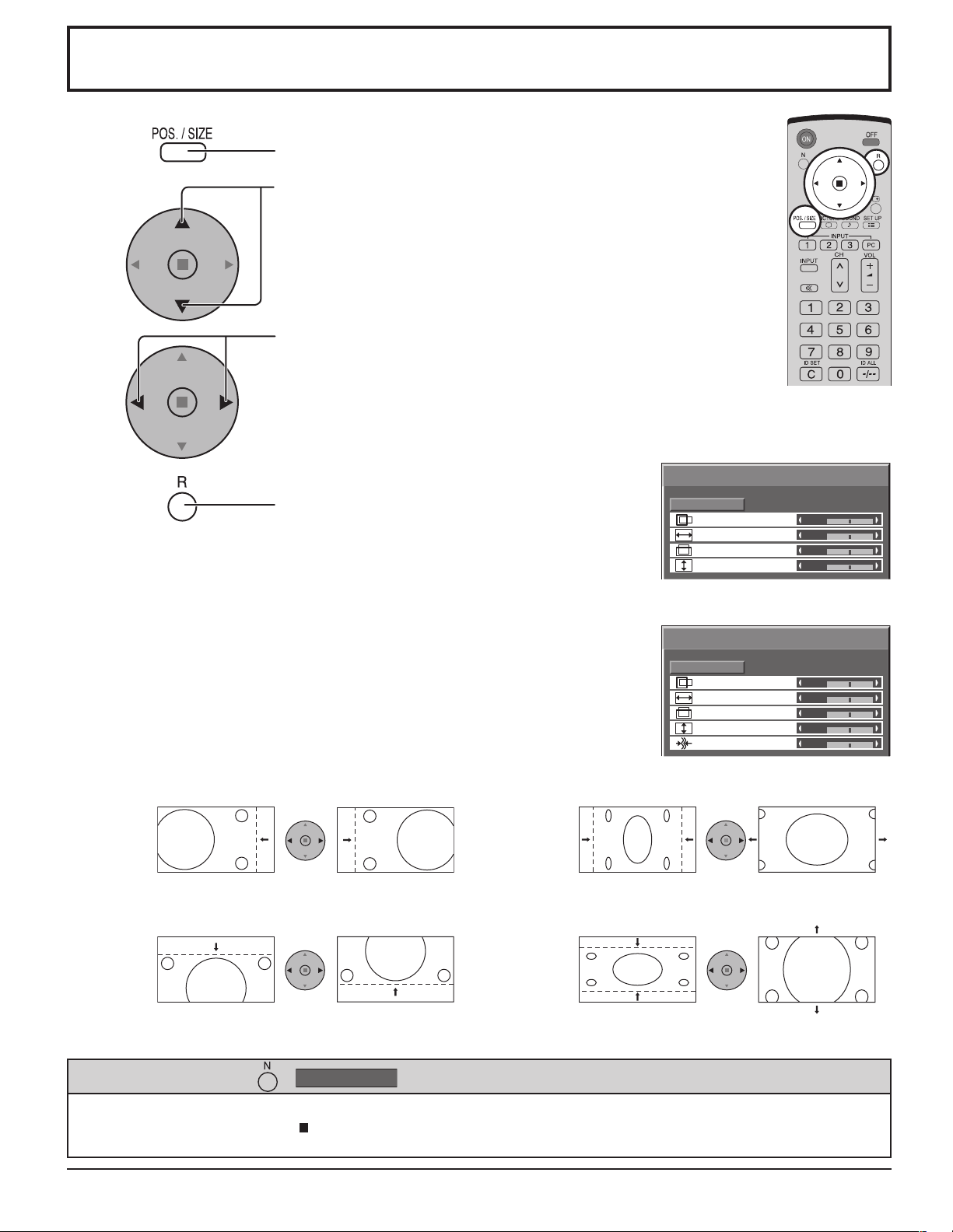
Ajuste de Pos. /Tamaño
1
Pulse para visualizar el menú Pos. /Tamaño.
2
Presione para seleccionar “Pos. horizontal/Tamaño
horizontal/ Posición vertical/Tamaño vertical/Fase
de reloj”.
Presione para ajustar la Pos. /Tamaño.
3
4
Notas:
• Los detalles de los ajustes se memorizan por separado para los diferentes formatos
de señal de entrada. (Los ajustes para las señales componentes se memorizan
para cada 525 (480) / 60i · 60p, 625 (575) / 50i · 50p, 1125 (1080) / 60i · 50i · 24p
· 25p · 30p · 24sF, 1250 (1080) / 50i, 750 (720) / 60p · 50p, y las señales RGB/
PC/DVI se memorizan para cada frecuencia.)
• Si se recibe una señal de “Localización progresiva” o “Localización regresiva”
de una videograbadora o de un reproductor DVD, la posición de la imagen se
desplazará hacia arriba o hacia abajo. Este movimiento de posición de la imagen
puede controlarse con la función “Pos. /Tamaño”.
• Si ajusta la posición vertical y el tamaño vertical de la imagen en Panasonic Auto
en modo 16:9, el ajuste no se memorizará. Al salir del modo, la pantalla volverá
al ajuste anterior.
Presione para salir del modo de ajuste.
Durante los de señal de entrada “AV
(Video S)”, “Componente” y “DVI”.
Pos. /Tamaño
Normalizar
Pos. horizontal
Tamaño horizontal
Posición vertical
Tamaño vertical
Durante los de señal de entrada
“RGB/PC”.
Pos. /Tamaño
Normalizar
Pos. horizontal
Tamaño horizontal
Posición vertical
Tamaño vertical
Fase de reloj
Normal
0
0
0
0
Normal
0
0
0
0
0
Pos.
horizontal
Posición
vertical Ajusta la posición vertical.
Fase de reloj
(Modo RGB/PC)
Consejos útiles ( /
Mientras la visualización Pos. /Tamaño está activada, si se presiona el botón N del mando a distancia en cualquier
momento o el botón de ACTION( ) durante “Normalizar”, todos los valores de los ajustes volverán a los ajustes hechos
en fábrica.
Ajusta la posición horizontal.
Elimina el parpadeo y la distorsión.
Normalizar
Normalización)
Tamaño
horizontal
Tamaño
vertical Ajusta el tamaño vertical.
Ajusta el tamaño horizontal.
20
Page 71
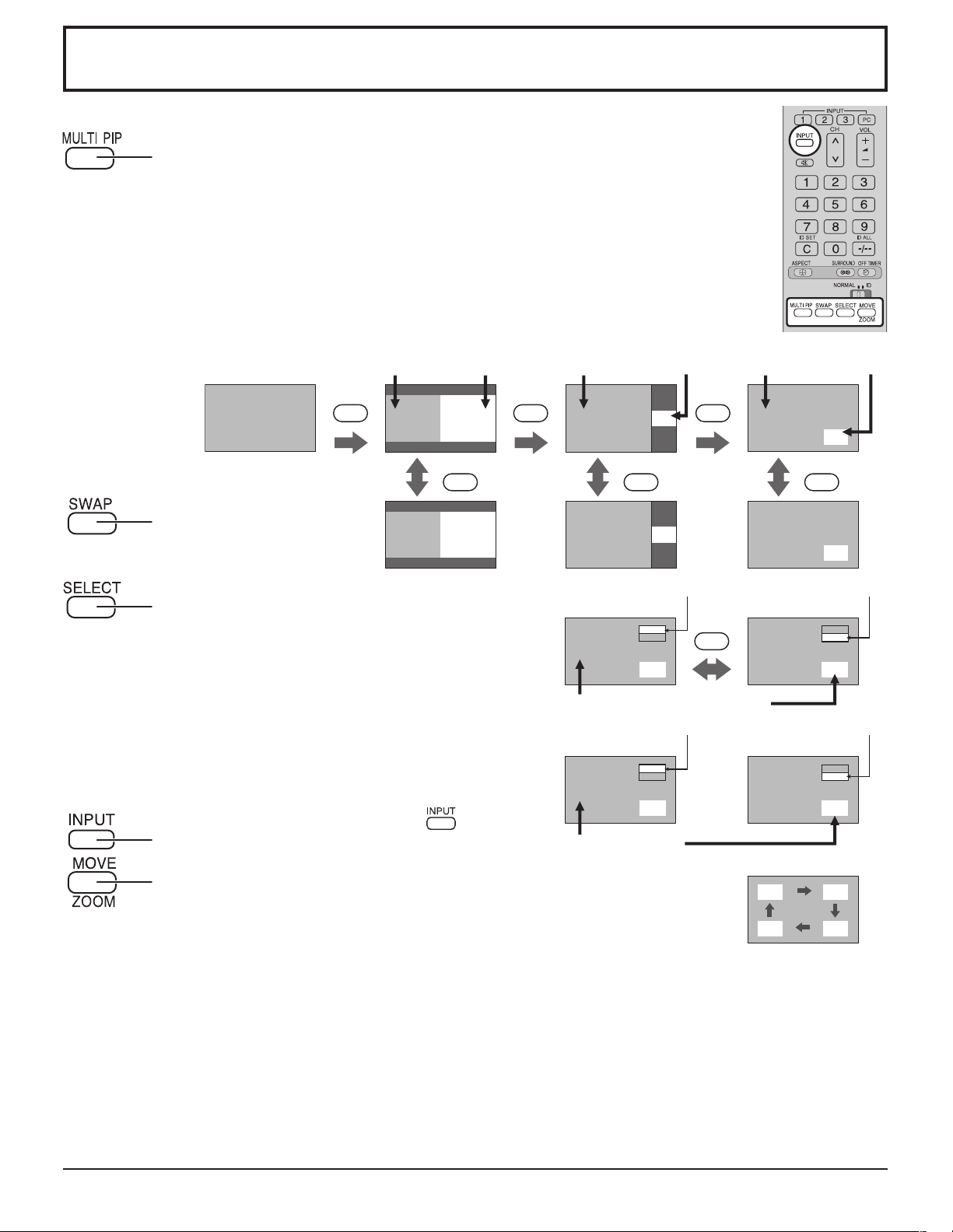
21
MULTI
PIP
MULTI
PIP
MULTI
PIP
AB
A
B
A
B
BA
B
A
B
A
PC1
VIDEO2
SELECT
SWAP SWAP SWAP
PC1
VIDEO2
VIDEO2
VIDEO1
PC1
VIDEO2
A
A
A
C
B
B
B
D
MULTI PIP
Presione repetidamente.
Cada vez que se presiona este botón, la imagen principal y la imagen
secundaria se visualizan como se muestra a continuación.
[Una imagen al lado de la otra] [Imagen en imagen]
Imagen principal Imagen secundaria
Visión normal
Presione para cambiar la
imagen principal por la imagen
secundaria.
[Ejemplo]
Presione para seleccionar el modo de entrada. Bajo
la visualización de la imagen principal y la imagen
secundaria, seleccione la imagen cuya señal de
entrada quiere cambiar.
Notas:
• El sonido de la imagen secundaria se oye mientras
se realiza una operación con imagen secundaria.
• La operación con imagen secundaria vuelve
automáticamente a la operación con imagen
principal si no se ha llevado a cabo una operación
con imagen secundaria durante unos 3 segundos
o si se presiona uno cualquiera de los botones del
mando a distancia (excepto el botón ).
Pulse para cambiar la señal de entrada
[Imagen fuera de imagen]
Imagen principal Imagen secundaria Imagen principal Imagen secundaria
Brilla la etiqueta de la imagen principal Brilla la etiqueta de la imagen secundaria
Es posible conmutar los modos de entrada
Cambia la etiqueta de la imagen principal Cambia la etiqueta de la imagen secundaria
Cambia la imagen
Presione para mover la imagen secundaria.
Cada vez que se presione, la ubicación de la imagen secundaria cambiará.
Notas:
• Esto botón sólo sirve para el modo de imagen en imagen.
• La imagen secundaria puede estar tapada por la visualización de la pantalla
Notas:
• La salida de sonido proviene de la imagen seleccionada en Salida Audio (PIP) (Vea la página 25).
En la visualización de pantalla 2 se puede seleccionar el mismo modo de entrada para la imagen principal y la imagen secundaria.
•
• La imagen principal y la imagen secundaria se procesan mediante circuitos distintos, lo cual produce una ligera diferencia
en la nitidez de las imágenes. También puede producirse una diferencia en la calidad de la imagen secundaria en función
del tipo de señales que se muestran en la imagen principal y del modo de visualización de 2 imágenes.
• Dado el tamaño pequeño de las sub-imágenes, éstas no pueden mostrarse en detalle.
• La imagen de pantalla del ordenador aparece en un formato simplifi cado y tal vez no sea posible discernir sus detalles
en forma satisfactoria.
•
Las siguientes combinaciones de dos señales análogas no pueden visualizarse simultáneamente ;
Componente - Componente, Componente - PC (RGB), PC (RGB) - Componente, PC (RGB) - PC (RGB)
dependiendo de su posición.
Page 72
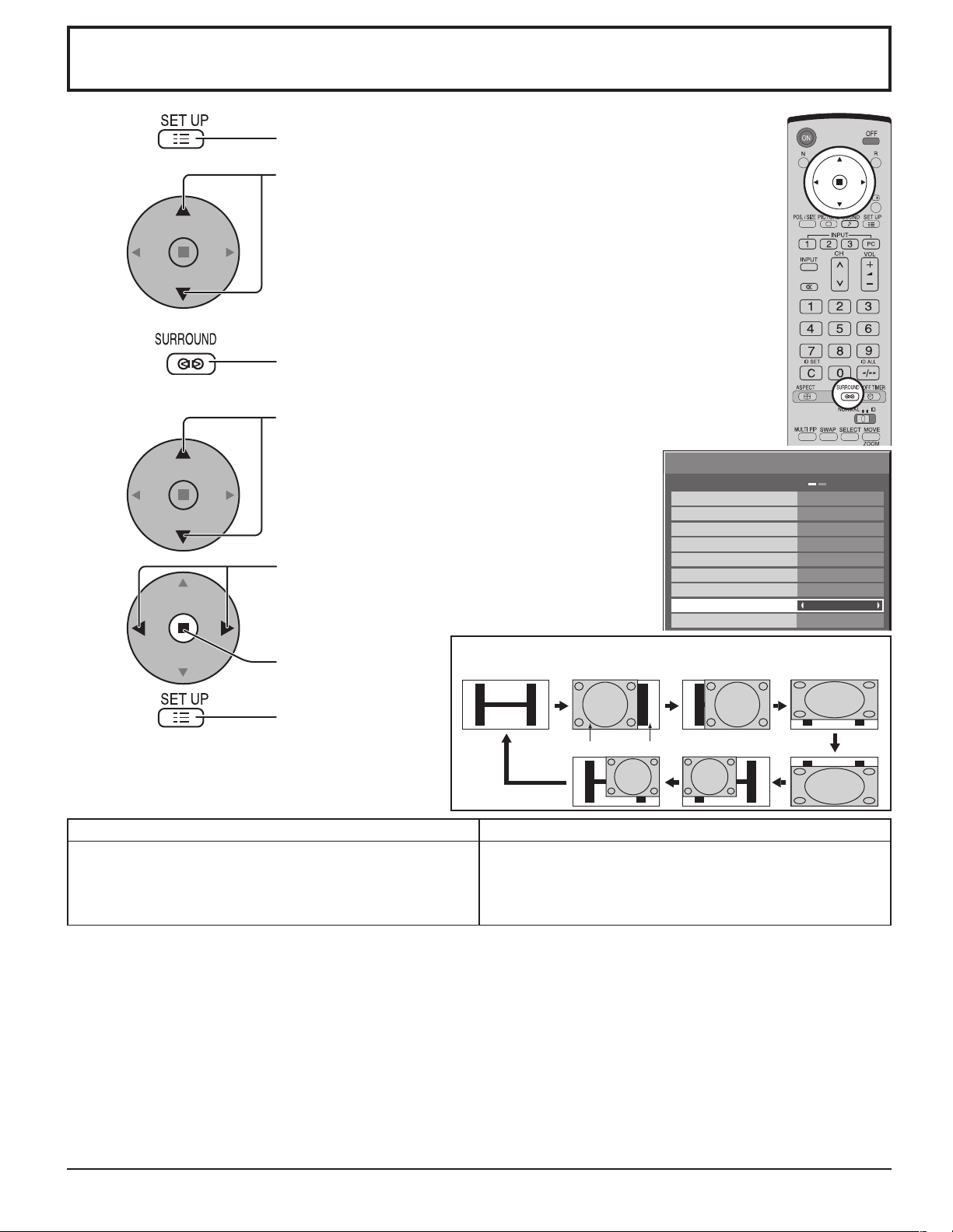
Advanced PIP (PIP avanzado)
1/2
Options
Off-timer function
INPUT lock
Studio W/B
Advanced PIP
Display size
Initial VOL level
Maximum VOL level
Initial INPUT
Onscreen display
Off
Off
Off
Off
Enable
On
Off
0
Off
Off
0
1
2
3
4
5
Pulse para visualizar el menú Setup.
Pulse para seleccionar “Idioma de OSD”
Mantenga presionado el botón hasta visualizar el menú Options
(Opciones).
Pulse para seleccionar Advanced PIP (PIP avanzado).
Pulse para ajustar el menú.
Off (Apagado): Confi gura el modo normal del visor
de dos pantallas (ver página 21).
On (Encendido): Confi gura el modo Advanced PIP.
6
Notas:
• Señal correspondiente a Advanced PIP
NTSC, PAL, SECAM (sintonizador, video)
525i, 525p, 625i, 625p, 750/60p, 750/50p, 1125/60i,
1125/50i, 1250/50i (Video de componente, RGB, DVI,
SDI, HDMI)
• La salida de sonido proviene de la imagen seleccionada en Salida Audio (PIP). (ver página 25).
• En la visualización de pantalla 2 se puede seleccionar el mismo modo de entrada para la imagen principal y la imagen
secundaria.
• La imagen principal y la imagen secundaria se procesan mediante circuitos distintos, lo cual produce una ligera diferencia
en la nitidez de las imágenes. También puede producirse una diferencia en la calidad de la imagen secundaria en función
del tipo de señales que se muestran en la imagen principal y del modo de visualización de 2 imágenes.
• Dado el tamaño pequeño de las sub-imágenes, éstas no pueden mostrarse en detalle.
• La imagen de pantalla del ordenador aparece en un formato simplifi cado y tal vez no sea posible discernir sus detalles
en forma satisfactoria.
•
Las siguientes combinaciones de dos señales análogas no pueden visualizarse simultáneamente ;
Componente - Componente, Componente - PC (RGB), PC (RGB) - Componente, PC (RGB) - PC (RGB)
• Consulte el manual de operaciones de cada tablero para conocer las señales correspondientes para DVI, SDI y
HDMI.
22
Pulse para confi rmar.
Pulse para salir
del menú Options
(Opciones).
Sub-pantalla Pantalla principal
Una pantalla Advanced PIP
(PIP avanzado)
Sub-pantalla Pantalla principal
640 x 480@60Hz, 852 x 480@60Hz, 1024 x 768@60Hz,
1366 x 768@60Hz (RGB, DVI, HDMI)
1280 x 768@60Hz (DVI)
Page 73
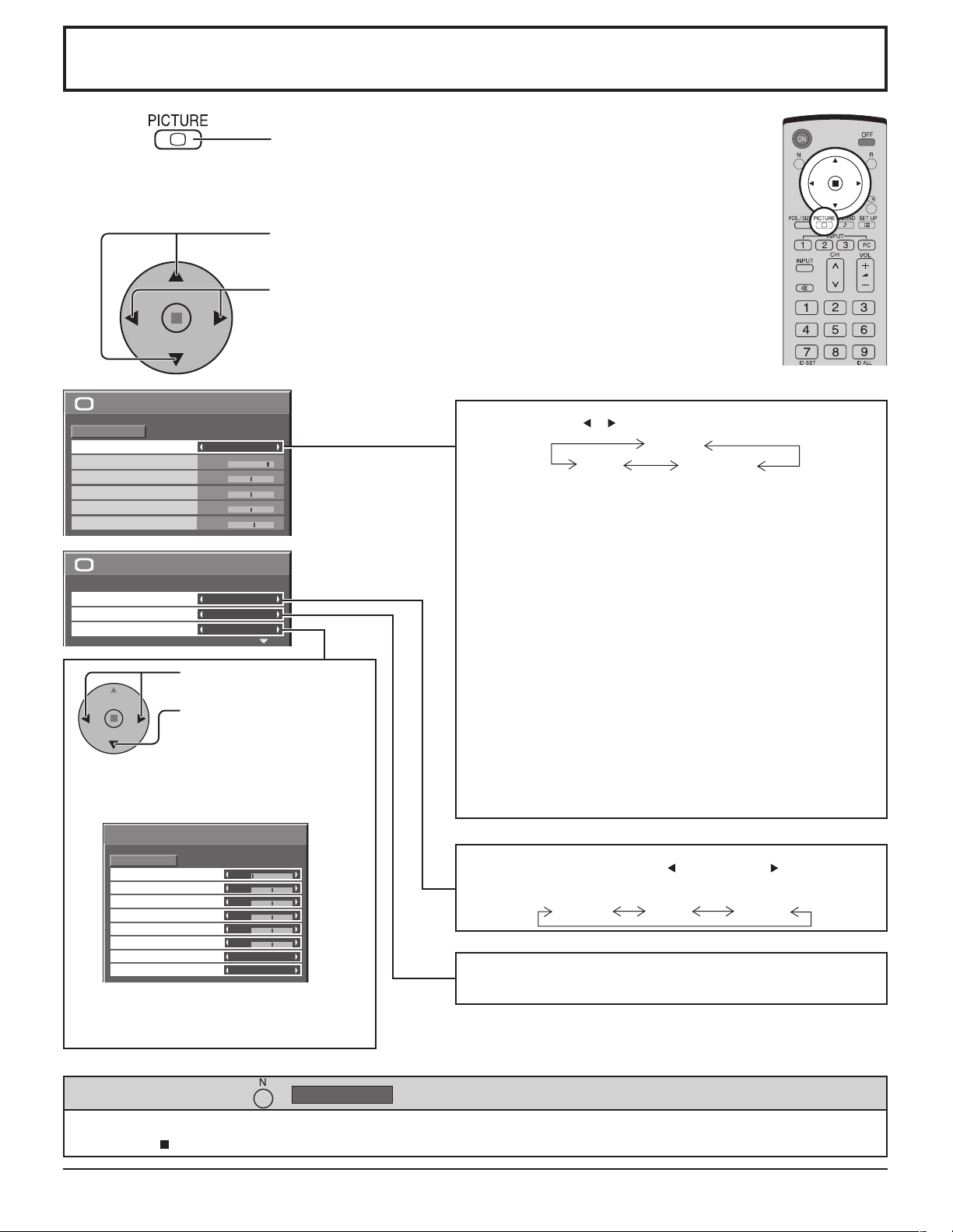
23
2/2Imagen
Corrección de color
Ajuste avanzado
Normal
Apagado
Encendido
Temp. de color
1/2
Normal
Normal
25
0
0
0
3
Imagen
Normalizar
Modo de Imagen
Color
Contraste
Matiz
Brillo
Nitidez
Ajuste de imagen
1
Presione la tecla PICTURE del mando a distancia para
mostrar la pantalla de menú “Imagen”.
Seleccione para ajustar cada elemento.
2
Presione para seleccionar el menú para ajustar.
Seleccione el nivel deseado mirando a la imagen de
detrás del menú.
Presione la tecla o para cambiar entre los modos.
Normal
Cine Dinámico
Normal
Para ver en ambientes estándar (iluminación de la
tarde). Este menú selecciona los niveles normales del
Brillo y del Contraste.
Presione para seleccionar
“Encendido”.
Presione para introducir
“Ajuste avanzado”.
Ajuste avanzado Encendido
Permite realizar ajustes fi nos de la imagen con
un nivel profesional (vea la página siguiente).
Ajuste avanzado
Normalizar
Extensión negro
Nivel de entrada
W/B High R
W/B High B
W/B Low R
W/B Low B
Gamma
Auto ganancia
Normal
0
0
0
0
0
0
2.2
Apagado
Ajuste avanzado Apagado
Visualiza imágenes con ajustes del menú
Imagen.
Dinámico
Para ver en ambientes brillantes. Este menú selecciona
niveles de Brillo y Contraste más altos que los normales.
Cine
Ideal para ver películas.
Nota:
Si quiere cambiar la imagen y el color del menú “Imagen”
seleccionado por otra cosa, haga el ajuste utilizando el
menú “Imagen” recomendado en el menú (vea la página
siguiente).
Presione la tecla de izquierda o de derecha para cambiar
entre los modos.
Normal Frío Cálido
Corrección de color Encendido
Permite el ajuste de colores vivos de forma automática.
Consejos útiles ( /
Mientras se visualiza el menú “Imagen”, si se presiona el botón N del mando a distancia en cualquier momento o el botón
de ACTION ( ) durante “Normalizar”, todos los valores de los ajustes volverán a los ajustes hechos en fábrica.
Normalizar
Normalización)
Page 74
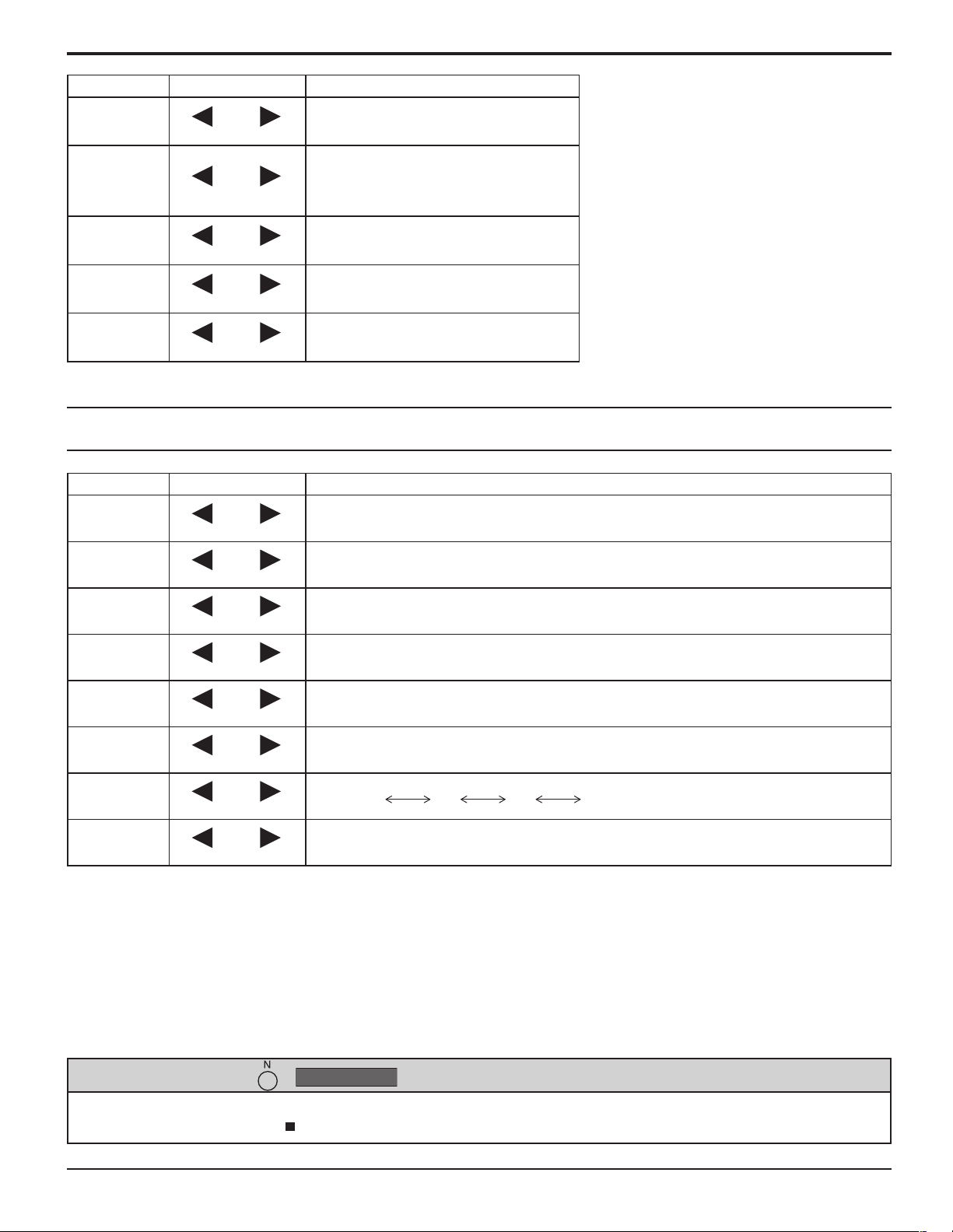
Ajuste de imagen
Elemento Efecto Ajustes
Contraste
Brillo
Color
Matiz
Nitidez
Menos Más
Más oscuro
Menos Más
Rojizo Verdoso
Menos Más
Más brillante
Selecciona el brillo y la densidad
apropiados para la sala.
Ajuste para ver fácilmente imágenes
oscuras como, por ejemplo, escenas
nocturnas o cabello negro.
Ajuste para un color más ligero.
Ajuste para un color de piel más
lindo.
Muestra una imagen nítida.
Notas:
• Los ajustes de “Color” y “Matiz” no se
• Usted podrá cambiar el nivel de cada
• Los detalles de ajuste para “Normal”,
• El ajuste “Matiz” se puede ajustar para la
• El cambio es muy pequeño cuando se
Ajustes avanzados
Elemento Efecto Detalles
Extensión
negro
Menos Más
Ajusta las sombras oscuras de la imagen en gradación.
pueden ajustar para las señales de
entrada “RGB/PC” y “DVI”.
función (Contraste, Brillo, Color, Matiz,
Nitidez) en cada menú Imagen.
“Dinámico” y “Cine” respectivamente se
memorizan por separado para cada modo
de terminal de entrada.
señal NTSC solamente durante la señal
de entrada “AV(Video S)”.
aumenta “Contraste” con una imagen
brillante o se reduce con una imagen
oscura.
Nivel de
entrada
W/B High R
W/B High B
W/B Low R
W/B Low B
Gamma
Auto
ganancia
Notas:
• Realice el ajuste “W/B” de la forma siguiente.
1. Ajuste el equilibrio del blanco de las secciones brillantes, utilizando los ajustes “W/B High R” y “W/B High B”.
2. Ajuste el equilibrio del blanco de las secciones oscuras, utilizando los ajustes “W/B Low R” y “W/B Low B”.
3. Repita los pasos 1 y 2.
Los pasos 1 y 2 afectan a los ajustes del otro, así que repita cada uno de los pasos para hacer el ajuste.
• Los valores de los ajustes se memorizan por separado para cada modo de terminal de entrada.
• Los valores de la gama de ajuste deberán utilizarse como una referencia para el ajuste.
Menos Más
Menos Más
Menos Más
Menos Más
Menos Más
Abajo Arriba
Abajo Arriba
Ajusta las partes que están sumamente brillantes y son difíciles de ver.
(Esto no se puede ajustar cuando la señal de entrada es DVI.)
Ajusta el equilibrio del blanco para las zonas color rojo claro.
Ajusta el equilibrio del blanco para las zonas color azul claro.
Ajusta el equilibrio del blanco para las zonas color rojo oscuro.
Ajusta el equilibrio del blanco para las zonas color azul oscuro.
Curva “S” 2.0 2.2 2.5
Aumenta automáticamente el brillo de la señal oscura.
Consejos útiles ( /
En el mando a distancia, mientras mientras se indica el menú “Ajuste avanzado”, si se presiona la tecla N en cualquier
momento o tecla de ACTION ( ) durante “Normalizar”, todos los valores de ajuste volverán a los ajustes de fábrica.
Normalizar
Normalización)
24
Page 75
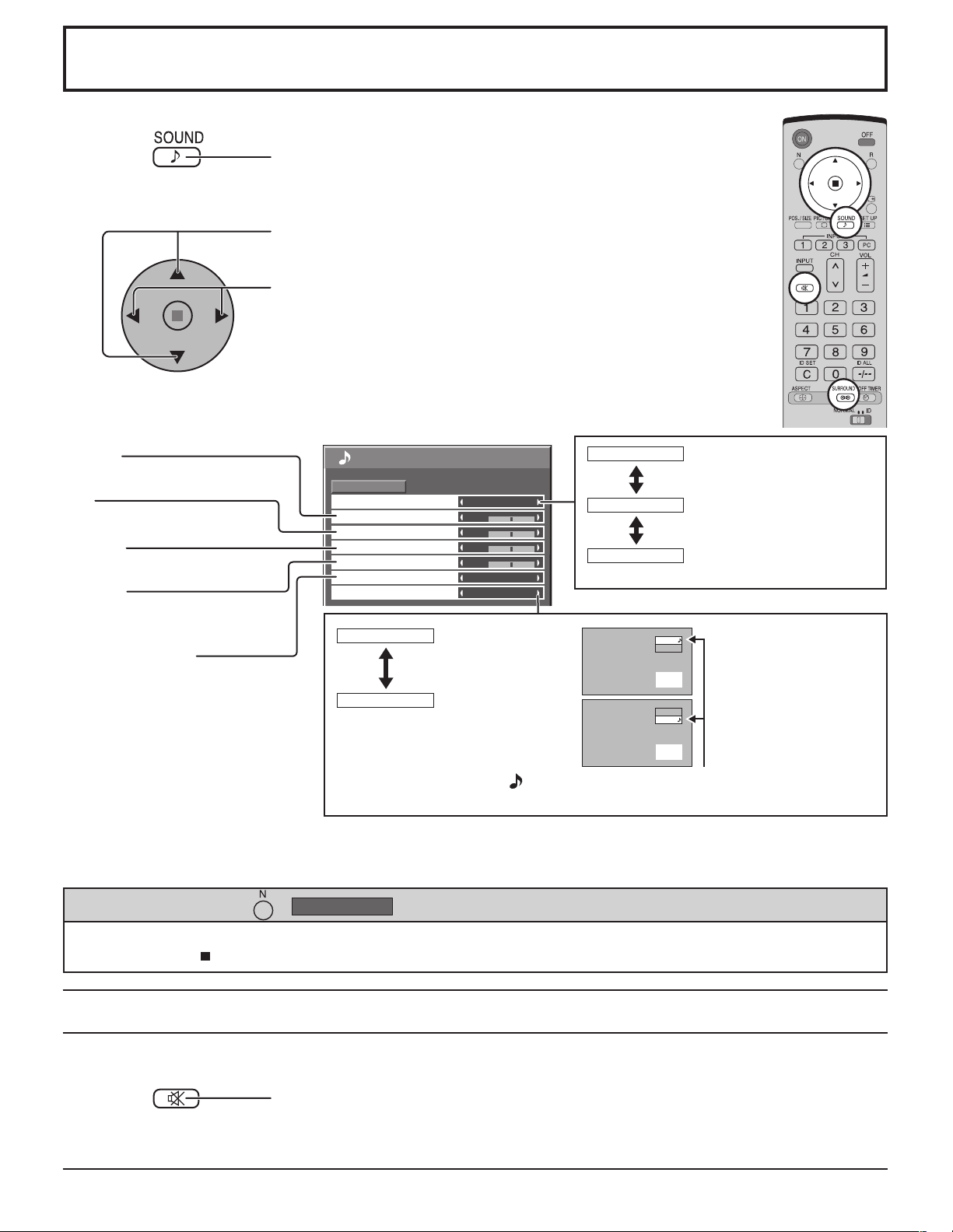
25
Ajuste del sonido
1
Pulse para mostrar el menú Sonido.
Seleccione para ajustar cada elemento.
2
Presione para seleccionar el menú para ajustar.
Seleccione el nivel deseado escuchando el sonido.
Graves
Ajusta los sonidos bajos
Mid
Ajusta el sonido normal
Agudos
Ajusta los sonidos altos
Balance
Sonido
Normalizar
Modo de sonido
Graves
Mid
Agudos
Balance
Sonido ambiental
Salida Audio (PIP)
Normal
Normal
0
0
0
0
Apagado
Principal
Normal
Dinámico
Borrar
Emite el sonido original.
Acentúa el sonido agudo.
Atenúa la voz humana.
Ajusta los volúmenes de los
canales izquierdo y derecho
Sonido ambiental
Seleccione Encendido o Apagado
Principal
Sub
Selecciona el
sonido de la
imagen principal.
Seleccionar sonido
de cuadro PIP.
A
INPUT1
PC
B
INPUT1
PC
(Cuando se elige el
sonido de la imagen
principal.)
(Cuando se elige el
sonido de cuadro PIP.)
A
B
Aparece la nota musical a la derecha de la etiqueta de la pantalla de salida
de audio.
Notas:
•
Presione la tecla Sonido ambiental para encender y apagar directamente el efecto de sonido ambiental. (vea la página 14)
• Los ajustes de Graves, Mid, Agudos y Sonido ambiental se memorizan separadamente para cada modo de sonido.
Consejos útiles ( /
Normalizar
Normalización)
Mientras se visualiza el menú “Sonido”, si se presiona el botón N del mando a distancia en cualquier momento o el
botón de ACTION( ) durante “Normalizar”, todos los valores de los ajustes volverán a los ajustes hechos en fábrica.
Silenciamiento
Esto resulta muy útil cuando se contesta el teléfono o se reciben visitantes inesperados.
Presione esta tecla para silenciar el sonido.
Presiónela de nuevo para reactivar el sonido. El sonido se reactiva también cuando se
apaga la alimentación o se cambia el nivel del sonido.
Page 76
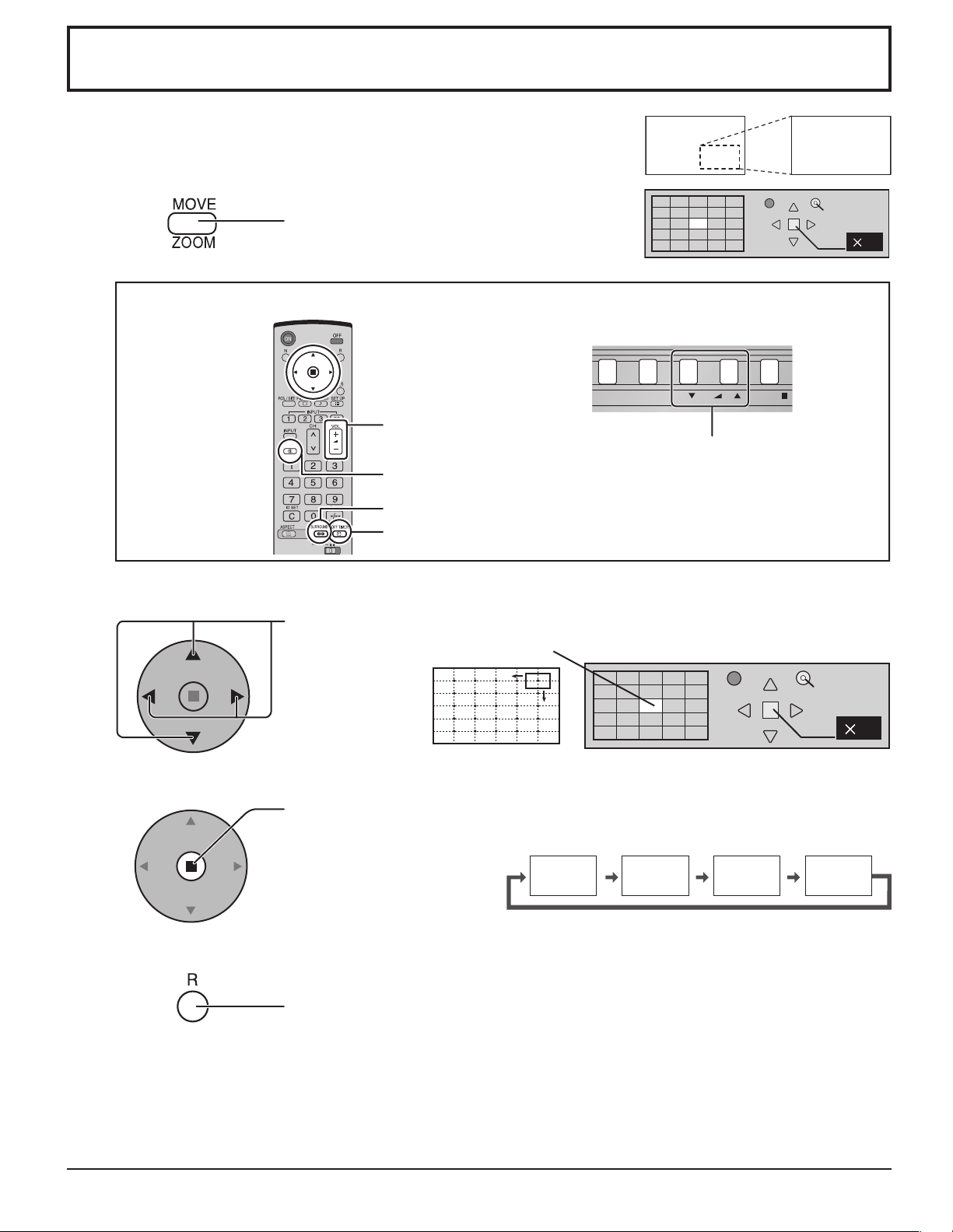
Zoom digital
INPUT MENU ENTER/+/VOL-/
Esto muestra una parte designada de la imagen visualizada que ha sido
aumentada.
1
2
Visualice la “Operation Guide”.
Pulse para tener acceso al zoom digital.
Se visualizará la “Operation Guide”.
Durante el empleo del zoom digital sólo se podrán utilizar los botones siguientes.
[Transmisor]
Botón VOL
Botón MUTE
Botón SURROUND
Botón OFF TIMER
Seleccione el área de la imagen que va a ampliar.
[Unidad]
Botón VOL
Salir
1
Presione sobre la parte que va a ampliar para seleccionarla.
El cursor se moverá.
Salir
21
3
4
Notas:
• Cuando se desconecte la alimentación (incluyendo la operación “Temporizador”), la función del zoom digital se
• La función del zoom digital no se podrá seleccionar en los estados de operación siguientes:
Operación “Multi-viewer” (Imagen en imagen, Imagen fuera de imagen, Una imagen al lado de la otra). (vea la página
• Mientras está funcionando el zoom digital, “Ajuste de Pos./Tamaño” no se pueden utilizar.
Seleccione el aumento requerido para la visualización ampliada.
Cada vez que se presione este botón, el factor de aumento cambiará.
Esto se muestra en la imagen que está siendo visualizada.
× 1 × 2 × 3 × 4
Retorno a la visualización normal (salida del modo del zoom digital).
Púlselo para salir del modo del zoom digital.
desactivará.
21)
26
Page 77
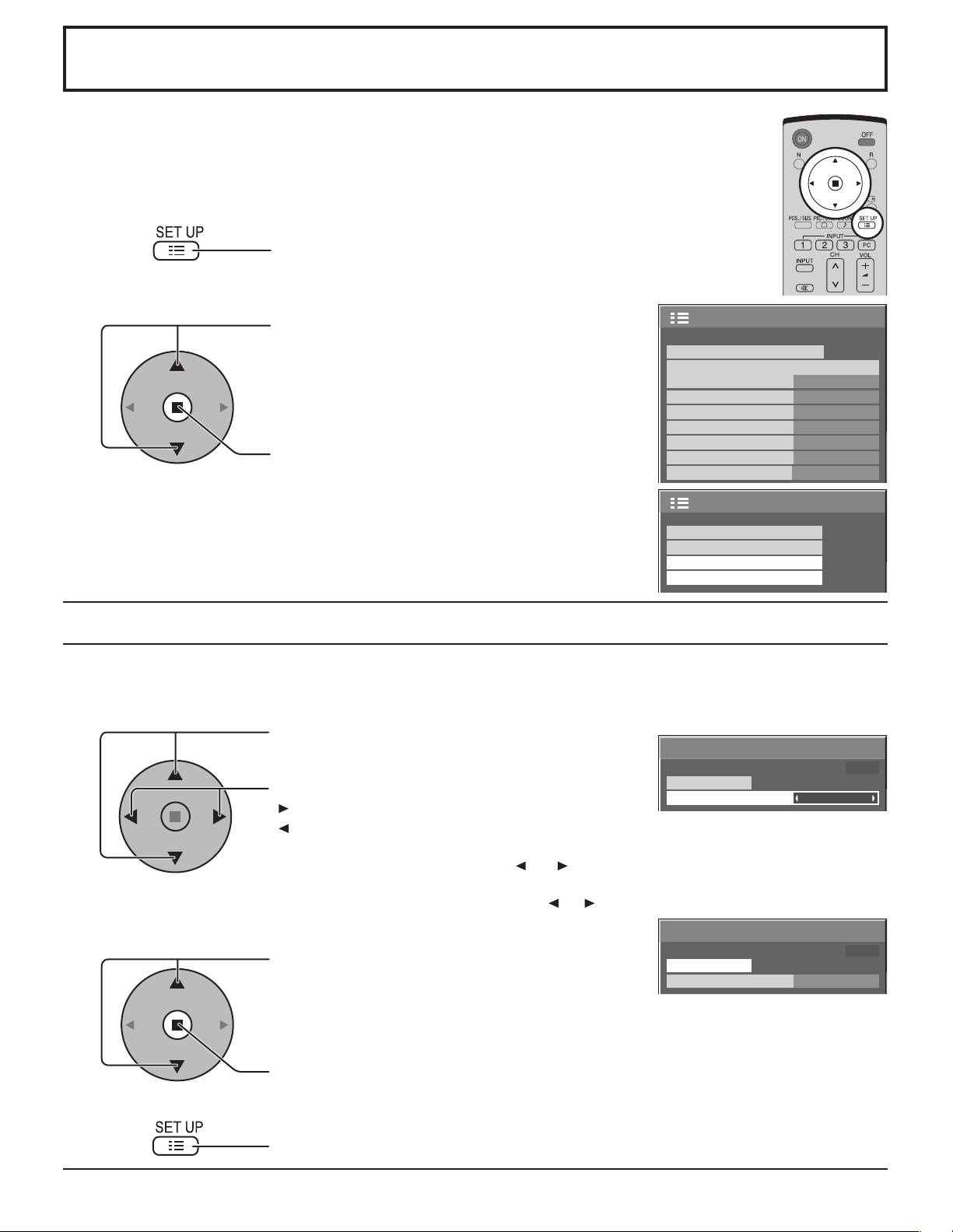
27
Puesta de HORA ACTUAL / TEMPORIZADOR ajuste
1/2
PC
Apagado
Ahorro en reposo
Apagado
Energía monitor
Apagado
Autoapagado
Apagado
Idioma de OSD Español
Seleccione entrada componente/RGB
RGB
Etiqueta de entrada
Señal
Ahorro de consumo
Configuración
2/2Configuración
Protec. pantalla
MULTI DISPLAY
TEMPORIZADOR ajuste
Puesta de HORA ACTUAL
El temporizador puede encender o apagar la pantalla de plasma.
Antes de intentar ajustar el temporizador, confi rme HORA ACTUAL y haga el ajuste necesario.
Luego ajuste el Hora de ENCENDIDO / Hora de APAGADO.
1
2
Pulse para visualizar la pantalla de menú
Confi guración.
Presione para seleccionar
TEMPORIZADOR ajuste o Puesta
de HORA ACTUAL.
Presione para visualizar la pantalla TEMPORIZADOR
ajuste o la pantalla Puesta de HORA ACTUAL.
Puesta de HORA ACTUAL
Visualice la pantalla Puesta de HORA ACTUAL.
Para ajustar HORA ACTUAL, siga el procedimiento descrito a continuación.
1
2
3
Pulse para seleccionar HORA ACTUAL.
Presione para poner la HORA ACTUAL.
botón: Avance
botón: Retroceso
Notas:
• Al presionar una vez el botón “ ” o “ ” , la HORA ACTUAL cambia en pasos de 1
minuto.
• Al presionar continuamente el botón “ ” o “ ”, la HORA ACTUAL cambia en pasos de 15
minutos.
Presione para seleccionar Ajustar.
Pulse para completar el ajuste HORA ACTUAL.
Nota:
No se puede seleccionar Ajustar a menos que la HORA ACTUAL esté puesta.
Presione para salir de Puesta de HORA ACTUAL.
Puesta de HORA ACTUAL
HORA ACTUAL 99:99
Ajustar
HORA ACTUAL
Puesta de HORA ACTUAL
HORA ACTUAL 99:99
Ajustar
HORA ACTUAL
99:99
99:99
Page 78
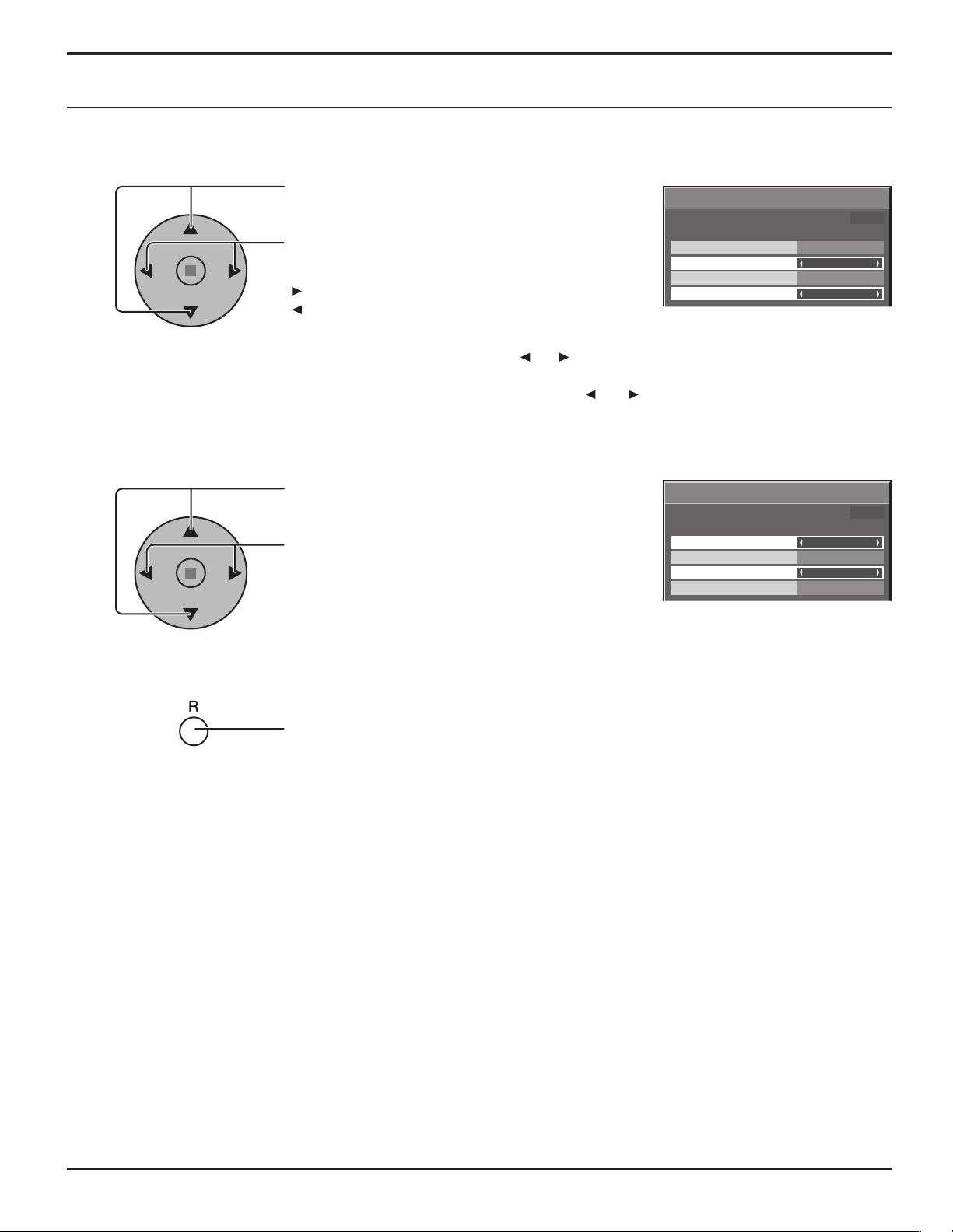
Puesta de HORA ACTUAL / TEMPORIZADOR ajuste
TEMPORIZADOR ajuste
Visualice la pantalla TEMPORIZADOR ajuste.
1
2
Pulse para seleccionar
Hora de ENCENDIDO/ Hora de APAGADO.
Presione para confi gurar la Hora de ENCENDIDO/
Hora de APAGADO.
botón: Avance
botón: Retroceso
Notas:
• Al presionar una vez el botón “ ” o “ ” la Hora de ENCENDIDO/Hora de APAGADO
cambia en pasos de 1 minuto.
• Al presionar continuamente el botón “ ” o “ ”la Hora de ENCENDIDO/Hora de
APAGADO cambia en pasos de 15 minutos.
Pulse para seleccionar Función de
ENCENDIDO/Función de APAGADO.
Pulse para seleccionar ENCENDIDO.
TEMPORIZADOR ajuste
HORA ACTUAL 99:99
Función de ENCENDIDO
Hora de ENCENDIDO
Función de APAGADO
Hora de APAGADO
TEMPORIZADOR ajuste
HORA ACTUAL 99:99
Función de ENCENDIDO
Hora de ENCENDIDO
Función de APAGADO
Hora de APAGADO
Apagado
0:00
Apagado
0:00
Apagado
0:00
Apagado
0:00
3
Nota:
La función del temporizador no se activará si no se establece “HORA ACTUAL”.
Pulse dos veces para salir de Confi guración.
28
Page 79
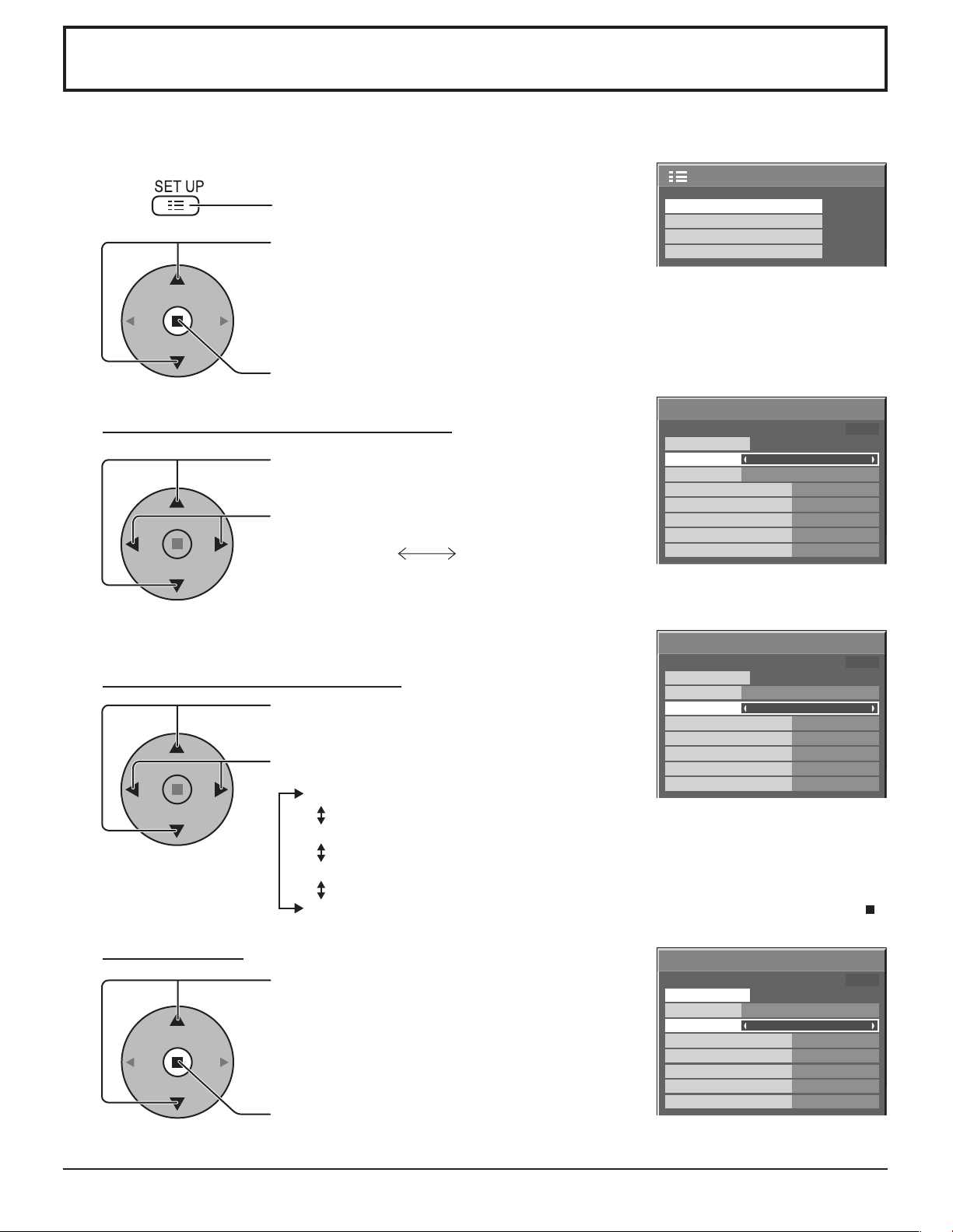
29
Protec. pantalla (Para impedir las imágenes secundarias)
2/2Configuración
Protec. pantalla
MULTI DISPLAY
TEMPORIZADOR ajuste
Puesta de HORA ACTUAL
Protec. pantalla
lnicio
Panel lateral
Hora de finalización
Hora de inicio
De. barra blanca
Apagado
6:15
12:30
Alto
Apagado
Apagado
Modo
Autodesplazamiento
función
Límite de brillo
HORA ACTUAL 99:99
Modo
Autodesplazamiento
función
Límite de brillo
Protec. pantalla
lnicio
Panel lateral
Hora de finalización
Hora de inicio
De. barra blanca
Apagado
6:15
12:30
Alto
Apagado
Apagado
HORA ACTUAL 99:99
Protec. pantalla
lnicio
Panel lateral
Hora de finalización
Hora de inicio
De. barra blanca
Encendido
6:15
12:30
Alto
Apagado
Apagado
Modo
Autodesplazamiento
función
Límite de brillo
HORA ACTUAL 99:99
No visualice una imagen fi ja, especialmente en el modo 4:3, para cualquier longitud del tiempo.
Si la pantalla tiene que estar encendida deberá utilizarse Protec. pantalla.
1
Pulse para visualizar la pantalla de menú Confi guración.
Pulse para seleccionar Protec. pantalla.
2
Pulse para seleccionar la pantalla Protec. pantalla.
Selección de Inversión/desplazamiento
3
Pulse para seleccionar función.
Pulse para seleccionar la función deseada.
De. barra blanca Inversión de imagen
De. barra blanca : La barra blanca se desplazará de izquierda a derecha.
Inversión de imagen : En la pantalla se mostrará una imagen negativa.
Selección del modo de operación
4
Ajuste de Inicio
5
Pulse para seleccionar Modo.
Pulse para seleccionar cada elemento del modo.
Apagado
Intervalo : Funciona cuando Tiempo periódico y Tiempo de operación
están establecidos y llegan esas horas.
Designación de tiempo : Funciona cuando Hora de inicio y Hora de fi nalización están
establecidas y llegan esas horas.
Encendido :
Funciona cuando se selecciona inicio y se presiona ACTION ( ).
Cuando Modo esté en Encendido, presione para
seleccionar Inicio.
Presione para iniciar el Protec. pantalla.
La pantalla de menú desaparecerá y se activará el Protec. pantalla. Para detener el
Protec. pantalla, pulse el botón R.
Page 80
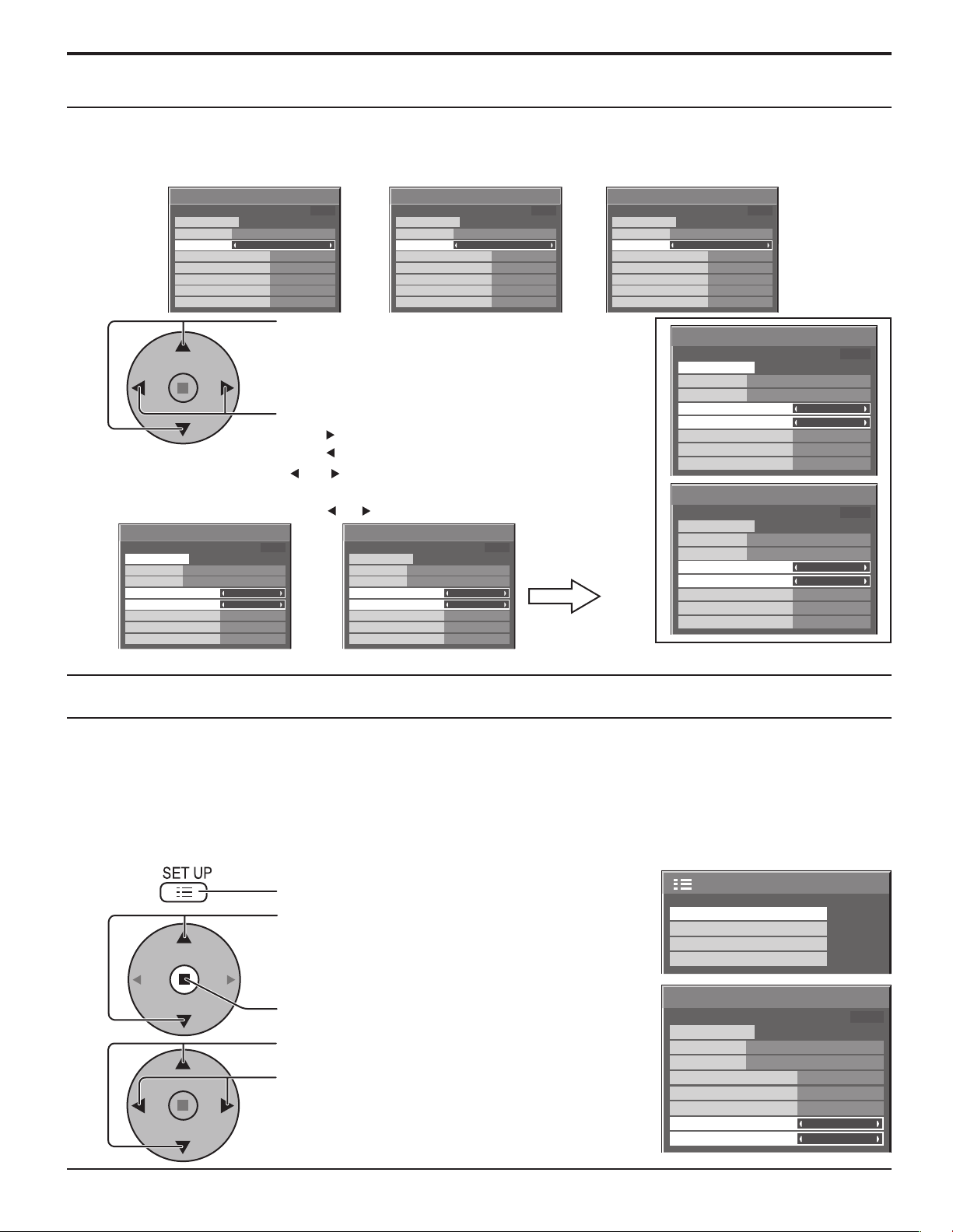
Protec. pantalla (Para impedir las imágenes secundarias)
Modo
Autodesplazamiento
función
Límite de brillo
Protec. pantalla
lnicio
Panel lateral
Hora de finalización
Hora de inicio
De. barra blanca
Apagado
6:15
12:30
Alto
Apagado
Apagado
HORA ACTUAL 99:99
Modo
Autodesplazamiento
Protec. pantalla
lnicio
Panel lateral
De. barra blanca
6:15
12:30
Alto
Apagado
Apagado
Intervalo
Tiempo de operación
Tiempo periódico
función
Límite de brillo
HORA ACTUAL 99:99
Protec. pantalla
lnicio
Panel lateral
Hora de finalización
Hora de inicio
De. barra blanca
6:15
12:30
Alto
Apagado
Apagado
Modo
Autodesplazamiento
función
Límite de brillo
Designación de tiempo
HORA ACTUAL 99:99
2/2Configuración
Protec. pantalla
MULTI DISPLAY
TEMPORIZADOR ajuste
Puesta de HORA ACTUAL
Protec. pantalla
lnicio
Panel lateral
Hora de finalización
Hora de inicio
De. barra blanca
Apagado
6:15
12:30
Alto
Apagado
Apagado
Modo
Autodesplazamiento
función
Límite de brillo
HORA ACTUAL 99:99
Protec. pantalla
lnicio
Panel lateral
Hora de finalización
Hora de inicio
De. barra blanca
0:00
0:00
Alto
Apagado
Apagado
Modo
Autodesplazamiento
función
Límite de brillo
Designación de tiempo
HORA ACTUAL 99:99
Protec. pantalla
lnicio
Panel lateral
De. barra blanca
0:00
0:00
Alto
Apagado
Apagado
Modo
Autodesplazamiento
función
Límite de brillo
Intervalo
Tiempo de operación
Tiempo periódico
HORA ACTUAL 99:99
Protec. pantalla
lnicio
Panel lateral
Hora de finalización
Hora de inicio
De. barra blanca
6:15
12:30
Alto
Apagado
Apagado
Modo
Autodesplazamiento
función
Límite de brillo
Designación de tiempo
HORA ACTUAL 99:99
Protec. pantalla
lnicio
Panel lateral
De. barra blanca
6:15
12:30
Alto
Apagado
Apagado
Modo
Autodesplazamiento
función
Límite de brillo
Intervalo
Tiempo de operación
Tiempo periódico
HORA ACTUAL 99:99
Establecimiento del tiempo de activación de Protec. Pantalla
Después de seleccionar Designación de tiempo o Intervalo, el TEMPORIZADOR ajuste pertinente quedará disponible para
la selección y podrá establecerse Operating Time. (El tiempo no se puede establecer cuando “Modo” está en “Encendido”
o en “Apagado”.)
Pulse para seleccionar Hora de inicio/Hora de
fi nalización (cuando se selecciona Designación de tiempo).
Pulse para seleccionar Tiempo periódico/Tiempo de
operación (cuando se selecciona Intervalo).
Presione para confi gurar.
botón : Avance
Notas:
• Al presionar una vez el botón “ ” or “ ”, la hora cambia en pasos de 1 minuto.
[Sin embargo, la conmutación se produce cada 15 minutos cuando se selecciona Periodic Time.]
• Al presionar continuamente el botón “ ” o “ ”, la hora cambia en pasos de 15 minutos.
botón : Retroceso
Nota: La función del temporizador no se activará si no se establece “HORA ACTUAL”.
Reducción del efecto de imagen secundaria en la pantalla
Las funciones siguientes impiden que se forme una “imagen secundaria” en la pantalla cuando esta se encuentra encendida.
Autodesplazamiento
Encendido1
Encendido2
Limite de brillo: Suprime el contraste de la imagen (brillo máximo).
1
2
3
30
: Desplaza automáticamente la imagen visualizada con un paso equivalente a un punto (por lo tanto
no lo nota el ojo) para impedir la imagen secundaria de los contornos más agudos de la imagen.
Nota:
: Desplaza la imagen con el paso del tiempo.
: Desplaza la imagen dependiendo de la detección de la pantalla.
Si se visualiza una imagen fi ja durante un período de tiempo prolongado, la pantalla puede oscurecerse
ligeramente. (vea la página 43)
Presione para visualizar la pantalla de menú Confi guración.
Presione para seleccionar “Protec. pantalla”.
Presione para visualizar el menú Protec. pantalla.
Presione para seleccionar “Autodesplazamiento” o “Límite
de brillo”.
Presione para seleccionar
“Encendido1”, ”Encendido2” o ”Apagado”
(Autodesplazamiento).
“Encendido” o “Apagado” (Limite de brillo).
Page 81
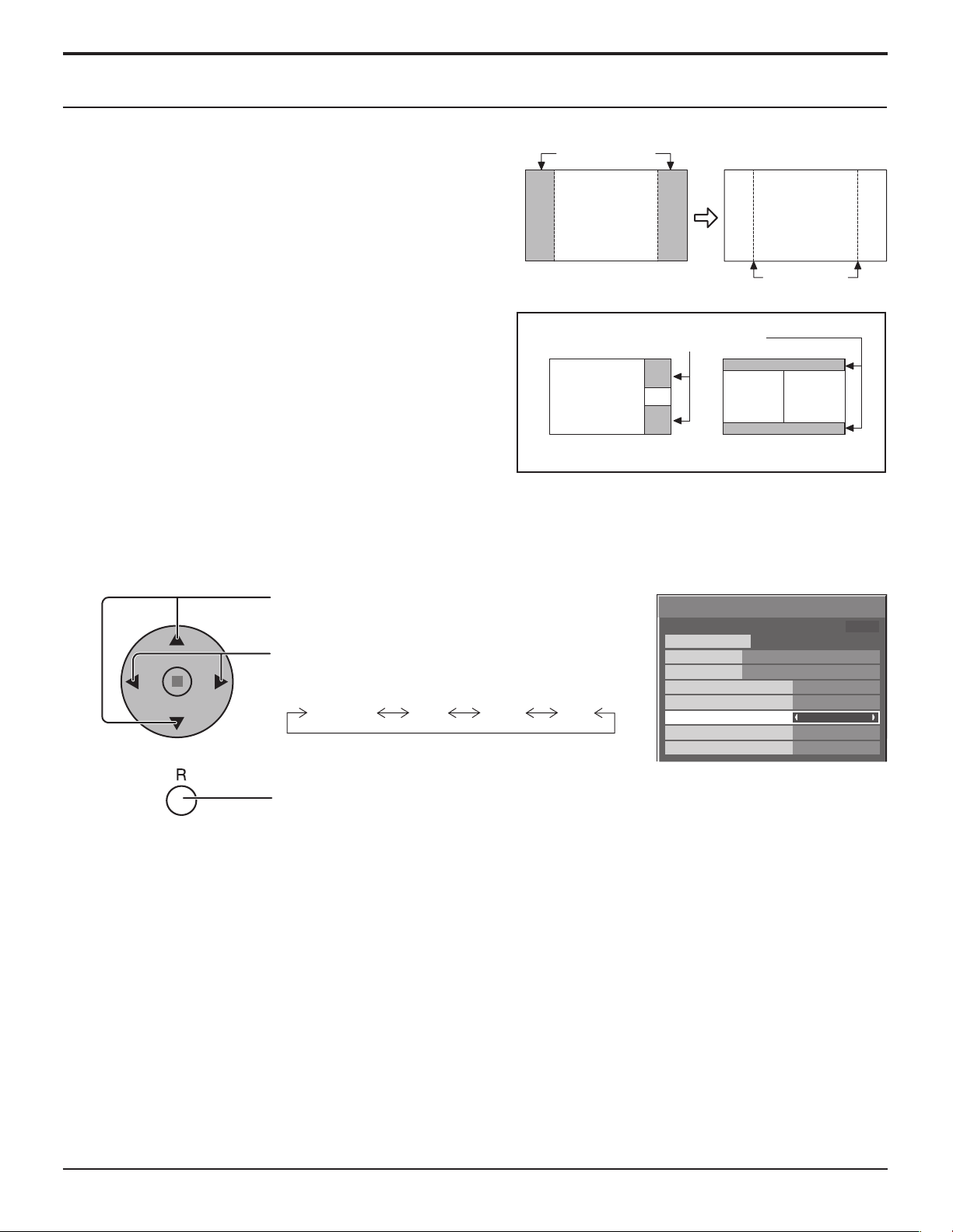
31
AB
Protec. pantalla (Para impedir las imágenes secundarias)
Protec. pantalla
lnicio
Modo
Panel lateral
Autodesplazamiento
Hora de finalización
Hora de inicio
De. barra blanca
Apagado
6:15
12:30
Alto
Apagado
Apagado
función
Límite de brillo
HORA ACTUAL 99:99
Ajuste de paneles laterales
No visualice una imagen en el modo 4:3 durante un periodo
de tiempo prolongado porque esto podrá ser la causa de
que quede una imagen secundaria en los paneles laterales
a ambos lados del campo de visualización.
Para reducir el riesgo de que se produzca el efecto de imagen
secundaria, ilumine los paneles laterales.
Esta función se puede aplicar al área sin imagen.
Paneles
lateralesl
Visualización en
el modo 4:3
Imágenes
secundarias
Área sin imagen
Imagen fuera de imagen
Una imagen al lado de la otra
Abra la pantalla Protec. pantalla.
(Consulte la pagina anterior, pasos 1 y 2 de la guía de operaciones)
1
Pulse para seleccionar Panel lateral.
Pulse para seleccionar Pulse para seleccionar
Apagado, Bajo, Medio, Alto.
Apagado Medio AltoBajo
2
Pulse dos veces para salir de Protec. pantalla.
Notas:
• Para disminuir la aparición de imágenes fantasma, ajuste el Panel lateral a Alto.
• Los paneles laterales pueden destellas (en blanco y negro alternativamente) dependiendo de la imagen que esté siendo
mostrada en la pantalla. Si se utiliza el modo de cine se reducirá el parpadeo.
Page 82
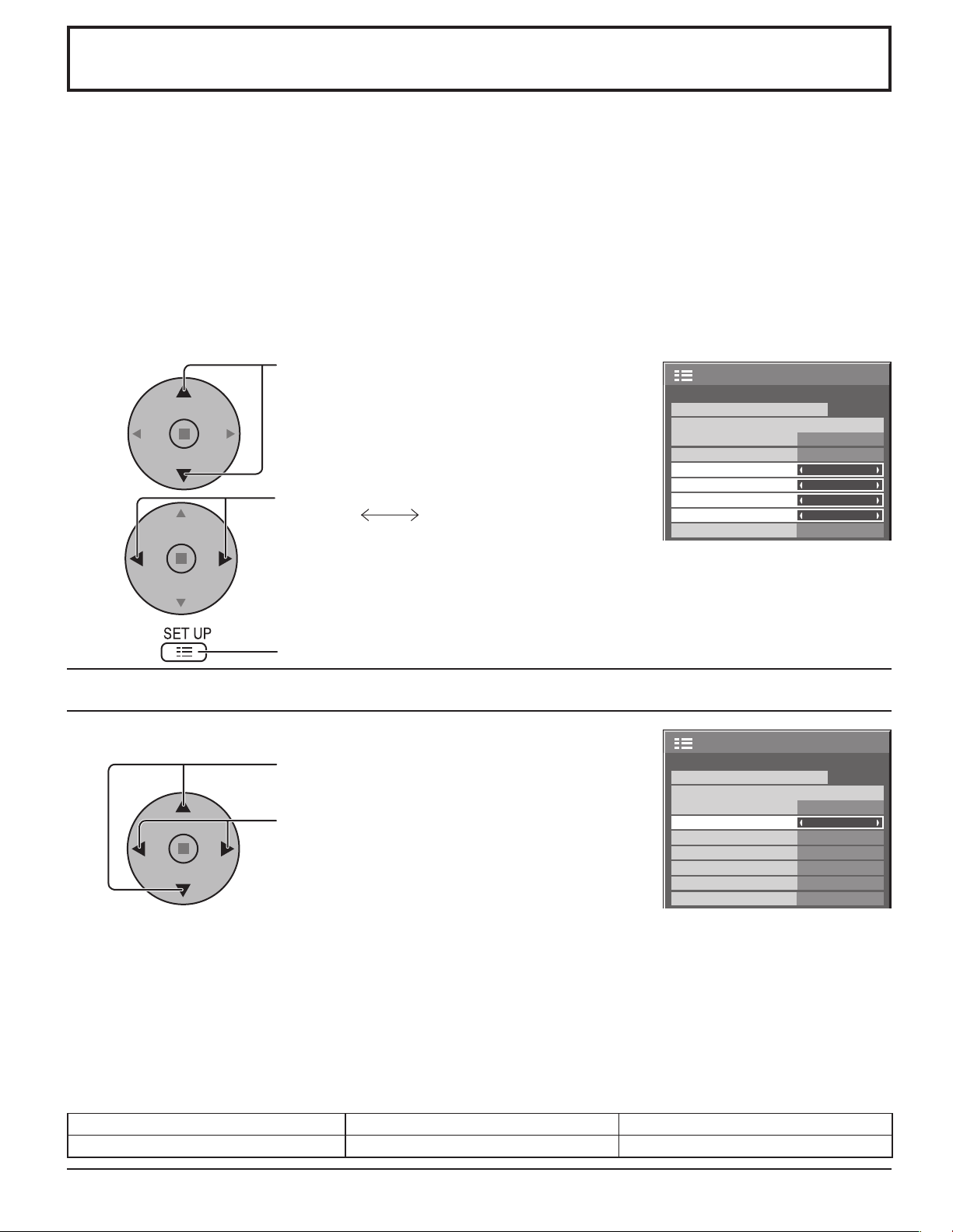
Reducción de consumo de energía
1/2
PC
Apagado
Ahorro en reposo
Apagado
Energía monitor
Apagado
Autoapagado
Apagado
Idioma de OSD Español
Seleccione entrada componente/RGB
RGB
Etiqueta de entrada
Señal
Ahorro de consumo
Configuración
1/2
PC
Apagado
Ahorro en reposo
Apagado
Energía monitor
Apagado
Autoapagado
Apagado
Idioma de OSD Español
Seleccione entrada componente/RGB
RGB
Etiqueta de entrada
Señal
Ahorro de consumo
Configuración
• Ahorro de consumo: Cuando se activa esta función, el nivel de luminosidad de la pantalla de plasma se suprime
para reducir el consumo de energía.
• Ahorro en reposo: Cuando se activa esta función, el consumo de energía del microprocesador se reduce
durante el modo de alimentación en espera (vea la página 13-15), por lo que también se
reduce el consumo de energía del aparato en el modo de espera.
• Energía monitor: La alimentación se conecta o desconecta dependiendo de si hay o no hay señal durante
el modo de entrada de PC. Esta función se activa cuando la alimentación está conectada.
(Sólo durante la entrada procedente del terminal PC (MiniD-sub)
• Autoapagado: El suministro de alimentación al equipo se desconecta cuando no hay señal.
Cuando esté en On, la alimentación de la unidad se pondrá en Off 10 minutos después de
detenerse las señales de entrada.
Esta función sólo es efectiva para las señales de entrada, a excepción de la entrada
procedente del terminal PC (mini D-sub).
1
Presione para seleccionar
“Ahorro de consumo”
“Ahorro en reposo”
“Energía monitor”
“Autoapagado”.
2
Presione para seleccionar “Encendido” o “Apagado”.
Encendido Apagado
Nota:
“Energia monitor” y “Autoapagado” sólo son
efectivos durante la visión normal (pantalla
3
Presione para salir de Confi guración.
de una imagen).
Personalización de las etiquetas de entrada
Esta función puede cambiar la etiqueta de la señal de entrada que va a ser
visualizada.
Nota:
Mientras selecciona una señal de entrada a través del tablero de terminales conectado a una de las ranuras comprendidas
entre la 1 y la 3, Input label dependerá de cada tablero de terminales opcional.
Presione para seleccionar Etiqueta de entrada.
Presione para cambiar Etiqueta de entrada.
Etiquetas de entrada para la ranura 1 a la ranura 3 y miniconector D-sub:
[Entrada de ranura 1] INPUT1/VIDEO1/COMPONENT1/RGB1/DIGITAL1/PC1/DVD1/CATV1/VCR1/STB1
[Entrada de ranura 2] INPUT2/VIDEO2/COMPONENT2/RGB2/DIGITAL2/PC2/DVD2/CATV2/VCR2/STB2
[Entrada de ranura 3] INPUT3/VIDEO3/COMPONENT3/RGB3/PC3/DVD3/CATV3/VCR3/STB3
[Entrada PC (MiniD-sub)] PC/COMPONENT/RGB/DVD/STB
Cuando se utiliza la TY-FB9BD (tarjeta de terminales de vídeo dual BNC opcional), al fi nal de cada etiqueta de entrada
se añade “A” o “B”, dependiendo de la entrada seleccionada (consulte más abajo).
Seña de adición “A” “B”
Entrada seleccionada Compuesto S VIDEO
32
Page 83
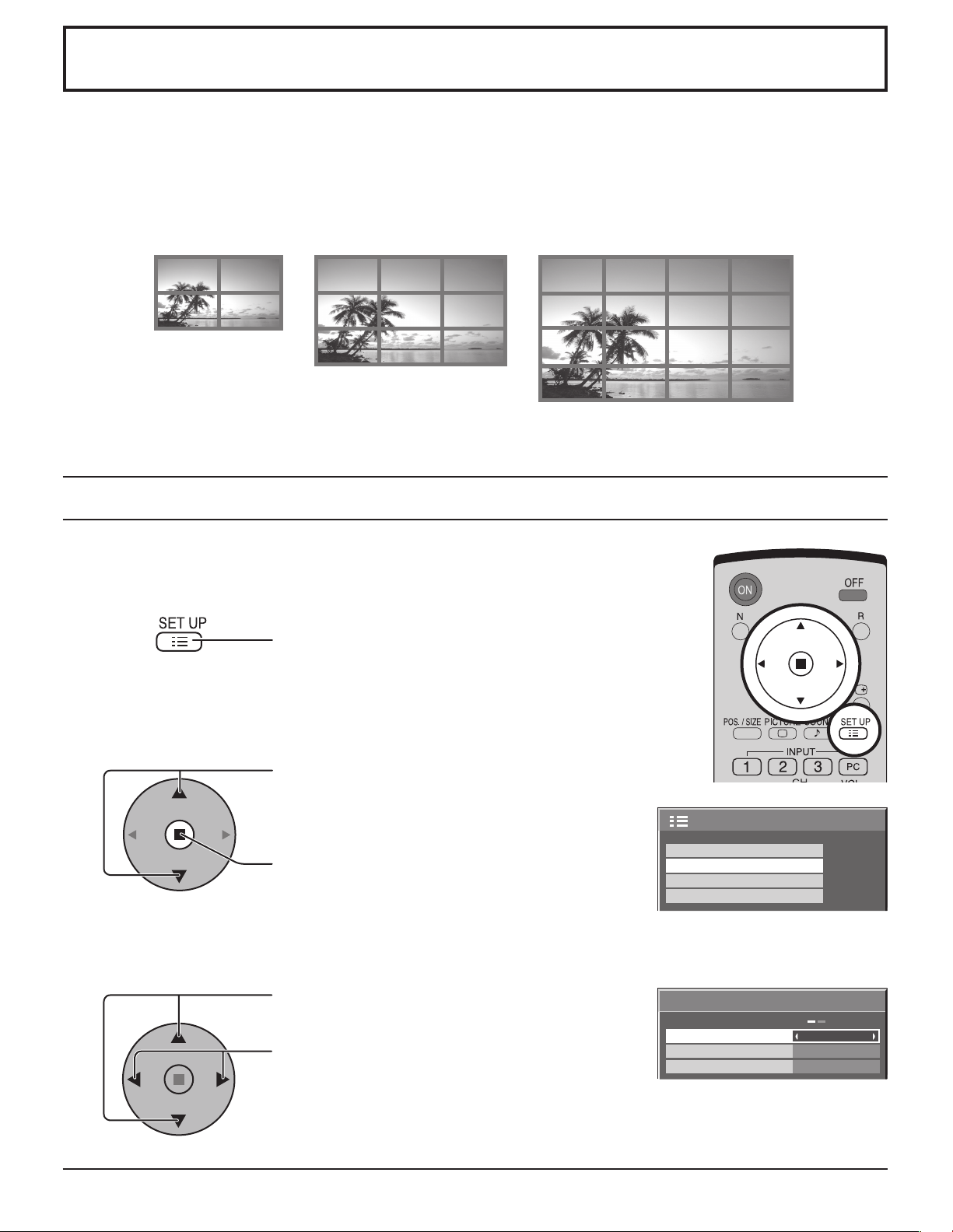
33
Preparación para MULTI DISPLAY
2/2Configuración
Protec. pantalla
MULTI DISPLAY
TEMPORIZADOR ajuste
Puesta de HORA ACTUAL
MULTI DISPLAY
2 × 2
A1
Ubicación
MULTI DISPLAY
Relación
Apagado
(Para la TH-42PS9UK)
Alineando pantallas de plasma en grupos de 4, 9 ó 16 como se muestra en la ilustración de abajo se puede visualizar
una imagen ampliada en todas las pantallas.
Para este modo de operación, cada pantalla de plasma tiene que ser preparada con un número de visualización para
determinar su ubicación.
Grupo de 16 (4 × 4(F))Grupo de 4 (2 × 2(F)) Grupo de 9 (3 × 3)(F))
Pueden seleccionarse dos opciones para MULTI DISPLAY. (vea la página 37).
Cómo preparar la MULTI DISPLAY
1
2
3
Pulse para visualizar la pantalla de menú
Confi guración.
Pulse para seleccionar MULTI DISPLAY.
Pulse para seleccionar el menú “MULTI
DISPLAY”.
Pulse para seleccionar MULTI DISPLAY.
Pulse para establecer Encendido o Apagado.
Page 84
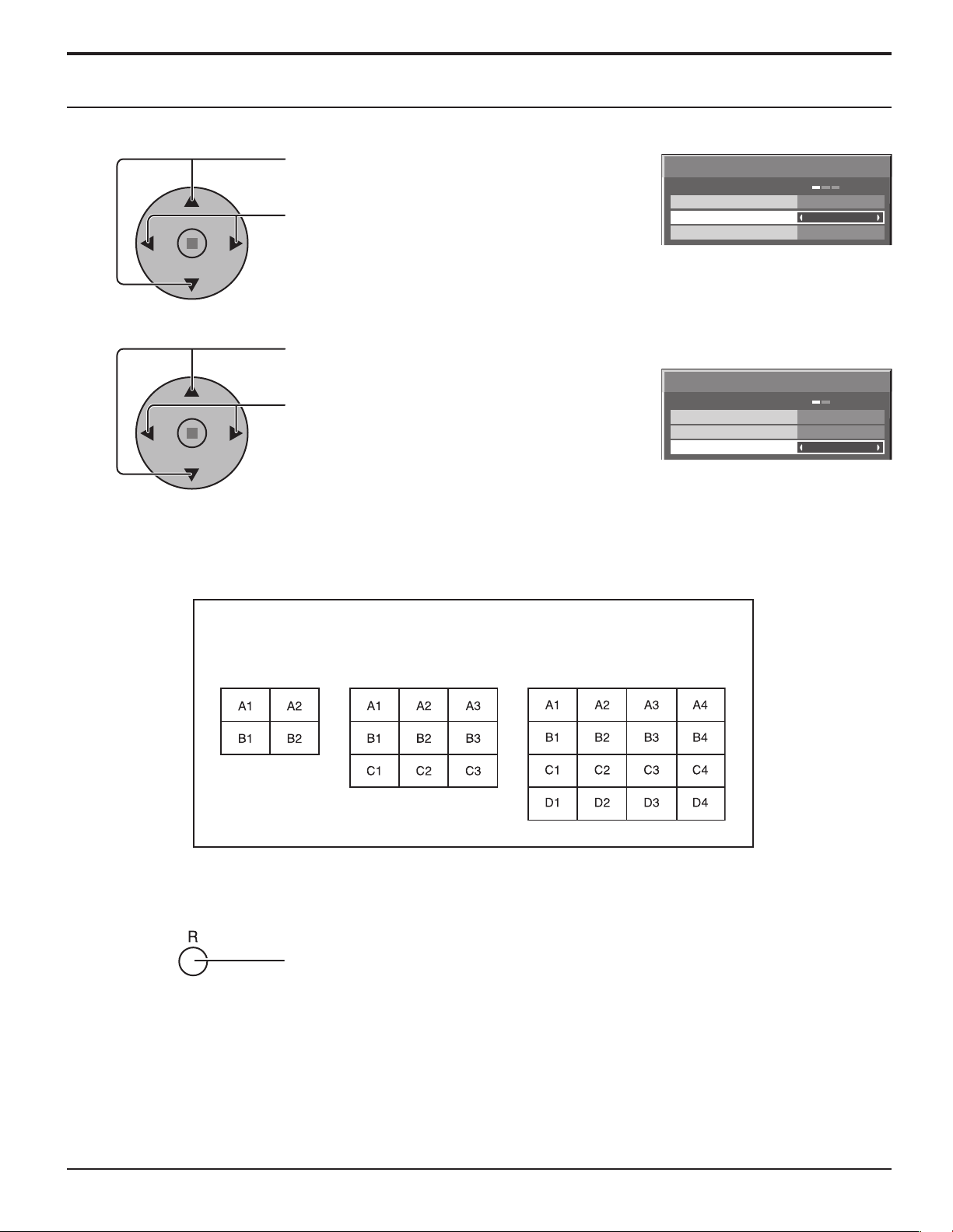
Preparación para MULTI DISPLAY
MULTI DISPLAY
2 × 2
A1
Ubicación
MULTI DISPLAY
Relación
Apagado
MULTI DISPLAY
2 × 2
A1
Ubicación
MULTI DISPLAY
Relación
Apagado
Cómo establecer el número de ubicación de cada pantalla de plasma
4
5
Pulse para seleccionar Relación (2.° paso).
Pulse para seleccionar “2x2”, “2x2F”, “3x3”,
“3x3F”, “4x4”, “4x4F”.
Pulse para seleccionar Ubicación.
Pulse para seleccionar el número de disposición
requerido. (A1-D4: Vea las explicaciones
siguientes.)
6
Numeración de pantallas para cada disposición.
( 2 × 2 (F) ) ( 3 × 3 (F) ) ( 4 × 4 (F) )
Pulse dos veces para salir de Confi guración.
34
Page 85
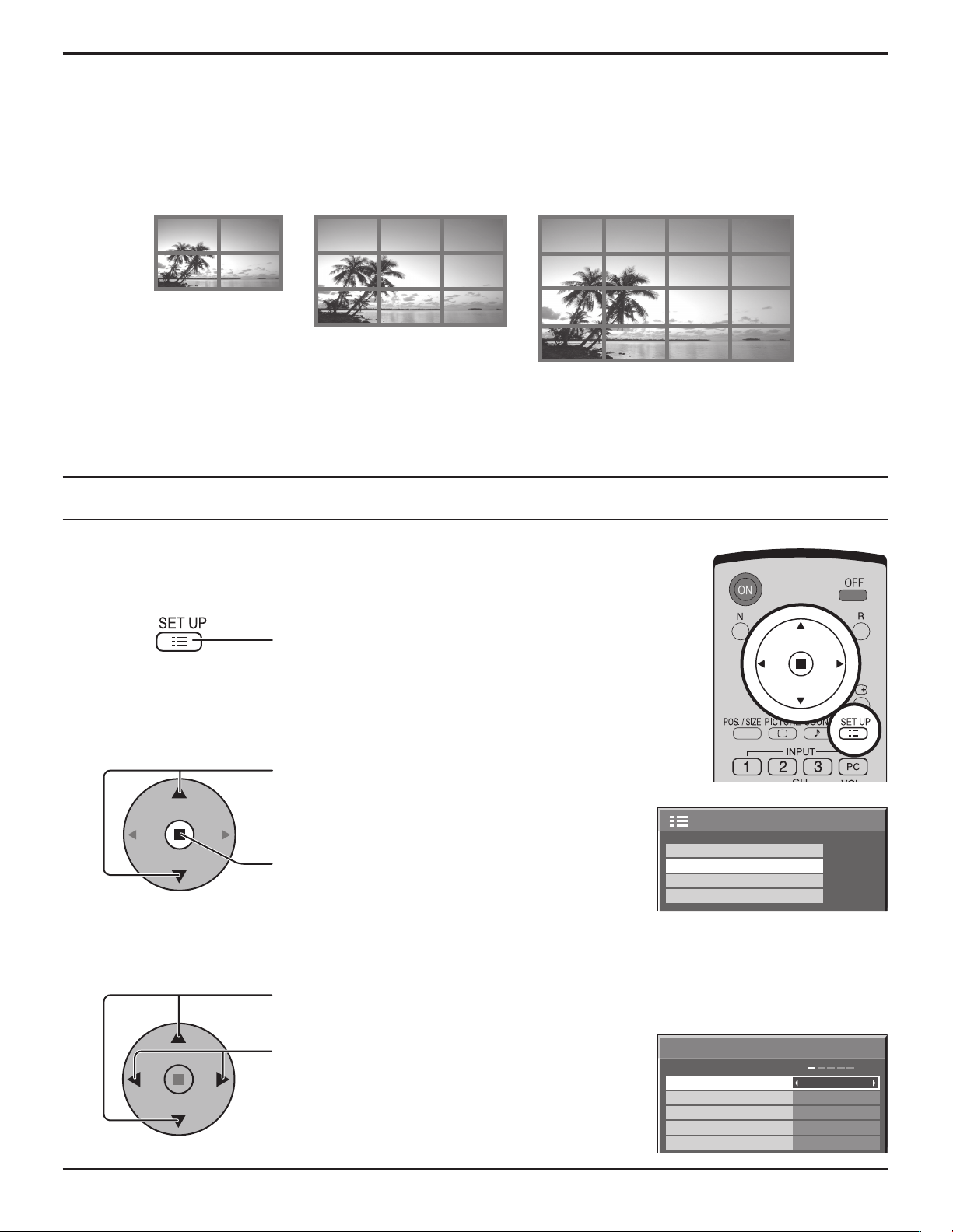
35
Preparación para MULTI DISPLAY
2/2Configuración
Protec. pantalla
MULTI DISPLAY
TEMPORIZADOR ajuste
Puesta de HORA ACTUAL
× 2
MULTI DISPLAY
Escala horizontal
Apagado
Apagado
A1
Ubicación
Escala vertical
Franja oculta video
× 2
MULTI DISPLAY
(Para la TH-37PH9UK, TH-42PH9UK, TH-50PH9UK)
Alineando pantallas de plasma en grupos de 4, 9 ó 16 como se muestra en la ilustración de abajo se puede visualizar
una imagen ampliada en todas las pantallas.
Para este modo de operación, cada pantalla de plasma tiene que ser preparada con un número de visualización para
determinar su ubicación.
Grupo de 16 (4 × 4)Grupo de 4 (2 × 2) Grupo de 9 (3 × 3)
Cómo preparar la MULTI DISPLAY
1
Pulse para visualizar la pantalla de menú
Confi guración.
Pulse para seleccionar MULTI DISPLAY.
2
Pulse para seleccionar el menú “MULTI
DISPLAY”.
3
Pulse para seleccionar MULTI DISPLAY.
Pulse para establecer Encendido o Apagado.
Page 86
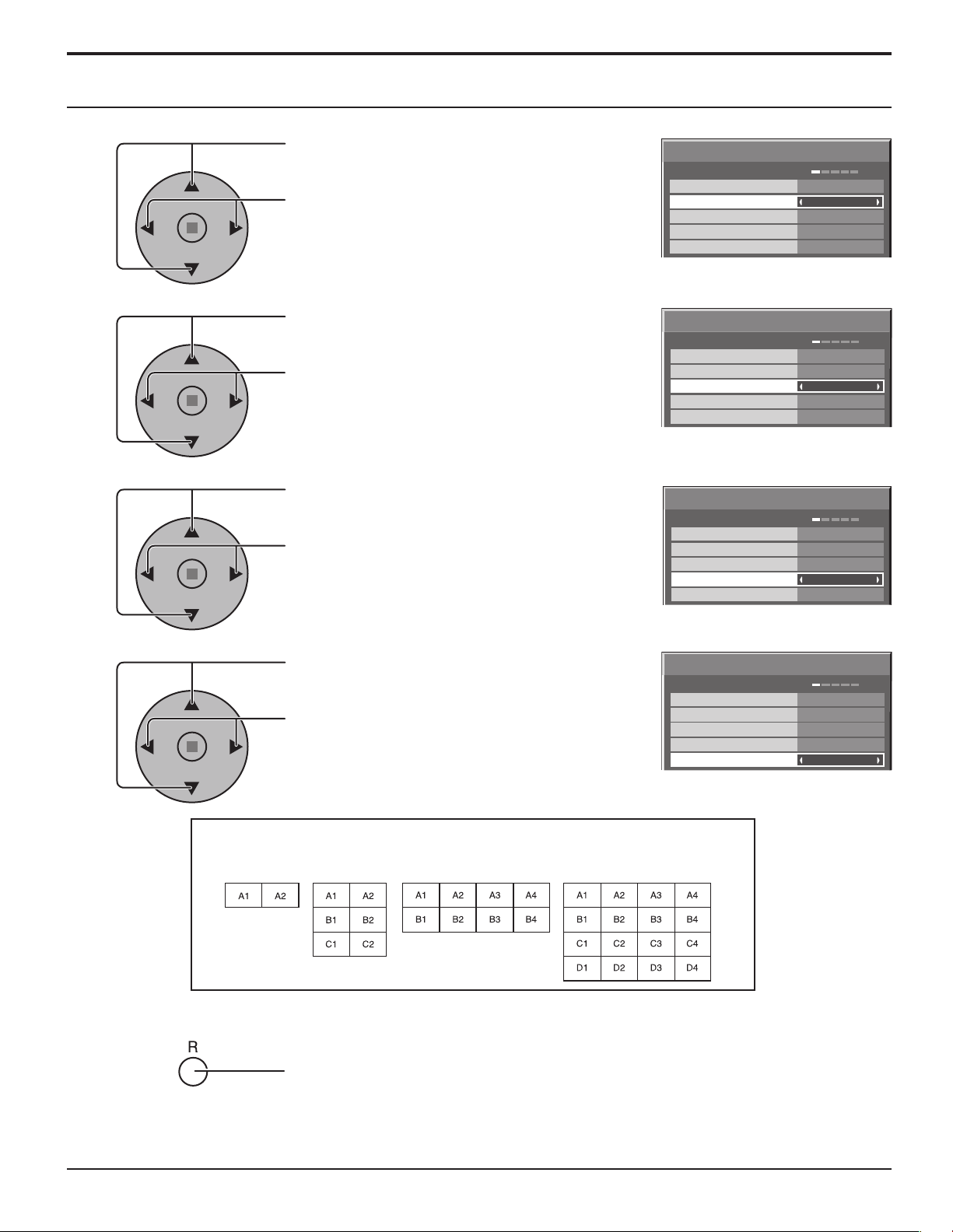
Preparación para MULTI DISPLAY
× 2
MULTI DISPLAY
Escala horizontal
Apagado
Apagado
A1
Ubicación
Escala vertical
Franja oculta video
× 2
MULTI DISPLAY
× 2
MULTI DISPLAY
Escala horizontal
Apagado
Apagado
A1
Ubicación
Escala vertical
Franja oculta video
× 2
MULTI DISPLAY
× 2
MULTI DISPLAY
Escala horizontal
Apagado
Apagado
A1
Ubicación
Escala vertical
Franja oculta video
× 2
MULTI DISPLAY
Cómo establecer el número de ubicación de cada pantalla de plasma
4
5
6
Pulse para seleccionar Escala horizontal.
Pulse para seleccionar “× 1”, “× 2”, “× 3”, “× 4”.
Pulse para seleccionar Escala vertical.
Pulse para seleccionar “× 1”, “× 2”, “× 3”, “× 4”.
Pulse para seleccionar Franja oculta video.
Pulse para seleccionar“Apagado”, “Encendido”.
MULTI DISPLAY
MULTI DISPLAY
Escala horizontal
Escala vertical
Franja oculta video
Ubicación
Apagado
× 2
× 2
Apagado
A1
7
8
Pulse para seleccionar Ubicación.
Pulse para seleccionar el número de disposición
requerido. (A1-D4: Vea las explicaciones
siguientes.)
Numeración de pantallas para cada disposición.
(Ejemplo)
( 2 × 1) ( 2 × 3 )
( 4 × 2 )
Pulse dos veces para salir de Confi guración.
( 4 × 4 )
36
Page 87
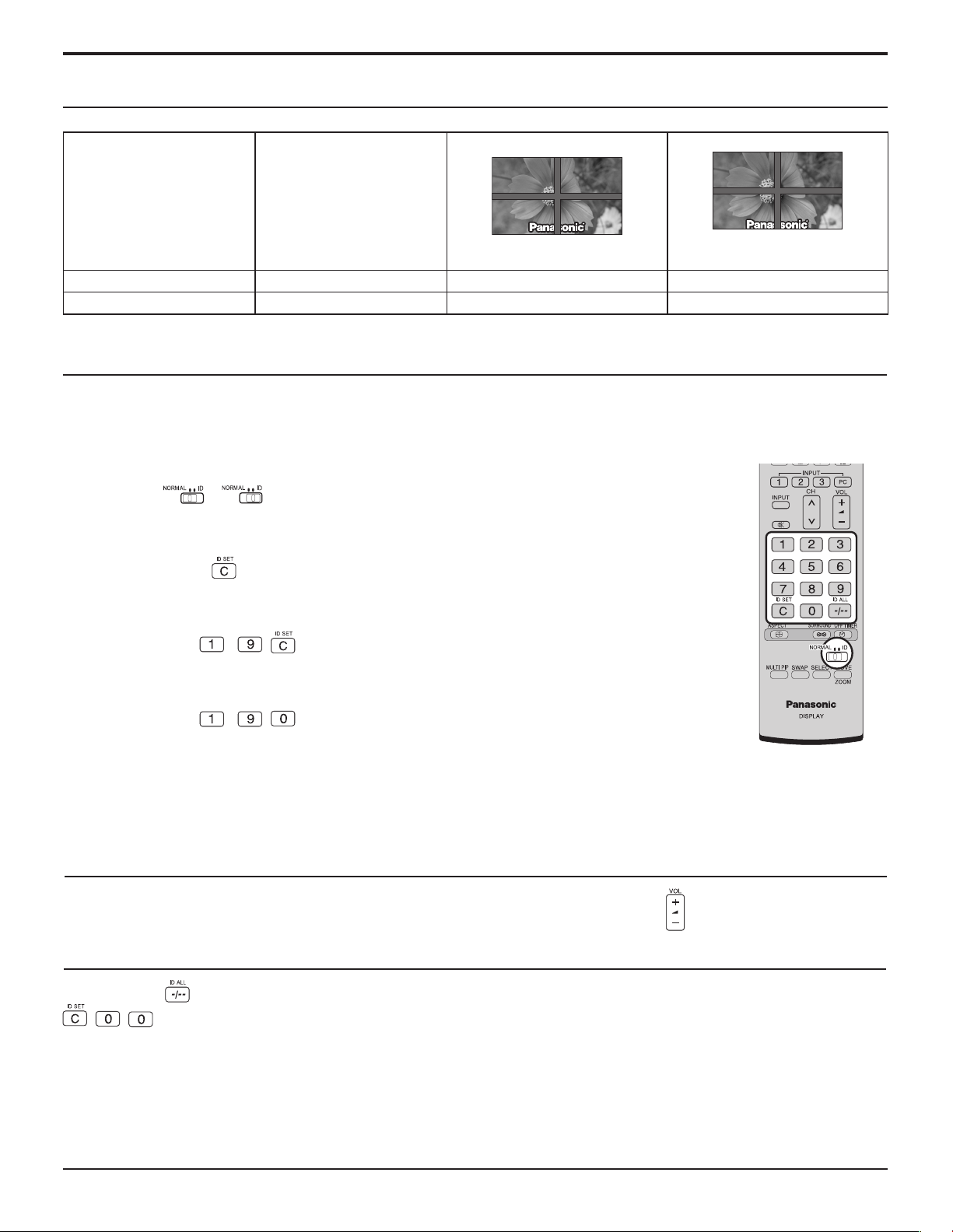
37
Preparación para MULTI DISPLAY
Ajuste F (Franja oculta video)
Para ocultar las uniones entre TVs.
Número de modelo Referencia
Ideal para visualizar
imágenes en movimiento.
TH-42PS9UK
TH-37/42/50PH9UK Paso 6, página 36 Encendido Apagado
Paso 4, página 34 (2 × 2, 3 × 3, 4 × 4)
Para mostrar las uniones entre TVs.
Ideal para visualizar
imágenes fi jas.
(2 × 2F, 3 × 3F, 4 × 4F)
Función de ID del mando a distancia
Usted puede confi gurar el ID del mando a distancia cuando desee utilizar este mando a distancia en uno de los
distintos TVs.
Cambie a a la derecha.
1
Pulse el botón en el mando a distancia.
2
Pulse uno de
3
Pulse uno de - , para obtener la confi guración del dígito de la unidad.
4
Notas:
• Los números en 2, 3 y 4 deben confi gurarse rápidamente.
• El rango ajustable del número de ID es 0 - 99.
• Si una tecla numérica se pulsa más de dos veces, los primeros dos números pasan a ser el número de ID del mando
a distancia.
- , para obtener la confi guración del dígito de la decena.
Funcionamiento del botón de ID del mando a distancia
El funcionamiento es el mismo que el del mando a distancia normal, salvo por el botón .
Cancelación de ID
Pulse el botón que se encuentra en el mando a distancia. (Esta acción tiene el mismo efecto que pulsar los botones
, , al mismo tiempo)
Notas:
• Confi gure el ID del mando a distancia en “On” para operar el ID del mando a distancia.
Si el ID remoto se fi ja en “On”, usted puede utilizar el mando a distancia sin un número de ID idéntico durante la
visualización del menú de opciones.(ver página 43)
• El mando a distancia del ID no puede utilizarse cuando el selector de ID está confi gurado en otro valor distinto de
0 y el ID del mando a distancia no es el mismo que el número del selector. (ver página 43)
Page 88
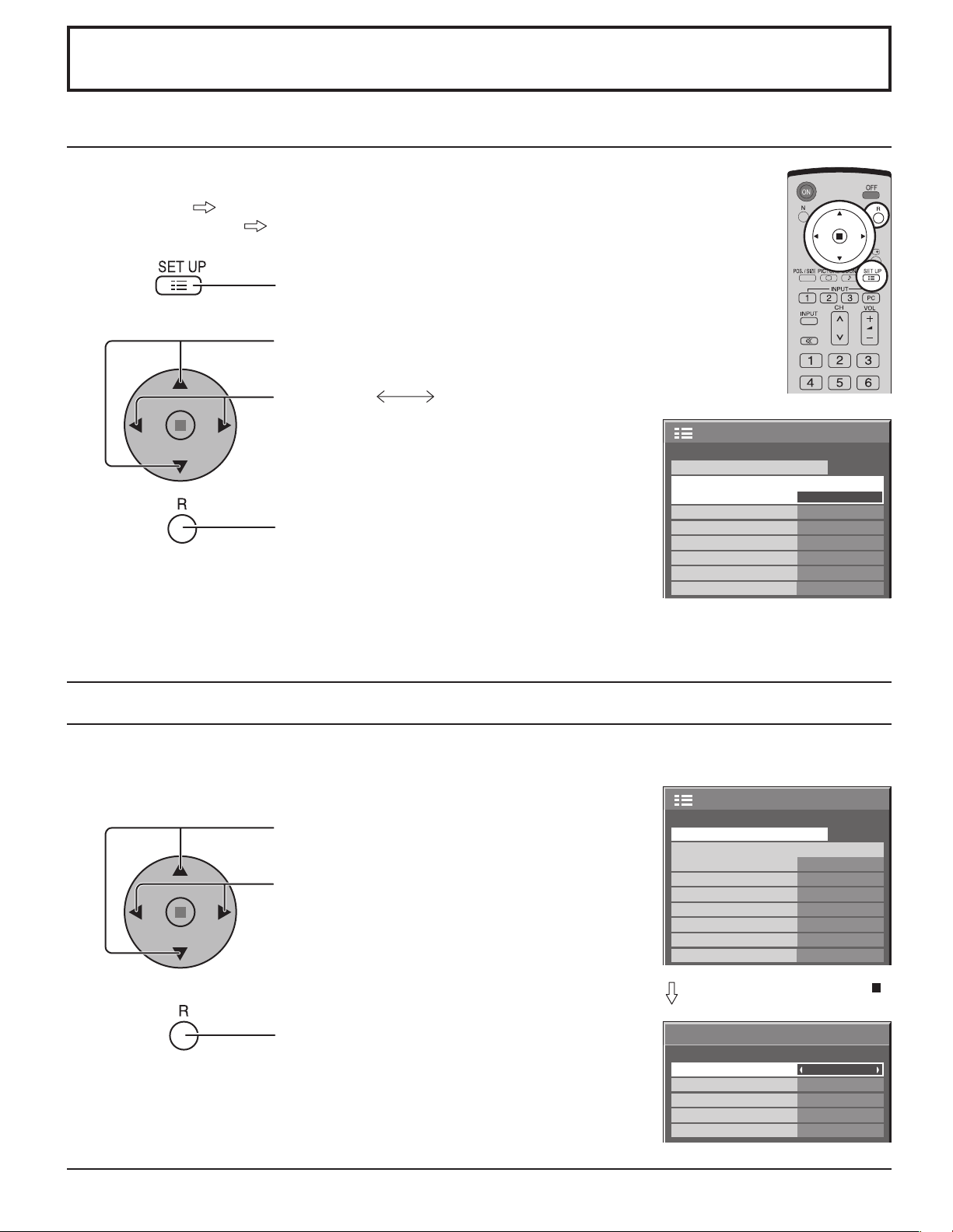
Confi guración para las señales de entrada
1/2
PC
Apagado
Ahorro en reposo
Apagado
Energía monitor
Apagado
Autoapagado
Apagado
Idioma de OSD Español
Seleccione entrada componente/RGB
RGB
Etiqueta de entrada
Señal
Ahorro de consumo
Configuración
1/2
PC
Apagado
Ahorro en reposo
Apagado
Energía monitor
Apagado
Autoapagado
Apagado
Idioma de OSD Español
Seleccione entrada componente/RGB
RVB
Etiqueta de entrada
Señal
Ahorro de consumo
Configuración
Señal
[
AV
]
F. Y/C 3D (NTSC)
Sistema de color
Encendido
Auto
Cinema reality
Panasonic Auto (4 : 3)
Apagado
4 : 3
P-NR
Apagado
Selección de entrada de señal componente/RGB
Haga la selección que concuerde con las señales procedentes de la fuente conectada a los
terminales de entrada de señal componente/RGB.
Señales Y, PB, PR “Componente”
Señales R, G, B, HD, VD “RGB”
1
Presione para indicar la pantalla del menú
“Confi guración”.
2
Press to select the “COMPONENT/RGB IN SELECT”.
Pulse para seleccionar la señal de entrada deseada.
Componente RGB
3
Presione para salir del modo de ajuste.
Nota:
Puede que no sea posible seleccionar, dependiendo de la tarjeta opcional que esté instalada.
Filtro 3D Y/C – para imágenes AV NTSC
Seleccione “Señal” desde el menú “Confi guración” durante la señal de entrada AV (Video S).
(Se muestra la pantalla de menú “Señal [AV]”.)
1
2
Nota:
Cuando está activado, este ajuste sólo afecta a las señales de entrada NTSC.
38
Presione para seleccionar “F. Y/C 3D (NTSC)”.
Presione para Encendido/Apagado.
Presione la tecla ACTION ( )
Presione para salir del modo de ajuste.
Page 89
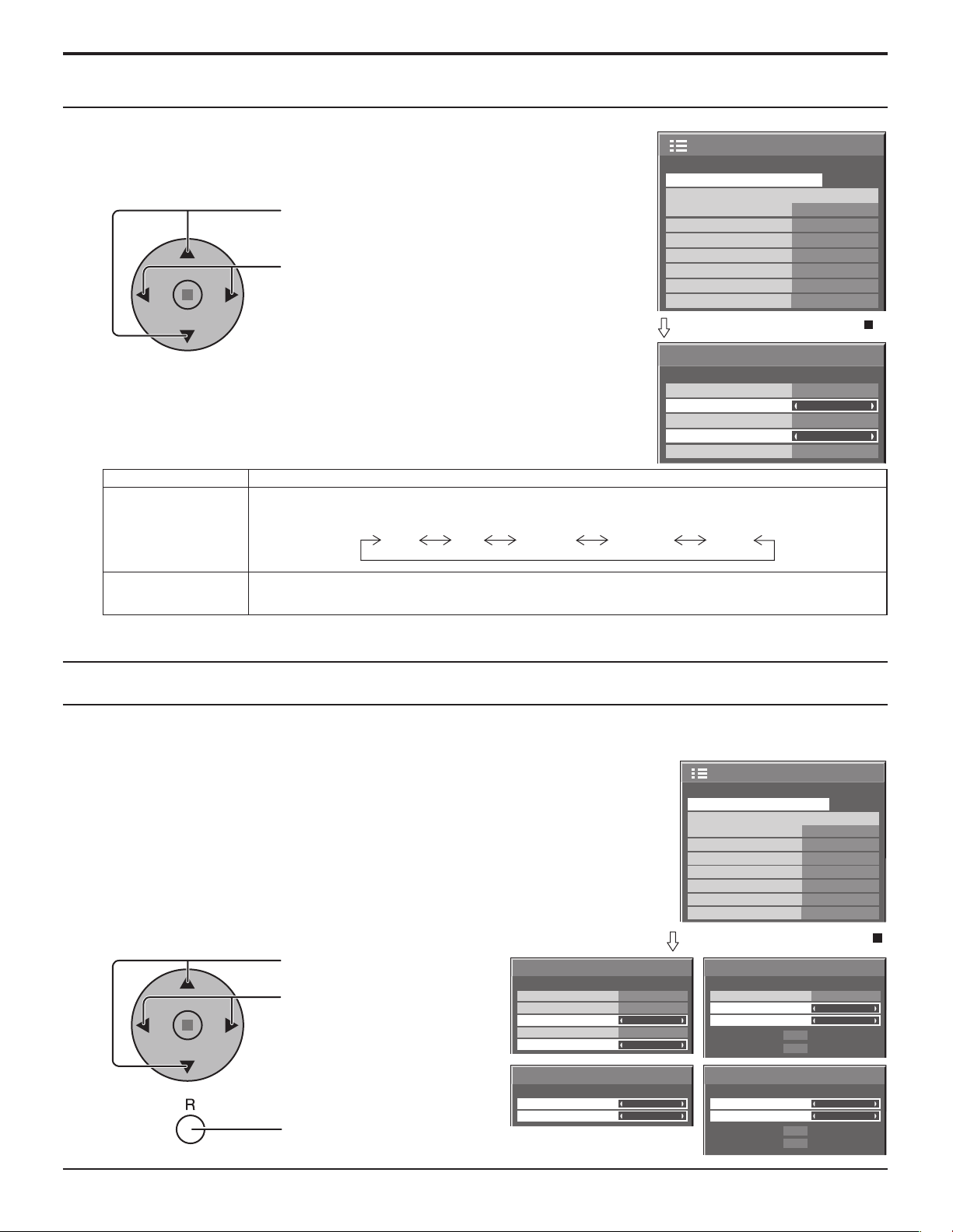
39
Confi guración para las señales de entrada
1/2
PC
Apagado
Ahorro en reposo
Apagado
Energía monitor
Apagado
Autoapagado
Apagado
Idioma de OSD Español
Seleccione entrada componente/RGB
RVB
Etiqueta de entrada
Señal
Ahorro de consumo
Configuración
F. Y/C 3D (NTSC)
Sistema de color
Señal
Encendido
Auto
Cinema reality
Panasonic Auto (4 : 3)
Apagado
4 : 3
P-NR
Apagado
[
AV
]
1/2
PC
Apagado
Ahorro en reposo
Apagado
Energía monitor
Apagado
Autoapagado
Apagado
Idioma de OSD Español
Seleccione entrada componente/RGB
RVB
Etiqueta de entrada
Señal
Ahorro de consumo
Configuración
Señal
[
AV
]
F. Y/C 3D (NTSC)
Sistema de color
Encendido
Auto
Cinema reality
Panasonic Auto (4 : 3)
Apagado
4 : 3
P-NR
Apagado
P-NR
Señal
Auto
Fre. H.
Fre. V.
kHz
Hz
33.8
60.0
[
RGB
]
Sincro
Apagado
Apagado
Cinema reality
Sistema de color / Panasonic Auto
Seleccione Señal desde el menú “Confi guración” durante la señal de entrada AV
(Video S).
(Se muestra la pantalla de menú “Señal [AV]”.)
Presione para seleccionar “Sistema de color” o
“Panasonic Auto”.v
Presione para seleccionar cada función.
Si la imagen se desestabiliza:
Con el sistema ajustado en el modo automático,
bajo condiciones de nivel de sonido bajo o señales
de entrada con ruido, la imagen tal vez pierda
estabilidad en casos muy raros. Si pasa esto, ajuste
el sistema para que concuerde con el formato de la
señal de entrada.
Modo Función
Sistema de color Ajusta el sistema del color para que concuerde con la señal de entrada. Si lo pone en “Auto”,
el sistema de color se determina automáticamente.
Auto SECAM M.NTSC NTSCPAL
Presione la tecla ACTION ( )
Panasonic Auto
(4:3)
Ajuste “4:3” para ver imágenes 4:3 en un formato sin cambiar cuando se seleccione Panasonic
Auto. Si desea ver imágenes 4:3 en el formato Preciso, ajuste “Preciso”.
Nota:
Cuando se utiliza la TY-FB9BD [tarjeta de terminales de vídeo dual BNC (opcional)] no funciona Panasonic AUTO.
Cinema reality / P-NR
Cinema reality: Cuando esté en “Encendido” se intenta reproducir de forma más natural las fuentes tales como películas,
las cuales están grabadas a 24 cuadros por segundo. Si la imagen no es estable, ponga el ajuste en
“Apagado”.
Nota:
Cuando esté en “Encendido”, este ajuste sólo afectará a la entrada de señal siguiente:
• Entrada de señal NTSC / PAL durante la señal de entrada “AV (Video S)”.
• Entrada de señal 525i (480i), 625i (575i) y 1125(1080) / 60i durante la señal de entrada
“Componente”.
P-NR: Reduce automáticamente el ruido de imagen no deseado.
Nota:
La P-NR no se puede ajustar mientras se aplica una señal PC.
Presione para seleccionar
1
“Cinema reality” o “P-NR”.
Presione para Encendido /
Apagado.
Presione la tecla ACTION ( )
2
Presione para salir del modo
Señal
Cinema reality
P-NR
de ajuste.
[
Componente
Apagado
Apagado
]
Señal
Cinema reality
P-NR
Fre. H.
Fre. V.
33.8
60.0
Apagado
Apagado
kHz
Hz
[
Digital
]
Page 90
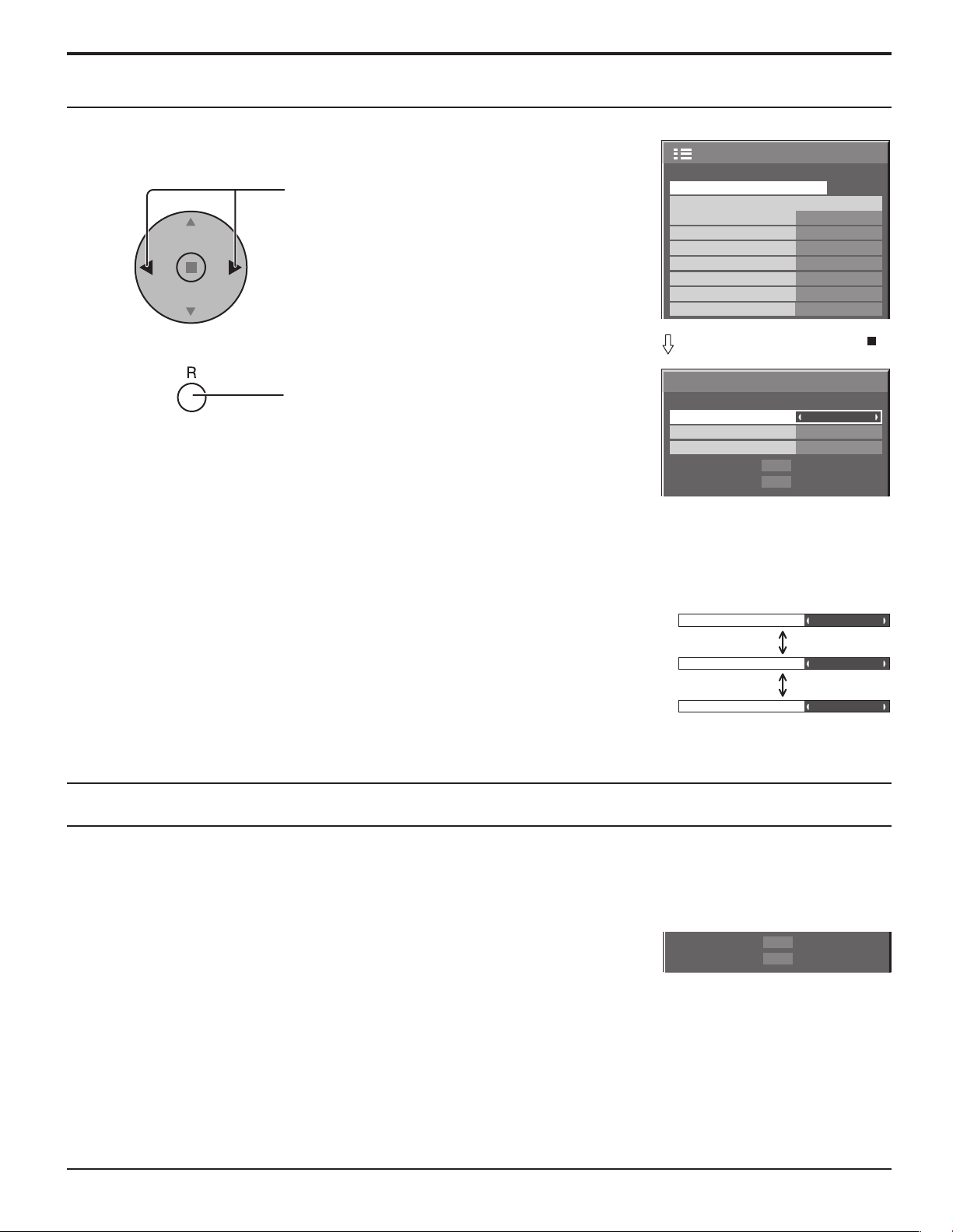
Confi guración para las señales de entrada
1/2
PC
Apagado
Ahorro en reposo
Apagado
Energía monitor
Apagado
Autoapagado
Apagado
Idioma de OSD Español
Seleccione entrada componente/RGB
RVB
Etiqueta de entrada
Señal
Ahorro de consumo
Configuración
P-NR
Cinema reality
Señal
Auto
Apagado
Apagado
Fre. H.
Fre. V.
kHz
Hz
33.8
60.0
[
RGB
]
Sincro
SYNC
AUTO
SYNC
EN G
SYNC
VBS
Fre. H.
Fre. V.
kHz
Hz
33.8
60.0
Sincronización
Seleccione Señal desde el menú “Confi guración” durante la señal de entrada
RGB.
1
2
Presione para ajustar.
Presione para salir del modo de
ajuste.
Ajuste de la señal de sincronización RGB:
Confi rme que la entrada sea RGB (este ajuste sólo tiene validez para la señal de
entrada RGB).
Auto: Las señales de sincronización H y V o la señal sincronizada se
seleccionan automáticamente. Si entran ambas, se seleccionan las
señales de sincronización H y V.
EN G: Utiliza una señal sincronizada en la señal Video G, que se introduce
desde el conector G (BNC).
VBS: Utiliza una señal sincronizada de la entrada de sincronización
compuesta, que entra por el conector HD.
Presione la tecla ACTION ( )
Frecuencia horizontal (kHz)/Frecuencia vertical (Hz)
Indica las frecuencias H (horizontal)/V (vertical).
Esta visualización sólo es válida para las señales de entrada RGB/PC y DVI.
Gama de indicación:
Horizontal 15 - 110 kHz
Vertica 48 - 120 Hz
40
Page 91
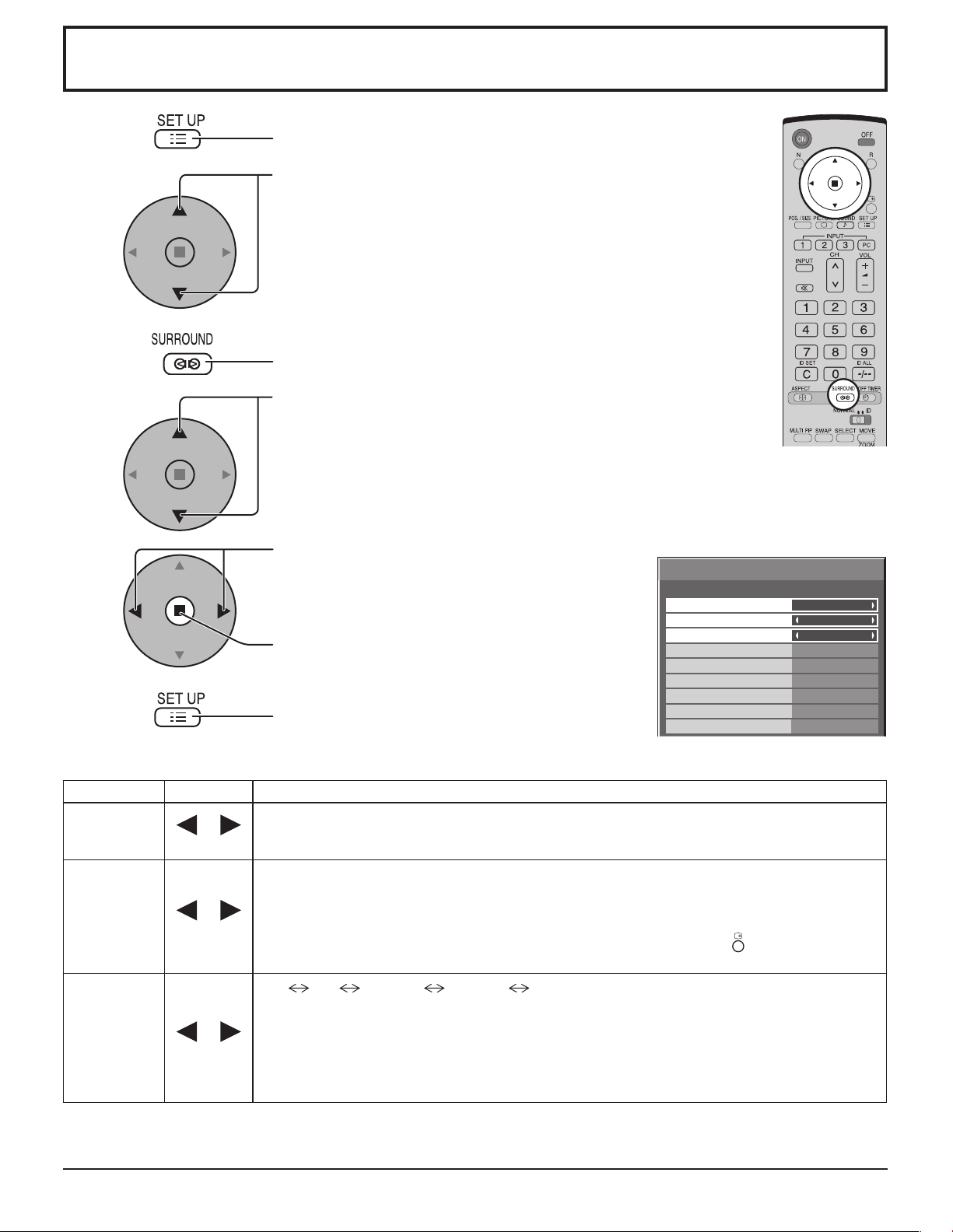
41
Ajustes de Options (Opciones)
1/3
Options
Off-timer function
INPUT lock
Studio W/B
Advanced PIP
Display size
Initial VOL level
Maximum VOL level
Initial INPUT
Onscreen display
Off
Off
Off
Off
Enable
On
Off
0
Off
Off
0
1
2
3
4
5
Pulse para visualizar el menú Setup.
Pulse para seleccionar “Idioma de OSD”.
Mantenga presionado el botón hasta que aparezca el menú
Options (Opciones).
Pulse y seleccione su menú preferido.
Pulse para ajustar el menú.
6
Elemento Efecto Ajustes
Off-timer
function
Onscreen
display
Initial INPUT
Enable
Disable
On Off
Pulse para confi rmar.
Pulse para salir del menú Options (Opciones).
Enable (Activar) : Cambia “Off-timer function (Función Off-timer)” y “On”.
Disable (Desactivar) : Cambia “Off-timer function (Función Off-timer)” y “Off”.
Nota: Cuando está confi gurado en “Disable (Desactivar)”, se cancela el Off-timer.
On (Encendido) : Muestra la siguiente información en pantalla.
• Visor de encendido
• Visor del interruptor de señal de entrada
• No aparece señal
• El silenciador (Mute) y el tiempo restante de off-timer después de fue presionado.
Off (Apagado) : Oculta todos los ítems de arriba de la vista.
Off PC INPUT1 INPUT2 INPUT3
Ajusta la señal de entrada cuando está encendida la TV.
Notas:
• Sólo se visualiza la señal ajustada (ver página 18).
• La señal puede visualizarse cuando está instalado el tablero de terminales.
•
Este menú está disponible solamente cuando el bloqueo de “INPUT lock (INPUT está en
posición)” “Off” (Apagado).
Page 92
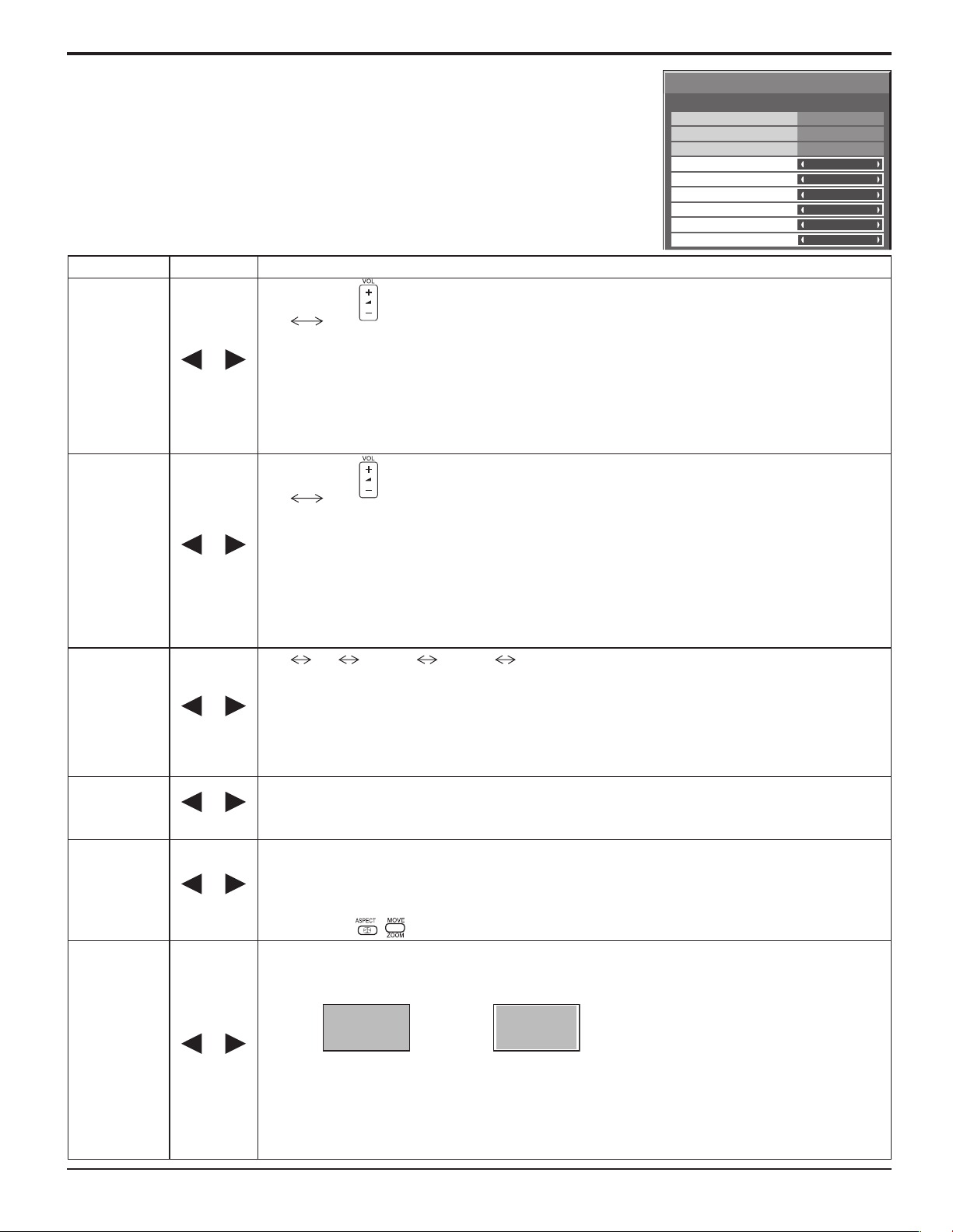
Ajustes de Options (Opciones)
Elemento Efecto Ajustes
Pulse el botón para ajustar el volumen cuando el televisor esté encendido.
Off On
Off (Apagado) : Confi gura el volumen normal.
Initial VOL
level
Maximum VOL
level
INPUT lock
Studio W/B
Advanced PIP
Off On
Off On
Off On
Off On
On (Encendido) : Fija el volumen deseado.
Notas:
• Cuando el “Maximum VOL level” (nivel máximo de volumen) está en posición de encendido (“On”),
el volumen sólo puede ajustarse entre 0 y su rango máximo.
• Usted puede escuchar el volumen que ha cambiado, independientemente de la configuración del
volumen antes de abrir el menú de opciones si ajusta el volumen cuando “Initial VOL level” (nivel
inicial de volumen) se encuentra encendido (“On”) y el cursor está sobre el menú.
Pulse el botón para ajustar el volumen máximo.
Off On
Off (Apagado) : Fija el volumen máximo automático.
On (Encendido) : Confi gura el volumen máximo deseado.
Notas:
•
Si el “Maximum VOL level (Nivel máximo de volumen)” se fija por debajo del “Initial VOL level (Nivel inicial de
volumen)”, este último pasa automáticamente a ser igual al “Maximum VOL level (Nivel máximo de volumen)”.
• El visor de volumen puede llegar hasta 63, independientemente de las configuraciones.
• Usted puede escuchar el volumen que ha cambiado, independientemente de la configuración del
volumen antes de abrir el menú de opciones si ajusta el volumen cuando “Maximum VOL level”
(nivel máximo de volumen) se encuentra encendido (“On”) y el cursor está sobre el menú.
Off PC INPUT1 INPUT2 INPUT3
Bloquea el funcionamiento del interruptor de entrada.
Notas:
• Sólo se visualiza la señal ajustada. (ver página 18).
• La señal puede visualizarse cuando está instalado el tablero de terminales.
• El interruptor de entrada puede utilizarse cuando esté en “Off”.
• En el modo de visor de dos pantallas, si hay algo configurado aparte de “Off”, el valor se fijará como
el valor de entrada en el modo de visor de una pantalla.
Off (Apagado) : Anula todas las confi guraciones ajustadas.
On (Encendido) : Confi gura la temperatura del color para un estudio de TV.
Nota:
Válido solamente cuando se confi gura el bajo como la temperatura del color en el ajuste de pantalla.
Off (Apagado) : Confi gura el modo del visor de dos pantallas. (ver página 21).
On (Encendido) : Confi gura el modo Advanced PIP (ver página 22).
Notas:
•
Cuando el bloqueo “INPUT lock” (bloqueo de entrada) está en encendido (“On”), usted no puede
utilizar las dos funciones del visor de dos pantallas.
• Los botones , no pueden utilizarse durante el funcionamiento del modo Advanced PIP.
Ajusta el tamaño del visor de imagen en pantalla.
Off (Apagado) : Ajusta el tamaño normal del visor de imagen en pantalla.
On (Encendido) :
Ajusta el tamaño del visor de imagen en alrededor del 95% del visor normal de imagen.
Off On
Options
Off-timer function
Onscreen display
Initial INPUT
Initial VOL level
Maximum VOL level
INPUT lock
Studio W/B
Advanced PIP
Display size
Enable
Off
Off
1/3
On
Off
0
0
Off
Off
Off
Off
Display size
42
Off On
Notas:
• Esta configuración es válida solamente cuando las señales de entrada son las siguientes: 525i,
525p, 625i, 625p, 750/60p, 750/50p, 1125/60i, 1125/50i, 1125/24sF, 1125/25p, 1125/24p, 1125/30p,
1250/50i(Video de componente, RGB, DVI, SDI, HDMI)
•
Esta configuración no es válida cuando se selecciona un visor de dos pantallas, zoom digital o Multi pantalla.
• Cuando el tamaño del visor se fija en “On”, no puede utilizarse el ajuste de Pos./Tamaño.
•
Consulte el manual de operaciones de cada tablero para conocer las señales correspondientes para DVI, SDI y HDMI.
Page 93
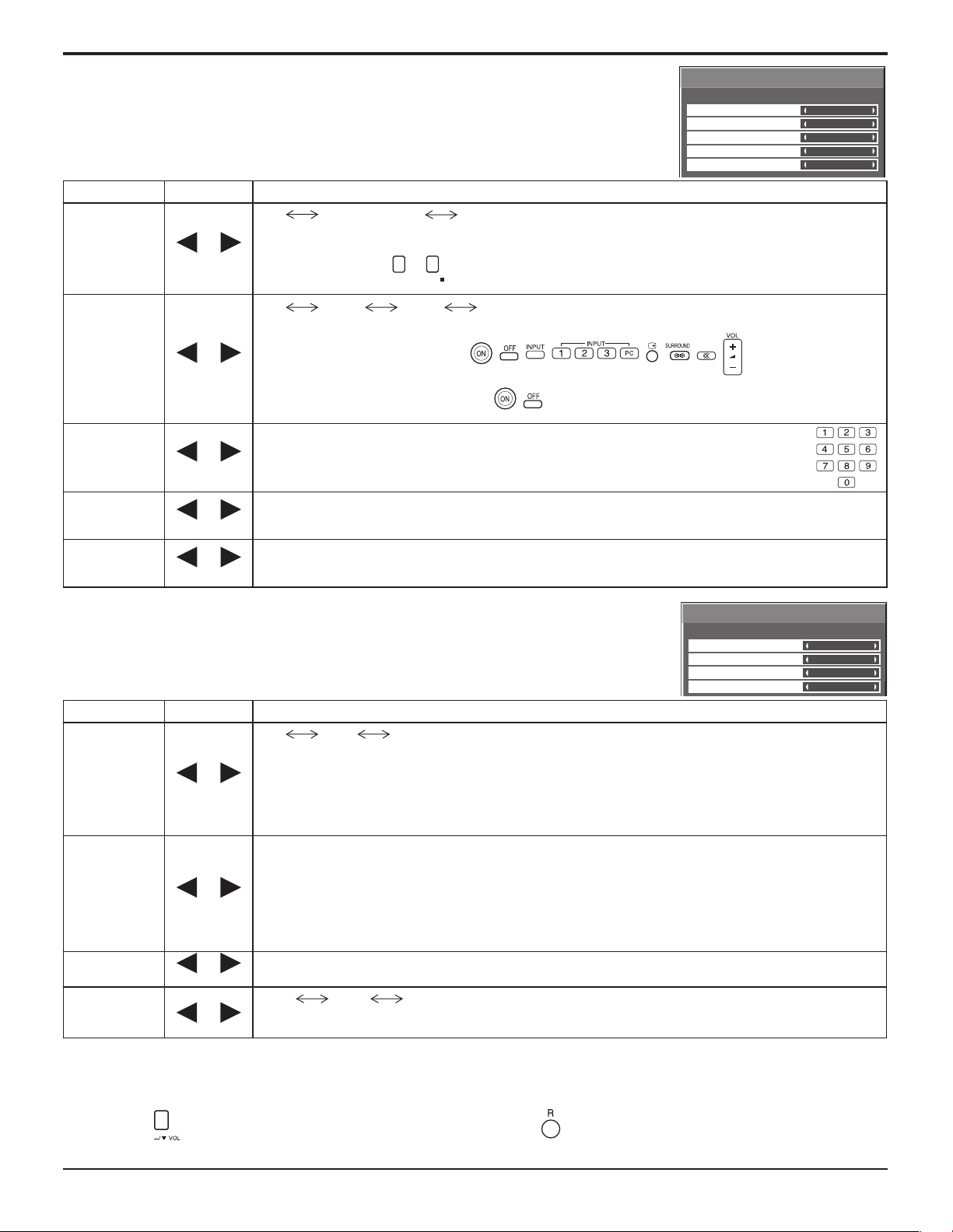
43
Ajustes de Options (Opciones)
MENU
ENTER/
3/3
Options
Off
Off
Off
V. lnstallation
Rotate
Slot1
Serial Slot Select
Slot power
Elemento Efecto Ajustes
Off MENU&ENTER On
Button lock
Remocon
User level
ID select
Remote ID
Serial ID
Off On
Off On
Off (Apagado) :
MENU & ENTER (MENU y ENTER) :
Bloquea los botones
On (Encendido) : Bloquea todos los botones en la cara inferior de la unidad principal.
Off User1 User2 User3
Off (Apagado) :
User1 (Usuario 1) :
Usted sólo puede usar los botones , , , , , , , , que se encuentran en
el mando a distancia.
User2 (Usuario 2) :
Usted sólo puede utilizar los botones
User3 (Usuario 3) : Bloquea todos los botones del mando a distancia.
Ajusta el número de ID del panel cuando éste se utiliza en “Remote ID” o en “Serial ID”.
Fije el rango de valor en: 0-100
(Valor estándar: 0)
Off (Apagado) : Desactiva las funciones del ID del mando a distancia.Usted puede utilizar las
On (Encendido) : Activa las funciones del ID del mando a distancia.
Confi gura el Control de ID del panel.
Off (Apagado) : Desactiva el control externo por medio del ID.
On (Encendido) : Activa el control externo por medio del ID.
Pueden utilizarse todos los botones en la parte inferior de la unidad principal.
y
en la cara inferior de la unidad principal.
Usted puede utilizar todos los botones que se encuentran en el mando a distancia.
, , que se encuentran en el mando a distancia.
operaciones normales del mando a distancia.
Options
Button lock
Remocon User level
ID select
Remote ID
Serial ID
2/3
Off
Off
0
Off
Off
Elemento Efecto Ajustes
Off Auto On
Off (Apagado) : La potencia no se transmite a la potencia de la ranura.
Slot Power
Auto :
On (Encendido) :
La potencia se transmite a la potencia de la ranura solamente cuando la potencia principal está activada.
La potencia se transmite a la potencia de la ranura cuando la potencia principal está activada o en espera.
Nota:
En algunos casos, la potencia se transmite a la potencia de la ranura cuando la potencia principal está
activada o en modo de espera, independientemente de la confi guración de potencia de la ranura.
Off (Apagado) : Fija el ventilador al modo de instalación horizontal.
On (Encendido) : Fija el ventilador al modo de instalación vertical.
Notas:
V.Installation
Off On
• Esto funciona cuando el visor está encendido.
• Este modo se encuentra disponible para TH-42PH9UK y TH-50PH9UK.
• La instalación vertical se encuentra disponible para TH-42PS9UK sin este modo.
• Gire el interruptor de la alimentación hacia arriba cuando instale verticalmente la pantalla.
Rotate
Serial Slot
Select
Off On
Off (Apagado) : No gira la imagen.
On (Encendido) : Gira la imagen a 180 grados.
Slot1 Slot2 Slot3
Selecciona la ranura que se comunica en serie.
Nota:
El ajuste de un comando externo sólo se puede establecer desde el terminal serial fi jo (vea la página 11).
Normalización
Cuando tanto los botones de la unidad principal como el mando a distancia se encuentran desactivados debido a las
confi guraciones del “Button lock” (Bloqueador de botones), “Remocon User level” (Nivel de mando a distancia del usuario)
o “Remote ID” (ID del mando a distancia), fi je todos los valores en “Off” para volver a activar todos los botones.
Pulse el botón que se encuentra en la unidad principal, junto con el botón que se ubica en el mando a distancia, y manténgalos
presionados durante más de 5 segundos. “SHIPPING (menú por defecto)” se visualiza y el bloqueo se destraba cuando desaparece.
Page 94
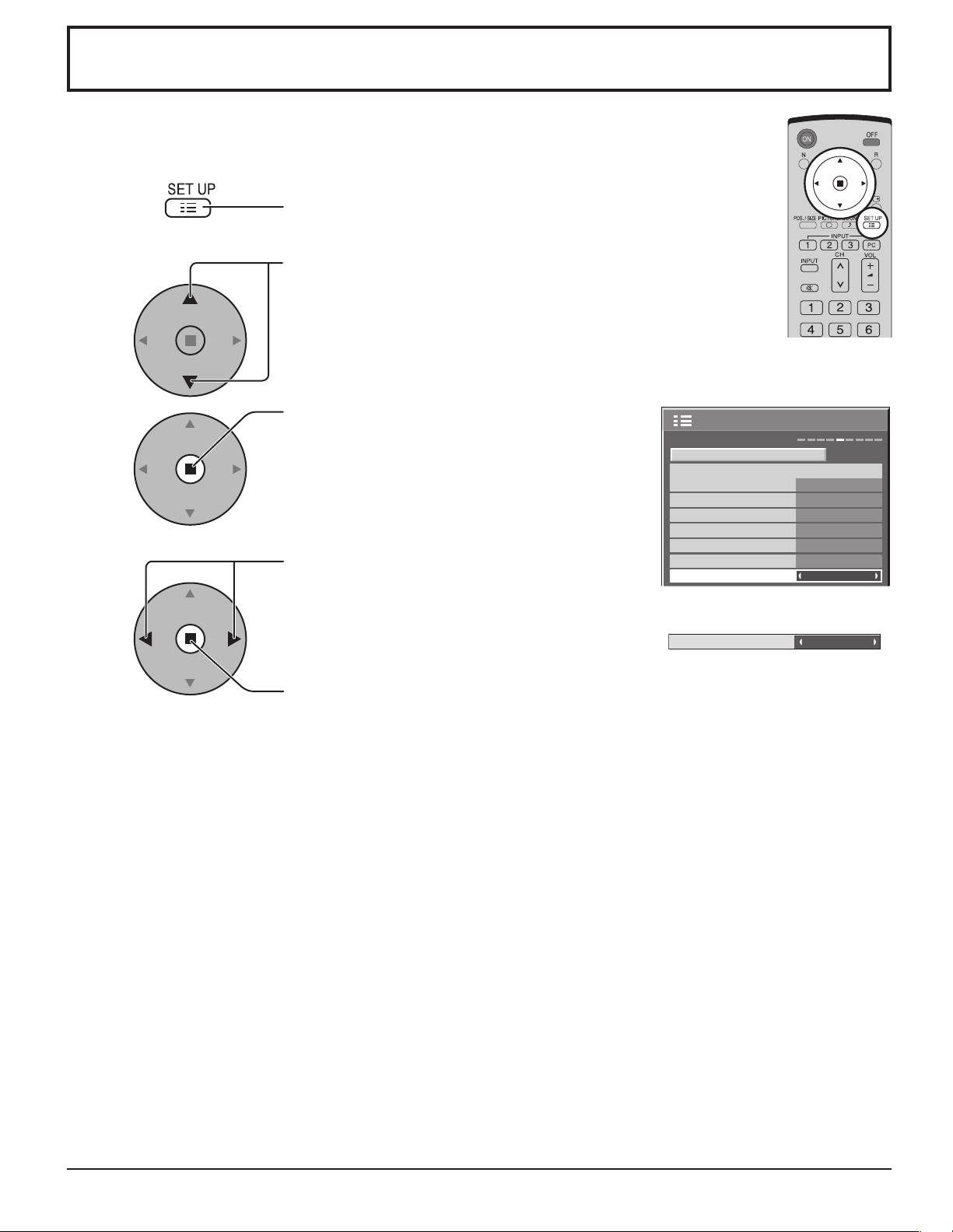
Estado de transporte
1/2
Señal
PC
Apagado
Ahorro en reposo
Apagado
Energía monitor
Apagado
Autoapagado
Apagado
Idioma de OSD Español
Seleccione entrada componente/RGB
RGB
Etiqueta de entrada
Ahorro de consumo
Configuración
Esta función permite restablecer la unidad a los valores de fábrica.
1
Presione para mostrar la pantalla “Confi guración”.
2
3
4
Presione para seleccionar “Idioma de OSD”.
Mantenga presionado hasta que aparezca el
menú SHIPPING.
Presione para seleccionar “YES”.
Presione para confi rmar.
SHIPPING
YES
[En la unidad]
1 Presione el botón MENU hasta que aparezca el menú Confi guración.
2 Presione el botón de subida “+” o bajada “–” del volumen para seleccionar “Idioma de OSD”.
3 Mantenga presionado la tecla ENTER hasta que aparezca el menú SHIPPING.
4 Presione el botón de subida “+” o bajada “–” del volumen para seleccionar “YES”.
5 Presione la tecla ENTER.
Nota:
Presione el botón R para volver al menú Confi guración cuando aparezca el menú SHIPPING.
44
Page 95
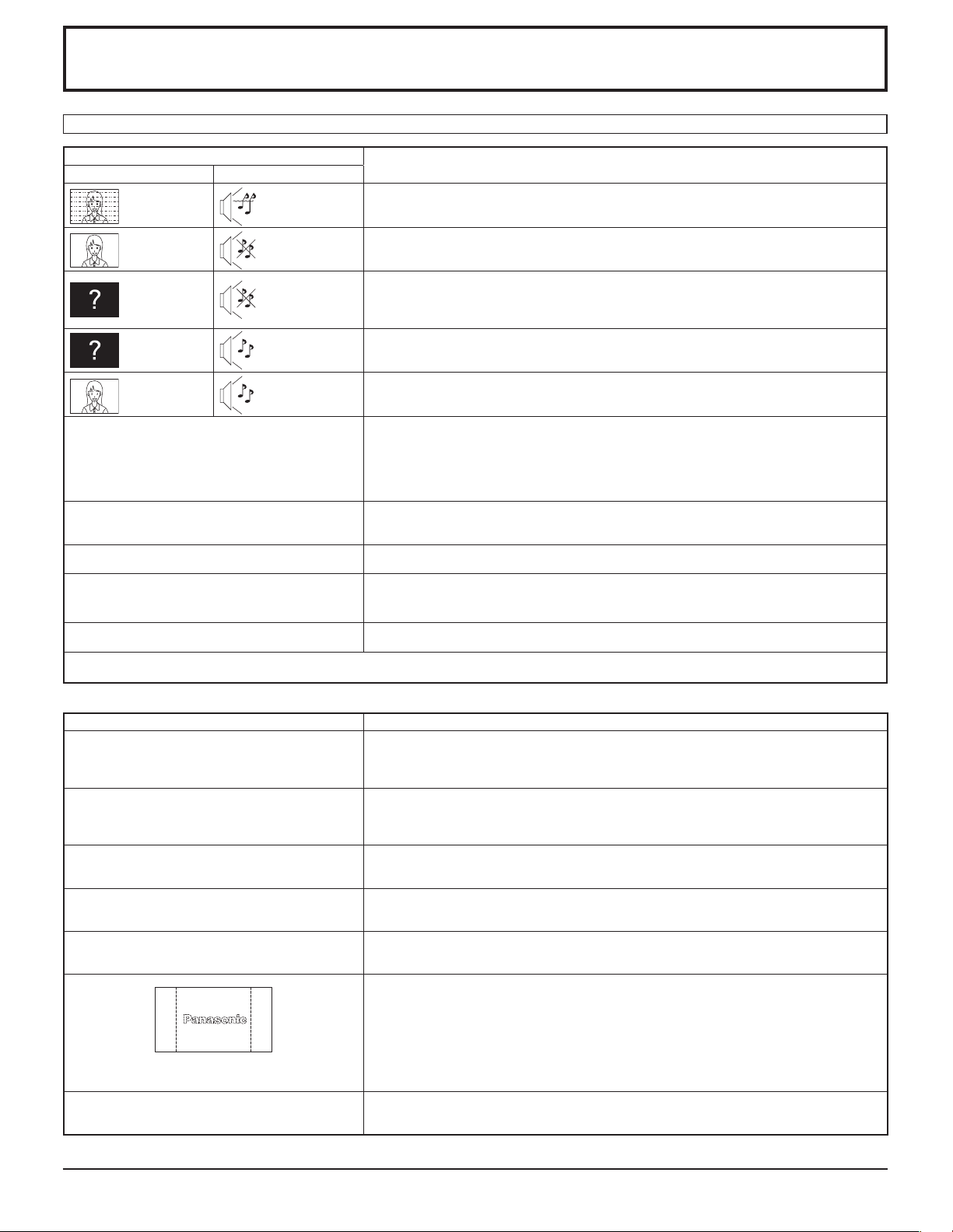
45
Localización de averías
Antes de acudir al servicio técnico, determine los síntomas y haga algunas verifi caciones sencillas como se indica a continuación.
Síntomas
Imagen Sonido
Interferencia
Imagen normal No hay sonido
No hay imagen
No hay imagen
No hay color Sonido normal
No se pueden realizar operaciones con el mando a
distancia.
A veces se oye un crujido en la unidad. Si no hay problemas de imagen o sonido, se trata del sonido de la caja sometida a contracciones
La parte superior o inferior de la imagen de la
pantalla se corta al utilizar la función de zoom.
Al utilizar la función de zoom aparecen zonas donde
no hay imagen en la parte superior e inferior de la
pantalla.
Se oyen sonidos procedentes de la unidad. Al encender la unidad puede oírse un sonido de funcionamiento del panel de la pantalla: Es
Esta pantalla de plasma utiliza un procesamiento de imagen especial. Por eso, dependiendo del tipo de señal de entrada, puede producirse un ligero
retraso entre la aparición de la imagen y el sonido. Sin embargo, esto no indica ningún fallo en el funcionamiento.
Sonido con
ruidos
No hay sonido
Sonido normal
Aparatos electrodomésticos
Coches/motocicletas
Luces fl uorescentes
Volumen
(Verifi que si no se ha activado la función de silenciamiento en el control
remoto.)
No está enchufado en el tomacorriente de CA
No está conectado
Ajuste de Contraste y Brillo/Volumen (Verifi que presionando el interruptor principal o el botón
de espera en el control remoto.)
Si entra una señal con un sistema de color, formato o frecuencia no aplicables, sólo aparece
la indicación de terminal de entrada..
Controles de color ajustados a su nivel mínimo.
(vea la página 23, 24)
Sistema de color (vea la página 39)
Compruebe si se han agotado las pilas; en caso negativo, asegúrese de que estén bien
colocadas.
Compruebe si el sensor de control remoto está expuesto a la luz exterior o a una luz fl uorescente
fuerte.
Asegúrese de estar utilizando el mando a distancia diseñado específi camente para esta unidad.
(La unidad no se puede manejar con otro mando a distancia.)
muy leves debidas a cambios en la temperatura de la habitación. Esto no tiene efectos adversos
sobre el rendimiento u otros aspectos.
Ajuste la posición de la imagen en la pantalla.
Si se utiliza un programa de software para vídeo (como un programa para formato de cine) en
una pantalla más ancha que la del modo 16:9, en la parte superior e inferior de la pantalla se
forman zonas en blanco separadas de las imágenes.
algo normal y no indica ningún mal funcionamiento.
Verifi caciones
Panel de pantalla de plasma
Síntomas Verifi caciones
La pantalla se oscurece ligeramente cuando se
muestran imágenes brillantes con movimientos
mínimos.
La imagen tarda en aparecer. La unidad procesa digitalmente las distintas señales para reproducir imágenes estéticamente
Los bordes de las imágenes parpadean. Debido a las características del sistema empleado para hacer funcionar el panel, puede que
Cambia el brillo de los dos lados
de las imágenes en el modo 4:3.
Algunas partes de la pantalla no
se encienden.
Aparece una imagen fantasma
[Para TH-37PH9UK, TH-42PH9UK, TH-50PH9UK]
Se pueden oír sonidos de runruneo desde la
pantalla.
La pantalla se oscurece ligeramente cuando se visualizan fotos, imágenes fi jas de un ordenador
u otras imágenes con movimientos mínimos durante un período de tiempo prolongado. Esta
función sirve para reducir el efecto de imagen secundaria en la pantalla y el acortamiento de
la vida útil de la pantalla: Es algo normal y no indica ningún mal funcionamiento.
agradables. En consecuencia, a veces la imagen tarda un poquito en aparecer al encender la
unidad, al cambiar de entrada o cuando se intercambian las imágenes de la imagen principal
y de la secundaria en las dos pantallas.
parezca que parpadeen los bordes en las partes que se mueven rápidamente en las imágenes:
Es algo normal y no indica ningún mal funcionamiento.
Si se visualizan los paneles laterales con el ajuste “Alto” o “Medio”, el brillo de ambos lados
puede cambiar según el tipo de programa que se visualice: Es algo normal y no indica ningún
mal funcionamiento.
El panel de la pantalla de plasma se ha fabricado con una tecnología de alto nivel de precisión,
sin embargo puede haber partes de la pantalla donde falten elementos de imagen o tengan
puntos siempre iluminados. Esto no es un síntoma de avería.
No permita que una imagen fi ja se muestre durante mucho tiempo, porque esto puede ser la
causa de que quede una imagen fantasma permanente en la pantalla de plasma.
Los ejemplos de imágenes fi jas incluyen logotipos, videojuegos, imágenes de computadora,
teletexto e imágenes mostradas en el formato 4:3.
Nota:
La imagen secundaria permanente en la pantalla de plasma debida a la utilización de una imagen
fi ja no es un defecto de funcionamiento y, por lo tanto, no está cubierta por la garantía. Este
producto no ha sido diseñado para visualizar imágenes fi jas durante largos plazos de tiempo.
La pantalla está equipada con un ventilador de refrigeración para disipar el calor generado
durante el funcionamiento normal. El sonido de runruneo lo causa la rotación del ventilador y
no es ningún fallo de funcionamiento.
Page 96
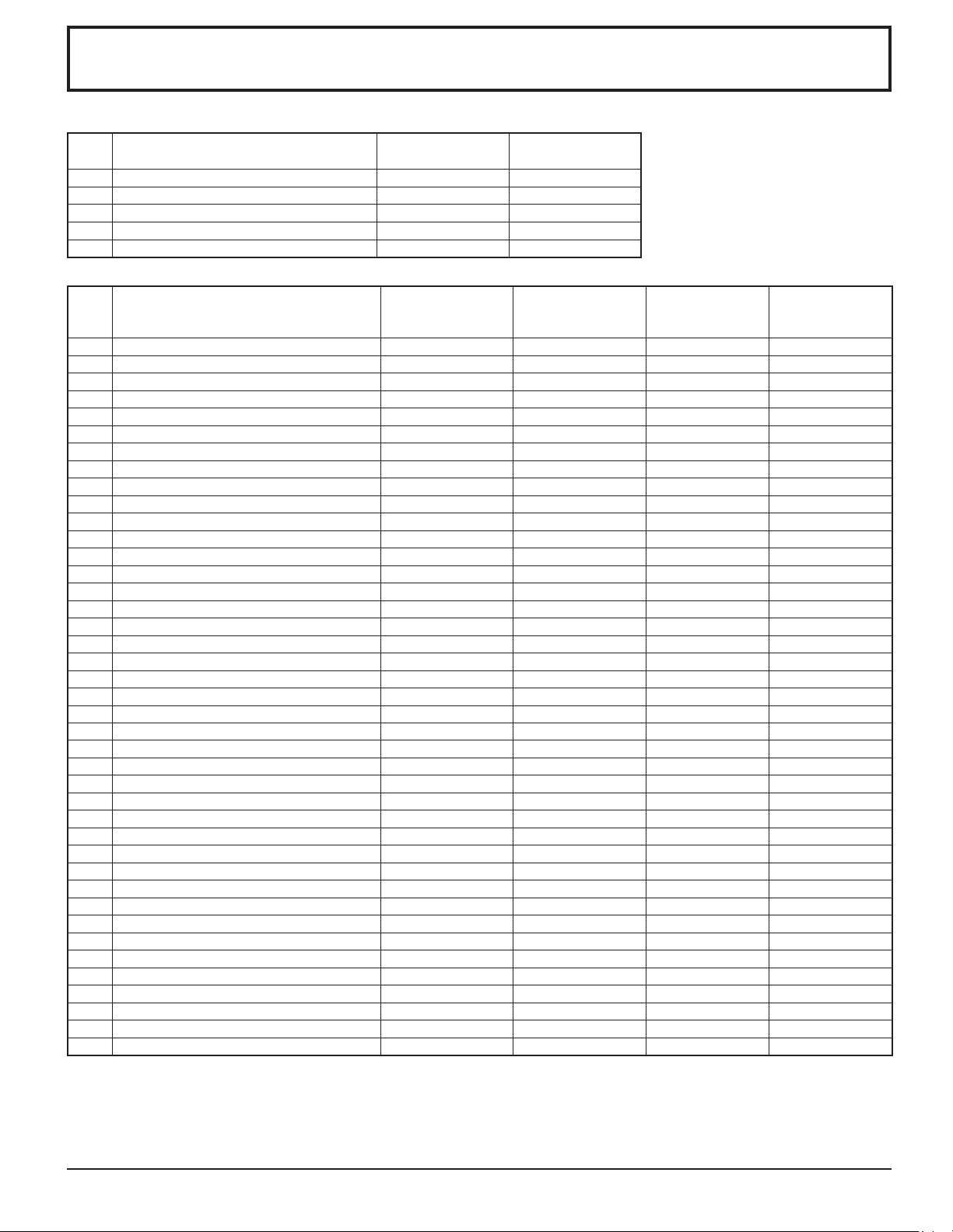
Señales de entrada de AV/Componente/RGB/PC
Entrada de AV
Nombre de la señal
1 NTSC 15,73 59,94
2 PAL 15,63 50,00
3 PAL60 15,73 59,94
4 SECAM 15,63 50,00
5 NTSC modifi cado 15,73 59,94
Señales de entrada aplicables para Componente/ Mini D-sub 15P (Componente) / RGB / Mini D-sub 15P (RGB) (∗ asterisco)
Nombre de la señal
1 525 (480) / 60i 15,73 59,94
2 525 (480) / 60p 31,47 59,94
3 625 (575) / 50i 15,63 50,00
4 625 (575) / 50p 31,25 50,00
5 750 (720) / 60p 45,00 60,00
6 750 (720) / 50p 37,50 50,00
7 1.125 (1.080) / 60i 33,75 60,00
8 1.125 (1.080) / 50i 28,13 50,00
9 1.125 (1.080) / 24p 27,00 24,00
10 1.125 (1.080) / 24sF 27,00 47,92
11 1.125 (1.080) / 25p 28,13 25,00
12 1.125 (1.080) / 30p 33,75 30,00
13 1.250 (1.080) / 50i 31,25 50,00
14 640 × 400 @70 Hz 31,46 70,07
15 640 × 480 @60 Hz 31,47 59,94
16 640 × 480 @72 Hz 37,86 72,81
17 640 × 480 @75 Hz 37,50 75,00
18 640 × 480 @85 Hz 43,27 85,01
19 852 × 480 @60 Hz 31,47 59,94
20 800 × 600 @56 Hz 35,16 56,25
21 800 × 600 @60 Hz 37,88 60,32
22 800 × 600 @72 Hz 48,08 72,19
23 800 × 600 @75 Hz 46,88 75,00
24 800 × 600 @85 Hz 53,67 85,06
25 1.024 × 768 @60 Hz 48,36 60,00
26 1.024 × 768 @70 Hz 56,48 70,07
27 1.024 × 768 @75 Hz 60,02 75,03
28 1.024 × 768 @85 Hz 68,68 85,00
29 1.152 × 864 @75 Hz 67,50 75,00
30 1.280 × 960 @60 Hz 60,00 60,00
31 1.280 × 960 @85 Hz 85,94 85,00
32 1.280 × 1.024 @60 Hz 63,98 60,02
33 1.280 × 1.024 @75 Hz 79,98 75,03
34 1.280 × 1.024 @85 Hz 91,15 85,02
35 1.600 × 1.200 @60 Hz 75,00 60,00
36 1.600 × 1.200 @65 Hz 81,25 65,00
37 1.066 × 600 @60 Hz 37,88 60,32
38 1.366 × 768 @60 Hz 48,36 60,00
39 Macintosh13” (640 × 480) 35,00 66,67
40 Macintosh16” (832 × 624) 49,72 74,54
41 Macintosh21” (1.152 × 870) 68,68 75,06
Frecuencia
horizontal (kHz)
Frecuencia
horizontal (kHz)
Frecuencia
vertical (Hz)
Frecuencia
vertical(Hz)
Componente /
Mini D-sub 15P
(Componente)
∗∗
∗
∗∗
∗∗
∗∗
∗∗
∗∗
∗∗
∗∗
∗∗
∗∗
∗∗
∗∗
RGB /
Mini D-sub 15P
(RGB)
1
∗
∗
2
∗
∗
∗
∗
2
∗
∗
∗
∗
∗
∗
∗
∗
∗
∗
∗
∗
∗
∗
∗
∗
∗
∗
∗
∗
∗
∗
∗
∗
1: Cuando se selecciona el formato RGB y la entrada de señal 525p en el terminal Mini D-sub 15P, se reconoce como
señal VGA 60Hz.
∗2: Al ingresar la señal del formato VGA 60Hz del otro terminal Mini D-sub 15P, se reconoce como señal 525p.
Nota: Las señales sin las especifi caciones de arriba puede que no se visualicen correctamente.
46
Page 97
47
Especifi caciones
TH-42PS9UK
Fuente de alimentación 120 V AC, 50/60 Hz
Fuente de consumo
Máximo 290 W
Estado de espera Protección desactivada 0,6 W, Protección activada 0,4 W
Estado de corriente desconectada
Panel de pantalla de plasma Tipo CA con método directo 42 pulg.,
Relación de contraste Max 10000:1
Tamaño de pantalla
(Número. de pixeles) 408.960 (852 (An.) × 480 (AI.))
Condiciones de funcionamiento
Temperatura 32 °F - 104 °F (0 °C - 40 °C)
Humedad 20 % - 80 %
Señales aplicables
Color System NTSC, PAL, PAL60, SECAM, NTSC modifi cado
Scanning format 525 (480) / 60i · 60p, 625 (575) / 50i · 50p, 750 (720) / 60p · 50p, 1125 (1080) / 60i · 50i · 24p · 25p
· 30p · 24sF ···· SMPTE274M, 1250 (1080) / 50i
Señales PC VGA
Terminales de conexión
AV VIDEO IN (BNC) 1,0 Vp-p (75 Ω o alta impedancia)
S VIDEO IN (Mini DIN de 4 patillas) Y: 1 Vp-p (75 Ω), C: 0,286 Vp-p (75 Ω)
AUDIO IN (Toma de patilla RCA × 4) 0,5 Vrms (alta impedancia)
COMPONENTE/RGB Y/G (BNC) 1,0 Vp-p/con/sync (75 Ω)
0,7 Vp-p/sin/sync (75 Ω)
P
B/B (BNC), PR/R (BNC) 0,7 Vp-p (75 Ω)
AUDIO IN (Toma de patilla RCA × 2) 0,5 Vrms (alta impedance)
PC (ALTA DENSIDAD, CONECTOR MINI D-SUB DE 15 CONTACTOS) R,G,B/0,7 Vp-p (75 Ω)
HD, VD/1,0 - 5,0 Vp-p (alta impedancia)
Componente
Y : 1,0 Vp-p (75 Ω : incluye sincronización)
P
P
Toma de 3,5 ø
SERIAL
Altavoces (6 Ω) 16W [8 W + 8 W] (10 % THD)
Accesorios suministrados
Transmisor del mando a distancia
Pila 2 × tamaño AA
Banda de fi jación (TMME203 o TMME187) × 2
Dimensiones (An × Al. × Prof.)
Masa (Peso)
unidad principal solamente
con altavoces 66,1 lbs
AUDIO IN (
TERMINAL DE CONTROL EXTERIOR (CONECTOR D-SUB DE 9 CONTACTOS) RS-232C COMPATIBLE
36,2” (920mm) (An.) × 20,4” (518mm) (Al.)
× 42” (1.056mm) (diagonal)
SVGA, XGA, SXGA, UXGA ···· (comprimido)
Frecuencia de exploración horizontal 15 - 110 kHz
Frecuencia de exploración vertical 48 - 120 Hz
B/CB : 0,7 Vp-p (75 Ω)
R/CR : 0,7 Vp-p (75 Ω)
) 0,5 Vrms (alta impedancia)
40,2” (1.020 mm) × 24” (610 mm) × 3,5” (89 mm)
0,1 W
16:9 aspect ratio
[2.556 × 480 puntos]
EUR7636070R
57,3 lbs
Nota:
El diseño y especifi caciones están sujetos a cambios sin previo aviso. El Masa y dimensiones son aproximados.
Page 98
Especifi caciones
TH-37PH9UK TH-42PH9UK
Fuente de alimentación 120 V AC, 50/60 Hz
Fuente de consumo
Máximo 300W 345 W
Estado de espera
Estado de corriente desconectada
Panel de pantalla de plasma Tipo CA con método directo 37 pulg.,
Relación de contraste Max 10000:1
Tamaño de pantalla
(Número. de pixeles) 737.280 (1.024 (An.) × 720 (AI.))
Condiciones de funcionamiento
Temperatura 32 °F - 104 °F (0 °C - 40 °C)
Humedad 20 % - 80 %
Señales aplicables
Color System NTSC, PAL, PAL60, SECAM, NTSC modifi cado
Scanning format 525 (480) / 60i · 60p, 625 (575) / 50i · 50p, 750 (720) / 60p · 50p, 1125 (1080) / 60i · 50i · 24p · 25p
PC signals
Terminales de conexión
AV VIDEO IN (BNC) 1,0 Vp-p (75 Ω o alta impedancia)
COMPONENTE/RGB Y/G (BNC) 1,0 Vp-p/con/sync (75 Ω)
PC (ALTA DENSIDAD, CONECTOR MINI D-SUB DE 15 CONTACTOS)R,G,B/0,7 Vp-p (75 Ω)
SERIAL
Altavoces (6 Ω) 16W [8 W + 8 W] (10 % THD)
Accesorios suministrados
Transmisor del mando a distancia
Pila 2 × tamaño AA
Banda de fi jación (TMME203 o TMME187) × 2
Dimensiones (An × Al. × Prof.)
Masa (Peso)
unidad principal solamente
con altavoces 59,5 lbs 68,3 lbs
Protección desactivada 0,6 W, Protección activada 0,4 W Protección desactivada 0,6 W, Protección activada 0,4 W
0,1 W 0,1 W
Tipo CA con método directo 42 pulg.,
relación de aspecto de 16:9
32,2” (818mm) (An.) × 18,1” (461mm) (Al.)
× 37” (939mm) (diagonal)
[3.072 × 720 puntos]
· 30p · 24sF ···· SMPTE274M, 1250 (1080) / 50i
VGA, SVGA,
XGA, SXGA, UXGA ···· (comprimido)
Frecuencia de exploración horizontal 15 - 110 kHz
Frecuencia de exploración vertical 48 - 120 Hz
S VIDEO IN (Mini DIN de 4 patillas) Y: 1 Vp-p (75 Ω), C: 0,286 Vp-p (75 Ω)
AUDIO IN (Toma de patilla RCA × 4) 0,5 Vrms (alta impedancia)
0,7 Vp-p/sin/sync (75 Ω)
P
B/B (BNC), PR/R (BNC) 0,7 Vp-p (75 Ω)
AUDIO IN (Toma de patilla RCA × 2) 0,5 Vrms (alta impedance)
HD, VD/1,0 - 5,0 Vp-p (alta impedancia)
Componente
Y : 1,0 Vp-p (75 Ω : incluye sincronización)
P
P
AUDIO IN (
TERMINAL DE CONTROL EXTERIOR (CONECTOR D-SUB DE 9 CONTACTOS) RS-232C COMPATIBLE
36,2” (920 mm) × 21,7” (550 mm) × 3,5” (89 mm)
Toma de 3,5 ø
50,7 lbs 59,5 lbs
B/CB : 0,7 Vp-p (75 Ω)
R/CR : 0,7 Vp-p (75 Ω)
) 0,5 Vrms (alta impedancia)
EUR7636070R
36,2” (920mm) (An.) × 20,4” (518mm) (Al.)
Frecuencia de exploración horizontal 15 - 110 kHz
Frecuencia de exploración vertical 48 - 120 Hz
40,2” (1.020 mm) × 24” (610 mm) × 3,5” (89 mm)
16:9 aspect ratio
× 42” (1.056mm) (diagonal)
786.432 (1.024 (An.) × 768 (AI.))
[3.072 × 768 puntos]
VGA, SVGA, XGA,
SXGA, UXGA ···· (comprimido)
Nota:
El diseño y especifi caciones están sujetos a cambios sin previo aviso. El Masa y dimensiones son aproximados.
48
Page 99
49
Especifi caciones
TH-50PH9UK
Fuente de alimentación 120 V AC, 50/60 Hz
Fuente de consumo
Máximo 460 W
Estado de espera Protección desactivada 0,5 W, Protección activada 0,3 W
Estado de corriente desconectada
Panel de pantalla de plasma Tipo CA con método directo 50 pulg.,
relación de aspecto de 16:9
Relación de contraste Max 10000:1
Tamaño de pantalla 43,5” (1.106mm)
×
50” (1.269mm)
(Número. de pixeles) 1.049.088 (1.366 (An.) × 768 (AI.))
Condiciones de funcionamiento
Temperatura 32 °F - 104 °F (0 °C - 40 °C)
Humedad 20 % - 80 %
Señales aplicables
Color System NTSC, PAL, PAL60, SECAM, NTSC modifi cado
Scanning format 525 (480) / 60i · 60p, 625 (575) / 50i · 50p, 750 (720) / 60p · 50p, 1125 (1080) / 60i · 50i · 24p · 25p
· 30p · 24sF ···· SMPTE274M, 1250 (1080) / 50i
Señales PC VGA, SVGA, XGA,
SXGA, UXGA ···· (comprimido)
Frecuencia de exploración horizontal 15 - 110 kHz
Frecuencia de exploración vertical 48 - 120 Hz
Terminales de conexión
AV VIDEO IN (BNC) 1,0 Vp-p (75 Ω o alta impedancia)
S VIDEO IN (Mini DIN de 4 patillas) Y: 1 Vp-p (75 Ω), C: 0,286 Vp-p (75 Ω)
AUDIO IN (Toma de patilla RCA × 4) 0,5 Vrms (alta impedancia)
COMPONENTE/RGB Y/G (BNC) 1,0 Vp-p/con/sync (75 Ω)
0,7 Vp-p/sin/sync (75 Ω)
P
B/B (BNC), PR/R (BNC) 0,7 Vp-p (75 Ω)
AUDIO IN (Toma de patilla RCA × 2) 0,5 Vrms (alta impedance)
PC (ALTA DENSIDAD, CONECTOR MINI D-SUB DE 15 CONTACTOS)R,G,B/0,7 Vp-p (75 Ω)
HD, VD/1,0 - 5,0 Vp-p (alta impedancia)
Componente
Y : 1,0 Vp-p (75 Ω : incluye sincronización)
SERIAL
Altavoces (6 Ω) 16W [8 W + 8 W] (10 % THD)
Accesorios suministrados
Transmisor del mando a distancia
Pila 2 × tamaño AA
Banda de fi jación (TMME203 o TMME187) × 2
Dimensiones (An × Al. × Prof.)
Masa (Peso)
unidad principal solamente
con altavoces 90,4 lbs
P
P
AUDIO IN (
TERMINAL DE CONTROL EXTERIOR (CONECTOR D-SUB DE 9 CONTACTOS) RS-232C COMPATIBLE
Toma de 3,5 ø
47,6” (1.
B/CB : 0,7 Vp-p (75 Ω)
R/CR : 0,7 Vp-p (75 Ω)
) 0,5 Vrms (alta impedancia)
210
mm) × 28,5” (724 mm) × 3,7” (95 mm)
0,1 W
(An.) ×
[4.098 × 768 puntos]
EUR7636070R
24,5” (622mm)
(diagonal)
81,6 lbs
(Al.)
Nota:
El diseño y especifi caciones están sujetos a cambios sin previo aviso. El Masa y dimensiones son aproximados.
Page 100
Registro del cliente
El número de modelo y número de serie de este producto están en la cubierta trasera. Debe anotar este número de
serie en el espacio a continuación y guardar este libro junto con el recibo de compra como registro permanente de su
compra para ayudar a identifi carlo en el caso de robo o pérdida y para el servicio bajo garantía.
Número de modelo Número de serie
2006 Matsushita Electric Industrial Co., Ltd. All Rights Reserved.
©
Panasonic Broadcast & Television Systems Company
Unit of Panasonic Corporation of North America
Executive Offi ce :
One Panasonic Way 4E-7, Secaucus, NJ 07094 (201) 348-7000
EASTERN ZONE : One Panasonic Way 4E-7 Secaucus, NJ 07094 (201) 348-7621
Mid-Atlantic/New England : One Panasonic Way 4E-7 Secaucus, NJ 07094 (201) 348-7621
Southeast Region : 1225 Northbrook Parkway, Ste 1-160 Suwanee GA 30024 (770) 338-6835
Central Region : 1707 N Randall Road E1-C-1, Elgin, IL 60123 (847) 468-5200
WESTERN ZONE : 3330 Cahuenga Blvd W., Los Angeles, CA 90068 (323) 436-3500
Dallas Region : 6226 Abington Way, Houston, TX 77008 (713) 802-2726
No. CA/Northwest Region : 5870 Stone Ridge, #3, Pleasanton, CA (925) 416-5108
Government Marketing Department : 52 West Gude Drive, Rockville, MD 20850 (301) 738-3840
Panasonic Canada Inc.
5770 Ambler Drive
Mississauga, Ontario
L4W 2T3
MBS0406A1046
 Loading...