

Page 1
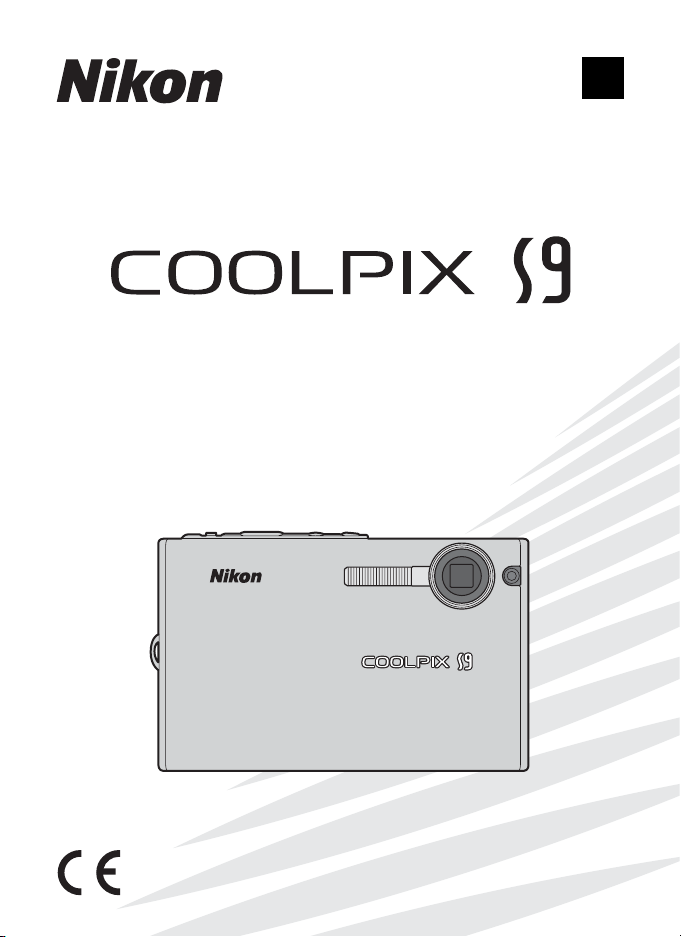
The Nikon Guide to Digital Photography
with the
DIGITAL CAMERA
En
Page 2

Trademark Information
Macintosh, Mac OS, and QuickTime are registered trademarks of Apple Computer,
Inc. Microsoft and Windows are registered trademarks of Microsoft Corporation.
The SD logo is a trademark of the SD Card Association. Adobe and Acrobat are
registered trademarks of Adobe Systems Inc. PictBridge is a trademark. D-Lighting
o
technology is provided by
provided by Identix
®
. All other trade names mentioned in this manual or the other
Apical Limited. Face-priority AF technology is
documentation provided with your Nikon product are trademarks or registered
trademarks of their respective holders.
Page 3
Introduction
First Steps
Basic Photography and
Playback: L (Auto) Mode
Scene Modes: n Scene Mode
One-Touch Portrait Mode
More on Playback
Movies
Voice Recordings
Connecting to Televisions,
Computers, and Printers
Shooting, Playback, and Setup
Menus
Technical Notes
i
Page 4
Introduction
For Your Safety
To prevent damage to your Nikon product or injury to yourself or to others,
read the following safety precautions in their entirety before using this
equipment. Keep these safety instructions where all those who use the prod-
Introduction
uct will read them.
The consequences that could result from failure to observe the precautions
listed in this section are indicated by the following symbol:
This icon marks warnings, information that should be read before using this
Nikon product to prevent possible injury.
WARNINGS
Turn off in the event of malfunction
Should you notice smoke or an
unusual smell coming from the camera, remove the battery immediately, taking care to avoid burns.
Continued operation could result in
injury. After removing or disconnecting the power source, take the
equipment to a Nikon-authorized
service representative for inspection.
Do not disassemble
Touching the product’s internal
parts could result in injury. Repairs
should be performed only by qualified technicians. Should the camera
break open as the result of a fall or
other accident, take the product to
a Nikon-authorized service representative for inspection after unplugging the product and/or removing
the battery.
ii
Do not use the camera in the
presence of flammable gas
Do not use electronic equipment in
the presence of flammable gas, as
this could result in explosion or fire.
Handle the camera strap
with care
Never place the strap around the
neck of an infant or child.
Keep out of reach of children
Particular care should be taken to
prevent infants from putting the
battery or other small parts into
their mouths.
Page 5
For Your Safety
Observe caution when handling the battery
The battery may leak or explode if
improperly handled. Observe the
following precautions when handling the battery for use in this
product:
• Before replacing the battery, turn
the product off.
• Only use a rechargeable Nikon
EN-EL8 lithium-ion battery (supplied). Charge the battery by
inserting it in an MH-62 battery
charger.
• When inserting the battery, do
not attempt to insert it upside
down or backwards.
• Do not short or disassemble the
battery or attempt to remove or
break the battery insulation or
casing.
• Do not expose the battery to
flame or to excessive heat.
• Do not immerse in or expose to
water.
• Replace the terminal cover when
transporting the battery. Do not
transport or store with metal
objects such as necklaces or hairpins.
• The battery is prone to leakage
when fully discharged. To avoid
damage to the product, be sure
to remove the battery when no
charge remains.
• Discontinue use immediately
should you notice any change in
the battery, such as discoloration
or deformation.
• If liquid from the damaged battery comes in contact with clothing or skin, rinse immediately with
plenty of water.
Observe the following precautions when handling the
battery charger
• Keep dry. Failure to observe this
precaution could result in fire or
electric shock.
• Dust on or near the metal parts of
the plug should be removed with
a dry cloth. Continued use could
result in fire.
• Do not handle the power cable or
go near the battery charger during lightening storms. Failure to
observe this precaution could
result in electric shock.
• Do not damage, modify, forcibly
tug or bend the power cable,
place it under heavy objects, or
expose it to heat or flame. Should
the insulation be damaged and
the wires become exposed, take it
to a Nikon-authorized service representative for inspection. Failure
to observe these precautions
could result in fire or electric
shock.
Introduction
iii
Page 6
For Your Safety
• Do not handle the plug or battery
charger with wet hands. Failure to
observe this precaution could
Introduction
result in electric shock.
Use appropriate cables
When connecting cables to the
input and output jacks, use only the
cables provided or sold by Nikon for
the purpose, to maintain compliance with product regulations.
Handle moving parts with
care
Be careful that your fingers or other
objects are not pinched by the lens
cover or other moving parts.
CD-ROMs
The CD-ROMs supplied with this
device should not be played back on
audio CD equipment. Playing CDROMs on an audio CD player could
cause hearing loss or damage the
equipment.
Observe caution when using
the flash
Using the flash close to your subject’s eyes could cause temporary
visual impairment. Particular care
should be observed if photographing infants, when the flash should
be no less than one meter (39 in.)
from the subject.
Do not operate the flash
with the flash window
touching a person or object
Failure to observe this precaution
could result in burns or fire.
Avoid contact with liquid
crystal
Should the monitor break, care
should be taken to avoid injury
caused by broken glass and to prevent liquid crystal from the monitor
touching the skin or entering the
eyes or mouth.
iv
Page 7
Notices
Notice for Customers in the
U.S.A.
Federal Communications Commission (FCC) Radio Frequency
Interference Statement
This equipment has been tested and
found to comply with the limits for a
Class B digital device, pursuant to
Part 15 of the FCC rules. These limits are designed to provide reasonable protection against harmful
interference in a residential installation. This equipment generates,
uses, and can radiate radio frequency energy and, if not installed
and used in accordance with the
instructions, may cause harmful
interference to radio communications. However, there is no guarantee that interference will not occur
in a particular installation. If this
equipment does cause harmful
interference to radio or television
reception, which can be determined by turning the equipment off
and on, the user is encouraged to
try to correct the interference by
one or more of the following measures:
• Reorient or relocate the receiving
antenna.
• Increase the separation between
the equipment and receiver.
• Connect the equipment into an
outlet on a circuit different from
that to which the receiver is connected.
• Consult the dealer or an experienced radio/television technician
for help.
COOLPIX S9
CAUTIONS
Modifications
The FCC requires the user to be
notified that any changes or modifications made to this device that are
not expressly approved by Nikon
Corporation may void the user’s
authority to operate the equipment.
Interface Cables
Use the interface cables sold or provided by Nikon for your equipment.
Using other interface cables may
exceed the limits of Class B Part 15
of the FCC rules.
Notice for customers in the State
of California
WARNING: Handling the cord on
this product will expose you to lead,
a chemical known to the State of
California to cause birth defects or
other reproductive harm. Wash
hands after handling.
Nikon Inc.,
1300 Walt Whitman Road
Melville, New York 11747-3064
USA
Tel: 631-547-4200
Introduction
v
Page 8
Notices
Notice for Customers in Canada
Introduction
CAUTION
This class B digital apparatus meets
all requirements of the Canadian
Interference Causing Equipment
Regulations.
ATTENTION
Cet appareil numérique de la classe
B respecte toutes les exigences du
Règlement sur le matériel brouilleur
du Canada.
Symbol for Separate Collection in European Countries
This symbol indicates that
this product is to be collected separately.
The following apply only to
users in European countries:
• This product is designated for
separate collection at an appropriate collection point. Do not dispose of as household waste.
• For more information, contact the
retailer or the local authorities in
charge of waste management.
vi
Page 9

Table of Contents
Introduction .....................................................................................................ii
For Your Safety .................................................................................................. ii
WARNINGS ................................................................................................... ii
Notices................................................................................................................ v
About This Manual............................................................................................1
Information and Precautions ............................................................................2
Parts of the Camera...........................................................................................4
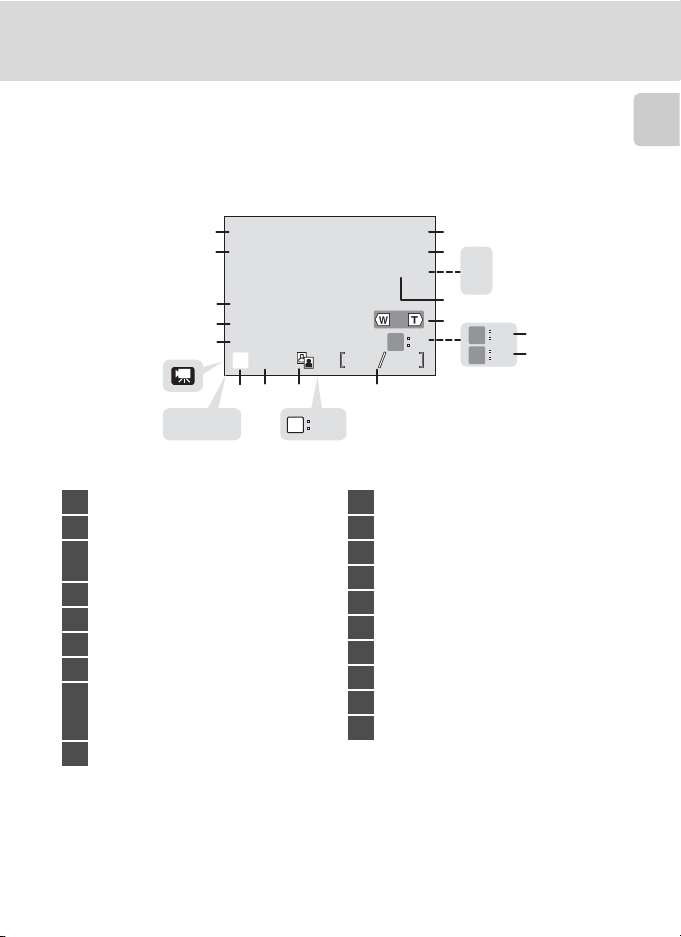
The Monitor ....................................................................................................... 6
Shooting ....................................................................................................... 6
Playback........................................................................................................ 7
Basic Operations ................................................................................................ 8
The o (shooting/playback) Button...........................................................8
The Multi Selector ......................................................................................... 8
The p Button......................................................................................... 9
The m Button ......................................................................................... 10
Help Displays ...............................................................................................11
First Steps........................................................................................................12
Charging the Battery....................................................................................... 12
Inserting the Battery .......................................................................................14
Turning On and Off the Camera .................................................................. 15
Setting Display Language, Date, and Time.................................................... 16
Inserting Memory Cards.................................................................................. 18
Basic Photography and Playback: L (Auto) Mode .....................................20
Step 1 Turn the Camera On and Select L (Auto) Mode..............................20
Step 2 Frame a Picture ....................................................................................22
Step 3 Focus and Shoot ................................................................................... 24
Step 4 Viewing and Deleting Pictures ............................................................26
Full-Frame Playback ..................................................................................... 26
Deleting Pictures .........................................................................................26
Using the Flash ................................................................................................ 28
Taking Pictures with the Self-Timer ............................................................... 30
Macro Close-up Mode ..................................................................................... 31
Introduction
vii
Page 10

Table of Contents
Scene Modes: n Scene Mode .......................................................................32
Introduction
Assist and Scene Modes ..................................................................................32
Assist Modes ....................................................................................................33
Taking Pictures in Assist Modes ................................................................... 33
B Portrait Assist .........................................................................................34
E Landscape Assist .................................................................................... 35
P Sports Assist ........................................................................................... 36
D Night Portrait Assist................................................................................ 37
Scene Modes ....................................................................................................38
Taking Pictures in Scene Modes...................................................................38
One-Touch Portrait Mode..............................................................................44
Taking Pictures in the One-Touch Portrait Mode..........................................44
The One-Touch Portrait Menu........................................................................45
More on Playback ..........................................................................................46
Viewing Multiple Pictures: Thumbnail Playback ...........................................46
Taking a Closer Look: Playback Zoom ............................................................ 47
Editing Pictures................................................................................................ 48
Creating a Cropped Copy: Crop .................................................................. 49
Enhancing Brightness and Contrast: D-Lighting ...........................................50
H Resizing Pictures: Small Picture............................................................... 51
Voice Memos: Recording and Playback .........................................................52
Movies.............................................................................................................53
Movie Mode.....................................................................................................53
The Movie Menu ............................................................................................. 54
Selecting Movie Options.............................................................................. 54
Auto-Focus Mode........................................................................................ 57
Movie Playback ................................................................................................ 58
Deleting Movie Files ....................................................................................58
Voice Recordings............................................................................................59
Making Voice Recordings ...............................................................................59
Playing Voice Recordings ................................................................................ 60
Copying Voice Recordings .............................................................................. 61
viii
Page 11

Table of Contents
Connecting to Televisions, Computers, and Printers ...................................62
Connecting to a TV..........................................................................................63
Connecting to a Computer .............................................................................64
Before Connecting the Camera ................................................................... 64
Setting the USB Option ...............................................................................65
Transferring Pictures to a Computer ............................................................ 66
Connecting to a Printer...................................................................................68
Connecting the Camera and Printer ............................................................69
Printing Pictures One at a Time .................................................................... 70
Printing Multiple Pictures............................................................................. 72
Creating a DPOF Print Order: Print Set .......................................................... 74
Shooting, Playback, and Setup Menus..........................................................76
Shooting Options: The Shooting Menu .........................................................76
Z Image Mode .......................................................................................... 77
d White Balance ........................................................................................ 79
I Exp. +/–.................................................................................................. 81
q Continuous............................................................................................82
A Best Shot Selector (BSS) ......................................................................... 84
W Sensitivity ............................................................................................... 85
d Color Options......................................................................................... 86
Restrictions on Camera Settings .................................................................. 87
Playback Options: The Playback Menu ..........................................................88
w Print Set ................................................................................................. 90
z Slide Show ............................................................................................. 90
A Delete .................................................................................................... 91
D Protect ................................................................................................. 91
E Transfer Marking .................................................................................. 92
L Copy...................................................................................................... 93
Basic Camera Setup: The Setup Menu............................................................94
R Menus.................................................................................................... 95
V Welcome Screen .................................................................................... 96
W Date....................................................................................................... 97
Z Monitor Settings .................................................................................. 100
f Date Imprint .........................................................................................101
u AF Assist ............................................................................................. 103
h Sound Settings.....................................................................................103
h Blur Warning ........................................................................................104
i Auto Off ..............................................................................................104
M Format Memory/O Format Card .......................................................... 105
j Language .............................................................................................106
Introduction
ix
Page 12

Table of Contents
k Interface............................................................................................... 106
n Reset All ...............................................................................................107
Introduction
B Firmware Version ................................................................................. 108
Technical Notes ............................................................................................109
Optional Accessories ..................................................................................... 109
Image File and Folder Names .....................................................................110
Caring for the Camera .................................................................................. 111
Cleaning ...................................................................................................113
Storage ..................................................................................................... 113
Error Messages............................................................................................... 114
Troubleshooting ............................................................................................118
Specifications .................................................................................................123
Index...............................................................................................................127
x
Page 13
About This Manual
Thank you for your purchase of a Nikon COOLPIX S9 digital camera. This
manual has been written to help you enjoy taking pictures with your Nikon
digital camera. Read this manual thoroughly before use, and keep it where
all those who use the product will read it.
Symbols and Conventions
To make it easier to find the information you need, the following symbols
and conventions are used:
This icon marks cautions, information that should be read
before use to prevent damage to
the camera.
This icon marks notes, information that should be read before
k
using the camera.
Notations
• A Secure Digital (SD) memory card is referred to as a “memory card.”
• The setting at the time of purchase is referred to as the “default setting.”
• Menu items, options, and messages displayed in the camera monitor are
shown in brackets ([ ]).
Screen Samples
In this manual, images are sometimes omitted from monitor display samples
so that monitor indicators can be more clearly shown.
Illustrations and Screen Display
Illustrations and text displays shown in this manual may differ from actual
display.
This icon marks tips, additional
information that may be helpful
lj
when using the camera.
This icon indicates that more
information is available else-
c
where in this manual or in the
Quick Start Guide.
Introduction
k Memory Cards
Pictures taken with this camera can be stored in the camera’s internal memory or on removable memory cards. If a memory card is inserted, all new pictures will be stored on the memory card and delete, playback, and format operations will apply only to the pictures on the
memory card. The memory card must be removed before the internal memory can be formatted or used to store, delete, or view pictures.
1
Page 14
Information and Precautions
Life-Long Learning
As part of Nikon’s “Life-Long Learning” commitment to ongoing product support and education, continually updated information is available online at the following sites:
Introduction
• For users in the U.S.A.: http://www.nikonusa.com/
• For users in Europe and Africa: http://www.europe-nikon.com/support/
• For users in Asia, Oceania, and the Middle East: http://www.nikon-asia.com/
Visit these sites to keep up-to-date with the latest product information, tips, answers to frequently asked questions (FAQs), and general advice on digital imaging and photography.
Additional information may be available from the Nikon representative in your area. See the
URL below for contact information:
http://nikonimaging.com/
Use Only Nikon Brand Electronic Accessories
Nikon COOLPIX cameras are designed to the highest standards and include complex electronic circuitry. Only Nikon brand electronic accessories (including battery chargers and batteries) certified by Nikon specifically for use with this Nikon digital camera are engineered and
proven to operate within the operational and safety requirements of this electronic circuitry.
THE USE OF NON-NIKON ELECTRONIC ACCESSORIES COULD DAMAGE THE CAMERA AND
MAY VOID YOUR
For more information about Nikon brand accessories, contact a local authorized Nikon dealer.
Before Taking Important Pictures
Before taking pictures on important occasions (such as at weddings or before taking the camera on a trip), take a test shot to ensure that the camera is functioning normally. Nikon will
not be held liable for damages or lost profits that may result from product malfunction.
About the Manuals
• No part of the manuals included with this product may be reproduced, transmitted, tran-
scribed, stored in a retrieval system, or translated into any language in any form, by any
means, without Nikon’s prior written permission.
• Nikon reserves the right to change the specifications of the hardware and software
described in these manuals at any time and without prior notice.
• Nikon will not be held liable for any damages resulting from the use of this product.
• While every effort has been made to ensure that the information in these manuals is accu-
rate and complete, we would appreciate it were you to bring any errors or omissions to the
attention of the Nikon representative in your area (address provided separately).
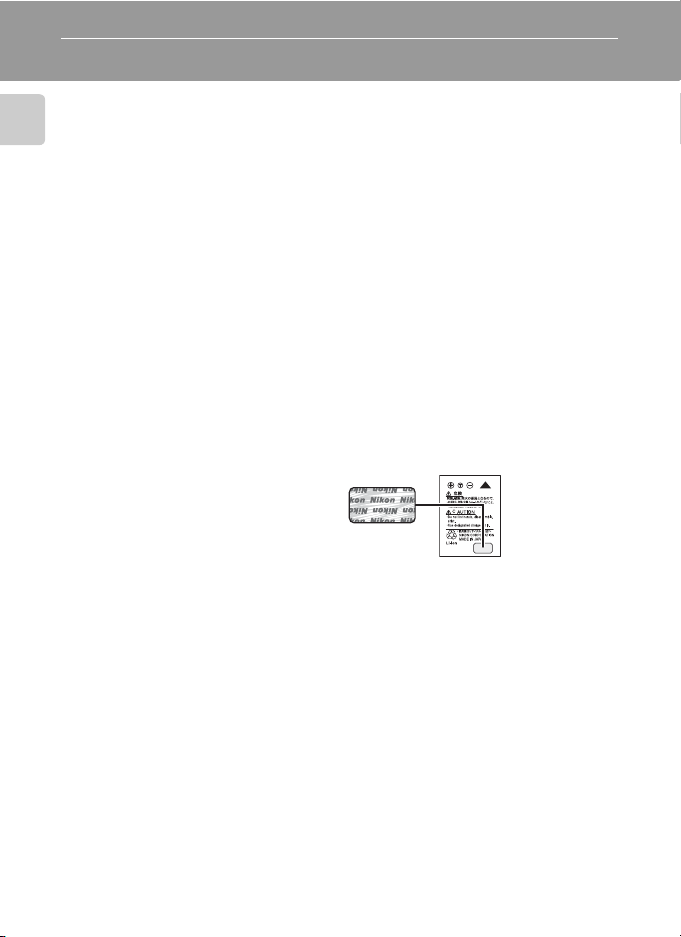
NIKON WARRANTY.
* Holographic seal: Identifies this
device as an authentic Nikon
product.
EN-EL8
rechargeable
battery
2
Page 15

Information and Precautions
Notice Concerning Prohibition of Copying or Reproduction
Note that simply being in possession of material that has been digitally copied or reproduced
by means of a scanner, digital camera or other device may be punishable by law.
• Items prohibited by law from being copied or reproduced
Do not copy or reproduce paper money, coins, securities, government bonds, or local government bonds, even if such copies or reproductions are stamped “Sample.”
The copying or reproduction of paper money, coins, or securities which are circulated in a
foreign country is prohibited.
Unless the prior permission of the government has been obtained, the copying or reproduction of unused postage stamps or post cards issued by the government is prohibited.
The copying or reproduction of stamps issued by the government and of certified documents stipulated by law is prohibited.
• Cautions on certain copies and reproductions
The government has issued cautions on copies or reproductions of securities issued by private companies (shares, bills, checks, gift certificates, etc.), commuter passes, or coupon
tickets, except when a minimum of necessary copies are to be provided for business use by
a company. Also, do not copy or reproduce passports issued by the government, licenses
issued by public agencies and private groups, ID cards, and tickets, such as passes and meal
coupons.
• Comply with copyright notices
The copying or reproduction of copyrighted creative works such as books, music, paintings,
woodcut prints, maps, drawings, movies, and photographs is governed by national and
international copyright laws. Do not use this product for the purpose of making illegal copies or to infringe copyright laws.
Disposing of Data Storage Devices
Please note that deleting images or formatting data storage devices such as memory cards or
built-in camera memory does not completely erase the original image data. Deleted files can
sometimes be recovered from discarded storage devices using commercially available software, potentially resulting in the malicious use of personal image data. Ensuring the privacy of
such data is the user’s responsibility.
Before discarding a data storage device or transferring ownership to another person, erase all
data using commercial deletion software, or format the device and then completely refill it
with images containing no private information (for example, pictures of empty sky). Be sure to
also replace any pictures selected for the welcome screen (c 96). Care should be taken to
avoid injury or damage to property when physically destroying data storage devices.
Introduction
3
Page 16
Parts of the Camera
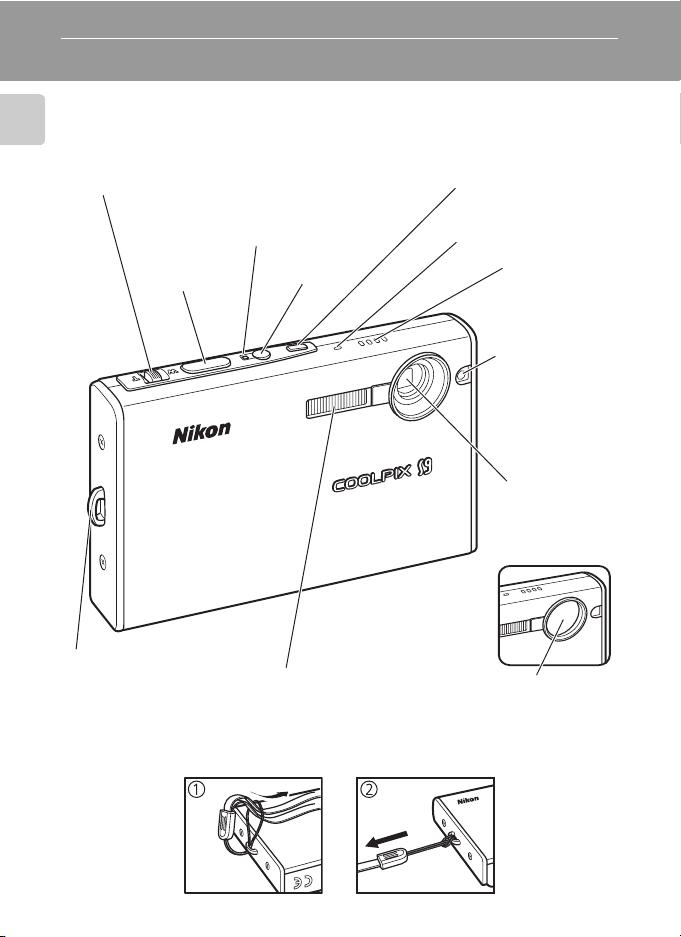
Zoom control (c 22)
See also:
• j (thumbnail playback): c 46
Introduction
• k (playback zoom): c 47
• l (help): c 11
Shutter-release
button (c 24)
Power-on lamp
(c 16)
Power switch
(c 16)
m (one-touch portrait) button (c 44)
u (D-Lighting) button (c 50)
Built-in microphone
(c 52, 53)
Speaker (c 52)
Self-timer lamp
(c 30)
AF-assist illuminator (LED;
c 28, 112)
Lens
(c 22, 111)
Lens cover
closed
Eyelet for camera strap
Built-in flash (c 28)
Attaching the Camera Strap
4
Lens cover
Page 17
Parts of the Camera
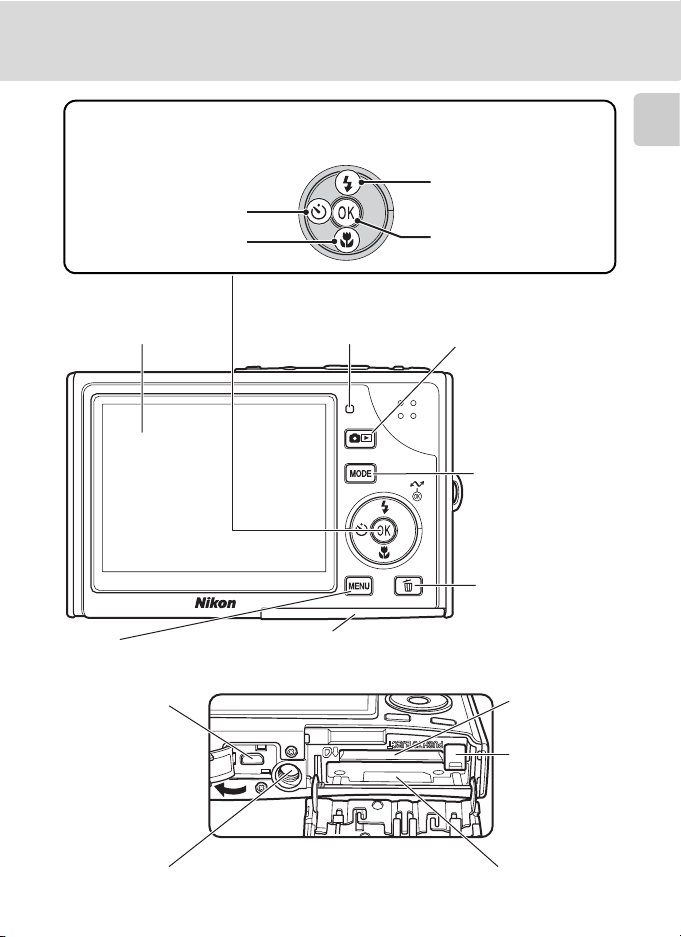
The Multi selector (c 8)
In shooting mode, you can activate the flash (J), the self-timer (H), and
macro close-up mode (F).
J: Display flash mode
H: Display self-timer menu
(c 30)
F: Display macro closeup mode menu (c 31)
menu (c 28)
d/g: Apply selection/
transfer picture (c 67)
Introduction
Monitor (c 6, 113)
m button
(c 10, 76)
Multi connector
Tripod socket
Indicator lamp (c 24)/
Flash lamp (c 28)
Battery-chamber/memory card
slot cover (c 14)
o (shooting/playback)
button (c 26, 46)
Battery chamber (c 14)
p button
(c 9)
T (delete) button
(c 26, 47, 52, 58)
Memory card
slot (c 18)
Battery latch
(c 14, 15)
5
Page 18
The Monitor
9999
+1.0
10
q w z
fg h i jl
C D B A
M O
A B C D
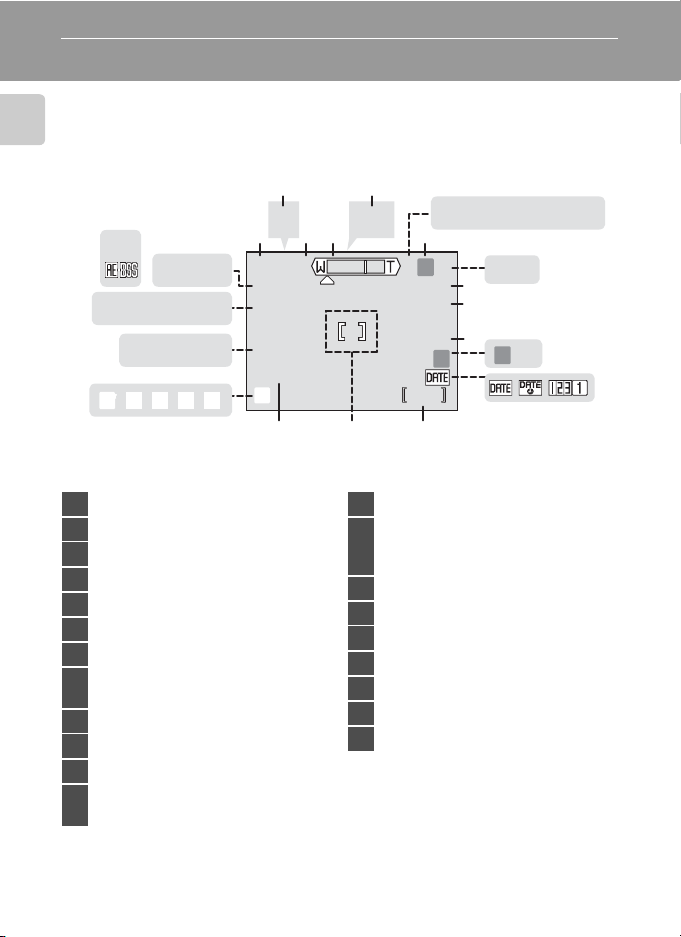
The following indicators may appear in the monitor during shooting and
playback (actual display varies with current camera settings).
Introduction
Shooting
526
z ABCD
20
AA
19
fghijl
fghijl
18
CDBA
CDBA
17
bcehi
21
qwz
qwz
GG
134 7
pp
M
qq
gg
CC
II
+1.0
+1.0
c
z ABCD
BBhFF
MM
ww
WW
HH
10
10
s
9999
9999
9
10
11
MO
MO
W
141516
YY
8
12
13
1 Shooting mode ........ 20, 32, 44, 53
2 Exposure lock ............................. 42
3 Macro close-up mode................. 31
4 Zoom indicator..................... 22, 31
5 Focus indicator ........................... 24
6 Flash mode ................................ 28
7 Camera shake icon..................... 29
Internal memory/memory card
8
indicator .................................... 18
9 Battery level indicator ................. 20
10 Sensitivity (ISO equivalent) .......... 29
11 Self-timer indicator..................... 30
“Date not set” indicator ........... 114
12
Time zone indicator.................... 97
6
13 Date imprint/date counter ........ 101
Number of exposures
14
remaining ................................... 20
Movie length .............................. 53
15 Focus area .................................. 24
16 Exposure compensation value..... 81
17 Image mode ............................... 77
18 Color options ............................. 86
19 White balance mode .................. 79
20 Best shot selector (BSS) ............... 84
21 Continuous shooting mode........82
Page 19
Playback
100NIKON
12:00
9999.JPG
2006.10.10
9999
9999
START
I J K
The Monitor
Introduction
2006.10.10
2006.10.10
19
12:00
12:00
18
EE
17
ww
16
DD
15
14
13
IJK
IJK
1 Current folder .......................... 110
2 File number and type................ 110
Internal memory/memory card
3
indicator .................................... 18
4 Battery level indicator ................. 20
5 Volume indicator.................. 52, 58
6 Voice memo recording guide...... 52
7 Voice memo playback guide....... 52
Current frame number/total
8
number of frames/
movie length .............................. 58
9 D-Lighting icon .......................... 50
PP
c
OK
100NIKON
100NIKON
9999.JPG
9999.JPG
1
2
3
MM
MMww
OO
4
hh
5
O
N O
O
N
9999
O
9999
99999999
PPN
811 912
10
START
START
10 Movie playback indicator ............ 58
11 Voice memo icon........................ 52
12 Image mode ............................... 77
13 Small picture indicator ................ 51
14 Movie indicator .......................... 58
15 Protect icon ................................ 91
16 Print-order icon .......................... 74
17 Transfer icon ........................ 67, 92
18 Time of recording ....................... 16
19 Date of recording ....................... 16
6
7
7
Page 20
Basic Operations
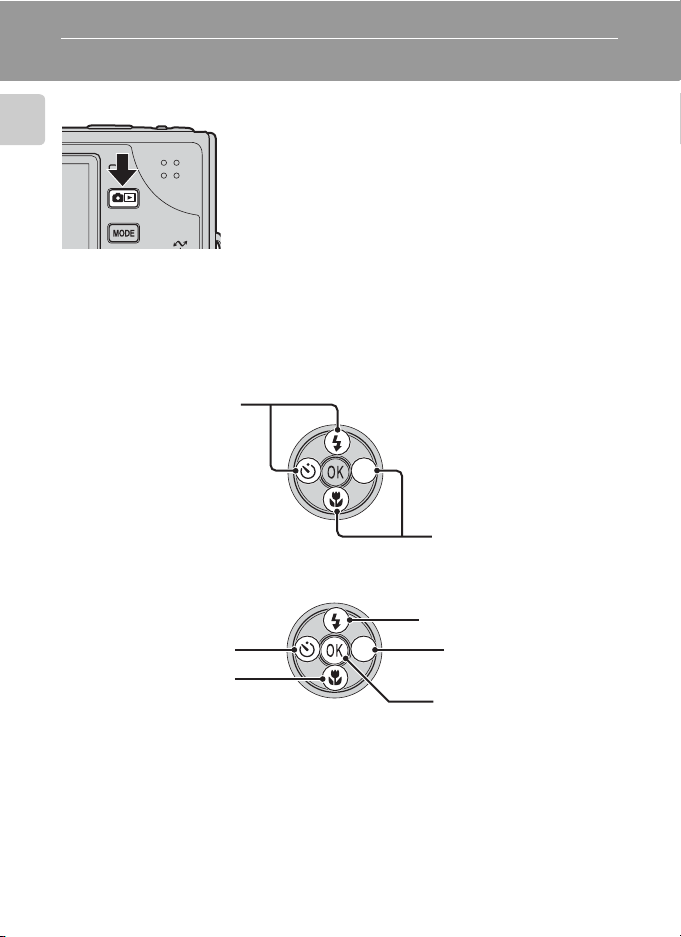
The o (shooting/playback) Button
Press o once in shooting mode to enter full-
Introduction
The Multi Selector
In addition to activating the flash, macro close-up, and self-timer modes and
functions, the multi selector is also used to perform the following operations.
Playback Mode
Display the previous
file (GI, c 26, 58)
(voice recording:G,
c 60)
Navigating the Menus
frame playback; press again to switch back to
shooting mode. (If the camera is turned off, press
o for about a second to turn the camera on in
playback mode.)
Display the next file
(JH, c 26, 58)
(voice recording:H,
c 60)
Return to the previous menu, or move
cursor left (I)
Move cursor down (H)
* In the manual, the button indicating up, down, left, and right of the multi selector is
shown as GHIJ.
Move cursor up (G)
Display the sub-menu,
move cursor right, or
apply selection (J)
Apply selection
8
Page 21
The p Button
Shooting Modes
L (G): Auto mode (c 20)
A simple “point-and-shoot” mode in which the majority
of camera settings are controlled by the camera
T (I): Movie mode
(c 53)
Record movies. Select
one of five recording
modes
O (H): Voice recording mode (c 59)
Record sound only
Playback Modes
i (G): Playback (c 46)
View still pictures and movies
Basic Operations
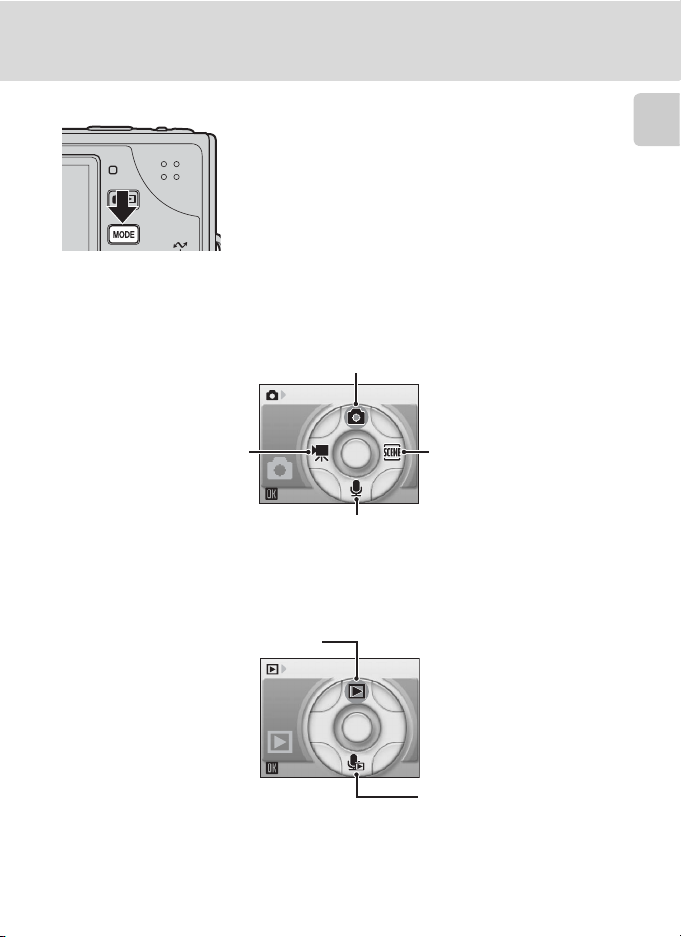
Press p during shooting or playback to display
each mode-selection menu.
To choose the desired mode, use the multi selector.
Shooting
n (J): Scene mode
(c 32)
Select one of fifteen
“scenes” suited to different subjects or shooting
conditions, such as
indoor parties or night
landscapes, and let the
camera do the rest
Play
Introduction
q (H): Voice playback
(c 52)
Listen to voice recordings
k Note on Selecting a Mode
To apply the selected mode, press d after choosing the desired mode by pressing the multi
selector GHIJ.
9
Page 22
Basic Operations
The m Button
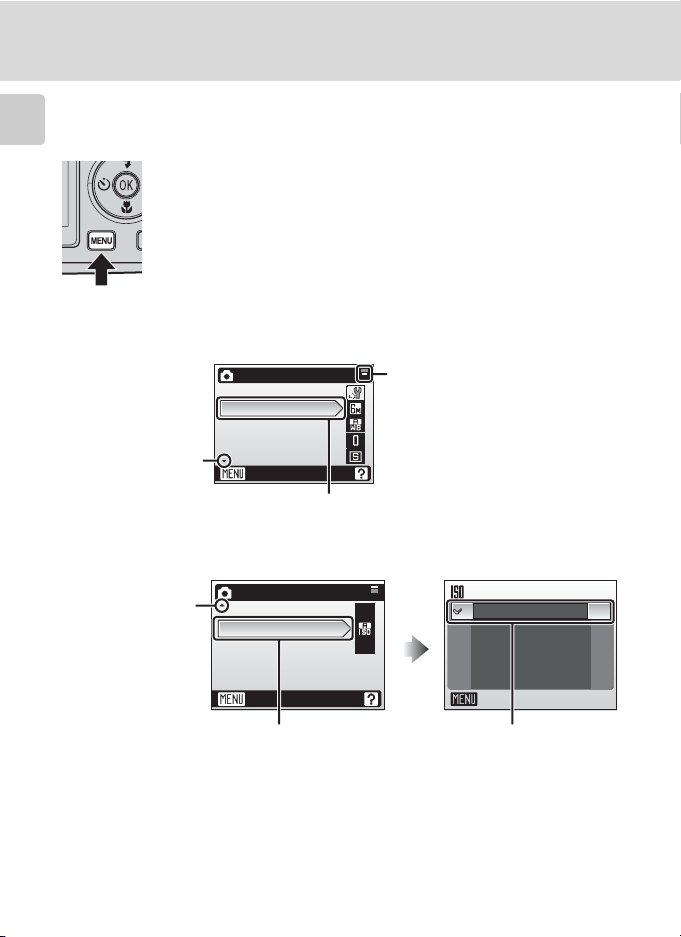
Press m to display the menu for the mode selected (c 9).
Introduction
The following is a brief introduction of the parts of menus and how to navigate through them, using the shooting menu as an example.
L : Auto mode → Shooting menu (c 76)
n : Scene mode → Scene menu (c 32)
T : Movie mode → Movie menu (c 53)
O : Voice recording mode → Setup menu (c 94)
m : One-touch portrait mode → One-touch portrait menu (c 45)
i : Playback mode → Playback menu (c 88)
Displayed when
there are one or
more menu items
to follow
Displayed when
there are one or
more previous
menu items
10
Shooting menu
Set up
Image mode
White balance
Exp. +/Continuous
Exit
The shape of the bar for a selected menu
item indicates whether or not selection
from further options is necessary.
Shooting menu
BSS
Sensitivity
Color Options
Exit
Press the multi selector J or
d to proceed to the next set
of options.
Displayed when the menu
contains two or more pages
Sensitivity
B
e
Exit
Press the multi selector J or
d to apply selection.
Auto
64
100
200
400
Page 23
Basic Operations
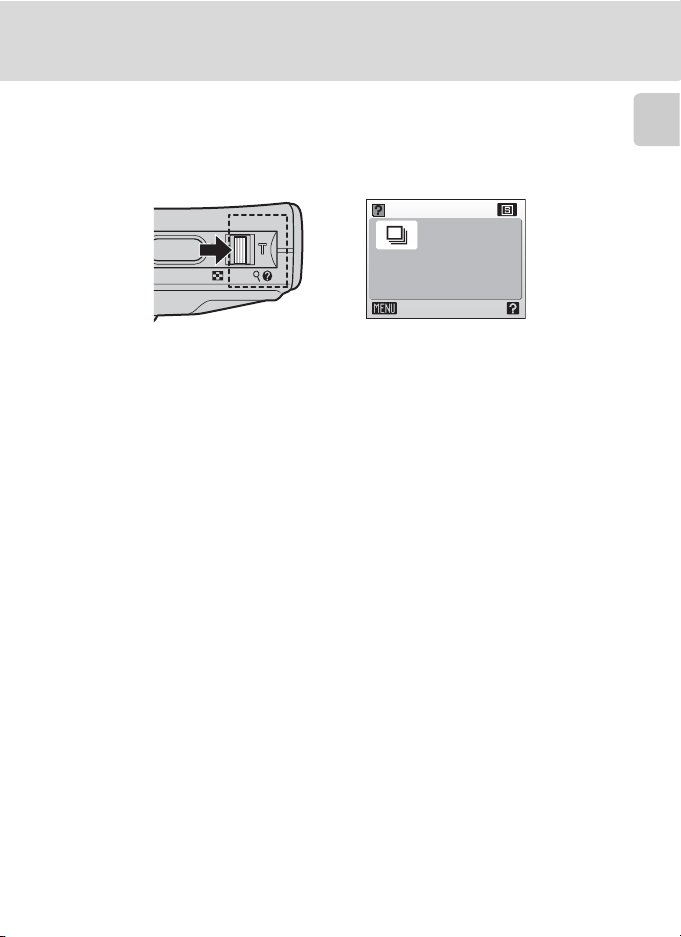
Help Displays
Information about camera menu options can be displayed in the COOLPIX S9
monitor. Press the zoom control to l (v) to view a description of the currently selected item.
Continuous
Keep the
shutter-release button
pressed to take pictures
continuously.
Exit
•Press GH to show the previous or next menu item.
•Press d to display the options for the selected item.
• To return to the original menu, press the zoom control to l (v).
Introduction
11
Page 24
First Steps
Charging the Battery
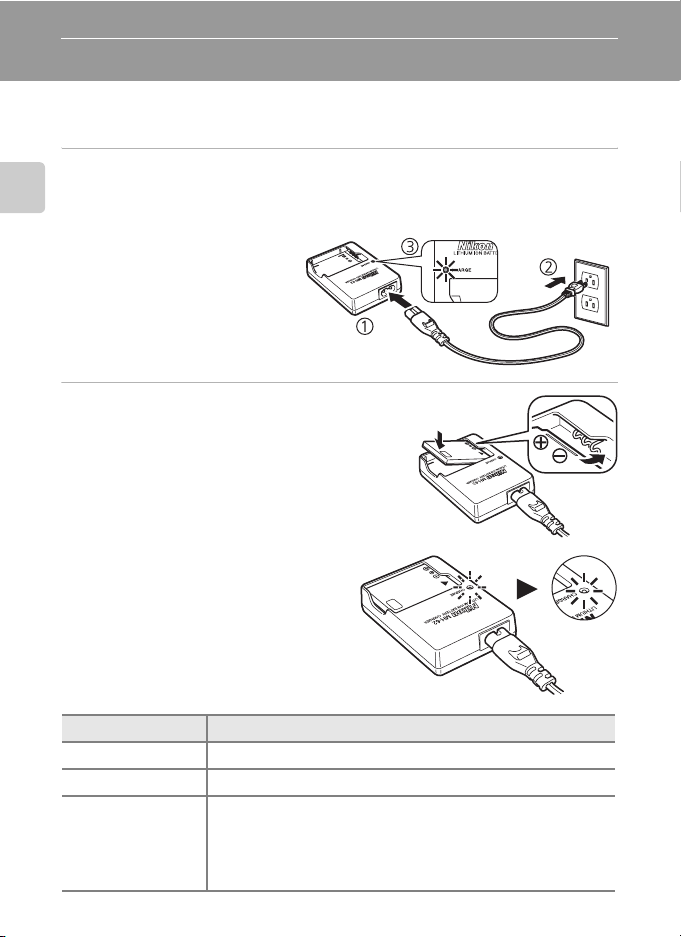
The camera uses a rechargeable Nikon EN-EL8 lithium-ion battery (supplied).
Charge the battery before first use or when the battery is running low.
1 Plug in the charger.
Connect the power cable to the supplied MH-62 battery charger (1) and insert
First Steps
the wall plug into a power outlet (2). The CHARGE lamp will light to show that
the charger is on (3).
2 Charge the battery.
Remove the terminal cover from the EN-EL8
and insert into the MH-62.
CHARGE lamp starts blinking when
battery is inserted. Charging is complete when lamp stops blinking.
About two hours are required to
charge a new or fully depleted battery.
CHARGE lamp Description
Blinks Battery charging.
On Battery fully charged.
Battery error. If ambient temperature is not 0 to 40 °C (32 to
Flickers
104 °F), wait until temperature is in this range before charging. Otherwise unplug charger and remove battery immediately and take both devices to retailer or Nikon-authorized
service representative.
12
Page 25

Charging the Battery
3 Unplug the charger.
Remove the battery and unplug the charger.
j The MH-62 Battery Charger
Before using the MH-62, read and follow the warnings and notices on pages ii to iv
of this manual.
The MH-62 is for use with EN-EL8 batteries. Do not use with incompatible batteries. The supplied power cable is intended solely for use with the MH-62 and is for domestic use only. It
may be necessary to purchase another cable for use abroad; consult with a local Nikon-authorized retailer or service representative.
First Steps
j The EN-EL8 Battery
Before using the EN-EL8, read and follow the warnings and notices on pages ii to iv
and 112 of this manual.
Do not use the battery at ambient temperatures below 0 °C (32 °F) or above 40 °C (104 °F).
During charging, the temperature should be in the vicinity of 5 to 35 °C (41 to 95 °F). Note
that the battery may become hot during use; wait for the battery to cool before charging.
Failure to observe these precautions could damage the battery, impair its performance, or
prevent it from charging normally.
j When the Battery Is Not in Use
When the battery is not in use, remove it from the camera or battery charger and replace the
terminal cover. The camera and battery charger draw minute amounts of current even when
off; if left in place, the battery could be drained to the point that it no longer functions.
13
Page 26
Inserting the Battery
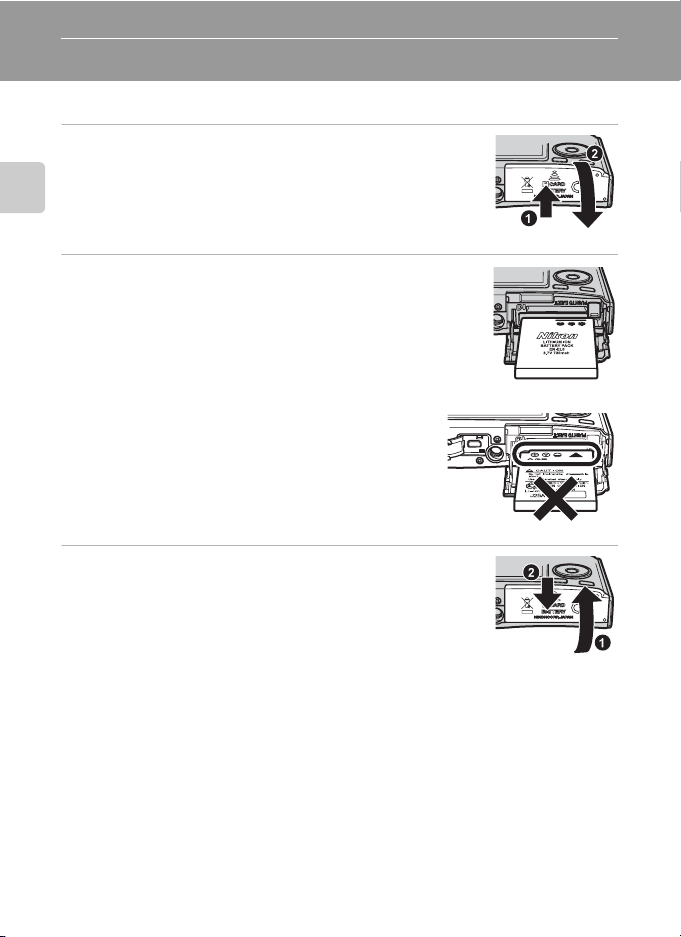
The camera uses a rechargeable EN-EL8 lithium-ion battery (supplied).
1 Open the battery-chamber/memory card
slot cover.
First Steps
2 Insert the battery.
The orange battery latch is pushed aside as the battery
is inserted. The battery is fully inserted when the latch
clicks back into place.
j Inserting the Battery
Inserting the battery upside down or backwards could
damage the camera. Check to be sure the battery is in
the correct orientation.
3 Close the battery-chamber/memory card
slot cover.
14
Page 27
Inserting the Battery
Turning On and Off the Camera
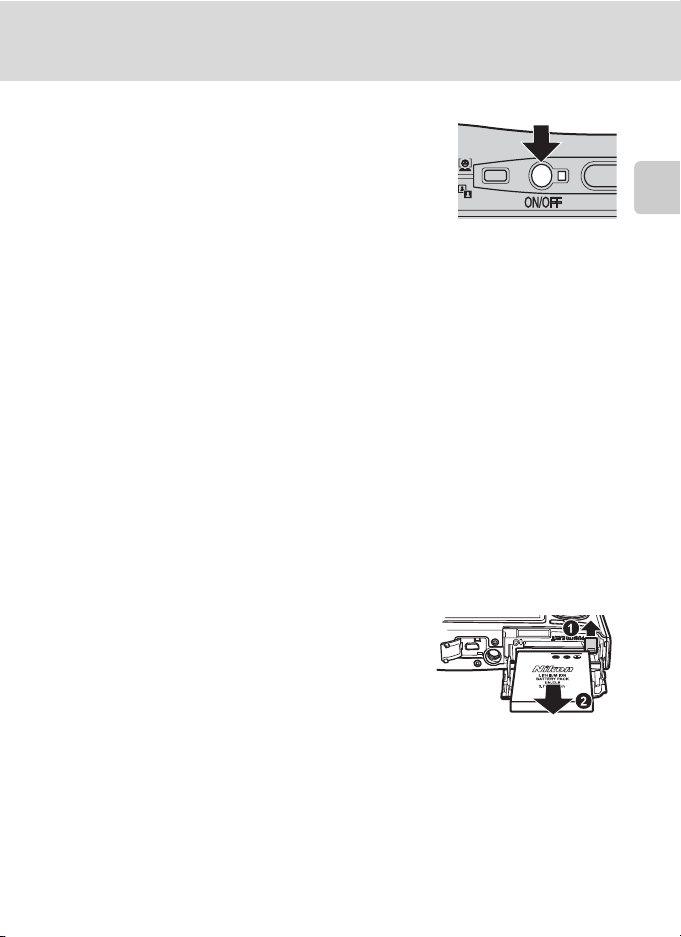
To turn on the camera, press the power switch. The
power-on lamp (green) will light for a moment and
the monitor will turn on.
To turn off the camera, press the power switch
again.
(If the camera is turned off, press o for about a
second to turn the camera on in playback mode.)
j Note on the Battery
Read and follow the warnings and cautions on pages ii to iv and 112 of this manual.
j Removing the Battery
Turn the camera off before removing the battery. To eject
the battery, open the battery-chamber/memory card slot
cover and slide the battery latch in the direction shown. The
battery can then be removed by hand. Note that the battery
may become hot during use; observe due caution when
removing the battery.
First Steps
k Power Saving Function
In shooting mode, the monitor will dim to reduce the drain on the battery if no operations are
performed for about five seconds. The monitor will brighten when camera controls are used.
When no operations are performed for fifteen seconds, the monitor turns off and the poweron lamp blinks. If no operations are performed for another fifteen seconds, the camera enters
standby mode. If no operations are performed for another three minutes, the camera turns
off. To reactivate the camera from standby mode, press the shutter-release button halfway.
The amount of time allowed to pass before the camera enters standby mode can be specified
from the auto off menu (c 104).
15
Page 28
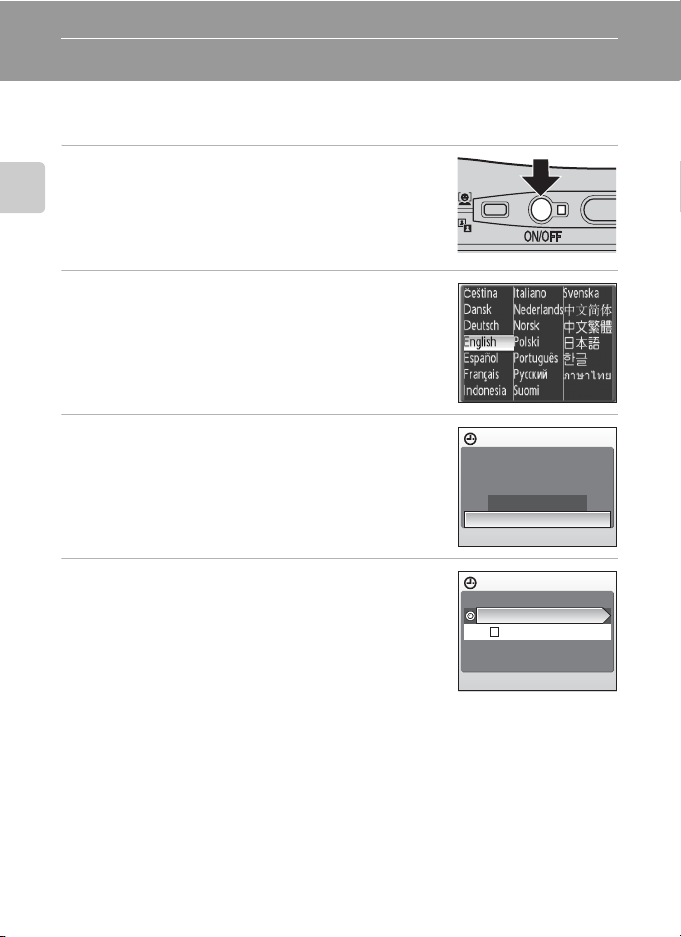
Setting Display Language, Date, and Time
A language-selection dialog is displayed the first time the camera is turned
on.
1 Turn on the camera.
The power-on lamp (green) will light for a moment
First Steps
and the monitor will turn on.
2 Press the multi selector GHIJ to
choose the desired language and press
d.
For information on using the multi selector, see “The
Multi Selector” (c 8).
3 Press GH to choose [Yes] and press d.
If [No] is selected, the date and time will not be set.
4 Press J.
The home time zone menu is displayed.
If daylight saving time is in effect in the local time
zone, press H to choose [DaylightSaving] and press
d. The [DaylightSaving] option will be enabled with a
check mark (y) and the time will automatically be
advanced one hour.
Press G, and then go to step 5 after pressing J.
16
Date
Set time and date?
No
Yes
Time zone
London,Casablanca
X
DaylightSaving
Page 29
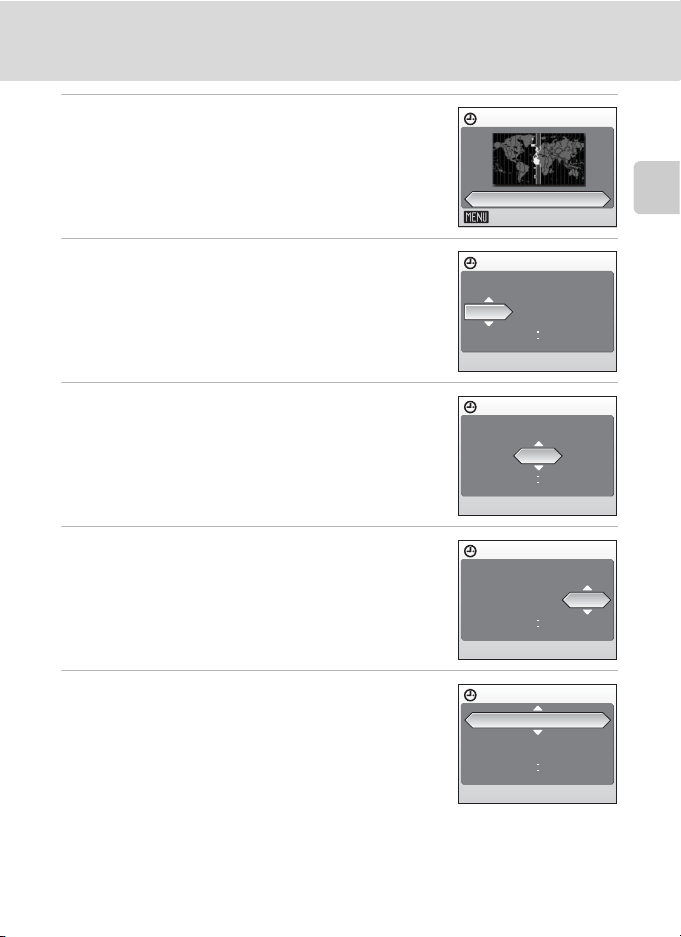
Setting Display Language, Date, and Time
5 Press IJ to select your home time zone
and press d.
The date menu is displayed.
6 Press GH to edit the day ([D]) (order of
the day, month, and year may differ in
some areas) and press J.
7 Press GH to edit the month ([M]) and
press J.
8 Press GH to edit the year ([Y]), hour,
and minutes. Press J after setting each
item.
[D], [M], and [Y] blink.
9 Choose the order in which the day,
month, and year are displayed and press
d.
The settings are applied and monitor display returns to
the standard display for the current mode.
Home time zone
London,Casablanca
X
Back
Date
DMY
01
Date
DMY
10
Date
DMY
10
Date
DMY
10
200609
0000
200609
0000
200610
0000
200610
1015
First Steps
17
Page 30
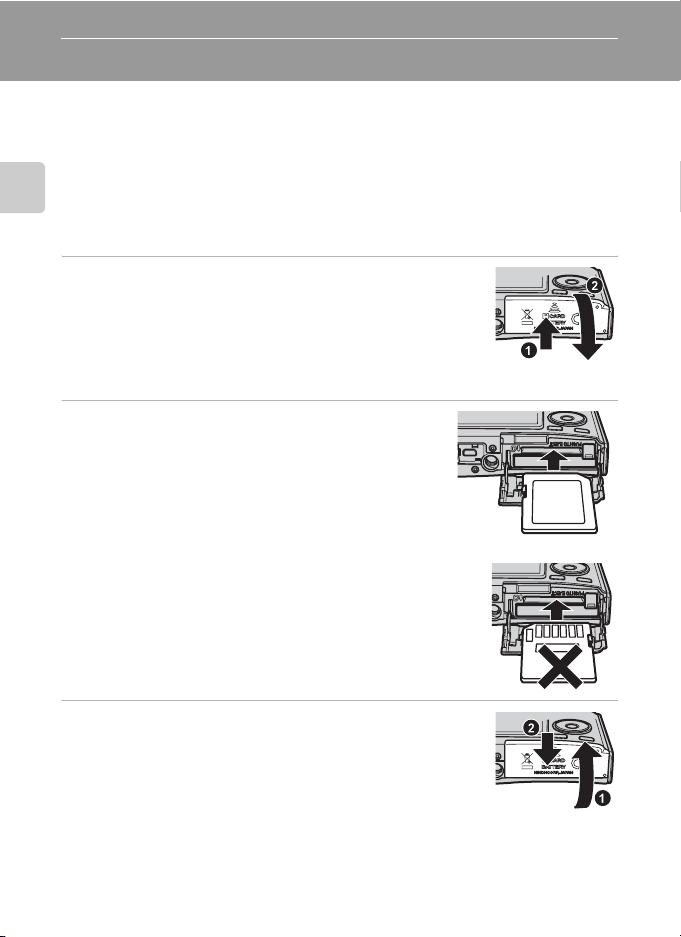
Inserting Memory Cards
Pictures are stored in the camera’s internal memory (24 MB) or on removable
Secure Digital (SD) memory cards (available separately) (c 109).
If a memory card is inserted in the camera, pictures are automatically
stored on the memory card and only pictures recorded to the memory
card can be played back, deleted, or transferred.
Remove the memory card to store pictures in the internal memory, or
First Steps
play back or delete pictures from the internal memory.
1 Turn the camera off and open the bat-
tery-chamber/memory card slot cover.
Make sure that the camera is off (power-on lamp is
off) before opening the battery-chamber/memory
card slot cover.
2 Insert the memory card.
Slide the memory card in until it clicks into place.
j Inserting Memory Cards
Inserting the memory card upside down or backwards
could damage the camera or the memory card. Be
sure that the memory card is correctly oriented when
inserting.
3 Close the battery-chamber/memory card
slot cover.
18
Page 31
Inserting Memory Cards
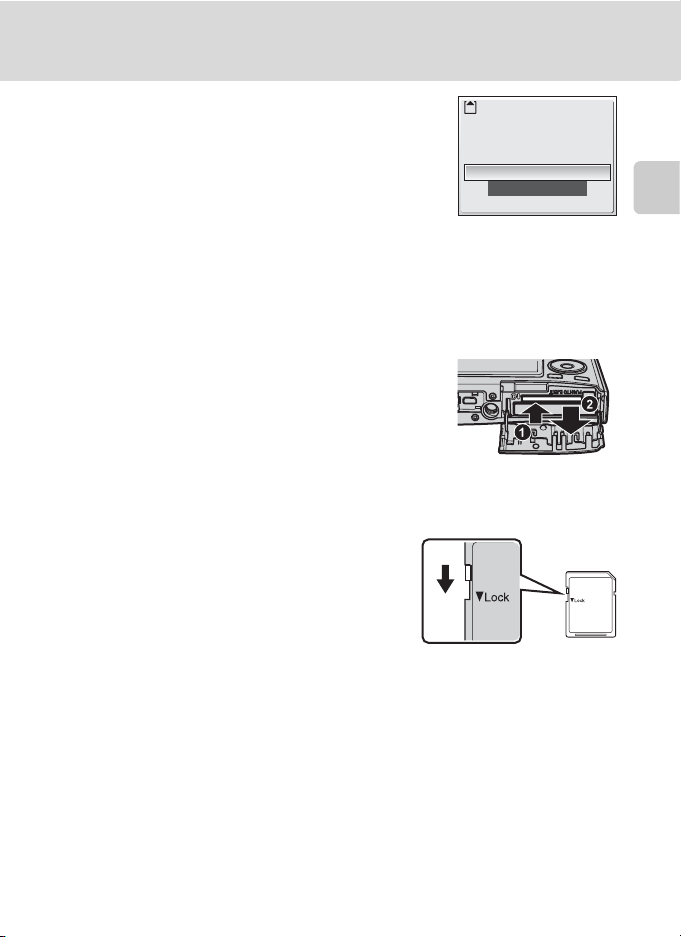
j Formatting Memory Cards
If the message at right is displayed, the memory card must be
formatted before use (c 105).
• Note that formatting permanently deletes all pictures
and other data on the memory card. Be sure to make copies of any pictures you wish to keep before formatting the
memory card.
• To format the memory card, press the multi selector G to choose [Format] and press d.
• Do not turn the camera off or remove the battery or memory card until formatting
is complete.
• The first time you insert the memory cards used in other devices into the COOLPIX S9, be
sure to format them with [Format] (c 105).
Card is not formatted
Format
No
j Removing Memory Cards
Before removing memory cards, turn the camera off and
confirm that the power-on and indicator lamps are off.
Open the battery-chamber/memory card slot cover and press
the card in to partially eject the card. The card can then be
removed by hand.
j The Write Protect Switch
SD memory cards are equipped with a write protect
switch. Pictures cannot be recorded or deleted and the
memory card cannot be formatted when this switch is in
the “lock” position.
Write protect switch
First Steps
j Memory Cards
• Use only Secure Digital memory cards.
• Do not eject the memory card, turn the camera off, or remove the battery during formatting or while data are being written to or deleted from the memory card.
Failure to observe this precaution could result in loss of data or in damage to the camera or
memory card.
• Do not disassemble or modify.
• Do not drop, bend, or expose to water or strong physical shocks.
• Do not touch the metal terminals with your fingers or metal objects.
• Do not affix labels or stickers to the memory card.
• Do not leave in direct sunlight, closed vehicles, or areas exposed to high temperatures.
• Do not expose to humidity or to corrosive gases.
19
Page 32
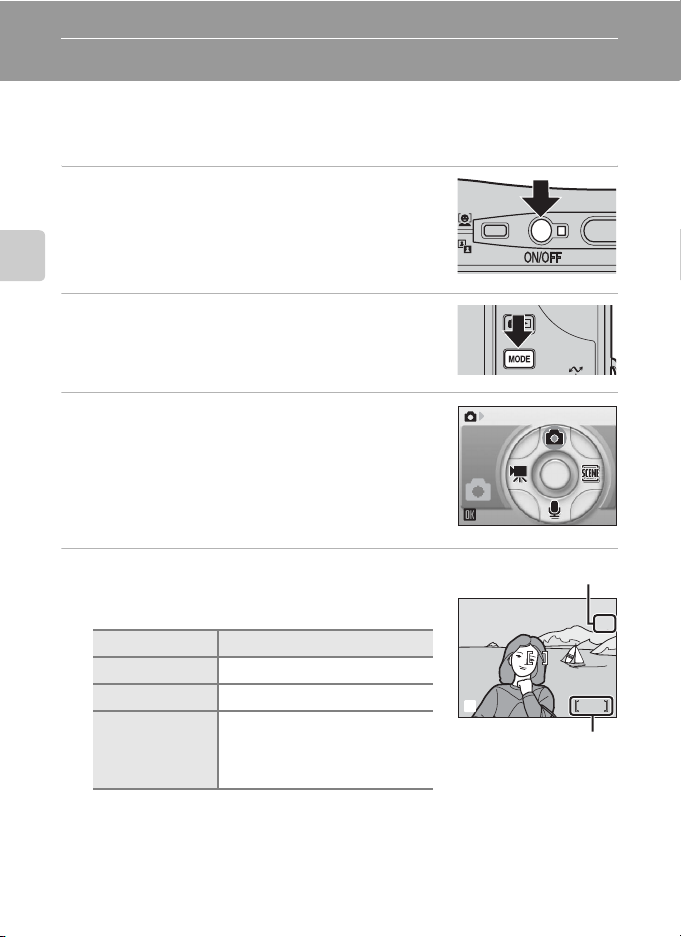
Basic Photography and Playback: L (Auto) Mode
Step 1 Turn the Camera On and Select L (Auto) Mode
This section describes how to take pictures in L (auto) mode, an automatic,
“point-and-shoot” mode recommended for first-time users of digital cameras.
1 Press the power switch.
The power-on lamp (green) will light for a moment
and the monitor will turn on.
Basic Photography and Playback: L (Auto) Mode
2 Press p.
The shooting mode menu will be displayed.
3 Press the multi selector G to choose L
and press d.
The camera enters L (auto) mode.
4 Check the battery level and number of
exposures remaining.
Battery level
Monitor Description
NO INDICATOR Battery fully charged.
w Battery low; charge the battery.
Warning!!
battery
exhausted
w
Number of exposures remaining
The number of pictures that can be stored depends on the capacity of the memory
or memory card and image mode setting.
20
Battery exhausted. Recharge or
replace with a fully charged
battery.
Shooting
Battery level indicator
M
c
Number of exposures
remaining
181818
MM
ww
Page 33
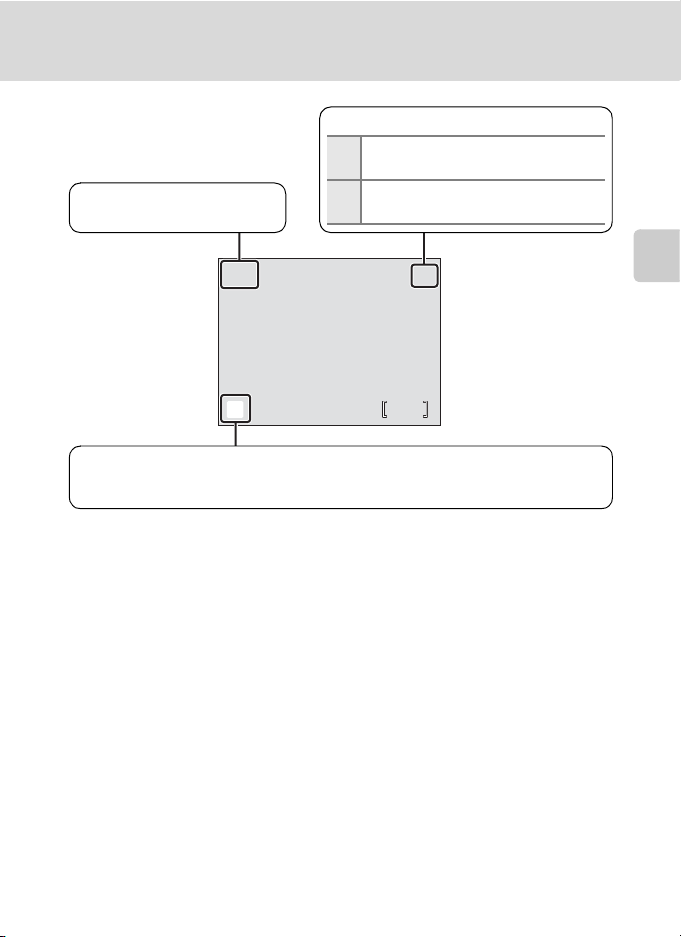
Step 1 Turn the Camera On and Select L (Auto) Mode
Shooting mode
L displayed in auto mode
Internal memory/memory card
Pictures will be recorded to internal
M
memory.
Pictures will be recorded to memory
O
card.
M
c
Image mode
Choose from five options depending on how you plan to use the picture.
The default setting is c (2816 × 2112).
MM
ww
181818
l Available Functions in Auto Shooting Mode
In L mode, macro close-up mode (c 31) can be applied and pictures can be taken using
the flash (c 28) and self-timer (c 30). Pressing m in L mode displays the shooting
menu. This menu allows you to specify the image mode (c 77), white balance setting
(c 79), and to apply exposure compensation (c 81), continuous shooting (c 82), BSS
(c 84), sensitivity (c 85), and color options (c 86) to suit shooting conditions or your own
preferences.
Basic Photography and Playback: L (Auto) Mode
21
Page 34
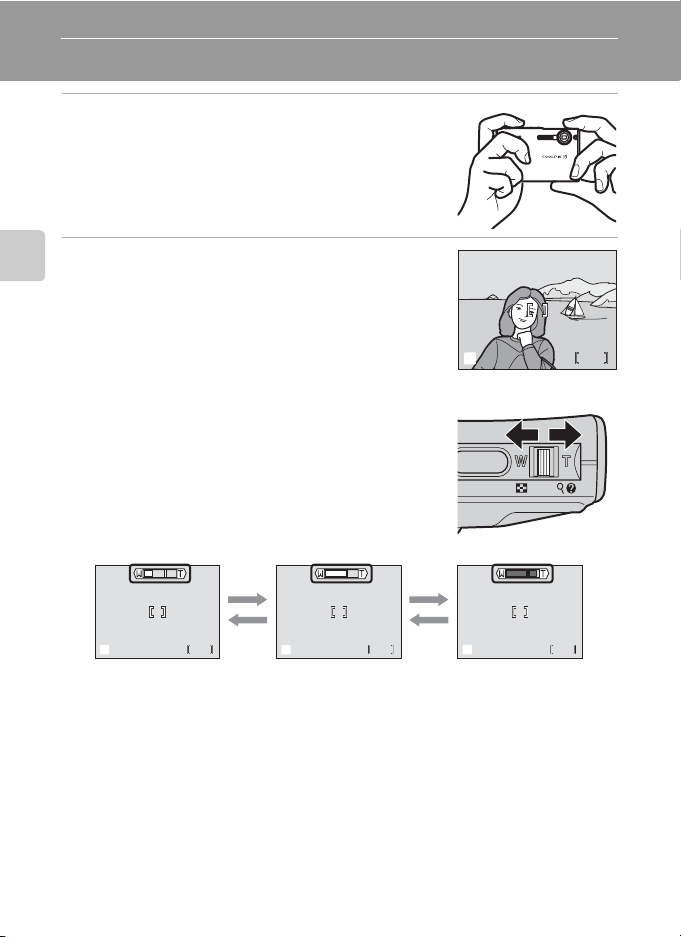
Step 2 Frame a Picture
18
18
18
1 Ready the camera.
Hold the camera steadily in both hands, keeping your
fingers and other objects away from the lens, flash,
and self-timer lamp.
When taking pictures in “tall” orientation, turn the
camera so that the built-in flash is above the lens.
2 Frame the picture.
Basic Photography and Playback: L (Auto) Mode
Position the main subject near the center of the monitor.
Use the zoom control to activate optical zoom. Press
the zoom control to t to zoom out, increasing the
area visible in the frame, or to v to zoom in so that
the subject fills a larger area of the frame.
When the camera is zoomed in to the maximum
magnification (3×), holding the zoom control down
to v triggers digital zoom. The subject is magnified
up to 4×, for a total magnification of 12×.
A monitor indicator shows the current zoom ratio.
M
c
Zoom indicator displayed when the zoom
control is pressed.
M
c
Zoom out Zoom in
MM
18
18 18 18
M
TWT
W
c
Optical zoom
(up to 3×)
MM
18
M
TWT
W
c
Zoom indicator turns
yellow when digital
zoom is in effect.
MM
181818
MM
18
22
Page 35

Step 2 Frame a Picture
j Digital Zoom
Unlike optical zoom, data from the camera’s image sensor are processed digitally with digital
zoom. Details visible at maximum optical zoom are simply enlarged, producing a slightly
“grainy” image.
Basic Photography and Playback: L (Auto) Mode
23
Page 36
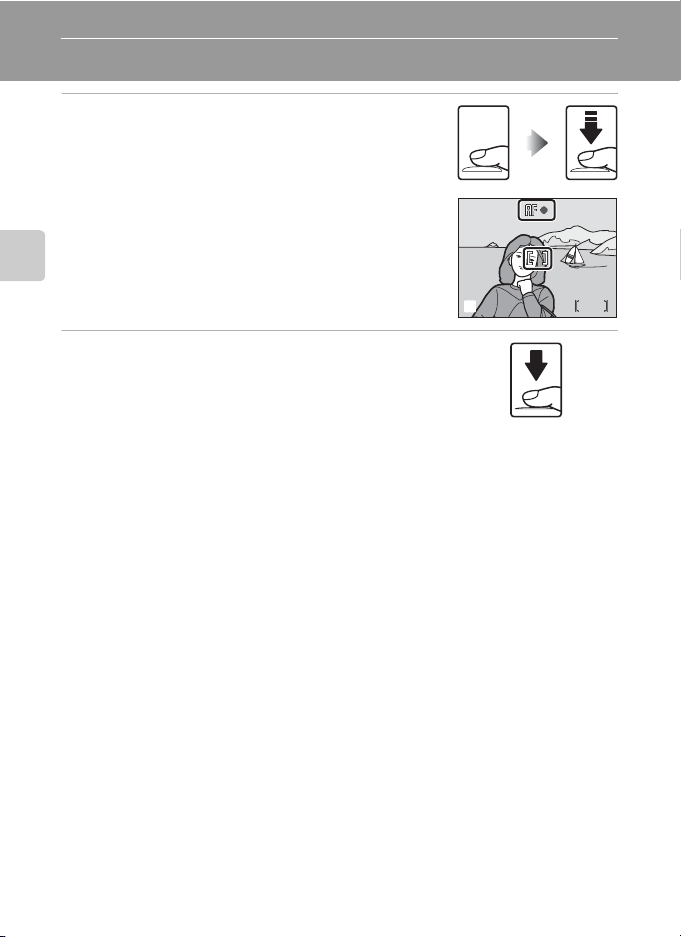
Step 3 Focus and Shoot
1 Press the shutter-release button halfway.
The camera focuses on the subject at the center of
the frame. When the subject is in focus, the focus
indicator (p) is green. When the camera is unable
to focus, the focus indicator blinks red. Change the
composition and try again.
The distance between the camera and your subject
should not change while the focus is locked.
M
MM
Basic Photography and Playback: L (Auto) Mode
c
2 Press the shutter-release button the rest
of the way down to take the picture.
The picture will be recorded to the memory card or
internal memory. The flash may fire or the AF-assist
illuminator (
j During Recording
While pictures are being recorded, the y (wait) icon will be displayed, the indicator lamp will
blink green, and the O (recording to memory card) or M (recording to internal memory) icon
will blink. Do not turn the camera off, eject the memory card, or remove or disconnect the
power source while these icons are displayed. Cutting power or removing the memory card in
these circumstances could result in loss of data or in damage to the camera or card.
24
c 29) may light if the subject is poorly lit.
181818
Page 37
Step 3 Focus and Shoot
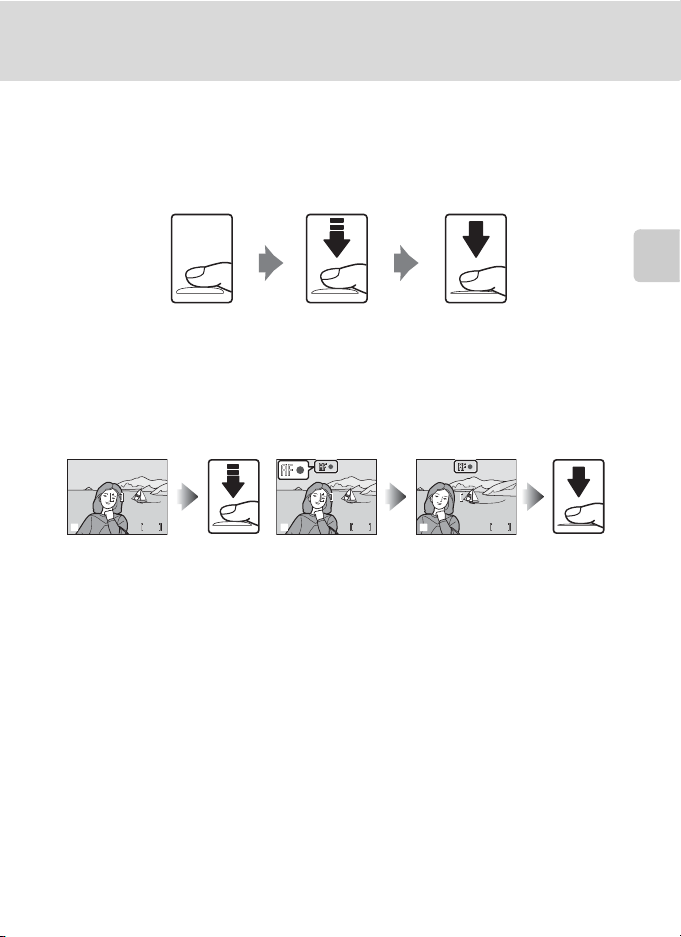
l Shutter-Release Button
The camera features a two-stage shutter-release button. To set focus and exposure, press the
shutter-release button halfway, stopping when you feel resistance. Focus and exposure lock
while the shutter-release button is held in this position. To release the shutter and take a picture, press the shutter-release button the rest of the way down. Do not use force when pressing the shutter-release button, as this may result in camera shake and blurred pictures.
Take pictureSet focus and
exposure
l Focus Lock
To focus on off-center subject, use focus lock as described below.
• Be sure that the distance between the camera and the subject does not change while focus
is locked.
M
MM
M
MM
M
MM
Basic Photography and Playback: L (Auto) Mode
c
Position the
subject in the
center of the
frame.
181818
Press the
shutterrelease
button
halfway.
c
181818
Confirm that
the focus indicator (p) is
green
c
Continue holding down the
shutter release
button halfway and
recompose the
picture.
181818
Press the
shutterrelease
button
the rest of
the way
down.
l Auto Focus
Focus lock does not perform well if the subject is very dark or is moving rapidly, if there are
objects of sharply differing brightness in the scene (e.g., the sun is behind your subject and
their features are in deep shadow), or if there are several objects at different distances from
the camera at the center of the frame (e.g., your subject is inside a cage).
25
Page 38
Step 4 Viewing and Deleting Pictures
100NIKON
15:30
0009.JPG
10.10.2006
Erase 1 image?
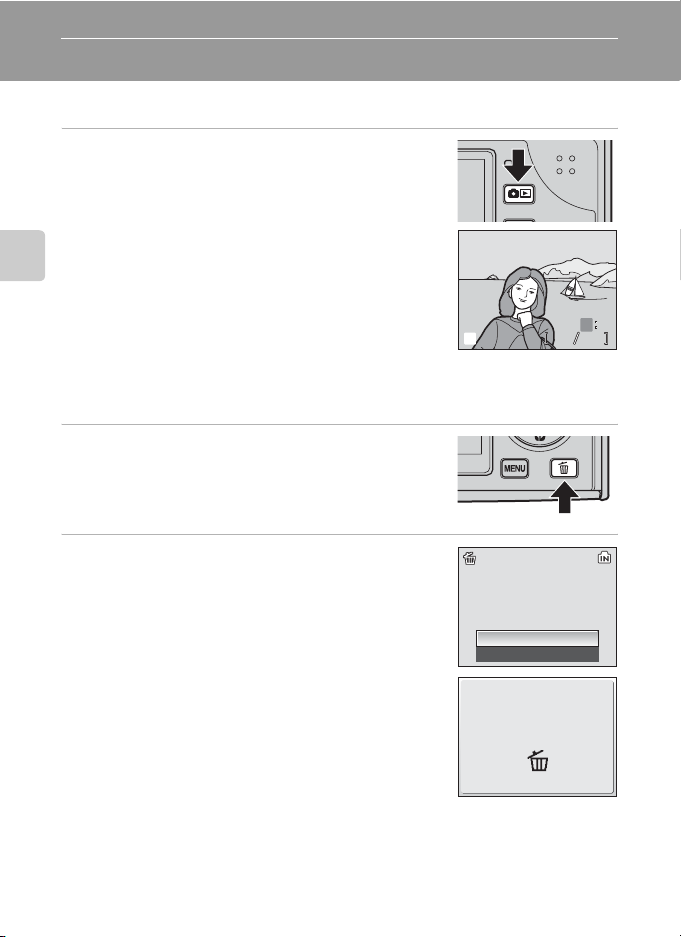
Full-Frame Playback
1
Press
o
to display pictures in the monitor.
To view additional pictures, press the multi selector
HJ to view pictures in the order recorded, GI to
view pictures in reverse order. Press and hold the
multi selector to scroll quickly to a particular frame
number without viewing the intervening pictures.
Pictures may be displayed briefly at low resolution while
Basic Photography and Playback: L (Auto) Mode
being read from the memory card or internal memory.
Press o again to switch to shooting mode.
Deleting Pictures
1 Press T to delete the picture currently
displayed in the monitor.
A confirmation dialog will be displayed.
2 Press the multi selector H to select [Yes]
and press d.
To exit without deleting the picture, choose [No] and
press d.
10.10.2006
10.10.2006
15:30
15:30
c
Erase 1 image?
Erase 1 image?
No
Yes
100NIKON
100NIKON
0009.JPG
0009.JPG
MM
O
NEEO
44
44
26
Done
Page 39
Step 4 Viewing and Deleting Pictures
Erase 1 image?
k Full-Frame Playback Mode
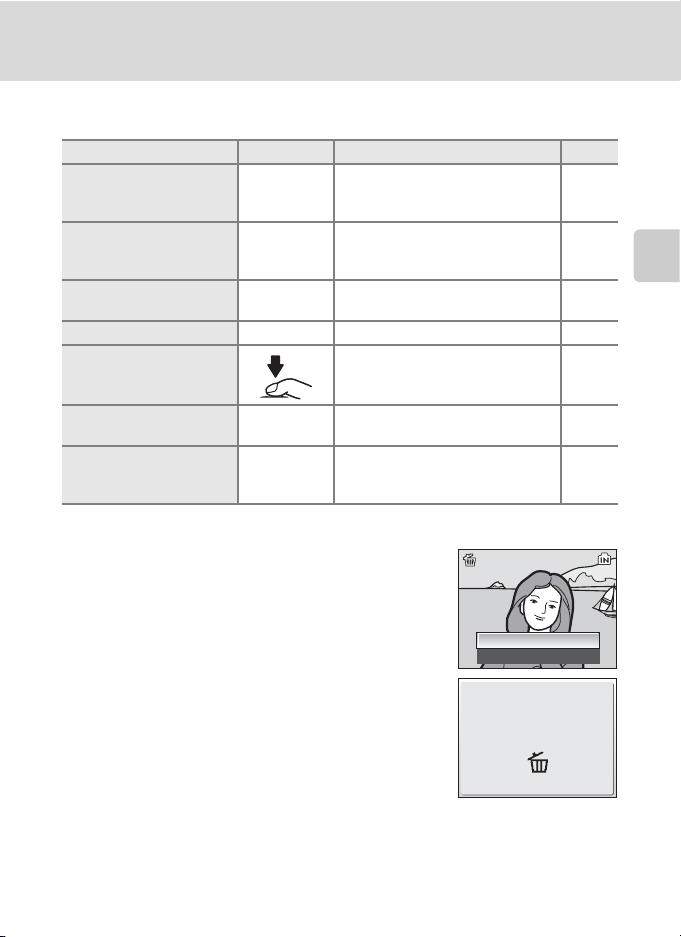
The following options are available in full-frame playback mode.
Option Press Description c
Playback zoom
View thumbnails
View playback mode
menu
View playback menu
Record/play voice
memo
D-Lighting
Switch to shooting
mode
Zoom con-
trol to k (v)
Zoom con-
trol to j
(t)
p
m
i
o
Enlarge view of picture currently
displayed in monitor up to about
10×.
Display four or nine picture
thumbnails.
Display the mode-selection
menu.
Display the playback menu. 88
Record or play back voice memos
up to 20 seconds in length.
Enhance brightness and contrast
in dark portions of pictures.
Switch to the shooting mode
selected with the mode-selection
menu.
k Deleting the Last Picture Taken
In shooting mode, press T to delete the last picture taken. The
confirmation dialog shown at right will be displayed. Press the
multi selector H to choose [Yes] and press d.
• To exit without deleting the picture, choose [No] and press
d.
Erase 1 image?
Erase 1 image?
No
Yes
47
46
52
50
Basic Photography and Playback: L (Auto) Mode
9
–
Done
l Viewing Pictures
• When the camera is off, pressing o for one second will turn the camera on in playback
mode.
• Pictures stored in the internal memory can only be viewed if no memory card is inserted.
27
Page 40
Using the Flash
The flash has a range of 0.3–2.6 m (1 ft.–8 ft. 6 in.) when the camera is
zoomed out all the way. With maximum optical zoom applied, the range is
0.3–1.4 m (1 ft.–4 ft. 7 in.). The following flash modes are available:
z Auto (default)
Flash fires automatically when lighting is poor.
A Auto with red-eye reduction
Reduces “red-eye” in portraits (c 29).
B Off
Basic Photography and Playback: L (Auto) Mode
Flash will not fire even when lighting is poor.
J Fill flash
Flash fires whenever a picture is taken. Use to “fill-in” (illuminate) shadows
and back-lit subjects.
D Slow sync
Flash illuminates main subject; slow shutter speeds are used to capture background at night or under dim light.
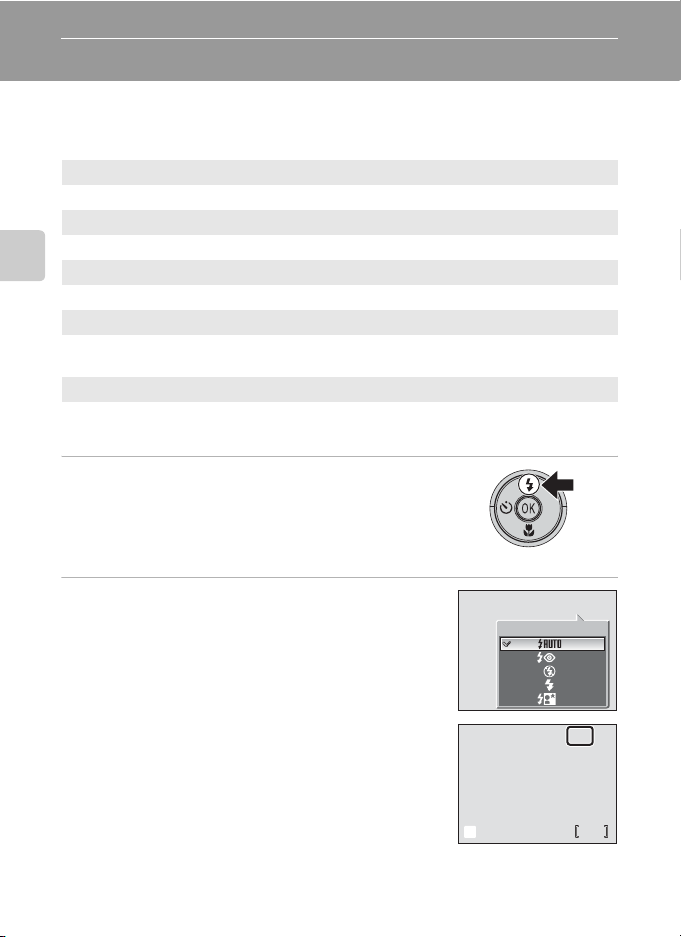
1 Press J (flash mode).
The flash menu is displayed.
2 Press the multi selector GH to choose
the desired flash mode and press d.
The monitor will return to the normal display for the
current mode if the setting is not applied by pressing
d within five seconds.
The icon for the selected flash mode is displayed at
the top of the monitor.
When z is selected, the icon is only displayed for
five seconds after the setting is applied.
The flash mode applied in L mode is stored in the
camera’s memory even after the camera is turned off.
28
M
c
Flash
zz
zz
MM
181818
Page 41
Using the Flash
Picture is blurred.
save picture?
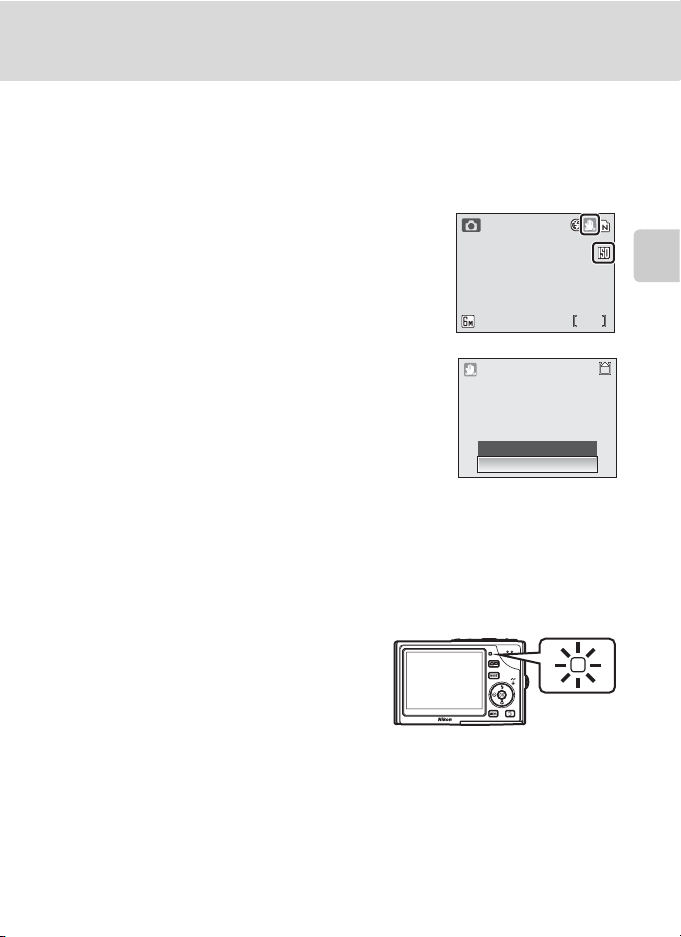
j Note on Using the Flash
When using the flash at a wide-angle zoom position, reflections from dust particles in the air
may appear as bright spots in pictures. To reduce these reflections, set the flash to B (Off) or
zoom in on the subject.
k When Lighting is Poor
When lighting is poor and the flash is off (B), the y or W
icon may appear on the monitor. Note the following.
• Place the camera on a flat, level surface or use a tripod (recommended).
•The W icon is displayed when the camera increases sensitiv-
ity from the normal sensitivity to minimize blur caused by
slow shutter speeds. The picture taken when the W icon is
displayed may be slightly mottled.
• If the warning at right is displayed after a picture is taken,
the picture may be blurred. Select [No] to exit without
recording the picture.
• The camera may process pictures to reduce noise, which
makes recording time increase.
Picture is blurred.
Picture is blurred.
save picture?
save picture?
No
Yes
k The AF-assist Illuminator
If lighting is poor, the AF-assist illuminator may light to assist the focus operation when the
shutter-release button is pressed halfway. The illuminator has a maximum range of about
1.9 m/6 ft. 3 in. (t) to 1.1 m/3 ft. 7 in. (v). The AF-assist illuminator is not available in some
modes (c 32-43) and can also be turned off manually (c 103), although in this case the
camera may not focus when lighting is poor.
k The Flash Lamp
The flash lamp indicates flash status when the shutter-release button is pressed halfway.
• On: Flash will fire when picture is taken.
• Blinks: Flash charging. Wait a few seconds and try
again.
• Off: Flash will not fire when picture is taken.
k Red-Eye Reduction
• The COOLPIX S9 is equipped with an advanced red-eye reduction system. Pre-flashes are
fired several times at low intensity before the main flash to reduce “red-eye.” If the camera
detects “red-eye” after a picture is taken, Nikon’s own In-Camera Red-Eye Fix processes
the image as it is recorded. Therefore, there is a slight delay before the shutter-release button operates normally to take another picture.
•
Red-eye reduction may not always produce the desired results. In some rare cases, other portions of pictures may be affected. Should this occur, choose another flash mode and try again.
Basic Photography and Playback: L (Auto) Mode
181818
29
Page 42
Taking Pictures with the Self-Timer
OFF
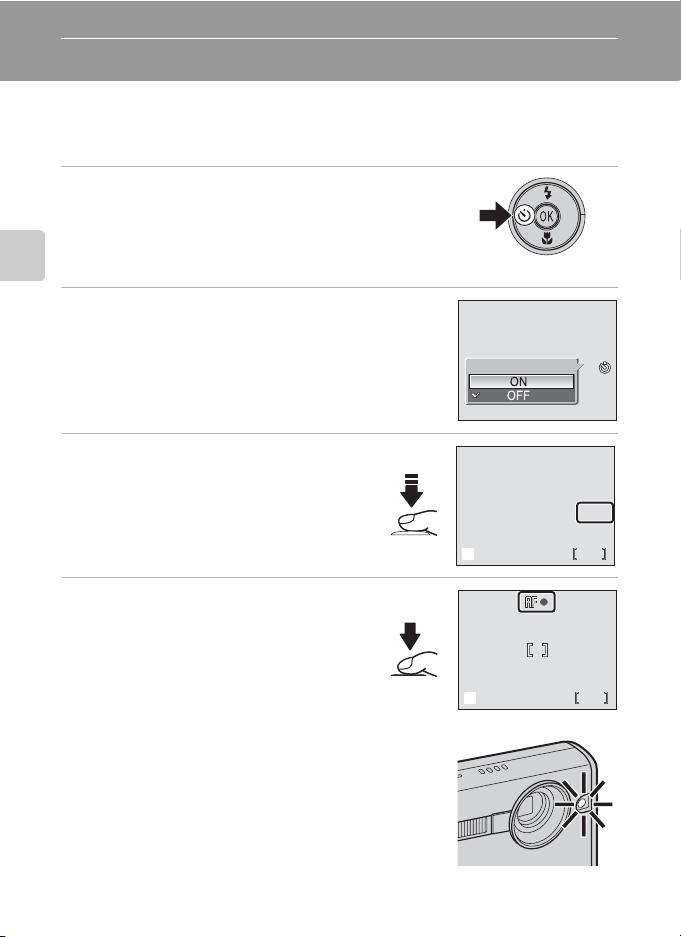
The camera is equipped with a ten-second timer for self-portraits. When
using the self-timer, mount the camera on a tripod (recommended) or rest it
on a flat, level surface.
1 Press H (self-timer).
The self-timer menu is displayed.
Basic Photography and Playback: L (Auto) Mode
2 Press the multi selector G to choose [ON]
and press d.
The self-timer indicator (10H) is displayed.
The monitor will return to the normal display for the
current mode if the setting is not applied by pressing
d within five seconds.
Self-timer
OFF
OFF
3 Frame the picture and press the
shutter-release button halfway.
4 Press the shutter-release button
fully.
The self-timer starts.
The self-timer lamp will blink for about nine
seconds. The lamp stops blinking one second
before the photograph is taken and remains
lit until the shutter is released.
The number of seconds remaining before
the shutter is released is displayed in the
monitor.
To stop the timer before a picture is taken,
press the shutter-release button again.
30
M
c
M
c
101010
101010
MM
HH
181818
MM
HH
181818
Page 43
Macro Close-up Mode
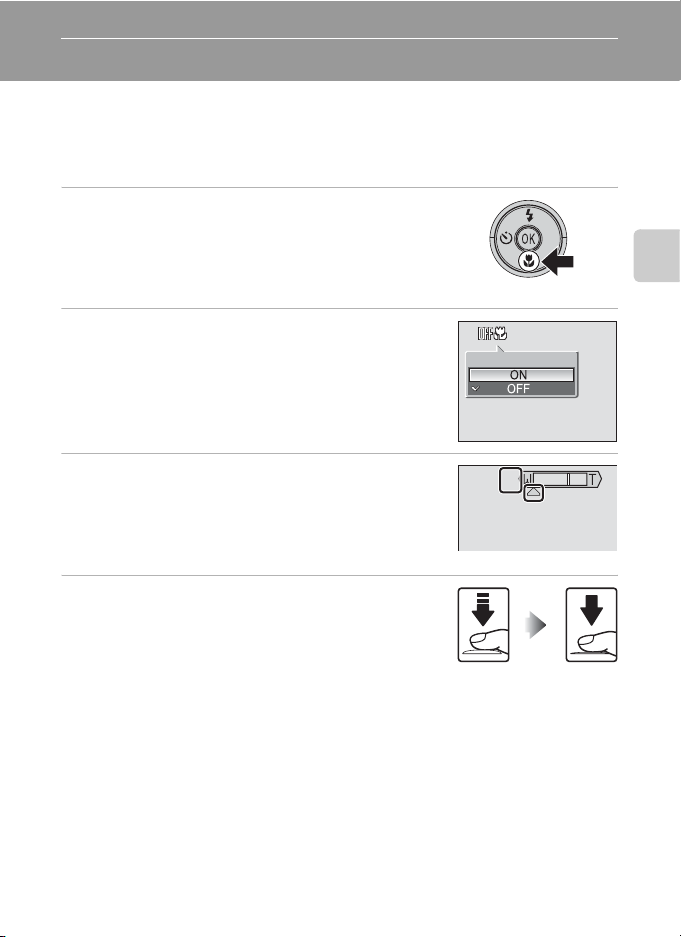
Macro close-up mode is used for taking shots of pictures as close as 4 cm
(1.6 in.). Note that the flash may be unable to light entire subject at distances
of less than 30 cm (11.8 in.). If the flash fires, play the picture back and
check the results.
1 Press L (macro mode).
The macro close-up menu is displayed.
2 Press the multi selector G to choose
[ON] and press d.
The macro close-up mode icon (F) is displayed.
The monitor will return to the normal display for the
current mode if the setting is not applied by pressing
d within five seconds.
Macro close-up
Basic Photography and Playback: L (Auto) Mode
3 Press the zoom control to v (k) or to t
(j) to frame the picture.
The minimum focus distance varies with zoom position. The camera can focus at a distance of 4 cm
(1.6 in.) at the zoom position at which F turns green.
M
FFF
4 Press the shutter-release button fully.
The macro close-up mode applied in L mode is
stored in the camera’s memory even after the camera
is turned off.
k Macro Close-up Mode
In macro close-up mode, the camera focuses continuously, even when the shutter-release
button is not pressed halfway.
31
Page 44
Scene Modes: n Scene Mode
Assist and Scene Modes
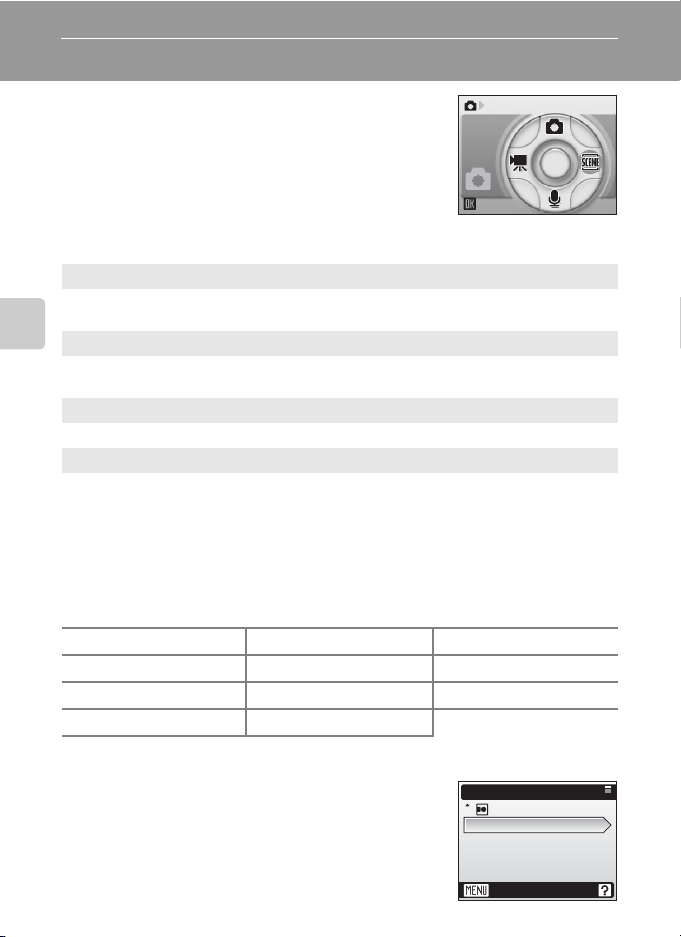
The camera offers a choice of four “assist” modes
and eleven “scene” modes.
In these modes, camera settings are automatically
optimized for the selected subject type.
Assist Modes
The following modes offer framing assist options to
help you compose your shots.
B Portrait (default)
Use for portraits. The main subject stands out clearly while the background
details are softened, lending a sense of depth to the composition.
E Landscape
Scene Modes: n Scene Mode
Use for vivid landscape shots that enhance outlines, colors, and contrast in
subjects such as skyscapes and forests.
P Sports
Fast shutter speeds freeze fast-moving subjects for dynamic sports scenes.
D Night portrait
Use for a natural balance between the main subject and background lighting
in portraits taken at night.
Scene Modes
The following modes allow you to take pictures optimized for a particular
subject type by simply choosing a scene mode and pressing the shutterrelease button.
C Party/indoor G Night landscape O Copy
H Beach/snow M Close up L Back light
I Sunset N Museum F Panorama assist
J Dusk/dawn K Fireworks show
Scene
l Image Mode
[Image mode] (c 77) can be set in the assist menu of the scene
assist modes or in the scene menu. Changes made to the image
mode setting apply to all shooting modes.
32
B
Portrait
Z
Exit
Portrait figure
Image mode
Page 45
Assist Modes
Taking Pictures in Assist Modes
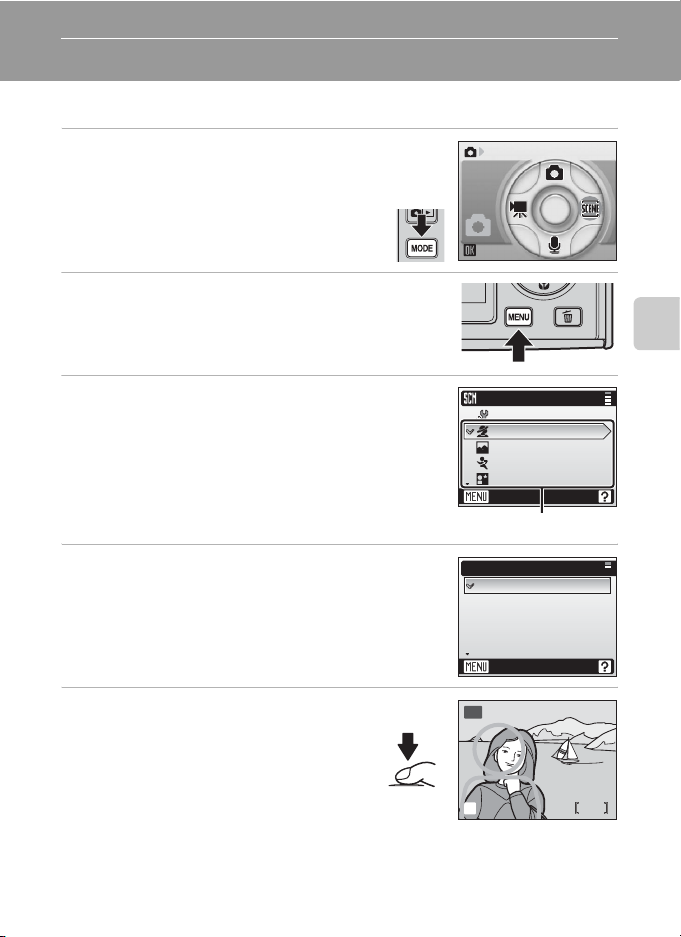
1 Enter scene mode by pressing p
in shooting mode, selecting n (press
the multi selector J), and then
pressing d.
The camera returns to the scene mode
selected last time.
2 Press m to display the scene menu.
3 Press GH to choose an assist mode and
press d.
The framing assist menu is displayed.
For information on using the multi selector, see “The
Multi Selector” (c 8).
4 Press GH to choose the appropriate
composition and press d.
Framing guides are displayed if available.
5 Position the subject in the fram-
ing guide and take the picture.
Scene menu
Set up
Portrait
Landscape
Sports
Night portrait
Exit
Assist modes
B
Portrait
Portrait
B
Portrait left
N
Portrait right
O
Portrait close-up
P
Portrait couple
Q
Exit
B
Scene
AA
Scene Modes: n Scene Mode
MM
c
181818
33
Page 46
Assist Modes
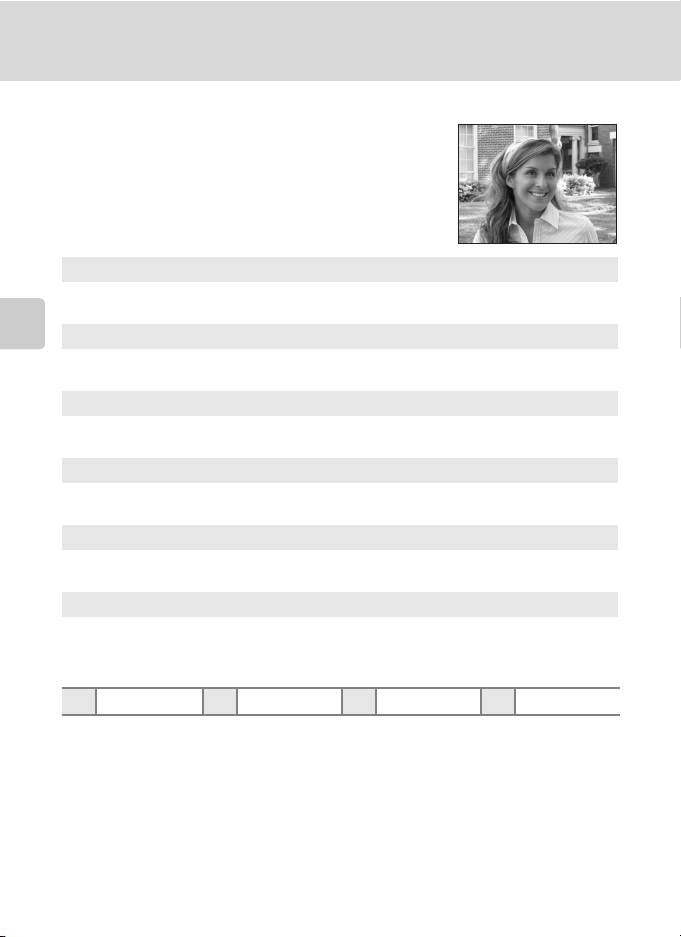
B Portrait Assist
Use this mode for portraits in which the main subject stands out clearly while background details are
softened. Portrait subjects exhibit smooth, naturallooking skin tones.
B Portrait (default)
Camera focuses on subject in the center of the monitor. No guides are displayed in the monitor.
N Portrait left
Scene Modes: n Scene Mode
Compose shot with subject in left half of frame. Camera focuses on subject
inside the framing guides.
O Portrait right
Compose shot with subject in the right half of frame. Camera focuses on subject inside the framing guides.
P Portrait close-up
Compose shot with subject’s face in top half of frame. Camera focuses on
face inside the framing guides.
Q Portrait couple
Compose shot with two subjects side-by-side. Camera focuses on subjects
inside the framing guides.
C Portrait figure
Compose shot in “tall” orientation. Camera focuses on subject inside the
framing guides. Pictures taken in “tall” orientation are displayed in the same
“tall” orientation in the monitor.
C A
1
Other settings can be selected.
2
See “AF Assist” (c 103) for information on using this function.
3
AF Assist is set to [Off] for all modes except for [Portrait].
1
H Off
1
F Off u
2
Off
3
34
Page 47
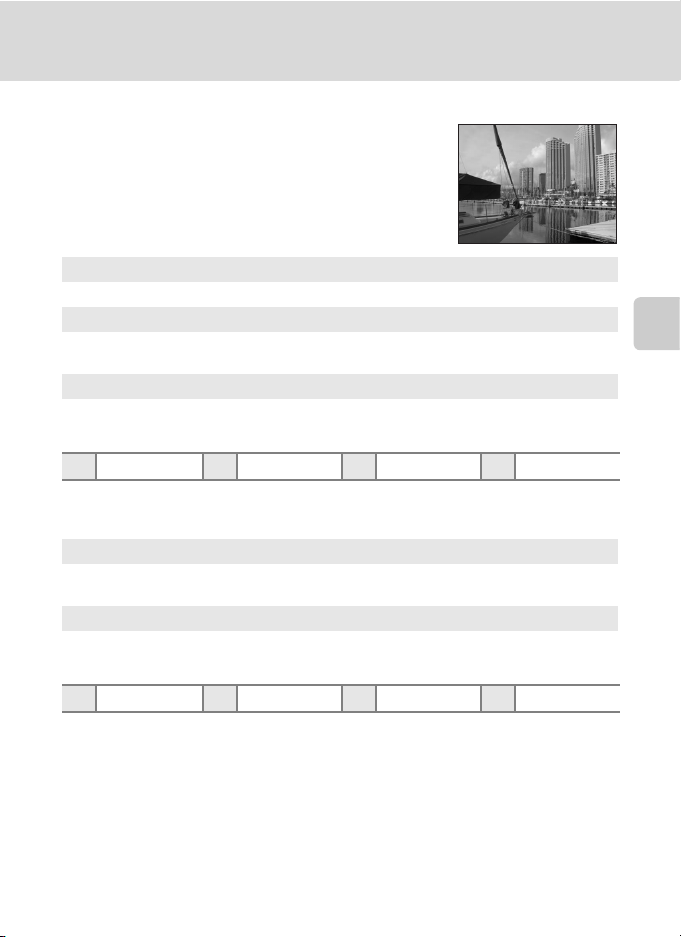
E Landscape Assist
Use this mode for vivid landscapes, cityscapes, and
portraits featuring a landmark in the background.
E Landscape (default)
Camera focuses at infinity. No guides are displayed in the monitor.
S Scenic view
Use to photograph distant skylines. Camera focuses at infinity. Match top of
skyline with wavy yellow guide.
U Architecture
Use to photograph buildings. Camera focuses at infinity. A grid is displayed in
the monitor to help keep verticals and horizontals aligned with the frame.
C B H Off
1
Other settings can be selected.
V Group right
Use to compose portraits with portrait subjects to right and landmark or other
objects in background at left of frame.
W Group left
Use to compose portraits with portrait subjects to left and landmark or other
objects in background at right of frame.
C z
1
Other settings can be selected.
1
H Off
1
F Off u Off
1
F Off u Off
Assist Modes
Scene Modes: n Scene Mode
l Focusing at Infinity
The focus indicator (c 24) is always green when the shutter-release button is pressed halfway when [Landscape], [Scenic view], or [Architecture] is selected for landscape assist mode.
Note, however, that objects in the foreground may not always be in focus.
35
Page 48
Assist Modes
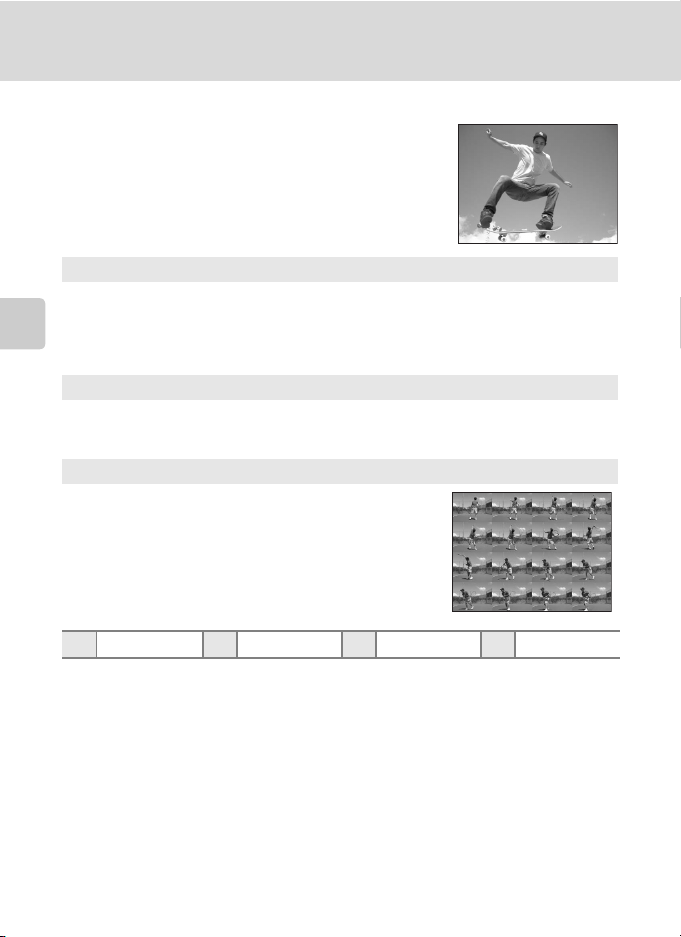
P Sports Assist
Use this mode for dynamic action shots that freeze
the action in a single shot or record motion in a
series of pictures. No framing guides are displayed.
P Sports (default)
While shutter-release button is held down, pictures are taken at rate of about
1.7 frames per second (fps). Camera focuses continuously even when the
shutter-release button is not pressed halfway. If [Image mode] (c 77) is set to
Scene Modes: n Scene Mode
[Normal(2816)], 3 pictures are taken continuously with the same focus, exposure, and white balance values used for the first shot.
X Sport spectator
As above, except that camera focuses at ranges of 3 m (9.8 ft.) to infinity at
maximum wide-angle zoom position and 7 m (23 ft.) to infinity at maximum
telephoto position.
Y Sport composite
Each time shutter-release button is pressed, camera takes 16 shots in about 2 seconds and
arranges them in four rows to form a single picture 1,600 × 1,200 pixels in size.
C B H Off F Off u Off
l Sports Assist
When [Sports] or [Sport composite] is selected in sports assist mode, the camera focuses continuously on the center of the frame, even when the shutter-release button is not pressed
halfway.
36
Page 49
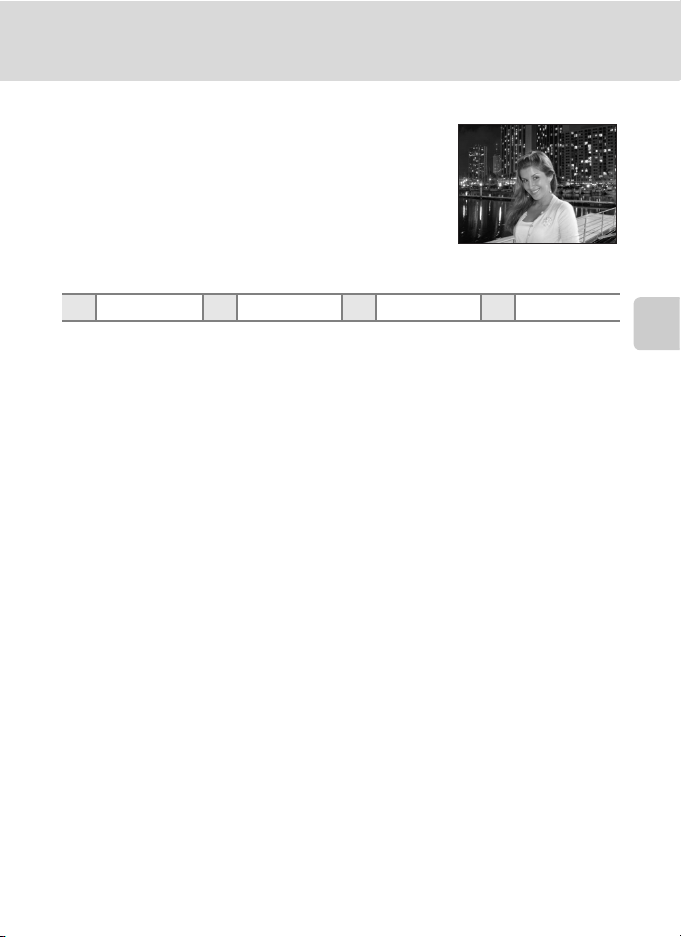
D Night Portrait Assist
Use this mode to achieve a natural balance
between the main subject and background lighting
in portraits taken at night. This mode offers the
same assist options as portrait assist mode (c 34).
Pictures taken at slow shutter speeds are processed
to reduce noise; to prevent blurring, mount the
camera on a tripod or rest it on a flat, stable surface.
C A
1
Flash illuminates main subject with slow sync and red-eye reduction.
2
Other settings can be selected.
3
AF Assist is set to [Off] for all modes except for [Portrait].
1
H Off
2
F Off u Off
Assist Modes
3
Scene Modes: n Scene Mode
37
Page 50
Scene Modes
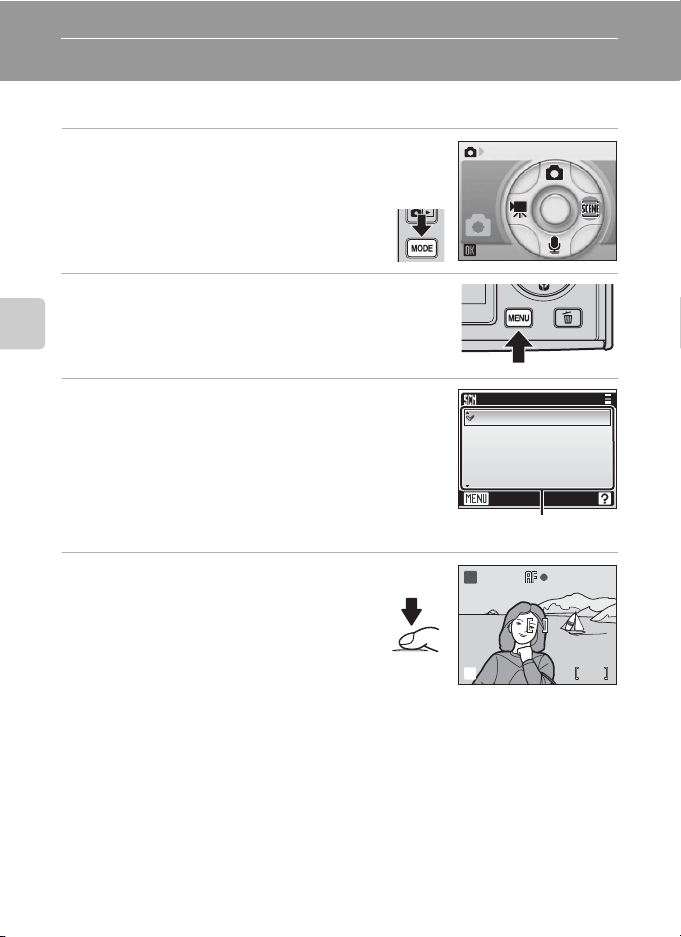
Taking Pictures in Scene Modes
1 Enter scene mode by pressing
p in shooting mode, selecting
n (press the multi selector J),
and then pressing d.
The camera returns to the scene mode
selected last time.
2 Press m to display the scene menu.
Scene Modes: n Scene Mode
3 Press GH to choose a scene mode and
press d.
Three pages of scene modes are available, beginning
with [Party/indoor] and ending with [Panorama assist].
For information on using the multi selector, see “The
Multi Selector” (c 8).
4 Frame the subject and take the
picture.
Scene menu
Party/indoor
C
Beach/snow
H
Sunset
I
Dusk/dawn
J
Night landscape
G
Exit
Scene modes
H
c
Scene
MM
181818
38
Page 51
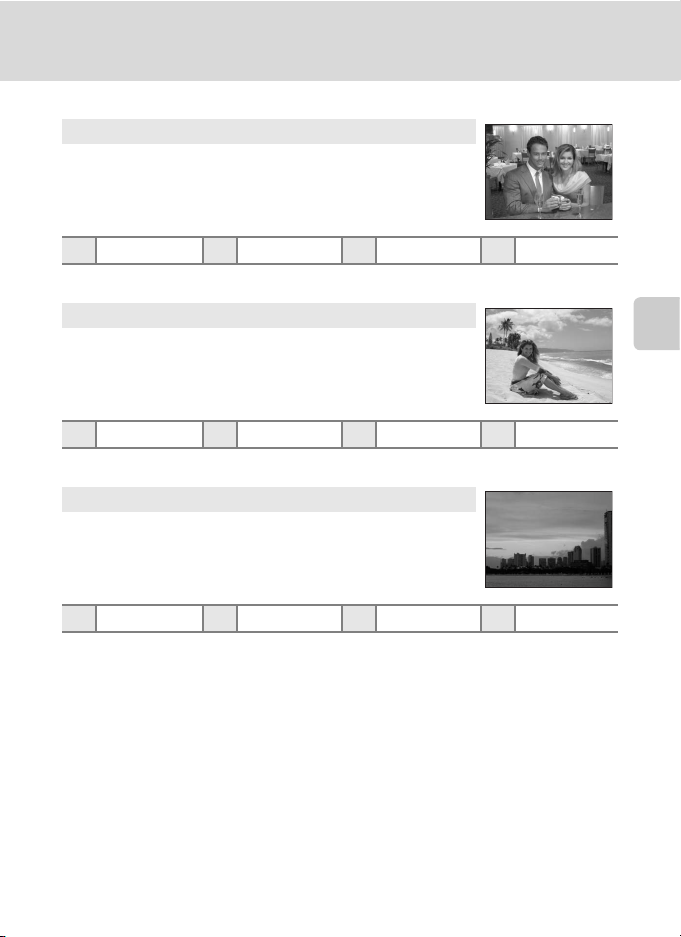
The following modes are available:
C Party/indoor
Captures the effects of candlelight and other indoor background lighting.
• Camera focuses on subject in center of frame.
• Hold the camera steady to prevent camera shake.
Scene Modes
C A
1
Other settings can be selected.
1
H Off
1
F Off u Auto
H Beach/snow
Captures the brightness of such subjects as snowfields,
beaches, or sunlit expanses of water.
• Camera focuses on subject in center of frame.
C z
1
Other settings can be selected.
1
H Off
1
F Off u Auto
I Sunset
Preserves the deep hues seen in sunsets and sunrises.
• Camera focuses on the subject in the center of the frame.
• Use of a tripod recommended to prevent blurring.
C B
1
Other settings can be selected.
1
H Off
1
F Off u Auto
1
Scene Modes: n Scene Mode
1
1
39
Page 52
Scene Modes
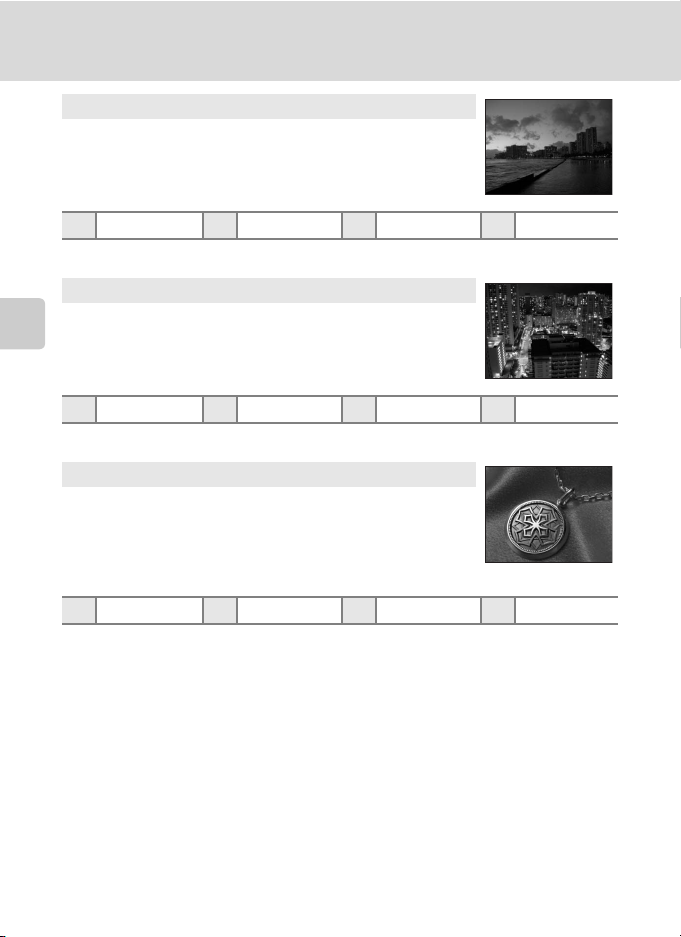
J Dusk/dawn
Preserves the colors seen in the weak natural light before sunrise or after sunset.
• Camera focuses on the subject in the center of the frame.
• Use of a tripod recommended to prevent blurring.
C B H Off
1
Other settings can be selected.
1
F Off u Off
G Night landscape
Slow shutter speeds are used to produce stunning night landscapes.
• Camera focuses on the subject in the center of the frame.
Scene Modes: n Scene Mode
• Use of a tripod recommended to prevent blurring.
C B H Off
1
Other settings can be selected.
1
F Off u Off
M Close up
Photograph flowers, insects, and other small objects at close
range (c 31).
• Camera focuses continuously until shutter-release button is
pressed halfway to lock focus.
• Hold the camera steady to prevent camera shake.
C B
1
Other settings can be selected.
1
H Off
1
F On u Auto
1
l Focusing at Infinity
The focus indicator (c 29) is always green when the shutter-release button is pressed halfway with [Dusk/dawn], [Night landscape], or [Fireworks show] scene mode selected. Note,
however, that objects in the foreground may not always be in focus.
40
Page 53
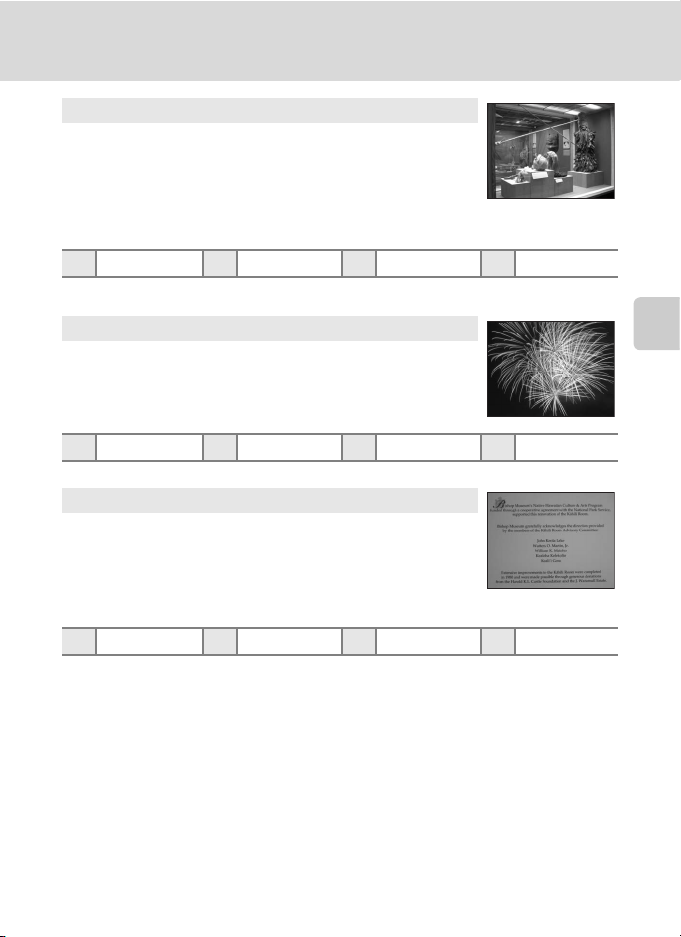
N Museum
Use indoors where flash photography is prohibited (for example, in museums and art galleries) or in other settings in which
you do not want to use the flash.
• Camera focuses on subject in center of frame.
•BSS (c 84) turns on automatically.
• Hold the camera steady to prevent camera shake.
Scene Modes
C B H Off
1
Other settings can be selected.
1
F Off
1
u Off
K Fireworks show
Slow shutter speeds are used to capture the expanding burst of
light from a firework.
• Use of a tripod recommended to prevent blurring.
C B H Off F Off u Off
O Copy
Provides clear pictures of text or drawings on a white board or
in print.
• Camera focuses on subject in center of frame.
• Use macro close-up mode (c 31) to focus at short ranges.
• Colored text and drawings may not show up well.
C B
1
Other settings can be selected.
1
H Off
1
F Off
1
u Auto
Scene Modes: n Scene Mode
1
41
Page 54
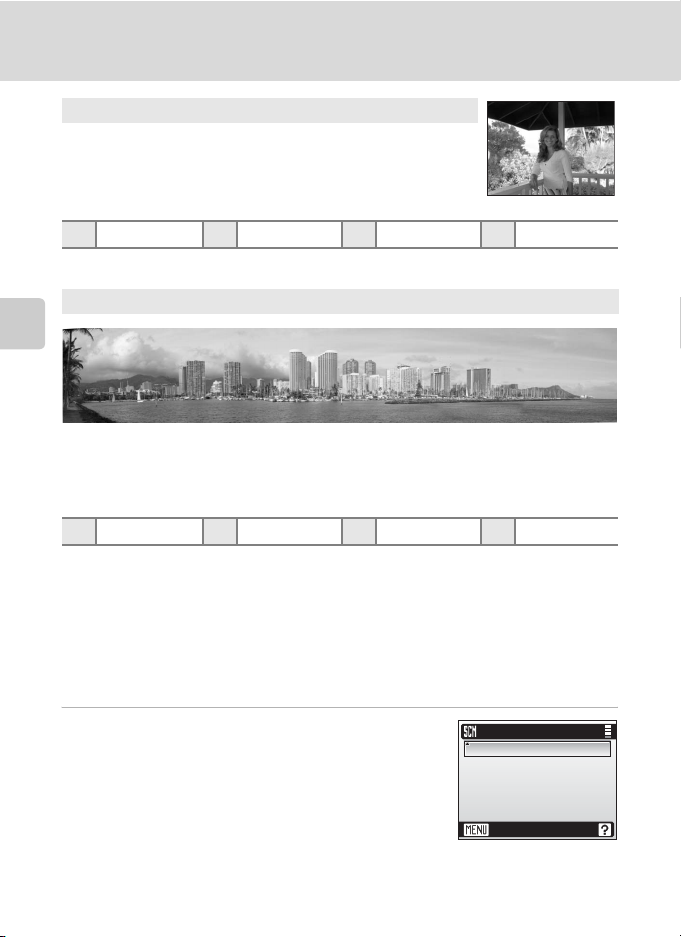
Scene Modes
L Back light
Use when light is coming from behind your subject, throwing
features or details into shadow. The flash fires automatically to
“fill in” (illuminate) shadows.
• Camera focuses on subject in center of frame.
C J H Off
1
Other settings can be selected.
1
F Off u Auto
F Panorama assist
Scene Modes: n Scene Mode
Use when taking a series of pictures that will later be joined to form a single panorama using PictureProject.
• Camera focuses on subject in center of frame.
• Hold the camera steady to prevent camera shake.
C B
1
Other settings can be selected.
1
H Off
1
F Off
1
u Auto
Taking Pictures for a Panorama
The camera focuses on the subject in the center of the frame. Use a tripod
for best results.
1 Press the multi selector GH to choose
[Panorama assist] in the scene menu and
press d.
The yellow panorama direction icon (E) is displayed to
show the direction in which pictures will be joined.
Scene menu
Panorama assist
F
Image mode
Z
Exit
1
1
42
Page 55
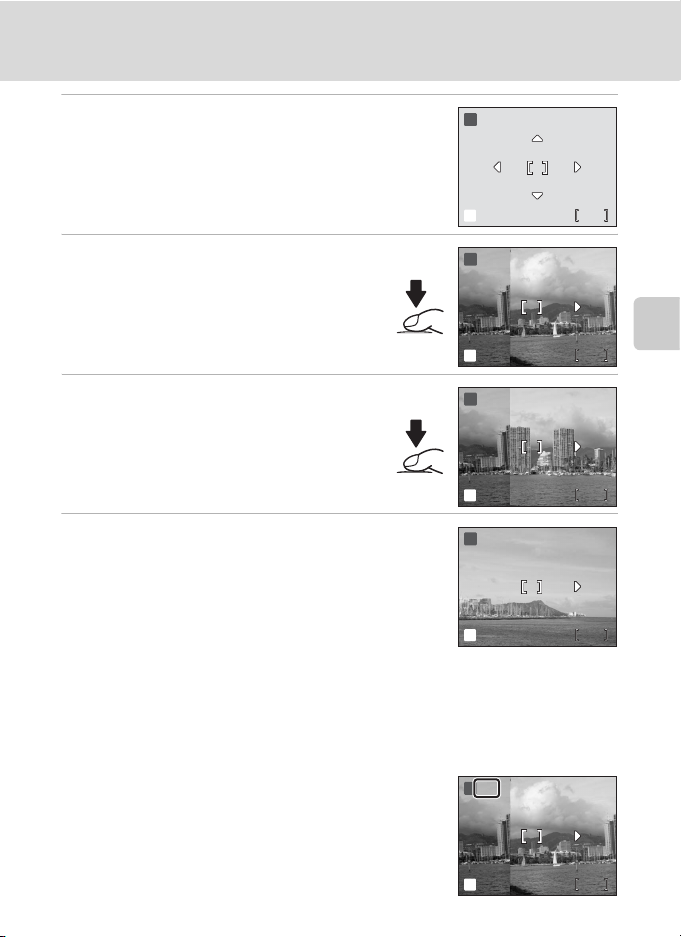
Scene Modes
2 Press GHIJ to choose the
direction and press d.
3 Take the first picture.
The first picture is displayed in the first third
of the monitor.
4 Take the second picture.
Compose the next picture so that it overlaps the first picture. Repeat until you have
taken the necessary number of pictures to
complete the scene.
5 Press d to finalize the series.
Monitor display returns to shooting mode.
F
GG
c
F
GG
c
F
GG
c
F
GG
c
BB
MM
44
BB
MM
33
BB
MM
22
BB
MM
11
j Panorama Assist
Flash mode (c 28), self-timer (c 30), macro close-up (c 31) and exposure compensation
(c 81) cannot be adjusted after the first picture is taken. Pictures cannot be deleted, nor can
zoom or image-mode setting (c 77) be adjusted until the series is finalized.
Scene Modes: n Scene Mode
l Exposure Lock
G is displayed to show that white balance and exposure have
been locked at the values set with the first shot. All pictures
taken in a panorama series have the same exposure and whitebalance settings.
F
GG
c
BB
MM
33
43
Page 56
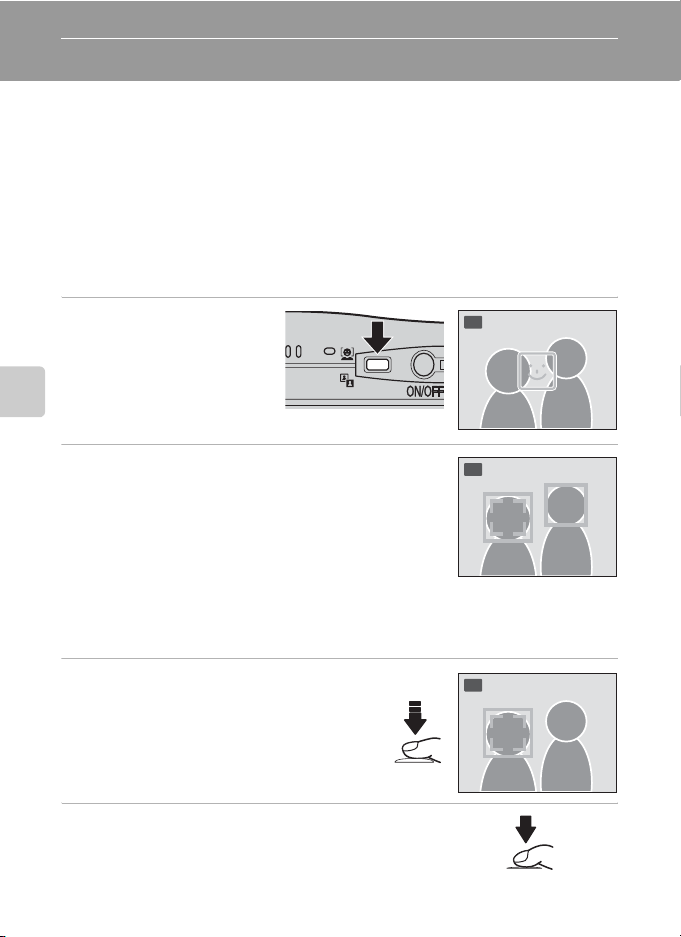
One-Touch Portrait Mode
Taking Pictures in the One-Touch Portrait Mode
For portrait shots, press the m button when the camera is in the auto mode,
scene mode and movie mode. The following features are automatically activated:
• Portrait: The portrait subject stands out clearly.
• Face-priority AF: The camera automatically detects and focuses on faces.
• Auto red-eye reduction: The flash mode is automatically set to A (auto
with red-eye reduction: c 29)
Press m again to return to the shooting mode selected with the mode-selection menu.
1 Press m (one-touch
portrait mode).
The K guide is displayed.
One-Touch Portrait Mode
2 Frame a picture using the K guide.
When the camera detects a face, the guide is displayed with a double yellow border.
When the camera detects more than one face, the
closest face is framed by a double border and the rest
by a single border. The camera focuses on the face
framed by the double border.
If the camera loses its ability to detect a face (for example, because the subject has
looked away from the camera), borders are no longer displayed and monitor display returns to that shown in step 1.
3 Press the shutter-release button
halfway.
Focus and exposure are set, and the double
border turns green.
4 Press the shutter-release button the rest
of the way down to take a picture.
A
A
A
44
Page 57
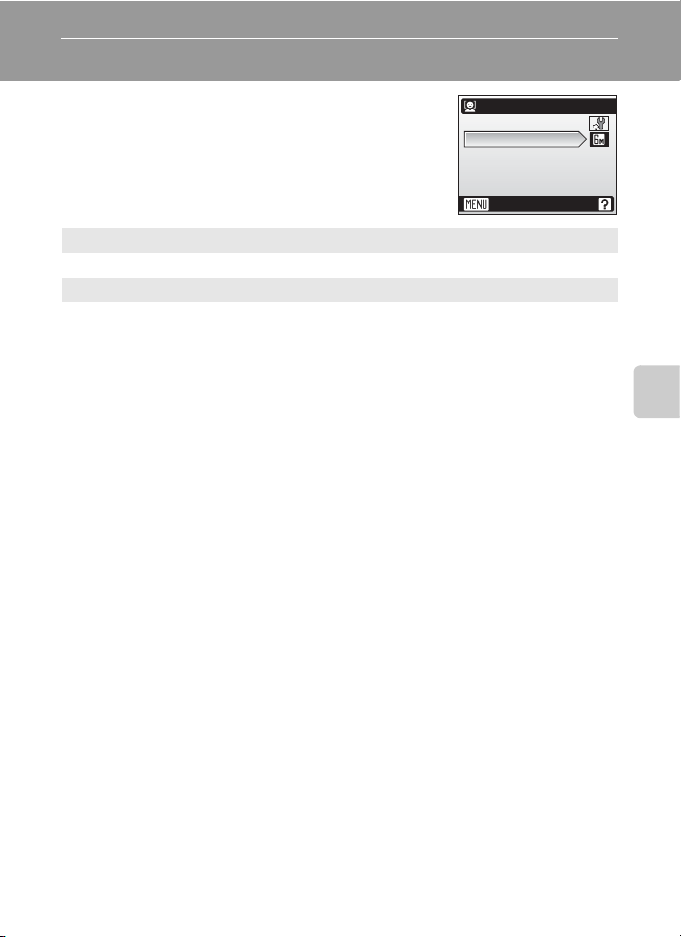
The One-Touch Portrait Menu
Press m in one-touch portrait mode to display
the one-touch portrait menu. Options chosen in
this menu are restored next time this mode is
One-touch portrait
Set up
Image mode
selected.
Exit
Z Set up
Display setup menu (c 94).
Z Image mode (default: Normal(2816))
Choose an image size and quality (c 77).
j Face-Priority AF
The camera’s ability to detect faces depends on a variety of factors, including whether or not
the subject is facing the camera. The camera focuses continuously until a face is detected.
If the yellow double border blinks when the shutter-release button is pressed halfway, the
camera was unable to focus. Release the button and try again. If no face is recognized when
the shutter-release button is pressed halfway, the camera focuses on the center of the frame.
The camera may be unable to detect faces in the following situations:
• When faces are partially hidden by sunglasses or other obstructions
• When faces take up too much or too little of the frame
One-Touch Portrait Mode
k Settings for One-Touch Portrait Mode
• Flash: Changeable
• Self-timer: Available
• Macro close-up: Off
45
Page 58
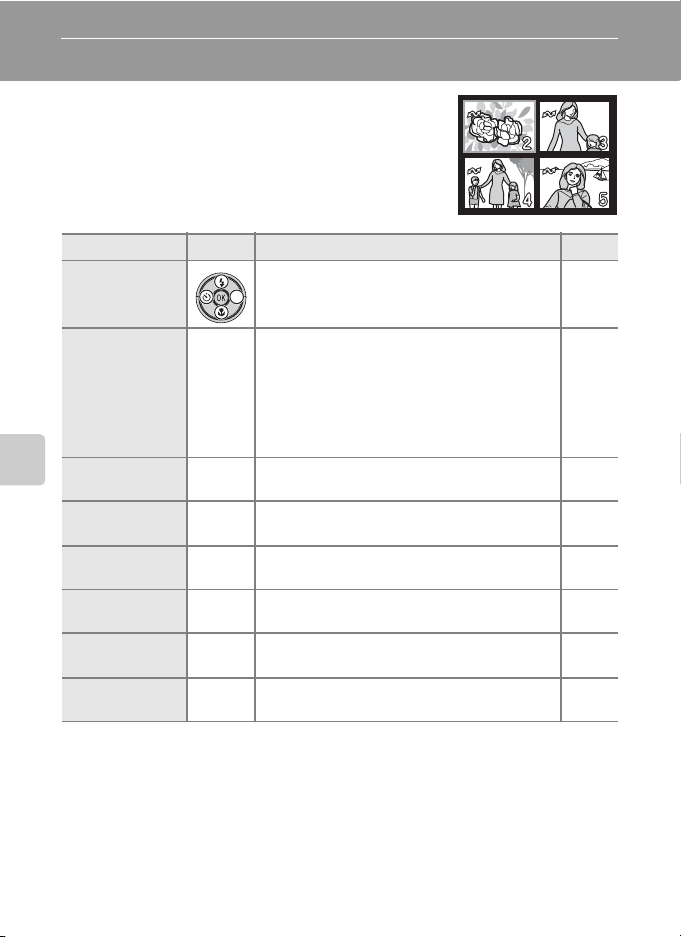
More on Playback
Viewing Multiple Pictures: Thumbnail Playback
Press the zoom control to t (j) in full-frame
playback to display pictures in “contact sheets” of
four or nine thumbnail images.
The following operations can be performed while
thumbnails are displayed:
To Press Description c
Choose pictures
Change number
of pictures displayed
Cancel thumbnail playback
More on Playback
Delete picture
View playback
mode menu
View playback
menu
D-Lighting
Switch to shooting mode
x
d
T
p
m
i
o
Press the multi selector GHIJ to choose
pictures.
With four thumbnails displayed, press the
zoom control to t once to view nine thumbnails. With nine thumbnails displayed, press
the zoom control to v once to display four
thumbnails. With four thumbnails displayed,
press the zoom control to v once to return to
full-screen playback.
Cancel thumbnail playback and return to fullscreen playback.
Confirmation dialog will be displayed. Choose
[Yes] and press d to delete.
Display the mode-selection menu. 9
Display the playback menu. 88
Enhance brightness and contrast in dark portions of pictures.
Switch to the shooting mode selected with
the mode-selection menu.
26
50
26
8
–
–
46
Page 59
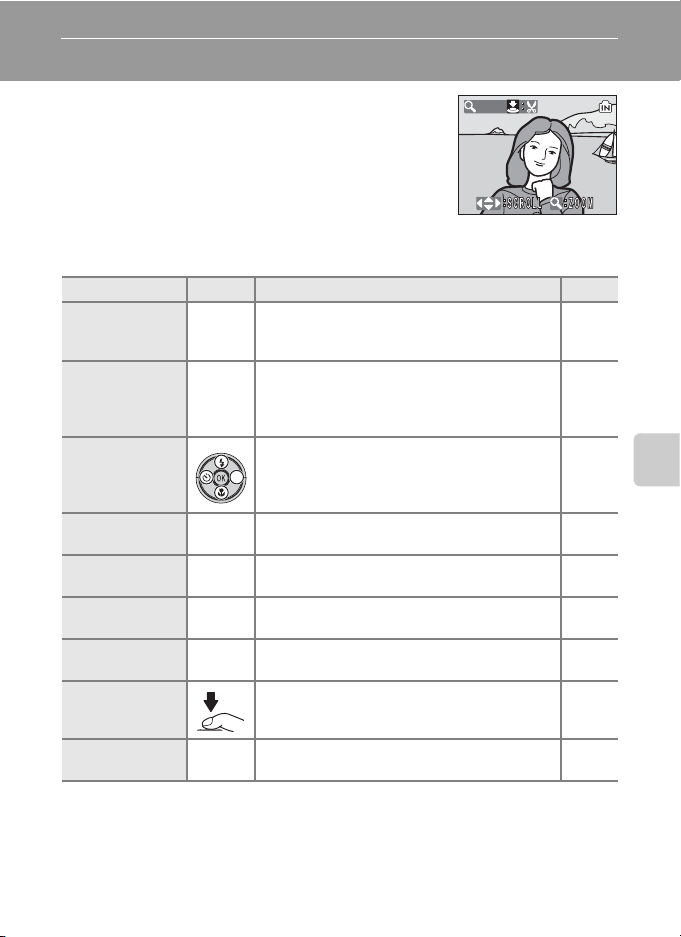
Taking a Closer Look: Playback Zoom
Press the zoom control to v (k) to zoom in on still
images displayed in full-frame playback (c 26).
X4.0
Playback zoom is not available when the current picture is a movie or a copy created using the small picture function.
While image is zoomed in, the zoom ratio is displayed on the monitor.
The following operations can be performed while pictures are zoomed in:
To Press Description c
Zoom
Zoom in
Zoom out
View other
areas of picture
Delete picture
Return to fullframe playback
View playback
mode menu
View playback
menu
Crop picture
Switch to shooting mode
control
to k (v)
control
p
o
Zoom increases each time the zoom control is
pressed to k (v), to a maximum of 10×.
Zoom
Zoom decreases each time the zoom control is
to j
pressed to j (t). To cancel zoom, press d.
(t)
Use the multi selector to scroll to areas of picture not visible in monitor. To use the multi
selector GHIJ to view other pictures,
cancel playback zoom.
Confirmation dialog will be displayed. Choose
T
[Yes] and press d to select.
Cancel playback zoom and return to full-
d
screen playback.
Display the mode-selection menu. 9
Display the playback menu. 88
m
Crop current picture to contain only the portion visible in the monitor.
Switch to the shooting mode selected with
the mode-selection menu.
–
–
8
More on Playback
26
–
49
26
47
Page 60
Editing Pictures
Use the COOLPIX S9 to edit pictures in-camera and store them as separate
files. The editing features described below are available.
Editing function Description
Crop
D-Lighting
Small Picture
Restrictions on Picture Editing
The following restrictions apply to copies created using crop (c 49),
D-Lighting (c 50), and small picture (c 51).
• Copies created using the crop or small picture functions cannot be edited
again.
• The D-Lighting function cannot be used on copies created using the
D-Lighting function. In other words, this function can only be applied to a
More on Playback
picture once.
k Picture Editing
• The COOLPIX S9 editing functions may not be available for pictures taken with non-
COOLPIX S9 digital cameras.
• If a copy created using the COOLPIX S9 is viewed on a different digital camera, the picture
may not be displayed or may not be transferred to a computer.
• Editing functions are not available when there is not enough free space in the internal
memory or on the memory card.
• Edited copies are recognized by identifiers corresponding to the editing function and file
numbers assigned automatically by the camera (c 110).
Enlarge the image or refine the composition and create a
copy containing only the portion visible in the monitor.
Create a copy of the current picture with enhanced brightness and contrast, brightening dark portions of the picture.
Create a small copy of pictures suitable for use on web
pages or as e-mail attachments. Small copies are stored as
JPEG files with a compression ratio of 1:16.
l Original Pictures and Edited
• Copies created with editing functions are not deleted if the original pictures are deleted.
The original pictures are not deleted if copies created with editing functions are deleted.
• Edited copies are stored with the same recording date and time as the original.
• Copies created using crop, D-Lighting, and small picture have the same transfer marking
(c 92) as the original but are not marked for printing (c 74) or protecting (c 91).
48
Page 61
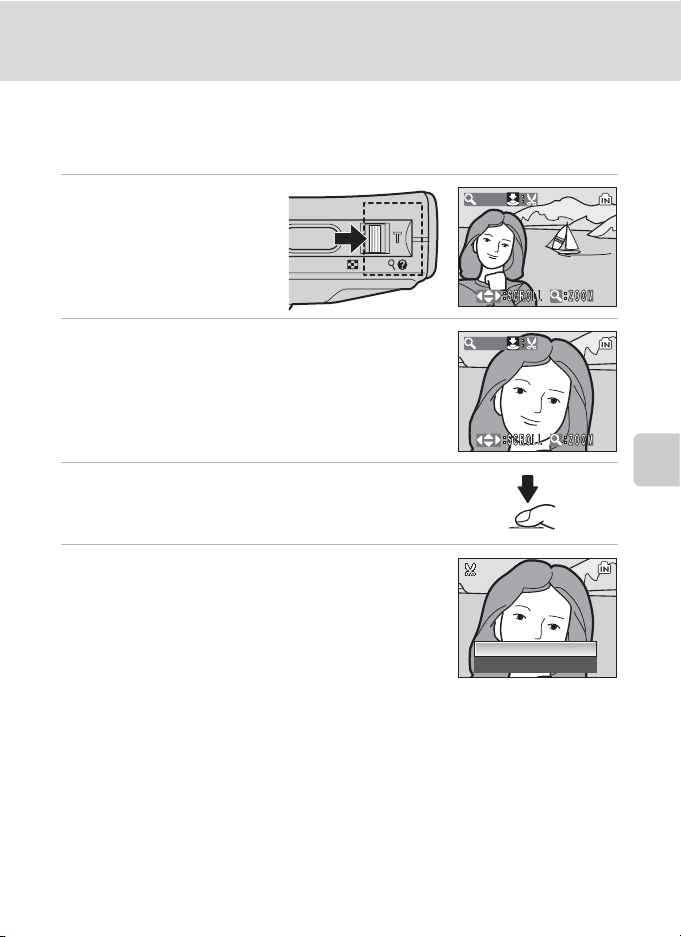
Editing Pictures
Save this image
as displayed?
Creating a Cropped Copy: Crop
This function is only available when N:u is displayed in the monitor with
playback zoom (c 47) enabled.
1 Press the zoom con-
trol to v (k) to zoom
in on the image.
Press the zoom control to v
or t to adjust the zoom
ratio.
2 Refine copy composition.
Press the multi selector GHIJ to scroll the picture
until only the portion you want to copy is visible in the
monitor.
3 Press the shutter-release button.
The confirmation dialog will be displayed.
4 Press H to choose [Yes] and press d.
A new picture, containing only the portion visible in
the monitor, is created.
X4.0
X7.0
Save this image
Save this image
as displayed?
as displayed?
No
Yes
More on Playback
l Cropped Copy Image Mode
Depending on the size of the original picture and the zoom ratio in effect at the time the copy
was created, the camera will automatically select one of the following image-mode settings
for cropped copies.
• d 2,592 × 1,944 • e 2,048 × 1,536 • f 1,600 × 1,200 • g 1,280 × 960
• h 1,024 × 768 • i 640 × 480 • J 320 × 240 • K 160 × 120
49
Page 62
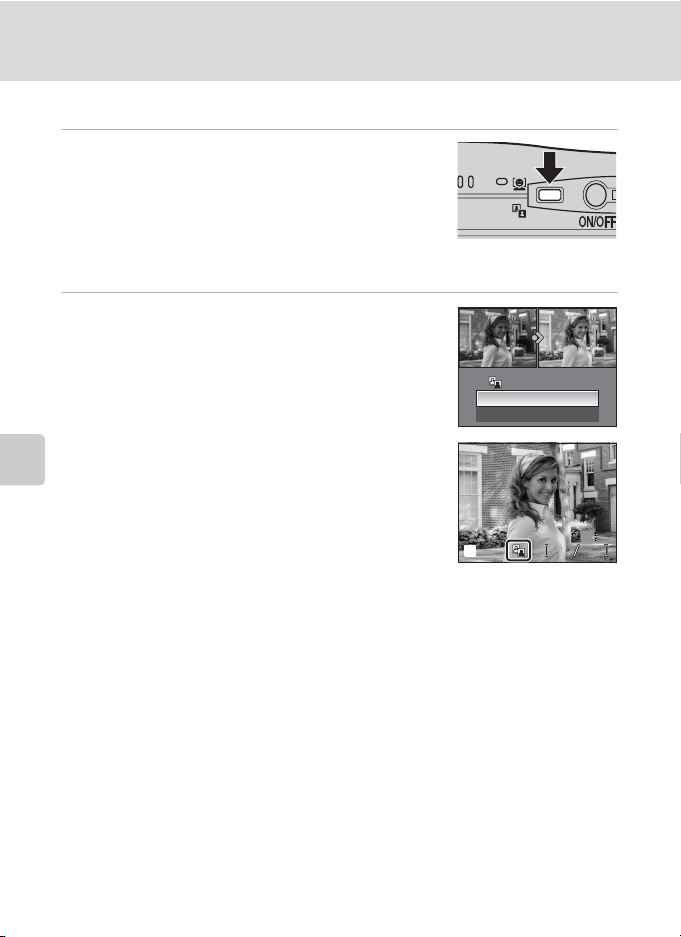
Editing Pictures
100NIKON
15:30
10.10.2006
0005.JPG
Enhancing Brightness and Contrast: D-Lighting
1 Display the desired picture in full-frame
playback (c 26) and press i (m).
D-Lighting copies can also be created by pressing i
(m) after selecting a picture in thumbnail playback
mode.
The results of D-Lighting enhancement can be confirmed in the monitor.
2 Press the multi selector G to choose [OK]
and press d.
A new copy with enhanced brightness and contrast is
created.
D-Lighting copies can be recognized by the i icon
displayed during playback.
More on Playback
D-Lighting
10.10.2006
10.10.2006
15:30
15:30
EE
DD
c
OK
Cancel
100NIKON
100NIKON
0005.JPG
0005.JPG
OMMN
O
44 44
50
Page 63
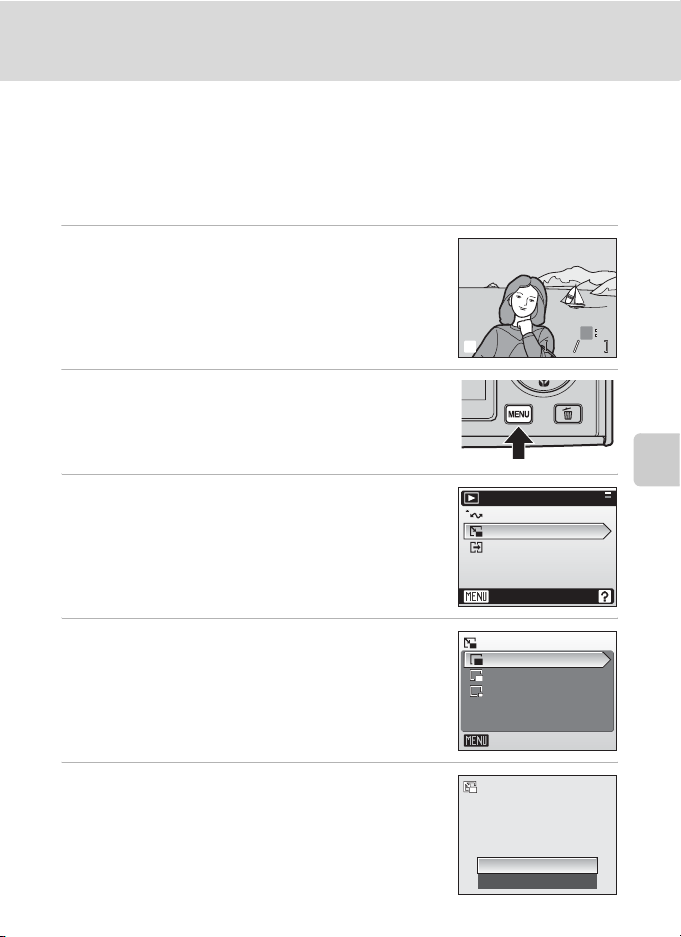
H Resizing Pictures: Small Picture
100NIKON
15:30
0005.JPG
10.10.2006
Create small picture file?
The following sizes are available:
I 640×480: Suited to television playback.
J 320×240: Suited to display on web pages.
K 160×120: Suitable for e-mail attachments.
Editing Pictures
1 Display the desired picture in full-frame
playback mode (c 26).
2 Press m.
The playback menu is displayed.
3 Press the multi selector GH to choose
[Small pic.] and press d.
4 Press GH to choose the desired copy
size and press d.
5 Press H to choose [Yes] and press d.
A new, smaller copy is created.
10.10.2006
10.10.2006
15:30
15:30
c
Playback menu
Transfer marking
Small pic.
Copy
Exit
Small pic.
640×480
320×240
160×120
Exit
Create small picture file?
Create small picture file?
No
Yes
100NIKON
100NIKON
0005.JPG
0005.JPG
NEEO
MM
O
44
44
More on Playback
51
Page 64
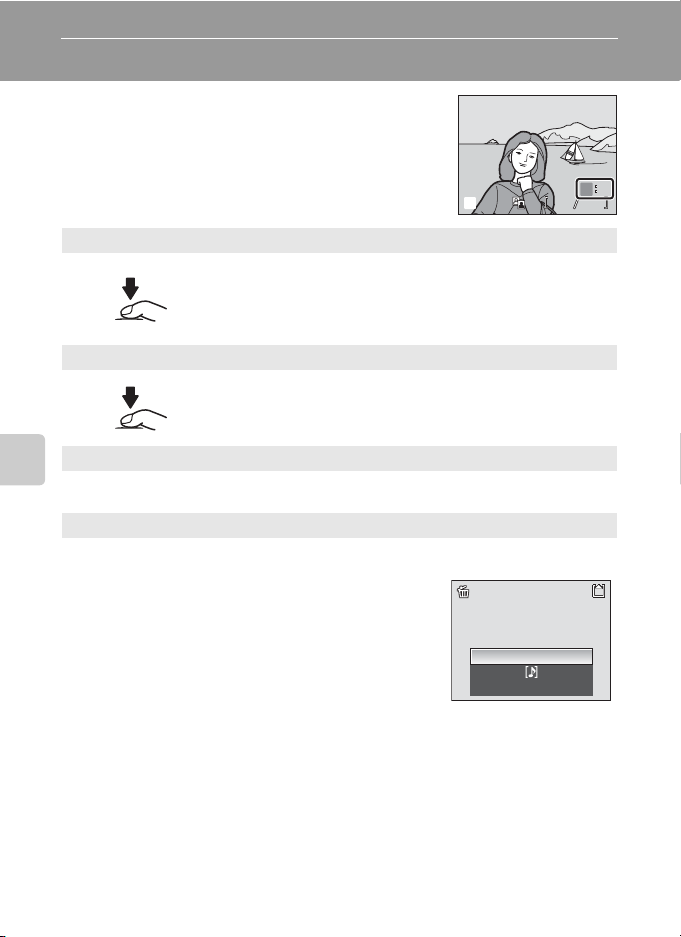
Voice Memos: Recording and Playback
100NIKON
15:30
10.10.2006
0005.JPG
Erase 1 image?
Use the camera’s built-in microphone (c 4) to
record voice memos for pictures marked with N:O
in full-frame playback (c 26).
Record voice memo
A voice memo will be recorded while the shutter-release
button is held down. Recording ends after about 20 seconds
or when the shutter-release button is released.
• During recording, y and P blink in the monitor dis-
play.
Play voice memo
Press the shutter-release button while a picture with a voice
memo (indicated by P) is displayed in full-frame playback to
play voice memo. Playback ends when the voice memo ends
or the shutter-release button is pressed again.
Adjust volume
More on Playback
Delete voice memo
x
T
Press the zoom control to t to lower volume, or to v to
raise volume.
Press T and the confirmation dialog shown below will be
displayed. Choose [No], [P], or [Yes] and press d.
• [No]: Exit without deleting
the picture or voice
memo.
•[P]: Delete voice memo
only.
• [Yes]: Delete both picture
and voice memo.
10.10.2006
10.10.2006
15:30
15:30
EE
DD
c
Erase 1 image?
Erase 1 image?
No
Yes
100NIKON
100NIKON
0005.JPG
0005.JPG
OMMN
O
44 44
j Voice Memos
• Do not touch the built-in microphone during recording.
52
• If a voice memo already exists for the current picture, it must be deleted before a new voice
memo can be recorded.
• Voice memos cannot be added to pictures created with other models of camera. Voice
memos recorded using other models of camera cannot be played back on the COOLPIX S9.
Page 65
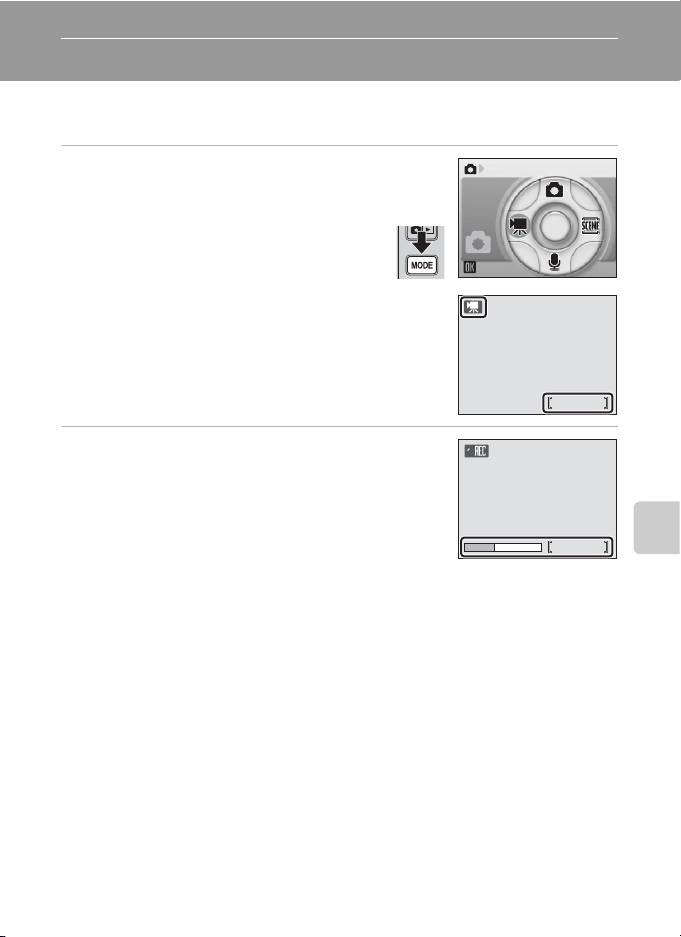
Movies
0h01m24s
0h00m50s
Movie Mode
To shoot movies with sound recorded via the built-in microphone, select
shooting mode and follow the steps below.
1 Enter movie mode by pressing
p in shooting mode, selecting
Movie
S (press the multi selector I),
and then pressing d.
Exposure count display shows maximum total length
of movie that can be recorded.
2 Press the shutter-release button fully to
start recording.
A progress bar at the bottom of the monitor shows
the amount of recording time remaining.
Recording will end if the shutter-release button is
pressed all the way down a second time, or when the
internal memory or memory card is full.
y
MM
0h01m24s
0h01m24s
MM
0h00m50s
0h00m50s
k Recording Movies
• The self-timer (c 30) and flash (c 28) (except for time-lapse and stop-motion movie) cannot be used in movie mode.
• Digital zoom (up to 2×) can be applied while movies are being recorded. Adjust zoom
before beginning recording. Once recording begins, optical zoom cannot be adjusted.
• If the camera is pointed at the sun or other bright light source during recording, vertical
comet-like streaks (“smear”) may appear in the movie. Avoid pointing the camera at bright
light sources when filming movies.
Movies
l More on Movies
See the information on how movie files are named and stored (c 110), the maximum total
length of movie that can be recorded at different settings (c 54), and movie menu default
settings (c 108).
53
Page 66
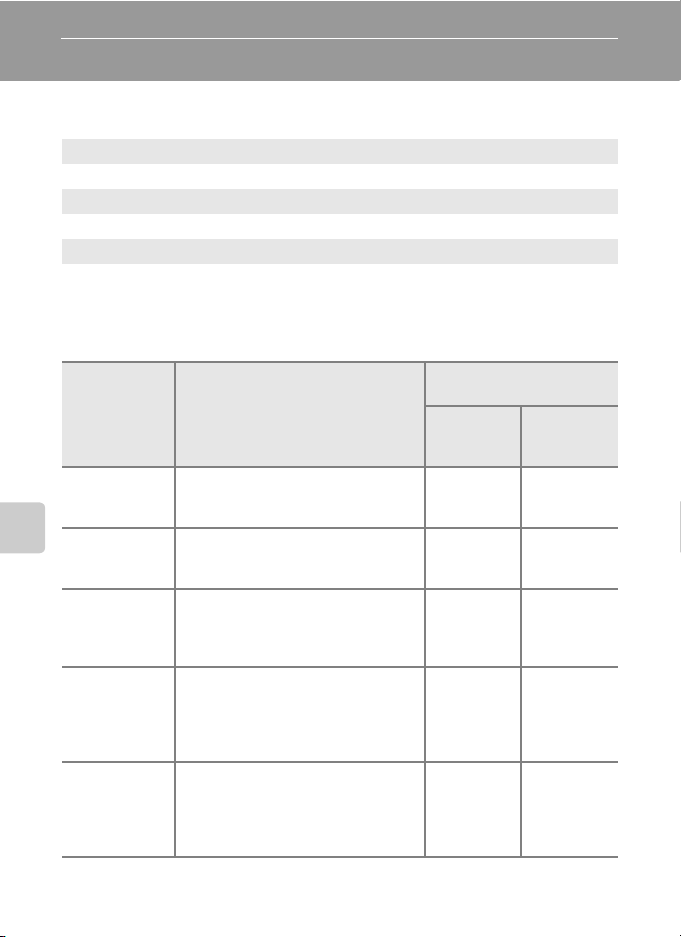
The Movie Menu
Press m in movie mode to display the movie menu. Options chosen in this
menu are restored the next time movie mode is selected.
Z Set up
Display setup menu (c 94).
T Movie options (default: Small size 320)
Choose type of movie that will be recorded (see below).
Y Auto-focus mode (default: Single AF)
Choose how camera focuses in movie mode (c 57).
Selecting Movie Options
The movie menu offers the options shown below.
Maximum movie length/
frames
Option Description
R
TV movie 640
Movies
S
Small size 320
U
Smaller size
160
V
Time-lapse
movie640
E
Stop-motion
movie
*
Movies can be as long as free space in the internal memory or on the memory card allows.
All figures are approximate. Maximum movie length varies with make of memory card.
54
Movies are recorded at 30 frames per
second. Each frame is 640 × 480 pixels in size.
Movies are recorded at 30 frames per
second. Each frame is 320 × 240 pixels in size.
Movies are recorded at 30 frames per
second. Each frame is 160 × 120 pixels in size. Small size allows for
recording of longer movies.
Movies are recorded at specified
interval until the shutter-release button is pressed again, memory is full,
or 1,800 frames (60 sec.) have been
recorded. Sound is not recorded.
Pictures are taken at specified playback speed (frame/s) and are joined
to create a silent movie. Record flowers opening or butterflies emerging
from cocoons.
Internal
memory
(24 MB)
21 sec.
1 min.
24 sec.
5min.
13 sec.
652 frames
200 frames 200 frames
*
Memory
card
(256 MB)
3min.
30 sec.
14 min.
10 sec.
52 min.
30 sec.
1,800
frames
Page 67
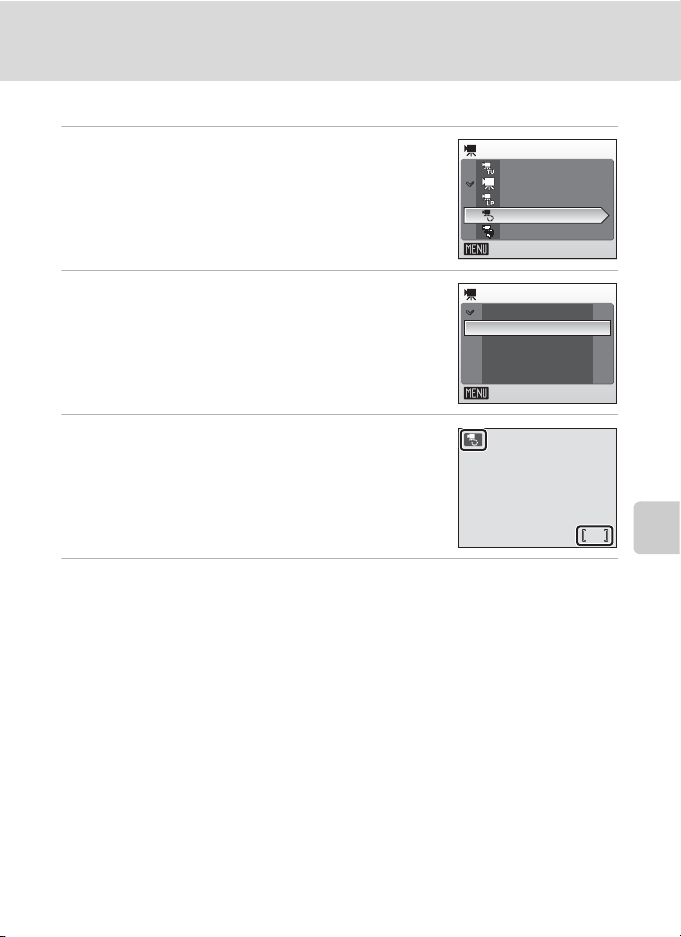
Time-Lapse Movies
652
The Movie Menu
1 Press the multi selector GH to choose
[Movie options] > [Time-lapse movie640]
and press d.
2 Press GH to choose the interval
between shots and press d.
3 Press m to return to shooting mode.
Movie options
TV movie 640
Small size 320
Smaller size 160
Time-lapse movie640
Stop-motion movie
Exit
Set interval time
10s
30s
1m
5m
10m
Exit
BB
MM
652
652
4 Press the shutter-release button all the way down to start
recording.
Monitor turns off and indicator lamp blinks green between shots.
To end recording, press the shutter-release button all the way down a second
time.
Camera will take pictures at specified interval until the shutter-release button is
pressed again, memory is full, or 1,800 frames have been recorded.
Movies
55
Page 68
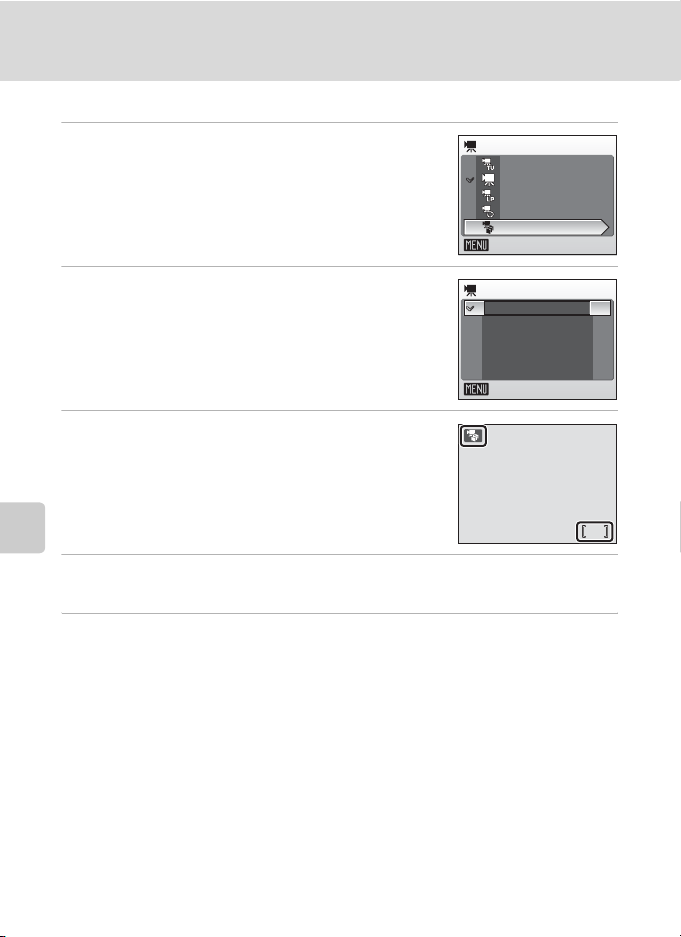
The Movie Menu
200
Stop-Motion Movies
1 Press the multi selector GH to choose
[Movie options] > [Stop-motion movie]
and press d.
2 Press GH to choose the playback speed
and press d.
Movie options
TV movie 640
Small size 320
Smaller size 160
Time-lapse movie640
Stop-motion movie
Exit
Playback speed
Exit
3 Press m to return to shooting mode.
Movies
4 Press the shutter-release button to record the first frame.
The recorded picture will be superimposed on the view through the lens.
5 Press the shutter-release button to record the second frame.
The second frame will be superimposed on the first frame.
The monitor turns off automatically if no operations are performed for 30 minutes
(auto off), and recording of the stop-motion movie ends.
To stop recording, wait until 200 pictures are taken, or press d.
5fps
10fps
15fps
BB
MM
200
200
j Time-Lapse Movie and Stop-Motion Movie
To prevent the camera from turning off unexpectedly during recording, use a fully charged battery.
k Deleting Stop-Motion Pictures
You can delete the last picture (superimposed frame) by using T. A confirmation dialog will
be displayed; press H to choose [Yes] and press d. After deletion of the last picture (for
example, Picture C, when taking pictures A, B, and C), the immediately preceding frame (Picture B) will be superimposed on the frame (Picture A), and you can then continue recording.
56
Page 69

Auto-Focus Mode
Choose how the camera focuses in movie mode.
Z Single AF (default)
Camera focuses when shutter-release button is pressed halfway and locks at
this position during shooting, preventing sound of camera focusing from
interfering with recording.
a Full-time AF
Camera focuses continuously, even when shutter-release button is not
pressed halfway.
The Movie Menu
Movies
57
Page 70
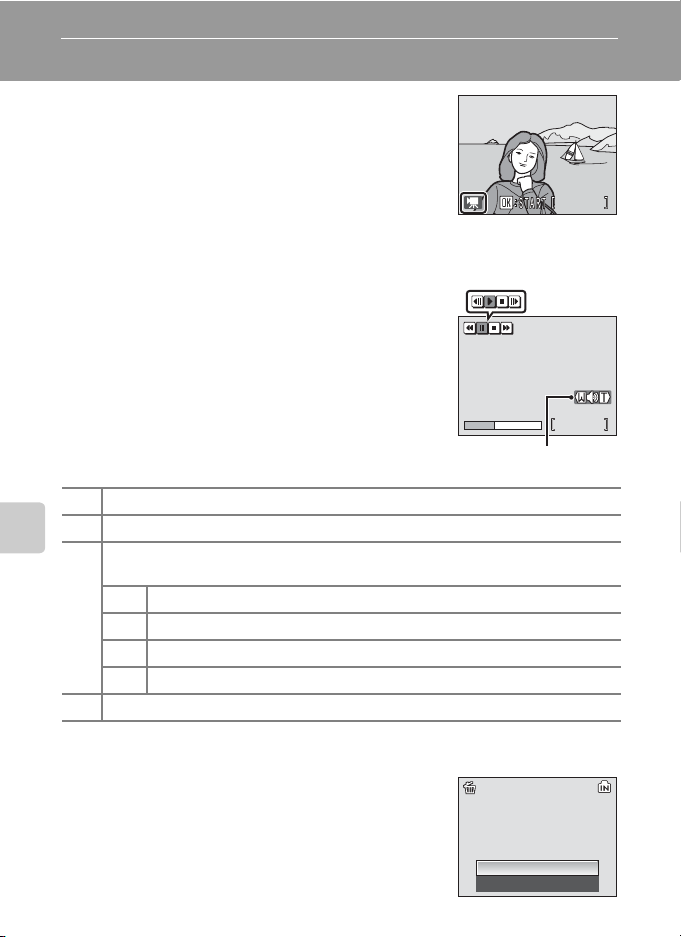
Movie Playback
100NIKON
15:31
10.10.2006
0009.MOV
0h00m05s
Erase 1 image?
In full-frame playback (c 26), movies are recognized by the T icon. To play a movie, display it in
full-frame playback and press d.
Use the zoom control (x) to adjust playback volume. Press the multi selector IJ to choose a control, then press d to perform the selected
operation.
Q Rewind movie. Playback resumes when d is released.
U Advance movie. Playback resumes when d is released.
Movies
Pause playback. The following operations can be performed while playback is
paused.
V Rewind movie by one frame. Rewind continues while d is pressed.
R
W Advance movie by one frame. Advance continues while d is pressed.
z Resume playback.
S End playback and return to full-frame playback.
S End playback and return to full-frame playback.
10.10.2006
10.10.2006
15:31
15:31
EE
0h00m05s
0h00m05s
Playback display
Pausing
Volume indicator
100NIKON
100NIKON
0009.MOV
0009.MOV
MM
MM
2s2s2s
Deleting Movie Files
Display a movie in full-frame (c 26) or thumbnail
playback mode (c 46) and press T.
A confirmation dialog is displayed. Choose [Yes] and
58
press d to delete the movie, or choose [No] and
press d to return to the normal playback display
without deleting the movie.
Erase 1 image?
Erase 1 image?
No
Yes
Page 71
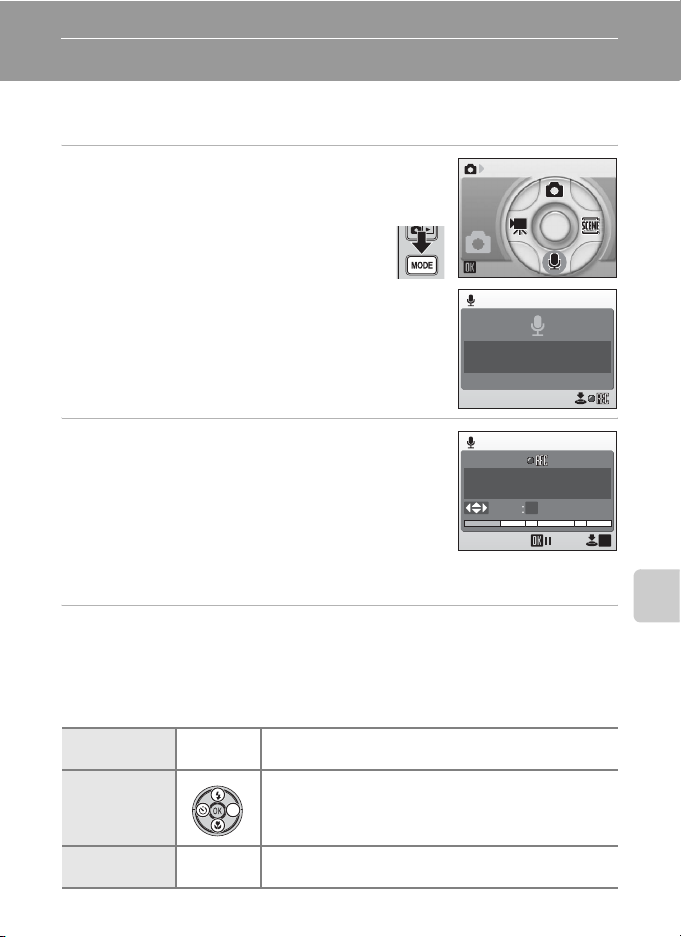
Voice Recordings
1
4
5
6
7
2
3
Making Voice Recordings
Audio voice recordings can be recorded over the built-in microphone and
played back over the built-in speaker.
1
Enter voice recording mode by
pressing
p
in shooting mode,
selecting O (press the multi selector
H
), and then pressing d.
Voice recording
The length of recording that can be made
will be displayed.
2 Press the shutter-release button fully to
start recording.*
1 Recording indicator
2 File number
3 Length of recording
Date and time of recording
4
* Camera enters standby mode (c 15) after about 30 seconds and indicator lamp
turns red. Press d to reactivate display.
5 Time remaining
6 Index number
7 Progress indicator
Voice recording
001 10:3010.10.2006
Max rec time
Voice recording
001 10:3010.10.2006
2
00:00:05
3
6
7
3 Press the shutter-release button fully a second time to end
recording.
Recording will end automatically if the internal memory or memory card becomes
full, or after five hours of recording on the memory card (256 MB or more).
Use the following during recording:
Pause/resume
recording
Create index
End recording
Shutter
button
Press d once to pause recording; indicator lamp will
d
blink. Press again to resume.
During recording, press the multi selector
create index. Camera can skip to any index during playback. Start of recording is index number 1; other numbers
are assigned in ascending order, to a maximum of 98.
Press the shutter-release button fully a second time to
end recording.
/
Index
18:35
1
00:18:30
5
01
GHIJ
4
Voice Recordings
to
59
Page 72
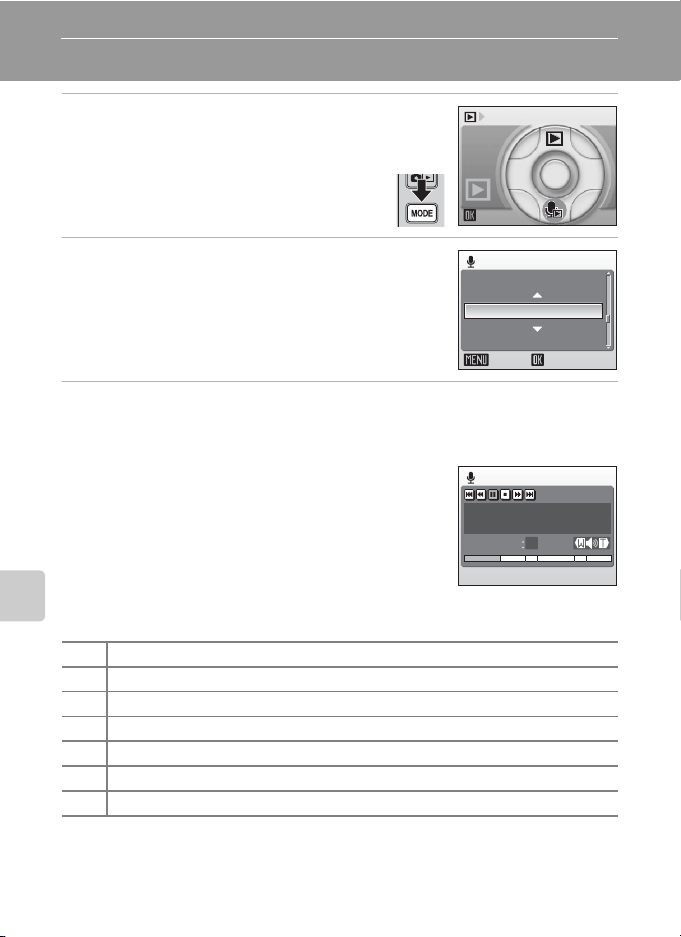
Playing Voice Recordings
1
4
5
6
7
8
9
2
3
1 Enter audio playback mode by
pressing p in playback mode,
selecting q (press the multi selector H), and then pressing d.
Voice recording files will be listed.
2 Press GH to choose the desired file and
press d.
The selected file will be played back.
3 Press GH to advance or rewind.
To delete recording, press A.
Press m to exit playback and return to recording mode.
1 Control icons*
2 File number
3 Playback time
4 Index number
5 Progress indicator
* Press IJ to choose control, press d to select.
†
Zoom control controls volume. Select t to lower volume, v to raise volume.
Voice Recordings
R Pause playback.
z Resume playback.
U Advance recording. Playback resumes when multi selector is released.
Q Rewind recording. Playback resumes when multi selector is released.
s Return to start of current index.
r Skip to next index.
S End playback and return to voice recording list.
Date and time of recording
6
7 Length of recording
8 Volume
†
9 Index
2
3
5
Audio playback
Select sound file
001 10:3010.10.2006
002 11:05
10.10.2006
003 10:0510.15.2006
Copy Play
Audio playback
1
9
02
6
7
8
10.10.2006
001 10:30
00:00:10/00:18:25
4
Index
60
Page 73
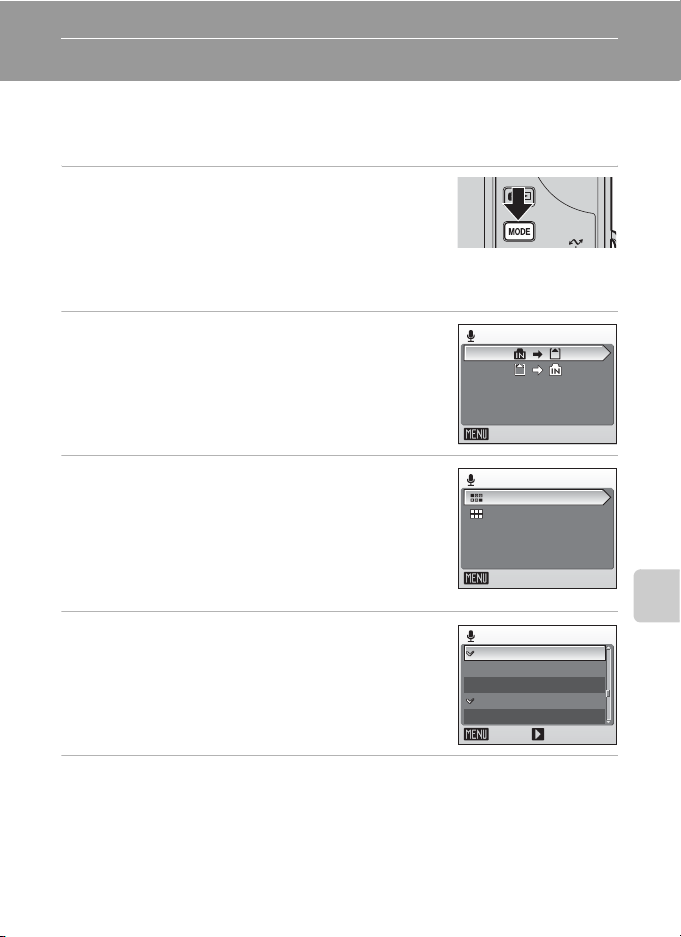
Copying Voice Recordings
To copy voice recordings between internal memory and a memory card, display the voice recording list shown in step 3 on the preceding page and press
m. This option is available only when a memory card is inserted.
1 Press p in the Select sound file
screen (c 60).
MNO: Copy recordings from internal memory to
memory card
ONM: Copy recordings from memory card to internal memory
2 Press the multi selector GH to choose
the option and press d.
3 Press GH to choose the copy option.
To copy all voice recordings, choose [Copy all files]
and press d. A confirmation dialog will be displayed;
choose [Yes] and press d.
4 Press GH to choose the desired file and
press d.
A confirmation dialog will be displayed.
Copy sound files
Exit
Camera to card
Selected files
Copy all files
Exit
Select sound files
001 10:3010.10.2006
002 11:0510.10.2006
003 10:0510.15.2006
004 13:2310.25.2006
005 15:0010.25.2006
Exit Select
5 Press GH to choose [Yes] and press d.
Copying starts.
k Voice Recordings
The COOLPIX S9 may be unable to play or copy sound files created with other devices.
Voice Recordings
61
Page 74
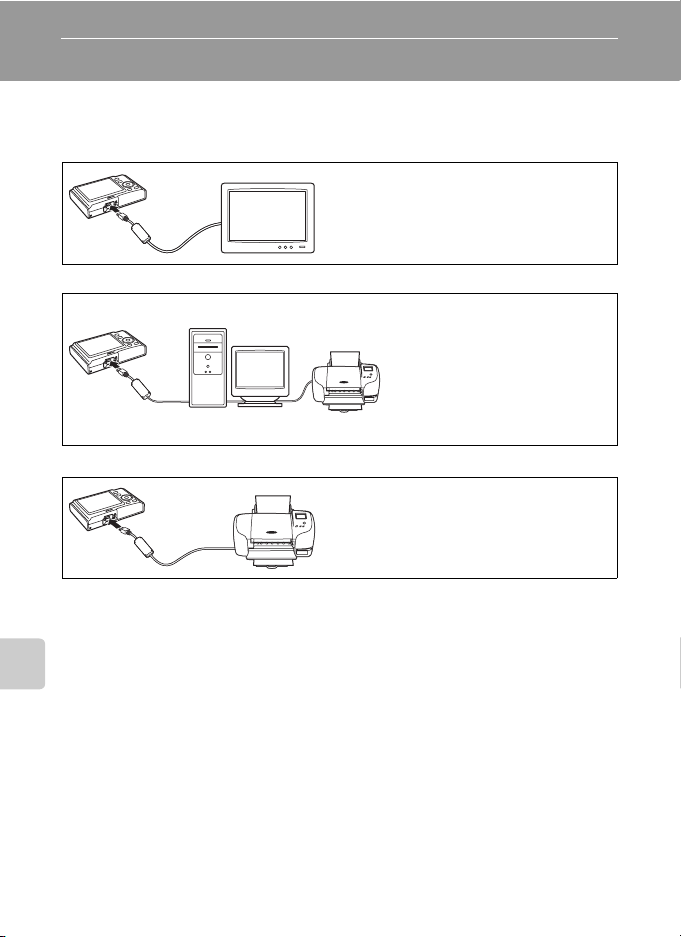
Connecting to Televisions, Computers, and Printers
You can connect your camera to your television, computer, or printer to view
pictures you have taken.
Connecting to a TV (c 63)
View pictures on a TV by connecting
your camera via the supplied audio/
video (A/V) cable.
Connecting to a Computer (c 64)
Connecting to Televisions, Computers, and Printers
Use the supplied PictureProject software to copy pictures to a computer, and then organize, browse,
edit, and save those pictures. You
can also print pictures from a printer
connected to the computer. Connect the camera to the computer
using the supplied USB cable.
Connecting to a Printer (c 68)
Connect your camera directly to a
PictBridge-compatible printer. Use
the supplied USB cable to connect
the camera to a printer for direct
printing.
j Before Connecting the Camera
Use a fully charged battery to prevent the camera from turning off unexpectedly while connected.
k Playback, Transfer, or Print Pictures from the Internal Memory
To view pictures stored in the camera’s internal memory on a TV, transfer them to a computer, or print with direct connection to a printer, remove the memory card from the camera.
l Printing Pictures
In addition to printing pictures transferred to a computer from your personal printer and
printing over a direct camera-to-printer connection, the following options are also available
for printing pictures:
• Insert a memory card into a DPOF-compatible printer’s card slot
• Take a memory card to a digital photo lab
For printing using these methods, specify the pictures and the number of prints each using
your camera’s [Print set] menu (c 74).
62
Page 75
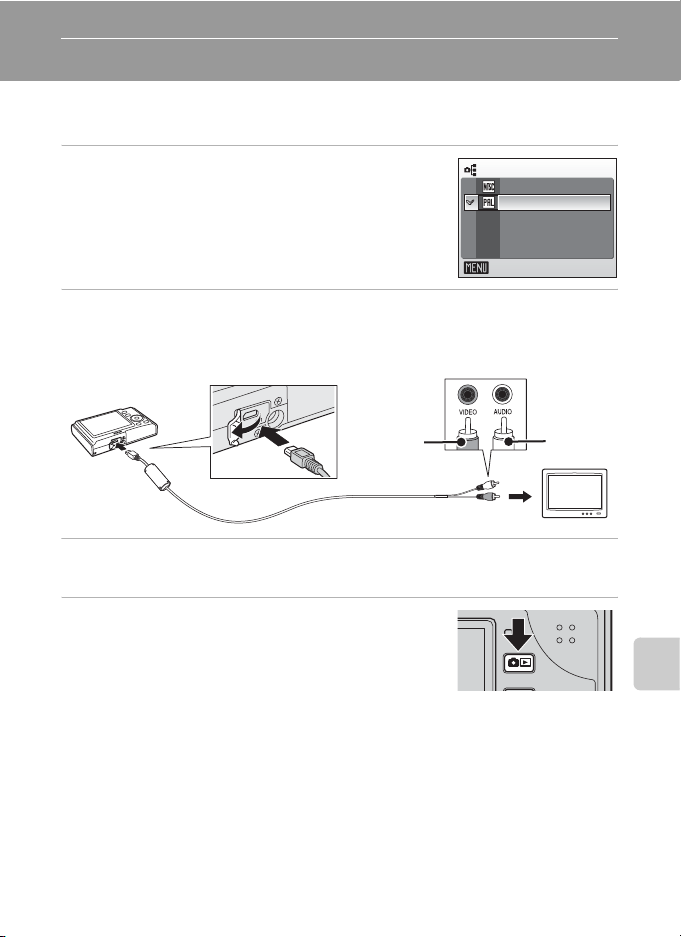
Connecting to a TV
Connect the camera to a television using the A/V cable to play back pictures
on the television.
1 Choose [NTSC] or [PAL] to match your TV
video standard (c 106) and then turn off
the camera.
Video mode
NTSC
PAL
Exit
2 Connect the A/V cable.
Connect the yellow plug to the video-in jack on the TV, and the white plug to the
audio-in jack.
3 Tune the television to the video channel.
See the documentation provided with your television for details.
4 Press o for one second to turn on
the camera.
The camera monitor will remain off and the image
normally shown in the monitor will be displayed on
the television.
Connecting to Televisions, Computers, and Printers
WhiteYellow
j Connecting an A/V Cable
• When connecting the A/V cable, be sure that the camera connector is oriented correctly.
Do not use force when connecting the A/V cable to the camera. When disconnecting the
A/V cable, do not pull the connector at an angle.
• Do not pinch the connector cover between the camera’s A/V connector and the A/V cable
connector when connecting the cable to the camera.
63
Page 76
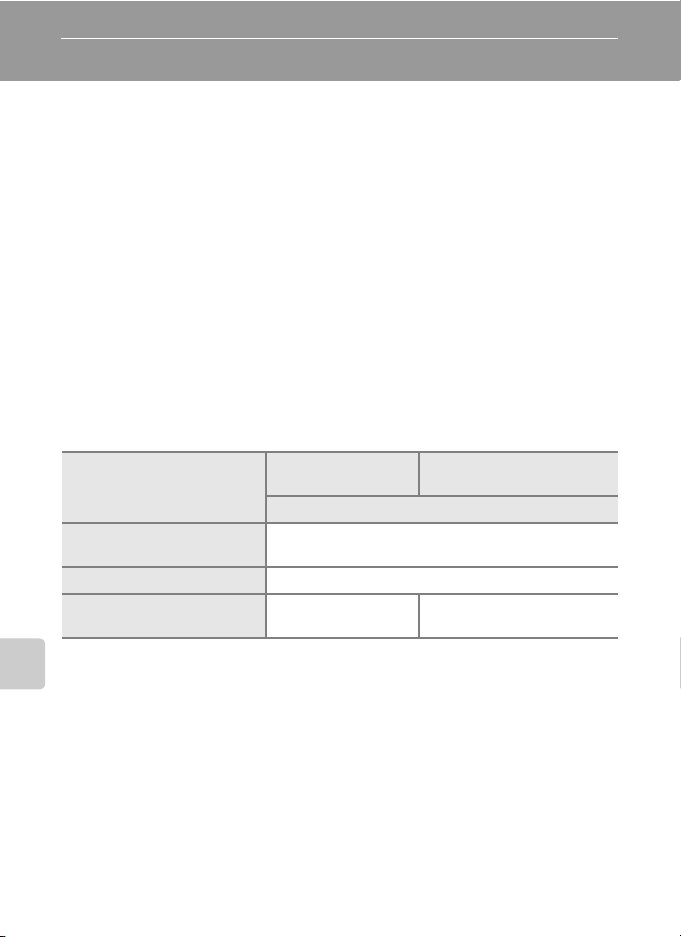
Connecting to a Computer
Use the USB cable and PictureProject software supplied with your camera to
copy (transfer) pictures to a computer.
Before Connecting the Camera
Installing PictureProject
Before transferring pictures or movies to a computer, PictureProject must be
installed. For more information on installing and using PictureProject, see the
Quick Start Guide or the PictureProject Reference Manual (on CD).
Connecting to Televisions, Computers, and Printers
Confirming USB Option
The following two methods can be used to transfer pictures from the camera
to a computer:
•Press E (d) on the camera.
• Click [Transfer] in PictureProject.
The method used will depend on your computer’s operating system and the
USB option (c 65) selected in the camera’s setup menu (c 106).
Camera E (d)
Operating system
Windows XP Home Edition
Windows XP Professional
Windows 2000 Professional
Mac OS X 10.3.9 or later Choose [PTP].
1
The camera’s E (d) button cannot be used to transfer pictures in the following
cases. Use the PictureProject Transfer button.
• When transferring pictures from the camera’s internal memory and [Mass storage]
is selected in the USB menu.
• When the memory card write-protect switch is in the “lock” position. Unlock by
sliding the switch to the “write” position before transferring pictures.
2
This camera supports the USB mass storage device class (default setting [Mass storage]) and Picture Transfer Protocol ([PTP]) USB transfer protocols.
3
If your computer is running Windows 2000 Professional, be sure to set the USB
option to [Mass storage]. If [PTP] is selected, the Found New Hardware Wizard will be
displayed when the camera is connected to the computer. Select [Cancel], close the
window, and disconnect the camera from the computer.
3
1
button
Choose [Mass storage] or [PTP].
Choose [Mass storage].
PictureProject Transfer
button
USB mode
2
Choose [Mass storage] or
[PTP].
64
Page 77
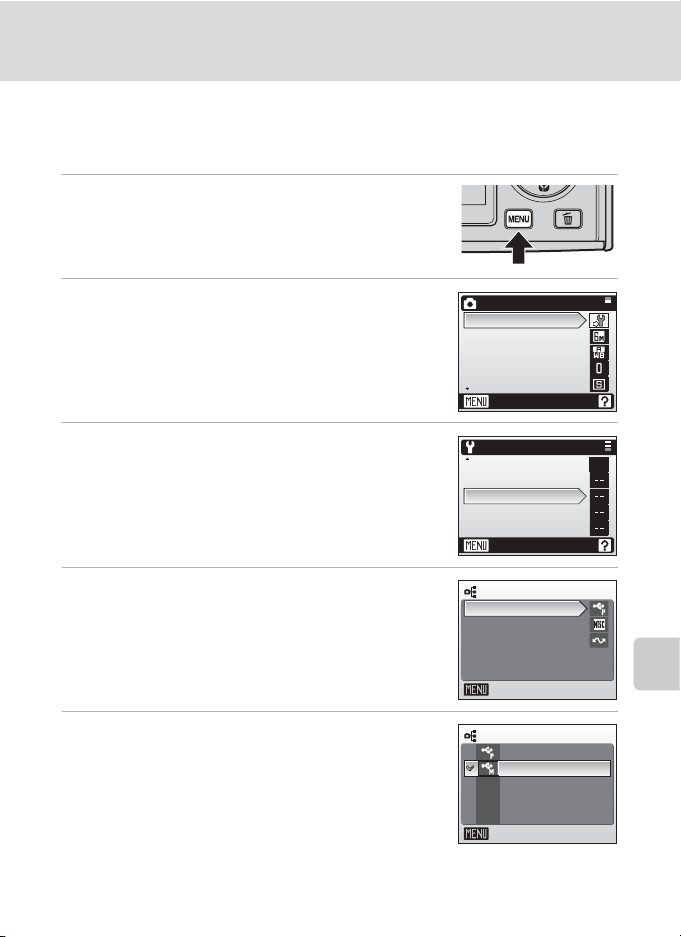
Connecting to a Computer
Setting the USB Option
Set the USB option (c 106) in the setup menu on the camera before connecting the camera to the computer or printer.
1 Press m.
2 Press the multi selector GH to choose
[Set up] and press d.
3 Press GH to choose [Interface] and
press d.
4 Press GH to choose [USB] and press d.
5 Press GH to choose [PTP] or [Mass stor-
age] and press d.
The setting is enabled.
Shooting menu
Set up
Image mode
White balance
Exp. +/Continuous
Exit
Set up
Format memory
Language
Interface
Reset all
Firmware version
Exit
Interface
USB
Video mode
Auto transfer
Exit
USB
PTP
Mass storage
Exit
Connecting to Televisions, Computers, and Printers
O
65
Page 78
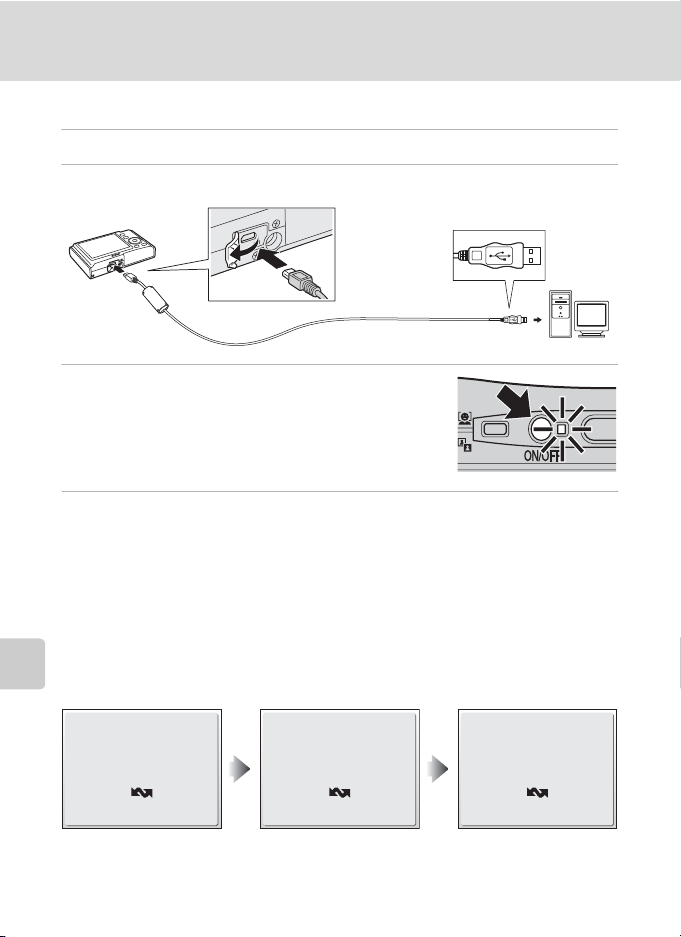
Connecting to a Computer
Transferring Pictures to a Computer
1 Start a computer to which PictureProject has been installed.
2 Turn the camera off and connect the USB cable as shown below.
Connecting to Televisions, Computers, and Printers
3 Turn on the camera.
At default PictureProject settings, PictureProject Transfer is launched immediately with recognition of camera connection.
4 Transfer pictures.
Transfer using PictureProject
Click the PictureProject Transfer button.
All pictures and movies marked for transfer are copied to the computer. Once
transfer is complete, pictures are displayed in PictureProject.
Transfer using the camera’s E (d) button
While PictureProject Transfer is launched, press E (d) to copy pictures marked
for transfer (c 67) to the computer. The following messages are displayed in the
camera monitor during transfer.
66
Preparing to transfer
Transferring images to
computer
Transfer completed
Page 79
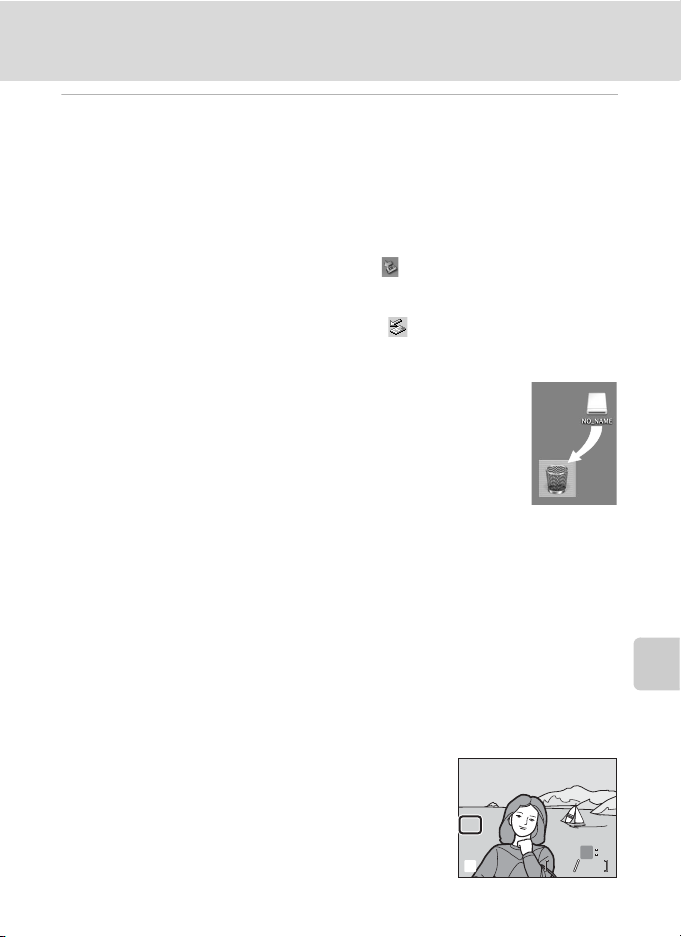
Connecting to a Computer
100NIKON
15:30
10.10.2006
0005.JPG
5 Disconnect the camera once transfer is complete.
If the USB option is set to [PTP]
Turn the camera off and disconnect the USB cable.
If the USB option is set to [Mass storage]
Remove the camera from the system as described below before turning the
camera off and disconnecting the USB cable.
Windows XP Home Edition/Windows XP Professional
Click the [Safely Remove Hardware] icon ( ) in the taskbar and select [Safely
remove USB Mass Storage Device] from the menu displayed.
Windows 2000 Professional
Click the [Unplug or Eject Hardware] icon ( ) in the taskbar and select [Stop
USB Mass Storage Device] from the menu displayed.
Macintosh
Drag the untitled camera volume (“NO NAME”) to the Trash.
j Connecting the USB Cable
• When connecting the USB cable, be sure that the connectors are oriented correctly. Do not
use force when connecting the USB cable. When disconnecting the USB cable, do not pull
the connector at an angle.
• Do not pinch the connector cover between the camera’s USB connector and the USB cable
connector when connecting the cable to the camera.
Connecting to Televisions, Computers, and Printers
l Marking Pictures for Transfer
Pictures marked for transfer are recognized by the E icon displayed during playback. As the default setting, all pictures are
automatically marked for transfer. Two options control transfer
marking:
• [Interface] > [Auto transfer] in the setup menu: Choose [On]
to mark all new pictures for transfer (c 106).
• [Transfer marking] in the playback menu: Change marking
for existing pictures (c 92).
10.10.2006
10.10.2006
15:30
15:30
c
100NIKON
100NIKON
0005.JPG
0005.JPG
OMMNEEO
44 44
67
Page 80
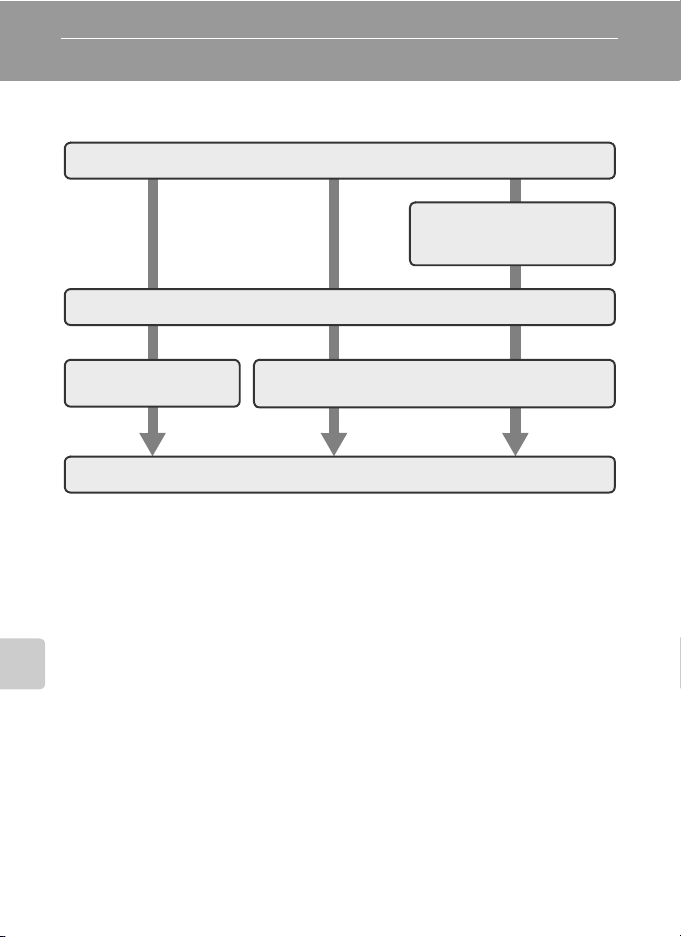
Connecting to a Printer
Users of PictBridge-compatible (c 117) printers can connect the camera
directly to the printer and print pictures without using a computer.
Take pictures
Select pictures for printing
using [Print set] option
(c 74)
Connecting to Televisions, Computers, and Printers
Print pictures one at
a time (c 70)
Connect to printer (c 69)
Print multiple pictures (c 72)
Turn camera off and disconnect USB cable
68
Page 81
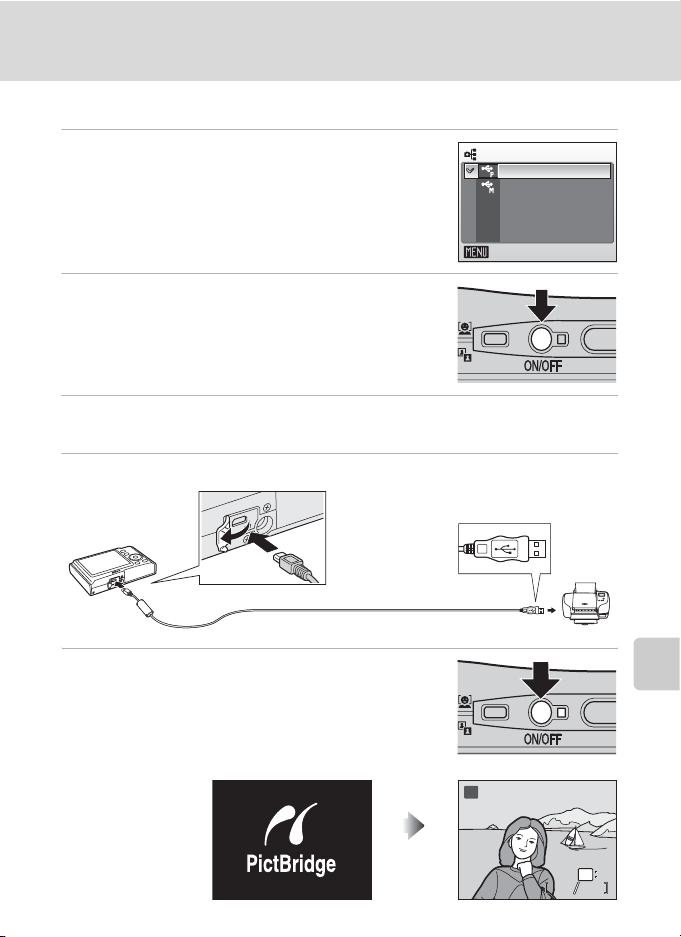
Connecting the Camera and Printer
Connecting to a Printer
1 Set the USB option (c 65) to [PTP].
2 Turn off the camera.
3 Turn on the printer.
Check printer settings.
4 Connect the USB cable as shown below.
5 Turn on the camera.
The PictBridge start-up screen will be displayed in the
camera monitor. The camera will then enter full-frame
playback with the PictBridge logo displayed in the top
left corner of the monitor.
USB
PTP
Mass storage
Exit
Connecting to Televisions, Computers, and Printers
12
v
OK
MM
ww
44 44
69
Page 82
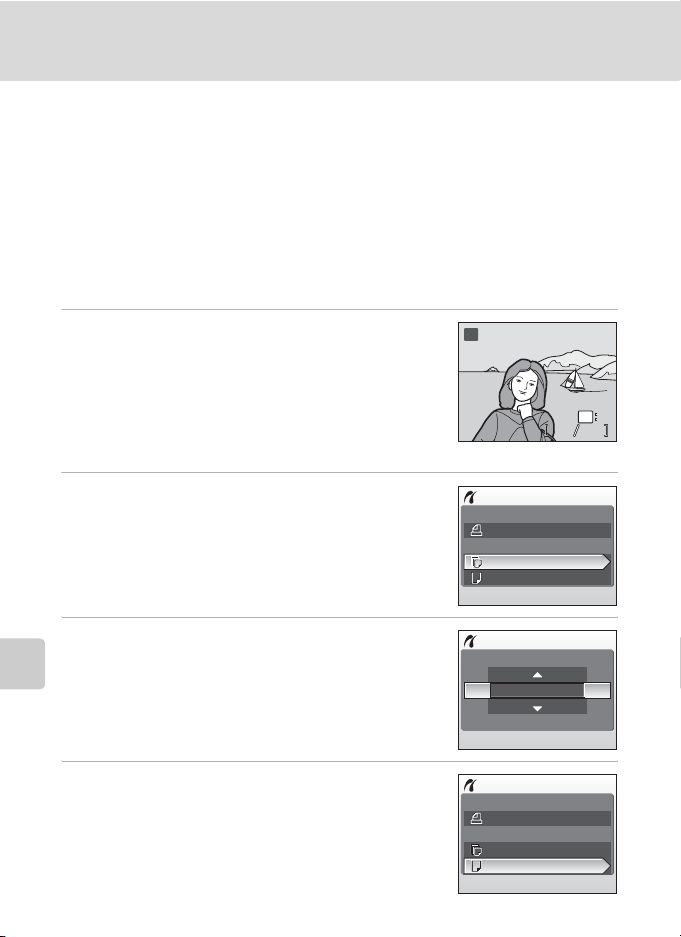
Connecting to a Printer
j Connecting the USB Cable
• When connecting the USB cable, be sure that the connectors are oriented correctly. Do not
use force when connecting the USB cable. When disconnecting the USB cable, do not pull
the connector at an angle.
• Do not pinch the connector cover between the camera’s USB connector and the USB cable
connector when connecting the cable to the camera.
Printing Pictures One at a Time
After connecting the camera to the printer correctly (c 69), print pictures by
following the procedure below.
Connecting to Televisions, Computers, and Printers
1 Press the multi selector GHIJ to
choose a picture and press d.
The PictBridge menu is displayed.
To choose a picture from a list of thumbnails, press
the zoom control t (j) and use the multi selector
to choose the desired picture, or press to v (k) to exit
to full-frame playback.
2 Press GH to choose [Copies] and press
d.
3 Press GH to choose number of copies
(up to 9) and press d.
Monitor display returns to the PictBridge menu
(step 2).
4 Press GH to choose [Paper size] and
press d.
70
v
PictBridge
Start print
Copies
Paper size
Copies
PictBridge
Start print
Copies
Paper size
MM
ww
OK
44 44
8
Page 83
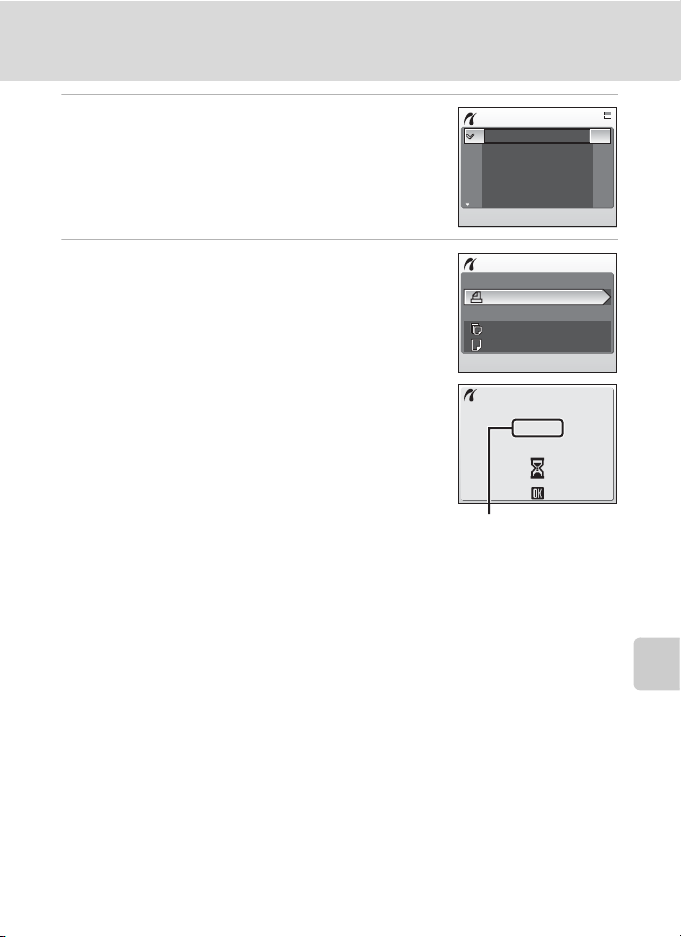
Connecting to a Printer
5 Press GH to choose the desired paper
size and press d.
Monitor display returns to the PictBridge menu
(step 2).
To specify paper size using printer settings, choose
[Default] in the paper size menu and press d.
6 Press GH to choose [Start print] and
press J.
Monitor display returns to that shown in step 1 when
printing is complete. To cancel before all copies have
been printed, press d.
Paper size
Default
3.5 x 5 in.
5 x 7 in.
Postcard
100x150mm
PictBridge
Start print
Copies
Paper size
Printing
002/004
Cancel
Current print/total
number of prints
Connecting to Televisions, Computers, and Printers
71
Page 84
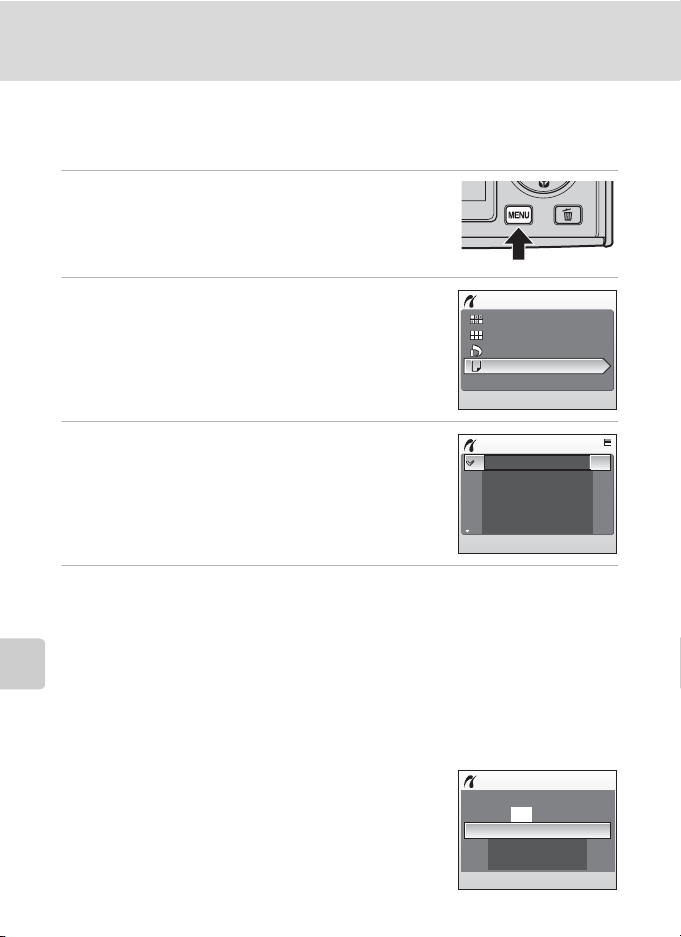
Connecting to a Printer
Printing Multiple Pictures
After connecting the camera to the printer correctly (c 69), print pictures by
following the procedure below.
1 Press m.
The print menu is displayed.
Connecting to Televisions, Computers, and Printers
2 Press the multi selector GH to choose
[Paper size] and press d.
Print menu
Print selection
Print all images
DPOF printing
Paper size
3 Press GH to choose the desired paper
size and press d.
To specify paper size using printer settings, choose
[Default] in the paper size menu and press d.
Monitor display returns to the print menu (step 2).
Paper size
Default
3.5 x 5 in.
5 x 7 in.
Postcard
100x150mm
4 Press GH to choose [Print selection], [Print all images] or
[DPOF printing] and press d.
Print selection
Select pictures and specify the number of prints for each picture. Proceed to step 5.
Print all images
All pictures stored in the internal memory or memory card are printed. Monitor
display returns to the print menu (step 2) when printing is complete.
DPOF printing
72
Pictures for which a print order has been created are
printed accordingly (c 74). To print, press GH to
choose [Start print] and press d.
Monitor display returns to the print menu (step 2).
To view the current print order, choose [Confirm] and
press d. Print order details will be displayed. Proceed
to step 7.
DPOF printing
004 prints
Start print
Confirm
Cancel
Page 85
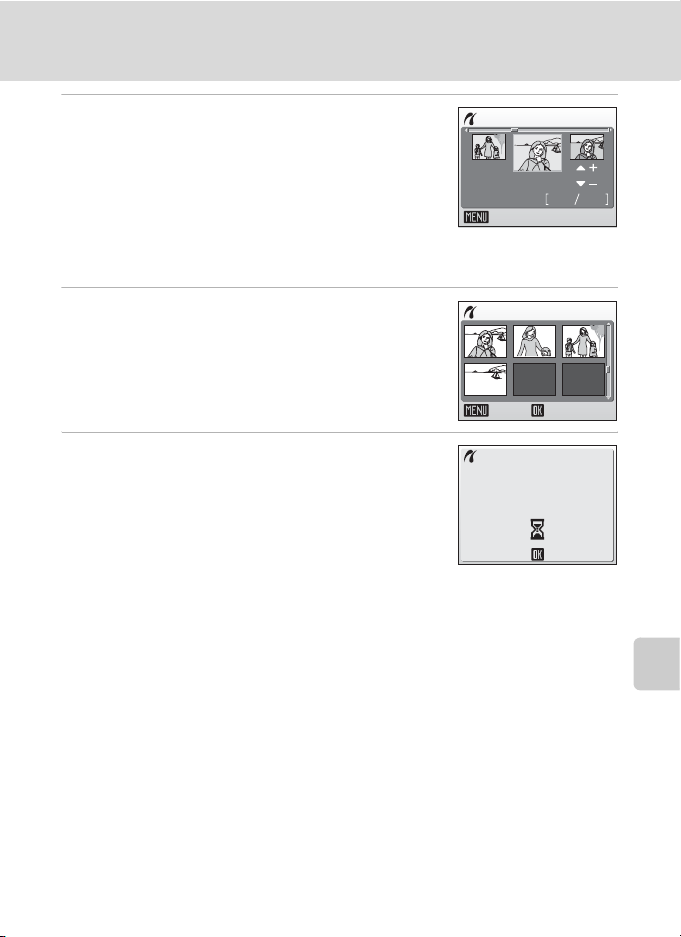
Connecting to a Printer
5 Choose the pictures and number of cop-
ies (up to 9) of each and press d.
The current picture is shown at the center of the display. Press IJ to choose the previous or next picture. Press GH to increase or decrease the number
of copies for each picture.
Pictures selected for printing are recognized by the w
icon and the number of copies to be printed. w is not displayed with pictures for
which 0 copies have been specified and these pictures will not be printed.
6 Press GHIJ to check the selected pic-
tures you wish to print.
Thumbnails of the chosen pictures for printing are displayed. Press m to modify the selection and return
to step 5.
Print selection
10.10.2006
15:30
Back
004 prints
1 2 3
123
4
4
Back Print
7 Press d to start printing.
Monitor display returns to the print menu (step 2)
when printing is complete. To cancel before all copies
have been printed, press d.
Printing
002/004
43
Connecting to Televisions, Computers, and Printers
Cancel
j Paper Size
The camera supports the following paper sizes: [Default] (the default paper size for the current printer), [3.5 × 5 in.], [5 × 7 in.], [Postcard], [100 × 150 mm], [4 × 6 in.], [8 × 10 in.],
[Letter], [A3], and [A4]. Only sizes supported by the current printer will be displayed.
73
Page 86
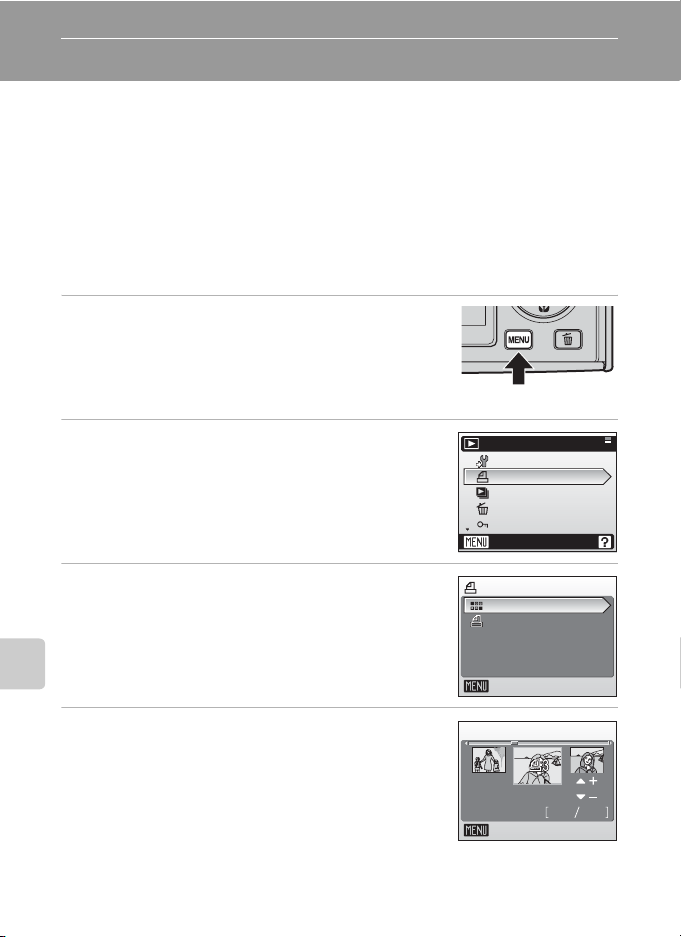
Creating a DPOF Print Order: Print Set
The [Print set] option in the playback menu (c 88) is used to create digital
“print orders” for printing on DPOF-compatible devices (c 126). In addition
to pictures themselves, shooting date and photo information (shutter speed,
aperture, etc.) can also be printed.
When the camera is connected to a PictBridge-compatible printer, pictures
can be printed from the printer according to the DPOF print order you have
created for pictures on the memory card. If the memory card is removed
from the camera, you can create the DPOF print order for pictures in the
internal memory and print pictures according to the DPOF print order.
Connecting to Televisions, Computers, and Printers
1 Press m in playback mode.
The playback menu is displayed.
When printing from a PictBridge-compatible printer,
create print orders before connecting the camera to
the printer.
2 Press the multi selector GH to choose
[Print set] and press d.
The print set menu is displayed.
3 Press GH to choose [Print selected] and
press d.
To delete the current print order, choose [Delete print
set] and press d.
4 Choose the pictures and number of cop-
ies (up to 9) of each.
The current picture is shown at the center of the display. Press IJ to choose the previous or next picture. Press GH to increase or decrease the number
of copies for each picture.
Pictures selected for printing are recognized by the w
icon and the number of copies to be printed. w is not displayed with pictures for
which 0 copies have been specified and these pictures will not be printed.
74
Playback menu
Set up
Print set
Slide show
Delete
Protect
Exit
Print set
Print selected
Delete print set
Exit
w
Print selection
10.10.2006
15:30
Back
43
Page 87
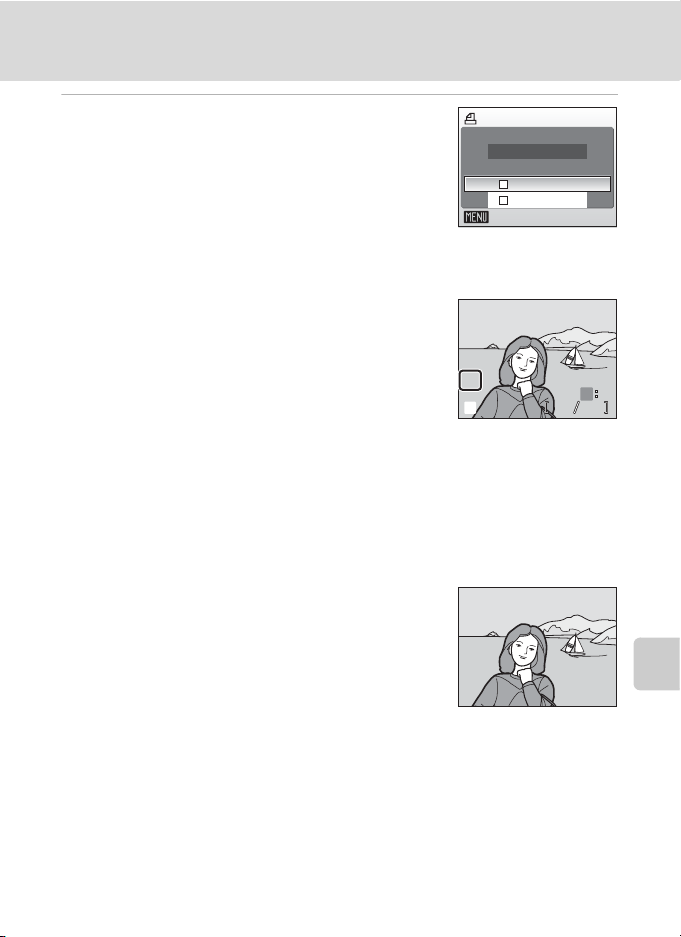
Creating a DPOF Print Order: Print Set
100NIKON
15:30
10.10.2006
0005.JPG
10. 10.2 006
5 Press d.
Press GH to choose an option and press d to
enable that option.
[Date]: Print date of recording on all pictures in the
print order.
[Info]: Print shutter speed and aperture on all pictures
Print set
Exit
Done
Date
Info
in the print order. Note that this information is not
printed with direct connection to a printer.
[Done]: Complete the print order and exit.
Pictures selected for printing are recognized by the
w icon displayed with playback.
10.10.2006
10.10.2006
15:30
15:30
EE
ww
c
100NIKON
100NIKON
0005.JPG
0005.JPG
OMMN
O
44 44
j Print Set
[Date] and [Info] are reset each time the print set menu (step 4) is displayed. Information normally printed when [Info] is selected in the print set menu is not printed when the camera is
connected directly to the printer.
k Note on the Print Set [Date] Option
The date and time printed on pictures with DPOF printing
when [Date] in the print set menu is enabled are those
recorded with the picture when it was taken. Date and time
printed using this option are not affected when the camera’s
date and time setting are changed from the setup menu after
pictures are recorded.
10.10.2006
10.10.2006
Connecting to Televisions, Computers, and Printers
l Differences Between Print Set and Date Imprint
• Date and time can only be printed on pictures using the [Date] option in the print set menu
when pictures are printed from a DPOF-compatible printer (c 101).
• Use the [Date imprint] (c 101) option in the setup menu to print the date on pictures from
a printer that does not support DPOF (position of the date is fixed at the bottom right hand
corner of the picture). Once the [Date imprint] option is enabled, the date forms a permanent part of the image and cannot be deleted from pictures.
• When the date option for both [Print set] and [Date imprint] is enabled, only the date from
the [Date imprint] option is printed, even when a DPOF-compatible printer is used.
75
Page 88
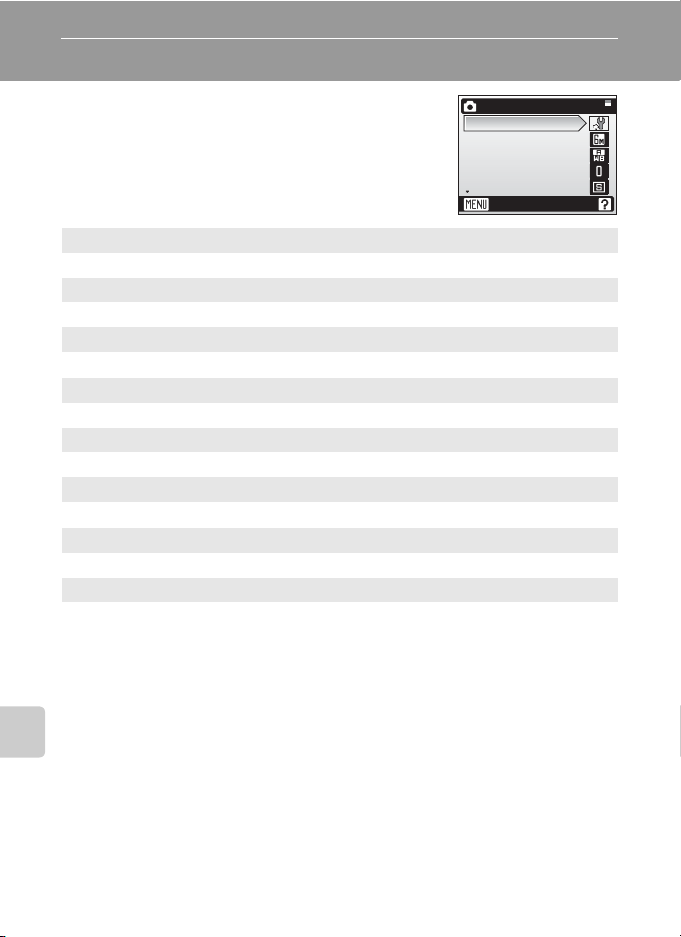
Shooting, Playback, and Setup Menus
Shooting Options: The Shooting Menu
The shooting menu contains the following options
only available in L mode (with the exception of
[Image mode]).
See “The m Button” (c 10) for information on
viewing and using the menu.
Shooting menu
Set up
Image mode
White balance
Exp. +/Continuous
Exit
Z Set up c 94
Display the setup menu.
Z Image mode c 77
Choose image size and quality.
d White balance
*
Match white balance to the light source.
I Exp. +/– c 81
Adjust exposure for very bright or very dark subjects.
q Continuous
Shooting, Playback, and Setup Menus
*
Take pictures one at a time or in a sequence.
A BSS
*
Use the “best shot selector” to choose the sharpest picture.
W Sensitivity c 85
Control camera’s sensitivity to light.
d Color Options
*
Apply color effects to pictures as they are recorded.
* See the information on restrictions that may apply to [White balance], [Continuous],
[BSS], and [Color Options] settings (c 87).
c 79
c 82
c 84
c 86
76
Page 89
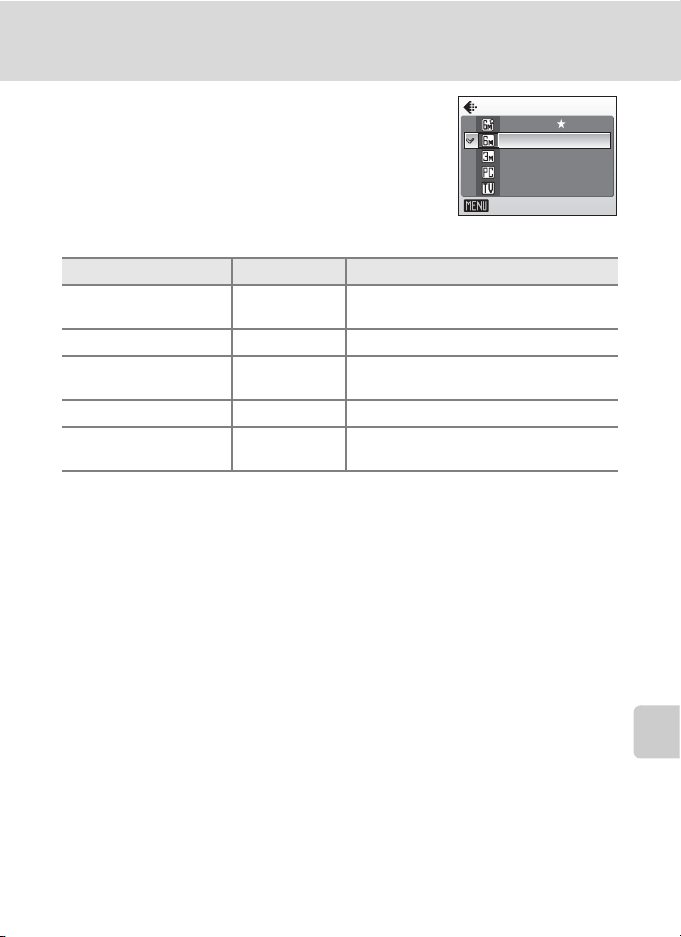
Shooting Options: The Shooting Menu
Z Image Mode
Pictures taken with a digital camera are recorded as
image files. The size of the files, and with it the
number of images that can be recorded, depends
on the size and quality of the images. Before shooting, choose an image mode according to how you
Image mode
High(2816 )
Normal(2816)
Normal(2048)
PC screen(1024)
TV screen(640)
Exit
plan to use the picture.
Options Size (pixels) Description
b High(2816A) 2,816 × 2,112
c Normal(2816) 2,816 × 2,112 Best choice in most situations.
e Normal(2048) 2,048 × 1,536
h PC screen(1024) 1,024 × 768 Suited to display on computer monitor.
i TV screen(640) 640 × 480
Highest quality, suitable for enlargements or high-quality prints.
Smaller size allows more pictures to be
stored.
Suited to full-screen display on a television or distribution by e-mail or the web.
The icon for the current setting is displayed in the monitor (c 6).
Shooting, Playback, and Setup Menus
l Image Mode
The image mode setting can also be applied from the one-touch portrait and scene menus.
Changes made to the image mode setting from any of the three menus apply to all shooting
modes.
77
Page 90
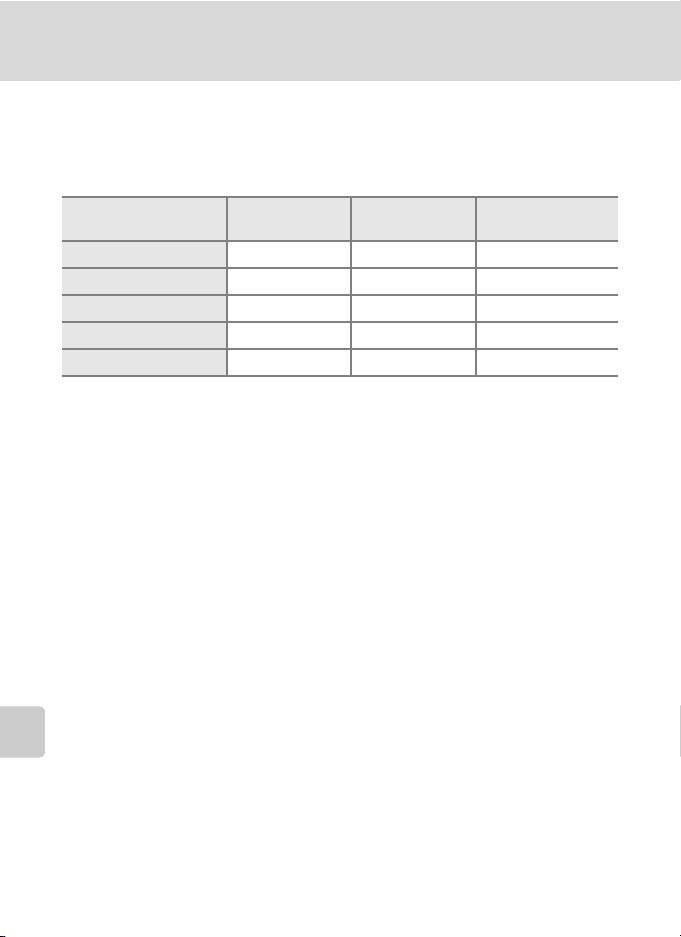
Shooting Options: The Shooting Menu
k Image Mode and the Number of Exposures Remaining
The following table lists the number of pictures that can be stored in internal memory and on
a 256 MB memory card, together with the size of still pictures. All figures are approximate. If
the number of exposures remaining is 10,000 or more, the number of exposure remaining
display shows [9999].
Setting
b High(2816A) 9 90 24 × 18 / 9½ × 7
c Normal(2816) 18 180 24 × 18 / 9½ × 7
e Normal(2048) 32 320 17 × 13 / 7 × 5
h PC screen(1024) 127 1,280 9 × 7 / 3½ × 2½
i TV screen(640) 191 1,920 5 × 4 / 2 × 1½
Shooting, Playback, and Setup Menus
Internal mem-
ory (24 MB)
256 MB mem-
ory card
Print size (printed
at 300 dpi; cm/in.)
78
Page 91
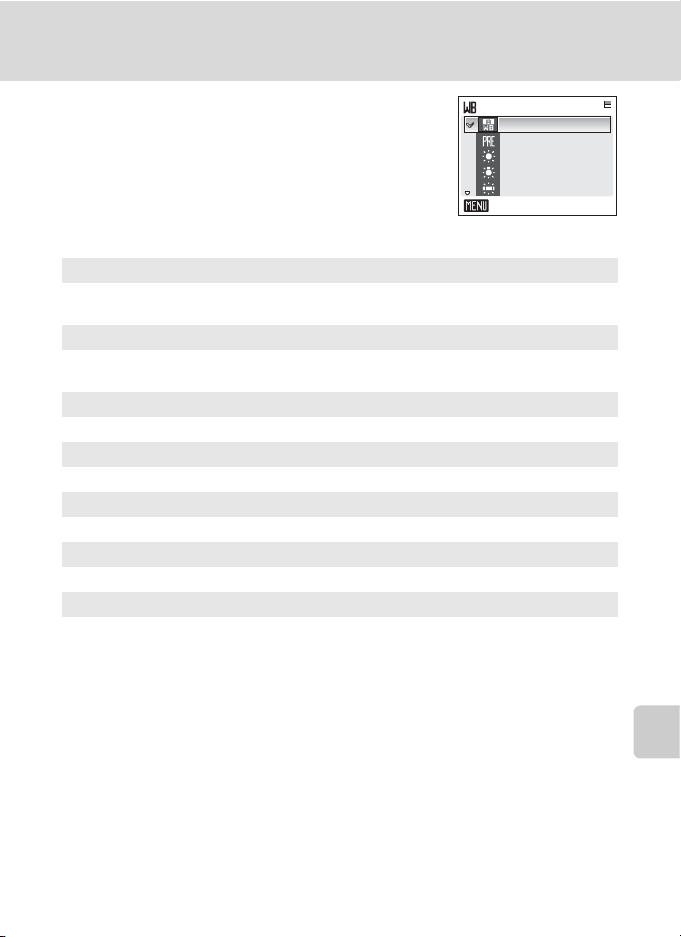
Shooting Options: The Shooting Menu
Daylight
Incandescent
Fluorescent
White bal. preset
d White Balance
Adjust white balance based on the light source to
give pictures the most realistic colors possible.
[Auto] can be used under most types of lighting, or
you can apply the white balance setting suited to a
particular light source to achieve more accurate
White balance
Auto
White bal. preset
White bal. preset
Daylight
Daylight
Incandescent
Incandescent
Fluorescent
Fluorescent
Exit
results.
e Auto (default)
White balance automatically adjusted to suit lighting conditions. Best choice in
most situations.
f White bal. preset
Neutral-colored object used as reference to set white balance under unusual
lighting conditions (c 80).
g Daylight
White balance adjusted for direct sunlight.
h Incandescent
Use under incandescent lighting.
i Fluorescent
Use under most types of fluorescent lighting.
j Cloudy
Use when taking pictures under overcast skies.
l Flash
Use with the flash.
At settings other than [Auto], the icon for the current setting is displayed in
the monitor (c 6).
Shooting, Playback, and Setup Menus
j Flash Mode
At white-balance settings other than [Auto] or [Flash], turn the flash off (B) (c 28).
79
Page 92
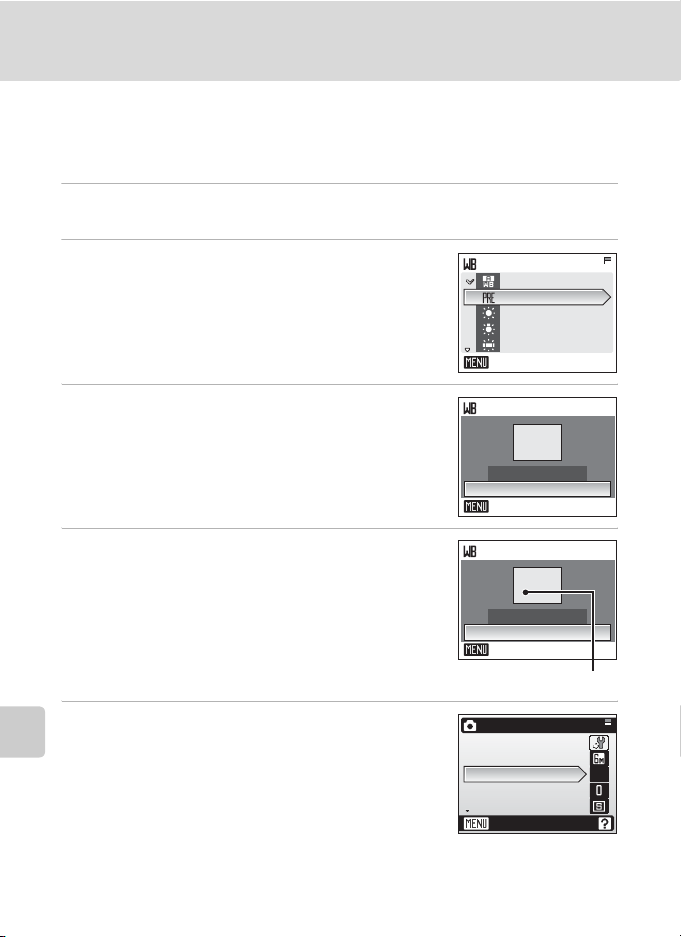
Shooting Options: The Shooting Menu
Auto
Daylight
Incandescent
Fluorescent
f Preset White Balance
Preset white balance is used with mixed lighting or to compensate for light
sources with a strong color cast (for example, to make pictures taken under a
lamp with a red shade look as though they had been taken under white light).
1 Place a white or gray reference object under the lighting that
will be used during shooting.
2 Press the multi selector GH to choose
[White bal. preset] and press d.
The camera zooms in.
3 Press GH to choose [Measure].
To apply the most recently measured value for preset
Shooting, Playback, and Setup Menus
white balance, choose [Cancel] and press d.
4 Frame the reference object.
5 Press d.
The shutter is released and the new white balance
value is set.
No pictures are recorded.
k Note on Preset White Balance
The camera cannot measure a value for preset white balance when the flash fires. Regardless
of the flash mode selected, the flash will not fire when d is pressed in step 5.
80
White balance
Auto
Auto
White bal. preset
Daylight
Daylight
Incandescent
Incandescent
Fluorescent
Fluorescent
Exit
White bal. preset
Cancel
Measure
Exit
White bal. preset
Cancel
Measure
Exit
Reference object frame
Shooting menu
Set up
Image mode
White balance
Exp. +/Continuous
Exit
f
Page 93
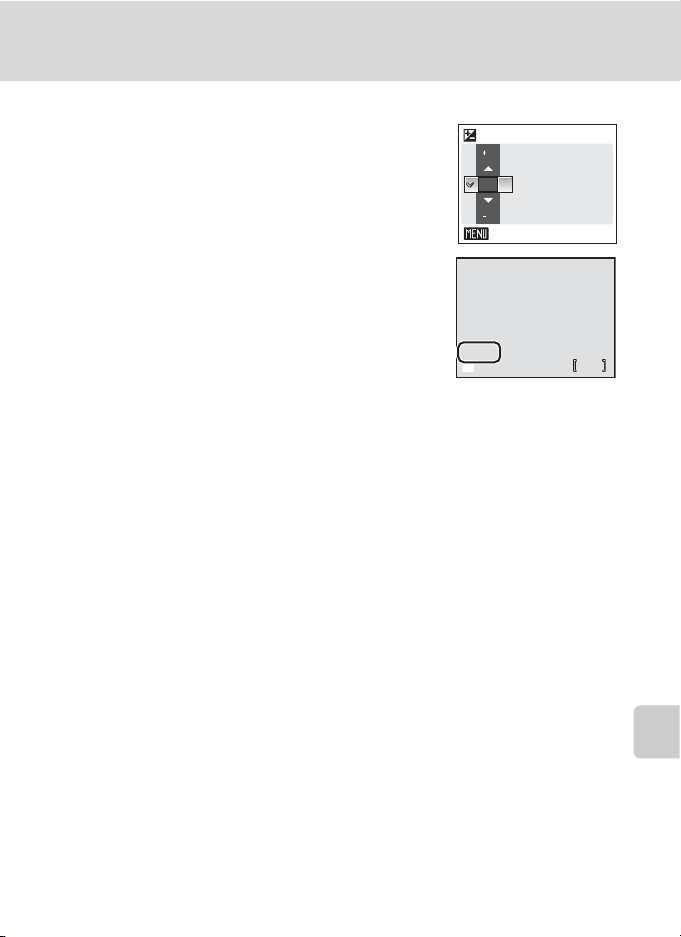
Shooting Options: The Shooting Menu
+1.0
I Exp. +/–
Exposure compensation is used to alter exposure
from the value selected by the camera. Choose
from values between –2.0 EV and +2.0 EV in increments of
pictures, positive values brighter pictures.
The effects can be previewed in the display. At settings other than zero, the current value for exposure compensation is also displayed in the monitor.
1
/3 EV. Negative values produce darker
M
II
c
Exp. +/-
0.3
0
0.3
Exit
+1.0
+1.0
MM
181818
Shooting, Playback, and Setup Menus
81
Page 94
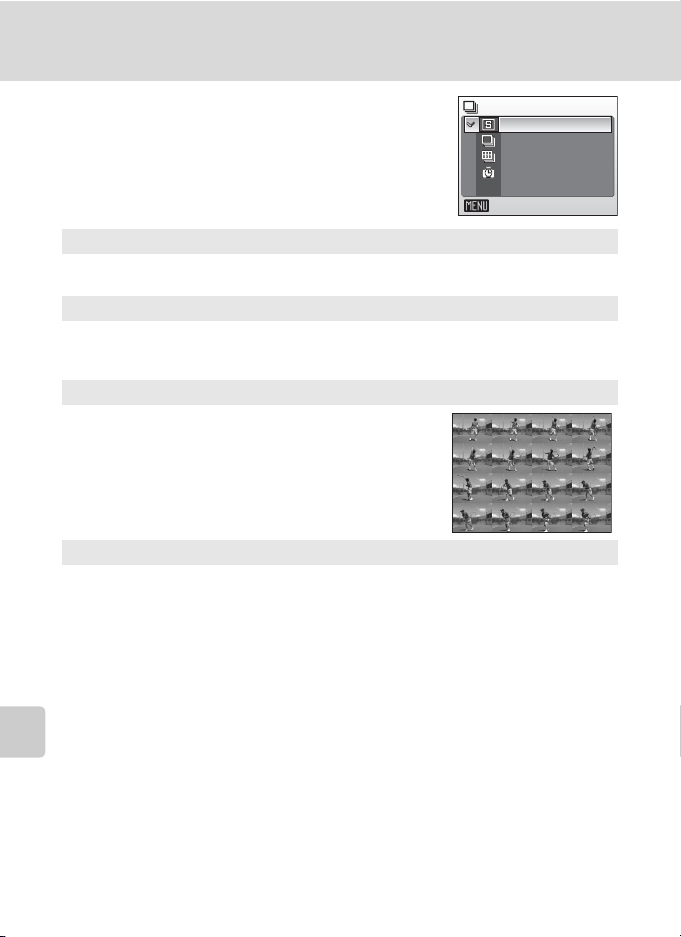
Shooting Options: The Shooting Menu
q Continuous
Capture a fleeting expression on a portrait subject,
photograph a subject that is moving unpredictably,
or capture motion in a series of pictures.
r Single (default)
One shot is taken each time shutter-release button is pressed. When [Single] is
selected, no indicator is displayed in the monitor.
q Continuous
While shutter-release button is pressed, camera takes pictures at up to 1.7
frames per second. COOLPIX S9 can take up to 3 pictures at a time at imagemode setting of [Normal(2816)].
w Multi-shot 16
Each time shutter-release button is pressed, cam-
Shooting, Playback, and Setup Menus
era takes 16 shots at about 2.1 frames per second
and arrange them in a single picture
2,816 × 2,112 pixels as shown at right.
z Intvl timer shooting
Camera takes pictures automatically at specified interval until the shutterrelease button is pressed again, memory is full, or 1,800 frames have been
recorded (c 83).
Continuous
Single
Continuous
Multi-shot 16
Intvl timer shooting
Exit
The indicator for the current setting is displayed in the monitor (c 6). At settings other than [Single], focus, exposure, and white balance are fixed at the
values for the first picture in each series.
82
Page 95
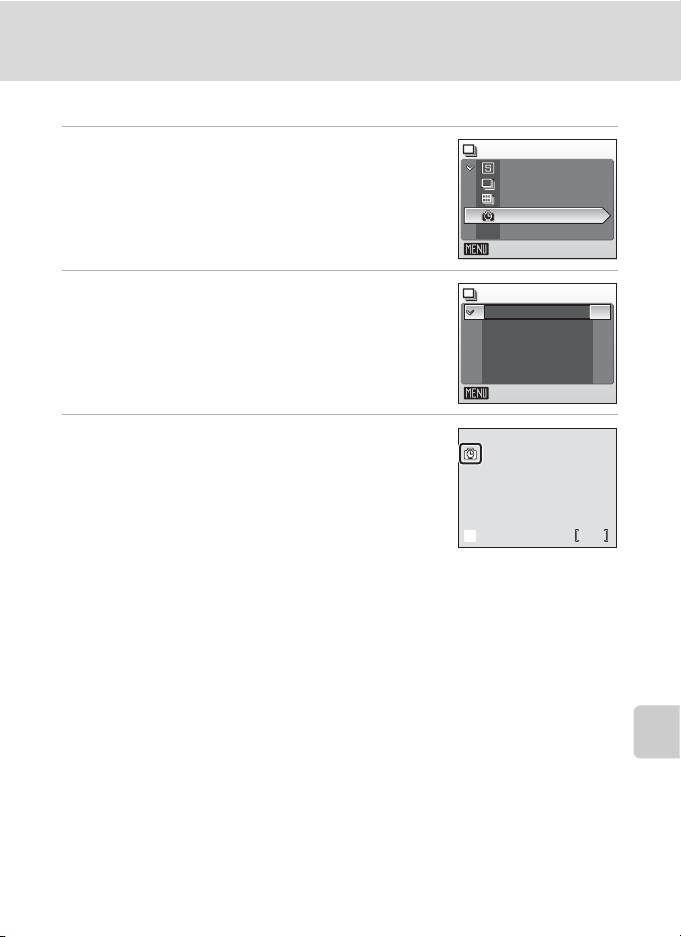
z Interval Timer Photography
Shooting Options: The Shooting Menu
1 Press the multi selector GH to choose
[Intvl timer shooting] and press d.
2 Press GH to choose interval between
shots and press d.
Press m to return to shooting mode.
3 Press the shutter-release button fully to
start recording.
Monitor turns off and indicator lamp blinks green
between shots.
Continuous
Single
Continuous
Multi-shot 16
Intvl timer shooting
Exit
Set interval time
Exit
M
c
30s
1m
5m
10m
181818
MM
Shooting, Playback, and Setup Menus
83
Page 96
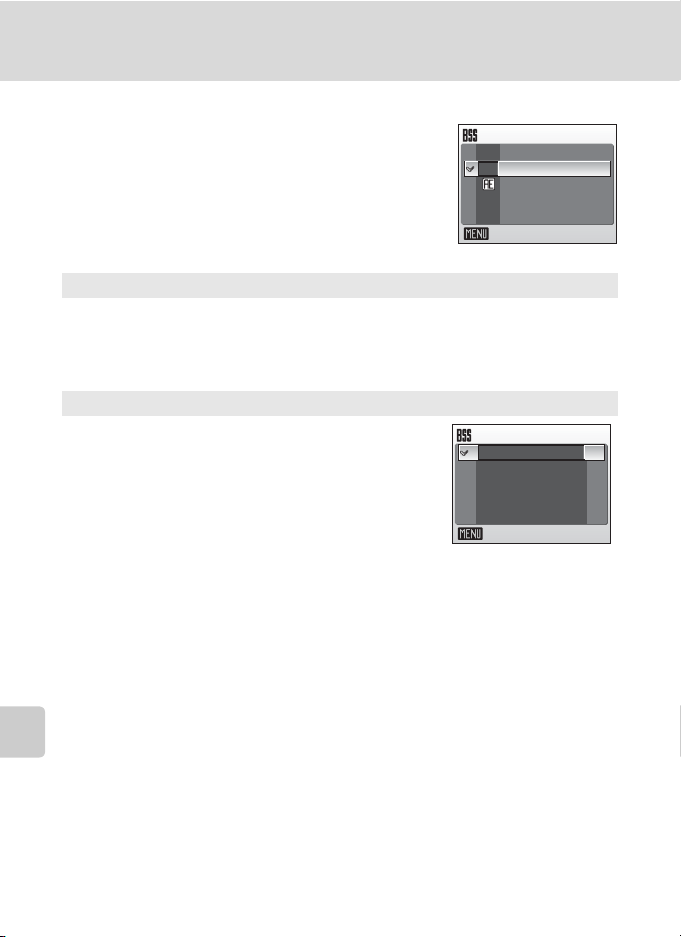
Shooting Options: The Shooting Menu
A Best Shot Selector (BSS)
The “best shot selector” is recommended from situations in which inadvertent camera movement can
result in blurred pictures, or when parts of the
image are prone to under- or overexposure. BSS
may not produce the desired results if the subject
moves or the composition changes while the shutter-release button is fully pressed.
A On
Camera takes shots while shutter-release button is pressed, to a maximum of
ten. These images are then compared and the sharpest picture (picture with
highest level of detail) is saved. Flash automatically turns off and focus, exposure, and white balance for all pictures are determined by the first picture in
each series.
w Exposure BSS
Selecting this option displays sub-menu shown at
Shooting, Playback, and Setup Menus
right. Choose from:
• [Highlight BSS]: picture with smallest area of
overexposure is selected.
• [Shadow BSS]: picture with smallest area of
underexposure is selected.
• [Histogram BSS]: of pictures with least underand over-exposure, camera chooses picture
with overall exposure closest to optimum.
Camera takes five shots each time shutter-release button is pressed, but only
the picture that best meets the selected criterion is saved. Flash automatically
turns off and focus and white balance for all pictures are determined by first
picture in each series. Recommended for high-contrast subjects, when it is difficult to set exposure correctly.
At settings other than [Off], the icon for the current setting is displayed in the
monitor (c 6).
BSS
On
ABA
Off
B
Exposure BSS
Exit
Exposure BSS
Highlight BSS
Shadow BSS
Histogram BSS
Exit
84
Page 97
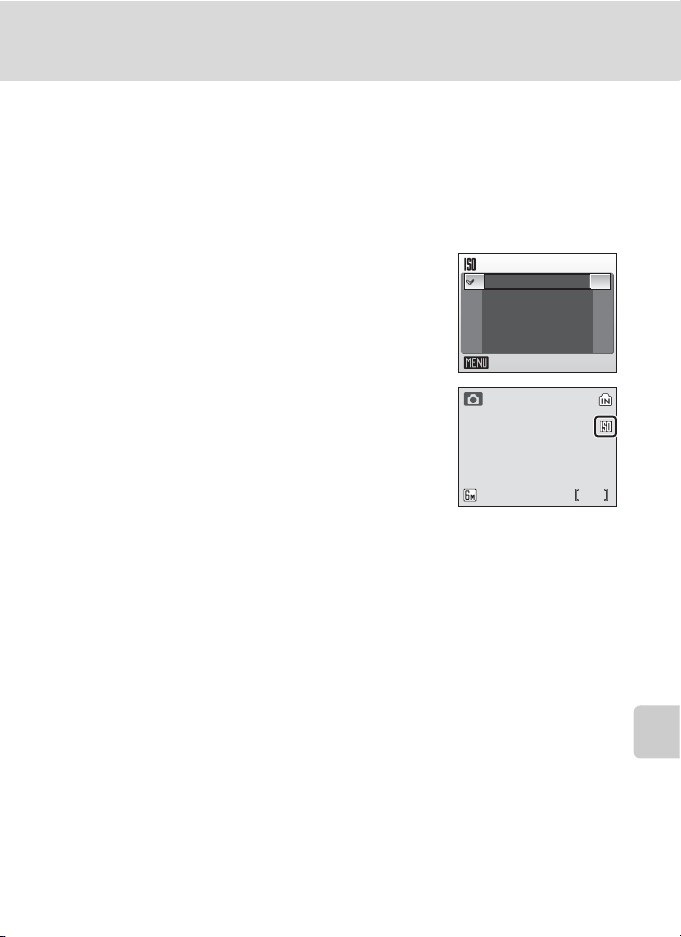
Shooting Options: The Shooting Menu
W Sensitivity
Sensitivity is a measure of how quickly the camera reacts to light. The higher
the sensitivity, the less light needed to make an exposure. Although a high
ISO rating is suited for taking pictures of subjects in action or in poor lighting,
high sensitivity is often associated with “noise” -randomly spaced, brightly
colored pixels concentrated in dark parts of the image. Choose from values
between ISO 64 and 400 equivalent.
[Auto] is equivalent to ISO 64 under normal conditions; when lighting is poor and the flash is off, the
camera compensates by raising sensitivity to a maximum of ISO 400 equivalent.
At settings other than [Auto], the current setting is
displayed in the monitor (c 6). If [Auto] is selected
and the sensitivity is raised above an ISO 64 equivalent, the W icon will be displayed.
Sensitivity
Auto
Exit
64
100
200
400
181818
Shooting, Playback, and Setup Menus
85
Page 98
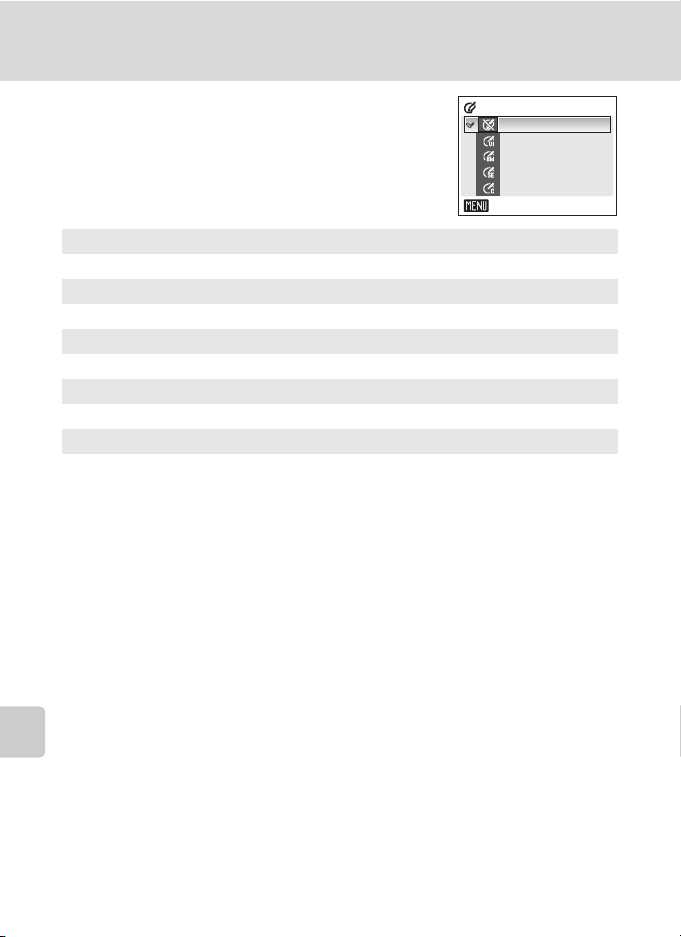
Shooting Options: The Shooting Menu
Black-and-white
Sepia
Cyanotype
Vivid color
d Color Options
Make colors more vivid or record pictures in monochrome.
Color Options
Standard color
Vivid color
Vivid color
Black-and-white
Black-and-white
Sepia
Sepia
Cyanotype
Cyanotype
Exit
e Standard color (default)
Use for pictures exhibiting natural color.
C Vivid color
Use to achieve a vivid, “photoprint” effect.
D Black-and-white
Record pictures in black-and-white.
B Sepia
Record pictures in sepia tones.
A Cyanotype
Shooting, Playback, and Setup Menus
Record pictures in cyan-blue monochrome.
The effects of the selected option can be previewed in the monitor. At settings other than [Standard color], the icon for the current setting is displayed
in the monitor (c 6).
86
Page 99

Shooting Options: The Shooting Menu
Restrictions on Camera Settings
Restrictions apply to the following settings in L mode:
Flash mode
Flash turns off at [Continuous] settings of [Continuous] or [Multi-shot
16] or when [BSS] is on. Applied setting is restored when [Single] or
[Intvl timer shooting] is selected or [BSS] is turned off.
Self-timer
If self-timer is on, only one shot will be taken when shutter is
released, regardless of settings chosen for [Continuous] and [BSS].
Applied [Continuous] and [BSS] settings are restored when picture is
taken or self-timer is turned off.
Continuous
Selecting [Continuous], [Multi-shot 16], or [Intvl timer shooting] turns
[BSS] off. Applied [BSS] setting is not restored when [Single] is
selected.
BSS
[Continuous] is automatically set to [Single] when [BSS] is on. Applied
setting is not restored when [BSS] is turned off.
White balance
White balance is automatically set to [Auto] and cannot be adjusted
when [Black-and-white], [Sepia], or [Cyanotype] is selected for [Color
Options]. Applied white balance setting is restored when [Standard
color] or [Vivid color] is selected.
Shooting, Playback, and Setup Menus
87
Page 100
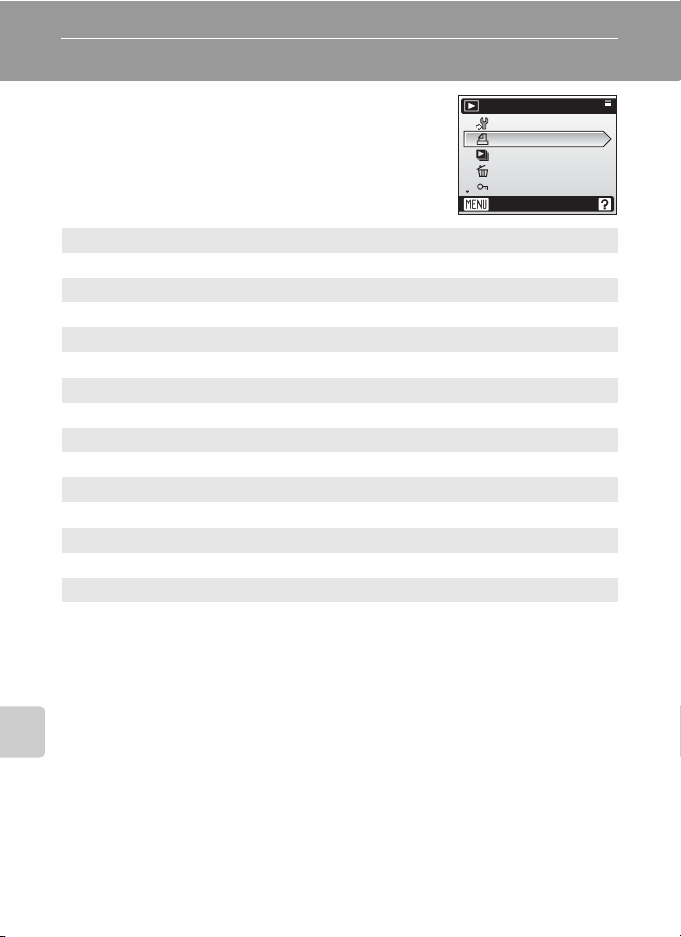
Playback Options: The Playback Menu
The playback menu contains the following options.
See “The m Button” (c 10) for information on
viewing and using the menu.
Z Set up c 94
Display the setup menu.
w Print set c 90
Select pictures for printing.
z Slide show c 90
View pictures in an automatic slide show.
A Delete c 91
Delete all or selected pictures.
D Protect c 91
Shooting, Playback, and Setup Menus
Protect selected pictures from accidental deletion.
E Transfer marking c 92
Change transfer marking for existing pictures.
H Small pic. c 51
Create a small copy of the current picture.
L Copy c 93
Copy files between memory card and internal memory.
Playback menu
Set up
Print set
Slide show
Delete
Protect
Exit
88
 Loading...