

Page 1
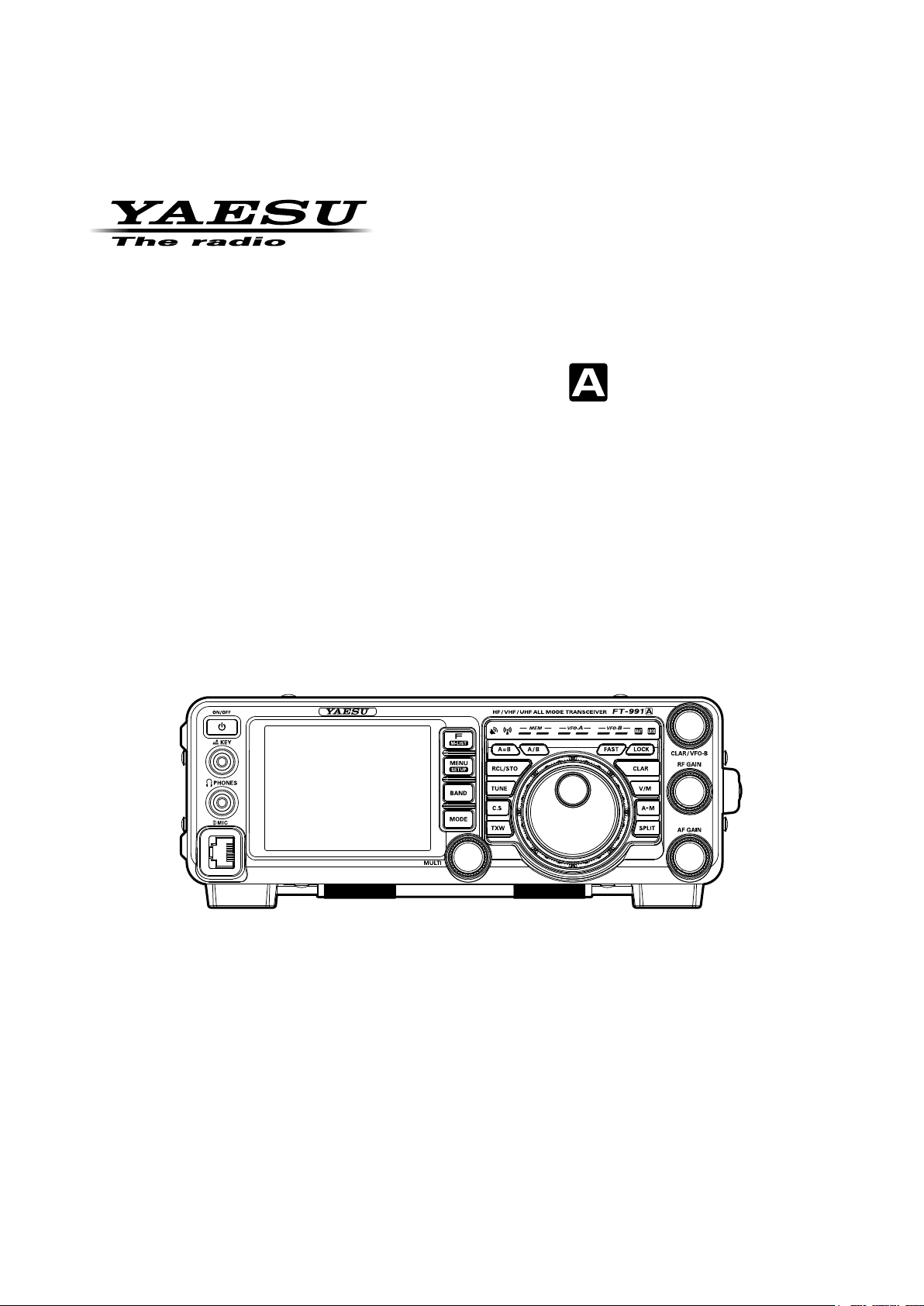
HF/VHF/UHF All Mode TrAnsceiVer
FT-991
operATing MAnUAl
YAESU MUSEN CO., LTD.
Tennozu Parkside Building
2-5-8 Higashi-Shinagawa, Shinagawa-ku, Tokyo 140-0002 Japan
YAESU USA
6125 Phyllis Drive, Cypress, CA 90630, U.S.A.
YAESU UK
Unit 12, Sun Valley Business Park, Winnall Close
Winchester, Hampshire, SO23 0LB, U.K.
Page 2

About this MAnuAl . . .
The
FT-991A
iar to you. In order to gain the most enjoyment and operating efciency from your
read this manual in its entirety, and keep it handy for reference as you explore the many capabilities of your new transceiver.
Before using your
al.
FT-991A utilizes a TFT liquid-crystal display.
• Although TFT liquid-crystal displays are made using very precise technology, they are prone to develop
• Depending on the viewing angle, unevenness in color or brightness may occur. Please note that any uneven-
• If your TFT liquid-crystal display becomes dirty, please use a dry soft cloth or tissue to wipe the display
is a leading-edge transceiver with a number of new and exciting features, some of which may be unfamil-
FT-991A
FT-991A
dead pixels (dark dot) or pixels that are always on (bright dot). Please understand that such phenomena
do not constitute product defects or malfunctions. Rather, this phenomena occurs due to limitations in the
manufacturing technology with respect to TFT liquid-crystal displays.
ness observed is inherent to the construction of TFT liquid crystal displays and therefore does not constitute
a product defect or malfunction.
clean. Use of glass cleaner, household cleaners, organic solvents, alcohol, abrasives, and/or like substance
may damage the TFT liquid-crystal display.
, be sure to read and follow the instructions in the “Before You Begin” section of this manu-
About TFT Displays
, we recommend that you
Page 3

general DescripTiOn
Built-in high-brightness TFT full-color
display with touch-panel functionality
The FT-991A is equipped with a 3.5 inch full-color TFT
display. Functions, including the receiving band, the noise
and signal interference reduction tools are graphically
displayed. Even while performing rigorous operations,
during DX pditions or contests, the operator may instantly
grasp the status of each function.
Equipped with C4FM digital mode
This transceiver C4FM mode provides good error correction performance, and supports the V/D mode (voice/
data simultaneous transmission mode) which makes the
transceiver suitable for mobile communication, and the
Voice FR mode (voice full rate mode) which allows the
transceiver to transmit high quality digital audio. The AMS
function recognizes the contacting stations transmission
method and automatically switches the transceiver to the
same C4FM digital or analog (FM) communications mode
as the received signal.
GM (Group Monitor) function allows
registering frequently communicating
stations to a memory group. The group
members may then automatically
exchange (send/receive) station location
information.
The transceiver automatically checks the channel frequency for registered member stations that are within communicating range. The distance and direction information
of the call sign members of the group may be shown on
the TFT display.
Comes equipped with two types of
roong lters
This transceiver is equipped with two types of roong lters for 3 kHz and 15 kHz bandwidths. These narrow band
lters are especially useful on a very crowded band during
contests, because they can dramatically attenuate powerful
out-of-band signals in the rst IF stage and reduce their
impact in the second stage to further optimizing the excel-
lent dynamic range and IP3 characteristics for processing
signals ranging from faint to powerful.
Two selectable RF ampliers provide the
optimal receiver gain for each low-to high
HF band (see page 48.
Congure the front end RF circuitry for the precise gain and
performance to suit the conditions of each HF band.Select
the IPO (Intercept Point Optimization) feature to optimize
the proximal multi-signal and mutual modulation characteristics in order to minimize the effects of powerful broadcast
stations, especially in the low-band so that even the faintest
signals can be received. When higher gain is advantageous,
select the single low noise RF amplier AMP1. In the high
bands, adding AMP2 provides maximum useful gain.
)
High stability built-in TCXO
The 30.225 MHz standard oscillator provides exceptional
frequency stability. It is temperature compensated and
boasts an enhanced ±0.5 ppm stability from −10°C to
+50°C.
WIDTH feature and continuously variable
bandwidth SHIFT feature. Optimal wide to
narrow bandwidth switching (see pages
51, 52.
The SHIFT feature, can eliminate interference in one side
of the passband. The WIDTH feature allows the bandwidth
to be narrowed by rotating the WIDTH knob. The moment
weak signals disappear due to interfering signals (including pile-ups), you can eliminate the interfering signals and
extract only the desired signal, thanks to the unique DSP
sharp ltering characteristic.
)
CONTOUR feature is renowned for
effective noise control (see page 50.
Rather than using the DSP extremely sharp attenuation
characteristics, the CONTOUR circuit provides gentle
shaping of the DSP passband lter and can thus attenuate
or peak bandwidth components in segments. The interfering signal can be naturally shaped without having part of
the signal suddenly interrupted. The contour function is
very effective in making the desired signal rise out of the
interference.
)
DNR (Digital Noise Reduction) by DSP
digital processing (see page 56.
The incorporated digital noise reduction circuit may be
set to the optimal working point by varying the 15 step
parameters according to the noise type.
)
NOTCH feature that significantly
eliminates unwanted beat signals; and
DNF feature that instantly attenuates
multiple beat signals (see page 56.
When interfering beat signals are present in the receiver
passband, the IF NOTCH feature can signicantly eliminate a part of the passband and remove the beat signal.
Moreover, the function is equipped with an Automatic
Tracking System DNF (Digital Notch Filter) that can
be engaged by DSP when there are multiple interfering
signals, even when the frequency is changing.
)
Reliable High-output Final Amplifier
Stage
In the HF/50MHz frequency range, a pair of RD100HHF1
transistors in a push-pull RF amplier arrangement deliv-
ers 100 watts of low-distortion, high-quality transmitter
power. The nal amplier for the 144 MHz/430 MHz
bands uses the high-output RDH70HUF2 device, provid-
ing ample output power of 50 watts.
T-991
OperaTing Manual
Page 1F
Page 4

general DescripTiOn
Microphone Amplifier that includes
Parametric Equalizer (see page 65.
The microphone amplier equalizer feature is equipped
with a three-stage parametric equalizer that can alter the
Low, Mid, and High frequencies of the audio separately;
this feature permits the bandwidth and gain for each part of
the audio spectrum to be precisely adjusted independently.
Real-Time Spectrum Scope and Multi-Color
Waterfall Display (see page 42.
The spectrum scope function provides a visual display of
the strength and distribution of signals across the band in
real time. The Waterfall Display Mode portrays color differentiation between strong and weak signals.
)
)
High speed antenna tuner (see page 63.
The transceiver is equipped with the relay switching high
speed digital tuner which supports 1.8 MHz to 50 MHz.
The large 100-channel tuning data memory allows immediate recall of the optimum matching conditions for
previously tuned frequencies.
)
Optional Five Channel Message Memory
(
voice memory) (see page 70.
You can use the 5 channel voice memory function which
is useful for operating in contests, etc. This voice memory
enables recording of up to 20 seconds of audio for each
message you want to send.
Custom selection (C.S) button (see page 39.
This feature lets you select any Menu item for one-touch
access via the C.S button.
)
)
Page 2 F
T-991
OperaTing Manual
Page 5

Table OF cOnTenTs
General Description ..................................................... 1
Table of Contents ......................................................... 3
Safety Precautions ........................................................ 5
Accessories & Options ................................................. 7
Supplied Accessories ................................................ 7
Available Options ..................................................... 8
Before You Begin .......................................................... 9
Base Station Wire Stand ........................................... 9
Adjusting the Main Tuning Dial Torque .................. 9
Adjusting the Clock ................................................ 10
Inputting the Call Sign ........................................... 11
Resetting the Microprocessor ................................. 12
Antenna Considerations ......................................... 13
About Coaxial Cable .............................................. 13
Grounding ............................................................... 14
Connection of Antenna and Power Cables ............. 15
Installation and Interconnections ............................. 16
Connection of Microphone, Headphone and
Remote Control Keypad ......................................... 16
Key, Keyer, and Computer-Driven Keying
Interconnections ..................................................... 17
VL-1000 Linear Amplier Interconnections .......... 18
Plug/Connector Pinout Diagrams ........................... 19
Front Panel Controls & Switches ............................. 20
About the Display ....................................................... 24
TFT Liquid Crystal Display ................................... 24
LED Indicators ....................................................... 26
Rear Panel ................................................................... 27
MH-31A8J Microphone Switches ............................. 29
Optional FH-2 Remote Control Switches ................ 30
Optional MH-36E8J Microphone Switches ............. 31
Basic Operation: Receiving on Amateur Bands ...... 32
Operation on 60-Meter (5 MHz) Band
(U.S. and U.K. version only) .................................. 35
CLAR (Clarier) Operation ................................... 36
LOCK ..................................................................... 37
DIMMER ............................................................... 37
VFO COLOR ......................................................... 38
Convenience Features ................................................ 39
Band Stack Operation ............................................. 39
C.S (Custom Switch
AMS (Automatic Mode Select) Operation ............. 40
SCOPE ................................................................... 42
More Frequency Navigation Techniques ............... 44
Receiver Operation (Front End Block Diagram
) .............................................. 39
) ... 46
Interference Rejection ............................................... 47
ATT (AttenuAtor
IPO (Intercept Point Optimization
IF Noise Blanker (NB) Operation .......................... 49
CONTOUR Control Operation .............................. 50
IF SHIFT Operation (SSB/CW/RTTY/DATA
) .................................................................... 51
Modes
WIDTH (IF DSP Bandwidth) Tuning (SSB/CW/
RTTY/DATA Modes
NARROW (NAR) One-Touch IF Filter Selection . 54
IF NOTCH Filter Operation (SSB/CW/RTTY/
DATA/AM Modes
Digital NOTCH Filter (DNF) Operation ................ 56
Digital Noise Reduction (DNR) Operation ............ 56
Tools for Comfortable and Effective Reception ...... 57
RF Gain .................................................................. 57
Audio Peak Filter ................................................... 58
AGC (Automatic Gain Control
Adjustable Receiver Audio Filter ........................... 60
SSB/AM Mode Transmission .................................... 61
Using the Automatic Antenna Tuner ........................ 63
ATU Operation ....................................................... 63
About ATU Operation ............................................ 64
Enhancing Transmit Signal Quality ......................... 65
Parametric Microphone Equalizer
(SSB/AM mode) ..................................................... 65
Using the Speech Processor (SSB Mode
Adjusting the SSB Transmitted Bandwidth
(
SSB Mode
Transmitter Convenience Features .......................... 70
Voice Memory (SSB/AM modes
VOX (SSB/AM/FM Modes: Automatic TX/RX
Switching using Voice Control) ............................. 72
MONITOR (SSB/AM modes
Split Operation Using the TX Clarier .................. 75
Split-Frequency Operation ..................................... 76
CW Mode Operation ................................................. 78
Setup for Straight Key (and Straight Key
emulation) Operation .............................................. 78
Using the Built-in Electronic Keyer ....................... 80
CW Convenience Features ........................................ 84
CW Spotting (Zero-Beating
CW Delay Time Setting ......................................... 85
CW Pitch Adjustment ............................................. 85
Contest Memory Keyer .......................................... 86
FM Mode Operation .................................................. 93
Basic Operation ...................................................... 93
Repeater Operation ................................................. 94
DCS Operation ....................................................... 96
Tone Squelch Operation ......................................... 96
C4FM Mode (Digital Mode) Operation ................... 97
Memory Operation .................................................... 99
Convenient Memory functions ............................... 99
QMB (Quick Memory Bank
Standard Memory Operation ................................ 100
Memory Groups ................................................... 106
) .................................................. 47
) ........................ 48
) ............................................. 52
) ................................................. 55
) ............................. 59
) .............. 68
) ............................................................ 69
) .......................... 70
)................................ 74
) .................................. 84
) ................................. 99
T-991
OperaTing Manual
Page 3F
Page 6

Table OF cOnTenTs
Operation on Alaska Emergency Frequency:
5167.5 kHz (U.S. Version Only) .............................. 108
VFO and Memory Scanning ................................... 109
VFO Scanning ...................................................... 109
Memory Scan ....................................................... 110
PMS (Programmable Memory Scanning) ..............111
Using the GPS Function .......................................... 112
What is GPS? ....................................................... 112
Positioning Using GPS ......................................... 112
Displaying the Position Information .................... 114
Using the GM Function ........................................... 11 5
What is the GM Function? ................................... 115
Basic Methods to Use the GM Function .............. 115
RTTY (Radio Teletype) Operation ......................... 118
Example of Connecting RTTY
Communications Device ...................................... 118
DATA (PSK) Operation ........................................... 120
Example of Data Communications Device .......... 120
Menu Mode ............................................................... 122
Installation of Optional Accessories ....................... 141
FC-40 External Automatic Antenna Tuner
(
for Wire Antenna
Active-Tuning Antenna System
(
ATAS-120A) Operation ...................................... 143
Mounting Bracket MMB-90 Installation .............. 145
Specications ............................................................ 146
Index .......................................................................... 148
) ............................................... 141
Page 4 F
T-991
OperaTing Manual
Page 7
saFeTy precauTiOns
Safety Precautions
Note beforehand that the company shall not be liable for any damages suffered by the customer or third parties in using
this product, or for any failures and faults that occur during the use or misuse of this product, unless otherwise provided
for under the law.
Type and meaning of the marks
DANGER
WARNING
CAUTION
Type and meaning of symbols
Prohibited actions that must not be attempted, in order to use this radio safely.
For example,
Precautions that must be adhered to in order to use this radio safely. For example, signifies that the power supply
is to be disconnected.
This symbol indicates an imminently hazardous situation, which, if not avoided, could result indeath or serious injury.
This symbol indicates a potentially hazardous situation, which, if not avoided, could result in death
or serious injury.
This symbol indicates the possibility of physical impediments occurring or impediments being inflicted on the user and the surrounding people when these instructions are ignored and the product
is mishandled.
signifies that disassembly is prohibited.
DANGER
Do not use the device in “regions or aircrafts
and vehicles where its use is prohibited” such
as in hospitals and airplanes.
This may exert an impact on electronic and medical devices.
Do not use this product while driving or riding
a motorbike. This may result in accidents.
Make sure to stop the car in a safe location first
before use if the device is going to be used by
the driver.
Do not transmit in crowded places in consideration of people who are fitted with medical
devices such as heart pacemakers.
Electromagnetic waves from the device may affect the medical device, resulting in accidents
caused by malfunctions.
Never touch the antenna during transmission.
This may result in injury, electric shock and equipment failure.
WARNING
Do not use voltages other than the specified
power supply voltage.
Doing so may result in fire and electric shock.
Do not transmit continuously for long periods
of time.
This may cause the temperature of the main body
to rise and result in burns and failures due to
overheating.
Do not dismantle or modify the device.
This may result in injury, electric shock and equipment failure.
Do not handle the power plug and connector
etc. with wet hands. Also do not plug and unplug the power plug with wet hands.
This may result in injury, liquid leak, electric shock
and equipment failure.
Do not use fuses other than those specified.
Doing so may result in fire and equipment failure.
Do not operate the device when flammable
gas is generated.
Doing so may result in fire and explosion.
When an alarm goes off with the external antenna connected, cut off the power supply to
this radio immediately and disconnect the external antenna from this radio.
If not, this may result in fire, electric shock and
equipment failure.
Do not touch any liquid leaking from the liquid
display with your bare hands.
There is a risk of chemical burns occurring when
the liquid comes into contact with the skin or gets
into the eyes. In this case, seek medical treatment immediately.
When smoke or strange odors are emitted
from the radio, turn off the power and disconnect the power cord from the socket.
This may result in fire, liquid leak, overheating,
damage, ignition and equipment failure. Please
contact our company customer support or the retail store where you purchased the device.
Keep the power plug pins and the surrounding areas clean at all times.
This may result in fire, liquid leak, overheating,
breakage, ignition etc.
Disconnect the power cord and connection
cables before incorporating items sold separately and replacing the fuse.
This may result in fire, electric shock and equipment failure.
Never cut off the fuse holder of the DC power
cord.
This may cause short-circuiting and result in ignition and fire.
T-991
OperaTing Manual
Page 5F
Page 8

saFeTy precauTiOns
Do not allow metallic objects such as wires
and water to get inside the product.
This may result in fire, electric shock and equipment failure.
Do not place the device in areas that may get
wet easily (e.g. near a humidifier).
This may result in fire, electric shock and equipment failure.
When connecting a DC power cord, pay due
care not to mix up the positive and negative
polarities.
This may result in fire, electric shock and equipment failure.
Do not use DC power cords other than the one
enclosed or specified.
This may result in fire, electric shock and equipment failure.
Do not bend, twist, pull, heat and modify the
power cord and connection cables in an unreasonable manner.
This may cut or damage the cables and result in
fire, electric shock and equipment failure.
Do not pull the cable when plugging and unplugging the power cord and connection cables.
Please hold the plug or connector when unplugging. If not, this may result in fire, electric shock
and equipment failure.
Refrain from using headphones and earphones at a loud volume.
Continuous exposure to loud volumes may result
in hearing impairment.
Do not use the device when the power cord
and connection cables are damaged, and
when the DC power connector cannot be
plugged in tightly.
Please contact our company customer support or
the retail store where you purchased the device
as this may result in fire, electric shock and equipment failure.
Follow the instructions given when installing
items sold separately and replacing the fuse.
This may result in fire, electric shock and equipment failure.
Do not use the device when the alarm goes
off.
For safety reasons, please pull the power plug of
the DC power equipment connected to the product out of the AC socket.
Never touch the antenna as well. This may result
in fire, electric shock and equipment failure due
to thunder.
CAUTION
Do not place this device near a heating instrument or in a location exposed to direct sunlight.
This may result in deformation and discoloration.
Do not place this device in a location where
there is a lot of dust and humidity.
Doing so may result in fire and equipment failure.
Stay as far away from the antenna as possible
during transmission.
Long-term exposure to electromagnetic radiation
may have a negative effect on the human body.
Do not wipe the case using thinner and benzene etc.
Please use a soft and dry piece of cloth to wipe
away the stains on the case.
Keep out of the reach of small children.
If not, this may result in injuries to children.
Do not put heavy objects on top of the power
cord and connection cables.
This may damage the power cord and connection
cables, resulting in fire and electric shock.
Do not transmit near the television and radio.
This may result in electromagnetic interference.
Do not use optional products other than those
specified by our company.
If not, this may result in equipment failure.
When using the device in a hybrid car or fuelsaving car, make sure to check with the car
manufacturer before using.
The device may not be able to receive transmissions normally due to the influence of noises from
the electrical devices (inverters etc.) fitted in the
car.
Do not turn on the volume too high when using a headphone or earphone.
This may result in hearing impairment.
For safety reasons, switch off the power and
pull out the DC power cord connected to the
DC power connector when the device is not
going to be used for a long period of time.
If not, this may result in fire and overheating.
Do not throw or subject the device to strong
impact forces.
This may result in equipment failure.
Do not the put this device near magnetic cards
and video tapes.
The data in the cash card and video tape etc. may
be erased.
Do not place the device on an unsteady or
sloping surface, or in a location where there
is a lot of vibration.
The device may fall over or drop, resulting in fire,
injury and equipment failure.
Do not stand on top of the product, and do not
place heavy objects on top or insert objects
inside it.
If not, this may result in equipment failure.
Do not use a microphone other than those
specified when connecting a microphone to
the device.
If not, this may result in equipment failure.
Do not touch the heat radiating parts.
When used for a long period of time, the temperature of the heat radiating parts will get higher, resulting in burns when touched.
Do not open the case of the product except
when replacing the fuse and when installing
items sold separately.
This may result in injury, electric shock and equipment failure.
Page 6 F
T-991
OperaTing Manual
Page 9
accessOries & OpTiOns
Supplied AcceSSorieS
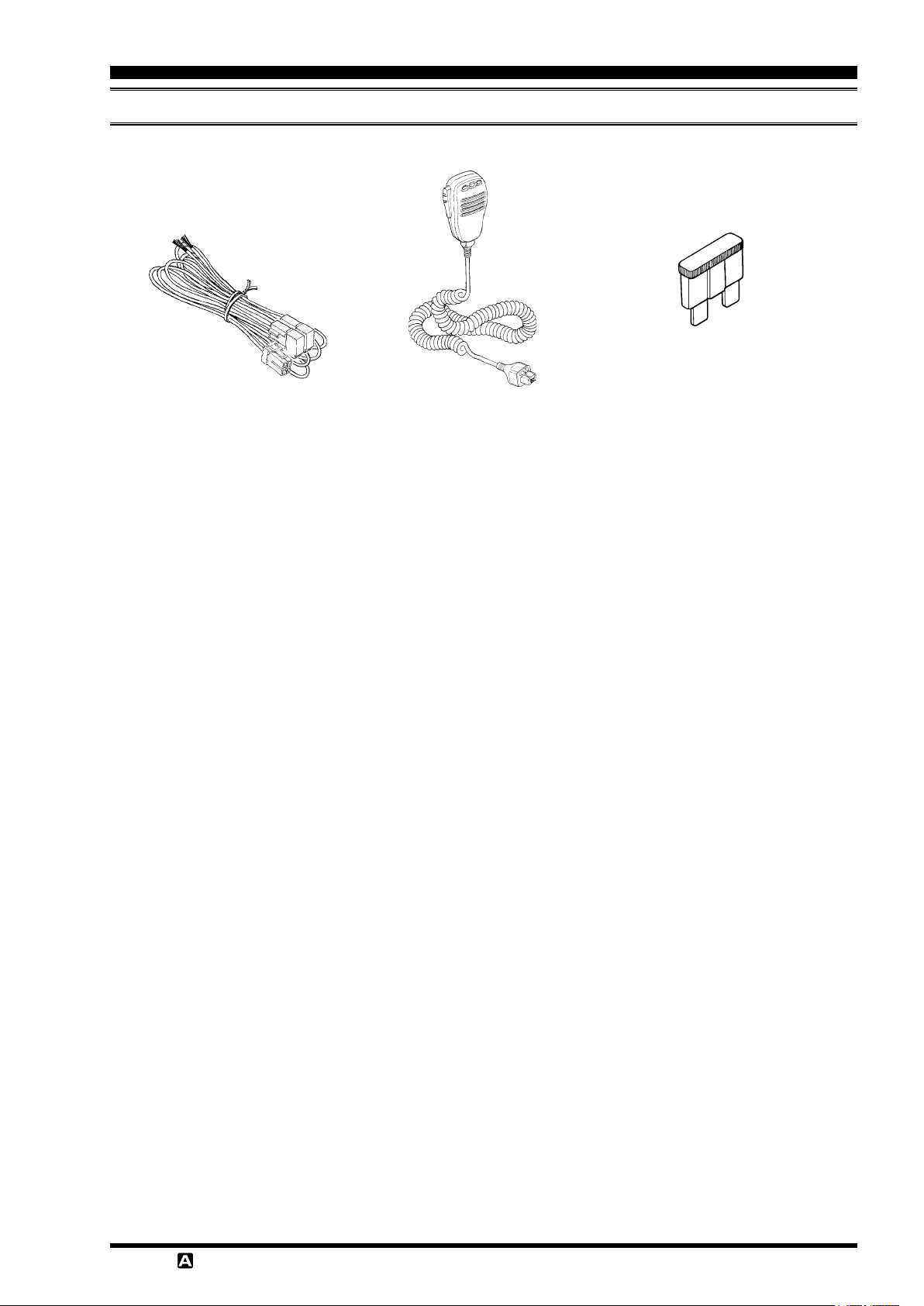
DC Power Cord Hand Microphone
Operating Manual
Warranty Card
World Map
Sticker
The illustrations above may vary slightly from the actual accessories.
(
MH-31
A8J
)
Spare Fuse (25A
)
T-991
OperaTing Manual
Page 7F
Page 10
accessOries & OpTiOns
AvAilAble optionS
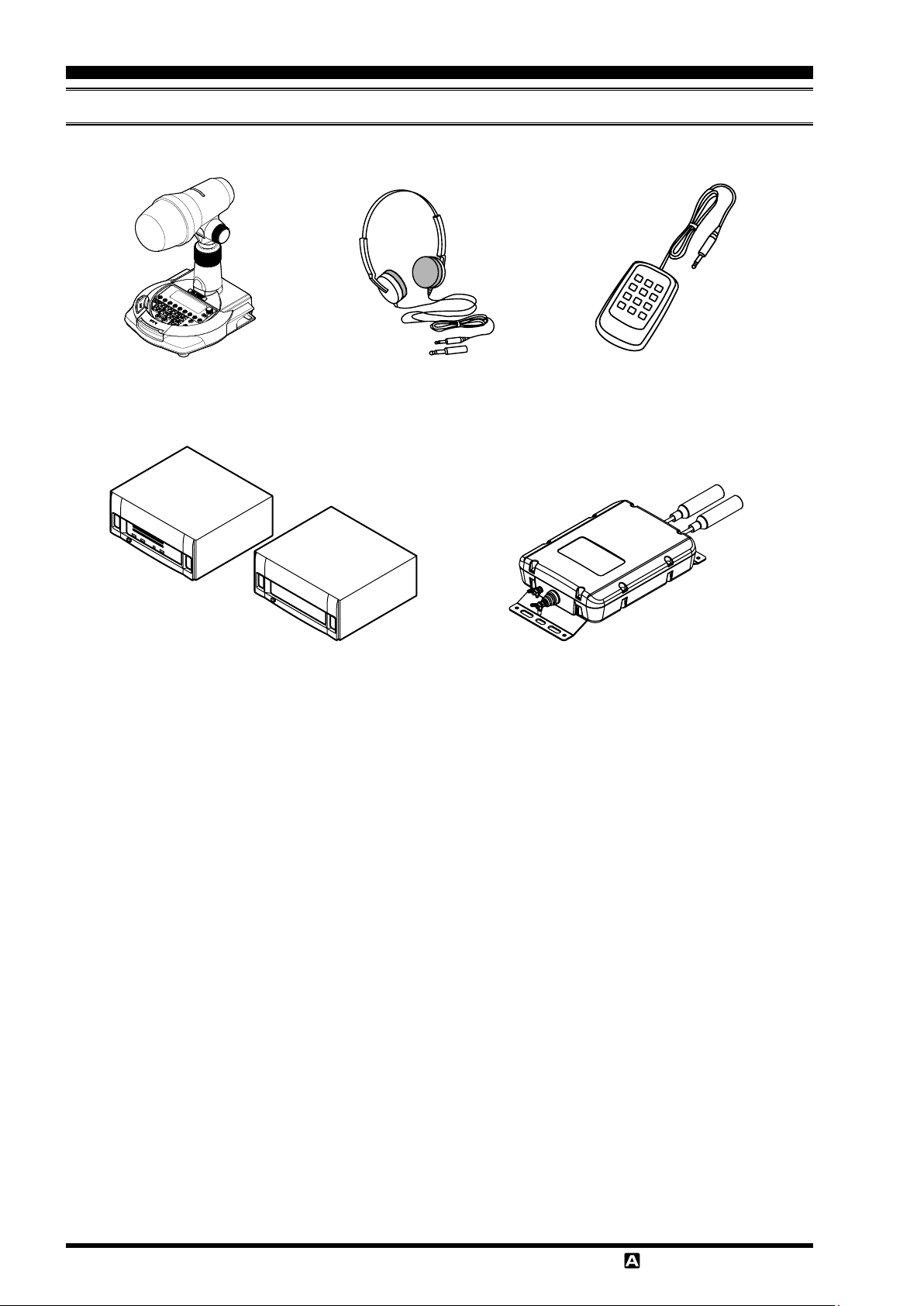
For details, see “Installation of Optional Accessories” on page 141 or the catalog.
Reference Microphone
M-1
Linear Amplier/AC Power Supply
VL-1000/VP-1000
Others
Hand Microphone
DTMF Hand Microphone
Dual Element Microphone
Ultra-High-Fidelity Desktop Microphone
Desktop Microphone
Active Tuning Antenna (Automatic Type)
Antenna Base Kit
Active Tuning Antenna (Manual Type)
Mobile Bracket
External Power Supply (13.8 VDC 23 A)
External Power Supply (13.8 VDC 25 A)
VL-1000
Packet Interface Cable
Linear Amplier Connection Cable
Lightweight Stereo Headphone
YH-77STA
A8J
MH-31
MH-36
M-100
MD-200
MD-100
ATAS-120A
ATBK-100
ATAS-25
MMB-90
FP-1023A
FP-1030A
CT-58
CT-39A
(equivalent to the supplied microphone
E8J
A8X
A8X
(U.S.A. only
Remote Control Keypad
FH-2
External Automatic Antenna Tuner
FC-40
)
)
Page 8 F
T-991
OperaTing Manual
Page 11
beFOre yOu begin
bASe StAtion Wire StAnd
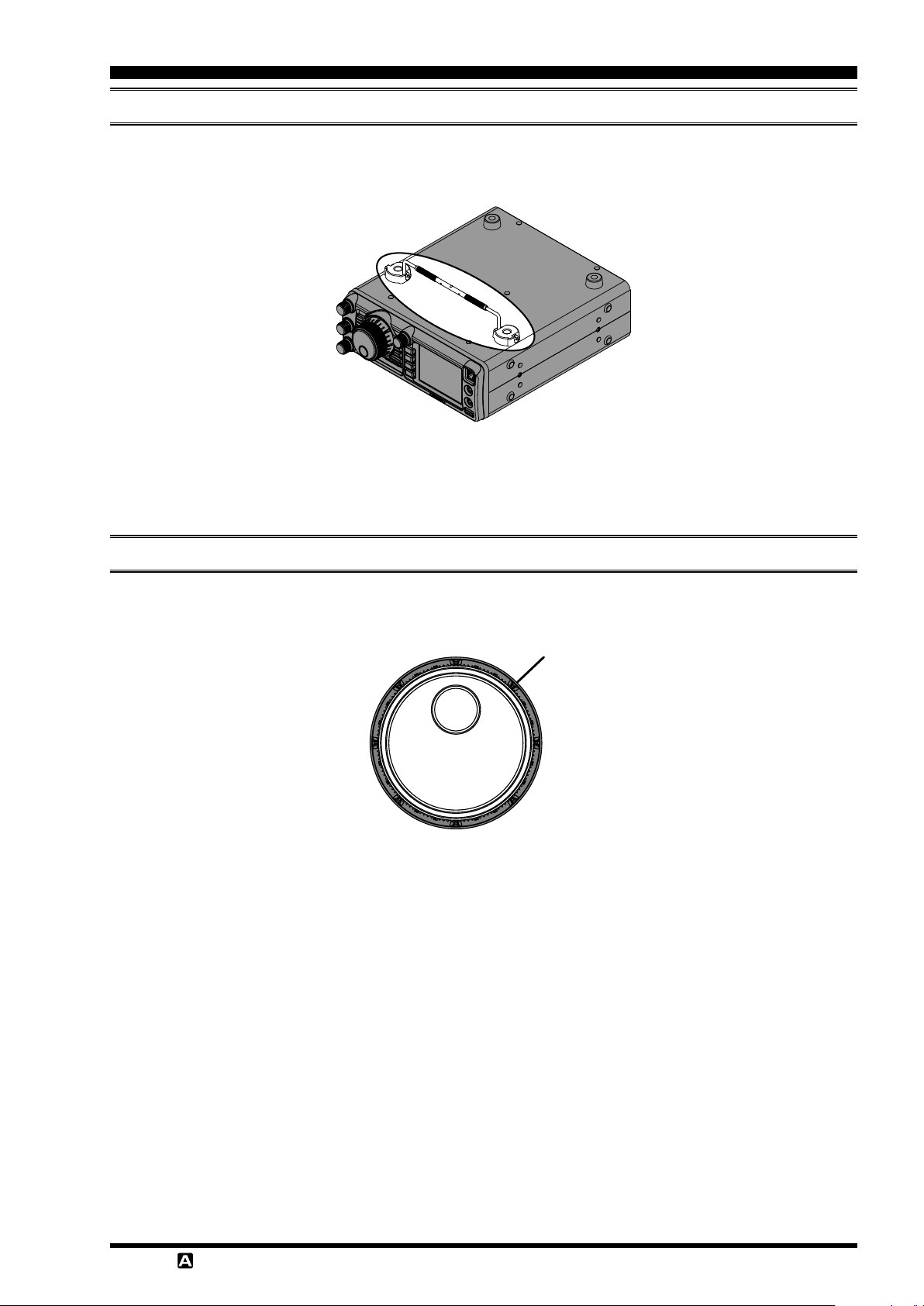
The heavy wire stand on the bottom of the transceiver allows the transceiver to be tilted upward for better viewing. Simply fold the stand forward to raise the front of the transceiver, and fold it back against the bottom case to lower the front
of the
FT-991A
.
AdjuSting the MAin tuning diAl torque
The torque (drag) of the Main Tuning Dial knob may be adjusted according to your preferences. Rotate the skirt at the
base of the knob clockwise to reduce the drag, or counter-clockwise to increase the drag.
Skirt
T-991
OperaTing Manual
Page 9F
Page 12
beFOre yOu begin
AdjuSting the clock
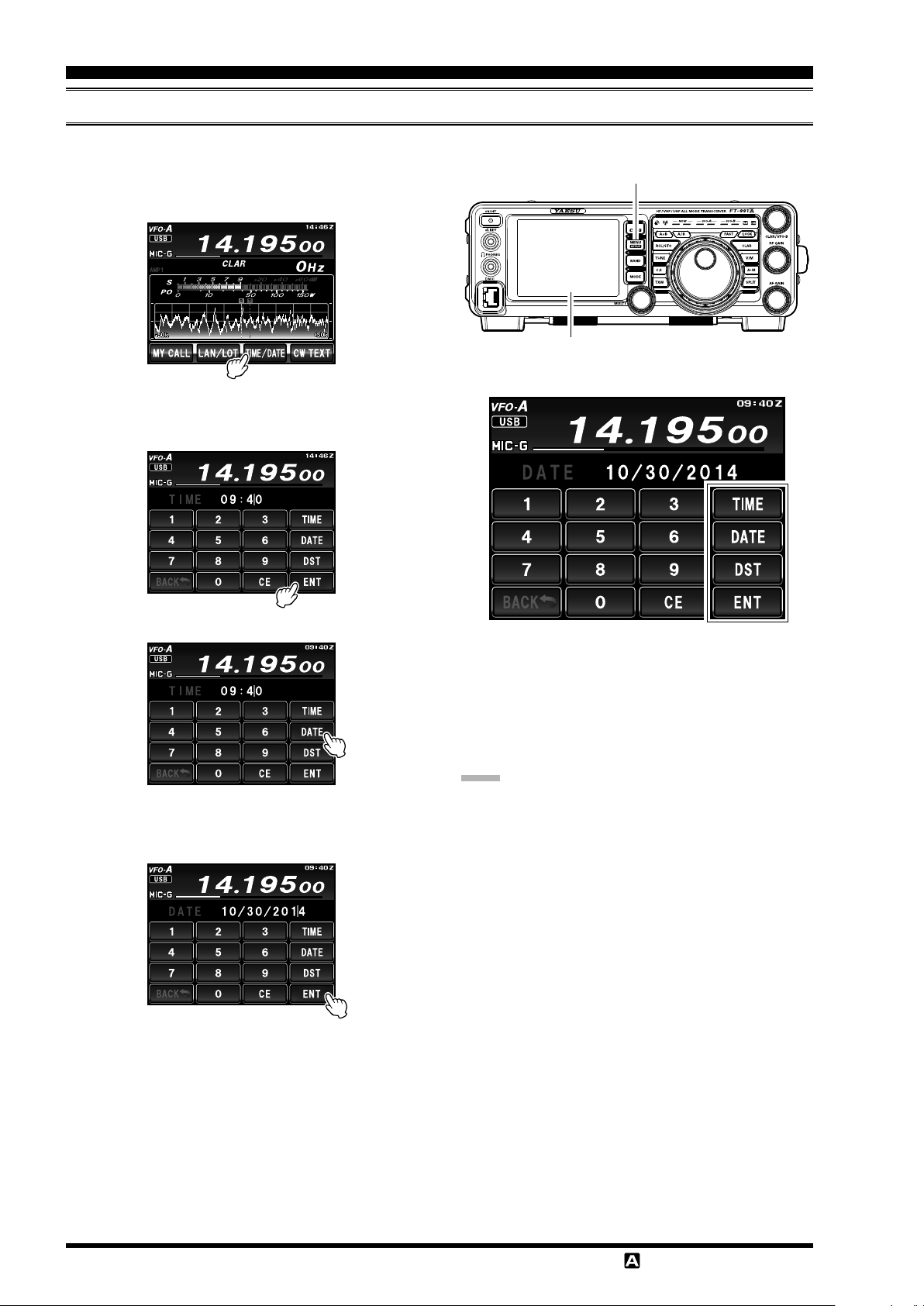
Use the following procedure to adjust the clock shown at the top right of the LCD display.
1. Press and hold the
2. Touch
3. Enter the present time with the number keys on the
[
TIME/DATE
LCD, then touch
MENU(SETUP
]
on the LCD.
[
]
.
ENT
)
button.
MENU(SETUP)
LCD
button
[
4. Touch
5. Enter month, day, and year with the number keys on
the LCD, then touch
6. Touch
mode display.
7. Press the
radio operation display.
]
DATE
[
on the LCD to switch the screen.
]
BACK
on the LCD to return to the setup
MENU(SETUP
[
]
.
ENT
)
button to return to the
[
Sets the time display. Touching this button toggles be-
tween UTC (Coordinated Universal Time) and the local
time. When UTC is displayed, “Z” appears on the right
side of the time.
note:
The user may decide the time preference.
The Local or UTC time must be set manually; the
time does not adjust automatically when the setting is
switched between Local and UTC time.
Only the “Z” indicator for UTC is changed.
[
Sets the date display. Touching this button toggles between MM/DD/YYYY and YYYY/MM/DD.
[
Touching this button switches daylight saving time be-
tween ON and OFF. When daylight saving time is set to
on, “D” appears on the right side of the time.
TIME
DATE
DST
]
]
]
Page 10 F
T-991
OperaTing Manual
Page 13
beFOre yOu begin
inputting the cAll Sign
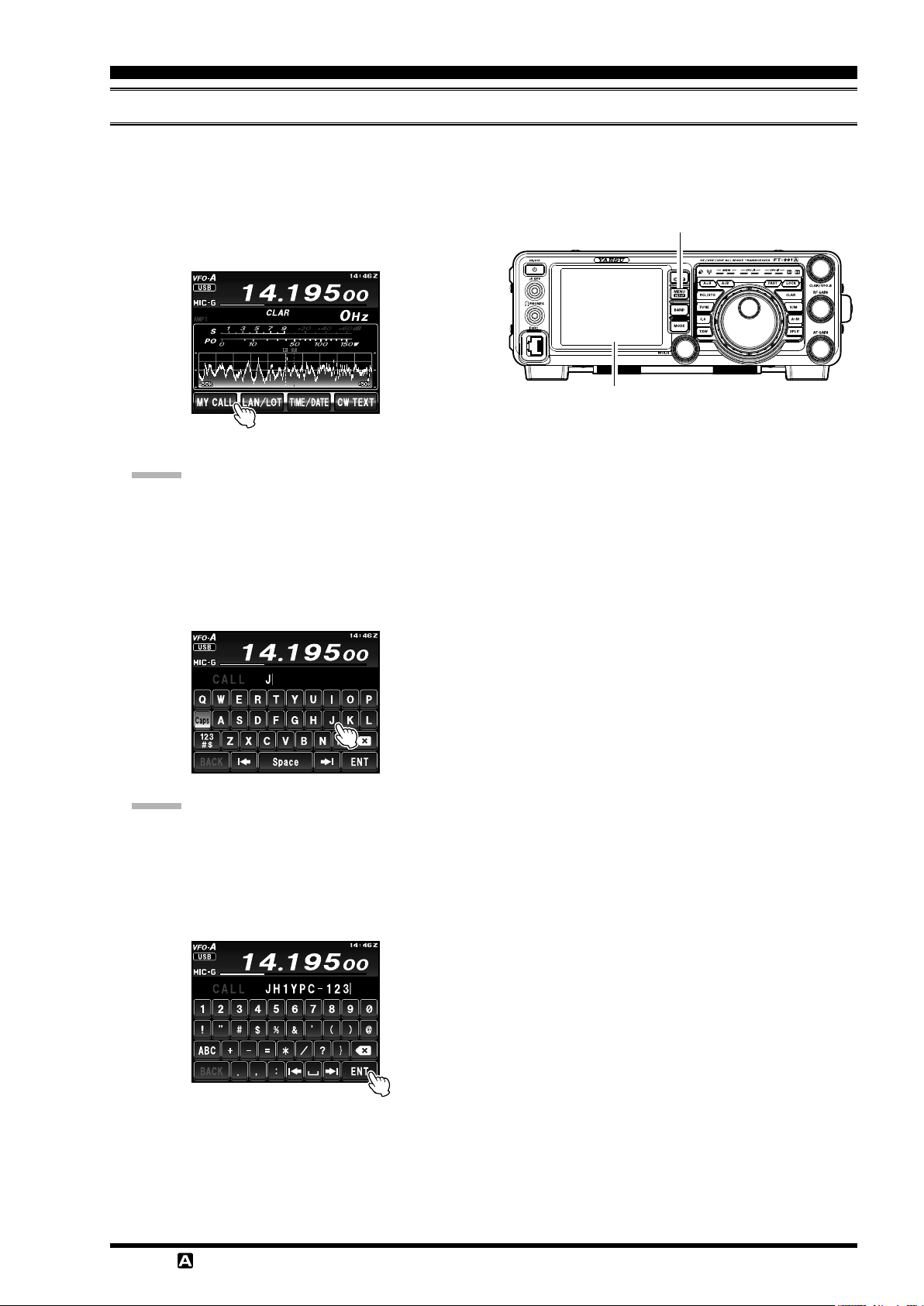
When turning on the power for the rst time after purchase, or after resetting the transceiver, enter your own call sign.
The call sign will be displayed on the start screen when turning on the power and will be used to identify the station
when sending messages during digital communication.
1. Press and hold the
2. Touch
The time duration of the initial call sign start up
3. Touch a character key. The touched character will be
[
MY CALL
Advice:
screen display may be changed from the Menu item
“
005 MY CALL INDICATION
displayed at the top of the screen. Enter each character of your call sign.
MENU(SETUP
]
on the LCD.
)
button.
”.
MENU(SETUP)
LCD
button
Advice:
Up to 10 characters (letters, numbers, and sym-
bols) can be entered.
[
4. Touch
completed and the display will switch to the frequency display screen.
]
on the LCD. The call sign setting is
ENT
T-991
OperaTing Manual
Page 11F
Page 14
beFOre yOu begin
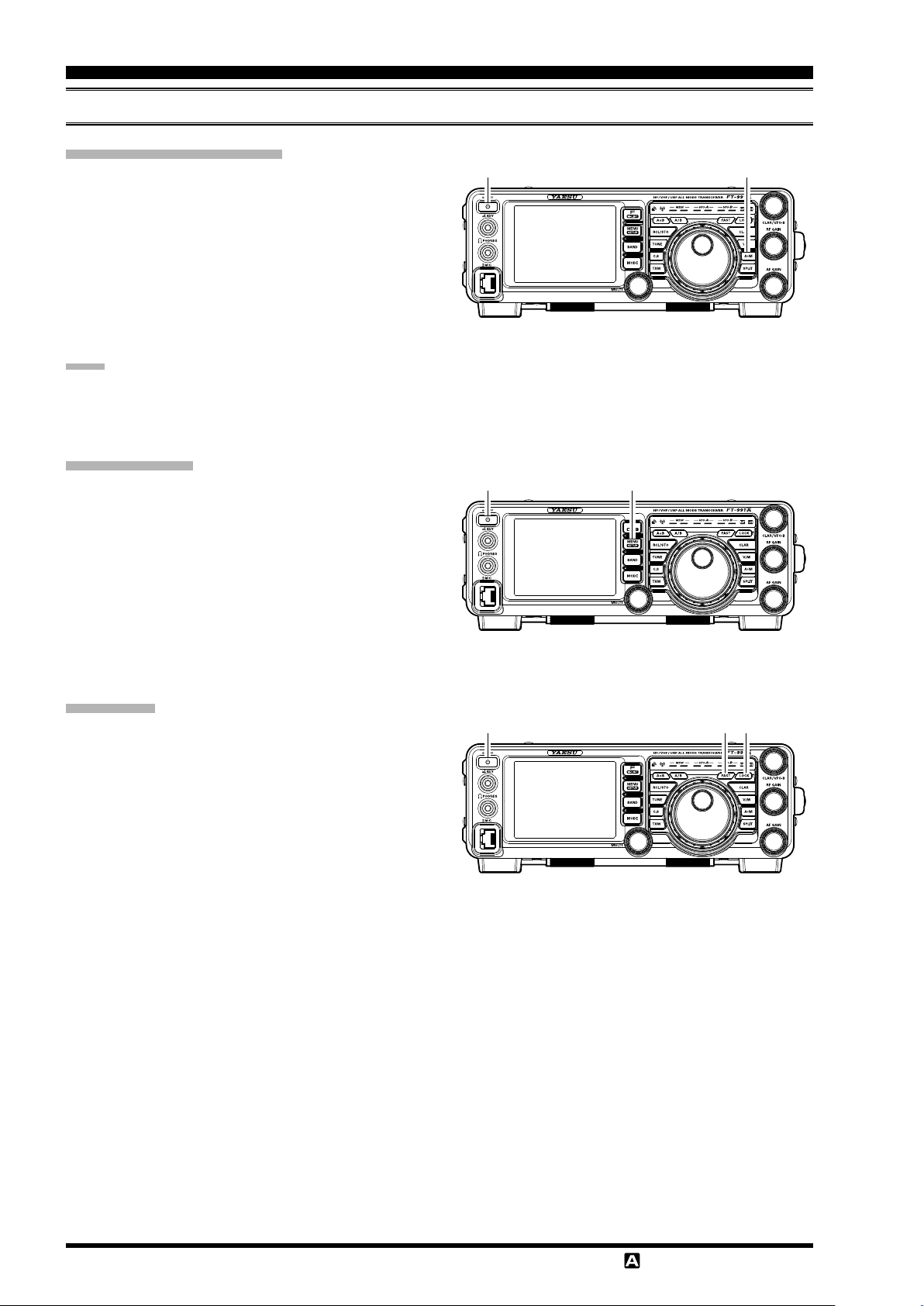
reSetting the MicroproceSSor
reSetting MeMorieS (only
Use this procedure to reset (clear) the previously stored
Memory channels, without affecting any conguration
changes you may have made to the Menu settings.
1. Press the front panel
transceiver off.
2. While holding the
in the front panel
ceiver on. Once the transceiver comes on, you may
release the buttons.
note:
The
(
and “
FT-991A
5-01
cannot erase the memory channels “01”
” through “
A
ON/OFF
5-10
)
ON/OFF
M
”: U.S. version).
switch to turn the
button in, press and hold
switch to turn the trans-
Menu reSetting
Use this procedure to restore the Menu settings to their
factory defaults, without affecting the programmed
memories.
1. Press the front panel
transceiver off.
2. While holding the
and hold in the front panel
the transceiver on. Once the transceiver comes on,
release the buttons.
ON/OFF
MENU(SETUP
switch to turn the
)
button in, press
ON/OFF
switch to turn
AM buttonON/OFF Switch
MENU(SETUP) ButtonON/OFF Switch
Full reSet
Use this procedure to restore all Menu and Memory settings to their original factory defaults. All Memories will
be cleared by this procedure.
1. Press the front panel
transceiver off.
2. While holding the
press and hold in the front panel
turn the transceiver on. Once the transceiver comes
on, release the buttons.
ON/OFF
FAST
switch to turn the
and
LOCK
ON/OFF
buttons in,
switch to
FAST Button LOCK ButtonON/OFF Switch
Page 12 F
T-991
OperaTing Manual
Page 15
beFOre yOu begin
AntennA conSiderAtionS
The
FT-991A
erating frequency. While minor excursions from the 50-Ohm specication are of no consequence, if the Standing Wave
Ratio (SWR) present at the Antenna jack is greater than 3:1, the transceiver’s Automatic Antenna Tuner may not be able
to reduce the impedance mismatch to an acceptable value.
Every effort should be made to ensure that the impedance of the antenna system be as close as possible to the specied
50-Ohm value. Note that the “G5RV” type antenna does not provide a 50-Ohm impedance on all HF Amateur bands. An
external wide-range antenna coupler must be used with this antenna type.
Any antenna to be used with the
when using a “balanced” antenna such as a dipole, remember that a balun or other matching/balancing device must be
used to ensure proper antenna performance.
The same precautions apply to any additional (receive-only) antennas connected to the antenna jacks. If the receive only
antennas do not have impedance near 50 Ohms at the operating frequency, It may be necessary to install an external antenna tuner to obtain optimum performance.
is designed for use with any antenna system providing a 50 Ohm resistive impedance at the desired op-
FT-991A
must be fed from the transceiver with 50 Ohm coaxial cable. Therefore,
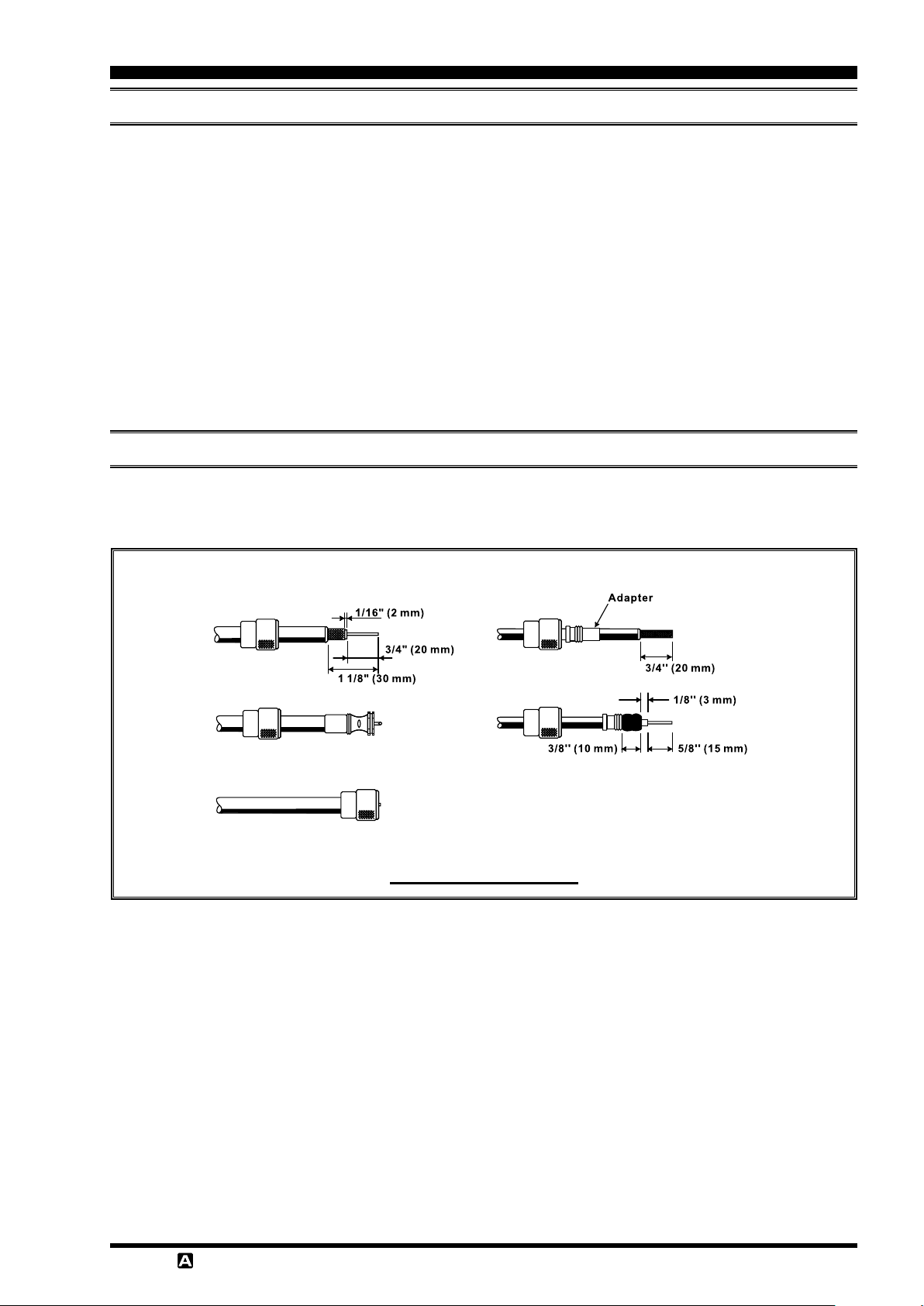
About coAxiAl cAble
Use high-quality 50-Ohm coaxial cable for the lead-in to your
antenna system will be wasted if poor quality, lossy coaxial cable is used. This transceiver utilizes standard “M” (“PL259”) type connectors.
FT-991A
transceiver. All efforts at providing an efcient
T-991
OperaTing Manual
typicAl pl-259 inStAllAtion
Page 13F
Page 16
beFOre yOu begin
GND
Transceiver
GND
Linear
Amplifier
GND
TNC
"Daisy Chain"
GND
Linear
Amplifier
GND
TNC
GND
Transceiver
GND
Transceiver
GND
Linear
Amplifier
GND
TNC
"Daisy Chain"
grounding
The
FT-991A
transceiver, like any other HF communications apparatus, requires an effective ground system for maxi-
mum electrical safety and best communications effectiveness. A good ground system can contribute to station efciency
in a number of ways:
It can minimize the possibility of electrical shock to the operator.
It can minimize RF currents owing on the shield of the coaxial cable and the chassis of the transceiver. Such cur-
rents may lead to radiation, which can cause interference to home entertainment devices or laboratory test equipment.
It can minimize the possibility of erratic transceiver/accessory operation caused by RF feedback and/or improper
current ow through logic devices.
An effective earth ground system may take several forms. For a more complete discussion, see an appropriate RF engineering text. The information below is intended only as a guideline.
Typically, the ground connection consists of one or more copper-clad steel rods, driven into the ground. If multiple
ground rods are used, they should be positioned in a “V” conguration and bonded together at the base of the “V” which
is nearest the station location. Use a heavy, braided cable (such as the discarded shield from type RG-213 coaxial cable)
and strong cable clamps to secure the braided cable(s) to the ground rods. Be sure to weatherproof the connections
to ensure many years of reliable service. Use the same type of heavy, braided cable for the connections to the station
ground bus (described below).
Inside the station, a common ground bus consisting of a copper pipe of at least 25 mm diameter should be used. An alternative station ground bus may consist of a wide copper plate (single-sided circuit board material is ideal) secured to
the bottom of the operating desk. Grounding connections from individual transceivers, power supplies, and data communications devices (TNCs, etc.) should be made directly to the ground bus using a heavy, braided cable.
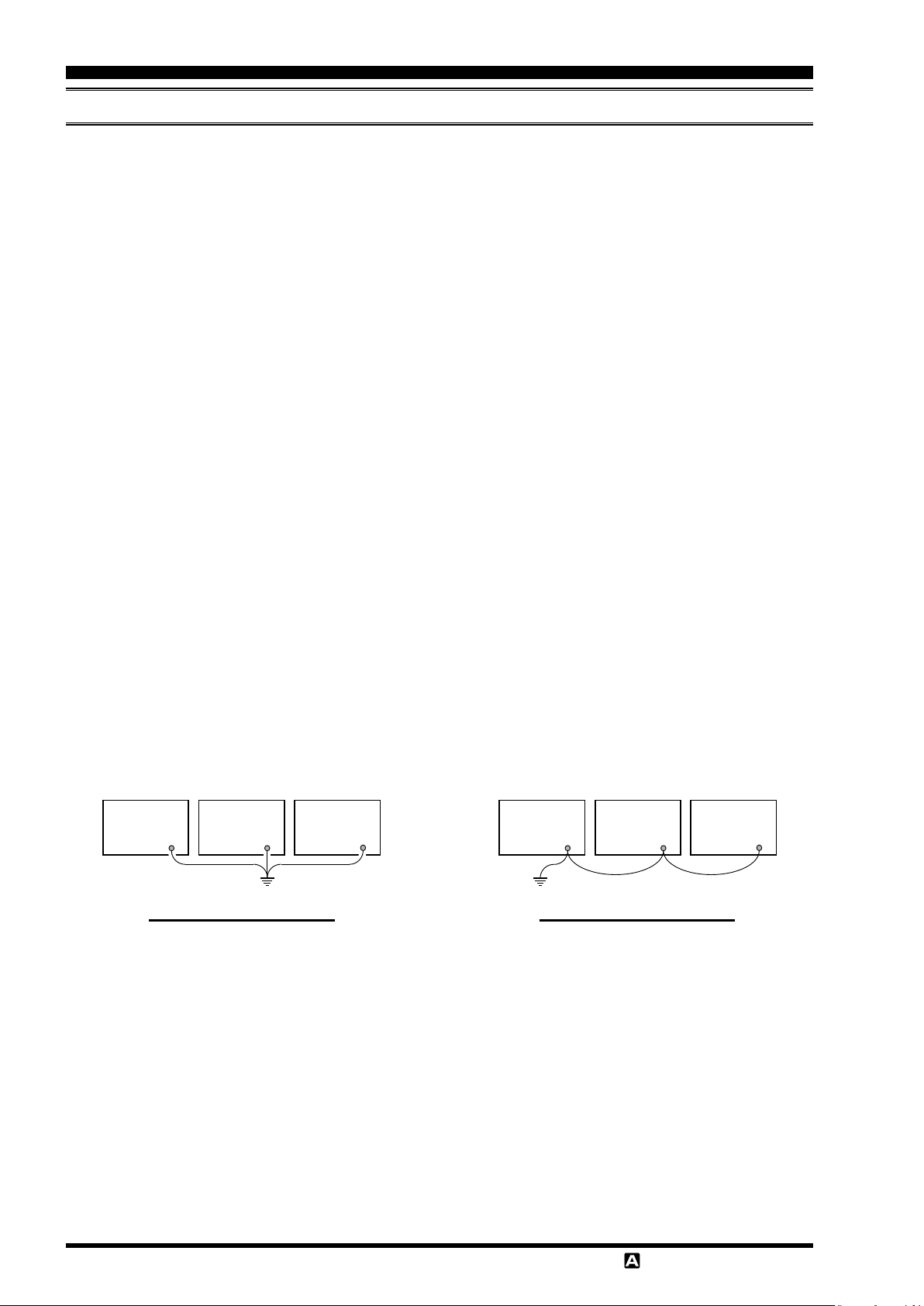
Do not “Daisy-Chain” ground connections from one electrical device to another and thence to the ground bus. This
method may nullify any attempt at effective radio frequency grounding. See the drawing below for examples of proper
grounding techniques.
Inspect the ground system - inside the station as well as outside - on a regular basis to ensure continued performance
and safety.
Besides following the above guidelines carefully, note that household or industrial gas lines must never be used in an
attempt to establish an electrical ground. Cold water pipes may, in some instances, help in the grounding effort, but gas
lines represent a signicant explosion hazard, and must never be used.
proper ground connection
iMproper ground connection
Page 14 F
T-991
OperaTing Manual
Page 17
beFOre yOu begin
connection oF AntennA And poWer cAbleS
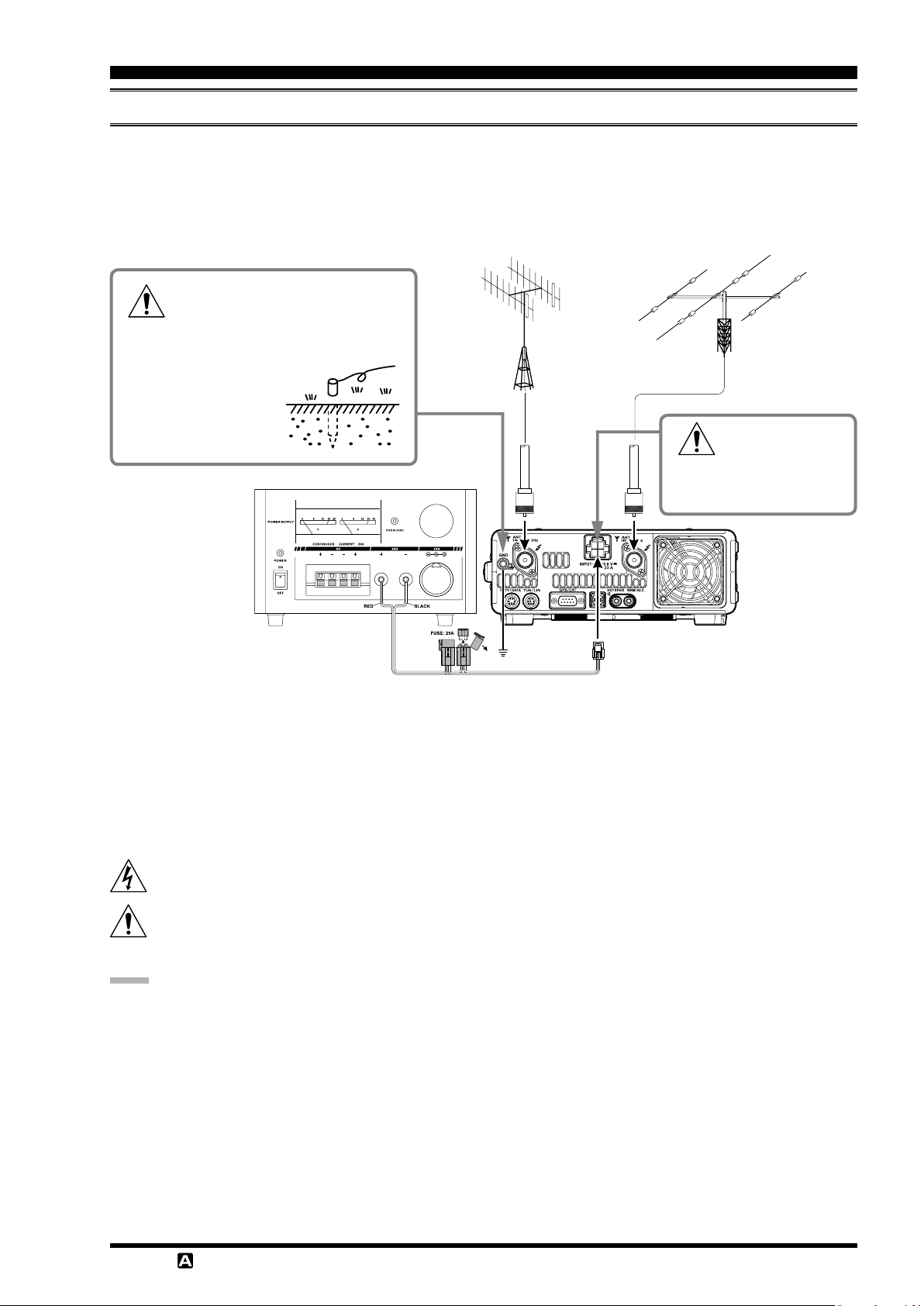
Please follow the outline in the illustration regarding the proper connection of antenna coaxial cables, as well as the DC
power cable. The DC power connector for the
(
±15 %), and capable of at least 23 Amperes of current. Always observe proper polarity when making DC connection:
The RED DC power lead connects to the Positive (+) DC terminal.
The BLACK DC power lead connects to the Negative (–) DC terminal.
To prevent damage from lightning, atmospheric electricity, electrical shock
etc., please provide a good earth ground.
Use a short, thick, braided cable to connect your
station equipment to the
buried ground rod (or
alternative earth ground
system).
FT-991A
must only be connected to a DC source providing 13.8 Volts DC
Check the DC volt-
age and current
rating (+13.8 V, 23 A) of the
power supply before connecting to the transceiver.
We recommend the use of the
be used with the
lines described above must be strictly followed.
Note that other manufacturers may use the same type of DC power connections as the
the wiring configuration may be different from that specified for the
caused if improper DC connections are made; consult with a qualied service technician when in doubt.
High RF voltage is present in the TX RF section of the transceiver while transmitting.
Absolutely! Do not touch the TX RF section while transmitting.
Permanent damage can result when improper supply voltage, or reverse-polarity voltage, is applied to the
991A
verse polarity DC, or DC voltage outside the specied range of 13.8 V ±15 %. When replacing fuses, be certain
to use a fuse of the proper rating. The
note:
Do not place the
Do not place the
Ensure adequate ventilation around the
due to high heat.
Do not install the
from above.
To minimize the possibility of interference to home entertainment devices, take all precautionary steps including
separation of TV/FM antennas from Amateur transmitting antennas to the greatest extent possible, and keep transmitting coaxial cables separated from cables connected to home entertainment devices.
Ensure that the DC power cord is not subject to undue stress or bending, which could damage the cable or cause it to
be accidentally unplugged from the rear panel
Be certain to install your transmitting antenna(s) so they cannot possibly come in contact with TV/FM radio or other
antennas, or with power or telephone lines.
FT-991A
. The Limited Warranty on this transceiver does not cover damage caused by application of AC voltage, re-
FT-991A
FT-991A
FT-991A
FP-1030A
, but the 13.8 VDC input voltage, 23 Ampere current capability, and DC cable polarity guide-
in a location with direct exposure to sunshine.
in a location exposed to dust and/or high humidity.
on an unstable desk or table. Do not place it in a location where objects may fall onto it
(USA market only) AC Power Supply. Other models of power supplies may
transceiver; however,
FT-991A
FT-991A
FT-991A
FT-991A
requires a 25 Amp blade fuse.
, to prevent heat build-up and possible reduction of performance
jack.
DC IN
transceiver. Serious damage can be
FT-
T-991
OperaTing Manual
Page 15F
Page 18
insTallaTiOn anD inTercOnnecTiOns
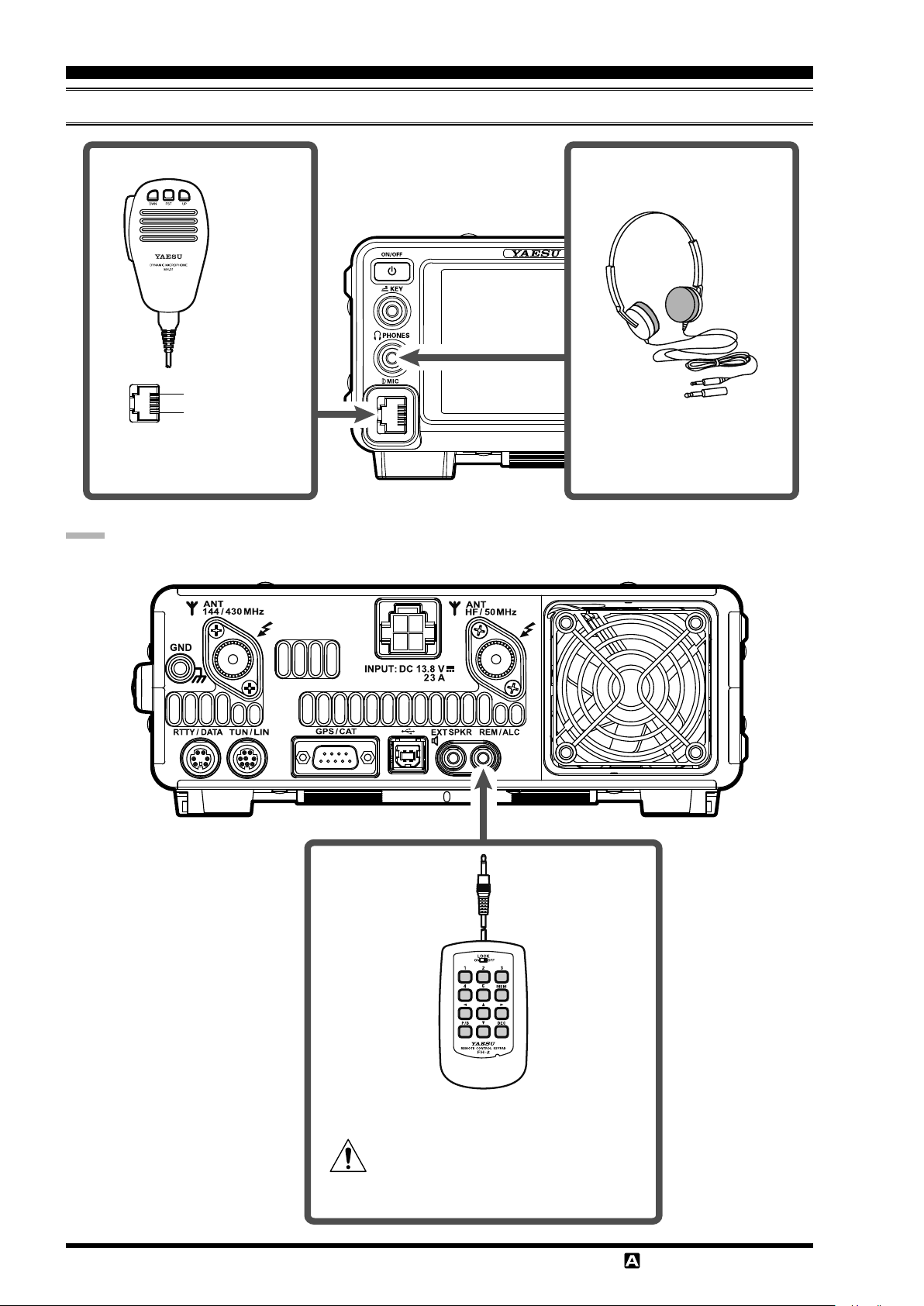
connection oF Microphone, heAdphone And reMote control keypAd
DOWN
UP
+5V
MIC GND
MIC
PTT
GND
FAST
Lightweight Stereo
Headphone
YH-77STA
note:
Make sure to turn off the power of the transceiver before connecting or disconnecting the microphone.
Remote Control Keypad
FH-2
If the
while the
991A
Turn off the power of the
or disconnecting the
plug is removed from the jack
FH-2
FT-991A
may be switched to the transmit mode.
FH-2
is in operation, the
FT-991A
.
before connecting
Page 16 F
T-991
FT-
OperaTing Manual
Page 19
insTallaTiOn anD inTercOnnecTiOns
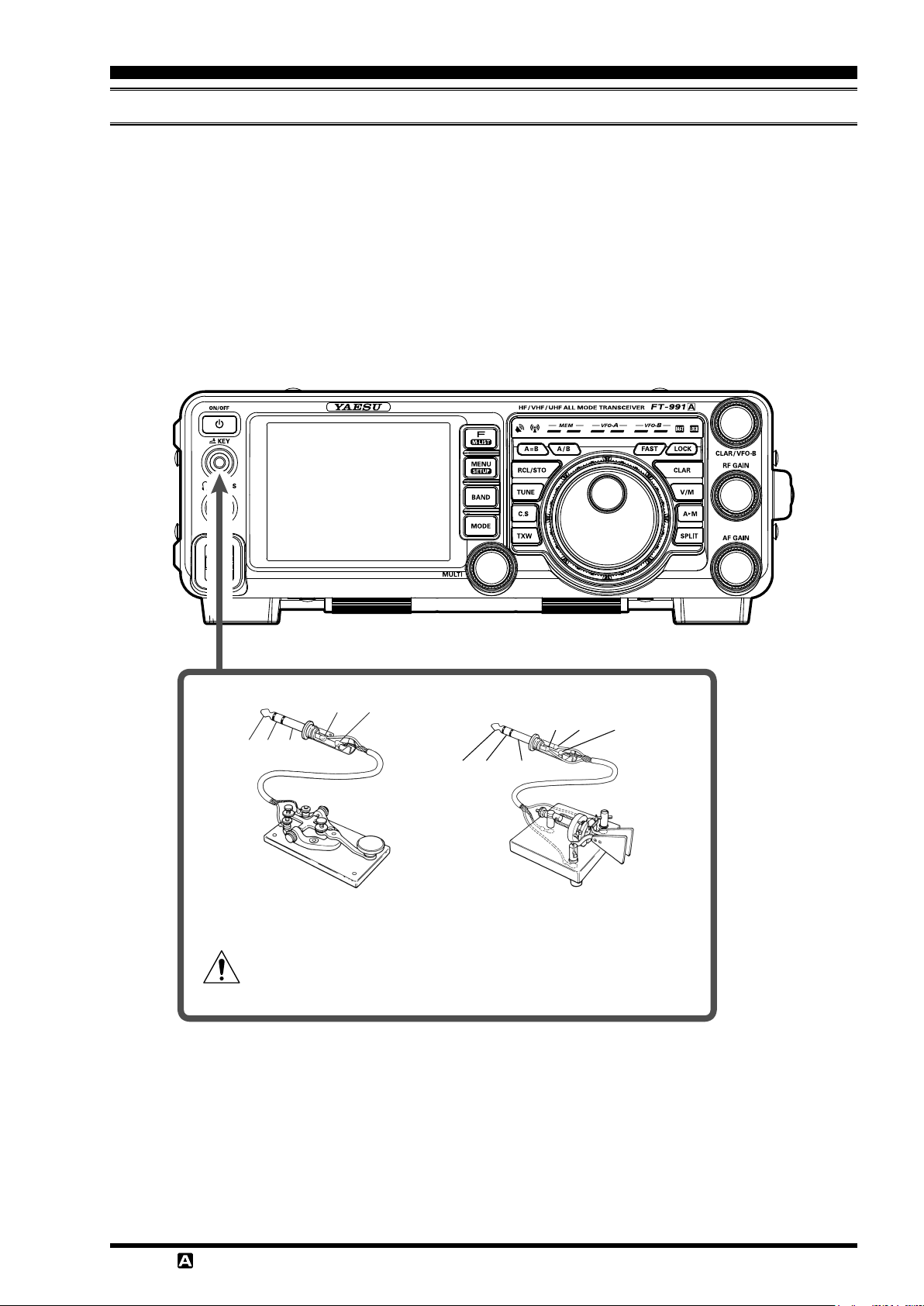
key, keyer, And coMputer-driven keying interconnectionS
The
FT-991A
later. Besides the built-in Electronic Keyer, two key jacks are provided, one on the front and one on the rear panel, for
convenient connection to keying devices.
The Menu selections permit conguring the front panel
keyer paddle may be connected to the front panel
input.
The
KEY
down current is approximately 4 mA. When connecting a key or other device to the
(
“stereo”) 3.5 mm phone plug; a 2-contact plug will place a short between the ring and shaft (ground) of the plug, result-
ing in a constant “key-down” condition in some circumstances.
includes many features for the CW operator. These functions will be detailed in the “Operation” section
jack according to the device connected. For example, a
KEY
jack on the
FT-991A
jack, and Menu item “
KEY
utilize “Positive” keying voltage. Key-up voltage is approximately +3.3V DC, and key-
012 KEYER TYPE
KEY
” used to select paddle
jack, use only a 3-contact
KEY
GND
KEY
NC GND
DOT DASH COMMON
Single key/Double-speed key Manipulator
If the Keyer plug is removed from the jack while the
the
FT-991A
Turn off the power of the
may be switched to the transmit mode.
FT-991A
before connecting or disconnecting the Keyer.
DOT DASH COMMON
FT-991A
is in operation,
T-991
OperaTing Manual
Page 17F
Page 20
insTallaTiOn anD inTercOnnecTiOns
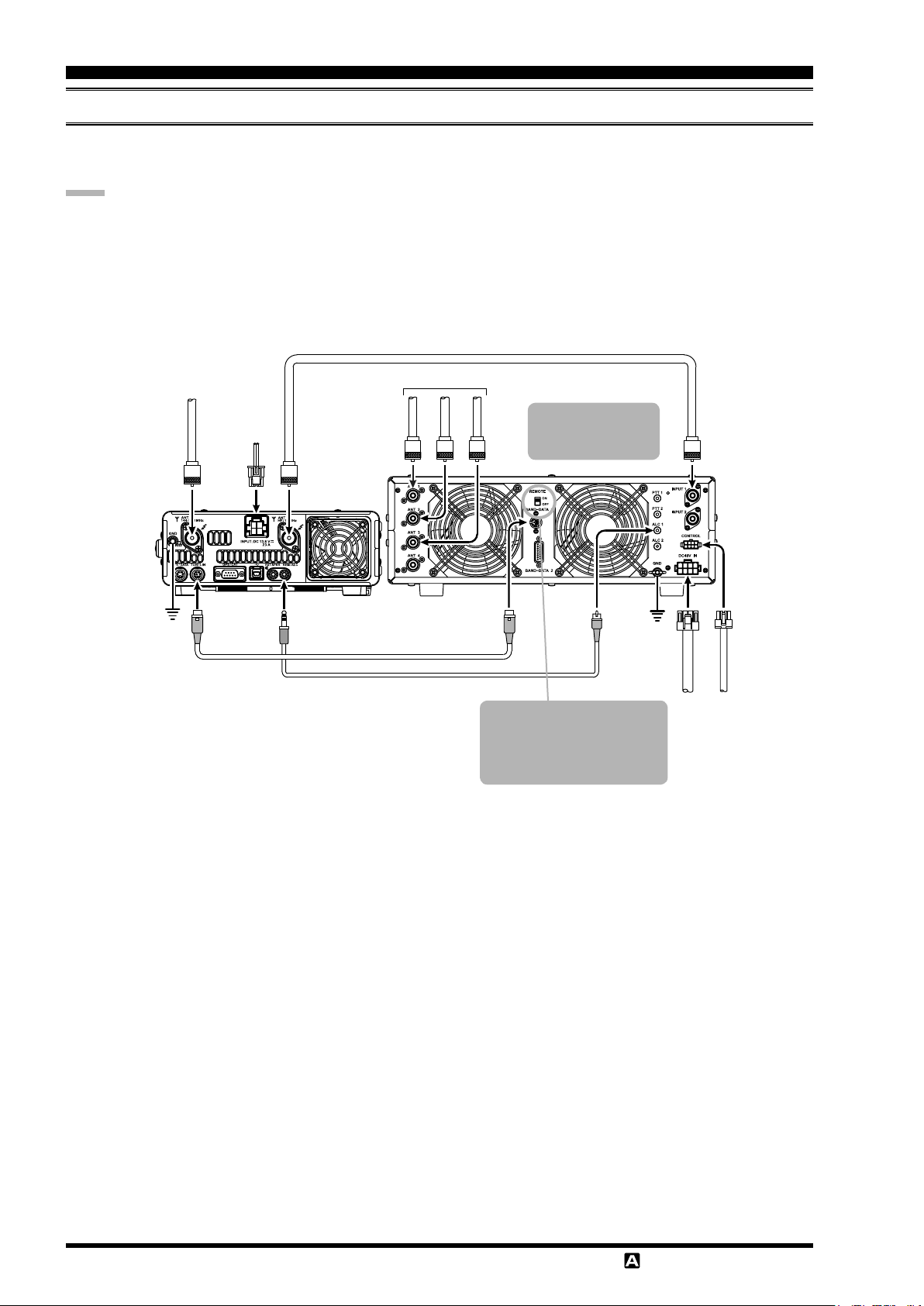
vl-1000 lineAr AMpliFier interconnectionS
Be sure that both the
FT-991A
and
VL-1000
are turned off, and then follow the installation recommendations contained
in the illustration.
note:
Refer to the
Do not attempt to connect or disconnect coaxial cables when your hands are wet.
Set the Menu item “
Since the ALC cable is connected to the
VL-1000
144/430MHz Antenna
ANT
Operating Manual for details regarding amplier operation.
143 TUNER SELECT
DC 13.8 V
144/430MHz
INPUT
REM/ALC
ANT
HF/50MHz
” to “
”.
LAMP
jack, the optional
Coaxial Cable (50Ω)
Connect to “INPUT 1” of the VL-1000
HF/50MHz Antenna
ANT 1
ANT 2
ANT 3
FH-2
Set the front panel’s
INPUT switch to the
“INPUT1”.
cannot be connected.
INPUT 1
GND
TUN/LIN
REM/ALC
CT-58 Band Data Cable (Option)
CT-58 ALC Cable (Option)
To link the FT-991A and VL-
1000 Power switches, set the
VL-1000 REMOTE switch to
the “ON” position.
ALC 1
BAND-DATA 1
GND
VP-1000
CONTROL
DC 48V IN
VP-1000
Page 18 F
T-991
OperaTing Manual
Page 21

insTallaTiOn anD inTercOnnecTiOns
RESET (BAND D)
plug/connector pinout diAgrAMS
MIC GPS/CAT
(
as viewed from front panel
RTTY/DATA TUN/LIN
① ②
③ ④
⑤
⑥
(
as viewed from rear panel
DOWN
UP
+5V
MIC GND
MIC
PTT
GND
FAST
) (
① DATA IN
② GND
③ PTT
④ SHIFT
⑤ DATA OUT
⑥ SQL
) (
⑧⑨ ⑦ ⑥
① DCD
② SERIAL OUT/RXD
(GPS DATA IN)
③ SERIAL IN
④ DTR
⑤ GND
⑥ DSR
⑦ RTS
①②③④⑤
⑧ CTS
⑨ RI
as viewed from rear panel
as viewed from rear panel
+13V OUT
TX GND
GND
TX D (BAND A)
RX D (BAND B)
BAND C
TX INH
)
)
DC IN KEY
(
as viewed from rear panel
EXT SPKR PHONE
SIGNAL GND
TX REQ
Manipulator Single key/Double-speed key
DOT KEY GNDDASH COMMON
)
SIGNAL (RIGHT)
SIGNAL (LEFT)
Do not use
2-conductor type plug
GND
REM/ALC
NC
EXT ALC
T-991
OperaTing Manual
GND
REMOTE
GND
Page 19F
Page 22
FrOnT panel cOnTrOls & swiTches
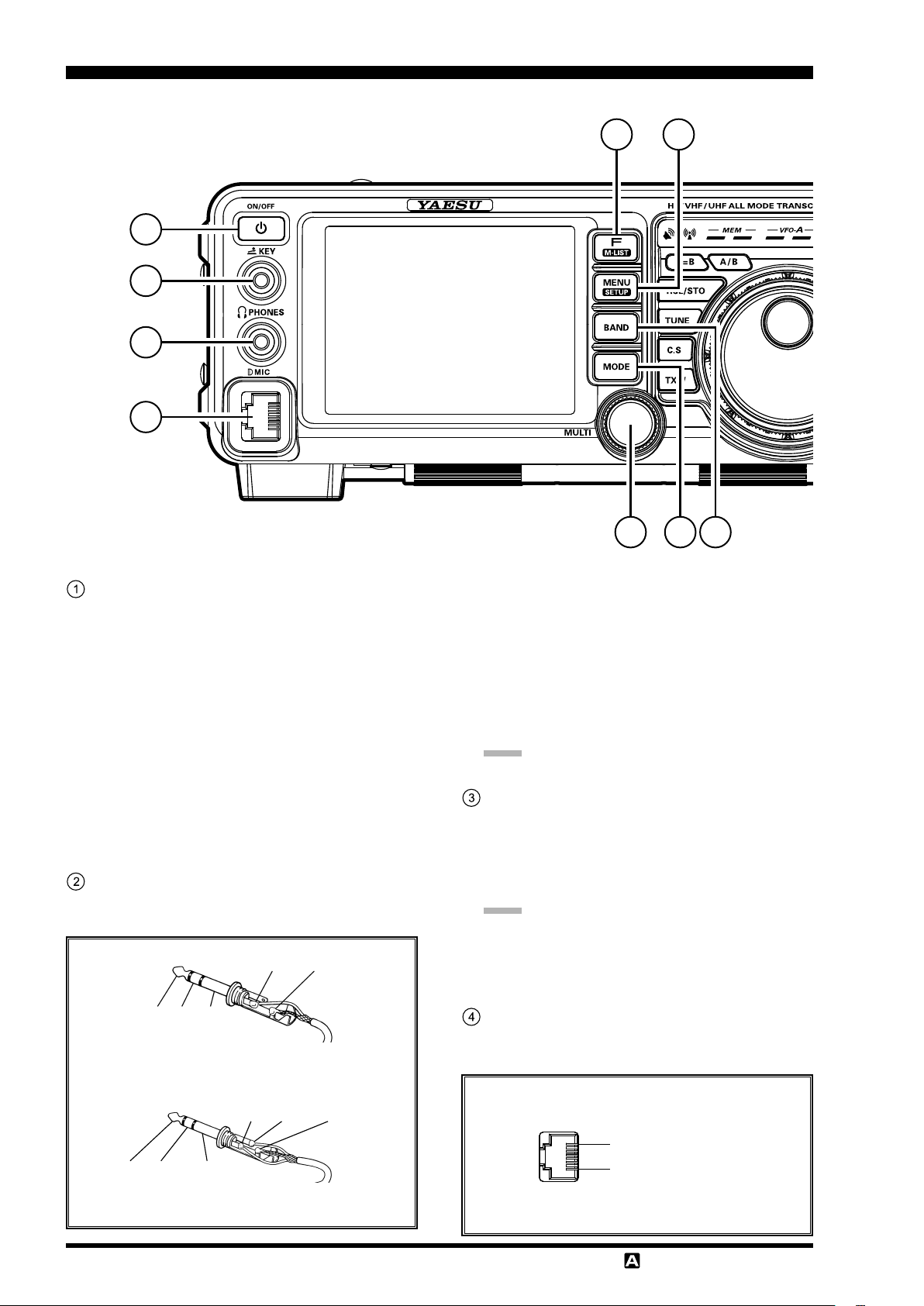
5
6
1
2
3
4
789
ON/OFF Switch
Press and hold in this switch for one second to turn
the transceiver on. Similarly, press and hold in this
switch for one second to turn the transceiver off.
Connect the
m
mercially available DC power supply. Turn the
DC supply on to place the transceiver in standby
mode. The transceiver must be in standby mode
to turn it on using the
tails on how to connect a commercially available
DC power supply, see page 15.
Press the
m
er is on, the receiver audio from the speaker will
be muted for about 3 seconds (Mute function).
FT-991A
ON/OFF
transceiver to a com-
ON/OFF
switch briey while the pow-
switch. For de-
KEY Jack
Connect a telegraph key or electronic keyer paddle
to use for CW mode operation.
KEY
GND
KEY
NC GND
When connecting a single straight key
When connecting a key or other device to the
m
jack, use only a 3-contact (“stereo”) 3.5
KEY
mm phone plug; a 2-contact plug will place a
short between the ring and the (grounded) shaft
of the plug, resulting in a constant “key-down”
condition.
Key-up voltage is +3.3 V, and key-down current
m
is about 4 mA.
note:
A 2-contact plug cannot be used in this jack.
PHONES Jack
Connect headphones to this ϕ3.5 standard stereo
jack.
Inserting a headphone plug into this jack will de-
m
activate the internal and external speakers.
note:
When wearing headphones, we recommend that you
turn the AF Gain levels down to their lowest settings
before turning power on, to minimize the impact on
your hearing caused by audio “
” during switch-on
pops
MIC Jack
This 8-pin jack accepts input from a microphone uti-
lizing a traditional YAESU HF transceiver pinout.
.
DOT DASH COMMON
DOT DASH COMMON
When connecting an electronic keyer paddle
Page 20 F
T-991
DOWN
UP
+5V
MIC GND
MIC
PTT
GND
FAST
OperaTing Manual
Page 23
FrOnT panel cOnTrOls & swiTches
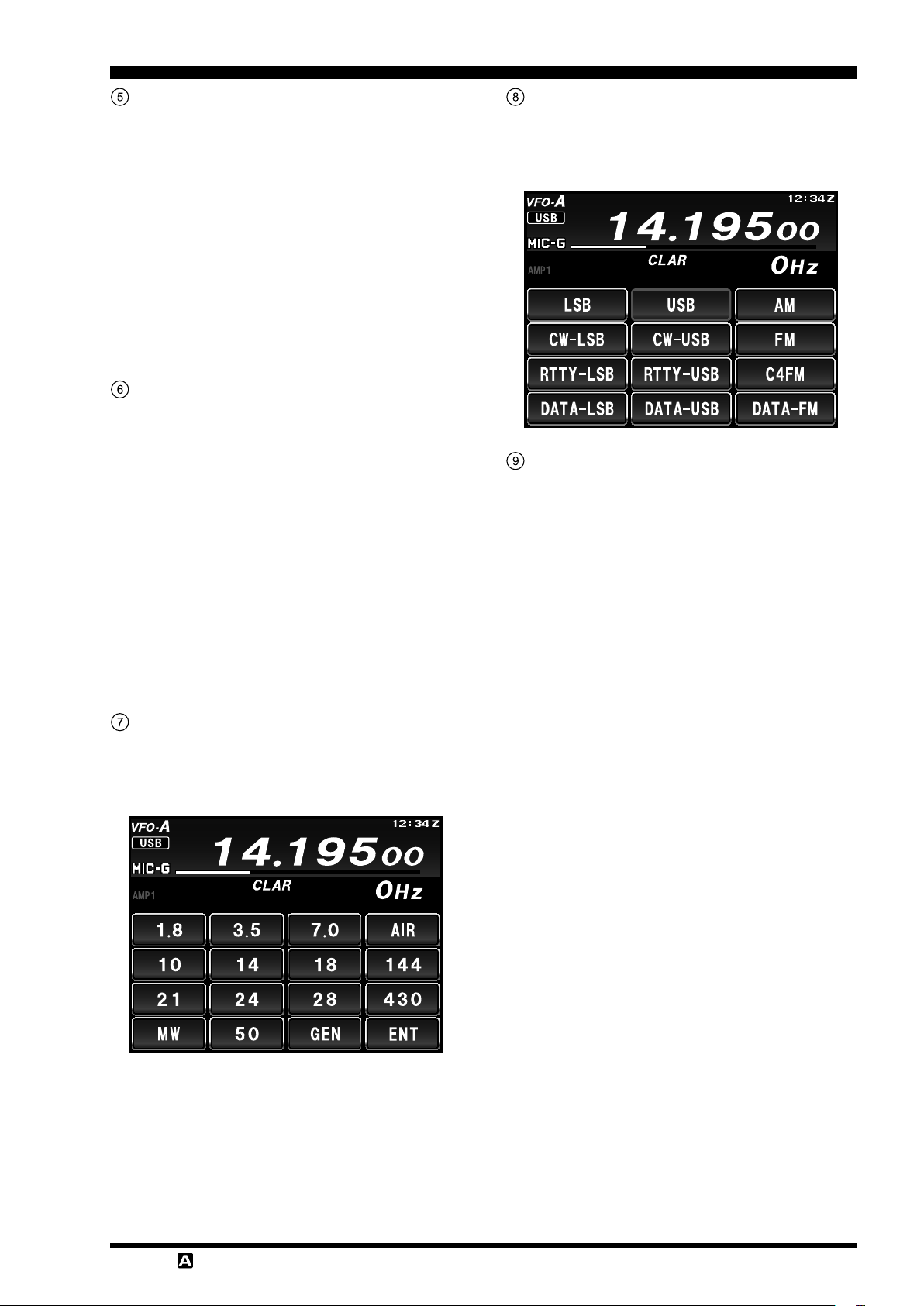
F(M-LIST
Press the button briey to display the function menu
screen where the operation settings for a variety of
functions may be congured.
Press this button again to close the function menu
screen.
Press and hold this button for more than one second
to display the menu list screen where the memory
channel data may be reviewed.
While displaying the memory data, rotate the
m
[
MULTI
channels.
Press this button again to close the memory list
screen.
MENU(SETUP
Press this button briey to display the menu mode
screen (see page 122) where you can set a variety
of functions.
Press this button again (or touch
touch panel) to close the menu mode screen.
Press and hold this button for more than 1 second to
display the setup screen where you can congure the
following settings.
•
MY CALL
•
LAT/LON
114
•
TIME/DATE
10
•
CW TEXT
Press this button again to close the setup screen.
)
Button
]
knob to review all data in memory
)
Button
[
BACK
: Setting the call sign (see page 11
: Setting longitude/latitude (see page
)
: Setting date and time (see page
)
: Entering CW TEXT (see page 89
]
on the
)
)
MODE Button
Switch the radio modulation form (operating mode).
Press this button to display the radio modulation
form selection screen, then touch and select your desired modulation form.
MULTI Knob
Adjust transmit output, microphone gain and opera-
tions of other functions (see page 24).
BAND Button
Switch the operation band (operation frequency
band). Press this button to display the operation band
selection screen, then touch and select the desired
band.
T-991
OperaTing Manual
Page 21F
Page 24
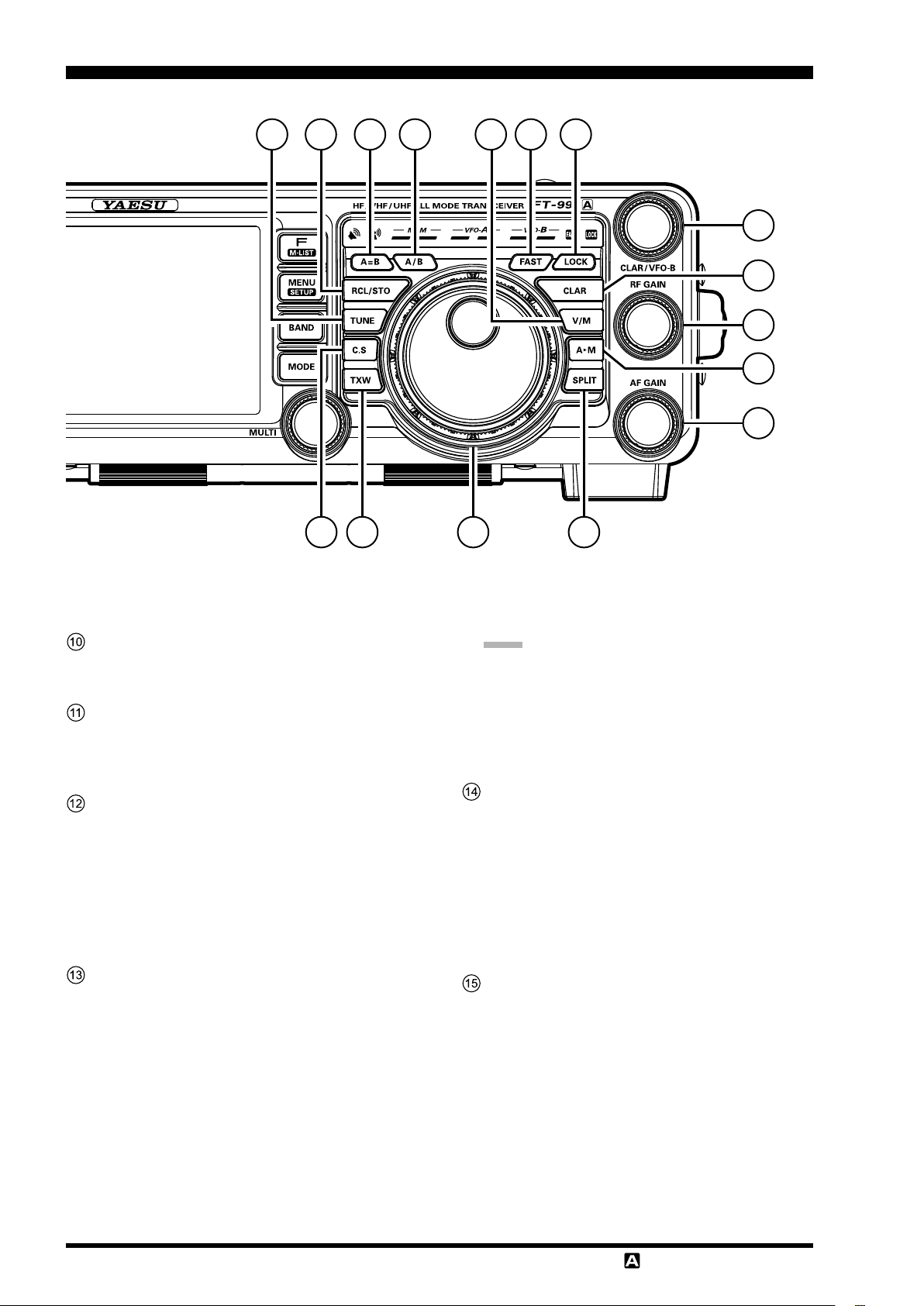
FrOnT panel cOnTrOls & swiTches
1213
201110 1817
23
19
24
21
25
1514
16
22
A=B Button
Pressing this button momentarily, sets the same fre-
quency and data values of VFO-A to VFO-B.
A/B Button
Pressing this button momentarily, exchanges the
frequency and memory channel data, of VFO-A and
VFO-B.
RCL/STO Button
Press and hold this button for more than one second
to write the frequency and data currently set for
VFO-A onto the quick memory bank (QMB) (see
page 99).
5 channels are available for QMB memories.
m
Press the button briey to recall the data written onto
the quick memory banks (QMB) one by one.
TUNE Button
This is the on/off switch for the
Antenna Tuner.
Press the
m
“
TUNER
vate the antenna tuner.
Press the
“
TUNER
tuner.
Press the
m
start “automatic tuning”. The “
tor will ash.
[
” indicator on the touch panel and acti-
[
TUNE
” indicator off and disable the antenna
[
]
TUNE
TUNE
button briefly to display the
]
button briey again to turn the
]
button for about 1 second to
FT-991A
Automatic
TUNER
” indica-
note:
Since the transceiver transmits automatically dur-
ing automatic tuning, make sure to connect an
antenna or dummy load before tuning up.
When the antenna or dummy load does not match
the impedance, “
touch panel.
HI-SWR
” will appear on the
C.S Button
Press this button momentarily to directly recall a fa-
vorite Menu Selection.
To program a Menu selection to the
m
press the
Menu. Select the Menu item you want to set as
the short cut. Press the
MENU(SETUP
lected Menu item as the short cut.
MENU(SETUP
)
button; this will lock in the se-
)
button to enter the
button, then press the
C.S
C.S
button,
TXW Button
During a split operation, press and hold the
button to listen on the transmitter frequency while
holding the button.
TWX
Page 22 F
T-991
OperaTing Manual
Page 25
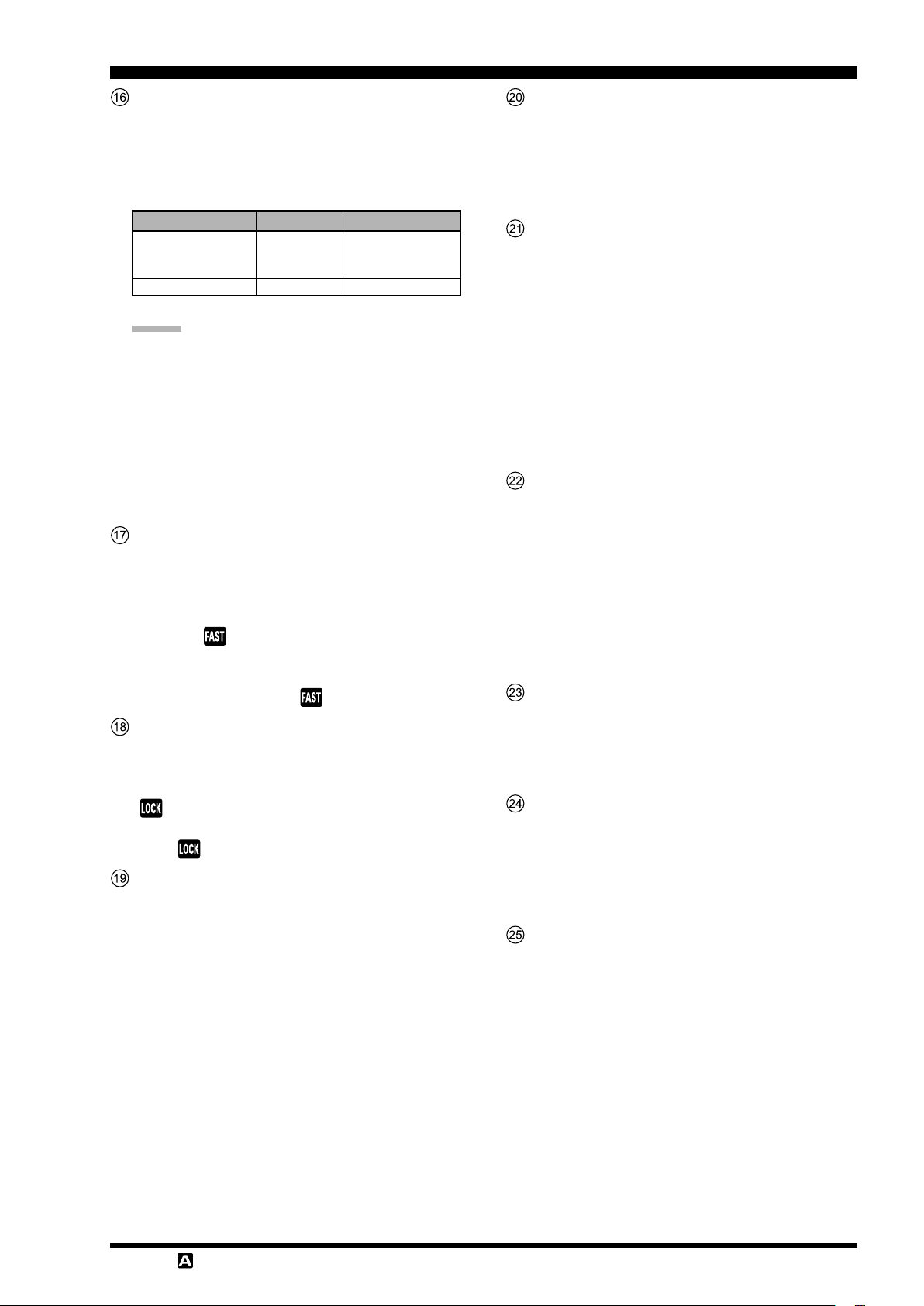
FrOnT panel cOnTrOls & swiTches
Main Tuning Dial Knob
This large knob adjusts the operating frequency of
VFO-A.
Rotate clockwise to increase the operating frequency
and rotate counter-clockwise to decrease the operating frequency.
operAting Mode 1 Step 1 diAl rotAtion
LSB/USB/CW/RTTY/
DATA-LSB/DATA-
USB/AM
FM/DATA-FM/C4FM
Numbers in parentheses indicate steps when the FAST button is On.
Advice:
The tuning steps for the Main Dial knob are set
at the factory to: 10Hz (SSB/AM), 5 Hz (CW/
RTTY/DATA-LSB/DATA-USB) and 100 Hz (FM/
DATA-FM/C4FM) per step.
In LSB, USB, CW, RTTY, DATA-LSB or DATA-
USB mode, the frequency change amount (step
width) may be toggled between “
by pressing the
ing [
5/10Hz
] on the LCD.
5 Hz (100 Hz
10 Hz (100 Hz
100 Hz (1 kHz)20 kHz (200 kHz
F(M-LIST
)
1 kHz (20 kHz
)
2 kHz (20 kHz
” and “
5Hz
)
button, and then touch-
10Hz
)
)
)
”
FAST Button
Pressing this button will change the tuning of the
Main Tuning Dial knob (VFO-A) to a higher step
rate.
Press this button to double the main dial frequency
variation. “
up.
Press this button again to restore the frequency varia-
tion to the original value. “
” in the LED indicator area will light
” will disappear.
LOCK Button
This button toggles on/off locking of the Main Tun-
ing Dial knob.
Press this button to lock the main dial operations.
“ ” will light up in the LED indicator area.
Press this button again to unlock the main dial opera-
tions. “ ” will disappear.
CLAR Button
During reception, press this button, then rotate the
CLAR/VFO-B
RX clarier offset value (see page 36).
The clarier offset value (frequency) can be re-
m
stored to “0 (zero)” by pressing the
for more than 1 second.
Depending on the menu mode “
m
MODE SELECT
the TX clarifier for changing only the transmit
frequency (see page 75) or RX/TX clarifier for
both receiving and transmitting (see page 36,
75).
knob to adjust the VFO-A
CLAR
040 CLAR
” setting, this button can work as
button
V/M Button
This button toggles frequency control between VFO-
A and the memory system.
Pressing this button alternately recalls the VFO
m
frequency data and the frequency data saved in a
memory channel by turns.
AM Button
Pressing and holding this key for one second (until
the double beep) copies the current operating data
into the currently selected memory channel, overwriting any previous data stored there.
Press this button briey to display the memory check
function screen, where the data saved in a memory
channel may be reviewed.
While displaying memory data, rotate the
m
knob to review the data in each memory channel.
Press this button again, to close the memory list
screen.
MULTI
SPLIT Button
Press this button to operate split frequency between
VFO-A (used for reception) and VFO-B (used for
transmission) (see page 76).
Press and hold in the
m
ond to engage the “Quick Split” (see page 76)
feature. VFO-B transmit will automatically be
set to a frequency 5 kHz higher than the VFO-A
receive frequency, with the same operating mode.
The transceiver will operate in the Split mode.
button for one sec-
SPLIT
CLAR/VFO-B Knob
During the VFO-A operation, rotate this knob to ad-
just the clarier.
During Split operation, this knob adjusts the operat-
ing frequency of VFO-B.
RF GAIN Knob
Adjust the receiver gain of the high frequency and
mid-range frequency amplier stages.
Rotate the knob clockwise to increase the gain.
m
Rotate the knob fully clockwise to set the gain to
the highest level for normal operations.
AF GAIN Knob
The
AF GAIN
level.
Rotate the knob clockwise to increase the receiv-
m
er audio volume level.
knob sets the receiver audio volume
T-991
OperaTing Manual
Page 23F
Page 26
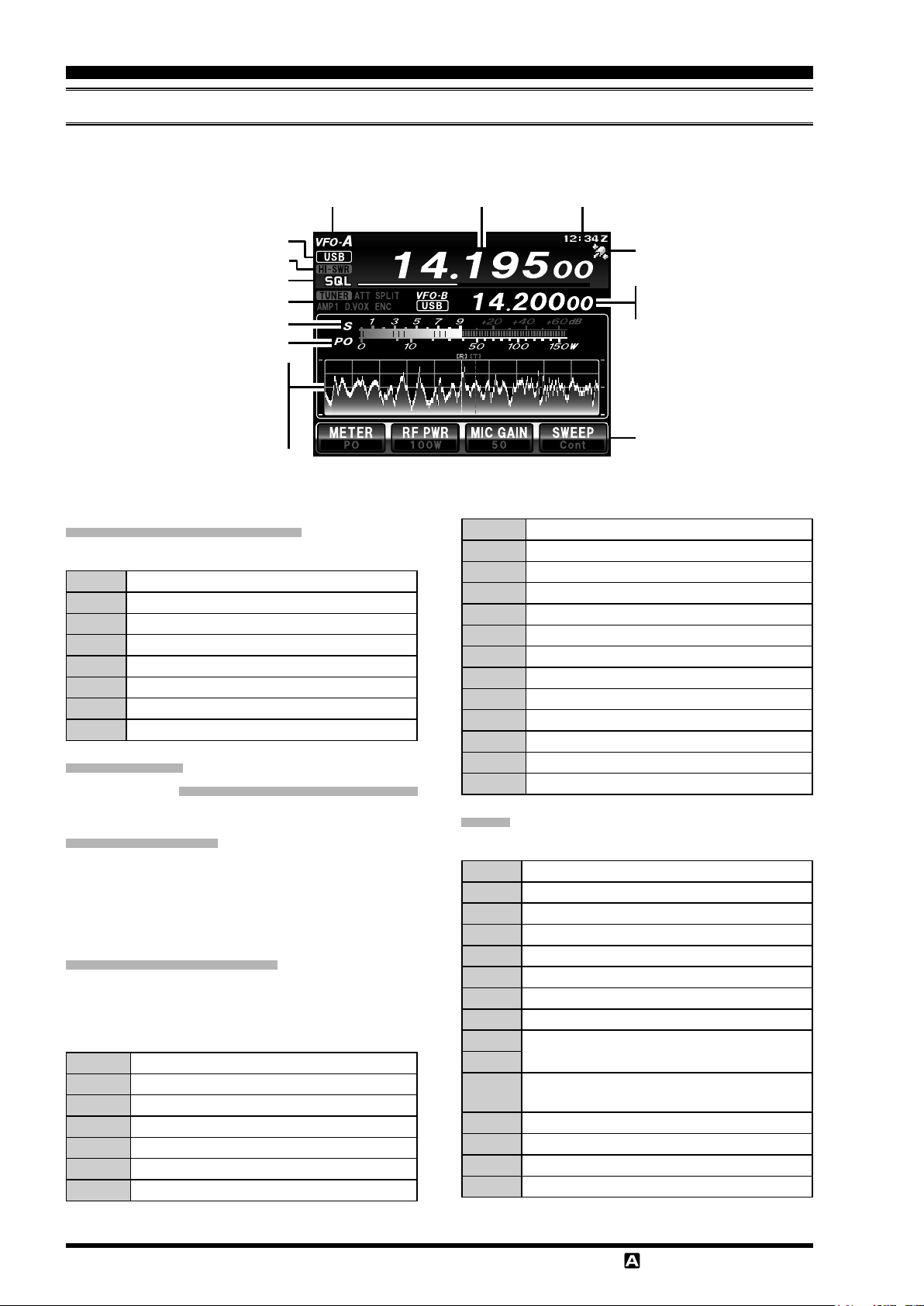
abOuT The Display
tFt liquid cryStAl diSplAy
A variety of information such as VFO-A/VFO-B frequencies, mode, S-meter will appear on the LCD.
Operating mode
Mode (radio modulation form)
HI-SWR
MULTI knob operation
Icons
S-meter
Meters
Scope
Waterfall
Menu list
Memory list
Function menu
Operating Mode Indicators
Displays the current operating mode.
VFO-A Operating in VFO-A mode
MEM Operating in memory mode
MT The memory tuning feature is in use
QMB Operating with the quick memory feature
PMS Programmable memory scanning
MCK The memory check function is in use
HOME Recalling the home channel
EMG Recalling the frequency for emergency contact
Current Mode
(
Modulation Form) Indicator
Displays the current modulation form.
HI-SWR Indicator
Indicates antenna matching errors.
When this warning appears, stop transmitting immediately, check and repair the antenna, connectors, cables,
etc.
MULTI Knob Operations
Displays the functions operated with the
(
see page 21).
The progress bar shows the operation status.
RF-P Adjusts transmission output
MIC-G Adjusts the microphone gain
NB-L Adjusts the noise blanker level
SHIFT Shift function
WIDTH Width function
NOTCH Notch function
CONT Contour function
MULTI
knob
ClockOperation frequency
GPS signal capturing
VFO-B data
Clarifier operation
Main control buttons
DNR Digital Noise Reduction function
PROC Adjusts Speech Processor Gain
MONI Adjusts the monitor level
DT-G Adjusts the input level during data communication
CH-D Frequency tuning in the pre-programmed steps
SPEED Adjusts keying speed
APF Audio Peak Filter function
PITCH Adjusts the CW pitch
SQL Adjusts the squelch level
TONE Selects the tone frequency
DCS Selects the DCS code
MCH Selects the memory channel
GRP Selects the memory group
Icons
Displays currently used functions.
TUNER Antenna tuner
ATAS Active Tuning Antenna System
ATT The attenuator is in use
SPLIT Running split operation
DUP Recalling duplex memories
[+] Plus shift
[-] Minus shift
IPO The receiver amplier is OFF
AMP1
AMP2
D.VOX
VOX The VOX function is in use
ENC The tone encoder is in use
DEC The tone decoder is in use
DCS The digital code squelch is in use
The receiver amplier is ON
The VOX function activates during data communication
Page 24 F
T-991
OperaTing Manual
Page 27
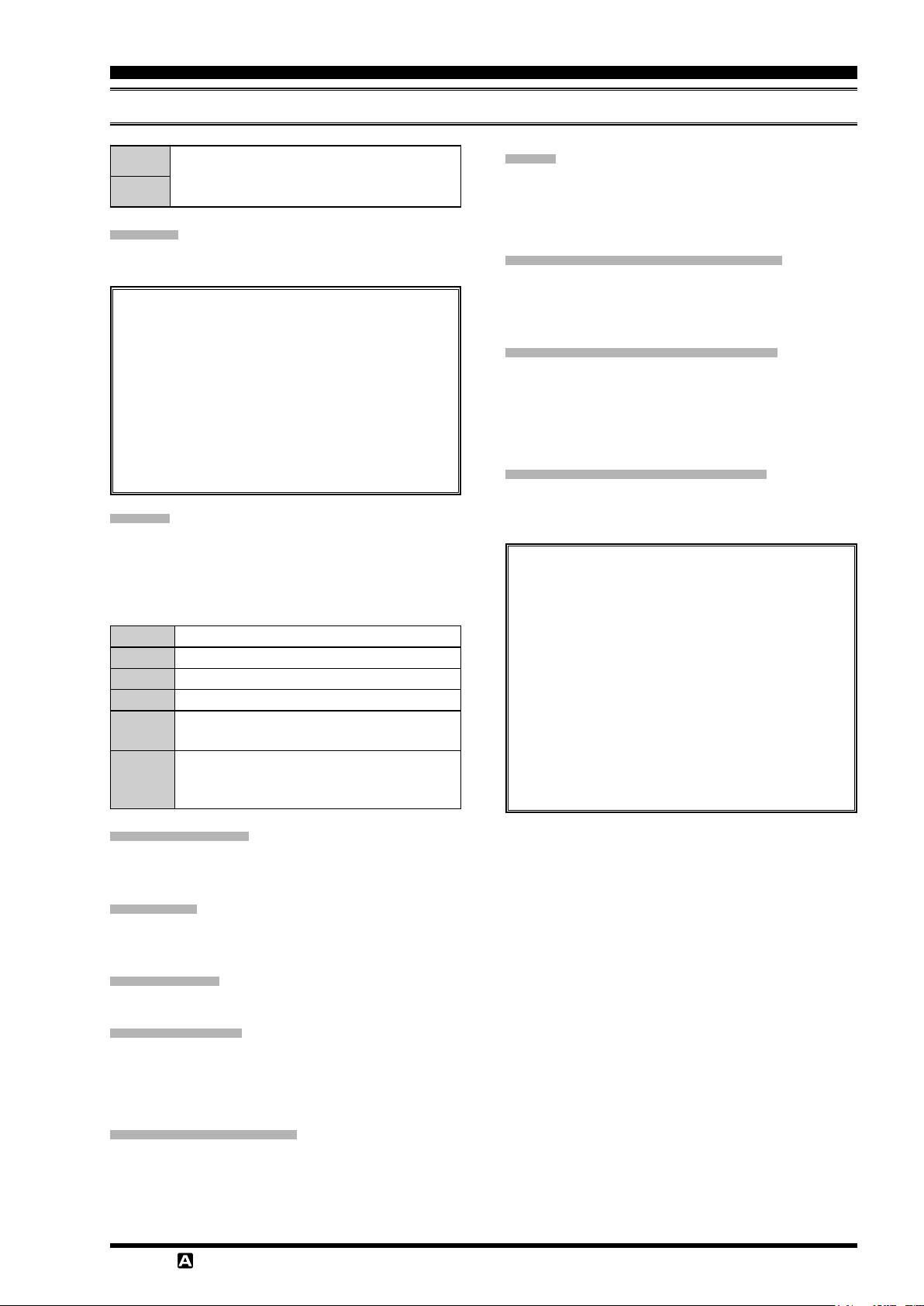
abOuT The Display
tFt liquid cryStAl diSplAy
PLAY
REC
The voice memory/contest memory keyer functions are in use.
PLAY: Playing, REC: Recording
S-Meter
Displays the reception signal strength.
To change the meter peak hold time
1. Press the
2. Rotate the
MTR PEAK HOLD
3. Touch
MULTI
(
OFF/0.5/1.0/2.0 seconds).
4. Touch
MENU(SETUP
MENU(SETUP
MULTI
[
SELECT
knob to select the time to hold
[
ENTER
knob to select “
”.
]
, then rotate the
]
, then
)
button.
)
button.
[
BACK
009 BAR
]
or press the
Meters
The following information can be displayed below the
S-meter.
The displayed information is switched each time [
] is touched on the panel.
TER
PO Displays transmitter output power.
ALC Displays ALC voltage
SWR Displays antenna matching state
COMP Displays the speech processor compression level
ID
VDD
Displays the drain current of the nal stage FET
transistors
Displays the drain voltage of the nal stage ampli-
er.
The proper voltage is 13.8 V.
ME-
Clock
Indicates the current time.
When receiving a GPS signal, the time is set automati-
cally.
GPS Signal Capturing Indicator
Appears when an external GPS device is connected to
the
GPS/CAT
are being acquired.
jack on the rear panel and GPS signals
VFO-B Data/Clarier Operation
Displays operation status of the radio modulation form
and VFO-B frequency, etc.
Displays the offset operation status and the clarier off-
set value, etc.
”.
” to “
)
SWAP
Main Control Buttons (SWAP
Frequently used functions can be assigned to these buttons.
To change the function assigned
to the main control button
1. Press the
2. Touch
“
SWAP F1
3. Touch one of the “
F4
want to change ashes.
4. Touch
tion you want to assign, then select and
touch the function.
5. Press the
F(M-LIST
[
BACK
” to “
” screens and conrm the function you
[
BACK
F(M-LIST
)
]/[
FWD
SWAP F4
SWAP F1
]/[
FWD
)
button.
]
to display screens
]
to display the func-
button.
Scope/Waterfall
Displays a spectrum or waterfall when the scope function (see page 42) is in use.
Menu List
Displays the menu item list when making settings in the
menu mode.
Memory List
Displays the data saved in the memory channels.
Function Menu
Displays the function menu from which you can set a
variety of functions.
Touch
[
BACK
]/[
]
to switch the menu screen.
FWD
Operation Frequency
Displays the current operation frequency.
T-991
OperaTing Manual
Page 25F
Page 28
abOuT The Display
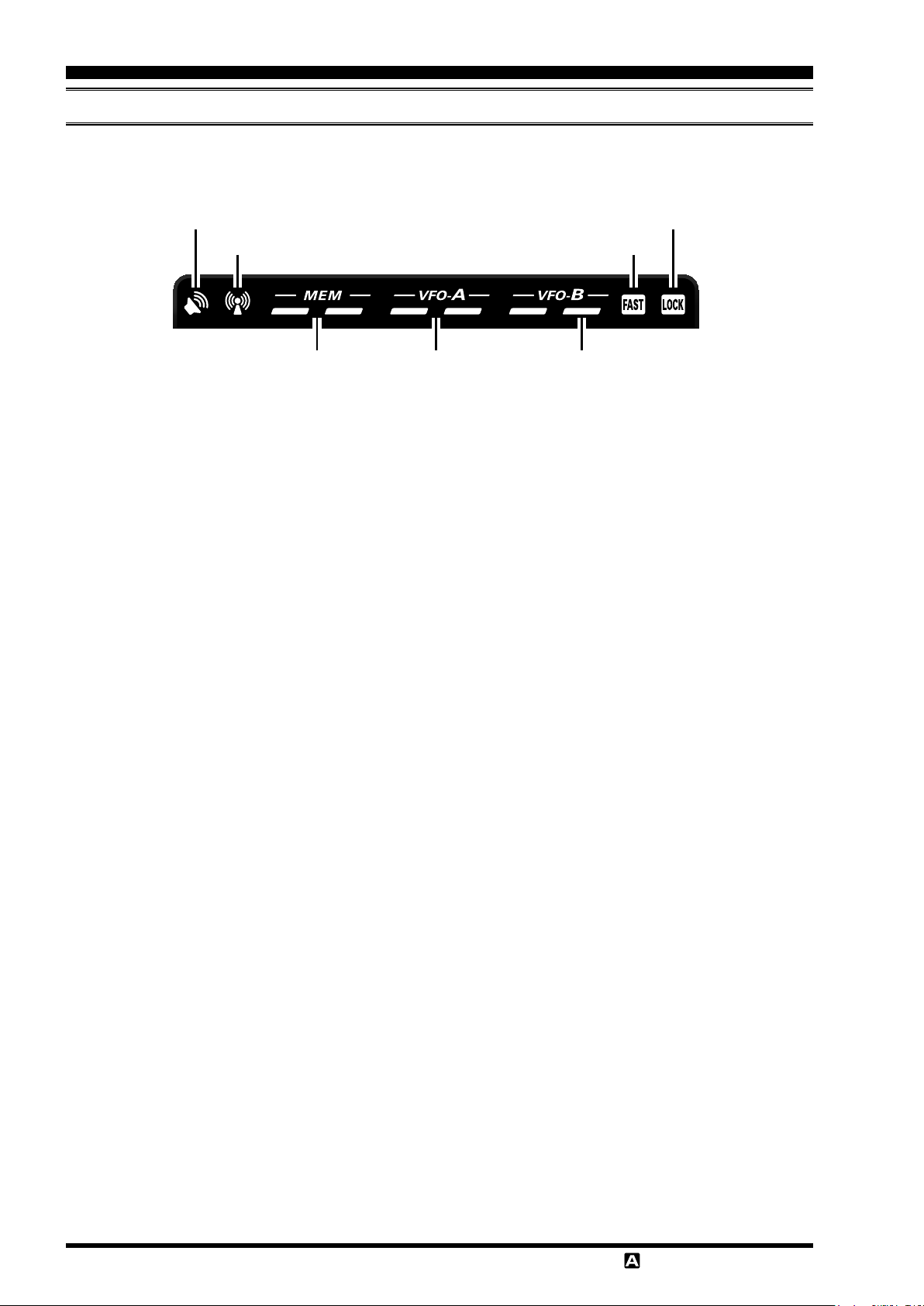
led indicAtorS
Displays the transmit/receive status of the transceiver, and the main dial “
RX Indicator
TX Indicator
Memory Mode
RX/TX
Indicators
RX Indicator (Green
This indicator illuminates when the squelch opens.
TX Indicator (Red
This indicator illuminates during transmission.
)
)
Main Band
RX/TX
Indicators
Sub Band TX Indicator
Red (Right):
This indicator illuminates when the transmitter is active
on the main band (VFO-B).
FAST Indicators
Memory Mode RX/TX Indicators
Green (Left):
This indicator illuminates when the receiver is active on
the memory channel.
Red (Right):
This indicator illuminates when the transmitter is active
on the memory channel.
This indicator appears when the Main Tuning Dial knob
tuning rate is set to “fast” (see page 23).
LOCK Indicators
This indicator appears when the Main Tuning Dial knob
is locked (see page 23).
” and “
FAST
LOCK Indicators
FAST Indicators
Sub Band
TX
Indicator
LOCK
”.
Main Band RX/TX Indicators
Green (Left):
This indicator illuminates when the receiver is active on
the main band (VFO-A).
Red (Right):
This indicator illuminates when the transmitter is active
on the main band (VFO-A).
Page 26 F
T-991
OperaTing Manual
Page 29
rear panel
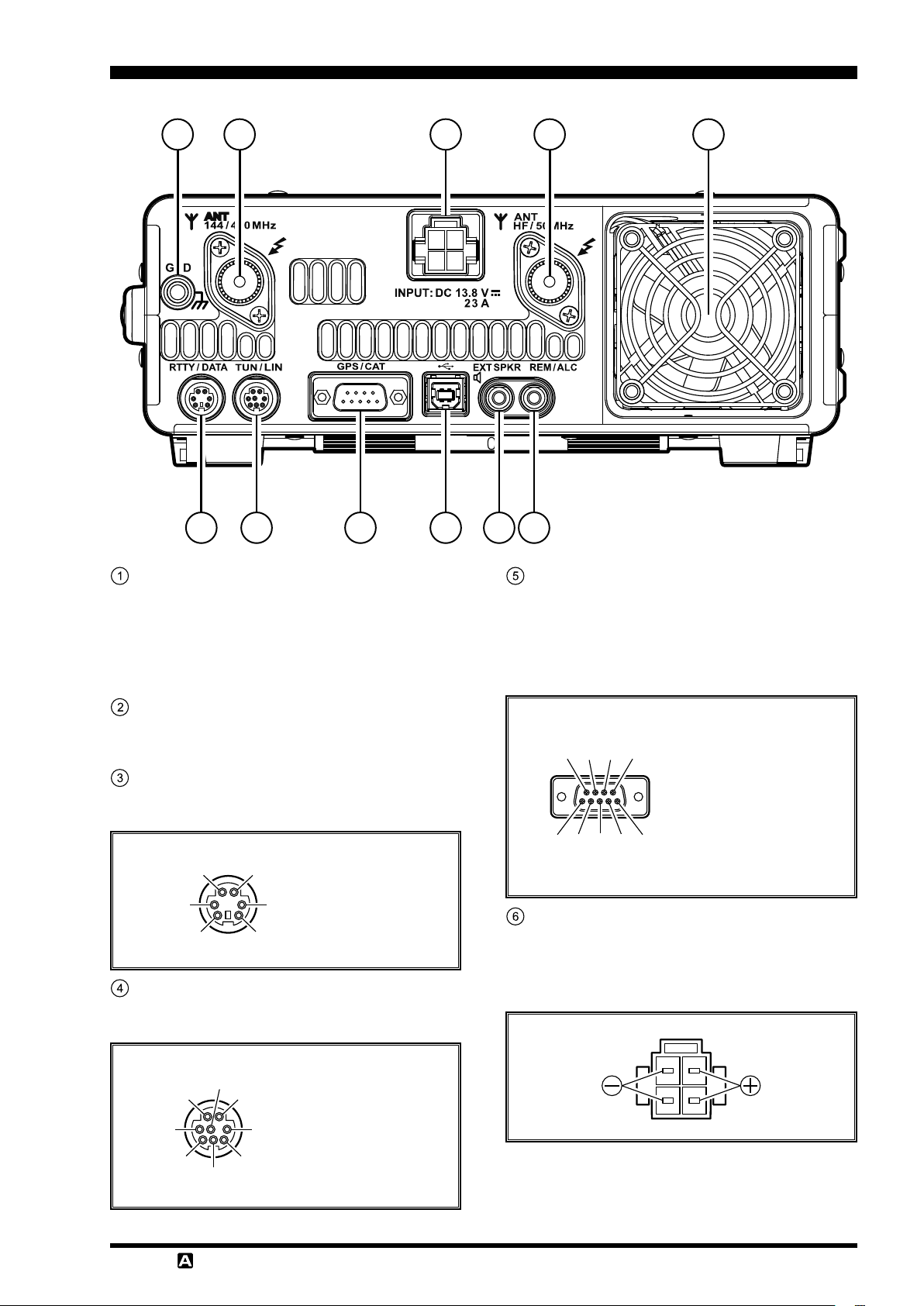
1
2
43
5
7 869
GND
Use this terminal to connect the transceiver to a good
earth ground, for safety and optimum performance.
Use a large diameter, short braided cable to make
the ground connections. For details on grounding the
transceiver, see “Grounding” on page 14.
10
11
GPS/CAT Jack
This is the
or a commercially available external GPS device.
Connecting a computer to this jack, using a com-
mercially available
CAT control of the transceiver.
RS-232C
jack for connecting a computer
RS-232C
straight cable, enables
ANT Jack (144/430MHz
This is the M-type coaxial connector for the 144
MHz band and 430 MHz band antennas (50 ohms).
)
RTTY/DATA Jack
This is the input/output jack to connect a terminal
unit for RTTY and TNC for packet communications.
① ②
③ ④
⑤
⑥
① DATA IN
② GND
③ PTT
④ SHIFT
⑤ DATA OUT
⑥ SQL
TUN/LIN Jack
Connect the optional external antenna tuner “
or the linear amplier “
VL-1000
+13V OUT
TX GND
GND
TX D (BAND A)
RX D (BAND B)
BAND C
RESET (BAND D)
TX INH
”.
FC-40
”
① DCD
⑧⑨ ⑦ ⑥
② SERIAL OUT/RXD
(GPS DATA IN)
③ SERIAL IN
④ DTR
⑤ GND
⑥ DSR
⑦ RTS
①②③④⑤
⑧ CTS
⑨ RI
DC IN Jack
This is the DC power supply connection for the
transceiver. Use the supplied DC cable to connect directly to a DC power supply, which must be capable
of supplying at least 23 A @13.8 VDC.
T-991
OperaTing Manual
Page 27F
Page 30
rear panel
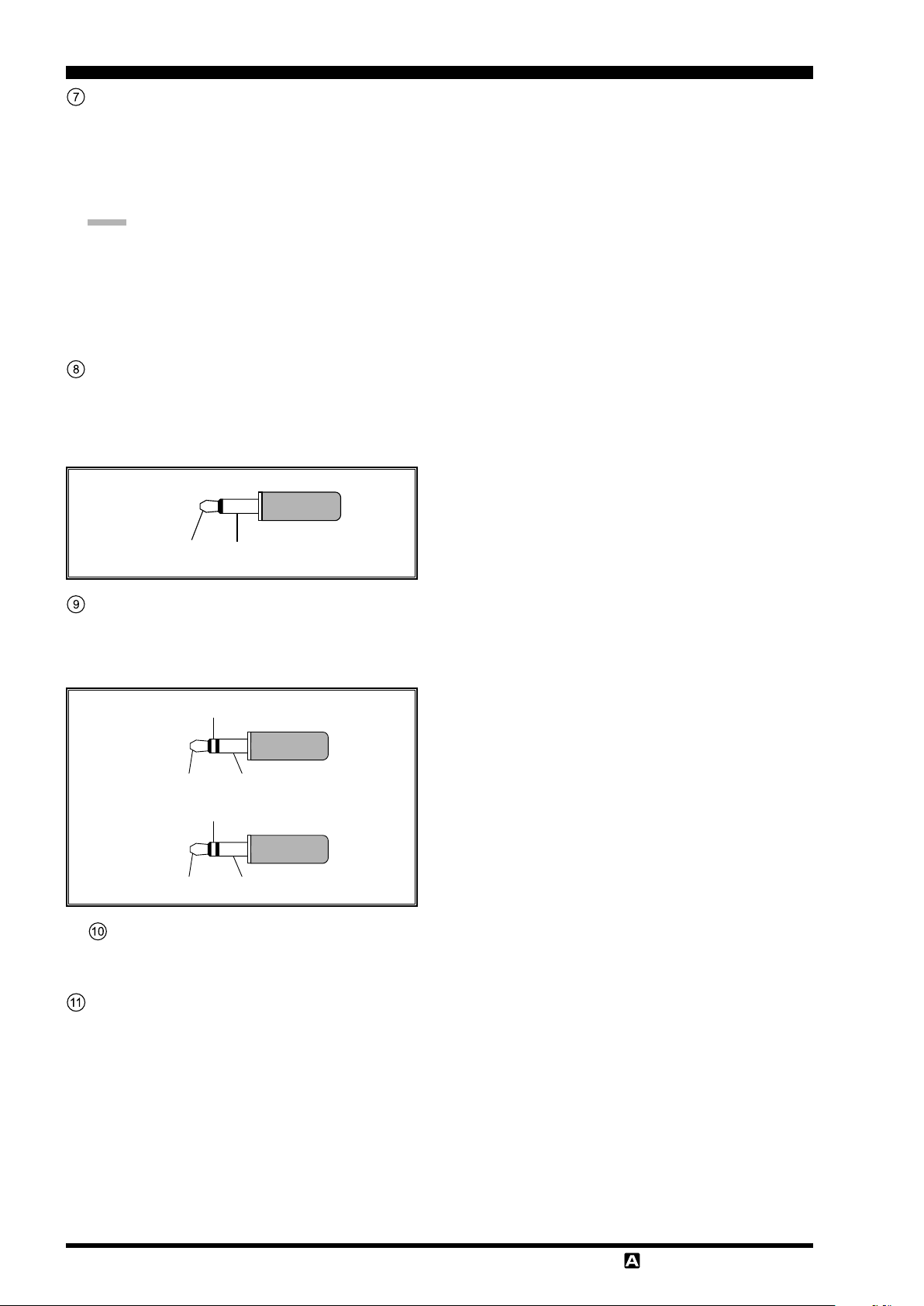
USB Jack
Connect a computer with a commercially available
USB cable to control the transceiver remotely from
the computer using the CAT command.
Inputting/Outputting audio signals and transmission
control can also be done from the computer.
note:
To control the transceiver remotely from the
computer, a USB driver is required. For details
on the USB driver, visit the Yaesu website.
When using a USB cable connected to a com-
puter, the transceiver may change to the transmit
mode when the computer is started.
EXT SPKR Jack
This is the monaural jack to connect an external
speaker (4 Ω to 8 Ω).
Connecting an external speaker to this jack will de-
activate the internal speaker.
SIGNAL GND
REM/ALC Jack
Connect the optional remote control keypad “
When a device such as a linear amplier is connect-
ed, this is an external ALC current input jack.
TX REQ
EXT ALC
REMOTENCGND
ANT Jack (HF/50MHz
This is the M-type coaxial connector to connect HF
band and 50 MHz band antennas (50 ohms).
GND
)
FH-2
”.
Cooling fan
Page 28 F
T-991
OperaTing Manual
Page 31
Mh-31a8J MicrOphOne swiTches
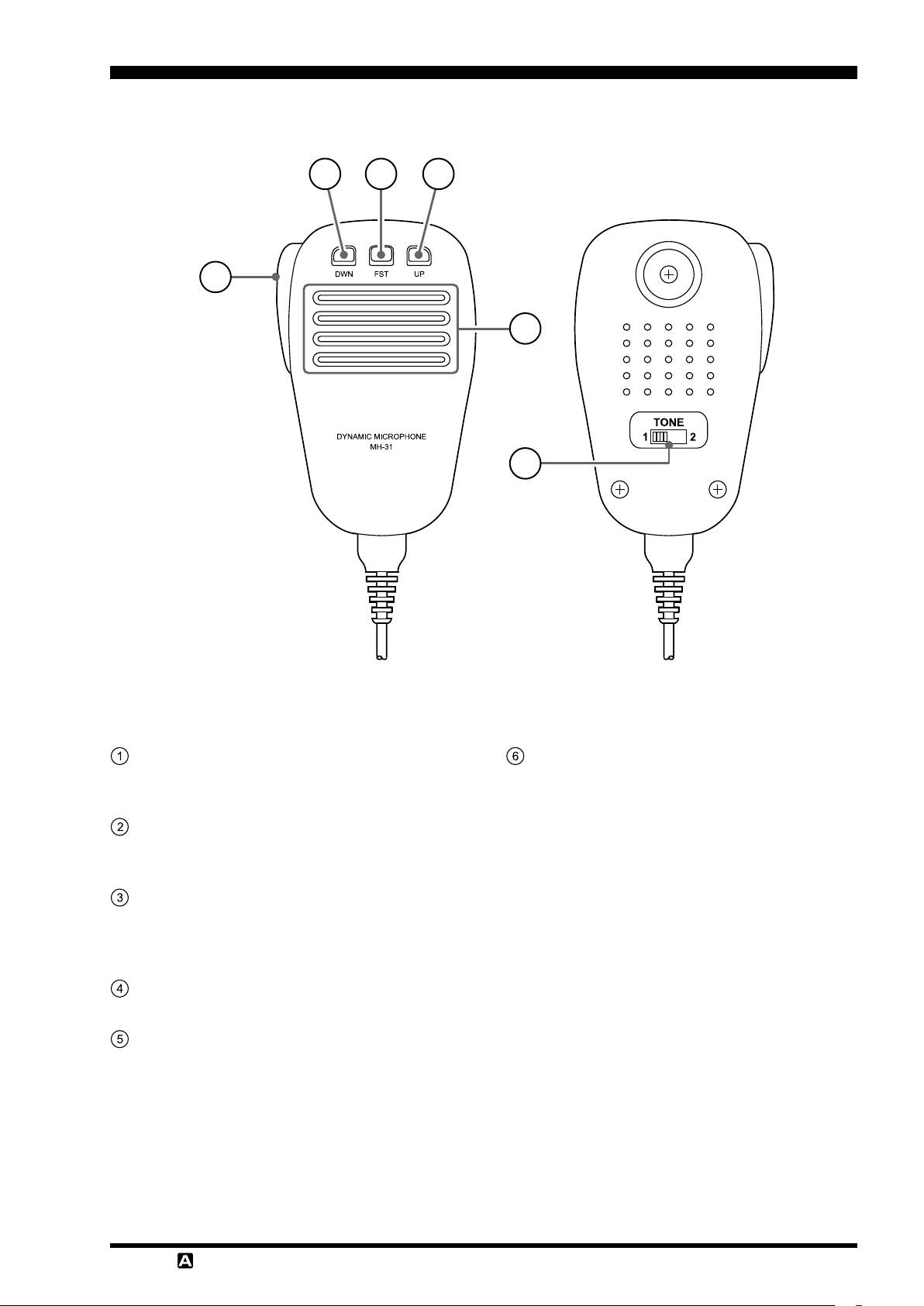
32
4
1
5
6
PTT Switch
Switches transmission/reception.
Press to transmit and release to receive.
DWN Button
Press the
downward.
(Down) button to scan the frequency
DWN
FST Button
Allows switching the frequency variation (step),
working in the same way as the
transceiver front panel.
button on the
FAST
UP Button
Press the UP button to scan the frequency upward.
Microphone
Speak into the microphone in a normal tone of voice
with the microphone 5 cm away from the mouth.
TONE Switch
Switches transmission sound quality.
Slide to the “1” side to make the transmit audio at.
Slide to the “2” side to emphasize transmit audio.
T-991
OperaTing Manual
Page 29F
Page 32

OpTiOnal FH-2 reMOTe COnTrOl SwiTCHeS
With the optional remote control keypad
Contest Memory Keyer during CW operation.
OnSSB/AM modes, ve channels of storage and playback of voice memory(20 seconds each), using your own
m
voiceforrecording(see page 70).
FortheCWMemoryKeyer,5channelsareavailableforeachoftheMESSAGEMemoryandtheTEXTMemory(see
m
page 86).
, you can record and transmit your voice (Voice Memory) and control the
FH-2
4
1
5
2
3
Voice Memory: 5 Memory Channels for
the Memory Keyer
Inthecase ofVoice Memory,up to20seconds of
audiomaybestoredoneachchannel.
“MESSAGEMemory”and“TEXTMemory” are
availablefortheContestMemoryKeyer.
Each“MESSAGE Memory”channeliscapable
ofretaininga50-characterCW message using the
PARISstandardforcharactersandwordlength.
Each“TEXTMemory”channeliscapableofretain-
ingamaximumof50characters.
Cursor Buttons
When programming the Contest Memory Keyer,
thesebuttons areused tomove thecursor andselect
the text characters.
Thecursormaybemovedin4differentdirections
(
up/down/right/left).
Usually, thesebuttonsareused fortuningthe VFO
frequency. Pressthe[p]/[q]buttonsto changethe
frequencyinthesameincrementsasthemicrophone
[UP]/[
changethefrequencyby100kHzsteps.
]switches.Pressthe[t]/[u]buttonsto
DWN
6
]
[P/B
When entering text, a space may be inserted where
[LOCK
The
[MEM
[DEC
Button
thecursorisashing.
]
Button
keybuttonsmaybelockedbysettingthis
FH-2
switchto“ON”.
]
Button
PressthisbuttontostoreeitheraVoiceMemory,ora
Contest Keyer Memory.
]
Button
Whenutilizingthe sequentialcontestnumber capabilityofthe ContestKeyer,press thisbuttonto
decrement (decrease)thecurrentContestNumberby
one digit (i.e.tobackupfrom#198to#197,etc.).
Page 30 F
T-991
OperaTing Manual
Page 33
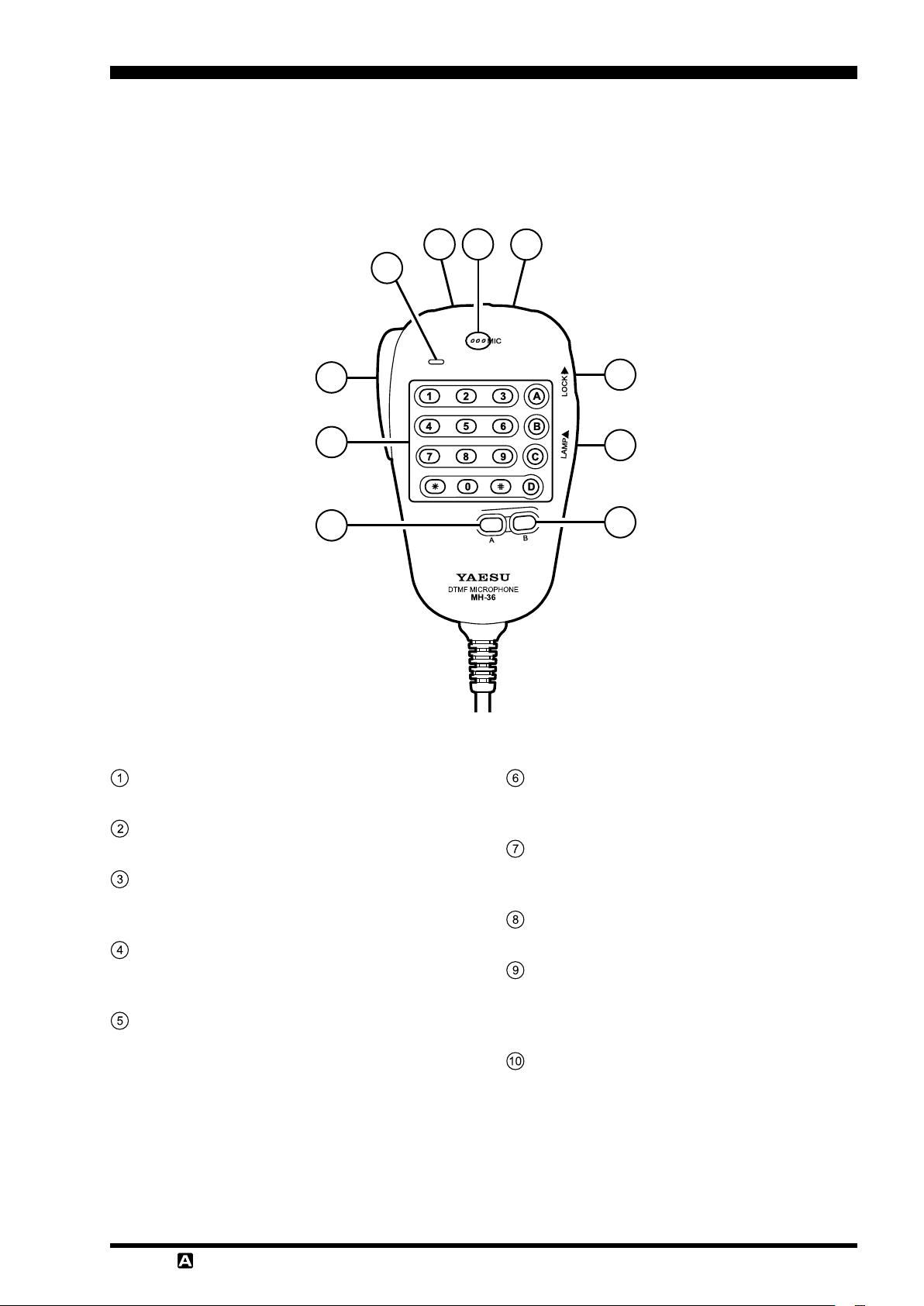
OpTiOnal Mh-36e8J MicrOphOne swiTches
The optional
Multi Frequencies) transmission.
A lamp switch illuminates the DTMF keypad for easy viewing in the dark.
MH-36E8J
is a handheld microphone equipped with the DTMF function that enables DTMF (Dual Tone
1
3
2
4
5
6
9
7
8
10
DWN Button
Press to tune down, hold to start scanning.
UP Button
Press to tune up, hold to start scanning.
Microphone Element
Speak across the face of the mic from about two
inches away.
DTMF Indicator
When the DTMF is transmitted, this indicator glows
red.
PTT Switch
Press and hold to transmit.
DTMF Keypad
Press a key button while holding the
transmit a DTMF tone.
PTT
switch to
LOCK Switch
Slide upward to lock the microphone controls and
buttons.
LAMP Switch
Slide upward to illuminate the keypad.
A Button
This activates an accessory function.
Activates the “rst” mode when used with the
.
991A
FT-
B Button
This activates a second accessory function.
This button has no function when used with the
.
991A
FT-
T-991
OperaTing Manual
Page 31F
Page 34

basic OperaTiOn:
Before turning on the main power, please verify the following items once more.
Have you made all ground connections securely? See page 14 for details.
Do you have your antenna(s) connected to the rear-panel Antenna jack(s)? See page 15 for details.
Is your microphone (and/or key or paddle) connected? See pages 16, 17 for details.
If using a linear amplier, have all interconnections been successfully completed? See pages 18 for details.
Please rotate the
transceiver turns on. See page 23 for details.
AF GAIN
control to the fully counter-clockwise position, to avoid a loud blast of audio when the
receiving On aMaTeur banDs
Page 32 FT-
991
OperaTing Manual
Page 35
basic OperaTiOn: receiving On aMaTeur banDs
Here is the typical start-up procedure for normal operation:
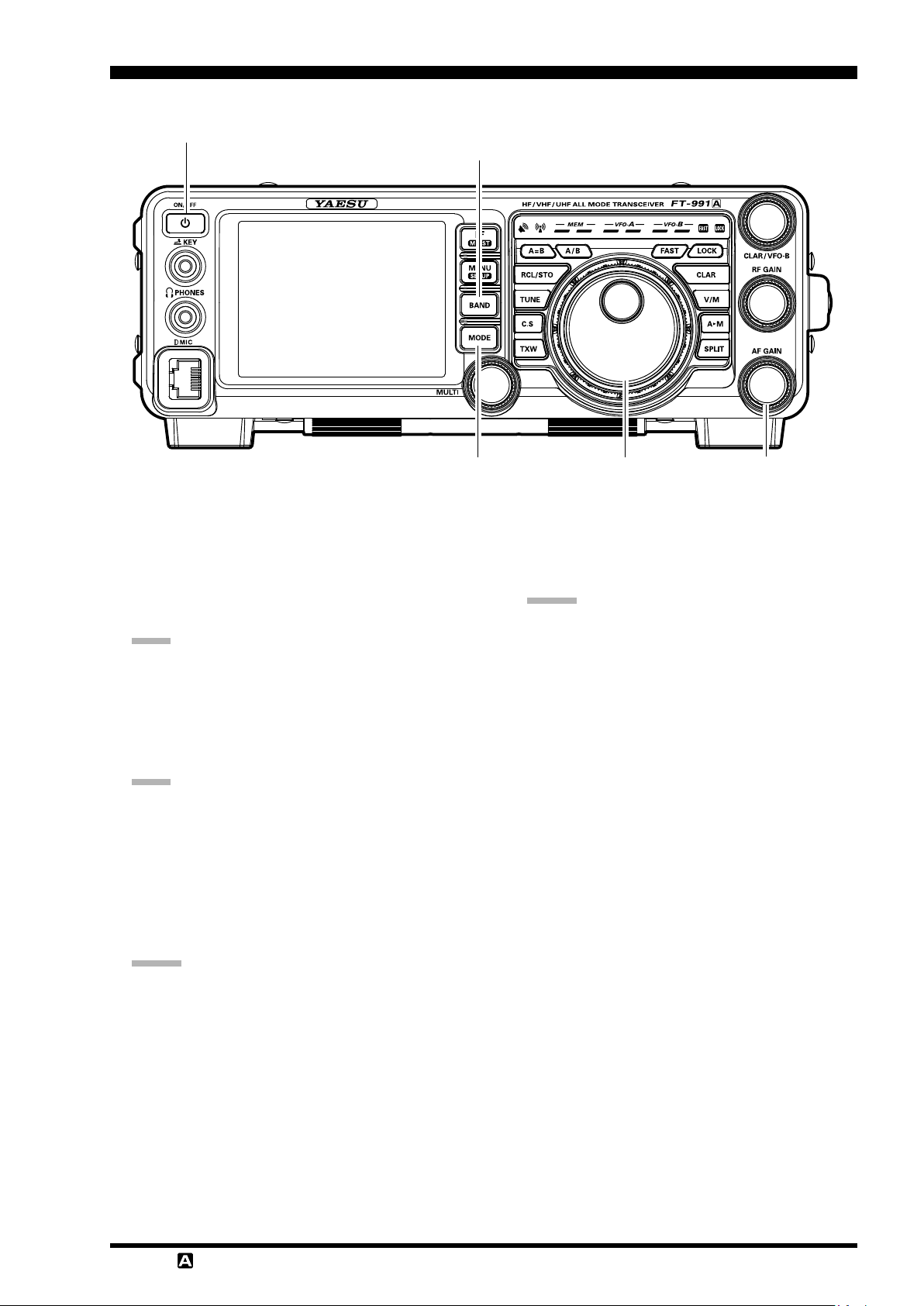
ON/OFF Switch
BAND Button
MODE Button
1. Turn on the external DC power supply.
2. Press and hold in the front-panel
until the transceiver turns on.
3. The transceiver will start up on 7.000.00 MHz LSB,
(
or the previously used operating frequency) and
normal operation may begin.
note:
To turn power off, press and hold in the front panel
ON/OFF
4. Rotate the
dio level of the incoming signals or noise. Clockwise
rotation of the
level.
note:
When using headphones, start by rotating the
GAIN
ume level up after you put the headphones on. This
will minimize the chance of damage to your hearing
caused by an unexpectedly high audio level.
5. Press the
bands on the LCD, then touch a key corresponding
to the band on which you wish to begin operation.
Advice:
switch for one second.
AF GAIN
knob counter-clockwise, then bring the vol-
BAND
One-touch selection of each Amateur band be-
tween 1.8 and 50 MHz, 144 MHz, and 430 MHz
is provided.
The
FT-991A
selection technique, which permits storing up to
three favorite frequencies and modes onto each
VFO band register. For example, you may store
one frequency each on 14 MHz CW, RTTY, and
USB, then recall these frequencies by successive,
press the
the screen repeatedly. Each Amateur band key
may similarly have up to three frequency/mode
settings applied.
BAND
knob to set a comfortable au-
AF GAIN
button to display the list of Amateur
knob increases the volume
utilizes a triple band-stack VFO
button, and then touch
ON/OFF
switch
AF
[14]
on
AF GAIN KnobMain Tuning Dial Knob
6. Press the
lections.
Touch the corresponding key to select the desired
operating mode.
Advice:
By convention in the Amateur bands, LSB is
When changing modes from SSB to CW, you
To eliminate noise while the transceiver is not re-
MODE
used on the 7 MHz and lower bands (with the
exception of 60 meters), while USB is utilized on
the 14 MHz and higher bands.
will observe a frequency shift on the display.
This shift represents the BFO offset between the
“zero beat” frequency and the audible CW pitch
(
tone) you can hear (the pitch is programmed via
the Menu item “
though the actual tone that you hear is not changing.
ceiving any signal, press the
then touch [
pear on the LCD and the
tion as the squelch knob. Rotate the
to adjust the squelch until the noise disappears.
button to display the available se-
SQL
MULTI
”), even
)
button,
” will ap-
knob
059 CW FREQ DISPLAY
F(M-LIST
] on the LCD. “
SQL
MULTI
knob will func-
991
OperaTing Manual
Page 33FT-
Page 36
basic OperaTiOn: receiving On aMaTeur banDs
7. Rotate the Main Tuning Dial knob to tune around the
band, and begin normal operation.
Advice:
Clockwise rotation of the Main Tuning Dial knob
increases the operating frequency, one “step”
of the synthesizer at a time; similarly, counterclockwise rotation of the Main Tuning Dial knob
will decrease the frequency. Two settings, one
“normal” and one “fast”, are available for each
operating mode. Pressing the
gages the “Fast” tuning selection (see chart be-
low).
MAin tuning diAl knob tuning rAte
operAting Mode 1 Step 1 diAl rotAtion
LSB/USB/CW/RTTY/
DATA-LSB/DATA-
USB/AM
FM/DATA-FM/C4FM
Numbers in parentheses indicate steps when the FAST button is On.
If you want to make rapid frequency changes,
5 Hz (100 Hz
10 Hz (100 Hz
100 Hz (1 kHz)20 kHz (200 kHz
)
)
there are several techniques available:
Direct keyboard entry of the frequency.
Use the microphone UP/
DWN
if your microphone is so equipped.
button en-
FAST
1 kHz (20 kHz
2 kHz (20 kHz
scanning keys,
)
)
)
Page 34 FT-
991
OperaTing Manual
Page 37
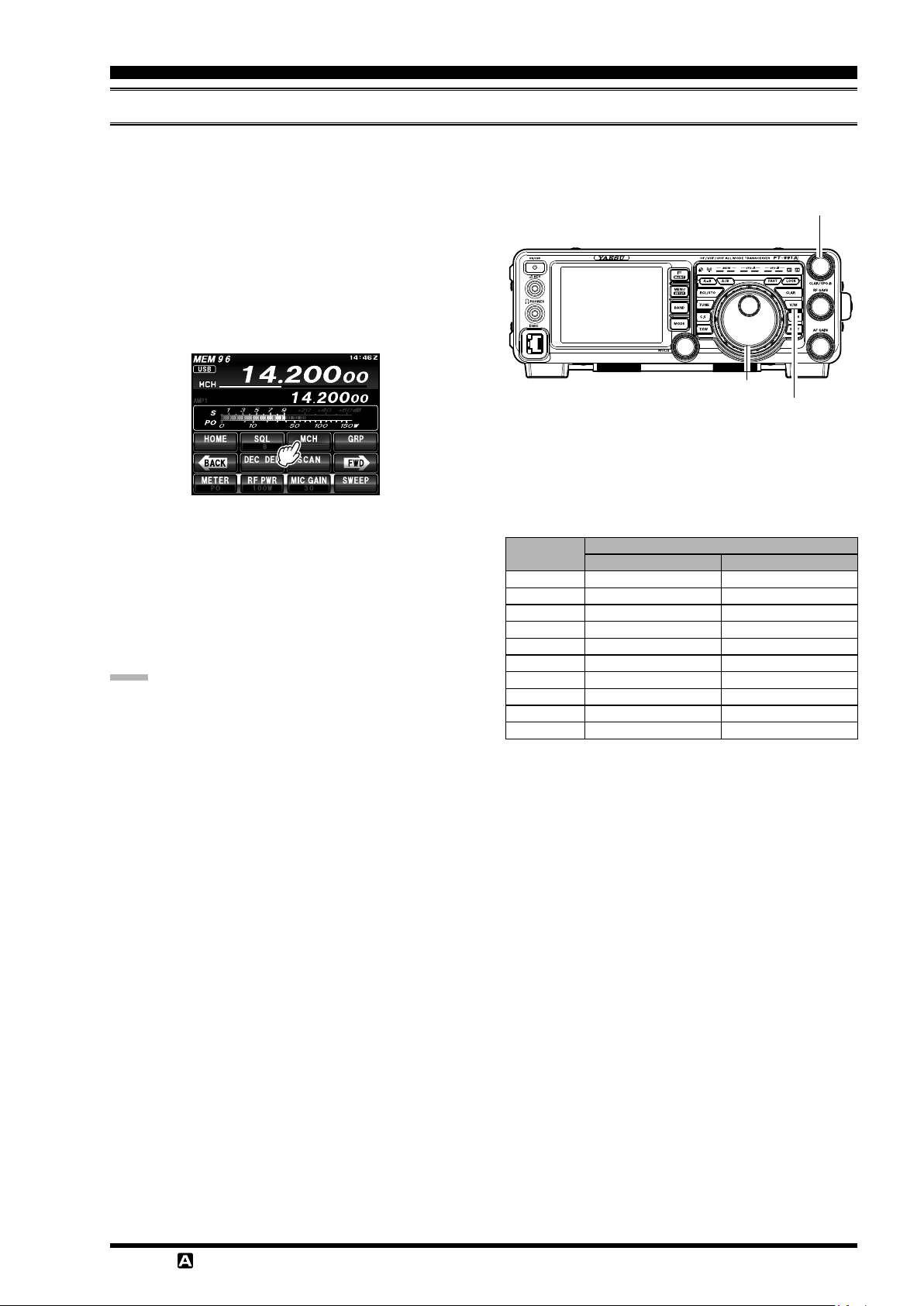
basic OperaTiOn: receiving On aMaTeur banDs
operAtion on 60-Meter (5 Mhz) bAnd
The recently-released 60-meter band is covered, in the
USB or CW, and they appear between the “last” PMS channel (“
1):
1. Press the
mode; the “
the
F(M-LIST
[
2. Touch
button once to enter the “Memory”
V/M
” icon will appear in the display.
MEM
]
on the screen displayed by pressing
MCH
)
button. The “
” notation and a
MCH
memory channel number will appear on the display
to signify that rotation of the
MULTI
knob will allow
selection of the memory channel.
3. Memory channels (“
5-01
” through “
5-10
pre-programmed, at the factory, with the permitted
frequencies in the 5 MHz band, and the USB or CW
mode is automatically selected on these channels.
4. To exit from 60-meter operation and return to the
VFO mode, just press the
V/M
button.
note:
The frequencies and operating mode for 5 MHz band
operation are xed, and may not be changed.
FT-991A
”) are
(
u.S. And u.k. verSion only
)
, by xed memory channels. These channels are set to
”) and the rst “regular” memory channel (Channel
P9U
CLAR/VFO-B Knob
Main Tuning Dial Knob
V/M Button
chAnnel
nuMber
5-01 5.332000 MHz (SSB)5.260000 MHz (SSB
5-02 5.348000 MHz (SSB)5.280000 MHz (SSB
5-03 5.358500 MHz (SSB)5.290000 MHz (SSB
5-04 5.373000 MHz (SSB)5.368000 MHz (SSB
5-05 5.405000 MHz (SSB)5.373000 MHz (SSB
5-06 5.332000 MHz (CW)5.400000 MHz (SSB
5-07 5.348000 MHz (CW)5.405000 MHz (SSB
5-08 5.358500 MHz (CW
5-09 5.373000 MHz (CW
5-10 5.405000 MHz (CW
u.S. verSion u.k. verSion
Frequency
)
)
)
-
-
-
)
)
)
)
)
)
)
991
OperaTing Manual
Page 35FT-
Page 38
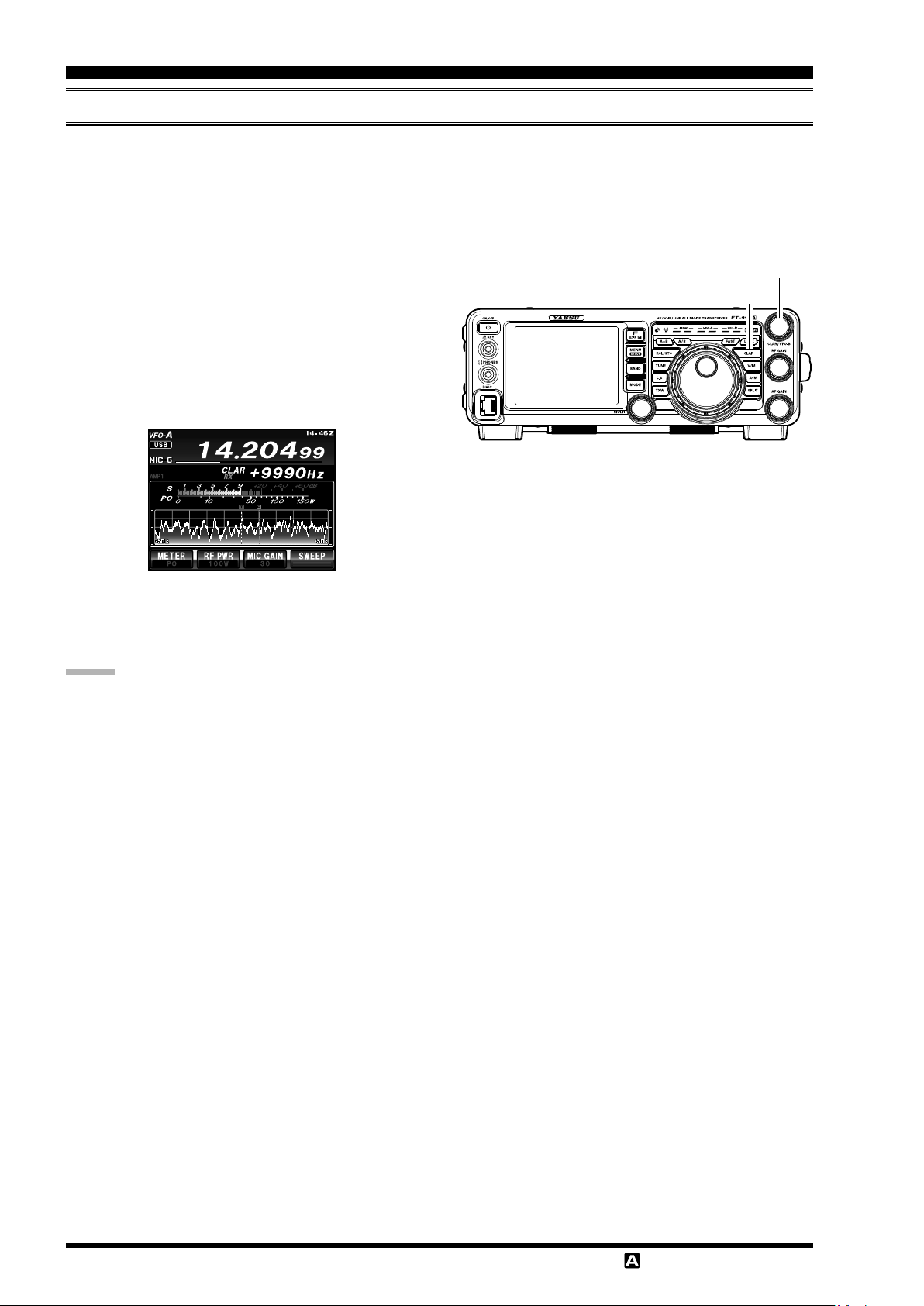
basic OperaTiOn: receiving On aMaTeur banDs
clAr (clAriFier) operAtion
The
from their settings on the VFO-A frequency. Four small numbers on the TFT Display show the current Clarier offset.
The Clarier controls on the
retuning, and then to activate it via the Clarier
for setting the small frequency offsets sometimes utilized in DX “Split” work.
Here is the technique for utilizing the Clarier:
1. Press the
pear in the TFT Display, and the programmed offset
will be applied to the receive frequency.
2. Rotation of the
to modify your initial offset on the y. Offsets of up
to ±9.99 kHz may be set using the Clarier.
CLAR
button and
button. The “RX” notation will ap-
CLAR
CLAR/VFO-B
CLAR/VFO-B
FT-991A
knob will allow you
knob are used to offset the receive frequency, the transmit frequency, or both,
are designed to allow setting a preset offset (up to ±9.99 kHz) without actually
button. This feature is ideal for following a drifting station, or
CLAR
CLAR/VFO-B Knob
CLAR Button
To cancel Clarier operation, press the
The “RX” notation will disappear from the display.
Advice:
Turning the Clarifier off merely cancels the application of the programmed offset from the receive and/or
the transmit frequencies. To clear the Clarifier offset,
and reset it to “zero,” press and hold the
The programmed offset is displayed in the small multichannel window of the frequency display.
CLAR
CLAR
button.
button.
Page 36 FT-
991
OperaTing Manual
Page 39
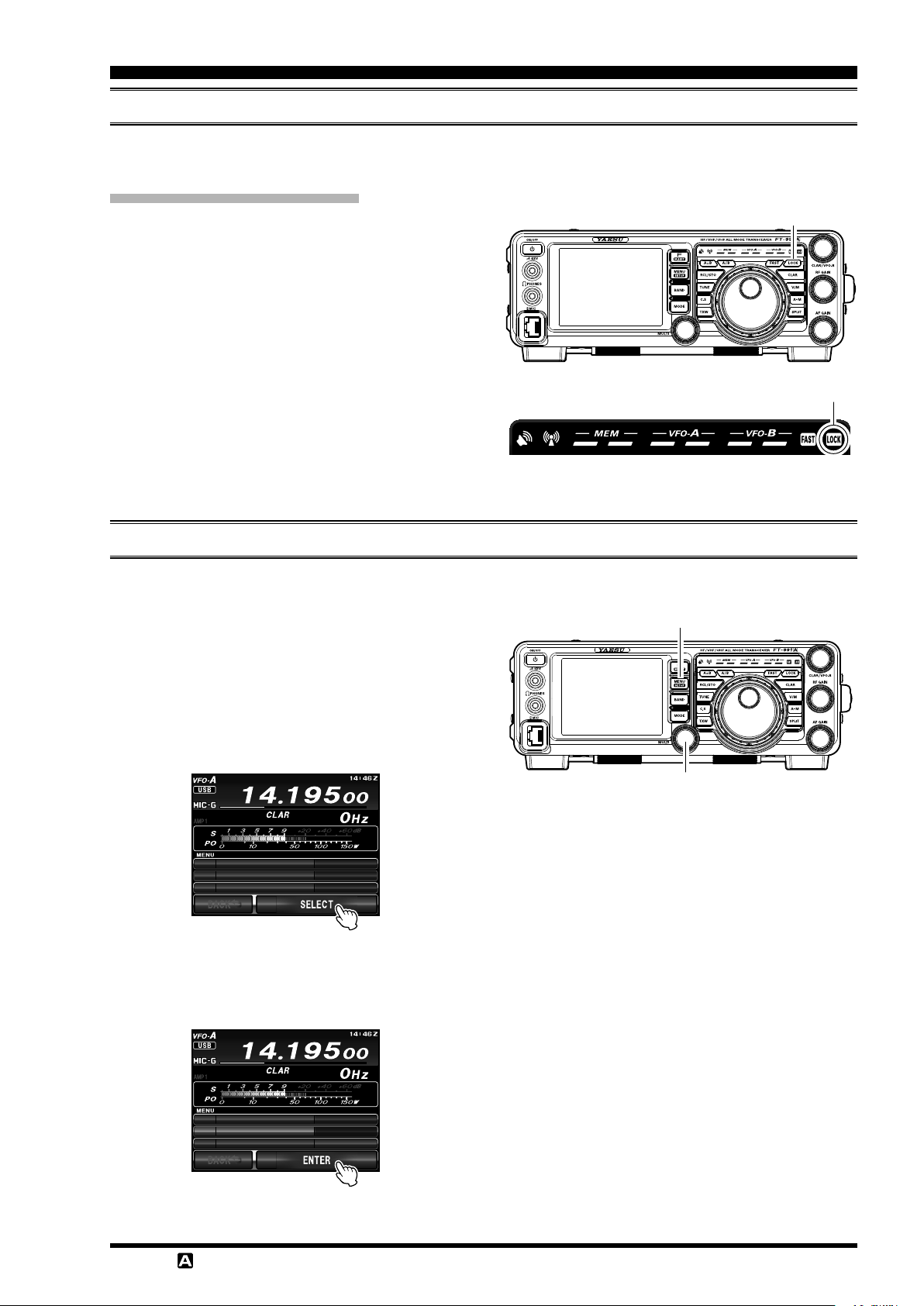
basic OperaTiOn: receiving On aMaTeur banDs
LOCK
You may lock the setting of the Main Tuning Dial knob (for VFO-A frequency tuning) to prevent accidental frequency
change.
Main Tuning Dial Knob Lock
To lock the Main Tuning Dial knob, press the
button that is located to the right of the Main Tuning
Dial knob.
LOCK
LOCK Button
“
” in the LED indicator area will light up
Lock
To unlock the Dial setting, and restore normal tuning,
press the
button once more.
LOCK
LOCK Indicators
DIMMER
The illumination level of the TFT display and LED indicators (above the Main Tuning Dial knob), may be adjusted via
Menu items 007 and 008.
To adjust the illumination level:
1. Press the
2. Rotate the
DIMMER LED
MER TFT
3. Touch
MULTI
[
SELECT
knob to select the desired illumination level.
” (for TFT display).
button to enter the Menu mode.
MENU
knob to select Menu item “
MULTI
” (for LED indicators) or “
]
on the LCD then rotate the
007
008 DIM-
MENU Button
&+52.;#.%1 14 $.7'
&+//'4 .&'
&+//'4 66(
4. Touch
[
ENTER
on the LCD or press the
]
on the LCD, then touch
MENU
new setting and exit to normal operation.
&+52.;#11. 4
&+///4'&.%'
&+//'4 66(
$.7'
[
BACK
button to save the
MULTI
Knob
]
991
OperaTing Manual
Page 37FT-
Page 40
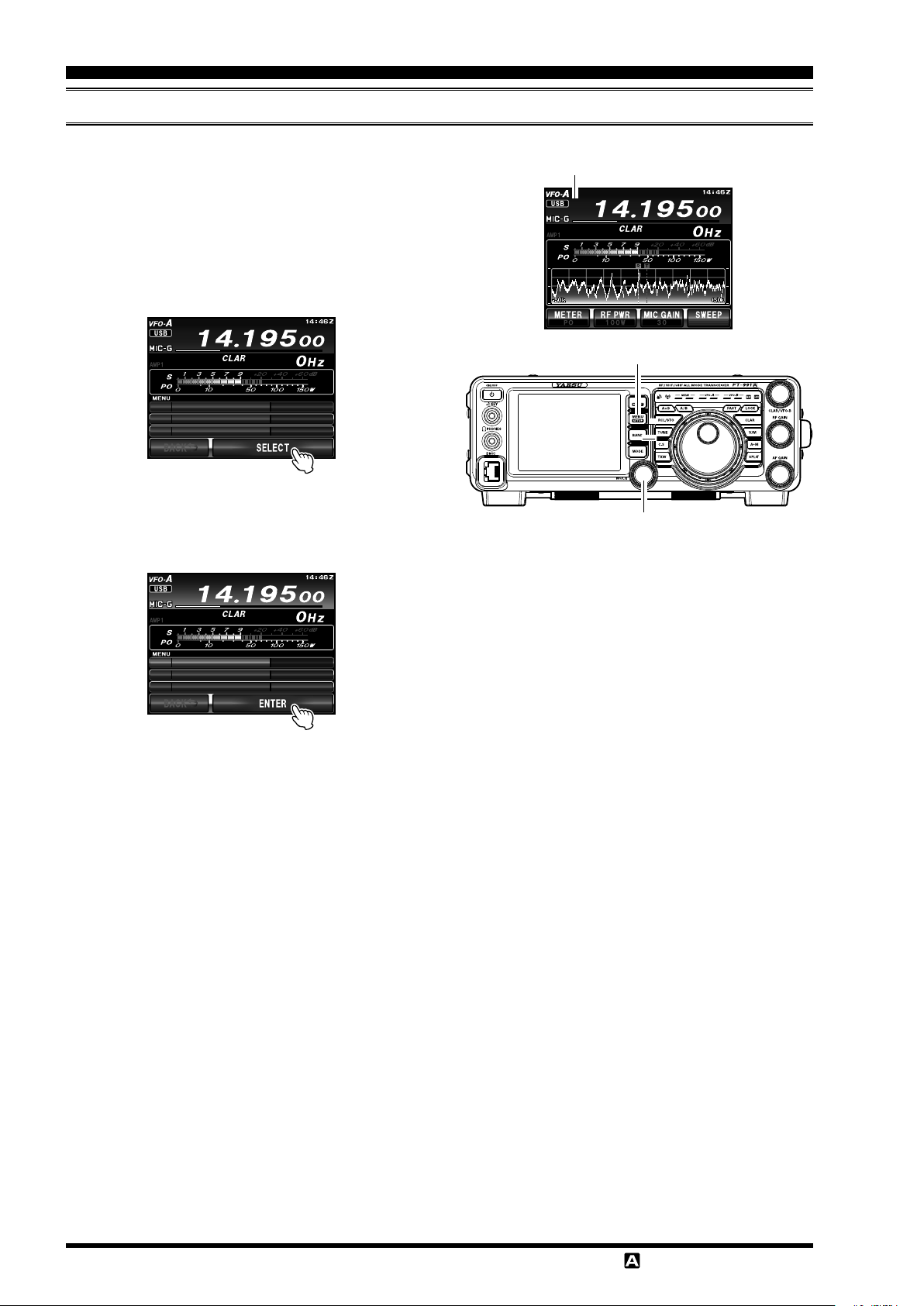
basic OperaTiOn: receiving On aMaTeur banDs
VFO COLOR
The background color of the VFO-A frequency in the TFT display may be selected via Menu item 006.
1. Press the
2. Rotate the
DISPLAY COLOR
3. Touch
MULTI
BLUE
[
SELECT
knob to select from the following colors:
(default
button to enter the Menu mode.
MENU
knob to select Menu item “
MULTI
”.
]
on the LCD, then rotate the
)
/ GRAY / GREEN / ORANGE /
PURPLE / RED / SKY BLUE
&+52.;#.%1 14 $.7'
&+//'4 .&'
&+//'4 66(
4. Touch
[
ENTER
on the LCD or press the
]
on the LCD, then touch
MENU
new setting and exit to normal operation.
006
[
BACK
button to save the
Background color
MENU Button
]
MULTI
Knob
&+52.;#11. 4
&+///4'&.%'
&+//'4 66(
)4''0
Page 38 FT-
991
OperaTing Manual
Page 41

【BAND】【14】
【14】
cOnvenience FeaTures
bAnd StAck operAtion
The
FT-991A
cies and modes onto each band VFO register. For example, one frequency each on 14 MHz CW, RTTY, and USB may
be stored and then recalled by successive, momentary touches of
Each Amateur band key may similarly have up to three frequency/mode settings applied. Note that only the VFO-A system has the band stacks.
A typical setup, for the 14 MHz band, might be arranged like this:
1. Program 14.025 MHz, CW Mode, then press the
BAND
2. Program 14.080 MHz, RTTY Mode, then press the
BAND
3. Program 14.195 MHz, SSB Mode, then press the
BAND
To individually recall each of the three stored operating
states, press the
the screen repeatedly.
utilizes a triple band-stack VFO selection technique that permits storing of up to three favorite frequen-
[14]
button, and then touch
button, and then touch
button, and then touch
button, and then touch
BAND
【14】
[14]
on the LCD.
[14]
on the LCD.
[14]
on the LCD.
[14]
on the screen displayed by the
BAND Button
on
BAND
button.
【BAND】
Advice:
The 5MHz band stack may be recalled by touching and holding
c.S (cuStoM SWitch
The front panel
C.S Setup
1. Press the
the Menu list will appear on the display.
2. Rotate the
want to access with the front panel
3. Press the
4. Press the
LCD to save the new conguration and exit to nor-
mal operation.
Menu Selection Recall via C.S button
Press the
The programmed Menu item will appear on the display.
Press the
exit to normal operation.
C.S
MENU
button may be programmed to directly access an often-used Menu Mode selection.
C.S
button to engage the Menu mode;
MENU
knob to select the Menu item you
MULTI
button.
C.S
button to lock in your selection.
C.S
MENU
button.
button or touch
button or touch
[
BACK
[
BACK
]
on the
]
on the LCD
[14]
on the LCD in a similar operation.
)
MULTI Knob
C.S buttonMENU button
991
OperaTing Manual
Page 39FT-
Page 42
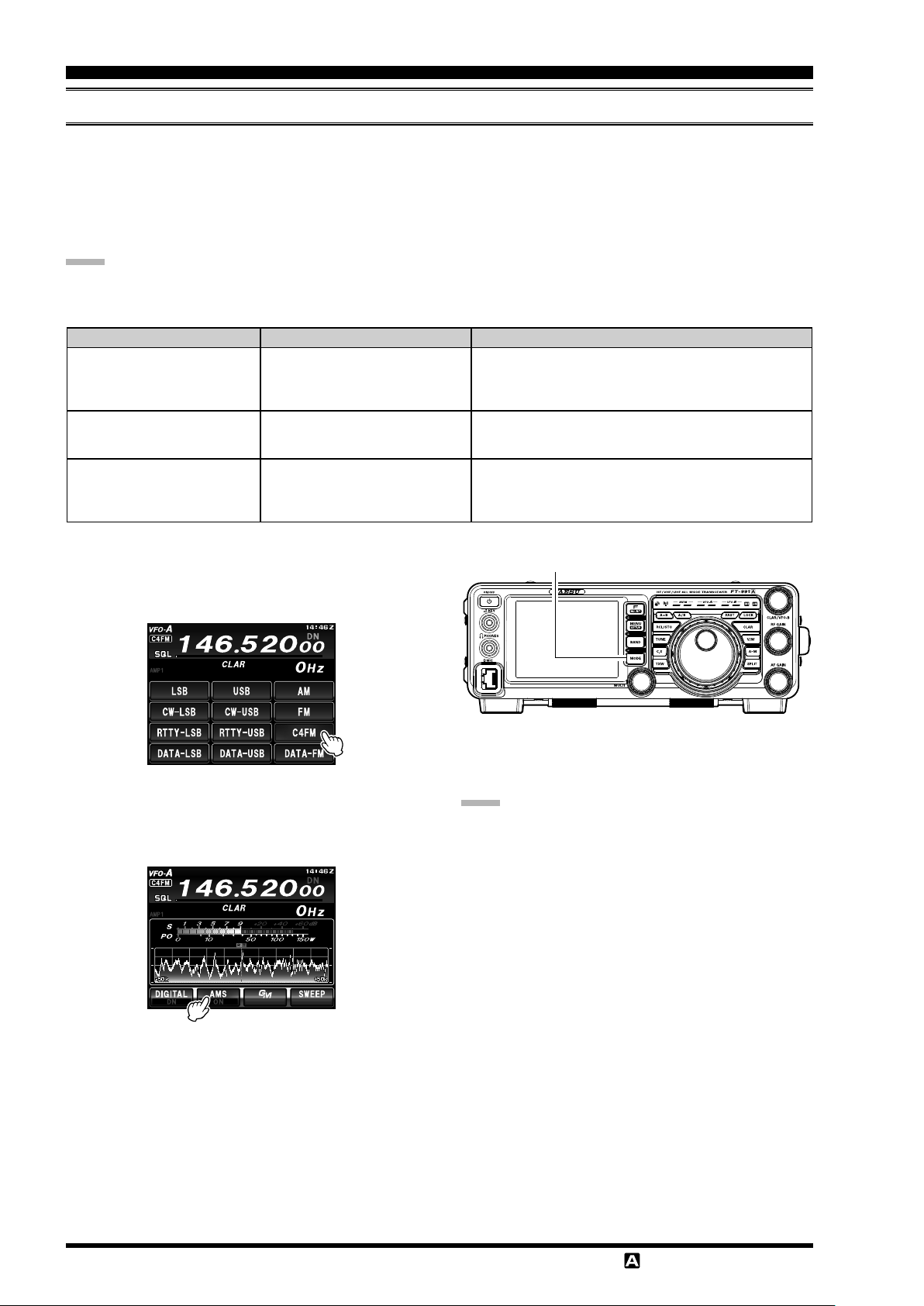
cOnvenience FeaTures
AMS (AutoMAtic Mode Select) operAtion
The transceiver has the AMS (Automatic Mode Select) function which enables the transceiver to automatically select
the most appropriate option out of the three communication modes according to the received signal while operating in
C4FM mode.
Besides C4FM digital signals, analog signals (FM) are also identied in order to automatically match the communication mode of the partner station.
note:
The AMS function recognizes the three modes listed in the following table. Other communication modes cannot be recognized.
operAting Mode diSplAy explAnAtion oF ModeS
V/D mode
(
simultaneous voice and data
communication mode
Voice FR mode
(
Voice full-rate mode
Analog FM mode
)
)
When AMS is “ON”: Red
When AMS is “OFF”: Light blue
When AMS is “ON”: Red
When AMS is “OFF”: Light blue
Only when AMS is “ON”: Lights red
DN
VW
AN
As the audio signal error is detected and repaired at the
same time as the transmission of the digital audio signal,
it becomes more difcult for conversations to be cut off. A
basic digital mode of C4FM FDMA.
Digital voice data is transmitted using the entire 12.5 kHz
bandwidth. High quality voice communication is possible.
Analog communication mode using the FM mode.
This mode is effective for communication when the signal
strength is so weak that the voice is cut off midway in the
digital mode.
1. Press the
MODE
button, and then touch the corresponding key on the LCD to select the C4FM operating mode. The “
2. Touch
[
]
on the LCD. The AMS function will
AMS
” icon appears in the display.
C4FM
switched to “ON” and the communication mode will
be switched to match the received signal.
MODE Button
note:
In the V/D mode (“DN” displayed), the position infor-
mation is included in the transmitted signal during the
conversation, but in the Voice FR mode (“VW” displayed), the position information is not included.
Page 40 FT-
991
OperaTing Manual
Page 43
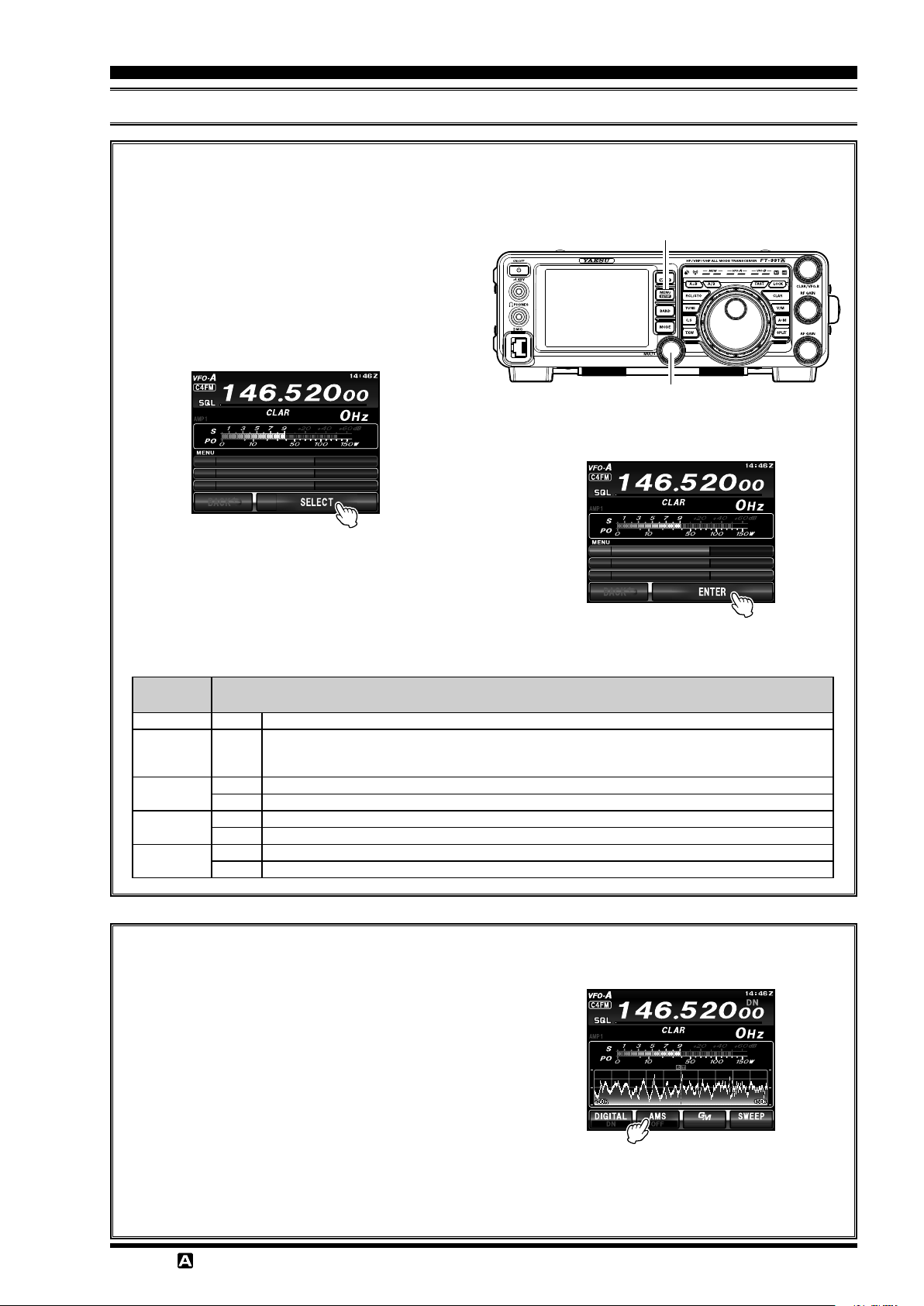
cOnvenience FeaTures
AMS (AutoMAtic Mode Select) operAtion
Setting the Operation of the AMS Function
Using the AMS function switches the communication mode to match the received signal but you can alternatively
select and lock the transmission mode.
1. Press the
MENU(SETUP
)
button to enter the
Menu mode.
2. Rotate the
AMS TX MODE
3. Touch
[
SELECT
knob to select Menu item “
MULTI
”.
] on the LCD, rotate the
knob to select the desired operation (see the following table).
0&$; $''2
;.%7
'/1& #761
#/56:
56# 10
4666(4'3 *\
092
MULTI
4. Touch
[
ENTER
ting.
5. Press the
[
BACK
]
on the LCD to exit to normal operation.
MENU(SETUP) Button
MULTI Knob
]
on the LCD to save the new set-
0&$; $''2
;.%7
'/1& /#07#.
)
button or touch
#/56:
56# 10
4666(4'3 *\
MENU(SETUP
AvAilAble
explAnAtion oF Function
SettingS
AUTO TX/RX
MANUAL TX/RX
DN RX
VW RX
ANALOG RX
The operating mode is automatically selected from the three communication modes to match the received signal.
The operating mode is automatically selected from three communication modes to match the received signal.
Pressing the Microphone PTT switch momentarily, toggles between the Digital (C4FM) and Analog (FM)
communication modes.
The RX mode is automatically selected from the three communication modes to match the received signal.
TX The TX mode is automatically changed to the “DN” mode.
The RX mode is automatically selected from the three communication modes to match the received signal.
TX The TX mode is automatically changed to the “VW” mode.
The RX mode is automatically selected from the three communication modes to match the received signal.
TX The TX mode is automatically changed to the “FM” mode.
Toggling to the Digital Communication Mode
Without using the AMS function, you can select and lock the digital communication mode (DN or VW).
1. Touch
[
] on the screen to set the AMS func-
AMS
tion to “OFF”.
2. Touching
[
DIGITAL
] on the screen switches the
digital communication mode between the following modes.
)
DN (V/D Mode
: As the audio signal error is detected and repaired at the same time as the
transmission of the digital audio signal,
)
it becomes more difficult for conversations to be cut off. A basic digital mode of
C4FM FDMA.
VW (FR Mode
ted using the entire 12.5 kHz bandwidth.
High quality voice communication is pos-
: Digital voice data is transmit-
sible.
991
OperaTing Manual
Page 41FT-
Page 44
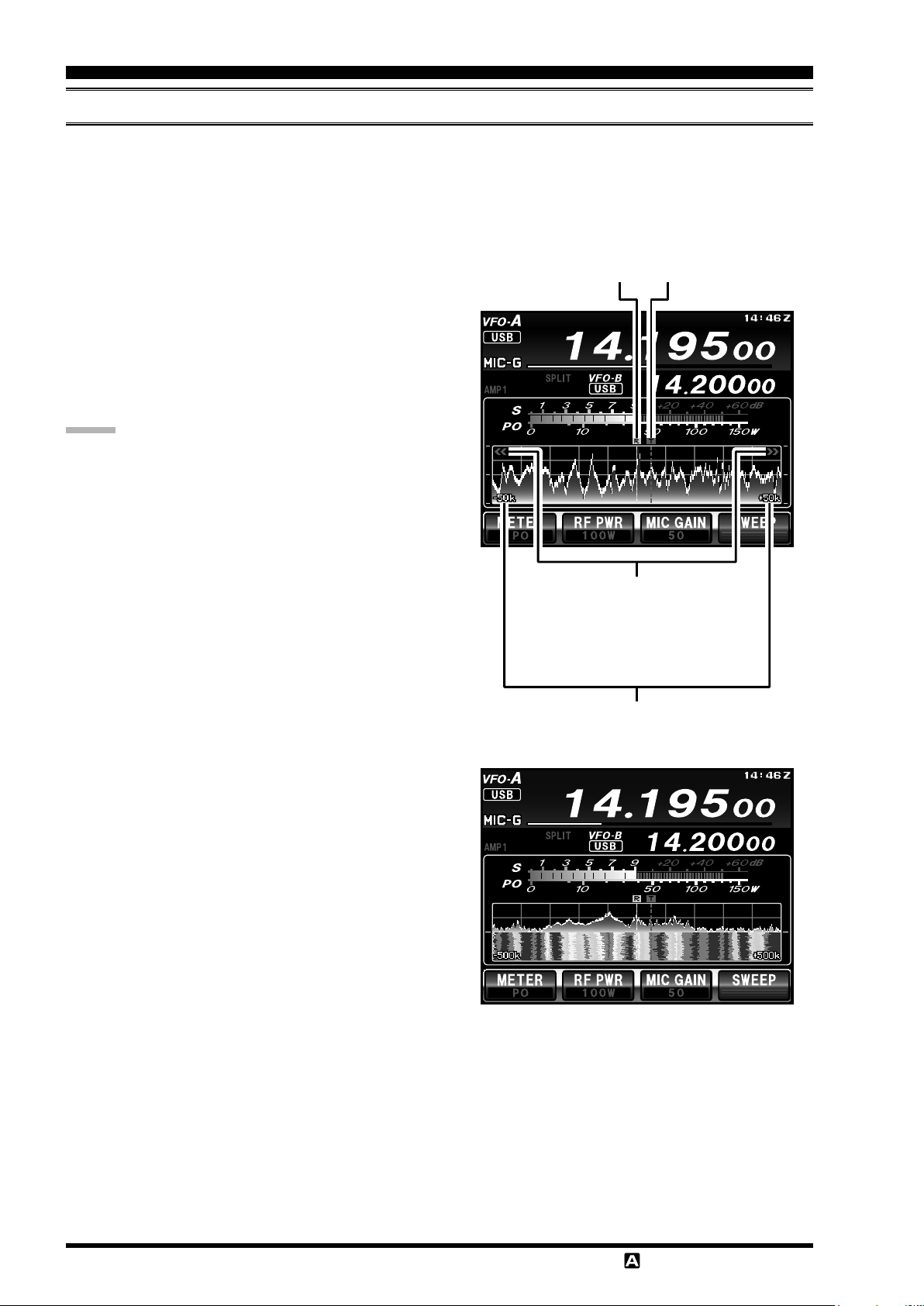
cOnvenience FeaTures
Scope
The SCOPE function provides a real time spectrum display of the band conditions. Both strong and weak signals can
be clearly displayed on the TFT screen. In the MANUAL mode, the scope frequency spectrum is scanned one time and
displayed. In the “Continuous Sweeping mode”, the scope spectrum is repeatedly swept and displayed. The scope sweep
and span, the color of the SPECTRUM display, and the color of the WATER FALL display may be optimized according
to your preference.
[
Touch
tions (spectrum).
Advice:
SWEEP
The transceiver is equipped with two types of sweep-
ing mode: “MANUAL mode” and “Continuous
sweeping mode”. Refer to the advice below to select
the optimal mode according to your preferences and
purposes.
“Touch
mode. Each time
a new scan of the spectrum scope is shown on the
TFT display.
Touch and hold
spectrum scope to scan continuously until
on the LCD is touched again.
“Spectrum display mode” or “Waterfall display
mode” may be selected in Menu item “
DISPLAY MODE
Width of scope display may be set in Menu item “
SCP SPAN FREQ
Color of the SPECTRUM display may be set in
Menu item “
Color of the WATER FALL display may be set in
Menu item “
]
on the LCD to display the band condi-
[
SWEEP
]
on the LCD to access the Manual
[
SWEEP
[
SWEEP
”.
”.
119 SPECTRUM COLOR
120 WATER FALL COLOR
]
on the LCD is touched,
]
on the LCD to cause the
”.
[
SWEEP
117 SCP
”.
118
Reception frequency Transmission frequency
]
Lights up when transmission frequency
is outside of the display range
Reception frequency: Green
Transmission frequency: Red
Width of scope
Example of waterfall display
Page 42 FT-
991
OperaTing Manual
Page 45
cOnvenience FeaTures
Scope
Sweep Mode
Two sweep modes are available for the scope function as described below.
MANUAL Mode
[
Touch
SWEEP
Continuous Sweeping Mode
Touch and hold
sweeping the band segment continuously. While rotating the main dial, you can continuously monitor the band
condition.
]
on the LCD to sweep across the band one time, and display band conditions.
[
SWEEP
]
on the LCD to begin the continuous sweep operation. The spectrum scope will start
To stop sweeping, touch
[
SWEEP
]
on the LCD again.
991
OperaTing Manual
Page 43FT-
Page 46
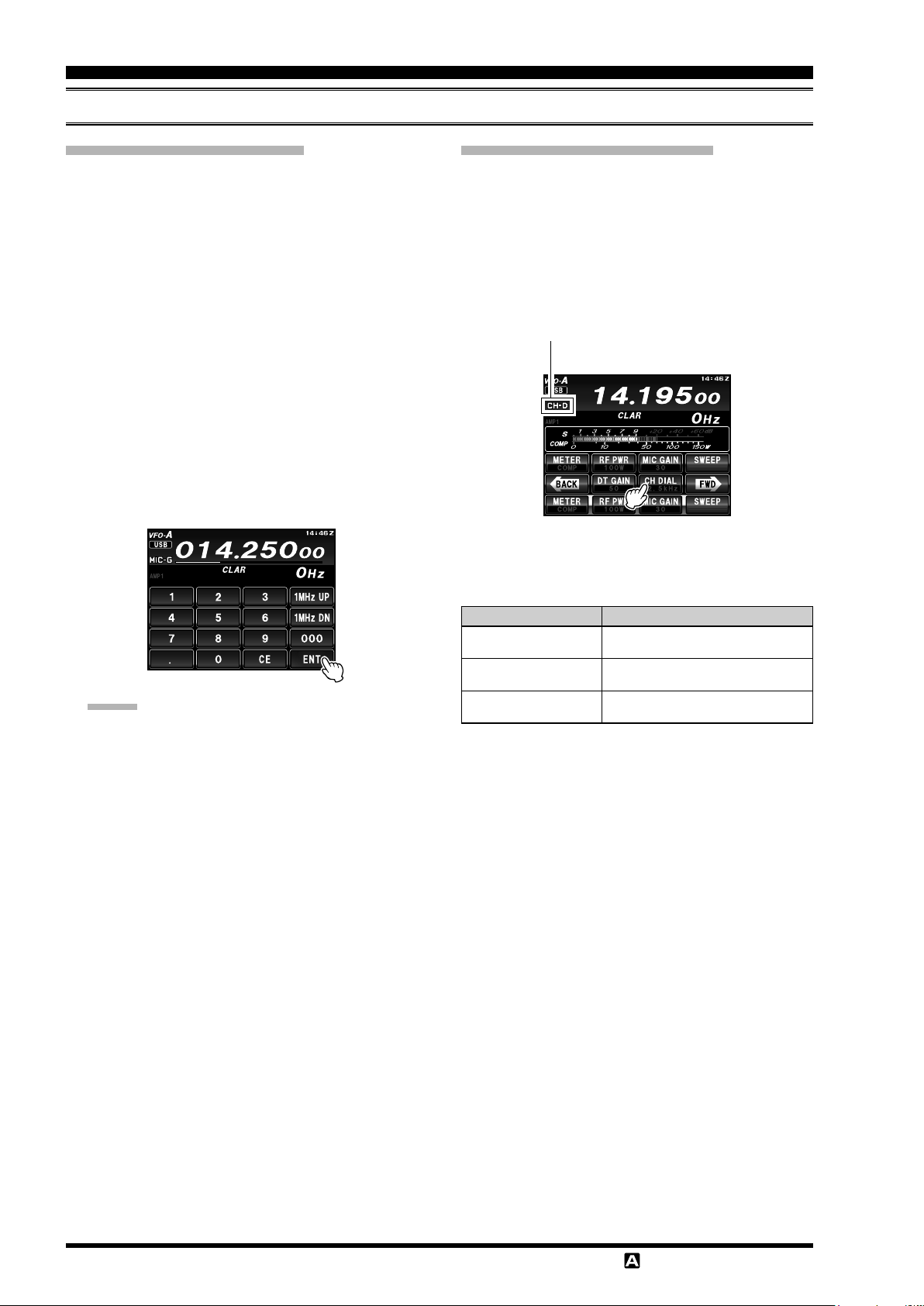
cOnvenience FeaTures
More Frequency nAvigAtion techniqueS
Keyboard Frequency Entry
The Operating frequency may be entered directly into
the current VFO, using the display screen keyboard by
pressing the front panel
Example: Enter 14.250.00 MHz
1. Press the
button to begin the direct frequency
BAND
entry process.
[
2. Touch
]
on the LCD. The rst digit of the fre-
ENT
quency (the leftmost digit) will blink.
3. Enter, in order, the digits of the operating frequency,
touching the keys on the LCD
The decimal point after the “MHz” portion of the
frequency must be entered, but no decimal point is
required after the “kHz” portion.
[
4. Touch
]
on the LCD once more to complete
ENT
the operating frequency entry. A short “beep” will
conrm that the entry was successful, and the new
operating frequency will appear on the display.
BAND
button.
Setting with the MULTI Knob
Rotate the
programmed frequency steps. The frequency step can be
changed.
1. Press the
menu list. Touch the
function and cause the
the frequency adjustment knob.
2. Touch
[
step. Touching
as follows.
knob to set the frequency in the pre-
MULTI
)
F(M-LIST
CH-D (CH DIAL) indicator
CH DIAL
button to display the function
[
CH DIAL
MULTI
]
to select the desired frequency
[
CH DIAL
]
icon to activate this
knob to function as
]
switches the frequency
Advice:
If you attempt to enter a frequency outside the oper-
ating range of 30 kHz - 56 MHz, the microprocessor
will ignore the attempt, and will return to the previ-
ous operating frequency. If this happens, please try
again, taking care not to repeat the error in the frequency entry process.
operAting Mode Frequency Step
AM 2.5
SSB/CW/RTTY/
DATA-LSB/DATA-USB
FM/C4FM/
DATA-FM
3. Rotate the
knob to change the frequency in
MULTI
1
5
6.25
5
9
10
…
2.5
2.5
5
10
25
12.5
5
the selected frequency steps.
12.5
…
1
15
…
25
20
Page 44 FT-
991
OperaTing Manual
Page 47
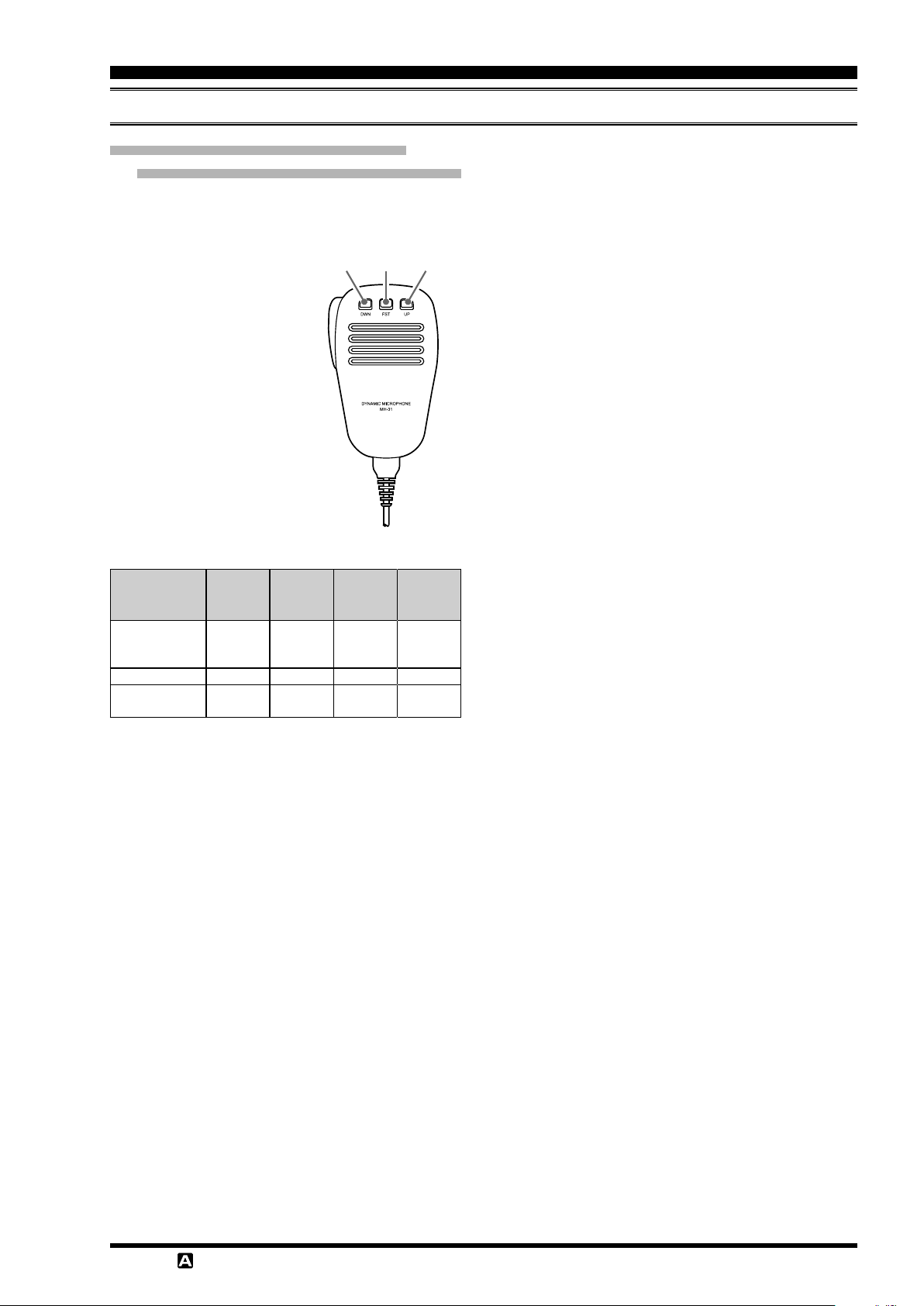
More Frequency nAvigAtion techniqueS
Using the UP/DWN Buttons of the
Supplied MH-31
The UP/
Microphone may also be used to manually scan the frequency upward or downward.
buttons on the supplied
DWN
A8J
Hand Microphone
A8J
MH-31
Hand
cOnvenience FeaTures
In modes other than AM/FM,
the frequency changes by the
same step as the main dial.
When the microphone
button is pressed, the tuning
rate increases by a factor of
ten, in a manner similar to
the transceiver front panel
button.
FAST
The frequency change
amount (step size) differs depending on the preset modulation form and FST button
condition.
operAting
Mode
CW/RTTY/
DATA-LSB/
DATA-USB
LSB/USB/AM +10 Hz −10 Hz +100 Hz −100 Hz
FM/C4FM/
DATA-FM
FST
up DWN
+5 Hz −5 Hz +100 Hz −100 Hz
+5 kHz −5 kHz +50 kHz −50 kHz
DWN UPFST
FST
+
UP
FSt
+
dWn
991
OperaTing Manual
Page 45FT-
Page 48
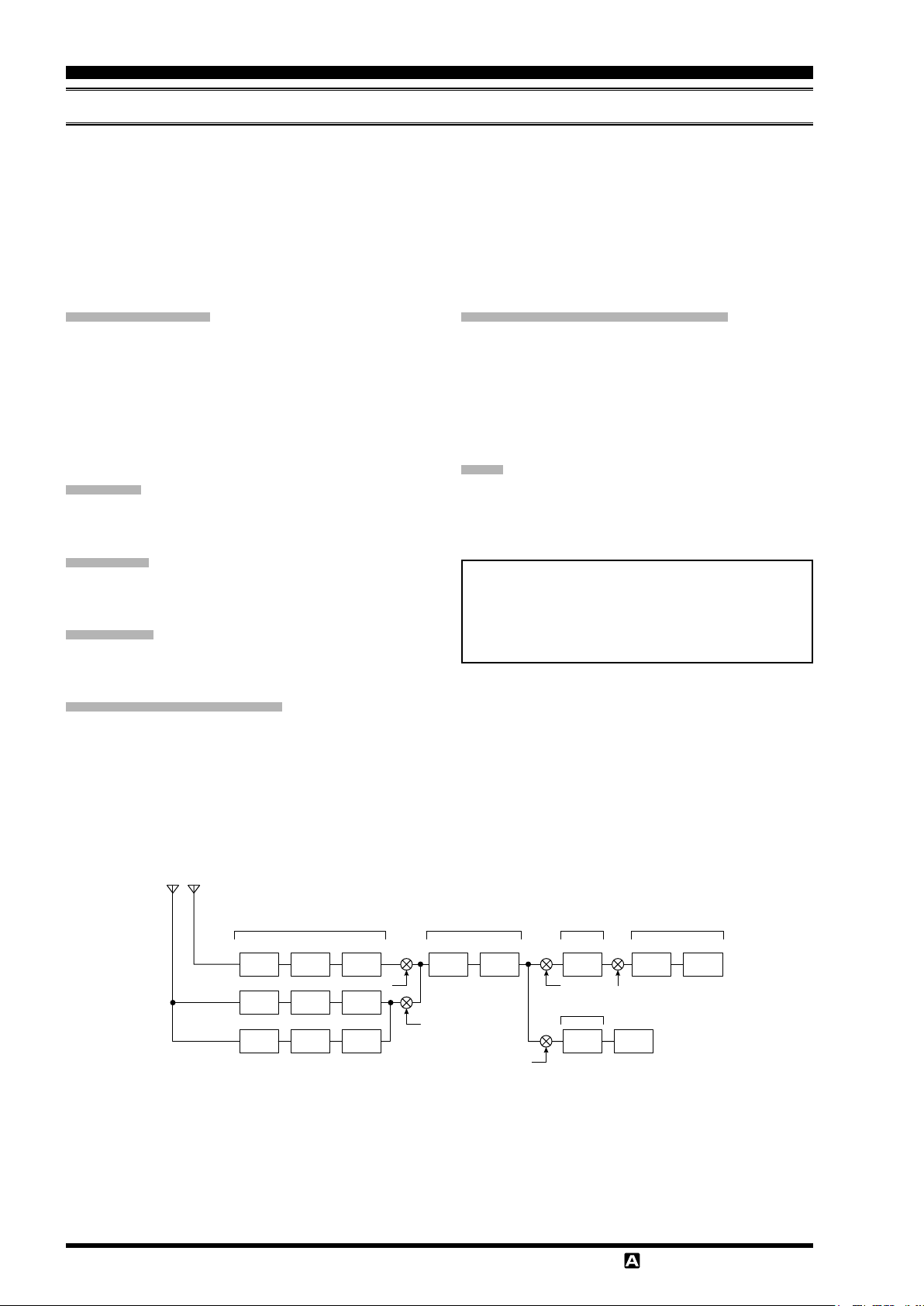
cOnvenience FeaTures
)
The
FT-991A
receiver operAtion (Front end block diAgrAM
includes a wide range of special features to suppress the many types of interference that may be encountered on the HF bands. However, real world interference conditions are constantly changing, so optimum setting of the
controls is somewhat of an art, requiring familiarity with the types of interference and the subtle effects of some of the
controls. Therefore, the following information is provided as a general guideline for typical situations, and a starting
point for your own experimentation.
The
FT-991A
tion.
FT-991A
CONTOUR Filter
The DSP Contour filter has the unique ability to provide either a null or a peak in tunable segments of the
receiver passband. You may suppress interference and
excessive frequency components of an incoming signal,
or you may peak those tunable frequency segments. The
level of the null or peak, and the bandwidth, over which
it is applied, are adjustable via the Menu.
IF SHIFT
The passband center frequency of the IF DSP lter may
be moved up or down by adjusting this control.
interference-ghting circuitry begins in its “RF” stages, and continues throughout the entire receiver sec-
allows conguration of the features described below.
DNR (Digital Noise Reduction
)
The DSP’s Digital Noise Reduction (DNR) feature uti-
lizes 15 different mathematical algorithms to analyze
and suppress different noise proles encountered on the
HF/50 MHz bands. Choose the selection that provides
the best noise suppression, and allows the signal to rise
up out of the noise.
AGC
The AGC system automatically adapts to changing signal and fading characteristics, making reception possible
under the most difcult conditions.
IF WIDTH
The width of the IF DSP ltering may be adjusted using
this control.
IF NOTCH
The IF Notch lter is a high-Q notch lter that can eliminate, or signicantly reduce an interfering carrier.
DNF (Digital Notch lter
When multiple interfering carriers are encountered dur-
ing reception, the Digital Notch Filter can signicantly
reduce the level of these signals.
HF/
VHF/
50MHz
UHF
ANT
ANT
)
HF/50MHz
ATT BPF
144MHz
LPF
430MHz
LPF
RF
RF AMP/
IPO
1st Local
BPF
RF AMP
RF AMP BPF FM DET
ROOFING
FILTER
3 kHz
15 kHz
1st Local
The
FT-991A
uses the 15 kHz roofing filter on
AM/FM/C4FM modes. All the other modes use
the 3 KHz lter automatically. There is no manual
selection possible.
1st IF
69.450 MHz
1st
IF AMP
2nd Local
2nd IF
9 MHz
MCF
2nd Local
3rd Local
2nd IF
450 kHz
FM C4FM
IF AMP
C4FM
DSP UNIT
3rd
3rd IF
24 kHz
DSP
UNIT
Front end block diAgrAM
Page 46 FT-
991
OperaTing Manual
Page 49
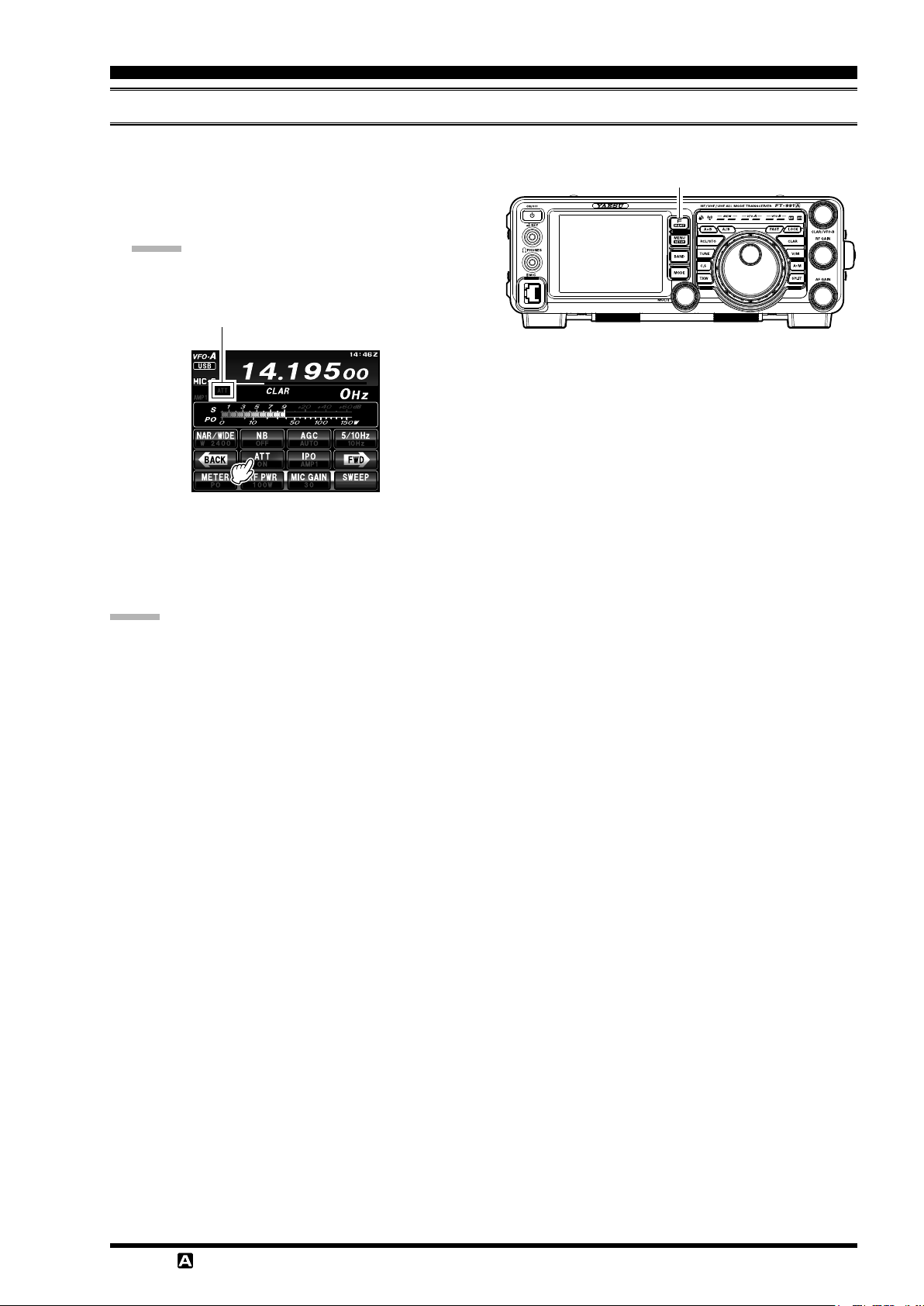
inTerFerence reJecTiOn
ATT (AttenuAtor
When the desired signal is extremely strong or the noise level is high on a low frequency band, activate the attenuator to
reduce the incoming signal from the antenna.
[
1. Press the
the LCD. The “
DSP display.
Advice:
The incoming signal level is reduced by 12dB
2. To restore full signal strength through the Attenuator
circuit, touch
display to the “
F(M-LIST
(
Signal voltage is reduced to 1/4 compared to OFF).
Displays ATT
)
button, then touch
” indicator will appear in the
ATT
[
]
on the LCD to return the ATT
ATT
” position.
OFF
ATT
]
on
)
F(M-LIST) Button
Advice:
If the noise level is high or the received signal is extremely strong, the incoming signal level can be suppressed with the
IPO/ATT settings.
If the S-meter uctuates S-3 or more in the noise level, or the received signal is extremely strong and it causes a high S-
meter indication (+20dB or more), activate the attenuator.
Since IPO does not only attenuate the incoming signal, but also improves the cross modulation characteristic, try to activate the IPO rst. If the signal is still strong, also use the ATT. In this way, you can attenuate the incoming signal and
noise effectively.
991
OperaTing Manual
Page 47FT-
Page 50
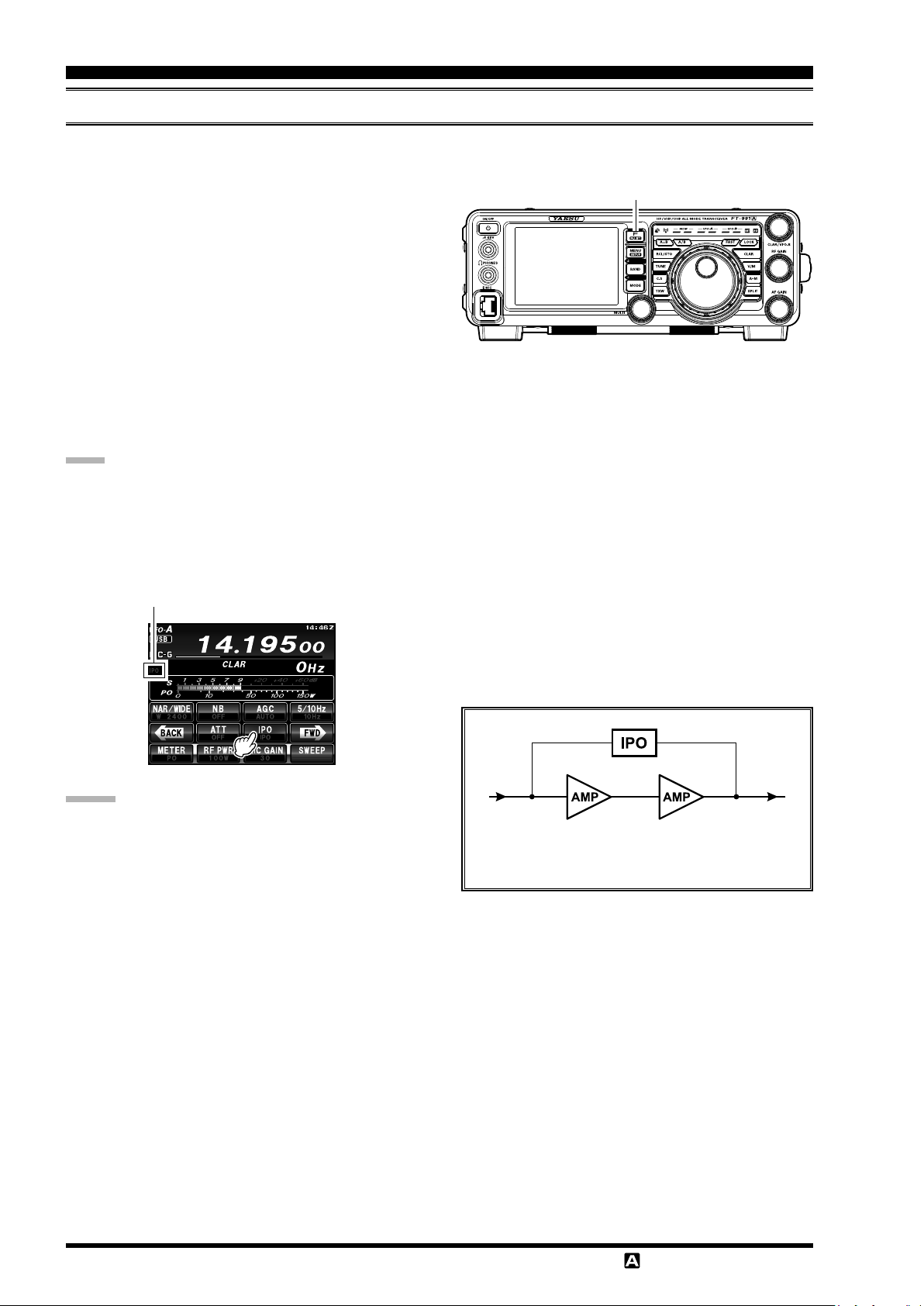
inTerFerence reJecTiOn
1.8 MHz ~ 56 MHz
ipo (intercept point optiMizAtion
The IPO feature allows the operator to optimize the characteristics of the receiver front end, contingent on the current
noise level and the strength of incoming signals.
Press the
menu list. Touch the
the desired characteristic of the receiver front end, according to the chart below.
note:
AMP1 does not function below the 1.8 MHz frequency
range.
The selected receiver RF preamplier will be indicated
in the IPO column of the Key Function Display on the
TFT screen.
F(M-LIST
: Amplies the incoming signals, using a low
AMP1
distortion RF preamplier (gain: approx. 10
dB).
: Amplifies the incoming signals, using a
AMP2
2-stage low-distortion RF preamplier (total
gain: approx. 20 dB).
: Bypasses the RF preamplier, yielding direct
IPO
feed to the rst mixer.
)
button to display the function
[
]
function repeatedly, to set
IPO
)
F(M-LIST) Button
Displays IPO
Advice:
On the 10 MHz and lower bands, it is generally not
necessary to use any preamplier at all; selecting the
“IPO” position as described above will increase the
strong-signal-handling capability of the receiver, and
generally result in more pleasant reception due to the
reduced ambient noise level. If you can hear band
noise with the preampliers disengaged, then a preamplier is generally not needed.
About 10dB About 10dB
Page 48 FT-
991
OperaTing Manual
Page 51
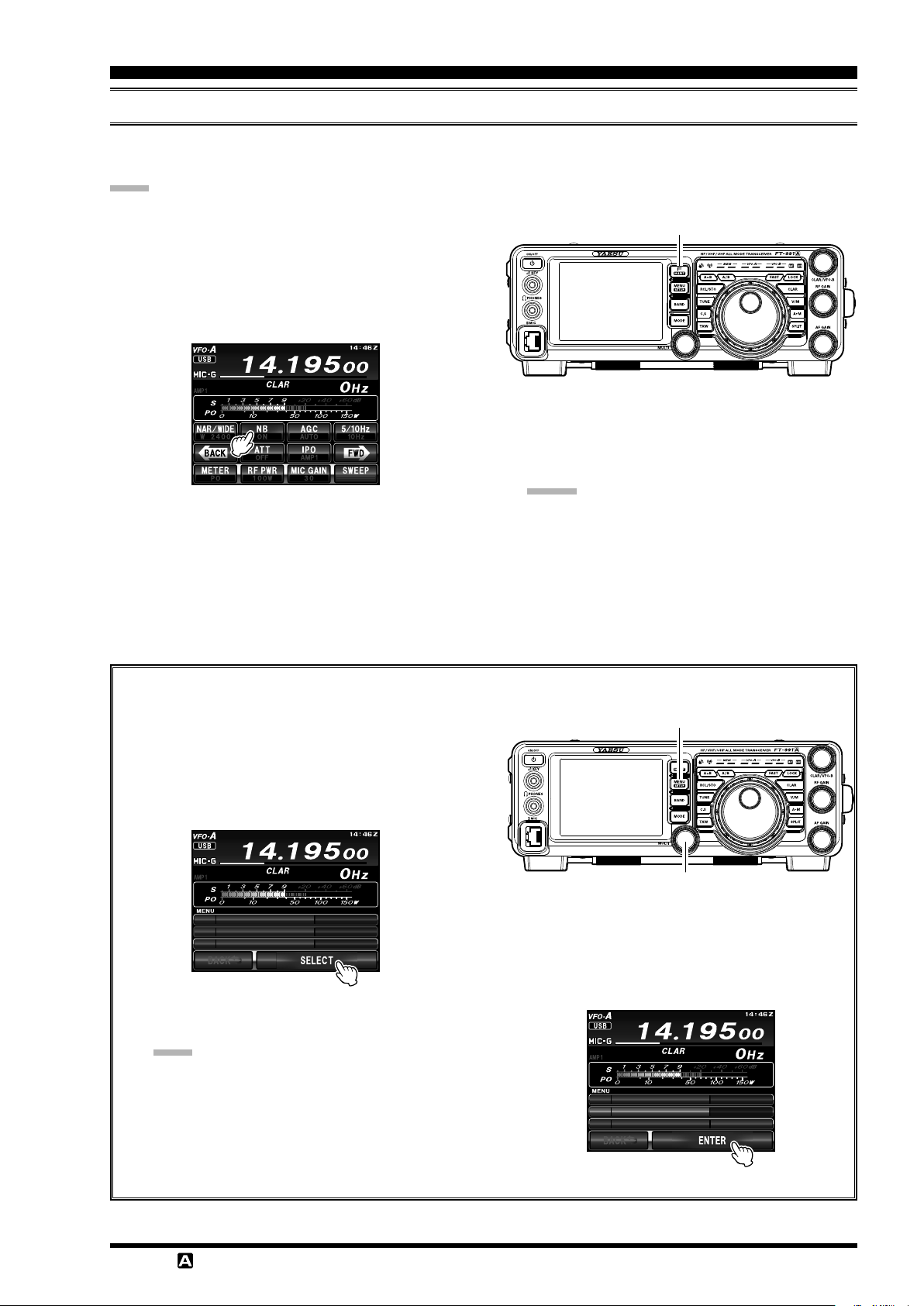
inTerFerence reJecTiOn
iF noiSe blAnker
(
nb
)
operAtion
The
FT-991A
includes an effective IF Noise Blanker, which can signicantly reduce noise caused by automotive igni-
tion systems.
note:
The NB function may be less effective on some other types of interference.
1. Press the
F(M-LIST
menu list. Touch the
)
button to display the function
]
function icon briefly to
[NB
reduce short duration pulse noise like that from
switching transients, automobile ignitions and power
lines. The Noise Blanker will be set to “ON”.
2. If desired, the Noise Blanker level may be adjusted
via Menu item “
the offending noise is best reduced or eliminated.
See box below for details.
Advice:
The noise attenuation can be selected from
10dB/30dB/50dB via Menu item “
JECTION
3. To end Noise Blanker operation, touch
TFT display once more. The “
the TFT display, conrming the Noise Blanker is no
longer in operation.
F(M-LIST) Button
025 NB LEVEL
”.
” to the point where
024 NB RE-
[NB]
on the
” will appear in
OFF
Adjusting the Noise Blanker Level
1. Press the
MENU
button to engage the Menu
mode.
2. Rotate the
NB LEVEL
3. Touch
[
SELECT
4. Rotate the
knob to select Menu item “
MULTI
”.
]
on the LCD
0$ 4' ',1%6+ 0 F$
0$ .'8 .'
$''2.8'.'
MULTI
knob to the point where the
offending noise is best reduced or eliminated.
note:
Excessive increase of the NB level may cause
distorted receive audio.
5. Touch
MENU
[
ENTER
button or touch
]
on the LCD, then press the
[
BACK
]
on the LCD to
lock in the new setting and exit to normal operation.
025
MENU button
MULTI Knob
0$ 4' ',1%6+ 0 F$
0$ .'8 .'
$''2.8'.'
991
OperaTing Manual
Page 49FT-
Page 52
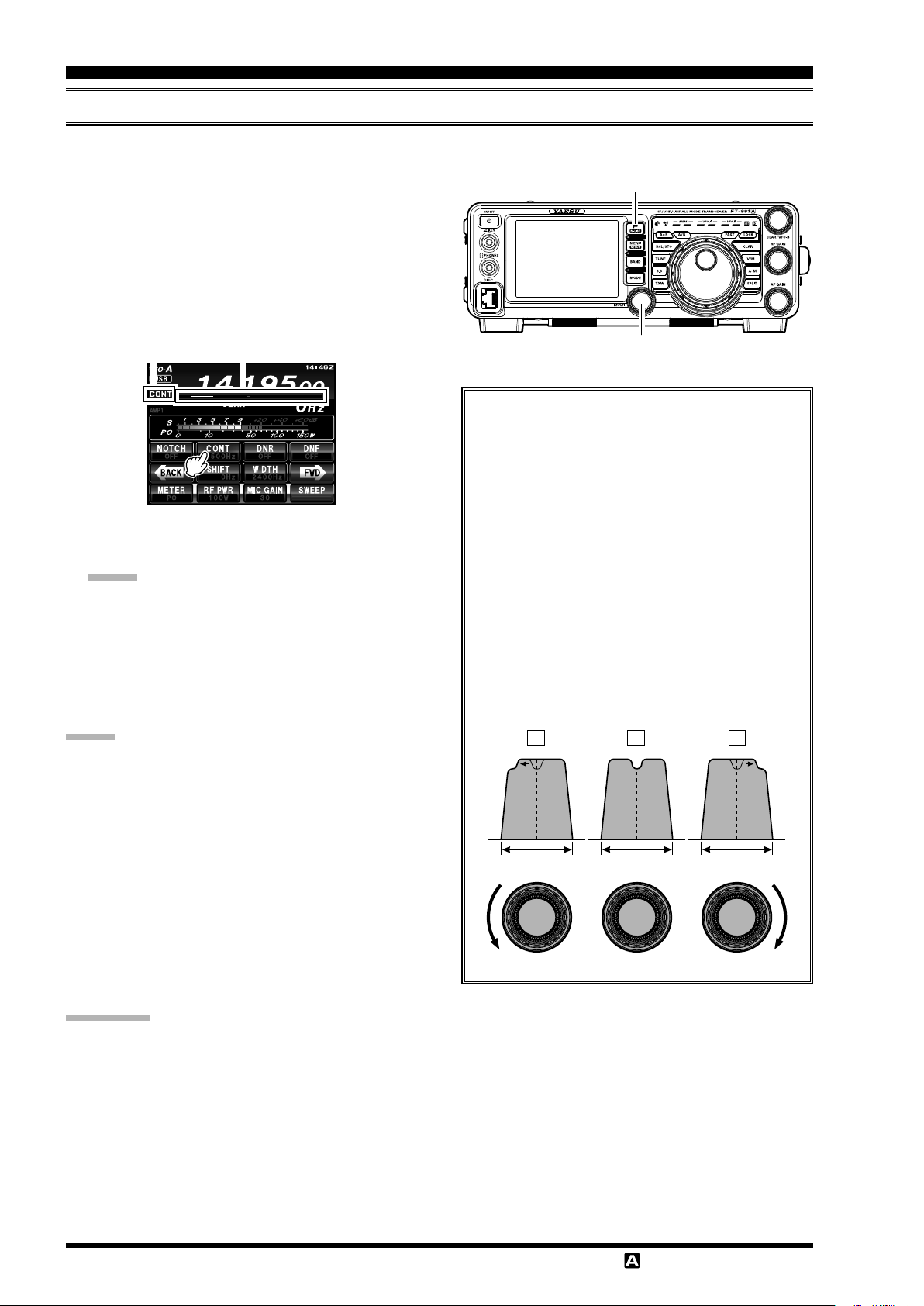
inTerFerence reJecTiOn
contour control operAtion
The Contour lter system provides a gentle perturbation of the IF lter passband. The Contour is set to either suppress,
or boost specic frequency components, and thus enhances the sound and readability of a received signal.
1. Press the
menu list. Touch
function and set the
adjustment knob.
2. Touch
function will be set to “ON”.
3. Rotate the
sounding audio reproduction of the incoming signal.
Advice:
Rotate the
The level indicator shows the amount of attenua-
4. To cancel Contour tuning, touch
TFT display.
Advice:
The Contour circuit operation will be set to “
Touching
eration between “ON” and “
The Contour function attenuation and bandwidth can
be set in Menu items “
“
115 CONTOUR WIDTH
on the right).
F(M-LIST
[
CONT
CONT (Contour) indicator
CONT (Contour) level indicator
MULTI
center frequency (10 Hz to 3,200 Hz) below the
[
tion for your reference.
CONT
]
indicator.
[
CONT
)
button to display the function
[
]
on the TFT display. The Contour
MULTI
]
CONT
to activate the CONTOUR
knob as the CONTOUR
MULTI
knob to achieve the most natural
knob to display the Contour
[
]
changes the Contour circuit op-
”.
OFF
114 CONTOUR LEVEL
” (refer to the instruction
CONT
]
on the
OFF
”.
” and
Refer to Figure “B”, this illustrates a “dip” in the
center of the Contour lter passband. The Contour lter places a low-Q “notch” in the passband,
per the settings of Menu items “
” and “
LEVEL
clockwise rotation of the
notch to move toward a lower frequency within
the passband, while clockwise rotation causes the
notch to move toward a higher frequency within
the passband. By removing interference or unwanted frequency components of the incoming
signal, it is possible to make the desired signal
rise out of the background noise/interference, and
signicantly enhance intelligibility.
A B C
IF BANDWIDTH IF BANDWIDTH IF BANDWIDTH
F(M-LIST) Button
MULTI Knob
114 CONTOUR
115 CONTOUR WIDTH”.
MULTI
knob causes the
Counter-
MULTI MULTI MULTI
quick point:
By judicious use of the Contour lter, the “shoulder” of the passband response may be altered, or components may be
removed from within the passband, allowing the desired signal to rise above the background noise and interference in a
manner not obtainable with other ltering systems.
Page 50 FT-
991
OperaTing Manual
Page 53
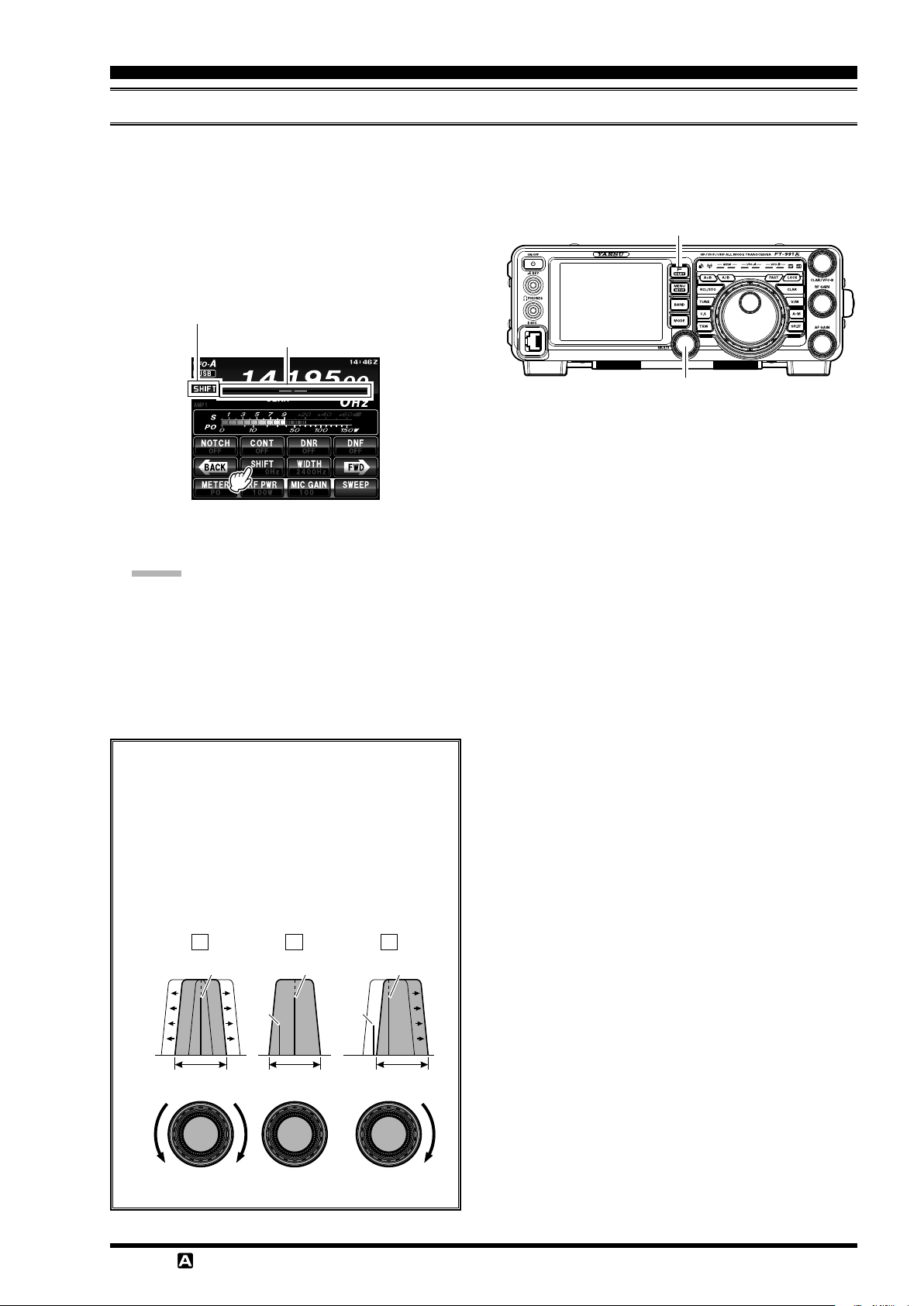
inTerFerence reJecTiOn
iF ShiFt operAtion (SSb/cW/rtty/dAtA ModeS
IF SHIFT permits moving the DSP lter passband higher or lower, without changing the pitch of the incoming signal,
and thus reduces or eliminates interference. Because the tuned carrier frequency is not varied, there is no need to re-tune
the operating frequency to eliminate the interference. The total passband tuning range for the IF SHIFT system is ±1.2
kHz.
1. Press the
menu list. Touch
The
knob.
2. Rotate the
interfering signals.
Advice:
Rotate the
The level indicator shows the shift offset direc-
F(M-LIST
MULTI
of the IF lter (−1,200 Hz to +1,200 Hz) below
the
tion for your reference.
knob functions as the SHIFT adjustment
SHIFT indicator
MULTI
[
SHIFT
)
button to display the function
[
MULTI
]
indicator.
]
SHIFT
knob to the left or right to reduce
to reduce the interference.
SHIFT level indicator
knob to display the shift offset
F(M-LIST) Button
MULTI Knob
)
Referring to Figure “A”, note the depiction of the
IF DSP lter as the thick line, with
in the 12 o’clock position. In Figure “B”, an in-
terfering signal has appeared inside the original
passband. In Figure “C”, you can see the effect
of rotating the
level is reduced by moving the lter passband so
that the interference is outside of the passband.
A B C
Desired Signal Desired Signal Desired Signal
IF BANDWIDTH
MULTI MULTI MULTI
MULTI
knob. The interference
IF BANDWIDTH IF BANDWIDTH
MULTI
QRMQRM
knob
991
OperaTing Manual
Page 51FT-
Page 54
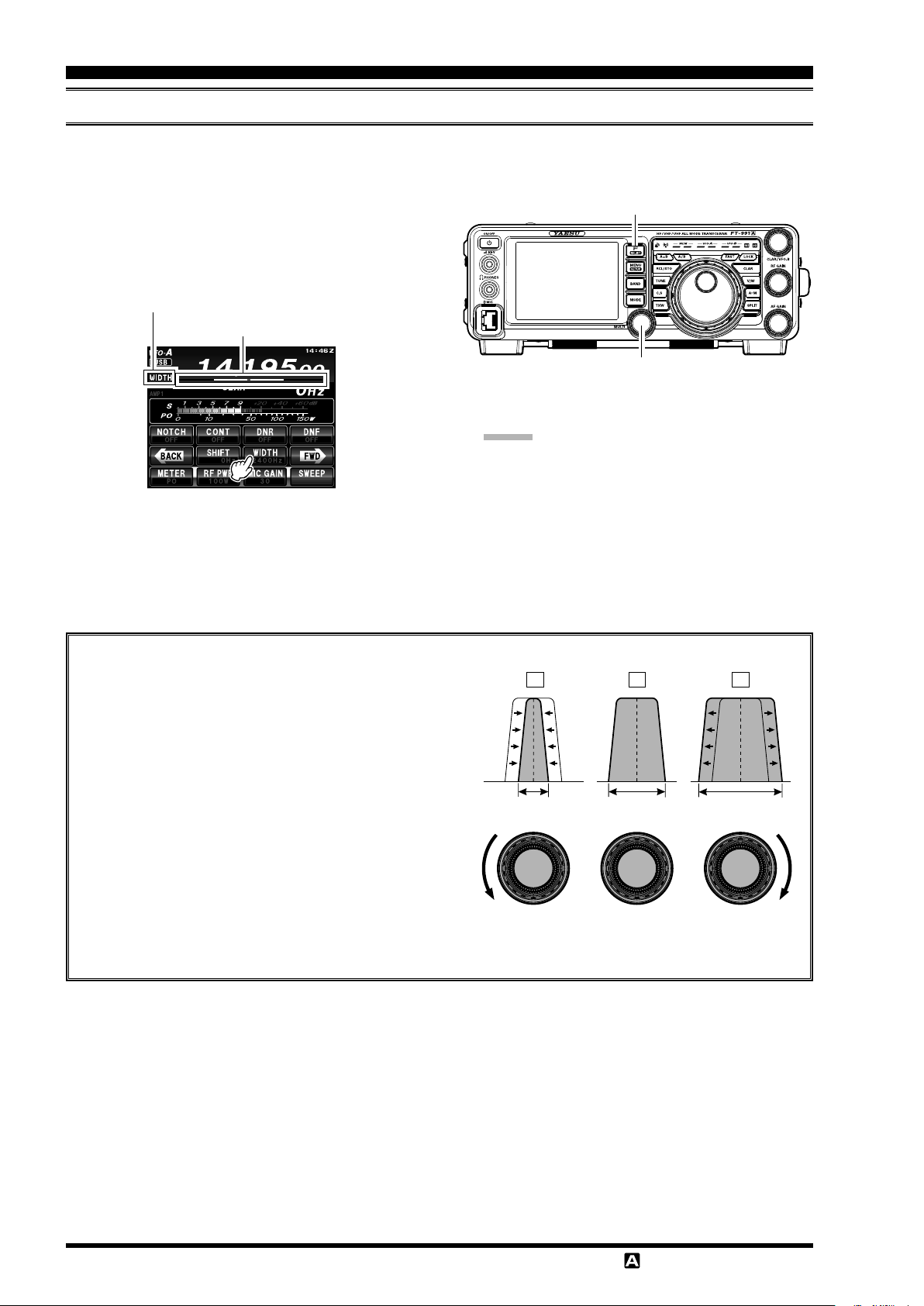
inTerFerence reJecTiOn
Width (iF dSp bAndWidth) tuning (SSb/cW/rtty/dAtA ModeS
The IF WIDTH tuning system allows you to vary the width of the DSP IF passband, to reduce or eliminate interference.
Moreover, the bandwidth may actually be expanded from its default setting, should you wish to enhance incoming sig-
nal delity when interference on the band is low.
1. Press the
menu list. Touch the
function and cause the
the WIDTH adjustment knob.
2. Rotate the
the bandwidth and reduce interference.
F(M-LIST
WIDTH indicator
MULTI
)
button to display the function
[
WIDTH
MULTI
WIDTH level indicator
knob counter-clockwise to narrow
]
icon to activate this
knob to function as
Advice:
To increase the bandwidth, rotate the knob clock-
wise.
Rotate the
of the IF lter below the
fer to the instruction below).
For reference, the level indicator on the TFT dis-
play shows the bandwidth.
F(M-LIST) Button
MULTI Knob
knob to display the bandwidth
MULTI
[
WIDTH
]
indicator (Re-
)
Referring to Figure “B”, you can see the default
bandwidth of the SSB mode.
By rotating the
width will narrow (see Figure “A”), while rotation of the
the bandwidth as depicted in Figure “C”.
The default bandwidths, and total bandwidth adjustment range, will vary according to the operat-
ing mode:
SSB Mode: 1.8 kHz - 3.2 kHz (default: 2.4 kHz).
CW Mode: 500 Hz - 3 kHz (default: 2.4 kHz
RTTY/DATA (LSB, USB) Modes: 500 Hz - 3
kHz (default: 500 Hz
AM Mode: Fixed at 9 kHz
FM/DATA-FM/C4FM Modes: Fixed at 16 kHz
MULTI
knob to the left, the band-
MULTI
knob to the right, will increase
)
)
A B C
IF BANDWIDTH IF BANDWIDTH IF BANDWIDTH
MULTI MULTI MULTI
Page 52 FT-
991
OperaTing Manual
Page 55
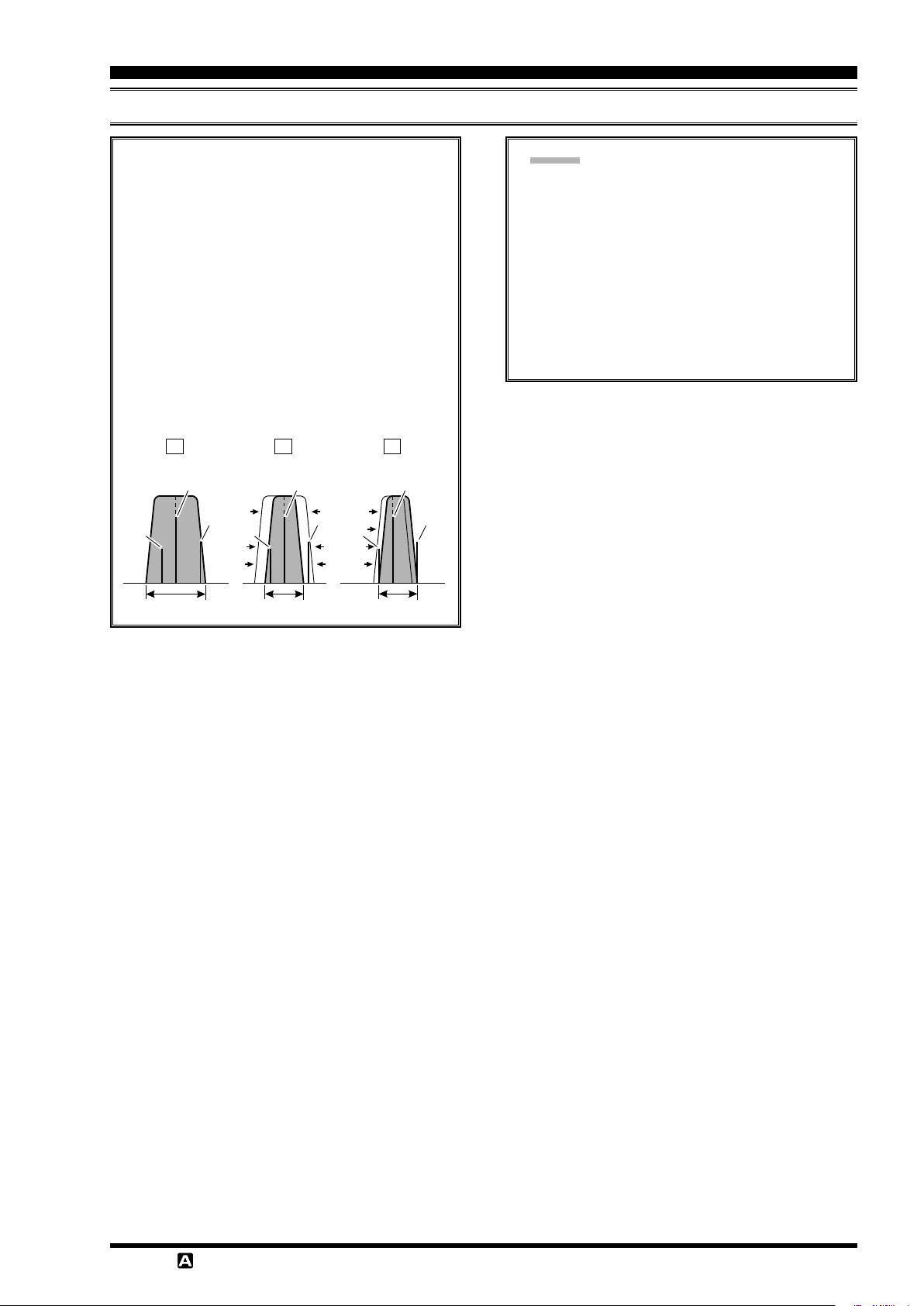
inTerFerence reJecTiOn
Width (iF dSp bAndWidth) tuning (SSb/cW/rtty/dAtA ModeS
Using IF SHIFT and WIDTH Together
The IF SHIFT and Variable IF WIDTH features
together form a very effective interference-ghting ltering system.
For example, in Figure “A”, you can see how interference has appeared both on the high and low
QRM
QRM
[
WIDTH
sides of the desired signal. Touch
the LCD, the interference from one side can be
eliminated (Figure “B”). Next, rotate the
knob to re-position the passband (Figure “C”),
the interference on the opposite side can be removed, without re-introducing the interference
previously eliminated in Figure “B”.
A B C
Desired Signal Desired Signal Desired Signal
QRM
QRM
QRM
]
on
MULTI
QRM
Advice:
The WIDTH and SHIFT features are the primary tools to use for best interference reduction.
After narrowing the bandwidth (WIDTH) and/
or adjusting the center of the passband (SHIFT),
the Contour control may then yield additional
signal-enhancement benets on the net residual
bandwidth. Even more, the IF NOTCH Filter
(
described later) may also be used, in conjunction with these lter systems, to signicant advantage.
)
IF BANDWIDTH IF BANDWIDTH IF BANDWIDTH
991
OperaTing Manual
Page 53FT-
Page 56
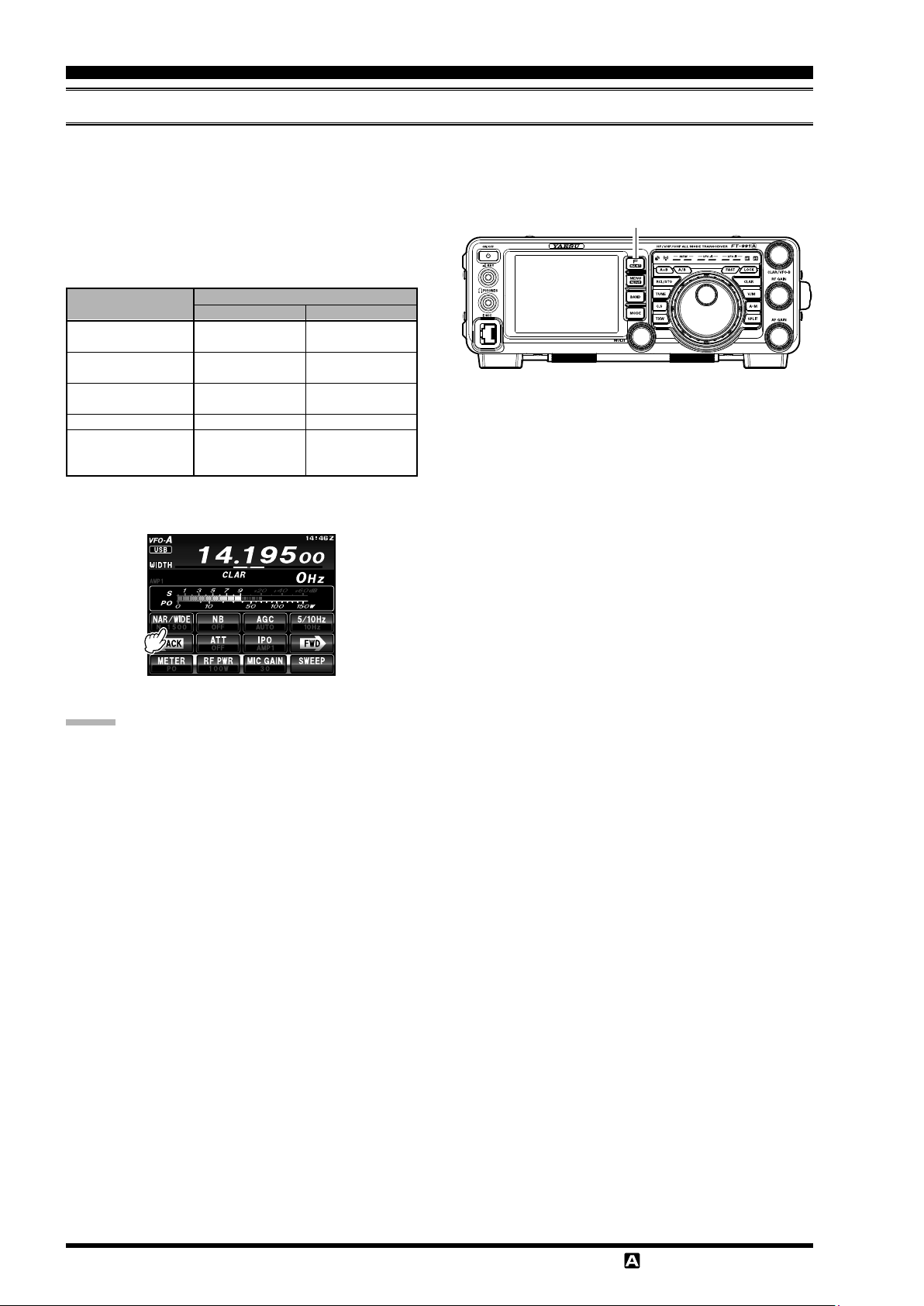
inTerFerence reJecTiOn
nArroW (nAr) one-touch iF Filter Selection
Press the
F(M-LIST
)
button to display the function menu list. Touch the
[
NAR/WIDE
]
button to enable one-touch,
mode-specic, selection of a narrow IF DSP lter setting that does not require resetting the bandwidth control to the
WIDTH/SHIFT system.
Touching
[
NAR/WIDE
]
on the LCD once more returns
F(M-LIST) Button
the bandwidth control to the WIDTH/SHIFT system.
The factory default bandwidths are:
operAting Mode
SSB
CW
RTTY/DATA-LSB/
DATA-USB
AM
FM/DATA-FM
(
28/50/144/430
MHz Bands
)
[
nAr/Wide] touch key
“on”
200 Hz - 1.8 kHz
(
1.5 kHz
50 - 500 Hz
(
500 Hz
50 - 500 Hz
(
300 Hz
6 kHz
9 kHz
: Depends on the [WIDTH] setting
)
)
)
1.8 - 3.0 kHz
(
(
2.4 kHz
500 Hz - 3.0 kHz
(
2.4 kHz
500 Hz - 3.0 kHz
(
)
: Default Bandwidth
“oFF”
500 Hz
9 kHz
16 kHz
)
)
)
Advice:
If
[
NAR/WIDE
]
on the LCD has been touched to
engage the narrow lter, you may further adjust the
narrow IF bandwidth by touching
TFT display and rotating the
[
MULTI
WIDTH
knob. The IF
SHIFT may also be operated.
When in the FM mode, touching
[
NAR/WIDE
the TFT display will narrow both transmit and receive bandwidths.
]
on the
]
on
Page 54 FT-
991
OperaTing Manual
Page 57
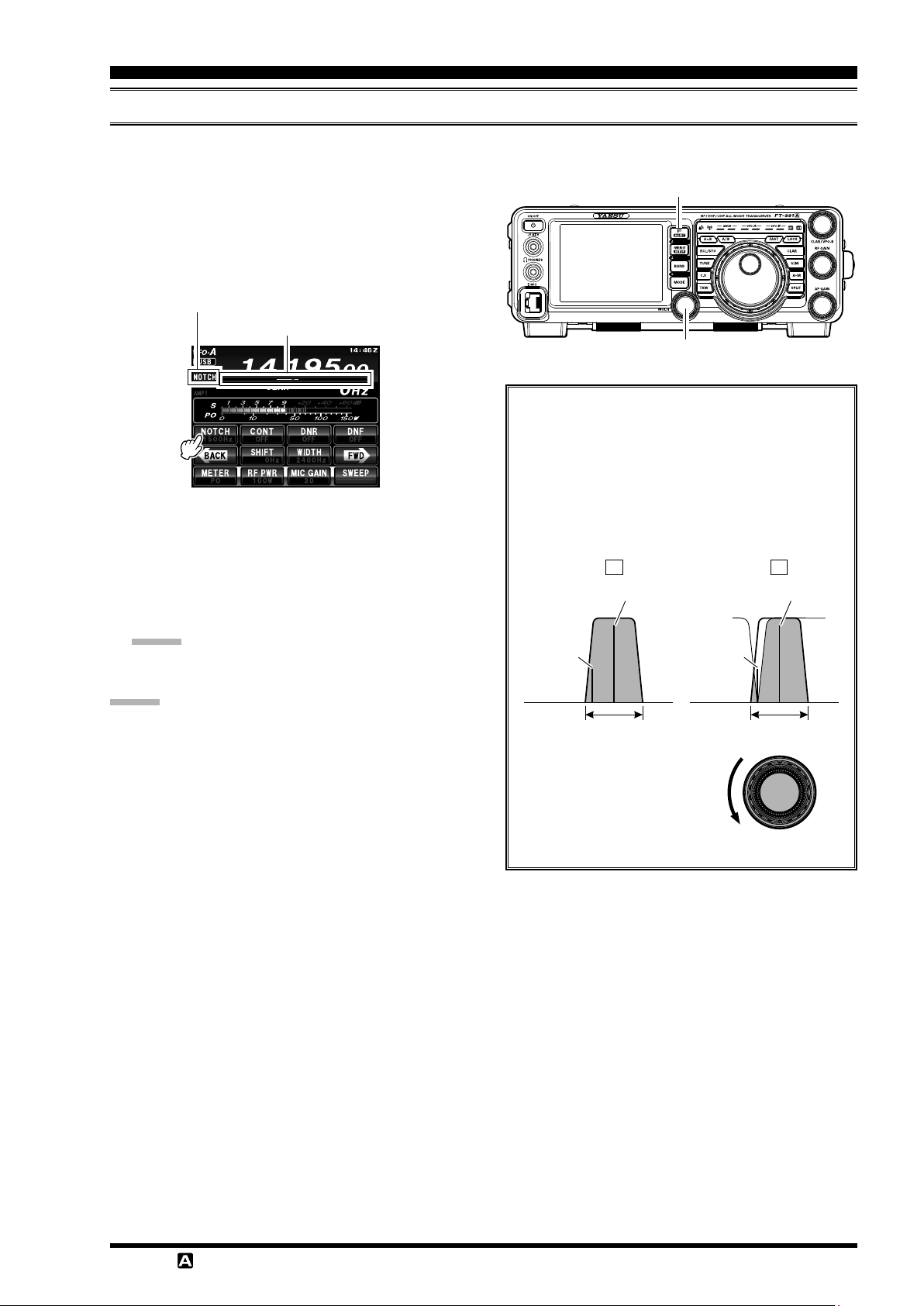
inTerFerence reJecTiOn
iF notch Filter operAtion (SSb/cW/rtty/dAtA/AM ModeS
)
The IF NOTCH lter is a highly effective system that allows cutting out an interfering beat note or other carrier signal
from inside the receiver passband.
1. Press the
F(MLIST
)
button to show the functions
F(M-LIST) Button
listed on the TFT display.
2. Touch
[
NOTCH
]
on the TFT display. The Notch
function will be set to “ON”.
NOTCH indicator
NOTCH level indicator
MULTI Knob
The performance of the IF NOTCH lter is illustrated in Figure “A”, where the desired signal and
the interfering heterodyne are shown within the
IF passband. In Figure “B” the notching effect of
3. Rotate the
knob to adjust the “null” position
MULTI
of the Notch lter.
4. To cancel the NOTCH lter, touch
TFT display, “
” will appear in the display, con-
OFF
[
NOTCH
rming that the NOTCH lter is no longer in opera-
]
on the
the IF NOTCH lter is illustrated as the
knob is rotated to eliminate the interfering heterodyne.
A B
Desired Signal Desired Signal
MULTI
tion.
Advice:
Alternate touches of
[
NOTCH
]
, will switch the
QRM
(
Heterodyne
)
QRM
(
Heterodyne
)
NOTCH lter between on and off.
Advice:
The bandwidth of the NOTCH lter (either narrow
or wide) may be adjusted using Menu item “
IF NOTCH WIDTH
“
”.
WIDE
”. The factory default setting is
116
IF BANDWIDTH IF BANDWIDTH
991
OperaTing Manual
MULTI
Page 55FT-
Page 58
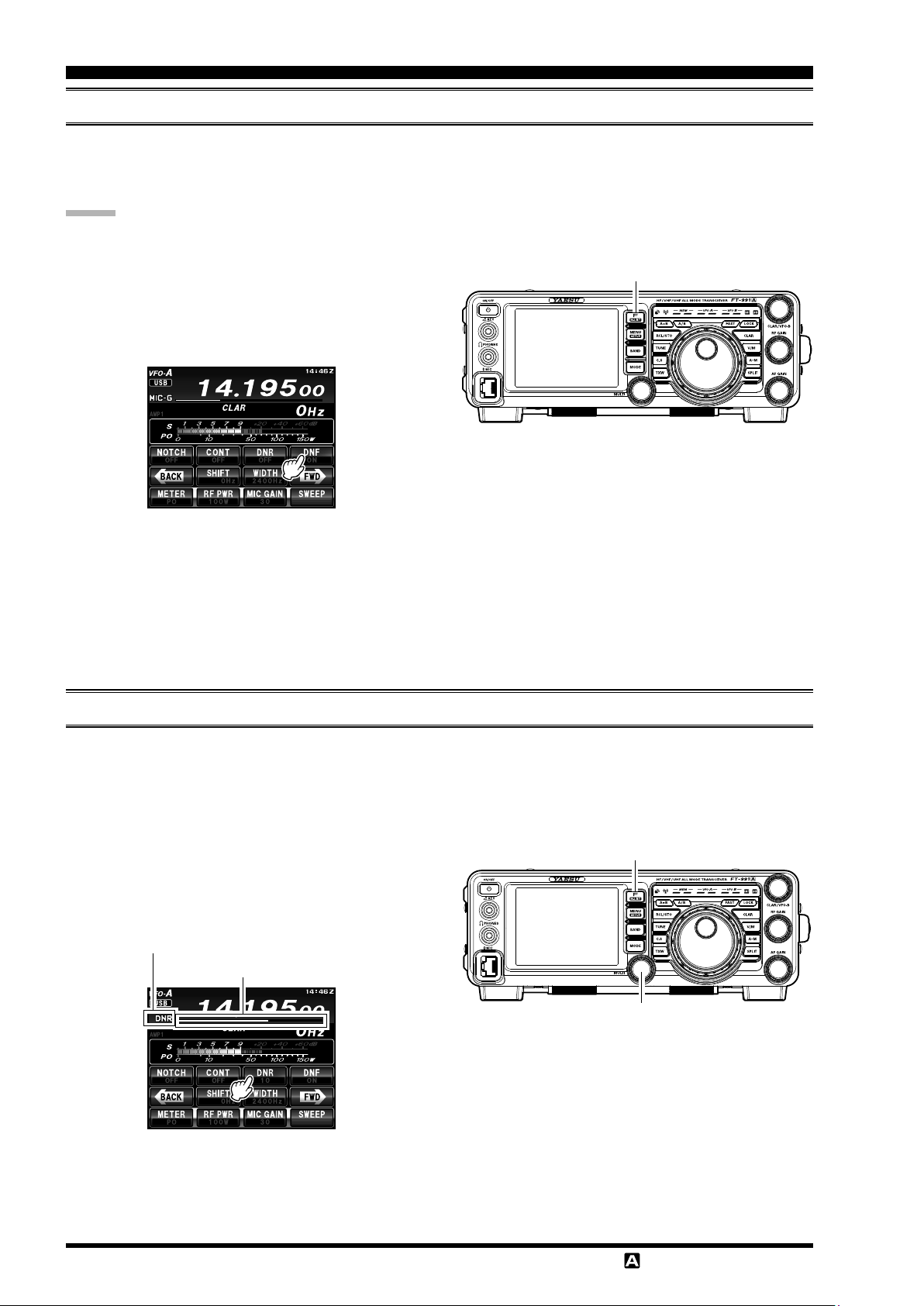
inTerFerence reJecTiOn
(
digitAl notch Filter
The Digital NOTCH Filter (DNF) is an effective beat-canceling lter that can null out a number of interfering beat notes
inside the receiver passband. Because this is an Auto-Notch feature, there is no adjustment knob associated with this l-
ter.
Advice:
If a very strong interfering carrier is encountered, we recommend using the IF NOTCH lter rst, as it is the most effective notching tool in the receiver section.
1. Press the
listed on the TFT display, then touch
TFT display. The Digital NOTCH Filter will be set
to “ON”.
F(M-LIST
)
button to show the functions
[
]
on the
DNF
dnF
To disable the Digital NOTCH Filter, just repeat the
above procedure, touching
“
OFF
Digital NOTCH Filter is not active.
)
operAtion
”. The “
DNF
F(M-LIST) Button
[
]
on the LCD to choose
DNF
” will turn off, confirming that the
(
digitAl noiSe reduction
The Digital Noise Reduction (DNR) system is designed to reduce the level of ambient noise found on the HF and 50
MHz bands. The (DNR) system is especially effective during SSB operation. While DNR is functioning, rotate the
MULTI
gorithms was created to deal with a different noise prole. You will want to experiment with the DNR system to nd the
best setting corresponding to the noise currently being experienced.
1. Press the
2. Touch
knob to adjust the DNR level. Any of 15 different noise-reduction algorithms can be selected; each of these al-
)
F(MLIST
list on the TFT LCD display.
[
]
DNR
be set to “ON”.
DNR indicator
button to reveal the functions
on the LCD. The DNR function will
DNR level indicator
dnr
3. Rotate the
rithms that best reduces the noise level.
4. To cancel the DNR lter, touch
“
OFF
DNR system is no longer in operation.
)
operAtion
F(M-LIST) Button
MULTI Knob
knob to choose one of 15 algo-
MULTI
[
]
on the LCD,
DNR
” will appear in the display, conrming that the
Page 56 FT-
991
OperaTing Manual
Page 59
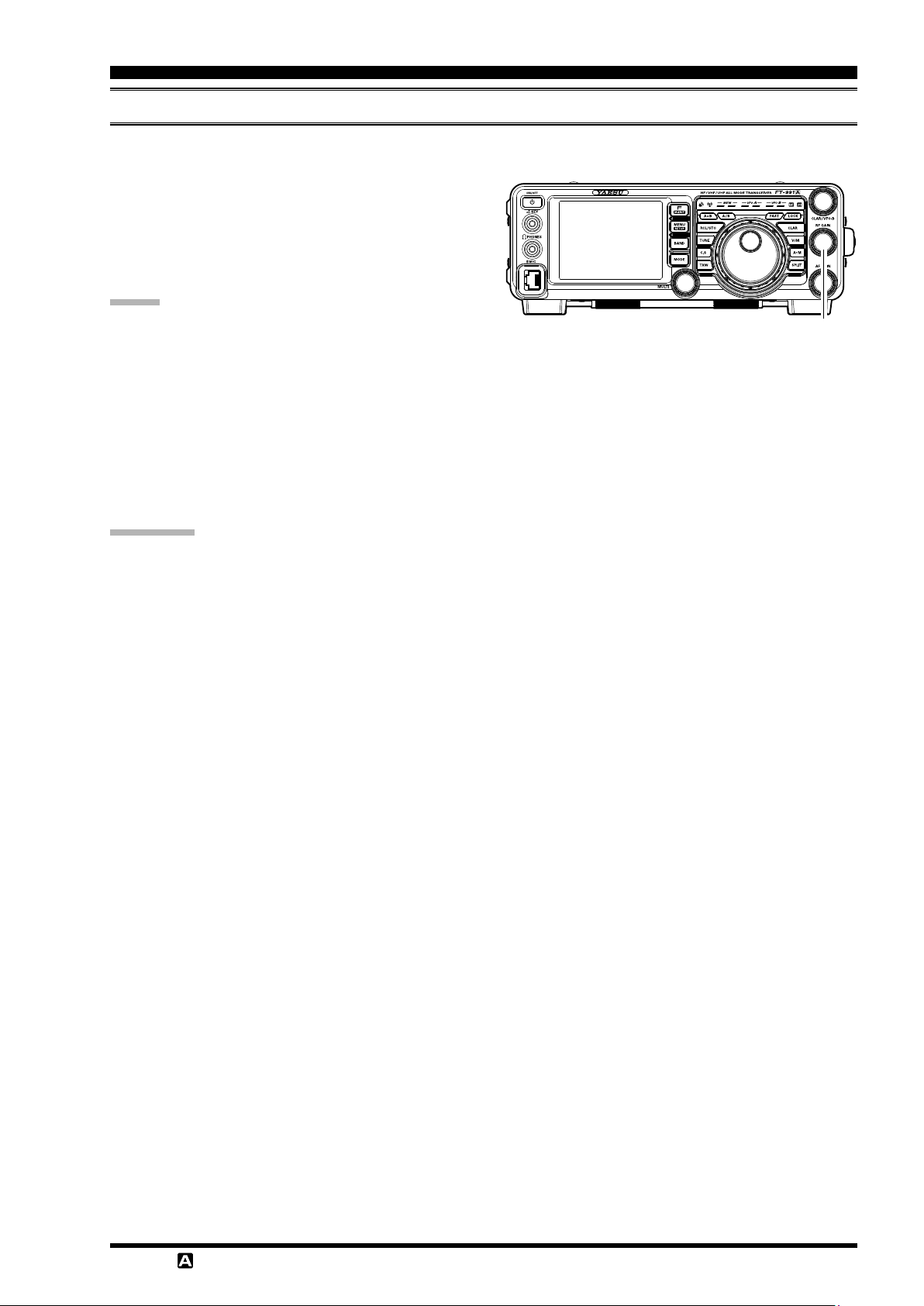
TOOls FOr cOMFOrTable anD eFFecTive recepTiOn
rF gAin
The RF Gain control provides manual adjustment of the gain levels for the receiver RF and IF stages, to account for
noise and signal strength conditions at the moment.
1. The
2. Counter-clockwise rotation of the
Advice:
quick point:
RF GAIN
the fully clockwise position. This is the point of
maximum receiver sensitivity.
will gradually reduce the system gain.
As the
to reduce the gain, the S-meter reading will rise. This
indicates that the AGC voltage being applied to the
receiver is increasing (this causes a reduction in receiver gain).
Rotating the
counter-clockwise position will essentially disable
the receiver, as the gain will be greatly reduced. In
this case, the S-meter will appear to be “pegged”
against the right edge of the analog S-meter scale.
Reception frequently can be improved by rotating
the
point where the “stationary” meter indication is set
just about the same as the incoming noise level. This
will reduce the RF gain to nd a level of improved
signal to noise ratio.
The RF Gain control, along with the IPO and the At-
tenuator features, all affect the system receiver gain
in different ways. The IPO generally should be the
rst feature engaged when dealing with a high noise
level, or a crowded, high-level signal environment.
Also, the IPO generally should be the first feature
engaged, if the frequency is low enough to allow the
preamplier to be bypassed. Thereafter, the RF Gain
and Attenuator features may be employed to provide
precise, delicate adjustment of the receiver gain to
fully optimize performance.
RF GAIN
RF GAIN
knob should, initially, be rotated to
RF GAIN
knob is rotated counterclockwise
RF GAIN
knob slightly counter-clockwise to the
knob control to the fully
knob
RF GAIN Knob
991
OperaTing Manual
Page 57FT-
Page 60
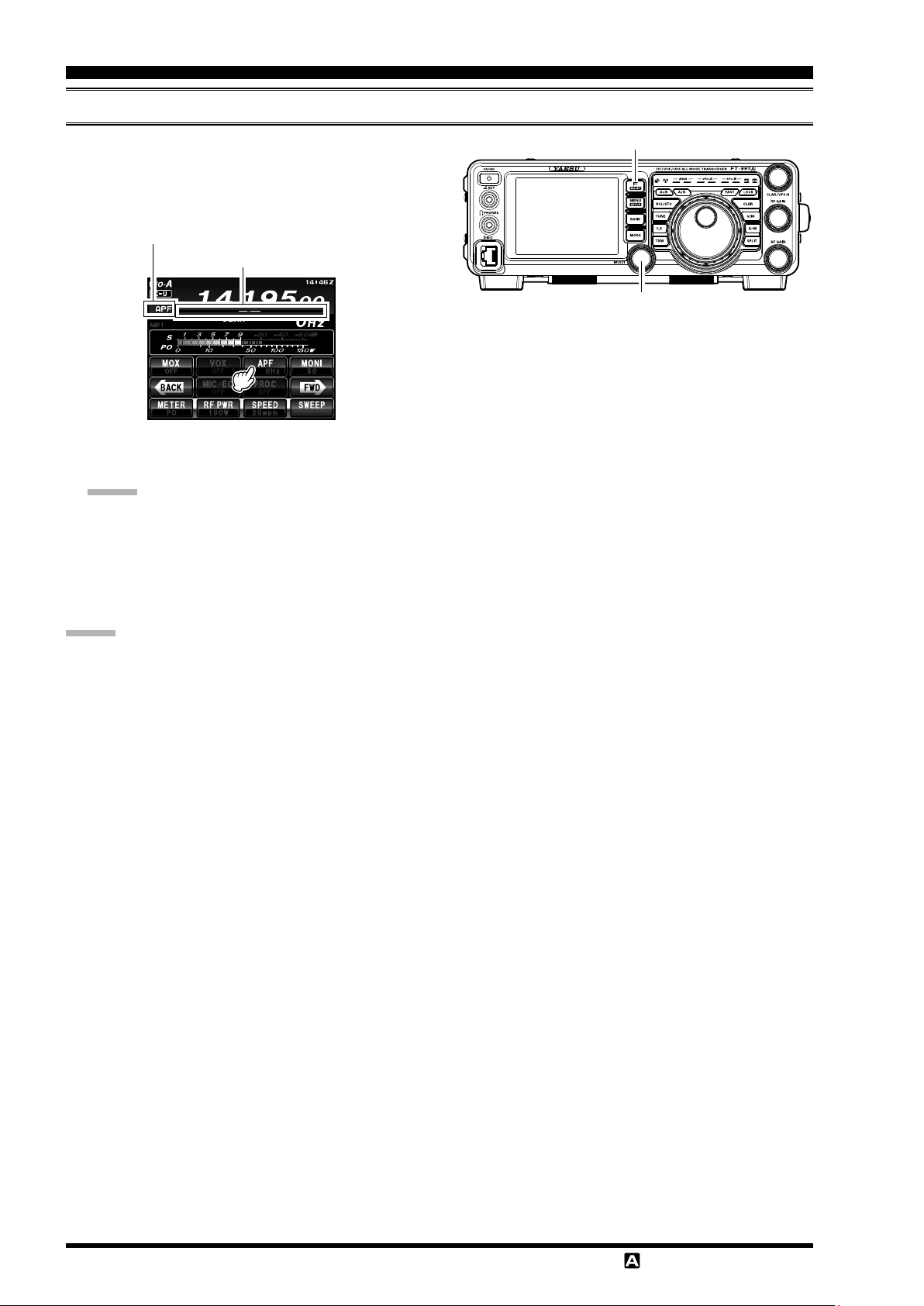
TOOls FOr cOMFOrTable anD eFFecTive recepTiOn
Audio peAk Filter
1. Press the
list on the TFT LCD display.
2. Touch
set to “ON”.
3. Rotate the
comfortable level.
Advice:
The APF bandwidth can be selected from NAR-
4. To cancel the APF action, touch
The “
the APF system is no longer in operation.
Advice:
The APF may only be activated while the transceiver is
in CW mode.
F(MLIST
[
]
APF
APF indicator
MULTI
ROW/MEDIUM/WIDE via the Menu item “
APF WIDTH
” will appear in the display, conrming that
OFF
)
button to reveal the functions
on the LCD. The APF function will be
APF level indicator
knob to set the sound volume to a
113
”.
[
]
on the LCD.
APF
F(M-LIST) Button
MULTI Knob
Page 58 FT-
991
OperaTing Manual
Page 61
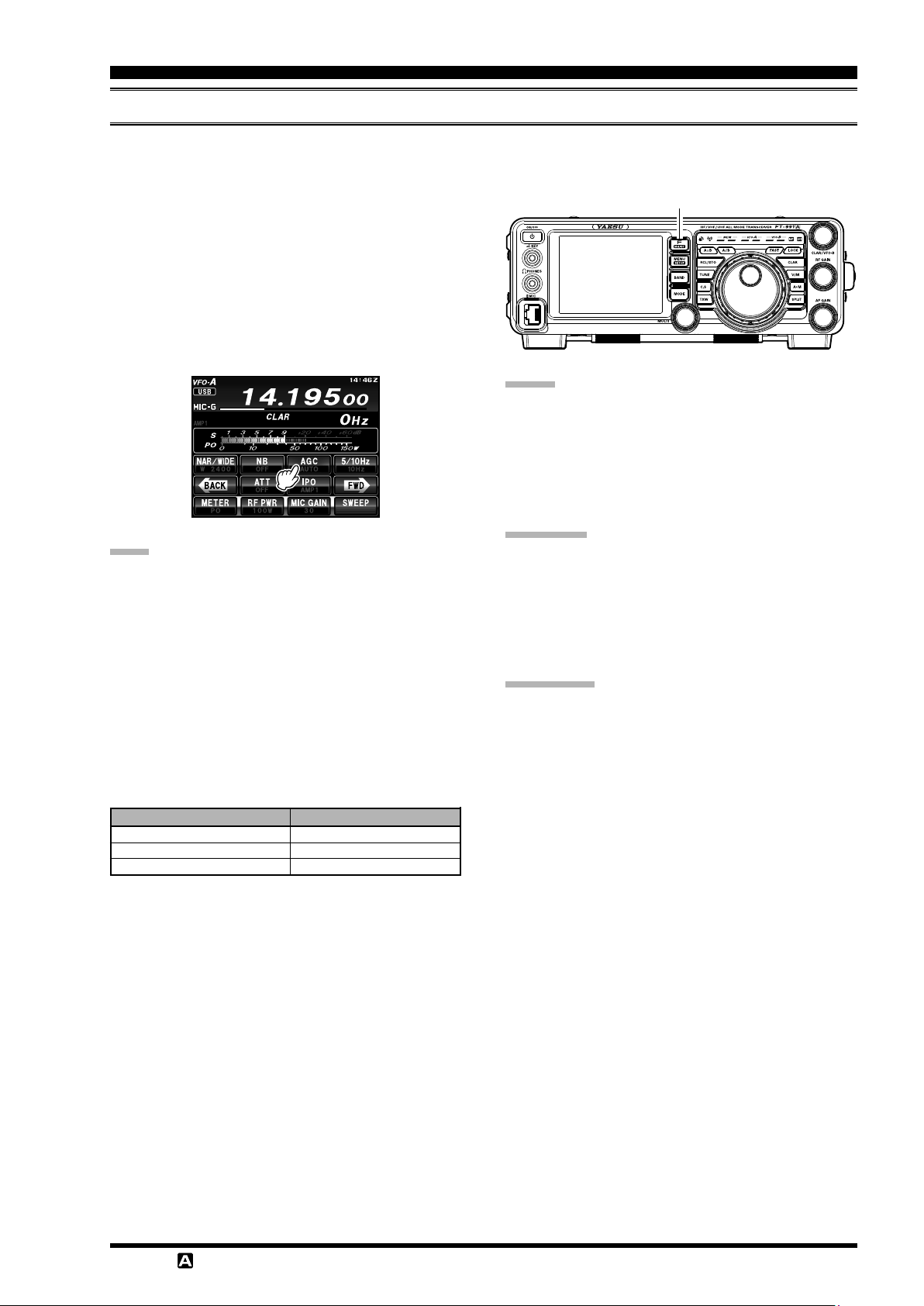
TOOls FOr cOMFOrTable anD eFFecTive recepTiOn
Agc (AutoMAtic gAin control
The AGC system is designed to help compensate for fading and other propagation effects. The AGC characteristics can
be individually set for each operating mode. The basic objective of AGC is to maintain a constant audio output level
once a certain minimum threshold of signal strength is achieved.
[
Press the
LCD repeatedly to select the desired receiver-recovery
time constant. You will observe the AGC status notation
in the AGC column of the Key Function Display on the
TFT display, denoting the AGC receiver-recovery time
currently in use. For most operations, we recommend
the “AUTO” mode. Additionally, you may disable the
AGC by touching
note:
The “AUTO” selection mode selects the optimum
In this case, the selected receiver-recovery time in
Touching
RTTY/DATA-LSB/DATA-USB
F(M-LIST
receiver-recovery time for the reception mode.
the AGC column of the Key Function Display glows
green (Normally it glows blue).
desired receiver-recovery time constant. Normally,
the “AUTO” selection is satisfactory for most situ-
ations, but in the event of operation on a crowded
band where you wish to receive a weak signal, you
may wish to change the setting to FAST. The AUTO
mode selections are:
operAting Mode
LSB/USB/AM
CW/FM/DATA-FM
)
button, then touch
[
]
on the LCD.
AGC
[
]
on the LCD allows selection of the
AGC
Auto Agc Selection
SLOW
FAST
MID
AGC
]
on the
Advice:
If the AGC receiver-recovery time is set to “Off” by
touching
longer deect. Additionally, you will likely encounter distortion on stronger signals, as the IF ampliers
and the following stages are probably being overloaded.
quick point:
Several aspects of AGC performance may be congured
via the Menu. However, because AGC can have such a
profound impact on overall receiver performance, we
generally do not recommend any changes to the AGC
Menu selections until you are thoroughly familiar with
the performance of the
terMinology:
Automatic Gain Control, or AGC, is a circuit that senses
the received signal strength, and then limits the gain of
the RF and IF stages to keep the output audio volume at
a more-or-less constant level. AGC also protects the RF,
IF, Audio, and DSP stages from overload, as it limits the
signal strength that is allowed to ow, irrespective of the
input signal level.
[
AGC
)
F(M-LIST) Button
]
on the LCD, the S-meter will no
FT-991A
.
991
OperaTing Manual
Page 59FT-
Page 62
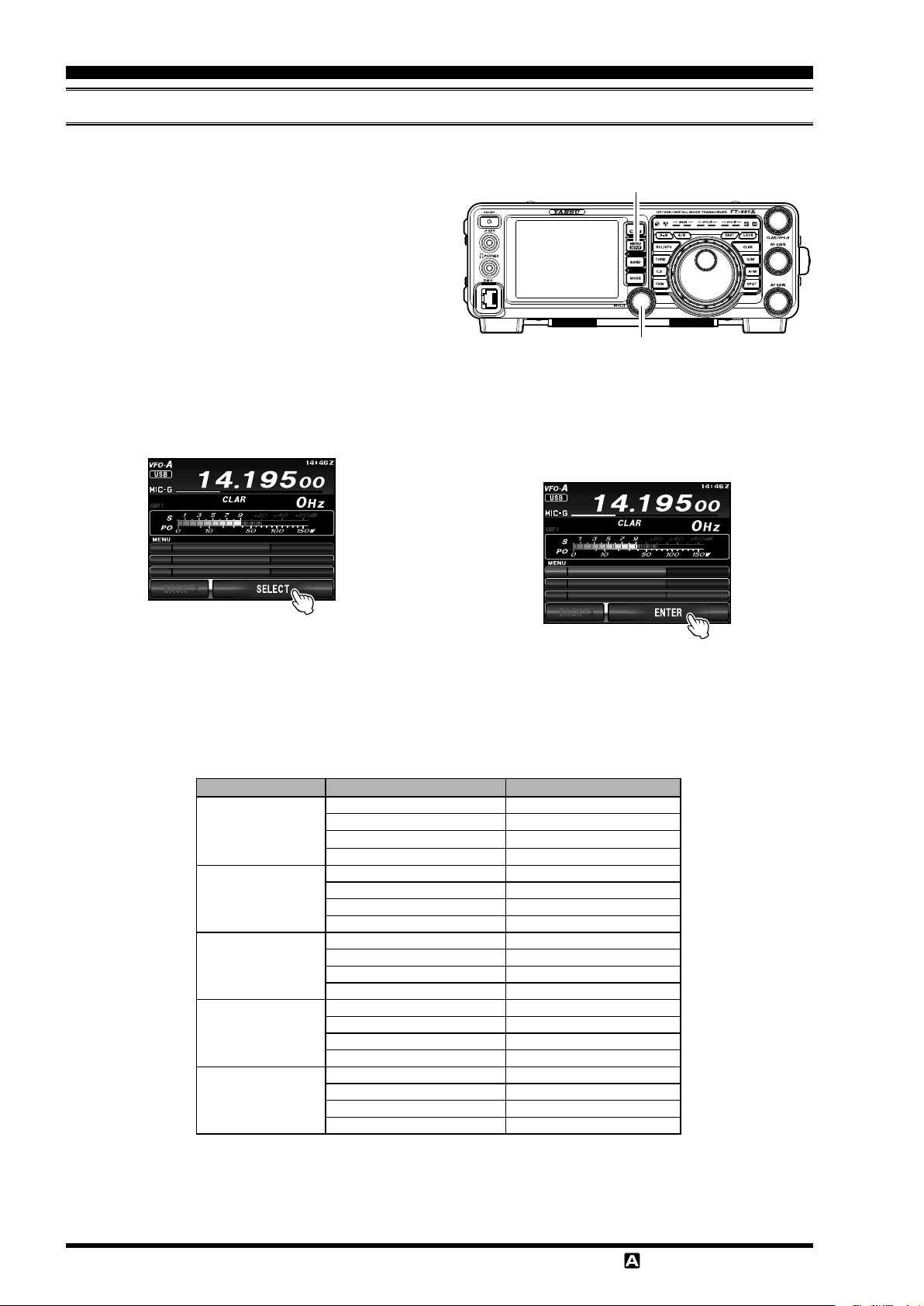
TOOls FOr cOMFOrTable anD eFFecTive recepTiOn
AdjuStAble receiver Audio Filter
The
FT-991A
includes an adjustable receiver audio lter, that provides precise, independent control of the low; and up-
per audio ranges.
1. Press the
2. Rotate the
through “
button to enter the Menu mode.
MENU
knob to nd Menu items “
MULTI
” these parameters apply to the adjust-
044
ment of the receiver audio filter in the AM mode,
Menu items “
” through “
050
” apply to the
053
adjustment of the RX audio lter in the CW mode,
Menu items “
” through “
066
” apply to the ad-
069
justment of the RX audio lter in the DATA mode,
Menu items “
” through “
094
” apply to the ad-
097
justment of the RX audio lter in the RTTY mode,
and Menu items “
” through “
104
” apply to the
107
adjustment of the RX audio lter in the SSB mode
3. Touch
[
SELECT
]
#/ .% 67'(4 3
#/ .% 6715. 2'
#/ *% 67'(4 3
on the LCD.
1((
F$QEV
1((
041
MENU Button
”
MULTI Knob
4. Rotate the
knob to adjust the receiver audio
MULTI
response as desired.
5. Touch
[
ENTER
]
on the LCD to save the new set-
ting.
#/ .% 67'(4 3
#/ .% 6715. 2'
#/ *% 67'(4 3
*\
F$QEV
1((
Mode Menu iteM
041 AM LCUT FREQ
AM
CW
DATA
RTTY
SSB
042 AM LCUT SLOPE
043 AM HCUT FREQ
044 AM HCUT SLOPE
050 CW LCUT FREQ
051 CW LCUT SLOPE
052 CW HCUT FREQ
053 CW HCUT SLOPE
066 DATA LCUT FREQ
067 DATA LCUT SLOPE
068 DATA HCUT FREQ
069 DATA HCUT SLOPE
094 RTTY LCUT FREQ
095 RTTY LCUT SLOPE
096 RTTY HCUT FREQ
097 RTTY HCUT SLOPE
104 SSB LCUT FREQ
105 SSB LCUT SLOPE
106 SSB HCUT FREQ
107 SSB HCUT SLOPE
6. Press the
MENU
button or touch
LCD to exit to normal operation.
AvAilAble vAlueS
OFF/100(Hz) - 1000(Hz
6dB/oct / 18dB/oct
700(Hz) - 4000(Hz)/OFF
6dB/oct / 18dB/oct
OFF/100(Hz) - 1000(Hz
6dB/oct / 18dB/oct
700(Hz) - 4000(Hz)/OFF
6dB/oct / 18dB/oct
OFF/100(Hz) - 1000(Hz
6dB/oct / 18dB/oct
700(Hz) - 4000(Hz)/OFF
6dB/oct / 18dB/oct
OFF/100(Hz) - 1000(Hz
6dB/oct / 18dB/oct
700(Hz) - 4000(Hz)/OFF
6dB/oct / 18dB/oct
OFF/100(Hz) - 1000(Hz
6dB/oct / 18dB/oct
700(Hz) - 4000(Hz)/OFF
6dB/oct / 18dB/oct
[
BACK
)
)
)
)
)
]
on the
Page 60 FT-
991
OperaTing Manual
Page 63
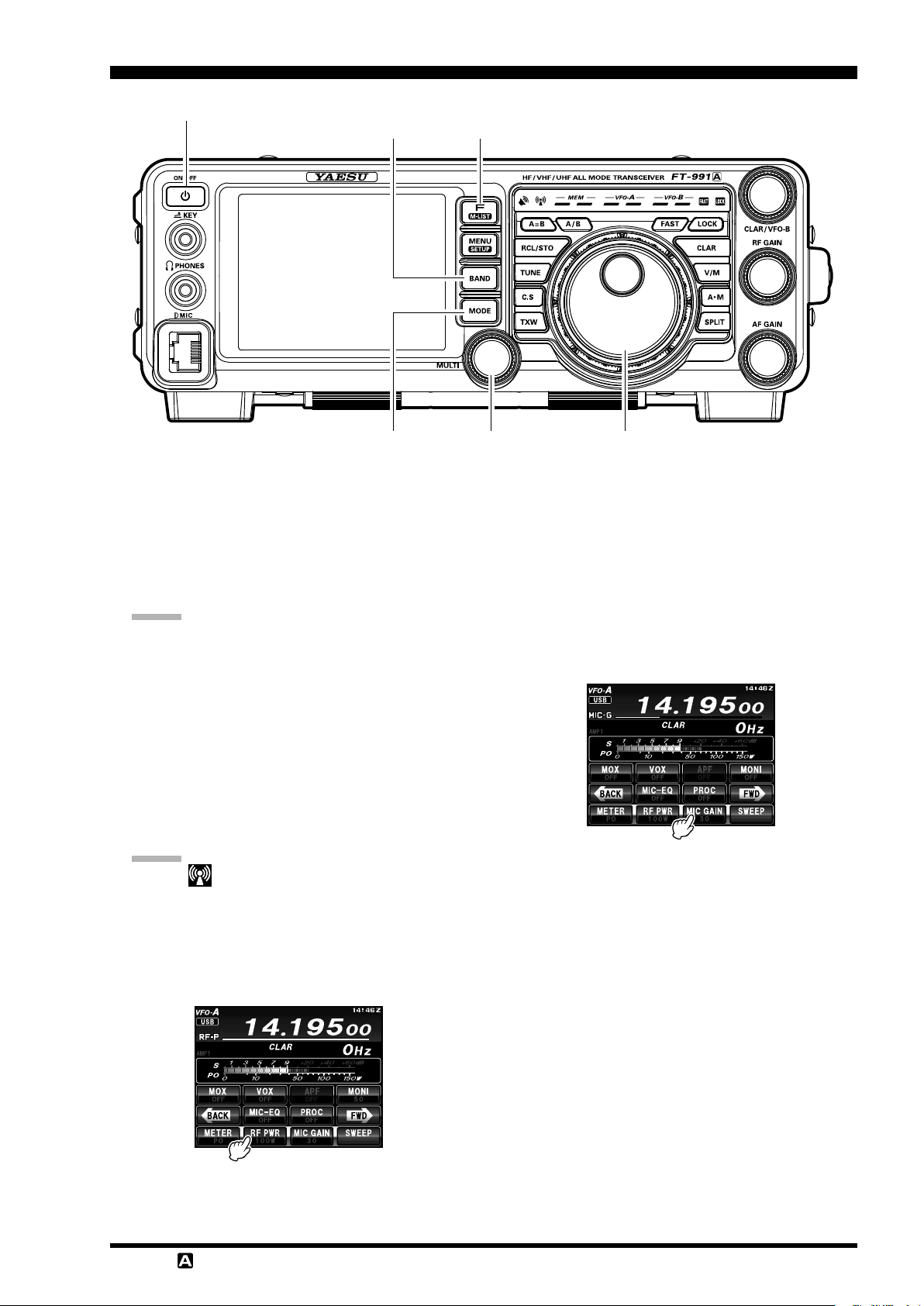
ON/OFF Switch
ssb/aM MODe TransMissiOn
BAND Button
F(M-LIST) Button
1. Press the
then touch a band key corresponding to the Amateur
band on which you wish to operate.
2. Press the
then select the operating mode by touching the corresponding key.
Advice:
By convention, LSB is used in the 7 MHz and lower
Amateur bands for SSB communication, and USB is
used on the 14 MHz and higher bands (the 10 MHz
band is used for CW and data modes only).
3. Rotate the Main Tuning Dial knob to adjust the operating frequency. Alternately, you may use the UP/
scanning buttons on the
DWN
crophone to scan up or down the current band.
4. Press the microphone
begin transmitting; speak into the microphone in a
normal voice level.
Advice:
The “
indicators area, conrming that transmission is in
progress.
When transmitting in the AM mode, set a maxi-
mum (carrier) power output of 25 Watts by press-
[
ing
RF PWR
button to show the band list, and
BAND
MODE
button to show the mode list, and
MH-31
(Push To Talk) switch to
PTT
” indicator will light up in the TFT LED
]
, then rotate the
A8J
MULTI
Hand Mi-
knob.
MULTI KnobMODE Button
5. Adjust the microphone amplier gain to match the
Press and hold the
In the SSB mode, touch
In the AM mode, touch
6. Release the
Main Tuning Dial Knob
microphone and your voice level: Touch
on the LCD repeatedly to select the “
switch, and speak into the
PTT
microphone in a normal voice level.
[
MIC GAIN
just
the ALC zone of the meter (up to half scale deection) on voice peaks.
the
MULTI
ect on voice peaks.
When transmitting In the AM mode, adjust the
MIC gain so that the PO meter does not deect
when speaking.
sion. The transceiver will return to the receive mode.
knob so that the ALC meter stays within
MULTI
[
MIC GAIN
knob so that the ALC meter does not de-
switch at the end of the transmis-
PTT
ALC
]
and then ad-
]
and then adjust
[
METER
”.
]
991
OperaTing Manual
Page 61FT-
Page 64
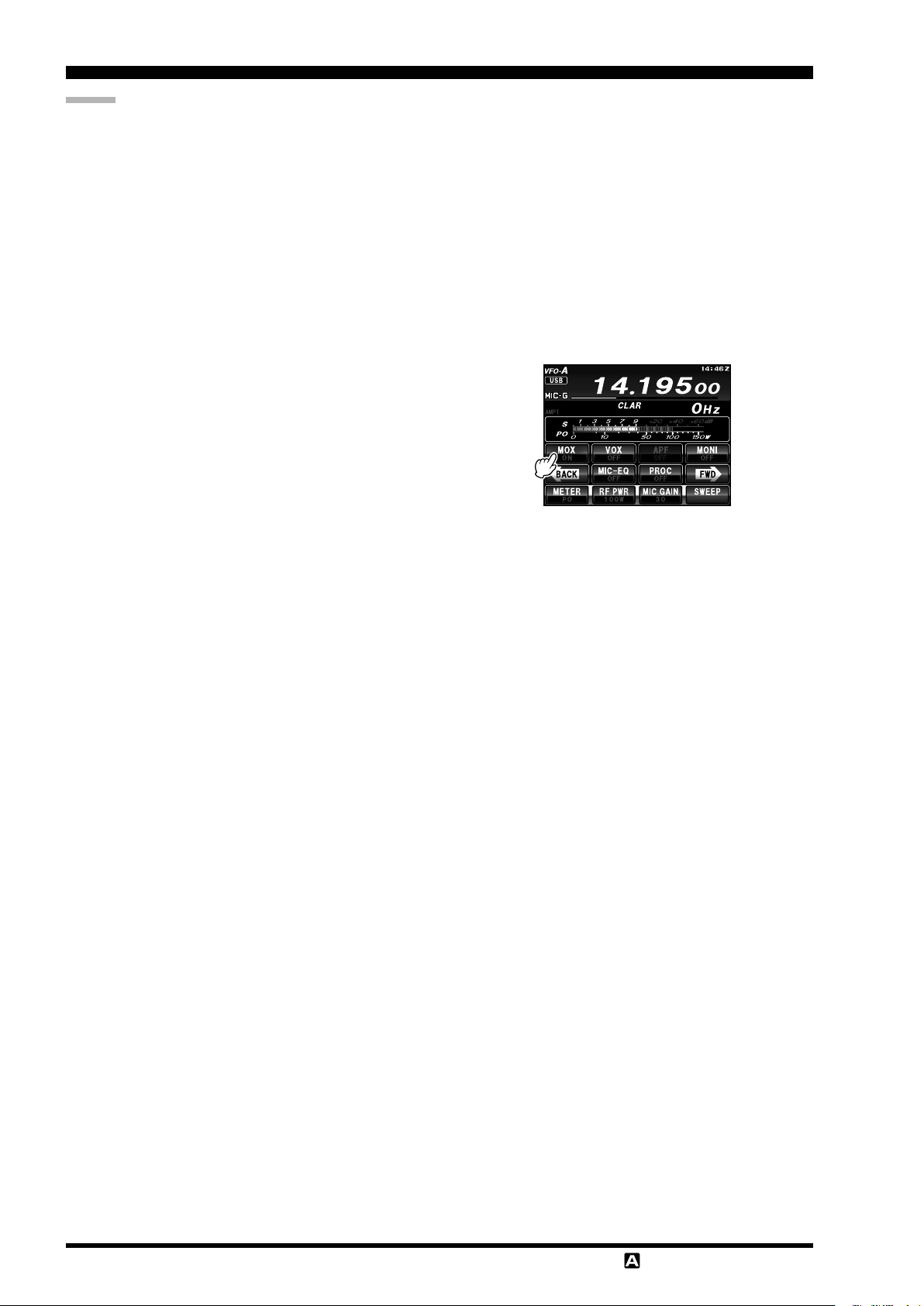
ssb/aM MODe TransMissiOn
Advice:
ALC meter deection may be caused by excessive
drive power, but also by reflected power detected
in the antenna system. If the antenna impedance
presented to the transceiver is other than 50 Ohms,
ALC meter action may be observed that is not related to the proper setting of
LCD. Therefore, we recommend that you make
]
adjustments into a dummy load or antenna
GAIN
system presenting impedance very close to 50 Ohms.
When making “on air” tests (such as setting the mi-
crophone gain), be sure to listen on the frequency
before transmitting, to avoid interference to others
who may already be using the frequency.
[
MIC GAIN
]
on the
[
MIC
Four techniques to implement Transmit/Receive con-
trol are provided on the
the technique(s) that best suit your operating needs:
Pressing the microphone
the transmitter.
The rear panel
foot switch or other manual switching device in
order to engage the transmitter.
Touching
list will lock the transmitter on (The functions list
may be displayed by pressing the
ton). Touch
receive.
The VOX (Voice Operated Xmit) circuit will
engage the transmitter automatically when you
speak into the microphone. For details of VOX
operation refer to page 72.
[
MOX
[
MOX
FT-991A
jack may be connected to a
PTT
]
on the TFT display functions
]
on the LCD again to return to
. You may choose
switch will engage
PTT
F(MLIST
)
but-
Page 62 FT-
991
OperaTing Manual
Page 65

using The auTOMaTic anTenna Tuner
The Automatic Antenna Tuner (hereinafter referred to as the “ATU”) built into each
50-Ohm load for the nal amplier stage of the transmitter.
Advice:
Because the ATU of the
ceiver at the station end of your coaxial cable feedline. It does not “tune” the SWR at the antenna feed point itself.
When designing and building your antenna system, we recommend that every effort be made to ensure a low SWR
at the antenna feed point.
The ATU of the
each Amateur band, so that each band has at least one setting preset for use on that band. The remaining 89 memories are reserved for the 89 most-recent tuning points, for quick frequency change without the need to retune the
ATU.
The ATU in the
ing to an SWR of 3:1 or less on the 160 through 6 meter amateur bands. Accordingly, simple non-resonant whip antennas, along with random-length wires and the “G5RV” antenna (on most bands) may not be within the impedance
matching range of the ATU.
FT-991A
FT-991A
FT-991A
includes 100 memories for tuning data. Eleven of these memories are allocated, one for
is designed to match impedances within the range of 16.7 Ohms to 150 Ohms, correspond-
is located inside the station, it only adjusts the impedance presented to the trans-
FT-991A
is designed to ensure a
Atu operAtion
1. Use the Main Tuning Dial knob to set the radio to
the desired operating frequency within the Amateur
band.
2. Press the
ATU in the transmit line (no adjustment/tuning will
occur yet). The “
display.
quick point:
The momentary press of the
the tuner on, and the microprocessor will automatically select the tuning point closest to the current
operating frequency.
button momentarily to place the
TUNE
TUNER
” icon will appear in the
button will turn
TUNE
Advice:
The ATU circuit is located between the nal amplier
and the rear-panel antenna jack; reception is not affected
by the ATU.
TUNE Button
3. Press and hold in the
begin automatic tuning. The transmitter will be engaged, and the “
ing is in progress. When the optimum tuning point
has been reached, the radio will return to receive,
and the “
stead of blinking).
4. To disconnect the ATU from the transmit line, press
the
TUNE
icon will turn off, conrming that the ATU has been
turned off. In the “Off” mode, the transceiver will be
directly connected to the coaxial cable connected to
your antenna, and will respond to whatever impedance is present at the station end of the coax.
TUNER
TUNER
” icon will again glow steadily (in-
button momentarily. The “
button for one second to
TUNE
” icon will blink while tun-
TUNER
quick pointS:
As shipped from the factory, only one ATU alignment
point is saved on each Amateur band. This was memorized during the nal alignment and performance verication stages on the production line.
note:
Please listen to the operating frequency before beginning the tuning process, to be sure you are not interfering with others who may already be using the frequency.
terMinology:
Antenna Tuner Memories: The ATU microprocessor
makes a note of the selected tuning capacitors and in-
”
ductors, and stores the data for each 10 kHz window in
which tuning has occurred. This eliminates the need to
re-tune every time you return to a frequency on which
you have already completed the tuning process.
991
OperaTing Manual
Page 63FT-
Page 66
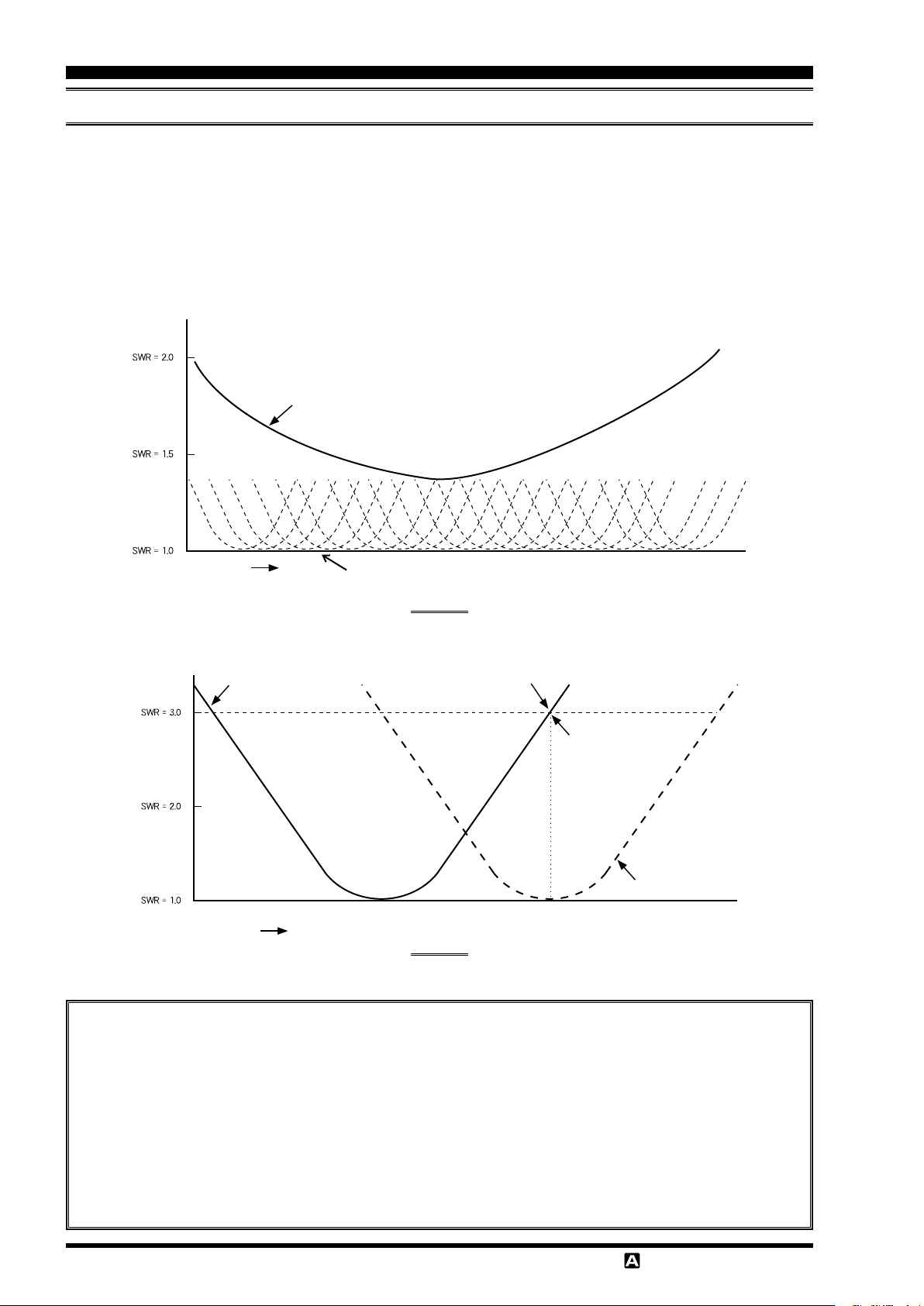
using The auTOMaTic anTenna Tuner
About Atu operAtion
Figure 1 depicts a situation where normal tuning via the ATU has been successfully completed, and the tuning data has
been stored in the ATU memory. The antenna system as seen by the transmitter is shown.
In Figure 2, the operator has changed frequency, and the “
in the
If a high SWR condition exists (above 3:1), corrective action must be taken in the antenna system to bring the impedance closer to 50 Ohms. The ATU will refuse to memorize settings on frequencies where the SWR exceeds 3:1. A High
SWR may indicate a mechanical failure in the feed system, and can lead to the generation of spurious signals causing
TVI, etc.
button for one second to begin impedance matching using the ATU.
TUNE
Feed Point SWR
Frequency
SWR after ATU Tuning
HI-SWR
Figure 1
” icon has appeared. The operator presses and holds
The “HI-SWR” icon appears on the display
Memorized ATU Tuning
Frequency
About ATU Memories
SWR (After tuning) Less than 2:1
The tuner settings are stored in the ATU memory.
SWR (After tuning) Greater than 2:1
Tuning data will not be retained in memory. If you return to the same frequency, the tuning process must be repeated.
when you transmit on the frequency
SWR: 3.0
Retuned Setting
Figure 2
SWR (After tuning) Greater than 3:1
The “
HI-SWR
the high SWR condition and resolve the problem before attempting further operation using this antenna.
Page 64 FT-
” icon will light up, and the tuner settings, if achieved, will not be memorized. Please investigate
991
OperaTing Manual
Page 67
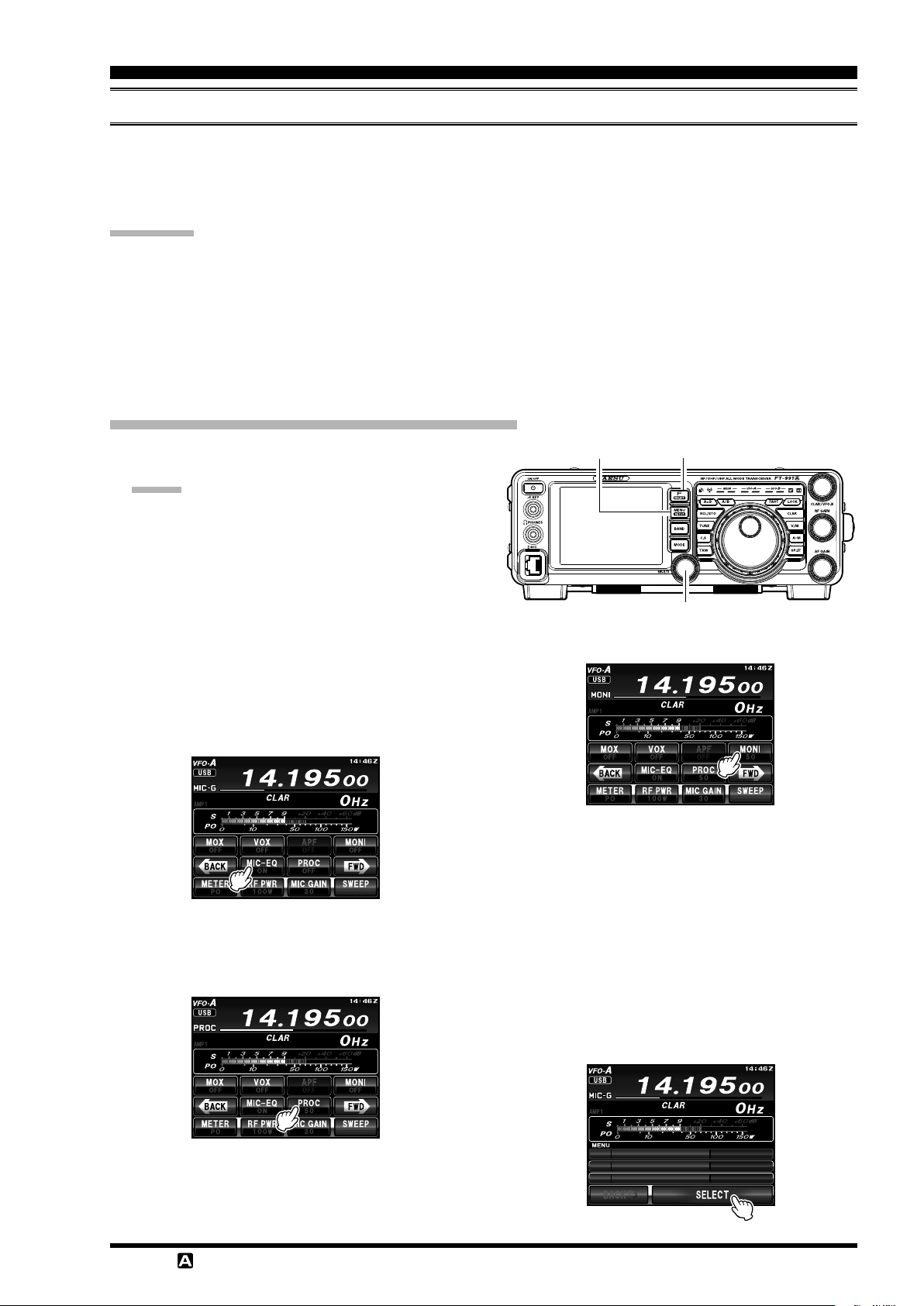
enhancing TransMiT signal QualiTy
)
The
FT-991A
PArAMetric Microphone equAlizer (SSb/AM Mode
includes a unique Three-Band Parametric Microphone Equalizer that provides precise, independent control over the low, mid and treble ranges in the voice waveform. You may utilize one group of settings when the speech
processor is off and use an alternate group of settings when the speech processor is on. The speech processor feature is
described in the next chapter.
quick point:
The Parametric Equalizer is a unique technique for adjusting the signal quality. The three audio ranges may be adjusted
so precisely, it is possible to craft an audio response that provides a natural and pleasant sound that you may not have
ever experienced before. Alternately, the effective “talk power” can be signicantly enhanced.
The conguration aspects that may be adjusted on the Parametric Equalizer are:
Center Frequency: The center frequency of each of the three bands may be adjusted.
Gain: The amount of enhancement (or suppression) within each band may be adjusted.
Q: The bandwidth over which the equalization is applied may be adjusted.
Setup of the Parametric Microphone Equalizer
1. Connect the microphone to the
2. Set the RF output power to minimum value.
Advice:
We recommend that you connect a dummy load
to one of the Antenna jacks, and monitor your
signal on a separate receiver, to prevent interference to other users.
You will have the best chance of hearing the ef-
fects of adjustments if you wear headphones
(
connected to the separate monitor receiver)
while listening to your transmitted signal.
3. To adjust the Parametric Microphone Equalizer
while the speech processor is disabled, press the
)
F(M-LIST
button, then touch
“ON”.
jack.
MIC
[
MIC-EQ
]
to select
MENU
(
SETUP
)
Button
F(M-LIST) Button
MULTI Knob
To adjust the Parametric Microphone Equalizer with
the speech processor engaged, press the
button, then touch
4. Touch
[
MONI
[
]
, if you want to listen on the
PROC
]
to select “ON”.
F(M-LIST
FT-991A
internal monitor.
991
OperaTing Manual
5. Press the
MENU(SETUP
)
button. The Menu list
will appear in the TFT display.
6. Rotate the
containing Menu items “
knob to nd the “EQ” Menu area,
MULT
” through “
121
129
”; these
parameters apply to the adjustment of the Parametric
Microphone Equalizer when the speech processor
)
is disabled. Menu items “
” through “
130
138
” ap-
ply to the adjustment of the Parametric Microphone
Equalizer when the speech processor is engaged.
7. Touch
MULT
[
SELECT
knob to adjust a particular Menu item.
]
on the LCD, then rotate the
24/64% '3 '(4 3
24/64% '3 8.' '.
24/64% '3 6$9 *
1((
Page 65FT-
Page 68
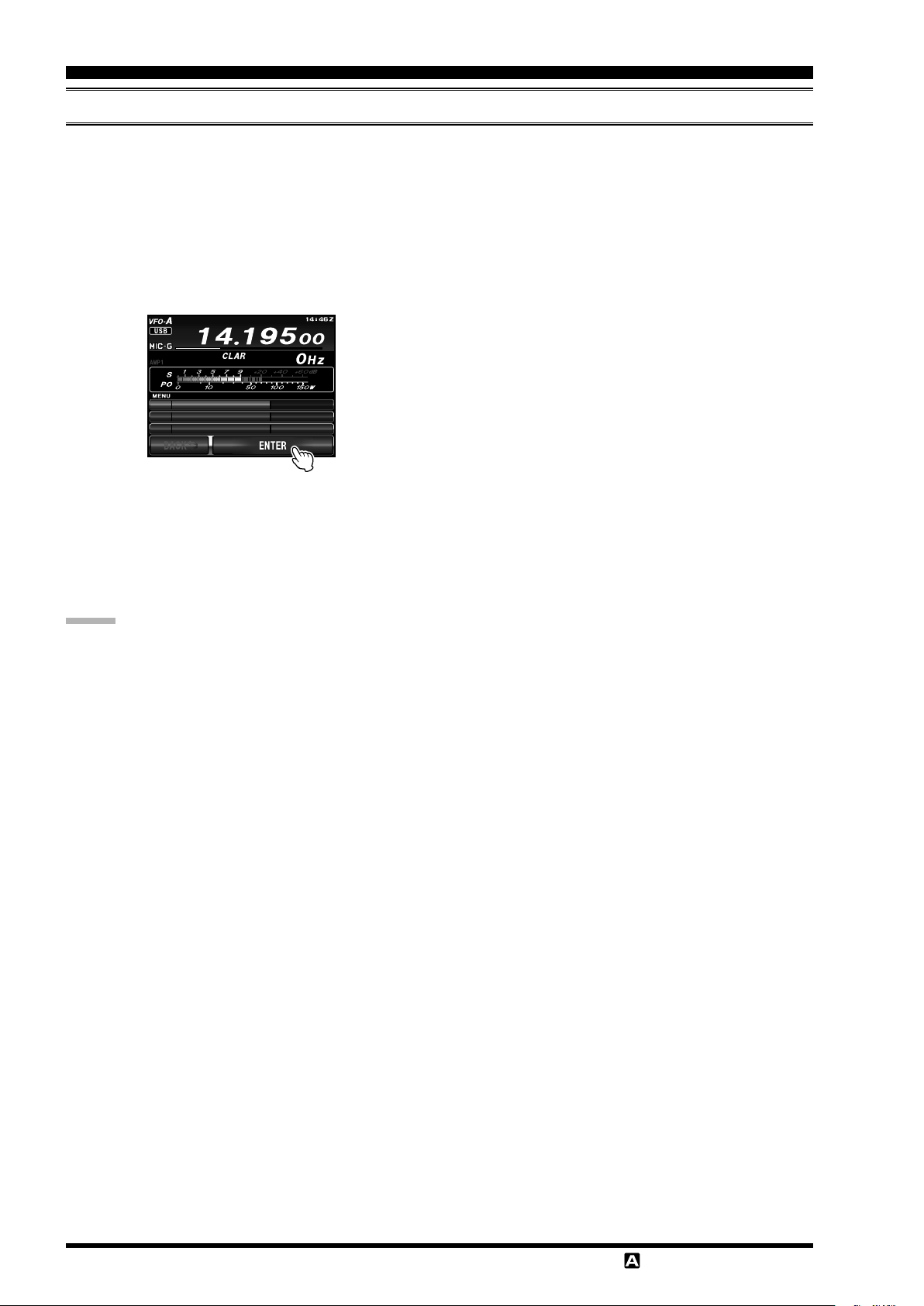
enhancing TransMiT signal QualiTy
pArAMetric Microphone equAlizer (SSb/AM Mode
8. Press and hold the
the microphone while listening to the effect of the
changes you are making. Because the overall effect on the sound will change with each adjustment,
make several passes through each adjustment area,
to be sure that you achieve the optimum settings.
9. When all adjustments have been completed, touch
[
ENTER
10. Press the
]
on the LCD to save the new settings.
24/64% '3 '(4 3
24/64% '3 8.' '.
24/64% '3 6$9 *
MENU(SETUP
on the LCD to return to normal operation. If you
only touch
[
BACK
menu, none of the changes you performed will be
stored.
switch, and speak into
PTT
)
button or touch
]
momentarily to exit the setup
[
BACK
)
]
Advice:
To roll off the excessive bass response prevalent in a
wide-range of studio microphones, try setting the microphone equalizer for a 10 dB null at 100 Hz with a band-
width of “1” or “2”, a 3 dB null centered on 800 Hz with
a bandwidth of “3”, and then put an 8 dB peak centered
on 2100 Hz with a bandwidth of “1.” These are starting
recommendations; each microphone and user’s voice
will be different, often requiring different settings.
Page 66 FT-
991
OperaTing Manual
Page 69
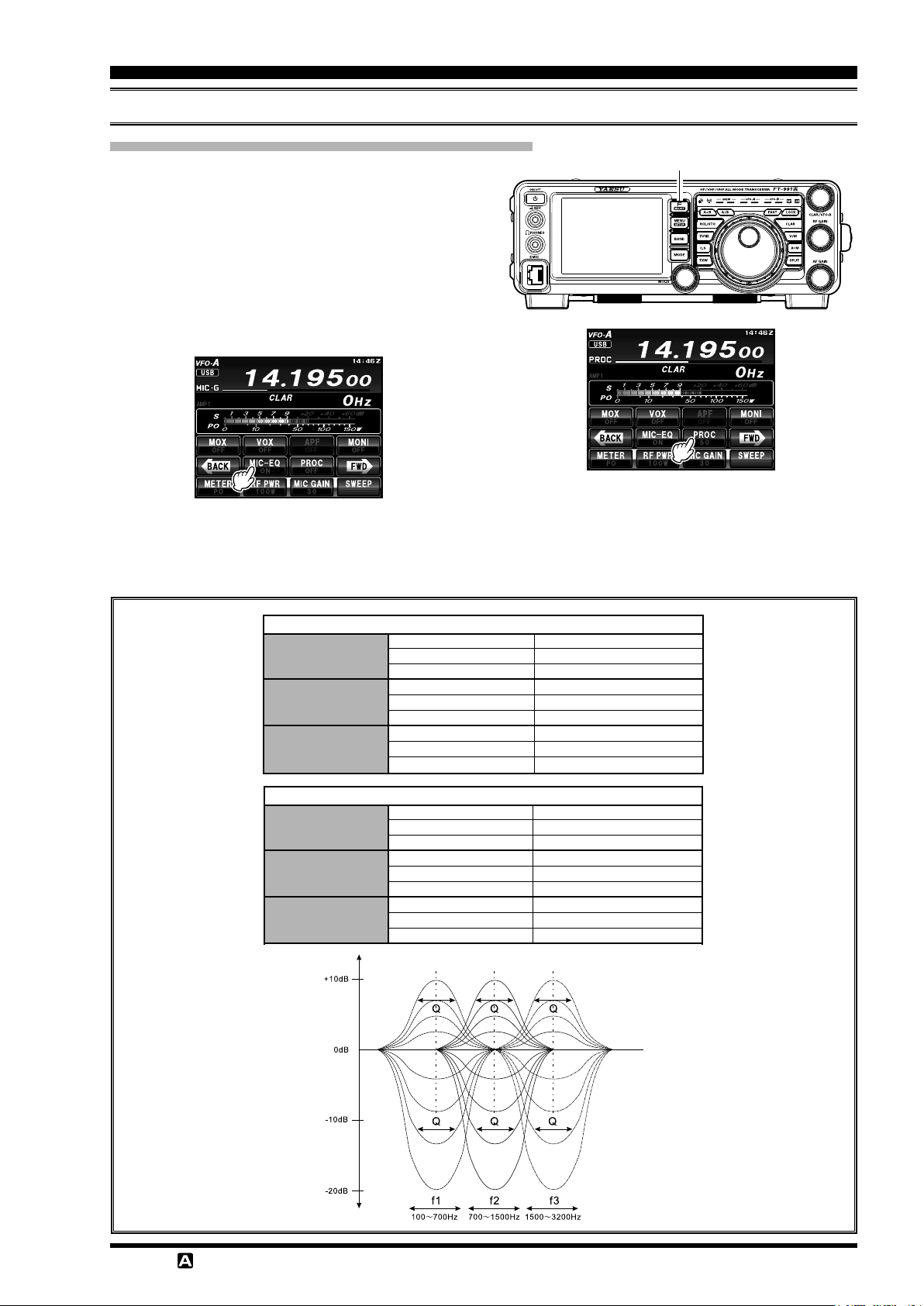
enhancing TransMiT signal QualiTy
pArAMetric Microphone equAlizer (SSb/AM Mode
Activating the Parametric Microphone Equalizer
1. Adjust
[
MIC GAIN
on page 61.
2. Press the
F(M-LIST
on the TFT display to select “ON”. If you use the
Parametric Microphone Equalizer with the speech
processor engaged, press the
[
touch
PROC
to 100), conrming that the Parametric Microphone
Equalizer is engaged.
]
on the TFT display, as described
)
button, then touch
F(M-LIST
]
to display the PROC level (from 1
[
MIC-EQ
)
button, then
]
3. Press the
4. To switch the Parametric Microphone Equalizer off,
)
F(M-LIST) Button
switch on the microphone, and speak
PTT
into the microphone in a normal voice level.
touch
[
MIC-EQ
]
on the LCD again.
3-StAge pArAMetric equAlizer AdjuStMentS
Center Frequency “121 PRMTRC EQ1 FREQ” “100” (Hz) - “700” (Hz) / “OFF”
“124 PRMTRC EQ2 FREQ” “700” (Hz) - “1500” (Hz) / “OFF”
“127 PRMTRC EQ3 FREQ” “1500” (Hz) - “3200” (Hz) / “OFF”
Parametric Gain “122 PRMTRC EQ1 LEVEL” (Low) “–20” (dB) - “10” (dB
“125 PRMTRC EQ2 LEVEL” (Mid) “–20” (dB) - “10” (dB
“128 PRMTRC EQ3 LEVEL” (High) “–20” (dB) - “10” (dB
Q (Bandwidth) “123 PRMTRC EQ1 BWTH” (Low) “1” - “10”
“126 PRMTRC EQ2 BWTH” (Mid) “1” - “10”
“129 PRMTRC EQ3 BWTH” (High) “1” - “10”
3-StAge pArAMetric equAlizer AdjuStMentS
Center Frequency “130 P-PRMTRC EQ1 FREQ” “100” (Hz) - “700” (Hz) / “OFF”
“133 P-PRMTRC EQ2 FREQ” “700” (Hz) - “1500” (Hz) / “OFF”
“136 P-PRMTRC EQ3 FREQ” “1500” (Hz) - “3200” (Hz) / “OFF”
Parametric Gain “131 P-PRMTRC EQ1 LEVEL” (Low) “–20” (dB) - “10” (dB
“134 P-PRMTRC EQ2 LEVEL” (Mid) “–20” (dB) - “10” (dB
“137 P-PRMTRC EQ3 LEVEL” (High) “–20” (dB) - “10” (dB
Q (Bandwidth) “132 P-PRMTRC EQ1 BWTH” (Low) “1” - “10”
“135 P-PRMTRC EQ2 BWTH” (Mid) “1” - “10”
“138 P-PRMTRC EQ3 BWTH” (High) “1” - “10”
Parametric Gain
(Speech proceSSor: “oFF”
(Speech proceSSor: “on”
)
)
)
)
)
)
)
)
991
OperaTing Manual
Page 67FT-
Page 70
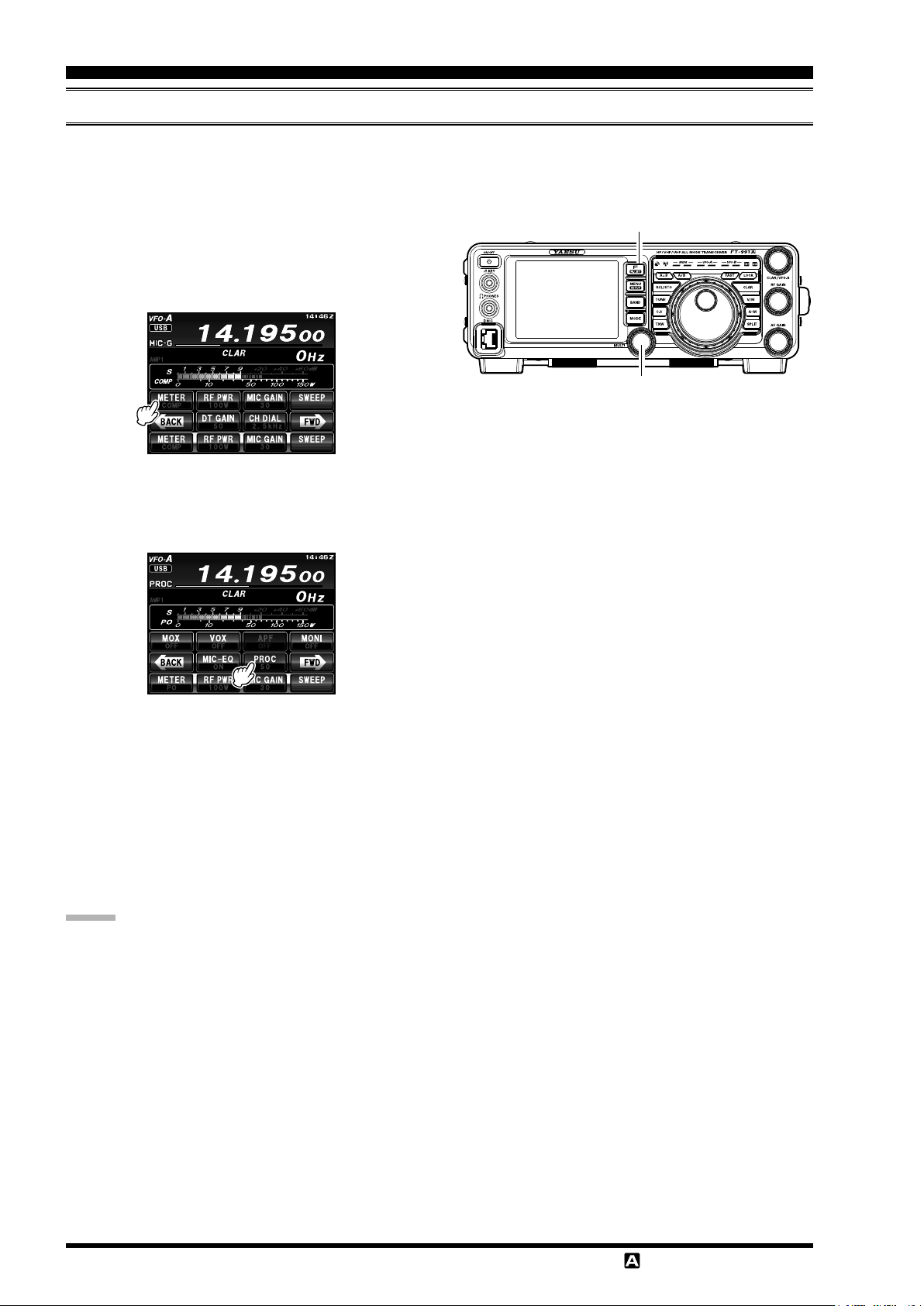
enhancing TransMiT signal QualiTy
uSing the Speech proceSSor (SSb Mode
The
FT-991A
phisticated compression technique) and adjusting the audio quality to the menu settings (“
“
133 P-PRMTRC EQ2 FREQ
are difcult.
1. Adjust
on page 61.
2. Touch
“
COMP
3. Press the
display the PROC level (from 1 to 100), conrming
that the Speech Processor is engaged.
Speech Processor is designed to increase “talk power” by increasing the average power output (via a so-
”, “
[
MIC GAIN
[
METER
” (Compression) meter.
F(M-LIST
]
on the TFT display, as described
]
on the TFT display to select
)
button, then touch
136 P-PRMTRC EQ3 FREQ
[
PROC
]
to
”). The result is improved intelligibility when conditions
)
130 P-PRMTRC EQ1 FREQ
F(M-LIST) Button
MULTI Knob
”,
4. Press the
into the microphone in a normal voice level.
5. Adjust the
within the 5 dB to 10 dB range.
6. To switch the Speech Processor off, touch
on the TFT display once more. The “
pear in the display, conrming that the Speech pro-
cessor is turned off.
Advice:
You may adjust the Parametric Microphone Equal-
izer when the speech processor is engaged, using
Menu Items “
for details.
switch on the microphone, and speak
PTT
knob to set the compression level
MULT
OFF
” through “
130
”. See page 137
138
[
PROC
” will ap-
]
Page 68 FT-
991
OperaTing Manual
Page 71
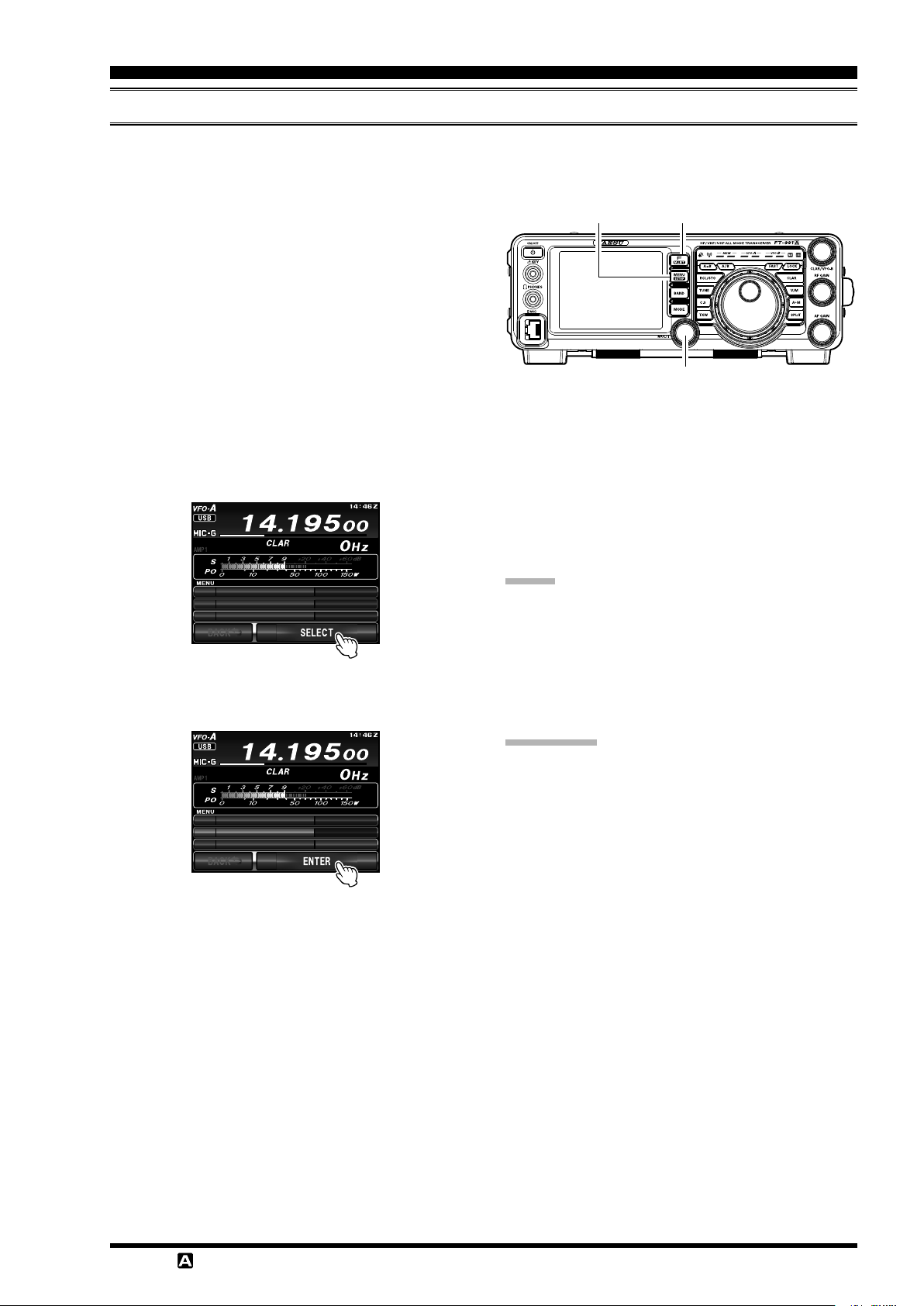
enhancing TransMiT signal QualiTy
AdjuSting the SSb trAnSMitted bAndWidth (SSb Mode
)
For SSB transmission, a default bandwidth of 2.4 kHz is available. This bandwidth provides reasonable delity along
with good talk power, and is the typical bandwidth used for decades for SSB transmission. The transmit bandwidth may
be varied by the operator, to provide different levels of delity or talk power, according to individual preferences.
Here are the steps to adjust the SSB transmit bandwidth:
1. Press the
MENU(SETUP
)
button to engage the
MENU(SETUP) Button
F(M-LIST) Button
Menu.
2. Rotate the
SSB TX BPF
the
[
SELECT
MULTI
3. Touch
knob to select Menu item “
MULTI
112
”.
]
on the TFT display, then rotate
knob to select the desired bandwidth.
The available selections are: 100-3000 Hz, 1002900 Hz, 200-2800 Hz, 300-2700 Hz, 400-2600 Hz.
MULTI Knob
The default is 300-2700 Hz. A wider bandwidth will
provide greater fidelity. A narrow bandwidth will
compress the available transmitter power into less
spectrum, resulting in more “talk power” for DX
pile-ups.
#
4' 412546 '.'%6 #
4. Touch
55$6:$(2
##2(9+6&* &+7/
[
ENTER
]
on the TFT display to save the new
/'
setting.
4' 412546 '.'%6 #
#
5. Press the
55$6:$(2
##2(9+6&* &+7/
MENU(SETUP
/'
)
button or touch
on the TFT display to exit to normal operation.
[
BACK
Advice:
The Transmit Monitor function is a very helpful way to
conrm the effect that changing the bandwidth will have
on delity. To activate the Monitor function, press the
)
F(MLIST
LCD display. Then touch the
button to reveal the functions list on the TFT
[
]
button, you will
MONI
be able to hear the difference in sound quality as you
make bandwidth changes.
quick pointS:
The higher delity associated with wide bandwidth will
be particularly enjoyable on the low bands during local
rag-chew QSOs.
]
991
OperaTing Manual
Page 69FT-
Page 72
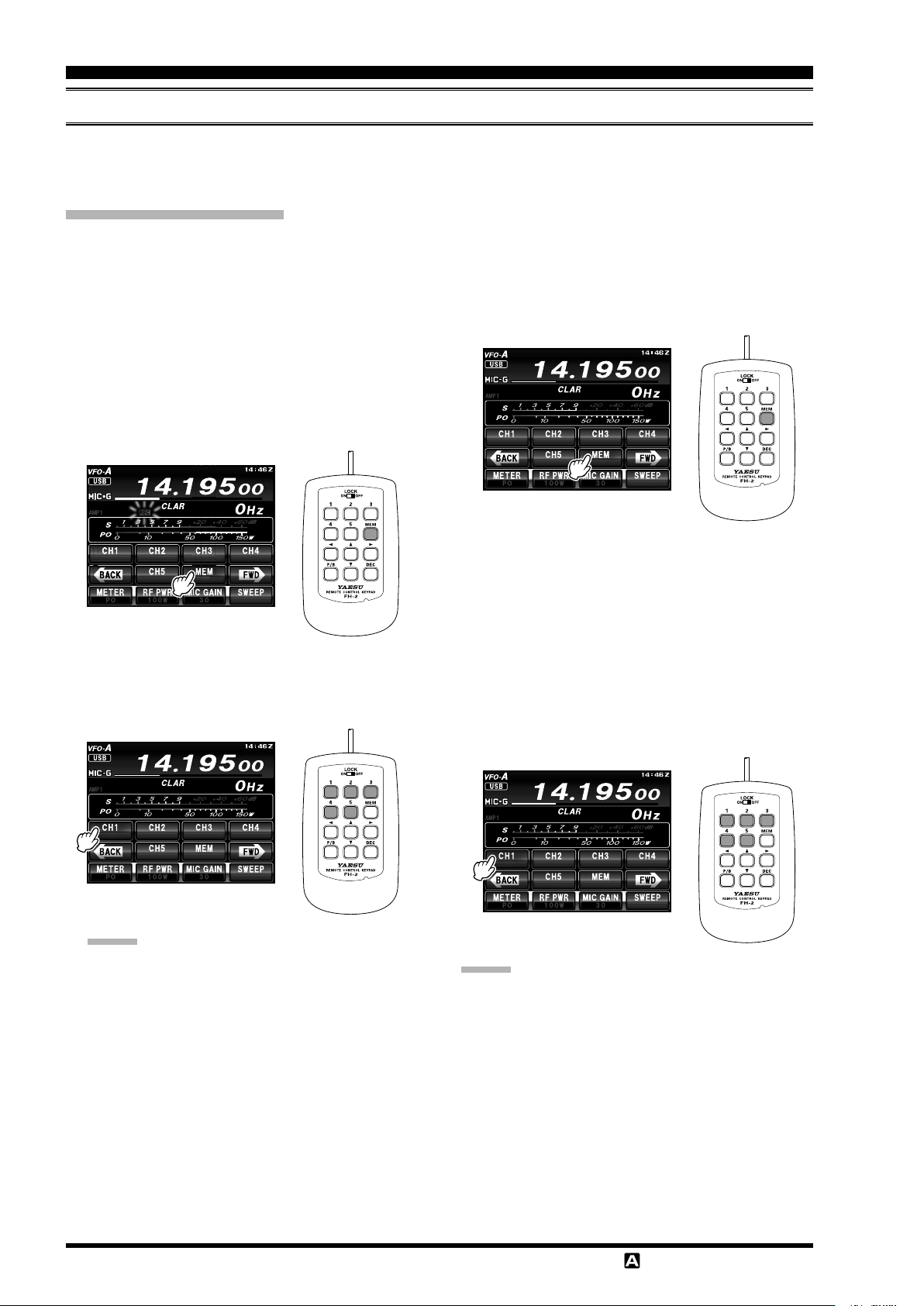
TransMiTTer cOnvenience FeaTures
voice MeMory (SSb/AM ModeS
You may utilize the Voice Memory capability of the
includes ve memories capable of storing up to 20 seconds of voice audio each. The maximum that any memory can
hold is 20 seconds.
FT-991A
for repetitive messages. The Voice Memory system
)
Voice Memory Operation
You may also utilize the Voice Memory capability of the
Remote Control Keypad, which plugs into the rear panel
Recording Your Own Voice in Memory
1. Select the LSB, USB, or AM mode using the front
panel
2. Adjust
page 61.
3. Touch
on the
the display.
button.
MODE
[
MIC GAIN
[
MEM
. A blinking “
FH-2
]
on the LCD, as described on
]
on the LCD or press the
” icon will appear in
REC
[
MEM
]
key
FT-991A
REM/ALC
by operating from the display or the optional
jack.
[
7. Touch
key to complete the message storage process.
]
on the LCD or press the
MEM
FH-2
[
MEM
FH-2
Checking Your Recording
[
]
[
4. Touch
any of the
select that memory storage register.
CH1
]
through
FH-2
[
CH5
keys numbered
]
on the LCD or press
[1]
through
[5]
to
1. Be sure that
so transmit will not be activated. The function statuses may be observed on the TFT display by pressing
the
F(M-LIST
2. Touch
[1]
[5]
in). The “
you will hear the contents of the Voice Memory you
just recorded.
VOX
)
button.
[
]
[
-
CH1
key (whichever register you just recorded
CH5
” icon will appear in the display and
PLAY
[
and
]
on the LCD or press the
BK-IN
]
functions are “Off”
FH-2
]
Advice:
If you do not press the
in ve seconds, the memory storage process will be
cancelled.
5. Press the microphone
“
” icon will glow steadily and recording will
REC
begin.
6. Speak into the microphone in a normal voice level to
record the message (such as “CQ DX, CQ DX, this
is W 6 Delta X-Ray Charlie, W 6 Delta X-Ray Char-
lie, Over”). Remember that the time limit for recording any message is 20 seconds.
key (see next step) with-
PTT
switch momentarily. The
PTT
Advice:
The playback level of the recording may be adjusted via
Menu item “
010 DVS RX OUT LEVEL
Page 70 FT-
991
”.
OperaTing Manual
Page 73
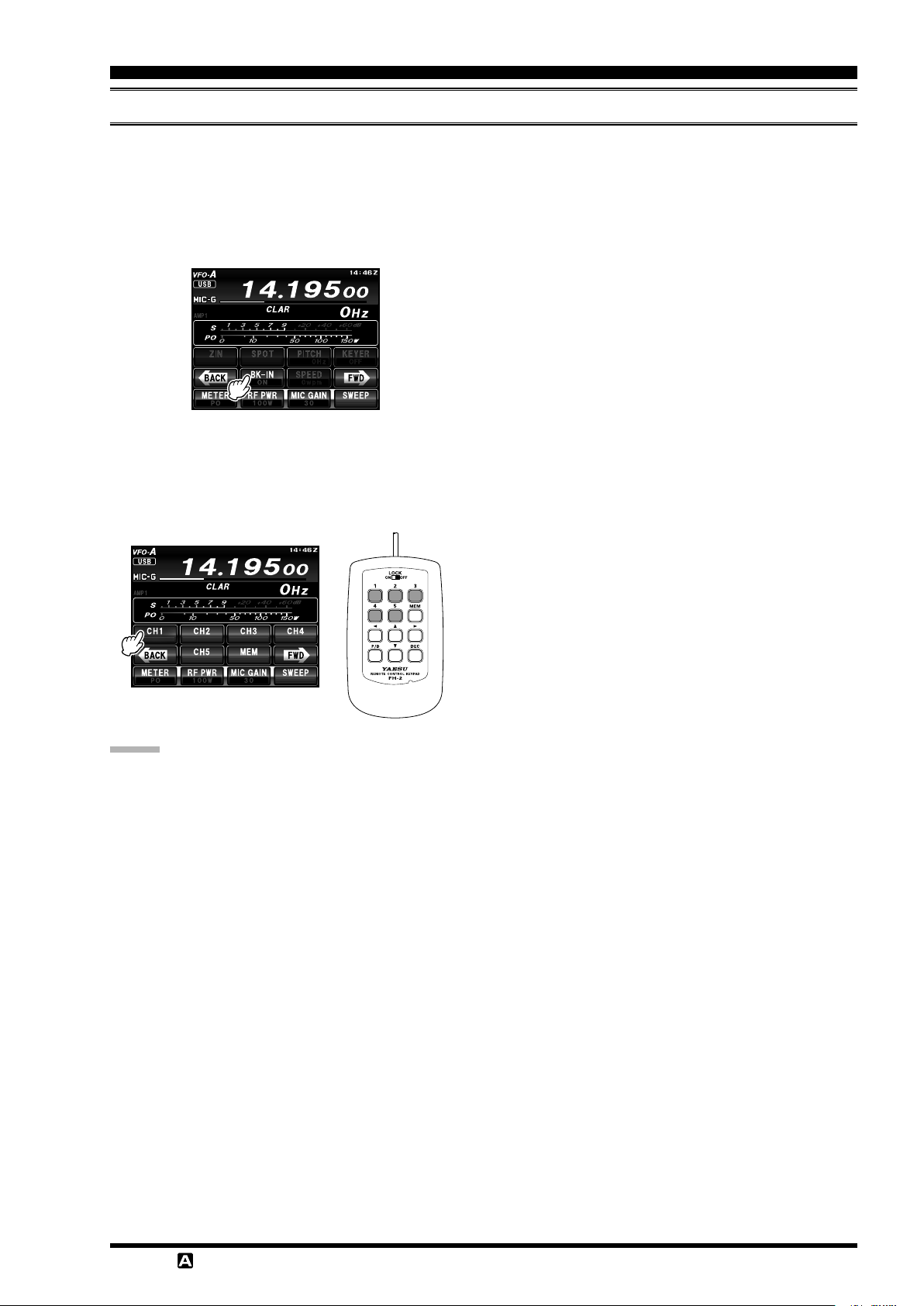
TransMiTTer cOnvenience FeaTures
voice MeMory (SSb/AM ModeS
Transmitting the Recorded Message
1. Select the LSB, USB, or AM mode using the front
panel
2. Press the front panel
functions list on the TFT LCD display, then touch
[
BK-IN
3. Touch
[1]
[5]
in). A “
the message will be transmitted.
button.
MODE
)
F(M-LIST
]
on the LCD.
[
]
[
-
CH1
key (whichever register you just recorded
PLAY
]
on the LCD or press the
CH5
” icon will appear in the display and
button to reveal the
FH-2
)
Advice:
The transmit (audio) level of the recording may be adjusted via Menu item “
011 DVS TX OUT LEVEL
”.
991
OperaTing Manual
Page 71FT-
Page 74
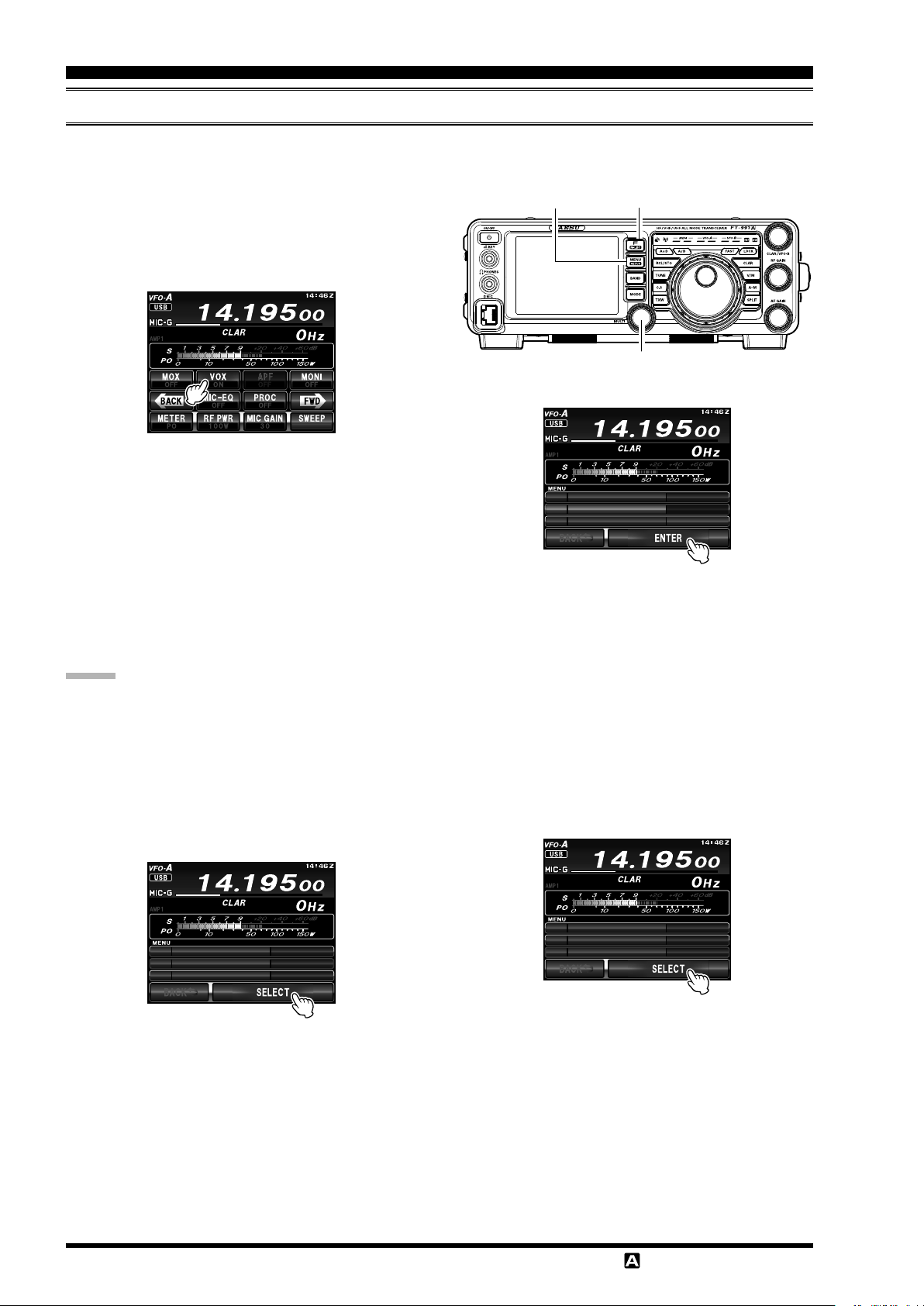
TransMiTTer cOnvenience FeaTures
vox (SSb/AM/FM ModeS:
Instead of using the microphone
switch or the [
PTT
AutoMAtic tx/rx SWitching uSing voice control
] function (that may be displayed by pressing the
MOX
)
F(M-LIST
button) to activate the transmitter, the VOX (Voice Operated Transmit) system may be used for hands-free activation of
the transmitter, by the voice input to the microphone.
1. Press the
F(M-LIST
)
button, to reveal the functions
list on the TFT LCD display, then touch
[
VOX
]
on
MENU(SETUP) Button
F(M-LIST) Button
the LCD to activate the function, “ON” will appear
in the display.
MULTI Knob
2. Without pressing the
switch, speak into the
PTT
microphone in a normal voice level. When you start
:
speaking, the transmitter should be activated auto-
matically. When you nish speaking, the transceiver
81 5.' '%6 /++%
81:)#0+
881::&'#.; OUEG
should return to the receive mode (after a short delay).
3. To cancel VOX and return to
[
]
on the LCD once more. The “
VOX
tion will turn OFF, signifying that the VOX circuitry
has been turned off.
Advice:
The VOX Gain may be adjusted to prevent acciden-
tal transmitter activation in a noisy environment. To
adjust the VOX Gain:
1) Activate the VOX circuitry, if necessary.
2) Press the
MENU(SETUP
Menu mode.
3) Rotate the
VOX GAIN
”, then touch
knob to select Menu item “
MULTI
[
SELECT
operation, touch
PTT
” indica-
VOX
)
button to engage the
145
]
on the LCD.
6) Press the
[
BACK
The “Hang-Time” of the VOX system (the transmit/
MENU(SETUP
]
on the LCD to exit to normal operation.
)
button or touch
receive delay after the cessation of speech) may also
be adjusted via the Menu mode. The default delay is
500 msec. To set a different delay time:
1) Activate the VOX circuitry, if necessary.
2) Press the
MENU(SETUP
)
button to engage the
Menu mode.
3) Rotate the
VOX DELAY
knob to select Menu item “
MULTI
”, then touch
[
SELECT
]
on the
LCD.
146
)
81 5.' '%6 /++%
:
81 5.' '%6 /++%
81::)#0+
881::&'#.; OUEG
4) While speaking into the microphone, rotate the
knob to the point where the transmitter
MULTI
4) Rotate the
lable like “Ah” and listening to the hang time for
the desired delay.
81::)#0+
881::&'#.; OUEG
MULTI
is quickly activated by your voice, without background noise causing the transmitter to activate.
5) When you are satisfied with the setting, touch
[
ENTER
]
on the TFT LCD display to save the
new setting.
Page 72 FT-
:
knob while saying a brief syl-
991
OperaTing Manual
Page 75
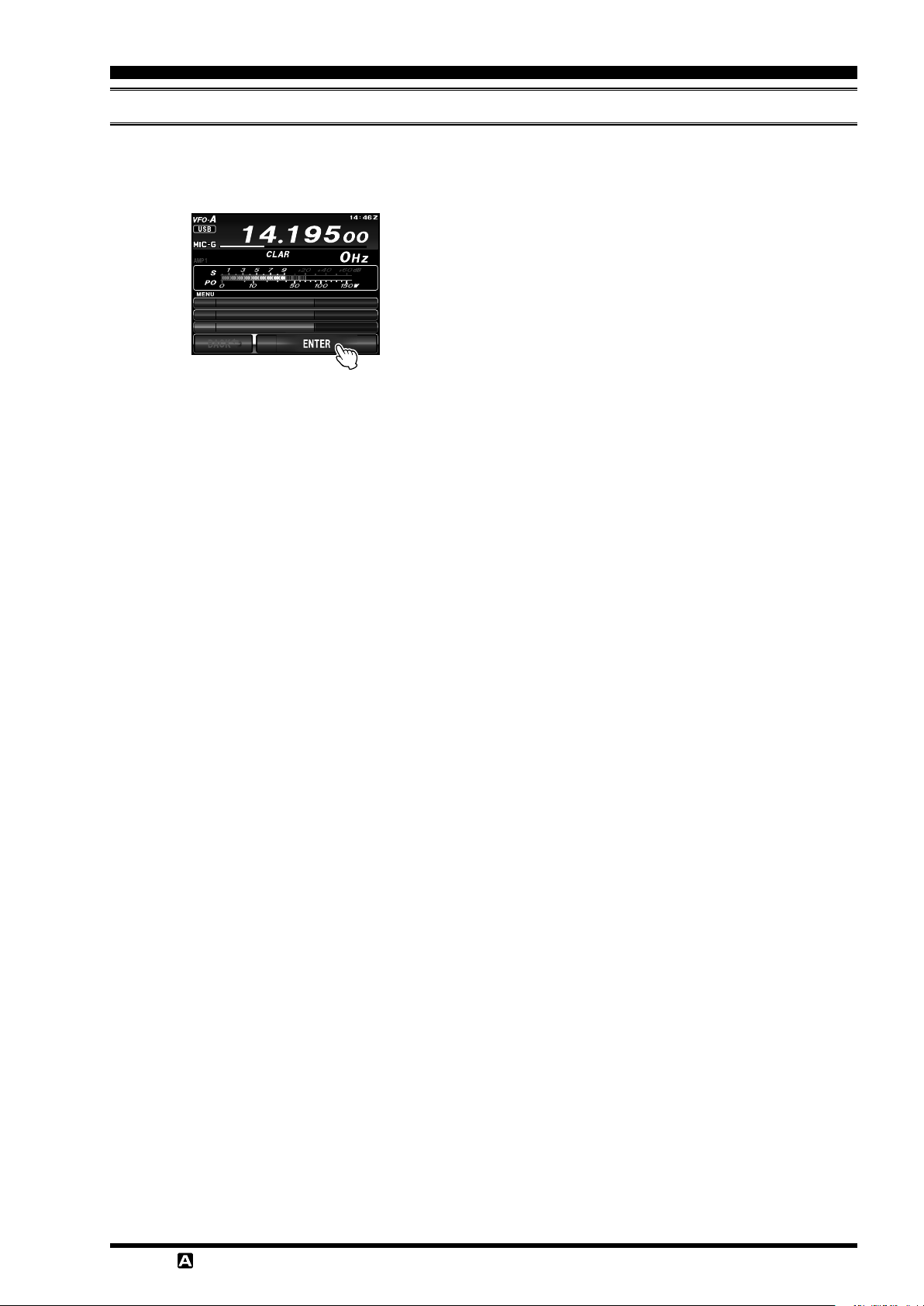
TransMiTTer cOnvenience FeaTures
vox (SSb/AM/FM ModeS:
5) When you are satisfied with the setting, touch
[
ENTER
new setting.
6) Press the
[
BACK
The Anti-Trip setting adjusts the level of negative re-
ceiver audio feedback to the microphone, to prevent
receiver audio from activating the transmitter (via
the microphone). This setting can also be adjusted
via Menu item “
VOX operation may be engaged on either Voice
modes (SSB/AM/FM) or on AFSK-based Data
modes. Use Menu item “
lections are “
]
on the TFT LCD display to save the
:
81 5.' '%6 /++%
81:)#0+
81:&'#.; OUEG
MENU(SETUP
]
on the LCD to exit to normal operation.
147 ANTI VOX GAIN
” and “
MIC
)
button or touch
”.
144 VOX SELECT
”).
DATA
” (the se-
AutoMAtic tx/rx SWitching uSing voice control
)
991
OperaTing Manual
Page 73FT-
Page 76
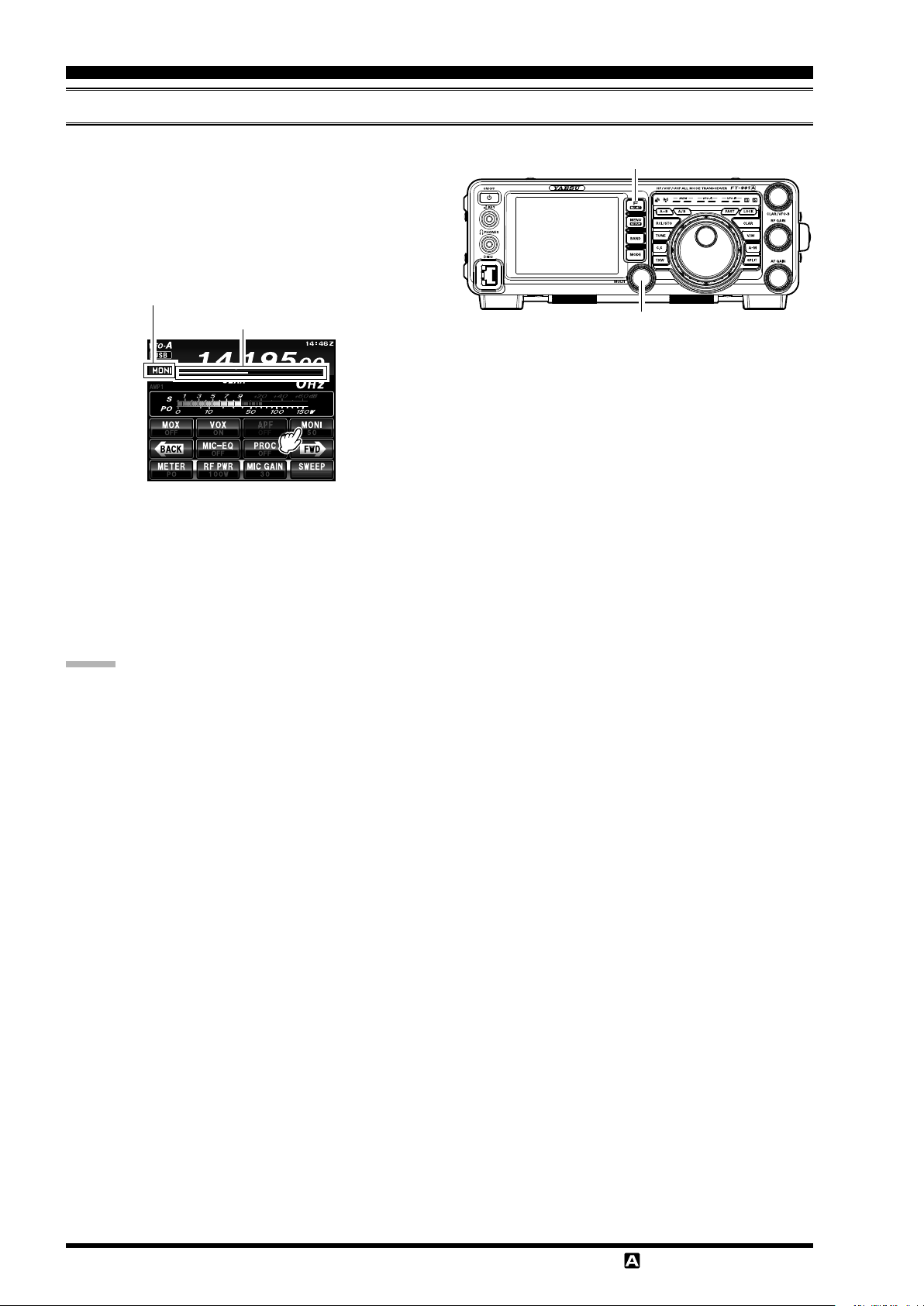
TransMiTTer cOnvenience FeaTures
Monitor (SSb/AM ModeS
You may listen to the quality of your transmitted signal using the Monitor feature.
[
1. Touch
button to reveal the functions list on the TFT LCD
display.
2. Touch
will be set to “ON”. The
MONITOR adjustment knob.
3. During transmission, rotate the
just the audio level in the Headphones or speaker.
Clockwise rotation of this knob will increase the volume level.
4. To switch the Monitor off again, touch
the LCD once more. “
rming that the Monitor function is disengaged.
]
displayed by pressing the
MONI
[
]
MONI
MONI (Monitor) indicator
on the LCD, the Moniter function
MONI (Monitor) level indicator
OFF
F(M-LIST
knob serves as the
MULTI
knob to ad-
MULTI
[
MONI
” will be displayed, con-
]
on
)
)
F(M-LIST) Button
MULTI Knob
Advice:
Because the Monitor feature samples the transmit-
ter IF signal, it can be very useful for checking the
adjustment of the Speech Processor or Parametric
Equalizer on SSB, and for checking the general signal quality on AM.
Page 74 FT-
991
OperaTing Manual
Page 77
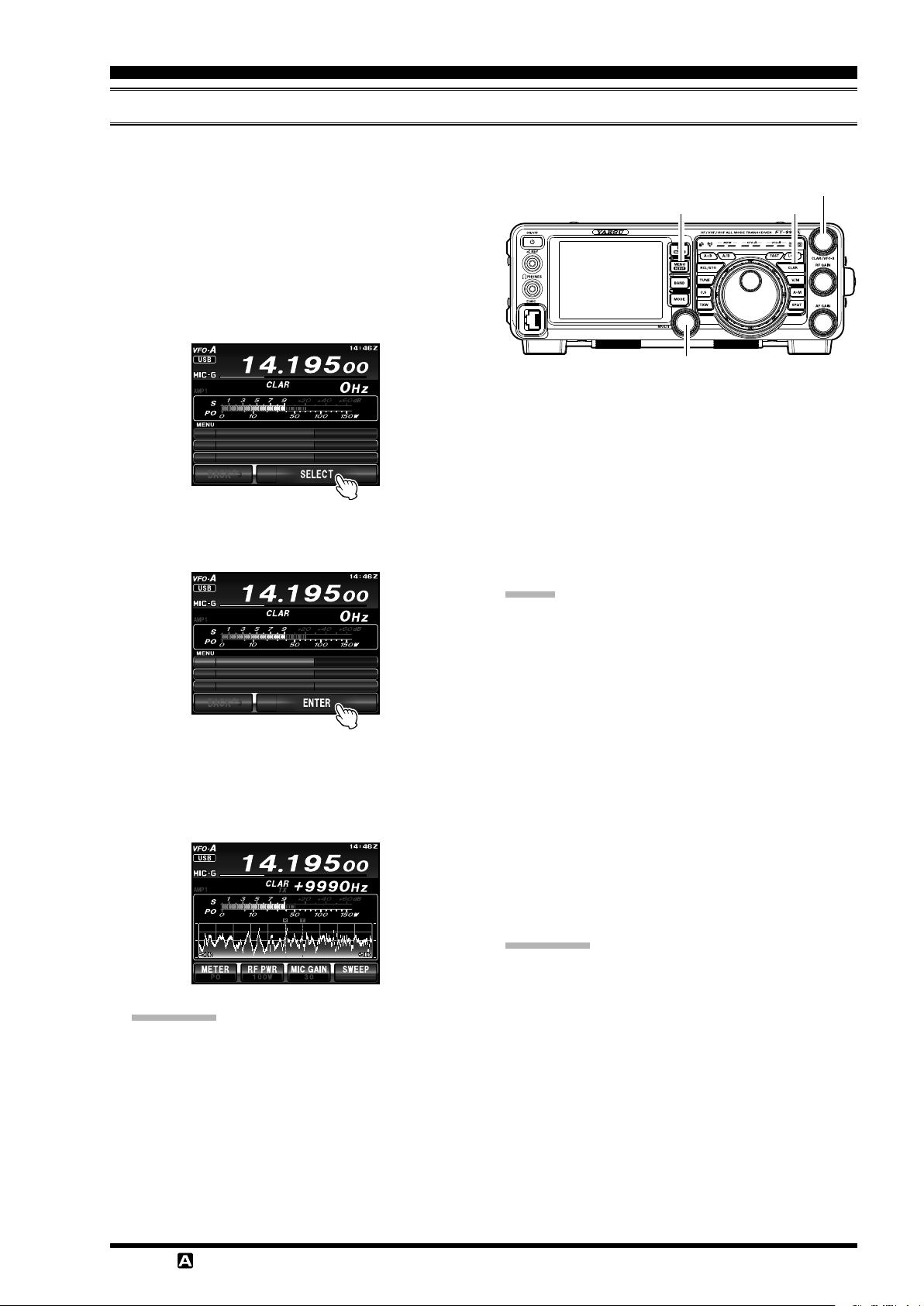
TransMiTTer cOnvenience FeaTures
Split operAtion uSing the tx clAriFier
For split TX/RX operation in “casual” pile-ups, where the split is less than 10 kHz, the TX Clarier (Offset Tuning) fea-
ture may be utilized.
1. Press the
MENU(SETUP
)
button to enter the Menu
mode.
2. Rotate the
CLAR MODE SELECT
3. Touch
MULTI
[
SELECT
knob to set this Menu item to “TX” (the de-
knob to select Menu item “
MULTI
”.
] on the LCD, then rotate the
fault setting is “RX”).
4. Touch
[
ENTER
%.#4 /1&' '56.'%
#/ .% 67'(4 3 1((
#/ .% 6715. 2'
]
on the LCD to save the new set-
4:
F$QEV
ting.
%.#4 /1&' '56.'% 6:
5. Press the
#/ .% 67'(4 3 1((
MENU(SETUP
F$QEV#/ .% 6715. 2'
)
button or touch
on the LCD to exit to normal operation.
6. Press the
button. The “TX” icon will appear
CLAR
in the TFT display.
040
[
BACK
CLAR/VFO-B Knob
7. Rotate the
MENU(SETUP) Button
MULTI Knob
CLAR/VFO-B
knob to set the desired
CLAR Button
transmitter offset. A maximum split of ±9.999 kHz
may be set.
8. To exit from TX Clarier operation, press the
CLAR
button once more. The “TX” icon will disappear
from the display.
Advice:
When listening to a “pile-up” calling a DX station, in
order to nd the station currently being worked, you
may press the
VFO-B
(
knob to zero in on the station calling the DX
use the SPOT function on CW for precise alignment
of your frequency). You may then press the
button. Then, use the
CLAR
CLAR/
CLAR
button again to cancel the RX Clarier, and return to
]
reception on the DX station’s frequency.
Just as with receiver Clarier operation, the amount
of offset from the original VFO frequency will appear in the display.
As with receiver Clarier operation, when you turn
the TX Clarier off, the last-used offset is remembered, and will be available if you turn the TX Clari-
er back on. To clear the Clarier offset, press and
hold the
button for more than 1 second.
CLAR
quick point:
The Clarifier is frequently used for receiver offset
tuning. However, for DX pile-ups where the DX
station is using a split of less than 10 kHz, the TX
Clarier function is usually the quickest way to set
the transmitter to the desired offset frequency.
991
OperaTing Manual
quick point:
When attempting to work a DX station on CW in a split
frequency pile-up, remember that a large number of
other stations may also be using Yaesu transceivers with
capability similar to that of your
FT-991A
. On the DX
side of the pile-up, everyone calling precisely on the
same CW frequency will sound like a single tone! So
you may have more success if you use the RX Clarier
to nd a hole in the pile-up, instead of trying to zero-
beat the last station worked by the DX station.
Page 75FT-
Page 78
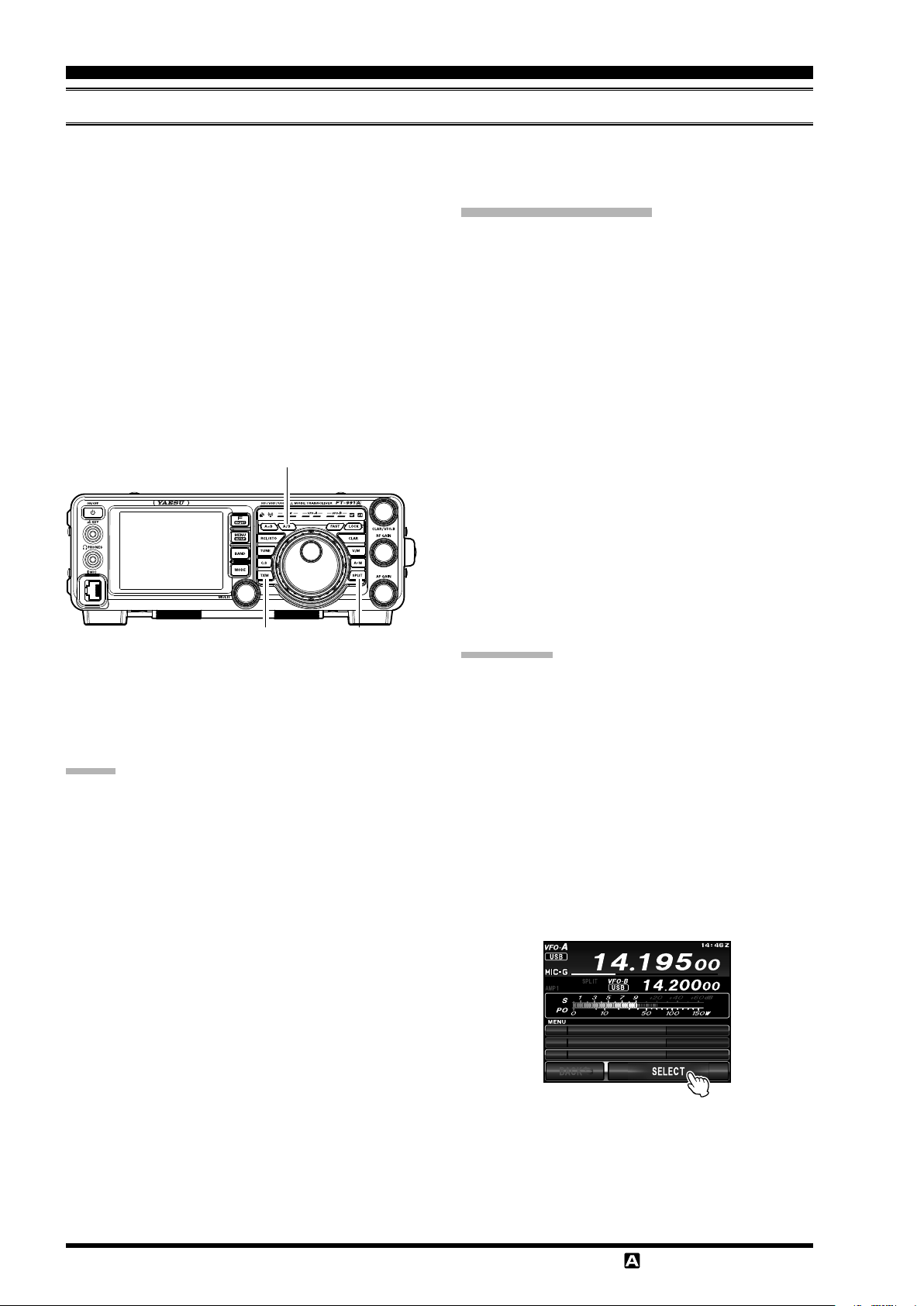
TransMiTTer cOnvenience FeaTures
Split-Frequency operAtion
A powerful capability of the
FT-991A
quency registers. This makes the
is its exibility in Split Frequency operation using the VFO-A and VFO-B fre-
FT-991A
especially useful for high-level DX-peditions. The Split operation capability
is very advanced and easy to use.
1. Rotate the Main Tuning Dial knob to set the desired
RX frequency.
2. Press the
button, then rotate the Main Tuning
A/B
Dial knob to set the desired split TX frequency.
3. Press the
button, then press the
A/B
SPLIT
button.
The VFO-B frequency will be shown in the TFT display and the LED indicators will appear as below:
VFO-A RX
VFO-A TX
VFO-B RX
VFO-B TX
Indicator: “ON”
(LED glows Green
Indicator: “OFF” (LED Off
Indicator: “OFF” (LED Off
Indicator: “ON” (LED glows Red
A/B Button
TXW Button
)
)
)
)
SPLIT Button
During Split operation, the VFO-A register will be used
for reception, while the VFO-B register will be used for
transmission. If you press the
button once more,
SPLIT
Split operation will be cancelled.
Advice:
During Split operation, pressing the
button will
A/ B
reverse the contents of VFO-A and VFO-B. Press the
button once more to return to the original fre-
A/B
quency alignment.
During Split operation you may listen to the TX fre-
quency temporarily while pressing the
TXW
button
located on the bottom left of the Main Tuning Dial
knob.
While pressing the
button during split opera-
TXW
tions, the frequency of transmit on VFO-B can be
changed.
During Split operation it is also possible to set VFO-
A and VFO-B to different Amateur bands if a multi
band antenna is used.
Quick Split Operation
The Quick Split feature allows setting a one-touch offset
of +5 kHz compared to the VFO-A frequency, to be applied to the transceiver VFO-B (transmit) frequency,
1.
Start with regular transceiver operation on the VFO-A.
VFO-A RX
VFO-A TX
VFO-B RX
VFO-B TX
2. Press and hold in the
Indicator: “ON” (LED glows Green
Indicator: “ON” (LED glows Red
Indicator: “OFF” (LED Off
Indicator: “OFF” (LED Off
button for one second
SPLIT
to engage the Quick Split feature, and apply a fre-
quency 5 kHz above the VFO-A frequency to the
VFO-B frequency register.
The VFO conguration will then be:
VFO-A RX
VFO-A TX
VFO-B RX
VFO-B TX
3. Press and hold in the
Indicator: “ON” (LED glows Green
Indicator: “OFF” (LED Off
Indicator: “OFF” (LED Off
Indicator: “ON” (LED glows Red
switch for one second
SPLIT
to increment the Sub (VFO-B) offset frequency another +5 kHz.
quick pointS:
The offset of VFO-B from VFO-A is programmed
via the Menu and is set to +5 kHz at the factory.
However, other offsets may be selected using the fol-
lowing procedure:
1. Press the
MENU(SETUP
)
button to engage the
Menu mode.
2. Rotate the
QUICK SPLIT FREQ
3. Touch
MULT
[
SELECT
knob to select the desired offset. The avail-
knob to select Menu item “
MULTI
”.
]
on the LCD, then rotate the
able setting range is –20kHz - +20kHz (factory default: +5 kHz).
/
/' )1472 &+5#$.'
37+%-25+6 (4'3.
6: 616 (
M1(*\
)
)
)
)
)
)
)
)
035
Page 76 FT-
991
OperaTing Manual
Page 79
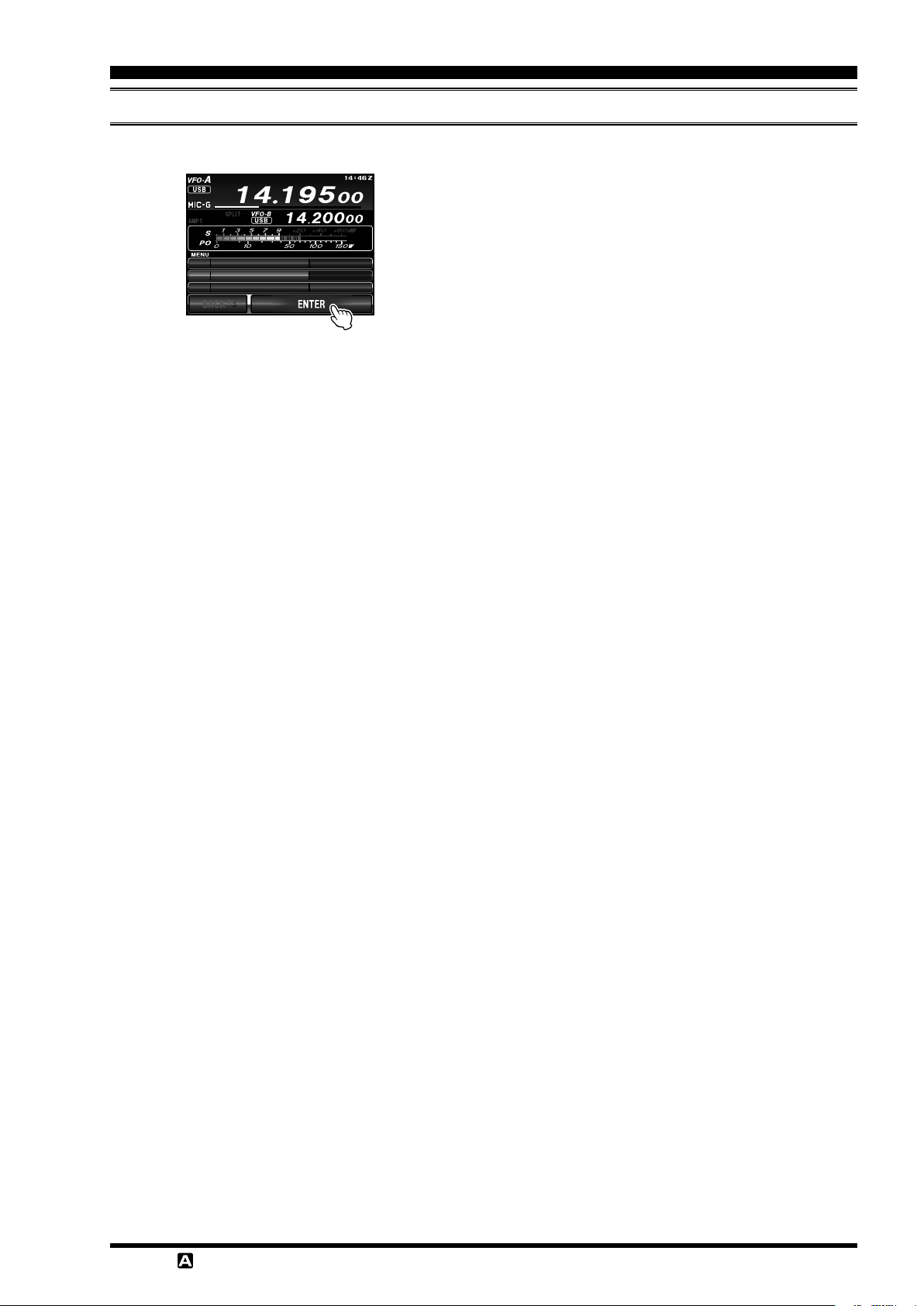
TransMiTTer cOnvenience FeaTures
Split-Frequency operAtion
4. Touch
[
ENTER
5. Press the
]
button to save the new setting.
/' )1472 &+5#$.'
/
37+%-25+6 (4'3.
6: 616 (
MENU(SETUP
M1(*\
)
button or touch
on the LCD to exit to normal operation.
[
BACK
]
991
OperaTing Manual
Page 77FT-
Page 80
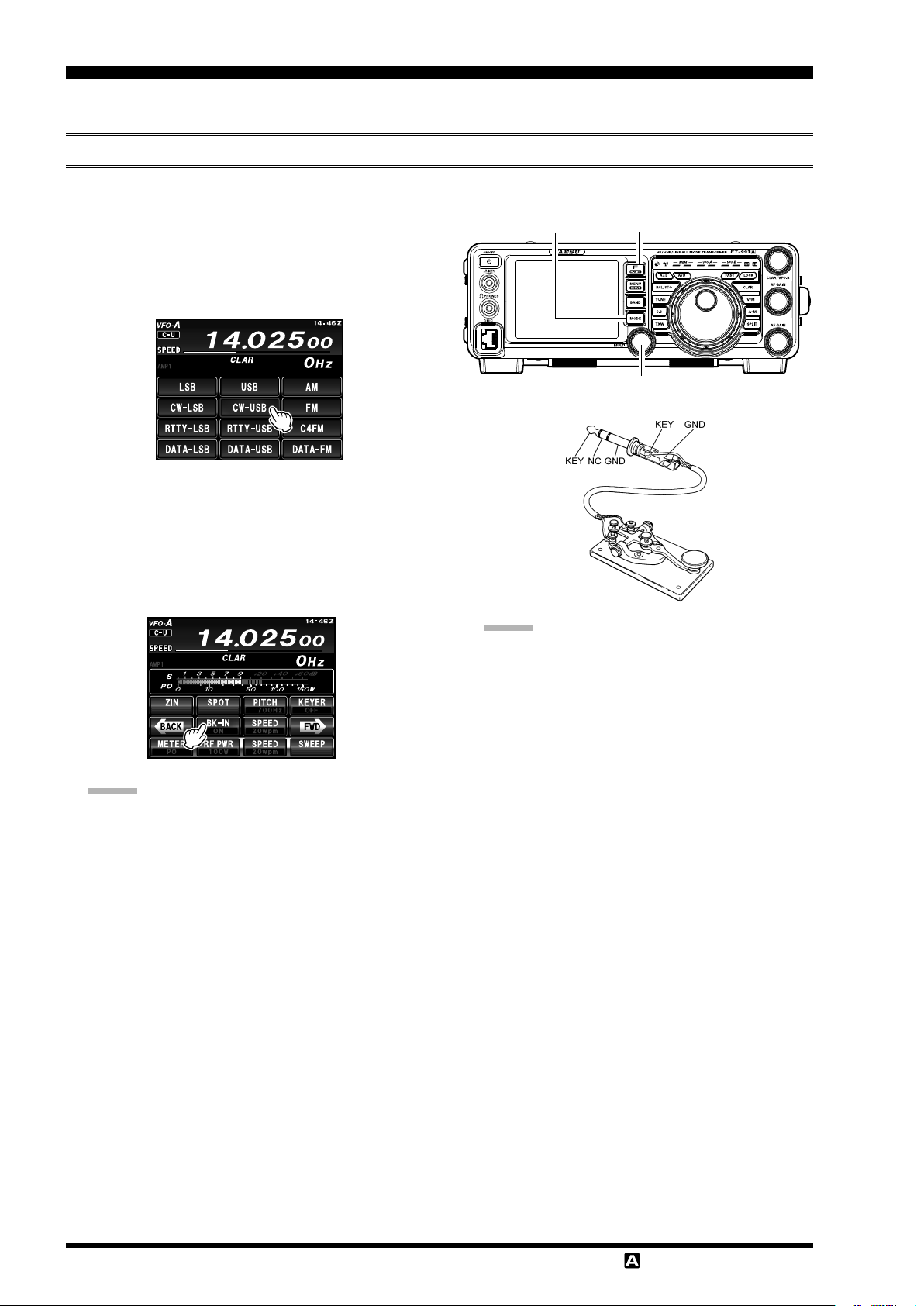
cw MODe OperaTiOn
The powerful CW operating capabilities of the
key”, or a computer-based keying device.
Setup For StrAight key
Before starting, connect your key line(s) to the front panel
)
button is turned off for now.
LIST
1. Press the
[
CW-USB
or “
monitor is activated.
2. Rotate the Main Tuning Dial knob to select the desired operating frequency.
3. Press the
on the LCD to engage automatic activation of the
transmitter when you close the CW key. The Breakin will be set to “ON”.
” icon will appear in the display. The CW
C-U
button, then touch
MODE
]
on the TFT LCD display. The “
)
F(M-LIST
button, then touch
FT-991A
(
And StrAight key eMulAtion
[
CW-LSB
[
BK-IN
permit operation using an electronic keyer paddle, a “straight
]
or
”
C-L
]
jack. Be sure
KEY
[
BK-IN
MODE Button
)
operAtion
]
displayed by pressing the
F(M-LIST) Button
MULTI Knob
F(M-
Advice:
When you close the CW key, the transmitter will
automatically be activated, and the CW carrier
will be transmitted. When you release the key,
transmission will cease, and after a brief delay,
receive will be restored. The delay time is userprogrammable per the discussion on page 85.
As shipped from the factory, the
RX system for CW is configured for “Semi-
break-in” operation. However, using Menu item
“
056 CW BK-IN TYPE
setup for full break-in (QSK) operation, whereby
the switching is quick enough to hear incoming
signals in the spaces between the dots and dashes
of your transmission. This may prove very useful
during contest and trafc handling operations.
4. CW operation using the CW key may now proceed.
”, you may change this
FT-991A
TX/
Advice:
The CW sidetone audio level may be adjusted by
setting “MONITOR” (see page 74).
You may practice sending CW listening to the sidet-
one only, without having the signal transmitted out
over the air, if you press the front panel
button to reveal the functions list on the TFT LCD
display, and then touch the [
break-in to Off.
If you reduce transmit power via the [
function that may be displayed by pressing the
)
button, the ALC meter reading will increase;
LIST
this is normal and does not indicate any problem
whatsoever (because increased ALC voltage is being
used to lower the power).
To enable the keying operation in LSB/USB mode
and send the CW signal without switching to CW
mode, change Menu item “
The same frequency may be displayed when switch-
ing between SSB mode and CW mode by setting
Menu item “
By connecting the
be operated using free or commercially available
software and setting Menu item “
059 CW FREQ DISPLAY
FT-991A
BK-IN
055 CW AUTO MODE
to a computer, CW can
060 PC KEYING
F(M-LIST)
] button to set
RF PWR
”.
]
F(M-
”.
”.
Page 78 FT-
991
OperaTing Manual
Page 81
cw MODe OperaTiOn
Setup For StrAight key
terMinology:
Semi-break-in
This is a pseudo-”VOX” mode used on CW, whereby the closure of the CW key will engage the transmitter, and
release of the key will allow the receiver to recover after a short delay. No signals will be heard during the spaces
between dots and dashes (unless the sending speed is extremely slow).
Full break-in
Full break-in (also known as “Full QSK”) involves very fast switching between transmit and receive, incoming
signals may be heard between the dots and dashes as you send them. This allows you to hear a station that suddenly starts transmitting on your frequency, while you are in the midst of a transmission.
(
And StrAight key eMulAtion
)
operAtion
991
OperaTing Manual
Page 79FT-
Page 82
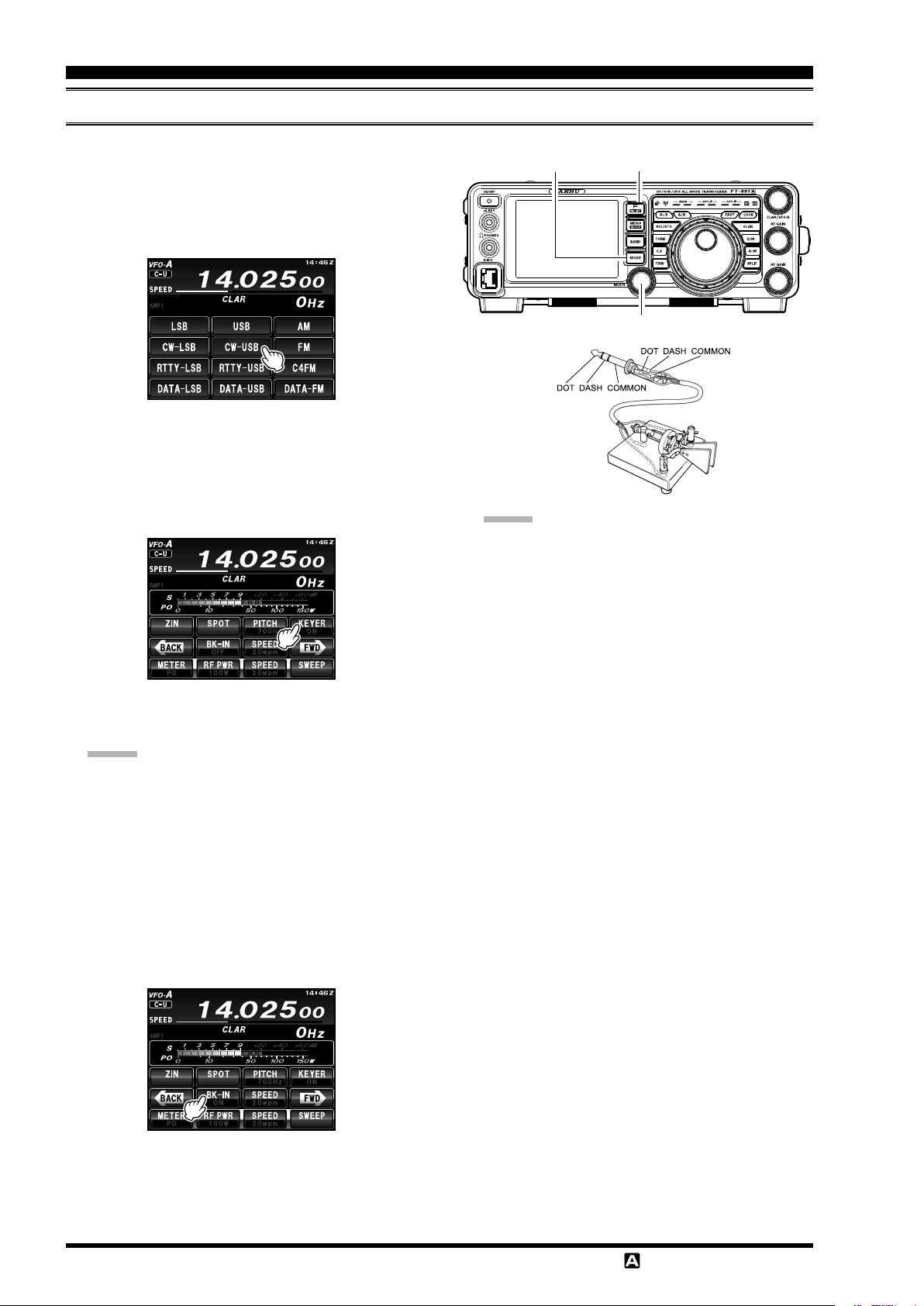
cw MODe OperaTiOn
uSing the built-in electronic keyer
Connect the cable from your keyer paddle to the front panel
1. Press the
[
CW-USB
or “
monitor is activated.
2. Rotate the Main Tuning Dial knob to select the desired operating frequency.
3. Press the
on the LCD to select “ON” to conrm that the builtin Electronic Keyer is now active.
4. Touch
knob to set the desired sending speed (4 - 60 WPM).
Advice:
5. Touch
matic activation of the transmitter when either the
“Dot” or “Dash” side of the paddle is pressed. The
Break-in will be set to “ON”.
” icon will appear in the display. The CW
C-U
[
SPEED
Rotate the
speed (4 - 60 WPM) below the
tor.
By pressing either the “Dot” or “Dash” side of
the paddle, the CW keying tone will automatically be generated.
[
BK-IN
button, then touch
MODE
]
on the TFT LCD display. The “
)
F(M-LIST
button, then touch
]
on the LCD, then rotate the
MULTI
]
knob to display the keying
on the TFT display to engage auto-
[
CW-LSB
[
SPEED
C-L
[
KEYER
MULTI
]
indica-
]
or
”
]
jack.
KEY
MODE Button
Advice:
When the keyer paddle is pressed, the transmitter
will automatically be activated, and the CW characters (or a string of dots or dashes) will be transmitted. When the keyer paddle is released, transmission
will cease, and after a brief delay, reception will be
restored. The delay time is user-programmable, per
the discussion on page 85.
The CW sidetone audio level may be set using
“MONITOR” (see page 74).
If [
CW with the sidetone only, without having the signal
go out over the air. (Press the front panel
button to reveal the functions list on the TFT display ).
If the transmitter power is reduced via [
function, the ALC meter reading will increase; this
is normal and does not indicate any problem whatsoever (because increased ALC voltage is being used
to lower the power).
The keying operation may also be enabled in LSB/
USB mode to send the CW signal via the Menu item
“
055 CW AUTO MODE
mode.
The same frequency may be displayed when switch-
ing between SSB mode and CW mode by setting
Menu item “
By connecting a computer, CW can be operated us-
ing free or commercially available software and setting Menu item “
The electronic keyer operation mode can be changed
via the Menu item “
BK-IN
] is set to “
059 CW FREQ DISPLAY
F(M-LIST) Button
MULTI Knob
”, you may practice sending
OFF
” without switching to CW
060 PC KEYING
012 KEYER TYPE
”.
”.
”.
F(M-LIST
RF PWR
)
]
6. CW operation utilizing the CW paddle may now
commence.
Page 80 FT-
991
OperaTing Manual
Page 83
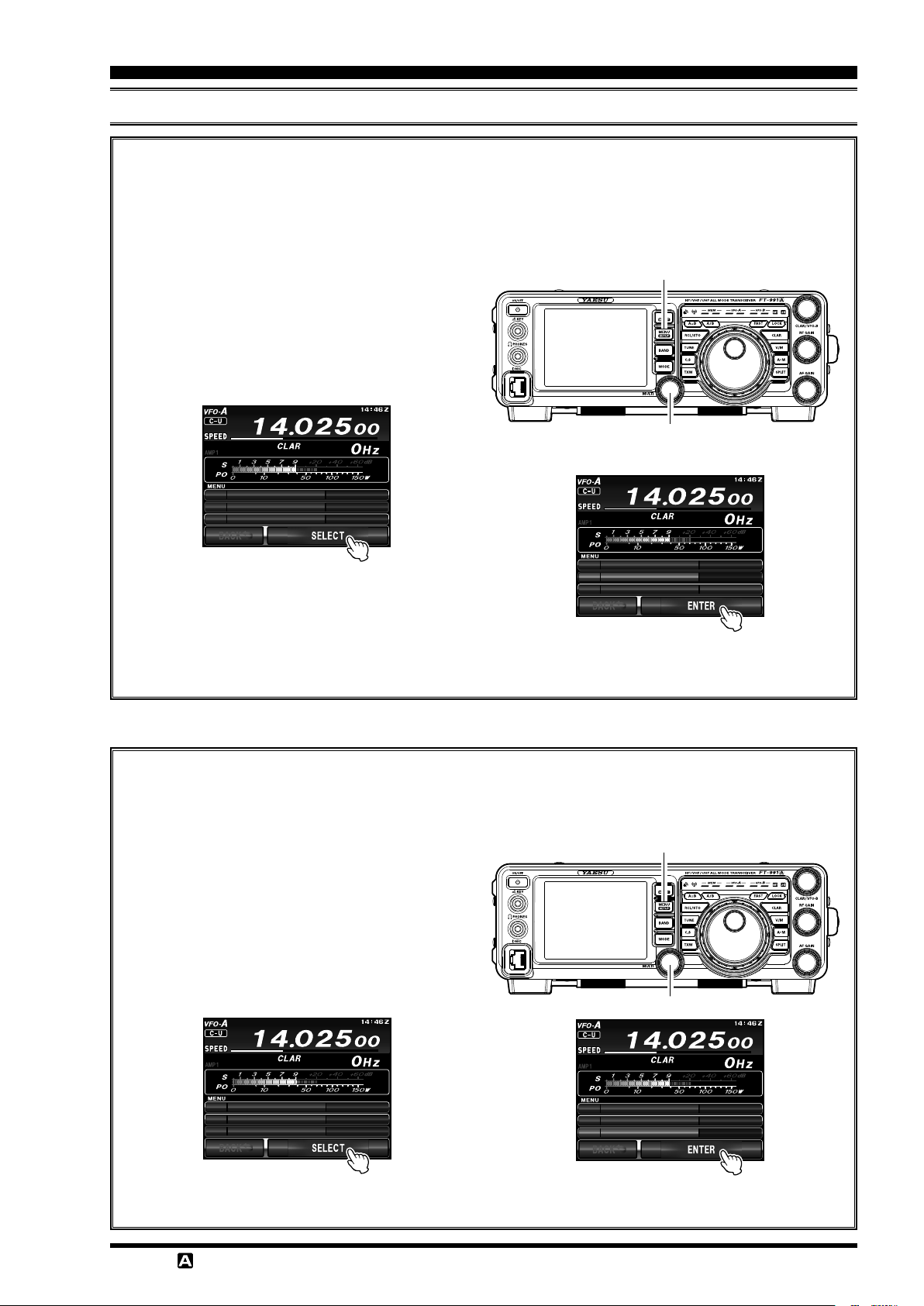
cw MODe OperaTiOn
uSing the built-in electronic keyer
Full Break-in (QSK) Operation
As shipped from the factory, the
FT-991A
However, this setup may be changed to full break-in (QSK) operation by setting Menu item “
”. With full break-in QSK, the TX/RX switching is quick enough to hear incoming signals in the spaces be-
TYPE
tween the dots and dashes of your transmission.
TX/RX system for CW is congured for “Semi-break-in” operation.
056 CW BK-IN
1. Press the
MENU(SETUP
)
button to engage the
Menu.
2. Rotate the
CW BK-IN TYPE
3. Press the
MULTI
knob to set this Menu item to “
[
knob to select Menu item “
MULTI
”.
]
SELECT
%9
%9 $-++0 6;2' 5'/+
%9 $- 0&' .#; O GUE
button, and then rotate the
#&'/1167 ((1
FULL
4. When the adjustments are complete, touch
]
on the LCD to save the new setting.
TER
056
”.
[
EN-
5. Press the
[
BACK
]
on the LCD to exit to normal operation.
MENU(SETUP) Button
MULTI Knob
%9# &'/1167 ((1
%9 $-++0 6;2' (7..
%9 $- 0&' .#; O GUE
MENU(SETUP
)
button or touch
A number of interesting and useful features are available for use with the Electronic Keyer operation.
Setting the Keyer Weight (Dot/Dash) Ratio
This Menu item may be used to adjust the dot/dash ratio for the built-in Electronic Keyer. The default weighting
is 3:1 (a dash is three times longer than a dot).
1. Press the
MENU(SETUP
)
button to engage the
MENU(SETUP) Button
Menu.
2. Rotate the
CW WEIGHT
3. Touch the [
the
MULTI
knob to select Menu item “
MULTI
014
”.
SELECT
] button, and then rotate
knob to set the weight to the desired
value. The available adjustment range is a Dot/
Dash ratio of 2.5 - 4.5 (default value: 3.0).
;2' '.'-';$
-';'46
-';'4 6*1&
%9 6
9'+)*
014
MULTI Knob
;2' '.'-';$
-';'46
-';'4&16 *
%9 6
9'+)*
014
4. When your adjustments are complete, touch
]
on the LCD to save the new setting.
TER
991
OperaTing Manual
[
EN-
5. Press the
[
BACK
]
on the LCD to exit to normal operation.
MENU(SETUP
)
button or touch
Page 81FT-
Page 84
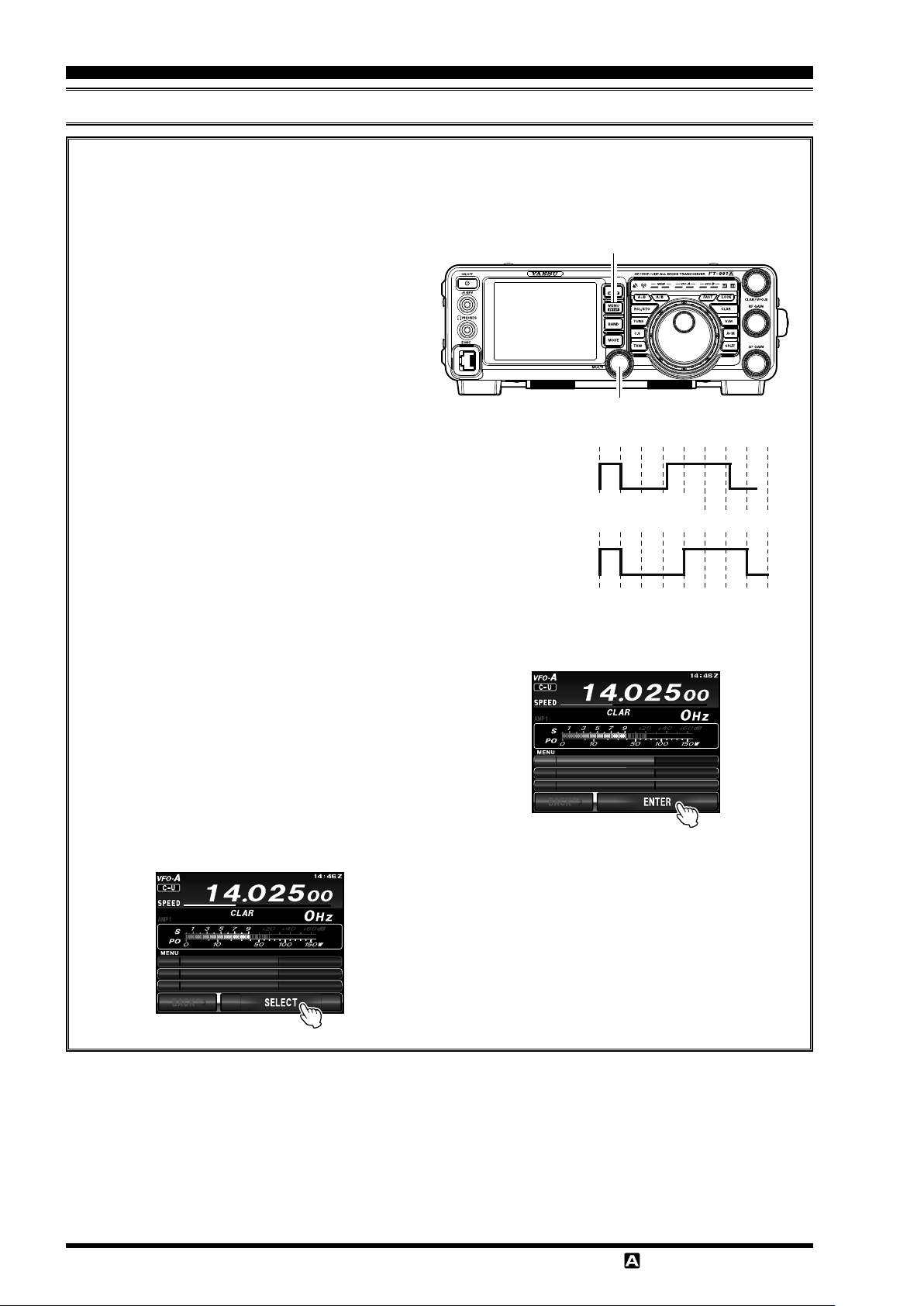
cw MODe OperaTiOn
uSing the built-in electronic keyer
Selecting the Keyer Operating Mode
The conguration of the Electronic Keyer may be customized independently for the front panel
FT-991A
. This permits utilization of Automatic Character Spacing (ACS), if desired. This allows the use of an
electronic keyer via the front jack and a straight key or computer-driven keying line via the rear panel jack.
KEY
jack of the
1. Press the
MENU(SETUP
)
button to engage the
Menu.
2. Rotate the
KEYER TYPE
3. Press the
knob to set the keyer to the desired mode.
MULTI
[
knob to select Menu item “
MULTI
”.
]
SELECT
button, and then rotate the
The available selections are:
: The built-in Electronic Keyer is
OFF
turned off (“straight key” mode).
: Dots will be generated automatically
BUG
by the keyer, but dashes must be sent
manually.
ELEKEY-A
: A code element (“Dot” or “Dash”
side) is transmitted upon releasing
both sides of the paddle.
ELEKEY-B
: Releasing both sides of the paddle
transmits the currently generated
“Dash” side followed by “Dot” side
(
or reverse order).
ELEKEY-Y
: Pressing both sides of the paddle
transmits the currently generated
“Dash” side followed by “Dot” side
(
or reverse order).
While transmitting the “Dash” side,
the first transmitted “Dot” side will
not be stored.
: Same as “
ACS
ELEKEY
” except that the
spacing between characters is precisely set by the keyer to be the same
length as a dash (three dots in length).
012
MENU(SETUP) Button
MULTI Knob
ACS
OFF
Morse
"E" & "T"
Inter-character
スペース
Spacing too short
ACS
ON
Morse
"E" & "T"
4. When the adjustments are complete, touch
]
on the LCD to save the new setting.
TER
-';'46
5. Press the
[
BACK
]
on the LCD to exit to normal operation.
;2' '.'-';#
-';'4 6*1&
%9 6
9'+)*
MENU(SETUP
014
)
button or touch
[
EN-
-';'46
;2' '.'-';$
-';'4 6*1&
%9 6
9'+)*
014
Page 82 FT-
991
OperaTing Manual
Page 85
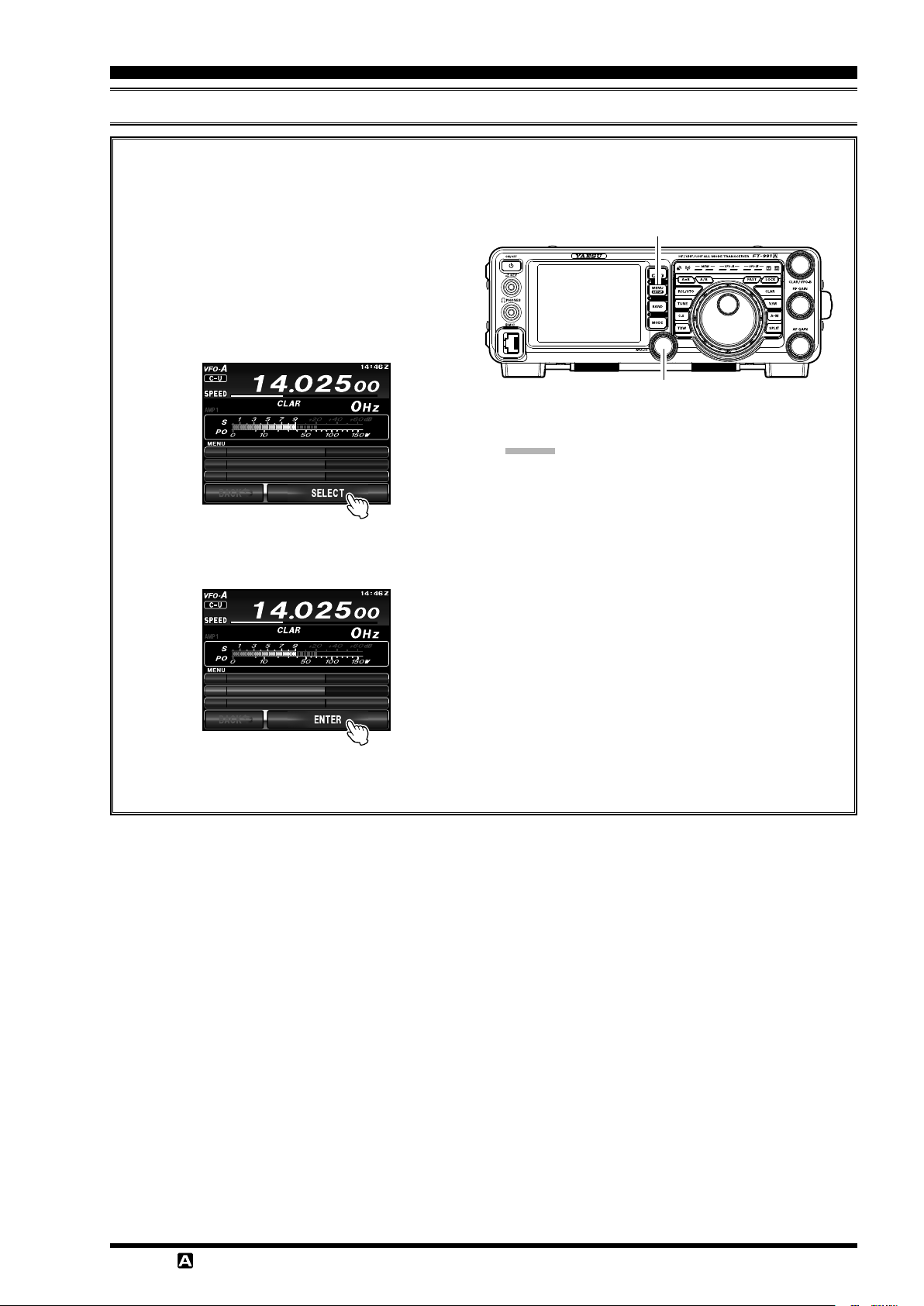
cw MODe OperaTiOn
uSing the built-in electronic keyer
Reversing the Keyer Polarity
For left-handed operators in a contest, for example, the polarity can be reversed easily in the Menu mode without
changing the keyer connection (the default setting is “
NOR
”).
1. Press the
MENU(SETUP
Menu.
2. Rotate the
MULTI
KEYER DOT/DASH
3. Press the
MULTI
4. Touch
knob to select “
[
ENTER
setting.
)
button to engage the
knob to select Menu item “
”.
[
SELECT
-';'46
-';'4 6*1&
%9 6
9'+)*
-';'46
-';'4&16*
%9 6
9'+)*
]
button, then rotate the
.”
REV
;2' '.'-';$
]
on the LCD to save the new
;2' '.'-';$
014
4'8
013
MENU(SETUP) Button
MULTI Knob
Advice:
In the steps on the left, only polarities of the
ELEKEY and ACS keyers can be changed.
5. Press the
[
BACK
]
on the LCD to exit to normal operation.
MENU(SETUP
)
button or touch
991
OperaTing Manual
Page 83FT-
Page 86
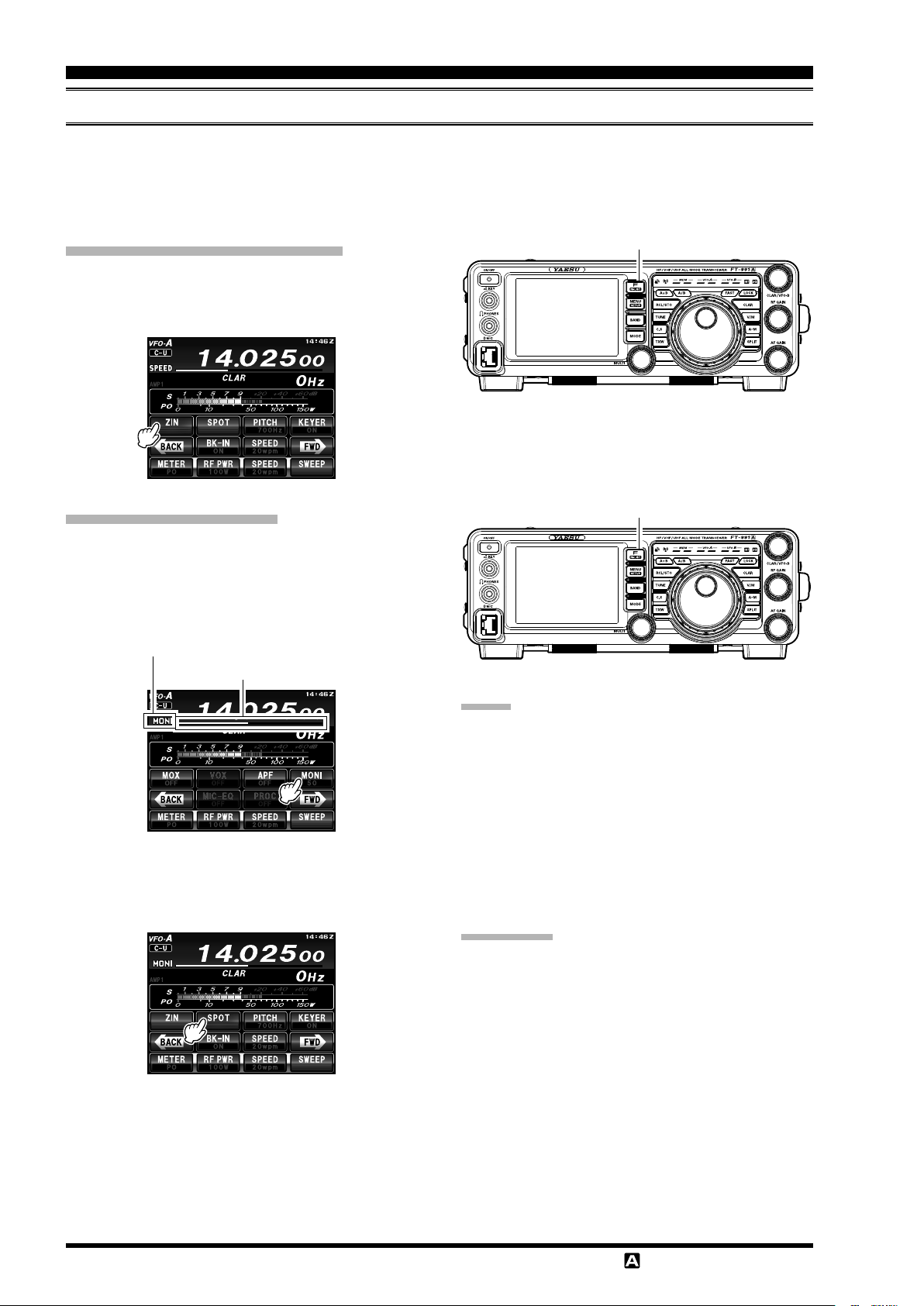
cw cOnvenience FeaTures
cW Spotting (zero-beAting
“Spotting” (zeroing in on a received CW station) is a handy technique to ensure you and the other station are precisely
on the same frequency.
The Tuning Offset Indicator in the display may also be observed so you can adjust the receiver frequency to center the
incoming station on the pitch corresponding to that of your transmitted signal.
Using the Auto Zeroing System
[
Press the
LCD to cause the receiving frequency to zero-in automatically while receiving the CW signal.
F(M-LIST
)
button, then touch
Using the SPOT System
1. Press the
list.
2. Touch
will be set to “ON”. The
as the MONITOR adjustment knob.
F(M-LIST
[
MONI
)
button to display the function
]
on the LCD. The Monitor function
knob will function
MULTI
ZIN
]
on the
)
F(M-LIST) Button
F(M-LIST) Button
3. Touch
[
ing and holding
speaker.
MONI (Monitor) indicator
MONI (Monitor) level indicator
]
SPOT
on the LCD. While you are press-
[
SPOT
]
, the tone is output from the
Advice:
In a tough DX pile-up, you may actually want to
use the SPOT system to nd a “gap” in the spread
of calling stations, instead of zeroing in precisely
on the last station being worked by the DX station.
From the DX side, if a dozen or more operators (also
using Yaesu’s SPOT system) all call precisely on the
same frequency, their dots and dashes merge into a
single, long tone that the DX station cannot decipher.
In such situations, calling slightly higher or lower in
frequency may get your call through.
quick pointS:
The displayed frequency on CW normally reflects
the “zero beat” frequency of your offset carrier. That
is, if you were to listen on USB on 14.100.00 MHz
to a signal with a 700 Hz offset, the “zero beat” fre-
quency of that CW carrier would be 14.100.70 MHz;
the latter frequency is what the
by default. However, you can change the display to
be identical to what you would see on SSB by using
Menu item “
it to “
OFFSET
059 CW FREQ DISPLAY
DIRECT FREQ
” setting.
” instead of the default “
FT-991A
displays,
” and setting
PITCH
Page 84 FT-
991
OperaTing Manual
Page 87
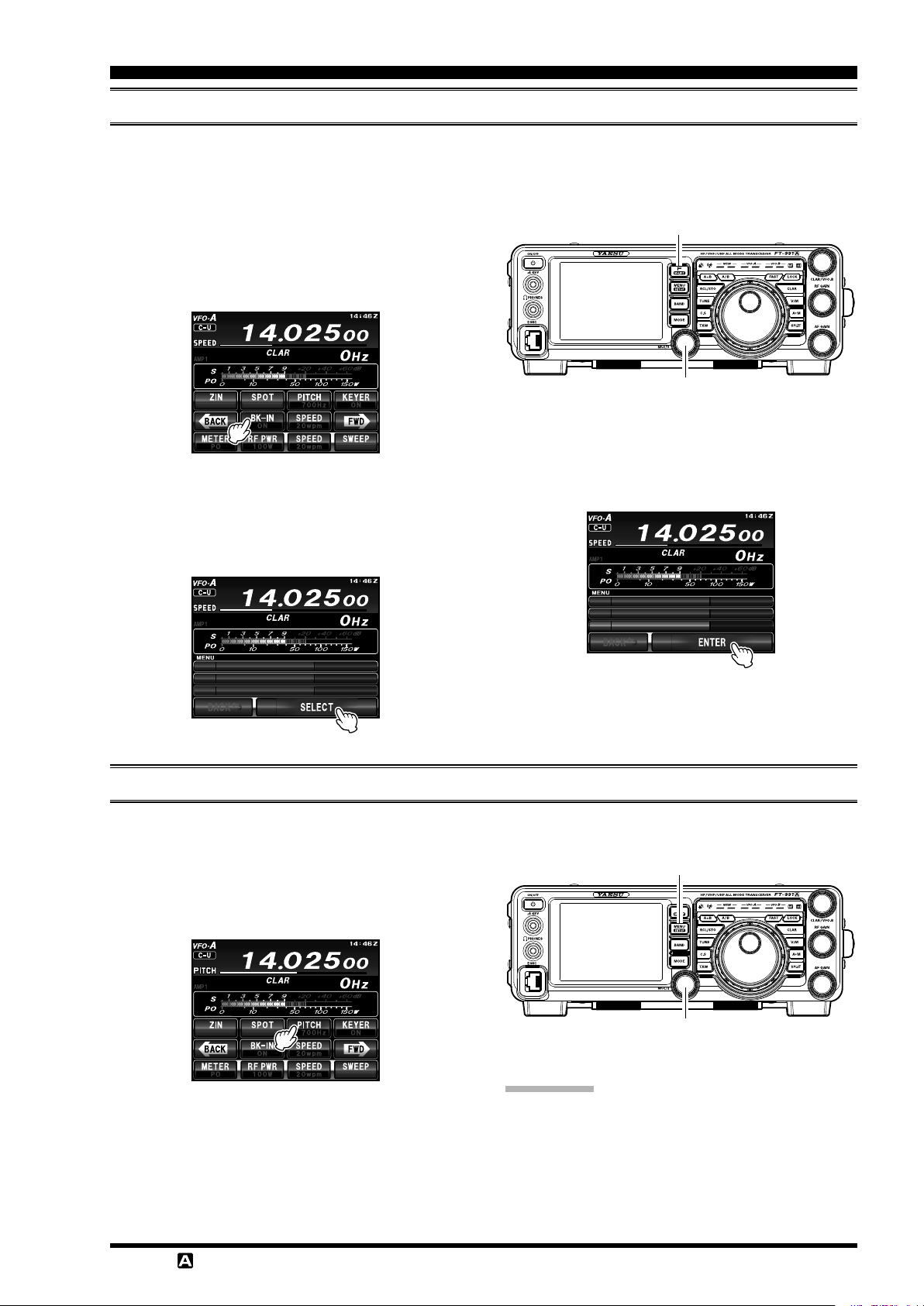
cw cOnvenience FeaTures
cW delAy tiMe Setting
During semi-break-in (not QSK) operation, the hang time of the transmitter, after you have nished sending, may be ad-
justed to a comfortable value consistent with your sending speed. This is the functional equivalent of the “VOX Delay”
adjustment used on voice modes, and the delay may be varied anywhere between 30 msec and 3 seconds via Menu item
“
057 CW BK-IN DELAY
”.
1. Press the
list, then touch
F(M-LIST
[
BK-IN
transmission (Menu item “
must be set to “
2. Press the
SEMI
MENU(SETUP
mode.
3. Rotate the
CW BK-IN DELAY
knob to select Menu item “
MULTI
”, then touch
LCD.
%9# &'/1167 ((1
%9 $-+0 6;2'
%9 $- 0&' .#; O GUE+
)
button to display the function
]
on the LCD to enable CW
056 CW BK-IN TYPE
”).
)
button to enter the Menu
057
5'/+
[
SELECT
]
on the
F(M-LIST) Button
”
MULTI Knob
4. Start sending and rotate the
knob to adjust
MULTI
the hang time, as you prefer for comfortable operation.
5. When the adjustments are complete, touch
[
ENTER
]
on the LCD to save the new setting.
%9# &'/1167 ((1
6. Press the
%9 $-+0 6;2'
%9 $- 0&' .#; O GUE+
MENU(SETUP
5'/+
)
button or touch
[
BACK
]
on the LCD to exit to normal operation.
cW pitch AdjuStMent
The center frequency of the receiver passband may be adjusted to the CW tone you prefer. By touching [
LCD, the pitch of the CW offset carrier may be varied between 300 Hz and 1050 Hz, in 10 Hz steps.
1. Press the
list, then touch
F(M-LIST
)
button to display the function
[
PITCH
]
on the LCD. The
knob functions as the PITCH adjustment knob.
2. Rotate the
MULTI
knob to adjust the PITCH (300
Hz to 1,050 Hz).
MULTI
terMinology:
CW Pitch: If the receiver is tuned to an exact “zero
beat” on an incoming CW signal, you could not copy
it (“Zero beat” implies a 0 Hz tone). Therefore, the receiver is offset several hundreds of Hz (typically), to
produce a beat tone that can be heard. The BFO offset
associated with this tuning (that produces the comfortable audio tone) is called the CW Pitch.
MENU(SETUP) Button
MULTI Knob
PITCH
] on the
991
OperaTing Manual
Page 85FT-
Page 88

cw cOnvenience FeaTures
conteSt MeMory keyer
The CW message capability of the
plugs into the rear panel
REM/ALC
FT-991A
jack.
may be utilized from the optional
Remote Control Keypad, which
FH-2
Message Memory
Five memory channels capable of retaining 50 characters each are provided (using the PARIS standard for characters
and word length).
)
--••
-- --
•
•
4. Touch
ting.
--
••••
[
ENTER
--
••
MENU(SETUP) Button
]
on the LCD to save the new set-
%106'65/07 $'4
%9 /'/14 ;
%9
/'/14 ;
--••--
MULTI Knob
--•--
•
(C) (K)
/'55#)'
6':6
--•--
Example: CQ CQ CQ DE W6DXC K (19 characters
--•--• -- --•--
(C) (Q)
--•--• -- --•--
(C) (Q)
--•--• -- --•--
(C) (Q) (D) (E) (W) (6) (D) (X)
Storing A MeSSAge into MeMory
1. Press the
MENU(SETUP
)
button to enter the Menu
mode.
2. Rotate the
MULTI
knob to select the CW Memory
Register into which you wish to store the message;
for now, we are just setting the message entry technique to (Keyer entry).
018 CW MEMORY 1
019 CW MEMORY 2
020 CW MEMORY 3
021 CW MEMORY 4
022 CW MEMORY 5
3. Touch
MULTI
ister to “
[
SELECT
knob to set the selected CW Memory Reg-
MESSAGE
]
on the LCD, then rotate the
”. If you want to use your keyer
paddle for message entry on all memories, set all ve
Menu items (#018 - 022) to “
MESSAGE
”.
%106'65/07 $'4
%9 /'/14 ;
%9
/'/14 ;
6':6
6':6
5. Press the
MENU(SETUP
)
button or touch
[
BACK
on the LCD to exit to normal operation.
terMinology:
PARIS Word Length: By convention among CW and
Amateur operators (utilized by ARRL and others), the
length of one “word” of CW is dened as the length of
the Morse Code characters spelling the word “PARIS”.
This character (dot/dash/space) length is used for the
specic denition of code speed in “words per minute”.
]
Page 86 FT-
991
OperaTing Manual
Page 89
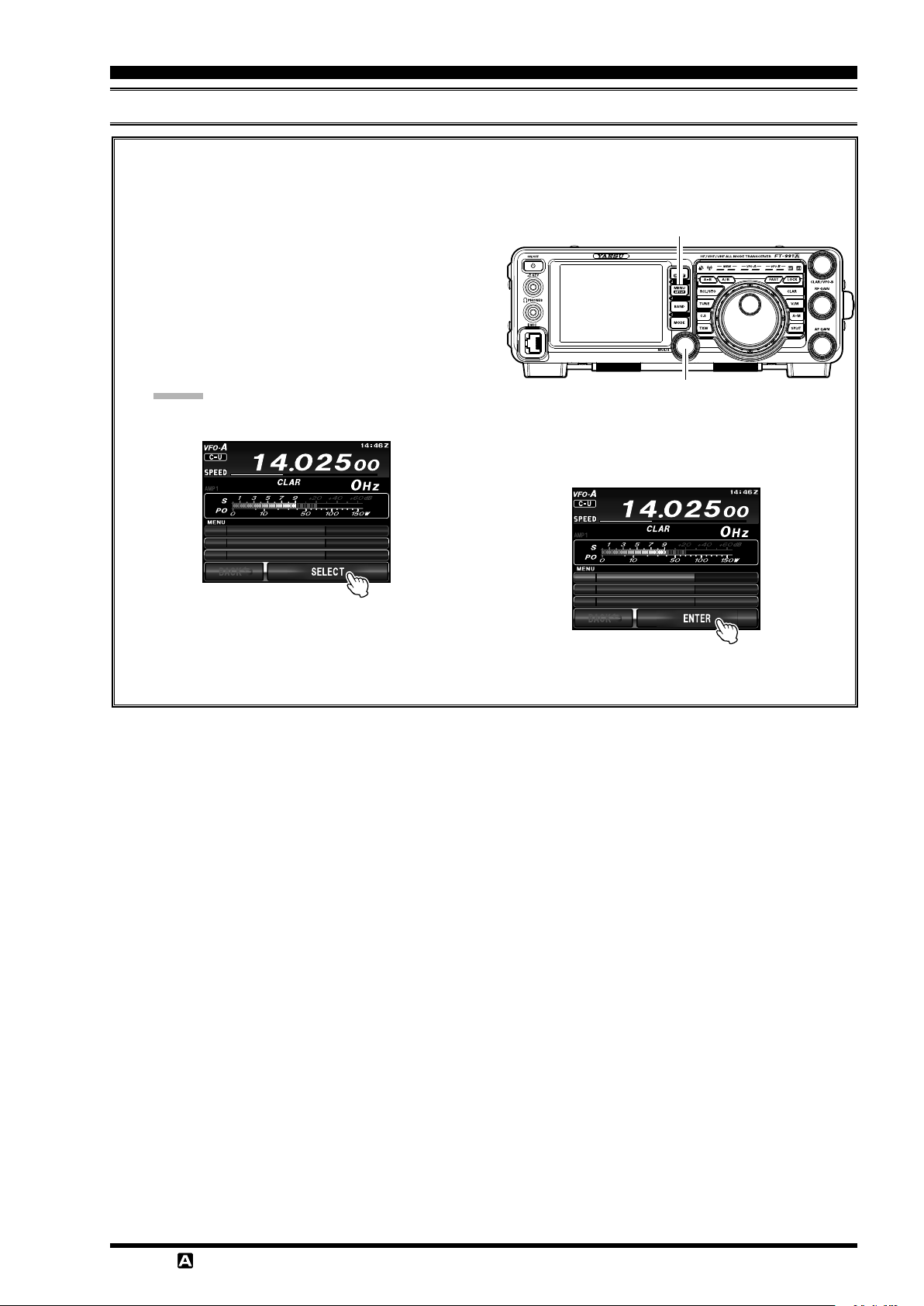
cw cOnvenience FeaTures
conteSt MeMory keyer
Contest Number Programming
Use this process if you are starting a contest, or if you somehow get out of sync with the proper number in the
middle of a contest.
1. Press the
MENU(SETUP
Menu mode.
2. Rotate the
CONTEST NUMBER
knob to select Menu item “
MULTI
”. The current contest num-
ber appears on the TFT display.
3. Touch
MULTI
[
SELECT
knob to set the Contest Number to the
]
on the LCD, then rotate the
desired value.
Advice:
Touch
[
]
BACK
on the LCD to cancel the setting.
%106'65/07 $'4
%9 /'/14 ;
%9
/'/14 ;
)
button to enter the
017
6':6
6':6
4. Touch
[
ENTER
ting.
5. Press the
[
BACK
]
on the LCD to exit to normal operation.
MENU(SETUP) Button
MULTI Knob
]
on the LCD to save the new set-
%106'65/07 $'4
%9 /'/14 ;
%9
/'/14 ;
MENU(SETUP
6':6
6':6
)
button or touch
991
OperaTing Manual
Page 87FT-
Page 90
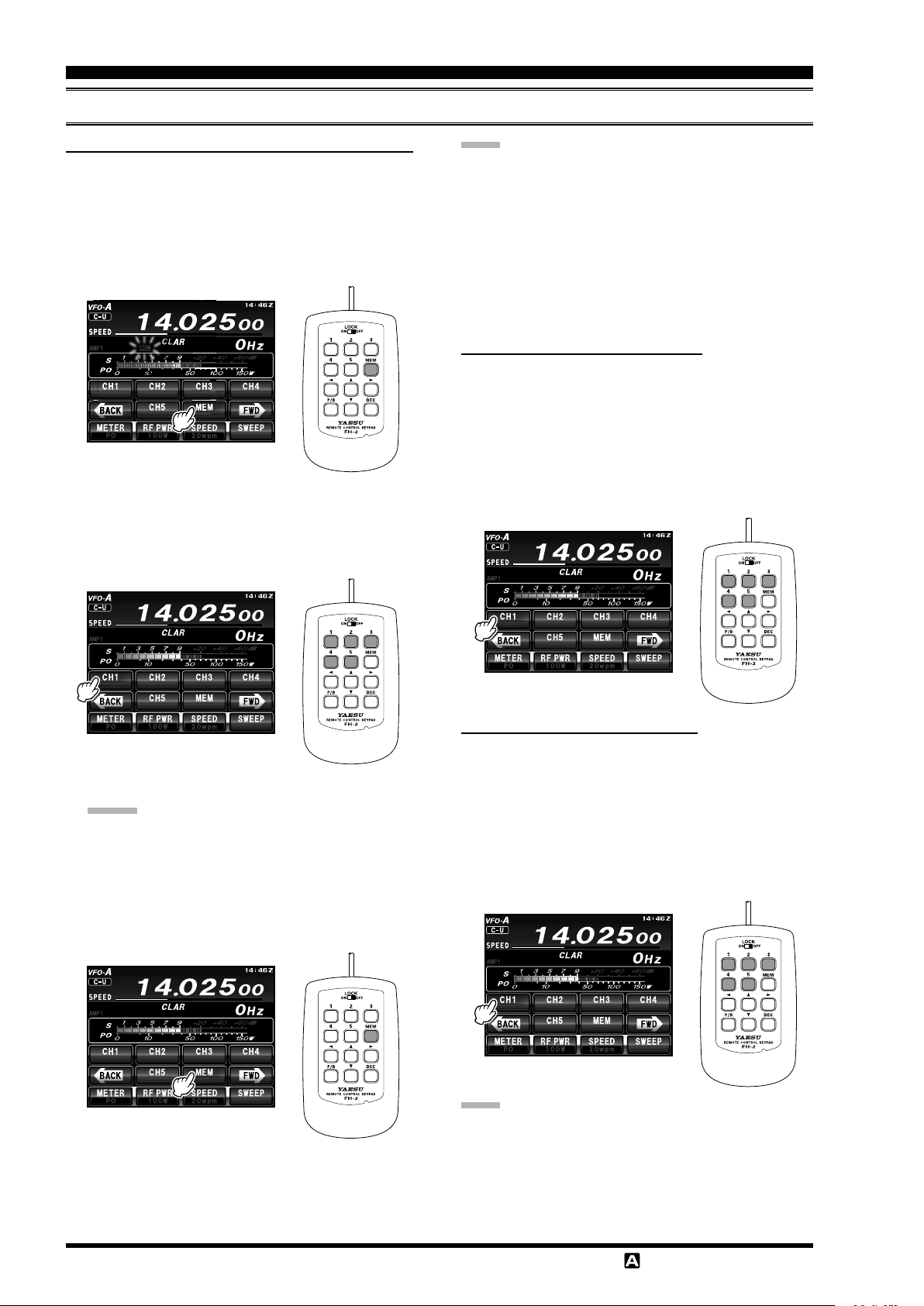
cw cOnvenience FeaTures
conteSt MeMory keyer
MeSSAge MeMory progrAMMing (uSing your pAddle
1. Set the operating mode to CW.
[
2. Set
[
3. Set
4. Touch
on the
the display.
5. Touch
any of the
begin the memory storage process, and the “
icon will glow steadily.
BK-IN
KEYER
[
MEM
FH-2
[
CH1
]
on the LCD to “Off”.
]
on the LCD to “On”.
]
on the LCD or press the
. A blinking “
]
through
keys numbered
FH-2
[
” icon will appear in
REC
]
on the LCD or press
CH5
[1]
through
[
MEM
]
key
[5]
REC
)
to
note:
Care must be exercised when sending to ensure that the
spaces between letters and words are accurately done;
if the timing is off, the spacing may not come out right
in the stored message. For ease in setting up the keyer
memories, we recommend setting Menu item “
KEYER TYPE
while programming the keyer memories.
checking the cW MeMory contentS
1. Be sure that Break-in is still turned “Off” by
on the LCD.
2. Touch
tor.
3. Touch
[1]
in. You will hear the message played in the sidetone
monitor, but no RF energy will be transmitted.
”
” to “
[
MONI
[
CH1
[5]
-
key, whichever memory you just recorded
” (Automatic Character Spacing)
ACS
]
on the LCD to enable the CW moni-
]
[
-
]
on the LCD or press the
CH5
012
[
BK-IN
FH-2
]
6. Send the desired message using your keyer paddle.
Advice:
If you do not start keying within ten seconds, the
memory storage process will be cancelled.
[
7. Touch
on the
Up to 50 characters may be stored in each of the ve
memories.
]
on the LCD or press the
MEM
once more at the end of your message.
FH-2
[
MEM
]
key
on-the-Air cW MeSSAge plAybAck
1. Touch
2. Touch
note:
If you subsequently decide to use the “Text Memory”
technique for memory storage, please note that a message stored using keyer paddle input will not be trans-
ferred over when you select “Text Memory technique”
on a particular memory register (the Menu Mode Setting
is set to “
[
Either Full- or Semi-break-in will be engaged, depending on the setting of Menu item “
IN TYPE
[
[1]
[5]
ister message you wish to transmit. The programmed
message will be transmitted on the air.
TEXT
]
BK-IN
CH1
on the LCD to enable transmission.
056 CW BK-
”.
]
[
-
key, depending on which CW Memory Reg-
”).
]
on the LCD or press the
CH5
FH-2
Page 88 FT-
991
OperaTing Manual
Page 91
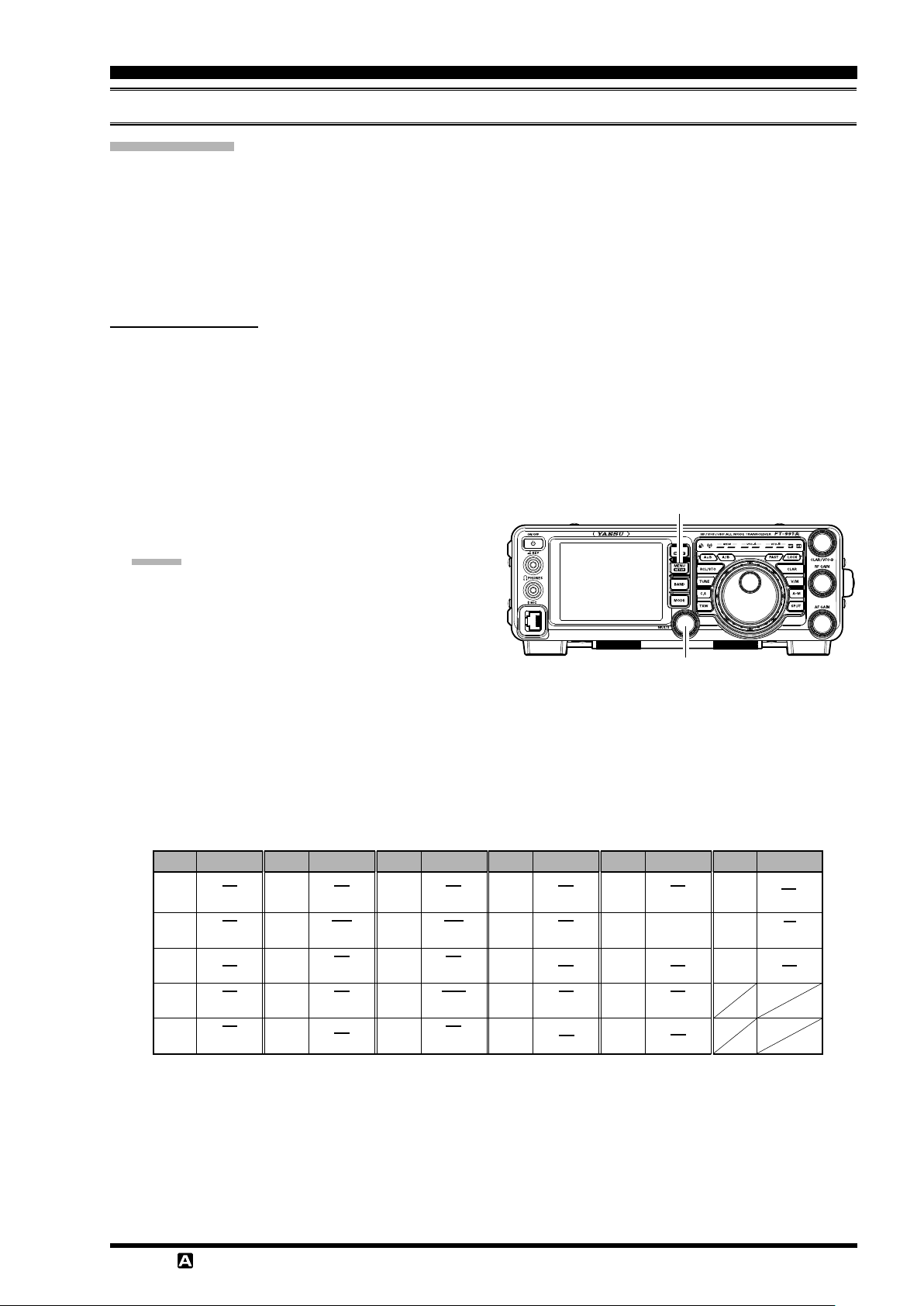
cw cOnvenience FeaTures
conteSt MeMory keyer
TEXT Memory
The ve channels of CW message memory (up to 50 characters each) may also be programmed using a text-entry tech-
nique. This technique is somewhat slower than sending message directly from the keyer paddle, but accuracy of charac-
ter spacing is ensured. Be sure to enter the character “}” at the end of the text message.
Example 1: CQ CQ CQ DE W6DXC K} (20 characters
The sequential Contest Number (“Count up”) feature is another powerful feature of the CW Memory Keyer.
Example 2: 599 10 200 # K} (15 characters
)
text MeMory StorAge
1. Press the
MENU(SETUP
)
button to enter the Menu
mode.
2. Rotate the
MULTI
knob to select the CW Memory
Register into which you wish to store the message;
we are now setting the message entry technique to
(
Text entry).
018 CW MEMORY 1
019 CW MEMORY 2
020 CW MEMORY 3
021 CW MEMORY 4
022 CW MEMORY 5
Advice:
The following texts are programmed to the MEM-
ORY 4 and MEMORY 5 in factory default.
MEMORY 4: DE FT-991 K}
MEMORY 5: R 5NN K}
3. Touch
MULTI
ter to “
[
SELECT
knob to set the selected CW Memory Regis-
TEXT
]
on the LCD, then rotate the
”. If you want to use text message entry
on all memories, set all ve Menu items (#018 - 022)
to “
4. Touch
TEXT
”.
[
ENTER
]
on the LCD to save the new set-
ting.
5. Press the
MENU(SETUP
)
button or touch
[
BACK
on the LCD to exit to normal operation.
)
MENU(SETUP) Button
MULTI Knob
]
TEXT
!
”
#
$
%
991
CW CODE
SN
AF
SX
KA
TEXT
&
´
(
)
*
CW CODE
AS
WG
KN
KK
OperaTing Manual
TEXT
+
,
-
.
/
CW CODE
AR
MIM
DU
AAA
DN
TEXT
:
;
<
=
>
CW CODE
OS
KR
BT
TEXT
?
@
[
¥(\)
}
CW CODE
IMI
@
AL
TEXT
^
_
}
CW CODE
IQ
Page 89FT-
Page 92
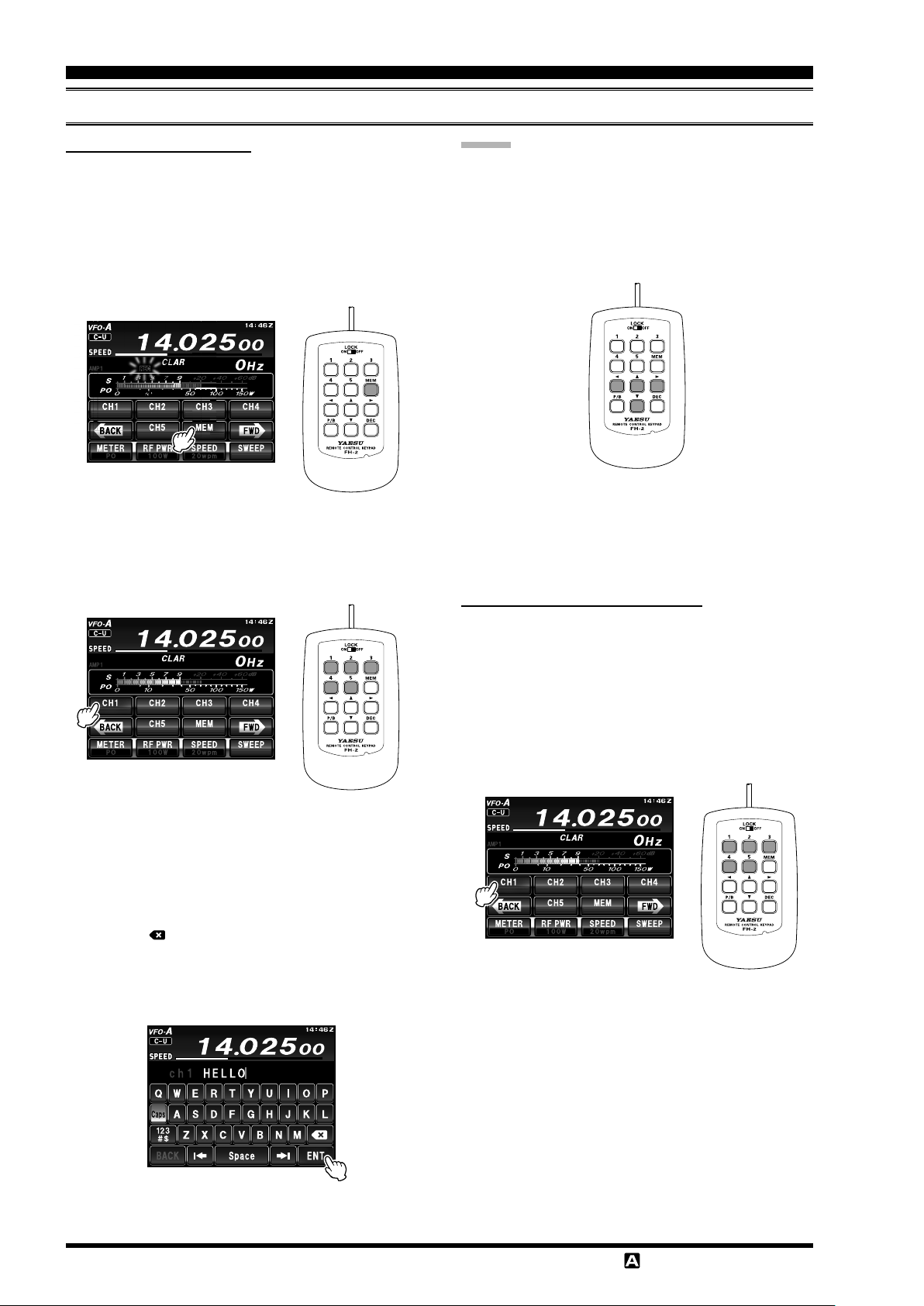
cw cOnvenience FeaTures
conteSt MeMory keyer
text MeSSAge progrAMMing
1. Press the
CW.
2. Be sure that Break-in is “Off” with
LCD, if necessary.
3. Touch
4. Touch
[
MEM
key. A blinking “
play.
[
CH1
[1]
[5]
-
key to select the desired CW Memory Register into which you wish to program the text. The
text input screen will appear.
button to set the operating mode to
MODE
]
on the LCD or press the
” icon will appear in the dis-
REC
]
[
-
]
on the LCD or press an
CH5
[
BK-IN
FH-2
]
on the
[
MEM
FH-2
Advice:
Use the
tion and use the
the letter/number to be programmed in each slot of the
memory. In the case of the second example on the previ-
]
ous page the “#” character designates the slot where the
Contest Number will appear.
8. When the message is complete, add the “}” character
at the end to signify the termination of the message.
9. Touch
FH-2
characters (including “}”) have been programmed.
checking the cW MeMory contentS
1. Be sure that Break-in is still turned “Off” with
]
on the LCD.
IN
2. Touch
tor.
3. Touch
[1]
in. You will hear the results in the sidetone, but no
RF energy will be transmitted.
[t]
FH-2
[
MEM
[
MEM
[
MONI
[
]
CH1
[5]
key, whichever memory you just recorded
[]
and
FH-2
]
on the LCD or press and hold in the
]
key for one second to exit, once all
]
on the LCD to enable the CW moni-
[
-
CH5
keys to set the cursor posi-
[p]
’s
]
on the LCD or press an
and
[q]
keys to choose
[
BK-
FH-2
5. Touch a key on the LCD to enter the letters, numbers, or symbols of the desired label.
6. Repeat step 5 to program the remaining letters, num-
bers, or symbols of the desired text. 12 characters
may be used in the creation of a text.
[
Use
tion and
of the cursor.
7. When you have completed the creation of the text,
touch
[
]
and
[ ]
ENT
]
[
on the LCD to set the cursor posi-
on the LCD to erase a letter at the left
]
on the LCD.
Page 90 FT-
991
OperaTing Manual
Page 93
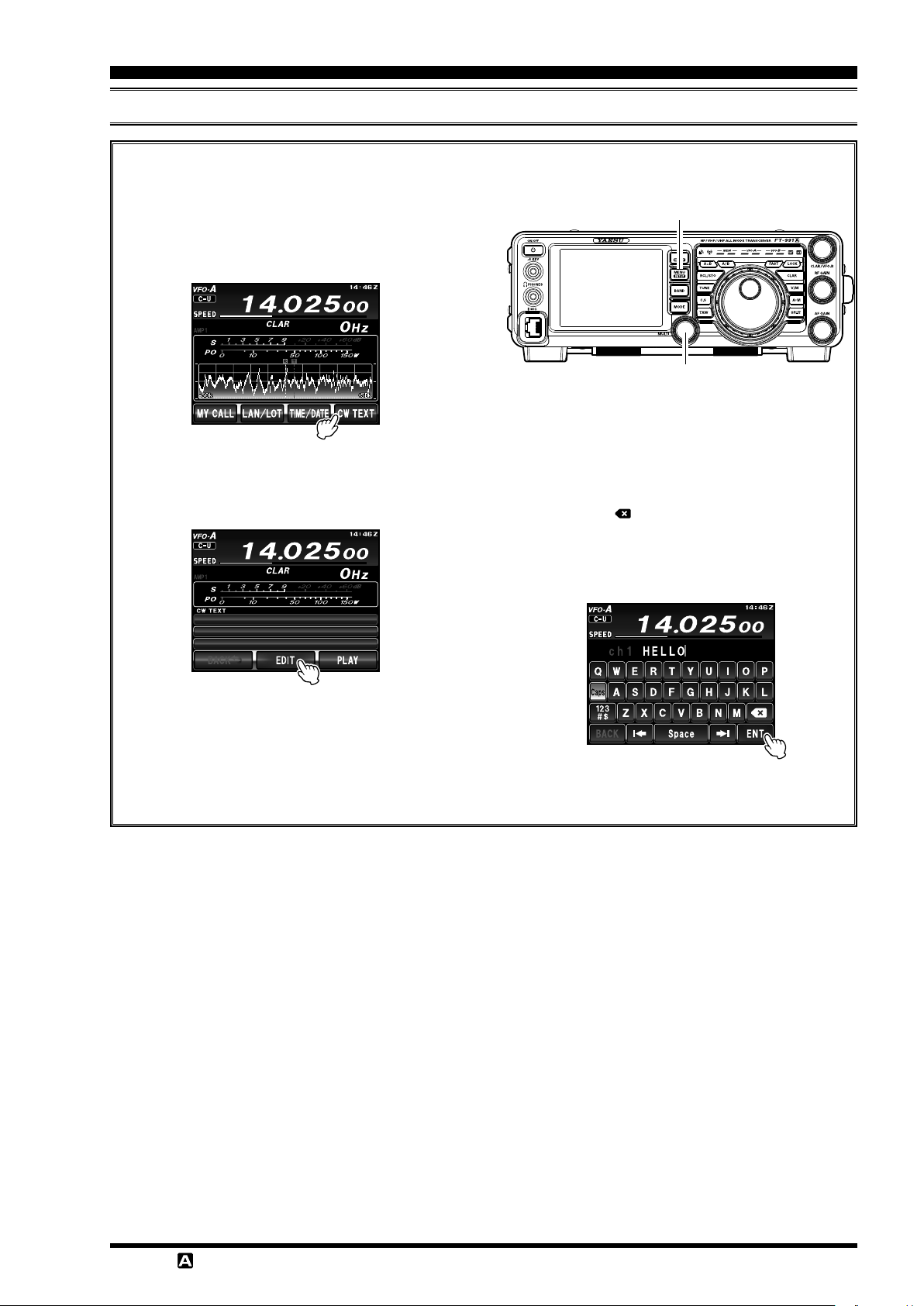
cw cOnvenience FeaTures
conteSt MeMory keyer
Inputting the CW TEXT directly on the screen
Without using the remote control keypad
, you can also input the CW TEXT directly on the screen.
FH-2
1. Press and hold the
2. Touch
[
CW TEXT
MENU(SETUP
]
on the LCD. The CW text
display screen will appear.
3. Rotate the
MULTI
knob to select the CW TEXT
you want to input, then touch
input screen will appear.
E
J
_
EJ
_
EJ
_
[
EDIT
)
button.
]
. The text
MENU(SETUP) Button
MULTI Knob
5. Repeat step 4 to program the remaining letters,
numbers, or symbols of the desired text. 12 characters may be used in the creation of a text.
Use
position and
]
[
and
]
[
on the LCD to set the cursor
[
]
on the LCD to erase a letter at
the left of the cursor.
6. When you have completed the creation of the
[
text, touch
ENT
]
on the LCD.
4. Touch a key on the LCD to enter the letters, numbers, or symbols of the desired text.
7. Press the
MENU(SETUP
)
button to save the
new setting and return to normal operation.
991
OperaTing Manual
Page 91FT-
Page 94
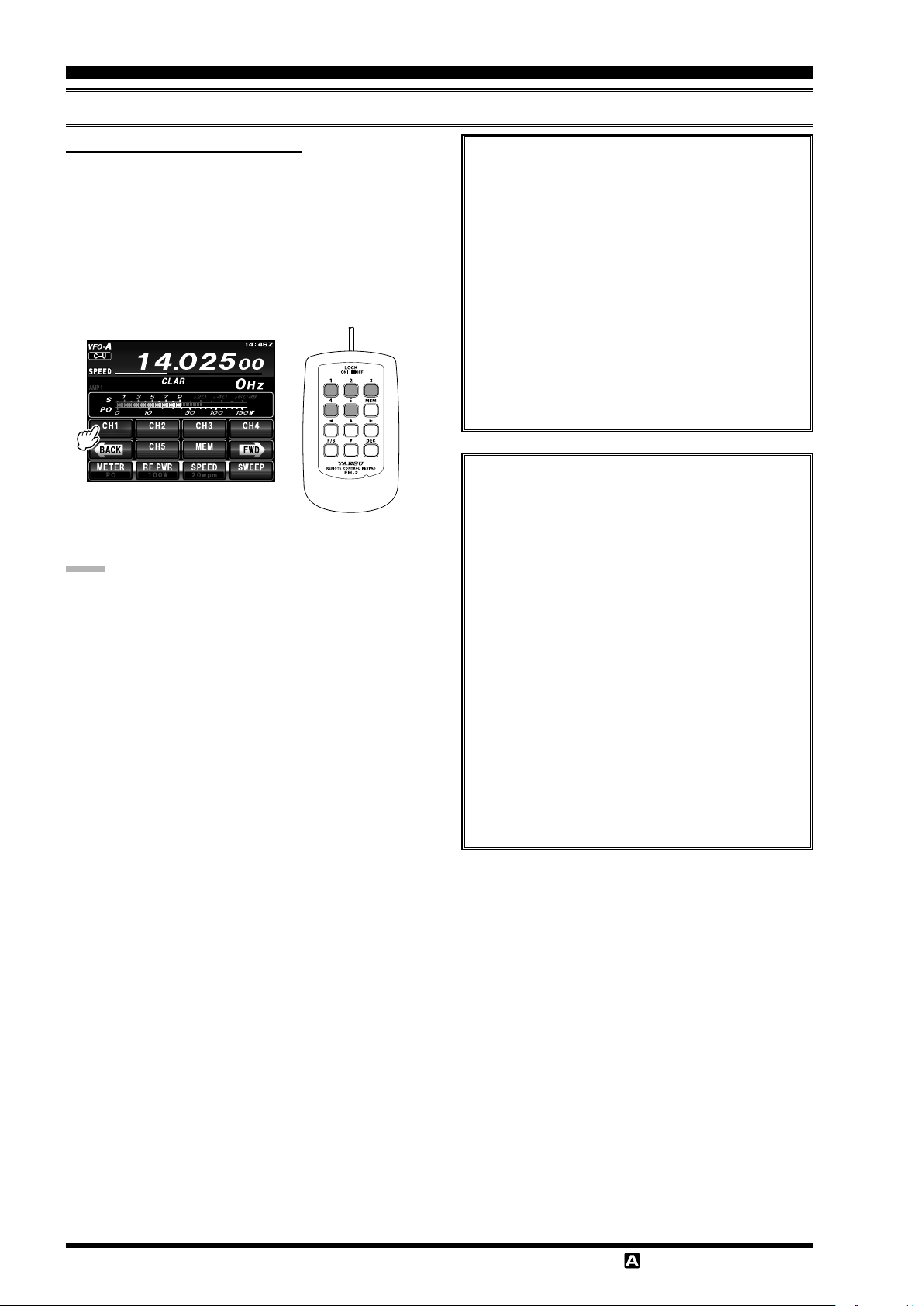
cw cOnvenience FeaTures
conteSt MeMory keyer
on-the-Air cW MeSSAge plAybAck
1. Touch
2. Touch
note:
If you subsequently decide to use the “Message Memory” technique for memory storage, please note that the
contents of a message stored using text input will not be
transferred over when you set entry to “Message Memo-
ry technique” on a particular memory register (the Menu
Mode Setting is set to “
[
Either Full-break-in or Semi-break-in will be engaged, depending on the setting of Menu item “
CW BK-IN TYPE
[
[1]
[5]
Register message you wish to transmit. The programmed message will be transmitted on the air.
]
BK-IN
CH1
on the LCD to enable transmission.
056
”.
]
[
-
key, depending on which CW Memory
]
on the LCD or press an
CH5
MESSAGE
”).
FH-2
Decrementing the Contest Number
Use this process if the current contest number
gets slightly ahead of the actual number you
want to send (in case of a duplicate QSO, for example).
[
Press the
on the LCD momentarily. The current Contest
Number will be reduced by one. Press of the
FH-2
LCD as many times as necessary to reach the de-
sired number. If you go too far, use the “Contest
Number Programming” technique described pre-
viously.
In “Beacon” mode, it is possible to repeatedly
transmit any message programmed, either via
paddle input, or via the “Text” input method. The
time delay between message repeats may be set
anywhere between 1 and 690 seconds (1 - 240
sec (1 sec/step) or 270 - 690 sec (30 sec/step))
via Menu item “
do not wish the message to repeat in a “Beacon”
mode, please set this Menu item to “
To transmit the message:
1. Touch
2. Touch
FH-2
[
]
mission. Either Full-break-in or Semi-breakin will be engaged, depending on the setting
of Menu item “
FH-2
the Beacon message will begin.
key or touch
DEC
Transmitting in the Beacon Mode
[
BK-IN
[
CH1
[1]
-
]
[5]
key or touch
DEC
[
015 BEACON INTERVAL
]
on the LCD to enable trans-
056 CW BK-IN TYPE
]
[
-
]
on the LCD or press an
CH5
key. Repetitive transmission of
[
DEC/DEL
DEC/DEL
OFF
]
on the
” If you
”.
”.
]
Page 92 FT-
991
OperaTing Manual
Page 95
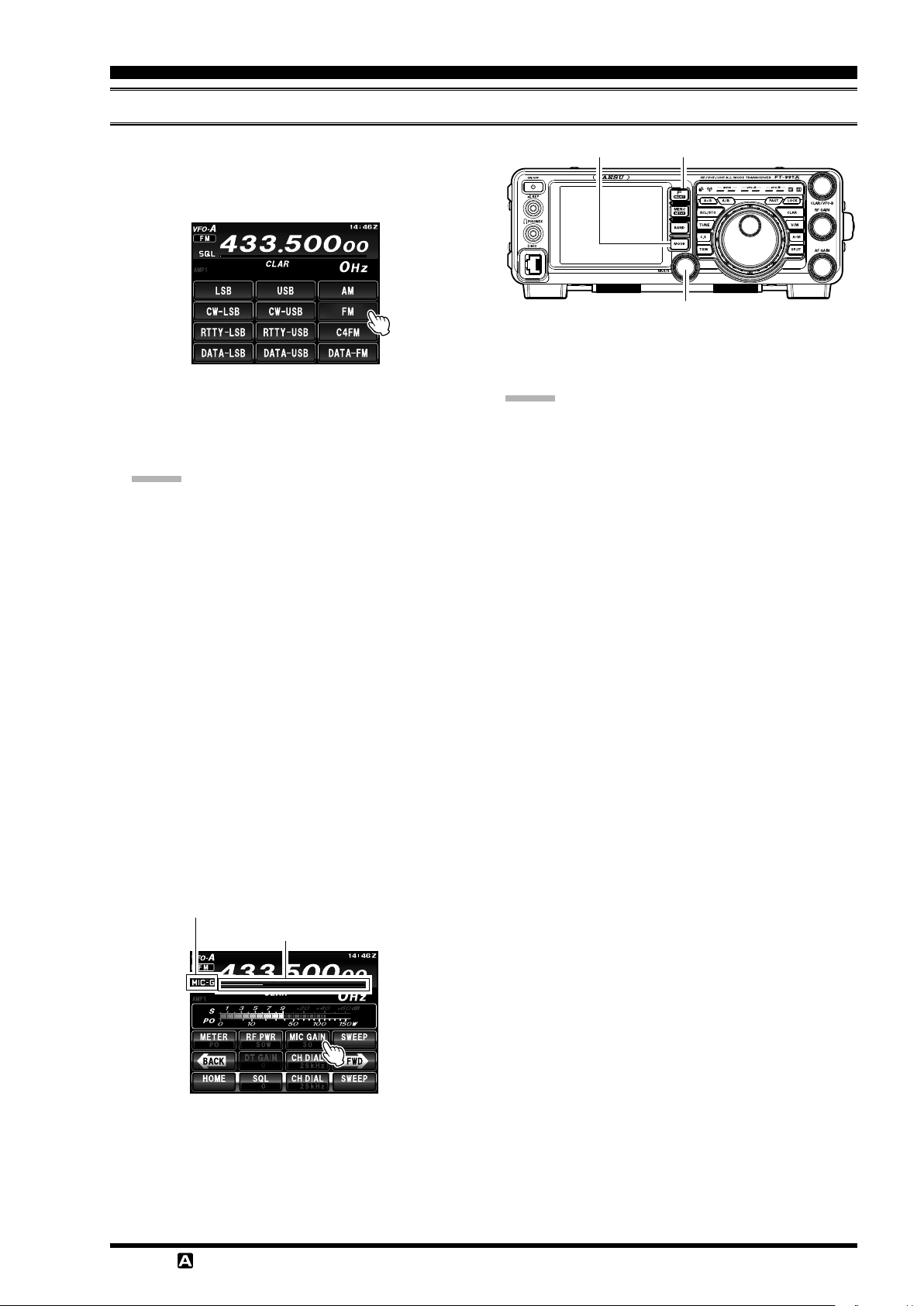
FM MODe OperaTiOn
bASic operAtion
1. Press the
ing key on the LCD to select the FM operating
mode. The “FM” icon appears in the display.
2. Set the transceiver to the desired frequency.
3. Press the microphone
into the microphone in a normal voice level. Release
the
Advice:
The
knob.
To change the
the below procedure:
Press the
on the TFT display. Rotate the
[
CH DIAL
in the following order.
You can also switch the frequency steps by touching
[
CH DIAL
“
2.5kHz
4. Adjustment of the microphone gain may be accomplished in two ways. At the factory, a default
level has been programmed that should be satisfactory for most situations. To change the microphone
gain, press the
GAIN
tion as the microphone gain adjustment knob. Rotate
the
MODE
switch to return to receive.
PTT
MULTI
F(M-LIST
” “
“
12.5kHz
]
on the LCD. Rotate the
MULTI
button, then touch the correspond-
switch to transmit. Speak
PTT
knob can serve as the frequency setting
knob frequency step, follow
MULTI
)
button, then touch
MULTI
] repeatedly to select the frequency steps
]
repeatedly.
” “
5kHz
” “
25kHz
F(M-LIST
knob to adjust the microphone gain.
” “
9kHz
” “
2.5kHz
)
button, then touch
MULTI
[
CH DIAL
knob or touch
”
10kHz
”
[
knob func-
MIC
MODE Button
Advice:
FM is only used in the 28 MHz, 50 MHz, 144 MHz
and 430 MHz Amateur bands covered by the
. Please do not use FM on any other bands.
991A
]
F(M-LIST) Button
MULTI Knob
FT-
MIC GAIN (Microphone Gain) indicator
MIC GAIN (Microphone Gain) level indicator
991
OperaTing Manual
Page 93FT-
Page 96
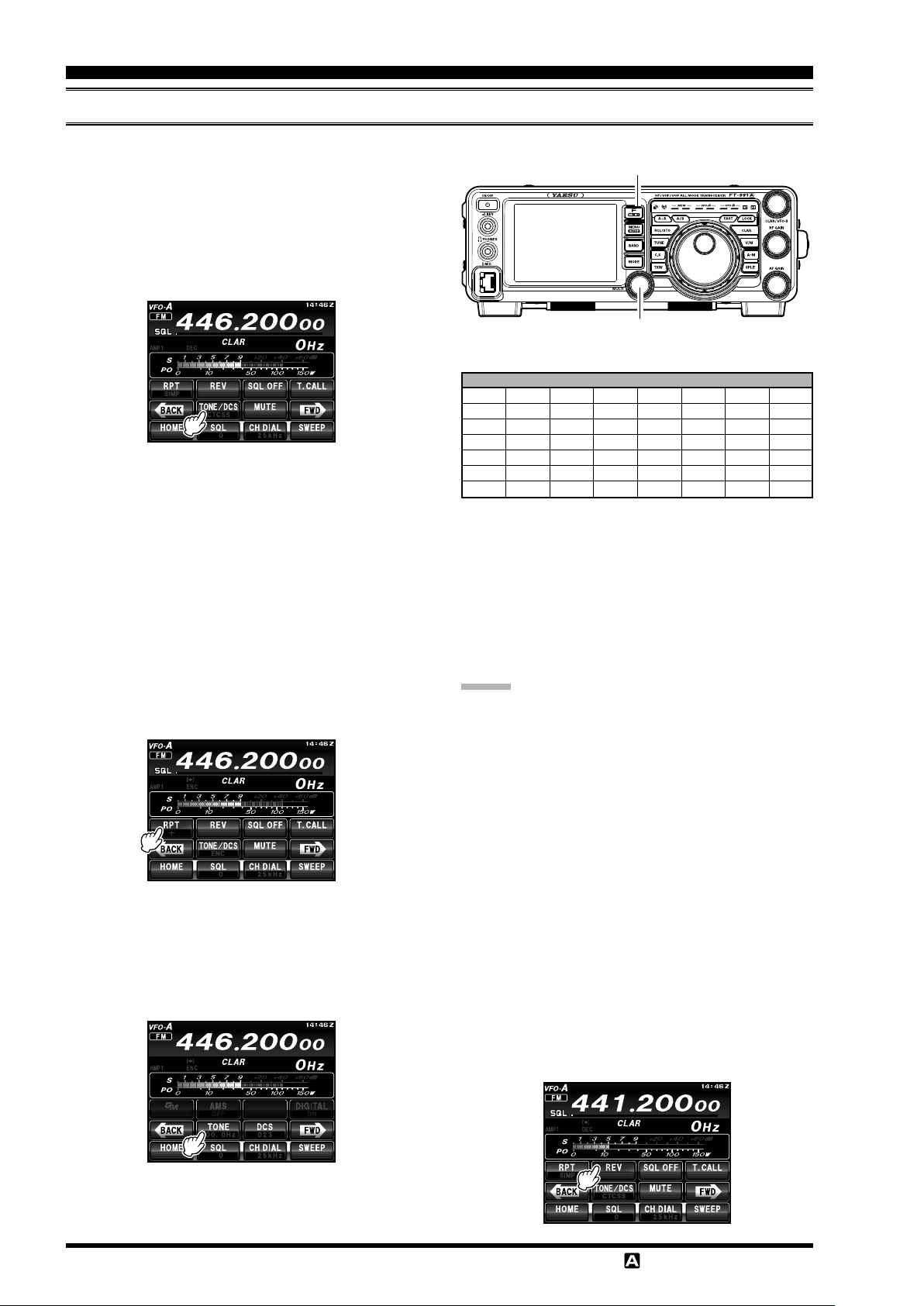
FM MODe OperaTiOn
repeAter operAtion
The
FT-991A
1. Rotate the Main Tuning Dial knob to set the
991A
(
downlink from the repeater).
2. If CTCSS Tone operation is desired/needed, press
the
the LCD to engage the CTCSS mode.
3. Touch
select the desired CTCSS mode. If the repeater requires an uplink encoding tone, select “
both uplink and downlink encode/decode operation,
choose “
“
OFF
“
“
4. Touch
desired repeater shift direction. The selections are:
“
SIMP
where “
used on a repeater).
5. Touch
touch
the desired CTCSS Tone to be used. A total of 50
standard CTCSS tones are provided (see the CTCSS
Tone Chart).
may be utilized on 29 MHz, 50 MHz, 144 MHz and 430 MHz repeaters.
FT-
to the desired repeater’s output frequency
)
F(M-LIST
[
” “
CTCSS
DCS
[
” “+” “–” “
[
[
TONE
button, then touch
]
TONE/DCS
”. The available choices are:
CTCSS
(Tone Encoder)”
ENC
(Tone Squelch)”
(Digital Code Squelch)” “
]
repeatedly on the LCD to select the
RPT
” represents “Simplex” operation (not
SIMP
]
to switch the display screen, and then
FWD
]
. Rotate the
on the LCD repeatedly to
SIMP
MULTI
[
TONE/DCS
OFF
”
knob to select
ENC
”
]
on
.” For
F(M-LIST) Button
MULTI Knob
67.0 69.3 71.9 74.4 77.0 79.7 82.5 85.4
88.5 91.5 94.8 97.4 100.0 103.5 107.2 110.9
114.8 118.8 123.0 127.3 131.8 136.5 141.3 146.2
151.4 156.7 159.8 162.2 165.5 167.9 171.3 173.8
177.3 179.9 183.5 186.2 189.9 192.8 196.6 199.5
203.5 206.5 210.7 218.1 225.7 229.1 233.6 241.8
250.3 254.1
6. Press and hold the microphone
transmission. You will observe that the frequency
has shifted to correspond to the programming set up
in the previous steps. Speak into the microphone in a
normal voice level. Release the
to the receive mode.
Advice:
The conventional repeater shift used on 29 MHz is
100 kHz, while on the 50 MHz band the shift may
vary between 500 kHz and 1.7 MHz (or more). On
the 144 MHz band, the shift will be 600 kHz; on
the 430 MHz band, the shift will be 1.6 MHz or 7.6
MHz (5 MHz for the U.S.A. version). To program
the proper repeater shift, use Menu items “
RPT SHIFT 28MHz
50MHz
(
144 MHz), and “
MHz) as appropriate.
Press the
the LCD to reverse the transmission and reception
frequencies temporarily to check whether direct
communication with the partner station is possible.
When reversing the frequencies, + or − will flash.
When
is cancelled.
ctcSS tone Frequency (Hz
- - - - - -
” (28 MHz), “
” (50 MHz), “
F(M-LIST
[
]
is touched one more time, the reverse
REV
082 RPT SHIFT 144MHz
083 RPT SHIFT 430MHz
)
button, then touch
)
switch to begin
PTT
switch to return
PTT
081 RPT SHIFT
[
REV
080
” (430
]
on
”
Page 94 FT-
991
OperaTing Manual
Page 97
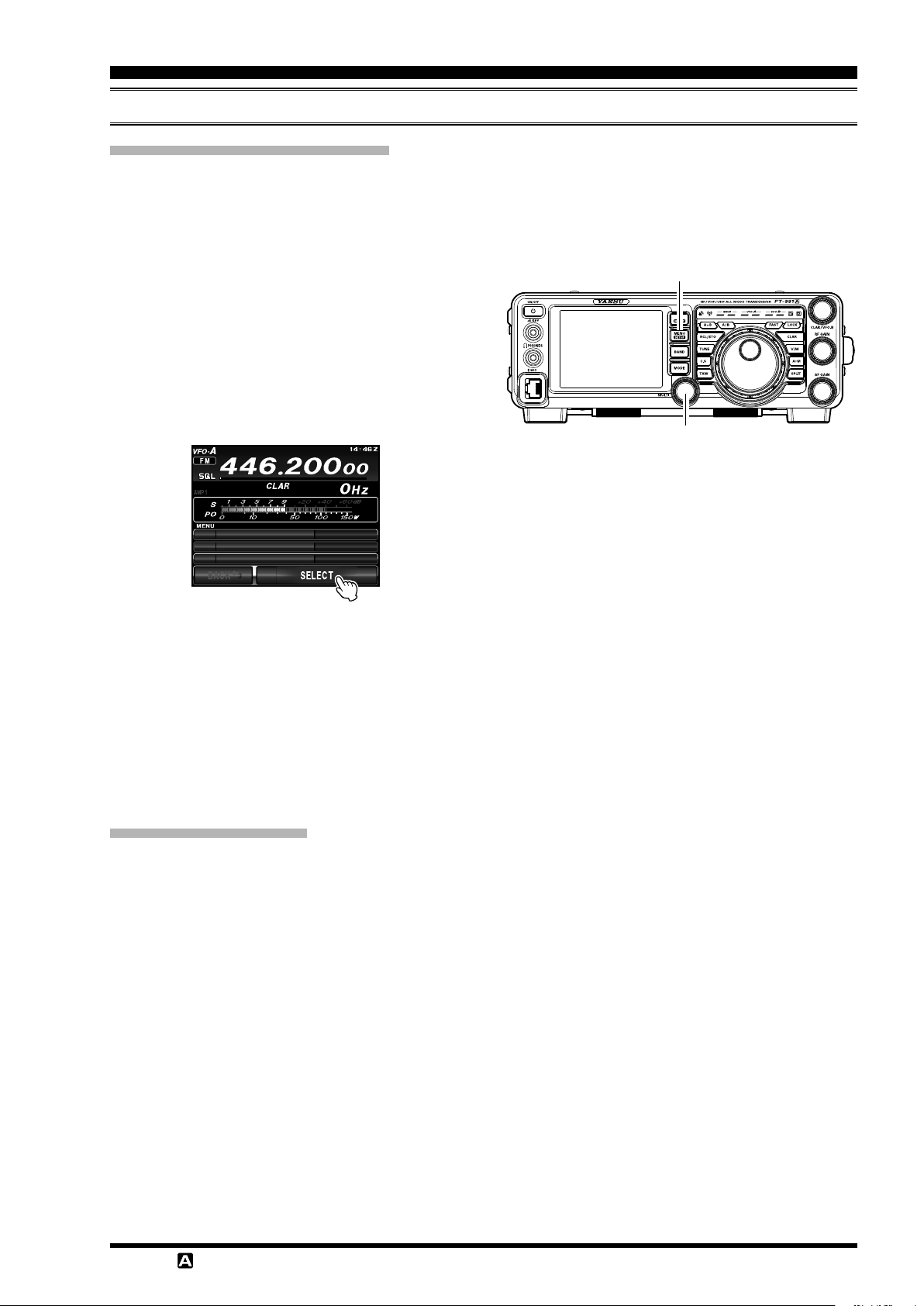
FM MODe OperaTiOn
repeAter operAtion
Automatic Repeater Shift (ARS
The
FT-991A
ARS feature causes the appropriate repeater shift to be automatically applied whenever it is tuned into the
)
designated repeater sub-bands.
If the ARS feature does not appear to be working, you may have accidentally disabled it.
To re-enable ARS:
1. Press the
MENU(SETUP
)
button to enter the Menu
MENU(SETUP) Button
mode.
2. To use the ARS function at 144 MHz, select “
ARS 144MHz
MHz, select “
MULTI
3. Touch
MULTI
knob.
[
knob to set this Menu item to “ON”.
”. To use the ARS function at 430
085 ARS 430MHz
]
SELECT
on the LCD, then rotate the
4265+*
#45 10
/*\
45 10/*\#
(6 /*\ M*\
” by rotating the
084
MULTI Knob
4. Touch
[
ENTER
]
on the LCD to save the new set-
ting.
5. Press the
MENU(SETUP
)
button or touch
[
BACK
]
on the LCD to exit to normal operation.
Tone Calling (1750 Hz
T.CALL
)
button to display the function list, then touch
]
to generates a 1750 Hz burst tone to access the repeater. The transmitter will automatically be
Press the
F(M-LIST
and holding
[
)
[
T.CALL
]
on the LCD. While you are pressing
activated, and a 1750 Hz audio tone will be superimposed on the carrier. Once access to the repeater has been gained,
you may release the
[
T.CALL
]
, and use the
switch for activating the transmitter thereafter.
PTT
991
OperaTing Manual
Page 95FT-
Page 98
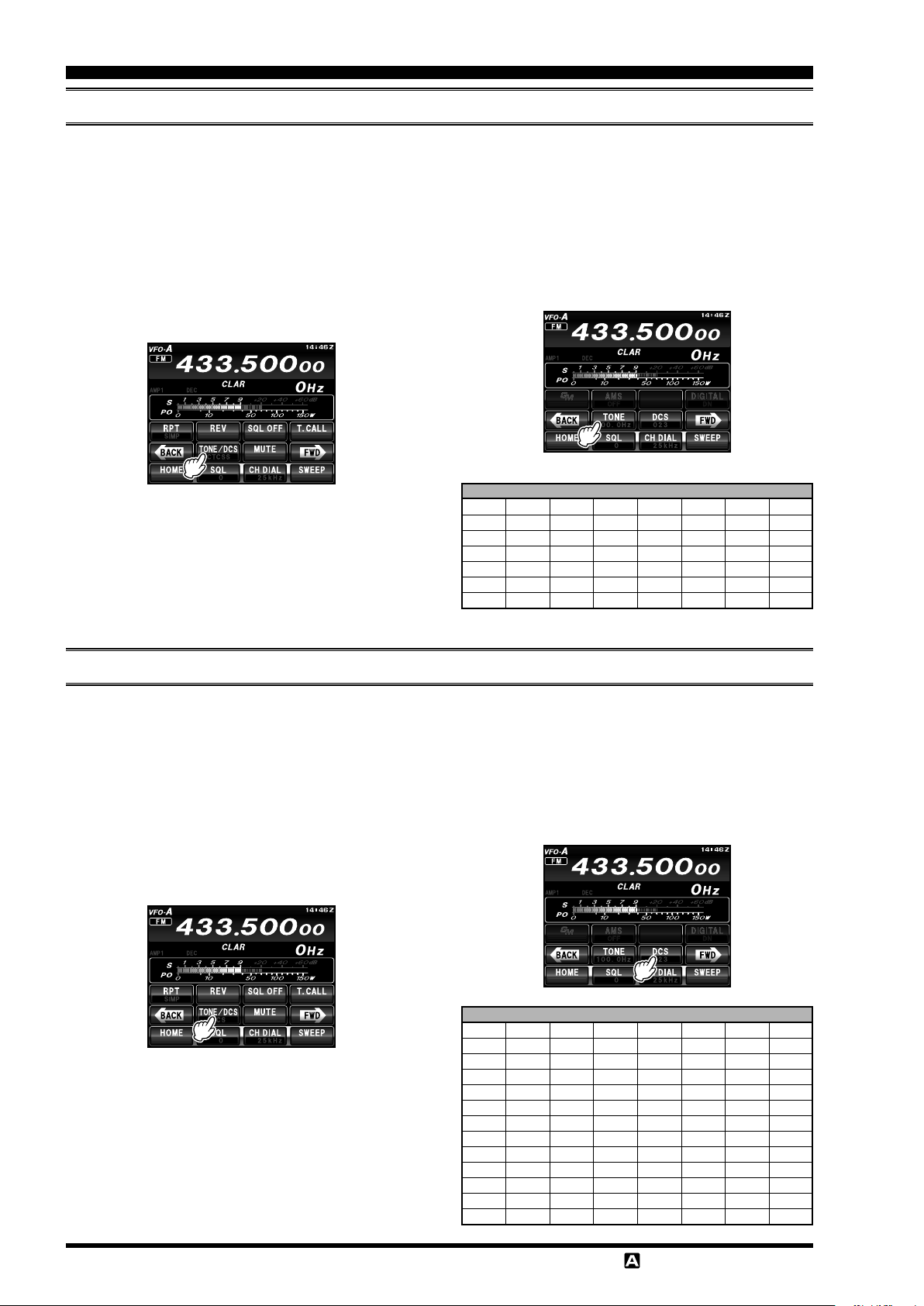
FM MODe OperaTiOn
tone Squelch operAtion
The “Tone Squelch” may be activated to keep the receiver silent until an incoming signal modulated with a matching
CTCSS tone is received. The receiver squelch will then open in response to the reception of the required tone.
[
1. Press the
MODE
button, and then touch the corresponding key on the LCD to select the FM operating
mode. The “FM” icon appears in the display.
2. Set the transceiver to the desired frequency.
3. If CTCSS Tone operation is desired/needed, press
the
F(M-LIST
)
button, then touch
[
TONE/DCS
]
on
the LCD to engage the CTCSS mode.
5. Touch
[
TONE
sired CTCSS Tone to be used. A total of 50 standard
CTCSS tones are provided (see the CTCSS Tone
Chart).
]
to switch the screen, and then touch
FWD
]
. Rotate the
MULTI
knob to select the de-
)
4. Touch
choose “
“
OFF
” “
“
CTCSS
“
DCS
[
TONE/DCS
CTCSS
ENC
]
on the LCD repeatedly to
” from the available choices of
(Tone Encoder)”
(Tone Squelch)”
(Digital Code Squelch)” “
OFF
67.0 69.3 71.9 74.4 77.0 79.7 82.5 85.4
88.5 91.5 94.8 97.4 100.0 103.5 107.2 110.9
114.8 118.8 123.0 127.3 131.8 136.5 141.3 146.2
151.4 156.7 159.8 162.2 165.5 167.9 171.3 173.8
177.3 179.9 183.5 186.2 189.9 192.8 196.6 199.5
203.5 206.5 210.7 218.1 225.7 229.1 233.6 241.8
”
250.3 254.1
ctcSS tone Frequency (Hz
- - - - - -
dcS operAtion
The “DCS” may be activated to keep the receiver silent until an incoming signal modulated with a matching DCS code
is received. The receiver squelch will then open in response to the reception of the required code.
[
1. Press the
button, and then touch the corre-
MODE
sponding key on the LCD to select the FM operating
mode. The “FM” icon appears in the display.
2. Set the transceiver to the desired frequency.
3. If DCS operation is desired/needed, press the
)
button, then touch
LIST
[
TONE/DCS
]
on the LCD
to engage the DCS mode.
F(M-
5. Touch
[
]
DCS
DCS code to be used. A total of 104 DCS codes are
provided (see the DCS Code Chart).
]
to switch the screen, and then touch
FWD
. Rotate the
knob to select the desired
MULTI
dcS code
023 025 026 031 032 036 043 047
051 053 054 065 071 072 073 074
4. Touch
choose “
“
” “
OFF
[
TONE/DCS
” from the available choices of
DCS
ENC
“
(Tone Squelch)”
CTCSS
“
EDCS
“
DCS
]
on the LCD repeatedly to
(Tone Encoder)”
(DCS Encoder)”
(Digital Code Squelch)” “
OFF
”
114 115 116 122 125 131 132 134
143 145 152 155 156 162 165 172
174 205 212 223 225 226 243 244
245 246 251 252 255 261 263 265
266 271 274 306 311 315 325 331
332 343 346 351 356 364 365 371
411 412 413 423 431 432 445 446
452 454 455 462 464 465 466 503
506 516 523 526 532 546 565 606
612 624 627 631 632 654 662 664
703 712 723 731 732 734 743 754
Page 96 FT-
991
OperaTing Manual
Page 99
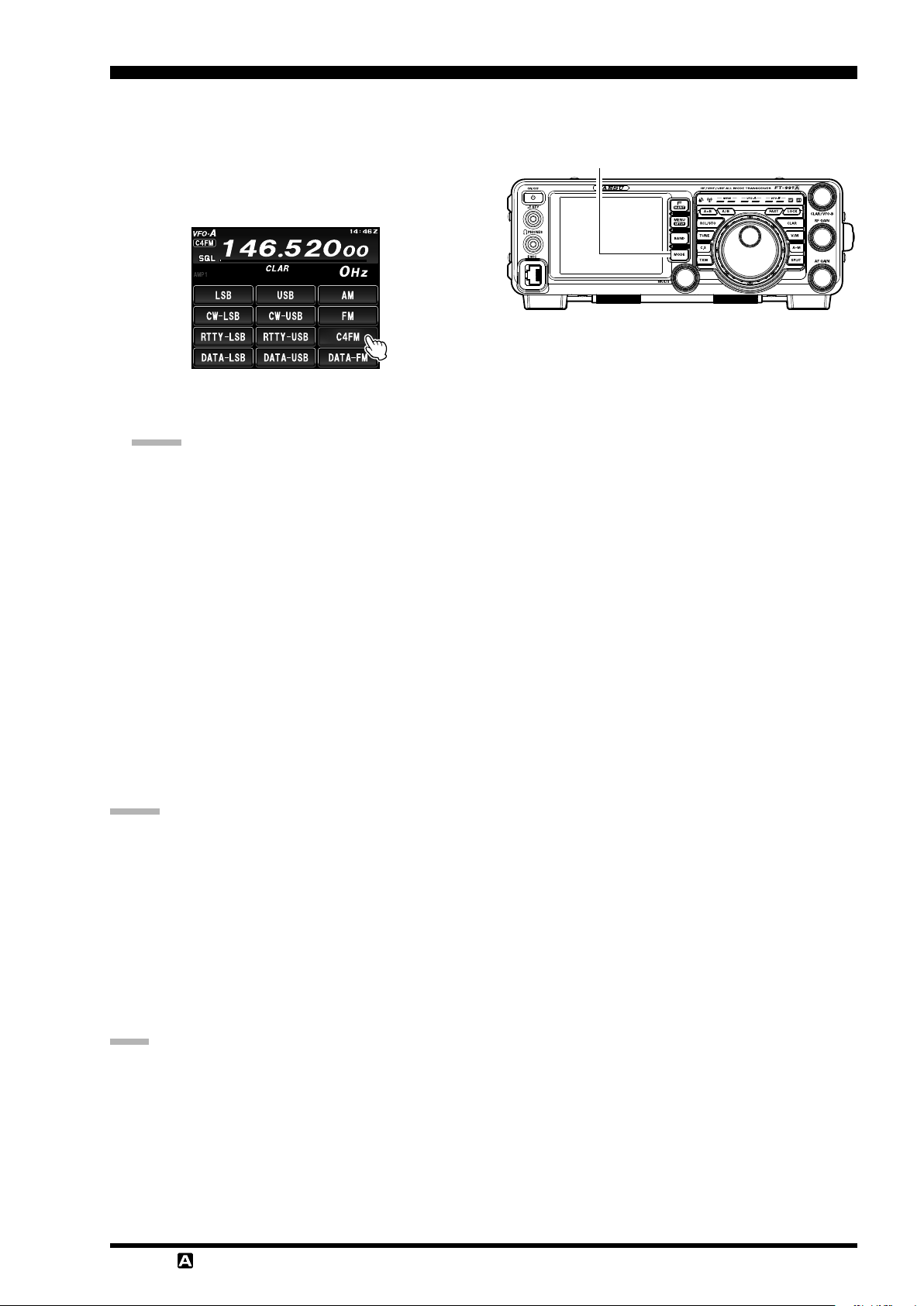
c4FM MODe (DigiTal MODe) OperaTiOn
The
FT-991A
data simultaneously, and the “Voice FR mode” which transmits digital voice data using the full 12.5 kHz bandwidth.
1. Press the
sponding key on the LCD to select the C4FM operating mode. The “
2. Set the transceiver to the desired operating frequency.
Advice:
The VFO-A frequency can be changed by rotating
the Main Tuning Dial knob or using one of the following methods. For details, see page 44.
Setting the frequency directly using the number
Setting the frequency by rotating the
Setting the frequency using the
transceiver is capable of using 2, C4FM digital modes: the “V/D mode” which communicates voice and
button, and then touch the corre-
MODE
C4FM
keys.
knob.
on the microphone.
” icon appears in the display.
MULTI
UP/DWN
buttons
MODE Button
3. Press and hold the
touch the
ceiver to transmit mode, then speak into the microphone.
Release the
if you pressed
change the transceiver back to the receive mode.
Advice:
Digital communication mode can be switched be-
tween V/D mode and FR mode (see “Toggling to the
Digital Communication Mode” on page 41).
The AMS (Automatic Mode Select) function enables
the transceiver to select the appropriate communica-
tion mode according to the received signal. Using
the AMS function, the transceiver recognizes either
analog (FM) or C4FM digital signals and automatically changes to the same communication mode as
the contact station.
note:
When communicating in V/D mode (“DN” is dis-
played on the LCD), the station location information
is contained within the transmitted digital signal. In
Voice FR mode (“VW” is displayed on the LCD), the
location information is not included in the transmitted signals.
[
MOX
button (or touch the
PTT
[
MOX
button on the microphone (or
PTT
]
on the LCD) to change the trans-
[
]
again
MOX
]
to enter the transmit mode) to
991
OperaTing Manual
Page 97FT-
Page 100
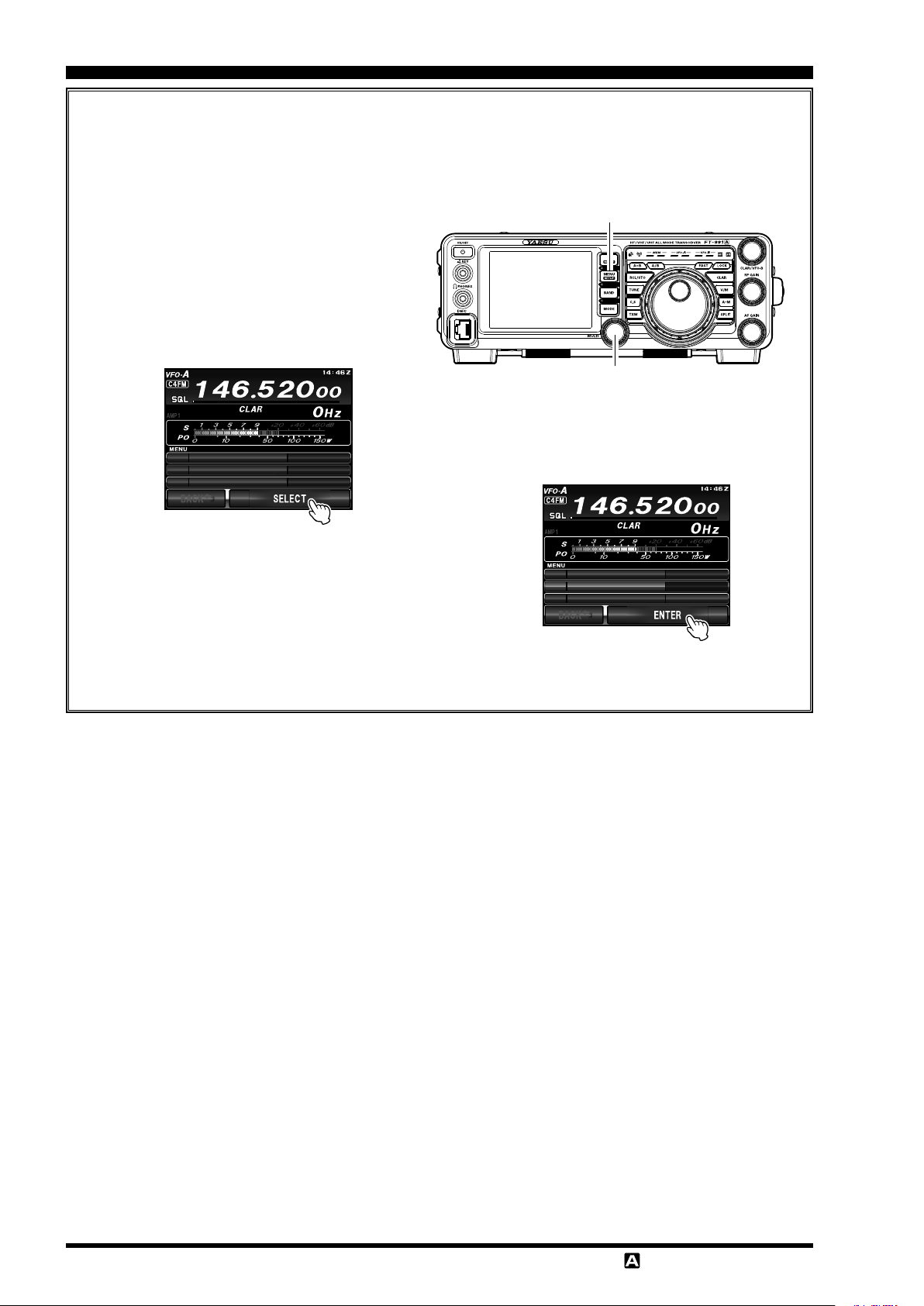
c4FM MODe (DigiTal MODe) OperaTiOn
Notication When the Contact Station Completes a Transmission (Standby Beep Function
)
When communicating in C4FM mode, an audible beep sounds to indicate that the contact station has completed
a transmission (Standby Beep function).
To change the Standby Beep function “
1. Press the
MENU(SETUP
)
button to enter the
ON/OFF
”, follow the procedure below.
MENU(SETUP) Button
Menu mode.
2. Rotate the
STANDBY BEEP
3. Touch
[
SELECT
MULTI
“
knob to set this Menu item to “ON” or
” (the default setting is “ON”).
OFF
knob to select Menu item “
MULTI
”.
] on the LCD, then rotate the
0&$; $''2
;.%7
'/1& #761
#/56:
56# 10
4666(4'3 *\
093
4. Touch
ting.
[
ENTER
MULTI Knob
]
on the LCD to save the new set-
5. Press the
[
BACK
]
on the LCD to exit to normal operation.
0&$; $''2
;.%7
'/1& #761
#/56:
56# 10
4666(4'3 *\
MENU(SETUP
)
button or touch
Page 98 FT-
991
OperaTing Manual
 Loading...