

Page 1

aao
i¡aao
i¡aao
i¡aao
i¡aao
i¡aao
i¡aao
i¡aao
i¡aao
i¡a
a
o
i¡aao
i
¡
a
TX---29E40D
Colour Television
Operating Instructions
English
TQB0E0065eng---M
this is an unapproved issue --- for information only
Page 2

WELCOME
Dear Panasonic Customer,
Welcome to the Panasonic family of customers. We hope that you have many years of
enjoyment from your new colour television. This is a very advanced television;
however, the Quick Start Guide will allow you to use the TV as quickly as possible. You
can then read the instructions completely and retain them for future reference.
CONTENTS
Warnings and Precautions 3...........
Accessories 4........................
Quick Start Guide 5...................
Basic Controls 8......................
Menu Structure 9.....................
Using the On Screen Displays 10......
Aspect Controls 11...................
Hold Control 12.......................
Main Menu 13........................
Picture Menu 14......................
Sound Menu 15.......................
Setup Menu 16.......................
Tuning Menu 17......................
Tuning Menu -- Programme edit 18.....
Tuning Menu -- Auto setup 22..........
Tuning Menu -- Manual tuning 23.......
OSD Language 25....................
Q-- Link 26............................
VCR/DVD/ROperation 28.............
Te l e te x t O per a t io n 29.................
Audio / Video (AV) Connections 31.....
AV Select and Setup 31...............
Front sockets 31.....................
Rear sockets 32......................
Scart and S-- Video socket
information 33.......................
Tro u blesho oting 34...................
For your guidance 35.................
Specifications 35.....................
2
Page 3

WARNINGS AND PRECAUTIONS
D This TV set is designed to operate on 220 --
240V, 50Hz A.C.
D To prevent damage which might result in
electric shock or fire, do not expose this TV
set to rain or excessive moisture.
This TV must not be exposed to dripping or
splashing water and objects filled with liquid,
such as vases, must not be placed on top of
or above the TV.
H WARNING : HIGH VOLTAGE !!!
Do not remove the rear cover as live parts are
accessible when it is removed. There are no
user serviceable parts inside.
D Avoid exposing the TV set to direct sunlight
and other sources of heat. To prevent fire,
never placeany type of candle or naked flame
on top of, or near the TV set.
D Ensure that the mains plug is easily
accessible.
D The On/Off switch on this model does not fully
disconnect the TV from the mains supply.
Remove the mains plug from the wall socket
when the TV set is not used for a prolonged
period of time.
H CABINET AND PICTURE TUBE CARE
Remove the mains plug from the wall socket.
The cabinet and picture tube can be cleaned
with a soft cloth moistened with mild detergent
and water. Do not use solutions containing
benzol or petroleum. TV sets can produce
static electricity, care must be taken whenever
touching the TV screen.
D Adequate ventilation is essential to prevent
failure of electrical components, we
recommend that a gap of at least 5cm is left all
around this television receiver even when it is
placed inside a cabinet or between shelves.
D Ventilation should not be impleded by
covering the ventilation openings with items
such as newspapers, tabel cloths and
curtains.
H ENVIRONMENT
Batteries, packaging and old equipment should
not be disposed of as domestic waste, but in
accordance with the applicable regulations.
H TV GAMES / HOME COMPUTERS
Extended use of TV games or home computers
with any television set can cause a permanent
‘shadow’ on the screen. This type of irreversible
picture tube damage, can be limited by
observing the following points:
D Reduce the brightness and contrast levels
to a minimum viewing level.
D Do not operate the television set for a
continuous period of time while using TV
games or home computers.
D Thistypeofpicturetubedamage,isnotan
operating defect, and as such is not
covered by the Panasonic warranty.
H SLEEP FEATURE
If the set is not switched off when the TV station
stops transmitting , it will automatically go to
standby mode after 30 minutes. This function
will not operate when the TV is in AV mode.
3
Page 4
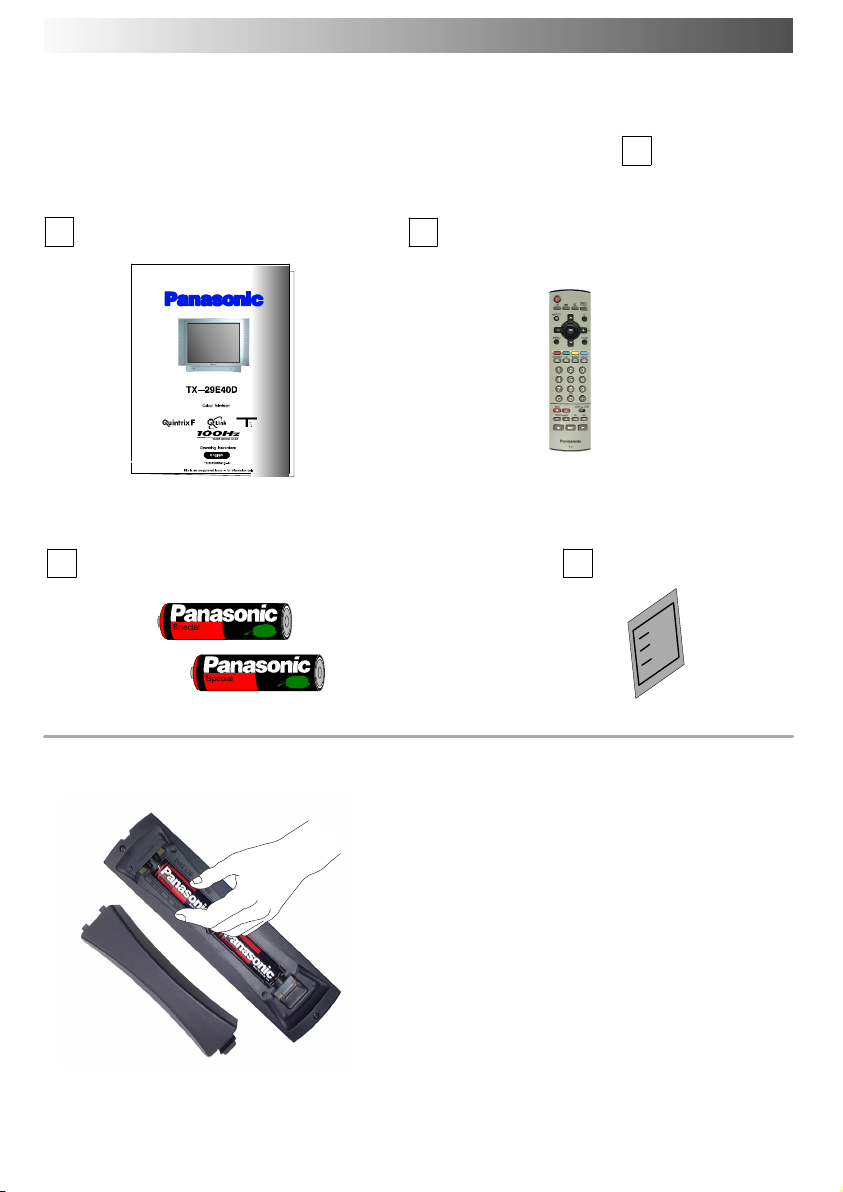
ACCESSORIES
Check that you have the accessories and items shown
Operating Instruction book
Batteries for the Remote Control Transmitter.
(2 x R6 (UM3) size)
Remote Control Transmitter
(EUR 7628010)
n
TV Guarantee
Remote control batteries
4
D Make sure that the batteries are fitted the
correct way round.
D Do not mix old batteries with new batteries.
Remove old, exhausted batteries immediately.
D Do not mix different battery types, i.e. Alkaline
and Manganese or use rechargeable (Ni---Cd,
N i --- M H) b at t er i es .
Page 5
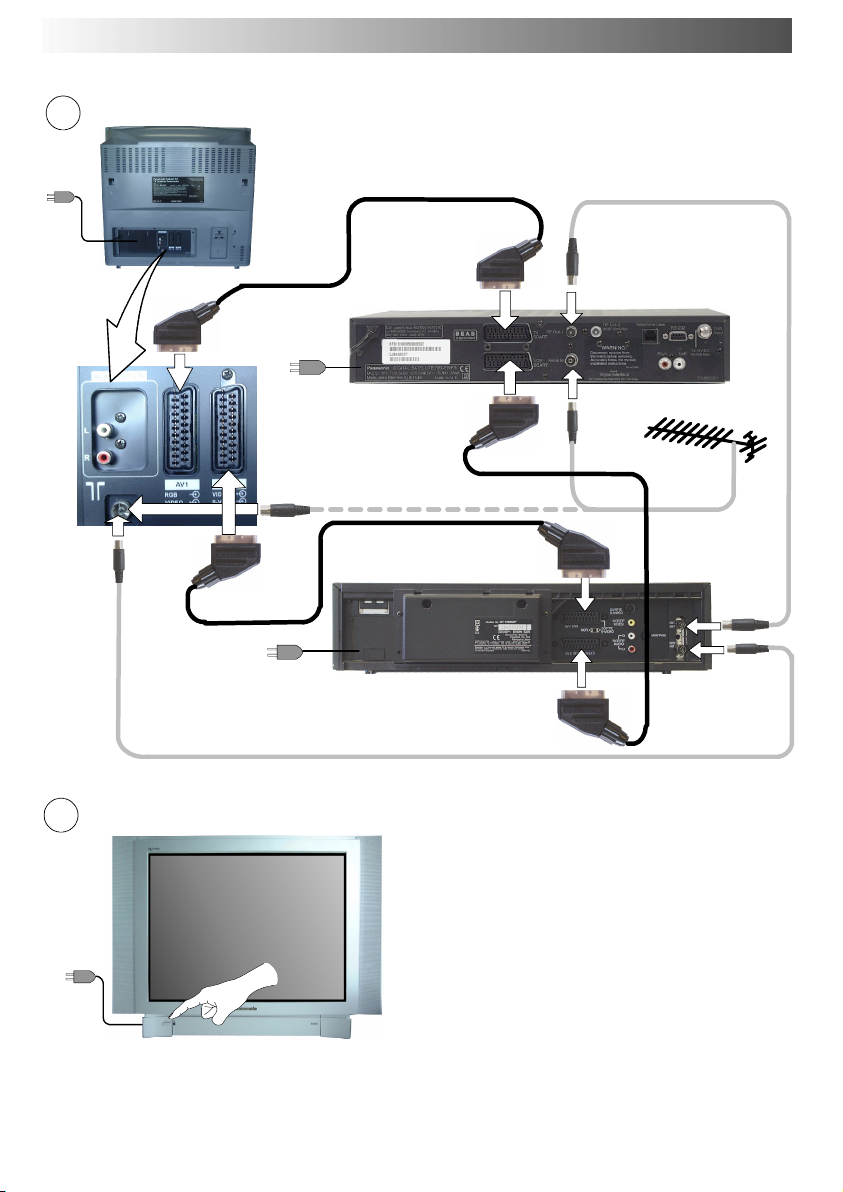
QUICK S TART GUIDE
1
Plug in aerial and connect ancillary equipment.
AV1
AV2
OR
AV1
AV2
SATELLITE RECEIVER
VCR / DVD/R
2
First, ensure that the VCR (DVD/R) is in
Standby mode.
Plug in TV and switch on.
5
Page 6
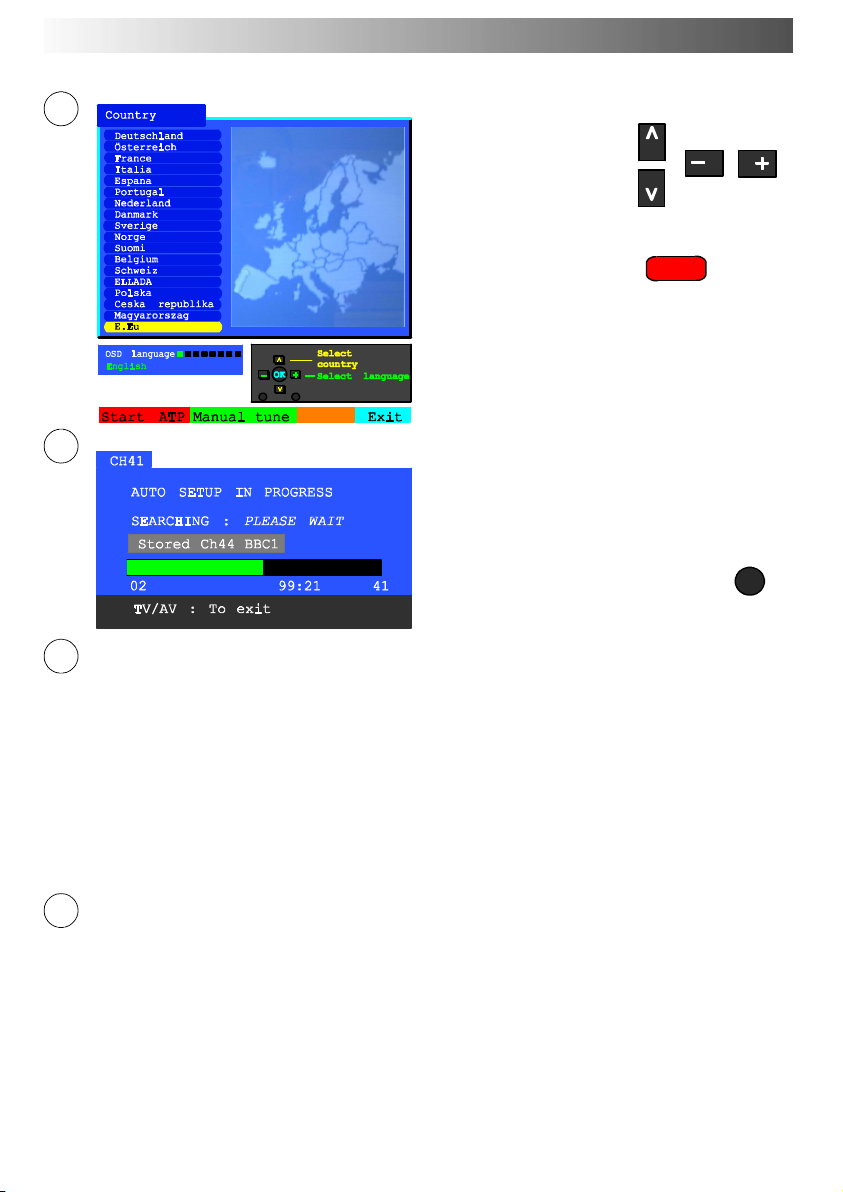
QUICK S TART GUIDE
3
4
Select your country.
Press the red button
Auto setup will begin, your stations will be
located and stored.
Use the Programme Edit menu to delete
unwanted stations (see page 18).
Press the TV/AV button to exit.
TV/AV
5
If you are installing a new Q ---Link compatible VCR (DVD/R), you can now switch it ON.
Downloaded tuning data will match the television’s.
If you are installing a new NEXTVIEWLINK compatible VCR (DVD/R), you will need to initiate
download manually.
See the VCR (DVD/R) handbook for details.
D If the VCR (DVD/R) has not accepted download data from the TV, you may need to select the
Download option from the VCR (DVD/R)’s menu.
D If Q ---Link is notoperating correctly, check it is connected to thetelevision’s AV1or AV2 socket,
the SCART lead is a “full function” type, and the VCR (DVD/R) is compatible with Q---Link,
NEXTVIEWLINK or similar technologies. Ask your dealer for further details.
D For further information on Q ---Link and connecting equipment, see pages 26, and 27.
6
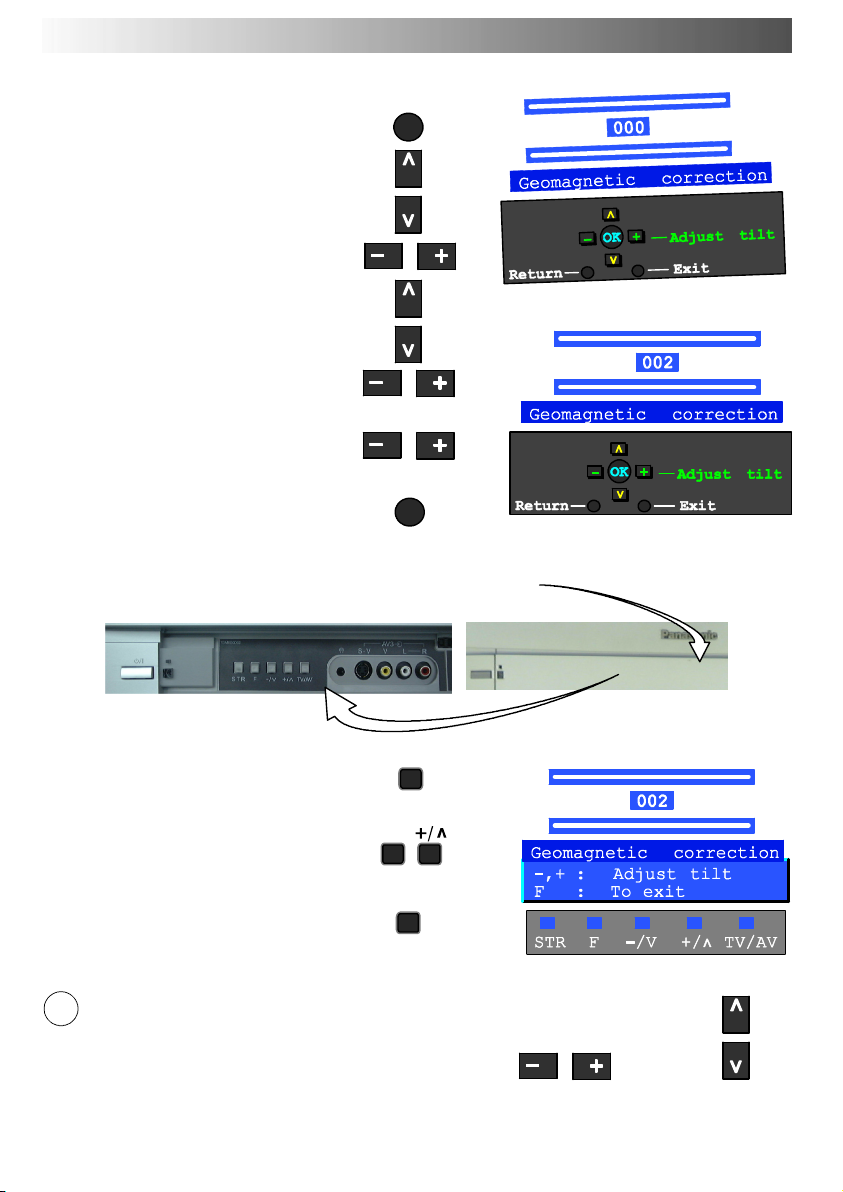
Slight tilting of the picture may be noticeable or coloured patches may sometimes appear
at the corners of the screen (colour purity). The Geomagnetic Correction feature can be
used to eliminate them, if necessary:
First, ensure the ATP and Q--- Link download procedures are complete. T he screen should not
be showing any On ---Screen Display menus.
Using the remote control keys indicated, access the Geomagnetic Correction menu option
and follow the procedure below (for a full explanation of the O n Screen Display menu system
see page 10) :
6
Page 7
QUICK S TART GUIDE
Press the MAIN menu button
Move to the SETUP menu option
Access the SETUP menu
Move to the Geomagnetic menu option
Access the Geomagnetic menu
Adjust the picture tilt as necessary
Press the TV/AV button to exit
MENU
TV/AV
The function ’geomagnetic correction’ is also accessible from the front panel.
Pressandreleaseheretoopenflap
Press the F button repeatedly until the
Geomagnetic Correction feature is
displayed.
Press the + or --- buttons repeatedly until
the picture appears to be level.
Press the F button again to return to
normal viewing. Close the flap to prevent
damage.
7
Youarenowreadytobeginviewingprogrammes
The cursor controls provide the two basic functions:
--- / v
F
F
Adjust Volume
Change Programme
7
Page 8
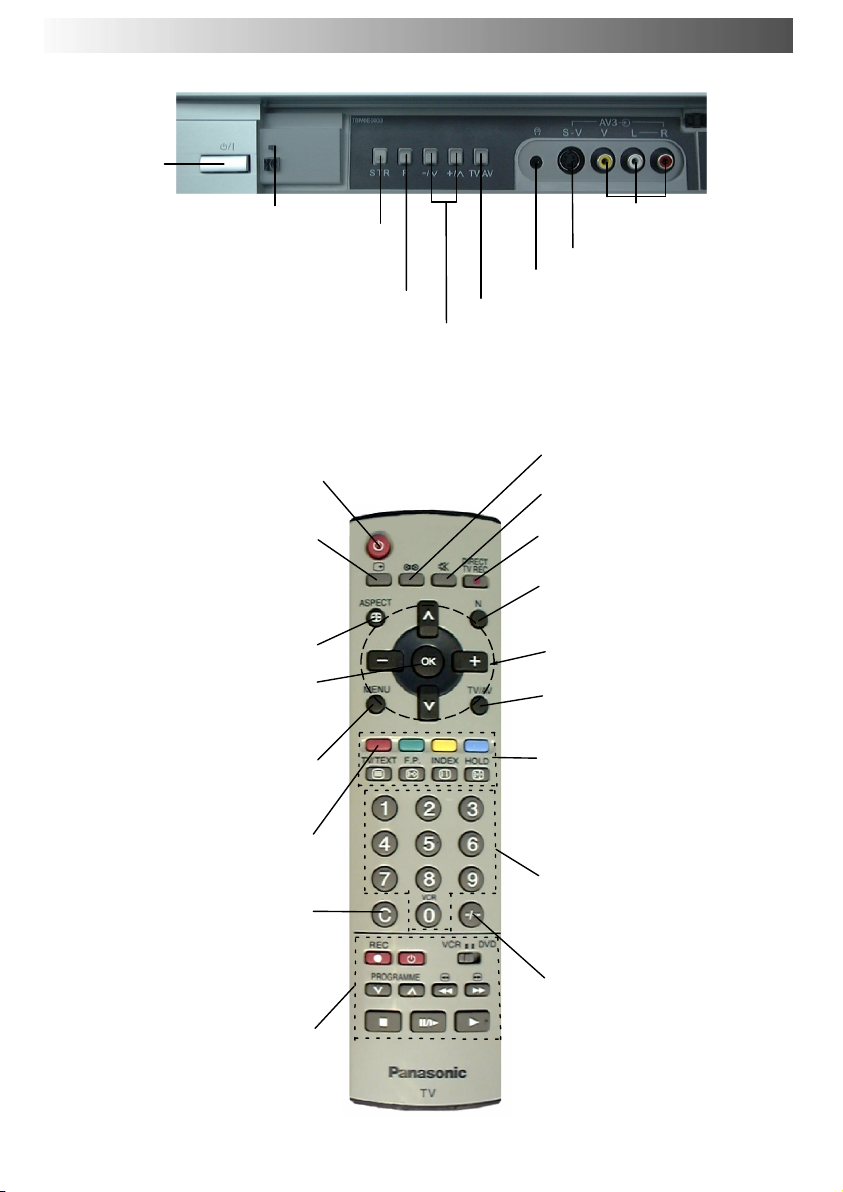
BASIC CONTROLS : FRONT PANEL AND REMOTE CONTROL
MAINS
Power On/Off
switch
Red light indicates Standby mode.
STR (Normalisation store) Used to store
tuning and other function settings
F (Function select)
Displays the On Screen Display functions, use
repeatedly to select from the available functions
-- Volume, Contrast, Brightness, Colour,
Sharpness, Tint (in NTSC mode), Bass, Treble,
Balance, Tuning mode and Geomagnetic
Correction.
Headphone socket (see page 31)
TV/AVswitch(seepage31)
Increases or decreases the programme
position by one. When a function is already
displayed, press to increase or decrease the
selected function.
RCA Audio/V ideo sockets
(page 31)
S---VHSsocket(seepage31)
Standby ON/OFF switch Switches
TV On or Off standby.
Status button
Press to display programme
position, programme name,
channel number, TV system, time
stereo mode
and programme table.
Aspect button (see page 11)
O K k ey --- U s ed t o s t or e a nd
confirm tuning, OSD functions
and other settings
Menu button
Press to access the Main,
Picture, Sound and Setup menus
(see page 10)
Teletext buttons (see page 29)
Direct Channel Access
During normal TV viewing or
when in the Tuning, Programme
edit or Manual tuning menus,
press and then enter channel
number using the numeric
buttons
VCR / DVD buttons (see page 28)
Ambience on/off
Sound mute On/Off
Direct TV Record button(see
page 26)
N(Normalise)button
Resets all settings to their
default levels
Cursor buttons to make
selections and adjustments
Switch between viewing TV or
AVinput(seepage31)
Coloured buttons used for
Programme Edit functions (see
page 18)
Teletext functions (see page
29) AV selection (see page 31)
Programme / channel change
buttons (0-- 9) and Teletext
pagebuttons(seepage29)
Programme position for
selection of two digit
programmes (10 -- 99) using
numeric buttons.
Press the “C” and “-- -/------”
buttons for Direct Channel
Access in hyperband.
8
Page 9
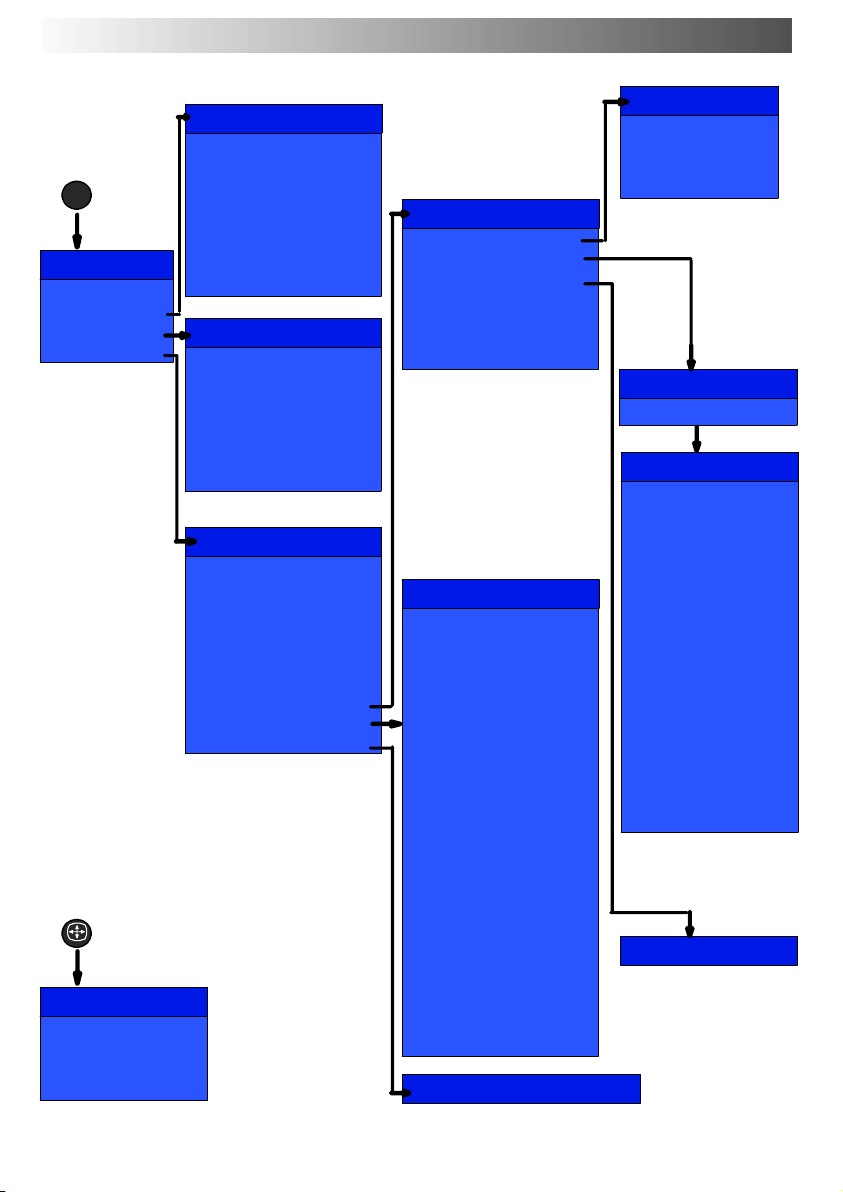
MENU STRUCTURE
MENU
Main Menu
Viewing Mode
Picture Menu
Sound Menu
Setup Menu
ASPECT
Aspect Controls
Auto
4:3
16:9
S-Zoom
Picture Menu
Viewing Mode
Contrast
Brightness
Colour
Sharpness
Tint (NTSC only)
Colour balance
P-NR
Sound Menu
Volume
Bass
Treble
Balance
MPX
Mode
Ambience
Setup Menu
AV1 out
AV2 out
Teletext
Off timer
Flicker reduction
Q-LinkSelect
Text language
Tuning menu
OSD language
Geomagnetic
Tuning Menu
Programme edit
Auto setup
Manual tuning
Fine tuning
Colour system
Volume Correc.
Decoder (AV2)
OSD language
Deutsch
English
Français
Italiano
ELLHNIKA
Čeština
Română
Polski
Español
Norsk
Dansk
Svenska
Magyar
Russkij
Slovensky
Srpski
Nederlands
Suomi
Türkçe
Português
Hrvatski
Bulgarian
Slovensko
Geomagnetic correction
Programme edit
Delete
Add
Move
Download
Auto Setup
Warning
Country
Deutschland
Österreich
France
Italia
España
Portugal
Nederland
Danmark
Sverige
Norge
Suomi
Belgium
Schweiz
ELLADA
Polska
Česká republika
Magyarország
E.Eu
Manual tuning
9
Page 10
USING THE ON SCREEN DISPLAYS
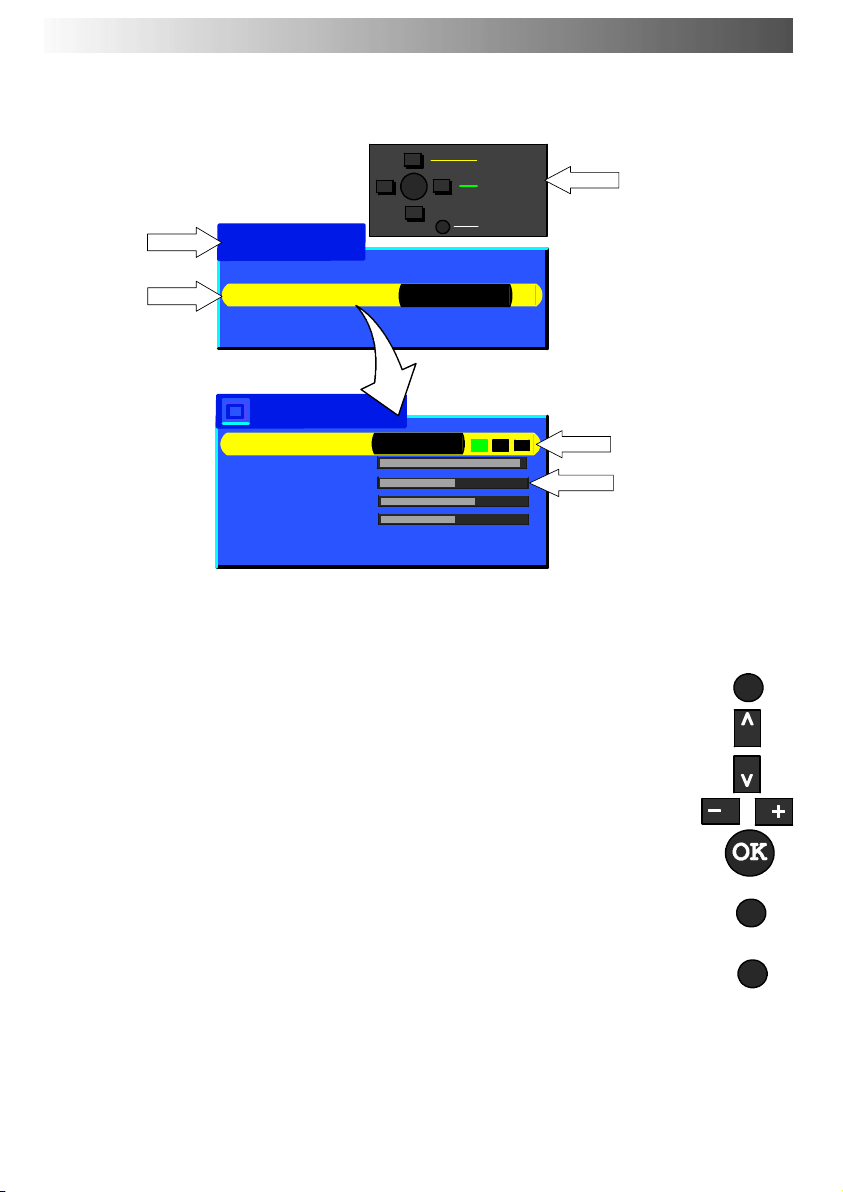
This TV has a comprehensive system of On Screen Display menus to access
adjustments and options
Menu Title
Sub-- menus
∧
OK
−
∨
Main Menu
Viewing Mode Dynamic
Picture Menu Access
Sound Menu
Setup Menu
+
Select
Access
Exit
Instructions
Picture Menu
Viewing Mode Dynamic
Contrast
Brightness
Colour
Sharpness
Colour Balance Normal
P-NR Off
Some selections, for example, Contrast, Brightness, Colour and Sharpness will allow you to
increase or decrease their level.
Some selections, for example, Off timer,allowachoicetobemade.
Some selections, for example Tuning menu, will lead to a further menu.
TheMENU buttonisusedtoopenthemainmenuandalsotoreturntotheprevious
menu.
Indicator for options
Selection bar
MENU
The up and down cursor buttons are used to move the cursor up and down the menus.
The left and right cursor buttons are used to access menus, adjust levels or to select
from a range of options.
The OK button used to store and confirm tuning, OSD functions and other settings
The TV/AV button is used to exit the menu system and return to the normal viewing
screen.
N (Normalise) button --- resets all settings to their default levels
TV/AV
N
Last Position Memory
Certain functions have a last position memory, i.e. the setting at the time of switch-- off will be the
setting used when the receiver is switched on again.
10
Page 11
ASPECT CONTROLS
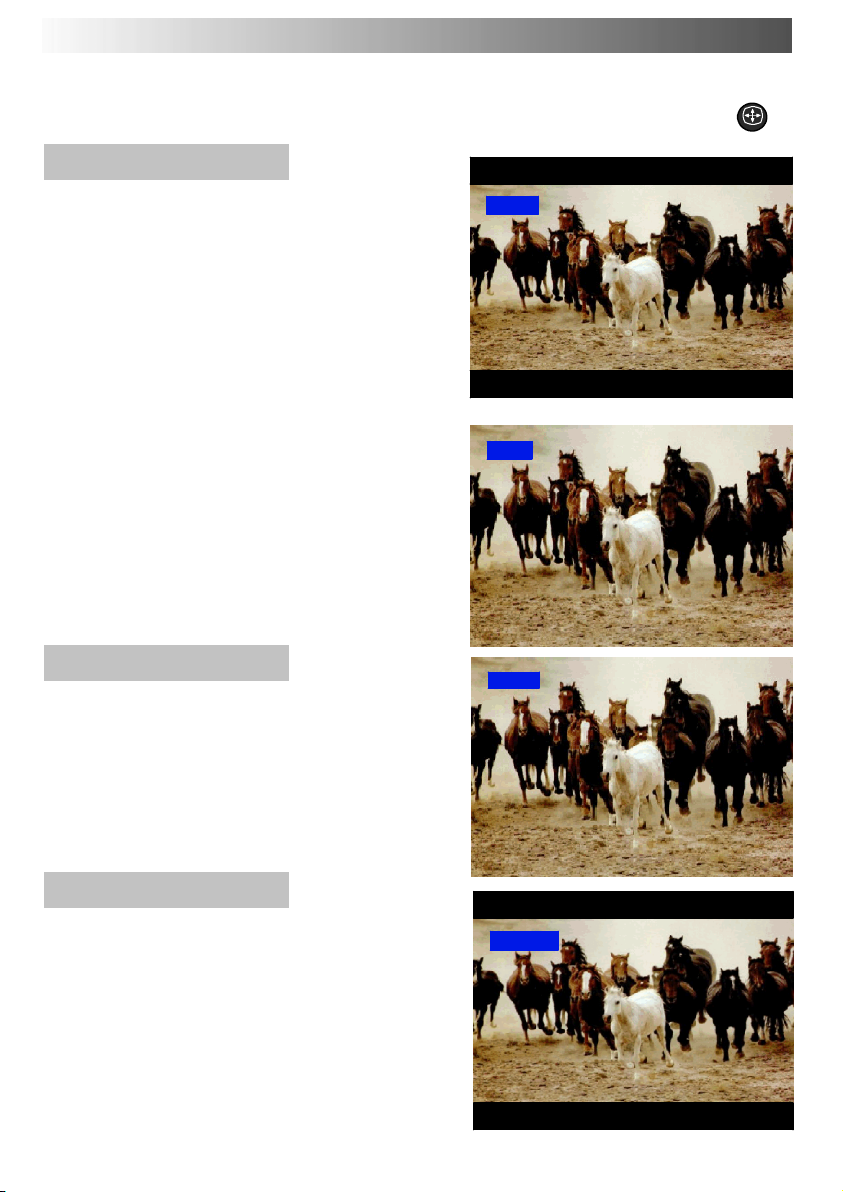
Press the ASPECT button to move through the four aspect options: Auto, 4:3, 16:9 and
S --- Z o om .
Auto
Selecting AUTO mode of this TV will
automatically cause the TV to display any
incoming picture at its correct format, i.e. 16:9 or
4:3.
16:9
Auto
4:3
Auto
4:3
4:3
4:3 will display a 4:3 picture at its standard 4:3
size and can be selected if you wish to view in this
format.
ASPECT
16:9
16:9 will diplay a 16:9 picture at its standard 16:9
size and can be selected if you wish to view in this
format.
16:9
11
Page 12
ASPECT CONTROLS
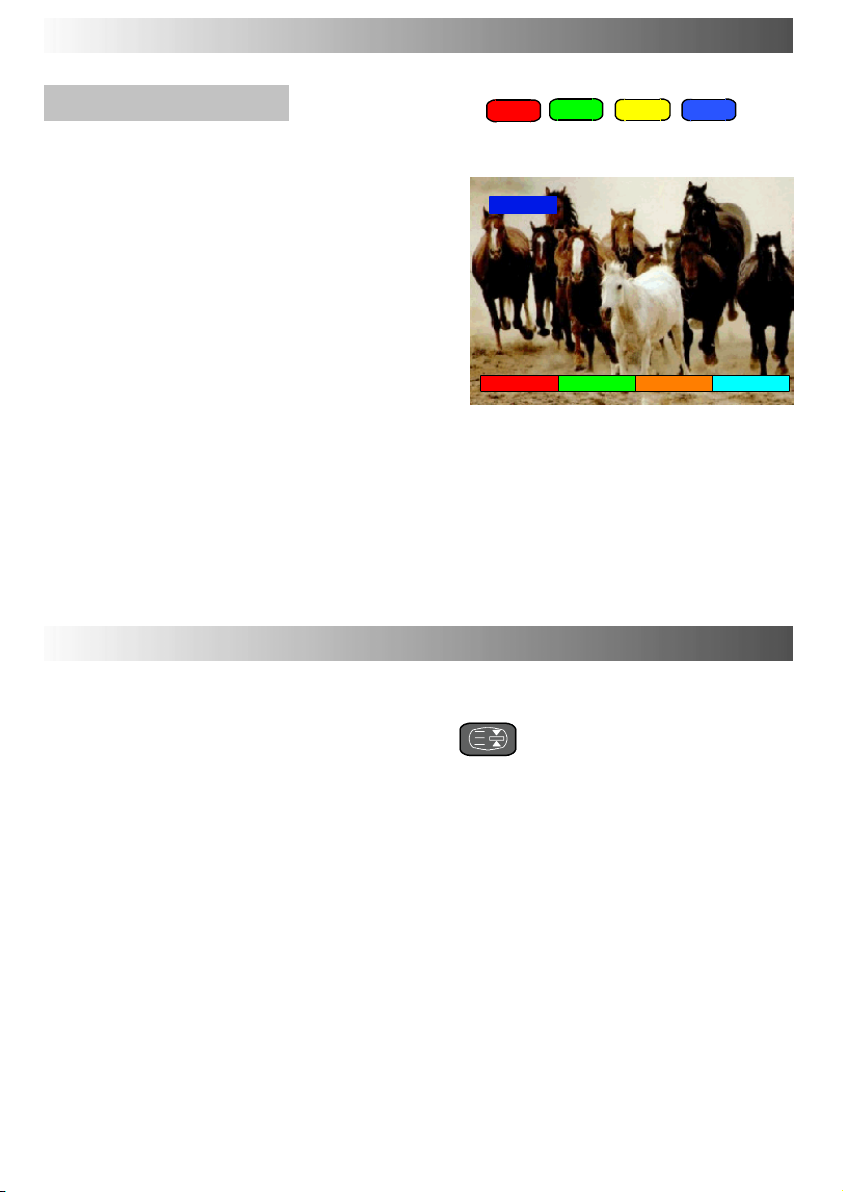
S --- Z o o m
S --- Z o o m allows increased magnification and
the ability to move the picture horizontally and
vertically.
The on screen selector keys that appear for
some aspect function will clear after a few
seconds. If you subsequently wish to select an
operationthenpresstheAspectkeyoncemore
for the keys to reappear.
If, in Auto mode, you experience problems with
the screen display size when playing back
widescreen format recordings from your VCR
then it is possible that the tracking control of your
VCR requires adjustment (your VCR instruction
book will contain adjustment details).
S-Zoom
Hpol.- Hpol.+ Vpol.- Vpol.+
Increased magnification with S---Zoom.
HOLD CONTROL
TheHOLDkeyallowsyoutofreezethepictureat
any time.
12
HOLD
Page 13
MAIN MENU
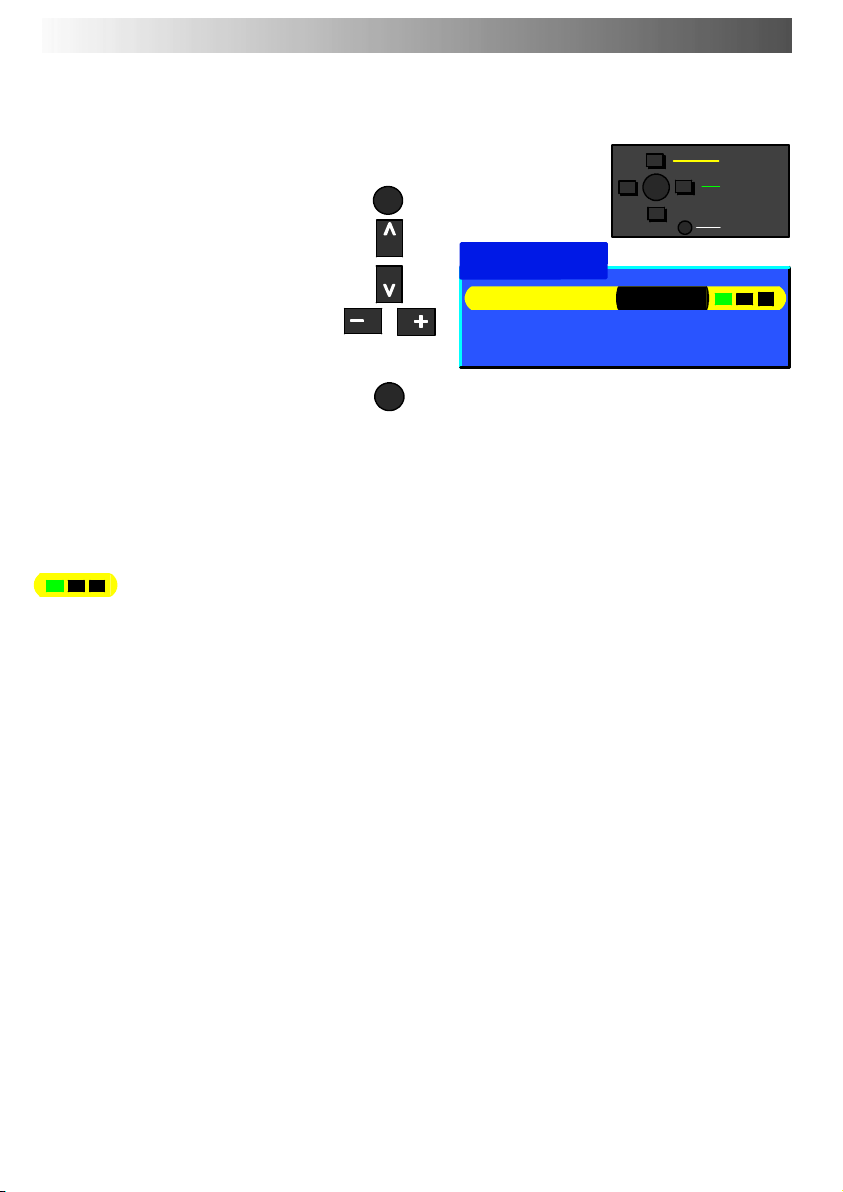
This menu allows you to access to Viewing Mode, Picture, Sound and Setup
menu
Open the Main menu
Move to your choice
Increase or decrease levels or set
options
Press the TV/AV button to exit the
menu system
Viewing mode
Picture Menu
The Viewing mode menu allows you to select 3 different screen settings --Dynamic, Normal and Cinema.
This menu allows you to make adjustments to the picture quality.
MENU
TV/AV
∧
OK
−
∨
Main Menu
Viewing Mode Dynamic
Picture Menu
Sound Menu
Setup Menu
+
Select
Change
Exit
Sound Menu
Setup Menu
The Sound menu will allow you to set your personal preferences for all aspects
of sound quality.
The Setup menu provides access to various advanced features and also to the
T uning menu.
13
Page 14
PICTURE MENU
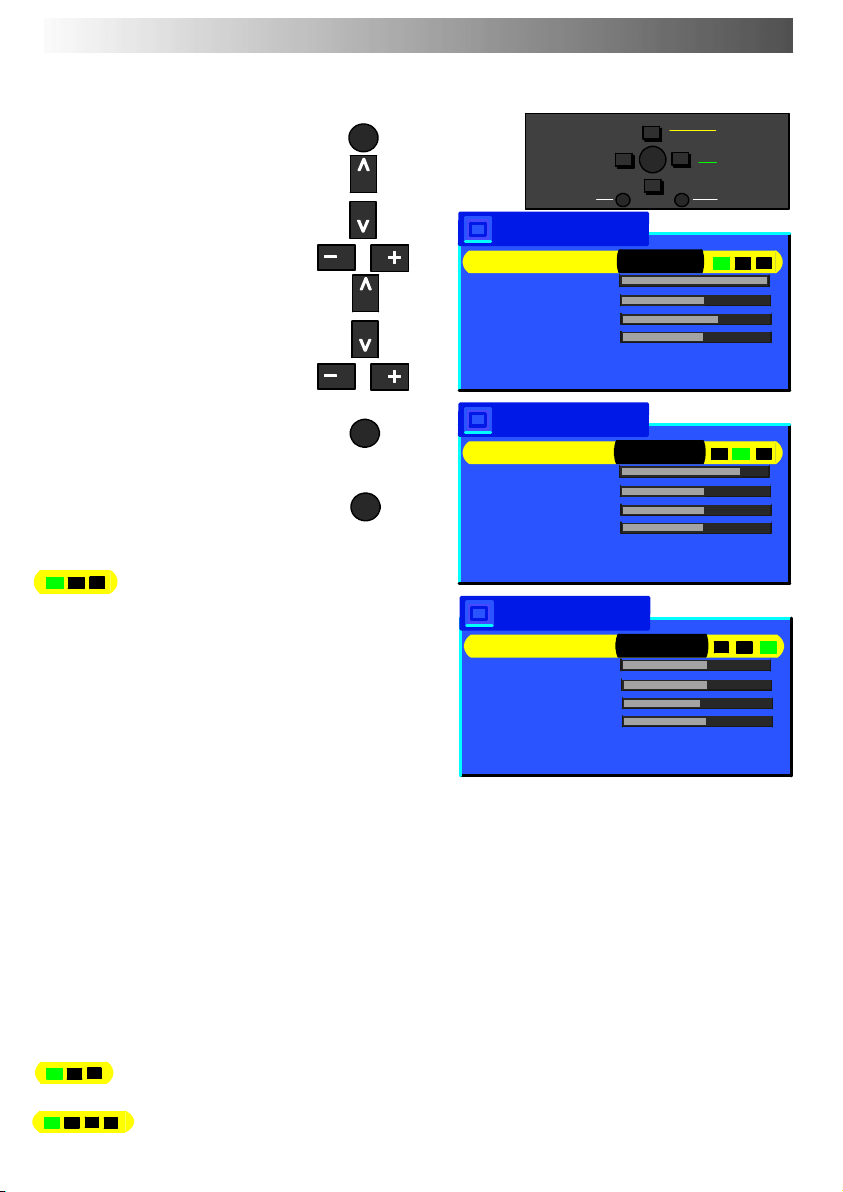
This menu allows you to make adjustments to the picture quality
Open the Main menu
Move to Picture menu
Access Picture menu
Move to your choice
Increase or decrease levels or set
options
Press the TV/AV button to exit the
menu system
Press the N button to return
the factory setting
Viewing mode
Contrast
The Viewing mode in the Picture
menu allows you to select,
adjust and store three different
screen settings --- Dynamic,
Normal and Cinema.
In each Viewing mode setting,
Contrast, Brightness, Tint ( in
NTSC only), Colour, and
Sharpness can be adjusted and
stored to suit your particular
viewing requirement (for
example you may require
different settings for viewing sport, films, news etc.).
Viewing mode offers you up to a maximum of three separate settings for each
signal source: RF, AV1, AV2, AV3 (including RGB).
By analysing and processing the incoming picture, all three modes feature
automatic enhancement.
You can restore the factory settings for the selected profile on the selected signal
source by pressing the “N” button on the remote control.
Brightness
Colour
Sharpness
Tint (NTSC only)
The Contrast, Brightness, Colour, Tint (in NTSC only) and Sharpness levels can
be adjusted to suit your own preferences and the viewing conditions.
MENU
TV/AV
N
∧
OK
−
Return
∨
Picture Menu
Viewing Mode Dynamic
Contrast
Brightness
Colour
Sharpness
Colour Balance Normal
P-NR Off
Picture Menu
Viewing Mode Normal
Contrast
Brightness
Colour
Sharpness
Colour Balance Normal
P-NR Off
Picture Menu
Viewing Mode Cinema
Contrast
Brightness
Colour
Sharpness
Colour Balance Normal
P-NR Off
+
Select
Change
Exit
Colour balance
P-- NR
14
The Colour balance setting allowsyou to set the overall colour tone of the picture.
P-- NR will automatically reduce unwanted picture interference.
Page 15
SOUND MENU
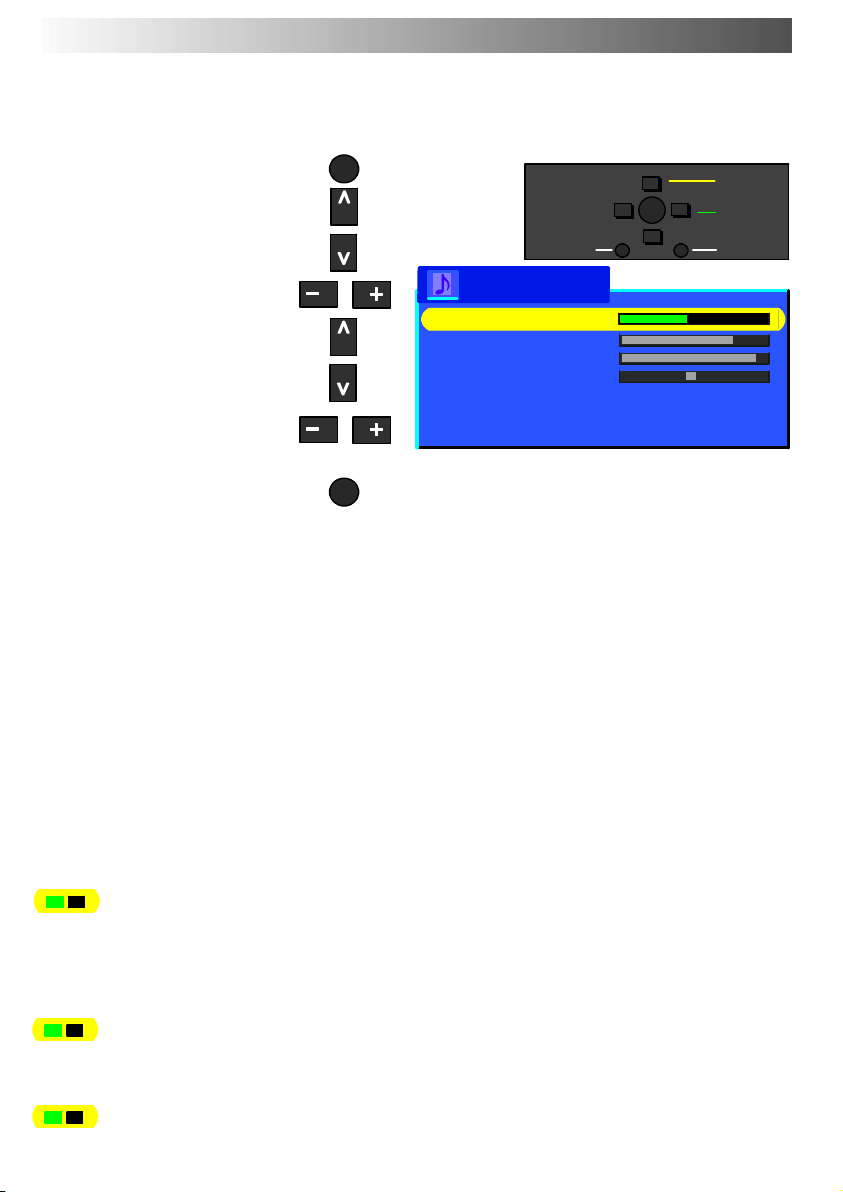
The Sound menu will allow you to set your p ersonal preferences for all aspects
of sound quality
Open the Main menu
Move to Sound menu
MENU
Return
+
Select
Adjust
Exit
∧
OK
−
∨
Access Sound menu
Move to your choice
Increase or decrease levels or
set options
Press the TV/AV button to exit the
menu system
Volume
Bass
Treb le
Balance
The Volume adjustment sets the overall output volume.
Bass adjustment will emphasise the lower, deeper frequencies and can be
increased or decreased.
Treble adjustment will emphasise the sharper, higher frequencies and can be
increased or decreased.
Balance affects the levels of sound between the left and right speakers.
Adjustment can be made so that the level from the speakers will suit your
listening position.
TV/AV
Sound menu
Volume
Bass
Treble
Balance
MPX Stereo
Mode Music
Ambience Off
−
+
MPX
Mode
Ambience
MPX will usually be set to Stereo to provide the best reproduction, however if
reception deteriorates or if the service is not available then it is advisable to
switch to Mono. Mono M1 and M2 can also be selected if signals are being
transmitted.
The sound can be improved during Music or Speech mode by selecting the
appropriate function.
Ambience provides a dynamic enhancer to simulate improved spatial effects.
15
Page 16
SETUP MENU
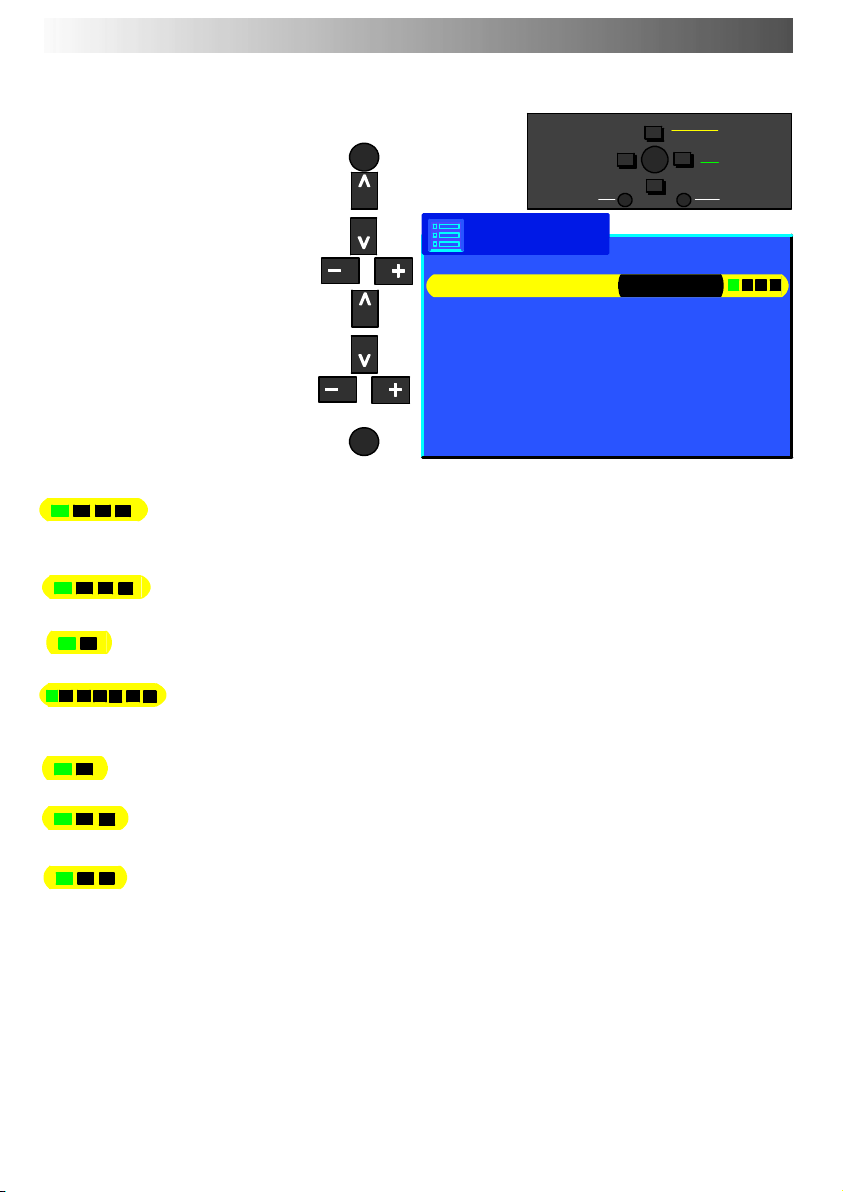
The Setup menu provides access to various advanced features and also to the
Open the Main menu
Move to Setup menu
Access Setup menu
Move to your choice
Increase or decrease levels, set
options or access further menus
Press the TV/AV button to exit
the menu system
Tuning menu
MENU
TV/AV
OK
−
Return
Setup menu
AV1 out TV
AV2 out TV
Teletext FLOF
Off timer Off
Flicker reduction Off
Q-Link Select AV2
Text Language West
Tuning menu
OSD Language
Geomagnetic
∧
∨
+
Select
Change
Exit
AV1 out
AV2 out
Te l e t ex t
Off timer
Flicker
reduction
Q-- Link Select
Text Language
Tuning menu
OSD Language
Geomagnetic
Offers a choice of signals to send to the AV1 Scart socket. You can choose from
the current TV programme position, the signal entering AV2 / AV3 or Monitor --the picture displayed on screen.
Offers a choice of signals to send to the AV2 Scart socket. You can choose from
the current TV programme position, the signal entering AV1 / AV3 or Monitor --the picture displayed on screen.
The Teletext option allows you to choose between TOP / Flof or List mode. See
page 29.
Off timer will switch the TV off within a preset time which you can choose from
between 0 to 90 minutes in 15 minute intervals.
You will normally find that Flicker reduction is best set to On to reduce any slight
picturemovement.However,itispossiblethatsomeoccasionalbroadcastsmay
benefit by selecting the Off position.
Q-- Linkallowsyoutoenable(AV1orAV2)ordisabledatacommunicationwitha
compatible VCR (DVD/R). See page 26.
Select character set, so that all characters needed are availabe for text on teletext
pages (eg: cyrillic characters, etc).
Mode Languages
West: English, French, German, Greek, Italian, Spanish, Swedish, Turkish
East1: English, Estonian, Lett, Rumanian, Russian, Ukrainian, Lithuanian
East2: Czech, Hungarian, Lett, Polish, Rumanian, Lithuanian
The Tuning menu provides an entry to many other features including Programme
edit, ATP, Fine tuning, Manual tuning, Colour system and Volume correction. See
page 17.
OSD language allows you to select the language used for On Screen Displays.
See page 25.
If you notice a slight tilt to the picture or if there are coloured patches at the corners
of the screen, use this feature to eliminate them. See page 6 (Quick Start Guide).
16
Page 17
TUNING MENU
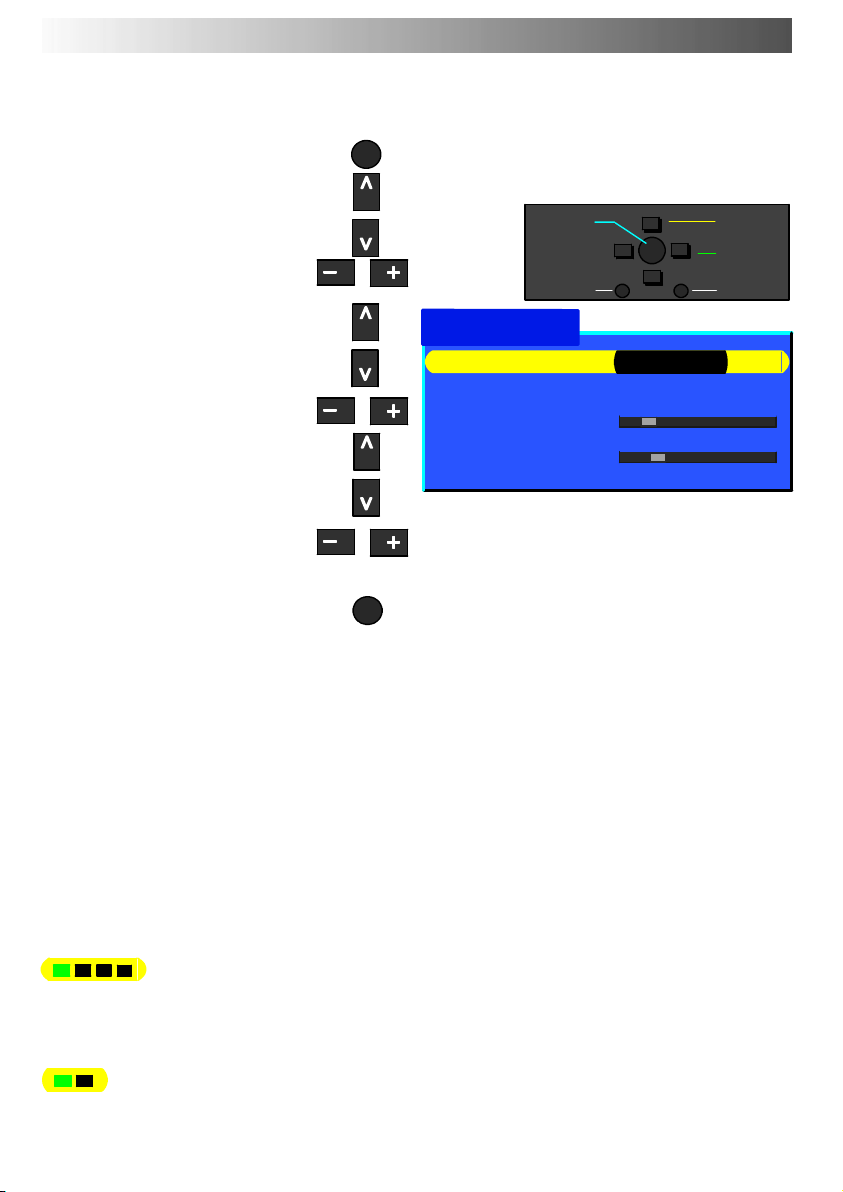
The Tuning menu provides access to manual, automatic and fine tuning menus
Open the Main menu
MENU
Move to Setup menu
Access Setup menu
Move to Tuning menu
Access Tuning menu
Move to your choice
Increase or decrease levels, set
options or access further menus
Press the TV/AV button to exit the
menu system
Programme
edit
Accessing the Programme edit menu will allow stations to be moved, added,
deleted, named or locked and provides access to the TV -- system.
See page 18.
TV/AV
Store
Return
∧
OK
−
∨
Tuning menu
Programme edit Access
Auto setup
Manual tuning
Fine tuning
Colour system Auto
Volume correc.
Decoder (AV2) Off
+
Select
Access
Exit
Auto setup
Manual tuning
Fine tuning
Colour system
Volume correc.
Decoder (AV2)
The Auto setup menu allows you to automatically retune the TV. See page 22.
The Manual tuning menu allows individual programme positions to be tuned
manually . See page 23.
Stations can be finely tuned using the Fine tuning adjustment.
The Colour system menu allows you to decide the correct choice of
transmission standard.
Volume correction allows you to adjust the volume level of individual stations.
This option is used when a decoder is connected via AV2. Set to On if a
scrambled signal is to be processed by the decoder. Set to Off after use.
ThisoptionsisavaiableonlywhenQ---Linkisswitchedon.
17
Page 18
TUNING MENU -- PROGRAMME EDIT
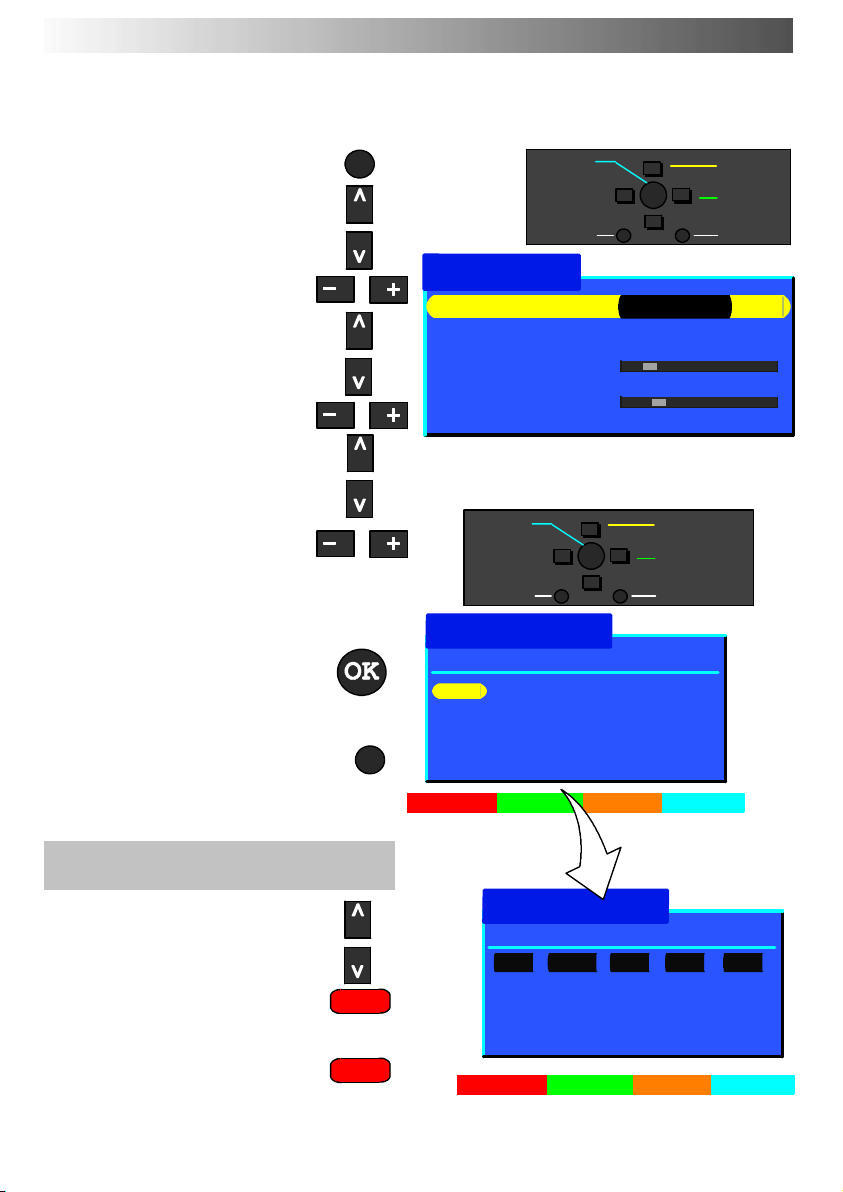
The Programme edit menu allows you to edit the programme position settings
Open the Main menu
Move to Setup menu
Access Setup menu
Move to Tuning menu
Access Tuning menu
Move to Programme edit menu
Access Programme edit menu
Make required changes (see sections
below)
Press OK button to store changes
If you have finished in the Programme
edit menu, press the TV/AV button to
exit
MENU
TV/AV
Store
Return
∧
OK
−
∨
+
Select
Access
Exit
Tuning menu
Programme edit Access
Auto setup
Manual tuning
Fine tuning
Colour system Auto
Volume correc.
Decoder (AV2) Off
+
Change
programme
Select
option
Exit
Store
Return
∧
OK
−
∨
Programme edit
Prog. Chan. Name Lock Sys
1: CH41 XYZ Off SC3
2: - Off SC3
3: - Off SC3
4: - Off SC3
5: - Off SC3
Delete Add Move Download
To delete an unwanted programme
position
Choose the programme position
PresstheRedbuttononremote
control
Press the Red button again to
confirm
18
Programme edit
Prog. Chan. Name Lock Sys
1: CH41 XYZ Off SC3
2: - Off SC3
3: - Off SC3
4: - Off SC3
5: - Off SC3
Delete Cancel
Page 19
TUNING MENU -- PROGRAMME EDIT
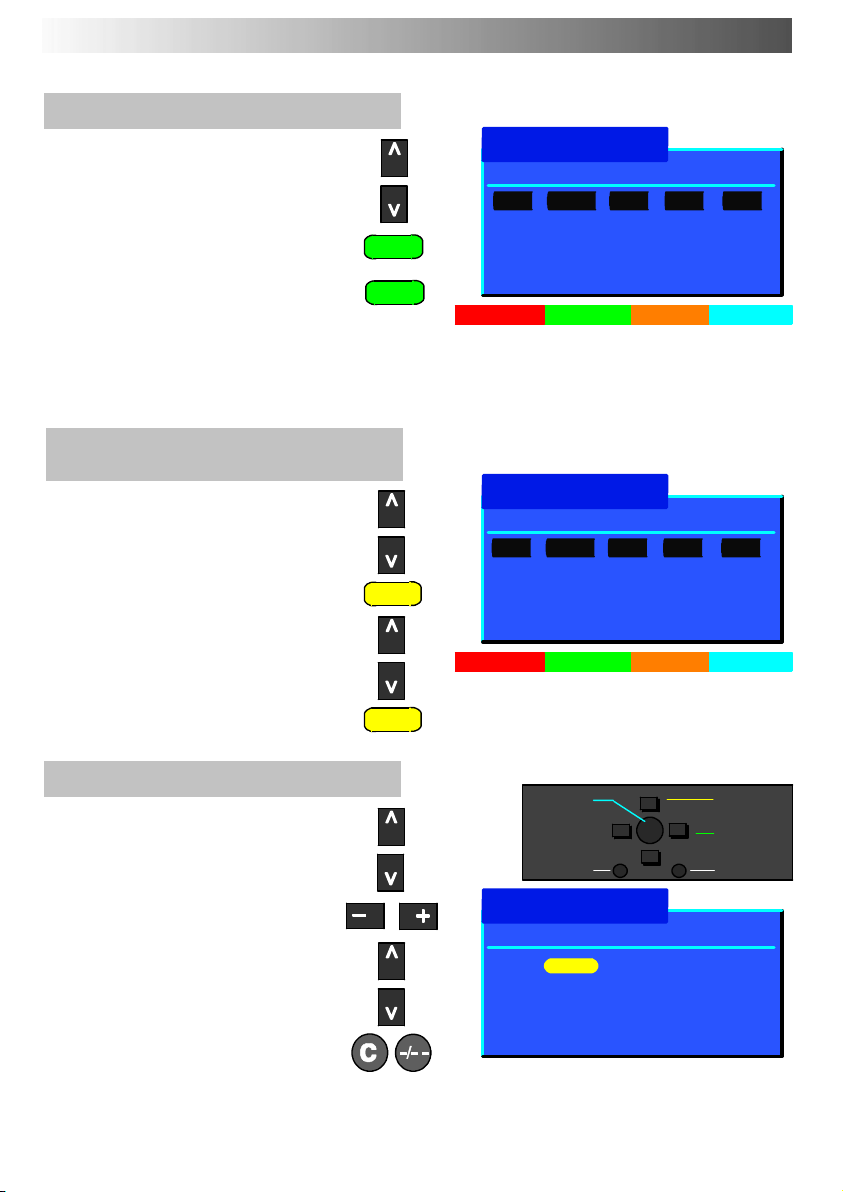
To add a programme position
Choose the programme position where
the new program is to be inserted
Press the Green button
Press the Green button again to
confirm
Thisblankprogrammecanthenbe
tuned, named, locked and be allocated
your choice of TV-- system
To move a programme to another
position
Choose the programme position to be
moved
Press the Yellow button on remote
control
Choose new position
Programme edit
Prog. Chan. Name Lock Sys
1: CH41 XYZ Off SC3
2: - Off SC3
3: - Off SC3
4: - Off SC3
5: - Off SC3
Add Cancel
Programme edit
Prog. Chan. Name Lock Sys
1: CH41 XYZ Off SC3
2: - Off SC3
3: - Off SC3
4: - Off SC3
5: - Off SC3
Confirm Cancel
Press the Yellow button again to
confirm
To tune a programme position
Choose the programme position
Move to the channel column
Increase or decrease channel number
or use the ’C’ key for Direct Channel
A c ce s s o r u s e th e ’ C ’ a nd ’ --- / --- --- ’
buttons for Direct Channel Access in
hyperband (see page 8)
+
Change
channel
Select
option
Exit
Store
Return
∧
OK
−
∨
Programme edit
Prog. Chan. Name Lock Sys
1: CH41 XYZ Off SC3
2: - Off SC3
3: - Off SC3
4: - Off SC3
5: - Off SC3
19
Page 20
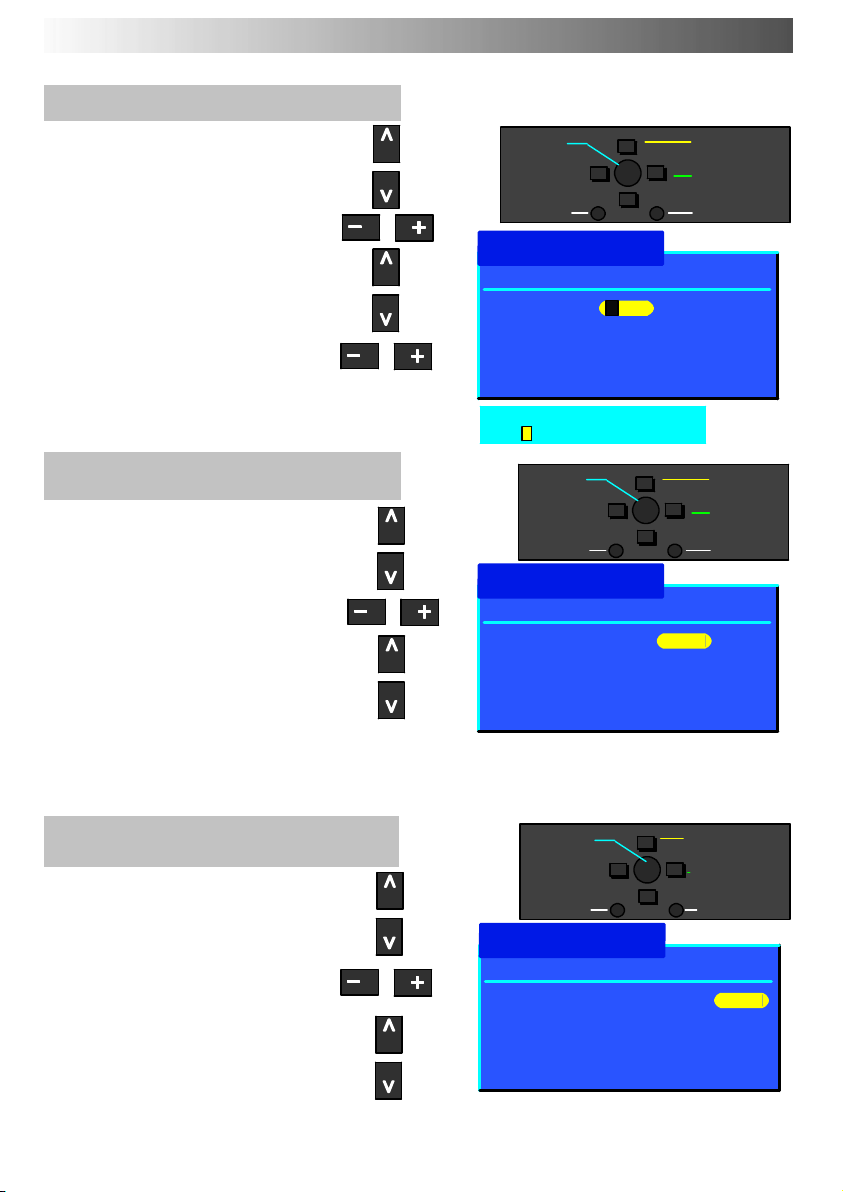
TUNING MENU -- PROGRAMME EDIT
To rename a programme position
Choose the programme position
Move to the Name column
Choose the new character
Move to the next character position
Continue until renaming is done
To lock a programme position to
prevent access
Choose the programme position
Move to the lock column
Choose between lock on or lock off
Note :
When a programme position is locked,
Direct Channel Access using the ’C’ and
numeric keys on the remote control is
not available for.
+
Change
character
Select
option
Exit
Store
Return
∧
OK
−
∨
Programme edit
Prog. Chan. Name Lock Sys
1: CH41 XYZ Off SC3
2: - Off SC3
3: - Off SC3
4: - Off SC3
5: - Off SC3
ABCDEFGHIJKLMNOPQRST
UVWXYZ+-. 0123456789
+
Lock
off/on
Select
option
Exit
Store
Return
∧
OK
−
∨
Programme edit
Prog. Chan. Name Lock Sys
1: CH41 XYZ Off SC3
2: - Off SC3
3: - Off SC3
4: - Off SC3
5: - Off SC3
To c h an ge t he T V -- system for a
programme position
Choose the programme position
Move to the Sys column
Choose the required sound system:
SC1 : PAL B/G, SECAM B/G
SC2 : PAL I
SC3 : PAL D/K / SECAM D/K
F:SECAML/L’
20
Store
−
Return
∧
OK
∨
Change
TV system
+
Select
option
Exit
Programme edit
Prog. Chan. Name Lock Sys
1: CH41 XYZ Off SC3
2: - Off SC3
3: - Off SC3
4: - Off SC3
5: - Off SC3
Page 21

TUNING MENU -- PROGRAMME EDIT
To copy programme information to
acompatibleVCR(DVD/R)
connected to AV1 or AV2
Move to the Prog. column
Press the Blue button on the remote
control
Programme data will now be sent to
the VCR (DVD/R). This might take a
few seconds, depending on the
number of stations stored.
Note:
If the message “Q---Link? Unable to
download”
D check Q---Link (AV1 or AV2)
D check your VCR (DVD/R)”
appears on the screen, the television is
unable to send the programme
information to the VCR (DVD/R). See
the VCR (DVD/R) handbook for further
information.
TV>VCR DOWNLOAD IN PROGRESS
PLEASE WAIT
Programme : 48
Remote control unavailable
21
Page 22
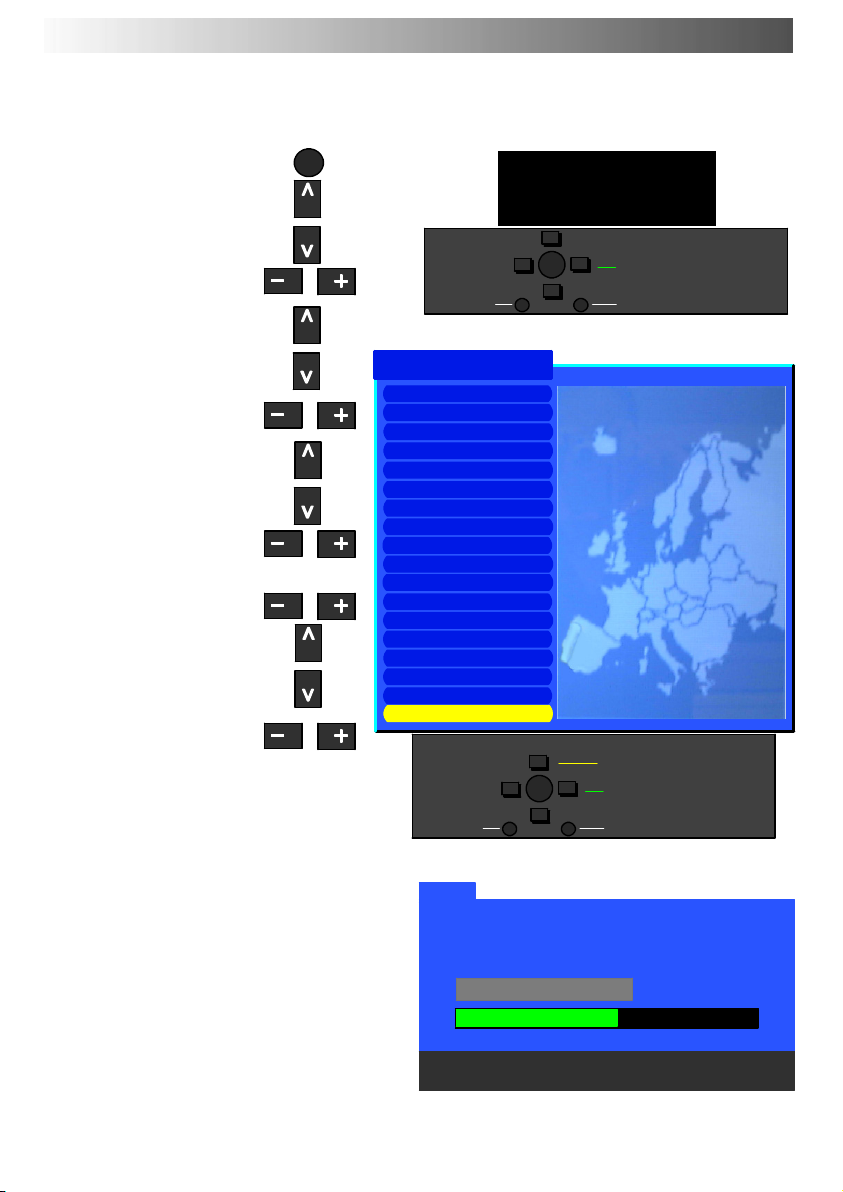
TUNING MENU -- AUTO SETUP (ATP)
The Auto setup menu will allow you to automatically retune the TV to your local
stations. It is useful if you move to a different region
Open the Main menu
Move to Setup menu
Access Setup menu
MENU
Return
WARNING
All current tuning
data will be erased
∧
+
OK
−
∨
Start Auto Setup
Exit
Move to Tuning menu
Access Tuning menu
Move to Auto setup
Access Auto setup
Press to confirm start
Select your country
Press to start Auto setup
The TV will search for, locate and sort
intoorderyourlocalstations.
If a compatible VCR (DVD/R) is
connected via the AV1 or AV2 socket,
programmedatawillbesenttothe
VCR (DVD/R) via Q-- Link (see page 26)
Country
Deutschland
Österreich
France
Italia
España
Portugal
Nederland
Danmark
Sverige
Norge
Suomi
Belgium
Schweiz
ELLADA
Polska
Česká republika
Magyarország
E.Eu
−
Return
CH41
AUTO SETUP IN PROGRESS
SEARCHING : PLEASE WAIT
Stored Ch44 BBC1
∧
OK
Select
country
+
Start Auto Setup
∨
Exit
Once this operation is completed the
TV will display programme position 1
22
02 99:21 41
MENU : Return to tuning menu
TV/AV:Toexit
Page 23
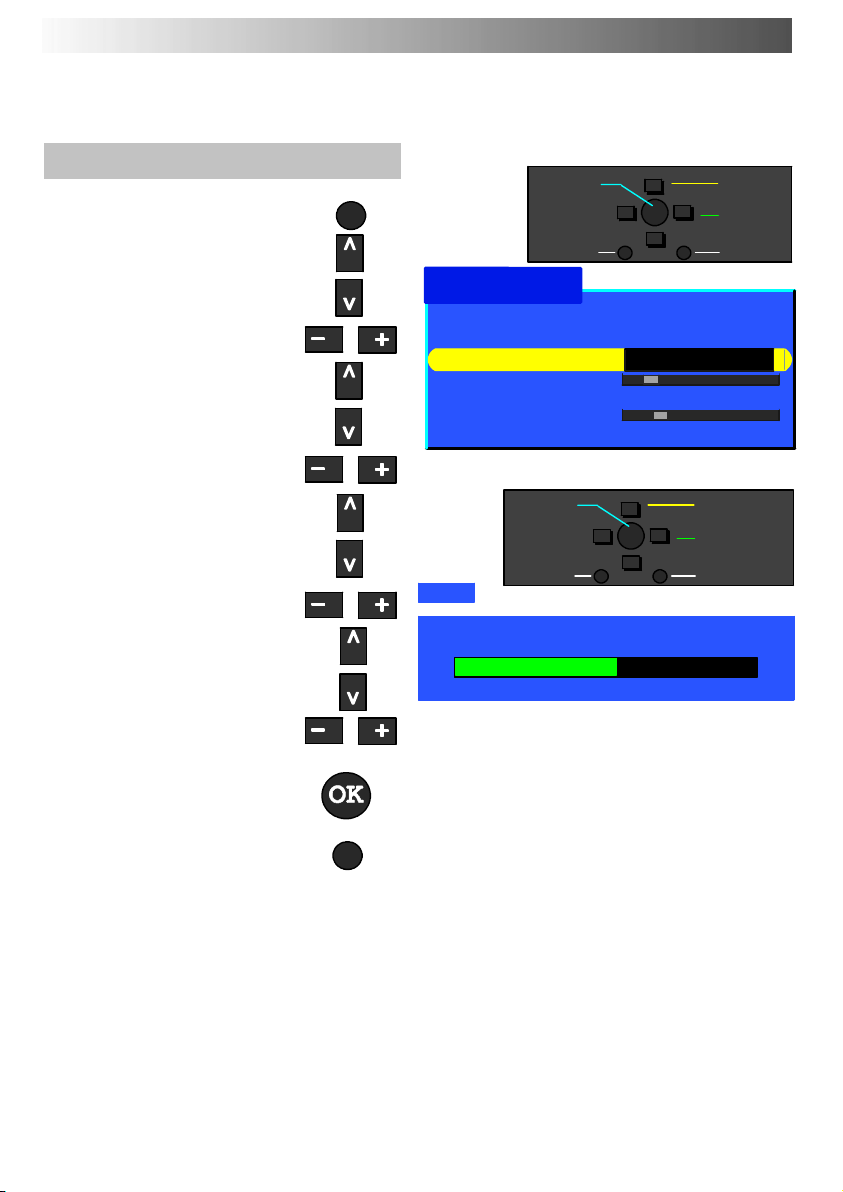
TUNING MENU -- MANUAL TUNING
Manual tuning of the Programme positions is available either from the On
Screen Display menu or from the front panel controls
Manual tuning menu
Open the Main menu
Move to Setup menu
Access Setup menu
Move to Tuning menu
Access Tuning menu
Move to Manual tuning
Access Manual tuning
Select the programme position
to be tuned
Start tuning
MENU
Store
Return
∧
+
OK
−
∨
Tuning menu
Programme edit
Auto setup
Manual tuning Access
Fine tuning
Colour system Auto
Volume correc.
Decoder (AV2) Off
Store
Return
CH41
Manual tuning
02 99:21 41
∧
+
OK
−
∨
Select
Access
Exit
Programme
down/up
Search
down/up
Exit
When the desired programme is
found, press OK button to store
Press the TV/AV button to exit
TV/AV
23
Page 24
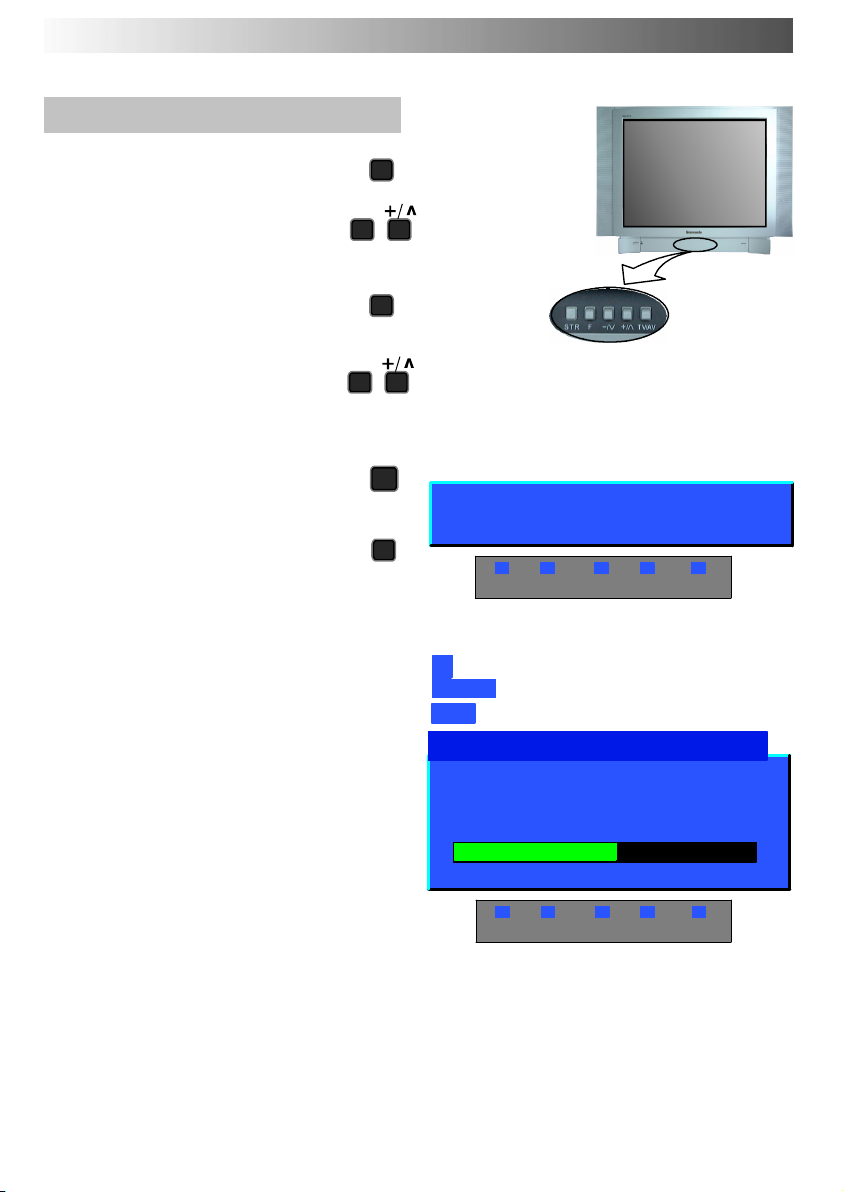
TUNING MENU -- MANUAL TUNING
Manual tuning (Front panel)
Press the F button (Front panel) until
“Tuning mode” is reached
Press the -- or + button to access
Tuni ng mode
F
--- / v
Press the TV/AV button to move
between “Change progr amme”,
“Search” or “Change TV system”
Press the -- or + button to change
programme position, start search, or
alter TV system
When the desired station is found,
press STR to store the changes
Repeat above procedure to tune
additional programmes or press the F
button to exit
TV/AV
--- / v
STR
F
Tuning mode
F:No -,+:Yes
STR F -/V +/∧ TV/AV
1
CH41
SC3
Manual tuning (Front panel)
-,+ : Search
TV/AV : Move cursor
STR : To store
F : To exit
24
02 99:21 41
STR F -/V +/∧ TV/AV
Page 25
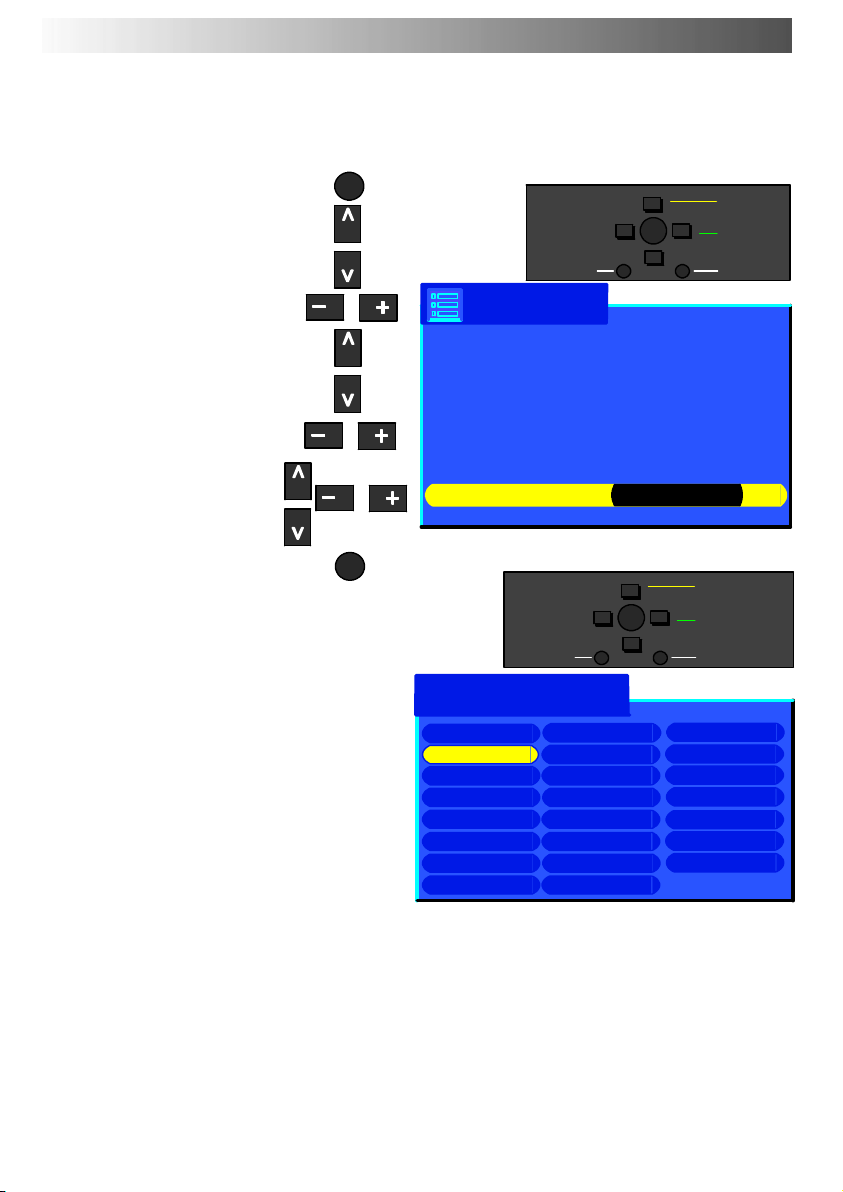
OSD LANGUAGE
When you first installed the TV the On Screen Display language was set
according to your choice of country. If you wish to use a different language
then it can be chosen from the OSD language menu
Open the Main menu
Move to Setup menu
MENU
Return
∧
+
OK
−
∨
Select
Access
Exit
Access Setup menu
Move to the O SD language menu
Access the OSD language menu
Move to your choice
Press the TV/AV button to exit
TV/AV
Setup menu
AV1 out Monitor
AV2 out TV
Teletext Flof
Off timer Off
Flicker reduction Normal
Q-Link Select AV2
Text Language West
Tuning Menu
OSD Language Access
Geomagnetic
+
Select
language
Select
language
Exit
Return
∧
OK
−
∨
OSD language
Deutsch Español Nederlands
English Norsk Suomi
Français Dansk Türkçe
Italiano Svenska Português
ELLHNIKA Magyar Hrvatski
Čeština Russkij Bulgarian
Română Slovensky Slovensko
Polski Srpski
25
Page 26
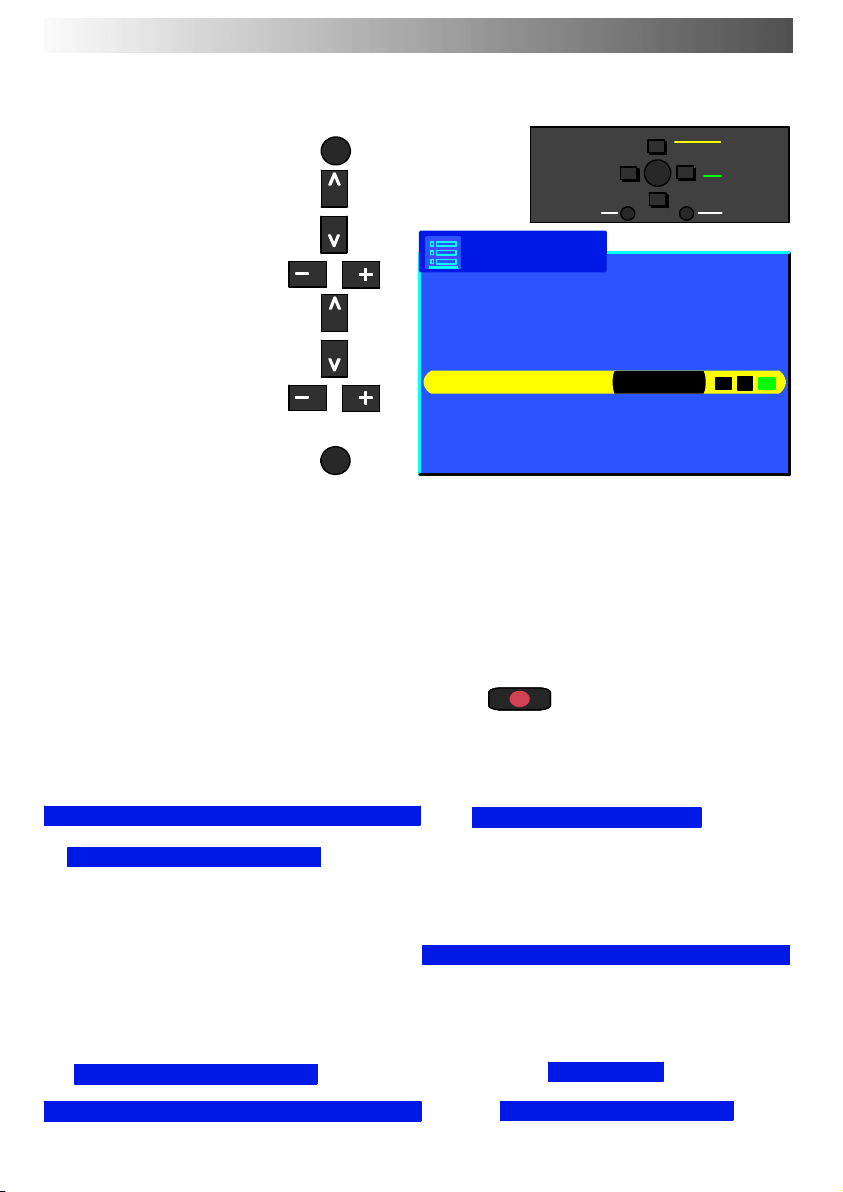
Q-- LINK
Q-- Link allows the television to communicate with your VCR (DVD/R)
Open the Main menu
Move to Setup menu
MENU
Return
+
Select
Change
Exit
∧
OK
−
∨
Access Setup menu
Move to Q-- Link
Confirm the setiing is correct
for connected Q -- Link device
(AV1 or AV2)
Press the TV/AV button to exit
The VCR (DVD/R) must b e connected with a SCA RT lead (full function type) attached between the
AV1 or AV2 socket of the television and the appropr iate socket on your VCR (DVD/R). See theVCR
(DVD/R) handbook fo r further information. Q -- Link, NEXTVIEWLINK or similar technology allows
the television to instruct a compatible VCR (DVD/R) to record the programme that is currently
being displayed on screen, regardless of which programme position is VCR (DVD/R) currently set
to, thus simplifying the process of recording programmes.
TV/AV
Setup menu
AV1 Out Monitor
AV2 out TV
Teletext Flof
Off timer Off
Flicker reduction Normal
Q-Link Select AV2
Text Language West
Tuning Menu
OSD Language Access
Geomagnetic
To record the programme you are currently watching
DIRECT TVREC
Press the DIRECT TV REC button on the remote control
If the VCR (DVD/R) is off, it will automatically switch on when you press the DIRECT TV REC button.
A message, sent from the VC R (DVD/R), will appear on screen showing what is being recorded, or if it
is not possible to record:
Recording stopped - TV source changed
Recording in progress
VCR (DVD/R) is recording the programme
signal from its own tuner. If you wish you
canswitchofftheTVandleavetheVCR
(DVD/R) recording in the normal way.
Examples of other messages that might be displayed are:
VCR (DVD/R) is recording the programme signal
switchofftheTV:ifyoudo,theVCR(DVD/R)will
Recording TV source
from the television.
You must not change programme position or
automatically stop recording and switch off.
No recording - Check tape or disc
The write protection tab on the back of the
cassette has been removed.
DOWNLOAD IN PROGRESS
Unable to download, - Check Equipment
26
Download
DOWNLOAD. Programme :
Page 27

Q-- LINK
To share tuning information
To ensure correct recordings are made, the television and VCR (DVD/R) should share tuning
information -- seepage21.
D Whenever the Auto setup (ATP) function is used, tuning data will be downloaded to the VCR
(DVD/R).
Auto Power functions
With Panasonic Q-- Link VCRs (DVD/R) these additional features are available:
D If you insert a tape in your VCR (DVD/R) and press the Play button, the television will automatically
switch on and select the AV1 or AV2 input so you can view the tape.
D If you switch off the television whilst the VCR (DVD/R) is in Stop, Fast Forward or Rewind modes,
the VCR (DVD/R) will switch off automatically
To turn off Q-- Link communication
If you do not wish to use the Q-- Link feature, go to the Setup menu and set the Q-- Link option to “Off”.
See page 16.
Important Note:
Not all VCRs (DVD/R) support this type of data communication system. Some may support certain
features, but not others. See the VCR (DVD/R) handbook for further information.
If Q-- Link is inoperative, first confirm that your SCART lead is a full function type. Ask your dealer for
further details.
.
27
Page 28
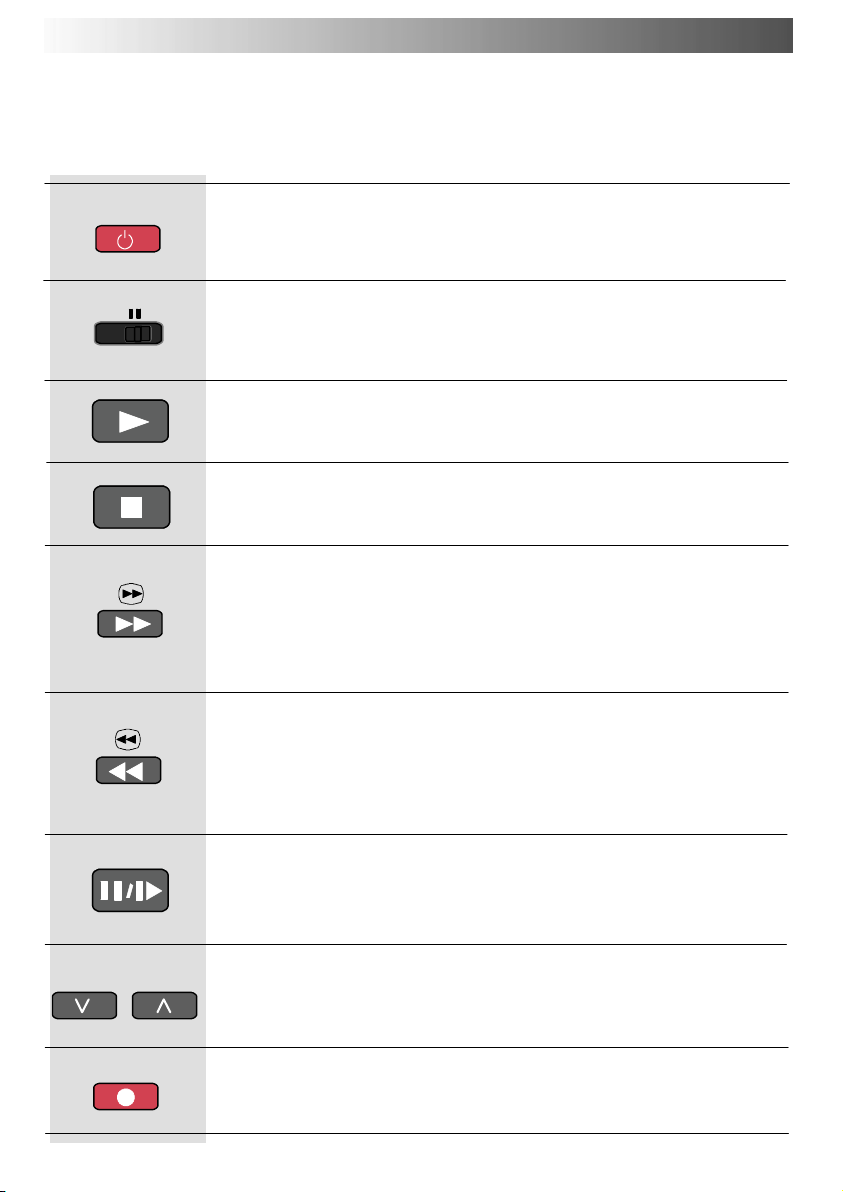
VCR/DVD/ROPERATION
The Remote Control is capable of operating some functions of selected Panasonic VCRs and DVD
(Digital Versatile Disc) equipment. Some VCR and DVD equipment have different functions, so to
ensure compatibility please refer to the equipment’s instruction book or consult your dealer for
details.
Standby
Press to switch the VCR or DVD to standby mode.
Press again to switch back on.
VCR DVD
VCR / DVD switch
Use this switch to select whether controls operate DVD equipment or
your VCR.
Play
Press to playback the tape or DVD.
Stop
Press to stop the tape or DVD.
Skip/FastForward/Cue
VCR: Press to fast forward the tape. In Play mode, press to view the
picture rapidly forward.
DVD: Press once to skip to the next track. In play mode press and hold
to view the picture rapidly forward.
Skip / Rewind / Review
VCR: Press to rewind the tape. In Play mode, press to view the picture
rapidly in reverse.
DVD: Press once to skip to the previous track. In play mode press and
hold to view the picture rapidly in reverse.
Pause / Still
Press in playback mode, the picture will pause.
Press again to restart play.
PROGRAMME
REC
28
Programme Up / Down
Press to increase or decrease the VCR programme position by one.
Record
Press this button to start recording.
Page 29
TELETEXT OPERATION
D Teletext features may vary depending on the Broadcasting Companies and is only available if the
channel selected is transmitting Teletext.
D Pressing the MENU button twice whilst in Teletext operation will display the contrast functionwith a
cyan bar, press A"to alter the setting as required.
Pressing the MENU button once whilst in Teletext operation will display special function options at
the bottom of the screen.
D When in Teletext mode, the volume may still be altered to the desired listening level.
What is LIST mode?
In LIST mode, four differently coloured page numbers are situated at the bottom of the screen. Each
of these numbers can be altered and stored in the TV’s memory.
What is FLOF (FASTEXT)?
In FASTEXT mode, four differently coloured subjects are situated at the bottom of the display. To
access more information about one of these subjects, press the appropriately coloured button. This
facility enables fast access to information of the subjects shown.
What is TOP Teletext?
TOP Teletext makes the task of selecting the desired Teletext pages easier and shorter. In fact page
access time is almost instantaneous, just press the button and the page appears.
How does it work?
TOP Teletext uses the four coloured buttons, Red, Green, Yellow and Blue to select the following
information.
D To move between subject blocks (SPORT for example) use the Blue button. Within this SPORT
topic it is possible to select different groups such as Tennis, Football, Baseball etc, by using the
Yellow button. When the last group within the block is reached, the yellow button moves to the next
block.
D TheGreenbuttonwillselectthenextavailablepageUP.
D TheRedbuttonwillselectthenextavailablepageDOWN.
What are the advantages?
D Page selection at the touch of a single button.
D Easy to use step---by ---step selection of the topical subject.
D Reduction of waiting time.
D If a non existent page number is entered, a question mark will appear at the bottom of the
screen.
D Page status line at the bottom of the screen so you always know which button will take you to the
information required
.
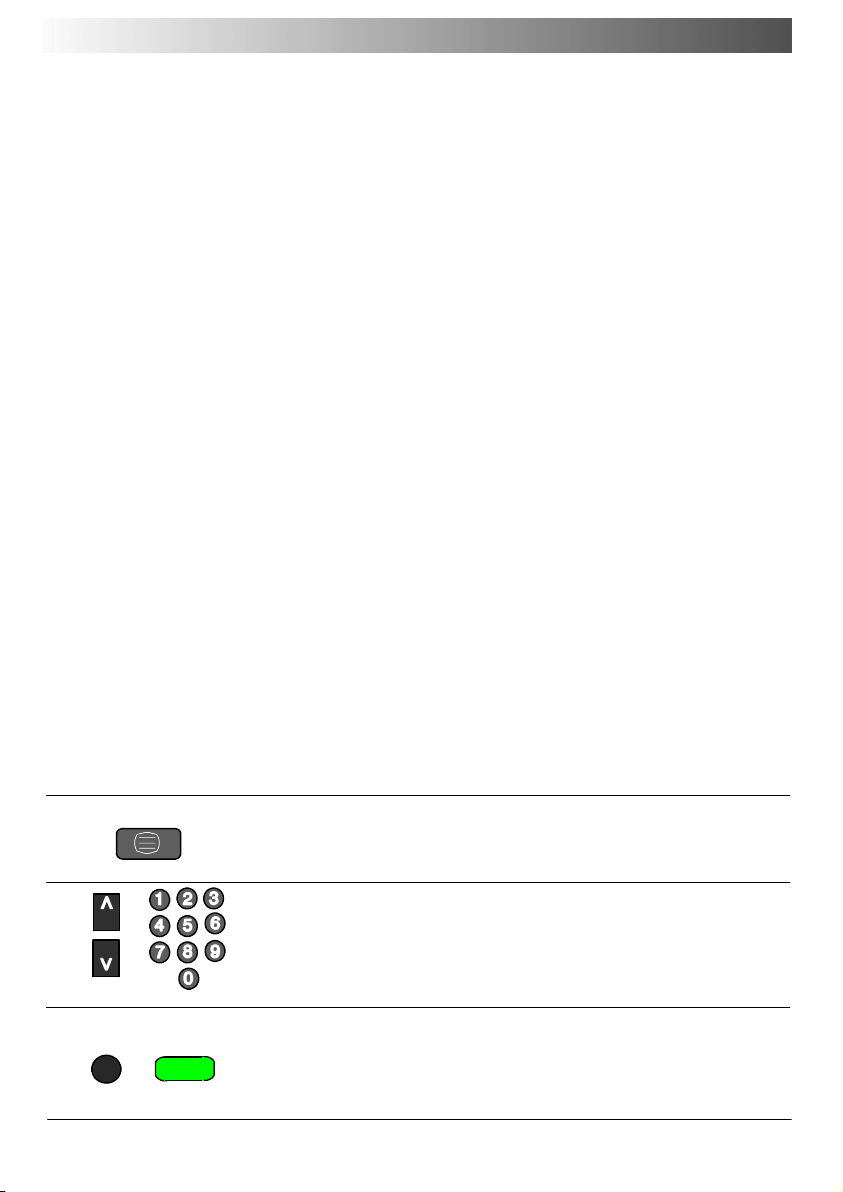
TV/TEXT
MENU
TV / Teletext mode
Press the TV/TEXT button.
The screen will display the Te letext page.
PressagainwhenyouwishtoreturntoTV.mode.
Page Selection
Pages can be selected in two ways :
a. Press the ∧ / ∨ buttons to increase or decrease the page
number by one.
b. By entering the page number, using 0 -- 9ontheremote
control.
Full/Top/Bottom
Press the MENU button to display special functions, followed by
the Green button to expand TOP half.
Press the Green button again to expand the BOTTOM half.
Press again to return to normal (FULL) size.
29
Page 30
TELETEXT OPERATION
It is not possible to change the programme position when in News flash, Update or Sub Coded Page
Access operation.
MENU
MENU
HOLD
F. P.
Reveal
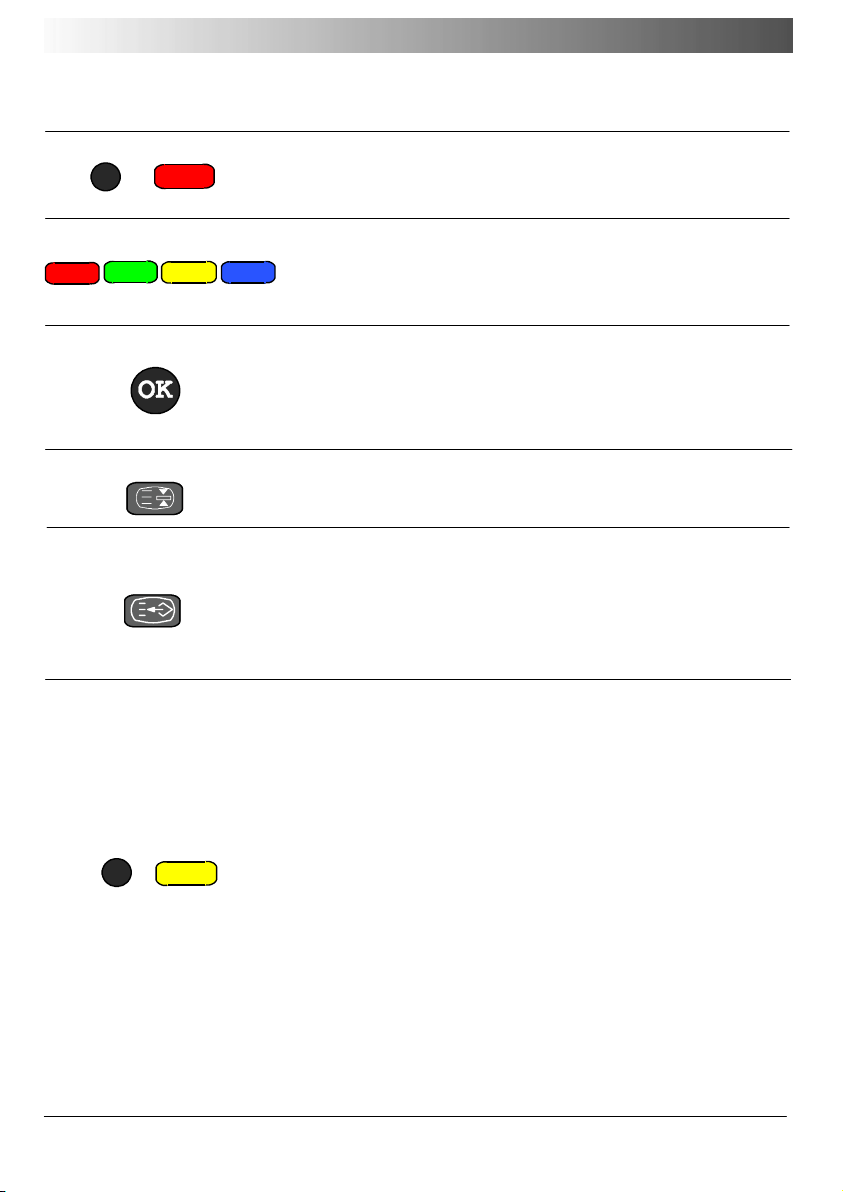
Press the MENU button to display special functions, followed by
the Red button to reveal hidden words e.g. quiz page answers.
Press again to hide.
Red / Green / Yellow / Blue buttons
In TOP/FASTEXT mode these correspond to the differently
coloured subjects.
In LIST mode they correspond to the differently coloured page
numbers.
List Store
InLISTmodethefourpagenumberscanbealteredforchannel
positions 1 -- 25 only.
To do this, press one of the coloured buttons and enter the new
page number.
Press and hold OK, the page numbers will change colour.
Hold
To hold the Teletext page when viewing multi-- page information.
Press again to return to automatic page update.
Favourite Page (F.P.)
Stores a favourite page in memory for instant recall. To store
suchapage,theTVmustbeinLISTmode,andtheprogramme
position must be from 1 -- 25. Press the Blue button, select the
pagenumber,thenpressandholdtheOK button. The page
number is now stored.
Press F. P. to recall this page.
Update Display
Press the MENU button to display special functions, followed by
the Ye ll ow button to view the TV picture whilst searching for a
Tel e t ex t p ag e.
Whenfound,thescreenwilldisplaythepagenumberatthetop
left.
Press the Ye ll ow button to view the page.
Press TV/TEXT again to return to normal TV operation.
News Flash
When a news flash page has been selected, press MENU,
Yel l o w, to view the TV picture. When an update is received, the
page number will be displayed on screen.
Press the Ye ll ow button to display the News Flash
Press TV/TEXT to return to normal TV. operation.
Update
Press MENU, Ye ll ow to see the update of information on certain
pages.
When an update is received, the page number will be displayed
atthetopleftofthescreen.
Press the Ye ll ow button to view the page.
Press TV/TEXT to return to normal TV. operation.
30
Page 31
AUDIO / VIDEO CONNECTIONS
V/A
V
AV Select and Setup
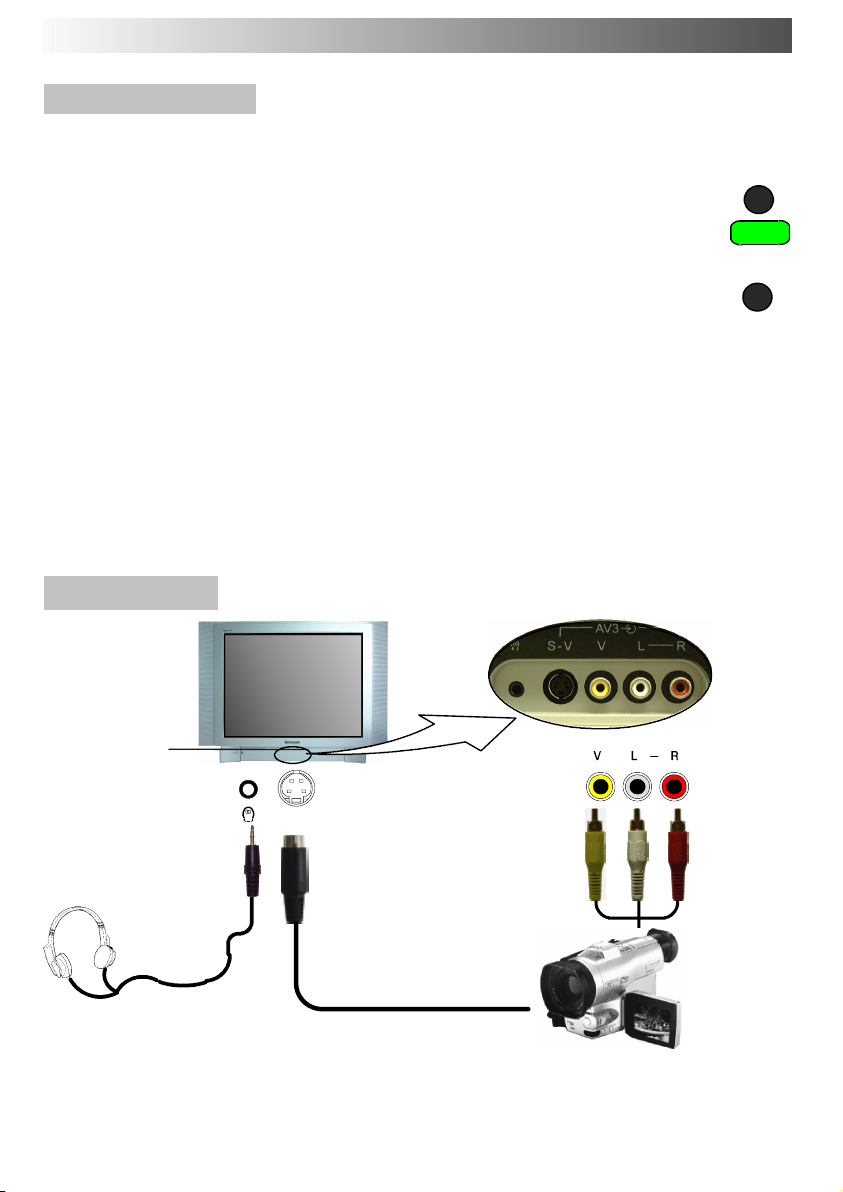
It is possible to connect a variety of additional equipment to this TV. The following pages detail how to
connect external equipment to both the front and rear of the TV.
Once your equipment is connected, use the following procedure to view the input:
Press the TV/AV menu button
Press the relevant on screen selector key to select the AV source you wish to view (for
example, press the green button to select AV2 if you have connected a video recorder
to the AV2 SCART socket).
The on screen selector keys that appear clear after a few seconds. If you want to select
an input when the keys are not shown, press the TV/AV key once more and the keys
will reappear.
Notes:
D This television may automatically switch over to the AV mode if the connected device sends a
switchsignaltotheSCARTcableconnector.Inthiscase,the“EC”willbedisplayedinthelefttop
corner of the screen and the signal from the AV equipment (for the RGB signal the “EC/RGB” will be
displayed).The picture received will remain the same when the TV programme is changed.
D You may switch back to the television by pressing button “TV/AV” or by disconnecting the AV
device.
D You can also select an AV source using the TV/AV button on the control panel on the front of your
TV. Press the TV/AV button repeatedly until you reach the AV source you wish to view.
D When in AV mode a reduced number of options are available in the SOUND and SETUP menus
(eg: in the Setup menu there is no Tuning menu option).
Front sockets
T
TV/AV
Press and
release to open
S --- V
Video input to
S --- V i de o
socket
Output from
Headphones socket
3.5mm Stereo
Plug
STEREO HEADPHONES
with 3.5mm Plug
Notes:
D Additional equipment and cables shown are not supplied with this TV set.
D For S---Video socket wiring information see page 33.
Video input
to V socket
RCA Video
cable
Audio input
to L/R
sockets
2xRCA
Audio
cables
CAMCORDER
31
Page 32
AUDIO / VIDEO CONNECTIONS
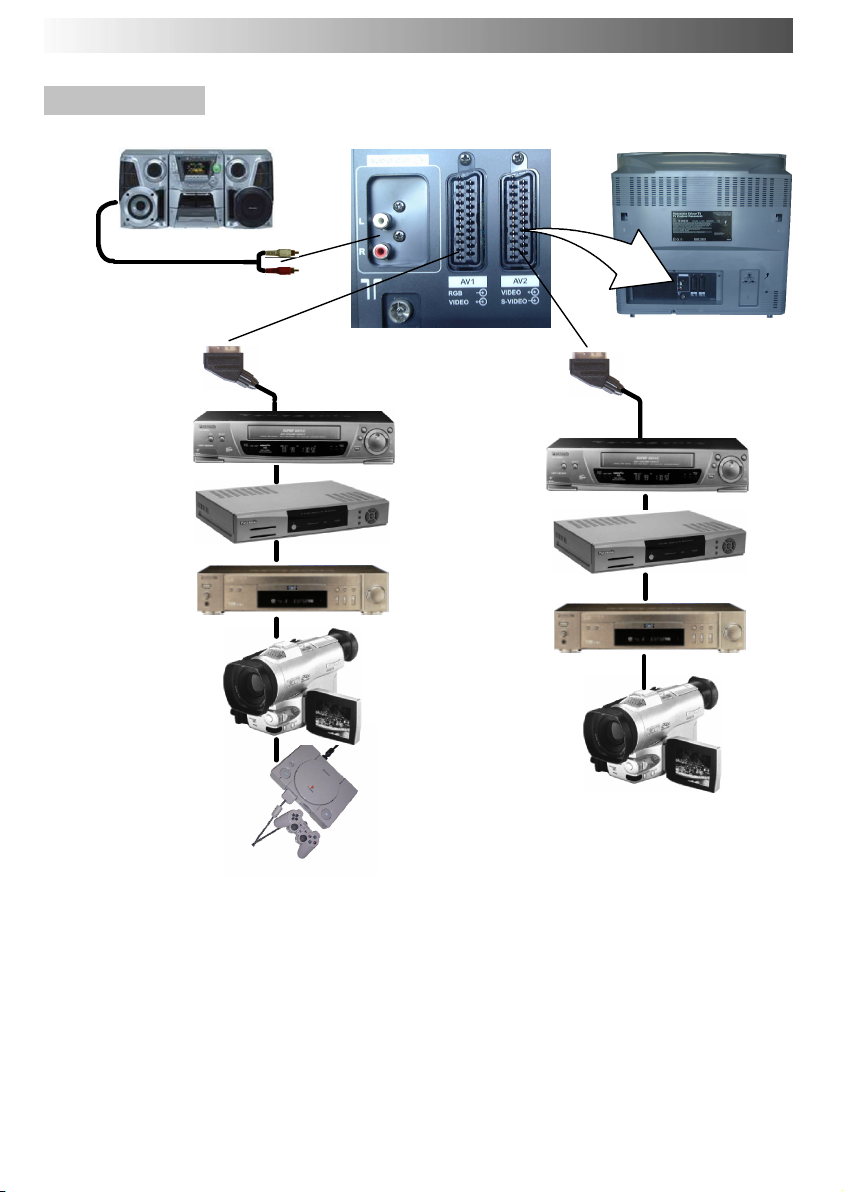
Rear sockets
HI-- FI
SYSTEM
2xRCAAudioCables
Output from L-- RAUDIO
OUT Sockets
SCART Cable
VCR
Q-- LINK COMPATIBLE
VCR
SATELLITE RECEIVER
DVD PLAYER
CAMCORDER
GAMES C ONSOLE /
COMPUTER (RGB)
Notes:
D Additional equipment and cables shown are not supplied with this TV set.
D Do not connect a computer with TTL output (5V) to this set.
Input/Output from AV1
SCART Socket
Q-- Link data
SCART Cable
VCR
S-- VIDEO VCR
Q-- LINK COMPATIBLE VCR
SATELLITE RECEIVER
DVD PLAYER
S-- VIDEO CAMCORDER
Input/Output from
AV2 SCART Socket
Q-- Link data
32
Page 33

AUDIO / VIDEO CONNECTIONS
Scart and S--- Video socket information
AV1 21 pin SCART terminal
Socket Earth
CVBS out (video)
CVBS earth
Red in
Red earth
Green in
Green earth
Blue in
Blue earth
Audio out (L)
Audio out (R)
21
19
17
15
13
11
9
7
5
3
1
20
18
16
14
12
10
8
6
4
2
Suitable inputs for AV1 include RGB
(Red/Green/Blue).
AV221pinSCARTterminal
Socket Earth
CVBS out (video)
CVBS earth
S.C. --- In
Earth
--- ---
Earth
--- ---
--- ---
Audio out (L)
Audio out (R)
21
19
17
15
13
11
9
7
5
3
1
20
18
16
14
12
10
8
6
4
2
CVBS in (video)
RGB status earth
Status RGB
Earth
--- ---
Q --- Li n k d a t a
Status CVBS
Audio in (L)
Audio earth
Audio in (R)
CVBS in (video)
Earth
--- ---
--- ---
--- ---
Q --- Li n k d a t a
Status CVBS
Audio in (L)
Audio earth
Audio in (R)
AV2 --- Pins 15 and 20 are dependent on AV2
S--- VHS / VIDEO switching.
S --- V i d e o 4 p i n s o c k e t
Chrominance earth
Luminance inChrominance in
Luminance earth
33
Page 34
Check
s
TROUBLESHOOTING
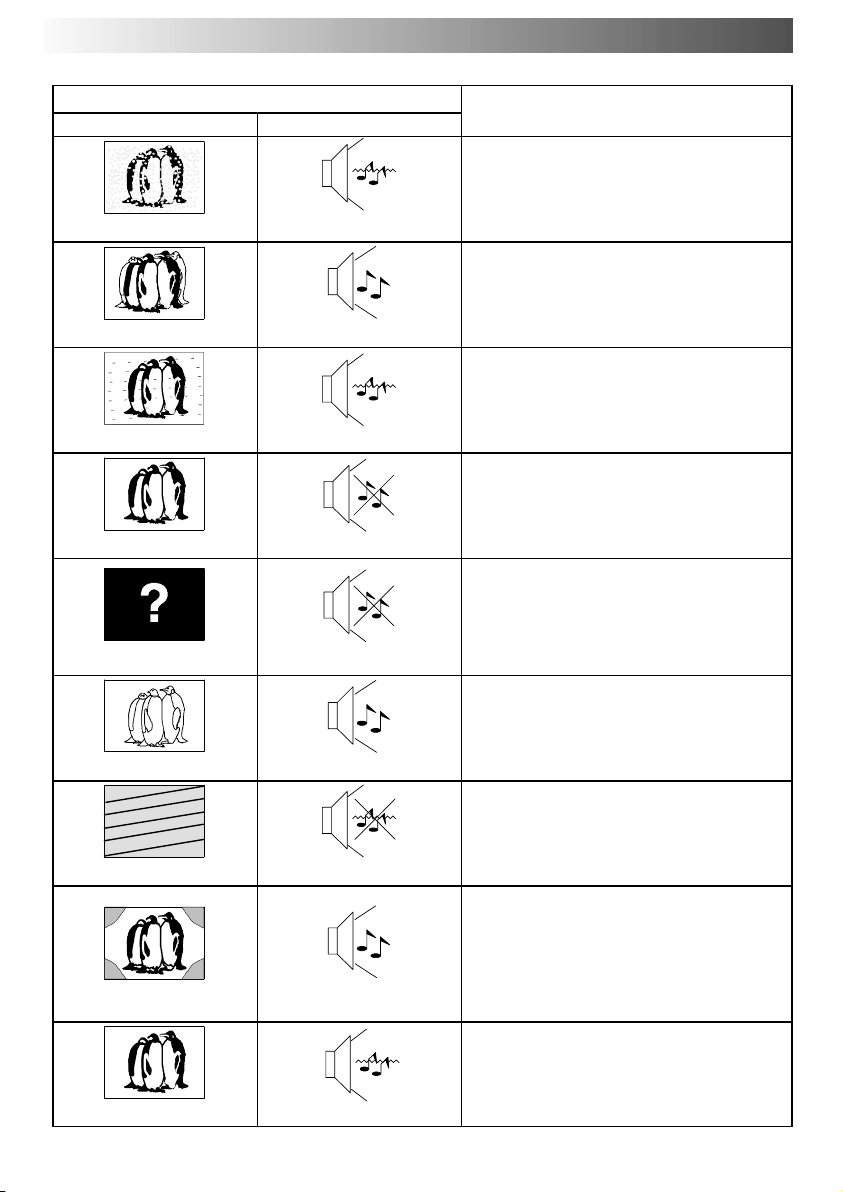
Symptoms
Picture
Sound
Aerial location, direction or connection
Snowy Picture
Multiple Images
Interference
Normal Picture
No Picture
No Colour
Noisy Sound
Normal Sound
Noisy Sound
No Sound
No Sound
Normal Sound
Aerial location, direction or connection
Electrical appliances
Cars / Motorcycles
Fluorescent lights
Switch on P ---NR in Picture menu to
reduce picture noise
Volume level
Sound mute switched on
TV set to AV mode
Not plugged into A.C. outlet
Not switched on
Picture / Sound controls set at
minimum levels
Check if in standby mode
Colour controls set at minimum levels
Poor or Distorted Picture
Coloured Patches
Normal Picture
34
Weak or No Sound
Normal Sound
Weak or distorted sound
Retune Channel(s)
Magnetic Interference from unshielded
equipment
Receiver moved while switched ON,
switch TV off for 30 minutes.
If picture is also tilted, use
Geomagnetic Correction feature (see
Quick Start Guide, page 6)
Sound reception may have
deteriorated.
Switch MPX setting (Sound menu) to
Mono until reception improves.
Page 35
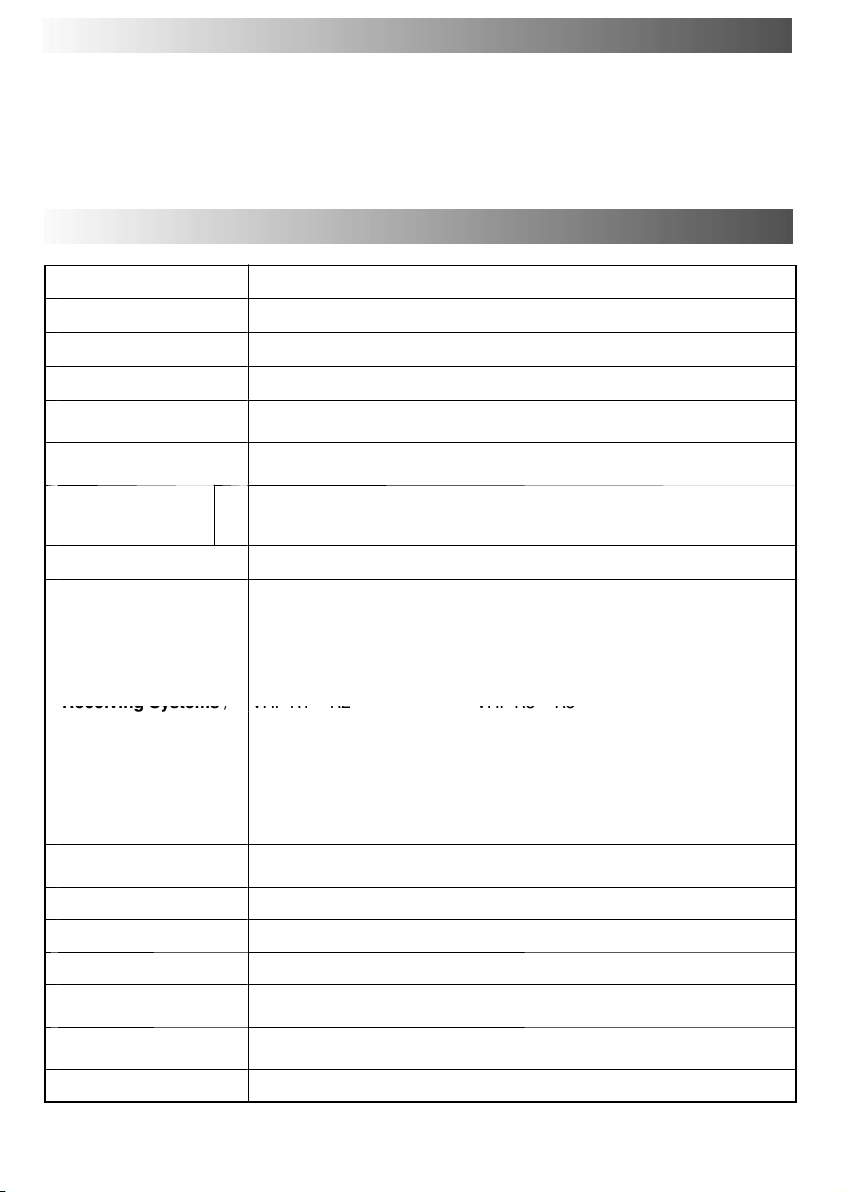
ReceivingSystems/
VHFR1R2VHFR3R
5
FORYOURGUIDANCE
Service :
Before requesting service, please refer to the troubleshooting guide on p revious page to determine
the symptoms. To obtain service please contact your local Panasonic dealer quoting the model
number and serial number (both are located at the rear of the TV).
SPECIFICATIONS
TX-- 29E40D
Power Source 220 -- 240 V AC 50 Hz
Power Consumption 101 W
Standby Consumption
Picture Tube
Visible Diagonal
Audio Output
Music Power
H
Dimensions
Weight 49,5 kg
ReceivingSystems /
Band name
Number of
programme positions
Te l e te x t P a ge s 250
Aerial -- Rear UHF / VHF
Headphones -- Front 3,5 mm, 8 Ω impedance
Rear Audio monitor
out
AV -- Rear
AV -- Front AV3 -- S ---Video in, 2 x RCA Audio in, 1 x RCA Video in.
Specifications are subject to change without notice. Weight and dimensions shown are approximate.
W
D
PAL B/G, PAL I, SECAM B/G, SECAM L/L’
VHF E2 -- E12 VHF H1 -- H2 (ITALY)
VHF A -- H(ITALY) UHFE21-- E69
CATV (S01 -- S05) CATV S1 -- S10 (M1 -- M10)
CATV S11 -- S20 (U1 -- U10) CATV S21 -- S41 (Hyperband)
PAL D/K, S ECA M D/K
VHF R1 -- R2 VHF R3 -- R5
VHF R6 -- R12 UHF E21 -- E69
PAL 525/60 Playback of NTSC tape from some PAL video recorders
(VCR)
M.NTSC (AV input only) Playback from NTSC 4,43 MHz
Videorecorders (VCR)
NTSC (AV input only) Playback from NTSC Videorecorders
(VCR)
AV1 -- 21 pin terminal -- Audio / Video in / out, RGB in, Q--- Link.
AV2 -- 21 pin terminal -- Audio/Videoin/out,S-- Video in, Q-- Link
2x10WRMS(2x20WMPO),8Ω
2 x RCA Audio Monitor Out , 500 mV RMS
0,9 W
68 cm
585 mm
776 mm
533 mm
99 + VCR
35
Page 36

2003CS
36
 Loading...