What you need to know about the safety instructions 4
Important safety symbols 4
CALIFORNIA PROPOSITION 65 WARNING 5
Contents
Important safety precautions 5
Installation 13
Unpacking your washer 13
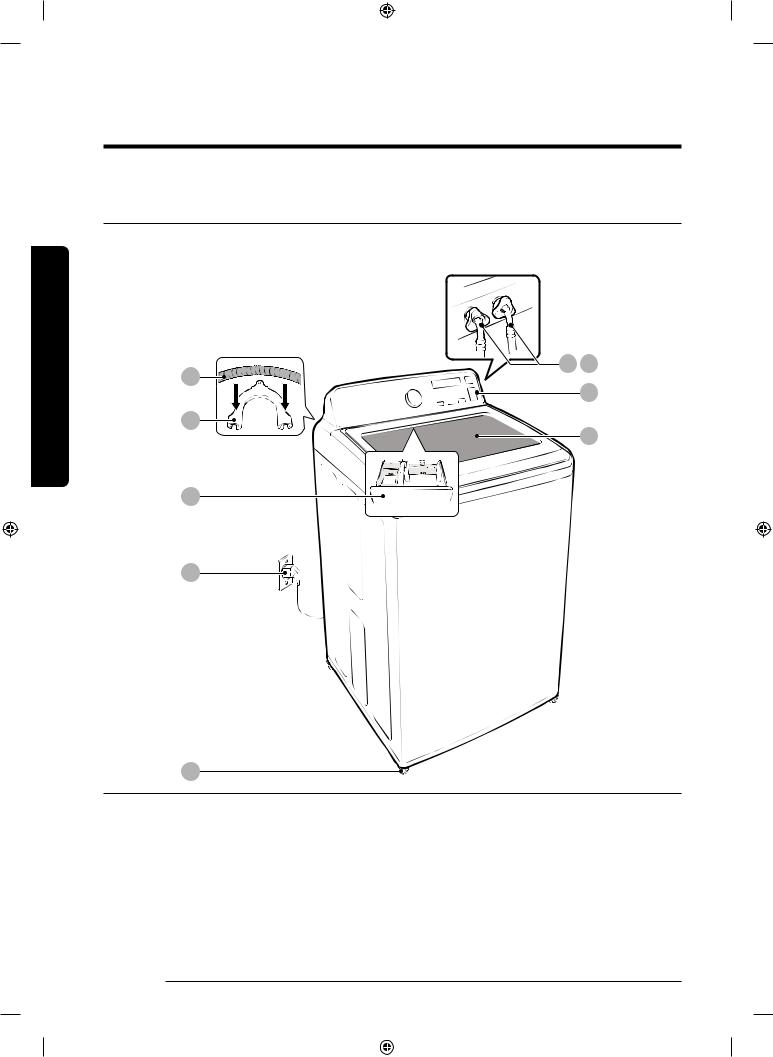
Overview of your washer 14
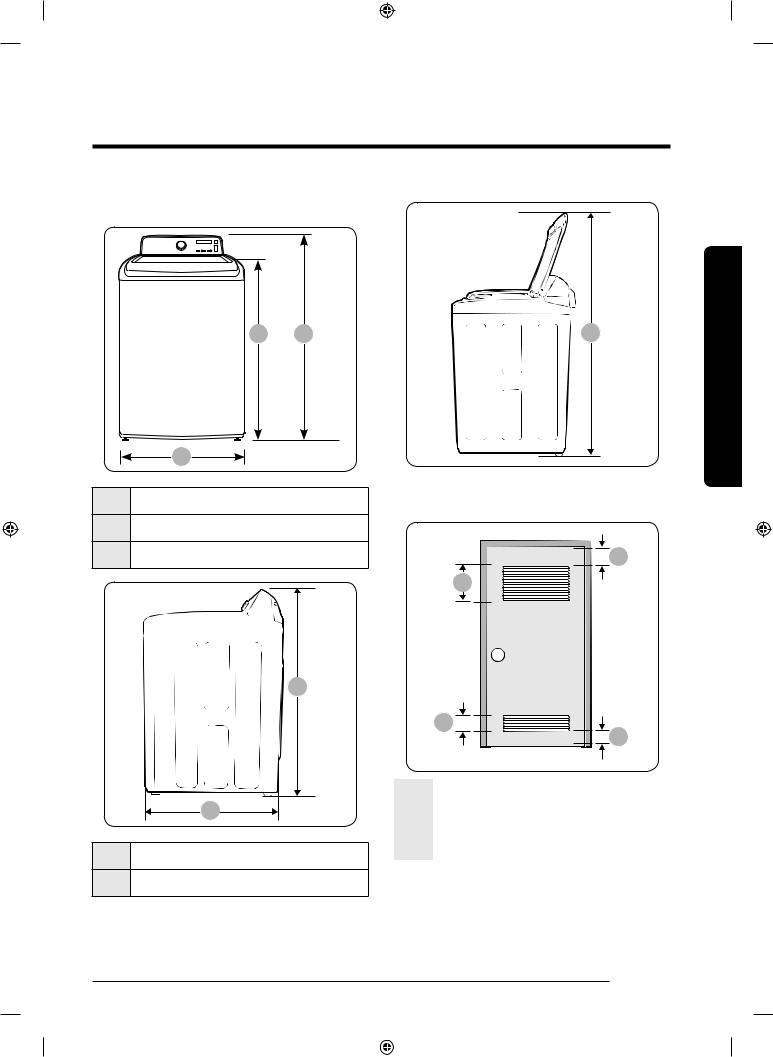
Basic location requirements 16
Step-by-step installation 20
Before you start 28
Loading your washer 28
Getting started 30
Operations 31
Control panel 31
Cycle overview 33
Options 34
Washing clothes using the cycle selector 36
ATC (Auto Temperature Control) 37
Detergent use 37
Features 38
Maintenance 42
Cleaning the exterior 42
Cleaning the interior 42
Storing your washer 42
Preserving the top cover and the front frame 43
Cleaning mesh lter 43
Cleaning the detergent drawer 44
Self Clean 46
Congratulations on your new Samsung washer. This manual contains important information
on the installation, use and care of your appliance. Please take some time to read this manual
to take full advantage of your washer’s many benets and features.
What you need to know about the safety instructions
Safety information
Please read this manual thoroughly to ensure that you know how to safely and efciently
operate the extensive features and functions of your new appliance. Please store the manual
in a safe location close to the appliance for future reference. Use this appliance only for its
intended purpose as described in this instruction manual.
Warnings and Important Safety Instructions in this manual do not cover all possible
conditions and situations that may occur. It is your responsibility to use common sense,
caution and care when installing, maintaining and operating your washer.
Because the following operating instructions cover various models, the characteristics of your
washer may differ slightly from those described in this manual and not all warning signs
may be applicable. If you have any questions or concerns, contact your nearest service center
or nd help and information online at www.samsung.com.
Important safety symbols
What the icons and signs in this user manual mean:
Hazards or unsafe practices that may result in severe personal injury, death and/or property
damage.
Hazards or unsafe practices that may result in personal injury and/or property damage.
WARNING
CAUTION
NOTE
Indicates that a risk of personal injury or material damage exists.
These warning signs are here to prevent injury to yourself and others.
Please follow them explicitly.
After reading this manual, store it in a safe place for future reference.
Read all instructions before using the appliance.
As with any equipment that uses electricity and moving parts, potential hazards exist. To
safely operate this appliance, familiarize yourself with its operation and exercise care when
using it.
CALIFORNIA PROPOSITION 65 WARNING
WARNING
Cancer and Reproductive Harm - www.P65Warnings.ca.gov.
Important safety precautions
WARNING
To reduce the risk of re, electric shock, or injury to persons when using your appliance,
follow basic precautions, including the following:
1. Read all instructions before using this appliance.
2. Do not wash or dry articles that have been previously cleaned in, washed in, soaked in, or
spotted with gasoline, dry-cleaning solvents, other ammable or explosive substances as
they give off vapors that could ignite or explode.
3. Do not allow children to play on or in the appliance. Close supervision of children is
necessary when the appliance is used near children.
4. Before the appliance is removed from service or discarded, remove the lid of the washing
or drying compartment.
5. Do not reach into the appliance if the drum is moving.
6. Do not install or store this appliance where it will be exposed to the weather.
7. Do not tamper with the controls.
8. Do not repair or replace any part of the appliance or attempt any servicing unless it is
specically recommended in the user-maintenance instructions or in published userrepair instructions that you understand and have the skills to carry out.
9. Do not add gasoline, dry-cleaning solvents, or other ammable or explosive substances to
10. Under certain conditions, hydrogen gas may be produced in a hot water system that
Safety information
Critical installation warnings
Plug the power cord into an AC 120 V / 60 Hz/wall socket rated at 15 amps or higher. Use
the socket for this appliance only. In addition, do not use an extension cord.
• Sharing a wall socket with other appliances, using a power strip, or extending the power
• Do not use an electric transformer. It may result in electric shock or re.
• Ensure that the power voltage, frequency, and current match the product’s specications.
the wash water. These substances give off vapors that could ignite or explode.
has not been used for 2 weeks or more. HYDROGEN GAS IS EXPLOSIVE. If the hot water
system has not been used for 2 weeks or more, before using a washer or combination
washer-dryer, turn on all hot water faucets and let the water ow from each for several
minutes. This will release any accumulated hydrogen gas. As the gas is ammable, do not
smoke or use an open ame during this time.
WARNING
cord may result in electric shock or re.
Failing to do so may result in electric shock or re.
Have this appliance installed by a qualied technician or service company.
• Failing to do so may result in electric shock, re, an explosion, problems with the product,
or injury.
Remove all foreign substances such as dust or water from the power plug terminals and
contact points using a dry cloth on a regular basis.
• Unplug the power plug and clean it with a dry cloth.
• Failing to do so may result in electric shock or re.
Plug the power plug into the wall socket in the right direction so that the cord runs towards
the oor.
• If you plug the power plug into the socket in the opposite direction, the electric wires
within the cable may be damaged and this may result in electric shock or re.
This appliance must be properly grounded.
Do not ground the appliance to a gas pipe, plastic water pipe, or telephone line.
• Improper grounding may result in electric shock, re, an explosion, or problems with the
product.
• Never plug the power cord into a socket that is not grounded correctly. Make sure the
socket you use is grounded in accordance with local and national codes.
Safety information
Do not install this appliance near a heater or ammable material.
Do not install this appliance in a humid, oily, or dusty location, or in a location exposed to
direct sunlight or water (rain drops).
Do not install this appliance in a location where gas may leak.
• This may result in electric shock or re.
Plug the power plug into the wall socket rmly. Do not use a damaged power plug, damaged
power cord, or loose wall socket.
• This may result in electric shock or re.
Do not pull or excessively bend the power cord.
Do not twist or tie the power cord.
Do not hook the power cord over a metal object, place a heavy object on the power cord,
insert the power cord between objects, or push the power cord into the space behind the
appliance.
• This may result in electric shock or re.
Do not pull the power cord when unplugging the power plug.
• Unplug the power plug by holding the plug.
• Failing to do so may result in electric shock or re.
If the power plug or power cord are damaged, contact your nearest service center.
Installation cautions
CAUTION
Position the appliance so that the power plug is easily accessible.
• Failing to do so may result in electric shock or re due to electric leakage.
Install your appliance on a level and hard oor that can support its weight.
• Failing to do so may result in abnormal vibrations, noise, or problems with the product.
Unplug the power plug when the appliance is not being used for long periods of time or
during a thunder/lightning storm.
•Failing to do so may result in electric shock or re.
Critical usage warnings
Safety information
If the appliance is ooded, cut the power immediately and contact your nearest service
center.
If the appliance emits a strange noise, a burning smell, or smoke, unplug the power plug
immediately and contact your nearest service center.
•Failing to do so may result in electric shock or re.
In the event of a gas leak (such as propane gas, LP gas, etc.), ventilate the area immediately.
Do not turn any appliance or light on or off.
•Do not use a ventilating fan.
•A spark may result in an explosion or re.
WARNING
Do not wash items contaminated with gasoline, kerosene, benzene, paint thinner, alcohol or
other ammable or explosive substances.
•This may result in electric shock, re, or an explosion.
Do not force the washer lid open while the washer is operating (high-temperature washing/
drying/spinning).
•Water owing out of the washer may cause burns or cause the oor to be slippery.
This may result in injury.
Forcing the lid open can damage the product or cause injury.
•
Make sure to remove the packaging (sponge, styrofoam) attached to the bottom of the
washer before using it.
Do not turn the appliance off by unplugging the power plug while the washer is in operation.
•Plugging the power plug into the wall socket again may cause a spark and result in
electric shock or re.
Keep all packaging materials well out of the reach of children, as packaging materials can be
dangerous to children.
•If a child places a bag over their head, the child may suffocate.
Do not let children or inrm persons use this washer unsupervised.
•Failing to do so may result in electric shock, burns or injury.
Do not insert your hand or a metal object under the washer while it is operating.
•This may result in injury.
Do not attempt to repair, disassemble, or modify the appliance yourself.
•Do not use any fuse (such as copper, steel wire, etc.) other than the standard fuse.
•If you need to repair or reinstall the appliance, contact your nearest service center.
•Failing to do so may result in electric shock, re, problems with the product, or injury.
If any foreign substance such as water enters the appliance in any area other than the tub,
unplug the power plug and contact your nearest service center.
•Failing to do so may result in electric shock or re.
If the water supply hose comes loose from the faucet and oods the appliance, unplug the
power plug.
•Failing to do so may result in electric shock or re.
Safety information
For waterproof fabrics, only use the BEDDING/WATERPROOF cycle.
•Do not use other cycles for waterproof fabrics. This may result in injury or damage to the
washer, walls, oor, or clothing due to abnormal vibrations.
•Set the temperature and spin according to the attached care label.
•WARNING : Failure to closely follow these instructions may result in an abnormal
vibrating and out-of-balance condition that could result in physical injury, property
damage, and/or appliance damage.
If the washer is contaminated by a foreign substance such as detergent, dirt, food waste, etc.,
unplug the power plug and clean the washer using a damp, soft cloth.
Safety information
•Failing to do so may result in discoloration, deformation, damage or rust.
The clear portion of the lid can be broken by a strong impact. Take care when using the
washer.
•If the clear portion is cracked or broken, it may result in injury.
After a water supply failure or when reconnecting the water supply hose, open the faucet
slowly.
Open the faucet slowly after a long period of non-use.
•The air pressure in the water supply hose or the water pipe may result in damage to a
CAUTION
part or in water leakage.
If a drain error occurs during an operation, check if there is a draining problem.
•If the washer is used when it is ooded because of a draining problem, it may result in
electric shock or re due to electric leakage.
Do not insert your hand under the washer.
•This may result in injury.
Insert the laundry into the washer completely so that laundry does not get caught in the lid.
•If laundry gets caught in the lid, it may result in damage to the laundry or the washer, or
result in water leakage.
Ensure that the faucet is turned off when the washer is not being used.
•Ensure that the water supply hose connectors are properly tightened.
•Failing to do so may result in property damage or injury.
Open the faucet and check if the water supply hose connector is rmly tightened and that
there is no water leaking before using the product.
•If the water supply hose connectors are loose, it may result in water leakage.
Do not stand on top of the appliance or place objects (such as laundry, lighted candles,
lighted cigarettes, dishes, chemicals, metal objects, etc.) on the appliance.
•This may result in electric shock, re, problems with the product, or injury.
Do not use hot water from water cooling/heating devices.
•This may result in problems with the washer.
Do not use natural hand-washing soap in the washer.
•If it hardens and accumulates inside the washer, it may cause problems with the product,
discoloration, rust, or bad odors.
Safety information
Do not wash large laundry items such as bedding in the washing net.
•Failing to do so may result in injury due to abnormal vibrations.
•Place smaller items, such as lace socks and lingerie in the washing net.
Do not use hardened detergent.
•If it accumulates inside the washer, it may result in water leakage.
Do not wash throw rugs or doormats.
•If you wash throw rugs or doormats, the sand will accumulate inside the washer. It may
Critical cleaning warnings
Do not clean the appliance by spraying water directly onto it.
Do not use the strong acid cleaning agent.
Do not use benzene, paint thinner, or alcohol to clean the appliance.
•This may result in discoloration, deformation, damage, electric shock, or re.
Before cleaning or performing maintenance, unplug the appliance from the wall socket.
•Failing to do so may result in electric shock or re.
Follow these instructions carefully to ensure proper installation of the washer and to prevent
accidents when using it.
WARNING
Certain internal parts are intentionally not grounded and may present a risk electric shock
only during servicing. Service personnel – Do not contact the following parts while the
appliance is energized: Control board, heat sink, motor, inlet valve, heater and pump.
Unpacking your washer
Unpack your washer and inspect it for shipping damage. Make sure you have received all the
items shown below. If your washer was damaged during shipping, or you do not have all of
the items, contact 1-800-SAMSUNG (1-800-726-7864).
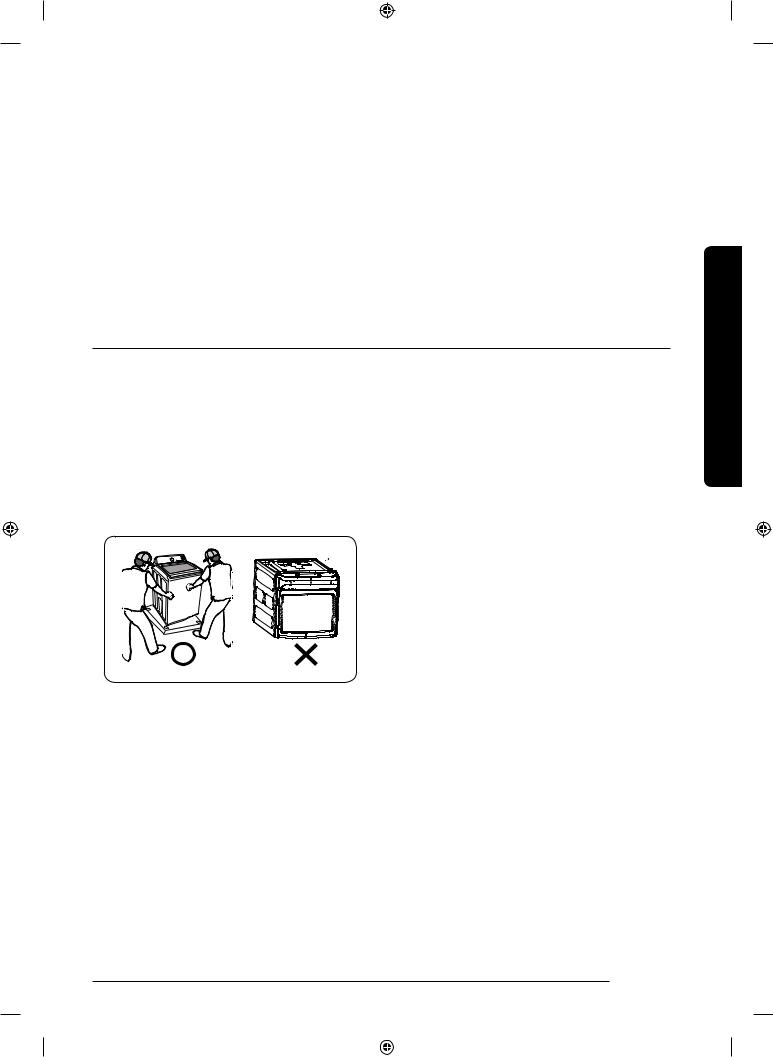
To prevent personal injury or strain, wear protective gloves whenever lifting or carrying the
unit.
WARNING
Packing materials can be dangerous to children; Keep all packing material (plastic bags,
polystyrene, etc.) well out of children’s reach.
CAUTION
When unpacking the washer, 2 person
collaboration is needed. To remove the
cushion bottom of the packing materials,
forward dumping is strictly prohibited.
When you lay the washer down to remove
carton base, should protect the side of
washer and lay it carefully. Never lay your
washer on its back or front.
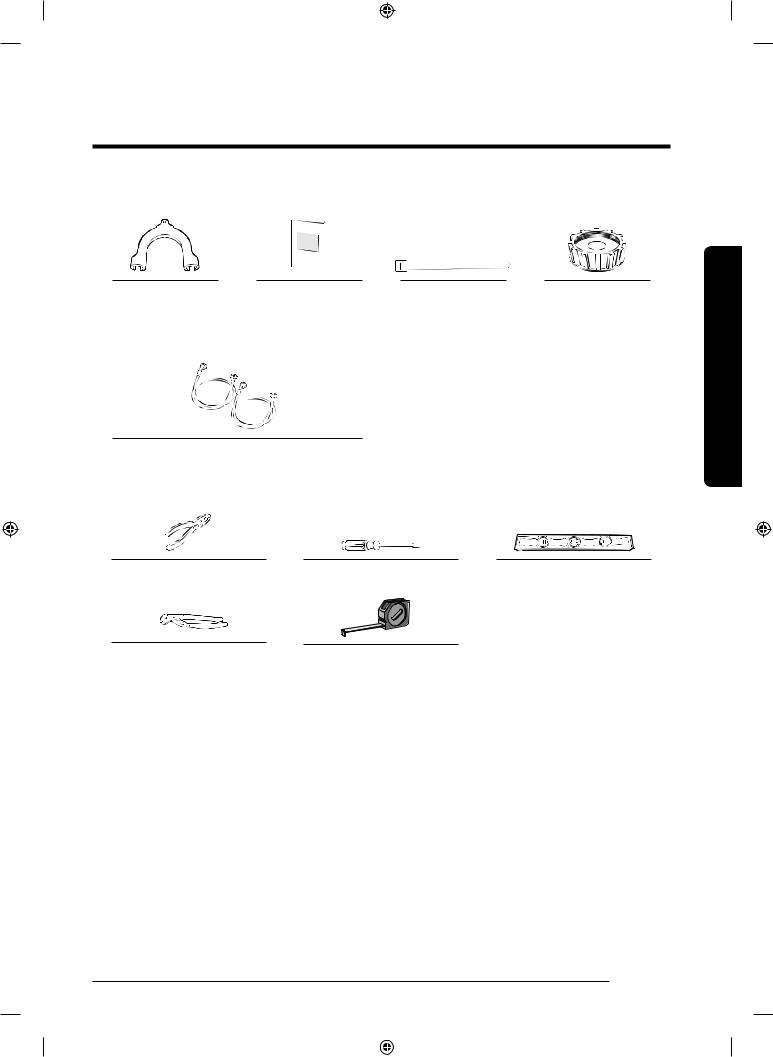
Make sure all the parts are included in the product package. If you have a problem with
the washer or the parts, contact a local Samsung customer center or the retailer.
Hose guideUser manualPlastic zip hose tieWater intake cap
Parts not supplied
Water supply hoses
Tools needed for installation
WrenchFlat screwdriverLeveller
Adjustable PlierMeasuring tape
NOTE
•If you lose an accessory and want to purchase a replacement, contact the Samsung
service center (1-800-SAMSUNG (1-800-726-7864)).
•The design of the parts and accessories may differ from the pictures above.
Their design is subject to change without notice for product improvement.
•Do not reuse old hoses. Only use new water supply hoses when you install the washer.
Old water supply hoses can leak or burst causing ooding and property damage.
•Conrm that there are rubber washers inside each coupling of the water supply hoses.
•Individual branch circuit serving only
your Washer is recommended.
•Your washer is equipped with a power
cord.
CAUTION
Never use an extension cord.
Grounding
Electrical grounding is required for this
appliance.
This appliance must be grounded. In
the event of malfunction or breakdown,
grounding will reduce the risk of electric
shock by providing a path of least resistance
for electric current.
This appliance is equipped with a power
cord having a three-prong grounding plug
for use in a properly installed and grounded
outlet.
The plug must be plugged into an
appropriate outlet that is properly installed
and grounded in accordance with all local
codes and ordinances.
WARNING
An improperly connected equipmentgrounding conductor can increase the risk
of electrical shock. Check with a qualied
electrician or serviceman if you are not sure
whether the appliance is properly grounded.
Do not modify the plug provided with the
appliance – if it does not t the outlet, have
a proper outlet installed by a qualied
electrician.
Important safety precautions
To prevent unnecessary risk of re,
electrical shock or personal injury, all wiring
and grounding must be done in accordance
with the National Electrical Code ANSI/
FNPA, No.70 Latest Revision and local
codes and ordinances. It is the personal
responsibility of the appliance owner to
provide adequate electrical service for this
appliance.
CAUTION
Never connect the ground wire to plastic
plumbing lines, gas lines, or hot water pipes.
To correctly ll your Washer in the proper
amount of time, water pressure of 20 to
116 psi (137 to 800 kPa) is required.
Water pressure less than 20 psi may cause
water valve failure, or may not allow the
water valve to shut off completely, or may
extend the ll time beyond what your
Washer controls allow, causing your Washer
to turn off. A time limit is built into the
controls to prevent ooding in your home if
a hose becomes loose.
The water faucets must be within 4 feet
(122 cm) to the back of your Washer to
match the inlet hoses provided with your
Washer.
NOTE
Accessory inlet hoses are available in
various lengths up to 10 feet (275 cm) for
faucets that are further away from the back
of your washer.
To avoid the possibility of water damage:
• Have water faucets easily accessible.
• Turn off faucets when the washer is not
in use.
• Periodically check that there is no
leakage from the water inlet hose
ttings.
Drain facility
The recommended height of the standpipe
is 39 in (99 cm). The drain hose must be
routed through the drain hose clip to the
standpipe. The standpipe must be large
enough to accept the outside diameter of
the drain hose. The drain hose is attached to
the washer at the factory.
Flooring
For best performance, you must install
your washer on a solidly constructed oor.
Wood oors may need to be reinforced to
minimize vibration and/or unbalanced load
situations. Carpeting and soft tile surfaces
are contributing factors to vibration which
can cause your washer to move slightly
during the spin cycle.
Never install your washer on a platform or
weakly supported structure.
Location considerations
Do not install your washer in areas where
water may freeze, since your washer will
always retain some water in its water valve,
pump, and hose areas. Frozen water can
damage the belts, the pump, hoses, and
other components.
Installation
WARNING
Check all connections at the water valve and
faucet for leaks
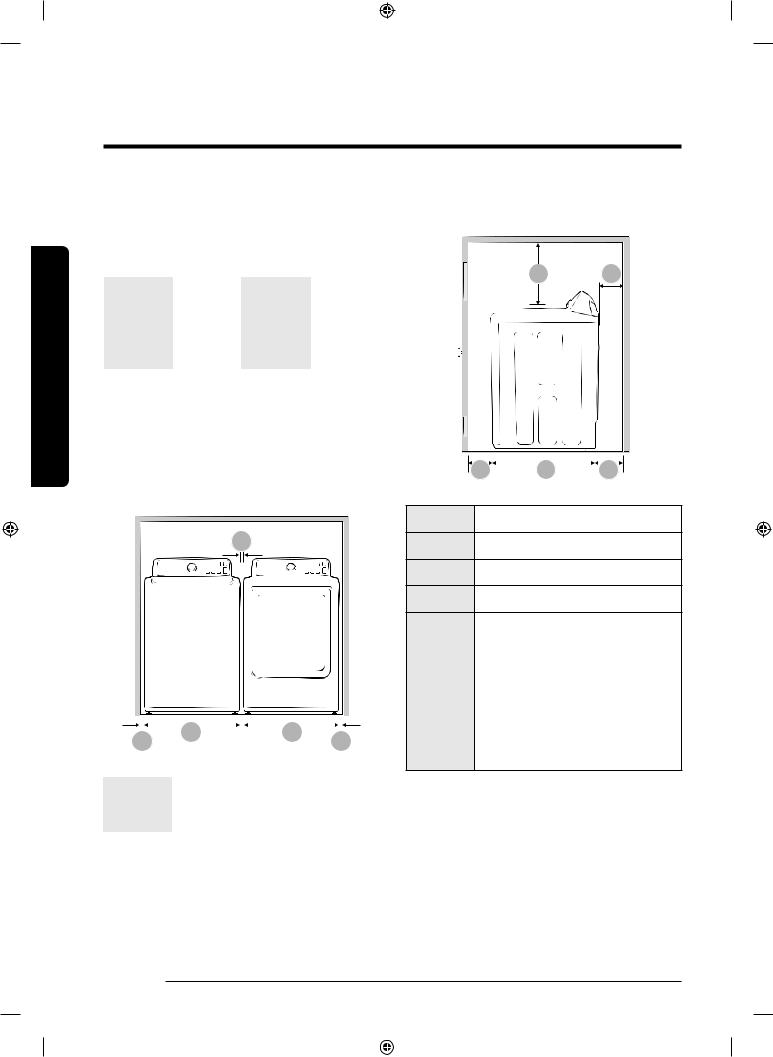
Minimum clearances for closet and alcove
installations:
Sides
Rear
1 in /
25 mm
5.9 in /
150 mm
If the washer and dryer are installed
together, the closet front must have at least
a 72 in² (465 cm²) unobstructed air opening.
Your washer alone does not require a
specic air opening.
Before you install the washer, make sure the location:
• Has a hard, level surface without carpeting or ooring that may obstruct ventilation.
• Is away from direct sunlight.
• Has adequate ventilation.
• Is not exposed to freezing temperatures (temperatures under 32 °F or 0 °C).
• Is away from heat sources such as oil or gas.
• Has enough space so that the washer doesn’t rest on its power cord.
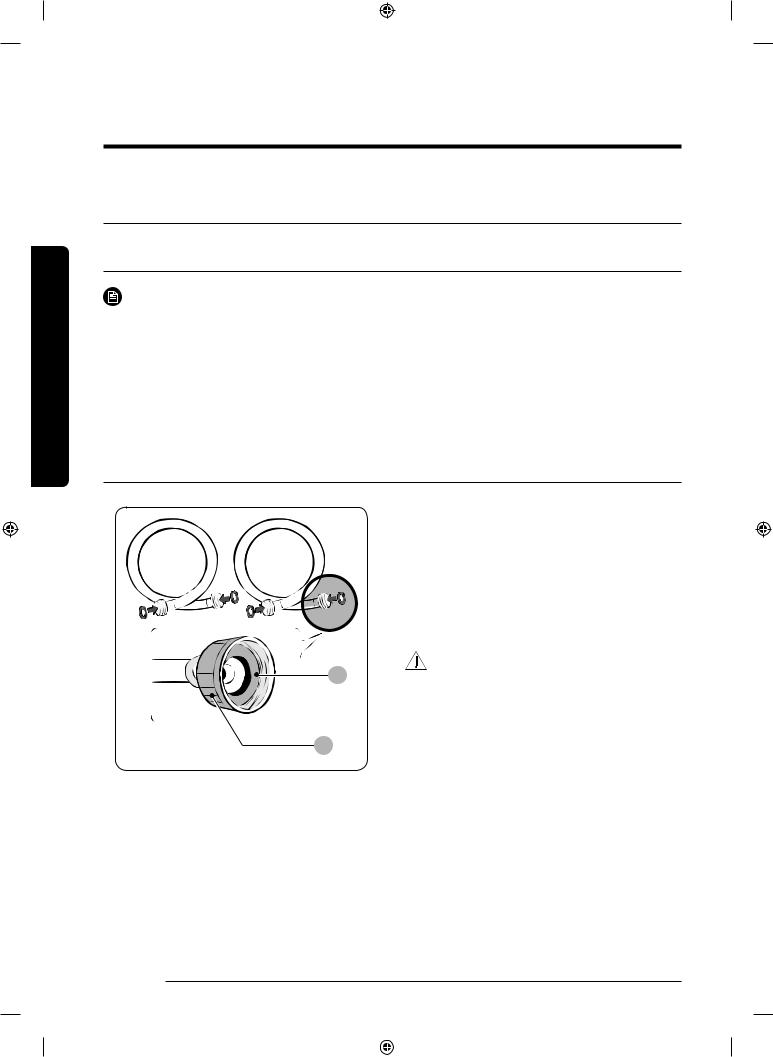
STEP 2 Connecting the water supply hose
CAUTION
Before installing the water supply hoses,
make sure there are rubber gaskets (B)
inside the couplings (A) at both ends of each
new water hose. Installing the water supply
hoses without rubber gaskets can cause
water leakage.
B
A
CAUTION
When you initially install the washer, be
sure to use new hoses. Failing to do so may
result in a water leakage or overow and
may damage your property.
CAUTION
Do not connect multiple water supply hoses
together to increase the length of the supply
hose. Hoses connected this way can leak
and the leakage can cause electrical shock. If
a hose is too short, replace the hose with a
longer, high pressure hose.
1. Connect the ends of the water supply
hoses to the hot and cold faucets.
2. Tighten the ttings by hand until they
are snug, and then tighten them an
additional two-thirds of a turn with a
plier.
CAUTION
When you fasten the ttings, do not fasten
them too tightly or apply tape or sealant to
the faucets or water supply intakes. This can
damage the ttings.
NOTE
After you have connected the water supply
hoses to the faucets, ensure that they are
connected correctly by pulling the water
supply hoses downwards.
3. Place the unconnected ends of the hoses
into a bucket and open the faucets
connected to the two water supply hoses
for 10 or 15 seconds to remove any
foreign substances from the hoses. Close
the faucets before continuing.
4. Connect the ends of the water supply
hoses to the water supply intake
connections at the back of the washer.
CAUTION
The water supply hose connected to the hot
faucet must be connected to the hot water
supply intake and the water hose connected
to the cold faucet must be connected to the
cold water supply intake.
Installation
5. Tighten the ttings by hand until they
are snug, and then tighten them an
additional two-thirds of a turn with a
plier.
NOTE
To ensure correct water usage, connect both
the hot and cold water faucets. If either or
both are not connected, the Cool (no ll) LED
will ash.
NOTE
If you do not want to use the hot water
supply hose, insert the water intake cap
into the hot water supply intake hole. In this
case, you must select the Cold for the water
temperature. If you select the Cold, all the
lamps for the water temperature options are
turned off.
CAUTION
Conrm that the water supply hoses are not
twisted or bent. If the hoses are twisted or
bent, the hoses can leak and cause electric
shock due to the water leakage.
6. Turn on the hot and cold water supplies
and check all the water supply intake
connections and the faucets for water
leaks.
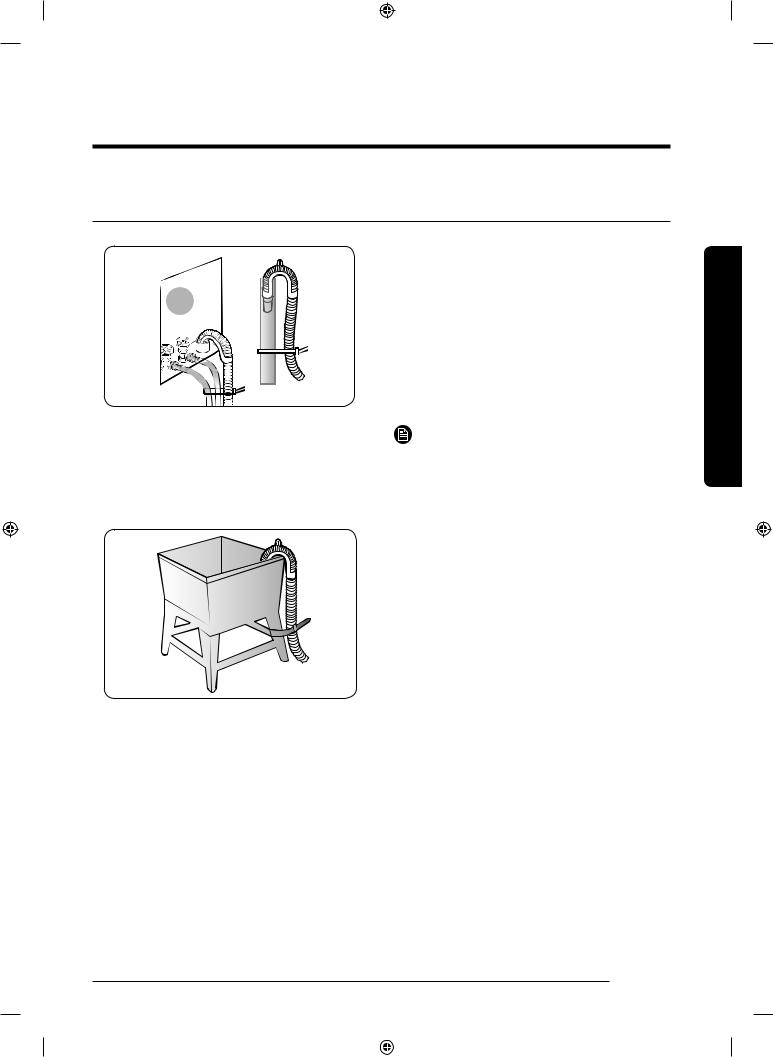
The end of the drain hose can be positioned
in three ways:
In a Wall standpipe or Floor standpipe
The height of end of standpipe must be no
lower than 39 in (99 cm) and no higher than
96 in (245 cm).
If drain pipe are built into the wall with
water valves (A), fasten the drain hose to
the water hose.
NOTE
• Make sure that the connection between
the drain hose and the standpipe is not
airtight.
In a laundry tub
The height of the tub must be no lower than
39 in (99 cm) and no higher than 96 in (245
cm).
Assemble the supplied Hose guide at the
end of the drain hose, and put the hanger on
laundry tub.
And fasten the drain hose to the leg of
laundry tub.
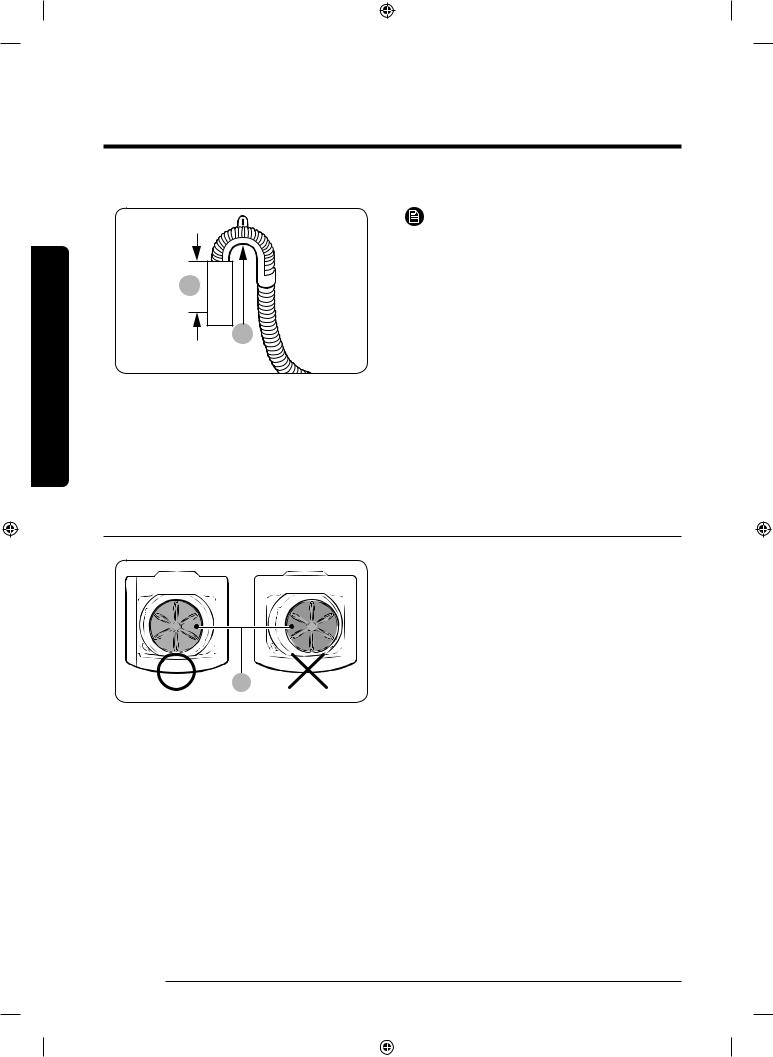
Connect the hose guide (A) within 3~5
in (7.6~12.7 cm)* from the end of the
drain hose. If the drain hose is extended
beyond the end of the hose guide, mold
or microorganisms could spread inside the
washer.
NOTE
The drain hose can be installed to a 96
in (245 cm) maximum, but the draining
capability can be reduced at this height.
It can cause the washer to have an odor
because of remaining water in the drain
system.
STEP 4 Leveling your washer
A
See if the washer is level by checking the
position of the tub:
1. Slide the washer into position.
2. Open the lid of the washer, and pour
the water into the tub to just below the
pulsator level.
3. If the washer is level, the pulsator (A) is
positioned at the center of the water as
shown in the gure.
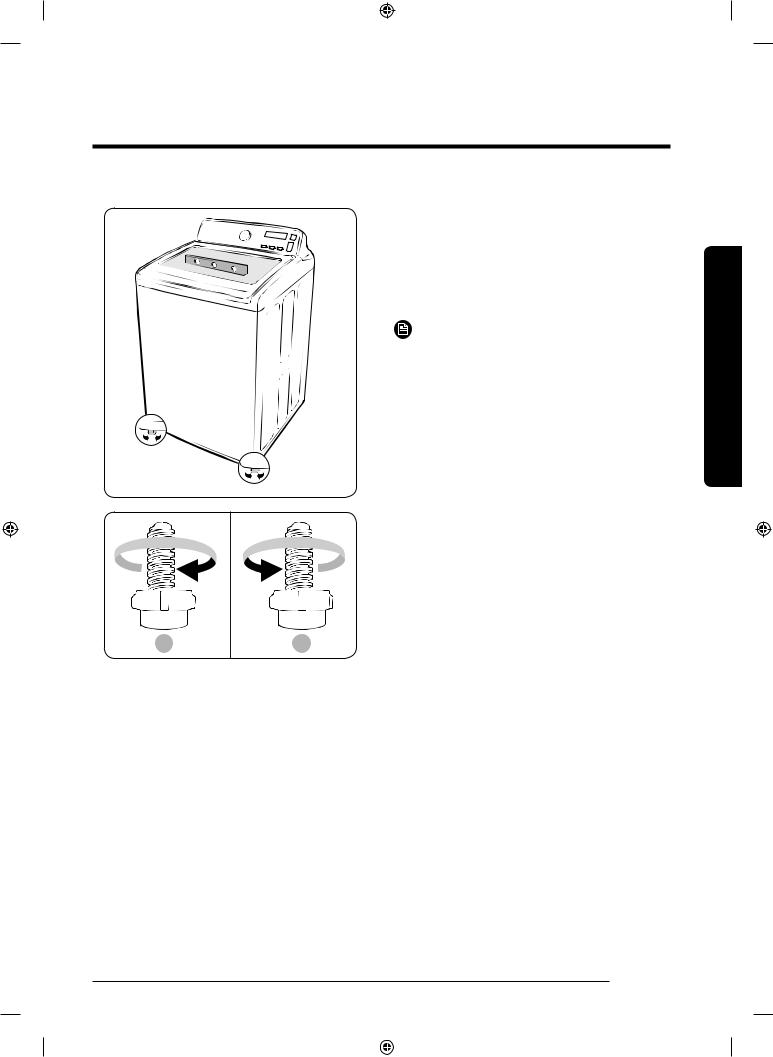
If not, level your washer by turning
the front leveling feet clockwise or
counterclockwise as necessary.
NOTE
• Turn the front leveling feet clockwise
(B) to lower the washer, and
counterclockwise (C) to raise the washer.
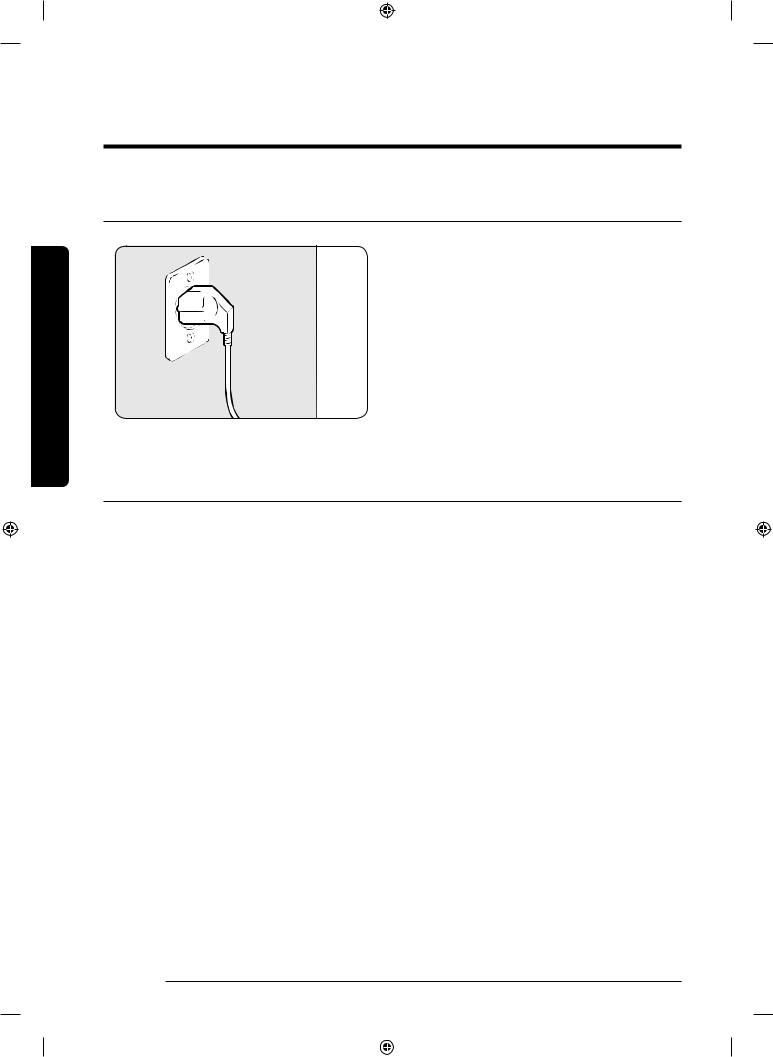
Plug the power cord into a 3-prong,
well grounded 120 volt 60 Hz approved
electrical outlet protected by a 15-amp fuse
or comparable circuit breaker.
Your washer is grounded through the third
prong of the power cord when plugged into
a three-prong grounded electrical outlet.
Installation
Test run
Make sure that you install your washer
correctly by running the RINSE+SPIN after
the installation is complete.
STEP 6 Running a test cycle
Run a test cycle as follows to check if your washer is properly installed.
1. Load about 6 pounds of laundry into the tub.
2. Press POWER to turn on your washer.
3. Select RINSE+SPIN by turning the Cycle Selector.
4. Press START/PAUSE to start the test cycle.
5. The washer should not rock or vibrate excessively when water is supplied or when
washing or spinning, and should drain well during the spin cycle.
NOTE
If water leaks while water is being supplied or drained, check the water connections. Refer to
the “STEP 2 Connecting the water supply hose” section on page 20 for instructions.
NOTE
If the washer rocks and vibrates excessively, level your washer again. Refer to the “STEP
4 Leveling your washer” section on page 24 for instructions.
To reduce the risk of re, electric shock, or injury to persons when using your appliance,
follow basic precautions, including the following:
Loading your washer
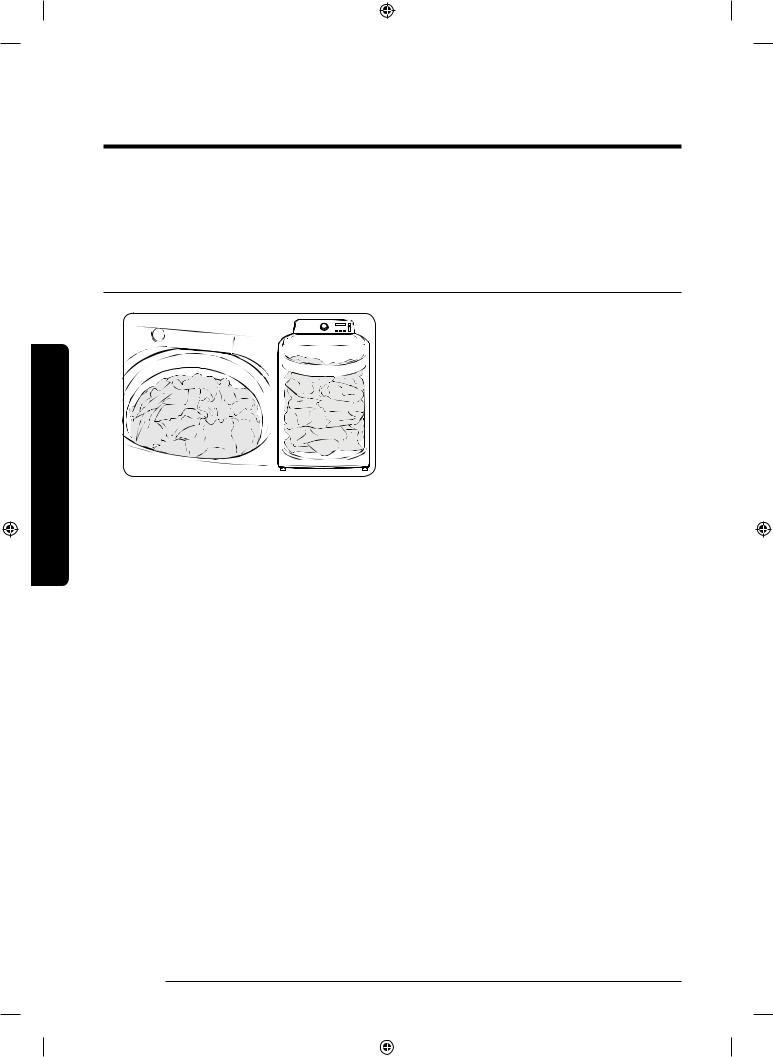
•Fill the tub with dry, unfolded clothes
evenly around in order to enhance
washing efciency and prevent excess
wear, or wrinkling of the load.
•For optimal washing performance, make
sure the laundry is piled up evenly.
•Wash delicate items such as bras, hosiery,
and other lingerie in the Delicates cycle
with similar lightweight items.
•When washing big bulky items or a
Before you start
few smaller items that don’t ll the tub
completely – a rug, a pillow, stuffed toys,
or one or two sweaters, for example – add
a few towels to improve spin performance.
•Do not insert bulky items except for
Bedding in this cycle.
NOTE
During the spin cycle, the washer may add additional water to redistribute the clothes and
correct an imbalance inside the drum.
•When washing heavily soiled loads, do not overload your washer to ensure good cleaning
results.
CAUTION
•Inatable items may cause damage to the laundry or the machine during the wash or
drying process.
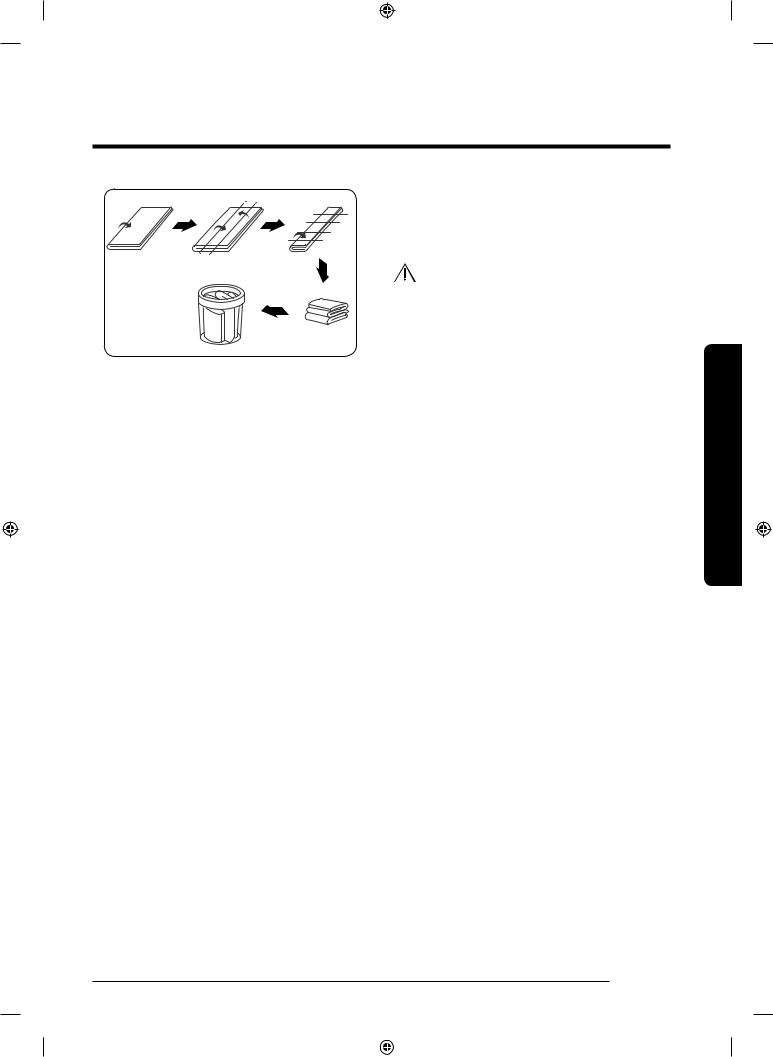
•Regardless of the size, blankets or quilts are safer and cleaner to wash one item at a time.
Two different-sized blankets in the same load may compromise the drying performance
due to unbalanced loads.
2. Add liquid (or powder) detergent and additives to the dispenser (see the "Detergent use"
section on page 37).
3. Select the appropriate cycle and options for the load (see the "Operations" section page 31).
4. Close the lid.
5. Press START/PAUSE.
6. The Wash Indicator illuminates.
7. The estimated cycle time will appear in the display.
The time may uctuate to indicate the time remaining in the cycle.
NOTE
The actual time required for a cycle may differ from the estimated time in the display
depending on the water pressure, water temperature, detergent, and laundry.
8. Before your washer starts to ll, it will make a series of clicking noises to check the door
Before you start
lock and do a quick drain.
NOTE
•When the cycle is complete, the Door Lock indicator will go out.
•Pressing POWER cancels the cycle and stops your washer.
•The Wash, Rinse, and Spin indicators will illuminate during those portions of the cycle.
Press this button to select the water level manually.
For optimal performance, set the water level to Auto Level. To select
Auto Level, press this button repeatedly until all the lamps of the
04 Water Level
05 Soil
06 POWER
water level are off.
Spin Only: This cycle runs a spin cycle only. Press and hold Water
Level for 3 seconds.
Press to change the soil level for the current cycle.
Heavy : For extremely soiled loads.
Normal : For moderately soiled loads. This setting is best for most
loads.
Light : For barely soiled loads.
Press once to turn your washer on. Press again to turn your washer
off. If the washer is left on for more than 10 minutes without any
buttons being pressed, the power automatically turns off.
For most fabrics including cottons, linens, and normally soiled
garments.
For sturdy, colorfast fabrics and heavily soiled garments. We
HEAVY DUTY
propose to use this function only when washing lot of heavily
soiled garments.
DELICATES
For sheer fabrics, bras, lingerie, silks, and other handwash-only
fabrics. For best results, use liquid detergent.
For bulky and large items, such as comforters, blankets and
sheets. When washing comforters, waterproof or water-resistant
items, use liquid detergent.
CAUTION
BEDDING/
WATERPROOF
※ Do not wash waterproof items and non-waterproof items
together.
※ Check the specication label on the fabric item and see if the
item is waterproof.
※ Use the BEDDING/WATERPROOF cycle for waterproof or water-
resistant items such as plastic mats, ski pants, raincoat and
comforters which hardly absorb water.
Use for loads that need rinsing only or to add rinse-added
fabric softener to a load.
Use to clean dirt and bacteria from the tub. Regular use (after
every 20 washes) is recommended.
English 33
Page 34
Operations
Options
Operations
Child Lock
Child Lock disables the START/PAUSE button
while the washer is operating. This is to
prevent children from playing with the
washer.
Activating the Child Lock function
Press and hold the Temp. and Water Level
buttons simultaneously for approximately
3 seconds.
• Child Lock disables the START/PAUSE
button while the washer is operating.
• The Child Lock
Using the Child Lock function
If the lid is opened when the Child Lock
function is on, “dC” is displayed and an
alarm sounds.
• If the water level in the tub is above the
safe water level, “dC” is displayed on the
LED display and the washer starts to
drain water by force after 30 seconds.
• If the water level in the tub is above
the safe water level and the Child Lock
function is turned on while the lid is
open, “CL” is displayed on the LED
display, even if the washer is turned off,
and the washer drains water by force.
• When Child Lock is on and the washer is
off, if the water in the tub is above the
safe water level and the lid is opened,
“CL” is displayed on the LED display.
No alarm sounds, but the washer drains
the water. When the draining operation
nishes, the power automatically turns
off again.
Indicator
blinks.
• If you activate the Child Lock function
while the washer is running, the Start/
Pause button will not work.
• After the compulsory drain, “CL” blinks
at 1 second intervals and the washer
enters the “CL” mode. (When the washer
is in the “CL” mode, only the Power
button works.)
• To cancel the “CL” mode, turn the power
off and then on again.
• To cancel the “dC” mode, deactivate
the Child Lock function. To deactivate
the Child Lock function, press and hold
Temp. and Water Level simultaneously
for at least 3 seconds.
NOTE
Adding laundry when Child Lock is on
To add laundry, deactivate the Child Lock
function. To deactivate the Child Lock
function, press and hold Temp. and Water Level simultaneously for at least 3 seconds.
See the “Pause Option” section on page 36
for additional details.
Deactivating the Child Lock function
Press and hold both Temp. and Water Level
simultaneously for approximately 3 seconds.
• When you deactivate the Child Lock
function, the Child Lock indicator is
turned off.
• The Child Lock function prevents
children or the inrm from accidently
operating the washer and injuring
themselves.
If a child enters the washer, the child may
become trapped and suffocate.
CAUTION
• Once you have activated the Child Lock
function, it continues working even if
the power is turned off.
• Forcing the lid open can result in injury
or damage to the product.
NOTE
To add laundry after you have activated
the Child Lock function, you must rst
deactivate the Child Lock function.
Smart Care
To enable this function, you must rst
download the Samsung Laundry app from
the Play Store or the App Store and install
it on a mobile device that has a camera
function. The Smart Care function has been
optimized for Galaxy and iPhone mobile
devices (applicable models only).
1. When the washer detects an issue to
check, an information code appears on
the display. To enter Smart Care mode,
press and hold Water Level and Soil
simultaneously for 3 seconds.
2. The washer starts the self-diagnosis
procedure and displays an information
code if a problem is detected.
3. Run the Samsung Laundry app on your
mobile device, and then tap Smart Care.
4. Put the mobile device close to the
washer’s display so that the smartphone
camera and the washer face each other.
The information code will be recognized
automatically by the app.
5. When the information code is
recognized correctly, the app provides
detailed information about the problem
with applicable solutions.
NOTE
• The function name, Smart Care, may
differ depending on the language.
• If the washer's display reects light,
the app may fail to recognize the
information code.
• If the app fails to recognize the
information code, you can enter the code
manually on the app.
Your new washer makes washing clothes
easy, using Samsung’s “Fuzzy Control”
automatic control system. When you select
a wash program, the machine will set the
correct temperature, washing time, and
washing speed.
1. Press POWER.
2. Open the lid.
3. Load the articles of clothing one at a
time loosely into the drum, without
overlling it.
4. Add liquid (or powder) detergent,
softener, and/or bleach (if necessary) to
the appropriate compartments. See the
"Detergent use" section on page 37.
5. Close the lid.
6. Use the Cycle Selector to select the
appropriate cycle according to the type
of material: NORMAL, HEAVY DUTY,
DEEP WASH, BEDDING/WATERPROOF,
QUICK WASH, DELICATES, and
RINSE+SPIN. The relevant indicators will
illuminate on the control panel.
7. At this time, you can control the wash
temperature and the number of rinse
cycles by pressing the appropriate
option button.
8. Press START/PAUSE and the wash will
begin. The process indicator will light up
and the remaining time for the cycle will
appear in the display.
Pause Option
To remove or add laundry items, follow
these steps:
1. Press START/PAUSE to unlock the lid.
NOTE
The lid cannot be opened when the water is
too HOT.
2. Remove or add laundry items.
3. Close the lid, and then press START/
PAUSE to restart the wash.
NOTE
If you have Child Lock on, you must
deactivate it rst. See page 34.
When the cycle is nished:
After the total cycle has nished, the power
will turn off automatically.
ATC is the control function that the
washer controls water temperature with
temperature sensor (thermistor).
NOTE
Because there are numerous water
temperatures depending on the customer’s
environments (cold areas, warm areas,
various water temperatures, settings of
heater temperature, etc.), ATC function in our
washer maintains the certain level of wash
temperature to output the best washing
performance at each cycle.
Detergent use
NOTE
If you select NORMAL cycle, this cycle is the
regulation and UL cycle. Since new washers
must reduce the amount of energy usage as
a rst priority, customers will notice more
cold water entering the washer. But, this is
normal, not a problem.
In those regulation cycles, Hot temperature
is similar to acceptable adult bath-water
temperature and warm temperature is
similar to comfortable swimming-pool water
temperature.
NOTE
If customers want to wash clothes in specic
water temperatures, customers should
choose a different cycle at each temperature
(Hot/Warm/Eco Warm/Cool).
Operations
• For the best cleaning results, use a high
efciency detergent such as Tide HE,
Wisk HE, Cheer HE or Gain HE*. High
efciency detergents contain suds
suppressors that reduce or eliminate
suds. When fewer suds are produced,
the load tumbles more efciently and
cleaning is maximized. (* Brand names
are trademarks of their respective
manufacturers.)
WARNING
For best results, use HE detergents only.
Do not use regular detergent, organic
detergent, natural detergent or HE
detergents with natural ingredients (such as
vinegar, baking soda).
NOTE
Reducing the amount of detergent
may reduce the quality of cleaning. It
is important to pre–treat stains, sort
carefully by color and soil level, and avoid
overloading.
Your washer has separate compartments for dispensing detergent and color-safe bleach and
fabric softener. Add all laundry additives to their respective compartments before starting
your washer.
The automatic dispenser must always be in place before you start your washer.
DO NOT open the automatic dispenser when your washer is running.
NOTE
•Never exceed the manufacturer’s recommendations when adding detergent.
•This compartment holds liquid detergent for the main wash cycle, which is added to the
load at the beginning of the cycle.
•When using powdered detergent, remove the liquid detergent compartment from the
detergent drawer. The washer will not dispense powdered detergent from the liquid
detergent compartment.
Operations
To add detergent to the automatic dispenser:
1. Open the dispenser drawer.
2. Load the recommended amount of liquid
(or powder) detergent into the detergent
compartment before you start your
wash.
3. Close the drawer slowly and smoothly
to avoid spilling, splashing, or premature
dispensing of the contents.
NOTE
It is normal for a small amount of water to
remain in the dispenser compartments at
the end of the cycle.
NOTE
Do not put chlorine bleach in the dispenser
drawer.
Loading the Liquid (or Powder) detergent compartment
A
1. Pour the recommended amount of
laundry detergent directly into the
detergent compartment before starting
your washer.
2. If you are using color-safe bleach, add
it with the detergent to the detergent
compartment.
NOTE
When adding color-safe bleach with
detergent, it is best if both laundry products
are in the same form – liquid.
NOTE
When using powdered detergent, remove
the liquid detergent compartment (A) from
the detergent drawer. The washer will not
dispense powdered detergent from the
liquid detergent compartment.
1. Add chlorine bleach to the bleach
compartment (B).
DO NOT exceed the bleach compartment.
NOTE
• Avoid splashing or over–lling the
compartment.
• Never pour undiluted liquid chlorine
bleach directly onto the load or into the
tub. It is a powerful chemical and can
cause fabric damage, such as weakening
of the bers or color loss, if not used
properly.
• If you prefer to use color–safe, add it to
the appropriate detergent compartment.
DO NOT pour color–safe bleach into the
Bleach compartment.
1. Pour the recommended amount of
liquid fabric softener into the softener compartment (C).
For smaller loads, use less than one
capful.
2. Dilute the fabric softener with water
until it reaches MAX FILL in the
compartment.
3. The dispenser automatically releases
liquid fabric softener at the proper time
during the rinse cycle.
NOTE
• Use the softener compartment ONLY for
liquid fabric softeners.
• DO NOT use the Downy Ball* in the
fabric softener compartment with this
washer. It will not add fabric softener at
the appropriate time.
Use the detergent compartment.
(* Brand names are trademarks of their
respective manufacturers.)
• Do not use liquid fabric softener that
is too sticky as it may not mix with the
water sufciently.
Certain internal parts are intentionally not grounded and may present a risk electric shock
only during servicing. Service personnel – Do not contact the following parts while the
appliance is energized: Control board, heat sink, motor, inlet valve, heater and pump.
Cleaning the exterior
1. Turn off the water faucets after nishing
the day’s washing.
This will shut off the water supply to
your washer and prevent the unlikely
possibility of damage from escaping
water. Leave the lid open to allow the
inside of your washer to dry out.
2. Use a soft cloth to wipe up all detergent,
bleach or other spills as they occur.
3. Clean the following as recommended:
Control Panel – Clean with a soft, damp
cloth. Do not use abrasive powders or
cleaning pads. Do not spray cleaners
directly on the panel.
Cleaning the interior
Clean the interior of your washer
periodically to remove any dirt, soil, odor,
mold, mildew, or bacterial residue that
may remain in your washer as a result of
washing clothes.
Failure to follow these instructions may
result in unpleasant conditions, including
odors and/or permanent stains on your
washer or laundry.
Hard water deposits may be removed, if
needed. Use cleaners labeled “Washer safe”.
Storing your washer
Maintenance
Washers can be damaged if water is
not removed from hoses and internal
components before storage.
Prepare your washer for storage as follows:
1. Select the Quick Wash cycle and add
bleach to the automatic dispenser. Run
your washer through the cycle without
a load.
2. Turn the water faucets off and
disconnect the inlet hoses.
3. Unplug your washer from the electrical
outlet and leave your washer lid open to
let air circulate inside the drum.
If your washer has been stored in
below–freezing temperatures, allow time
for any leftover water in your washer to
thaw out before use.
small, non-metal brush to clean the
recess. Remove all residue from the
upper and lower parts of the recess.
5. Return the inserts to the proper
compartments and replace the drawer
by placing the dispenser drawer rail (B)
on top of the compartment rail (A) (Tilt
the dispenser drawer downward and
insert it).
Then push the drawer in rmly and
slowly.
Certain usage and environmental conditions may result in some residue build-up or odor in the
washer tub. To prevent this build-up of residue or odor causing bacteria and keep your washer
tub fresh and clean, perform the SELF CLEAN cycle at least once a month or every 20 cycles.
Perform the recommended procedure below when using the SELF CLEAN cycle.
1. Remove all items from the washer tub and ensure the tub is empty. Laundry left in the
tub during the SELF CLEAN cycle may be damaged.
2. Press POWER.
3. Turn the Cycle Selector to SELF CLEAN.
4. Press START/PAUSE. SELF CLEAN begins.
NOTE
•The water temperature for SELF CLEAN is defaulted to Hot. This temperature cannot be
changed.
•In the case where residue is present in the washer tub, add 1 cup (8 .oz, 240 ml) of liquid
chlorine bleach to the bleach compartment before you start the SELF CLEAN cycle. Do not
use or mix any other detergent or chemicals during the SELF CLEAN cycle.
•If necessary, run a RINSE+SPIN Cycle after the SELF CLEAN cycle has completed to help
remove any remaining residue.
CAUTION
•Check the washer tub before using the SELF CLEAN cycle. Remove any remaining water
in the tub by running a Spin Only cycle prior to starting the SELF CLEAN cycle.
•If there is chlorine bleach left in the washer tub for an extended period of time, rust can
occur.
Maintenance
SELF CLEAN reminder
•After 20 washing cycles, the SELF CLEAN LED reminder icon and the SELF CLEAN cycle
LED will blink on the control panel for an hour and then turn off automatically.
•The reminder will appear on the control panel for 5 additional consecutive cycles
before turning off. The next reminder will not appear until another 20 cycles have been
completed.
• Make sure the hoses are connected to the correct water taps.
Flush water lines.
• Disconnect the hoses and clean the screens. The hose lter
screens may be clogged.
• While the washing machine lls, the water temperature may
change as the automatic temperature control feature checks
incoming water temperature. This is normal.
• While the washing machine lls, you may notice just hot and/
or just cold water going through the dispenser when cold or
warm temperatures are selected.
This is a normal function of the automatic temperature
control feature as the washing machine determines the water
temperature.
• While the washing machine is operating, press or tap START/
PAUSE to stop the washing machine.
• It may take a few moments for the door lock mechanism to
disengage.
Does not drain and/
or spin.
Load is wet at the end
of the cycle.
• Check the fuse or reset the circuit breaker.
• Make sure the electrical voltage is normal.
• Make sure the washing machine is plugged in.
• Make sure the drain hose is pointed downward. (Natural drain
models only)
• Make sure the drain hose is not clogged.
• Make sure the drain hose is not kinked.
• Straighten the drain hose. If there is a drain restriction, call for
service.
• Close the door, and press or tap START/PAUSE. For your
safety, the washing machine will not spin unless the door is
closed.
• Use the High or Extra High spin speed. (Applicable model
only)
• Use high efciency (HE) detergent to reduce oversudsing.
• Load is too small. Small loads (one or two items) may become
•Make sure the water supply hose's rubber packing is in the
correct position. Screw tightly again.
•Make sure the end of the drain hose is correctly inserted and
secured to the drain system.
Leaks water.
Excessive suds.
•Avoid overloading.
•Use high efciency (HE) detergent to prevent oversudsing.
•Make sure the water supply hose is not kinked.
•If the water supply is too strong, water may leak. Close the
water tap a little.
•Make sure water is not leaking from the water tap. If so,
repair the water tap.
•Use high efciency (HE) detergent to prevent oversudsing.
•Reduce the detergent amount for soft water, small loads, or
lightly soiled loads.
•Non-HE detergent is not recommended.
Troubleshooting
The spin basket or
drain/supply hose is
frozen.
Water drains out
immediately.
•Use warm water to disconnect the water supply hose and
drain hose. Soak them in warm water.
•Fill the spin basket with warm water, and then wait for about
10 minutes.
•Put a hot towel on the drain hose connector.
•Reconnect the water supply hose and drain hose, and check if
water is supplied properly.
•Make sure the drain hose is not clogged, and is hung over the
drain hose hook. Fill the spin basket halfway with water, and
try spinning again.
•Lift the end of the drain hose to prevent water from draining.
Fill the spin basket halfway with water, and then run spinning
after releasing the drain hose.
•Make sure the drain hose is installed correctly. See the
installation section of this user manual and adjust the position
of the drain hose as instructed.
The washer may display information codes to help you understand what is occurring with
your washer better.
NoCodeMeaning
The WaterLevel sensor is not working properly.
• Check WaterLevel Sensor wire harness.
• If the information code remains, contact a customer service
11C
23C
centre.
NOTE
When the washer displays “1C”, the washer do draining for
3 minutes. During this time, the POWER button is inoperative.
Check the motor for operation.
• Try restarting the cycle.
• If the problem continues, call for service.
Troubleshooting
34C
44C2
Water is not supplied.
• Make sure the water taps are open.
• Make sure the water hoses are not clogged.
• Make sure the water taps are not frozen.
• Make sure the washing machine is operating with sufcient
water pressure.
• Make sure that the cold water tap and the hot water tap are
properly connected.
• Clean the mesh lter as it may be clogged.
NOTE
When the washer displays “4C”, the washer do draining for
3 minutes. During this time, the POWER button is inoperative.
• Make sure the cold water supply hose is rmly connected to
the cold water tap.
If it is connected to the hot water tap, the laundry may be
deformed with some cycles.
The following symbols provide garment care
direction. The clothing care labels include
symbols for drying, bleaching, drying and
ironing, or dry cleaning when necessary. The
use of symbols ensures consistency among
garment manufacturers of domestic and
imported items. Follow care label directions
to optimize garment life and reduce
laundering problems.
Wash cycle
Normal
Permanent press/Wrinkle
resistant/Wrinkle control
Gentle/Delicates
Hand wash
Water temperature
The clothes washer can not ensure
these temperatures because the actual
temperature of the water entering your
washer depends on water heater settings
and regional water supply temperatures. For
example, cold water entering the home in
the northern states during winter may be
40 °F / 4 °C which is too cold for effective
cleaning. In this situation, you will need to
adjust the water temperature by selecting
a warm setting, adding some hot water to
the MAX FILL line, or using your Washer’s
heating option, if available.
Bleach
Any bleach (when needed)
Only non-chlorine (color-safe)
bleach (when needed)
Tumble dry
Hot
Warm
Cold
NOTE
This represents appropriate wash water
temperatures for various items. The
temperature range for Hot is 105° - 125 °F
/ 41° - 52 °C, for Warm 85° - 105 °F /
29° - 41 °C and for Cold 60° - 85 °F / 16°
- 29 °C. (Wash water temperature must be
a minimum of 60 °F / 16 °C for detergent
activation and effective cleaning.)
• Your washer is manufactured from
recyclable materials. If you decide to
dispose of it, please observe local waste
disposal regulations. Cut off the power
cord so that the appliance cannot be
connected to a power source. Remove
the lid so that animals and small children
cannot get trapped inside the appliance.
Declaration of conformity
This appliance complies with UL2157.
• Do not exceed the detergent quantities
recommended in the detergent
manufacturers’ instructions.
• Use stain removal products and bleaches
before the wash cycle only when
necessary.
• Save water and electricity by only
washing full loads (the exact amount
depends upon the program used).
LIMITED WARRANTY TO ORIGINAL CONSUMER PURCHASER WITH PROOF OF
PURCHASE
This SAMSUNG brand product, as supplied and distributed by SAMSUNG ELECTRONICS
AMERICA, INC. (SAMSUNG) and delivered new, in the original carton to the original consumer
purchaser, is warranted by SAMSUNG against manufacturing defects in materials or
workmanship for the limited warranty period, starting from the date of original purchase, of:
One (1) year parts and labor,
Three (3) years stainless tub part (Part Only),
Five (5) years washing motor part (Part Only).
This limited warranty is valid only on products purchased and used in the United States
that have been installed, operated, and maintained according to the instructions attached
to or furnished with the product. To receive warranty service, the purchaser must contact
SAMSUNG at the address or phone number provided below for problem determination and
service procedures. Warranty service can only be performed by a SAMSUNG authorized
service center. The original dated bill of sale must be presented upon request as proof of
purchase to SAMSUNG or SAMSUNG’s authorized service center to receive warranty service.
SAMSUNG will provide in-home service within the contiguous United States during the
warranty period at no charge, subject to availability of SAMSUNG authorized servicers within
the customer’s geographic area. If in-home service is not available, SAMSUNG may elect, at
its option, to provide transportation of the product to and from an authorized service center.
If the product is located in an area where service by a SAMSUNG authorized servicer is not
available, you may be responsible for a trip charge or required to bring the product to a
SAMSUNG authorized service center for service.
To receive in-home service, product must be unobstructed and accessible to the service
agent.
During the applicable warranty period, a product will be repaired, replaced, or the purchase
price refunded, at the sole option of SAMSUNG. SAMSUNG may use new or reconditioned
parts in repairing a product, or replace the product with a new or reconditioned product.
Replacement parts and products are warranted for the remaining portion of the original
product’s warranty or ninety (90) days, whichever is longer. All replaced parts and products
are the property of SAMSUNG and you must return them to SAMSUNG.
This limited warranty covers manufacturing defects in materials or workmanship encountered
in normal household, noncommercial use of this product and shall not cover the following:
damage that occurs in shipment, delivery, installation, and uses for which this product was
not intended; damage caused by unauthorized modication or alteration of the product;
product where the original factory serial numbers have been removed, defaced, changed
in any way, or cannot be readily determined; cosmetic damage including scratches, dents,
chips, and other damage to the product’s nishes; damage caused by abuse, misuse, pest
infestations, accident, re, oods, or other acts of nature or God; damage caused by use of
equipment, utilities, services, parts, supplies, accessories, applications, installations, repairs,
external wiring or connectors not supplied or authorized by SAMSUNG; damage caused by
incorrect electrical line current, voltage, uctuations and surges; damage caused by failure
to operate and maintain the product according to instructions; in-home instruction on how
to use your product; and service to correct installation not in accordance with electrical or
plumbing codes or correction of household electrical or plumbing (i.e., house wiring, fuses,
or water inlet hoses). The cost of repair or replacement under these excluded circumstances
shall be the customer’s responsibility.
Visits by an authorized servicer to explain product functions, maintenance or installation
are not covered by this limited warranty. Please contact SAMSUNG at the number below for
assistance with any of these issues.
EXCLUSION OF IMPLIED WARRANTIES
IMPLIED WARRANTIES, INCLUDING THE IMPLIED WARRANTIES OF MERCHANTABILITY OR
FITNESS FOR A PARTICULAR PURPOSE, ARE LIMITED TO ONE YEAR OR THE SHORTEST
PERIOD ALLOWED BY LAW. Some states do not allow limitations on how long an implied
warranty lasts, so the above limitations or exclusions may not apply to you. This warranty
gives you specic rights, and you may also have other rights, which vary from state to state.
YOUR SOLE AND EXCLUSIVE REMEDY IS PRODUCT REPAIR, PRODUCT REPLACEMENT, OR
REFUND OF THE PURCHASE PRICE AT SAMSUNG’S OPTION, AS PROVIDED IN THIS LIMITED
WARRANTY. SAMSUNG SHALL NOT BE LIABLE FOR SPECIAL, INCIDENTAL OR CONSEQUENTIAL
DAMAGES, INCLUDING BUT NOT LIMITED TO TIME AWAY FROM WORK, HOTELS AND/OR
RESTAURANT MEALS, REMODELING EXPENSES, LOSS OF REVENUE OR PROFITS, FAILURE TO
REALIZE SAVINGS OR OTHER BENEFITS REGARDLESS OF THE LEGAL THEORY ON WHICH THE
CLAIM IS BASED, AND EVEN IF SAMSUNG HAS BEEN ADVISED OF THE POSSIBILITY OF SUCH
DAMAGES. Some states do not allow exclusion or limitation of incidental or consequential
damages, so the above limitations or exclusions may not apply to you. This warranty gives
you specic rights, and you may also have other rights, which vary from state to state.
SAMSUNG does not warrant uninterrupted or error-free operation of the product. No
warranty or guarantee given by any other person, rm, or corporation with respect to this
product shall be binding on SAMSUNG.
To obtain warranty service, please contact SAMSUNG at:
Samsung Electronics America, Inc.
85 Challenger Road
Ridgeeld Park, NJ 07660
1-800-SAMSUNG (726-7864)
www.samsung.com/us/support
This SAMSUNG brand product, as supplied and distributed by SAMSUNG ELECTRONICS
CANADA, INC. (SAMSUNG) and delivered new, in the original carton to the original consumer
purchaser, is warranted by SAMSUNG against manufacturing defects in materials and
workmanship for a limited warranty period of:
One (1) year part and labor.
This limited warranty begins on the original date of purchase, and is valid only on products
purchased and used in the Canada. To receive warranty service, the purchaser must contact
SAMSUNG for problem determination and service procedures. Warranty service can only be
performed by a SAMSUNG authorized service center. The original dated bill of sale must be
presented upon request as proof of purchase to SAMSUNG or SAMSUNG’s authorized service
center. SAMSUNG will provide in-home service during the warranty period at no charge,
subject to availability within the Canada. In-home service is not available in all areas.
To receive in-home service, product must be unobstructed and accessible to the service
agent. If service is not available, SAMSUNG may elect to provide transportation of the
product to and from an authorized service center.
SAMSUNG will repair, replace, or refund this product at our option and at no charge as
stipulated herein, with new or reconditioned parts or products if found to be defective during
the limited warranty period specied above. All replaced parts and products become the
property of SAMSUNG and must be returned to SAMSUNG. Replacement parts and products
assume the remaining original warranty, or ninety (90) days, whichever is longer.This limited
warranty covers manufacturing defects in materials and workmanship encountered in
normal, noncommercial use of this product and shall not apply to the following: damage that
occurs in shipment; delivery and installation; applications and uses for which this product
was not intended; altered product or serial numbers; cosmetic damage or exterior nish;
accidents, abuse, neglect, re, water, lightning, or other acts of nature or God; use of products,
equipment, systems, utilities, services, parts, supplies, accessories, applications, installations,
repairs, external wiring or connectors not supplied or authorized by SAMSUNG that damage
this product or result in service problems; incorrect electrical line voltage, uctuations and
surges; customer adjustments and failure to follow operating instructions, maintenance and
environmental instructions that are covered and prescribed in the instruction book; product
removal and reinstallation; problems caused by pest infestations.
This limited warranty does not cover problems resulting from incorrect electric current,
voltage or supply, light bulbs, house fuses, house wiring, cost of a service call for instructions,
or xing installation errors. SAMSUNG does not warrant uninterrupted or error-free operation
of the product.
EXCEPT AS SET FORTH HEREIN, THERE ARE NO WARRANTIES ON THIS PRODUCT EITHER
EXPRESS OR IMPLIED, AND SAMSUNG DISCLAIMS ALL WARRANTIES INCLUDING, BUT NOT
LIMITED TO, ANY IMPLIED WARRANTIES OF MERCHANTABILITY, INFRINGEMENT OR FITNESS
FOR A PARTICULAR PURPOSE.
NO WARRANTY OR GUARANTEE GIVEN BY ANY PERSON, FIRM, OR CORPORATION WITH
RESPECT TO THIS PRODUCT SHALL BE BINDING ON SAMSUNG. SAMSUNG SHALL NOT BE
LIABLE FOR LOSS OF REVENUE OR PROFITS, FAILURE TO REALIZE SAVINGS OR OTHER
BENEFITS, OR ANY OTHER SPECIAL, INCIDENTAL OR CONSEQUENTIAL DAMAGES CAUSED BY
THE USE, MISUSE, OR INABILITY TO USE THIS PRODUCT, REGARDLESS OF THE LEGAL THEORY
ON WHICH THE CLAIM IS BASED, AND EVEN IF SAMSUNG HAS BEEN ADVISED OF THE
POSSIBILITY OF SUCH DAMAGES.
NOR SHALL RECOVERY OF ANY KIND AGAINST SAMSUNG BE GREATER IN AMOUNT THAN
THE PURCHASE PRICE OF THE PRODUCT SOLD BY SAMSUNG AND CAUSING THE ALLEGED
DAMAGE. WITHOUT LIMITING THE FOREGOING, PURCHASER ASSUMES ALL RISK AND
LIABILITY FOR LOSS, DAMAGE, OR INJURY TO PURCHASER AND PURCHASER’S PROPERTY
AND TO OTHERS AND THEIR PROPERTY ARISING OUT OF THE USE, MISUSE, OR INABILITY TO
USE THIS PRODUCT. THIS LIMITED WARRANTY SHALL NOT EXTEND TO ANYONE OTHER THAN
THE ORIGINAL PURCHASER OF THIS PRODUCT, IS NONTRANSFERABLE AND STATES YOUR
EXCLUSIVE REMEDY.
Some provinces do not allow limitations on how long an implied warranty lasts, or the
exclusion or limitation of incidental or consequential damages, so the above limitations or
exclusions may not apply to you. This warranty gives you specic rights, and you may also
have other rights, which vary from province to province.
To obtain warranty service, please contact SAMSUNG at:
Samsung Electronics Canada Inc.
2050 Derry Road West
Mississauga, Ontario L5N 0B9 Canada
1-800-SAMSUNG (726-7864)
www.samsung.com/ca/support (English)
www.samsung.com/ca_fr/support (French)
Visits by a Service Engineer to explain functions, maintenance or installation is not
covered by warranty.
Please contact your Samsung call agent for help with any of these issues.
Remarques importantes sur les consignes de sécurité 4
Symboles de sécurité importants 4
AVERTISSEMENT CONCERNANT LA PROPOSITION 65 DE L'ÉTAT DE CALIFORNIE 5
Sommaire
Consignes de sécurité importantes 5
Installation 13
Déballage de votre lave-linge 13
Présentation de votre lave-linge 14
Exigences de base relatives à l'emplacement 16
Installation étape par étape 20
Avant de commencer 28
Chargement du lave-linge 28
Mise en marche 30
Opérations 31
Panneau de commande 31
Présentation des cycles 33
Options 34
Laver du linge à l'aide du Sélecteur de cycle 36
ATC (Contrôle automatique de la température) 37
Utilisation de la lessive 37
Fonctions 38
Entretien 42
Nettoyer l'extérieur 42
Nettoyer l'intérieur 42
Entreposage de votre lave-linge 42
Protection du capot supérieur et du panneau avant 43
Nettoyage du ltre à maille 43
Nettoyage du tiroir à lessive 44
Auto-nettoyage 46
Tableau des symboles textiles 55
Respect de l'environnement 57
Déclaration de conformité 57
Fiche de caractéristiques techniques 58
Tableau des cycles 59
Félicitations pour l'achat de votre nouveau lave-linge Samsung. Ce manuel contient de précieuses
informations concernant l'installation, l'utilisation et l'entretien de votre appareil. Prenez le temps de le
lire an de tirer pleinement prot de tous les avantages et les fonctionnalités qu'offre votre lave-linge.
Remarques importantes sur les consignes de sécurité
Consignes de sécurité
Veuillez lire attentivement ce manuel an d'utiliser cet appareil en toute sécurité et de proter
pleinement de toutes ses fonctionnalités. Conservez ce manuel dans un endroit sûr situé à proximité
de l'appareil an de pouvoir facilement vous y reporter en cas de besoin. N'utilisez pas cet appareil
autrement que pour l'usage auquel il est destiné, conformément aux consignes du manuel.
Les consignes de sécurité et les avertissements décrits dans ce manuel ne sont pas exhaustifs. Il est de
votre responsabilité de faire preuve de bon sens, de prudence et de discernement lors de l'installation,
de l'entretien et de l'utilisation de votre lave-linge.
Ces consignes d'utilisation couvrant plusieurs modèles, il se peut que les caractéristiques de votre lavelinge diffèrent légèrement de celles décrites dans ce manuel ; ainsi, certaines icônes d'avertissement
peuvent ne pas s'appliquer à votre lave-linge. Pour toute question, contactez votre centre de
dépannage le plus proche ou connectez-vous sur www.samsung.com.
Symboles de sécurité importants
Signication des icônes et signes repris dans ce manuel d'utilisation :
AVERTISSEMENT
Risques ou pratiques inadaptées susceptibles de causer des blessures corporelles graves voire
mortelles et/ou des dommages matériels.
ATTENTION
Risques ou pratiques inadaptées susceptibles de causer des blessures et/ou des dommages matériels.
REMARQUE
Indique la présence d'un risque de blessures ou de dommages matériels
Ces symboles d'avertissement ont pour but d'éviter tout risque de blessure corporelle.
Respectez-les en toutes circonstances.
Lisez attentivement ce manuel et conservez-le en lieu sûr an de pouvoir le consulter ultérieurement.
Lisez attentivement toutes les consignes avant d'utiliser l'appareil.
Comme avec tout équipement électrique ou comportant des parties mobiles, il existe un certain
nombre de dangers potentiels. Pour utiliser cet appareil en toute sécurité, familiarisez-vous avec son
fonctionnement et restez prudent lorsque vous l'employez.
AVERTISSEMENT CONCERNANT LA PROPOSITION 65 DE L'ÉTAT DE CALIFORNIE
AVERTISSEMENT
Risque de cancer ou de troubles de la reproduction - www.P65Warnings.ca.gov.
Consignes de sécurité importantes
AVERTISSEMENT
An de réduire les risques d'incendie, d'électrocution ou de blessures physiques lors de l'utilisation de
l'appareil, des précautions de base doivent être prises :
1. Lisez toutes les consignes de sécurité avant d'utiliser l'appareil.
2. Ne lavez et ne faites sécher aucun article ayant été en contact de quelque manière que ce soit
(nettoyage, lavage, trempage ou tache) avec de l'essence, des solvants de nettoyage à sec ou toute
autre substance inammable ou explosive. Ces substances dégagent en effet des vapeurs qui
risquent de s'enammer ou d'exploser.
3. Ne laissez pas les enfants jouer sur ou dans l'appareil. Une surveillance attentive s'impose lorsque
l'appareil est utilisé à proximité d'enfants.
4. Avant la mise hors service ou au rebut de l'appareil, retirez le couvercle du compartiment de lavage
ou de séchage.
5. Ne tentez pas d'ouvrir l'appareil lorsque le tambour est en mouvement.
6. N'installez et n'entreposez jamais cet appareil dans un endroit exposé aux intempéries.
7. N'utilisez pas les commandes de l'appareil inutilement.
8. Ne procédez pas à la réparation ou au remplacement des pièces de l'appareil et ne tentez pas
non plus de le réparer vous-même, sauf si le manuel d'entretien ou de réparation contient des
recommandations spéciques en la matière que vous comprenez et êtes en mesure d'exécuter.
9. N'ajoutez jamais d'essence, de solvant de nettoyage à sec ou d'autres substances inammables ou
explosives dans l'eau du lave-linge. Ces substances dégagent en effet des vapeurs qui risquent de
s'enammer ou d'exploser.
10. Dans certaines conditions, de l'hydrogène peut être dégagé dans les systèmes d'eau chaude qui
n'ont pas été utilisés depuis au moins 2 semaines. L'HYDROGÈNE EST UN GAZ EXPLOSIF. Si votre
réseau d'eau chaude n'a pas été utilisé pendant au moins 2 semaines, ouvrez tous les robinets
Consignes de sécurité
d'eau chaude de votre maison et laissez l'eau couler plusieurs minutes avant d'utiliser votre lavelinge ou votre lave-linge/sèche-linge combiné. Cela permettra d'éliminer l'éventuelle accumulation
d'hydrogène. L'hydrogène étant un gaz inammable ; ne fumez pas et ne créez aucune amme ni
étincelle pendant cette opération.
Branchez le cordon d'alimentation sur une prise murale de 120 V CA / 60 Hz de 15 A minimum. Ne
branchez que cet appareil sur cette prise. N'utilisez pas de rallonge.
• Le fait de partager une prise murale avec d'autres appareils à l'aide d'une multiprise ou d'une
rallonge peut entraîner une électrocution ou un incendie.
• N'utilisez pas de transformateur électrique. Il pourrait entraîner un incendie ou une électrocution.
• Assurez-vous que la tension, la fréquence et le courant sont conformes aux spécications de
l'appareil. Le non-respect de cette consigne peut entraîner une électrocution ou un incendie.
Cet appareil doit être installé par un technicien qualié ou un centre de réparation agréé.
• Le non-respect de cette consigne peut entraîner une électrocution, un incendie, une explosion, des
problèmes avec l'appareil ou des blessures.
Éliminez régulièrement toute eau, poussière ou corps étranger des prises murales et zones de contact à
l'aide d'un chiffon sec.
• Débranchez le cordon d'alimentation et nettoyez-le à l'aide d'un chiffon sec.
• Le non-respect de cette consigne peut entraîner une électrocution ou un incendie.
Branchez le cordon d'alimentation dans la prise murale dans le bon sens, de sorte que le cordon soit
dirigé vers le sol.
• Si vous branchez le cordon d'alimentation dans l'autre sens, les ls électriques à l'intérieur du câble
pourront être endommagés, entraînant un risque d'électrocution ou d'incendie.
Cet appareil doit être correctement mis à la terre.
Ne reliez pas le conducteur de terre de l'appareil à un tuyau de gaz, un tuyau de canalisation en
plastique ou une ligne téléphonique.
•Une mise à la terre incorrecte pourrait causer une électrocution, un incendie, une explosion ou des
problèmes avec l'appareil.
•Ne branchez jamais le cordon d'alimentation sur une prise qui n'est pas correctement mise à
la terre. Vériez que la prise utilisée est mise à la terre conformément aux normes locales et
nationales.
N'installez jamais cet appareil près d'un radiateur ou de matériaux inammables.
N'installez pas cet appareil dans un endroit humide, huileux ou poussiéreux, dans un endroit exposé
directement au soleil ou à l'eau (de pluie).
N'installez pas l'appareil dans un lieu où une fuite de gaz est susceptible de se produire.
•Cela pourrait entraîner une électrocution ou un incendie.
Branchez correctement le cordon d'alimentation dans la prise murale. N'utilisez pas de prise ou de
cordon d'alimentation endommagé(e) ou de prise murale mal xée.
•Cela pourrait entraîner une électrocution ou un incendie.
Ne tirez pas et ne pliez pas excessivement le cordon d'alimentation.
Ne vrillez pas et n'attachez pas le cordon d'alimentation.
N'accrochez pas le cordon d'alimentation sur un objet métallique, ne posez pas d'objet lourd sur le
cordon d'alimentation, ne l'insérez pas entre des objets et ne le coincez pas dans l'espace situé derrière
l'appareil.
•Cela pourrait entraîner une électrocution ou un incendie.
Consignes de sécurité
Ne tirez pas sur le cordon d'alimentation pour le débrancher.
•Débranchez le cordon en tenant la prise.
•Le non-respect de cette consigne peut entraîner une électrocution ou un incendie.
Si la prise ou le cordon d'alimentation est endommagé(e), contactez votre centre de dépannage le plus
proche.
Mises en garde pour l'installation
ATTENTION
Positionnez l'appareil de telle sorte que la prise reste facilement accessible.
•Le non-respect de cette consigne peut entraîner une électrocution en cas de fuites de courant.
En cas d'inondation, coupez immédiatement l'alimentation électrique et contactez votre centre de
dépannage le plus proche.
Si l'appareil émet des bruits anormaux ou dégage une odeur de brûlé ou de la fumée, débranchez-le
immédiatement et contactez votre centre de dépannage le plus proche.
• Le non-respect de cette consigne peut entraîner une électrocution ou un incendie.
En cas de fuite de gaz (propane, gaz LP, etc.) ventilez immédiatement la zone. Aucun appareil ni aucune
lumière ne doivent être allumés ou éteints.
• N'utilisez pas de ventilateur.
• Une étincelle peut entraîner une explosion ou un incendie.
Ne lavez jamais de linge ayant été en contact avec de l'essence, du kérosène, du benzène, des diluants
de peinture ou toute autre substance inammable ou explosive.
• Cela pourrait entraîner une électrocution, un incendie ou une explosion.
Ne forcez pas l'ouverture du couvercle pendant le fonctionnement du lave-linge (lavage à haute
température/séchage/essorage).
• Une fuite d'eau peut causer des brûlures ou rendre le sol glissant.
Cela pourrait entraîner des blessures.
• Le forçage du couvercle peut endommager l'appareil ou causer des blessures.
Assurez-vous de retirer l'emballage (mousse, polystyrène) xé au bas du lave-linge avant d'utiliser
celui-ci.
N'insérez pas votre main sous le lave-linge.
• Cela pourrait entraîner des blessures.
Ne touchez pas la prise d'alimentation avec des mains mouillées.
Ne débranchez pas l'appareil si celui-ci est en cours de fonctionnement.
•Le fait de rebrancher la prise d'alimentation dans la prise murale peut provoquer une étincelle et
entraîner une électrocution ou un incendie.
Conservez tous les matériaux d'emballage hors de portée des enfants ; les matériaux d'emballage
présentent des dangers pour les enfants.
•Un enfant risque de s'étouffer s'il met un sac plastique sur sa tête.
Ne laissez pas les enfants ou des personnes handicapées utiliser ce lave-linge sans surveillance.
•Risque d'électrocution, de brûlure ou de blessures.
N'insérez pas votre main ou un objet métallique sous le lave-linge pendant son fonctionnement.
•Cela pourrait entraîner des blessures.
Ne tentez pas de réparer, de démonter ou de modier l'appareil vous-même.
•N'utilisez pas de fusible (cuivre, l d'acier, etc.) autre que le fusible standard.
•Si l'appareil a besoin d'être réparé ou réinstallé, contactez votre centre de dépannage le plus
proche.
•Le non-respect de cette consigne peut entraîner une électrocution, un incendie, des problèmes avec
l'appareil ou des blessures.
Si une substance étrangère telle que de l'eau pénètre dans une partie autre que le tambour de l'appareil,
débranchez la che d'alimentation et contactez votre centre de dépannage le plus proche.
•Le non-respect de cette consigne peut entraîner une électrocution ou un incendie.
Consignes de sécurité
Si le tuyau d'arrivée d'eau se déconnecte du robinet et inonde l'appareil, débranchez le lave-linge.
•Le non-respect de cette consigne peut entraîner une électrocution ou un incendie.
Pour les tissus imperméables, utilisez uniquement le cycle BEDDING/WATERPROOF (DRAPS/
IMPERMÉABLES).
•N'utilisez aucun autre cycle pour les tissus imperméables. Risque de vibrations anormales, de
blessures ou de dégâts matériels (lave-linge, murs, sol ou linge).
•Réglez la température et l'essorage en fonction de l'étiquette attachée sur les vêtements.
•AVERTISSEMENT : Si vous ne suivez pas scrupuleusement ces consignes, vous risquez de constater
des vibrations anormales et un manque d'équilibre qui pourraient provoquer des blessures
corporelles, des dommages matériels et/ou des dommages sur l'appareil.
Si le lave-linge est contaminé par des corps étrangers (ex. : détergent, saletés, déchets alimentaires
etc.), débranchez-le et nettoyez-le à l'aide d'un chiffon doux humide.
Consignes de sécurité
• À défaut, une décoloration, une déformation, des dommages ou de la rouille peuvent apparaître.
La partie transparente du couvercle peut se casser en cas d'impact. Utilisez le lave-linge avec
précaution.
• Si la partie transparente du hublot est ssurée ou cassée, il existe un risque de blessure.
Après une interruption d'arrivée d'eau ou en rebranchant le tuyau d'arrivée d'eau au robinet, ouvrez
celui-ci lentement.
Ouvrez le robinet d'arrivée d'eau lentement après une période prolongée de non-utilisation.
• La pression d'air dans le tuyau d'arrivée d'eau ou la canalisation d'eau peut entraîner des
dommages à certaines pièces ou une fuite d'eau.
En cas de vidange défaillante durant un cycle, vériez s'il y a un problème de vidange.
• En cas d'inondation (problème de vidange), il existe un risque d'électrocution ou d'incendie.
N'insérez pas votre main sous le lave-linge.
• Cela pourrait entraîner des blessures.
Introduisez complètement le linge dans le lave-linge an qu'il ne reste pas coincé dans le couvercle.
• Si du linge reste coincé dans le couvercle, il peut être endommagé, ainsi que le lave-linge, ou une
fuite d'eau peut survenir.
Assurez-vous que le robinet est fermé lorsque le lave-linge n'est pas utilisé.
• Assurez-vous que les raccords du tuyau d'arrivée d'eau sont correctement serrés.
• Le non-respect de cette consigne peut entraîner des dommages matériels et des blessures.
Ouvrez le robinet et vériez que le raccord du tuyau d'arrivée d'eau est fermement serré et qu'il n'y a
aucune fuite d'eau avant d'utiliser l'appareil.
• Si les raccords du tuyau d'arrivée d'eau sont desserrés, des fuites peuvent se produire.
Ne montez pas sur l'appareil et ne placez pas d'objets (tels que du linge, des bougies allumées, des
cigarettes allumées, de la vaisselle, des produits chimiques, des objets métalliques, etc.) sur l'appareil.
• Cela pourrait causer une électrocution, un incendie, des problèmes avec l'appareil ou des blessures.
Ne faites pas fonctionner l'appareil avec des mains mouillées.
Ne pulvérisez pas de matières volatiles telles que de l'insecticide sur la surface de l'appareil.
• En plus d'être nocives pour l'être humain, elles peuvent également entraîner une électrocution, un
incendie ou des problèmes avec l'appareil.
Ne placez pas d'objet générant un champ électromagnétique à proximité du lave-linge.
• Ceci pourrait entraîner des blessures résultant de dysfonctionnements.
L'eau vidangée durant un cycle de séchage ou de lavage à haute température étant chaude, ne touchez
pas cette eau.
• Cela pourrait entraîner des brûlures ou des blessures.
Ne faites jamais fonctionner le lave-linge sans le distributeur de lessive.
• Ceci pourrait entraîner une électrocution ou des blessures résultant de la fuite d'eau.
N'introduisez pas votre main dans le distributeur de lessive après l'avoir ouvert.
• Cela pourrait entraîner des blessures car vous risquez de vous faire prendre la main.
Ne placez pas d'objets (ex. : chaussures, déchets alimentaires ou animaux) autres que du linge dans le
lave-linge.
• Risque de vibrations anormales et d'endommagement ; danger de mort pour les animaux.
N'actionnez pas les boutons à l'aide d'objets tranchants tels que des aiguilles, des couteaux, les ongles
etc.
• Cela pourrait entraîner une électrocution ou des blessures.
Consignes de sécurité
Ne lavez pas de linge entré en contact avec des huiles, crèmes ou lotions utilisées dans les salons de
beauté ou de massage.
• Ceci pourrait provoquer une déformation du joint en caoutchouc, entraînant des fuites d'eau.
Ne laissez pas d'objets métalliques (ex. : épingles de sûreté, à cheveux, etc.) dans le tambour ; ne laissez
pas d'agent de blanchiment dans le tambour pendant des périodes prolongées.
• Ceci pourrait entraîner l'apparition de rouille sur le tambour.
• Si de la rouille apparaît sur la surface du tambour, appliquez un produit de nettoyage neutre et
frottez à l'aide d'une éponge. N'utilisez jamais de brosse métallique.
N'utilisez pas de solvants de nettoyage à sec directement dans le tambour et ne lavez, ne rincez et
n'essorez pas de linge ayant été contaminé par du solvant de nettoyage à sec.
• Risque de combustion ou d'inammation spontanée résultant de la chaleur dégagée par l'oxydation
de l'huile.
N'utilisez pas d'eau chaude provenant d'appareils de refroidissement/de réchauffement d'eau.
• Ceci pourrait entraîner des dysfonctionnements du lave-linge.
N'utilisez pas de savon pour les mains dans le lave-linge.
• Risque de dysfonctionnement, de décoloration, d'oxydation ou de dégagement de mauvaises
odeurs.
Consignes de sécurité
Ne lavez pas d'articles de grande taille tels que du linge de lit dans un let de lavage.
• Dans le cas contraire, des vibrations anormales peuvent engendrer des blessures.
• Placez les plus petits objets, tels que des chaussettes délicates et de la lingerie, dans le let de
lavage.
N'utilisez pas de détergent solidié.
• S'il s'accumule dans le lave-linge, des fuites d'eau peuvent en résulter.
Ne lavez pas les lingettes jetables ou les paillassons.
• Le sable risquerait de s'accumuler à l'intérieur du lave-linge. Les performances de certaines
fonctions s'en trouveraient altérées (ex. : essorage).
Avertissements importants concernant le nettoyage
AVERTISSEMENT
Ne nettoyez pas l'appareil en pulvérisant directement de l'eau dessus.
N'utilisez pas de produit nettoyant acide et agressif.
N'utilisez pas de benzène, de diluant ou d'alcool pour nettoyer l'appareil.
• Cela pourrait entraîner des décolorations, des déformations, des dommages, une électrocution ou
un incendie.
Avant d'effectuer un nettoyage ou un entretien, débranchez le cordon d'alimentation de la prise murale.
• Le non-respect de cette consigne peut entraîner une électrocution ou un incendie.
Suivez attentivement ces instructions an de garantir la bonne installation du lave-linge et d'éviter des
accidents lors de son utilisation.
AVERTISSEMENT
Certaines pièces internes sont intentionnellement non mises à la terre et peuvent présenter un risque
d'électrocution uniquement lors d'une réparation. Technicien de maintenance – Ne touchez pas les
pièces suivantes lorsque l'appareil est sous tension : panneau de commande, dissipateur thermique,
moteur, vanne d'arrivée d'eau, élément chauffant et pompe.
Déballage de votre lave-linge
Déballez votre lave-linge et vériez qu'il n'a pas été endommagé pendant le transport. Vériez que
vous disposez de tous les éléments illustrés ci-dessous. Si votre lave-linge a été endommagé pendant le
transport ou si vous ne disposez pas de tous les éléments, appelez immédiatement le 1-800-SAMSUNG
(1-800-726-7864).
An de prévenir tout risque de blessures, munissez-vous de gants de protection pour soulever ou
porter le lave-linge.
AVERTISSEMENT
Tenez tous les matériaux d'emballage (sacs plastique, polystyrène, etc.) hors de portée des enfants.
Installation
ATTENTION
Lorsque vous déballez le lave-linge, la
collaboration de 2 personnes est nécessaire.
Vous ne devez en aucun cas basculer l'appareil
en avant pour retirer le fond de protection des
éléments d'emballage.
Lorsque vous couchez le lave-linge au sol pour
retirer le fond en carton, vous devez protéger le
côté du lave-linge et le déposer doucement. Ne
posez jamais le lave-linge sur la façade avant ou
arrière.
Assurez-vous que toutes les pièces sont incluses dans l'emballage de l'appareil. Si vous rencontrez
un problème avec votre lave-linge ou les pièces, contactez un centre de service Samsung local ou le
magasin vous ayant vendu l'appareil.
07
01
02
03
06
08
09
04
05
01 Tuyau de vidange02 Guide du tuyau de vidange03 Tiroir à lessive
• Si vous avez perdu un accessoire et souhaitez en acheter un de rechange, contactez le centre de
dépannage Samsung (1-800-SAMSUNG (1-800-726-7864)).
• La conception des pièces et accessoires ci-dessus peut varier sur votre modèle.
Leur conception est susceptible d'être modiée sans préavis en vue d'améliorer l'appareil.
• Ne réutilisez jamais de tuyaux usagés. Utilisez uniquement des tuyaux d'arrivée d'eau neufs lors
de l'installation du lave-linge. Les tuyaux d'arrivée d'eau usagés sont susceptibles de fuir ou de se
rompre et de provoquer une inondation et des dommages matériels.
• Assurez-vous de la présence de rondelles en caoutchouc à l'intérieur de chaque raccord des tuyaux
d'arrivée d'eau.
• Votre lave-linge est muni d'un cordon
d'alimentation.
ATTENTION
N'utilisez jamais de rallonge.
Mise à la terre
Cet appareil requiert une mise à la terre.
Cet appareil doit être mis à la terre. En cas
de panne ou de défaillance, la mise à la terre
réduit le risque d'électrocution en fournissant
au courant électrique un trajet de moindre
résistance.
Cet appareil est équipé d'un cordon doté d'une
prise à 3 broches, dont une de terre, destinée à
être branchée sur une prise murale correctement
installée et reliée à la terre.
La prise doit être branchée sur une prise secteur
appropriée, correctement installée et mise à
la terre conformément aux dispositions et aux
réglementations en vigueur.
AVERTISSEMENT
Un conducteur de mise à la terre connecté de
manière incorrecte peut augmenter le risque
d'électrocution En cas de doute, demandez à un
électricien qualié ou à un réparateur de vérier
si l'appareil est correctement mis à la terre. Ne
modiez pas la prise fournie avec l'appareil ; si
elle n'est pas adaptée à la prise murale, faites
appel à un électricien qualié pour installer une
prise appropriée.
Consignes de sécurité importantes
An d'éviter tout risque inutile d'incendie,
d'électrocution ou de blessures corporelles,
il est essentiel que le câblage et la mise à
la terre soient réalisés conformément aux
spécications de la NEC (National Electrical
Code) ANSI/FNPA n°70 (dernière révision) ainsi
qu'aux réglementations et ordonnances locales.
L'utilisation d'une alimentation électrique adaptée
à cet appareil relève de la responsabilité de son
propriétaire.
ATTENTION
Ne reliez jamais un conducteur de terre à une
conduite de plomberie en plastique, une conduite
de gaz ou une conduite d'eau chaude.
La pression d'eau doit être comprise entre
20 et 116 psi (137 et 800 kPa) pour que votre
lave-linge puisse se remplir dans les délais
appropriés.
Une pression d'eau inférieure à 20 psi peut
provoquer une panne de la soupape d'arrivée
d'eau et l'empêcher de se fermer correctement,
ou augmenter la durée de remplissage audelà de celle autorisée par le régulateur du
lave-linge, entraînant l'arrêt de ce dernier. Un
limiteur de durée de remplissage est intégré aux
commandes an d'éviter toute inondation en cas
de défaillance d'un tuyau.
Les robinets d'arrivée d'eau doivent se trouver à
moins de 4 pieds (122 cm) de l'arrière de votre
lave-linge an de pouvoir y raccorder les tuyaux
fournis avec celui-ci.
REMARQUE
Il existe des tuyaux d'arrivée d'eau allant jusqu'à
10 pieds (275 cm) de long pour les robinets se
trouvant à une trop grande distance de votre
lave-linge.
Pour prévenir les risques de dégât des eaux :
• Faites en sorte que les robinets d'arrivée
d'eau soient facilement accessibles.
• Fermez les robinets d'arrivée d'eau lorsque
vous n'utilisez pas le lave-linge.
• Vériez régulièrement l'absence de fuite au
niveau des raccords des tuyaux d'arrivée
d'eau.
Système de vidange
La hauteur recommandée de la conduite
d'évacuation est de 39 pouces (99 cm). Fixez le
tuyau de vidange à la pince prévue à cet effet,
puis introduisez-le dans le tuyau d'évacuation
mural. Le tuyau d'évacuation doit être
sufsamment large pour accueillir le tuyau de
vidange du lave-linge. Le tuyau de vidange est
xé au lave-linge en usine.
Sol
Pour un fonctionnement optimal, vous devez
installer votre lave-linge sur un sol stable. Si le
sol est en bois, il est préférable de le renforcer
an de réduire les vibrations et/ou problèmes
de déséquilibre. La présence de moquette ou de
surfaces molles peut entraîner des vibrations
susceptibles de provoquer un léger déplacement
de votre lave-linge durant l'essorage.
N'installez jamais votre lave-linge sur une plateforme ou sur une structure instable.
Choix de l'emplacement d'installation
N'installez pas votre lave-linge dans un endroit
qui risque d'être exposé au gel : il reste en effet
toujours une certaine quantité d'eau dans la
vanne, la pompe ou les tuyaux. L'eau gelée peut
endommager les courroies, la pompe, les tuyaux
ou d'autres composants.
Installation
AVERTISSEMENT
Vériez l'absence de fuite au niveau de tous les
raccords de la vanne d'eau et du robinet.
Encastrement dans une niche ou installation
dans un placard
Dégagements minimaux pour installation dans
un placard ou une niche :
Côtés
Arrière
1 pouce /
25 mm
5.9 pouces
/ 150 mm
Si le lave-linge et le sèche-linge sont installés
ensemble, prévoyez un dégagement d'au moins
72 pouces² (465 cm²) à l'avant du placard.
Installé seul, votre lave-linge ne nécessite aucun
dégagement.
Encastrement dans une niche
À l'avant
du
placard
Haut
A
1 pouce /
25 mm
21 pouces
/ 533 mm
Vue latérale du placard ou de l'espace réduit
A
B
C
E
D
A21 pouces (53,3 cm)
B
1 pouce (2,5 cm)
C29 et 7/16 de pouces (74,4 cm)
D
5.9 pouces (15,0 cm)
A
A1 pouce (2,5 cm)
B27,0 pouces (68,6 cm)
18 Français
BB
Espace entre l'extrémité de la
vanne d'arrivée d'eau et le mur
•Cas 1 Assemblage du exible
E
d'arrivée après l'installation :
Plus de 4 pouces (10 cm).
•Cas 2 Assemblage du exible
d'arrivée avant l'installation :
Plus de 3 pouces (8 cm).
Avant d'installer votre lave-linge, vériez que l'emplacement choisi :
•possède une surface dure et à niveau, sans moquette ou autre revêtement de sol susceptible
d'obstruer l'aération ;
•n'est pas exposé à la lumière directe du soleil ;
•dispose d'un espace d'aération sufsant ;
•n'est pas exposé au gel (températures inférieures à 32 °F ou 0 °C)
•ne se trouve pas à proximité d'une source de chaleur (ex. : essence, gaz, etc.) ;
•dispose de sufsamment d'espace, de sorte que votre lave-linge ne repose pas sur son cordon
d'alimentation.
ÉTAPE 2 Raccordement du tuyau d'arrivée d'eau
ATTENTION
Avant d'installer les tuyaux d'arrivée d'eau, vériez
la présence de joints en caoutchouc (B) à l'intérieur
des raccords (A) situés aux deux extrémités de
chaque tuyau d'arrivée d'eau neuf. L'installation de
tuyaux d'arrivée d'eau sans joints en caoutchouc
est susceptible d'entraîner une fuite d'eau.
B
A
ATTENTION
Lors de l'installation initiale du lave-linge, veillez
à utiliser des tuyaux neufs. Le contraire est
susceptible d'entraîner une fuite d'eau ou un tropplein et de provoquer des dommages matériels.
ATTENTION
Ne raccordez pas plusieurs tuyaux d'arrivée
d'eau ensemble pour augmenter la longueur du
tuyau d'arrivée. Des tuyaux raccordés de cette
façon peuvent fuir et la fuite peut entraîner
une électrocution. Si un tuyau est trop court,
remplacez-le par un tuyau haute pression plus
long.
1. Raccordez les extrémités des tuyaux
d'arrivée d'eau aux robinets d'eau chaude et
d'eau froide.
2. Serrez autant que possible les raccords
à la main, puis faites deux tiers de tour
supplémentaires à l'aide d'une pince.
ATTENTION
Lorsque vous serrez les raccords, veillez à ne pas
trop les serrer et à n'appliquer ni ruban adhésif,
ni mastic sur les robinets ou les arrivées d'eau.
Cela est susceptible d'endommager les raccords.
REMARQUE
Après avoir raccordé les tuyaux d'arrivée d'eau
aux robinets, vériez que le branchement a
été correctement effectué en tirant les tuyaux
d'arrivée d'eau vers le bas.
3. Placez les extrémités non raccordées des
tuyaux dans une bassine et ouvrez les
robinets connectés aux deux tuyaux d'arrivée
d'eau pendant 10 ou 15 secondes an
d'éliminer toute substance étrangère dans
les tuyaux. Fermez les robinets avant de
poursuivre.
4. Raccordez les extrémités des tuyaux
d'arrivée d'eau aux raccords de la vanne
d'alimentation en eau située à l'arrière du
lave-linge.
ATTENTION
Le tuyau d'arrivée d'eau raccordé au robinet
d'eau chaude doit être raccordé à l'arrivée d'eau
chaude et le tuyau d'arrivée d'eau raccordé au
robinet d'eau froide doit être raccordé à l'arrivée
d'eau froide.
5. Serrez autant que possible les raccords
à la main, puis faites deux tiers de tour
supplémentaires à l'aide d'une pince.
REMARQUE
Pour garantir un bon fonctionnement, raccordez
les robinets d'arrivée d'eau chaude et d'eau
froide. Si l'un des deux (ou les deux) n'est pas
raccordé, le voyant Cool (Fraîche) clignote.
22 Français
REMARQUE
Si vous ne souhaitez pas utiliser le tuyau
d'arrivée d'eau chaude, insérez le bouchon
d'arrivée d'eau dans l'orice d'arrivée d'eau
chaude. Dans ce cas, vous devez sélectionner
l'option Cold (Froide) pour la température de
l'eau. Si vous sélectionnez l'option Cold (Froide),
tous les voyants correspondant aux options de
température de l'eau sont éteints.
ATTENTION
Vériez si les tuyaux d'arrivée d'eau ne sont
pas vrillés ou pliés. Si les tuyaux sont vrillés ou
pliés, ils risquent de fuir et de provoquer une
électrocution due à la fuite d'eau.
6. Ouvrez les robinets d'eau chaude et froide
puis vériez tous les raccordements d'arrivée
d'eau et les robinets ne présentent aucune
fuite d'eau.
L'extrémité du tuyau de vidange peut être
positionnée de trois manières différentes :
Sur une conduite au sol ou au mur
La hauteur de l'extrémité de la conduite ne
doit pas être inférieure à 39 pouces (99 cm) et
supérieure à 96 pouces (245 cm).
Si la conduite de vidange est intégrée dans le
mur avec les vannes d'arrivée d'eau (A), serrez le
tuyau de vidange sur le tuyau d'eau.
REMARQUE
•Assurez-vous que le raccordement entre le
tuyau de vidange et la conduite d'évacuation
n'est pas étanche à l'air.
Dans un bac à laver
La hauteur du tambour ne doit pas être inférieure
à 39 pouces (99 cm) et supérieure à 96 pouces
(245 cm).
Montez le guide de tuyau fourni sur l'extrémité
du tuyau de vidange, puis placez le support sur
le bac à laver.
Ensuite, serrez le tuyau de vidange sur le pied du
bac à laver.
Montez le guide de tuyau (A) à une distance
comprise entre 3 et 5 pouces (7,6 et 12,7 cm)* de
l'extrémité du tuyau de vidange. Si le tuyau de
vidange s'étend au-delà de l'extrémité du guide
de tuyau, des moisissures ou microorganismes
risquent de se développer à l'intérieur du lavelinge.
REMARQUE
Le tuyau de vidange peut être installé à une
hauteur maximale de 96 pouces (245 cm), mais
la capacité de vidange peut être réduite à cette
hauteur. Par conséquent, le lave-linge peut
dégager de mauvaises odeurs à cause de l'eau
restant dans le système d'évacuation.
ÉTAPE 4 Mise à niveau de votre lave-linge
A
Vériez si le lave-linge est de niveau en vériant
la position du tambour :
1.Faites glisser le lave-linge à l'emplacement
choisi.
2.Ouvrez le couvercle du lave-linge et versez
de l'eau dans le tambour jusqu'à arriver juste
en dessous du niveau du pulsateur.
3.Si le lave-linge est de niveau, le pulsateur (A)
est placé au centre de l'eau, comme indiqué
sur l'illustration.
Sinon, mettez à niveau votre lave-linge en
tournant les pieds réglables avant dans
le sens horaire ou antihoraire autant que
nécessaire.
REMARQUE
•Tournez les pieds réglables avant dans
le sens horaire (B) pour abaisser le lave-
linge, et dans le sens antihoraire (C) pour le
surélever.
•Le nombre de pieds réglables peut varier
d'un modèle à l'autre.
Branchez le cordon d'alimentation sur une prise
électrique murale agréée de 120 V, 60 Hz et à
3 broches correctement mise à la terre, protégée
par un fusible de 15 ampères ou un disjoncteur
comparable.
La troisième broche du cordon d'alimentation
permet de relier votre lave-linge à la terre une
fois ce cordon branché sur une prise électrique
murale à trois broches mise à la terre.
Cycle à vide
Une fois l'installation terminée, veillez à installer
votre lave-linge correctement en lançant le cycle
RINSE+SPIN (RINÇAGE+ESSORAGE).
ÉTAPE 6 Lancement d'un cycle de test
Lancez un cycle à vide comme indiqué ci-dessous pour vérier si votre lave-linge est correctement
installé.
1. Mettez du linge dans le tambour de sorte d'atteindre un poids d'environ 6 livres.
2. Appuyez sur POWER (MARCHE/ARRÊT) pour allumer votre lave-linge.
3. Sélectionnez RINSE+SPIN (RINÇAGE+ESSORAGE) en tournant le Sélecteur de cycle.
4. Appuyez sur START/PAUSE (DÉPART/PAUSE) pour commencer le cycle de test.
5. Le lave-linge ne bouge et ne vibre pas excessivement lorsque l'eau est approvisionnée ou lors du
lavage ou de l'essorage. L'appareil doit également bien vidanger pendant le cycle d'essorage.
REMARQUE
Si de l'eau fuit lors de l'approvisionnement ou de la vidange, vériez les connexions d'arrivée d'eau.
Reportez-vous à la section « ÉTAPE 2 Raccordement du tuyau d'arrivée d'eau » à la page 20 pour
obtenir des instructions.
REMARQUE
Si le lave-linge bouge et vibre excessivement, remettez-le à niveau. Reportez-vous à la section « ÉTAPE
4 Mise à niveau de votre lave-linge » à la page 24 pour obtenir des instructions.
An de réduire les risques d'incendie, d'électrocution ou de blessures physiques lors de l'utilisation de
l'appareil, des précautions de base doivent être prises :
Chargement du lave-linge
•Remplissez le tambour avec du linge sec et
non plié, en le répartissant uniformément an
d'optimiser l'efcacité de lavage et éviter une
usure ou un froissement excessif du linge.
•Pour obtenir des performances de lavage
optimales, assurez-vous que le linge est réparti
uniformément.
•Lavez le linge délicat comme les soutiensgorge, bas et autres types de lingerie à l'aide
du cycle Délicats avec les articles légers
similaires.
•Lorsque vous lavez des articles volumineux ou
un faible nombre d'articles qui ne remplissent
pas complètement le tambour (ex : tapis,
peluches, un ou deux pulls, etc.), ajoutez
quelques serviettes an d'améliorer l'essorage.
•N'insérez pas d'articles volumineux sauf pour le
cycle Draps.
REMARQUE
Lors de l'essorage, le lave-linge peut ajouter de l'eau pour redistribuer les vêtements an de compenser
les éventuels déséquilibres dans le tambour.
•Lorsque vous lavez du linge très sale, ne surchargez pas votre lave-linge an d'obtenir un meilleur
résultat de lavage.
ATTENTION
•Les articles gonables peuvent endommager le linge ou le lave-linge au cours du processus de
lavage ou de séchage.
•Quelle que soit leur taille, il vaut mieux laver les couvertures ou les couettes individuellement, tant
pour des questions de sécurité que d'efcacité de lavage. Deux couvertures de taille différente dans
une même charge peuvent compromettre les performances de séchage en raison des charges non
équilibrées.
2. Versez de la lessive liquide (ou en poudre) et des additifs de lavage dans le distributeur (reportez-
vous à la section « Utilisation de la lessive » en page 37).
3. Sélectionnez le cycle et les options appropriés en fonction du linge (reportez-vous à la section
« Opérations » en page 31).
4. Fermez le couvercle.
5. Appuyez sur START/PAUSE (DÉPART/PAUSE).
6. Le voyant Wash (Lavage) s'allume.
7. La durée estimée du cycle s'afche à l'écran.
La durée indiquant le temps restant pour le cycle peut uctuer.
REMARQUE
La durée réelle nécessaire à la réalisation d'un cycle peut différer de la durée estimée afchée sur
l'écran en fonction de la pression et de la température de l'eau, du type de lessive utilisé et du linge à
nettoyer.
8. Avant de se remplir, votre lave-linge émet une série de cliquetis ; ces cliquetis indiquent qu'il
vérie que le hublot est bien verrouillé et qu'il effectue une vidange rapide.
REMARQUE
• Une fois le cycle terminé, le voyant Verrouillage du hublot s'éteint.
• Appuyez sur POWER (MARCHE/ARRÊT) pour annuler le cycle et arrêter votre lave-linge.
• Les voyants Wash (Lavage), Rinse (Rinçage) et Spin (Essorage) s'allument lorsque le lave-linge
An de limiter les risques d'incendie, d'électrocution ou de blessures corporelles, consultez la section
CONSIGNES IMPORTANTES DE SÉCURITÉ avant d'utiliser cet appareil.
Panneau de commande
01 Sélecteur de
cycle
02 Afchage
03 Temp.
Faites tourner le Sélecteur de cycle pour sélectionner le cycle souhaité. Le
voyant s'allume en regard du nom du cycle correspondant.
Il afche consignes et diagnostics tout en vous informant sur l'état du cycle et
le temps restant.
Appuyez plusieurs fois sur ce bouton pour faire déler les différentes
températures d'eau disponibles.
• Hot (Chaude) : linge blanc, très sale et grand teint.
• Warm (Tiède) : linge grand teint.
• Eco Warm (Tiède éco) : linge moyennement sale, grand teint, la plupart
des articles infroissables.
• Cool (Fraîche) : linge très peu sale, couleurs vives.
• Cold (Froide) : eau froide sans ajout d'eau tiède.
REMARQUE
• Si vous sélectionnez l'option Cold (Froide), tous les voyants correspondant
aux options de température de l'eau sont éteints.
• Extra Rinse (Rinçage intensif) : passez du mode de rinçage par
pulvérisation au mode de rinçage en profondeur, puis rincez à nouveau.
Maintenez Temp. enfoncé pendant 3 secondes.
Appuyez sur ce bouton pour sélectionner manuellement le niveau d'eau.
Pour garantir des performances optimales, réglez le niveau d'eau sur
Auto Level (Niveau automatique). Pour sélectionner Auto Level (Niveau
automatique), appuyez plusieurs fois sur ce bouton jusqu'à ce que tous les
voyants du niveau d'eau soient éteints.
REMARQUE
Spin Only (Essorage uniquement) : ce bouton permet de lancer un cycle
d'essorage seul. Maintenez le bouton Water Level (Niveau d'eau) enfoncé
pendant 3 secondes.
Permet de modier le degré de salissure pour le cycle actuel.
Heavy (Sale) : linge extrêmement sale.
Normal : linge moyennement sale. Ce réglage convient à la plupart des
lessives.
Light (Peu sale) : linge très peu sale.
Opérations
06 POWER
(MARCHE/
ARRÊT)
07 START/PAUSE
(DÉPART/
PAUSE)
Appuyez une fois pour allumer le lave-linge. Appuyez une nouvelle
fois pour éteindre le lave-linge. Si le lave-linge reste allumé pendant
plus de 10 minutes sans qu'aucun bouton ne soit actionné, il s'éteint
automatiquement.
Appuyez sur ce bouton pour mettre en pause et relancer les cycles.