

Page 1
INKBUILDER
L
®
FMS™ 100-TX H
®
UB
SER
U
A member of the 3Com LinkBuilder FMS family
G
UIDE
Part No. 09-0889-000 Published March 1996
Page 2

3Com Corporation ■ 5400 Bayfront Plaza ■ Santa Clara, California ■ 95052-8145
© 3Com Corporation, 1996. All rights reserved. No part of this documentation may be reproduced in any form or by any means or used to make
any derivative work (such as translation, transformation, or adaptation) without permission from 3Com Corporation.
3Com Corporation reserves the right to revise this documentation and to make changes in content from time to time without obligation on the
part of 3Com Corporation to provide notification of such revision or change.
3Com Corporation provides this documentation without warranty of any kind, either implied or expressed, including, but not limited to, the
implied warranties of merchantability and fitness for a particular purpose. 3Com may make improvements or changes in the product(s) and/or
the program(s) described in this documentation at any time.
UNITED STATES GOVERNMENT LEGENDS:
If you are a United States government agency, then this documentation and the software described herein are provided to you subject to the
following restricted rights:
For units of the Department of Defense:
Restricted Rights Legend:
restricted Rights in Technical Data and Computer Software clause at 48 C.F.R. 52.227-7013. 3Com Corporation, 5400 Bayfront Plaza, Santa Clara,
California 95052-8145.
For civilian agencies:
Restricted Rights Legend: Use, reproduction or disclosure is subject to restrictions set forth in subparagraph (a) through (d) of the Commercial
Computer Software - Restricted Rights Clause at 48 C.F.R. 52.227-19 and the limitations set forth in 3Com Corporation’s standard commercial
agreement for the software. Unpublished rights reserved under the copyright laws of the United States.
If there is any software on removable media described in this documentation, it is furnished under a license agreement included with the
product as a separate document, in the hard copy documentation, or on the removable media in a directory file named LICENSE.TXT. If you are
unable to locate a copy, please contact 3Com and a copy will be provided to you.
Unless otherwise indicated, 3Com registered trademarks are registered in the United States and may or may not be registered in other countries.
3Com, LinkBuilder, and EtherLink are registered trademarks of 3Com Corporation. 3TECH, FMS, and SuperStack are trademarks of 3Com
Corporation. 3ComFacts is a service mark of 3Com Corporation. CompuServe is a trademark of CompuServe, Incorporated.
Other brand and product names may be registered trademarks or trademarks of their respective holders. 3Com registered trademarks are
registered in the United States and may or may not be registered in other countries.
Guide written by John Jeter. Edited by Nancy Kurahashi. Technical illustration by Tim Buckreus. Production by Becky Whitmer.
Use, duplication or disclosure by the Government is subject to restrictions as set forth in subparagraph (c) (1) (ii) for
ii
Page 3

ONTENTS
C
BOUT THIS GUIDE
A
Introduction 1
How to Use This Guide 1
Conventions 2
I
NTRODUCTION
1
General Description 1-1
Management Unit 1-3
Hub Functions 1-4
2
NSTALLING THE
I
FMS 100-TX H
Unpacking the Hub 2-1
Positioning the Hub 2-2
Installing the Hub 2-2
Rack Mounting 2-3
Desktop Placement 2-5
Installing the Transceiver Interface Modules 2-5
Using the Redundant Power System 2-7
Replacing the Fuse 2-9
UB
M
3
AKING
Making Network Connections 3-1
Hub to Node 3-2
Hub-to-Hub Interconnection 3-4
Hub to
Management Unit 3-5
Hub to Backbone 3-6
FMS 100-TX HUB C
ONNECTIONS
iii
Page 4

Using Transceiver Interface Modules 3-6
Considerations for Multisegmented Networks 3-7
Classification of Repeaters 3-9
Class I Repeaters 3-9
Class II Repeaters 3-10
LED Descriptions 3-11
Status LEDs 3-11
Operation LEDs 3-12
Unit Digital Display 3-12
Power-Up Disabled Option Switch 3-13
4
A
B
ABLING
C
Transceiver Interface Module Cabling Requirements 4-2
Topology Rules 4-2
Hub to Connected Workstations 4-2
One Class I Repeater 4-3
S
PECIFICATIONS
Hub Specifications A-1
ECHNICAL SUPPORT
T
On-line Technical Services B-1
3Com Bulletin Board Service B-1
Access by Modem B-1
Access by ISDN B-2
World Wide Web Site B-2
3ComForum on CompuServe B-2
3ComFacts Automated Fax Service B-3
Support from Your Network Supplier B-3
Support from 3Com B-4
Returning Products for Repair B-4
G
LOSSARY
iv
Page 5

NDEX
I
IMITED WARRANTY
L
FCC C
LASS
CISPR A C
OTICE
CE N
A V
ERIFICATION STATEMENT
OMPLIANCE
v
Page 6

vi
Page 7

IGURES
F
1-1
Front Panel of LinkBuilder FMS 100-TX Hub 1-2
1-2
Rear Panel of LinkBuilder FMS 100-TX Hub 1-2
2-1
Attaching a Bracket for Rack Mounting 2-3
2-2
Rack Mounting a Single Hub 2-3
2-3
Installing a Hub Stack in a Rack 2-4
2-4
Attaching a Bracket for Desktop Placement 2-5
2-5
Transceiver Interface Modules 2-6
2-6
Connecting the Redundant Power System to Four Hubs 2-8
2-7
Opening the Fuse-holder in the AC Receptacle Assembly 2-9
2-8
Removing the Fuse 2-10
3-1
LinkBuilder FMS 100-TX Hub Supporting 11 Users and a Ser ver 3-2
3-2
Pin Assignments for Straight-Through Cabling 3-3
3-3
RJ-45 Connector Pin Assignments 3-3
3-4
Interconnecting Two Hubs 3-4
3-5
Connecting a Hub Stack to a Management Unit 3-5
3-6
Connecting Hubs to the Network Backbone 3-6
3-7
10 and 100 Mbps Collision Domains Connected by a Switching Hub 3-8
3-8
Class I Hub 3-9
3-9
Class II Hubs 3-10
3-10
LED Indicators 3-11
3-11
Unit Digital Display 3-12
3-12
Power-Up Disabled Option Switch 3-13
4-1
Connecting the Hub to a Workstation 4-2
4-2
Connecting the Hub in a Network Span of 260.8 Meters 4-3
4-3
Using an Internetworking Device to Extend the Network Span 4-4
vii
Page 8

ABLES
T
1-1
Supported IEEE 802.3 Repeater Functions 1-4
2-1
Transceiver Interface Modules 2-5
3-1
LinkBuilder FMS 100-TX Hub Network Connections 3-1
3-2
Port LEDs 3-11
3-3
Hub Operation LEDs 3-12
3-4
Settings on Power-Up Disabled Option Switch 3-13
4-1
Maximum Network Collision Domain Diameters 4-1
viii
Page 9

BOUT
A
T
HIS
G
UIDE
Introduction
How to Use This Guide
This guide describes how to mount the 3Com® LinkBuilder® FMS™ 100-TX Hub
in a rack, install the hub on the network, and interpret the hub’s front panel
LEDs. It also describes, in general terms, the functioning of the hub in a Fast
Ethernet network environment.
The following table shows where to find specific information in this guide.
If you are looking for: Turn to:
General information about the hub Chapter 1 Instructions for mounting the hub Chapter 2 Instructions for connecting the hub to the network Chapter 3 Information about interpreting LEDs Chapter 3 Information about the hub’s transceiver interface modules Chapter 3 Information about cabling requirements Chapter 4 Information on hub specifications Appendix A Information about 3Com’s technical support services Appendix B
Page 10
2
BOUT THIS GUIDE
A
Conventions
The following table lists the notice icons that are used throughout this guide.
Icon Type Description
Information Note Information notes call attention to important features or
instructions.
Caution Cautions alert you to personal safety risk, system damage,
or loss of data.
Warning Warnings alert you to the risk of severe personal injury.
Page 11
1
NTRODUCTION
I
The LinkBuilder® FMS™ 100-TX Hub is a member of the 3Com® SuperStack™
system of stackable network devices. The 100 designation refers to
100BASE-T Fast Ethernet, which is an extension of the Ethernet IEEE 802.3
specifications. The 100BASE-T specification supports the following 100 Mbps
media options:
100BASE-TX (two-pair Category 5 UTP cabling)
■
■
100BASE-T4 (four-pair Category 3, 4, or 5 UTP cabling)
■
100BASE-FX (two-strand fiber cabling)
The LinkBuilder FMS 100-TX Hub complies with the definition of a
Class I repeater provided in the IEEE 802.3 standard. Refer to the section
“Classification of Repeaters” in Chapter 3 for a description of the IEEE 802.3
repeater classification.
This guide discusses the LinkBuilder FMS 100-TX Hub and the 100BASE-TX
and 100BASE-FX transceiver interface modules.
General Description
The LinkBuilder FMS 100-TX Hub, which functions as a network repeater and
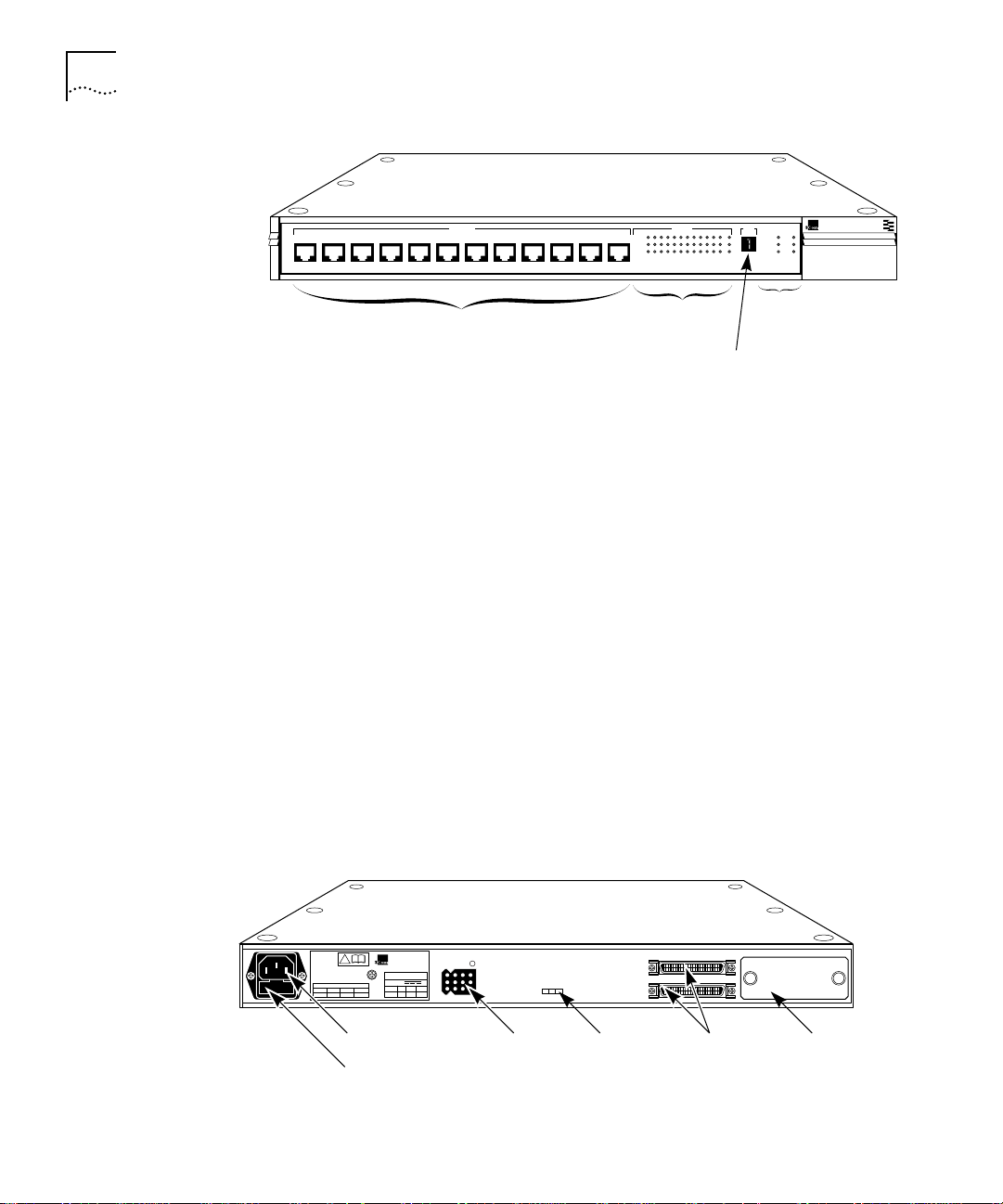
supports 100 Mbps connectivity, has 12 dedicated RJ-45 twisted-pair ports on
its front panel, as shown in Figure 1-1. A media-flexible transceiver interface
module port on the hub’s rear panel is designated the thirteenth port.
Page 12
1-2
HAPTER
C
NTRODUCTION
1: I
1x 2x 3x 4x 5x 6x 7x
100BASE-TX STATUS
8x 9x 10x 11x 12x
ACTIVITY
LINK
PARTITION
12345678910111213
LinkBuilder FMS 100
®
UNIT
3C250-TX/Ι
FAN FAIL
OVERTEMP
COLLISION
100BASE-TX Hub
CLSII
CLSI
PWR
Hub
operation
LEDs
RJ-45 ports
Port LEDs
Unit digital
display
Figure 1-1
Front Panel of LinkBuilder FMS 100-TX Hub
Each port (including the thirteenth por t) is supplied with three LEDs that
provide activity, link, and partition status information. Additional LEDs
provide repeater classification, environmental, and port status information.
(Refer to Chapter 3 for the interpretation of LEDs.)
The hub’s rear panel (Figure 1-2) has a slot for a 3Com transceiver interface
module, which (as the thirteenth port) provides media flexibility and
accessibility to the hub. This slot can also be left empty, if desired, with no
connection (no module attached).
Two types of transceiver interface modules are available and must be
purchased separately:
■
100BASE-TX Category 5 UTP module (3C252-TX) 100BASE-FX Fiber module (3C262-FX)
■
Additional modules may be supported in the future.
REFER TO
INSTRUCTION MANUAL
FOR CORRECT
!
SELECTION OF
POWER CORD
CAUTION: For continued
protection against risk of fire
use only with same type
and rating of anti-serge fuse.
AC power cord socket
Fuse compartment
Figure 1-2
3Com Corporation
Santa Clara, CA
®
Made in USA
A max55.0
DC INPUT
INPUT
V
+12
–12
2.5
0.2
ED
DC input
connector
UP
DOWN
Power-up
disabled
option switch
Rear Panel of LinkBuilder FMS 100-TX Hub
EXPANSION
Expansion
connectors
Transceiver
interface
module port
Page 13

Management Unit
1-3
The two expansion connectors are used for adding components (additional
hubs or a Management Unit) to create a hub stack. The LinkBuilder FMS 100-TX
Hub can be used as a stand-alone repeater or as a stacked unit with other
LinkBuilder FMS 100 Hubs. Stacking units provides the benefit of a higher port
count, with the stack functioning as a single logical repeater. Up to eight units
(for example, seven hubs and a Management Unit) can be connec ted together
in a stack.
The rear panel of the hub provides a three-pronged socket for attaching a
100–240 V AC power cord to the hub. Alternatively, power can be supplied
through a 3Com Redundant Power System (RPS) connected to the DC input
connector. Refer to the section “Using the Redundant Power System” in
Chapter 2 for additional information.
A 2 A, 250 V fast-blow fuse is located in the hub’s AC receptacle.
You can mount the LinkBuilder FMS 100-TX Hub in a 19-inch standard rack or
you can place it as a stand-alone unit on a desk or table. A rack-mounting kit
is supplied with each hub.
Management Unit
The LinkBuilder FMS 100-TX Hub can support a Management Unit to
provide full SNMP manageability to a hub stack. The Management Unit is
designed for inclusion in 3Com’s SuperStack family of stackable network
devices and can also be connected to the Redundant Power System (RPS).
If a Management Unit is included in a stack, a maximum of seven hubs is
allowed in the stack — that is, one M anagement Unit plus seven repeaters
for a total of eight components, the maximum number of components
allowed in one hub stack.
Only one Management Unit can be attached to each stack.
Page 14

1-4
HAPTER 1: INTRODUCTION
C
Hub Functions The LinkBuilder FMS 100-TX Hub supports the standard functions of an
IEEE 802.3 repeater, as listed in Table 1-1.
Table 1-1 Supported IEEE 802.3 Repeater Functions
Standard Repeater
Function
Signal retiming Restores the timing and amplitude of the received signal
Carrier integrity monitor Examines the packets being received for invalid framing;
Jabber control Inhibits overly long transmissions of data generated by
Automatic partition/ reconnection
Description
before retransmitting the signal.
blocks excessive invalid frames to prevent them from
harming the network.
station hardware failure. This function is activated once a
received packet has exceeded the jabber threshold. Refer to
the 802.3u specification for additional information.
Prevents the faulty segment’s carrier activity from reaching
the hub and being propagated throughout the network.
Page 15

2
INSTALLING THE
FMS 100-TX H
This chapter discusses the following topics:
■ Unpacking the hub
■ Positioning the hub
■ Installing the hub
■ Installing the transceiver interface modules
■ Using the Redundant Power System
■ Replacing the fuse
UB
Unpacking the Hub
When unpacking the hub, follow these steps:
1 Open the shipping container and carefully remove its contents.
2 Return all packing materials to the shipping container and save it.
If the hub must be returned, ship it in its original shipping container (or one
providing equivalent protection), or the warrant y will be voided.
3 Verify that you have received all items that are shipped with the hub, as
listed below.
4 Inspect each item for damage. If you find any omissions or damage, contact
your network supplier and the carrier that delivered the package.
Each LinkBuilder FMS 100-TX hub is shipped with the following:
■ Rack mounting kit containing two brackets and four screws
■ Four rubber feet for desktop placement
■ AC power cord
Page 16

2-2 CHAPTER 2: INSTALLING THE FMS 100-TX HUB
If you ordered one or more transceiver interface modules, they will be
packaged separately from the hub.
Positioning the Hub
When deciding where to place the hub, make sure the environment meets
the following conditions:
■ The hub is accessible and cables can be connected easily.
For help in planning your network configuration and the location of the
hub, refer to Chapters 3 and 4 for information on connecting the hub to the
network and the required cabling types and lengths. Read this material
before locating the hub permanently.
■ Cabling is away from:
■ Sources of electrical noise, such as HVAC, radios, transmitters, and
broadband amplifiers
■ Power lines and fluorescent lighting fixtures
■ Water or moisture cannot enter the hub’s case.
■ Airflow around the unit and through the vents is not restricted. Provide a
minimum of 1 inch (2.5 cm) clearance on all four sides of the unit.
■ No objects are placed directly on top of any stack or unit other than
another stackable device.
Installing the Hub This section discusses hub installation. You can install the hub in a standard
19-inch rack or on a desk or table.
WARNING: 3Com strongly recommends that you install the hub stack in a
rack, particularly if you intend to use more than four hubs in the stack. Since
each hub weighs 12 pounds (5.5 kg), the total weight of eight hubs (the
maximum hub stack), plus the possible addition of two RPSs, would be more
than 100 pounds (45.5 kg). For maximum safety, this combination of units
should be installed in the lower part of a rack. If placed on a desk or table, be
certain that the furniture is sturdy enough to support the weight.
Page 17
Installing the Hub 2-3
Rack Mounting The hub is supplied with two brackets and four screws for rack mounting in
a standard 19-inch rack. The four rubber feet that are shipped with each
hub are not used for rack mounting.
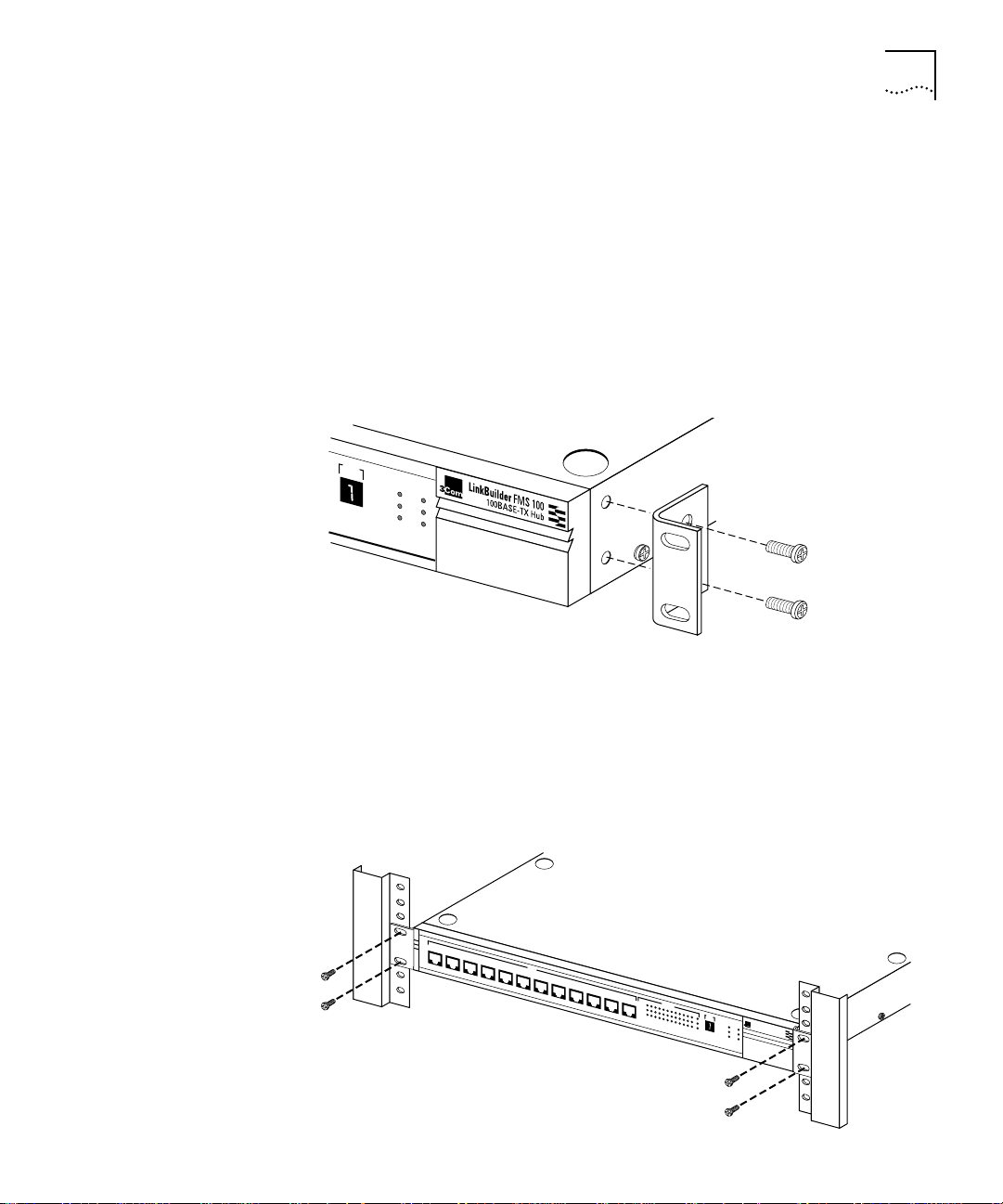
To mount the hub in a rack, follow these steps, which assume you are
stacking two or more hubs in a rack:
1 Place one of the hubs on a level surface, with the front panel facing you.
2 Position a bracket over the mounting holes on one side of the unit, as
shown in Figure 2-1.
.
UNIT
3C250-TX/Ι
FAN FAIL
OVERTEMP
COLLISION
®
CLSII
CLSI
PWR
Figure 2-1 Attaching a Bracket for Rack Mounting
3 Insert the two screws and tighten with a screwdriver.
4 Repeat steps 2 and 3 for the other side of the hub.
5 Mount the hub in the rack and secure it with suitable screws, as shown in
Figure 2-2.
1x
2x
3x
4x
100BT
5x
6x
7x
8x
9x
10x
11x
12x
ACTIVITY
STATUS
LINK
Figure 2-2 Rack Mounting a Single Hub
PARTITION
12345678910111213
UNIT
3C250-TX/
LinkBuilder FMS 100
FAN FAIL
®
CLSII
OVERTEMP
100BASE-TX Hub
CLSI
COLLISION
PWR
Page 18
2-4 CHAPTER 2: INSTALLING THE FMS 100-TX HUB
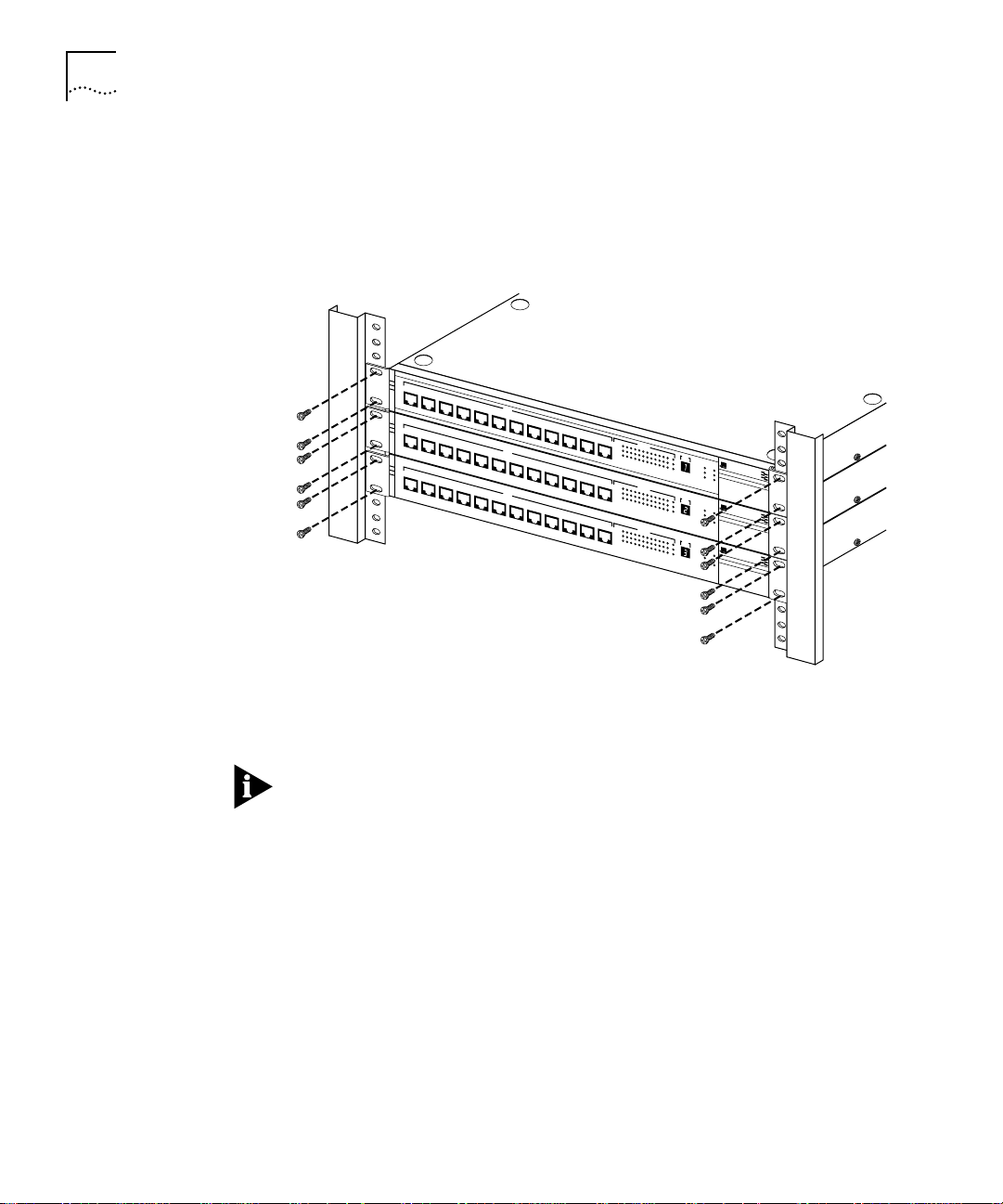
6 Attach brackets to both sides of the other hubs to be rack-mounted, as
described in steps 2 through 4.
7 Insert each hub into the rack and fasten each one individually to the rack
uprights, as shown in Figure 2-3.
1x
2x
1x
2x
1x
2x
3x
4x
100BT
5x
6x
7x
8x
9x
10x
11x
3x
4x
100BT
5x
6x
7x
8x
3x
4x
100BT
5x
6x
7x
8x
12x
ACTIVITY
STATUS
LINK
PARTITION
9x
9x
12345678910111213
10x
11x
12x
ACTIVITY
LINK
PARTITION
12345678910111213
10x
11x
12x
ACTIVITY
LINK
PARTITION
12345678910111213
UNIT
3C250-TX/
LinkBuilder FMS 100
FAN FAIL
Ι
®
CLSII
OVERTEMP
100BASE-TX Hub
CLSI
COLLISION
STATUS
STATUS
PWR
UNIT
3C250-TX/
LinkBuilder FMS 100
FAN FAIL
Ι
®
CLSII
OVERTEMP
100BASE-TX Hub
CLSI
COLLISION
PWR
UNIT
3C250-TX/
FAN FAIL
LinkBuilder FMS 100
Ι
®
CLSII
OVERTEMP
100BASE-TX Hub
CLSI
COLLISION
PWR
Figure 2-3 Installing a Hub Stack in a Rack
8 Repeat steps 2 through 7 when placing additional hubs in the stack.
A single hub stack can contain up to eight units (eight hubs, or seven hubs
and one Management Unit) and two Redundant Power Systems.
9 For each hub, plug one end of the power cord into the AC power connector
and the other end into a power source. (Refer to the section “Using the
Redundant Power System” for information on installing the Redundant
Power System.)
All the LEDs should light momentarily. Verify that the PWR (power) LED
remains ON, indicating that the hub is receiving power.
See Chapter 3 for information about connecting the stack to the network
and interpreting LEDs.
Page 19
Installing the Transceiver Interface Modules 2-5
Desktop Placement If you place the hub on a desk or table, attach the supplied rubber feet to
each bottom corner of the hub. If you stack additional hubs on top of the
bottom one, place rubber feet on the bottom of each corner of each hub in
the outline shown on the unit’s base.
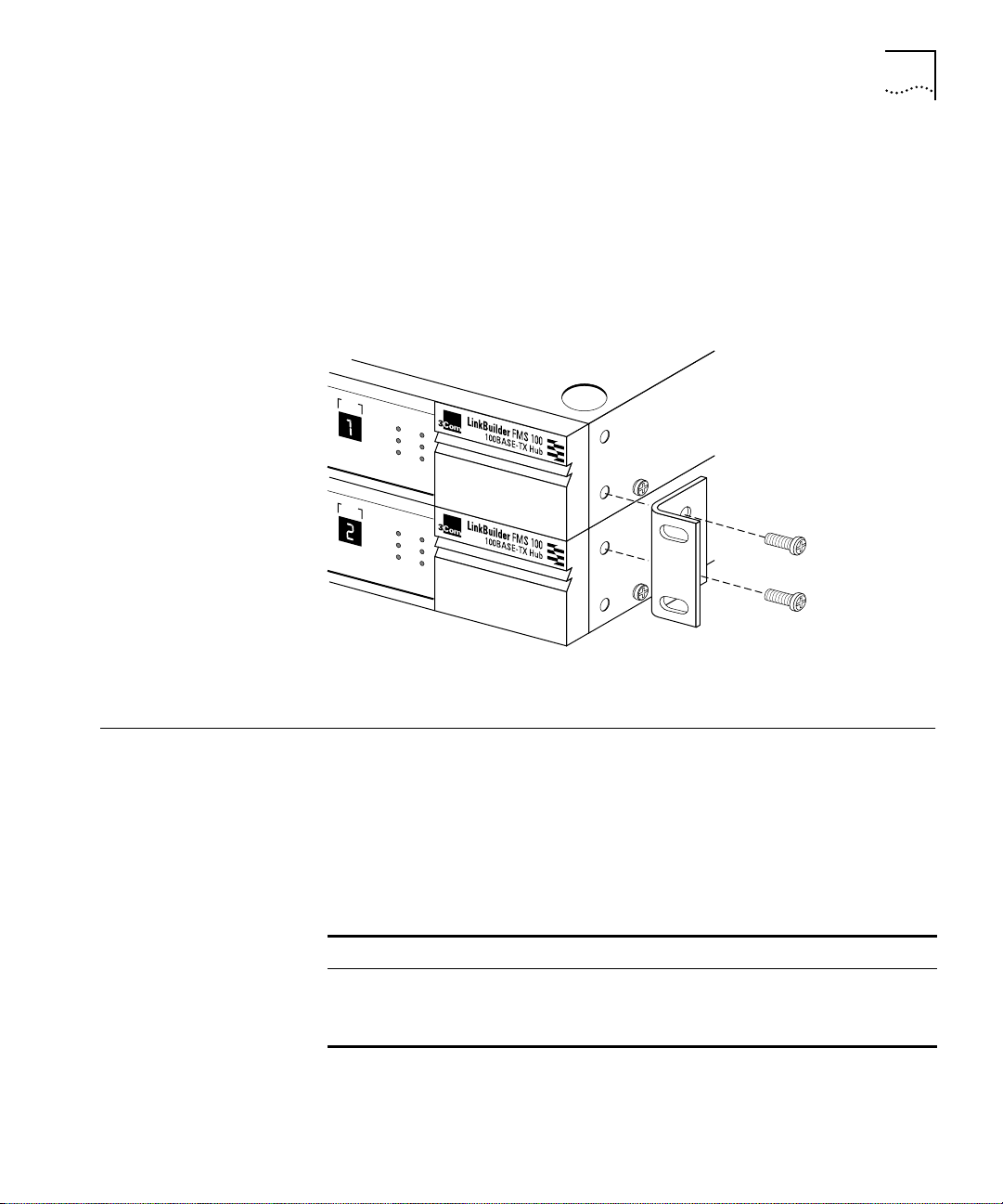
To prevent hubs from possibly sliding off the stack, fasten each hub to the
hub below it by using the supplied brackets, as shown in Figure 2-4.
UNIT
3C250-TX/Ι
UNIT
FAN FAIL
OVERTEMP
COLLISION
FAN FAIL
OVERTEMP
COLLISION
CLSII
PWR
3C250-TX/Ι
CLSII
PWR
®
CLSI
®
CLSI
Installing the Transceiver Interface Modules
Figure 2-4 Attaching a Bracket for Desktop Placement
The LinkBuilder FMS 100-TX Hub chassis is equipped with a rear panel port
into which you can insert an optional 3Com transceiver interface module.
The transceiver interface module permits connections to a 100 Mbps Ethernet
station or a network backbone that is also running 100 Mbps Ethernet.
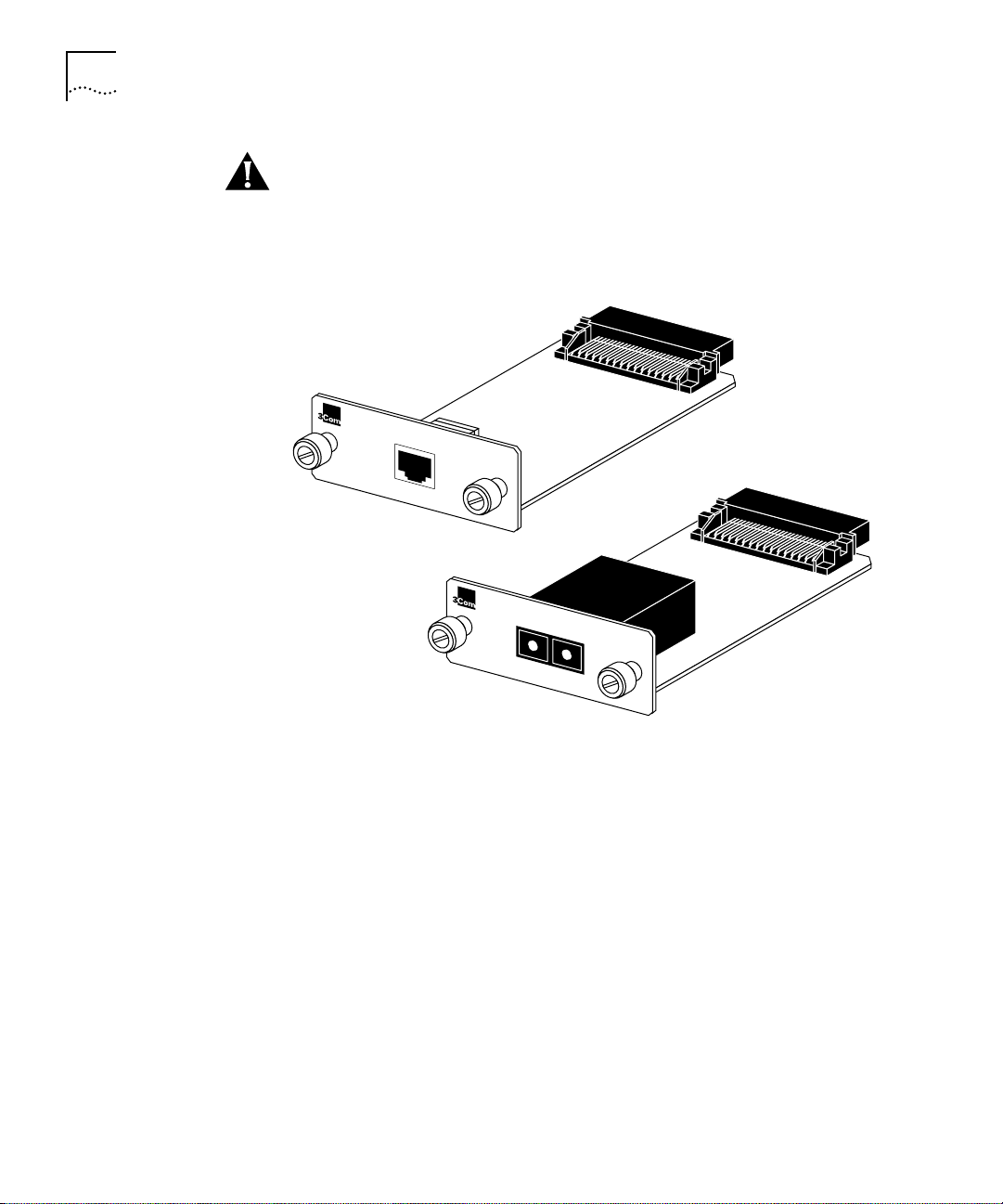
The two types of transceiver interface modules are shown in Figure 2-5.
Table 2-1 describes the two 100 Mbps modules.
Table 2-1 Transceiver Interface Modules
Module Type 3Com Part Number Connector Cabling
100BASE-TX 3C252-TX RJ-45 Category 5 UTP cabling 100BASE-FX 3C262-FX Multimode fiber
SC connector
Two-strand (62.5/125µ) fiber-optic cabling
Page 20
2-6 CHAPTER 2: INSTALLING THE FMS 100-TX HUB
CAUTION: Each module is packed in antistatic material to protect it during
shipment. To avoid damaging any static-sensitive components after removal
from the container, be sure to reduce any static electricity on your person.
One way to do this is to touch the metal chassis of the hub. You can
maintain grounding by wearing a wrist strap attached to the chassis.
®
100BASE-TX
100BASE-TX
®
100BASE-FX
100BASE-FX
Figure 2-5 Transceiver Interface Modules
To install a transceiver interface module, follow these steps:
1 Disconnect the AC power cord from the individual hub into which you are
installing the transceiver interface module.
You do not have to power down the entire stack to install a module in a
single hub. If you are installing several modules, power down each hub
before inserting its module.
2 Remove the blanking plate from the transceiver interface module port on
the hub’s rear panel by unscrewing the plate’s two end screws.
The transceiver interface module port is shown in Figure 1-2.
Keep the blanking plate for possible future use in case you remove the
module.
Page 21

Using the Redundant Power System 2-7
3 Carefully remove the transceiver interface module from its shipping
container.
4 Slowly insert the module into the slot, being careful not to damage any of
the components or connecting pins.
The module will slide into the hub following the tracks in the slot. The
lettering that shows the module type must be positioned on top of the
connector openings when the module is in place.
5 Push the module all the way in until the connector is firmly seated. 6 Tighten the two thumbscrews to secure the module in place. 7 Reattach the power cord to the hub. 8 Attach the proper cable to the module to make the desired network
connection.
The ACTIVITY LED for the thirteenth port on the hub’s front panel should be
green, indicating the module is correctly installed.
Using the Redundant Power System
To ensure fail-safe operation and constant power to the hub stack, you can
use the 3Com Redundant Power System (RPS) (part number 3C565047).
The RPS must be purchased separately.
The RPS, which is rack-mountable, comprises two load-sharing bulk power
supplies fed by two independent AC lines. Either power supply alone can
support a stack of up to four hubs. Eight hubs in a stack will require two RPS
units, one mounted on the bottom of the stack and the other on the top.
Redundant fans protect against possible failures caused by overheating.
The RPS front panel provides LED indicators for monitoring temperature as
well as input and output status. In the event of a failure in one of the
supplies, an alert is automatically sent to the management console.
Page 22
2-8 CHAPTER 2: INSTALLING THE FMS 100-TX HUB
The RPS cables are inserted into the DC input connectors on the hubs’ rear
panels. Remove the rubber protective cover from each DC input connector
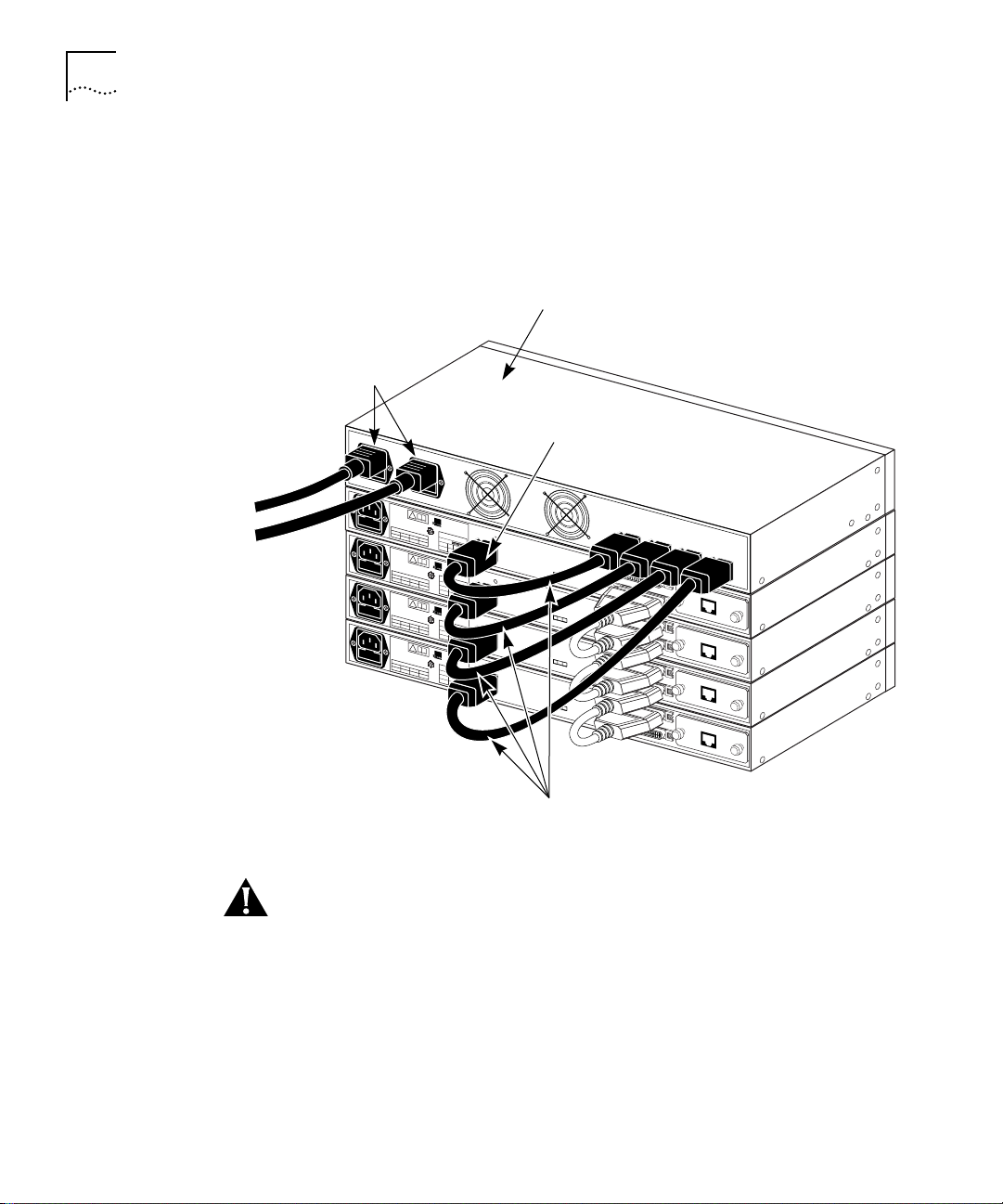
before connecting the RPS cable. Figure 2-6 shows the RPS mounted on top
of a four-hub stack and connected to each hub.
AC power
cords
REFER TO
INSTRUCTION MANUAL
FOR CORRECT
SELECTION OF
POWER CORD
!
CAUTION: For continued
protection against risk of fire
use only with same type
and rating of anti-serge fuse.
REFER TO
INSTRUCTION MANUAL
FOR CORRECT
SELECTION OF
POWER CORD
!
CAUTION: For continued
protection against risk of fire
use only with same type
and rating of anti-serge fuse.
REFER TO
INSTRUCTION MANUAL
FOR CORRECT
SELECTION OF
POWER CORD
!
CAUTION: For continued
protection against risk of fire
use only with same type
and rating of anti-serge fuse.
REFER TO
INSTRUCTION MANUAL
FOR CORRECT
SELECTION OF
POWER CORD
!
CAUTION: For continued
protection against risk of fire
use only with same type
and rating of anti-serge fuse.
3Com Corporation
®
Santa Clara, CA
Made in USA
INPUT
V
A max
3Com Corporation
®
Santa Clara, CA
Made in USA
INPUT
V
A max
3Com Corporation
®
Santa Clara, CA
Made in USA
INPUT
V
A max
3Com Corporation
®
Santa Clara, CA
Made in USA
INPUT
V
A max
Redundant
Power
System
DC input
connector
DC INPUT
5
+12
–12
5.0
2.5
0.2
DC INPUT
5
+12
–12
5.0
2.5
0.2
DC INPUT
5
+12
–12
5.0
2.5
0.2
DC INPUT
5
+12
–12
5.0
2.5
0.2
OUT
D
E
D
E
D
E
D
E
EXPANSION
IN
OUT
EXPANSION
IN
OUT
EXPANSION
IN
OUT
EXPANSION
IN
RPS cables
Figure 2-6 Connecting the Redundant Power System to Four Hubs
CAUTION: If you use the Redundant Power System, do not use the AC power
plug on the rear panel or the AC power cable that is supplied with each hub.
Instead, use the RPS cable and insert one end into the RPS and the other into
the DC input connector on each hub. I f you do not use the RPS, you must
connect each hub separately to an AC power source.
Page 23
Replacing the Fuse 2-9
Replacing the Fuse If the hub’s power (PWR) LED was lit initially but is no longer lit, one of the
following conditions may have caused the LED to go out:
■ The unit may be disconnected from its AC power source.
■ If connected to an RPS, the unit may be disconnected from its DC power
source.
Verify that the RPS is on and securely attached to the hub.
■ The AC power source may have failed.
If you are using AC power, verify that the AC power cord is securely
attached.
If the LED is still not lit, the fuse probably needs to be replaced.
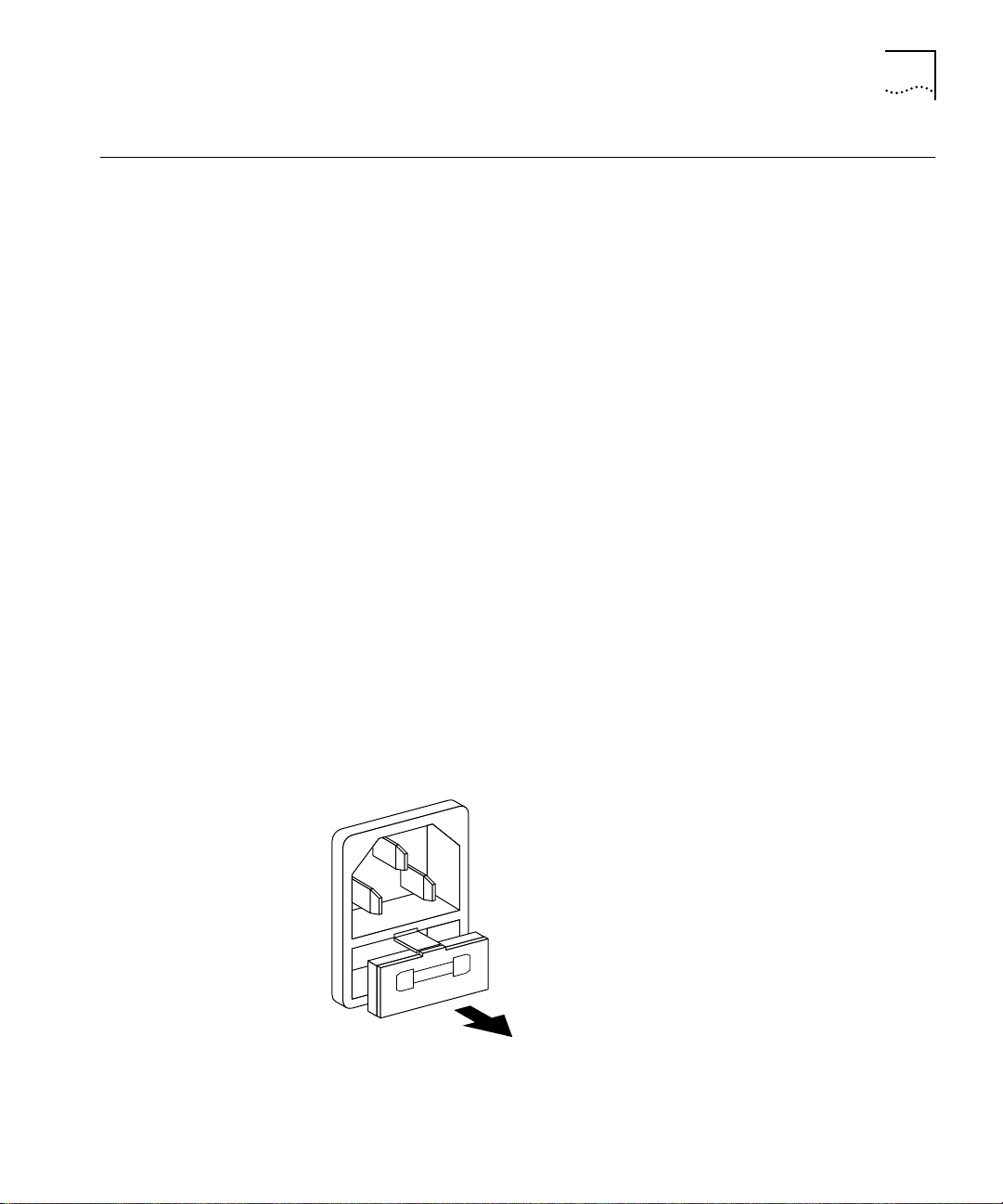
The fuse is located in the hub’s AC receptacle assembly on the hub’s rear
panel and is supplied as standard equipment for the hub. It is a fast-blow
FSF034.1523 fuse or equivalent, rated at 2 A, 250 V.
To replace the fuse, follow these steps:
1 Locate the AC receptacle on the hub’s rear panel. 2 Disconnect the AC power cord. 3 Using a small screwdriver, carefully pry open and pull out the fuse-holder, as
shown in Figure 2-7.
Use only with 250V fuse
Figure 2-7 Opening the Fuse-holder in the AC Receptacle Assembly
Page 24
2-10 CHAPTER 2: INSTALLING THE FMS 100-TX HUB
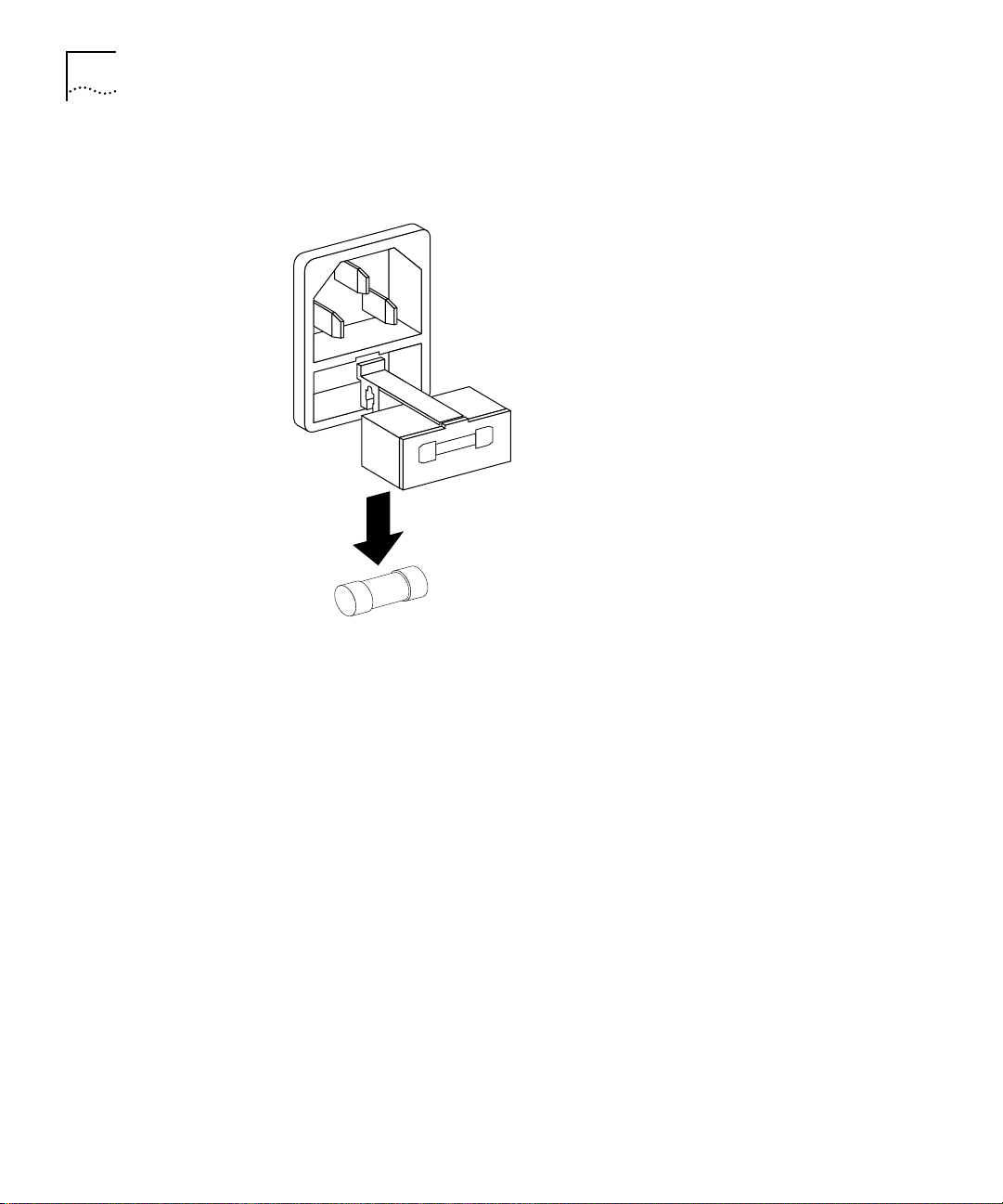
4 Remove the burned-out fuse by pulling it straight out of its socket, as
shown in Figure 2-8.
Use only with 250V fuse
Figure 2-8 Removing the Fuse
If you wish, you can store a spare fuse in the front section of the
fuse-holder.
5 Insert a new fuse, rated at 2 A, 250 V, in the fuse-holder.
6 Push the fuse-holder back into the AC receptacle until it snaps in place, and
reconnect the AC power cord.
If the PWR LED remains off, contact your network supplier.
Page 25

3
MAKING FMS 100-TX HUB
C
ONNECTIONS
This chapter discusses how to use the LinkBuilder FMS 100-TX Hub in
various network environments. The chapter also discusses how to interpret
the hub’s LEDs and how to use the power-up disabled option.
Making Network Connections
Table 3-1 LinkBuilder FMS 100-TX Hub Network Connections
Hub Connection Connectors Cabling Required Purpose
To node RJ-45 port
To another hub in the stack
To Management Unit Expansion connector Expansion cable Connects hub or hub stack to a
To network backbone Transceiver interface module:
Table 3-1 summarizes the possible schemes for connecting the LinkBuilder
FMS 100-TX Hub in a 100BASE-T network. These connections are the only
ones permitted for a Class I device such as the LinkBuilder FMS 100-TX Hub.
Straight-through UTP
Transceiver interface module:
100BASE-TX
100BASE-FX
Expansion connector Expansion cable Connects as many as eight hubs
100BASE-TX
100BASE-FX
RJ-45 port
Straight-through UTP Fiber
Straight-through or
cross-over UTP depending
on device
Fiber
Straight-through or
cross-over UTP depending
on device
Connects PCs, servers, and other
network devices directly to the hub
to each other to form a single
logical stack
Management Unit
Connects hub or hub stack to
network backbone through a
bridge, router, or switch
Connections that use the 100BASE-TX module are identical to those that use
an RJ-45 port on the hub’s front panel.
Page 26
3-2 CHAPTER 3: MAKING FMS 100-TX HUB CONNECTIONS
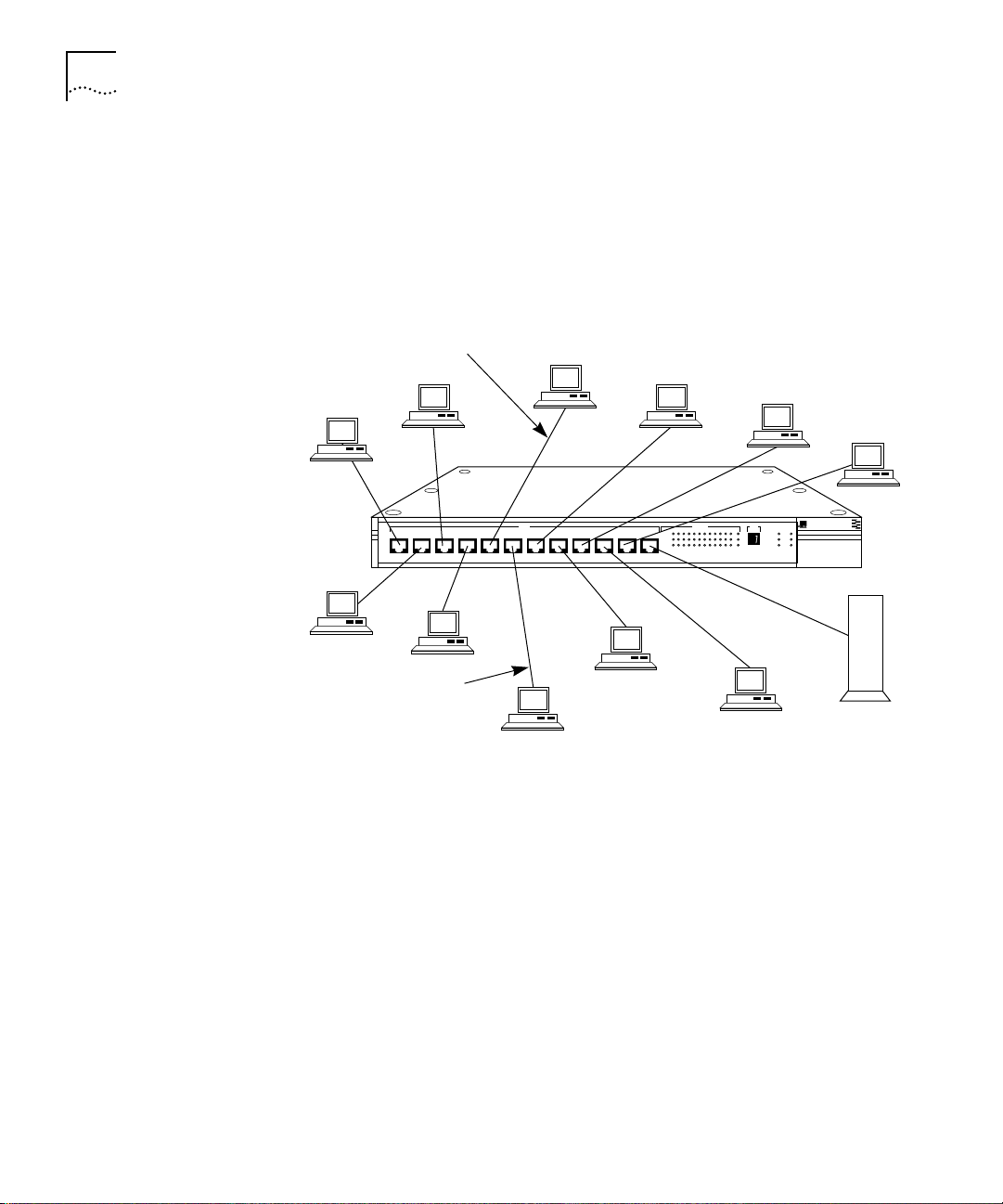
Hub to Node Once installed, the hub can support up to 12 end node connections.
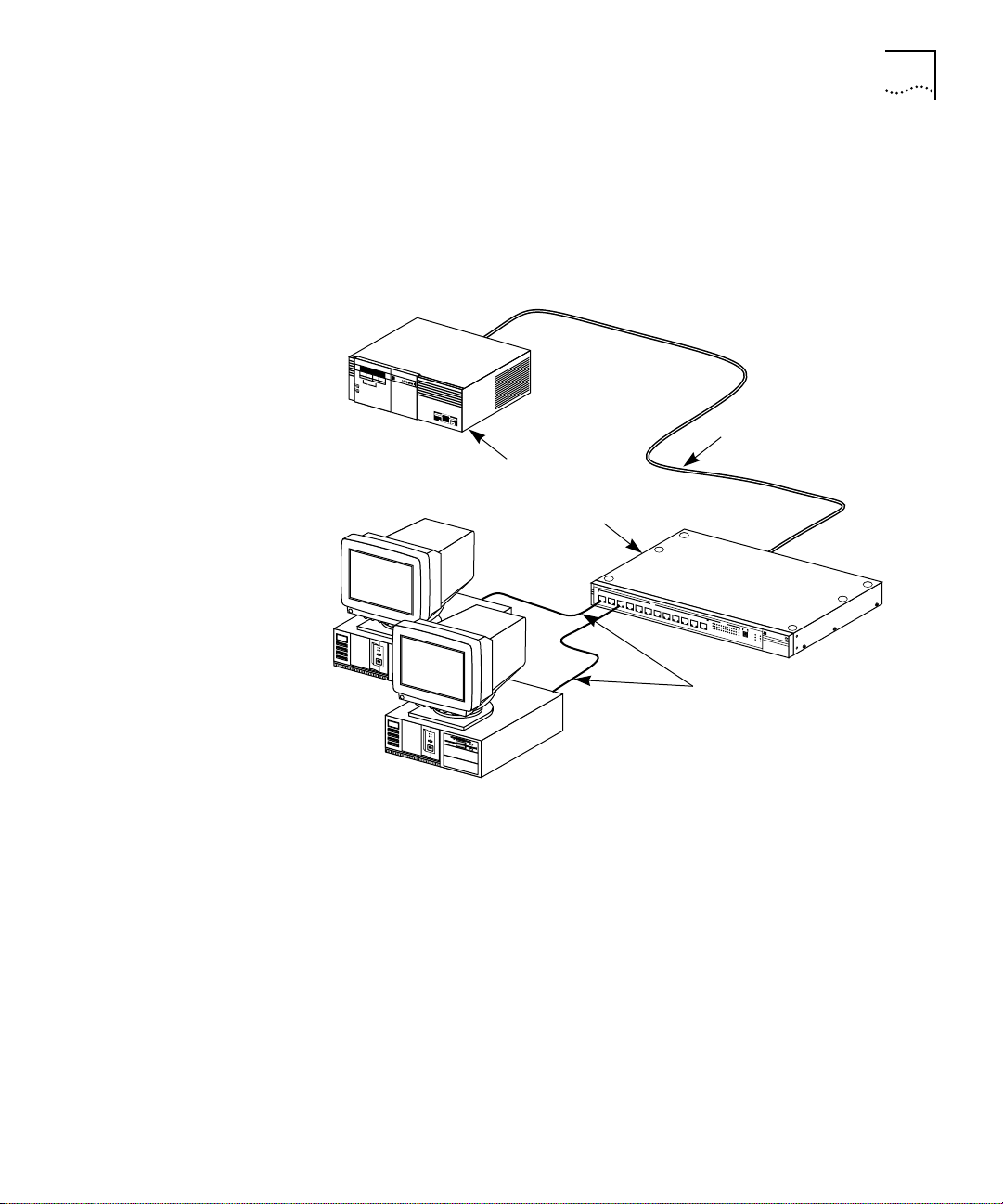
Figure 3-1 shows 11 PCs and one server connected to the RJ-45 ports on
the hub’s front panel. You can connect any combination of PCs, servers, and
other hubs to the 12 RJ-45 ports. ( The thirteenth por t permits an additional
connection through the transceiver interface module located on the hub’s
rear panel. See the section “Installing the Transceiver Interface Modules” in
Chapter 2.)
100 meters maximum
LinkBuilder
FMS 100 Hub
1x 2x 3x 4x 5x 6x 7x
100BT STATUS
8x 9x 10x 11x 12x
ACTIVITY
LINK
PARTITION
12345678910111213
LinkBuilder FMS 100
UNIT
®
3C250-TX/Ι
100BASE-TX Hub
CLSII
FAN FAIL
CLSI
OVERTEMP
PWR
COLLISION
Twisted-pair
cable
Server
Figure 3-1 LinkBuilder FMS 100-TX Hub Supporting 11 Users and a Server
The maximum allowable distance between the hub and a PC, server, or
other device is 100 meters of Category 5 UTP cable. The UTP cable used for
hub-to-node connections is a straight-through connection. That is, no
crossovers should be present. The pin assignments for a straight-through
cable are shown in Figure 3-2. Refer to Chapter 4 for cabling details.
Page 27
Making Network Connections 3-3
Adapter Hub
1
2
3
4
5
6
7
8
1
2
3
4
5
6
7
8
Figure 3-2 Pin Assignments for Straight-Through Cabling
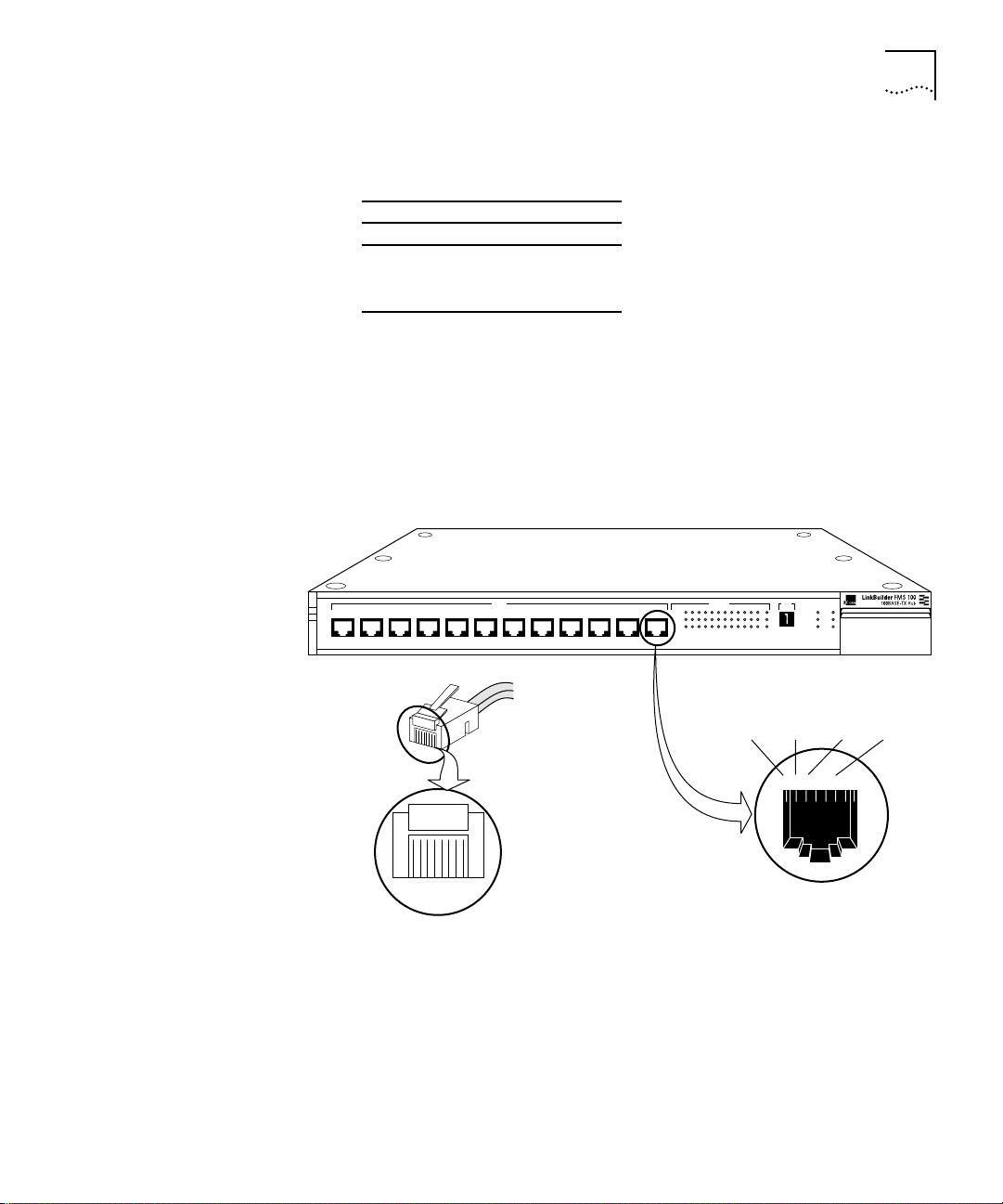
The pin assignments for the 100BASE-TX transceiver interface module are
the same as the pin assignments for the RJ-45 ports on the hub’s front
panel. Figure 3-3 shows the RJ-45 connector pin assignments.
1x 2x 3x 4x 5x 6x 7x
100BT STATUS
8x 9x 10x 11x 12x
12345678
Figure 3-3 RJ-45 Connector Pin Assignments
ACTIVITY
LINK
PARTITION
12345678910111213
UNIT
3C250-TX
FAN FAIL
OVERTEMP
COLLISION
1
2345678
®
CLSII
CLSI
PWR
TD–TD+RD–RD+
Page 28
3-4 CHAPTER 3: MAKING FMS 100-TX HUB CONNECTIONS
Hub-to-Hub
Interconnection
You can interconnect up to eight hubs, using expansion cables to form one
logical unit. ( The hub expansion cable is also designated the inter-hub bus
[IHB] cable.) Interconnecting eight hubs will provide a maximum of 104 ports
(96 RJ-45 ports from the front panels and 8 ports from the transceiver
interface modules inserted in the hubs’ rear panels).
You do not have to turn off the power if you are connecting hubs using
expansion cables.
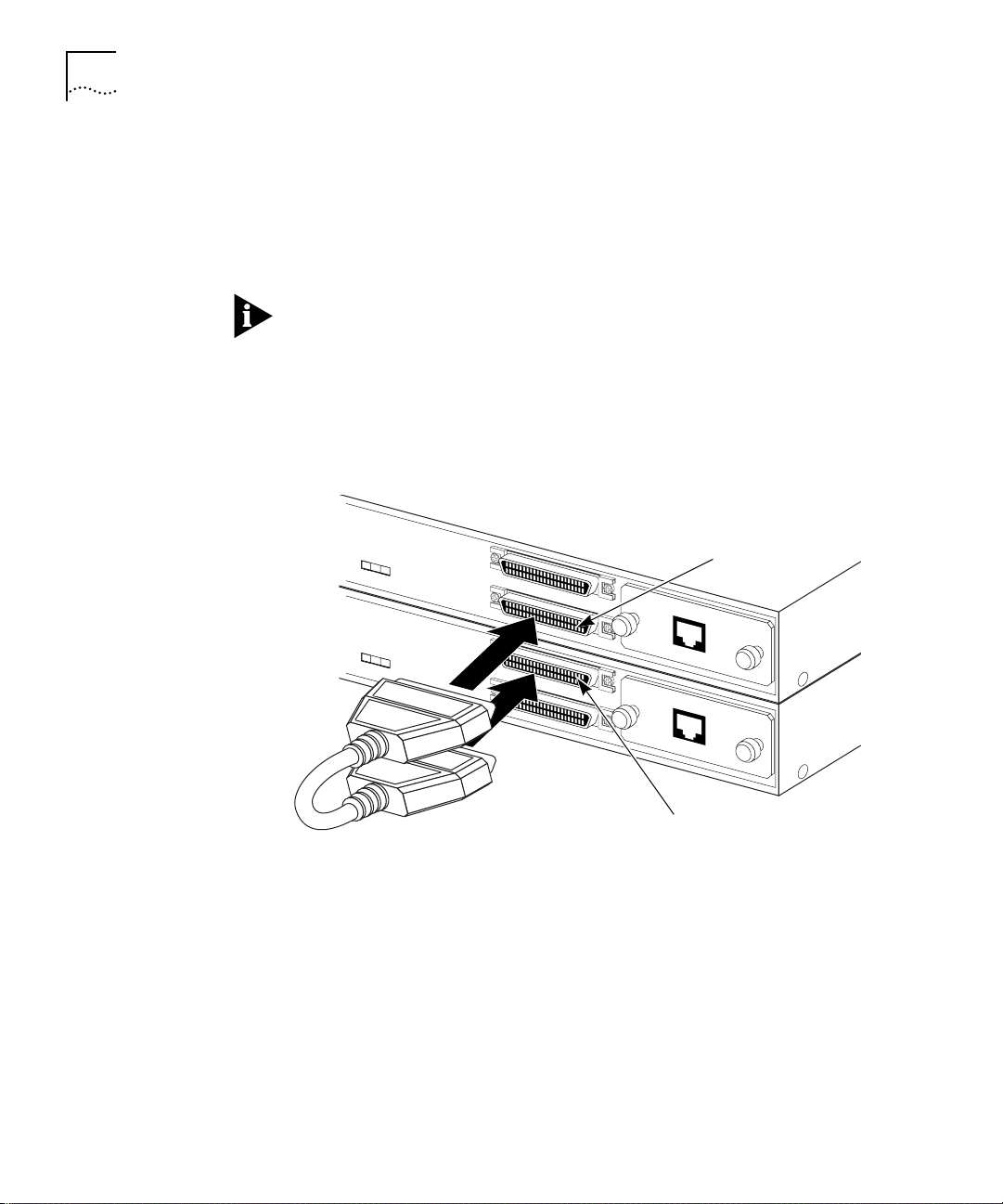
Use the hub expansion cable (3C219) to connect the UP expansion port on
the rear panel of one hub to the DOWN expansion port on the next hub, as
shown in Figure 3-4. (The hub expansion cable must be purchased
separately.) Repeat this step for each hub in the stack.
D
E
D
E
UP
DOWN
UP
DOWN
EXPANSION
EXPANSION
DOWN
expansion
port
Figure 3-4 Interconnecting Two Hubs
UP expansion port
Page 29
Making Network Connections 3-5
Hub to
Management Unit
You can connect the hub (or a hub stack) to a Management Unit by using
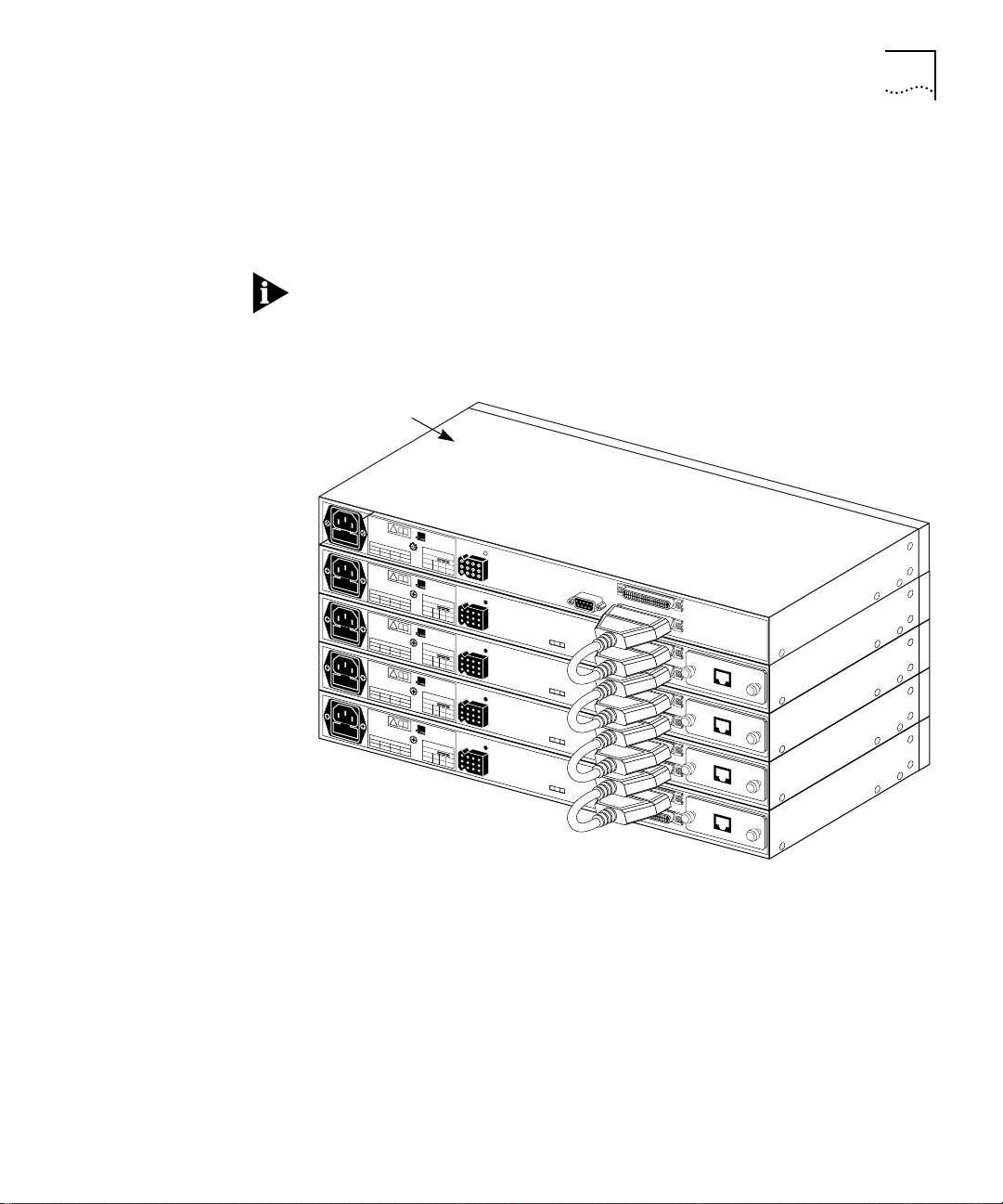
the expansion cable. Connect the UP expansion port on the hub’s rear panel
to the DOWN expansion port on the Management Unit’s rear panel, as
shown in Figure 3-5.
3Com strongly recommends that you place the Management Unit on top of
the hub stack, so it will be unit number 1. This will ensure that existing
nonvolatile port configuration information is applied to the correct physical
unit in the stack.
Management
Unit
REFER TO
INSTRUCTION MANUAL
FOR CORRECT
SELECTION OF
POWER CORD
CAUTION: For continued
protection against risk of fire
use only with same type
and rating of anti-serge fuse.
REFER TO
INSTRUCTION MANUAL
FOR CORRECT
SELECTION OF
POWER CORD
CAUTION: For continued
protection against risk of fire
use only with same type
and rating of anti-serge fuse.
REFER TO
INSTRUCTION MANUAL
FOR CORRECT
SELECTION OF
POWER CORD
CAUTION: For continued
protection against risk of fire
use only with same type
and rating of anti-serge fuse.
REFER TO
INSTRUCTION MANUAL
FOR CORRECT
SELECTION OF
POWER CORD
CAUTION: For continued
protection against risk of fire
use only with same type
and rating of anti-serge fuse.
REFER TO
INSTRUCTION MANUAL
FOR CORRECT
SELECTION OF
POWER CORD
CAUTION: For continued
protection against risk of fire
use only with same type
and rating of anti-serge fuse.
!
3Com Corporation
®
Santa Clara, CA
Made in USA
DC INPUT
INPUT
V
5
+12
A max
–12
5.0
2.5
0.2
!
3Com Corporation
®
Santa Clara, CA
Made in USA
DC INPUT
INPUT
V
5
+12
A max
–12
5.0
2.5
0.2
!
3Com Corporation
®
Santa Clara, CA
Made in USA
DC INPUT
INPUT
V
5
+12
A max
–12
5.0
2.5
0.2
!
3Com Corporation
®
Santa Clara, CA
Made in USA
DC INPUT
INPUT
V
5
+12
A max
–12
5.0
2.5
0.2
!
3Com Corporation
®
Santa Clara, CA
Made in USA
DC INPUT
INPUT
V
5
+12
A max
–12
5.0
2.5
0.2
D
D
D
D
UP
EXPANSION
Down
UP
E
E
E
E
DOWN
DOWN
DOWN
DOWN
EXPANSION
UP
EXPANSION
UP
EXPANSION
UP
EXPANSION
Figure 3-5 Connecting a Hub Stack to a Management Unit
The maximum number of units in a stack is eight including the
Management Unit. If you wish, you can add two Redundant Power Systems
to a stack of eight units (seven hubs and one Management Unit, or eight
hubs with no other device).
Page 30
3-6 CHAPTER 3: MAKING FMS 100-TX HUB CONNECTIONS
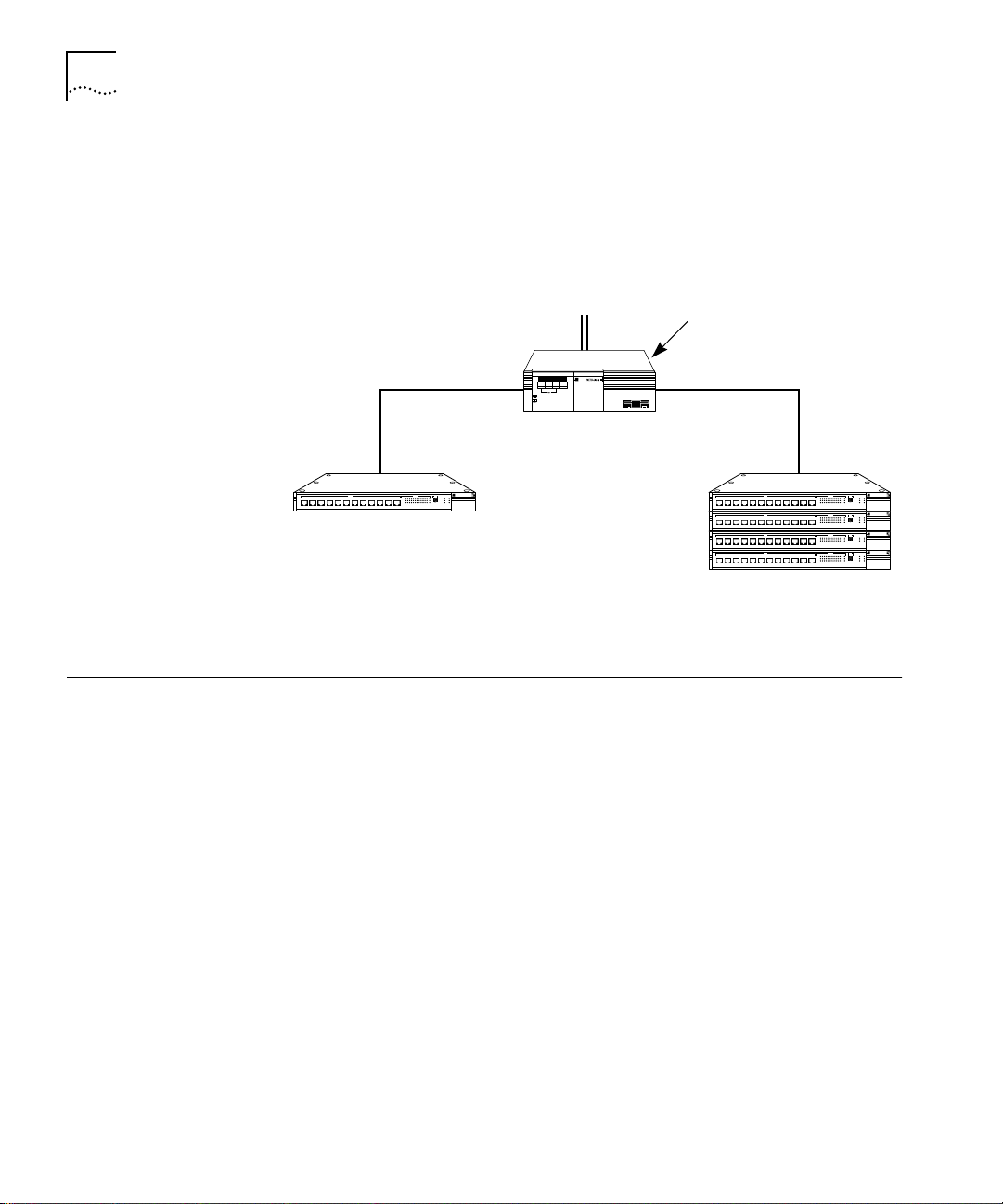
Hub to Backbone You can connect hubs and hub stacks to the network backbone through
the transceiver interface module on the rear panel via a bridge, router, or
switch, using either Category 5 UTP or fiber cabling. Figure 3-6 shows
single and interconnected hubs connected to a network backbone.
To network
backbone
Switch, router, or bridge
Using Transceiver Interface Modules
®
LinkBuilder
1x 1x 1x 1x 1x 1x 1x
1x 1x 1x 1x 1x 1x 1x
1x 1x 1x 1x 1x 1x 1x
1x 1x 1x 1x 1x 1x 1x
100BT STATUS
1x 1x 1x 1x 1x
100BT STATUS
1x 1x 1x 1x 1x
100BT STATUS
1x 1x 1x 1x 1x
100BT STATUS
1x 1x 1x 1x 1x
ACTIVITY
LINE
PARTITION
12345678910111213
ACTIVITY
LINE
PARTITION
12345678910111213
ACTIVITY
LINE
PARTITION
12345678910111213
ACTIVITY
LINE
PARTITION
12345678910111213
®
UNIT
3C12345
R
EPEATER
CLS2
FAN FAIL
CLS1
OVERTEMP
PWR
COLLISION
LinkBuilder
®
UNIT
3C12345
R
EPEATER
CLS2
FAN FAIL
CLS1
OVERTEMP
PWR
COLLISION
LinkBuilder
®
UNIT
3C12345
R
EPEATER
CLS2
FAN FAIL
CLS1
OVERTEMP
PWR
COLLISION
LinkBuilder
®
UNIT
3C12345
R
EPEATER
CLS2
FAN FAIL
CLS1
OVERTEMP
PWR
COLLISION
1x 1x 1x 1x 1x 1x 1x
100 meters maximum
100BT STATUS
1x 1x 1x 1x 1x
ACTIVITY
LINE
PARTITION
12345678910111213
UNIT
3C12345
CLS2
FAN FAIL
CLS1
OVERTEMP
PWR
COLLISION
Single hub
LinkBuilder
®
R
EPEATER
Interconnected hubs
Figure 3-6 Connecting Hubs to the Network Backbone
Two types of transceiver interface modules are available for connecting the
LinkBuilder FMS 100-TX Hub to the LAN. By inserting the appropriate
transceiver interface module in the hub’s thirteenth port, you can use either
UTP or fiber-optic cabling to connect the hub to various LAN devices. For
example, you can connect the LinkBuilder FMS 100-TX Hub to a multiport
bridge or switch using the 100-TX module and gain access to a 10BASE-T
network. Likewise, by using the 100BASE-FX module, you can attach the hub
to a switch that is connected via fiber cabling to the network. (S ee the next
section for a discussion of using the hub to access multisegmented networks.)
The required cabling for the two transceiver interface modules is as follows:
■ 100BASE-TX module: Category 5 two-pair UTP cabling
■ 100BASE-FX module: two-strand 62.5/125 µ multimode fiber cabling
Connections to a server or PC from one of the transceiver interface modules
require straight-through cabling.
Page 31

Considerations for Multisegmented Networks 3-7
Considerations for Multisegmented Networks
The 100BASE-T technology defined in the IEEE 802.3 standard provides for both
homogeneous CSMA/CD 100 Mbps networks and heterogeneous 10/100 Mbps
mixed networks. Both network topologies can be suppor ted by connecting
various LAN segments using repeaters and switches, bridges, or routers.
The LinkBuilder FMS 100-TX Hub supports only the 100 Mbps network
topology. Access to 10 Mbps functionality is possible through connections
with switches, bridges, or routers that support 10/100 Mbps topologies.
Two LAN segments connected by a repeater constitute a single collision
domain. LAN segments connected by switches, bridges, or routers constitute
multiple collision domains. You can achieve maximum network flexibility by
designing multiple collision domain networks.
For example, a combined system containing both 10BASE-T and 100BASE-T
devices and built with repeaters and switches can deliver dedicated 100 Mbps,
shared 100 Mbps, dedicated 10 Mbps, and shared 10 Mbps ser vices to devices
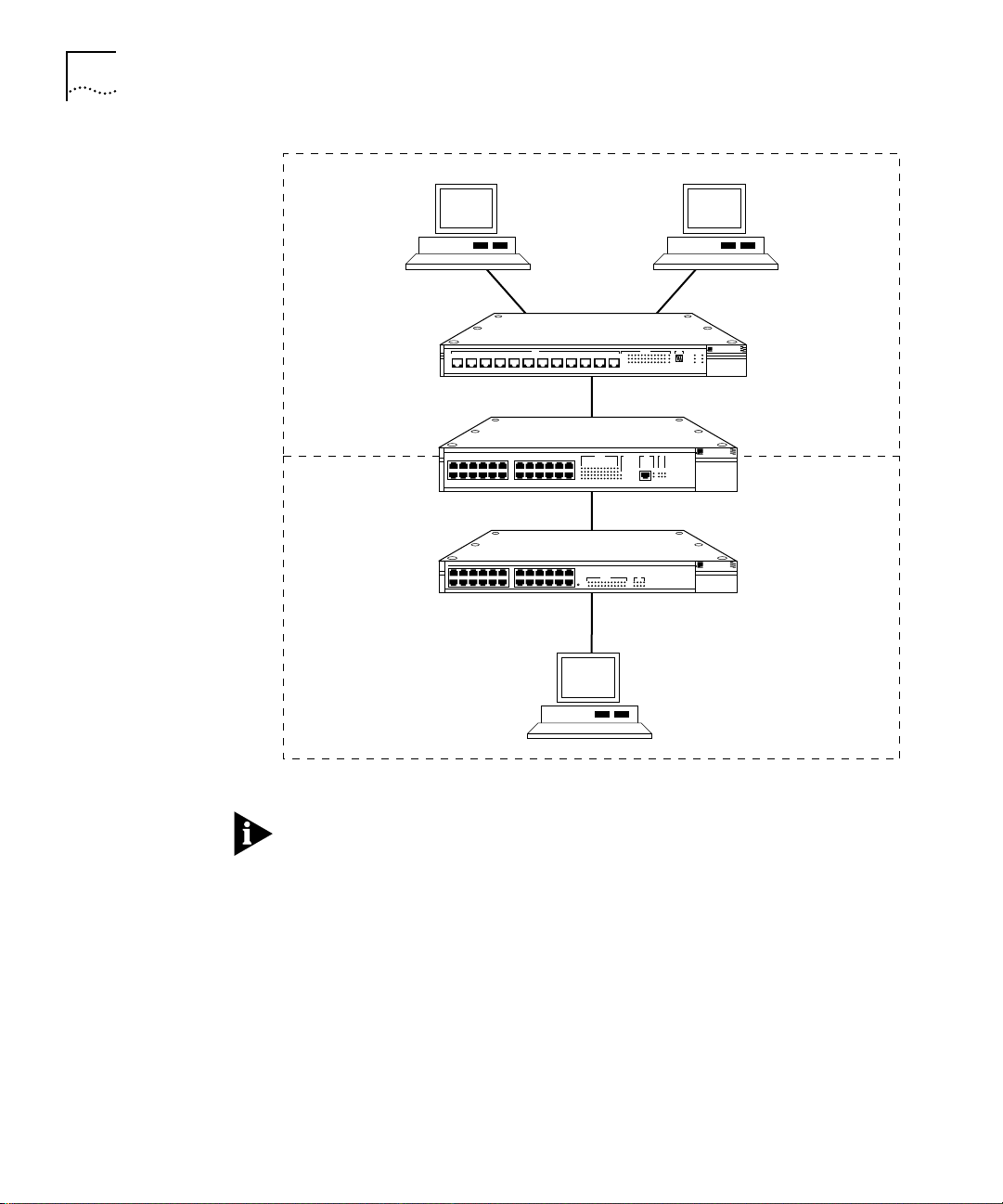
on the LAN. Figure 3-7 illustrates a network composed of two collision domains
connected by a 10/100 Mbps switching hub.
Page 32
3-8 CHAPTER 3: MAKING FMS 100-TX HUB CONNECTIONS
Collision domain
1x 2x 3x 4x 5x 6x 7x
Collision domain
100BT STATUS
8x 9x 10x 11x 12x
STATUS UNIT XXXXXXXX
STATUS XX
ACTIVITY
LINK
PARTITION
12345678910111213
LinkBuilder FMS 100
®
UNIT
3C250-TX
100BASE-TX Hub
CLSII
FAN FAIL
CLSI
OVERTEMP
PWR
COLLISION
3C16900
LinkBuilder FMS
100-TX Hub
LinkSwitch
1000
LinkSwitch 1000
Switch
LinkBuilder
FMS II
3C16671
LinkBuilder FMS II
10 Mbps Hub
Figure 3-7 10 and 100 Mbps Collision Domains Connected by a Switching Hub
A Fast Ethernet packet transmitted on a LAN can pass through no more than
two logical Class II repeaters or one logical Class I repeater before reaching its
destination or passing through a LAN bridge, switch, or router.
Page 33
Classification of Repeaters 3-9
Classification of
Repeaters
The IEEE 802.3 standard defines two classes of repeaters for 100BASE-T
Fast Ethernet networks, as detailed below.
Class I Repeaters A Class I repeater is a hub with internal delay such that only one repeater can
exist between any two DTE (data terminal equipment) devices within a single
collision domain when two maximum-length cable segments are used.
The LinkBuilder FMS 100-TX Hub (product number 3C250-T X/1) is a Class I
device only.
Internal delay is the time delay between the sensing of the first data bit
received and the sensing of the first bit transmitted on a 100 Mbps CSMA/CD
network. Propagation time delays also affect repeater classification. Class I
repeater delays are longer than Class II repeater delays.
A Class I network topology consists of one hub (or hub stack) in a single collision
domain existing between any two end stations. The stack of LinkBuilder FMS
100-TX Hubs in this configuration can contain up to eight hubs.
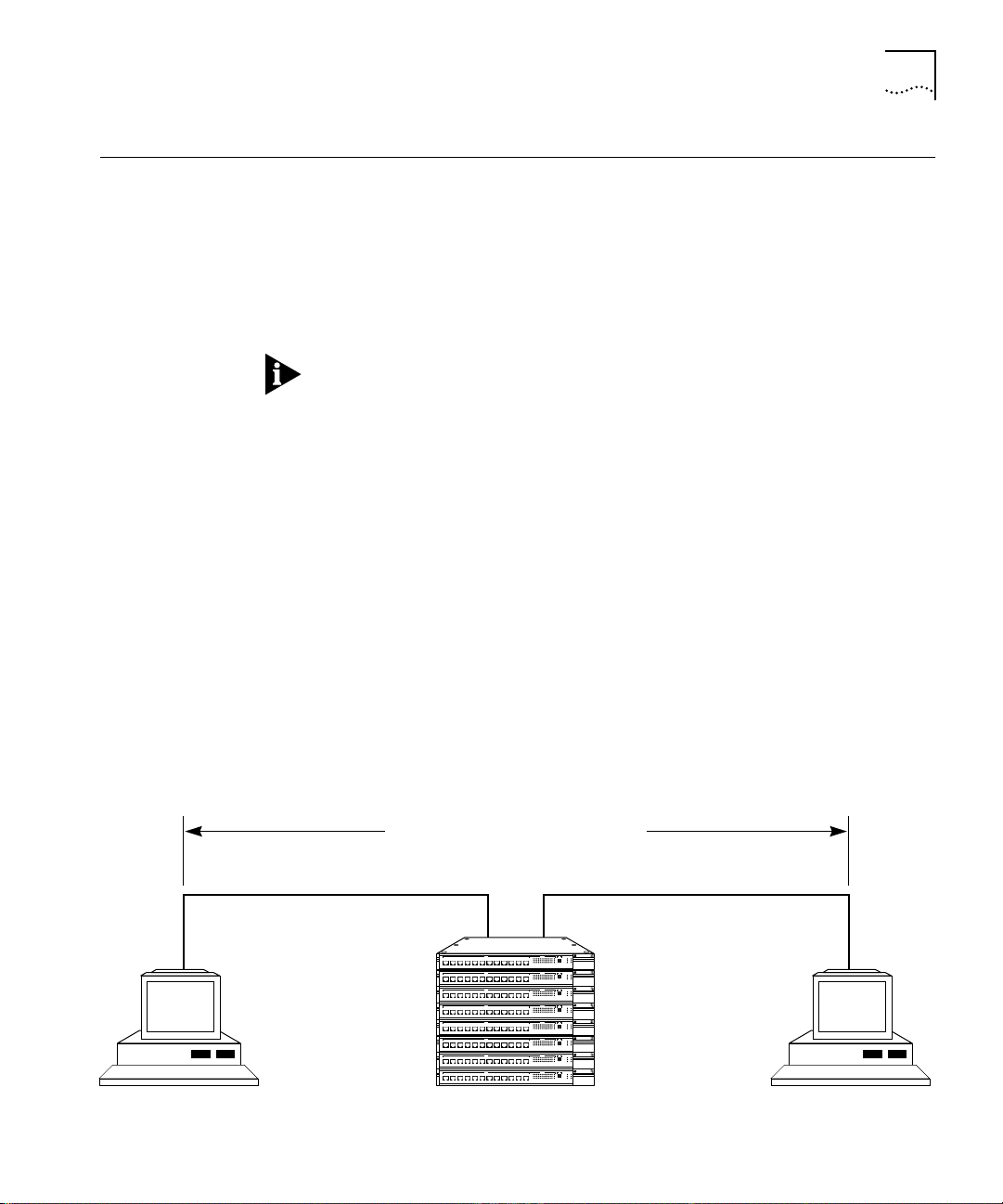
Figure 3-8 shows a single collision domain containing one Class I hub stack
between two end stations, with the distance between end stations being
200 meters. If one of the hub-to-node segments is implemented with fiber
cabling (by using the 100BASE-FX transceiver interface module), the total
span can be 260.8 meters. That is, up to 100 meters can consist of UTP
cabling, with up to 160.8 meters of fiber cabling.
200 meters: maximum UTP distance
(260.8 meters: mixed UTP and fiber cable)
100 meters maximum
(160.8 meters: fiber cable)
Figure 3-8 Class I Hub
1x 1x 1x 1x 1x 1x 1x
1x 1x 1x 1x 1x 1x 1x
1x 1x 1x 1x 1x 1x 1x
1x 1x 1x 1x 1x 1x 1x
1x 1x 1x 1x 1x 1x 1x
1x 1x 1x 1x 1x 1x 1x
1x 1x 1x 1x 1x 1x 1x
1x 1x 1x 1x 1x 1x 1x
100BT STATUS
1x 1x 1x 1x 1x
100BT STATUS
1x 1x 1x 1x 1x
100BT STATUS
1x 1x 1x 1x 1x
100BT STATUS
1x 1x 1x 1x 1x
100BT STATUS
1x 1x 1x 1x 1x
100BT STATUS
1x 1x 1x 1x 1x
100BT STATUS
1x 1x 1x 1x 1x
100BT STATUS
1x 1x 1x 1x 1x
ACTIVITY
LINE
PARTITION
12345678910111213
ACTIVITY
LINE
PARTITION
12345678910111213
ACTIVITY
LINE
PARTITION
12345678910111213
ACTIVITY
LINE
PARTITION
12345678910111213
ACTIVITY
LINE
PARTITION
12345678910111213
ACTIVITY
LINE
PARTITION
12345678910111213
ACTIVITY
LINE
PARTITION
12345678910111213
ACTIVITY
LINE
PARTITION
12345678910111213
UNIT
UNIT
UNIT
UNIT
UNIT
UNIT
UNIT
UNIT
Class I configuration
100 meters maximum
LinkBuilder
®
3C12345
R
EPEATER
CLS2
FAN FAIL
CLS1
OVERTEMP
PWR
COLLISION
LinkBuilder
®
3C12345
R
EPEATER
CLS2
FAN FAIL
CLS1
OVERTEMP
PWR
COLLISION
LinkBuilder
®
3C12345
R
EPEATER
CLS2
FAN FAIL
CLS1
OVERTEMP
PWR
COLLISION
LinkBuilder
®
3C12345
R
EPEATER
CLS2
FAN FAIL
CLS1
OVERTEMP
PWR
COLLISION
LinkBuilder
®
3C12345
R
EPEATER
CLS2
FAN FAIL
CLS1
OVERTEMP
PWR
COLLISION
LinkBuilder
®
3C12345
R
EPEATER
CLS2
FAN FAIL
CLS1
OVERTEMP
PWR
COLLISION
LinkBuilder
®
3C12345
R
EPEATER
CLS2
FAN FAIL
CLS1
OVERTEMP
PWR
COLLISION
LinkBuilder
®
3C12345
R
EPEATER
CLS2
FAN FAIL
CLS1
OVERTEMP
PWR
COLLISION
Page 34
3-10 CHAPTER 3: MAKING FMS 100-TX HUB CONNECTIONS
Class II Repeaters A Class II repeater is a hub with internal delay such that no more than two
hubs can exist between any two DTE devices within a single collision domain
when two maximum-length cable segments are used. The Class II network
topology allows two hubs (or hub stacks) to exist between any two end
stations.
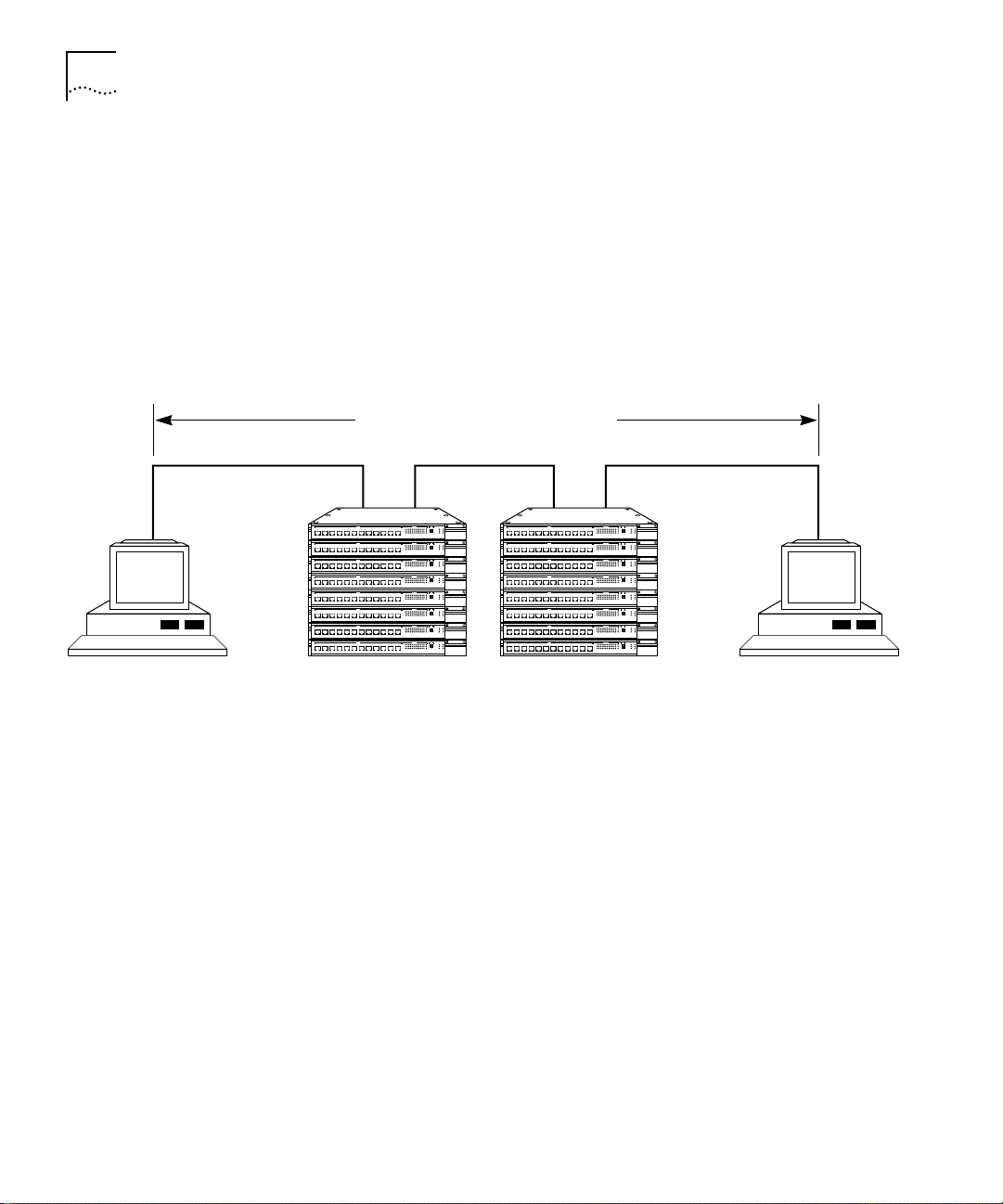
Figure 3-9 shows a two-repeater collision domain containing two hubs
between two end stations that are located 205 meters apart. This is the total
allowable span for UTP cable.
205 meters: maximum UTP distance
5 meters maximum100 meters maximum 100 meters maximum
®
1x 1x 1x 1x 1x 1x 1x
1x 1x 1x 1x 1x 1x 1x
1x 1x 1x 1x 1x 1x 1x
1x 1x 1x 1x 1x 1x 1x
1x 1x 1x 1x 1x 1x 1x
1x 1x 1x 1x 1x 1x 1x
1x 1x 1x 1x 1x 1x 1x
1x 1x 1x 1x 1x 1x 1x
100BT STATUS
1x 1x 1x 1x 1x
100BT STATUS
1x 1x 1x 1x 1x
100BT STATUS
1x 1x 1x 1x 1x
100BT STATUS
1x 1x 1x 1x 1x
100BT STATUS
1x 1x 1x 1x 1x
100BT STATUS
1x 1x 1x 1x 1x
100BT STATUS
1x 1x 1x 1x 1x
100BT STATUS
1x 1x 1x 1x 1x
ACTIVITY
LINE
PARTITION
ACTIVITY
LINE
PARTITION
ACTIVITY
LINE
PARTITION
ACTIVITY
LINE
PARTITION
ACTIVITY
LINE
PARTITION
ACTIVITY
LINE
PARTITION
ACTIVITY
LINE
PARTITION
ACTIVITY
LINE
PARTITION
12345678910111213
12345678910111213
12345678910111213
12345678910111213
12345678910111213
12345678910111213
12345678910111213
12345678910111213
UNIT
3C12345
CLS2
FAN FAIL
CLS1
OVERTEMP
PWR
COLLISION
®
UNIT
3C12345
CLS2
FAN FAIL
CLS1
OVERTEMP
PWR
COLLISION
®
UNIT
3C12345
CLS2
FAN FAIL
CLS1
OVERTEMP
PWR
COLLISION
®
UNIT
3C12345
CLS2
FAN FAIL
CLS1
OVERTEMP
PWR
COLLISION
®
UNIT
3C12345
CLS2
FAN FAIL
CLS1
OVERTEMP
PWR
COLLISION
®
UNIT
3C12345
CLS2
FAN FAIL
CLS1
OVERTEMP
PWR
COLLISION
®
UNIT
3C12345
CLS2
FAN FAIL
CLS1
OVERTEMP
PWR
COLLISION
®
UNIT
3C12345
CLS2
FAN FAIL
CLS1
OVERTEMP
PWR
COLLISION
Class II configuration
Figure 3-9 Class II Hubs
LinkBuilder
R
EPEATER
LinkBuilder
R
EPEATER
LinkBuilder
R
EPEATER
LinkBuilder
R
EPEATER
LinkBuilder
R
EPEATER
LinkBuilder
R
EPEATER
LinkBuilder
R
EPEATER
LinkBuilder
R
EPEATER
1x 1x 1x 1x 1x 1x 1x
1x 1x 1x 1x 1x 1x 1x
1x 1x 1x 1x 1x 1x 1x
1x 1x 1x 1x 1x 1x 1x
1x 1x 1x 1x 1x 1x 1x
1x 1x 1x 1x 1x 1x 1x
1x 1x 1x 1x 1x 1x 1x
1x 1x 1x 1x 1x 1x 1x
100BT STATUS
1x 1x 1x 1x 1x
100BT STATUS
1x 1x 1x 1x 1x
100BT STATUS
1x 1x 1x 1x 1x
100BT STATUS
1x 1x 1x 1x 1x
100BT STATUS
1x 1x 1x 1x 1x
100BT STATUS
1x 1x 1x 1x 1x
100BT STATUS
1x 1x 1x 1x 1x
100BT STATUS
1x 1x 1x 1x 1x
ACTIVITY
LINE
PARTITION
ACTIVITY
LINE
PARTITION
ACTIVITY
LINE
PARTITION
ACTIVITY
LINE
PARTITION
ACTIVITY
LINE
PARTITION
ACTIVITY
LINE
PARTITION
ACTIVITY
LINE
PARTITION
ACTIVITY
LINE
PARTITION
12345678910111213
12345678910111213
12345678910111213
12345678910111213
12345678910111213
12345678910111213
12345678910111213
12345678910111213
LinkBuilder
®
UNIT
3C12345
R
EPEATER
CLS2
FAN FAIL
CLS1
OVERTEMP
PWR
COLLISION
LinkBuilder
®
UNIT
3C12345
R
EPEATER
CLS2
FAN FAIL
CLS1
OVERTEMP
PWR
COLLISION
LinkBuilder
®
UNIT
3C12345
R
EPEATER
CLS2
FAN FAIL
CLS1
OVERTEMP
PWR
COLLISION
LinkBuilder
®
UNIT
3C12345
R
EPEATER
CLS2
FAN FAIL
CLS1
OVERTEMP
PWR
COLLISION
LinkBuilder
®
UNIT
3C12345
R
EPEATER
CLS2
FAN FAIL
CLS1
OVERTEMP
PWR
COLLISION
LinkBuilder
®
UNIT
3C12345
R
EPEATER
CLS2
FAN FAIL
CLS1
OVERTEMP
PWR
COLLISION
LinkBuilder
®
UNIT
3C12345
R
EPEATER
CLS2
FAN FAIL
CLS1
OVERTEMP
PWR
COLLISION
LinkBuilder
®
UNIT
3C12345
R
EPEATER
CLS2
FAN FAIL
CLS1
OVERTEMP
PWR
COLLISION
Page 35
LED Descriptions 3-11
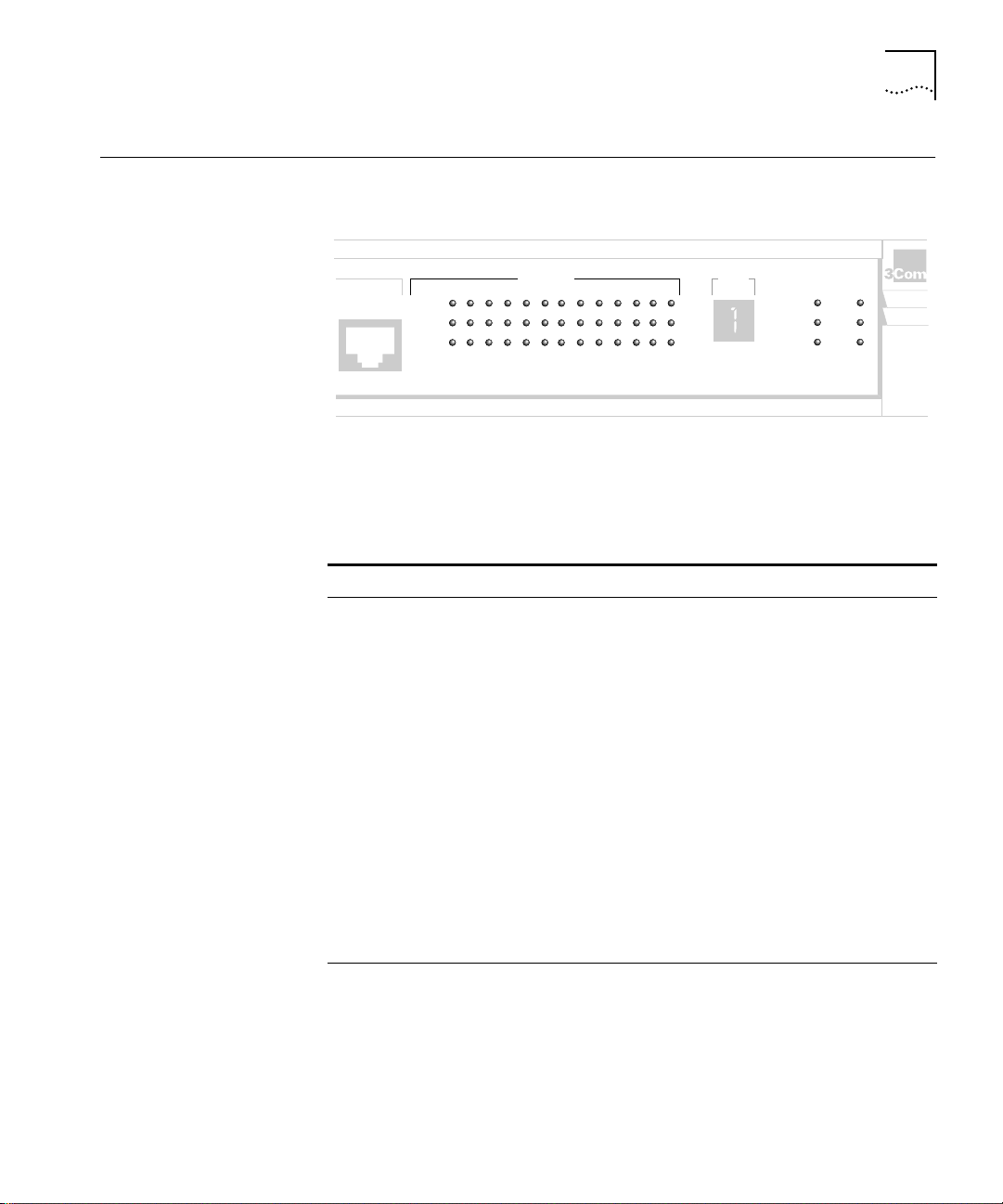
LED Descriptions The LinkBuilder FMS 100-TX Hub is equipped with front panel LEDs to
provide port status and hub information (see Figure 3-10).
UNIT
OVERTEMP
COLLISION
12x
STATUS
ACTIVITY
LINK
PARTITION
12345678910111213
Figure 3-10 LED Indicators
Status LEDs Table 3-2 interprets the meaning of the port STATUS LEDs.
Table 3-2 Port LEDs
LED Color Status Meaning
ACTIVITY Green ON The port is receiving data.
OFF The port is not receiving data.
LINK Green ON A connection exists between the port and
the end node.
OFF There is no connection between the port and
the end node.
PARTITION Amber ON The port is partitioned because of excessive
collisions (more than 127 consecutive
collisions) or because long packets (longer
than 5 milliseconds) are being sent over the
network.
If a port is partitioned, it is automatically
reconnected to the network when the
problem no longer exists.
OFF The port is not partitioned.
FAN FAIL
3C250-TX/Ι
CLSII
CLSI
PWR
®
Page 36
3-12 CHAPTER 3: MAKING FMS 100-TX HUB CONNECTIONS
Operation LEDs Table 3-3 interprets the meaning of the hub operation LEDs.
Table 3-3 Hub Operation LEDs
LED Color Status Meaning
FAN FAIL Amber ON One or both of the two internal fans
have failed.
OVERTEMP Amber ON The internal temperature exceeds 158° F
(70° C). COLLISION Green ON The segment is experiencing collisions. CLS II (Class II) OFF The FMS 100-TX Hub does not support
Class II configuration. This LED is
nonfunctional. CLS I (Class I) Green ON The FMS 100-TX Hub supports Class I
configuration, which means that only
one repeater or hub stack can be used
between two end stations. PWR (Power) Green ON The hub is receiving power.
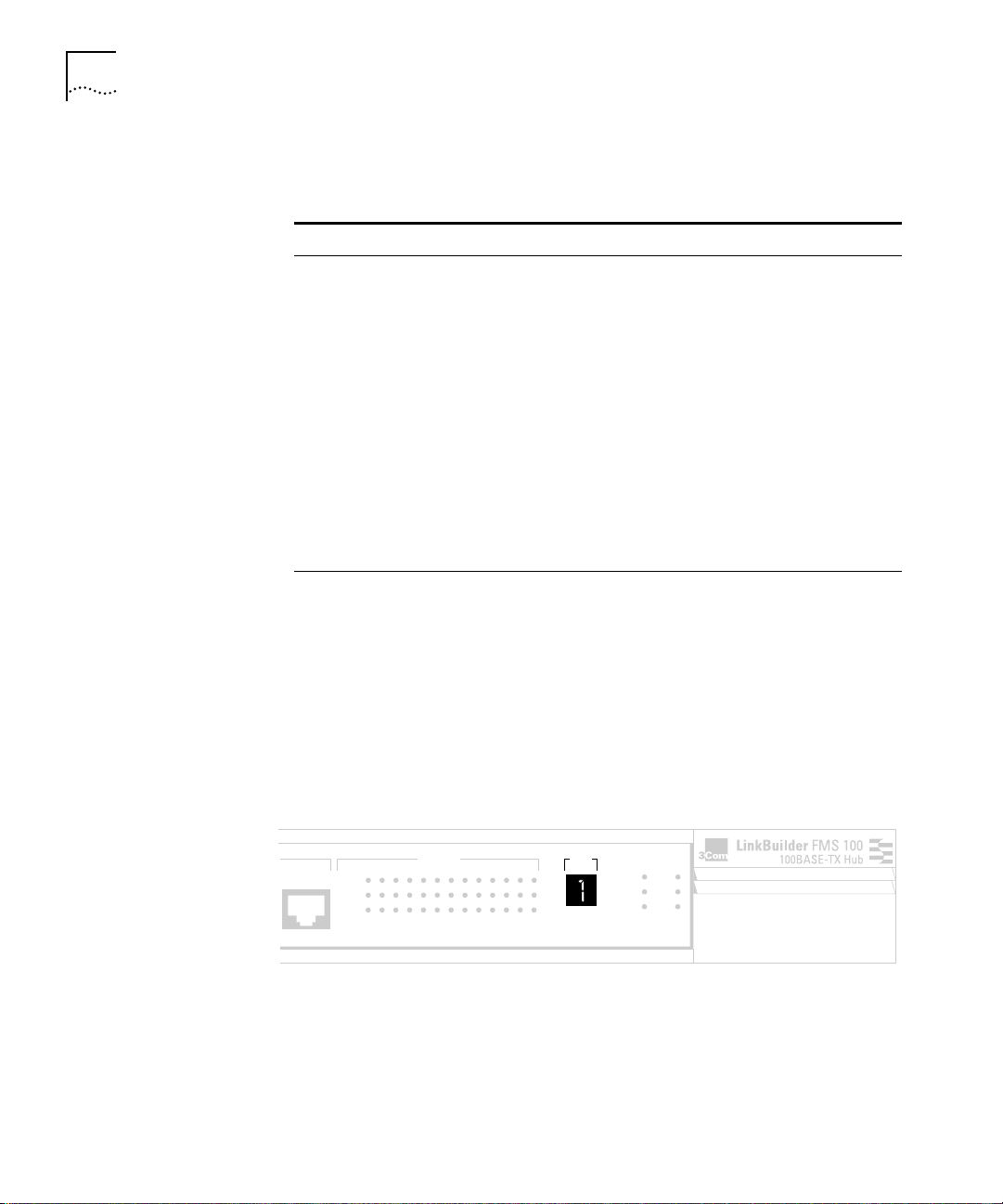
Unit Digital Display The front panel unit digital display (see Figure 3-11) provides a numeric
designation for each component in a hub stack, including a Management Unit
if one is present. Unit numbers are assigned dynamically as the units are
plugged into the stack. The Management Unit ID is assigned after the
Power-On Self-Test (POST) has run. The number 1 indicates the device that has
no other unit above it; in other words, the hub (or Management Unit) that is on
the top of the stack and connected by a hub expansion cable to the
component immediately below it.
STATUS
12x
ACTIVITY
LINK
PARTITION
12345678910111213
Figure 3-11 Unit Digital Display
UNIT
FAN FAIL
OVERTEMP
COLLISION
3C250-TX/Ι
CLSII
CLSI
PWR
®
Page 37
Power-Up Disabled Option Switch 3-13
Powe r - U p Disabled Option Switch
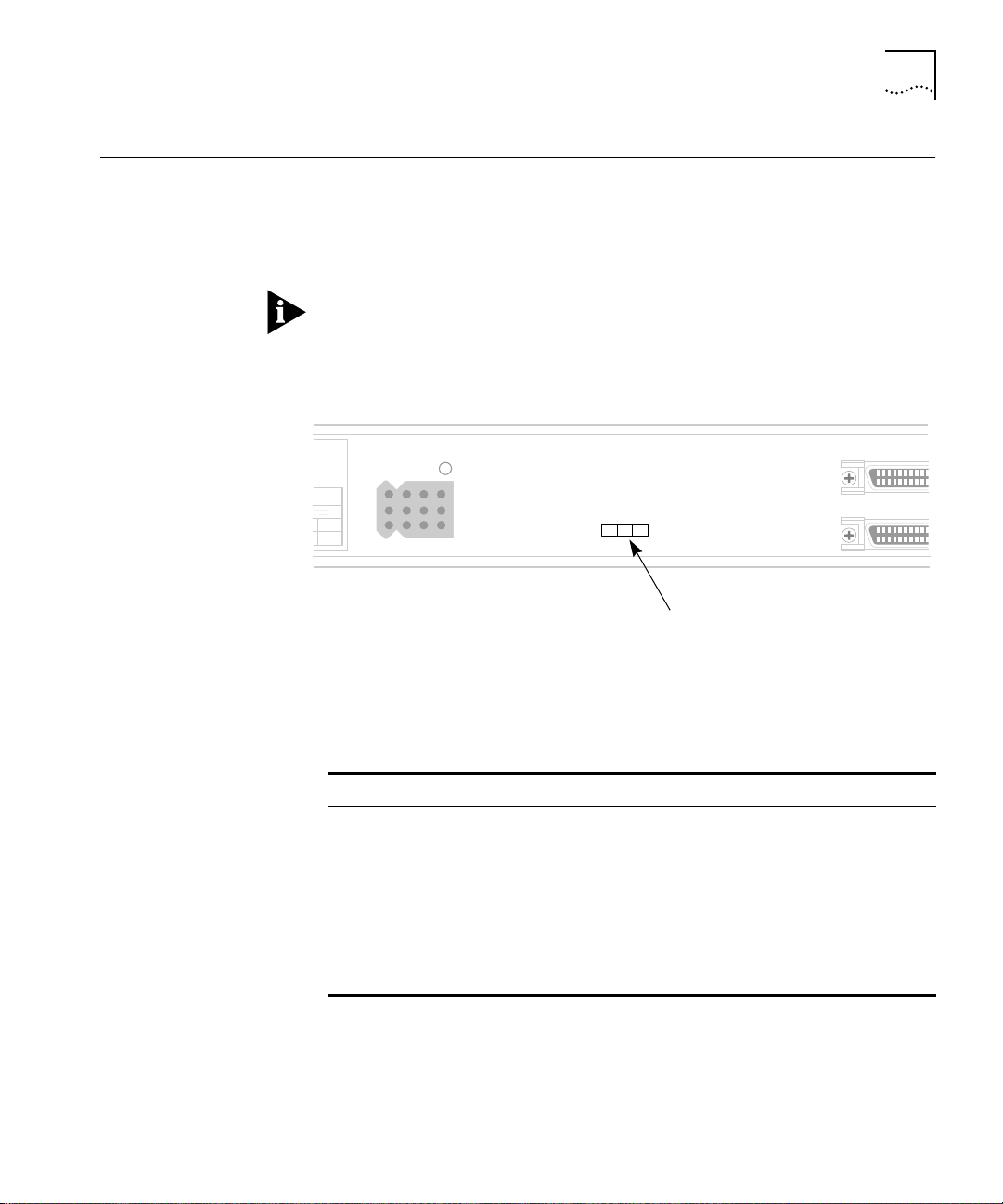
If network management is present, an external switch on the hub’s rear panel
allows you to power-up the hub with the ports disabled. The power-up
disabled option switch is located between the expansion connectors and the
DC input connector, as shown in Figure 3-12.
This feature cannot be fully implemented unless a network management
device (such as the LinkBuilder FMS 100 Management Unit) is connected to
the hub stack. If no network management is present, leave the power-up
disabled option switch in the enabled position (set to E).
tion
A
–12
0.2
DC INPUT
ED
Power-up disabled
option switch
UP
DOWN
Figure 3-12 Power-Up Disabled Option Switch
Table 3-4 describes the functioning of the power-up disabled option switch.
EXPA
Table 3-4 Settings on Power-Up Disabled Option Switch
Setting Result
D (disabled) If network management is present, you can enable specific ports
after the hub has been powered-up.
If network management is not present, all ports remain disabled
after the hub has been powered-up.
E (enabled) This is the default setting. All ports are enabled after the hub has
been powered-up, whether or not network management is present.
If network management is present, individual ports can then be
disabled after the hub has been powered-up.
You can use this option for security purposes. For example, you can disable a
port where a faulty device or other problem exists. This prevents the disabled
port from receiving any data when the hub is powered-up. Conversely, you
can enable ports if you want them to receive data.
Page 38

Page 39
4
CABLING
The LinkBuilder FMS 100-TX Hub supports Fast Ethernet cabling and topology
requirements, as detailed in the IEEE 802.3 specification. Fast Ethernet
preserves the 100-meter maximum UTP cable length from the hub to the
desktop that is a requirement for 10 Mbps Ethernet. Two 100 Mbps topology
rules are different from those for 10 Mbps Ethernet:
■ The maximum number of repeaters in a collision domain is two. (For additional
information, refer to the sections “Considerations for Multisegmented
Networks” and “Classification of Repeaters” in Chapter 3.)
The LinkBuilder FMS 100-TX Hub only supports one repeater in a collision
domain.
■ In a single collision domain, the maximum network diameter is 200 meters
with Category 5 UTP cabling only, or 260.8 meters with one fiber-optic
cabling link. Refer to Table 4-1 for a summary of maximum cable lengths.
Table 4-1 Maximum Network Collision Domain Diameters
Model Maximum Cable Length Media
Hub to connected workstations
One Class I repeater 200 meters Straight-through UTP cable
100 meters Straight-through UTP cable
260.8 meters Combined UTP and fiber cable
Page 40
4-2 CHAPTER 4: CABLING
Transceiver Interface Module Cabling Requirements
The two transceiver interface modules provide downlink connectivity to
another hub or to a bridge, router, or switch. For transceiver interface
module connections, the hub supports 100BASE-T functionality using the
following media specifications:
■ 100BASE-TX: two pairs of Category 5 twisted-pair UTP wire
■ 100BASE-FX: two-strand fiber-optic cabling (62.5/125 µ multimode cable)
Topology Rules The key 100BASE-T topology rules are illustrated in this section.
Hub to Connected
Workstations
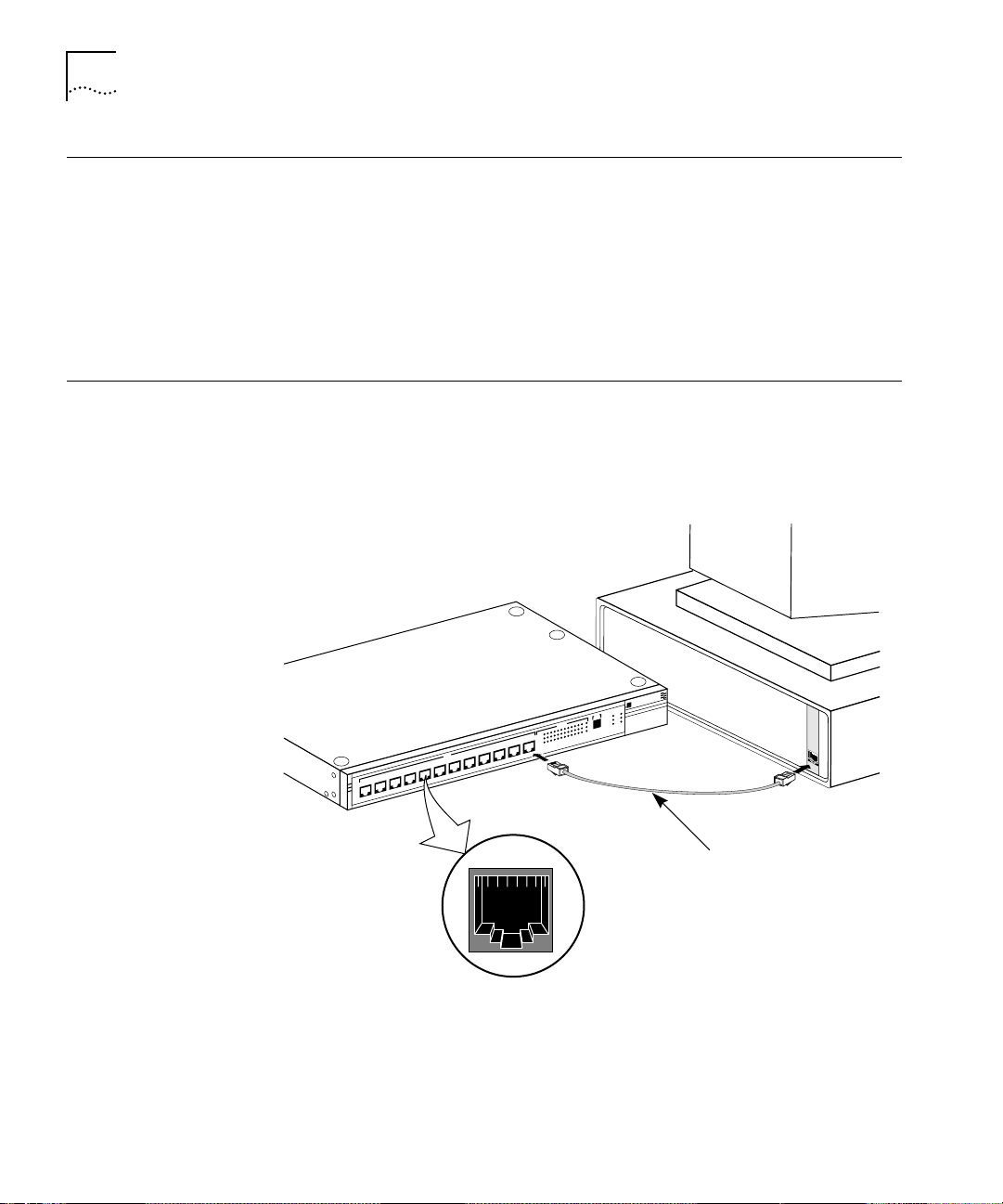
The maximum UTP cable length between the hub and connected
workstations is 100 meters. (S ee Figure 4-1.)
LinkBuilder FMS 100
®
100BASE-TX Hub
3C250-TX/Ι
CLSII
UNIT
FAN FAIL
CLSI
OVERTEMP
PWR
ACTIVITY
LINK
12x
11x
PARTITION
12345678910111213
10x
9x
8x
100BT STATUS
7x
6x
5x
4x
3x
2x
1x
COLLISION
1 . . . . . . .8
Figure 4-1 Connecting the Hub to a Workstation
Straight-through UTP cable
(100 meters maximum)
Page 41
Topology Rules 4-3
One Class I Repeater A total network span of 260.8 meters (combined UTP and fiber cabling) is
allowed in single-Class I hub topologies (one hub stack per wiring closet with
a fiber run to the collapsed backbone). For example, you could use a
160.8-meter fiber downlink from the hub to a router, bridge, or switch with a
100-meter maximum UTP run from the hub to the desktops. (See Figure 4-2.)
®
Fiber backbone
Router, bridge,
or switch
LinkBuilder
FMS 100 Hub
(class I)
1x
1x
1x
1x
100BT
1x
1x
1x
1x
(160.8 meters maximum)
1x
1x
1x
1x
ACTIVITY
STATUS
LINE
PARTITION
UNIT
12345678910111213
3C250/Ι
FAN FAIL
®
CLS2
OVERTEMP
CLS1
COLLISION
PW
R
LinkBuilder
R
EPEATER
UTP cable 100
meters maximum
Figure 4-2 Connecting the Hub in a Network Span of 260.8 Meters
The maximum network span using only UTP cabling is 200 meters. If only
fiber cable is used, the maximum span in 272 meters.
Page 42
4-4 CHAPTER 4: CABLING
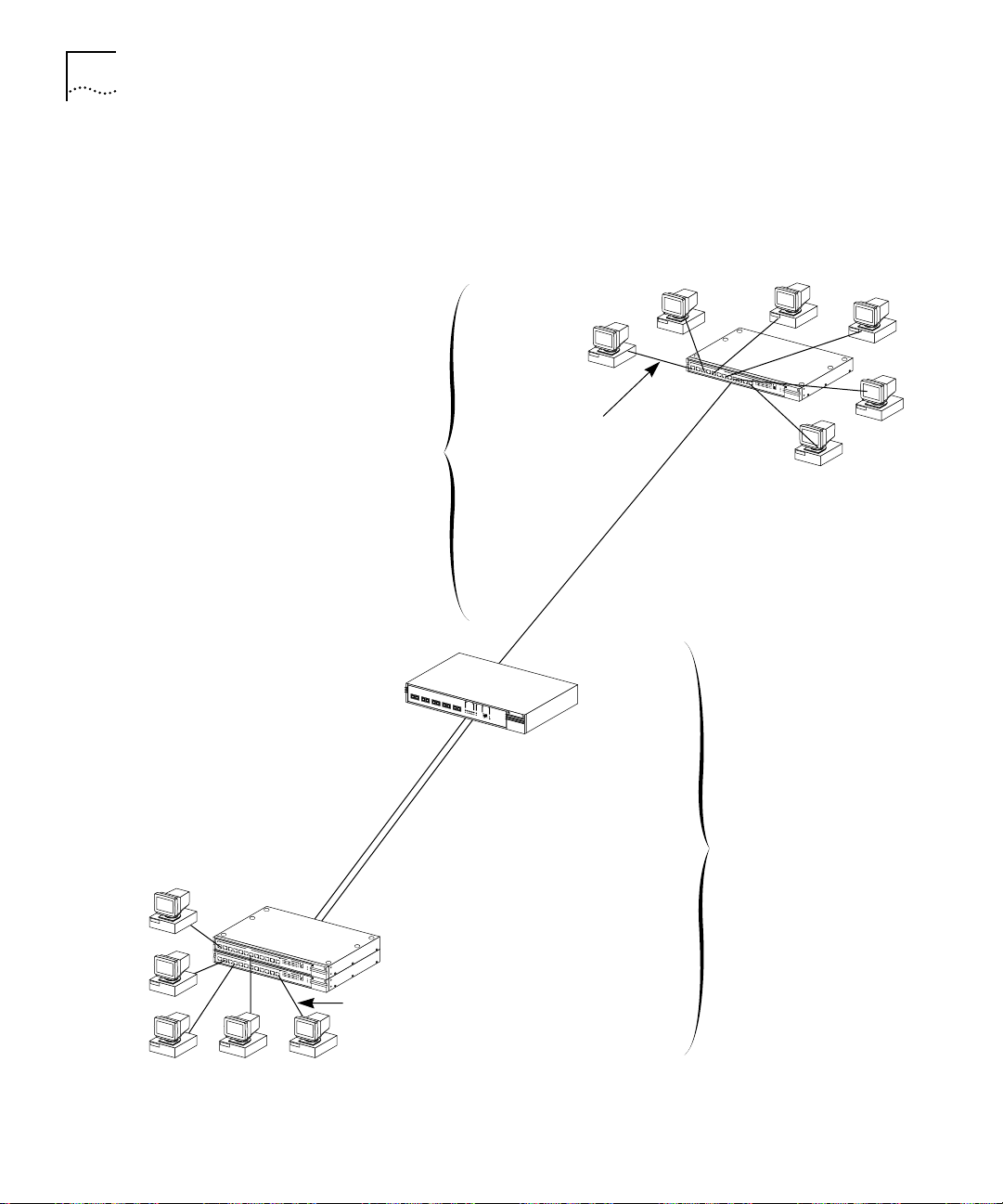
If greater distances and more ports are required, you can use an
internetworking device (such as a bridge, router, or switch) to isolate traffic
between workgroups. This would divide the network into a number of
independent segments, as illustrated in Figure 4-3.
1x
2x
3x
4x
100BASE-TX
5x
6x
7x
8x
9x
10x
11x
12x
A
C
T
IV
IT
STATUS
Y
L
IN
K
P
A
R
T
IT
IO
N
UNIT
12345678910111213
3C250-TX
LinkBuilder FMS 100
®
F
A
N
F
A
IL
C
L
S
O
II
V
E
R
T
E
M
100BASE-TX Hub
P
C
L
S
C
I
O
L
L
IS
IO
N
P
W
R
Collision domain:
200 meters
maximum UTP span
100 meters
maximum
UTP cable 100
meters maximum
100BASE-TX
DOWNLINK
100BASE-TX
6543211
®
LinkSwitch
3000
LinkSwitch
3000
Fiber 160.8 meters maximum
Collision domain:
260.8 meters,
UTP and fiber
maximum span
1x
2x
3x
4x
100BASE-TX
5x
6x
7x
8x
9x
1x
10x
2x
11x
3x
12x
A
C
T
IV
IT
STATUS
Y
4x
L
IN
100BASE-TX
K
5x
P
A
R
T
IT
IO
N
6x
UNIT
12345678910111213
7x
3C250-TX
LinkBuilder FMS 100
®
F
8x
A
N
F
A
IL
C
L
S
O
II
V
9x
E
R
T
E
M
100BASE-TX Hub
P
C
L
S
C
I
O
10x
L
L
IS
IO
N
P
W
R
11x
12x
A
C
T
IV
IT
STATUS
Y
L
IN
K
P
A
R
T
IT
IO
N
UNIT
12345678910111213
3C250-TX
LinkBuilder FMS 100
®
F
A
N
F
A
IL
C
L
S
O
II
V
E
R
T
E
M
100BASE-TX Hub
P
C
L
S
C
I
O
L
L
IS
IO
N
P
W
R
100 meters maximum
Figure 4-3 Using an Internetworking Device to Extend the Network Span
Page 43

A
SPECIFICATIONS
This appendix lists the specifications for the LinkBuilder FMS 100-TX Hub.
Hub Specifications Physical Dimensions
Length: 30.48 cm (12 in.)
Width: 43.94 cm (17.3 in.)
Height: 4.37 cm (1.72 in.)
Weight: 5.5 kg (12 lb)
Environmental Operating Ranges
Operating temperature: 0˚ to 40˚ C (34˚ to 104˚ F)
Storage temperature: –30˚ to 60˚ C (–22˚ to 140˚ F)
Humidity: 10% to 90% relative humidity, noncondensing
Altitude: 3,050 m (10,000 ft) operating
Power Requirements
AC input voltage: 100–240 VAC, 47–63 Hz
Inrush current: 20 A peak for 1/2 cycle @ 250 VAC
AC input isolation: 2000 VAC
Power consumption: 40 W maximum
Heat output: 136.5 BTU/hr
User-replaceable fuse: Fast-blow 2 A, 250 V
Repeater Classification Class I
Page 44

Page 45

B
TECHNICAL SUPPORT
3Com provides easy access to technical support information through a
variety of services. This appendix describes these services.
On-line Technical Services
3Com Bulletin
Board Service
3Com offers worldwide product support seven days a week, 24 hours a day,
through the following on-line systems:
■ 3Com Bulletin Board Service (3ComBBS)
■ World Wide Web site
■ 3ComForum on CompuServe®
■ 3ComFacts
3ComBBS contains patches, sof tware, and drivers for all 3Com products, as
well as technical articles. This service is available via modem or ISDN seven
days a week, 24 hours a day.
Access by Modem
To reach the service by modem, set your modem to 8 data bits, no parity,
and 1 stop bit. Call the telephone number nearest you:
Country Data Rate Telephone Number
Australia up to 14400 bps (61) (2) 9955 2073 France up to 14400 bps (33) (1) 69 86 69 54 Germany up to 9600 bps (49) (89) 627 32 188 or (49) (89) 627 32 189 Hong Kong up to 14400 bps (852) 2537 5608 Italy (fee required) up to 14400 bps (39) (2) 273 00680 Japan up to 14400 bps (81) (3) 3345 7266 Singapore up to 14400 bps (65) 534 5693 Taiwan up to 14400 bps (886) (2) 377 5840 U.K. up to 28800 bps (44) (1442) 278278 U.S. up to 28800 bps (1) (408) 980 8204
SM
automated fax service
Page 46

B-2 APPENDIX B: TECHNICAL SUPPORT
Access by ISDN
ISDN users can dial-in to 3ComBBS using a digital modem for fast access up
to 56 Kbps. To access 3ComBBS using ISDN, dial the following number:
(408) 654 2703
World Wide Web Site Access the latest networking information on 3Com’s World Wide Web site by
entering our URL into your Internet browser:
http://www.3Com.com/
This service features news and information about 3Com products, customer
service and support, 3Com’s latest news releases, selected articles from
™
3TECH
(3Com’s award-winning technical journal) and more.
3ComForum on
CompuServe
3ComForum is a CompuServe-based service containing patches, software,
drivers, and technical articles about all 3Com products, as well as a
messaging section for peer support. To use 3ComForum, you need a
CompuServe account.
To use 3ComForum:
1 Log on to CompuServe. 2 Enter
go threecom .
3 Press [Return] to see the 3ComForum main menu.
Page 47

Support from Your Network Supplier B-3
3ComFacts
Automated Fax Service
3Com Corporation’s interactive fax ser vice, 3ComFacts, provides data sheets,
technical articles, diagrams, and troubleshooting instructions on 3Com
products 24 hours a day, seven days a week.
Call 3ComFacts using your touch-tone telephone. International access
numbers are:
Country Telephone Number
Hong Kong (852) 2537 5610 U.K. (44) (1442) 278279 U.S. (1) (408) 727 7021
Local access numbers are available within the following countries:
Country Telephone Number Country Telephone Number
Australia 800 123853 Netherlands 06 0228049 Belgium 0800 71279 Norway 800 11062 Denmark 800 17319 Portugal 0505 442607 Finland 98 001 4444 Russia (Moscow only) 956 0815 France 05 90 81 58 Spain 900 964445 Germany 0130 8180 63 Sweden 020 792954 Italy 1678 99085 U.K. 0800 626403
Support from Your Network Supplier
If additional assistance is required, contac t your network supplier. Many
suppliers are authorized 3Com service partners who are qualified to provide
a variety of services, including network planning, installation, hardware
maintenance, application training, and suppor t services.
When you contact your network supplier for assistance, have the following
information ready:
■ Diagnostic error messages
■ A list of system hardware and software, including revision levels
■ Details about recent configuration changes, if applicable
If you are unable to contact your network supplier, see the following section
on how to contact 3Com.
Page 48

B-4 APPENDIX B: TECHNICAL SUPPORT
Support from 3Com
If you are unable to receive support from your network supplier, technical
support contracts are available from 3Com.
In the U.S. and Canada, call (800) 876-3266 for customer service.
If you are outside the U.S. and Canada, contact your local 3Com sales office
to find your authorized service provider:
Country Telephone Number Country Telephone Number
Australia (Sydney) (61) (2) 959 3020 Japan (81) (3) 3345 7251 (Melbourne) (61) (3) 653 9515 Mexico (525) 531 0591
*
Belgium
0800 71429 Netherlands Brazil (55) (11) 546 0869 Norway Canada (905) 882 9964 Singapore (65) 538 9368 Denmark Finland France Germany
*
*
*
*
800 17309 South Africa (27) (11) 803 7404
0800 113153 Spain
05 917959 Sweden
0130 821502 Taiwan (886) (2) 577 4352 Hong Kong (852) 868 9111 United Arab Emirates (971) (4) 349049
*
Ireland
*
Italy
* These numbers are toll-free.
1 800 553117 U.K.
1678 79489 U.S. (1) (408) 492 1790
*
*
*
*
*
06 0227788 800 13376
900 983125 120 795482
0800 966197
Returning Products for Repair
A product sent directly to 3Com for repair must first be assigned a Return
Materials Authorization (RMA) number. A product sent to 3Com without an
RMA number will be returned to the sender unopened, at the sender ’s
expense.
To obtain an RMA number, call or fax:
Country Telephone Number Fax Number
U.S. and Canada (800) 876 3266, option 2 (408) 764 7120 Europe 31 30 60 29900, option 5 (44) (1442) 275822 Outside Europe, U.S., and Canada (1) (408) 492 1790 (1) (408) 764 7290
Page 49

GLOSSARY
10BASE-T The IEEE 802.3 physical layer specification for a 10 Mbps Ethernet network
over two pairs of Category 3, 4, or 5 UTP wire.
100BASE-FX The IEEE 802.3 physical layer specification for a 100 Mbps Ethernet network
over two strands of fiber.
100BASE-T The group of IEEE 802.3 physical layer specifications for a 100 Mbps Ethernet
network over various wiring specifications.
100BASE-T4 The IEEE 802.3 physical layer specification for a 100 Mbps Ethernet network
over four pairs of Category 3, 4, or 5 UTP wire.
100BASE-TX The IEEE 802.3 physical layer specification for a 100 Mbps Ethernet network
over two pairs of Category 5 UTP or STP wire.
Backbone The main transmission medium used to interconnect the workgroup areas
of a network. Fiber-optic cable is often used for the backbone connection.
CAT 3 Category 3 balanced cable. Balanced 100 Ω and 120 Ω cables and
associated connecting hardware whose transmission characteristics are
specified up to 16 MHz. Used by 10BASE-T and 100BASE-T4 installations.
CAT 4 Category 4 balanced cable. Balanced 100 Ω and 120 Ω cables and
associated connecting hardware whose transmission characteristics are
specified up to 20 MHz. Used by 10BASE-T and 100BASE-T4 installations.
CAT 5 Category 5 balanced cable. Balanced 100 Ω and 120 Ω cables and
associated connecting hardware whose transmission characteristics are
specified up to 100 MHz. Used by10BASE-T and 100BASE-T installations.
CDDI Copper Distributed Data Interface. FDDI over twisted-pair copper wire.
See also FDDI.
Page 50

2 GLOSSARY
Class I A type of 100BASE-T repeater with internal delay such that only one
repeater or stack may exist between any two end stations within a single
collision domain when two maximum-length copper cable segments are
used.
Class II A type of 100BASE-T repeater with internal delay such that two repeaters or
stacks may exist between any two end stations within a single collision
domain when two maximum-length copper cable segments are used.
Collision A condition that results from concurrent transmissions from multiple
sources within a single collision domain.
Collision domain A single CSMA/CD network. If two or more Media Access Control (MAC)
sublayers are within the same collision domain and both transmit at the
same time, a collision will occur. MAC sublayers separated by a repeater are
in the same collision domain; MAC sublayers separated by a bridge, router,
or switch are within different collision domains.
Ethernet A local area network standard defining a physical medium and its method
of placing data, or packet signaling, on a cable. Access to the cable is based
on CSMA/CD (carrier sense multiple access with collision detection).
Fast Ethernet A 100 Mbps technology based on the Ethernet CSMA/CD network access
method.
FDDI Fiber Distributed Data Interface. The local area networking standard that
provides high bandwidth for interconnecting computers and peripheral
devices using a fiber-optic medium in a ring configuration.
The FDDI specification is made up of standards that correspond to the IEEE OSI
model layers (on the physical and data link levels). These standards specify the
physical interfaces, functions, and operations needed to support
interoperability between devices.
Fiber-optic cable Cable consisting of a glass center, cladding, a buffer layer, strength members,
and a cable sheath. The glass center supports the transmission of light signals.
FMS Flexible Media Stack. 3Com’s family of stackable hubs.
Page 51

GLOSSARY 3
Hub A device used to provide connectivity between network devices. Hubs
perform the basic repeater functions of restorating signal amplitude and
timing, detecting collisions, and broadcasting signals to lower-level hubs
and network devices.
MAC Media Access Control. The data link sublayer that is responsible for transferring
data to and from the physical layer.
MIB Management Information Base. A logical naming of all information
resources residing in a network and pertinent to the network’s
management. Simple Network Management Protocol (SNMP) management
uses a set of standard MIBs known as MIB II and other standard MIBs for
FDDI, Ethernet, etc. In addition, vendors write proprietary MIB extensions for
SNMP management of particular devices.
Partition A repeater function that isolates a particular por t from the network because
of an excessive number of collisions. Once the problem causing the
collisions is corrected, the port is reactivated.
Repeater A device that extends the length, topology, or interconnectivity of the
SNMP Simple Network Management Protocol. A network monitoring protocol for
Standard Ethernet
cable
STP Shielded twisted-pair. Shielded four-conductor electrical cable that offers
physical medium beyond that imposed by a single segment, up to the
maximum allowable end-to-end trunk transmission line length. Repeaters
perform the basic actions of restoring signal amplitude, waveform, and
timing applied to normal data and collision signals. See also Hub.
TCP/IP-based networks. It is a simple request/response protocol used to
communicate management information between the network management
station and the agent residing in network elements. The protocol does not
define the objects that can be managed. ( The MIB defines manageable
objects.) SNMP can be used with any network management variable that can
be inspected and altered.
A 0.4-inch diameter cable comprised of two foil shields and two braids over
copper wire. It requires an external transceiver cable or N-series to BNC series
adapter. It is also called thick Ethernet cable. See also thin Ethernet cable.
high-speed transmission for long distances.
Page 52

4 GLOSSARY
SuperStack 3Com system of stackable hubs, servers, switches, routers, SDLC converters,
and power supplies. SuperStack systems can suppor t a range of LAN
environments, including Ethernet, token ring, FDDI, SNA, and ATM.
Thin Ethernet cable A cable standard for Ethernet (IEEE 802.3) networks using RG-58 A/U or
RG-58 C/U cable and BNC connectors. The coaxial cable is 0.2 inches in
diameter, so it is more flexible than thick Ethernet cable. Thin Ethernet
operates at the same frequency as thick Ethernet but over a shorter distance,
and it provides less insulation from interference than thick Ethernet.
Transceiver A hardware device that links a node to a network cable and functions as
both a transmitter and a receiver.
Twisted-pair Wiring similar to that found in the telephone system, consisting of two
insulated wires loosely twisted around each other to help cancel out
induced noise in balanced circuits.
UTP Unshielded twisted-pair. A cable consisting of two or more pairs of twisted
copper wires that are not shielded.
Page 53

INDEX
Numerics
100 Mbps media options
100BASE-FX 1-1
required cabling 3-6
100BASE-T4 1-1
100BASE-TX 1-1
required cabling 3-6
100BASE-FX transceiver interface module 1-2
100BASE-T
cabling 4-2
topology rules 4-2
100BASE-TX transceiver interface module 1-2
3Com Bulletin Board Service (3ComBBS) B-1
3Com sales offices B-4
3ComFacts B-3
3ComForum B-2
802.3 specifications 1-1
100 Mbps networks 3-7
repeater functions 1-4
A
AC power cord 1-3, 2-1, 2-8
B
bulletin board service B-1
C
cabling
100BASE-FX module 3-6
100BASE-TX module 3-6
Category 3, 4, or 5 UTP 1-1
fiber 1-1
requirements
100BASE-FX module 4-2
100BASE-TX module 4-2
hub to workstation 4-2
network connections 3-1
network span 4-3
straight-through 3-2, 4-1
classification of repeaters
Class I 3-9
Class II 3-10
collision domain
defined 3-7
single-repeater 3-9
CompuServe B-2
connecting to the network 3-1
connections
hub to backbone 3-6
hub to Management Unit 3-1, 3-5
hub to node 3-2, 4-2
hub-to-hub interconnection 3-4
D
desktop placement of hub 2-5
digital display 3-12
E
environmental operating ranges A-1
Ethernet IEEE 802.3 standard 1-1, 3-7
expansion cable 3-4
expansion connectors 1-3
extending the network span 4-4
F
Fast Ethernet
cabling and topology requirements 4-1
specifications 1-1
fax service. See 3ComFacts
front panel
description 1-1
LEDs 1-2, 3-11
RJ-45 ports 3-2
unit digital display 3-12
fuse 1-3, 2-9, A-1
replacing 2-9
Page 54

2 INDEX
H
hub
connections
hub to backbone 3-6
hub to Management Unit 3-1, 3-5
hub to node 3-2, 4-2
hub-to-hub interconnection 3-4
description 1-1
functions 1-4
installation 2-2
LEDs 3-11, 3-12
specifications A-1
I
installing
hub 2-2
desktop placement 2-5
positioning 2-2
rack mounting 2-3
unpacking 2-1
transceiver interface modules 2-6
inter-hub bus (IHB) cable 3-4
L
LED descriptions
activity 3-11
Class I 3-12
Class II 3-12
collision 3-12
fan fail 3-12
link 3-11
overtemp 3-12
partition 3-11
power 3-12
LinkBuilder FMS 100-TX Hub. See hub
M
Management Unit
connecting to a hub 3-1, 3-5
in a hub stack 1-3
maximum UTP cable length, hub to node 4-2
multisegmented networks 3-7
N
network connections
hub-to-backbone 3-6
hub-to-hub 3-4
hub-to-Management Unit 3-1, 3-5
hub-to-node 3-2
via a bridge, router, or switch 3-6, 3-7, 4-2, 4-3, 4-4
network management and power-up disabled option 3-13
network supplier support B-3
networks, heterogeneous 10/100 Mbps 3-7
O
on-line technical services B-1
operating voltage requirements A-1
operation LEDs 3-12
P
physical dimensions A-1
pin assignments
100BASE-TX transceiver interface module 3-3
RJ-45 3-3
straight-through cabling 3-2
port LEDs 3-11
power requirements A-1
power-up disabled option switch 3-13
R
rack mounting
instructions for 2-3
kit 2-1
rear panel
connectors 1-3
description 1-2
power-up disabled option switch 3-13
thirteenth port 1-1
Redundant Power System (RPS) 1-3
function of 2-7
installation 2-7
repeater(s)
classification of 3-9
functions 1-4
LinkBuilder FMS 100-TX Hub 1-1
maximum number allowed 4-1
replacing the fuse 2-9
returning products for repair B-4
RJ-45 connector pin assignments 3-3
RJ-45 ports 1-1, 3-2
Page 55

S
specifications
environmental operating ranges A-1
physical dimensions A-1
power requirements A-1
stacking hubs 1-3
straight-through cabling, pin assignments 3-3
SuperStack family
FMS 100 Management Unit 1-3
FMS 100-TX Hub 1-3
T
technical support B-1
thirteenth port (transceiver interface module por t) 1-1
topology rules, 100BASE-T 4-1, 4-2
transceiver interface module port 1-1
transceiver interface modules 1-1, 3-6
100BASE-FX 1-2
100BASE-TX 1-2
cabling 2-5
cabling requirements 4-2
connector types 2-5
installation 2-6
INDEX 3
U
unit digital display 3-12
Page 56

Page 57

LIMITED WARRANTY
HARDWARE: 3Com warrants its hardware products to be free from defects in workmanship and materials, under normal use and service, for the
following lengths of time from the date of purchase from 3Com or its Authorized Reseller:
Internetworking products One year
Network adapters Lifetime
Ethernet stackable hubs and
Unmanaged Ethernet fixed port repeaters Lifetime* (One year if not registered)
Fast Ethernet stackable hubs One year
*Power supply and fans in these stackable hubs and unmanaged repeaters One year
Other hardware products One year
Spare parts and spares kits 90 days
If a product does not operate as warranted during the applicable warranty period, 3Com shall, at its option and expense, repair the defective
product or part, deliver to Customer an equivalent product or part to replace the defective item, or refund to Customer the purchase price paid
for the defective product. All products that are replaced will become the property of 3Com. Replacement products may be new or
reconditioned. Any replaced or repaired product or part has a ninety (90) day warranty or the remainder of the initial warranty period,
whichever is longer.
3Com shall not be responsible for any software, firmware, information, or memory data of Customer contained in, stored on, or integrated with
any products returned to 3Com pursuant to any warranty.
SOFTWARE: 3Com warrants that the software programs licensed from it will perform in substantial conformance to the program specifications
therefor for a period of ninety (90) days from the date of purchase from 3Com or its Authorized Reseller. 3Com warrants the magnetic media
containing software against failure during the warranty period. No updates are provided. 3Com's sole obligation hereunder shall be (at 3Com's
discretion) to refund the purchase price paid by Customer for any defective software products, or to replace any defective media with software
which substantially conforms to 3Com's applicable published specifications. Customer assumes responsibility for the selection of the
appropriate applications program and associated reference materials. 3Com makes no warranty that its software products will work in
combination with any hardware or applications software products provided by third parties, that the operation of the software products will be
uninterrupted or error free, or that all defects in the software products will be corrected. For any third party products listed in the 3Com
software product documentation or specifications as being compatible, 3Com will make reasonable efforts to provide compatibility, except
where the non-compatibility is caused by a “bug” or defect in the third party's product.
STANDARD WARRANTY SERVICE: Standard warranty service for hardware products may be obtained by delivering the defective product,
accompanied by a copy of the dated proof of purchase, to 3Com's Corporate Service Center or to an Authorized 3Com Service Center during
the applicable warranty period. Standard warranty service for software products may be obtained by telephoning 3Com's Corporate Service
Center or an Authorized 3Com Service Center, within the warranty period. Products returned to 3Com's Corporate Service Center must be
pre-authorized by 3Com with a Return Material Authorization (RMA) number marked on the outside of the package, and sent prepaid, insured,
and packaged appropriately for safe shipment. The repaired or replaced item will be shipped to Customer, at 3Com's expense, not later than
thirty (30) days after receipt by 3Com.
WARRANTIES EXCLUSIVE: IF A 3COM PRODUCT DOES NOT OPERATE AS WARRANTED ABOVE, CUSTOMER’S SOLE REMEDY SHALL BE REPAIR,
REPLACEMENT, OR REFUND OF THE PURCHASE PRICE PAID, AT 3COM’S OPTION. THE FOREGOING WARRANTIES AND REMEDIES ARE EXCLUSIVE
AND ARE IN LIEU OF ALL OTHER WARRANTIES, EXPRESS OR IMPLIED, EITHER IN FACT OR BY OPERATION OF LAW, STATUTORY OR OTHERWISE,
INCLUDING WARRANTIES OF MERCHANTABILITY AND FITNESS FOR A PARTICULAR PURPOSE. 3COM NEITHER ASSUMES NOR AUTHORIZES ANY
OTHER PERSON TO ASSUME FOR IT ANY OTHER LIABILITY IN CONNECTION WITH THE SALE, INSTALLATION, MAINTENANCE OR USE OF ITS
PRODUCTS.
3COM SHALL NOT BE LIABLE UNDER THIS WARRANTY IF ITS TESTING AND EXAMINATION DISCLOSE THAT THE ALLEGED DEFECT IN THE
PRODUCT DOES NOT EXIST OR WAS CAUSED BY CUSTOMER'S OR ANY THIRD PERSON'S MISUSE, NEGLECT, IMPROPER INSTALLATION OR
TESTING, UNAUTHORIZED ATTEMPTS TO REPAIR, OR ANY OTHER CAUSE BEYOND THE RANGE OF THE INTENDED USE, OR BY ACCIDENT, FIRE,
LIGHTNING, OR OTHER HAZARD.
LIMITATION OF LIABILIT Y: IN NO EVENT, WHETHER BASED IN CONTRACT OR TORT (INCLUDING NEGLIGENCE) SHALL 3COM BE LIABLE FOR
INCIDENTAL, CONSEQUENTIAL, INDIRECT, SPECIAL, OR PUNITIVE DAMAGES OF ANY KIND, OR FOR LOSS OF REVENUE, LOSS OF BUSINESS, OR
OTHER FINANCIAL LOSS ARISING OUT OF OR IN CONNECTION WITH THE SALE, INSTALLATION, MAINTENANCE, USE, PERFORMANCE, FAILURE, OR
INTERRUPTION OF ITS PRODUCTS, EVEN IF 3COM OR ITS AUTHORIZED RESELLER HAS BEEN ADVISED OF THE POSSIBILITY OF SUCH DAMAGES
Some states do not allow the exclusion of implied warranties or the limitation of incidental or consequential damages for consumer products,
so the above limitations and exclusions may not apply to you. This warranty gives you specific legal rights which may vary from state to state.
GOVERNING LAW: This Limited Warranty shall be governed by the laws of the state of California.
Page 58

FCC CLASS A VERIFICATION STATEMENT
WARNING: This equipment has been tested and found to comply with the limits for a Class A digital device, pursuant to Part 15 of the FCC
Rules, and the Canadian Department of Communications Equipment Standards entitled, “Digital Apparatus,” ICES-003. These limits are
designed to provide reasonable protection against harmful interference in a commercial installation. This equipment generates, uses and can
radiate radio frequency energy and, if not installed and used in accordance with the instructions, may cause harmful interference to radio
communications. Operation of this equipment in a residential area is likely to cause harmful interference, in which case, the user will be
required to correct the interference at the user’s own expense.
Changes or modifications not expressly approved by 3Com could void the user’s authority to operate this equipment.
CISPR A COMPLIANCE
This device complies with the EMC directive of the European Community and meets or exceeds the following technical standard:
EN 55022 – Limits and Methods of Measurement of Radio Interference Characteristics of Information Technology Equipment.
This device complies with the CISPR Class A standard.
WARNING: This is a Class A product. In a domestic environment this product may cause radio interference in which case the user may be
required to take adequate measures.
3Com Corporation
5400 Bayfront Plaza
Santa Clara, CA 95052-8145
(408) 764-5000
CE NOTICE
Marking by the symbol indicates compliance of this equipment to the EMC directive of the European Community. Such marking is
indicative that this equipment meets or exceeds the following technical standards:
■ EN 55022—“Limits and Methods of Measurement of Radio Interference Characteristics of Information Technology Equiment.”
■ EN 50082-1—“Electromagnetic compatibility —Generic immunity standard Part 1: Residential, commercial, and light industry.”
■ IEC 801-2—“Electromagnetic compatibility for industrial-process measurement and control equipment Part 2: Electrostatic discharge
requirements.”—Severity level 3.
■ IEC 801-3—“Electromagnetic compatibility for industrial-process measurement and control equipment Part 3: Radiated electromagnetic field
requirements.”—Severity level 2.
■ IEC 801-4—“Electromagnetic compatibility for industrial-process measurement and control equipment Part 4: Electrical fast transient/burst
requirements.”—Severity level 2.
■ A “Declaration of Conformity” in accordance with the above standards has been made and is on file at 3Com Corporation.
Page 59

NOTES
Page 60

NOTES
Page 61

NOTES
Page 62

NOTES
Page 63

Reader Comment Form 3Com Corporation
Your comments concerning 3Com publications are important to us. Please take the time to complete
this form. Your suggestions and comments will help us improve our future publications. Thank you.
PLEASE CUT HERE
Publication Title ___________________________________________________________________________________
Part No. ____________________________________________ Date Purchased ______________________________
1 Please rate the quality of this publication in each of the following areas:
Technical Accuracy
Does the product work as the manual says it does?
Illustrations
Are they clear and useful?
Are there enough of them?
Organization
Is it easy to locate information?
Completeness
Did you find all the information you needed?
Examples
Are they helpful?
Are there enough of them?
2 How did you use this publication? (Check all that apply.)
Installation manual _____ Introduction to the subject _____ Self-study _____ Operating instructions _____
Reference training _____ Other _____
LinkBuilder FMS 100-TX Hub User Guide
09-0889-000
Excellent Good Fair Poor
______ ______ ______ ______
______ ______
______ ______ ______ ______
______ ______ ______ ______
______ ______
______ ______
______ ______
______ ______
______ ______
______ ______
______ ______
3 If you noticed any errors or omissions, please list them with their page numbers.
________________________________________________________________________________________________
________________________________________________________________________________________________
________________________________________________________________________________________________
________________________________________________________________________________________________
4 Any comments or suggestions? Use a separate sheet if necessary.
________________________________________________________________________________________________
________________________________________________________________________________________________
________________________________________________________________________________________________
________________________________________________________________________________________________
Optional:
Name _______________________________________________________________________________________
Company _______________________________________________________________________________________
Address _______________________________________________________________________________________
_______________________________________________________________________________________
_______________________________________________________________________________________
Phone _______________________________________________________________________________________
Page 64
BUSINESS REPLY MAIL
FIRST CLASS PERMIT NO. 1883, SANTA CLARA, CA
3Com Corporation
Attn: PCOps Technical Publications
P.O. Box 58145
Santa Clara, CA 95052-8145
U.S.A.
PLEASE FOLD AND TAPE. POSTAL REGULATIONS PROHIBIT THE USE OF STAPLES.
NO POSTAGE
NECESSARY
IF MAILED
IN THE
UNITED STATES
 Loading...