3Before You Start
6Safety Precautions
21Proper Posture During Computer Use
24Overview
Chapter 1
Getting Started
65Using the Keyboard Dock (Optional)
71Using the S Note app (S Note, Optional)
75Samsung Software Update
76Diagnosing the Computer Status and Troubleshooting
77Battery
80BIOS Setup
1
30Turning the Computer On and O
Chapter 2. Using Windows 8
33What is Microsoft Windows 8?
34Screen At a Glance
36Using the Charms
38Using Apps
42Windows Hot Key Function
Chapter 3. Using the computer
44Using the Touch Screen
52Micro SD Card Slot (Optional)
54Connecting an External Display Device
57Adjusting the Volume
59LCD Brightness Control
Chapter 4. Troubleshooting
83Recovering the Computer (Optional)
86Q&A
Chapter 5. Appendix
91Important Safety Information
93Replacement Parts and Accessories
95Regulatory Compliance Statements
110 WEEE Symbol Information
111 Samsung Packaging Take-Back Program
112 TCO Certied (for corresponding models only)
113 Product Specications
115 Glossary
119 Index
Before reading the User Guide, rst check the following
information.
Optional items, some devices and software referred to in •
the User Guide may not be provided and/or changed by
upgrade.
Note that the computer environment referred in the User
Guide may not be the same as your own environment.
The pictures used for the cover and the main body in the •
User Manual are those of the representative model of each
series and may dier from the actual appearance of the
product.
This guide decribes procedures for using both the mouse •
and the S Pen.
In this manual ‘click’ means ‘one press with the S Pen’.
The User Guide describes information on the basis of the •
touch screen.
Software Usage Instructions
In the • Start screen, slightly drag the top edge of the
screen toward the center.
Click the corresponding program in the All Apps
menu item.
Alternatively, start the program from Quick Starter.
You can install • Quick Starter through the SW Update.
This manual has been written for the Windows 8 operating •
system. The descriptions and gures may dier depending
on the installed operating system.
The User guide supplied with this computer may vary •
depending on your model.
Page 5
4
Chapter 1
Getting Started
Before You Start
Safety Precaution Notations
IconNotationDescription
Failure to follow instructions marked with
Warning
Caution
this symbol, may cause personal injury
and or fatality.
Failure to follow instructions marked with
this symbol, may cause slight injury to
yourself or damage your property.
Samsung Electronics Co., Ltd. owns the copyright of this manual.
No part of this manual may be reproduced or transmitted in any
form or by any means, electronic or mechanical, without the
consent of Samsung Electronics Co., Ltd.
The information in this document is subject to change without
notice due to improving the performance of the product.
Samsung Electronics shall not be liable for any data loss. Please
take care to avoid losing any important data and backup your data
to prevent any such data loss.
IconNotationDescription
Content included in this section includes
Caution
information required about the function.
Content included in this section includes
Note
helpful information to use the function.
OS and Software Support
If you change the product’s factory OS (Operating System) to
another OS or if you install software which is not supported by the
product’s original factory OS, you will not receive any technical
support, product exchange or refund. And a fee will be charged
when requesting a service.
Please use your computer with the original factory OS. If you
install an OS other than the factory OS, data may be deleted or the
computer may not start.
Page 6
5
Chapter 1
Getting Started
Before You Start
Performance Information and Restriction
Online games and some games(3D,2D) may not be supported •
and Full HD video and some high bit rate HD video playback
may be slow and stutter on this computer.
If the main board goes out of order, the data saved on the •
storage device cannot be used due to the characteristics of this
product.
Make sure that you always back up all your important data.
About the Product Capacity Representation
Standard
About the capacity representation of the storage
The capacity of the storage device (HDD, SSD) of the manufacturer
is calculated assuming that 1KB=1,000 Bytes.
The operating system (Windows) calculates the capacity of the
storage device assuming that 1KB=1,024 Bytes, and therefore
the representation of the storage device capacity in Windows
is smaller than the actual capacity due to the dierence in the
capacity calculation.
(E.g. For an 80GB storage device, the capacity is represented as
74.5GB by the operating system. 80x1,000x1,000x1,000 byte/
(1,024x1,024x1,024)byte=74.505GB)
Windows may also display a smaller hard disk capacity due
to some hidden functions or software programs such as the
Recovery program.
About Memory Capacity Representation
The memory capacity reported in Windows is less than the actual
capacity of memory.
This is because BIOS or a video adapter uses a portion of memory
or claims it for further use.
(E.g. For 1GB(=1,024MB) memory installed, Windows may report
the capacity as 1,022MB or less)
Page 7
6
Chapter 1
Getting Started
Safety Precautions
For your security and to prevent damage, please read the
following safety instructions carefully.
Since this is commonly applied to Samsung computers,
some pictures may dier from actual products.
Warning
Failure to follow instructions marked with this symbol may
cause personal injury and even fatality.
Installation Related
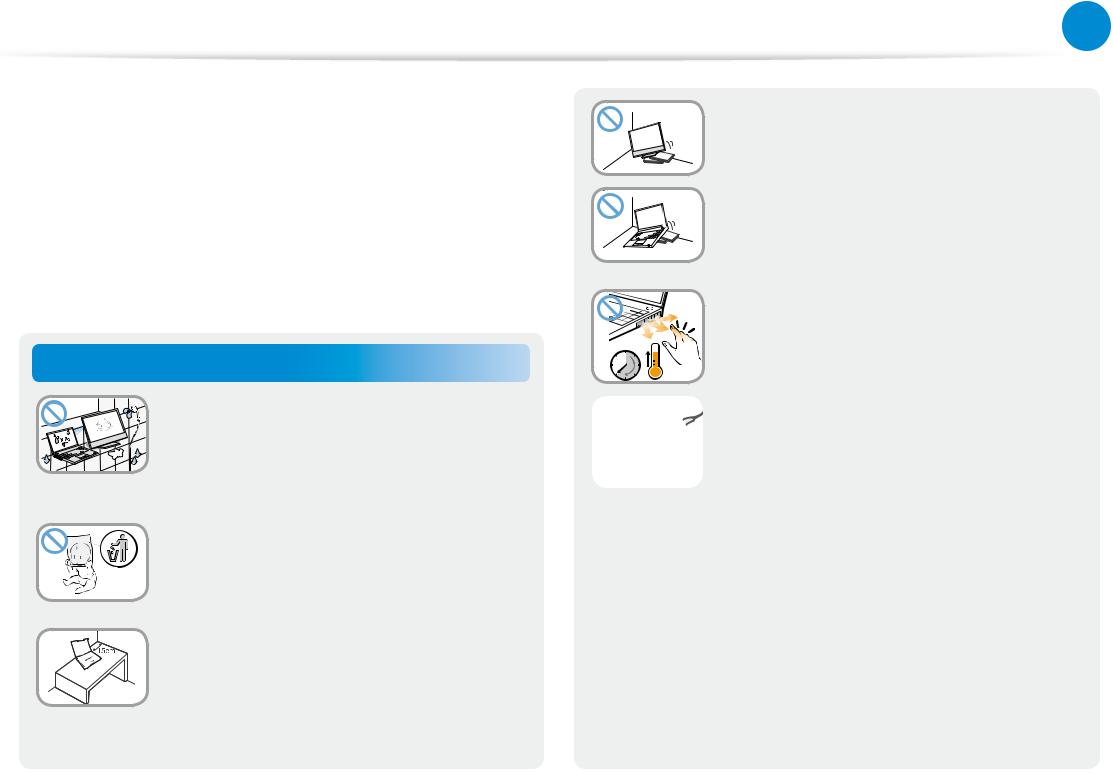
Do not install the computer on a slant or a
place prone to vibrations, or avoid using the
computer in that location for a long time.
This increases the risk that a malfunction or
damage to the product will occur.
Be careful that people are not exposed to
the computer’s ventilator, adapter, etc., as
they generate heat over a long period of
time when your PC is powered on.
Do not install the product in places exposed
to humidity such as bathrooms.
There is a danger of electric shock. Use the
product within the operating conditions
specied in the Manufacturers User Guide.
Keep the plastic bags out of the reach of
children.
There is a danger of suocation.
Keep a distance of 15cm or more between
the computer and the wall and do not place
any objects between them.
This may increase the internal temperature of
the computer and may cause an injury.
Exposing a part of your body close to the heat
from the vent or AC adapter for long periods of
time may cause a burn.
Avoid blocking the vent at the bottom or
side of the computer when using it on a bed
or cushion.
If the vent is blocked, there is a danger of
damaging the computer or overheating the
inside of the computer.
Ver 3.3
Page 8
7
Chapter 1
Getting Started
G
Safety Precautions
Warning
Failure to follow instructions marked with this symbol may
cause personal injury and even fatality.
Power Related
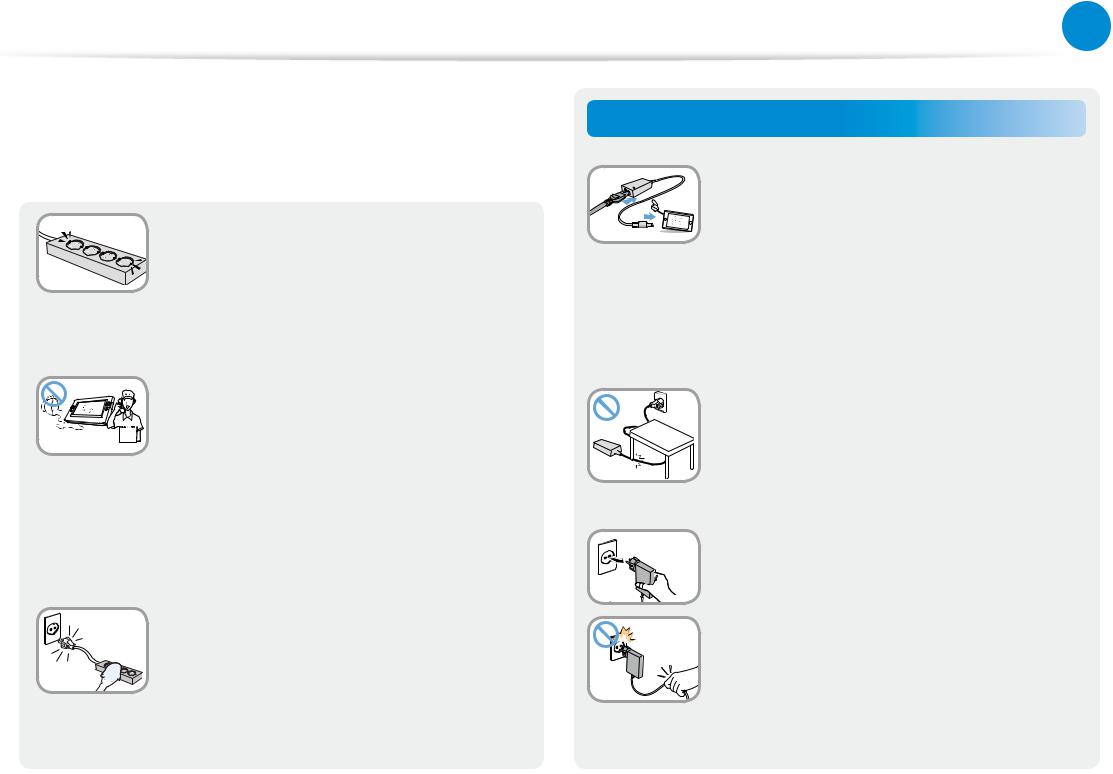
The power plug and wall outlet gures may dier
depending on the country specications and the product
model.
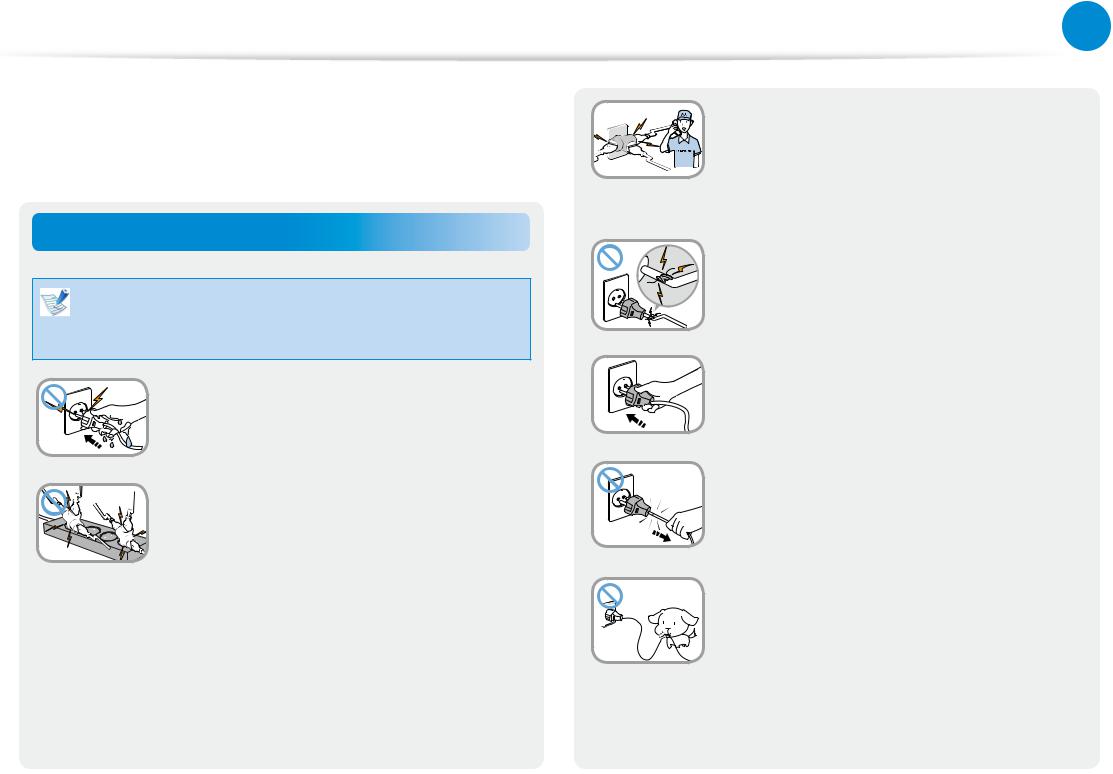
Do not touch the main plug or power cord
with wet hands.
There is a danger of electric shock.
Do not exceed the standard capacity
(voltage/current) of a multiplug or power
outlet extension when using it for the
product.
There is a danger of electric shock or re
hazard.
If the power cord or power outlet makes a
noise, disconnect the power cord from the
wall outlet and contact a service center.
There is a danger of electric shock or re
hazard.
Do not use a damaged or loose main plug or
power cord or power outlet.
There is a danger of electric shock or re
hazard.
Plug the power cord rmly into the power
outlet and AC adapter.
Failure to do so may cause re hazard.
Do not unplug the power cord by pulling
the cable only.
If the cord is damaged, it may cause electric
shock.
Do not bend the power cord excessively or
do not place a heavy object over the power
cord. It is especially important to keep the
power cord out of reach of infants and pets.
If the cord is damaged, it may cause electric
shock or re.
Page 9
8
Chapter 1
Getting Started
Safety Precautions
Warning
Failure to follow instructions marked with this symbol may
cause personal injury and even fatality.
Connect the power cord to an outlet or
multiple power plug (extended cable) with
a ground terminal.
Failure to do so may result in electric shock.
When the power supply is ungrounded, the
current may leak resulting in electric shock.
If water or another substance enters
the power input jack, AC adapter or the
computer, disconnect the power cord and
contact the service center.
If the notebook computer has an external
type (removable) battery, separate the
battery also.
Damage to the device within the computer
may cause electric shock or re hazard.
Keep the power cord or outlet clean so that
they are not covered with dust.
Failure to do so may result in re.
AC Adapter Usage Precautions
Connect the power cord to the AC adapter
rmly.
Otherwise, there is a danger of re due to an
incomplete contact.
Use only the AC adapter supplied with the
product.
Using another adapter may cause the screen to
icker.
Do not place heavy objects on top of or step
onto the power cord or AC adapter to avoid
damaging the power cord or AC adapter.
If the cord is damaged, there is a danger of
electric shock or re.
Unplug the wall-mount AC adapter (adapter
and plug intergrated type) from the wall
outlet while holding the body and pulling it
in the direction of the arrow.
If you unplug the adapter by holding and
pulling the cable, the adapter may be damaged
and an electric shock, explosive sound or spark
may occur as a result.
Page 10
9
Chapter 1
Getting Started
Safety Precautions
Warning
Failure to follow instructions marked with this symbol may
cause personal injury and even fatality.
Battery Usage Related
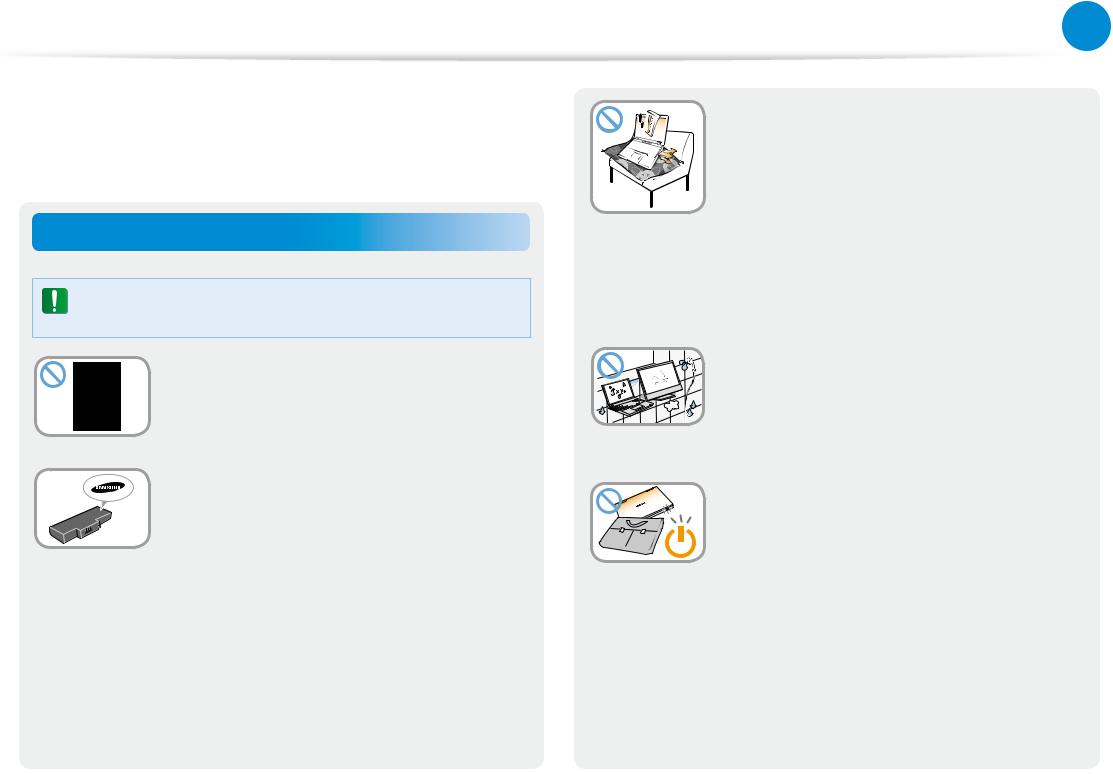
Please charge the battery fully before using the
computer for the rst time.
Keep the battery out of the reach of infants
and pets, as they could put the battery into
their mouths.
There is a danger of electric shock or choking.
Use an authorized battery and AC adapter
only.
Please use an authorized battery and adapter
approved by Samsung Electronics.
Unauthorized batteries and adapters may not
meet the proper safety requirements and may
cause problems or malfunctions and result in
an explosion or re.
Do not use the computer in a badly
ventilated location such as on bedding, on
a pillow or cushion, etc, and do not use it in
a location such as a room with oor heating
as it may cause the computer to overheat.
Take care that the computer vents (on the side
or the bottom) are not blocked especially in
these environments. If the vents are blocked,
the computer may overheat and it may cause a
computer problem, or even an explosion.
Do not use the computer in a humid
location such as a bathroom or sauna.
Please use the computer within the
recommended temperature and humidity
ranges (10 - 32ºC (50 - 90ºF), 20 - 80% RH)
Do not close the LCD panel and put the
computer into your bag to move it when it is
still turned on.
If you put the computer into your bag without
turning it o, the computer may overheat and
there is a danger of re. Shut the computer
down properly before moving it.
Page 11
10
Chapter 1
Getting Started
Safety Precautions
Warning
Failure to follow instructions marked with this symbol may
cause personal injury and even fatality.
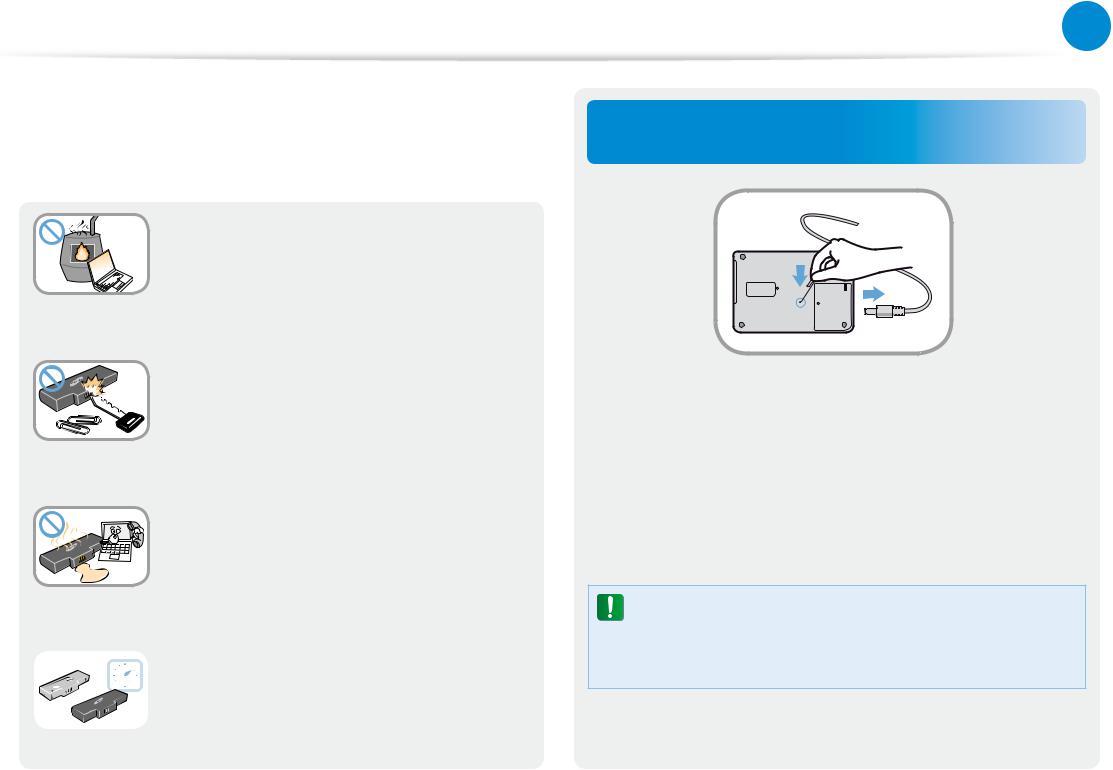
Never heat the product (or battery) or put
the product (or battery) into a re. Do not
put or use the product (or battery) in a hot
location such as a sauna, inside a vehicle
exposed to the heat, and so on.
There is a danger of an explosion or re.
Take care not to allow metal objects such as
a key or clip to touch the battery terminal
(metal parts).
If a metal object touches the battery terminals,
it may cause excessive current ow and it may
damage the battery, or result in a re.
If liquid leaks out of the product (or
battery) or there is a funny smell coming
from the product (or battery), remove the
the product (or battery) the computer and
contact a service center.
There is a danger of an explosion or re.
To use the computer safely, replace a dead
battery with a new, authorized battery.
Cutting the Power to the Internal Battery
(for corresponding models only)
For products with built-in batteries, customers cannot remove •
the battery.
In the case of ooding, lightning or explosions, you can cut •
the battery power by inserting an object such as a paper clip
into the [Emergency Hole] at the bottom of the computer.
Disconnect the AC adapter and insert an object such as a •
paper clip into the hole at the bottom of the computer to cut
the battery power.
In the case of ooding, lightning or explosions, cut
the battery power, do not reconnect the AC adapter,
and immediately contact Samsung Electronics so that
the appropriate countermeasures can be taken.
Page 12
11
Chapter 1
Getting Started
Safety Precautions
Warning
Failure to follow instructions marked with this symbol may
cause personal injury and even fatality.
Thereafter, if you connect the AC adapter, the battery power •
will be supplied again.
Do not cut the battery power under normal •
conditions.
This may result in data loss or a product •
malfunction.
The location of the Emergency Hole may dier depending
on the model.
Usage Related
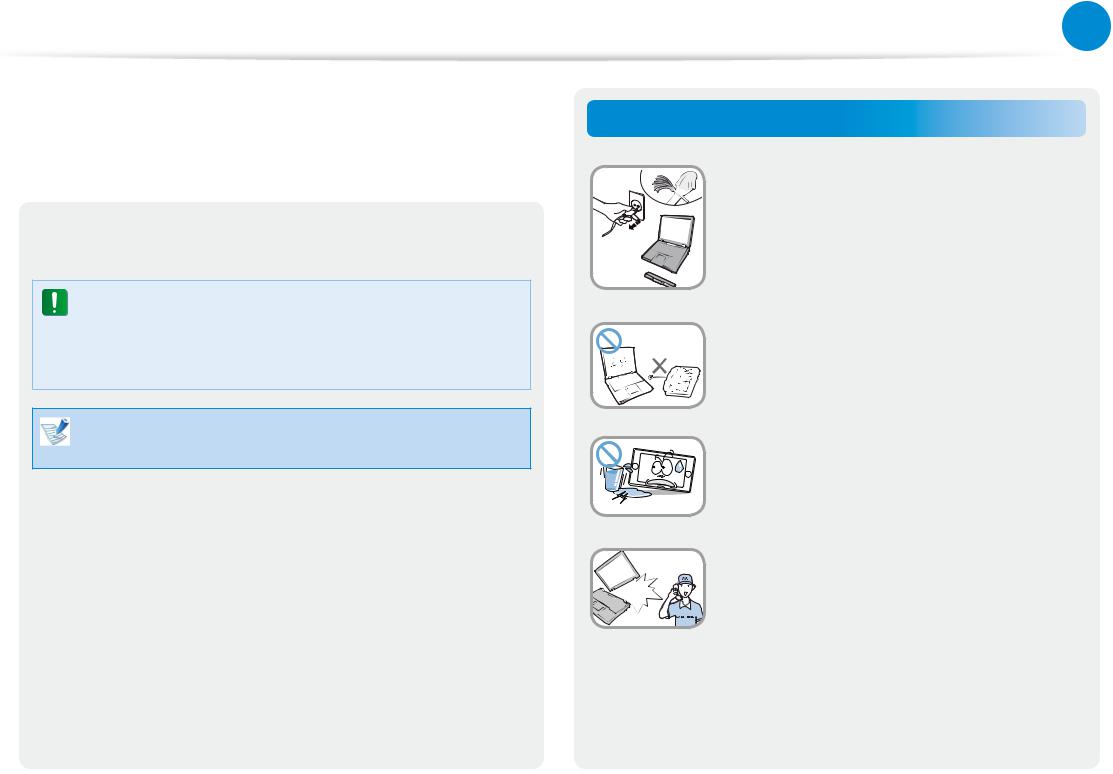
Disconnect all cables connected to the
computer before cleaning it.If your
notebook is an external & removable
battery type, remove the external battery.
There is a danger of electric shock or damage
to the product.
Do not connect a phone line connected to a
digital phone to the modem.
There is a danger of a electric shock, re or
damage to the product.
Do not place any container lled with water or
chemicals over or near the computer.
If water or chemicals enter the computer, this
may cause re or electric shock.
If the computer is broken or dropped,
disconnect the power cord and contact a
service center for a safety check.
If the notebook computer has an external
type (removable) battery, separate the
battery also.
Using a broken computer may cause electric
shock or re hazard.
Page 13
12
Chapter 1
Getting Started
Safety Precautions
Warning
Failure to follow instructions marked with this symbol may
cause personal injury and even fatality.
Avoid direct sunlight when the computer
is in an air-tight location such as inside a
vehicle.
There is a danger of a re hazard. The computer
may overheat and also present opportunity to
thieves.
Do not use your computer for long
periods of time while any part of your
body is making direct contact with it. The
temperature of the product may increase
during normal operation.
This may result in harming or burning your skin.
Upgrade Related
Be sure to upgrade the computer by
yourself only if you have sucient
knowledge and ability.
If this is not the case, ask for assistance from
the service center or an authorized engineer
for the upgrade.
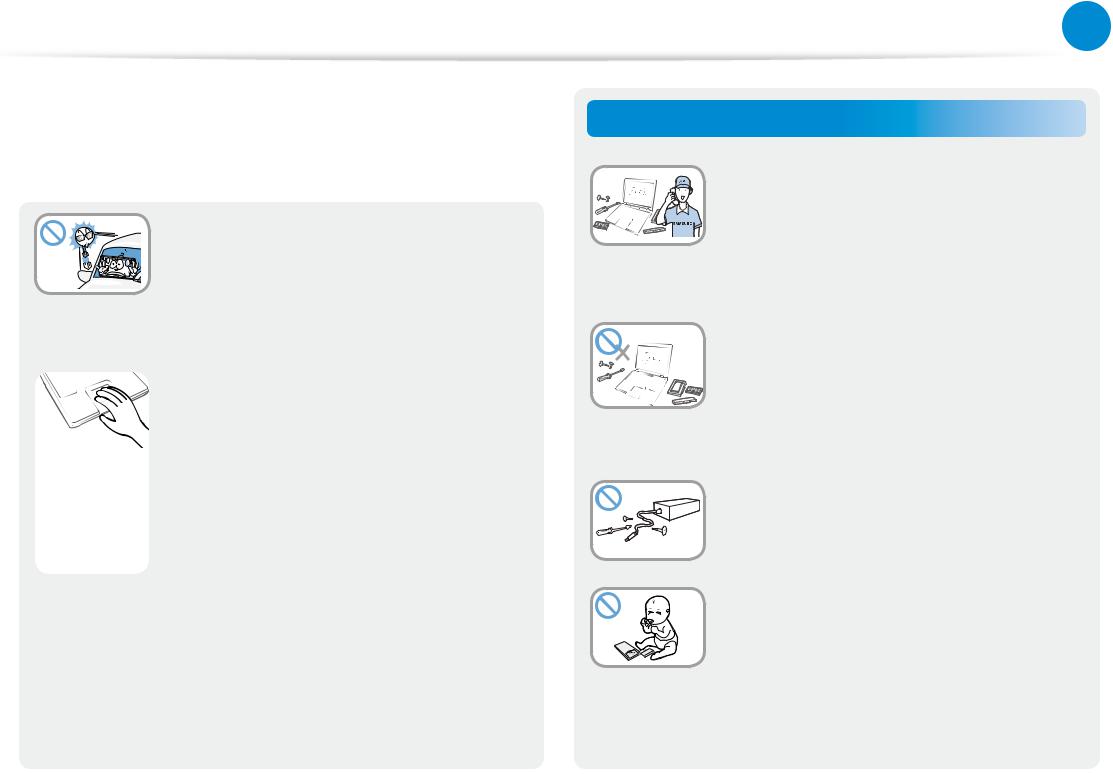
Be sure to upgrade only the parts specied
in the user manual according to the
procedures described in the user manual.
Do not disassemble any other parts or devices
by yourself. There is a danger of a electric
shock, re or damage to the product.
Never disassemble the power supply or AC
adapter.
There is a danger of electric shock.
When removing the RTC (Real Time Clock)
battery, keep it out of the reach of children
as they could touch and/or swallow it.
There is a danger of choking. If a child has
swallowed it, contact a doctor immediately.
Page 14
13
Chapter 1
Getting Started
Safety Precautions
Warning
Failure to follow instructions marked with this symbol may
cause personal injury and even fatality.
Before upgrading the computer, be sure
to shutdown the computer rst and then
separate all connected cables. If the
notebook computer has an external type
(removable) battery, separate the battery,
too.
Failure to do so may cause electric shock.
Security and Movement Related
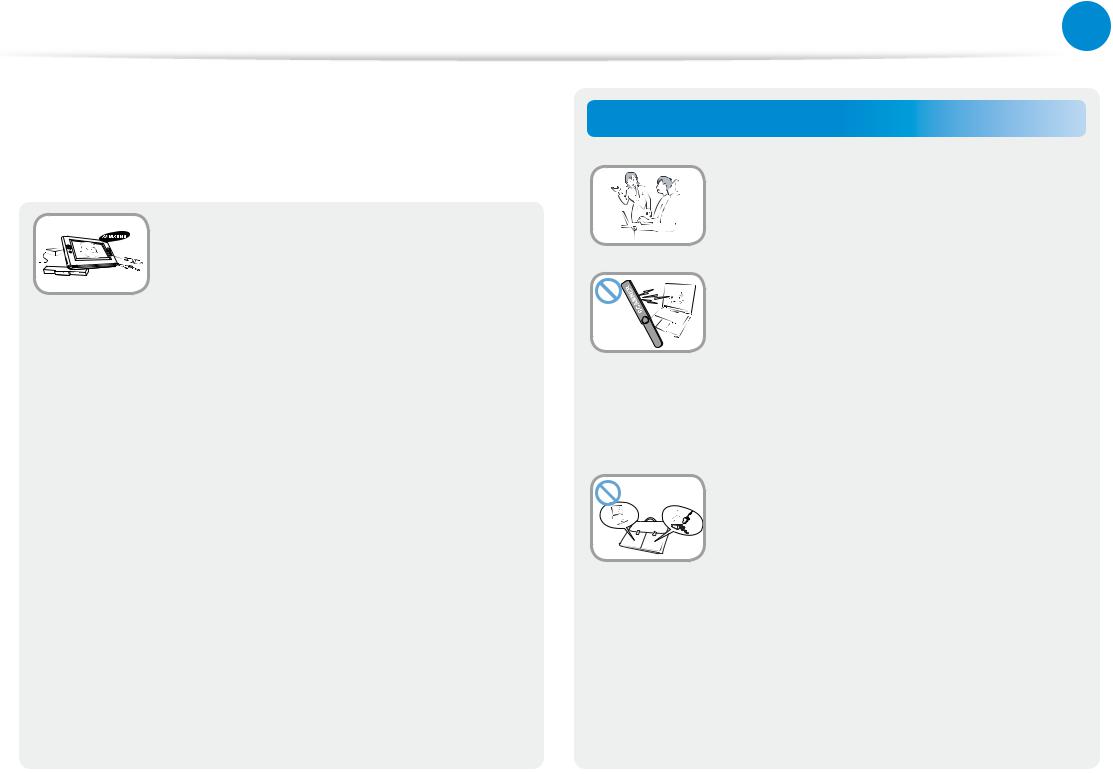
Follow the instructions for the relevant
location (e.g., airplane, hospital, etc.) when
using a wireless communication device
(wireless LAN, Bluetooth, etc.).
Avoid exposing a drive to magnetic elds.
Security devices with magnetic elds include airport walk-through devices and security wands.
The airport security devices that check carry-on luggage, such as conveyor belts, use
x-rays instead of magnetism and will not
damage a drive.
When carrying the notebook computer
with other items, such as the adapter,
mouse, books, etc, take care not to press
anything against the notebook computer.
If a heavy object is pressed against the
notebook computer, a white spot or stain may
appear on the LCD. Therefore, take care not to
apply any pressure to the notebook.
In this case, place the notebook computer
in a separate compartment away from other
objects.
Page 15
14
Chapter 1
Getting Started
Safety Precautions
Caution
Failure to follow instructions marked with this symbol may
cause slight injury or damage to the product.
Installation Related
Do not block the ports (holes), vents, etc. of the product and
do not insert objects.
Damage to a component within the computer may cause electric
shock or re.
When using the computer with it lying on its side, place it so
that the vents face upwards.
Failure to do so may cause the internal temperature of the
computer to rise and the computer to malfunction or halt.
Do not place a heavy object over the product.
This may cause a problem with the computer. In addition, the
object may fall and cause injury, or damage the computer.
Battery Usage Related
Dispose of worn-out batteries properly.
There is a danger of re or explosion.•
The battery disposal method may dier depending on •
your country and region. Dispose of the used battery in an
appropriate way.
Do not throw or disassemble the battery and do not put it
into water.
This may cause an injury, re or explosion.
Use only a battery authorized by Samsung Electronics.
Failure to do so may cause an explosion.
Avoid contact with metal objects such as car keys or clips
when keeping or carrying a battery.
Contact with a metal may cause excessive current and a high
temperature and may damage the battery or cause a re.
Charge the battery according to the instructions in the manual.
Failure to do so may cause an explosion or re from damage to
the product.
Do not heat the product (or battery) or expose it to heat (e.g.,
inside a vehicle during the summer).
There is a danger of explosion or re.
Page 16
15
Chapter 1
Getting Started
Safety Precautions
Caution
Failure to follow instructions marked with this symbol may
cause slight injury or damage to the product.
Usage Related
Do not place a candle, light a cigar, etc. over or on the
product.
There is a danger of re.
Use a wall outlet or multi-plug with a grounding part.
Failure to do so may cause electric shock hazard.
Make sure to have the product tested by a safety service
engineer after repairing the product.
Authorized Samsung Repair Centers will carry out safety checks
after a repair. Using a repaired product without testing it for
safety may cause an electric shock or re.
Do not use your computer and AC-Adapter on your lap or
soft surfaces.
If the computer temperature increases, there is a danger of
burning yourself.
Connect only permitted devices to the connectors or ports of
the computer.
Failure to do so may cause electric shock and re.
Close the LCD panel only after checking if the notebook
computer is turned o.
The temperature may rise and cause overheating and
deformation of the product.
Do not press the Eject Button while the CD-ROM drive is in
operation.
You might lose data and the disk might be suddenly ejected and
could cause an injury.
Do not drop or knock the product.
In case of lightning, immediately turn the system o,
disconnect the power cord from the wall outlet and phone
line from the modem. Do not use a modem or phone.
There is a danger of electric shock or re.
This may result in injury or damage to the data.
Do not touch the antenna with an electricity facility such as
the power outlet.
There is a danger of electric shock.
When handling computer parts, follow the instructions on
the manual supplied with the parts.
Failure to do so may cause damage to the product.

Page 17
16
Chapter 1
Getting Started
Safety Precautions
Caution
Failure to follow instructions marked with this symbol may
cause slight injury or damage to the product.
If the computer emits smoke, or there is a burning smell,
disconnect the power plug from the wall outlet and contact
a service center immediately. If your notebook is an external
& removable battery type, remove the external battery.
There is a danger of re.
Do not use a damaged or modied CD.
There is a danger of damaging the product or personal injury.
Do not insert your ngers into the PC Card Slot.
There is a danger of injury or electric shock.
Use recommended computer cleansing solution when
cleaning the product and only use the computer when it is
completely dried.
Do not place your face close to the Optical Disk Drive tray
when it is operating.
There is a danger of injury due to an abrupt ejection.
Check CDs for cracks and damage prior to use.
It may damage the disc and cause problems with the device and
injury to the user.
Do not leave the product in a location exposed to magnetic
elds.
A magnetic eld may cause the product to work abnormally or •
the battery to discharge.
The information saved on the magnetic tape of a credit card, •
phone card, bankbook, transportation tickets and so on can be
damaged by a computer’s electromagnetic eld.
Use the pen only for the original purpose. Do not poke in the
eye or ear with the pen, and do not put the pen in the mouth.
There is a danger of injury.
Failure to do so may cause electric shock or re.
Emergency disk eject method using paperclip should not
be used while the disk is in motion. Make sure to use the
emergency disk eject method only when the Optical Disk
Drive has stopped.
There is a danger of injury.
Page 18
17
Chapter 1
Getting Started
Safety Precautions
Caution
Failure to follow instructions marked with this symbol may
cause slight injury or damage to the product.
Upgrade Related
Carefully touch a part or device of the product.
Failing to do so may result in damage to the product or injury.
Take care not to throw or drop a computer part or device.
Failing to do so may result in damage to the product or injury.
After the disassembly, be sure to close the cover and then
connect the power.
Failing to do so may result in an electric shock from the exposed
circuit.
To connect a device that is not manufactured or authorized
by Samsung Electronics, inquire at your service center
before connecting the device.
There is a danger of damaging the product.
Security and Movement Related
When moving the product, turn the power o and separate
all connected cables rst.
The product might be damaged or users may trip over the cables.
For long periods of not using the notebook computer,
discharge the battery and separate the battery from the
computer (for external & removable battery type).
The battery will be preserved at its best condition.
Use parts authorized by Samsung Electronics only.
It may damage the product or result in re.
Never disassemble or repair the product by yourself.
If the product is modied, disassembled or repaired by the user,
the warranty is expired, a service fee will be charged and there is
a danger of an accident.
Be sure to use an authorized Samsung Electronics service center.
Do not operate or watch the computer while driving a
vehicle.
There is a danger of a trac accident. Please concentrate on
driving.
Page 19
18
Chapter 1
Getting Started
Safety Precautions
Caution
Failure to follow instructions marked with this symbol may
cause slight injury or damage to the product.
Cautions on Preventing Data Loss
(Hard Disk Management)
Take care not to damage the data on a hard disk drive.
A hard disk drive is so sensitive to external impact that an •
external impact may cause loss of data on the surface of the
disk.
Take extra care, because moving the computer or an impact •
on the computer when it is turned on may damage the data of
the hard disk drive.
The company is not liable for any loss of data on the hard disk •
drive.
Causes that may damage the data of a hard disk drive and
the hard disk drive itself.
The data may be lost when an external impact is applied to the •
disk while disassembling or assembling the computer.
The data may be lost when the computer is turned o or reset •
by a power failure while the hard disk drive is operating.
The data may be lost and irrecoverable due to a computer virus •
infection.
The data may be lost if the power is turned o while running a •
program.
Sudden impact or movement to the computer while the hard •
disk drive is operating may cause les to be corrupted or bad
sectors on the hard disk.
To prevent data loss due to damage to the hard disk drive,
please backup your data frequently.
Page 20
19
Chapter 1
Getting Started
Safety Precautions
Using the Power Supply in an Airplane
Since the power outlet type diers depending on the type of
airplane, connect the power appropriately.
Since the representative gures of the power plug and
the auto adapter are used, they may dier from the actual
parts.
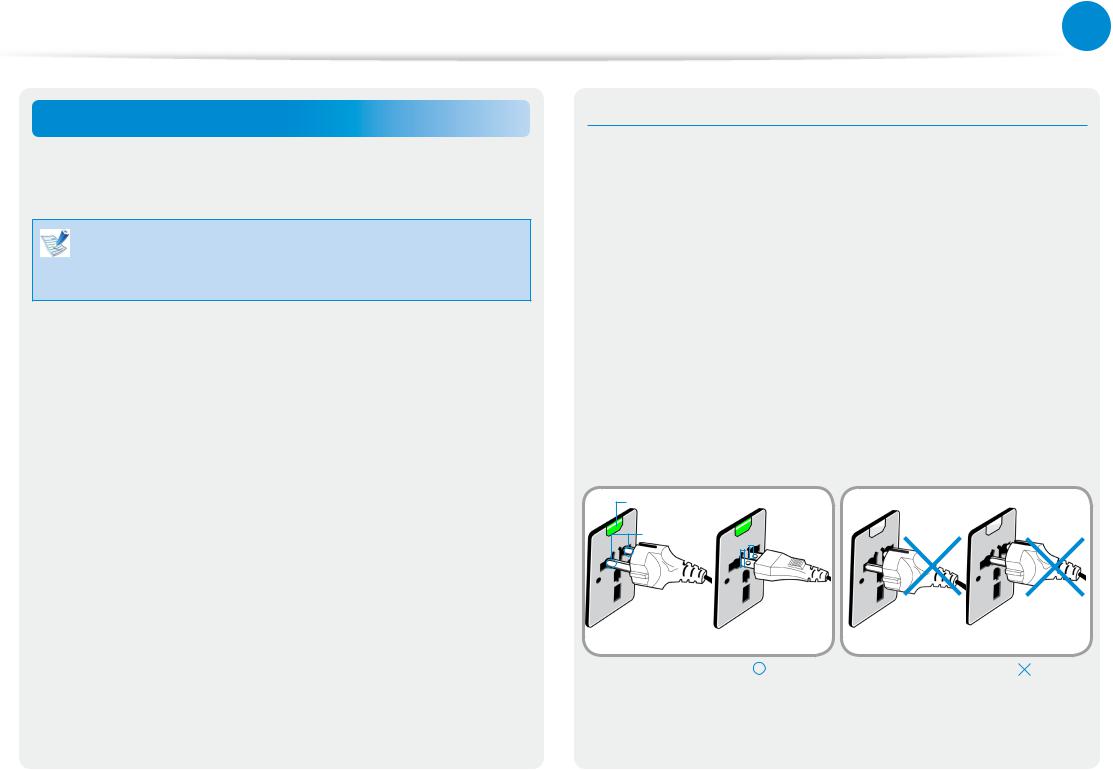
When Using the AC Power Plug
Connect the power plug pins perpendicular into the center of the
power outlet.
If the plug pins are not inserted into the center of the holes, the •
plug pins are only inserted up to half their length. In this case,
reconnect the power plug.
You have to insert the power plug into the outlet when the •
power indicator (LED) of the power outlet is lit green. If the
power is connected properly, the power indicator (LED)
remains green.
Otherwise, the power indicator (LED) is turned o. In this case,
unplug the power, check if the power indicator (LED) is green,
and then reconnect the power plug.
Power Indicator (LED)
Center
Holes
220V Power Plug110V Power Plug
Good Example
Wrong Example
Page 21
20
Chapter 1
Getting Started
Safety Precautions
When Using the Auto Adapter
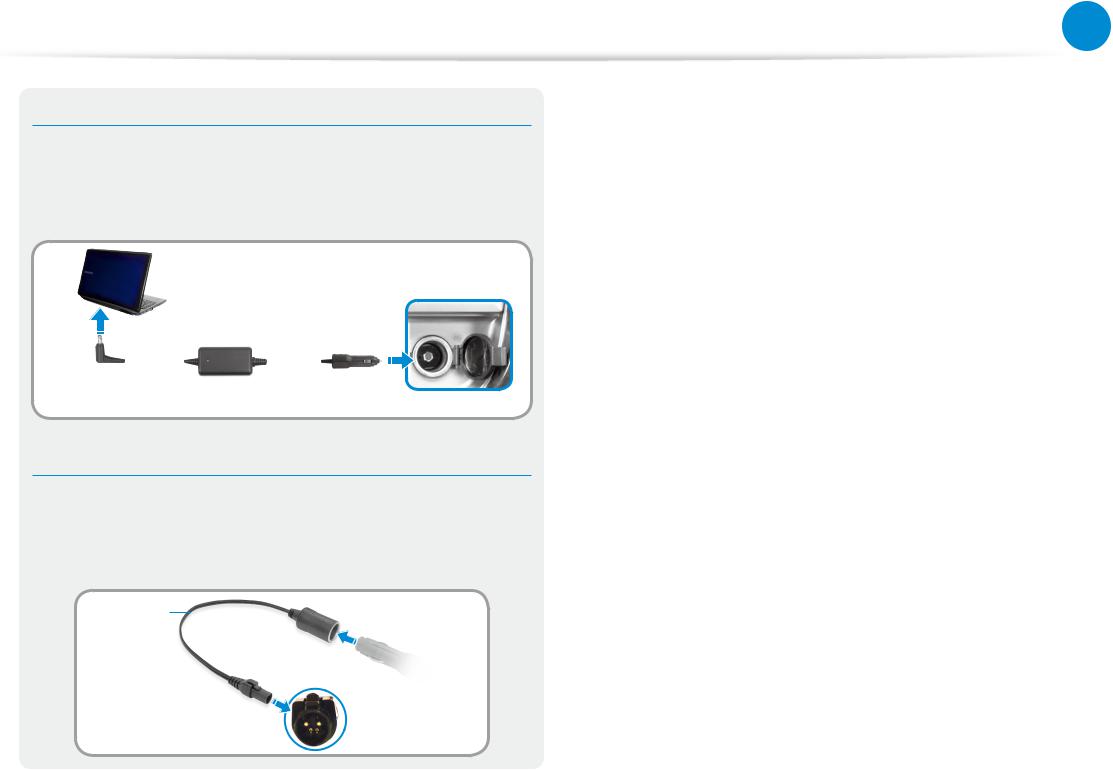
When a cigar socket is provided, you have to use the auto adapter
(optional). Insert the cigar plug of the auto adapter into the cigar
socket and connect the DC plug of the auto adapter to the power
input port of the computer.
Auto Adapter
In-ight Cigar SocketCigar PlugDC Plug
When Using the Airplane Charging Coverter
Depending on the airplane, you have to use the auto adapter
and charging converter. Connect the airplane charging converter
(optional) to the auto adapter (optional) and then insert the
airplane power input jack into the power outlet.
Charging
Converter
Connect the airplane power
input jack to the power
outlet of the airplane.
2
Connect this end to
1
the auto adapter.
Page 22
21
Chapter 1
Getting Started
Proper Posture During Computer Use
Maintaining a proper posture during computer use is very
important to prevent physical harm.
The following instructions are about maintaining a proper posture
during computer use developed through human engineering.
Please read and follow them carefully when using the computer.
Otherwise, the probability of (RSI: Repetitive Strain Injury) from
repeated operations may increase and serious physical harm may
be caused.
The instructions in this manual have been prepared so that •
they can be applied within the coverage of general users.
If the user is not included in the coverage, the •
recommendation is to be applied according to the user’s
needs.
Proper Posture
Do not use the computer while you are lying down, but only •
while you are sitting down.
Do not use the computer on your lap. If the computer •
temperature increases, there is a danger of burning yourself.
Work while keeping your waist straight.•
Use a chair with a comfortable back.•
Keep the center of your leg weight not on the chair but on •
your feet when you are sitting on a chair.
To use the computer while talking over the telephone, use a •
headset. Using the computer with the phone on your shoulder
is bad for posture.
Keep frequently used items within a comfortable work range •
(where you can reach them with your hands).
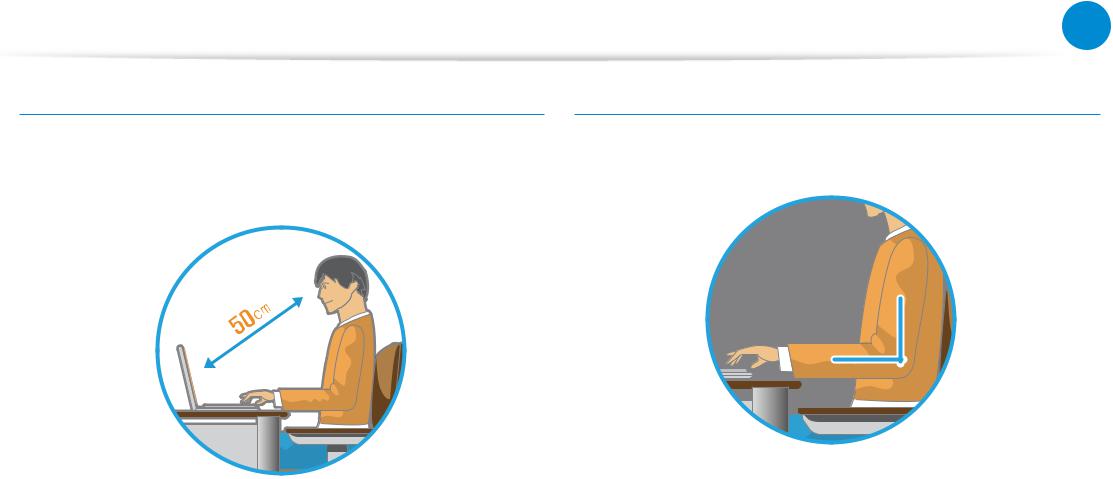
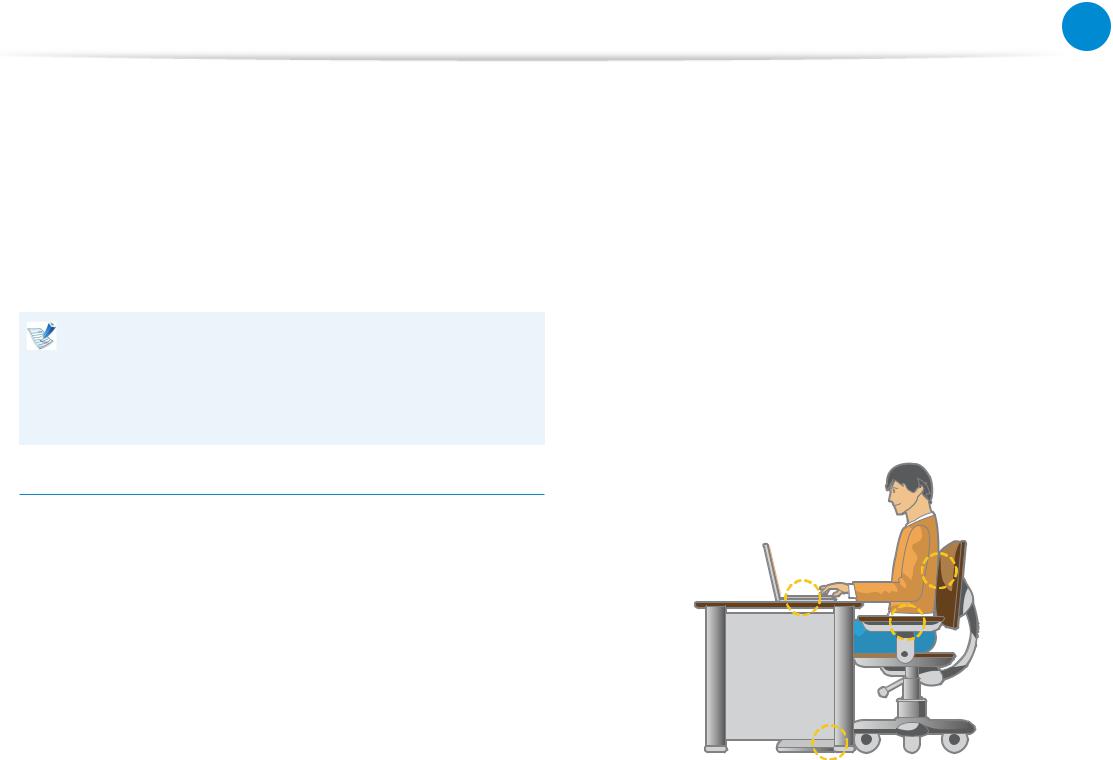
Adjust the heights of desks and chairs appropriate to your
height.
The heights are to be adjusted so that your arm forms a right
angle when you place your hand over the keyboard while sitting
down on a chair.
Adjust the height of chair so that your heel is comfortably placed
on the oor.
Page 23
22
Chapter 1
Getting Started
Proper Posture During Computer Use
Eye Position
Keep the monitor or LCD away from your eyes by at least
50cm.
Hand Position
Keep your arm at a right angle as shown by the gure.
Adjust the height of the monitor and the LCD screen so that its •
top height is equal to or lower than your eyes.
Avoid setting the monitor and LCD excessively bright.•
Keep the monitor and LCD screen clean.•
If you wear glasses, clean them before using the computer.•
When entering contents printed on a paper into the computer, •
use a static paper holder so that the height of the paper is
almost equal to that of the monitor.
Keep the line from your elbow to your hand straight.•
Do not place your palm over the keyboard while typing.•
Do not hold the mouse with excessive force.•
Do not press the touch screen with excessive force.•
It is recommended connecting an external keyboard and •
mouse when using the computer for long periods of time.
Page 24
23
Chapter 1
Getting Started
Proper Posture During Computer Use
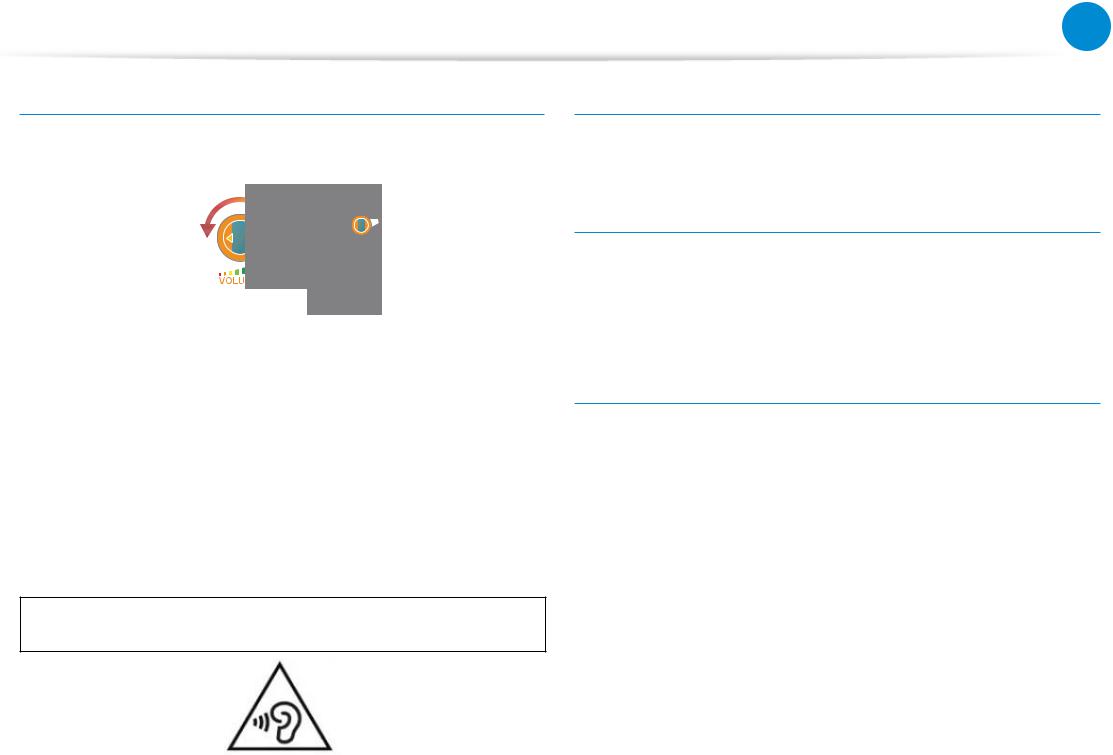
Volume Control (Headphones and Speakers)
Check your volume rst to listen to music.
Check your
volume!
Check if the volume is too loud before using headphones.•
It is not recommended using headphones for long periods of •
time.
Any deviation from the equalizer default setting could cause •
hearing impairment.
The default setting can be changed through software and •
Use Time (Break Time)
Take a break for 10 minutes or more after a 50-minute period •
when working for more than one hour.
Illumination
Do not use the computer in dark locations. The illumination •
level for computer use must be as bright so for reading a book.
Indirect illumination is recommended. Use a curtain to prevent •
reection on the LCD screen.
Operation Condition
Do not use the computer in hot and humid locations.•
Use the computer within the allowed temperature and •
humidity range specied in the User Guide.
driver updates without your intervention. Please check the
equalizer default setting before rst usage.
To prevent possible hearing damage, do not listen at high volume
levels for long periods.
Page 25
24
Chapter 1
Getting Started
Overview
áᔪ
Ŗᮁ
Front View
The pictures used for the cover and the main body in the User
Manual are those of the representative model of each series.
Therefore the colors and appearance of the pictures may
dier from the actual appearance of the product depending
on the model.
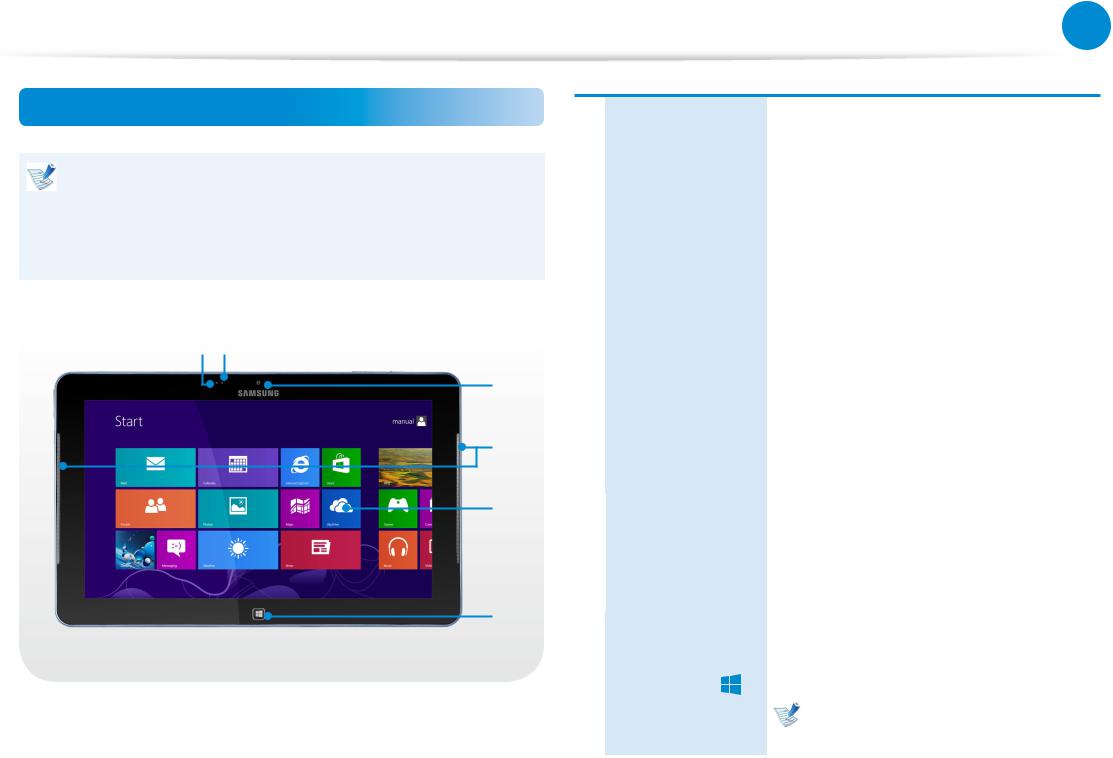
1 2
Using the illumination sensor, the LCD
screen brightness is automatically adjusted
depending on the ambient illumination.
1Illumination Sensor
If you cover the illumination sensor with
your hand, the LCD screen will become
dimmer. Therefore, please take care that
you do not cover the sensor when you use
the computer.
Camera operating
2
This indicates the camera operating status.
indicator (Optional)
3
Using this camera, you can take still
pictures and record video.
3Camera (Optional)
4
You can take a picture or make a movie
using the Charms > Start > Camera.
5
4SpeakerA device used to generate sound.
This is a touch screen that shows the
5Touch Screen
output from the computer.
6
Switches the screen between the Start
screen and the currently running app/
6
Home button
program.
If no app/software is currently running,
the Desktop is displayed.
Page 26
25
Chapter 1
Getting Started
Overview
Right View
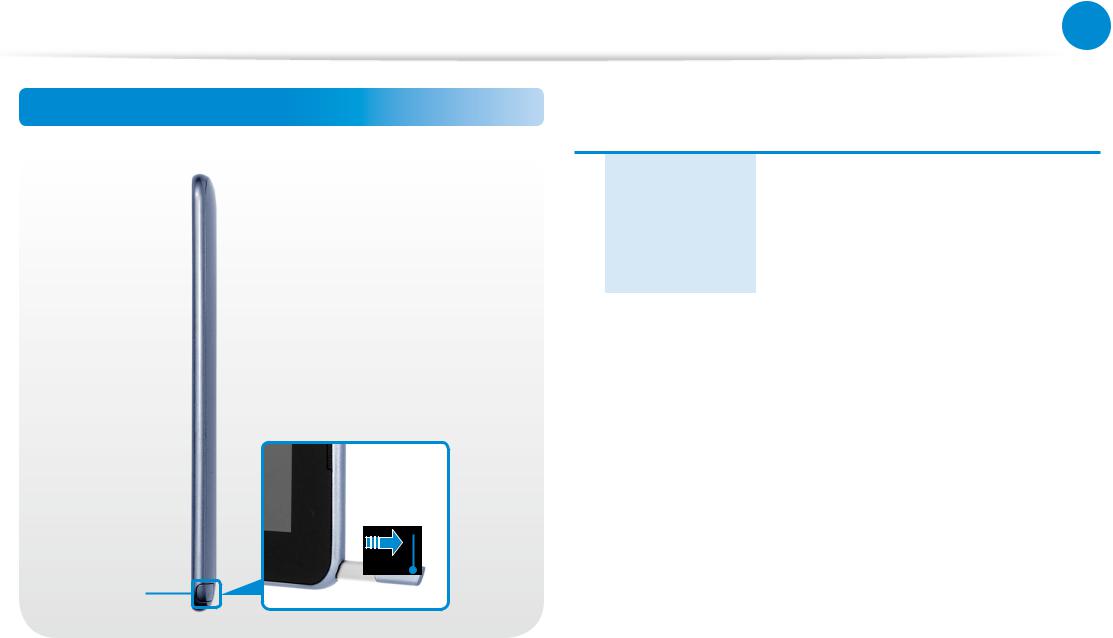
S Pen (Optional)
1
S Pen Slot
2
(Optional)
1
A pen used to enter information on the
touch screen.
You can keep the S Pen in the S Pen slot.
2
Page 27
26
Chapter 1
Getting Started
Overview
Left View
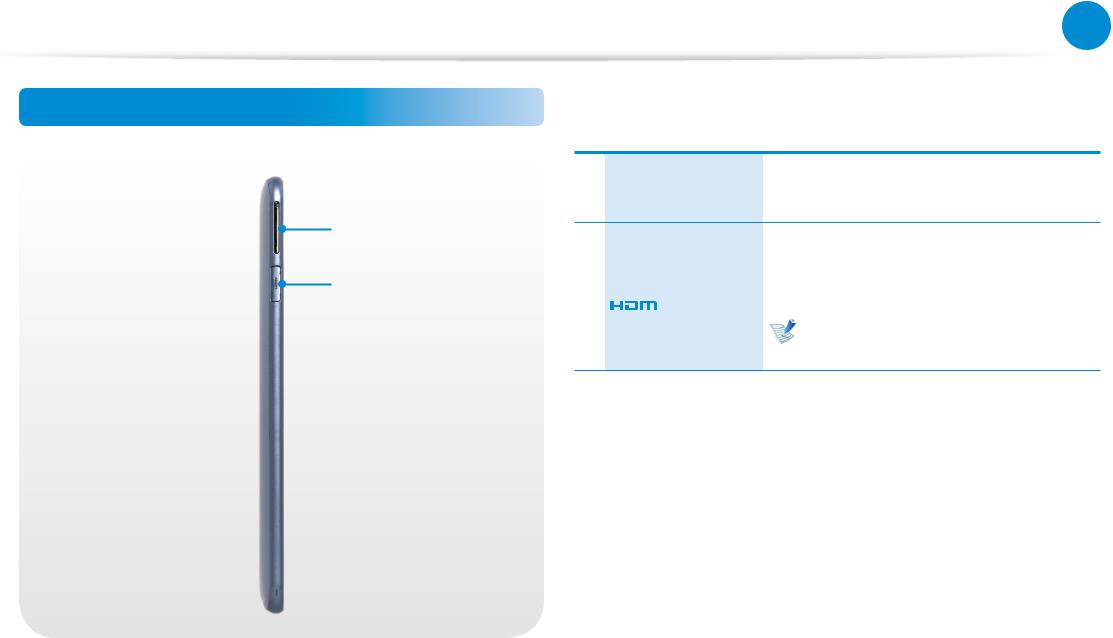
Volume Control
1
Button
1
Controls the volume.
This is the port for a micro HDMI.
2
Micro HDMI Port
2
(Optional)
You can enjoy digital video and audio by
connecting the computer to a TV.
You can connect a VGA adapter
(optional).
Page 28
27
Chapter 1
Getting Started
Overview
Top View
356784
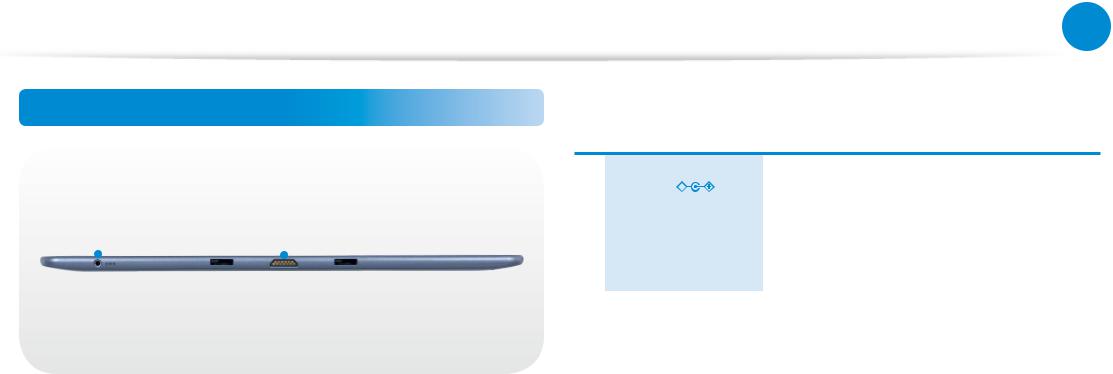
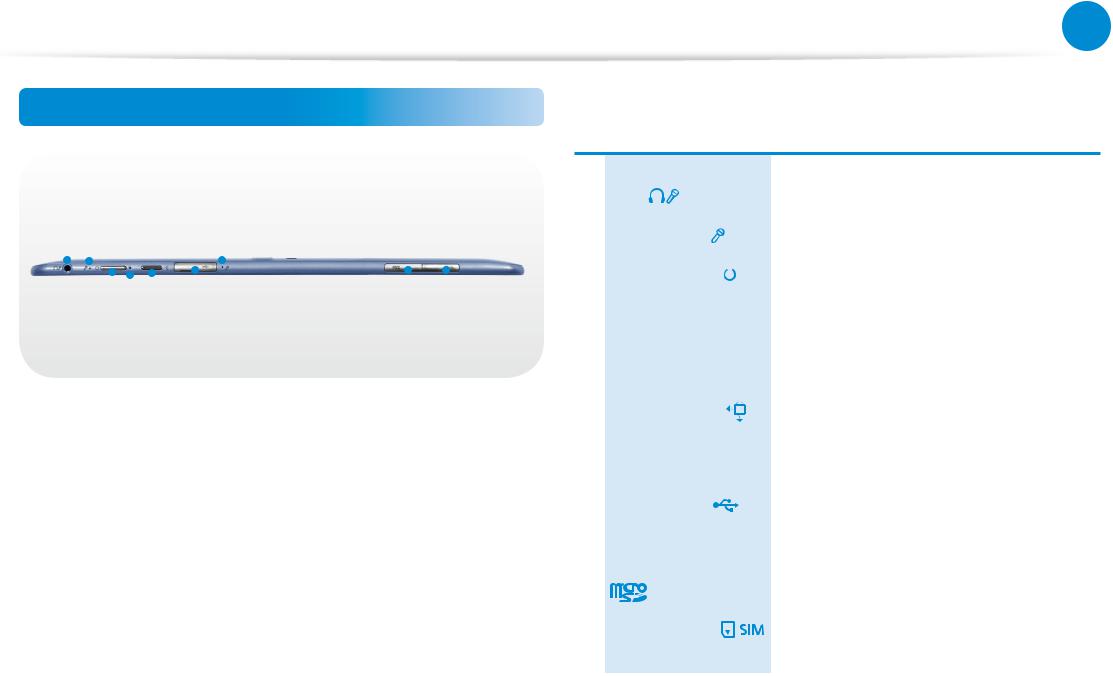
Ear-set / headset
1
Jack
21
2Microphone You can use the built-in microphone.
3Power Button Turns the computer on and o.
4Power Button LED
5
Rotation Lock
6USB 2.0 Port
This is the jack for connecting an ear-set
or headset.
When the computer is on, the power
button LED is lit.
Locks the screen rotation so that the
screen does not automatically rotate
according to the orientation function of
the product.
You can connect USB devices to the USB
port such as a keyboard/mouse, digital
camera, etc.
Micro SD Card Slot
7
SIM Card Slot
8
(Optional)
This slot is for micro SD cards.
This slot is for SIM cards.
Page 29
28
Chapter 1
Getting Started
Overview
Bottom View
12
1DC Jack
Dock Connector
2
(Optional)
A jack to connect the AC adapter that
supplies power to the computer.
A connector to the keyboard dock
(optional).
Page 30
29
Chapter 1
Getting Started
Overview
Rear View
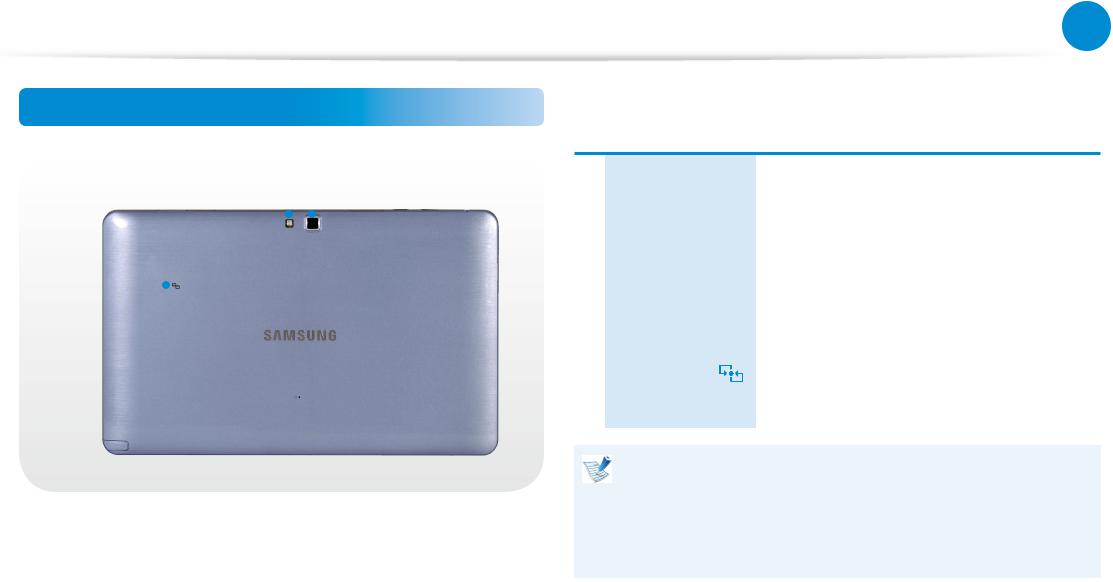
21
3
Camera Flash
1
(Optional)
Camera
2
(Optional)
NFC Antenna
3
(Optional)
If you replace the bottom of the product, the model name,
serial number and some logos etched into the bottom of the
product will no longer be there.
For more information, please ask for assistance from the
service center.
Used when taking photos.
Using this camera, you can take still pictures
and record video.
You can take a picture or make a movie
using the Charms > Start > Camera.
Provides NFC features for near eld
communication for various application
services.
Page 31
30
Chapter 1
Getting Started
Turning the Computer On and O
áᔪ
Ŗᮁ
᯲
ᰆ⊹
Turning the computer on
Connect the AC adapter.
1
Press and hold the Power button for a moment to turn the
2
computer on.
Power button LED is lit while the computer is turned on.
3
LED
About Windows Activation
When you turn the computer on for the rst time, the Windows
activation screen appears.
Follow the activation procedures according to the instructions on
the screen to use the computer.
Adjusting the screen brightness
When the computer runs on battery power, the LCD brightness is
automatically set to low.
Slightly drag from the right edge of the screen toward the
1
center to display the Charms menu.
Increase the bar by pressing the Settings
> Screen .
2
Page 32
31
Chapter 1
Getting Started
áᔪ
Ŗᮁ
᯲
ᰆ⊹
Turning the Computer On and O
Turning the computer o
Since the procedures to turn the computer o may dier •
depending on the installed operating system, please turn
the computer o according to the procedures for the
purchased operating system.
Save all your data before clicking on • Shut down.
Slightly drag from the right edge of the screen toward the
1
center to display the Charms menu.
Click Settings
> Power
> Shut down.
2
If you want to power o your computer when you are logged
out, unlock the screen and click Power
> Shut down.
Page 33
Chapter 2.
Using Windows 8
What is Microsoft Windows 8? 33
Screen At a Glance 34
Using the Charms 36
Using Apps 38
Windows Hot Key Function 42
Page 34
What is Microsoft Windows 8?
áᔪ
Ŗᮁ
᯲
ᰆ⊹
Microsoft Windows 8 (hereafter referred to as Windows) is an
operating system that is required for operating a computer.
To use your computer optimally, you need to know how to use it
properly. Therefore, It is better to learn how to use Windows by
utilizing Windows Help and Support.
The screen may appear somewhat dierent depending on •
the model and the operating system.
Since this guide has been prepared based on Windows •
8, some of the instructions may dier depending on the
version. It may also be modied without prior notice.
Chapter 2
Using Windows 8
Searching
for Help
33
Displaying Help
Move the pointer on the screen to the top or bottom right edge of
the screen to view the Charm menu.
Alternatively, slightly drag the right edge inward with your nger
to view the Charm menu.
Select Charm menu > Settings
If you are connected to the internet, you can access the most
recent online Help.
> Help.
Get Started
Internet &
networking
Security, privacy,
& accounts
You can view basic instructions on how to use
your computer including new function(s) for the
Windows OS.
After connecting to the network, you can check
the Help section required to use the internet.
You can check the Help information required
to protect your computer and personal
information.
Page 35
34
Chapter 2
Using Windows 8
Screen At a Glance
Windows 8 provides both the new Start screen mode and the
Desktop mode of the existing OS.
Start ScreenDesktop
Start Screen
1 Start ScreenRefers to the default Start screen of Windows 8.
2 AppRefers to the apps that are currently installed.
The Charms is hidden at the right of the
screen. Place your mouse pointer at the edge
of the top or bottom right of the screen to
Displaying the
3
Charms
display the Charms.
Alternatively, slightly drag the right edge
inward with your nger to view the Charm
menu.
When you turn on the computer, the Start screen is displayed,
which allows you to use the applications (Application, App,
hereafter referred to as an App) at the same location.
1
6
7
4 User AccountThis refers to the currently used user account.
This refers to the menu that allows you to use
5Charms
2
3
4
5
3
6DesktopSwitches to Desktop mode.
7CameraAllows you to take pictures or make a movie.
functions such as Search, Share, Start, Device
and Settings.
Page 36
35
Chapter 2
Using Windows 8
Screen At a Glance
Desktop
This provides similar functions to those provided by the Desktop
in prior Windows versions.
1
2
3
4
2
This refers to the menu that allows you to use
3Charms
Switching to the
4
Start Screen
functions such as Search, Share, Start, Device
and Settings.
Click the corner of the bottom left of the
screen to switch to the Start screen.
Displaying Documents and Files
Click Windows Explorer in the taskbar on the Desktop to
search for documents and les.
1DesktopRefers to the Desktop.
The Charms is hidden at the right of the
screen. Place your mouse pointer at the edge
of the top or bottom right of the screen to
Displaying the
2
Charms
display the Charms.
Alternatively, slightly drag the right edge
inward with your nger to view the Charm
menu.
Page 37
36
Chapter 2
Using Windows 8
Search
Search
Share
Search
Share
Start
Search
Share
Start
Device
Search
Share
Start
Device
Settings
Using the Charms
The Charms is a new type of menu that combines the Start menu
with the Control Panel of existing Windows.
The Charms allows you to quickly congure the device(s)
connected to your computer, search for App(s)/le(s), and use the
sharing function, etc.
Activating the Charms
Slightly drag the right edge inward with your nger to view the
Charm menu.
Alternatively, tap the top or bottom right edge of the screen to
If you want to search for a program or le in the App(s)/
Settings/File(s), simply enter a keyword in the Search
charm and start Search.
You can also search within an App or on the Web.
You can use this menu to transfer a picture or le to
another user. You can easily share pictures or les with
other users simply by associating multiple Apps with the
Share charm.
You can move to the Start screen.
view the Charm menu.
Displaying
the Charms
Menu
Charms
Displaying
the Charms
Menu
As this allows you to move directly to a desired device,
you can handle tasks such as importing pictures from
a digital camera, streaming a video to your TV or
transferring les to a device on the current screen.
The Settings charm allows you to perform basic tasks
such as adjusting the volume, turning o the PC, etc.
If you select the Settings charm while a specic App is
running, the settings for the currently running App are
displayed.
Page 38
37
Chapter 2
Using Windows 8
Using the Charms
⦽
Changing the Settings
Frequently used Windows menus are collected.
Click the Charms > Settings.
IconNameFunction Description
Wireless
Network
Adjusting the
Volume
ScreenYou can adjust the screen brightness.
Notice
Power
Keyboard
You can connect to a wireless network.
Select a wireless network to connect
to.
You can adjust the volume or mute the
sound.
You can set the interval at which an
App sends notices.
You can turn o your computer or
select the Power Options.
You can set the Language or launch
Touch keyboard.
Change PC settings
You can change more settings.
Page 39
38
Chapter 2
Using Windows 8
Using Apps
An App refers to an application program (hereafter referred to as
an App). In a larger sense, it refers to all the software programs
installed on the operating system.
Windows 8 provides basic Apps for frequently performed tasks.
Starting/Exiting an App
Click on an App in the Start screen to activate it.
To exit the App
Move your mouse pointer to the top of the screen.
1
Your mouse pointer changes to a hand shape.
Click and hold your mouse button and then drag it to the
2
bottom of the screen. The App moves downward and
Using Apps
You can use the following function with the mouse.
Displaying Currently Running App(s)
Move your mouse pointer to the top left corner of the screen
1
to display the last run App.
Then, move your mouse pointer down to display a list of the
2
currently running Apps in order.
disappears and exits.
1
2
Page 40
39
Chapter 2
Using Windows 8
Using Apps
Click on an App in that list or drag it to the center of the
3
screen. Now, you can check the selected App which is
currently running.
Right-click over the App in the list and click Close to exit the
App.
1
2
Running Two Apps at the Same Time
Select the Apps in the Start screen.
1
Move your mouse pointer to the top of the screen. Your
2
mouse pointer changes to a hand shape.
If you click and hold your mouse button and move left or
3
right, you can split the screen to display multiple Apps.
Move the Screen Split Bar to change the screen split ratio.
4
Supported screen split ratios are 3:7 or 7:3.
Weather
App
Screen
Split Bar
Store App
Ex) If you run the Weather App and Store App at the same time
Page 41
40
Chapter 2
Using Windows 8
Using Apps
Adding/Removing an App to/from the Start Screen
In the Start screen, slightly drag the top edge of the screen
inward.
Click All Apps at the bottom of the screen to display all the
Apps that are currently installed.
If you right-click over the App to be added, the relevant menu
1
is activated at the bottom of your screen.
Click Pin to start or Unpin from Start .
2
Using the Windows Store
If you run the App Store in the Start screen, the Apps in the
Windows Store are displayed.
However, a Microsoft account is required to purchase App(s) in the
Windows Store.
Continue after registering your Microsoft Account in the
Charms.
1
Samsung cannot solve errors occuring with other apps
installed from the Windows Store. Contact customer support
2
Ex) When removing an App in the Start screen
for the app directly.
Page 42
41
Chapter 2
Using Windows 8
Using Apps
Conguring your Microsoft Account
A Microsoft Account allows you to synchronize your settings with
other device(s) running Windows 8 online allowing you to share
le(s) or settings.
You should register a Microsoft Account to download or purchase
App(s) from the Store.
Run the Charms and click Settings > Change PC Settings.
1
Click Users > Your account > Switch to a Microsoft
2
account.
Register your account through the following relevant
3
procedures.
1
2
Page 43
Windows Hot Key Function
Chapter 2
Using Windows 8
42
You can use the following convenient hot keys in Windows 8.
You can use the following function when an external-type
keyboard is connected.
FunctionHot KeysFunction Description
Displaying the Start
Screen
Displaying the
Desktop
Running the
Charms
Windows KeySwitches to Start mode.
Switches to Desktop
Windows Key + D
mode.
Windows Key + CActivates the Charms.
FunctionHot KeysFunction Description
Opening the
Advanced
Management Tool
Exit AppAlt + F4
Windows Key + X
Opens the Advanced
Management Tool.
Exits the currently
running App.
Locking the ScreenWindows Key + LLocks the screen.
Opening the Ease
of Access Center
Opening the
Second Screen
Settings
Windows Key + U
Windows Key + P
Opens the Ease of Access
Center conguration.
Opens the External
Monitor Settings menu.
Page 44
Chapter 3.
Using the computer
Using the Touch Screen 44
Micro SD Card Slot (Optional) 52
Connecting an External Display Device 54
Adjusting the Volume 57
LCD Brightness Control 59
Wireless Network (Optional) 60
Mobile broadband (Wireless WAN, Optional) 62
NFC (Near Field Communication) (Optional) 63
Using the Keyboard Dock (Optional) 65
Using the S Note app (S Note, Optional) 71
Samsung Software Update 75
Diagnosing the Computer Status and Troubleshooting 76
Battery 77
BIOS Setup 80
Page 45
44
Chapter 3.
Using the computer
Using the Touch Screen
You can use the computer using the touch screen only, without using the keyboard and mouse.
The touch screen function is only supported for models which have the function installed at the factory.
Operate the touch screen using your nger or the S Pen. Other tools such as a ballpoint pen are not recognized and using sharp •
objects may damage or scratch the surface of the LCD.
If a S Pen (optional) is provided, you can use the S Pen instead.•
Since touching the touch screen with a conductive material such as a metallic object may cause a malfunction, take care not to •
touch the screen with this kind of object.
Using the Touch Screen
This function is provided by touch screen models running Windows 8 and will only work for some applications.•
In addition, note that the supported functions are dependant on the application.•
You can use the S Pen (optional) as you use your ngers. The descriptions here are for using your ngers.•
Learning basic touch screen operations
You can easily learn how to use the touch screen conveniently.
Touch OperationFunction Description
Dragging from the right edge
toward the center
Displays the Charms menu which is hidden at the right of the screen.
Page 46
45
Chapter 3.
Using the computer
Using the Touch Screen
Touch OperationFunction Description
Dragging from the left edge
toward the center
Dragging from the bottom edge
upward
or
from the top edge downward
Touching slightly
(Clicking)
Touching twice
(Double-clicking)
Displays the last run App.
Displays the options for the currently running application.
Slightly press with your nger to select an item.
(If you slightly touch a specic menu, option, application icon, etc. on
the screen, the corresponding capability is activated.)
Slightly press twice with your nger to select an item.
Moves the selected target or moves to the next page.
Touching and dragging
You can draw a picture or write some letters with this operation.
Page 47
46
Chapter 3.
Using the computer
Using the Touch Screen
Touch OperationFunction Description
Rotating with more than 2 ngersRotates the selected target.
Spreading 2 ngers widely
bringing them towards each other
Touching and holding for a while
(Right-clicking your mouse)
or
Zooms in or out of the target.
Provides the same function as right-clicking your mouse button.
Displays the additional options which can be set for the selected
target or more detailed information.
Touching and dragging 2 ngers
up/down, left/right
(Scrolling)
Moves up/down, left/right. Provides the same function as scrolling
your mouse.
Page 48
47
Chapter 3.
Using the computer
Using the Touch Screen
Using the S Pen (optional)
If a S Pen is supplied with the product, you can operate the
computer with the pen instead of your ngers.
You can use the S Pen as you would use your ngers.
Taking Out the S Pen
Take out your S Pen toward the right.
After using the S Pen, keep it in the S Pen slot.
S Pen structure and functions
Pen button
Pen tip
Pen tip
(Use this to perform the role
of the left mouse button)
This performs the function of your
nger tip when you touch the screen.
Ring
Pen tip
Pen button
(Use this to perform the role
of the right mouse button.)
If you press the pen button when the S
Pen tip is on the screen, circles appear
around the pointer on the screen.
Touch the screen with the S Pen while
holding down the pen button.
This performs the right-click function.
Page 49
48
Chapter 3.
Using the computer
Using the Touch Screen
áᔪ
Ŗᮁ
᯲
ᰆ⊹
Replacing the pen tip
If the pen tip is damaged, you can replace the pen tip as follows:
Hold the pen tip by inserting it into the hole of the ring and
1
remove the tip by pulling it out.
Insert the new pen tip into the S Pen.
2
Screen Calibration
When the pointer on the screen does not precisely match the
points you touch, calibrate the touch screen using the Tablet PC Settings menu.
The calibration process for the touch screen may dier depending
on the operating system and may not be available in some
operating systems. The following descriptions assume the
Windows 8 operating system.
Click Charms menu on the Desktop > Settings
1
Control Panel > Hardware and Sound > Tablet PC
Settings > Calibrate.
>
Take care so that the pen tip does not spring out when taking
it out.
Page 50
49
Chapter 3.
Using the computer
Using the Touch Screen
Select the screen type to calibrate. If the Calibration screen
2
appears, touch the point represented by the “+” mark and
then remove your nger.
The “+” mark appears sequentially from the top left to the
bottom right of the screen.
Entering Characters
You can enter characters using the keyboard and the Tablet PC
Input Panel.
Entering characters may dier depending on the operating system
and is not supported by some operating systems.
If you are using your computer for a long period of time, it is
recommended using the keyboard.
Entering characters is explained using an example with notepad.
Using the Tablet PC Input Panel
The Tablet PC Input Panel is an onscreen keyboard provided by
Windows.
Follow the descriptions and illustrations on how to use the touch
When the Do you want to save the calibration data?
3
window appears, click Yes .
The touch screen input points are calibrated.
keyboard and handwriting mode.
In the Start screen, slightly drag the top edge of the screen
1
toward the center.
Press All Apps > Notepad.
Put your hand on the Notepad screen to display the cursor.
2
Page 51
50
Chapter 3.
Using the computer
Using the Touch Screen
On the Desktop, press the at the right of the taskbar to
3
display the Tablet PC Input Panel.
Touch Keyboard
(displays the Numeric Key Pad in the middle.)
Touch Keyboard
Handwriting Mode
Entering characters using the Touch Keyboard
The Touch keyboard has the standard keyboard layout which
allows you to select keys to enter characters.
Press the Touch Keyboard icon in the Tablet PC Input
1
Panel.
Press the keys to enter your characters.
2
[Input Mode]
Page 52
51
Chapter 3.
Using the computer
Using the Touch Screen
Entering characters in Handwriting Mode
You can enter characters by writing them in the Handwriting
Mode Input Panel on the touch screen.
Handwriting Mode may not be available in some languages.
Press the Handwriting Mode icon in Tablet PC Input
1
Panel.
Write characters in the input area of the Handwriting Mode
2
Input Panel on the touch screen.
Touch screen use precautions
Use the touch screen with clean and dry hands. In a humid •
environment, remove the moisture from your hands and the
touch screen surface before use.
Avoid directly spraying liquid cleansing solution onto the touch •
screen. The liquid solution may enter the touch screen through
the bottom edge.
When using a liquid cleansing solution, dampen a cloth in
the solution and clean the screen with the cloth (a cleansing
solution or cloth containing abrasives may damage the touch
screen.)
Do not apply a severe impact to the touch screen or press the •
screen with a sharp object such as a ball-point pen.
This may damage the touch screen.
Press the Insert button to enter characters.
3
If your nger only touches the touch screen slightly, your touch •
may not be recognized.
If you wish to use a pen, please use the provided S Pen •
(optional). Otherwise, the computer may not work properly.
Take care that you do not drop the S Pen as this may damage •
the pen tip.
When pressing the touch screen, press over an item precisely •
taking care not to press other items.
If the touch screen is contaminated by a foreign substance •
such as a bug or water, the touch screen will not work properly.
Page 53
52
Chapter 3.
Using the computer
Micro SD Card Slot
(Optional)
You can only use the micro SD card slot for micro SD cards.
You can use micro SD cards as removable disks and conveniently
exchange data with digital devices such as a digital camera, digital
camcorder, MP3, etc.
You have to additionally purchase a micro SD card with the •
necessary capacity depending on your requirements.
You can use a micro SD card just like any data storage •
device.
A copyright protection function is not supported.
Since you can lose a card when moving the computer, •
keep the card separately.
The gures used for the description are of a representative •
model. Therefore the gures may dier from the real ones.
Using the card
Open the micro SD card slot cover and insert the micro SD
1
card.
Micro SD Card Slot
The following message appears on the top right. Click to
2
open the folder and click View Files.
If a message appears to notify you of any problem, click the
corresponding window > Continue without Scanning. You
can perform the following process described in No. 3.
Windows Explorer runs on the Desktop. You can save, move
3
and delete data on the corresponding drive.
Page 54
53
Chapter 3.
Using the computer
Micro SD Card Slot
(Optional)
To remove a memory card
Press the card until it pops up, then pull it out by holding the end
of the card.
To format a memory card
When using the memory card for the rst time, you must format
the card before using it.
Formatting a card deletes all data saved on the card. If the
card includes data, backup the data before formatting it.
Click the Windows Explorer icon in the taskbar on the
1
Desktop.
To use a card to exchange data with a digital device such •
as a digital camera, formatting the data using the digital
device is recommended.
When you try to use a card, which is formatted in the •
computer, in another digital device, you may have to
format the card again in the device.
If the write-protect tab is in the • Lock position, you cannot
format, write or delete data on the card.
Take care when you insert or remove a micro SD card. The •
micro SD card may be damaged when not treated carefully.
Right-click over a card drive with the touchpad and select
2
Format.
Click Start to the formatting.
3
Page 55
54
Chapter 3.
Using the computer
Connecting an External Display Device
If you connect an external display device such as a monitor, TV,
projector, etc., you can view the picture on the wider screen of the
external device when you give a presentation or watch a video or
movie.
Connecting to the monitor port (Optional)
Connect an external monitor, TV, or projector that supports the
D-SUB interface to display the image on a wider screen.
You can give better presentations by connecting the computer to
a projector.
The VGA adapter is optional and to be be purchased.
Open the monitor port and connect the VGA adapter.
1
Connect the VGA cable (15-pin) to the connected VGA
adapter and then connect the other end of the VGA cable to
the D-SUB port of the monitor or the TV.
z
VGA
Adapter
External
Monitor
x
TV
Projector
Connect the power cord of the connected monitor, TV or
2
projector and turn the power on.
Change your TV to external device mode when connecting to
the TV.
Page 56
55
Chapter 3.
Using the computer
áᔪ
Ŗᮁ
᯲
3&ִփ
3&ִփ
ـࢿ
3&ִփ
ـࢿ
ࢠ
3&ִփ
ـࢿ
ࢠ
ѿءִփ
Connecting an External Display Device
Select Charms menu > Devices
3
Select a desired monitor mode.
PC screen only
The contents are only displayed on the PC
monitor (current device).
Duplicate
The contents of the current device are displayed
on the external device as well.
Extend
The screen of the current device is expanded to
the external device.
Second screen only
The contents are displayed only on the screen of
the external device.
> Second Screen.
Connecting through the Micro HDMI port
(Optional)
By connecting the computer to a TV with a HDMI port, you can
enjoy both a high visual quality and a high sound quality.
After connecting a TV through HDMI, you have to congure the
screen and sound.
You have to additionally purchase the HDMI to micro HDMI
cable.
Connect the HDMI to micro HDMI cable to the HDMI port of
1
the TV.
External
Monitor
TV
Projector
Alternatively, to set up dual view:
Open the Display Settings window in the Control Panel,
select Monitor 2 and select the Expand to t to this monitor checkbox to set dual view. For more detailed
information, refer to the Windows online help.
HDMI to
micro HDMI
Page 57
56
Chapter 3.
Using the computer
áᔪ
Ŗᮁ
᯲
3&ִփ
3&ִփ
ـࢿ
3&ִփ
ـࢿ
ࢠ
3&ִփ
ـࢿ
ࢠ
ѿءִփ
Connecting an External Display Device
This is only supported for models that support a TV output •
port (HDMI).
When a TV provides more than one HDMI port, connect •
the computer to the DVI IN port.
When connecting the computer to a TV, switch the •
external input mode of the TV to HDMI.
Select Charms menu > Devices
2
Select a desired monitor mode.
PC screen only
The contents are only displayed on the PC
monitor (current device).
Duplicate
External Monitor / TV is not supported in the DOS Command
Prompt window.
> Second Screen.
The contents of the current device are displayed
on the external device as well.
Extend
The screen of the current device is expanded to
the external device.
Second screen only
The contents are displayed only on the screen of
the external device.
Page 58
57
Chapter 3.
Using the computer
Adjusting the Volume
áᔪ
Ŗᮁ
᯲
ᰆ⊹
You can adjust the volume using the volume control button and
the volume control program.
Adjusting the volume with the buttons
You can control the volume by pressing the volume control button
on the left side of the computer.
+
Adjusting the Volume using the Volume
Adjustment Program
Click the Charms menu > Settings
bar.
Mute
>
to adjust the control
-
Page 59
58
Chapter 3.
Using the computer
áᔪ
Ŗᮁ
áᔪ
Ŗᮁ
᯲
ᰆ⊹
Adjusting the Volume
Using the Sound Recorder
The procedures to record sound using the Windows Recorder are
described below.
Connect a microphone to the microphone jack.
1
Or use built-in microphone.
Right-click over the Volume icon on the taskbar and select
2
Recording Device.
Check if the microphone is set as the default recording
3
device.
If this is the case, it is already set as the default device. If not,
right-click over the microphone and select Set default.
Connecting and using a Ear-set / headset Jack
When there is no sound after connecting an earset or headset,
congure the settings as follows.
On the Desktop, click the Charms menu > Settings
1
Control Panel > Hardware and Sound > Sound > Play tab.
Select the Speakers (Intel SST Audio Device (WDM)), click
2
Set Default and click OK.
>
Using the Microphone (Optional)
You can optimize the microphone’s performance for a single user
only or for sharing with others.
Right-click over the Charms menu > Start
4
Apps > Sound Recorder. Then press Start Recording to
record.
to click All
On the notication area of the taskbar, right-click the Audio
1
Manager icon , and then click Sound Manager.
On the Microphone tab, select an option to enable, and then
2
click OK.
. Narrow: The computer recognizes sound only from a front
45 degree angle. Select this option if only a single user uses
the microphone.
. Wide: The computer recognizes sound from any front angle
so that the microphone can be shared with other people.
However, this option may cause noise.
Page 60
59
Chapter 3.
Using the computer
LCD Brightness Control
áᔪ
Ŗᮁ
᯲
ᰆ⊹
The screen brightness is automatically set to the brightest
level when AC power is connected and the brightness is
automatically set dimmer when the computer runs on battery
power to extend the battery use time.
Controlling the Brightness Using the Keyboard
Click the Charms menu > Settings
1
Adjustment icon
Adjust the brightness with the screen brightness control bar.
.
> Screen
2
Saving battery power consumption•
Decreases the LCD brightness when the computer
is running on battery power to save battery power
consumption.
LCD bad pixels principle of computer•
Samsung observes the specications regarding strict
quality and reliability of LCD. But in spite of that, it is
inevitable that there might be a small number of bad
pixels. A large number of bad pixels can cause problems in
appearance, but a small number of pixels doesn’t aect the
computer performance.
Therefore Samsung observes and manages the following
dot principles:
- Bright dot : 2 or less
- Black dot : 4 or less
- Combination of Bright and Dark : 4 or less
Instructions for Cleaning the LCD
Clean the LCD panel with a soft cloth lightly moistened with
computer cleansing detergent moving in one direction.
Cleaning the LCD panel with excessive force can damage the
LCD.
Page 61
60
Chapter 3.
Using the computer
Wireless Network
(Optional)
A wireless network (Wireless LAN) environment is a network
environment that enables communication between multiple
computers at home or a small-size oce through wireless LAN
devices.
The screen gures and terms may dier depending on the •
model.
The descriptions below are for computer models with •
a Wireless LAN card or device. A Wireless LAN device is
optional.
The pictures in this manual may dier from the actual
product depending on your wireless LAN device model.
If the wireless LAN is turned o, select • Settings > Wireless
Network and set it to ON.
What is an Access Point (AP)?
An AP is a network device that bridges wired and wireless
LANs, and corresponds to a wireless hub in a wired network.
You can connect multiple wireless LAN installed computers
to an AP.
Page 62
61
Chapter 3.
Using the computer
Wireless Network
áᔪ
Ŗᮁ
᯲
ᰆ⊹
(Optional)
Connecting to a Wireless LAN
If there is an AP, you can connect to the Internet via the AP using
the Wireless LAN connection method provided by Windows.
If you click the Charms menu > Settings
1
Connections icon, a list of available APs appears.
If you select an AP to connect to, the Connect button
appears.
> Network
Click Connect.
2
If a network key is set for the AP, enter the network key and
then click OK.
For the network key, please ask your network administrator.
AP List
When the AP connection is completed, Connected is
3
displayed next to the corresponding AP. You can now use the
wireless network.
Page 63
62
Chapter 3.
Using the computer
Mobile broadband
áᔪ
Ŗᮁ
᯲
ᰆ⊹
áᔪ
Ŗᮁ
᯲
ᰆ⊹
áᔪ
Ŗᮁ
᯲
ᰆ⊹
(Wireless WAN, Optional)
A wireless wide area network (WWAN) is a mobile broadband
network that is available in mobile phone service areas.
The descriptions below are for computer models with •
mobile broadband devices. A mobile broadband device is
optional.
Depending on the version of the operating system, some •
functions may not be provided or dierent functions may
be provided.
The pictures in this manual may dier from the actual •
product depending on your WWAN device model.
For more information on the mobile broadband network, •
contact the network provider.
You must activate the SIM before you connect to the •
mobile broadband.
To nd the hardware information for the SIM activation,
Click Charms > Settings
1
mobile broadband networks as shown below.
If there are no available network service providers listed
under Mobile broadband, turn o the computer, and insert
the SIM card correctly, and then turn on the computer.
> Network to display available
open the Charms and click Settings
settings > Wireless > View mobile broadband hardware
information. You can check IMEI, phone number, and SIM
ICC ID information.
To set a SIM card’s PIN for security, open the • Charms and
click Settings
name and click View link properties > Secure.
> Network. Press and hold the carrier
> Change PC
Select a carrier, and then click Connect.
2
Clicking Connect in a foreign country activates automatic
data roaming. Therefore, you may be charged for the data
usage.
If the Prole settings screen appears, follow the onscreen
3
instructions to enter the required information.
The network connection is established and Internet access is
4
available.
Page 64
63
Chapter 3.
Using the computer
NFC
áᔪ
Ŗᮁ
᯲
(Near Field Communication) (Optional)
About NFC (Near Field Communication)
This is a set of standards to establish radio communications •
within a short distance (usually no more than 10 centimeters).
You can share the contents safely and conveniently without
any cumbersome setup process.
Various features such as video/photo transfers, P2P games, •
mobile payments, reading/writing tags, NFC device
communications and so on can be utilized depending on the
NFC device.
You can use the NFC function on devices that have the NFC •
mark.
For more information on how to use the device, refer to the
User Guide of the device.
On computer A, select Charm menu > Device
2
by Tap.
Put the NFC antenna of the NFC computer B into
3
contact with the NFC antenna of computer A.
> Sent
Simultaneously sharing a website between two
computers
This section describes how to connect two NFC computers.
You can connect a website displayed on computer A with
computer B at the same time.
Open a website on computer A using Internet Explorer.
1
If the following message appears on the B computer, tap on
4
the screen.
Now, the website contents in computer A are delivered to
5
computer B.
You can see the computer A’s website on the computer B’s
Internet Explorer.
Page 65
64
Chapter 3.
Using the computer
NFC
áᔪ
Ŗᮁ
᯲
(Near Field Communication) (Optional)
Connecting a device
This section describes how to connect an NFC-supported
Bluetooth speaker.
Turn the computer on. Turn the Bluetooth speaker on.
1
Put the NFC mark of the speaker into contact with the NFC
2
antenna at the back of the computer.
The device connection conrmation message appears at the
3
top right of the screen. Tap on the message.
Connect the device according to the instructions on the
screen.
The device is connected. You can now use the speaker.
4
Select Charm menu > Settings > Change PC Settings >
Device
Restrictions
to view the connected device.
You can make only one-to-one connection between NFC •
devices at a time.
Because the NFC function is not compatible between Windows •
and Android operating systems, only the URL of the NFC
function is transferred to an Android-based mobile device that
is connected to the computer.
Page 66
65
Chapter 3.
Using the computer
Using the Keyboard Dock
(Optional)
Use this keyboard dock only with models that support it.
You can use the USB port for external connections while enjoying
the convenience of a keyboard.
You have to purchase the keyboard dock separately.•
Specications are subject to change without notice . •
The images shown may vary.•
Front View
Computer ConnectorRelease button
DC Jack
Status LEDs
CAPS LOCK LED indicates the capital lock
function. You can enable or disable this
function with the Caps Lock key on the
keyboard.
1Caps Lock
On:• The English text you type is in capital
letters.
O:• The English text you type is in
lowercase letters.
Power LED indicates the status of your
computer and keyboard dock.
On:• The computer and the keyboard dock
are successfully connected.
Status LEDs
Keyboard
2Power
USB 2.0 portUSB 2.0 portTouchpad
Blinking:• The Computer and the keyboard
dock are not connected properly. Separate
the devices and install the computer again.
O:• The computer is in the sleep mode
or has no power source. Press the power
button to wake up the computer.
Page 67
66
Chapter 3.
Using the computer
Using the Keyboard Dock
(Optional)
Installing/Separating
Attaching the computer
Align the keyboard dock’s connectors and the computer and
1
insert the computer into the docking slot.
zx
When the keyboard dock and the computer are properly
2
connected, the keyboard dock power indicator is turned
on.
The keyboard dock can operate only on the battery power of
the computer.
Separating the Computer
Pull the computer upward by hand while pushing the keyboard
dock’s release button with the other hand.
The keyboard dock may not operate properly due to
impurities on the connectors. Make sure that the connectors
are dust-free before connecting the computer to the
keyboard dock.
c
Page 68
67
Chapter 3.
Using the computer
Using the Keyboard Dock
(Optional)
Shortcut Keys
Shortcut key functions and procedures are discussed in the following sections.
Press both the Fn key and hot key at the same time.
Alternatively, press the Fn Lock key as well as a hot key to use the hot key functions more easily.
Method 1
►
+
Method 2
►
1
2
Shortcut Keys
Shortcut Keys
Page 69
68
Chapter 3.
Using the computer
Using the Keyboard Dock
Shortcut KeysNameFunction
SettingsThe Samsung software control program, the Settings, is launched.
(Optional)
Screen Brightness
Control
CRT/LCD
Tou chp ad
MutePress this button to turn the audio on or o.
Volume ControlControls the volume.
Controls the screen brightness.
Switches the screen output to the LCD or external monitor when an external monitor (or TV)
is connected to the computer.
Turns the Touchpad function on or o.
When using an external mouse only, you can turn the Touchpad o.
Wireless network
Turns all wireless network devices on or o.
(Only for models with a wireless network device.)
Page 70
69
Chapter 3.
Using the computer
Using the Keyboard Dock
(Optional)
Touchpad
The touchpad on this keyboard dock has the same functionality as
a typical laptop’s touchpad.
In Windows 8, you can use the additional gestures as shown
below:
Charms Menu Activating Function
If you place your nger on the right edge of the touch pad and
drag your nger toward the center, the Charms menu appears.
Displaying Additional Menu(s) of a Currently Running
App
Place your nger at the edge of the top area on the touch pad and
drag your nger toward the center, and the menu of the currently
running App appears.
Last Run Window Opening Function
Place your nger on the left edge of the touch pad and drag
your nger towards the center to activate a previously operating
program from among the currently running programs.
Page 71
70
Chapter 3.
Using the computer
Using the Keyboard Dock
(Optional)
The Scroll Function
This function is the same as the scroll area of the Touchpad.
If you place two ngers over the Touchpad and move them up,
down, left or right, the screen is scrolled up, down, left or right
accordingly.
or
Zoom Functions
If you place two ngers over the Touchpad together or apart, the
current image or text is zoomed in or out.
Zoom-in
or
Zoom-out
Page 72
71
Chapter 3.
Using the computer
Using the S Note app
(S Note, Optional, for corresponding models only)
You can design your note using various formats such as idea
writing, recipe, diary, travel sketch and so on.
Depending on the version of the program, some functions
may not be provided or dierent functions may be provided.
Creating a note
Select S Note in the Start screen.
1
The S Note app is launched and the S Note guide appears.
2
Tap Finish.
From the Appbar, tap the New note .
3
x
z
Appbar
Page 73
72
Chapter 3.
Using the computer
Using the S Note app
(S Note, Optional, for corresponding models only)
Various note format options will appear.
4
Select a format.
Create a note using the Menu.
5
E.g. When you selected Recipe
Exit S Note
MenuHide menu
Tap and hold to change
the photos or contents.
Entering text through the
Keypad and style settings
Select/input mode
Using pens and conguring the pen toolsEraserInsert a gureTurn the S Pen on or o
Undo / Redo
Voice memoFavorites
Add a page
Page 74
73
Chapter 3.
Using the computer
Using the S Note app
(S Note, Optional, for corresponding models only)
Inserting a gure (photo)
►
We will describe inserting a photo as an example.
Tap the icon.
z
Select the gure insertion method.
x
If you tap on Take a picture, the picture taking screen appears.
c
Tap on the screen to take a picture.
Recording a voice memo
►
Tap the icon.
z
The voice memo window appears. Tap the Record button.
x
When the recording is complete, tap the Stop button.
c
The recording is complete. To make a new recording, tap
v
Replace.
If the photo has been taken, tap OK.
v
The photo is inserted into the recipe screen. Adjust the size
b
and location of the photo.
Inserting a gure is completed.
n
You can also insert various items such as text boxes, clipart, etc.
When creating a note is completed, drag the bottom center
6
upward.
Tap Save to nish creating the note.
Tap the icon to exit the note app. Then you can view the
7
newly created note icon.
Page 75
74
Chapter 3.
Using the computer
Using the S Note app
(S Note, Optional, for corresponding models only)
Sending a note via email
Slightly drag the note to be sent via email downward in the
1
folder. The note is selected.
Select Charm menu > Share > Email.
2
Printing a note
Slightly drag the note to be printed downward in the folder.
1
The note is selected.
Select Appbar > More > Print.
2
Alternatively, select Charm menu > Device and select a
printing device.
Send an email according to the instructions below.
3
You need a Microsoft account to use the email app.•
To register a note to an app other than the email app, •
select Charm menu > Settings > Change PC Settings >
Sharing and set the App to be used for sharing option to
On.
Print the note according to the instructions.
3
Page 76
75
Chapter 3.
Using the computer
Samsung Software Update
SW Update is a software program that searches for Samsung
software programs and drivers installed when you purchased the
computer and helps you update any drivers or programs.
You can check updatable les before performing the •
update only when you are connected to the internet.
SW Update does not provide any updates for device drivers •
or software programs installed separately by the user.
Right-click over the Start screen.
1
Click SW Update in the All Apps menu item.
If the program is running for the rst time, the User
2
Agreement for personal information use appears.
Click Agree.
The SW Update program runs.
3
Select the items that you want to update before proceeding
with the update process.
Software List
Software
Update
Page 77
76
Chapter 3.
Using the computer
Diagnosing the Computer Status and Troubleshooting
The Support Center program, which is Samsung’s computer’s
troubleshooting guide, supports diagnosing the system and has a
FAQ for frequently occurring problem(s).
Support Center may not be provided or may be a dierent
version depending on the model.
Right-click over the Start screen.
1
Click Support Center in the All Apps menu item.
Support Center is activated and starts diagnosing your
2
computer.
After the diagnosing process is nished, the System Status
menu displays a list of the current problems to be solved as
shown.
Searching for
computer’s problems
Diagnosing
Computer and
Troubleshooting
FAQ for
computer’s
major problems
You can solve a problem by clicking the Troubleshoot button
3
for the problem.
Page 78
77
Chapter 3.
Using the computer
Battery
Please refer to the following instructions when running the
computer on battery power without connecting the AC power.
This computer is equipped with an internal battery.
Precautions
Users cannot remove or replace the internal battery. •
To remove or replace the battery, use an authorized •
service center in order to protect the product and
users. You will be charged for this service.
Use only chargers specied in the User Manual.•
Never heat the battery pack, put it near or in a re or use at •
a temperature higher than 60°C, as this may cause re.
Please refer to the system operation environment of •
this manual and operate and store the battery at room
temperature.
Before using the computer for the rst time, make sure to
connect the AC adapter and charge the battery completely.
The location of the internal battery
Charging the Battery
Connect the AC adapter to the power input jack of the computer.
The battery will start charging.
Page 79
78
Chapter 3.
Using the computer
Battery
áᔪ
Ŗᮁ
᯲
ᰆ⊹
Measuring the Remaining Battery Charge
You can view the battery charge status by completing the
following procedures.
Conrming the battery charge in the Taskbar
Disconnect the AC adapter and move the mouse cursor over
the battery icon in the system tray of the Taskbar to conrm the
remaining battery charge.
Battery Usage Time Information
Extending the Battery Usage Time
Decreasing the LCD Brightness
Click the Charms menu > Settings
1
Dims the screen.
2
> Screen icon.
A battery is an expendable supply, so when using it over a long
time, the capacity/battery life is shortened. If the battery life is
reduced to under half of its initial time, we recommend purchasing
a new battery.
When not using the battery for a long time, store the battery after
charging it to 30-40% of its capacity. This extends the battery life
time.
Page 80
79
Chapter 3.
Using the computer
Battery
áᔪ
Ŗᮁ
᯲
ᰆ⊹
Using the power management program
This program helps you use the battery more eciently
and supports the power mode optimized for the operating
environment.
Click Charms menu on the Desktop > Settings
1
Control Panel > Hardware and Sound > Power Options.
Alternatively, right-click the power measuring device icon
in the notication area of the taskbar and select Power
Options.
If the following screen appears, select one of the modes.
2
>
Page 81
80
Chapter 3.
Using the computer
BIOS Setup
áᔪ
Ŗᮁ
You can check the status of the sytem (CPU, memory, BIOS version,
etc.) in Setup.
Since incorrect settings may cause your system to •
malfunction or crash, take care when conguring the BIOS.
The functions of the BIOS setup are subject to change for •
product function enhancement purposes.
The BIOS Setup menus and items may dier depending on •
your computer model.
Entering the BIOS Setup
Shut the computer down.
1
Press the computer’s Power button.
2
If the Samsung logo screen appears, press the Home button
.
After a moment, the BIOS setup screen appears.
3
The items in the BIOS setup may dier depending on the
product.
If you choose Reset your PC, select a format type and
►
follow the instructions on the screen. Refer to the format
type below:
Just remove
my les
Fully clean
the drive
If the recovery is completed successfully, you can use your
5
computer normally.
You can restore required Samsung software programs •
through All Apps > SW Update.
Format your PC quickly and restore the
Windows system.
Fully format your PC and restore the Windows
system. This may take several hours.
Since only the minimum amount of restoration storage •
has been allocated to ensure computer operations, you
have to additionally install any required applications after
performing a restoration.
Page 86
85
Chapter 4.
Troubleshooting
Recovering the Computer
(Optional)
Computer Recovery Function in Windows 8
If a problem occurs with your computer, the recovery program
allows you to restore your computer to the default settings.
Click the Charms menu > Settings > Change PC Settings >
1
General.
Click the Start button for Refresh.... or Remove.....
2
If your PC does not work properly, you can
Refresh....
Remove….
restore your PC while keeping your media
les such as your photo, video and music
les, etc. as well as your personal documents.
You can remove all items in your PC and
reinstall Windows again.
Follow the onscreen instructions to proceed with the
3
recovery process.
If the recovery is complete, you can use your computer
normally.
You can restore required Samsung software programs •
through All Apps > SW Update.
Since only the minimum amount of restoration storage •
has been allocated to ensure computer operations, you
have to additionally install any required applications after
performing a restoration.
You should back up the les in the following folders
before using the PC Recovery function since these les
are not kept.
You can look for potential problems that may occur with the
system and view the relevant solutions. Also, you may look up any
reference(s) required while operating the computer.
Windows 8 Related
The App disappeared in the Start screen.
Q3
A
Click the Charms menu > Search to display all installed
Apps. Right-click over the corresponding App to select in a
Tile in the Start Screen.
I cannot nd the Start button on the Desktop.
Q1
A
There's no Start button in Windows 8.
You can use the Control Panel, PC-running menu(s), etc. by
activating the Charms menu.
I cannot nd the computer's Shutdown button.
Q2
A
Click the Charms menu > Settings > Power to display the
Power Options menu.
Click Shutdown.
Since I'm familiar with Windows 7, I would like the
Q4
A
Currently, there is no way to set the Desktop to appear by
Desktop screen to appear as it does in Windows 7.
default.
Press the Windows key + D key simultaneously to reveal
the Desktop when the Start screen appears. This is currently
the only workaround.
How can I install a printer driver?
Q5
A
Run your driver installation le and follow the corresponding
instructions. You can install it in the same method as the
existing OS.
Refer to your printer manual for detailed instructions for
each model.
Page 88
87
Chapter 4.
Troubleshooting
Q&A
How can I uninstall the driver?
Q6
A
On the Desktop, click Charms menu > Settings > Control
Panel > Programs and Features.
Q7
A
To congure your computer in detail, click the Charms
Click the program. Then click uninstall.
How can I change the screen settings, environment
settings, type size, color, and so on?
Click Charms menu > Settings > Change PC Settings >
Personalization. You can set the OS settings such as the
screen design, etc.
menu in Desktop > Settings > Control Panel.
Active X does not run in Internet Explorer on the Start
Q8
A
Since Internet Explorer on the Start screen complies with the
If you right-click over the Internet Explorer, the following
screen.
HTML5 web standards, it does not support Active X. However,
Internet Explorer on the Desktop supports Active X.
►
How to activate Active X:
window appears. Press the button and click View on the
Desktop. Active X is now enabled.
You can congure your computer in the same way as
existing Windows systems.
Page 89
88
Chapter 4.
Troubleshooting
Q&A
Display Related
The Desktop displayed on the TV after connecting via
Q1
A
Go to the Graphics Control Panel to adjust the screen
Right-click over the Desktop and go to Graphics Properties
1. Right-click over the Desktop and select Graphics
the HDMI port does not t the screen.
settings.
►
►
For Intel graphics cards
> Display > General. Adjust the Horizontal Ratio and
Vertical Ratio settings to t your screen and click OK.
For AMD graphics cards
Properties > Desktop and Display > My Digital Flat
Panel > Expansion Options (Digital Flat Panel).
Sound Related
I cannot hear any sound from the TV after connecting
Q1
A
1. Right-click over the taskbar on the Desktop and click Play
2. Change the option to Digital Audio (HDMI), HDMI device,
via the HDMI port.
Device.
HDMI Output or another option and click Set as Default.
Then click OK.
2. Adjust the control bar to t the TV corners and click Apply.
Page 90
89
Chapter 4.
Troubleshooting
Q&A
Touch screen Related
The screen is abnormally displayed when the touch
Q1
A
The screen rotation function may not work properly
To x the screen orientation, press the Rotation Lock
screen has been rotated.
depending on the application.
button.
The letters on the computer screen overlap.
Q2
A
If the font size is set to large, the letters on the screen may
overlap.
In this case, select Settings > Touch Tuning > DPI Settings
and set the text size to Basic.
Page 91
Chapter 5.
Appendix
Important Safety Information 91
Replacement Parts and Accessories 93
Regulatory Compliance Statements 95
WEEE Symbol Information 110
Samsung Packaging Take-Back Program 111
TCO Certied (for corresponding models only) 112
Product Specications 113
Glossary 115
Index 119
Page 92
Important Safety Information
Chapter 5
Appendix
91
Safety Instructions
Your system is designed and tested to meet the latest standards
for safety of information technology equipment. However, to
ensure safe use of this product, it is important that the safety
instructions marked on the product and in the documentation are
followed.
Always follow these instructions to help guard against
personal injury and damage to your system.
Setting Up your System
Read and follow all instructions marked on the product and in •
the documentation before you operate your system. Retain all
safety and operating instructions for future use.
If your computer has a voltage selector switch, make sure that •
the switch is in the proper position for your area.
Openings in the computer case are provided for ventilation. •
Do not block or cover these openings. Make sure you provide
adequate space, at least 6 inches (15 cm), around the system
for ventilation when you set up your work area. Never insert
objects of any kind into the computer ventilation openings.
Ensure that the fan vents on the bottom of the casing are clear •
at all times. Do not place the computer on a soft surface, doing
so will block the bottom vents.
If you use an extension cord with this system, make sure that the •
total power rating on the products plugged into the extension
cord does not exceed the extension cord power rating.
For Notebooks with glossy display bezels the user should •
consider the placement of the Notebook as the bezel may
cause disturbing reections from surrounding light and bright
Do not use this product near water or a heat source such as a •
radiator.
Set up the system on a stable work surface.•
The product should be operated only with the type of power •
source indicated on the rating label.
Ensure that the electrical outlet you are using to power your •
equipment is easily accessible in case of re or short circuit.
surfaces.
Ver 3.3
Page 93
92
Chapter 5
Appendix
Important Safety Information
Care During Use
Do not walk on the power cord or allow anything to rest on it.•
Do not spill anything on the system. The best way to avoid •
spills is to not eat or drink near your system.
Some products have a replaceable CMOS battery on the •
system board. There is a danger of explosion if the CMOS
battery is replaced incorrectly. Replace the battery with the
same or equivalent type recommended by the manufacturer.
Dispose of batteries according to the manufacturers
instructions. If the CMOS battery requires replacement insure
that a qualied technician performs the task.
When the computer is turned o, a small amount of electrical •
current still ows through the computer.
To avoid electrical shock, always unplug all power cables,
remove the battery and modem cables from the wall outlets
The Instruction On Safety Operation of NotePC
1.When installing and operating devices please refer to safety
requirements in the user guide.
2.Devices can be used only with the equipment specied in the
technical specications of the devices.
3. If any smell of burning or smoke is detected from the computer
the unit should be switched o and battery removed. The unit
should be checked by a qualied technician before reuse.
4.Service and repair of devices should be carried out by
authorized service centers.
5.Do not allow your portable computer to operate with the base
resting directly on exposed skin for extended periods of time.
The surface temperature of the base will rise during normal
operation (particularly when AC Power is present). Allowing
sustained contact with exposed skin can cause discomfort or
before cleaning the system.
Unplug the system from the wall outlet and refer servicing to •
qualied personnel if:
– The power cord or plug is damaged.
– Liquid has been spilled into the system.
– The system does not operate properly when the operating
instructions are followed.
– The system was dropped or the casing is damaged.
– The system performance changes.
eventually a burn.
Page 94
93
Chapter 5
Appendix
Replacement Parts and Accessories
Use only replacement parts and accessories recommended by
manufacturer.
To reduce the risk of re, use only No. 26 AWG or larger
telecommunications line cord.
Do not use this product in areas classied as hazardous.
Such areas include patient care areas of medical and dental
facilities, oxygen rich environments, or industrial areas.
Battery Disposal
Do not put rechargeable batteries or products powered by
non-removable rechargeable batteries in the garbage.
Laser Safety
All systems equipped with CD or DVD drives comply with the
appropriate safety standards, including IEC 60825-1. The laser
devices in these components are classied as “Class 1 Laser
Products” under a US Department of Health and Human Services
(DHHS) Radiation Performance Standard. Should the unit ever
need servicing, contact an authorized service location.
Laser Safety Note:•
Use of controls or adjustments or performance of
procedures other than those specied in this manual
may result in hazardous radiation exposure. To prevent
exposure to laser beams, do not try to open the enclosure
of a CD or DVD drive.
Contact the Samsung Helpline for information on how to dispose
of batteries that you cannot use or recharge any longer.
Follow all local regulations when disposing of old batteries.
THERE IS A RISK OF EXPLOSION IF BATTERY IS REPLACED BY
AN INCORRECT TYPE.
DISPOSE OF USED BATTERIES ACCORDING TO THE
INSTRUCTIONS.
Class 1M laser radiation when operating part is open.•
Do not view directly with optical instruments.
Class 3B invisible laser radiation when open.•
Avoid exposure to the beam.
Page 95
94
Chapter 5
Appendix
Replacement Parts and Accessories
Connect and Disconnect the AC adapter
The socket-outlet shall be installed near the equipment and shall
be easily accessible.
Do not unplug the power cord by pulling the cable only.
Power Cord Requirements
The power cord set (wall plug, cable and AC adapter plug) you
received with your computer meets the requirements for use in
the country where you purchased your equipment.
Power cord sets for use in other countries must meet the
requirements of the country where you use the computer. For
more information on power cord set requirements, contact your
General Requirements
The requirements listed below are applicable to all countries:
All power cord sets must be approved by an acceptable •
accredited agency responsible for evaluation in the country
where the power cord set will be used.
The power cord set must have a minimum current capacity •
of 7 A and a nominal voltage rating of 125 or 250 volts AC, as
required by each country’s power system. (USA ONLY)
The appliance coupler must meet the mechanical conguration •
of an EN 60 320/IEC 320 Standard Sheet C7 (or C5) connector,
for mating with appliance inlet on the computer.
authorized dealer, reseller, or service provider.
Page 96
95
Chapter 5
Appendix
Regulatory Compliance Statements
Wireless Guidance
(If tted with 2.4G band or 5G band)
Low power, Radio LAN type devices (radio frequency (RF) wireless
communication devices), operating in the 2.4GHz/5GHz Band, may
be present (embedded) in your notebook system. The following
section is a general overview of considerations while operating a
wireless device.
Additional limitations, cautions, and concerns for specic countries
are listed in the specic country sections (or country group
sections). The wireless devices in your system are only qualied for
use in the countries identied by the Radio Approval Marks on the
system rating label. If the country you will be using the wireless
device in, is not listed, please contact your local Radio Approval
agency for requirements. Wireless devices are closely regulated
and use may not be allowed.
The RF eld strength of the wireless device or devices that may
be embedded in your notebook are well below all international
RF exposure limits as known at this time. Because the wireless
devices (which may be embedded into your notebook) emit less
energy than is allowed in radio frequency safety standards and
Radio frequency wireless communication can interfere •
with equipment on commercial aircraft. Current aviation
regulations require wireless devices to be turned o while
traveling in an airplane.
802.11ABGN (also known as wireless Ethernet or Wi) and
Bluetooth communication devices are examples of devices
that provide wireless communication.
In environments where the risk of interference to other •
devices or services is harmful or perceived as harmful,
the option to use a wireless device may be restricted or
eliminated. Airports, Hospitals, and Oxygen or ammable
gas laden atmospheres are limited examples where use
of wireless devices may be restricted or eliminated. When
in environments where you are uncertain of the sanction
to use wireless devices, ask the applicable authority for
authorization prior to use or turning on the wireless device.
Every country has dierent restrictions on the use of •
wireless devices. Since your system is equipped with
a wireless device, when traveling between countries
with your system, check with the local Radio Approval
authorities prior to any move or trip for any restrictions on
the use of a wireless device in the destination country.
recommendations, manufacturer believes these devices are safe
using. Regardless of the power levels, care should be taken to
minimize human contact during normal operation.
Some circumstances require restrictions on wireless devices.
Examples of common restrictions are listed on the next page:
If your system came equipped with an internal embedded •
wireless device, do not operate the wireless device unless
all covers and shields are in place and the system is fully
assembled.
Page 97
96
Chapter 5
Appendix
Regulatory Compliance Statements
Wireless devices are not user serviceable. Do not modify •
them in any way. Modication to a wireless device will void
the authorization to use it. Please contact manufacturer for
service.
Only use drivers approved for the country in which •
the device will be used. See the manufacturer System
Restoration Kit, or contact manufacturer Technical Support
for additional information.
United States of America
USA and Canada Safety Requirements and Notices
Do not touch or move antenna while the unit is transmitting or
receiving.
Do not hold any component containing the radio such that the
antenna is very close or touching any exposed parts of the body,
especially the face or eyes, while transmitting.
Do not operate the radio or attempt to transmit data unless the
antenna is connected; if not, the radio may be damaged.
Use in specic environments:
The use of wireless devices in hazardous locations is limited by the
constraints posed by the safety directors of such environments.
The use of wireless devices on airplanes is governed by the Federal
Aviation Administration (FAA).
The use of wireless devices in hospitals is restricted to the limits
set forth by each hospital.
Explosive Device Proximity Warning
Do not operate a portable transmitter (such as a wireless
network device) near unshielded blasting caps or in an
explosive environment unless the device has been modied
to be qualied for such use.
Page 98
97
Chapter 5
Appendix
Regulatory Compliance Statements
Use On Aircraft Caution
Regulations of the FCC and FAA prohibit airborne operation
of radio-frequency wireless devices because their signals
could interfere with critical aircraft instruments.
Other Wireless Devices
Safety Notices for Other Devices in the Wireless Network:
Refer to the documentation supplied with wireless Ethernet
adapters or other devices in the wireless network.
The Part 15 radio device operates on a non-interference basis
with other devices operating at this frequency. Any changes
or modication to said product not expressly approved by
Intel could void the user’s authority to operate this device.
Unintentional Emitter per FCC Part 15
This device complies with Part 15 of the FCC Rules. Operation is
subject to the following two conditions:(1) this device may not
cause harmful interference, and (2) this device must accept any
interference received, including interference that may cause
undesired operation.
This equipment has been tested and found to comply
with the limits for a Class B digital device pursuant to Part
15 of the FCC Rules. These limits are designed to provide
reasonable protection against harmful interference in a
residential installation. This equipment generates, uses,
and can radiate radio frequency energy. If not installed
and used in accordance with the instructions, it may cause
harmful interference. If this equipment does cause harmful
interference to radio or television reception, which can be
determined by turning the equipment o and on, the user is
encouraged to try to correct the interference by one or more
of the following measures:
Reorient or relocate the receiving antenna.•
Increase the separation between the equipment and •
receiver.
Connect the equipment into an outlet on a circuit dierent •
from that to which the receiver is connected.
Consult the dealer or an experienced radio/TV technician •
for help.
Page 99
98
Chapter 5
Appendix
Regulatory Compliance Statements
If necessary, the user should consult the dealer or an experienced
radio/television technician for additional suggestions. The user
may nd the following booklet helpful: “Something About
Interference.”
This is available at FCC local regional oces. Our company is not
responsible for any radio or television interference caused by
unauthorized modications of this equipment or the substitution
or attachment of connecting cables and equipment other than
those specied by our company. The correction will be the
responsibility of the user. Use only shielded data cables with this
system.
Intentional emitter per FCC Part 15
(If tted with 2.4G band or 5G band)
Low power, Radio LAN type devices (radio frequency (RF) wireless
communication devices), operating in the 2.4GHz/5GHz Band, may
This device is restricted to indoor use due to its operation in the
5.15 to 5.25 GHz frequency range. FCC requires this product to be
used indoors for the frequency range 5.15 to 5.25 GHz to reduce
the potential for harmful interference to co-channel Mobile
Satellite systems. High power radars are allocated as primary users
of the 5.25 to 5.35 GHz and 5.65 to 5.85 GHz bands. These radar
stations can cause interference with and /or damage this device.
Operation of this device is subject to the following two conditions:
(1) This device may not cause harmful interference, and (2)
this device must accept any interference received, including
interference that may cause undesired operation of the device.
Wireless devices are not user serviceable. Do not modify
them in any way.
Modication to a wireless device will void the authorization
to use it. Contact manufacturer for service.
be present (embedded) in your notebook system. This section is
only applicable if these devices are present. Refer to the system
label to verify the presence of wireless devices.
Wireless devices that may be in your system are only qualied for
use in the United States of America if an FCC ID number is on the
system label.
Page 100
99
Chapter 5
Appendix
Regulatory Compliance Statements
Health and safety information
Exposure to Radio Frequency (RF) Signals
Certication Information (SAR)
This product can contain an embedded radio transmitter and
receiver. It is designed and manufactured not to exceed the
exposure limits for radio frequency (RF) energy set by the Federal
Communications Commission (FCC) of the U.S. government. These
FCC exposure limits are derived from the recommendations of two
expert organizations, the National Council on Radiation Protection
and Measurement (NCRP) and the Institute of Electrical and
Electronics Engineers (IEEE). In both cases, the recommendations
were developed by scientic and engineering experts drawn from
industry, government, and academia after extensive reviews of the
scientic literature related to the biological eects of RF energy.
SAR level of the device while operating can be well below the
maximum value. This is because the device is designed to operate
at multiple power levels so as to use only the power required to
reach the network. In general, the closer you are to a wireless base
station antenna, the lower the power output.
Before a new model is available for sale to the public, it must
be tested and certied to the FCC that it does not exceed the
exposure limit established by the FCC. Tests for each model are
performed in positions and locations (e.g. at the bottom on the
body) as required by the FCC.
For body worn operation, this model has been tested and meets
the FCC RF exposure guidelines when used with Samsung
accessory designated for this product. Non-compliance with the
above restrictions may result in violation of FCC RF exposure
guidelines.
The exposure limit set by the FCC for wireless devices employs a
unit of measurement known as the Specic Absorption Rate (SAR).
The SAR is a measure of the rate of absorption of RF energy by the
human body expressed in units of watts per kilogram (W/kg). The
FCC requires wireless devices to comply with a safety limit of 1.6
watts per kilogram (1.6 W/kg). The FCC exposure limit incorporates
a substantial margin of safety to give additional protection to the
public and to account for any variations in measurements.
SAR tests are conducted using standard operating positions
accepted by the FCC with the wireless transmitting at its highest
certied power level in all tested frequency bands. Although the
SAR is determined at the highest certied power level, the actual
SAR information on this and other model can be viewed on-line
at http://www.fcc.gov/oet/ea/fccid/. This site uses this product FCC
ID number on the outside of the product. Sometimes it may be
necessary to remove the battery pack to nd the number. Once
you have the FCC ID number for a particular product, follow the
instructions on the website and it should provide values for typical
or maximum SAR for a particular product.
Loading...
+ hidden pages
You need points to download manuals.
1 point = 1 manual.
You can buy points or you can get point for every manual you upload.