The DSC-S75, DSC-S85 and DSC-F707 cameras are high quality ‘high–end’ cameras with many features,
including Carl Zeiss lenses, multi-step and continuous focus, optical and digital zoom, low light auto focus
illumination, USB connectivity, JPEG, GIF and TIFF picture formats, burst and bracketed still modes and a
MPEG movie mode. The camera specifications are shown in the table:
Connections Video/USB/AC PowerVideo/USB/AC PowerVideo/USB/AC Power
Dimensions6-5/6 x 4-7/8 x 2-5/8"4-15/16 x 2 x 2-9/16"4-15/16 x 2 x 2-9/16"
Weight1 lb, 6.4 oz (635g)15.2 oz (423g)15.2 oz (423g)
Warranty Terms
1/1.2" 5.2MP Super
MAD CCD
1 Year parts, 90 days
labor
1/1.8" 4.1MP CCD1/1.8" 3.3MP CCD
1 Year parts, 90 days
labor
1 Year parts, 90 days
labor
Symbol Explanations
The following symbols used in this manual:
? This symbol in front of a paragraph indicates a helpful service tip or step
N The upraised arm symbol indicates a momentary halt to a process or procedure and evaluate if it is done
All current model Sony still cameras are packaged with a CD containing a USB driver for interfacing with USB
computer ports and a number of video editing programs:
•Two versions of MGI PhotoSuite, a still video editing and album creating application: Version 8.1 for Windows
operating systems and version 1.1 for Mac operating systems
•Also included is MGI Video Wave III, an entry-level motion video editing system.
•As of this writing, the supplied USB camera driver is version SVP-004. Tables 2-1 and 2-2 list the driver
compatibility with Macintosh and Windows operating systems.
3.1 X 7.1.2 X
95 X 7.5 X
98 OK 7.6.1 X
98SE OK 8.0 X
ME OK 8.1 X
NT3.5.1 X 8.5 X
NT4.0 X 8.5.1 OK
2000 PRO OK 8.6 OK
XP PRO OK* 9.0 OK
CE X 9.1 OK
*Driver not needed. Already built into
OS
X= Not Compatible
Table 2-1 - Windows Operating
Systems
OS Version Status OS Version Status
Table 2-2 - Mac Operating
Systems
X (10) OK*
The SVP-004 USB device driver is included as an accessory with each camera. It can be downloaded from the
Sony web support site at:
•Picture data is transferred from the camera to a computer via the USB port using PTP (Picture Transfer
Protocol).
•PTP is an open standards protocol for transferring pictures from digital cameras to computers using the USB
port
•PTP protocol allows the camera to be seen by the computer as a mass storage device. When connected to
a computer, the computer will see the picture files in the camera as data files.
•PTP allows only picture objects to be seen and transferred between the camera and the computer. When the
memory stick is installed in the camera, non picture files that are stored on the memory stick will not be seen
by the computer.
•PTP works only with Windows XP. It is not supported by any earlier operating system.
2
Page 5
3. DSC-S75 and DSC-S85 Digital Cameras
C version.
Chapter 3 - DSC-S75 and DSC-S85 Digital Cameras
Overview
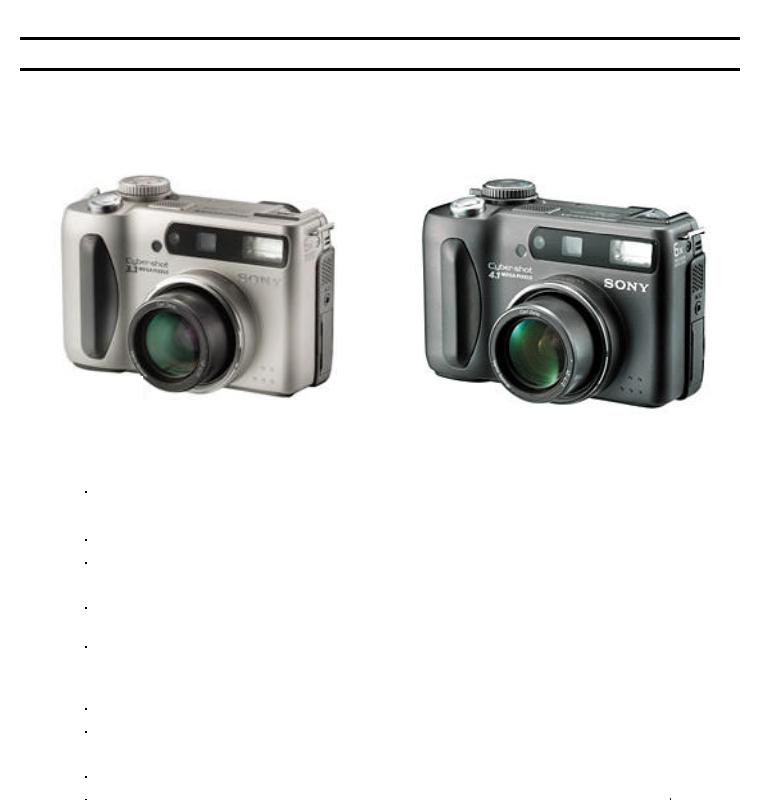
The DSC-S75 and S85 Cyber-shot® digital cameras are very similar in appearance and operation. The circuit
descriptions and repair procedures are also very similar and apply equally to both models. The differences are
in the body colors (S85 is black and S75 is silver), the number of CCD pixels and the price. The S75 is supplied
with an 8 MB Memory Stick ™ and the S85 with a 16 MB memory stick.
DSC-S75
DSC-S85
Repair Tools and Jigs
Repairing these digital cameras requires the following specialized tools and jigs. See Table 3-1 below:
Table 3-1 – Repair Tools and Jigs
Jig or Tool Vendor
NTSC color monitor Your choice
Vectorscope Your choice
Radar W jig J-6082-429-A
Radar Jig Software Available Online at
http://service.sel.sony.com/
Computer to run Radar W software Must have USB & bi-direction parallel
printer port
RM-95 Adjusting Remote Commander J-6082-053-B
CPC 9 interface jig
Light box with focus and color bar patterns Your choice
Tripod Your choice
Tool to discharge flash capacitor Made with 1000 ohm 1 watt resistor
See note 1
. J-6082-393-C
See note 1
.
Note 1: Do not use earlier version of CPC-9 interface jigs. Use only -393Earlier versions will damage the SY -68 board. The version and part numbers are silk
screened on the CPC-9 jigs.
3
Page 6
3. DSC-S75 and DSC-S85 Digital Cameras
Alignment
When to Align
Cameras will need alignment when one of the following components is replaced:
•SY-68 board
•Lens assembly
•Flash
•LCD display
•LCD character display
Table 3-2 shows the areas that will need realignment when one of the above components is replaced.
Table 3-2 - Adjustment Table
INITIALIZATION OF D PAGE DATA
INITIALIZATION OF 7,9,B,E,F PAGE DATA
VIDEO SYNC LEVEL ADJ.
VIDEO BURST LEVEL ADJ.
FLANGE BACK ADJ.
F No. STANDARD DATA INPUT
MECHANICAL SHUTTER ADJ.
LIGHT LEVEL ADJ.
MIXED COLOR CANCEL ADJ.
AUTO WHITE BALANCE STANDARD DATA INPUT
AUTO WHIT BALANCE ADJ.
COLOR REPRODUCTION ADJ.
CCD (WHITE AND BLACK0 DEFECT COMPENSATION
STROBE WHITE BALANCE ADJ.
LCD INITIAL DATA INPUT
LCD VCO ADJ.
LCD D RANGE ADJ.
LCD BRIGHT ADJ.
LCD CONTRAST ADJ.
LCD COLOR ADJ.
LCD V-COM LEVEL ADJ.
LCD V-COM ADJ.
LCD WHITE BALANCE ADJ
SY-68
BOARD
LENS
LCD
DISPLAY
LCD
BACKLITE
FLASH
4
Page 7
3. DSC-S75 and DSC-S85 Digital Cameras
Radar W and RM-95
Alignments should be done with the RADAR W interface jig and associated software. They can also be done
with the Adjustment RM-95 remote control jig, but RADAR W is an order of magnitudes faster than the Service
RM-95, and unlike the RM-95, it is less prone to data entry mistakes.
The Sony part number for the Radar W interface jig is J-6082-429-A.
The RM-95 jig should be reserved for making small registry changes or for checking the operation of the camera
switches.
The diagrams show how to interconnect the interface jig between the camera and the RM-95 or the Radar W jig.
FROM
CAMERA
+
1
CPC-9 JIG
J-6082-393-C
-
ADJUSTING
REMOTE
COMMANDER
RM-95
REPLACE RM-95 PLUG
WITH INTERFACE
UNIT PLUG
INTERFACING RM-95 OR RADAR W JIG
INTERFACE UNIT
J-6082-429-A
COMPUTER
PARALLEL
TO
PORT
5
Page 8
4. DSC-75 and DSC-S85 Block Diagram
Chapter 4 - DSC-S75 and DSC-S85 Block Diagram
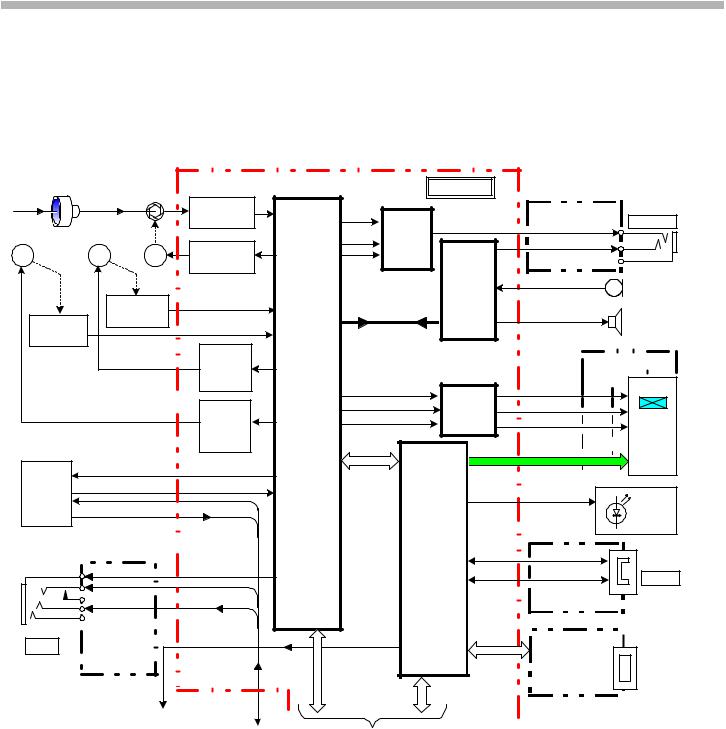
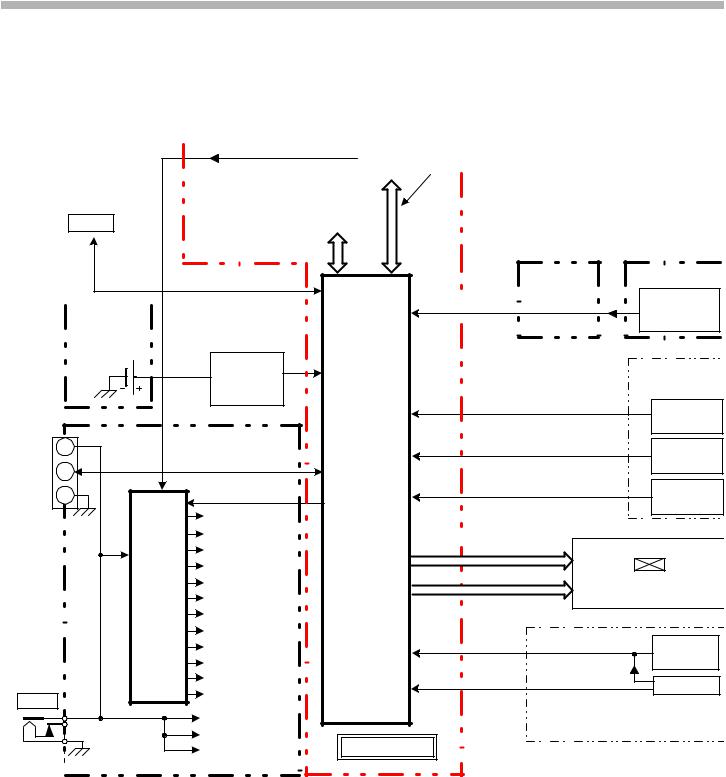
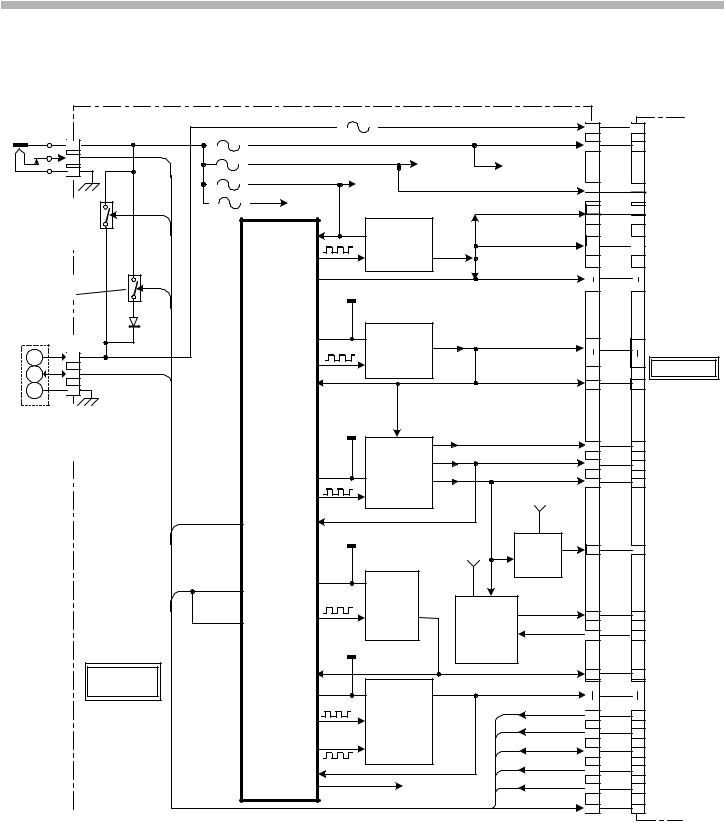
The following is a short explanation of the internal camera operations in block diagram format, based on the SY68 board as the central item.
Overview
Refer to Figure 4-1. Most of the camera functions are concentrated on SY-68 board, including interfaces for
external switches, controls and I/O interfaces to the outside world. The power supply is on the DM-101 board.
Operation
The camera is controlled by three processors: CAMERA DSP IC301, FRONT CONTROL IC402 and MC CAMERA
SH DSP IC501. The video to the LCD panel and a power supply DC CONTROL IC.
•The CAMERA DSP converts the light image falling on the CCD into video signals for the LCD monitor and A/
V jack and into digital video data for the memory stick and USB port.
•The Front Control IC acts as an I/O interface. It processes all input commands from the camera switches
dials and sensors, controls the flash charging and generates the characters for the LCD monitor panel and
the LCD readout display.
•The MC Camera SH DSP IC controls the digital data to the LCD monitor panel (the video signals are controlled
by the Camera DSP) and the USB I/O.
•The DC Control IC controls all of the regulated power supply outputs from the DM-101 board.
Accessory jack J782 interfaces with the camera LANC data and is also used for triggering an external flash.
CN753 is the Memory Stick™ socket
SY-68 Board Troubleshooting
The SY-68 board is not a repairable item. If defective, it should be replaced and the old board returned for core
credit, as per Sony policy.
The board, together with the lens assembly, is easily removable once the back cover is taken off. They are held
in place by just five easily visible screws; no further explanation is necessary.
N The camera must be fully aligned after the board is replaced. This includes flange back adjustment. To
reduce the alignment time, whenever possible use Radar W to upload and save the data from the original SY
board to the computer then download it back into the new board.
? If camera is intermittent, check the SY board for flatness. Replace if it is slightly bowed along its long axis.
? After replacing a SY-68 board, the camera may display Japanese characters. Use the Service RM-95 to
change the display to English. Change the data in page D, address 4F, to 04 (do not forget to disable write
protect before writing and to press Pause after writing). You can also use this method if the user inadvertently
changes the display to another language.
D1.8V
D3.2V
CAM 3.2V
A 3.2V
CAM P 5V
A 4.9V
P 4.9V
10.05V
15.05V
-10.05V
PANEL-15.3V
CAM -7.5V
ACV UNREG
ST UNREG
BATT.UNREG
INITIAL
RESET
BACK-UP
DM-101 BD.
BATT. SIG.
SYSDD ON
IC402
FRONT
CONTROL
SY-68 BOARD
KEY AD 0-2
COM 0-3
SEG 0-19
KEY AD3
DIAL A,B
CK-103
BOARDFUNCTION
LCD
CHARACTER DISP.
CONTROL SW.
BLOCK ZOOM
KY-55 BOARD
KEY
SHUTTER
SWITCH
MODE
DIAL
POWER
ON/OFF
ZOOM
SWITCH
JOG DIAL
FIGURE 4-2 - OVERALL BLOCK DIAGRAM B
8
4.2DSC02b 1483
Page 11
5. DSC-S75 and DSC-S85 Power Supply
Chapter 5 - DSC-S75 and DSC-S85 Power Supply
The DM-101 Power Supply board converts the dc input from the ac adapter or battery into all of the necessary ac
and ±dc voltages.
Board Access
The DM-101 board is sandwiched between the SY-68 board and the front of the camera and is not easily accessible
for live troubleshooting.
The output and control lines to the board can be checked at CN701 on the SY-68 board when the camera back
is removed. Although the camera will not operate properly with the back removed, the power supply will power
up. The picture shows the location of CN701 on the SY-68 board.
Circuit Operation
Figure 5-1 shows a block diagram of the power supply board. Due to limited access, “live” troubleshooting is
limited to the CN701 connector on the SY-68 board. Therefore, the circuit description of the DM-101 board
will be limited to a block diagram.
With the exception of an unregulated always-on voltage and an unregulated battery voltage, all voltages are
produced by discrete switching circuits on the board. The switching circuits are controlled and regulated by
DC Control IC001, which provides the switching signals and feedback control to the switching transistors.
9
Page 12
5. DSC-S75 and DSC-S85 Power Supply
CN001
J001
DC IN
Q003,004
+
S
-
1
2
3
Q002
FAST
CH.
INIT.
CH.
CN002
1
2
3
BT902
BATT.
TERMINAL
BATT
SIG.
MD-101
BOARD
D003
BATT. ON
F004
F005
ALWAYS ON
F003
F001
F002
VCC-D
SW
VCC-D
VCC-A
3.2V CAM
SW. REG.
VCC-BVCC-C
Q009
FB
Q007
A 3.2V
CAM 3.2V
D 3.2V
A 4.9V
CAM
SW
SW. REG.
P4.9V
FB
VCC-B
4.9V
Q005
SCP
IC001
DC
CONTROL
SW
+10V
+15V
-10.5V
FB
-10.5V
VCC-B
V. REF.
SYS
DD ON
SW
VCC-A
Q008
BACK
LIGHT
-VOL
Q070.
Q076
-15V
SW. REG.
Q011,
Q012
SW
SW
1.8B
SW. REG.
FB
V. REF.
SYS DD ON
BATT SIG
INIT CH. ON
BATT. /XEXT
FIGURE 5-1 - POWER SUPPLY BLOCK DIAGRAM
10V
15V
V. REF.
CAM
-7.5V
PANEL
-15.3V
ON/OFF
BL VO-
D 1.8V
SCP
FAST CH.
1DSC02 1479 10/11/02
39
35
33
28
29
26
27
23
25
12
14
11
19
18
17
16
15
31
10
30
32
40
36
37
38
7
CN701
11
34
7
8
17
13
17
18
19
20
21
23
32
34
35
27
28
29
30
31
39
15
36
38
16
14
10
6
9
8
SY-68 BD.
10
Page 13
5. DSC-S75 and DSC-S85 Power Supply
Unregulated always ON voltages
The always-on voltage is fed to all
circuits via four fuses ? F1 ~ F4. Each
fuse supplies a different section of
IC001 and its respective external
switching circuit.
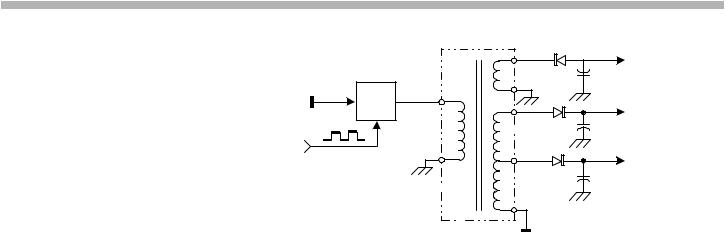
+10V, +15V, -10V Supplies
The circuit supplying these voltages
VCC-B
FROM
IC001
Q005
SW.
PRI
+
+
+
is unique: one of the secondary
windings is in series with the +4.9V
output from Q007. See Figure 5-2. It
operates as follows:
1. The primary winding of the
transformer is switched by Q005
FIGURE 5-2 - +10V, +15V,-10.5V DIAGRAM
4.9V FROM
Q007
to provide an ac voltage to the
primary. Q005 is powered by Vcc-B.
2. The turn ratio of the secondary +10V and +15V winding can provide only +5V and +10V. To get the additional
5 volts, the common leg of the secondary winding is not connected to ground but to the +4.9V line from Q007.
This causes the output from this secondary winding to increase by 4.9V.
-10.5V
+15V
+10V
9DSC02 14939/26/02
V REF
This output line from Control IC001 provides a very stable 1.5 reference voltage to many of the voltage regulators
in the power supply.
DC IN – Battery Switching
AC Adapter Connected
See Figure 5-1.
•The ac adapter directly supplies the camera with power when it is connected. Q002 provides a fast charge
(initial charge) to the battery if the battery charge is low.
•Q003, Q004 and D003 charges the battery with a slow initial charge (current limiting)
•Once the battery has charged up a little, switch Q003 / Q004 opens and Q002 closes. This provides the
battery with a faster charge.
•When the battery has fully charged, switch Q002 opens and the battery is isolated from the ac adapter
power.
AC adapter Not Connected
See Figure 5-1.
•The battery supplies power to fuses F001 ~ F004 via switch Q003/Q004 and D003.
11
Page 14
5. DSC-S75 and DSC-S85 Power Supply
Control Circuits
See Figure 5-1
The control lines for this power supply are:
SYS DD ON
This is the master switch that turns the DC Control IC ON/OFF. The line must be HIGH (3.2v) for the IC to
operate. It is controlled by the SY-68 board.
SCP (Short Circuit Protection)
See Figure 5-3
This is the short circuit protection line. The SY-68 board monitors the -10.5V and +15 volt lines and will output
a LOW on the SCP line if the voltages it monitors drops to -8.5 volts and +12 volts, respectively.
N Do not repair any of the printed circuit boards on units under warranty. If defective, order a new one and send
the old one back for a refund of the core charge, as per Sony policy.
Troubleshooting the DM-101 power supply board is limited to checking the output voltage levels and control
signal lines on SY-68 connector CN701 and to checking fuses and other components with the board removed.
•If the camera is dead, the most important voltage to check is the always-on voltage from fuse F004. See
Figure 5-1. Since this fuse provides always-on power to the SY-68 board, that board will not be able to
provide a HIGH to the SYS DD ON line and the power supply will not turn on.
Failure to diagnose this fuse can prevent the technician from determining which board is defective.
Replace the DM-101 board if this fuse is open after first making sure that there is not a short in the SY-68
board that is blowing the fuse.
•If the lack of a particular output voltage is traced to a blown fuse, make sure to also check the switching
transistors that it feeds for a short.
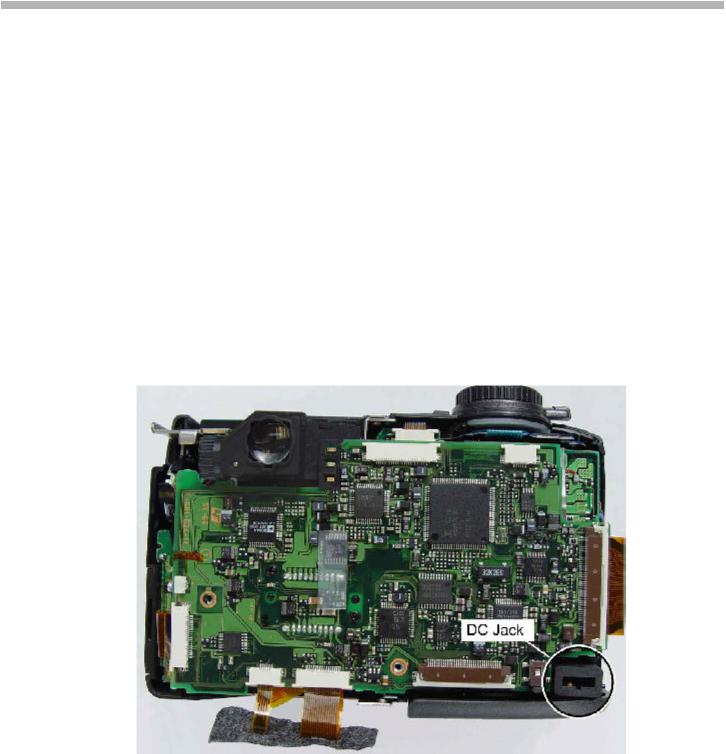
? A common complaint of the battery not charging or unit not running from ac adaptor is caused by a physically
damaged ac adapter jack. Check this jack before replacing the battery or ac adapter. It is easily lifted out
once the back cover is removed. The part number is for the jack is 1-7940-456-1. See Figure 5-4.
Figure 5-4
13
Page 16
6. DSC-S75 and DSC-S85 Flash Assembly
Chapter 6 - DSC-S75 and DSC-S85 Flash Assembly
The flash assembly is considered a replaceable module so its internal operation is not discussed. Its mode of
operation is rather simple:
In addition to unregulated B+ input and ground (not shown), it has five control lines to and from the SY-68 board:
STB CHARGE, XSTB FULL, STRB ON, PHOTO TR OUT (STRB AIN) and STRB PHOTO ON.
1. STB CHARGE. A HIGH (3V) on this line from the SY68 board turns on the storage capacitor charge circuit.
Charging stops when the line goes LOW.
2. XSTB FULL. Outputs a LOW pulse from the flash
assembly to the SY-68 board when the storage
capacitor is charged up. The SY-68 board then switches
the STB CHARGE line LOW, turning off the flash charge
circuit.
3. STRB ON. A HIGH pulse on this line from the SY-68 board fires the flash. The on time of the flash is
proportional to this pulse width.
4. PHOTO TR OUT (also called STRB AIN). This is an output from a phototransistor located in the front of the
camera that feeds back the intensity of the flash reflected back from the scene to the SY-68 board. When
sufficient light has reached the subject, the STRB_ON line goes low and the flash turns off. The voltage level
on the STRB_AIN line depends on the amount of light reflecting to the camera. Maximum level is 3V with no
light falling on the phototransistor.
5. STRB PHOTO ON. This line enables the phototransistor. It goes HIGH when the shutter is pressed and
goes LOW after the picture has been taken.
CAUTION – SHOCK HAZARD
X Capacitor will charge up when the camera is turned on. Never touch
any exposed part of the flash assembly without first discharging the
storage capacitor. Use a 1K 1W resistor to discharge the capacitor.
Troubleshooting
Failure to flash can be caused either by the flash assembly or by the SY68 board. Since “live” diagnosis is not practical, an educated guess must
be made to determine if the problem is with the flash assembly or with
the SY-68 board.
? The flash assembly may be defective if error code E:91:01 appears
in the display when taking a flash picture.
Figure 6-1 - Flash Assembly
? The flash assembly should be replaced before replacing the SY-68 board if the problem fault cannot be
determined. Experience has shown that the flash unit is more likely to be defective than the SY-68 board. It
is also much less complicated to replace (no need for extensive alignment) and is also lower in cost.
10 SECONDS)
1k
1
W
DISCHARGE
RESISTOR
(HOLD FOR
14
Page 17
M
FOCUS
SENSOR
7. DSC-S75 and DSC-S85 Video Processing
Chapter 7 - DSC-S75 and DSC-S85 Video Processing
SY-68 BD.
ZOOM
M
M
IRIS
SENSOR
IMAGER
PROCESS
SHUTTER
DRIVE
Z SENS RST
FSENS RST
Y
VIDEO
C
AMP
V
VIDEO OUT
AUDIO
PROC.
& AMP.
JK-211BD.
AUDIO OUT
AV OUT
MIC.
SPEAKER
IC001
DC CONT.
ZOOM
MOTOR
DRIVE
FOCUS
MOTOR
DRIVE
IC301
CAMERA
DSP
IC501
CAMERA
SH DSP
LCD
DRIVE
MC
TO/FROM FRONTCONTROL IC
CLK
CK-103 BOARD
VR
VG
VB
USB D+
USB D-
JK-211BOARD
DM-101
BOARD
LCD901
COLOR
LCD
MON.
BACK
LIGHT
USB
CN753
MEMORY
STICK
SOCKET
FIGURE 7-1 - VIDEO PROCESSING
10/11/025DSC02c 1533
Video processing of the image falling on the CCD, as well as lens control operations are controlled by the
CAMERA DSP IC. See Figure 7-1.
1. Starting at the upper left corner of the block diagram, the image from the lens is input to the image processor
(includes the CCD).
2. After some processing by the image processors, it is input to the CAMERA DSP, which converts the signal to
RGB video components for the LCD panel and into three video components Y, C and V for the video amp.
3. The RGB signals for the LCD display are input to an LCD drive IC and then sent to the display
4. The YCV signals are input to a video amplifier that also combines the signals into one NTSC signal that is
sent to the A/V jack.
5. The video, in digital format, is also sent to the Memory Stick storage device and to the USB port via the MC
Camera SH DSP IC301.
15
Page 18
8. DSC-S75 and DSC-S85 Lens Assembly
Chapter 8 - DSC-S75 and DSC-S85 Lens Assembly
The lens assembly is replaced as a module. Since it is not disassembled by the technician, its internal mechanism will not be discussed.
The “electronics” associated with the lens consist of a focus motor, aperture (iris) servo-motor, zoom motor and
end position sensors for the zoom and focus lenses. The electrical components, including the motors, are buried
inside the lens barrel and are not accessible.
Operation
1. Each of the three lens motors is driven by four pulsed dc lines.
2. Motor direction is determined by the sequence that the lines are pulsed.
3. The zoom and focus lenses have end sensors that determine the physical end positions of these lenses
during initialization.
4. The iris motor operates as a servo motor and is controlled by the light level falling on the CCD imager.
16
Page 19
8. DSC-S75 and DSC-S85 Lens Assembly
LENS
M
ZOOM
SENSOR
FOCUSZOOM
M
FOCUS
SENSOR
M
IRIS
CN202
CN201
SYS-68 BD.
IRIS A
2
IRIS A
4
IRIS B
5
IRIS B
3
FOCUS A
8
FOCUS A
6
FOCUS B
7
FOCUS B
5
ZOOM A
10
ZOOM A
11
ZOOM B
9
ZOOM B
12
F SENS RST
15
F SENS VCC
14
F SENS RST
3
F SENS VCC
5
IMAGE
PROCESSOR
IRIS
(SHUTTER)
DRIVE
FOCUS
MOTOR
DRIVE
ZOOM
MOTOR
DRIVE
IC301
CAMERA
DSP
B+ (3.2V)
FIGURE 8-1 - LENS ASSY.
10DSC02 149410/11/02
Lens Initialization
The lens is initialized when the camera is powered up and just before it shuts down. See Figure 6-2.
The following occurs at power-up initialization:
1. The zoom and focus motors turn towards their “reset” positions (maximum zoom and near focus, respectively)
extending the lens barrel to its extreme position.
2. The reset switches close when their respective lenses reach their reset positions. This resets the position
registers to zero. Since the motors are driven by pulsed signals, the registers can keep track of subsequent
lens positions by tracking the number of pulses that are sent to the motors. The tracking differentiates
between forward drive pulses and reverse drive pulses.
3. Once reset, the lenses reverse direction and turn to the extreme wide angle and infinity focus positions. The
+B voltage to the reset sensors is not needed any more and is switched off.
4. Once initialization has completed, the zoom and focus lens are not reinitialized until after both battery and AC
power are removed and then reconnected.
At power-down, the lens barrel extends to maximum position and then disappears completely into the camera
body before shutting down.
17
Page 20
8. DSC-S75 and DSC-S85 Lens Assembly
Troubleshooting
Statistically, the number one replacement item on cameras is the lens assembly. Mostly because of physical
damage caused by either user carelessness or abuse. In many instances, the damage is visible but in other
instances, it may be internal and invisible. When no visible damage is noted, the technician has to determine if
the problem is with the lens or with the electronics controlling the lens.
? Look around the lens barrel lip or barrel sides for impact damage.
A very effective method of determining if the lens motors are working is to initialize the camera and listen to the
slight noise from the zoom and focus motors as they are turning. The motors will usually turn and make noise
even if the lenses are jammed. With some practice, the technician can discern the noises from each motor.
If noise is heard, it is a good indication that the electronics are working.
FIGURE 8-2
? check the lens cap switch first. If OK, the lens assembly may be defective. (It may also be caused by a
defective SY-68 board.) See Figure 8-2 for location of lens cap switch.
18
Page 21
8. DSC-S75 and DSC-S85 Lens Assembly
? If S75 camera cannot focus in low light conditions, differentiate between a defective lens and a defective SY-
68 board by checking if the low light AF illuminator lights up at low light conditions. Turn the AF illuminator on
in a dark area and press the shutter halfway down. If the illuminator lights, then the problem is more likely
with the lens; if it does not light, then the problem is with the SY-68 board.
? Error message E:61:00 indicates a lens initialization problem. Check the lens for a mechanical jam.
19
Page 22
9. DSC-S75 and DSC-S85 Camera Switches
Chapter 9 - DSC-S75 and DSC-S85 Camera Switches
Overview
Theses cameras uses a variety of switches, all of which are mounted on flex board assemblies. Since they
are mounted deep inside the camera and on the rear cover, they cannot be checked “live”. When a switch
stops responding, it may be because it became defective or a break occurred in its associated flex assembly.
In either case, the flex assembly should be replaced.
In some instances, a switch may intermittently short, causing an associated response from the camera.
Troubleshooting
Shorted Switches
? In some cases, a shorted switch may prevent other switches from working.
Open Switches
Switches that do not close can be checked with a Service RM-95 jig to determine if a switch or switch block is
closed or open. With the jig, the switches can be checked “live” and without disassembling the camera. Without
the RM-95, the unit must be disassembled and the switch contacts checked with an ohmmeter at the flex board
while at the same time pushing on the switch.
? Replace the switch block assembly if the camera turns on spontaneously. The ON/OFF switch may be
defective.
? Check the lens-cap-on sensor switch if the camera indicates that the lens is on (and it is not).
Testing Switches with RM-95
1. Connect the Service RM-95 to the interface jig and power up the camera.
2. With the RM-95, proceed to data page 2,
3. Table 9-1 shows addresses for the switches. To check a particular switch, go to the address for the
switch and activate the switch. If it is working properly, the correct data for the switch will be displayed in
the RM-95. Note that the active data is not a fixed but can be within range of numbers shown in the table.
For example: When pressing the Control Down switch, any data between 00 and 0C at address 90 is
acceptable.
4. On some switches, the binary value of an internal register must be determined. This is done by using
Table 9-2 to convert the displayed data to a register value. The least significant data bit displays the
values of bit registers 0 to 3; the most significant data bit displays the values of bit registers 4 to 7.
20
Page 23
Switch Address/
Data
Control
Down
Control
Up
Control
Right
Control
Left
Control
Set
Mode Dial S 94/
Mode Dial
SCN
Mode Dial
Play
Memory
Stick
90/
00-0C
90/
0D-27
91/
00-0C
91/
0D-27
91/
28-48
00-14
94/
68-A0
80/bit 1 *
0=on
80/bit 5 *
0=in 1=out
Table 9-1
Data Page 2
Switch Address/
Data
Menu 90/
28-48
Display/LCD
ON/OFF
AE Lock 92
Exposure 92/
Focus 92/
Mode Dial A 94/
Mode Dial
Movie
Mode Dial
Setup
92/
00-0C
0D-27
28-48
49/74
15-3D
94/
A1-D0
86/bit 6
0=on
9. DSC-S75 and DSC-S85 Camera Switches
Switch Address/
Data
Spot
Meter
Zoom W 93/
Zoom T 93/
Jog Dial 93/
Power
On/Off
Mode Dial M 94/
Mode Dial
Camera
XShutter 80/bit 4 *
Shutter 80/bit 3 *
92/
75-A6
00-0C
00-0C
28-48
80/bit 0 *
1=off 0=on
3E-67
94/
D1-FF
0=on
0=on
* Use hex to binary conversion table 9-2 to determine the binary bit values
9 1 0 0 1
A 1 0 1 0
B 1 0 1 1
C 1 1 0 0
D 1 1 0 1
E 1 1 1 0
F 1 1 1 1
Bit 3
or
bit 7
Bit 2
or
bit 6
Bit 1
or
bit 5
Bit O or
bit 4
21
Page 24
Chapter 10 - DSC-F707 Features
This is a high-end camera with a number of unique and outstanding features. Some of those are:
10. Alignment
•5.2 mega-pixel Super HAD CCD
•Automatic pop-up flash: Hidden flash pops up
automatically when flash is required.
•Color LCD monitor and color EVF
•Night Shot Mode: Allows black and white picture
taking in very low light conditions. .
•Continuous manual focus ring
•Hologram laser auto-focus lighting from the front of
the lens for low light situations. This allows low light
situation focusing.
•IR Lighting: LEDs from the front of the lens provides
IR lighting when shooting in Night Shot mode.
•Pivoting lens: Lens barrel can be tilted vertically up or
down.
22
Page 25
8. DSC-S75 and DSC-S85 Repair Tools and Jigs
Chapter 11 - DSC-F707 Repair Tools and Jigs
Repairing the digital camera may require the following specialized tools and jigs. See Table 11-1.
Table 11-1 Specialized Tools & Jigs
Jig or tool Vendor
NTSC Color monitor Your choice
Vectorscope Your choice
Radar W jig J-6082-429-A
Radar Jig Software Available Online at
http://service.sel.sony.com
Computer to run Radar W software Must have USB and bi-directional
parallel (printer) ports
RM-95 Adjusting Remote Commander J-6082-053-B
CPC 12 interface jig J-6082-436-A
Light box with focus and color bar patterns Your choice
Tripod Your choice
Tool to discharge flash capacitor Made with 1000 ohm 1 watt resistor
Extension cable between CD-355 and SY -072
boards
Extension cable between FR-181 and SY -072
boards
J-6082-448-A
J-6083-095-11
23
Page 26
12. DSC-F707 Alignment
Chapter 12 - DSC-F707 Alignment
Radar W and RM-95
Alignments should be done with the RADAR W interface jig and its associated software. Although alignment can
also be done with the Adjustment RM-95 remote control jig, RADAR W is an order of magnitudes faster than the
Service RM-95 and unlike the RM-95, it is not prone to data entry errors by the user.
The Sony part number for the Radar W interface jig is J-6082-429-A.
? The RM-95 jig should be reserved for making only a few register changes and for determining the operation
of the camera switches.
The diagrams show how to interconnect the interface jig between the camera and the RM-95 or Radar W jig.
18DSC02 1534 10/10/02
24
Page 27
12. DSC-F707 Alignment
When to Align
The camera needs to be aligned when one of the following components are replaced:
FR-181 board - PD-155 board - SY-072 board - Lens assembly – Flash – EVF - LCD display - Back light assembly
(LC-075 board).
Table 12-1 shows which items need realignment when any one of the above components is replaced.
Table12-1
25
Page 28
13. DSC-F707 Block Diagram
Chapter 13 - DSC-F707 Block Diagram
Since troubleshooting is limited to identifying a defective board or module, the circuit descriptions will only include
areas that are necessary to identify a defective board or module.
The camera consists of a lens assembly, camera and data control circuits, audio and video processing, and the
flash circuits.
FP-425
FLEX BD.
LASER
LENS ASSY.
5 MOTORS
4 SENSORS
IR
BATT.
UNREG
DC
CCD
IRIS
FLASH
DC-DC
CONV.
USB
300VDC
SY-072 BD.
SH, AGC
A/D
POSITION
SENSORS
MOTOR
DRIVES
FLASH CONTROL
POP-UP
IR LED ON
LD
PD OUT
USB
IC301
CAMERA
DSP
IC501
MC
CAM
SH, DSP
RGB
PD-155 BD.
VIDEO
DRIVES
FR-181 BD.
AUDIO
AMPS
FRONT
CONT.
IC (I/O)
IC001
DC-DC
CONTROL
BATT. UNREG DC
LCD
MON.
EVF
AV
OUT
CAMERA
SWITCHES &
CONTROLS
DC
OUTPUTS
FIGURE 13-1 - F707 OVERALL DIAGRAM
11DSC02 1496 10/11/02
Lens Assembly
The lens assembly is replaced as single unit. No repairs are done to its internal components. The lens contains
a total of five motors and servo motors, four position sensors, IR light sources and a laser light source. The CCD
assembly is an integral part of the lens and the whole lens assembly is replaced if the CCD is defective.
26
Page 29
13. DSC-F707 Block Diagram
Camera Control
•The camera is controlled by three processor ICs: CAMERA DSP IC301, MC CAM SH SP IC501 and the Front
Control I/O IC.
•The CAMERA DSP converts the signals from the CCD into video signals for the LCD monitor and A/V jack.
•The MC CAM SH DSP IC generates the characters for the LCD monitor and EVF, converts the video to data
that can be used by the USB protocol and the memory stick.
•The Front Control IC on the FR-181 board processes the input commands from the camera switches dials
and sensors, and controls the flash pop-up solenoid
Audio and Video
The video drivers for the LCD panel, the color EVF (electronic view finder) and the NTSC output are on the PD155 board.
The audio driver for the speaker and the microphone preamp is on the FR-181 board.
Flash
The flash unit is recessed and pops up when flash is needed. It is replaced as a complete module. The flash
circuits are split up in two boards: the charging circuit and storage capacitors are located on the BT-006 board;
the rest of the circuits are located in the flash module. The normally hidden flash module is under spring tension
when recessed and is released by a solenoid when flash is needed.
27
Page 30
14. DSC-F707 Lens Assembly
Chapter 14 - DSC-F707 Lens Assembly
Overview
This chapter describes the operation of the various lens electronic circuits. Although the lens assembly is
replaced as a complete unit, an understanding of how it operates is important to enable the technician to determine
if a problem is or is not caused by the lens.
LENS ASSY.
FOCUS
MOTOR
M
SW
ZOOM
MOTOR
M
SW
IR FILTER
MOTOR
M
SW
SHUTTER
MOTOR
M
23
21
24
22
31
30
25
26
28
27
18
19
39
36
33
35
11
8
SY-072 BD.
FOCUS A
FOCUS A
FOCUS B
FOCUS B
ZOOM A
ZOOM A
ZOOM B
ZOOM B
+
-
IR FILTER
+
-
IC203
DRIVE
Q203
SHUTTER
IC202
FOCUS
DRIVE
IC202
ZOOM
DRIVE
IR SENSOR
IC203
DRIVE
CONT.
IR SENS
3.2V
FOCUS DRIVE
F SENS RST
Z DRIVE
Z SENS RST
Q206
3.2V
IR DRIVE
IR SENSOR
CONTROL
SHUTTER DRIVE
IC301
CAMERA
DSP
FIGURE 14-1 - F707 LENS ASSY. A
14DSC02 149910/10/02
Since the lens is replaced as single unit, repairs are not made to its internal components. Disassembling the lens
will introduce dust that will degrade the picture quality and void the warranty.
The lens consists of five motors, four position sensors, a laser light source and IR light sources. The CCD
assembly is an integral part of the lens assembly.
28
Page 31
14. DSC-F707 Lens Assembly
Circuit Description
See Figure 14-1
Focus and Zoom
1. The focus and zoom lenses are driven by four phase dc pulse motors. Four pulsed lines drive the motors.
2. Motor direction is determined by the sequence that the motor lines are pulsed.
3. Both lenses have end sensors that determine the end positions of the lenses during initialization.
4. The lenses are initialized each time the camera is turned on. When initialized, the lenses turn to their end
positions and trigger the sensor switches.
5. When the end sensor switches are triggered, their respective motors stop and registers inside IC301 are
reset.
6. The registers in IC301 track subsequent lens motion by counting the number of pulses that are sent to the
motors. The registers differentiate between forward and reverse drive pulses, allowing them to keep track of
lens position regardless of motor direction.
Shutter
This is a simple mechanical on/off shutter in the lens light path that opens when the camera is turned on and
closes when the camera is turned off. It blocks all light from the CCD when the camera is turned off. The shutter
is controlled by a simple two terminal motor, driven by IC203.
Do not confuse this shutter with the electronic shutter. The electronic shutter is an electronic gate to the CCD that
determines the length of time that the CCD is actively “seeing” when the picture is snapped.
IR Filter and IR Illumination
Two infrared LEDs are used as light sources for shooting in very low or no light situations when the camera is in
NightShot mode™. The IR LEDs are located in the front of the lens barrel and turn on in NightShot mode when
the shutter is pressed.
Since the CCD is made sensitive to IR light, a movable IR filter must be inserted in the light path during normal
shooting and removed during IR shooting:
•In normal non-NightShot operation, the filter is placed in the light path and blocks IR light from the CCD.
•In NightShot mode, the filter moves away from the light path, allowing the IR light from the scene to reach the
CCD.
IR Filter Control
•The IR filter motor is a simple two terminal motor driven by IC203.
•The filter position is determined by the IR sense switch. Q203 provides a dc voltage to the switch when
NightShot is enabled, allowing the IR sense switch to operate.
29
Page 32
Iris
Iris
Operation
Operation
14. DSC-F707 Lens Assembly
LENS ASSY.
IRIS
MOTOR
M
IRIS POSITION
SENSOR
LASER UNIT
FR-181 BD.
IC204, IC205,
CN203
12
13
17
16
H
15
14
5
3
1
2
CAM P 5V
HALL (-)
BIAS (+)
HALL (+)
BIAS (-)
LD OUT
IC253 LASER
GENERATOR
PD OUT
CAM
P 5V
Q202 IRIS
DRIVE
IC205
HALL
BIAS
IC205, Q207
GAIN
CONTROL
LEVEL
Q258
IRIS CONTROL
-
+
HALL
GAIN
IC252
COMP
Q257
HALL
OFFSET
IC205
HALL AMP
-
+
FB
PD
IR LED ON
IC207
EVR
A/D
CONV.
LD
IC501
MC CAM
SH
DSP
IR LED's
FIGURE 14-2 - F707 LENS ASSY. B
LED DRIVE
15DSC02 1500 10/10/02
The iris motor operates as a servo motor and is controlled by the light level falling on the CCD imager.
The iris opening is adjusted by a two terminal servo motor that is controlled by EVR IC207 and the iris drive ICs.
The iris is spring-loaded, which keeps it at minimum open when no control voltage is applied to the servo motor.
•The control voltage for the iris servo is provided by EVR IC207 and is determined by the average video level
from the video amplifier (not shown).
•The average video level is compared to a reference level. Video levels higher or lower than the reference will
change the IRIS CTRL drive voltage output from EVR IC207.
•An average video level below reference increases the IRIS CTRL voltage from the EVR IC and increases
the iris opening.
•An average video above reference level decreases the IRIS CTRL voltage from the EVR IC and reduces
the iris opening.
Hall Circuit
The mechanical iris position is sensed by a hall effect device that provides iris position feedback via amplifier
IC205 (4/4) to IC501.
Feedback from the hall amp is also applied to the iris drive circuit in the form of negative feedback. This slows
down the iris response and prevents iris over compensation when it is changing size. Without feedback, the
picture brightness levels will oscillate between too light a picture and too dark a picture whenever the iris makes
30
Page 33
14. DSC-F707 Lens Assembly
large adjustments; the slow response time from the video amp (remember, it is averaged) will cause the iris to
over compensate and shoot pasts its optimal point, then swing back and overcompensate again in the opposite
direction.
The hall reference, hall gain and hall offset lines from the EVR IC compensate for large variations in component
tolerances.
Lens Initialization
The lens is initialized when the camera is powered up and just prior to shutdown.
Power-up Initialization:
1. The zoom and focus motors start turning towards their “reset” positions (zoom to wide angle and focus to
near focus).
2. Once in the reset position, the focus and zoom position sense switches close, resetting the zoom and focus
and position registers inside IC301.
3. When initialization has completed, Q206 turns off, cutting power to the sense switches. This prevents the
registers from resetting during camera shooting.
Power-down Initialization
The zoom and focus motors turn towards their “home “ positions (extreme zoom and infinite focus) when camera
shutdown is initiated; when done, the camera shuts off.
NightFraming™
In low light situations, the IR laser light located in the lens barrel is turned on when the camera is in NightFraming
mode. The laser light reaching the scene creates a hologram-like effect on the subject and that improves
focusing.
Operation
The laser light is controlled by the EVR IC207, IC252, Q258 and IC253.
•To turn the laser on, a dc voltage from EVR IC207 is applied to the inverting terminal of comparator IC252.
This voltage is different with each camera and depends on the tolerances of the laser and the photo diode
and in all instances it is higher than the inverting terminal voltage level.
•A photo diode inside the laser module detects the IR light level reflected from the subject and feeds it back to
comparator IC252 and IC501. If the reflected IR level is too low, as when the camera is too far from the
subject for the laser to be effective, the comparator reverses its output logic level and the laser turns off,
saving battery power.
Features Disabled in NightFraming Mode
The following features will not work in NightFraming mode:
•AE lock
•Manual Focus
•Metering mode
•Flash will not work in BURST and EXP BRKTG (bracketed exposure) modes.
Operating Conditions for NightShot
•NightFraming will not work under the following conditions:
•An external filter must not be installed on the lens. Most filters block IR light.
•The mode dial must be in the camera icon position (camera icon on the mode dial).
•Conversion lens feature must not be enabled (if on, it can be turned off from the Setup menu).
31
Page 34
14. DSC-F707 Lens Assembly
Servicing
The lens, including the mounted CCD assembly, is replaced as a unit. Except for the manual focus ring in the
front of the lens, no internal repairs are to be done to lens assembly.
? Error message E:61:00 or E:61:10 is usually an indication of a jammed lens assembly. Replace the lens.
? Shading (darker picture) on one side of the picture (usually the left side). This may be caused by a defective
lens. See ESI service bulletin E16561506 for additional information.
? After replacing a lens, a complete camera realignment is required.
? The lens design allows the technician to look into the lens and see if the iris, zoom and focus lenses are
moving. With experience, the technician can determine if the internal lens parts are moving properly. This is
best done when the unit is turned on and off while looking into the lens.
? Use an IR indicator card or laser power meter to check if the laser is working (go / no go). If it is working, the
laser light will go on in NightFraming mode when the shutter is pushed halfway down.
? The external focus ring can be repaired in case it falls off. Replace the three screws shown in the picture with
self locking types, part number 3-056-559-01. Alternately, you can add Lock-Tite™ on the original screws
and tighten them.
? Replacement lenses come without the laser flex board.
The original one must be removed from the old lens and
installed on the new one. This is very easily overlooked
and the camera is then returned to the customer in this
condition. Obviously, the low light features will not work.
See Figure 14-3
? To avoid ESD damage to the laser, use the precautions
outlined below.
Protecting Laser from ESD
•The laser assembly is extremely sensitive to ESD
voltages and easily damaged by it. To avoid ESD
damage to a good laser LED, solder together the two
solder pads on the laser assembly before replacing,
handling or removing a good laser assembly. See figure
14-4.
? Make sure to remove the solder bridge once the laser
assembly is in the unit.
Figure 14-3
32
Figure 14-4
Page 35
14. DSC-F707 Lens Assembly
Lens Re-mounting
The lens unit is electrically connected to the camera by the FP-421 flexible board. Due to the tilt and mounting
design of the lens, this flexible board has multiple folds, bends, loops and adhesive sections that must be
accurately replicated when reassembling the lens. The following diagrams show how a new flexible board is
folded properly and how to route and coil it properly when reassembling the lens barrel.
Folding New FP-421 Flexible Board
Double-sided
Adhesive tape
Double-sided
Adhesive tape
Double-sided
Adhesive tape
FP Holder
7
Two screws
4
(M1.7)
1
Two flexible boards
(CN701, 702)
Fold
Flexible Board Routing
6
PT-130 Harness
FP-421 Flexible Board
8
Note 1: Coil two and a half
loops in the direction of the
arrow
Hinge assembly
5
Double-sided
Adhesive tape
Screw
2
(M1.7)
3
Screw
(M1.7)
33
Page 36
14. DSC-F707 Lens Assembly
Focus Ring Repairs
The manual focus ring in the front of the lens can be replaced if broken or repaired if it simply falls off.
FOCUS RING
The ring should be repaired if it falls off and is not otherwise damaged. One of the following methods can be
used:
•Replace the three existing screws with self locking screws, part number 3-056-559-01, and torque them to
0.14 Nm (±0.02 Nm)
•Remove and reinstall the original screws with Lock-Tite and torque them to 0.14 Nm (±0.02 Nm)
The replacement part number for a broken ring is X-3952-003-1.
Uneven Picture Shading
Due to the sensitivity of some CCDs, on some units a few customers may complain of a slightly darker picture on
the left side than on the right side.
To determine if the brightness is within specs, refer to Electronic Service Information bulletin E16561506 for the
procedure.
Replace the lens assembly if it is out of spec.
34
Page 37
15. DSC-F707 Power Supply
Chapter 15 - DSC-F707 Power Supply
Power Supply
Since troubleshooting is limited to identifying the defective board or module, the power supply description is
limited to a circuit understanding for troubleshooting purposes. Refer to Figures 15-1a and 15-1b.
DC IN
CN401
CN402
+
S
-
BATT.
TERMINAL
1
2
3
Q401,
1
2
3
Q402
BATT
BT-006 BD.
D403
GND
F401,
Q403,
404
F405
2,3
F404
CN403
2
3
4
6
BATT./XEXT
7
FAST CHARGE
8
INIT. CHARGE
5
BATT. SIG
1
CN001
2
3
4
6
7
8
5
1
BATT.UNREG
FLASH
DC-DC
CONV.
300VDC
11
12
1
XTB FULL
TO POWER
BLOCK 2
11
12
STB. CHARGE
FIGURE15-1a - F707 POWER SUPPLY
UNREG 1
UNREG 2
UNREG 3
FR-181 BD.
TO IC102 FRONT
CONTROL
12DSC02a 153110/7/02
35
Page 38
15. DSC-F707 Power Supply
V REF.
UNREG 1
Q007
FB
SYS
DD ON
SHUTDOWN
PROTECTION
SCP
1.5V
V REF.
-BLVO
4
4
30
CONTROL
13
27
IC001
DC
56
34
50
37
64
14
57
18
46
43
40
FB
FB
FB
FB
OUT 1
OUT 2
FB
UNREG 1
Q004, T001
DC-DC
UNREG 2
Q005
4.9V REG
UNREG 3
Q009
3.2V REG
UNREG 3
Q006, Q008
1.5V REG
CONV.
+15V
5V
BOOST
UNREG 3
Q010
5V
REG
V REF.
Q015, Q016
-15.3V
REG.
Q013, Q014
-15.3V
REG.
CAM-7.5V
REG.
LCD
PANEL
-15.3V
CAMERA +15V
13.5V LCD PANEL
A4.9V, PANEL
3.2V, PANEL 3.2V
CAM 5V
-7.5V
1.5V
FIGURE 15-1b - F707 POWER SUPPLY
12DSC02b 153210/8/02
The power supply circuits are located on two boards: BT-006 and FR-181:
•The BT-006 board contains the unregulated supply lines from the battery and ac adapter, and its fuses, the
battery charging and ac adapter / battery switchover circuits, and the 300 volt dc–dc converter for the flash.
•The dc-dc converters for all of the regulated power supply lines are on the FR-181 board. The dc-dc converters
are controlled by dc-dc control IC001.
Converter Operation
•With the exception of unregulated always-on voltages and an unregulated battery voltage, all voltages are
produced by discrete switching circuits on the board.
•The switching circuits are controlled and regulated by DC Control IC001, which provides the switching
signals to the discrete switchers.
36
Page 39
15. DSC-F707 Power Supply
Camera +15V Line
The circuit supplying Camera 15V is somewhat unique: it actually produces only 10 volts. To get a 15 volt output,
the cold leg of its secondary transformer winding is connected to the A4.9V line instead of to ground. This boots
the 10 volts to 15 volts.
AC Adapter – Battery Switching
Ac Adapter Connected
•The ac adapter supplies the camera directly with power when it is connected to the camera. Q403/Q404
provides an initial charge to the battery and if it needs further charging, fast charge transistors Q401/Q402
turn on.
•Switch Q401/Q402 provides the battery with a fast charge when the battery charge is low. The switch is
controlled by the FAST CH line from SY-68 board via CN701/pin 37.
•After the battery has fully charged, switch Q401/Q402 opens and the battery is isolated from the ac adapter.
Ac adapter Not Connected
•The battery supplies power to the unregulated supply lines via switch Q403 / Q404 / D403 and fuses F401
through F404.
•Switch Q403/Q404 remains closed until the battery is nearly discharged, at which point the switch opens,
cutting off power to the switching regulators.
Unregulated Always ON Voltages
The unregulated always-on voltage is fed to all circuits via four fuses - F401 through F404. Each fuse supplies
a different section of IC001 and its respective external switching circuits. Another always-on line provides standby
power the Front Control IC102 when the camera is disconnected from the ac adapter.
IC001 Control Lines
SYS DD ON
This is the master switch that turns the
DC CONTROL IC ON/OFF. The line must
be HIGH (3.2v) for the IC to operate. It is
controlled by FRONT CONTROL IC102.
SCP (Short Circuit Protection)
This is a short circuit protection line that
monitors three negative voltage lines
(PANEL -15.3V, CAM -7.5V, and –BLVO)
for short circuits or excessive loads. See
Figure 15-2.
CAM -7.5V
CAM 4.9V
PANEL -15.3V
BLVO -20V
UNREG 1
Q017A
SCP
NPN
Q017B
NPN
13
IC001
DC-CONTROL
IC
NPN
A3.2V
Q001
FIGURE 15-2 - F707 SHORT CIRCUIT PROTECTION
37
Page 40
15. DSC-F707 Power Supply
•The lines are monitored by Q017A and B, and Q001. Each of these transistors also has a positive reference
voltage applied to it.
•In normal operation, the base of the transistors is approximately 0V.
•The transistors will turn on if the negative voltages drops to the point that the transistor base rises to +1.3V.
This puts the SCP line LOW and shuts down the power supply
Troubleshooting
The power supply circuit should be checked in the following order:
1. BT-006 board
2. FR-181 board
3. Short circuit protection.
Checking BT-006 Board
Since “live” troubleshooting is limited, the technician must make a determination if the problem is on the BT-006
or the FR-181 board.
The BT-006 board is easier to troubleshoot in “passive mode” – with the unit off – and should be checked first. If
the BT-006 board is ok, then the FR-181 board should be checked.
Checking Fuses
Fuses should be checked first. Their locations are
shown in Figure 15-3. See caution on the following
page “Discharging Storage Capacitors”.
•Fuses are located on the ‘back’ side of the board
•Fuses look like chip resistors
•If a fuse is open, check the circuits that it feeds
on the FR-181 board for shorts.
Removing BT-006 board
See next paragraph for caution before removing the
BT-006 board. This board is easy to remove. With
the camera back off:
•Remove the FR-181 board (held by two screws).
•Remove the battery holder.
•Remove the BT-006 board.
38
Figure 15-3
Page 41
15. DSC-F707 Power Supply
Discharging Storage Capacitors
CAUTION : Do not handle the BT-006 board without first discharging the flash storage capacitors. Make a discharge
jig from a 1K ohm - 1W resistor (Sony pn: 1-215-869-11) and two hook clip leads.
Checking FR-181 Board
•The output voltages from the FR-181
board can be checked live at
connectors CN301 and CN308. Set
up the camera as shown in the picture
so that the board can be checked live.
•If there are no output voltages, check
if the SCP line with an oscilloscope to
see if the line goes LOW. If it does,
then the problem may be caused by a
short or overload in the lens assembly,
the SY-072 board or PD-155 board.
Disconnect them one at a time.
39
Page 42
16. DSC-F707 Flash Circuit
Chapter 16 - DSC-F707 Flash Circuit
Overview
The flash on this model is a pop-up flash that automatically pops up when flash is needed.
•The flash assembly is under spring tension in the closed position. It is held there by a plunger.
•When flash is required, a solenoid releases the plunger and the flash pops up.
•The flash assembly must be pushed down manually to close it.
Operation
DC UNREG
F405
Q405,
Q406
IC102
FRONT
CONTROL
Q408,T401
FLASH DC-
DC CONV.
FLASH
STORAGE
CAPACITORS
CHARGE ON/OFF
STB-CHARGE
XSTB- FULL
XSTB
XSTB-POP-UP
BT-006 BD.
300VDC
Q409
+
+
FLASH
CHARGE
DET.
11
12
1
CN403
CN404
BATT./
FLASH
CHARGE
LED
EVER
3V
300VDC
LENS
PHOTO
TR.
STB-PLUNGER
PHOTO-TR-OUT
PHOTO-TR-ON
FIGURE 16-1 - S707 FLASH UNIT
FR-181 BD.
SY-072 BD.
IC301
CAMERA
DSP.
POP-UP
SOLENOID
FP-488 BD.
SWITCH
XSTRB-ON
16DSC02 1503 10/10/02
FLASH
POP-UP
FLASH
ON
The circuits controlling the flash are dispersed on four boards and the lens. Therefore, a somewhat detailed
description of the flash operation is needed so that the technician can isolate the flash problem to a particular
board.
1. The 300 volts dc-dc converter on the BT-006 board charges the two flash storage capacitors.
40
Page 43
16. DSC-F707 Flash Circuit
2. Q405/Q406 switches power to the converter on and off and is controlled by the CHARGE ON/OFF line. To
initiate the charge cycle, IC102 on the FR-181 board outputs a HIGH on the STB_CHARGE line. The battery
charge lamp blinks while the capacitors charge up.
3. Once the capacitors have fully charged, the FLASH CHARGE DETECT circuit outputs a LOW, which overrides
the HIGH on the STB_CHARGE line. This shuts off the flash dc-dc converter.
4. The FLASH CHARGE DETECT also outputs a LOW on the XSTB_FULL line to IC102, informing it that the
flash is ready to fire. The camera will not take a picture if flash is needed and the XSTB_FULL line is did not
go LOW.
5. When the shutter is pressed down partially and the camera detects that flash is needed, the STB-PLUNGER
line from IC102 outputs a HIGH, triggering the flash pop-up solenoid and popping up the flash.
6. The pop up switch closes when the flash reaches the up position, pulling the XSTB_POPUP line LOW and
signaling IC102 that the flash is ready. The camera will not take a picture if flash is needed and the
XSTB_POPUP line is not LOW.
7. When the shutter is pressed fully down, XSTRB_ON from CAMERA DSP IC301goes LOW, firing the flash.
The flash duration is determined by the pulse width.
8. The photo transistor inside the lens controls the on time of the flash. The output from the photo transistor is
applied to CAMERA DSP IC301. Once sufficient light has reached the CCD, IC301 switches the XSTRB_ON
line HIGH, turning off the flash.
CAUTION – SHOCK HAZARD
X Never touch any exposed part of the flash assembly without first discharging the storage capacitor. Make a jig
from a well insulated 1K 1W resistor to discharge the capacitor.
Servicing
Discharging Storage Capacitors
CAUTION : Do not handle the BT-006 board without first discharging the flash storage capacitors. The capacitors
charge up when the camera is turned on and can maintain a charge even after the unit has been off for many
hours or days.
Make a discharge jig from a 1K ohm - 1W resistor (Sony pn: 1-215-869-11) and two hook clip leads.
41
Page 44
16. DSC-F707 Flash Circuit
Since the flash circuits and its control lines are spread out over a number of boards, the basic troubleshooting
procedure is to identify the board or the flash module causing the problem and replace it.
Procedure
The best diagnostic tool is the yellow indicator LED
that blinks while the flash capacitors are charging.
? The indicator LED starts blinking when IC102
outputs a LOW on the STB_CHARGE line (the
capacitors charge up) and turns stops when the
XSTB_FULL goes LOW and the capacitors are
charged.
? The LED will continuously blink if the capacitors
do not charge up. This is an indication that the
dc-dc converter, Q405/Q406 and /or F405 may
be defective.
? LED does not blink. This is likely to be caused
by IC102 on the FR-181 board not outputting a
HIGH on the STB_CHARGE line.
LED blinks normally then shuts off normally but the flash does not work: The following items may be defective:
? Pop-up solenoid
? Flash Assembly
? Pop-up switch
? FRONT CONTROL IC102 (not responding to XSTB_POPUP)
? A viewfinder error code of E:91:oo indicates a charging defect and the flash assembly may have to be
replaced.
? Excessively blue picture when using flash
Checking the charge on the storage capacitors
The charge on the storage capacitors may be
checked with a DVM if precautions normally
associated with high voltage are taken.
USE CAUTION WHEN CHECKING STORAGE
CAPACITORS – A fully charged capacitor stores
up to 300 volts for days.
Blue Flash
Cameras with an overly blue picture should be sent
to Sony for repairs. The repairs require expensive
equipment that is not normally available. Refer to
ESI bulletin E14843941
42
Page 45
18. DSC-F707 Camera Switches
Chapter 17 - DSC-F707 Jigging Camera
A defective SY-072 board should be replaced and not be repaired under warranty. The old board should be
returned for core credit, as per Sony policy.
The board is located on top of the lens assembly inside the lens barrel housing. It is accessible after the lens
housing is removed.
? You can check the SY-072 board and the lens assembly “in circuit” with an extender ribbon cable.
? The camera must be fully aligned after the board is replaced. To reduce the alignment time, whenever
possible use Radar W to upload and save the data from the original SY board to the computer then download
it back into the new board.
43
Page 46
18. DSC-F707 Camera Switches
Chapter 18 - DSC-F707 Camera Switches
Overview
The camera uses a variety of push button, rotary and slide switches that are mounted on flex board assemblies.
These switches are located on the rear cover, the front cabinet and on the lens assembly. Most switch terminals
are not easily accessible when the camera is operating. When a switch stops responding, either the switch
became defective or a break occurred in its associated flex assembly. In either case, the flex board must be
replaced.
Troubleshooting
Shorted Switches
? In most cases, the camera will be “dead” if a momentary contact switch shorts. The shorted switch will
prevent other switches - including the power ON/OFF switch - from operating.
? If a shorted switch is suspected, the best method of determining which switch is shorted is to disconnect the
switch ribbon cables, one at a time, press the reset button after each try (a shorted switch is likely to latch up
the camera), then attempt to power up the camera. After a few tries, the defective flex assembly will become
obvious.
Open Switches
Open switches can be checked with a Service RM-95 jig to determine if it or the flex board is open. This method
allows the switches to be checked “live” without disassembling the camera. Without the RM-95, the unit must be
disassembled and the switch contacts checked with an ohmmeter at a flex board while simultaneously pressing
the switch (not an easy task).
Testing with RM-95
1. Connect the Service RM-95 to the interface jig and power up the camera.
2. With the RM-95, proceed to data page 2,
3. To check a particular switch, go to the address listed in the table for the switch then activate the switch. If it
is working properly the data shown in the table will be displayed in the RM-95. Note that the active data is not
fixed but can be within a range of numbers shown in the table. For example, when pressing the Control Down
switch, any data between 00 and 0C at address 90 is acceptable.
4. On switches that include a bit number, the binary value of the internal register for that bit must be determined
by using the hex to binary conversion table. The table converts the data displayed on the RM-95 to a binary
register value. The least significant data bit displays the values of bit registers 0 to 3; the most significant
data bit displays the values of bit registers 4 to 7.
44
Page 47
18. DSC-F707 Camera Switches
Data Page 2
Switch Address, Data
NightFraming/
NightShot
Menu 90, 28-48
Index 90, 49-74
Display 91, 49-74
Finder/LCD 90, Finder=A7-DD
+/- Exposure 93, 00-0C
Shutter 80, bit 3=0*
Shutter Lock 80, bit 4=0*
Jog Dial Execute 93, 0D-27
Focus 92, Auto=DE-FF
AE Lock 92, 00-0C
Metering Pattern 92, 0D-27
White Balance 92, 49-74
One Push
White Balance
Memory Stick
Sensor
* Use hex to binary conversion table
93, Normal=DE-FF
NightShot=75-A6;
NightFrame=A7-DD
LCD=DE-FF
Manual=AD-DD
92, 28-48
80, bit 5:*
In=0 Out=1
Data Page 2
Switch Address, Data
Mode Dial SCN 94, 68-A8
Mode Dial M 94, 3E-67
Mode Dial A 94, 15-3D
Mode Dial S 94, 00-14
Mode Dial Camera 94, D1-FF
Mode Dial Movie 94, A9-D0
Mode Dial Play 80, bit 1=0*
Mode Dial Setup 86, bit 6=0*
Power 80, bit 0=0*
* Use hex to binary conversion table