

Page 1
LC320EXN
Product Specification
SPECIFICATION
FOR
APPROVAL
)
(
(
Preliminary Specification
)
Final Specification
●
Title 32.0” WXGA TFT LCD
BUYER Hisense
MODEL
APPROVED BY
/
/
/
SIGNATURE
DATE
SUPPLIER LG Display Co., Ltd.
*MODEL LC320EXN
SUFFIX SCA1
*When you obtain standard approval,
please use the above model name without suffix
APPROVED BY
H.S.SONG / Team Leader
REVIEWED BY
Y.J.KIM / Project Leader
PREPARED BY
Y.C.JANG / Engineer
SIGNATURE
DATE
Please return 1 copy for your confirmation with
your signature and comments.
Ver. 1.0
TV Product Development Dept.
LG Display Co., Ltd
1/ 28
Page 2
Product Specification
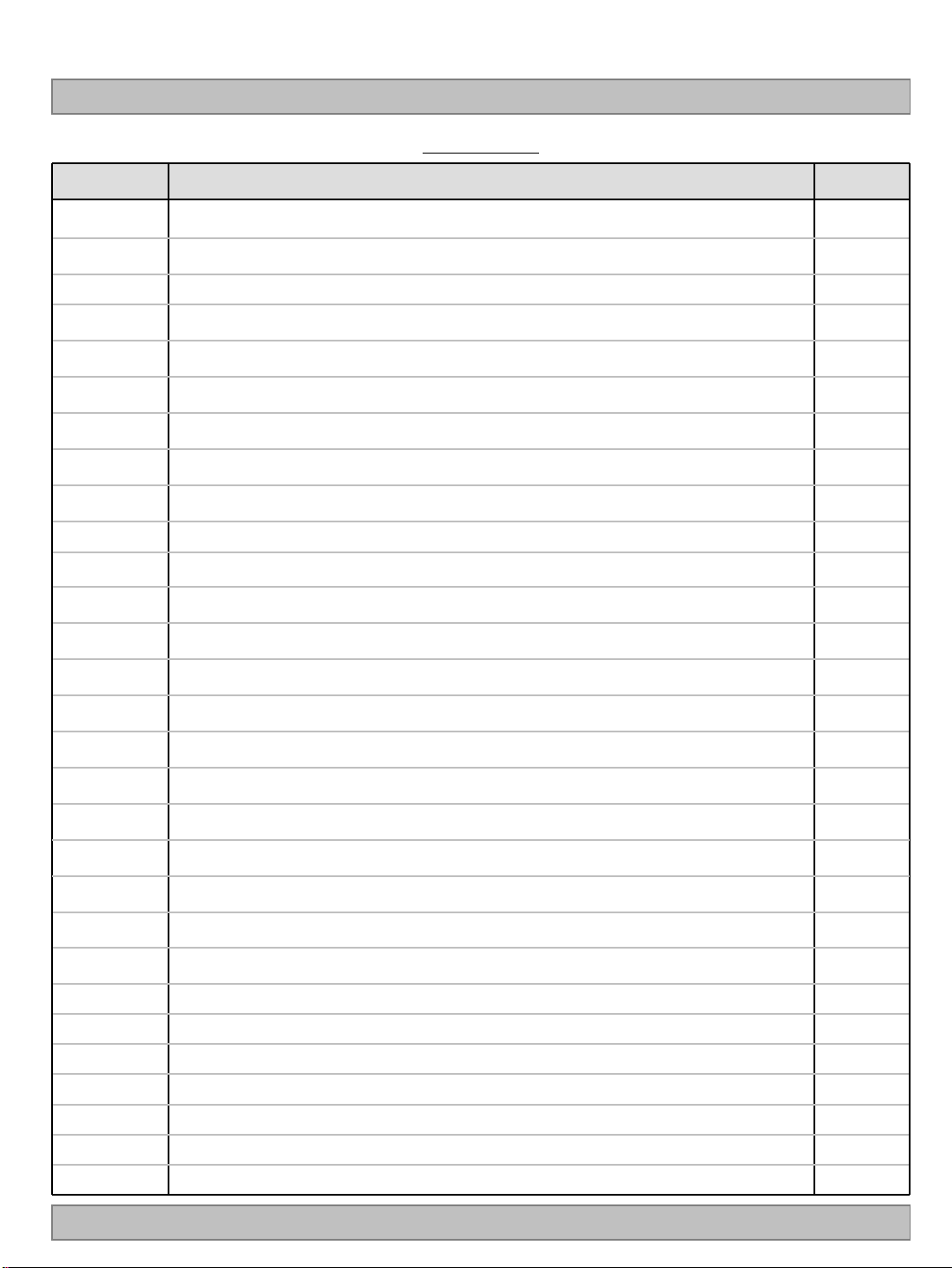
CONTENTS
LC320EXN
Number ITEM
COVER
CONTENTS
RECORD OF REVISIONS
1 GENERAL DESCRIPTION
2 ABSOLUTE MAXIMUM RATINGS
3 ELECTRICAL SPECIFICATIONS
3-1 ELECTRICAL CHARACTERISTICS
3-2 INTERFACE CONNECTIONS
3-3 SIGNAL TIMING SPECIFICATIONS
3-4 LVDS SIGNAL SPECIFICATIONS
3-5 COLOR DATA REFERENCE
3-6 POWER SEQUENCE
4 OPTICAL SPECIFICATIONS
5 MECHANICAL CHARACTERISTICS
Page
1
2
3
4
5
6
6
8
10
12
13
14
16
20
6 RELIABILITY
7 INTERNATIONAL STANDARDS
7-1 SAFETY
7-2 EMC
7-3
8 PACKING
8-1 DESIGNATION OF LOT MARK
8-2 PACKING FORM
9 PRECAUTIONS
9-1 MOUNTING PRECAUTIONS
9-2 OPERATING PRECAUTIONS
9-3 ELECTROSTATIC DISCHARGE CONTROL
9-4 PRECAUTIONS FOR STRONG LIGHT EXPOSURE
9-5 STORAGE
9-6 HANDLING PRECAUTIONS FOR PROTECTION FILM
Ver. 1.0
Environment
23
24
24
24
24
25
25
25
26
26
26
27
27
27
27
2/ 28
Page 3
Product Specification
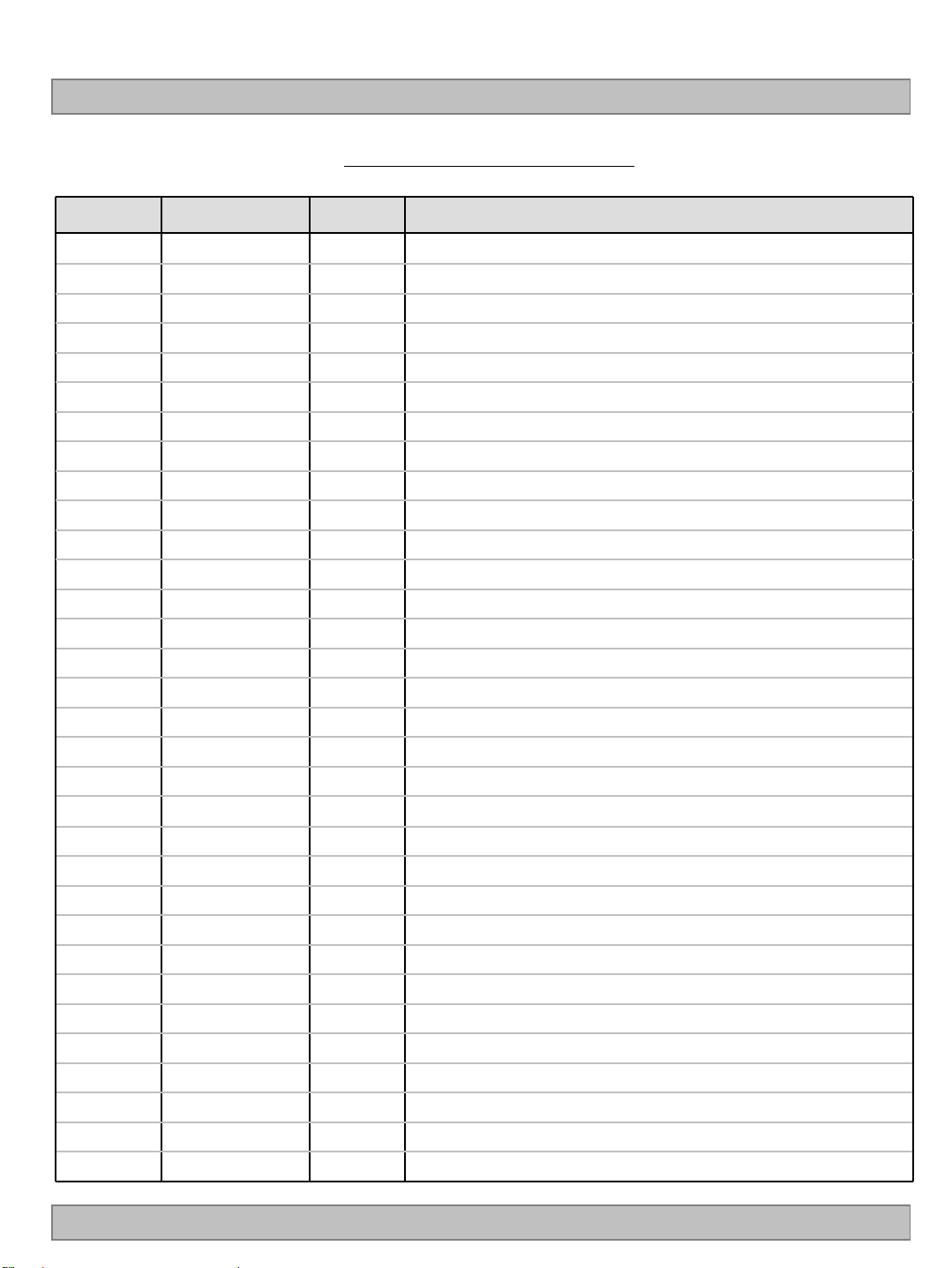
RECORD OF REVISIONS
Revision No. Revision Date Page Description
0.0 Jan. 11, 2010 - Preliminary Specification (First Draft)
0.1 Apr. 06, 2010 - Preliminary Sp ecification (2’nd Draft)
1.0 May. 12, 2010 4 Changed Power consumption
7 Changed In-rush Current Spec (2.47 Æ 2.5A)
21 Changed Mechanical Characteristics (depth : 20.7 Æ 23.6)
22, 23 Updated LCM Drawing
- Final Specification
1.1 May. 19, 2010 23 Updated LCM Drawing
LC320EXN
Ver. 1.0
3/ 28
Page 4
LC320EXN
Product Specification
1. General Description
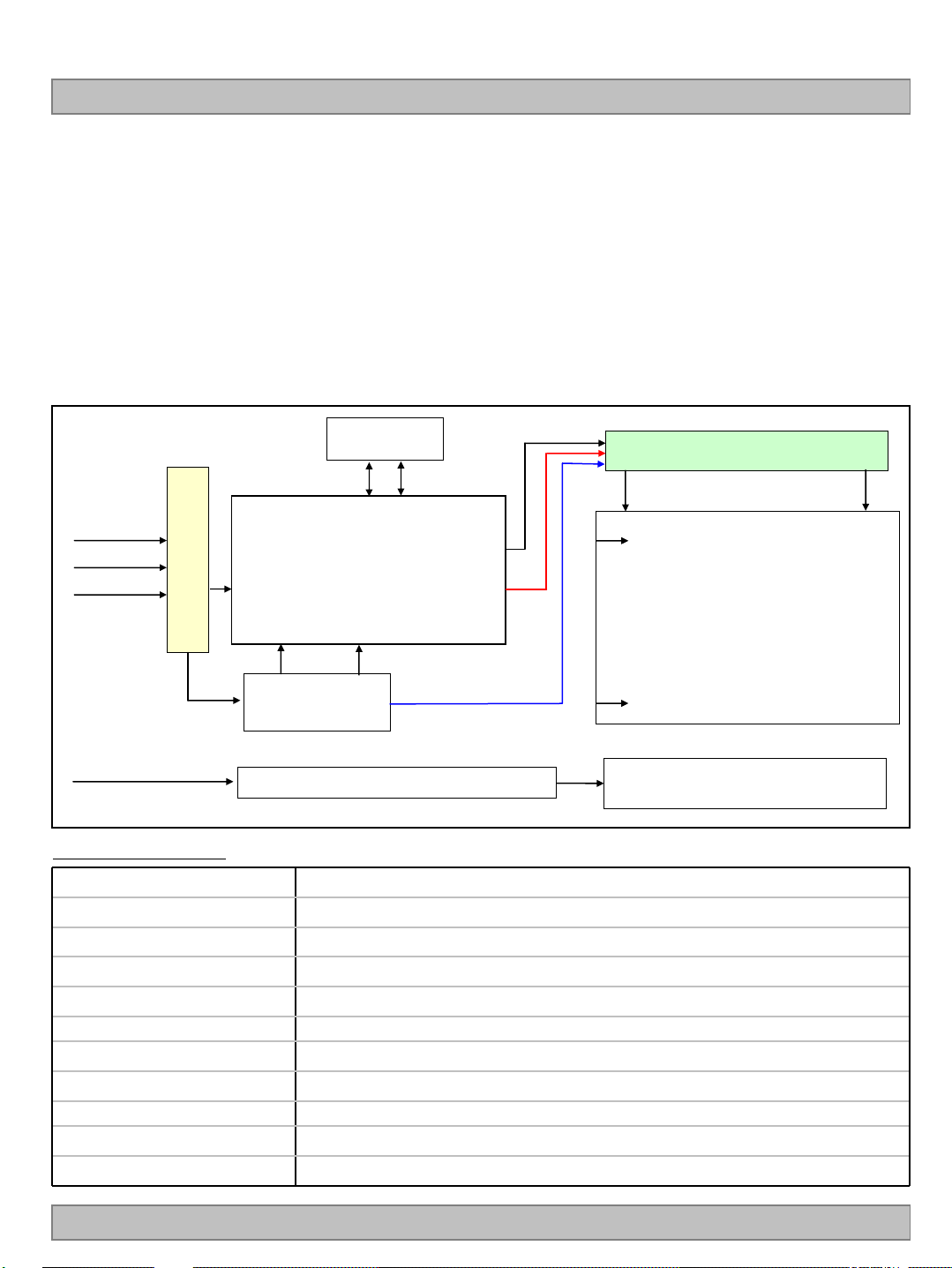
The LC320EXN is a Color Active Matrix Liquid Crystal Display with an integral Light Emitting Diode(LED)
backlight system. The matrix employs a-Si Thin Film Transistor as the active element.
It is a transmissive display type which is operating in the normally black mode. It has a 31.51 inch diagonally
measured active display area with WXGA resolution (768 vertical by 1366 horizontal pixel ar
Each pixel is divided into Red, Green and Blue sub-pixels or dots which are arranged in Hor izontal stripes.
Gray scale or the luminance of the sub-pixel color is determined with a 8-bit gray sca le signal for each dot,
thus presenting a palette of more than 16.7M(true) colors.
It has been designed to apply the 8-bit 1-port LVDS interface.
It is intended to support LCD TV, PCTV where high brightness, super wide viewing angle, high color gamut,
high color depth and fast response time are important.
ray).
Control
Signals
RGB
S1 S1366
G1
TFT - LCD Panel
+12.0V
LVDS 1Port
LVDS Select
#9
CN1
(30pin)
EEPROM
SCL
SDA
Timing Controller
[LVDS Rx + Spread Spectrum
Integrated]
(1366 × 768 x RGB pixels)
G768
Back light Assembly(96 LED)
+24.0V, GND, On/off
Ext VBR-B
Power Circuit
Block
LED Driver
Power Signals
General Features
Active Screen Size 31.51 inches(800.4mm) diagonal
Outline Dimension 741.4 mm(H) x 435.8 mm(V) x 23.6 mm(D) (Typ.)
Pixel Pitch 510.75㎛ x 170.25㎛ x RGB
Pixel Format 1366 horiz. by 768 vert. pixels RGB stripe arrangement
Source Driver Circuit
[Gate In Panel]
Color Depth 8bit, 16,7 M colors
Luminance, White 400 cd/m2 (Center 1 point) (Typ.)
Viewing Angle (CR>10) Viewing angle free ( R/L 178(Min.), U/D 178(Min.))
Power Consumption Total 46.1 Watt (Logic=4.2 W , LED Driver = 41.9W @ [ExtVbr_B=100%] )
Weight 5,900g(Typ.)
Display Operating Mode Transmissive mode, normally black
Surface Treatment Hard coating(3H), Anti-glare treatment of the front polarizer (Haze 10%)
Ver. 1.0
4/ 28
Page 5
LC320EXN
Product Specification
2. Absolute Maximum Ratings
The following items are maximum values wh ich, if exceeded, may cause faulty operation or damage to the
LCD module.
Table 1. ABSOLUTE MAXIMUM RATINGS
Parameter
Power Input Voltage
Driver Control Voltage
T-Con Option Selection Voltage VLOGIC
Operating Temperature TOP
Storage Temperature TST
Panel Front Temperature TSUR - +68 °C
Operating Ambient Humidity HOP
Storage Humidity HST 10 90 %RH
Note
1. Ambient temperature condition (Ta = 25 ± 2 °C )
LCD Circuit VLCD
Driver VBL -0.3 + 27.0 VDC
ON/OFF
Brightness
VOFF / VON
EXTVBR-B
Value
Min Max
-0.3 +14.0
-0.3 +5.5
0.0 +5.5
-0.3 +4.0
0 +50
-20 +60
10 90
Unit
VDC
VDC
VDC
VDC
°C
°C
%RH
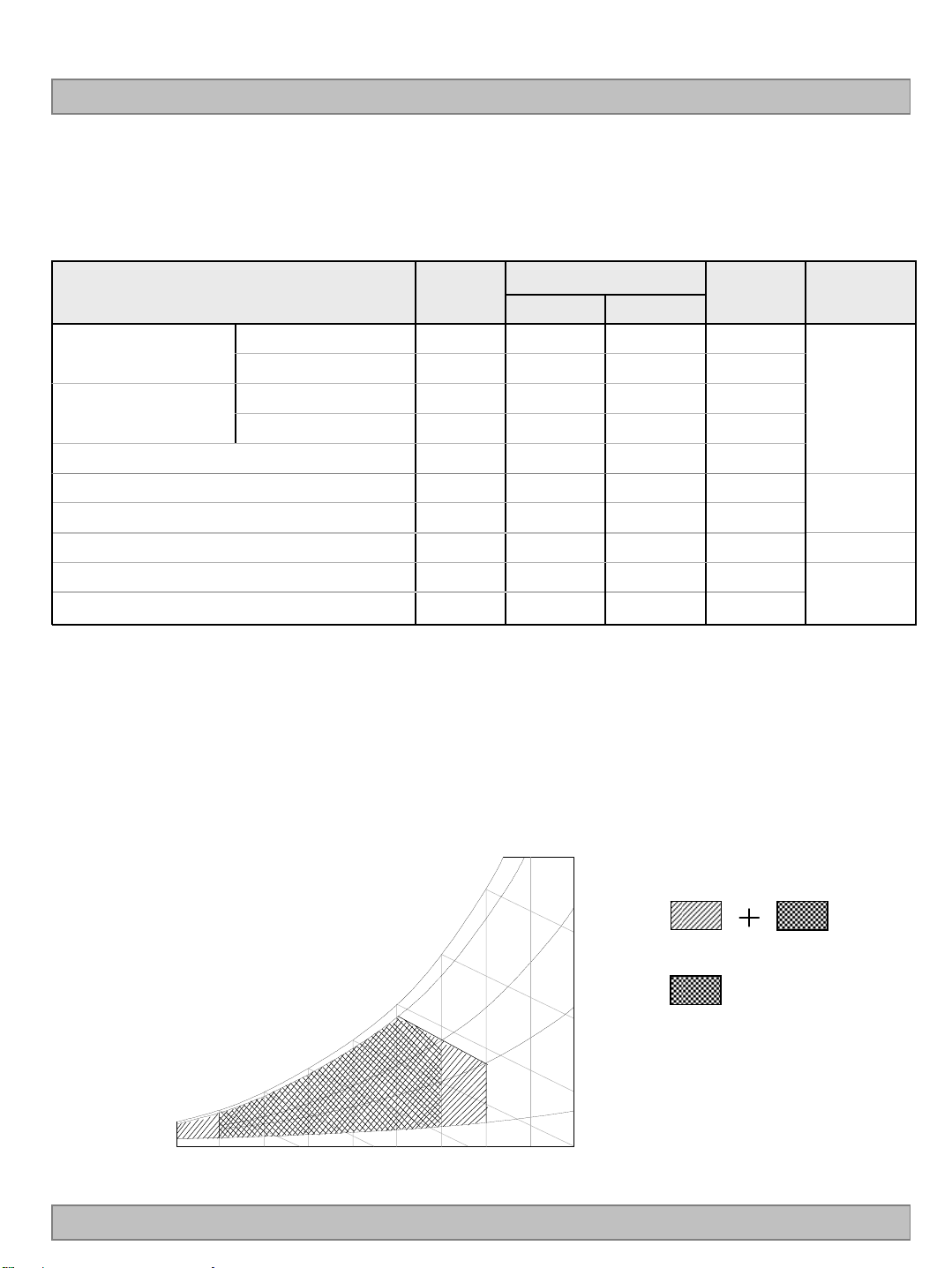
2. Temperature and relative humidity range are shown in the figure below.
Wet bulb temperature should be Max 39°C, and no condensation of water.
3. Gravity mura can be guaranteed below 40°C condition.
4. The maximum operating temperatures is based on the test condition that the surface temperature
of display area is less than or equal to 68°C with LCD module alone in a temperature controlled chamber.
Thermal management should be considered in final product design to prevent the surface temperature of
display area from being over 68℃. The range of operating temperature may degraded in case of
improper thermal management in final product design.
NoteSymbol
1
2,3
4
2,3
Ver. 1.0
Wet Bulb
Temperature [
10
0
10 20 30 40 50 60 70 800-20
Dry Bulb Temperature [
°C]
20
30
40
°C]
50
60
90%
60%
40%
10%
Storage
Operation
Humidity [(%)RH]
5/ 28
Page 6
LC320EXN
Product Specification
3. Electrical Specifications
3-1. Electrical Characteristics
It requires two power inputs. One is employed to power for the LCD circuit. The other Is used for the LED
backlight and LED Driver circuit.
Table 2. ELECTRICAL CHARACTERISTICS
Parameter Symbol
Value
Min Typ Max
Circuit :
Power Input Voltage V
LCD
10.8 12.0 13.2 V
- 347 450 mA 1
Power Input Current I
Power Consumption P
Rush current I
LCD
LCD
RUSH
- 495 643 mA 2
- 4.2 5.85 Watt 1
- - 3.0 A 3
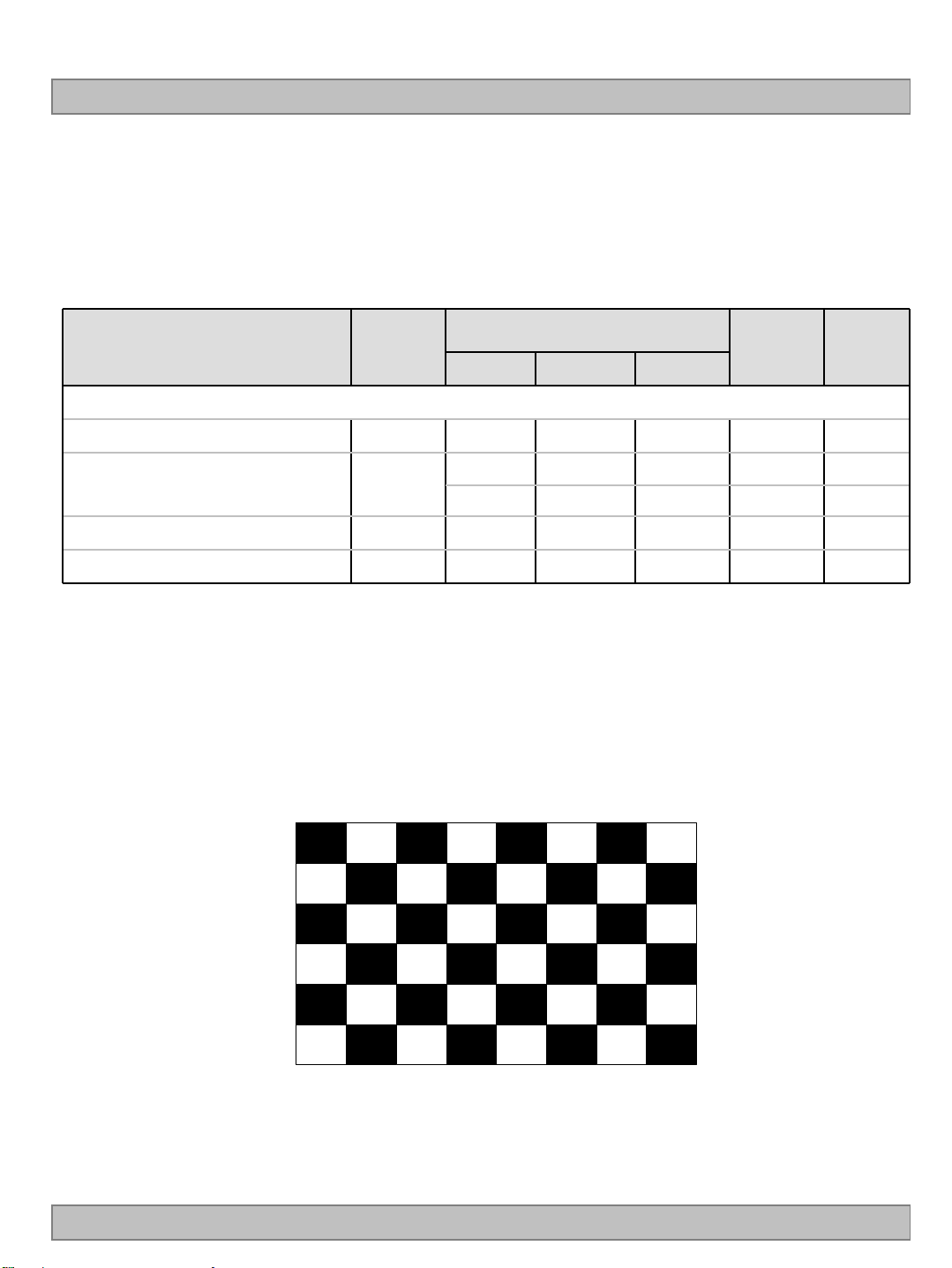
Notes : 1. The specified current and power consumption are under the V
condition whereas mosaic pattern(8 x 6) is displayed and f
is the frame frequency.
V
2. The current is specified at maximum current pattern.
3. The duration of rush current is about 2ms and rising time of power input is 0.5ms (min.).
White : 255 Gray
Black : 0 Gray
Unit Note
DC
=12.0V, 25 ± 2°C, fV=60Hz
LCD
Ver. 1.0
Mosaic Pattern(8 x 6)
6/ 28
Page 7
Product Specification
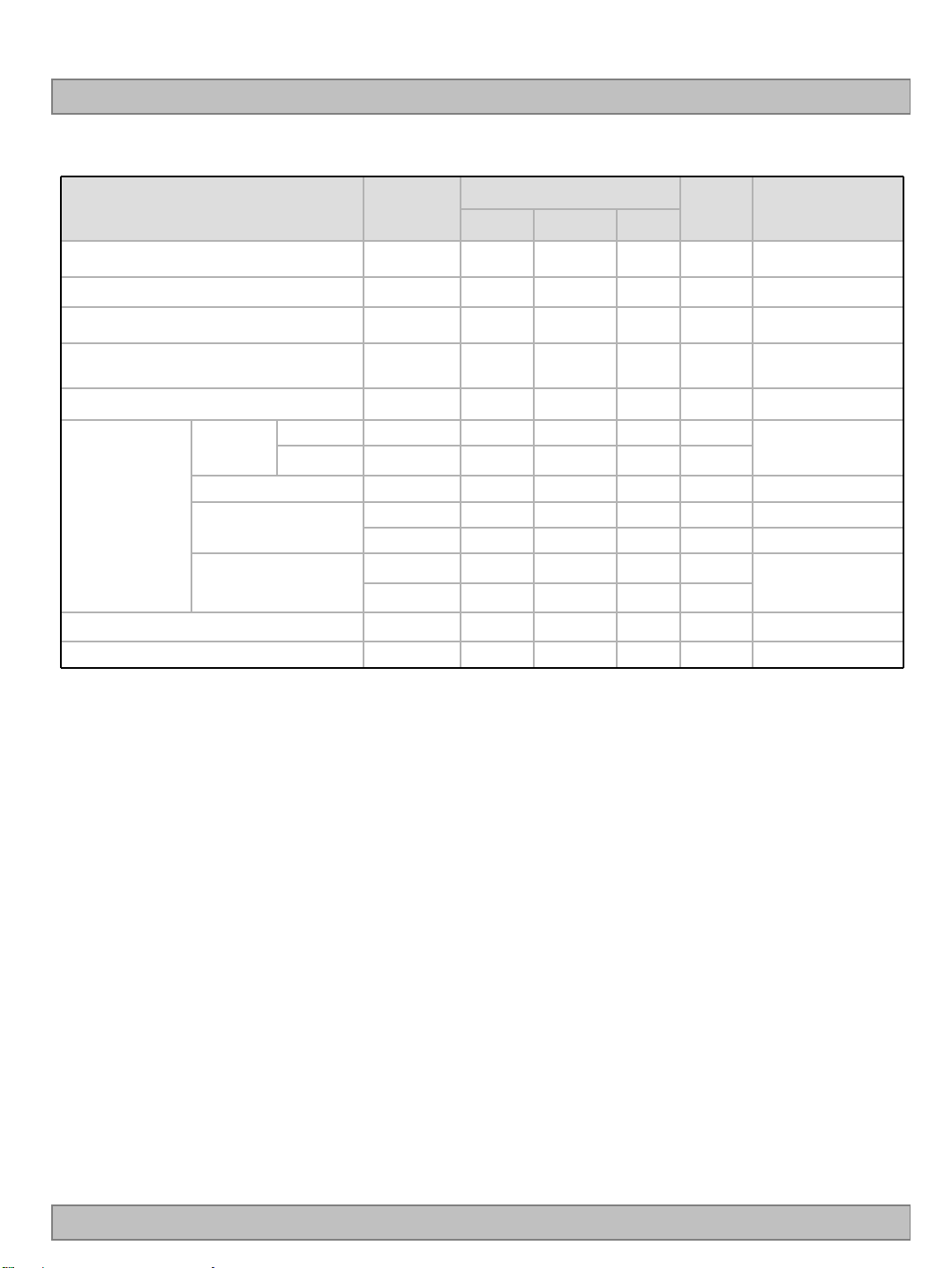
Table 3. ELECTRICAL CHARACTERISTICS (Continue)
LC320EXN
Parameter Symbol
LED Driver :
Power Supply Input Voltage VBL 22.8 24.0 25.2 Vdc 1
Power Supply Input Current IBL_A
Power Supply Input Current (In-Rush) Irush - - 2.5 A
Power Consumption PBL -
On/Off
Input Voltage for
Control System
Signals
LED :
Life Time 30,000 Hrs 3
Brightness Adjust ExtV
PWM Frequency for
NTSC & PAL
Pulse Duty Level
(PWM)
On V on 2.5 - 5.0 Vdc
Off V off -0.3 0.0 0.7 Vdc
BR-B 10 - 100 % On Duty
PAL 100 Hz 4
NTSC 120 Hz 4
High Level 2.5 - 5.0
Low Level 0.0 - 0.7
Min Typ Max
Values
-
1.7
41.9 44.5
1.8
Unit Notes
A1
V
BL = 22.8V
Ext V
BR-B = 100%
W1
Vdc
Vdc
HIGH : on duty
LOW : off duty
Notes :
1. Electrical characteristics are determined after the unit has been ‘ON’ and stable for approximately 60
minutes at 25±2°C. The specified current and power consumption are under the typical supply Input voltage
24Vand V
BR (ExtVBR-B : 100%), it is total power consumption.
2. The life time(MTTF) is determined as the time which luminance of the LED is 50% compared to that of initial
value at the typical LED current (ExtVBR-B :100%) on condition of continuous operating in LCM state at
25±2°C.
3. LGD recommend that the PWM freq. is synchronized with One time harmonic of Vsync signal of system.
Though PWM frequency is over 120Hz (max 252Hz), function of LED Driver is not affected.
4. The duration of rush current is about 200ms.
2
5. Even though inrush current is over the specified value, there is no problem if I
Ver. 1.0
T spec of fuse is satisfied.
7/ 28
7/ 28
Page 8
LC320EXN
Product Specification
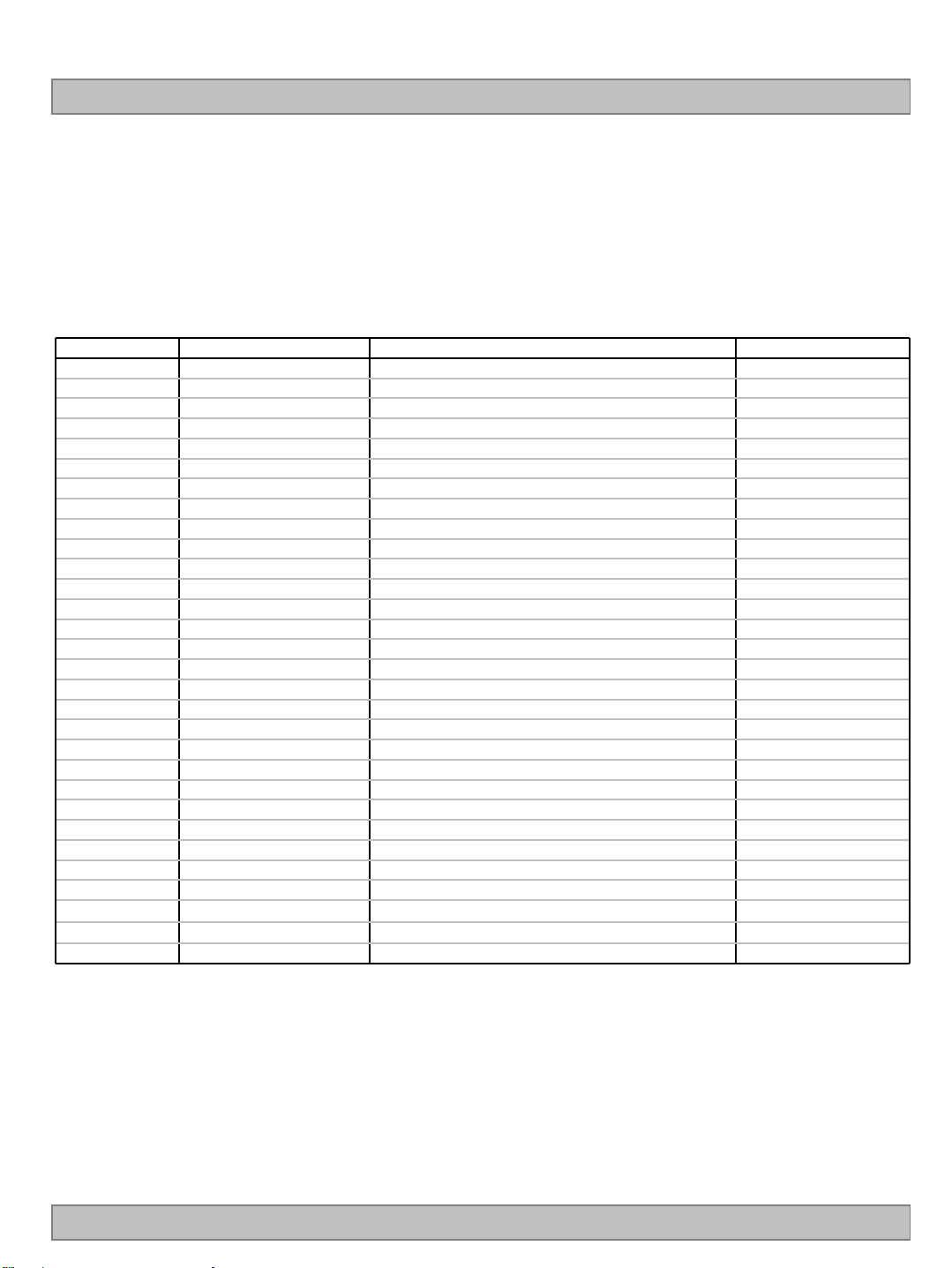
3-2. Interface Connections
This LCD module employs two kinds of interface connection, a 30-pin connector is used for the module
electronics and 14-pin connector is used for the integral backlight system.
3-2-1. LCD Module
- LCD Connector(CN1) : KDF71G-30S-1H(Hirose) or FI-X30SSL-HF(JAE)
- Mating Connector : : FI-X30C2L (Manufactured by JAE) or Equivalent
Table 4. MODULE CONNECTOR(CN1) PIN CONFIGURATION
Pin No. Symbol Description Note
1 VLCD Power Supply +12.0V
2 VLCD Power Supply +12.0V
3 VLCD Power Supply +12.0V
4 VLCD Power Supply +12.0V
5 GND Ground
6 GND Ground
7 GND Ground
8 GND Ground
9
10
11 GND Ground
12 RA- LVDS Receiver Signal(-)
13 RA+ LVDS Receiver Signal(+)
14 GND Ground
15 RB- LVDS Receiver Signal(-)
16 RB+ LVDS Receiver Signal(+)
17 GND Ground
18 RC- LVDS Receiver Signal(-)
19 RC+ L VDS Receiver Signal(+)
20 GND Ground
21 RCLK- LVDS Receiver Clock Signal(-)
22 RCLK+ LVDS Receiver Clock Signal(+)
23 GND Ground
24 RD- LVDS Receiver Signal(-)
25 RD+ L VDS Receiver Signal(+)
26 GND Ground
27
28
29 NC No Connection
30 GND Ground
LVDS Select ‘H’ =JEIDA , ‘L’ or NC = VESA
GND
PWM OUT PWM output (From LCM)
Ext VBR-B
Ground
External VBR (From System)
Appendix III
Notes :
Ver. 1.0
1. All GND (Ground) pins should be connected together to the LCD module’s metal frame.
2. All VLCD(power input) pins should be connected together.
3. All Input levels of LVDS signals are based on the EIA 644 Standard.
8/ 28
Page 9
Product Specification
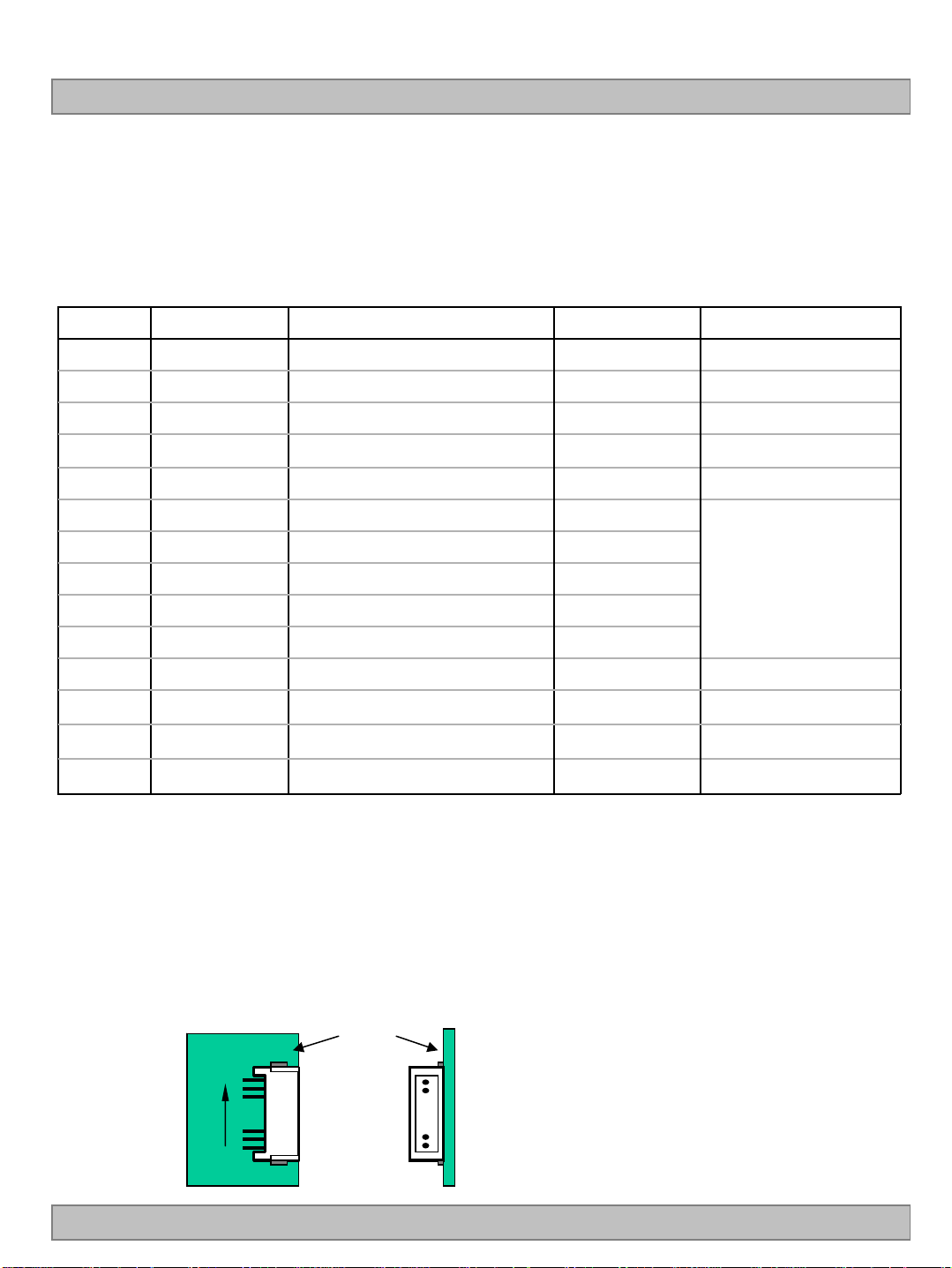
3-2-2. Backlight Module
Master
- LED Driver Connector : 20022WR-14B1(Yeonho) or Equivalent
- Mating Connector : 20022HS-14 or Equivalent
Table 5. LED DRIVER CONNECTOR PIN CONFIGURATION
Pin No Symbol Description Master Note
LC320EXN
VBL
BL
V
VBL
VBL
VBL
GND
GND
GND
GND
GND
OPEN or GND
ON/OFF
V
EXTVBR-B
GND 3
10
11
12
13
14
1
2
3
4
5
6
7
8
9
VBL Power Supply +24.0V
VBL Power Supply +24.0V
VBL Power Supply +24.0V
VBL Power Supply +24.0V
VBL Power Supply +24.0V
GND Backlight Ground
GND Backlight Ground
GND Backlight Ground
GND Backlight Ground
GND Backlight Ground
NC
ON/OFF
V
EXTVBR-B
GND
No connection
Backlight ON/OFF control
External PWM
Backlight Ground
Notes : 1. GND should be connected to the LCD module’s metal frame.
2. High : on duty / Low : off duty, Pin#13 can be opened. ( if Pin #13 is open , EXTVBR-B is 100% )
3. #14 of Input CNT Must be Connected to Backlight Ground.
4. Each impedance of pin #12 and 13 is over 50[KΩ] and over 50[KΩ].
1
2
◆ Rear view of LCM
Ver. 1.0
14
PCB
…
…
1
9/ 28
Page 10
LC320EXN
Product Specification
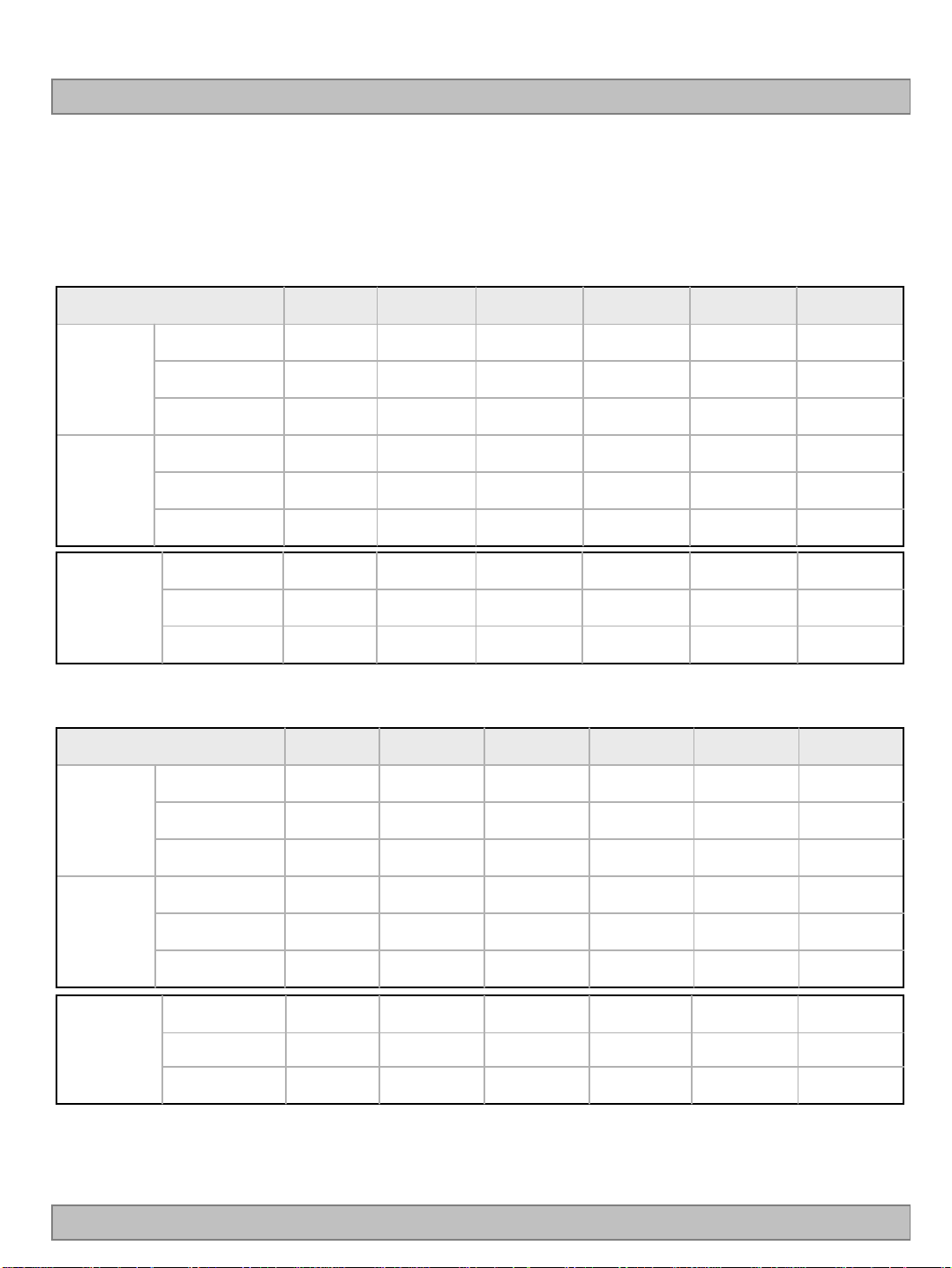
3-3. Signal Timing Specifications
Table 6 shows the signal timing required at the input of the LVDS transmitter. All of the interface signal
timings should be satisfied with the following specification for normal operation.
Table 6-1. TIMING TABLE for NTSC (DE Only Mode)
ITEM Symbol Min Typ Max Unit Note
Frequency
Display Period tHV
BlankHorizontal
Total
Display Period t
Blank tVB 8 22 240 tHPVertical
Total t
DCLK
Horizontal
Vertical
tHB
tHP
VV - 768 - tHP
VP 776 790 1008 tHP
fCLK
fH
f
V
- 1366 - tclk
90 162 410 tclk
1456 1528 1776 tclk
Table 6-2. TIMING TABLE for PAL (DE Only Mode)
Symbol
tHV
tHB
Horizontal
Display Period
Blank
MHz80.072.463.0
KHz5547.445
Hz636057
NoteUnitMaxTypMinITEM
tclk-1366tclk41016290
Vertical tHP295180126tVBBlank
Frequency
Note
The Input of HSYNC & VSYNC signal does not have an effect on normal operation(DE Only Mode).
The performance of the electro-optical characteristics may be influenced by variance of the vertical
refresh rate.
Ver. 1.0
Total
DCLK
Horizontal
Vertical
HP
t
fCLK
fH
f
V
tclk177615281456
HP-768-tVVDisplay Period
t
HP1063948894tVPTotal
t
MHz80.072.463.0
KHz5547.445
Hz535047
10 / 28
Page 11
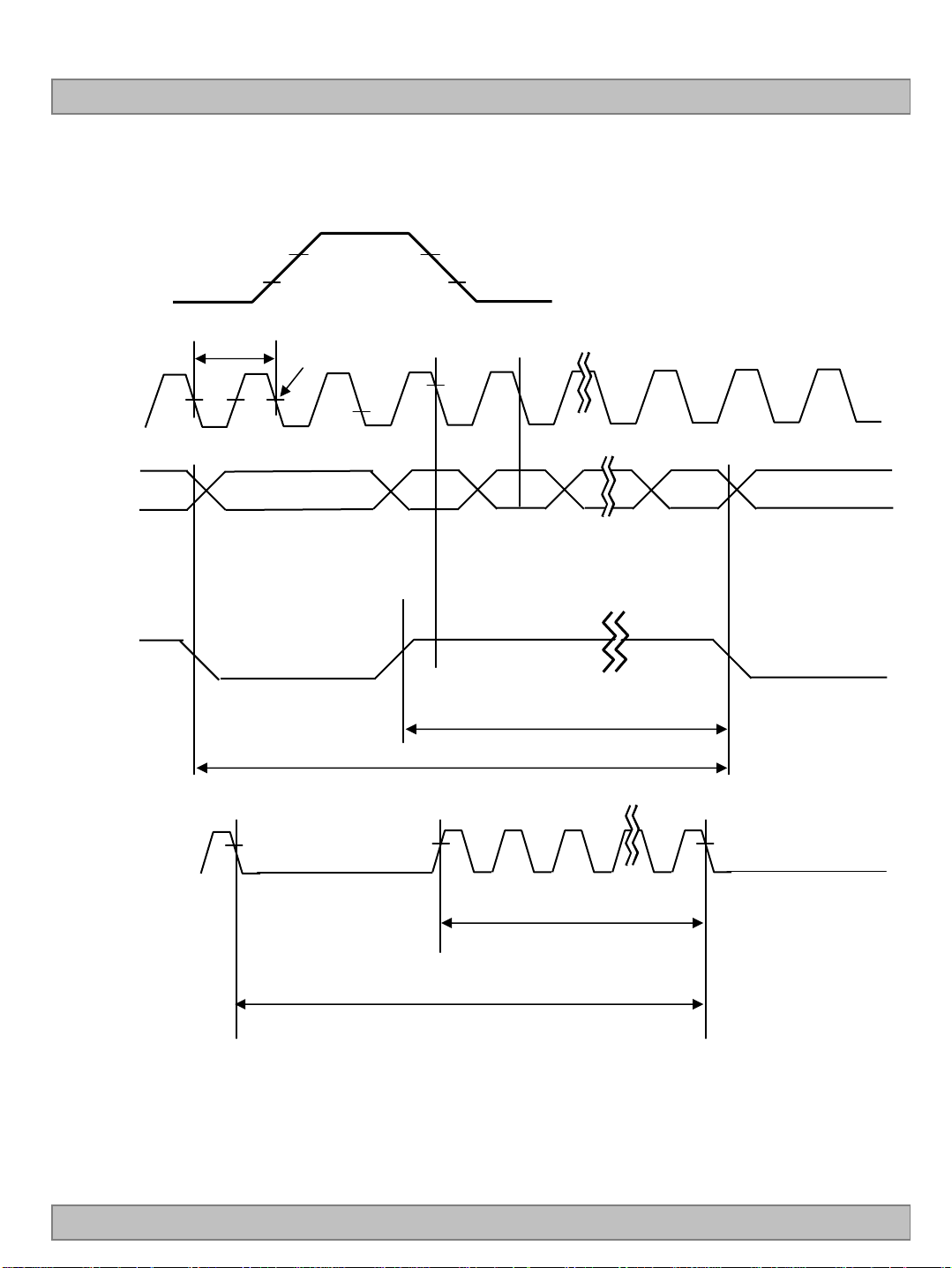
3-4. Signal Timing Waveforms
3-4-1. LVDS Input Signal Timing Diagram
LC320EXN
Product Specification
DE, Data
DCLK
First data
0.7VDD
0.3VDD
tCLK
DE(Data Enable)
0.5 VDD
Invalid data
Valid data
Pixel 0,0
tHP
Pixel 2,0
Invalid data
tHV
DE(Data Enable)
Ver. 1.0
1 768
tVV
tVP
11 / 28
Page 12
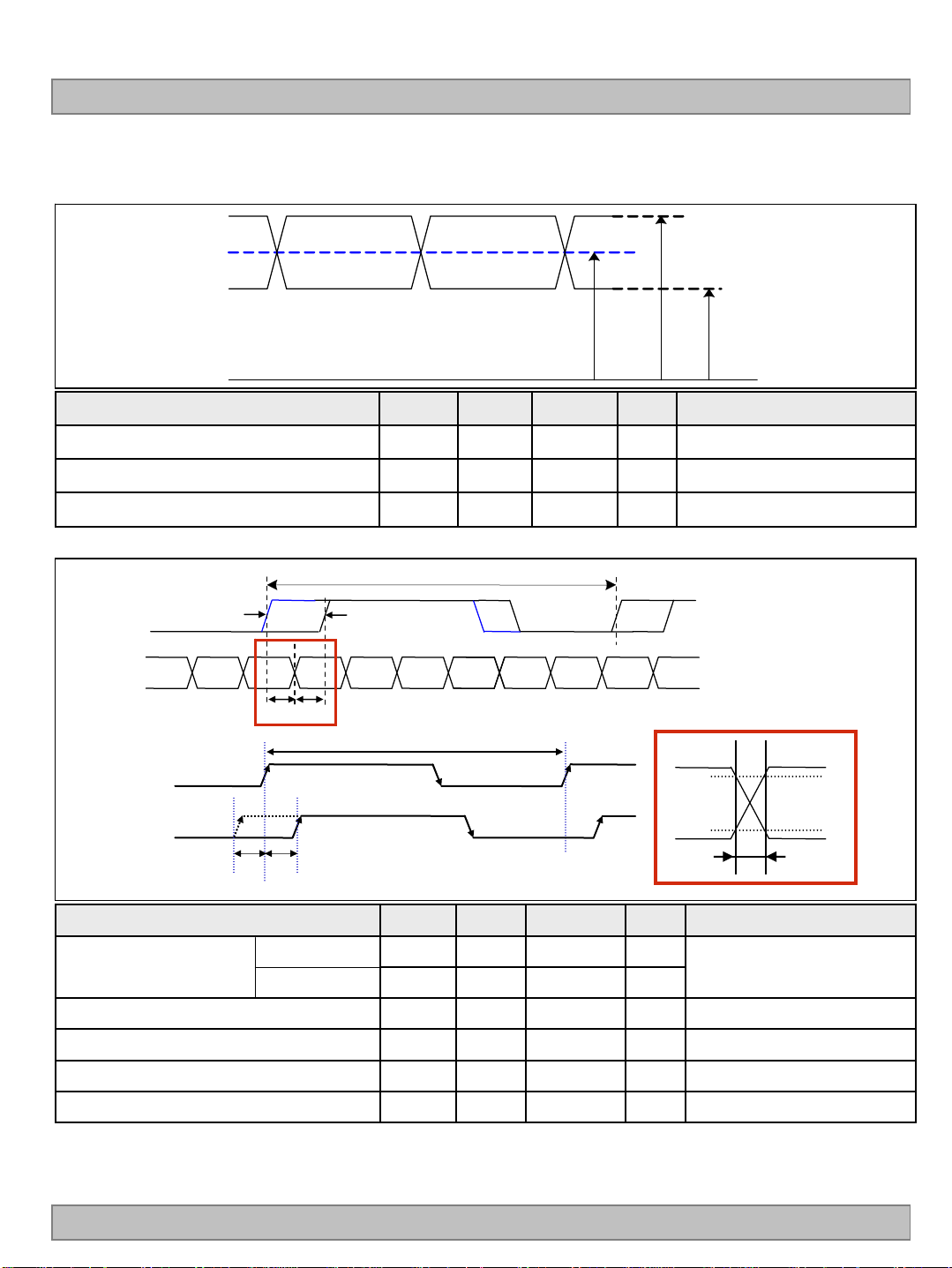
3-4-2. LVDS Input Signal Characteristics
1) DC Specification
LVDS -
LVDS +
LC320EXN
Product Specification
V
IN _ MAXVIN _MIN
# VCM= {(LVDS +) + ( LVDS -)} /2
0V
V
CM
Description Symbol Min Max Unit Note
LVDS Common mode Voltage V
LVDS Input Voltage Range V
CM
IN
1.0 1.5 V -
0.7 1.8 V -
Change in common mode Voltage ΔVCM 250 mV -
2) AC Specification
T
clk
LVDS Clock
A
LVDS Data
(F
= 1 /T
)
clk
A
LVDS 1’st Clock
LVDS 2nd/ 3rd/ 4thClock
tSKEW
t
SKEW_mintSKEW_max
tSKEW
clk
T
clk
80%
20%
t
RF
Description Symbol Min Max Unit Note
High Threshold
Low Threshold
LVDS Clock to Data Skew Margin t
LVDS Clock/DATA Rising/Falling time t
Effective time of LVDS t
LVDS Clock to Clock Skew Margin (Even to Odd) t
Note
1. All Input levels of LVDS signals are based on the EIA 644 Standard.
2. If t
isn’t enough, t
RF
should be meet the range.
eff
3. LVDS Differential Voltage is defined within t
Ver. 1.0
V
TH
V
TL
SKEW
RF
eff
SKEW_EO
100 300 mV
-300 -100 mV
|(0.25*T
260 (0.3*T
)/7| ps -
clk
)/7 ps 2
clk
±360 ps -
1/7* T
clk
eff
T
clk
3LVDS Differential Voltage
-
12 / 28
Page 13
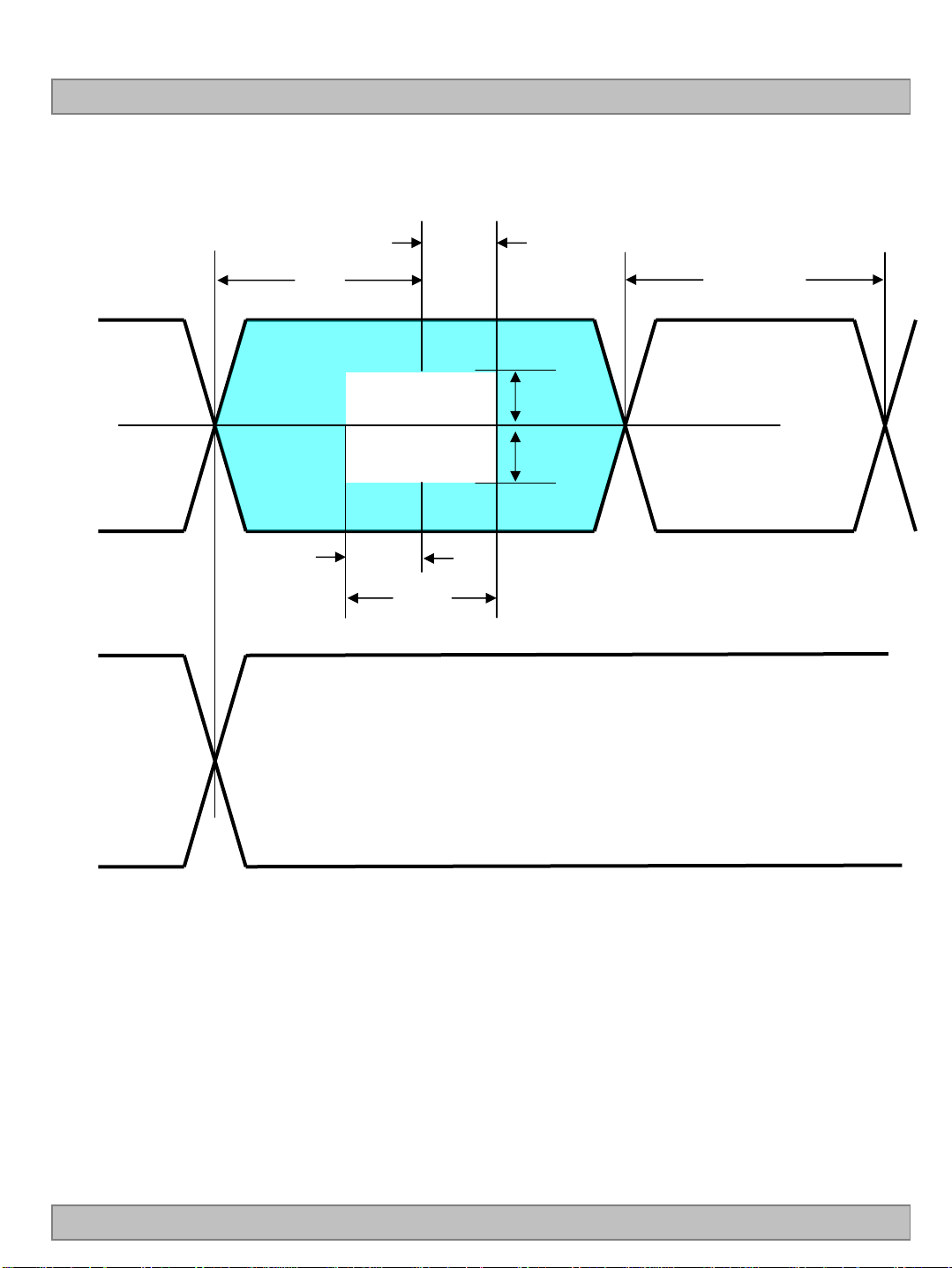
Product Specification
360ps
LC320EXN
V+
data
Vcm
Vdata
V+
clk
Vcm
0.5tui
tui
VTH
VTL
360ps
teff
tui : Unit Interval
Vclk
Ver. 1.0
13 / 28
Page 14
LC320EXN
Product Specification
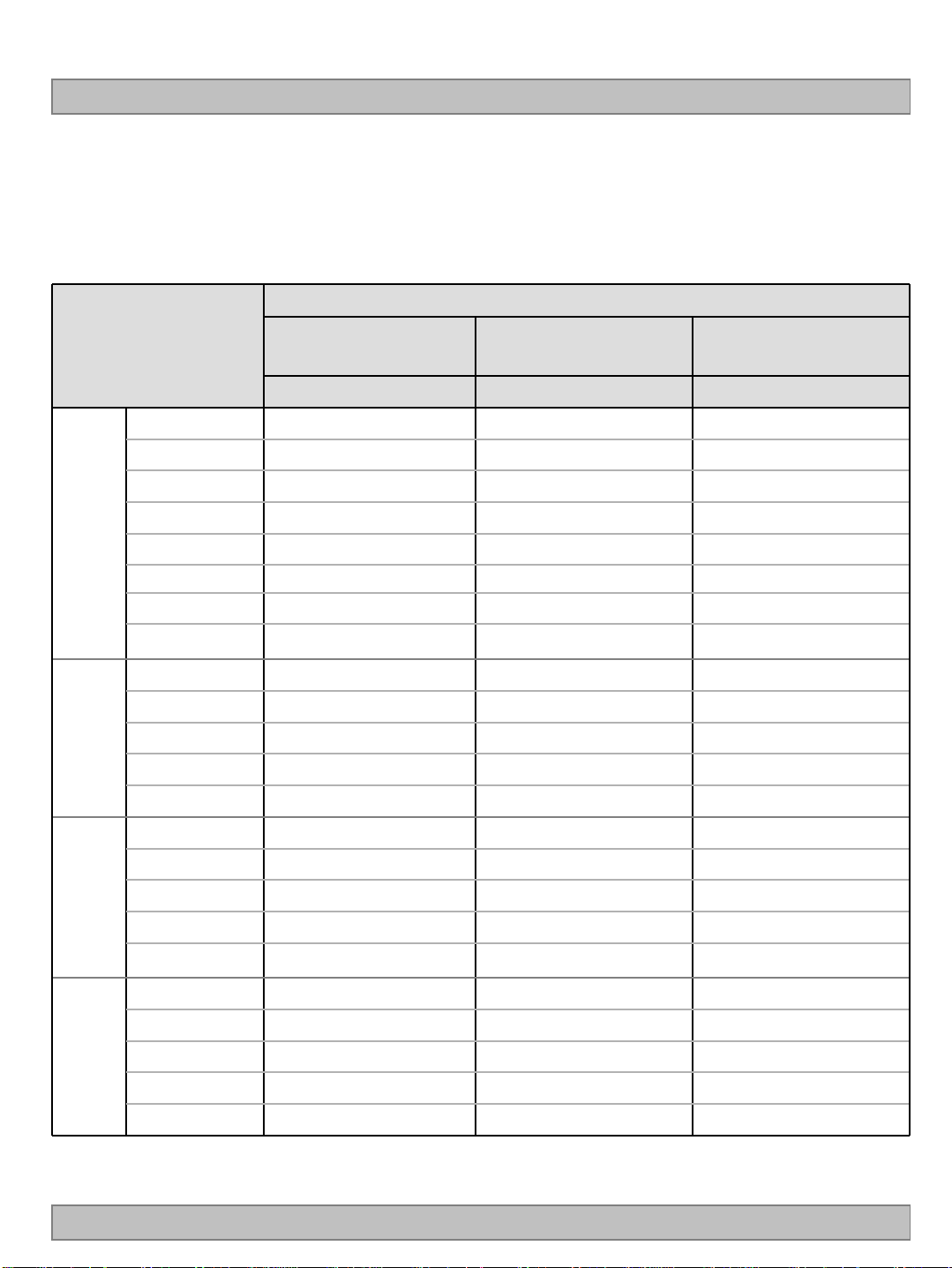
3-5. Color Data Reference
The brightness of each primary color (Red, Green, Blue) is based on the 8-bit gray scale data input for the color.
The higher binary input, the brighter the color. Table 7 provides a reference for color versus data input.
Table 7. COLOR DATA REFERENCE
Input Color Data
Basic
Color
RED
Color
Black 0 0 0 0 0 0 0 0 0 0 0 0 0 0 0 0 0 0 0 0 0 0 0 0
Red (255) 1 1 1 1 1 1 1 1 0 0 0 0 0 0 0 0 0 0 0 0 0 0 0 0
Green (255) 0 0 0 0 0 0 0 0 1 1 1 1 1 1 1 1 0 0 0 0 0 0 0 0
Blue (255) 0 0 0 0 0 0 0 0 0 0 0 0 0 0 0 0 1 1 1 1 1 1 1 1
Cyan 0 0 0 0 0 0 0 0 1 1 1 1 1 1 1 1 1 1 1 1 1 1 1 1
Magenta 1 1 1 1 1 1 1 1 0 0 0 0 0 0 0 0 1 1 1 1 1 1 1 1
Yellow 1 1 1 1 1 1 1 1 1 1 1 1 1 1 1 1 0 0 0 0 0 0 0 0
White 1 1 1 1 1 1 1 1 1 1 1 1 1 1 1 1 1 1 1 1 1 1 1 1
RED (000) Dark 0 0 0 0 0 0 0 0 0 0 0 0 0 0 0 0 0 0 0 0 0 0 0 0
RED (001) 0 0 0 0 0 0 0 1 0 0 0 0 0 0 0 0 0 0 0 0 0 0 0 0
... ... ... ...
RED (254) 1 1 1 1 1 1 1 0 0 0 0 0 0 0 0 0 0 0 0 0 0 0 0 0
RED (255) 1 1 1 1 1 1 1 1 0 0 0 0 0 0 0 0 0 0 0 0 0 0 0 0
GREEN (000) Dark 0 0 0 0 0 0 0 0 0 0 0 0 0 0 0 0 0 0 0 0 0 0 0 0
MSB LSB
R7 R6 R5 R4 R3 R2 R1 R0 G7 G6 G5 G4 G3 G2 G1 G0 B7 B6 B5 B4 B3 B2 B1 B0
RED
MSB LSB
GREEN
BLUE
MSB LSB
GREEN
BLUE
Ver. 1.0
GREEN (001) 0 0 0 0 0 0 0 0 0 0 0 0 0 0 0 1 0 0 0 0 0 0 0 0
... ... ... ...
GREEN (254) 0 0 0 0 0 0 0 0 1 1 1 1 1 1 1 0 0 0 0 0 0 0 0 0
GREEN (255) 0 0 0 0 0 0 0 0 1 1 1 1 1 1 1 1 0 0 0 0 0 0 0 0
BLUE (000) Dark 0 0 0 0 0 0 0 0 0 0 0 0 0 0 0 0 0 0 0 0 0 0 0 0
BLUE (001) 0 0 0 0 0 0 0 0 0 0 0 0 0 0 0 0 0 0 0 0 0 0 0 1
... ... ... ...
BLUE (254) 0 0 0 0 0 0 0 0 0 0 0 0 0 0 0 0 1 1 1 1 1 1 1 0
BLUE (255) 0 0 0 0 0 0 0 0 0 0 0 0 0 0 0 0 1 1 1 1 1 1 1 1
14 / 28
Page 15
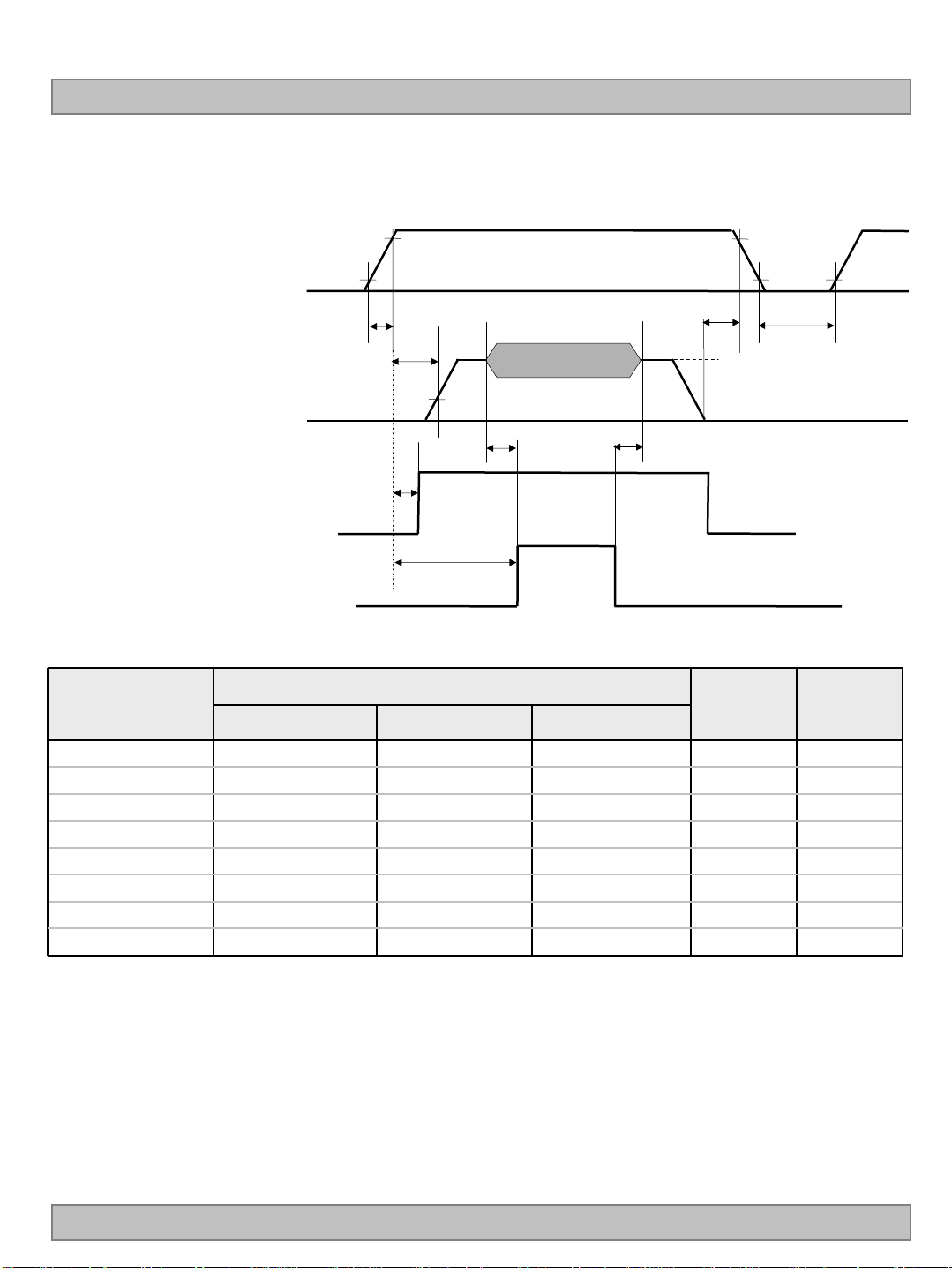
3-6. Power Sequence
3-6-1. LCD Driving circuit
LC320EXN
Product Specification
Power Supply For LCD
V
LCD
Interface Signal (Tx)
User Control Signal
(LVDS_select)
Power for LED
Table 8. POWER SEQUENCE
Parameter
90%
10%
0V
T1
T2
30%
0V
100%
T6
T7
Value
Min Typ Max
Valid Data
T3 T4
LED ON
90%
10%
T8
10%
T5
Vcm: LVDS Common mode Voltage
Unit Notes
T1 0.5 - 20 ms
2 0--ms4
T
T
3 200 - - ms 3
T
4 200 - - ms 3
T
5 1.0 - - s 5
T
6 --T2ms4
7 0.5 - -S
T
T
8 100 - -ms6
1. Please avoid floating state of interface signal at invalid period.
Note :
2. When the power supply for LCD (V
3. The
T3 / T4 is recommended value, the case when failed to meet a minimum specification,
LCD) is off, be sure to pull down the valid and invalid data to 0V.
abnormal display would be shown. There is no reliability problem.
4. If the on time of signals(Interface signal and user control signals) precedes the on time of Power(V
it will be happened abnormal display. When
5.
T5 should be measured after the Module has been fully discharged between power off and on
T6 is NC status, T6 doesn’t need to be measured.
period.
6. It is recommendation specification that
Ver. 1.0
T8 has to be 100ms as a minimum value.
LCD
15 / 28
),
Page 16
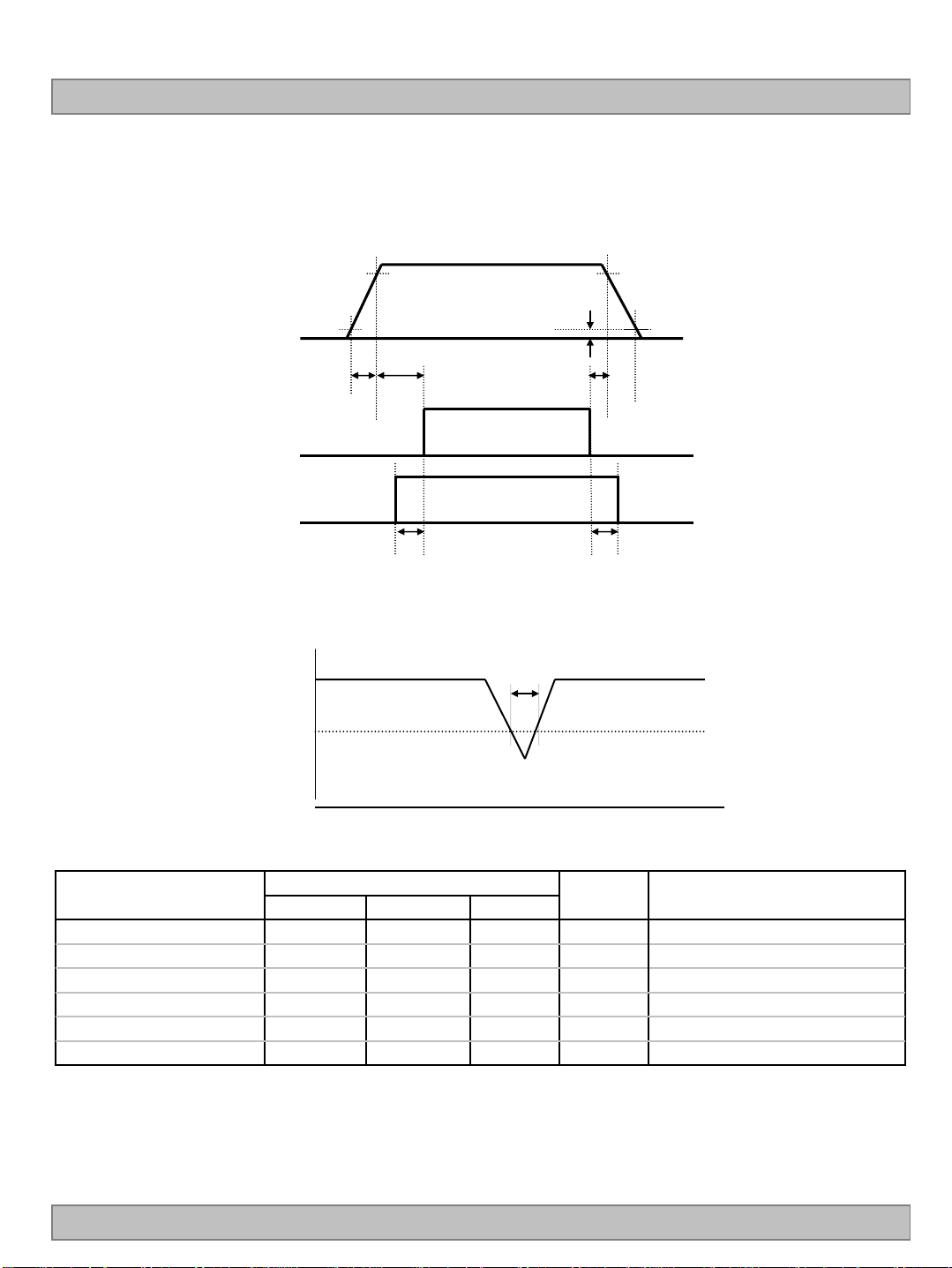
3-6-2. Sequence for LED Driver
Power Supply For LED Driver
VBL
0V
10%
LC320EXN
Product Specification
24V (typ.)
90%
0.7V
T1 T2
ON/OFF
V
BR-B
Ext-V
3-6-3. Dip condition for LED driver
(Typ.) x 0.8
V
BL
Table 9. Power Sequence for LED Driver
Parameter
T1 20 - - ms 1
T2 500 - - ms
T3 10 T4 0 - - ms
T5 0 - - ms
T6 - - 10 ms V
Min Typ Max
T4
Values
LED BL ON
T6
T3
T5
Units
ms
V
: 24V
BL
0 V
Remarks
(Typ) x 0.8
BL
Notes : 1. T1 describes rising time of 0V to 24V and this parameter does not applied at restarting time.
Even though T1 is over the specified value, there is no problem if I
Ver. 1.0
2
T spec of fuse is satisfied.
16 / 28
Page 17
LC320EXN
Product Specification
4. Optical Specification
Optical characteristics are determined after the unit has been ‘ON’ and stable in a dark environment at 25±2°C.
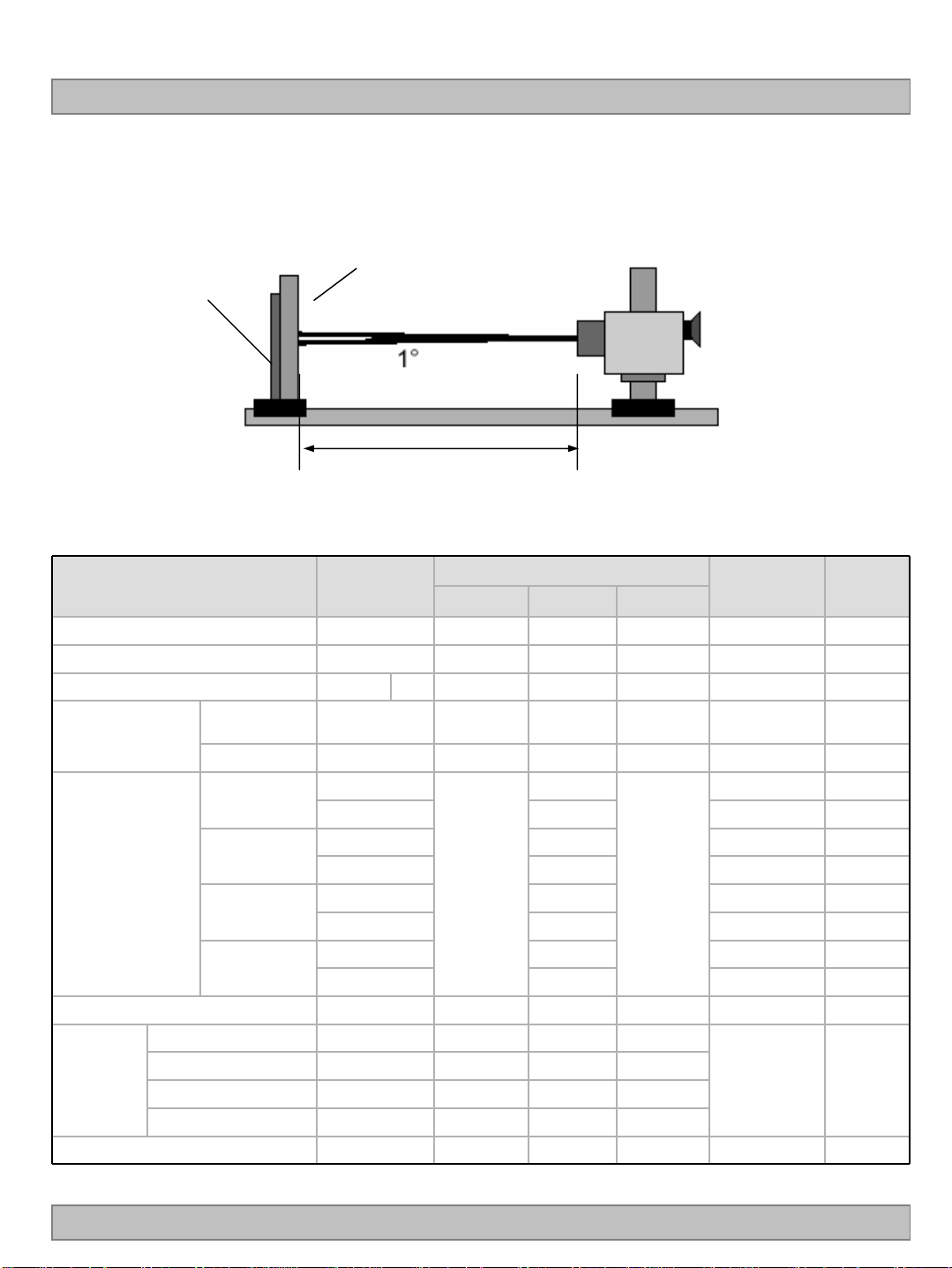
The values are specified at an approximate distance 50cm from the LCD surface at a viewing angle of Φ and θ
equal to 0 °.
FIG. 1 shows additional information concerning the measurement equipment and method.
Optical Stage(x,y)
LCD Module
Pritchard 880 or
equivalent
50cm
FIG. 1 Optical Characteristic Measurement Equipment and Method
Table 10. OPTICAL CHARACTERISTICS
Ta= 25±2°C, V
=12.0V, fV=60Hz, Dclk=72.4MHz,
LCD
EXTVBR_B=100%
Value
Parameter Symbol
Unit Note
Min Typ Max
Contrast Ratio CR 800 1200 - 1
Surface Luminance, white L
Luminance Variation δ
Gray-to-Gray
Response Time
Color Coordinates
[CIE1931]
Viewing Angle (CR>10)
Gray Scale - 7
(BW)
Variation G to G
RED
GREEN
BLUE
WHITE
x axis, right(φ=0°) θr 89 - -
x axis, left (φ=180°) θl 89 - -
y axis, up (φ=90°) θu 89 - -
y axis, down (φ=270°) θd 89 - -
WH
WHITE
G to G
5P - - 1.3 3
BW
σ
Rx 0.639
Ry 0.340
Gx 0.322
Gy 0.600
Bx 0.152
By 0.055
Wx 0.279
Wy
320 400 cd/m
-913 ms 4
5 8 ms 5
Typ
-0.03
0.292
Typ
+0.03
2
degree 6
2
Ver. 1.0
17 / 28
Page 18
Product Specification
Notes : 1. Contrast Ratio (CR) is defined mathematically as :
CR =
It is measured at center 1-point.
2. Surface luminance is determined after the unit has been ‘ON’ and 1Hour after lighting the
backlight in a dark environment at 25±2°C. Surface luminance is the luminance value at center
1-point across the LCD surface 50cm from the surface with all pixels displaying white.
For more information see the FIG. 2.
3. The variation in surface l umin ance , δ WHITE is defined as :
Where L
For more information, see the FIG. 2.
Surface Luminance at all white pixels
Surface Luminance at all black pixels
δ WHITE(5P) = Maximum(L
on1
to L
are the luminance with all pixels displaying white at 5 locations .
on5
on1,Lon2
, L
on3
, L
on4
, L
) / Minimum(L
on5
on1,Lon2
, L
on3
, L
on4
, L
LC320EXN
)
on5
4. Response time is the time required for the display to transit from G(N) to G(M) (Rise Time, Tr
and from G(M) to G(N) (Decay Time, Tr
). For additional information see the FIG. 3. (N<M)
D
)
R
※ G to G Spec stands for average value of all measured points.
Photo Detector : RD-80S / Field : 2 °
5. Gray to Gray Response time uniformity is Reference data. Please see Appendix XI.
6. Viewing angle is the angle at which the contrast ratio is greater than 10. The angles are
determined for the horizontal or x axis and the vertical or y axis with respect to the z axis which
is normal to the LCD module surface. For more information, see the FIG. 4.
7. Gray scale specification
Gamma Value is approximately 2.2. For more information, see the Table 11.
Table 11. GRAY SCALE SPECIFICATION
Gray Level Luminance [%] (Typ.)
L0
L15
L31
L47
L63
L79
L95
L111
L127
L143
L159
L175
L191
L207
L223
L239
L255
0.10
0.27
1.04
2.49
4.68
7.66
11.5
16.1
21.6
28.1
35.4
43.7
53.0
63.2
74.5
86.7
100
Ver. 1.0
18 / 28
Page 19
Product Specification
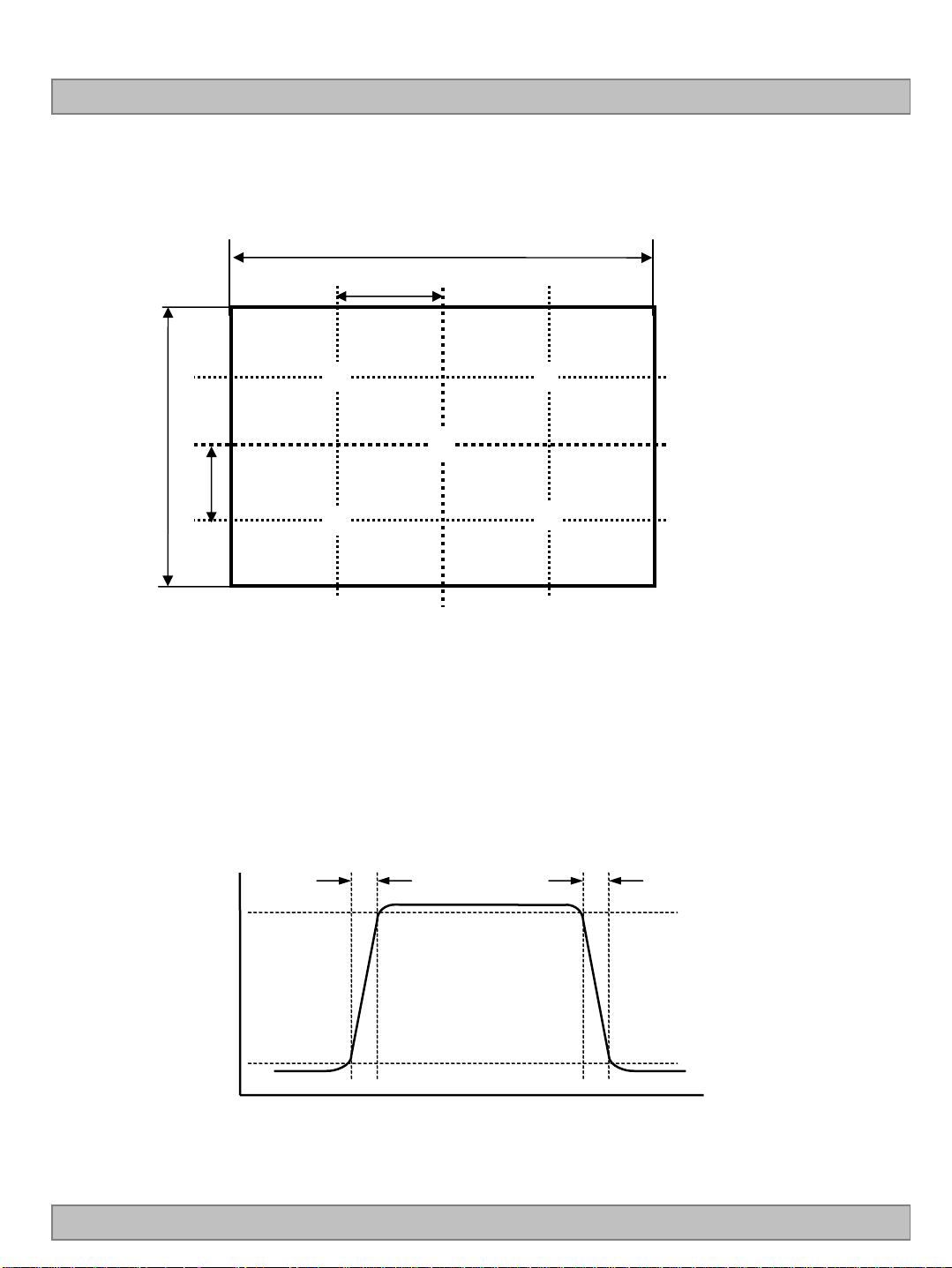
Measuring point for surface luminance & measuring point for luminance variation.
H
A
③②
LC320EXN
V
①
B
④
FIG. 2 5 Points for Luminance Me asure
Response time is defined as the following figure and shall be measured by switching the input signal for
“Gray(N)” and “Gray(M)”.
TrR
100
90
⑤
TrD
A : H / 4 mm
B : V / 4 mm
@ H,V : Active Area
Ver. 1.0
Optical
Response
10
0
Gray(N)
N,M = 0(Black)~255(White), N<M
FIG. 3 Response Time
Gray(M)
Gray(N)
19 / 28
Page 20
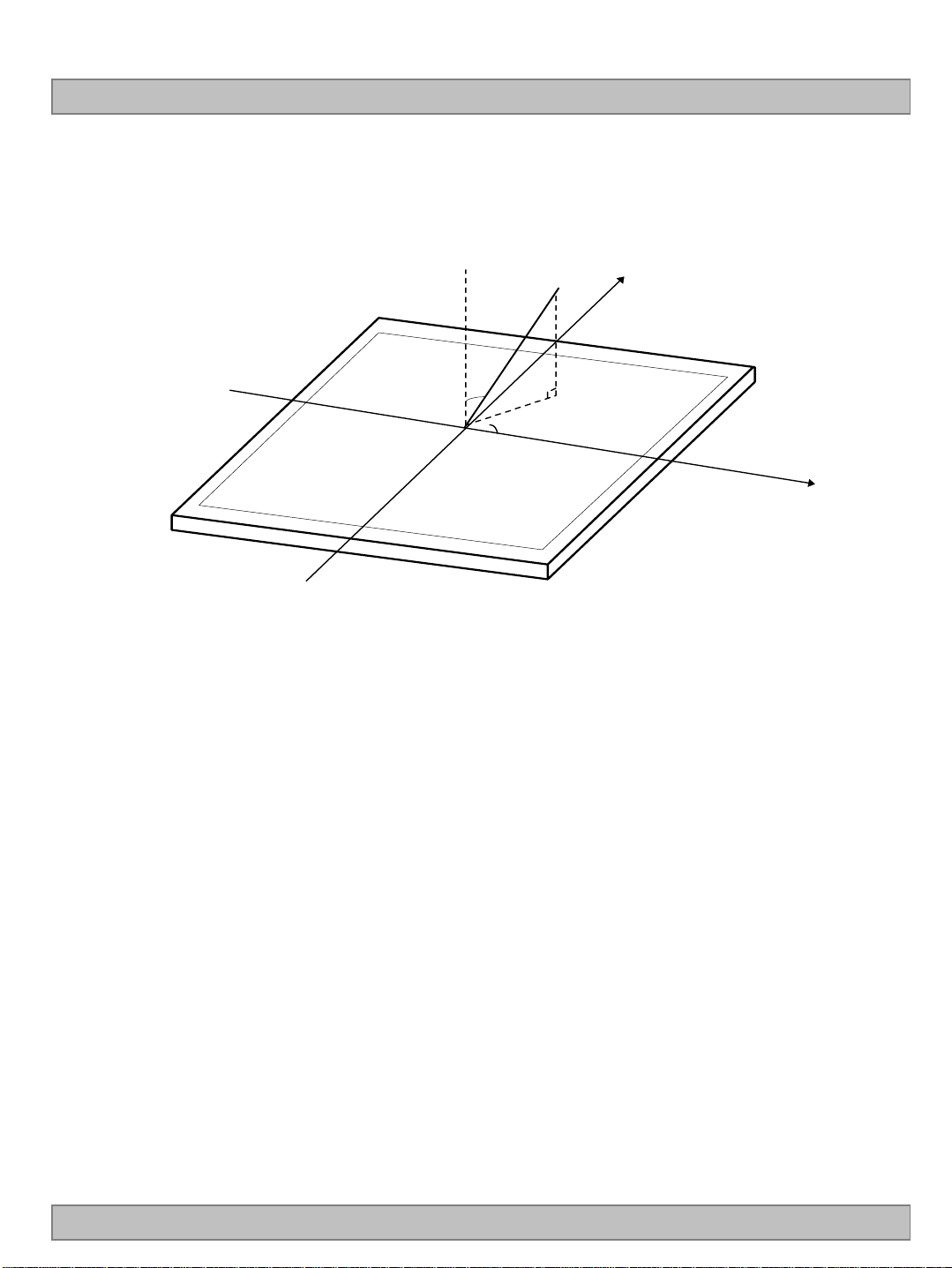
Dimension of viewing angle range
LC320EXN
Product Specification
φ
= 180°, Left
φ
= 270°, Down
Normal
θ
φ
FIG. 4 Viewing Angle
E
Y
φ
= 90°, Up
φ
= 0°, Right
Ver. 1.0
20 / 28
Page 21
Product Specification
5. Mechanical Characteristics
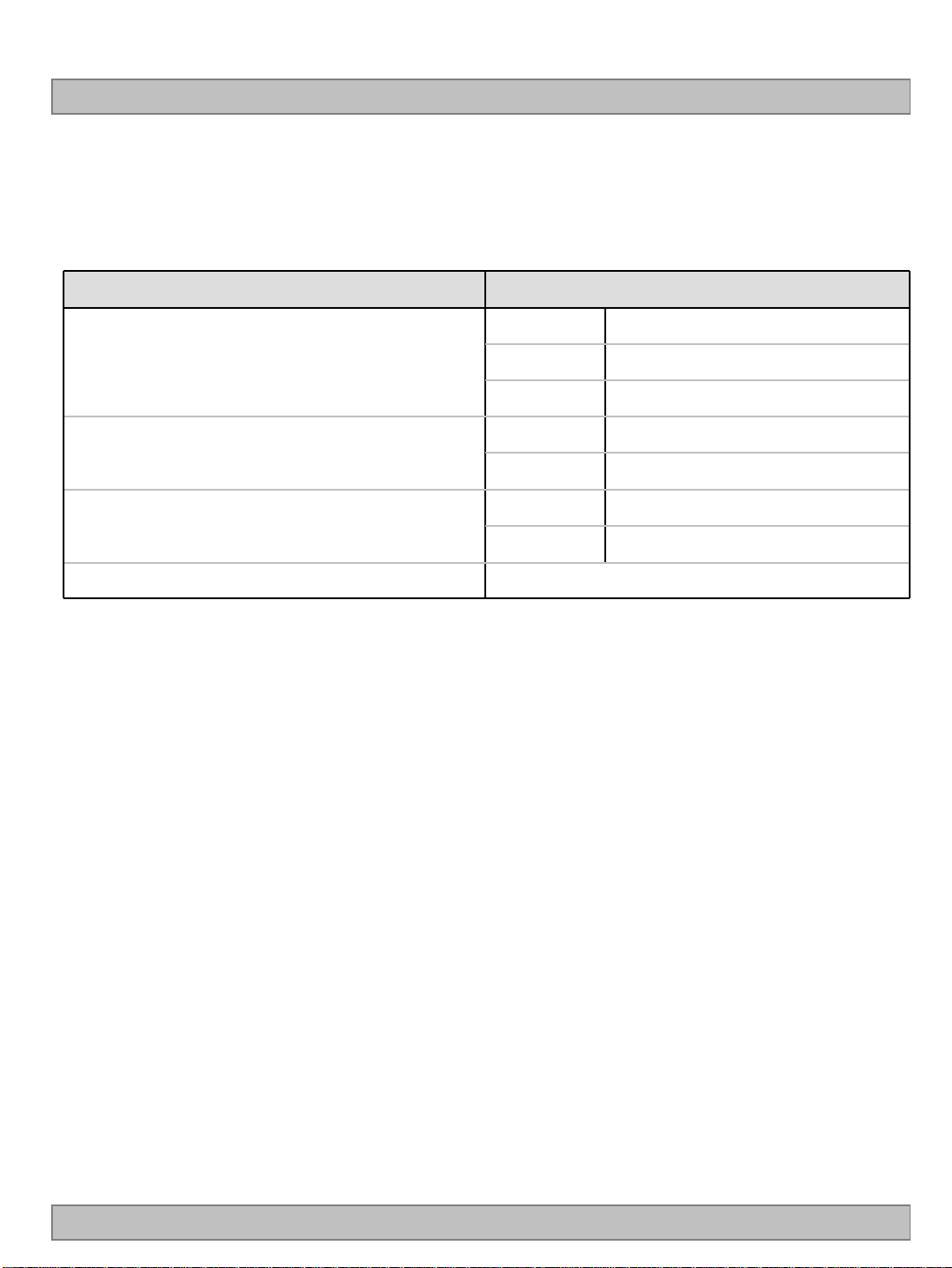
Table 12 provides general mechanical characteristics.
Table 12. MECHANICAL CHARACTE RISTIC S
Item Value
Bezel Area
Active Display Area
LC320EXN
Horizontal 741.4mm
Vertical 435.8 mmOutline Dimension
Depth 23.6 mm
Horizontal 705.4mm
Vertical 399.8mm
Horizontal 697.685mm
Vertical 392.256mm
Weight 5,900 g (Typ.), 6,200 g (Max.)
Note : 1.Please refer to a mechanical drawing in terms of tolerance at the next page.
Ver. 1.0
21 / 28
Page 22
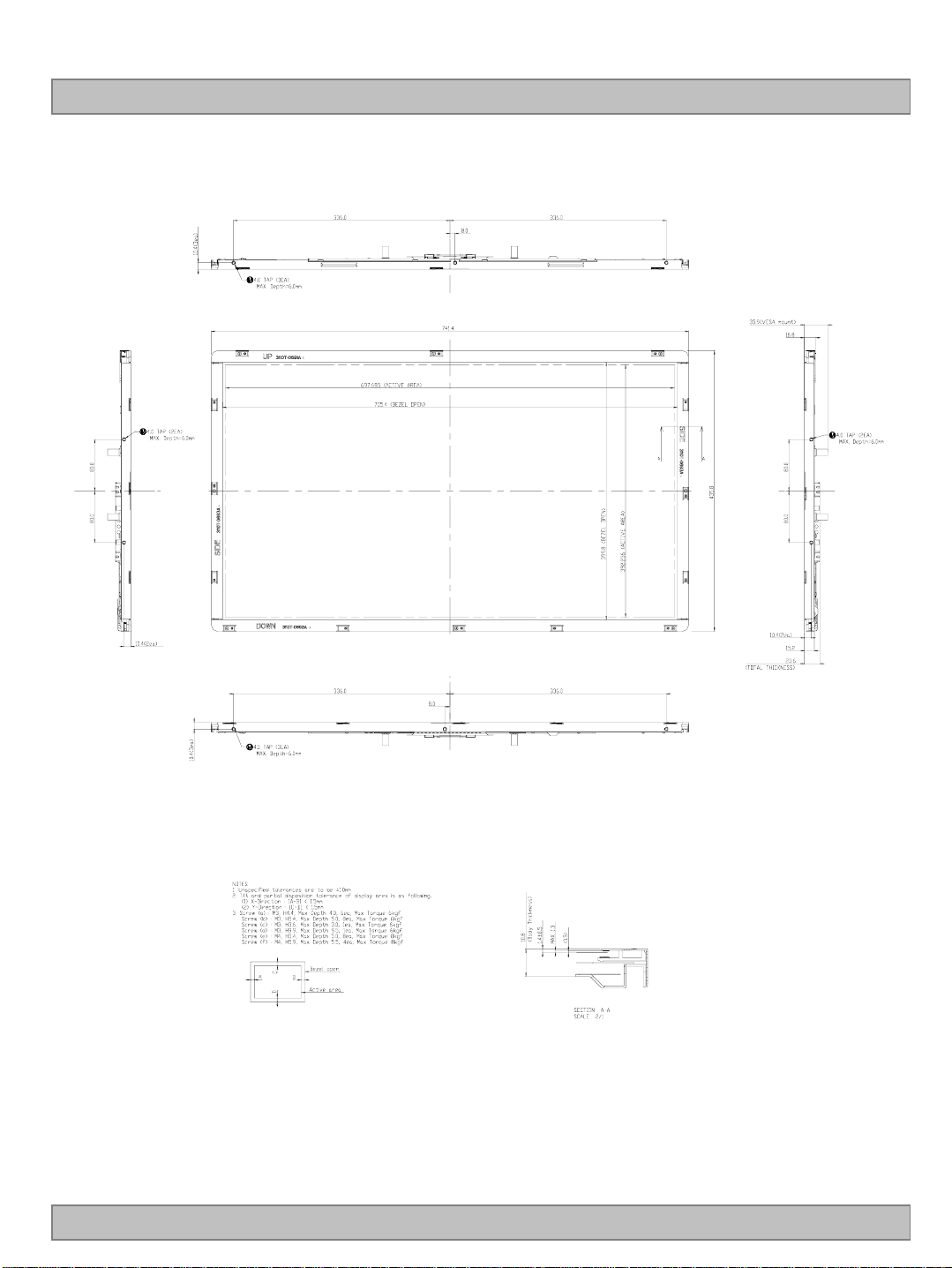
<FRONT VIEW>
LC320EXN
Product Specification
Ver. 1.0
22 / 28
Page 23
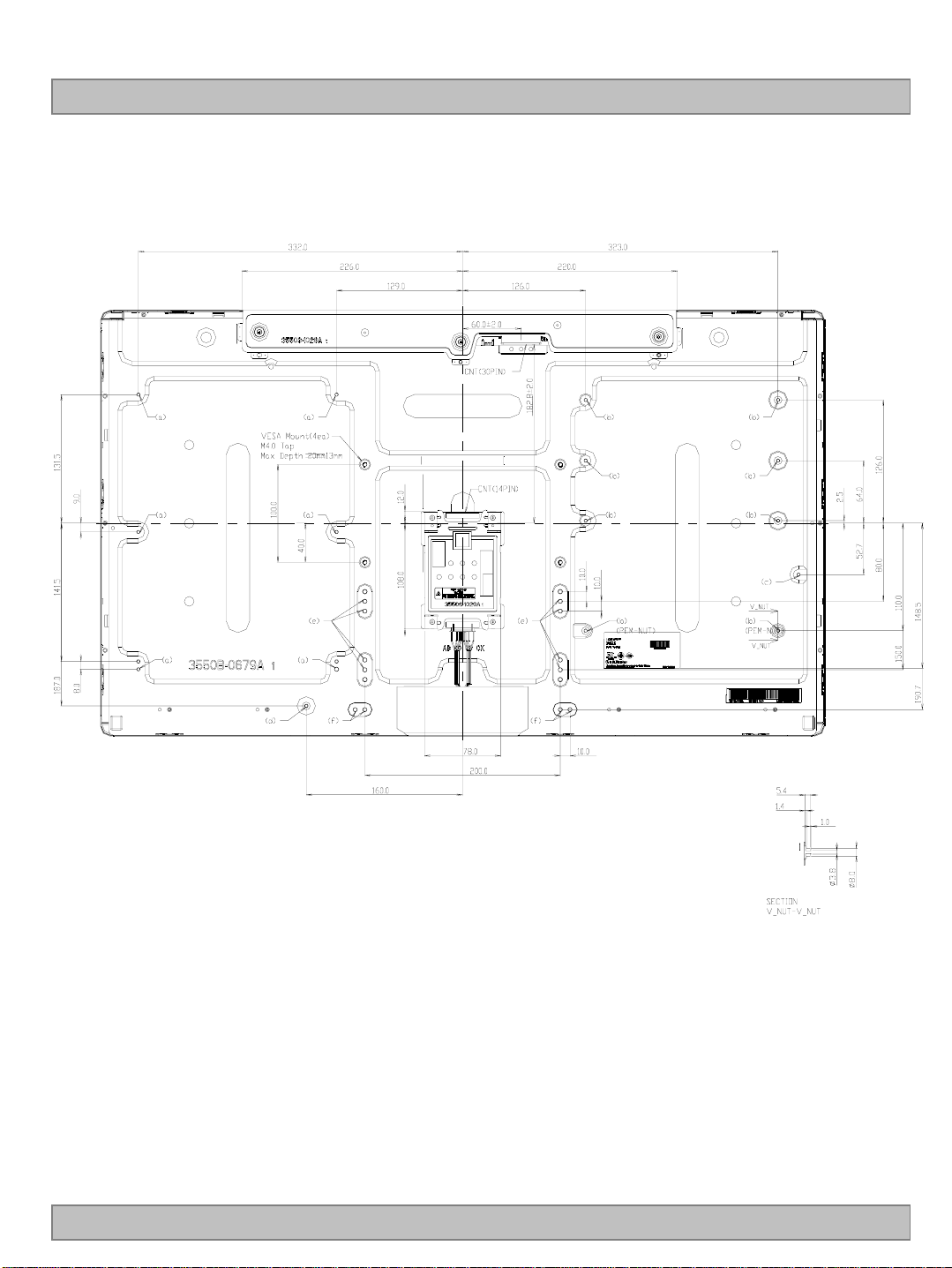
<REAR VIEW><REAR VIEW>
LC320EXN
Product Specification
Ver. 1.0
23 / 28
Page 24
Product Specification
6. Reliability
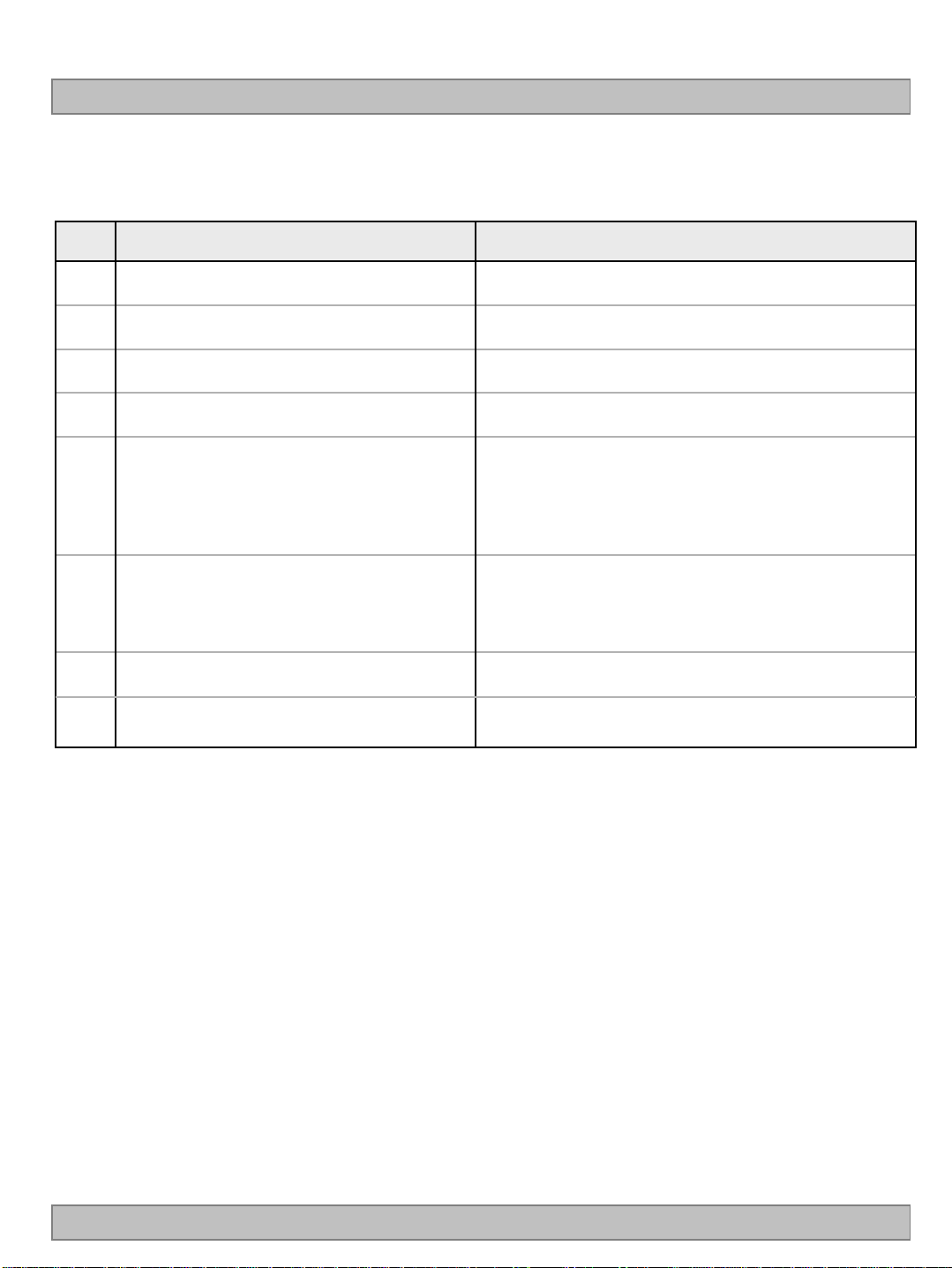
Table 13. ENVIRONMENT TEST CONDITION
No. Test Item Condition
1 High temperature storage test Ta= 60°C, 240h
2 Low temperature storage test Ta= -20°C 240h
3 High temperature operation test Ta= 50°C 50%RH 240h
4 Low temperature operation test Ta= 0°C 240h
Wave form : random
Vibration level : 1.0Grms
Bandwidth : 10-300Hz
Duration : X,Y,Z, 30 min
Each direction per 10 min
5
Vibration test
(non-operating)
LC320EXN
Shock level : 100Grms
Shock test
6
(non-operating)
7 Humidity condition Operation Ta= 40 °C ,90%RH
Altitude operating
8
storage / shipment
Waveform : half sine wave, 2ms
Direction : ±X, ±Y, ±Z
One time each direction
0 - 15,000 ft
0 - 40,000 ft
Note : Before and after Reliability test, LCM should be operated with normal function.
Ver. 1.0
24 / 28
Page 25

Product Specification
7. International Standards
7-1. Safety
a) UL 60065, Seventh Edition, Underwriters Laboratories Inc.
Audio, Video and Similar Electronic Apparatus - Safety Requirements.
b) CAN/CSA C22.2 No.60065:03, Canadian Standards Association.
Audio, Video and Similar Electronic Apparatus - Safety Requirements.
c) EN 60065:2002 + A11:2008, European Committee for Electrotechnical Standardization (CENELEC).
Audio, Video and Similar Electronic Apparatus - Safety Requirements.
d) IEC 60065:2005 + A1:2005, The International Electrotechnical Commission (IEC).
Audio, Video and Similar Electronic Apparatus - Safety Requirements.
(Including report of IEC60825-1:2001 clause 8 and clause 9)
Notes
1. Laser (LED Backlight) Informati on
Class 1M LED Product
IEC60825-1 : 2001
Embedded LED Power (Class1M)
Power : 4.90 mW (Max.)
Wavelength : 277 ~526 (nm)
Width : 1.5 x 0.6 (mm)
LC320EXN
2. Caution
: LED inside.
Class 1M laser (LEDs) radiation when open.
Do not open while operating.
7-2. EMC
a) ANSI C63.4 “American National Standard for Methods of Measurement of Radio-Noise
Emissions from Low-Voltage Electrical and Electronic Equipment in the Range of 9 kHz to 40 GHz.”
American National Standards Institute (ANSI), 2003.
b) CISPR 22 “Information technology equipment – Radio disturbance characteristics – Limit and
methods of measurement." International Special Committee on Radio Interference
(CISPR), 2005.
c) CISPR 13 “Sound and television broadcast receivers and associated equipment – Radio disturbance
characteristics – Limits and method of measurement." International Special Committee on Radio
Interference (CISPR), 2006.
7-3. Environment
a) RoHS, Directive 2002/95/EC of the European Parliament and of the council of 27 January 2003
Ver. 1.0
25 / 28
Page 26
8. Packing
8-1. Information of LCM Label
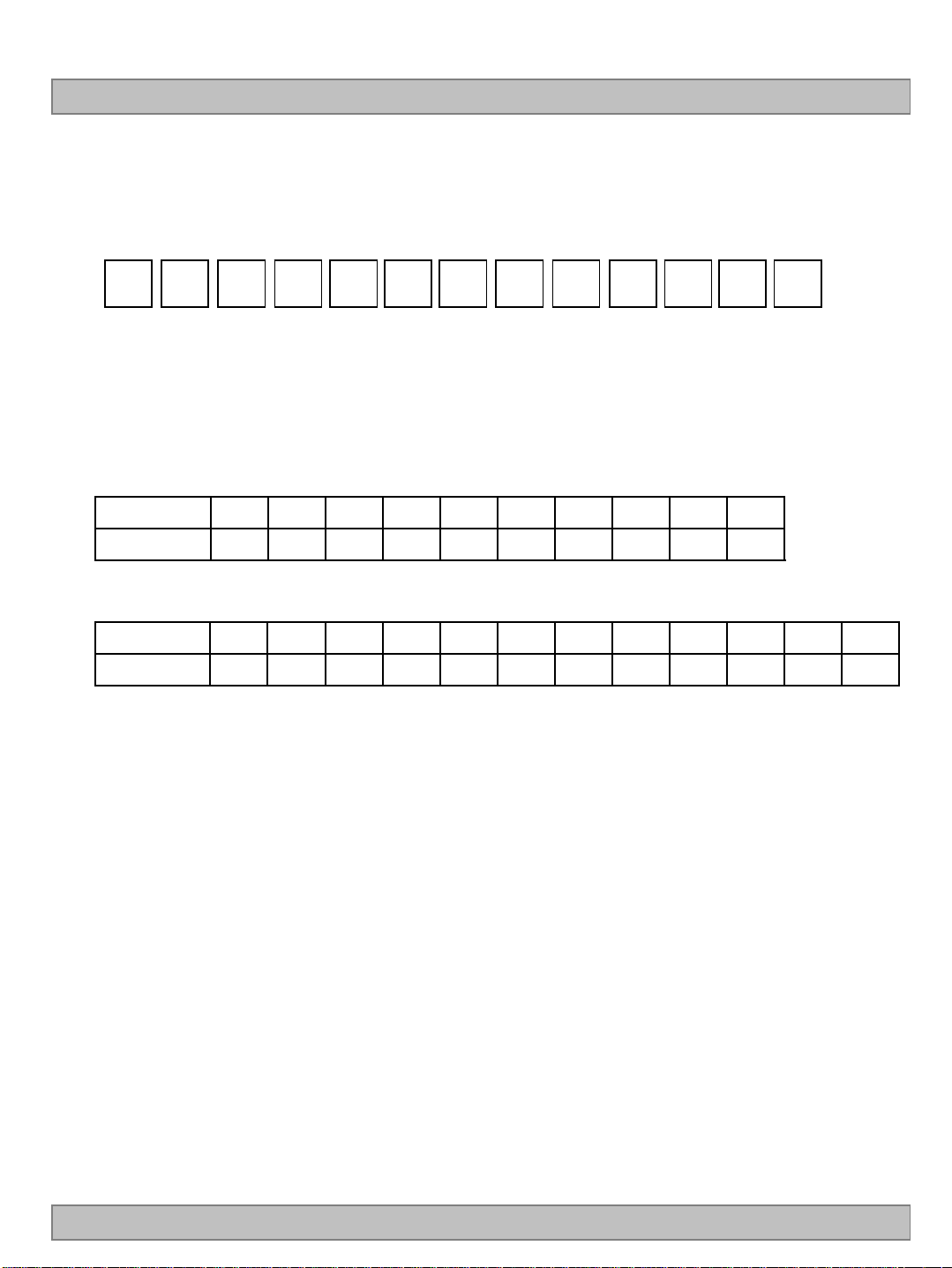
a) Lot Mark
ABCDEFGHI JKLM
A,B,C : SIZE(INCH) D : YEAR
E : MONTH F ~ M : SERIAL NO.
Note
1. YEAR
LC320EXN
Product Specification
Year
Mark
321
200452005
4
200320022001
2006720078200892009
6
2. MONTH
Month
Mark
Apr5May
4
Jun7Jul8Aug9Sep
6
b) Location of Lot Mark
Serial No. is printed on the label. The label is attached to the backside of the LCD module.
This is subject to change without prior notice.
8-2. Packing Form
a) Package quantity in one box : 6 pcs
b) Box size : 840 mm(W) X 365 mm(D) X 530 mm(H)
2010
0
Oct
A
Nov
B
DecMarFebJan
C321
Ver. 1.0
26 / 28
Page 27

LC320EXN
Product Specification
9. Precautions
Please pay attention to the followings when you use this TFT LCD module.
9-1. Mounting Precautions
(1)You must mount a module using specified mounting holes (Details refer to the drawings).
(2) You should consider the mounting structure so that uneven force (ex. Twisted stress) is not applied to the
module. And the case on which a module is mounted should have sufficient strength so that external
force is not transmitted directly to the module.
(3) Please attach the surface transparent protective plate to the surface in order to protect the polarizer.
Transparent protective plate should have sufficient strength in order to the resist external force.
(4) You should adopt radiation structure to satisfy the temperature specification.
(5) Acetic acid type and chlor ine type materials for the cover case are not des irable because the former
generates corrosive gas of attacking the polarizer at high tempe rature and the latte r causes ci rcuit br eak
by electro-chemical reaction.
(6) Do not touch, push or rub the exposed polarizers with glass, tweezers or anything harder than HB
pencil lead. And please do not rub with dust clothes with chemical treatment.
Do not touch the surface of polarizer for bare hand or greasy cloth.(Some cosmetics are detrimental
to the polarizer.)
(7) When the surface becomes dusty, please wipe gently with absorbent cotton or other soft mater ials like
chamois soaks with petroleum benzine. Normal-hexane is recommended for cleaning the adhesives
used to attach front / rear polarizers. Do not use acetone, toluene and alcohol because they cause
chemical damage to the polarizer. * There is no problem of Panel crack under 5kgf / φ10mm
(8) Wipe off saliva or water drops as soon as possible. Their long time contact with polarizer causes
deformations and color fading.
(9) Do not open the case because inside circuits do not have sufficient strength.
9-2. Operating Precautions
(1) The spike noise causes the mis-operation of circuits. It should be lower than following voltage :
V=±200mV(Over and under shoot voltage)
(2) Response time depends on the temperature.(In lower temperature, it becomes longer.)
(3) Brightness depends on the temperature. (In lower temperature, it becomes lower.)
And in lower temperature, response time(requ ired time tha t br ightness is stab le after turned on ) beco mes
longer.
(4) Be careful for condensation at sudden temperature change. Condensation makes damage to polarizer or
electrical contacted parts. And after fading condensation, smear or spot will occur.
(5) When fixed patterns are displayed for a long time, remnant image is likely to occur.
(6) Module has high frequency cir cuits. Sufficient suppression to the elec tromagnetic interference shall be
done by system manufacturers. Grounding and shielding methods may be important to minimized the
interference.
(7) Please do not give any mechanical and/or acoustical impact to LCM. O therwise, LCM can ’t be operated
its full characteristics perfectly.
(8) A screw which is fastened up the steels should be a machine screw.
(if not, it causes metallic foreign material and deal LCM a fatal blow)
(9) Please do not set LCD on its edge.
(10) The conductive material and signal cables are kept away from LED driver inductor to prevent abnormal
display, sound noise and temperature rising.
Ver. 1.0
27 / 28
Page 28

LC320EXN
Product Specification
9-3. Electrostatic Discharge Control
Since a module is composed of electronic circuits, it is not strong to elec trostatic di scharge. Make certain that
treatment persons are connected to ground through wrist band etc. And don’t touch interface pin directly.
9-4. Precautions for Strong Light Exposure
Strong light exposure causes degradation of polarizer and color filter.
9-5. Storage
When storing modules as spares for a long time, the following precautions are necessary.
(1) Store them in a dark place. Do not exp ose t h e mo dul e t o sunli ght or flu oresce nt light. K e ep t h e t emp erat ure
between 5°C and 35°C at normal humidity.
(2) The polarizer surface should not come in contact with any other object.
It is recommended that they be stored in the container in which they were shipped.
9-6. Handling Precautions for Protection Film
(1) The protection film is attached to the bezel with a small masking tape.
When the protection film is peeled off, static electricity is generated between the film and polarizer.
This should be peeled off slowly and care fully by people who are electrically g rounded and with well ionblown equipment or in such a condition, etc.
(2) When the module with protection film a ttached is stored for a long time, sometimes there remains a very
small amount of glue still on the bezel after the protection film is peeled off.
(3) You can remove the glue easily. When the glue remains on the bezel surface or its ves tige is recognized,
please wipe them off with absorbent cotton waste or other soft materia l like chamois soaked with normalhexane.
Ver. 1.0
28 / 28
Page 29
# APPENDIX- I
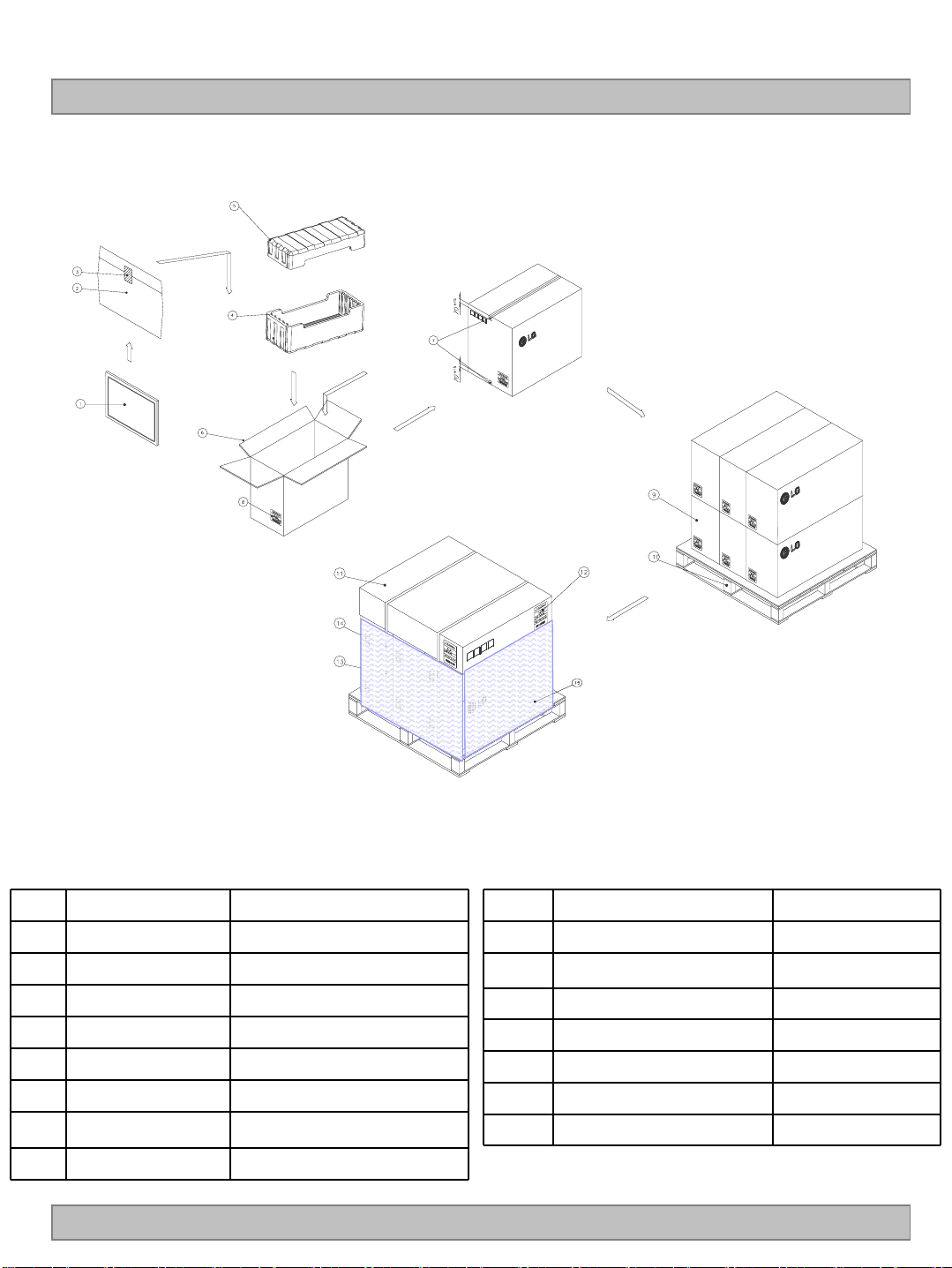
■ Package
LC320EXN
Product Specification
Palletizing Size : 1140 X 870 X 1180.5
Box Quantity : 6 ea
※ Packing Ass`y ※ Pallet Ass`y
NO. DESCRIPTION MATERIAL
1 LCD Module
2BAG AL
3 TAPE MASKING 20MMX50M
4 Packing EPS
5 Packing EPS
6 BOX PAPER(DW)
7 TAPE OPP 70MMX300M
8 Label ART 100X70
Ver. 1.0
NO. DESCRIPTION MATERIAL
9 PACKING ASS’Y
10 PALLET Plywood
11 ANGLE, COVER PAPER(SW)
12 LABEL ART 100X70
13 BAND PP
14 CLIP, BAND STEEL
15 Wrap LLDPE
29 / 28
Page 30
# APPENDIX- II-1
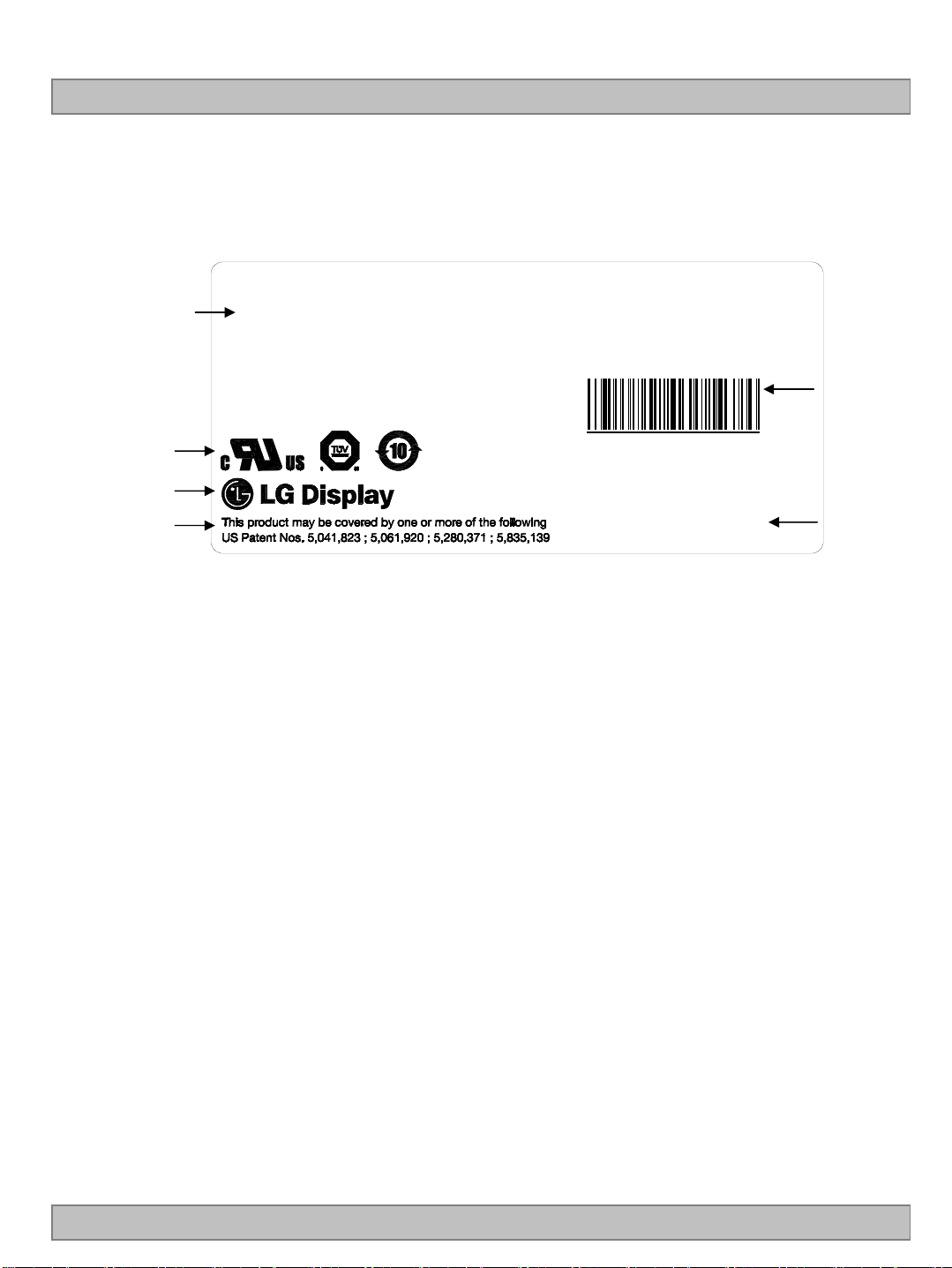
■ LCM Label
LC320EXN
Product Specification
Model
UL, TUV Mark
LGD Logo
US PATENT No.
LC320EXN
(SC)(A1)
RoHS Verified
************* ***
LIGHT GUIDE : >PMMA<
MADE IN KOREA
Serial No.
Origin
Ver. 1.0
30 / 28
Page 31
Product Specification
# APPENDIX- II-2
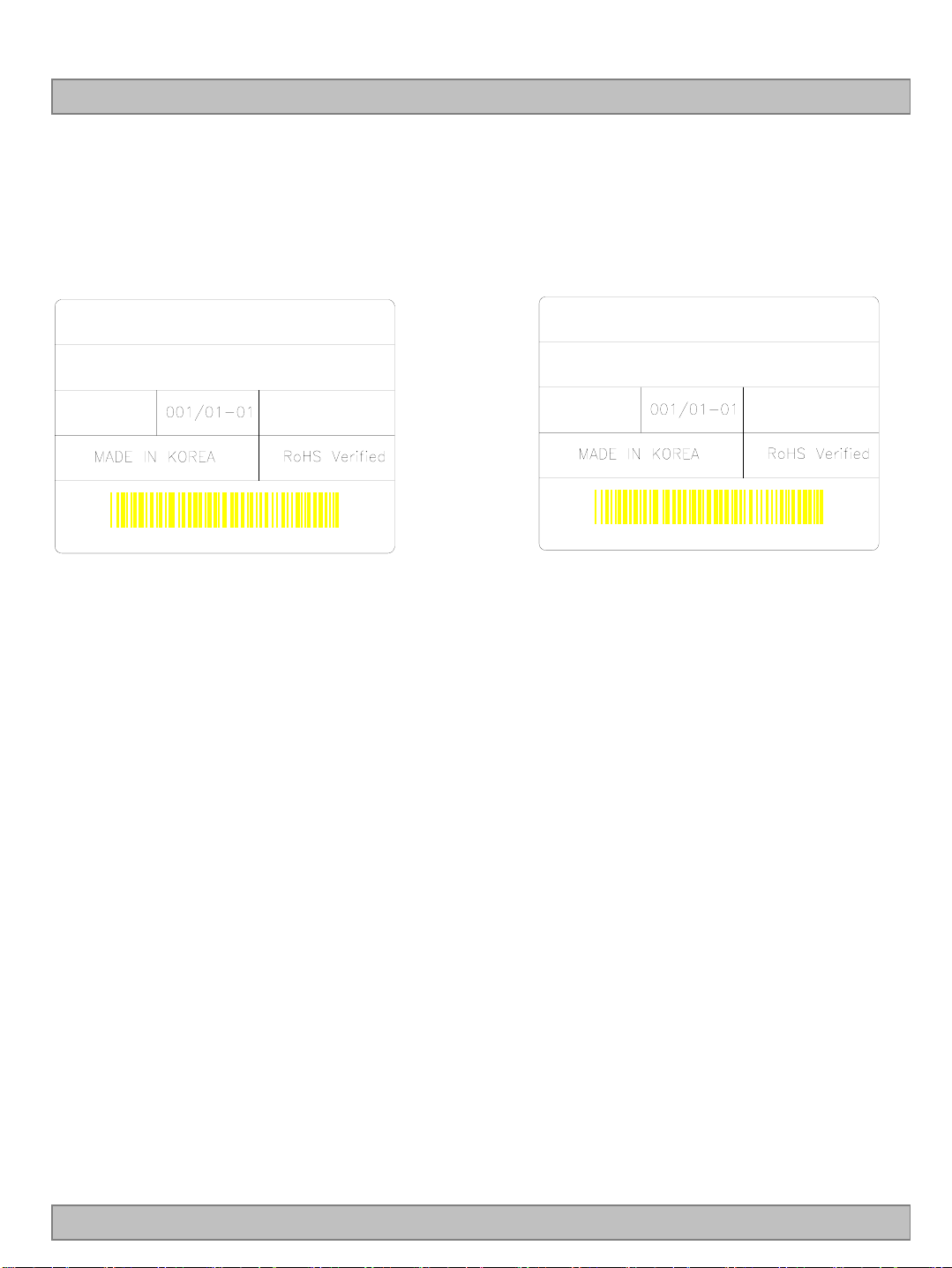
■ Box Label ■ Pallet Label
LC320EXN
X pcs
LC320EXN
SCA1
LC320EXN
SCA1
XX pcs
Ver. 1.0
31 / 28
Page 32
Product Specification
# APPENDIX-III-1
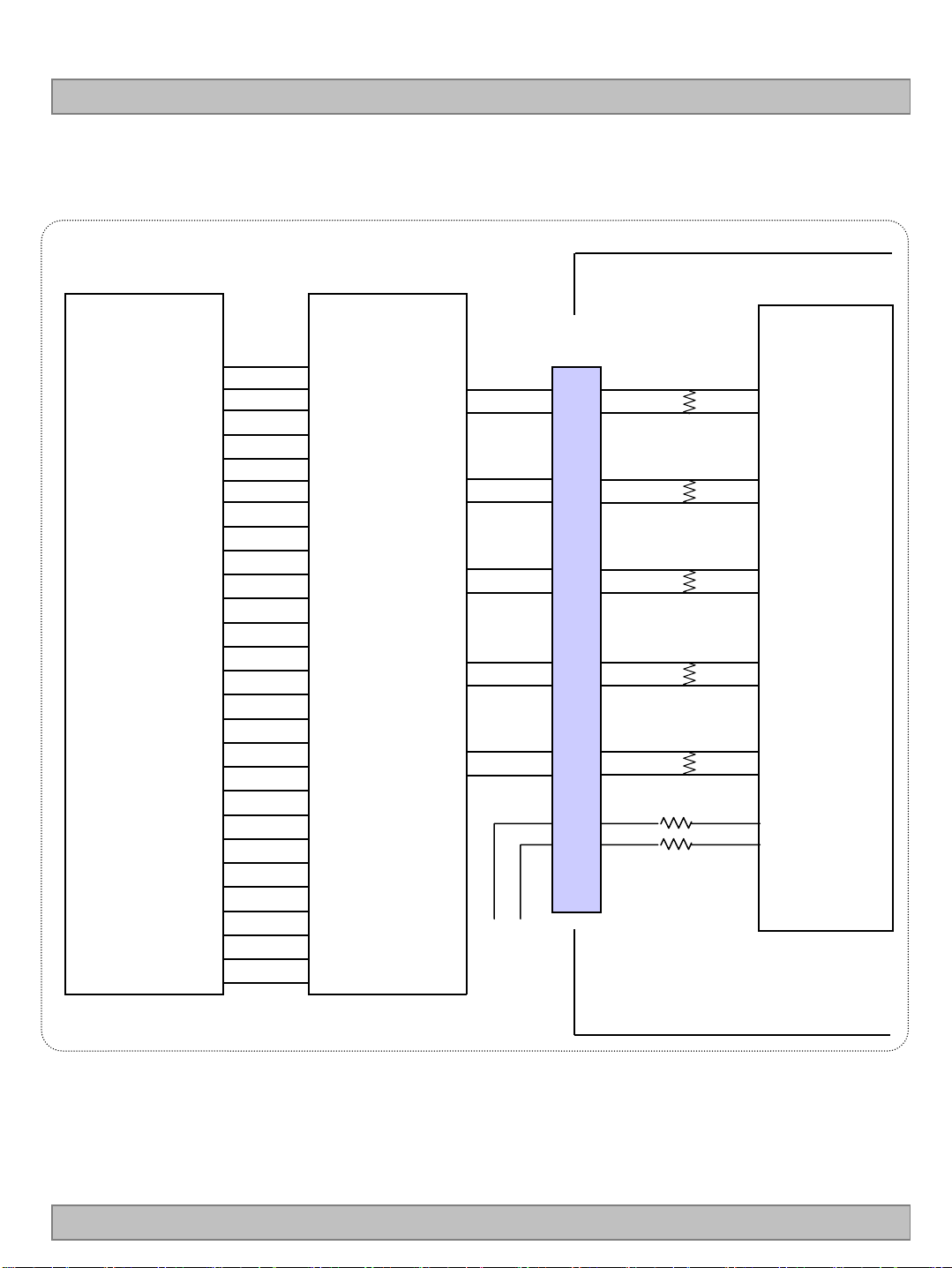
■ Required signal assignment for Flat Link Transmitter(Pin9=“L” or NC)
LC320EXN
Host System
24 Bit
RED0
RED1
RED2
RED3
RED4
RED5
RED6
RED7
GREEN0
GREEN1
GREEN2
GREEN3
GREEN4
GREEN5
GREEN6
GREEN7
BLUE0
BLUE1
BLUE2
BLUE3
BLUE4
BLUE5
BLUE6
BLUE7
Hsync
Vsync
Data Enable
CLOCK
DS90C385
or Compatible
51
52
54
55
56
3
50
2
4
6
7
11
12
14
8
10
15
19
20
22
23
24
16
18
27
28
30
31
TxCLKOUTTxCLKOUT+
TxOUT0TxOUT0+
TxOUT1TxOUT1+
TxOUT2TxOUT2+
TxOUT3TxOUT3+
KDF71G-30S-1H
48
47
46
45
42
41
40
39
38
37
GND
GND
12
13
15
16
18
19
21
22
24
25
30
Timing
Controller
100Ω
100Ω
100Ω
100Ω
100Ω
9
RxIN0RxIN0+
RxIN1RxIN1+
RxIN2RxIN2+
RxCLKINRxCLKIN+
RxIN3RxIN3+
VESA / JEIDA
LCD Test
LCD Module
Notes:
1. The LCD module uses a 100 Ohm(Ω) resistor between positive and negative lines
of each receiver input.
2. Refer to LVDS transmitter data sheet for detail descriptions. (DS90C385 or Compatible)
3. ‘7’ means MSB and ‘0’ means LSB at R,G,B pixel data.
Ver. 1.0
32 / 28
Page 33
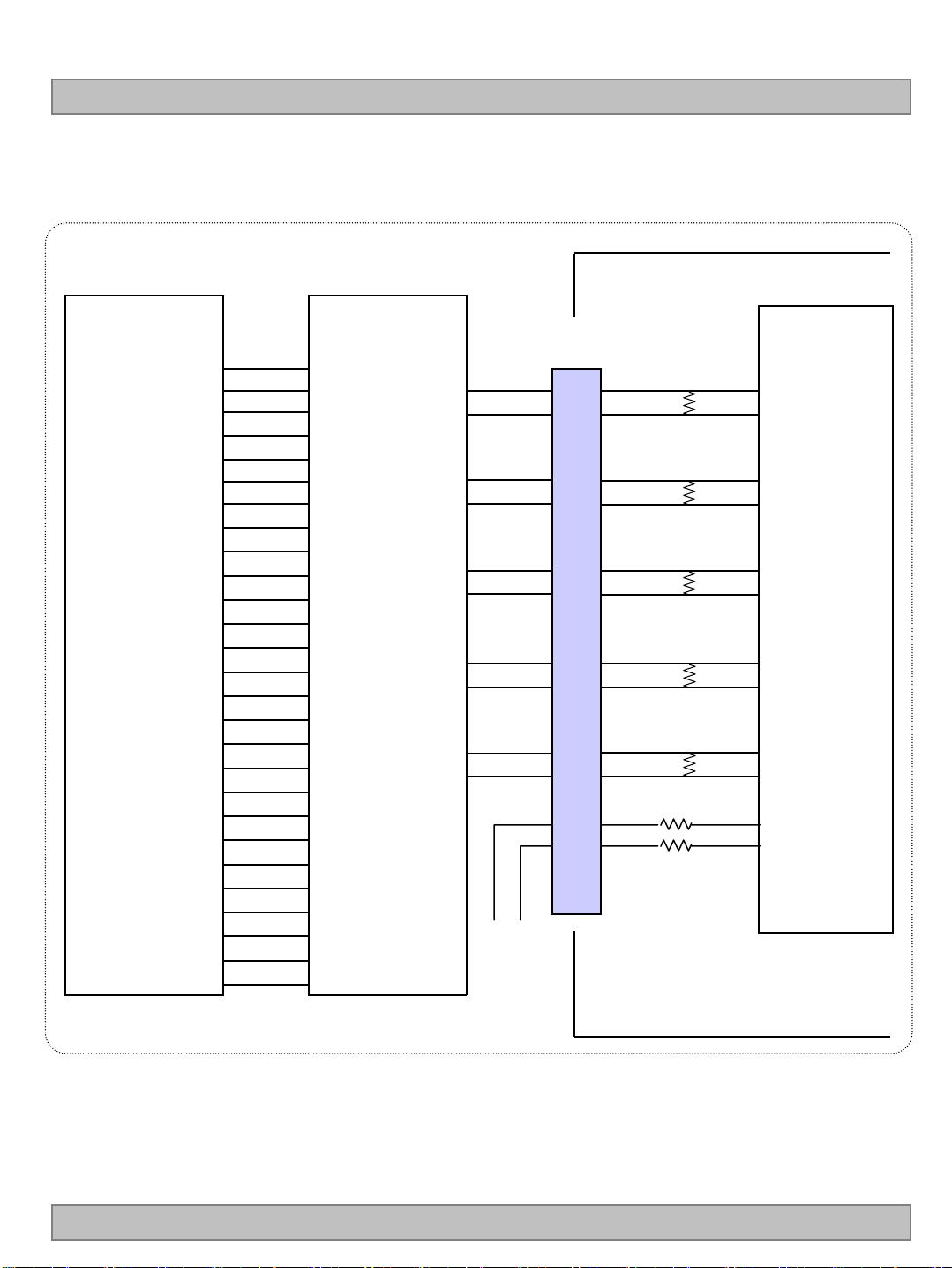
Product Specification
# APPENDIX-III-1
■ Required signal assignment for Flat Link Transmitter(Pin9=“H”)
LC320EXN
Host System
24 Bit
RED0
RED1
RED2
RED3
RED4
RED5
RED6
RED7
GREEN0
GREEN1
GREEN2
GREEN3
GREEN4
GREEN5
GREEN6
GREEN7
BLUE0
BLUE1
BLUE2
BLUE3
BLUE4
BLUE5
BLUE6
BLUE7
Hsync
Vsync
Data Enable
CLOCK
DS90C385
or Compatible
50
2
51
52
54
55
56
3
8
10
4
6
7
11
12
14
16
18
15
19
20
22
23
24
27
28
30
31
TxCLKOUTTxCLKOUT+
TxOUT0TxOUT0+
TxOUT1TxOUT1+
TxOUT2TxOUT2+
TxOUT3TxOUT3+
KDF71G-30S-1H
48
47
46
45
42
41
40
39
38
37
GND
Vcc
12
13
15
16
18
19
21
22
24
25
30
Timing
Controller
100Ω
100Ω
100Ω
100Ω
100Ω
9
RxIN0RxIN0+
RxIN1RxIN1+
RxIN2RxIN2+
RxCLKINRxCLKIN+
RxIN3RxIN3+
VESA /
LCD Test
JEIDA
LCD Module
Notes:
1. The LCD module uses a 100 Ohm(Ω) resistor between positive and negative lines
of each receiver input.
2. Refer to LVDS transmitter data sheet for detail descriptions. (DS90C385 or Compatible)
3. ‘7’ means MSB and ‘0’ means LSB at R,G,B pixel data.
Ver. 1.0
33 / 28
Page 34
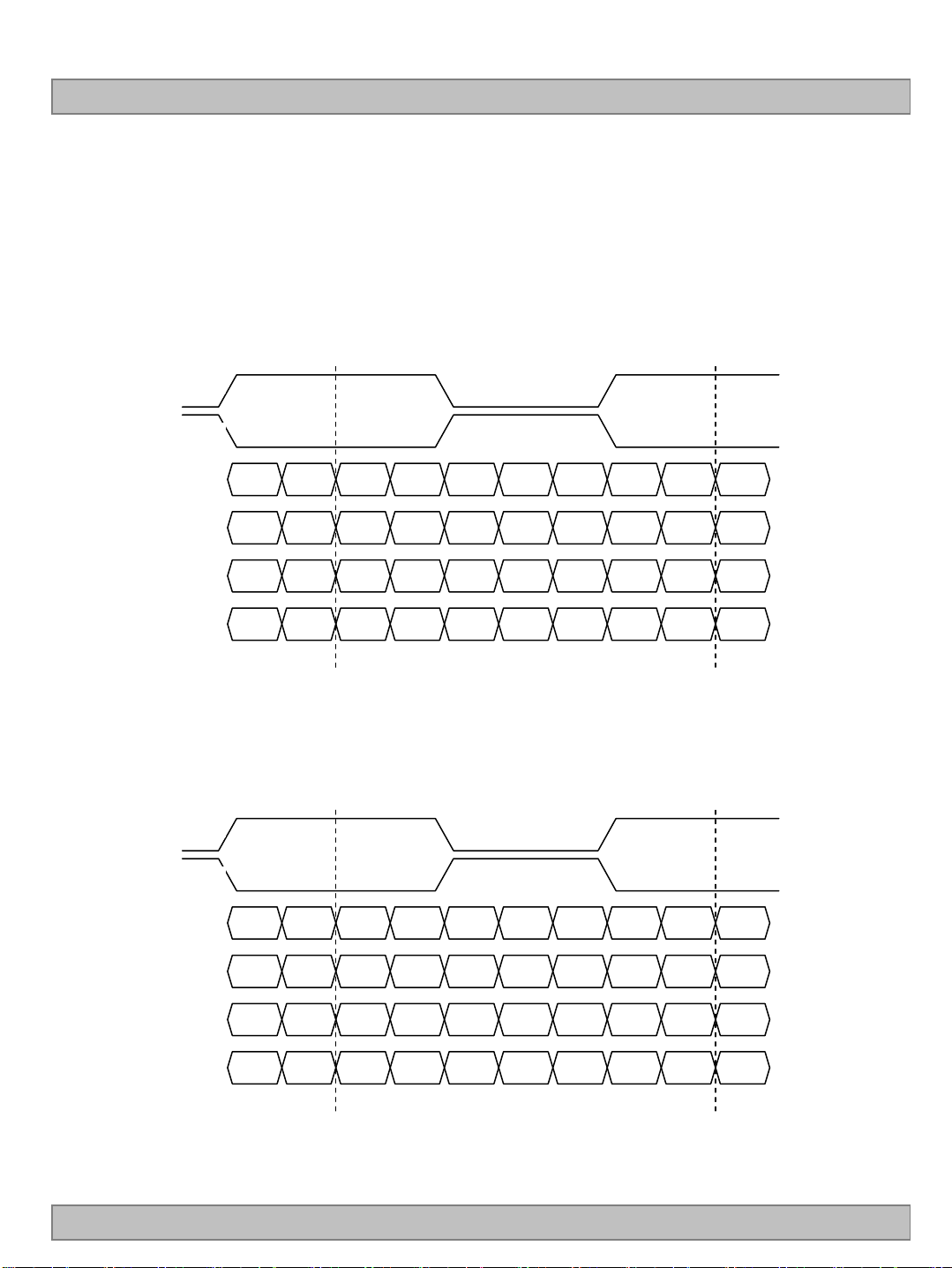
# APPENDIX- III-1
■ LVDS Select : “H” Data-Mapping (JEIDA format)
RCLKP
RCLKM
LC320EXN
Product Specification
LVDS Data-Mapping info. (8bit)
RAP
RBP
RCP
RDP
R17 R16 R15 R14G12 R13R12’ R12R13’ G12”
B12 G17 G16 G15B13 G14G13’ G13G14’ B13”
V
SYNCHSYNC
B11 B10 G11 G10X R11R10’ R10R11’ X”
B17 B16DE B15B14’ B14B15’ DE”
■ LVDS Select : “L” Data-Mapping (VESA format)
RCLKP
RCLKM
RAP
RBP
R15 R14 R13 R12G10 R11R10’ R10R11’ G10”
B10 G15 G14 G13B11 G12G11’ G11G12’ B15”
Ver. 1.0
RCP
RDP
V
SYNCHSYNC
B17 B16 G17 G16X R17R16’ R16R17’ X”
B15 B14DE B13B12’ B12B13’ DE”
34 / 28
Page 35
Product Specification
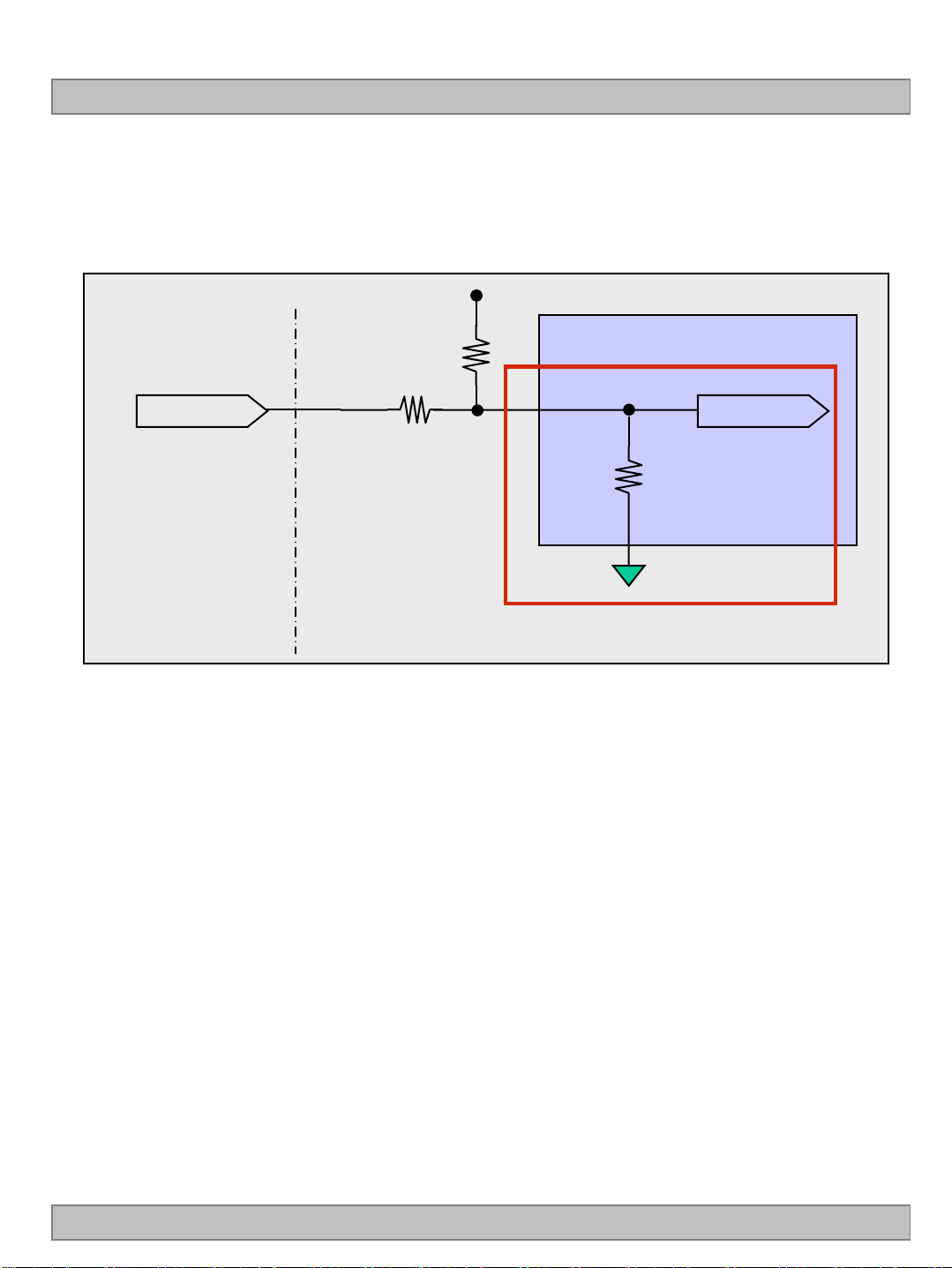
# APPENDIX- III-2
■ Option Pin Circuit Block Diagram
1) Circuit Block Diagram of LVDS Format Selection pin
VCC
Open
Selector (Pin 9) Selector
1KΩ
LC320EXN
50KΩ
ASIC
(TCON)
System Side LCM Side
Ver. 1.0
35 / 28
Page 36
LC320EXN
Product Specification
# APPENDIX- IV
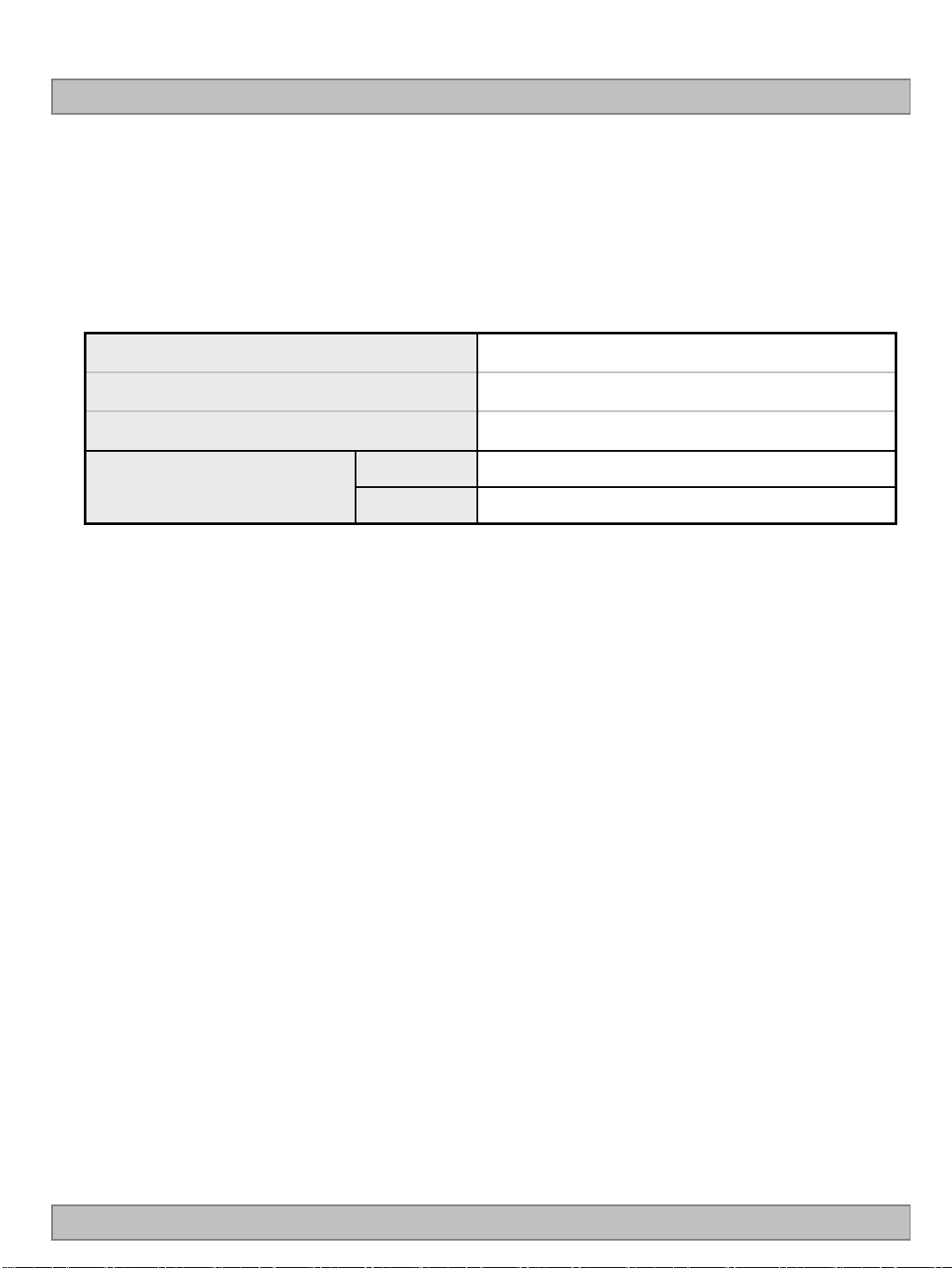
■ Humming Noise Level
These are measurement method and condition of Humming Noise Level for LC320EXN-SCA1 model of
RV sample conditions
Type of room Anechoic
Distance to display
Measurement Point
Humming Noise Level
0.5m (Typical)
@ LCM Center
Front Typ 19dBA, Max 20dBA
Rear
Max 25dBA
Ver. 1.0
36 / 28
 Loading...