

Page 1
- Data Brochure
•
•
•
•
•
•
•
•
D 161
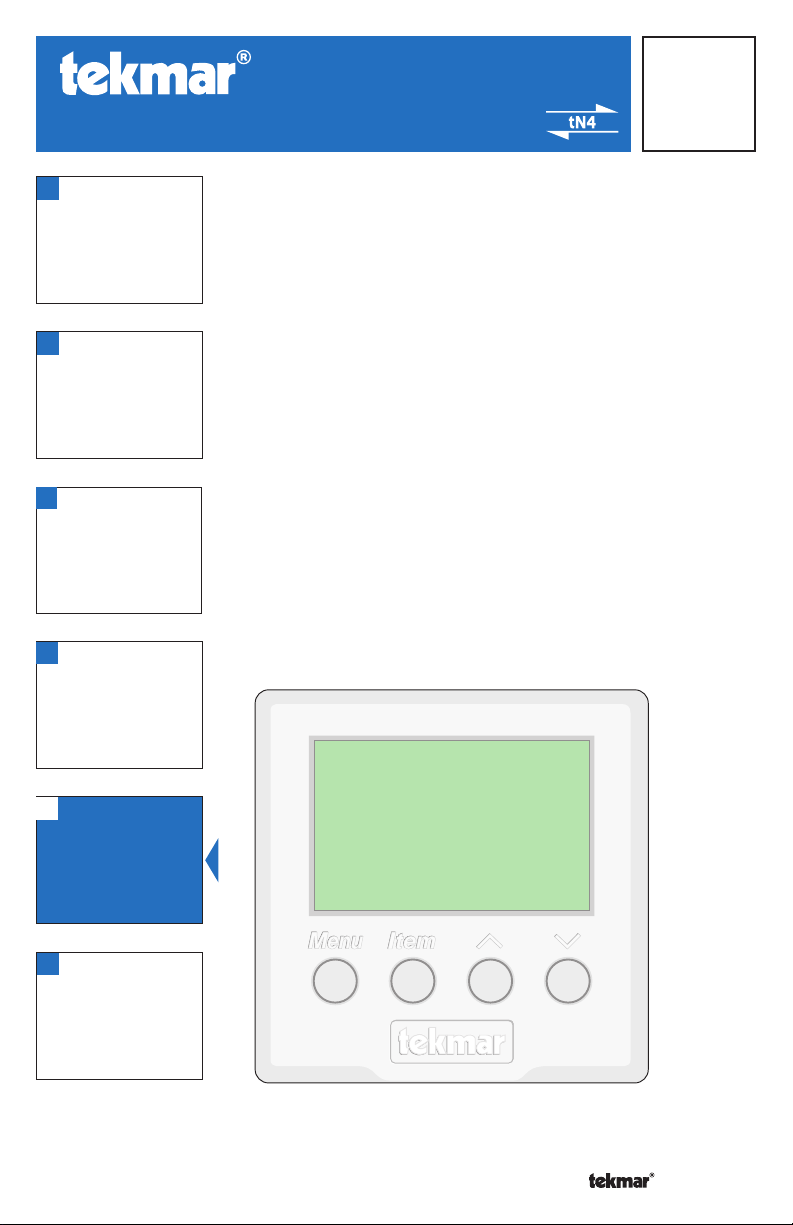
tekmarNet®4 Setpoint Control 161
1
Information
Brochure
Choose controls
to match
application
2
Application
Brochure
Design your
mechanical
applications
3
Rough In
Wiring
Rough-in
wiring
instructions
4
Wiring
Brochure
Wiring and
installation of
specific control
Introduction
The Setpoint Control 161 is a single stage heat setpoint
control that can operate on an On / Off differential or can
operate on Pulse Width Modulation. The control includes
special modes for hot tub, domestic hot water tank and
radiant floor applications.
Features
• tN4 Compatible
• On / Off Differential
• Hot Tub Operation
• DHW Tank Operation
• Floor Operation
• Exercising
• Scenes
• Temperature Sensor Input
08/07
5
Data
Brochure
Control settings
and sequence of
operation
6
Job
Record
Record settings &
wiring details for
future reference
1 of 36 © 2007 D 161 - 08/07
Page 2
•
•
Table of Contents
/
•
•
Table of Contents .............................. 2
Display and DIP Switches ................ 2
Dip Switches ................................. 2
Access Levels ............................... 3
Display .......................................... 3
Symbol Description ........................ 4
User Interface ............................... 4
Application Overview ........................ 5
On / Off Differential ......................... 5
Pulse Width Modulation ................ 6
Display Menus ................................. 7
VIEW Menu ................................... 7
ADJUST Menu ..............................10
SCENE Menu ...............................15
SCHEDULE Menu ........................16
MISCELLANEOUS Menu .............17
Sequence of Operation ...................19
Mode 1 - On / Off Setpoint ...........19
Mode 2 - Hot Tub ..........................19
Mode 3 - DHW Tank ................... 20
Mode 4 - Floor ............................ 21
Remote Enable / Disable ................ 22
Sensor Input ................................... 23
Setting the Schedule ...................... 23
Scenes ............................................ 24
Restore Factory Defaults ................ 25
Temperature Units .......................... 25
Backlight ........................................ 25
tN4 Features .................................. 25
Error Messages .............................. 28
Cleaning the Control ...................... 34
Warranty ......................................... 36
Display and DIP Switches
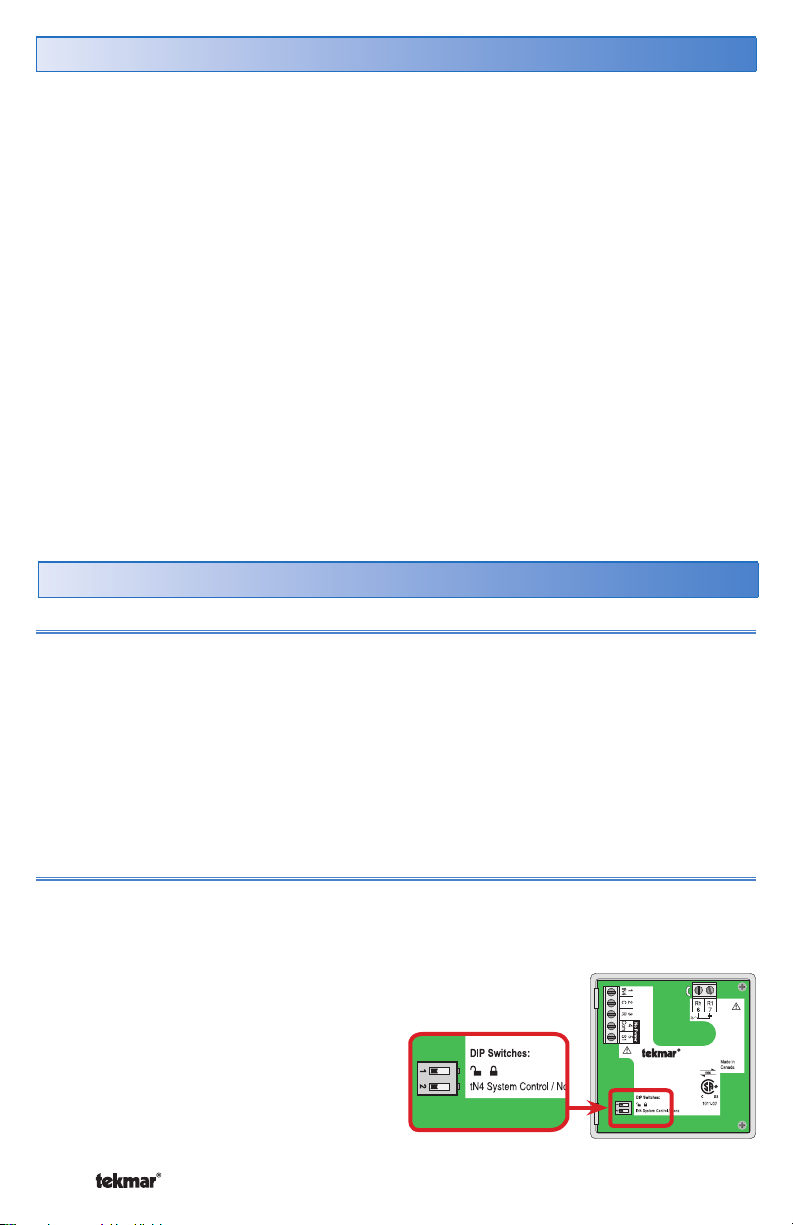
DIP Switches
Lock / Unlock (DIP Switch #1)
Use the Lock / Unlock DIP switch to lock or unlock the Access Level of the 161.
• To unlock the Access Level, set the DIP switch to the unlocked (left) position.
• To lock the Access Level, set the DIP switch to the locked (right) position. Once
locked, a padlock is displayed in the lower right corner of the display and the Access
Level cannot be changed.
Note: The tN4 System Control’s Lock / Unlock DIP switch overrides the Lock / Unlock
DIP switch on the 161. Set the tN4 System Control’s Lock / Unlock DIP switch to the
Unlock position before Access Levels can be changed on the setpoint control.
tN4 System Control (DIP Switch #2)
A tN4 System Control is a control, not a thermostat, that the Setpoint Control 161
connects to through the tN4 bus. All tN4 compatible Outdoor Reset Modules are
tN4 System Controls.
For product instructions see brochure
• If the setpoint control is connected
to a tN4 System Control, set the tN4
System Control DIP switch to tN4
System Control (left position).
• If the setpoint control is not connected
to a tN4 System Control, set the tN4
System Control DIP switch to None
(right position).
© 2007 D 161 - 08/07 2 of 36
Use at least 194°F (90°C) conductors
tN4 Setpoint Control 161
One Stage Heat
24 V ±10% 50/60 Hz 1.7 VA
Power:
24 V (ac) 2 A
Relays:
/
Cut jumper to
isolate relay
Feb 2006
Lot 1948
Meets Class B:
Canadian ICES
FCC Part 15
161
Page 3
•
•
•
•
•
Access Levels
The Access Level restricts the number of Menus, Items and Adjustments that can
be accessed by the user. The Access Level setting is found in the Miscellaneous
(MISC) menu. Select the appropriate access level for the people who work with the
setpoint control on a regular basis.
The 161 has five Access Levels:
• Advanced
• Installer
• User (USEr): for property owners
• Limited (LTD): limited temperature adjustment
• Secure (SEC): for commercial and public installations
In the Limited access level, the temperature can only be adjusted by +/-3°F (1.5°C)
from the temperature setting entered prior to entering the Limited access level.
In the Secure access level, all settings, including the temperature, cannot be
changed.
For more information, see the Miscellaneous (MISC) Menu section.
In the following menu tables, the access level the item is visible in is shown in the
access column.
To adjust the Access Level:
1. Set the Unlock / Lock DIP switch to the unlock position. If a tN4 System Control
is connected to the 161, the Unlock / Lock DIP switch on the tN4 System Control
must be set to the unlock position.
2. Use the Menu button to select the MISC menu.
3. Use the Item button to select the Access item.
4. Use the Up and Down button to select the required Access Level.
(ADV)
: access to all settings
(InST)
: settings required for installation
Display
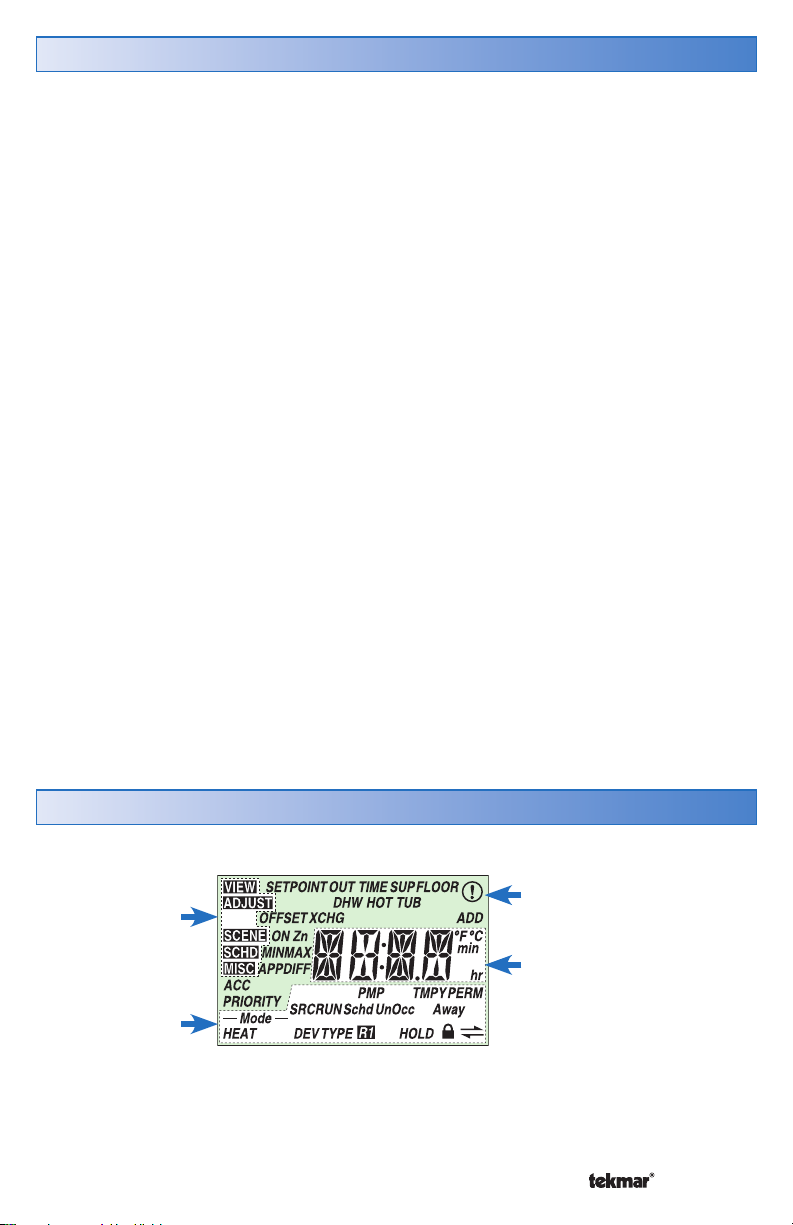
Menu Field
Displays the
current menu
Status Field
Displays the
current status
of the control’s
inputs, outputs
and operation
3 of 32 © 2007 D 161 - 08/07
Item Field
Displays an abbreviated
name of the selected item
Number Field
Displays the current value
of the selected item
Page 4
Symbol Description
•
•
•
•
•
•
•
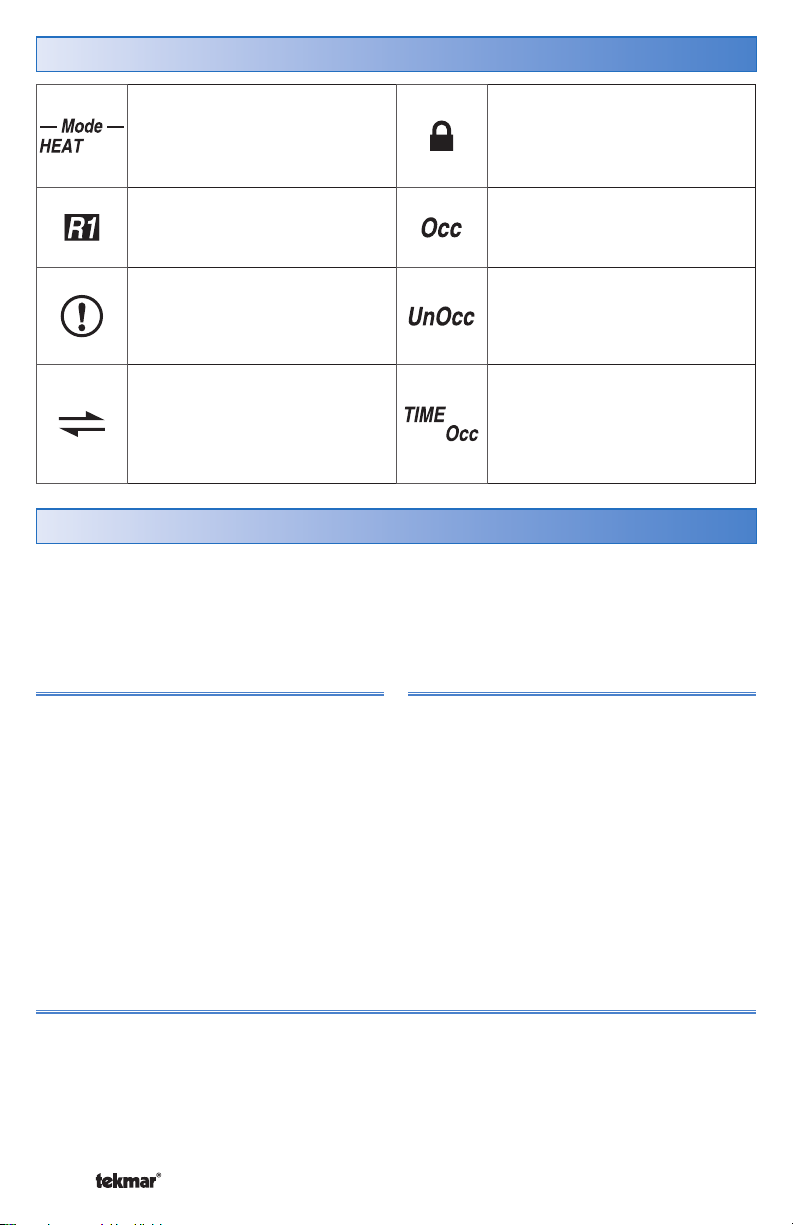
MODE OF OPERATION
Displays whether the device
is in heating or off mode.
RELAY 1
Displays when relay contact
1 is closed.
WARNING
An error is present.
tN4 COMMUNICATION
A tN4 network is detected.
LOCK
The Access Levels are
locked or a menu option is
visible but not adjustable.
OCCUPIED
Displays when operating at
the occupied temperature.
UNOCCUPIED
Displays when operating
at the unoccupied setback
temperature.
TIME OCCUPIED
Displays when operating
temporarily at the occupied
temperature due to a remote
enable or manual enable.
User Interface
Use the User Interface available on the Liquid Crystal Display (LCD) to setup and
monitor the operation of the setpoint control. Use the four push buttons below the
LCD (Menu, Item, Up, Down) to select settings. As the settings are entered, record
the settings in the Job Record J 161.
Menu
The menus display in the Menu Field at
the left of the LCD.
Up to 5 menus are available:
• VIEW
• ADJUST
• SCENE
• SCHD (Schedule)
• MISC (Miscellaneous)
To select a menu, press and release the
Menu button.
Item
In each menu, a group of items can be
selected. The abbreviated name of the
selected item displays in the Item field of
the LCD display.
• To view the next available item, press
and release the Item button.
• To view the previous item, hold down
the Item button and press and release
the Up button.
Adjusting a Setting
To adjust a setting:
1. Use the Menu button to select the appropriate menu.
2. Use the Item button to select a menu item.
3. Use the Up or Down button to adjust the setting.
© 2007 D 161 - 08/07 4 of 36
Page 5
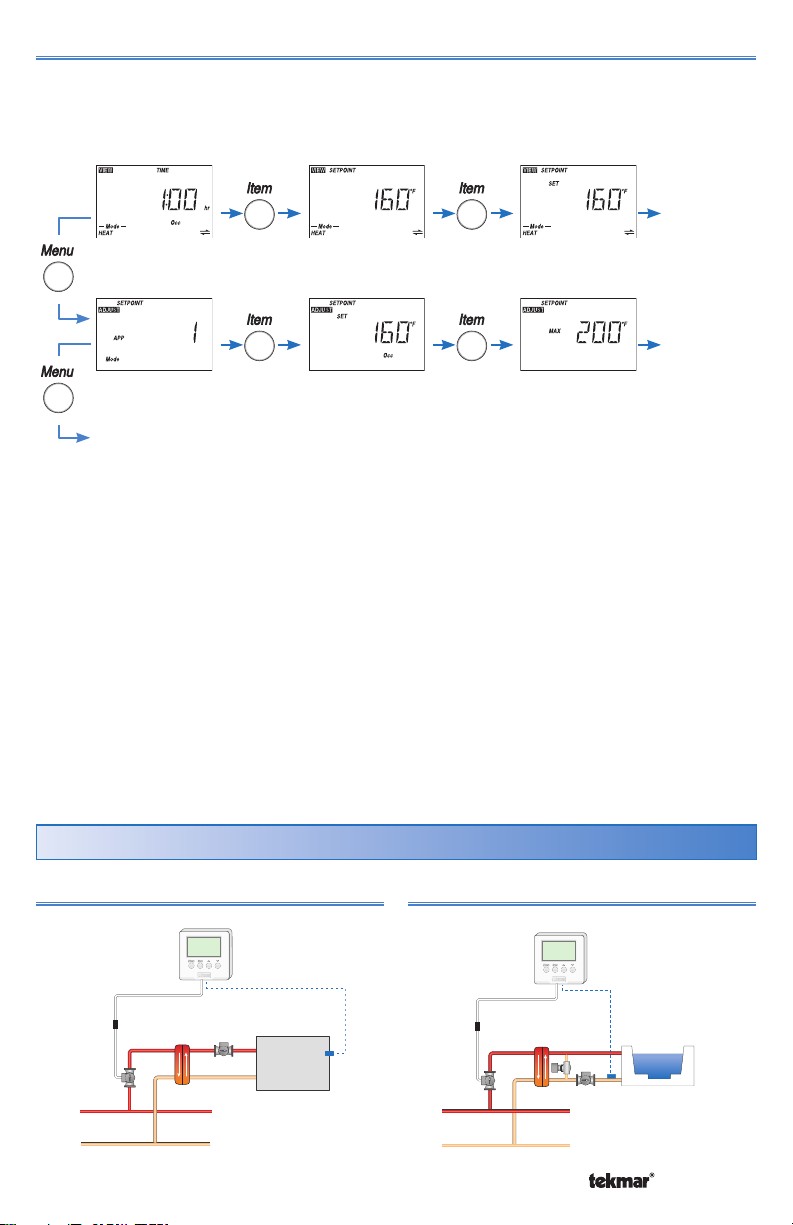
Default Item
To set the default item in the VIEW Menu, display item for more than five seconds.
After navigating menus, the display reverts back to the default item after 60 seconds
of button inactivity.
Continue to
next Item
Continue to
next Item
Continue to next Menu
Application Overview
The Setpoint Control 161 is designed to support four different applications. The items
shown in the VIEW and ADJUST Menu change depending on the Application Mode.
Set the application mode as follows:
1) Setpoint
2) Hot Tub
3) DHW Tank
4) Floor
The VIEW and ADJUST menus list which of the four application items are visible
based upon the mode column.
The TIME, SCENE, SCHD (Schedule) and MISC (Miscellaneous) menus are the
same for the four application modes.
Applications: On / Off Differential
Mode 1 Setpoint (On / Off) Mode 2 Hot Tub
Load
5 of 32 © 2007 D 161 - 08/07
Page 6
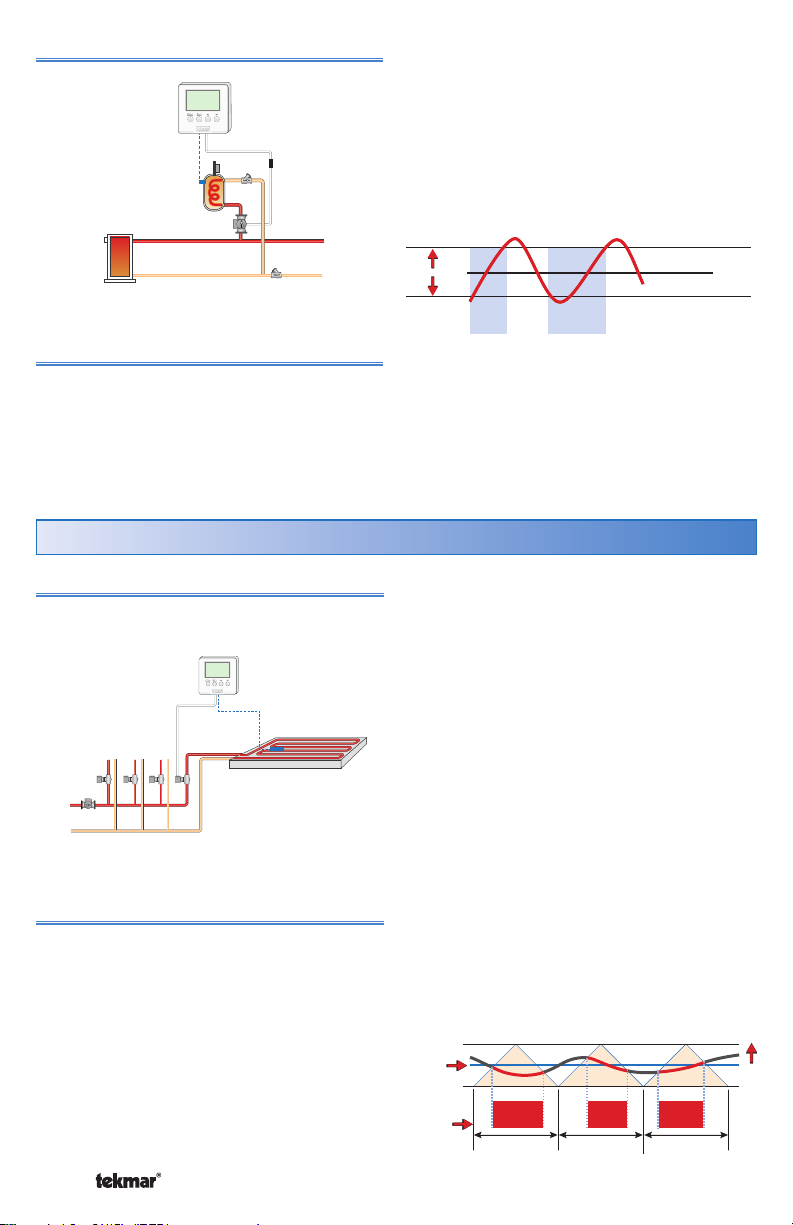
Mode 3 DHW Tank
S
e
t
p
o
i
n
t
Heating Operation
When heating, the setpoint control turns
on Relay 1 when the temperature falls to
1/2 of the differential below the setpoint
and turns off Relay 1 once the temperature
reaches 1/2 of the differential above the
setpoint.
Differential
Relay 1 On / Off Differential
Operation
The On / Off Differential operates by
centering a differential range around
the target setpoint temperature. On / Off
differentials are best suited to heating loads
that quickly change temperature.
Applications: Pulse Width Modulation
Heating On / Off Differential
Relay 1
On
Relay 1
On
Target + ½ Differential
Tar get
Target – ½ Differential
Mode 4 Floor
Relay 1 Pulse Width Modulation
(PWM) Operation
PWM operates by centering the throttling
range around the target setpoint temperature.
PWM is best suited for large heating loads
that do not change rapidly in temperature
such as radiant floors.
Heating Operation
When the temperature is at the setpoint,
Relay 1 is on for 50% of a cycle and off
for 50% of a cycle. When the temperature
is 1/2 of the throttling range below the
setpoint, Relay 1 is on for 100% of a
cycle. When the temperature is 1/2 of the
throttling range above the setpoint, Relay
1 is off for 100% of a cycle. For ranges
within the throttling range, Relay 1’s on
time increases linearly as temperature
falls. The throttling range is fixed at 3°F
(1.5°C).
The cycle length is either the same as
the tN4 system control, or when a tN4
system control is not present, the cycle
length is fixed at 15 minutes.
Heating PWM Operation
Set Heat
Heat
Relay 1
On
Relay 1OnRelay 1
On
Cycle Length
Warmer
© 2007 D 161 - 08/07 6 of 36
Page 7
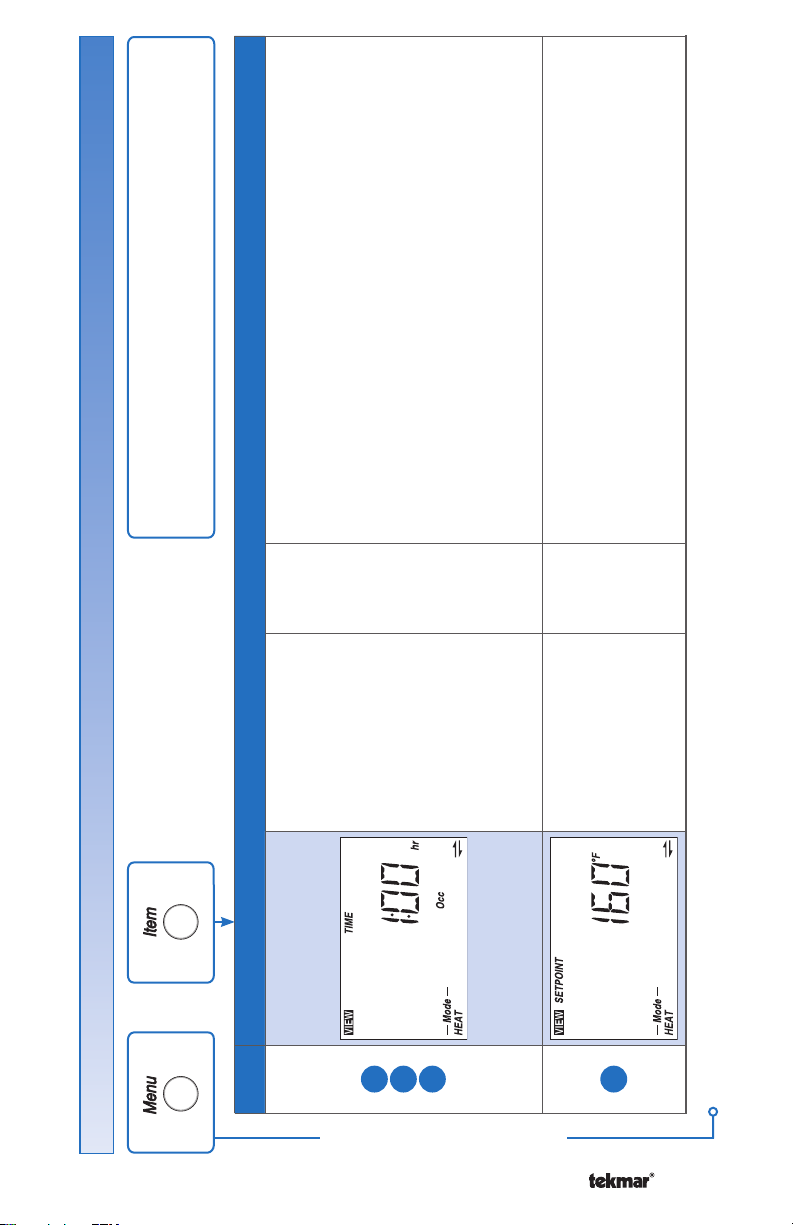
The VIEW menu items display the current operating
temperatures and status information of the system.
OCCUPIED TIME SECTION B, D, E
Displays the amount of time left on the manual override.
The setpoint device operates at the Occupied temperature
and then reverts back Scheduled temperature. Time
counts down to 0:00 hours.
Cancel the override by pressing the Up and Down
buttons together at the same time or through the user
This item is only available when a programmable
switch or gateway.
Note:
setback schedule or normally unoccupied has been
selected.
SETPOINT SECTION A
Displays the measured setpoint sensor temperature.
VIEW Menu (1 of 3)
Display Menus
Mode Item Field Range Access Description
LTD
USEr
1
ADV
InST
0:01 to 24:00 hr
2
4
SEC
LTD
-31 to 266°F
InST
USEr
(-35.0 to 130.0°C)
1
ADV
Continued on next page.
VIEW MENU
7 of 32 © 2007 D 161 - 08/07
Page 8
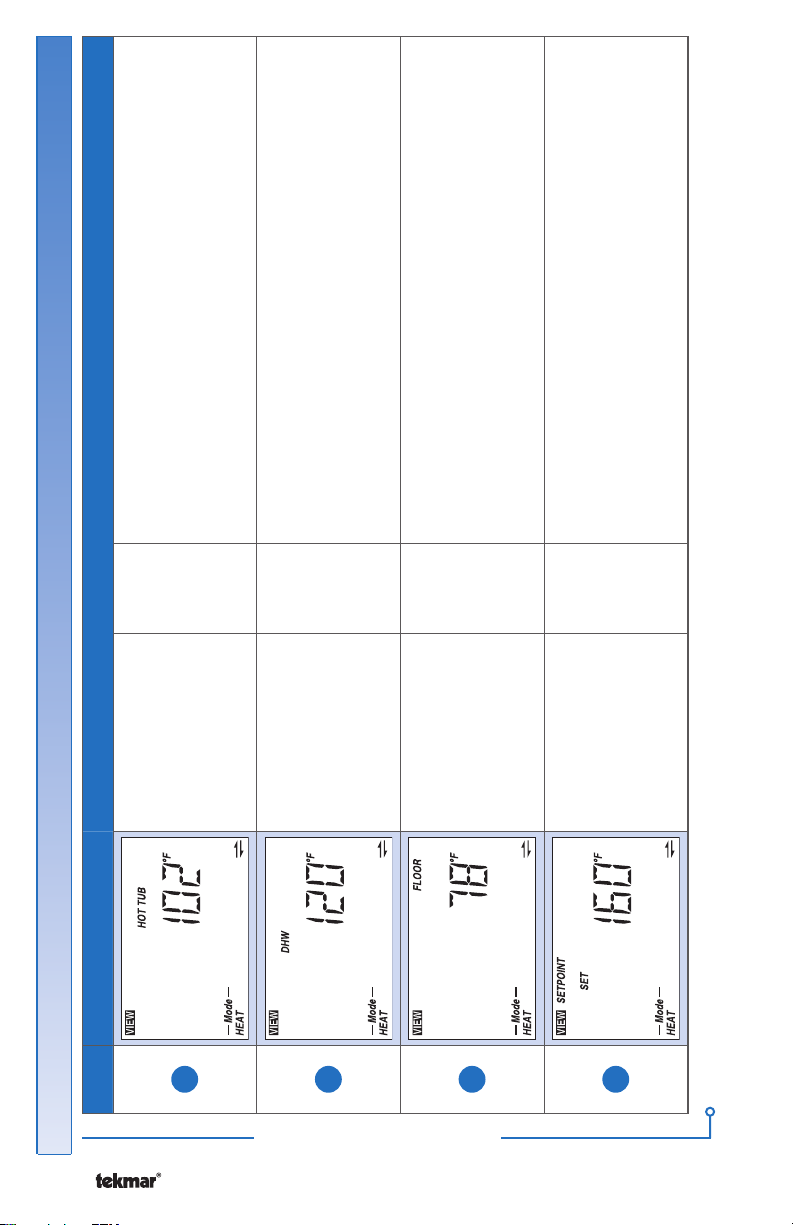
SECTION B
HOT TUB
Displays the measured hot tub temperature.
DHW TANK SECTION C
Displays the measured domestic hot water tank
temperature.
FLOOR SECTION D
Displays the measured floor temperature.
SET SETPOINT SECTION A
Display the desired temperature.
LTD
SEC
-31 to 266°F
Mode Item Field Range Access Description
InST
USEr
(-35.0 to 130.0°C)
2
ADV
VIEW Menu (2 of 3)
SEC
LTD
USEr
-31 to 266°F
3
ADV
InST
(-35.0 to 130.0°C)
SEC
LTD
-31 to 266°F
InST
USEr
(-35.0 to 130.0°C)
4
ADV
VIEW MENU
InST
USEr
OFF, -4°F (-20.0°C)
to Setpoint Maximum
1
ADV
(variable)
Continued on next page.
© 2007 D 161 - 08/07 8 of 36
Page 9
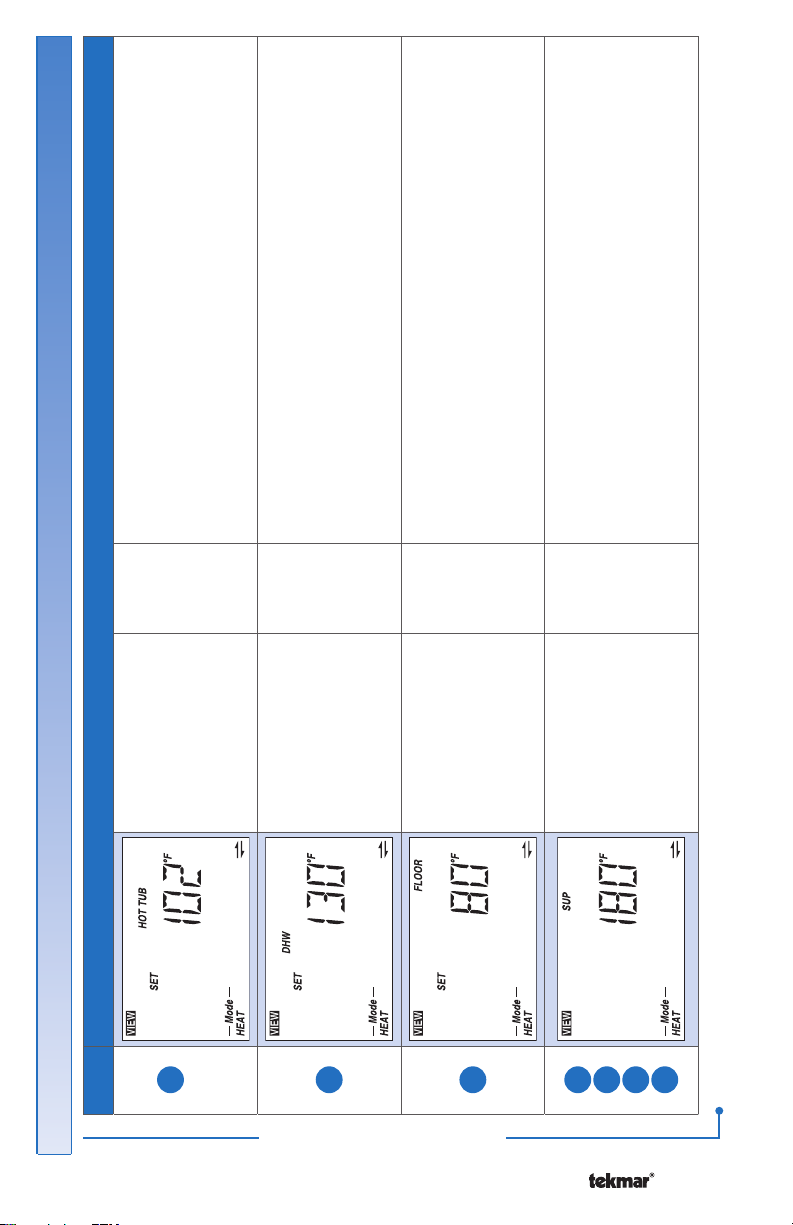
SECTION B
SET HOT TUB
Display the desired temperature.
SET DHW SECTION C
Display the desired temperature.
SET FLOOR SECTION D
Display the desired temperature.
SUPPLY TEMP OF tN4 BUS SECTION L
Actual water temperature of the tN4 bus for heating.
Note: This item is only available when the setpoint control
is connected to a tN4 System Control, DIP switch 2 is set
to tN4 System Control, and the Heat Source item in the
ADJUST menu is set to hydronic (HYDr).
InST
USEr
OFF, -4°F (-20.0°C)
to Hot Tub Maximum
2
Mode Item Field Range Access Description
ADV
(variable)
InST
USEr
to DHW Maximum
OFF, -4°F (-20.0°C)
3
ADV
(variable)
InST
USEr
to Floor Maximum
OFF, -4°F (-20.0°C)
4
ADV
(variable)
1
ADV
InST
-31 to 266°F
(-35.0 to 130.0°C)
2
3
4
After the last item, the control returns to the first item in the menu.
VIEW MENU
VIEW Menu (3 of 3)
9 of 32 © 2007 D 161 - 08/07
Page 10
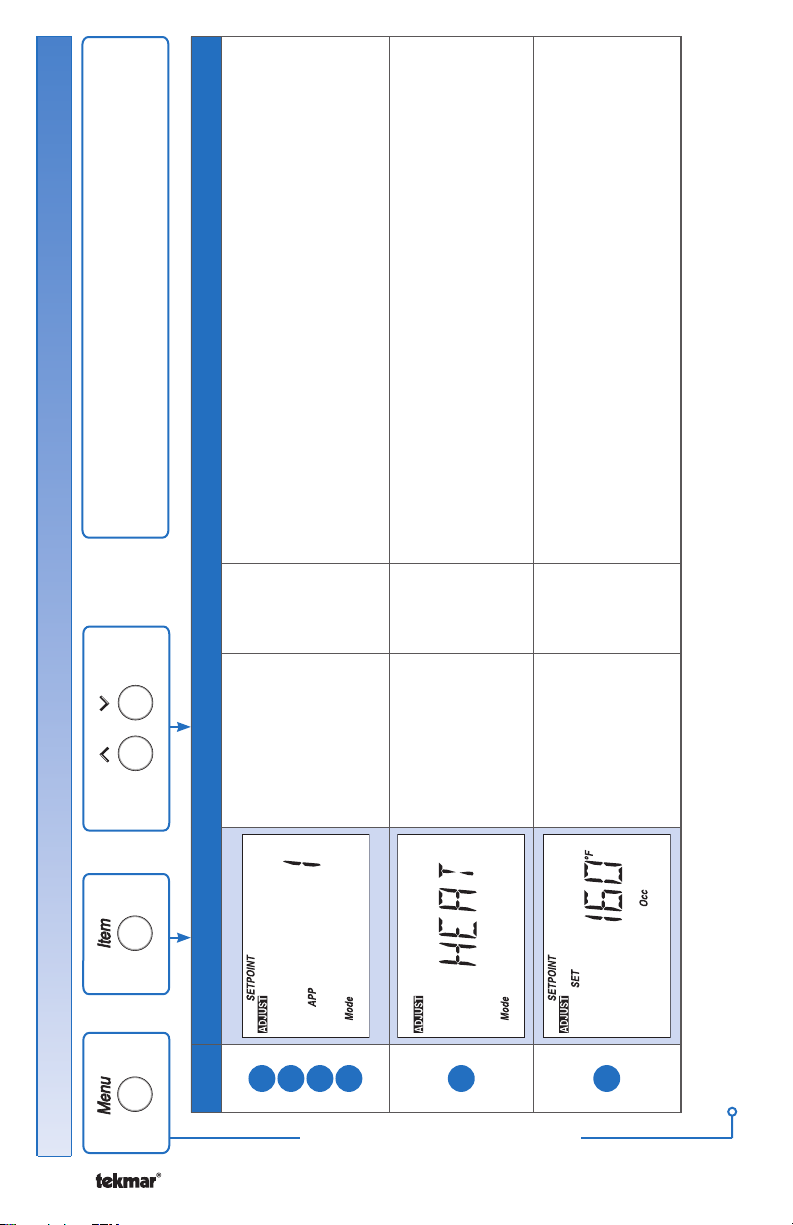
The ADJUST Menu items are the programmable
settings used to operate the mechanical equipment.
APPLICATION MODE SECTION A, B, C, D
Select the application for the setpoint control.
1 = Setpoint
be adjusted by +/-3°F (1.5°C) from the temperature setting
2 = Hot Tub
3 = DHW Tank
4 = Floor
MODE OF OPERATION SECTION B
Select to either heat or turn off the hot tub.
SET SETPOINT OCCUPIED SECTION A
Select the setpoint temperature for the occupied period.
entered prior to entering the Limited access level.
Note: In the Limited Access Level, the temperature can only
ADV
InST
1, 2, 3, 4
Default = 1
1
2
3
4
Mode Item Field Range Access Description
ADJUST Menu (1 of 5)
© 2007 D 161 - 08/07 10 of 36
InST
USEr
HEAT, OFF
2
ADV
Default = HEAT
LTD
(-20°C) to
OFF, -4°F
InST
USEr
Setpoint
Maximum
1
ADV
(71.0°C)
Default = 160°F
Continued on next page.
ADJUST MENU
Page 11

SECTION B
be adjusted by +/-3°F (1.5°C) from the temperature setting
SET HOT TUB OCCUPIED
Select the hot tub temperature for the occupied period.
LTD
USEr
OFF, 40°F
(4.5°C) to Hot
entered prior to entering the Limited access level.
Note: In the Limited Access Level, the temperature can only
ADV
InST
(39.0°C)
Tub Maximum
Default = 102°F
SET DHW TANK OCCUPIED SECTION C
OFF, 40°F
In the Limited Access Level, the temperature can only
Select the domestic hot water tank temperature for the
LTD
(4.5°C) to DHW
be adjusted by +/-3°F (1.5°C) from the temperature setting
occupied period.
Note:
ADV
InST
USEr
(54.5°C)
Maximum
Default = 130°F
entered prior to entering the Limited access level.
In the Limited Access Level, the temperature can only
be adjusted by +/-3°F (1.5°C) from the temperature setting
SET FLOOR OCCUPIED SECTION D
Select the floor temperature for the occupied period.
LTD
USEr
OFF, 40°F
(4.5°C) to Floor
entered prior to entering the Limited access level.
Note:
ADV
InST
(26.5°C)
Maximum
Default = 80°F
SETPOINT MAXIMUM SECTION A,
ADV
(10.0 to
115.0°C)
50 to 239°F
Select the maximum setpoint temperature range
adjustment.
(93.5°C)
Default = 200°F
2
Mode Item Field Range Access Description
3
4
1
ADJUST MENU
ADJUST Menu (2 of 5)
11 of 32 © 2007 D 161 - 08/07
Continued on next page.
Page 12

SECTION B
HOT TUB MAXIMUM
Select the maximum hot tub temperature range
adjustment.
DHW MAXIMUM SECTION C
Select the maximum domestic hot water tank temperature
range adjustment.
FLOOR MAXIMUM SECTION D
Select the maximum floor temperature range
adjustment.
DIFFERENTIAL
Select the differential to cycle on and off around the setpoint
temperature.
ADV
50 to 104°F
(10.0 to 40.0°C)
2
Mode Item Field Range Access Description
(40.0°C)
Default = 104°F
ADV
50 to 200°F
(10 to 93.5°C)
3
(60.0°C)
Default = 140°F
ADJUST Menu (3 of 5)
© 2007 D 161 - 08/07 12 of 36
ADV
50 to 110°F
(10.0 to 43.5°C)
4
(29.5°C)
Default = 85°F
ADJUST MENU
InST
1 to 40°F
(0.5 to 22.0°C)
1
2
ADV
(5.5°C)
Default = 10°F
3
Continued on next page.
Page 13

SECTION L
SECTION L
HEAT SOURCE
Select whether the heat source is hydronic (HYDr) or other
(OTHr) when the setpoint control is connected to a tN4
InST
r
HYDr, OTH
This item is only available when DIP switch 2 is set
System Control.
Note:
ADV
HYDr
Default =
to tN4 System Control.
EXCHANGE SUPPLY OCCUPIED
Select the desired supply water temperature required on
60 to 220°F
period.
Note: This item is only available when DIP switch 2 is set
ADV
104.5°C)
Default = 180°F
to tN4 System Control, and the Heat Source item in the
(82.0°C)
the tN4 bus to heat the setpoint load during the occupied
InST
(15.5 to
ADJUST menu is set to hydronic (HYDr).
PRIORITY SECTION L
Select if the setpoint control has priority over the heating
system.
This item is only available when DIP switch 2 is set
to tN4 System Control, and the Heat Source item in the
ADJUST menu is set to hydronic (HYDr).
Note:
ADV
InST
On, OFF
Default = OFF
Priority is not available when connected to a mix
tN4 bus.
Note:
1
2
3
4
Mode Item Field Range Access Description
1
2
3
4
1
2
3
4
Continued on next page.
ADJUST MENU
ADJUST Menu (4 of 5)
13 of 32 © 2007 D 161 - 08/07
Page 14

SECTION L
RELAY 1 PUMP
Select whether a system pump from a tN4 system control
should operate whenever relay 1 is closed.
InST
OFF, On
This item is only available when DIP switch 2 is set
to tN4 System Control, and the Heat Source item in the
ADJUST menu is set to hydronic (HYDr).
Note:
ADV
Default = On
SETPOINT DEVICE ENABLE SECTION E
Select the Setpoint Device Enable number to allow a
remote device such as a User Switch to activate the Time
OFF, 1 to 12
This item is only available when the setpoint control
Occupied override. The control then maintains the occupied
ADV
Default = 1
has tN4 communication.
temperature for a preset amount of time.
Note:
1
2
3
4
Mode Item Field Range Access Description
1
2
ADJUST Menu (5 of 5)
© 2007 D 161 - 08/07 14 of 36
4
After the last item, the control returns to the first item in the menu.
ADJUST MENU
Page 15

Description
The SCENE Menu items set the current scene as well
as the scene settings.
RUN TIME OCCUPIED SECTION B, D, E
Select the amount time for the setpoint control to operate at
Access
Item Field Range
This item is only available in Application Mode 2
the occupied temperature when a Setpoint Device Enable
(Hot Tub) or 4 (Floor) if a programmable setback schedule
is provided.
Note:
LTD
InST
USEr
24:00 hr, On
OFF, 0:05 to
(in 5 min. increments)
This item is only available in Application Mode 1
is selected.
if a programmable setback schedule is selected and the
Setpoint Device Enable setting in the ADJUST menu is set
Note:
ADV
Default = 1:00
from 1 through 12.
SCENE MENU SECTION H
Select whether or not to use the scene feature on the
ADV
InST
OFF, On
Default = OFF
setpoint control.
SCENE MENU
After the last item, the control returns to the first item in the menu.
SCENE Menu (1 of 1)
15 of 32 © 2007 D 161 - 08/07
Page 16

The SCHEDULE menu allows the setpoint control to
follow a schedule.
Description
HEAT SCHEDULE SECTION G
Selects the schedule used by the setpoint control.
Access
This item can be viewed in the USEr and InST
If a schedule is not required, select NONE.
If the schedule is set on another thermostat or setpoint
control, select Mbr1 to Mbr4.
ADV
InST
Mbr3, Mbr4, UnOc
NONE, Mbr1, Mbr2,
(Installer) access levels but can only be adjusted in the
UnOc is not available in Mode 3.
Note:
Default = NONE
ADV (Advanced) access level.
Item Field Range
SCHD (Schedule) Menu (1 of 1)
© 2007 D 161 - 08/07 16 of 36
After the last item, the control returns to the first item in the menu.
SCHEDULE MENU
Page 17

The Miscellaneous menu items set display and control
options such as access level and temperature units.
Description
ACCESS LEVEL
The access level of the setpoint control. The access column
shows which items are visible in each access level.
the Unlock position and the tN4 system control DIP switch is
set to the Unlock position.
Note: This item is only available when DIP switch 1 is set to
UNITS SECTION J
Select Fahrenheit or Celsius as the temperature units.
BACKLIGHT SECTION K
Select whether the backlight displays permanently, temporarily,
or is off. The temporary backlight lasts for 30 seconds.
Access
Item Field Range
LTD
SEC
SEC, LTD, USEr,
ADV
InST
USEr
InST, ADV
Default = USEr
InST
USEr
°F, °C
ADV
Default = °F
ADV
InST
Default = TMPY
ON, TMPY, OFF
MISC MENU
MISC (Miscellaneous) Menu (1 of 2)
17 of 32 © 2007 D 161 - 08/07
Continued on next page.
Page 18

SECTION L
Description
This item is only available when the setpoint control
NUMBER OF DEVICES
Access
Item Field Range
has tN4 communication.
Number of tN4 devices connected to this tN4 bus.
Note:
– – –, 1 to 24 ADV
This item is only available when the setpoint control
ADDRESS SECTION L
The tN4 bus address of this setpoint control.
Auto allows the tN4 system to automatically assign an address
to the setpoint control.
To manually set the address, use the Up or Down buttons while
LTD
SEC
USEr
AUTO
bus#:01 to bus#:24,
has tN4 communication.
in the ADV (Advanced) or InST (Installer) access level.
Note:
ADV
InST
Default = AUTO
RESTORE DEFAULTS
Press the Up and Down buttons together to load the factory
InST
defaults. The SELECT icon appears and then the display shows
DONE when the factory defaults have been completed.
ADV
TYPE
Product number of this setpoint control. Hold the Up button
to view the software version.
LTD
SEC
USEr
161, Software
InST
Version
ADV
MISC (Miscellaneous) Menu (2 of 2)
© 2007 D 161 - 08/07 18 of 36
MISC MENU
After the last item, the control returns to the first item in the menu.
Page 19

Sequence of Operation
Application Mode 1 - On / Off Setpoint SECTION A
Application Mode 1 is a generic setpoint
control operation using an on/off
differential for heating. The sensor is
required to be located at the temperature
control point. The setpoint control can
have an occupied temperature setting.
The setpoint load is not heated during
the unoccupied or away periods.
Relay 1 Operation
Relay 1 operates using an on/off differential to maintain the load at the Occupied
temperature. Relay 1 does not operate during the Unoccupied or Away periods.
Setting the Setpoint Off
The setpoint temperature can be set to Off. When set to Off, Relay 1 will not turn on.
If the heating area is outdoors, or the heating system has the potential to freeze, it is
recommended that the setpoint always be set to a temperature and not set to Off.
The setpoint can be set to Off if the heating system can be drained or the pump
should remain off.
The setpoint control power should never be shut off, otherwise an error message
will appear on the rest of the tN4 system.
Load
Application Mode 2 - Hot Tub SECTION B
Application Mode 2 is designed
specifically to heat hot tubs using
an on/off differential. A sensor must
be located in a temperature well on
the recirculation pipe. The hot tub
can have an occupied temperature
setting.
Relay 1 Operation
Relay 1 operates using an on/off differential to maintain the load at the Occupied
temperature. During the Unoccupied period, Relay 1 is operated to maintain 10°F
(5.5°C) less than the Occupied temperature setting. During the Away scene, Relay
1 is operated to maintain the Hot Tub at 50°F (10.0°C).
19 of 32 © 2007 D 161 - 08/07
Page 20

Mode of Operation
The hot tub mode of operation can be set to either Heat or Off. While set to Off,
Relay 1 remains off. The Off setting should only be used when the hot tub is drained
or when there is no possibility of freezing. Power should never be removed from the
setpoint control as this will result in an error message on the tN4 system.
Occupied Time
The setpoint control can temporarily override the scheduled temperature and operate
at the occupied temperature on a timer.
Press the Up or Down buttons while in the View menu to set the amount of time
that the occupied temperature should remain in effect.
To use this feature, a programmable schedule must be set or the schedule be set to
normally operate at the unoccupied setting. When the schedule is set to unoccupied,
the setpoint control operates at the unoccupied setting until activated.
The length of time the setpoint remains
at the occupied temperature is preset by
the Run Time Occupied item located in
the Scene menu.
To cancel the temporary occupied
time, press and hold the Down button
until the display shows OFF, at which
point, the setpoint control returns to the
schedule.
Pressing the UP button while in the VIEW
menu starts operation of the Hot Tub for
the time set.
To Stop operation press the DOWN button
until the time shows OFF.
Application Mode 3 - DHW Tank SECTION C
Application Mode 3 is designed specifically
to operate a domestic hot water (DHW)
tank using an on/off differential. A sensor
must be located in a temperature well
inside the DHW tank. The DHW tank can
have an occupied temperature setting.
The DHW tank is not heated during the
unoccupied and away periods.
Relay 1 Operation
Relay 1 operates using an on/off differential to maintain the load at the Occupied
temperature. Relay 1 does not operate during the Unoccupied or Away periods.
© 2007 D 161 - 08/07 20 of 36
Page 21

Application Mode 4 - Floor SECTION D
Application Mode 4 configures the setpoint control for floor warming and floor
heating applications using pulse width modulation. Floor warming is not necessarily
designed to heat the room, but to make the floor feel warm to the touch. This is
common especially in bathrooms. A sensor must be located within the slab between
the heating pipes. The setpoint control allows a Floor temperature to be set for the
occupied period. The floor is not heated during the unoccupied or away periods.
Relay 1 Operation
Relay 1 operates using pulse width modulation to maintain the load at the Occupied
temperature. Relay 1 does not operate during the Unoccupied or Away periods.
Occupied Time
The setpoint control can temporarily override the scheduled temperature and operate
at the occupied temperature on a timer.
Press the Up or Down buttons while in the View menu to set the amount of time
that the occupied temperature should remain in effect.
To use this feature, a programmable schedule must be set or the schedule be set to
normally operate at the unoccupied setting. When the schedule is set to unoccupied,
the setpoint control operates at the unoccupied setting until activated.
The length of time the setpoint remains at the occupied temperature is preset by
the Run Time Occupied item located in the Scene menu.
To cancel the temporary occupied time, press and hold the Down button until the
display shows off, at which point, the setpoint control returns to the schedule.
Pressing the UP button while in the VIEW
menu starts operation of the Hot Tub for
the time set.
To Stop operation press the DOWN
button until the time shows OFF.
21 of 32 © 2007 D 161 - 08/07
Page 22

Remote Enable / Disable SECTION E
To use the Remote Enable / Disable feature, the setpoint control must be set to Mode
1 (Setpoint), 2 (Hot Tub), or 4 (Floor). When the setpoint control is connected to a
tN4 system, a User Switch or tN4 Gateway can remotely signal a setpoint control
(or multiple setpoint controls) to override the unoccupied temperature to temporarily
operate at the occupied temperature. The Setpoint Control, User Switch and tN4
Gateway each have a setting called Setpoint Device Enable that can be assigned
a number between 1 and 12. When devices have the same Setpoint Device Enable
number, then either pressing the button on the User Switch or activating the feature on
the tN4 Gateway causes the Setpoint Control to operate at the occupied temperature.
Sending a second Setpoint Device Enable cancels the override and the setpoint
control returns to the unoccupied temperature. A total of 12 different Setpoint Devices
Enables can be configured on the tN4 system.
To create a Setpoint Device Enable:
1) DIP switch 2 must be set to tN4
system control.
2) A User Switch or tN4 Gateway
should be connected to one of the
tN4 buses.
3) Set the Setpoint Device Enable item
in the Adjust menu to a number
between 1 and 12.
4) Set the Setpoint Device Enable on
the User Switch or tN4 Gateway to
the same number between 1 and 12.
Control
Setpoint Device
Enable Number
User SwitchSetpoint
=
Setpoint Device
Enable Number
User
Button
1
User
Button
2
User
Button
3
The schedule on the setpoint control must be set to either Schedule Member, or
to Unoccupied to allow the temporary occupied time override to operate. When
the schedule is set to Unoccupied, the setpoint control operates at the unoccupied
setting until activated.
The length of time the setpoint remains at the occupied temperature is preset by
the Run Time Occupied item located in the Scene menu.
Remote activation of the setpoint control requires the same Setpoint Device enable
number to be set on the setpoint control and on a User Switch 480 or 481 (or tN4
Gateway).
Setpoint
Control
UnOcc
© 2007 D 161 - 08/07 22 of 36
User Switch
User
Button
1
User
Button
2
User
Button
3
Press Button
Setpoint
Control
Occ
Page 23

3
6
Sensor Input SECTION F
The Setpoint Control 161 requires a temperature sensor (Universal Sensor 071
included) to be connected to the sensor input on the back of the control. All tekmar
sensors are compatible. Choose the sensor type that best meets the requirements
of the application. See application mode diagrams for the recommended location
of the sensor.
Setting the Schedule SECTION G
To provide greater energy savings, the setpoint control can follow a schedule master
when connected to a tN4 system. Alternatively, the setpoint control can normally operate
at the unoccupied temperature until activated to the occupied temperature.
During the Unoccupied and Away periods, the Setpoint, DHW tank, and the Floor
are not heated.
During the Unoccupied period, the Hot Tub is heated to the Occupied temperature
minus 10°F (5.5°C). While in the Away scene, the Hot Tub is maintained at 50°F
(10.0°C).
Members of
Schedule 1
Zone 12
Master
Schedule 1
4 5
None
Zone
Schedule
Master
Schedule 2
7 8
Members of
Schedule 2
Schedule Member
If a Master Schedule is available on the tN4 system, the setpoint control can follow
the Master Schedule as a member.
To follow a master schedule as a member:
1. Assign the setpoint control to follow a master schedule by setting the Schedule
menu item in the Schedule menu to Member (MBR) 1 to 4. The number must
match that of the Master.
Normally Unoccupied
The setpoint control can be set to normally operate at the unoccupied temperature.
This allows the setpoint control to temporarily be set to the occupied temperature by
either pressing the Up or Down buttons in the View menu or by a remote enable.
23 of 32 © 2007 D 161 - 08/07
Page 24

Scenes SECTION H
Scenes are a system override feature available when the setpoint control is part of
a tN4 system. Scenes allow the user to change the entire tN4 system to operate at
preset temperatures.
To use the scene function, go to the Scene menu and set the Scene setting to On.
The tN4 scene can be changed through the scene menu on a tN4 thermostat, a
tN4 User Switch or through a tN4 Gateway. The setpoint control reacts to the scene
as follows:
Scene Setpoint Control Temperature
1 Follows the schedule
2Away
3 Unoccupied (no effect if schedule is Off)
4 Not valid, remains at previous scene
5 Not valid, remains at previous scene
6 3 hour Occupied
7 Not valid, remains at previous scene
8 Not valid, remains at previous scene
The default is for the tN4 system to remain in Scene 1.
During the Unoccupied and Away periods, the Setpoint, DHW tank, and the Floor
are not heated.
During the Unoccupied period, the Hot Tub is heated to the Occupied temperature
minus 10°F (5.5°C). While in the Away scene, the Hot Tub is maintained at 50°F
(10.0°C).
Example:
A house is normally in scene 1. There is a living room that operates on a schedule
and there is a hot tub that is normally at the unoccupied temperature. When
entertaining guests, the scene is changed to scene 6. Scene 6 has been preprogrammed to change the hot tub to operate at the occupied temperature.
Living room thermostat:
Scene 1 is set to Schedule.
Scene 6 is set to Schedule.
Hot tub setpoint control:
Scene 1 is set to Unoccupied.
70°F
Scheduled
Event
94°F
Hot Tub
Unoccupied
70°F
Living RoomLiving Room
Scheduled
Event
104°F
Hot Tub
Occupied
Scene 6 is set to Occupied.
© 2007 D 161 - 08/07 24 of 36
Page 25

Restore Factory Defaults SECTION I
•
•
To restore the factory defaults, locate the Default item in the Miscellaneous menu
and press and hold the Up and Down buttons for 1 second. The display will show
“SELECT” and when completed it will show “DONE”.
Temperature Units SECTION J
The setpoint control can display temperatures in either Fahrenheit (°F) or in
Celsius (°C).
• Locate the units setting in the Miscellaneous menu.
Backlight SECTION K
Use the setpoint control’s backlight to increase the visibility of the display. The
backlight can be set to On, Temporary, or Off. If Temporary is selected, the backlight comes on for 30 seconds when a button is pressed. By default, the backlight
is Temporary. If Off is selected the backlight remains permanently off.
• Locate the Backlite setting in the Miscellaneous menu.
tN4 Features SECTION L
When the setpoint control is connected to a tN4 system, the setpoint control has
additional features not present when operating alone.
tN4 Bus
When connecting the setpoint control to a tN4 system, there may be several tN4
buses available. The setpoint control should be connected to the tN4 bus that best
represents the water temperature required for the setpoint load. Typically, the setpoint
control should be connected to the boiler tN4 bus for Application Modes 2 (Hot Tub)
and 3 (DHW Tank). Typically the setpoint control should be connected to a mix tN4
bus for Application Mode 4 (Floor).
Heat Source
When the setpoint control is part of a tN4 system, the Heat Source item in the Adjust
menu allows the setpoint control to inform the tN4 system control whether the heat
is hydronic (HYDr) or provided by another (OTHr) heat source.
Exchange Supply
When the setpoint control is connected to a tN4 system control and Heat Source item
is set to hydronic (HYDr), the setpoint control requests that the Exchange Supply
Occupied water temperature be maintained on the tN4 bus whenever Relay 1 is
heating the load.
25 of 32 © 2007 D 161 - 08/07
Page 26

Relay 1 System Pump
In order to accommodate many different piping and pumping configurations, the
setpoint control is able to choose whether a “system” pump is required to operate at
the same time as Relay 1. This allows each manifold on a water temperature to have
a “system” pump when using zone valves or when using zone pumps together with
primary secondary piping. Only the manifold that has zones requiring heat should
have their “system” pump turned on.
When the setpoint control is connected to the tN4 boiler bus, the “system” pump is
the primary pump located on the tN4 system control.
When the setpoint control is connected to a tN4 mix bus, the “system” pump is
the mix system pump located on the tN4 system control or on a mixing expansion
module.
To turn on the “system” pump together
with Relay 1, set the Relay 1 Pump item
in the Adjust menu to On. This is the
factory default.
To turn on Relay 1 without the “system”
pump, set the Relay 1 Pump item in the
tN4
System
Control
Boiler
Zone
Manager
tN4 Mix Bus
Zone
Group
Pump
Mix System
Pump
Setpoint
Control
Adjust menu to Off.
Purging
When the setpoint control is used with a tN4 system control, the setpoint control
purges heat from the boiler into the setpoint zone if it is the last zone to shut off.
The length of the purge is dependent on time, the temperature of the boiler, and
the temperature of the setpoint load.
Priority
When the setpoint control is connected to a boiler tN4 bus, a priority setting is
available. When priority is set to On, the setpoint control has priority over the
thermostats. First, all heating thermostats are shut off. If there is sufficient boiler
capacity, boiler temperature zones are turned on in order of their tN4 address from
1 to 24. Second, boiler temperature second stage heating zones are turned on in
order of their tN4 address from 1 to 24. Last, all mixing outputs are increased up to
normal operating levels.
tN4 Address
When connected to other tN4 devices through a tN4 bus, the setpoint control is
automatically assigned a network address. The Address item in the Miscellaneous
menu displays the current address of the setpoint control. A total of 24 devices can
be connected to each tN4 bus.
If the 161 is operating as a member of a thermostat / setpoint only network, the
address consists of a device number with no bus number. If the 161 is not connected
to a tN4 network, the address item in the MISC menu is not available.
© 2007 D 161 - 08/07 26 of 36
Page 27

When the setpoint control is connected to a tN4 boiler bus, the address range is
•
•
•
b:01 through to b:24.
When the setpoint control is connected to the tN4 mix 1 bus, the address range is
1:01 through to 1:24.
When the setpoint control is connected to the tN4 mix 2 bus, the address range is
2:01 through to 2:24.
When the setpoint control is connected to the tN4 mix 3 bus, the address range is
3:01 through to 3:24.
The address number determines the heating priority for each zone. A device with
address number 1 has a higher priority than address number 24. The tN4 address
allows the tN4 system control to shut off low priority zones when the heat source
is unable to heat all zones simultaneously. In some cases, the installer may want
to change the device’s address in order to change the thermostat’s priority relative
to other devices.
Note: Keep track of manually set tN4 addresses. When a tN4 address is manually
set, tN4 devices using the Auto address setting will automatically be assigned new
addresses. If two devices are manually set to the same address, an error message
will appear. The error remains until one of the addresses is manually changed to
a vacant address.
Zone Test
The tN4 system control has a Zone Test feature, which
allows each tN4 device to be individually operated for
up to 5 minutes. When the setpoint control is selected,
the display shows “Zn TEST” and Relay 1 is turned on.
When the setpoint control is not selected, the display
shows “Zn TEST” and Relay 1 is turned off.
Maximum Heat
The tN4 system control has a Maximum Heat feature,
which operates all tN4 devices, including the setpoint
control, at the occupied temperature setting plus 5°F
(3°C). While in the maximum heat operation, the setpoint
control display shows the “MAX HEAT” symbols.
Exercising
When connected to a tN4 system control, the setpoint control exercises Relay 1 for
10 seconds after 3 days of inactivity. Exercising helps prevent pump seizure. While
the setpoint control is exercising, the display shows “TEST”.
Exercising does not occur when:
• Mode of Operation is set to Off.
• Heat Source is set to Other.
• DIP switch 2 is set to None.
27 of 32 © 2007 D 161 - 08/07
Page 28

Error Messages
Local Errors and Device Errors
Error messages are used to indicate a problem somewhere in the system. There
are two types of error messages: Local Errors and Device Errors.
A Local Error indicates an error specific to a device. For example, a thermostat with
a sensor short circuit will show a Sensor Short Error on its display. No other devices
will show this specific error (unless they also have a sensor short circuit).
A Device Error is used to indicate that there is a local error somewhere else on the
system. For example, if a thermostat has a sensor short circuit, that thermostat will
show a Local Error indicating specifically what the problem is. All other devices on
the network will show Device Errors, indicating the address of the device with the
Local Error. In other words, Device Errors are nothing more than pointers, showing
you that there is a local error somewhere on the system and where to find it.
Error Priority
Only one error can be shown on a particular device at a time. If there is more than one
error on the system, the highest priority error will be the one that is shown. The table
on pages 30 to 33 lists error messages in order of high priority to low priority.
How to Locate an Error Message
If the warning symbol (flashing circle with exclamation mark) is visible on screen,
this indicates that there is an error somewhere on the system. To view the error
message, you must first put the control into the Advanced or Installer access level
(available in MISC menu). When an error message is present, it is available as an
item in the VIEW menu.
While in the View Menu, press the item button until the error message is displayed.
You may have to advance through several View Menu items before the message
is displayed.
© 2007 D 161 - 08/07 28 of 36
Page 29

If the error message is a Device Error (if “DEV” or “DEV ERR” is shown on screen),
read the address shown and go to the device with that address. That device will
have a Local Error indicating specifically what the problem is. When the problem is
corrected, the error message will automatically clear.
Access Levels
In some cases, it is not desirable to let day-to-day users view error messages. In
these cases, by lowering the access level of the thermostat or setpoint device to
‘User’ or lower, error messages cannot be seen in the View menu and the warning
symbol only appears if there is a local error or a device error caused by a critical
error on another device. If there is an error message on the system that you cannot
find on a particular thermostat, make sure that the access level on that thermostat
is set to Installer or Advanced.
Sensor Temperature Errors
If a control is unable to display a temperature due to a sensor malfunction or
communication problem, the word “Err” is displayed in place of the temperature.
This usually indicates that there is an error somewhere on the system but is not
the actual error message. Keep looking through the View menu to find the actual
error message.
Device is attempting to
show floor temperature
but cannot because of
Keep pressing the Item
button to find the actual
error message
sensor problem.
Once error is corrected,
the temperature can be
displayed
29 of 32 © 2007 D 161 - 08/07
Page 30

ADJUST ERROR
The setpoint control failed to read the ADJUST menu settings from memory and has reloaded the
factory default settings. Operation stops until the ADJUST menu settings are checked.
Note: To clear the error, the access level must be set to Advanced before checking all settings in
the ADJUST menu.
SCENE ERROR
The setpoint control failed to read the SCENE menu settings from memory and has reloaded the
factory default settings. The setpoint control continues to operate while displaying this error.
Note: To clear the error, the access level must be set to Advanced before checking all settings in
Error Message Description
Error Messages (1 of 4)
Note: Error Messages are only visible while in the Advanced or Installer access level.
© 2007 D 161 - 08/07 30 of 36
the SCENE menu.
SCHEDULE ERROR
The setpoint control failed to read the SCHEDULE menu settings from memory and has reloaded
the factory default settings. The setpoint control continues to operate while displaying this error.
Note: To clear the error, the access level must be set to Advanced before checking all settings in
the SCHEDULE menu.
MISCELLANEOUS ERROR
The setpoint control failed to read the MISCELLANEOUS menu settings from memory and has
reloaded the factory default settings. The setpoint control continues to operate while displaying
this error.
Note: To clear the error, the access level must be set to Advanced before checking all settings in
the MISCELLANEOUS menu.
Page 31

and set Dip 2 to the ‘None’ position. This will
BUS ERROR
Due to an open or short circuit, communication is lost with the tN4 bus. Check the wires for damage
or loose connections. Check the wires for continuity. The error message will clear once the error
condition has been corrected.
Error Message Description
Error Messages (2 of 4)
Note: Error Messages are only visible while in the Advanced or Installer access level.
31 of 32 © 2007 D 161 - 08/07
also clear the bus error message.
Note: In some cases, the setpoint control is intentionally removed from the tN4 system. Press the
Up and Down buttons together to clear the address
NO tN4 SYSTEM CONTROL
DIP switch 2 is set to tN4 System Control and the setpoint control does not detect the tN4 System
Control. Once the tN4 System Control is detected, this error will clear automatically.
Note: If a tN4 System Control is not installed, set the tN4 System Control DIP switch 2 to None.
ADDRESS ERROR
Two tN4 devices have been manually set to the same address. The setpoint control continues to
operate with this error but does not communicate with the tN4 bus. To clear this error, manually
select an unused address. This can be done automatically by setting the Address item to Auto.
DEVICE LIMIT
There are more than 24 devices on the tN4 bus. The additional devices must be removed and
reconnected to a different tN4 bus if possible.
Page 32

DIP SWITCH 2 MODE
The tN4 System Control DIP switch 2 is set to None and the setpoint control has detected a tN4
System Control. The setpoint control does not operate until this error is corrected. The tN4 System
Control DIP switch 2 must be set to tN4 System Control.
SETPOINT SENSOR SHORT CIRCUIT
Due to a short circuit, the setpoint control failed to read the sensor input. The setpoint control displays
the error and stops operation until the error message is cleared. Check the wire for short circuits.
Locate and repair the problem as described in the Data Brochure D 070. The error message clears
automatically once the error is corrected.
Error Message Description
Error Messages (3 of 4)
Note: Error Messages are only visible while in the Advanced or Installer access level.
© 2007 D 161 - 08/07 32 of 36
SETPOINT SENSOR OPEN CIRCUIT
Due to an open circuit, the setpoint control failed to read the sensor input. The setpoint control
displays the error and stops operation until the error message is cleared. Check for loose or broken
wires. Locate and repair the problem as described in the Data Brochure D 070. The error message
clears automatically once the error is corrected.
SCHEDULE MEMBER ERROR
The setpoint control can no longer detect its schedule master. Ensure that the Schedule Master
number has not been changed. Check the communication connections for open or short circuits.
Once the schedule master has been detected, the error message clears.
Page 33

DEVICE ERROR AT ADDRESS #:##
#:## is the address of the device with the error. The bus number displays before the colon, and
the device number displays after. Go to the device with the address displayed.
Possible Addresses:
01 to 24 - Device Error on Thermostat only network
b:01 to b:24 - Device Error on Boiler Bus
1:01 to 1:24 - Device Error on Bus 1
2:01 to 2:24 - Device Error on Bus 2
3:01 to 3:24 - Device Error on Bus 3
CTRL - Device Error on System Control
MIX1 - Device Error on Mixing Expansion Module (See System Control for local error)
MIX2 - Device Error on Mixing Expansion Module (See System Control for local error)
MIX3 - Device Error on Mixing Expansion Module (See System Control for local error)
Error Message Description
Error Messages (4 of 4)
Note: Error Messages are only visible while in the Advanced or Installer access level.
33 of 32 © 2007 D 161 - 08/07
Page 34

Cleaning the Control
The control’s exterior can be cleaned using a damp cloth. Moisten the cloth with
water and wring out prior to wiping the control. Do not use solvents or cleaning
solutions.
© 2007 D 161 - 08/07 34 of 36
Page 35

Notes
35 of 32 © 2007 D 161 - 08/07
Page 36

Limited Warranty and Product Return Procedure
Limited Warranty The liability of tekmar under this warranty is limited. The Purchaser, by
taking receipt of any tekmar product (“Product”), acknowledges the terms of the Limited
Warranty in effect at the time of such Product sale and acknowledges that it has read and
understands same.
The tekmar Limited Warranty to the Purchaser on the Products sold hereunder is a manufacturer’s pass-through warranty which the Purchaser is authorized to pass through to its customers.
Under the Limited Warranty, each tekmar Product is warranted against defects in workmanship
and materials if the Product is installed and used in compliance with tekmar’s instructions, ordinary wear and tear excepted. The pass-through warranty period is for a period of twenty-four (24)
months from the production date if the Product is not installed during that period, or twelve (12)
months from the documented date of installation if installed within twenty-four (24) months from
the production date.
The liability of tekmar under the Limited Warranty shall be limited to, at tekmar’s sole discretion: the
cost of parts and labor provided by tekmar to repair defects in materials and / or workmanship of the
defective product; or to the exchange of the defective product for a warranty replacement product; or
to the granting of credit limited to the original cost of the defective product, and such repair, exchange
or credit shall be the sole remedy available from tekmar, and, without limiting the foregoing in any
way, tekmar is not responsible, in contract, tort or strict product liability, for any other losses, costs,
expenses, inconveniences, or damages, whether direct, indirect, special, secondary, incidental or
consequential, arising from ownership or use of the product, or from defects in workmanship or materials, including any liability for fundamental breach of contract.
The pass-through Limited Warranty applies only to those defective Products returned to tekmar
during the warranty period. This Limited Warranty does not cover the cost of the parts or labor to
remove or transport the defective Product, or to reinstall the repaired or replacement Product, all
such costs and expenses being subject to Purchaser’s agreement and warranty with its customers.
Any representations or warranties about the Products made by Purchaser to its customers which are
different from or in excess of the tekmar Limited Warranty are the Purchaser’s sole responsibility and
obligation. Purchaser shall indemnify and hold tekmar harmless from and against any and all claims,
liabilities and damages of any kind or nature which arise out of or are related to any such representations or warranties by Purchaser to its customers.
The pass-through Limited Warranty does not apply if the returned Product has been damaged by
negligence by persons other than tekmar, accident, fire, Act of God, abuse or misuse; or has been
damaged by modifications, alterations or attachments made subsequent to purchase which have not
been authorized by tekmar; or if the Product was not installed in compliance with tekmar’s instructions and / or the local codes and ordinances; or if due to defective installation of the Product; or if
the Product was not used in compliance with tekmar’s instructions.
THIS WARRANTY IS IN LIEU OF ALL OTHER WARRANTIES, EXPRESS OR IMPLIED, WHICH THE
GOVERNING LAW ALLOWS PARTIES TO CONTRACTUALLY EXCLUDE, INCLUDING, WITHOUT
LIMITATION, IMPLIED WARRANTIES OF MERCHANTABILITY AND FITNESS FOR A PARTICULAR
PURPOSE, DURABILITY OR DESCRIPTION OF THE PRODUCT, ITS NON-INFRINGEMENT OF
ANY RELEVANT PATENTS OR TRADEMARKS, AND ITS COMPLIANCE WITH OR NON-VIOLATION OF ANY APPLICABLE ENVIRONMENTAL, HEALTH OR SAFETY LEGISLATION; THE TERM
OF ANY OTHER WARRANTY NOT HEREBY CONTRACTUALLY EXCLUDED IS LIMITED SUCH
THAT IT SHALL NOT EXTEND BEYOND TWENTY-FOUR (24) MONTHS FROM THE PRODUCTION
DATE, TO THE EXTENT THAT SUCH LIMITATION IS ALLOWED BY THE GOVERNING LAW.
Product Warranty Return Procedure All Products that are believed to have defects in workmanship or materials must be returned, together with a written description of the defect, to the tekmar
Representative assigned to the territory in which such Product is located. If tekmar receives an
inquiry from someone other than a tekmar Representative, including an inquiry from Purchaser (if not
a tekmar Representative) or Purchaser’s customers, regarding a potential warranty claim, tekmar’s
sole obligation shall be to provide the address and other contact information regarding the appropriate Representative.
tekmar Control Systems Ltd., Canada
tekmar Control Systems, Inc., U.S.A.
Head Office: 5100 Silver Star Road
Vernon, B.C. Canada V1B 3K4
(250) 545-7749 Fax. (250) 545-0650
Web Site: www.tekmarcontrols.com
All specifications are subject
to change without notice
Product design, software and literature
are Copyright © 2007 by:
tekmar Control Systems Ltd. and tekmar
Control Systems, Inc.
36 of 36 D 161 - 08/07.
 Loading...