

Page 1
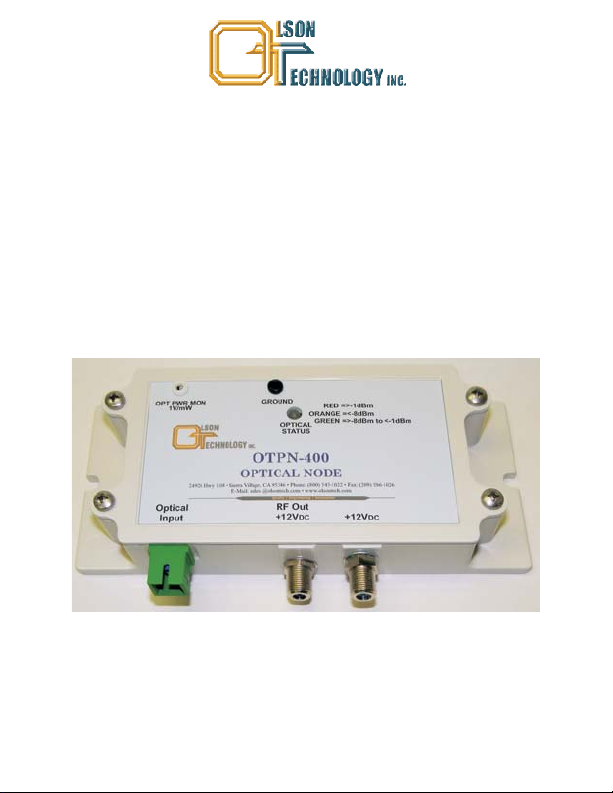
OLSON TECHNOLOGY PREMISE NODE
025-000476 Rev X8
OTPN-400C
PREMISE NODE
INDOOR OPTICAL NODE
INSTRUCTION MANUAL
Phone: (209) 586-1022
(800) 545-1022
Fax: (209) 586-1026
E-Mail: salessupport@olsontech.com
www.olsontech.com
07/27/10
Page 2

SAFETY WARNINGS
LASER RADIATION
A laser transmitter emits invisible radiation that can cause permanent eye
damage. . Operate the transmitter only
with theproper opticalfiber installedin thetransmitter opticalconnector. Power to
the OTPN-400C should be turned-off or preferably, disconnected whenever the
optical connectorcover isopened and there is no installed fiber (as whenthe fiber
connector is beinginstalled orremoved from thetransmitterconnector).
The OTPN-400C is designed for indoor use only. Direct exposure to moisture
must be avoided. Connect the AC Adapter into the OTPN-400C
plugging the adapterinto thewall.
AVOID DIRECT EXPOSURE TO BEAM
NEVER
USE ANY OPTICAL INSTRUMENT TO VIEW THE OUTPUT OF THE
LASER TRANSMITTER. “OPTICAL INSTRUMENT” INCLUDES MAGNIFYING
GLASSES, ETC.
NEVER
LOOK INTO THE OUTPUT OF THE LASER TRANSMITTER
NEVER
LOOK INTO THE OUTPUT OF A FIBER CONNECTED TO A LASER
TRANSMITTER.
NEVER
LOOK INTO OR USE ANY OPTICAL INSTRUMENT TO VIEW THE
DISTANT END OF AFIBER THAT MAY BE CONNECTED DIRECTLY OR VIA AN
OPTICAL SPLIT, TO A TRANSMITTER THAT MAY BE OPERATING. THIS
SPECIFICALLY APPLIES TO FIBERS THAT ARE TO BE CONNECTED TO
RECEIVERS (SUCH AS THE OTPN-400C) OR OTHER DEVICES AT ANY
DISTANCEFROMTHELASER TRANSMITTER.
SHOCK HAZARD
BEFORE
Page 3

INTRODUCTION
The Olson Technology Inc. OTPN-400C is a high-quality, cost-effective CATV
node designed around the latest optical receiver technology. It is designed to
operate with optical input levels ranging from -8dBm to 0dBm. The OTPN-400C
operates with external +12 V source either direct or “up the coax” with optional
power inserter.AnACpower adapter isalso available forsupplying+12V . Power
DC
DC
consumption is less than 5 Watts. The OTPN-400C has flanges on the bottom to
allow mounting toa flatsurface.
INSTALLATION/ ENVIRONMENTALCONSIDERATIONS
The OTPN-400C is specified to operate from 0°C to +70°C. It usually will not
require an air-conditioned environment. It should be mounted in an adequately
ventilated area.Like any other electronic equipment, it willprobably have a longer
life spanif it isnot operated atthe upper limitof the temperature range. Installation
in wet areas or areas of extremely high humidity should be avoided. Extremely
dirty or dusty areas should be avoided if possible.The OTPN-400Cshould notbe
installed in areasthat areaccessible to children.
The OTPN-400C may be installed and operated in any position on a flat surface.
The unit has two slots in the bottom flange to accommodate mounting hardware.
The unit should be mounted by sliding under one screw and then installing and
tightening the other screw. If mounting requires a wood screw, use #6 or #8
(maximum) pan-head sheet metal screws. These are commonly available at
hardware stores. If mounting with a machine screw (to tapped holes), use 6-32
pan-head screws.
The OTPN-400C can be powered in two ways. Power can be inserted into the
coax going to the “RF OUT /+12V ” port via the optional power inserter, or by
plugging the optional AC-to-DC power supply into the “+12V ” port. A type “F”
DC
DC
adapter has beensupplied to allow theAC-to-DC powersupply to plugdirectly into
the “+12V ” portor theoptional power inserter.
DC
Figure 1 showsthe keydimensions of theOTPN-400C.
Page 4

Figure 1 - OTPN-400C Key Dimensions
OPTICAL CONNECTORS AND CLEANING
The standard optical connector is an SC/APC. In order to use an FC/APC
connectors, you must order a conversion kit, OTLL-SCFCKIT. The standard
optical connectorlocation is onthe same side as theRF connector. The fiberends
can be damaged by the insertion of contaminated connectors. Some types of
customer damage to connectors are not covered under warranty. Fiber
connectors should never be left uncovered. Pre-packaged alcohol wipes are the
most convenient means of cleaningoptical connectors. Cleanalcohol and lintfree
wipes, such asKim-Wipe type34155, or swabsmayalso be used.
OPERATIONAL SETUP – RECEIVER (FORWARD PATH)
The OTPN-400C optical receiver as the last component in a specific optical link
will provide carrier-to-noise performance andan RF outputlevel that isdependent
on several parameters.TheRF input levelto the sourceoptical transmitter and the
optical input level to the OTPN-400C basically determine the link performance.
Both the laser modulation and the receiver output level are basically limited by
total optical power. The RF input level to any optical transmitter is dependent on
the number of channels being transmitted. As the number of carried channels is
Page 5

is lowered, the RF input level to the transmitter can be raised. This results in
increased RF levels at the OTPN receiver and improves the carrier-to-noise ratio
over the link. Links should be designed and transmitters should be set up using
values that representthe maximumnumber of channelslikelyto be carried.
Chart 1 assumes approximately 77 channels from 50MHz to 550MHz and digital
loading from 550MHzto 1,000MHzat -6dB.
Chart1-TestPoint Voltage and RF Output Level vs. Optical Input
Optical Input Received Power TP Approx. RF OutputLevel
-8dBm 0.16V +14dBmV
-6dBm 0.25V +18dBmV
-4dBm 0.40V +22dBmV
-2dBm 0.63V +26dBmV
-1dBm 0.79V +28dBmV
0dBm 1.00V +30dBmV
Although the node will operate at optical input levels as high as +0dBm, there is
little improvement in the CNR performance of the node at optical input levels
above 0dBm. For optimum distortion performance it is recommended that the
optical input to the node be kept at or below -1dBm.At -1dBm, the DC test point
voltage will be0.79 Volts.
Unlike many optical nodes, the OTPN-400C is designed to perform down to an
optical input of -8dBm. Figure 2 shows the approximate CNR performance at
various receiver optical input levels and transmitter equivalent RF channel
loading. Thisperformance may vary considerably depending upon fiber and laser
performance so itis presentedas a designaidonly.
Page 6

Figure 2 - CNR vs. Optical Input Level
TEST POINTS and ADJUSTMENTS
The OTPN-400Creceiver has anexternal test pointto monitor optical signal level.
The received power test point is calibrated at 1V per mW @ 1310nm. Internally,
there is a jumper used to select wavelengths between 1310nm and 1550nm. The
factory presets thejumper to1310nm.
Page 7

ORDERING INFORMATION
MODEL DESCRIPTION
OTPN-400C PremiseNode (40-1,000MHz), Rx Only,+28dBmV @ -1dBm,
SC/APC Optical Connector
OTPS-12A-F Power Supply and “F” Connector Adapter, 110/220 Volts AC
=> +12 Volts /1.5Amps DC
OTPS-12A-PIC Power Supply and Power Inserter Coupler,110/220VoltsAC
=> +12 Volts /1.5Amps DC
OTLL-SCFCKIT Optical ConnectorAdapter Kit, SC/APCto FC/APC
OTOA-1000 Optical FiberAttenuator,1310nm, 1-7dB VariableSteps
Page 8

This page is blank intentionally
 Loading...