

Page 1
025-000480 Rev D
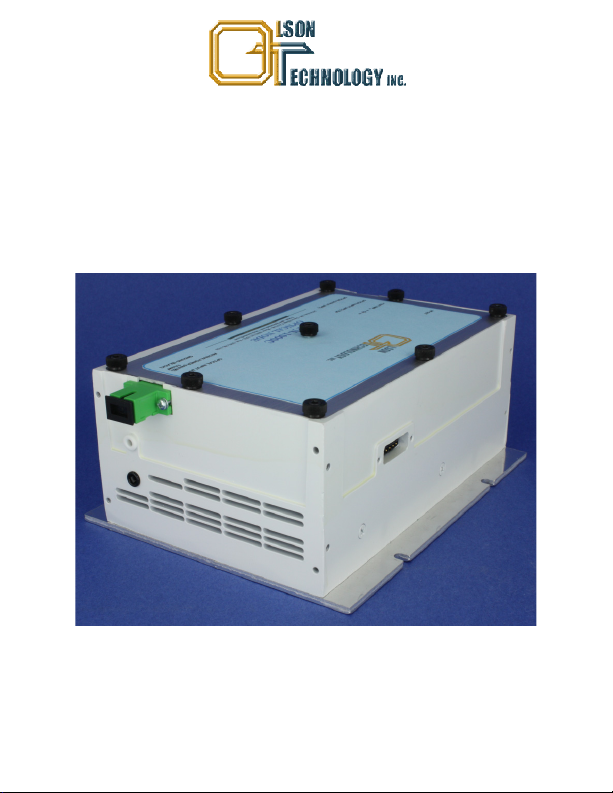
OTPN-2000C
PREMISE NODE
INDOOR OPTICAL NODE
INSTRUCTION MANUAL
Phone: (209) 586-1022
(800) 545-1022
Fax: (209) 586-1026
E-Mail: salessupport@olsontech.com
www.olsontech.com
02/14/12
Page 2

SAFETY WARNINGS
LASER RADIATION
The OTPT-300 laser transmitteremits invisible radiation thatcancause permanent eye
damage. . Operate the transmitter onlywiththe
proper optical fiber installed in the transmitter optical connector. Power to the OTPN2000C should beturned-off orpreferably, disconnected whenever the optical connector
cover is opened and there is no installed fiber (as when the fiber connector is being
installed or removed fromthetransmitterconnector).
The power supply section (bottom section) of the OTPN-2000C contains no user
serviceable parts. There is exposed high voltage inside this section. Only factory
service technicians should openthepowersupplysection.
The AC line input fuse is containedin the IEC 320 power input connector. This fuse is a
3AG, 0.5A, slow blowfuse. To avoid a risk of fire, this fuse shouldbe replaced only with
an identically rated fuse.
The OTPN-2000Cis designed forindoor use only. Direct exposureto moisture mustbe
avoided.
AVOID DIRECTEXPOSURETO BEAM
NEVER
USE ANY OPTICAL INSTRUMENT TO VIEW THE OUTPUT OF THE
LASER TRANSMITTER. “OPTICAL INSTRUMENT” INCLUDES MAGNIFYING
GLASSES, ETC.
NEVER
LOOK INTO THE OUTPUT OF THE LASER TRANSMITTER
NEVER
LOOK INTO THE OUTPUT OF A FIBER CONNECTED TO A LASER
TRANSMITTER.
NEVER
LOOK INTO OR USE ANY OPTICAL INSTRUMENT TO VIEW THE
DISTANT END OF A FIBER THAT MAY BE CONNECTED DIRECTLY OR VIA AN
OPTICAL SPLIT, TO A TRANSMITTER THAT MAY BE OPERATING. THIS
SPECIFICALLY APPLIES TO FIBERS THAT ARE TO BE CONNECTED TO
RECEIVERS (SUCH AS THE OTPN-2000C) OR OTHER DEVICES AT ANY
DISTANCEFROMTHE LASERTRANSMITTER.
HIGH VOLTAGE
FIRE HAZARD
SHOCK HAZARD
Page 3

INTRODUCTION
The Olson Technology Inc. OTPN-2000C is ahigh-quality, cost-effective, bi-directional
CATVnode designed withthe latest opticalreceiver technology. It operates withoptical
input levels ranging from -6dBm to +2dBm. Thereceive RF pathinclude a plug-in 15dB
equalizer to provide for sloped output response as well as plug-in pads to set the
forward and reverse RF gains. The OTPN-2000C is available with two different band
splits.
OTPN-2000C 5-42MHz Reverse Band, 54-1,000MHzForwardBand
OTPN-2000C-PAL 5-65MHz Reverse Band, 85-1,000MHzForwardBand
The OTPN-2000C does not come with a reverse transmitter. The OTPT-300 return
transmitter is field-installed in the OTPN-2000C node. The OTPN-2000C has a
universal power supply that allows operation from 90-240 V @50 or 6 Hz. It consumes
less than 23 Watts of power . Positive cooling is
including an OTPT-300 Transmitter
AC
provided by means of a small, high-MTBF fan, which may be replaced in the field
without interrupting operation. The OTPN-2000C has flanges on the bottom to allow
mounting it to a flat surface. The available OTLL-RMKIT-2 will allow mounting up to
three of these nodesinastandard19"rack.
INSTALLATION/ENVIRONMENTALCONSIDERATIONS
The OTPN-2000C operates from -10°C to +55°C. An air-conditioned environment is
usually not required. Mount in an adequately ventilated area. Like all electronic
equipment, it will have a longer life span if it is not operated at higher temperatures. Do
not install in wet areas or areas of extremely high humidity. Avoid extremely dirty or
dusty areas. Do not block the openings in the housing or the fan. Do not install the
OTPN-2000C in areas that are accessible to children. The OTPN-2000C may be
installed and operated in any position on a flat surface. The unit has four slots in the
bottom plate to accommodate mounting hardware. Mount with a #6 or #8 pan-head
sheet metal screw,ora6-32pan-headmachinescrew. See Figure 1 for dimensions and
mounting details. This is due to limited clearance under the OTPT-300 that is above
some of the mounting slots. If the OTPN-2000C has an installed OTPT-300, mounting
or dismounting the unit does not require the disconnection of the OTPT-300. The fiber
connector can be moved to the other end of the unit. Make forward and reverse RF
adjustments to the OTPN-2000Cbeforemountinginarack mountkit.
Page 4

Figure 1 - OTPN-2000C Key Dimensions
OPTICAL CONNECTORS AND CLEANING
SC/APC is the standard optical connector. Order conversion kit OTLL-SCFCKIT for
FC/APC connectors. The standardopticalconnectorlocationison the same side as the
RF connector.Fiberendscan be damagedbytheinsertionofcontaminatedconnectors.
Some types of customerdamage to connectors are notcovered under warranty. Never
leave fiber connectors uncovered. Pre-packaged alcohol wipes or c
lint-free wipes, such asKim-Wipetype34155,
can be used tocleanopticalconnectors.
lean alcohol and
OPERATIONAL SETUP – RECEIVER (FORWARD PATH)
The OTPN-2000C optical receiver, as the last component in a specific optical link, will
provide carrier-to-noise performance and an RF output level that is dependent on the
RF input level to the source optical transmitter and the optical input level to the OTPN2000C. The laser modulation and the receiver output level are limited by total optical
power. The RF input level to any optical transmitter is dependent on the number of
channels beingtransmitted.As the number ofcarried channels islowered, the RF input
level to the transmitter can be raised. This results in increased RF levels at the OTPN
receiver. This improves the carrier-to-noise ratio over the link. Transmitters should be
set up using valuesthatrepresentthemaximumnumber of channelslikelytobecarried.
Page 5

The receiver output powerisalsoaffectedby theequalizerused.
The following chart assumes approximately 77 channels from 55MHz to 550MHz and
digital loading from 550MHz to 1,000MHz at -6dB. The RF levels indicated are for an
equivalent slope of 10dBwiththeactuallevelsmeasured at 547.25MHz.
Although the node operatesat optical inputlevels as high as +3dBm,there is littleCNR
improvement at levels above 0dBm. For optimum distortion performance, keep the
optical input at or below 0dBm. The Olson model OTOA-xxx optical attenuator is ideal
for this application. To lower the output level, the value of the “Forward Pad” should be
increased, but reducing output below +43dBmV at 547.25MHz by this method is not
recommended. Iflower output is desired,theunit should be setfor +43dBmV and aninline pad added to the RF output to reduce the output level. This maintains optimum
CNR performance.Thisalsoreducesthereturngain ifanOTPT-300 transmitter is used.
Unlike many optical nodes, the OTPN-2000C is designed to give full output performance at optical input levels as low as -8dBm. Figure 2 shows the approximate CNR
performance at various input levels and channel loading. Performance can vary
depending upon fiber andlaserperformancesoitis presented asadesignaidonly.
Olson recommends that the provided 15dB equalizer (OLEQ1G-15) always be used.
Other equalizer values willlikelyleadtoreducedperformance.
Page 6

Figure 2 - OTPN-2000C CNR vs. Optical Input
Figure 3 - Characteristic of the 15dB Equalizer
Page 7

INTERNAL TEST POINTS and ADJUSTMENTS
The OTPN-2000C receiver has an internal plug-in pad to allow the RF output level of the
node to be adjusted. There is also a plug-in equalizer to compensate for cable slope.
These adjustments are accessed by removing the nine thumbscrews that hold the top
cover on. The unit should not be operated for extended periods with the top cover
removed. This is because of RF ingress and potential thermal problems due to
unchanneled air flow. When replacing the top cover, be sure to firmly tighten all
thumbscrews. RF ingress oroscillationcanbecausedby loose screws.
The locations of theinternaladjustmentsareshownin the followingdiagram.
FLAT
FWDEQFWDEQFWD
FWD
PAD
PAD
WAVELENGTH SELECT
12
1550nm
-20dB
-20dB
REV
REV
T.P.
T.P.
1310nm
REV PAD
DIPLEXER
-20dB
-20dB
FWD
FWD
T.P.
T.P.
10
The forward adjustments are at the left.Theforwardtestpointisattheright.Thereverse
pad and test point in the center are used only when an OTPT-300 is attached. The
wavelength select jumper is used to compensate the received power test point for the
changes in responsivity ofthephotodiodewithwavelength.
EXTERNAL TESTPOINTS
The OTPN-2000C has one external test point. It should be measured with a high
impedance voltmeter. The received powertestpoint is calibrated at1Vper mW @ 1310
nm. This test point is for long-term monitoring purposes. The optical power should be
measured withapowermeteratthe time of installation. The input testpointiscalibrated
at the factory at 1310 nm. The value at 1550 nm may be off by 15% due to photodiode
responsivity variations. The input test point reading will be considerably in error if the
input wavelength is 1550nmandtheinternaljumper hasnotbeenchanged.
Page 8

 Loading...