

Page 1
Road Gear 160
Road Gear 260
Integrated Mobile Sound System
Sistema de Sonido Móvil Integrado
综合移动音响系统
User’s Manual
Manual del Usuario
使用手册
English / Español / 简体中文
Page 2

Road Gear 160
Road Gear 260
Integrated Mobile Sound System
Sistema de Sonido Móvil Integrado
综合移动音响系统
CONTENTS
INTRODUCTION........................4
FEATURES.................................4
ROADGEAR COMPONENTS.....4
DISASSEMblING......................5
INITIAl SETUP...........................5
THE ROADGEAR MIXER...........6
COMbINATION DOCKING
lOCK..........................................9
THE ROADGEAR SPEAKERS...9
MICROPHONE...........................9
OPTIONAl ACCESSORIES.....10
CONTENIDO
INTRODUCCION..............................13
CARACTERISTICAS........................13
COMPONENTES DE ROAD GEAR..13
DESMONTAjE.................................14
CONFIGURACIóN INICIAl..............14
MEzClADORA ROADGEAR............15
COMbINACIóN DE CIERRE DE
ATRACAMIENTO.............................18
AlTAvOCES DE ROADGEAR..........18
MICROFONO...................................18
ACCESORIOS OPCIONAlES..........19
目录
简介...............................22
功能...............................22
RoadGear组件...............22
装卸...............................23
基本设置........................23
RoadGear调音台...........23
对接号码锁.....................25
RoadGear音箱...............26
麦克风............................26
任选配件........................26
规格...............................27
SPECIFICATIONS....................11
APPlICATION..........................28
blOCK DIAGRAMS.................29
Phonic preserves the right to improve or alter any information within this document without prior notice
Phonic se reserva el derecho de mejorar o alterar cualquier información provista dentro de este documento sin previo aviso
ESPECIFICACIONES.......................20
APlICACION....................................28
DIAGRAMAS DE blOQUE..............29
PHONIC保留不预先通知即可更新本手册的权利
应用...............................28
线路图............................29
v1.0 12/05/2008
Page 3
1. Read these instructions before operating this
apparatus.
2. Keep these instructions for future reference.
3. Heed all warnings to ensure safe operation.
4. Follow all instructions provided in this document.
5. Do not use this apparatus near water or in locations
where condensation may occur.
6. Clean only with dry cloth. Do not use aerosol or liquid
cleaners. Unplug this apparatus before cleaning.
7. Do not block any of the ventilation openings. Install
in accordance with the manufacturer’s instructions.
8. Do not install near any heat sources such as radiators,
heat registers, stoves, or other apparatus (including
.
9. Do not defeat the safety purpose of the polarized or
grounding-type plug. A polarized plug has two blades
with one wider than the other. A grounding type plug
has two blades and a third grounding prong. The wide
blade or the third prong is provided for your safety. If
the provided plug does not into your outlet, consult
an electrician for replacement of the obsolete outlet.
10. Protect the power cord from being walked on or
pinched particularly at plug, convenience receptacles,
and the point where they exit from the apparatus.
11. Only use attachments/accessories by the
manufacturer.
12. Use only with a cart, stand, tripod, bracket, or
table by the manufacturer, or sold with
the apparatus. When a cart is used, use caution
when moving the cart/apparatus
combination to avoid injury from tipover.
13. Unplug this apparatus during lighting
storms or when unused for long
periods of time.
14. Refer all servicing to service personnel.
Servicing is required when the apparatus has been
damaged in any way, such as power-supply cord or
plug is damaged, liquid has been spilled or objects
have fallen into the apparatus, the apparatus has
been exposed to rain or moisture, does not operate
normally, or has been dropped.
IMPORTANT SAFETY INSTRUCTIONS
CAUTION: TO REDUCE THE RISK OF ElECTRIC SHOCK,
DO NOT REMOvE COvER (OR bACK)
NO USER SERvICEAblE PARTS INSIDE
REFER SERvICING TO QUAlIFIED PERSONNEl
The lightning flash with arrowhead symbol, within an
equilateral triangle, is intended to alert the user to the
presence of uninsulated “dangerous voltage” within the
product
’
magnitude to constitute a risk of electric shock to persons.
The exclamation point within an equilateral triangle is intended to alert the user to the presence of important operating and maintenance (servicing) instructions in the literature
accompanying the appliance.
WARNING: To reduce the risk of or electric shock, do
not expose this apparatus to rain or moisture.
CAUTION: Use of controls or adjustments or performance
of procedures other than those may result in
hazardous radiation exposure.
The apparatus shall not be exposed to dripping or splashing and that no objects with liquids, such as vases,
shall be placed on the apparatus. The MAINS plug is used as the disconnect device, the disconnect device shall
remain readily operable.
Warning: the user shall not place this apparatus in the area during the operation so that the mains switch
can be easily accessible.
CAUTION
RISK OF ELECTRIC SHOCK
DO NOT OPEN
Page 4
Introduction
We at Phonic would like to congratulate you on purchasing
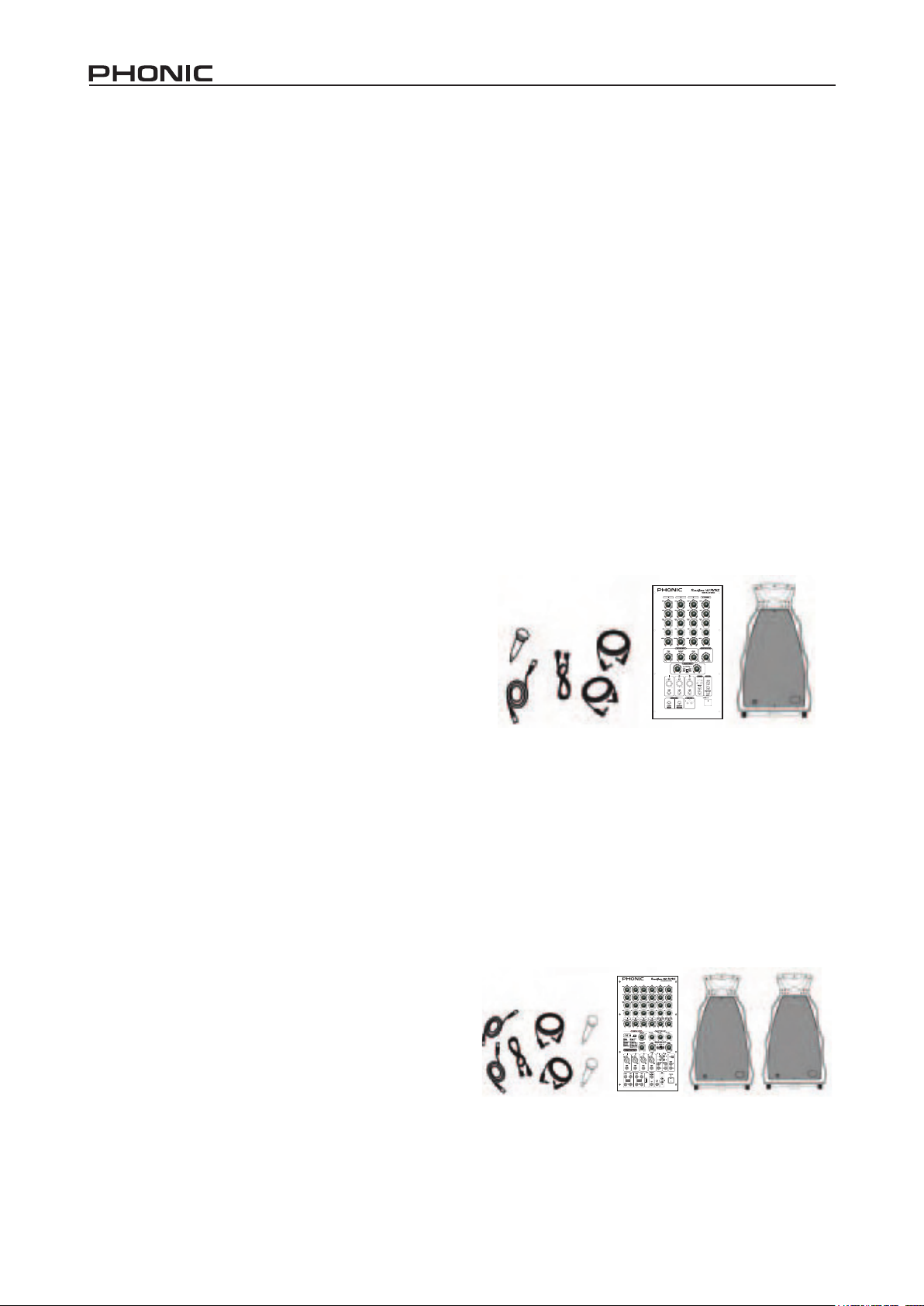
one of the RoadGear Plus mobile audio systems, a set of audio equipment superior in design and versatility. The Phonic
RoadGear sets allow you to take all the equipment you need
to setup an advanced all-in-one integrated sound system anywhere you go, with a minimum of fuss. The fully self-contained
unit includes two full-range speakers, a powered mixer, and
two dynamic microphones, as well as all the needed cables.
RoadGear also gives you the option of using wireless microphones and supplies enough storage space to pack them conveniently away.
RoadGear 260 Plus additional features
● 260 Watt (130 per channel) stereo
● Six input channel mixer: four mic/line, two stereo
● High-Denition digital effect processor with 16 programs
and tap-delay
● 3-band system equalizer
● Two dynamic microphones (with clips, cables and individual
pouches)
RoadGear Components
Setting up the RoadGear couldn’t be easier. just release the
docking lock, and, after disassembling the mobile kit, simply
position the speakers, and plug them, the microphone, and any
other instruments or devices you wish, into the powered mixer.
After plugging the powered mixer into an appropriate power
supply, your system is ready to use. Not only is it this simple
to set up, however, but using the system is just as simple. Using the controls of the supplied powered mixer, simply adjust
the levels of the inputs, as well as the high, low, and middle
frequencies of the inputs, and the digital effects processor. All
these features make the RoadGear an easy and convenient
solution to a mobile sound system.
This user’s manual is specically designed to give you accurate information on the function and use of the RoadGear
160 Plus and RoadGear 260 Plus. After thoroughly reading
this manual, it is suggested you store it in an easily accessible
place for future reference.
Features
Common Features
● Integrated mobile sound system with luxury luggage-style
molded cabinet plus wheels
● Operates on AC or DC power
● Speaker system with 1” compression driver and 8” woofer
● 2-band EQ on each input channel
● Two 30 feet speaker cables
● Two receiver slots for optional wireless microphones
● Storage compartment for microphones, cables and acces-
sories
RoadGear 160 Plus
● Two Speakers with specially molded enclosures
● One powered mixer built into a specially molded storage
case
● One Phonic UM 99 microphone with 16 foot (5 meter) cable,
clip and carry pouch
● Two 30 foot (9 meter) speaker cables
● Detatchable power cable
● One transparent dust cover
RoadGear 260 Plus
● Two Speakers with specially molded enclosures
● One powered mixer built into a specially molded storage
case
● Two Phonic UM 99 microphones each with 16 foot (5 meter)
cable, clip and carry pouch
● Two 30 foot (9 meter) speaker cables
● Detatchable power cable
● One transparent dust cover
RoadGear 160 Plus additional features
● 160 Watt (80 per channel) stereo
● Four input channel mixer: three mic/line and one stereo
● Echo effect with delay time and repeat controls
● System equalizer with treble/bass control
● One dynamic microphone (with mic clip, cable and carry
pouch)
4
Road Gear 160 Plus/Road Gear 260 Plus
Page 5
Caution
1
Push botton in
to release lock
Initial Setup
● Use the AC power cable supplied with the RoadGear sets
only
● When buying the RoadGear, the AC power cable will be
specic to the safety and code requirements of the Country
of purchase
● The ground (earth) pin of the AC power cable’s male connector should under no circumstances be removed.
● When taking the RoadGear abroad, check local voltage levels and ensure the appropriate power standard is used, as
selected by the power selection switch on the rear panel.
● When the RoadGear is in use, the storage compartment
door much be kept open for better ventilation
Dissassembling
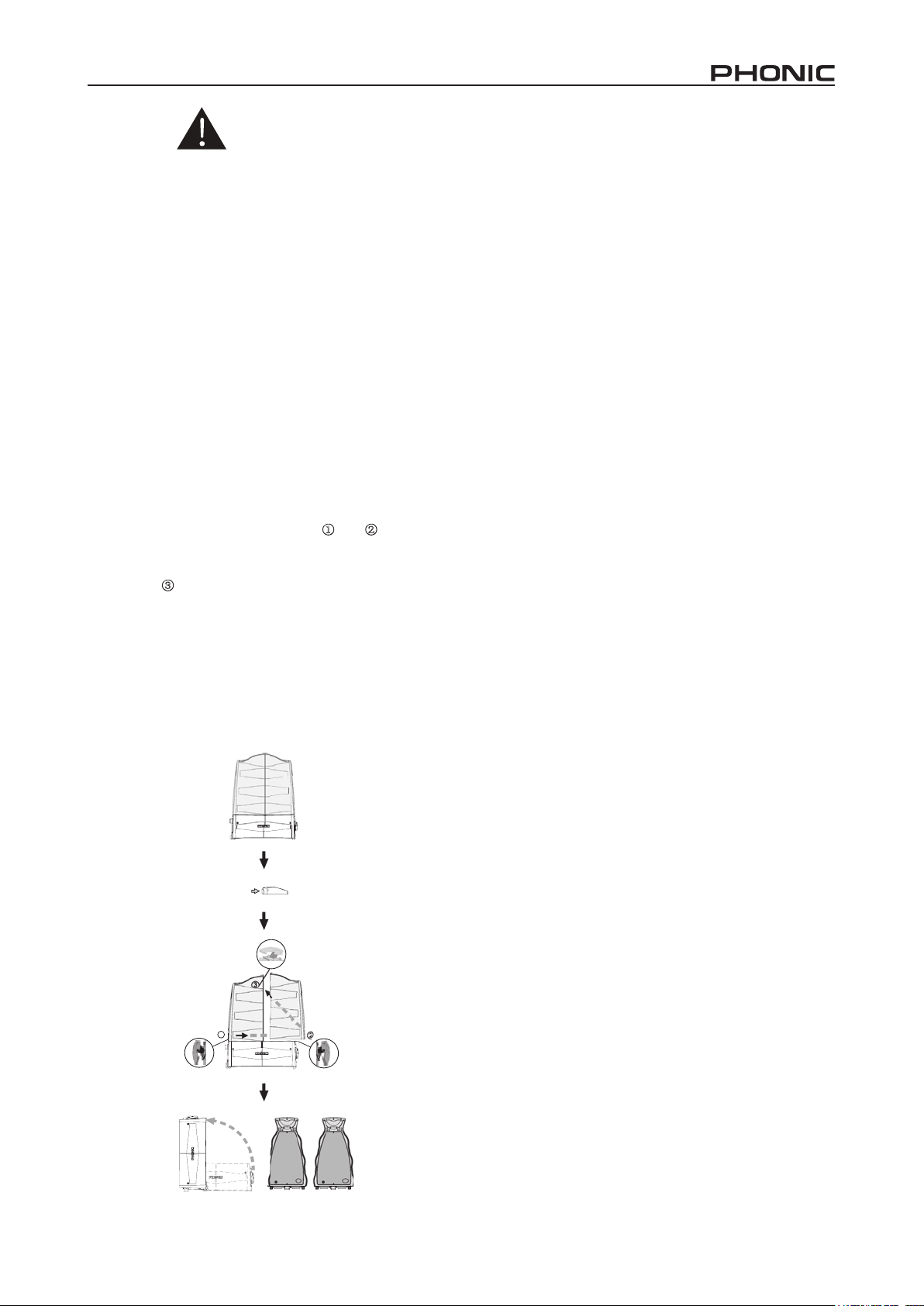
To follow is the most convenient way to open and close the
RoadGear kits. Following these instructions will ensure trouble-free setup of the RoadGear.
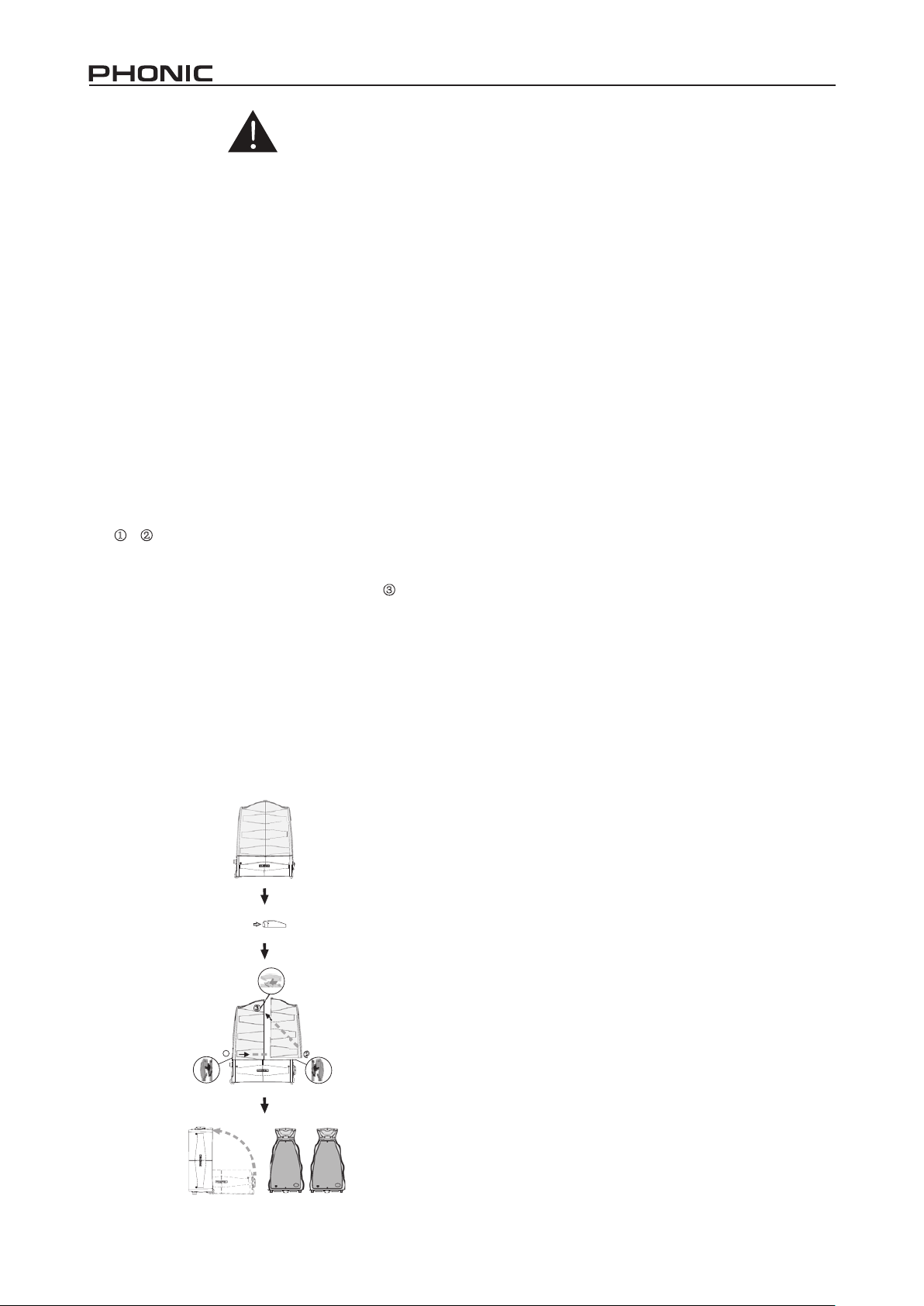
1. You should rst unclip docking locks ① and ② (indicated
below) on the either side of the RoadGear.
2. After unlocking these docking locks you can then open the
top lock ③. This ensure the RoadGear pieces come apart
smoothly.
3. Stand the powered mixer upright.
4. To re-assemble the RoadGear pieces, the same order
should be taken (side locks rst, followed by the top).This
way the pieces will be held securely and rmly together.
5. When using the RoadGear speakers, ensure that the docking locks on the rear are locked back into place, to ensure
they don’t scratch the surface on which they sit.
Please ensure you take note of all setup instructions listed in
this manual. The RoadGear 160 and 260 are both used as
normal PA systems and therefore all care should be taken in
ensuring the correct setting up of equipment.
1. Disassembling the mobile RoadGear set and remove the
speakers from the top of the kit. Remove all items you wish
to use in your PA system from the RoadGear’s storage area.
Also, place the mixer and speakers in a suitable place.
2. Contect the two speakers to the Powered Mixer, via the
supplied speaker cable. An optional speaker stand may be
used to increase the height of the speakers.
NB. No devices other than speakers should be connected to
the speaker outputs. Doing so will likely cause damage to
the device. Also, guitar should not be used to connect am-
pliers to speakers.
3. Plug all necessary instruments and equipment into the
device’s various inputs as required. This may include linesignal devices, as well as microphones and/or guitars, keyboards, ect.
4. Plug any necessary equipment into the device’s various
outputs. This could include monitors, signal processors,
and/or recording devices.
5. Ensure all input and out levels are set to the leftmost position.
6. Plug the supplied AC cable into the AC inlet on the back of
the RoadGear mixer.
NB. Ensure the power cable has no scratches or cuts that may
reveal the wire beneath before plugging into the provided
powered mixer as constant setting up and disassembling of
equipment may cause insulation wear.
7. Plug the supplied AC cable into a power outlet of a suitable
voltage.
8. Turn the mixer power switch to the on position and set all
input and output at appropriate levels to suit your needs.
9. When the RoadGear is in use, the storage compartment
door must be kept open for better ventilation.
5Road Gear 160 Plus/Road Gear 260 Plus
Page 6
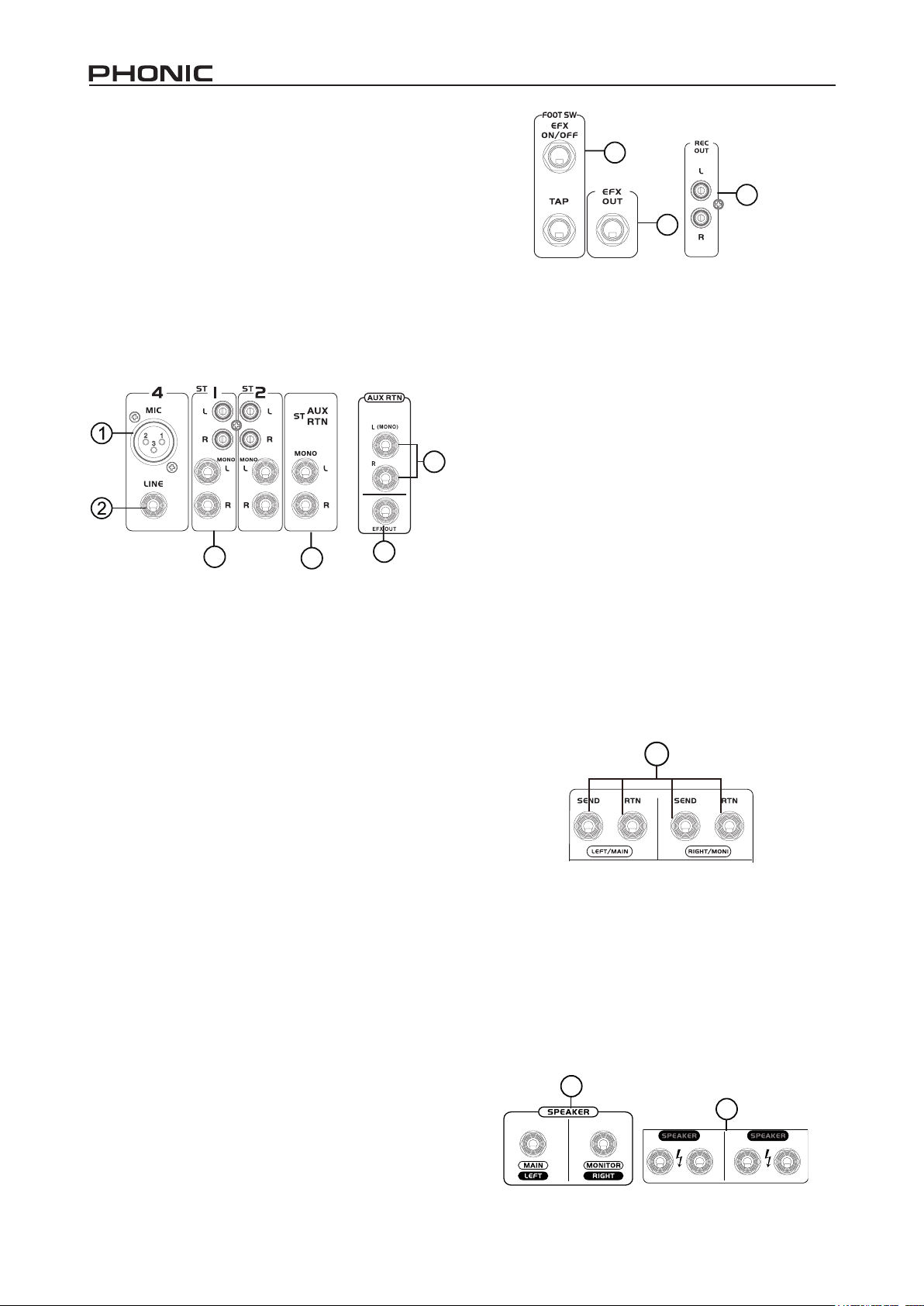
The RoadGear Mixer
The powered mixer provided with the RoadGear 260 Plus is
equipped with 4 mono microphone and line inputs, as well as
2 stereo inputs and a built in effect processor boasting a 32/40bit DSP. All this, plus a 3-band built in equalizer, ensures your
audio always sounds great on the road.
7
5
6
The RoadGear 160 Plus’s mixer is equipped with 3 mono mic
and line inputs, a single stereo channel, built-in digital echo
and system bass/treble control.
Making a Connection
3
RoadGear260
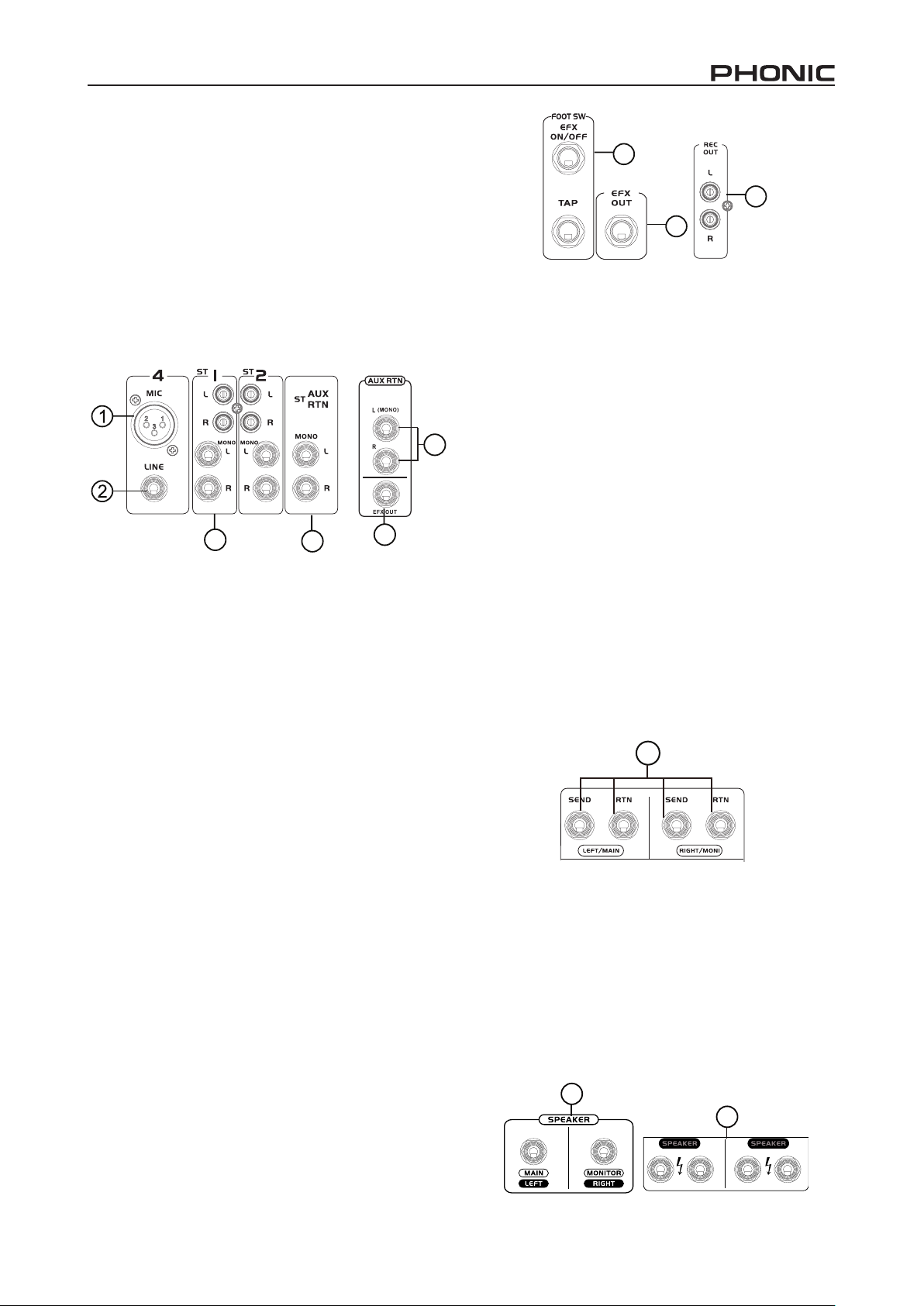
1. Microphone Input Jacks
These XlR jacks are for the input of low level signal devices,
most commonly, microphones. For best performance, we suggest using the microphones supplied with the RoadGear set,
however they can be used in conjunction with any professional
condenser, dynamic (RoadGear 260 Plus only) or ribbon microphones with standard 3-pin XlR male connectors.
2. Line Input Jack
These 1/4” TS phone jacks accept a wide range of input line
level devices, such as guitars and keyboards. It can accept
unbalanced sources, however any microphones plugged into
the microphone input will not work when a line device is attached to this system.
4
6
RoadGear160
5. Record Out
These outputs will accommodate RCA cables to be fed to a variety of recording devices, such as tape and digital recorders.
6. Effects (EFX) Out
These 1/4” TS outputs are the nal output from the effects
send mixing bus. This feed may be used to connect to an am-
plier and speakers, or to external digital effect processors.
When using external processors, the feed can be returned to
the Stereo AUX Return ports.
4
7. Foot Switch (RoadGear 260 Plus only)
This port allows the inclusion of a foot switch for remote alteration of digital effect properties (on or off). The upper one
is for turning on and off effect; the lower one is for changing
tap delay.
8. Send and Return (RoadGear 260 Plus)
These connectors allow external signal processors to be incorporated with the main mix, just prior to being sent through
the power amplier. Devices that can be used in conjunction
with these jacks include graphic equalizers, digital effect processors, feedback silencers, and so forth. It is strongly advised that these devices are set at low levels to ensure the
RoadGear’s inputs do not overload.
8
3. Stereo Inputs
The stereo inputs include 2 sets of jacks: standard RCA stereo
jacks, for use with consumer gear like CD and tape players,
etc., and stereo 1/4” TS phone jacks, for use with stereo products such as keyboards and drum machines. The RCA and
TS jacks can both be used simultaneously; however, in some
cases this is unadvisable as the blending of audio may have
undesirable results. The audio fed into these input are fed to
the corresponding stereo input bus.
4. Stereo AUX Return
These TS inputs connect the mixer with parallel external devices, such as sub mixers or external effect processors, receiving the processed signal from another source and feed it to the
main mixing bus. If you wish to use a signal from a mono device, simply connect the input to the left jack, and the signal will
be doubled to the right, effectively making it a mono signal.
6
9. Speaker Outputs
These jacks are used to connect to speakers, fed from the in-
ternal power amplier. Both sets of outputs are 1/4” TS jacks,
which can drive 130 Watts of output into 8Ω (or 80 Watts into 8Ω
on the RoadGear 160 Plus) per channel. To use these, simply
insert an appropriate 1/4” TS plug into them. The RoadGear
260 Plus features 2 speaker outputs per channel, whereas the
RoadGear 160 Plus features a single output per channel.
NB. Due to the fact that the output signal of these jacks is active, they
should be used in conjunction with speakers only as to avoid damaging
any other equipment.
9
9
RoadGear 160 Plus
Road Gear 160 Plus/Road Gear 260 Plus
RoadGear260 Plus
Page 7
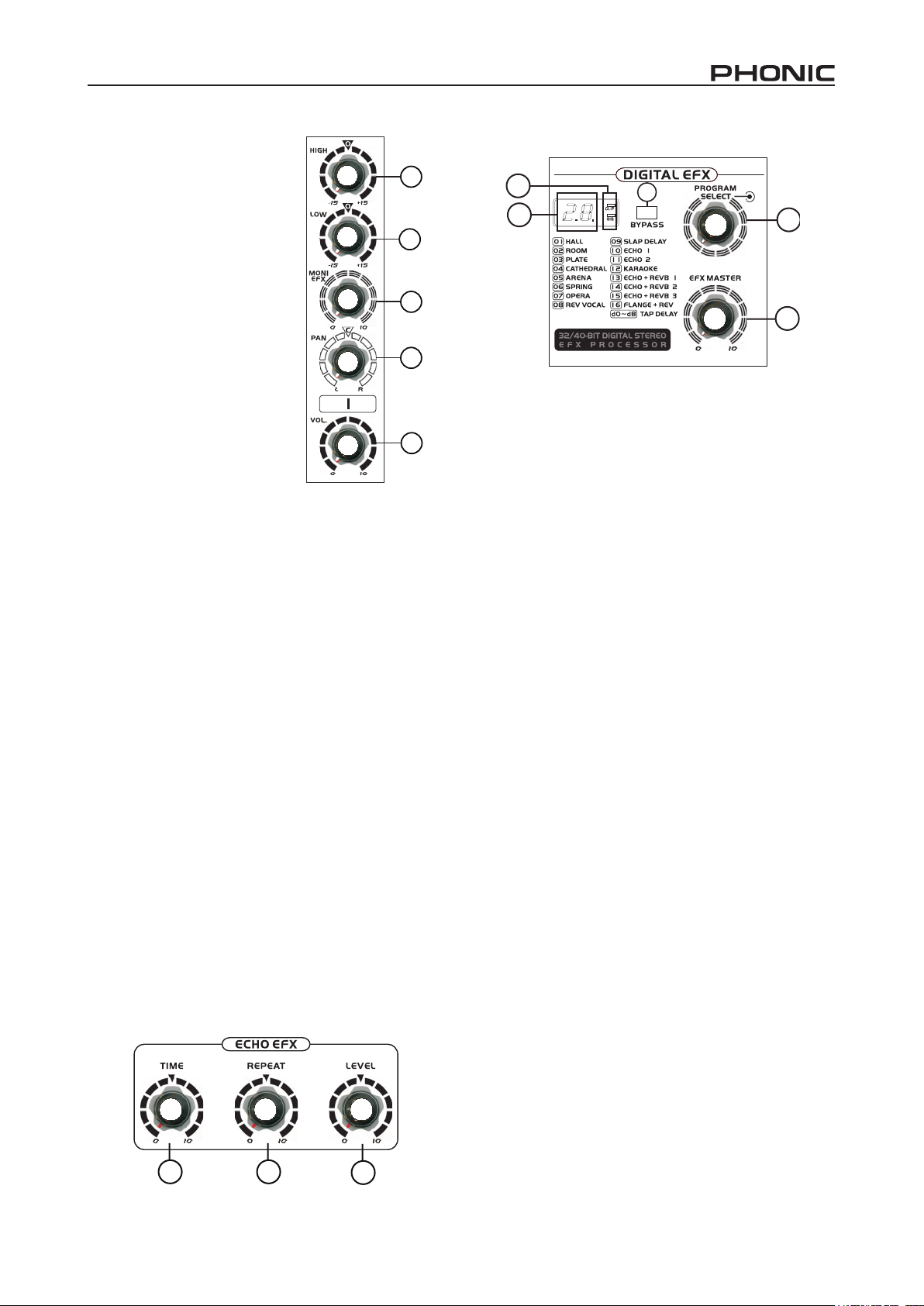
Controls and Settings
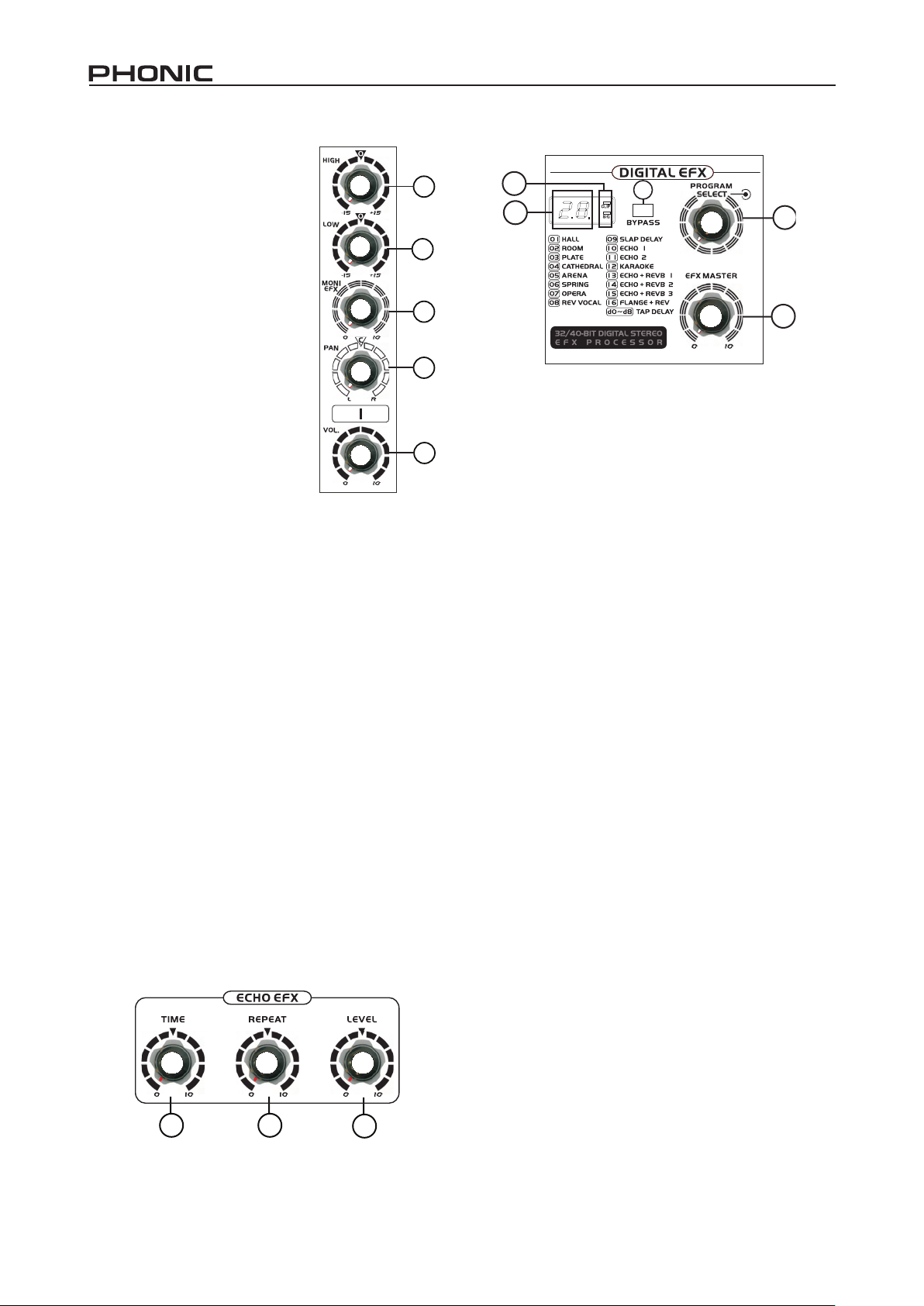
10. High Frequency Control
This control alters the degree of high
frequencies – or treble – in the audio
of the corresponding channel. Turn
clockwise to increase the amount
of treble in the sound, and turn
counterclockwise to decrease the
amount. Position the knob for a at
response, if not in use.
11. Low Frequency Control
This control alters the degree of high
frequencies – or bass – in the audio
of the corresponding channel. Turn
clockwise to increase the amount of
bass in the sound, and turn counterclockwise to decrease the amount.
Position the knob at “0” if not in use.
12. MONI / EFX Control
This control adjusts the signal level of the corresponding channel to be sent to the EFX and Monitor mixing bus, for digital
effect processing and monitoring of audio, respectively.
13. PAN / BAL Control
The ‘pan’ control alternates the degree or level of the mono
audio signal that the left and right channels of the main mix
should receive. On stereo channels, the ‘balance’ attenuates
the left or right signal as required.
10
11
12
13
14
Digital Effects Panel (RoadGear 260 Plus)
19
18
22
20
21
18. Digital Effects Panel
This 2-digital numeric display shows the program number that
is currently applied to your EFX audio signal. When you rotate
the Program control, you can scroll through different program
numbers; however the display will revert back to the original
program if a new program is not selected within a few seconds.
19. Sig and Clip Indicators
located within the Digital Effect Display are Clip and Sig lEDs.
The Sig lED will light up when any signal is received by the effect processor, and the Clip lED will light up shortly before excessive signals are dynamically clipped. If the Clip lED lights
up too often, it may be advisable to turn down one or all EFX
controls on input channels to ensure the signal level is not too
high.
14. Level Control
This control alters the signal level of the corresponding channel to the main mix of the RoadGear. This control should be
set at “0” when the mixer is not in use.
Digital Effects (RoadGear 160 Plus)
15. Time Control
This control adjusts the time of the built-in echo effect.
16. Repeat Control
This control adjusts the frequency of the repeats in the Echo
effect.
17. Level Control
This control adjusts the amount of the audio from the built-in
Echo effect processor that will be sent to the main mix.
20. Program Control
This control is used to scroll through the various effects. Turning the control clockwise will allow users to ascend into higher
program numbers, and turning it counter-clockwise will allow
users to descend into lower program numbers. Pushing this
control will apply the new effect. When a tap-delay effect is
selected, pressing this control will allow users to select the tapdelay time.
by pushing the button several times, the effect processor interprets the time between last two pushes and remembers this
as the delay time, until the button is pushed again (this is kept,
even after the power is turned off). When the tap delay effect is
selected, a small LED will ash within the digital effect display
window at the selected intervals.
21. EFX Master Control
The EFX master control adjusts the nal level of the processed
signal that is sent to the main mix.
22. Bypass Switch
Pushing this switch will bypass the effect engine. Two small in-
dicators within the Effects display will ash when this is done.
15 16
17
7Road Gear 160 Plus/Road Gear 260 Plus
Page 8
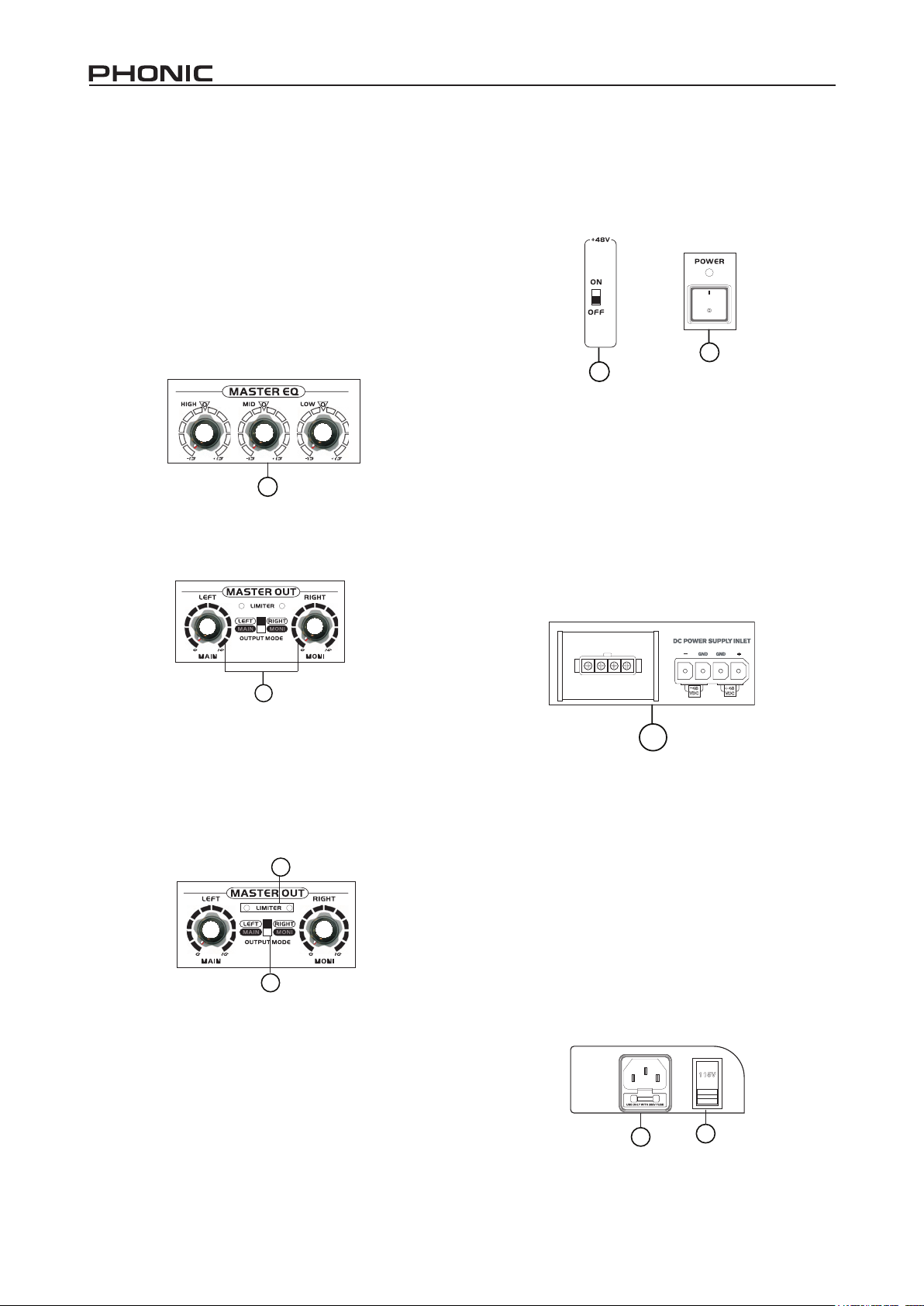
Master Controls
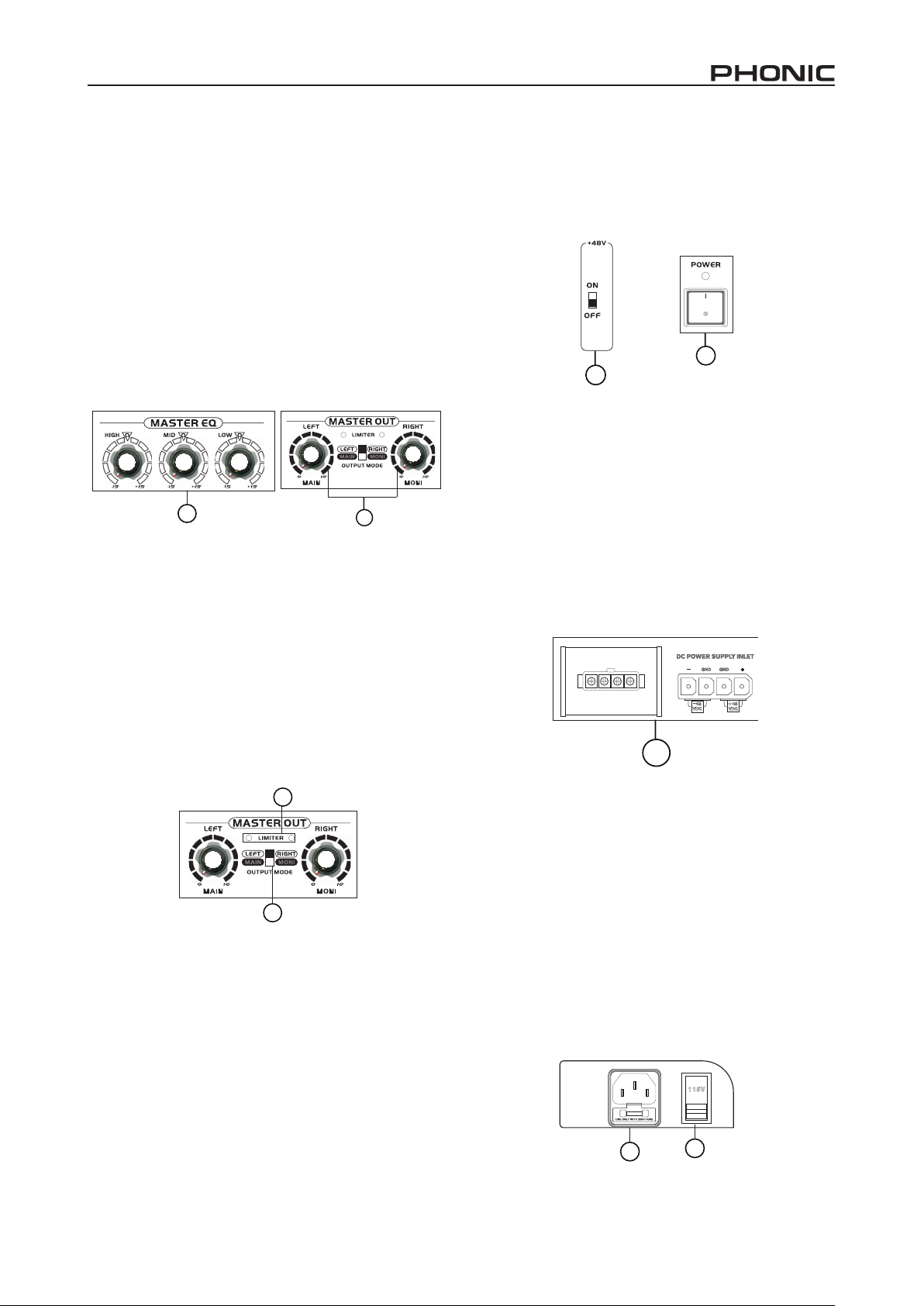
23. System Equalizer
The RoadGear 260 Plus’s built in equalizer provides you with
3 different level controls, for perfect control over the high, mid
and low frequencies of your audio. Changing the level of high
frequencies included in your audio with enhance the treble
sounds, such as guitars, as well as enhancing the crispness
of vocals. Changing the level of low frequencies in your audio
will enhance bass sounds, including drums and bass guitars,
and add to the overall warmth of the sound. Changing middle
frequencies can help add crispness to vocals.
The RoadGear 160 Plus features a single bass / treble control
for adjusting the high and low frequency balance of your mix.
23
24. L/R Level Controls
These controls are used to adjust the nal volume level of the
MAIN Left and Right signal, sent to the power amplier and
respective outputs (as set by the mode selector switch).
27. +48V Switch (RoadGear 260 Plus only)
This switch supplies +48v of phantom power to all input channels, used for powering condenser microphones.
28. Power Switch
This button is used to turn the device on and off.
28
27
Rear Panel
29. DC Power Supply Input
This DC power input is used to connect the RoadGear 12vDCto±48vDC converter (12vDC-to±40vDC on RoadGear 160
Plus) (and portable 12v battery) to the RoadGear, enabling
you to use the RoadGear system when an AC power source
is unavailable. The rightmost socket is used for the positive
connection, and the leftmost is used for the negative. The two
middle sockets are used for grounding. The power supply used
should not exceed 51vDC(44vDC on RoadGear 160 Plus) as
to ensure safe operation of the RoadGear.
24
25. Limiter Indicators
There are 2 limiters built-in the stereo power amplier featured
in the RoadGear 160 Plus and 260 Plus. The limiters will kick
into action (and these lEDs illuminate) when the signal levels
become excessive. The limiter system will help prevent any
damage from occurring to any of your equipment, as well as try
to maintain signal clarity. However, if these lEDs are lighting
up, it is advisable to turn the main level controls.
25
26
26. Mode Selector
This is used to alternate the use of the power amplier outputs. If
stage monitors are used in your set of speakers, then the switch
can be set to the MAIN / MONI position. On the RoadGear 260
Plus, this will allow you to plug main speakers into the lEFT /
MAIN speaker outputs, and a set of passive monitors (with an
impedance of 8Ω or above) to the RIGHT / MONI outputs. On
the RoadGear 160 Plus, this selection will cause the left speaker
output to send the main signal (in mono); the right speaker output will send the monitor signal. When set to lEFT / RIGHT, the
speaker outputs send the main left and right signals as normal.
29
30. Power Connector and Fuse Holder
This port is used to plug the female end of the included AC
power cable. The other end should be connected to an appropriate power source. just below this connector is the
RoadGear’s fuse holder. In the event that the fuse blows, users
can open this holder, remove the old fuse and replace it with
another suitable fuse (listed near the power connector).
31. Voltage Selector
The voltage Select switch is used to adapt the RoadGear to different Countries’ voltage levels. You are able to select between
115v (which you can use in Countries with standard voltage
between 100v and 120v) and 230v (which can be used in
Countries with standard voltage between 220v and 240v).
30
31
8
Road Gear 160 Plus/Road Gear 260 Plus
Page 9
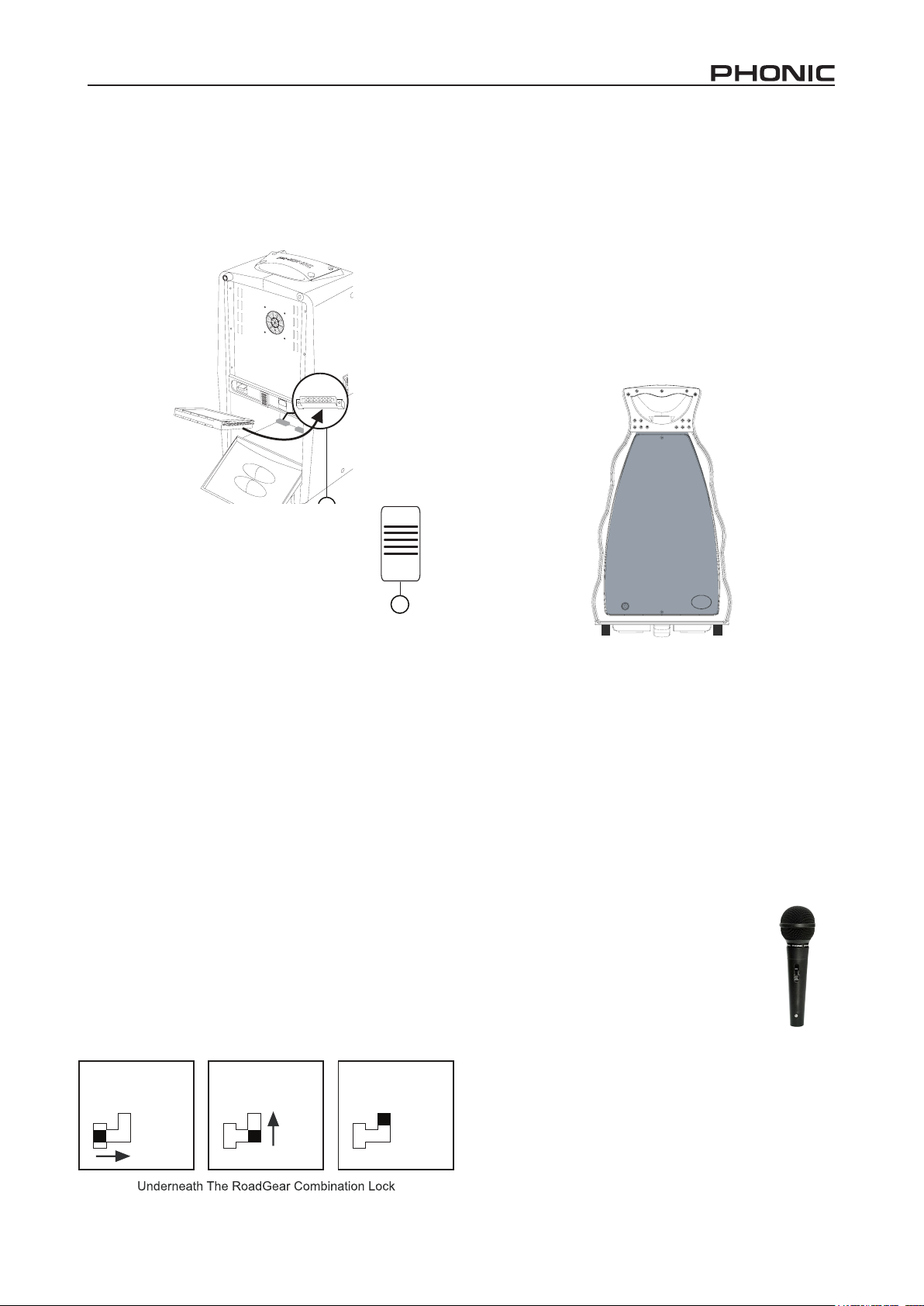
32. Wireless Module Slots
located conveniently within the RoadGear storage compartment, these two slots accept the UM-R11 wireless receiver
module (available with the UM31, UM41 and UM51 wireless
microphone kits). The wireless signal received by the left slot
is sent to channel 2 of the RoadGear mixer, whereas the right
slot is sent to channel 1.
33. Storage Compartment Latch
This small latch keeps the storage compartment
closed when not in use. Flick it up before opening,
and be sure not to force open the storage compartment as to avoid damaging this latch.
33
The RoadGear Speakers
The specially molded speakers that are included in both sets
provide 8 inch woofers, as well as a 1” compression driver for
high quality sound reproduction. Included with the speakers
are two 30 foot speaker cables. Each speaker has an imped-
ance of 8Ω.
It is important that users do not pick the RoadGear up by the
latches that hold it in place when the kit is assembled. Doing so
can cause damage to the latches, making them useless. Furthermore, when using the speakers, be sure to lock the latches
at the lower-rear end of the speaker back into place. This also
avoids damaging the latch.
Combination Docking Lock
The docking locks of the RoadGear are combination locks,
which require the user to enter a pre-set combination to open
them. Please observe the following instructions to opening the
lock.
1) The default code of the lock is 000. Please enter this code
the rst time you use the RoadGear.
2) To change the lock’s code, rst open the latch and nd a
small lever on the underneath of the lock. Pull it towards the
center of the lock, and up, until it sticks into place.
3) Change the number dials to your desired secret code. Ensure you either remember the code or write it down somewhere, as to not have to attempt to break the RoadGear
apart in a way that would not be favorable to it whatsoever.
4) After entering your desired code, replace the small lever
underneath the lock into its original position and voila! Your
new, secret code is set.
This process must be repeated for each lock separately. It’s
advised that you have the same code for each lock, as to avoid
confusion.
Microphone
Included with the RoadGear sets will be a microphone (two
with the RoadGear 260 Plus), more specically the Phonic
UM99 microphone. The Phonic UM99 will no doubt supply you
with a fantastically rened sound for use in public addresses or
even for vocals in live performances.
Polar Pattern: Cardioid (unidirectional)
Frequency Response: 50 Hz – 15 kHz
Impedance: 600Ω ± 30% (at 1000 Hz)
Sensitivity: -72dB ± 3 dB (SPL = 74 dB, 0 dB = 1V/μ bar; at
1000 Hz indicated by open circuit)
Switch: on & off
Dynamic Microphone Cartridge: CUM-112 (copper
voice coil)
Mechanical Spec:
Dimensions: Ø52 x 178 mm
Weight: 232g (without cable)
UM99
9Road Gear 160 Plus/Road Gear 260 Plus
Page 10
Optional Accessories
2
1
3
4
ON
OFF
Battery Pack
In addition to all this, the RoadGear sets provide you with the
option of using various added features. Wireless microphones,
with 2 module inputs conveniently placed at the rear of the mixer, are a fantastic way to ensure the microphone cord is never
in the way. Dual and single speaker stands compatible with
the RoadGear speakers enable you to position your speakers in a way that best suits your setting, for a greater dispersion of audio. These just add to the ease and convenience that
RoadGear provides.
The following is a list of all optional accessories:
TB-RG: RoadGear Travel bag, used to protect the RoadGear
during transportation or in storage.
MK1-RG: RoadGear Speaker wall mount kit.
MK2-RG: RoadGear Dual Speaker Mount, allow you to mount
two RoadGear speakers at one tripod stand.
SK1: Two Speaker Stands, including carry bag.
SK2: Two Mic Stands & two Speaker Stands, including carry
bag.
Wireless Microphone
There are 3 different wireless microphone kits available for
the RoadGear mobile audio systems: the UM31, UM41 and
UM51. Each of these systems provides users with the same
wireless receiver, however includes either a handheld, lavaliere or headset microphone.
UM31 Handheld System
● Handheld transmitter (HT-100)
● Wireless receiver module (UM-R11)
UM41 Lavaliere System
● lavaliere microphone (Ml-10)
● bodypack transmitter (bT-200)
● Wireless receiver module (UM-R11)
UM51 Headset System
● Headset microphone (MH-20)
● bodypack transmitter (bT-200)
● Wireless receiver module (UM-R11)
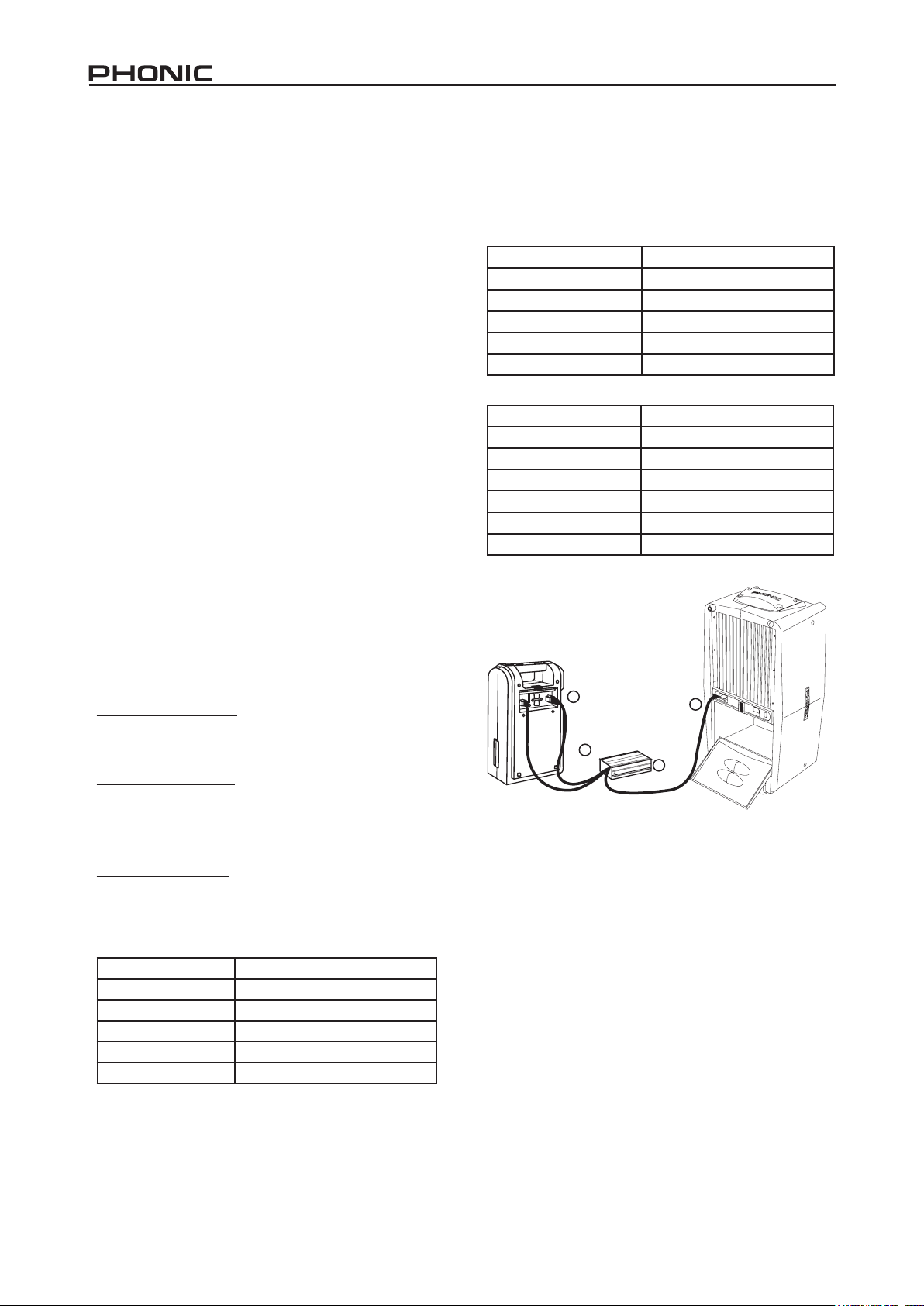
The bP-RG battery Pack and Cv-RG 12 volt DC-to-DC converter can be used to power the RoadGear in areas where no
AC power supply is available. The battery pack should provide
up to 4 hours of continuous use, and is rechargeable.
Model Number bP-RG battery pack
Charge Time 30 hours
Battery Time 4 hours
Lighting Time Up to 25 hours
Dimensions (W x H x D) 226x325x99mm 8.9"x12.8"x3.9"
Weight 7.75 kg (17.1 lbs)
Model Number Cv-RG DC to DC converter
Input Voltage 12v nomi
Output Voltage +48vDC and -48vDC
Input Fuse 40 amp
Output Fuse 10 amp
Dimensions (W x H x D) 100x50x166mm 3.9"x2.0"x6.5"
Weight 1.27 kg (2.8 lbs)
RF Frequency 614 - 870 MHz
Oscillation Type Pll Synthesized Control Oscillation
Channels 16 Channels
Frequency Response 50Hz - 18KHz, +/-3db
Bandwidth 24MHz
Operation Range 100m
10
Road Gear 160 Plus/Road Gear 260 Plus
Page 11
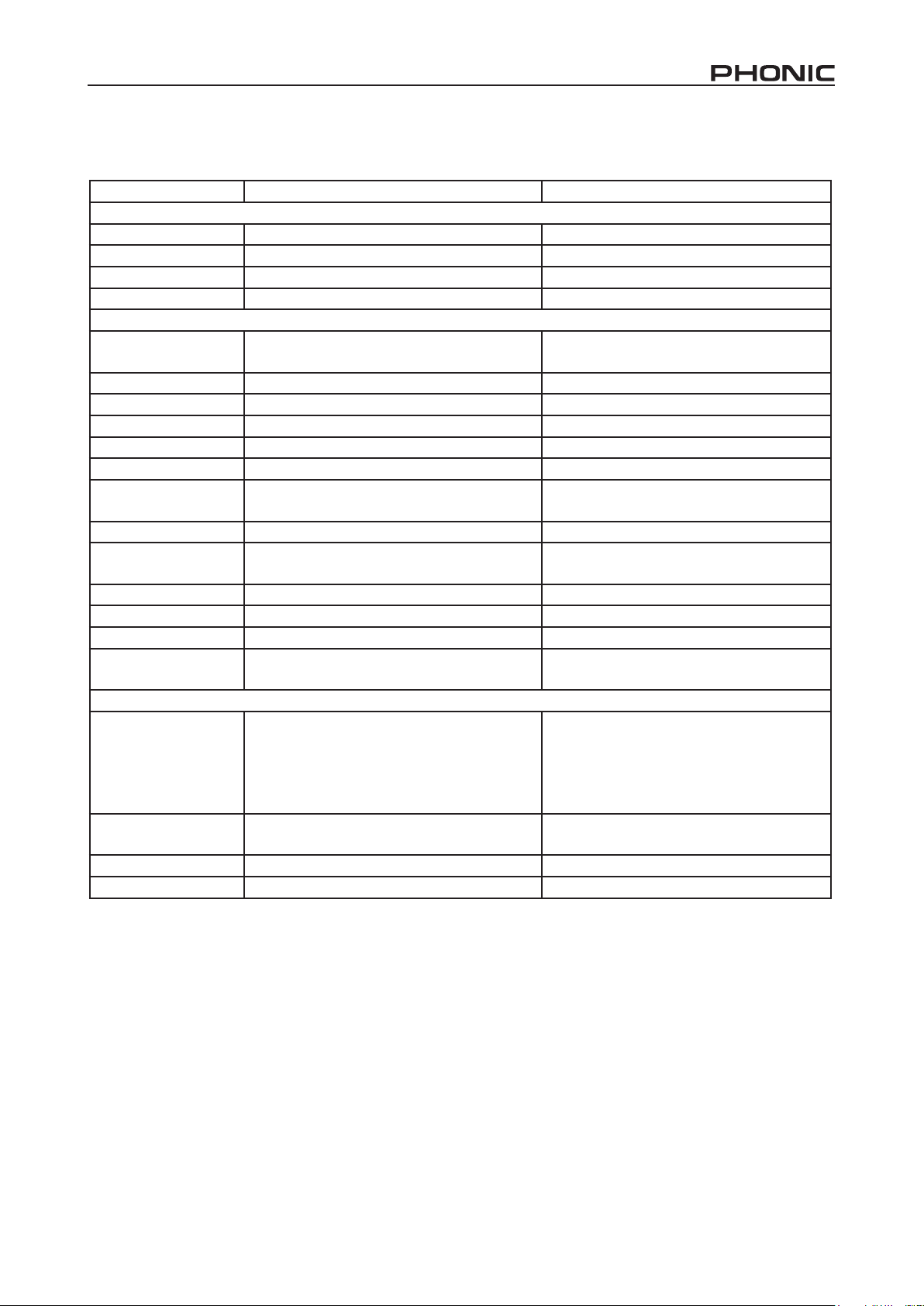
Specications
Road Gear 160 Plus Road Gear 260 Plus
Speakers
Drivers Compression tweeter & 8" woofer Compression tweeter & 8" woofer
Stand Adapter 35mm 35mm
Output Power 2x80W @ 8Ω 2x130W@8Ω
Mid/High Crossover Point 2KHz 2KHz
Mixers
Channels
Mono Channel balanced, XlR & 1/4" TRS balanced, XlR & 1/4" TRS
Stereo Channel 2x1/4"TS & 2xRCA 2x1/4"TS & 2xRCA
Multi-effect Processor Echo with time and repeat control 16 programs plus tap delay, 40-bit
Foot Switch n/a Momentary, Effect On / Mute and tap
System EQ Treble/bass 3-band
Minimum Impedance of
Power Amplier
Amp Mode l & R or MAIN & MONITOR, with limiter indicators l & R or MAIN & MONITOR, with limiter indicators
Speaker Out 1 x 1/4" TS per channel
Tape Out One Stereo RCA One Stereo RCA
EFX Out & ST Return Yes, 1/4" TS Yes, 1/4" TS
Phantom Power n/a Yes
Wireless Mic Module
Socket
Included Accessories
Power Requirement
Dimensions (H x W x D) 818x635x352mm (32.2"x25"x13.9") 818x635x352mm (32.2"x25"x13.9")
Net Weight 27kg (59.5lbs) 28kg(61.7lbs)
3 mono & 1 stereo CH, 2-band EQ,
Efx send, pan, level
8Ω 4Ω
2 (wireless microphones and receiver
modules are optional)
Miscellaneous
1 x Phonic UM99 microphone with
clip, 20' cable, and carry pouch
2 x 30' speaker cables
1 x detachable power cable
1 x PvC dust cover
Switchable between 115vAC / 60Hz
and 230vAC / 50Hz, or optional
4 mono & 2 stereo CH, 2-band EQ,
Efx send, pan, level
2 x 1/4" TS per channel with insert
Send and Return
2 (wireless microphones and receiver
modules are optional)
2 x Phonic UM99 microphone with
clip, 20' cable, and carry pouch
2 x 30' speaker cables
1 x detachable power cable
1 x PvC dust cover
Switchable between 115vAC / 60Hz
and 230vAC / 50Hz, or optional
11Road Gear 160 Plus/Road Gear 260 Plus
Page 12
Page 13
Introducción
En Phonic nos gustaríamos felicitarle por la compra de uno de
los sistemas de audio móvil RoadGear Plus, un set de equipo
de audio superior en el diseño y versatilidad. los sets de Phonic
RoadGear le permite llevar todo el equipo que usted necesita
para congurar un avanzado sistema de sonido integrado todo-
en-uno a cualquier lugar donde vaya, con un alboroto mínimo.
la unidad completamente autocontenida incluye dos altavoces
de rango completo, una mezcladora de potencia, dos micrófonos
dinámicos y todos los cables necesarios. RoadGear también
le da la opción de usar micrófonos inalámbricos y proporciona
espacio de almacenaje suciente para empaquetarlos
convenientemente.
Congurando el RoadGear no podría ser más fácil. Sólo libere
el cierre de atracamiento y luego de desensamblar el kit móvil,
posicione simplemente los altavoces y enchufarlos, el micrófono
y cualquier otros instrumentos o dispositivos que usted desea
en la mezcladora de potencia. luego de enchufar la mezcladora
de potencia en un suministro de energía apropiado, su sistema
está listo para utilizar. No solo que la conguración es así de
fácil, sino que la utilización es también así de simple. Usando
los controles de la mezcladora de potencia suministrada,
simplemente ajusta los niveles de las entradas, así como las
frecuencias alta, baja y media de las entradas y el procesador
de efectos digitales. Todas estas características hacen que
RoadGear sea una solución fácil y conveniente para sistema
de sonido móvil.
Características adicionales de RoadGear 260 Plus
● Estéreo de 260 Watt (130 por canal)
● Mezcladora de seis canales de entrada: cuatro mic/línea,
dos estéreo
● Procesador de efecto digital de Alta Denición con 16
programas y tap-retardo
● Ecualizador de sistema de 3 bandas
● Dos micrófonos dinámicos (con clips, cables y bolsas
individuales)
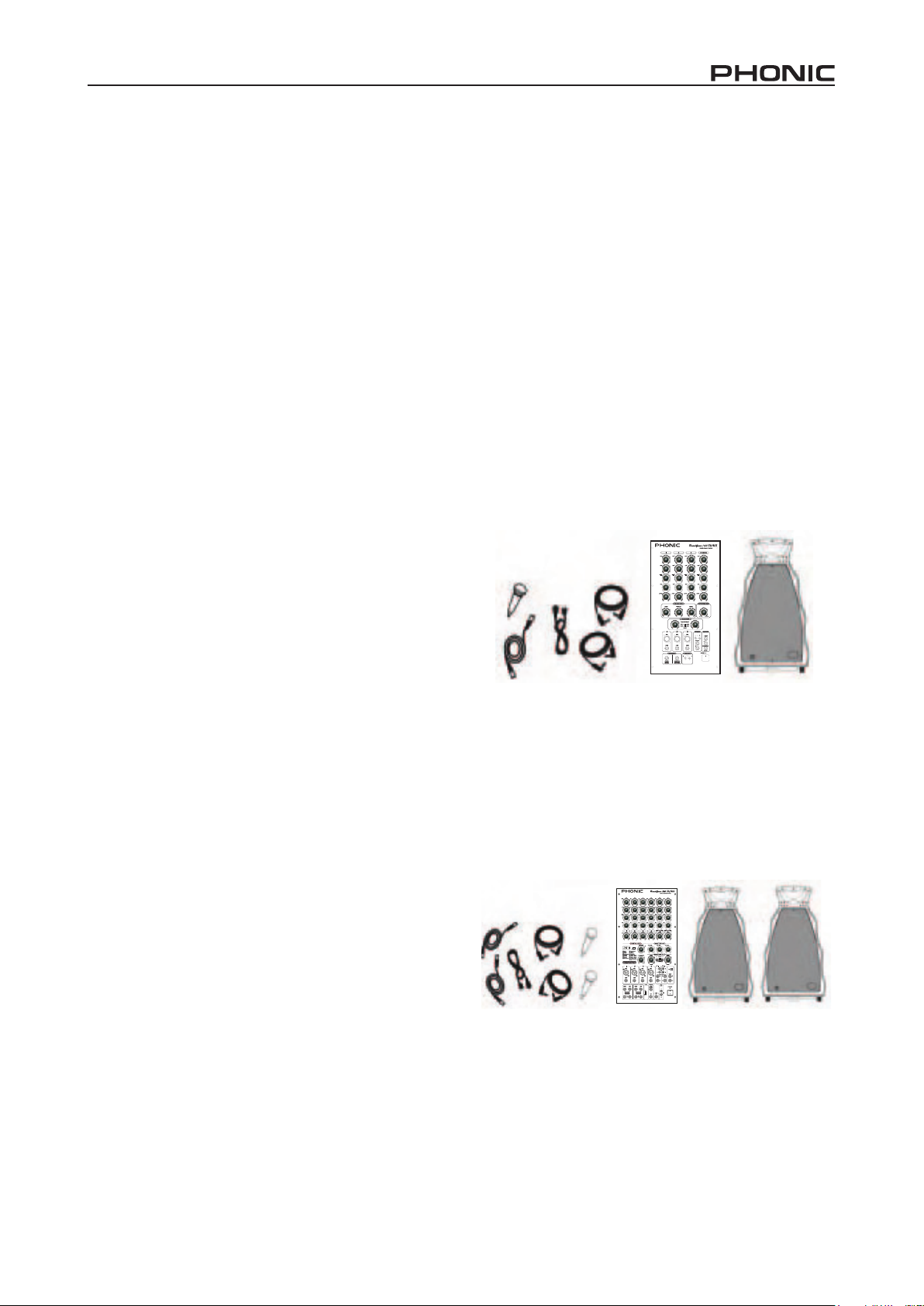
Componentes de RoadGear
RoadGear 160 Plus
● Dos Altavoces con estuches moldeados especialmente
● Una mezcladora amplicada construida dentro de un
estuche de almacenaje moldeado especialmente
● Un micrófono Phonic UM 99 con cable de 16 pies (5
metros), clip y bolsa para llevar
● Dos cables de altavoz de 30 pies (9 metros)
● Cable de energía desmontable
● Una cubierta antipolvo transparente
Este manual del usuario está diseñado especialmente para
darle información exacta de las funciones y uso de RoadGear
160 Plus y RoadGear 260 Plus. luego de leer este manual, se
le recomienda de guardarlo en un lugar de fácil acceso para
referencia futura.
Características
Características Comunes
● Sistema de sonido móvil integrado con lujoso gabinete
moldeado estilo maleta con ruedas
● Opera con energía AC o DC
● Sistema de altavoz con controlador de compresión de 1” y
woofer de 8”
● EQ de 2 bandas en cada canal de entrada
● Dos cables de altavoz de 30 pies
● Dos ranuras de receptor para micrófonos inalámbricos
opcionales
● Compartimiento de almacenaje para micrófonos, cables y
accesorios
Características adicionales de RoadGear 160 Plus
● Estéreo de 160 Watt (80 por canal)
● Mezcladora de cuatro canales de entrada: tres mic/línea y
un estéreo
● Efecto de eco con tiempo de retardo y controles de repetición
● Ecualizador de sistema con control de agudo/bajo
● Un micrófono dinámico (con mic clip, cable y bolsa para
llevar)
RoadGear 260 Plus
● Dos Altavoces con estuches moldeados especialmente
● Una mezcladora amplicada construida dentro de un
estuche de almacenaje moldeado especialmente
● Dos micrófonos Phonic UM 99, cada uno con cable de 16
pies (5 metros), clip y bolsa para llevar
● Cables de altavoz de 30 pies (9 metros)
● Cable de energía desmontable
● Una cubierta antipolvo transparente
13Road Gear 160 Plus/Road Gear 260 Plus
Page 14
1
Push botton in
to release lock
Advertencia
Utilice el cable de corriente alterna suministrado con los
sets RoadGear solamente
Cuando compra el RoadGear, el cable de corriente alterna
será especíco a los requerimientos de seguridad y código
de país de la compra.
El pin a tierra de conector macho de cable de corriente alterna
no debería ser removido bajo ninguna circunstancia.
Cuando lleva el RoadGear a otro país, chequée los niveles
de voltaje local y asegúrese de que la energía estándar
apropiada es usada, como seleccionado por el interruptor
de selección de energía en el panel de dorso.
Cuando el RoadGear está en uso, la puerta de
compartimiento de almacenaje debe mantenerse abierta
para una mejor ventilación.
Desmontaje
la siguiente es la manera más conveniente de abrir y cerrar
los kits RoadGear. Siguiendo estas instrucciones asegurará
conguración sin problema de RoadGear.
1. Primero debería desabrochar los cierres de atracamiento
① y ② (indicado abajo) en cualquiera de los dos lados de
RoadGear.
2. Después de desenganchar estos cierres de atracamiento,
usted puede abrir entonces el cierre superior ③ . Esto
asegura que las piezas de RoadGear se separan sin
complicaciones.
3. Coloque la mezcladora amplicada verticalmente.
4. Para re-ensamblar las piezas de RoadGear, debería tomar
el mismo orden (primero los cierres laterales, luego el de
arriba). De esta manera las piezas estarán contenidas con
seguridad y rmemente juntas.
5. Cuando se usa los altavoces RoadGear, asegúrese de
que los cierres de atracamiento en la parte trasera están
cerrados correctamente para asegurar que no rayan la
supercie donde se posicionan.
Presione el botón para
liberar el cierre
Conguración Inicial
Por favor asegúrese de tomar nota de todas las instrucciones
de conguración listadas en este manual. Ambos RoadGear
160 y 260 son usados como sistemas PA normales y por lo
tanto todos los cuidados deberían ser tomados para asegurar
la conguración correcta de equipo.
1. Desensamble el set RoadGear móvil y remueva los
altavoces de tope de kit. Remueva todos los artículos que
usted desea usar en su sistema PA de área de almacenaje
de RoadGear. También, coloque la mezcladora y los
altavoces en un lugar adecuado.
2. Conecte los dos altavoces a la Mezcladora Amplicada
mediante el cable de altavoz suministrado. Una plataforma
de altavoz opcional puede ser usada para aumentar la
altura de los altavoces.
Nota: Además de los altavoces, ningún otro dispositivo debería
ser conectado a las salidas de altavoz. Haciendo eso, causará
probablemente daño al dispositivo. También, los cables de
guitarra no deberían ser usados para conectar amplicadores
a altavoces.
3. Enchufe todos los instrumentos y equipo necesarios dentro
de las varias entradas de dispositivo como sea necesario.
Esto podría incluir dispositivos de señal de línea, micrófonos
y/o guitarras, teclados, etc.
4. Enchufe cualquier equipo necesario en las varias salidas
de dispositivo. Esto podría incluir monitores, procesadores
de señal y/o dispositivos de grabación.
5. Asegúrese de que todos los niveles de entrada y salida
están seteados a la posición más izquierda.
6. Enchufe el cable suministrado de corriente alterna en
la entrada de corriente alterna en la parte trasera de la
mezcladora RoadGear.
Nota: Asegúrese de que el cable de electricidad no tenga
rayaduras o cortes que podrían haber por debajo de cable
antes de enchufar en la mezcladora amplicada proporcionada
ya que el constante montaje y desmontaje de equipo podría
causar aislamiento a desgaste.
7. Enchufe el cable de corriente alterna suministrado en la
salida de energía de un voltaje compatible.
8. Gire el interruptor de energía de mezcladora a la posición
de encendido y setée todas las entradas y salidas en
niveles apropiados para ajustar a sus necesidades.
9. Cuando el RoadGear está en uso, la puerta de
compartimento de almacenaje debería mantenerse abierta
para mejor ventilación.
14
Road Gear 160 Plus/Road Gear 260 Plus
Page 15
Mezcladora RoadGear
La mezcladora amplicada proporcionada con RoadGear 260
Plus está equipada con 4 micrófonos mono y entradas de línea,
2 entradas de estéreo y un procesador de efecto incorporado
ostentando un 32/40 bits DSP. Todo esto, más un ecualizador
incorporado de 3 bandas, asegura que su audio suena siempre
magníco en la ruta.
la mezcladora de RoadGear 160 Plus está equipada con 3
mic mono y entradas de línea, un simple canal de estéreo, eco
digital incorporado y control de grave/agudo de sistema.
Haciendo Conexión
3
RoadGear260
1. Jacks de Entrada de Micrófono
Estos jacks XlR son para entrada de dispositivos de señal
de nivel bajo, lo más común, micrófonos. Para el mejor
rendimiento, sugerimos usar los micrófonos suministrados
con el set RoadGear, sin embargo, pueden ser usado junto
con cualquier condensador profesional (RoadGear 260 Plus
solamente) o micrófonos de cinta con conectores macho XlR
estándares de 3 pines.
2. Jack de Entrada de Línea
Estos jacks de auricular TS 1/4” aceptan un amplio rango de
dispositivos de nivel de línea de entrada, tales como guitarras y
teclados. Puede aceptar fuentes no balanceadas, sin embargo,
cualquier micrófono enchufado en la entrada de micrófono no
trabajará cuando un dispositivo de línea está unida a este
sistema.
3. Entradas de Estéreo
las entradas de estéreo incluyen 2 juegos de jacks: jacks
estándar RCA estéreo, para usar con equipo de consumidor
como CD y tape players, etc., y jacks de auricular TS 1/4”
estéreo, para usar con productos de estéreo tales como teclados
y máquinas de tambor. Ambos jacks RCA y TS pueden ser
usados simultáneamente; sin embargo, en algunos casos no es
aconsejable ya que combinando audio podría tener resultados
no deseables. El audio alimentado dentro de estas entradas
son alimentadas a bus de entrada de estéreo correspondiente.
4. Retorno Aux de Estéreo
Estas entradas TS conecta la mezcladora con dispositivos
externos paralelos, tales como sub mezcladoras o procesadores
de efecto externos, recibiendo la señal procesada de otra fuente
y alimentarla a bus de mezcla principal. Si usted desea usar
una señal desde un dispositivo mono, simplemente conecte la
entrada a jack izquierdo y la señal será doblada a la derecha,
haciendola una señal mono ecientemente.
4
6
RoadGear160
7
5
6
5. Salida de Grabación
Estas salidas acomodarán a los cables RCA para ser
alimentadas a una variedad de dispositivos de grabación,
tales como tape y grabadoras digitales.
6. Salida de Efectos (EFX)
Estas salidas TS 1/4” son salidas nales desde el bus de mezcla
de envío de efectos. Esta alimentación podría ser usada para
conectar a un amplicador y altavoces o a procesadores de
efecto digital externos. Cuando se usa procesadores externos,
4
la alimentación puede ser retornada a los puertos de Estéreo
AUX Retorno.
7. Interruptor de Pedal (RoadGear 260 Plus solamente)
Este puerto permite la inclusión de un interruptor de pedal
para alteración remota de las propiedades de efecto digital
(encendido o apagado). El de arriba es para encender o
apgargar el efecto; el de abajo es para cambiar tap retardo.
8. Envío y Retorno (RoadGear 260 Plus)
Estos conectores permiten a procesadores de señal externa
ser incorporados con la mezcla principal, justo antes de ser
enviado por el amplicador de potencia. Los dispositivos que
pueden ser usados junto con estos jacks incluyen ecualizadores
grácos, procesadores de efecto digital, silenciadores de
retroalimentación, etc. Se advierte fuertemente que estos
dispositivos están seteados en niveles bajos para asegurar
que las entradas de RoadGear no se sobrecargan.
8
9. Salidas de Altavoz
Estos jacks son usados para conectar a los altavoces,
alimentado desde el amplicador de potencia interno. Ambos
juegos de salidas son jacks TS de 1/4”, que pueden conducir
130 Watts de salida en 8Ω (o 80 Watts en 8Ω en RoadGear
160 Plus) por canal. Para usar ésto, simplemente inserte un
enchufe apropiado TS 1/4” en ello. El RoadGear 260 Plus
presenta 2 salidas de altavoz por canal, en tanto el RoadGear
160 Plus presenta una salida simple por canal.
Nota: Debido a que la señal de salida de estos jacks está activa, ellos
deberían ser usados junto con los altavoces solamente como para
evitar daño a cualquier otro equipo.
9
9
RoadGear 160 Plus
RoadGear260 Plus
15Road Gear 160 Plus/Road Gear 260 Plus
Page 16
Controles y Conguraciones
10. Control de Frecuencia Alta
Este control altera el grado de las
frecuencias altas –o agudo- en el
audio de canal correspondiente. Gire
en el sentido de reloj para aumentar la
cantidad de agudo en el sonido, y gire
en sentido contrario para disminuir la
cantidad. Posicione el botón para una
respuesta plana, si no está en uso.
11. Control de Frecuencia Baja
Este control altera el grado de las
frecuencias bajas –o bass- en el
audio de canal correspondiente. Gire
en sentido de reloj para aumentar la
cantidad de bass en el sonido, y gire
en sentido contrario para disminuir la
cantidad. Posicione la perilla en “0” si
no está en uso.
12. Control MONI / EFX
Este control ajusta el nivel de la señal de canal correspondiente
para ser enviado a EFX y bus de mezcla de Monitor, para
procesamiento de efecto digital y monitoreo de audio,
respectivamente.
13. Control PAN / BAL
El control ‘pan’ alterna el grado o nivel de señal de audio mono
que los canales izquierdo y derecho de la mezcla principal
deberían recibir. En los canales de estéreo , ‘balance’(Equilibrio)
atenua la señal izquierda o derecha como es requerida.
14. Control de Nivel
Este control alterna el nivel de la señal de canal correspondiente
a la mezcla principal de RoadGear. Este control debería estar
seteado en “0” cuando la mezcladora no está en uso.
10
11
12
13
14
Efectos Digitales (RoadGear 160 Plus)
15. Control de Tiempo
Este control ajusta el tiempo de efecto eco incorporado.
16. Control de Repetición
Este control ajusta la frecuencia de repeticiones en efecto
Eco
17. Control de Nivel
Este control ajusta la cantidad de audio de procesador de
efecto Eco que será enviado a la mezcla principal.
15 16
17
Panel de Efectos Digitales (RoadGear 260 Plus)
19
18
22
20
21
18. Panel de Efectos Digitales
Este display numérico de 2 digitales muestra el número de
programa que es actualmente aplicado a su señal de audio
EFX. Cuando usted gira el Control de Programa, puede
desplazarse por los diferentes números de programa; sin
embargo, el display volverá a programa original si el nuevo
programa no está seleccionado dentro de pocos segundos.
19. Indicadores Sig y Clip
los lEDs de Clip y Sig están ubicados dentro de Display
de Efecto Digital. El lED Sig se iluminará cuando cualquier
señal es recibida por el procesador de efecto, y el lED Clip
se encenderá brevemente antes de que las señales excesivas
son cortadas dinámicamente. Si el lED Clip se ilumina
demasiado frecuente, sería aconsejable bajar uno o todos los
controles EFX en los canales de entrada para asegurar que el
nivel de la señal no está demasiado alto.
20. Control de Programa
Este control es usado para desplazarse por varios efectos.
Girando el control en el sentido de reloj permitirá a los usuarios
ascender a números más altos de programa, y girando en
sentido contrario permitirá a usuarios a descender a programa
de números más bajos. Pulsando este control se aplicará el
nuevo el efecto nuevo. Cuando un efecto de tap-retardo es
seleccionado, presionando este control permitirá a los usuarios
a seleccionar el tiempo de tap-retardo.
Pulsando el botón varias veces, el procesador de efecto
interpreta el tiempo entre las dos últimas pulsadas y lo toma
como el tiempo de retardo hasta que el botón es pulsado
nuevamente (ésto se guarda aún después de apagar
la electricidad). Cuando el efecto de retardo de tap es
seleccionado, un pequeño lED se brillará dentro de la ventana
de display de efecto digital en los intervalos sleccionados.
21. Control Maestro EFX
El control maestro EFX ajusta el nivel nal de la señal
procesada que es enviada a la mezcla principal.
22. Interruptor de Bypass
Pulsando este interruptor bypass el motor de efecto. Dos
indicadores pequeños dentro de display de efectos se brillarán
cuando está hecho.
16
Road Gear 160 Plus/Road Gear 260 Plus
Page 17
Controles Maestro
23. Ecualizador de Sistema
El ecualizador incorporado de RoadGear 260 Plus le provee
con 3 controles de nivel diferentes, para el control perfecto
sobre las frecuencias altas, medias y bajas de su audio.
Cambiando el nivel de frecuencias altas incluidas en su audio
con aumento de sonidos agudos, tales como guitarras, y
aumentando la claridad de las vocales. Cambiando el nivel
de las frecuencias bajas en su audio aumentará los sonidos
de bass, incluyendo tambores y guitarras bajo, y añade en
general calidez de sonido. Cambiando frecuencias medias
puede ayudar a agregar claridad a las vocales.
El RoadGear 160 Plus presenta un simple control de grave /
agudo para ajustar el equilibrio de frecuencia alta y baja de
su mezcla.
23
24. Controles de Nivel Izquierdo/Derecho
Estos controles son usados para ajustar el nivel de volumen
nal de señal PRINCIPAL Izquierda y Derecha, enviada a
amplicador de potencia y salidas respectivas (según seteado
por el interruptor de selector de modo).
25. Indicadores de Limitador
Hay 2 limitadores incorporados en amplicador de potencia
de estéreo presentados en RoadGear 160 Plus y 260 Plus.
los limitadores entrarán en acción (y estos lEDs se iluminan)
cuando los niveles de la señal llegan a ser excesivos. El
sistema de limitador ayudará a prevenir cualquier daño a
su equipo y tratar de mantener la claridad de la señal. Sin
embargo, si estos lEDs se iluminan, es aconsejable bajar los
controles de nivel principal.
25
26
26. Selector de Modo
Es utilizado para alternar el uso de las salidas de amplicador
de potencia. Si los monitores de escenario son usados en su
juego de altavoces, entonces el interruptor puede ser seteado
a posición PRINCIPAl / MONI. En RoadGear 260 Plus, ésto
le permitirá enchufar los altavoces principales en salidas de
altavoz IzQUIERDO / PRINCIPAl, y un juego de monitores
pasivos (con una impedancia de 8Ω o más) a salidas
DERECHA / MONI. En RoadGear 160 Plus, esta selección
causará la salida de altavoz izquierdo a enviar la señal
principal (en mono); la salida de altavoz derecho enviará la
señal de monitor. Cuando setea a IzQUIERDO / DERECHO,
las salidas de altavoz envían las señales de principal izquierdo
y derecho como normal.
24
27. Interruptor +48V (RoadGear 260 Plus solamente)
Este interruptor suministra +48v de fuente fantasma a todos los
canales de entrada, usado para proveer energía a micrófonos
de condensador.
28. Interruptor de Energía
Este botón es usado para encender y apagar el dispositivo.
28
27
Panel de Dorso
29. Entrada de Suministro de Energía DC
Esta entrada de energía DC es usada para conectar el
convertidor de RoadGear 12vDC-a±48vDC (12vDC-a±40vDC
en RoadGear 160 Plus ) (y batería portable 12v) a RoadGear,
permitiendole a usted usar el sistema RoadGear cuando la
fuente de corriente alterna no está disponible. El enchufe más
a derecho es usado para conexión positiva, y el más izquierdo
es usado para la negativa. los dos enchufes de medio son
usados para conexión a tierra. El suministro de energía usado
no debería exceder 51vDC (44vDC en RoadGear 160 Plus)
como para asegurar la seguridad de operación de RoadGear.
29
30. Conector de Energía y Portafusible
Este puerto es usado para enchufar el extremo hembra de
incluido cable de corriente alterna. El otro extremo debería
conectar a una fuente de energía apropiada. justo debajo de
este conector está el portafusible de RoadGear. En el caso
de que el fusible se quema, los usuarios pueden abrir este
portafusible, remueva el viejo fusible y reemplacelo con otro
fusible compatible (listado cerca de conector de energía).
31. Selector de Voltaje
El interruptor de Selección de voltaje es usado para adaptar
el RoadGear a los niveles de de voltaje de diferentes países.
Usted es capaz de seleccionar entre 115v (que puede usar en
países con voltaje estándar entre 100v y 120v) y 230v(que
puede ser usado en países con voltaje estádar entre 220v y
240v).
30
31
17Road Gear 160 Plus/Road Gear 260 Plus
Page 18
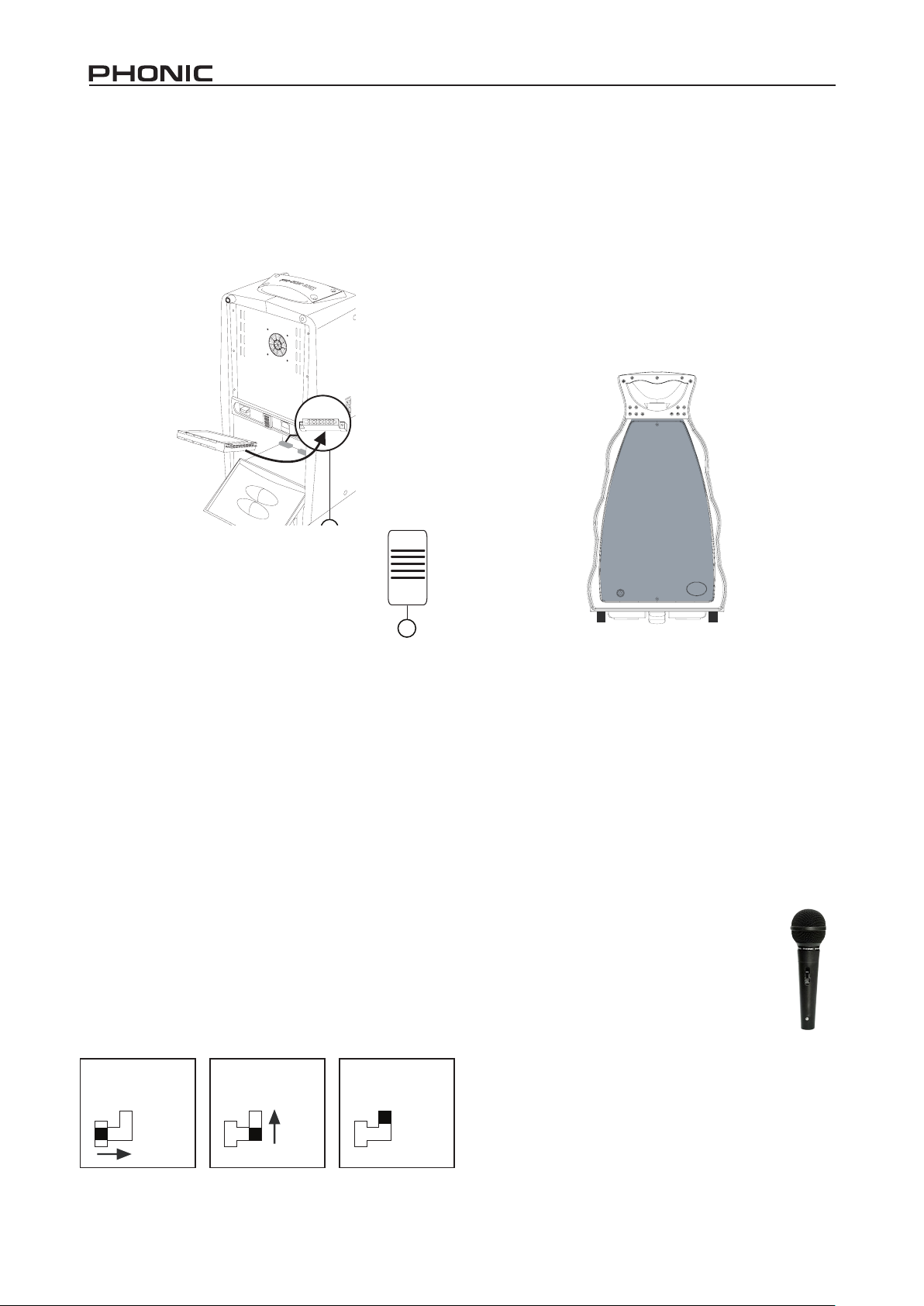
32. Ranuras de Módulo Inalámbrico
Parte Inferior de Cierre de Combinación de RoadGear
Ubicado convenientemente dentro de compartimiento
de almacenaje de RoadGear, estas dos ranuras aceptan
módulo de receptor inalámbrico UM-R11 (disponible con kits
de micrófono inalámbrico UM31, UM41 y UM51). la señal
inalámbrica recibida por la ranura izquierda es enviada a canal
2 de la mezcladora RoadGear, en tanto que la ranura derecha
es enviada a canal 1.
33. Pestillo de Compartimiento de Almacenaje
El pequeño pestillo mantiene el compartimiento
de almacenaje cerrado cuando no está en uso.
levantelo antes de abrir, y asegure de no abrir con
fuerza el comparimiento de almacenaje para evitar
que se dañe este pestillo.
33
Altavoces de RoadGear
los altavoces moldeados especialmente que están incluidos
en ambos sets proveen woofers de 8 pulgadas, un driver de
compresión 1” para reproducción de sonido de alta calidad.
Con los altavoces incluyen dos cables de altavoz de 30 pies.
Cada altavoz tiene una impedancia de 8Ω.
Es importante que los usuarios no levanten el RoadGear por
los pestillos que lo sujeta en el lugar cuando el kit está armado.
Haciendo eso, puede causar daño a los pestillos, haciendolos
inútiles. En adelante, cuando usa los altavoces, asegúrese
de cerrar los pestillos en el extremo bajo reverso de altavoz
trasero en el lugar. Esto también evita dañar el pestillo.
Combinación de Cierre de Atracamiento
los cierres de atracamiento de RoadGear son cierres de
combinación, que requiere que el usuario ingrese una
combinación preseteada para abrirlos. Por favor vea las
siguientes instrucciones para abrir el cierre.
1) El código de cierre por defecto es 000. Por favor ingrese
este código la primera vez que utilice RoadGear.
2) Para cambiar el código de cierre, primero abra el pestillo
y encuentre la pequeña palanca debajo de cierre. Tirela
hacia el centro de cierre y arriba hasta que se clava en el
lugar.
3) Cambie los diales de número a su código secreto deseado.
Asegúrese de acordar el código o escribalo en algún lugar,
para que no tenga que intentar a romper el RoadGear, que
no sería una manera favorable en absuluto.
4) luego de ingresar su código deseado, coloque la pequeña
palanca debajo de cierre en su posición original y listo! Su
nuevo, secreto código está seteado.
Este preoceso debe ser repetido para cada cierre
separadamente. Es aconsejado que tenga el mismo código
para cada cierre para evitar confusión.
Micrófono
Con los sets RoadGear incluirán un micrófono (dos con
RoadGear 260 Plus), más especicamente micrófono Phonic
UM99. Phonic UM99 sin duda le suministrará un sonido
increíblemente renado para usar en lugares públicos o aún
para voces en actuaciones en vivo.
Patrón Polar: Cardioide (unidireccional)
Respuesta de Frecuencia: 50Hz – 15kHz
Impedancia: 600Ω ± 30% (en 1000 Hz)
Sensibilidad: -72db ± 3 db (SPl = 74db, 0db=1v/µ bar; en
1000 Hz indicado por circuirto abierto)
Interruptor: encendido & apagado
Cartucho de Micrófono Dinámico: CUM-112 (bobina
de cobre)
Especicación Mecánica:
Dimensiones: Ø52 x 178 mm
Peso: 232g (sin cable)
UM99
18
Road Gear 160 Plus/Road Gear 260 Plus
Page 19
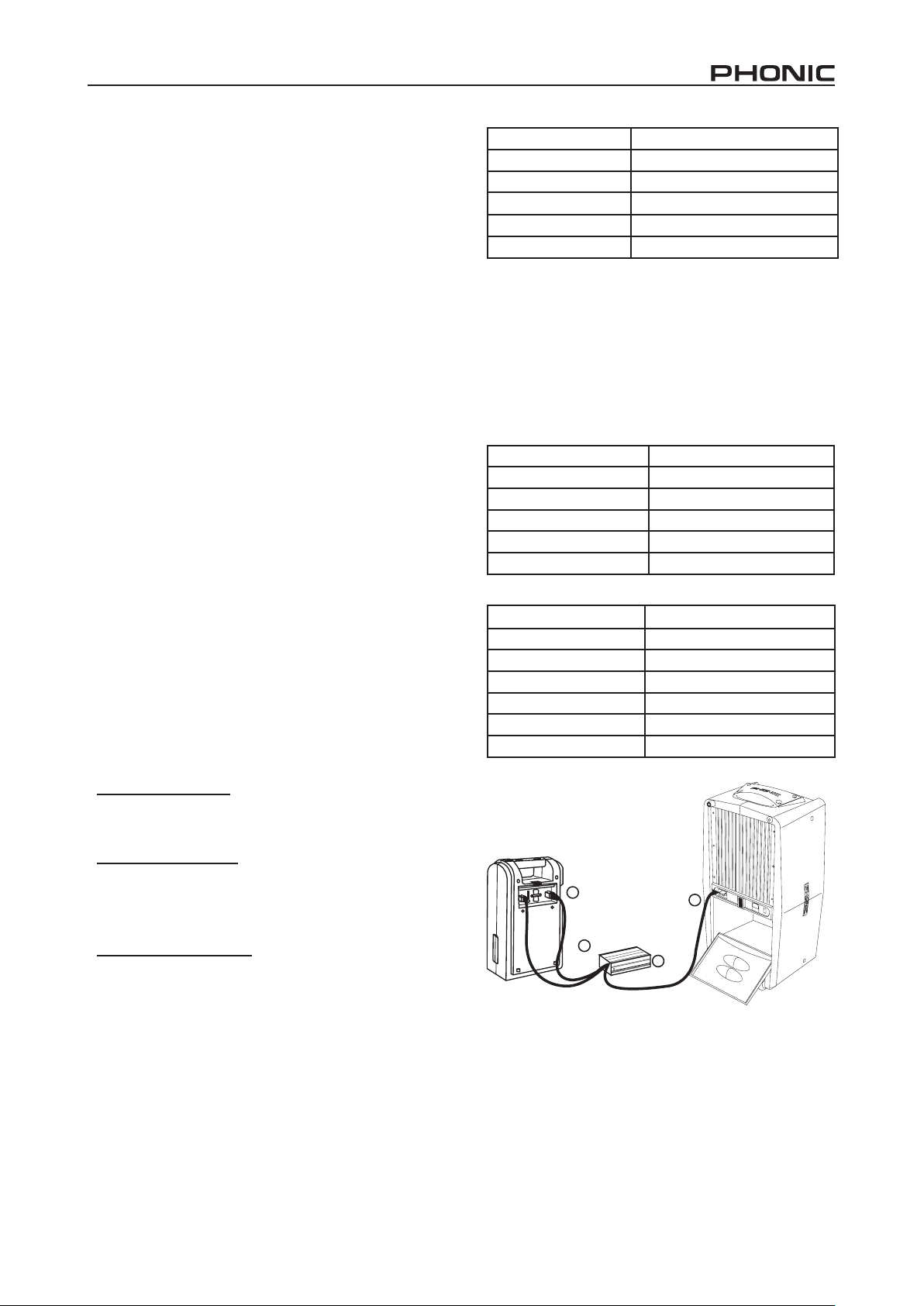
Accesorios Opcionales
2
1
3
4
ON
OFF
Además de todo ésto, los sets RoadGear le proveen la
opción de usar varias características añadidas. Micrófonos
inalámbricos con 2 entradas de módulo convenientemente
colocados en la parte trasera de la mezcladora, son maneras
estupendas para asegurar que el cable de micrófono no
está nunca en el camino. Soportes de altavoz dual y simple
compatibles con altavoces RoadGear le permite posicionar sus
altavoces en la manera que ajusta mejor a su conguración,
para mayor dispersión de audio. los paquetes de batería
opcionales proveen energía a sets RoadGear cuando no hay
otra fuente de energía cerca. Estos solo agregan a la facilidad
y conveniencia que RoadGear provee.
la siguiente es una lista completa de todos los accesorios
opcionales:
Frecuencia RF 614-870 MHz
Tipo de Oscilación Oscilación de Control Sintetizado Pll
Canales 16 Canales
Respuesta Frecuencia 50 Hz – 18 kHz, +/-3db
Ancho de Banda 24 MHz
Rango de Operación 100m
Paquete de Batería
El Paquete de batería bP-RG y convertidor Cv-RG 12 voltios
DC-a-DC puede ser usado para dar energía a RoadGear en
áreas donde no hay suministro de corriente alterna. El paquete
de batería debería proveer hasta 4 horas de uso continuo, y
es recargable.
TB-RG: RoadGear bolsa de viaje, usado para proteger
RoadGear durante la transportación o en almacenamiento.
MK1-RG: RoadGear kit de montaje a pared de altavoz.
MK2-RG: RoadGear Montaje de Altavoz Dual, le permite
montar dos altavoces RoadGear en un soporte de trípode.
SK1: Dos Soportes de Altavoz, incluyendo bolsa para llevar.
SK2: Dos Soportes de Mic & dos Soportes de Altavoz,
incluyendo bolsa para llevar.
Micrófono Inalámbrico
Hay 3 kits de micrófonos inalámbricos diferentes disponibles
para sistemas de audio móvil RoadGear: UM31, UM41 y
UM51. Cada uno de estos sistemas provee a usuarios con
el mismo receptor inalámbrico e incluye un micrófono portátil,
lavaliere o auricular con micrófono integrado.
Sistema Portátil UM 31
● Transmisor portátil (HT-100)
● Módulo de receptor inalámbrico (UM-R11)
Sistema Lavaliere UM41
● Micrófono lavaliere (Ml-10)
● Transmisor bodypack (bT-200)
● Módulo de receptor inalámbrico (UM-R11)
Sistema Auriculares UM51
● Micrófono auriculares (MH-20)
● Transmisor bodypack (bT-200)
● Módulo de receptor inalámbrico (UM-R11)
Número de Modelo bP-RG Paquete de batería
Tiempo de Carga 30 horas
Tiempo de Batería 4 horas
Tiempo de Iluminación Hasta 25 horas
Dimensiones(An x Al x P) 226x325x99mm 8.9”x12.8”x3.9”
Peso 7.75 kg (17.1 lbs)
Número de Modelo Cv-RG DC a DC convertidor
Voltaje de Entrada 12v nominal
Voltaje de Salida +48vDC y -48vDC
Fusible de Entrada 40 amp
Fusible de Salida 10 amp
Dimensiones(An x Al x P) 100x50x166mm 3.9”x2.0”x6.5”
Peso 1.27 kg (2.8 lbs)
19Road Gear 160 Plus/Road Gear 260 Plus
Page 20
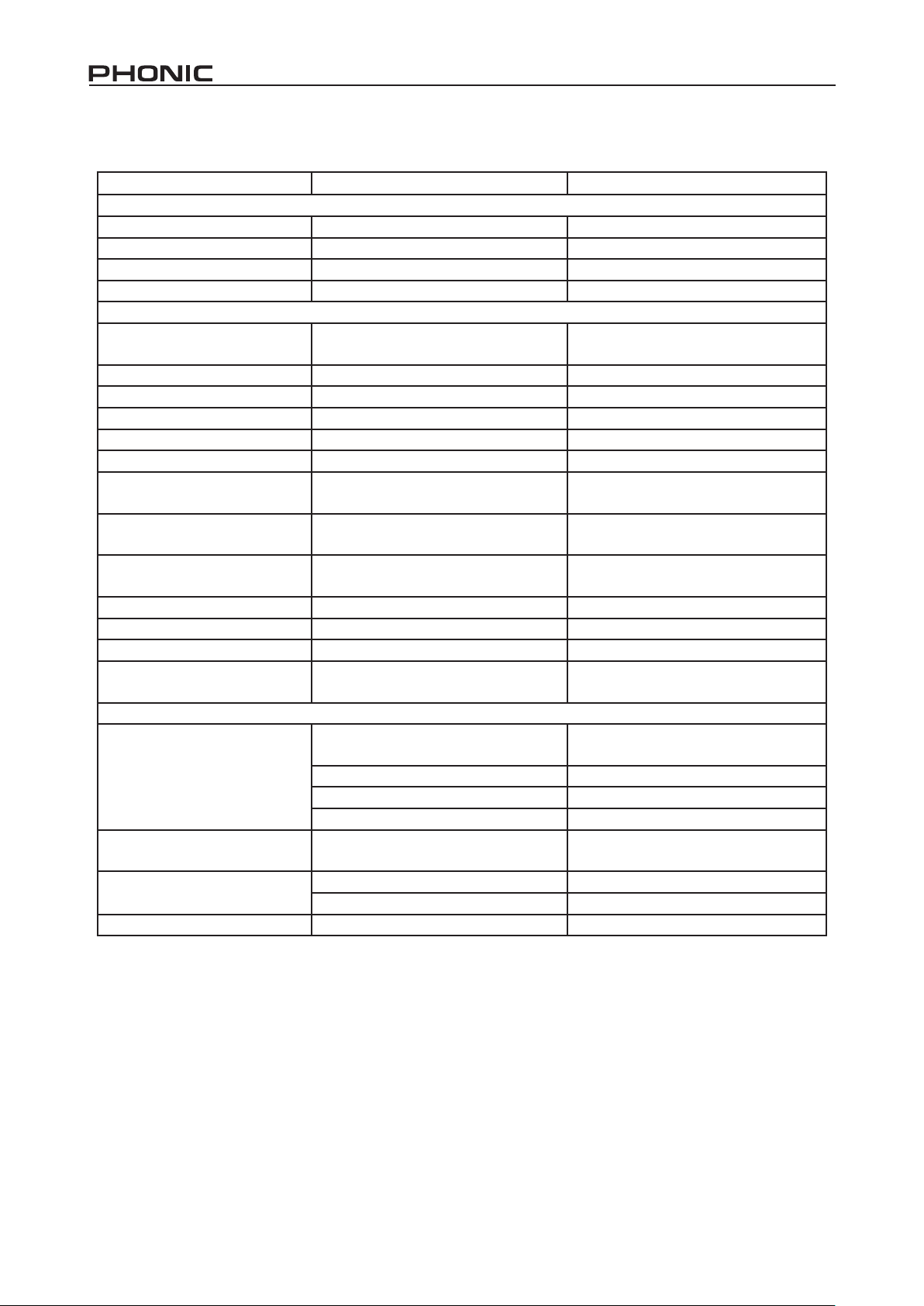
Especicaciones
RoadGear 160 Plus RoadGear 260 Plus
Altavoces
Drivers Compresión tweeter & 8” woofer Compresión tweeter & 8” woofer
Adaptador de Soporte 35mm 35mm
Energía de Salida 2 x 80W @ 8 ohms 2 x 130W @ 8 ohms
Punto de Crossover Medio/Alto 2 kHz 2 kHz
Mezcladora
Canales
Canal Mono balanceado, XlR & 1/4” TRS balanceado, XlR & 1/4” TRS
Canal Estéreo 2 x 1/4” TS & 2 x RCA 2 x 1/4” TS & 2 x RCA
Procesador Multi-efecto Eco con control de tiempo y repetición 16 programas más retardo tap, 40 bits
Interruptor de Pedal No Momentáneo, Efecto Encendido/Mute y tap
Sistema EQ Agudo / Grave 3 bandas
Impedancia Mínima de
Amplicador de Potencia
Modo Amp
Salida de Altavoz 1 x 1/4” TS por canal
Salida de Tape Un Estéreo RCA Un Estéreo RCA
Salida EFX & Retorno ST Sí, 1/4” TS Sí, 1/4” TS
Fuente Fantasma No Sí
Socket de Módulo Mic
Inalámbrico
Varios
Accesorios Incluidos
Requerimiento de Energía
Dimensiones
(Alto x Ancho x Profundidad)
Peso Neto 27 Kg (59.4 lbs) 28 Kg (61.7 lbs)
Canales 3 mono & 1estéreo, EQ 2 bandas,
envío Efx, pan, nivel
8 ohms 4 ohms
I & D o PRINCIPAl & MONITOR, con
indicadores de limitador
2 (micrófonos inalámbricos y módulos de
receptor son opcionales)
1 x micrófono Phonic UM99 con clip, cable de
20’ y bolsa para llevar
2 x cables de altavoz 30’ 2 x cables de altavoz 30’
1 x cable de electricidad desmontable 1 x cable de electricidad desmontable
1 x cubierta antipolvo PvC 1 x cubierta antipolvo PvC
Intercambiable entre 115vAC / 60Hz y
230vAC / 50Hz, u opcional
818 x 635 x 352 mm 818 x 635 x 352 mm
(32.2” x 25” x 13.9”) (32.2” x 25” x 13.9”)
Canales 4 mono & 2estéreo, EQ 2 bandas,
envío Efx, pan, nivel
I & D o PRINCIPAl & MONITOR, con
indicadores de limitador
2 x 1/4” TS por canal con inserción de Envío y
Retorno
2 (micrófonos inalámbricos y módulos de
receptor son opcionales)
2 x micrófono Phonic UM99 con clip, cable de
20’ y bolsa para llevar
Intercambiable entre 115vAC / 60Hz y
230vAC / 50Hz, u opcional
20
Road Gear 160 Plus/Road Gear 260 Plus
Page 21
CAUTION
RISK OF ELECTRIC SHOCK
DO NOT OPEN
PHONIC CORPORATION
Page 22
简介
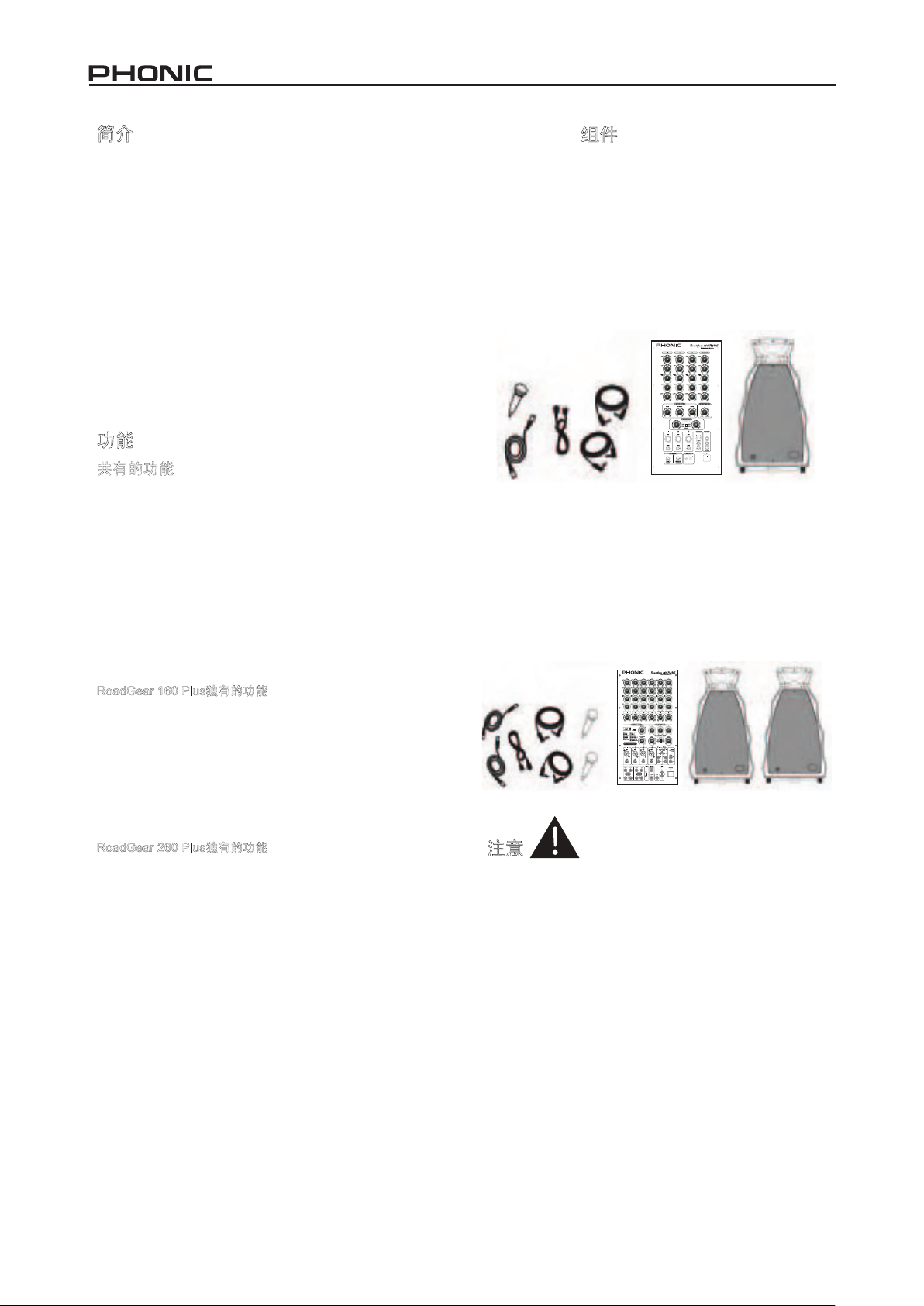
Road Gear组件
感谢您选购Phonic移动音频设备RoadGear,风格迥异的外观
设计与多 功能高 质量的特性 为非固 定式安装提 供了极 大的便
利.它配有完整的单体,包括一对全范围的音箱,功放调音台,动
圈式麦克风和连接线.RoadGear可让您随心所欲地享有无线自
由空间.
安装RoadGear时请先解锁,拆卸移动架,放置音箱,再连接麦克
风等其它乐器.把调音台插入合适的电源后,系统即可启用.运
用配备的调音台可有效地调节数字效果器和输入讯号的低中高
频.
RoadGear160 Plus和260 Plus使用手册为您提供详细的安装和
功能介绍.请仔细阅读使用手册并妥善保管,以便日后参阅.
功能
共有的功能
● 豪华行李式抗压封箱结构和滚轮设计赋予音箱系统的完整和
便利性
● 可使用直流或交流电
● 完美组合的1”高音单体和8”低音单体
● 每输入声道设两段EQ
● 两段30英尺的音箱连接线
● 麦克风,连接线和其它配件的储放隔间
● 两个无线麦克风接收器插槽
RoadGear 160 Plus
● 独特密封箱体的两个音箱
● 内置于特制箱体的功率调音台
● Phonic UM99麦克风带20英尺长的连接线,麦克风夹和便携
袋
● 两段30英尺长的音箱连接线
● 附带电源线
● 透明防尘罩
RoadGear260 Plus
● 独特封箱结构的两个音箱
● 内置于特制箱体的调音台
● Phonic UM99麦克风带20英尺的连接线,麦克风夹和便携袋
● 两段30英尺长的音箱连接线
● 附带电源线
● 透明防尘罩
RoadGear 160 Plus独有的功能
● 输出功率160W(每声道80W)
● 4路输入通道:三路麦克风/高电平和一路立体通道
● 回音效果具延迟时间和重复控制
● 系统均衡器具高低音控制
● 动圈式麦克风(麦克风连接线, 麦克风夹和便携袋)
RoadGear 260 Plus独有的功能
● 输出功率260W(每声道130W)
● 6路声道输入:4路麦克风/高电平,两路立体通道
● 三段系统均衡器
● 高清晰的16种音乐和节拍延迟的数字效果处理器
● 两个动圈式麦克风(麦克风连接线, 麦克风夹和两个便携袋)
注意
1. AC电源线只与RoadGear配对使用.
2. 购买RoadGear时,AC电源线应符合国家规定的安全和指定
标准.
3. 请勿损坏AC线连接器的接地插脚.
4. 使用RoadGear前,先确认当地电压伏特数是否与所选择的电
压一致.
5. RoadGear工作时,为保持良好的通风请打开置物箱门.
22
Road Gear 160 Plus/Road Gear 260 Plus
Page 23
装卸
1
按下此键以解锁
RoadGear调音台
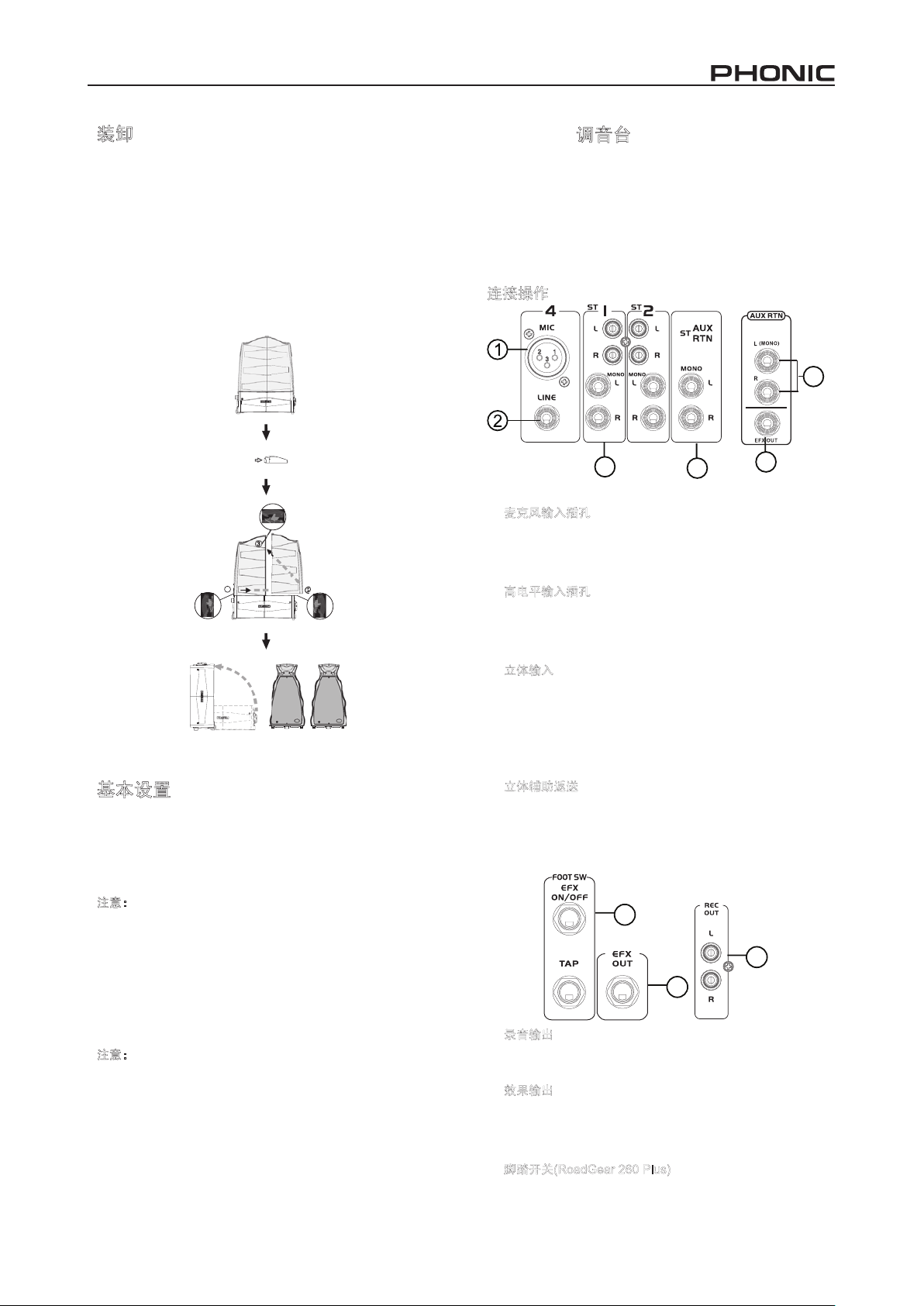
以下为您提供了最便捷的拆卸步骤,让您轻松快速地安装拆卸
设备.
1. 首先把图示中1和2的锁扣打开
2. 再打开位于顶部的锁扣,这样可把两个音箱拆开.
3. 直立放置调音台
4. 再把拆开的音箱组装起来, 先锁上左右两边的锁扣再锁上顶
部的锁扣.
5. 确保所有锁扣按原位固定,以避免刮损机体表面.
基本设置
请按使用说明操作,以利于正确地安装和使用机器.
1. 拆卸移动Road Gear设备,把它们从机架上端移开.再把放在
置物箱的其它配件拿出.
2. 使用配置的接线连接音箱与调音台,可将其放在音箱支架上.
注意:其它设备的连接线均不能接入音箱输出端,否则会损坏机
器.
3. 将乐器和其它设备插入对应的输入声道,如高电平信号设备,麦
克风,吉它,电子琴等.
4. 输出声道接入所需设备如监听器,信号处理器,录音机.
5. 所有输入和输出讯号音量设定在最左端.
6. 把AC线插入调音台背部的AC插座.
注意:确保不被刮损或割裂电源线,否则金属线暴露出来不能起
到绝缘保护的作用.
7. AC线应插入电压相符的电源插座.
8. 打开调音台,把输入和输出电平控制在适当位置.
9. 为保持良好的通风请打开置物箱门.
Road Gear 260 Plus调音台含有4个麦克风和高电平输入,两路
立体输入声,内置32/40位数字讯号处理器,另外还有3段等化设
置,为高传真音质的输出提供了可靠的保障.
Road Gear160 Plus调音台配有三个单音麦克风和高电平输入,
一路立体通道, 内建数字回音和系统低/高音控制.
连接操作
4
3
RoadGear260
1. 麦克风输入插孔
此平衡式 XlR插头用 于低电 平信号 设备,通常 是麦克 风.虽 然
可与专业的电容式麦克风,动圈式麦克风(只适用于RoadGear
260 Plus)和铝带麦克风经三芯XlR连接器一起使用.
2. 高电平输入插孔
1/4”TS Phone插头可连接多种高电平设备,如吉他,电子琴,接
收非平衡讯号.只要任一高电平设备连接音箱,麦克风如再插入
输入声道将无效.
3. 立体输入
一对输入插座中,一个是标准的立体RCA立体插头, 主要连接家
用音响产品如CD和磁带播放机.另一个是立体1/4”TS Phone型
插头,连接电子琴和鼓声产生器.两个输入插座可同时使用,然
而混淆地使用音频设备则会产生不良效果.音频讯号应分别送
入相应的立体输入总线.
4. 立体辅助返送
经TS输入声道并连外部设备,如辅助调音台或效果处理器,接受
另一声源处理过的讯号,再将讯号送至主混音总线.如果想使用
单音设备的讯号, 只需插入l左插孔, 讯号会自动复制给R右插
孔, 有效地接通单音讯号.
4
6
RoadGear160
7
5
6
5. 录音输出
这些输出是接RCA线供各种录音设备使用,如磁带和数字录音
机.
6. 效果输出
此1/4”TS输出是效果输出总线的最终讯号输出,该段讯号送入
扩大机和音箱或讯号处理器.使用信号处理器时,讯号会返送至
立体辅助倒送端子.
7. 脚踏开关(RoadGear 260 Plus)
用于远距离数字效果控制.
23Road Gear 160 Plus/Road Gear 260 Plus
Page 24
8
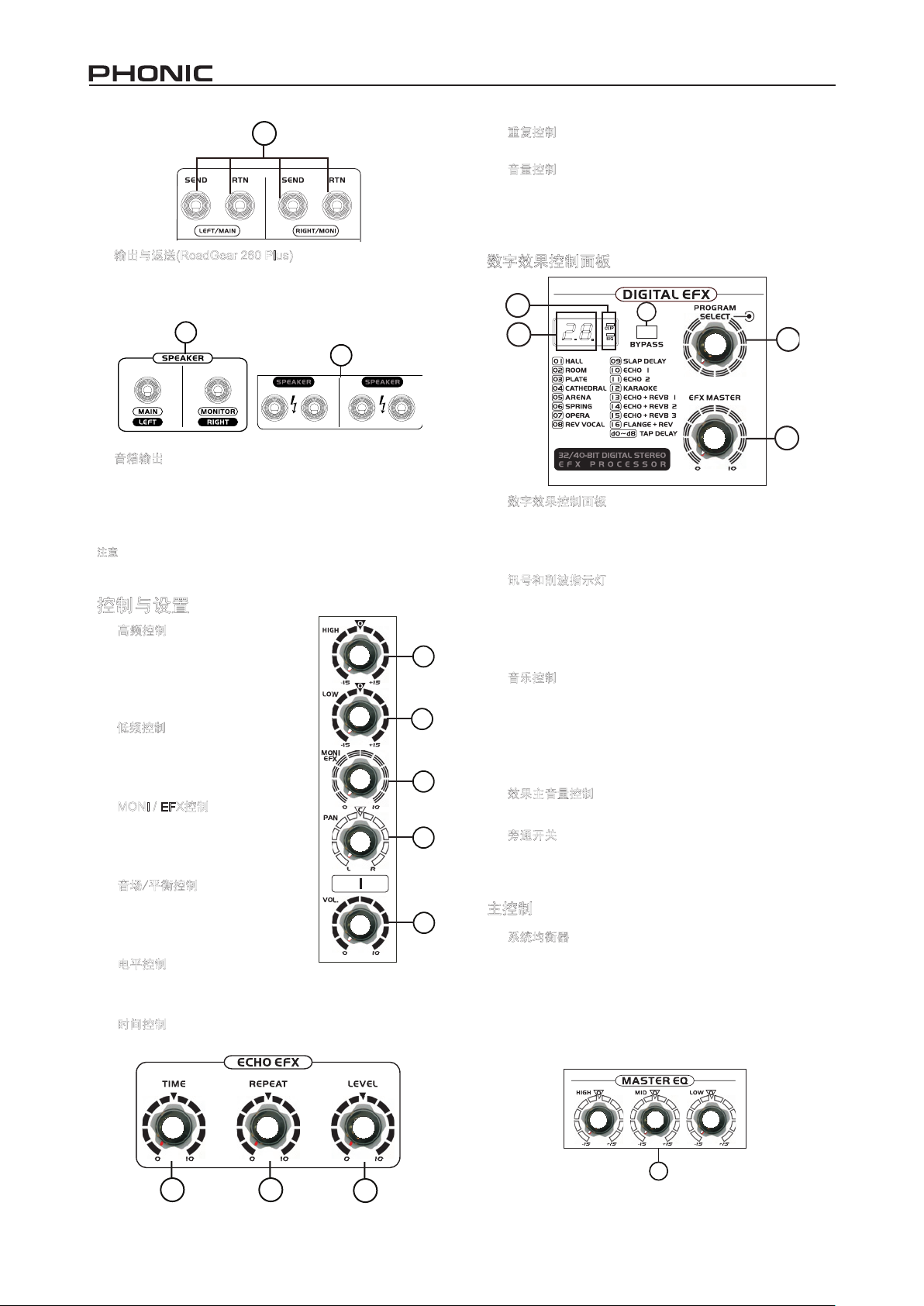
16. 重复控制
此旋钮用以调节回音效果重复频率.
17. 音量控制
此控制旋钮调节内建Echo效果处理器输往main mix主混音的讯
号音量.
8. 输出与返送(RoadGear 260 Plus)
这四个接口将外部讯号处理设备(图形均衡器,数字效果处理器
和回授静噪器)与内置的功率扩大机连接.强烈建议设备讯号电平
设定恰当以防电平超载.
9
9
RoadGear 160 Plus
9. 音箱输出
通过此声道连接音箱,由内置的功率扩大机送入讯号.两对都是
1/4”TS插座,可驱动8ohm,130W的功率.(RoadGear160 Plus为
80W, 8ohm).只需将音箱连接线的1/4”TS插座插入这几个声道
即可使用了.
注意:由于讯号经功率扩大机处理过,此端子只接音箱,否则会损坏机器.
RoadGear260 Plus
控制与设置
10. 高频控制
此旋钮用以调节输入讯号的高频段/高
音. 向右旋 转提升高 频,向 左旋转 削减
高频 .不使 用此功 能时将 它调至 0的位
置.
11. 低频控制
用 以 调 节 低 频 / 低 音 的 强 弱, 当 旋 钮
打向右 时 提 升 低 频 ,向左旋 转 削 减 低
频.不使用此功能时将它调至0的位置.
12. MONI / EFX控制
此旋钮搞节相应通道送入EFX和Moni-
tor混音路径的讯号大小,分别用以数字
效果处理和监听.
13. 音场/平衡控制
Pan旋钮调节主调音台左右两接收的讯
号大小.经立体通道,使用平衡控制则
消减左右音频讯号.
14. 电平控制
用来 改 变 从相应声道 输 入 混音总线的 音 量 大小.不使 用 声 道
时,旋钮设定在“0”的位置.
15. 时间控制
此旋钮用以调节内建回音效果的时间.
10
11
12
13
14
数字效果控制面板(RoadGear 260 Plus)
19
18
22
20
21
18. 数字效果控制面板
两位数字显示运用于效果音频讯号的音乐编码.转动Program控
制旋钮时,可依次浏览不同的音乐编号,如果在几秒钟之内没有
选择新音乐,数字显示将显示最初音乐.
19. 讯号和削波指示灯
在数字效果显示Digital Effect Display 区内设有讯号和削波指示
灯.当接收来自效果处理器的讯号时,Sig lED变亮.当讯号急剧
削波时,则Clip lED指示灯变亮. 这时就需要调节EFX控制旋钮
减小讯号电平.
20. 音乐控制
在数字效果显示面板上移动,按下此键即选择其中一种效果,
音乐自动改变为相应效果.
多次按下此键,效果处理器则以最后两次记忆为延迟时间,直到
再次按下而更改.节拍延迟效果选择后,旁边的lED指示灯也会
闪动.
21. 效果主音量控制
用以调节从数字效果处理器送至主混音总的讯号大小.
22. 旁通开关
按下这个开关将旁通效果器,两个小指示灯此刻也同时闪动.
主控制
23. 系统均衡器
RoadGear260Plus内建3段均衡器可有效地调节音频的低,中
和高频.提升 高频,如吉 它,使音色更细 腻及清晰明 亮;提升低
频,可付予人声温暖的感觉,并且增加吉他,鼓声及电子琴更
多的劲道.调节中频可增加声音的清脆感.
RoadGear160Plus具有一个单独的低音/高音控制, 平衡混音
中的高频和低频.
24
15 16
23
17
Road Gear 160 Plus/Road Gear 260 Plus
Page 25
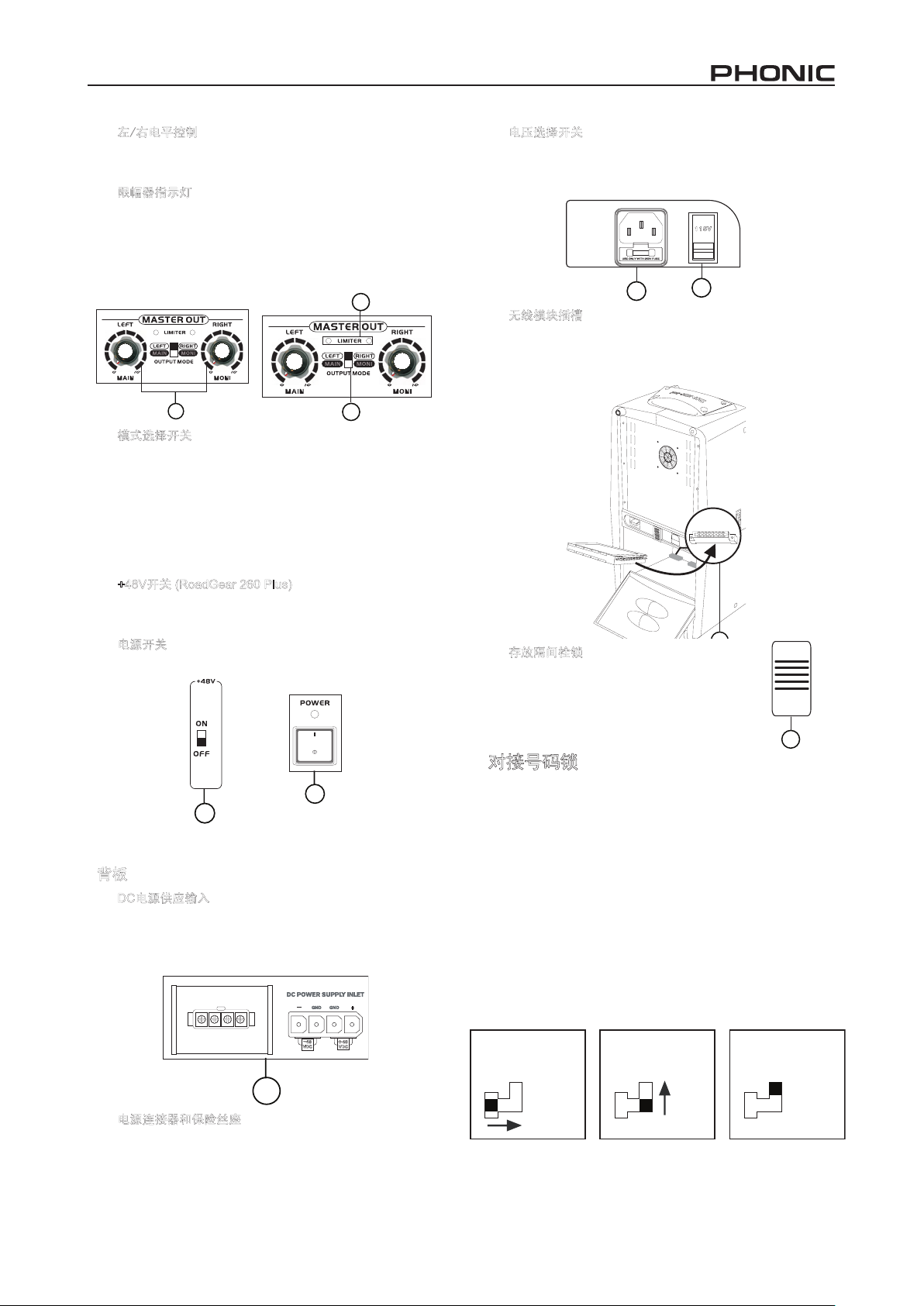
24. 左/右电平控制
位于RoadGear对接号码锁下方
调节由MAIN lEFT/RIGHT送入功率扩大机和相应输出声道的
讯号大小 (由模式选择器开关设定).
25. 限幅器指示灯
RoadGear160Plus和RoadGear260Plus的立体功率扩大机都
各内建2两个限幅器.电平讯号过大时, 限幅器自动起保护作用
(led照亮).限幅器系统防止任何对机器破坏性的可能,并保持
讯号的清晰明亮度.如果限幅指示灯闪亮,请调节主音量控制旋
钮.
25
31. 电压选择开关
为适应不同国家的电压要求,使 用这 个开 关可在115v(标准电
压在 110v和120v之间的 国 家 ) 和 230v( 标 准 电源为220v和
240v)之间选择.
30
32. 无线模块插槽
在RoadGear的储放隔间有两个插槽, 接收UM R11无线接收器
模块(UM31, UM41和UM51无线麦克风). 由左插槽接收的无线
讯号送入调音台的通道2, 右插槽则送入通道1.
31
24
26. 模式选择开关
根据不同的设置选择功率扩大机的输出模式.如果使用舞台音
箱,则开关应设置为MAIN/MONI模式, RoadGear 260 Plus将
左右主音箱插入lEFT/MAIN音箱输出声道.也可将一对被动监
听音箱插入RIGHT/MONI输出通道.RoadGear 160 Plus的这
种接法将使左音箱输出通道发送主讯号(单音模式);右音箱输
出输出监听讯号 .当设 定在lEFT/RIGHT时,音箱输出将传 送
Main左右讯号.
27. +48v开关 (RoadGear 260 Plus)
此开关控制为所有输入通道提供+48v幻象电源.为电容式麦克
风供电.
28. 电源开关
机器的开启和关闭由此键控制.
26
28
27
背板
29. DC电源供应输入
直流电源输入用以连接RoadGear和12vDC-48vDC转接器 (或
是便携式的12v电池).右边的为正极, 左边为负极.中间两个插
孔用以接地.为确保机器的安全性,电源输入不应超过51vDC.
33. 存放隔间栓锁
不使用时这个栓锁可将存放隔间关闭.向上推便打
开隔间门, 请不要用力过猛或强行打开隔间.
33
对接号码锁
ROADGEAR的对接锁是号码锁,用户需要输入预先设定的号
码开启。请按下面的步骤开锁:
1.默认的密码是000,第 一次 使用 ROADGEAR时请输入此密
码。
2.更改密 码请先 打开弹 簧锁, 在锁的 下方找 到一个 小的控 制
杆。把它推向锁的中心,顶住,直到它固定住。
3.重新设定密码,但请记住输入的新密码,以免因忘记密码而带
来不必要的麻烦.
4.设定好新密码后,把锁下方的控制杆固定在初始的位置。这
样,新密码就设置好了。
打开 ROADGEAR的 包 装,请 先 确认音箱 上的对接 锁是锁定
的,并且确认对接锁没有划伤机箱表面。
29
30. 电源连接器和保险丝座
此端子接AC电源线的母端,另一端插入合适的电源插座.在连
接插头的下端有一个保险丝座,如不甚烧坏,使用者可打开保险
丝座,替换一根合适的保险丝.
25Road Gear 160 Plus/Road Gear 260 Plus
Page 26
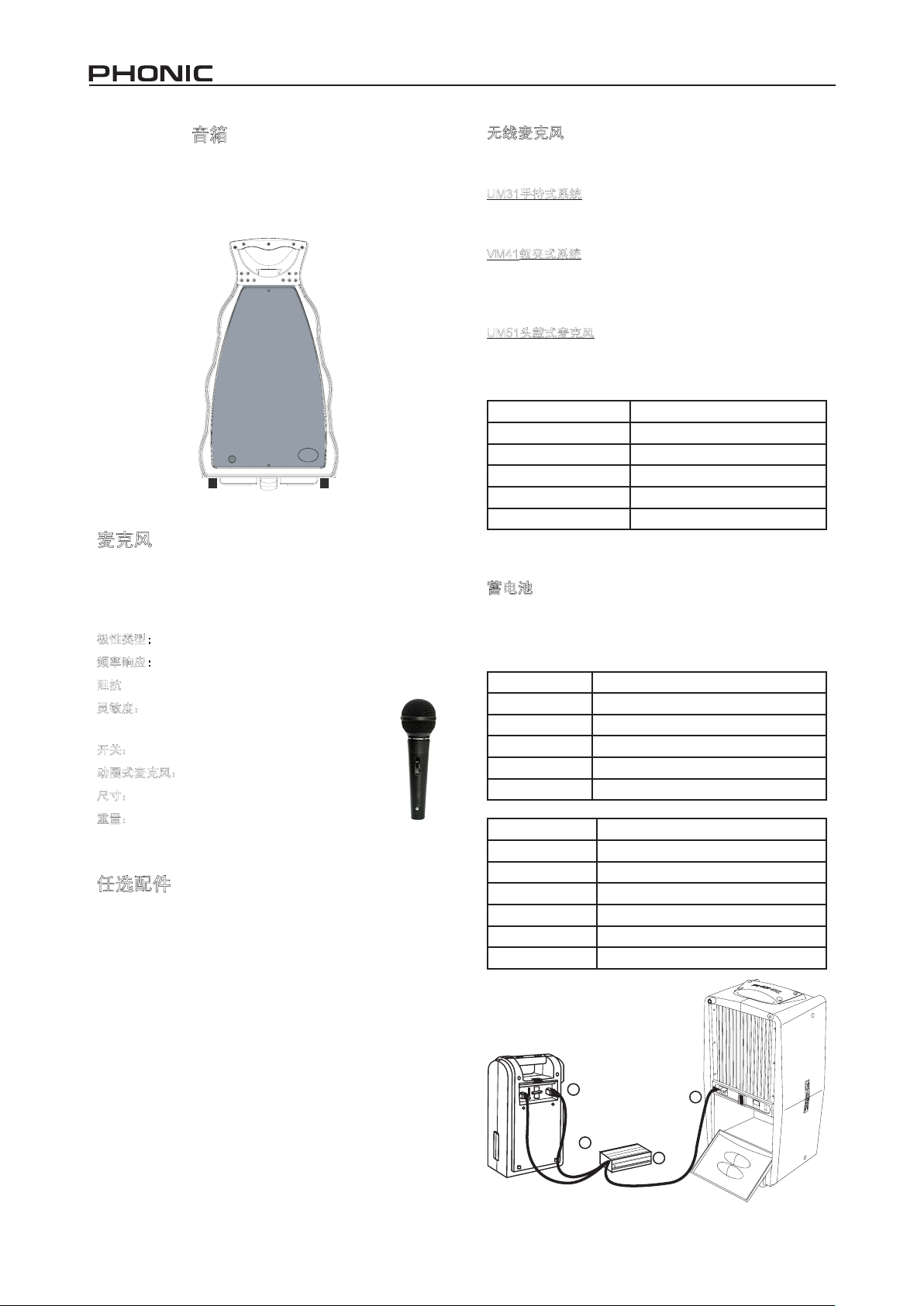
Road Gear音箱
2
1
3
4
ON
OFF
具有独特 结构的 一对8英尺 高音单体和 1”低音 单体, 其音质非
凡,并配有两段30英尺的音箱连接线,每台音箱的阻抗是8欧姆.
在此提醒使用者请不要使用对接锁搬动机器,闲置时请将对接
锁锁住.
麦克风
RoadGear整 套 系 统 配 有 一 个 动 圈 式 麦 克 风 (RoadGear260
Plus配有两个)即Phonic UM 99麦克风,高传真音质的输出很大
程度得益于此麦克风.另外还配有20英尺的麦克风连接线,麦克
风夹(clip),和便携袋.
极性类型: 向心型(单向型)
频率响应: 50Hz – 15kHz
阻抗:600Ω ± 30% (at 1000 Hz)
灵敏度:-72dB ± 3 dB (SPL = 74 dB, 0 dB = 1V/μ bar;
开路则为1000 Hz
开关:开和关
动圈式麦克风:CUM-112
尺寸:52 x 178 mm
重量:232g (不含连接线)
任选配件
除了 以 上 的配件外, 为 满 足您更多的 需 求 还配置了无 线 麦 克
风,它有2路模块输入,可置于调音台置物箱,音箱支架可以更好
地固定音箱传输讯号.不使用其它电源时,可选用直流-直流变
压器或蓄电池.这些配件可放置于便携袋中,既方便又安全.
CV-RG: RoadGear 12v 直流-直流电源转换器
BP-RG: RoadGear 蓄电池
TB-RG: RoadGear 旅行包, 在装运途中或放置时可有效地保
护箱体
MK1-RG: RoadGear墙挂式支架
MK2-RG:双音箱支架,一个三角支架可放置两个音箱箱体.
SK1:两个音箱支架再加一个便携袋
SK2:两个麦克风支架&两个音箱支架加一个便携袋
BG-RG: Road Gear直流电源附件包,装置蓄电池,DC-DC转换
器,连接线.
UM99
无线麦克风
无线麦克风有几款可供选择,UM31,UM41,UM51.为使用者提
供了头戴式麦克风和领夹式麦克风.
UM31手持式系统
● 手持式发射器(HT-100)
● 无线接收器模块(UM-R11)
vM41领夹式系统
● 领夹式麦克风(Ml-10)
● 腰挂式发射器(bT-200)
● 无线接收器模块(UM-R11)
UM51头戴式麦克风
● 头戴式麦克风(MH-20)
● 腰挂式发射器(bT-200)
● 无线接收器模块(UM-R11)
射频频率
振荡类型
声道
频率响应
频宽
操作距离
614 - 870 MHz
Pll综合控制振荡
16路声道
50Hz - 18KHz, +/-3db
24MHz
100m
蓄电池
用户可选购与RoadGear配套的蓄电池,它能持继使用长达4小
时.此款蓄电池应与直流-直流转换器一起使用,但电平要选择
适当.蓄电池还含有一个小灯,用以照明.
产品型号
充电时长
使用时长
照明时长
尺寸(宽x高x深)
重量
产品型号
输入电压
输出电压
输入保险丝
输出保险丝
尺寸(宽x高x深)
重量
bP-RG电池组
30 小时
4 小时
高达 25 小时
226x325x99mm 8.9"x12.8"x3.9"
7.75 kg (17.1 lbs)
Cv-RG DC - DC转接器
额定12v
+48vDC 和 -48vDC
40 amp
10 amp
100x50x166mm 3.9"x2.0"x6.5"
1.27 kg (2.8 lbs)
26
Road Gear 160 Plus/Road Gear 260 Plus
Page 27
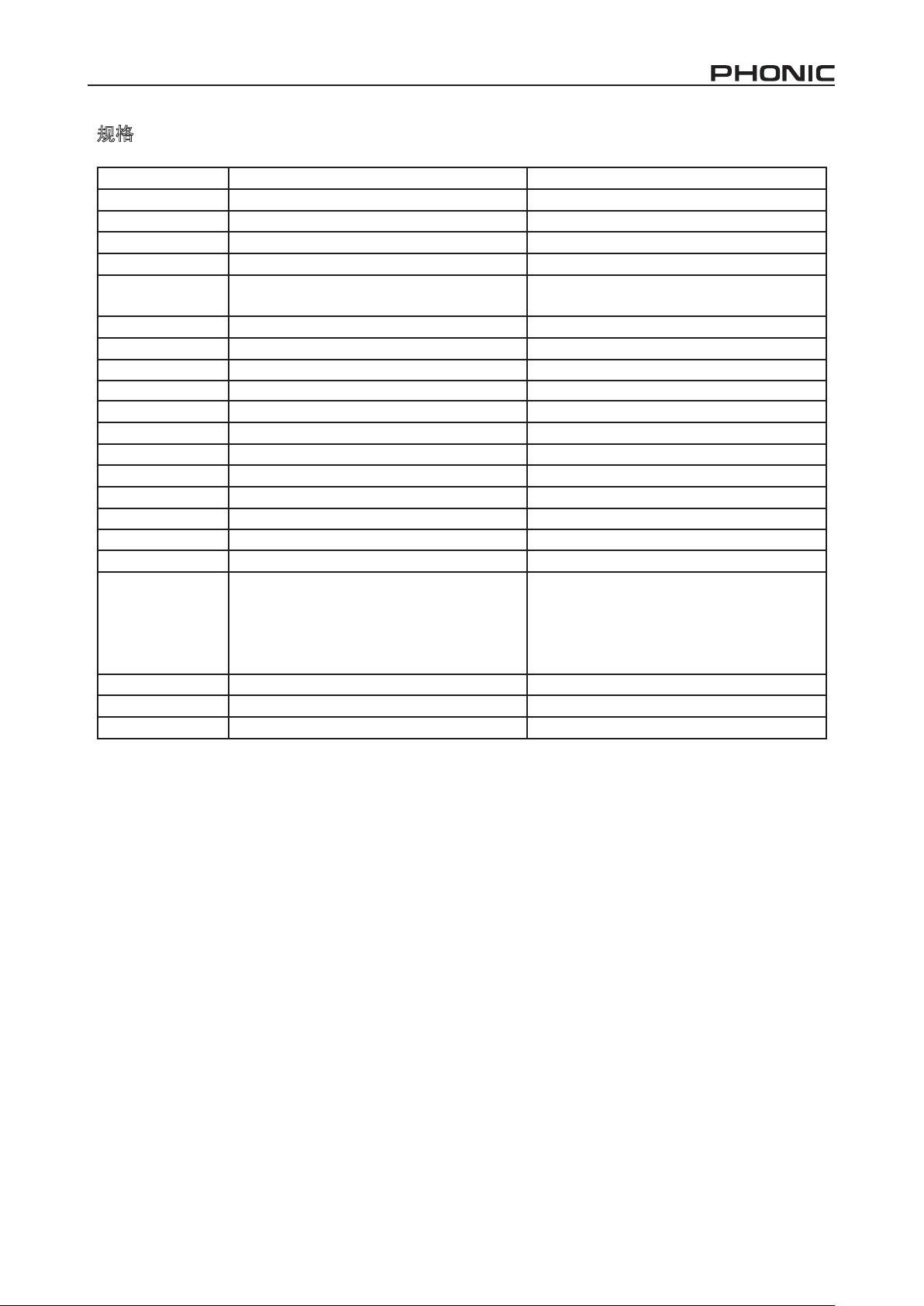
规格
Road Gear 160 Plus Road Gear 260 Plus
驱动
支架插座
输出功率
中频/高频分频点
声道
单声道
立体声声道
效果处理器 回声带时间和重复控制 16种音乐以及节拍延迟,40位
脚踏开关插座 无 瞬时接触,效果开/削减和节拍
系统EQ
功放的最小阻抗
功放模式
音箱输出
录音输出
效果输出&ST倒送
幻象电源 无 是
无线麦克风模块插槽
内含附件
电源要求
尺寸(高x宽x深)
净重
3路单声道 & 1路立体声声道,2段EQ,效果输出,音
可切换电源115vAC/60Hz和230vAC/50Hz,或任选 可切换电源115vAC/60Hz和230vAC/50Hz,或任选
压缩高音单元 & 8"低音单元 压缩高音单元 & 8"低音单元
35mm 35mm
2x80W @ 8Ω 2x130W@8Ω
2KHz 2KHz
4路单声道 & 2路立体声声道,2段EQ,效果输出,音
场,高电平
平衡式,XlR&1/4"TRS 平衡式,XlR&1/4"TRS
2x1/4"TS & 2xRCA 2x1/4"TS & 2xRCA
高音/低音
8Ω 4Ω
l&R或Main&Monitor,带限幅器指示灯 l&R或Main&Monitor,带限幅器指示灯
1x1/4"TS/声道 2x1/4"TS/声道带插入输出和倒送
一个立体声RCA 一个立体声RCA
是,1/4"TS 是,1/4"TS
2(任选无线麦克风和接收器模块) 2(任选无线麦克风和接收器模块)
1xPhonic UM99麦克风带麦克风夹子,
连接线和便携袋
2x30'音箱连接线
1x可分开的电源连接线
1xPvC防尘罩
818x635x352mm (32.2"x25"x13.9") 818x635x352mm (32.2"x25"x13.9")
27kg (59.5lbs) 28kg(61.7lbs)
2xPhonic UM99麦克风带麦克风夹子,连接线和便
场,高电平
3段
携袋
2x30'音箱连接线
1x可分开的电源连接线
1xPvC防尘罩
27Road Gear 160 Plus/Road Gear 260 Plus
Page 28
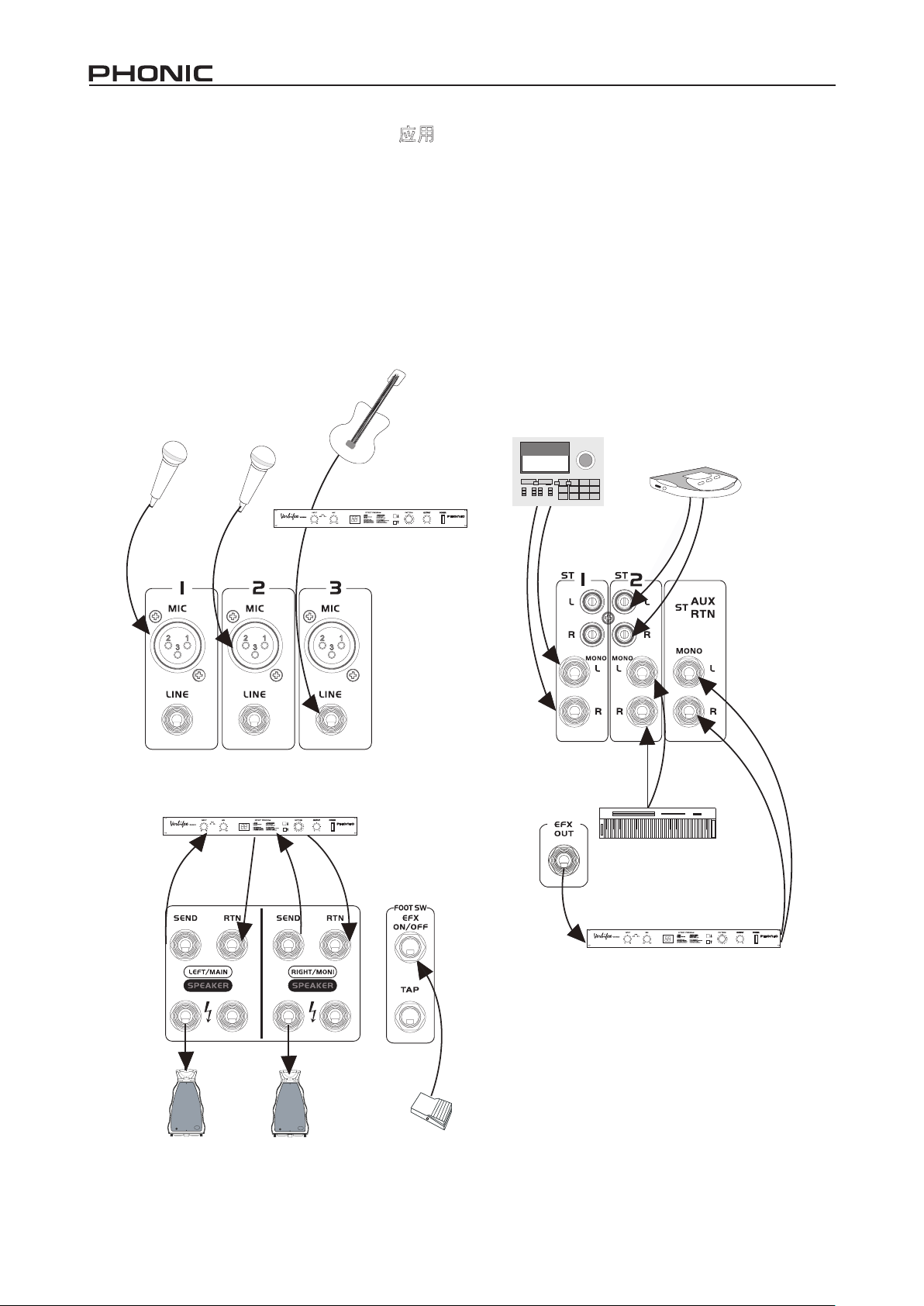
APPLICATION APLICACIÓN 应用
MIC
FOOT SWITCH
DRUM MACHINE
KEYBOARD,
SYSNTHESIZER, SAMPLER
SIGNAL PROCESSOR
RoadGear260 Plus only
MICROFONO
麦克风
MIC
MICROFONO
麦克风
GUITAR
GUITARRA
吉他
REPRODUCTOR DE CD
CD PLAYERS
CD 播放器
ROADGEAR SPEAKERS
ROADGEAR ALTAVOCES
MAQUINA DE TAMBOR
鼓声产生器
ROADGEAR 音箱
RoadGear 260 Plus SOLAMENTE
仅适用于RoadGear 260 Plus
RoadGear260 Plus only
RoadGear 260 Plus SOLAMENTE
仅适用于RoadGear 260 Plus
TECLADO,SINTETIZADOR,MUESTRARIO
电子琴,合成器,取样器
INTERRUPTOR DE PEDAL
脚踏开关
PROCESADOR DE SEÑAL
信号处理器
SIGNAL PROCESSO
PROCESADOR DE SENAL
信号处理器
The Phonic RoadGear sets are use the same was as an ordinary PA system would be, but with the convenience of having all the
components in one handy package, and as such has the potential to be set up in a variety different ways. below is just one of the many
possible examples we could have given you in setting up the gear, hopefully giving you a good idea of the amazing possibilities that
RoadGear provides.
los sets de RoadGear se usan igual que un sistema PA ordinario, pero con la conveniencia de tener todos los componentes en un
paquete práctico, y como tal tiene la potencial de ser congurado en una variedad de diferentes maneras. El siguiente es solo uno de
los muchos posibles ejemplos que le podríamos dar en la conguración de equipo, se espera darle una buena idea de las posibilidades
asombrosas que RoadGear provee.
Phonic Road Gear与一般的前置扩大机系统类似,与众不同的是它具有更加便捷与简易操作的特性.以下是所列的一些应用范例,通过图
标希望会为您提供明了直接的连接方法,便于您掌握有效的设置途径.
28
Road Gear 160 Plus/Road Gear 260 Plus
Page 29
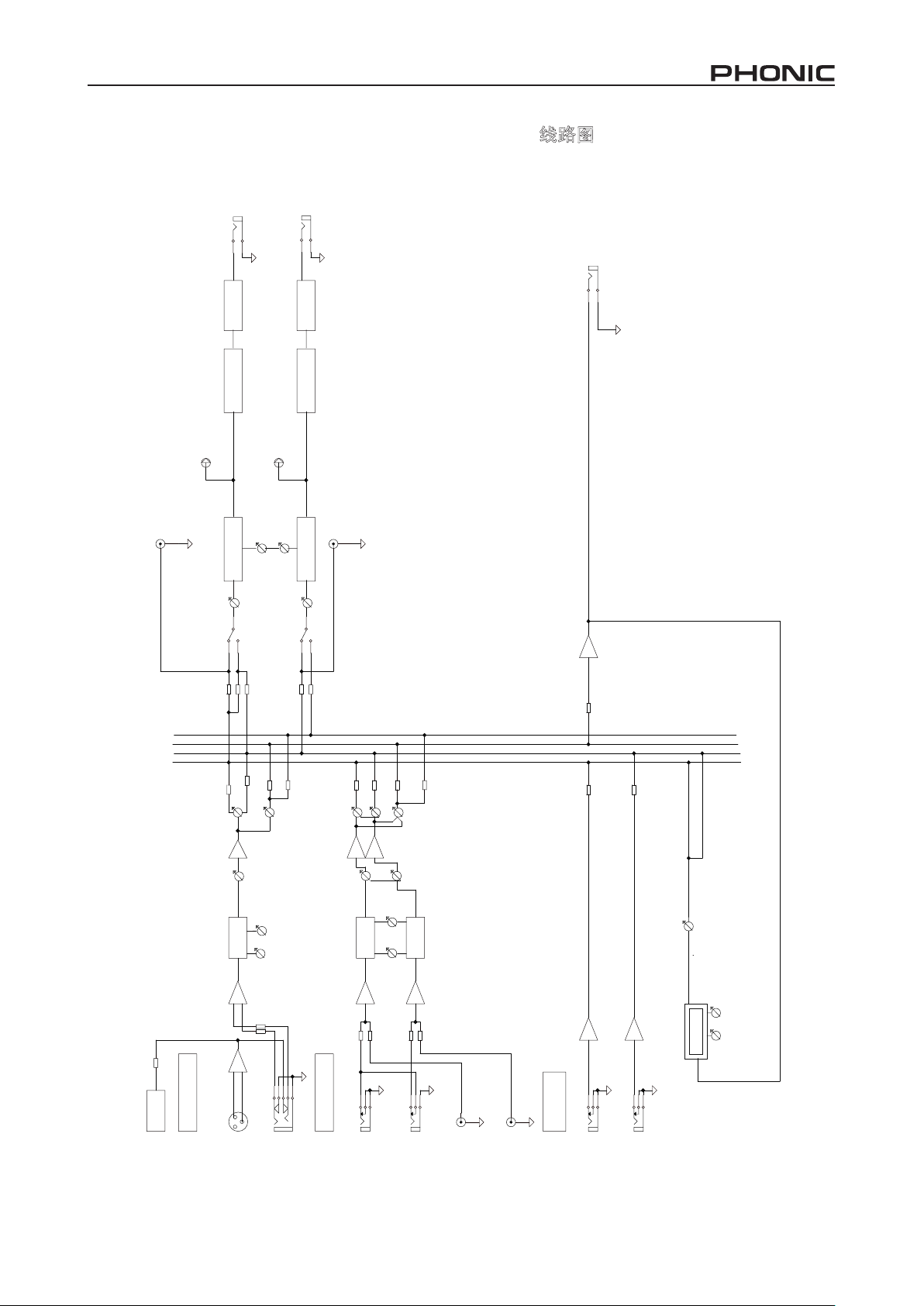
BLOCK DIAGRAM DIAGRAMAS DE BLOQUE 线路图
Road Gear160 Plus
SPEAKER l OUT
SPEAKER R OUT
EFX OUT
CROSS_OvER
CROSS_OvER
E
l/AMP.
MODUlE
LIMIT L LED
REC _l
EQ
MASTER l
lEFT
MAIN
R/AMP.
MODUl
LIMIT R LED
TREblE
TREblE
EQ
bASS
REC _R
bASS
MASTER R
RIGHT
MONO
USE
1&2
CHANNEL
I
INO
XFE
R_NIAM
_
l
M
lIA
M
PAN
MONI
EFX/
bAl
X/MONI
EF
NOM
E
XF
_NIAM
R
M
_lIA
l
vOl
lOW
2 bAND TONE
HIGH
+
-
lOWHIGH
2 bAND TONE
+
2 bAND TONE
+
LEVEL
REPEAT
DIGITAL EFX
PROCESSOR
TIME
Pre/amp
MODULE
WIRE LESS
CH1_3 INPUT
MIC(balance)
lINE(balance)
ST INPUT
ST/l INPUT(MONO)
NPUT
TAPE/l INPUT
ST/R I
TAPE/R INPUT
AUX_RTN
INPUT
AUX_RTN/l INPUT
AUX_RTN/R INPUT
29Road Gear 160 Plus/Road Gear 260 Plus
Page 30
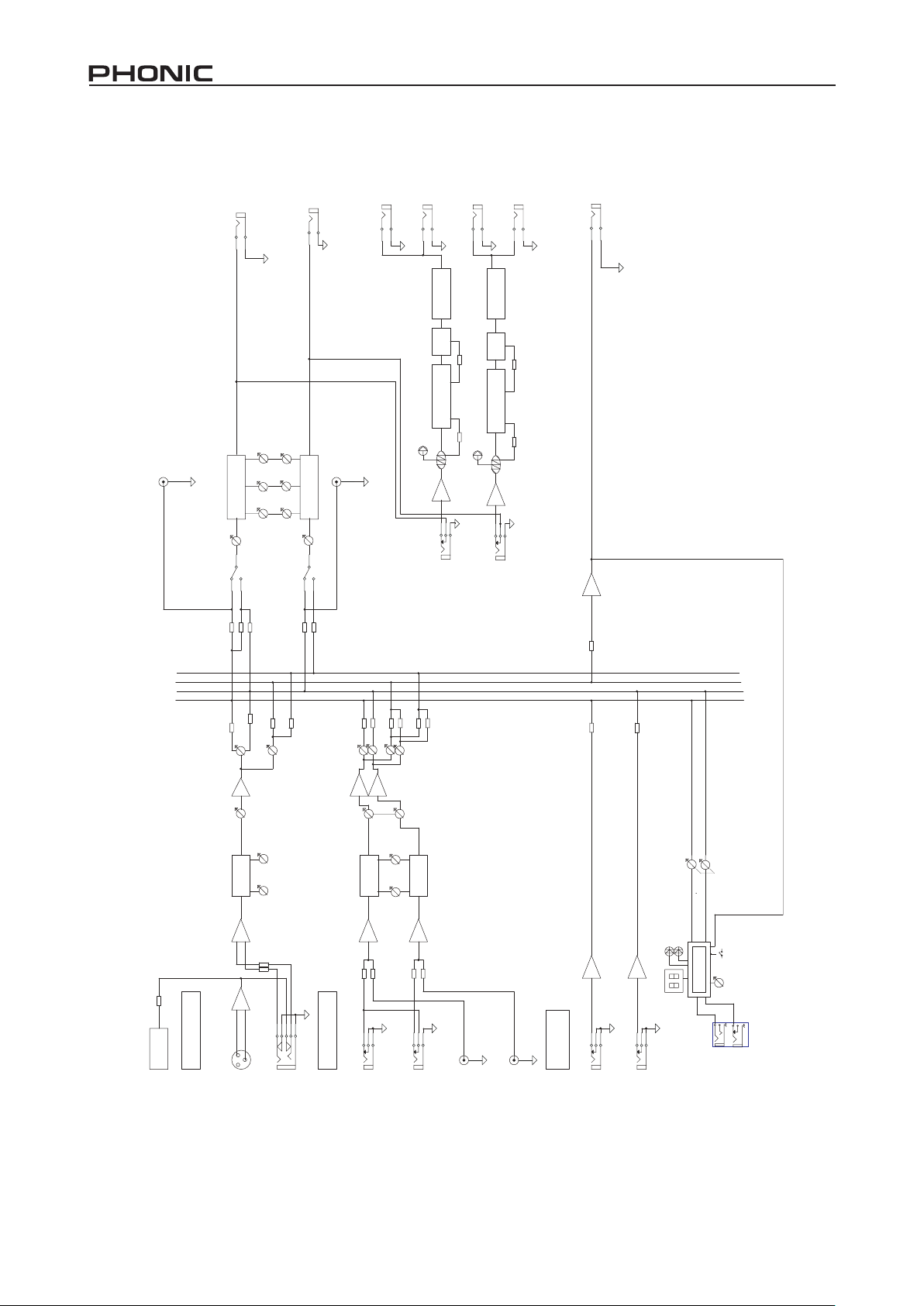
RoadGear 260 Plus
O
l W
FE /
X
N
A
P
INOM
l
_lIAM
O
M
I
N
R_NIAM
HGIH
EN
O
T
D
NA
b
2
TUPNI 4_1
H
C
pm
a
/er
P
+
-
+
+
E
N
OT
DN
A
b
2
O
l W
H
G
IH
ENOT
DN
A
b
2
l
Ab
FE /X I
N
OM
NT
R_
X
U
A
UP
N
I
T
l_lIA
M
R
_NIAM
INOM
XFE
XF
E
.
PMA
/
l
E
l
U
D
OM
E
L
T
IM
I
L
D
T
IMIL
E
L
D
.P
M
A/R
E
l
U
D
O
M
.
T
O
R
P
.
T
O
RP
O
R
C
R
EvO_
S
S
O
R
C
R
E
v
O_
S
S
8
D
A
OL
I
N
IM h
O
/ m
8
DAO
L
INI
M hO/ m
8
D
AOL
I
NIM h
O
/
m
8 D
AO
L
IN
I
M
h
O/
m
M
A
RG
O
RP
FE
L
A
T
I
G
I
D
X
O
S
SE
C
O
RP R
l
E
v
El
l
R
ET
S
AM
R
R
E
T
S
A
M
HGI
H
O
l
W
IM
D
E
NO
T
DN
Ab
3
E
N
OT
DNA
b
3
O
l
W
HG
IH IM
D
TF
E
l
N
I
AM
H
GI
R
T
ONO
M
2_1TS UP
N
I T
L
EN
NAHC 1&2
S
U E
L
U
DOM E
SE
L
ER
I
W S
R
E
TS
A
M
X
FE
l
EvE
l
UPNI
l
/
N
TR_
XU
A
T
T U
P
NI
l
/
EP
A T
PILC
D
N
E
S
l
IS G
F
T
OO S W
FFO/NO
TU
O
XF
E
_
CE
R
R
l
R
E
KA
E
P
S
T
UO
I
R
/
T
S
T
U
PN
R
EKAEP
S
R
TUO
M
A
N
TR
P
R
U
P
N
I
R
/
E
P
A
T
T
S
S
AP
Y
B
U
PNI
R/NTR_XU
A T
l
R
E
KAEP
S
TU
O
(T
U
P
N
I
l
/TS )ON
O
M
P
A
T
_ C
ER
l
)ecn
al
a
b(
C
I
M
Il e
c
nal
a
b
(
E
N
)
REK
A
E
P
S
R TUO
E
S
R
DN
M
A
NT
R
P l
30
Road Gear 160 Plus/Road Gear 260 Plus
Page 31
[email protected] http://www.phonic.com
CÓMO COMPRAR EQUIPO ADICIONAL
Y ACCESORIOS DE PHONIC
Para comprar equipos y accesorios opcionales de
Phonic, póngase en contacto con cualquiera de los
distribuidores autorizados de Phonic. Para una lista
de los distribuidores de Phonic visite nuestra página
web en www.phonic.com y entre a la sección Get
Gear. También, puede ponerse en contacto directamente con Phonic y le ayudaremos a encontrar un
distribuidor cerca de usted.
SERVICIO Y REPARACIÓN
Para refacciones de reemplazo y reparaciones, por
favor póngase en contacto con nuestro distribuidor
de Phonic en su país. Phonic no distribuye manuales
de servicio directamente a los consumidores y, avisa
a los usuarios que no intenten hacer cualquier
reparación por si mismo, haciendo ésto invalidará
todas las garantías del equipo. Puede encontrar un
distribuidor cerca de usted en
http://www.phonic.com/where/.
INFORMACIÓN DE LA GARANTIA
Phonic respalda cada producto que hacemos con
una garantía sin enredo. La cobertura de garantía
podría ser ampliada dependiendo de su región.
Phonic Corporation garantiza este producto por un
mínimo de un año desde la fecha original de su
compra, contra defectos en materiales y mano de
obra bajo el uso que se instruya en el manual del
usuario. Phonic, a su propia opinión, reparará o
cambiará la unidad defectuosa que se encuentra
dentro de esta garantía. Por favor, guarde los recibos
de venta con la fecha de compra como evidencia de
la fecha de compra. Va a necesitar este comprobante
para cualquier servicio de garantía. No se aceptarán
reparaciones o devoluciones sin un número RMA
apropiado (return merchandise autorization). En
orden de tener esta garantía válida, el producto
deberá de haber sido manejado y utilizado como se
describe en las instrucciones que acompañan esta
garantía. Cualquier atentado hacia el producto o
cualquier intento de repararlo por usted mismo,
cancelará completamente esta garantía. Esta
garantía no cubre daños ocasionados por accidentes, mal uso, abuso o negligencia. Esta garantía es
válida solamente si el producto fue comprado nuevo
de un representante/distribuidor autorizado de
Phonic. Para la información completa acerca de la
política de garantía, por favor visite
http://www.phonic.com/warranty/.
SERVICIO AL CLIENTE Y SOPORTE
TÉCNICO
Le invitamos a que visite nuestro sistema de ayuda
en línea en www.phonic.com/support/. Ahí podrá
encontrar respuestas a las preguntas más frecuentes, consejos técnicos, descarga de drivers, instrucciones de devolución de equipos y más información
de mucho interés. Nosotros haremos todo el
esfuerzo para contestar sus preguntas lo antes
posible.
TO PURCHASE ADDITIONAL
PHONIC GEAR AND ACCESSORIES
To purchase Phonic gear and optional
accessories, contact any authorized
Phonic distributor. For a list of Phonic
distributors please visit our website at
www.phonic.com and click on Get Gear.
You may also contact Phonic directly and
we will assist you in locating a distributor
near you.
SERVICE AND REPAIR
For replacement parts, service and repairs
please contact the Phonic distributor in
your country. Phonic does not release
service manuals to consumers, and advice
users to not attempt any self repairs, as
doing so voids all warranties. You can
locate a dealer near you at
http://www.phonic.com/where/
WARRANTY INFORMATION
Phonic stands behind every product we
make with a no-hassles warranty.
Warranty coverage may be extended,
depending on your region. Phonic Corpo
ration warrants this product for a minimum
of one year from the original date of
purchase against defects in material and
workmanship under use as instructed by
the user’s manual. Phonic, at its option,
shall repair or replace the defective unit
covered by this warranty. Please retain the
dated sales receipt as evidence of the date
of purchase. You will need it for any
warranty service. No returns or repairs will
be accepted without a proper RMA number
(return merchandise authorization). In
order to keep this warranty in effect, the
product must have been handled and used
as prescribed in the instructions accompanying this warranty. Any tempering of the
product or attempts of self repair voids all
warranty. This warranty does not cover
any damage due to accident, misuse,
abuse, or negligence. This warranty is
valid only if the product was purchased
new from an authorized Phonic
dealer/distributor. For complete warranty
policy information, please visit
http://www.phonic.com/warranty/.
CUSTOMER SERVICE AND
TECHNICAL SUPPORT
We encourage you to visit our online help
at http://www.phonic.com/support/. There
you can find answers to frequently asked
questions, tech tips, driver downloads,
returns instruction and other helpful
information. We make every effort to
answer your questions within one business
day.
Phonic
Phonic
Phonic
www.phonic.com Get Gear
Phonic
Phonic
Phonic Phonic
http://www.phonic.com/where/
Phonic
Phonic
1 Phonic
RMA
http://www.phonic.com/warranty/
http://www.phonic.com/support/
Page 32
 Loading...