

Page 1
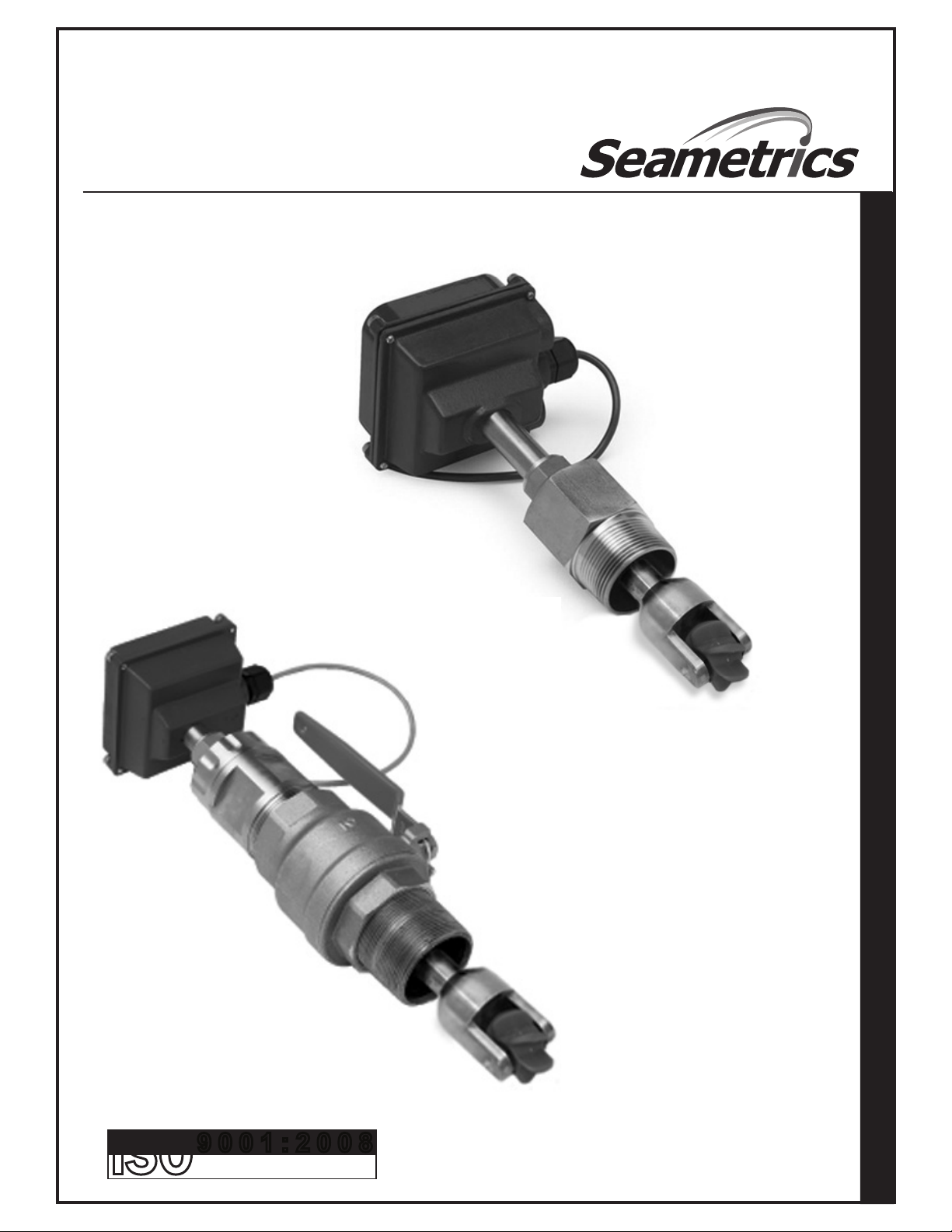
TX100/200-SERIES
INSERTION TURBINE
INSTRUCTIONS
TX100/200-SERIES INSERTION TURBINE INSTRUCTIONS
TX101/201
ISO
TX115/215
9001:2008
CERTIFIED COMPANY
Page 2

TABLE OF CONTENTS
General Information
Features, Specications ......................................................................................................................................Page 1
Installation
Piping, Immersion, Positioning the Meter ..........................................................................................................Page 2
Straight Pipe Recommendations ........................................................................................................................
Full Pipe Recommendations ................................................................................................................................Page 4
Fitting Installation, Meter Installation .................................................................................................................Page 5
Proper Depth Setting, Dimension C, Pipe Wall Thickness .................................................................................Page 6
Set-Up
Connection, Calibration, K-Factors .....................................................................................................................Page 7
Operation
Flow Range, Flow Rates .......................................................................................................................................Page 8
Parts List
Parts Exploded View.............................................................................................................................................Page 9
Troubleshooting & Repair
Troubleshooting, Repair, Rotor Replacement ........................................................................................................ Back
Page 3
TABLES AND DIAGRAMS
Features ............................................................................................................................................................... Page 1
Specifications ...................................................................................................................................................... Page 1
Positioning the Meter .......................................................................................................................................... Page 2
Piping ................................................................................................................................................................... Page 2
Straight Pipe Recommendations .......................................................................................................................
Full Pipe Recommendations ...............................................................................................................................Page 4
Meter Installation ................................................................................................................................................ Page 5
Depth Setting ...................................................................................................................................................... Page 6
Pipe Wall Thickness ............................................................................................................................................ Page 6
Connection Diagram ........................................................................................................................................... Page 7
Parts Exploded View............................................................................................................................................ Page 9
Page 3
Parts List .............................................................................................................................................................. Page 9
Rotor Replacement ................................................................................................................................................ Back
Page 3
GENERAL INFORMATION
The TX100/200-Series are adjustable depth insertion turbines
that come in brass or 316 stainless models to t 3” to 40”
pipe. Adapters mate with standard 1-1/2" (101/201) or 2”
(115/215) FNPT ttings such as saddles and weldolets which
may be purchased either locally or from Seametrics.
Ruby bearings and a non-drag pickoff give these adjustable
insertion turbine ow sensors a wide ow range and long life.
A sensor detects the passage of miniature magnets in the rotor blades. The resulting square-wave signal can be sent for
hundreds of feet without a transmitter, over unshielded cable.
This signal can be connected directly to many PLC’s and other
controls without any additional electronics.
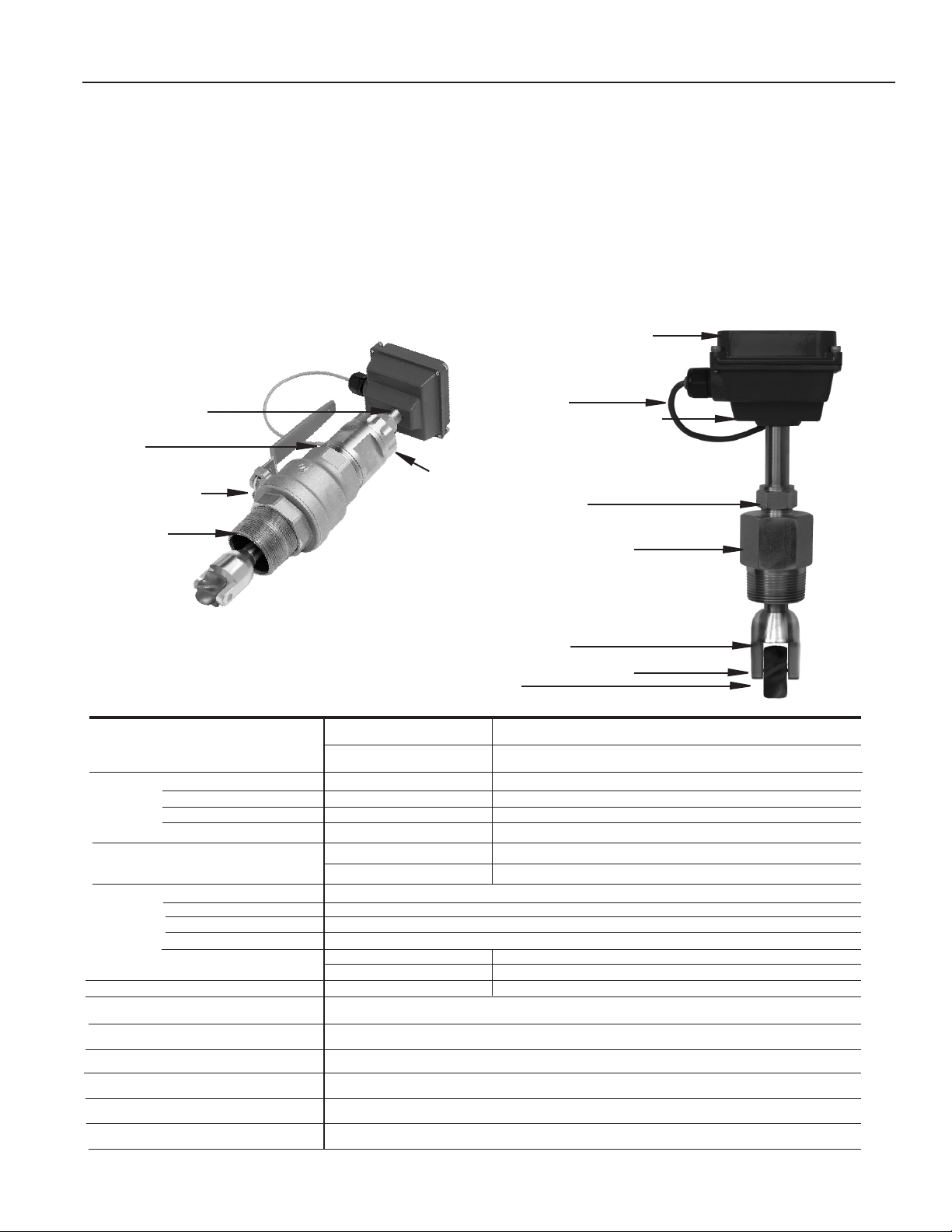
FEATURES
3/4” diameter tubing
for low insertion force
2” Adapter
removes to mount
hot-tap machine
Full-port 2” ball valve
for sensor removal
Adapter mates
with 2” FNPT
threaded ttings
Locking collar
If desired, a modular system of electronics can be installed
directly on the ow sensor or mounted remotely. The FT415
(battery powered) or FT420 (loop powered) provides digital rate
and total display, as well as programmable pulse; the FT420
also provides a 4-20 mA analog output. The AO55 is a blind
analog (4-20 mA) transmitter. Programmable pulse for pump
pacing is available with the PD10.
The “hot-tap” models (TX115/215) can be installed or serviced
without shutting down the line by means of a 2” full-port isolation valve that comes with a nipple for installation on the pipe
tting. In most circumstances, no special tool is required.
Modular electronics (optional)
• rate/total/pulse/4-20 mA
• blind 4-20 transmitter
• pulse divider
18 Foot Cable
Rugged cast aluminum housing
Compression nut
for easy adjustment, secure locking
Adapter mates with 1-1/2”
FNPT threaded ttings
SPECIFICATIONS*
Power Source
Supply Voltage/Current
Sensor Type
Output
Sinking Current
External Pull-up Resistor
Pipe Size
Materials Housing
Sensor Body
Rotor
Shaft/Bearings
Isolation Valve
Fitting Size Required
Flow Range
Accuracy
Maximum Temperature
Maximum Pressure
Insertion Force
Cable
TX115/215
Rotor housing
Removable jewel bearings
Rotor
Standard Micropowered (-04 Option)
6-40 Vdc/< 2 mA 3.5-16 Vdc/60 µA @ 3.5 Vdc
Magnetoresistive Magnetoresistive
Current Sinking Pulse Current Sinking Pulse
100 mA max 2 mA max
3-40 Vdc ≤ Supply Voltage
TX101/115 TX201/215
3” - 12” (50 - 300mm) 12” - 40” (300 - 890mm)
Cast aluminum
Brass or 316 SS
PVDF standard
Nickel-bound tungsten carbide/Ruby
TX101/201 TX115/215
None Bronze (316SS optional)
1-1/2” FNPT 2” FNPT
0.5 - 30 feet/sec (0.15 - 9.14 meter/sec)
+/-1.5% of full scale
200˚ F (93˚ C)
200 psi (14 bar)
0.44 x pressure in pipe
#22 AWG 3-con, 18’ (6m); 2,000’ (650m) maximum cable run
TX101/201
Note: For larger pipe sizes contact factory
*Specications subject to change. Please consult our website for the most current data (www.seametrics.com).
Page 1
Page 4
INSTALLATION
10
x Dia.
5
x Dia.
FLOW
An insertion ow sensor measures the velocity of ow at one
point in the pipe; ow rate and total can be inferred from this
one point. Accuracy is decreased by any factor which makes
the ow at the measured point unrepresentative of the entire
ow stream. This includes distorted ow patterns caused by
upstream ttings too close to the sensor. The worst offenders
are ttings that increase the ow on one side of the pipe, such
as partially-opened gate or buttery valves. Fluid moving in a
pipe does not ow at the same velocity. Toward the center of
the pipe, uid moves faster than at the wall, and the relationship between the two changes as overall ow rate increases.
This change in the “velocity prole” can result in non-linearity,
which means that the K-factor (see page 7) that is correct for
one ow rate may be incorrect for another. Recommended
depth settings (see page 6) have been carefully chosen to
minimize this source of error, and should be followed carefully,
especially in the smaller pipe sizes.
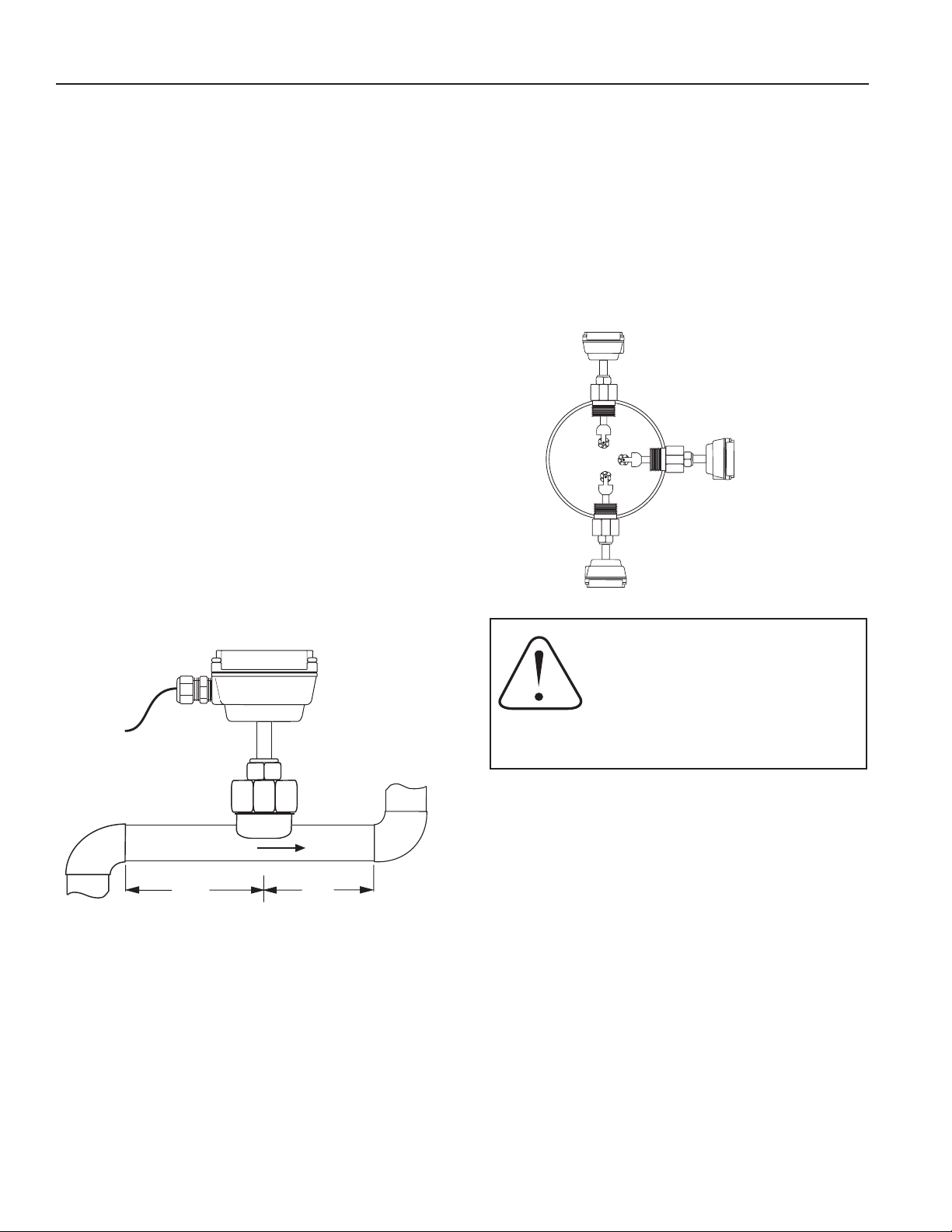
Piping. For best results, the TX sensor should be installed with at least ten diameters of straight pipe
upstream and ve downstream. Certain extreme situations
such as partially-opened valves are particularly difcult and
may require more straight diameters upstream. See Straight
Pipe and Full Pipe recommendations on following pages.
Immersion. The TX100/200-Series standard sensors are
not designed for continuous underwater operation. If your
meter may experience occasional temporary immersion, as
in a ooded vault, a unit modied for immersion should be
specied (Option -40).
Positioning the Meter. Horizontal is the preferred installation orientation, since it improves low-ow performance
slightly and avoids problems with trapped air. Bottom, top,
and vertical pipe installaations are all acceptable if required
by the piping layout.
Fair (unacceptable if air is
present)
Best
Fair (unacceptable if uid
contains sediment)
CAUTION: These water meters are
not recommended for installation
downstream of the boiler feedwater
pump where installation fault may
expose the meter to boiler pressure
and temperature. Maximum recom-
mended temperature is 200ºF.
Page 2
Page 5

INSTALLATION
STRAIGHT PIPE RECOMMENDATIONS
(X = diameter)
Reduced Pipe
Two Elbows In Plane
Two Elbows, Out Of Plane
10X
20X
5X
5X10X
5X
Expanded Pipe
Spiral Flow
Swirling Flow
Propeller Meter
Partially Open
Buttery Valve
20X
5X
30X
50X
Page 3
Page 6

INSTALLATION
FULL PIPE RECOMMENDATIONS
Allows air pockets to form at sensor
Better InstallationPossible Problem
Ensures full pipe
Better InstallationPossible Problem
Post-valve cavitation can create air pocket Keeps pipe full at sensor
Better InstallationPossible Problem
Air can be trapped
Allows air to bleed off
Page 4
Page 7

INSTALLATION
TX101/201 INSTALLATION
Fitting Installation. TX101/201 adapters mate with a 1-1/2” female
NPT pipe thread adapter tting. Any tting that provides the matching
NPT female thread may be used. Installation procedure compensates
for tting height differences. Cut a minimum 1-3/4” hole in the pipe. If
possible, measure the wall thickness and write it down for use in depth
setting. Then install the threaded tting (saddle, weldolet, etc.) on the
pipe.
Meter Installation. Loosen the compression nut so that the adapter
slides freely. Pull the meter fully upward and nger-tighten the compression nut. Using a thread sealant, install the adapter in the pipe tting.
Do not overtighten. Now loosen the compression nut, lower the meter to
the appropriate depth setting (see diagram and instructions that follow).
Caution: Do not allow the meter to fall into the pipe uncontrolled, as this
may damage the meter. Be sure ow is in the direction of the arrow on
the housing. Tighten compression nut fully.
Compression nut
Adapter mates
with 1-1/2"
FNPT threads
TX115/215 INSTALLATION
‘Hot tap’ TX meters are designed to be installed and serviced without
depressurizing the pipe.
Fitting Installation. The TX115/215 adapters mate with a 2” FNPT
threaded tting for compatibility with the 2” isolation valve. Any tting
that provides matching NPT female thread may be used. The installation
procedure compensates for differences in tting height.
If initial installation is performed on an unpressurized pipe, cut a
minimum 1-3/4” hole in the pipe. If possible, measure the wall thickness
and write it down for use in depth setting. Then install the threaded tting
(saddle, weldolet, etc.) on the pipe.
If it is necessary to do the initial installation under pressure, any standard
hot tap drilling machine with 2” NPT adapter, such as a Transmate or a
Mueller, can be used. Ordinarily, it is not necessary to use an installation
tool, since the small-diameter tube can be controlled by hand at all but
the highest pressures.
Compression nut
Locking collar
2” adapter removes
to mount hot-tap
machine
Full-port 2” ball
valve allows sensor
removal
Mates with 2”
FNPT threads
Meter Installation. Remove the sensor unit from the valve assembly.
Using a thread sealant, install the valve assembly on the pipe tting. If
the initial installation is a pressure (“hot”) tap, remove the 1-1/2” x 2”
adapter bushing at the back of the valve. Thread the tapping machine
on, open the valve, and tap using a minimum of 1-3/4” or maximum
1-7/8” cutter. After retracting the machine and closing the valve, reinstall
the ow sensor. When the sensor is secure, open the valve and adjust
depth setting (see diagram and instructions that follow). Be sure ow is
in the direction of the arrow on the housing. Tighten locking collar and
compression nut fully.
TX115/215 Sensor
Removal
Page 5
Page 8

INSTALLATION
"D"
2. Measuring from the outside of the pipe to the joint
in the housing, as shown in the diagram above,
adjust the sensor to Dimension D and hand-tighten
compression nut.
3. Align the conduit housing with the centerline of the
pipe, as shown. Be sure the arrow on the housing
points in the direction of ow.
Proper Depth Setting. It is important for accuracy that
the sensor be inserted to the correct depth into the pipe.
1. Please visit www.seametrics.com and select the
K-factor Calculator located on the lower left of
the homepage to nd dimension 'D' (insertion depth
setting) above.*
TABLE 1: PIPE WALL THICKNESS
NOMINAL PIPE SIZE
3” 4” 6” 8” 10” 12” 14” 16” 18” 20” 24” 30” 36”
PVC/Steel
Sch. 40
0.216 0.237 0.280 0.322 0.365 0.406 0.438 0.500 0.562 0.593 0.687
strain
relief
FLOW
4. Check Dimension D one more time.
5. Tighten the compression nut fully.
RECORD YOUR SETTINGS
Once you have the meter set up and operational, it
is important to record your meter setttings and save
them for future reference.
K-Factor
Insertion Depth (Dim. D)
*For pipe sizes larger than 50”, please consult factory.
PVC/Steel
Sch. 80
Stainless
Steel (10S)
Stainless
Steel (40S)
Copper Tubing
(Type L)
Copper Tubing
(Type K)
Brass Pipe
Duct. Iron
(Class 52)
Page 6
0.300 0.337 0.432 0.500 0.593 0.687 0.750 0.843 0.937 1.031 1.218
0.120 0.120 0.134 0.148 0.165 0.180 0.188 0.188 0.188 0.218 0.250 0.312 0.312
0.216 0.237 0.280 0.322 0.365 0.375 0.375 0.375 0.375 0.375 0.375 0.375 0.375
0.090 0.110 0.140 0.200 0.250 0.280
0.109 0.134 0.192 0.271 0.338 0.405
0.219 0.250 0.250 0.312 0.365 0.375
0.280 0.290 0.310 0.330 0.350 0.370 0.390 0.400 0.410 0.420 0.440 0.470 0.530
Page 9

SET-UP
Connection. Sensors are supplied with 18 ft. of cable. For
sensors with no additional electronics, see diagram for color
coding. For sensors with on-board electronics, see the manual
accompanying the electronics module.
RED (+) 5-24 Vdc
WHITE (signal)
BLACK (-) Power
18' cable standard
Calibration (“K-Factor”). In order to properly process pulses
from the ow sensor, a number must be entered into the control
to which the sensor is connected. This number, called the Kfactor, is the number of pulses the sensor puts out per unit of
uid passing through the pipe. It is normally provided for Seametrics sensors in pulses per gallon, and can be ascertained
by using the “K-Factor Calculator” on the Seametrics website.
These numbers are based on extensive testing, which has shown
close agreement between different TX sensors in the same
installation. Most K-factor error can be attributed to installation variables, such as depth setting and tting conguration.
It is possible to eld calibrate a sensor by catching the uid
in a measured container and comparing with the number of
pulses recorded. (To record individual pulses, set the K-factor on the control to 1.00.) This is especially desirable if the
installation has less than the recommended length of straight
pipe upstream of the sensor. For detailed intructions on eld
calibration, please refer to the technical bulletin on our website
(www.seametrics.com/pdf/LT-13276-A.pdf).
Page 7
Page 10

OPERATION
Flow Range. These sensors are designed to operate at ow
velocities of 0.5 to 30 feet per second (see Table 2, below).
If erratic readings are encountered at low ows, check the
chart to see if ow is below minimum for the pipe size. The
standard shaft and bearings should have a long life at continuous high ow.
TABLE 2: Flow Rates converted from Feet/Sec to Gallons/Minute at various velocities: Schedule 40 pipe
Nominal pipe size
Feet / Sec
3" 4" 5" 6" 8" 10" 12" 16" 24" 36" 38" 40"
▲
(0.5)
11.5 19.8 31.2 45 78 123 176 313 704 1585 1770 1960
(1.0)
23 39.7 62.4 90 156 246 349 551 1250 2910 3530 3915
(2.0)
46.1 79.4 125 180 312 492 698 1100 2510 5830 7070 7825
(5.0)
115 198 312 450 780 1230 1740 2750 6270 14570 17670 19560
(10.0)
230 397 624 900 1560 2460 3490 5510 12530 29140 35350 39120
(20.0)
461 794 1250 1800 3120 4920 6980 11020 25060 58270 70700 78240
691 1190 1870 2700 4680 7370 10470 16520 37600 87410 106050 117500
(30.0)
Page 8
Page 11

PARTS LIST
4
1
2
3
7
8
9
10
TX101/201
5
6
TX115/215
17
18
19
TX 101/201 Parts
1 Upper housing assembly 30475
2 Housing Gasket 26211
3 Lower housing Not Field Replaceable
4 Housing screw assembly 26229 (4 required)
5 Plug, steel 26073
6 Strain relief 07655
7 Sensor w/cable
8 Tube Not Field Replaceable
9 Compression nut
10 Compression Ferrule 26065
11 Adapter
12 Rotor housing O-ring 16454
13 Rotor housing
26310 (Standard - FT420)
29953 (Micropower - FT415)
14199 (Brass)
15064 (SS)
30998 (Brass)
30999 (SS)
After Jan 1, 2011
33023 (Brass)
33024 (SS)
11
7
12
13
14
16
20
Jewel bearing assembly
14
(for carbide shaft)
15 Turbine Rotor assembly
Rotor repair kit
16
(consists of #15 & #16)
25901 (2 required)
After Jan 1, 2011
33015 (Kynar)
After Jan 1, 2011
33087 (Kynar/Carb)
TX 115/215 Parts (hot tap)
All part numbers are the same except those below
17 Locking Collar
18 Adapter tting O-ring 26029
19 Adapter, hot tap
Valve assembly
20
(inlcudes Adapter, #20)
14190 (Brass)
15170 (SS)
26130 (Brass)
26131 (SS)
14225 (Brass)
15225 (SS)
15
Page 9
Page 12

TROUBLESHOOTING and REPAIR
Troubleshooting
CAUTION! Never attempt to remove a
ow sensor when there is pressure in
the pipe. Loosen the compression nut
slowly to release any trapped pressure.
If uid sprays out when removing the
sensor, stop turning and depressurize the pipe. Failure to do so could result in the sensor being thrown
from the pipe, resulting in damage or serious injury.
The ow sensor has only one moving part, the rotor. If this is
turning properly and there is no signal, the Hall-effect sensor
is not operating properly. To check the signal, apply 12 Vdc
regulated* power to the red (+) and black (-) leads. Set a
multimeter to voltage reading. Put the positive multimeter
lead on the red wire and the negative lead on the white
wire. Slowly turn the rotor. Voltage reading should swing
between +12 Volts and 0 Volts as the rotor turns. If it does
not, the Hall effect sensor is not working properly. Checking
for continuity is not a useful test of these sensors.
*NOTE: An unregulated power supply can exceed max voltage of
micro powered sensor (gray cable) and damage sensor.
Rotor Replacement. Rotors are easily eld-replaced. Shaft
and rotor are a single unit, and are not replaced separately.
If replacement is due only to normal shaft wear, bearing replacement is probably not necessary. If the rotor has been
damaged by impact, the bearings should also be replaced.
Rotor and bearings can be ordered as a kit (see parts listing).
Follow these steps:
1. Unscrew the threaded bearing housings to expose the
shaft ends. If bearings are being replaced, back them
completely out.
2. Remove the rotor. Put the new rotor in its place.
3. Thread in one bearing housing part way, then the
other. Take care to start the end of the shaft into
the bearing hole before tightening further.
4. Screw in bearing housings until they bottom.
Note: Do not use excessive force.
5. Check for free spin. Blowing lightly on the rotor
should result in it spinning rapidly and coasting
to a smooth stop.
Turbine Rotor
Repair
All Seametrics ow sensors are repairable, and can be
returned to the factory or distributor for repair.
Please rst obtain a Return Material Authorization
(RMA) number.
Bearing
Housing
Shaft
Seametrics Incorporated • 19026 72nd Avenue South • Kent, Washington 98032 • USA
(P) 253.872.0284 • (F) 253.872.0285 • 1.800.975.8153 • www.seametrics.com
LT-65200050-061213
6/12/2013
 Loading...