
This document, including all its parts, is protected by copyright.
Any further processing or use requires the previous written consent of
Daimler AG, Department GSP/OIS, HPC R822, W002, D>70546 Stuttgart.
This applies in particular to reproduction, distribution, alteration, translation,
microfilming and storage and/or processing in electronic systems, including
databases and online services.
Image no. of title image:W00.01>1016>00
Order no. of this publication:6517 1261 02 > HLI 000 000 02 89
09/11
Page 4
SN00.00>W>0001>01HAPreface
– This printout will not be recorded by the update service. Status: 09 / 2011 –
Preface
This brochure
Actros electronic systems, model 963
is intended for the technical personnel responsible for service and
maintenance of Mercedes>Benz trucks.
The content of this brochure is split up into:
•
function descriptions
•
component descriptions
•
Description of locations of electrical connectors, sockets and
ground points
All the data listed in this brochure correspond with the technical
status as per September 2011.
Any changes or supplements hereto will be published in the
Workshop Information System (WIS) only.
Additional documents for model 963, such as maintenance and
repair instructions or wiring diagrams are also available in the
Workshop Information System (WIS).
Mercedes>Benz
W‘rth plant, GSP/TTM
September 2011
i
Electronic systems, Actros, model 963 > 09/2011 >
1
Page 5
Contents
– This printout will not be recorded by the update service. Status: 09 / 2011 –

SN00.00>W>0110H
MODEL 963
Overview of as>built configuration and function descriptions2.8.11
Function descriptions
Overall network
Overall network, function
Maintenance system, function
Maintenance system, overall network
Data acquisition function
Data storage function
Normal mode displays function
Reset service item function
Forecast calculation, function
Life cycle consumption calculation,
function
Page 15
Page 16
Page 22
Page 23
Page 24
Page 29
Page 30
Page 32
Page 34
Page 35
Transmission automation, function
Transmission automation, overall network
Operation, function
Driver information, function
Transmission mode, function
Shifting the transmission, function
Controlling the clutch, function
Countershaft brake, function
Level control, function
Level control, overall network
Axle load measuring system, function
Monitoring/control of specified level,
function
Changeover from level 1 to level 2,
function
Raise/lower vehicle frame manually,
function
Store frame height, function
Constant frame height when
loading/unloading, function
Raise/lower lift axle, function
Page 37
Page 40
Page 41
Page 44
Page 45
Page 46
Page 52
Page 54
Page 56
Page 59
Page 60
Page 62
Page 64
Page 66
Page 68
Page 70
Page 73
2
Page 6
Contents
– This printout will not be recorded by the update service. Status: 09 / 2011 –

Starting>off aid, function
Load/relieve additional axles, function
Roll control, function
Roll control, overall network
Tire pressure monitor, function
Tire pressure monitor, overall network
Tire pressure monitor, driver information
Electronic Brake Control, function
Electronic Brake Control, overall network
Brake application on front axle with
Electronic Brake Control, function
Brake application on front axle without
Electronic Brake Control, function
Brake application on rear axle with
Electronic Brake Control, function
Brake application on rear axle without
Electronic Brake Control, function
Trailer control with Electronic Brake
Control, function
Trailer control without Electronic Brake
Control, function
Auxiliary braking effect, function
Page 76
Page 78
Page 81
Page 84
Page 85
Page 86
Page 87
Page 88
Page 92
Page 93
Page 95
Page 97
Page 99
Page 101
Page 104
Page 106
Electronic Stability Program, function
Electronic Stability Program, overall
network
Intervention of Electronic Stability Program
in the event of understeer or oversteer,
function
Intervention of Electronic Stability Program
upon risk of tipping, function
Compressed air supply system, function
Compressed air supply system, overall
network
Hydraulic retarder, function
Overall network of hydraulic retarder
Single>circuit power steering, function
Page 108
Page 111
Page 112
Page 114
Page 116
Page 122
Page 123
Page 129
Page 130
i
Electronic systems, Actros, model 963 > 09/2011 >
3
Page 7
Contents
– This printout will not be recorded by the update service. Status: 09 / 2011 –

Additional steering axle, function
Additional steering axle, overall network
Additional steering axle, hydraulics
diagram
Driving assistance systems, function
Driving assistance systems, overall network
Proximity Control Assist function
Active Brake Assist function
Lane Keeping Assist function
Battery sensor function
Overall network battery sensor
Modular switch panel function
Overall network modular switch panel
Instrument cluster, function
Instrument cluster, overall network
Instrument cluster operating notes
Display fuel quantity, function
Display outside temperature, function
Display engine speed, function
Display speed and travel distance, function
Display AdBlue level, function
Redundancy operation of Electronic Air>
Processing Unit (EAPU), function
Page 133
Page 137
Page 138
Page 139
Page 144
Page 145
Page 149
Page 154
Page 158
Page 159
Page 160
Page 162
Page 163
Page 166
Page 167
Page 168
Page 169
Page 170
Page 171
Page 173
Page 174
Signaling system, function
Overall network of signaling system
Power windows, function
Power windows, overall network
Electric power sliding roof, function
Electric power sliding rood, overall
network
Central locking, function
4
Page 175
Page 177
Page 178
Page 181
Page 182
Page 184
Page 185
Page 8
Contents
– This printout will not be recorded by the update service. Status: 09 / 2011 –

Central locking, overall network
Comfort locking system function
Comfort locking system overall network
Anti>theft alarm system, function
Anti>theft alarm system, overall network
Anti>theft alarm system, status messages
Activate antitheft alarm system, function
Deactivate anti>theft alarm system,
function
Triggering alarm by disconnecting trailer
or semitrailer, function
Alarm actuation by unlocking cab, function
Triggerring alarm with panic switch,
function
Alarm triggering with interior protection,
function
Alarm triggering by steeling fuel, function
Alarm triggering by unlocking/opening a
door/flap, function
Alarm triggering by alarm siren, function
Page 191
Page 192
Page 198
Page 199
Page 201
Page 202
Page 205
Page 210
Page 214
Page 217
Page 220
Page 223
Page 226
Page 229
Page 233
Drive authorization system, function
Drive authorization system overall network
Exterior lighting, function
Exterior lights, overall network
Headlamp control, function
Fog lamp actuation, function
Rear fog lamp actuation, function
Turn signal light actuation, function
Brake lights actuation, function
Backup light actuation, function
Emergency light actuation, function
Floodlight actuation, function
Interior illumination, function
Interior illumination, overall network
Ambient lighting actuation, function
Interior illumination actuation, function
Page 236
Page 238
Page 239
Page 241
Page 242
Page 246
Page 247
Page 248
Page 250
Page 252
Page 253
Page 255
Page 257
Page 259
Page 260
Page 261
i
Electronic systems, Actros, model 963 > 09/2011 >
5
Page 9
Contents
– This printout will not be recorded by the update service. Status: 09 / 2011 –

Reading light actuation, function
Night light actuation, function
Exit lamp actuation, function
Windshield wiper system, functionWith code (F8X) Rain and light sensor
With code (F8X) Rain and light sensor
Windshield wiper system overall network
Multifunction steering wheel, function
Multifunction steering wheel overall
network
Stationary air conditioning, function
Stationary air conditioner, overall network
Load cold reservoir, function
Discharge cold reservoir function
Automatic air conditioning, function
Automatic climate control, overall network
Ventilation function
Air supply in normal operation, function
Air supply in recirculated air mode,
function
Temperature control function
Refrigerant circuit, function
Heater circuit function
Temperature control during heater
operation, function
Temperature control during AC operation,
function
Page 264
Page 266
Page 267
Page 268
Page 270
Page 272
Page 273
Page 275
Page 276
Page 279
Page 280
Page 284
Page 286
Page 287
Page 288
Page 290
Page 292
Page 294
Page 295
Page 297
Page 299
Page 302
Auxiliary heater, function
Auxiliary heater, overall network
Heater operation, function
Terminate heater operation, function
Trigger heating mode, function
Triggering the permanent heater
operation, function
Triggering the preselection heater
operation, function
Automatic triggering of heat mode,
function
6
Page 306
Page 307
Page 308
Page 309
Page 315
Page 316
Page 318
Page 320
Page 10
Contents
– This printout will not be recorded by the update service. Status: 09 / 2011 –

Starting operation, function
Combustion mode, function
Control pause, function
Residual heat system, function
Residual heat system overall network
Component descriptions
Instrument cluster control unit (ICUC),
component description
Central gateway control unit (CGW),
component description
Component description drive control (CPC)
control unit
Component description for engine
management (MCM) control unit
Transmission control (TCM) control unit.
component description
Anti>theft alarm system control unit (ATA),
component description
Cab signal acquisition and actuation
module control unit (SCA), component
description
Signal acquisition and actuation module
control unit, frame (SCH), component
description
Electronic Brake Control control unit (EBS),
component description
Retarder control unit (RCM), component
description
Component description for automatic air
conditioning control unit
Auxiliary heater control unit, component
description
Stationary air conditioner control unit,
component description
Front radar sensor (RDF) control unit,
component description
Driver door control unit (DCMD),
component description
Passenger door module control unit
(DCMP), component description
Electronic Air>Processing Unit (EAPU),
component description
A1
A2
A3
A4
A5
A6
A7
A8
A10b, A10c
A11
A12b
A13
A14
A15
A16
A17
A18, 6.16, 6.17, 6.18
Page 322
Page 325
Page 327
Page 329
Page 330
Page 331
Page 333
Page 334
Page 335
Page 337
Page 338
Page 339
Page 340
Page 341
Page 342
Page 344
Page 346
Page 347
Page 348
Page 349
Page 350
Page 351
i
Electronic systems, Actros, model 963 > 09/2011 >
7
Page 11
Contents
– This printout will not be recorded by the update service. Status: 09 / 2011 –

Front axle axle modulator, component
description
Rear axle axle modulator, component
description
Parameterizable special module (PSM)
control unit component description
Electronic Stability Program (ESP) control
unit, component description
Level control (CLCS) control unit,
component description
Driver switch group, component
description
Front passenger switch group, component
description
FleetBoard control unit, component
description
Battery disconnect switch control unit,
component description
Additional steering axle (ASA) control unit,
component description
Tire pressure monitor (TPM) control unit,
component description
Stationary air conditioner cold reservoir,
component description
Stationary air conditioner cold reservoir
temperature sensor, component
description
Stationary air conditioner cold reservoir
coolant pump, component description
Stationary air conditioner cold reservoir
solenoid valve, component description
Modular switch panel control unit (MSF),
component description
– This printout will not be recorded by the update service. Status: 09 / 2011 –
CAN 1Exterior>CAN
CAN 2Interior CAN
CAN 3Frame CAN
CAN 4Drive train CAN
CAN 5Climate control CAN
CAN 6a Front axle brakes CAN
CAN 6b Rear axle brakes CAN
CAN 6c Redundant brakes CAN
CAN 6d ESP“ brakes CAN
CAN 7Trailer CAN (PSM)
CAN 8Body manufacturer CAN (PSM)
CAN 9Telematics CAN
CAN 10 Diagnostic CAN
CAN 11 Trailer CAN (EBS)
CAN 12 Radar CAN
CAN 13 NOx>CAN
G1aBattery sensor (IBS)
LIN 1Rain/light sensor LIN
LIN 2Battery sensor LIN
1General
The increase in electronic systems in the new Actros means that
more and more signals now have to be made available across all
the systems. This primarily has an impact on the networking,
which has also gained in complexity. Alongside the familiar CAN
and ASIC data bus systems the LIN data bus is now increasingly
being used. The new Actros alone has 11 LIN data buses, which
connect the various control units, switches or other electronic
components to each other. The number of CAN data buses by
contrast has only risen slightly.
LIN 3 Right multifunction control lever>
LIN
LIN 4 Left multifunction control lever LIN
LIN 5 Radiator shutters LIN
LIN 6 LIN SCA/SCH redundancy
LIN 7 Button group LIN
LIN 8 Level control LIN
LIN 9 Driver switch panel LIN
LIN 10 EAPU>LIN
LIN 11 ATA>LIN
P1Tachograph (TCO)
S1Electronic ignition lock (EIS)
S20Left multifunction control lever
S22Level control operating unit
S23Right multifunction control lever
S110Left multifunction steering wheel
button group
S111Right multifunction steering wheel
manufacturers
XR>E1H CAN>H exterior cable weld point 1
XR>E1L CAN>L exterior cable weld point 1
XR>E1M CAN>ground exterior cable weld
point 1
Z1Cab instrument panel CAN bus star
point
Z3Frame CAN bus star point
Z4Drive CAN bus star point
ASICASIC data bus (Application System
Integrated Circuit)
2CAN data bus system
The CAN data bus system enables information to be exchanged
quickly and reliably between control units over only a few lines.
The information is sent or received successively (serial). The
exchange is bidirectional, i.e. each control unit operates as both a
transmitter and a receiver.
Transfer rates
2.1
In the new Actros up to 13 different CAN data buses are used. The
majority of these CAN data buses have a transfer rate of >250
kBaud and this classes them as high>speed CAN data buses. The
reasons for the increase in high>speed CAN data buses are:
•
Increase in data rate (number of messages that are sent)
•
Almost identical manufacturing costs as for low>speed CAN
data buses
•
Greater use of LIN data bus in non>critical safety areas
– This printout will not be recorded by the update service. Status: 09 / 2011 –

The transfer rate of the drive train CAN (CAN 4) was increased to
667 kBaud, because the high number of messages had
significantly increased the bus operating rate. If the data rate was
not increased, then there is the risk that some messages with low
priority could no longer be sent due to the bus operating rate.
To ensure that freight forwarders, for example for fleet
management, can continue to call up specific information on
vehicle location, current speed, etc. the transfer rate of the
telematics CAN (CAN 9) has been retained at 250 kBaud.
The transfer rates have also been retained on the trailer CAN
(PSM) (CAN 7), the body manufacturer CAN (PSM) (CAN 8) and the
trailer CAN (EBS) (CAN 11). They are 125 kBaud, whereby they are
still classified as low>speed CAN data buses.
The transfer rate for the NOx>CAN (CAN 13) has not been changed
either and is > as before > 250 kBaud.
To compensate for the different transfer speeds, some control units
also act as a gateway:
•
The central gateway control unit (CGW) (A2) routes the
respective messages from the exterior, interior, frame,
telematics and diagnostic CAN (CAN 1, 2, 3, 9 and 10).
•
The modular switch panel (MSF) control unit (A43) acts as a
gateway between the interior CAN (CAN 2), the ASIC data bus
(ASIC) and the three LIN data buses to the button groups on
the multifunction steering wheel, the left multifunction
control lever and the level control operating unit.
•
The Electronic Brake Control (EBS) control unit (A10b) or
(A10c), depending on the version, sends the messages from
the frame CAN (CAN 3) to the front axle brake CAN (CAN 6a),
the rear axle brake CAN (CAN 6b), the brake CAN ESP“ (CAN
6d) as well as, where applicable, the trailer CAN (EBS) (CAN
11) and vice versa.
•
The drive control (CPC) control unit (A3) acts as an interface
between the frame CAN (CAN 3) and the drive train CAN
(CAN 4).
2.3 CAN neutral points and bus terminating resistors
Because of the high transfer rates on high>
there may be some reflections in the lines. Bus termination
resistors are used to avoid reflections that would lead to the
falsification of actual information. The characteristic impedance
of the electrical line is important for the bus termination resistor.
The total bus terminating resistor on a high>speed CAN data bus is
60 ].
In the neutral points for the cab instrument panel CAN bus (Z1)
and frame CAN bus (Z3) the bus terminating resistors are
integrated into the neutral points. The drive CAN bus neutral
point (Z4) only includes those ferrite elements that are also
installed in the neutral points for interference suppression of
high>frequency interference pulses.
The LIN data bus is an inexpensive serial subbus, which replaces
the CAN data bus in the area of uncritical data transfer. The
voltage supply for the LIN data bus is 12 V. This is realized
internally in the control units through voltage dividers. Signals are
transmitted through a single>
kBaud. Communication refers to ID>based communication. All
subscribers connected to the LIN data bus receive the message,
but only one subscriber responds to it.
A LIN data bus subscriber never sends information by itself, as is
the case, for example with a CAN data bus subscriber. Subscribers
of the LIN data bus only ever respond to a query.
wire line. The max. data rate is 20
speed CAN data buses,
The bus terminator on the exterior CAN (CAN 1) is realized by
using bus terminating resistors within the central gateway control
unit (CGW) (A2) and the Electronic Air>
control unit (A18). Located in both control units is a 120 ] resistor
each. The parallel connection then yields a total bus terminating
resistance of 60 ].
In the diagnostic CAN (CAN 10) the bus terminator is realized by a
60 ] resistor in the central gateway control unit (CGW) (A2).
– This printout will not be recorded by the update service. Status: 09 / 2011 –

The previously familiar ASIC data bus system is also used in the
new Actros.
The ASIC data bus (ASIC) belongs to the so>called subbuses. In
contrast to conventional switches which switch via their own
contacts and are connected to their components via separate
electrical lines (e.g. motors, solenoid valves, switch inputs, lighting
devices), the ASIC data bus performs these tasks.
The electronics installed in the ASIC signal switches notifies the
modular switch panel (MSF) control unit (A43) the following via
the ASIC data bus (ASIC):
fswitch position (open, closed, operated, not operated)
fFunctionality (normally closed contact, normally open
contact, changeover contact)
fSystem affiliation (e.g. headlamp cleaning system button,
Each ASIC signal switch is connected over three contacts (pins) to
the ASIC data bus (ASIC), and it is evaluated by the modular switch
panel (MSF) control unit (A43). It is thus possible to install each
ASIC signal switch at any arbitrary point on the individual switch
modules.
For currents up to a maximum of 20 A there continues to be load
switches which as before switch via their own contacts and are
connected to their components through electrical lines.
These load switches are only connected to the switch panel via the
ASIC contacts for separate background lighting.
Virtual control units are not equipped with their own housing.
They are integrated into the hardware and software of other
control units. In Star Diagnosis and the instrument cluster control
unit (ICUC) (A1) they appear as independent control units.
Among the virtual control units are the central data memory
(CDS) (A2 a1), the communications interface (COM) control unit
(A2 a2) and the maintenance system (MS) control unit (A2 a3),
which are all integrated into the central gateway control unit
(CGW) (A2).
With the aid of the central data memory (CDS) (A2 a1) the
parameters for the electronic control units can be reset to
manufacturer default settings.
Instrument cluster control unit (ICUC),
component description
Central gateway control unit (CGW),
component description
Component description drive control (CPC)
control unit
Component description for engine
management (MCM) control unit
Transmission control (TCM) control unit.
component description
Antitheft alarm system control unit (ATA),
component description
Cab signal acquisition and actuation
module control unit (SCA), component
description
Signal acquisition and actuation module
control unit, frame (SCH), component
description
Electronic Brake Control (EBS) control unit,
component description
Retarder control unit (RCM), component
description
6Safety strategy
Several control units have a redundant connection over LIN or
CAN data buses. The redundant connection serves as an
emergency communication, if the actual CAN connection
malfunctions. The use of redundant LIN or CAN data buses is
dependent on the safety relevance of each system.
The service brake system, for example has a redundant CAN data
bus connection between the axle modulators.
LIN data buses serve as redundancies between the sensor and
actuator module, cab (SCA) control unit (A7) and the sensor and
actuator module, chassis (SCH) control unit (A8) as well as
between the instrument cluster control unit (ICUC) (A1) and the
Electronic Air
A1
A2
A3
A4
A5
A6
A7
A8
A10b, A10c
A11
i Only in vehicles with code (B3H)
Secondary water retarder.
>Processing Unit (EAPU) control unit (A18).
Page 331
Page 333
Page 334
Page 335
Page 337
Page 338
Page 339
Page 340
Page 341
Page 342
i
Electronic systems, Actros, model 963 > 09/2011 >
19
Page 23
Functions
– This printout will not be recorded by the update service. Status: 09 / 2011 –

Component description for automatic air
conditioning control unit
Auxiliary heater control unit, component
description
Stationary air conditioner control unit,
component description
Front radar sensor (RDF) control unit,
component description
Driver door control unit (DCMD),
component description
Passenger door module control unit
(DCMP), component description
Electronic Air>Processing Unit (EAPU),
component description
Front axle axle modulator, component
description
Rear axle axle modulator, component
description
Parameterizable special module (PSM)
control unit component description
Electronic Stability Program (ESP) control
unit, component description
Level control (CLCS) control unit,
component description
FleetBoard control unit, component
description
Battery disconnect switch control unit,
component description
Additional steering axle (ASA) control unit,
component description
Tire pressure monitor (TPM) control unit,
component description
A12b
A13
i Only in vehicles with code (D6M) Cab
auxiliary water heater or with code (D6N)
Cab and engine auxiliary water heater.
A14
A15
A16
A17
A18
i The Electronic Air>Processing Unit
(EAPU) control unit (A18) forms a module
together with the Electronic Air>Processing
Unit (EAPU).
A20, A20a
A21, A21a
A22
A25, A25a
A26
A30
A33
i Only in vehicles with one of the
following codes:
•
Code (E5T) ADR model class EX/II,
including AT
•
Code (E5U) ADR model class EX/III,
including EX/II and AT
•
Code (E5V) ADR model class FL,
including EX/II, EX/III and AT
•
Code (E5X) ADR model class AT
•
Code (E5Z) Accessories, ADR
•
Code (E9D) Preinstallation, for bipolar
battery circuit breaker
•
Code (E9E) ADR preinstallation, without
chassis shielding
A34
A35
Page 344
Page 346
Page 347
Page 348
Page 349
Page 350
Page 351
Page 509
Page 511
Page 356
Page 357
Page 358
Page 361
Page 362
Page 364
Page 365
20
Page 24
Functions
– This printout will not be recorded by the update service. Status: 09 / 2011 –

Modular switch panel control unit (MSF),
component description
Driver assistance system control unit
(VRDU), component description
EATU output NOx sensor, component
description
Pump module, component descriptionA58
Exhaust aftertreatment (ACM) control unit,
component description
EATU input NOx sensor, component
description
Lane Assistant (SPA) camera, component
description
i The EATU output NOx sensor control
unit (A57) together with the EATU output
NOx sensor (A57 b1) forms a unit.
Vehicles with code (M5R) EEV engine
version and vehicles with code (M5Y) Euro
V engine version
Vehicles with code (M5Z) Euro VI engine
version
i The SCR control unit (A58) together
with the pump module forms a unit.
A60
Vehicles with code (M5R) EEV engine
version and vehicles with code (M5Y) Euro
V engine version
Vehicles with code (M5Z) Euro VI engine
version
A70
i The EATU input NOx sensor control unit
(A70) together with the EATU input NOx
sensor (A70 b1) forms a unit.
Vehicles with code (M5R) EEV engine
version and vehicles with code (M5Y) Euro
V engine version
Vehicles with code (M5Z) Euro VI engine
version
A72
B66
S1
Page 370
Page 378
Page 379
Page 381
Page 384
Page 386
Page 388
Page 390
Page 392
Page 395
Page 424
Page 459
Page 460
i
Electronic systems, Actros, model 963 > 09/2011 >
21
Page 25
Functions
– This printout will not be recorded by the update service. Status: 09 / 2011 –

GF00.20>W>0005H
Maintenance system, function2.8.11
MODEL 963
1CAN messages
2"Maintenance" menu
A1Instrument cluster (ICUC) control
unit
A1 p1Multifunction display
A2Central gateway control unit
(CGW)
A43Modular switch panel (MSF)
control unit
CAN 2Interior CAN
CAN 3Frame CAN
CAN 10 Diagnostic CAN
LIN 7Button group LIN
S110Left multifunction steering wheel
button group
S111 Right multifunction steering wheel
button group
General information
The maintenance system (WS):
fIs a software which is integrated as a virtual control unit into
the central gateway control unit (CGW) (A2),
frecords all the required measurement data as CAN messages
(1) using the CAN data bus system and
fcalculates the load>
for each maintenance item in order to determine the service
dates.
i Load>dependent forecasting is used to carry out the
following:
fIndividual determination of the service dates for each
maintenance item and they can be called up in the
"Maintenance" (2) menu of the instrument cluster control
unit (ICUC) (A1).
fDisplay of pending maintenance items as a message in the
multifunction display (A1 p1) when the ignition is switched
on.
dependent service life and forecast data
Maintenance system overall network
Data acquisition function
Data storage function
Life cycle consumption calculation,
function
Forecast calculation, function
Normal mode displays function
Reset service item function
Z1Cab instrument panel CAN bus star
point
W00.20>1076>76
Z3Frame CAN bus star point
X100.16
The menu is operated using the left multifunction steering wheel
button group (S110) and the right multifunction steering wheel
button group (S111).
Maintenance information is shown in the multifunction display
(A1 p1) of the instrument cluster control unit (ICUC) (A1). The
instrument cluster control unit (ICUC) (A1) acts as a display unit.
A maintenance item is reset using the left multifunction steering
wheel button group (S110) and the right multifunction steering
wheel button group (S111) or with the aid of Star Diagnosis
through the diagnostic socket (X100.16).
Diagnostic socket
Page 23
Page 24
Page 29
Page 35
Page 34
Page 30
Page 32
22
Page 26
GF00.20>W>0005>02HMaintenance system overall network
– This printout will not be recorded by the update service. Status: 09 / 2011 –

Functions
A1Instrument cluster (ICUC) control
unit
A2Central gateway control unit (CGW)
A2a3 Maintenance system (MS) control
unit
A3Drive control (CPC) control unit
A4Engine management control unit
(MCM)
A5Transmission control (TCM) control
unit
A7Cab signal acquisition and
actuation module control unit
(SCA)
A8Frame signal acquisition and
actuation module control unit
(SCH)
A11Retarder control (RCM) control
unit
A18Electronic Air Processing Unit
(EAPU) control unit
A43Modular switch panel (MSF)
control unit
A60Exhaust aftertreatment (ACM)
control unit
CAN 1Exterior>CAN
CAN 2Interior CAN
CAN 3Frame CAN
CAN 4Drive train CAN
CAN 10 Diagnostic CAN
W00.20>1079>79
LIN 6LIN SCA/SCH redundancy
LIN 7Button group LIN
LIN 10EAPU>LIN
P1Tachograph (TCO)
S110Left multifunction
steering wheel button group
S111Right multifunction
steering wheel button group
X100.16 Diagnostic socket
Z1Cab instrument panel CAN bus
star point
Z3Frame CAN bus star point
Z4Drive CAN bus star point
i
Electronic systems, Actros, model 963 > 09/2011 >
23
Page 27
Functions
– This printout will not be recorded by the update service. Status: 09 / 2011 –

GF00.20>W>3000H
MODEL 963
Data acquisition function2.8.11
A1Instrument cluster (ICUC) control
unit
A1p1 Multifunction display
A2Central gateway control unit (CGW)
A3Drive control (CPC) control unit
A4Engine management control unit
(MCM)
A5Transmission control (TCM) control
unit
A7Cab signal acquisition and
actuation module control unit
(SCA)
A8Frame signal acquisition and
actuation module control unit
(SCH)
A11Retarder control unit (RCM) (in
vehicle with code (B3H) Secondary
water retarder)
B48Air filter sensor
B75
1st front axle temperature sensor
B771st rear axle temperature sensor
B92Outside temperature sensor
B505 Transmission oil temperature
sensor
B600 Crankshaft position sensor
B605 Engine oil fill level sensor
B933 Coolant temperature sensor (in
vehicles with code (B3H) Secondary
water retarder)
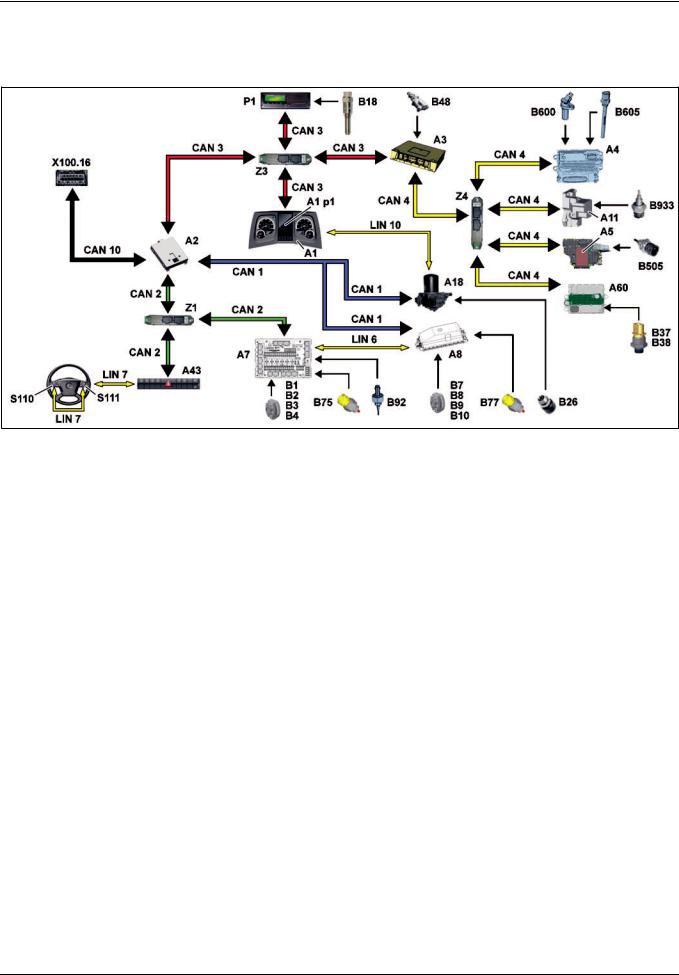
A18 Electronic Air Processing Unit (EAPU)
control unit
A43 Modular switch panel (MSF) control
unit
A60 Exhaust aftertreatment (ACM)
control unit (in vehicles with code
(M5Z) Euro VI engine version)
B1Left 1st front axle
brake wear sensor
B2Right 1st front axle
brake wear sensor
B3Left 2nd front axle
brake wear sensor
B4Right 2nd front axle
brake wear sensor
CAN 1Exterior>CAN
CAN 2Interior CAN
CAN 3Frame CAN
CAN 4Drive train CAN
CAN 10 Diagnostic CAN
LIN 6LIN SCA/SCH redundancy
LIN 7Button group LIN
LIN 10EAPU>LIN
P1Tachograph (TCO)
W00.20>1078>79
B7Left 1st rear axle
brake wear sensor
B8Right 1st rear axle
brake wear sensor
B9Left 2nd rear axle
brake wear sensor
B10 Right 2nd rear axle
brake wear sensor
B18 Travel and speed sensor
B26 Condensation sensor
B37 Exhaust pressure sensor upstream of
diesel oxidation catalytic converter (in
vehicles with code (M5Z) Euro VI
engine version)
B38 Exhaust pressure sensor downstream of
diesel particulate filter (in vehicles with
code (M5Z) Euro VI engine version)
S110Left multifunction steering wheel
button group
S111Right multifunction steering
wheel button group
Z1Cab instrument panel CAN bus
star point
Z3Frame CAN bus star point
Z4Drive CAN bus star point
X100.16 Diagnostic socket
24
Page 28
General information
– This printout will not be recorded by the update service. Status: 09 / 2011 –
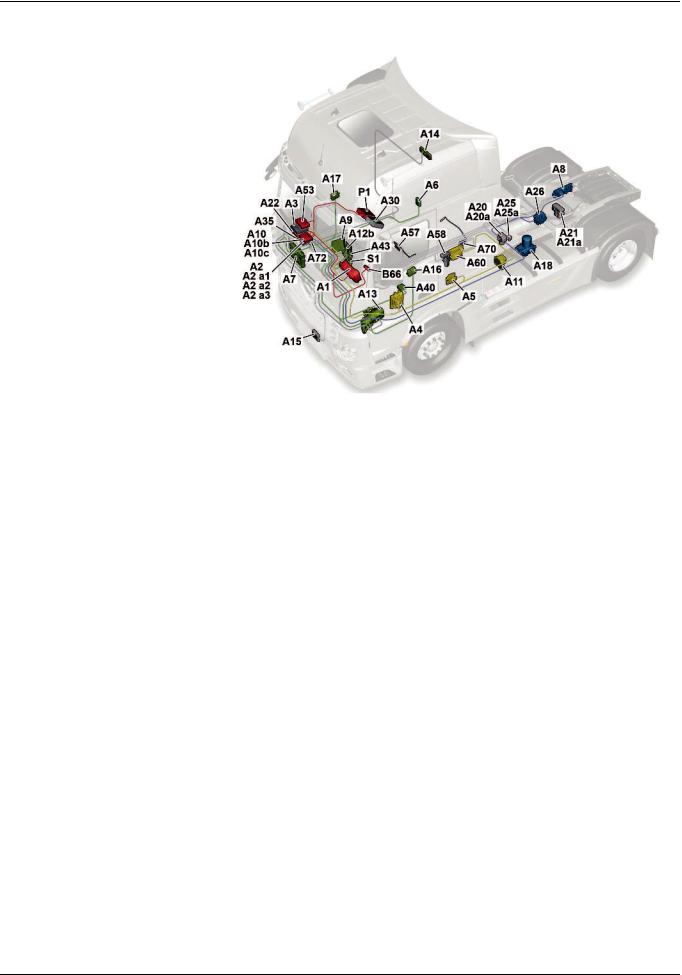
The recording of data function enables the maintenance system
(WS) to receive two different types of input factors for calculating
the load>specific maintenance intervals:
fBasic data, which are determined unchangeable at first in
the form of a parameterization and
fmeasured values, which are sensed continuously.
Thus, two functions are differentiated:
fAcquiring the basic data
fAcquiring the measured values
Functions
Acquiring the basic data
The maintenance system (WS) requires certain basic data
(parameters), which:
fare a prerequisite for the general function and
fwhich are used to adapt the maintenance system (WS) to the
vehicle and the operating fluids.
The basic data are acquired in the form of the following
parameterizations:
fBasic parameterization
fVehicle
fSubsequent parameterization
fParameterization of operating fluids
fmakes it possible to change parameters, which are
fmay only be carried out in workshops authorized by
>specific parameterization
connected to constructional vehicle changes for instance or
special customer's requests, such as the "time>
servicing scheme grid" parameter and
Mercedes>Benz.
based
Basic parameterization
The basic parameterization (base parameterization):
fincludes the pre>assignment of certain parameters with
values and is a prerequisite for the function of the
maintenance system (WS) and
fis made at the manufacturer of the central gateway control
unit (CGW) (A2).
Vehicle>specific parameterization
The vehicle>specific parameterization:
fis used to adapt the maintenance system (WS) to the vehicle
model and the vehicle equipment, or to the special features
of the individual maintenance items, such as
their cut>in or cutout and
fis carried out in the Mercedes>Benz production plant.>>>>>>>>>>>>>>>>>>>>>>>>>>>>>>>>>>>>>>>>>>>>>>>>>>>>>>>>>>>>>>>>>>>>>>>>>>>>>>>>>>>>>>>>>
Parameterization of operating fluids
Parameterization of operating fluids:
fmakes it possible to change parameters with regard to the
properties of fuels and lubricants, which can change during
the operation of the vehicle, such as engine oil quality,
engine oil viscosity, transmission oil quality, or sulfur content
of the fuel and
fmay also be carried out by other workshops.
i Querying and operation are conducted using the left
multifunction steering wheel button group (S110) and right
multifunction steering wheel button group (S111) or using Star
Diagnosis through the diagnostic socket (X100.16).
i The parameters can be checked and changed if necessary
through the "Fuels and Lubricants" submenu in the
"Adjustments" menu of the menu system. Querying and
operation are conducted using the left multifunction steering
wheel button group (S110) and right multifunction steering
wheel button group (S111) or using Star Diagnosis through the
diagnostic socket (X100.16).
– This printout will not be recorded by the update service. Status: 09 / 2011 –
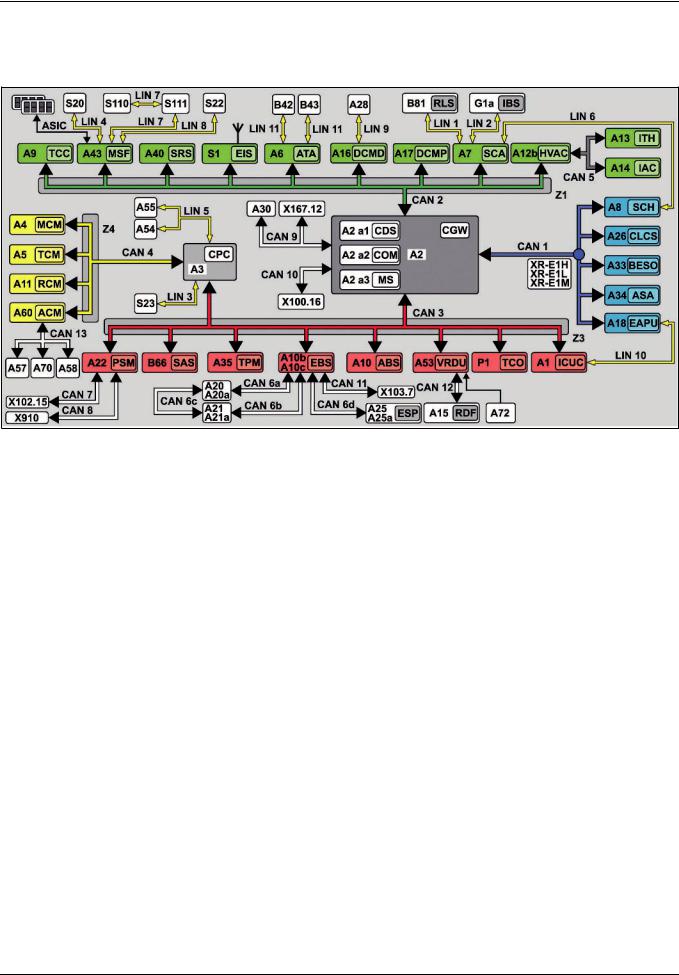
Acquiring the measured values
The measurement values are recorded using different sensors,
which are connected to the system>specific control units or the
locally best suited modules, e.g. on the sensor and actuator
module, cab (SCA) control unit (A7).
The analog measured values are turned into corresponding CAN
messages by the particular control units or modules; these CAN
messages are transmitted with the aid of the CAN data bus system
to the maintenance system (WS).
The maintenance system (WS):
fprocesses the recorded measured values converting them to
input data for the life cycle consumption and forecast
calculation, whereby the quality of processed measured
values is of major significance in terms of the forecast
calculation result and
fmonitors the acquired measured values for errors, exceeding
The drive control (CPC) control unit (A3):
facquires the measured value for air filter contamination by
the air filter sensor (B48) and
fsends a corresponding CAN message over the frame CAN
(CAN 3) and over the frame CAN bus neutral point (Z3) to the
central gateway control unit (CGW) (A2).
Engine management (MCM) control unit (A4)
The engine management (MCM) control unit (A4):
facquires the measured "crankshaft rpm" value from the
crankshaft position sensor (B600),
facquires the measured "engine oil temperature" value from
the engine oil fill level sensor (B605),
fsends corresponding CAN messages over the drive train CAN
(CAN 4) and over the drive train CAN bus neutral point (Z4)
to the drive control (CPC) control unit (A3) and from there
over the frame CAN (CAN 3) and over the frame CAN bus
neutral point (Z3) to the central gateway control unit (CGW)
(A2).
The transmission control unit (TCM) (A5):
facquires the measured "transmission oil temperature" value
from the transmission oil temperature sensor (B505) and
fsends a corresponding CAN message over the drive train
CAN (CAN 4) and over the drive train CAN bus neutral point
(Z4) to the drive control (CPC) control unit (A3) and from
there over the frame CAN (CAN 3) and over the frame CAN
bus neutral point (Z3) to the central gateway control unit
(CGW) (A2).
i Only in vehicles with code (B3H) Secondary water retarder.
The retarder control unit (RCM) (A11):
facquires the measured "coolant temperature" value from
the coolant temperature sensor (B933) and
fsends a corresponding CAN message over the drive train
CAN (CAN 4) and over the drive train CAN bus neutral point
(Z4) to the drive control (CPC) control unit (A3) and from
there over the frame CAN (CAN 3) and over the frame CAN
bus neutral point (Z3) to the central gateway control unit
(CGW) (A2).
Electronic Air>Processing Unit (EAPU) control unit (A18)
i
Only in vehicles with code (B1C, B1D, B1E) Electronic Air>
Processing Unit (EAPU).
The Electronic Air>Processing Unit (EAPU) control unit (A18)
frecords the measured "condensation water level" value
from the condensation sensor (B26),
fdelivers the "reservoir pressure for brake circuit 1 and 2"
measurement value from the integrated reservoir pressure
sensors for brake circuit
1 and 2,
fsends corresponding CAN messages over the exterior CAN
(CAN 1) to the central gateway control unit (CGW) (A2),
fsends corresponding LIN messages over the redundant
EAPU>LIN (LIN 10) to the instrument cluster control unit
(ICUC) (A1).
Sensor and actuator module, chassis (SCH) control unit (A8)
The sensor and actuator module, chassis (SCH) control unit (A8):
facquires the measured "brake wear" value at the installed
rear axles from the following brake wear sensors:
> Left 1st rear axle brake wear sensor (B7)
> Right 1st rear axle brake wear sensor (B8)
> Left 2nd rear axle brake wear sensor (B9)
> Right 2nd rear axle brake wear sensor (B10)
frecords the "rear axle oil temperature" value at the first rear
axle from the 1st rear axle temperature sensor (B77),
fsends corresponding CAN messages over the exterior CAN
(CAN 1) to the central gateway control unit (CGW) (A2).
i In the event of any data transfer interference between the
central gateway control unit (CGW) (A2) and the sensor and
actuator module, cab (SCA) control unit (A7) or the sensor and
actuator module, chassis (SCH) control unit (A8) the data can be
sent as LIN messages redundantly over the redundancy LIN
SCA/SCH (LIN 6).
i Only for vehicles with code (M5Z) Engine version Euro VI.
The exhaust aftertreatment (ACM) control unit (A60)
facquires the exhaust pressure measurement values on the
diesel oxidation catalytic converter/diesel particulate filter
from the following pressure sensors:
> exhaust pressure sensor upstream of diesel oxidation
catalytic converter (B37)
> exhaust pressure sensor downstream of diesel particulate
filter (B38)
fsends a corresponding CAN message over the drive train
CAN (CAN 4) and over the drive train CAN bus neutral point
(Z4) to the drive control (CPC) control unit (A3) and from
there over the frame CAN (CAN 3) and over the frame CAN
bus neutral point (Z3) to the central gateway control unit
(CGW) (A2).
Instrument cluster control unit (ICUC),
component description
Central gateway control unit (CGW),
component description
Component description drive control (CPC)
control unit
Component description for engine
management (MCM) control unit
Transmission control (TCM) control unit.
component description
Cab signal acquisition and actuation
module control unit (SCA), component
description
Signal acquisition and actuation module
control unit, frame (SCH), component
description
i
Electronic systems, Actros, model 963 > 09/2011 >
A1
A2
A3
A4
A5
A7
A8
Page 331
Page 333
Page 334
Page 335
Page 337
Page 339
Page 340
27
Page 31
Functions
– This printout will not be recorded by the update service. Status: 09 / 2011 –

Retarder control unit (RCM), component
description
Electronic Air>Processing Unit (EAPU),
component description
Modular switch panel control unit (MSF),
component description
Exhaust aftertreatment (ACM) control unit,
component description
Exhaust pressure sensor downstream of
diesel particulate filter, component
description
Outside temperature sensor, component
description
Transmission oil temperature sensor,
component description
Component description for crankshaft
position sensor
Component description for engine oil fill
level sensor
Retarder, component descriptionB933
A11
i Only in vehicles with code (B3H)
Secondary water retarder.
A18
i Only in vehicles with code (B1C)
Electronic Air>Processing Unit (EAPU) low
or with code (B1D) Electronic Air>
Processing Unit (EAPU) mid or with code
(B1E) Electronic Air>Processing Unit (EAPU)
high.
A43
A60
Vehicles with code (M5R) EEV engine
version and vehicles with code (M5Y) Euro
V engine version
Vehicles with code (M5Z) Euro VI engine
version
B18
B26
B37
i Only for vehicles with code (M5Z)
Engine version Euro VI.
B38
i Only for vehicles with code (M5Z)
Engine version Euro VI.
Saving service messages in the service messages memory
The service messages memory:
fis a ring memory, in which the data of up to 30 consecutive
service messages can be stored,
i Here, the next service message with the highest urgency
is then stored. If the data memory capacity has been
reached, then the oldest entries are deleted first.
fdocuments the first>time occurrence of a service message
and
fsaves the urgency level of the service message, the date, the
maintenance interval travel distance, the kilometer reading
of the speedometer and the relative life cycle consumption.
fsaves the major assembly designation and
fdocuments whether a service message was confirmed.
Saving service life data, forecast data, maintenance memory data
and parameters in internal memory:
In the internal memory:
fthe service life and forecast data are always saved after
switching off the ignition or after every operating hour,
fthe data are preserved after the ignition is switched off,
fthe maintenance memory data are stored after a
maintenance operation was reset for a maintenance item,
fthe service memory data are saved when a message appears
or is confirmed,
fparameters are saved again after a change is made and the
Parameterization mode is exited and
fthe new parameters are also stored in the mirror memory of
the instrument cluster control unit (ICUC) (A1) to enable
parameterization to be conducted when a control unit is
replaced.
Saving service life data, forecast data, maintenance memory data
and parameters in mirror memory:
The mirror memory is a nonvolatile memory in the instrument
cluster (ICUC) (A1), in which all the important service life data and
parameters are saved every 5 operating hours.
If the central gateway control unit (CGW) (A2) has to be replaced,
then the data from the mirror memory in the instrument cluster
control unit (ICUC) (A1) can be copied into the new central
gateway control unit (CGW) (A2). The parameterization of the
central gateway control unit (CGW) (A2) is restored separately
through the central data memory (CDS) in the instrument cluster
(ICUC) (A1).
Storing faults and text messages in the diagnostic trouble code
memory
The diagnostic trouble code memory stores any fault or text
message that appears for the first time.
Consecutive new entries are stored one after the other.
Instrument cluster control unit (ICUC),
component description
Central gateway control unit (CGW),
component description
i
Electronic systems, Actros, model 963 > 09/2011 >
A1
A2
Page 331
Page 333
29
Page 33
Functions
– This printout will not be recorded by the update service. Status: 09 / 2011 –

GF00.20>W>3003H
Normal mode displays function2.8.11
MODEL 963
1"Maintenance" menu
2"Diagnosis" menu
A1Instrument cluster (ICUC) control
unit
A1p1 Multifunction display
A2Central gateway control unit (CGW)
A43Modular switch panel (MSF) control
unit
CAN 2 Interior CAN
CAN 3 Frame CAN
LIN 7 Button group LIN
S110Left multifunction steering wheel
button group
S111Right multifunction steering wheel
button group
General information
The central gateway control unit (CGW) (A2) sends the CAN
messages with the display information over the frame CAN (CAN
3) and over the frame CAN bus neutral point (Z3) to the
instrument cluster control unit (ICUC) (A1).
The maintenance information display is generated in the
instrument cluster control unit (ICUC) (A1) and shown on the
multifunction display (A1 p1).
Z3Frame CAN bus star pointZ1Cab instrument panel CAN bus star
Service messages
Service messages are text warnings that indicate upcoming
maintenance operations. They contain the "service date" and
"remaining driving distance" forecast data for the listed
maintenance item or its urgency status (e.g. Service due).
They are automatically generated by the maintenance system
(WS) as per their urgency status and shown on the multifunction
display (A1 p1).
If there are any service messages pending, they are shown each
time the ignition is switched on along with any other pending
messages. Service messages can only be canceled by
acknowledging them.
– This printout will not be recorded by the update service. Status: 09 / 2011 –

Five urgency levels of service messages are differentiated:
fNo message
fEarly warning
fService due
fService now (can be acknowledged)
fService now (cannot be acknowledged)
i Any acknowledgeable service messages has to be
acknowledged. The associated service dates have to be observed
and the maintenance operations have to be carried out.
If service messages are skipped, the operational and road safety of
the vehicle can be jeopardized. If a maintenance operation is
carried out late or not at all, the wear at the vehicle or at the
major assemblies will increase at any rate.
The life cycle consumption has reached the exceeding limit.
The due service date was significantly exceeded.
A highlighted text information is displayed in yellow.
When acknowledging the service message, the next pending
service message, where applicable, is then shown.
Service now (cannot be acknowledged)
The life cycle consumption has extended far beyond the overrun
limit. The Service due date was exceeded to an extreme extent. A
text information highlighted in yellow is shown and the yellow
indicator lamp with the wrench symbol. When the maximum
brake wear is reached, the indicator lamp also appears with the
brake symbol.
When acknowledging the service message, the next pending
service message, where applicable, is then shown.
Advance warning
This is information on the maintenance item and the remaining
driving distance until the service is due.
The life cycle consumption is still below 100%.
Service will be due within the next days and the life cycle
consumption will then be
100%.
When acknowledging the service message, the next pending
service message, where applicable, is then shown.
Service due
The life cycle consumption is 100%.
The due service date was reached or exceeded.
If the service message is acknowledged, the next service message
of the "Service due" urgency level is displayed if applicable.
Service information can be called up at any given time in the
"Maintenance" menu in the instrument cluster and shown on the
multifunction display (A1 p1). The system is operated using the
left multifunction steering wheel button group (S110) and the
right multifunction steering wheel button group (S111).
The service information listed in the "Maintenance" menu on a
maintenance item contains the same information as the service
messages. The interval number is also shown on the multifunction
display (A1 p1).
If the "Reset?" prompt is shown in the multifunction display (A1
p1), the maintenance item above the left multifunction steering
wheel button group (S110) and the right multifunction steering
wheel button group (S111) can be reset.
If the multifunction display (A1 p1) shows a display without any
forecast data under the maintenance item text, there are no
forecast data available for the maintenance item.
Example: Transmission
>.> >.> >
>
Instrument cluster control unit (ICUC),
component description
Central gateway control unit (CGW),
component description
– This printout will not be recorded by the update service. Status: 09 / 2011 –

GF00.20>W>3005H
Reset service item function2.8.11
MODEL 963
Requirements:
f Maintenance operation was conducted
f Vehicle at rest
f Ignition switched on
f Hand brake applied
Directly measured maintenance items
(e.g. brake linings)
f Manual reset
Reset maintenance items
Execution:
f Confirm the "Reset?" selection internally through the multifunction display (A1 p1)
in the instrument cluster control unit (ICUC) (A1) in the respective maintenance item
in the Maintenance menu by pressing the left multifunction steering wheel button
group (S110) and the right multifunction steering wheel button group (S111)
f Confirm externally through the diagnostic socket (X100.16) using Star Diagnosis
Accumulating maintenance items
(operation oils)
f Manual reset
f Possible adjustment of the new operating fluid
Time>based servicing scheme
(e.g. lubrication of steering knuckles)
f Manual reset
General information
If a maintenance operation was carried out, the associated
maintenance item has to be reset.
For safety reasons the reset of maintenance items is only possible,
if the vehicle's hand brake is tightened and the ignition is
switched on. When driving, the instrument cluster control unit
(ICUC) (A1) blocks this function.
>bars are shown in the forecast data,
>then the service messages memory is deleted and
>basic maintenance data that have accrued so far are taken
over into the maintenance memory.
A reset for the "brake" maintenance item is only possible, if the
currently valid measured values for both brakes on one axle are
below the brake wear value of 18%.
– This printout will not be recorded by the update service. Status: 09 / 2011 –

Reset maintenance items for accumulated maintenance items
Manual reset
After a manual reset:
>the service life data are reset to their initialization values,
>then the service messages memory is deleted,
>the basic maintenance data that have incurred this far are
transferred to the maintenance memory,
>the interval number is incremented,
>bars are shown in the forecast data, and
>where fuels and lubricants are used, that differentiate from
the previous fuel and lubricants, then these are to be set in
the Fuels and Lubricants menu below the corresponding
major assembly.
Instrument cluster control unit (ICUC),
component description
Central gateway control unit (CGW),
component description
As long as the life cycle consumption is still below the forecasting
start, no forecast data are calculated. There is not yet a sufficient
amount of information below the forecasting start to be able to
calculate reliable forecast data.
After each reset the forecast data are marked "not predictable"
by the base parameterization. After exceeding the forecasting
start, the predictions are calculated based on the current life cycle
consumption values.
The forecasting start for accumulated, directly measured
maintenance items and for time>
h operating time.
Forecasting
The forecast data are calculated individually for each
maintenance item. As a result, the service dates of the individual
maintenance items do not have a fixed time interval between one
another.
The prognosis calculation is based on the following input
parameters:
fTotal time
fOperating time
fDistance
fLife cycle consumption
The service date of the time>based servicing scheme is exclusively
specified via the parameterizable time maintenance grid. The
forecast data are issued on the multifunction display (A1 p1) in
the instrument cluster (ICUC) (A1).
Thus, the workshop equipment is optimally utilized.
The forecast data for the remaining total time and the remaining
driving distance apply exactly to each service date of a
maintenance item and represent the remainder values until the
due date.
The individual service date for each maintenance item is the point
in time at which the next maintenance is due.
i This applies provided the workshop equipment is used with a
constant load.
If maintenance items are close to each other, then a decision
should be reached in consultation with the customer as to
whether they can be conducted together during a maintenance
visit to the workshop.
The life cycle consumption increases irrespective of the load of
the maintenance item in proportion to the elapsed time.
The service date depends exclusively on the calculated remaining
total time. The remaining total time is calculated beginning with
the start of the total time calculation.
Central gateway control unit (CGW),
component description
34
After confirmation of a conducted time>
the new service date is displayed in the multifunction display (A1
p1).
The remaining distance is shown after 50 operating hours for the
first time in the multifunction display (A1 p1).
A2
based servicing scheme,
Page 333
Page 38
Functions
– This printout will not be recorded by the update service. Status: 09 / 2011 –
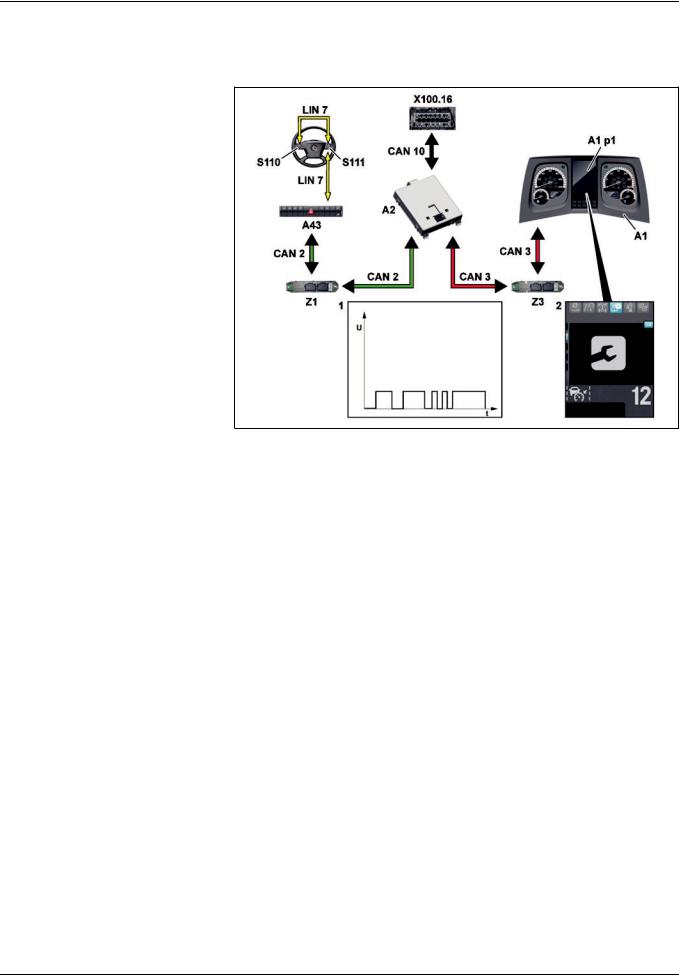
GF00.20>W>3012H
Life cycle consumption calculation, function2.8.11
MODEL 963
Life cycle consumption of a maintenance
item
1Life cycle consumption after
loading
2Life cycle consumption according
to driving time limit
3Life cycle consumption after travel
distance limitation
LDV (%) Life cycle consumption
tTime
t
1
t
2
t
3
Time "100% LDV according to
load"
Time "100% LDV according to
driving time limit"
Time "100% LDV according to
distance limit"
W00.20>1040>05
INPUT DATA
f Operating oil temperatures of
major assemblies
f Brake lining thickness of front and
rear axle
f Air filter contamination
f Air drier condensation level
f Brake wear ratio
f Operating time
f Total time
f Distance
f Number of crankshaft revolutions
f Engine speed
f Moderate engine speed
f Average major assemblies
temperature
f Average outside air temperature
f Diesel particulate filter soiling
f Vehicle speed
Calculation of life cycle consumption
f Life cycle consumption based on the vehicle load for
A. directly measured maintenance items (brake linings, air
filter)
Calculation with linear or nonlinear calculation instruction
as a function of the wear variable.
B. Accumulating maintenance items (operation oils)
Calculation with empirical calculation instructions
dependent on:
> Correction factors for temperature, load, rotational
speed, cold start increment
> Quality factors for oil, fuel, mechanical components
f Time>based servicing scheme (e.g. lubrication of steering
knuckles)
f Life cycle consumption based on the drive time limit
f Life cycle consumption based on the travel distance
– This printout will not be recorded by the update service. Status: 09 / 2011 –
General information
The life cycle consumption calculation provides information on
the degree to which the workshop equipment is worn out, and
which one should be replaced or repaired during maintenance.
The life cycle consumption calculation determines 4 life cycle
consumption values, which are calculated anew during each
calculation cycle:
fLife cycle consumption based on vehicle load, based on
calculation method for:
> directly measured maintenance items and
> accumulating maintenance items.
fLife cycle consumption based on the drive time limit,
fLife cycle consumption based on the travel distance
limitation,
fLife cycle consumption based on operating time,
Central gateway control unit (CGW),
component description
The workshop equipment is worn out if a life cycle consumption
of 100% is reached.
An exception is the time>based servicing scheme, which has fixed
maintenance intervals that are independent from loads and
driving distance.
The life cycle consumption is the basis for forecasting.
i Very precise, earlier prognoses are possible in the event of
regular operations in regard to loads and driving distance over a
long period of time. If operations vary greatly, the prognosis
variation is higher. The forecasts become increasingly more
accurate as total vehicle operating time increases.
Once the four life cycle consumption values have been evaluated,
the maintenance system (WS) provides the highest value as a
forecasting life cycle parameter.
A2
Page 333
36
Page 40
Functions
– This printout will not be recorded by the update service. Status: 09 / 2011 –
GF26.21>W>0002H
Transmission automation, function2.8.11
TRANSMISSION 715 in MODEL 963 with CODE (G5G) Mercedes PowerShift 3
TRANSMISSION 715 in MODEL 964 with CODE (G5G) Mercedes PowerShift 3
A1 Instrument cluster (ICUC) control unit
A2 Central gateway control unit (CGW)
A3 Drive control (CPC) control unit
A4 Engine management control unit
(MCM)
A5 Transmission control (TCM) control
unit
A43 Modular switch panel (MSF) control
unit
1General
With transmission automation there a convenience shifting
system available over which gear selection as well as declutching
and engaging of the clutch take place automatically. It contains a
fully automated manual transmission, based on a constant>
transmission, with automated clutch operating system. The clutch
operation takes place over a pneumatically actuated centrally
located clutch operator.
Synchronization does not take place via a blocking
synchronization as on a synchromesh transmission but is realized
instead by braking or accelerating the countershaft in a controlled
manner. As a result can be widened for the same dimensions of
the transmission gears and thus higher torques and outputs
transmitted. Passive safety is also increased due to reducing the
burden for the driver.
B18Travel and speed sensor
B501Main shaft rpm sensor
B502Countershaft rpm sensor
B503Clutch travel sensor
B504Range group travel sensor
B505Transmission oil temperature
sensor
CAN 2 Interior CAN
CAN 3 Frame CAN
CAN 4 Drive train CAN
mesh
W26.21>1121>79
LIN 3 Multifunction control lever>LIN on
the right
LIN 7 Button group LIN
S23Right multifunction control lever
S110Left multifunction steering wheel
button group
S111Right multifunction steering wheel
button group
Y900 Transmission positioner
Optimum gear selection supports an economic and fuel>
driving style. All the shift operations take place in the optimum
rpm range, minimizing wear on the transmission and engine.
Faults during shifting are ruled out and it is no longer possible to
over rev the engine. After switching on the ignition the automatic
mode of transmission automation is always activated irrespective
of which mode was last selected (manual or automatic). The
option of activating a manual or automatic shift mode with the
transmission mode button (M/A) (S23 s3) on the RH multifunction
control lever (S23) has been retained. 12 forwards gears, 4 reverse
gears and neutral can be engaged.
The transmission (TCM) control unit (A5) is the central control unit
for the transmission and the clutch. It contains the software
modules for controlling the transmission and clutch actors.
The following sensor signals are read in directly amongst others:
The pneumatic central clutch release bearing directly actuates the
mechanical clutch components, takes on disengaging the clutch
and engaging the clutch and contains the clutch travel sensor
(B503).
4.6 Right multifunction control lever (S23)
The RH multifunction control lever (S23) transmits the shift
commands to the drive control (CPC) control unit (A3).
5The following components support during transmission
– This printout will not be recorded by the update service. Status: 09 / 2011 –

automation
Functions
5.1 Engine management (MCM) control unit (A4)
The engine management (MCM) control unit (A4) includes the
software module for torque and rotational speed actuation of the
engine and therefore also implements requests from other
control units on the rotational speed and torques for switching,
starting off and stopping.
5.2 Drive control (CPC) control unit (A3)
The drive control (CPC) control unit (A3) is modular in design and
it contains the following software modules:
fSoftware module for drive control; it comes with extended
A thermostatically regulated transmission cooling with the
following components is used as special equipment:
fTransmission cooler with a transmission cooling fan (M19)
(located in the direction of travel on the right, next to the
cooling module)
fTransmission oil lines
fThermostat element with spring from the shape memory
alloy (FGL)
For transmission oil temperatures above 80∞C the spring force of
the spring closes the cooler protection valve (bypass). The
transmission oil flows through the transmission cooler and is
cooled by the airstream.
5.3 Modular switch panel (MSF) control unit (A43)
The modular switch panel (MSF) control unit (A43) reads in the
operation of the back
wheel button group (S110) or the right multifunction steering
wheel button group (S111).
5.4 Tachograph (TCO) (P1)
The tachograph (TCO) (P1) reads in the way and speed sensor
(B18) and evaluates its signal.
5.5 IC control unit (ICUC) (A1)
The IC (ICUC) control unit (A1) shows the driver information over
the multifunction display (A1 p1).
If the transmission oil temperature increases further, the
transmission cooling fan (M19) located on the transmission cooler
is switched on from 90∞C over the SCA (SCA) control unit (A7).
For transmission oil temperatures below 80∞C the spring opens the
cooler protection valve. The transmission oil flows uncooled over
the bypass back into the transmission.
In the case of an excessively high transmission oil pressure the
i
cooler and the transmission protection valve open and allow the
oil to flow uncooled over a bypass back into the transmission.
>up mode via the left multifunction steering
Overall network for transmission
automation
Operation, function
Driver information, function
Transmission mode, function
Shifting the transmission, function
Controlling the clutch, function
Countershaft brake, function
i
Electronic systems, Actros, model 963 > 09/2011 >
Page 40
Page 41
Page 44
Page 45
Page 46
Page 52
Page 54
39
Page 43
Functions
– This printout will not be recorded by the update service. Status: 09 / 2011 –

GF26.21>W>0002>01HOverall network for transmission
automation
A1Instrument cluster (ICUC) control
unit
A2Central gateway control unit (CGW)
A3Drive control (CPC) control unit
A4Engine management control unit
(MCM)
A5Transmission control (TCM) control
unit
A10b Electronic brake system (EBS) control
unit
A10cElectronic brake system (EBS)
control unit
A43Modular switch panel (MSF)
control unit
CAN 2 Interior CAN
CAN 3 Frame CAN
CAN 4 Drive train CAN
LIN 3Multifunction control lever>LIN on
the right
LIN 7Button group LIN
P1Tachograph (TCO)
W26.00>1032>79
S23Right multifunction control lever
S110Left multifunction steering wheel
button group
S111Right multifunction steering wheel
button group
Z1Cab instrument panel CAN bus star
point
Z3Frame CAN bus star point
Z4Drive CAN bus star point
40
Page 44
Functions
– This printout will not be recorded by the update service. Status: 09 / 2011 –

GF26.21>W>3003H
Operation, function2.8.11
TRANSMISSION 715 in MODEL 963 with CODE (G5G) Mercedes PowerShift 3
TRANSMISSION 715 in MODEL 964 with CODE (G5G) Mercedes PowerShift 3
A3Drive control (CPC) control unit
A5Transmission control (TCM) control
unit
CAN 4 Drive train CAN
LIN 3Multifunction control lever>LIN on
the right
S23Right multifunction control lever
S23s1Transmission position switch
The drive control (CPC) control unit (A3) reads in the shift signals
from the RH multifunction control lever (S23) via the RH
multifunction control lever LIN (LIN 3), evaluates them and sends
appropriate CAN messages to the transmission (TCM) control unit
(A5) via the drive train CAN (CAN 4).
Twelve forwards gears, 4 reverse gears and neutral can be
engaged.
Automatic operation
(the optimal gear (the required gear specification) is determined
by the drive control (CPC) control unit (A3))
Gear selection is dependent on the following influencing
variables:
fGround speed (only relevant for the start>off gear)
fAccelerator pedal position (specified torque)
fLoad condition of engine
fOperating point of the target gear
fStarting speed of the transmission
fOperation of the permanent brake
fLoad condition of the vehicle
fShift program
fLay of the land for the driving lane
Manual mode
Difference to automatic mode:
fThe shifting operations must be initiated by the driver, that
is the driver determines the shift point and shift direction.
– This printout will not be recorded by the update service. Status: 09 / 2011 –

Operation of the driving functions
The driving functions assist the driver in daily driving to drive with
a more fuel economy. They increase the ride comfort and support
him in difficult situations.
Selectable driving functions are:
f EcoRoll mode,
fuel>saving driving style through automatic shifting into the
transmission neutral position "N" when the accelerator is
not actuated
f Rocking mode,
recess
fCrawl mode, for automatic starting moving when releasing
the service brake and continued crawling without actuating
the accelerator pedal.
If the pre
control unit (A3) requests the neutral position from the
transmission (TCM) control unit (A5) via the drive train CAN (CAN
4). The transmission (TCM) control unit (A5) actuates the
transmission positioner (Y900) to open the clutch. After successful
opening of the clutch, read in over the clutch position sensor
(B503), the transmission positioner (Y900) is actuated to engage
neutral. After ending the switching the transmission (TCM)
control unit (A5) transmits the engaged neutral to the drive
control (CPC) control unit (A3) via the drive train CAN (CAN 4).
i Based on the reduced engine speed a somewhat lower
steering assist can occur and therefore greater steering forces in
certain driving situations, for example on slightly curved
downslopes. The operation or road safety is not endangered by
this.
>conditions are fulfilled then the drive control (CPC)
in certain driving situations for supporting a
for rocking the vehicle out of an off>road
EcoRoll mode
Preconditions
fEcoRoll function activated
fGround speed was > 35 km/h and is > 25 km/h (hysteresis)
fAccelerator not operated
fService brake or permanent brake not actuated
fDriver assistance systems not in control mode
fBrake assistant systems not in control mode
fPower take
fVariable speed limiter maximum speed not exceeded
fCC speed tolerance not exceeded
The crawl function is always switched on after an engine start and
is activated after first moving off.
The crawl function is deactivated under the following conditions:
fThe crawl function is switched off over the IC (ICUC) control
unit (A1)
fThe transmission in neutral for longer than 2 s
fThe parking brake is tightened
fThe rocking mode is activated
fDriver assistance systems switch into control mode
fIdle speed > 700 rpm
fThreat of clutch overloading
fAn excessively high air drag and rolling resistance
fAn excessively high tire grip
i The crawl function is similar in its behavior to an automatic
torque converter. Since the function is realized over the clutch the
function is not wear>free and the vehicle in the slip range of the
clutch is not capable of permanently crawling.
The crawl function consists of 2 parts:
fIn gears 1 to 6, R1 and R2, self>
releasing the service brake (only for an active crawl function)
fIn gears 1 to 6, R1 and R2 further crawling (=freewheeling)
for a non>actuated accelerator pedal
The driving off dosing occurs for first driving off over the
accelerator pedal. The system is taught in in the process to the
torque prescribed by the driver. After the first "real" driving
determination of the crawling torque depends on the determined
vehicle mass and incline in the driving lane.
i If driving with a trailer is recognized over the trailer
recognition the mass and incline dependent crawling torque is
reset in the drive control (CPC) control unit (A3) and teaching in
occurs again during first driving off.
Rocking mode is activated over the rocking mode button (S938).
If rocking mode has been activated the transmission control
changes from automatic into manual mode.
Accelerator pedal requests are implemented more directly and
the clutch is opened more rapidly for a non>actuated accelerator
pedal. The clutch is closed quickly again as soon as the accelerator
pedal is actuated again. Through repeated actuation and release
of the accelerator pedal can put the vehicle into a rocking mode
condition and in this way can rock the vehicle free out if a hollow.
– This printout will not be recorded by the update service. Status: 09 / 2011 –
Back>up mode represents a last emergency function for engaging
gears for a vehicle standstill. The operating commands for
navigation are entered in the menu tree multifunction display (A1
p1) in the IC (ICUC) control unit (A1) over the LH multifunction
steering wheel button group (S110) and the RH multifunction
steering wheel button group (S111).
The modular switch panel (MSF) control unit (A43) reads in the
switching commands from the LH multifunction steering wheel
button group (S110) and the RH multifunction steering wheel
button group (S111), evaluates them and transmits appropriate
CAN messages via the interior CAN (CAN 2), the central gateway
(CGW) control unit (A2) and the frame CAN (CAN 3) to the drive
control (CPC) control unit (A3).
The drive control (CPC) control unit (A3) evaluates the switching
request from the driver, determines the targeted gear to be
switched and, for release, transmits appropriate CAN messages
via the drive train CAN (CAN 4) to the transmission (TCM) control
unit (A5).
Functions
The following switching positions can be selected in back>
mode:
The actuation of the clutch is controlled automatically as long as
no malfunction is present. A malfunction would result in
automatic clutch operation being disabled.
i If gear selection was not enabled, a shift to "neutral" is always
enabled.
up
Instrument cluster control unit (ICUC),
component description
Component description for central
gateway control unit (CGW)
Component description for drive control
(CPC) control unit
Component description for transmission
control (TCM) control unit
Component description for modular switch
panel control unit (MSF)
Component description for right
multifunction control lever
Component description for multifunction
steering wheel
A1
A2
A3
A5
A43
S23
S110, S111
Page 331
Page 333
Page 334
Page 337
Page 370
Page 463
Page 469
i
Electronic systems, Actros, model 963 > 09/2011 >
43
Page 47
Functions
– This printout will not be recorded by the update service. Status: 09 / 2011 –
GF26.21>W>3005H
Driver information, function2.8.11
TRANSMISSION 715 in MODEL 963 with CODE (G5G) Mercedes PowerShift 3
TRANSMISSION 715 in MODEL 964 with CODE (G5G) Mercedes PowerShift 3
A1Instrument cluster (ICUC) control
unit
A1 p1Multifunction display
A3Drive control (CPC) control unit
A5Transmission control (TCM) control
unit
B50Center speaker
CAN 3 Frame CAN
CAN 4 Drive train CAN
Displaying shift status
The drive control (CPC) control unit (A3) transmits the information
for indication of the switching condition to the IC (ICUC) control
unit (A1) via the frame CAN (CAN 3).
To do this the transmission (TCM) control unit (A5) permanently
transmits the CAN messages with information about the condition
of the transmission (for example the engaged gear, the possible
gear) to the drive control (CPC) control unit (A3) via the drive train
CAN (CAN 4). Before execution of the shift operation the drive
control (CPC) control unit (A3) transmits the targeted gear request
(determined from the automatic gear selection or the gear
selected by the driver) to the transmission (TCM) control unit (A5).
The transmission (TCM) control unit (A5) transmits the confirmed
targeted gear and the engaged current gear to the drive control
(CPC) control unit (A3) .
The transmission (TCM) control unit (A5) transmits CAN messages
with information concerning the condition of the transmission
(for example on the switched gear, the possible gear, temperature
of the transmission oil) to the drive control (CPC) control unit (A3)
via the drive train CAN (CAN 4).
W26.21>1118>76
The IC (ICUC) control unit (A1) receives the CAN messages and
generates the following displays in the multifunction display (A1
p1):
fdisplay of the direction of travel and / or the engaged gear
fdisplay of the gearshift recommendation or to engaged gear
fdisplay of the transmission mode
The previous display is retained during the shift operation. The
current display only takes place when the shift operation is
concluded.
During the teach>in process appropriate CAN messages are
i
transmitted with information for display of the active teach>in
process. Also in back>up mode all CAN messages are transmitted,
as in normal mode, via the drive control (CPC) control unit (A3)
and the frame CAN (CAN 3) to the IC (ICUC) control unit (A1).
The drive control (CPC) control unit (A3) decides over a warning
emission to the driver. If a warning emission is necessary, the drive
control (CPC) control unit (A3) transmits an appropriate CAN
message with the information for output of warning tones to the
IC (ICUC) control unit (A1) via the frame CAN (CAN 3).
The IC (ICUC) control unit (A1) receives the CAN messages from
the drive control (CPC) control unit (A3) and generates acoustic
messages whose output takes place over the center speaker (B50).
Component description for instrument
cluster control unit (ICUC)
Component description drive control (CPC)
control unit
Component description for transmission
control (TCM) control unit
44
A1
A3
A5
Page 331
Page 334
Page 337
Page 48
Functions
– This printout will not be recorded by the update service. Status: 09 / 2011 –
GF26.21>W>3007H
Transmission mode, function2.8.11
TRANSMISSION 715 in MODEL 963 with CODE (G5G) Mercedes PowerShift 3
TRANSMISSION 715 in MODEL 964 with CODE (G5G) Mercedes PowerShift 3
General information
One can select between a manual transmission mode (manual
operation) or an automatic transmission mode (automatic
operation). In automatic operation there is a standard switching
program (A) and either the shift program (A power) or the shift
program
(A economy) available depending on the vehicle and transmission
design.
Automatic transmission mode
The transmission automation is fitted with a standard shift
program:
fA, with kickdown, accelerator pedal curve standard, CC
standard, maximum speed of 89.8 km/h, function EcoRoll
which can be switched off
The driving specific shift programs have the following significant
properties:
fA power, switchings take place at an about 100 rpm higher
rotational speed in comparison with a standard shift
program and dynamic clutch matching for driving off
fA economy, no kickdown possible, EcoRoll cannot be
switched off, maximum speed of 85 km/h, accelerator pedal
curve and max. engine torque lowered, CC Softcruise
i Selection of the automatic transmission mode takes place over
the transmission mode button (M/A) (S23 s3) on the RH
multifunction control lever (S23).
Manual transmission mode
In manual transmission mode the shift operations are initiated by
the driver over it. This means that the driver determines the shift
point and the switching direction. The kickdown function is not
available.
Component description for right
multifunction control lever
S23
Page 463
i
Electronic systems, Actros, model 963 > 09/2011 >
45
Page 49
Functions
– This printout will not be recorded by the update service. Status: 09 / 2011 –
GF26.20>W>3007H
Shifting the transmission, function2.8.11
TRANSMISSION 715 in MODEL 963 with CODE (G5G) Mercedes PowerShift 3
TRANSMISSION 715 in MODEL 964 with CODE (G5G) Mercedes PowerShift 3
Schematic representation
1Gate cylinder
2Range group shift cylinder
3Gear cylinder
4Splitter group shift cylinder
6Countershaft brake
6.1Mechanical vent valve
7Pneumatic central clutch release
A3Drive control (CPC) control unit
A4Engine management (MCM)
control unit
A5Transmission control (TCM)
control unit
A43Modular switch panel (MSF)
control unit
B18Travel and speed sensor
B501Main shaft rpm sensor
B502Countershaft rpm sensor
B503Clutch travel sensor
Y900 y4 Clutch quick opening solenoid
valve
Y900 y5Countershaft brake solenoid
valve
Y900 y6 'Extend' splitter group solenoid
valve
Y900 y7 'Retract' splitter group solenoid
valve
Y900 y8 'Extend' gear cylinder solenoid
valve
W26.21>1123>09
B504 Range group travel sensor
Interior CAN
CAN 2
CAN 3 Frame CAN
CAN 4 Drive train CAN
LIN 3 Multifunction control lever>LIN on
the right
LIN 7 Button group LIN
S23Right multifunction control lever
S110Left multifunction steering wheel
button group
S111Right multifunction steering wheel
button group
Y900 y9 'Retract' gear cylinder solenoid
valve
Y900 y10 'Extend' gate cylinder solenoid
valve
Y900 y11 'Retract' gate cylinder solenoid
valve
Y900 y12 'Retract' range group solenoid
valve
Y900 y13 'Extend' range group solenoid
valve
46
Page 50
Functions
– This printout will not be recorded by the update service. Status: 09 / 2011 –
1General
The transmission control (TCM) control unit (A5) is, as the
interface to the transmission, the central control electronics for
shift operation of a gear and actuation of the clutch.
It controls the entire shift operation and in the process performs
the following tasks:
fSwitching the switching groups of the transmission
fMeasuring and evaluating the shift status and operating
condition of the transmission
fMeasuring and evaluating the shift status and operating
Actuation of the components cylinder valve gear extend solenoid
(Y900 y8), gear cylinder retract solenoid valve (Y900 y9), splitter
group extend solenoid valve (Y900 y6), splitter group retract
solenoid valve (Y900 y7), range group retract solenoid valve (Y900
y12), range group extend solenoid valve (Y900 y13), gate cylinder
extend solenoid valve (Y900 y10), gate cylinder retract solenoid
valve (Y900 y11) takes place over electrical shift signals from the
transmission control (TCM) control unit (A5).
The sequence of actuation is carried out as per a specified
sequence corresponding to the gear to be shifted. The solenoid
valves control the admission and release of air into/out of the
working spaces of the associated gate shift cylinder (1), range
group shift cylinder (2), gear cylinder (3) and splitter group shift
cylinder (4). In the process their piston rods assume a defined
position and operate the associated shift mechanism for shifting
the splitter, range group, gear and gate.
The transmission control (TCM) control unit (A5) which is located
above the overall network is in constant data exchange with other
control units which provide switching relevant data.
It is in direct connection with the drive control (CPC) control unit
(A3) and the engine management (MCM) control unit (A4) via the
drive train CAN (CAN 4). Also requests from the transmission
control (TCM) control unit (A5) to other control units (e.g.
rotational speed requests to the engine) are transmitted via the
drive train CAN (CAN 4).
Actuation of the components
(Y900 y1), clutch slow open solenoid valve (Y900 y2), clutch rapid
close solenoid valve (Y900 y3), clutch rapid open solenoid valve
(Y900 y4) occurs over electrical shift signals from the transmission
control (TCM) control unit (A5).
The solenoid valves control the aeration and ventilation of the
pneumatic central clutch release bearing (7). The pneumatic
central clutch release bearing (7) opens or closes the clutch or
regulates the clutch at a particular position.
3.2 Switch the range group
Condition: the neutral position of gear cylinder (3) was detected.
The range group is switched through actuation of the range
group retract solenoid valve (Y900 y12) or the range group extend
solenoid valve (Y900 y13).
The splitter group is switched through actuation of the splitter
group extend solenoid valve (Y900 y6) or splitter group retract
solenoid valve (Y900 y7).
Shifting the gate
3.4
The gate is switched through actuation of the gate cylinder
retract solenoid valve (Y900 y11).
i There is a spring in the shift mechanism to reset the
transmission shift rod. This ensures that there is the necessary
return force present for a non> actuated gate cylinder retract
solenoid valve (Y900 y11). The return force of the spring is also
supported as required through actuation of the gate cylinder
extended solenoid valve (Y900 y10).
The gears are switched through actuation of the gate cylinder
extend solenoid valve (Y900 y8) or the gate cylinder retract
solenoid valve (Y900 y9). The shift operation starts from the
neutral position.
i The rotational speed of the countershaft must be aligned with
the rotational speed of the main shaft before switching the gear.
This occurs for upshifting through actuation of the countershaft
brake solenoid valve (Y900 y5) as well as for downshifting
through raising the engine speed for a closed clutch.
3.6 Shifting gears in towing mode
Towing mode is only possible in back>up mode and if the electrical
and pneumatic components are functioning correctly. Towing
mode comprises automatic shifting of the high>speed range
group and of the neutral position.
– This printout will not be recorded by the update service. Status: 09 / 2011 –
4Detecting the shift status and operating condition of the
transmission
To monitor the shift status and operating condition of the
transmission, the following sensors are read in by the transmission
(TCM) control unit (A5):
The travel and speed sensor (B18) detects the rotational speed of
the transmission output shaft over Hall sensors.
The main shaft rpm sensor (B501) detects the rotational speed and
the direction of rotation of the main shaft over Hall sensors.
The countershaft rpm sensor (B502) detects the rotational speed
of the countershaft over Hall sensors.
The clutch travel sensor (B503) detects the release travel of the
clutch.
The range group travel sensor (B504) detects the position of the
range group shift cylinder (2) over a tappet.
The transmission oil temperature sensor (B505) records the
temperature of the transmission oil.
The splitter group travel sensor (Y900 b1) indirectly detects the
position of the splitter group shift cylinder (4) over a bias attached
to the side on the shift fork.
The gear cylinder travel sensor (Y900 b2) and gate cylinder (Y900
b3) detects the position of the piston rods for the shift cylinder for
the switching groups and internally generates a pulse width
modulated (PWM) signal, which is proportional to the release
travel of the piston rod of the shift cylinder.
4.1 Evaluating the shift status and operating condition of the
transmission
The transmission (TCM) control unit (A5) determines the shift
status and operating condition of the transmission from the
sensor signals.
Together with other data relevant to shifts it performs further
evaluations, such as monitoring the shiftability of the desired
gear. This information is transmitted via the drive train CAN (CAN
4) to the drive control (CPC) control unit (A3) which requests a
targeted gear from the transmission (TCM) control unit (A5). The
transmission (TCM) control unit (A5) ensures rapid
synchronization of the rotational speeds and engaging of the
desired gear through actuation of the solenoid valves for the
respective cylinder. The engaged current gear is transmitted by
the transmission (TCM) control unit (A5) to the drive control (CPC)
control unit (A3).
The drive control (CPC) control unit (A3) makes the CAN message
available on the frame CAN (CAN 3) or evaluates this itself.
5Measuring and evaluating the shift status and operating
condition of the clutch
The clutch travel sensor (B503) detects the position of the
pneumatic central clutch release bearing (7) and internally
generates a pulse width modulation signal for further evaluation.
The transmission (TCM) control unit (A5) reads in the signal of the
clutch travel sensor (B503), evaluates this and therefore
continuously detects the switching and operating condition of the
clutch.
An integral clutch regulation in the transmission (TCM) control
unit (A5) determines the optimal clutch position according to this
information. Through actuation of the solenoid valves for the
clutch operation the clutch position is set and reports back the
drive control (CPC) control unit (A3). Requests to the engine to set
the rotational speed and torque is transmitted fitting to the clutch
position.
– This printout will not be recorded by the update service. Status: 09 / 2011 –
7.2 From an odd gear after an even gear (for example 8th to 7th
gear)
1. Reduction of the engine torque
2. Open clutch and relax drivetrain
3. Splitter group switches over
4. Close clutch
5. Build up the engine torque again
8Starting off
To start off the transmission (TCM) control unit (A5) receives
information from the drive control (CPC) control unit (A3) about
the accelerator pedal position and appropriately controls the
closing process of the clutch. The engine is loaded through a
closing process of the clutch and this builds up a respective engine
torque. The transmission (TCM) control unit (A5) also monitors at
the same time to ensure that the engine is not overloaded.
10Torque curves
Shown: Torque curve for 1st gear on
transmission 715.352/371
If there is threat of overloading the transmission (TCM) control
unit (A5) opens the clutch slightly.
In the case of difficult startoffs, for example for high weights and
when on a slope the transmission (TCM) control unit (A5) makes
the request to the engine management (MCM) control unit (A4)
to increase the engine speed to make it possible to start off.
9Engine torque adaptation for switching
The engine torque must be reduced or built up again before and
after the switching. In this process the transmission (TCM) control
unit (A5) ensures a rapid but vibration suppressing reduction and
build up on the basis of information from the drive control (CPC)
control unit (A3) and the engine management (MCM) control unit
(A4). This reduction and build up of the torque takes place
adapted to the situation and sometimes sounds like "revving up".
ASplitter group (splitter group)
BMain group
CRange group (range group)
The torque of the engine is transmitted by
the drive shaft over constants 1 (8) of the
splitter group (A) onto the countershaft.
It is transmitted further over the engaged
1st speed gear (11) onto the main shaft and
further over the planetary gear of the range
group (C) on the transmission output shaft.
Shown: torque curve for 8th gear on
transmission 715.352/371
ASplitter group (splitter group)
BMain group
CRange group (range group)
The torque of the engine is transmitted by
the drive shaft over constants 2 (9) of the
splitter group (A) onto the countershaft.
It is transmitted further over the engaged
1st speed gear (11) onto the main shaft and
directly further onto the transmission
output shaft.
W26.60>1296>75
W26.60>1298>75
i
Electronic systems, Actros, model 963 > 09/2011 >
49
Page 53
Functions
– This printout will not be recorded by the update service. Status: 09 / 2011 –
Shown: Torque curve for 12th gear on
transmission 715.352/371
ASplitter group (splitter group)
BMain group
CRange group (range group)
The engine torque is transmitted from the
drive shaft directly onto the main shaft and
directly further onto the transmission
output shaft.
No gear ratio takes place between the
transmission input shaft and the
transmission output shaft.
11Assignment of the actuated solenoid valves (MV) to the engaged gear during the switching (G211, G281)
12Assignment of the actuated solenoid valves (MV) to the engaged gear during the switching (G330)
– This printout will not be recorded by the update service. Status: 09 / 2011 –
Transmission 715.381 (G330)
Indication in the multi>
function display
(A1 p1)
1Y900 y7Y900 y9>Y900 y12
2Y900 y6Y900 y9>Y900 y12
3Y900 y7Y900 y8Y900 y11Y900 y12
4Y900 y6Y900 y8Y900 y11Y900 y12
5Y900 y7Y900 y9Y900 y11Y900 y12
6Y900 y6Y900 y9Y900 y11Y900 y12
7Y900 y7Y900 y9>Y900 y13
8Y900 y6Y900 y9>Y900 y13
9Y900 y7Y900 y9Y900 y11Y900 y13
10Y900 y6Y900 y8Y900 y11Y900 y13
11Y900 y7Y900 y9Y900 y11Y900 y13
12Y900 y6Y900 y9Y900 y11Y900 y13
R1Y900 y7Y900 y8>Y900 y12
R2Y900 y6Y900 y8>Y900 y12
R3Y900 y7Y900 y8>Y900 y13
R4Y900 y6Y900 y8>Y900 y13
N1>Y900 y8, Y900 y9>Y900 y12
N2>Y900 y8, Y900 y9>Y900 y13
mV
Splitter group
mV
Gear cylinder
mV
Gates cylinder
MV range group
Functions
Component description for instrument
cluster control unit (ICUC)
Component description drive control (CPC)
control unit
Component description for engine
management (MCM) control unit
Component description for transmission
control (TCM) control unit
Component description for travel and
speed sensor
Component description for main shaft rpm
sensor
Component description for countershaft
rpm sensor
Component description for clutch travel
sensor
Component description for range group
travel sensor
Component description for transmission oil
temperature sensor
Component description for transmission
positioner
Component description for pneumatic
central clutch release bearing
Component description for range group
module
A1
A3
A4
A5
B18
B501
B502
B503
B504
B505
Y900
Page 331
Page 334
Page 335
Page 337
Page 408
Page 431
Page 432
Page 433
Page 434
Page 435
Page 492
Page 499
Page 501
i
Electronic systems, Actros, model 963 > 09/2011 >
51
Page 55
Functions
– This printout will not be recorded by the update service. Status: 09 / 2011 –
GF26.21>W>3010H
Controlling the clutch, function2.8.11
TRANSMISSION 715 in MODEL 963 with CODE (G5G) Mercedes PowerShift 3
TRANSMISSION 715 in MODEL 964 with CODE (G5G) Mercedes PowerShift 3
1Pneumatic central clutch release
bearing
A3Drive control (CPC) control unit
A5Transmission control (TCM) control
unit
A10b Electronic Brake Control (EBS)
control unit (Wabco)
A10c Electronic Brake Control (EBS)
control unit (Knorr)
General information
For transmission automation the clutch is controlled
automatically. This control is integrated in the transmission (TCM)
control unit (A5). In this process detection, processing and passing
on of all necessary data for the clutch control is realized. The
following functions are contained in the clutch control:
fDriving off, driving and stopping function: here all processes
are calculated and controlled which are needed for reducing
and building up the torque of the clutch.
fCrawl function: here all processes are calculated and
controlled which concerns regulation of the clutch and
crawling from a standstill and freewheeling.
fAnti Jerking Control: here all processes are calculated and
controlled based on drivetrain model which realizes the
building up and reduction of the engine before and after
shift operation as smoothly and as quickly as possible.
fClutch properties: here all data concerning the properties of
the clutch are gathered, evaluated and made available to
other software functions. To do this the characteristic of the
transferable torque is relevant about the actuation travel of
the clutch, as well as the engagement point and the
temperature behavior of the clutch.
fClutch operation: here the determined clutch position
specified values are implemented in the solenoid actuations
and regulates on the basis of the measured clutch sensor
values.
The function of the automated clutch control is achieved for
The clutch operator takes over calculation of the set variables for
actuating the clutch.
The transmission (TCM) control unit (A5) directly actuates the
solenoid valves for operation of the clutch over integral output
stages:
fSlowly close clutch solenoid valve (Y900 y1)
fSlowly open clutch solenoid valve (Y900 y2)
fQuickly close clutch solenoid valve (Y900 y3)
fQuickly open clutch solenoid valve (Y900 y4)
i
The solenoid valves for operation of the pneumatic central
clutch release bearing (1) are integrated in the transmission
positioner (Y900).
If clutch solenoid valve open slowly (Y900 y2) or clutch solenoid
valve open quickly (Y900 y4) is actuated the pneumatic central
clutch release bearing (1) has compressed air applied to it over
the transmission positioner (Y900) and the clutch opens.
i
The pneumatic central clutch release bearing is located
concentrically around the transmission input shaft.
The clutch regulation monitors opening and closing of the clutch
over the sensor connector position (B503) directly read in by the
transmission (TCM) control unit (A5).
Component description drive control (CPC)
control unit
Component description for transmission
control (TCM) control unit
Component description for Electronic
Brake Control control unit (EBS)
Component description for travel and
speed sensor
Component description for main shaft rpm
sensor
Component description for countershaft
rpm sensor
Component description for clutch travel
sensor
Component description for range group
travel sensor
Component description for transmission oil
temperature sensor
Component description for tachograph
(TCO)
Component description for transmission
positioner
Component description for pneumatic
central clutch release bearing
A3
A5
A10b, A10c
B18
B501
B502
B503
B504
B505
P1
Y900
Page 334
Page 337
Page 341
Page 408
Page 431
Page 432
Page 433
Page 434
Page 435
Page 459
Page 492
Page 499
i
Electronic systems, Actros, model 963 > 09/2011 >
53
Page 57
Functions
– This printout will not be recorded by the update service. Status: 09 / 2011 –
GF26.50>W>3010H
Countershaft brake, function2.8.11
TRANSMISSION 715 in MODEL 963 with CODE (G5G) Mercedes PowerShift 3
TRANSMISSION 715 in MODEL 964 with CODE (G5G) Mercedes PowerShift 3
General information
For upshifting the countershaft must be braked for rpm
compensation between the countershaft and main shaft. The
rotational speeds are reported over the countershaft rpm sensor
(B502) and the main shaft rpm sensor (B501) to the transmission
(TCM) control unit (A5) so that the brake application can be
exactly regulated by the transmission (TCM) control unit (A5).
For regulation the countershaft brake solenoid valve (Y900 y5) is
actuated appropriately.
That is it is possible to change several times between a brake
position and release position during a brake application until the
rpm between the countershaft and main shaft is compensated.
A distinction is made between two function positions of the
countershaft brake:
fBrake position
fRelease position
Arrow Brake position
If during upshifting rpm reduction of the countershaft is requested by the transmission
(TCM) control unit (A5) the countershaft brake solenoid valve (Y900 y5) is actuated. The
compressed air is controlled over a line from the transmission positioner (Y900) to the
transmission housing front section and from there through the compressed air duct (1) into
the cover on the front side of the piston (2); the mechanical quick vent valve (5) also closes.
The air pressure operates on the piston (2) which presses together the internal plates (3) and
the external plates (4) and thus brakes the countershaft.
W26.60>1299>03
54
Page 58
Release position of countershaft brake
– This printout will not be recorded by the update service. Status: 09 / 2011 –
If the rpm between the countershaft and main shaft is compensated or the rpm of the
countershaft drop too severely, the countershaft brake solenoid valve (Y900 y5) is no longer
actuated.
After the countershaft brake solenoid valve (Y900 y5) is switched off the space upstream of
the piston (2) is ventilated compressed air duct (1) and as a result the opens the mechanical
quick vent valve (5) and ventilates the space upstream of the piston (2) suddenly.
The centrally located spring>loaded reset pin pushes the piston (2) into the rest position. The
internal plates (3) and the external plates (4) are relieved of load. The countershaft can turn
again freely.
Functions
W26.60>1300>03
Component description for transmission
control (TCM) control unit
Component description for main shaft rpm
sensor
Component description for countershaft
rpm sensor
Component description for transmission
positioner
A5
B501
B502
Y900
Page 337
Page 431
Page 432
Page 492
i
Electronic systems, Actros, model 963 > 09/2011 >
55
Page 59
Functions
– This printout will not be recorded by the update service. Status: 09 / 2011 –
GF32.33>W>0006H
MODEL 963
Level control function2.8.11
Shown: wheel configuration 6x2 with a
single>tired trailing axle
5.01Compressed air reservoir
7.01Overflow valve with return flow
30.03 Pressure limiting valve with vent
43.01 Sleeve air spring
A18Electronic Air Processing Unit
(EAPU) control unit
A26 Level control (CLCS) control unit
B19 Front axle pressure sensor
B20 Left driven axle pressure sensor
B21 Right driven axle pressure sensor
B24 Left driven axle position sensor
B25 Right driven axle position sensor
B27 Front axle position sensor
W32.33>2039>79
Y20Front axle level control valve unit
Y21a
Level control valve unit, 3>axle
vehicles
aSystem pressure
bAir spring bellows pressure
56
Page 60
General information
– This printout will not be recorded by the update service. Status: 09 / 2011 –
For air>sprung vehicles in driving mode the level control (CLCS)
monitors the frame height and holds this constant at a
parameterized specified level. For stationary vehicles the frame
height can be held constant during loading or unloading of the
vehicle.
The level control (CLCS) primarily consists of the following major
components:
fLevel control (CLCS) control unit (A26)
fFront axle level control valve unit (Y20) (for full air
suspension)
fLevel control valve unit for 2>axle vehicles (Y21) or
level control valve unit for 3>axle vehicles (Y21a)
fLevel control operating unit (S22)
fFront axle pressure sensor (B19) (for full air suspension)
fLeft drive axle pressure sensor (B20)
fRight drive axle pressure sensor (B21)
fLeft drive axle position sensor (B24)
fRight drive axle position sensor (B25)
fFront axle position sensor (B27) (for full air suspension)
Using the level control operating unit (S22) the vehicle frame at
the rear and full air suspension at the front can be individually
adjusted for height for example for loading and unloading
processes. One further operating unit which is mounted in the
body of the vehicle is offered as special equipment. Furthermore
the functions of the level control can be actuated over the
transmitter key (S953) version Multi>
The level control operating unit (S22) is fitted with two memory
keys over which any desired number of frame heights can be
stored.
A height of the vehicle frame individually set through manual
lifting or lowering or according to selection of a stored frame
height is held for a maximum of 60 min for a switched off ignition.
Level regulation (CLCS) is calibrated ex works to a frame height
(driving level) established according to vehicle type.
For vehicles with a low frame height (vehicles with a low jounce
travel due to the construction) a second level (level 2) can be
selected manually apart from the normal level (level 1).
The LH drive axle position sensor (B24) and the RH drive axle
position sensor (B25), as well as full air suspension the front axle
position sensor (B27) permanently report the distance between
the frame and axle on the level control (CLCS) control unit (A26).
The level control (CLCS) control unit (A26) evaluates these signals
and actuates the level control valve unit for 2>
or the level control valve unit for 3>axle vehicles (Y21a) on the
drive axle as well as the front axle level control valve unit (Y20) for
full air suspension to maintain the specified level. The valve units
ventilate or aerate the air spring bellows on the axles.
If the level control (CLCS) control unit (A26) recognizes reaching
of the specified level base on signals from the LH drive axle
position sensor (B24) and the LH drive axle position sensor (B25) as
well as the front axle position sensor (B27) for full air suspension
recognizes reaching of the specified level it actuates the level
control valve unit for 2>
valve unit for 3>axle vehicles (Y21a) at the drive axle as well as the
front axle level control valve unit (Y20) for full air suspension. The
air spring bellows for the axles are no longer aerated or
ventilated.
Additional functions
The level control (CLCS) control unit (A26) also takes over the
following additional functions:
froll control
faxle load measuring device
fmonitoring the fifth>wheel coupling
fstarting>off aid
fthe 2nd driving level
fexternal activation (2nd operating unit)
– This printout will not be recorded by the update service. Status: 09 / 2011 –
Roll control
The roll control (WR) serves to adapt the chassis damping in a
targeted manner to the respective driving situation and is only
available for air>sprung vehicles since the functionality is stored in
the level control (CLCS) control unit (A26).
Axle load measuring device
The level control (CLCS) control unit (A26) determines the axle
load in combination with the special equipment the axle the load
measuring device and allows calling up of the single axle loads
and the total vehicle weight in the multifunction display (A1 p1)
of the IC (ICUC) control unit (A1).
Monitoring of the fifth wheel coupling
A sensor in the fifth wheel coupling determines the distance to
the kingpin or the semitrailer plate with the aid of proximity
switches which react to changes in magnetic flow due to
approaching of metal. The level control (CLCS) control unit (A26)
also checks the connection condition over a dry reed contact.
Starting>off aid
The starting>off aid is a legally permissible traction aid, with which
the axle load of the drive axle may be exceeded by a set value. The
switching on period of the starting>off aid is, however, temporally
dependent on the country or speed>dependent.
2nd driving level
For vehicles with a lower frame height the driver can select
between two frame heights to improve the suspension comfort.
External activation
One further operating unit which is mounted in the body of the
vehicle is offered as special equipment. It is also possible to use
this to operate for a switched off ignition (activation over
operation of the stop button for more than 2 s). Furthermore the
functions of the level control can be actuated over the transmitter
key (S953) version Multi>Function.
Monitoring/controlling the specified level,
function
Changeover from level 1 to level 2,
function
Raise/lower vehicle frame manually,
function
Store frame height, function
Constant frame height when
loading/unloading, function
Raise/lower lift axle, functionValid for vehicles with a liftable trailing
axle/leading axle
Starting>off aid, functionValid for vehicles with a trailing
axle/leading axle
Additional axle liftable, loading functionValid for vehicles with a liftable trailing
axle/leading axle
Page 59
Page 60
Page 62
Page 64
Page 66
Page 68
Page 70
Page 73
Page 76
Page 78
58
Page 62
GF32.33>W>0006>02HOverall network level control
– This printout will not be recorded by the update service. Status: 09 / 2011 –
Functions
A1Instrument cluster (ICUC) control
unit
A2Central gateway control unit (CGW)
A10b Electronic Brake Control (EBS)
control unit (Wabco)
A10c Electronic Brake Control (EBS)
control unit (Knorr)
A18Electronic Air Processing Unit
(EAPU) control unit
A25Electronic Stability Program
(control unit (ESP“) (Wabco)
A25aElectronic Stability Program
(control unit (ESP“) (Knorr)
A26Level control (CLCS) control unit
A43Modular switch panel (MSF)
control unit
CAN 1Exterior>CAN
CAN 2Interior CAN
CAN 3Frame CAN
CAN 6d ESP“ brakes CAN
W32.33>2040>79
LIN 8Level control LIN
LIN 7Button group LIN
LIN 10 EAPU>LIN
S22Level control operating unit
S110Left multifunction steering wheel
button group
S111Right multifunction steering
wheel button group
Z1Cab instrument panel CAN bus star
point
Z3Frame CAN bus star point
i
Electronic systems, Actros, model 963 > 09/2011 >
59
Page 63
Functions
– This printout will not be recorded by the update service. Status: 09 / 2011 –
GF32.33>W>2003H
Axle load measuring system, function2.8.11
MODEL 963 with CODE (J3Z) Axle load measuring device
Shown: wheel configuration 6x2 with a
single>tired trailing axle
A1Instrument cluster (ICUC) control
unit
A1 p1 Multifunction display
A2Central gateway control unit (CGW)
A26Level control (CLCS) control unit
General information
The axle load measuring system for full air suspension measures
the current axle load over pressure sensors in the air spring
bellows on the front and drive axle .
Using the axle load measuring device the load on every axle can
be called up individually and the total weight of the vehicle called
up in the multifunction display (A1 p1) of the IC (ICUC) control
unit (A1). The vehicle must be at driving level to do this.
>axle vehicles with a front axle or trailing axle no
For 3
measurement for the additional axle is planned. The axle load of
the additional axle is determined through computation using the
measurements obtained on the measured axles.
control unit
B19Front axle pressure sensor
B20Left driven axle pressure sensor
B21Right driven axle pressure sensor
CAN 1 Exterior>CAN
W32.33>2044>79
CAN 2 Interior CAN
CAN 3
LIN 7Button group LIN
S110Left multifunction steering wheel
Requirements
fCircuit 15 ON
fVehicle at rest
fVehicle is at driving level (normal level 1 or normal level 2)
fLift axle is lowered
fFunction starting>off aid is switched off
fFunction traction aid is switched off (for a leading axle)
– This printout will not be recorded by the update service. Status: 09 / 2011 –
The front axle pressure sensor (B19), the LH drive axle pressure
sensor (B20) and the RH drive axle pressure sensor (B21)
permanently report to the level control (CLCS) control unit (A26)
about the current pressure values in the air spring bellows.
Functions
Through pressing on the steering wheel button for the LH MFL
button group (S110) the level control menu can be called up in the
multifunction display (A1 p1) of the IC. The axle loads can be
called up there over the menu item "Axles" .
The level control (CLCS) control unit (A26) calculates the current
loading of the front axle, the drive axle as well as the total vehicle
based on the signals of the pressure sensor using parameterized
characteristics.
If the level control (CLCS) control unit (A26) has determined all
values it transmits them to the IC (ICUC) control unit (A1) via the
central gateway control unit (CGW) (A2).
Instrument cluster control unit (ICUC),
component description
Component description for central
gateway control unit (CGW)
Component description for level control
(CLCS) control unit
Component description for modular switch
panel control unit (MSF)
Component description for level control
pressure sensor
Component description for multifunction
steering wheel
Indication of the axle loads is always associated with a certain
i
degree of imprecision and can therefore be manually
recalibrated. To do this the axle load must be determined using a
weighing machine and entered over the IC (ICUC) control unit
(A1) with the aid of the LH MFL button group (S110).
A1
A2
A26
A43
B20, B21
S110
Page 331
Page 333
Page 358
Page 370
Page 409
Page 469
i
Electronic systems, Actros, model 963 > 09/2011 >
61
Page 65
Functions
– This printout will not be recorded by the update service. Status: 09 / 2011 –
GF32.33>W>3000H
MODEL 963
Monitoring/controlling the specified level, function2.8.11
Shown: wheel configuration 6x2 with a
single>tired trailing axle
A2Central gateway control unit (CGW)
A10b Electronic Brake Control (EBS)
control unit (Wabco)
A10c Electronic Brake Control (EBS)
control unit (Knorr)
A26Level control (CLCS) control unit
B24Left driven axle position sensor
B25Right driven axle position sensor
B27Front axle position sensor
CAN 1 Exterior>CAN
CAN 3 Frame CAN
W32.33>2042>79
Y20Front axle level control valve unit
Y21a
Level control valve unit,
3>axle vehicles
62
Page 66
Functions
– This printout will not be recorded by the update service. Status: 09 / 2011 –
Prerequisites
fVehicle in motion
Function sequence
The LH drive axle position sensor (B24) and the RH drive axle
position sensor (B25), as well the front axle position sensor (B27)
for full air suspension permanently send the distance between the
frame and axle on the level control (CLCS) control unit (A26).
The level control (CLCS) control unit (A26) evaluates the signals
from the LH drive axle position sensor (B24), the RH drive axle
position sensor (B25) as well as the front axle position sensor (B27)
for full air suspension and initiates an independent control
procedure as soon as there is any deviation from the specified
level.
In order to provide protection before a control procedure for
cornering the level control (CLCS) control unit (A26) queries the
central gateway control unit (CGW) (A2) via the exterior CAN
(CAN 1) and the frame CAN (CAN 3) information from the
Electronic Brake Control (EBS) control unit (A10b or A10c) about
the difference in speed of the front wheels.
If there is no cornering the level control (CLCS) control unit (A26)
actuates the level control for 2>axle vehicles valve unit (Y21) or the
level control for 3>axle vehicles valve unit (Y21a) at the drive axle
as well as the front axle level control valve unit (Y20) for full air
suspension according to the deviations in the specified level. The
respective air spring bellows are aerated or ventilated until the LH
drive axle position sensor (B24), the RH drive axle position sensor
(B25) as well the front axle position sensor (B27) for full air
suspension report reaching of the specified level.
Actuation of the valve units takes place for standstill of the vehicle
immediately and in driving mode with a delay of 60 s.
A control procedure which was initiated at standstill of the vehicle
will be completed of the vehicle begins to move.
Every individually initiated control procedure will be interrupted
by actuating the service brake.
Component description for central
gateway control unit (CGW)
Component description for Electronic
Brake Control control unit (EBS)
Component description for level control
(CLCS) control unit
Component description for position sensor B24, B25, B27
Component description for front axle level
control valve unit
Component description for level control
for 2>axle vehicles valve unit
Component description for level control
for 3>axle vehicles valve unit
A2
A10b, A10c
A26
Y20
Y21
Y21a
Page 333
Page 341
Page 358
Page 410
Page 483
Page 485
Page 487
i
Electronic systems, Actros, model 963 > 09/2011 >
63
Page 67
Functions
– This printout will not be recorded by the update service. Status: 09 / 2011 –
GF32.33>W>3001H
MODEL 963
Changeover from level 1 to level 2, function2.8.11
Shown: wheel configuration 6x2 with a
single>tired trailing axle
A1Instrument cluster (ICUC) control
unit
A1 h14 Level control indicator lamp
A1 p1Multifunction display
A2Central gateway control unit
(CGW)
A26Level control (CLCS) control unit
i Triggering factors for switchover to "level 2" can be poor road
surfaces. The switchover to "level 2" prevents the frame from
hitting the emergency rubbers on the axle for rocking of vehicle
to settle the suspension. The vehicle speed is not important for the
switchover.
Requirements
fCircuit 15 ON
fDriving level button (S918) activated
fVehicle stationary or while driving
unit
A44Instrument panel switch module 1
B24Left driven axle position sensor
B25Right driven axle position sensor
B27Front axle position sensor
CAN 1 Exterior>CAN
CAN 2 Interior CAN
W32.33>2043>79
CAN 3 Frame CAN
S918
S921Driving level/Stop button
Y20Front axle level control valve unit
Y21aLevel control valve unit for
Function sequence
The preselected driving level (for an activated driving level
button (S918) driving level 2) is activated by pressing the button
driving level/stop (S921).
In the multifunction display (A1 p1) of the IC (ICUC) control unit
(A1) the message "Towing vehicle outside driving level" is
indicated as well as the level control indicator lamp (A1 h14) of
the IC (ICUC) control unit (A1) being actuated.
– This printout will not be recorded by the update service. Status: 09 / 2011 –
The level control (CLCS) control unit (A26) receives the signal from
the button on the modular switch panel (MSF) (A43) and via the
central gateway control unit (CGW) (A2) and actuates level
control for 2>axle vehicles valve unit (Y21) or the level control for
3>axle vehicles valve unit (Y21a) at the drive axle as well as the
front axle level control valve unit (Y20) for full air suspension . All
air spring bellows are aerated.
The LH drive axle position sensor (B24) and the RH drive axle
position sensor (B25), as well as the front axle position sensor
(B27) for full air suspension permanently send the distance
between the frame and axle on the level control (CLCS) control
unit (A26) during the filling process.
Component description for instrument
cluster control unit (ICUC)
Component description for central
gateway control unit (CGW)
Component description for level control
(CLCS) control unit
Component description for modular switch
panel control unit (MSF)
Component description for position sensor B24, B25, B27
Component description for front axle level
control valve unit
Component description for level control
for 2>axle vehicles valve unit
Component description for level control
for 3>axle vehicles valve unit
As soon as the level control (CLCS) control unit (A26) recognizes
reaching of Level 2 from the signals from the LH drive axle
position sensor (B24), the RH drive axle position sensor (B25) as
well as the front axle position sensor (B27) for full air suspension is
appropriately actuates the level control for 2>axle vehicles valve
unit (Y21) or the level control for 3>axle vehicles valve unit (Y21a)
as well as the front axle level control valve unit (Y20) for full air
suspension. The air spring bellows are no longer aerated.
The level control (CLCS) control unit (A26) now monitors specified
level 2 with the aid of the travel sensors.
A1
A2
A26
A43
Page 331
Page 333
Page 358
Page 370
Page 410
Y20
Y21
Y21a
Page 483
Page 485
Page 487
i
Electronic systems, Actros, model 963 > 09/2011 >
65
Page 69
Functions
– This printout will not be recorded by the update service. Status: 09 / 2011 –
Function sequence for vehicle frame raise or lower over level
control operating unit (S22)
Activate level control operating unit (S22) by pressing any button.
The level control operating unit (S22) shows the readiness to
operate by illuminating the function indicator (1).
Select the function raise/lower front axle, raise/lower the overall
vehicle, raise/lower rear axle by pressing the axle pre/mode
selection buttons (2).
A1 p1 Multifunction display
A2Central gateway control unit (CGW)
A26Level control (CLCS) control unit
A43Modular switch panel (MSF) control
unit
B24Left driven axle position sensor
B25Right driven axle position sensor
B27Front axle position sensor
CAN 1 Exterior>CAN
W32.33>2041>79
CAN 2 Interior CAN
CAN 3
Frame CAN
LIN 8 Level control LIN
S22Level control operating unit
Y20Front axle level control valve unit
Y21a Level control valve unit for
3>axle vehicles
The level control (CLCS) control unit (A26) receives the signals
from the level control operating unit (S22) connected to the
modular switch panel (MSF) (A43) via the central gateway control
unit (CGW) (A2) and actuates the level control for 2>axle vehicles
valve unit (Y21) or the level control for 3>axle vehicles valve unit
(Y21a) on the drive axle as well as the front axle level control valve
unit (Y20) for full air suspension.
The level control for 2>axle vehicles valve unit (Y21) or the level
control for 3>axle vehicles valve unit (Y21a) and the front axle
level control valve unit (Y20) aerate or purge the air spring
bellows on the drive axle or front axle depending on the selected
function. The chassis frame is raised or lowered.
The function lift or lower is activated by pressing the activation of
raise/lower buttons (3).
– This printout will not be recorded by the update service. Status: 09 / 2011 –
In the multifunction display (A1 p1) of the (ICUC) IC the message
"Towing vehicle outside driving level" is indicated as well as the
level control indicator lamp (A1 h14) of the IC (ICUC) control unit
(A1) being actuated.
i The functions messages for level control are not displayed if
the driver is in the menu for level control.
The LH drive axle position sensor (B24), the LH drive axle position
sensor (B25) or the front axle position sensor (B27) send the
change in frame height to the level control (CLCS) control unit
(A26).
As soon as the level control (CLCS) control unit (A26) recognizes
the signals from the LH drive axle position sensor (B24), the RH
drive axle position sensor (B25) or the front axle position sensor
(B27) that the upper or lower frame height limit has been reached
then it independently interrupts raising or lowering of the vehicle
frame.
The vehicle frame is standing at any height.
Select the function driving level over the axle pre/mode selection
(2) buttons.
The function is activated by pressing the activation of
raising/lowering buttons (3) and the level control operating unit
(S22) is deactivated. The function indicator (1) for the level control
operating unit (S22) goes out.
The level control (CLCS) control unit (A26) initiates aeration or
purging of the air spring bellows, dependent on the position of
the vehicle frame, over the level control for 2>
unit (Y21) or the level control for 3>axle vehicles valve unit (Y21a)
as well as the front axle level control valve unit (Y20) for full air
suspension.
The LH drive axle position sensor (B24), the LH drive axle position
sensor (B25) or the front axle position sensor (B27) send the
change in frame height to the level control (CLCS) control unit
(A26).
axle vehicles valve
The vehicle frame therefore remains in the uppermost or lowest
maximum position. If the desired vehicle frame height is reached
raising or lowering of the vehicle by actuation of the stop button
(4) ends.
The level control (CLCS) control unit (A26) receives the stop signal
from the level control operating unit (S22) connected to the
modular switch panel (MSF) (A43) via the central gateway control
unit (CGW) (A2) and actuates the level control for 2>axle vehicles
valve unit (Y21) or the level control for 3>axle vehicles valve unit
(Y21a) on the drive axle as well as the front axle level control valve
unit (Y20) for full air suspension according to the stop signal. The
air spring bellows are no longer aerated or ventilated.
The existing frame height of the vehicle is taken by the level
control (CLCS) control unit (A26) as the new specified level with a
delay of 4 s.
As soon as the level control (CLCS) control unit (A26) recognizes
reaching of the driving level (normal level) from the signals from
the LH drive axle position sensor (B24), the RH drive axle position
sensor (B25) as well as the front axle position sensor (B27) for full
air suspension appropriately actuates the level control for 2>
vehicles valve unit (Y21) or the level control for 3>axle vehicles
valve unit (Y21a) as well as the front axle level control valve unit
(Y20) for full air suspension. The air spring bellows are no longer
aerated or ventilated.
The message "Towing vehicle outside driving level" in the
multifunction display (A1 p1) of the IC (ICUC) control unit (A1) as
well as the level control indicator lamp (A1 h14) of the IC (ICUC)
control unit (A1) go out.
axle
Component description for instrument
cluster control unit (ICUC)
Component description for central
gateway control unit (CGW)
Component description for level control
(CLCS) control unit
Component description for modular switch
panel control unit (MSF)
Component description for position sensor B24, B25, B27
Component description for level control
operating unit
Component description for front axle level
control valve unit
Component description for level control
for 2>axle vehicles valve unit
Component description for level control
for 3>axle vehicles valve unit
i
Electronic systems, Actros, model 963 > 09/2011 >
A1
A2
A26
A43
S22
Y20
Y21
Y21a
Page 331
Page 333
Page 358
Page 370
Page 410
Page 461
Page 483
Page 485
Page 487
67
Page 71
Functions
– This printout will not be recorded by the update service. Status: 09 / 2011 –
GF32.33>W>3003H
MODEL 963
Store frame height, function2.8.11
Shown: wheel configuration 6x2 with a
single>tired trailing axle
fVehicle at rest
fLevel control operating unit (S22) is activated
fFunction raise/lower overall vehicle is selected or lights up
Function sequence
The function lift or lower is activated by pressing the activation of
raise/lower buttons (3).
The level control (CLCS) control unit (A26) receives the signals
from the level control operating unit (S22) connected to the
modular switch panel (MSF) (A43) via the central gateway control
unit (CGW) (A2) and actuates the level control for 2>
valve unit (Y21) or the level control for 3>axle vehicles valve unit
(Y21a) on the drive axle as well as the front axle level control valve
unit (Y20) for full air suspension.
A1 p1Multifunction display
A2Central gateway control unit
(CGW)
A26Level control (CLCS) control unit
A43Modular switch panel (MSF)
control unit
B24Left driven axle position sensor
B25Right driven axle position sensor
B27Front axle position sensor
axle vehicles
W32.33>2041>79
CAN 1 Exterior>CAN
CAN 2
CAN 3 Frame CAN
LIN 8Level control LIN
S22Level control operating unit
Y20Front axle level control valve unit
Y21aLevel control valve unit for
The level control for 2>axle vehicles valve unit (Y21) or the level
control for 3>axle vehicles valve unit (Y21a) and the front axle
level control valve unit (Y20) aerate or purge the air spring
bellows on the drive axle or front axle depending on the selected
function. The chassis frame is raised or lowered.
In the multifunction display (A1 p1) of the IC (ICUC) control unit
(A1) the message "Towing vehicle outside driving level" is
indicated as well as the level control indicator lamp (A1 h14) of
the IC (ICUC) control unit (A1) being actuated.
i The functions messages for level control are not displayed if
the driver is in the menu for level control.
– This printout will not be recorded by the update service. Status: 09 / 2011 –
The LH drive axle position sensor (B24), the LH drive axle position
sensor (B25) or the front axle position sensor (B27) send the
change in frame height to the level control (CLCS) control unit
(A26).
i As soon as the level control (CLCS) control unit (A26)
recognizes the signals from the LH drive axle position sensor (B24),
the RH drive axle position sensor (B25) or the front axle position
sensor (B27) that the upper or lower frame height limit has been
reached then it independently interrupts raising or lowering of
the vehicle frame. The vehicle frame therefore remains in the
uppermost or lowest maximum position.
If the vehicle frame, and therefore also the cargo area, has
reached the desired height, raising or lowering of the vehicle
through actuation of the stop button (4) ends.
Component description for instrument
cluster control unit (ICUC)
Component description for central
gateway control unit (CGW)
Component description for level control
(CLCS) control unit
Component description for modular switch
panel control unit (MSF)
Component description for position sensor B24, B25, B27
Component description for level control
operating unit
Component description for front axle level
control valve unit
Component description for level control
for 2>axle vehicles valve unit
Component description for level control
for 3>axle vehicles valve unit
The level control (CLCS) control unit (A26) receives the stop signal
from the level control operating unit (S22) connected to the
modular switch panel (MSF) (A43) via the central gateway control
unit (CGW) (A2) and actuates the level control for 2>axle vehicles
valve unit (Y21) or the level control for 3>axle vehicles valve unit
(Y21a) on the drive axle as well as the front axle level control valve
unit (Y20) for full air suspension according to the stop signal. The
air spring bellows are no longer aerated or ventilated.
The frame height is stored through holding down the memory
button M1 (5) or the memory button M2 (6).
The level control operating unit (S22) confirms saving of the frame
height by flashing all arrows in the function indicator.
A1
A2
A26
A43
Page 331
Page 333
Page 358
Page 370
Page 410
S22
Y20
Y21
Y21a
Page 461
Page 483
Page 485
Page 487
i
Electronic systems, Actros, model 963 > 09/2011 >
69
Page 73
Functions
– This printout will not be recorded by the update service. Status: 09 / 2011 –
GF32.33>W>3004H
MODEL 963
Constant frame height when loading/unloading, function2.8.11
Illustration shows wheel configuration 6x2
with trailing axle with single tires
A1 p1Multifunction display
A2Central gateway (CGW) control
unit
A26Level control (CLCS) control unit
A43Modular switch panel (MSF)
control unit
B24Left drive axle position sensor
B25Right drive axle position sensor
B27Front axle position sensor
W32.33>2041>79
CAN 1 Exterior CAN
CAN 2
CAN 3 Frame CAN
LIN 8Level control LIN
S22Level control operating unit
Y20Front axle level control valve unit
Y21a3>axle vehicle level control valve
Interior CAN
unit
70
Page 74
Functions
– This printout will not be recorded by the update service. Status: 09 / 2011 –
Requirements
fVehicle at rest
fCompressed air system completely full
fLeading/trailing axle loaded or lift axle lowered
fLevel control operating unit (S22) activated
f"Raise/lower overall vehicle" function is selected and is lit
Function sequence
Pressing the "raise/lower activation" buttons (3) activates the
"raise/lower" function.
The level control (CLCS) control unit (A26) receives via the central
gateway (CGW) control unit (A2) the signals from the level control
operating unit (S22) connected to the modular switch panel (MSF)
(A43) and actuates the 2>axle vehicle level control valve unit (Y21)
or the 3>axle vehicle level control valve unit (Y21a) at the drive
axle and, with full air suspension, also actuates the front axle level
control valve unit (Y20). Air is admitted into or vented from the air
spring bellows.
The left drive axle position sensor (B24), right drive axle position
sensor (B25) and front axle position sensor (B27) transmit the
change in frame height to the level control (CLCS) control unit
(A26).
In the multifunction display (A1 p1) of the instrument cluster
(ICUC) control unit (A1), the message "tractor vehicle not at
driving level" is shown and the level control indicator lamp (A1
h14) of the instrument cluster (ICUC) control unit (A1) is actuated.
i The function messages from the level control system are not
displayed if the driver is in the level control menu.
If the vehicle frame and therefore the cargo area has reached the
height of the loading ramp, the stop button (4) must be pressed
and held down to maintain the frame height. If the ignition is
now switched off with the stop button (4) still pressed, the level
control function remains active after the stop button (4) is
released.
i For the frame height to be maintained with the ignition
switched off, an adequate air supply must be available in the
compressed air system for the entire duration. If this is the case,
the required frame height can be held for a maximum of 60
minutes.
During the loading/unloading procedure, the left drive axle
position sensor (B24), right drive axle position sensor (B25) and
front axle position sensor (B27) transmit the change in frame
height to the level control (CLCS) control unit (A26).
Instrument cluster (ICUC) control unit,
component description
Central gateway (CGW) control unit,
component description
Level control (CLCS) control unit,
component description
Modular switch panel (MSF) control unit,
component description
Position sensor, component descriptionB24, B25, B27
Level control operating unit, component
description
Front axle level control valve unit,
component description
As soon as the level control (CLCS) control unit (A26) detects on
the basis of the signals from the left drive axle position sensor
(B24), right drive axle position sensor (B25) and front axle position
sensor (B27) that a deviation from the specified level exists, it
actuates the 2
vehicle level control valve unit (Y21a) and, with full air suspension,
the front axle level control valve unit (Y20) accordingly. Air is
admitted into or vented from the air spring bellows.
A1
A2
A26
A43
>axle vehicle level control valve unit (Y21) or 3>axle
Page 331
Page 333
Page 358
Page 370
Page 410
S22
Y20
Page 461
Page 483
i
Electronic systems, Actros, model 963 > 09/2011 >
71
Page 75
Functions
– This printout will not be recorded by the update service. Status: 09 / 2011 –
2>axle vehicle level control valve unit,
component description
3>axle vehicle level control valve unit,
component description
Y21
Y21a
Page 485
Page 487
72
Page 76
Functions
– This printout will not be recorded by the update service. Status: 09 / 2011 –
GF32.33>W>3005H
MODEL 963
Valid for vehicles with liftable trailing/leading axle
Raise/lower lift axle, function2.8.11
Illustration shows wheel configuration 6x2
with trailing axle with single tires
30.03 Pressure limiting valve with vent
A1Instrument cluster (ICUC) control unit
A1 p1 Multifunction display
A2Central gateway (CGW) control unit
A26 Level control (CLCS) control unit
A43 Modular switch panel (MSF) control
unit
B20 Left drive axle pressure sensor
B21 Right drive axle pressure sensor
B24 Left drive axle position sensor
B25 Right drive axle position sensor
W32.33>2045>79
CAN 1 Exterior CAN
CAN 2
CAN 3 Frame CAN
S922Leading/trailing axle button
Y21a3>axle vehicle level control valve
Interior CAN
unit
i
Electronic systems, Actros, model 963 > 09/2011 >
73
Page 77
Functions
– This printout will not be recorded by the update service. Status: 09 / 2011 –
Illustration shows wheel configuration 6x2
with leading axle with single tires
30.03 Pressure limiting valve with vent
A1Instrument cluster (ICUC) control unit
A1 p1 Multifunction display
A2Central gateway (CGW) control unit
A26 Level control (CLCS) control unit
A43 Modular switch panel (MSF) control
unit
B20 Left drive axle pressure sensor
B21 Right drive axle pressure sensor
B24 Left drive axle position sensor
B25 Right drive axle position sensor
W32.33>2046>79
CAN 1 Exterior CAN
CAN 2
CAN 3 Frame CAN
S922Leading/trailing axle button
Y21a3>axle vehicle level control valve
Interior CAN
unit
i The vehicle speed is irrelevant for raising and lowering the
leading/trailing axle. The leading/trailing axle lowers
automatically if during loading the left drive axle pressure sensor
(B20) and right drive axle pressure sensor (B21) signal to the level
control (CLCS) control unit (A26) that the permissible axle load has
been reached.
Requirements
fCircuit 15 ON
Raise leading/trailing axle, function sequence
Pressing the leading/trailing axle button (S922) in the modular
switch panel (MSF) (A43) triggers the "raise leading/trailing axle"
function.
The level control (CLCS) control unit (A26) receives via the central
gateway (CGW) control unit (A2) the signals from the button
connected to the modular switch panel (MSF) (A43) and, to
prevent overloading of the drive axle, checks the values from the
right drive axle pressure sensor (B21) and left drive axle pressure
sensor (B20).
If the permissible axle load is not exceeded, the level control
(CLCS) control unit (A26) actuates the 3>axle vehicle level control
valve unit (Y21a) with the appropriate commands.
Air is admitted into the lift bellows of the leading/trailing axle up
to max. 8.0 bar via the pressure limiting valve with vent (30.03)
connected to connection 25 of the 3>axle vehicle level control
valve unit (Y21a). The leading/trailing axle is raised.
During the raising procedure, on vehicles with trailing axle the air
spring bellows of the trailing axle are vented to a residual
pressure of 0.5 bar via the 3>axle vehicle level control valve unit
(Y21a) and the pressure limiting valve with vent (30.03). On
vehicles with leading axle, the air spring bellows of the leading
axle are fully vented via the 3>axle vehicle level control valve unit
(Y21a).
A message in the multifunction display (A1 p1) indicates the raised
leading/trailing axle.
– This printout will not be recorded by the update service. Status: 09 / 2011 –
i On vehicles with partial air suspension, raising the trailing axle
relieves the load on the front axle considerably (approx. 30 to 40
mm above normal level). As a result, there is a risk that the raised
trailing axle could make contact with the ground during driving as
a result of the heavy weight at the rear. The level control (CLCS)
control unit (A26) prevents this by compensating the level at the
drive axle during the raising procedure by admitting air to the air
spring bellows.
Lower leading/trailing axle, function sequence
The "lower leading/trailing axle" function is triggered manually
by pressing the leading/trailing axle button (S922) in the modular
switch panel (MSF) (A43) or when the permissible drive axle load is
reached.
If the level control (CLCS) control unit (A26) receives via the
central gateway (CGW) control unit (A2) the signals from the
button connected to the modular switch panel (MSF) (A43) or it
detects on the basis of the signals from the right drive axle
pressure sensor (B21) and left drive axle pressure sensor (B20) that
the permissible axle load has been exceeded, it actuates the 3>axle
vehicle level control valve unit (Y21a) with the appropriate
commands.
Pressure limiting valve with ventilation,
component description
Instrument cluster (ICUC) control unit,
component description
Central gateway (CGW) control unit,
component description
Level control (CLCS) control unit,
component description
Modular switch panel (MSF) control unit,
component description
Level control pressure sensor, component
description
Position sensor, component descriptionB24, B25
3>axle vehicle level control valve unit,
component description
The lift bellows connected to connection 25 of the 3>axle vehicle
level control valve unit (Y21a) on vehicles with trailing axle is
vented to a residual pressure of 0.5 bar via the pressure limiting
valve with vent (30.03) connected to connection 32. The trailing
axle is lowered.
The lift bellows connected to connection 25 of the 3>axle vehicle
level control valve unit (Y21a) on vehicles with leading axle is
vented via the muffler connected to connection 32 of the 3>axle
vehicle level control valve unit (Y21a). The leading axle is lowered.
The air pressure in the air spring bellows of the leading/trailing
axle adjusts to that of the drive axle.
A message in the multifunction display (A1 p1) indicates the
lowered leading/trailing axle.
30.03
A1
A2
A26
A43
B20, B21
Page 496
Page 331
Page 333
Page 358
Page 370
Page 409
Page 410
Y21a
Page 487
i
Electronic systems, Actros, model 963 > 09/2011 >
75
Page 79
Functions
– This printout will not be recorded by the update service. Status: 09 / 2011 –
GF32.33>W>3007H
MODEL 963
Valid for vehicles with trailing/leading axle
Starting>off aid, function2.8.11
Illustration shows wheel configuration 6x2
with trailing axle with single tires
30.03 Pressure limiting valve with vent
A1Instrument cluster (ICUC) control
unit
A1 p1 Multifunction display
A2Central gateway (CGW) control unit
General information
The starting
the axle load of the drive axle may be exceeded by a set value. It is
installed in vehicles with leading axle or trailing axle and may
always only be used with spinning drive wheels on a slippery
surface, such as iced up or snow>covered roads.
The duty cycle of the starting>off aid can be limited by time or
limited according to speed (country>specific).
fEC countries:
>only at speeds < 30 km/h
>max. operating time 20 min
>no limited reactivation time
– This printout will not be recorded by the update service. Status: 09 / 2011 –
Requirements
f Engine running
f Vehicle stationary or moving
Function sequence
Pressing the Europe starting>off aid button (S916) in the modular
switch panel (MSF) (A43) activates the starting>off aid.
i The level control (CLCS) control unit (A26) interrupts the
starting>off aid if, from the signal from the left drive axle pressure
sensor (B20) and right drive axle pressure sensor (B21), it detects
that the permissible, increased axle load has been exceeded.
The level control (CLCS) control unit (A26) receives via the central
gateway (CGW) control unit (A2) the signals from the button
connected to the modular switch panel (MSF) (A43) and actuates
the 3>axle vehicle level control valve unit (Y21a) with the
appropriate commands.
A message indicating activation of the starting>
the multifunction display (A1 p1) of the instrument cluster (ICUC)
control unit (A1).
At a speed f30 km, after expiry of the time limit or after
deactivation of the starting>off aid the level control (CLCS) control
unit (A26) actuates the 3>axle vehicle level control valve unit
(Y21a) with the appropriate commands.
off aid is shown in
Air is admitted into the lift bellows of the leading/trailing axle up
to max. 8.0 bar via the pressure limiting valve with vent (30.03)
connected to connection 25 of the 3>axle vehicle level control
valve unit (Y21a). The leading/trailing axle is raised.
During the raising procedure, on vehicles with trailing axle the air
spring bellows of the trailing axle are vented to a residual
pressure of 0.5 bar via the 3>axle vehicle level control valve unit
(Y21a) and the pressure limiting valve with vent (30.03). On
vehicles with leading axle, the air spring bellows of the leading
axle are fully vented via the 3>axle vehicle level control valve unit
(Y21a).
The left drive axle pressure sensor (B20) and right drive axle
pressure sensor (B21) continuously send the current pressure
values in the air spring bellows to the level control (CLCS) control
unit (A26).
The lift bellows connected to connection 25 of the 3>axle vehicle
level control valve unit (Y21a) on vehicles with leading axle is
vented via the muffler connected to connection 32 of the 3>axle
vehicle level control valve unit (Y21a). The leading axle is lowered.
The message indicating activation of the starting>off aid in the
multifunction display (A1 p1) disappears.
The lift bellows connected to connection 25 of the 3>axle vehicle
level control valve unit (Y21a) on vehicles with trailing axle is
vented to a residual pressure of 0.5 bar via the pressure limiting
valve with vent (30.03) connected to connection 32. The trailing
axle is lowered.
Pressure limiting valve with ventilation,
component description
Instrument cluster (ICUC) control unit,
component description
Central gateway (CGW) control unit,
component description
Level control (CLCS) control unit,
component description
Modular switch panel (MSF) control unit,
component description
Level control pressure sensor, component
description
Position sensor, component descriptionB24, B25
3>axle vehicle level control valve unit,
component description
30.03
A1
A2
A26
A43
B20, B21
Y21a
Page 496
Page 331
Page 333
Page 358
Page 370
Page 409
Page 410
Page 487
i
Electronic systems, Actros, model 963 > 09/2011 >
77
Page 81
Functions
– This printout will not be recorded by the update service. Status: 09 / 2011 –
GF32.33>W>3011H
MODEL 963
Valid for vehicles with load>relievable trailing/leading axle
Relieve/load additional axles, function2.8.11
Illustration shows wheel configuration
6x2/2 with leading axle with single tires
A1Instrument cluster (ICUC) control
unit
A1 p1 Multifunction display
A2Central gateway (CGW) control unit
A26Level control (CLCS) control unit
A43Modular switch panel (MSF) control
unit
B20Left drive axle pressure sensor
B21Right drive axle pressure sensor
B24Left drive axle position sensor
B25Right drive axle position sensor
W32.33>2048>79
CAN 1 Exterior CAN
CAN 2
CAN 3 Frame CAN
S922Leading/trailing axle button
Y21a3>axle vehicle level control valve
Interior CAN
unit
78
Page 82
Illustration shows wheel configuration 6x2
– This printout will not be recorded by the update service. Status: 09 / 2011 –
with trailing axle with single tires
30.03 Pressure limiting valve with vent
A1Instrument cluster (ICUC) control unit
A1 p1 Multifunction display
A2Central gateway (CGW) control unit
A26Level control (CLCS) control unit
A43Modular switch panel (MSF) control
unit
B20Left drive axle pressure sensor
B21Right drive axle pressure sensor
B24Left drive axle position sensor
B25Right drive axle position sensor
Functions
W32.33>2049>79
CAN 1 Exterior CAN
CAN 2
CAN 3 Frame CAN
S922Leading/trailing axle button
Y21a3>axle vehicle level control valve
Interior CAN
unit
Requirements
fCircuit 15 ON
fVehicle fully or partially unloaded
The vehicle speed is irrelevant for loading/relieving the
i
leading/trailing axle. The leading/trailing axle is loaded
automatically if during loading the pressure sensors of the drive
axle signal to the level control (CLCS) control unit (A26) that the
permissible axle load has been reached.
Relieve leading/trailing axle, function sequence
Pressing the leading/trailing axle button (S922) in the modular
switch panel (MSF) (A43) triggers the "relieve leading/trailing
axle" function.
The level control (CLCS) control unit (A26) receives via the central
gateway (CGW) control unit (A2) the signals from the button
connected to the modular switch panel (MSF) (A43) and, to
prevent overloading of the drive axle, checks the values from the
right drive axle pressure sensor (B21) and left drive axle pressure
sensor (B20).
If the permissible axle load is not exceeded, the level control
control unit actuates the 3>axle vehicle level control valve unit
(Y21a) with the appropriate commands.
The air spring bellows of the leading/trailing axle are vented to a
residual pressure of 0.5 bar via the 3>axle vehicle level control
valve unit (Y21a) and the pressure limiting valve with vent (30.03).
i While the leading/trailing axle is being relieved of load, the
left drive axle position sensor (B24) and right drive axle position
sensor (B25) continuously report the distance between the frame
and axle to the level control (CLCS) control unit (A26). The level
control (CLCS) control unit (A26) interrupts the load>relieving
procedure as soon as a deviation from the specified level occurs.
Air is admitted to the air spring bellows of the drive axle until the
specified level is restored. After this the unloading process is
continued.
A message indicating the load>relieved leading/trailing axle is
shown in the multifunction display (A1 p1) of the instrument
cluster (ICUC) control unit (A1).
– This printout will not be recorded by the update service. Status: 09 / 2011 –
Load leading/trailing axle, function sequence
The "load leading/trailing axle" function is triggered by pressing
the leading/trailing axle button (S922) in the modular switch
panel (MSF) (A43) or when the permissible drive axle load is
reached.
If the level control (CLCS) control unit (A26) receives via the
central gateway (CGW) control unit (A2) the signals from the
button connected to the modular switch panel (MSF) (A43) or it
detects on the basis of the signal from the right drive axle pressure
sensor (B21) and left drive axle pressure sensor (B20) that the
permissible axle load has been exceeded, it actuates the 3>axle
vehicle level control valve unit (Y21a) with the appropriate
commands.
The 3>axle vehicle level control valve unit (Y21a) admits air to the
air spring bellows of the leading/trailing axle up to the air
pressure of the air spring bellows of the drive axle. The
leading/trailing axle is loaded.
Pressure limiting valve with ventilation,
component description
Instrument cluster (ICUC) control unit,
component description
Central gateway (CGW) control unit,
component description
Level control (CLCS) control unit,
component description
Modular switch panel (MSF) control unit,
component description
Level control pressure sensor, component
description
Position sensor, component descriptionB24, B25
3>axle vehicle level control valve unit,
component description
30.03
A1
A2
A26
A43
B20, B21
Y21a
Page 496
Page 331
Page 333
Page 358
Page 370
Page 409
Page 410
Page 487
80
Page 84
Functions
– This printout will not be recorded by the update service. Status: 09 / 2011 –
GF32.34>W>0006H
Roll control, function2.8.11
MODEL 963, 964 with CODE (S1F)
Shown on model 963.403
1Left front axle shock absorber
2Right front axle shock absorber
3Left rear axle shock absorber
4Right rear axle shock absorber
A26 Level control (CLCS) control unit
B20 Left drive axle pressure sensor
B21 Right drive axle pressure sensor
B24 Left drive axle position sensor
B25 Right drive axle position sensor
B27 Front axle position sensor
Y12 Left 1st front axle proportional valve
W32.34>1016>09
Y13 Right 1st front axle proportional
valve
Left 1st rear axle proportional valve
Y16
Y17 Right 1st rear axle proportional valve
i
Electronic systems, Actros, model 963 > 09/2011 >
81
Page 85
Functions
– This printout will not be recorded by the update service. Status: 09 / 2011 –
i This description is based on a 2>axle vehicle of model 963.403
(wheel configuration 4x2) with code (A1A) Front axle air
suspension. All functions and control situations/control states are
identical on the other vehicle models. Only the number of
controlled shock absorbers differs depending on vehicle model
and equipment.
General information
Roll control (WR) is an electronic shock absorber control system
that is used to precisely adapt the damping characteristics to the
respective load, current driving situation and road surface
conditions.
The roll control (WR) function is integrated in the level control
(CLCS) control unit (A26). This means that the existing sensors of
and information from the level control system (CLCS) can also be
used for roll control (WR).
i On vehicles with roll control (WR), the full version of the level
control (CLCS) control unit (A26) is always installed.
The control logic of the roll control (WR) function collects the
variables occurring during the current driving operation, uses
them to calculate the optimum damping requirements and
adjusts the shock absorber characteristics on the basis of this
information.
The functions of the roll control (WR) are enabled using
parameters for each individual axle. Up to four axles can be
actuated.
Two shock absorbers, each with an electrically actuated
proportional valve, are always fitted at each axle. They are
actuated steplessly at each axle. On vehicles with roll control but
without code (A1A) Front axle air suspension, shock absorbers
with proportional damping valves are also fitted at the steel>
sprung front axles.
From these signals, the level control (CLCS) control unit (A26)
calculates the damping requirements of the shock absorbers
within a few milliseconds.
The left 1st front axle proportional valve (Y12), right 1st front axle
proportional valve (Y13), left 1st rear axle proportional valve
(Y16) and right 1st rear axle proportional valve (Y17) are actuated
at the appropriate shock absorbers, taking handling
characteristics, vehicle condition, outside interference and vehicle
response into consideration.
Depending on actuation, the proportional valves steplessly
i
adjust the oil flow rate for the rebound and compression stage in
the shock absorbers.
In order to actuate, the proportional valves must first be
energized with their maximum current of 2 A (pushing). There will
be no adjustment of the shock absorber behavior if energization
occurs without prior pushing.
– This printout will not be recorded by the update service. Status: 09 / 2011 –
fLoad condition
The load condition is detected using the bellows pressures at
the rear axle. Damping is increased as the load increases.
fVehicle speed
Damping is increased as the vehicle speed increases.
fLevel control
If level control occurs while the vehicle is stationary, the
shock absorbers are set to the lowest level in order to reduce
friction during the raising and lowering procedure.
fChange in roll angle
Roll behavior is assessed using the left and right rear jounce
and rebound travel. Appropriate adjustment is performed
especially when vehicles with a high center of gravity
perform lane>changing maneuvers, .
fPitch angle
The pitch angle is determined by means of the rear position
sensors. Sprung mass vibrations, especially when braking
and driving off and also on uneven road surfaces, are
reduced by increasing damping.
Lateral acceleration is determined using the difference in
rotational speed and the average speed of the front wheels.
If lateral acceleration is detected, damping is increased
slightly.
fChange in lateral acceleration
Examples of this criterion are lane changes and sudden
evasive maneuvers. The greater the change in acceleration
is, the higher the damping requirement will be. This is
intended to harden the shock absorbers even more quickly
in the case of rapid steering movements than is possible by
only changing the roll angle.
fLongitudinal acceleration
If the engine specified torque increases, damping is
increased in order to counter a squatting motion of the
vehicle.
fDeceleration
When the service brake is actuated, damping is increased in
order to counter the expected pitching of the front axle.
If the vehicle is subjected to the natural pitching frequency
(e.g. resulting from surface undulations), increasing
damping will counter jerking of the body.
fRoad surface conditions
The frequency and travel of axle motion are detected by the
position sensors. If a "poor road surface" is detected,
damping is reduced in order to improve ride comfort. Here,
it is the high
consideration in particular.
i Usually, several criteria occur simultaneously when the
vehicle is in motion. The highest calculated damping
requirement is output as the damping value for the shock
absorbers.
>frequency axle vibrations that are taken into
Roll control > overall network
Level control (CLCS) control unit,
component description
Proportional valve, component description
Position sensor, component description
Level control pressure sensor, component
description
fFail>safe condition
If the proportional valves are not energized (if the vehicle is
stationary or there is a system failure) or if the current drops
below the minimum current of 700 mA, damping
corresponding to the series ID is applied (fail>safe condition).
i If a shock absorber fails, only the shock absorbers of the
axle concerned are switched to the fail>safe condition.
Page 84
Page 358
Page 480
Page 410
Page 409
i
Electronic systems, Actros, model 963 > 09/2011 >
83
Page 87
Functions
– This printout will not be recorded by the update service. Status: 09 / 2011 –
GF32.34>W>0006>01HRoll control > overall network
A2Central gateway (CGW) control
unit
A3Drive control (CPC) control unit
A5Transmission control (TCM)
control unit
A10Antilock brake system (ABS)
control unit, 4>channel
A10bElectronic Brake Control (EBS)
control unit (Wabco)
A10cElectronic Brake Control (EBS)
control unit (Knorr)
A20Front axle modulator (Wabco)
A26Level control (CLCS) control unit
CAN 1Exterior CAN
CAN 3Frame CAN
CAN 4Drive train CAN
CAN 6a Front axle brakes CAN
CAN 6b Rear axle brakes CAN
CAN 6c Redundant brakes CAN
CAN 6d ESP“ brakes CAN
P1Tachograph (TCO)
Z3Frame CAN bus star point
Z4Drive CAN bus star point
84
Page 88
Functions
– This printout will not be recorded by the update service. Status: 09 / 2011 –
GF40.15>W>0001H
Tire pressure monitor, function2.8.11
MODEL 963, 964 with CODE (S1Y) Tire pressure monitor
1Wheel sensor
A35 Tire pressure monitor (TPM) control
unit
The task of the tire pressure monitoring system is to monitor the
tire pressure and tire air temperature. The system consists of the
following components:
fTire pressure monitor (TPM) control unit (A35)
fWheel sensors (1)
fAntenna on 1st front axle (W3)
fLeft antenna on 1st driven rear axle (W6)
fRight antenna on 1st driven rear axle (W7)
and depending on the vehicle model:
fLeft antenna on 2nd driven rear axle (W8)
fRight antenna on 2nd driven rear axle (W9)
The wheel sensors (1), which are screwed into the filling valve on
the rim shoulder in each wheel, detect the tire pressure, the
rotational direction of the wheel and also the tire air temperature
and send this information via a wireless connection to the
antennas.
Tire pressure monitor > overall network
Tire pressure monitor, driver information
Instrument cluster (ICUC) control unit,
component description
Tire pressure monitor (TPM) control unit,
component description
Antenna, component descriptionW3, W6, W7, W8, W9
Wheel sensor, component description
W3 Antenna on 1st front axle
W6 Left antenna on 1st driven rear axle
W7 Right antenna on 1st driven rear axle
W40.15>1026>79
W8 Left antenna on 2nd driven rear axle
W9 Right antenna on 2nd driven rear axle
The tire pressure monitor (TPM) control unit (A35) evaluates the
information sent from the wheel sensors (1) and received via the
antennas and sends it as a CAN message via the frame CAN (CAN
3) to the instrument cluster (ICUC) control unit (A1).
The instrument cluster (ICUC) control unit (A1) evaluates the
information and outputs a warning message under the following
conditions:
fUnderpressure/overpressure at a tire
fRapid pressure loss at a tire
fIncreased tire air temperature
fExhausted battery capacity at a wheel sensor (1)
i The connections of the antennas have a fixed assignment at
the tire pressure monitor (TPM) control unit (A35) and must not
be changed over, otherwise it will not be possible to display and
assign the tires correctly.
A1
A35
Page 331
Page 365
Page 476
Page 502
Page 86
Page 87
i
Electronic systems, Actros, model 963 > 09/2011 >
85
Page 89
Functions
– This printout will not be recorded by the update service. Status: 09 / 2011 –
A1 Instrument cluster (ICUC) control unitCAN 3 Frame CAN
A35 Tire pressure monitor (TPM) control
unit
Z3Frame CAN bus star point
W40.15>1040>79
86
Page 90
GF40.15>W>0001>09HTire pressure monitor, driver information
– This printout will not be recorded by the update service. Status: 09 / 2011 –
Main menu display
1Main menu
2Front axle with tire pressure
3Rear axle with tire pressure
The main menu (1) displays an overview of the axle configuration
and also shows the tires fitted on the vehicle.
Front axle submenu display
4Front axle submenu
5Actual tire pressure
6Tire air temperature
7Capacity of battery in wheel sensor
Functions
W40.15>1033>81
The front axle submenu (4) provides detailed information
concerning the tire conditions of each front axle. The actual tire
pressure (5), the tire air temperature (6), the capacity of the
batteries in the wheel sensor (7) and also the specified pressures of
the tires at 20 ∞C are shown here.
Rear axle submenu display
8Rear axle submenu
9Actual tire pressure
10Tire air temperature
11Capacity of battery in wheel sensor
The rear axle submenu (8) provides detailed information
concerning the tire conditions of each rear axle. The actual tire
pressure (9), the tire air temperature (10), the capacity of the
batteries in the wheel sensor (11) and also the specified pressures
of the tires at 20 ∞C are shown here.
W40.15>1034>81
i
Electronic systems, Actros, model 963 > 09/2011 >
W40.15>1035>81
87
Page 91
Functions
– This printout will not be recorded by the update service. Status: 09 / 2011 –
GF42.25>W>0005H
MODEL 963
with CODE (Z1H) Electronic brake control (EBS) from Wabco
with CODE (Z1G) Electronic brake control (EBS) from Knorr
Electronic Brake Control, function29.6.11
6.17Electronic Air Processing Unit
(EAPU)
14.01 Parking brake valve without trailer
control
16.01 Air admission relay valve
20.02 Diaphragm brake cylinder
22.01 Combination brake cylinder
30.03 Pressure limiting valve with
ventilation (only with model
963.403)
33.07 3/2>way valve for auxiliary braking
(only with model 963.403/404/405)
35.02 Coupling head for compressed air
supply
35.03 Coupling head for brake
A7Cab signal acquisition and
actuation module control unit
(SCA)
A8Frame signal acquisition and
actuation module control unit
(SCH)
A10b Electronic Brake Control control
unit (EBS) (Wabco)
A10c Electronic Brake Control control unit
(EBS) (Knorr)
A20 Front axle axle modulator (Wabco)
A20a Front axle axle modulator (Knorr)
A21 Rear axle axle modulator (Wabco)
A21a Rear axle axle modulator (Knorr)
B1Left 1st front axle brake wear sensor
B2Right 1st front axle brake wear
sensor
B7Left 1st rear axle brake wear sensor
B8Right 1st rear axle brake wear sensor
B13 Left front axle speed sensor
B14 Right front axle speed sensor
B15 Left rear axle speed sensor
W42.25>1255>79
B16 Right rear axle speed sensor
B17 Brake value sensor (Wabco)
B17a Brake value sensor (Knorr)
B30 Parking brake pressure switch
V1Rear axle service brake system
reservoir pressure
V2Front axle service brake system
reservoir pressure
Y1Left front axle ABS solenoid valve
Y2Right front axle ABS solenoid valve
Y6Trailer control valve, WABCO
Y6a Trailer control valve, Knorr
– This printout will not be recorded by the update service. Status: 09 / 2011 –
General information
The Electronic Brake Control (EBS) system is based on a purely
pneumatic dual>circuit brake system, which is overlaid by an
Electronic Brake Control system. The pneumatic dual>circuit brake
system is divided into the redundant front axle brake circuit and
the redundant rear axle brake circuit.
In the event of a partial or total failure of the electronic brake
control system, the wheel brakes are actuated with the relevant
redundant brake pressure (b) by purely pneumatic means.
The trailer control valve (Y6 or Y6a) is equipped with its own
electropneumatic brake circuit and is connected to the redundant
front>axle brake circuit for the redundancy case.
The pedal travel of the brake pedal is electronically recorded by
the brake value sensor (B17 or B17a) and forwarded to the
Electronic Brake Control control unit (EBS) (A10b or A10c) .
The Electronic Brake Control control unit (EBS) (A10b or A10c)
uses the values to compute the specified deceleration and the
brake pressure (a) required for this.
The braking pressure (a) required to fulfill the specified
deceleration is transmitted via the front axle brake CAN (CAN 6a)
to the front axle axle modulator (A20 or A20a) and via the rear
axle brake CAN (CAN 6b) to the rear axle axle modulator (A21 or
A21a), which then regulates brake pressure (a) on the axles. The
Electronic Brake Control control unit (EBS) (A10b or A10c) directly
applies the brake pressure (a) required at the trailer control valve
(Y6 or Y6a).
The Electronic Brake Control (EBS) primarily consists of the
following major components:
fElectronic Brake Control control unit (EBS) (A10b or A10c)
fFront axle axle modulator (A20 or A20a)
fRear axle axle modulator (A21 or A21a)
fTrailer control valve (Y6 or Y6a)
fBrake wear sensors (B1, B2, B7, B8)
fBrake value sensor (B17 or B17a)
fRpm sensors (B14, B14, B15, B16)
fPressure limiting valve with ventilation (30.03)
During the entire regulating process, the pressure sensors in the
front axle axle modulator (A20 or A20a), rear axle axle modulator
(A21 or A21a) and the trailer control valve (Y6 or Y6a) monitor the
applied brake pressure (a) and report this to the
Electronic Brake Control control unit (EBS) (A10b or A10c).
The Electronic Brake Control control unit (EBS) (A10b or A10c)
uses the signals from the rpm sensors (B13, B14, B15, B16) to
compute the rpm change of the wheels. The Electronic Brake
Control control unit (EBS) (A10b or A10c) uses the rpm change to
detect the actual deceleration of the vehicle. If there is a
difference between the actual deceleration and the specified
deceleration, braking is adjusted by an appropriate control
command.
Automatic tire matching continuously compensates for
differences between the actual tire sizes and thus between the
rolling circumferences of the rpm>sensed wheels. The wheel
speeds are matched to the calibrated
vehicle speeds of the instrument cluster control unit (ICUC) (A1). If
impermissible tire pairings are used or if the speed signals vary
significantly, an error message is generated.
– This printout will not be recorded by the update service. Status: 09 / 2011 –
Differential slip control
The differential slip control is comprised of the following
subfunctions:
fThe deceleration control adjusts the brake pressure level to
achieve the driver's specified deceleration command.
fDepending on the wheel slip, the brake force distribution
ensures the distribution of brake force between the front
and rear axles.
fThe trailer control ensures that the trailer's braking ratio is
both physically sound and legally complies with EU braking
specifications.
fThe lining wear equalization adjusts the brake distribution
between the front and rear axles during uncritical brake
applications in order to prevent differences in wear.
fThe permanent brake integration activates the permanent
brakes installed in the vehicle when the service brakes are
actuated via the CAN bus
i In driving situations with critical adhesion (high wheel
slip), the permanent brake integration is disabled because
the permanent brakes cannot control highly dynamically.
fThe Brake Assist System detects an emergency braking
situation via the operating speed and travel of the brake
pedal and supports the driver by increasing the specified
braking pressure.
fThe wheel brake temperature model uses the brake
pressures, vehicle speed and time to calculate the wheel
brake temperatures, and warns about overheating.
fThe learning function for the brake factor acquires
information about the effectiveness of the wheel brakes
during driving mode and uses this information to optimize
the control functions, particularly the trailer control.
fThe vehicle mass determination uses the engine torque and
the acceleration values calculated from the wheel speeds to
determine the vehicle mass and makes this available to other
systems via the CAN Bus.
The control logic uses the wheel speed behavior to detect
whether one or more wheels are displaying lock>
and decides whether the associated brake pressure should be
lowered, held or raised.
Acceleration slip regulation (ASR)
The ASR function detects whether the drive wheels have a
tendency to spin and counteracts this using the following
controls:
f ASR engine intervention
If both drive wheels tend to lose traction, the drive control
reduces engine torque via the CAN bus in order to reduce the
drive slip.
f Selective ASR brake intervention
If an individual drive wheel tends to have an increased drive
slip, a selective brake intervention occurs over the rear axle
axle modulator (A21 or A21a)
f ASR shutoff
To improve traction off>road or in deep snow, the
acceleration skid control can be switched off via the
acceleration skid control button (S45).
Drag torques occur in the drivetrain when the driver abruptly
releases the accelerator pedal or engages the clutch too quickly
when shifting down gears. If a defined slip condition is exceeded,
the engine torque is temporarily increased depending on the
wheel speeds of the drive wheels. This prevents the drive wheels
from locking up or slipping on the road.
Electronic Stability Program (ESP“)
Due to their high center of gravity and large mass, commercial
vehicles tend to tilt and over or understeer when changing lanes,
carrying out evasive maneuvers and cornering. If there is a threat
that the vehicle may oversteer, i.e. the rear end of the vehicle
tends to skid outwards in a curve, the Electronic Stability Program
(ESP“) brakes the outside front wheel. The Electronic Stability
Program (ESP“) counters against understeering of the vehicle by
braking the rear wheel on the inside of the curve and partly by
reducing engine power.
– This printout will not be recorded by the update service. Status: 09 / 2011 –
Stability optimization
Solo semitrailer tractors generally exhibit a very low rear axle load
as a percentage of the whole. In order to guarantee the stability
of the rear end when braking, the deceleration at the front axle is
limited by software measures in certain models. If an EBS
semitrailer is detected, the stability optimization automatically
remains inactive.
Hill holder
The hill holder supports the driver by keeping the
vehicle stationary and, particularly, by not having to operate the
parking brake when starting off on a hill.
The activated hill holder stops the vehicle from rolling away.
When the brake pedal is released while the vehicle is stationary,
the hill holder automatically maintains the brake pressure last
applied at the front and rear axle until the vehicle is driven off
with a gear engaged.
An automatic reverse gear lock is required by law for refuse
vehicles. The parameterizable special module control unit (PSM)
(A22) uses signals from the step plate at the rear of the vehicle to
determine whether it is necessary to activate the reverse gear lock
function.
To ensure that the hill holder cannot be used as a substitute for
the parking brake, the driver must confirm his presence by
applying slight pressure to the brake, accelerator or clutch pedal
when the hill holder is activated. If the Electronic Brake Control
control unit (EBS) (A10b or A10c) does not receive any feedback, it
triggers a warning buzzer and then deactivates the hill holder by
releasing the brake pressure.
Comfort > frequent>stop brake
The comfort frequent>stop brake operates in a similar way to the
hill holder and is intended, e.g. for vehicles in municipal use. The
comfort frequent>stop brake automatically releases when
starting>off, when engaging the parking brake or by turning off
the function by switch. In contrast to the hill holder, with an active
comfort frequency>stop brake, a minimum brake pressure of 3.5
bar is applied at all axles.
At the same time, a brake request (3.5 bar on all axles) is provided
to the Electronic Brake Control (EBS) (A10b or A10c) by the
parameterizable special module control unit (PSM) (A22).
Electronic Brake Control, overall network
Brake application on front axle with
Electronic Brake Control, function
Brake application on front axle without
Electronic Brake Control, function
Brake application on rear axle with
Electronic Brake Control, function
Brake application on rear axle without
Electronic Brake Control, function
Trailer control with Electronic Brake
Control, function
Trailer control without Electronic Brake
Control, function
Auxiliary braking effect, function
Page 92
Page 93
Page 95
Page 97
Page 99
Page 101
Page 104
Page 106
i
Electronic systems, Actros, model 963 > 09/2011 >
91
Page 95
Functions
– This printout will not be recorded by the update service. Status: 09 / 2011 –
X103.7ABS trailer socket 7>pin
Z1Cab instrument panel CAN bus
star point
Z3Frame CAN bus star point
CAN 1Exterior>CAN
CAN 2Interior CAN
CAN 3Frame CAN
CAN 6a Front axle brakes CAN
CAN 6b Rear axle brakes CAN
CAN 6c Redundant brakes CAN
CAN 6d ESP brakes CAN
CAN 10 Diagnostic CAN
CAN 11 Trailer CAN (EBS)
LIN 6Redundant>LIN SCA/SCH
LIN 10EAPU>LIN
92
Page 96
Functions
– This printout will not be recorded by the update service. Status: 09 / 2011 –
GF42.25>W>3007H
MODEL 963
with CODE (Z1H) Electronic brake control (EBS) from Wabco
with CODE (Z1G) Electronic brake control (EBS) from Knorr
Brake application on front axle with Electronic Brake Control, function29.6.11
5.01Compressed air reservoir
6.17Electronic Air Processing Unit
(EAPU)
20.02 Diaphragm brake cylinder
30.03 Pressure limiting valve with
ventilation (only with model
963.403)
33.07 3/2>way valve for auxiliary braking
(only with model 963.403/404/405)
A10b Electronic Brake Control control
unit (EBS) (Wabco)
A10c Electronic Brake Control control
unit (EBS) (Knorr)
A20Front axle axle modulator (Wabco)
A20a Front axle axle modulator (Knorr)
B13Left front axle speed sensor
B14Right front axle speed sensor
B17Brake value sensor (Wabco)
B17a Brake value sensor (Knorr)
W42.25>1284>79
Y1 Left front axle ABS solenoid valve
Y2 Right front axle ABS solenoid valve
V1 Rear axle service brake system
– This printout will not be recorded by the update service. Status: 09 / 2011 –
Requirements
fVehicle moves.
fMax. reservoir pressure in the compressed air reservoirs
(5.01).
fNo faults indicated in the multifunction display (A1p1) of the
instrument cluster control unit (ICUC) (A1).
fElectronic Brake Control electronics (EBS) operational.
Function sequence
When the brake pedal is operated, the sensors in the brake value
sensor (B17 or B17a) record the driver's brake command for the
Electronic Brake Control control unit (EBS) (A10b or A10c).
The pneumatic part of the brake value sensor (B17 or B17a)
applies a redundant brake pressure (b) that corresponds to the
pedal travel to the pressure limiting valve with ventilation (30.03)
via connection 22.
iWith tractors, the pressure limiting valve with ventilation
(30.03) limits redundant brake pressure (b) in the front axle
The brake pressure (c) reaches the right>
diaphragm brake cylinder (20.02) via the opened ABS solenoid
valve (Y2), whereby the right wheel is braked.
At the same time, the brake pressure (c) is applied to the left
single>circuit diaphragm brake cylinder (20.02) of the front axle to
brake the left>hand wheel via the 3/2>way valve for auxiliary
braking (33.07) and the opened ABS solenoid valve (Y1).
i If the front>axle brake circuit fails, the 3/2>way valve for
auxiliary braking (33.07) supports the braking effect at the rear
axle. As long as brake pressure (c) from the front axle axle
modulator (A20 or A20a) is available at connection 12 of the 3/2>
way valve for auxiliary braking (33.07) during brake application,
the valve will remain in the basic position and the brake pressure
can flow through freely.
hand single circuit
for stability reasons. As long as the redundant brake pressure (b)
coming from connection 22
does not exceed 3.5 bar, it can freely flow through the pressure
limiting valve with ventilation (30.03).
The redundancy path switching valve integrated into the front
axle axle modulator (A20 or A20a) blocks the redundant brake
pressure (b) from the pressure limiting valve with ventilation
(30.03).
At the same time, the electronics of the Electronic Brake Control
control unit (EBS) (A10b or A10c) uses the electric signals from the
brake value sensor to calculate the specified deceleration for the
front and rear axle.
The Electronic Brake Control control unit (EBS) (A10b or A10c)
actuates the front axle axle modulator (A20 or A20a) using the
specified deceleration signal and uses this to apply brake pressure
(c) to connections 22 and 21.
To calculate the actual deceleration and wheel slip, the Electronic
Brake Control control unit (EBS) (A10b or A10c) evaluates the
signals
from the rpm sensors (B13, B14) on the wheels and the
pressure sensor in the front axle axle modulator (A20 or A20a)
during the entire brake application.
If the actual deceleration deviates from the specified
deceleration, the Electronic Brake Control control unit (EBS) (A10b
or A10c) causes the front axle axle modulator (A20 or A20a) to
reduce or increase brake pressure (c).
94
Pressure limiting valve with ventilation,
component description
3/2>way valve for auxiliary braking effect,
component description
Front axle axle modulator, component
description
Brake value sensor, component description B17, B17a
Electronic Brake Control control unit (EBS),
component description
ABS solenoid valve, component description Y1, Y2
Component description for the rpm sensor B13, B14, B15, B16
30.03 (only with model 963.403)
33.07 (only with model 963.403/404/405)
A20, A20a
A10b, A10c
Page 497
Page 507
Page 509
Page 406
Page 341
Page 479
Page 405
Page 98
Functions
– This printout will not be recorded by the update service. Status: 09 / 2011 –
GF42.25>W>3008H
MODEL 963
with CODE (Z1H) Electronic brake control (EBS) from Wabco
with CODE (Z1G) Electronic brake control (EBS) from Knorr
Brake application on front axle without Electronic Brake Control, function29.6.11
5.01Compressed air reservoir
6.17Electronic Air Processing Unit
(EAPU)
20.02 Diaphragm brake cylinder
30.03 Pressure limiting valve with
ventilation (only with model
963.403)
33.07 3/2>way valve for auxiliary braking
(only with model 963.403/404/405)
iThe braking operation occurs without electronic monitoring
and electronic regulation. The brake pressure is applied relative to
the travel of the brake pedal by purely pneumatic means.
Requirements
fVehicle moves.
fMax. reservoir pressure in the compressed air reservoirs
(5.01).
fThe Electronic Brake Control is not operational, the electrical
connections between the Electronic Brake Control control
unit (EBS) (A10b or A10c) and the brake system components
are interrupted.
fThe redundancy path switching valve in the front axle axle
modulator (A20 or A20a) is de
through position.
fThe instrument cluster control unit's (ICUC) (A1)
multifunction display (A1p1) indicates a fault in the
Electronic Brake Control (EBS).
When the brake pedal is actuated, the pneumatic part of the
brake valve sensor (B17 or B17a) actuates the pressure limiting
valve with ventilation (30.03) via connection 22 with a redundant
brake pressure (b) that corresponds to the pedal travel.
The opened pressure limiting valve with ventilation (30.03) directs
the redundant brake pressure (b) to connection 4 of the front axle
axle modulator (A20 or A20a).
i With tractors, the pressure limiting valve with ventilation
(30.03) limits the redundant brake pressure (b) of the front axle
for stability reasons. As long as the redundant brake pressure (b)
from connection 22 does not exceed 3.5 bar, it can freely flow
through the pressure limiting valve with ventilation (30.03).
– This printout will not be recorded by the update service. Status: 09 / 2011 –
The relay valve integrated in the front axle axle modulator (A20 or
A20a) is opened by the redundant brake pressure (b) coming from
the redundancy path switching valve (b) and applies the reservoir
pressure (a) present at connection 11 as brake pressure (c) to
connections 21 and 22.
The brake pressure (c) reaches the right>hand single circuit
diaphragm brake cylinder (20.02) of the front axle via the opened
ABS solenoid valve (Y2), and the right wheel brakes.
At the same time, the brake pressure (c) reaches the left>hand
single>circuit diaphragm brake cylinder (20.02) of the front axle
via the 3/2>way valve for auxiliary braking (33.07) and the
Pressure limiting valve with ventilation,
component description
3/2>way valve for auxiliary braking effect,
component description
Front axle axle modulator, component
description
Brake value sensor, component description B17, B17a
Electronic Brake Control control unit (EBS),
component description
ABS solenoid valve, component description Y1, Y2
Component description for the rpm sensor B13, B14, B15, B16
opened ABS solenoid valve (Y1) to brake the left>hand wheel.
i If the front>axle brake circuit fails, the 3/2>way valve for
auxiliary braking (33.07) supports the braking effect at the rear
axle. As long as brake pressure (c) from the front axle axle
modulator (A20 or A20a) is available at connection 12 of the 3/2>
way valve for auxiliary braking (33.07), the valve will remain
inoperative and the brake pressure can flow through freely.
30.03 (only with model 963.403)
33.07 (only with model 963.403/404/405)
A20, A20a
Page 497
Page 507
Page 509
Page 406
A10b, A10c
Page 341
Page 479
Page 405
96
Page 100
Functions
– This printout will not be recorded by the update service. Status: 09 / 2011 –
GF42.25>W>3009H
MODEL 963
with CODE (Z1H) Electronic brake control (EBS) from Wabco
with CODE (Z1G) Electronic brake control (EBS) from Knorr
Brake application on rear axle with Electronic Brake Control, function29.6.11
5.01Compressed air reservoir
6.17Electronic Air Processing Unit
(EAPU)
22.01 Combination brake cylinder
30.03 Pressure limiting valve with
ventilation (only with model