

Page 1
Question ID: 2937ef4f
Assessment Test Domain Skill Difficulty
SAT Math Algebra Linear equations in one
variable
Hard
Question
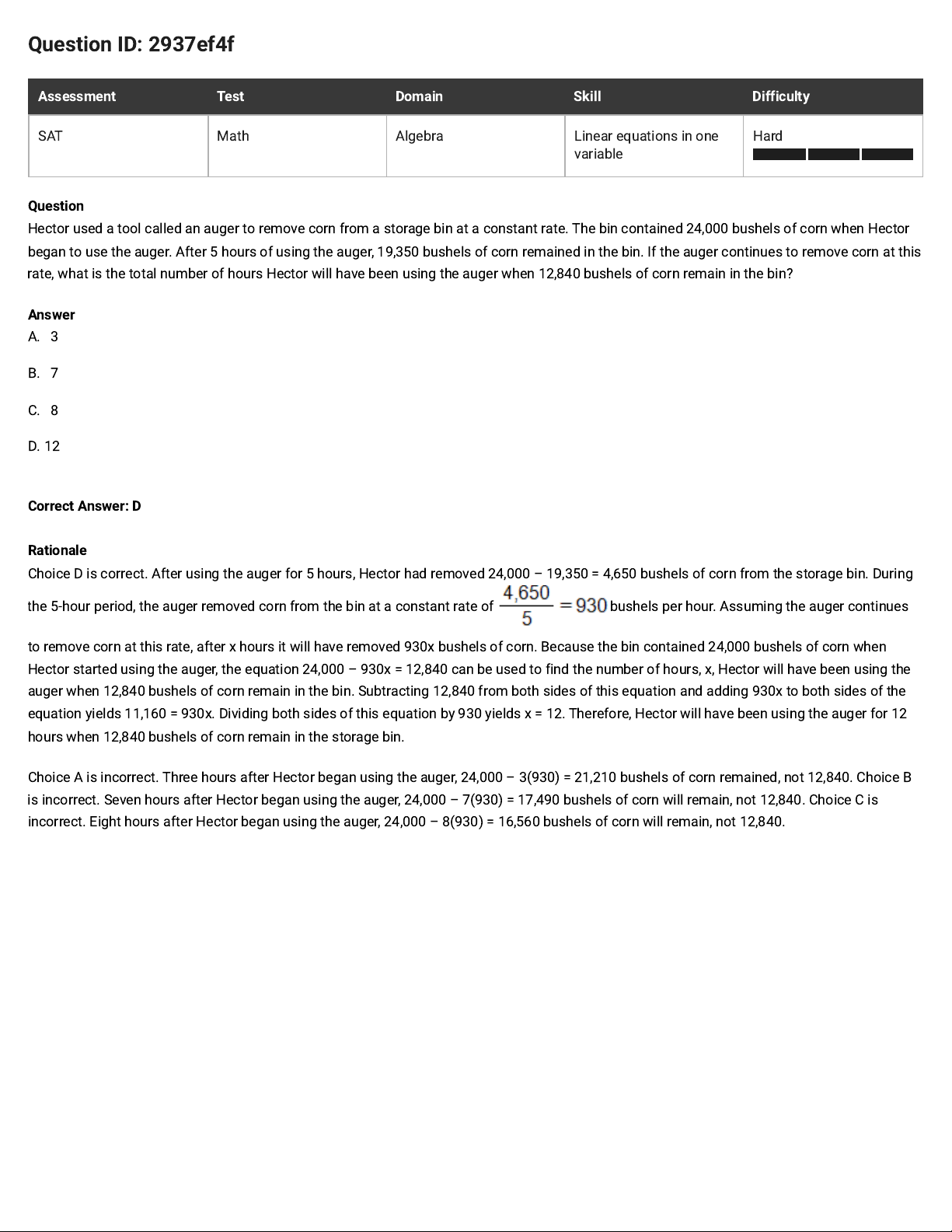
Hector used a tool called an auger to remove corn from a storagebin at a constant rate. The bin contained 24,000bushels of corn when Hector
began to use theauger. After 5hours of using the auger, 19,350bushels of corn remained in the bin. If the auger continues to remove corn at this
rate, what is the total number of hours Hector will have been using the auger when 12,840bushels of corn remain in thebin?
Answer
A. 3
B. 7
C. 8
D. 12
Correct Answer: D
Rationale
Choice D is correct. After using the auger for 5 hours, Hector had removed 24,000 – 19,350 = 4,650 bushels of corn from the storage bin. During
the 5-hour period, the auger removed corn from the bin at a constant rate of bushels per hour. Assuming the auger continues
to remove corn at this rate, after x hours it will have removed 930x bushels of corn. Because the bin contained 24,000 bushels of corn when
Hector started using the auger, the equation 24,000 – 930x = 12,840 can be used to find the number of hours, x, Hector will have been using the
auger when 12,840 bushels of corn remain in the bin. Subtracting 12,840 from both sides of this equation and adding 930x to both sides of the
equation yields 11,160 = 930x. Dividing both sides of this equation by 930 yields x = 12. Therefore, Hector will have been using the auger for 12
hourswhen 12,840 bushels of corn remain in the storage bin.
Choice A is incorrect. Three hours after Hector began using the auger, 24,000 – 3(930) = 21,210 bushels of corn remained, not 12,840. Choice B
is incorrect. Seven hours after Hector began using the auger, 24,000 – 7(930) = 17,490 bushels of corn will remain, not 12,840. Choice C is
incorrect. Eight hours after Hector began using the auger, 24,000 – 8(930) = 16,560 bushels of corn will remain, not 12,840.
Page 2
Question ID: f14484a5
Assessment Test Domain Skill Difficulty
SAT Math Algebra Linear equations in one
variable
Hard
Question
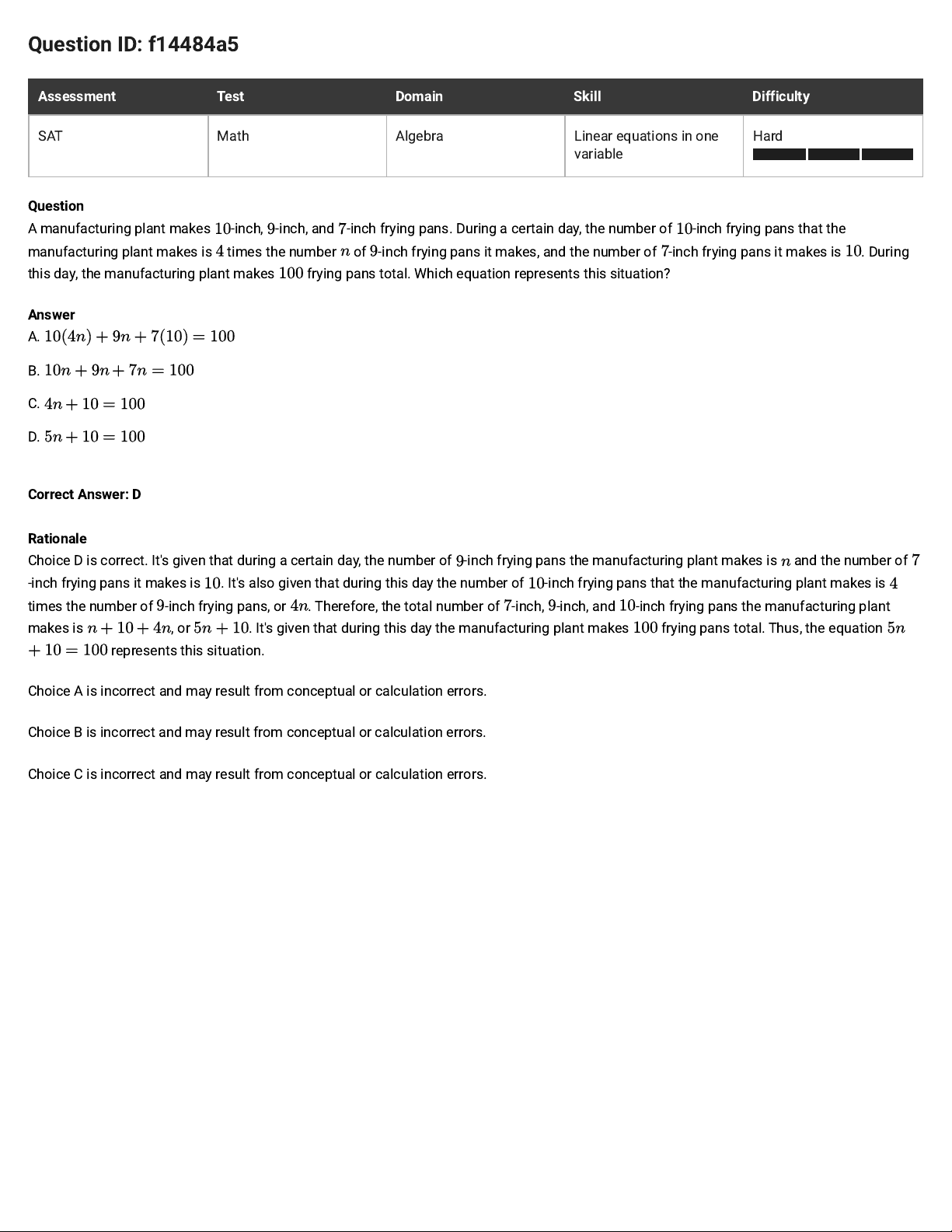
A manufacturing plant makes -inch, -inch, and -inch frying pans. During a certain day, the number of -inch frying pans that the
manufacturing plant makes is times the number of -inch frying pans it makes, and the number of -inch frying pans it makes is . During
this day, the manufacturing plant makes frying pans total. Which equation represents this situation?
Answer
A.
B.
C.
D.
Correct Answer: D
Rationale
Choice D is correct. It's given that during a certain day, the number of -inch frying pans the manufacturing plant makes is and the number of
-inch frying pans it makes is . It's also given that during this day the number of -inch frying pans that the manufacturing plant makes is
times the number of -inch frying pans, or . Therefore, the total number of -inch, -inch, and -inch frying pans the manufacturing plant
makes is , or . It's given that during this day the manufacturing plant makes frying pans total. Thus, the equation
represents this situation.
Choice A is incorrect and may result from conceptual or calculation errors.
Choice B is incorrect and may result from conceptual or calculation errors.
Choice C is incorrect and may result from conceptual or calculation errors.
Page 3
Question ID: 7a5a74a6
Assessment Test Domain Skill Difficulty
SAT Math Algebra Linear equations in one
variable
Medium
Question
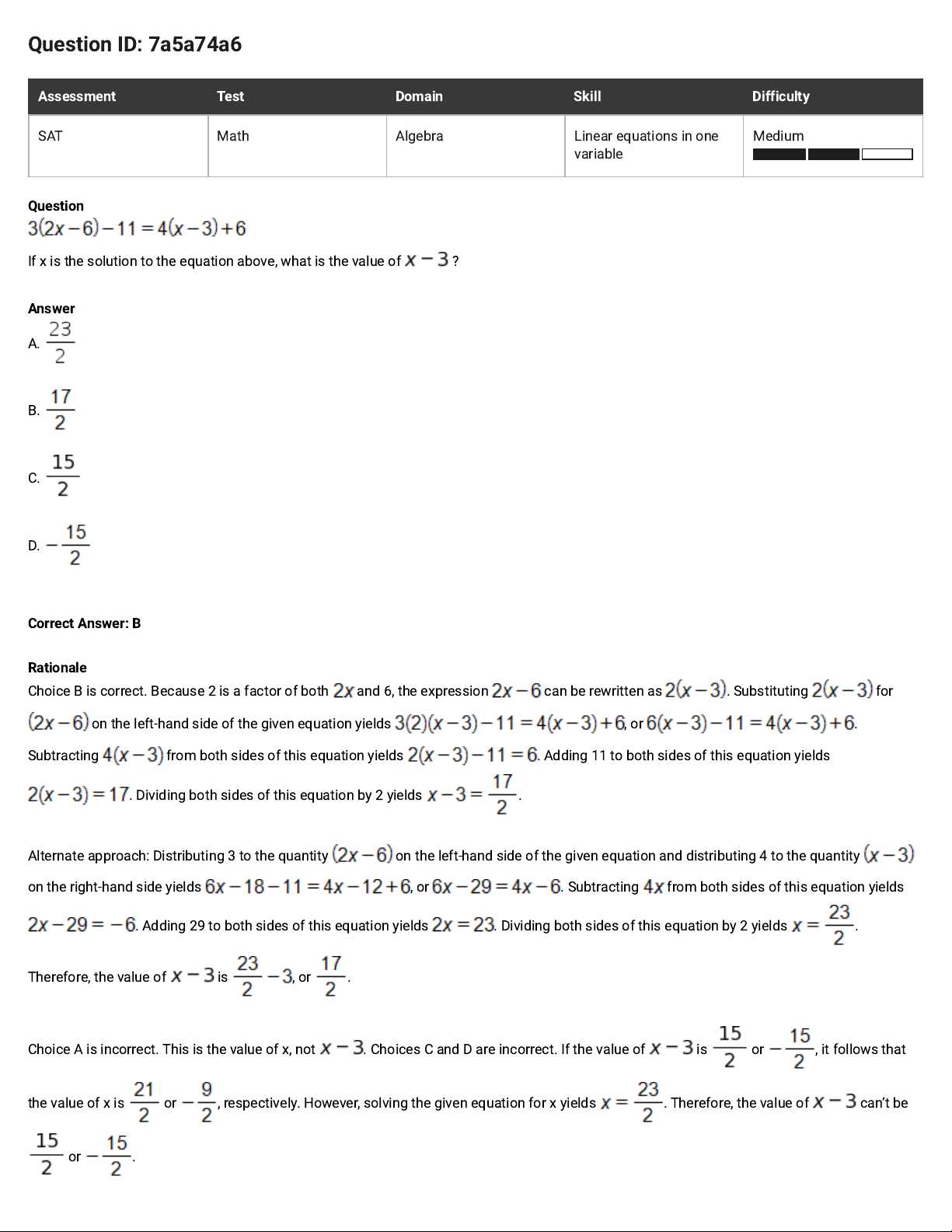
If x is the solution to the equation above, what is the value of ?
Answer
A.
B.
C.
D.
Correct Answer: B
Rationale
Choice B is correct. Because 2 is a factor of both and 6, the expression can be rewritten as . Substituting for
on the left-hand side of the given equation yields , or .
Subtracting from both sides of this equation yields . Adding 11 to both sides of this equation yields
. Dividing both sides of this equation by 2 yields .
Alternate approach: Distributing 3 to the quantity on the left-hand side of the given equation and distributing 4 to the quantity
on the right-hand side yields , or . Subtracting from both sides of this equation yields
. Adding 29 to both sides of this equation yields . Dividing both sides of this equation by 2 yields .
Therefore, the value of is , or .
Choice A is incorrect. This is the value of x, not . Choices C and D are incorrect. If the value of is or , it follows that
the value of x is or , respectively. However, solving the given equation for x yields . Therefore, the value of can’t be
or .
Page 4

Page 5
Question ID: b7e6394d
Assessment Test Domain Skill Difficulty
SAT Math Algebra Linear equations in one
variable
Hard
Question
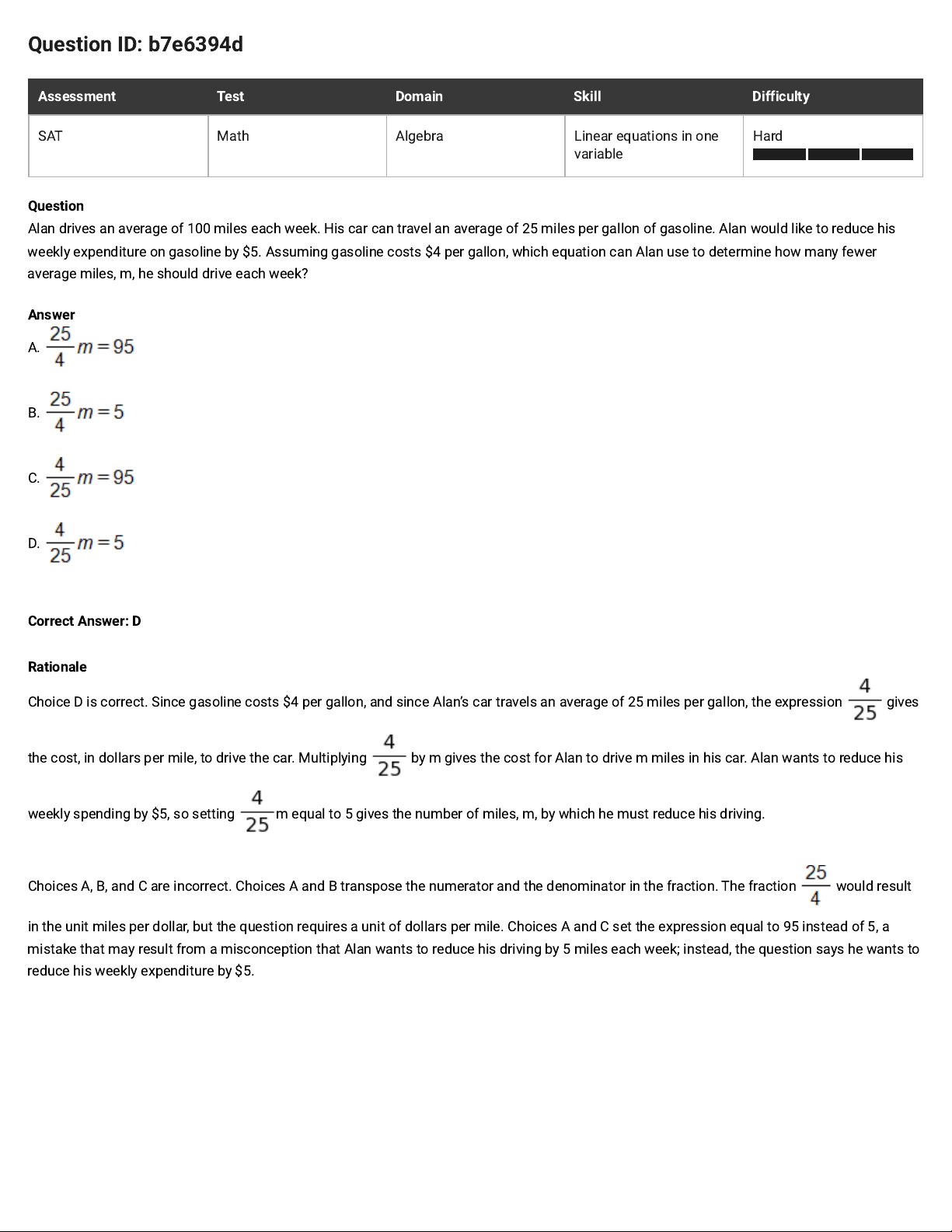
Alan drives an average of 100miles each week. His car can travel an average of 25miles per gallon of gasoline. Alan would like to reduce his
weekly expenditure on gasoline by $5. Assuming gasoline costs $4per gallon, which equation can Alan use to determine how many fewer
average miles, m, he should drive each week?
Answer
A.
B.
C.
D.
Correct Answer: D
Rationale
Choice D is correct. Since gasoline costs $4 per gallon, and since Alan’s car travels an average of 25 miles per gallon, the expression gives
the cost, in dollars per mile, to drive the car. Multiplying by m gives the cost for Alan to drive m miles in his car. Alan wants to reduce his
weekly spending by $5, so setting m equal to 5 gives the number of miles, m, by which he must reduce his driving.
Choices A, B, and C are incorrect. Choices A and B transpose the numerator and the denominator in the fraction. The fraction would result
in the unit miles per dollar, but the question requires a unit of dollars per mile. Choices A and C set the expression equal to 95 instead of 5, a
mistake that may result from a misconception that Alan wants to reduce his driving by 5 miles each week; instead, the question says he wants to
reduce his weekly expenditure by $5.
Page 6
Question ID: 25e1cfed
Assessment Test Domain Skill Difficulty
SAT Math Algebra Linear equations in one
variable
Hard
Question
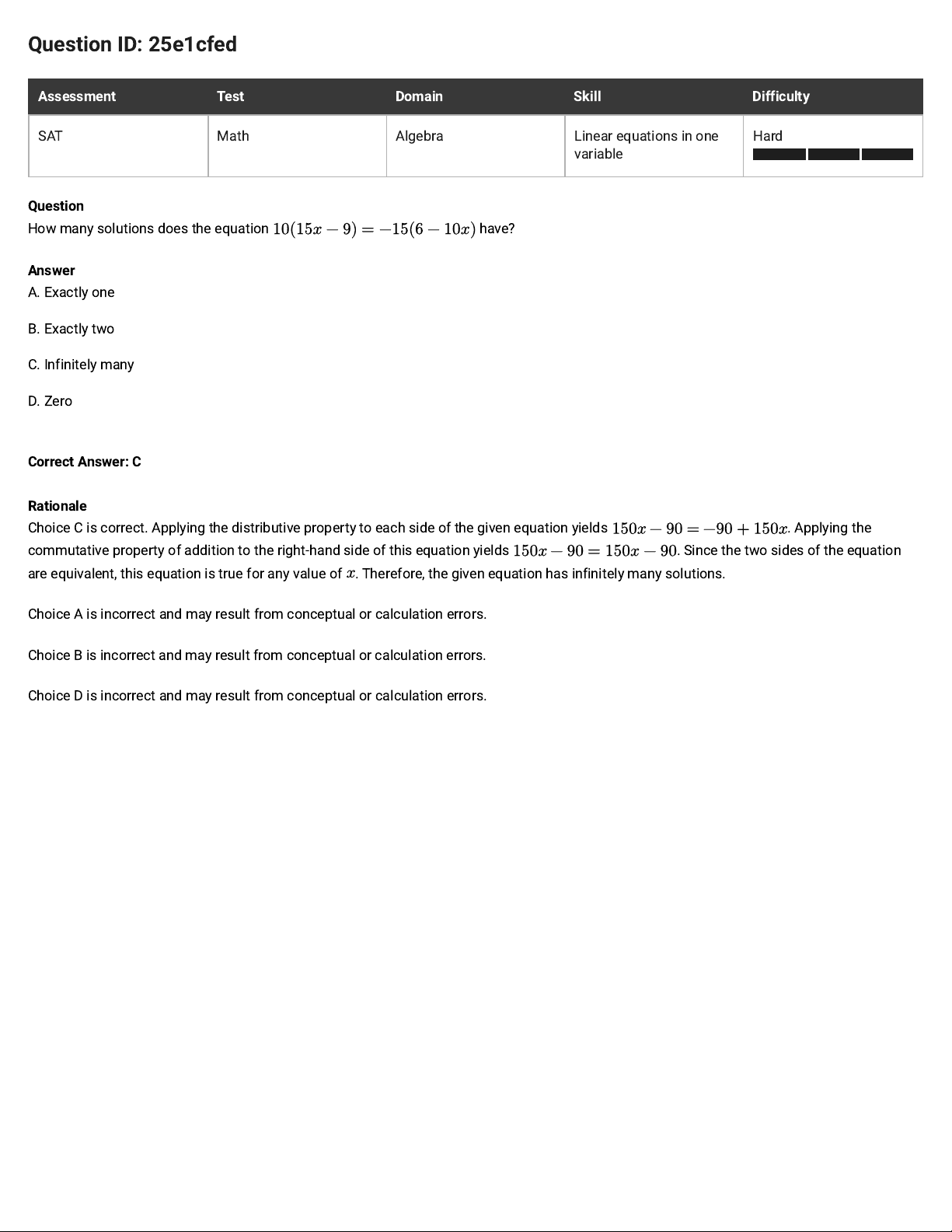
How many solutions does the equation have?
Answer
A. Exactly one
B. Exactly two
C. Infinitely many
D. Zero
Correct Answer: C
Rationale
Choice C is correct. Applying the distributive property to each side of the given equation yields . Applying the
commutative property of addition to the right-hand side of this equation yields . Since the two sides of the equation
are equivalent, this equation is true for any value of . Therefore, the given equation has infinitely many solutions.
Choice A is incorrect and may result from conceptual or calculation errors.
Choice B is incorrect and may result from conceptual or calculation errors.
Choice D is incorrect and may result from conceptual or calculation errors.
Page 7
Question ID: e6cb2402
Assessment Test Domain Skill Difficulty
SAT Math Algebra Linear equations in one
variable
Hard
Question
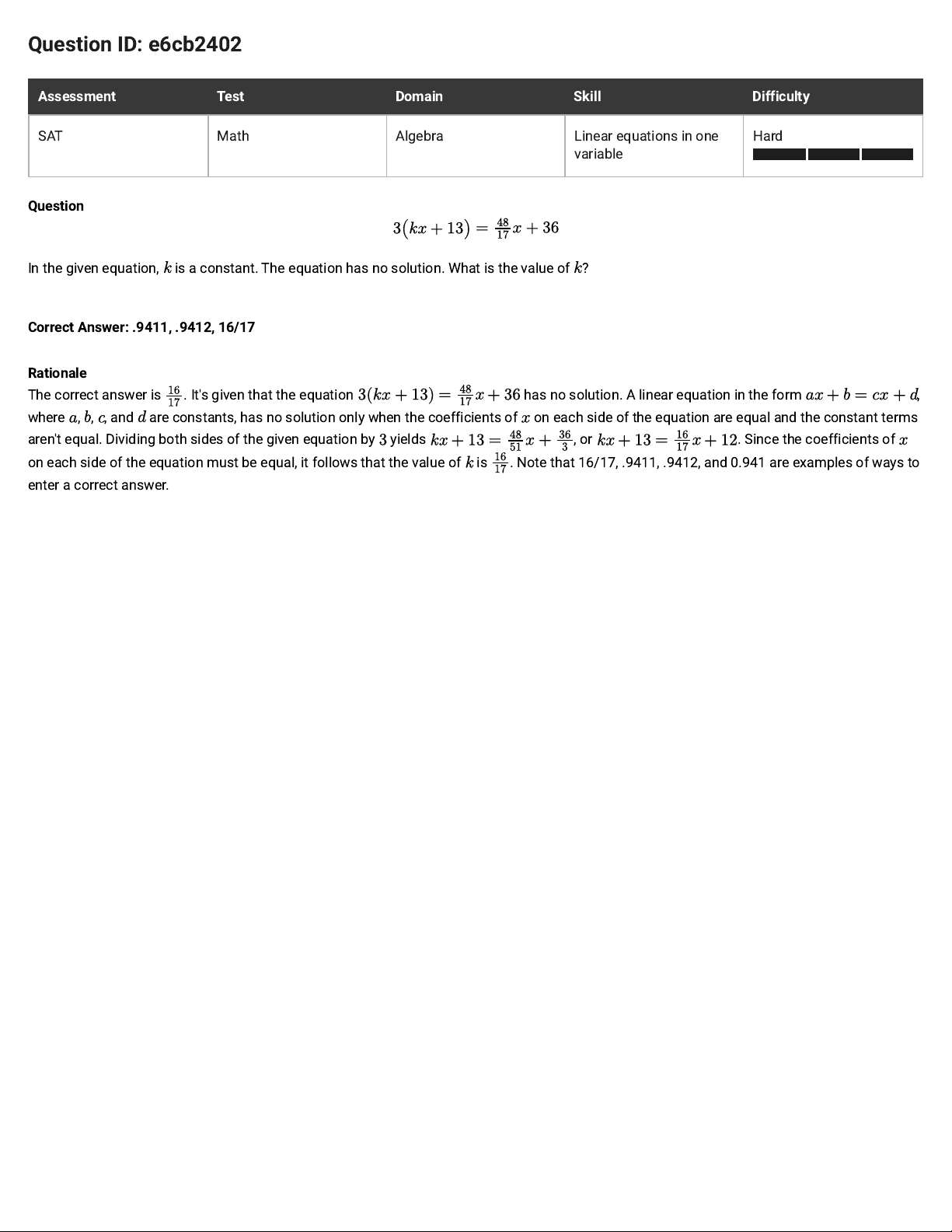
In the given equation, is a constant. The equation has no solution. What is the value of ?
Correct Answer: .9411, .9412, 16/17
Rationale
The correct answer is . It's given that the equation has no solution. A linear equation in the form
,
where , , , and are constants, has no solution only when the coefficients of on each side of the equation are equal and the constant terms
aren't equal. Dividing both sides of the given equation by yields , or
. Since the coefficients of
on each side of the equation must be equal, it follows that the value of is . Note that 16/17, .9411, .9412, and 0.941 are examples of ways to
enter a correct answer.
Page 8
Question ID: 620abf36
Assessment Test Domain Skill Difficulty
SAT Math Algebra Linear equations in one
variable
Medium
Question
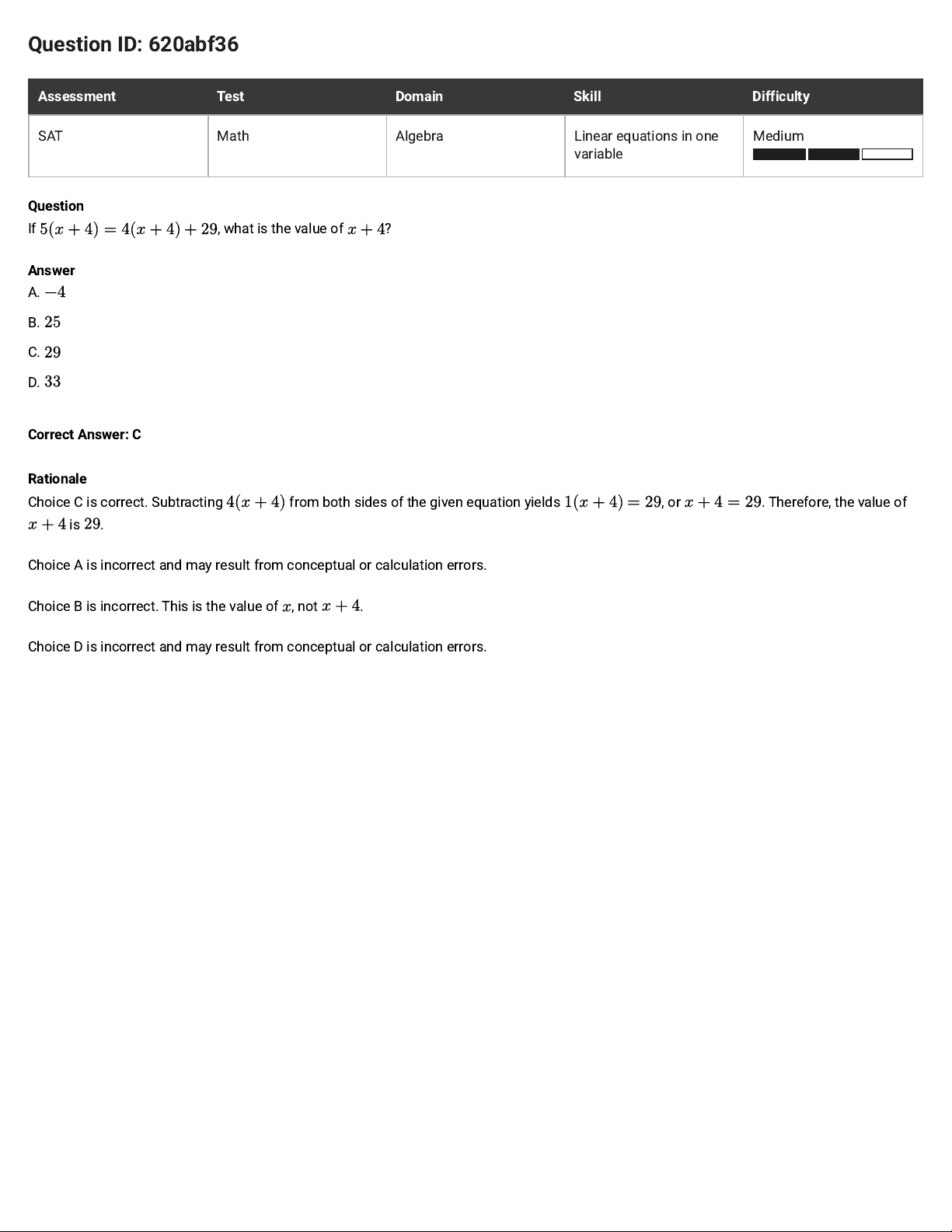
If , what is the value of ?
Answer
A.
B.
C.
D.
Correct Answer: C
Rationale
Choice C is correct. Subtracting from both sides of the given equation yields , or . Therefore, the value of
is .
Choice A is incorrect and may result from conceptual or calculation errors.
Choice B is incorrect. This is the value of , not .
Choice D is incorrect and may result from conceptual or calculation errors.
Page 9
Question ID: 4f669597
Assessment Test Domain Skill Difficulty
SAT Math Algebra Linear equations in one
variable
Medium
Question
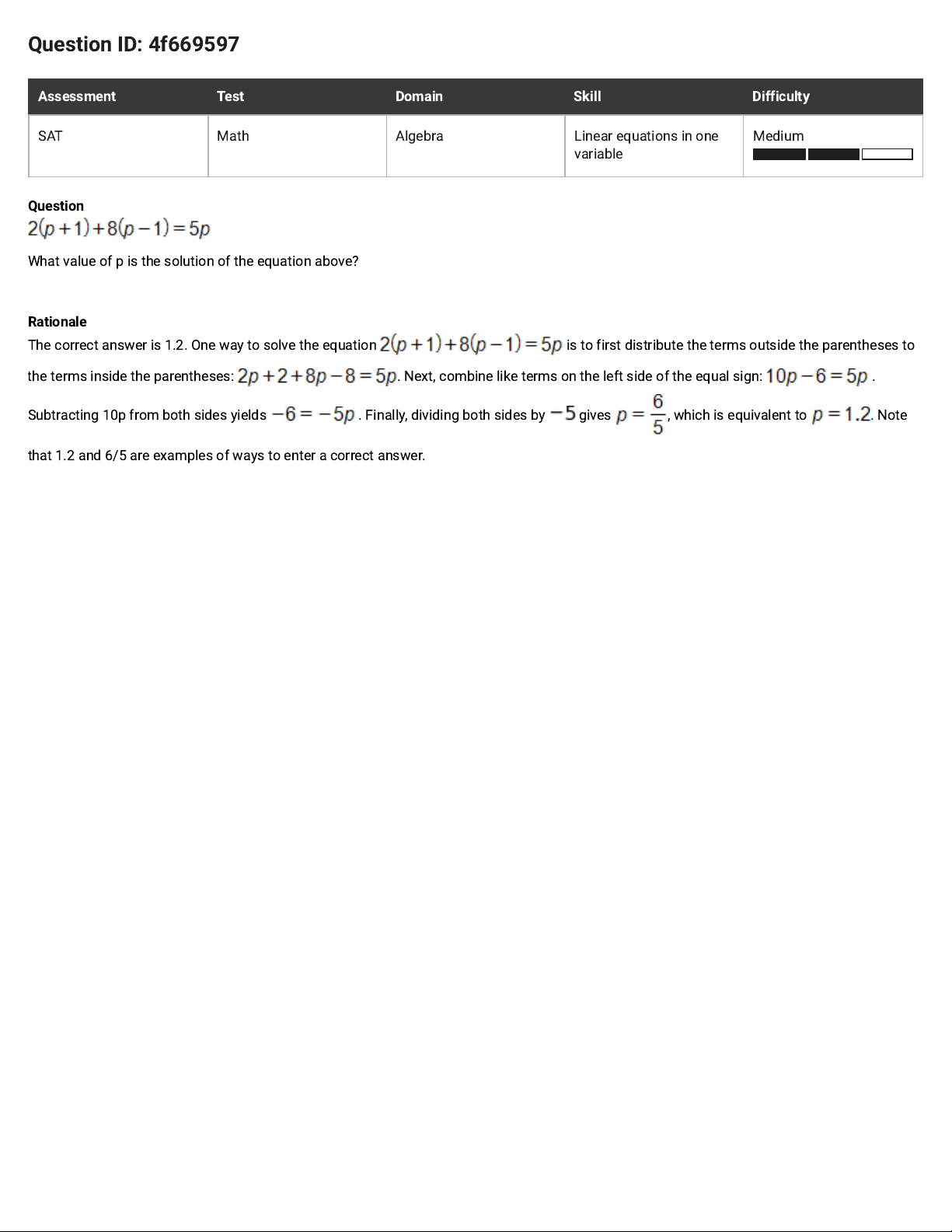
What value of p is the solution of the equation above?
Rationale
The correct answer is 1.2. One way to solve the equation is to first distribute the terms outside the parentheses to
the terms inside the parentheses: . Next, combine like terms on the left side of the equal sign: .
Subtracting 10p from both sides yields . Finally, dividing both sides by gives , which is equivalent to . Note
that 1.2 and 6/5 are examples of ways to enter a correct answer.
Page 10
Question ID: feb78194
Assessment Test Domain Skill Difficulty
SAT Math Algebra Linear equations in one
variable
Medium
Question
A museum rents tablets to visitors. The museum earns revenue of for each tablet rented for the day. On Wednesday, the museum earned
in profit from renting tablets after paying daily expenses of . How many tablets did the museum rent on Wednesday?
Correct Answer: 37
Rationale
The correct answer is . It's given that the museum earns revenue of for each tablet rented for the day. It's also given that on Wednesday,
the museum earned in profit from renting tablets after paying daily expenses of . Let represent the number of tablets the museum
rented on Wednesday. It follows that the total revenue can be represented by the expression . Because
, the equation
represents this situation. Adding to both sides of this equation yields .
Dividing both sides of this equation by yields . Therefore, the museum rented tablets on Wednesday.
Page 11
Question ID: 3f8a701b
Assessment Test Domain Skill Difficulty
SAT Math Algebra Linear equations in one
variable
Hard
Question
The equation , where a and b are constants, has no solutions. Which of the following must be true?
I.
II.
III.
Answer
A. None
B. I only
C. I and II only
D. I and III only
Correct Answer: D
Rationale
Choice D is correct. For a linear equation in a form to have no solutions, the x-terms must have equal coefficients and the
remaining terms must not be equal. Expanding the right-hand side of the given equation yields . Inspecting the x-terms, 9
must equal a, so statement I must be true. Inspecting the remaining terms, 5 can’t equal . Dividing both of these quantities by 9 yields that b
can’t equal . Therefore, statement III must be true. Since b can have any value other than , statement II may or may not be true.
Choice A is incorrect. For the given equation to have no solution, both and must be true. Choice B is incorrect because it must
also be true that . Choice C is incorrect because when , there are many values of b that lead to an equation having no solution.
That is, b might be 5, but b isn’t required to be 5.
Page 12
Question ID: 628300a9
Assessment Test Domain Skill Difficulty
SAT Math Algebra Linear equations in one
variable
Hard
Question
A science teacher is preparing the 5stations of a science laboratory. Each station will have either ExperimentA materials or ExperimentB
materials, but not both. ExperimentA requires 6teaspoons of salt, and ExperimentB requires 4teaspoons of salt. If x is the number of stations
that will be set up for ExperimentA and the remaining stations will be set up for ExperimentB, which of the following expressions represents the
total number of teaspoons of salt required?
Answer
A.
B.
C.
D.
Correct Answer: C
Rationale
Choice C is correct. It is given that x represents the number of stations that will be set up for Experiment A and that there will be 5 stations total,
so it follows that 5 – x is the number of stations that will be set up for Experiment B. It is also given that Experiment A requires 6 teaspoons of
salt and that Experiment B requires 4 teaspoons of salt, so the total number of teaspoons of salt required is 6x + 4(5 – x), which simplifies to 2x
+ 20.
Choices A, B, and D are incorrect and may be the result of not understanding the description of the context.
Page 13
Question ID: 45bba652
Assessment Test Domain Skill Difficulty
SAT Math Algebra Linear equations in one
variable
Medium
Question
If , what is the value of ?
Answer
A. 2
B. 5
C. 7
D. 12
Correct Answer: A
Rationale
Choice A is correct. Adding the like terms on the left-hand side of the given equation yields . Dividing both sides of this equation
by 5 yields .
Choice B is incorrect and may result from subtracting 5, not dividing by 5, on both sides of the equation . Choice C is incorrect.
This is the value of x, not the value of . Choice D is incorrect. This is the value of , not the value of .
 Loading...