

Page 1
Question ID: dd4ab4c4
Assessment Test Domain Skill Difficulty
SAT Math Advanced Math Equivalent expressions Medium
Question
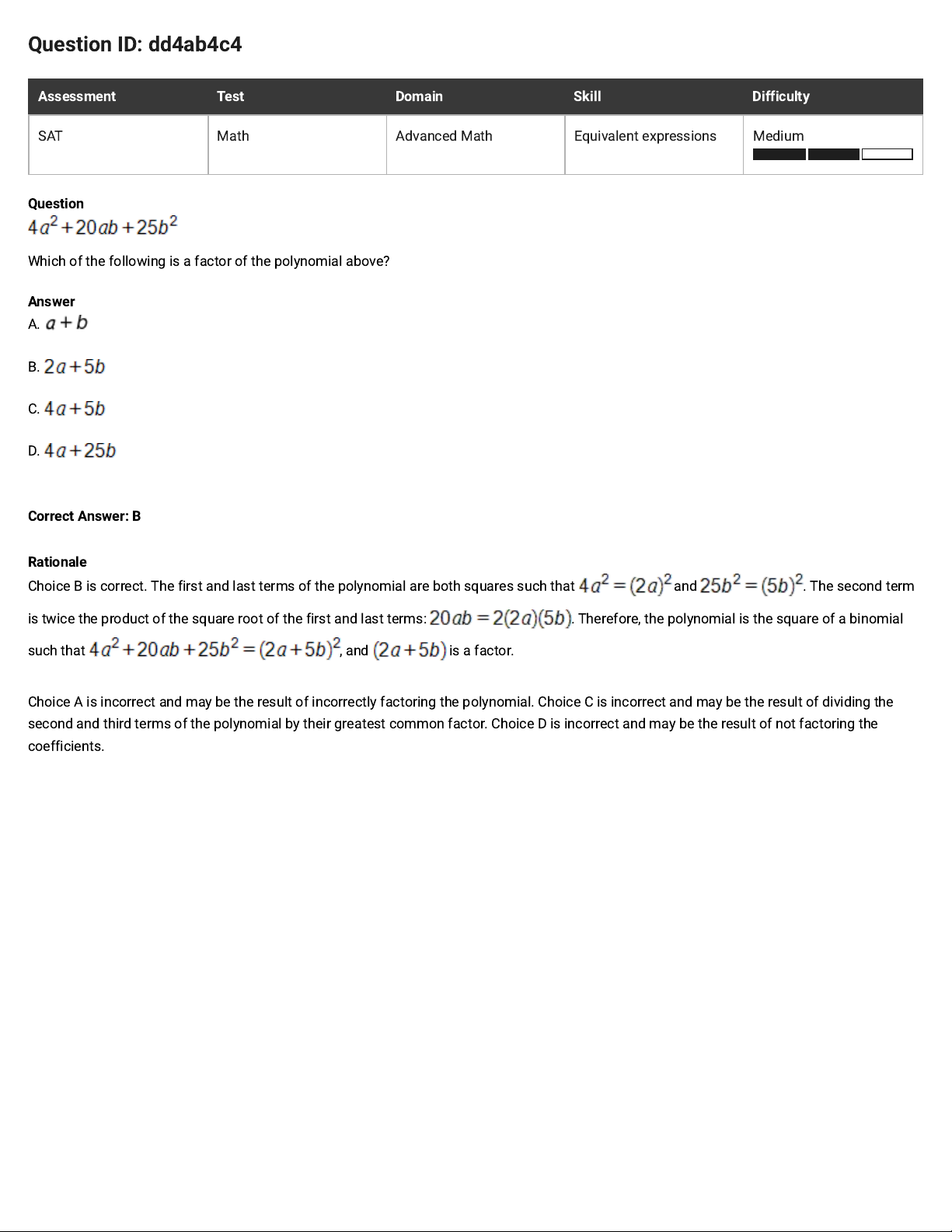
Which of the following is a factor of the polynomial above?
Answer
A.
B.
C.
D.
Correct Answer: B
Rationale
Choice B is correct. The first and last terms of the polynomial are both squares such that and . The second term
is twice the product of the square root of the first and last terms: . Therefore, the polynomial is the square of a binomial
such that
, and
is a factor.
Choice A is incorrect and may be the result of incorrectly factoring the polynomial. Choice C is incorrect and may be the result of dividing the
second and third terms of the polynomial by their greatest common factor. Choice D is incorrect and may be the result of not factoring the
coefficients.
Page 2
Question ID: b8caaf84
Assessment Test Domain Skill Difficulty
SAT Math Advanced Math Equivalent expressions Medium
Question
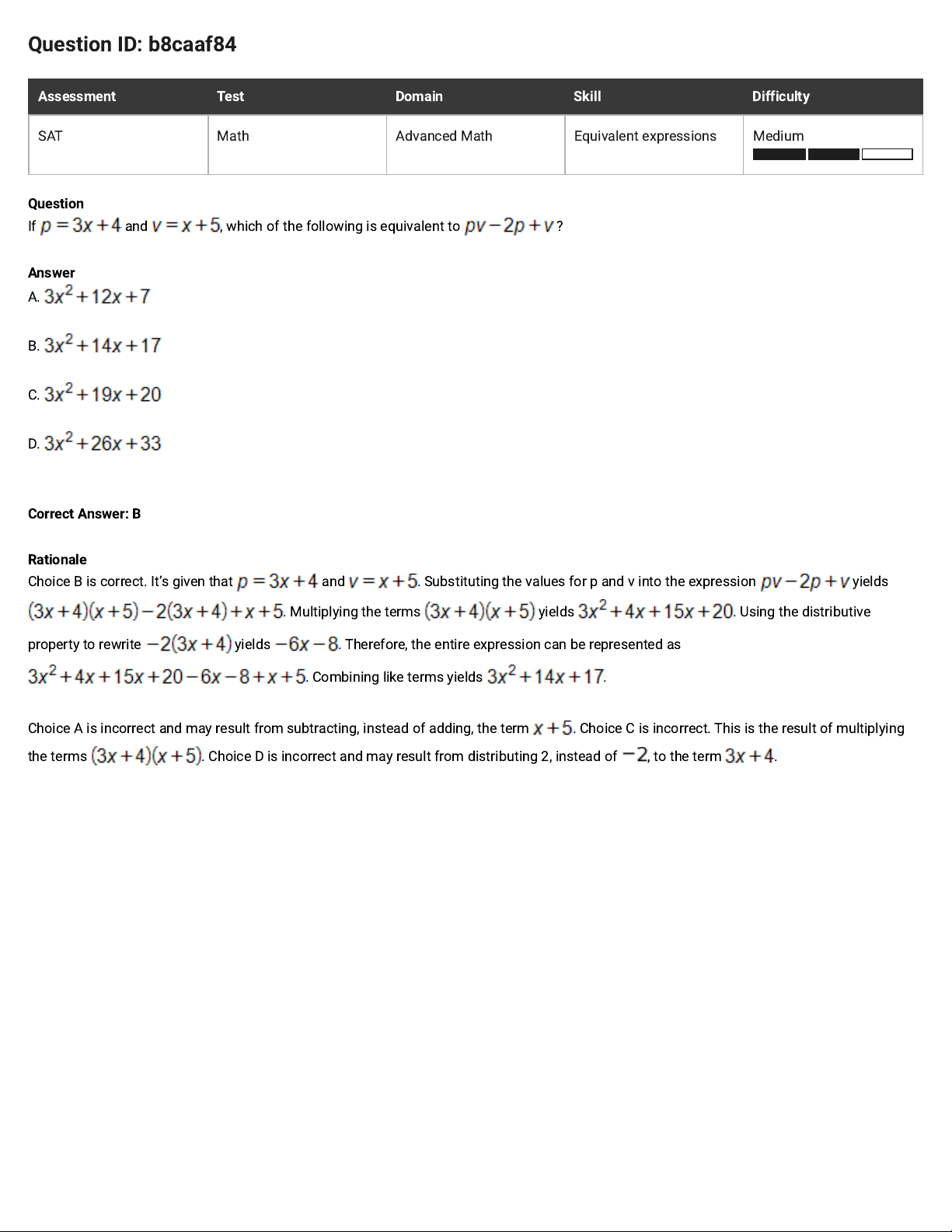
If and , which of the following is equivalent to ?
Answer
A.
B.
C.
D.
Correct Answer: B
Rationale
Choice B is correct. It’s given that and . Substituting the values for p and v into the expression yields
. Multiplying the terms yields . Using the distributive
property to rewrite yields . Therefore, the entire expression can be represented as
. Combining like terms yields .
Choice A is incorrect and may result from subtracting, instead of adding, the term . Choice C is incorrect. This is the result of multiplying
the terms . Choice D is incorrect and may result from distributing 2, instead of , to the term .
Page 3
Question ID: e312081b
Assessment Test Domain Skill Difficulty
SAT Math Advanced Math Equivalent expressions Easy
Question
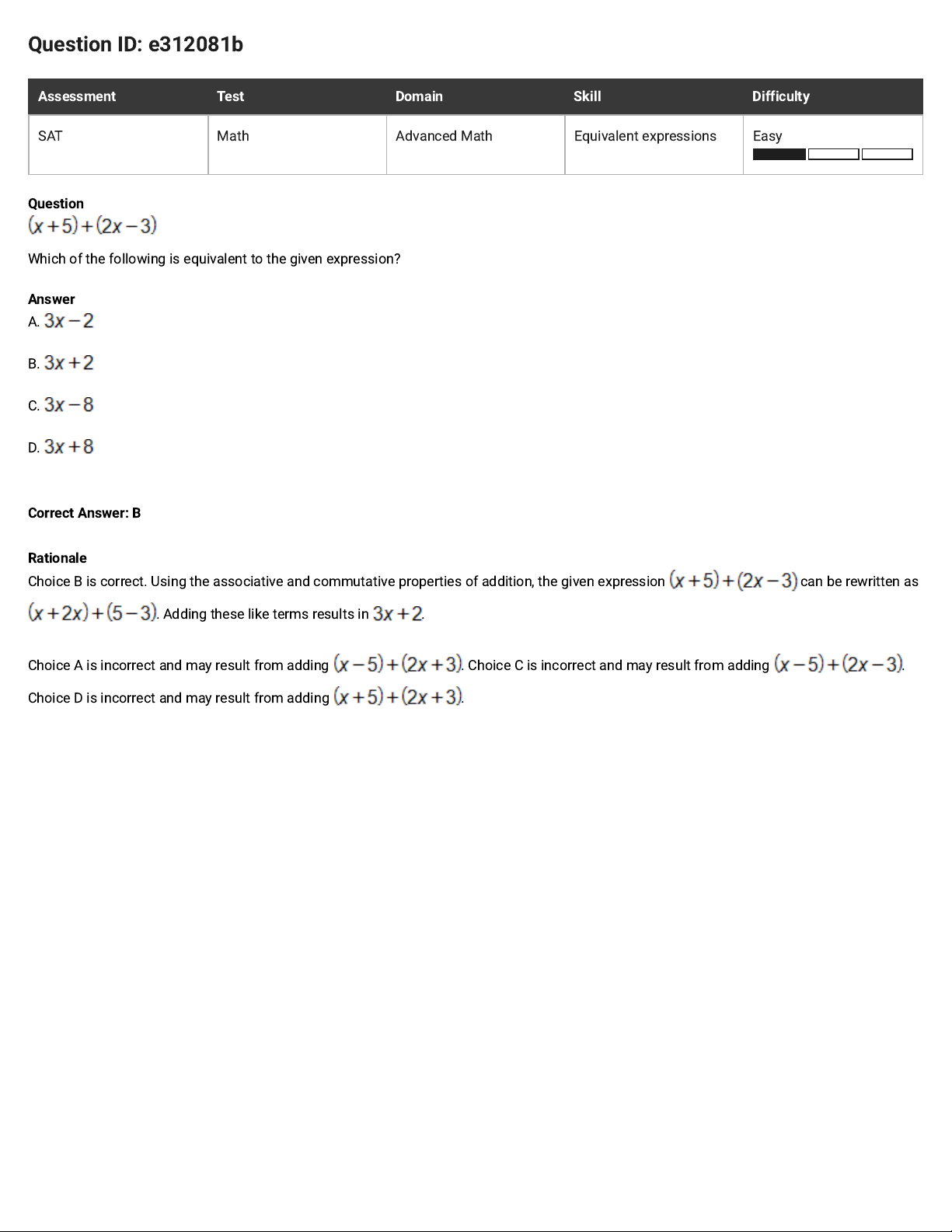
Which of the following is equivalent to the given expression?
Answer
A.
B.
C.
D.
Correct Answer: B
Rationale
Choice B is correct. Using the associative and commutative properties of addition, the given expression can be rewritten as
. Adding these like terms results in .
Choice A is incorrect and may result from adding . Choice C is incorrect and may result from adding .
Choice D is incorrect and may result from adding .
Page 4
Question ID: ad2ec615
Assessment Test Domain Skill Difficulty
SAT Math Advanced Math Equivalent expressions Medium
Question
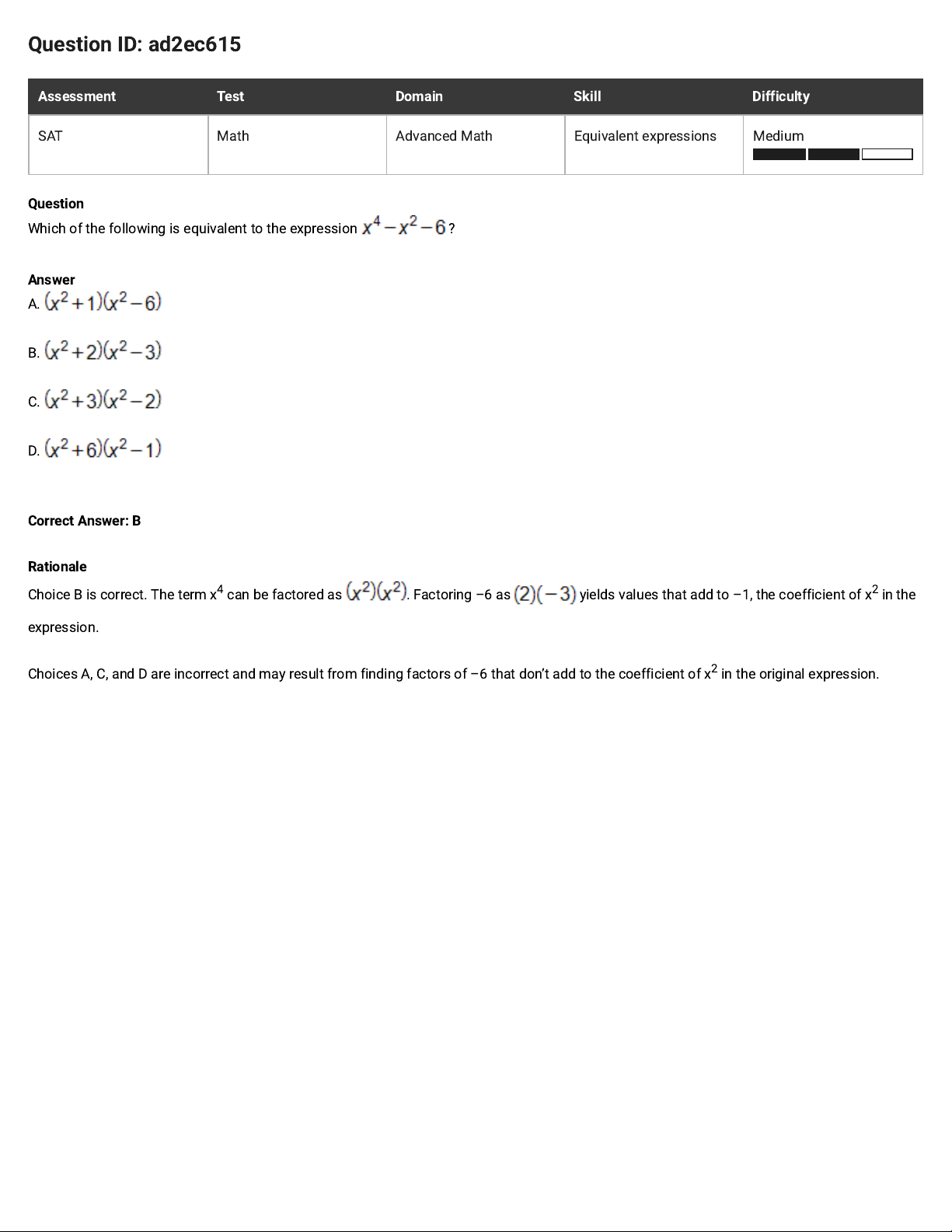
Which of the following is equivalent to the expression ?
Answer
A.
B.
C.
D.
Correct Answer: B
Rationale
Choice B is correct. The term x4 can be factored as . Factoring –6 as yields values that add to –1, the coefficient of x2 in the
expression.
Choices A, C, and D are incorrect and may result from finding factors of –6 that don’t add to the coefficient of x2 in the original expression.
Page 5
Question ID: 42c71eb5
Assessment Test Domain Skill Difficulty
SAT Math Advanced Math Equivalent expressions Medium
Question
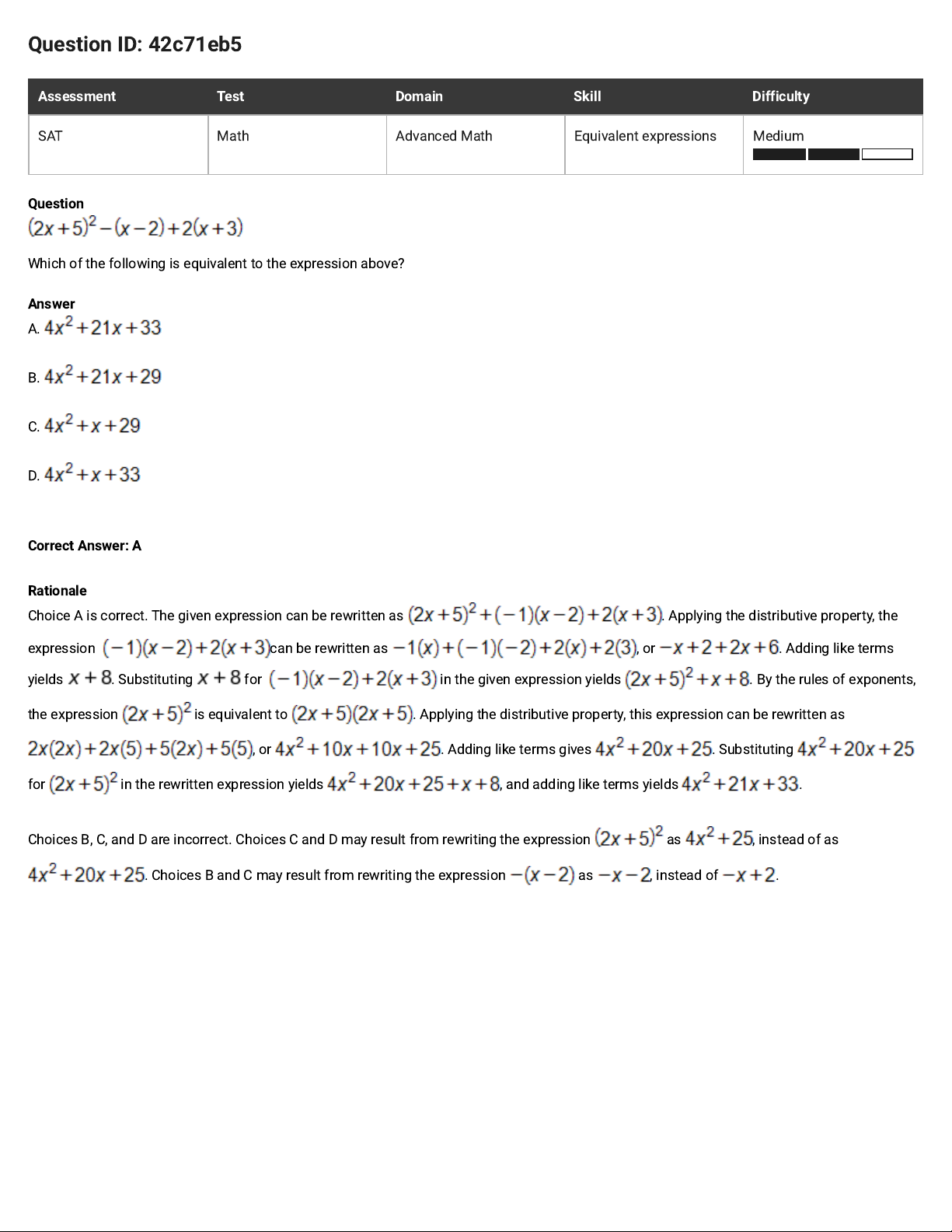
Which of the following is equivalent to the expression above?
Answer
A.
B.
C.
D.
Correct Answer: A
Rationale
Choice A is correct. The given expression can be rewritten as . Applying the distributive property, the
expression can be rewritten as , or . Adding like terms
yields . Substituting for in the given expression yields . By the rules of exponents,
the expression is equivalent to . Applying the distributive property, this expression can be rewritten as
, or . Adding like terms gives . Substituting
for in the rewritten expression yields , and adding like terms yields .
Choices B, C, and D are incorrect. Choices C and D may result from rewriting the expression as , instead of as
. Choices B and C may result from rewriting the expression as , instead of .
Page 6
Question ID: 371cbf6b
Assessment Test Domain Skill Difficulty
SAT Math Advanced Math Equivalent expressions Hard
Question
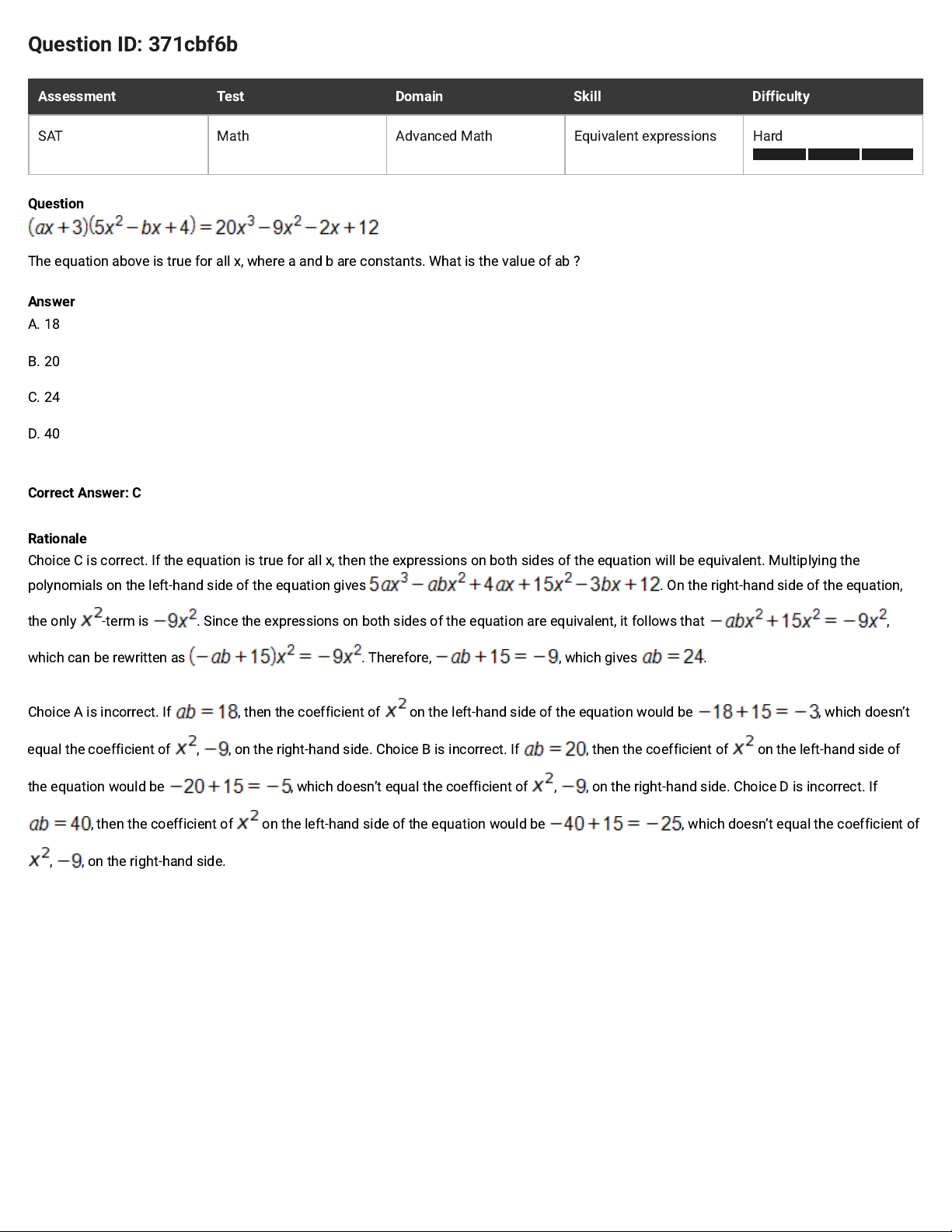
The equation above is true for all x, where a and b are constants. What is the value of ab ?
Answer
A. 18
B. 20
C. 24
D. 40
Correct Answer: C
Rationale
Choice C is correct. If the equation is true for all x, then the expressions on both sides of the equation will be equivalent. Multiplying the
polynomials on the left-hand side of the equation gives . On the right-hand side of the equation,
the only -term is . Since the expressions on both sides of the equation are equivalent, it follows that ,
which can be rewritten as . Therefore, , which gives .
Choice A is incorrect. If , then the coefficient of on the left-hand side of the equation would be , which doesn’t
equal the coefficient of , , on the right-hand side. Choice B is incorrect. If , then the coefficient of on the left-hand side of
the equation would be , which doesn’t equal the coefficient of , , on the right-hand side. Choice D is incorrect. If
, then the coefficient of on the left-hand side of the equation would be , which doesn’t equal the coefficient of
, , on the right-hand side.
Page 7
Question ID: a05bd3a4
Assessment Test Domain Skill Difficulty
SAT Math Advanced Math Equivalent expressions Medium
Question
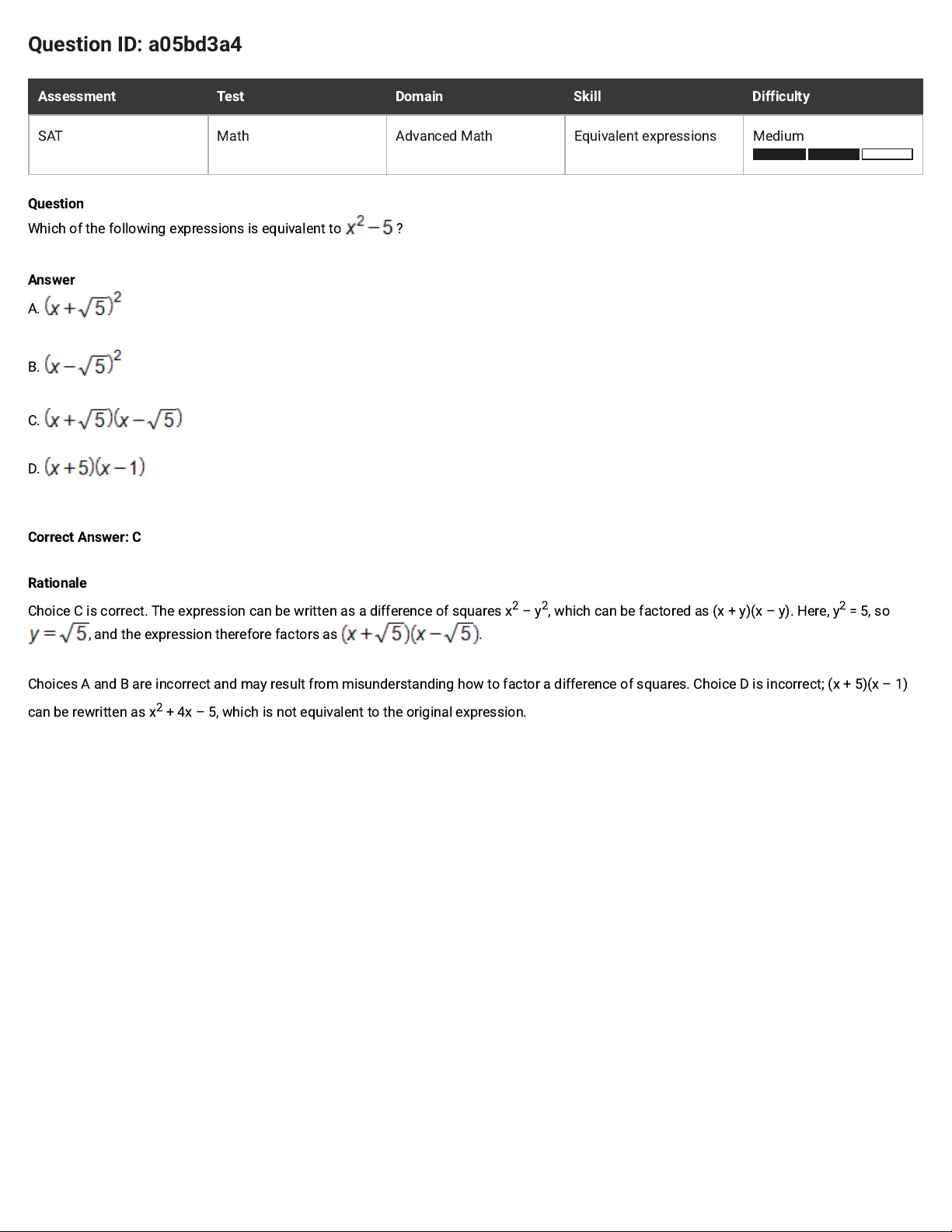
Which of the following expressions is equivalent to ?
Answer
A.
B.
C.
D.
Correct Answer: C
Rationale
Choice C is correct. The expression can be written as a difference of squaresx2–
y2, which can be factored as (x+y)(x–y). Here,y2
= 5, so
, and the expression therefore factors as .
Choices A and B are incorrect and may result from misunderstanding how to factor a difference of squares. Choice D is incorrect; (x+ 5)(x–
1)
can be rewritten as x2
+ 4x–
5, which is not equivalent to the original expression.
Page 8
Question ID: c3b116d7
Assessment Test Domain Skill Difficulty
SAT Math Advanced Math Equivalent expressions Hard
Question
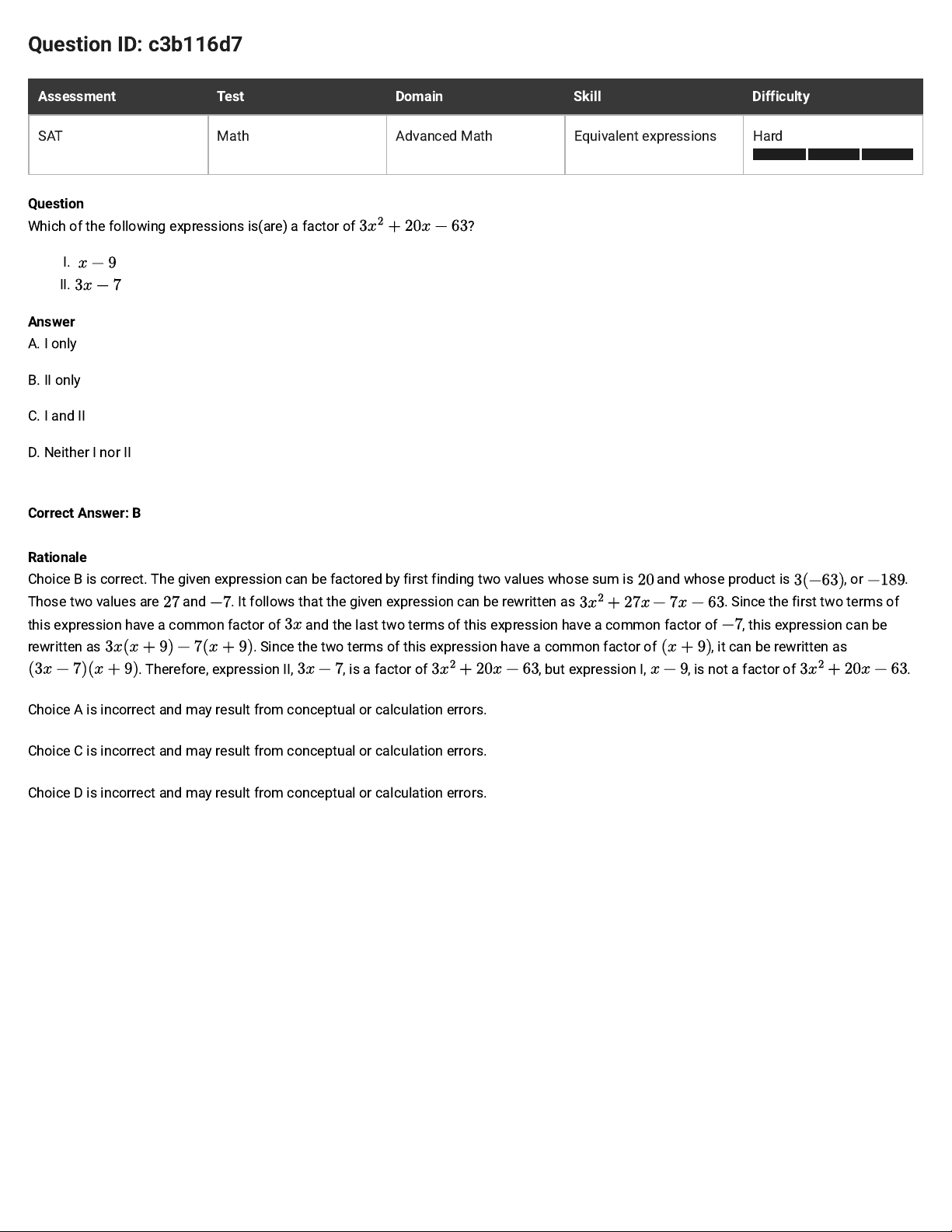
Which of the following expressions is(are) a factor of ?
I.
II.
Answer
A. I only
B. II only
C. I and II
D. Neither I nor II
Correct Answer: B
Rationale
Choice B is correct. The given expression can be factored by first finding two values whose sum is and whose product is , or .
Those two values are and . It follows that the given expression can be rewritten as . Since the first two terms of
this expression have a common factor of and the last two terms of this expression have a common factor of , this expression can be
rewritten as . Since the two terms of this expression have a common factor of , it can be rewritten as
. Therefore, expression II,
, is a factor of , but expression I,
, is not a factor of .
Choice A is incorrect and may result from conceptual or calculation errors.
Choice C is incorrect and may result from conceptual or calculation errors.
Choice D is incorrect and may result from conceptual or calculation errors.
Page 9
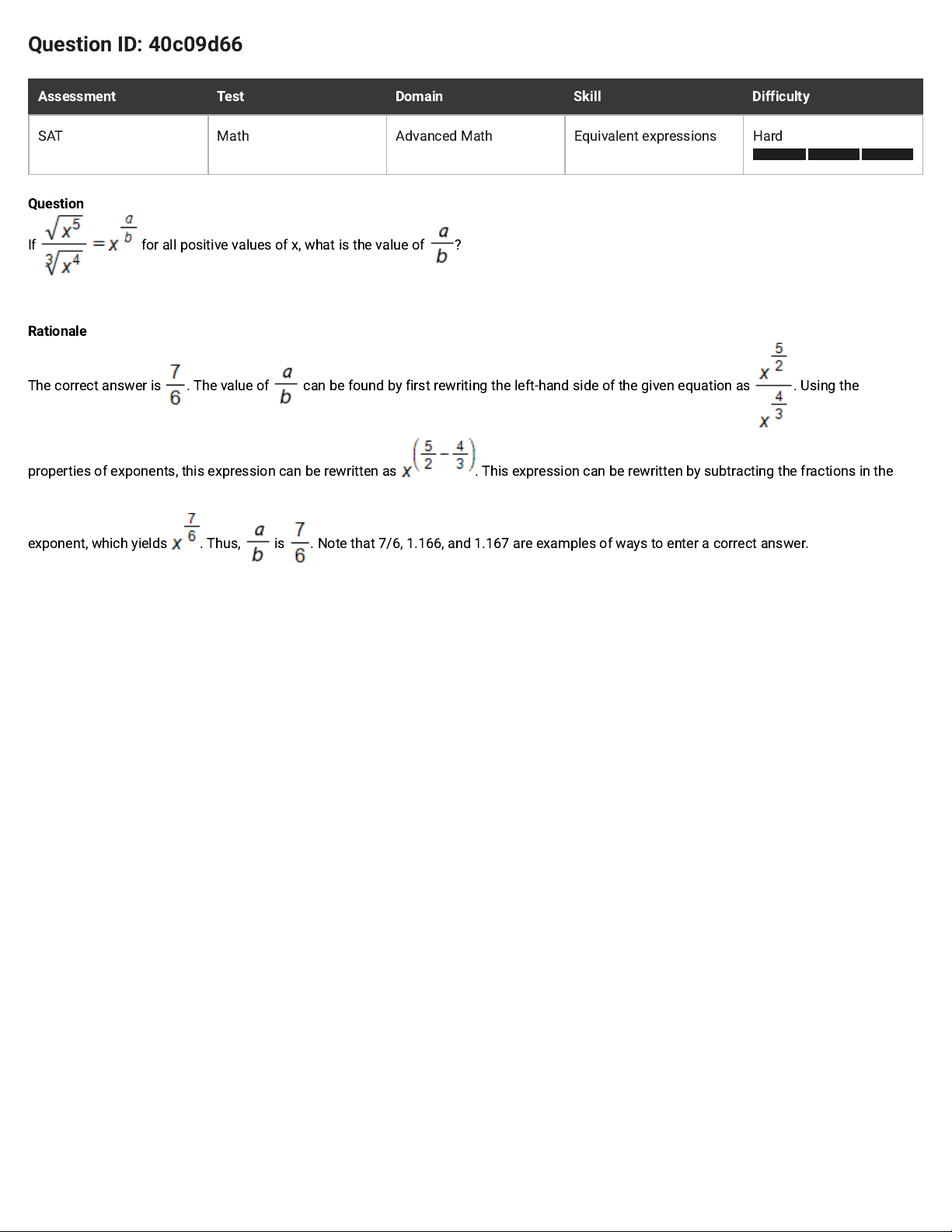
Question ID: 40c09d66
Assessment Test Domain Skill Difficulty
SAT Math Advanced Math Equivalent expressions Hard
Question
If for all positive values of x, what is the value of ?
Rationale
The correct answer is . The value of can be found by first rewriting the left-hand side of the given equation as . Using the
properties of exponents, this expression can be rewritten as . This expression can be rewritten by subtracting the fractions in the
exponent, which yields . Thus, is . Note that 7/6, 1.166, and 1.167 are examples of ways to enter a correct answer.
Page 10
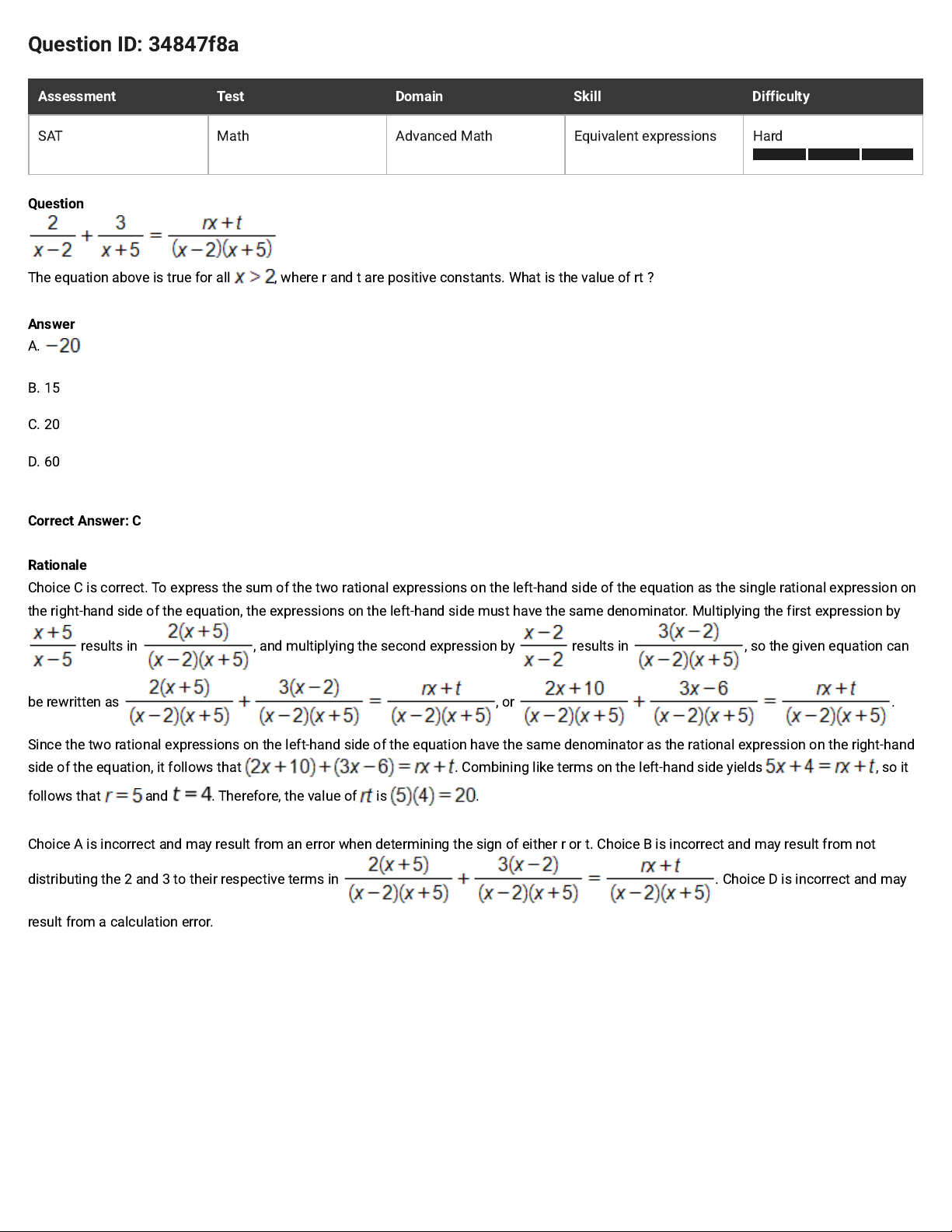
Question ID: 34847f8a
Assessment Test Domain Skill Difficulty
SAT Math Advanced Math Equivalent expressions Hard
Question
The equation above is true for all , where r and t are positive constants. What is the value of rt ?
Answer
A.
B. 15
C. 20
D. 60
Correct Answer: C
Rationale
Choice C is correct. To express the sum of the two rational expressions on the left-hand side of the equation as the single rational expression on
the right-hand side of the equation, the expressions on the left-hand side must have the same denominator. Multiplying the first expression by
results in , and multiplying the second expression by results in , so the given equation can
be rewritten as , or .
Since the two rational expressions on the left-hand side of the equation have the same denominator as the rational expression on the right-hand
side of the equation, it follows that . Combining like terms on the left-hand side yields , so it
follows that and . Therefore, the value of is .
Choice A is incorrect and may result from an error when determining the sign of either r or t. Choice B is incorrect and may result from not
distributing the 2 and 3 to their respective terms in . Choice D is incorrect and may
result from a calculation error.
Page 11
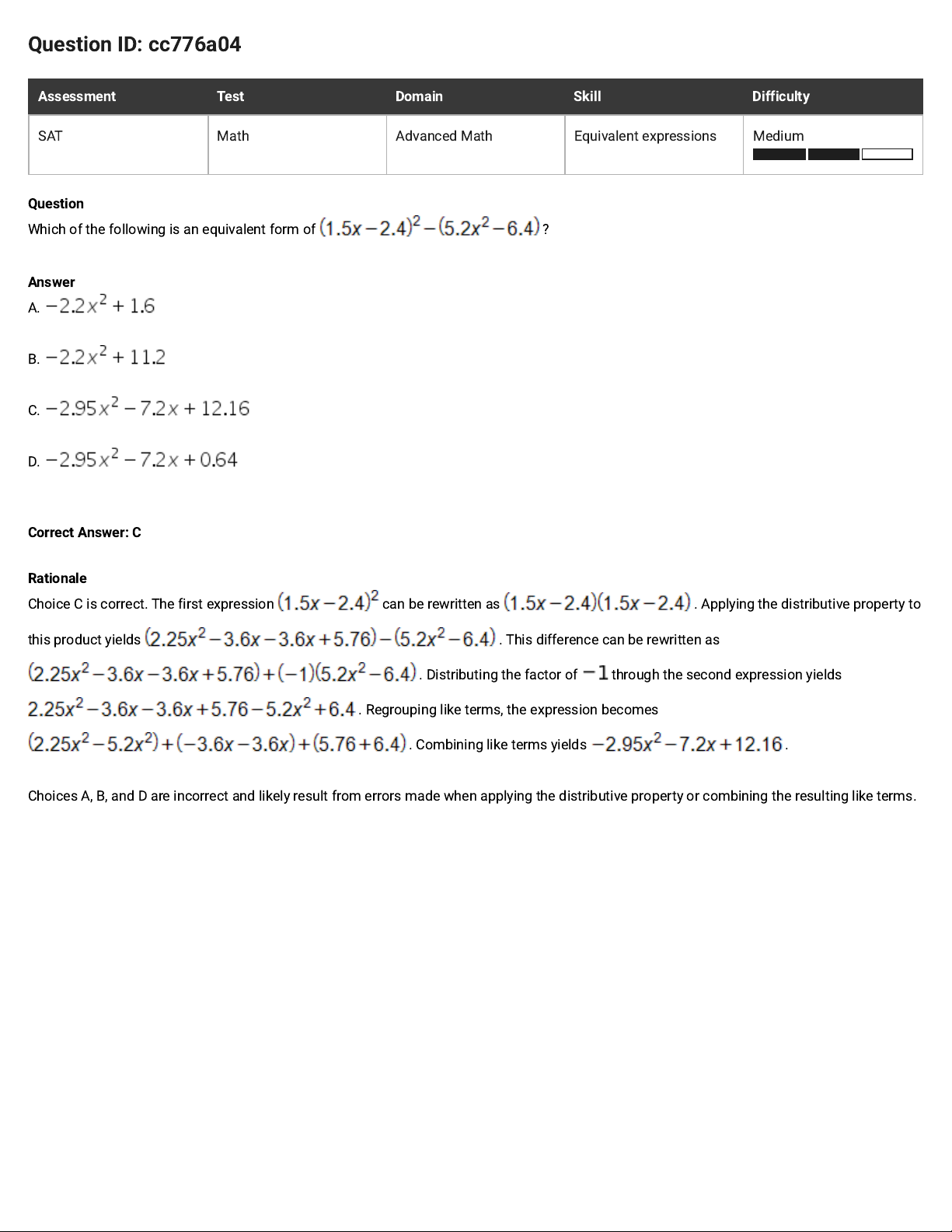
Question ID: cc776a04
Assessment Test Domain Skill Difficulty
SAT Math Advanced Math Equivalent expressions Medium
Question
Which of the following is an equivalent form of ?
Answer
A.
B.
C.
D.
Correct Answer: C
Rationale
Choice C is correct. The first expression can be rewritten as . Applying the distributive property to
this product yields . This difference can be rewritten as
. Distributing the factor of through the second expression yields
. Regrouping like terms, the expression becomes
. Combining like terms yields .
Choices A, B, and D are incorrect and likely result from errors made when applying the distributive property or combining the resulting like terms.
Page 12
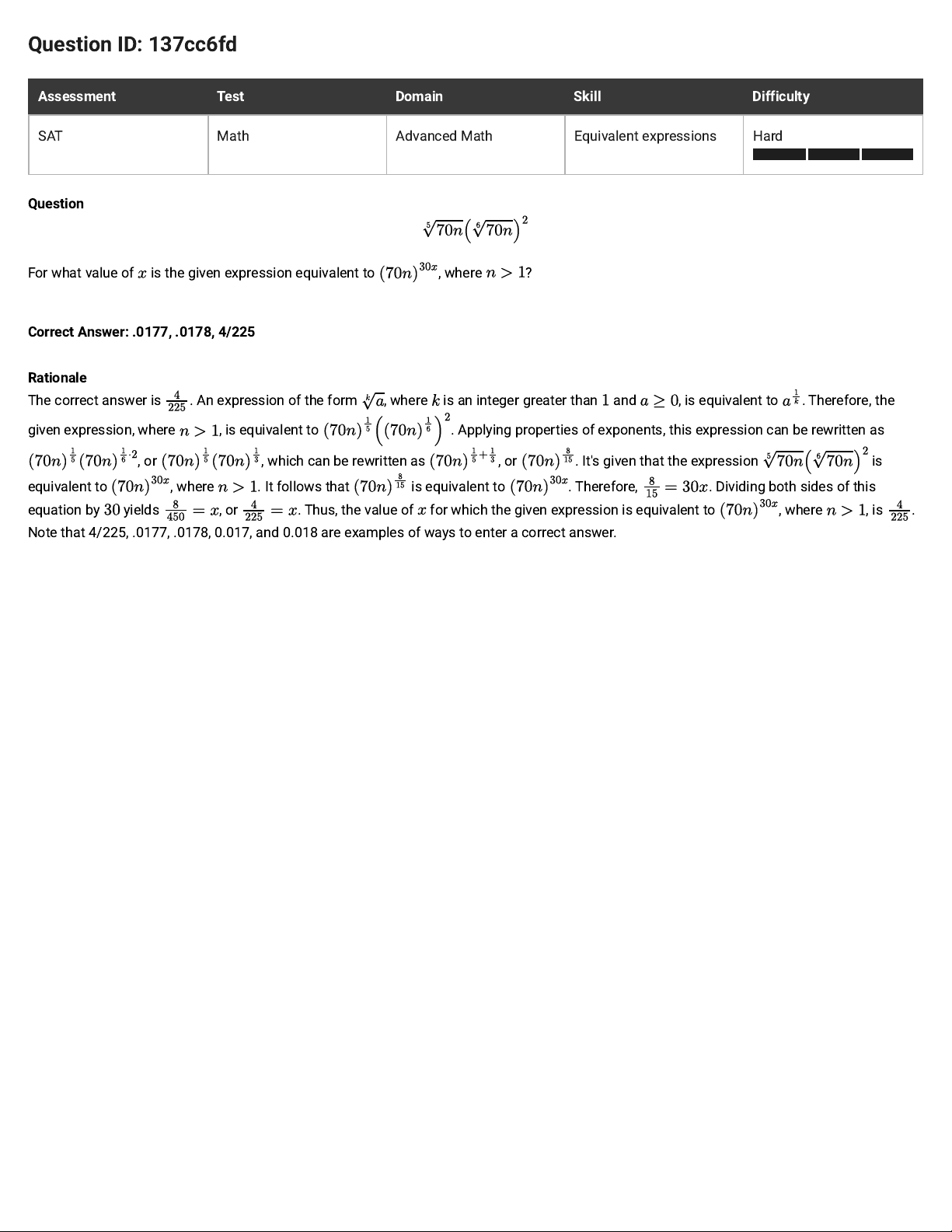
Question ID: 137cc6fd
Assessment Test Domain Skill Difficulty
SAT Math Advanced Math Equivalent expressions Hard
Question
For what value of is the given expression equivalent to , where ?
Correct Answer: .0177, .0178, 4/225
Rationale
The correct answer is . An expression of the form , where is an integer greater than and , is equivalent to . Therefore, the
given expression, where
,is equivalent to . Applying properties of exponents, this expression can be rewritten as
, or
, which can be rewritten as
, or
. It's given that the expression
is
equivalent to
, where . It follows that
is equivalent to
. Therefore,
. Dividing both sides of this
equation by
yields
, or . Thus, the value of for which the given expression is equivalent to , where
, is .
Note that 4/225, .0177, .0178, 0.017, and 0.018 are examples of ways to enter a correct answer.
Page 13
Question ID: 70482e20
Assessment Test Domain Skill Difficulty
SAT Math Advanced Math Equivalent expressions Easy
Question
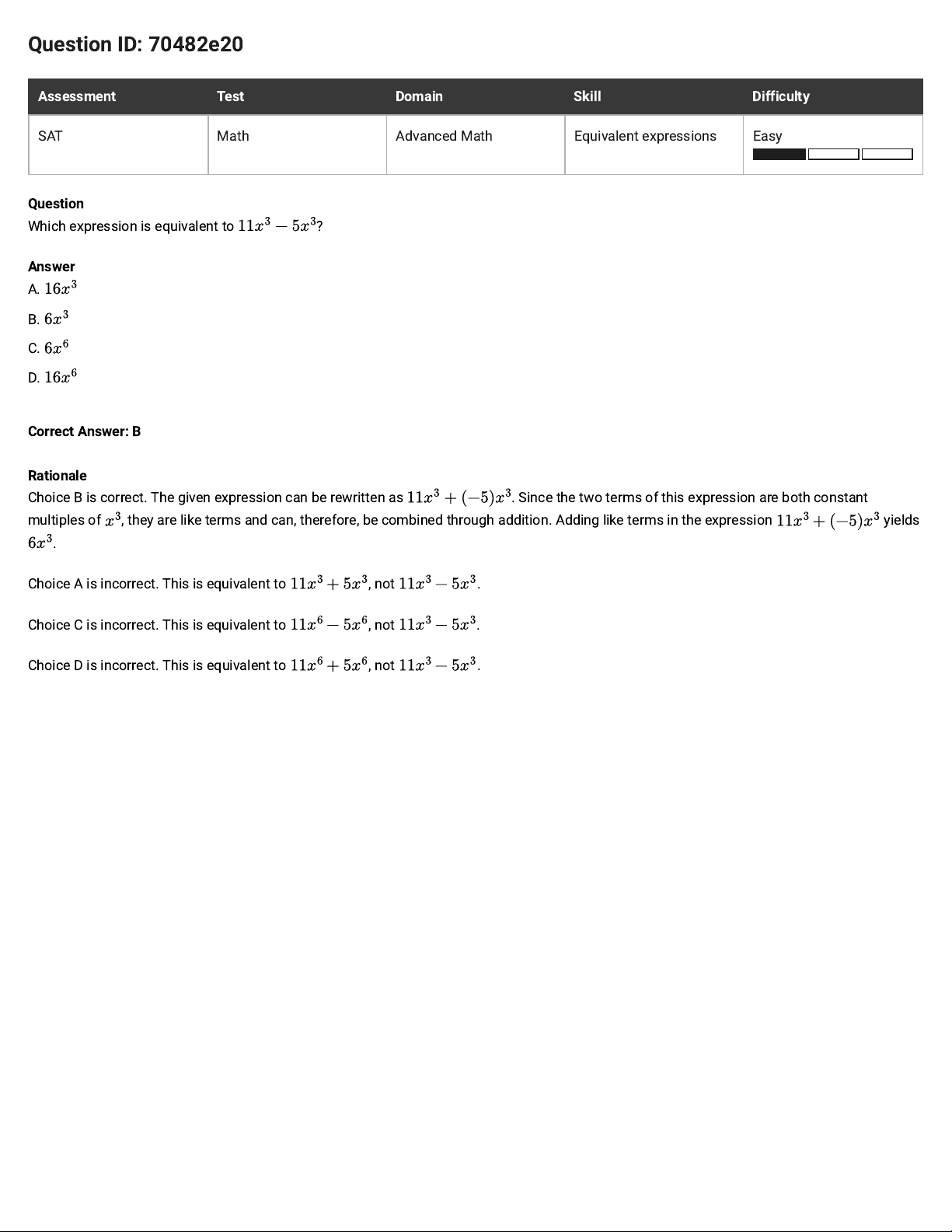
Which expression is equivalent to ?
Answer
A.
B.
C.
D.
Correct Answer: B
Rationale
Choice B is correct. The given expression can be rewritten as . Since the two terms of this expression are both constant
multiples of , they are like terms and can, therefore, be combined through addition. Adding like terms in the expression yields
.
Choice A is incorrect. This is equivalent to
, not
.
Choice C is incorrect. This is equivalent to
, not
.
Choice D is incorrect. This is equivalent to
, not
.
Page 14
Question ID: ea6d05bb
Assessment Test Domain Skill Difficulty
SAT Math Advanced Math Equivalent expressions Hard
Question
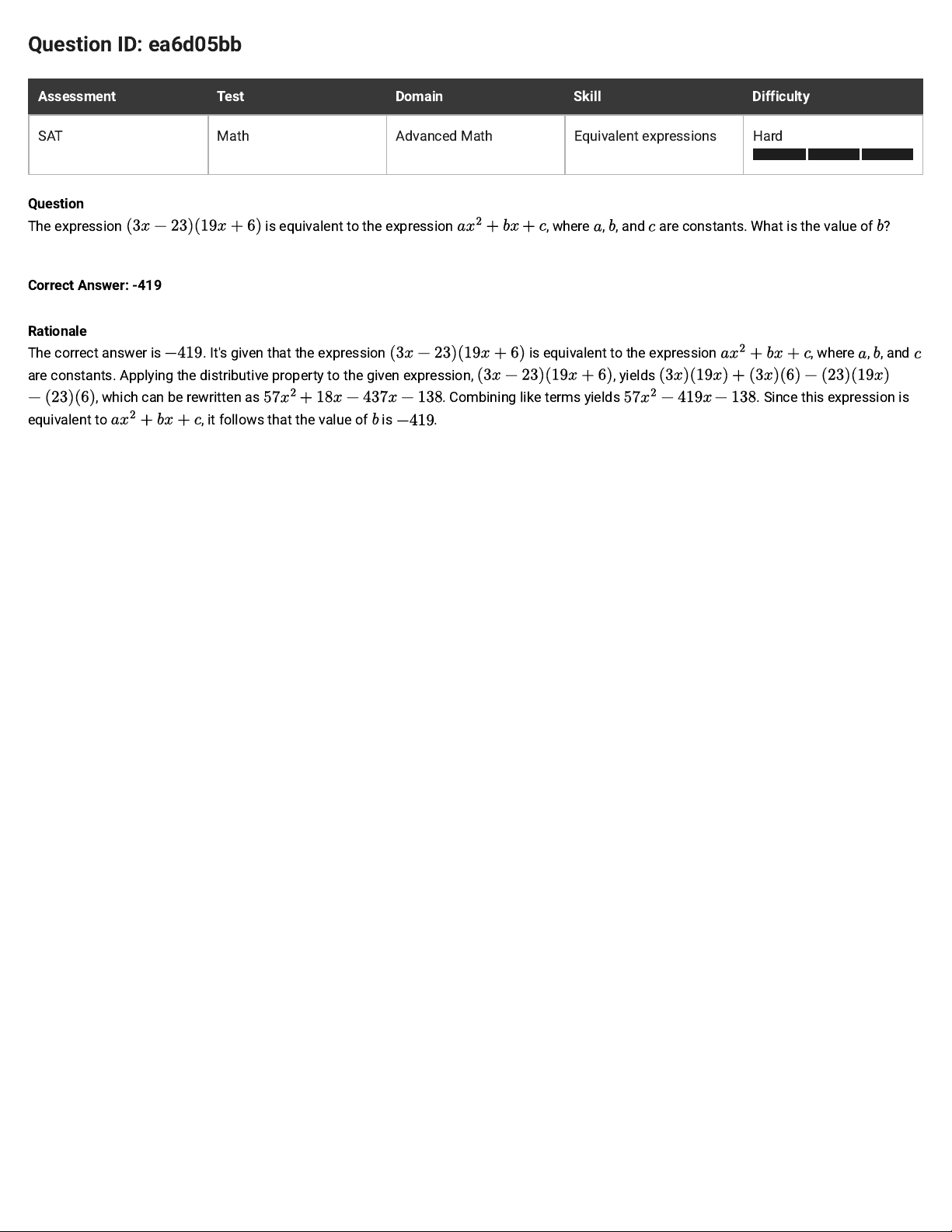
The expression
is equivalent to the expression
, where , , and are constants. What is the value of ?
Correct Answer: -419
Rationale
The correct answer is . It's given that the expression
is equivalent to the expression , where , , and
are constants. Applying the distributive property to the given expression, , yields
, which can be rewritten as
. Combining like terms yields
. Since this expression is
equivalent to , it follows that the value of is .
Page 15
Question ID: 0536ad4f
Assessment Test Domain Skill Difficulty
SAT Math Advanced Math Equivalent expressions Easy
Question
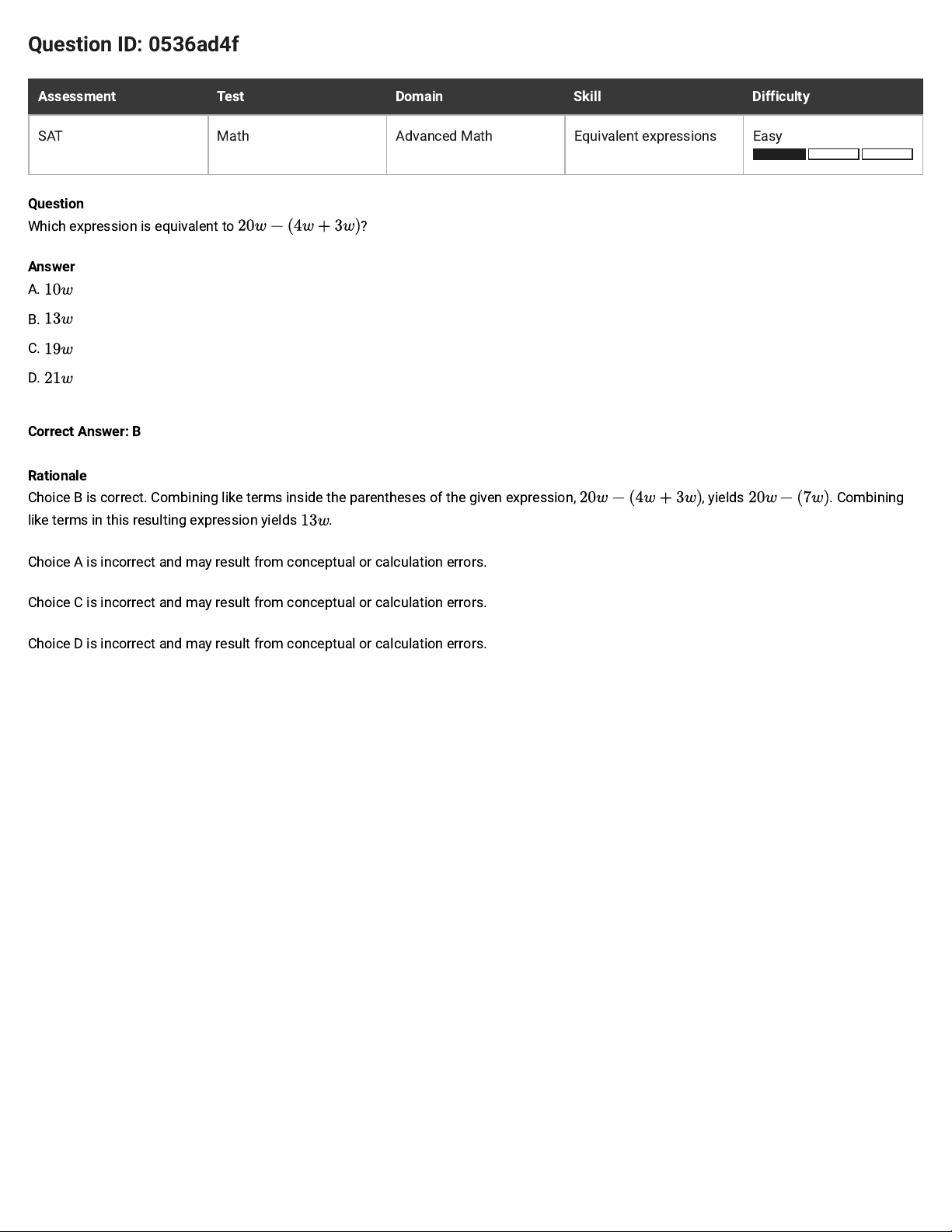
Which expression is equivalent to ?
Answer
A.
B.
C.
D.
Correct Answer: B
Rationale
Choice B is correct. Combining like terms inside the parentheses of the given expression, , yields . Combining
like terms in this resulting expression yields .
Choice A is incorrect and may result from conceptual or calculation errors.
Choice C is incorrect and may result from conceptual or calculation errors.
Choice D is incorrect and may result from conceptual or calculation errors.
Page 16
Question ID: 433184f1
Assessment Test Domain Skill Difficulty
SAT Math Advanced Math Equivalent expressions Hard
Question
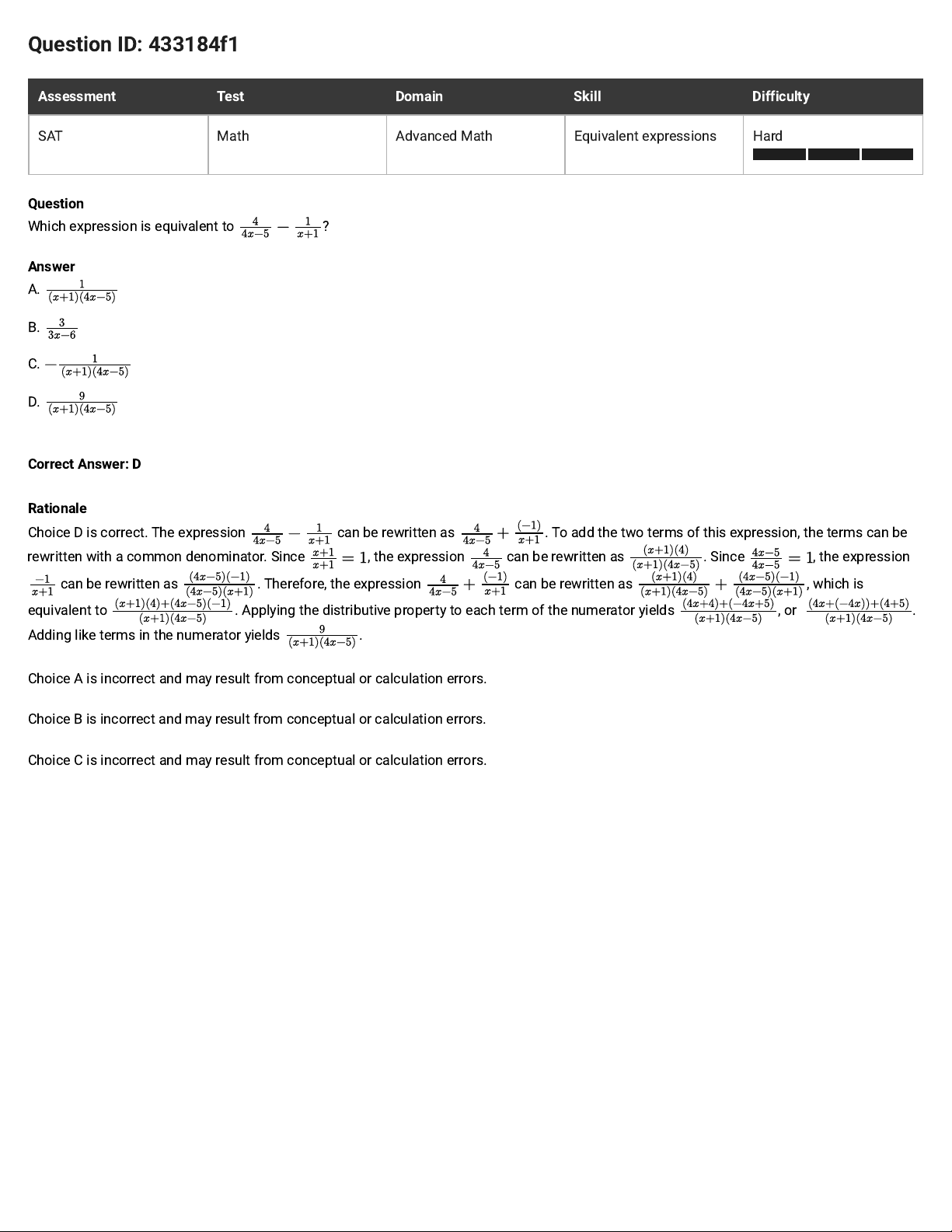
Which expression is equivalent to ?
Answer
A.
B.
C.
D.
Correct Answer: D
Rationale
Choice D is correct. The expression
can be rewritten as
. To add the two terms of this expression, the terms can be
rewritten with a common denominator. Since , the expression can be rewritten as . Since , the expression
can be rewritten as . Therefore, the expression
can be rewritten as
, which is
equivalent to .Applying the distributive property to each term of the numerator yields , or .
Adding like terms in the numerator yields
.
Choice A is incorrect and may result from conceptual or calculation errors.
Choice B is incorrect and may result from conceptual or calculation errors.
Choice C is incorrect and may result from conceptual or calculation errors.
Page 17
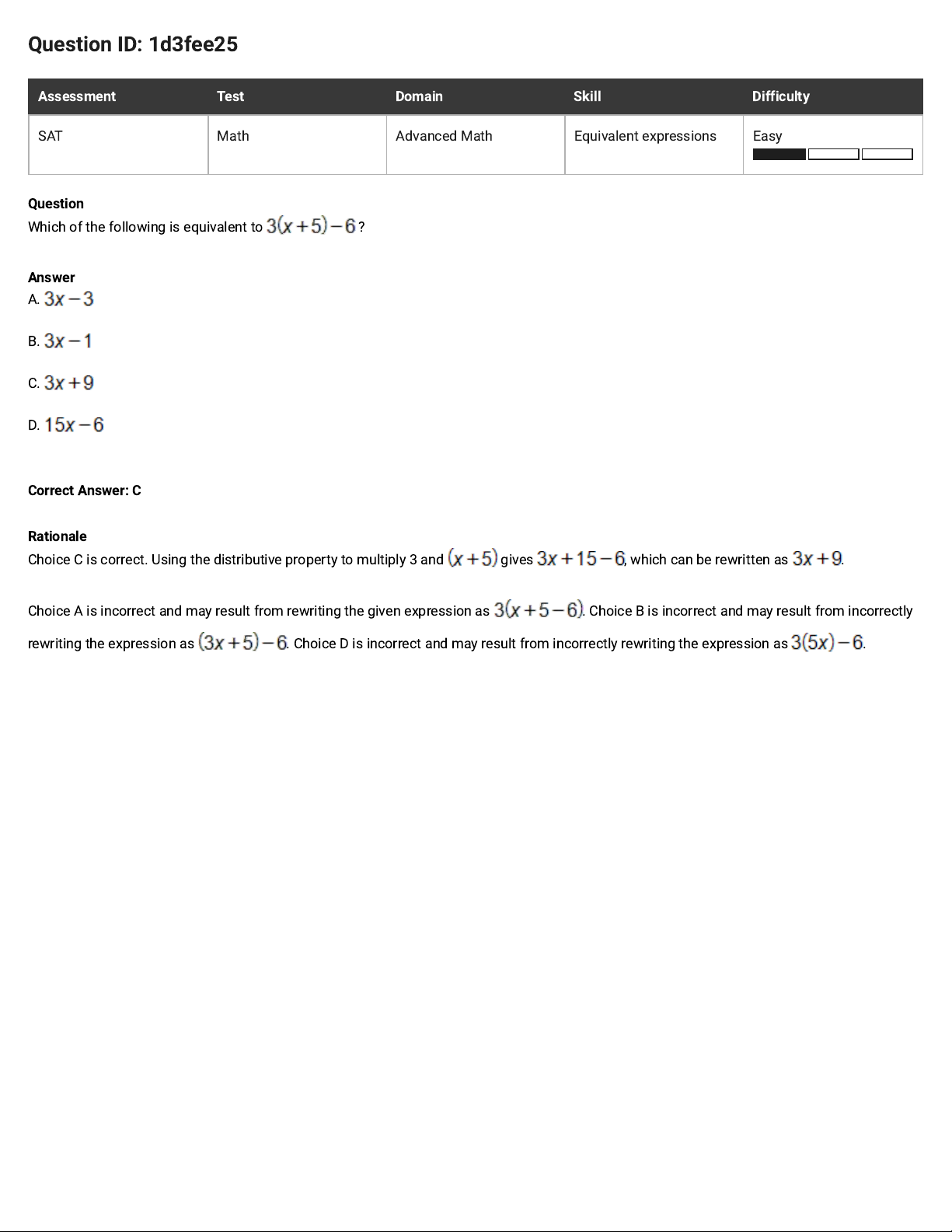
Question ID: 1d3fee25
Assessment Test Domain Skill Difficulty
SAT Math Advanced Math Equivalent expressions Easy
Question
Which of the following is equivalent to ?
Answer
A.
B.
C.
D.
Correct Answer: C
Rationale
Choice C is correct. Using the distributive property to multiply 3 and gives , which can be rewritten as .
Choice A is incorrect and may result from rewriting the given expression as . Choice B is incorrect and may result from incorrectly
rewriting the expression as . Choice D is incorrect and may result from incorrectly rewriting the expression as .
Page 18
Question ID: d8789a4c
Assessment Test Domain Skill Difficulty
SAT Math Advanced Math Equivalent expressions Hard
Question
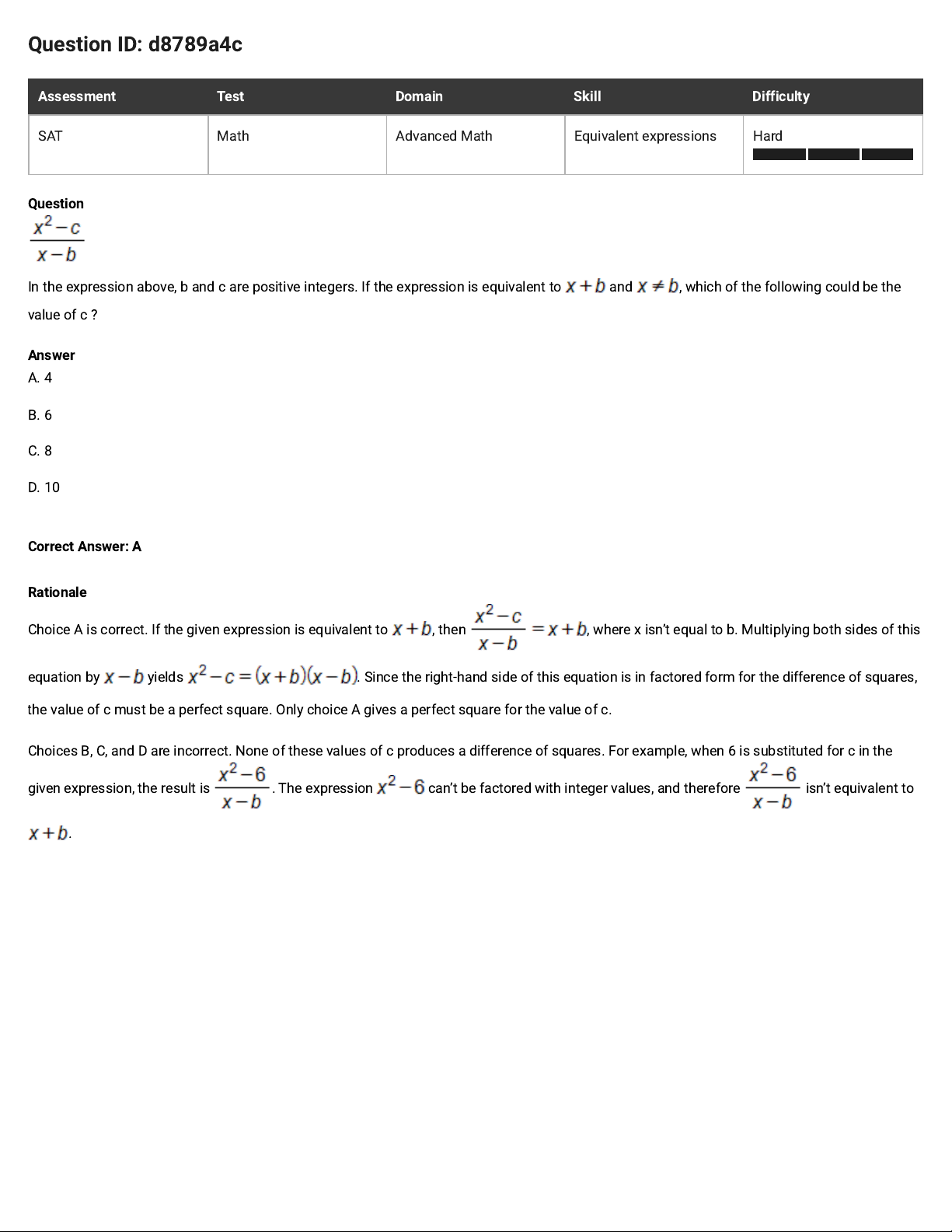
In the expression above, b and c are positive integers. If the expression is equivalent to and , which of the following could be the
value of c ?
Answer
A. 4
B. 6
C. 8
D. 10
Correct Answer: A
Rationale
Choice A is correct. If the given expression is equivalent to , then , where x isn’t equal to b. Multiplying both sides of this
equation by yields . Since the right-hand side of this equation is in factored form for the difference of squares,
the value of c must be a perfect square. Only choice A gives a perfect square for the value of c.
Choices B, C, and D are incorrect. None of these values of c produces a difference of squares. For example, when 6 is substituted for c in the
given expression, the result is . The expression can’t be factored with integer values, and therefore isn’t equivalent to
.
Page 19
Question ID: a520ba07
Assessment Test Domain Skill Difficulty
SAT Math Advanced Math Equivalent expressions Medium
Question
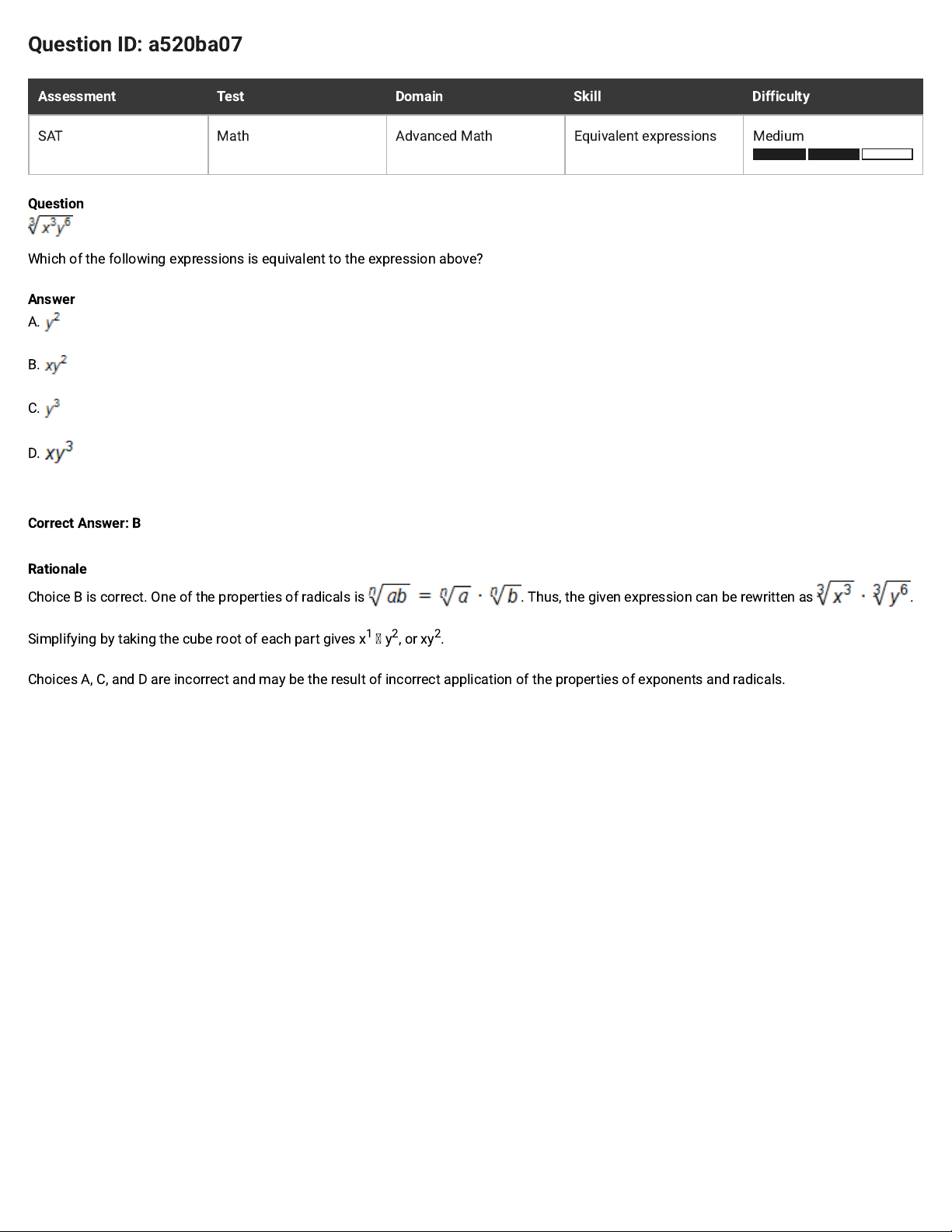
Which of the following expressions is equivalent to the expression above?
Answer
A.
B.
C.
D.
Correct Answer: B
Rationale
Choice B is correct. One of the properties of radicals is . Thus, the given expression can be rewritten as .
Simplifying by taking the cube root of each part gives x1 y2, or xy2.
Choices A, C, and D are incorrect and may be the result of incorrect application of the properties of exponents and radicals.
Page 20
Question ID: a255ae72
Assessment Test Domain Skill Difficulty
SAT Math Advanced Math Equivalent expressions Medium
Question
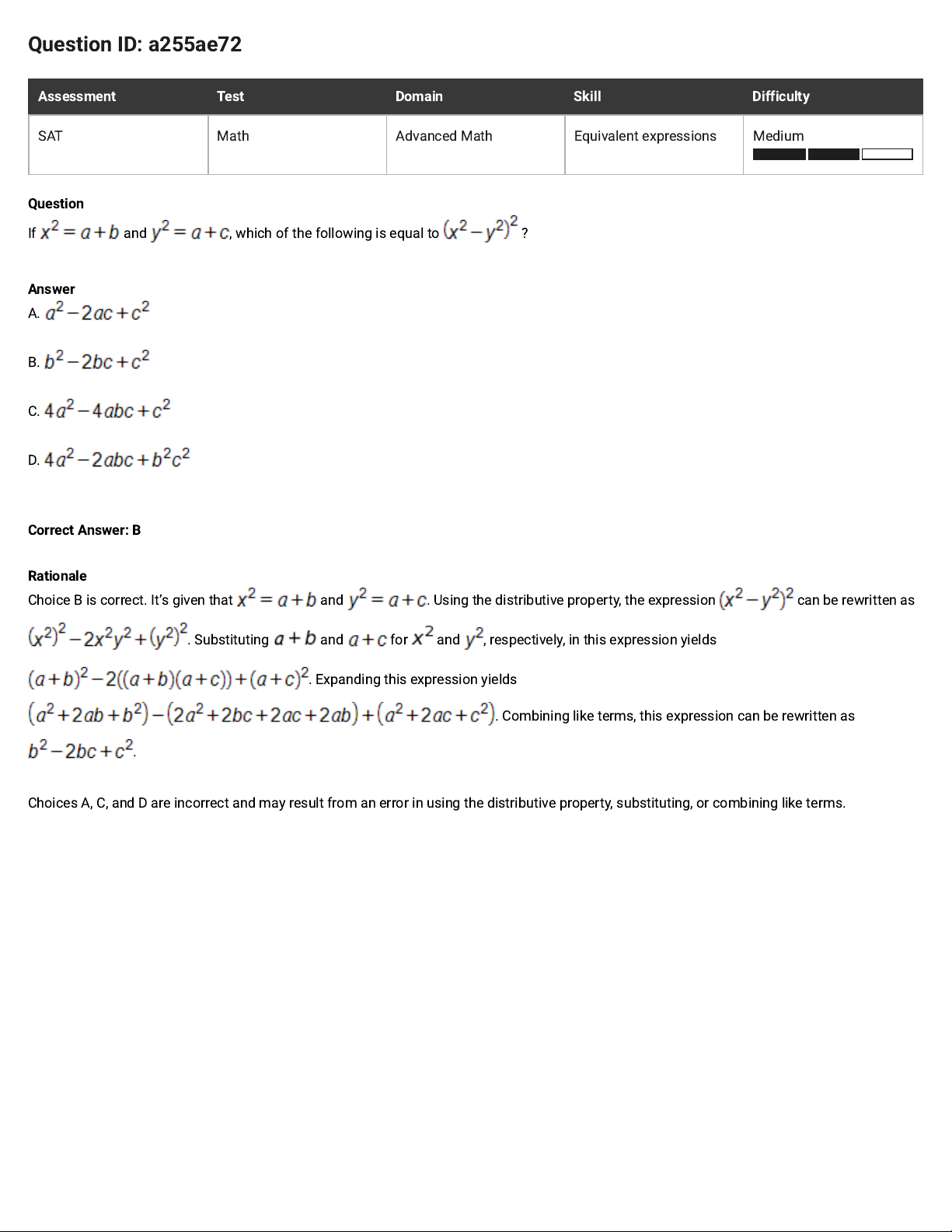
If and , which of the following is equal to ?
Answer
A.
B.
C.
D.
Correct Answer: B
Rationale
Choice B is correct. It’s given that and . Using the distributive property, the expression can be rewritten as
. Substituting and for and , respectively, in this expression yields
. Expanding this expression yields
. Combining like terms, this expression can be rewritten as
.
Choices A, C, and D are incorrect and may result from an error in using the distributive property, substituting, or combining like terms.
Page 21
Question ID: 463eec13
Assessment Test Domain Skill Difficulty
SAT Math Advanced Math Equivalent expressions Medium
Question
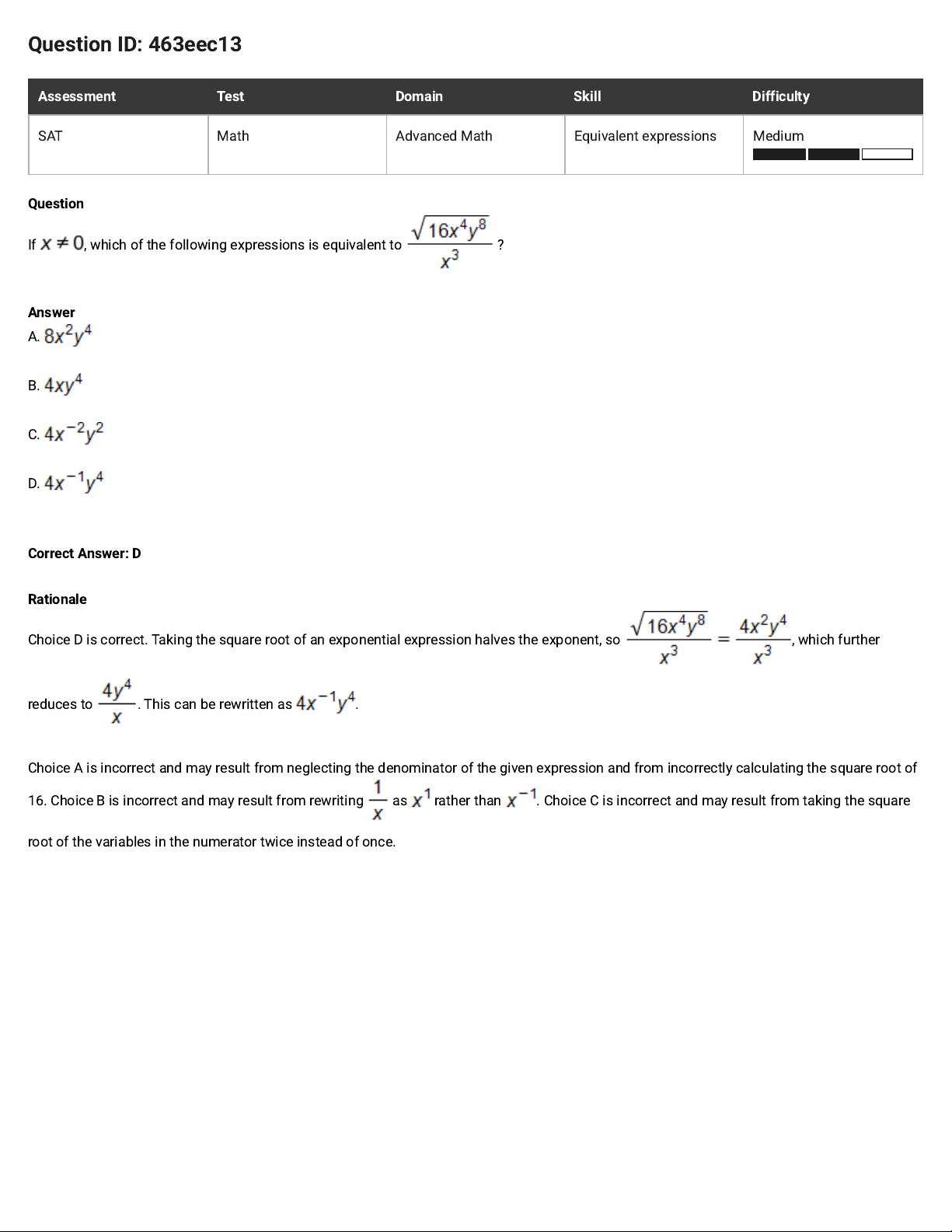
If , which of the following expressions is equivalent to ?
Answer
A.
B.
C.
D.
Correct Answer: D
Rationale
Choice D is correct. Taking the square root of an exponential expression halves the exponent, so , which further
reduces to . This can be rewritten as .
Choice A is incorrect and may result from neglecting the denominator of the given expression and from incorrectly calculating the square root of
16. Choice B is incorrect and may result from rewriting as rather than . Choice C is incorrect and may result from taking the square
root of the variables in the numerator twice instead of once.
Page 22
Question ID: 5355c0ef
Assessment Test Domain Skill Difficulty
SAT Math Advanced Math Equivalent expressions Hard
Question
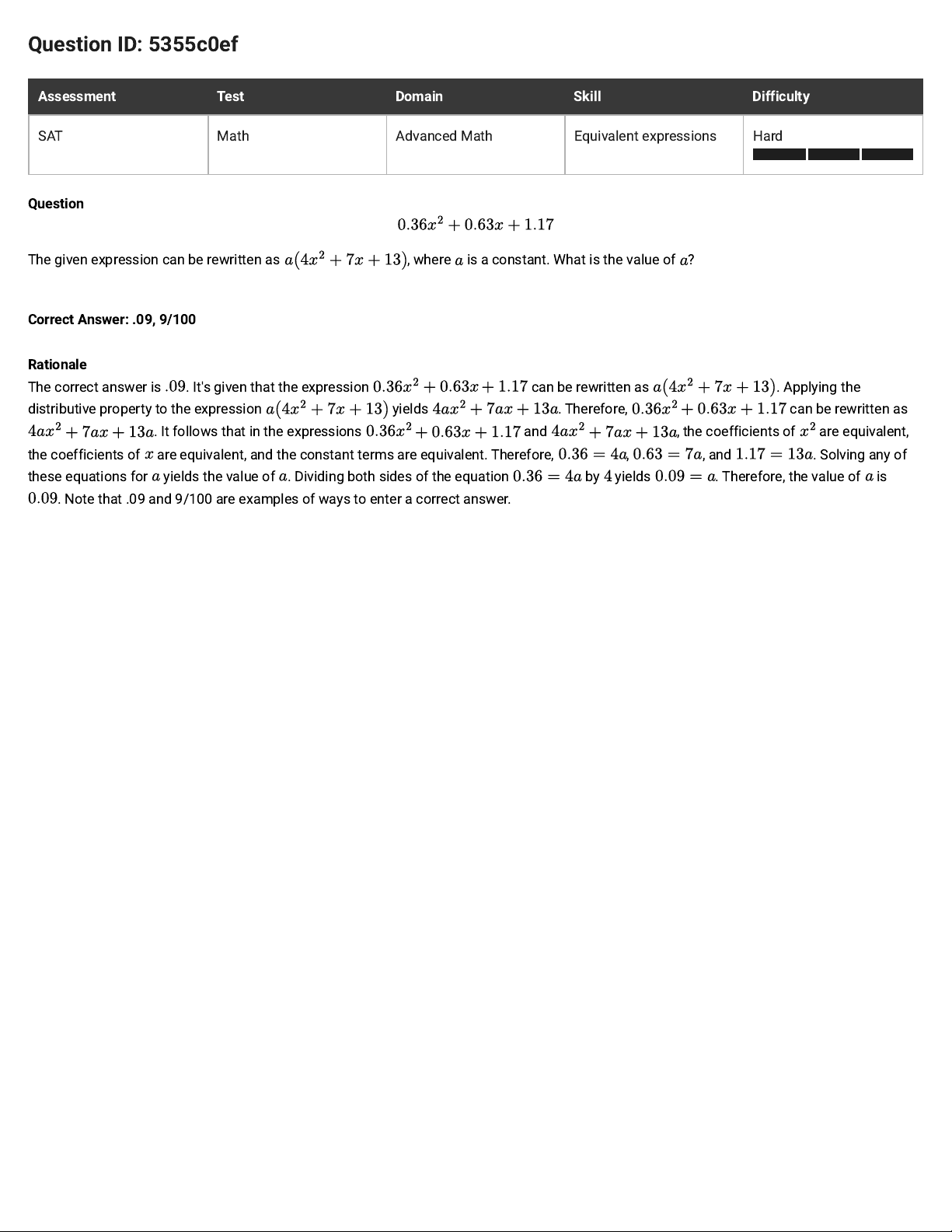
The given expression can be rewritten as , where is a constant. What is the value of ?
Correct Answer: .09, 9/100
Rationale
The correct answer is . It's given that the expression
can be rewritten as . Applying the
distributive property to the expression
yields . Therefore, can be rewritten as
. It follows that in the expressions and
, the coefficients of are equivalent,
the coefficients of are equivalent, and the constant terms are equivalent. Therefore, , , and . Solving any of
these equations for yields the value of . Dividing both sides of the equation by yields . Therefore, the value of is
. Note that .09 and 9/100 are examples of ways to enter a correct answer.
Page 23
Question ID: a1bf1c4e
Assessment Test Domain Skill Difficulty
SAT Math Advanced Math Equivalent expressions Medium
Question
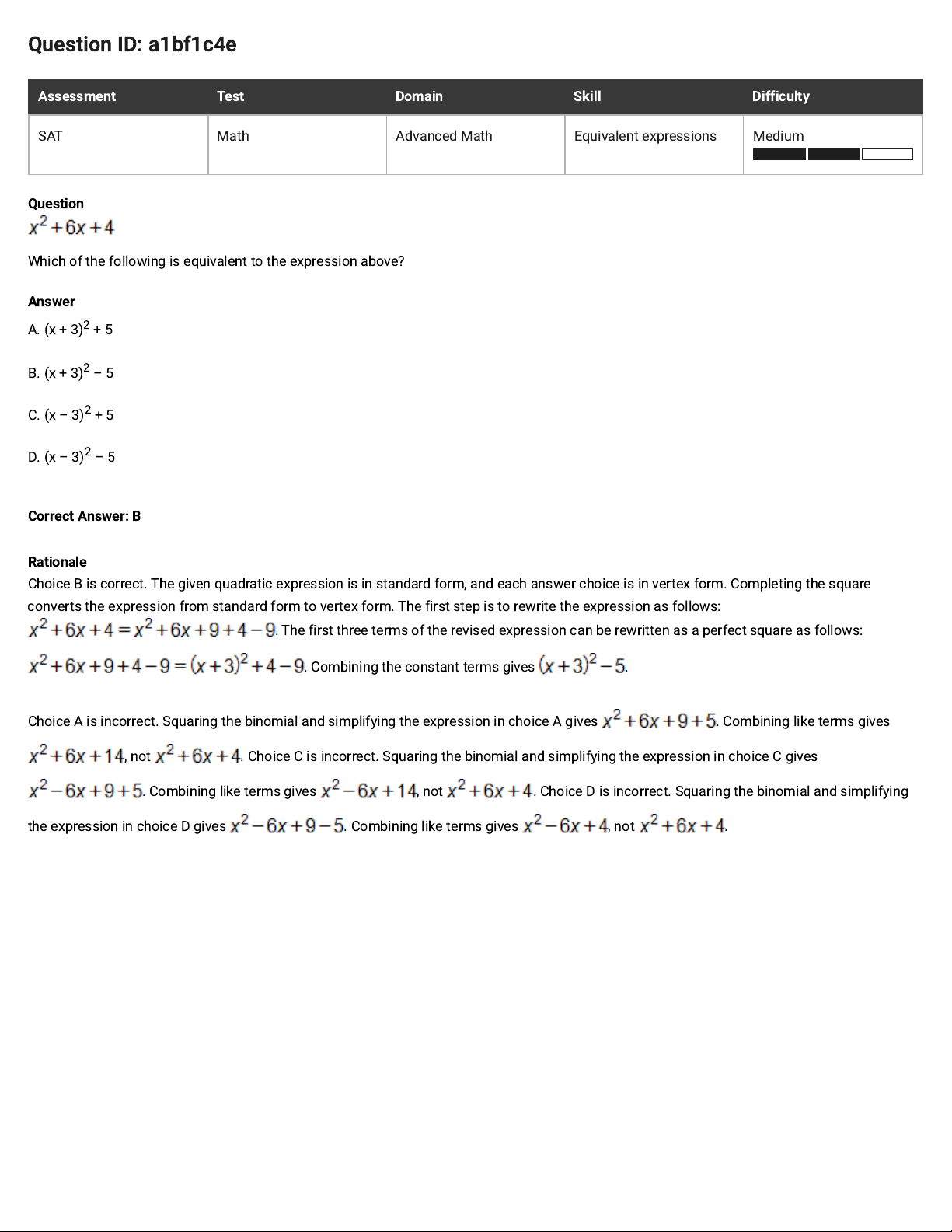
Which of the following is equivalent to the expression above?
Answer
A. (x + 3)2 + 5
B. (x + 3)2 – 5
C. (x – 3)2 + 5
D. (x – 3)2 – 5
Correct Answer: B
Rationale
Choice B is correct. The given quadratic expression is in standard form, and each answer choice is in vertex form. Completing the square
converts the expression from standard form to vertex form. The first step is to rewrite the expression as follows:
. The first three terms of the revised expression can be rewritten as a perfect square as follows:
. Combining the constant terms gives .
Choice A is incorrect. Squaring the binomial and simplifying the expression in choice A gives . Combining like terms gives
, not . Choice C is incorrect. Squaring the binomial and simplifying the expression in choice C gives
. Combining like terms gives , not . Choice D is incorrect. Squaring the binomial and simplifying
the expression in choice D gives . Combining like terms gives , not .
Page 24
Question ID: c81b6c57
Assessment Test Domain Skill Difficulty
SAT Math Advanced Math Equivalent expressions Hard
Question
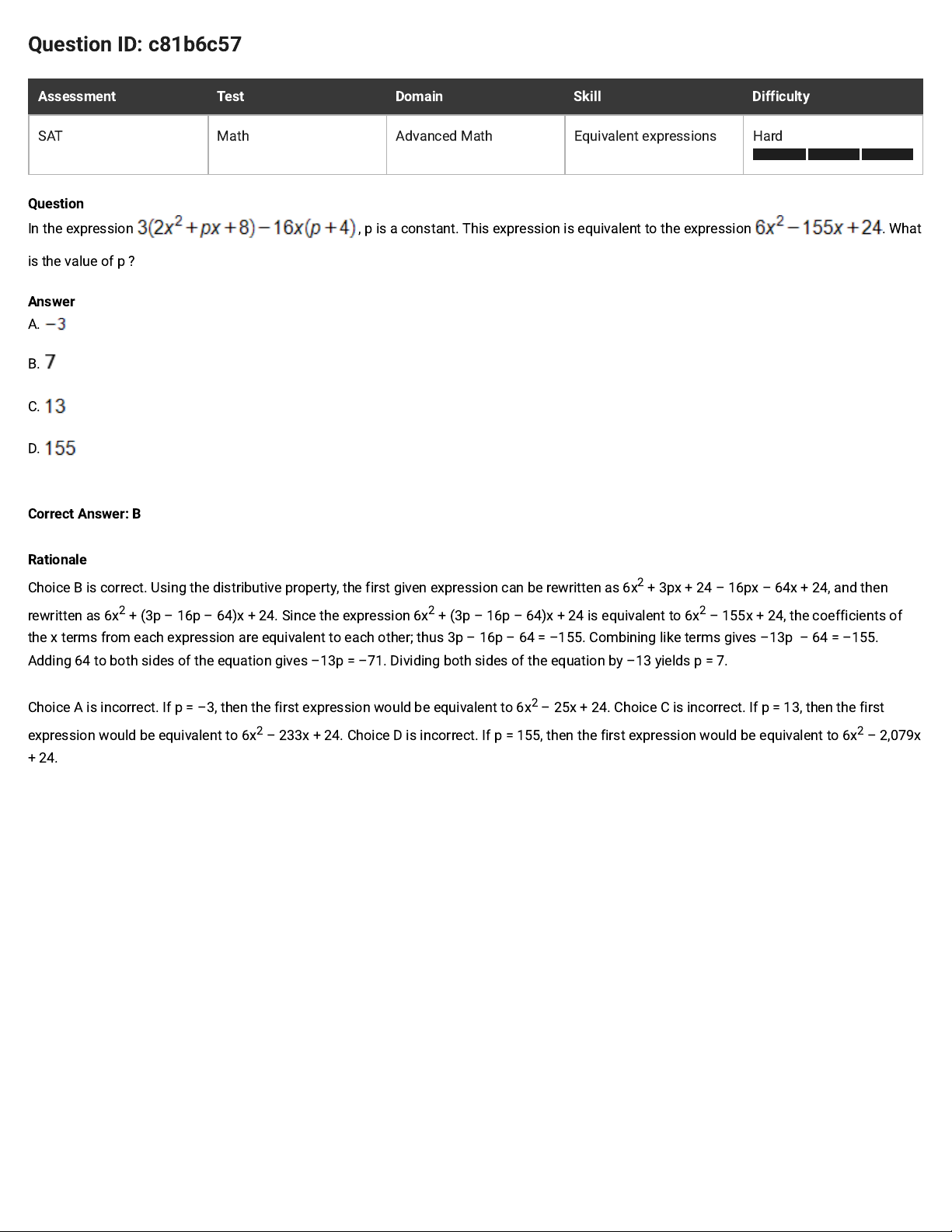
In the expression
, p is a constant. This expression is equivalent to the expression . What
is the value of p?
Answer
A.
B.
C.
D.
Correct Answer: B
Rationale
Choice B is correct. Using the distributive property, the first given expression can be rewritten as6x2 + 3px + 24 – 16px – 64x + 24, and then
rewritten as 6x2 + (3p – 16p – 64)x + 24. Since the expression 6x2 + (3p – 16p – 64)x + 24 is equivalent to 6x2 – 155x + 24, the coefficients of
the x terms from each expression are equivalent to each other; thus 3p – 16p – 64 = –155. Combining like terms gives –13p – 64 = –155.
Adding 64 to both sides of the equation gives –13p = –71. Dividing both sides of the equation by –13 yields p = 7.
Choice A is incorrect. If p = –3, then the first expression would be equivalent to 6x2 – 25x + 24. Choice C is incorrect. If p = 13, then the first
expression would be equivalent to 6x2 – 233x + 24. Choice D is incorrect. If p = 155, then the first expression would be equivalent to 6x2 – 2,079x
+ 24.
Page 25
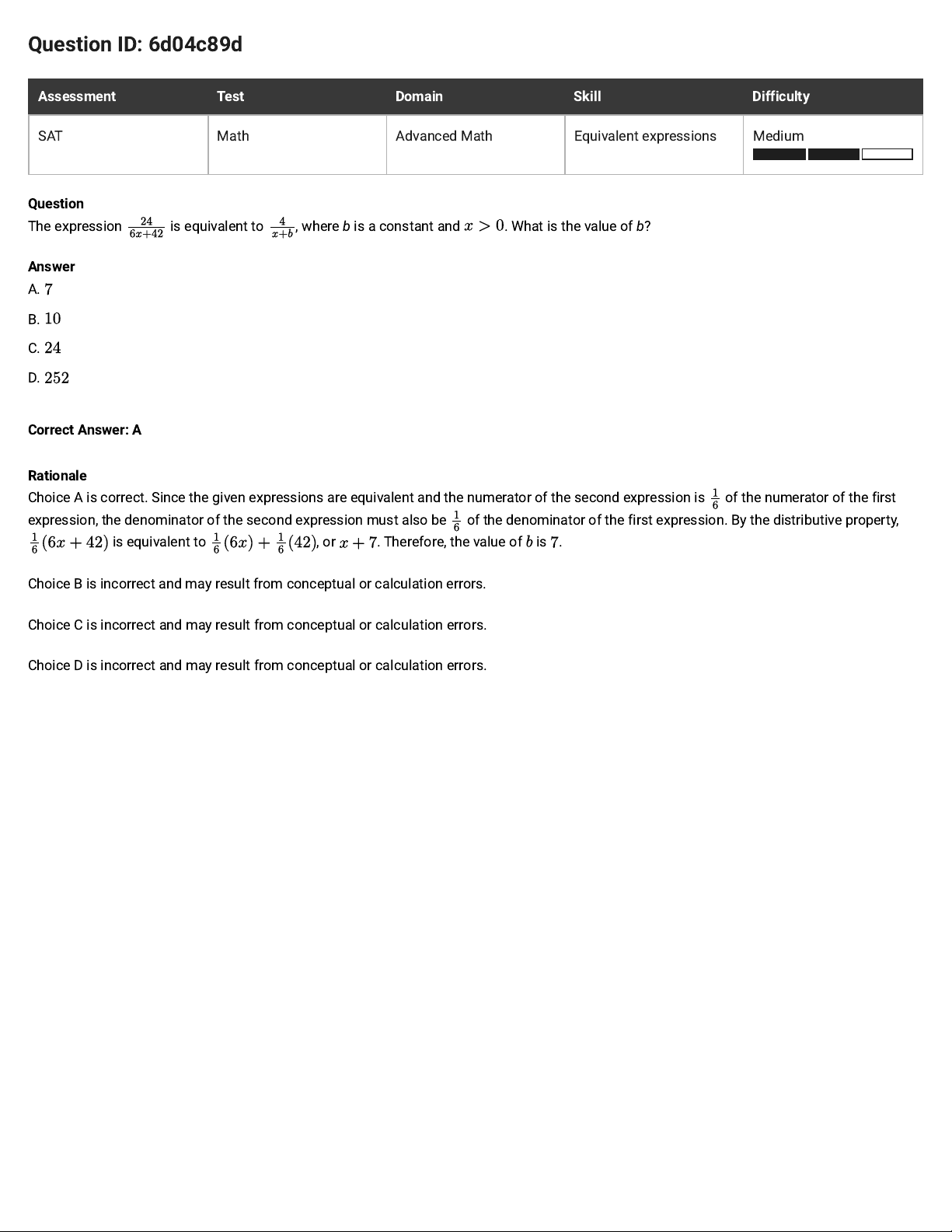
Question ID: 6d04c89d
Assessment Test Domain Skill Difficulty
SAT Math Advanced Math Equivalent expressions Medium
Question
The expression is equivalent to , where b is a constant and . What is the value of b?
Answer
A.
B.
C.
D.
Correct Answer: A
Rationale
Choice A is correct. Since the given expressions are equivalent and the numerator of the second expression is of the numerator of the first
expression, the denominator of the second expression must also be of the denominator of the first expression. By the distributive property,
is equivalent to , or . Therefore, the value of is .
Choice B is incorrect and may result from conceptual or calculation errors.
Choice C is incorrect and may result from conceptual or calculation errors.
Choice D is incorrect and may result from conceptual or calculation errors.
Page 26
Question ID: 60fdb4d4
Assessment Test Domain Skill Difficulty
SAT Math Advanced Math Equivalent expressions Easy
Question
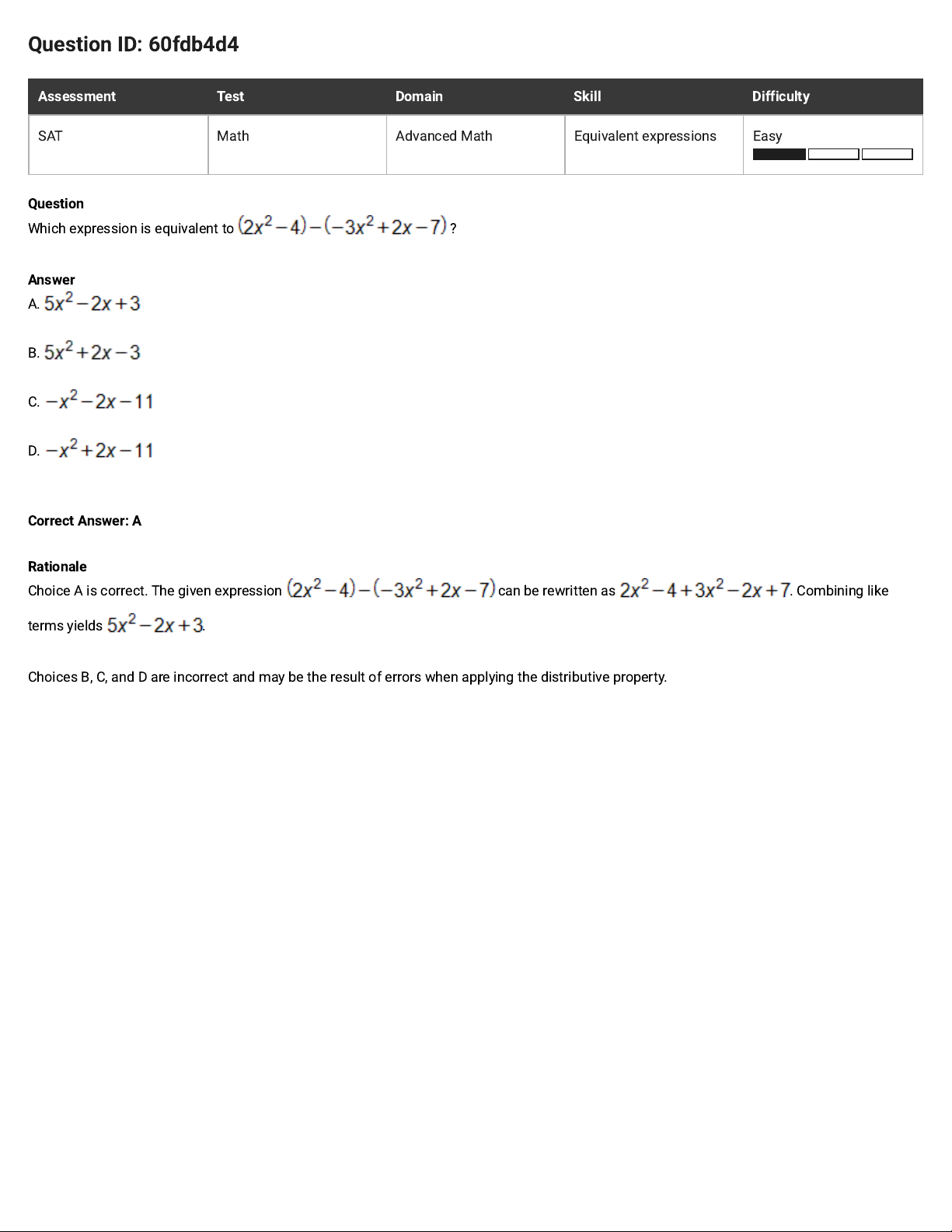
Which expression is equivalent to ?
Answer
A.
B.
C.
D.
Correct Answer: A
Rationale
Choice A is correct. The given expression can be rewritten as . Combining like
terms yields .
Choices B, C, and D are incorrect and may be the result of errors when applying the distributive property.
Page 27
Question ID: 2c88af4d
Assessment Test Domain Skill Difficulty
SAT Math Advanced Math Equivalent expressions Hard
Question
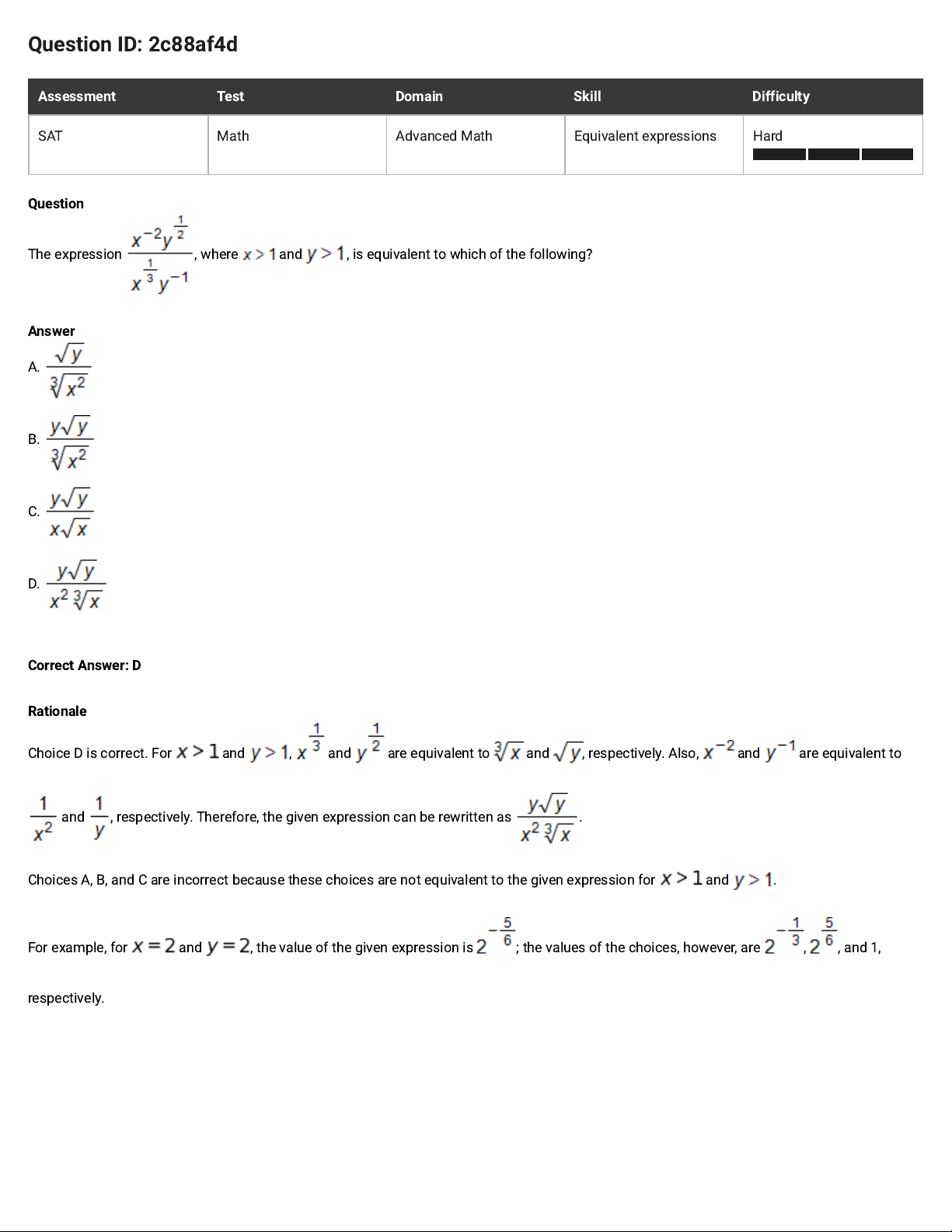
The expression , where and , is equivalent to which of the following?
Answer
A.
B.
C.
D.
Correct Answer: D
Rationale
Choice D is correct. For and , and are equivalent to and , respectively. Also, and are equivalent to
and , respectively. Therefore, the given expression can be rewritten as .
Choices A, B, and C are incorrect because these choices are not equivalent to the given expression for and .
For example, for and , the value of the given expression is ; the values of the choices, however, are , , and 1,
respectively.
Page 28
Question ID: 22fd3e1f
Assessment Test Domain Skill Difficulty
SAT Math Advanced Math Equivalent expressions Hard
Question
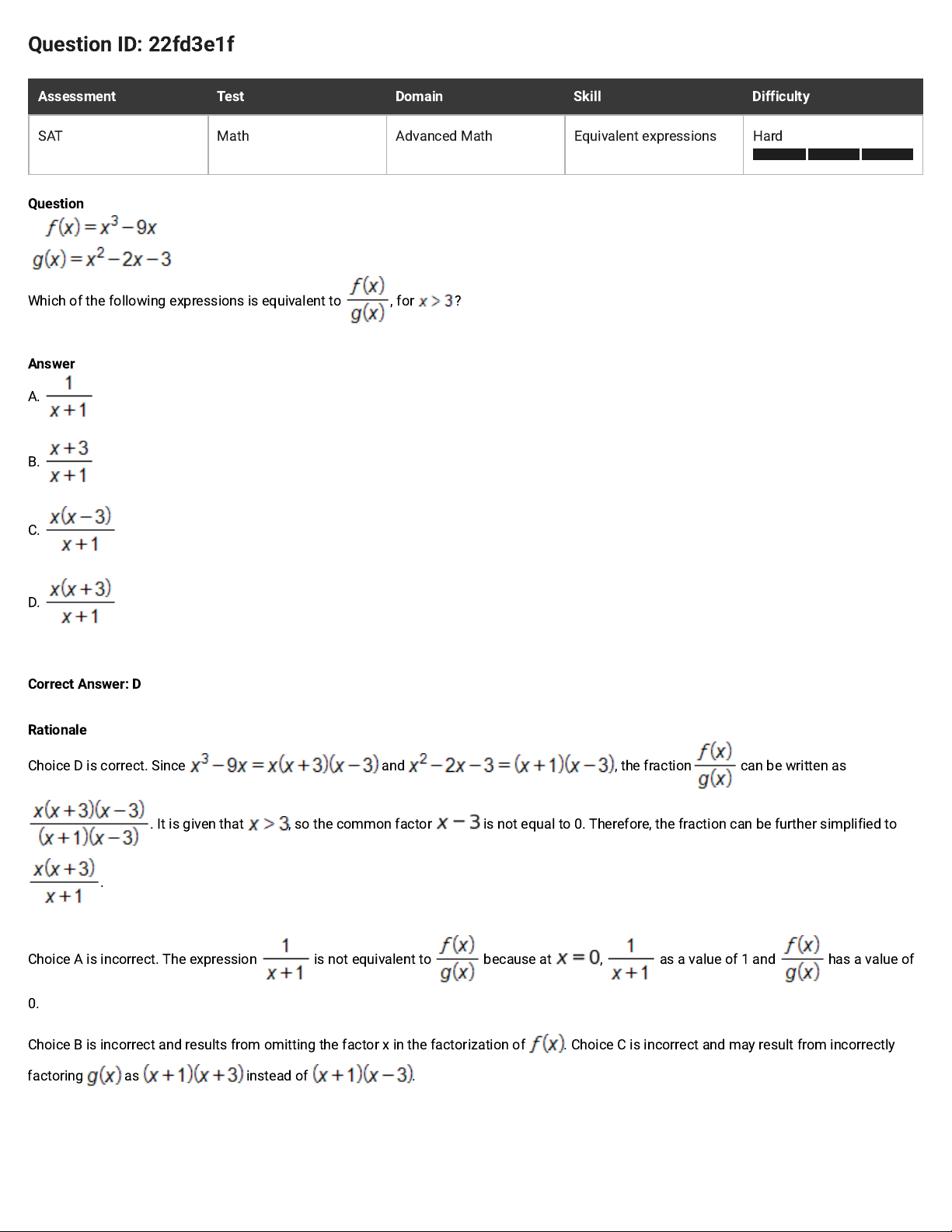
Which of the following expressions is equivalent to , for
?
Answer
A.
B.
C.
D.
Correct Answer: D
Rationale
Choice D is correct. Since and , the fraction can be written as
. It is given that , so the common factor is not equal to 0. Therefore, the fraction can be further simplified to
.
Choice A is incorrect. The expression is not equivalent to because at , as a value of 1 and has a value of
0.
Choice B is incorrect and results from omitting the factor x in the factorization of . Choice C is incorrect and may result from incorrectly
factoring as instead of .
Page 29
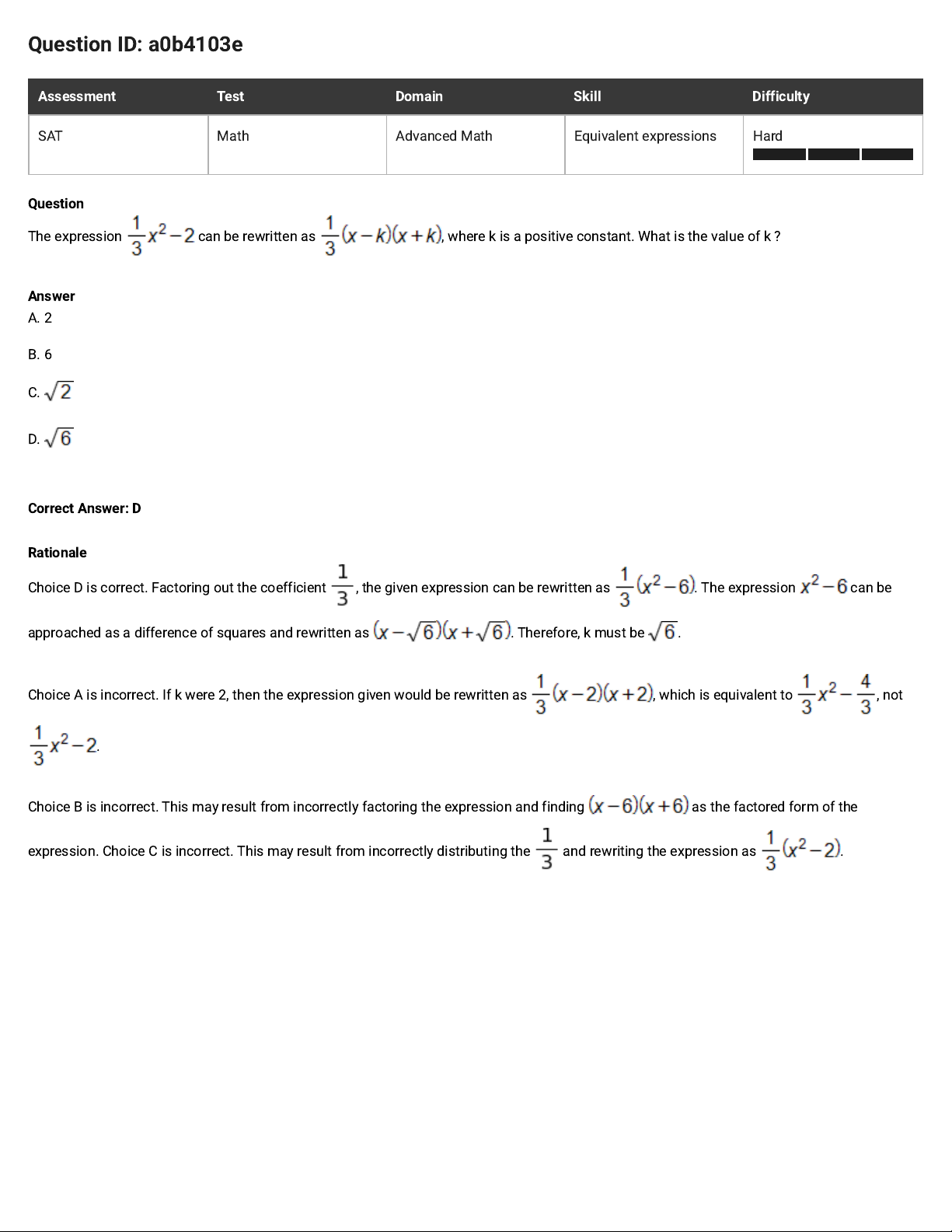
Question ID: a0b4103e
Assessment Test Domain Skill Difficulty
SAT Math Advanced Math Equivalent expressions Hard
Question
The expression can be rewritten as , where k is a positive constant. What is the value of k ?
Answer
A. 2
B. 6
C.
D.
Correct Answer: D
Rationale
Choice D is correct. Factoring out the coefficient , the given expression can be rewritten as . The expression can be
approached as a difference of squares and rewritten as . Therefore, k must be .
Choice A is incorrect. If k were 2, then the expression given would be rewritten as , which is equivalent to , not
.
Choice B is incorrect. This may result from incorrectly factoring the expression and finding as the factored form of the
expression. Choice C is incorrect. This may result from incorrectly distributing the and rewriting the expression as .
Page 30
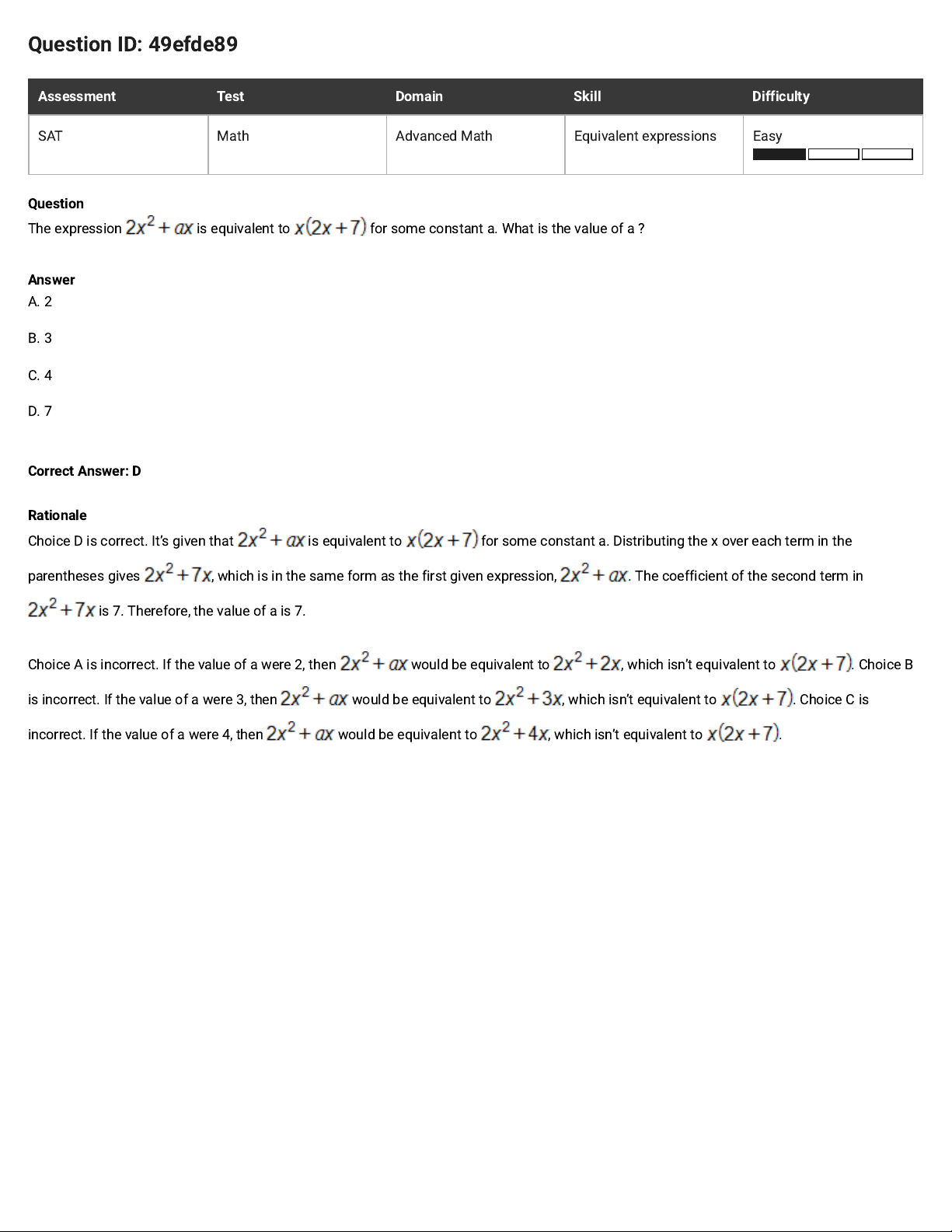
Question ID: 49efde89
Assessment Test Domain Skill Difficulty
SAT Math Advanced Math Equivalent expressions Easy
Question
The expression is equivalent to for some constant a. What is the value of a ?
Answer
A. 2
B. 3
C. 4
D. 7
Correct Answer: D
Rationale
Choice D is correct. It’s given that is equivalent to for some constant a. Distributing the x over each term in the
parentheses gives , which is in the same form as the first given expression, . The coefficient of the second term in
is 7. Therefore, the value of a is 7.
Choice A is incorrect. If the value of a were 2, then would be equivalent to , which isn’t equivalent to . Choice B
is incorrect. If the value of a were 3, then would be equivalent to , which isn’t equivalent to . Choice C is
incorrect. If the value of a were 4, then would be equivalent to , which isn’t equivalent to .
Page 31
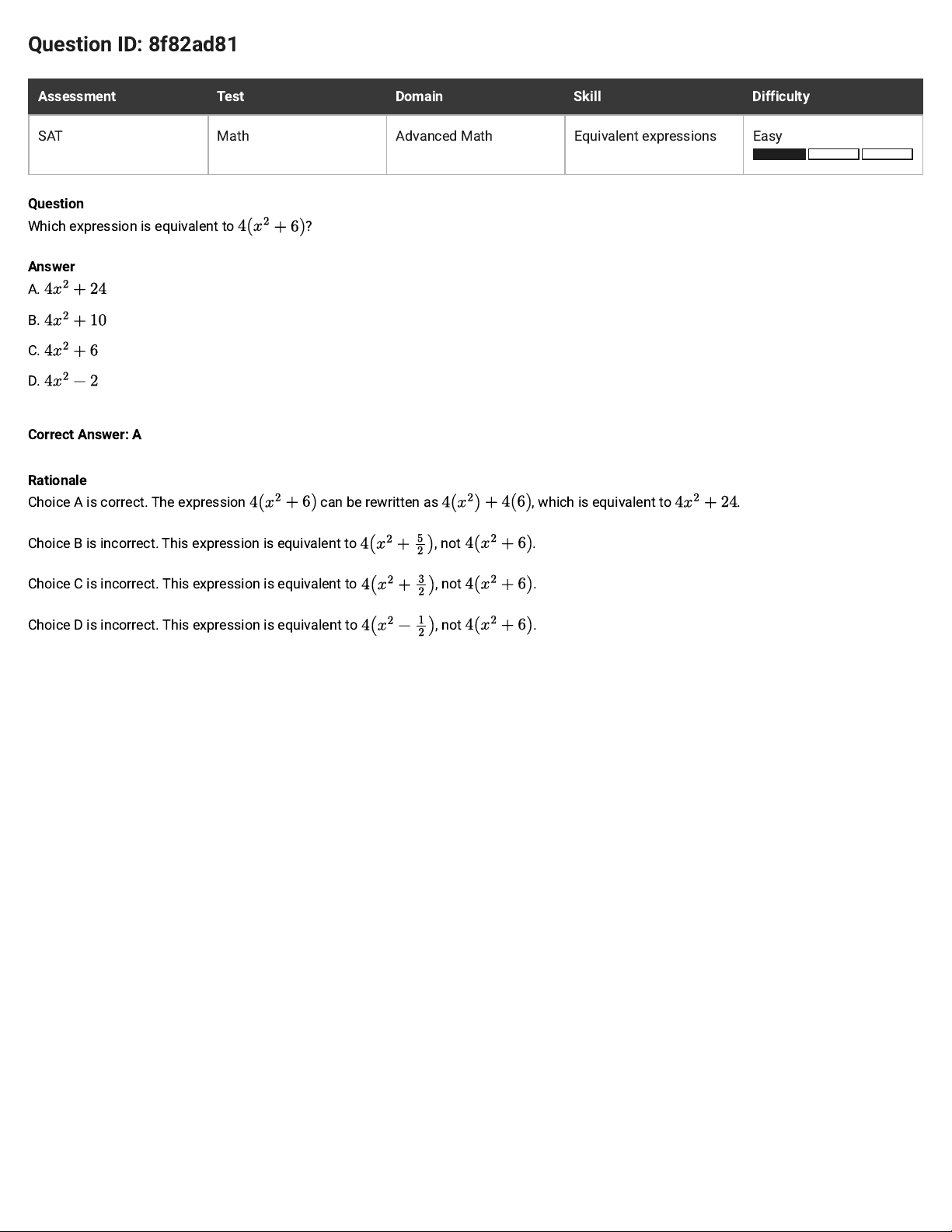
Question ID: 8f82ad81
Assessment Test Domain Skill Difficulty
SAT Math Advanced Math Equivalent expressions Easy
Question
Which expression is equivalent to
?
Answer
A.
B.
C.
D.
Correct Answer: A
Rationale
Choice A is correct. The expression can be rewritten as , which is equivalent to .
Choice B is incorrect. This expression is equivalent to , not .
Choice C is incorrect. This expression is equivalent to , not .
Choice D is incorrect. This expression is equivalent to , not .
Page 32
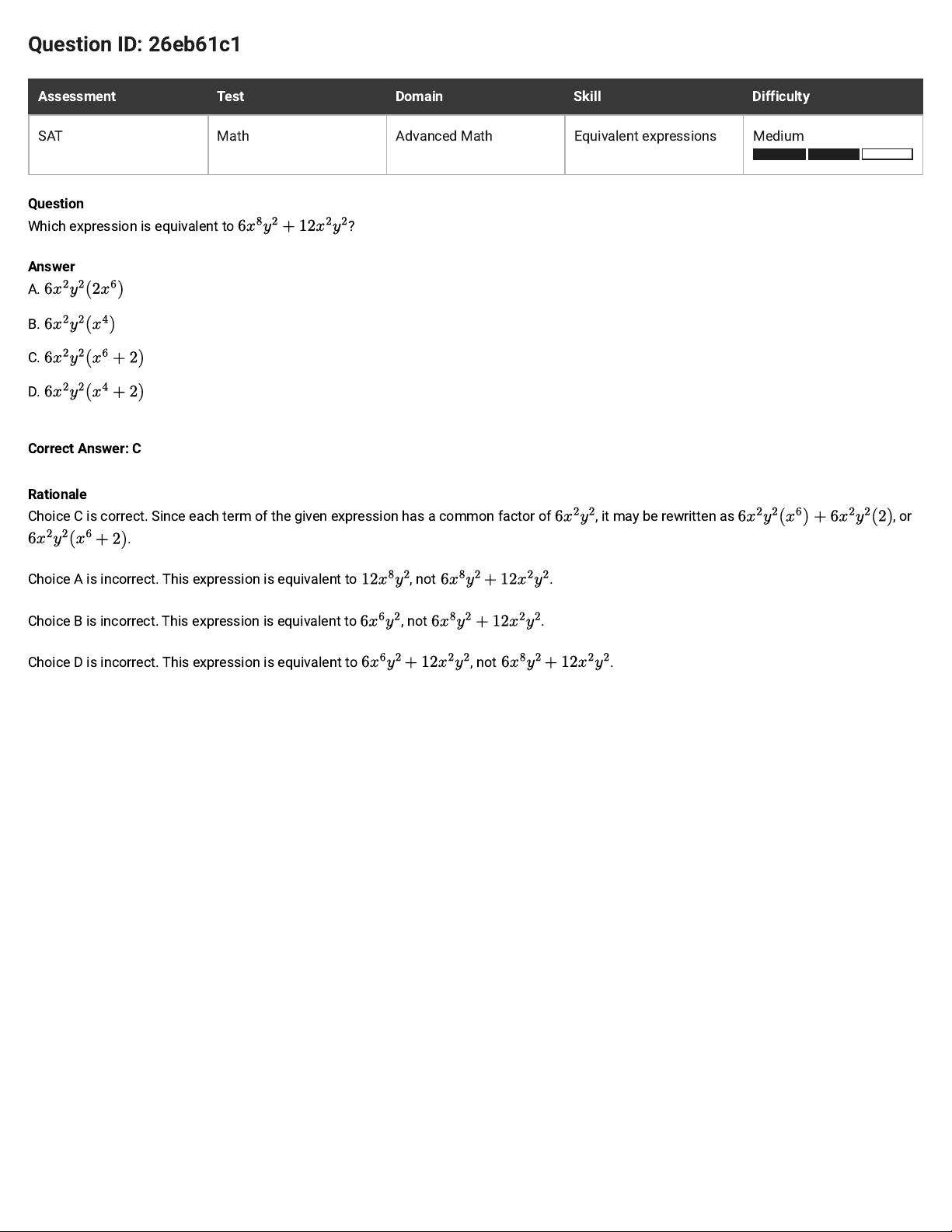
Question ID: 26eb61c1
Assessment Test Domain Skill Difficulty
SAT Math Advanced Math Equivalent expressions Medium
Question
Which expression is equivalent to ?
Answer
A.
B.
C.
D.
Correct Answer: C
Rationale
Choice C is correct. Since each term of the given expression has a common factor of , it may be rewritten as , or
.
Choice A is incorrect. This expression is equivalent to , not .
Choice B is incorrect. This expression is equivalent to , not .
Choice D is incorrect. This expression is equivalent to , not .
Page 33
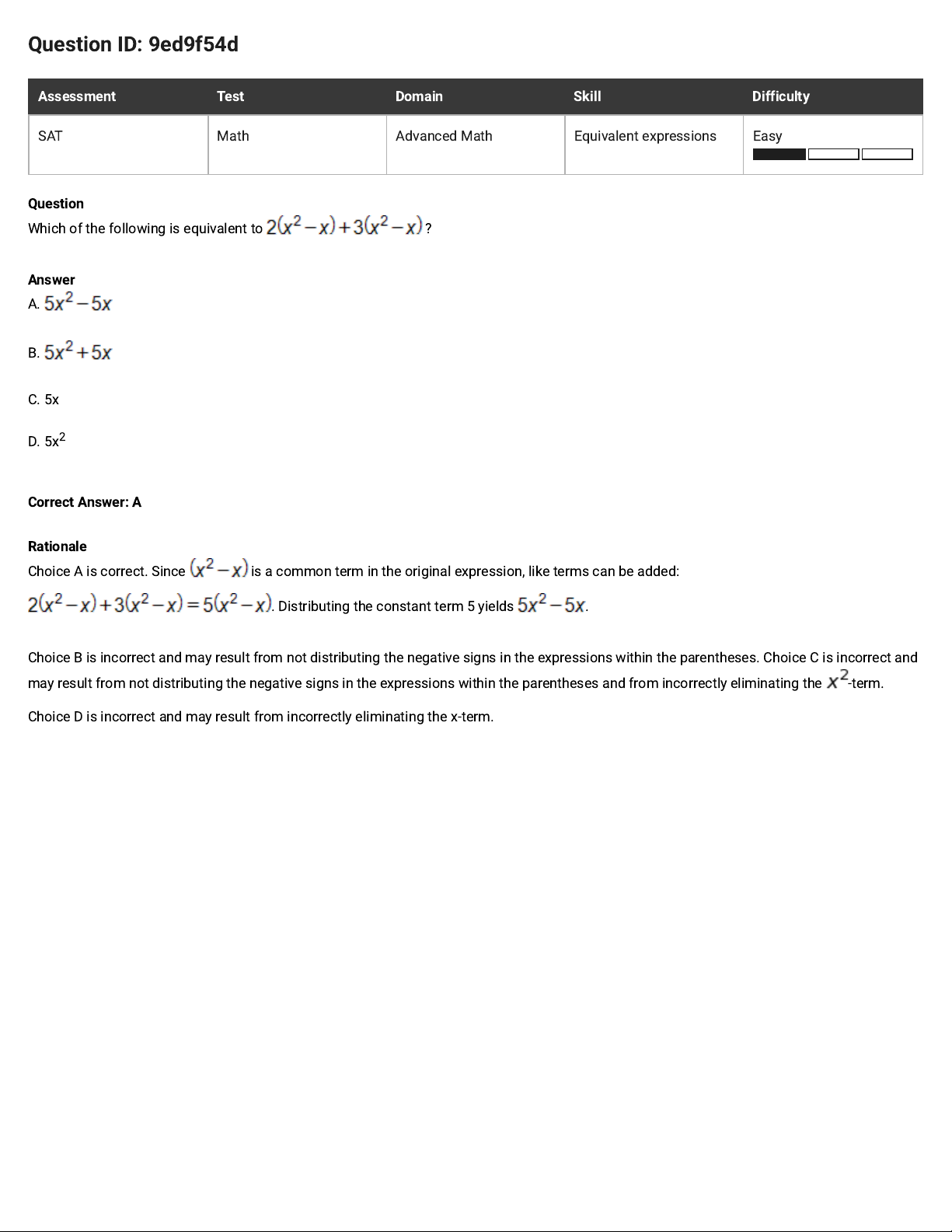
Question ID: 9ed9f54d
Assessment Test Domain Skill Difficulty
SAT Math Advanced Math Equivalent expressions Easy
Question
Which of the following is equivalent to ?
Answer
A.
B.
C. 5x
D. 5x
2
Correct Answer: A
Rationale
Choice A is correct. Since is a common term in the original expression, like terms can be added:
. Distributing the constant term 5 yields .
Choice B is incorrect and may result from not distributing the negative signs in the expressions within the parentheses. Choice C is incorrect and
may result from not distributing the negative signs in the expressions within the parentheses and from incorrectly eliminating the -term.
Choice D is incorrect and may result from incorrectly eliminating the x-term.
Page 34
Question ID: 18c7c3e0
Assessment Test Domain Skill Difficulty
SAT Math Advanced Math Equivalent expressions Easy
Question
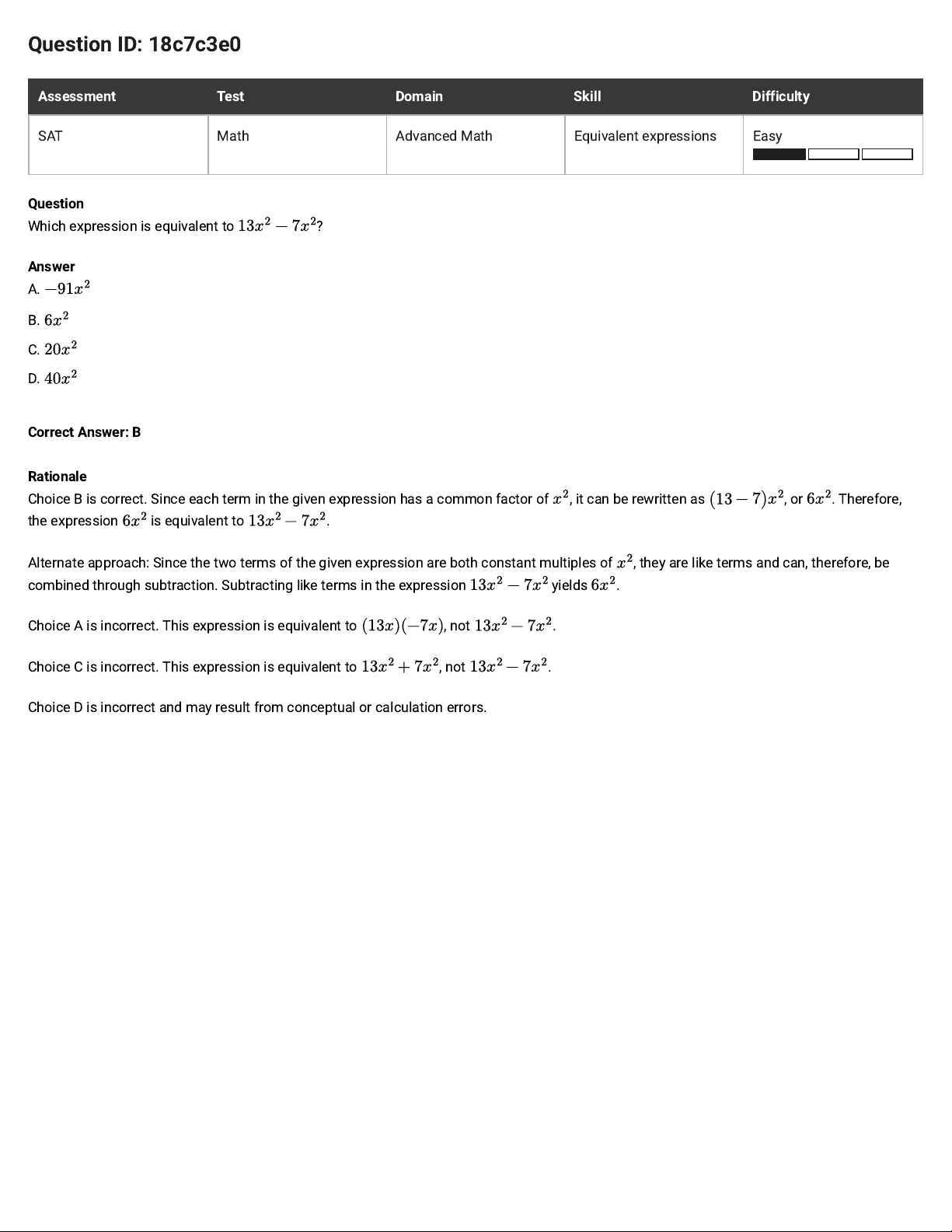
Which expression is equivalent to
?
Answer
A.
B.
C.
D.
Correct Answer: B
Rationale
Choice B is correct. Since each term in the given expression has a common factor of , it can be rewritten as , or . Therefore,
the expression is equivalent to .
Alternate approach: Since the two terms of the given expression are both constant multiples of , they are like terms and can, therefore, be
combined through subtraction. Subtracting like terms in the expression yields .
Choice A is incorrect. This expression is equivalent to
, not
.
Choice C is incorrect. This expression is equivalent to , not .
Choice D is incorrect and may result from conceptual or calculation errors.
Page 35
Question ID: 294db8ec
Assessment Test Domain Skill Difficulty
SAT Math Advanced Math Equivalent expressions Easy
Question
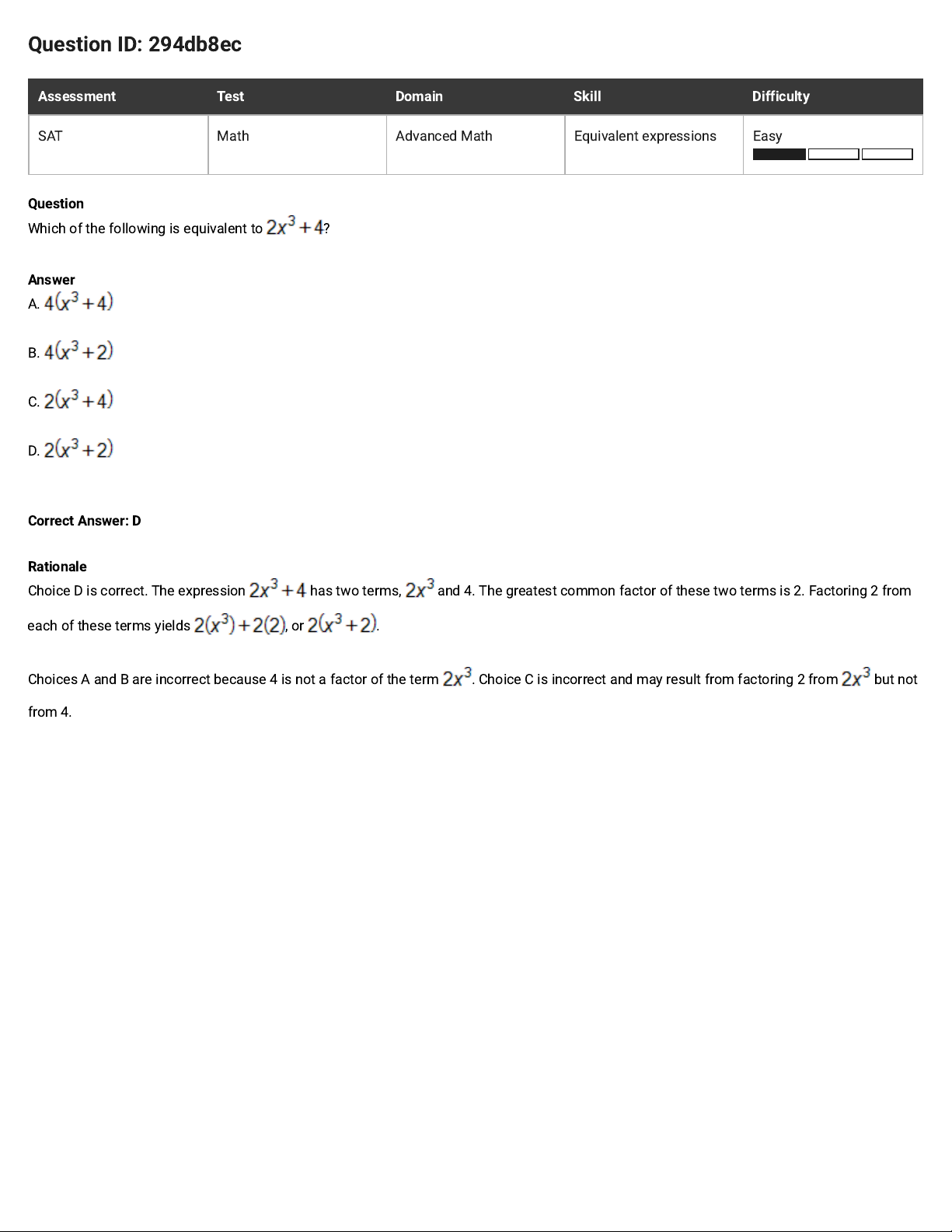
Which of the following is equivalent to ?
Answer
A.
B.
C.
D.
Correct Answer: D
Rationale
Choice D is correct. The expression has two terms, and 4. The greatest common factor of these two terms is 2. Factoring 2 from
each of these terms yields , or .
Choices A and B are incorrect because 4 is not a factor of the term . Choice C is incorrect and may result from factoring 2 from but not
from 4.
Page 36
Question ID: f237ccfc
Assessment Test Domain Skill Difficulty
SAT Math Advanced Math Equivalent expressions Medium
Question
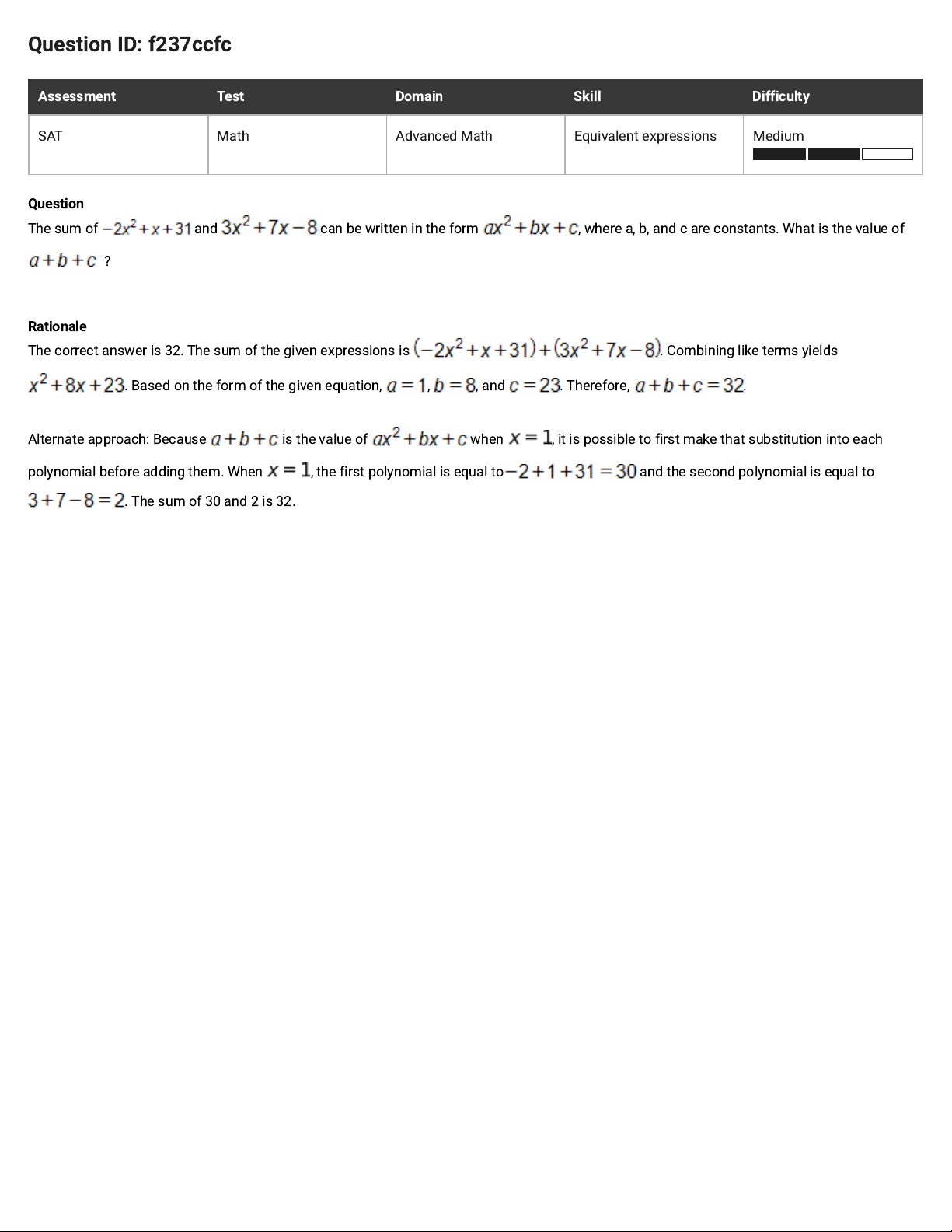
The sum of and can be written in the form , where a, b, and c are constants. What is the value of
?
Rationale
The correct answer is 32. The sum of the given expressions is . Combining like terms yields
. Based on the form of the given equation, , , and . Therefore, .
Alternate approach: Because is the value of when , it is possible to first make that substitution into each
polynomial before adding them. When , the first polynomial is equal to and the second polynomial is equal to
. The sum of 30 and 2 is 32.
Page 37
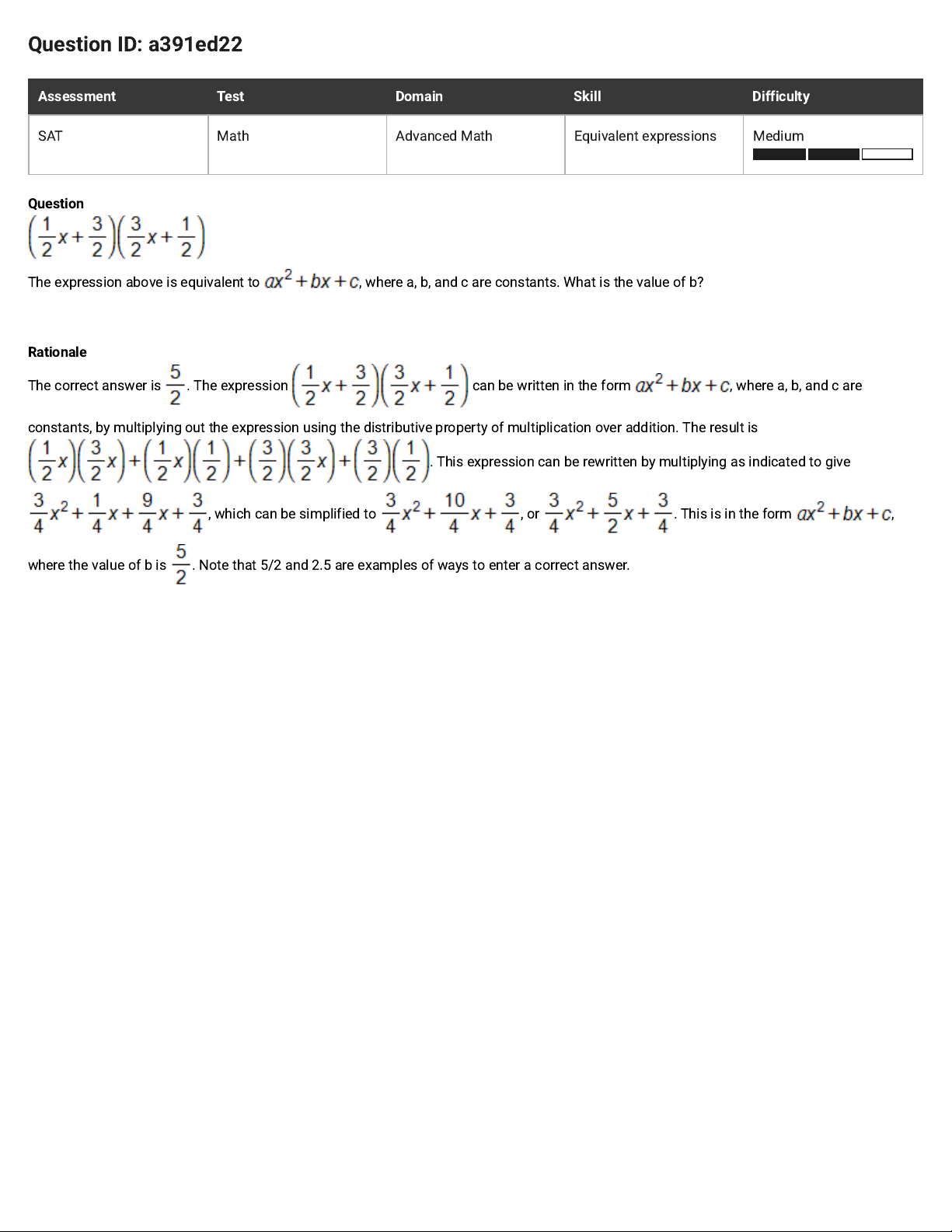
Question ID: a391ed22
Assessment Test Domain Skill Difficulty
SAT Math Advanced Math Equivalent expressions Medium
Question
The expression above is equivalent to , where a, b, and c are constants. What is the value of b?
Rationale
The correct answer is . The expression can be written in the form , where a, b, and c are
constants, by multiplying out the expression using the distributive property of multiplication over addition. The result is
. This expression can be rewritten by multiplying as indicated to give
, which can be simplified to , or . This is in the form ,
where the value of b is . Note that 5/2 and 2.5 are examples of ways to enter a correct answer.
Page 38
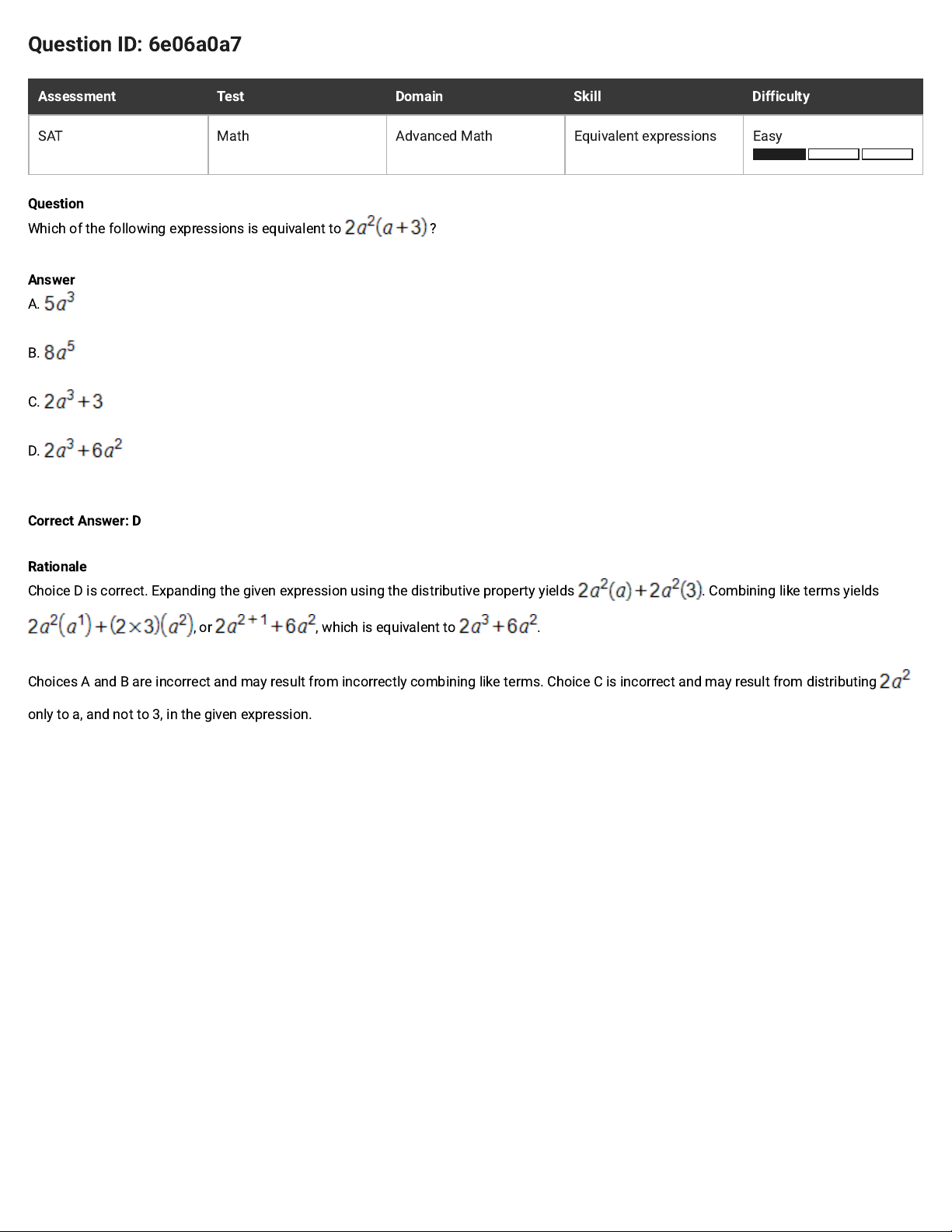
Question ID: 6e06a0a7
Assessment Test Domain Skill Difficulty
SAT Math Advanced Math Equivalent expressions Easy
Question
Which of the following expressions is equivalent to
?
Answer
A.
B.
C.
D.
Correct Answer: D
Rationale
Choice D is correct. Expanding the given expression using the distributive property yields . Combining like terms yields
, or , which is equivalent to .
Choices A and B are incorrect and may result from incorrectly combining like terms. Choice C is incorrect and may result from distributing
only to a, and not to 3, in the given expression.
Page 39
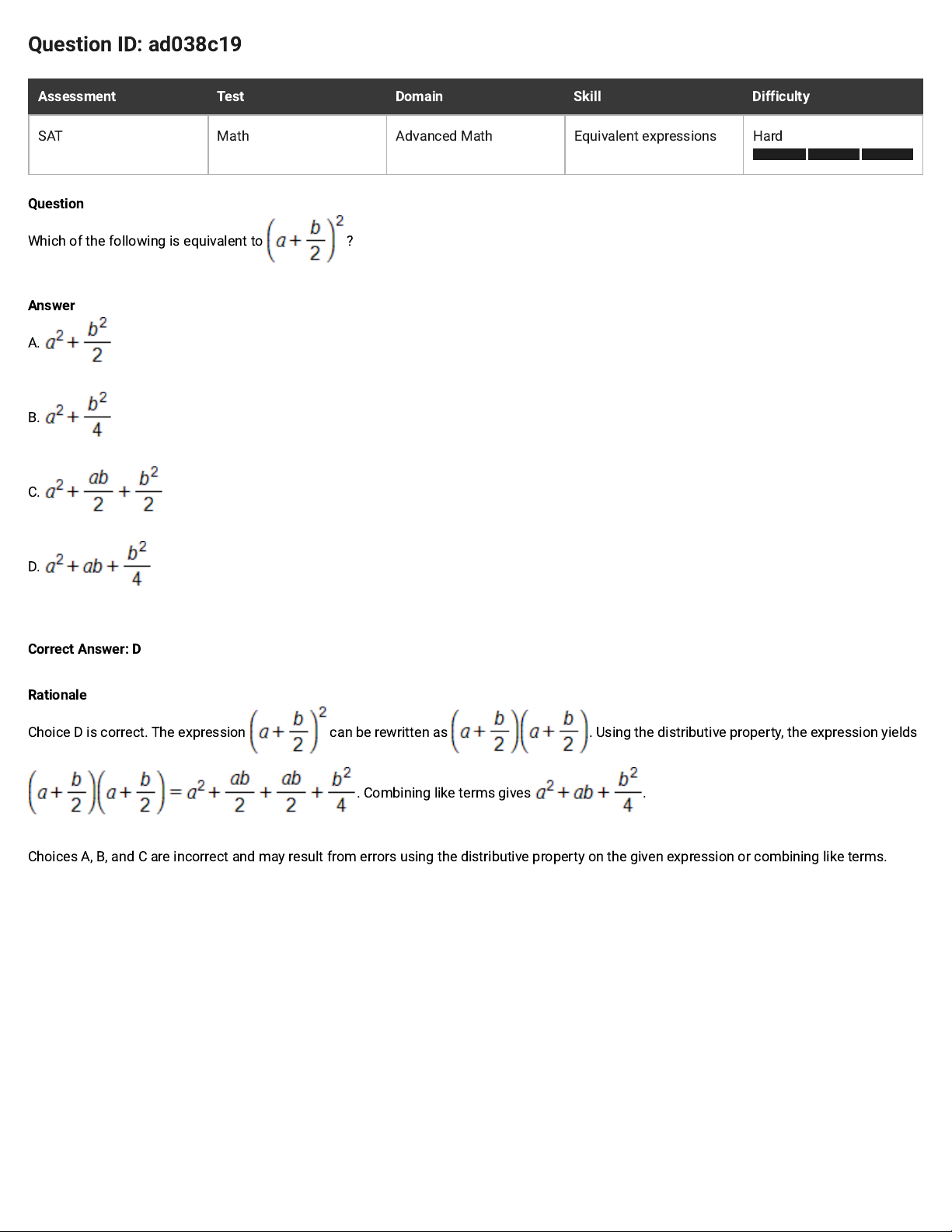
Question ID: ad038c19
Assessment Test Domain Skill Difficulty
SAT Math Advanced Math Equivalent expressions Hard
Question
Which of the following is equivalent to ?
Answer
A.
B.
C.
D.
Correct Answer: D
Rationale
Choice D is correct. The expression can be rewritten as . Using the distributive property, the expression yields
. Combining like terms gives .
Choices A, B, and C are incorrect and may result from errors using the distributive property on the given expression or combining like terms.
Page 40
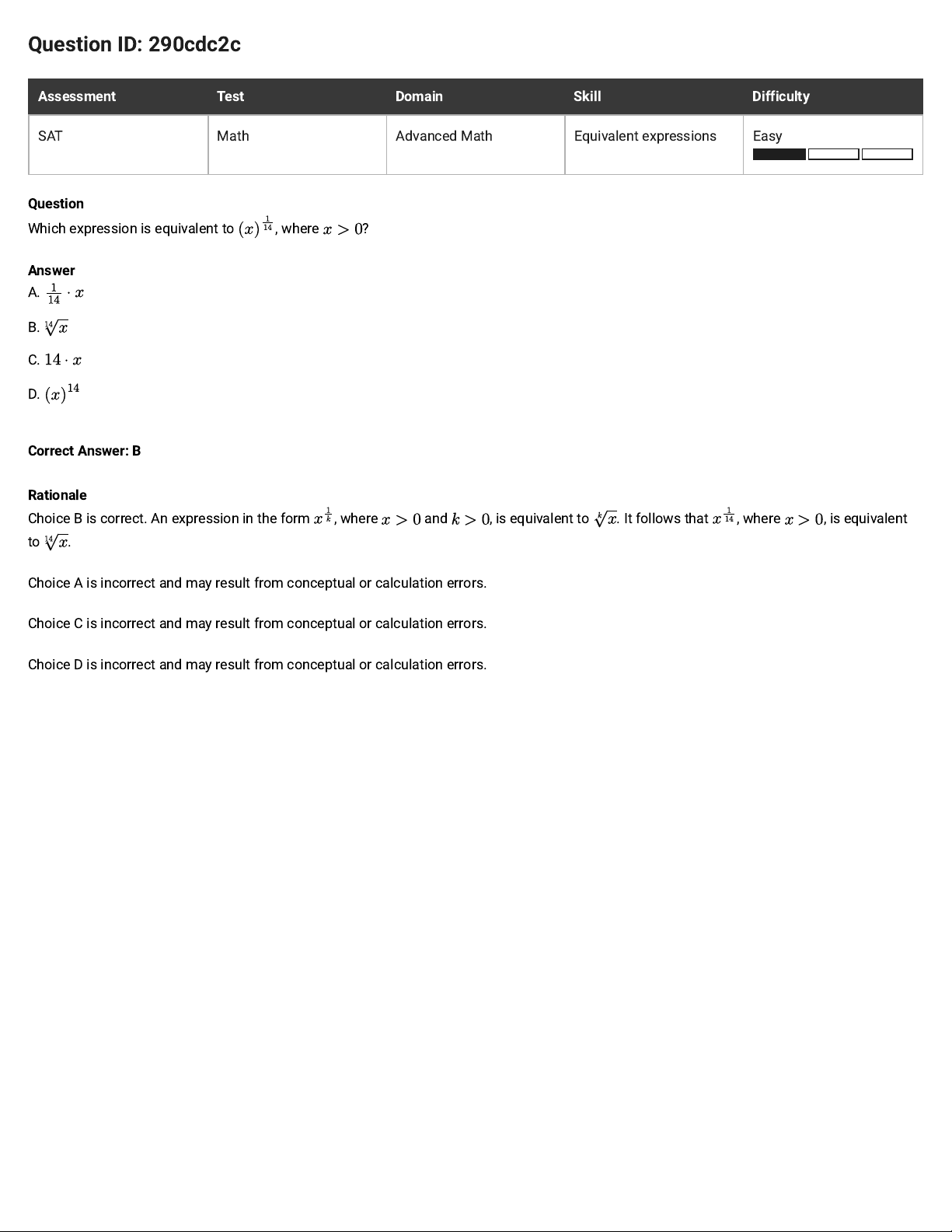
Question ID: 290cdc2c
Assessment Test Domain Skill Difficulty
SAT Math Advanced Math Equivalent expressions Easy
Question
Which expression is equivalent to , where ?
Answer
A.
B.
C.
D.
Correct Answer: B
Rationale
Choice B is correct. An expression in the form, where
and
, is equivalent to. It follows that, where
, is equivalent
to
.
Choice A is incorrect and may result from conceptual or calculation errors.
Choice C is incorrect and may result from conceptual or calculation errors.
Choice D is incorrect and may result from conceptual or calculation errors.
Page 41
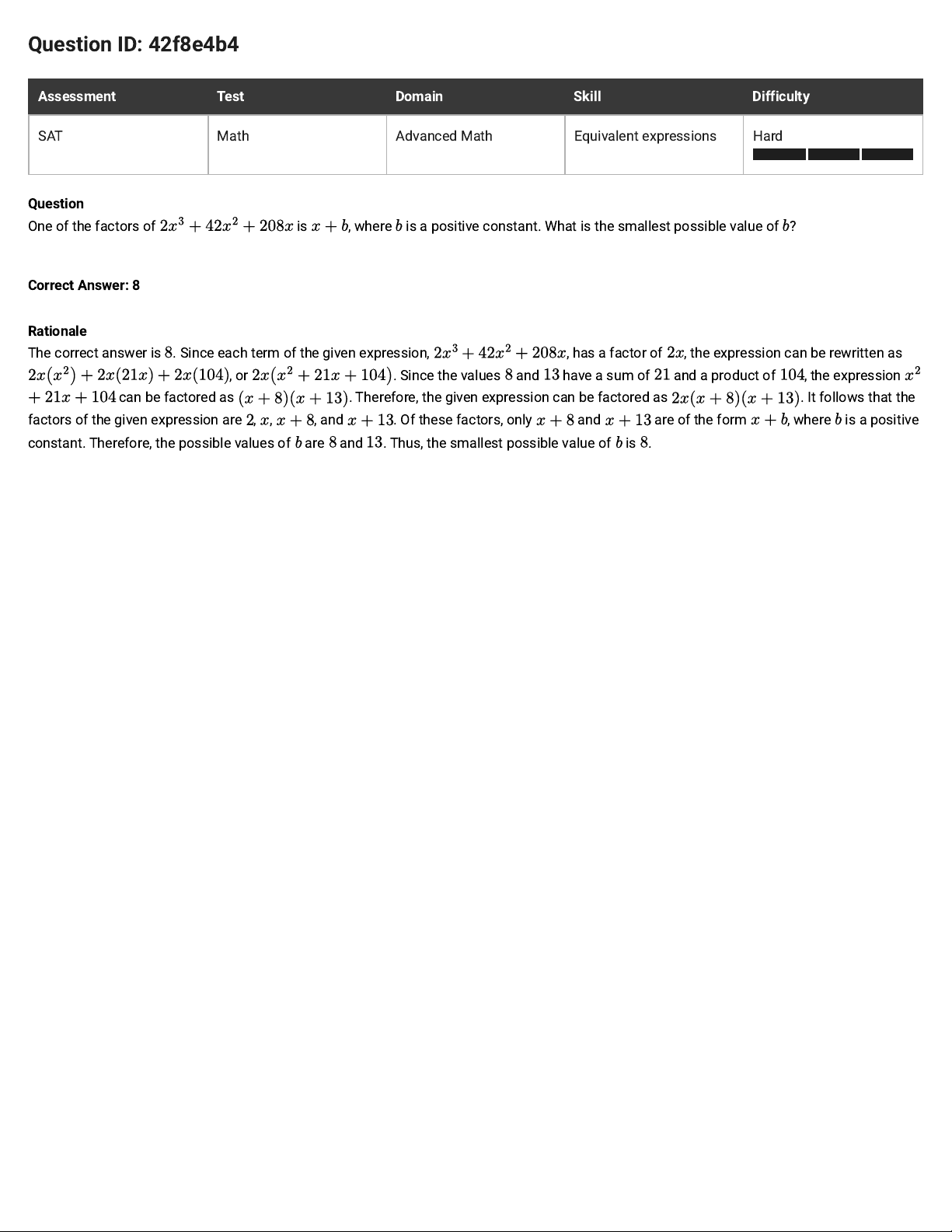
Question ID: 42f8e4b4
Assessment Test Domain Skill Difficulty
SAT Math Advanced Math Equivalent expressions Hard
Question
One of the factors of is , where is a positive constant. What is the smallest possible value of ?
Correct Answer: 8
Rationale
The correct answer is . Since each term of the given expression, , has a factor of , the expression can be rewritten as
, or
. Since the values and have a sum of and a product of , the expression
can be factored as
. Therefore, the given expression can be factored as
. It follows that the
factors of the given expression are , , , and . Of these factors, only and are of the form , where is a positive
constant. Therefore, the possible values of are and . Thus, the smallest possible value of is .
Page 42
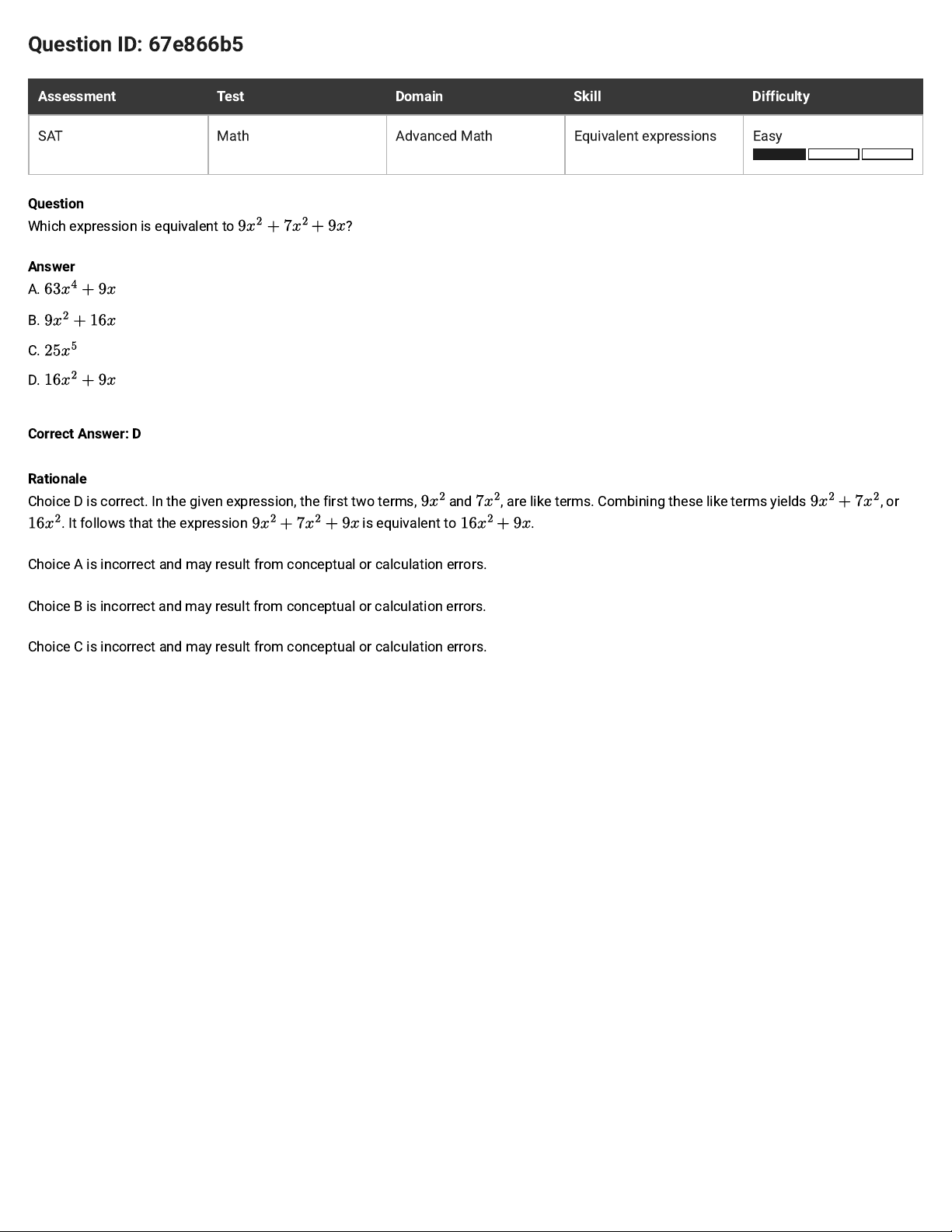
Question ID: 67e866b5
Assessment Test Domain Skill Difficulty
SAT Math Advanced Math Equivalent expressions Easy
Which expression is equivalent to ?
A.
B.
C.
D.
Choice D is correct. In the given expression, the first two terms, and , are like terms. Combining these like terms yields , or
. It follows that the expression
is equivalent to .
Choice A is incorrect and may result from conceptual or calculation errors.
Choice B is incorrect and may result from conceptual or calculation errors.
Choice C is incorrect and may result from conceptual or calculation errors.
Page 43
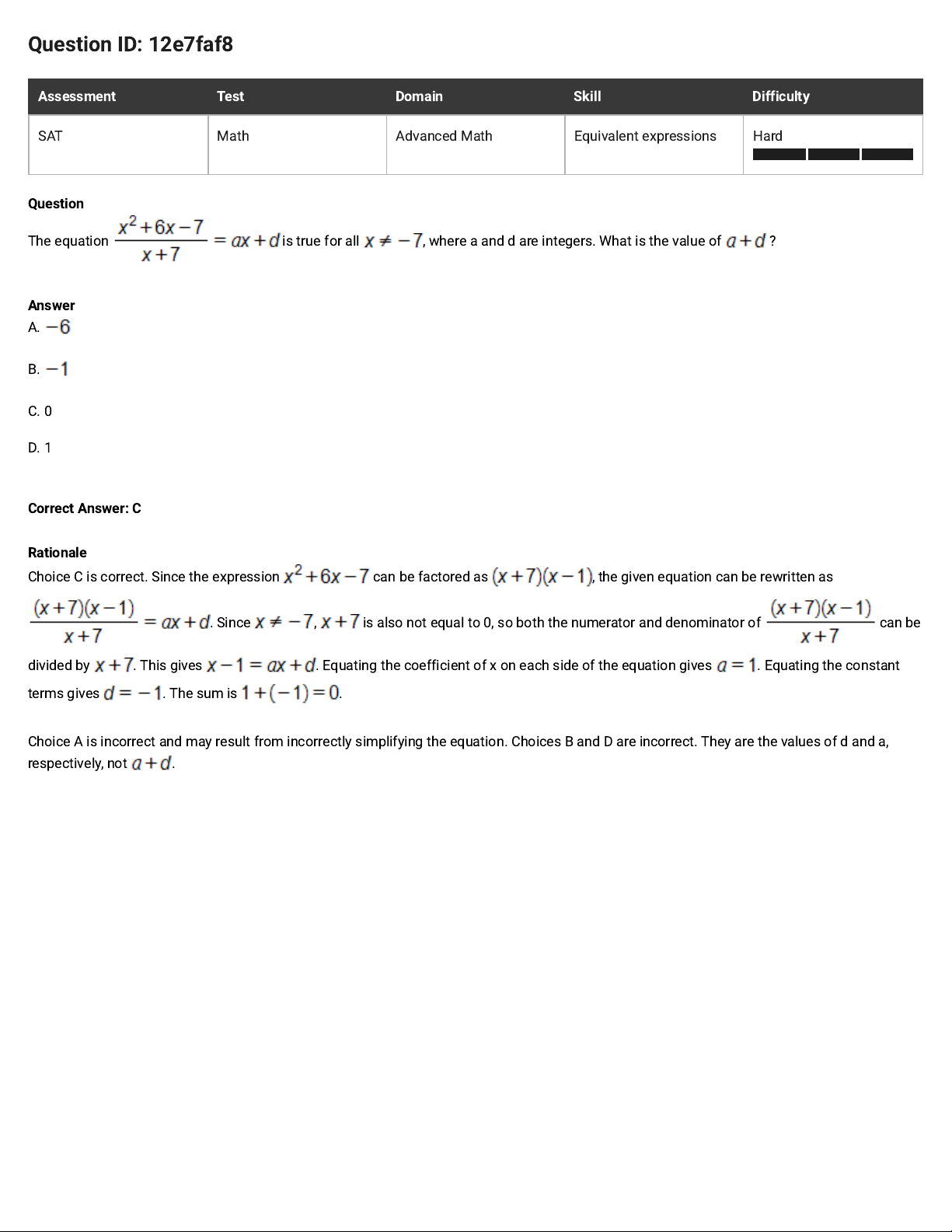
Question ID: 12e7faf8
Assessment Test Domain Skill Difficulty
SAT Math Advanced Math Equivalent expressions Hard
Question
The equation is true for all , where a and d are integers. What is the value of ?
Answer
A.
B.
C. 0
D. 1
Correct Answer: C
Rationale
Choice C is correct. Since the expression can be factored as , the given equation can be rewritten as
. Since , is also not equal to 0, so both the numerator and denominator of can be
divided by . This gives . Equating the coefficient of x on each side of the equation gives . Equating the constant
terms gives . The sum is .
Choice A is incorrect and may result from incorrectly simplifying the equation. Choices B and D are incorrect. They are the values of d and a,
respectively, not .
Page 44
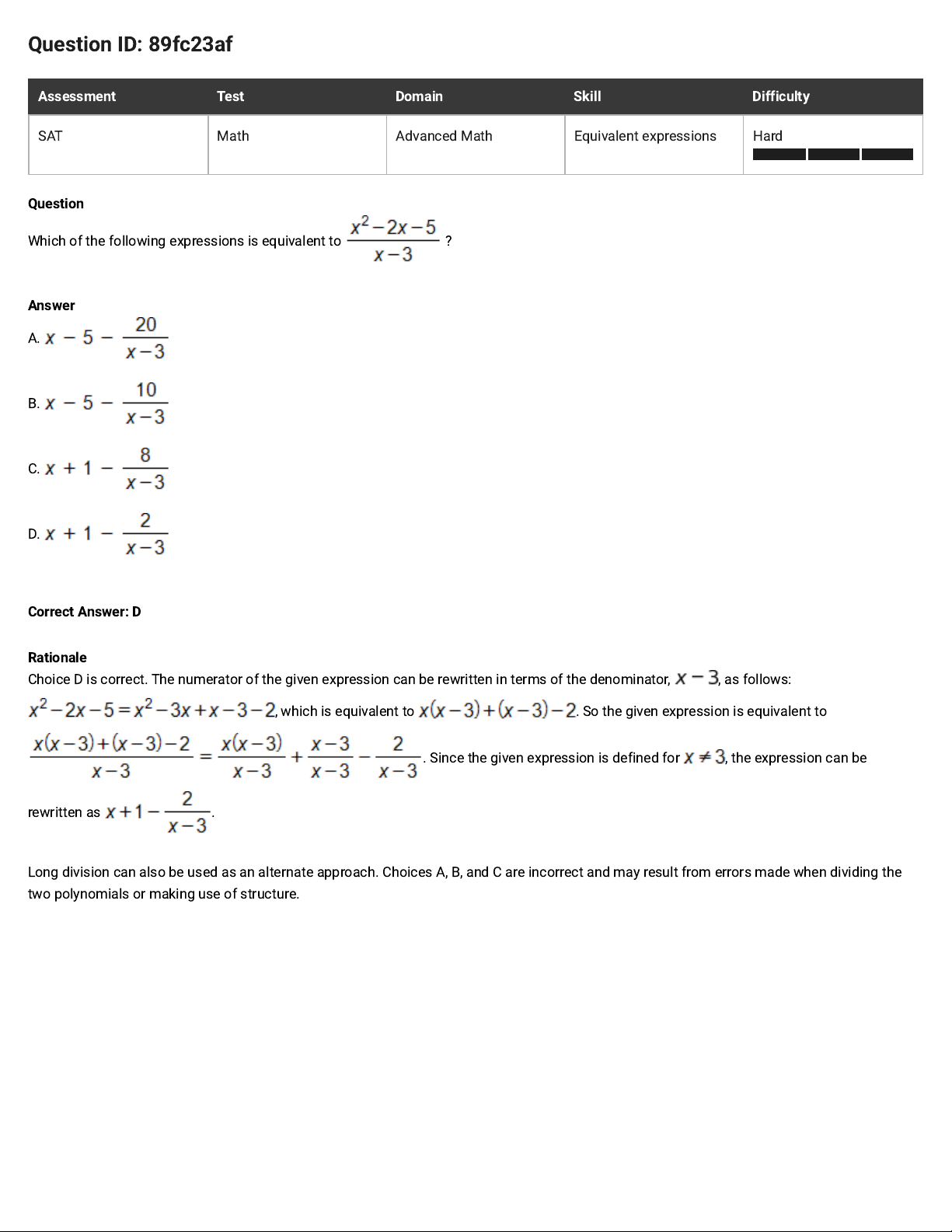
Question ID: 89fc23af
Assessment Test Domain Skill Difficulty
SAT Math Advanced Math Equivalent expressions Hard
Question
Which of the following expressions is equivalent to ?
Answer
A.
B.
C.
D.
Correct Answer: D
Rationale
Choice D is correct. The numerator of the given expression can be rewritten in terms of the denominator, , as follows:
, which is equivalent to . So the given expression is equivalent to
. Since the given expression is defined for , the expression can be
rewritten as .
Long division can also be used as an alternate approach. Choices A, B, and C are incorrect and may result from errors made when dividing the
two polynomials or making use of structure.
Page 45
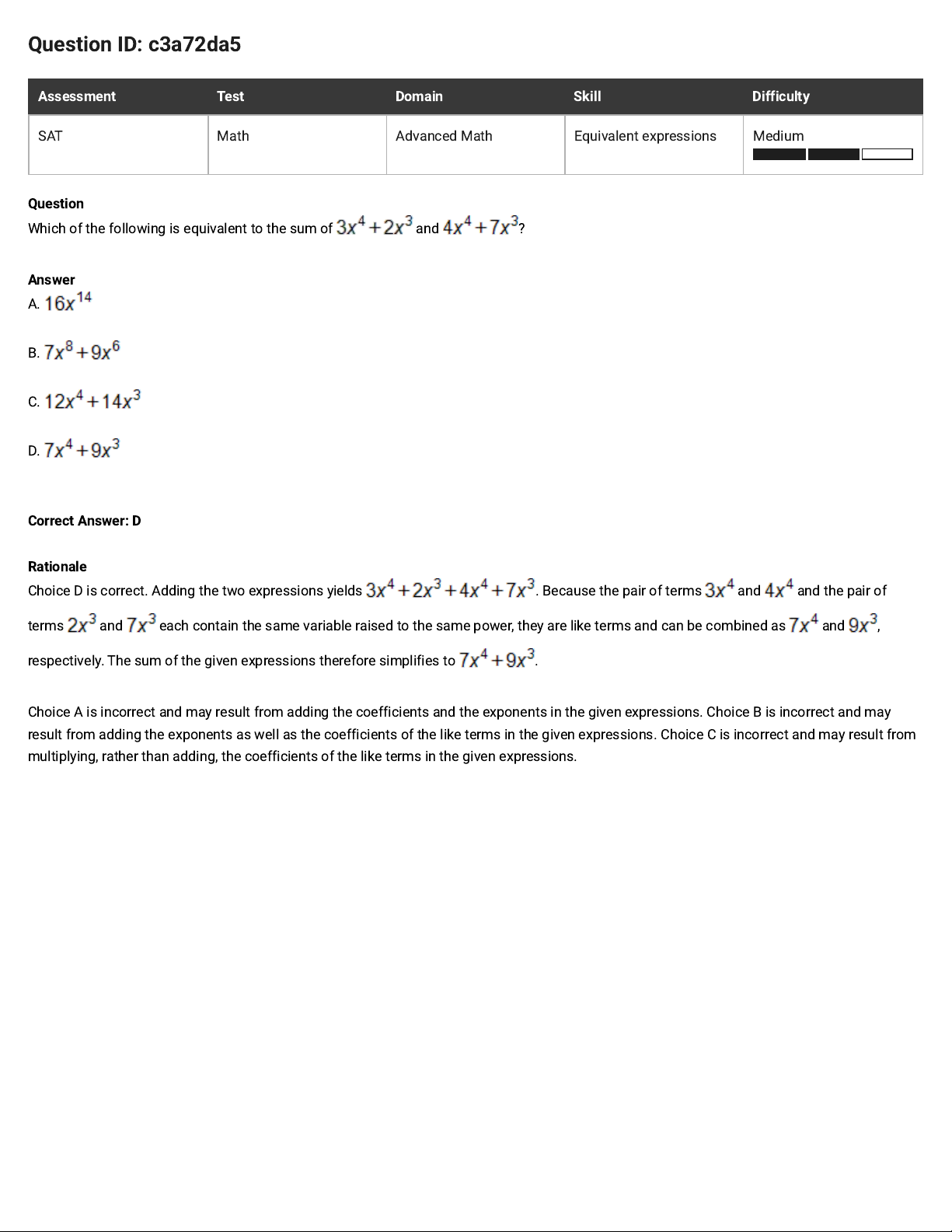
Question ID: c3a72da5
Assessment Test Domain Skill Difficulty
SAT Math Advanced Math Equivalent expressions Medium
Question
Which of the following is equivalent to the sum of and ?
Answer
A.
B.
C.
D.
Correct Answer: D
Rationale
Choice D is correct. Adding the two expressions yields . Because the pair of terms and and the pair of
terms and each contain the same variable raised to the same power, they are like terms and can be combined as and ,
respectively. The sum of the given expressions therefore simplifies to .
Choice A is incorrect and may result from adding the coefficients and the exponents in the given expressions. Choice B is incorrect and may
result from adding the exponents as well as the coefficients of the like terms in the given expressions. Choice C is incorrect and may result from
multiplying, rather than adding, the coefficients of the like terms in the given expressions.
Page 46
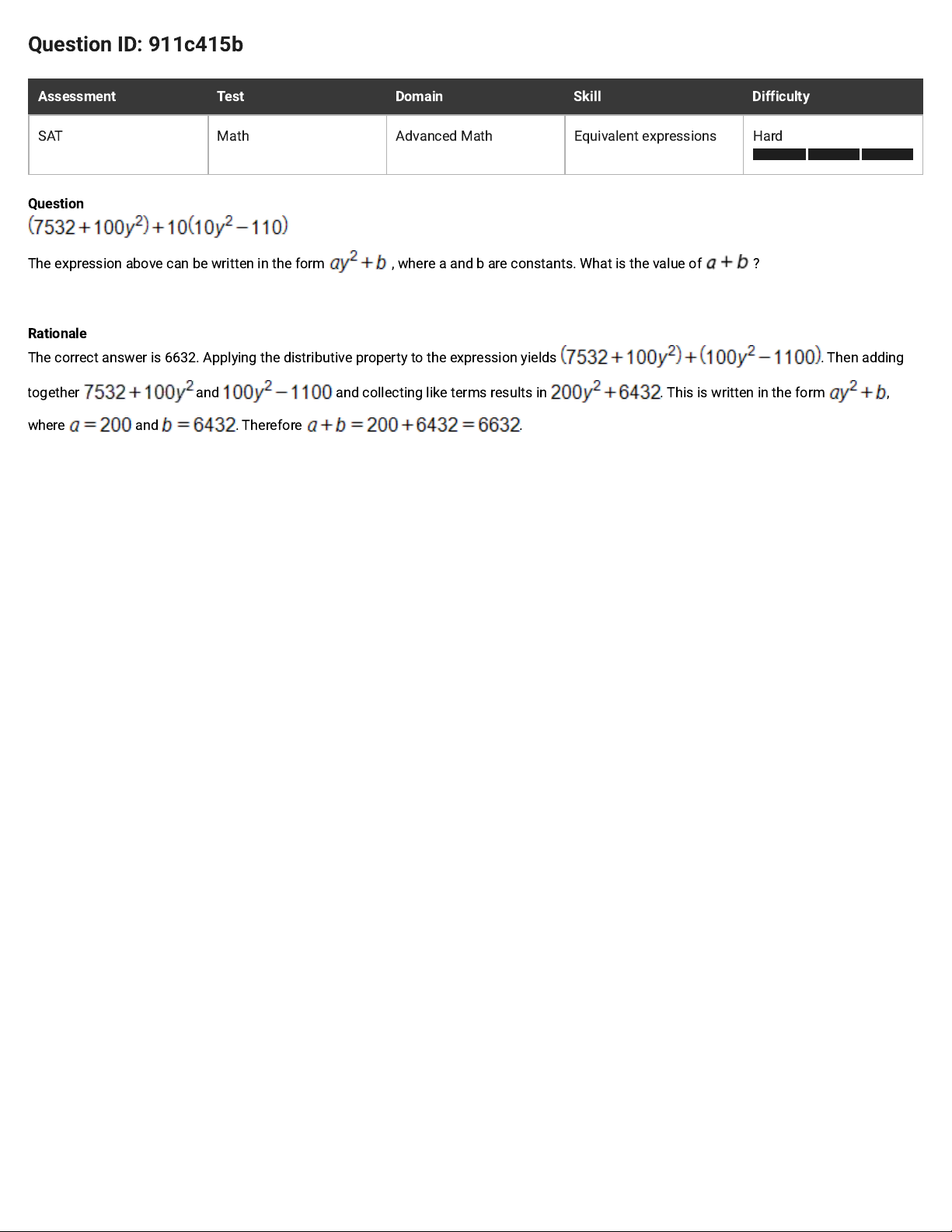
Question ID: 911c415b
Assessment Test Domain Skill Difficulty
SAT Math Advanced Math Equivalent expressions Hard
Question
The expression above can be written in the form , where a and b are constants. What is the value of ?
Rationale
The correct answer is 6632. Applying the distributive property to the expression yields . Then adding
together and and collecting like terms results in . This is written in the form ,
where and . Therefore .
Page 47
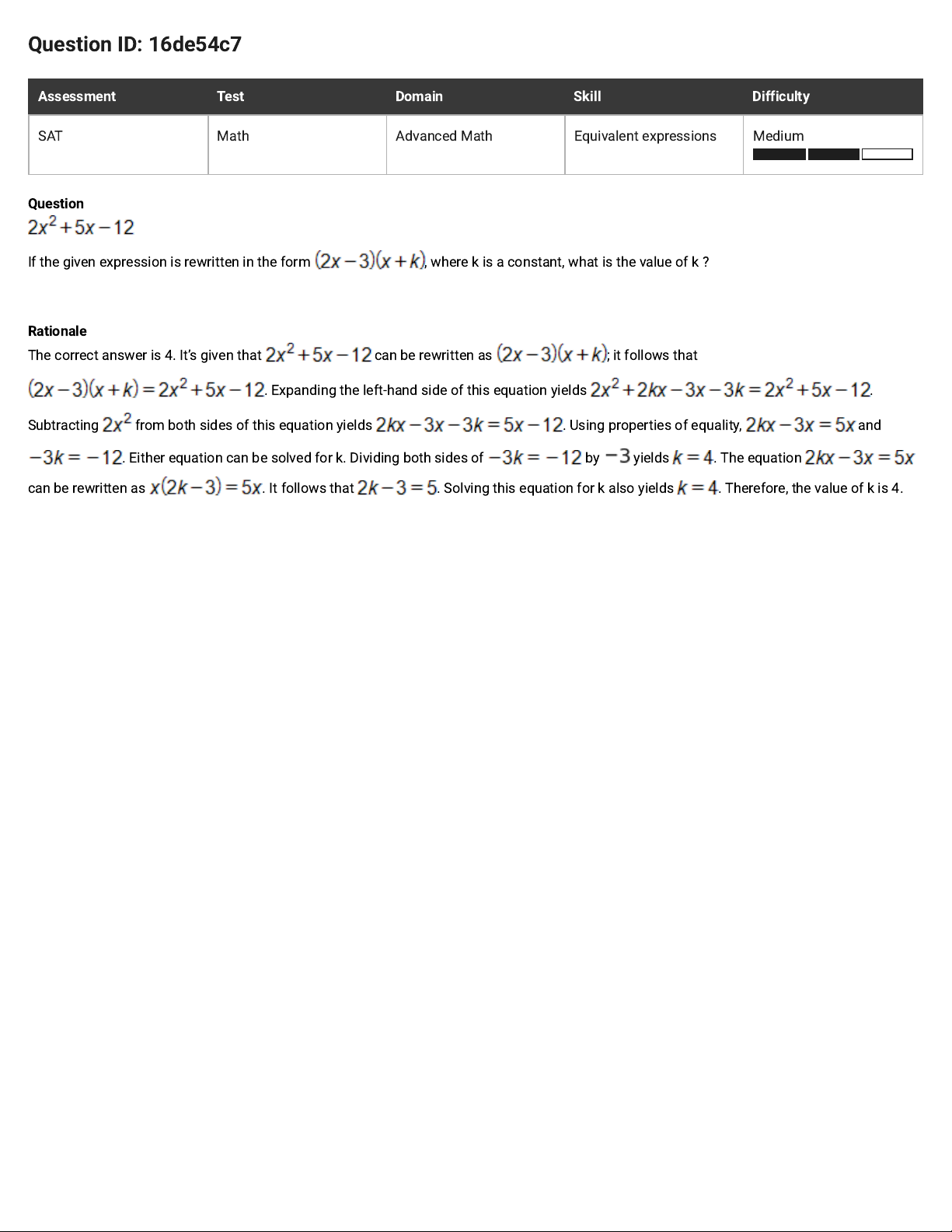
Question ID: 16de54c7
Assessment Test Domain Skill Difficulty
SAT Math Advanced Math Equivalent expressions Medium
Question
If the given expression is rewritten in the form , where k is a constant, what is the value of k?
Rationale
The correct answer is 4. It’s given that can be rewritten as ; it follows that
. Expanding the left-hand side of this equation yields .
Subtracting from both sides of this equation yields . Using properties of equality, and
. Either equation can be solved for k. Dividing both sides of by yields . The equation
can be rewritten as . It follows that . Solving this equation for k also yields . Therefore, the value of k is 4.
Page 48
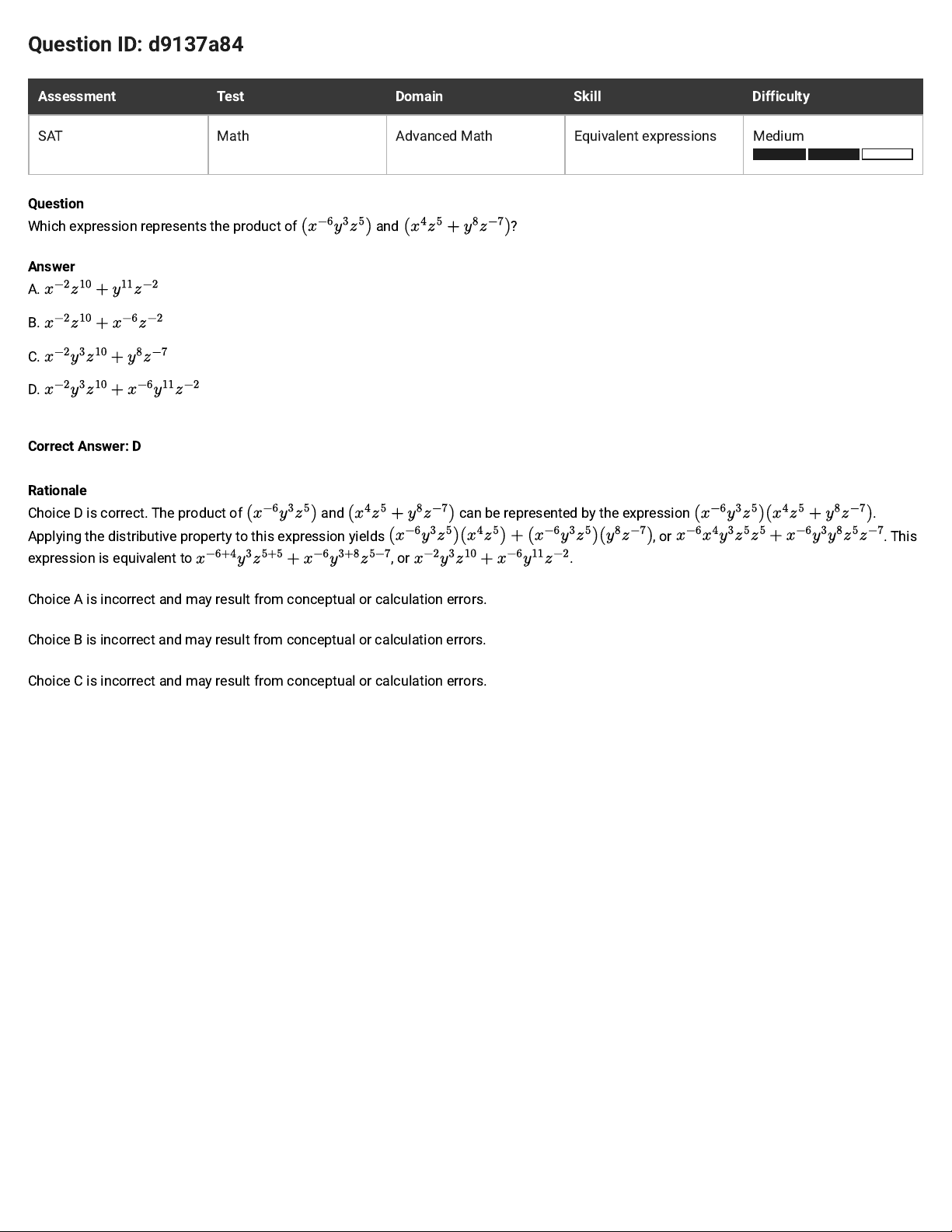
Question ID: d9137a84
Assessment Test Domain Skill Difficulty
SAT Math Advanced Math Equivalent expressions Medium
Question
Which expression represents the product of
and
?
Answer
A.
B.
C.
D.
Correct Answer: D
Rationale
Choice D is correct. The product of
and
can be represented by the expression
.
Applying the distributive property to this expression yields
, or
. This
expression is equivalent to
, or
.
Choice A is incorrect and may result from conceptual or calculation errors.
Choice B is incorrect and may result from conceptual or calculation errors.
Choice C is incorrect and may result from conceptual or calculation errors.
Page 49
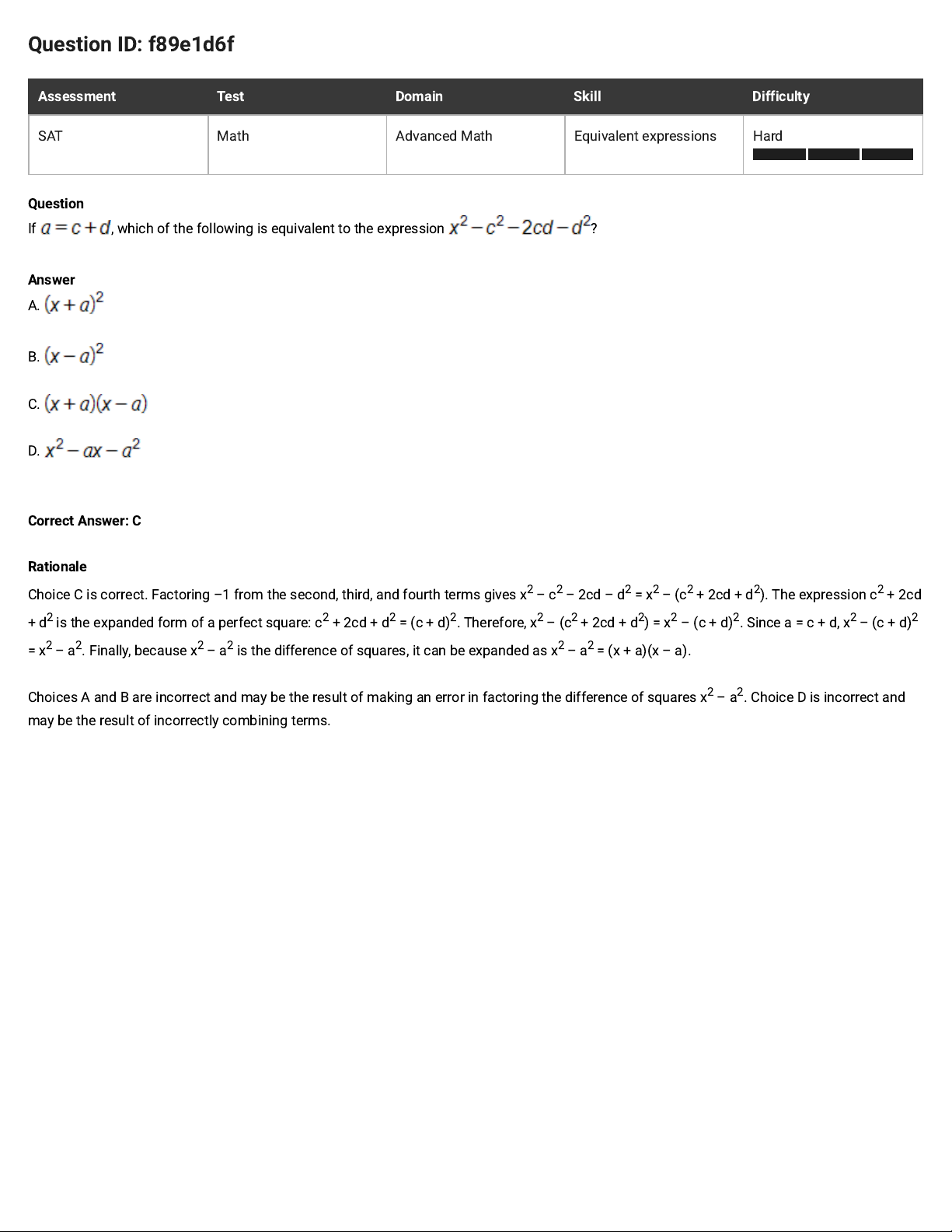
Question ID: f89e1d6f
Assessment Test Domain Skill Difficulty
SAT Math Advanced Math Equivalent expressions Hard
Question
If , which of the following is equivalent to the expression ?
Answer
A.
B.
C.
D.
Correct Answer: C
Rationale
Choice C is correct. Factoring –1 from the second, third, and fourth terms gives x2 –
c2 –
2cd – d2 = x2 –
(c2 + 2cd + d2). The expression c2 + 2cd
+ d2 is the expanded form of a perfect square: c2 + 2cd + d2 = (c + d)2. Therefore, x2 –
(c2 + 2cd + d2) = x2 – (c + d)2. Since a = c + d, x2 –
(c + d)
2
= x2 –
a2. Finally, because x2 –
a2 is the difference of squares, it can be expanded as x2 –
a2 = (x + a)(x – a).
Choices A and B are incorrect and may be the result of making an error in factoring the difference of squares x2 –
a2. Choice D is incorrect and
may be the result of incorrectly combining terms.
Page 50
Question ID: df0ef054
Assessment Test Domain Skill Difficulty
SAT Math Advanced Math Equivalent expressions Easy
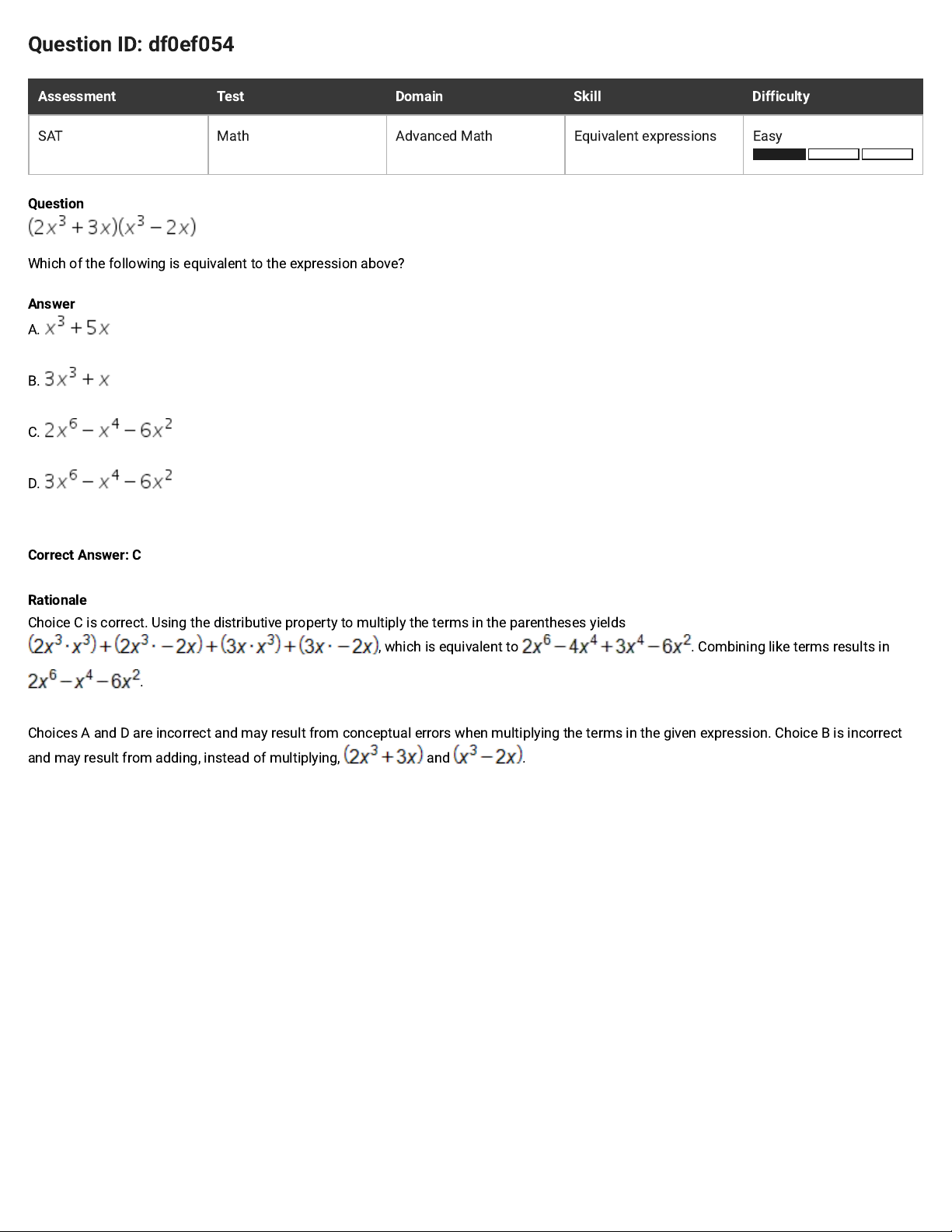
Question
Which of the following is equivalent to the expression above?
Answer
A.
B.
C.
D.
Correct Answer: C
Rationale
Choice C is correct. Using the distributive property to multiply the terms in the parentheses yields
, which is equivalent to . Combining like terms results in
.
Choices A and D are incorrect and may result from conceptual errors when multiplying the terms in the given expression. Choice B is incorrect
and may result from adding, instead of multiplying, and .
Page 51
Question ID: 3e9cc0c2
Assessment Test Domain Skill Difficulty
SAT Math Advanced Math Equivalent expressions Medium
Question
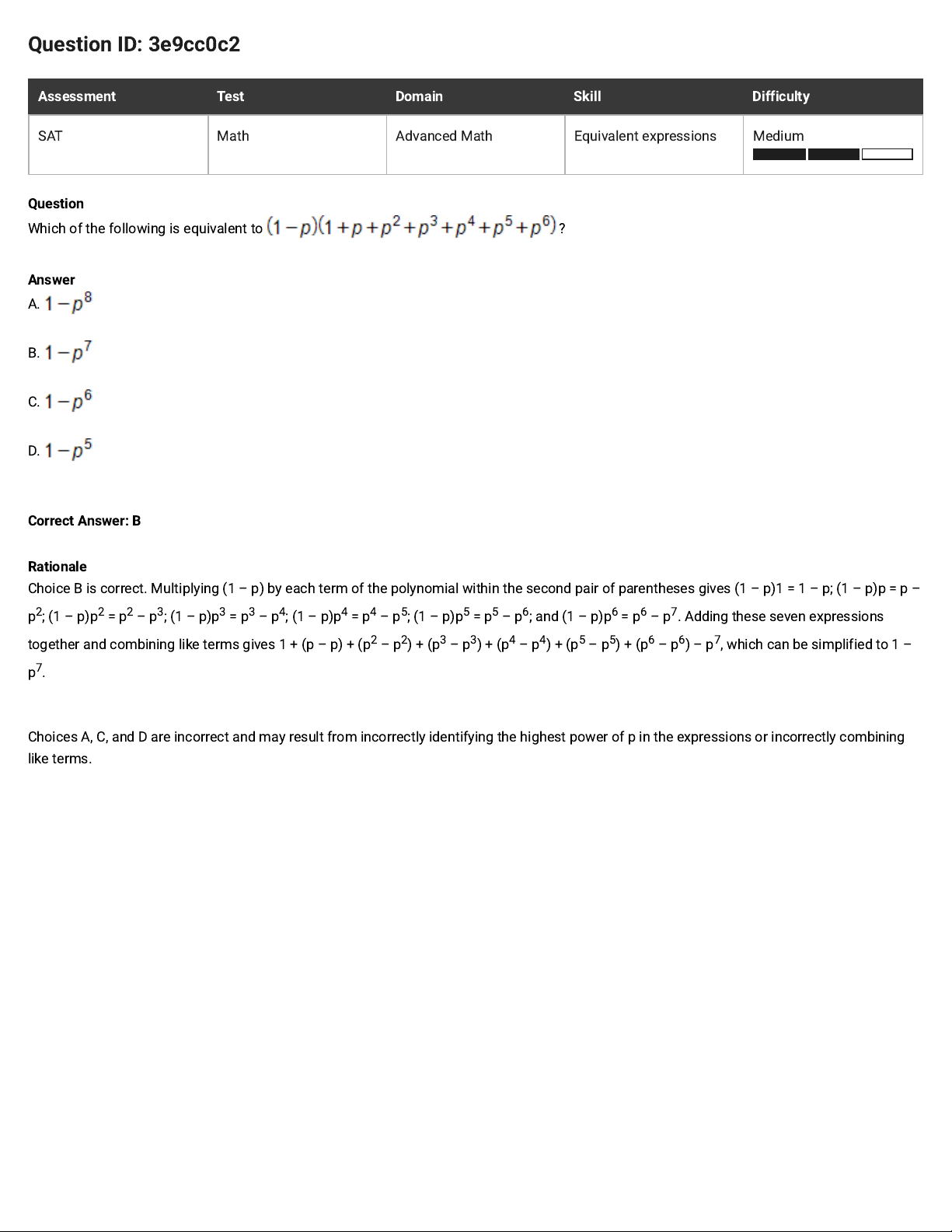
Which of the following is equivalent to
?
Answer
A.
B.
C.
D.
Correct Answer: B
Rationale
Choice B is correct. Multiplying (1 – p) by each term of the polynomial within the second pair of parentheses gives (1 – p)1 = 1 – p; (1 – p)p = p
–
p2; (1 – p)p2 = p2 – p3; (1 – p)p3 = p3 – p4; (1 – p)p4 = p4 – p5; (1 – p)p5 = p5 – p6; and (1 – p)p6 = p6 – p7. Adding these seven expressions
together and combining like terms gives1 + (p–
p) + (p2– p2) + (p3– p3) + (p4– p4) + (p5– p5) + (p6– p6) – p7, which can be simplified to 1
–
p7.
Choices A, C, and D are incorrect and may result from incorrectly identifying the highest power of p in the expressions or incorrectly combining
like terms.
Page 52
Question ID: 7348f046
Assessment Test Domain Skill Difficulty
SAT Math Advanced Math Equivalent expressions Medium
Question
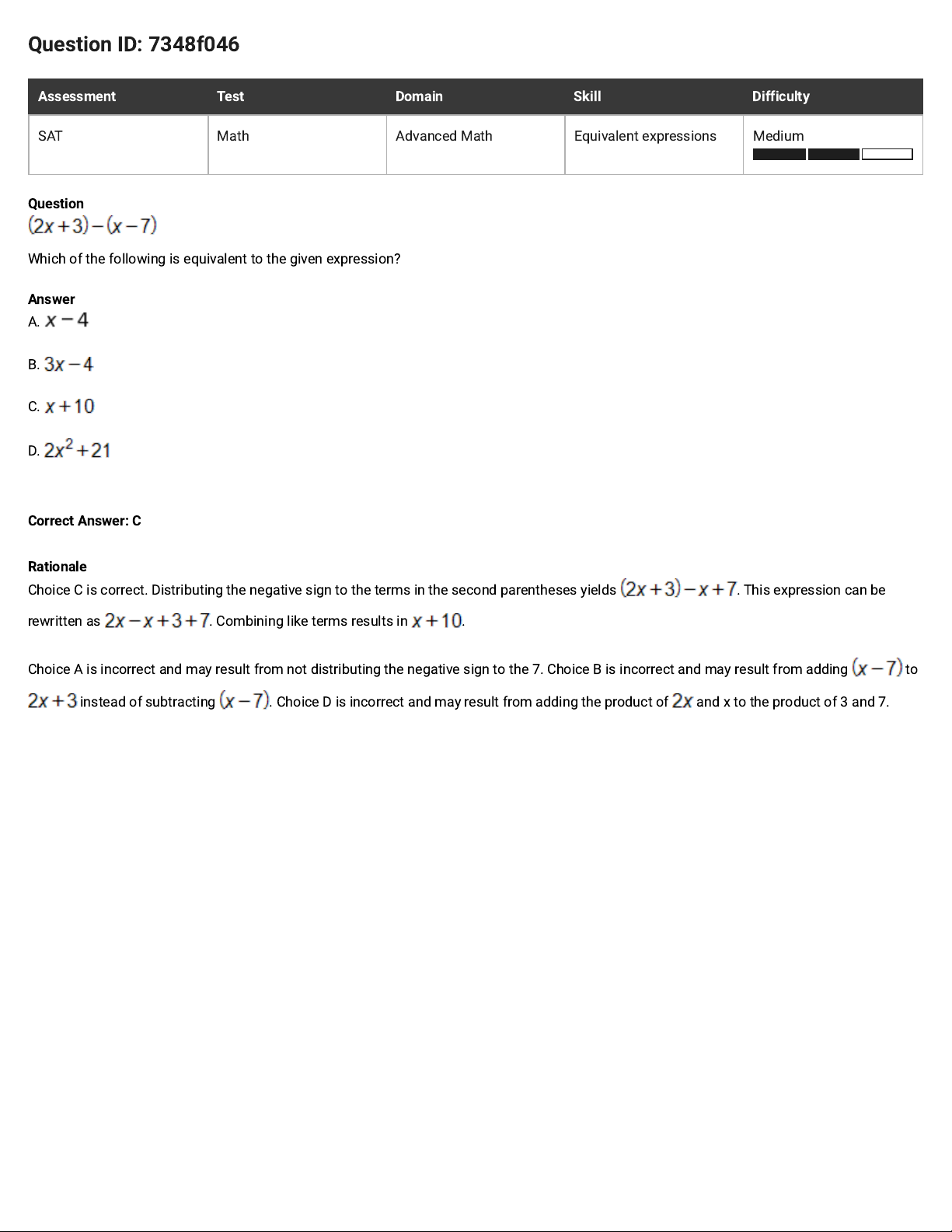
Which of the following is equivalent to the given expression?
Answer
A.
B.
C.
D.
Correct Answer: C
Rationale
Choice C is correct. Distributing the negative sign to the terms in the second parentheses yields . This expression can be
rewritten as . Combining like terms results in .
Choice A is incorrect and may result from not distributing the negative sign to the 7. Choice B is incorrect and may result from adding to
instead of subtracting . Choice D is incorrect and may result from adding the product of and x to the product of 3 and 7.
Page 53
Question ID: b47419f4
Assessment Test Domain Skill Difficulty
SAT Math Advanced Math Equivalent expressions Medium
Question
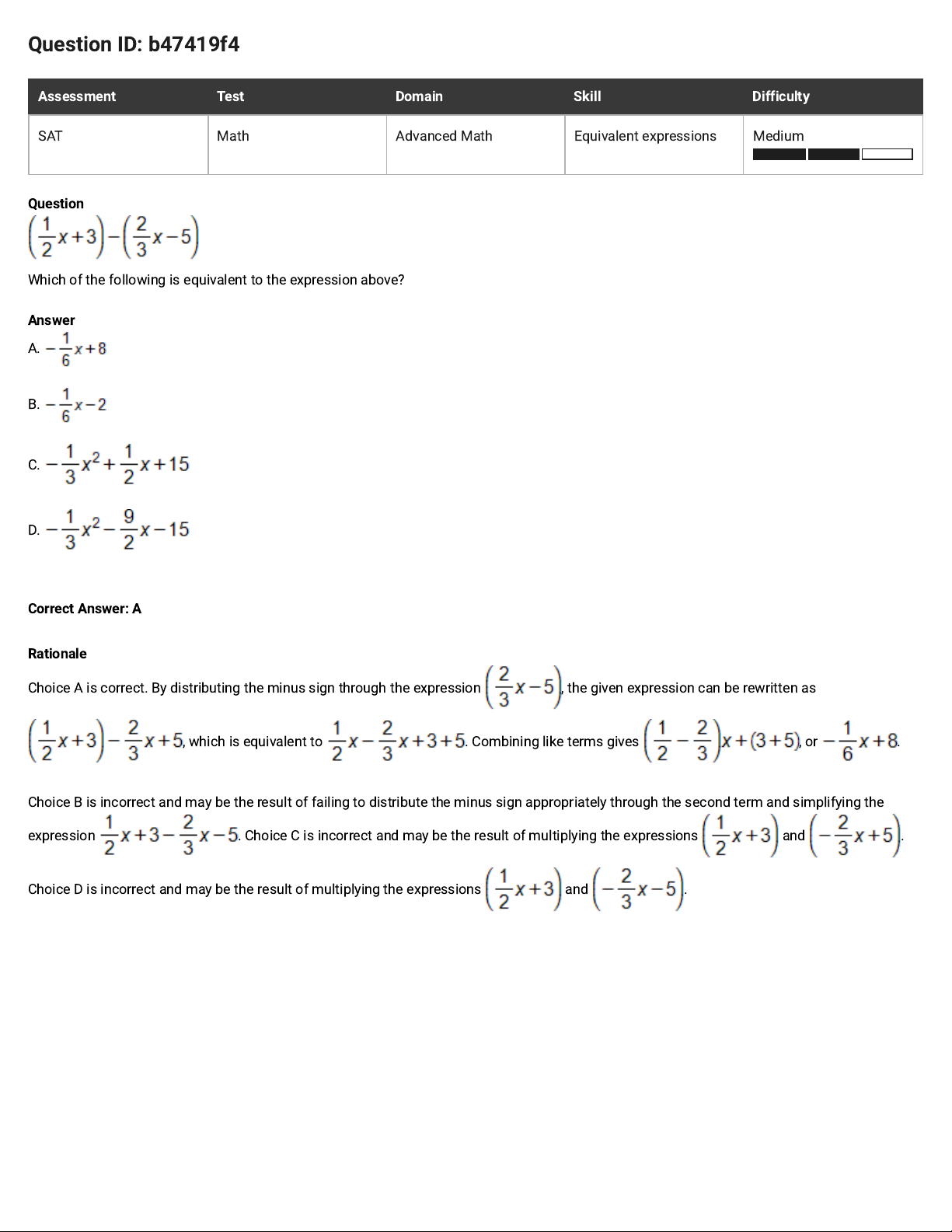
Which of the following is equivalent to the expression above?
Answer
A.
B.
C.
D.
Correct Answer: A
Rationale
Choice A is correct. By distributing the minus sign through the expression , the given expression can be rewritten as
, which is equivalent to . Combining like terms gives , or .
Choice B is incorrect and may be the result of failing to distribute the minus sign appropriately through the second term and simplifying the
expression . Choice C is incorrect and may be the result of multiplying the expressions
and .
Choice D is incorrect and may be the result of multiplying the expressions and .
Page 54
Question ID: 8838a672
Assessment Test Domain Skill Difficulty
SAT Math Advanced Math Equivalent expressions Medium
Question
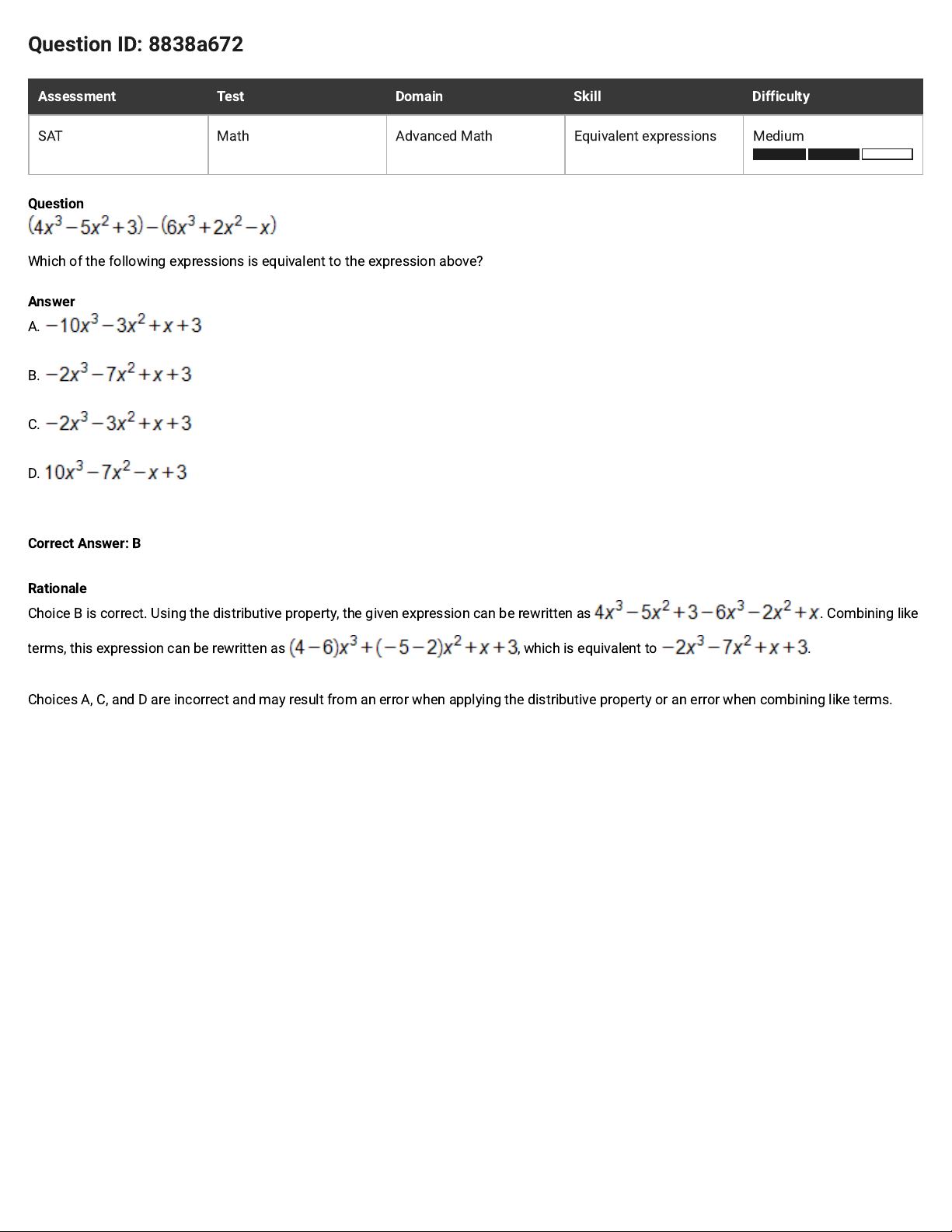
Which of the following expressions is equivalent to the expression above?
Answer
A.
B.
C.
D.
Correct Answer: B
Rationale
Choice B is correct. Using the distributive property, the given expression can be rewritten as . Combining like
terms, this expression can be rewritten as , which is equivalent to .
Choices A, C, and D are incorrect and may result from an error when applying the distributive property or an error when combining like terms.
Page 55
Question ID: 0b3d25c5
Assessment Test Domain Skill Difficulty
SAT Math Advanced Math Equivalent expressions Medium
Question
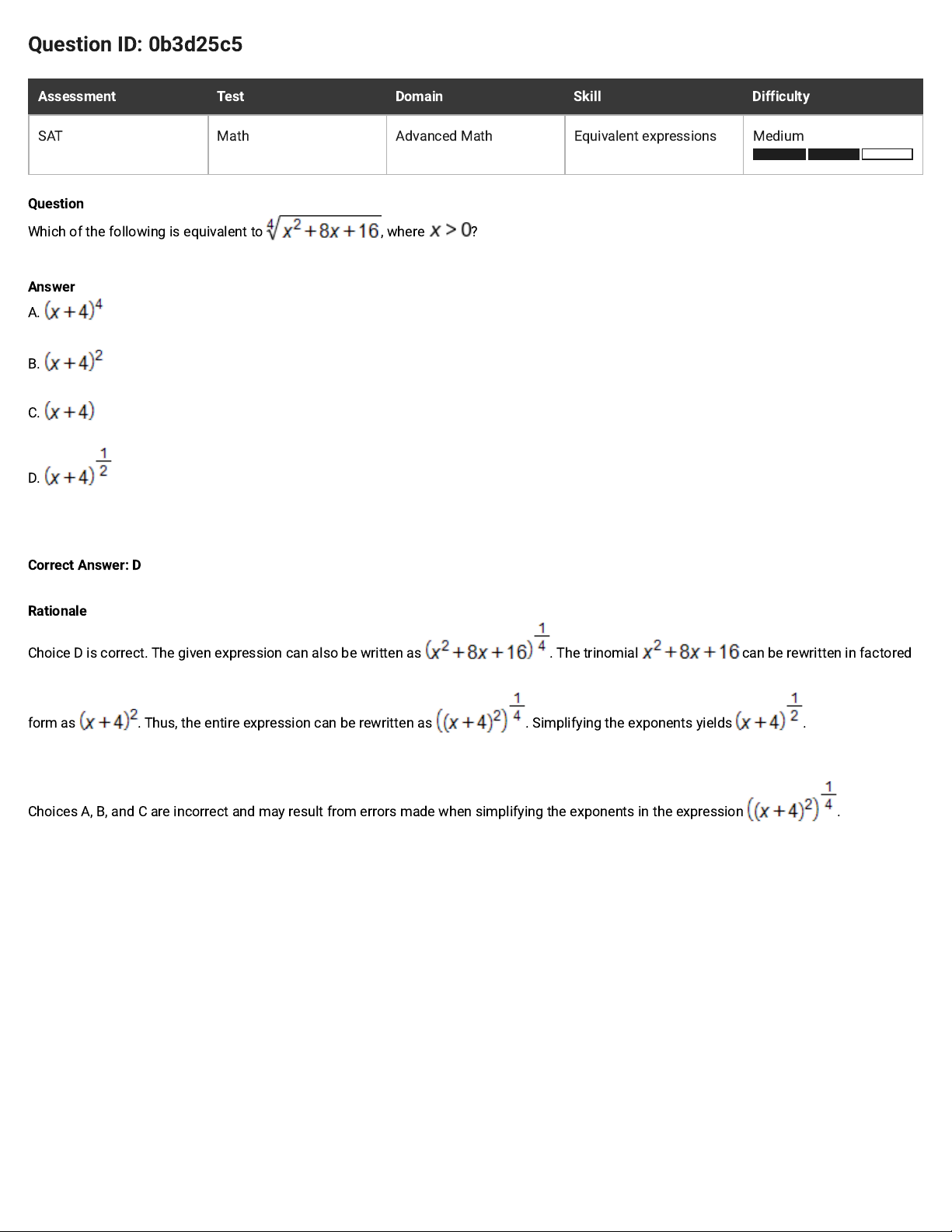
Which of the following is equivalent to , where ?
Answer
A.
B.
C.
D.
Correct Answer: D
Rationale
Choice D is correct. The given expression can also be written as . The trinomial can be rewritten in factored
form as . Thus, the entire expression can be rewritten as . Simplifying the exponents yields .
Choices A, B, and C are incorrect and may result from errors made when simplifying the exponents in the expression .
Page 56
Question ID: e117d3b8
Assessment Test Domain Skill Difficulty
SAT Math Advanced Math Equivalent expressions Hard
Question
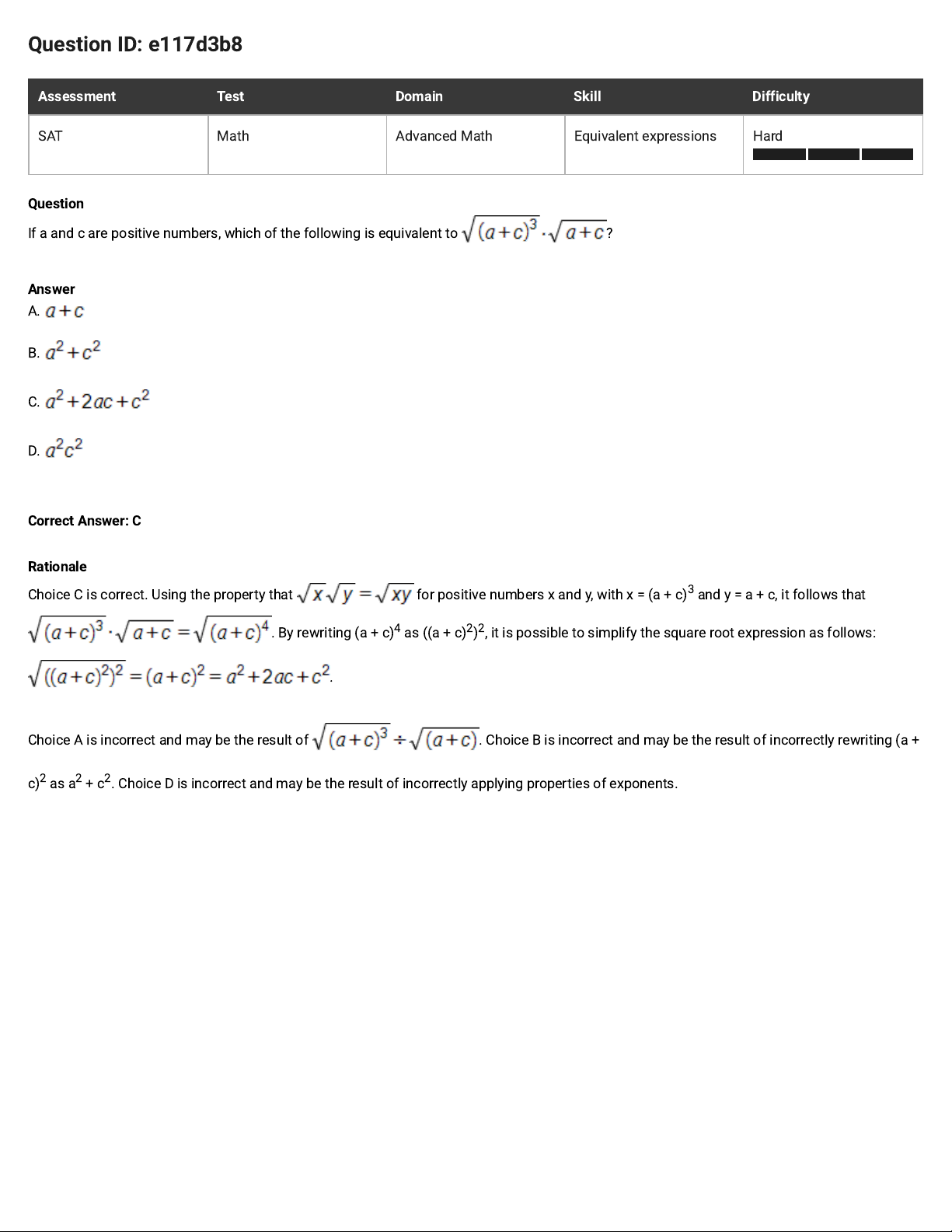
If a and c are positive numbers, which of the following is equivalent to ?
Answer
A.
B.
C.
D.
Correct Answer: C
Rationale
Choice C is correct. Using the property that
for positive numbers x and y, with x = (a + c)3 and y = a + c, it follows that
. By rewriting (a + c)4 as ((a + c)2)2, it is possible to simplify the square root expression as follows:
.
Choice A is incorrect and may be the result of . Choice B is incorrect and may be the result of incorrectly rewriting (a +
c)2 as a2 + c2. Choice D is incorrect and may be the result of incorrectly applying properties of exponents.
Page 57
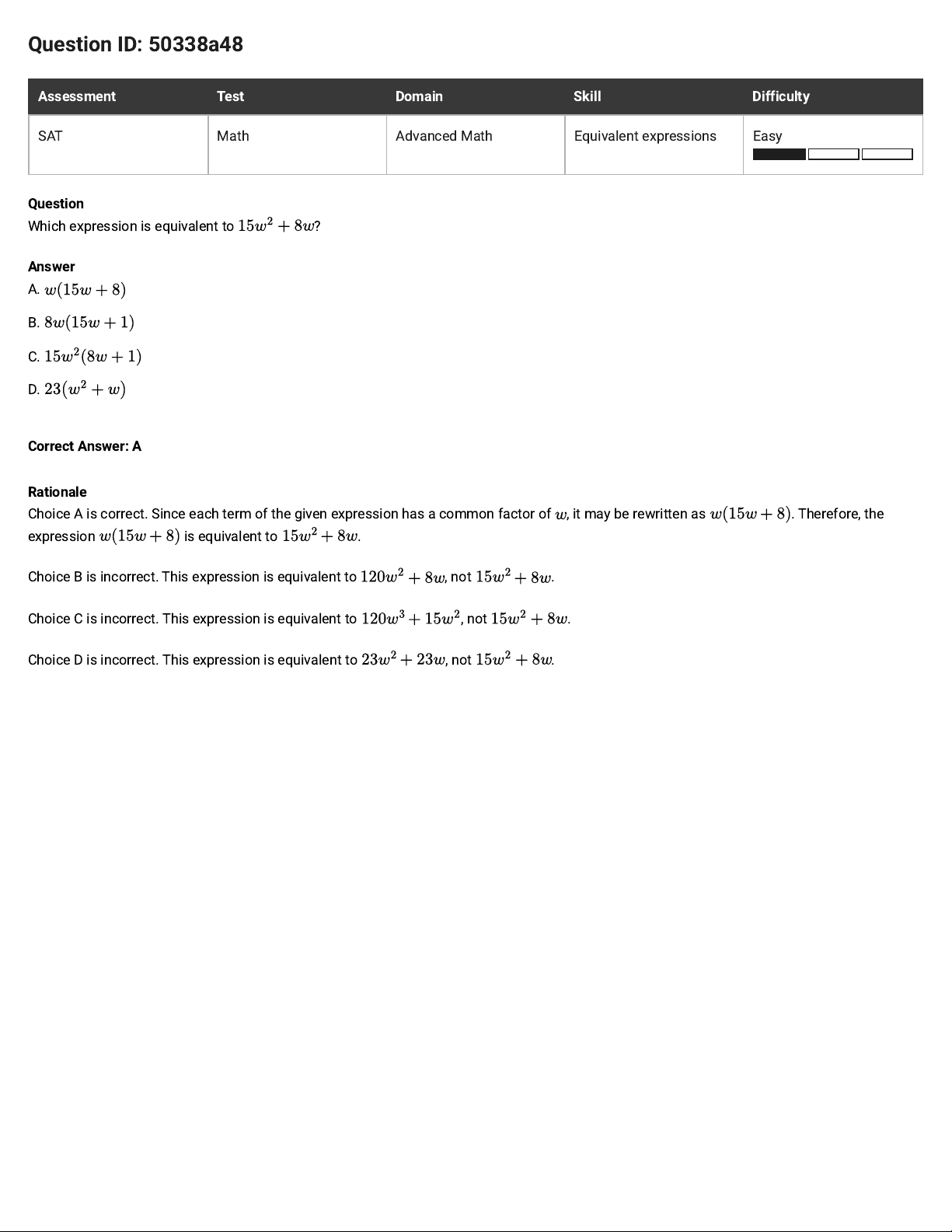
Question ID: 50338a48
Assessment Test Domain Skill Difficulty
SAT Math Advanced Math Equivalent expressions Easy
Question
Which expression is equivalent to
?
Answer
A.
B.
C.
D.
Correct Answer: A
Rationale
Choice A is correct. Since each term of the given expression has a common factor of , it may be rewritten as . Therefore, the
expression is equivalent to .
Choice B is incorrect. This expression is equivalent to , not .
Choice C is incorrect. This expression is equivalent to , not .
Choice D is incorrect. This expression is equivalent to , not .
Page 58
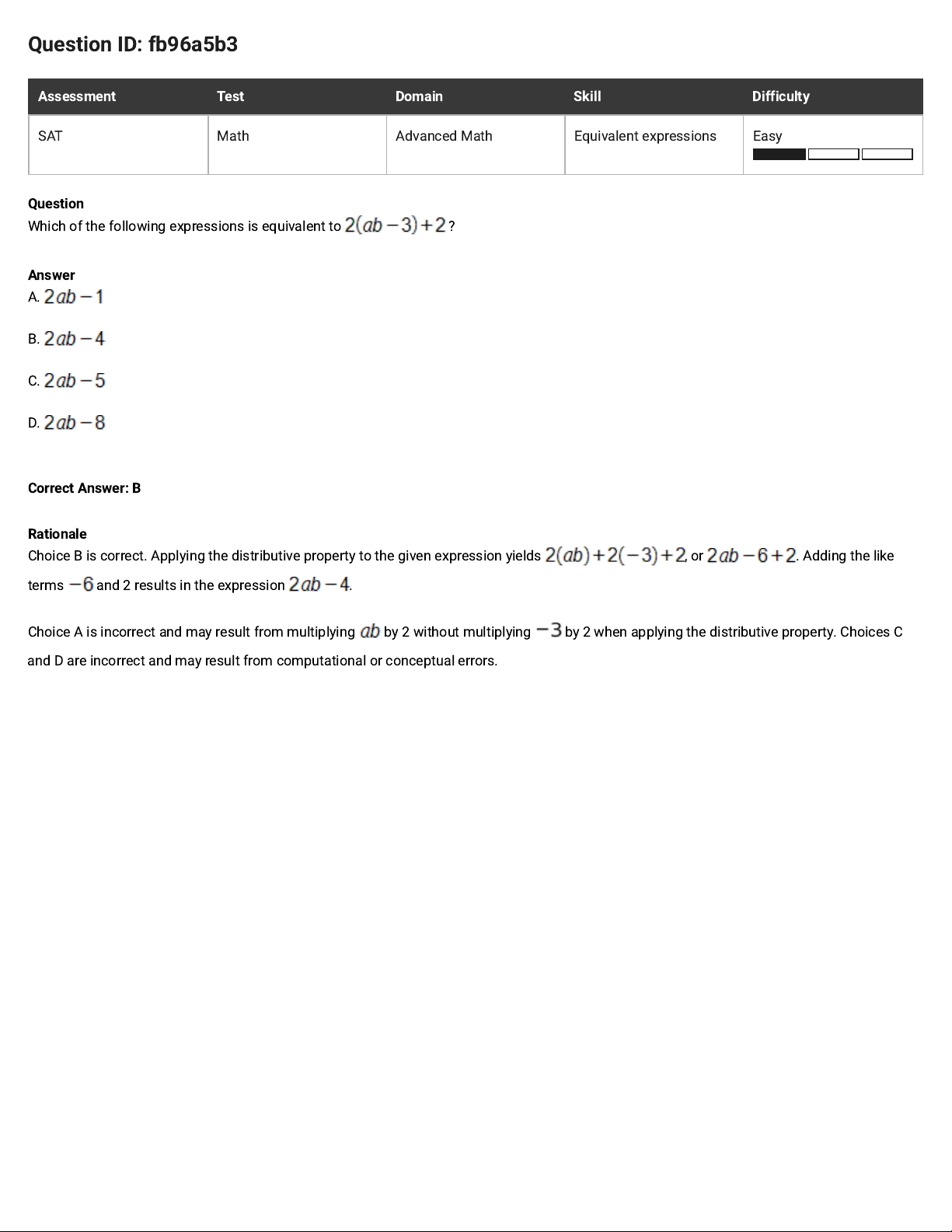
Question ID: fb96a5b3
Assessment Test Domain Skill Difficulty
SAT Math Advanced Math Equivalent expressions Easy
Question
Which of the following expressions is equivalent to ?
Answer
A.
B.
C.
D.
Correct Answer: B
Rationale
Choice B is correct. Applying the distributive property to the given expression yields , or . Adding the like
terms and 2 results in the expression .
Choice A is incorrect and may result from multiplying by 2 without multiplying by 2 when applying the distributive property. Choices C
and D are incorrect and may result from computational or conceptual errors.
Page 59
Question ID: e597050f
Assessment Test Domain Skill Difficulty
SAT Math Advanced Math Equivalent expressions Easy
Question
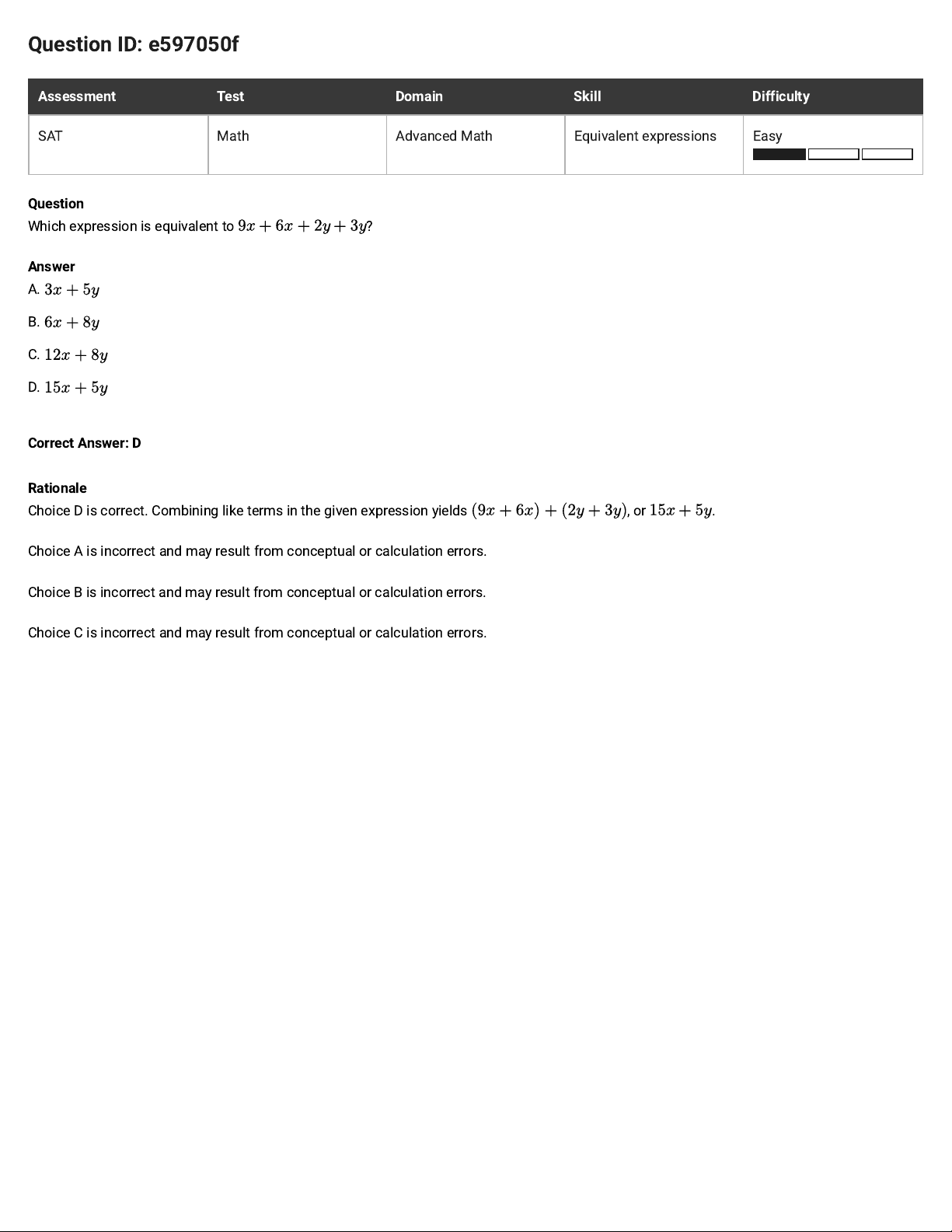
Which expression is equivalent to
?
Answer
A.
B.
C.
D.
Correct Answer: D
Rationale
Choice D is correct. Combining like terms in the given expression yields , or .
Choice A is incorrect and may result from conceptual or calculation errors.
Choice B is incorrect and may result from conceptual or calculation errors.
Choice C is incorrect and may result from conceptual or calculation errors.
Page 60
Question ID: 0354c7de
Assessment Test Domain Skill Difficulty
SAT Math Advanced Math Equivalent expressions Easy
Question
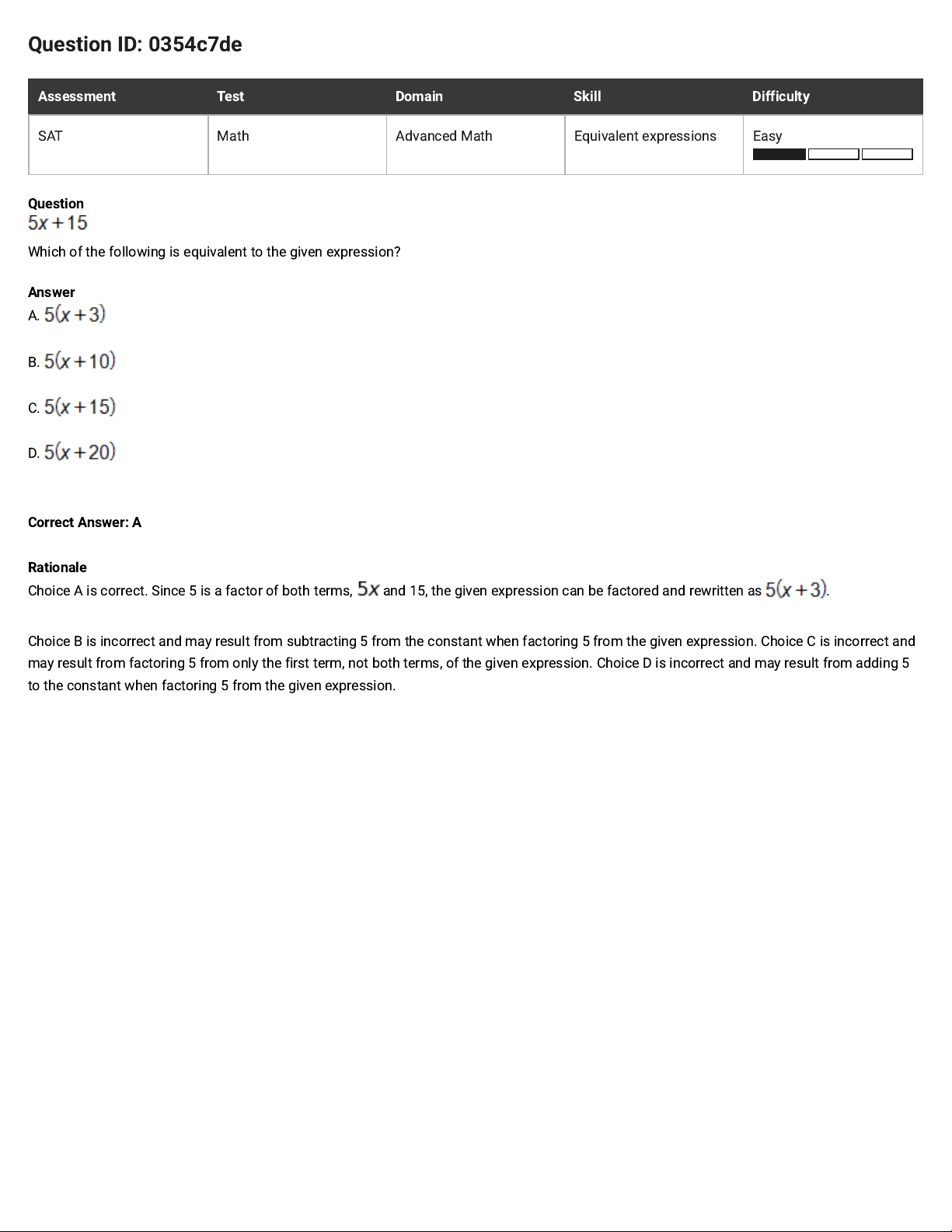
Which of the following is equivalent to the given expression?
Answer
A.
B.
C.
D.
Correct Answer: A
Rationale
Choice A is correct. Since 5 is a factor of both terms, and 15, the given expression can be factored and rewritten as .
Choice B is incorrect and may result from subtracting 5 from the constant when factoring 5 from the given expression. Choice C is incorrect and
may result from factoring 5 from only the first term, not both terms, of the given expression. Choice D is incorrect and may result from adding 5
to the constant when factoring 5 from the given expression.
Page 61
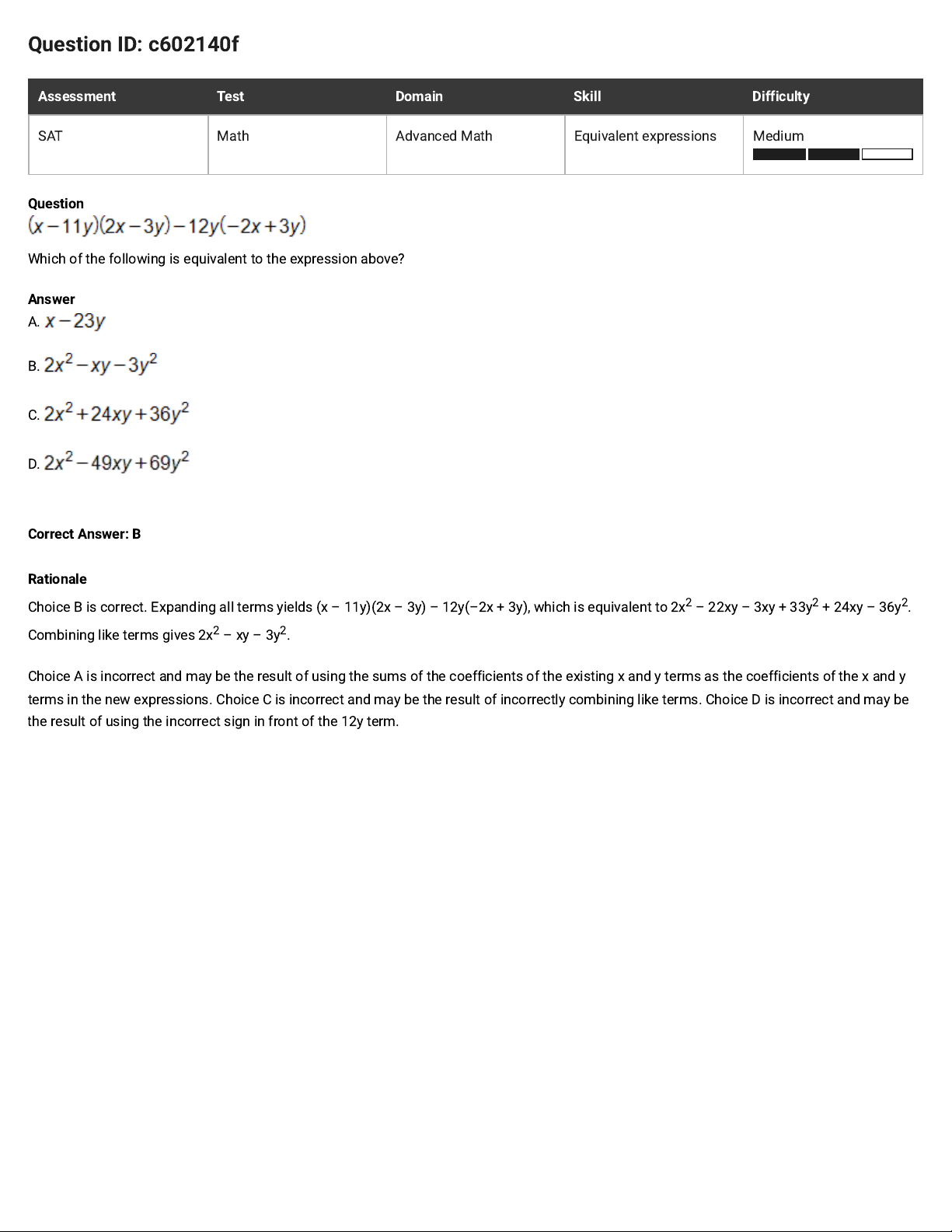
Question ID: c602140f
Assessment Test Domain Skill Difficulty
SAT Math Advanced Math Equivalent expressions Medium
Question
Which of the following is equivalent to the expression above?
Answer
A.
B.
C.
D.
Correct Answer: B
Rationale
Choice B is correct. Expandingall terms yields(x – 11y)(2x – 3y) – 12y(–2x + 3y), which is equivalent to2x2 – 22xy – 3xy + 33y2 + 24xy – 36y2.
Combining like terms gives 2x2 – xy – 3y2.
Choice A is incorrect and may be the result of using the sums of the coefficients of the existing x and y terms as the coefficients of the x and y
terms in the new expressions.Choice C is incorrect and may be the result of incorrectly combining like terms. Choice D is incorrect and may be
the result of using the incorrect sign in front of the 12y term.
Page 62
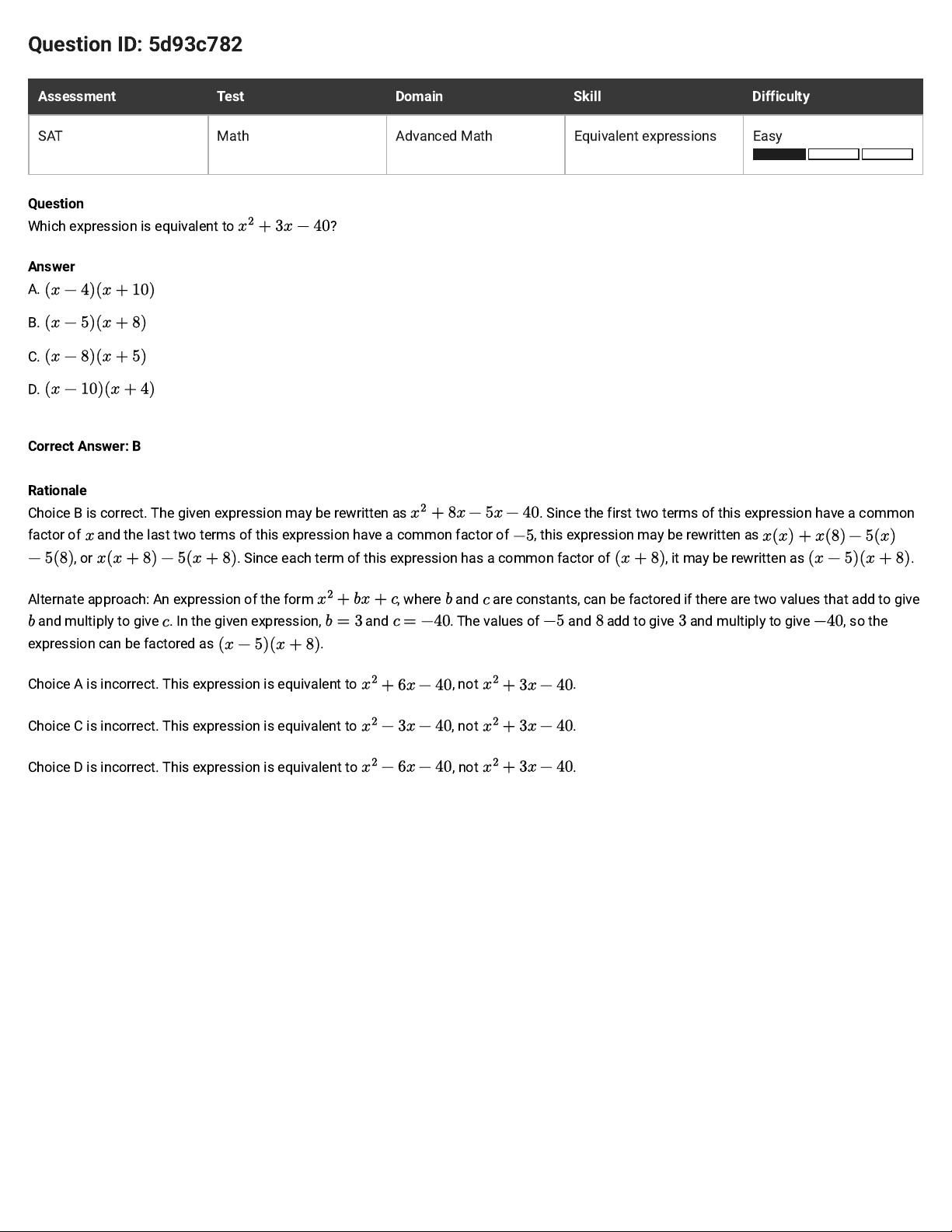
Question ID: 5d93c782
Assessment Test Domain Skill Difficulty
SAT Math Advanced Math Equivalent expressions Easy
Question
Which expression is equivalent to ?
Answer
A.
B.
C.
D.
Correct Answer: B
Rationale
Choice B is correct. The given expression may be rewritten as . Since the first two terms of this expression have a common
factor of and the last two terms of this expression have a common factor of , this expression may be rewritten as
,or . Since each term of this expression has a common factor of
, it may be rewritten as
.
Alternate approach: An expression of the form
, where and are constants, can be factored if there are two values that add to give
and multiply to give . In the given expression, and
. The values of and add to give and multiply to give , so the
expression can be factored as .
Choice A is incorrect. This expression is equivalent to
, not .
Choice C is incorrect. This expression is equivalent to , not .
Choice D is incorrect. This expression is equivalent to , not .
Page 63
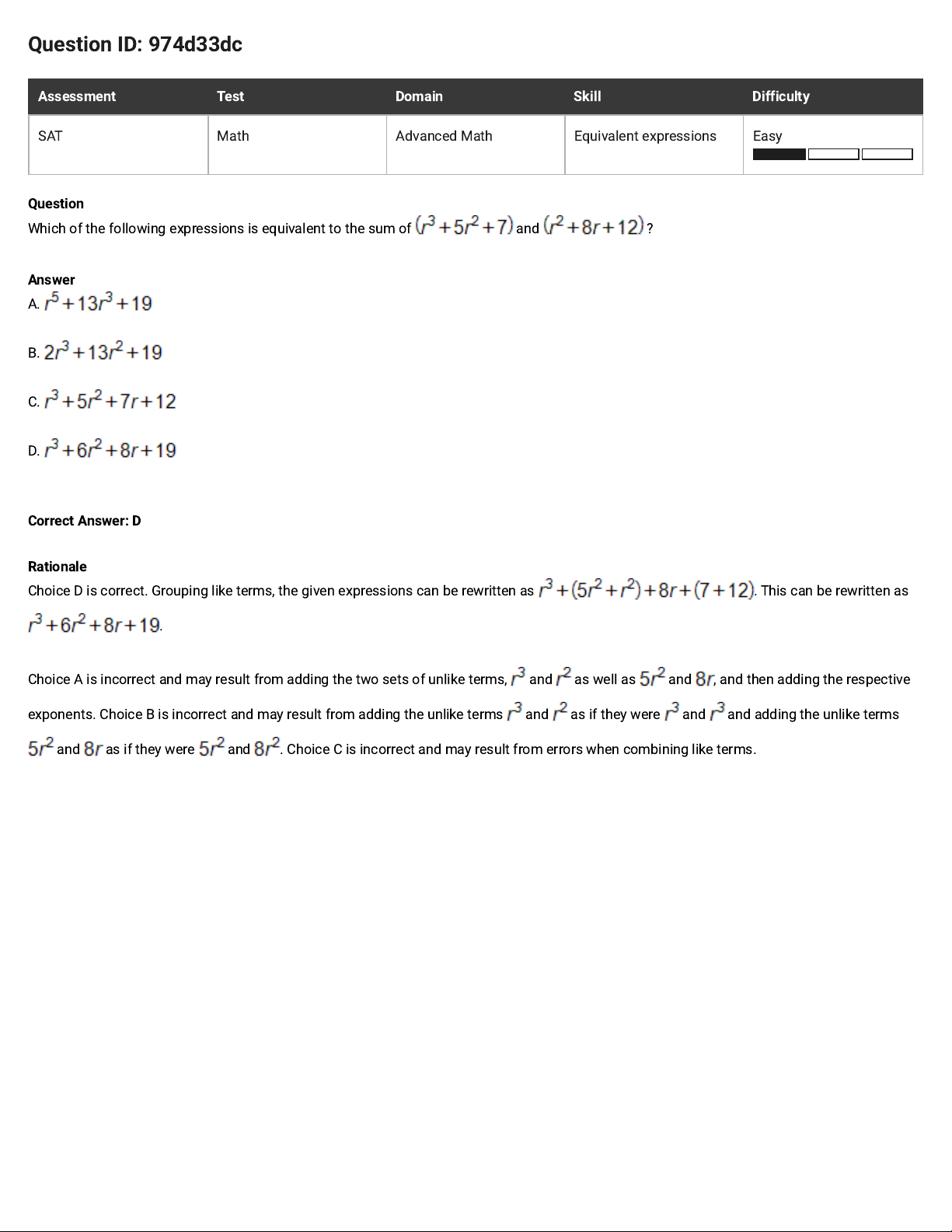
Question ID: 974d33dc
Assessment Test Domain Skill Difficulty
SAT Math Advanced Math Equivalent expressions Easy
Question
Which of the following expressions is equivalent to the sum of and ?
Answer
A.
B.
C.
D.
Correct Answer: D
Rationale
Choice D is correct. Grouping like terms, the given expressions can be rewritten as . This can be rewritten as
.
Choice A is incorrect and may result from adding the two sets of unlike terms, and as well as and , and then adding the respective
exponents. Choice B is incorrect and may result from adding the unlike terms and as if they were and and adding the unlike terms
and as if they were and . Choice C is incorrect and may result from errors when combining like terms.
Page 64
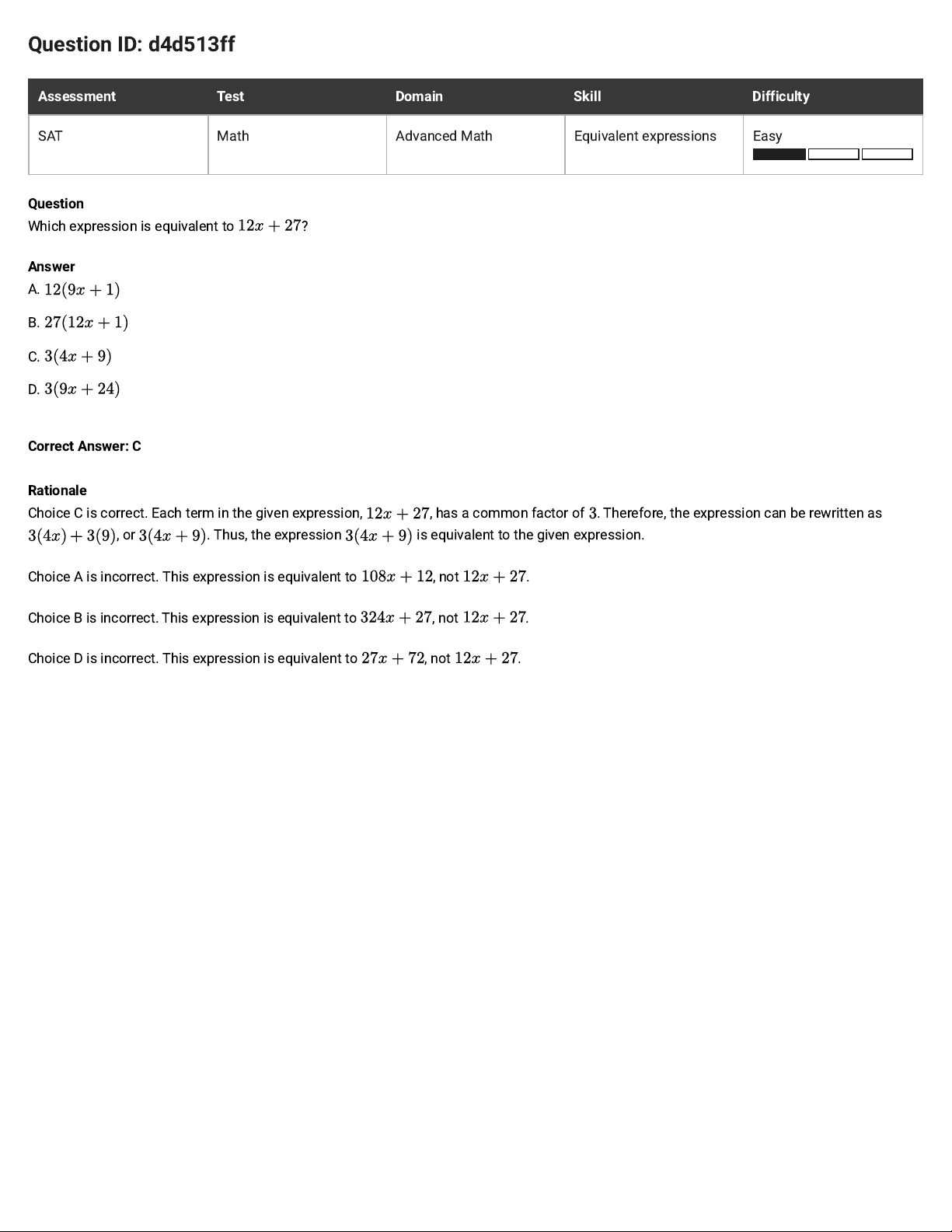
Question ID: d4d513ff
Assessment Test Domain Skill Difficulty
SAT Math Advanced Math Equivalent expressions Easy
Question
Which expression is equivalent to ?
Answer
A.
B.
C.
D.
Correct Answer: C
Rationale
Choice C is correct. Each term in the given expression, , has a common factor of . Therefore, the expression can be rewritten as
, or
. Thus, the expression
is equivalent to the given expression.
Choice A is incorrect. This expression is equivalent to , not .
Choice B is incorrect. This expression is equivalent to , not .
Choice D is incorrect. This expression is equivalent to , not .
 Loading...