

Page 1
Question ID: 70feb725
Assessment Test Domain Skill Difficulty
SAT Math Algebra Systems of two linear
equations in two
variables
Hard
Question
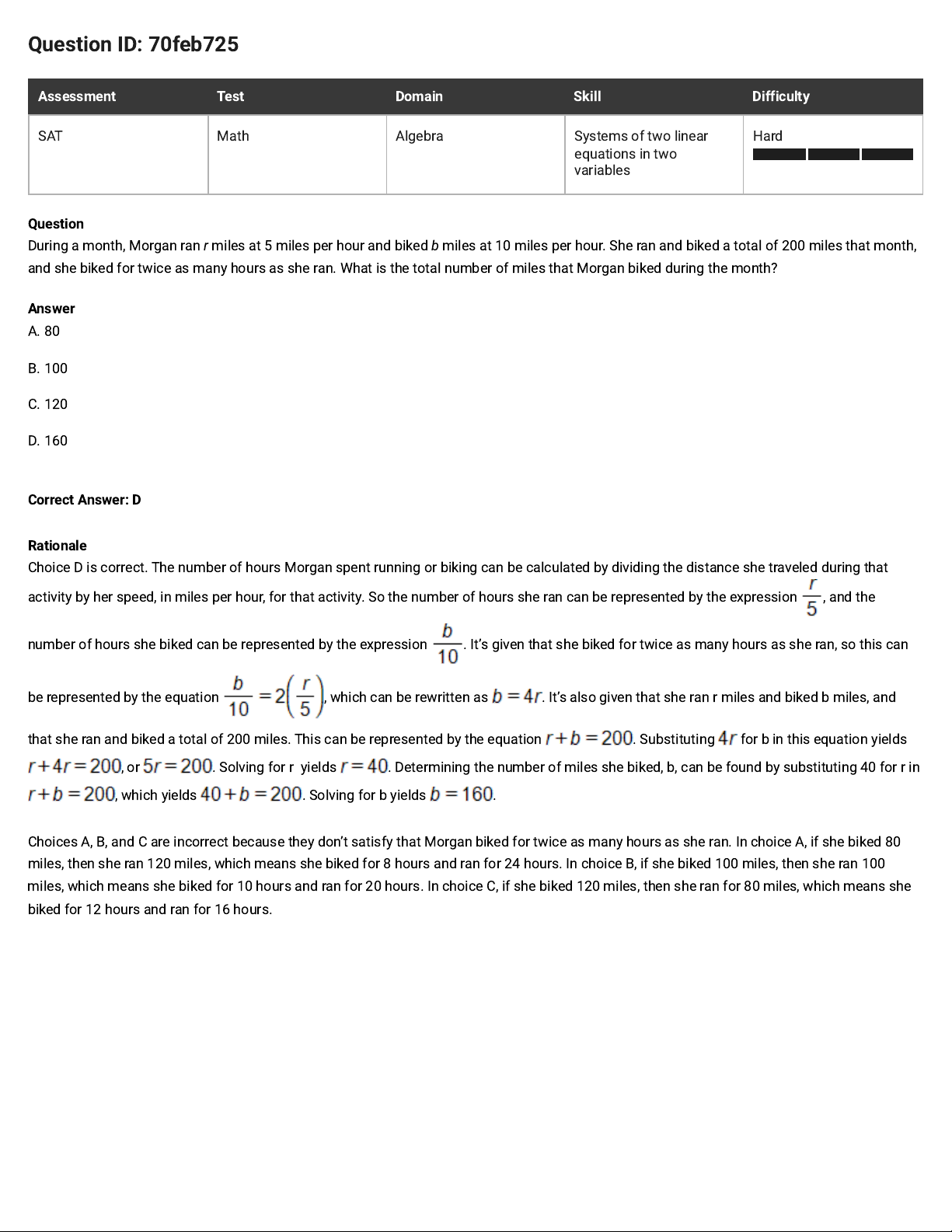
During a month, Morgan ran r
miles at 5miles per hour and biked b
miles at 10miles per hour. She ran and biked a total of 200miles that month,
and she biked for twice as many hours as she ran. What is the total number of miles that Morgan biked during the month?
Answer
A. 80
B. 100
C. 120
D. 160
Correct Answer: D
Rationale
Choice D is correct. The number of hours Morgan spent running or biking can be calculated by dividing the distance she traveled during that
activity by her speed, in miles per hour, for that activity. So the number of hours she ran can be represented by the expression , and the
number of hours she biked can be represented by the expression . It’s given that she biked for twice as many hours as she ran, so this can
be represented by the equation , which can be rewritten as . It’s also given that she ran r miles and biked b miles, and
that she ran and biked a total of 200 miles. This can be represented by the equation . Substituting for b in this equation yields
, or . Solving for r yields . Determining the number of miles she biked, b, can be found by substituting 40 for r in
, which yields . Solving for b yields .
Choices A, B, and C are incorrect because they don’t satisfy that Morgan biked for twice as many hours as she ran. In choice A, if she biked 80
miles, then she ran 120 miles, which means she biked for 8 hours and ran for 24 hours. In choice B, if she biked 100 miles, then she ran 100
miles, which means she biked for 10 hours and ran for 20 hours. In choice C, if she biked 120 miles, then she ran for 80 miles, which means she
biked for 12 hours and ran for 16 hours.
Page 2
Question ID: e1248a5c
Assessment Test Domain Skill Difficulty
SAT Math Algebra Systems of two linear
equations in two
variables
Hard
Question
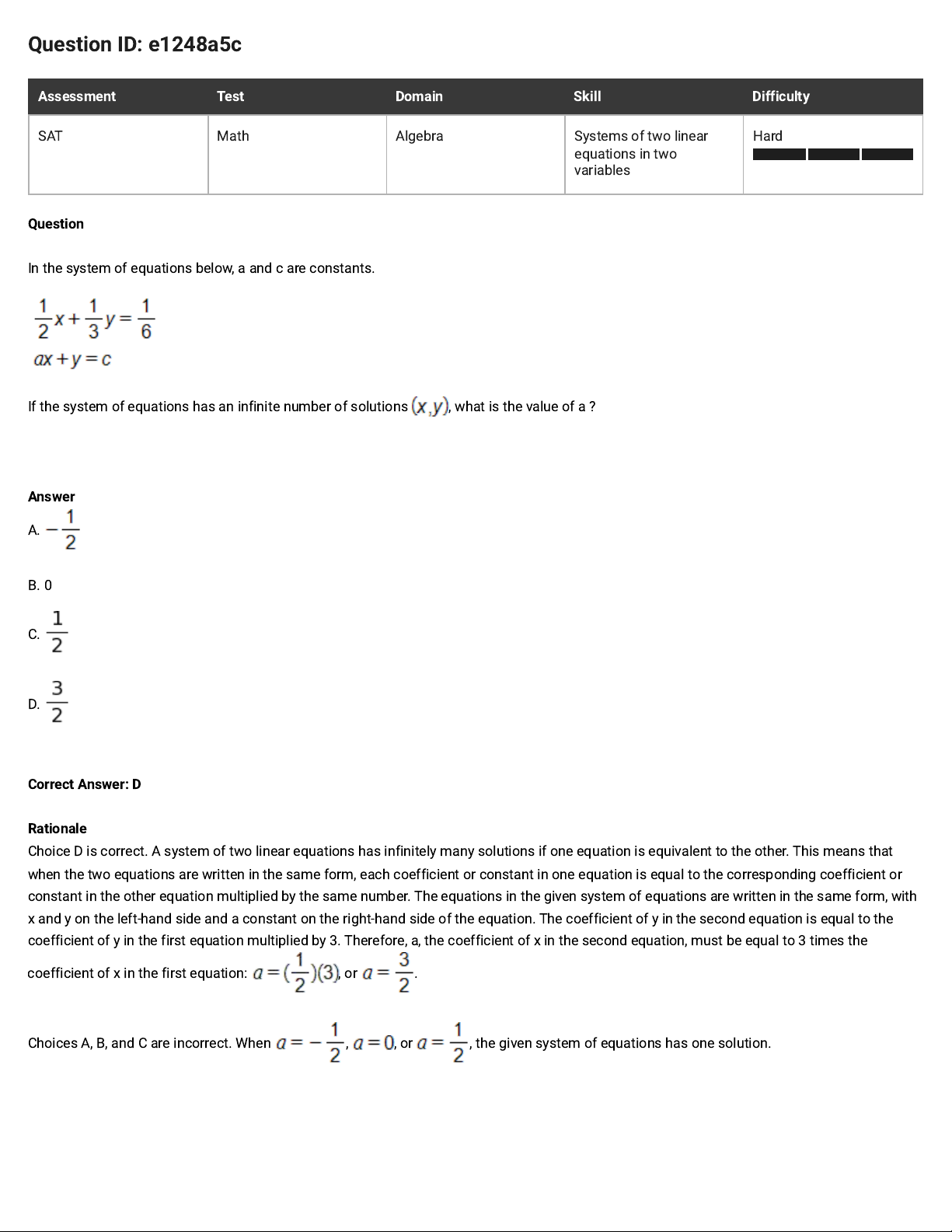
In the system of equations below, a and c are constants.
If the system of equations has an infinite number of solutions , what is the value of a ?
Answer
A.
B. 0
C.
D.
Correct Answer: D
Rationale
Choice D is correct. A system of two linear equations has infinitely many solutions if one equation is equivalent to the other. This means that
when the two equations are written in the same form, each coefficient or constant in one equation is equal to the corresponding coefficient or
constant in the other equation multiplied by the same number. The equations in the given system of equations are written in the same form, with
x and y on the left-hand side and a constant on the right-hand side of the equation. The coefficient of y in the second equation is equal to the
coefficient of y in the first equation multiplied by 3. Therefore, a, the coefficient of x in the second equation, must be equal to 3 times the
coefficient of x in the first equation: , or .
Choices A, B, and C are incorrect. When , , or , the given system of equations has one solution.
Page 3
Question ID: c5082ce3
Assessment Test Domain Skill Difficulty
SAT Math Algebra Systems of two linear
equations in two
variables
Medium
Question
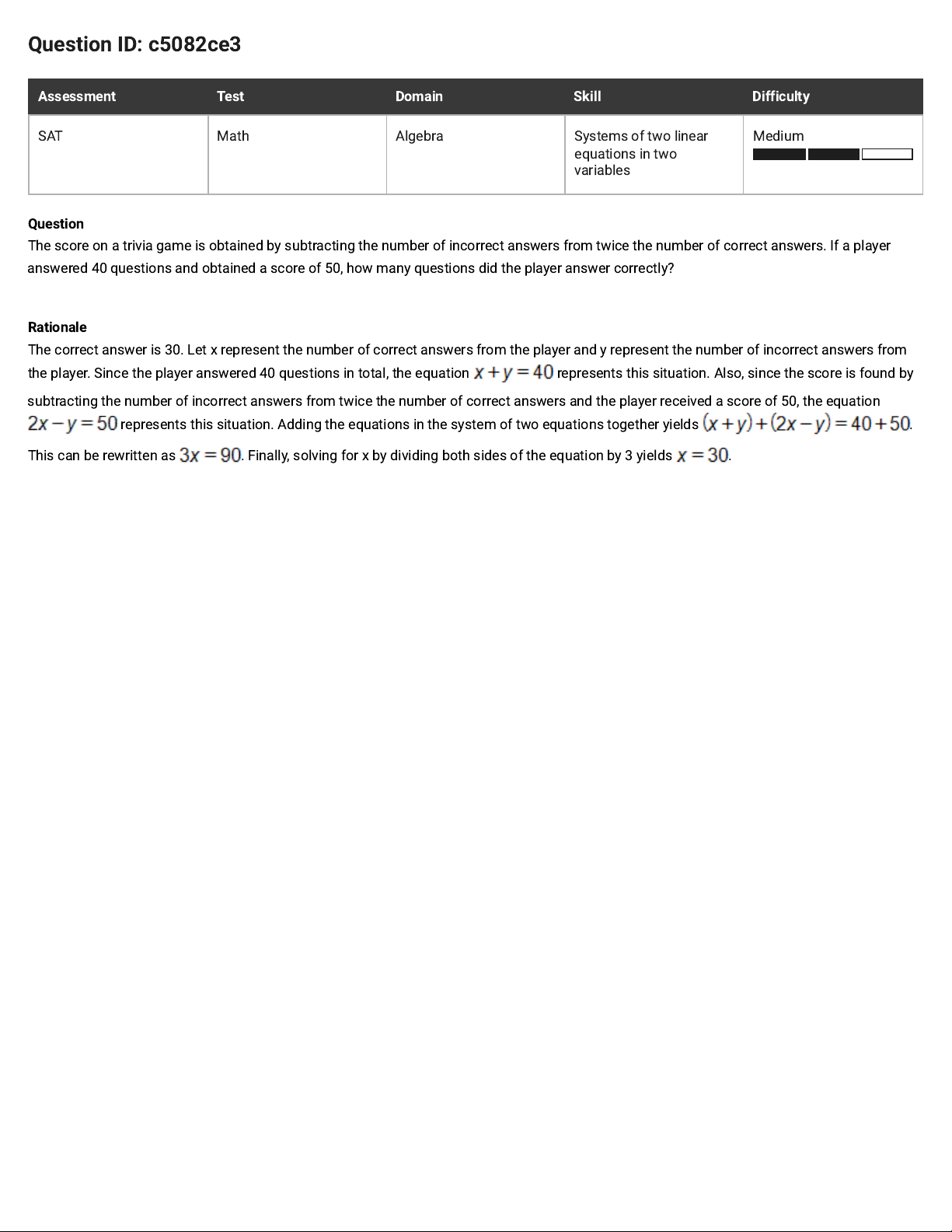
The score on a trivia game is obtained by subtracting the number of incorrect answers from twice the number of correct answers. If a player
answered 40questions and obtained a score of 50, how many questions did the player answer correctly?
Rationale
The correct answer is 30. Let x represent the number of correct answers from the player and y represent the number of incorrect answers from
the player. Since the player answered 40 questions in total, the equation represents this situation. Also, since the score is found by
subtracting the number of incorrect answers from twice the number of correct answers and the player received a score of 50, the equation
represents this situation. Adding the equations in the system of two equations together yields .
This can be rewritten as . Finally, solving for x by dividing both sides of the equation by 3 yields .
Page 4
Question ID: dcc4886a
Assessment Test Domain Skill Difficulty
SAT Math Algebra Systems of two linear
equations in two
variables
Medium
Question
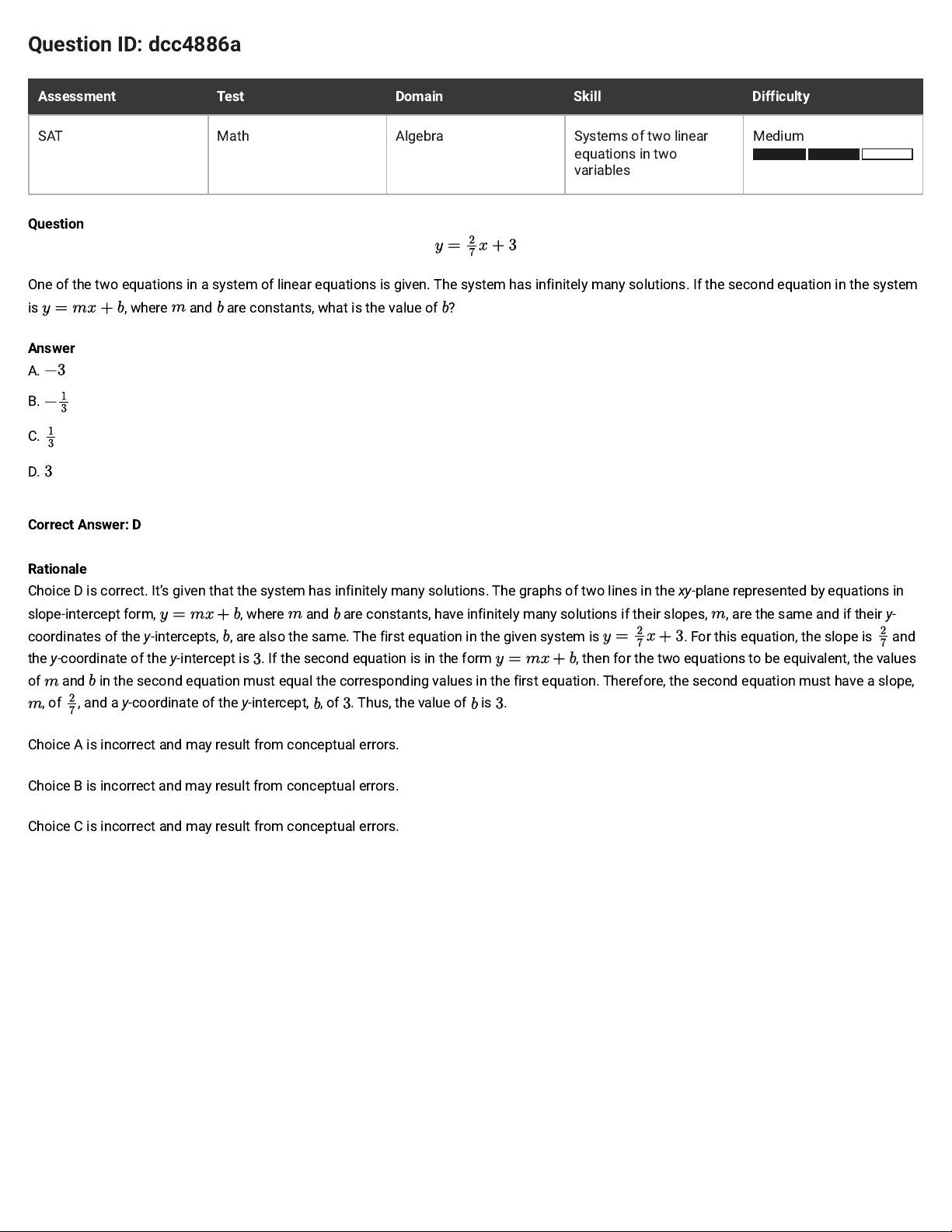
One of the two equations in a system of linear equations is given. The system has infinitely many solutions. If the second equation in the system
is , where and are constants, what is the value of ?
Answer
A.
B.
C.
D.
Correct Answer: D
Rationale
Choice D is correct. It’s given that the system has infinitely many solutions. The graphs of two lines in the xy-plane represented by equations in
slope-intercept form, , where and are constants, have infinitely many solutions if their slopes, , are the same and if their y-
coordinates of the y-intercepts, , are also the same. The first equation in the given system is . For this equation, the slope is and
the y-coordinate of the y-intercept is . If the second equation is in the form , then for the two equations to be equivalent, the values
of and in the second equation must equal the corresponding values in the first equation. Therefore, the second equation must have a slope,
, of , and a y-coordinate of the y-intercept, , of . Thus, the value of is .
Choice A is incorrect and may result from conceptual errors.
Choice B is incorrect and may result from conceptual errors.
Choice C is incorrect and may result from conceptual errors.
Page 5
Question ID: fb5e7f59
Assessment Test Domain Skill Difficulty
SAT Math Algebra Systems of two linear
equations in two
variables
Hard
Question
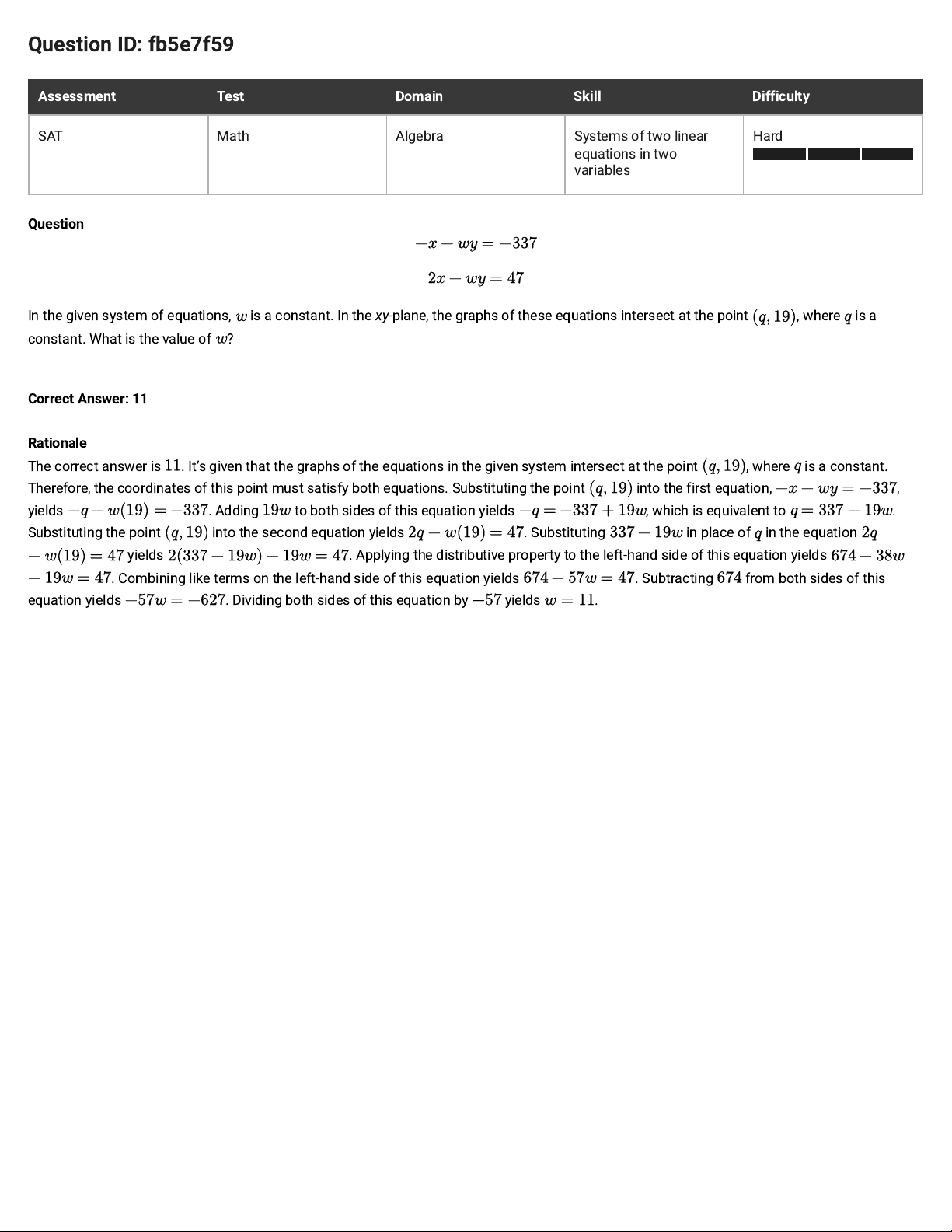
In the given system of equations, is a constant. In the xy-plane, the graphs of these equations intersect at the point , where is a
constant. What is the value of ?
Correct Answer: 11
Rationale
The correct answer is . It’s given that the graphs of the equations in the given system intersect at the point , where is a constant.
Therefore, the coordinates of this point must satisfy both equations. Substituting the point into the first equation, ,
yields . Adding
to both sides of this equation yields , which is equivalent to .
Substituting the point
into the second equation yields . Substituting in place of in the equation
yields . Applying the distributive property to the left-hand side of this equation yields
. Combining like terms on the left-hand side of this equation yields . Subtracting from both sides of this
equation yields . Dividing both sides of this equation by yields .
 Loading...