

Page 1
Question ID: 45cfb9de
Assessment Test Domain Skill Difficulty
SAT Math Algebra Linear inequalities in one
or two variables
Hard
Question
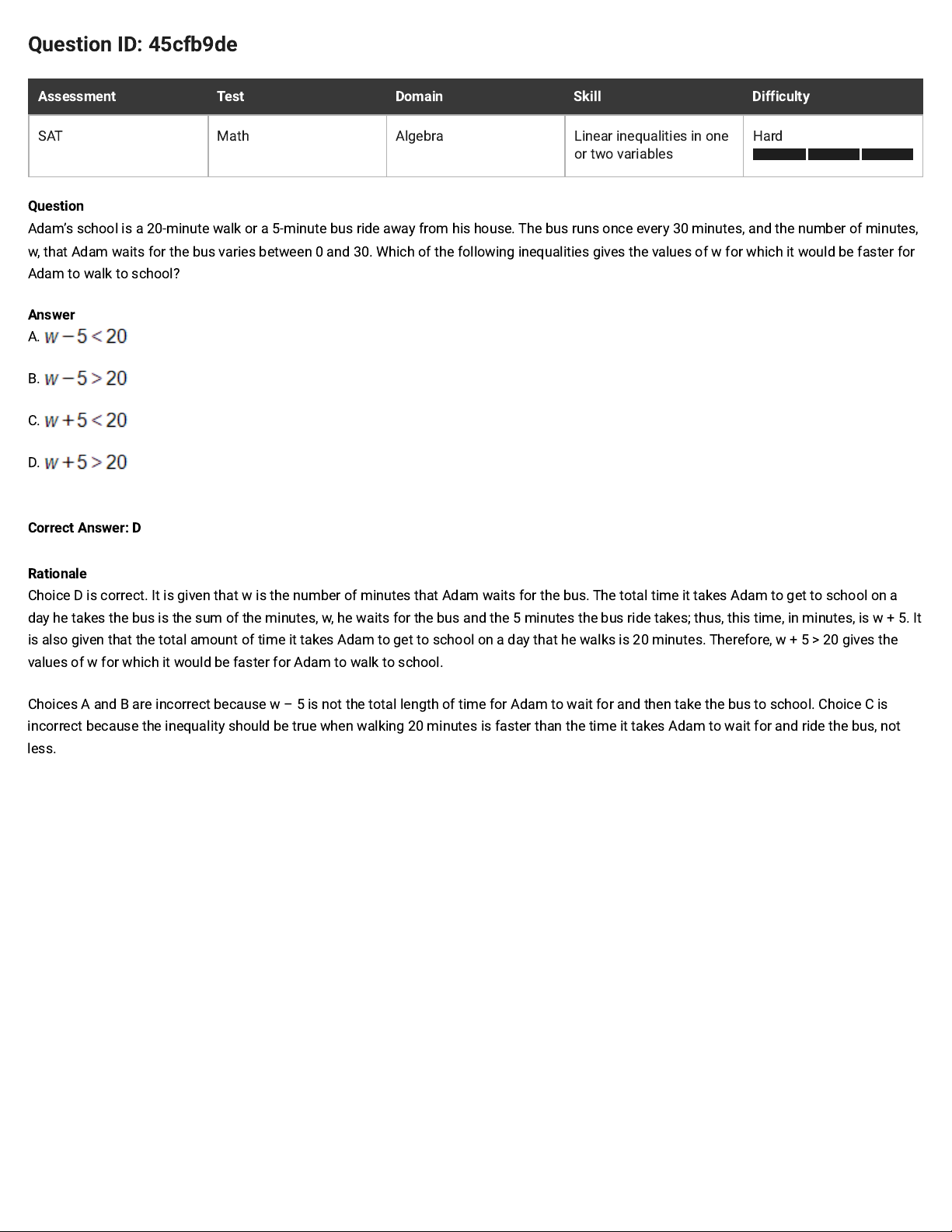
Adam’s school is a 20-minute walk or a 5-minute bus ride away from his house. The bus runs once every 30minutes, and the number of minutes,
w, that Adam waits for the bus varies between 0 and 30. Which of the following inequalities gives the values of w for which it would be faster for
Adam to walk to school?
Answer
A.
B.
C.
D.
Correct Answer: D
Rationale
Choice D is correct. It is given that w is the number of minutes that Adam waits for the bus. The total time it takes Adam to get to school on a
day he takes the bus is the sum of the minutes, w, he waits for the bus and the 5 minutes the bus ride takes; thus, this time, in minutes, is w + 5. It
is also given that the total amount of time it takes Adam to get to school on a day that he walks is 20 minutes. Therefore, w + 5 > 20 gives the
values of w for which it would be faster for Adam to walk to school.
Choices A and B are incorrect because w – 5 is not the total length of time for Adam to wait for and then take the bus to school. Choice C is
incorrect because the inequality should be true when walking 20 minutes is faster than the time it takes Adam to wait for and ride the bus, not
less.
Page 2
Question ID: 64c85440
Assessment Test Domain Skill Difficulty
SAT Math Algebra Linear inequalities in one
or two variables
Medium
Question
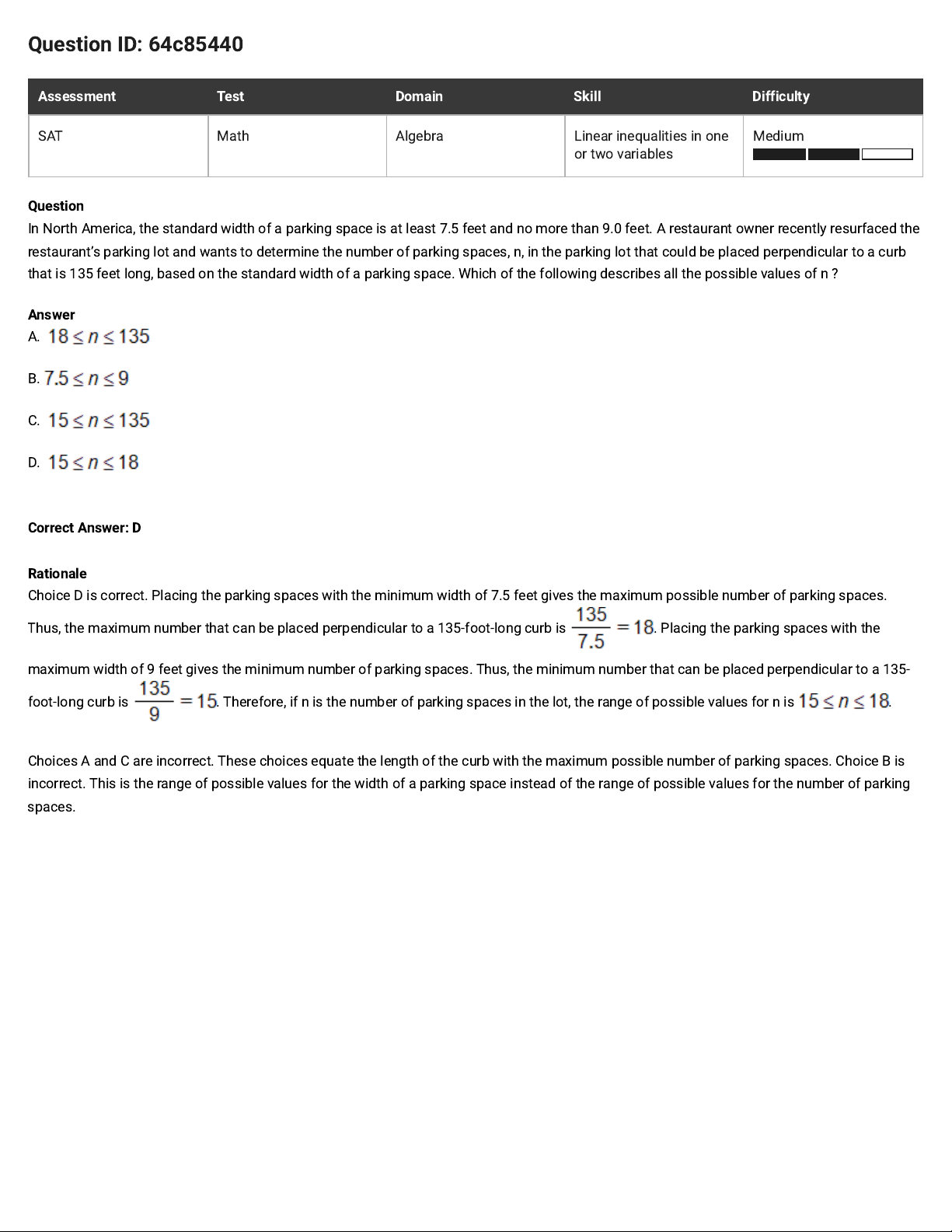
In North America, the standard width of a parking space is at least 7.5 feet and no more than 9.0 feet. A restaurant owner recently resurfaced the
restaurant’s parking lot and wants to determine the number of parking spaces, n, in the parking lot that could be placed perpendicular to a curb
that is 135 feet long, based on the standard width of a parking space. Which of the following describes all the possible values of n ?
Answer
A.
B.
C.
D.
Correct Answer: D
Rationale
Choice D is correct. Placing the parking spaces with the minimum width of 7.5 feet gives the maximum possible number of parking spaces.
Thus, the maximum number that can be placed perpendicular to a 135-foot-long curb is . Placing the parking spaces with the
maximum width of 9 feet gives the minimum number of parking spaces. Thus, the minimum number that can be placed perpendicular to a 135-
foot-long curb is . Therefore, if n is the number of parking spaces in the lot, the range of possible values for n is .
Choices A and C are incorrect. These choices equate the length of the curb with the maximum possible number of parking spaces. Choice B is
incorrect. This is the range of possible values for the width of a parking space instead of the range of possible values for the number of parking
spaces.
Page 3
Question ID: ee2f611f
Assessment Test Domain Skill Difficulty
SAT Math Algebra Linear inequalities in one
or two variables
Hard
Question
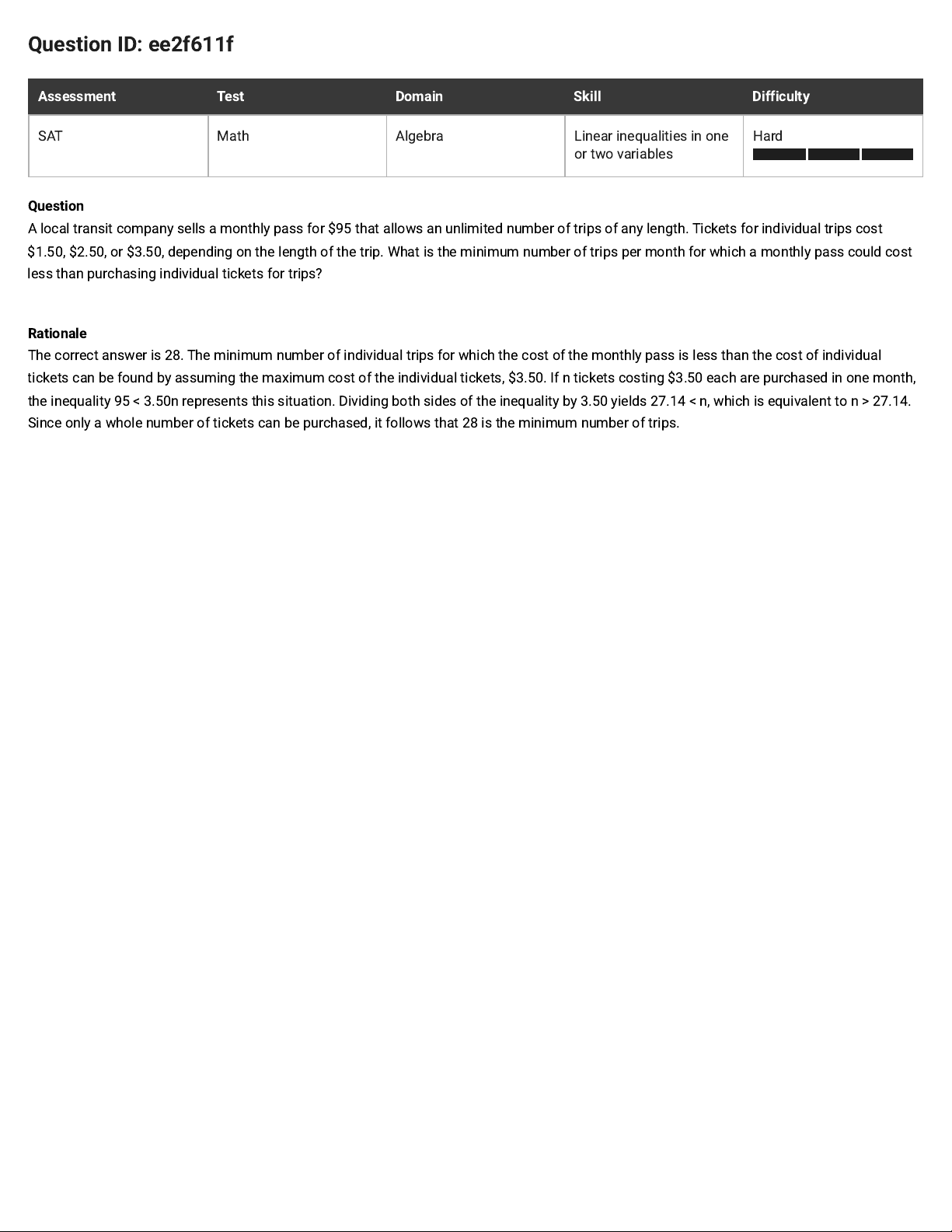
A local transit company sells a monthly pass for $95 that allows an unlimited number of trips of any length. Tickets for individual trips cost
$1.50, $2.50, or $3.50, depending on the length of the trip. What is the minimum number of trips permonth for which a monthly pass could cost
less than purchasing individual tickets fortrips?
Rationale
The correct answer is 28. The minimum number of individual trips for which the cost of the monthly pass is less than the cost ofindividual
tickets can be found by assuming the maximum cost of the individual tickets, $3.50. If ntickets costing $3.50 each are purchased in one month,
the inequality 95 < 3.50n represents this situation. Dividing both sides of the inequality by 3.50 yields 27.14 < n, which is equivalent to n > 27.14.
Since only a whole number of tickets can be purchased, it follows that 28 is the minimum number of trips.
Page 4
Question ID: 80da233d
Assessment Test Domain Skill Difficulty
SAT Math Algebra Linear inequalities in one
or two variables
Medium
Question
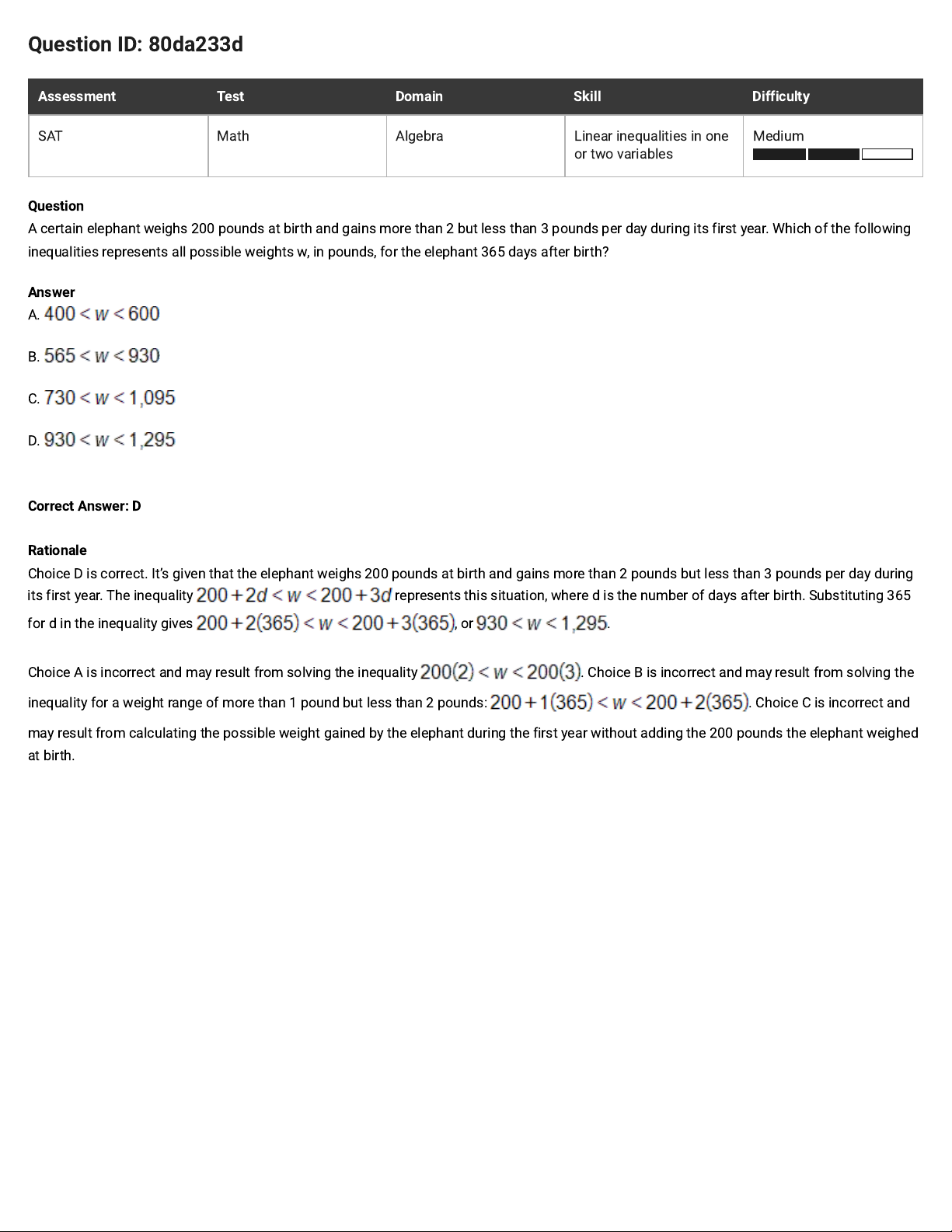
A certain elephant weighs 200 pounds at birth and gains more than 2 but less than 3 pounds per day during its firstyear. Which of the following
inequalities represents all possible weights w, in pounds, for the elephant 365 days after birth?
Answer
A.
B.
C.
D.
Correct Answer: D
Rationale
Choice D is correct. It’s given that the elephant weighs 200 pounds at birth and gains more than 2 pounds but less than 3 pounds per day during
its first year. The inequality represents this situation, where d is the number of days after birth. Substituting 365
for d in the inequality gives , or .
Choice A is incorrect and may result from solving the inequality . Choice B is incorrect and may result from solving the
inequality for a weight range of more than 1 pound but less than 2 pounds: . Choice C is incorrect and
may result from calculating the possible weight gained by the elephant during the first year without adding the 200 pounds the elephant weighed
at birth.
Page 5
Question ID: b31c3117
Assessment Test Domain Skill Difficulty
SAT Math Algebra Linear inequalities in one
or two variables
Medium
Question
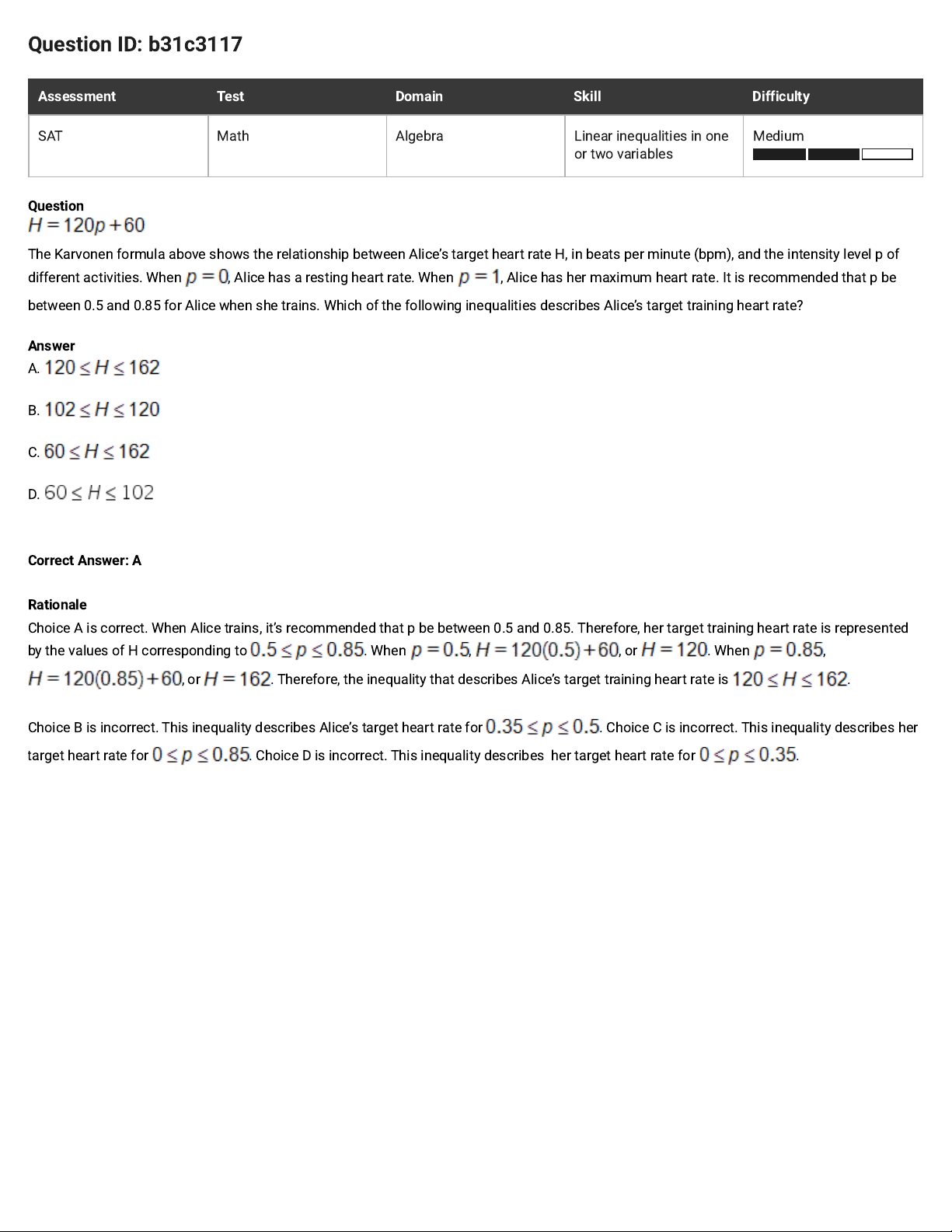
The Karvonen formula above shows the relationship between Alice’s target heart rate H, in beats per minute (bpm), and the intensity level p of
different activities. When , Alice has a resting heart rate. When , Alice has her maximum heart rate. It is recommended that p be
between 0.5 and 0.85 for Alice when she trains. Which of the following inequalities describes Alice’s target training heart rate?
Answer
A.
B.
C.
D.
Correct Answer: A
Rationale
Choice A is correct. When Alice trains, it’s recommended that p be between 0.5 and 0.85. Therefore, her target training heart rate is represented
by the values of H corresponding to . When , , or . When ,
, or . Therefore, the inequality that describes Alice’s target training heart rate is .
Choice B is incorrect. This inequality describes Alice’s target heart rate for . Choice C is incorrect. This inequality describes her
target heart rate for . Choice D is incorrect. This inequality describes her target heart rate for .
Page 6
Question ID: 6cb9bf45
Assessment Test Domain Skill Difficulty
SAT Math Algebra Linear inequalities in one
or two variables
Medium
Question
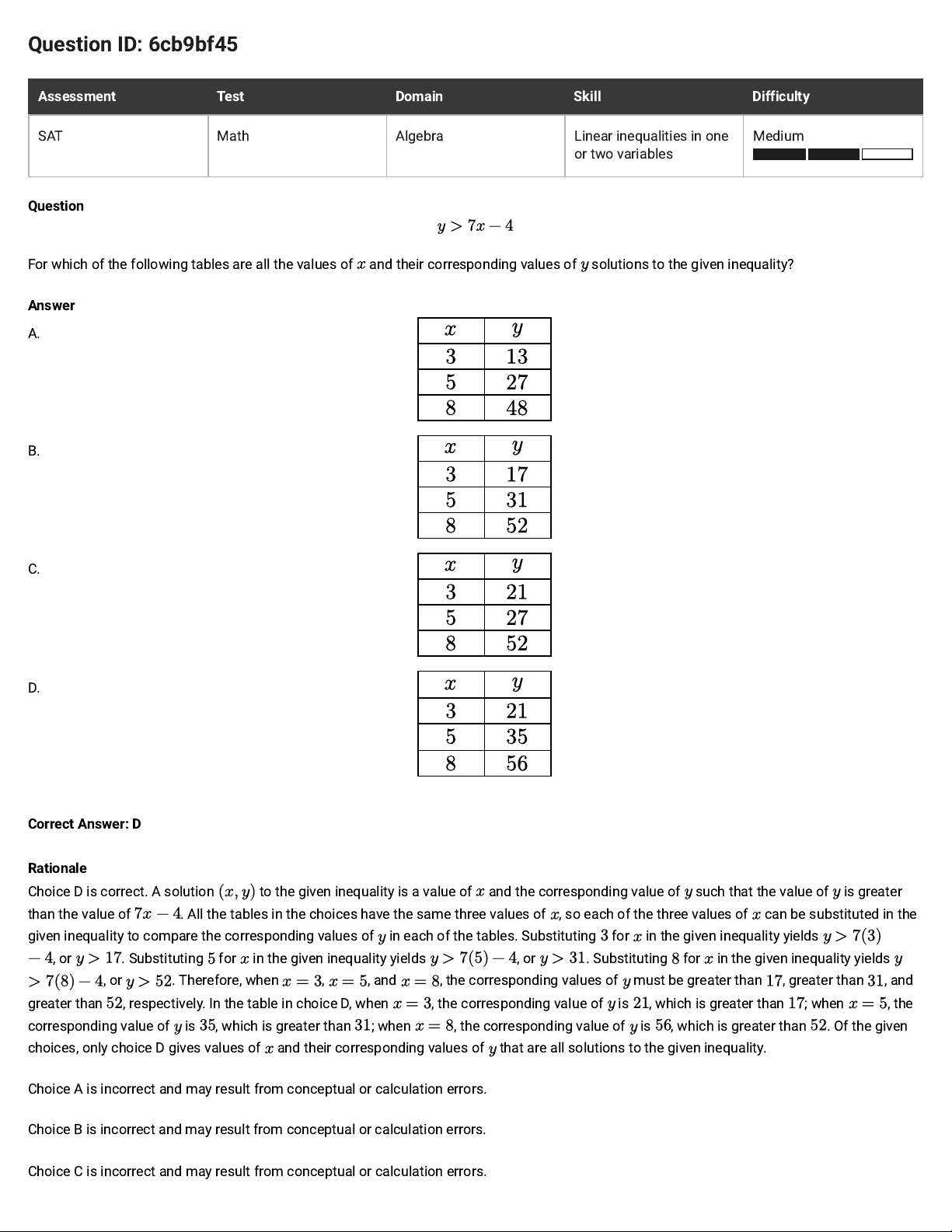
For which of the following tables are all the values of and their corresponding values of solutions to the given inequality?
Answer
A.
B.
C.
D.
Correct Answer: D
Rationale
Choice D is correct. A solution to the given inequality is a value of and the corresponding value of such that the value of is greater
than the value of . All the tables in the choices have the same three values of , so each of the three values of can be substituted in the
given inequality to compare the corresponding values of in each of the tables. Substituting for in the given inequality yields
,or . Substituting for in the given inequality yields ,or .Substituting for in the given inequality yields
,or . Therefore, when , , and , the corresponding values of must be greater than , greater than , and
greater than , respectively. In the table in choice D, when , the corresponding value of is , which is greater than ; when , the
corresponding value of is , which is greater than ; when , the corresponding value of is , which is greater than . Of the given
choices, only choice D gives values of and their corresponding values of that are all solutions to the given inequality.
Choice A is incorrect and may result from conceptual or calculation errors.
Choice B is incorrect and may result from conceptual or calculation errors.
Choice C is incorrect and may result from conceptual or calculation errors.
Page 7
Question ID: e8f9e117
Assessment Test Domain Skill Difficulty
SAT Math Algebra Linear inequalities in one
or two variables
Hard
Question
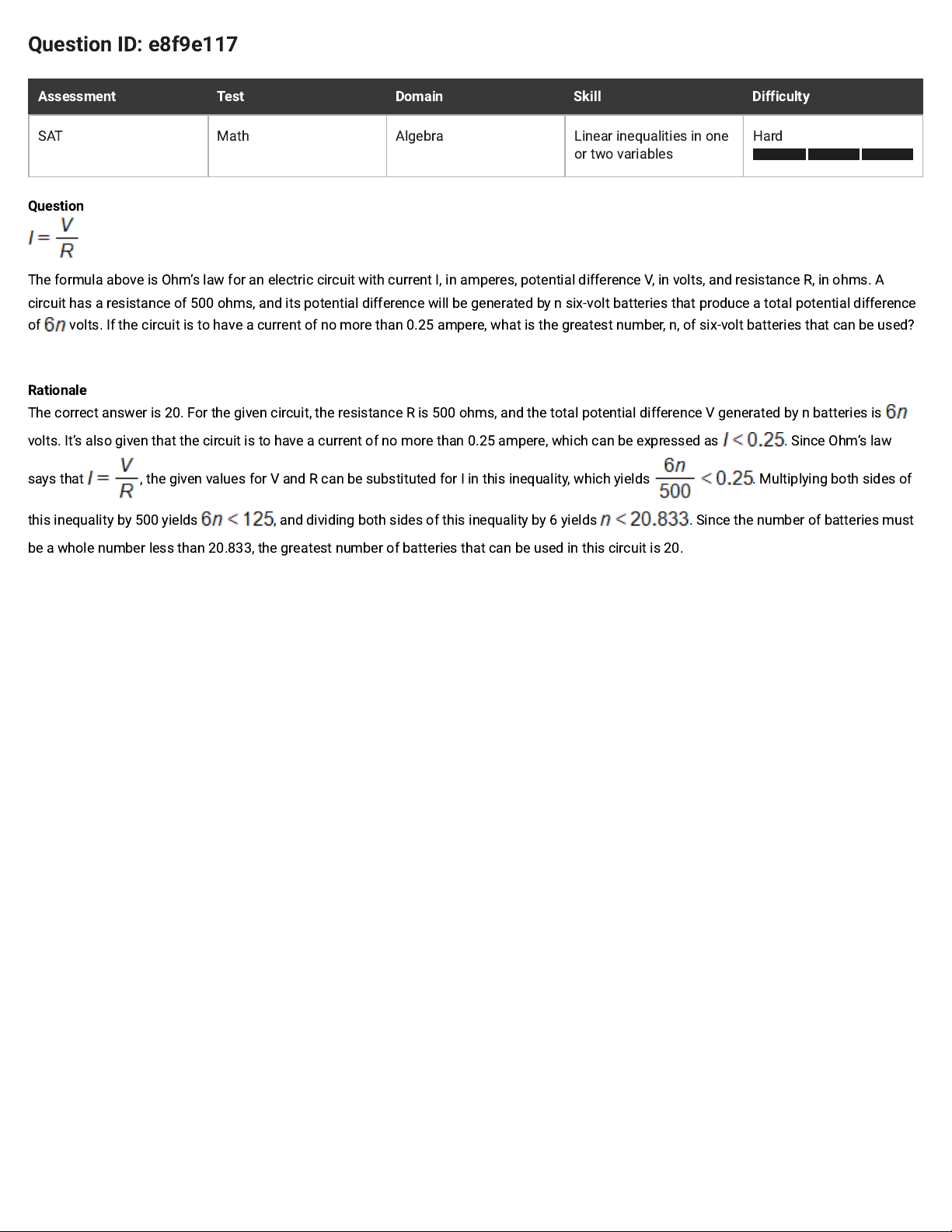
The formula above is Ohm’s law for an electric circuit with current I, in amperes, potential difference V, in volts, and resistance R, in ohms. A
circuit has a resistance of 500 ohms, and its potential difference will be generated by n six-volt batteries that produce a total potential difference
of volts. If the circuit is to have a current of no more than 0.25 ampere, what is the greatest number, n, of six-volt batteries that can be used?
Rationale
The correct answer is 20. For the given circuit, the resistance R is 500 ohms, and the total potential difference V generated by n batteries is
volts. It’s also given that the circuit is to have a current of no more than 0.25 ampere, which can be expressed as . Since Ohm’s law
says that , the given values for V and R can be substituted for I in this inequality, which yields . Multiplying both sides of
this inequality by 500 yields , and dividing both sides of this inequality by 6 yields . Since the number of batteries must
be a whole number less than 20.833, the greatest number of batteries that can be used in this circuit is 20.
Page 8
Question ID: 6daf8d70
Assessment Test Domain Skill Difficulty
SAT Math Algebra Linear inequalities in one
or two variables
Medium
Question
A city employee will plant two types of bushes, azaleas and boxwoods, in a park. There will be no more than total bushes planted, and the
number of azaleas planted will be at most three times the number of boxwoods planted. Which of the following systems of inequalities best
represents this situation, where is the number of azaleas that will be planted, and is the number of boxwoods that will be planted?
Answer
A.
B.
C.
D.
Correct Answer: D
Rationale
Choice D is correct. It’s given that a city employee will plant azaleas and boxwoods in a park, where is the number of azaleas that will be
planted and is the number of boxwoods that will be planted. It’s also given that there will be no more than total bushes planted, which can
be represented by the inequality . It’s also given that the number of azaleas planted will be at most three times the number of
boxwoods planted, which can be represented by the inequality . Therefore, the system of inequalities containing and
best represents this situation.
Choice A is incorrect. The inequality represents a situation where at least total bushes will be planted, not that there will be no
more than total bushes planted. Also, the inequality represents a situation where the number of boxwoods that will be planted is at
most three times the number of azaleas that will be planted, not that the number of azaleas planted will be at most three times the number of
boxwoods planted.
Choice B is incorrect. The inequality represents a situation where at least total bushes will be planted, not that there will be no
more than total bushes planted.
Choice C is incorrect. The inequality represents a situation where the number of boxwoods that will be planted is at most three times the
number of azaleas that will be planted, not that the number of azaleas planted will be at most three times the number of boxwoods planted.
Page 9
Question ID: 963da34c
Assessment Test Domain Skill Difficulty
SAT Math Algebra Linear inequalities in one
or two variables
Hard
Question
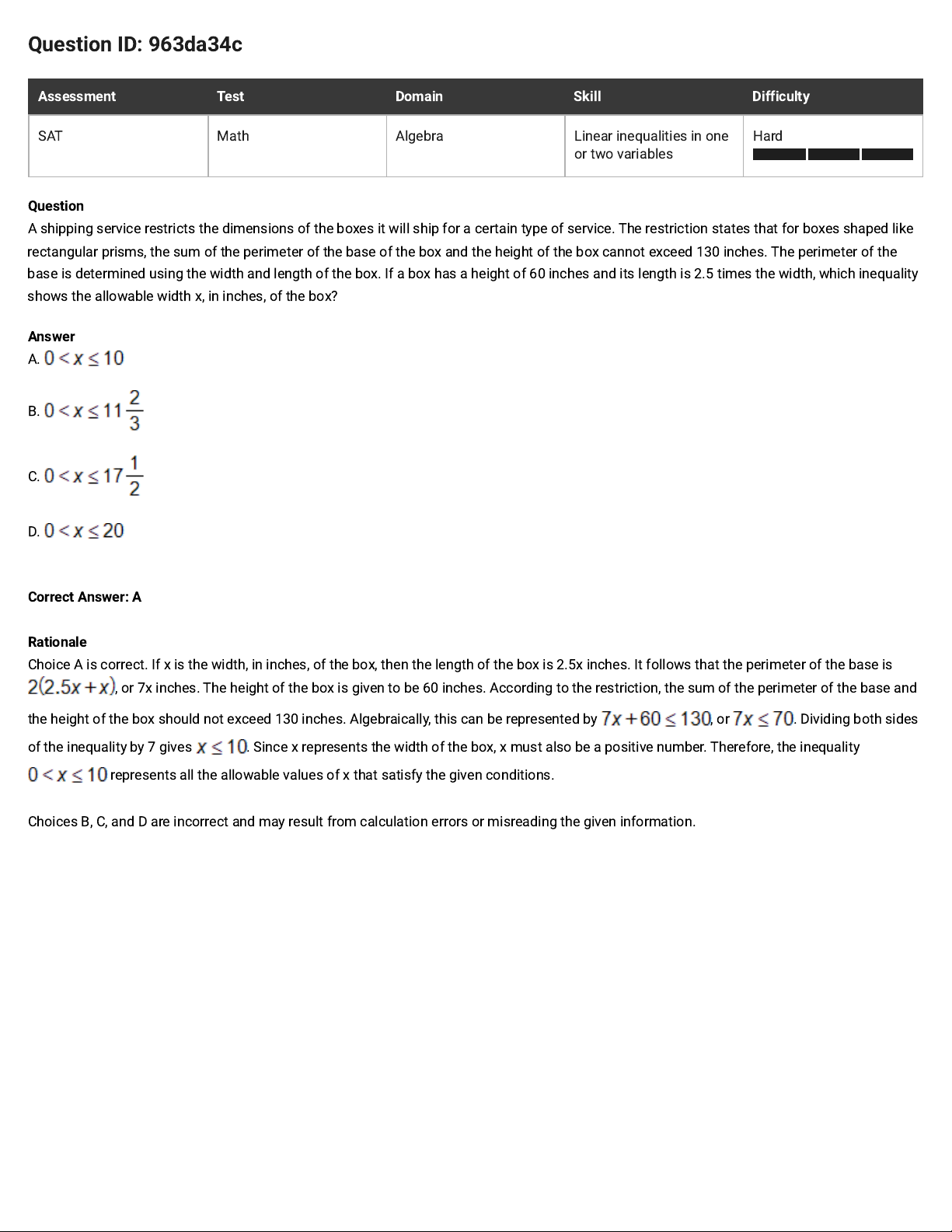
A shipping service restricts the dimensions of the boxes it will ship for a certain type of service. Therestriction states that for boxes shaped like
rectangular prisms, the sum of the perimeter of the base of the box and the height of the box cannot exceed 130inches. The perimeter of the
base is determined using the width and length of the box. Ifa box has a height of 60inches and its length is 2.5times the width, which inequality
shows the allowable width x, in inches, of the box?
Answer
A.
B.
C.
D.
Correct Answer: A
Rationale
Choice A is correct. If x is the width, in inches, of the box, then the length of the box is 2.5x inches. It follows that the perimeter of the base is
, or 7x inches. The height of the box is given to be 60 inches. According to the restriction, the sum of the perimeter of the base and
the height of the box should not exceed 130 inches. Algebraically, this can be represented by , or . Dividing both sides
of the inequality by 7 gives . Since x represents the width of the box, x must also be a positive number. Therefore, the inequality
represents all the allowable values of x that satisfy the given conditions.
Choices B, C, and D are incorrect and may result from calculation errors or misreading the given information.
Page 10
Question ID: 68c5c81a
Assessment Test Domain Skill Difficulty
SAT Math Algebra Linear inequalities in one
or two variables
Hard
Question
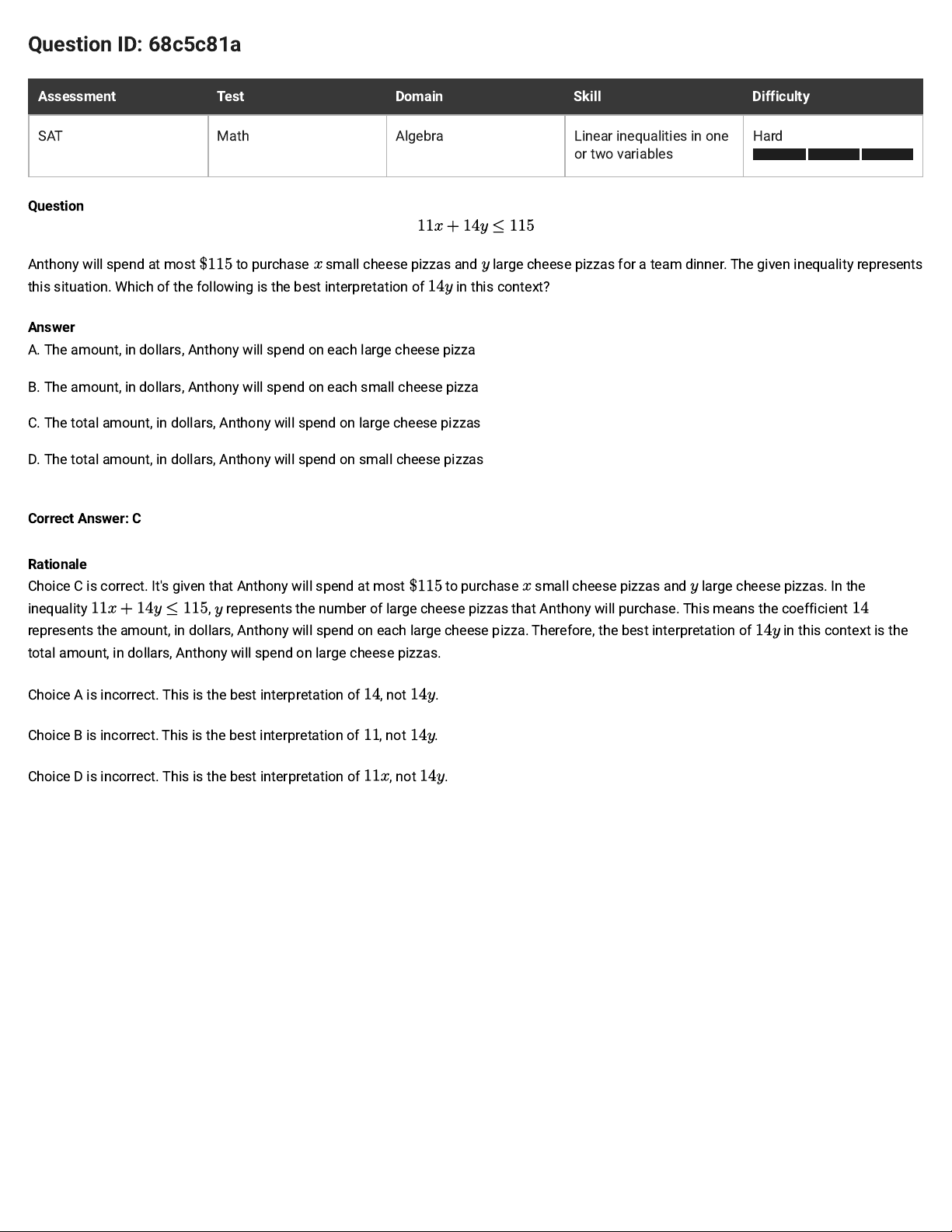
Anthony will spend at most to purchase small cheese pizzas and large cheese pizzas for a team dinner. The given inequality represents
this situation. Which of the following is the best interpretation of in this context?
Answer
A. The amount, in dollars, Anthony will spend on each large cheese pizza
B. The amount, in dollars, Anthony will spend on each small cheese pizza
C. The total amount, in dollars, Anthony will spend on large cheese pizzas
D. The total amount, in dollars, Anthony will spend on small cheese pizzas
Correct Answer: C
Rationale
Choice C is correct. It's given that Anthony will spend at most to purchase small cheese pizzas and large cheese pizzas. In the
inequality , represents the number of large cheese pizzas that Anthony will purchase. This means the coefficient
represents the amount, in dollars, Anthony will spend on each large cheese pizza. Therefore, the best interpretation of in this context is the
total amount, in dollars, Anthony will spend on large cheese pizzas.
Choice A is incorrect. This is the best interpretation of , not .
Choice B is incorrect. This is the best interpretation of , not .
Choice D is incorrect. This is the best interpretation of , not .
 Loading...