

Page 1
Question ID: 37e5c794
Assessment Test Domain Skill Difficulty
SAT Reading and Writing Standard English
Conventions
Form, Structure, and
Sense
Hard
Question
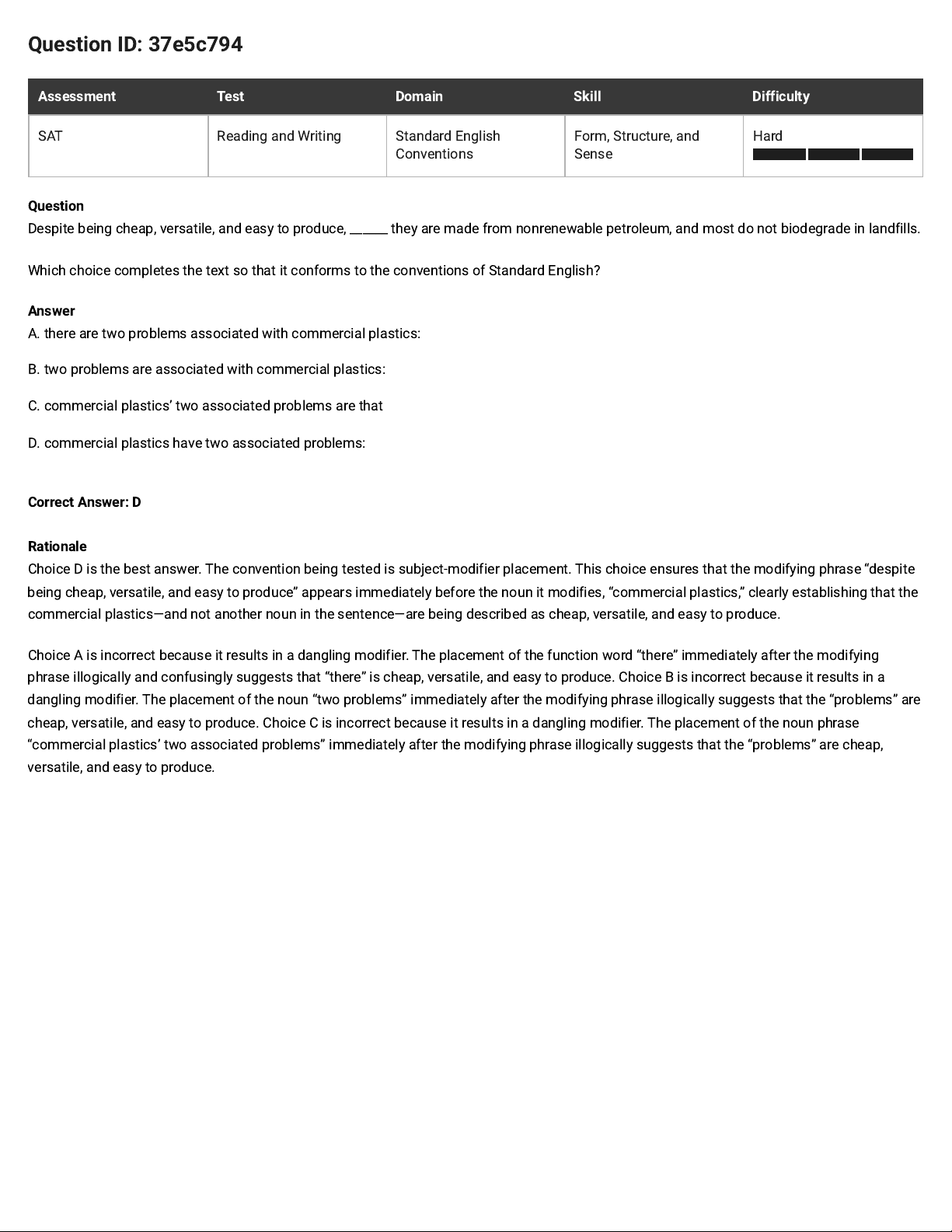
Despite being cheap, versatile, and easy to produce, ______ they are made from nonrenewable petroleum, and most do not biodegrade in landfills.
Which choice completes the text so that it conforms to the conventions of Standard English?
Answer
A. there are two problems associated with commercial plastics:
B. two problems are associated with commercial plastics:
C. commercial plastics’ two associated problems are that
D. commercial plastics have two associated problems:
Correct Answer: D
Rationale
Choice D is the best answer. The convention being tested is subject-modifier placement. This choice ensures that the modifying phrase “despite
being cheap, versatile, and easy to produce” appears immediately before the noun it modifies, “commercial plastics,” clearly establishing that the
commercial plastics—and not another noun in the sentence—are being described as cheap, versatile, and easy to produce.
Choice A is incorrect because it results in a dangling modifier. The placement of the function word “there” immediately after the modifying
phrase illogically and confusingly suggests that “there” is cheap, versatile, and easy to produce. Choice B is incorrect because it results in a
dangling modifier. The placement of the noun “two problems” immediately after the modifying phrase illogically suggests that the “problems” are
cheap, versatile, and easy to produce. Choice C is incorrect because it results in a dangling modifier. The placement of the noun phrase
“
commercial plastics’ two associated problems” immediately after the modifying phrase illogically suggests that the “problems” are cheap,
versatile, and easy to produce.
Page 2
Question ID: 3580533b
Assessment Test Domain Skill Difficulty
SAT Reading and Writing Standard English
Conventions
Form, Structure, and
Sense
Easy
Question
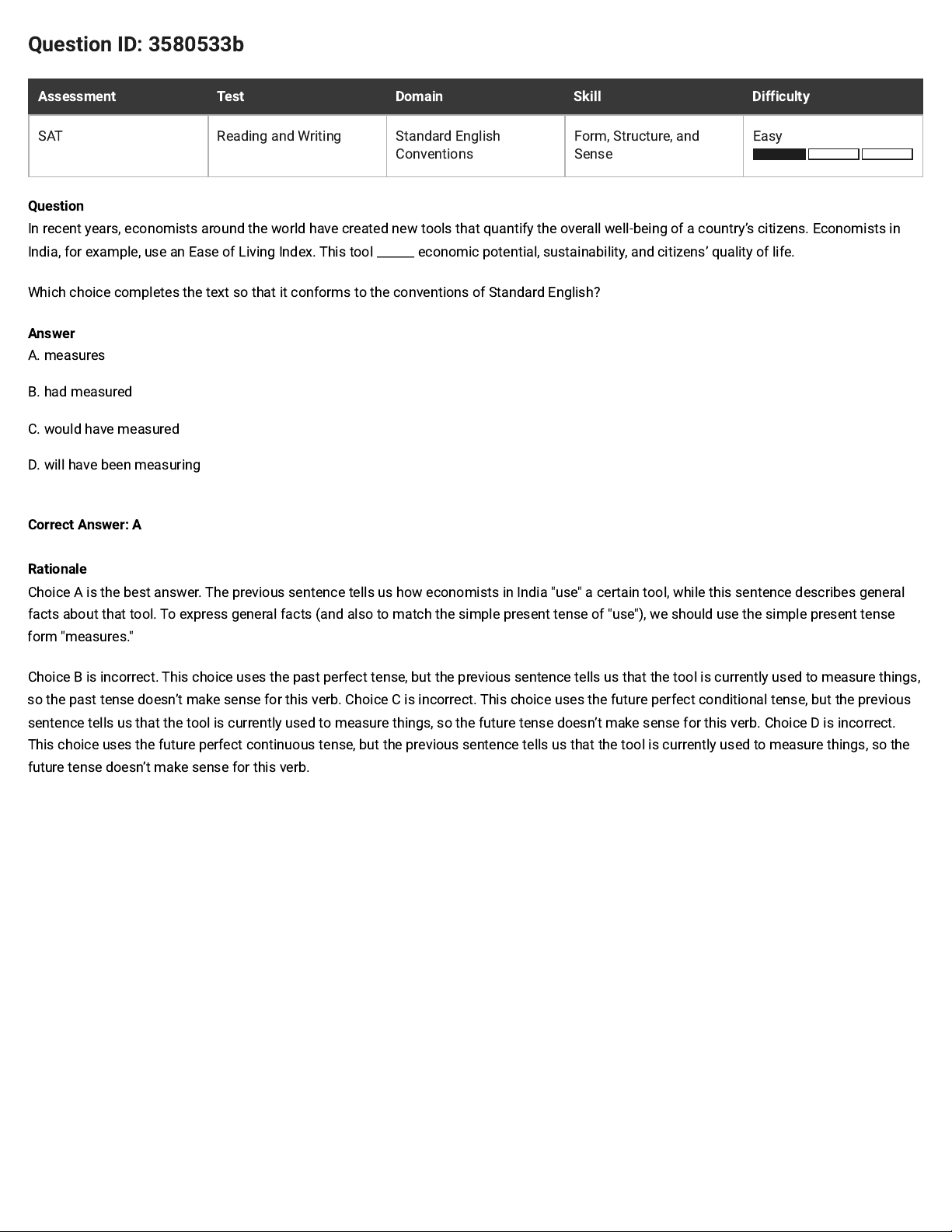
In recent years, economists around the world have created new tools that quantify the overall well-being of a country’s citizens. Economists in
India, for example, use an Ease of Living Index. This tool ______ economic potential, sustainability, and citizens’ quality of life.
Which choice completes the text so that it conforms to the conventions of Standard English?
Answer
A. measures
B. had measured
C. would have measured
D. will have been measuring
Correct Answer: A
Rationale
Choice A is the best answer. The previous sentence tells us how economists in India "use" a certain tool, while this sentence describes general
facts about that tool. To express general facts (and also to match the simple present tense of "use"), we should use the simple present tense
form "measures."
Choice B is incorrect. This choice uses the past perfect tense, but the previous sentence tells us that the tool is currently used to measure things,
so the past tense doesn’t make sense for this verb. Choice C is incorrect. This choice uses the future perfect conditional tense, but the previous
sentence tells us that the tool is currently used to measure things, so the future tense doesn’t make sense for this verb. Choice D is incorrect.
This choice uses the future perfect continuous tense, but the previous sentence tells us that the tool is currently used to measure things, so the
future tense doesn’t make sense for this verb.
Page 3
Question ID: 4c335aea
Assessment Test Domain Skill Difficulty
SAT Reading and Writing Standard English
Conventions
Form, Structure, and
Sense
Hard
Question
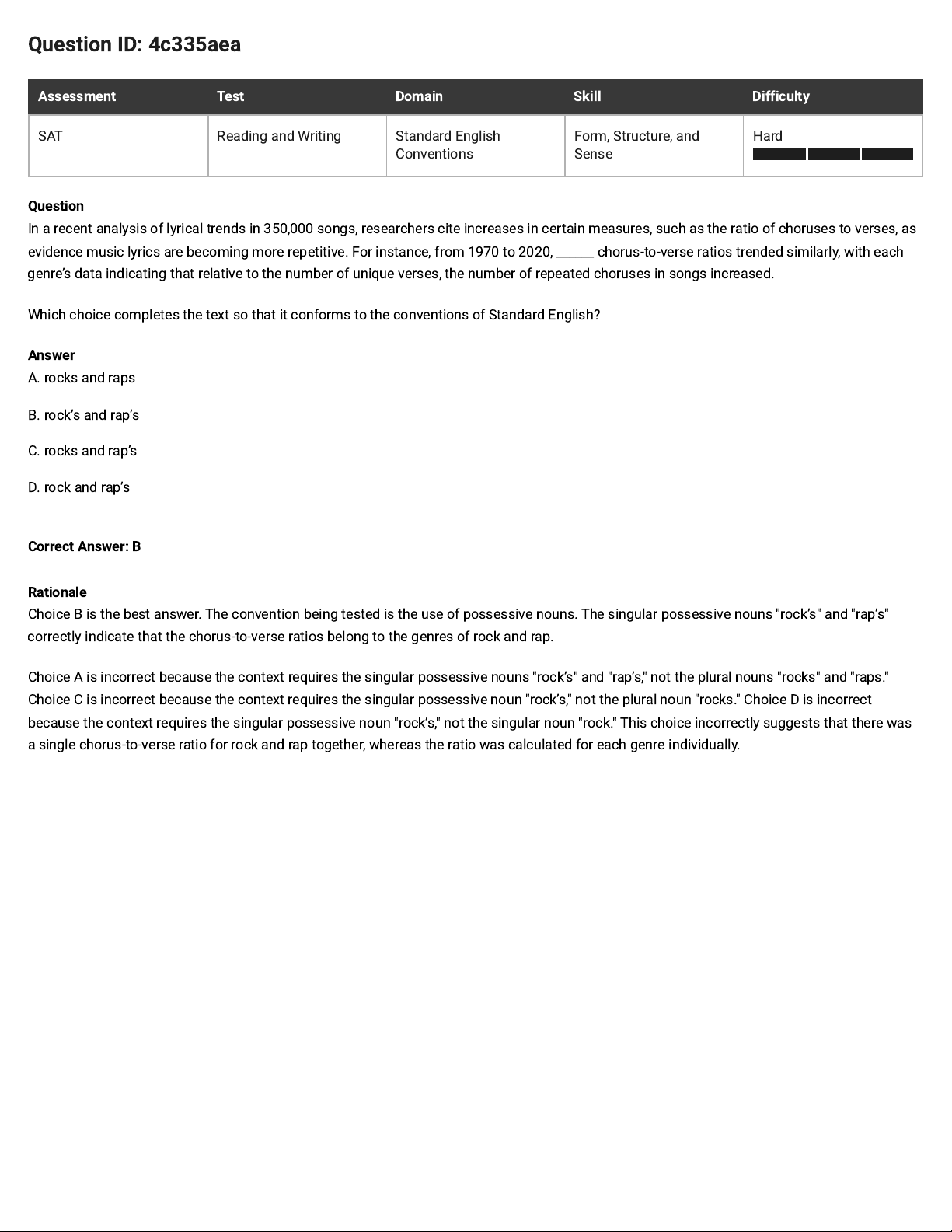
In a recent analysis of lyrical trends in 350,000 songs, researchers cite increases in certain measures, such as the ratio of choruses to verses, as
evidence music lyrics are becoming more repetitive. For instance, from 1970 to 2020, ______ chorus-to-verse ratios trended similarly, with each
genre’s data indicating that relative to the number of unique verses, the number of repeated choruses in songs increased.
Which choice completes the text so that it conforms to the conventions of Standard English?
Answer
A. rocks and raps
B. rock’s and rap’s
C. rocks and rap’s
D. rock and rap’s
Correct Answer: B
Rationale
Choice B is the best answer. The convention being tested is the use of possessive nouns. The singular possessive nouns "rock’s" and "rap’s"
correctly indicate that the chorus-to-verse ratios belong to the genres of rock and rap.
Choice A is incorrect because the context requires the singular possessive nouns "rock’s" and "rap’s," not the plural nouns "rocks" and "raps."
Choice C is incorrect because the context requires the singular possessive noun "rock’s," not the plural noun "rocks." Choice D is incorrect
because the context requires the singular possessive noun "rock’s," not the singular noun "rock." This choice incorrectly suggests that there was
a single chorus-to-verse ratio for rock and rap together, whereas the ratio was calculated for each genre individually.
Page 4
Question ID: 8b017d4e
Assessment Test Domain Skill Difficulty
SAT Reading and Writing Standard English
Conventions
Form, Structure, and
Sense
Hard
Question
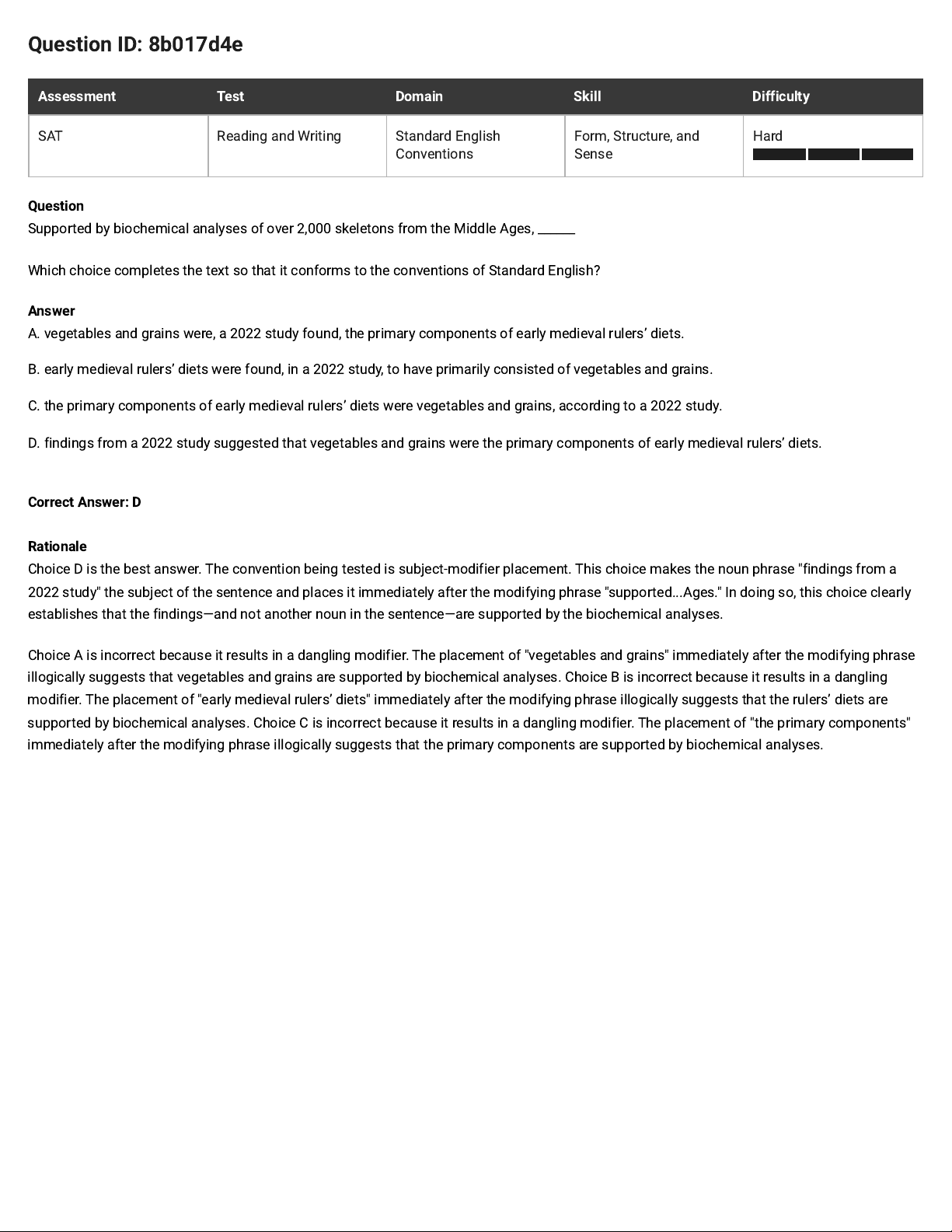
Supported by biochemical analyses of over 2,000 skeletons from the Middle Ages, ______
Which choice completes the text so that it conforms to the conventions of Standard English?
Answer
A. vegetables and grains were, a 2022 study found, the primary components of early medieval rulers’ diets.
B. early medieval rulers’ diets were found, in a 2022 study, to have primarily consisted of vegetables and grains.
C. the primary components of early medieval rulers’ diets were vegetables and grains, according to a 2022 study.
D. findings from a 2022 study suggested that vegetables and grains were the primary components of early medieval rulers’ diets.
Correct Answer: D
Rationale
Choice D is the best answer. The convention being tested is subject-modifier placement. This choice makes the noun phrase "findings from a
2022 study" the subject of the sentence and places it immediately after the modifying phrase "supported...Ages." In doing so, this choice clearly
establishes that the findings—and not another noun in the sentence—are supported by the biochemical analyses.
Choice A is incorrect because it results in a dangling modifier. The placement of "vegetables and grains" immediately after the modifying phrase
illogically suggests that vegetables and grains are supported by biochemical analyses. Choice B is incorrect because it results in a dangling
modifier. The placement of "early medieval rulers’ diets" immediately after the modifying phrase illogically suggests that the rulers’ diets are
supported by biochemical analyses. Choice C is incorrect because it results in a dangling modifier. The placement of "the primary components"
immediately after the modifying phrase illogically suggests that the primary components are supported by biochemical analyses.
Page 5
Question ID: f0864217
Assessment Test Domain Skill Difficulty
SAT Reading and Writing Standard English
Conventions
Form, Structure, and
Sense
Hard
Question
Rabinal Achí is a precolonial Maya dance drama performed annually in Rabinal, a town in the Guatemalan highlands. Based on events that
occurred when Rabinal was a city-state ruled by a king, ______ had once been an ally of the king but was later captured while leading an invading
force against him.
Which choice completes the text so that it conforms to the conventions of Standard English?
Answer
A.
Rabinal Achí
tells the story of K’iche’ Achí, a military leader who
B. K’iche’ Achí, the military leader in the story of
Rabinal Achí,
C. the military leader whose story is told in
Rabinal Achí, K’iche’ Achí,
D. there was a military leader, K’iche’ Achí, who in
Rabinal Ach
í
Correct Answer: A
Rationale
Choice A is the best answer. The modifier “Based on events…by a king,” is describing the drama “Rabinal Achí.” Modifiers need to be next to the
subjects they describe, so “Rabinal Achí”
needs to be the first word after the comma.
Choice B is incorrect. This doesn’t complete the text in a way that conforms to the conventions of Standard English. The modifier “Based on
events…by a king,” is describing the drama “Rabinal Achí.” Modifiers need to be next to the subjects they describe, so “Rabinal Achí”
needs to be
the first word after the comma.Choice C is incorrect. This doesn’t complete the text in a way that conforms to the conventions of Standard
English. The modifier “Based on events…by a king,” is describing the drama “Rabinal Achí.” Modifiers need to be next to the subjects they
describe, so “Rabinal Achí”
needs to be the first word after the comma.Choice D is incorrect. This doesn’t complete the text in a way that
conforms to the conventions of Standard English. The modifier “Based on events…by a king,” is describing the drama “Rabinal Achí.” Modifiers
need to be next to the subjects they describe, so “Rabinal Achí”
needs to be the first word after the comma.
Page 6
Question ID: 6e193b19
Assessment Test Domain Skill Difficulty
SAT Reading and Writing Standard English
Conventions
Form, Structure, and
Sense
Medium
Question
Professional American football player Fred Cox invented one of the world’s most popular toys. In the 1970s, he came up with the idea for the Nerf
football, which ______ of the harder and heavier regulation football.
Which choice completes the text so that it conforms to the conventions of Standard English?
Answer
A. were a smaller, foam version
B. are smaller, foam versions
C. were smaller, foam versions
D. is a smaller, foam version
Correct Answer: D
Rationale
Choice D is the best answer. The convention being tested is subject-verb agreement and agreement between nouns. The singular verb “is” and
the singular noun “version” both agree in number with the relative pronoun “which.” In this context, “which” functions as a singular subject
because it refers to the singular noun “the Nerf football.
”
Choice A is incorrect because the plural verb “were” doesn’t agree in number with the singular noun phrase “the Nerf football” that it’s modifying.
Choice B is incorrect because the plural verb “are” and the plural noun “versions” don’t agree in number with the singular noun phrase “the Nerf
football” that they’re modifying. Choice C is incorrect because the plural verb “were” and the plural noun “versions” don’t agree in number with the
singular noun phrase “the Nerf football” that they’re modifying.
Page 7
Question ID: fced396a
Assessment Test Domain Skill Difficulty
SAT Reading and Writing Standard English
Conventions
Form, Structure, and
Sense
Hard
Question
The Herfindahl-Hirschman Index (HHI), a commonly used measure of competition between companies in a particular market, ranges from a
score of zero to 10,000 points. Compared with that of a highly concentrated market—that is, a market controlled by very few companies—______
Which choice completes the text so that it conforms to the conventions of Standard English?
Answer
A. a market that is less concentrated will have a much lower HHI score.
B. the HHI score of a less concentrated market will be much lower.
C. when a market is less concentrated, its HHI score will be much lower.
D. a less concentrated market will have an HHI score that is much lower.
Correct Answer: B
Rationale
Choice B is the best answer. The convention being tested is subject-modifier placement. This choice makes the noun phrase "the HHI...market"
the subject of the sentence and places it immediately after the modifying phrase "compared...market." In doing so, this choice clearly establishes
that the HHI score of a less concentrated market—and not another noun in the sentence—is being compared with the HHI score of a highly
concentrated market.
Choice A is incorrect because it results in a dangling modifier. The placement of "a market that is less concentrated" immediately after the
modifying phrase illogically suggests that a market is being compared with an HHI score. Choice C is incorrect because it results in a confusing,
illogical sentence. The placement of the modifier "when a market is less concentrated" after "a highly concentrated market" is contradictory.
Furthermore, it’s ambiguous what "its" is referring to in "its HHI score," resulting in an illogical comparison. Choice D is incorrect because it
results in a dangling modifier. The placement of "a less concentrated market" immediately after the modifying phrase illogically suggests that a
market is being compared with an HHI score.
Page 8
Question ID: 819c443d
Assessment Test Domain Skill Difficulty
SAT Reading and Writing Standard English
Conventions
Form, Structure, and
Sense
Medium
Question
In January 1776, Thomas Paine published
Common Sense
, an appeal for freedom from the British monarchy that famously helped ignite the
desire for independence among the American colonists. After the colonies achieved their independence, Paine moved to Paris, where the
provocative ______ would contribute to another revolution—the French Revolution.
Which choice completes the text so that it conforms to the conventions of Standard English?
Answer
A. authors political writings
B. author’s political writings
C. author’s political writing’s
D. authors’ political writings
’
Correct Answer: B
Rationale
Choice B is the best answer. The conventions being tested are the use of plural and possessive nouns. The singular possessive noun "author’s"
correctly indicates that the political writings are those of Thomas Paine, and the plural noun "writings" correctly indicates that multiple works by
Paine are being discussed.
Choice A is incorrect because the context requires the singular possessive noun "author’s," not the plural noun "authors." Choice C is incorrect
because the context requires the plural noun "writings," not the singular possessive noun "writing’s." Choice D is incorrect because the context
requires the singular possessive noun "author’s" and the plural noun "writings," not the plural possessive nouns "authors’" and "writings’."
Page 9
Question ID: f10b7ce4
Assessment Test Domain Skill Difficulty
SAT Reading and Writing Standard English
Conventions
Form, Structure, and
Sense
Hard
Question
In the list “Adorable Things” from Sei Shōnagon’sPillow Book
, the author delights in baby sparrows, a face drawn on a melon, and a young
courtier in ceremonial garb. So shrewd an observer is Shōnagon, a lady-in-waiting to Empress Teishi, that her book’s musings on tenth-century
Japanese courtly life ______ readers a thousand years later.
Which choice completes the text so that it conforms to the conventions of Standard English?
Answer
A. fascinate
B. has fascinated
C. fascinates
D. is fascinating
Correct Answer: A
Rationale
Choice A is the best answer. The convention being tested is subject-verb agreement. The plural verb "fascinate" agrees in number with the plural
subject "musings."
Choice B is incorrect because the singular verb "has fascinated" doesn’t agree in number with the plural subject "musings." Choice C is incorrect
because the singular verb "fascinates" doesn’t agree in number with the plural subject "musings." Choice D is incorrect because the singular verb
"is fascinating" doesn’t agree in number with the plural subject "musings."
Page 10
Question ID: ea0aa676
Assessment Test Domain Skill Difficulty
SAT Reading and Writing Standard English
Conventions
Form, Structure, and
Sense
Hard
Question
In the 1970s, Janaki Ammal, a prominent botanist, emerged as a powerful voice in India’s environmental conservation movement. Her exhaustive
chromosomal survey of plants in Silent Valley, a pristine tropical forest in Kerala, India, that is home to nearly 1,000 species of native flora (many
of which are endangered), ______ instrumental in the government’s decision to preserve the forest.
Which choice completes the text so that it conforms to the conventions of Standard English?
Answer
A. are
B. were
C. have been
D. was
Correct Answer: D
Rationale
Choice D is the best answer. The subject "survey" is singular, and so is the verb "was."
Choice A is incorrect. The subject "survey" is singular, but the verb "are" is plural. Choice B is incorrect. The subject "survey" is singular, but the
verb "were" is plural. Choice C is incorrect. The subject "survey" is singular, but the verb "have been" is plural.
Page 11
Question ID: dc645172
Assessment Test Domain Skill Difficulty
SAT Reading and Writing Standard English
Conventions
Form, Structure, and
Sense
Hard
Question
The artistic talents of Barbara Chase-Riboud, most known for her 1979 historical novel
Sally Hemings
and the conversation it inspired, ______
limited to the realm of prose: she first excelled in sculpture, where her affinity for bronze—a material she described as “timeless” due to its use
across eras and cultures—became part of her artistic identity.
Which choice completes the text so that it conforms to the conventions of Standard English?
Answer
A. hasn’t been
B. wasn’t
C. isn’t
D. aren’t
Correct Answer: D
Rationale
Choice D is the best answer. The subject "talents" is plural, and so is the verb "aren’t": "the artistic talents…aren’t limited."
Choice A is incorrect. The subject "talents" is plural, but the verb "hasn’t been" is singular. Choice B is incorrect. The subject "talents" is plural, but
the verb "wasn’t" is singular. Choice C is incorrect. The subject "talents" is plural, but the verb "isn’t" is singular.
Page 12
Question ID: d2b81427
Assessment Test Domain Skill Difficulty
SAT Reading and Writing Standard English
Conventions
Form, Structure, and
Sense
Hard
Question
In assessing the films of Japanese director Akira Kurosawa, ______ have missed his equally deep engagement with Japanese artistic traditions
such as Noh theater.
Which choice completes the text so that it conforms to the conventions of Standard English?
Answer
A. many critics have focused on Kurosawa’s use of Western literary sources but
B. Kurosawa’s use of Western literary sources has been the focus of many critics, who
C. there are many critics who have focused on Kurosawa’s use of Western literary sources, but they
D. the focus of many critics has been on Kurosawa’s use of Western literary sources; they
Correct Answer: A
Rationale
Choice A is the best answer. The convention being tested is subject-modifier placement. This choice makes the noun phrase “many critics” the
subject of the sentence and places it immediately after the modifying phrase “in assessing…Kurosawa.” In doing so, this choice clearly
establishes that it is the critics—and not another noun in the sentence—who assess Kurosawa’s films.
Choice B is incorrect because it results in a dangling modifier. The placement of the noun phrase “Kurosawa’s…sources” immediately after the
modifying phrase illogically suggests that his use of Western literary sources is what assesses Kurosawa’s films. Choice C is incorrect because it
results in a dangling modifier. The placement of the function word “there” immediately after the modifying phrase illogically suggests that “there
”
is what assesses Kurosawa’s films. Choice D is incorrect because it results in a dangling modifier. The placement of the noun phrase “the focus
…
critics” immediately after the modifying phrase illogically suggests that the critics’ focus is what assesses Kurosawa’s films.
Page 13
Question ID: b74f676f
Assessment Test Domain Skill Difficulty
SAT Reading and Writing Standard English
Conventions
Form, Structure, and
Sense
Medium
Question
Classical composer Florence Price’s 1927 move to Chicago marked a turning point in her career. It was there that Price premiered her First
Symphony—a piece that was praised for blending traditional Romantic motifs with aspects of Black folk music—and ______ supportive
relationships with other Black artists.
Which choice completes the text so that it conforms to the conventions of Standard English?
Answer
A. developing
B. developed
C. to develop
D. having developed
Correct Answer: B
Rationale
Choice B is the best answer. The missing verb is part of the same clause as the verb "premiered," and "Price" is the subject of both. So we need
the past-tense form "developed" in order to match "premiered."
Choice A is incorrect. This choice creates a verb form error. The missing verb is part of the same clause as the verb "premiered," and "Price" is the
subject of both. So we need the past-tense form "developed" in order to match "premiered." Choice C is incorrect. This choice creates a verb form
error. The missing verb is part of the same clause as the verb "premiered," and "Price" is the subject of both. So we need the past-tense form
"developed" in order to match "premiered." Choice D is incorrect. This choice creates a verb form error. The missing verb is part of the same
clause as the verb "premiered," and "Price" is the subject of both. So we need the past-tense form "developed" in order to match "premiered."
Page 14
Question ID: 69f031ab
Assessment Test Domain Skill Difficulty
SAT Reading and Writing Standard English
Conventions
Form, Structure, and
Sense
Easy
Question
While exploring Nevada’s Gypsum Cave in 1930, Seneca and Abenaki archaeologist Bertha Parker made her most famous discovery: the skull of
a now-extinct ground sloth (
Nothrotheriops shastensis
) alongside human-made tools. Parker’s crucial finding was the first ______ humans in
North America as far back as 10,000 years ago.
Which choice completes the text so that it conforms to the conventions of Standard English?
Answer
A. places
B. placed
C. place
D. to place
Correct Answer: D
Rationale
Choice D is the best answer. The object for the verb "was" is "first," and "to place" is acting as a modifier for "first." What was the finding? It was
"the first." The first to do what? The first "to place humans in North America" 10,000 years ago. When a verb serves as a modifier within a noun
phrase, it must be nonfinite (i.e., not conjugated to a specific subject). The infinitive form "to place" is the only nonfinite option among the
choices that makes sense in context.
Choice A is incorrect. The object for the verb "was" is "first," and "places" is acting as a modifier for "first." What was the thing that Parker’s finding
did? What was it the first to do? Place humans in North America 10,000 years ago. When a verb acts as a modifier, it must be nonfinite (i.e., not
conjugated to a specific subject), but "places" is a finite form of the verb. Choice B is incorrect. The object for the verb "was" is "first," and
"placed" is acting to modify "first." What was it that Parker’s finding was the first to do? Place humans in North America 10,000 years ago. When
a verb acts as a modifier, it must be nonfinite (i.e., not conjugated to a specific subject), but "placed" is a finite form. "Placed" can also be a past
participle, but that wouldn’t make sense here because the meaning of "the first placed humans" would be unclear. Choice C is incorrect. The
object for the verb "was" is "first," and "place" is modifying "first." What was the thing that Parker’s finding did? What was it the first to do? Place
humans in North America. When a verb acts as a modifier, it must be nonfinite (i.e., not conjugated to a specific subject), but "place" is a finite
form of the verb. Additionally, "place" can’t serve as a noun here, because it results in an illogical sentence (the "finding" wasn’t "the first place").
Page 15
Question ID: 003f22c8
Assessment Test Domain Skill Difficulty
SAT Reading and Writing Standard English
Conventions
Form, Structure, and
Sense
Medium
Question
Every last second of space shuttle mission STS-79, which lasted ten days and three hours, ______ carefully monitored by a team of experts.
Which choice completes the text so that it conforms to the conventions of Standard English?
Answer
A. have been
B. are
C. was
D. were
Correct Answer: C
Rationale
Choice C is the best answer. The convention being tested is subject-verb agreement. The singular verb "was" agrees in number with the singular
subject "every last second."
Choice A is incorrect because the plural verb "have been" doesn’t agree in number with the singular subject "every last second." Choice B is
incorrect because the plural verb "are" doesn’t agree in number with the singular subject "every last second." Choice D is incorrect because the
plural verb "were" doesn’t agree in number with the singular subject "every last second."
Page 16
Question ID: 3bceeb93
Assessment Test Domain Skill Difficulty
SAT Reading and Writing Standard English
Conventions
Form, Structure, and
Sense
Hard
Question
When they were first discovered in Australia in 1798, duck-billed, beaver-tailed platypuses so defied categorization that one scientist assigned
them the name
Ornithorhynchus paradoxus: “
paradoxical bird-snout.” The animal, which lays eggs but also nurses ______ young with milk, has
since been classified as belonging to the monotremes group.
Which choice completes the text so that it conforms to the conventions of Standard English?
Answer
A. they’re
B. their
C. its
D. it’s
Correct Answer: C
Rationale
Choice C is the best answer. The singular possessive pronoun "its" agrees with the singular antecedent "the animal" and indicates that the
"young" belong to it.
Choice A is incorrect. This choice creates a pronoun-antecedent agreement error. "They’re" is a contraction of "they are," a plural pronoun and
verb, but the antecedent "the animal" is singular. Also, we don’t need the extra verb "are" — we already have a main verb in this clause, so adding
"are" would be confusing and ungrammatical. Choice B is incorrect. This choice creates a pronoun-antecedent agreement error. "Their" is a plural
pronoun, but the subject of the sentence is "the animal," a singular noun. Choice D is incorrect. This choice creates a confusing and
ungrammatical sentence. "It’s" is a contraction for "it is." We already have the verb "nurses" in this clause, so we shouldn’t add the verb "is."
Page 17
Question ID: dab8b8ee
Assessment Test Domain Skill Difficulty
SAT Reading and Writing Standard English
Conventions
Form, Structure, and
Sense
Hard
Question
Known as Earth’s “living skin,” biocrusts are thin layers of soil held together by surface-dwelling microorganisms such as fungi, lichens, and
cyanobacteria. Fortifying soil in arid ecosystems against erosion, ______
Which choice completes the text so that it conforms to the conventions of Standard English?
Answer
A. a recent study’s estimate is that these crusts reduce global dust emissions by 60 percent each year.
B. an estimated 60 percent reduction in global dust emissions each year is due to these crusts, according to a recent study.
C. these crusts reduce global dust emissions by an estimated 60 percent each year, according to a recent study.
D. a recent study has estimated that these crusts reduce global dust emissions by 60 percent each year.
Correct Answer: C
Rationale
Choice C is the best answer. The subject of the modifier "fortifying soil in arid ecosystems against erosion" is "biocrusts." Subject-modifier
placement requires a modifier and its subject to be next to each other, so "biocrusts" or some variant meaning "biocrusts" (in this case, "these
crusts") must begin the missing clause.
Choice A is incorrect. Modifiers and their subjects must go next to each other. The subject of the modifier "fortifying soil in arid ecosystems
against erosion" is "biocrusts," not "a recent study’s estimate." Choice B is incorrect. Modifiers and their subjects must go next to each other. The
subject of the modifier "fortifying soil in arid ecosystems against erosion" is "biocrusts," not "an estimated 60 percent reduction." Choice D is
incorrect. Modifiers and their subjects must go next to each other. The subject of the modifier "fortifying soil in arid ecosystems against erosion"
is "biocrusts," not "a recent study."
Page 18
Question ID: f4fd123c
Assessment Test Domain Skill Difficulty
SAT Reading and Writing Standard English
Conventions
Form, Structure, and
Sense
Easy
Question
The African Games Co-production Market, one of over 180 annual international conferences supporting video game development, ______ the
growth of the African gaming industry by helping start-up studios in Africa find partners.
Which choice completes the text so that it conforms to the conventions of Standard English?
Answer
A. promote
B. are promoting
C. promotes
D. have promoted
Correct Answer: C
Rationale
Choice C is the best answer. The subject of the sentence is “The African Games Co-production Market.” That’s one market, so it’s a singular noun,
which means it needs a singular verb. “Promotes” is the only singular verb among the choices.
Choice A is incorrect. This choice creates a subject-verb agreement error. The subject “The African Games Co-production Market” is singular, but
the verb “promote” is plural. Choice B is incorrect. This choice creates a subject-verb agreement error. The subject “The African Games Co-
production Market” is singular, but the verb “are promoting” is plural. Choice D is incorrect. This choice creates a subject-verb agreement error.
The subject “The African Games Co-production Market” is singular, but the verb “have promoted” is plural.
Page 19
Question ID: 97df6650
Assessment Test Domain Skill Difficulty
SAT Reading and Writing Standard English
Conventions
Form, Structure, and
Sense
Easy
Question
The village of Panduyacu in Ecuador ______ one of the rare places in the world located almost directly on the equator.
Which choice completes the text so that it conforms to the conventions of Standard English?
Answer
A. are being
B. have been
C. is
D. are
Correct Answer: C
Rationale
Choice C is the best answer. The convention being tested is subject-verb agreement. The singular verb "is" agrees in number with the singular
subject "village."
Choice A is incorrect because the plural verb "are being" doesn’t agree in number with the singular subject "village." Choice B is incorrect because
the plural verb "have been" doesn’t agree in number with the singular subject "village." Choice D is incorrect because the plural verb "are" doesn’t
agree in number with the singular subject "village."
Page 20
Question ID: 59209b6d
Assessment Test Domain Skill Difficulty
SAT Reading and Writing Standard English
Conventions
Form, Structure, and
Sense
Medium
Question
Based on genetic evidence, archaeologists have generally agreed that reindeer domestication began in the eleventh century CE. However, since
uncovering fragments of a 2,000-year-old reindeer training harness in northern Siberia, ______ may have begun much earlier.
Which choice completes the text so that it conforms to the conventions of Standard English?
Answer
A. researcher Robert Losey has argued that domestication
B. researcher Robert Losey’s argument is that domestication
C. domestication, researcher Robert Losey has argued,
D. the argument researcher Robert Losey has made is that domestication
Correct Answer: A
Rationale
Choice A is the best answer. The convention being tested is subject-modifier placement. This choice makes the noun phrase “researcher Robert
Losey” the subject of the sentence and places it immediately after the modifying phrase “since…Siberia.” In doing so, this choice clearly
establishes that researcher Robert Losey—and not another noun in the sentence—is who uncovered fragments of a 2,000-year-old reindeer
training harness in northern Siberia.
Choice B is incorrect because it results in a dangling modifier. The placement of the noun phrase “researcher Robert Losey’s argument
”
immediately after the modifying phrase illogically suggests that the “argument” is what uncovered fragments of a 2,000-year-old reindeer training
harness in northern Siberia. Choice C is incorrect because it results in a dangling modifier. The placement of the noun “domestication
”
immediately after the modifying phrase illogically suggests that “domestication” is what uncovered fragments of a 2,000-year-old reindeer
training harness in northern Siberia. Choice D is incorrect because it results in a dangling modifier. The placement of the noun phrase “the
argument” immediately after the modifying phrase illogically suggests that the “argument” is what uncovered fragments of a 2,000-year-old
reindeer training harness in northern Siberia.
Page 21
Question ID: 2784cbaf
Assessment Test Domain Skill Difficulty
SAT Reading and Writing Standard English
Conventions
Form, Structure, and
Sense
Hard
Question
To fully describe the motion of an object requires knowing each of five ______ movement: displacement, time, initial velocity, final velocity, and
acceleration. These are called kinematic variables.
Which choice completes the text so that it conforms to the conventions of Standard English?
Answer
A. variable’s that characterize objects
’
B. variables that characterize objects
’
C. variables that characterize object’s
D. variables that characterize objects
Correct Answer: B
Rationale
Choice B is the best answer. The conventions being tested are the use of plural and possessive nouns. The plural noun "variables" correctly
indicates that there are multiple variables, and the plural possessive noun "objects’" correctly indicates that the movement of objects in general is
being discussed.
Choice A is incorrect because the context requires the plural noun "variables," not the singular possessive noun "variable’s." Choice C is incorrect
because the context requires the plural possessive noun "objects’," not the singular possessive noun "object’s." Choice D is incorrect because the
context requires the plural possessive noun "objects’," not the plural noun "objects."
Page 22
Question ID: 863065c7
Assessment Test Domain Skill Difficulty
SAT Reading and Writing Standard English
Conventions
Form, Structure, and
Sense
Hard
Question
Legal scholars James Melton and Tom Ginsburg’s analysis of de jure judicial independence and its growth over decades ______ six constitutional
features that enhance such independence, including judicial tenure and selection procedure. Albania’s constitution contains five of these
features.
Which choice completes the text so that it conforms to the conventions of Standard English?
Answer
A. are identifying
B. identify
C. have identified
D. identifies
Correct Answer: D
Rationale
Choice D is the best answer. The convention being tested is subject-verb agreement. The singular verb "identifies" agrees in number with the
singular subject "analysis."
Choice A is incorrect because the plural verb "are identifying" doesn’t agree in number with the singular subject "analysis." Choice B is incorrect
because the plural verb "identify" doesn’t agree in number with the singular subject "analysis." Choice C is incorrect because the plural verb "have
identified" doesn’t agree in number with the singular subject "analysis."
Page 23
Question ID: 872a002e
Assessment Test Domain Skill Difficulty
SAT Reading and Writing Standard English
Conventions
Form, Structure, and
Sense
Hard
Question
The present-day city of Dushanbe, Tajikistan, was for years the capital of the Tajik Autonomous Soviet Socialist Republic, one of many nominally
autonomous republics within the Soviet Union. Like ______ peer autonomous Soviet socialist republics, the Tajik Republic was established along
ethnolinguistic lines: most of the republic’s residents spoke Persian.
Which choice completes the text so that it conforms to the conventions of Standard English?
Answer
A. their
B. they’re
C. its
D. it’s
Correct Answer: C
Rationale
Choice C is the best answer. The convention being tested is the use of possessive determiners. The singular possessive determiner "its" agrees
in number with the singular subject "the Tajik Republic" and thus indicates that the other republics were its peers.
Choice A is incorrect because the plural possessive determiner "their" doesn’t agree in number with the singular subject "the Tajik Republic."
Choice B is incorrect because "they’re" is the contraction for "they are," not a possessive determiner. Choice D is incorrect because "it’s" is the
contraction for "it is" or "it has," not a possessive determiner.
Page 24
Question ID: 0fe5ce68
Assessment Test Domain Skill Difficulty
SAT Reading and Writing Standard English
Conventions
Form, Structure, and
Sense
Hard
Question
Ten of William Shakespeare’s plays are classified as histories. Although each one of these plays, which include
Henry V
and
Richard III
, ______ on
a single historical figure (specifically, an English king), some, such as
Henry VI Part One
and
Henry VI Part Two,
feature different episodes from
the same monarch’s life.
Which choice completes the text so that it conforms to the conventions of Standard English?
Answer
A. focuses
B. focus
C. are focused
D. were focused
Correct Answer: A
Rationale
Choice A is the best answer. The convention being tested is subject-verb agreement. The singular verb "focuses" agrees in number with the
singular subject "each one of these plays," which refers to each play individually.
Choice B is incorrect because the plural verb "focus" doesn’t agree in number with the singular subject "each one of these plays." Choice C is
incorrect because the plural verb "are focused" doesn’t agree in number with the singular subject "each one of these plays." Choice D is incorrect
because the plural verb "were focused" doesn’t agree in number with the singular subject "each one of these plays."
Page 25
Question ID: 684b8bd2
Assessment Test Domain Skill Difficulty
SAT Reading and Writing Standard English
Conventions
Form, Structure, and
Sense
Medium
Question
Far from being modern inventions, ______ more than 5,000 years ago.
Which choice completes the text so that it conforms to the conventions of Standard English?
Answer
A. Sumerians in ancient Mesopotamia used drinking straws
B. drinking straws were used by Sumerians in ancient Mesopotamia
C. the use of drinking straws by Sumerians in ancient Mesopotamia happened
D. ancient Mesopotamia was home to Sumerians who used drinking straws
Correct Answer: B
Rationale
Choice B is the best answer. Modifiers and their subjects must go next to each other. The modifier “far from being modern inventions” must be
describing “drinking straws,” because those are the only possible inventions in this sentence.
Choice A is incorrect. Modifiers and their subjects must go next to each other. The modifier “far from being modern inventions” can’t be
describing “Sumerians,” because they are a group of people, not an invention. Choice C is incorrect. Modifiers and their subjects must go next to
each other. The modifier “far from being modern inventions” can’t be describing “the use of drinking straws,” because it is not “the use” of
drinking straws that is an invention—it is the drinking straws themselves. Choice D is incorrect. Modifiers and their subjects must go next to each
other. The modifier “far from being modern inventions” can’t be describing “Ancient Mesopotamia,” because that is a place, not an invention.
Page 26
Question ID: 5b8f9cf2
Assessment Test Domain Skill Difficulty
SAT Reading and Writing Standard English
Conventions
Form, Structure, and
Sense
Hard
Question
In the canon of North African literature, Moroccan author Driss Chraïbi’s 1954 novel
The Simple Past(
Le Passé simple
) looms large. A coming-of-
age story, a social meditation, and a sober gaze into the dark maw of French colonialism, ______ interrogates systemic power with memorable
intensity.
Which choice completes the text so that it conforms to the conventions of Standard English?
Answer
A. Morocco gained its independence two years before the publication of Chraïbi’s debut novel, which
B. Chraïbi’s debut novel, published two years before Morocco gained its independence,
C. Chraïbi wrote a debut novel that, published two years before Morocco gained its independence,
D. published two years before Morocco gained its independence, Chraïbi wrote a debut novel that
Correct Answer: B
Rationale
Choice B is the best answer. Subject-modifier placement requires a modifier and its subject to be next to each other. The subject of the modifier
"a coming-of-age story…colonialism" is Chraïbi’s novel
The Simple Past
, so the subject "Chraïbi’s debut novel" fits perfectly after this introductor y
modifying phrase.
Choice A is incorrect. Modifiers and their subjects must go next to each other. The introductory modifier "a coming-of-age story…colonialism" is
describing Chraïbi’s novel, not Morocco. However, this choice places Morocco directly next to that modifier. Choice C is incorrect. Modifiers and
their subjects must go next to each other. The introductory modifier "a coming-of-age story…colonialism" all describes Chraïbi’s novel, not Chraïbi
himself. However, this choice places Chraïbi directly next to that modifier. Choice D is incorrect. Modifiers and their subjects must go next to
each other. The modifier "a coming-of-age story…" is describing Chraïbi’s novel, so that needs to be the subject immediately after the modifier.
This choice adds another modifier that describes Chraïbi’s novel, but then puts "Chraïbi" himself—not the novel—right after that modifier, which
doesn’t make sense. Chraïbi wasn’t "published two years before" Moroccan independence; his novel
The Simple Past
was.
Page 27
Question ID: de3dd17d
Assessment Test Domain Skill Difficulty
SAT Reading and Writing Standard English
Conventions
Form, Structure, and
Sense
Hard
Question
Planetary scientist Briony Horgan and her colleagues have determined that as much as 25 percent of the sand on Mars is composed of impact
spherules. These spherical bits of glass form when asteroids collide with the planet, ejecting bits of molten rock into the atmosphere that, after
cooling and solidifying into glass, ______ back onto Mars’s surface.
Which choice completes the text so that it conforms to the conventions of Standard English?
Answer
A. to rain
B. raining
C. having rained
D. rain
Correct Answer: D
Rationale
Choice D is the best answer. "That…[rain] back onto Mars’s surface" is a relative clause that describes the "bits of molten rock." Forming the
clause requires a conjugated, finite verb, and this is the only choice that provides that.
Choice A is incorrect. "To rain" is an infinitive and can’t serve as the main verb of a clause. A conjugated verb is needed here to form the main
verb of the relative clause "that…[rain] back onto Mars’s surface," which describes the "bits of molten rock." Choice B is incorrect. "Raining" is a
present participle and, on its own, can’t serve as the main verb of a clause. A conjugated verb is needed here to form the main verb of the relative
clause "that…[rain] back onto Mars’s surface," which describes the "bits of molten rock." Choice C is incorrect. "Having rained" is a perfect
participle and can’t serve as the main verb of a clause. A conjugated verb is needed here to form the main verb of the relative clause "that…[rain]
back onto Mars’s surface," which describes the "bits of molten rock."
Page 28
Question ID: b260c65a
Assessment Test Domain Skill Difficulty
SAT Reading and Writing Standard English
Conventions
Form, Structure, and
Sense
Easy
Question
Earth is not a perfect sphere. Due to the ______ gravitational pull, Earth bulges out on the sides closest to and farthest from the Moon. This
distorting pull is known as a tidal force, and it is responsible for the changes in water levels that are called high and low tides.
Which choice completes the text so that it conforms to the conventions of Standard English?
Answer
A. Moon’s
B. Moons
C. Moons
’
D. Moon
Correct Answer: A
Rationale
Choice A is the best answer. The convention being tested is the use of possessive nouns. The singular possessive noun "Moon’s" correctly
indicates that there is only one Moon, and it has a gravitational pull.
Choice B is incorrect because the context requires the singular possessive noun "Moon’s," not the plural noun "Moons." Choice C is incorrect
because the context requires the singular possessive noun "Moon’s," not the plural possessive noun "Moons’." Choice D is incorrect because the
context requires the singular possessive noun "Moon’s," not the singular noun "Moon."
Page 29
Question ID: c52652c9
Assessment Test Domain Skill Difficulty
SAT Reading and Writing Standard English
Conventions
Form, Structure, and
Sense
Medium
Question
The human brain is primed to recognize faces—so much so that, due to a perceptual tendency called pareidolia, ______ will even find faces in
clouds, wooden doors, pieces of fruit, and other faceless inanimate objects. Researcher Susan Magsamen has focused her work on better
understanding this everyday phenomenon.
Which choice completes the text so that it conforms to the conventions of Standard English?
Answer
A. she
B. they
C. it
D. those
Correct Answer: C
Rationale
Choice C is the best answer. "It" is a singular pronoun used to stand in for objects. Since the antecedent in this case is the singular noun phrase
"the human brain," "it" is a perfect pronoun to use here.
Choice A is incorrect. Although "she" is a singular pronoun, it is reserved for people and animals, not objects like "the human brain." Choice B is
incorrect. "They" is a plural pronoun, but we need a singular pronoun to represent the antecedent "the human brain." Choice D is incorrect. "Those"
is a plural pronoun, but we need a singular pronoun to represent the antecedent "the human brain."
Page 30
Question ID: 36944347
Assessment Test Domain Skill Difficulty
SAT Reading and Writing Standard English
Conventions
Form, Structure, and
Sense
Medium
Question
Official measurements of the Mississippi River’s length vary: according to the US Geologic Survey, the river is 2,300 miles long, whereas the
Environmental Protection Agency records its length as 2,320 miles. This disparity can be explained in part by the fact that rivers such as the
Mississippi expand and contract as ______ sediment.
Which choice completes the text so that it conforms to the conventions of Standard English?
Answer
A. they accumulate
B. one accumulates
C. it accumulates
D. we accumulate
Correct Answer: A
Rationale
Choice A is the best answer. The noun that goes with "expand and contract" is "rivers," a plural noun. "They" is a third-person plural pronoun, so it
can correctly stand in for "rivers."
Choice B is incorrect. This choice creates a pronoun-antecedent agreement error. "One" is a singular pronoun, but the noun that goes with
"expand and contract" is "rivers," a plural noun. Choice C is incorrect. This choice creates a pronoun-antecedent agreement error. "It" is a singular
pronoun, but the noun that goes with "expand and contract" is "rivers," a plural noun. Choice D is incorrect. This choice creates a pronoun-
antecedent agreement error. The noun that goes with "expand and contract" is the plural noun "rivers." Rivers are not people, so "we" can’t be
used to stand in for it.
Page 31
Question ID: 7c48a6dd
Assessment Test Domain Skill Difficulty
SAT Reading and Writing Standard English
Conventions
Form, Structure, and
Sense
Easy
Question
In the late 1960s, inspired in part by the sight of laundry hanging on a clothesline, African American abstract painter Sam Gilliam began to create
his iconic “Drape” paintings. He applied bold, saturated hues to large canvases and ______ them from ceilings or walls, causing the drooping
fabric to cascade in dramatic loops and curves.
Which choice completes the text so that it conforms to the conventions of Standard English?
Answer
A. to have suspended
B. suspending
C. to suspend
D. suspended
Correct Answer: D
Rationale
Choice D is the best answer. The past tense of "suspended" matches the past tense of "applied," which has the same subject ("he") and takes
place in the same context: "He applied…and [he] suspended."
Choice A is incorrect. The perfect infinitive "to have suspended" doesn’t match the past tense of "applied," and it can’t serve as a verb on its own.
These are both verbs with the same subject and in the same context, so there’s no need to shift tenses. Choice B is incorrect. The present
participle "suspending" doesn’t match the past tense of "applied," and it can’t serve as a verb on its own. These are both verbs with the same
subject and in the same context, so there’s no need to shift tenses. Choice C is incorrect. The infinitive "to suspend" doesn’t match the past tense
of "applied," and it can’t serve as a verb on its own. These are both verbs with the same subject and in the same context, so there’s no need to
shift tenses.
Page 32
Question ID: 8d53e7a0
Assessment Test Domain Skill Difficulty
SAT Reading and Writing Standard English
Conventions
Form, Structure, and
Sense
Medium
Question
Slam poet Elizabeth Acevedo’s debut novel
The Poet X
, winner of the 2018 National Book Award for Young People’s Literature, is composed of
______ protagonist, fifteen-year-old Xiomara Batista.
Which choice completes the text so that it conforms to the conventions of Standard English?
Answer
A. poems putatively written by the novel’s
B. poem’s putatively written by the novel’s
C. poem’s putatively written by the novels
’
D. poems putatively written by the novels
’
Correct Answer: A
Rationale
Choice A is the best answer. Nothing belongs to the “poems” in the sentence, so it should not be possessive—just a simple plural noun. The
protagonist does belong to the novel—it’s the protagonist of the novel—so “novel” needs to be a singular possessive noun.
Choice B is incorrect. This doesn’t complete the text in a way that conforms to the conventions of Standard English. This choice uses the
singular possessive “poem’s,” but the text indicates that it should be the simple plural “poems”: there is more than one poem, and nothing
belongs to the poems.Choice C is incorrect. This doesn’t complete the text in a way that conforms to the conventions of Standard English. This
choice uses the singular possessive “poem’s,” but the text indicates that it should be the simple plural “poems”: there is more than one poem, and
nothing belongs to the poems. This choice also uses the plural possessive “novels’,” which is incorrect because there is only one novel.Choice D
is incorrect. This doesn’t complete the text in a way that conforms to the conventions of Standard English. This choice uses the plural possessive
“
novels’,” which is incorrect because there is only one novel, so it should be the singular possessive “novel’s.”
.
Page 33
Question ID: 20a6a4ed
Assessment Test Domain Skill Difficulty
SAT Reading and Writing Standard English
Conventions
Form, Structure, and
Sense
Medium
Question
Anthropologist Lívia Barbosa, of the Universidade Federal Fluminense in Brazil, ______ food and sociability in contemporary Brazil—specifically,
how foods such as cabidela (a rice and rabbit dish) and churrasco (a barbeque dish) function as central mechanisms in building social
relationships, values, and identities.
Which choice completes the text so that it conforms to the conventions of Standard English?
Answer
A. studies
B. are studying
C. have studied
D. study
Correct Answer: A
Rationale
Choice A is the best answer. The convention being tested is subject-verb agreement. The singular verb "studies" agrees in number with the
singular subject "anthropologist Lívia Barbosa."
Choice B is incorrect because the plural verb "are studying" doesn’t agree in number with the singular subject "anthropologist Lívia Barbosa."
Choice C is incorrect because the plural verb "have studied" doesn’t agree in number with the singular subject "anthropologist Lívia Barbosa."
Choice D is incorrect because the plural verb "study" doesn’t agree in number with the singular subject "anthropologist Lívia Barbosa."
Page 34
Question ID: a03008de
Assessment Test Domain Skill Difficulty
SAT Reading and Writing Standard English
Conventions
Form, Structure, and
Sense
Medium
Question
The Proto-Nilotic language, common ancestor of fifty-five African languages with similar linguistic properties, ______ like all protolanguages,
hypothetical: there
s no direct evidence these ancestral languages actually existed.
Which choice completes the text so that it conforms to the conventions of Standard English?
Answer
A. is,
B. are,
C. have been,
D. were,
Correct Answer: A
Rationale
Choice A is the best answer. The convention being tested is subject-verb agreement. The singular verb "is" agrees in number with the singular
subject "the Proto-Nilotic language."
Choice B is incorrect because the plural verb "are" doesn
t agree in number with the singular subject "the Proto-Nilotic language." Choice C is
incorrect because the plural verb "have been" doesn
t agree in number with the singular subject "the Proto-Nilotic language." Choice D is incorrect
because the plural verb "were" doesn
t agree in number with the singular subject "the Proto-Nilotic language."
Page 35
Question ID: fff4c7f4
Assessment Test Domain Skill Difficulty
SAT Reading and Writing Standard English
Conventions
Form, Structure, and
Sense
Easy
Question
American poet Emily Dickinson wrote many of her poems on scraps of paper, but she also took steps to collect these works. From 1858 to
around 1864, for example, she copied more than 800 of ______ into for ty homemade booklets (known as fascicles).
Which choice completes the text so that it conforms to the conventions of Standard English?
Answer
A. them
B. this
C. that
D. it
Correct Answer: A
Rationale
Choice A is the best answer. The pronoun "them" agrees with the plural antecedents "poems" and "works."
Choice B is incorrect. "This" is a singular pronoun, but its antecedents, "poems" and "works," are plural. Choice C is incorrect. "That" is a singular
pronoun, but its antecedents, "poems" and "works," are plural. Choice D is incorrect. "It" is a singular pronoun, but its antecedents, "poems" and
"works," are plural.
Page 36
Question ID: e2759b92
Assessment Test Domain Skill Difficulty
SAT Reading and Writing Standard English
Conventions
Form, Structure, and
Sense
Easy
Question
Occupying a significant part of modern-day Nigeria, the Kingdom of Benin was one of the major powers in West Africa between the thirteenth
and nineteenth centuries. It ______ ruled by Oba Ewuare I from 1440 to 1473.
Which choice completes the text so that it conforms to the conventions of Standard English?
Answer
A. is
B. will be
C. has been
D. was
Correct Answer: D
Rationale
Choice D is the best answer. The convention being tested is the use of verbs to express tense in a sentence. In this choice, the past tense verb
“
was ruled” correctly indicates that Oba Ewuare I ruled the Kingdom of Benin in the distant past (from 1440 to 1473). This past tense verb choice
is consistent with the other past tense verb (“was”) used to describe the Kingdom of Benin.
Choice A is incorrect because the present tense verb “is ruled” doesn’t indicate that Oba Ewuare I ruled the Kingdom of Benin in the distant past.
Choice B is incorrect because the future tense verb “will be ruled” doesn’t indicate that Oba Ewuare I ruled the Kingdom of Benin in the distant
past. Choice C is incorrect because the present perfect tense verb “has been ruled” doesn’t indicate that Oba Ewuare I ruled the Kingdom of
Benin in the distant past.
Page 37
Question ID: 1448f43f
Assessment Test Domain Skill Difficulty
SAT Reading and Writing Standard English
Conventions
Form, Structure, and
Sense
Easy
Question
Unsupervised machine learning is an approach that computer scientists like Nina Miolane use to engineer artificial intelligence technologies. It
involves training computer algorithms to organize unlabeled data sets. Multitask learning is another approach. ______ involves training computer
models to perform multiple tasks at the same time.
Which choice completes the text so that it conforms to the conventions of Standard English?
Answer
A. Those
B. They
C. It
D. Some
Correct Answer: C
Rationale
Choice C is the best answer. The convention being tested is pronoun-antecedent agreement. The singular pronoun "it" agrees in number with the
singular antecedent "multitask learning" and clearly indicates what multitask learning involves.
Choice A is incorrect because the plural demonstrative pronoun "those" doesn’t agree in number with the singular antecedent "multitask
learning." Choice B is incorrect because the plural pronoun "they" doesn’t agree in number with the singular antecedent "multitask learning."
Choice D is incorrect because the indefinite pronoun "some" is ambiguous in this context; the resulting sentence leaves unclear what exactly
"involves training computer models."
Page 38
Question ID: d46ac7e7
Assessment Test Domain Skill Difficulty
SAT Reading and Writing Standard English
Conventions
Form, Structure, and
Sense
Hard
Question
A second-generation Japanese American, Wataru Misaka ______ in World War II (1941-45) and won two amateur national basketball
championships at the University of Utah when he joined the New York Knicks for the 1947-48 season, becoming the first non-white basketball
player in the US’s top professional league.
Which choice completes the text so that it conforms to the conventions of Standard English?
Answer
A. already served
B. was already serving
C. already serves
D. had already served
Correct Answer: D
Rationale
Choice D is the best answer. Misaka served in World War II before he joined the New York Knicks in 1947. To show that a past occurrence took
place before another past occurrence, we need to use “had” + the past tense form of the verb. This is called the past perfect tense.
Choice A is incorrect. Misaka served in World War II before he joined the Knicks. Both events are in the past, but his service in World War II
happened earlier, so we need a verb that makes it clear that his service (and the two national championships) had ended by the time he joined
the Knicks. Choice B is incorrect. “Was already serving” forms the continuous past tense, which we use when we’re showing a past action that
was ongoing. Misaka served in World War II before he joined the Knicks. Both events are in the past, but they’re not happening at the same time,
so we shouldn’t use the continuous past tense here. Choice C is incorrect. Misaka served in World War II in the past, so we shouldn’t use the
present tense “serves.
”
Page 39
Question ID: e31b0056
Assessment Test Domain Skill Difficulty
SAT Reading and Writing Standard English
Conventions
Form, Structure, and
Sense
Easy
Question
Mary Madden of Ohio ______ a fierce advocate of women’s voting rights in the late 1800s. The dedication of Madden and her fellow activists was
rewarded in 1920, when the Nineteenth Amendment to the US Constitution guaranteed American women the right to vote.
Which choice completes the text so that it conforms to the conventions of Standard English?
Answer
A. are
B. was
C. have been
D. were
Correct Answer: B
Rationale
Choice B is the best answer. The convention being tested is subject-verb agreement. The singular verb "was" agrees in number with the singular
subject "Mary Madden of Ohio."
Choice A is incorrect because the plural verb "are" doesn’t agree in number with the singular subject "Mary Madden of Ohio." Choice C is incorrect
because the plural verb "have been" doesn’t agree in number with the singular subject "Mary Madden of Ohio." Choice D is incorrect because the
plural verb "were" doesn’t agree in number with the singular subject "Mary Madden of Ohio."
Page 40
Question ID: 31362d2d
Assessment Test Domain Skill Difficulty
SAT Reading and Writing Standard English
Conventions
Form, Structure, and
Sense
Easy
Question
If simple sugars such as ribose and glycolaldehyde ______ Earth from elsewhere and survived impact—a possibility astrophysicist Nicolle Zellner
outlined in a 2020 study—the sugars could have reacted with other molecules that were already present on the planet to form the nucleotides
that are the structural components of RNA and DNA.
Which choice completes the text so that it conforms to the conventions of Standard English?
Answer
A. reach
B. had reached
C. will reach
D. are reaching
Correct Answer: B
Rationale
Choice B is the best answer. The convention being tested is the use of verbs to express tense. In this choice, the past perfect verb “had reached
”
is used correctly to describe a past action that was completed before another action in the past. Specifically, in this hypothetical scenario about
the origins of RNA and DNA on Earth, the simple sugars had to have reached Earth before they could react with other molecules on the planet.
Choice A is incorrect because the present tense verb “reach” doesn’t indicate that the simple sugars reached Earth before reacting with other
molecules on the planet. Choice C is incorrect because the future tense verb “will reach” doesn’t indicate that the simple sugars reached Earth
before reacting with other molecules on the planet. Choice D is incorrect because the present progressive verb “are reaching” doesn’t indicate
that the simple sugars reached Earth before reacting with other molecules on the planet.
Page 41
Question ID: d2cf0e11
Assessment Test Domain Skill Difficulty
SAT Reading and Writing Standard English
Conventions
Form, Structure, and
Sense
Medium
Question
Inventor John Friedman created a prototype of the first flexible straw by inserting a screw into a paper straw and, using dental floss, binding the
straw tightly around the ______ When the floss and screw were removed, the resulting corrugations in the paper allowed the straw to bend easily
over the edge of a glass.
Which choice completes the text so that it conforms to the conventions of Standard English?
Answer
A. screw’s thread’s.
B. screws’ threads.
C. screw’s threads.
D. screws threads’.
Correct Answer: C
Rationale
Choice C is the best answer. The convention being tested is the use of plural and possessive nouns. The singular possessive noun “screw’s” and
the plural noun “threads” correctly indicate that there is only one screw and it has multiple threads.
Choice A is incorrect because the context requires the plural noun “threads,” not the singular possessive noun “thread’s.” Choice B is incorrect
because the context requires the singular possessive noun “screw’s,” not the plural possessive noun “screws’.” Choice D is incorrect because the
context requires the singular possessive noun “screw’s” and the plural noun “threads,” not the plural noun “screws” or the plural possessive noun
“
threads.
’”
Page 42
Question ID: 1d971f75
Assessment Test Domain Skill Difficulty
SAT Reading and Writing Standard English
Conventions
Form, Structure, and
Sense
Easy
Question
Photographer Ansel Adams’s landscape portraits are iconic pieces of American art. However, many of the ______ of landscapes were intended
not as art but as marketing; a concessions company at Yosemite National Park had hired Adams to take pictures of the park for restaurant
menus and brochures.
Which choice completes the text so that it conforms to the conventions of Standard English?
Answer
A. photographer’s early photo’s
B. photographers early photo’s
C. photographer’s early photos
D. photographers early photos
Correct Answer: C
Rationale
Choice C is the best answer. There’s only one photographer (Adams), and the photos are his, so the singular possessive "photographer’s" is
correct. There’s more than one photo, and nothing belongs to the photos, so the simple plural "photos" is correct.
Choice A is incorrect. This choice uses the singular possessive "photo’s," which isn’t correct. There’s more than one photo, and they don’t possess
anything, so the noun should be the simple plural "photos." Choice B is incorrect. This choice uses the simple plural "photographers" and the
singular possessive "photo’s," which aren’t correct. There’s only one photographer (Adams) and there’s more than one photo. Choice D is
incorrect. This choice uses the simple plural "photographers," which isn’t correct. There’s only one photographer (Adams).
Page 43
Question ID: 2bca654a
Assessment Test Domain Skill Difficulty
SAT Reading and Writing Standard English
Conventions
Form, Structure, and
Sense
Hard
Question
Forming extensive networks via mycorrhizal association—that is, a symbiotic relationship between plants and fungi—______
Which choice completes the text so that it conforms to the conventions of Standard English?
Answer
A. it is the entanglement of pine trees’ roots and the fungus
Tricholoma matsutake’s fungal hyphae that makes nutrient transport possible.
B. the transport of nutrients is possible through the entanglement of pine trees’ roots and the fungus
Tricholoma matsutake’s fungal hyphae.
C. nutrients can be transported through the entanglement of pine trees’ roots and the fungus
Tricholoma matsutake’s fungal hyphae.
D. pine trees and the fungus
Tricholoma matsutake
can transport nutrients through their entangled tree roots and fungal hyphae.
Correct Answer: D
Rationale
Choice D is the best answer. The convention being tested is subject-modifier placement. This choice makes the noun phrase "pine trees and the
fungus
Tricholoma matsutake
" the subject of the sentence and places it immediately after the modifying phrase "forming…association." In doing
so, this choice clearly establishes that the pine trees and fungus—and not another noun in the sentence—are forming the networks.
Choice A is incorrect because it results in a dangling modifier. The placement of the it-cleft "it is" immediately after the modifying phrase
illogically and confusingly suggests that "it" is forming extensive networks. Fur thermore, it’s not conventional to follow a long introductory
modifying element with an it-cleft construction because it results in an unnecessarily wordy and confusing sentence, such as this. Choice B is
incorrect because it results in a dangling modifier. The placement of "the transport of nutrients" immediately after the modifying phrase illogically
suggests that the transport of nutrients is forming extensive networks. Choice C is incorrect because it results in a dangling modifier. The
placement of "nutrients" immediately after the modifying phrase illogically suggests that nutrients are forming extensive networks.
Page 44
Question ID: 0bcb4417
Assessment Test Domain Skill Difficulty
SAT Reading and Writing Standard English
Conventions
Form, Structure, and
Sense
Medium
Question
Oglala Lakota poet Layli Long Soldier’s star quilt poems offer an unusually open-ended reading experience. With ______ eight panels of text
stitched together in the shape of a traditional eight-pointed Lakota star quilt, the poems present viewers with a seemingly infinite number of
ways to read them.
Which choice completes the text so that it conforms to the conventions of Standard English?
Answer
A. their
B. it’s
C. they’re
D. its
Correct Answer: A
Rationale
Choice A is the best answer. The convention being tested is the use of possessive determiners. The plural possessive determiner "their" agrees
in number with the plural noun "the poems," thus indicating that the poems had eight panels of text stitched together in the shape of a traditional
eight-pointed Lakota star quilt.
Choice B is incorrect because "it’s" is the contraction for "it is" or "it has," not a possessive determiner. Choice C is incorrect because "they’re" is
the contraction for "they are," not a possessive determiner. Choice D is incorrect because the singular possessive determiner "its" doesn’t agree in
number with the plural noun "the poems."
Page 45
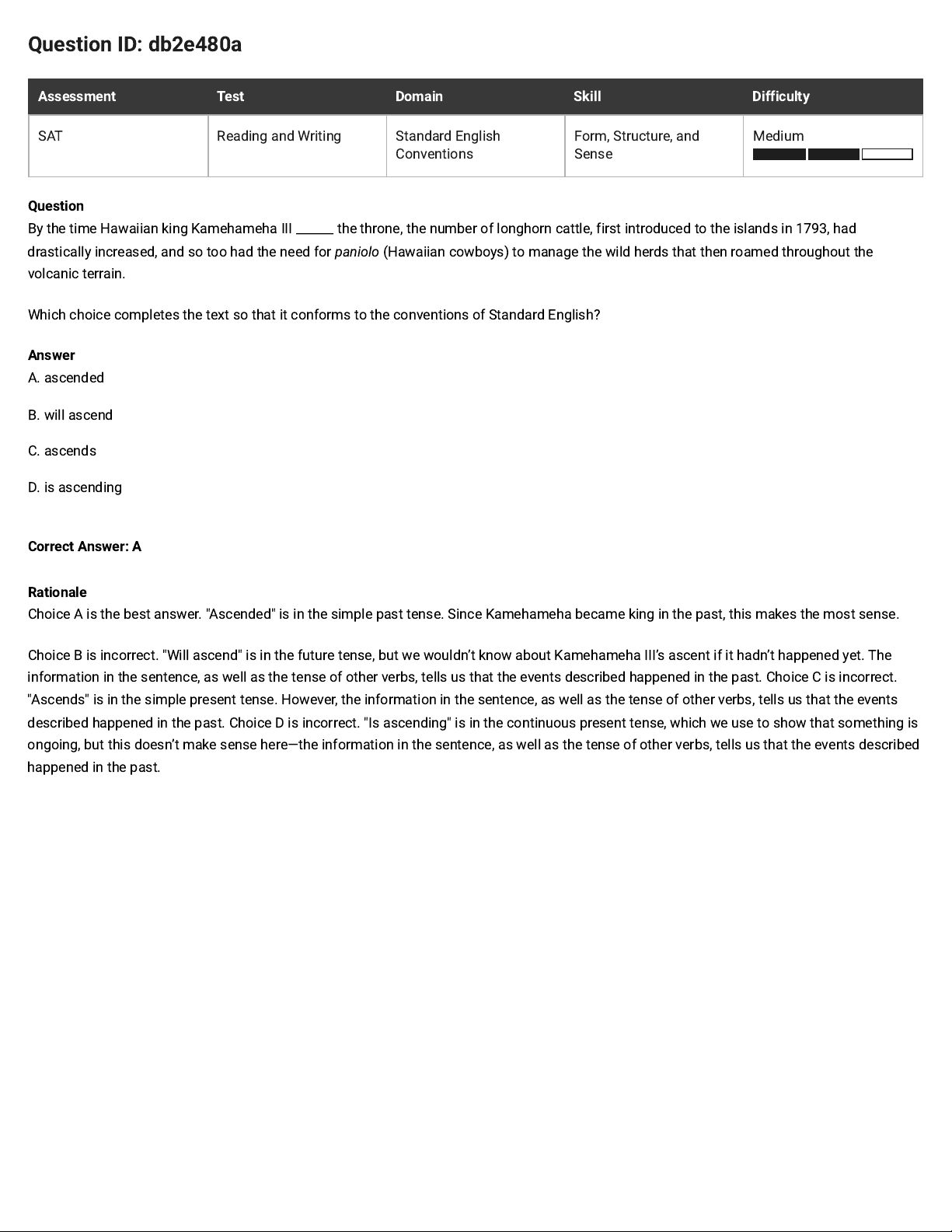
Question ID: db2e480a
Assessment Test Domain Skill Difficulty
SAT Reading and Writing Standard English
Conventions
Form, Structure, and
Sense
Medium
Question
By the time Hawaiian king Kamehameha III ______ the throne, the number of longhorn cattle, first introduced to the islands in 1793, had
drastically increased, and so too had the need for
paniolo
(Hawaiian cowboys) to manage the wild herds that then roamed throughout the
volcanic terrain.
Which choice completes the text so that it conforms to the conventions of Standard English?
Answer
A. ascended
B. will ascend
C. ascends
D. is ascending
Correct Answer: A
Rationale
Choice A is the best answer. "Ascended" is in the simple past tense. Since Kamehameha became king in the past, this makes the most sense.
Choice B is incorrect. "Will ascend" is in the future tense, but we wouldn’t know about Kamehameha III’s ascent if it hadn’t happened yet. The
information in the sentence, as well as the tense of other verbs, tells us that the events described happened in the past. Choice C is incorrect.
"Ascends" is in the simple present tense. However, the information in the sentence, as well as the tense of other verbs, tells us that the events
described happened in the past. Choice D is incorrect. "Is ascending" is in the continuous present tense, which we use to show that something is
ongoing, but this doesn’t make sense here—the information in the sentence, as well as the tense of other verbs, tells us that the events described
happened in the past.
Page 46
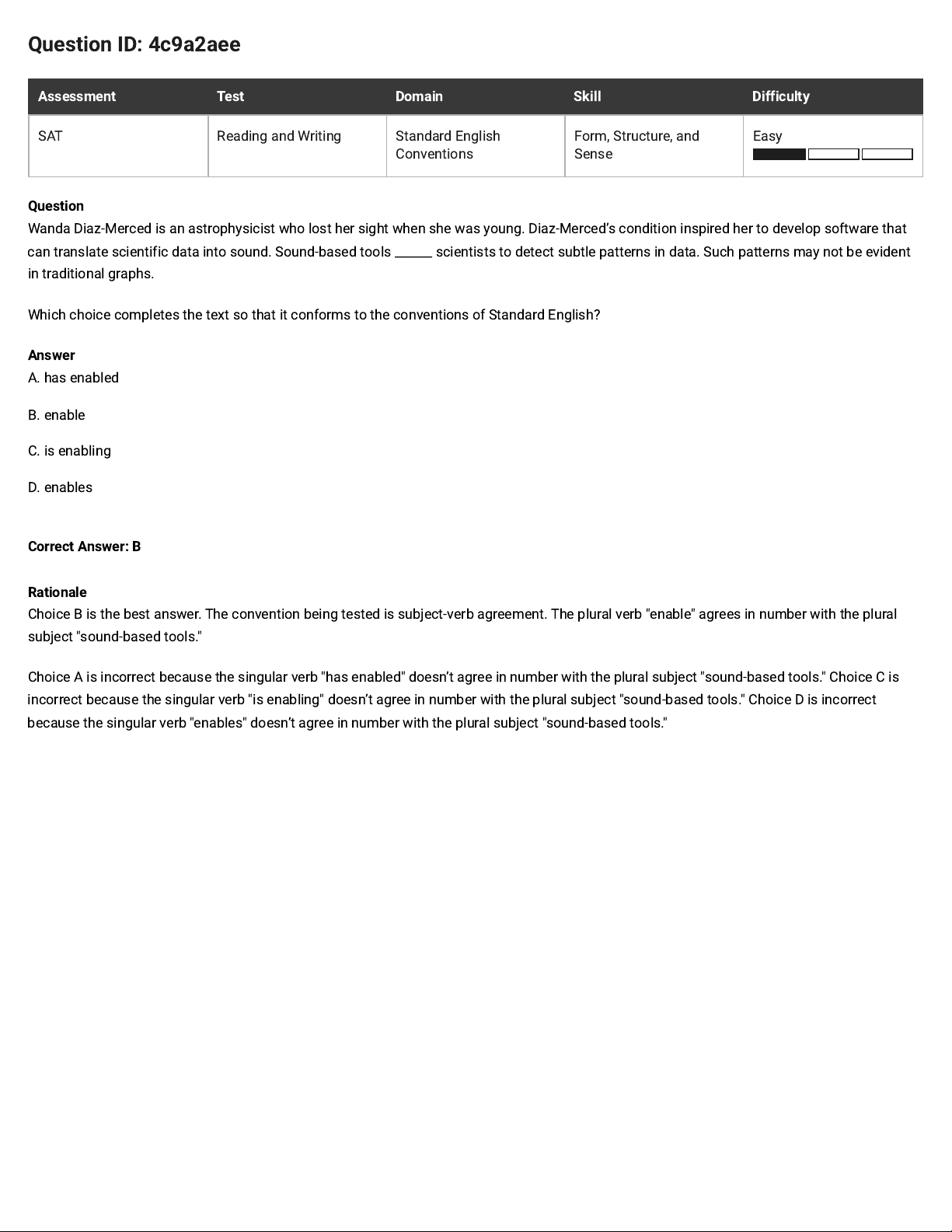
Question ID: 4c9a2aee
Assessment Test Domain Skill Difficulty
SAT Reading and Writing Standard English
Conventions
Form, Structure, and
Sense
Easy
Question
Wanda Diaz-Merced is an astrophysicist who lost her sight when she was young. Diaz-Merced’s condition inspired her to develop software that
can translate scientific data into sound. Sound-based tools ______ scientists to detect subtle patterns in data. Such patterns may not be evident
in traditional graphs.
Which choice completes the text so that it conforms to the conventions of Standard English?
Answer
A. has enabled
B. enable
C. is enabling
D. enables
Correct Answer: B
Rationale
Choice B is the best answer. The convention being tested is subject-verb agreement. The plural verb "enable" agrees in number with the plural
subject "sound-based tools."
Choice A is incorrect because the singular verb "has enabled" doesn’t agree in number with the plural subject "sound-based tools." Choice C is
incorrect because the singular verb "is enabling" doesn’t agree in number with the plural subject "sound-based tools." Choice D is incorrect
because the singular verb "enables" doesn’t agree in number with the plural subject "sound-based tools."
Page 47
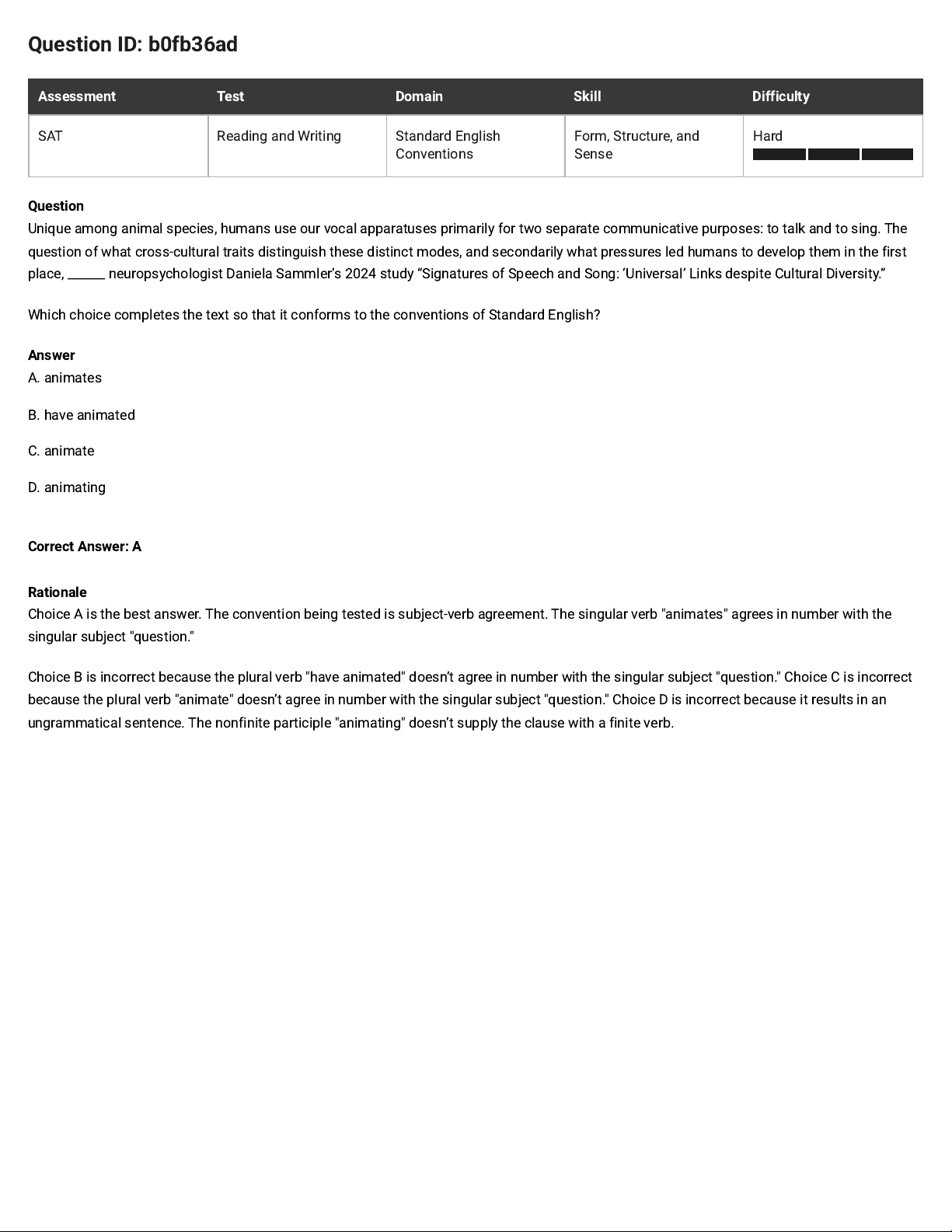
Question ID: b0fb36ad
Assessment Test Domain Skill Difficulty
SAT Reading and Writing Standard English
Conventions
Form, Structure, and
Sense
Hard
Question
Unique among animal species, humans use our vocal apparatuses primarily for two separate communicative purposes: to talk and to sing. The
question of what cross-cultural traits distinguish these distinct modes, and secondarily what pressures led humans to develop them in the first
place, ______ neuropsychologist Daniela Sammler’s 2024 study “Signatures of Speech and Song: ‘Universal’ Links despite Cultural Diversity.
”
Which choice completes the text so that it conforms to the conventions of Standard English?
Answer
A. animates
B. have animated
C. animate
D. animating
Correct Answer: A
Rationale
Choice A is the best answer. The convention being tested is subject-verb agreement. The singular verb "animates" agrees in number with the
singular subject "question."
Choice B is incorrect because the plural verb "have animated" doesn’t agree in number with the singular subject "question." Choice C is incorrect
because the plural verb "animate" doesn’t agree in number with the singular subject "question." Choice D is incorrect because it results in an
ungrammatical sentence. The nonfinite participle "animating" doesn’t supply the clause with a finite verb.
Page 48
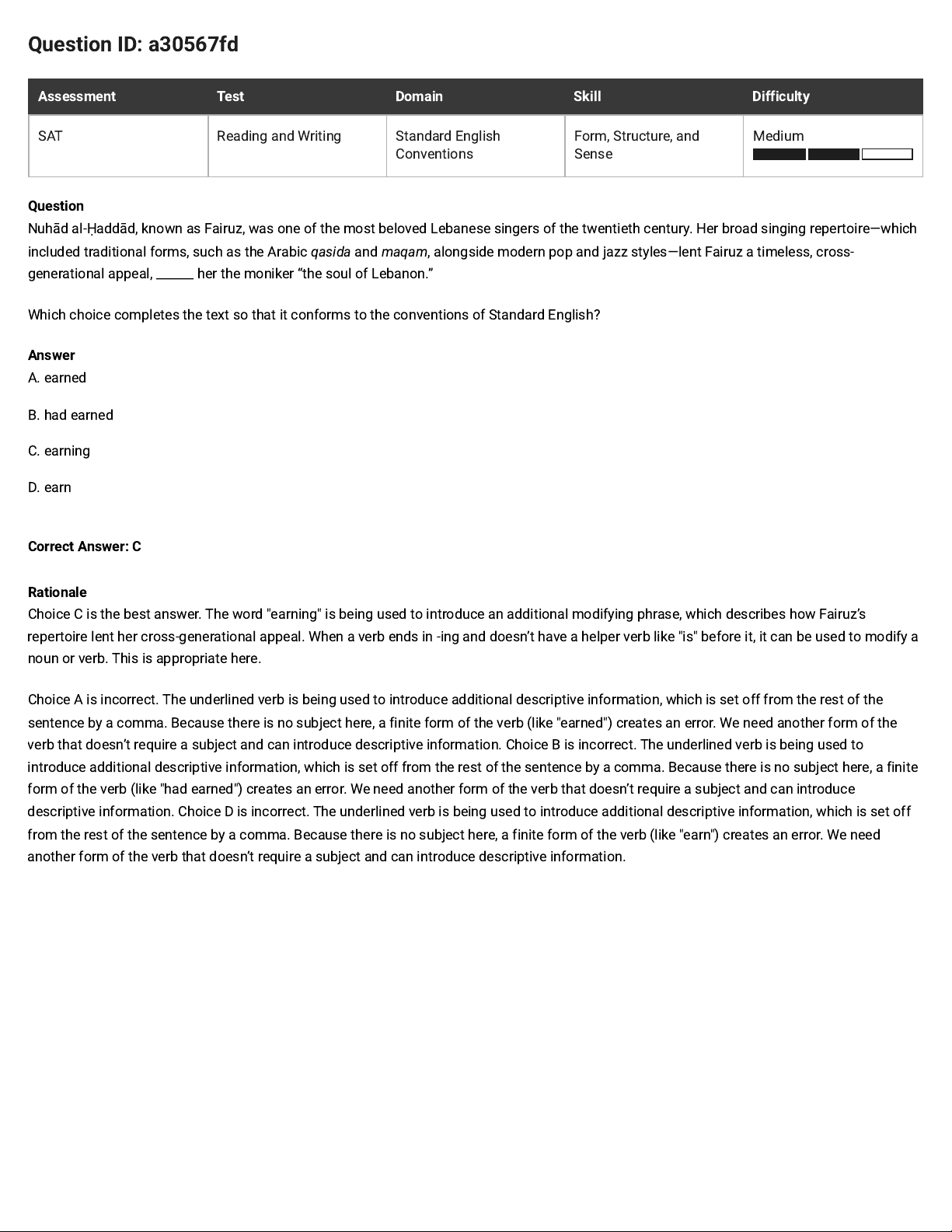
Question ID: a30567fd
Assessment Test Domain Skill Difficulty
SAT Reading and Writing Standard English
Conventions
Form, Structure, and
Sense
Medium
Question
Nuhād al-Ḥaddād, known as Fairuz, was one of the most beloved Lebanese singers of the twentieth century. Her broad singing repertoire—which
included traditional forms, such as the Arabic
qasida
and
maqam
, alongside modern pop and jazz styles—lent Fairuz a timeless, cross-
generational appeal, ______her the moniker “the soul of Lebanon.
”
Which choice completes the text so that it conforms to the conventions of Standard English?
Answer
A. earned
B. had earned
C. earning
D. earn
Correct Answer: C
Rationale
Choice C is the best answer. The word "earning" is being used to introduce an additional modifying phrase, which describes how Fairuz’s
repertoire lent her cross-generational appeal. When a verb ends in -ing and doesn’t have a helper verb like "is" before it, it can be used to modify a
noun or verb. This is appropriate here.
Choice A is incorrect. The underlined verb is being used to introduce additional descriptive information, which is set off from the rest of the
sentence by a comma. Because there is no subject here, a finite form of the verb (like "earned") creates an error. We need another form of the
verb that doesn’t require a subject and can introduce descriptive information. Choice B is incorrect. The underlined verb is being used to
introduce additional descriptive information, which is set off from the rest of the sentence by a comma. Because there is no subject here, a finite
form of the verb (like "had earned") creates an error. We need another form of the verb that doesn’t require a subject and can introduce
descriptive information. Choice D is incorrect. The underlined verb is being used to introduce additional descriptive information, which is set off
from the rest of the sentence by a comma. Because there is no subject here, a finite form of the verb (like "earn") creates an error. We need
another form of the verb that doesn’t require a subject and can introduce descriptive information.
Page 49
Question ID: 81ac953e
Assessment Test Domain Skill Difficulty
SAT Reading and Writing Standard English
Conventions
Form, Structure, and
Sense
Easy
Question
In 1899, Swedish chemist Svante Arrhenius developed an equation to answer a long-standing question: why do chemical reactions speed up at
higher temperatures? The Arrhenius equation, named for its creator, ______ an important concept in modern chemistry.
Which choice completes the text so that it conforms to the conventions of Standard English?
Answer
A. have remained
B. remain
C. remains
D. are remaining
Correct Answer: C
Rationale
Choice C is the best answer. This choice uses the singular verb "remains" to match the singular subject "equation."
Choice A is incorrect. The singular noun "equation" doesn’t match with the plural verb conjugation "have remained." Choice B is incorrect. The
singular noun "equation" doesn’t match with the plural verb conjugation "remain." Choice D is incorrect. The singular noun "equation" doesn’t
match with the plural verb conjugation "are remaining."
Page 50
Question ID: 50801257
Assessment Test Domain Skill Difficulty
SAT Reading and Writing Standard English
Conventions
Form, Structure, and
Sense
Hard
Question
In 1994, almost 200 years after the death of Wang Zhenyi, the International Astronomical ______ the contributions of the barrier-breaking 18th-
century astronomer and author of “Dispute of the Procession of the Equinoxes,” naming a crater on Venus after her.
Which choice completes the text so that it conforms to the conventions of Standard English?
Answer
A. Union would finally acknowledge
B. Union to finally acknowledge
C. Union, having finally acknowledged
D. Union, finally acknowledging
Correct Answer: A
Rationale
Choice A is the best answer. It’s the only choice that offers a form of the verb “acknowledge” that can go with the subject “International
Astronomical Union” to make a complete sentence. This might seem like an odd use of “would,” but when speaking from a point of view in the
past, we can actually use “would” to express something that happened later. That’s the case here: 200 years after Wang Zhenyi’s death, the IAU
would finally acknowledge her contributions.
Choice B is incorrect. This choice creates a sentence fragment. There’s no main verb elsewhere in the sentence, so we need a form of the verb
“
acknowledge” that can go with the subject “the International Astronomical Union” and serve as that main verb. “To acknowledge” can’t do that.
Choice C is incorrect. This choice creates a sentence fragment. There’s no main verb elsewhere in the sentence, so we need a form of the verb
“
acknowledge” that can go with the subject “the International Astronomical Union” and serve as that main verb. “Having acknowledged” can’t do
that. Choice D is incorrect. This choice creates a sentence fragment. There’s no main verb elsewhere in the sentence, so we need a form of the
verb “acknowledge” that can go with the subject “the International Astronomical Union” and serve as that main verb. The “-ing” form can’t do that.
Page 51
Question ID: a14eef71
Assessment Test Domain Skill Difficulty
SAT Reading and Writing Standard English
Conventions
Form, Structure, and
Sense
Hard
Question
In 2015, a team led by materials scientists Anirudha Sumant and Diana Berman succeeded in reducing the coefficient of friction (COF) between
two surfaces to the lowest possible level—superlubricity. A nearly frictionless (and, as its name suggests, extremely slippery) state, ______
Which choice completes the text so that it conforms to the conventions of Standard English?
Answer
A. when their COF drops below 0.01, two surfaces reach superlubricity.
B. two surfaces, when their COF drops below 0.01, reach superlubricity.
C. reaching superlubricity occurs when two surfaces’ COF drops below 0.01.
D. superlubricity is reached when two surfaces’ COF drops below 0.01.
Correct Answer: D
Rationale
Choice D is the best answer. The subject of the modifier “a nearly frictionless state” is “superlubricity.” Subject-modifier placement requires a
modifier and its subject to be next to one another, so “superlubricity” must be the first word in the missing clause.
Choice A is incorrect. This choice creates a subject-modifier placement error. The subject of the modifier “a nearly frictionless state” is
“
superlubricity.” Subject-modifier placement requires a modifier and its subject to be next to one another, so “superlubricity” must be the first
word in the missing clause. Choice B is incorrect. This choice creates a subject-modifier placement error. The subject of the modifier “a nearly
frictionless state” is “superlubricity.” Subject-modifier placement requires a modifier and its subject to be next to one another, so “superlubricity
”
must be the first word in the missing clause. Choice C is incorrect. This choice creates a subject-modifier placement error. The subject of the
modifier “a nearly frictionless state” is “superlubricity.” Subject-modifier placement requires a modifier and its subject to be next to one another,
so “superlubricity” must be the first word in the missing clause.
Page 52
Question ID: b85c19ed
Assessment Test Domain Skill Difficulty
SAT Reading and Writing Standard English
Conventions
Form, Structure, and
Sense
Medium
Question
The violins handmade in the seventeenth century by Italian craftsman Antonio Stradivari have been celebrated as some of the finest in the world.
In close collaboration with musicians, Stradivari introduced changes to the shape of a traditional violin, flattening some of the instrument’s
curves and making ______ lighter overall.
Which choice completes the text so that it conforms to the conventions of Standard English?
Answer
A. those
B. one
C. them
D. it
Correct Answer: D
Rationale
Choice D is the best answer. The convention being tested is pronoun–antecedent agreement. The singular pronoun “it” agrees in number with the
singular antecedent “violin” and thus indicates that the traditional violin (and not its curves) was made lighter.
Choice A is incorrect because the plural pronoun “those” doesn’t agree in number with the singular antecedent “violin.” Choice B is incorrect
because the singular pronoun “one” is ambiguous in this context; the resulting sentence leaves unclear what Stradivari made lighter.Choice C is
incorrect because the plural pronoun “them” doesn’t agree in number with the singular antecedent “violin.
”
Page 53
Question ID: dfbf5d33
Assessment Test Domain Skill Difficulty
SAT Reading and Writing Standard English
Conventions
Form, Structure, and
Sense
Hard
Question
In 1453, English King Henry VI became unfit to rule after falling gravely ill. As a result, Parliament appointed Richard, Third Duke of York, who had
a strong claim to the English throne, to rule as Lord Protector. Upon recovering two years later, ______ forcing an angered Richard from the royal
court and precipitating a series of battles later known as the Wars of the Roses.
Which choice completes the text so that it conforms to the conventions of Standard English?
Answer
A. Henry resumed his reign,
B. the reign of Henry resumed,
C. Henry’s reign resumed,
D. it was Henry who resumed his reign,
Correct Answer: A
Rationale
Choice A is the best answer. The convention being tested is subject-modifier placement. This choice ensures that the introductory phrase “upon
recovering two years later” appears immediately before the noun it modifies (“Henry”), clearly establishing that Henry recovered two years later.
Choice B is incorrect because it results in a dangling modifier. The placement of the noun phrase “the reign of Henry” immediately after the
introductory phrase illogically suggests that the reign of Henry recovered two years later.Choice C is incorrect because it results in a dangling
modifier. The placement of the noun phrase “Henry’s reign” immediately after the introductory phrase illogically suggests that Henry’s reign
recovered two years later.Choice D is incorrect because it results in a dangling modifier. The placement of the function word “it” immediately
after the introductory phrase illogically suggests that “it” recovered two years later.
Page 54
Question ID: ec08463d
Assessment Test Domain Skill Difficulty
SAT Reading and Writing Standard English
Conventions
Form, Structure, and
Sense
Easy
Question
Botanists recognize over fifty different species of sunflower. One species, the silverleaf sunflower, ______ both an early-flowering ecotype that
tends to grow in coastal areas and a late-flowering ecotype that grows inland.
Which choice completes the text so that it conforms to the conventions of Standard English?
Answer
A. having included
B. including
C. to include
D. includes
Correct Answer: D
Rationale
Choice D is the best answer. This verb needs to function as the main verb in the sentence, with the subject “one species,” so it needs to be
conjugated. This choice gives us the singular present tense “includes,” which is the only conjugated form of the verb among the choices.
Choice A is incorrect. This doesn’t complete the text in a way that conforms to the conventions of Standard English. This verb needs to function
as the main verb in the sentence, with the subject “one species,” so it needs to be conjugated. “Having included” is a participle form of the verb:
it’s not conjugated and doesn’t function like a normal verb.Choice B is incorrect. This doesn’t complete the text in a way that conforms to the
conventions of Standard English. This verb needs to function as the main verb in the sentence, with the subject “one species,” so it needs to be
conjugated. “Including” is the gerund form of the verb: it’s not conjugated and doesn’t function like a normal verb.Choice C is incorrect. This
doesn’t complete the text in a way that conforms to the conventions of Standard English. This verb needs to function as the main verb in the
sentence, with the subject “one species,” so it needs to be conjugated. “To include” is the infinitive form of the verb: it’s not conjugated.
Page 55
Question ID: 4a90a978
Assessment Test Domain Skill Difficulty
SAT Reading and Writing Standard English
Conventions
Form, Structure, and
Sense
Easy
Question
In 1990, California native and researcher Ellen Ochoa left her position as chief of the Intelligent Systems Technology Branch at a NASA research
center ______ the space agency’s astronaut training program.
Which choice completes the text so that it conforms to the conventions of Standard English?
Answer
A. to join
B. is joining
C. joined
D. joins
Correct Answer: A
Rationale
Choice A is the best answer. The convention being tested is the use of nonfinite verb forms in a sentence. The nonfinite to-infinitive verb "to join"
is correctly used to form a subordinate clause that expresses why Ochoa left her position (to join the training program).
Choice B is incorrect because the finite verb "is joining" can’t be used in this way to indicate Ochoa’s action of joining the training program. A
conjunction such as "and" would be needed to coordinate "is joining" with the previous finite verb, "left." Choice C is incorrect because the finite
verb "joined" can’t be used in this way to indicate Ochoa’s action of joining the training program. A conjunction such as "and" would be needed to
coordinate "joined" with the previous finite verb, "left." Choice D is incorrect because the finite verb "joins" can’t be used in this way to indicate
Ochoa’s action of joining the training program. A conjunction such as "and" would be needed to coordinate "joins" with the previous finite verb,
"left."
Page 56
Question ID: 588887b9
Assessment Test Domain Skill Difficulty
SAT Reading and Writing Standard English
Conventions
Form, Structure, and
Sense
Easy
Question
In 1881, French chemist Camille Faure redesigned the rechargeable lead-acid battery. Faure’s design greatly increased the amount of electricity
that the original battery, which the French physicist Gaston Planté ______ fifteen years earlier, could hold.
Which choice completes the text so that it conforms to the conventions of Standard English?
Answer
A. is inventing
B. will invent
C. invents
D. had invented
Correct Answer: D
Rationale
Choice D is the best answer. Faure redesigned the battery in 1881, and the original battery was invented “fifteen years earlier.” Notice that this is
the only choice in the past tense. To indicate that a past occurrence took place before another past occurrence, we need to use “had” + the past
tense form of the verb. This is called the “past perfect” tense.
Choice A is incorrect. This choice creates a tense error. Planté invented the original battery in the past, so we shouldn’t use the present tense “is
inventing.” Choice B is incorrect. This choice creates a tense error. Planté invented the original battery in the past, so we shouldn’t use the future
tense “will invent.” Choice C is incorrect. This choice creates a tense error. Planté invented the original battery in the past, so we shouldn’t use the
present tense “invents.
”
Page 57
Question ID: e44db0a0
Assessment Test Domain Skill Difficulty
SAT Reading and Writing Standard English
Conventions
Form, Structure, and
Sense
Medium
Question
Because a cycle of lunar phases ______ 29.5 days to complete, it’s possible to observe two full moons in a single month, one at the beginning and
one at the end.
Which choice completes the text so that it conforms to the conventions of Standard English?
Answer
A. are taking
B. have taken
C. take
D. takes
Correct Answer: D
Rationale
Choice D is the best answer. The convention being tested is subject-verb agreement. The singular verb "takes" agrees in number with the singular
subject "a cycle of lunar phases."
Choice A is incorrect because the plural verb "are taking" doesn’t agree in number with the singular subject "a cycle of lunar phases." Choice B is
incorrect because the plural verb "have taken" doesn’t agree in number with the singular subject "a cycle of lunar phases." Choice C is incorrect
because the plural verb "take" doesn’t agree in number with the singular subject "a cycle of lunar phases."
Page 58
Question ID: b8e13a74
Assessment Test Domain Skill Difficulty
SAT Reading and Writing Standard English
Conventions
Form, Structure, and
Sense
Medium
Question
Josephine Paddock and Florence Esté were among the 300 artists who exhibited at the 1913 Armory Show, a groundbreaking New York City art
exhibition that introduced modernism to American audiences. Though shocking at the time, an abstract cubist painting exhibited by Marcel
Duchamp—one of several works that received scorn from critics—______ the Western art canon more than a century later.
Which choice completes the text so that it conforms to the conventions of Standard English?
Answer
A. has entered
B. have entered
C. were entering
D. enter
Correct Answer: A
Rationale
Choice A is the best answer. The convention being tested is subject-verb agreement. The singular verb "has entered" agrees in number with the
singular subject "an abstract cubist painting."
Choice B is incorrect because the plural verb "have entered" doesn’t agree in number with the singular subject "an abstract cubist painting."
Choice C is incorrect because the plural verb "were entering" doesn’t agree in number with the singular subject "an abstract cubist painting."
Choice D is incorrect because the plural verb "enter" doesn’t agree in number with the singular subject "an abstract cubist painting."
Page 59
Question ID: 67614549
Assessment Test Domain Skill Difficulty
SAT Reading and Writing Standard English
Conventions
Form, Structure, and
Sense
Medium
Question
After winning the 1860 presidential election, Abraham Lincoln appointed Edward Bates, Salmon P. Chase, and William H. Seward to his cabinet.
Lincoln’s decision was surprising, since each of these men had run against him, but historians have praised it, noting that Lincoln ______ his
rivals’ diverse talents to strengthen his administration.
Which choice completes the text so that it conforms to the conventions of Standard English?
Answer
A. has leveraged
B. is leveraging
C. will leverage
D. leveraged
Correct Answer: D
Rationale
Choice D is the best answer. The subject of the verb is “Lincoln,” and the first sentence tells us that we’re talking about something that Abraham
Lincoln did in 1860. So the simple past tense “leveraged” fits the logic of the text.
Choice A is incorrect. This choice creates a tense issue. “Has leveraged” is the present perfect tense, which is used for an action that began in
the past and continues into the present. Lincoln started leveraging his rivals’ talents in 1860—it’s definitely not still happening today. So the
present perfect tense isn’t appropriate. Choice B is incorrect. This choice creates a tense issue. “Is leveraging” is the present tense, but Lincoln
leveraged his rivals’ talents in 1860, so the present tense isn’t appropriate. Choice C is incorrect. This choice creates a tense issue. “Will leverage
”
is the future tense, but Lincoln leveraged his rivals’ talents in 1860, so the future tense isn’t appropriate.
 Loading...