

Page 1
sames
LIGHT EMITTING DIODE DRIVER
FEATURES
n Drives 24 LED's under control of Serial
Interface
n Light Emitting Diode intensity
programmable using a single resistor
n Automatic lamp test facility on reset
(MRST)
n Minimal external components
n LED intensity constant, regardless of
number of LED's illuminated
DESCRIPTION
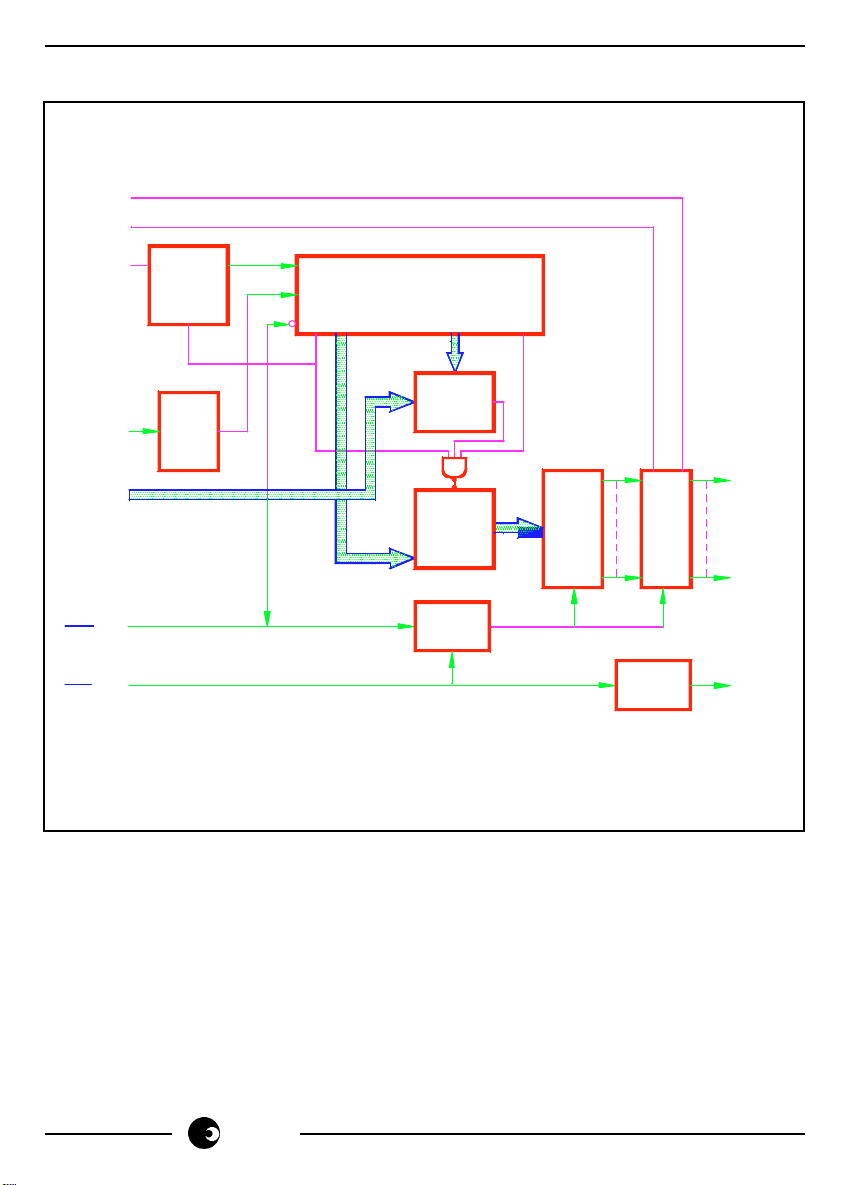
The block Diagram of the SA8803 is shown in
Fig. 1. A control word is clocked into the
device via the DATA pin with a local clock
provided to pin CLK. The control word
comprises a 3-bit chip address, a 5-bit LED
address and a Status (on/off) bit. Provided
that the Chip Adress matches the setting on
pins AD0..AD2 then the LED State Register is
addressed and the state of the selected LED
is set according to the Status bit in the Control
word.
The LEDs are driven by banks of Constant
Current Sources in which the value of the
current in all six banks is set by a single
external resistor connected between pin
INTENS and VEE. The total current drained
by the device and the LEDs may be fixed at
six times the LED current by connecting pin
CC to GND.
The status of all LEDs can be verified at any
time by pulling the TEST pin low. When tis
happens the contents of the LED Status
Register are clocked out of the SA8803 on the
pin DOUT. An additional test feature is that
al LEDs are illuminated for a short period after
power up to simplify system testing.
4159
SA8803
n 11 Bit Information word controls up to
192 LED's (using eight SA8803s)
n Readback of LED status
n Requires a local clock of 8 times the
data rate
n Constant current from power supply
option
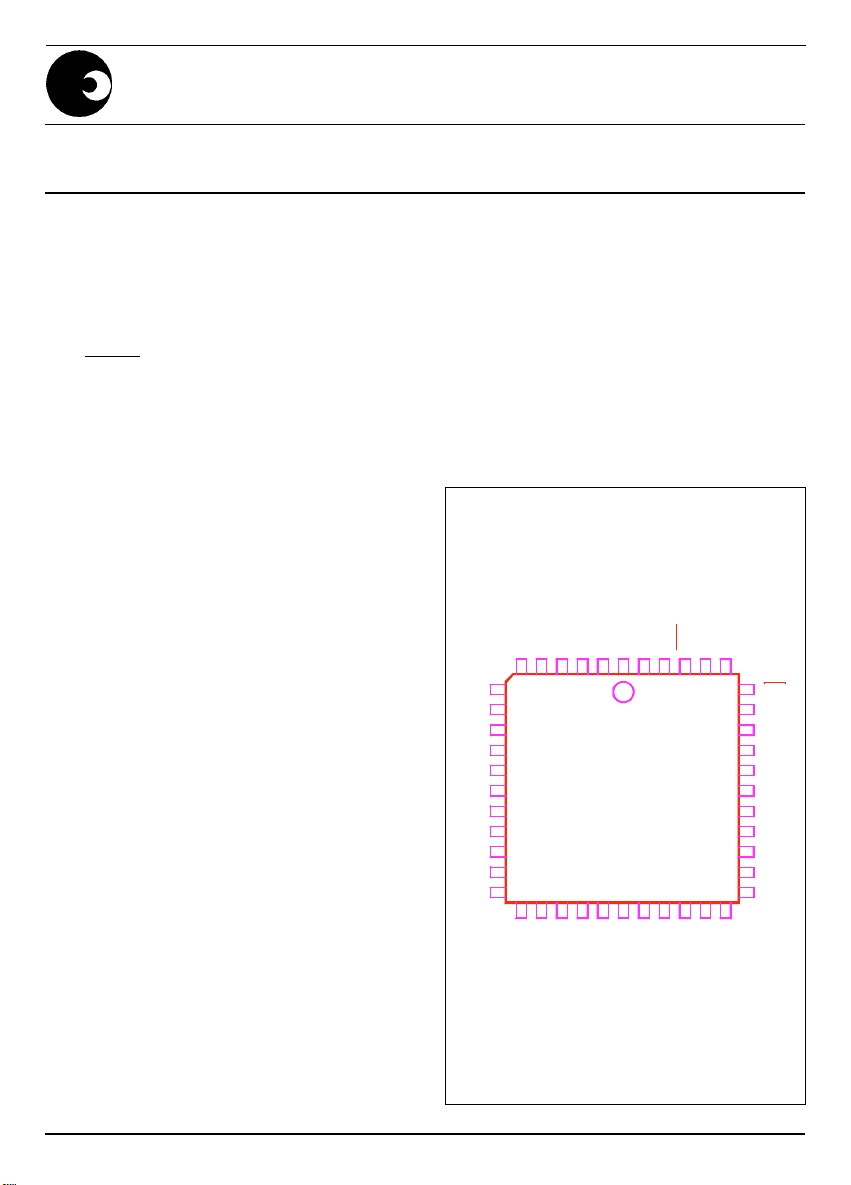
PIN CONNECTIONS
7
LED 1
8
LED 2
9
LED 3
10
LED 4
11
V
EE
12
LED 5
13
LED 6
14
LED 7
15
V
DD
16
LED 8
17
LED 9
DR-00593
DD
V
65432
18 19
LED 10
AD 2
CC
EE
V
AD 1
DOUT
AD 0
1
DATA
44 43 42
SA8803
LED 12
LED 11
23
24 25 26
DD
V
INTENS
LED 13
20 21 22
PDS039-SA8803-001 REV. C 07-03-96
GND
MRST
LED 14
LED 15
CLK
41 40
27 28
EE
V
N.C.
39
38
37
36
35
34
33
32
31
30
29
LED 16
TEST
LED 24
LED 23
LED 22
V
EE
LED 21
LED 20
LED 19
V
DD
LED 18
LED 17
1/10
Page 2
SA8803
FIGURE 1: BLOCK DIAGRAM
INTENS
CC
DATA
CLK
AD0....AD2
MRST
TEST
DR-00594
START
BIT
DETECTION
S
CLK
CLOCK
SYNC
SIN
CLK
11 - BIT SHIFT REGISTER
RESET
START
BIT
COMPARATOR
ADDRESS
DECODER
RESET
LAMP TEST
LOGIC
LED
3-BIT
STOP
CHIP
BIT
ADDRESS
LED
SELECTION
BUS
24-BIT
LED
STATE
REGISTER
LED
DRIVERS
TEST
CONTROL
LOGIC
LED1
LED24
DOUT
2/10
sames
Page 3

SA8803
PIN DESCRIPTION
Pin Designation Description
1..3 AD0..AD2 Device address input pins. The binary code set up on
these pins, must match the address field of the control
word, before device access may be achieved. These
Schmitt-triggered inputs have on-chip pull-up resistors.
4 DOUT This output is used for the manufacturers test requirements
and MUST be left open.
5 CC Constant Current Drain Select.This Schmitt-triggered
input has on-chip pullup provided.
7..10, LED1..LED4, High current LED drive terminal outputs.
12..14, LED5..LED7
16..18, LED8..LED10,
20..21, LED11..LED12,
24..26 LED13..LED15,
28..30 LED16..LED18,
32..34, LED19..LED21,
36..38 LED22..LED24
22 INTENS This analog input is used to set the drive current supplied
to the LED's. A resistor is connected from this pin to VEE.
39 TEST Active low input that enables the internal LED status word
to be output from the DOUT pin. This Schmitt-triggered
input has on-chip pullup provided.
40 NC Internally Unconnected.
41 CLK External clock Schmitt-triggered input runs at 8X the data
rate (Baud rate).
42 MRST This active low Schmitt-Trigger input may be used to
reset all internal registers. When active (low) this input
will cause all LED's to be driven for the duration of MRST
(lamp test). When MRST goes inactive all LED's will be
turned off. On-chip pullup provided.
43 GND 0V Supply Input for logic (0V)
44 DATA Serial data input. Accept data in the form of an 11-bit
information word. This Schmitt-triggered input has onchip pullup provided.
11, 19, VEE Negative Supply Inputs (-5V)
27, 35
6, 15, VDD Positive Supply Inputs (+5V)
23, 31
Note: All inputs and outputs are CMOS compatible, unless otherwise specified.
sames
3/10
Page 4

SA8803
FUNCTIONAL DESCRIPTION
1. Control Word
The control word written serially into the DATA pin, will contain 9 information bits.
The data structure is illustrated in Figure 2 below.
Because the chip address is 3 bits wide, a single chip controller will be able to
address 8 SA8803 devices. Each SA8803 can drive 24 LED's, which means that
the controller is capable of addressing 192 LED's. The address bits in the control
word are internally compared with the address on the AD0..AD2 address lines to
determine if the SA8803 is being addressed.
Table 1. LED Addresses
L5 L4 L3 L2 L1 LED
0 0 0 0 0 IGNORED
000 01 1
000 10 2
etc
110 0024
110 01
IGNORED
111 11
FIGURE 2: CONTROL WORD STRUCTURE
9-BIT CONTROL WORD
L1
SB
SB
L1 ... L5
A0 ... A2
E
L2 L3 L4 A1L5 S A0
=
START BIT
LED BIT ADDRESS INSIDE BANK
=
DEVICE BIT ADDRESS
=
=
END BIT
ESBA2
STATUS BITS=
DR-00595
As can be seen from the structure of the control word, the controller should send 1
start bit, 9 data bits, and 1 stop bit.
When a LED is addressed its state will be set according to the status bit. A logic
one will enable the LED, and a logic zero will disable the LED.
4/10
sames
Page 5

3. LED Intensity Control
The LED "on" current (ID), is determined by the current flowing from the INTENS pin
through the external resistor. The values of ID can be calculated as follows:
ID = KT.
V
X
R
KT - Current Transfer Ratio of the Internal Current Mirror (typically 10.0)
R - The programming resistor value
VX- The voltage drop across the external resistor (internally controlled to 5.0V)
4. Constant Current Mode
When the CC pin is pulled high, the device will draw a constant current from the V
supply which is equal to all LED's in the "on"condition regardless of the status of the
LED's.
5. Clock Characteristics
S
is the internal synchronous clock derived from the asynchronous external clock
CLK
applied at the CLK input pin. It divides the external clock by 8. Theoretically the
rising edge of S
(synchronous Clock) should be in the middle of every bit, as
CLK
shown in Figure 4. Because of phase shift due to the clock frequency being more
or less than 8 times the baud rate, this edge may shift its position with regard to the
bit period (BP). The extreme case that may still be tolerated is an edge arriving at
either the beginning, or end of bit 11. This represents the maximum shift that can
be tolerated for valid data to be received for an inaccurate input clock frequency
(FO).
SA8803
DD
sames
5/10
Page 6

SA8803
FIGURE 3: TIMING DIAGRAM
S
DATA
S
CLK
B
BIT 11
P
CLK
DR-00596
123
T
0
4567
=F
8 x S
0
CLK
8
The acceptable Clock pulse Period (TO) may be calculated as follows:
The rising edge may not shift more than half a bit period (BP), therefore:
11 x BP - (½ x BP) <11 x 8 x TO < 11 x BP (½ x BP)
Therefore:
11 x 8 x TO = 11 x BP ± (½ x BP)
.·. TO = (BP ÷ 8) ±
(BP ÷ 8)
22
.·. TO = (BP ÷ 8) ± 4,55%
The acceptable frequency for the clock FO is calculated as follows:
T
.·. FO =
(BP ÷ 8) (1 ± 1 )
FO =
1
1
O
22
But because:
BR x 8 =
(BP ÷ 8)
1
where BR = Baud Rate
FO = (BR x 8) x
(1 ± 22)
22
.·. FO = BR x 8 ± 4.55%
The SA8803 has been specified for an external clock frequency of 8 times the Baud
Rate ± 3%.
6/10
sames
Page 7

SA8803
6. Test feature
If the TEST pin is pulled low, the status of all 24 LED's are output at pin DOUT in
3 groups of 8 status bits each, with a start bit and a stop bit added. The data rate
of this status word is equal to the input data rate (i.e. CLK) devided by 8.
The three data word that are serially output at DOUT each contain 11-bit. This
means that bit 10 is not used in each case. The words therefore contain a start bit,
8 LED status bits (1 for off, 0 for on). 1 unused bit, and a stop bit. The three groups
are output consecutively in the following order: first LED's 1 to 8, then 9 to 16, and
then 17 to 24.
ABSOLUTE MAXIMUM RATINGS
Supply Voltage, V
Supply Voltage, V
DD
EE
-0.30 V to +5.50 V
0.30 V to -5.50 V
Input or Output Voltage -0.30 V to (VDD +0.30) V
DC Forward Bias Current, Input or Output ± 10 mA
Storage Temperature (Plastic) -40 to 125°C
Operating Temperature 0° - 70°
Note 1: Referenced to GND. Stresses above those listed under "Absolute Maximum
Ratings" may cause permanent damage to the device. This is a stress rating only and
functional operation of the device at these or any other conditions above those indicated
in the operation sections of this specification is not implied. Exposure to absolute
maximum rating conditions for extended periods may effect the device reliability.
ELECTRICAL CHARACTERISTICS
DC Electrical Characteristics Across Temperature Range (Note 1)
Symbol Parameter Condition Min Typ Max Unit
TTL INTERFACE
V
IL
Low Level 0.8 V
Input Voltage
V
IH
High Level 2.0 V
Input Voltage
V
OL
Low Level IOL ≤ 4mA 0.1 0.4 V
Ouput Voltage
V
OH
High Level IOH ≤ 4 mA 2.4 4.5 V
Output Voltage
sames
7/10
Page 8

SA8803
Symbol Parameter Condition Min Typ Max Unit
CMOS INTERFACE
V
IL
Low Level 1.5 V
Input Voltage
V
IH
High Level 3.5 V
Input Voltage
V
OL
Low Level IO ≤ ± 4 mA 1.0 V
Output Voltage
V
OH
High Level IO ≤ ± 4 mA VDD -1.0 V
Output Voltage
V
T+
Schmitt. Trig. 3.4 4.0 V
+ve Threshold
V
T-
Schmitt. Trig. 1.4 2.0 V
-ve Threshold
GENERAL
I
IL
Low Level VI = V
SS
-10 <1 10 µA
Input Current
I
IH
High Level VI = V
DD
-10 <1 10 µA
Input Current
I
ILU
Input Current VI = V
SS
-200 -50 -10 µA
with Pull Up
I
IHD
Input Current VI = V
DD
10 50 200 µA
with Pull Down
I
OZ
Tri-state VO = OV or V
DD
-10 <1 10 µA
Output Leakage
V
ESD
Electrostatic C = 100pF 2000 V
Protection R = 1.5Kohm
V
DD
Logic Supply 4.5 5.0 5.5 V
Voltage
V
SS
Analog Supply -5.5 -5.0 -4.5 V
Voltage
K
T
Current Transfer 10.5
Ratio
∆K
T
Delta Current ID = 10 mA ± 15 %
Transfer Ratio
I
D
LED Current Programmed 10 mA
Value
F
O
Operating Must be ± 3% of 0.4 128 448 kHz
Frequency
1
8 x Baud Rate
NOTE 1) The operating frequency range for FO is wide enough to cover baud rates
from 50 to 56000 bps.
8/10
sames
Page 9

NOTES:
SA8803
sames
9/10
Page 10

SA8803
Disclaimer: The information contained in this document is confidential and proprietary to South African Micro-
Electronic Systems (Pty) Ltd ("SAMES) and may not be copied or disclosed to a third party, in whole or in part, without
the express written consent of SAMES. The information contained herein is current as of the date of publication;
however, delivery of this document shall not under any circumstances create any implication that the information
contained herein is correct as of any time subsequent to such date. SAMES does not undertake to inform any
recipient of this document of any changes in the information contained herein, and SAMES expressly reserves the
right to make changes in such information, without notification,even if such changes would render information
contained herein inaccurate or incomplete. SAMES makes no representation or warranty that any circuit designed
by reference to the information contained herein, will function without errors and as intended by the designer.
South African Micro-Electronic Systems (Pty) Ltd
P O Box 15888, 33 Eland Street,
Lynn East, Koedoespoort Industrial Area,
0039 Pretoria,
Republic of South Africa, Republic of South Africa
Tel: 012 333-6021 Tel: Int +27 12 333-6021
Fax: 012 333-8071 Fax: Int +27 12 333-8071
10/10
sames
 Loading...