

Page 1

®
TM
LCD Monitor
LMD-320WS
LMD-230WS/2
LMD-210S
LMD-171WS
LMD-150S
Page 2
A Revolution in
Professional Picture
Monitoring
Combining decades of expertise in professional A/V technology with today’s
stunning advancements in LCD panel technology, Sony expands its LUMA™ Series
product line-up – LCD monitors that meet the quality-critical needs of
professional picture monitoring.
Unlike typical LCD monitors, the LUMA Series places maximum emphasis on
monitoring video images. The superb quality LCD panel provides an extremely
high level of brightness, contrast, and color depth. A wide variety of SD and HD
signal inputs are accepted, both in analog and digital formats. And to perform
best in today’s environments, Sony’s original I/P conversion and X-Algorithm
technologies allow SD interlace signals to be displayed on the progressive LCD
pixel array very naturally, unlike conventional LCD
monitors which are prone to
producing jaggy noise along the
oblique direction of fast moving
objects.
A huge appeal of the LUMA
Series is its two-piece design,
consisting of the LCD display and the signal
processor. This approach allows the LCD display to be as lightweight and slim as
possible for high operational convenience and mounting flexibility.
Four LCD display sizes are offered in the LUMA Series, to suit the different needs
in a variety of production and other applications. Panel sizes range from the
15-inch* LCD display with DC-operation capability, to the large 32-inch* display
for main monitor and multi-screen use.
With all these benefits, and with the operational controls that Sony Professional
monitors are acclaimed for, the LUMA Series combines quality and convenience
into one.
* Viewable area, measured diagonally
Page 3

Page 4

Features
LUMA Series Line-Up
32” Widescreen*
23” Widescreen*
21” (4x3)*
17” Widescreen*
4
*Viewable area measured diagonally.
15” (4x3)*
Page 5

Choice of LCD Display Panels
Superb Picture Performance
Four LCD display sizes are available. Each LCD display uses
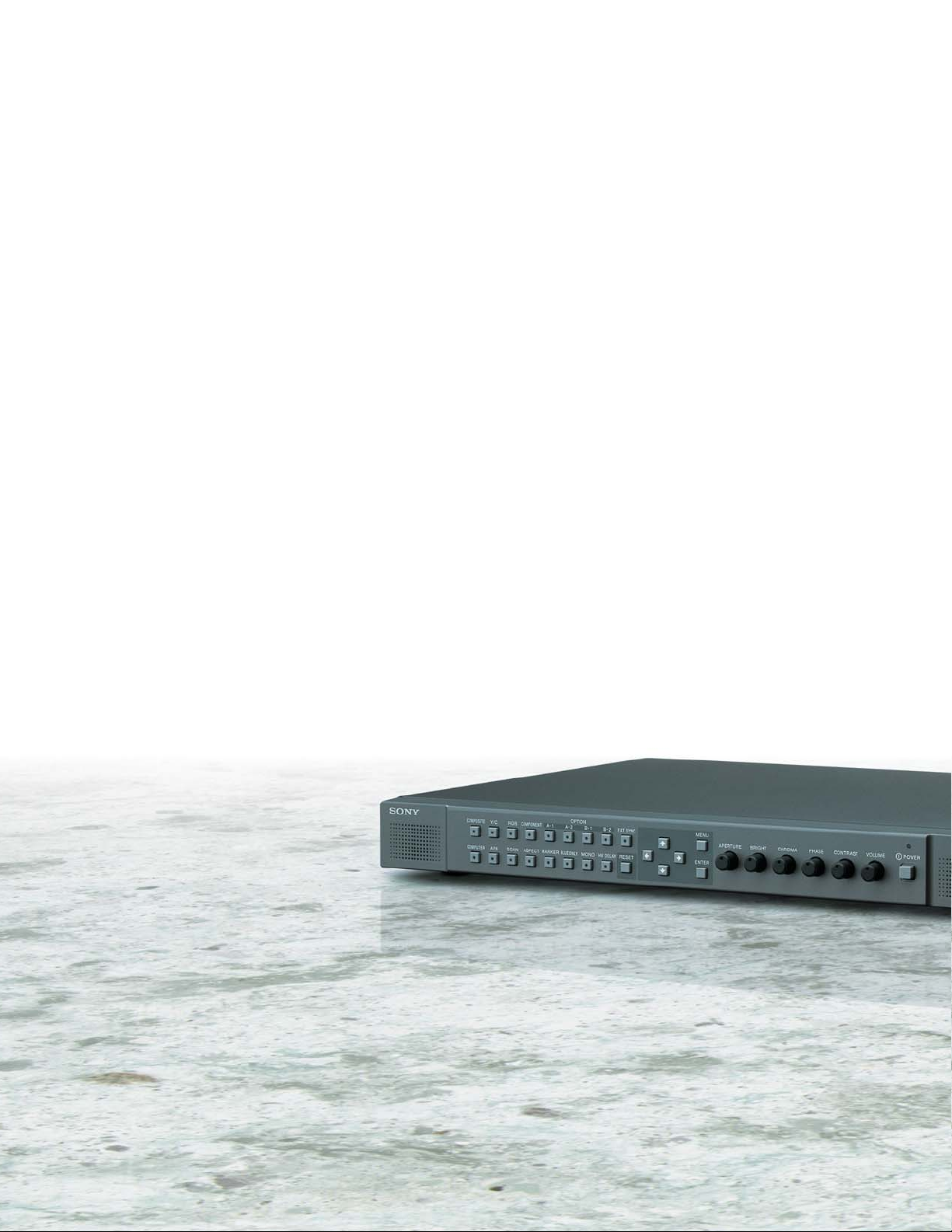
one signal-processing unit for control and signal interface.
Model name Aspect Ratio Panel Size*
LMD-320WS Wide 32-inches
LMD-230WS/2 Wide 23-inches
LMD-210S 4:3 21-inches
LMD-171WS Wide 17-inches
LMD-150S 4:3 15-inches
* Viewable area, measured diagonally
Flat Panel Design with Separate
Signal-Processing Unit
LUMA Series monitors have been designed to make
installation as easy and as flexible as possible. They consist of
extremely thin and lightweight LCD displays, and a highly
advanced signal-processing unit (Multiformat Engine Unit)
that can accept almost any type of HD or SD input format.
This ‘separate unit’ approach not only allows the LCD display
to be made as thin and as lightweight as possible, but it also
allows flexible placement of monitor controls and interface
connectors. The LCD display and Multi-format Engine Unit
are connected via a single multi-pin cable*, up to 10 meters
long (optional), which avoids having multiple cables hanging
from the LCD displays themselves.
The optional SU-558 monitor stand has a biaxial joint in its
neck assembly, allowing the LCD displays to be positioned at
various heights and tilt angles – meeting a wide range of
application needs.
* The LMD-230WS/2, LMD-210S, LMD-171WS and LMD-150S are supplied
with one 1.8 meter cable, and the LMD-320WS with one 3.0 meter cable.
LMD-230WS/2 shown with optional table stand
Sophisticated I/P Conversion using X-Algorithm
Handling interlace signals with LCD monitors can be a difficult
task, but with the LUMA Series, this concern is a thing of the
past. This is because they combine sophisticated I/P
conversion with Sony’s original X-Algorithm technology to
obtain the best results for both static and moving areas of the
picture.
With conventional LCD monitors, interlace signals are
displayed on the progressive LCD pixel array by combining
two adjacent picture fields into one picture frame. Since each
frame is formed by two fields, this method is effective for
static areas of the image, but it can often result in jagged
shape noise along the oblique direction of fast-moving
objects.
To avoid this, the LUMA Series uses a picture adaptive Still
Mode and Motion Mode in the I/P conversion process. By
comparison of the pixels in the proceeding and following
fields, the I/P conversion will operate in either Still or Motion
Mode. For pixels where motion is not detected, the I/P
conversion will simply copy pixels from the proceeding field to
create the absent scanning line.
In contrast, when motion is detected, picture frames are
created from interlace signals on a field basis by interpolating
every other line. Sony’s innovative X-Algorithm technology
intelligently compares the pixels above, below, and in the
diagonal direction of the moving picture part, and then inserts
a natural scanning line.
The direct result of this adaptive I/P conversion is much
smoother image reproduction for pictures both in the still and
moving areas.
*X-Algorithm is used for 480/60I and 575/50I signals only.
AR-Coated Protection Panel
The LCD panels of the LUMA Series use a robust AR-coated
protection layer, which minimizes the chance of scratching
the panel during transportation. The AR coating has two
unique characteristics: it provides a high transmission rate of
the internal light source to keep the picture as bright as
possible, while keeping reflection from ambient light to a
minimum. As a result, when used in bright lighting
conditions, high contrast is still maintained even in dark areas
of the picture – a clear benefit over CRT monitors.
Excellent Brightness and Contrast
While conventional LCD monitors can tend to be dark, the
LUMA Series provides high-brightness and high-contrast
images by use of super-wide aperture LCD panels. In
addition, the use of precisely manufactured RGB color filters
allows these monitors to reproduce colors with stunning
depth and saturation – creating highly natural images.
Wide Viewing Angle
The LCD panels used in the LUMA Series have a wide viewing
angle of 170 degrees, horizontally and vertically, with minimal
reduction in picture contrast. This allows images to be
viewed from various positions and angles.
5
Page 6

Input Versatility
MultiFormat Signal Support
LUMA Series monitors are designed for operations today, and
for DTV operations tomorrow. The Multiformat Engine Unit
can accept almost any SD or HD video format, both analog
and digital.
These include composite NTSC and PAL, component 480/60I
and 575/50I, progressive 480/60P and 576/50P, and highdefinition 1080/50I, 1080/60I, and 720/60P. The Multiformat
Engine Unit can also accept 1080/24PsF and 1080/25PsF.
The Multiformat Engine Unit comes equipped with typical
analog interfaces as standard, including composite (NTSC/PAL),
component (525/625), RGB, and Y/C*
1
. Digital interfaces are
offered as optional boards to meet budgetary and user needs.
To keep the unit compact in size (1RU high), the analog
inputs share the same four BNC connectors, which all provide
loop-through capability.
The Multiformat Engine Unit additionally accepts input from
various types of analog computer signals. With its highperformance scan converter, it can accept input signals from
VGA to SXGA*
*1 Y/C signals must be input via the BNC connectors of the Multiformat
Engine Unit using an S-Video-to-BNC conversion connector.
*2 SXGA images are downconverted for display.
2
.
Video Signal Formats
System
Horizontal
Total Active
scanning
lines lines
frequency
per per
(kHz)
575/50I 15.625 625 575 50 16:9/4:3 O O OOO
480/60I 15.734 525 483 60 16:9/4:3 O O OOO
576/50P 31.250 625 576 50 16:9/4:3 – O –––
480/60P 31.469 525 483 60 16:9/4:3 – O –––
1080/24PsF
1080/50I 28.125 1125 1080 50 16:9 – O – O –
1035/60I 33.750 1125 1035 60 16:9 – O – O –
1080/60I 33.750 1125 1080 60 16:9 – O – O –
720/60P 45.000 750 720 60 16:9 – O – O –
frame frame
27.000 1125 1080 48 16:9 – O – O –
Vertical
Aspect Compo- RGB
scanning
frequency
(Hz)
ratio site Compo-
Y/C nent BKM- BKM- BKM-
Input adaptor
220D 243HS 255DV
Signal-Interface Options
The Multi-format Engine Unit can accept HD-SDI, SD-SDI, or
DV signals via the following optional input adaptors.
SDI 4:2:2 Input Adaptor BKM-220D
• SD-SDI signal input (x2) • SD-SDI monitor output (x1)
• Power consumption: 1.5 W
* Embedded audio is supported.
HD/D1-SDI Input Adaptor BKM-243HS
•
HD-SDI/SD-SDI signal input (x2)• SD-SDI/HD-SDI monitor output (x1)
• Power consumption: 2 W
* HD-SDI and SD-SDI signals are automatically detected.
* Embedded audio is supported.
DV Input Adaptor BKM-255DV
• DV signal port (x 2) • Power consumption: 4 W
* Embedded audio is supported.
* The BKM-255DV accepts DV signals. However, the full command set of the
AV/C (Audio/Video and Control) protocol is not supported.
*
Although a 6-pin connector is used, power is not supplied through this port.
Preset Computer Input Frequencies
The Multiformat Engine Unit is factory preset to accept 16
typical computer input signal frequencies.
Preset Input Frequencies
No. Preset Signal fH [kHz] fV [Hz] H/V
P01 VGA mode 3 31.469 59.940 N/N
P02
640 x 480
P03 VGA VESA 85 Hz 43.269 85.008 N/N
P04 VGA (non-CRT) 29.531 59.780 P/N
P05 SVGA VESA 60 Hz 37.879 60.317 P/P
P06
800 x 600
P07 SVGA VESA 85 Hz 53.674 85.061 P/P
P08 SVGA (non-CRT) 36.979 59.837 P/N
P09 XGA VESA 60 Hz 48.363 60.004 N/N
P10 1024 x 768 XGA VESA 75 Hz 60.023 75.029 P/P
P11 XGA VESA 85 Hz 68.677 84.997 P/P
P12
1280 x 768
P13 WXGA (non-CRT) 47.396 59.995 P/N
P14
1280 x 1024
P15 SXGA (non-CRT) 63.194 59.957 P/N
P16 720 x 400 VGA TEXT 31.469 70.087 N/P
VGA VESA 75 Hz 37.500 75.000 N/N
SVGA VESA 75 Hz 46.875 75.000 P/P
WXGA (CRT 60 Hz) 47.693 59.992 N/P
SXGA VESA 60 Hz 63.981 60.020 P/P
Multiformat Engine Unit
Front Panel
Rear Panel
6
Page 7

Operational Convenience
Advanced Marker Settings
The LUMA Series can display various area markers, including a
center marker, aspect markers, and a safety zone marker. The
brightness of these markers can be selected from three
different levels, white, gray, and dark gray.
What’s more, users can select either a black or gray matte to
fill the outer area of the aspect markers.
These flexible marker controls, together with the choice of
many different aspect markers, make the LUMA Series an
extremely convenient display device for a variety of shooting
scenarios – from standard video acquisition to digital
cinematography.
Marker Variation
16:9 Mode 4:3 Mode
Aspect Marker
Center Marker O
Safety Area 80%, 88%, 90%, 93%
4:3, 15:9, 14:9, 13:9, 1.85:1,
2.35:1, 1.85:1 & 4:3
16:9
Marker examples
Half Tone Matte
Seven-Language On-Screen Display
The on-screen display is available in English, French, Spanish,
German, Italian, Japanese, and Chinese.
Color Temperature/Gamma Selection
High/low color temperatures or user presets can be selected.
Selectable Scan Size for Video Input and Aspect Ratio
The screen size can be selected between 5% over-scan and
0% inscan modes. The aspect ratio can be switched between
16:9 and 4:3 according to the input signal.
Three-Color Tally
The LMD-230WS/2, LMD-210S, LMD-171WS and LMD-150S
displays come equipped with a tally lamp that can be lit up
via a parallel remote connector. The status of the signal
displayed on the monitor can be identified by the tally color –
red, green, or amber.
Black Matte
Light Dark Marker
Dark Marker
Smart APA (Auto Pixel Alignment) for Computer Input
Image size can be automatically adjusted to its optimal setting
with the one-touch APA key.
Parallel Remote Control
The Multiformat Engine Unit can be controlled remotely via its
parallel remote connector. There are 31 functions in the
Remote menu (such as the ability to switch input signals), of
which seven can be allocated to the connector.
Stereo Audio Monitoring
The Multiformat Engine Unit is equipped with stereo speakers
(0.5 W + 0.5 W), which enable the user to monitor audio.
Protected Controls
The key-inhibit function helps prevent inadvertent operations
from the control panel.
Simulated pictures
7
Page 8

LCD Monitor Advantages
By nature, the use of LCD technology in the LUMA Series
eliminates many concerns inherent in CRT monitors. These
include the elimination of convergence alignments, geometric
distortion, flicker, and image burn-in. The LUMA Series is also
completely resistant to magnetic fields, a factor that requires
utmost care when installing a CRT monitor.
Mounting Flexibility
Mountable in a 19-Inch EIA Standard Rack
The LMD-150S panel (5U high) can be mounted in a standard
rack with the optional MB-524 Mounting Bracket. The
LMD-171WS panel (7U high) can be mounted in a 19-inch
EIA standard rack with the optional MB-522A Mounting
Bracket. The Multiformat Engine Unit (1U high) can be
mounted in a 19-inch EIA standard rack with the supplied
mounting bracket. Although wider than the 19-inch rack, if
required, the LMD-210S panel (10U high) can also be rack
mounted using the optional MB-523 Mounting Bracket.
Mounting the LMD-320WS
The large screen LMD-320WS panel can also be mounted on
the optional SU-559 Floor Stand, on a table using the
optional SPMTRI/C Table Stand or on a wall using the
mounting hooks (330 x 330 mm pitch) on the rear of
the display.
VESA Mounting
Complying with VESA standards, the LMD-230WS/2,
LMD-210S, LMD-171WS and LMD-150S panels can easily be
mounted (75 x 75 mm pitch) on a wall. Although large-screen
monitors, they remain thin and lightweight because the signalprocessing circuitry is contained in the separate Multiformat
Engine Unit.
Other Features
• H/V Delay Function
• ACC Off
• DC Operation of the LMD-171WS via the Multiformat
Engine Unit*
• Setup Level for Analog Component and NTSC signal
• Sub Control on Contrast, Chroma, Phase, and Brightness
• Blue-Only Mode
• Monochrome Mode
• Auto Chroma/Phase Setup
• Power-Saving Function (computer input only)
• DDC-2B Plug and Play (computer input only)
* The SMF-600 Extension Cable cannot be used for DC operation.
Optional Accessories
• BKM-220D
SDI 4:2:2 Input Adaptor
• BKM-255DV
DV Input Adaptor
• SPMTRI/C
Table Stand
8
(for LMD-320WS)
• BKM-243HS
HD/D1-SDI Input Adaptor
• SMF-600
Display IF Cable (10 m)
• MB-524
Mounting Bracket
(for LMD-150S only)
• SU-558
Monitor Stand
(for LMD-230WS/2, LDM-210S,
LMD-171WS and LMD-150S)
• SU-559
Monitor Stand
(for LMD-320WS only)
• MB-522A
Mounting Bracket
(for LMD-171WS only)
• MB-523
Mounting Bracket
(for LMD-210S only)
Page 9

Specifications
434 (17 1/8)
6.5 (9/32)
44 (1
3
/4)
Multiformat
Engine Unit
Input/Output
Input Connector/Slot
Composite 1.0 Vp-p ±3 dB,
Y/C 1.0 Vp-p ±3 dB, 0.286 Vp-p ±3 dB (NTSC)
Component 0.7 Vp-p ±3 dB
RGB 0.7 Vp-p ±3 dB
Audio in (for Video signals) Stereo mini jack (x1)
OPTION A-1
OPTION A-2
OPTION B-1
OPTION B-2
Ext. sync BNC, Loop-through, automatic 75 Ω termination
Computer HD D-sub 15-pin (female) (x1),
Audio in (for computer signals) Stereo mini jack (x1)
DC IN* XLR 4-pin (male) (x1), 12 V, output impedance 0.05 Ω or less
Output
Audio Monitor Out Stereo mini jack (x1)
Speaker Out Stereo (0.5 W + 0.5 W)
PARALLEL Remote Modular 8-pin (Assignable)
Display Signal Out Exclusive connector (x1)
Display DC Out** XLR 4-pin (female) (x1), DC 16.5 V (when AC power is supplied)
Video
Horizontal Scanning Frequency 15 to 45 kHz
Frame Scanning Frequency 48 to 60 Hz
Computer
Dot Clock 110 MHz
Horizontal Scanning Frequency 28 to 69 kHz
Vertical Scanning Frequency (frame) 60 to 85 Hz
Plug & Play DDC-2B
General
Power Consumption Maximum: Approx. 92 W (with 2 x BKM-243HS and LMD-230W)
Power Requirement AC 100 to 240 V±10%, 50/60 Hz, DC 12 V (LMD-170W only)
Operating Temperature 32 to 95 °F (0 to 35 °C)
Operating Humidity 30 to 85% (no condensation)
Storage and Trans. Temperature 14 to 104 °F (-10 to 40 °C)
Storage & Transport Humidity 0 to 90%
Operating/Storage/Trans. Pressure 700 to 1060 hPa
Dimensions (W x H x D) 17 1/8 x 1 3/4 x 12 1/8 inches
(excluding protrusions)
Weight Approx. 9 lb 15 oz (4.5 Kg)***
Supplied Accessories AC cord, AC plug holder, Mounting bracket, Operating instructions, CD-ROM, Warranty card
Regulation Compliance UL-1950 listed, FCC Class-A, CSA C22.2 No.950 (c-UL), IC Class-A,
Dimensions
Unit: mm (inches)
G/Y/Composite B/PB/S-Y R/PR/S-C
sync negative
Sync on G 0.3Vp-p
0.3 ~ 4 Vp-p ±3 dB, sync negative, usable tri-level sync signal 0.6 Vp-p ±3 dB
BNC, Loop through, automatic 75 Ω termination (x1)
sync negative 0.3 Vp-p ±3 dB (PAL)
0.7 Vp-p ±3 dB 0.7 Vp-p ±3 dB
-5 dBu, more than 47 kΩ
Option Slot (x1)
Option Slot (x1)
0.7 Vp-p, 75 Ω, positive (R,G,B)
-5 dBu, more than 47 kΩ
DC 12 V (when DC power is supplied)
Standard: Approx. 26 W (without optional input adaptor)
(434 x 44 x 305 mm)
EN60950, EN55103-1, EN55103-2, CE , VCCI Class-A, C-tick
*This connector is used to supply external DC power to the LMD-171WS via the Multiformat Engine Unit. This feature is not available
for other LMD monitors.
**This connector is not used when operating the LMD-320WS since power to this monitor must be supplied separately.
***Excluding supplied accessories.
9
Page 10

Specifications
31 1/8 (790)
20
1
/
4
(512)3
3
/
4
(3
3
/
4
)
LCD Monitors
LMD-320WS
Picture Performance
Type
Resolution ˇ1280 x 768 dots
Pixel Efficiency
Dot Pitc 0.537 x 0.537 mm
Picture Size (H x W) Approx. 27 x 16 2/9 inches
(Viewable area measured diagonally) (687 x 412 mm)
Aspect 15:9
Colors
Viewing Angle
Input
Display Input Connector
Digital Input
Dot Clock 27.175 MHz 68.250 MHz
Scanning Frequency
General
Power Consumption Approx. 150 W
Power Requirement AC 100 to 240 V ± 10%, 50/60 Hz
Operating Temperature
Operating Humidity
Storage & Transport Temperature
Storage & Transport Humidity 0 to 80%
Operating/Storage/Trans. Pressure
Dimensions (W x H x D) 31 1/8 x 20 1/4 x 3 3/4 inches *
Weight Approx. 55 lb 2 oz (25 Kg)*
Horizontal 31.469 kHz 47.396 kHz
Vertical 59.940 Hz 59.995 Hz
32-inch (801.59 mm)
(790 x 512 x 94 mm) *
10
Supplied Accessories AC cord, AC plug holder,
Regulation Compliance
Dimensions
Unit: mm (inches)
Display interface cable, Warranty card,
Operating instructions
Page 11

LMD-230WS/2
14 7/8 (379)
11
5
/
8
(297)2
7
/
8
(70)
with the optional SU-558 monitor stand
LMD-210S
with the optional SU-558 monitor stand
LMD-171WS
with the optional SU-558 monitor stand
LMD-150S
with the optional SU-558 monitor stand
a-Si TFT Active Matrix LCD with an AR-coated protection panel
1280 x 768 dots 1024 x 768 dots 1280 x 768 dots 1024 x 768 dots
0.3915 x 0.3915 mm 0.420 x 0.420 mm 0.284 x 0.284 mm 0.297 x 0.297
Approx. 19 3/4 x 11 7/8 inches Approx. 17 x 12 5/7 inches Approx. 14 3/8 x 8 5/8 inches Approx. 12 x 9 inches
(501 x 301 mm) (430 x 323 mm) (364 x 218 mm) (304 x 228)
23-inch (584.40 mm) 21-inch (537.60 mm) 17-inch (424 mm) 15-inch (380 mm)
15:9 4:3 15:9 4:3
25.175 MHz 68.250 MHz 27.175 MHz 65.000 MHz 27.175 MHz 68.250 MHz 27.175 MHz 65.000 MHz
31.469 kHz 47.396 kHz 31.469 kHz 48.363 kHz 31.469 kHz 47.396 kHz 31.469 kHz 48.363 kHz
59.940 Hz 59.995 Hz 59.940 Hz 60.004 Hz 59.940 Hz 59.995 Hz 59.940 Hz 60.004Hz
Approx. 62 W Approx. 70 W Approx. 53 W Approx. 42 W
DC16.5 V DC16.5 V DC12 V, DC16.5 V
22 1/4 x 14 3/4 x 3 1/8 inches * 20 3/8 x 16 1/8 x 3 1/8 inches * 17 3/8 x 11 5/8 x 3 inches * 15 x 11 5/8 x 2 7/8 inches *
(563 x 372 x 78 mm) * (515 x 409 x 77 mm) * (444 x 294 x 76 mm ) * (379 x 297 x 70 mm ) *
Approx. 14 lb 9 oz (6.6 Kg)* Approx. 15 lb 7 oz (7 Kg)* Approx. 10 lb 6 oz (4.7 Kg)* Approx. 9 lb 11 oz (4.4 Kg)*
Approx. 26 lb (11.8 Kg)** Approx. 26 lb 14 oz (12.2 Kg)** Approx. 21 lb 13 oz (9.9 Kg)** Approx. 21 lb 2 oz (9.6 Kg)**
Display interface cable, Warranty card, Operating instructions
22 1/4 (563)
(372)
4
/
3
14
(78)
8
/
1
3
20 3/8 (515)
(409)3
/
1
16
(77)
/
1
17 3/8 (444)
8
8
(294)3 (76)
8
/
5
11
*without the optional monitor stand and not including the projection parts.
**with the optional SU-558 monitor stand.
11
Page 12

Sony Electronics Inc.
®
One Sony Drive
Park Ridge, NJ 07656
www.sony.com/LUMA
Reproduction in whole or in part without permission is prohibited.
© 2004 Sony Corporation. All rights reserved.
Features and specifications are subject to change without notice.
All non-metric weights and measurements are approximate.
Images on monitors are simulated.
Sony and LUMA are trademarks of Sony Corporation.
DI-0066-A
MK10125V1
Printed in U.S.A. 11/04
 Loading...