

Page 1
SIH 21
D
Inhalator
Gebrauchsanweisung ................ 2 – 13
G
Nebuliser
Instruction for Use ...................14 – 23
F
Inhalateur
Mode d’emploi ........................24 – 35
I
Inalatore
Istruzioni per l’uso ...................36 – 46
r
Ингалятор
Инструкция по
применению ...........................47 – 58
ELECTROMAGNETIC COMPATIBILITY
INFORMATION
................................ 59 – 62
0483
Service-Adresse:
Hans Dinslage GmbH
Riedlinger Str. 28
88524 Uttenweiler, GERMANY
Tel.-Nr.: +49 (0) 73 74 - 91 57 66
E-Mail: [email protected]
Page 2

DEUTSCH
Inhalt
1. Kennenlernen ......................................................3
2. Zeichenerklärung .................................................3
3. Warn- und Sicherheitshinweise ...........................4
4. Geräte- und Zubehörbeschreibung .....................6
5. Inbetriebnahme ...................................................7
6. Bedienung ...........................................................7
7. Filterwechsel .......................................................9
8. Reinigung und Desinfektion ................................9
9. Entsorgen ..........................................................11
10. Problemlösung ..................................................11
11. Technische Angaben .........................................12
12. Garantie .............................................................13
Lieferumfang
Siehe Geräte- und Zubehörbeschreibung S. 6.
• Inhalator
• Vernebler
• Druckluftschlauch
• Mundstück
• Erwachsenenmaske
• Kindermaske
• Ersatzfilter
• Diese Gebrauchsanweisung
2
Page 3
1. Kennenlernen
Sehr geehrte Kundin,
sehr geehrter Kunde,
Bitte lesen Sie diese Gebrauchsanweisung aufmerksam durch, bewahren Sie sie für späteren Gebrauch
auf, machen Sie sie anderen Benutzern zugänglich und
beachten Sie die Hinweise.
Anwendungsbereich
Dieser Inhalator ist ein Inhalationsgerät zur Verneblung von Flüssigkeiten und flüssigen Medikamenten
(Aerosolen) und für die Behandlung der oberen und
unteren Atemwege.
Durch Verneblung und Inhalation des vom Arzt verordneten bzw. empfohlenen Medikaments können
Sie Erkrankungen der Atemwege vorbeugen, deren
Begleiterscheinungen mildern und die Heilung beschleunigen. Weitere Auskünfte über die Einsatzmöglichkeiten erfahren Sie durch Ihren Arzt oder Apotheker.
2. Zeichenerklärung
Folgende Symbole werden in der Gebrauchsanleitung
verwendet.
Warnung Warnhinweis auf Verletzungs-
gefahren oder Gefahren für Ihre
Gesundheit.
Das Gerät ist für die Inhalation zu Hause geeignet.
Die Medikamenteninhalation sollte nur nach ärztlicher
Anweisung erfolgen. Nehmen Sie die Inhalation ruhig
und entspannt vor und atmen Sie langsam und tief ein,
damit das Medikament bis in die feinen, tief liegenden
Bronchien gelangen kann. Atmen Sie normal aus.
Auf der Verpackung und auf dem Typenschild des
Gerätes und des Zubehörs werden folgende Symbole
verwendet.
Anwendungsteil Typ BF
Achtung Sicherheitshinweis auf mögliche
Schäden am Gerät/Zubehör.
Hinweis Hinweis auf wichtige Informatio-
nen.
Gebrauchsanweisung beachten.
Gerät der Schutzklasse 2
H
ersteller
Ein
I
Aus
O
Seriennummer
SN
30 ON /
30 OFF
3
30 Minuten Betrieb, anschließend 30 Minuten Pause vor erneutem Betrieb.
Vor Nässe schützen.
Page 4

3. Warn- und Sicherheitshinweise
Warnung
• Vor dem Gebrauch ist sicherzustellen, dass das
Gerät und Zubehör keine sichtbaren Schäden aufweisen. Benutzen Sie es im Zweifelsfall nicht und
wenden Sie sich an Ihren Händler oder an die angegebene Kundendienstadresse.
• Bei Störungen des Geräts bitte im Kapitel "10. Pro
blemlösung" nachschauen.
• Eine Anwendung des Gerätes ersetzt keine ärztliche
Konsultation und Behandlung. Befragen Sie bei jeder Art von Schmerz oder Krankheit deshalb immer
zunächst Ihren Arzt.
• Bei gesundheitlichen Bedenken irgendwelcher Art
konsultieren Sie Ihren Hausarzt!
• Beachten Sie beim Einsatz des Verneblers die allgemeinen Hygienemaßnahmen.
• Für den Typ des zu verwendenden Medikamentes,
die Dosierung, die Häufigkeit und die Dauer der In
halation sind immer die Anweisungen des Arztes zu
befolgen.
• Verwenden Sie nur Medikamente, die von Ihrem Arzt
oder Apotheker verordnet oder empfohlen wurden.
Bitte beachten:
Für die Behandlung nur die vom Arzt entsprechend
der Krankheitslage angegebenen Teile verwenden.
• Auf dem Beipackzettel des Medikaments kontrollieren, ob Gegenanzeigen für den Gebrauch mit den
üblichen Systemen für Aerosoltherapie bestehen.
• Sollte das Gerät nicht korrekt funktionieren, sich Unwohlsein oder Schmerzen einstellen, brechen Sie die
Anwendung sofort ab.
• Halten Sie das Gerät während des Gebrauchs von Ihren Augen entfernt, der Medikamentennebel könnte
schädigend wirken.
• Betreiben Sie das Gerät nicht bei Vorhandensein von
brennbaren Gasen.
• Dieses Gerät ist nicht dafür bestimmt, durch Kinder
oder Personen mit eingeschränkten physischen,
sensorischen (z.B. Schmerzunempfindlichkeit) oder
geistigen Fähigkeiten oder mangels Erfahrung und/
oder mangels Wissen benutzt zu werden. Es sei
denn, sie werden durch eine für Ihre Sicherheit zuständige Person beaufsichtigt oder erhielten von ihr
Anweisungen, wie das Gerät zu benutzen ist.
• Vor jedem Reinigungs- und/oder Wartungseingriff
muss das Gerät ausgeschaltet und der Stecker abgezogen werden.
• Halten Sie Kinder vom Verpackungsmaterial fern
(Erstickungsgefahr).
-
-
• Zur Vermeidung der Gefahr des Verfangens und der
Strangulation, die Kabel und Luftleitungen außerhalb
der Reichweite von kleinen Kindern aufbewahren.
• Benutzen Sie keine Zusatzteile, die nicht vom Her
steller empfohlen werden.
• Das Gerät darf nur an die auf dem Typschild ange
gebene Netzspannung angeschlossen werden.
• Tauchen Sie das Gerät nicht in Wasser und verwen
den Sie es nicht in Nassräumen. Es dürfen keinesfalls
Flüssigkeiten in das Gerät eindringen.
• Schützen Sie das Gerät vor stärkeren Stößen.
• Fassen Sie die Netzleitung niemals mit nassen Händen an, Sie könnten einen Stromschlag erleiden.
• Den Netzstecker nicht an der Netzleitung aus der
Steckdose herausziehen.
• Die Netzleitung nicht einklemmen, knicken, über
scharfkantige Gegenstände ziehen, nicht herunterhängen lassen sowie vor Hitze schützen.
• Wir empfehlen, das Versorgungskabel vollständig
abzurollen, um ein gefährliches Überhitzen zu vermeiden.
• Bei Beschädigungen der Netzleitung und des Gehäuses wenden Sie sich an den Kundenservice oder
Händler.
• Beim Öffnen des Gerätes besteht die Gefahr eines
elektrischen Schlages. Die Trennung vom Versorgungsnetz ist nur gewährleistet, wenn der Netzstecker aus der Steckdose gezogen ist.
• Wenn das Gerät heruntergefallen ist, extremer Feuchtigkeit ausgesetzt wurde oder anderweitige Schäden
davongetragen hat, darf es nicht mehr benutzt werden. Setzen Sie sich im Zweifelsfall mit dem Kundenservice oder Händler in Verbindung.
• Der SIH 21 Inhalator darf nur mit dafür passenden
Verneblern und mit entsprechendem Zubehör betrieben werden. Die Verwendung von Fremdverneblern
und - Zubehör kann zur Beeinträchtigung der The
rapieeffizienz führen und gegebenenfalls das Gerät
beschädigen.
-
-
-
-
Achtung
• Stromausfall, plötzliche Störungen bzw. andere ungünstige Bedingungen könnten zur Betriebsunfähigkeit des Geräts führen. Deshalb wird empfohlen,
über ein Ersatzgerät bzw. ein (mit dem Arzt abgesprochenes) Medikament zu verfügen.
• Sollten Adapter oder Verlängerungen erforderlich sein,
müssen diese den geltenden Sicherheitsvorschriften
entsprechen. Die Stromleistungsgrenze sowie die auf
dem Adapter angegebene Maximalleistungsgrenze
dürfen nicht überschritten werden.
4
Page 5

• Das Gerät und das Versorgungskabel darf nicht in
der Nähe von Wärmequellen aufbewahrt werden.
• Das Gerät darf nicht in Räumen verwendet werden,
in denen zuvor Sprays verwendet wurden. Vor der
Therapie sind diese Räume zu lüften.
• Keine Gegenstände in die Kühlungsöffnungen gelangen lassen.
• Das Gerät nie verwenden, wenn es ein anormales
Geräusch verursacht.
• Es ist aus hygienischen Gründen unbedingt erforderlich, dass jeder Benutzer sein eigenes Zubehör
verwendet.
• Nach dem Gebrauch immer den Netzstecker ziehen.
• Das Gerät an einem vor Witterungseinflüssen geschützten Ort aufbewahren. Das Gerät muss bei den
vorgesehenen Umgebungsverhältnissen aufbewahrt
werden.
SICHERUNG
• Im Gerät befindet sich eine Überstromsicherung.
Diese darf nur vom autorisierten Fachpersonal gewechselt werden.
Allgemeine Hinweise
Achtung
• Verwenden Sie das Gerät ausschließlich:
– am Menschen,
– für den Zweck, für den es entwickelt wurde (Aero
solinhalation) und auf die in dieser Gebrauchsanleitung angegebene Art und Weise.
• Jeder unsachgemäße Gebrauch kann gefährlich
sein!
• Bei akuten Notfällen hat die Erste Hilfe Vorrang.
• Verwenden Sie neben den Medikamenten nur destilliertes Wasser bzw. eine Kochsalzlösung. Andere
Flüssigkeiten führen unter Umständen zu einem Defekt des Inhalators bzw. Verneblers.
• Dieses Gerät ist nicht für den gewerblichen oder klinischen Gebrauch bestimmt, sondern ausschließlich
zur Eigenanwendung im privaten Haushalt!
-
Vor Inbetriebnahme
Achtung
• Vor Gebrauch des Gerätes ist jegliches Verpackungsmaterial zu entfernen.
• Schützen Sie das Gerät vor Staub, Schmutz und
Feuchtigkeit, decken Sie das Gerät auf keinen Fall
während des Betriebes ab.
• Betreiben Sie das Gerät nicht in stark staubbelasteter
Umgebung.
• Schalten Sie das Gerät sofort aus, wenn es defekt
ist oder Betriebsstörungen vorliegen.
• Der Hersteller haftet nicht für Schäden, die durch
unsachgemäßen oder falschen Gebrauch verursacht
wurden.
Reparatur
Hinweis
• Sie dürfen das Gerät keinesfalls öffnen oder reparieren, da sonst eine einwandfreie Funktion nicht
mehr gewährleistet ist. Bei Nichtbeachten erlischt
die Garantie.
• Wenden Sie sich bei Reparaturen an den Kundenservice oder an einen autorisierten Händler.
5
Page 6
4. Geräte- und Zubehörbeschreibung
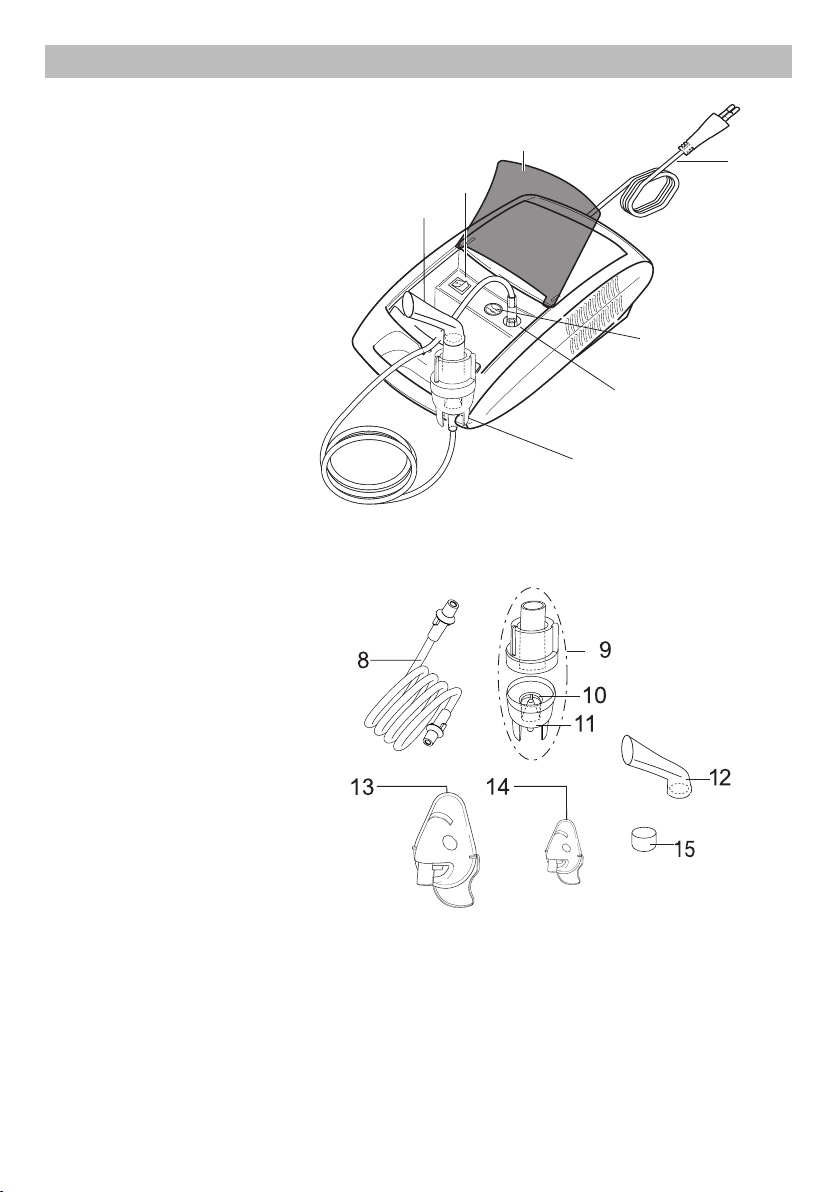
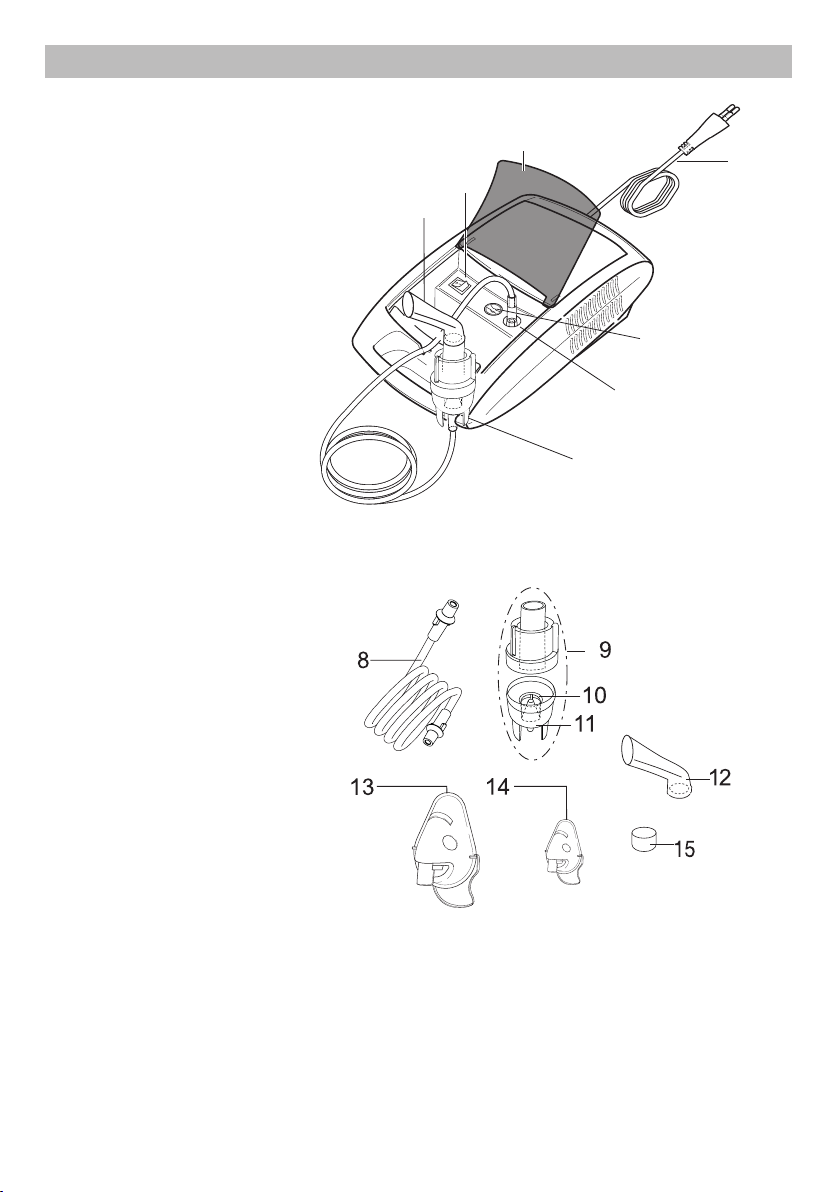
Übersicht Inhalator
4
2
1
3
1 Netzanschlusskabel
2 Deckel
3 Ein-/Aus-Schalter
4 Fach für Zubehör
5 Filterkappe mit Filter
6 Schlauchanschluss
7 Halterung für Vernebler
Übersicht Vernebler und Zubehör
8 Druckluftschlauch
9 Vernebler
10 Düsenaufsatz
11 Medikamentenbehälter
12 Mundstück
13 Erwachsenenmaske
14 Kindermaske
15 Ersatzfilter
5
6
7
6
Page 7
5. Inbetriebnahme
Aufstellen
Entnehmen Sie das Gerät der Verpackung.
Stellen Sie es auf einer ebenen Fläche auf.
Achten Sie darauf, dass die Lüftungsschlitze frei sind.
Klappen Sie den Deckel [2] auf, um an die Zubehörteile
zu gelangen.
Vor der ersten Verwendung
Hinweis
• Vor der ersten Nutzung sollte der Vernebler und das
Zubehör gereinigt und desinfiziert werden. Siehe
hierzu „Reinigung und Desinfektion“ S. 10.
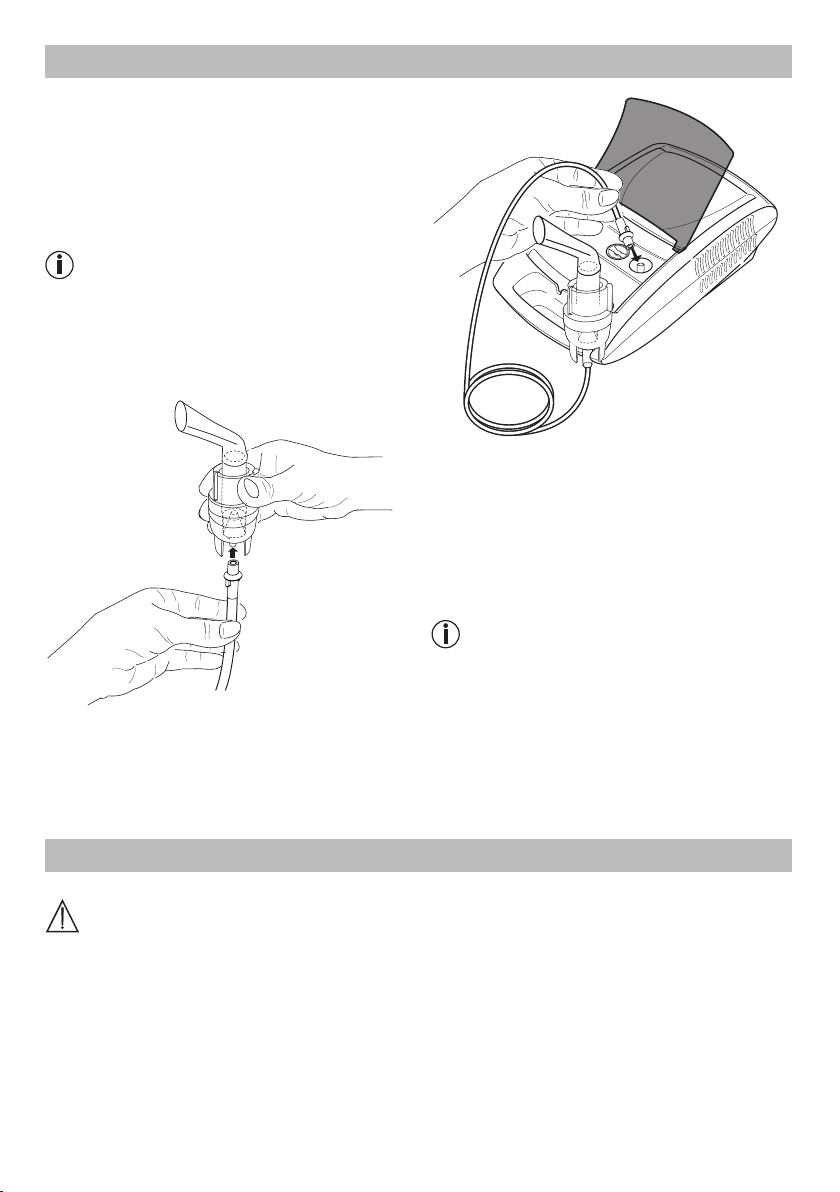
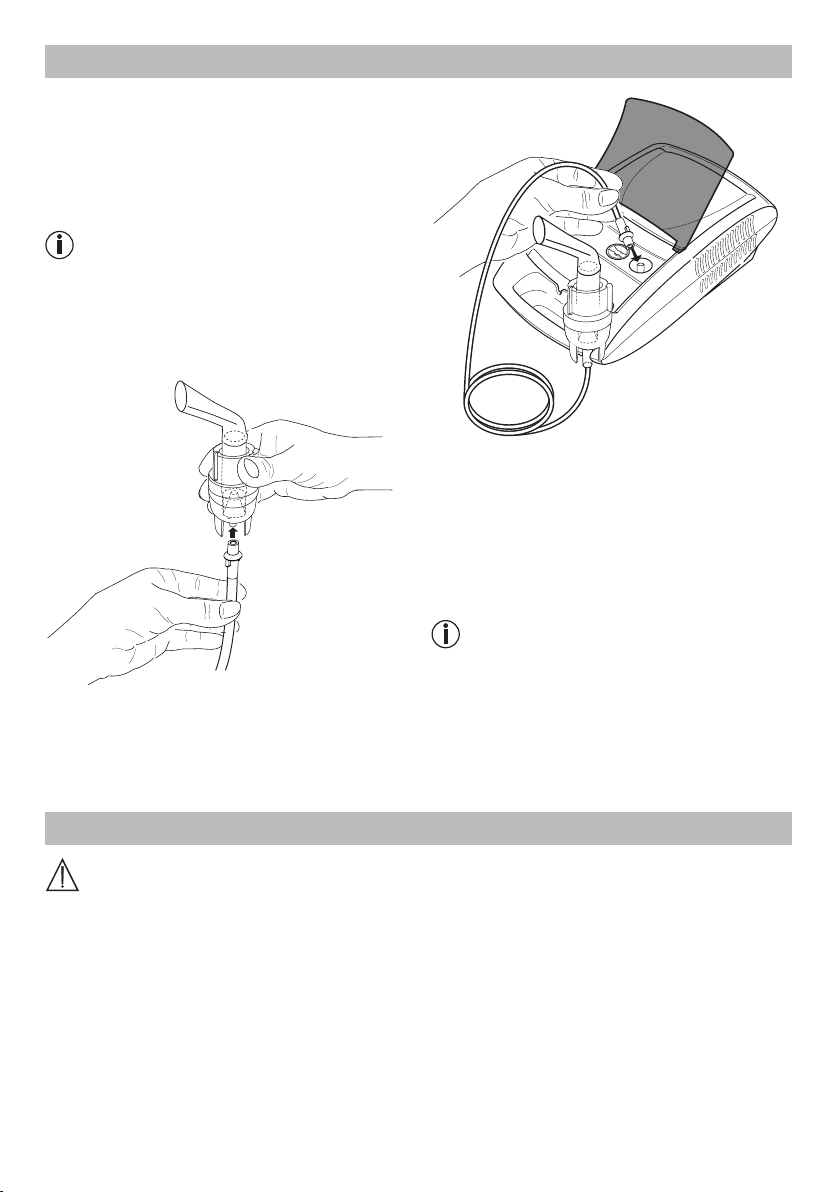
• Stecken Sie den Druckluftschlauch [8] unten an den
Medikamentenbehälter [11].
• Stecken Sie das andere Ende des Schlauchs [8] mit
leichter Drehung in den Schlauchanschluss [6] des
Inhalators.
Netzanschluss
Das Gerät nur an die auf dem Typschild angegebene
Netzspannung anschließen.
• Stecken Sie den Netzstecker des Netzkabels [1] in
eine geeignete Steckdose.
• Zur Netzverbindung den Stecker vollständig in die
Steckdose stecken.
Hinweis
• Achten Sie darauf, dass sich eine Steckdose in der
Nähe des Aufstellplatzes befindet.
• Verlegen Sie das Netzkabel so, dass niemand darüber stolpern kann.
• Zur Trennung des Inhalators vom Stromnetz nach
der Inhalation schalten Sie zuerst das Gerät aus und
ziehen Sie dann den Netzstecker aus der Steckdose.
6. Bedienung
Achtung
• Aus hygienischen Gründen ist es unbedingt erforderlich den Vernebler [9] sowie das Zubehör nach
jeder Behandlung zu reinigen und nach der täglich
letzten Behandlung zu desinfizieren.
• Die Zubehörteile dürfen nur von einer Person benutzt
werden; vom Gebrauch durch mehreren Personen
wird abgeraten.
• Sollten bei der Therapie mehrere verschiedene Medikamente nacheinander inhaliert werden, so ist zu
beachten, dass der Vernebler [9] nach jeder Anwen-
7
dung unter warmem Leitungswasser durchgespült
wird. Siehe hierzu „Reinigung und Desinfektion“ auf
Seite 10.
• Beachten Sie die Hinweise zum Filterwechsel in dieser Anleitung!
• Überprüfen Sie vor jeder Verwendung des Gerätes
den festen Sitz der Schlauchanschlüsse am Inhalator
[6] und am Vernebler [9].
• Prüfen Sie vor der Benutzung das Gerät auf ordnungsgemäße Funktion, hierfür schalten Sie den
Inhalator (samt angeschlossenem Vernebler, aber
ohne Medikamente) für einen kurzen Moment ein.
Page 8
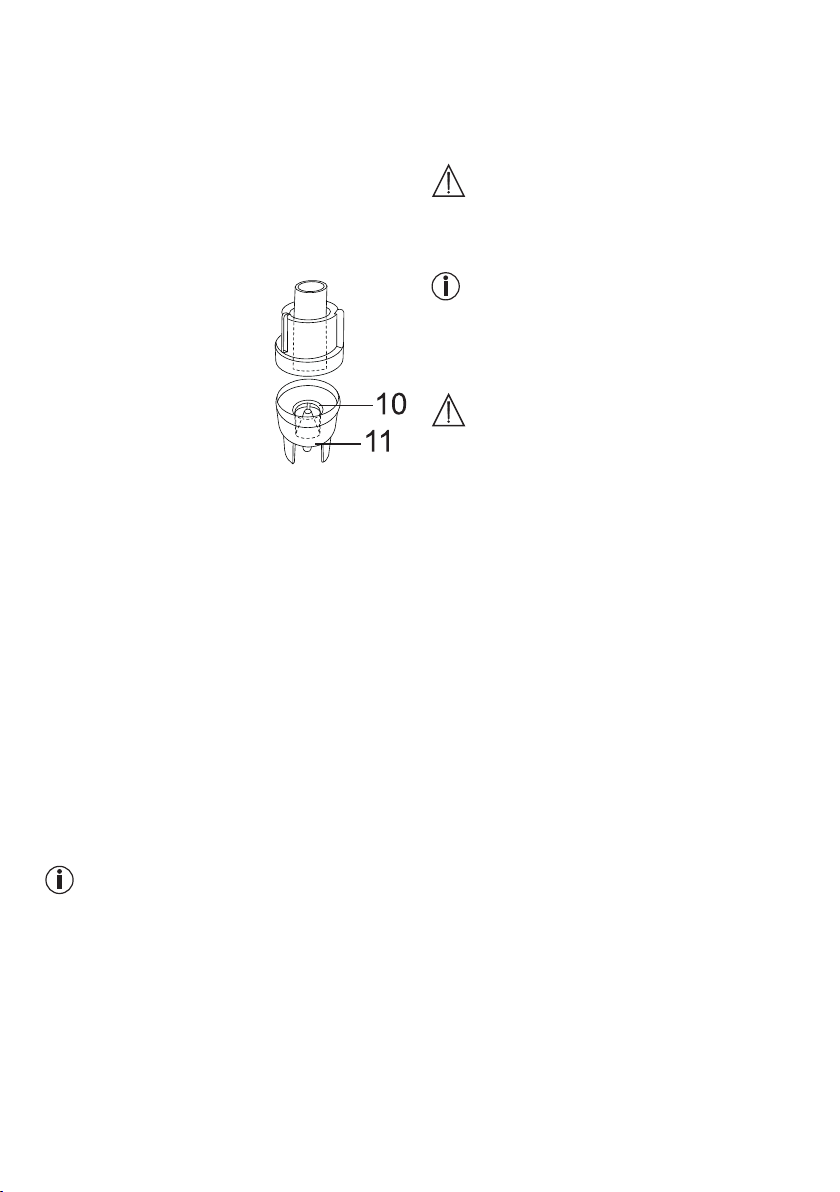
Wenn hierbei Luft aus dem Vernebler [9] kommt,
funktioniert das Gerät.
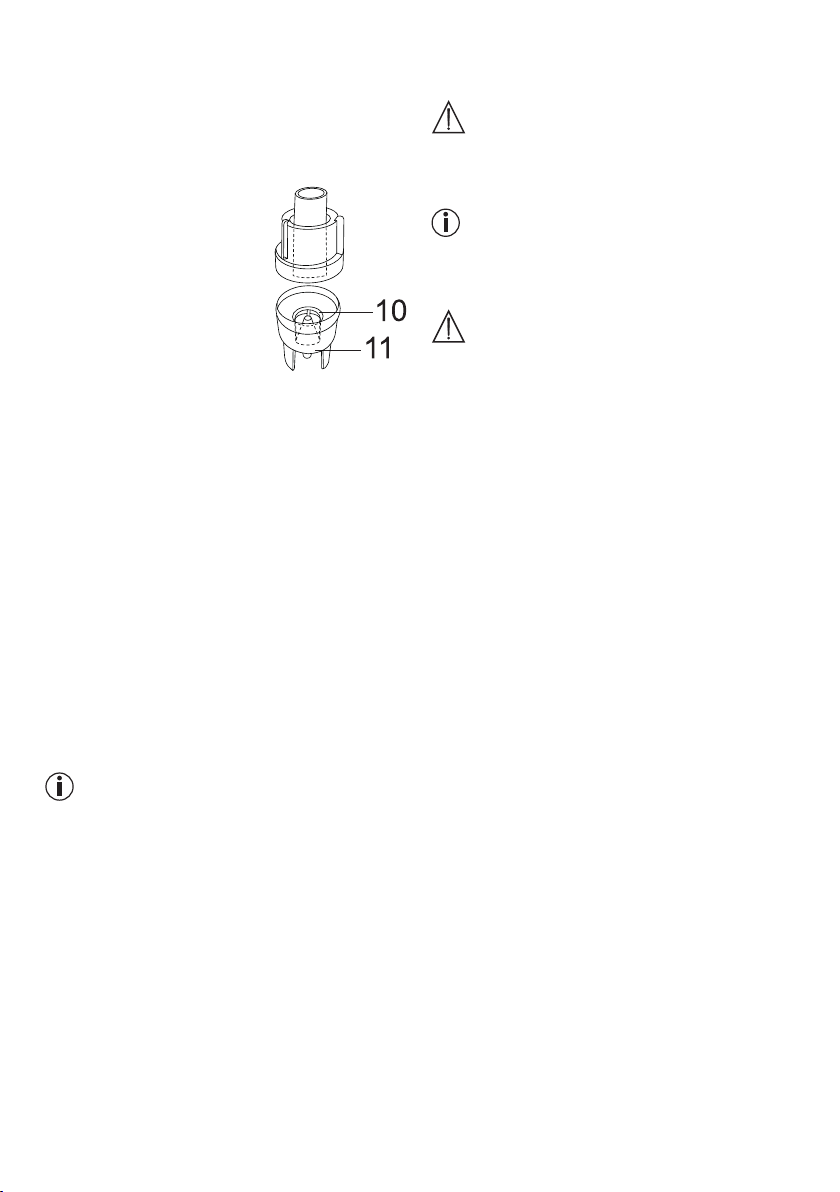
1. Düsenaufsatz einsetzen
• Öffnen Sie den Vernebler [9], indem Sie das Oberteil
im gegen den Uhrzeigersinn gegen den Medikamentenbehälter [11] drehen. Setzen Sie den Düsenaufsatz [10] in den Medikamentenbehälter [11] ein.
• Stellen Sie sicher, dass der Kegel für die Medikamentenführung gut auf dem Kegel für die Luftführung im
Innern des Zerstäubers aufsitzt.
2. Vernebler befüllen
• Füllen Sie eine isotonische
Kochsalzlösung oder das
Medikament direkt in den
Medikamentenbehälter [11].
Vermeiden Sie eine Überfüllung! Die maximal empfohlene
Füllmenge beträgt 8 ml !
• Verwenden Sie Medikamente
nur auf Anweisung Ihres
Arztes und fragen Sie nach
der für Sie angemessenen Inhalationsdauer und
-menge!
• Liegt die vorgegebene Menge des Medikamentes
bei weniger als 2 ml, füllen Sie diese Menge mit
isotonischer Kochsalzlösung auf mind. 4 ml auf. Eine Verdünnung ist bei zähflüssigen Medikamenten
ebenfalls notwendig. Achten Sie auch hier auf die
Anweisung Ihres Arztes.
3. Vernebler schließen
• Schließen Sie den Vernebler [9], indem Sie das Oberteil im Uhrzeigersinn gegen den Medikamentenbehälter [11] drehen. Achten Sie auf korrekte Verbindung!
4. Zubehör mit Vernebler verbinden
• Vernebler [9] mit gewünschtem Zubehör (Mundstück
[12], Erwachsenenmaske [13] oder Kindermaske [14])
verbinden.
Hinweis
Die Inhalation mit dem Mundstück ist die wirksamste
Form der Therapie. Der Gebrauch der Maskeninhala
tion wird nur empfohlen, wenn die Verwendung eines
Mundstücks nicht möglich ist (z.B. bei Kindern die
noch nicht mit dem Mundstück inhalieren können).
-
5. Behandlung
• Während des Inhalierens aufrecht und entspannt an
einem Tisch und nicht in einem Sessel sitzen, um
die Atemwege nicht zusammenzudrücken und so
die Wirksamkeit der Bahandlung zu Beeinträchtigen.
• Atmen Sie das zerstäubte Medikament tief ein.
Achtung
Das Gerät ist nicht für Dauerbetrieb geeignet, nach
30 Minuten Betrieb muss es 30 Minuten abgeschaltet
werden.
Hinweis
Halten Sie den Vernebler während der Behandlung gerade (senkrecht), da ansonsten die Zerstäubung nicht
funktioniert und eine einwandfreie Funktion nicht ge
währleistet ist.
-
Achtung
Ätherische Heilpflanzenöle, Hustensäfte, Lösungen
zum Gurgeln, Tropfen zum Einreiben oder für Dampfbäder sind grundsätzlich ungeeignet für die Inhalation
mit Inhalatoren. Diese Zusätze sind oft zähflüssig und
können die korrekte Funktion des Gerätes und damit
die Wirksamkeit der Anwendung nachhaltig beeinträchtigen. Bei einer Überempfindlichkeit des Bronchialsystems können Medikamente mit ätherischen
Ölen unter Umständen einen akuten Bronchospasmus
(eine plötzliche krampfartige Einengung der Bronchien
mit Atemnot) auslösen. Fragen Sie dazu Ihren Arzt oder
Apotheker!
6. Inhalation beenden
Tritt der Nebel nur noch unregelmäßig aus oder verändert sich das Geräusch bei der Inhalation können Sie
die Behandlung beenden.
• Schalten Sie den Inhalator nach der Behandlung mit
dem Ein-/Aus-Schalter [3] aus und trennen Sie ihn
vom Stromnetz.
• Setzen Sie den Vernebler [9] nach der Behandlung
wieder zurück in seine Halterung [7].
7. Reinigung durchführen
Siehe „Reinigung und Desinfektion“ auf Seite 10.
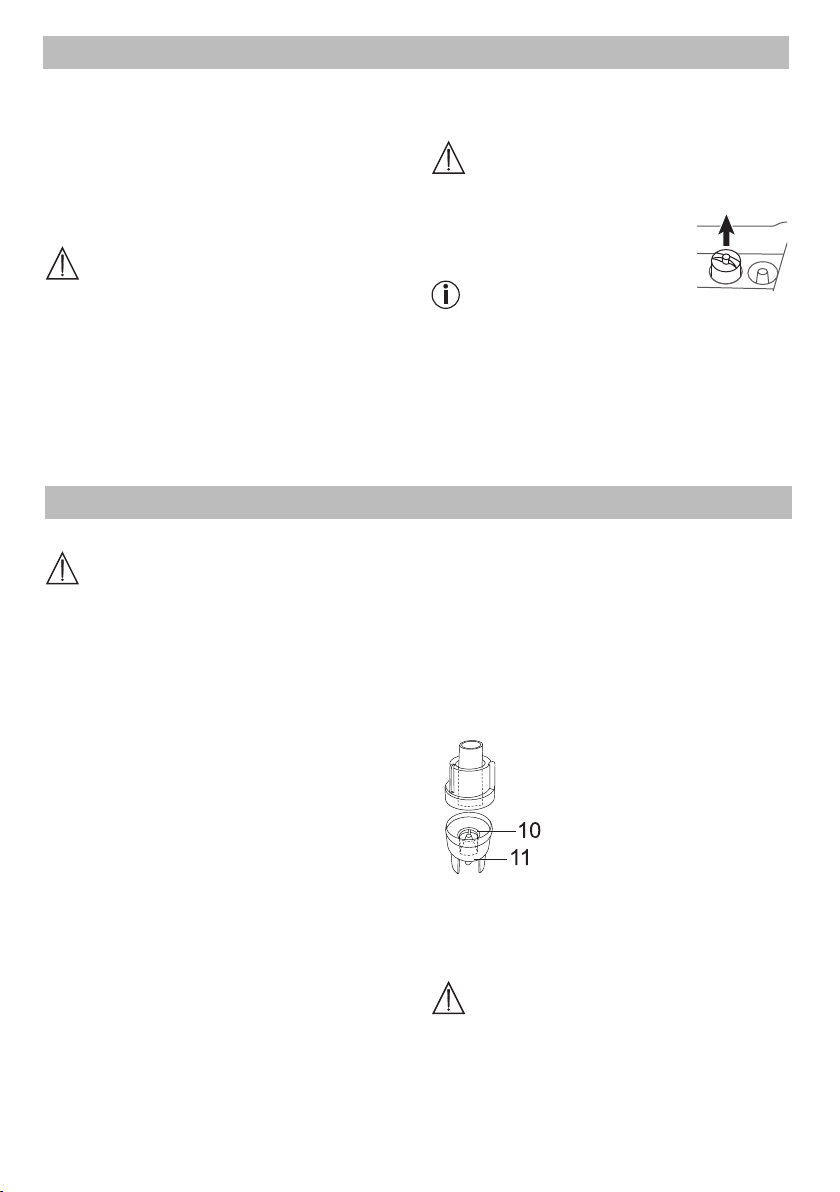
• Ziehen Sie den Vernebler vor der Behandlung nach
oben aus der Halterung [7] heraus.
• Starten Sie den Inhalator mit dem Ein-/Aus-Schalter
[3].
• Das Ausströmen des Sprühnebels aus dem Vernebler zeigt den einwandfreien Betrieb.
8
Page 9
7. Filterwechsel
Bei normalen Benutzungsbedingungen ist der Luftfilter nach etwa 500 Betriebsstunden bzw. einem Jahr
auszutauschen. Kontrollieren Sie den Luftfilter bitte
regelmäßig (nach 10-12 Zerstäubungsvorgängen).
Ist er stark verschmutzt oder verstopft, wechseln Sie
den gebrauchten Filter aus. Sollte der Filter feucht geworden sein, muss er ebenfalls gegen einen neuen
Filter ausgewechselt werden.
Achtung
• Versuchen Sie nicht, den gebrauchten Filter zu reinigen und wieder zu verwenden!
• Benutzen Sie ausschließlich den Original-Filter des
Herstellers, da ansonsten Ihr Inhalator beschädigt
werden könnte oder keine ausreichend effektive
Therapie sichergestellt werden kann.
• Der Luftfilter darf nicht repariert oder gewartet wer
den, während er bei einer Person im Einsatz ist.
• Gerät niemals ohne Filter betreiben.
-
8. Reinigung und Desinfektion
Vernebler und Zubehör
Warnung
Befolgen Sie nachfolgende Hygienevorschriften, um
eine Gesundheitsgefährdung zu vermeiden.
• Vernebler [9] und Zubehör sind für eine Mehrfachverwendung vorgesehen. Bitte beachten Sie, dass
für die unterschiedlichen Anwendungsbereiche
verschiedene Anforderungen an die Reinigung und
hygienische Wiederaufbereitung gestellt werden.
Hinweise:
• Eine mechanische Reinigung des Verneblers sowie
des Zubehörs mit Bürsten oder der Gleichen, muss
unterbleiben, da hierbei irreparable Schäden die Fol
ge sein können und ein gezielter Behandlungserfolg
nicht mehr gewährleistet ist.
• Die zusätzlichen Anforderungen bezüglich der not
wendigen hygienischen Vorbereitung (Handpflege,
Handhabung der Medikamente bzw. der Inhalationslösungen) bei Hochrisikogruppen (z.B. Mukoviszidosepatienten) erfragen Sie bitte bei Ihrem Arzt.
• Achten Sie auf ausreichende Trocknung nach jeder
Reinigung, Desinfektion. Eine Restfeuchtigkeit bzw.
Restnässe kann ein erhöhtes Risiko für Keimwachstum darstellen.
Vorbereitung
• Direkt nach jeder Behandlung müssen alle Teile des
Verneblers [9] sowie das benutzte Zubehör von Me
-
-
-
9
Zum Auswechseln des Filters gehen Sie folgendermaßen vor:
Achtung
• Gerät erst ausschalten und vom Netz trennen.
• Gerät abkühlen lassen.
1. Filterkappe [5] nach oben abziehen.
Hinweis
Falls der Filter nach Abziehen der Kappe im Gerät verbleibt, entfernen Sie den Filter, z.B. mit einer Pinzette
oder Ähnlichem, aus dem Gerät.
2. Filterkappe [5] mit neuem Filter wieder einsetzen.
3. Festen Sitz prüfen.
dikamentenresten und Verunreinigungen gereinigt
werden.
• Hierfür zerlegen Sie den Vernebler [9] in alle Einzel
teile.
• Ziehen Sie das Mundstück [12] vom Vernebler ab.
• Zerlegen Sie den Vernebler, indem Sie das Oberteil
gegen den Uhrzeigersinn gegen den Medikamentenbehälter [11] drehen.
• Entfernen Sie den Düsenaufsatz [10] aus dem Me
dikamentenbehälter [11].
• Der Zusammenbau erfolgt später sinngemäß in umgekehrter Reihenfolge.
Reinigung
Achtung
Vor jeder Reinigung muss das Gerät ausgeschaltet,
vom Netz getrennt und abgekühlt sein.
Der Vernebler sowie das benutzte Zubehör wie Mund-
stück, Maske, Düsenaufsatz usw. müssen nach jeder
Anwendung mit heißem nicht kochendem Wasser
-
-
Page 10
gereinigt werden. Trocken Sie die Teile sorgfältig mit
einem weichen Tuch ab. Setzen Sie die Teile, wenn
diese vollständig getrocknet sind, wieder zusammen
und legen Sie die Teile in ein trockenes, abgedichtetes
Behältnis oder führen Sie die Desinfektion durch.
Vergewissern Sie sich bei der Reinigung, dass jegliche
Rückstände entfernt werden. Verwenden Sie dabei auf
keinen Fall Substanzen, die bei der Berührung mit der
Haut oder den Schleimhäuten, verschluckt oder inha
liert potenziell giftig sein könnten.
Benutzen Sie zur Reinigung des Gerätes ein weiches,
trockenes Tuch und ein nicht scheuerndes Reinigungsmittel.
Benutzen Sie keine scharfen Reinigungsmittel und halten Sie das Gerät niemals unter Wasser.
-
• Den zerlegten Zerstäuber und das Mundstück 5
Minuten lang in kochendes Wasser legen.
• Für das übrige Zubehör
schung bestehend aus ¼ Essig und ¾ destilliertem
Wasser. Stellen Sie sicher, dass die Menge ausreichend ist, dass die Teile vollständig darin eingetaucht
werden können.
• Belassen Sie die Teile für 30 Minuten in der Essigmischung.
• Spülen Sie die Teile mit Wasser aus und trocknen
Sie diese sorgfältig mit einem weichen Tuch ab.
benutzen Sie eine Essigmi-
Achtung
Masken und Luftschlauch nicht abkochen oder autoklavieren.
Achtung
• Achten Sie darauf, dass kein Wasser in das Geräteinnere gelangt!
• Gerät und Zubehör nicht in der Spülmaschine reini
gen!
• Das Gerät darf im angeschlossenen Zustand nicht
mit feuchten Händen angefasst werden; es darf kein
Wasser auf das Gerät spritzen. Das Gerät darf nur im
vollständig trockenen Zustand betrieben werden.
• Sprühen Sie keine Flüssigkeit in die Lüftungsschlitze!
Eingedrungene Flüssigkeiten können eine Beschädigung der Elektrik sowie anderer Inhalatorteile verursachen und zu einer Funktionsstörung führen.
-
Kondenswasser, Schlauchpflege
Je nach Umgebungsbedingungen kann sich im
Schlauch Kondenswasser absetzen. Um Keimwachstum vorzubeugen und eine einwandfreie Therapie zu
gewährleisten, ist die Feuchtigkeit unbedingt zu entfernen. Gehen Sie dazu folgendermaßen vor:
• Ziehen Sie den Schlauch [8] vom Vernebler [9] ab.
• Lassen Sie den Schlauch inhalatorseitig [6] eingesteckt.
• Nehmen Sie den Inhalator so lange in Betrieb, bis die
Feuchtigkeit durch die durchströmende Luft beseitigt
ist.
• Bei starken Verschmutzungen ersetzen Sie den
Schlauch.
Desinfektion
Bitte folgen Sie den unten aufgeführten Punkten sorgfältig, um Ihren Vernebler und das Zubehör zu desinfizieren. Es wird empfohlen die Einzelteile spätestens
nach der täglich letzten Benutzung zu desinfizieren.
(Sie benötigen hierzu lediglich ein wenig farblosen
Essig und destilliertes Wasser!)
• Reinigen Sie zunächst den Vernebler und das Zubehör wie unter „Reinigung“ beschrieben.
• Setzen Sie die Teile wenn diese vollständig getrocknet sind wieder zusammen und legen Sie die Teile in
ein trockenes, abgedichteten Behältnis.
Hinweis
Bitte beachten Sie, dass bei oder speziell nach der
Reinigung die Teile vollständig getrocknet sind da ansonsten hier das Risiko vom Keimwachstum erhöht ist.
Sterilisierung
• Kaltsterilisierungslösungen gemäß Herstelleranweisung benutzen.
Trocknung
• Legen Sie die Einzelteile auf eine trockene, saubere
und saugfähige Unterlage und lassen Sie sie vollständig trocknen (mindestens 4 Stunden).
Materialbeständigkeit
• Vernebler und Zubehör unterliegen bei häufiger
Anwendung und hygienischer Wiederaufbereitung,
wie jedes andere Kunststoffteil auch, einer gewissen Abnutzung. Dies kann im Laufe der Zeit zu einer
Veränderung des Aerosols und somit auch zu einer
Beeinträchtigung der Therapieeffizienz führen. Wir
empfehlen deshalb den Vernebler nach einem Jahr
auszuwechseln.
• Bei der Wahl der Reinigungs-bzw. Desinfektionsmittel ist folgendes zu beachten: Verwenden Sie nur ein
mildes Reinigungsmittel oder Desinfektionsmittel,
welches Sie nach Herstellerangaben dosieren.
Aufbewahrung
• Nicht in Feuchträumen (z.B. Badezimmer) lagern und
zusammen mit feuchten Gegenständen transportieren.
• Vor anhaltender direkter Sonneneinstrahlung geschützt lagern und transportieren.
10
Page 11
• Die Zubehörteile können im Zubehörfach [4] sicher
verstaut werden. Das Gerät an einem trockenen
Platz, am besten in der Verpackung, aufbewahren.
9. Entsorgen
Im Interesse des Umweltschutzes darf das Gerät
nicht mit dem Hausmüll entsorgt werden.
Bitte entsorgen Sie das Gerät gemäß der Elektro- und Elektronik Altgeräte EG-Richtlinie –
WEEE (Waste Electrical and Electronic Equipment).
Bei Rückfragen wenden Sie sich bitte an die für die
Entsorgung zuständige kommunale Behörde.
10. Problemlösung
Probleme/ Fragen Mögliche Ursache/Behebung
Der Vernebler erzeugt kein
oder zu wenig Aerosol.
Der Ausstoß ist zu gering. Geknickter Schlauch, verstopfter Filter, zu viel Inhalationslösung.
Welche Medikamente kann
man inhalieren?
Es bleibt Inhalationslösung im
Vernebler zurück.
Was ist bei Babys und Kin
dern zu beachten?
Die Inhalation mit der Maske
dauert länger?
1. Zuviel oder zuwenig Medikament im Vernebler.
Minimum: 2 ml, Maximum: 8 ml.
2. Düse auf Verstopfung prüfen.
Gegebenenfalls Düse reinigen (z.B. durch Ausspülen). Vernebler danach
erneut in Betrieb nehmen.
ACHTUNG: die feinen Bohrungen nur von der Düsenunterseite vorsichtig
durchstechen.
3. Vernebler nicht senkrecht gehalten.
4. Ungeeignete Medikamentenflüssigkeit zum Vernebeln eingefüllt (z.B. zu
dickflüssig).
Die Medikamentenflüssigkeit sollte vom Arzt vorgegeben werden.
Bitte fragen Sie hierzu Ihren Arzt.
Grundsätzlich können alle Medikamente, die für eine Geräte-Inhalation
geeignet und zugelassen sind, inhaliert werden.
Dies ist technisch bedingt und normal. Beenden Sie die Inhalation, sobald
Sie ein deutlich verändertes Verneblergeräusch hören.
-
1. Bei Babys sollte die Maske Mund und Nase abdecken um eine effektive
Inhalation zu gewährleisten.
2. Bei Kindern sollte ebenfalls die Maske Mund und Nase abdecken. Eine
Verneblung neben schlafenden Personen ist wenig sinnvoll, da hierbei
nicht genügend des Medikaments in die Lunge gelangen kann.
Hinweis: es sollte nur unter Aufsicht und mit Hilfe einer erwachsenen Per
son inhaliert werden und das Kind nicht allein gelassen werden.
Dies ist technisch bedingt. Durch die Maskenlöcher atmen Sie pro Atemzug
weniger Medikament ein als über das Mundstück. Das Aerosol wird über die
Löcher mit Raumluft vermischt.
-
11
Page 12
Probleme/ Fragen Mögliche Ursache/Behebung
Warum soll der Vernebler
regelmäßig ausgewechselt
werden?
Benötigt jeder seinen eigenen
Vernebler?
Dafür gibt es zwei Gründe:
1. Um ein therapeutisch wirksames Teilchenspektrum zu gewährleisten, soll
die Düsenbohrung einen bestimmten Durchmesser nicht überschreiten.
Bedingt durch mechanische und thermische Beanspruchung unterliegt
der Kunststoff einem gewissen Verschleiß. Der Düsenaufsatz [10] ist besonders sensibel. Damit kann sich auch die Tröpfchenzusammensetzung
des Aerosols verändern, was unmittelbar die Effektivität der Behandlung
beeinflusst.
2. Zudem wird ein regelmäßiger Wechsel des Verneblers aus hygienischen
Gründen empfohlen.
Aus hygienischer Sicht ist dies unbedingt notwendig.
11. Technische Angaben
Model SIH 21
Typ SIH 21/2
Abmessungen
(BxHxT)
Gewicht 1,65 kg
Arbeitsdruck ca. 0,8 - 1,45 bar
Füllvolumen
Vernebler
Medikamenten-
fluss
Schalldruck max. 52 dBA
Netzanschluss 230 V~; 50 Hz; 230 VA
Betriebsbedingungen
Lager-und Transportbedingungen
Aerosol
Eigenschaften
Technische Änderungen vorbehalten.
300 x 180 x 100 mm
max. 8 ml
min. 2 ml
ca. 0,4 ml/min.
(gem. DIN EN 13544-1
Abschnitt 26)
UK: 240 V~; 50 Hz; 240 VA
Temperatur: +10 °C bis +40 °C
Relative Luftfeuchte:
10% bis 95%
Temperatur: 0 °C bis +60 °C
Relative Luftfeuchte:
10% bis 95%
Umgebungsdruck:
500 bis 1060 hPa
Durchfluss: 5,31 l/min
Aerosolabgabe: 0,171 ml
Aerosolabgaberate: 0,082 ml/min
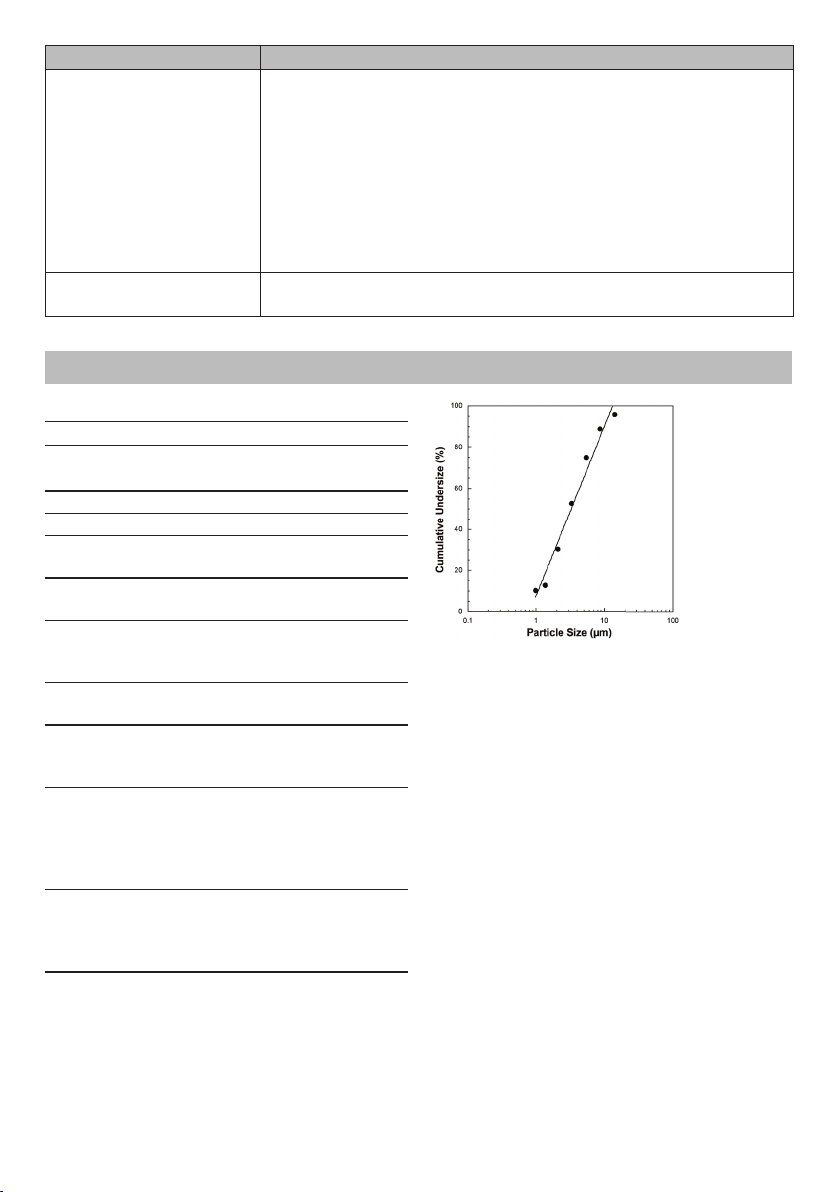
Partikelgröße (MMAD): 3,16 µm
Die Messungen wurden mit einer Natrium-FluoridLösung mit einem "Next Generation Impactor" (NGI)
durchgeführt.
Das Diagramm ist möglicherweise so nicht auf Suspensionen oder sehr zähflüssige Medikamente anwendbar.
Nähere Informationen dazu können Sie vom jeweiligen
Medikamentenhersteller erfahren.
12
Page 13
Nachkaufartikel
Yearpack SIH 21
Mundstück, Erwachsenen-/
Kindermaske, Vernebler, Druck
luftschlauch, Filter
REF
601.20
-
Hinweis
Bei Verwendung des Gerätes außerhalb der Spezifikation ist eine einwandfreie Funktion nicht gewährleistet!
Technische Änderungen zur Verbesserung und Weiterentwicklung des Produktes behalten wir uns vor.
Dieses Gerät und dessen Zubehör entspricht den europäischen Normen EN60601-1 und EN60601-1-2 sowie
EN13544-1 und unterliegt besonderen Vorsichtsmaßnahmen hinsichtlich der elektromagnetischen Verträglichkeit. Bitte beachten Sie dabei, dass tragbare und
mobile HF-Kommunikationseinrichtungen dieses Gerät
beeinflussen können. Genauere Angaben können Sie
unter der angegebenen Kundenservice-Adresse an
fordern. Das Gerät entspricht den Anforderungen der
europäischen Richtlinie für Medizinprodukte 93/42/EC,
dem Medizinproduktegesetz.
ELEKTROMAGNETISCHE KOMPATIBILITÄT
• Das Gerät entspricht den zur Zeit geltenden Vorschriften in Bezug auf die elektromagnetische
Kompatibilität und ist geeignet für die Verwendung
in sämtlichen Gebäuden, einschließlich derjenigen,
die für private Wohnzwecke bestimmt sind. Die Radiofrequenzemissionen des Geräts sind äußerst niedrig
und verursachen mit größter Wahrscheinlichkeit keine Interferenzen mit anderen Geräten in der Nähe.
• Es empfiehlt sich auf jeden Fall, das Gerät nicht über
oder nahe bei anderen Geräten aufzustellen. Sollte
es mit Ihren Elektrogeräten zu Interferenzen kommen, verstellen Sie es oder schließen Sie es an eine
andere Steckdose an.
• Funkgeräte könnten den Betrieb des Geräts beein
flussen.
-
-
12. Garantie
Sie erhalten 2 Jahre Garantie ab Kaufdatum auf Material- und Fabrikationsfehler des Produktes.
Die Garantie gilt nicht:
•
im Falle von Schäden, die auf unsachgemässer Bedienung beruhen,
•
für Verschleißteile (z.B. Vernebler, Filter, Druckluftschlauch etc.),
•
für Mängel, die dem Kunden bereits bei Kauf bekannt waren,
•
bei Eigenverschulden des Kunden.
Die gesetzlichen Gewährleistungen des Kunden bleiben durch die Garantie unberührt. Für Geltendmachung
eines Garantie falles innerhalb der Garantiezeit ist durch den Kunden der Nachweis des Kaufes zu führen. Die
Garantie ist innerhalb eines Zeitraumes von 2 Jahren ab Kaufdatum gegenüber der
Hans Dinslage GmbH,
Riedlinger Straße 28,
88524 Uttenweiler, Germany,
geltend zu machen.
Der Kunde hat im Garantiefall das Recht zur Reparatur der Ware bei unseren eigenen oder bei von uns auto
risierten Werkstätten. Weitergehende Rechte werden dem Kunden (aufgrund der Garantie) nicht eingeräumt.
-
13
Page 14

ENGLISH
Contents
1. Getting to know your instrument .......................15
2. Signs and symbols ............................................15
3. Safety information and warnings .......................16
4. Description of device and accessories .............17
5. Initial use ...........................................................18
6. Operation ...........................................................19
7. Changing the filter .............................................20
8. Cleaning and disinfection ..................................20
9. Disposal .............................................................22
10. Troubleshooting .................................................22
11. Technical specifications ....................................23
Included in delivery
For details of the delivery scope, see description of the
device and accessories on page 17.
• Nebuliser
• Atomiser
• Compressed air hose
• Mouthpiece
• Adult mask
• Child mask
• Spare filter
• These instructions for use
14
Page 15
1. Getting to know your instrument
Dear valued customer
Please read these instructions for use carefully and
keep them for later use, be sure to make them accessible to other users and observe the information
they contain.
Area of application
This nebuliser is a device used for the nebulisation
of liquids and liquid medication (aerosols) and for the
treatment of the upper and lower respiratory tract.
The nebulisation and inhalation of medication prescribed or recommended by a doctor can prevent against
diseases of the respiratory tract, treat the side effects
of these disorders and accelerate healing.
For more information on possible applications, consult
your doctor or pharmacist.
2. Signs and symbols
The device is suitable for inhalation at home. Medicines
should only be inhaled when instructed by a doctor.
Inhalation should be performed in a calm and relaxed
atmosphere. Inhale slowly and deeply to enable the
medicine to reach the small bronchi deep into the
lungs. Exhale normally.
The following symbols appear in these instructions.
Warning Warning instruction indicating a
Important Safety note indicating possible
Note
risk of injury or damage to health.
damage to the unit/accessory.
Note on important information.
The following symbols are used on the packaging and
on the nameplate of the device and accessories.
Type BF applied part
Read the instructions for use
Device in protection class 2
M
anufacturer
On
I
Off
O
Serial number
SN
30 ON /
30 OFF
30 minute operation, followed by a 30
minute break before operation continues.
Keep dry.
15
Page 16
3. Safety information and warnings
Warning
•
Before use, ensure that there is no visible damage to
the unit or accessories. When in doubt, do not use
the unit and contact your dealer or the customer
service address provided.
• In the event of device faults, please see Chapter "10.
Troubleshooting".
•
Using the unit is not a substitute for consultation with
or treatment from a physician. Whenever you have
any pain or illness, always contact your physician
first.
•
If you have health concerns of any kind, contact your
general practitioner!
•
When using the atomiser, always follow the basic
hygiene procedures.
•
Always follow your doctor’s instructions regarding
the type of medicine to be used and the dose, frequency, and duration of inhalation.
•
Only use medicines that have been prescribed or
recommended by your doctor or pharmacist.
Please note:
For treatment, only use parts indicated by your doc-
tor according to the particular diagnosis.
• Check whether there are contraindications for use
with the usual systems for aerosol therapy on the
medication instruction leaflet.
•
If the unit does not function correctly or if you begin
to feel unwell or feel pain, stop using the unit imme
diately.
•
During use, hold the unit away from the eyes, as
some nebulised medicines may cause damage to
the eyes.
•
Do not operate the unit in the presence of flammable
gases.
•
This device is not intended to be used by children
or persons with restricted physical, sensory (e.g.
insensitivity to pain) or mental abilities or persons
lacking in the required experience or knowledge for
safe operation of the device, unless supervised or
instructed by a person responsible for their safety.
• The device must be switched off and the plug pulled
out before every cleaning and/or maintenance procedure.
•
Keep children away from packaging materials (risk
of suffocation).
• To avoid the risk of entanglement and strangulation,
store cables and air lines out of the reach of small
children.
•
Do not use attachments that are not recommended
by the manufacturer.
-
•
Connect the unit only to the mains voltage listed on
the type plate.
•
Do not dip the unit into water and do not use it in wet
rooms. Do not allow any liquid to penetrate the unit.
•
Protect the unit from strong impacts.
•
Never touch the mains cable with wet hands, this
can cause an electric shock.
•
Do not pull the mains plug from the socket by the
cord.
•
Do not pinch or bend the mains cable, pull it over
sharp objects, or allow it to hang freely, and protect
it against sources of heat.
•
We recommend that the power cable is completely
unrolled to avoid dangerous overheating.
•
If the mains cable or housing is damaged, contact
our customer service department or your local dealer.
•
Opening the unit carries a risk of electric shock. Dis-
connection from the mains supply is only guaranteed
if the mains plug has been removed from the socket.
•
Do not use the unit if it has fallen or been dropped
on the floor, been exposed to extreme humidity or
is otherwise damaged. In case of doubt, contact our
customer service department or your local dealer.
•
The SIH 21 nebuliser must only be used with suit-
able atomisers and with the appropriate accessories. The use of other atomisers and accessories
can impair therapeutic efficiency and may dam
-
age the device.
Important
•
Power cuts, sudden faults or other unfavourable
conditions may render the unit unusable. You are
therefore recommended to keep a spare device or
replacement medicine (as agreed with the doctor).
•
If adapters or extensions are required, these must
comply with the applicable safety regulations. The
electrical capacity and the maximum capacity specified on the adapter must not be exceeded.
•
The unit and the mains cable must be stored away
from sources of heat.
•
Do not use the unit in a room in which a spray has
previously been used. If this is the case, ventilate the
room before commencing treatment.
•
Do not allow any objects to enter or obstruct the
ventilation openings.
•
Do not use the device if you notice an unusual noise.
•
For hygiene reasons, each user must use his own
accessories.
•
Always disconnect from the mains after use.
16
Page 17
•
Store the device in a location protected against en-
vironmental influences. The device must be stored
in the specified ambient conditions.
FUSE
•
The device contains an overload protection fuse.
This must only be changed by authorised specialist
personnel.
General notes
Important
•
Use the unit only:
–
On humans,
–
for its intended purpose (aerosol inhalation) and in
the manner described in these instructions for use.
• Any improper use can be dangerous!
•
In acute emergencies, first aid takes priority.
•
Apart from the medication, use only distilled water or
a saline solution in the unit. Other liquids may cause
defects to the nebuliser or atomiser.
•
This unit is not intended for commercial or clinical
use, but only for individual, private household use!
Before using the unit for the first time
Important
•
Before you use the unit for the first time, remove all
packaging materials.
•
Protect the unit against dust, dirt and moisture.
Never cover the unit during operation.
•
Do not use the unit in very dusty environments.
•
Switch the unit off immediately if it is defective or
malfunctioning.
•
The manufacturer shall not be held liable for damage
or injuries caused by improper or incorrect use.
Repairs
Note
•
Never open or attempt to repair the unit yourself, as
otherwise proper function is no longer guaranteed.
Failure to observe this regulation shall void the war
ranty.
•
If you need to have the unit repaired, contact cus-
tomer service or an authorised dealer.
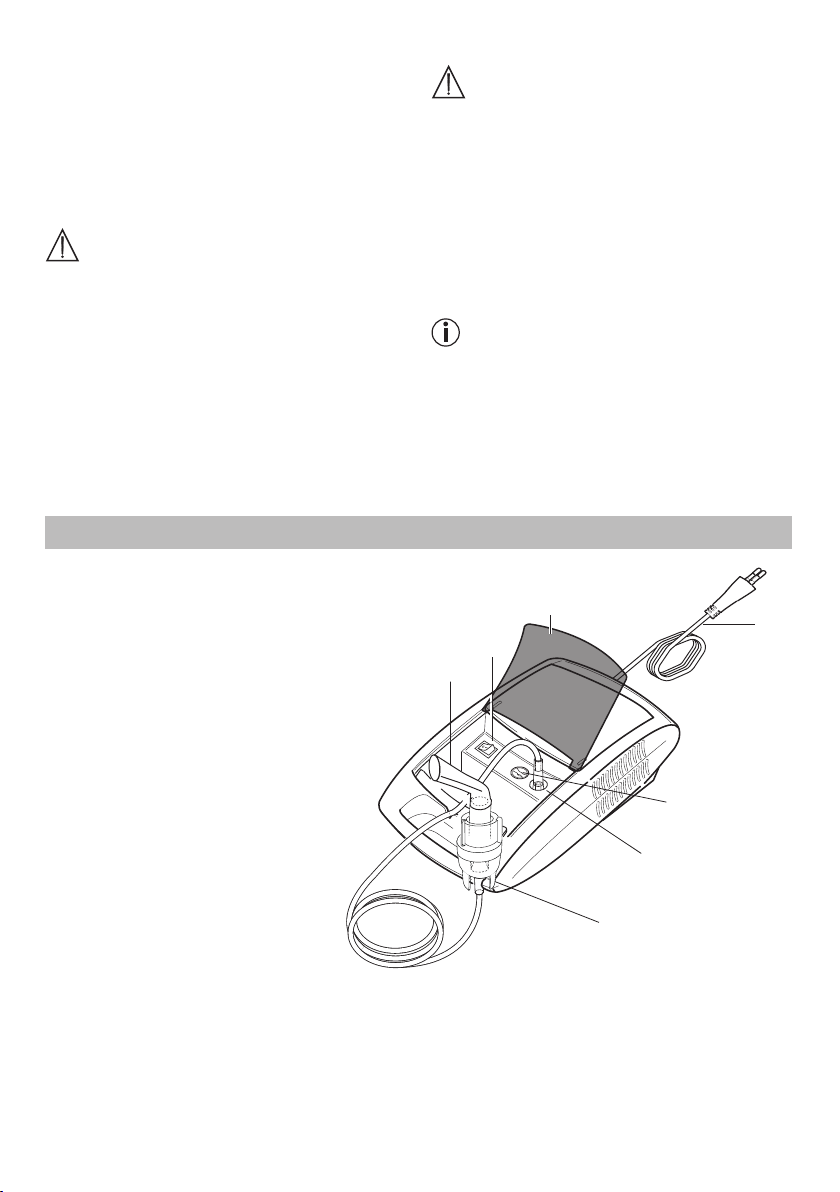
4. Description of device and accessories
Overview of the nebuliser
4
-
2
1
3
1 Mains cable
2 Lid
3 On/off switch
4 Compartment for accessories
5 Filter cap with filter
6 Hose connection
7 Holder for atomiser
5
6
7
17
Page 18
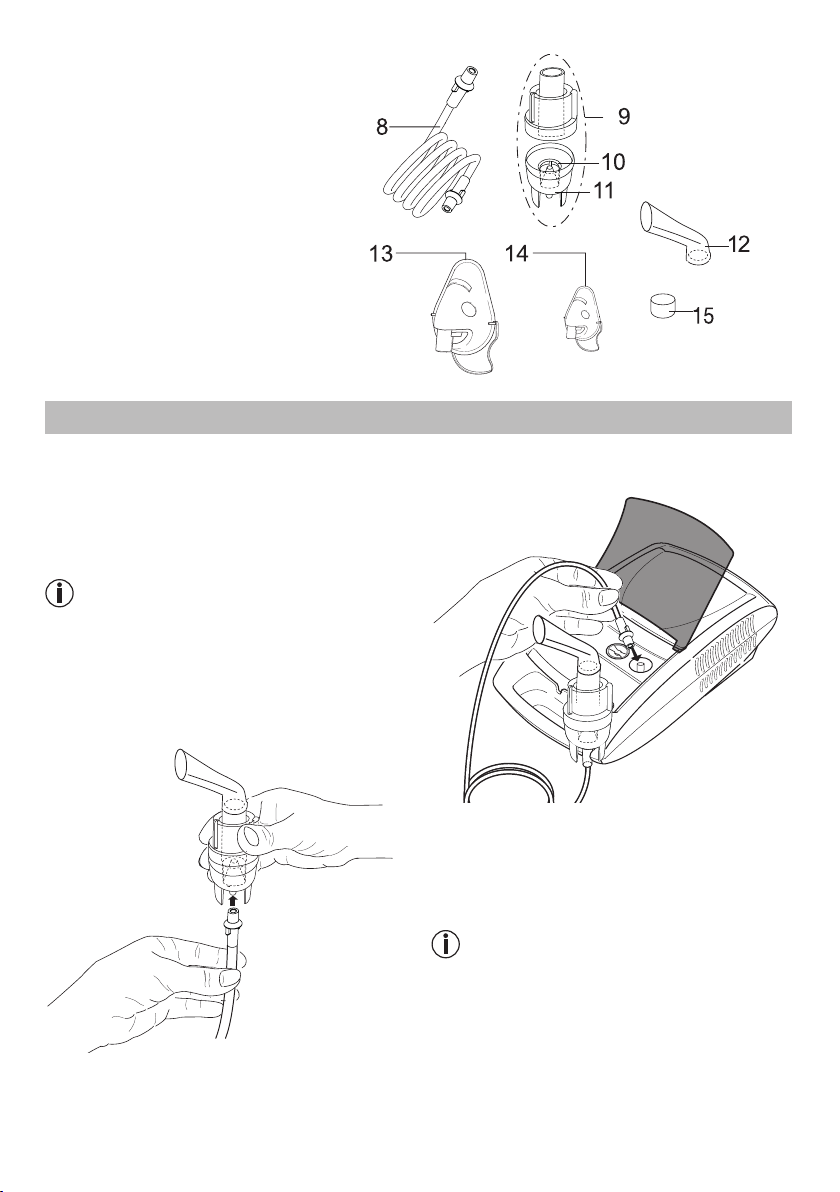
Overview of atomiser and accessories
8 Compressed air hose
9 Atomiser
10 Nozzle attachment
11 Medicine container
12 Mouthpiece
13 Adult mask
14 Child mask
15 Replacement filter
5. Initial use
Setup
Remove the unit from the packaging. Place it on a
flat surface.
Ensure that the ventilation slits are free.
Fold open the lid [2] to access the accessories.
Before using the unit for the first time
Note
•
The atomiser and accessories must be cleaned and
disinfected before they are used for the first time. For
information about this, see “Cleaning and disinfection” on page 20.
•
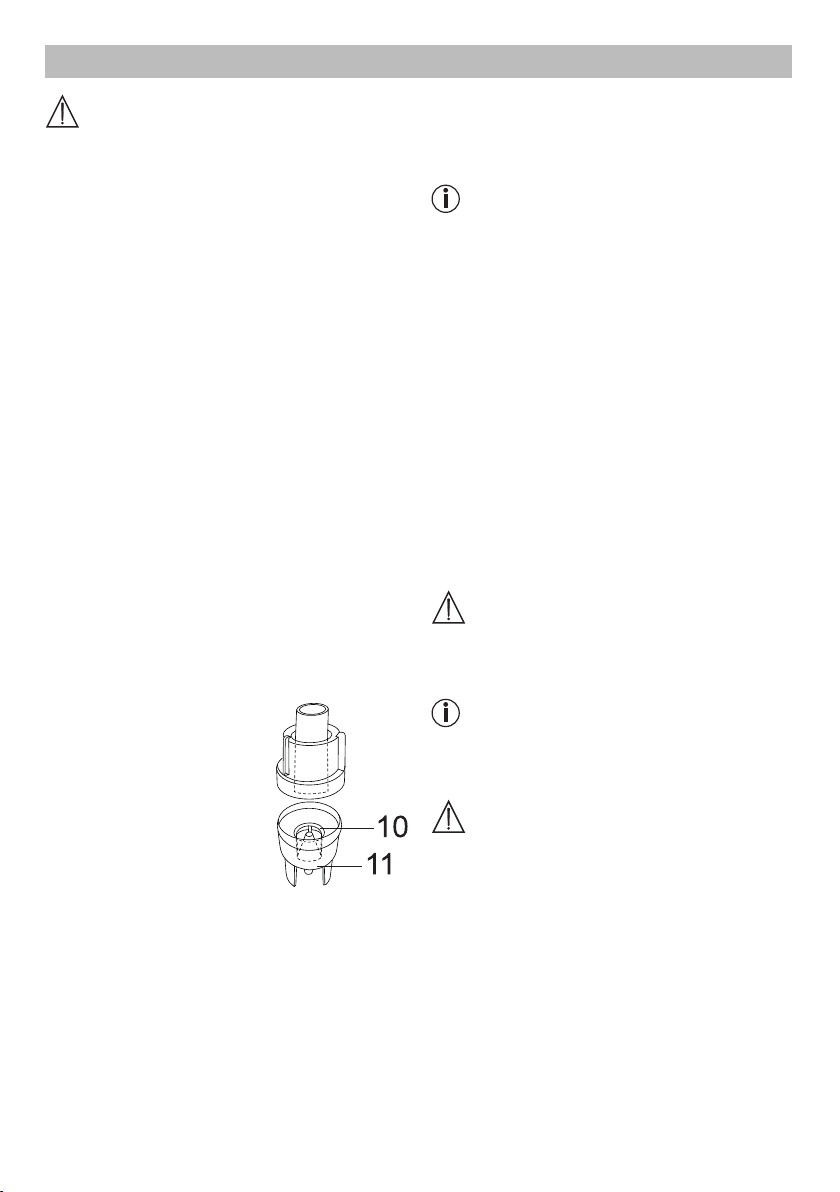
Attach the compressed-air hose [8] at the bottom of
the medicine container [11].
•
Connect the other end of the hose [8] to the hose
connector [6] on the nebuliser by lightly turning it.
Mains connection
Connect the unit only to the mains voltage listed on
the type plate.
• Insert the mains cable plug [1] into a suitable socket.
•
Push the plug completely into the mains socket.
Note
•
Ensure that there is a socket near to where the unit
will stand.
•
Lay the mains cable in such a way that no one can
trip over it.
•
To disconnect the nebuliser from the mains after use,
first switch off the device and then remove the plug
from the socket.
18
Page 19
6. Operation
Caution
•
For hygiene reasons, the atomiser [9] and the ac
cessories must be cleaned after each treatment and
disinfected after the last treatment of the day.
•
The accessories may be used only by one person;
use by several people is not recommended.
•
If several different medicines are to be inhaled in
succession during therapeutic use, the atomiser [9]
must be rinsed under warm tap water after each
use. For information about this, see “Cleaning and
disinfection” on page 20.
•
Follow the instructions for changing the filter con-
tained in these instructions.
•
Before each use, check that the hose connections
on the nebuliser [6] and the atomiser [9] are tight.
•
Before use, check that the device is functioning cor-
rectly. To do this, switch on the nebuliser (including
the connected atomiser, but without any medication)
for a short time. If the atomiser [9] expels air, the
device is functioning correctly.
-
1. Inserting the nozzle attachment
•
To open the atomiser [9], twist the upper section
anti-clockwise against the medicine container [11].
Place the nozzle attachment [10] in the medicine
container [11].
• Ensure that the cone for administering medication
fits well on the cone for the air duct inside the nebuliser.
2. Filling the atomiser
•
Pour an isotonic saline solu-
tion or the medicine directly
into the medicine container
[11]. Do not overfill! The maximum recommended fill level
is 8 ml !
•
Use medication only on the
advice of a physician, and
check the appropriate inhalation duration and quantity for
your needs.
•
If the required volume of medication is less than 2 ml,
top up this quantity to at least 4 ml using an isotonic
saline solution. Viscous medicines may also require
dilution. Always follow the instructions of your doc
tor.
-
3. Closing the atomiser
•
To close the atomiser [9], twist the upper section
clockwise against the medicine container [11]. Ensure the parts are connected correctly.
4. Connecting the accessories to the atomiser
• C
onnect the required accessory part (mouthpiece
[12], adult mask [13] or child mask [14]) to the atomiser [9].
Note
The most effective form of nebulisation is by using the
mouthpiece. Nebulisation using a mask is only recommended if it is not possible to use a mouthpiece (e.g.
for children who are not yet able to inhale medication
using a mouthpiece).
•
Before commencing treatment, pull the atomiser
upwards out of its holder [7].
•
Start the nebuliser using the on/off switch [3].
•
A flow of spray from the atomiser indicates that the
device is functioning properly.
5. Treatment
• When inhaling, sit upright and relaxed at a table and
not in an armchair to avoid compressing the airways
and therefore impairing the effectiveness of the treatment.
•
Inhale the nebulised medicine deeply.
Important
The device is not suitable for continuous operation;
after 30 minutes of operation it must be switched off
for 30 minutes.
Note
During treatment, hold the atomiser straight (vertical),
otherwise the atomisation does not work and correct
function cannot be guaranteed.
Important
Essential oils, cough medicines, solutions designed
for gargling, and drops for application to the skin or
for use in steam baths are wholly unsuitable for inhalation using a nebuliser. These substances are often
highly viscous and can impair the correct function of
the device and hence affect the effectiveness of its
application in the long term.
In the case of oversensitivity of the bronchial system,
medicines containing essential oils can sometimes
cause acute bronchiospasm (a sudden, cramp-like
tightening of the bronchi accompanied by breathlessness). Always ask your doctor or pharmacist for advice!
19
Page 20
6. End of inhalation
If the spray is only output sporadically or if the noise
changes during inhalation, you can end the treatment.
• Switch off the nebuliser after treatment using the on/
off switch [3] and disconnect it from the mains.
•
After use, replace the atomiser [9] in its holder [7].
7. Changing the filter
In normal operating conditions, the air filter must be
replaced after approx. 500 operating hours or one year.
Please check the air filter regularly (after 10-12 nebulisation procedures).
If the filter is very contaminated or blocked, replace the
used filter. If the filter has become wet, it must also be
replaced with a new one.
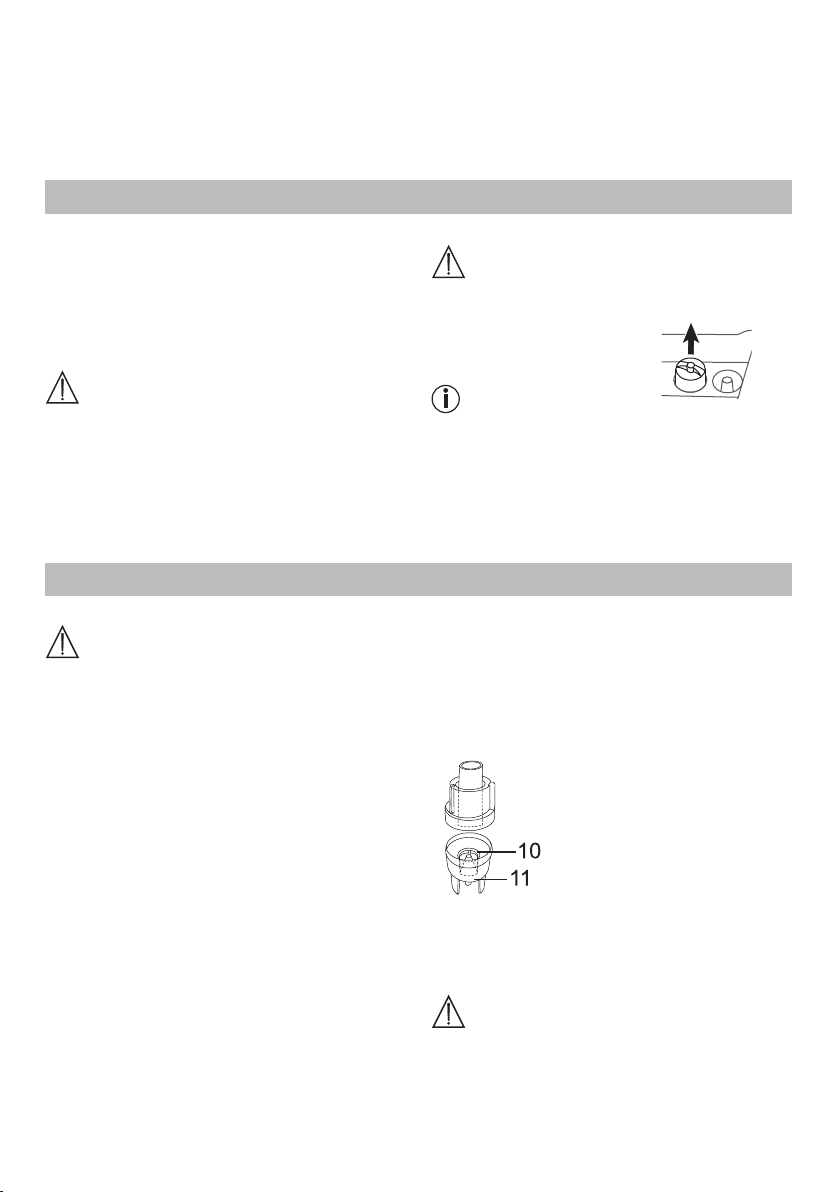
7. Clean the device
For information about this, see “Cleaning and disinfection” on page 20.
To replace the filter, proceed as follows:
Caution
•
First switch off the unit and unplug it.
•
Allow the unit to cool down.
1. Remove filter cap [5] upwards.
Caution
•
Do not try to clean and re-use the used filter!
•
Only use original filters supplied by the manufacturer.
Otherwise, your nebuliser may become damaged or
effective therapy can no longer be guaranteed.
• Do not repair or maintain the air filter while it is in use.
•
Never operate the device without a filter.
8. Cleaning and disinfection
Atomiser and accessories
Warning
Observe the following hygiene instructions in order to
avoid any health risks.
•
The atomiser [9] and accessories are intended for
multiple use. Please note that cleaning requirements
differ according to the different application areas.
Notes:
•
The atomiser and accessories must not be mechan-
ically cleaned with brushes or similar as this can
cause irreparable damage and the success of the
treatment can no longer be guaranteed.
•
For additional requirements regarding the necessary
hygienic preparations (hand washing, handling of
medicines or inhalation solutions) in high-risk groups
(e.g. cystic fibrosis patients), contact your doctor.
•
Ensure that all parts are properly dried following all
cleaning and disinfection. Residual moisture or water
droplets can result in an increased risk of bacterial
growth.
Preparation
•
Directly following each treatment, all parts of the
atomiser [9] and any accessories used must be
cleaned of medicine residues and contamination.
Note
If the filter remains in the unit when the cap is removed,
remove the filter from the unit using tweezers or similar.
2. Replace the filter cap [5] containing the new filter.
3. Check that the filter cap is firmly in place.
•
To do this, dismantle the atomiser [9] into its com-
ponent parts.
•
Remove the mouthpiece [12] from the atomiser.
•
Dismantle the atomiser by twisting the upper section
anti-clockwise against the medicine container [11].
•
Remove the nozzle attachment [10] from the medi-
cine container [11].
•
The nebuliser is later reassembled in the reverse
order.
Cleaning
Important
Before you clean the unit, always switch it off, unplug
it and let it cool off.
20
Page 21
The atomiser and the used accessories such as the
mouthpiece, mask, nozzle attachment, etc. must be
washed with hot but not boiling water after each use.
Carefully dry all components using a soft cloth. Once
all components are fully dry, reassemble the atomiser
and place the components in a dry, sealed container
or carry out disinfection.
When cleaning, ensure that all residues are removed.
Never use any substances that may be poisonous
when in contact with the skin or mucous membranes,
or when swallowed or inhaled.
Use a soft, dry cloth and non-abrasive cleaning products to clean the device.
Do not use abrasive detergents and never immerse
the unit in water.
Important
•
Ensure that no water penetrates inside the unit!
•
Do not put the device or accessories in a dishwasher.
•
Do not touch the unit with wet hands while it is
plugged in; do not allow any water to be sprayed
onto the unit. The unit must be operated only when
it is completely dry.
•
Do not spray any liquids into the ventilation slots. Any
liquid that penetrates into the unit can damage the
electrical parts or other components of the nebuliser
and impair the function of the device.
Condensation, care of the hose
Depending on the environmental conditions, condensation may collect in the hose. To prevent against
bacterial growth and to ensure effective therapeutic
use, this moisture must always be removed. To remove
moisture from the hose, proceed as follows:
•
Remove the hose [8] from the atomiser [9].
•
Leave the hose plugged into the nebuliser [6].
•
Run the nebuliser until all the moisture has been
displaced by the flow of air.
•
In the event of significant contamination, replace
the hose.
Disinfection
Follow the steps listed below carefully in order to disinfect your atomiser and the accessories. It is advisable
to disinfect the individual components after the last
time they are used each day at the latest.
(For disinfection, you will simply require a small amount
of clear vinegar and distilled water).
•
First clean the atomiser and the accessories as
described under “Cleaning”.
• Place the disassembled nebuliser and mouthpiece
in boiling water for five minutes.
• For the remaining accessories,
consisting of ¼ vinegar and ¾ distilled water. Make
use a vinegar solution
sure that the volume is sufficient to fully submerge
the parts in the solution.
• Leave the components in the vinegar solution for
30 minutes.
• Rinse the parts with water and dry carefully with a
soft cloth.
Important
Do not boil or autoclave the masks and air hose.
•
Once all components are fully dry, reassemble
the atomiser and place the components in a dry,
sealed container.
Note
Ensure that all parts are thoroughly dried during, and
in particular after cleaning, otherwise there is an increased risk of bacterial growth.
Sterilisation
Use the cold sterilisation solutions according to the
manufacturer's instructions.
Drying
•
Place the individual components on a dry, clean and
absorbent surface and allow to dry completely (for
at least 4 hours).
Material resistance
•
As with all plastic components, frequent use and
cleaning of the atomiser and the accessories can
lead to a certain amount of wear. Over time, this can
alter the aerosol properties and may eventually affect
the efficiency of therapy. We therefore recommend
that you replace the atomiser once a year.
•
When choosing a cleaning or disinfecting agent, note
the following: Only use mild cleaning or disinfectant
agents in the quantities recommended by the man
ufacturer.
-
Storage
•
Do not store the nebuliser in a damp atmosphere
(e.g. in the bathroom) or transport it together with
damp objects.
•
Store and transport the nebuliser away from direct
sunlight.
•
The accessories can be safely stored in the acces-
sories compartment [4]. Store the device in a dry
place, if possible in its original packaging.
21
Page 22
9. Disposal
In the interest of environmental protection, do not dispose of the device in household waste.
Please dispose of the device in accordance wi
th EC Directive – WEEE (Waste Electrical and
Electronic Equipment).
If you have any queries, please contact the ap
prpriate local authorities.
-
-
10. Troubleshooting
Problem/Question Possible Cause/Remedy
The atomiser produces
little or no aerosol.
Output is too low. Hose kinked, filter blocked, too much inhalation solution.
Which medicines are suitable
for inhalation?
Some inhalation solution
remains in the atomiser.
What special steps should
be taken for babies and
children?
Inhalation with the mask
takes longer.
Why do I need to replace the
atomiser at regular intervals?
Does each person need their
own atomiser?
1. Too much or too little medicine in the atomiser.
Minimum: 2 ml, Maximum: 8 ml.
2. Check that the nozzles are not blocked If necessary, clean the nozzle (e.g.
by rinsing). Use the atomiser again.
CAUTION: Only poke implements through the fine holes from the underside
of the nozzle.
3. The atomiser is not held in an upright position.
4. The medicine solution is unsuitable for nebulising (e.g. too thick). The
medicine solution should be specified by the doctor.
Consult your doctor.
Essentially all medicines that are suitable and approved for device-based
inhalation can be inhaled.
This is normal and occurs for technical reasons. Stop inhalation if you hear a
notable difference in the noise of the atomiser.
1. In babies, the mask should cover the mouth and nose to guarantee effec
tive inhalation.
2. In children, the mask should also cover the mouth and nose. Nebulisation
next to a sleeping person is not suitable because insufficient medicine
reaches the lungs.
Note: Children should only use the device with help and under supervision
of an adult. Never leave a child alone with the nebuliser.
This is for technical reasons. Less medicine is inhaled per breath through
the mask holes than using the mouthpiece. The aerosol is mixed with ambi
ent air through the holes in the mask.
There are two reasons for this:
1. To guarantee a therapeutically effective particle spectrum, the nozzle
holes should not exceed a certain diameter. Due to the thermal and
mechanical stresses, the plastic is subjected to a certain amount of wear.
The nozzle attachment [10] is particularly susceptible to this wear. This
can also cause changes to the droplet composition of the
has a direct effect on the effectiveness of the treatment.
2. You are also recommended to replace the atomiser on a regular basis for
hygiene reasons.
This is absolutely necessary for hygiene reasons.
-
-
aerosol, which
22
Page 23
11. Technical specifi cations
Model SIH 21
Type SIH 21/2
Dimensions
(WxHxD)
Weight 1.65 kg
Working pres-
sure
Atomiser filling
volume
Medication flow
rate
Sound pressure max. 52 dBA
Mains
connection
Operating
conditions
Storage and
transport
conditions
Aerosol
Properties
Subject to technical modifications.
300 x 180 x 100 mm
Approx. 0.8 to 1.45 bar
Max. 8 ml
Min. 2 ml
Approx. 0.4ml/min.
(acc. to DIN EN 13544-1 section
26)
230 V~; 50 Hz; 230 VA
UK: 240 V~; 50 Hz; 240 VA
Temperature: +10 °C – +40 °C
Relative humidity: 10% – 95%
Temperature: 0 °C – +60 °C
Relative humidity: 10% – 95%
Atmospheric pressure:
500 – 1060 hPa
Flow: 5.31 l/min
Aerosol delivery: 0.171 ml
Aerosol delivery rate: 0.082 ml/min
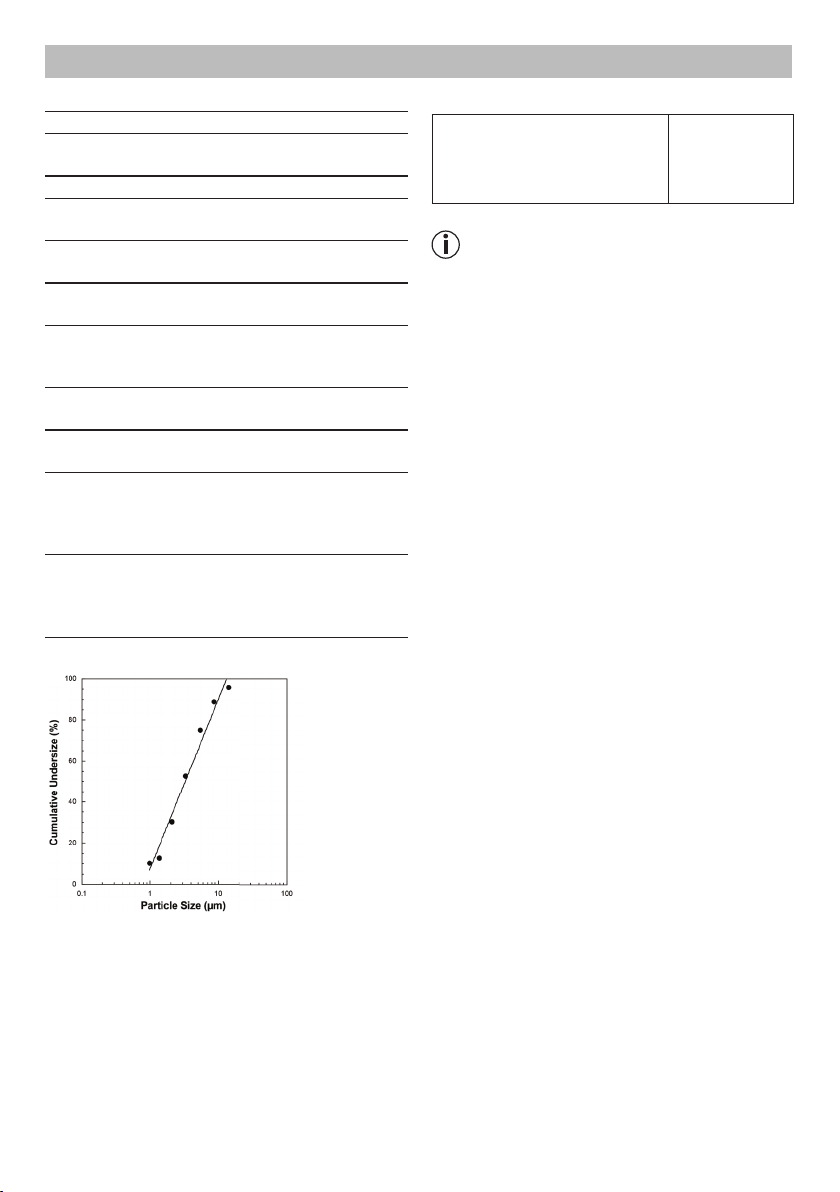
Particle size (MMAD): 3.16 µm
Spare parts
SIH 21 year pack
Mouthpiece, adult/children's
mask, atomiser, compressed air
hose, filters
REF
601.20
Note
If the unit is used outside of the specifications, proper
function is no longer guaranteed!
We reserve the right to make technical changes to improve and further develop the product.
This device and its accessories comply with European
standards EN60601-1 and EN60601-1-2, as well as
EN13544-1, and is subject to special safety measures in terms of electromagnetic tolerance. Note that
portable and mobile RF communication equipment
can affect this unit. For detailed information, contact
customer service at the address provided. The unit
conforms to the requirements of the European Directive for Medical Products 93/42/EC, the MPG (German
Medical units Act).
ELECTROMAGNETIC COMPATIBILITY
•
The device complies with current specifications
with regard to electromagnetic compatibility and is
suitable for use in all premises, including those designated for private residential purposes. The radio
frequency emissions of the device are extremely low
and in all probability do not cause any interference
with other devices in the proximity.
•
It is recommended that you do not place the device
on top of or close to other devices. Should you notice any interference with other electrical devices,
move the unit or connect it to a different socket.
•
Radio equipment may affect the operation of this
device.
Measurements were performed using a sodium fluoride
solution with a "Next Generation Impactor" (NGI).
All measurements were obtained with a sodium chloride solution using a laser diffraction method.
This diagram may not be applicable for suspensions
or highly viscous medicines. More information can be
obtained from the relevant medicine manufacturer.
23
Page 24

FRANÇAIS
Sommaire
1. Familiarisation avec l’appareil ...........................25
2. Symboles utilisés ..............................................25
3. Consignes d’avertissement et de mise en
garde .................................................................26
4. Description de l’appareil et des accessoires ....28
5. Mise en service .................................................29
6. Utilisation ...........................................................29
7. Changement du filtre .........................................31
8. Nettoyage et désinfection .................................31
9. Élimination .........................................................33
10. Solution aux problèmes ....................................33
11. Caractéristiques techniques ..............................34
Contenu
Voir la description de l’appareil et des accessoires à
la page 28.
•
Inhalateur
•
Nébuliseur
•
Tuyau à air comprimé
•
Embout buccal
•
Masque pour adulte
•
Masque pour enfant
•
Filtre de rechange
•
Le présent mode d’emploi
24
Page 25
1. Familiarisation avec l’appareil
Chère cliente,
cher client,
Lisez attentivement ce mode d’emploi, conservez-le
pour un usage ultérieur, mettez-le à disposition des
autres utilisateurs et suivez les consignes qui y figurent.
Domaine d’application
Cet inhalateur est un appareil servant à la nébulisation
de liquides et de médicaments liquides (aérosols) et
au traitement des voies respiratoires supérieures et
inférieures.
Grâce à la nébulisation et l’inhalation du médicament
prescrit ou recommandé par votre médecin, vous
pouvez prévenir les maladies des voies respiratoires,
atténuer leurs effets secondaires et accélérer la guérison. Veuillez vous adresser à votre médecin ou votre
pharmacien pour de plus amples informations quant
aux possibilités d’application.
L’appareil est adapté à l’inhalation à domicile. Ne pas
inhaler de médicaments sans avoir demandé l’avis de
votre médecin. Préparez-vous à inhaler calmement
et dans un moment de détente. Inspirez doucement
et profondément afin de permettre au médicament
d’atteindre les bronches fines situées en profondeur.
Expirez normalement.
2. Symboles utilisés
Les symboles suivant sont utilisés dans le mode
d’emploi.
Avertissement Ce symbole vous avertit des
risques de blessures ou des
dangers pour votre santé.
Attention Ce symbole vous avertit des
éventuels dommages au niveau de
l’appareil ou d’un accessoire.
Remarque Ce symbole indique des informa-
tions importantes.
Sur l’emballage ainsi que sur la plaque signalétique de
l’appareil et des accessoires, les symboles suivants
sont utilisés.
I
O
NS
30 ON /
30 OFF
Appareil de type BF
Respecter les consignes du mode
d’emploi.
Appareil de la classe de sécurité 2
F
abricant
Allumé
OFF
Numéro de série
Utilisation de 30minutes, puis pause de
30minutes avant la prochaine utilisation.
25
Protéger contre l’humidité.
Page 26

3. Consignes d’avertissement et de mise en garde
Avertissement
• Avant l’utilisation, assurez-vous que l’appareil et les
accessoires ne présentent aucun dommage visible.
En cas de doute, ne l’utilisez pas et adressez-vous
à votre revendeur ou au service client indiqué.
• En cas de panne de l’appareil, consultez le chapitre
«10. Solutions aux problèmes».
• L’utilisation de l’appareil ne remplace pas une
consultation et un traitement médicaux. C’est pourquoi en cas de tout type de douleur ou de maladie,
veuillez toujours consulter d’abord votre médecin!
• En cas de problèmes de santé quelconques, veuillez
consulter votre médecin de famille.
• Lors de l’utilisation du nébuliseur, veuillez respecter
les mesures d’hygiène générales.
• Il convient de toujours respecter les consignes du
médecin concernant le médicament à utiliser, le
dosage, la fréquence et la durée de l’inhalation.
• Veuillez n’utiliser que des médicaments qui vous ont
été prescrits ou recommandés par votre médecin ou
votre pharmacien.
Attention
Pour le traitement, n’utilisez que les pièces recommandées par le médecin, correspondant à l’évolution
de la maladie.
• Vérifiez sur la notice du médicament qu’il n’existe
pas de contre-indication à une utilisation avec les
systèmes habituels de thérapie par aérosols.
• Si l’appareil ne fonctionne pas correctement ou si
des indispositions ou des douleurs apparaissent,
interrompez immédiatement l’utilisation.
• Pendant l’utilisation, sachant que la brume de mé
dicaments pourrait avoir un effet néfaste, veillez à
éloigner l’appareil de vos yeux.
• Ne pas utiliser l’appareil en présence de gaz inflam
mables.
• Cet appareil n’est pas destiné à être utilisé par des
enfants ou personnes aux capacités physiques,
sensorielles (par ex. l’insensibilité à la douleur) ou
mentales restreintes, ou ne sachant pas l’utiliser par
manque d’expérience ou de connaissances. Sauf
dans le cas où ils sont surveillés par une personne
responsable de leur sécurité, ou s’ils ont eu de leur
part les instructions nécessaires à une bonne utili
sation de l’appareil.
• Avant chaque nettoyage et/ou chaque entretien,
l’appareil doit être éteint et débranché.
• Conservez l’emballage hors de portée des enfants
(risque d’étouffement).
-
-
-
26
• Pour éviter tout risque d’empêtrement et d’étranglement, conservez les câbles et les conduites d’air
hors de portées des jeunes enfants.
• N’utilisez pas d’accessoires qui n’ont pas été recommandés par le fabricant.
• Ne raccordez pas l’appareil à une autre tension que
celle indiquée sur la plaque signalétique.
• Ne pas immerger l’appareil dans l’eau ni l’utiliser
dans des pièces humides. En aucun cas, un liquide
ne doit pénétrer dans l’appareil.
• Protégez l’appareil contre les chocs importants.
• Ne touchez jamais le câble d’alimentation avec
les mains humides, vous risquez de recevoir une
décharge électrique.
• Ne pas débrancher la prise du secteur en tirant sur
le cordon d’alimentation.
• Ne pas coincer ou plier la prise du secteur, ni la faire
passer sur des objets tranchants, la laisser pendre
ou l’exposer à la chaleur.
• Nous recommandons de dérouler entièrement le
câble d’alimentation pour éviter toute surchauffe
dangereuse.
• En cas d’endommagements de la prise du secteur
et du boîtier, veuillez contacter notre service client
ou votre revendeur.
• Un risque de décharge électrique existe si vous
ouvrez le corps de l’appareil. La déconnexion du
réseau d’alimentation est uniquement assurée si
l’adaptateur secteur est sorti de la prise.
• Si l’appareil est tombé, a été exposé à un fort taux
d’humidité ou a subi d’autres types de dommages,
il ne doit plus être utilisé. En cas de doute, veuillez
contacter notre service client ou votre revendeur.
• L’inhalateur SIH 21 ne doit être utilisé qu’avec le nébuliseur adapté et les accessoires correspondants.
En cas d’utilisation d’un nébuliseur et d’accessoires
non d’origine, l’efficacité de la thérapie peut être
réduite ou l’appareil peut être endommagé le cas
échéant.
Attention
• Des pannes de courant, de soudaines perturbations
ou d’autres conditions défavorables peuvent contribuer à mettre l’appareil hors service. C’est pourquoi
nous vous recommandons de prévoir un appareil
de rechange ou un médicament prescrit par votre
médecin.
• Si jamais un adaptateur ou une rallonge sont nécessaires, ils doivent respecter les normes de sécurité
en vigueur. Ni la limite de puissance de l’appareil ni
celle qui est indiquée sur l’adaptateur ne doivent être
dépassées.
Page 27

• Ne pas stocker l’appareil et le câble d’alimentation
près d’une source de chaleur.
• Ne pas utiliser l’appareil dans une pièce dans laquelle des aérosols ont été utilisés préalablement.
Avant de commencer la thérapie, ces pièces doivent
être aérées.
• Ne pas placer d’objets dans les ouvertures de refroidissement.
• Ne jamais utiliser l’appareil s’il émet un bruit anormal.
• Pour des raisons d’hygiène, ne pas partager ses
accessoires avec d’autres utilisateurs.
• Après utilisation, toujours débrancher la fiche d’alimentation.
• Veuillez stocker l’appareil dans un endroit à l’abri
des intempéries. L’appareil doit être stocké dans un
endroit correspondant aux conditions ambiantes
spécifiées.
SÉCURITÉ
• L’appareil est équipé d’une protection contre les
surintensités. Elle ne doit être changée que par du
personnel autorisé.
Recommandations générales
Attention
• N’utilisez l’appareil que de la façon suivante:
– sur un être humain,
– aux fins pour lesquelles il a été conçu (c.-à-d. pour
l’inhalation d’aérosols) et de la manière indiquée
dans ce mode d’emploi.
• Toute utilisation inappropriée peut être dange-
reuse!
• En cas de situation d’urgence, les premiers secours
sont prioritaires.
• À part les médicaments, veuillez n’utiliser que de
l’eau distillée ou une solution de chlorure de sodium.
Les autres liquides peuvent entraîner une panne de
l’inhalateur ou du nébuliseur.
• Cet appareil n’est pas destiné à être utilisé dans un
cadre professionnel ou en clinique, mais exclusive
ment pour l’utilisation individuelle dans des foyers
privés.
-
Avant la mise en service
Attention
• L’emballage doit être retiré avant l’utilisation de
l’appareil.
• Protégez l’appareil de la poussière, de la saleté et
de l’humidité, ne couvrez en aucun cas le dispositif
pendant son fonctionnement.
• Ne pas utiliser l’appareil dans un environnement fort
poussiéreux.
• Éteignez immédiatement l’appareil s’il est défectueux
ou présente des défauts de fonctionnement.
• Le fabricant ne peut être tenu pour responsable des
dommages causés par une utilisation inappropriée
ou non conforme.
Réparation
Remarque
• Vous ne devez en aucun cas ouvrir ou réparer l’appareil; le bon fonctionnement de l’appareil ne serait
plus assuré. Le non-respect de cette consigne annulera la garantie.
• Pour toute réparation, adressez-vous au service
client ou à un revendeur agréé.
27
Page 28
4. Description de l’appareil et des accessoires
Vue d’ensemble de
l’inhalateur
3
4
2
1
1 Câble de raccordement
2 Couvercle
3 Touche Marche/Arrêt
4 Compartiment pour acces
soires
5 Capuchon du filtre avec
filtre
6 Raccord de tuyau
7 Support pour nébuliseur
Vue d’ensemble du nébuliseur et des
accessoires
8 Tuyau à air comprimé
9 Nébuliseur
10 Embout de buse
11 Récipient à médicaments
12 Embout buccal
13 Masque pour adulte
14 Masque pour enfant
15 Filtre de rechange
-
5
6
7
28
Page 29
5. Mise en service
Installation
Sortez l’appareil de son emballage.
Posez-le sur une surface plane.
Veillez à ce que les fentes d’aération soient dégagées.
Ouvrez le couvercle [2] pour accéder aux accessoires.
Avant la première utilisation
Remarque
• Avant la première utilisation, le nébuliseur et les
accessoires devront être nettoyés et désinfectés.
Voir «Nettoyage et désinfection» page 31.
• Raccordez le tuyau à air comprimé [8] sous le récipient à médicaments [11].
• Raccordez l’autre extrémité du tuyau [8] au raccord
de tuyau [6] de l’inhalateur avec une légère rotation.
Connexion au secteur
Branchez l’appareil uniquement à la tension indiquée
sur la plaque signalétique.
• Branchez la fiche électrique du câble d’alimentation
[1] sur une prise secteur adaptée.
• Pour connecter l’appareil au réseau, insérez complètement la fiche dans la prise.
Remarque
• Vérifiez qu’il y a bien une prise à proximité du lieu
d’installation.
• Placez le câble d’alimentation de manière à ce que
personne ne puisse trébucher dessus.
• Pour déconnecter l’inhalateur du secteur après l’inhalation, éteignez d’abord l’appareil et retirez ensuite
la prise du secteur.
6. Utilisation
Attention
• Pour des raisons hygiéniques, il est indispensable de
nettoyer le nébuliseur [9] ainsi que les accessoires
après chaque traitement, et de les désinfecter après
le dernier traitement quotidien.
• Les accessoires ne doivent être utilisés que par une
seule personne; leur utilisation par plusieurs personnes est déconseillée.
• Si au cours d’une thérapie, plusieurs médicaments
différents doivent être inhalés, il convient de veiller
à rincer le nébuliseur [9] à l’eau chaude du robinet
après chaque usage. Voir «Nettoyage et désinfection» page 31.
29
• Respectez les instructions de cette notice relatives
au changement du filtre.
• Avant chaque utilisation de l’appareil, contrôlez la
bonne fixation des raccords du flexible sur l’inhalateur [6] et sur le nébuliseur [9].
• Contrôlez le fonctionnement correct de l’appareil
avant de l’utiliser; pour ce faire, mettez brièvement
l’inhalateur en marche (avec le nébuliseur raccordé,
mais sans médicaments). L’appareil fonctionne
correctement si, à cette occasion, de l’air sort du
nébuliseur [9].
1. Assemblage du nébuliseur
• Ouvrez le nébuliseur [9] en tournant la partie supérieure dans le sens inverse des aiguilles d’une
Page 30
montre par rapport au récipient à médicaments [11].
Insérez l’embout de buse [10] dans le récipient à
médicaments [11].
• Assurez-vous que le cône d’arrivée de médicaments
est bien en place sur le cône du conduit d’air à l’intérieur de l’atomiseur.
2. Remplissage du nébuliseur
• Versez une solution saline
isotonique ou le médicament
directement dans le récipient
à médicaments [11]. Attention à ne pas trop le remplir!
La quantité de remplissage
maximale recommandée est
de 8ml.
• Utilisez uniquement des mé
dicaments prescrits par votre
médecin et demandez la durée et la dose d’inhala
tion adaptées à vos besoins!
• Si la dose de médicament prescrite est inférieure à
2ml, remplissez cette quantité avec une solution de
chlorure de sodium isotonique jusqu’à un minimum
de 4ml. La dilution est également nécessaire pour
les médicaments visqueux. Conformez-vous aux
indications de votre médecin.
-
3. Fermeture du nébuliseur
• Fermez le nébuliseur [9] en tournant la partie supérieure dans le sens des aiguilles d’une montre par
rapport au récipient à médicaments [11]. Assurezvous que le nébuliseur est bien fermé.
4. Raccordement des accessoires au nébuliseur
• Reliez le nébuliseur [9] à l’accessoire souhaité
(embout buccal [12], masque pour adulte [13] ou
masque pour enfant [14]).
Remarque
L’inhalation avec l’embout buccal est la forme la
plus efficace de la thérapie. L’utilisation du mas
que d’inhalation n’est recommandée que lorsque
l’utilisation d’un embout buccal n’est pas possible (par
exemple, chez les enfants qui ne peuvent pas encore
inhaler dans l’embout buccal).
pas compresser les voies respiratoires et risquer de
compromettre l’efficacité du traitement.
• Inspirez profondément le médicament pulvérisé.
Attention
L’appareil n’est pas adapté pour être utilisé pendant
une longue durée: après 30minutes d’utilisation, il doit
être arrêté pendant 30minutes.
Remarque
Tenez le nébuliseur droit (vertical) pendant l’inhalation;
autrement, la nébulisation ne fonctionne pas et
l’appareil ne peut plus fonctionner correctement.
Attention
Des huiles essentielles thérapeutiques, des sirops contre la toux, des solutions à gargariser, des gouttes pour
la friction cutanée ou pour des bains à vapeur ne sont
par principe pas adaptés à l’inhalation par inhalateur.
Ces additifs sont souvent de nature visqueuse et ris
quent de nuire durablement au bon fonctionnement
de l’appareil ainsi qu’à l’efficacité du traitement. En
cas d’hypersensibilité des bronches, des médicaments
à base d’huiles essentielles peuvent provoquer un
bronchospasme aigu (un resserrement spasmodique
soudain des bronches accompagné d’une dyspnée).
Renseignez-vous auprès de votre médecin ou de votre
pharmacien!
6. Fin de l’inhalation
Si le nuage de pulvérisation ne s’échappe plus que
de façon irrégulière ou si le bruit change au cours de
l’inhalation, vous pouvez arrêter l’inhalation.
• Après utilisation, éteignez l’inhalateur à l’aide de
l’interrupteur Marche/Arrêt [3] et débranchez-le du
secteur.
• Après le traitement, remettez le nébuliseur [9] dans
son support [7].
7. Nettoyage
Voir «Nettoyage et désinfection» page 31.
-
• Retirez le nébuliseur de son support [7] en le tirant
vers le haut avant de commencer le traitement.
• Démarrez l’inhalateur au moyen de l’interrupteur
marche/arrêt [3].
• Le brouillard de pulvérisation qui s’échappe du nébuliseur indique que l’appareil fonctionne parfaitement.
5. Traitement
• Pendant l’inhalation, restez debout et détendu à côté
d’une table et non assis sur une chaise, pour ne
30
Page 31
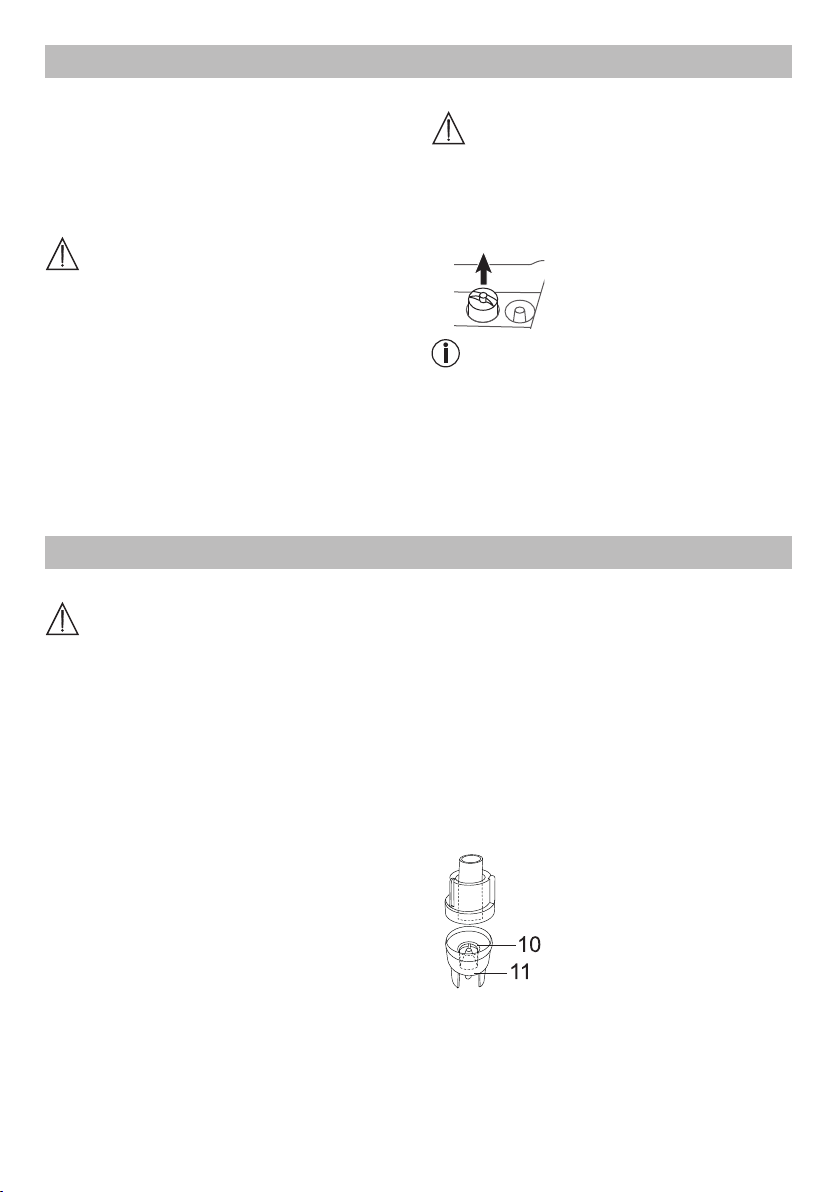
7. Changement du filtre
Dans des conditions d’utilisation normales, le filtre à air
est prévu pour être changé après environ 500heures
d’utilisation ou une année. Vérifiez l’état du filtre à air
régulièrement (toutes les 10 à 12atomisations).
S’il est très sale ou bouché, remplacez le filtre utilisé.
Si le filtre est humide, il doit également être remplacé
par un filtre neuf.
Attention
• N’essayez pas de nettoyer et de réutiliser le filtre
usagé!
• Utilisez exclusivement le filtre d’origine du fabricant,
votre inhalateur risquant autrement d’être endommagé ou le traitement de ne pas être assez efficace.
• Le filtre à air ne doit pas être réparé ou entretenu
alors qu’une personne est en train d’utiliser l’appareil.
• N’utilisez en aucun cas l’appareil sans filtre.
8. Nettoyage et désinfection
Nébuliseur et accessoires
Avertissement
Afin d’éviter tout risque pour la santé, veillez à observer
les prescriptions d’hygiène suivants.
• Le nébuliseur [9] et les accessoires sont prévus pour
une utilisation répétée. Veuillez tenir compte du fait
que les différents domaines d’utilisation exigent
différents moyens de nettoyage et de retraitement
hygiénique.
Remarque:
• Ne pas nettoyer mécaniquement le nébuliseur ainsi
que les accessoires avec des brosses ou des objets similaires, sachant que ceci pourrait causer des
dommages irréparables et par conséquent, le succès
ciblé de traitement ne peut plus être garanti.
• Concernant les exigences supplémentaires concer
nant la préparation hygiénique nécessaire (traitement
des mains, des médicaments ou des solutions d’inhalation) pour les groupes à haut risque (par ex. les
patients atteints de mucoviscidose), veuillez vous
renseigner auprès de votre médecin.
• Veillez à bien sécher le nébuliseur et les accessoires
après chaque nettoyage ou désinfection. L’humidité
résiduelle peut fortement favoriser la prolifération de
bactéries.
-
Procédez comme suit pour changer le filtre:
Attention
• Éteignez tout d’abord l’appareil, puis débranchez-le
du secteur.
• Laissez l’appareil refroidir.
1. Tirer le capuchon du filtre [5] vers le haut.
Remarque
Si le filtre reste dans l’appareil après le retrait du capuchon, retirez-le, par exemple avec une pince ou un
objet similaire.
2. Réinsérez le capuchon du filtre [5] avec un nouveau
filtre.
3. Assurez-vous qu’il est bien fixé.
Préparation
• Toutes les pièces du nébuliseur [9] ainsi que les
accessoires utilisés doivent être nettoyés immédiatement après chaque traitement, afin d’éliminer les
résidus médicamenteux et les impuretés.
• Pour cela, démontez toutes différentes pièces du
nébuliseur [9].
• Retirez l’embout buccal [12] du nébuliseur.
• Démontez le nébuliseur en tournant la partie supérieure dans le sens inverse des aiguilles d’une
montre par rapport au récipient à médicaments [11].
• Retirez l’embout de buse [10] du récipient à médicaments [11].
• Procédez dans l’ordre inverse lorsque vous remontrez le nébuliseur.
31
Page 32
Nettoyage
Attention
Avant chaque nettoyage, l’appareil devra être éteint,
débranché du secteur et refroidi.
Le nébuliseur et l’accessoire utilisé comme l’embout
buccal, le masque, l’embout de buse, etc. doivent être
nettoyés à l’eau chaude, mais pas bouillante, après
chaque utilisation. Séchez les pièces soigneusement
avec un chiffon doux. Lorsqu’elles sont entièrement
séchées, assemblez de nouveau les pièces et posezles dans un récipient sec et étanche ou effectuez la
désinfection.
Assurez-vous que tous les résidus ont été éliminés
lors du nettoyage. À cet effet, n’utilisez jamais des
substances pouvant être potentiellement toxiques au
contact avec la peau ou les muqueuses, ainsi que
lorsqu’elles sont avalées ou inhalées.
Pour nettoyer l’appareil, utilisez un chiffon sec doux
et un détergent doux.
N’utilisez pas de produit de nettoyage agressif et ne
mettez jamais l’appareil sous l’eau.
Attention
• Assurez-vous que l’eau ne s’infiltre pas à l’intérieur!
• Ne lavez pas l’appareil et les accessoires au lavevaisselle!
• Lorsqu’il est branché, l’appareil ne doit pas être saisi
avec des mains humides; protéger l’appareil des
éclaboussures d’eau. L’appareil doit uniquement être
utilisé à l’état entièrement sec.
• Ne pulvérisez pas de liquide dans les fentes
d’aération! En pénétrant à l’intérieur de l’appareil, les
liquides peuvent entraîner un endommagement de
l’électronique et des autres pièces de l’inhalateur et,
par conséquent, un dysfonctionnement de l’appareil.
Eau de condensation, entretien du flexible
Selon les conditions environnementales, de la condensation peut apparaître dans le tuyau. Pour éviter l’apparition de germes et garantir une thérapie
irréprochable, tenir impérativement à l’écart de
l’humidité. Pour ce faire, respectez les mesures suivantes:
• Retirez le tuyau [8] du nébuliseur [9].
• Laissez le tuyau branché du côté de l’inhalateur [6].
• Utilisez l’inhalateur jusqu’à ce que l’humidité soit
éliminée par l’air qui le traverse.
• Remplacez le tuyau en cas d’encrassement impor
tant.
-
Désinfection
Veuillez strictement respecter les points mentionnés
ci-dessous afin de désinfecter votre nébuliseur et les
accessoires. Il convient de désinfecter les différentes
pièces au plus tard après la dernière utilisation quotidienne.
(Tout ce dont vous avez besoin est d’un peu de vinaigre blanc
ou d’eau distillée)
• Commencez par nettoyer le nébuliseur et les accessoires, comme décrit dans la section «Nettoyage».
• Démontez l’atomiseur et l’embout buccal et laissez-les tremper 5minutes dans de l’eau bouillante.
• Pour nettoyer les autres accessoires,
mélange composé de ¼ de vinaigre et de ¾ d’eau
distillée. Assurez-vous que la quantité est suffisante
pour que les pièces sont complètement immergées.
• Laissez tremper les pièces pendant 30minutes dans
le mélange au vinaigre.
•
Rincez les pièces à l’eau et séchez-les soigneusement avec un chiffon doux.
utilisez un
Attention
Ne pas faire bouillir ni autoclaver le masque et le tuyau
d’air.
• Lorsqu’elles sont entièrement séchées, assemblez
de nouveau les pièces et posez-les dans un récipient
sec et étanche.
Remarque
Pendant et après le nettoyage, assurez-vous que les
pièces sont tout à fait sèches. Dans le cas contraire, le
risque de croissance des germes augmente.
Stérilisation
• Utilisez des solutions de stérilisation à froid conformément aux recommandations du fabricant.
Séchage
• Posez les différentes pièces sur une surface sèche,
propre et absorbante, et laissez-les sécher complètement (au moins pendant 4heures).
Résistance des matériaux
• Tout comme d’autres produits en matière plastique,
le nébuliseur et les accessoires sont sujets à une
certaine usure à la suite d’une utilisation et un traitement hygiénique fréquent. Au fil du temps, ceci
pourrait provoquer un changement de l’aérosol et
par conséquent, nuire à l’efficacité de la thérapie.
C’est pourquoi nous recommandons de changer le
nébuliseur après un an d’utilisation.
32
Page 33
• Pour choisir le produit de nettoyage ou de désinfection, il convient d’observer les points suivants:
N’utilisez qu’un produit de nettoyage ou de désinfection doux, que vous doserez selon les indications
du fabricant.
Stockage
• Ne pas stocker l’appareil dans des pièces à fort taux
d’humidité (par ex. dans la salle de bain) ou le transporter avec des objets humides.
9. Élimination
• Stocker et transporter l’appareil à l’abri du rayonne
ment prolongé direct du soleil.
• Les accessoires peuvent être rangés en toute sécu
rité dans le compartiment à accessoires [4]. Rangez
l’appareil dans un endroit sec, de préférence dans
son emballage.
-
-
Dans le cadre de la protection de l’environnement,
il est interdit de jeter l’appareil avec les déchets
ménagers.
Veuillez éliminer l’appareil conformément à la
directive européenne – WEEE (Waste Electrical
and Electronic Equipment) relative aux appareils
électriques et électroniques usagés.
Pour toute question à ce sujet, adressez-vous aux
collectivités locales responsables de l’élimination et
du recyclage de ces produits.
10. Solution aux problèmes
Problèmes/questions Causes possibles/solution
Le nébuliseur ne produit pas
ou trop peu d’aérosol.
L’émission est trop faible. Tuyau plié, filtre encrassé, trop de solution pour inhalation.
Quels médicaments peuvent
être inhalés?
Il reste des résidus de
solution d’inhalation dans le
nébuliseur.
Que faut-il observer pour les
bébés et les enfants?
1. Trop ou trop peu de médicament dans le nébuliseur.
Minimum: 2ml, Maximum: 8ml.
2. Vérifier que la buse n’est pas bouchée.
Le cas échéant, nettoyer la buse (par ex. en la rinçant). Allumer à nouveau
le nébuliseur.
ATTENTION: ne percer soigneusement les trous fins qu’à l’arrière de la buse.
3. Le nébuliseur n’est pas maintenu en position verticale.
5. Un médicament liquide inadapté a été versé dans le nébuliseur (par ex. un
liquide trop visqueux).
Le médicament liquide devra être prescrit par le médecin.
Veuillez consulter votre médecin à ce sujet.
En général, tous les médicaments qui conviennent et qui sont approuvés
pour un inhalateur peuvent être inhalés.
Ceci est normal et dû à des raisons techniques. Cessez l’inhalation dès que
vous remarquez que le bruit du nébuliseur est différent.
1. Chez les bébés, le masque doit recouvrir la bouche et le nez pour assurer
une inhalation efficace.
2. Chez les enfants, le masque doit également recouvrir la bouche et le
nez. Pour les personnes dormantes, une nébulisation n’est pas avisée,
car dans cet état, le médicament n’atteint pas les poumons en quantités
suffisantes.
Remarque: l’inhalation ne devrait être effectuée que sous la surveillance
et qu’avec le soutien d’une personne adulte, et les enfants ne doivent pas
rester sans surveillance.
33
Page 34
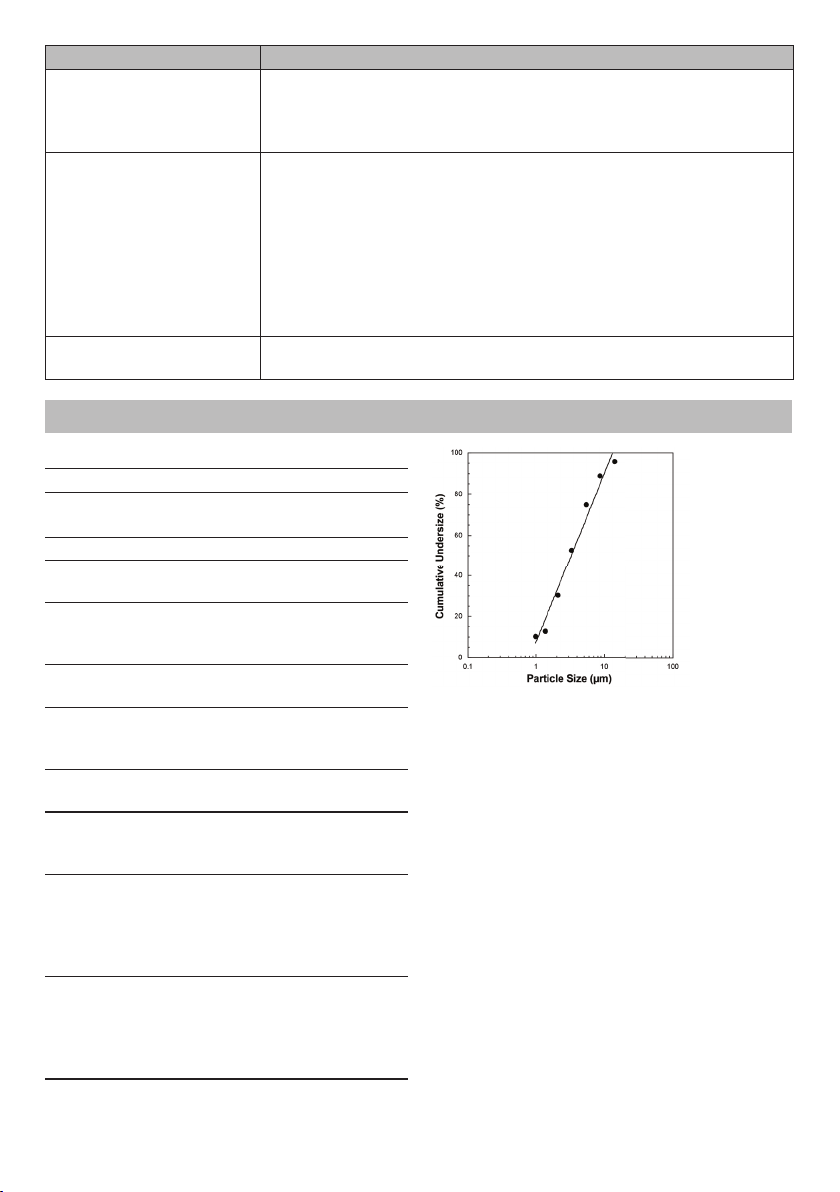
Problèmes/questions Causes possibles/solution
L’inhalation avec le masque
est-elle plus longue?
Pourquoi le nébuliseur doit-il
être remplacé régulièrement?
Chaque individu a-t-il besoin
de son propre nébuliseur?
Ceci est dû à des raisons techniques. Lors de chaque cycle de respiration,
vous inspirez moins de médicament à travers les orifices du masque que
par l’embout buccal. À travers les trous, l’aérosol est ensuite mélangé avec
l’air ambiant.
Il existe deux raisons pour cela:
1. Pour garantir un spectre de particules efficace d’un point de vue thérapeutique, l’alésage de la buse ne doit pas dépasser un diamètre donné.
En raison des sollicitations mécaniques et thermiques, le plastique est
soumis à une certaine usure. L’embout de buse [10] est particulièrement
sensible. La composition des gouttes de l’aérosol peut alors se modifier,
ce qui a une incidence directe sur l’efficacité du traitement.
2. En outre, il est recommandé de changer régulièrement le nébuliseur pour
des raisons d’hygiène.
Pour des raisons d’hygiène, c’est absolument indispensable.
11. Caractéristiques techniques
Modèle SIH 21
Type SIH 21/2
Dimensions (l x
H x P)
Poids 1,65 kg
Pression de
travail
Volume de
remplissage du
nébuliseur
Débit du médicament
Pression
acoustique
Connexion au
secteur
Conditions
d’utilisation
Conditions de
stockage et de
transport
Caractéristiques
de
l’aérosol
Sous réserve de modifications techniques.
300 x 180 x 100 mm
env. 0,8 - 1,45bar
8ml max.
2ml min.
env. 0,4ml/min.
max. 52dBA
(selon DIN NE 13544-1
paragraphe 26)
230 V~; 50 Hz; 230 VA
UK: 240 V~; 50 Hz; 240 VA
Température: +10 °C à +40 °C
Humidité relative de l’air:
10% à 95%
Température: 0°C à +60°C
Humidité relative de l’air:
10% à 95%
Pression atmosphérique:
500 à 1060hPa
Débit: 5,31l/min
Distribution: 0,171ml
Débit de distribution: 0,082ml/min
Taille des particules (MMAD):
3,16µm
Les mesures ont été effectuées avec une solution de
fluorure de sodium à l’aide d’un impacteur NGI (Next
Generation Impactor).
Il se peut que le diagramme ne soit pas applicable tel
quel pour les suspensions ou des médicaments très
visqueux. Pour de plus amples informations, veuillez
contacter le fabricant du médicament en question.
34
Page 35

Articles de rechange
Yearpack SIH 21
Embout buccal, masque pour
adulte et enfant, nébuliseur,
tuyau à air comprimé, filtre
RÉF.
601.20
Remarque
En cas d’utilisation de l’appareil en dehors des spécifications, un fonctionnement irréprochable ne peut pas
être garanti! Nous nous réservons le droit d’effectuer
des modifications techniques pour améliorer et faire
évoluer le produit. Cet appareil et les accessoires
correspondants satisfont aux normes européennes
EN60601-1 et EN60601-1-2 ainsi que EN13544-1 et
doivent faire l’objet de mesures de précautions particulières concernant la compatibilité électromagnétique.
Veuillez noter que les dispositifs de communication
HF portables et mobiles sont susceptibles d’influer
sur cet appareil. Pour des détails plus précis, veuillez contacter le service après-vente à l’adresse cidessous. L’appareil est conforme aux exigences de la
directive européenne 93/42/CE sur les produits médi
caux, la loi sur les produits médicaux.
-
COMPATIBILITÉ ÉLECTROMAGNÉTIQUE
• L’appareil satisfait aux prescriptions en vigueur
actuellement en matière de compatibilité électromagnétique et il est adapté à l’utilisation dans tous
les bâtiments, y compris ceux destinés à des fins
de logements privés. Les émissions de fréquences
radio de l’appareil sont extrêmement basses et ne
provoquent selon toute vraisemblance pas d’interférences avec d’autres appareils à proximité.
• Il convient dans tous les cas de ne pas positionner
l’appareil au-dessus ou à proximité d’autres appa
reils. Au cas où surviendraient des interférences avec
vos appareils électroniques, déplacez-le ou branchez-le à une autre prise.
• Des appareils radio pourraient interférer avec le fonctionnement de l’appareil.
-
35
Page 36

ITALIANO
Indice
1. Presentazione ....................................................37
2. Spiegazione dei simboli ....................................37
3. Avvertenze e indicazioni di sicurezza ................38
4. Descrizione dell‘apparecchio e degli
accessori ...........................................................40
5. Messa in funzione .............................................41
6. Funzionamento ..................................................41
7. Sostituzione del filtro .........................................42
8. Pulizia e disinfezione .........................................43
9. Smaltimento ......................................................44
10. Risoluzione dei problemi ...................................45
11. Dati tecnici .........................................................46
Contenuto della confezione
Vedere la descrizione dell’apparecchio e degli accessori a pag. 40.
• Inalatore
• Nebulizzatore
• Tubo per aria compressa
• Boccaglio
• Mascherina per adulti
• Mascherina per bambini
• Filtro di riserva
• Questo manuale d’uso
36
Page 37
1. Presentazione
Gentile cliente,
Leggere attentamente le presenti istruzioni per l‘uso,
conservarle per impieghi futuri, renderle accessibili ad
altri utilizzatori e attenersi alle indicazioni.
Campo di impiego
Questo inalatore è un apparecchio indicato per la nebulizzazione di fluidi e farmaci in forma liquida (aerosol) e per il trattamento efficace delle vie respiratorie
inferiori e superiori.
Attraverso la nebulizzazione dei medicinali prescritti o
consigliati dal medico, è possibile prevenire numerosi
disturbi dell‘apparato respiratorio, alleviarne i sintomi
e accelerarne la guarigione. Per ulteriori informazioni
in merito alle possibilità di impiego dell‘apparecchio,
rivolgersi al proprio medico curante o al farmacista.
Questo apparecchio è indicato per l‘utilizzo a domicilio
e l‘inalazione dei farmaci deve avvenire soltanto dietro
consiglio del medico.
Inalare la soluzione nebulizzata inspirando lentamente
e in modo rilassato, affinché il farmaco possa penetrare fino nelle diramazioni bronchiali più fini. Espirare
normalmente.
2. Spiegazione dei simboli
Nelle istruzioni d’uso sono utilizzati i seguenti simboli.
Pericolo Segnalazione di rischi di lesioni
o pericoli per la salute.
Attenzione Segnalazione di rischi di possibi-
li danni all’apparecchio.
Avvertenza Indicazione di importanti infor-
mazioni.
Sull’imballaggio e sulla targhetta identificativa dell’apparecchio e degli accessori compaiono i seguenti simboli.
I
O
SN
30 ON /
30 OFF
Parte applicata di tipo BF
Leggere le istruzioni per l’uso.
Classe di isolamento 2
P
roduttore
On
Off
Numero di serie
30 minuti di funzionamento, dopodiché
30 minuti di pausa prima della rimessa
in funzione.
37
Proteggere dall'umidità
Page 38
3. Avvertenze e indicazioni di sicurezza
Pericolo
• Prima dell’utilizzo accertarsi che l’apparecchio e gli
accessori non presentino danni visibili. In caso di
dubbi non utilizzarlo e rivolgersi al rivenditore oppure
contattare il servizio clienti all’indirizzo indicato.
• Se si verificano problemi con l'apparecchio, consultare il capitolo "10 Soluzione dei problemi".
• L’utilizzo di questo apparecchio non sostituisce il
parere diretto o un trattamento del medico. Quindi, al
manifestarsi di qualsiasi dolore o malattia, consultare
innanzitutto un medico.
• In caso di qualsiasi problema di salute consultare il
proprio medico curante.
• Durante l’utilizzo del nebulizzatore osservare le nor
mali regole di igiene.
• Per quanto riguarda il tipo e la posologia del farmaco
da utilizzare, nonché la durata e la frequenza dell’inalazione, seguire sempre le indicazioni del medico.
• Utilizzare esclusivamente farmaci prescritti o consigliati dal medico o dal farmacista.
Attenzione:
effettuare il trattamento utilizzando esclusivamente
i componenti indicati dal medico a seconda della
patologia.
• Verificare sul foglietto illustrativo del farmaco
l'esistenza di controindicazioni per l'uso in combinazione con i comuni sistemi di aerosolterapia.
• Qualora il dispositivo non funzioni correttamente o
si avverta malessere o dolore, interrompere immediatamente l’utilizzo.
• Durante l’utilizzo, tenere l’apparecchio lontano dagli occhi, in quanto il farmaco nebulizzato potrebbe
avere effetti dannosi.
• Non attivare l’apparecchio in presenza di gas infiammabili.
• Questo apparecchio non deve essere utilizzato da
bambini o persone con limitate capacità fisiche e
sensoriali (ad es. insensibilità al dolore) o che non
siano in pieno possesso delle proprie facoltà mentali;
inoltre non deve essere utilizzato da persone senza la
dovuta esperienza e/o le dovute conoscenze a meno
che non vengano sorvegliate da un’altra persona
responsabile della loro sicurezza o istruite su come
utilizzare l’apparecchio in questione.
•
Prima di ogni intervento di pulizia o manutenzione,
è necessario spegnere l'apparecchio ed estrarre la
spina.
• Tenere il materiale di imballo fuori dalla portata dei
bambini (pericolo di soffocamento).
-
38
• Per evitare il rischio di impigliamento e strangolamento, tenere i cavi e i tubi dell'aria lontano dai
bambini.
• Non utilizzare accessori che non siano autorizzati dal
produttore del dispositivo.
• L’apparecchio deve essere alimentato solo con la
tensione indicata sulla targhetta identificativa.
• Non immergere l’apparecchio in acqua e non utiliz
zarlo in ambienti umidi. Assicurarsi che all’interno
dell’apparecchio non possa penetrare alcun liquido.
• Proteggere il dispositivo da colpi e urti.
• Non toccare mai il cavo con le mani bagnate, vi è il
rischio di subire una scossa elettrica.
• Per staccare la spina dalla presa di corrente, non
tirare dal cavo.
• Non schiacciare, piegare o lasciare penzolare il cavo,
non farlo passare sopra oggetti dal bordo tagliente
e proteggerlo dal calore.
• È consigliabile srotolare completamente il cavo di
alimentazione, in modo da evitare un pericoloso
surriscaldamento.
• In caso di danni al cavo o all’involucro dell’appa
recchio, rivolgersi al rivenditore o al servizio clienti.
• L’apertura dell’apparecchio può comportare il rischio
di scossa elettrica. L’apparecchio è scollegato dalla
rete di alimentazione soltanto quando la spina non
è inserita nella presa.
• Qualora il dispositivo cada per terra, venga esposto a
un’eccessiva umidità o subisca danni di altro genere
non deve più essere utilizzato. In caso di dubbio
contattare il rivenditore o il servizio clienti.
•
L’inalatore SIH 21 deve essere fatto funzionare
-
-
esclusivamente con gli adeguati nebulizzatori e
con i rispettivi accessori. L’impiego di altri nebulizzatori o accessori può compromettere l’efficienza
del trattamento ed eventualmente danneggiare
l’apparecchio.
Attenzione
• Un black-out elettrico, improvvise interferenze o
altre condizioni sfavorevoli potrebbero impedire il
funzionamento dell’apparecchio. Per questa ragione
consigliamo di tenere a portata di mano un apparecchio di riserva o un farmaco adeguato (approvato dal
medico).
• Qualora fossero necessari adattatori o prolunghe, tali
dispositivi devono rispettare le norme di sicurezza
vigenti. I limiti dell’intensità di corrente non devono
essere superati, così come i limiti di massima potenza indicati sull’adattatore.
• L’apparecchio e il cavo di alimentazione non devono
essere tenuti in prossimità di fonti di calore.
Page 39
• L’apparecchio non deve essere utilizzato in stanze
nelle quali sono stati precedentemente impiegati prodotti spray. Prima del trattamento, assicurarsi che tali
stanze siano state sufficientemente aerate.
• Non inserire oggetti nelle aperture di raffreddamento
dell’apparecchio.
• Non utilizzare l’apparecchio, qualora esso produca
rumori inconsueti.
• Per ragioni igieniche è assolutamente necessario che
ogni utente utilizzi i suoi accessori personali.
• Dopo l’utilizzo staccare sempre la spina dalla presa
di corrente.
• Tenere l’apparecchio al riparo dagli agenti atmosfe
rici e da condizioni ambientali potenzialmente sfavorevoli.
-
FUSIBILE
• L’apparecchio è dotato di un fusibile di sovracorrente che deve essere sostituito soltanto da personale
autorizzato.
Avvertenze generali
Attenzione
• Utilizzare l’apparecchio esclusivamente:
– sugli esseri umani,
– per lo scopo previsto dal dispositivo stesso (inala-
zione di aerosol) e attenendosi a quanto indicato
in queste istruzioni per l’uso.
• Qualsiasi utilizzo improprio può rivelarsi perico
loso.
• In caso di incidenti seri, è opportuno rivolgersi innanzitutto al pronto soccorso.
• Oltre al farmaco, utilizzare esclusivamente acqua
distillata o una soluzione fisiologica. Altri liquidi in
certi casi possono danneggiare l’inalatore o il nebulizzatore.
• Questo apparecchio non è destinato ad un impiego
commerciale o clinico, bensì esclusivamente ad un
uso personale a domicilio.
-
Prima della messa in funzione
Attenzione
• Prima di utilizzare l’apparecchio rimuovere integralmente l’imballaggio.
• Tenere l’apparecchio al riparo da polvere, sporcizia
e umidità, e durante il funzionamento non coprirlo
per nessuna ragione.
• Non utilizzare l’apparecchio in ambienti polverosi.
• Spegnere immediatamente l’apparecchio qualora
esso risulti difettoso o si notino anomalie nel funzionamento.
• Il produttore declina ogni responsabilità in caso di
danni derivanti da un utilizzo scorretto o inadeguato.
Riparazione
Avvertenza
• Per nessuna ragione aprire o cercare di riparare il dispositivo, in quanto questo potrebbe comprometterne il funzionamento. Qualora tale regola non venisse
osservata, la garanzia perderebbe di validità.
• Per le riparazioni rivolgersi al servizio clienti o a un
rivenditore autorizzato.
39
Page 40
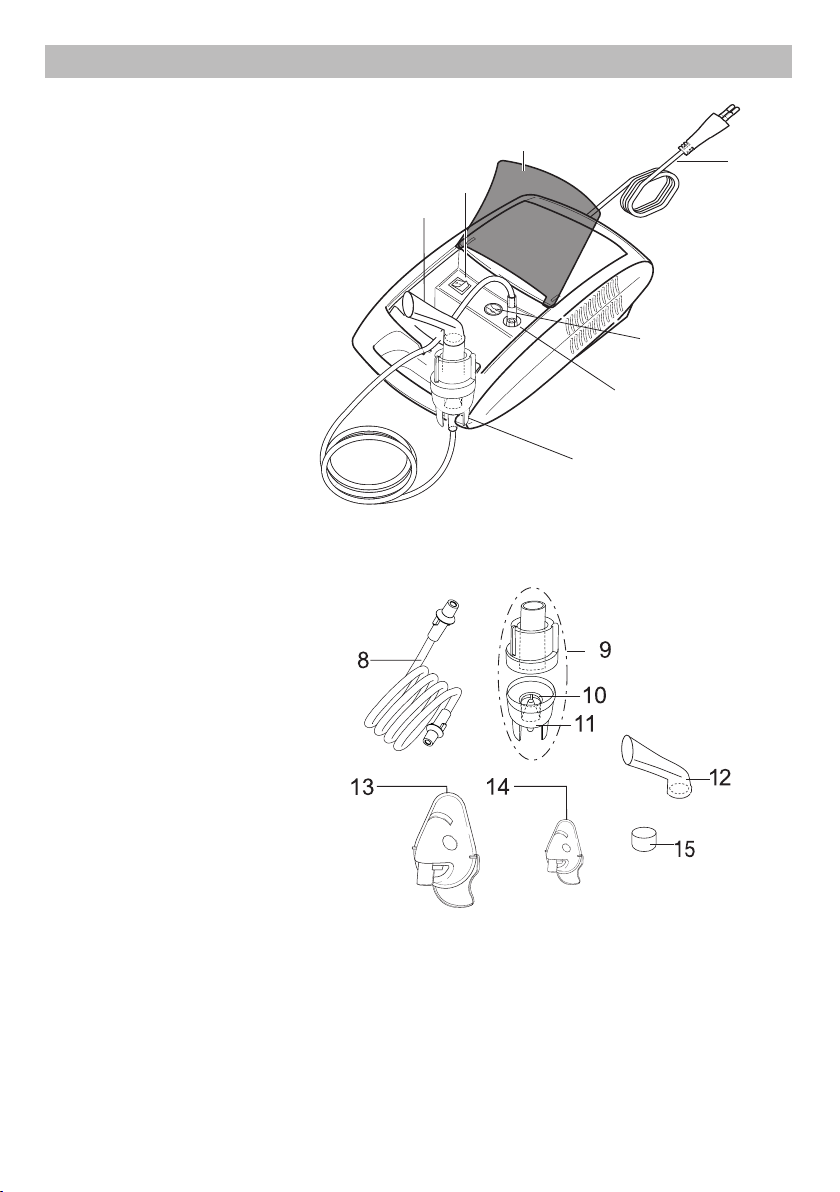
4. Descrizione dell‘apparecchio e degli accessori
Inalatore
2
3
4
1
1 Cavo di alimentazione
2 Coperchio
3 Interruttore On/Off
4 Scomparto per accessori
5 Tappo del filtro e filtro
6 Attacco per il tubo
7 Supporto del nebulizzatore
Nebulizzatore e accessori
8 Tubo per aria compressa
9 Nebulizzatore
10 Ugello di innesto
11 Ampolla per il farmaco
12 Boccaglio
13 Mascherina per adulti
14 Mascherina per bambini
15 Filtri di ricambio
5
6
7
40
Page 41
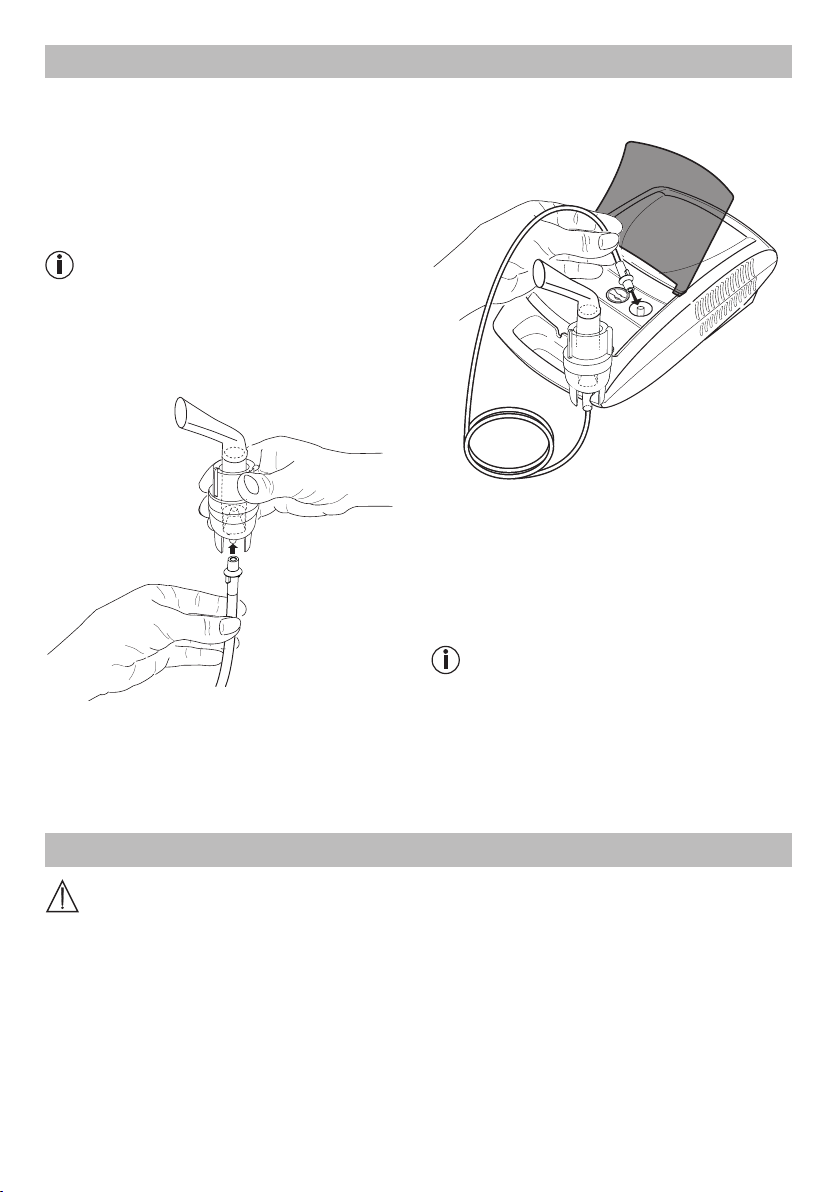
5. Messa in funzione
Posizionamento
Togliere l’apparecchio dalla confezione e appoggiarlo
su una superficie piana.
Assicurarsi che le aperture di aerazione non siano
coperte.
Abra la tapa [2] para acceder a los accesorios.
Al primo utilizzo
Avvertenza
•
Al primo utilizzo pulire e disinfettare il nebulizzatore
e gli accessori prima di procedere al trattamento (vedere “Pulizia e disinfezione” pag. 43.
•
Collegare il tubo per aria compressa [8] alla parte
inferiore dell’ampolla per il farmaco [11].
•
Inserire l’altra estremità del tubo [8] con una leggera
rotazione nell’attacco per il tubo [6] sull’inalatore.
Allacciamento elettrico
L’apparecchio deve essere alimentato solo con la tensione indicata sulla targhetta identificativa.
•
Inserire la spina del cavo di alimentazione [1] in una
presa di corrente adeguata.
•
Per il collegamento elettrico inserire completamente
la spina nella presa.
6. Funzionamento
Attenzione
•
Per ragioni igieniche è assolutamente necessario
pulire il nebulizzatore [9] e gli accessori dopo ogni
utilizzo e disinfettarli dopo l’ultimo utilizzo giornaliero.
• Gli accessori devono essere utilizzati da un un'unica
persona; l'uso da parte di più persone non è consigliato.
• Qualora la terapia preveda l’inalazione di farmaci diversi uno di seguito all’altro, assicurarsi che dopo
ogni utilizzo il nebulizzatore [9] venga risciacquato
con acqua calda corrente (vedere “Pulizia e disinfezione” a pag. 43.
41
Avvertenza
•
Assicurarsi che ci sia una presa di corrente vicino a
dove si intende posizionare l’apparecchio.
•
Prestare attenzione alla posizione del cavo, in modo
tale che nessuno corra il rischio di inciampare.
•
Dopo l’inalazione, per scollegare l’inalatore dalle rete
elettrica, innanzitutto spegnere l’apparecchio e in
seguito staccare la spina dalla presa di corrente.
•
Per la sostituzione del filtro, seguire le indicazioni
riportate in queste istruzioni.
•
Prima di ogni utilizzo accertarsi che il tubo sia sal-
damente collegato sia all’inalatore [6] sia al nebulizzatore [9].
•
Prima dell’utilizzo assicurarsi che l’apparecchio fun-
zioni in modo regolare: accendere quindi l’inalatore
(con il nebulizzatore collegato ma senza farmaci) per
qualche istante. Se dal nebulizzatore [9] fuoriesce
dell’aria, ciò vuol dire che l’apparecchio funziona.
1. Inserimento dell’ugello di innesto
•
Aprire il nebulizzatore [9] ruotando la parte superiore
in senso antiorario rispetto all’ampolla per il farma-
Page 42
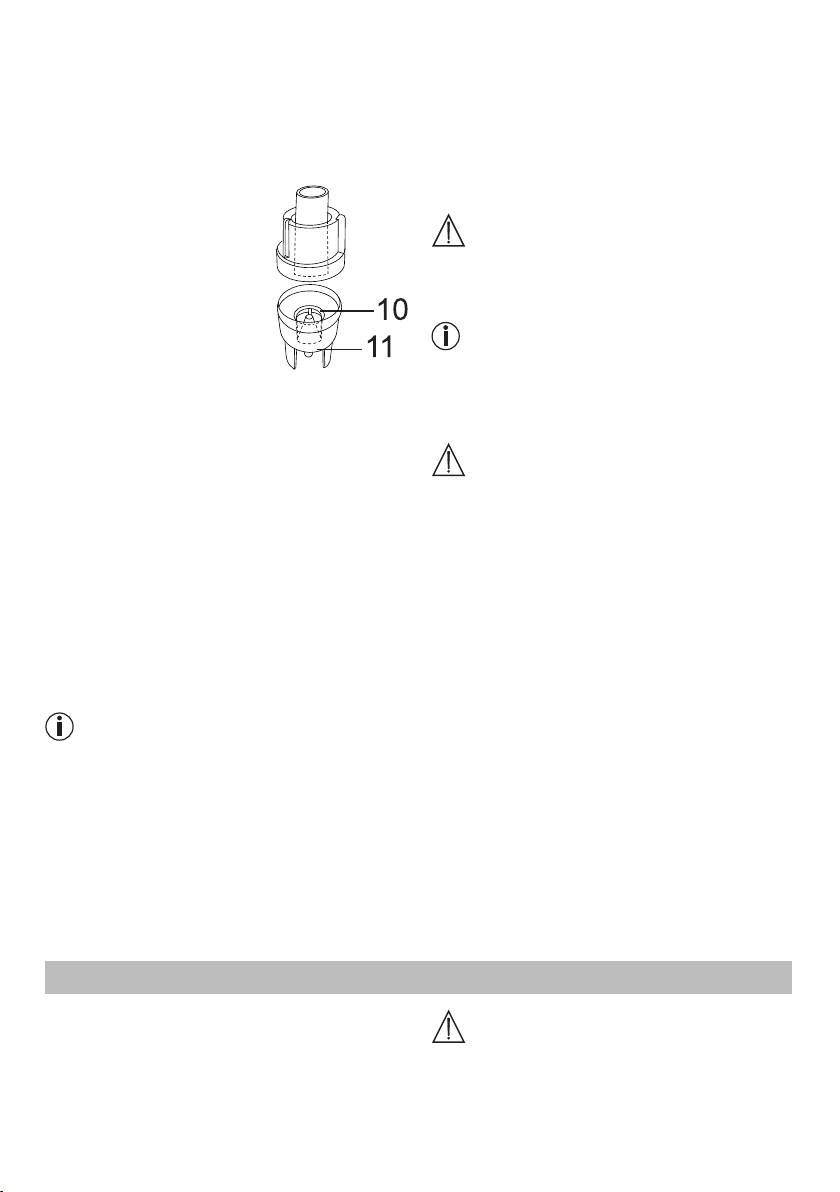
co[11] . Inserire l’ugello di innesto [10] nell’ampolla
per il farmaco [11].
• Accertarsi che il cono di conduzione del farmaco,
sia correttamente inserito sul cono di conduzione
dell'aria situato all'interno del nebulizzatore.
•
5. Trattamento
• Durante l'inalazione, sedere in posizione eretta e ri-
2. Riempimento del nebulizzatore
•
Versare una soluzione fisio-
logica isotonica o il farmaco
direttamente nell’apposita
ampolla [11]. La quantità di
liquido versato non deve superare 8 ml.
• Utilizzare esclusivamente farmaci indicati dal medico e informarsi in merito alla durata
dell’inalazione e alla quantità
di liquido da impiegare.
•
Qualora tale quantità sia inferiore ai 2 ml, integrar-
la solo con soluzione fisiologica isotonica fino ad
almeno 4 ml. La soluzione isotonica deve essere
impiegata anche nel caso di farmaci densi. Anche
in questo caso attenersi alle indicazioni del medico.
3. Chiusura del nebulizzatore
•
Chiudere il nebulizzatore [9] ruotando la parte su-
periore in senso orario rispetto all’ampolla per il farmaco [11]. Le due parti devono essere collegate in
modo corretto.
4. Collegamento degli accessori al nebulizzatore
•
Collegare il nebulizzatore [9] all’accessorio deside-
rato (boccaglio [12], mascheri- na per adulti [13] o
mascherina per bambini [14]).
Nota
L'inalazione mediante boccaglio rappresenta la forma più efficace della terapia. L'inalazione mediante
mascherina è consigliata solo nel caso in cui non sia
possibile utilizzare il boccaglio (ad esempio in bambini
non ancora in grado di inalare attraverso il boccaglio).
•
Prima del trattamento, estrarre il nebulizzatore dal
relativo supporto [7] tirandolo verso l’alto.
•
Avviare l’inalatore per mezzo dell’interruttore On/Off
[3].
•
L'apparecchio non è progettato per il funzionamento
continuo, dopo 30 minuti di esercizio deve rimanere
spento per 30 minuti.
Durante il trattamento tenere dritto il nebulizzatore (in
posizione verticale): in caso contrario la nebulizzazione
verrebbe ostacolata e di conseguenza il funzionamento
risulterebbe difettoso.
Oli essenziali di piante, sciroppi per la tosse, soluzioni
per i gargarismi, oli per massaggi o per bagno turco
non sono assolutamente adatti all’inalazione. La loro
viscosità può compromettere il funzionamento dell’apparecchio e di conseguenza l’efficacia del trattamento.
In caso di ipersensibilità bronchiale, farmaci con oli
essenziali possono talvolta provocare un broncospasmo acuto (un’improvvisa contrazione spasmodica dei
bronchi con conseguente insufficienza respiratoria).
Chiedere consiglio al proprio medico o farmacista.
6. Fine dell’inalazione
Quando il liquido nebulizzato comincia a fuoriuscire in
modo discontinuo o si avverte un rumore diverso durante l’inalazione, è possibile terminare il trattamento.
• Dopo il trattamento, spegnere l'inalatore con
•
7. Effettuare la pulizia
Vedere “Pulizia e disinfezione” a pag. 43.
La fuoriuscita di liquido nebulizzato dal nebulizzatore
indica il corretto funzionamento dell’apparecchio.
lassata a un tavolo e non in poltrona, in modo da non
comprimere le vie respiratorie e non compromettere
così l'efficacia del trattamento.
Inspirare a fondo il farmaco nebulizzato.
Attenzione
Avvertenza
Attenzione
l'interruttore On/Off [3] e scollegarlo dalla rete elettrica.
Riposizionare il nebulizzatore [9] sul relativo sup-
porto [7].
7. Sostituzione del filtro
In condizioni normali di utilizzo, è necessario sostituire
il filtro dell'aria dopo 500 ore di esercizio oppure un
anno. Controllare regolarmente il filtro dell'aria (dopo
10-12 nebulizzazioni). Qualora esso sia molto sporco
o intasato, sostituirlo. Qualora il filtro si sia inumidito,
occorre comunque sostituirlo con uno nuovo.
42
Attenzione
•
Non cercare di pulire e riutilizzare il filtro usato.
•
Utilizzare esclusivamente i filtri originali del pro-
duttore, poiché in caso contrario l’inalatore potrebbe essere danneggiato o la terapia potrebbe
non rivelarsi sufficientemente efficace.
Page 43
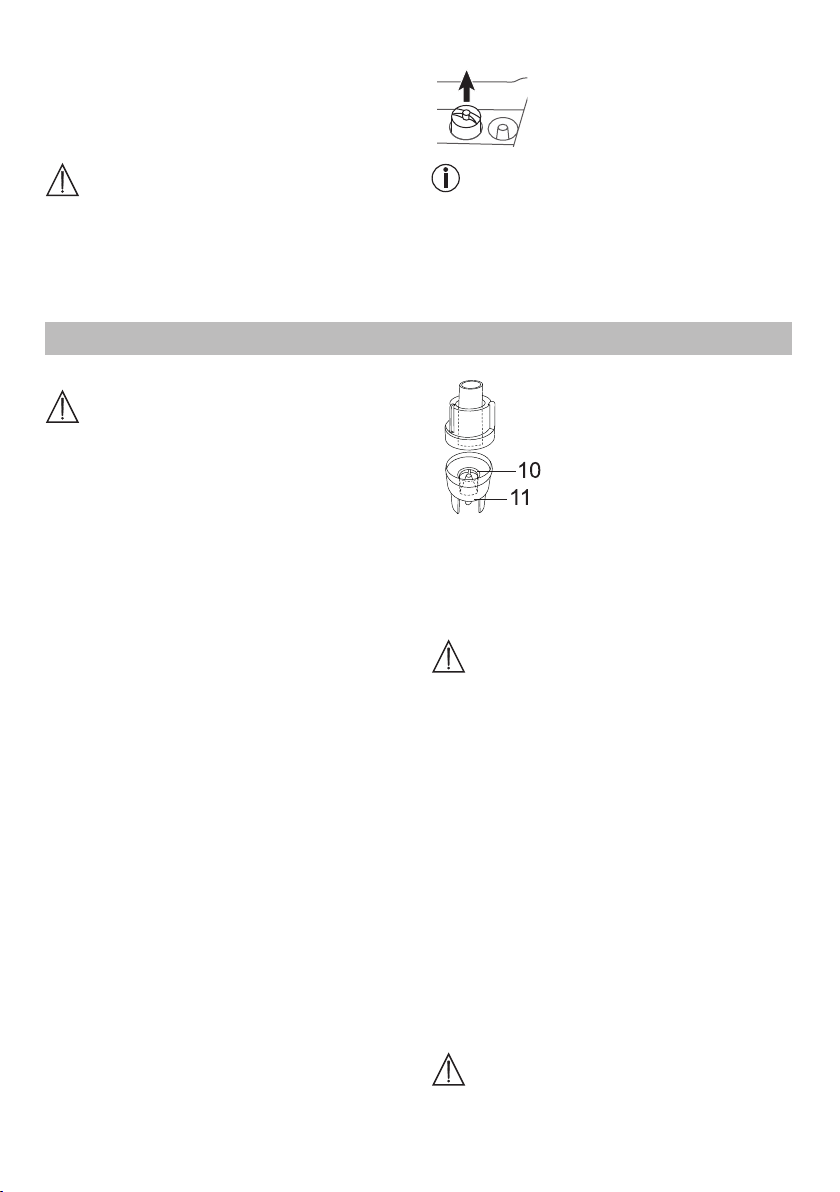
• Non è possibile riparare o effettuare interventi di manutenzione sul filtro dell'aria mentre una persona lo
sta utilizzando.
•
Non utilizzare mai l’apparecchio senza filtro.
Per sostituire il filtro procedere come segue:
Attenzione
•
Innanzitutto spegnere l’apparecchio e scollegarlo
dalla rete elettrica.
•
Lasciare raffreddare l’apparecchio.
8. Pulizia e disinfezione
Nebulizzatore e accessori
Pericolo
Attenersi alle seguenti regole di igiene al fine di evitare
possibili rischi per la salute.
•
È previsto che il nebulizzatore [9] e gli accessori
vengano utilizzati più volte. È opportuno considerare che per i diversi campi di impiego vi sono requisiti diversi in merito alla pulizia e al trattamento
igienico.
Avvertenze:
•
Evitare una pulizia meccanica del nebulizzatore
e degli accessori con spazzole o simili, in quanto
ciò potrebbe causare danni irreparabili all’appa
recchio e compromettere l’efficacia della terapia.
•
Per le precauzioni igieniche particolari (cura del-
le mani, utilizzo dei farmaci o delle soluzioni da
inalare) in caso di gruppi ad alto rischio (ad es.
pazienti affetti da fibrosi cistica), consultare il medico.
•
Dopo aver pulito e disinfettato il nebulizzatore e
l’accessorio, asciugarli con cura. Residui di umi
dità o di acqua possono favorire la proliferazione
di germi.
Preparazione
•
Subito dopo ogni trattamento, tutti i componen-
ti del nebulizzatore [9] e l’accessorio impiegato
devono essere puliti per eliminare i residui di farmaco e di sporcizia.
•
A tal fine, smontare il nebulizzatore[9] separando-
ne i singoli componenti.
•
Estrarre il boccaglio [12] dal nebulizzatore.
•
Aprire il nebulizzatore ruotando la parte superiore
in senso antiorario rispetto all’ampolla per il farmaco [11].
•
Estrarre l’ugello di innesto [10] dall’ampolla per il
farmaco [11].
1. Tirare verso l’alto il cappuccio del filtro [5].
Avvertenza
Qualora il filtro, dopo aver tolto il tappo, rimanga all’interno dell’apparecchio, estrarlo con una pinzetta o simili.
2. Reinserire il tappo [5] con un nuovo filtro.
3. Verificare che il tappo sia ben fissato.
• L’assemblaggio avviene poi seguendo l’ordine in-
verso.
Pulizia
-
-
Attenzione
Prima di procedere alla pulizia dell’apparecchio, spegnerlo, scollegarlo dalla rete elettrica e lasciarlo raffreddare.
Dopo ogni utilizzo lavare con acqua calda non bollente
il nebulizzatore e gli accessori utilizzati, come boccaglio, mascherina, ugello, ecc. Asciugare accuratamente
i componenti con un panno morbido. Riassemblare i
componenti perfettamente asciutti e riporli in un con
tenitore asciutto e sigillato oppure disinfettarli.
Durante la pulizia rimuovere accuratamente qualsiasi
residuo. Non utilizzare sostanze che in caso di contatto
con la pelle o le mucose, oppure se ingoiate o inalate,
potrebbero risultare tossiche.
Per pulire l'apparecchio, utilizzare un panno morbido
e asciutto e un detergente non abrasivo.
Non utilizzare prodotti di pulizia aggressivi e non im
mergere mai l’apparecchio nell’acqua.
Attenzione
•
Assicurarsi che non penetri acqua all’interno
dell’apparecchio.
-
-
43
Page 44
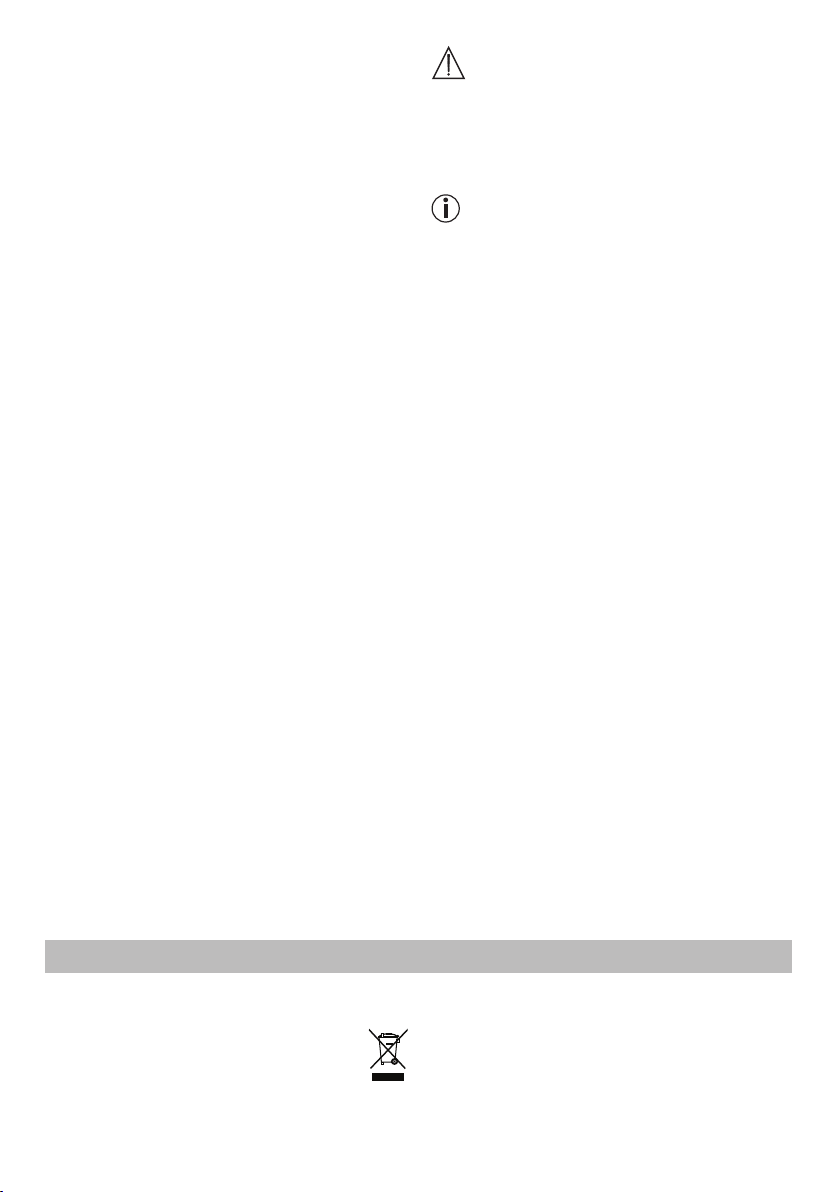
•
Non lavare l’apparecchio e gli accessori nella la-
vastoviglie.
•
Se collegato alla rete elettrica, l’apparecchio non
deve essere toccato con le mani bagnate. Fa-
Non far bollire o sterilizzare in autoclave le mascherine
e il tubo dell'aria.
re in modo che su di esso non schizzino gocce
d’acqua. L’apparecchio deve essere messo in
•
funzione soltanto se perfettamente asciutto.
•
Non spruzzare alcun liquido nelle aperture di
aerazione. Ciò potrebbe danneggiare il sistema
elettrico dell’apparecchio e altri componenti dell’inalatore e provocare difetti funzionali.
Acqua di condensa, cura del tubo
A seconda delle condizioni ambientali è possibile che
all’interno del tubo si formi dell’acqua di condensa. Al
fine di evitare la proliferazione di germi e assicurare una
terapia il più possibile efficace, l’umidità deve essere
assolutamente eliminata. Procedere come segue:
•
Staccare il tubo [8] dal nebulizzatore [9].
• Lasciare il tubo collegato all’inalatore [6].
• Far funzionare l’inalatore finché l’umidità non sia
stata completamente eliminata dal flusso di aria
all’interno del tubo.
• In caso di sporco persistente, sostituire il tubo.
Al fine di evitare la proliferazione di germi, assicurarsi che dopo essere stati puliti i componenti vengano
perfettamente asciugati.
Sterilizzazione
•
Asciugatura
•
Resistenza dei materiali
•
Disinfezione
Per la disinfezione del nebulizzatore e degli accessori, seguire attentamente i punti elencati di seguito.
Si consiglia di disinfettare i singoli componenti al più
tardi dopo l’ultimo utilizzo giornaliero. (A tal fine sono
sufficienti un poco di aceto incolore e acqua distillata).
•
Innanzitutto pulire il nebulizzatore e gli ac- cessori
•
come descritto al punto “Pulizia”.
• Immergere il nebulizzatore e il boccaglio disassemblati in acqua bollente per 5 minuti.
• Per gli altri accessori
da ¼ di aceto e ¾ di acqua distillata. Assicurarsi che
la quantità di miscela sia sufficiente per immergere
completamente i componenti.
• Lasciare i componenti immersi per 30 minuti nella
utilizzare una miscela composta
soluzione di aceto.
• Sciacquare i componenti con acqua e asciugarli accuratamente con un panno morbido.
Conservazione
• Non conservare l’apparecchio in ambienti umidi
• Conservare e trasportare l’apparecchio al riparo
•
Attenzione
Riassemblare i componenti perfettamente asciutti
e riporli in un contenitore asciutto e sigillato.
Avvertenza
U
tilizzare le soluzioni di sterilizzazione a freddo
seguendo le istruzioni del produttore.
Disporre i singoli componenti su una superficie
asciutta, pulita e assorbente, e lasciarli asciugare
completamente (almeno 4 ore).
Il nebulizzatore e gli accessori, se utilizzati fre-
quentemente, come tutti i componenti n materiale plastico, sono soggetti ad usura. Questo col
tempo può portare a una modifica dell’aerosol
e a un calo dell’efficienza della terapia. Pertanto
consigliamo di sostituire il nebulizzatore dopo un
anno.
Per la pulizia e la disinfezione è importante: uti-
lizzare esclusivamente detergenti delicati o disinfettanti il cui dosaggio deve essere indicato dal
produttore.
(ad es. il bagno) e non trasportarlo insieme ad
oggetti umidi.
dai raggi diretti del sole.
Gli accessori possono essere riposti nell’appo-
sito scomparto [4]. Conservare l’apparecchio in
un luogo asciutto, se possibile all’interno della
relativa confezione.
9. Smaltimento
Nel rispetto dell’ambiente, l’apparecchio non deve
essere gettato tra i normali rifiuti domestici.
Smaltire l'apparecchio secondo la direttiva eu
ropea sui rifiuti di apparecchiature elettriche ed
elettroniche (RAEE).
-
44
In caso di dubbi, rivolgersi agli enti comunali respon
sabili in materia di smaltimento.
-
Page 45
10. Risoluzione dei problemi
Problemi/domande Possibile causa/rimedio
Dal nebulizzatore non
fuoriesce aerosol o ne
fuoriesce troppo poco.
L’emissione non è
sufficiente
Quali farmaci si posso
no inalare?
Dopo il trattamento
rimane della soluzione
all’interno del nebuliz
zatore.
A che cosa è necessario prestare attenzione
per il trattamento dei
bambini e dei neonati?
L’inalazione con la ma
scherina dura di più?
Perché il nebulizzatore
deve essere sostituito
regolarmente?
È necessario un nebu
lizzatore diverso per
ogni utilizzatore?
1. Eccessiva o insufficiente quantità di farmaco nel nebulizzatore.
Min.: 2 ml, Max.: 8 ml.
2. Ugello probabilmente otturato.
Eventualmente pulire l’ugello (ad es. sciacquandolo). In seguito rimettere il
nebulizzatore in funzione.
Attenzione: far passare attraverso i piccoli fori soltanto la parte inferiore dell’ugel
lo.
3. Il nebulizzatore non è tenuto in posizione verticale.
Il farmaco impiegato non è adatto alla nebulizzazione (ad es. troppo denso).
4.
Il farmaco dovrebbe essere prescritto dal medico.
Tubo piegato, filtro otturato, troppa soluzione da inalare.
-
A tal proposito, consultare il medico.
Fondamentalmente possono essere inalati tutti i farmaci indicati e autorizzati per
l’inalazione tramite nebulizzatore.
Questo è tecnicamente normale e inevitabile. Sospendere l’inalazione, non appena
si avverte un netto cambiamento nel rumore prodotto dall’apparecchio.
-
1. Nel caso dei neonati, la mascherina deve coprire naso e bocca per garantire
un’inalazione efficace.
2. Anche nel caso dei bambini la mascherina deve coprire naso e bocca. L’utilizzo
su una persona addormentata non ha molto senso, in quanto l’inalazione non è
sufficiente a far penetrare abbastanza farmaco nei polmoni.
Avvertenza: il trattamento di un bambino deve essere effettuato sempre sotto la
supervisione di un adulto.
-
Questo è tecnicamente inevitabile. A causa dei fori nella mascherina, ad ogni
respiro viene inalato meno farmaco rispetto a quando si utilizza il boccaglio. L’aerosol, attraverso i fori, viene disperso nell’ambiente.
Alla base di ciò vi sono due ragioni:
1. Al fine di garantire un trattamento quanto più efficace, il foro dell’ugello non
deve superare un certo diametro. A causa di fattori sia meccanici che termici
la plastica è soggetta a usura, e l’ugello di innesto [10] è particolarmente
sensibile. In questo modo può variare anche la composizione delle goccioline
dell’aerosol, il che influisce direttamente sull’efficacia del trattamento.
2. Inoltre, una regolare sostituzione del nebulizzatore è consigliabile anche per
ragioni igieniche.
Per motivi igienici è assolutamente indispensabile.
-
-
45
Page 46
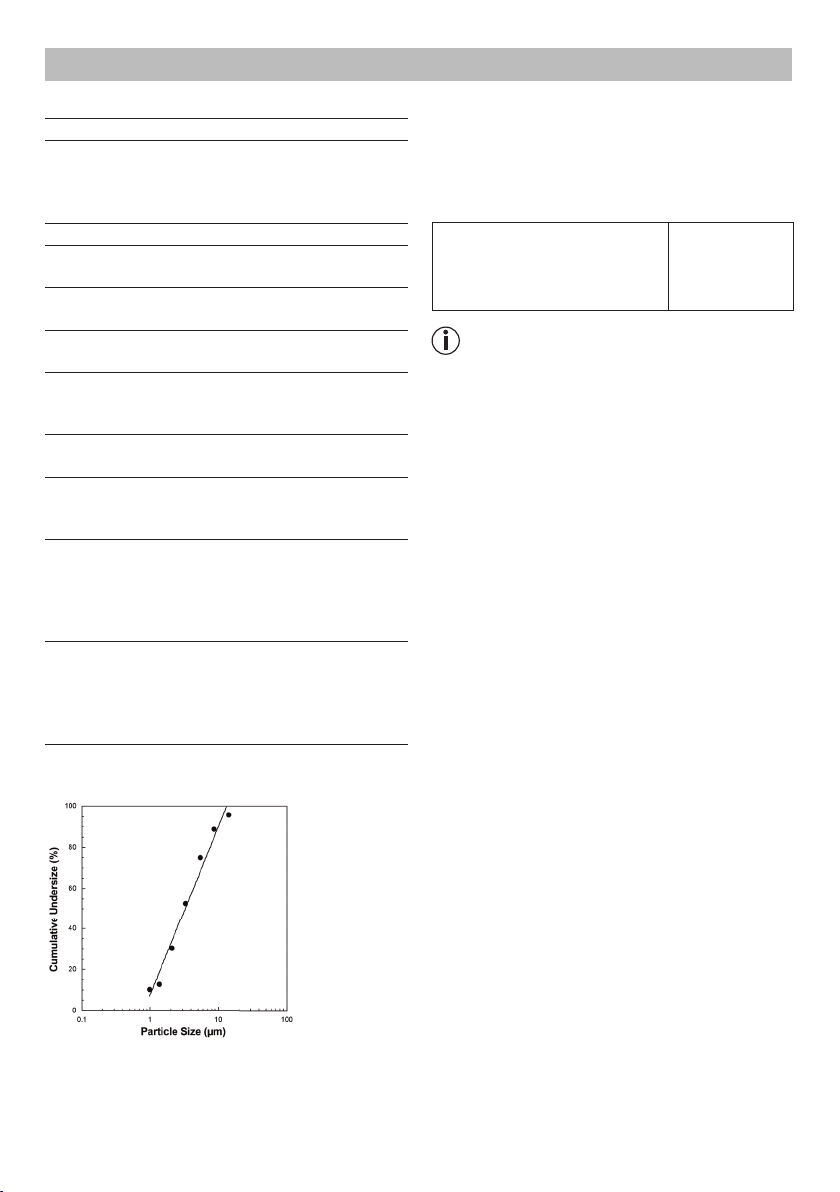
11. Dati tecnici
Modello SIH 21
Tipo SIH 21/2
Dimensioni
(larghezza,
altezza, profondità)
Peso 1,65 kg
Pressione
operativa
Capacità ne-
bulizzatore
Flusso del
medicinale
Pressione
sonora
Allacciamento
elettrico
Condizioni di
funzionamento
Condizioni di
trasporto e
immagazzinamento
Caratteristiche
aerosol
Con riserva di modifiche tecniche.
300 x 180 x 100 mm
ca. 0,8 - 1,45 bar
max. 8 ml
min. 2 ml
ca. 0,4 ml/min
max. 52 dBA
(secondo. DIN EN 13544-1:
paragrafo 26)
230 V~; 50 Hz; 230 VA
UK: 240 V~; 50 Hz; 240 VA
Temperatura: da +10°C a +40 °C
Umidità relativa dell’aria:
10% a 95%
Temperatura: da 0 °C a +60 °C
Umidità relativa dell’aria:
10% a 95%
Pressione ambiente: da 500 a
1060 hPa
Flusso: 5,31 l/min
Erogazione aerosol: 0,171 ml
Tasso di erogazione: 0,082 ml/min
Dimensione particelle (MMAD):
3,16 µm
Il diagramma non è quindi applicabile a sospensioni o a
farmaci particolarmente densi. Per ulteriori informazioni
a questo riguardo, consultare il produttore del farmaco
in questione.
Acquisto successivo
Yearpack SIH 21
Boccaglio, mascherina adulto/
bambino, nebulizzatore, tubo
dell'aria compressa, filtri
RIF
601.20
Avvertenza
L’inosservanza delle specifiche indicate non garantisce
il perfetto funzionamento del dispositivo. Ci riserviamo
la facoltà di apportare variazioni e migliorie tecniche
per un ulteriore sviluppo del prodotto.
Questo dispositivo e i relativi accessori sono fabbricati in accordo con le norme europee EN60601-1,
EN60601-1-2 e EN13544-1 e rispetta i requisiti essenziali di compatibilità elettromagnetica. Prestare attenzione al fatto che dispositivi di telecomunicazione
ad alta frequenza portatili e mobili possono interferire
con questo dispositivo. È possibile richiedere ulteriori
informazioni all’indirizzo del servizio clienti indicato.
Il dispositivo rispetta inoltre i requisiti della Direttiva
europea sui Dispositivi Medici 93/42/EC.
COMPATIBILITÀ ELETTROMAGNETICA
• L’apparecchio rispetta le norme vigenti in materia
di compatibilità elettromagnetica e può essere utilizzato in tutti gli edifici, inclusi quelli di domicilio
privato. Le emissioni in radiofrequenze dell’apparecchio sono estremamente basse ed è poco
probabile che provochino interferenze con altri
dispositivi nelle vicinanze.
•
Si consiglia comunque di non posizionare l’appa-
recchio sopra o vicino ad altri apparecchi. Qualora
dovessero verificarsi interferenze con altri apparecchi elettrici, spostarlo o collegarlo a un’altra
resa elettrica.
• Le radio possono influenzare il funzionamento
dell’apparecchio.
Le misurazioni sono state eseguite con una soluzione
di fluoruro di sodio e un “Next Generation Impactor”
(NGI).
46
Page 47

РУССКИЙ
Оглавление
1. Для ознакомления ...........................................48
2. Пояснения ксимволам ...................................48
3. Предупреждения иуказания по технике
безопасности ...................................................49
4. Описание прибора ипринадлежностей ........51
5. Подготовка кработе .......................................52
6. Обслуживание .................................................52
7. Замена фильтра ..............................................54
8. Очистка идезинфекция ..................................54
9. Утилизация .......................................................56
10. Устранение неисправностей ..........................56
11. Технические характеристики ..........................57
12. Гарантия ...........................................................58
Комплект поставки
См. описание прибора ипринадлежностей на стр.
51.
•
Ингалятор
•
Распылитель
•
Воздуховодная трубка
•
Мундштук
•
Маска для взрослых
•
Маска для детей
•
Сменный фильтр
•
Данная инструкция по применению
47
Page 48
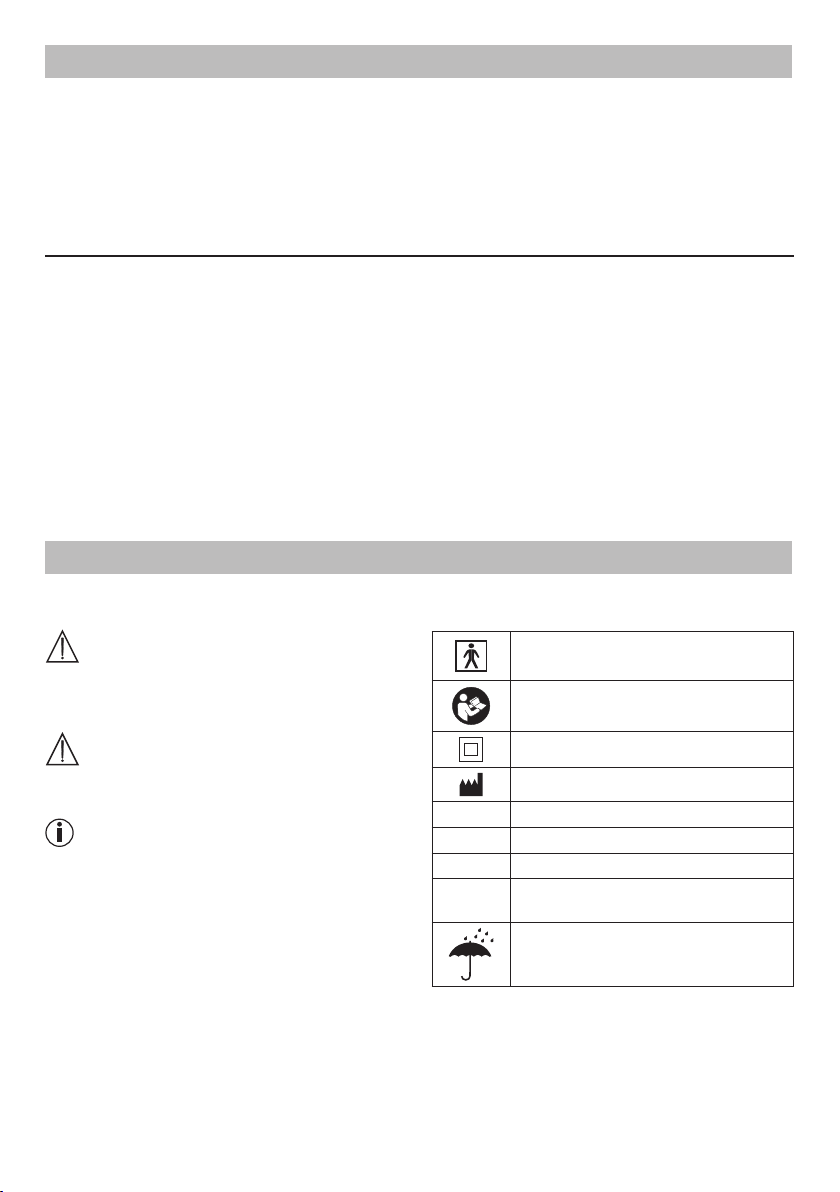
1. Для ознакомления
Уважаемый
покупатель!
Внимательно прочтите данную инструкцию по применению, сохраняйте ее для последующего использования, храните ее вместе, доступном для других
пользователей, иследуйте ее указаниям.
Область применения
Данный ингалятор предназначен для распыления жидкостей и жидких лекарственных
препаратов (аэрозолей), а также для лечения
верхних инижних дыхательных путей.
Распыление иингаляция назначенного или рекомендованного врачом лекарственного препарата
позволяет проводить профилактику заболеваний
дыхательных путей, смягчать сопутствующие явления иускорять выздоровление. Дальнейшую
информацию овариантах применения данного
2. Пояснения ксимволам
прибора Вы можете получить улечащего врача
или фармацевта.
Прибор подходит для ингаляции вдомашних условиях. Ингаляция сиспользованием лекарства
должна осуществляться только по назначению врача. Вдыхайте лекарство вспокойном ирасслабленном состоянии, дышите медленно иглубоко, чтобы
оно могло попасть даже всамые мелкие иглубоко
расположенные бронхи. Выдыхайте, как обычно.
Винструкции по применению используются следующие символы.
Предостережение Предупреждает об
опасности травмирования или ущерба для здоровья.
Внимание Указывает навозможные по-
вреждения прибора/принадлежностей.
Указание Отмечает важную информацию.
На упаковке ина типовой табличке прибора ипринадлежностей используются следующие символы:
Рабочая часть типа BF
Соблюдайте указания инструкции
поприменению.
Прибор склассом защиты 2
П
роизводитель
Вкл.
I
Выкл.
O
Серийный номер
SN
30 ВКЛ/
30 ВЫКЛ
48
30 мин. работы, затем перерыв 30
минут перед повторным включением.
Хранить всухом месте.
Page 49

3. Предостережения и указания по технике безопасности
Предостережение
• Перед использованием убедитесь втом, что
прибор иего принадлежности не имеют видимых повреждений. При наличии сомнений неиспользуйте прибор иобратитесь кпродавцу или
поуказанному адресу сервисной службы.
• При сбоях вработе прибора см. гл. «10. Устранение неисправностей».
• Применение прибора не заменяет консультации
уврача илечения. Поэтому при любых видах
боли или заболеваний всегда предварительно
консультируйтесь сврачом.
• При наличии каких-либо сомнений вотношении
здоровья проконсультируйтесь слечащим врачом!
• При использовании распылителя выполняйте
общепринятые санитарно-гигиенические мероприятия.
• Всегда следуйте указаниям врача относительно
типа используемого лекарственного препарата,
его дозировки, частоты идлительности ингаляций.
• Используйте только лекарственные препараты,
назначенные или рекомендованные врачом или
фармацевтом.
Соблюдайте следующие указания:
Для лечения использовать только те детали, применение которых было рекомендовано врачом
всоответствии ссостоянием здоровья.
• Внимательно прочитайте на прилагающемся
клекарственному препарату упаковочном листке информацию овозможных противопоказаниях
кприменению собычными системами аэрозольной терапии.
• Если прибор работает некорректно или уВас
появились недомогание или боли, сразу же прекратите использование прибора.
• Во время использования держите прибор на
достаточном расстоянии от глаз, распыленный
лекарственный препарат может привести ких
повреждениям.
• Не используйте прибор впомещениях сгорючи
ми газами.
• Данный прибор не предназначен для использования детьми или людьми сограниченными физическими, сенсорными (например, сотсутствием
болевой чувствительности) или умственными
способностями, снедостаточными знаниями или
опытом. Исключение составляют случаи, когда за
ними осуществляется надлежащий надзор или
-
49
если они получили от Вас инструкции по использованию прибора.
• Перед выполнением любых работ по очистке или
техническому обслуживанию необходимо выключить прибор из розетки.
• Не давайте упаковочный материал детям (опас
ность удушения).
• Кабель ивоздуховоды следует хранить вне досягаемости детей младшего возраста во избежание
запутывания иудушения.
• Не используйте дополнительные детали, не ре
комендованные производителем.
• Прибор разрешено подключать только ксетевому напряжению, указанному на заводской табличке.
• Не погружайте прибор вводу ине используйте
его во влажных помещениях. Не допускайте попадания жидкости внутрь прибора.
• Не допускайте сильных ударов прибора.
• Не берите кабель мокрыми руками – опасность
поражения электрическим током.
• Не вытаскивайте штекер из розетки, держась за
сетевой кабель.
• Не зажимайте, не перегибайте кабель, избегайте
его соприкосновения сострыми краями предметов, свисания ивоздействия на него высокой
температуры.
• Рекомендуется полностью разматывать питающий кабель для предотвращения перегрева.
• Вслучае повреждения сетевого кабеля икорпу
са прибора обратитесь всервисную службу или
кторговому представителю.
• При вскрытии прибора возникает опасность по
ражения электрическим током. Отсоединение от
сети выполнено только втом случае, если штекер
выключен из розетки.
• При падении прибора, сильном воздействии на
него влаги или иных повреждениях его дальнейшее использование запрещается. При наличии
сомнений обратитесь всервисную службу или
кторговому представителю.
• Ингалятор SIH 21 разрешается использовать
только вместе сподходящим распылителем ис
соответствующими принадлежностями. Применение принадлежностей сторонних производителей может привести кснижению эффективности
лечения иповреждению прибора.
-
-
-
-
Внимание
• Сбои вподаче электроэнергии, неожиданно возникшие неисправности идругие неблагоприятные условия могут привести квыходу прибора
Page 50
из строя. Поэтому рекомендуется иметь запасной
прибор или лекарственный препарат (согласованный сврачом).
• При необходимости использования адаптеров или
удлинителей они должны отвечать действующим
предписаниям техники безопасности. Нельзя превышать предельную мощность тока имаксимальную мощность, указанную на адаптере.
• Прибор нельзя хранить вблизи источников тепла.
• Не пользуйтесь прибором впомещениях, вкоторых перед этим использовались аэрозоли. Такие
помещения необходимо проветривать перед проведением терапии.
• Избегайте попадания мелких деталей вохлаждающие отверстия.
• Не используйте прибор, если при этом появляется необычный шум.
• Вцелях соблюдения санитарно-гигиенических
требований каждый пользователь должен иметь
свои индивидуальные принадлежности.
• После каждого использования выключайте прибор
из розетки.
• Храните прибор вместах, защищенных от воздействия погодных условий. Необходимо обеспечить соответствующие условия окружающей
среды для хранения прибора.
ПРЕДОХРАНИТЕЛЬ
• Вприборе установлен максимальный предохранитель. Его замена должна производиться только
квалифицированным персоналом со специаль
ным допуском.
-
Общие указания
Внимание
• Используйте прибор исключительно вследующих
целях:
– для лечения людей;
– вцелях, для которых он был разработан (аэ-
розольная ингаляция), всоответствии суказаниями, приведенными вданной инструкции по
применению.
• Любое ненадлежащее использование может
иметь опасные последствия!
• Вкритических ситуациях, прежде всего, следует
оказать первую помощь пострадавшему.
• Помимо лекарственных препаратов разрешается
использовать только дистиллированную воду или
физиологический раствор. Применение других
жидкостей при определенных условиях может
привести кповреждению ингалятора или распылителя.
• Прибор не предназначен для использования на
производстве или вклинических условиях. Его
применение разрешено исключительно вдомашних условиях!
Перед вводом вэксплуатацию
Внимание
• Перед использованием прибора следует удалить
все упаковочные материалы.
• Избегайте загрязнения прибора, попадания на
него пыли ивлаги. Во время использования ни
вкоем случае не накрывайте прибор.
• Не используйте прибор всильно запыленных
помещениях.
• Вслучае обнаружения дефектов или неполадок
вработе немедленно отключите прибор.
• Изготовитель не несет ответственности за ущерб,
вызванный неквалифицированным или ненадлежащим использованием прибора.
Ремонт прибора
Указание
• Ни вкоем случае не открывайте прибор ине ремонтируйте его самостоятельно, так как вданном
случае надежность его работы больше не гарантируется. Несоблюдение этого требования ведет
кпотере гарантии.
• Если прибор нуждается времонте, обратитесь
всервисную службу или кавторизованному торговому представителю.
50
Page 51
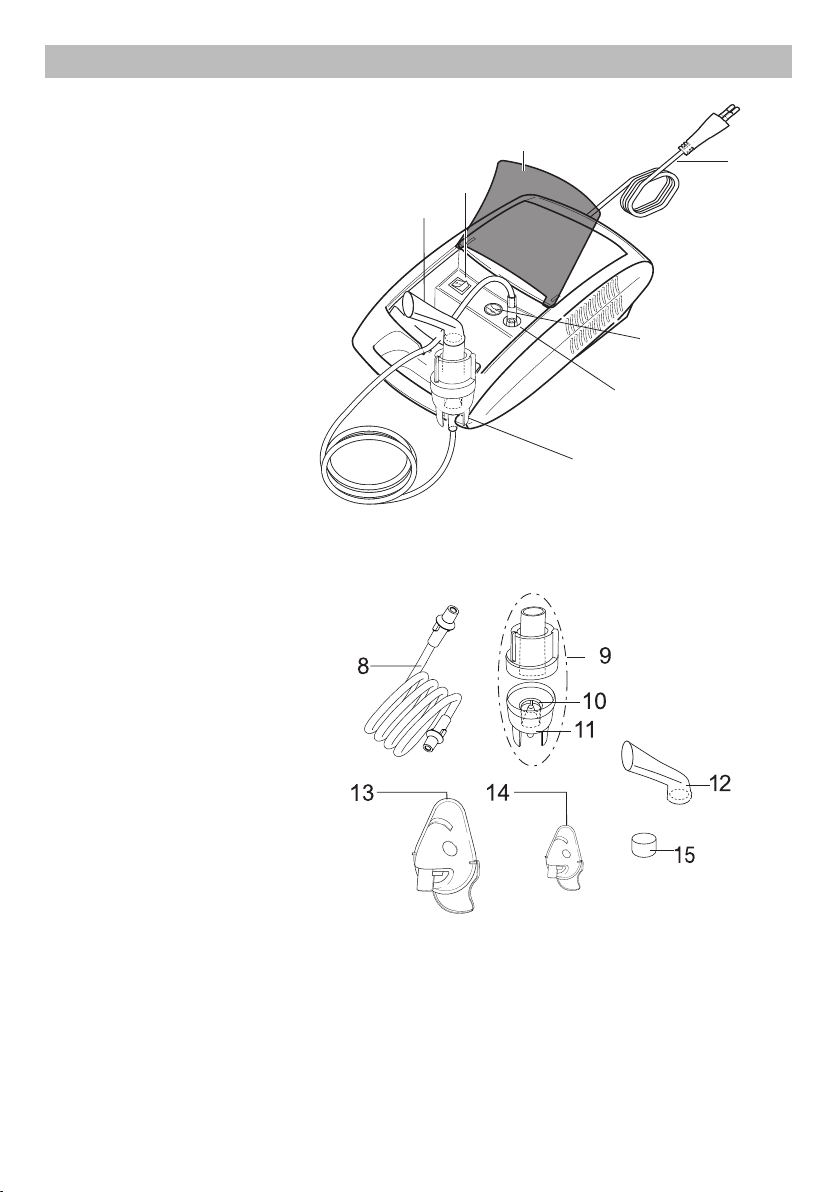
4. Описание прибора ипринадлежностей
Обзор компонентов
ингалятора
3
4
2
1
1. Сетевой кабель
2. Крышка
3. Кнопка ВКЛ./ВЫКЛ.
4. Отсек для
принадлежностей
5. Фильтр икрышка
фильтра
6. Разъем для подключения
трубки
7. Держатель для
распылителя
Обзор компонентов распылителя
ипринадлежностей
8. Воздуховодная трубка
9. Распылитель
10. Сопло
11. Емкость для лекарственных
препаратов
12. Мундштук
13. Маска для взрослых
14. Маска для детей
15. Сменный фильтр
5
6
7
51
Page 52
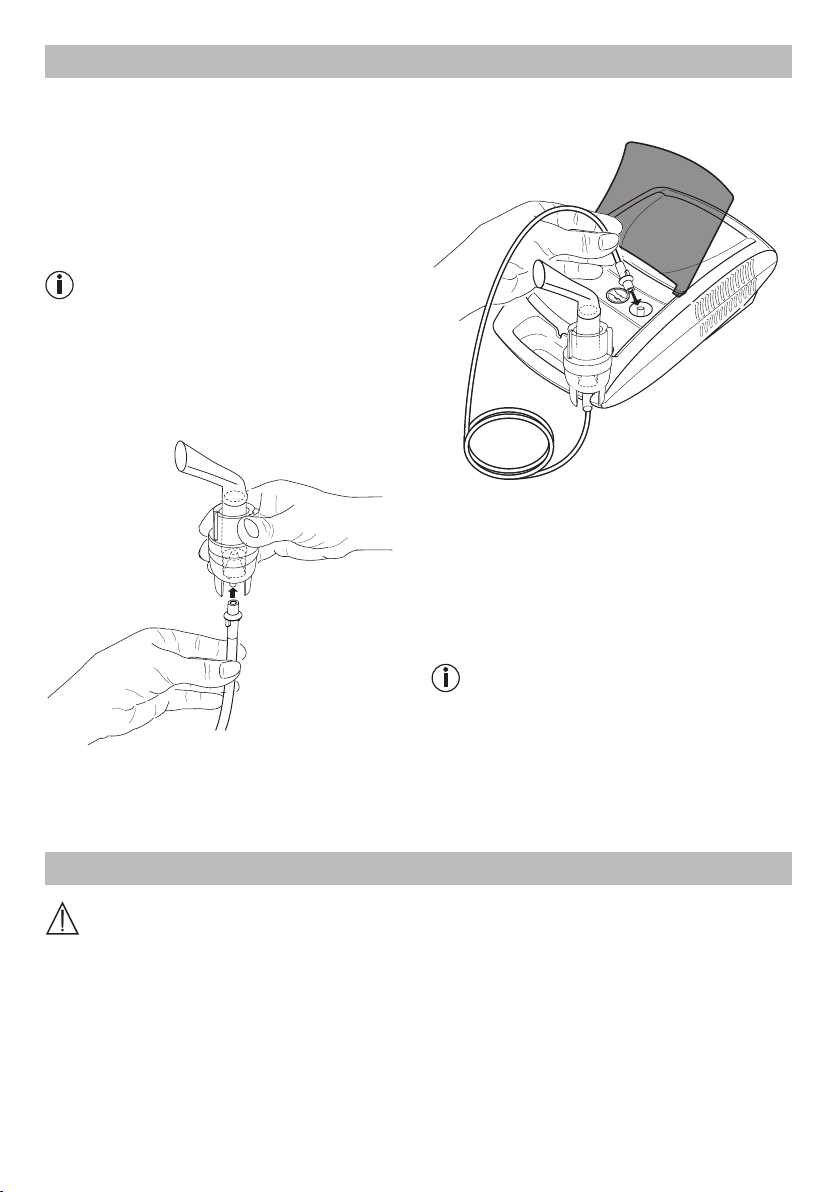
5. Подготовка кработе
Установка
Извлеките прибор из упаковки.
Установите прибор на ровную поверхность.
Следите за тем, чтобы прорези для вентиляции
оставались открытыми.
Чтобы достать принадлежности, откиньте крышку
[2].
Перед первым применением
Указание
• Перед первым применением следует очистить
ипродезинфицировать распылитель ипринадлежности кнему. См. раздел «Очистка идезинфекция» на стр.
• Вставьте воздуховодную трубку [8] вемкость для
лекарственных препаратов [11].
54
.
• Легким поворотом вставьте другой конец трубки
[8] вштуцер [6] ингалятора.
Подключение ксети
Подключайте прибор только ксетевому напряжению, указанному на заводской табличке.
• Вставьте штекер сетевого кабеля [1] вподходящую розетку.
• Для подключения ксети штекер должен быть
полностью вставлен врозетку.
Указание
• Убедитесь, что рядом сместом установки находится розетка.
• Разместите кабель таким образом, чтобы онего
невозможно было споткнуться.
• Для отключения ингалятора от сети после ингаляции сначала выключите сам прибор, затем
извлеките штекер из розетки.
6. Обслуживание
Внимание
• Вцелях соблюдения санитарно-гигиенических
требований распылитель [9] иего принадлежности следует очищать после каждого использования ипроводить его дезинфекцию вконце дня.
• Принадлежности могут быть использованы только одним лицом. Использование несколькими лицами не рекомендуется.
• Если для лечения необходимо последовательно
проводить ингаляцию несколькими видами лекарственных препаратов, то ингалятор [9] нужно
52
промывать теплой водопроводной водой после
каждого применения. См. раздел «Очистка идезинфекция» на стр. 54.
• Внимательно следуйте указаниям данной инструкции по замене фильтра!
• Перед каждым использованием прибора проверяйте прочность соединения трубки сингалятором [6] ираспылителем [9].
• Перед использованием проверьте правильность
работы прибора. Для этого ненадолго включите
ингалятор (вместе сраспылителем, но без лекар-
Page 53
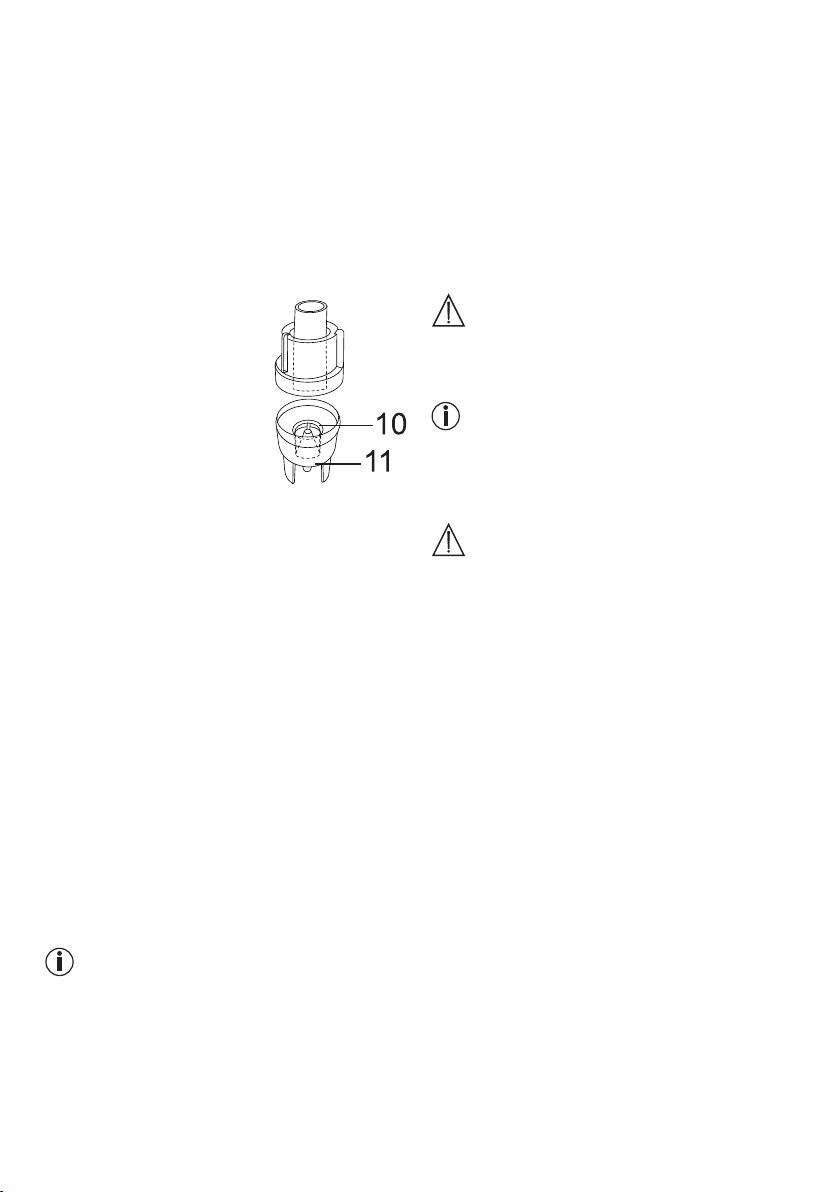
ственного препарата). Если при этом из распылителя [9] выходит воздух, то прибор работает.
1. Установка распылительной насадки
• Откройте распылитель [9], повернув верхнюю
часть корпуса против часовой стрелки относительно емкости для лекарственного препарата
[11]. Вставьте распылительную насадку [10] вемкость для лекарственного препарата [11].
• Убедитесь, что конус для ввода лекарственного
препарата хорошо закреплен на конусе для по
дачи воздуха враспылителе.
2. Наполнение распылителя
• Залейте изотонический
физиологический раствор
или лекарственный препарат непосредственно вемкость для лекарства [11]. Не
допускайте переполнения
емкости! Максимальный
рекомендуемый объем заполнения составляет 8мл!
• Используйте лекарственный
препарат только по назначению врача, спросите
его опродолжительности ингаляции иподходящем для Вас количестве лекарственного препарата.
• Если назначенное количество лекарственного
препарата меньше 2мл, добавьте изотонический
физиологическим раствор, доведя объем жидкости как минимум до 4мл. Необходимо также
разбавлять густые медикаменты. При этом также
следует соблюдать указания врача.
3. Закрытие распылителя
• Закройте распылитель [9], повернув верхнюю
часть корпуса по часовой стрелке относительно емкости для лекарственного препарата [11].
Следите за правильностью соединения!
4. Подсоединение принадлежностей крас-
пылителю
• Подсоедините краспылителю [9] требуемые принадлежности (мундштук [12], маску для взрослых
[13] или детскую маску [14]).
Указание
Ингаляция через мундштук является наиболее
эффективной формой терапии. Ингаляция через
маску рекомендуется только втом случае, если использование мундштука невозможно (например,
для детей, которые еще не могут вдыхать через
мундштук).
• Перед использованием извлеките распылитель
из крепления [7], потянув вверх.
• Включите ингалятор при помощи выключателя
[3].
• Появление аэрозоля из распылителя означает,
что он работает корректно.
5. Лечение
• Во время ингаляции рекомендуется сидеть прямо ирасслабленно за столом, ане вкресле для
-
предотвращения сдавливания дыхательных путей
иснижения эффективности лечения.
• Глубоко вдыхайте лекарственный препарат.
Внимание
Прибор не предназначен для непрерывного применения, после 30 минут работы его следует отключать на 30 минут.
Указание
Во время процедуры держите распылитель прямо
(вертикально), так как впротивном случае не будет
производиться распыление ине будет обеспечено
надлежащее действие прибора.
Внимание
Эфирные масла лекарственных растений, микстуры от кашля, растворы для полоскания горла, капли
для растирания ипаровых бань, как правило, не
подходят для ингаляции спомощью ингаляторов.
Данные добавки часто бывают вязкими имогут
нарушить работу прибора, тем самым снизив эффективность его применения. При повышенной
чувствительности бронхиальной системы медикаменты сэфирными маслами могут вызвать острый
бронхоспазм (резкое исудорожное сужение бронхов судушьем). Проконсультируйтесь об этом слечащим врачом или фармацевтом!
6. Завершение ингаляции
Если распыляемое вещество выходит неравномерно или изменяется шум при ингаляции, процедуру
можно завершить.
• После завершения процедуры отключите ингалятор спомощью выключателя [3] иотсоедините от
сети.
• Снова вставьте распылитель [9] вкрепление [7].
7. Выполнение очистки
См. раздел «Очистка идезинфекция» на стр. 54.
53
Page 54
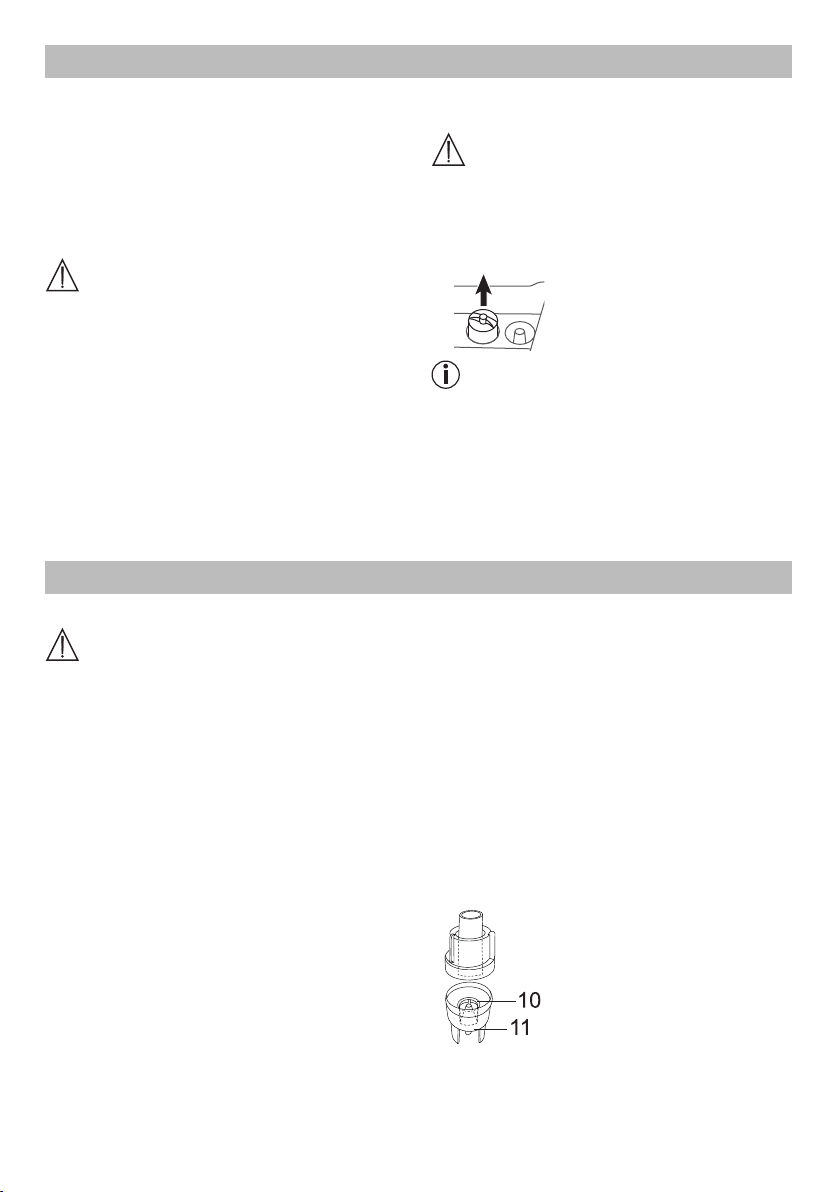
7. Замена фильтра
При обычных условиях использования воздушный
фильтр следует менять примерно после 500 часов
работы или один раз вгод. Регулярно контролируйте воздушный фильтр (после каждых 10–12
процедур ингаляции).
Замените использованный фильтр, если он сильно
загрязнен или засорился. Если фильтр намок, если
также следует заменить.
Внимание
• Не пытайтесь очистить иповторно использовать
старый фильтр!
• Используйте исключительно оригинальный
фильтр от производителя, впротивном случае
возможно повреждение ингалятора или снижение эффективности лечения.
• Запрещается ремонт итехническое обслужива
ние воздушного фильтра во время его использования.
• Никогда не пользуйтесь прибором без фильтра.
-
8. Очистка идезинфекция
Распылитель ипринадлежности
Предупреждение
Соблюдайте описанные ниже правила гигиены, чтобы избежать опасности для здоровья.
• Распылитель [9] иего принадлежности предназначены для многократного использования.
Обратите внимание, что требования кочистке
игигиенической обработке различаются взависимости от области применения прибора.
Указания:
• Не следует выполнять механическую очистку
распылителя ипринадлежностей щетками иподобными средствами всвязи свозможным нанесением непоправимого ущерба иотсутствием
должного эффекта от лечения.
• Проконсультируйтесь сВашим врачом относительно дополнительных требований, предъявляемых кнеобходимой гигиенической подготовке
(уход за руками, применение лекарственных препаратов или растворов для ингаляций) для групп
повышенного риска (например, для пациентов,
страдающих муковисцидозом).
• После каждой очистки или дезинфекции обеспечьте достаточное просушивание. Остаточная
Для замены фильтра следуйте следующим указаниям:
Внимание
• Сначала выключите прибор иотсоедините его от
сети.
• Дайте прибору остыть.
1. Снимите крышку фильтра [5], потянув ее вверх.
Указание
Если после снятия крышки фильтр остается вприборе, извлеките его, например, спомощью пинцета
или другого подобного инструмента.
2. После замены фильтра наденьте крышку фильтра
[5] на новый фильтр.
3. Проверьте, прочно ли надета крышка.
влажность может привести кповышению риска
размножения бактерий.
Подготовка
• Сразу после каждой процедуры все детали
распылителя [9], атакже использованные принадлежности необходимо очистить от остатков
лекарственного препарата изагрязнений.
• Разберите распылитель [9] на составные части.
• Извлеките мундштук [12] из распылителя.
• Разберите распылитель, повернув верхнюю часть
против часовой стрелки относительно емкости
для лекарственного препарата [11].
• Извлеките распылительную насадку [10] из емкости для лекарственного препарата [11].
• Сборка выполняется по аналогии вобратной последовательности.
54
Page 55
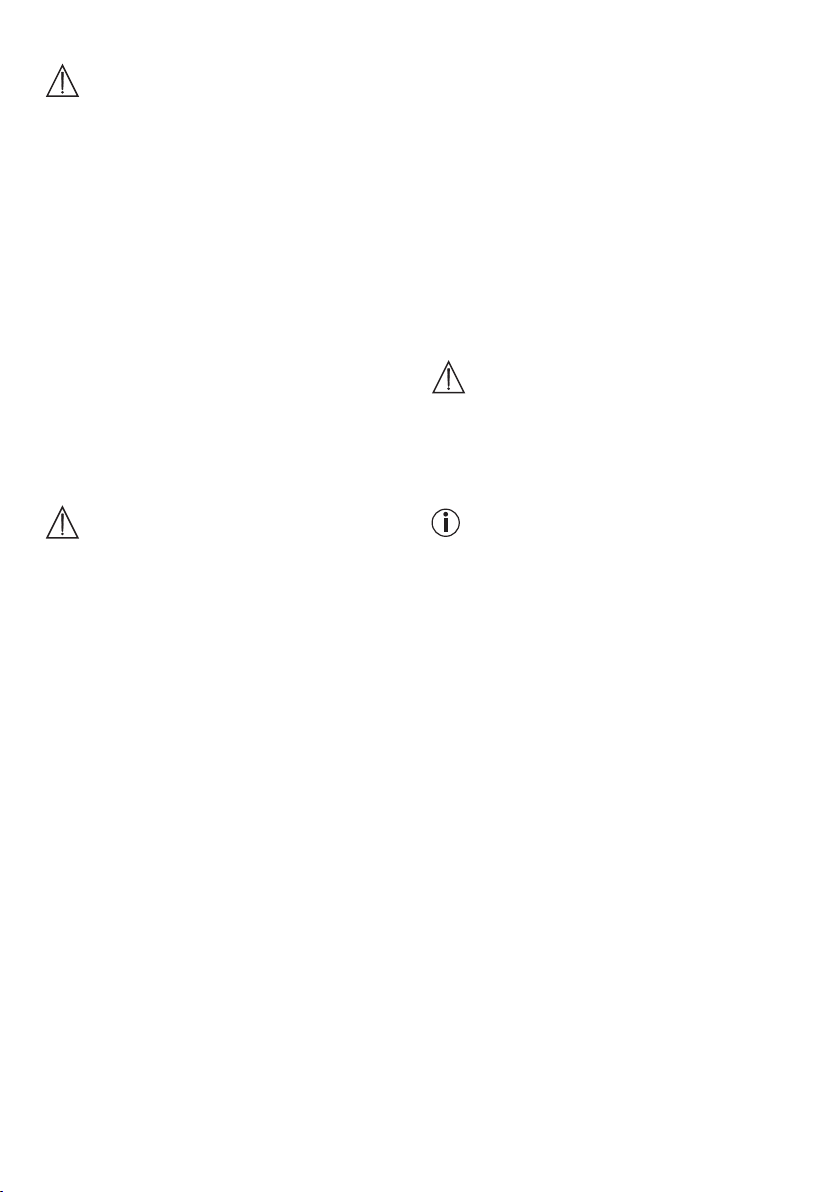
Очистка
Внимание
Перед каждой очисткой убедитесь, что прибор выключен, отсоединен от сети иостыл.
Распылитель ииспользованные принадлежности,
такие как мундштук, маска, распылительная насадка т.д. после каждого применения необходимо
промывать горячей, но не кипящей водой. Тщательно высушите детали мягкой тканью. После полного
высыхания соберите детали иположите их всухую
герметичную емкость или продезинфицируйте.
При очистке убедитесь, что все остатки удалены.
При этом ни вкоем случае не используйте вещества, которые могут быть потенциально опасными
при попадании на кожу или слизистую оболочку,
проглатывании или вдыхании.
Для очистки прибора используйте мягкую, сухую
тряпку инеабразивное чистящее средство.
Не используйте сильнодействующих чистящих
средств ине погружайте прибор вводу.
(Для этого Вам потребуется немного бесцветного
уксуса идистиллированной воды.)
•
Сначала очистите распылитель ипринадлежности, как описано вразделе «Очистка».
• Разобранный распылитель имундштук положить на 5 минут вкипящую воду.
• Для прочих принадлежностей
твор, состоящий на ¼ из уксуса ина ¾ из дис
тиллированной воды. Убедитесь, что жидкости
достаточно, чтобы можно было полностью погрузить внее детали.
• Оставьте детали на 30минут вуксусном растворе.
•
Промойте детали водой иразложите из для просушки на мягком полотенце.
используйте рас-
Внимание
Маски ивоздушный шланг не подвергать кипячению ине помещать вавтоклав.
• После полного высыхания соберите детали иположите их всухую герметичную емкость.
-
Внимание
• Следите за тем, чтобы внутрь прибора не попала
вода!
• Не мойте прибор ипринадлежности впосудомоечной машине!
• Не прикасайтесь кподключенному ксети прибору влажными руками; избегайте попадания воды
на прибор. Прибор разрешается использовать
только абсолютно сухим.
• Не распыляйте жидкость ввентиляционные отверстия! Попадание жидкостей может привести
кповреждению электрических идругих деталей
ингалятора, атакже ксбоям вего работе.
Конденсат, обслуживание трубки
Взависимости от условий окружающей среды
втрубке может образовываться конденсат. Чтобы
препятствовать росту микроорганизмов игарантировать безупречное лечение, влагу необходимо
удалять. Для этого необходимо сделать следующее:
• Извлеките трубку [8] из распылителя [9].
• Оставьте трубку вингаляторе [6].
• Оставьте ингалятор включенным до тех пор, пока
поток воздуха не удалит всю влагу.
• При сильном загрязнении замените трубку.
Дезинфекция
При проведении дезинфекции распылителя тщательно соблюдайте следующие правила. Рекомендуется дезинфицировать детали прибора не реже
чем после последнего применения за день.
Указание
Обратите внимание, что при или после очистки
необходимо полностью высушить детали, так как
впротивном случае возрастает риск размножения
бактерий.
Стерилизация
• Используйте растворы для холодной стерилизации всоответствии суказаниями производителя.
Сушка
• Положите составные детали на сухую чистую
ивпитывающую влагу подстилку иоставьте до
полного высыхания (не менее 4 часов).
Устойчивость материала
• Как ивсе детали из пластика, распылитель иего
принадлежности изнашиваются при частом использовании игигиенической обработке. Со временем это может привести кизменению состава
аэрозоля и, как следствие, снизить эффективность лечения. Поэтому рекомендуется менять
распылитель ежегодно.
• При выборе средства для очистки идезинфекции
необходимо учитывать следующее: используйте
только мягкое чистящее средство или дезинфи
цирующее средство вколичестве, указанном
производителем.
-
55
Page 56
Хранение
• Нельзя хранить прибор во влажных помещениях
(например, вванной комнате) иперевозить его
вместе свлажными предметами.
• Храните иперевозите прибор вместе, защищенном от длительного воздействия прямых солнечных лучей.
9. Утилизация
• Принадлежности можно хранить вспециально
предназначенном для этого отсеке [4]. Храните
прибор всухом месте, лучше всего, вупаковке.
Вцелях защиты окружающей среды прибор
следует утилизировать отдельно от бытового
мусора.
Прибор следует утилизировать согласно
Директиве ЕС по отходам электрическо
го иэлектронного оборудования — WEEE
(Waste Electrical and Electronic Equipment).
-
При возникновении вопросов, обращайтесь вкоммунальную организацию, занимающуюся вопросами утилизации.
10. Устранение неисправностей
Проблемы/вопросы Возможная причина/устранение
Распылитель не производит
аэрозоль или производит
его внедостаточном коли
честве.
Объем получаемого аэро
золя слишком мал.
Какие медикаменты можно
использовать для ингаля
ций?
Враспылителе остается
раствор для ингаляций.
На что следует обратить
внимание при лечении
детей имладенцев?
1. Враспылителе слишком много или слишком мало лекарственного
препарата.
-
Минимальное количество лекарственного препарата: 2мл, максимальное количество лекарственного препарата: 8мл
2. Проверьте, не засорилось ли сопло.
При необходимости очистите сопло (например, промывкой). После
этого вновь включите распылитель.
ВНИМАНИЕ! Мелкие отверстия осторожно протыкайте только снижней
стороны сопла.
3. Распылитель не ввертикальном положении.
4. Используемый лекарственный препарат не подходит для распыления
(например, жидкость слишком густая).
Лекарство должно быть назначено врачом.
-
Шланг перегнут, фильтр засорен, слишком большое количество рас
твора для ингаляций.
Проконсультируйтесь об этом сврачом.
-
Впринципе, можно применять любые лекарства, подходящие идопущенные киспользованию для ингаляторов.
Это нормально ипроисходит по техническим причинам. Если вы
услышите, что звук, издаваемый распылителем при работе, сильно
изменился, сразу же прекратите ингаляцию.
1. Для обеспечения эффективной ингаляции умладенцев маска должна
закрывать рот инос.
2. При проведении ингаляции удетей маска также должна закрывать
рот инос. Распыление лекарственного препарата рядом со спящим
человеком менее эффективно, поскольку влегкие не попадает до
статочное количество медикамента.
Указание: ингаляция должна осуществляться под присмотром ис
помощью взрослого, во время ингаляции нельзя оставлять ребенка
одного.
-
-
56
Page 57
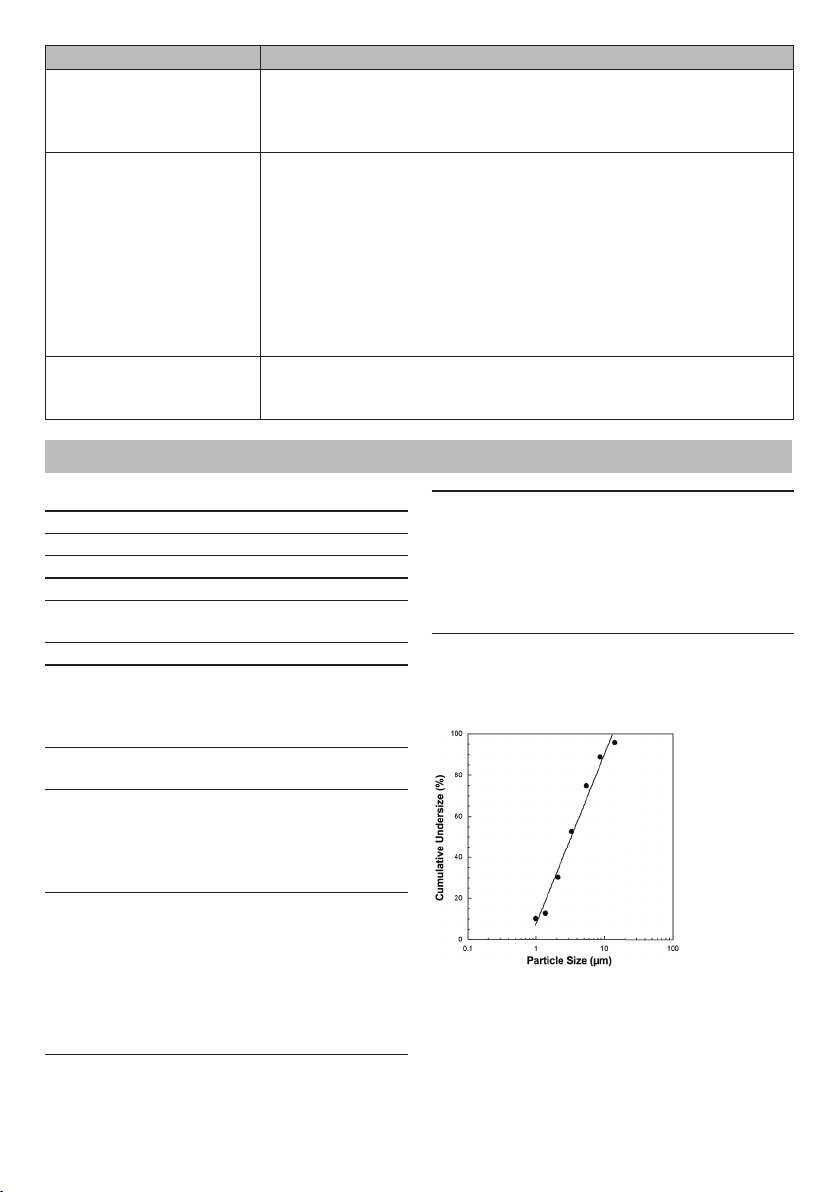
Проблемы/вопросы Возможная причина/устранение
Ингаляция смаской длится
дольше?
Почему нужно регулярно
заменять распылитель?
Для каждого пользователя
нужен собственный распылитель?
Это происходит по техническим причинам. Через отверстия вмаске
за один вдох Вы вдыхаете меньшее количество лекарства, чем через
мундштук. Проходя через эти отверстия, аэрозоль смешивается своздухом впомещении.
Это обусловлено двумя причинами:
1. Для обеспечения необходимого для эффективного лечения спектра
частиц, диаметр отверстия сопла не должен превышать определенных размеров. Пластмасса визвестной степени подвержена износу
вследствие механической итермической нагрузки. Осторожно
обращайтесь сраспылительной насадкой [10]. Из-за этого может измениться дисперсный состав аэрозоля, что непосредственно влияет
на эффективность лечения.
2. Кроме этого, регулярная замена распылителя рекомендуется вцелях
соблюдения санитарно-гигиенических требований.
Это обязательно по гигиеническим соображениям.
11. Технические характеристики
Модель SIH 21
Тип SIH 21/2
Размеры (Шх Вх Г) 300 x180 x100мм
Вес 1,65кг
Рабочее давление около 0,8–1,45бар
Объем наполнения
распылителя
Расход лекарства ок. 0,4мл/мин
Звуковое давление не более 52дБА
Подключение ксети 230 В~; 50 Гц; 230 ВА
Условия эксплуатации
Условия хранения
итранспортировки
макс. 8мл
мин. 2мл
(согл. стандарту DIN EN
13544-1
раздел 26)
UK: 240 В~; 50 Гц; 240 ВА
Температура: от +10 °Cдо
+40 °C
Относительная влажность
воздуха:
от 10% до 95%
Температура: от 0 °Cдо
+60 °C
Относительная влажность
воздуха:
от 10% до 95%
Давление окружающей
среды:
от 500 до 1060гПа
Аэрозоль
Характеристики
Возможны технические изменения.
Измерения производились сиспользованием раствора фторида натрия при помощи Next Generation
Impactor (NGI).
Поэтому диаграмма может не подходить для суспензий или очень густых медикаментов. Более
подробную информацию можно узнать упроизводителя соответствующего лекарства.
Расход 5,31л/мин
Выходной объем аэрозоля
0,171мл
Скорость распыления
0,082мл/мин
Размер частиц (MMAD):
3,16 µм
57
Page 58
Предметы, приобретаемые дополнительно
Yearpack SIH 21
Мундштук, маска для
взрослых/детей, распылитель,
воздуховодная трубка, фильтр
REF
601.20
Указание
Вслучае применения прибора не всоответствии
со спецификацией безупречное функционирование
не гарантируется! Мы оставляем за собой право
на технические изменения всвязи смодернизацией иусовершенствованием продукта. Данный
прибор иего принадлежности соответствуют европейским стандартам EN60601-1 иEN60601-1-2,
атакже EN13544-1 итребуют соблюдения особых
мер предосторожности вотношении электромаг
нитной совместимости. Следует учесть, что переносные имобильные высокочастотные коммуникационные устройства могут повлиять на работу
данного прибора. Точные данные можно запросить
по указанному адресу сервисной службы. Данный
-
12. Гарантия
прибор соответствует требованиям Европейской
директивы омедицинских изделиях 93/42/EC, атакже Закону омедицинских изделиях.
ЭЛЕКТРОМАГНИТНАЯ СОВМЕСТИМОСТЬ
• Прибор соответствует всем действующим внастоящее время предписаниям по электромагнитной совместимости иподходит для использования влюбых жилых зданиях. Уровень испускаемых прибором радиочастот очень низок ипоэтому вероятность того, что он вызовет помехи
вработе находящегося рядом оборудования,
крайне мала.
• Влюбом случае не рекомендуется устанавливать
прибор рядом сдругими устройствами или над
ними. Если помехи вработе других приборов все
же возникли, переставьте ингалятор вдругое место или подключите его кдругой розетке.
• Радиоаппаратура может повлиять на работу ин
галятора.
-
Мы предоставляем гарантию на дефекты материа
лов и изготовления этого прибора на срок 24 месяца со дня продажи через розничную сеть.
Гарантия не распространяется:
•
на случаи ущерба, вызванного неправильным
использованием,
•
на быстроизнашивающиеся части
(фильтры, маски, трубки),
•
на дефекты, о которых покупатель
знал в момент покупки
•
на случаи собственной вины покупателя.
Срок эксплуатации изделия: минимум 5 лет
Фирма-изготовитель: Бойрер Гмбх,
Софлингер штрассе 218,
89077-УЛМ, Германия для
фирмы Ханс Динслаге ЛТд
88524 Уттенвайлер,
Германия
Фирма-импортер: OOO Бойрер,
109451 г. Москва,
ул. Перерва 62, корп.2,
офис 3
Сервисный центр: 109451 г. Москва,
ул. Перерва 62, корп. 2
Тел(факс) 495– 658 54 90
[email protected]
-
Дата продажи
Подпись продавца
Штамп магазина
Подпись покупателя
58
Page 59
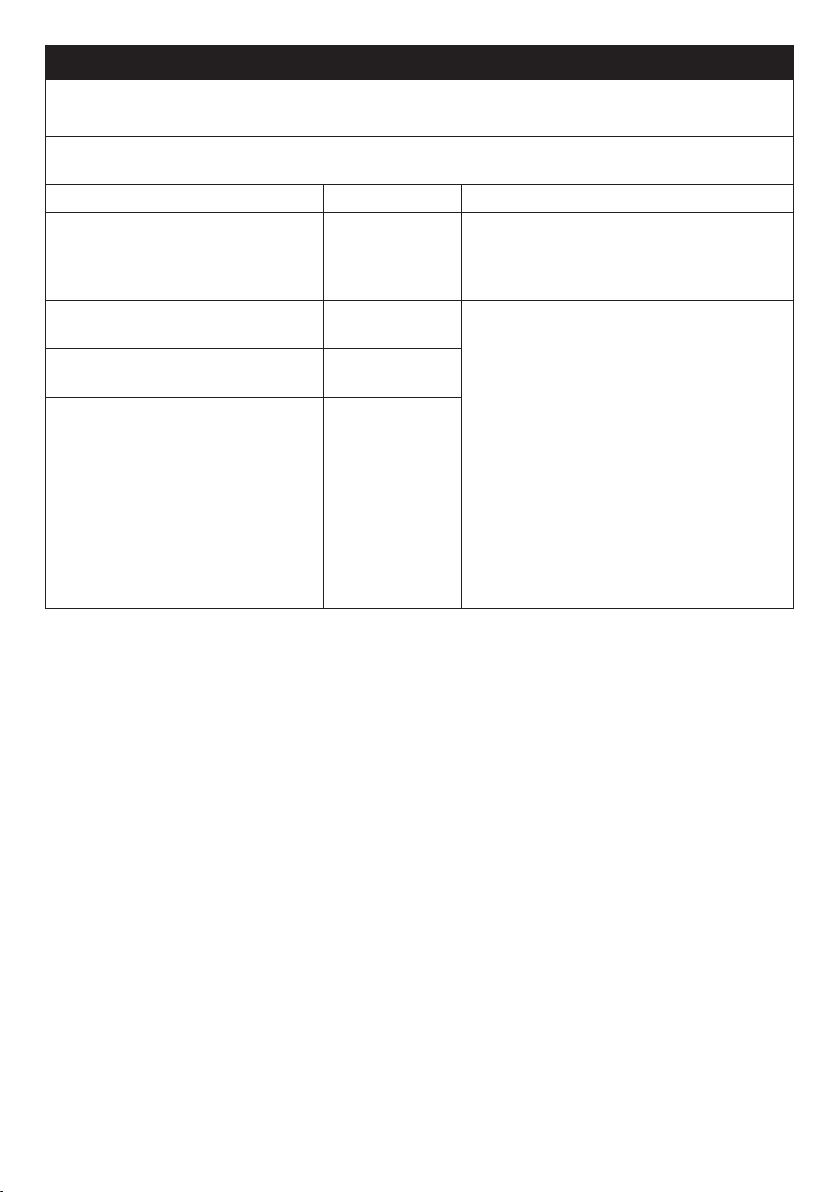
ELECTROMAGNETIC COMPATIBILITY INFORMATION
Guidance and manufacturer’s declaration - electromagnetic emissions
The SIH21/2 is intended for use in the electromagnetic environment specified below. The customer or the
user of the SIH21/2 should assure that it is used in such an environment
Emissions Compliance Electromagnetic environment – guidance
RF emissions
CISPR 11
RF emissions
CISPR 11
Harmonic emissions
IEC 61000-3-2
Voltage fluctuations/flicker emissions
IEC 61000-3-3
Group 1
Class B The SIH21/2 is suitable for use in all establish
Class A
Complies
The SIH21/2 uses RF energy only for its internal
function. Therefore, its RF emissions are very
low and are not likely to cause any interference
in nearby electronic equipment.
ments other than domestic, and may be used
in domestic establishments and those directly connected to the public low-voltage power
supply network that supplies buildings used
for domestic purposes, provided the following
warning is heeded:
Warning: This equipment/system is intended
for use by healthcare professionals only. This
equipment/ system may cause radio interference or may disrupt the operation of nearby
equipment. It may be necessary to take mitigation measures, such as re-orienting or relocating
the SIH21/2 or shielding the location.
59
Page 60

Guidance and manufacturer’s declaration – electromagnetic immunity
The SIH21/2 is intended for use in the electromagnetic environment specified below. The customer or the
user of the SIH21/2 should assure that it is used in such an environment
Immunity test EN 60601
test level
Electrostatic
discharge (ESD)
±6 kV contact
±8 kV air
IEC 61000-4-2
Compliance level
±6 kV contact
±8 kV air
Electromagnetic environment – guidance
Floors should be wood, concrete or
ceramic tile. If floors are covered with
synthetic material, the relative humidity should be at least 30 %
Electrical fast
transient/burst
IEC 61000-4-4
±2 kV for power supply lines
±1 kV for input/output
lines
±2 kV for power supply
lines
Mains power quality should be that
of a typical commercial or hospital
environment.
The electrical fast transient burst
(EFT) is generated by the switching of
inductive loads. Separation between
the equipment and other loads shall
be considered before installation.
Mains filter is required, if necessary.
Surge
IEC 61000-4-5
±1 kV line(s) to line(s)
±2 kV line(s) to earth
±1 kV line(s) to line(s)
Mains power quality should be that
of a typical commercial or hospital
environment.
Voltage dips, short
interruptions and
voltage variations
on power supply
input lines
IEC 61000-4-11
Power frequency
(50/60Hz)
magnetic field
IEC 61000-4-8
NOTE U
is the a.c. mains voltage prior to application of the test level
T
<5 % U
T
(>95 % dip in UT)
for 0,5 cycle
40 % U
T
(60 % dip in UT)
for 5 cycles
70 % U
T
(30 % dip in UT)
for 25 cycles
<5 % U
T
(>95 % dip in UT)
for 5s
3 A/m 3 A/m
<5 % U
T
(>95 % dip in UT)
for 0,5 cycle
40 % U
T
(60 % dip in UT)
for 5 cycles
70 % U
T
(30 % dip in UT)
for 25 cycles
<5 % U
T
(>95 % dip in UT)
for 5s
Mains power quality should be that of
a typical commercial or hospital environment. If the user of the SIH21/2
requires continued operation during
power mains interruptions, it is recommended the SIH21/2 be powered
from an uninterruptible power supply
or a battery.
Power frequency magnetic fields
should be at levels characteristic of a
typical location in a typical commer
-
cial or hospital environment.
60
Page 61
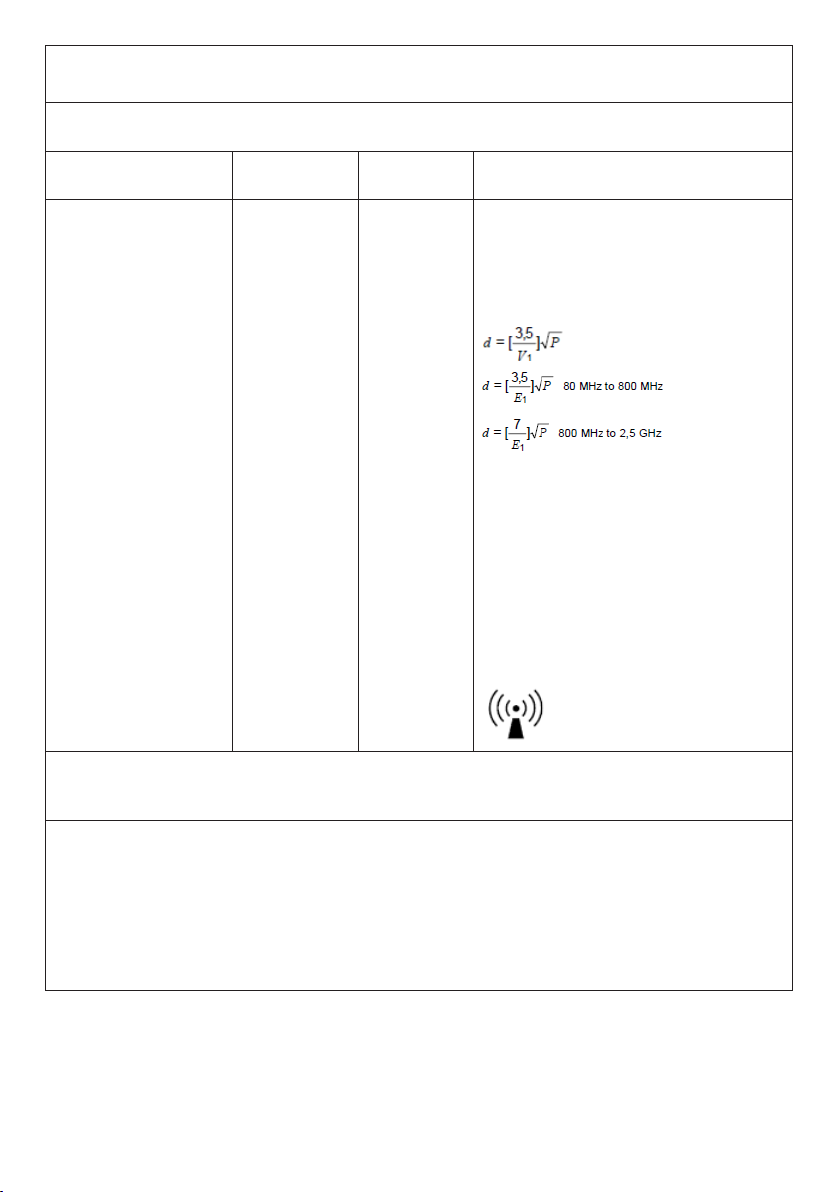
Guidance and manufacturer’s declaration – electromagnetic immunity
The SIH21/2 is intended for use in the electromagnetic environment specified below. The customer or the
user of the SIH21/2 should assure that it is used in such an environment
Immunity test EN 60601
test level
Conducted RF
IEC 61000-4-6
3 Vrms
150 kHz to
80 MHz
Compliance
level
3 V
Electromagnetic environment – guidance
Portable and mobile RF communications
equipment should be used no closer to any
part of the SIH21/2, including cables, than the
recommended separation distance calculated
from the equation applicable to the frequency
of the transmitter.
Radiated RF
IEC 61000-4-3
3 V/m
80 MHz to
3 V/m
2.5 GHz
where p is the maximum output power rating
of the transmitter in watts (W) according to the
transmitter manufacturer and d is the recommended separation distance in metres (m)
Field strengths from fixed RF transmitters,
as determined by an electromagnetic site
survey,a should be less than the compliance
level in each frequency range.b
Interference may occur in the vicinity of equipment marked with the following symbol:
NOTE 1 At 80 MHz and 800 MHz, the higher frequency range applies.
NOTE 2 These guidelines may not apply in all situations. Electromagnetic propagation is affected by
absorption and reflection from structures, objects and people.
a
Field strengths from fixed transmitters, such as base stations for radio (cellular/cordless) telephones and land
mobile radios, amateur radio, AM and FM radio broadcast and TV broadcast cannot be predicted theoretically
with accuracy. To assess the electromagnetic environment due to fixed RF transmitters, an electromagnetic
site survey should be considered. If the measured field strength in the location in which the SIH21/2 is used
exceeds the applicable RF compliance level above, the SIH21/2 should be observed to verify normal opera
tion. If abnormal performance is observed, additional measures may be necessary, such as re-orienting or
relocating the SIH21/2.
b
Over the frequency range 150 kHz to 80 MHz, field strengths should be less than 3 V/m.
61
Page 62
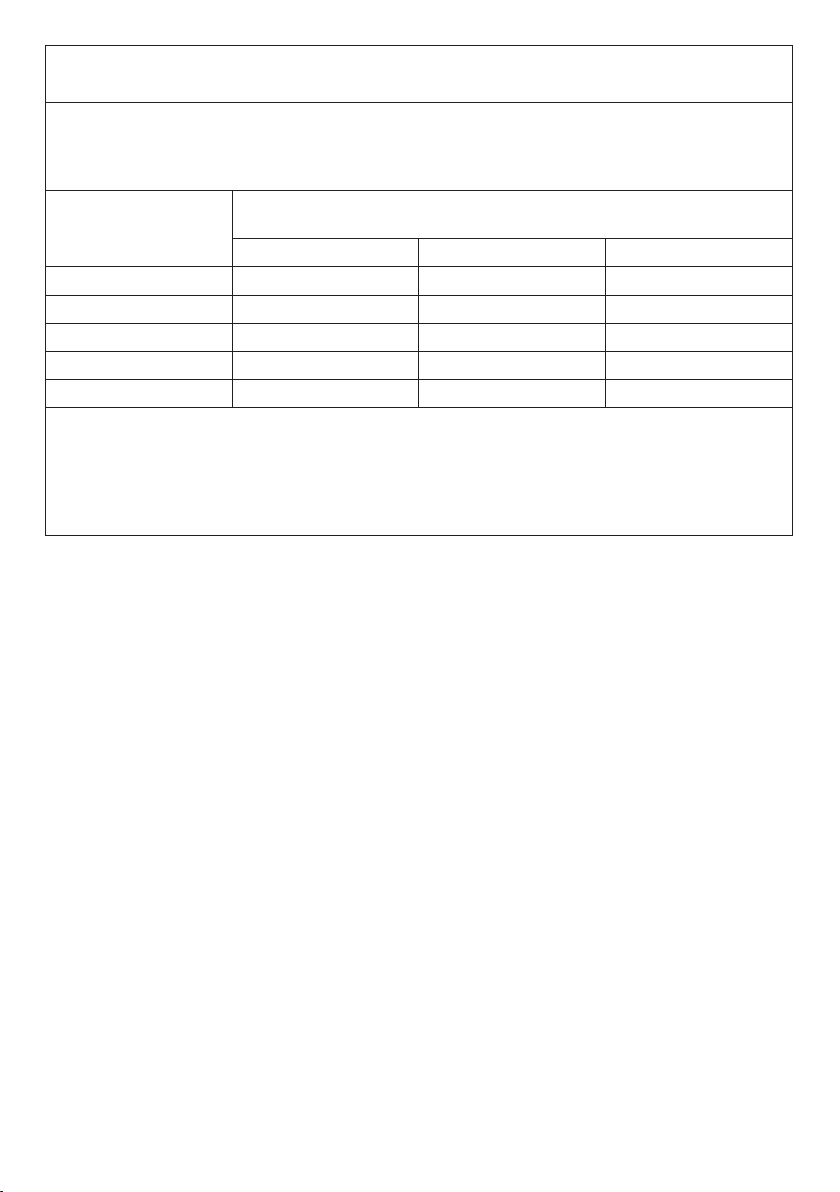
Recommended separation distances between portable and mobile RF communications equipment
and the SIH21/2
The SIH21/2 is intended for use in an electromagnetic environment in which radiated RF disturbances are
controlled. The customer or the user of the SIH21/2 can help prevent electromagnetic interference by maintaining a minimum distance between portable and mobile RF communications equipment (transmitters) and the
SIH21/2 as recommended below, according to the maximum output power of the communications equipment.
Rated maximum output
power of transmitter
W
0.01 0.12 0.12 0.23
0.1 0.37 0.38 0.73
1 1.2 1.2 2.3
10 3.8 3.8 7.3
100 12 12 23
For transmitters rated at a maximum output power not listed above, the recommended separation distance
d in metres (m) can be estimated using the equation applicable to the frequency of the transmitter, where P
is the maximum output power rating of the transmitter in watts (W) according to the transmitter manufacturer.
NOTE 1 At 80 MHz and 800 MHz, the separation distance for the higher frequency range applies.
NOTE 2 These guidelines may not apply in all situations. Electromagnetic propagation is affected by absorption
and reflection from structures, objects and people.
Separation distance according to frequency of transmitter
m
150 kHz to 80 MHz 80 MHz to 800 MHz 800 MHz to 2.5 GHz
62
Page 63

63
Page 64

64
751.869-0715 Irrtum und Änderung vorbehalten
 Loading...