

Page 1

HD Camcorder
PUB.DIE-0511-000
Instruction Manual
Page 2

COPYRIGHT WARNING:
Unauthorized recording of copyrighted materials may infringe on the rights of copyright owners and be contrary to copyright
laws.
2
Trademark Acknowledgements
• SD, SDHC and SDXC Logos are trademarks of SD-3C, LLC.
• Microsoft and Windows are trademarks or registered trademarks of Microsoft Corporation in the United States and/or other countries.
• macOS is a trademark of Apple Inc., registered in the U.S. and other countries.
• HDMI, the HDMI logo and High-Definition Multimedia Interface are trademarks or registered trademarks of HDMI Licensing LLC in the
United States and other countries.
• “AVCHD”, “AVCHD Progressive” and the “AVCHD Progressive” logo are trademarks of Panasonic
Corporation and Sony Corporation.
• Manufactured under license from Dolby Laboratories.
“Dolby” and the double-D symbol are trademarks of Dolby Laboratories.
• Other names and products not mentioned above may be trademarks or registered trademarks of their
respective companies.
• This device incorporates exFAT technology licensed from Microsoft.
• “Full HD 1080” refers to Canon camcorders compliant with high-definition video composed of 1,080 vertical pixels
(scanning lines).
• This product is licensed under AT&T patents for the MPEG-4 standard and may be used for encoding MPEG-4
compliant video and/or decoding MPEG-4 compliant video that was encoded only (1) for a personal and noncommercial purpose or (2) by a video provider licensed under the AT&T patents to provide MPEG-4 compliant video. No license is
granted or implied for any other use for MPEG-4 standard.
Page 3

Highlights of the Camcorder
The Canon VIXIA HF G21 HD Camcorder is a high-performance camcorder whose compact size
makes it ideal in a variety of situations. The following are just some of the many functions featured in
the camcorder.
HD Recording
HD CMOS PRO sensor and DIGIC DV 4
image processor
The camcorder is equipped with a
1/2.84-inch CMOS sensor that captures video
at an effective pixel count of approximately
2.91 megapixels (2136x1362). The video is
then processed by the DIGIC DV 4 image
processor. This allows the camcorder to excel
in low-light situations and achieve improved
image stabilization.
Wide zoom lens
With a focal length at full wide angle of
26.8 mm* (35 mm equivalent), the camcorder
has superb wide-angle shooting capability. The
lens is also capable of 20x optical zoom.
* 28.8 mm when using Dynamic IS.
Shooting video with the look you want
You can adjust many aspects of the picture,
such as the color depth, sharpness and
brightness so that you create a desired "look"
(A 64). The camera also comes with preset
looks from which you can choose. The first is
the [Wide DR] look, which applies a gamma
curve with a very wide dynamic range and an
appropriate color matrix. The second is the
[Highlight Priority] look, which creates a natural
gradation in tones and reduces overexposure
in bright areas by not compressing highlights.
When playing back video shot with that look,
you can appreciate the improved detail when
using an external monitor set to brighter
settings.
Operability
Emphasis on versatility
This camcorder has features to make it usable
as a main camera but is also small enough to
be very portable. The advanced image
stabilization (A 53) will let you shoot in a
variety of situations in the field.
Manual controls at your fingertips
The focus/zoom ring helps you achieve the
focus you are looking for. You can also easily
change the ring's functionality so that you can
operate the zoom. Furthermore, you can
assign certain frequently used functions to a
customizable button and adjust those
functions with the accompanying dial (A 84).
If those were not enough, the camcorder also
features 5 assignable buttons to which you
can assign a variety of functions so that you
can access them with ease (A 85).
Face detection
When a subject's face is detected, the
camcorder can track and focus on it (A 47).
Furthermore, you can have the camcorder in
manual focus but switch to autofocus only
when a face is detected, ensuring that
important subjects are in focus.
AVCHD/MP4 recording and dual
recording
When you record, you can choose between
AVCHD and MP4 formats (A 30). You can
also use dual recording (A 38) to record the
same scene to both memory cards and even
record on both memory cards using different
formats. Dual recording is convenient, for
example, to create a backup of your recording.
3
Page 4

Special recording modes (A 40, 80)
4
When you make recordings, you can change
the recording frame rate to achieve a fast or
slow motion effect. Alternatively, you can use
pre-recording to record 3 seconds before you
decide to start recording, helping you capture
those hard-to-catch opportunities.
Other Features
Audio scene select
With the audio scene select function (A 71),
you can optimize the audio settings of the
built-in microphone by selecting the audio
scene that matches your surroundings. Your
audience will feel even more immersed in the
scene during playback.
Smart AUTO
Smart AUTO (A 33) automatically selects the
best scene mode for the scene you want to
shoot. You get spectacular recordings every
time without worrying about settings.
LCD screen and viewfinder
The LCD screen and viewfinder both have
100% frame coverage, which will ensure that
you can accurately check that your shots are
framed how you want them. The LCD screen
has incredible clarity, which is indispensible in
checking the details of those important shots.
The viewfinder can be tilted 45 degrees
upward, which gives you additional range and
versatility while you shoot.
Tou c h AE
By simply touching the screen, you can make
dark areas in the picture appear brighter
(A 58). This operation is simple yet allows
you to shoot with the desired exposure.
Additional functions
Other functions include relay recording
(A 38), which allows you to continue
recording on the other memory card when one
becomes full, and converting scenes to MP4
(A 106).
Page 5

Table of contents
1 Introduction 8
About this Manual 8
Conventions Used in this Manual 8
Supplied Accessories 10
Names of Parts 11
2 Preparations 15
Attaching the Ferrite Core 15
Charging the Battery Pack 15
Preparing the Camcorder 18
Using the Lens Hood and Lens Cap 18
Using the Viewfinder 18
Adjusting the LCD Screen 19
Grip Belt and Straps 20
Basic Operation of the Camcorder 21
Turning the Camcorder On and Off 21
Setting the Camera Mode 22
Using the Touch Screen 22
Using the FUNC. Button and
Joystick 23
First Time Settings 24
Setting the Date and Time 24
Changing the Language 25
Changing the Time Zone 25
Using the Menus 26
Using a Memory Card 28
Memory Cards Compatible for Use with
the Camcorder 28
Inserting and Removing a Memory
Card 29
Initializing a Memory Card 29
Selecting the Memory Card for
Recordings 30
Selecting the Movie Format (AVCHD/
MP4) 31
3 Recording 32
Recording Movies and Photos 32
Recording in AUTO Mode 32
Recording in n (Manual) Mode 34
Reviewing the Latest Scene
Recorded 36
Selecting the Recording Mode (Video
Quality) 37
Dual Recording and Relay Recording 38
Selecting the Frame Rate 39
Slow & Fast Motion Recording 40
CINEMA Mode and Cinema-Look
Filters 42
Focus Adjustment 44
Manual Focus 44
Autofocus 46
Face Detection & Tracking 47
Zooming 49
Using the Focus/Zoom Ring 49
Using the Zoom Rocker 50
Using the Touch Screen’s Zoom
Controls 51
Soft Zoom Control 51
Digital Tele-Converter 52
Advanced Image Stabilization 53
Automatic Gain Control (AGC) Limit 54
Automatic Exposure Recording
Programs 55
Exposure Adjustment 57
Using the Manual Exposure Recording
Program 57
Exposure Compensation 58
White Balance 60
Special Scene Recording Programs 62
Looks and Other Image Effects 64
Selecting a Look 64
Adjusting Picture Settings 64
Setting the Time Code 66
Selecting the Running Mode 66
Selecting Drop Frame or Non-Drop
Frame 67
Setting the User Bit 68
Using the Mini Advanced Shoe 69
Recording Audio 70
Using an External Microphone 70
Switching the Input (MIC Terminal) 71
Audio Scenes 71
Audio Recording Level (Built-in
Microphone/MIC Terminal) 73
Microphone Directionality (Built-in
Microphone) 74
Audio Equalizer (Built-in Microphone) 74
Wind Screen (Built-in Microphone) 75
Microphone Attenuator 75
Low Cut Filter (MIC Terminal) 76
Audio Mix 76
5
Page 6

Using Headphones 77
Color Bars/Audio Reference Signal 78
Recording Color Bars 78
Recording an Audio Reference
Signal 78
Video Snapshot 79
Pre-Recording 80
6
Onscreen Displays and Data Code 81
Using the GP-E2 GPS Receiver 82
Connecting the GPS Receiver 82
4 Customization 84
CUSTOM Dial and Button 84
Assignable Buttons 85
Changing the Assigned Function 85
Using an Assignable Button 86
Saving and Loading Menu Settings 87
Saving Menu Settings to a Memory
Card 87
Loading Menu Settings from a Memory
Card 87
5 Playback 88
Playing Back Video 88
Adjusting the volume 89
Displaying scene information 90
Capturing Photos During Movie
Playback 91
Deleting Scenes 92
Deleting a Single Scene 92
Deleting Scenes from the Index
Screen 92
Dividing Scenes 94
Trimming Scenes 95
6 External Connections 96
Connecting to an External Monitor 96
Connection Diagram 96
Using the HDMI OUT Terminal 97
Using the AV OUT Terminal 97
Audio Output 98
Synchronizing the Video with the Audio
being Monitored 98
Deleting Photos 101
Deleting a Single Photo 101
Deleting Photos from the Index
Screen 101
8 Saving/Sharing
Recordings 102
Saving Movies to a Computer 102
Transferring Movies to the
Computer 103
Copying Recordings Between Memory
Cards 104
Copying Scenes from the Movie Index
Screen 104
Copying a Single Photo 104
Copying Photos from the Index
Screen 105
Converting Movies to MP4 Format 106
Copying Recordings to an External Video
Recorder 107
In High Definition 107
In Standard Definition 107
9 Additional Information 109
Appendix: Menu Options Lists 109
FUNC. Menu 109
Setup Menus 110
Appendix: Onscreen Icons and
Displays 119
Troubleshooting 123
List of Messages 127
Safety Instructions and Handling
Precautions 132
Camcorder 133
Battery Pack 134
Memory Card 134
Built-in Rechargeable Lithium
Battery 135
Disposal 135
Maintenance/Others 136
Cleaning 136
Condensation 136
Viewing the Certification Logo 136
Using the Camcorder Abroad 137
7 Photos 99
Viewing Photos 99
Photo Jump Function 100
Page 7

Optional Accessories 138
Specifications 141
Reference Tables 144
Approximate recording times 144
Approximate number of photos 144
Charging, Recording and Playback
Times 145
Index 146
7
Page 8

About this Manual
Introduction
1
Introduction
About this Manual
Thank you for purchasing the Canon VIXIA HF G21. Please read this manual carefully before you use
the camcorder and retain it for future reference. Should your camcorder fail to operate correctly, refer
Troubleshooting
to
8
Conventions Used in this Manual
• IMPORTANT: Precautions related to the camcorder’s operation.
• NOTES: Additional topics that complement the basic operating procedures.
• POINTS TO CHECK: Restrictions or requirements regarding the function described.
• A: Reference page number within this manual.
• The following terms are used in this manual:
“Memory card” refers to an SD, SDHC or SDXC memory card.
“Screen” refers to the LCD screen and the viewfinder screen.
“Scene” refers to one movie unit from the point you press the START/STOP button to start
recording until you press again to pause the recording.
• The photos included in this manual are simulated pictures taken with a still camera.
• Some screenshots in this manual have been simplified to show only relevant icons.
IMPORTANT
• Observe the following precautions while the camcorder’s ACCESS indicator is on or flashing. Failing
to do so may result in permanent data loss or damage to the memory.
- Do not disconnect the power source or turn off the camcorder.
- Do not open the double memory card slot cover.
- Do not change the camcorder’s camera mode.
- Do not set the camcorder to MEDIA mode.
- When a USB cable is connected to the camcorder, do not disconnect the USB cable.
(A 123).
Page 9

About this Manual
Focus Adjustment
Autofocus
When autofocus is activated, the camcorder continuously adjusts the focus on the subject in the
center of the screen. The focusing range is 1 cm (0.39 in.; at full wide-angle, measured from the front
of the lens barrel) to G and 60 cm (2 ft.; throughout the zoom ra nge, measured from the front of the
lens barrel) to G. Perform the following procedure to set the autofocus speed.
1 and modes only: Press the AF/MF button.
2 Open the [AF Mode] screen.
[FUNC.] > [MENU] > p > [AF Mode]
3 Touch the desired option and then touch [X].
• The icon of the selected option appears on the screen.
Options
( Default value)
Operating modes:
The three sets of icons indicate the operating
mode and whether a function is available in
that mode.
: Indicates whether the
camcorder is in shooting (CAMERA) or
playback (MEDIA) mode. In this example, the
function is available only in mode. For
details, refer to
and Off
Turning the Camcorder On
(A 21).
: Indicates the movie format. For
details, refer to
(AVCHD/MP4)
Selecting the Movie Format
(A 31).
: Indicates the camera
mode. For details, refer to
Camera Mode
(A 22).
Setting the
9
Brackets [ ] are used to
refer to onscreen buttons
and menu options you will
select and to other
onscreen messages and
displays.
The > arrow is used to abbreviate menu
selections. For details on how to use the
menus, refer to
For a summary of available menu options
and settings, refer to the appendix
Options Lists
(A 109).
Using the Menus
(A 26).
Menu
Page 10

Supplied Accessories
Supplied Accessories
The following accessories are supplied with the camcorder:
10
CA-570 Compact Power Adapter
(incl. power cord and ferrite core)
Lens cap Quick Guide
BP-820 Battery Pack Lens hood with lens barrier
Page 11

Names of Parts
Lef
t side view
Names of Parts
11
32
1
4
108765
9
1 Lens barrier switch (A 32)
2 Memory card slot 2 (A 29)
3 Memory card slot 3 (A 29)
4 u (review recording) button (A 36)/
Assignable button 5 (A 85)
5 Lens hood (A 18)
6 Focus/Zoom ring (A 44, 49)
7 CUSTOM (customizable) dial (A 84)
8 CUSTOM (customizable) button
(A 84)
9 Double memory card slot cover
10 DISP. (onscreen display) button
(A 81)/BATT. INFO (battery
information) button (A 122)
Page 12
Names of Parts
Righ
12
t side view
1
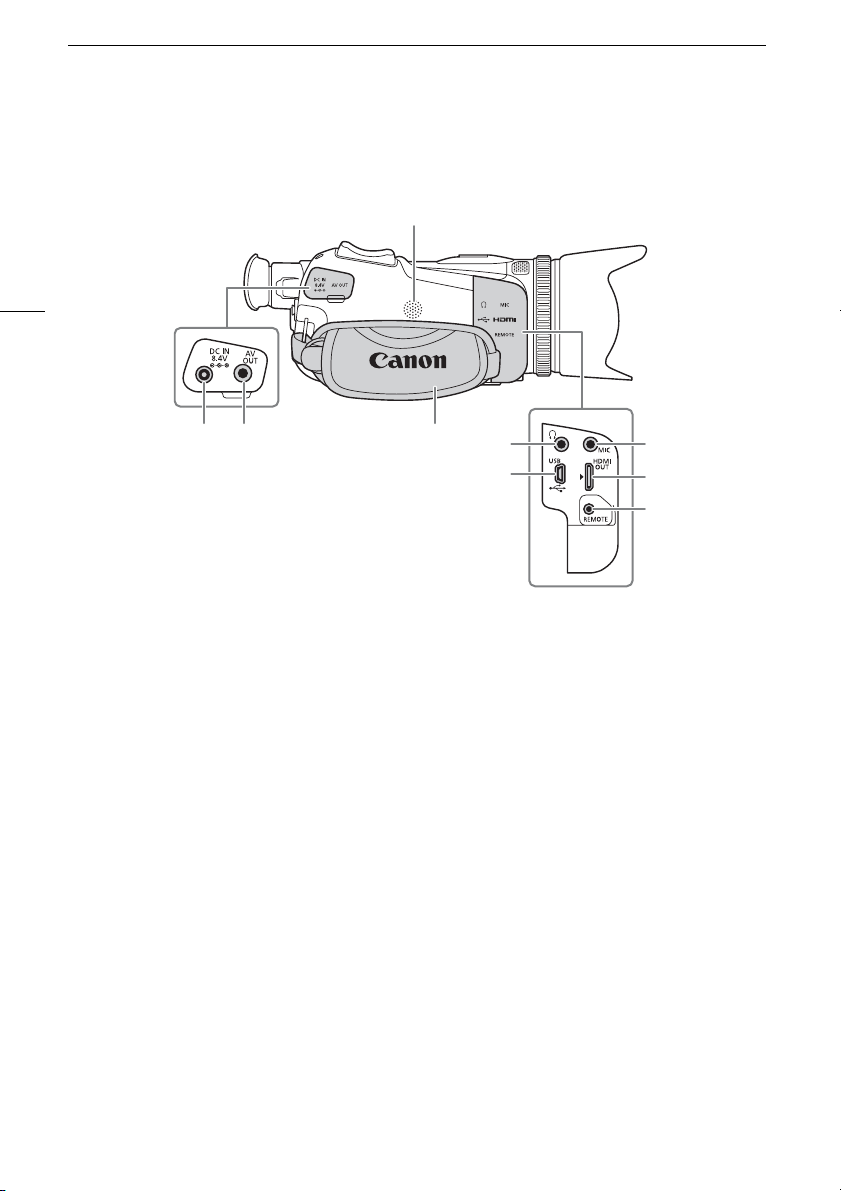
1 Built-in speaker (A 89)
2MIC terminal (A 71)
3HDMI OUT terminal (A 96, 97)
4 REMOTE terminal
For connecting commercially
available remote controllers.
987
6
25
3
4
5 × (headphones) terminal (A 77)
6USB terminal (A 82)
7DC IN terminal (A 15)
8AV OUT terminal (A 96, 97)
9 Grip belt (A 20)
Page 13
F
ront view
Back view
Names of Parts
13
1
6
45
7
8
9
2
3
141513121110
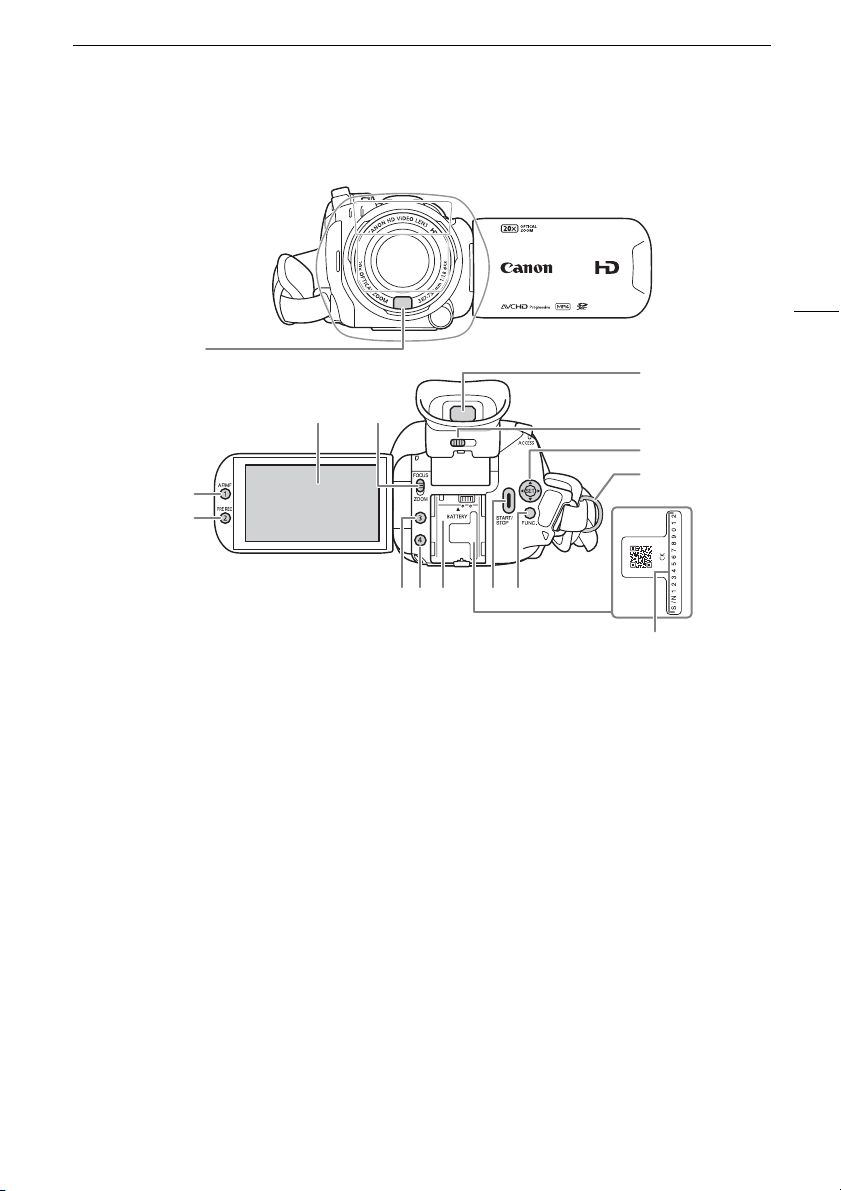
1 Instant AF sensor (A 46, 136)
2 AF/MF button (A 44)/
Assignable button 1 (A 85)
3 PRE REC (pre-recording) button
(A 80)/
Assignable button 2 (A 85)
4 LCD touch screen (A 19, 22)
5 Focus/Zoom ring switch (A 44, 49)
6 Viewfinder (A 18)
7 Dioptric adjustment lever (A 18)
8Joystick (A 23)/SET button (A 23)
9 Strap mount (A 20)
10 Assignable button 3 (A 85)
11 Assignable button 4 (A 85)
12 Battery attachment unit (A 15)
13 START/STOP button (A 32)
14 FUNC. button (A 23)
15 Serial number
Page 14

Names of Parts
T
B
op view
ottom view
3
14
9
4
5
1
2
6
7
8
1Power switch (A 21)
2 POWER / CHG (battery charging)
indicator (A 15)
3 Built-in stereo microphone
(A 70)
4 Accessory shoe
5Mode switch (A 22)
6 Camcorder zoom rocker (A 50)
8 Mini advanced shoe (A 69)
9 Lens hood mount index mark
10 Tripod socket
For mounting the camcorder on a
tripod with a mounting screw 6.5 mm
(0.26 in.) or shorter.
11 BATTERY RELEASE switch (A 16)
12 Eye cup (A 18)
7ACCESS indicator (A 32)
10
11
12
Page 15
Attaching the Ferrite Core
Preparations
2
Preparations
Attaching the Ferrite Core
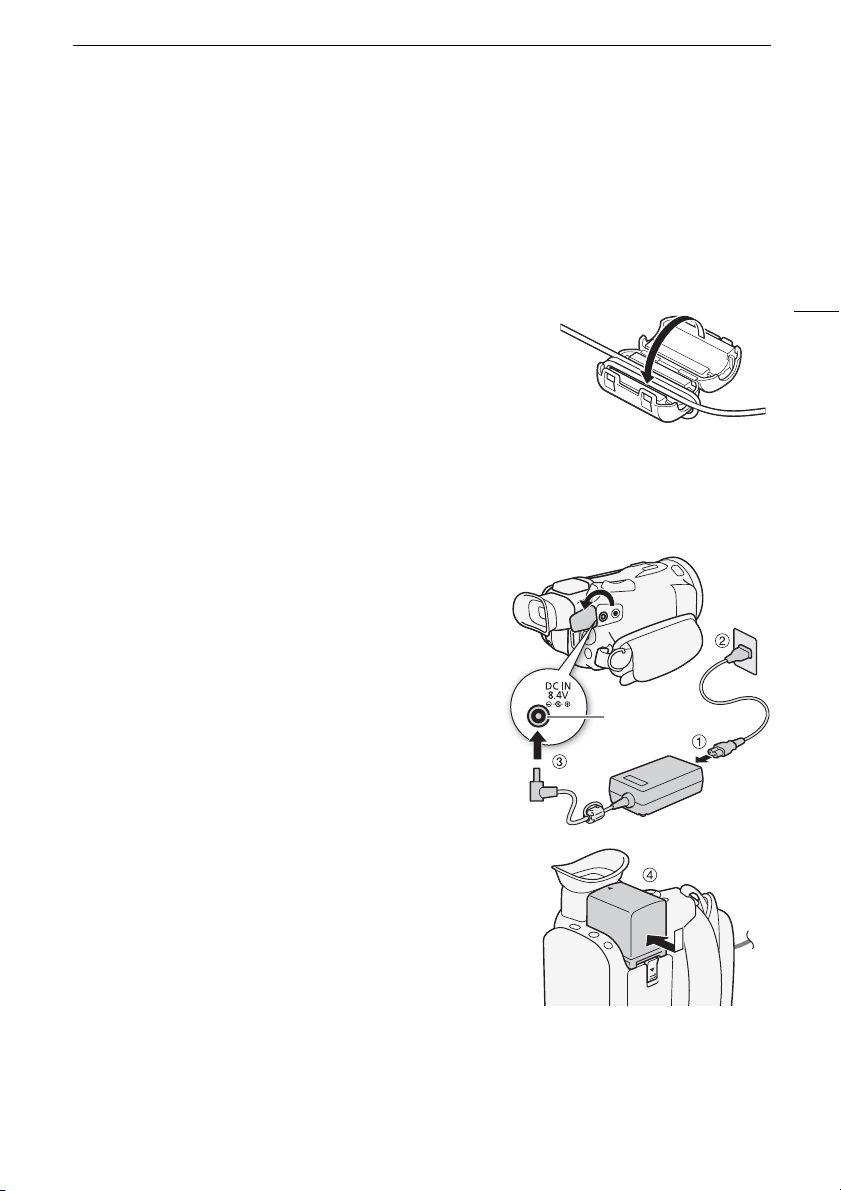
Attach the enclosed ferrite core before you connect the compact power adapter to the camcorder.
Attaching the ferrite core to the compact power adapter cable is necessary to suppress RF
interference.
Attach the ferrite core to the cable about 6 cm (2.4 in.) from the
DC plug (the plug to be connected to the DC IN terminal).
Pass the cable through the center of the core and wrap it around the
core (as shown in the illustration), then close the unit until it clicks shut.
Charging the Battery Pack
The camcorder can be powered with a battery pack or directly using the compact power adapter.
1 Connect the power cord to the compact power
adapter.
2 Plug the power cord into a power outlet.
3 Connect the compact power adapter to the
camcorder’s DC IN terminal.
15
4 Attach the battery pack to the camcorder.
• Press the battery pack softly into the battery attachment
unit and slide it forward until it clicks in place.
DC IN terminal
Page 16
Charging the Battery Pack
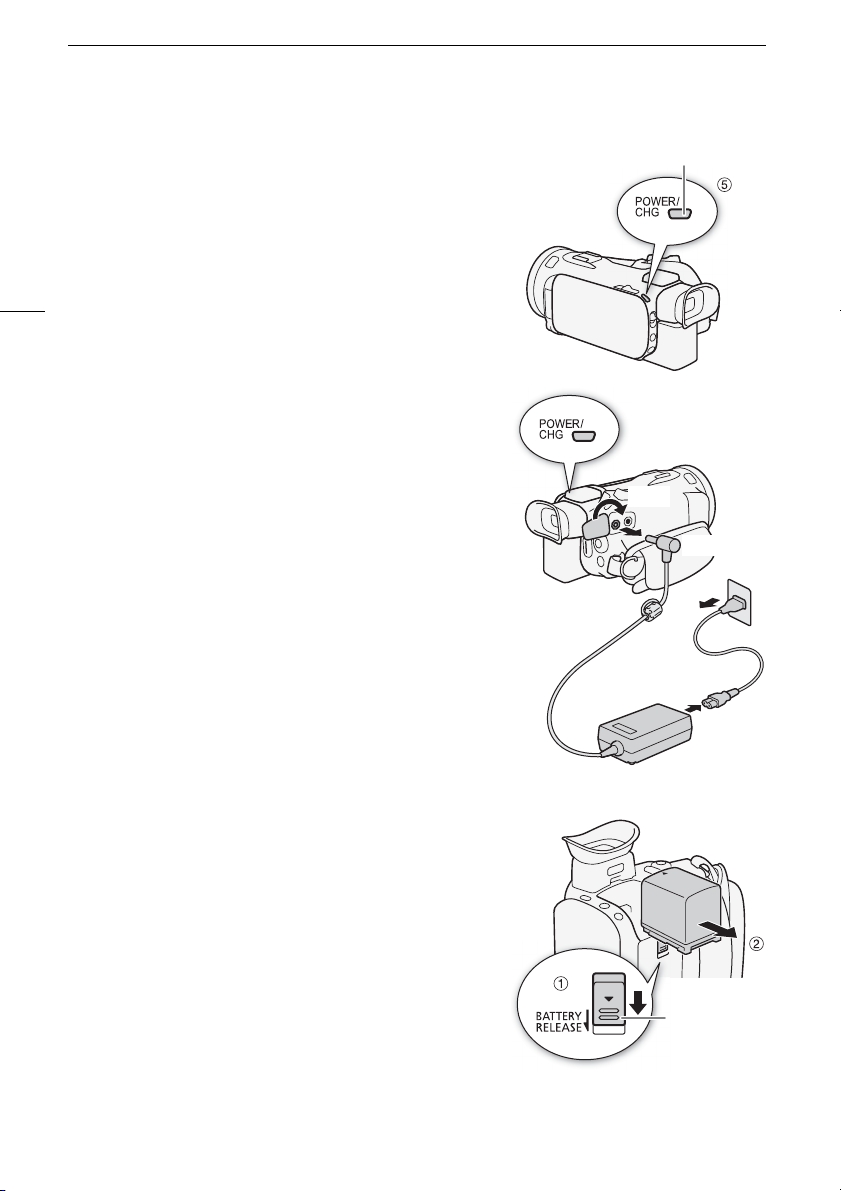
5 Charging will start when the camcorder is turned off.
• If the camcorder was on, the green POWER/CHG indicator
will go out when you turn off the camcorder. After a
moment, the POWER/CHG indicator will turn on in red
(battery pack charging). The red POWER/CHG indicator will
go out when the battery pack is fully charged.
16
• If the indicator flashes, refer to
6 Disconnect the compact power adapter in the order
shown in the illustration.
Troubleshooting
(A 125).
POWER/CHG (battery charging) indicator
햷
-2
햷
-1
햷
-3
햷
-4
To remove the battery pack
1 Slide the BATTERY RELEASE switch in the direction of the
arrow and hold it pressed down.
2 Slide the battery pack and then pull it out.
BATTERY
RELEASE
switch
Page 17

Charging the Battery Pack
IMPORTANT
• Turn off the camcorder before connecting or disconnecting the compact power adapter. After you
turn off the camcorder, important data is updated on the memory card. Be sure to wait until the
green POWER/CHG indicator goes out.
• When using the compact power adapter, do not fix it permanently to one place as this may cause a
malfunction.
• Do not connect to the camcorder’s DC IN terminal or to the compact power adapter any electrical
equipment that is not expressly recommended for use with this camcorder.
• To prevent equipment breakdowns and excessive heating, do not connect the supplied compact
power adapter to voltage converters for overseas travels or special power sources such as those on
aircraft and ships, DC-AC inverters, etc.
• For details on how to take care of the battery pack, refer to
Precautions
NOTES
• We recommend charging the battery pack in temperatures between 10 °C and 30 °C (50 °F and
86 °F). If either the ambient temperature or the battery pack’s temperature is outside the range of
approx. 0 °C to 40 °C (32 °F to 104 °F), charging will not start.
• The battery pack will be charged only when the camcorder is off.
• If the power supply was disconnected while charging a battery pack, make sure the POWER/CHG
indicator has gone out before restoring the power supply.
• If remaining battery time is an issue, you can power the camcorder using the compact power
adapter so the battery pack will not be consumed.
• Charged battery packs continue to discharge naturally. Therefore, charge them on the day of use, or
the day before, to ensure a full charge.
• The first time you use a battery pack, fully charge it and then use the camcorder until the battery
pack is completely exhausted. Doing so will ensure that the remaining recording time will be
displayed accurately.
• We recommend that you prepare battery packs to last 2 to 3 times longer than you think you might
need.
• For charging times and approximate usage times, refer to
(A 132).
Safety Instructions and Handling
Reference Tables
(A 144).
17
Page 18
Preparing the Camcorder
Preparing the Camcorder
This section covers the basic preparations for the camcorder such as attaching the lens hood,
adjusting the grip belt and adjusting the viewfinder and LCD screen. When attaching the lens hood,
grip belt and straps, be careful not to drop the camcorder by placing it on a table or other stable
surface.
18
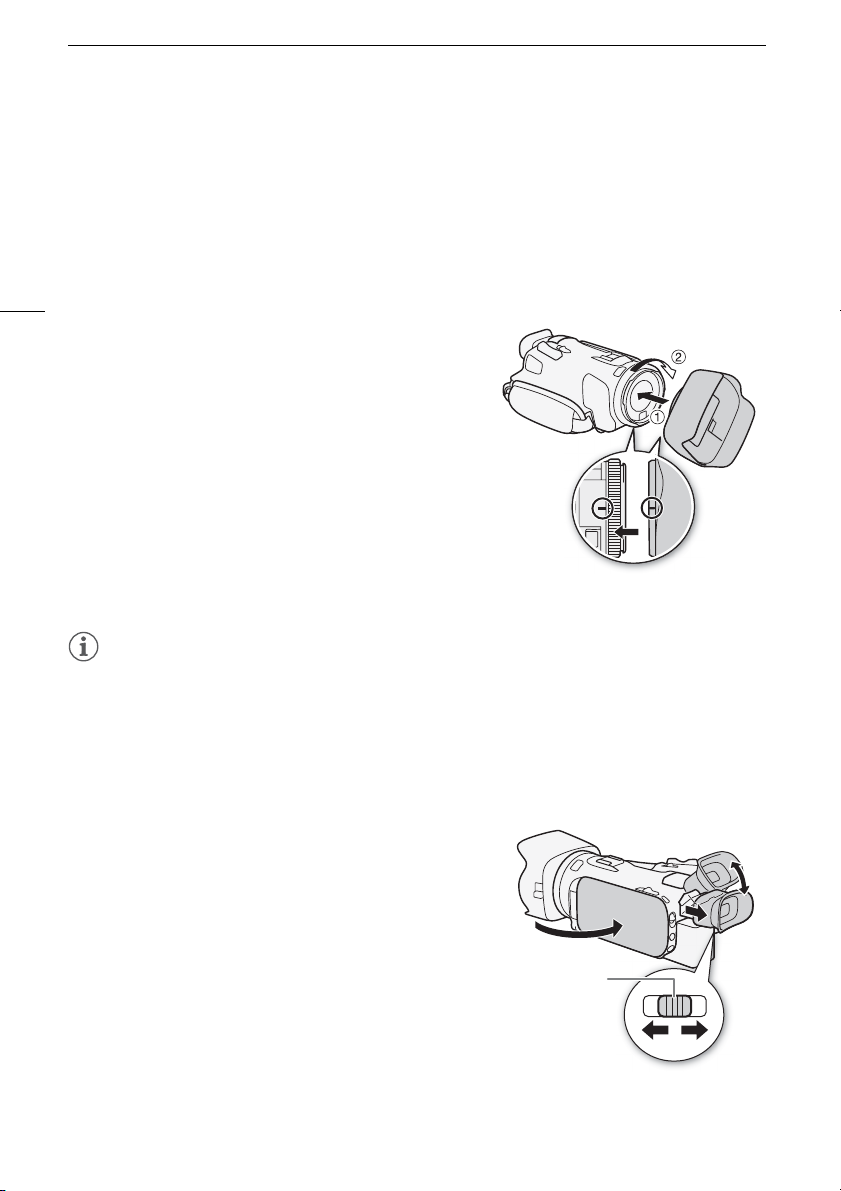
Using the Lens Hood and Lens Cap
While recording, the supplied lens hood with lens barrier is
effective for reducing stray light that can be the cause of lens
flare and ghost images. Additionally, closing the lens barrier
can help prevent fingerprints and dirt accumulation on the
lens.
1 Remove the lens cap.
2 Align the mark on the lens hood with the lens hood
mount index mark on the camera (
the lens hood clockwise until it stops with a click
• Be careful not to deform the lens hood.
• Make sure that the lens hood is aligned with the thread.
• To remove the lens hood, turn it counterclockwise.
햲), and then turn
(햳).
NOTES
• Use the supplied lens cap when carrying the camcorder or storing it after use.
• Note that the lens cap and the lens hood with lens barrier cannot be used simultaneously.
Using the Viewfinder
If it is difficult to use the LCD screen, you can use the viewfinder, which can be tilted 45 degrees
upward.
1 Close the LCD panel.
2 Pull out the viewfinder.
3 Use the power switch to turn on the camcorder.
4 Adjust the viewfinder using the dioptric adjustment
lever.
Dioptric
adjustment
lever
Page 19
Preparing the Camcorder
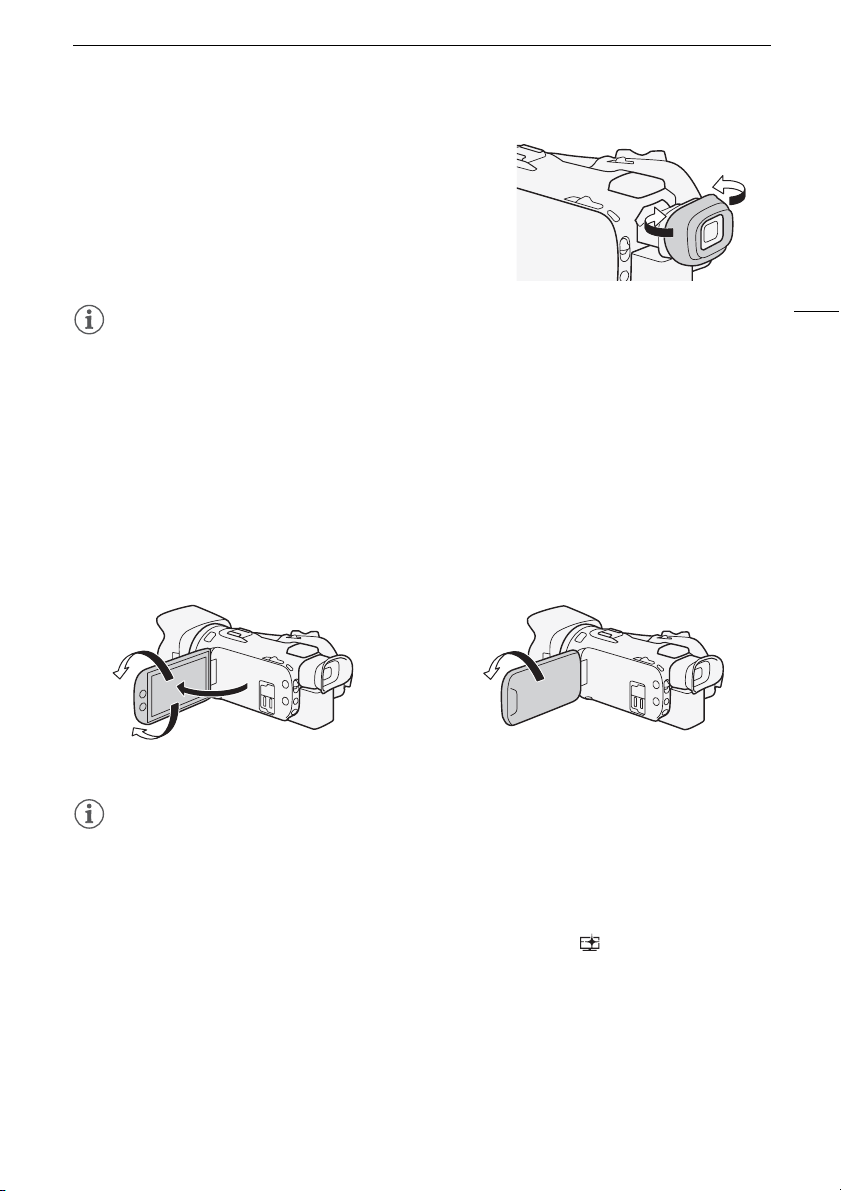
• If you wear glasses, you may find the viewfinder easier to
use if you flip back the outer edge of the eye cup toward
the camcorder body.
NOTES
• You cannot use the LCD screen and viewfinder simultaneously. To use the viewfinder, make sure
you close the LCD panel.
• Make sure you keep the eye cup attached when using the camcorder.
• For details about how to take care of the viewfinder, refer to
Cleaning
(A 136).
Handling Precautions
(A 133),
Adjusting the LCD Screen
Open the LCD panel 90 degrees.
• You can rotate the panel 90 degrees downward.
• You can rotate the panel 180 degrees toward the lens. Rotating the LCD toward the lens can be
useful to allow the subject to monitor the LCD screen while you use the viewfinder.
19
180°
90°
NOTES
• You can adjust the brightness of the LCD screen with the [FUNC.] > [MENU] > q > [LCD
Brightness] or [LCD Backlight] setting. Also, you can hold the DISP. button pressed down for more
than 2 seconds to change the [LCD Backlight] setting between bright and normal. You can adjust
the brightness of the viewfinder with the [FUNC.] > [MENU] > q > [Viewfinder Backlight]
setting.
• Adjusting the brightness or using the [FUNC.] > [MENU] > q > [ View Assistance] setting
does not affect the brightness of recordings.
• Using a brighter setting will shorten the effective usage time of the battery pack.
• For details about how to take care of the LCD screen and viewfinder, refer to
Cleaning
(A 133),
• About the LCD and viewfinder screens: The screens are produced using extremely high-precision
manufacturing techniques, with more than 99.99% of the pixels operating to specification. Very
rarely, pixels may misfire or may light up permanently as white dots. This has no effect on the
recorded image and does not constitute a malfunction.
(A 136).
180°
Subject can monitor the LCD screen
(you can use the viewfinder at the same time)
Handling Precautions
Page 20
Preparing the Camcorder
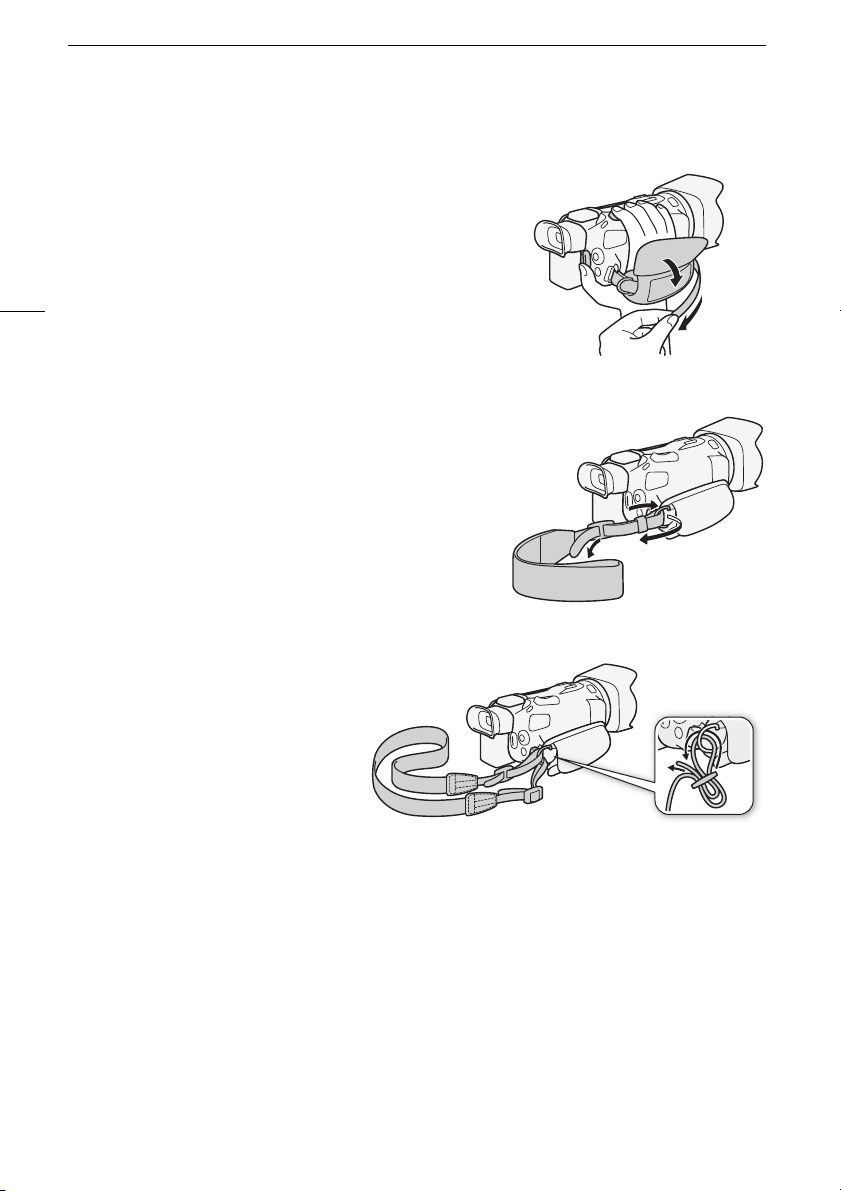
Grip Belt and Straps
Fasten the grip belt.
• Adjust the grip belt so that you can reach the camcorder
zoom rocker with your index finger, and the START/STOP
button with your thumb.
20
Attaching an optional wrist strap
Attach the wrist strap to the strap mount on the grip belt,
adjust the length and fasten.
• You can use both for extra convenience and protection.
Attaching an optional shoulder strap
Pass the ends of the shoulder strap
through the strap mount on the grip belt
and adjust the length of the strap.
Page 21
Basic Operation of the Camcorder
Basic Operation of the Camcorder
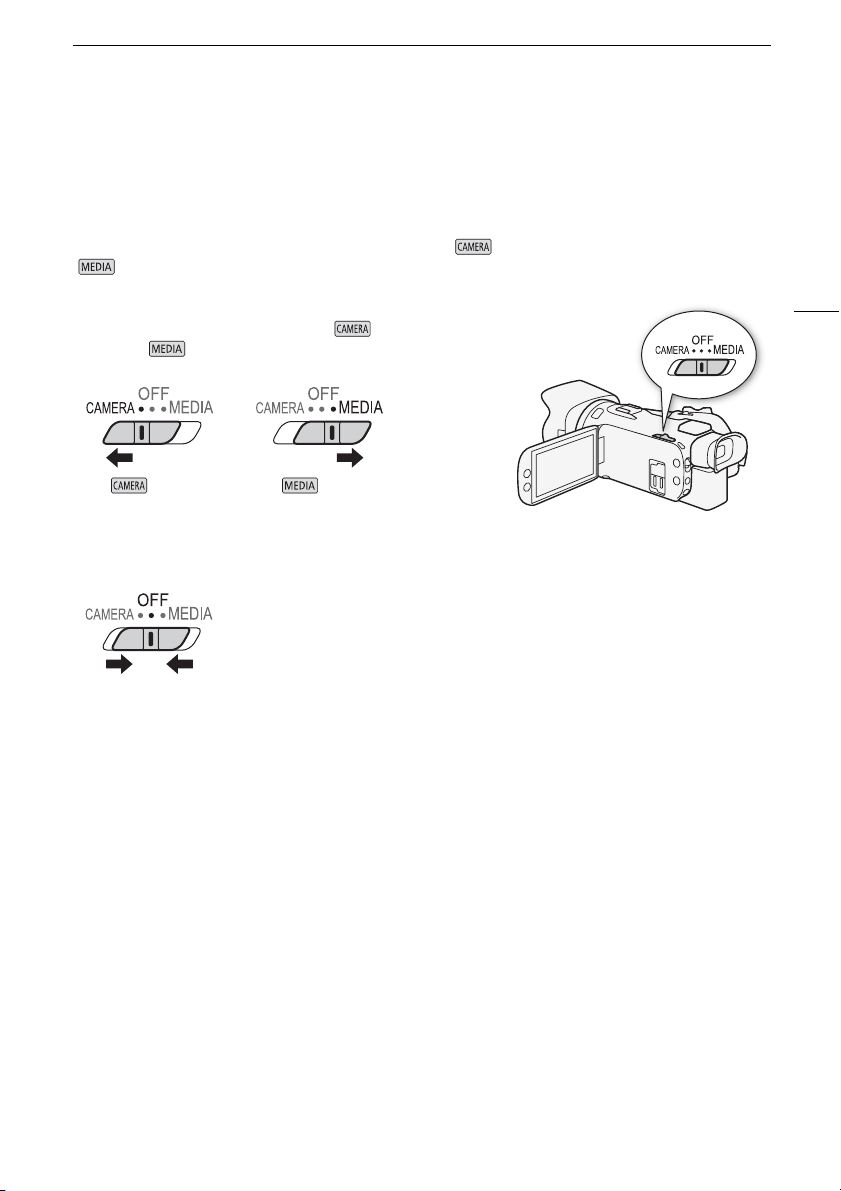
Turning the Camcorder On and Off
You can choose to turn the camcorder on in CAMERA ( ) mode for making recordings or MEDIA
( ) mode for playing back recordings. Select the mode using the power switch.
To turn on the camcorder
Set the power switch to CAMERA for mode (A 32) or
MEDIA for mode (A 88).
mode mode
To turn off the camcorder
Set the power switch to OFF.
21
Page 22
Basic Operation of the Camcorder
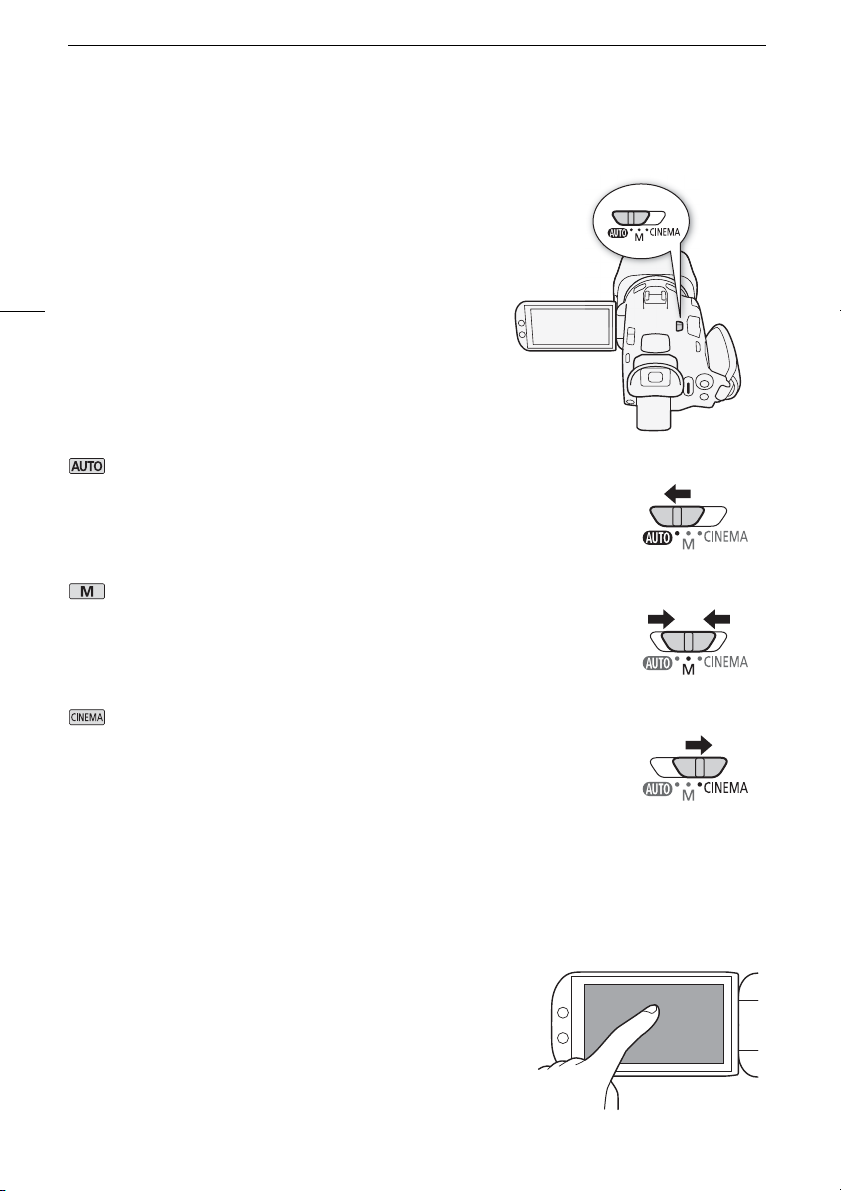
Setting the Camera Mode
When making recordings, you can change the camera mode
to match your shooting style.
22
(Auto) mode
Set the mode switch to N. With this mode, the camcorder takes care of all
the settings while you concentrate on recording (A 32). This operating mode is
suitable if you just prefer not to bother with detailed camcorder settings.
(Manual) mode
Set the mode switch to n. With this mode, you can enjoy full access to menus,
settings and advanced functions (A 34).
(Cinema) mode
Set the mode switch to E. With this mode, you can give your recordings
a cinematic look and use cinema-look filters to create unique movies (A 42).
Using the Touch Screen
The onscreen buttons and menu items that appear on the touch screen change dynamically
depending on the operating mode and the task you are performing. With the intuitive touch screen
interface you have all the controls at your fingertips.
Tou c h
Press on an element displayed on the touch screen.
Used to start playing back a scene in an index screen, to select
a setting from the menus, etc.
Page 23
Basic Operation of the Camcorder
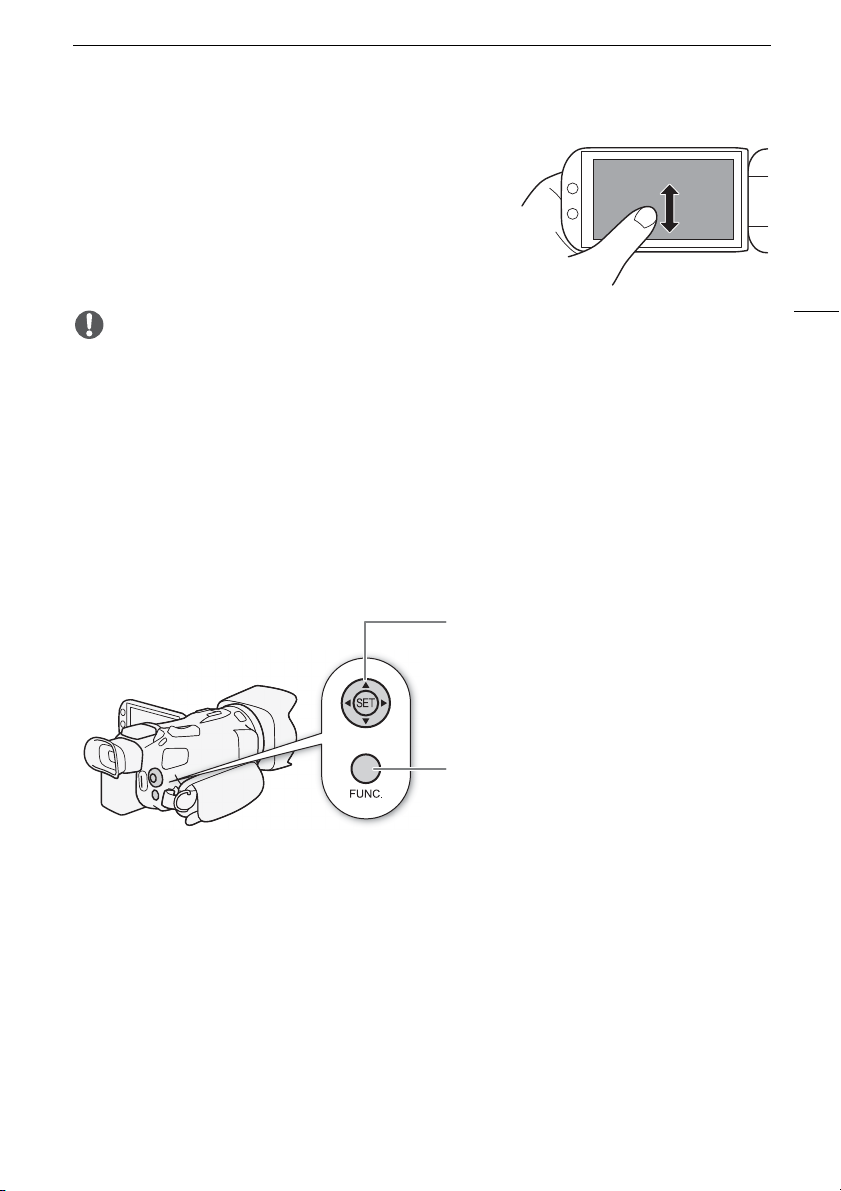
Drag
Swipe your finger up and down or left and right across the
screen. Used to scroll menus, to browse through index screen
pages or to adjust slider controls like the volume.
On some screens, you can achieve the same effect by touching
the triangle onscreen buttons.
IMPORTANT
• The camcorder features a capacitive touch screen. In the following cases, you may not be able to
perform touch operations correctly.
- Using your fingernails or hard-tipped objects, such as ballpoint pens.
- Operating the touch screen with wet or gloved hands.
- Applying excessive force or forcefully scratching the touch screen.
- Attaching commercially available screen protectors or adhesive film onto the touch screen’s
surface.
Using the FUNC. Button and Joystick
You can navigate some of the camcorder’s menus and screens using the FUNC. button and joystick
instead of using the touch panel.
Joystick/SET button
When making a menu selection, push the joystick
to move the orange selection frame in the menu.
Then, press the joystick itself (SET) to select the
menu item indicated by the orange selection frame.
23
FUNC. button
Press the button to open the FUNC. menu and then
press again to close the menu after adjusting
desired settings.
Page 24
First Time Settings
First Time Settings
Setting the Date and Time
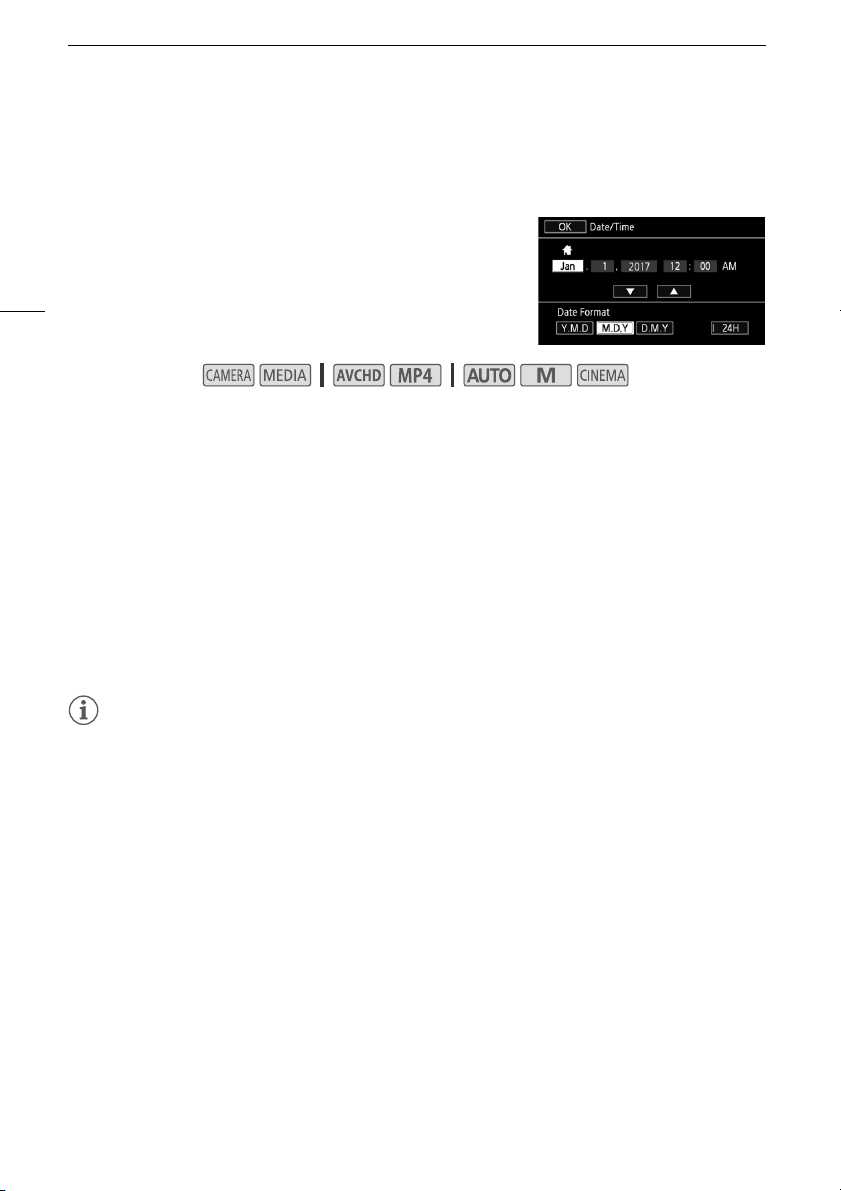
You will need to set the date and time of the camcorder before
you can start using it. The [Date/Time] screen will appear
automatically when the camcorder’s clock is not set.
24
Operating modes:
1 Use the power switch to turn on the camcorder.
• The [Date/Time] screen will appear.
2 Touch a field you want to change (year, month, day, hours or minutes).
• You can also push the joystick (ÏÐ) to move between the fields.
3Touch [Í] or [Î] to change the field as necessary.
• You can also push the joystick (ÍÎ) to change the field.
4 Set the correct date and time by changing all the fields in the same way.
5 Touch [Y.M.D], [M.D,Y] or [D.M.Y] to select the date format you prefer.
• In some screens, the date will be displayed in short form (numbers instead of month names or
only the day and month), but it will still follow the order you selected.
6 Touch [24H] to use 24-hour clock or leave it unselected to use 12-hour clock (AM/PM).
7 Touch [OK] to start the clock and close the setup screen.
NOTES
• You can adjust the date and time later on with the [FUNC.] > [MENU] > q > [Date/Time]
setting.
• When you do not use the camcorder for about 3 months, the built-in rechargeable lithium battery
may discharge completely and the date and time setting may be lost. In such case, recharge the
built-in lithium battery (A 135) and set the time zone, date and time again.
Page 25
First Time Settings
Changing the Language
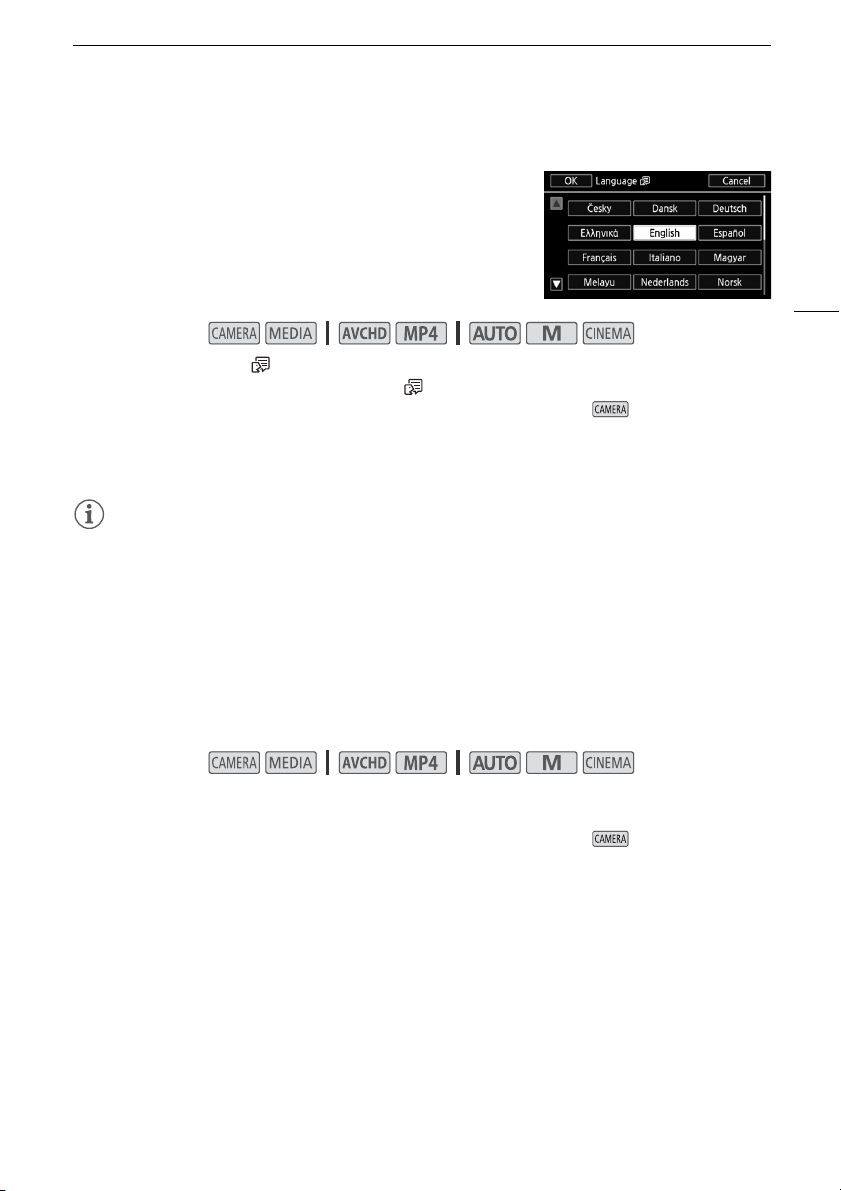
The default language of the camcorder is English. You can set
it to one of 27 languages.
Setup Menus
Refer to
the menu for this procedure.
Operating modes:
(A 27) for details on how to navigate
1 Open the [Language ] screen.
[FUNC.] > [MENU] > q > [Language ]
• Touching [FUNC.] is necessary only when performing the procedure in mode.
2 Touch the desired language and then touch [OK].
3Touch [X] to close the menu.
NOTES
• Some onscreen buttons, such as [ZOOM], [FUNC.] and [MENU], will appear in English regardless of
the language selected.
Changing the Time Zone
Change the time zone to match your location. The default setting is New York. In addition, the
camcorder is able to retain the date and time of an additional location. This is convenient when you
travel so that you can set the camcorder to match the time of your home location or that of your travel
destination.
Setup Menus
Refer to
Operating modes:
(A 27) for details on how to navigate the menu for this procedure.
25
1 Open the [Time Zone/DST] screen.
[FUNC.] > [MENU] > q > [Time Zone/DST]
• Touching [FUNC.] is necessary only when performing the procedure in mode.
2Touch ["] to set the home time zone, or [#] to set the time zone of your destination
when you are traveling.
3Touch [Í] or [Î] to set the desired time zone. If necessary, touch [$] to adjust for
daylight saving time.
4Touch [X] to close the menu.
Page 26

First Time Settings
Using the Menus
Many of the camcorder’s functions can be adjusted from the FUNC. menu and the setup menus. For
details about the available menu options and settings, refer to the appendix
(A 109).
FUNC. Menu
26
In mode:
Operating modes:
There are three ways to access the FUNC. menu: by touching [FUNC.] on the screen, by pressing the
FUNC. button or by pushing the joystick (Ý/Þ) to select [FUNC.] and then pressing the SET
button. After the FUNC. menu is open, select the function you want to use. You may need to scroll up
and down the screen or touch [Í]/[Î] to find the onscreen button of the desired function. In
mode, access to functions is limited.
FUNC. menu in mode
Touch the onscreen
button of the
desired function
Menu Options Lists
In mode:
Operating modes:
Just like during mode, you can open the FUNC. menu by touching [FUNC.] on the screen, by
pressing the FUNC. button or by pushing the joystick (Ý/Þ) to select [FUNC.] and then pressing
the SET button. After the FUNC. menu is open, select the function you want to use.
FUNC. menu in mode
Touch the onscreen
button of the
desired operation
Page 27

First Time Settings
Setup Menus
In this manual, navigating the setup menus is explained using the touch panel controls but they can
also be navigated using the joystick and other buttons. The procedure below explains how to use both
methods. If necessary, refer back to this section for details on using the joystick.
Operating modes:
To use touch panel controls
1 mode only: Touch [FUNC.].
2 Touch [MENU].
3 Touch the tab of the desired menu.
4 Drag your finger up and down to bring the desired setting
into the orange selection bar.
• You can also touch [Í] and [Î] to scroll up and down.
• Menu items not available appear grayed out.
• You can touch any menu item on the screen to bring it
directly into the selection bar.
5 When the desired menu item is inside the selection bar, touch [æ].
6 Touch the desired option and then touch [X].
• You can touch [X] to close the menu at any time.
To use the joystick
1 mode only: Push the joystick (Ý/Þ) to select [FUNC.] and then press the SET button.
• Alternatively, you can press the FUNC. button.
2 Push the joystick (Ý/Þ) to select [MENU] and then press the SET button.
3 Push the joystick (Þ) to select the desired tab and then press the SET button.
4 Push the joystick (Ý) to move the selection bar to the desired setting and then press the SET
button.
• Menu items not available appear grayed out.
5 Push the joystick (Ý/Þ) to select the desired option and then press the SET button.
6 Push the joystick (Ý/Þ) to select [X] and then press the SET button.
• You can press the FUNC. button to close the menu at any time.
27
NOTES
• For brevity's sake, references in the text to settings in the setup menus and functions in the FUNC.
menu will include only a simplified way to show how to access them in the camcorder. For example,
"You can adjust the date and time later on with the [FUNC.] > [MENU] > q > [Date/Time]
setting." Note that in mode, it is not necessary to select [FUNC.] for settings in the setup
menus.
Page 28
Using a Memory Card
Using a Memory Card
Memory Cards Compatible for Use with the Camcorder
You can use the following types of commercially available Secure Digital (SD) cards with this
camcorder. We recommend using memory cards rated CLASS 4, 6 or 10*.
As of June 2017, the movie recording function has been tested using SD/SDHC/SDXC cards made by
Panasonic, Toshiba and SanDisk. For the latest information about recording media tested for use with
28
this camera, visit your local Canon Web site.
Memory card type: . SD memory card, / SDHC memory card, 0 SDXC memory card
SD Speed Class*:
* When using an SD memory card without a speed class rating or one rated SD Speed Class 2, you may
not be able to record movies, depending on the memory card used.
NOTES
• About the Speed Class: Speed Class is a standard that indicates the minimum guaranteed data
transfer speed of memory cards. When you buy a new memory card, look for the Speed Class logo
on the package.
To record movies using a recording mode with a video quality of 28 Mbps or 35 Mbps, we
recommend using memory cards rated SD Speed Class 6 or 10. To record movies using slow & fast
motion, we recommend using memory cards rated SD Speed Class 10.
SDXC Memory Cards
You can use SDXC memory cards with this camcorder. When using memory cards with other devices,
such as digital recorders, computers and card readers, make sure that the external device is
compatible with SDXC cards. For information about the compatibility of SDXC cards, contact the
computer, operating system or memory card manufacturer.
IMPORTANT
• If you use an SDXC memory card with a computer OS that is not SDXC-compatible, you may be
prompted to format the memory card. In such case, cancel the operation to prevent data loss.
• After repeatedly recording, deleting and editing clips (if the memory is fragmented), you may notice
slower writing speeds to the recording media and recording may even stop. In such case, save your
recordings and initialize the recording media with the camera (using the [Complete Initialization]
option). Be sure to initialize recording media especially before shooting important scenes.
Page 29
Using a Memory Card
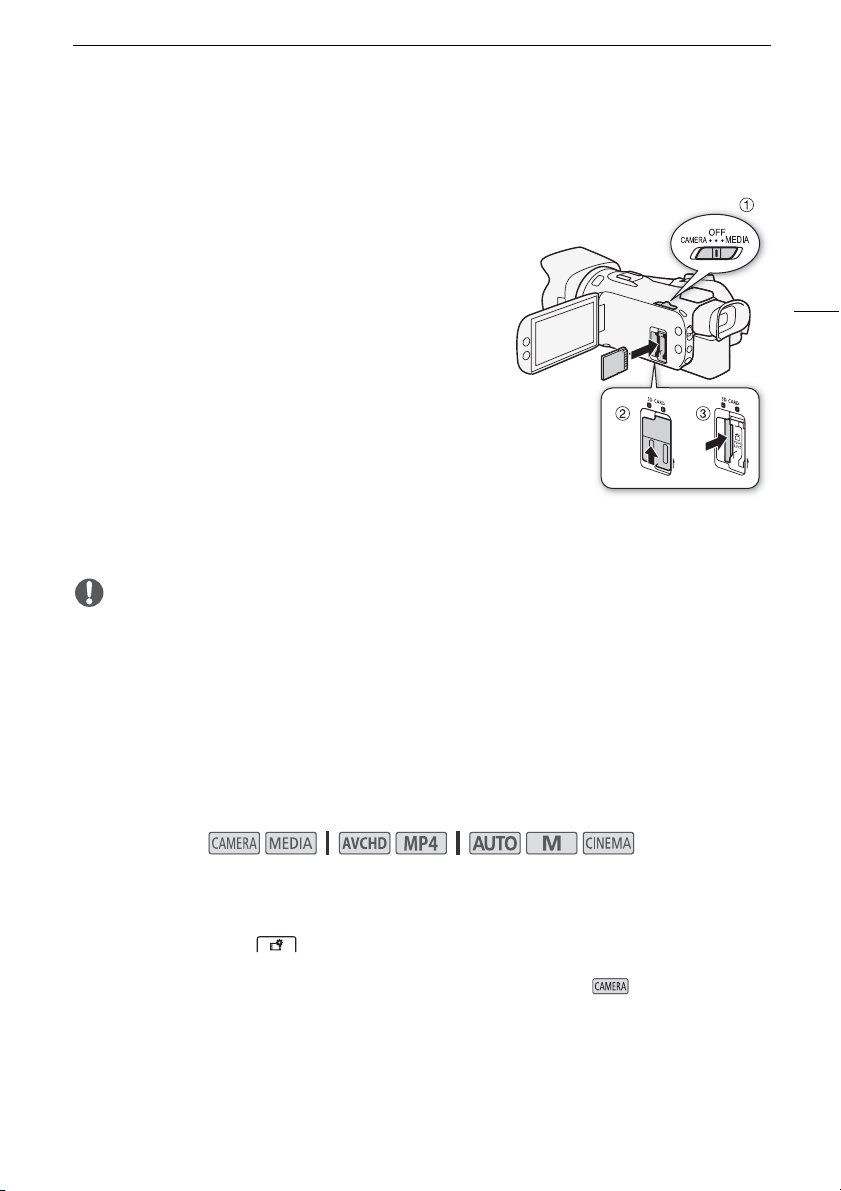
Inserting and Removing a Memory Card
Make sure to initialize (A 29) all memory cards before using them with this camcorder.
1 Turn off the camcorder.
• Make sure the POWER/CHG indicator is off.
2 Open the double memory card slot cover.
3 Insert the memory card straight, with the label facing
the front of the camcorder, all the way into one of the
memory card slots.
• You can also use two memory cards, one in each memory
card slot.
4 Close the double memory card slot cover.
• Do not force the cover closed if the memory card is not
correctly inserted.
To remove the memory card
Push the memory card once to release it. When the memory card springs out, pull it all the way out.
IMPORTANT
• Turn off the camcorder before inserting or removing a memory card. Inserting or removing the
memory card with the camcorder on may result in permanent data loss.
• Memory cards have front and back sides that are not interchangeable. Inserting a memory card
facing the wrong direction can cause a malfunction of the camcorder. Be sure to insert the memory
card as described in step 3.
29
Initializing a Memory Card
Initialize memory cards when you use them with this camcorder for the first time. You can also initialize
a memory card to permanently delete all the recordings it contains.
Operating modes:
1 Power the camcorder using the compact power adapter.
• Do not disconnect the power source or turn off the camcorder until the initialization is completed.
2 Open the initialization screen for the desired memory card.
[FUNC.] > [MENU] > > [Initialize 8] > [6 Mem. Card A] or [7 Mem. Card B] >
[Initialize]
• Touching [FUNC.] is necessary only when performing the procedure in mode.
• In the initialization screen, touch [Complete Initialization] to physically erase all the data rather than
just clear the file allocation table of the memory card.
Page 30
Using a Memory Card
3 Touch [Yes].
• If you selected the [Complete Initialization] option, you can touch [Cancel] to cancel the
initialization while it is in progress. All recordings will be erased and the memory card can be used
without any problem.
4 Touch [OK] and then touch [X].
30
IMPORTANT
• Initializing a memory card will permanently erase all recordings. Lost original recordings cannot be
recovered. Make sure you save important recordings in advance using an external device (A 102).
Selecting the Memory Card for Recordings
Movies and photos are recorded on a memory card. You can select on which memory card your
movies and photos will be recorded.
Operating modes:
1 Open the [Recording Media] screen.
[FUNC.] > [MENU] > > [Recording Media]
2 Touch the desired memory card ([6 Mem. Card A] or [7 Mem. Card B]) for recording
movies ([v Rec Media for Movies]) or for taking photos ([{ Rec Media for Photos]).
3Touch [X].
• After closing the menu, the icon of the memory card selected for recording movies will appear on
the screen.
Page 31

Selecting the Movie Format (AVCHD/MP4)
Selecting the Movie Format (AVCHD/MP4)
You can choose to record movies in AVCHD or MP4 format. AVCHD movies are ideal for playback with
fantastic picture quality. MP4 movies are versatile and can easily be played back on smartphones and
tablets or uploaded to the Web.
Operating modes:
1 Open the [Movie Format] screen.
[FUNC.] > [MENU] > > [Movie Format]
2 Select the desired movie format.
3Touch [X].
• The icon of the selected movie format will appear on the screen.
31
Page 32

Recording Movies and Photos
Recording
3
Recording
Recording Movies and Photos
You can select the memory card that will be used to record movies and photos (A 30). For details on
recording audio, refer to
Troubleshooting
to
32
POINTS TO CHECK
• Before you begin recording, make a test recording first to check that the camcorder is operating
correctly.
Recording in AUTO Mode
When you use mode to shoot video and take photos, the camcorder will automatically adjust
various settings for you.
Operating modes:
Recording Audio
(A 123).
(A 70). Should the camcorder fail to operate correctly, refer
1 Open the lens barrier.
• Set the lens barrier switch to OPEN.
2 Set the mode switch to N.
3 Set the power switch to CAMERA.
• The POWER/CHG indicator will illuminate in green.
To record video
Press the START/STOP button to begin recording.
• During recording, Ü will appear on the screen.
• The ACCESS indicator will flash from time to time while
the scene is being recorded.
• Press the START/STOP button again to pause the
recording. Ü will change to Ñ and the scene will be
recorded on the memory card selected for recording
movies.
To t a k e p h oto s
Touch [PHOTO].
• In the lower center of the screen, a green icon (g) will appear. Also, in the upper right of the screen,
{Ð will appear with the icon of the memory card selected for recording photos. The ACCESS
indicator will flash as the photo is being recorded.
Lens barrier
switch
[PHOTO]
POWER/CHG
indicator
Page 33

Recording Movies and Photos
When you have finished recording
1 Set the lens barrier switch to CLOSED to close the lens barrier.
2 Make sure that the ACCESS indicator is off.
3 Set the power switch to OFF.
4 Close the LCD panel and return the viewfinder to its retracted position.
Smart AUTO
In mode, the camcorder will automatically detect certain characteristics of the subject,
background, lighting conditions, etc. It will then adjust various settings (focus, exposure, color,
image stabilization, image quality, among others), selecting the best settings for the scene you
want to shoot. The Smart AUTO icon will change to one of the icons in the following table.
Smart AUTO icons
red)
1
Sunsets
1
(orange)
—
—
Background (color of the icon) →
Subject ↓
People (stationary)
People (moving)
Bright
(gray)
1
Blue skies
(light blue)
1
Vivid colors
(yellow/green/
( ) ( ) ( )
( ) ( ) ( )
Subjects other than people,
such as landscapes
Close objects /
( ) ( ) ( )
( /2)
2
( /2)
2
/
( /2)
2
/
—
Background (color of the icon) → Dark (dark blue)
Subject ↓ Spotlight Night scene
People (stationary) — —
People (moving) — —
Subjects other than people, such as
landscapes
Close objects /
1
The icon in parentheses appears under backlight conditions.
2
This icon will appear under tele macro conditions. Tele macro is activated automatically when you
zoom toward the telephoto end and close in on the subject. Tele macro allows you to get closer
shots of small subjects and adds a soft focus to the background, so the subject not only looks
larger but also stands out more.
2
— —
• Under certain conditions, the Smart AUTO icon that appears on the screen may not match the
actual scene. Especially when shooting against orange or blue backgrounds, the sunset or one
of the blue skies icons may appear and the colors may not look natural. In such case, we
recommend recording in mode (A 34).
33
Page 34

Recording Movies and Photos
Intelligent IS
Intelligent IS allows the camcorder to select the best image stabilization option based on your
shooting method. The Intelligent IS icon will change to one of the following icons. In and
modes, you can set the image stabilization mode manually (A 53).
Shooting method Icon
34
Most general situations; Zooming out (zooming toward T); Following
subjects at a distance moving left or right
Zooming in (zooming toward S) È (Powered IS)*
Close-up of a subject  (Macro IS)
Remaining stationary, such as when using a tripod à (Tripod mode)
* With the [FUNC.] > [MENU] > p > [Intelligent IS] setting, you can select whether Powered
IS can be set automatically as one of the Intelligent IS modes.
Ä (Dynamic IS)
Recording in n (Manual) Mode
In mode, you can enjoy full access to the menus and manually adjust the exposure, focus, white
balance and many more of the camcorder’s settings to your preference. Even in mode, though,
the camcorder can help you with the settings, for example, by using Special Scene recording
programs (A 62).
Operating modes:
1 Set the mode switch to n.
2 Set the power switch to CAMERA.
• The POWER/CHG indicator ill illuminate in green.
3 Record movies and photos.
• The procedure is the same as in mode (A 32).
IMPORTANT
• Be sure to save your recordings regularly (A 102), especially after making important recordings.
Canon shall not be liable for any loss or corruption of data.
Page 35

Recording Movies and Photos
NOTES
• When you set the [FUNC.] > [MENU] > q > [Rec Command] setting to [i On] and you
use the HDMI OUT terminal to connect the camcorder to a device capable of receiving recording
commands through a connection via the HDMI OUT terminal, if you start or stop recording with the
camcorder, the connected device will also start or stop recording. (When [Rec Command] is set to
[i On], video snapshot and power saving mode ([FUNC.] > [MENU] > q > [Auto Power
Off]) will not be available.)
• When the camcorder switches form recording on one memory card to another during relay
recording, the video will be recorded as two separate relay scenes. With the software Data Import
Utility, you can join relay scenes recorded on different memory cards as a single scene and save it
on a computer (A 102).
• For scenes with a long recording time, the video (stream) file in a scene will be split approximately
every 4 GB. Even in such case, playback will be continuous. With the software Data Import Utility,
you can join such split files into a single scene and save it on a computer (A 102).
• When recording in bright places, it may be difficult to use the LCD screen. In such cases, you can
adjust the brightness of the LCD screen with the [FUNC.] > [MENU] > q > [LCD Brightness]
setting. Alternatively, you can also use the viewfinder (A 18).
• About the power saving mode: If [FUNC.] > [MENU] > q > [Auto Power Off] is set to
[i On], the camcorder will shut off automatically to save power when it is powered by a battery
pack and is left without any operation for 5 minutes. Use the power switch to turn on the
camcorder.
• Photos are recorded as JPG files. During and modes, the camcorder can take photos
while recording a movie or during record standby mode. For the approximate number of photos that
can be taken, refer to
• Photos cannot be recorded during slow & fast motion recording mode or when [FUNC.] > [Image
Effects] > [Looks] is set to [Highlight Priority].
• You can capture a photo from a scene during playback (A 91).
• When you need to record for a long time with the camcorder set on a tripod, you can close the LCD
panel and use only the viewfinder in order to save power when using a battery pack (A 18).
Reference Tables
(A 144).
35
Page 36

Recording Movies and Photos
Reviewing the Latest Scene Recorded
You can review the last 4 seconds of the last scene recorded with the camcorder without switching to
mode. While reviewing the latest scene, the picture will be played back without sound. By
default, assignable button 5 is set to [ Rec Review] but you can set another assignable button to
this function (A 85).
Operating modes:
36
1 Record a scene.
2 After you finish recording a scene, press the u button.
Page 37

Selecting the Recording Mode (Video Quality)
Selecting the Recording Mode (Video Quality)
The camcorder offers various recording modes, depending on whether the movie format is AVCHD or
MP4. When the recording mode of an AVCHD scene is set to 28 Mbps LPCM (59.94P) or 24 Mbps
LPCM, you can enjoy two-channel linear PCM audio recording with a sampling frequency of 48 kHz.
Refer to the following tables for details.
Operating modes:
1 Open the [Recording Mode] screen.
[FUNC.] > [MENU] > > [Recording Mode]
2 Touch the desired recording mode and then touch [X].
NOTES
• For details on approximate recording times, refer to
• About scenes recorded at [28 Mbps LPCM (59.94P)]/[28 Mbps (59.94P)] (AVCHD) or [35
Mbps (59.94P)]/[8 Mbps (59.94P)] (MP4):
- Recording such scenes is not available during mode.
- When recording such scenes, dual recording is not available.
- Depending on the TV, scenes may not be able to be played back.
• AVCHD scenes recorded at 28 Mbps cannot be saved on AVCHD discs. Use an external Blu-ray
Disc recorder compliant with AVCHD Ver. 2.0 specifications to copy those movies onto Blu-ray
discs.
• The following types of MP4 scenes will be recognized as multiple files on other devices.
- Scenes exceeding 4 GB
- Scenes recorded at 35 Mbps or 8 Mbps exceeding 30 minutes
- Scenes recorded with a recording mode other than 35 Mbps or 8 Mbps exceeding 1 hour
• When the recording mode is set to [28 Mbps LPCM (59.94P)] or [24 Mbps LPCM], recording with
5.1ch surround sound is not available when using the optional SM-V1 Surround Microphone.
Approximate recording times
(A 144).
37
Recording modes by movie format
Movie format Recording mode Resolution Audio format
28 Mbps LPCM (59.94P)
28 Mbps (59.94P) Dolby Digital
AVCHD
MP4
24 Mbps LPCM Linear PCM
24 Mbps
5 Mbps 1440x1080
35 Mbps (59.94P)
24 Mbps
17 Mbps
8 Mbps (59.94P)
4 Mbps
3 Mbps 640x360
1920x1080
1920x1080
1280x720
Linear PCM
Dolby Digital17 Mbps
AAC
Page 38

Dual Recording and Relay Recording
Dual Recording and Relay Recording
When you record, you can use dual recording to record simultaneously on both memory cards.
Alternatively, you can use relay recording so that if the memory card being recorded on becomes full,
the recording will continue uninterrupted on the other memory card.
Activating dual recording
The backup movie is recorded on memory card B. After you activate dual recording, select the backup
38
movie's recording mode.
Operating modes:
1 Open the [Dual Recording] screen.
[FUNC.] > [MENU] > > [Dual/Relay Recording] > [Dual Recording]
• The screen shows the movie format and recording mode of the movies that will be recorded on
each card.
2 Select the movie format and recording mode for the backup movie that will be recorded
on memory card B.
• The first option is always the same movie format and recording mode of the movie that will be
recorded on memory card A. The second two options are always [¸ 4Mbps] and
[¸ 3Mbps], which result in small files that are ideal for transferring to a computer.
3Touch [X].
Activating relay recording
Operating modes:
1 Open the [Dual/Relay Recording] screen.
[FUNC.] > [MENU] > > [Dual/Relay Recording]
2 Touch [Relay Recording] and then touch [X].
NOTES
• To use neither function, select [Standard Recording] on the [Dual/Relay Recording] screen.
• When you use relay recording, it does not matter which memory card the recording starts on. The
recording will continue on the other memory card. However, the camcorder will switch to another
memory card only one time.
• With the software Data Import Utility, you can join relay scenes (either AVCHD or MP4 format)
recorded on both memory cards as a single scene and save it on a computer (A 102).
• Dual recording is not available when the recording mode uses a frame rate of 59.94P.
Page 39

Selecting the Frame Rate
Selecting the Frame Rate
You can change the frame rate (the number of frames recorded per second) to change the look of your
movies. When the recording mode is set to 28 Mbps LPCM (59.94P) or 28 Mbps (59.94P) for AVCHD
movies, or 35 Mbps (59.94P) or 8 Mbps (59.94P) for MP4 movies, the frame rate will automatically be
set to 59.94P so you will not be able to select the frame rate.
Operating modes:
1 Open the [Frame Rate] screen.
[FUNC.] > [MENU] > > [Frame Rate]
2 Touch the desired frame rate and then touch [X].
Options for AVCHD movies
[ 59.94i]
59.94 fields per second, interlaced. Standard frame rate of TV signals.
[ PF29.97] 29.97 frames per second, progressive*.
[ 23.98P] 23.98 frames per second, progressive.
* Recorded as 59.94i.
Options for MP4 movies (
[ 29.97P]
29.97 frames per second, progressive.
[ 23.98P] 23.98 frames per second, progressive.
NOTES
• The frame rate can be set independently for and modes.
( Default value)
Default value)
39
Page 40

Slow & Fast Motion Recording
Slow & Fast Motion Recording
When the movie format is set to MP4, you can record scenes that have a slow motion or fast motion
effect during playback. You simply select the slow motion or fast motion rate you are trying to achieve
(x0.4 to x1200 the normal speed) and then record. Sound is not recorded for such scenes.
Operating modes:
40
1 Open the [Slow & Fast Motion] screen.
[FUNC.] > [MENU] > > [Slow & Fast Motion]
2 Select the desired rate.
3Touch [X].
• or and the selected option will appear on the screen.
• To turn off slow & fast motion recording mode, repeat the procedure selecting [OFF] instead.
4 Press the START/STOP button to start recording.
• While recording, the time code's dividers (:) will flash. Note that the higher the rate used, the more
slowly the time code will advance.
5 Press the START/STOP button again to stop recording.
• When recording with a fast motion effect, the camcorder will adjust the time code after the
recording stops.
Available Slow/Fast Motion Rates
Recording mode Frame rate Available slow/fast motion rates
35 Mbps (59.94P),
8 Mbps (59.94P)
24 Mbps, 17 Mbps
– x2, x2.5
29.97P x0.5, x1.25, x2, x4, x10, x20, x60, x120, x1200
23.98P x0.4, x0.8
NOTES
• The following functions cannot be used with slow & fast motion recording mode:
- Dual recording
- Relay recording
- Pre-recording mode
- Video snapshot
- Color bars
- Face detection & tracking
• During slow & fast motion recording mode, the running mode of the time code (A 66) is set to [Rec
Run] or [Regen.] and the time code will advance by the number of frames recorded. If you activate
slow & fast motion recording mode while the running mode is set to [Free Run], the running mode
will automatically change to [Rec Run]. When you end slow & fast motion recording mode, the
running mode will return to its previous setting.
• When the recording mode is 35 Mbps (59.94P) or 8 Mbps (59.94P) and the slow/fast motion rate is
x2 or x2.5, it may take approximately 1 second to stop recording.
• To record movies using slow & fast motion, we recommend using memory cards rated SD Speed
Class 10.
Page 41

Slow & Fast Motion Recording
• The amount of video that can be recorded at one time is approximately 12 hours' worth of video at
normal playback speed. When that amount is exceeded, the camcorder will automatically stop
recording. However, when you use slow & fast motion recording, the recording time will change. For
example, when [x0.5] is selected, the recording time will be 6 hours (playback time will be 12 hours).
41
Page 42

CINEMA Mode and Cinema-Look Filters
CINEMA Mode and Cinema-Look Filters
In mode, you can use a variety of professional cinema-look filters to create unique movies with a
distinctive appearance. You can also use cinema-look filters when you convert movies to MP4
(A 106).
Operating modes:
42
1 Set the mode switch to E.
2 Touch [FILTER 1] to open the cinema-look filter
selection screen.
3 Drag your finger up and down along the photos to
select the desired cinema-look filter and then touch
[OK].
• You can change the effect level before touching [OK]
(see below).
• [Cinema Standard] offers different adjustment options
than the other cinema-look filters.
• The selected cinema-look filter will be applied and its
number will appear in the onscreen button.
To select the effect level of [Cinema Standard]
1 Open the parameter selection screen.
[w] > [ON]
2 Touch [Color Depth], [Softening Filter], [Key (Brightness)] or [Contrast].
3 Touch the desired level or touch [Ï] or [Ð] to adjust the parameter.
• You can also drag your finger along the dial.
• The picture will change immediately according to the adjustment.
• To adjust other parameters, touch [K] to return to the previous screen. Touch the desired
onscreen button and repeat step 3.
4Touch [K].
To select the effect level of the other cinema-look filters
1Touch [w] to open the adjustment screen.
2 Touch [L] (low), [M] (medium) or [H] (high).
3Touch [K].
Page 43

CINEMA Mode and Cinema-Look Filters
Options (
Default value)
The camcorder offers the following cinema-look filters. Select the desired filter while previewing the
effect on the screen.
[1. Cinema Standard]
[2. Vivid]
[3. Dream]
[4. Cool]
[5. Sepia]
[6. Old Movies]
[7. Memory]
!Filter number (will appear on the onscreen button) and name
"Preview the effect on the screen
#Select the effect level
$Brief description (onscreen guidance)
NOTES
• During mode, the following functions are not available.
- Taking photos
- Dual recording
- Using a recording mode that uses a frame rate of 59.94P.
- Slow & fast motion recording mode
43
Page 44

Focus Adjustment
Focus Adjustment
The camcorder offers manual and automatic focus adjustment. When using manual focus, you can
use the focus preset and peaking functions to assist you. When using automatic focus, you can use
face detection & tracking to help make sure the subject is in focus.
POINTS TO CHECK
44
• Adjust the zoom before you start the procedure.
Manual Focus
Use the focus/zoom ring to focus manually. You can change the direction and sensitivity of the focus/
zoom ring (A 117). Manual focus is available even after touching the screen to adjust the focus
automatically.
Operating modes:
1 Set the focus/zoom ring switch to FOCUS.
Focus/zoom ring
To focus using only the focus/zoom ring
2 Press the AF/MF button.
• [MF] will appear on the screen.
3 Turn the focus/zoom ring to adjust the focus.
To focus by touching the subject on the screen
2 Open the focus controls.
[FUNC.] > [< Focus]
• The focus adjustment screen will appear.
3 Touch a subject that appears inside the < frame.
• The Touch AF mark (I) will flash and the focusing distance will be adjusted automatically.
• To return the camcorder to autofocus, touch D.
4 If necessary, turn the focus/zoom ring to further adjust the focus.
NOTES
• The center of the screen will be magnified to help you focus more easily. You can also turn off this
function with the [FUNC.] > [MENU] > p > [Focus Assistance] setting.
• The focusing distance displayed will change as you adjust the focus with the focus/zoom ring. You
can change the units used for the distance display with the [FUNC.] > [MENU] > q >
[Distance Units] setting.
Page 45

Focus Adjustment
Focus Preset
When focusing manually, you can set a preset position for the focus in advance so that you can later
return to that preset focus position instantly.
1 Open the focus/zoom controls.
[FUNC.] > [< Focus]
2 Touch [MF].
3 Use Touch AF or turn the focus/zoom ring to obtain the desired focus position.
4 Touch [SET] to set the preset focus position.
5 After adjusting the focus, touch [ON] to return to the preset focus position.
• Touch [SET] again to cancel the current preset focus position.
• [ON] will be grayed out while adjusting the focus or zoom.
• You can use the [FUNC.] > [MENU] > q > [Focus Preset Speed] setting to adjust the
speed at which the camcorder returns to the preset focus position.
NOTES
• The preset focus position will be canceled when the camcorder is turned off.
Peaking
When peaking is activated, the edges of objects in focus will be highlighted in red, blue or yellow on
the screen. In addition, you can choose to switch the screen to black & white, further emphasizing the
edges.
45
1 Open the focus controls.
[FUNC.] > [< Focus]
2Touch [w].
For the black & white setting: Touch [Off] or [On]
For the peaking color: Touch [Red], [Blue] or [Yellow]
3Touch [K].
4Touch [O].
• Peaking is activated and edges are highlighted. You can turn the focus/zoom ring on this screen
or touch [X] to hide the focus controls.
•Touch [O] again to turn off the peaking effect.
NOTES
• The peaking effect and black & white picture will not appear in your recordings.
Page 46

Focus Adjustment
Autofocus
When autofocus is activated, the camcorder continuously adjusts the focus on the subject in the
center of the screen. The focusing range is 1 cm (0.39 in.; at full wide-angle, measured from the front
of the lens barrel) to G and 60 cm (2 ft.; throughout the zoom range, measured from the front of the
lens barrel) to G. Perform the following procedure to set the autofocus speed.
Operating modes:
46
1 and modes only: Press the AF/MF button.
2 Open the [AF Mode] screen.
[FUNC.] > [MENU] > p > [AF Mode]
3 Touch the desired option and then touch [X].
• The icon of the selected option appears on the screen.
Options (
[= Instant AF]
Default value)
Sets the autofocus to Instant AF. The focus is adjusted at the highest speed. This
mode is useful even when recording in very bright or low-light surroundings. This mode uses both the
TTL system and external sensor for focusing.
[? Medium AF] Sets the autofocus to Medium AF. The camcorder focuses more smoothly on the
subject than when using the [= Instant AF] setting. This mode uses both the TTL system and
external sensor for focusing.
[@ Normal AF] Sets the autofocus to Normal AF. The autofocus adjustment is made at a stable
speed.
NOTES
• When recording in bright surroundings, the camcorder closes down the aperture. This may cause
the picture to appear blurred and is more noticeable toward the wide angle end of the zoom range.
In such case, in and modes, select [’ Programmed AE], [‚ Shutter-Pri. AE],
[“ Aperture-Pri. AE] or [n Manual Exposure] recording program and set [FUNC.] > [MENU] >
p > [ND Filter] to [k Automatic].
• When you set [FUNC.] > [MENU] > p > [Conversion Lens] to a setting other than [j Off],
the [= Instant AF] and [? Medium AF] settings are not available.
• Autofocus takes longer to focus when the frame rate is PF29.97 or 23.98P than when it is 59.94P
or 59.94i.
• When recording under dark conditions, the focusing range narrows and the picture may appear
blurred.
• While using autofocus, you can turn the focus/zoom ring to focus manually. When you stop turning
the ring, the camcorder returns to autofocus. This is useful in situations such as when focusing on a
subject on the other side of a window.
• When the recording program is set to [P Fireworks], the focus will be set to G and cannot be
changed.
Page 47

Focus Adjustment
• Autofocus may not work well on the following subjects or in the following cases. In such case, focus
manually.
- Reflective surfaces - Through dirty or wet windows
- Subjects with low contrast or without vertical lines - Night scenes
- Fast moving subjects
- When [FUNC.] > [Image Effects] > [Looks] is set to [Wide DR].
- When subjects at different distances appear inside the AF frame.
Face Detection & Tracking
During autofocus, the camcorder automatically detects people’s faces and uses this information to
select the optimal focus and exposure settings. When a face cannot be detected, the camcorder will
adjust the focus using autofocus. When multiple faces are detected, you can use tracking to have the
camcorder track and optimize settings for a different subject. You can also use tracking to optimize
settings for moving subjects such as pets. You must use the touch screen to select the subject.
Operating modes:
POINTS TO CHECK
• Select a recording program other than [ü Night Scene], [Œ Low Light] or [P Fireworks].
By default, face detection & tracking are activated. If the function was turned off, perform the following
procedure to turn it on.
1 Open the [Face Detection & Tracking] screen.
[FUNC.] > [MENU] > p > [Face Detection & Tracking]
2Touch [i On }] and then touch [X].
47
To select the main subject
If there is more than one person in the picture, the camcorder will automatically select one person it
determines is the main subject. The main subject is indicated by a white face-detection frame and the
camcorder will optimize the settings for that person. Other faces will have gray frames.
Touch a different face on the touch screen to optimize the
camcorder’s settings for that person.
• You can also touch other moving objects, such as a pet.
• A white double frame will appear around the subject and
track it as it moves.
• Touch [Cancel £] to remove the frame and cancel the
tracking.
Main subject
Page 48

Focus Adjustment
Limiting Autofocus to Faces
While using autofocus, you can limit the autofocus function only to cases when a subject’s face is
detected and use manual focus for all other scenes. The camcorder will also adjust the brightness
when focusing automatically on the subject’s face.
Set an assignable button to [~ Face Only AF] (A 85) and press the button.
• ~ appears on the screen.
48
NOTES
• The camcorder may mistakenly detect the faces of non-human subjects. In such case, turn face
detection & tracking off.
• When face detection is activated, the slowest shutter speed used by the camcorder is 1/30 (1/24 if
the frame rate is set to 23.98P).
• In certain cases, faces may not be detected correctly. Typical examples include:
- Faces extremely small, large, dark or bright in relation to the overall picture.
- Faces turned to the side, upside down, at a diagonal or partially hidden.
• Face detection & tracking cannot be used in the following cases.
- When the shutter speed used is slower than 1/30 (1/24 if the frame rate is set to 23.98P).
- When the digital zoom is activated at more than 80x zoom.
- During fast & slow motion recording mode.
• Touching somewhere with a color or pattern unique to the subject will make it easier to track.
However, if there is another subject in the vicinity that shares similar characteristics to the selected
subject, the camcorder may start tracking the incorrect subject. Touch the screen again to select
the desired subject.
• In certain cases, the camcorder may not be able to track the subject. Typical examples include:
- Subjects extremely small or large in relation to the overall picture.
- Subjects too similar to the background.
- Subjects lacking sufficient contrast.
- Fast moving subjects.
- When shooting indoors with insufficient lighting.
Page 49

Zooming
Zooming
Operating modes:
To zoom in and out, you can use the focus/zoom ring, the zoom rocker on the camcorder or the zoom
controls on the touch screen.
In addition to the 20x optical zoom, you can turn on the digital zoom* (400x) with the [FUNC.] >
[MENU] > p > [Digital Zoom] setting.
This camcorder also features a digital tele-converter, which allows you to enlarge the image on the
screen digitally.
* Digital zoom is not available in mode or when [FUNC.] > [MENU] > p > [Conversion
Lens] is set to [WA-H58].
Using the Focus/Zoom Ring
1 Set the focus/zoom ring switch to ZOOM.
2 Turn the focus/zoom ring to adjust the zoom.
• Turn the focus/zoom ring slowly for a slow zoom; turn it
faster for faster zooms.
• The zoom bar that appears on the screen indicates the
approximate zoom position.
NOTES
• If you turn the focus/zoom ring too quickly, the camcorder
may not be able to zoom immediately. In such case, the
camcorder will zoom after you finish turning the ring.
Focus/zoom ring
49
Page 50

Zooming
Using the Zoom Rocker
Move the zoom rocker toward T (wide angle) to zoom
out. Move it toward S (telephoto) to zoom in.
• By default, the camcorder zoom rocker operates at a variable
speed – press gently for a slow zoom; press harder for faster
zooms. You can perform the following procedure to adjust the
50
zoom speed and to select a constant speed.
Setting the Zoom Speed
You can set the zoom speed for the zoom rocker.
To set the zoom speed of the camcorder zoom rocker
First, set the overall zoom speed to one of three levels. Next,
select whether the zoom rocker operates at a constant or
variable speed. Refer to the following table for a summary of the
zoom speed.
1 Open the [Zoom Speed Level] screen.
[FUNC.] > [MENU] > p > [Zoom Speed Level]
2Touch [Z Fast], [[ Normal] or [] Slow] and then touch [K].
• When [Zoom Speed Level] is set to [Z Fast], the sound made by the camcorder's internal
machinery will increase and may be recorded in the scene.
3 Touch [Zoom Rocker Zoom Speed].
4Touch [Y] for variable speed or [X] for constant speed.
•If you selected [X], touch [ð] or [ñ] or drag your finger along the bar to select a constant
speed.
5Touch [X].
Approximate zoom speeds*
W Zoom out
T Zoom in
[Zoom Rocker
Zoom Speed]
setting
[Y] (variable) – 4 sec. to 4 min. 45 sec. 2.5 sec. to 3 min. 1.9 sec.** to 1 min.
[X] (constant) 1 (slowest) 4 min. 45 sec. 3 min. 1 min.
* Measured from full wide-angle to full telephoto.
** The camcorder will have more trouble focusing automatically while zooming.
Selected
constant speed
16 (fastest) 4 sec. 2.5 sec. 1.9 sec.**
[] Slow] [[ Normal] [Z Fast]
[Zoom Speed Level] setting
Page 51

Zooming
To use high-speed zoom
You can use high-speed zoom when [Zoom Rocker Zoom Speed] is set to [Y]. When you use highspeed zoom, during record standby mode, [Zoom Speed Level] will be set to [Z Fast]. During
recording, the zoom speed is determined by [Zoom Speed Level].
1 Open the [High-Speed Zoom] screen.
[FUNC.] > [MENU] > p > [High-Speed Zoom]
2Touch [i On] and then touch [X].
NOTES
• When pre-recording is activated during record standby mode, the zoom speed will be determined
by the [Zoom Speed Level] setting.
• When you are using an external microphone while recording, the sound made by the camcorder's
internal machinery while zooming may be recorded in the scene.
Using the Touch Screen’s Zoom Controls
1 Display the zoom controls on the touch screen.
[FUNC.] > [ZOOM]
• The zoom controls appear on the left side of the screen.
2 Touch the zoom controls to operate the zoom.
• Touch anywhere within the V area to zoom out or
anywhere within the U area to zoom in. Touch closer to the
center for a slow zoom; touch closer to the V/U icons for
faster zooms.
3Touch [X] to hide the zoom controls.
51
Soft Zoom Control
Soft zoom control allows you to start and/or stop the zoom gradually.
1 Open the [Soft Zoom Control] screen.
[FUNC.] > [MENU] > p > [Soft Zoom Control]
2 Touch the desired option and then touch [X].
Options
[j Off]
[¬ Start] Zoom starts gradually.
[® Stop] Zoom stops gradually.
[¯ Start & Stop] Zoom start and stops gradually.
( Default value)
Use this setting if you do not intend to use soft zoom control.
Page 52

Zooming
Digital Tele-Converter
Using the digital tele-converter, you can digitally increase the focal length of the camcorder by a factor
of approx. 2 and record the enlarged image.
Operating modes:
1 Open the [Digital Zoom] screen.
52
[FUNC.] > [MENU] > p > [Digital Zoom]
2Touch [f Digital Tele-conv.] and then touch [X].
3 Open the zoom controls.
[FUNC.] > [ZOOM]
4Touch [f] (digital tele-converter) and then touch [X].
• The center of the screen will be enlarged approximately 2 times and the f icon will appear.
•Touch [
• You can attach the optional tele-converter and use it in conjunction with this function to increase the
effect.
• The digital tele-converter cannot be set while recording or when [FUNC.] > [MENU] > p >
[Conversion Lens] is set to [WA-H58].
• The image is digitally processed so the image will deteriorate throughout the zoom range.
f] again before closing the screen to deactivate the digital tele-converter.
NOTES
Page 53

Advanced Image Stabilization
Advanced Image Stabilization
The image stabilizer reduces camcorder blur (blur due to the camcorder moving) so you can get nice,
stable shots. Select the image stabilization mode according to the shooting conditions.
Operating modes:
1 Open the [Image Stabilizer] screen.
[FUNC.] > [Image Stabilizer]
2 Touch the desired IS mode and then touch [X].
Options
[Ä Dynamic]
while walking, and is more effective as the zoom approaches full wide angle.
[Å Standard] Compensates for a lower degree of camcorder shake, such as when shooting while
remaining stationary, and is suitable for shooting natural-looking scenes.
[Ì Off] Use this setting when the camcorder is mounted on a tripod.
Powered IS
After setting an assignable button to [È Powered IS], you can use Powered IS to make the
image stabilization even more powerful. Powered IS is most effective when you are stationary and
zooming in on far subjects using high zoom ratios (the more you approach the telephoto end).
Holding the LCD panel with your left hand will add to the stability of the shot.
Operating modes:
1 Set an assignable button to [È Powered IS] (A 85).
2 Press and hold the assignable button as long as you want to activate Powered IS.
( Default value)
Compensates for a higher degree of camcorder shake, such as when shooting
• È appears in yellow while Powered IS is activated.
• You can change the operation of the assignable button set to [È Powered IS] (long press
or toggle on/off) with the [FUNC.] > [MENU] > q > [Powered IS Button] setting.
• Powered IS is available even when [Image Stabilizer] is set to [Ì Off].
53
NOTES
• If the degree of camcorder shake is too high, the image stabilizer may not be able to fully
compensate.
• For surveying and following shots, when you pan the camcorder from side to side or tilt it up and
down, we recommend setting [Image Stabilizer] to [Ä Dynamic] or [Å Standard].
• The angle of view will change when [Image Stabilizer] is set to [Ä Dynamic].
Page 54

Automatic Gain Control (AGC) Limit
Automatic Gain Control (AGC) Limit
When recording in dark surroundings, the camcorder will automatically increase the gain to try to get a
brighter picture. However, using higher gain values may result in more noticeable video noise. You can
select the AGC limit to curb the amount of noise by setting the maximum gain value to be used. The
smaller the AGC limit, the darker the picture but the less noise it will contain.
Operating modes:
54
POINTS TO CHECK
• Select a recording program other than the Special Scene recording programs or
[n Manual Exposure].
1 Open the AGC limit adjustment screen.
[FUNC.] > [x AGC Limit] > [n] (manual)
•Touch [m] (automatic) to remove the AGC limit.
2Touch [Ï] or [Ð] to set the AGC limit.
• You can also drag your finger along the dial.
3Touch [X].
• The selected AGC limit will appear on the screen.
NOTES
• Setting the AGC limit is not available when [FUNC.] > [y Exposure] is set to [n].
• When the [FUNC.] > [Image Effects] > [Looks] setting is set to [Wide DR], note the following.
- The lowest available setting for the AGC limit is 6 dB.
- If [Image Effects] is switched between [ON] and [OFF], or [Looks] is changed from [Wide DR] to
another option, [x AGC Limit] will be set to [m], regardless of the previous setting.
• If you set [FUNC.] > [MENU] > q > [CUSTOM Dial & Button] to [x AGC Limit] (A 84),
you can adjust the AGC limit with the CUSTOM dial and button.
Page 55

Automatic Exposure Recording Programs
Automatic Exposure Recording Programs
With the automatic exposure (AE) recording programs, the camcorder will adjust some camera-related
settings to obtain the optimal exposure. When using the AE recording programs, you can change
functions like the white balance and image effects.
Operating modes:
1 Open the screen of the desired recording program.
[FUNC.] > [Rec. Programs] > [‚ Shutter-Pri. AE] or [“ Aperture-Pri. AE]
2Touch [Ï] or [Ð] to set the desired shutter speed (‚) or aperture value (“) and then
touch [X].
• You can also drag your finger along the dial.
• The selected shutter speed or aperture value will appear on the screen next to the recording
program icon.
Options (
[’ Programmed AE]
the optimal exposure for the subject.
Default value)
The camcorder automatically adjusts the aperture and shutter speed to obtain
[‚ Shutter-Pri. AE] Set the shutter speed value. The camcorder automatically sets the appropriate
aperture value.
[“ Aperture-Pri. AE] Set the aperture value. The camcorder automatically sets the appropriate
shutter speed.
Available shutter speed settings
[1/8] [1/15] [1/30] [1/60] [1/100]
[1/250] [1/500] [1/1000] [1/2000]
Available shutter speed settings when the frame rate is set to 23.98P
[1/6] [1/12] [1/24] [1/48] [1/60]
[1/100] [1/250] [1/500] [1/1000] [1/2000]
Available aperture value settings
ND filter settings will be available when the aperture value is [F4.0].
[F1.8] [F2.0] [F2.2] [F2.4] [F2.6] [F2.8]
[F3.2] [F3.4] [F3.7] [F4.0] [F4.4] [F4.8]
[F5.2] [F5.6] [F6.2] [F6.7] [F7.3] [F8.0]
55
NOTES
•[‚ Shutter-Pri. AE]:
- On screen only the denominator is displayed – [‚ 250] indicates a shutter speed of 1/250 second,
etc.
- When recording in dark surroundings, you can obtain a brighter picture by using slow shutter
speeds; however, image quality may not be as good and autofocus may not work well.
Page 56

Automatic Exposure Recording Programs
- The image may flicker when recording with fast shutter speeds.
- Recording movies under fluorescent lights: If the screen starts to flicker, select [‚ Shutter-Pri.
AE] and set the shutter speed to 1/100.
•[“ Aperture-Pri. AE]: The actual range of values available for selection will vary depending on the
initial zoom position.
• When setting a numeric value (aperture or shutter speed), the number displayed will flash if the
aperture value or shutter speed is not appropriate for the recording conditions. In such case, select
56
a different value.
• During exposure lock, the aperture value/shutter speed cannot be changed. Set the aperture value
or shutter speed before manually adjusting the exposure.
• If you set [FUNC.] > [MENU] > q > [CUSTOM Dial & Button] to [” Tv / Av] (A 84), you
can adjust the shutter speed or aperture value with the CUSTOM dial and button.
Page 57

Exposure Adjustment
Exposure Adjustment
At times, backlit subjects may appear too dark (underexposed) or subjects under very strong lights
may appear too bright or glaring (overexposed). In such cases, adjusting the exposure will correct this.
This camcorder features a dedicated recording program, [n Manual Exposure], for adjusting the
exposure manually. However, you can also compensate the exposure when using other recording
programs.
Using the Manual Exposure Recording Program
Using the [n Manual Exposure] recording program, you can adjust the aperture, shutter speed and
gain to achieve the desired exposure.
Operating modes:
1 Activate the [n Manual Exposure] recording program.
[FUNC.] > [Rec. Programs] > [n Manual Exposure]
• The exposure adjustment screen appears.
2 Touch the onscreen button of the setting you wish to adjust.
Aperture
Shutter speed
Gain
57
Adjustment dial
3Touch [Ï] or [Ð] to set the desired value.
• You can also drag your finger along the dial.
• The exposure will change according to the setting's new value. Repeat steps 2 and 3 to adjust
other settings.
• Before touching [X], you can also use the zebra pattern (see below).
4Touch [X].
NOTES
• When the [FUNC.] > [Image Effects] > [Looks] setting is set to [Wide DR], the lowest available
gain setting is 6 dB.
• If you set [FUNC.] > [MENU] > q > [CUSTOM Dial & Button] to [l Manual Exposure]
(A 84), you can adjust the aperture, shutter speed and gain with the CUSTOM dial and button.
Page 58

Exposure Adjustment
Using the Zebra Pattern
You can use the zebra pattern to identify areas that might be overexposed, so you can correct the
exposure appropriately. The camcorder offers two levels of zebra pattern: With 100% only areas that
will lose detail in the highlight areas will be identified, while 70% will identify also areas that are
dangerously close to losing detail.
1 From the exposure adjustment screen (A 57), touch [w] to select the zebra level.
58
2 Touch [70%] or [100%] and then touch [K].
3Touch [z] or [{] and then touch [X].
• The zebra pattern will appear on the overexposed areas of the picture.
• Touch again to turn off the zebra pattern.
NOTES
• Using the zebra pattern will not affect your recordings.
Exposure Compensation
When you use a recording program other than [P Fireworks] or [n Manual Exposure], the
camcorder will adjust the exposure automatically. However, you can compensate and lock the
exposure or use the Touch AE function to automatically set the optimal exposure for the subject you
select. This is convenient when the brightness of the subject you want to shoot is noticeably brighter/
darker than the general brightness of the image.
Operating modes:
POINTS TO CHECK
• Select a recording program other than [P Fireworks] or [n Manual Exposure].
1 Open the exposure adjustment screen.
[FUNC.] > [y Exposure]
• The exposure adjustment screen appears.
2 Touch a subject that appears inside the y frame.
• The Touch AE mark (I) will flash and the exposure will be adjusted automatically so the area you
touched will be correctly exposed. You have the option to further adjust the exposure manually as
necessary. Depending on the subject, you may want to use the [Highlights] setting as described
below.
• You can touch [n] instead to compensate the exposure without activating the Touch AE
function.
• The manual adjustment dial appears and the adjustment value is set at ±0.
•Touch [n] again to return the camcorder to automatic exposure.
3Touch [Ï] or [Ð] or drag your finger along the dial to set the exposure compensation
value.
• The adjustment range may vary depending on the initial brightness of the image, and some
values may be grayed out.
• Before touching [X], you can also use the zebra pattern (A 58).
Page 59

Exposure Adjustment
4Touch [X] to lock the exposure at the selected value.
• During exposure lock, y and the selected exposure compensation value will appear on the
screen.
NOTES
• The camcorder will return to automatic exposure if the camcorder is turned off, the power switch is
operated, or the camera mode or recording program is changed.
• If you set [FUNC.] > [MENU] > q > [CUSTOM Dial & Button] to [y Exposure] (A 84), you
can adjust the exposure compensation value with the CUSTOM dial and button.
To adjust the Touch AE function for highlights (Highlight AE)
Certain subjects, like clouds or white objects, are easily overexposed and can end up appearing as
bright areas where all detail is lost. Using the [Highlights] setting, you can touch the brightest area
inside the y frame and the camcorder will automatically make corrections so that area is not
overexposed. When you touch a dark area in the picture or the highlights are too bright, the
camcorder may not be able to correctly adjust the exposure.
After step 1 above:
1Touch [w].
2 Touch [Highlights] and then touch [K].
• Touch [Normal] to return the camcorder to normal Touch AE settings.
To use backlight correction
When recording in situations in which the subject is constantly backlit, you can use backlight
correction to make the entire picture brighter, especially dark areas.
1Open the [° BLC Always On] screen.
[FUNC.] > [° BLC Always On]
2 Touch [ON] and then touch [X].
• ° appears on the screen.
• Touch [OFF] to turn off backlight correction.
• Alternatively, you can set an assignable button to [° BLC Always On] (A 85). In that case,
press the assignable button to turn the backlight correction on and off.
59
NOTES
• Backlight correction cannot be used in the following cases.
- When the recording program is set to [P Fireworks].
- When [FUNC.] > [Image Effects] > [Looks] is set to [Wide DR].
• This camcorder also has an automatic backlight correction feature with the [FUNC.] > [MENU] >
p > [Auto Backlight Correction] setting.
Page 60

White Balance
White Balance
The white balance function helps you to accurately reproduce colors under different lighting
conditions.
Operating modes:
60
POINTS TO CHECK
• Select a recording program other than the Special Scene recording programs.
1 Open the white balance screen.
[FUNC.] > [Ä White Balance]
2 Touch the desired option and then touch [X].
• When you select [Â Color Temperature], [Æ Set 1] or [Ç Set 2], set the color temperature or a
custom white balance with the appropriate procedure below before touching [X].
• The icon of the selected option will appear on the screen.
To set the color temperature ([Â Color Temperature])
Touch [Ï] or [Ð] to set the desired value.
• You can also drag your finger along the dial.
To set a custom white balance ([Æ Set 1] or [Ç Set 2])
1 Point the camcorder at a gray card or white object so it fills the entire screen.
2 Touch [Set WB].
• When the adjustment is completed, Å stops flashing and disappears. The camcorder will retain
the custom white balance even if you turn it off.
Options (
[Ã Automatic]
Default value)
The camcorder automatically sets the white balance for natural looking colors.
[¼ Daylight] To record outdoors on a bright day.
[½ Shade] To record in shaded places.
[¾ Cloudy] To record on a cloudy day.
[¿Fluorescent] To record under warm white, cool white or warm-white-type (3-wavelength)
fluorescent lighting.
[À Fluorescent H] To record under daylight or daylight-type (3-wavelength) fluorescent lighting.
[É Tungsten] To record under tungsten and tungsten-type (3-wavelength) fluorescent lighting.
[Â Color Temperature] Allows you to set the color temperature between 2,000 K and 15,000 K.
[Æ Set 1], [Ç Set 2] Use the custom white balance settings to make white subjects appear white
under colored lighting.
NOTES
• When you select a custom white balance:
- Set [FUNC.] > [MENU] > p > [Digital Zoom] to [j Off].
- Reset the white balance when you change locations or the lighting or other conditions change.
- Depending on the light source, Å may keep flashing. The result will still be better than with
[Ã Automatic].
Page 61

White Balance
• Using a custom white balance may provide better results in the following cases:
- Changing lighting conditions
-Close-ups
- Subjects in a single color (sky, sea or forest)
- Under mercury lamps, certain types of fluorescent lights and LED lights
• Depending on the type of fluorescent light, optimal color balance may not be obtained with
[¿ Fluorescent] or [À Fluorescent H]. If the color looks unnatural, select [Ã Automatic] or a
custom white balance setting.
61
Page 62

Special Scene Recording Programs
Special Scene Recording Programs
Recording in a very bright ski resort or capturing the full colors of a sunset or a fireworks display
becomes as easy as selecting a Special Scene recording program.
Operating modes:
1 Open the recording programs screen.
62
[FUNC.] > [Rec. Programs] > [ú Portrait]
2 Touch the desired recording program and then touch [X].
Options
[úPortrait]
on the subject while blurring the background.
( Default value)
The camcorder uses a large aperture, to achieve a sharp focus
[ûSports] To record scenes with lots of movement.
[ü Night Scene] To record nightscapes with lower noise.
[ýSnow] To record in bright ski resorts without the subject being
underexposed.
[LBeach] To record on a sunny beach without the subject being
underexposed.
[ÿSunset] To record sunsets in vibrant colors.
[ΠLow Light] To record in low-light situations.
Page 63

Special Scene Recording Programs
[œSpotlight] To record spotlit scenes.
[PFireworks] To record fireworks.
NOTES
•[ú Portrait]/[û Sports]/[ý Snow]/[L Beach]: The picture may not appear smooth during
playback.
•[ú Portrait]: The blur effect of the background increases the more you zoom in (S).
•[ý Snow]/[L Beach]: The subject may become overexposed on cloudy days or in shaded
places. Check the image on the screen.
•[Œ Low Light]:
- Moving subjects may leave a trailing afterimage.
- Picture quality may not be as good as in other modes.
- White points may appear on the screen.
- Autofocus may not work as well as in other modes. In such case, adjust the focus manually.
•[P Fireworks]: To avoid camcorder blur (blur due to the camcorder moving) we recommend using
a tripod.
63
Page 64

Looks and Other Image Effects
Looks and Other Image Effects
You have the option of adding a "look" to your recordings. A look is a combination of various picture
settings that can enhance the recording's visual quality. You can also adjust various aspects of the
picture, such as the color depth and sharpness.
Operating modes:
64
POINTS TO CHECK
• Select a recording program other than the Special Scene recording programs.
Selecting a Look
If you do not plan to use a preset look, skip this procedure and perform the procedure
Picture Settings
after this one.
1 Open the image effects screen.
[FUNC.] > [Image Effects]
2Touch [ON].
• Select [OFF] instead to turn off the image effects.
3 Touch [Looks] and then touch the desired option.
• To further adjust the picture, touch [K] and continue with step 3 from the procedure below. If
not, touch [X].
• b will appear on the screen. If you selected [Highlight Priority], – will also appear on the
screen.
Options (
[Standard]
Default value)
Standard look for general shooting situations.
[Highlight Priority] Creates a picture with a natural gradation in tones and reduces overexposure in
bright areas by not compressing highlights.
[Wide DR] Applies a gamma curve with a very wide dynamic range and an appropriate color matrix.
Adjusting Picture Settings
1 Open the image effects screen.
[FUNC.] > [Image Effects]
2Touch [ON].
• Select [OFF] instead to turn off the image effects.
3 Touch [Color Depth], [Sharpness], [Contrast] or [Brightness].
4Touch [Ï] or [Ð] or drag your finger along the dial to adjust the effect level.
• + levels: richer colors, sharper image, stronger contrast, brighter image.
- levels: shallower colors, softer image, softer contrast, darker image.
• To adjust other parameters, touch [K] to return to the image effects screen and repeat steps 3
and 4.
Adjusting
Page 65

Looks and Other Image Effects
5Touch [X] to save and apply the customized picture settings.
• b will appear on the screen. If you selected [Highlight Priority], – will also appear on the
screen.
NOTES
• When [FUNC.] > [y Exposure] is set to [n], the [Brightness] parameter is not available.
• When the [FUNC.] > [Image Effects] > [Looks] setting is set to [Wide DR] or [Highlight Priority], the
[Contrast] parameter is not available.
• When the [Looks] setting is set to [Highlight Priority], you can use the [FUNC.] > [MENU] > q
> [ View Assistance] setting to display the picture on the screen with more accurate colors.
• When the [Looks] setting is set to [Wide DR], the lowest available gain setting is 6 dB. As such,
when shooting outdoors in daylight or other bright surroundings, the subject may appear bright
because the camcorder cannot achieve the optimal exposure.
65
Page 66

Setting the Time Code
Setting the Time Code
The camcorder can generate a time code signal and embed it in your recordings. In addition, the time
code will appear in the video output from the HDMI OUT terminal. You can select whether the time
code is output from the HDMI OUT terminal (A 117). You can also select between a drop frame and
non-drop frame time code.
Operating modes:
66
Selecting the Running Mode
You can select the running mode of the camcorder’s time code.
1 Open the [Time Code Mode] screen.
[FUNC.] > [MENU] > > [Time Code Mode]
2 Touch the desired option.
• If you selected [ Preset], touch [K] and continue to step 3. If you selected [ Regen.],
touch [X]; you do not need to perform the rest of this procedure.
3 Touch [Time Code Running Mode].
• If you would like to set the time code’s initial value, see the following section
Code’s Initial Value
.
4 Touch the desired option and then touch [X].
• If you selected [ Free Run], the time code will start running.
Options (
[ Preset]
[ Rec Run], the time code runs only when recording and scenes on the same memory card will
have a continuous time code; with [ Free Run], the time code runs regardless of the camcorder’s
operation. You can also choose to set the time code’s initial value for either [Time Code Running
Mode] option.
Default value)
After you select this option, select a [Time Code Running Mode] option. With
[ Regen.] The time code runs while recording. Use this running mode to continue from the last
time code recorded on the memory card.
Setting the Time
Setting the Time Code’s Initial Value
If you set the running mode to [ Preset], you can set the initial value of the time code.
1 Open the [Initial Time Code] screen.
[FUNC.] > [MENU] > > [Initial Time Code]
• The time code setting screen will appear with the orange selection frame indicating the hours.
• To reset the time code to [00:00:00:00], select [Reset] instead.
• Touch [Cancel] to close the screen without setting the time code.
2Touch [Í] or [Î] to change the field as necessary.
3 Touch another field you want to change (hours, minutes, seconds, frames).
4 Change the rest of the fields in the same way.
5Touch [OK].
Page 67

Setting the Time Code
Selecting Drop Frame or Non-Drop Frame
You can select between a drop frame (DF) or non-drop frame (NDF) time code, depending on how you
plan to use your recording. When the frame rate is set to 23.98P, the time code will be set to non-drop
frame.
1 Open the [DF/NDF] screen.
[FUNC.] > [MENU] > > [DF/NDF]
2 Select [ DF] or [ NDF] and then touch [X].
• The time code’s display will differ depending on the setting. If you selected [ DF], the time
code will appear as [00:00:00.00]; if you select [ NDF], it will appear as [00:00:00:00].
NOTES
• When the frame rate is set to 23.98P, the frames value in the time code runs from 0 to 23. For other
settings, it runs from 0 to 29.
• When you are using pre-recording mode, [Free Run] is automatically set and cannot be changed.
• When you mix drop frame and non-drop frame time codes, there might be a discontinuity in the time
code at the point where the recordings starts.
• As long as the built-in rechargeable lithium battery is charged and you selected the [Free Run]
option, the time code continues to run even if you disconnect all other power sources. However, this
is less accurate than when the camcorder is on.
67
Page 68

Setting the User Bit
Setting the User Bit
The user bit display can be selected from the date or the time of recording, or an identification code
consisting of 8 characters in the hexadecimal system. There are sixteen possible characters: the
numbers 0 to 9 and the letters A to F. When you record a scene, the user bit will be recorded with it.
The user bit is also output from the HDMI OUT terminal.
Operating modes:
68
1 Open the user bit [Setting] screen.
[FUNC.] > [MENU] > > [User Bit Type] > [ Setting]
• To set the time for the user bit, select [ Time] instead; to set the date for the user bit, select
[ Date]. Then, touch [
• The user bit setting screen will appear with the orange selection frame on the leftmost digit.
• To reset the user bit to [00 00 00 00], select [Reset].
• Touch [Cancel] to close the screen without setting the user bit.
2 Touch the digit you want to change and then touch [Í] or [Î] to change it as necessary.
3 Touch another digit you want to change.
4 Change the rest of the digits in the same way.
5 Touch [OK] and then touch [X].
NOTES
• When the frame rate is set to 23.98P and [FUNC.] > [MENU] > > [User Bit Output Mode]
is set to [Pulldown], the user bit will be 2:3 pulldown data.
• When playing back MP4 movies, the user bit embedded in the signal output from the HDMI OUT
terminal will have a value of 0 and cannot be changed.
X]. The rest of the procedure is not necessary.
Page 69

Using the Mini Advanced Shoe
Using the Mini Advanced Shoe
Using the mini advanced shoe, you can attach to the camcorder a range of optional accessories to
expand its functionality. For details about optional accessories available for use with your camcorder,
Optional Accessories
refer to
also to the instruction manual of the accessory used.
1 Open the mini advanced shoe cover.
2 Attach the optional accessory to the mini advanced
shoe.
• When a compatible accessory is attached to the mini
advanced shoe, º will appear on the screen.
NOTES
• Accessories designed for the Advanced Accessory Shoe cannot be used with this
camcorder. Look for video accessories bearing this logo to ensure compatibility with
the mini advanced shoe.
(A 138). For details about how to attach and use the accessories, refer
Example: Attaching an optional DM-100
Directional Stereo Microphone.
69
Page 70

Recording Audio
Recording Audio
The camcorder features many audio-related functions you can use when recording. You can record
audio using the built-in stereo microphone, an optional external microphone (mini advanced shoe) or a
commercially available microphone (MIC terminal). Using an external microphone is useful when
recording in very quiet surroundings, where the built-in microphone may pick up the sound of the
camcorder's internal machinery, or when recording outside, where the built-in microphone may pick
up excessive noise from wind.
70
When you are recording AVCHD movies and the recording mode is set to 28 Mbps LPCM or 24 Mbps
LPCM, you can enjoy 2-channel, 16-bit linear PCM audio recording with a sampling frequency of 48
kHz. LPCM audio playback is also available for scenes recorded with those recording modes.
Using an External Microphone
Using the SM-V1 Surround Microphone or DM-100 Directional Stereo
Microphone
Using the SM-V1 you can add a sense of depth and presence to your recordings with 5.1ch surround
sound. Using the DM-100 you can accurately record audio coming directly from the direction you are
recording. In either case, to reduce the amount of noise due to wind, we recommend that you use the
wind screen supplied with the microphone.
When you use the optional SM-V1 Surround Microphone with this camcorder for the first time, you will
need to update the camcorder's firmware using the memory card supplied with the SM-V1. Please
note an important change to the firmware update procedure in the instruction manual of the SM-V1. It
states that you must set the camcorder to photo playback mode and open the [Firmware] setting in
the setup menus. In this camcorder, however, you must set the camcorder to mode and open
[FUNC.] > [MENU] > q > [Firmware].
Operating modes:
Attach the optional SM-V1 Surround Microphone or DM-100 Directional Stereo Microphone
to the mini advanced shoe.
Refer to
Using the Mini Advanced Shoe
º will appear on the screen. For details about using the
optional external microphone, refer to the instruction manual of
the accessory used.
(A 69).
Page 71

Recording Audio
NOTES
• When using the optional SM-V1 Surround Microphone:
- Change the microphone’s directionality mode with the [FUNC.] > [MENU] > p >
[Surround Mic Directionality] setting.
- You can enjoy the full effect of recordings made with 5.1ch surround sound on HDTVs compatible
with 5.1ch surround sound connected to the camcorder using the optional HTC-100 High Speed
HDMI cable. Audio output from the AV OUT and × (headphones) terminals will be converted to
2ch stereo. The camcorder’s built-in speaker is monaural.
- When the recording mode is set to 28 Mbps LPCM (59.94P) or 24 Mbps LPCM for AVCHD
movies or when recording MP4 movies, recordings will be made with 2ch sound.
Using Commercially Available Microphones
You can also use commercially available condenser microphones
with their own power supply. You can connect almost any stereo
microphone with a ∅ 3.5 mm plug but audio recording levels
may vary.
NOTES
• To adjust the audio recording level of an external microphone
connected to the MIC terminal, refer to
(A 73).
Audio Recording Level
71
Switching the Input (MIC Terminal)
You can switch the input of the MIC terminal depending on whether you are using an external
microphone or an external audio source, such as a digital audio player.
Operating modes:
1 Open the [MIC Terminal Input] screen.
[FUNC.] > [MENU] > p > [MIC Terminal Input]
2Touch [Þ External Audio] or [ß Microphone] and then touch [X].
• If necessary, activate and adjust the audio mix balance (A 76).
Audio Scenes
You can have the camcorder optimize the audio settings of the built-in microphone by selecting the
audio scene that matches your surroundings. This will greatly enhance the sense of "being there".
Alternatively, you can select [„ Custom Setting]* in order to adjust the camcorder's various audio
settings to your liking.
See the following table for the settings used by each audio scene.
* Not available in mode.
Operating modes:
Page 72

Recording Audio
1 Open the audio scene selection screen.
[FUNC.] > [— Audio Scene]
2 Touch the desired option and then touch [X].
• When you select [„ Custom Setting], customize the audio settings to your preference with the
relevant procedures (see the reference pages in the following table).
Options (
[‘ Standard] To record most general situations. The camcorder records with standard settings.
72
Default value)
[’ Music] To vibrantly record music performances and singing indoors.
[‚ Speech] Best for recording human voices and dialog.
[“ Forest and Birds] To record birds and scenes in forests. The camcorder clearly captures sound
as it spreads.
[” Noise Suppression] To record scenes while reducing noise from wind, passing vehicles and
similar ambient sound. Ideal for recording at the beach or in places with a lot of noise.
[„ Custom Setting]
Allows you to adjust the audio settings to your liking. The settings that you can
adjust are the [ä Mic Level] setting in the FUNC. menu and the following settings in the p menu:
[Built-in Mic Wind Screen], [Microphone Attenuator], [Built-in Mic Freq. Response] (audio equalizer),
and [Built-in Mic Directionality].
Settings for each audio scene
[ä Mic Level]
[Microphone
Attenuator]
[Built-in Mic
Wind Screen]
[Built-in Mic
Freq. Response]
[‘ Standard] [n] (manual): 70 [k Automatic] [H Auto (High)] [h Normal] [h Normal]
[’ Music] [n] (manual): 70 [k Automatic] [L Auto (Low) ] [ê Boost
HF+LF Range]
[‚ Speech] [n] (manual): 86 [k Automatic] [H Auto (High)] [é Boost MF
Range]
[“ Forest and
Birds]
[” Noise
Suppression
[„ Custom
Setting]
[n] (manual): 80 [k Automatic] [H Auto (High)] [è Low Cut
Filter]
[n] (manual): 70 [k Automatic] [H Auto (High)] [è Low Cut
]
Filter]
Selected by user
(A 73) (A 75) (A 75) (A 74) (A 74)
[Built-in Mic
Directionality
[î Wide]
[í Monaural]
[î Wide]
[í Monaural]
]
NOTES
• Audio scenes cannot be selected in the following cases:
- When an external microphone is attached to the mini advanced shoe.
- When an external microphone is connected to the MIC terminal with p > [Audio Mix] set to
[j Off].
•[„ Custom Setting] is not available in mode. After setting [— Audio Scene] to [„ Custom
Setting], if the camcorder is then set to mode, this setting will change to [‘ Standard].
Page 73

Recording Audio
Audio Recording Level (Built-in Microphone/MIC Terminal)
You can adjust the audio recording level of the built-in microphone or an external microphone
connected to the MIC terminal. You can display the audio level indicator while recording.
Operating modes:
1 When setting the audio recording level of the built-in microphone, set [— Audio Scene]
to [„ Custom Setting] (A 71).
2 Open the manual audio recording level adjustment screen.
[FUNC.] > [ä Mic Level] > [n] (manual)
• The audio level indicator and current audio recording level will appear on the screen.
•Touch [m] (automatic) to return the camcorder to automatic audio recording levels.
73
Current audio level
Manual audio level adjustment
Audio level adjustment bar
Audio level indicator
3 Touch and hold [Ï] or [Ð] to adjust the audio recording level as necessary.
• As a guideline, adjust the audio recording level so that the audio level meter will go to the right of
the –18 dB mark (one mark right of the –20 dB mark) only occasionally.
• When [FUNC.] > [MENU] > p > [Audio Mix] is set to [i On], two audio level indicators
will appear; the top one ([INT]) for the built-in microphone, and the bottom one ([EXT]) for the
external audio connected to the MIC terminal.
4Touch [X] to lock the audio recording level at the current level.
To display the audio level indicator
Usually, the audio level indicator will be displayed only after activating the manual adjustment of the
audio recording level. You can choose to display it also when the audio level is adjusted automatically.
1 Open the automatic audio recording level screen.
[FUNC.] > [ä Mic Level] > [m] (automatic)
2 Touch [Audio Level Indicator] and then touch [X].
NOTES
• When the audio level meter reaches the red point (0 dB), the sound may be distorted.
• We recommend using headphones to check the sound level while adjusting the audio recording
level or when the microphone attenuator is activated.
Page 74

Recording Audio
Microphone Directionality (Built-in Microphone)
You can change the directionality of the built-in microphone to have more control over how sound is
recorded.
Operating modes:
1Set [— Audio Scene] to [„ Custom Setting] (A 71).
2 Open the [Built-in Mic Directionality] screen.
74
[FUNC.] > [MENU] > p > [Built-in Mic Directionality]
3 Touch the desired option and then touch [X].
Options
( Default value)
[í Monaural] Mono recording that emphasizes sound coming from the front of the camcorder/
microphone.
[h Normal]
í Monaural] settings in reach.
[
Standard stereo recording; a middle point between the [î Wide] and
[î Wide] Stereo recording of ambient sound over a more extensive area that adds to the sense of
presence of movies.
[ï Zoom] Stereo recording with the sound linked to the zoom position. The larger the subject
appears on the screen, the louder the sound will be.
Audio Equalizer (Built-in Microphone)
You can use the audio equalizer to adjust sound levels by specifically targeting the high- or lowfrequency range and selecting one of 3 available levels.
Operating modes:
1Set [— Audio Scene] to [„ Custom Setting] (A 71).
2 Open the [Built-in Mic Freq. Response] screen.
[FUNC.] > [MENU] > p > [Built-in Mic Freq. Response]
3 Touch the desired option and then touch [X].
Options
[h Normal]
( Default value)
Appropriate for balanced sound under most normal recording conditions.
[ç Boost LF Range] Accentuates the low-frequency range for more powerful sound.
[è Low Cut Filter] Filters the low-frequency range to reduce the noise of blowing wind, a car’s
engine and similar ambient sounds.
[é Boost MF Range] Best for recording human voices and dialog.
[ê Boost HF+LF Range] Best, for example, for recording live music and clearly capture the special
sound characteristics of a variety of instruments.
Page 75

Recording Audio
Wind Screen (Built-in Microphone)
The camcorder automatically reduces the background sound of wind when recording outdoors. You
can select from two levels or turn off the auto wind screen.
Operating modes:
1Set [— Audio Scene] to [„ Custom Setting] (A 71).
2 Open the [Built-in Mic Wind Screen] screen.
[FUNC.] > [MENU] > p > [Built-in Mic Wind Screen]
3 Touch the desired option and then touch [X].
NOTES
( Default value)
The camcorder will automatically activate the built-in microphone wind screen at a
Options
[H Auto (High)]
high level, as necessary.
[L Auto (Low) ] The camcorder will automatically activate the built-in microphone wind screen at a
low level, as necessary.
[j Off à] The built-in microphone wind screen will be deactivated at all times.
• Some low-frequency sounds will be suppressed along with the sound of wind. When recording in
surroundings unaffected by wind or if you want to record low-frequency sounds, we recommend
setting [Built-in Mic Wind Screen] to [j Off à].
75
Microphone Attenuator
If the audio level is too high and the audio sounds distorted while recording with the built-in or external
microphone, activate the microphone attenuator (20 dB).
Operating modes:
1Set [— Audio Scene] to [„ Custom Setting] (A 71).
2 Open the [Microphone Attenuator] screen.
[FUNC.] > [MENU] > p > [Microphone Attenuator]
3 Touch the desired option and then touch [X].
Options
[2 Automatic]
for optimal audio recording levels so high audio levels will not be distorted.
[i On å] The microphone attenuator will be activated at all times to reproduce more faithfully
the sound dynamics. å will appear on the screen.
( Default value)
The camcorder will automatically activate the microphone attenuator as necessary
Page 76

Recording Audio
Low Cut Filter (MIC Terminal)
When you are recording using a microphone connected to the MIC terminal, you can activate the low
cut filter to reduce the sound of blowing wind, a car’s engine and similar ambient sounds.
Operating modes:
1 Open the [MIC Low Cut] screen.
76
[FUNC.] > [MENU] > p > [MIC Low Cut]
2Touch [i On] and then touch [X].
NOTES
• When recording in surroundings unaffected by wind or if you want to record low-frequency sounds,
we recommend setting [MIC Low Cut] to [j Off].
Audio Mix
When recording, you can mix audio from the built-in microphone with external audio from the MIC
terminal and adjust the mix balance for original sound effects. The external audio input can be from a
commercially available external microphone or from an external audio player (analog Line In).
Operating modes:
1 Connect the external audio source to the MIC terminal.
2 Open the [MIC Terminal Input] screen.
[FUNC.] > [MENU] > p > [MIC Terminal Input]
3Touch [Þ External Audio] or [ß Microphone] and then touch [K].
4 Activate the audio mix.
[Audio Mix] > [i On]
5 Adjust the audio mix balance as necessary.
• Touch [INT] (more of the sound from the built-in microphone) or [EXT] (more of the sound from the
external audio) or drag your finger along the audio mix bar to adjust the mix balance as desired.
6Touch [X] to set the audio mix and close the menu.
Page 77

Using Headphones
Using Headphones
Use headphones for playback or to check the audio level while recording. The following procedure
explains how to adjust the volume.
Operating modes:
1 Connect headphones to the × (headphone) terminal.
2 Open the [Headphone Volume] screen.
[FUNC.] > [MENU] > q > [Headphone Volume]
• Touching [FUNC.] is necessary only when performing the procedure in mode.
3Touch [Ô] or [Õ] to adjust the volume and then touch [X].
• You can also drag your finger along the volume bar.
To adjust the volume during playback
During playback, adjust the headphones volume the same way you adjust the speaker’s volume
(A 89).
77
IMPORTANT
• When using headphones, make sure to lower the volume to an appropriate level.
NOTES
• Use commercially available headphones with a ∅ 3.5 mm minijack.
• When you are monitoring the audio, you can choose to synchronize the audio signal with the video
signal or monitor the audio in real time. Use the [FUNC.] > [MENU] > q > [Monitor Delay]
setting to select the method. Note that there will be a slight delay when you monitor in real time.
Regardless of the setting, however, the audio and video signals recorded will be synchronized.
Page 78

Color Bars/Audio Reference Signal
Color Bars/Audio Reference Signal
You can have the camcorder output and record color bars and a 1 kHz audio reference signal and
output them from the HDMI OUT terminal, AV OUT terminal, and × (headphone) terminal (audio
reference signal only).
Operating modes:
78
Recording Color Bars
You can choose between SMPTE standard-definition color bars and ARIB multi-format HDTV color
bars.
1 Open the [Color Bars] menu.
[FUNC.] > [MENU] > > [Color Bars]
2 Touch the desired option and then touch [X].
• The selected color bars appear on the screen and will be recorded when you press the START/
STOP button.
Recording an Audio Reference Signal
The camcorder can output a 1 kHz audio reference signal with the color bars.
1 Open the [1 kHz Tone] submenu.
[FUNC.] > [MENU] > > [1 kHz Tone]
2 Select the desired level and then touch [X].
• Available levels are -12 dB, -18 dB and -20 dB.
•Select [j Off] to turn off the signal.
• The signal is output at the selected level and will be recorded when you press the START/STOP
button.
Page 79

Video Snapshot
Video Snapshot
Record a series of short scenes. To record a video snapshot scene, set an assignable button to
[¦ Video Snapshot] in advance.
Operating modes:
1 Set an assignable button to [¦ Video Snapshot] (A 85).
2 Press the assignable button to activate video snapshot mode.
• D (the default length of a video snapshot scene) appears on the screen.
• Press the button again to deactivate video snapshot mode.
3 Press the START/STOP button.
• The camcorder records for a few seconds and then automatically returns to record standby
mode.
• When the camcorder stops recording, the screen will momentarily turn black as if a camera
shutter had released.
NOTES
• The default length of a video snapshot scene is 4 seconds but you can change it to 2 or 8 seconds
with the [FUNC.] > [MENU] > > [Video Snapshot Length] setting.
• Any of the following will deactivate video snapshot mode:
- Turning off the camcorder.
- Changing the camcorder's operating mode.
- Changing the movie format or frame rate.
79
Page 80

Pre-Recording
Pre-Recording
The camcorder will start recording 3 seconds before you press the START/STOP button, ensuring you
do not miss important shooting opportunities. This is especially useful when it is difficult to predict
when to start recording.
By default, the pre-recording function is assigned to assignable button 2.
Operating modes:
80
1 Press the PRE REC button.
• z will appear on the screen.
• Press the PRE REC button again to turn off pre-recording.
2 Press the START/STOP button.
• The scene recorded on the memory card will start 3
seconds before the START/STOP button was pressed.
NOTES
• The camcorder will not record the full 3 seconds prior to pressing the START/STOP button if the
button was pressed within 3 seconds of having turned on pre-recording or having finished the
previous recording.
• Any of the following actions will deactivate the pre-recording function.
- Leaving the camcorder without any operation for 1 hour.
- Changing the camcorder’s operating mode.
- Activating video snapshot.
- Touching any of the following onscreen buttons in the FUNC. menu: [MENU], [Rec. Programs],
[Ä White Balance], [x AGC Limit], [— Audio Scene] or [Image Stabilizer].
- Changing the [FUNC.] > [Image Effects] > [Looks] setting.
Page 81

Onscreen Displays and Data Code
Onscreen Displays and Data Code
You can turn most onscreen displays on or off.
Operating modes:
Repeatedly press the DISP. button to turn the onscreen displays on/off in the following
sequence:
mode:
• All displays on
• Onscreen markers
• Displays off
2
mode
• Only data code on
• All displays on
1
The onscreen markers will be displayed only when [FUNC.] >
[MENU] > p > [Onscreen Markers] is set to an option other
than [j Off].
2
Pressing D has the same effect as touching the screen. During single photo view and while playing
back a scene, the playback controls are displayed only momentarily.
About the Data Code
With every scene or photo recorded, the camcorder keeps a data code (date/time of recording,
information about the camera setup, etc.).
You can select the information to be displayed with the [MENU] > s / > [Data Code]
setting. Note that available options depend on the type of recording.
1
:
81
Page 82

Using the GP-E2 GPS Receiver
Using the GP-E2 GPS Receiver
When you attach the optional GP-E2 GPS Receiver to the camcorder, you can acquire GPS
information (latitude, longitude and altitude) and add it to your movies and photos.
Connecting the GPS Receiver
82
Turn off the camcorder and the receiver. Connect the receiver to the camcorder’s USB terminal using
the USB cable*. While recording, place the receiver in the carrying case* and attach it to the
camcorder’s grip belt or carry it on your person. For details about connecting and using the receiver,
refer to the GP-E2 Instruction Manual.
* Supplied with the optional GP-E2 GPS Receiver.
Activating the GPS Receiver
Operating modes:
Turn on the camcorder and receiver.
• The icon appears on the right of the screen and will blink as the receiver tries to acquire satellite
signals.
• When satellite signals are correctly acquired, the icon will stay continuously on. GPS functions
will be activated, and scenes and photos recorded thereafter will be geotagged.
IMPORTANT
• In certain countries/regions, the use of GPS may be restricted. Be sure to use the GPS receiver in
accordance with local laws and regulations of the country/region where the receiver is used. Be
particularly careful when traveling outside of your home country.
• Be careful about using the GPS receiver in places where the use of electronic devices is restricted.
• The GPS information recorded with scenes and photos may contain data that can lead others to
locate or identify you. Be careful when sharing geotagged recordings with others or when uploading
them to the Web.
• Do not leave the GPS receiver near strong electromagnetic fields such as near powerful magnets
and motors.
Page 83

Using the GP-E2 GPS Receiver
NOTES
• GPS signal reception may take some time after replacing the battery pack or when first turning on
the camcorder after a long period without use.
• The camcorder is not compatible with the GPS receiver’s digital compass and positioning interval
functions. Also, the [Set now] option is not available for [FUNC.] > [MENU] > q > [GPS Auto
Time Setting].
• You cannot add GPS information to the following types of recordings.
- Photos captured from a movie.
- MP4 movies that were converted from another movie.
• GPS information added to AVCHD movies cannot be deleted with the camcorder or software Data
Import Utility.
83
Page 84

CUSTOM Dial and Button
Customization
4
Customization
CUSTOM Dial and Button
You can assign to the CUSTOM button and the CUSTOM dial one of several frequently used functions.
You can then adjust the selected function using the CUSTOM button and the CUSTOM dial, without
having to access the menu.
84
Operating modes:
1 Press and hold the CUSTOM button for approx.
1 second.
• A quick menu of available options will appear.
2 Turn the CUSTOM dial to select the desired option and
then press the CUSTOM button.
• Alternatively, you can select an option using the [FUNC.]
> [MENU] > q > [CUSTOM Dial & Button] setting.
Options (
[” Tv/Av] When you set the recording program to [‚ Shutter-Pri. AE] or [“ Aperture-Pri. AE], you
can adjust the shutter speed or aperture value with the CUSTOM dial.
[l Manual Exposure] When you set the recording program to [n Manual Exposure], repeatedly
press the CUSTOM button to toggle between the aperture value, shutter speed and gain. Next, use
the CUSTOM dial to adjust the setting.
[x AGC Limit] Adjusts the AGC limit. Press the CUSTOM button to switch the AGC limit to manual
adjustment and then use the CUSTOM dial to adjust it. Press the button again to switch it back to
automatic.
[y Exposure]
Exposure], you can compensate the automatic exposure set by the camcorder. Press the CUSTOM
button to switch the exposure compensation to manual adjustment and then use the CUSTOM dial to
adjust it. Press the button again to switch it back to automatic.
[j Off] Use this setting if you do not intend to use the CUSTOM button or the CUSTOM dial.
Default value)
When using a recording program other than [P Fireworks] or [n Manual
Page 85

Assignable Buttons
Assignable Buttons
The camcorder conveniently features 5 buttons to which you can assign various functions. By
assigning often used functions, you can quickly access them with a single press of a button.
Operating modes:
Changing the Assigned Function
1 Open the selection screen for the desired assignable button.
[FUNC.] > [MENU] > q > Select from [Assign Button 1] to [Assign Button 5]
2 Select the desired option and then touch [X].
Options
[È Powered IS]* Turns Powe re d I S on/off ( A 53).
[° BLC Always On]* Turns backlight correction on/off (A 59).
[~ Face Only AF]* Turns face only autofocus on/off (A 48).
[¦ Video Snapshot] Turns video snapshot on/off (A 79).
[Ä WB Priority]* Turns white balance priority on/off (A 117).
[z Pre REC] Turns pre-recording on/off (A 80). Default setting for assignable button 2.
[ AF/MF]*Switches between autofocus and manual focus (A 44). Default setting for assignable
button 1.
[ Rec Review] Reviews the last scene that was recorded (A 36). Default setting for
assignable button 5.
[ Rec. Programs]*Functions the same as selecting [Rec. Programs] (A 55, 57, 62) in the
FUNC. menu.
[ BLC Always On]* Functions the same as selecting [° BLC Always On] (A 59) in the FUNC.
menu.
[ White Balance]* Functions the same as selecting [Ä White Balance] (A 60) in the FUNC.
menu.
[ AGC Limit]*Functions the same as selecting [x AGC Limit] (A 54) in the FUNC. menu.
[ Focus]*Functions the same as selecting [< Focus] (A 44) in the FUNC. menu.
[ Exposure]* Functions the same as selecting [y Exposure] (A 57) in the FUNC. menu.
85
Page 86

Assignable Buttons
[ Audio Scene] Functions the same as selecting [— Audio Scene] (A 71) in the FUNC.
menu.
[ Mic Level]* Functions the same as selecting [ä Mic Level] (A 73) in the FUNC. menu.
[ Zoom] Functions the same as selecting [R Zoom] (A 49) in the FUNC. menu.
[ Image Stabilizer]* Functions the same as selecting [Image Stabilizer] (A 53) in the FUNC.
menu.
[ Image Effects]* Functions the same as selecting [Image Effects] (A 64) in the FUNC. menu.
86
[j Off] Does not assign a function to the assignable button. Default setting for assignable
button 3 and assignable button 4.
* Even if this function is assigned to an assignable button in or mode, the button will be
disabled if you set the camcorder to mode.
Using an Assignable Button
After you assign a function to one of the buttons, press the button to activate the function.
Page 87

Saving and Loading Menu Settings
Saving and Loading Menu Settings
After you adjust the cinema-look filters and other settings in the FUNC. menu and setup menus, you
can save those settings on memory card B. You can load those settings at a later date or on another
HF G21 camcorder so that you can use that camcorder in the same way.
Operating modes:
Saving Menu Settings to a Memory Card
Menu settings must be saved to memory card B. If the memory card already has menu settings on it,
they will be overwritten.
1 Insert a memory card into memory card slot 3.
2 Open the [Backup Menu Settings
[FUNC.] > [MENU] > q > [Backup Menu Settings 7]
3 Touch [Save] and then touch [Yes].
• The current settings are saved to the memory card.
4 Touch [OK] and then touch [X].
Loading Menu Settings from a Memory Card
1 Insert a memory card with menu settings into memory card slot 3.
2 Open the [Backup Menu Settings
[FUNC.] > [MENU] > q > [Backup Menu Settings 7]
3 Touch [Load] and then touch [Yes].
• After the camcorder’s current settings are replaced with the settings saved on the memory card,
the screen will turn black momentarily and the camcorder will restart.
7] screen.
7] screen.
87
Page 88

Playing Back Video
Playback
5
Playback
Playing Back Video
This section explains how to play back scenes. For details on playing back scenes using an external
monitor, refer to
88
Operating modes:
1 Set the power switch to MEDIA.
• The AVCHD or MP4 movie index screen will appear.
2 If necessary, change the index screen.
[6 ·] > Tab of the desired memory card (6 or 7) >
Onscreen button of the content you want to play back
([y· Movies] or [y¸ Movies]).
3 Look for the scene you want to play back.
Connecting to an External Monitor
(A 96).
! Index screen button. Displays the currently selected memory card and movie format.
Press to change the index screen.
" Drag your finger left/right for the next/previous index page.
# Display the next/previous index page.
$ Scene information.
% Recording date (for AVCHD movies) or folder name (for MP4 movies; see
& Icon indicating a scene recorded using the [FUNC.] > [Image Effects] > [Looks] >
4 Touch the desired scene to play it back.
• The camcorder will play back the scene selected and continue until the end of the last scene in
the index screen.
• Touch the screen to display the playback controls. During playback, the playback controls will
disappear automatically after a few seconds without operation. In playback pause, touch the
screen again to hide the playback controls.
in the following sidebar).
names
[Highlight Priority] look.
About folder
Page 89

Playing Back Video
Playing back scenes recorded using the [Highlight Priority] look
When playing back a scene recorded using the [FUNC.] > [Image Effects] > [Looks] > [Highlight
Priority] look, you can use the [FUNC.] > [MENU] > q > [ View Assistance] setting to
display the picture on the camcorder's screen with more accurate colors. When playing back such
a scene on an external monitor, such as a TV, we recommend increasing the monitor's overall
brightness.
About folder names
MP4 movies and photos are saved as files in folders. The folder names appear in a format such as
"101_1025." The first three digits indicate the folder number and the last four digits indicate the
month and day (October 25, for the example folder above).
During playback:
! Jump to the beginning of the scene. Double-tap to jump to the previous scene.
" Jump to the beginning of the next scene.
# Pause the playback.
$ Fast playback* backward/forward.
% Display the volume controls (A 89).
& Stop the playback.
' Data code (A 81)
* Touch several times to increase the playback speed to approximately 5x → 15x → 60x
normal speed.
89
Adjusting the volume
1 During playback, touch the screen to display the playback controls.
2Touch [Ó/].
3Touch [Ø]/[Ô] or [Ù]/[Õ] to adjust the volume and then touch [K].
Page 90

Playing Back Video
During playback pause:
90
! Resume playback.
" Slow playback* backward/forward.
# Capture the displayed frame as a photo (A 91).
* Touch several times to increase the playback speed 1/8 → 1/4 the normal speed.
Displaying scene information
1 In either the AVCHD or MP4 movie index screen, touch [I].
2 Touch the desired scene.
• The scene information screen appears.
• If the optional GP-E2 GPS Receiver was attached to the camcorder during recording, GPS
information will also appear.
•Touch Ï/Ð to select the previous/next scene.
3Touch [K] twice when finished.
IMPORTANT
• You may not be able to play back with this camcorder movies recorded on a memory card using
another device.
NOTES
• You can turn off the recording date and time display or change the information displayed with the
[MENU] > s > [Data Code] setting. Note that available options depend on the type of
recording.
• Depending on the recording conditions, you may notice brief stops in video or sound playback
between scenes.
• During fast/slow playback, you may notice some anomalies (blocky video artifacts, banding, etc.) in
the playback picture.
• The speed indicated on the screen is approximate.
• Slow reverse playback will look the same as continuous frame reverse.
Page 91

Playing Back Video
Capturing Photos During Movie Playback
You can capture a photo while a movie is being played back.
1 Play back the scene from which you want to capture the photo.
2 Pause the playback at the point where you want to capture the photo.
3Touch [PHOTO].
4Touch [Ñ] to stop the playback.
NOTES
• The size of the captured photos will be 1920x1080.
• The date of the photos will reflect the date and time of recording of the original scene.
• Photos captured from a scene with a lot of fast movement may be blurred.
• Photos will be recorded on the memory card selected for recording photos.
91
Page 92

Deleting Scenes
Deleting Scenes
You can delete those scenes that you are not interested in keeping. Deleting scenes allows you also to
free up space on the memory card.
Operating modes:
92
Deleting a Single Scene
1 Play back the scene you wish to delete (A 88).
2 Touch the screen to display the playback controls.
3 Open the [Delete] screen.
[Ý] > [FUNC.] > [Delete]
4 Touch [Yes].
• The scene is deleted.
5Touch [OK].
Deleting Scenes from the Index Screen
1 Open the index screen (A 88).
• To delete all the scenes recorded on a specific date, drag your finger left/right until a scene you
want to delete appears.
2 Open the [Delete] screen.
[FUNC.] > [Delete]
3 Touch the desired option.
• When you touch [Select], perform the following procedure to select the individual scenes you
want to delete before touching [Yes].
4 Touch [Yes].
• Touch [Stop] to interrupt the operation while it is in progress. Some scenes may be deleted
nevertheless.
• The selected scenes are deleted.
5Touch [OK].
To select individual scenes
1 Touch on the individual scenes you want to delete.
• A checkmark ! will appear on the scenes you touch. The total number of selected scenes will
appear next to the " icon.
• Touch a selected scene to remove the checkmark. To remove all checkmarks at once, touch
[Remove All] > [Yes].
2 After selecting all the desired scenes, touch [OK].
Page 93

Deleting Scenes
Options
[
date/folder name
will appear in the onscreen button. For MP4 movies, the folder name (A 89) will appear, with the last
four digits indicating the month and day.
] Delete all the scenes recorded on a particular date. For AVCHD movies, the date
[Select] Select individual scenes to delete.
[All Scenes] Delete all the scenes.
IMPORTANT
• Be careful when deleting recordings. Once deleted, scenes cannot be recovered.
• Save copies of important scenes before deleting them (A 102).
NOTES
• To delete all movies and make all recordable space available again you may prefer to initialize the
memory card (A 29).
93
Page 94

Dividing Scenes
Dividing Scenes
You can divide AVCHD scenes in order to leave out the best parts and later cut out the rest.
Operating modes:
1 Play back the desired scene (A 88).
2 Pause the playback at the point where you want to divide the scene.
94
3 Open the screen for dividing scenes.
[FUNC.] > [Divide]
4 Bring the scene to a precise point, if necessary.
• The point at which the movie will be divided is indicated by the marker.
• Playback controls will appear on the screen (A 90). Use any special playback modes as
necessary to locate the desired point.
5 Divide the scene.
[μ Divide] > [Yes]
• The video from the division point to the end of the scene will appear as a new scene in the index
screen.
NOTES
• When advancing/reversing frames while dividing the scenes, the interval between frames is about
0.5 seconds.
• If the scene cannot be divided at the point where you paused the playback, advance/reverse a
frame and then divide the scene.
• During the playback of a scene that was divided, you may notice some anomalies in the picture/
sound at the point where the scene was cut.
• Scenes that are too short (less than 3 seconds) cannot be divided.
• Scenes cannot be divided within 1 second from the beginning or the end of the scene.
Page 95

Trimming Scenes
Trimming Scenes
You can trim MP4 scenes by removing everything up to a certain point or everything after a certain
point.
Operating modes:
1 Play back the desired scene (A 88).
2 Pause the playback.
3 Open the screen for trimming scenes.
[FUNC.] > [Trim]
4 Bring the scene to a precise point, if necessary.
• The point at which the movie will be trimmed is indicated by the marker.
• Playback controls will appear on the screen (A 90). Use any special playback modes as
necessary to locate the desired point.
5 Trim the scene.
[Trim] > Select whether to trim before ([Trim Before Marker]) or after ([Trim After Marker]) the
marker > Select whether to save as a new scene ([Save as New]) or overwrite the existing scene
([Overwrite])
• If you chose to save the trimmed scene as a new scene, you can touch [Stop] to interrupt the
operation while it is in progress.
95
Page 96

Connecting to an External Monitor
External Connections
6
External Connections
Connecting to an External Monitor
When you connect the camcorder to an external monitor for playback, use the terminal on the
camcorder that matches the one you wish to use on the monitor. Then, select the video signal output
configuration. The camcorder will automatically switch between the AV OUT and HDMI OUT terminals
96
based on the external connection.
Operating modes:
Connection Diagram
We recommend that you power the camcorder from a power outlet using the compact power adapter.
AV OUT t ermin al
HDMI OUT
terminal
STV-250N
Stereo Video
Cable (optional)
VIDEO IN/
AUDIO IN
HTC-100 High
Speed HDMI
Cable (optional)
HDMI IN
Page 97

Connecting to an External Monitor
Using the HDMI OUT Terminal
The HDMITM OUT terminal also offers a digital connection and outputs both a video and audio signal.
If you select [k Automatic], the output signal will automatically switch to HD or SD depending on the
capability of the external monitor. In mode, the audio output signal will be 2-channel linear PCM
audio (16-bit, 48 kHz sampling).
1 Open the [HDMI Output] screen.
[FUNC.] > [MENU] > q > [HDMI Output]
• Touching [FUNC.] is necessary only when performing the procedure in mode.
2 Touch the desired option and then touch [X].
NOTES
• In mode, you can use the [FUNC.] > [MENU] > q > [HDMI Time Code] setting to
include the time code in the signal output from the HDMI OUT terminal.
• The HDMI OUT terminal on the camcorder is for output only. Do not connect it to an HDMI output
terminal on an external device, as this may damage the camcorder.
• There will be no video output from the AV OUT terminal while an external monitor is connected to
the HDMI OUT terminal.
• Correct operation cannot be guaranteed when connecting the camcorder to DVI monitors.
• Video may not be output correctly depending on the monitor. In such case, use another terminal.
• If you selected an option other than [k Automatic] and the connected monitor is not compatible
with the signal output from the camcorder, then HDMI output will stop.
• You can use the [FUNC.] > [MENU] > q > [Output Onscreen Displays] setting to select
whether onscreen displays are embedded in the output video signal.
97
Using the AV OUT Terminal
The AV OUT terminal outputs a down-converted analog video signal and audio signal for connection
to monitors with a composite audio/video input.
Page 98

Audio Output
Audio Output
The camcorder can output audio from the HDMI OUT terminal, AV OUT terminal or × (headphone)
terminal.
Synchronizing the Video with the Audio being Monitored
98
When audio is output from the AV OUT terminal or × (headphone) terminal, you can choose to
synchronize the audio signal with the video signal or have the camcorder output the audio in real time.
When the audio is output in real time, there will be a slight delay. Regardless of the setting, however,
the audio and video signals recorded will be synchronized.
1 Open the [Monitor Delay] submenu.
[FUNC.] > [MENU] > q > [Monitor Delay]
• Touching [FUNC.] is necessary only when performing the procedure in mode.
2 Touch the desired option and then touch [X].
Options
[Þ Line Out] Synchronizes the audio and video signals.
[h Normal]
( Default value)
Allows you to monitor the audio in real time.
Page 99

Photos
7
Photos
Viewing Photos
Operating modes:
Viewing Photos
1 Set the power switch to MEDIA.
• The AVCHD or MP4 movie index screen will appear.
2 Open the photo index screen.
[6 ·] > Tab of the desired memory card (6 or 7) >
[} Photos]
3 Look for the photo you want to play back.
! Index screen button. Displays the currently selected memory card. Press to change
the index screen.
" Drag your finger left/right for the next/previous index page*.
# Display the next/previous index page.
$ Folder name (A 89).
* While browsing through index pages, a scroll bar will appear at the bottom of the screen
for a few seconds. When you have a large number of photos it may be more convenient
to drag your finger along the scroll bar.
4 Touch the photo you wish to view.
• The photo is displayed in single photo view.
• Drag your finger left/right to browse through the photos one by one.
• If the optional GP-E2 GPS Receiver was attached to the camcorder during recording, GPS
information will also appear.
99
To return to the index screen from single photo view
1 Touch the screen to display the playback controls.
2Touch [f].
Page 100

Viewing Photos
Photo Jump Function
When you have recorded a large number of photos, you can jump easily through the photos using the
scroll bar.
1 Touch the screen to display the playback controls.
2Touch [h].
3 Drag your finger left and right along the scroll bar and then touch [K].
100
IMPORTANT
• The following image files may not be displayed correctly.
- Images not recorded with this camcorder.
- Images edited on a computer.
- Images whose file names have been changed.
 Loading...