

Page 1
Reinventing Radar
Broadband Radar™
ESSENTIAL GUIDE
www.bandg.com
www.simrad-yachting.com
www.lowrance.com
Page 2
BROADBAND RADARESSENTIAL GUIDE
3 2
Yachtsmen, anglers and professional mariners can
expect to see a steady flow of similarly exciting
new products from the three brands in the coming
years. With a commitment to ever-enhanced
performance, ease of operability and seamless systems
integration,they will continue to set the pace in
innovation for the marine electronics industry for the
foreseeable future.
Broadband Radar
™
Reinventing Radar
t Crystal clear imagery
Miss none of your immediate surroundings.
Fantastic for tight manoeuvres in marinas or in
conditions of limited visibility.
t InstantOn™
Solid-state technology produces an immediate,
accurate on-screen image.
t Low power consumption
Broadband Radar™ requires very little power:
ideal for all types and size of recreational boat.
t Extremely low emissions
This safest of all radar, it can be mounted
anywhere! Broadband Radar™ has fewer
emissions than a mobile phone
t Quick installation
No reason to open the dome, no tune or zero
mile adjustment, and best of all – no radar-
licensed technician required.
t Automatic clarity
Proven Auto Harbour and Offshore modes
completely optimise the radar image – even on
our shortest range of 200 feet. Just steer.
The most significant radar
breakthrough since 1940
www.lowrance.com | www.bandg.com | www.simrad-yachting.com
Leaders in Marine Electronics
“ Over Seven years of R&D went in
to achieving these revolutionary
advances in marine navigation”
The world’s leading marine leisure electronics brands: Lowrance, Simrad
Yachting and B&G are proud to develop and manufacture the full range
of navigation and communications equipment for use by boaters in the
leisure and coastal commercial sectors.
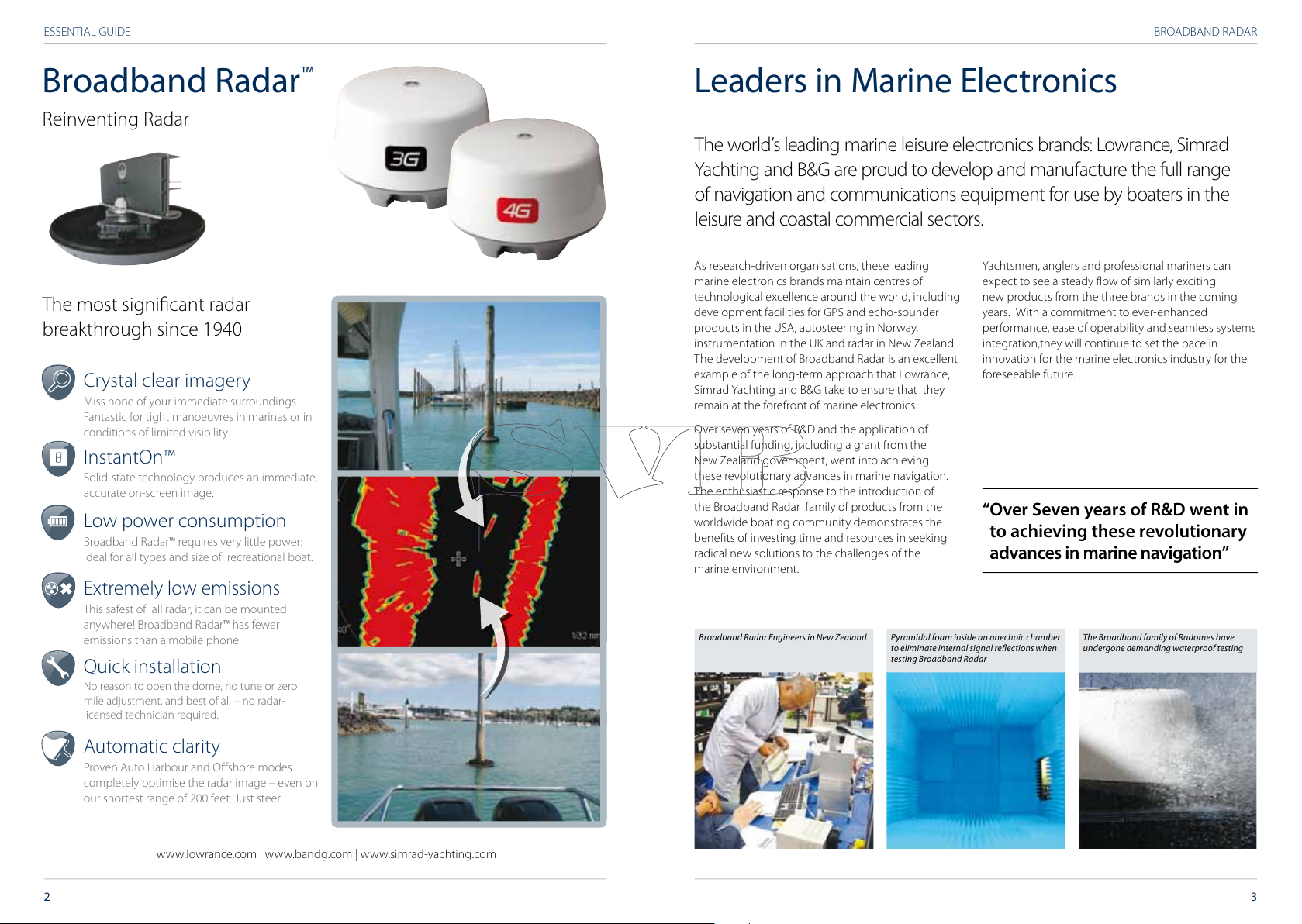
Pyramida l foam inside an ane choic chamber
to eliminate i nternal signal re e ctions when
testing Bro adband Radar
The Broad band family of Rad omes have
undergon e demanding waterp roof testing
Broadba nd Radar Engineer s in New Zealand
As research-driven organisations, these leading
marine electronics brands maintain centres of
technological excellence around the world, including
development facilities for GPS and echo-sounder
products in the USA, autosteering in Norway,
instrumentation in the UK and radar in New Zealand.
The development of Broadband Radar is an excellent
example of the long-term approach that Lowrance,
Simrad Yachting and B&G take to ensure that they
remain at the forefront of marine electronics.
Over seven years of R&D and the application of
substantial funding, including a grant from the
New Zealand government, went into achieving
these revolutionary advances in marine navigation.
The enthusiastic response to the introduction of
the Broadband Radar family of products from the
worldwide boating community demonstrates the
benefits of investing time and resources in seeking
radical new solutions to the challenges of the
marine environment.
Page 3
BROADBAND RADARESSENTIAL GUIDE
5 4
Greg Konig, Sr.Vice-President for Navico’s Product
Line was asked at a Press lunch if he could explain
how Broadband Radar works “in Layman’s terms”.
Konig obviously did not want
to launch into a lengthy
discourse over salad and
sandwiches. “In Layman’s
terms” he said, pausing for
effect “....it’s magic!”
With help from Konig and
other folks at Navico, we’ll
now try to explain how
Broadband Radar works
and how it differs from
conventional Pulse Radar
Conventional or pulse
radar is generated by a
magnetron, which has
been compared to a valve
opening and closing to
release pulses of energy.
In layman’s terms: Imagine
you are standing blindfolded
near a house. You holler
“hello!” and then listen to hear the echo. Let’s
assume you are changing direction like a rotating
radome as you continue to call “hello!” and listen
again. You holler, pause, listen; holler, pause, listen.
Your sense of hearing is more finely tunes than most,
and the echoes tell you that there is an irregular
object nearby in a particular direction at a specific
distance.
Broadband Radar is a marketing name for what
engineers call frequency-modulated continuous-
wave (FMCW) radar. The word “broadband”
nowadays is associated with good computer
connectivity; Navico justified use of this term
because its radar emits signals along a broad range
of frequencies. It does this without a magnetron,
instead using two solid-state amplifiers: one to
transmit waves at continuously increasing
frequencies, the other to
simultaneously receive their
echoes.
Now, Mr. Layman, you are
standing near the same
house, not hollering. You are
whispering, “do, re, me, fa, so,
la, ti, do; do, re, me, fa, so, la,
ti, do,” etc. As you rotate and
whisper, you listen for echoes,
with an ear for nuance. You
don’t pause; you whisper and
listen simultaneously. You clock
the echo from each discreet
note and use these streaming
time-stamps to build a mental
picture of a building with a tree
in front of it, but not touching.
“You are able to match what
you see on the screen to reality
quicker that you ordinarily
could. It also eliminates sea
clutter and rain clutter about five times better than
your traditional radar, and you don’t have to tune the
radar to get the signals to pop out from the noise”
Konig said.
Excerpts from “Radar Love” in Passage Maker
Magazine, courtesy of Peter Swanson
How does it work?
Broadband Radar™ compared to conventional pulse radar
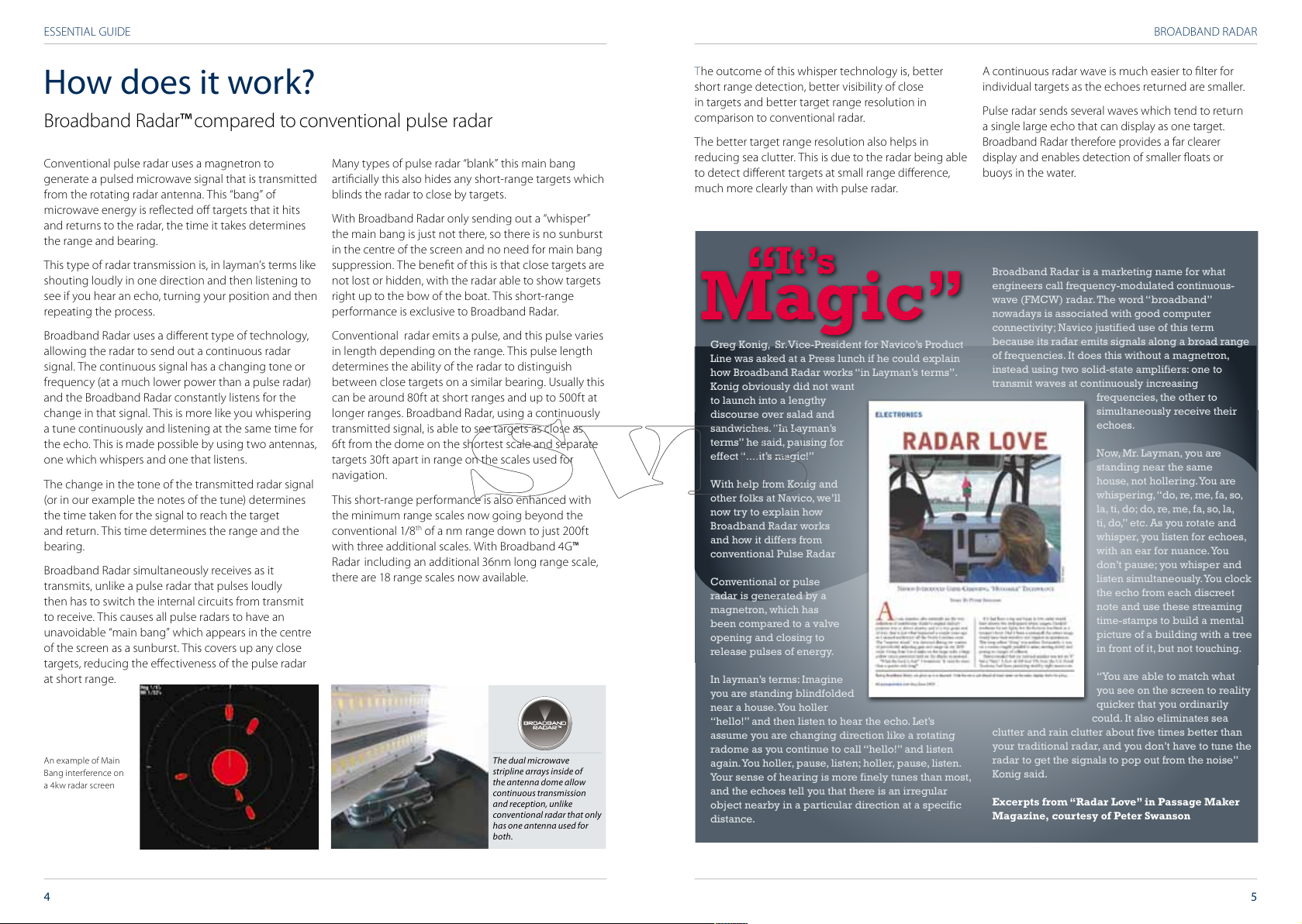
The dual mic rowave
striplin e arrays inside of
the antenna do me allow
continuous tra nsmission
and receptio n, unlike
conventiona l radar that only
has one antenn a used for
both.
An exampl e of Main
Bang inter ference on
a 4kw rada r screen
Conventional pulse radar uses a magnetron to
generate a pulsed microwave signal that is transmitted
from the rotating radar antenna. This “bang” of
microwave energy is reflected off targets that it hits
and returns to the radar, the time it takes determines
the range and bearing.
This type of radar transmission is, in layman’s terms like
shouting loudly in one direction and then listening to
see if you hear an echo, turning your position and then
repeating the process.
Broadband Radar uses a different type of technology,
allowing the radar to send out a continuous radar
signal. The continuous signal has a changing tone or
frequency (at a much lower power than a pulse radar)
and the Broadband Radar constantly listens for the
change in that signal. This is more like you whispering
a tune continuously and listening at the same time for
the echo. This is made possible by using two antennas,
one which whispers and one that listens.
The change in the tone of the transmitted radar signal
(or in our example the notes of the tune) determines
the time taken for the signal to reach the target
and return. This time determines the range and the
bearing.
Broadband Radar simultaneously receives as it
transmits, unlike a pulse radar that pulses loudly
then has to switch the internal circuits from transmit
to receive. This causes all pulse radars to have an
unavoidable “main bang” which appears in the centre
of the screen as a sunburst. This covers up any close
targets, reducing the effectiveness of the pulse radar
at short range.
Many types of pulse radar “blank” this main bang
artificially this also hides any short-range targets which
blinds the radar to close by targets.
With Broadband Radar only sending out a “whisper”
the main bang is just not there, so there is no sunburst
in the centre of the screen and no need for main bang
suppression. The benefit of this is that close targets are
not lost or hidden, with the radar able to show targets
right up to the bow of the boat. This short-range
performance is exclusive to Broadband Radar.
Conventional radar emits a pulse, and this pulse varies
in length depending on the range. This pulse length
determines the ability of the radar to distinguish
between close targets on a similar bearing. Usually this
can be around 80ft at short ranges and up to 500ft at
longer ranges. Broadband Radar, using a continuously
transmitted signal, is able to see targets as close as
6ft from the dome on the shortest scale and separate
targets 30ft apart in range on the scales used for
navigation.
This short-range performance is also enhanced with
the minimum range scales now going beyond the
conventional 1/8
th
of a nm range down to just 200ft
with three additional scales. With Broadband 4G™
Radar including an additional 36nm long range scale,
there are 18 range scales now available.
The outcome of this whisper technology is, better
short range detection, better visibility of close
in targets and better target range resolution in
comparison to conventional radar.
The better target range resolution also helps in
reducing sea clutter. This is due to the radar being able
to detect different targets at small range difference,
much more clearly than with pulse radar.
A continuous radar wave is much easier to filter for
individual targets as the echoes returned are smaller.
Pulse radar sends several waves which tend to return
a single large echo that can display as one target.
Broadband Radar therefore provides a far clearer
display and enables detection of smaller floats or
buoys in the water.
Page 4
BROADBAND RADARESSENTIAL GUIDE
7 6
No need to wor ry about microwa ve radiation with the n ew
Broadba nd Radar.
Advantages of Broadband Radar
Range discrimination performance
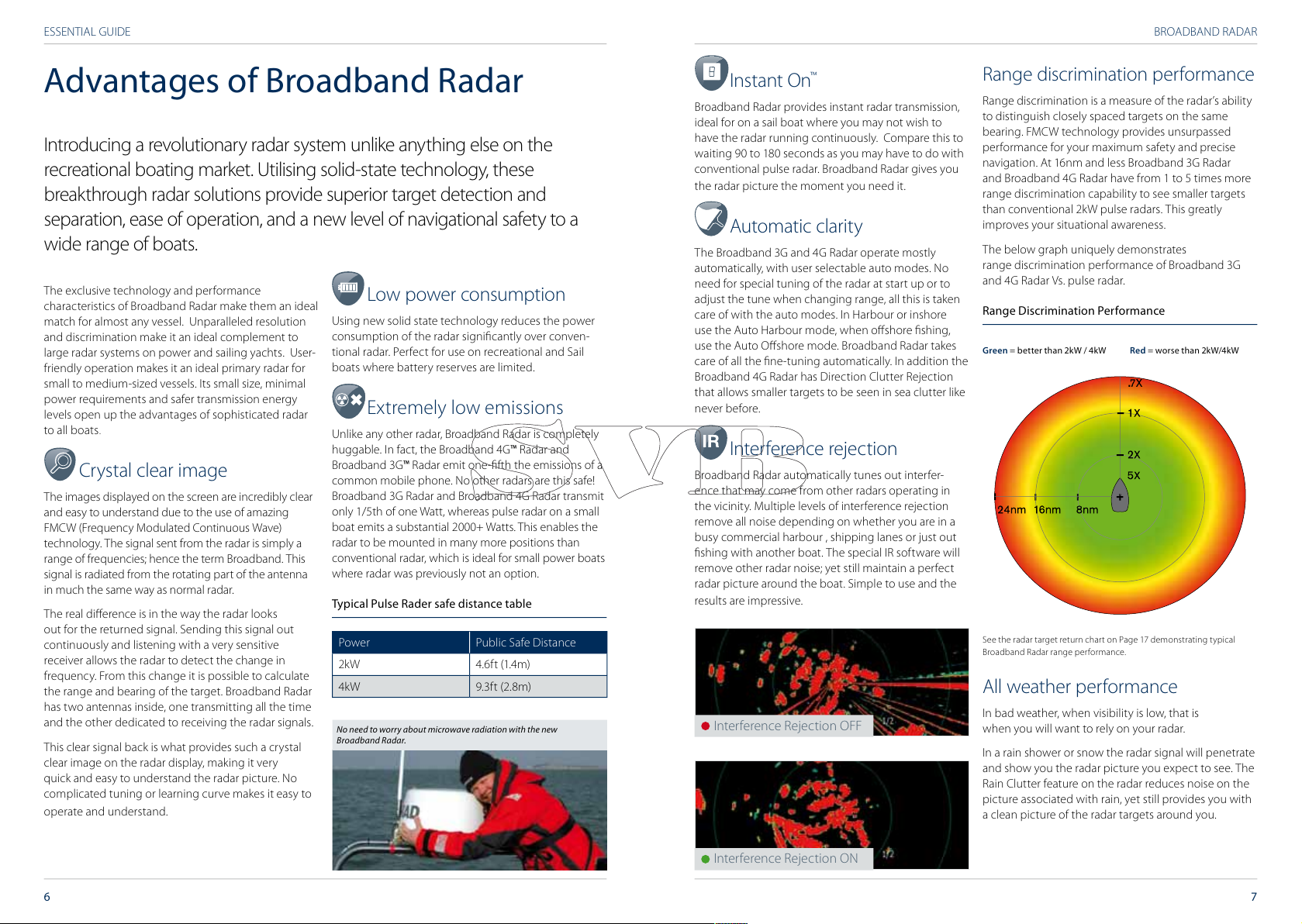
Range discrimination is a measure of the radar’s ability
to distinguish closely spaced targets on the same
bearing. FMCW technology provides unsurpassed
performance for your maximum safety and precise
navigation. At 16nm and less Broadband 3G Radar
and Broadband 4G Radar have from 1 to 5 times more
range discrimination capability to see smaller targets
than conventional 2kW pulse radars. This greatly
improves your situational awareness.
The below graph uniquely demonstrates
range discrimination performance of Broadband 3G
and 4G Radar Vs. pulse radar.
Range Discrimination Performance
See the ra dar target return char t on Page 17 demonstratin g typical
Broadban d Radar range per formance.
All weather performance
In bad weather, when visibility is low, that is
when you will want to rely on your radar.
In a rain shower or snow the radar signal will penetrate
and show you the radar picture you expect to see. The
Rain Clutter feature on the radar reduces noise on the
picture associated with rain, yet still provides you with
a clean picture of the radar targets around you.
The exclusive technology and performance
characteristics of Broadband Radar make them an ideal
match for almost any vessel. Unparalleled resolution
and discrimination make it an ideal complement to
large radar systems on power and sailing yachts. User-
friendly operation makes it an ideal primary radar for
small to medium-sized vessels. Its small size, minimal
power requirements and safer transmission energy
levels open up the advantages of sophisticated radar
to all boats.
Crystal clear image
The images displayed on the screen are incredibly clear
and easy to understand due to the use of amazing
FMCW (Frequency Modulated Continuous Wave)
technology. The signal sent from the radar is simply a
range of frequencies; hence the term Broadband. This
signal is radiated from the rotating part of the antenna
in much the same way as normal radar.
The real difference is in the way the radar looks
out for the returned signal. Sending this signal out
continuously and listening with a very sensitive
receiver allows the radar to detect the change in
frequency. From this change it is possible to calculate
the range and bearing of the target. Broadband Radar
has two antennas inside, one transmitting all the time
and the other dedicated to receiving the radar signals.
This clear signal back is what provides such a crystal
clear image on the radar display, making it very
quick and easy to understand the radar picture. No
complicated tuning or learning curve makes it easy to
operate and understand.
Introducing a revolutionary radar system unlike anything else on the
recreational boating market. Utilising solid-state technology, these
breakthrough radar solutions provide superior target detection and
separation, ease of operation, and a new level of navigational safety to a
wide range of boats.
Low power consumption
Using new solid state technology reduces the power
consumption of the radar significantly over conven-
tional radar. Perfect for use on recreational and Sail
boats where battery reserves are limited.
Extremely low emissions
Unlike any other radar, Broadband Radar is completely
huggable. In fact, the Broadband 4G™ Radar and
Broadband 3G™ Radar emit one-fifth the emissions of a
common mobile phone. No other radars are this safe!
Broadband 3G Radar and Broadband 4G Radar transmit
only 1/5th of one Watt, whereas pulse radar on a small
boat emits a substantial 2000+ Watts. This enables the
radar to be mounted in many more positions than
conventional radar, which is ideal for small power boats
where radar was previously not an option.
Instant On
™
Broadband Radar provides instant radar transmission,
ideal for on a sail boat where you may not wish to
have the radar running continuously. Compare this to
waiting 90 to 180 seconds as you may have to do with
conventional pulse radar. Broadband Radar gives you
the radar picture the moment you need it.
Automatic clarity
The Broadband 3G and 4G Radar operate mostly
automatically, with user selectable auto modes. No
need for special tuning of the radar at start up or to
adjust the tune when changing range, all this is taken
care of with the auto modes. In Harbour or inshore
use the Auto Harbour mode, when offshore fishing,
use the Auto Offshore mode. Broadband Radar takes
care of all the fine-tuning automatically. In addition the
Broadband 4G Radar has Direction Clutter Rejection
that allows smaller targets to be seen in sea clutter like
never before.
Interference rejection
Broadband Radar automatically tunes out interfer-
ence that may come from other radars operating in
the vicinity. Multiple levels of interference rejection
remove all noise depending on whether you are in a
busy commercial harbour , shipping lanes or just out
fishing with another boat. The special IR software will
remove other radar noise; yet still maintain a perfect
radar picture around the boat. Simple to use and the
results are impressive.
Green = better tha n 2kW / 4kW Red = worse than 2k W/4kW
Interference Rejection OFF
Interference Rejection ON
Power Public Safe Distance
2kW 4.6ft (1.4m)
4kW 9.3ft (2.8m)
Typical Pulse Rader safe distance table
Page 5
BROADBAND RADARESSENTIAL GUIDE
9 8
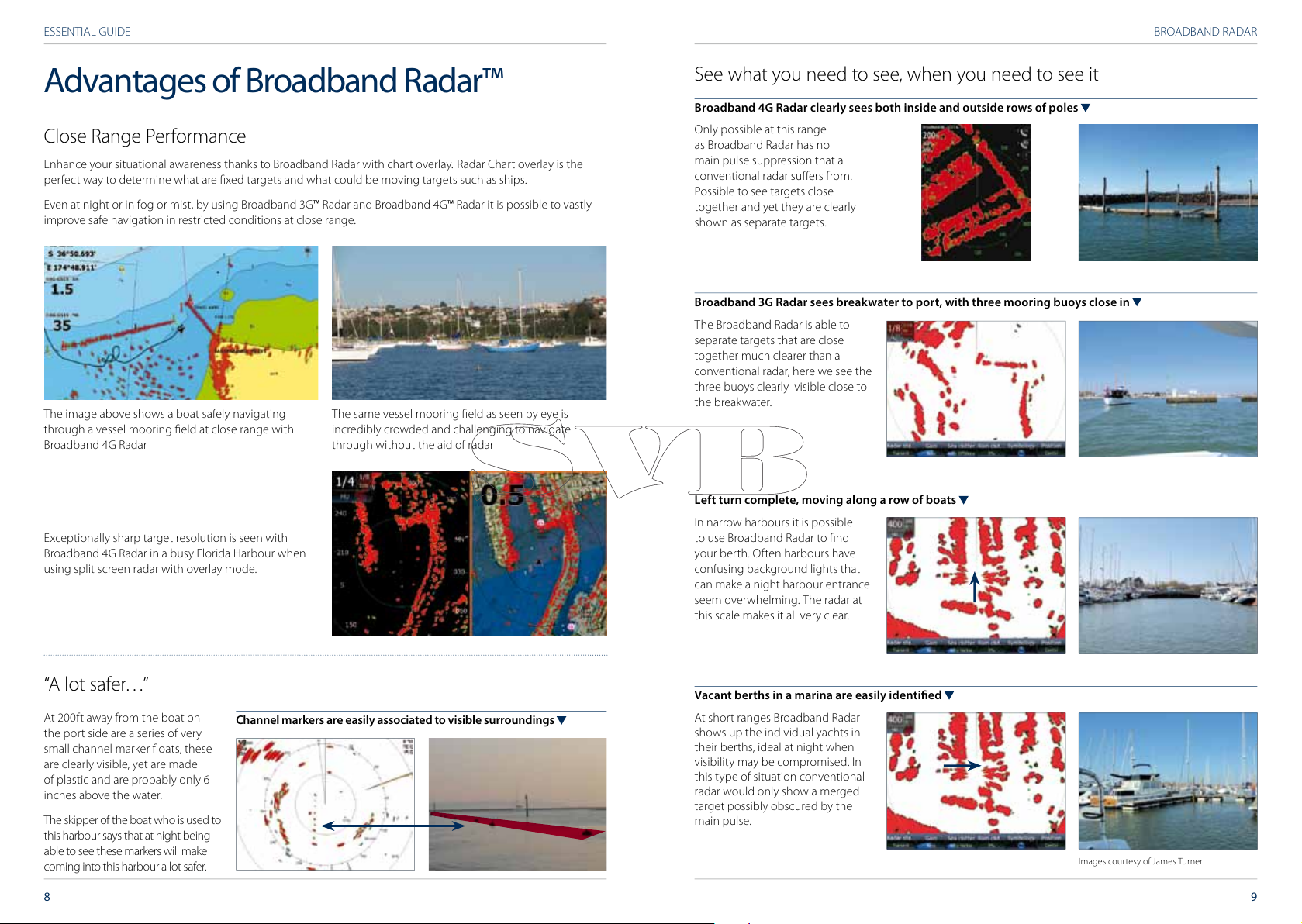
Close Range Performance
Enhance your situational awareness thanks to Broadband Radar with chart overlay. Radar Chart overlay is the
perfect way to determine what are fixed targets and what could be moving targets such as ships.
Even at night or in fog or mist, by using Broadband 3G™ Radar and Broadband 4G™ Radar it is possible to vastly
improve safe navigation in restricted conditions at close range.
The image above shows a boat safely navigating
through a vessel mooring field at close range with
Broadband 4G Radar
Advantages of Broadband Radar™
“A lot safer…”
Only possible at this range
as Broadband Radar has no
main pulse suppression that a
conventional radar suffers from.
Possible to see targets close
together and yet they are clearly
shown as separate targets.
Broadband 4G Radar clearly sees both inside and outside rows of poles
The Broadband Radar is able to
separate targets that are close
together much clearer than a
conventional radar, here we see the
three buoys clearly visible close to
the breakwater.
Broadband 3G Radar sees breakwater to port, with three mooring buoys close in
In narrow harbours it is possible
to use Broadband Radar to find
your berth. Often harbours have
confusing background lights that
can make a night harbour entrance
seem overwhelming. The radar at
this scale makes it all very clear.
Left turn complete, moving along a row of boats
See what you need to see, when you need to see it
At 200ft away from the boat on
the port side are a series of very
small channel marker floats, these
are clearly visible, yet are made
of plastic and are probably only 6
inches above the water.
The skipper of the boat who is used to
this harbour says that at night being
able to see these markers will make
coming into this harbour a lot safer.
Channel markers are easily associated to visible surroundings
At short ranges Broadband Radar
shows up the individual yachts in
their berths, ideal at night when
visibility may be compromised. In
this type of situation conventional
radar would only show a merged
target possibly obscured by the
main pulse.
Vacant berths in a marina are easily identied
Images cour tesy of James Turner
Exceptionally sharp target resolution is seen with
Broadband 4G Radar in a busy Florida Harbour when
using split screen radar with overlay mode.
The same vessel mooring field as seen by eye is
incredibly crowded and challenging to navigate
through without the aid of radar
Page 6
BROADBAND RADARESSENTIAL GUIDE
11 10
Broadband 4G™ Radar, What’s New? Broadband 4G™ Radar, What’s New?
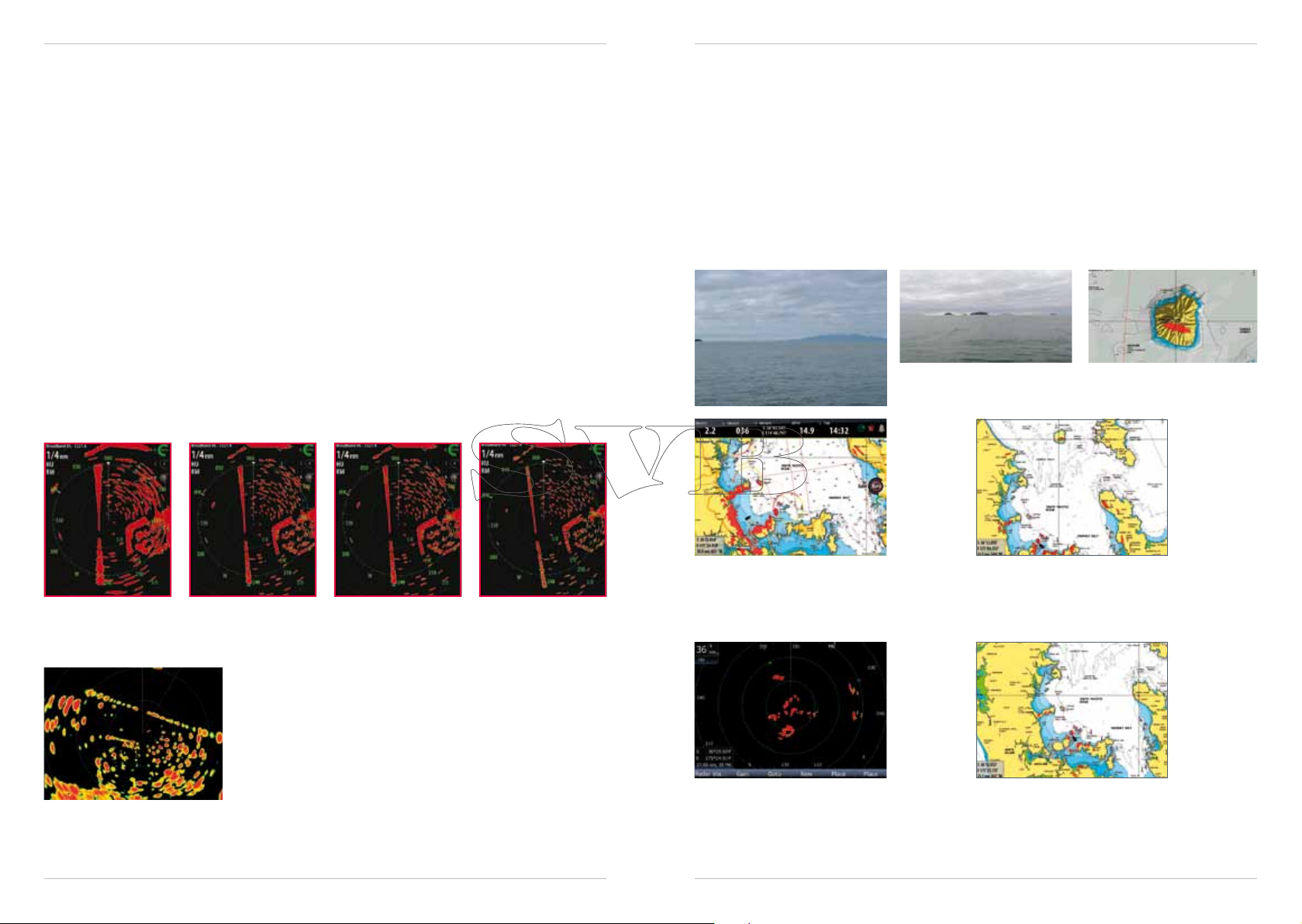
Broadband 4G Radar clearly detects the
New Zealand Coromandel Peninsula
.>29nm away with the B&G Zeus
Little Barrier island clearly seen over 32nm away with Broadband 4G Radar
Broadband 4G Radar provides a 36nm
usable display range as shown here
on the Lowrance HDS
*Displays without Noise Rejection Control automatically default to High, in this case Target Separation will also be High
Target Separation
Control OFF
~5.2˚
Target Separation
Control LOW
~4.4˚
Target Separation
Control MED
~3.5°
Target Separation
Control HIGH
~2.6˚
4kW pulse radar showing inferior
target separation
The Broadband 3G™ Radar followed in the footsteps of the awardwinning BR24™ Broadband Radar and has two times higher RF energy
transmitted at the antenna than the original BR24, resulting in a 30%
increase in range.
The newest member of the Broadband Radar range,
the Broadband 4G Radar continues in this tradition
offering all the benefits of the Broadband 3G Radar, as
well as some spectacular extra features .
The Broadband 4G Radar has an impressive 50%
improvement in range and target detection capability,
with a new 36nm range and 18 range scales to
accomodate the increased performance.
Broadband 4G is the first dome radar to employ
Beamsharpening. This technology enables a new
feature called Target Separation Control, which
improves the Azimouth resolution, or effective antenna
horizontal beam width, up to double the resolution
of any 18-inch dome radar. This is the equivalent of a
three and a half foot open array radar!
When paired with the Simrad NSE and NSO or B&G
Zeus series, the Broadband 4G Radar is capable of
high speed operation up to 48rpm. It also has a new
Dual Range feature which allows unprecendented
simultaneous working ranges, anywhere from 200ft up
to 36nm - no other radar in the world can do this.
Both Broadband 3G Radar and Broadband 4G Radar work with the
entire range of Simrad Yachting, Lowrance and B&G award-winning
multifunctional displays., these include the B&G Zeus, Simrad NSE, Simrad
NSO, Simrad NSS and Lowrance HDS series.
Improved Range Performance with Noise Rejection Control
Broadband 4G Radar uses advanced levels of Digital Signal Processing to reduce the amount of noise picked up
by the radome’s surroundings. Users can choose the levels of Noise Rejection via an onscreen menu and decide
between LOW or HIGH rejection to customise their views*.
Noise Rejection Control increases the Broadband 4G Radar range by up to 50% and also increases target
detection sensitivity.
Omaha Beach and Little Barrier island
are seen at over 32nm away by
Broadband 4G Radar
Broadband 3G™ Radar sees some of
the Coromandel Peninsula at 23nm.
Page 7
BROADBAND RADARESSENTIAL GUIDE
13 12
Broadband 4G™ Radar, What’s New?
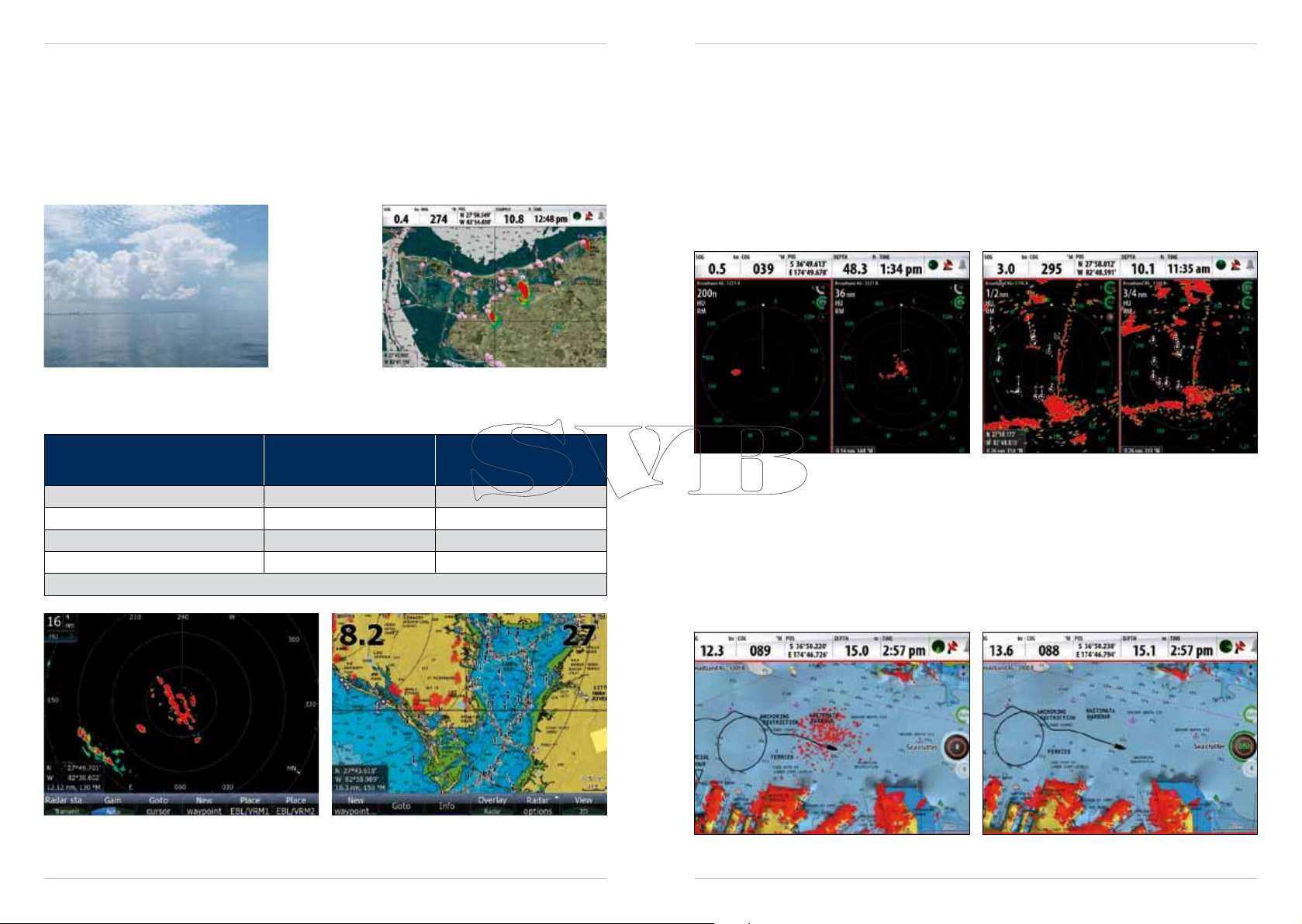
A concentrated Summer Storm cell is seen
over the coast
Broadband 4G Radar shows three individual
rain cells inside the storm pictured on the
left > 17nm away
A Buoy is seen 86’ away, while using the long 36nm
simultaneously
Dual Range with Advanced MARPA, High Speed
With compatible displays including the Simrad NSE, Simrad NSO and B&G Zeus series, Broadband 4G Radar is
capable of simultaneous Dual Range operation from a single dome, allowing 10 MARPA targets on each side of
a split screen. This allows unprecedented independent working ranges from 200ft right up to 36 nautical miles
- no other recreational radar in the world can provide this scaling! Up to 48rpm high speed operation is
available for single range operation at less than 1nm.
Broadband 4G™ Radar, what’s new?
Broadband 4G Radar Dual Range mode tracks up to 10
MARPA targets on each side of the screen with
independent controls, allowing 20 MARPA targets to
be tracked in total.
When using Broadband 4G Radar, a powerful storm
greater than 12nm away is displayed on a Lowrance
HDS with multiple gradient colours
Broadband 4G Radar detects many separated cells
inside a Florida rain storm overlaid on a chart greater
than 16nm away
Improved Sidelobe Clutter Rejection
Broadband 4G Radar has improved sidelobe clutter rejection for large targets, such as tankers and tall buildings
on the coastline. In addition, directional sea clutter processing improves the ability to see smaller targets in
heavy sea states.
Sea Clutter is set to OFF in a strong Sea State 3-4 to
demonstrate sea clutter around the boat.
Automatic OFFSHORE mode totally eliminates sea
clutter around boat while still seeing nearby targets.
Weather Detection
Broadband 4G™ Radar benefits from increased weather detection of around 10% when compared to Broadband 3G™
Radar. In on-water testing, Broadband Radar has detected strong rain cells in Florida, USA more than 17nm away.
Ballpark Distances
Rain Pattern
Typical maximum range of
Broadband 3G Radar in good
propagation conditions*
Typical maximum range of
Broadband 4G Radar in good
propagation conditions*
Wide weather front with heavy rain 8-15nm 9-17nm
Dense rain cell 100mm/hr 7-13nm 8-15nm
Heavy shower 25mm/hr 2.5-5.5nm 3-6nm
Light Rain 1.3 -2.6n m 1. 5-3nm
*Distance data represents typical detection distance, not guaranteed
Page 8
BROADBAND RADARESSENTIAL GUIDE
15 14
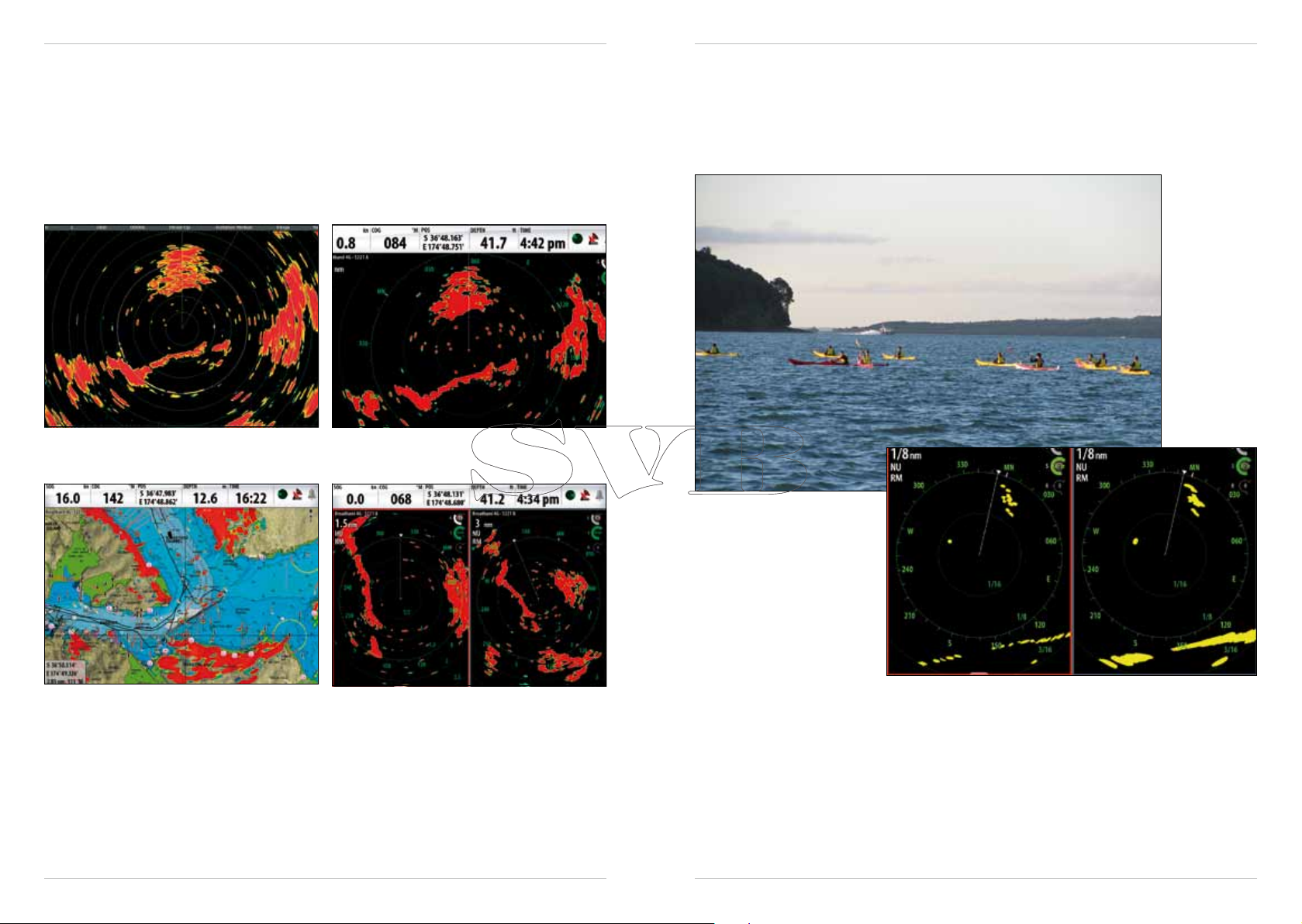
New Zealand Shipping channel at 3nm with 4kW Radar New Zealand Shipping channel at 3nm with
Broadband 4G™ Radar
New Zealand Shipping channel at 3nm with
Broadband 4G™ Radar and chart overlay. Notice the
crisp targets and markers.
Broadband 4G™ Radar what’s new?
Broadband 4G Radar showing shipping channel details
with 1.5nm and 3nm split screen
Small Target Detection at 3nm Range
The 3nm range is especially important in the transition one from short to longer range radar performance.
Broadband 4G™ Radar allows the clear detection of individual buoys, channel markers and coastline, while
avoiding the sidelobe projections and target stretching that is common with pulse radar.
The Broadband 4G Radar offers extraordinary all-round performance, including exception clutter rejection, which
dramatically increases situational awareness among novice and professional users alike.
Broadband 4G™ Radar what’s new?
Broadband 4G Radar compared to
Broadband 3G Radar (right Image)
when looking at Kayakers (above)
Page 9
BROADBAND RADARESSENTIAL GUIDE
17 16
17 17
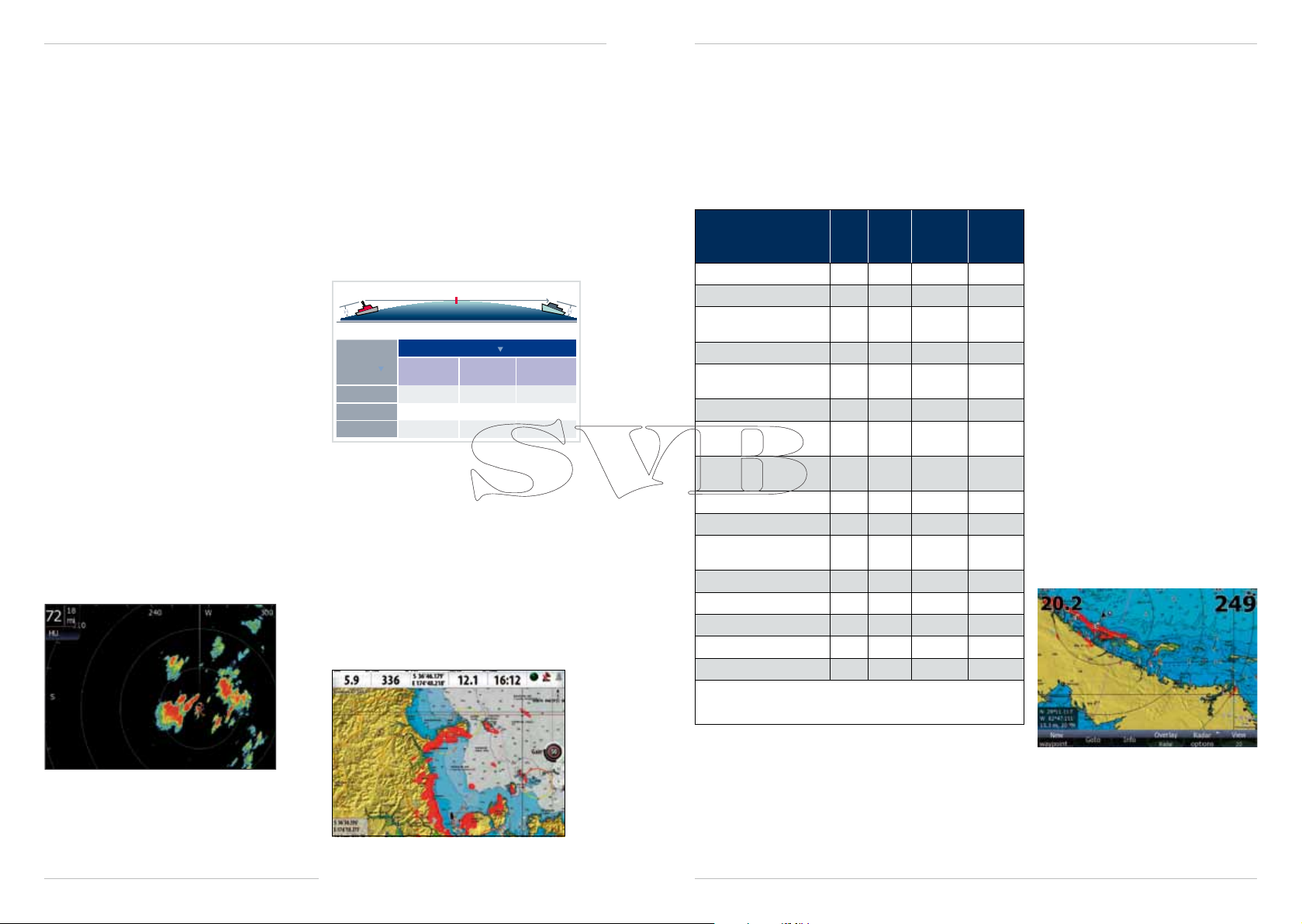
How far can I expect to see with
Broadband Radar?
17 17
When to Use Pulse Radar
vs Broadband Radar
Broadband 3G™ Radar and Broadband
4G™ Radar are ideal for
t Close range operation in tight quarters with an
unmatched full screen radar scale of 200’
t Tall Coastline detection past 30nm with Broadband
4G Radar
t Weather detection greater than 15-17nm
t Precise navigation with high resolution target
detection for collision avoidance situations up to 3nm
t Monitoring of both close and far ranges with
Broadband 4G Radar
t Natural sea clutter rejection
t Directional sea clutter rejection with Broadband
4G Radar
t Easy installation with maximum RF emission safety
t Maximum safety and situational awareness
Pulse radar is ideal for
t Detailed visibility of storms and rain cells farther
than 16-20nm away
t Seeing hard to detect sloping beaches and shorelines
t Triggering RACONS
t Cosmetic appearance of a turning open array
I can’t see my friend’s boat 6nm
away. Why?
t Always be careful with distance and line of sight-
all radars need to be higher to see farther, and the
farther you look, the bigger and taller the object
needs to be
I can see coastline in the distance
but my radar cannot see it. Why?
t This is true of all radars in some conditions due
to the slope of the land, height of the coastline,
vegetation, humidity and distance.
t Broadband Radar target detection ability decreases
more rapidly than pulse radars as the radar range
scale is increased while adequately seeing important
larger targets far away. Broadband 3G Radar is good
at seeing targets at distance, but Broadband 4G Radar
is 50% better, with a working range up to 32nm and a
useable display range of 36nm.
RADAR HORIZON TARGET
TYPICAL RADAR TARGET RANGES
Scanner
Height
Target
Objec t at sea
level
Small boa t
(2m high)
Big Launc h
(6m high)
6 feet 3.1 miles 6.3 miles 8.4 miles
9 feet 3.8 miles 7.0 miles 9.2miles
13 feet 4.4 miles 7.5 mile s 9.8 miles
Ballpark D istances
Typical Maxi mum range in
good prop agation conditio ns**
Target
Height
(ft)
Radar
Horizon
(nm)
Broadban d
3G Range
Broadban d
4G Range*
Marine Targets
Large Power St ation/ wind farm 300 21.3 18-2 5nm 25nm+
Long coast line with 100m
high cliffs
300 21.3 13-2 5n m 19-25 nm+
High densit y urban coastline 150 15.1 8-15nm 11- 19 nm +
Forest-cov ered coastline gentl y
sloping to 250 m
750 33 .7 5-10nm 8-15nm
Low lying sub urban coastline 150 15.1 5-10nm 8-15nm
Large conta iner ship
(ship depen dent)
100 12. 3 10 -17nm 13-17n m+
Low lying coa stline ,50m
dense vege tation
100 12. 3 4-8nm 6-11nm
small low ly ing island 50 8.7 2.5-5nm 4-7nm
Medium siz ed power boat 13 4.4 1. 3-2.6 nm 2-3.5nm
Channel mar kers with
radar refle ctors
10 3.9 1.3 -2.6n m 2-3.5nm
Small power o r sail boat 13 4.4 0.7-2nm 1-3nm
Small marker b uoy 10 3.9 0.25-0.7nm 0.25-1nm
Kayak 300 -800ft 6 3.0 300-800 ft 300-80 0ft
Birds 160-500 ft 100 12. 3 16 0-5 00f t 160 -50 0f t
Sandbars 1 5.7 0.2-0. 6nm 0.3-0.9nm
Ranges ab ove with radome hei ght of 13ft.
*Broadba nd 4G Radar - single ra nge noise reducti on = high
** Above dat a is typical targe t distances, not guar anteed
Can I improve maximum usable range by using
manual controls?
t In some cases, yes, but introduces more noise in the image
and not recommended for non-experienced radar users.
General Recommendations
for selecting Broadband or
Pulse Radars
t Broadband 3G Radar is the best value
choice for the vast majority of radar
applications and addresses the need
for superior all weather navigation
usage. Broadband 4G Radar is the best
18’’ dome radar available combining
the best resolution for navigation and for
offshore operation from 20-30nm
t Low emissions combined with the
fact that “all collision incidents occur
with objects less than 10’ of the boat” -
where radar visibility is now possible
with Broadband Radar, makes you and
your family safer in ever y way
t Pulse radars are for operators that
regularly go further than 20nm offshore
and need to keep tabs on distant storm
cells and detect far away coastlines - in
addition to seeing these objects
on their chartplotter map. For these
applications, HD digital open array radars
are recommended
6kW HD Digital Open Array (Pulse) Radar on
72nm range with full colour storm cells
Broadband 4G Radar sees solid coastlines and
three freighters in line approaching Auckland
on this map overlay
Broadband 4G Radar easily displays a small
power plant more than 15 nm away on a
Lowrance HDS
When to Use Pulse Radar
vs Broadband Radar
Page 10
BROADBAND RADARESSENTIAL GUIDE
19 18
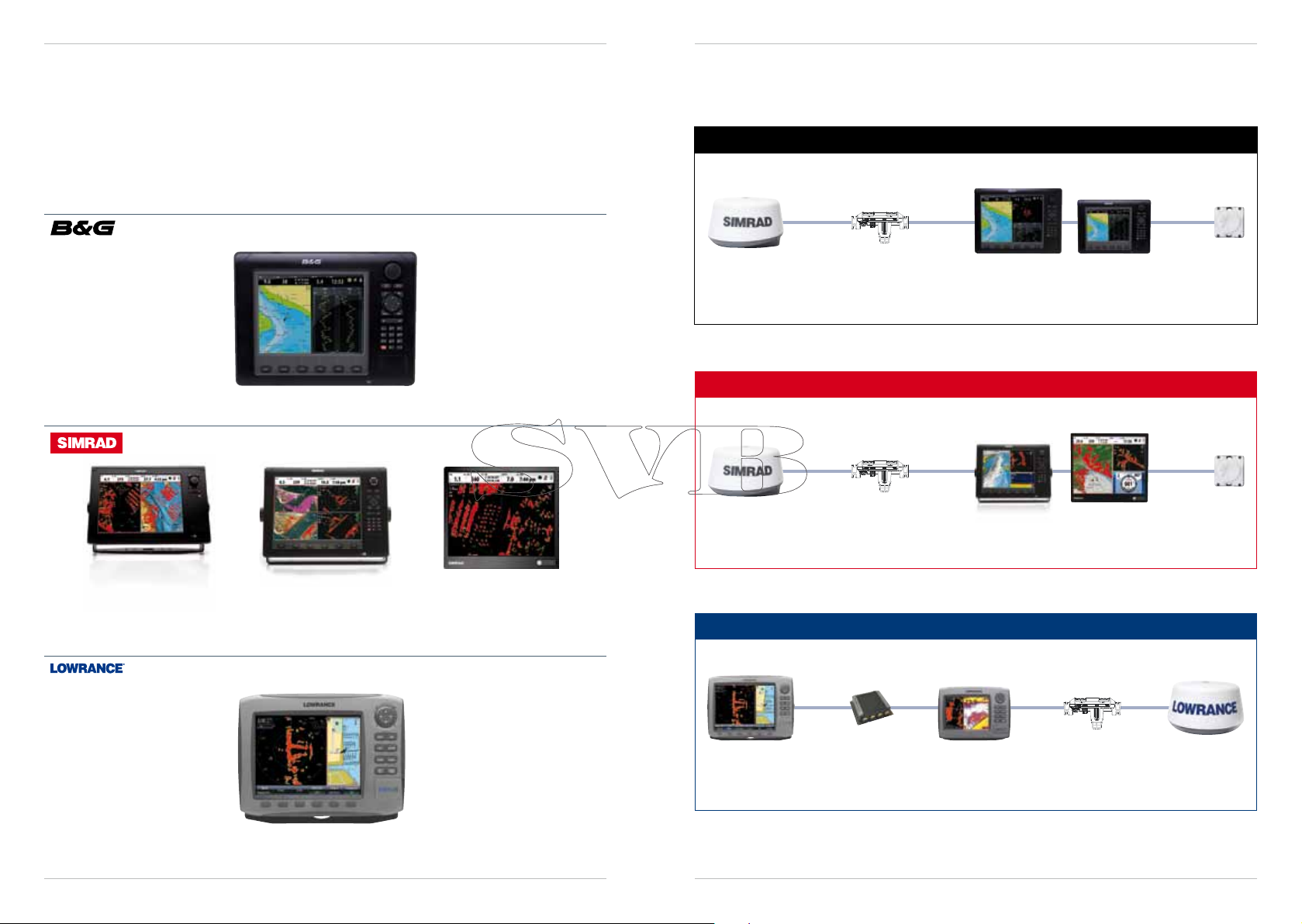
Is my display compatible?
Typical installation options
19
Broadband 3G Radar and Broadband 4G Radar are compatible with
many different modern Lowrance, SImrad and B&G displays. To see if
yours is compatible, see below.
www.lowrance.com
Note: Your display may r equire a softw are
upgrad e to be Broadband 3G and 4G R adar
compatibl e. Available features may v ary
according to uni t
Lowrance HDS: 5-inch / 7-inch / 8-inch / 10-inch
www.bandg.com
B&G Zeus: 8-inch / 12-inch
www.simrad-yachting.com
Simrad NSO Oshore:
15- in ch
17- in ch
19 -i nch
B&G Typical Installation (simplified diagram)
Zeus 12-inch Zeus 8-inchRadar Int erface
Box
Simrad Br oadband
3G / 4G Rada r
RC42
Compass
Lowrance Typical Installation (simplified diagram)
HDS-10 HDS-5 Lowranc e Broadband
3G / 4G Rada r
Radar Int erface
Box
Navico
Expan sion Port
Simrad Typical Installation (simplified diagram)
Radar Int erface
Box
Simrad Br oadband
3G / 4G Rada r
RC42
Compass
NSO15NSE8
Simrad NSS Sport:
7-inch
8-inch
12- in ch
Simrad NSE Expert:
8-inch
12- in ch
Page 11
BROADBAND RADARESSENTIAL GUIDE
21 20
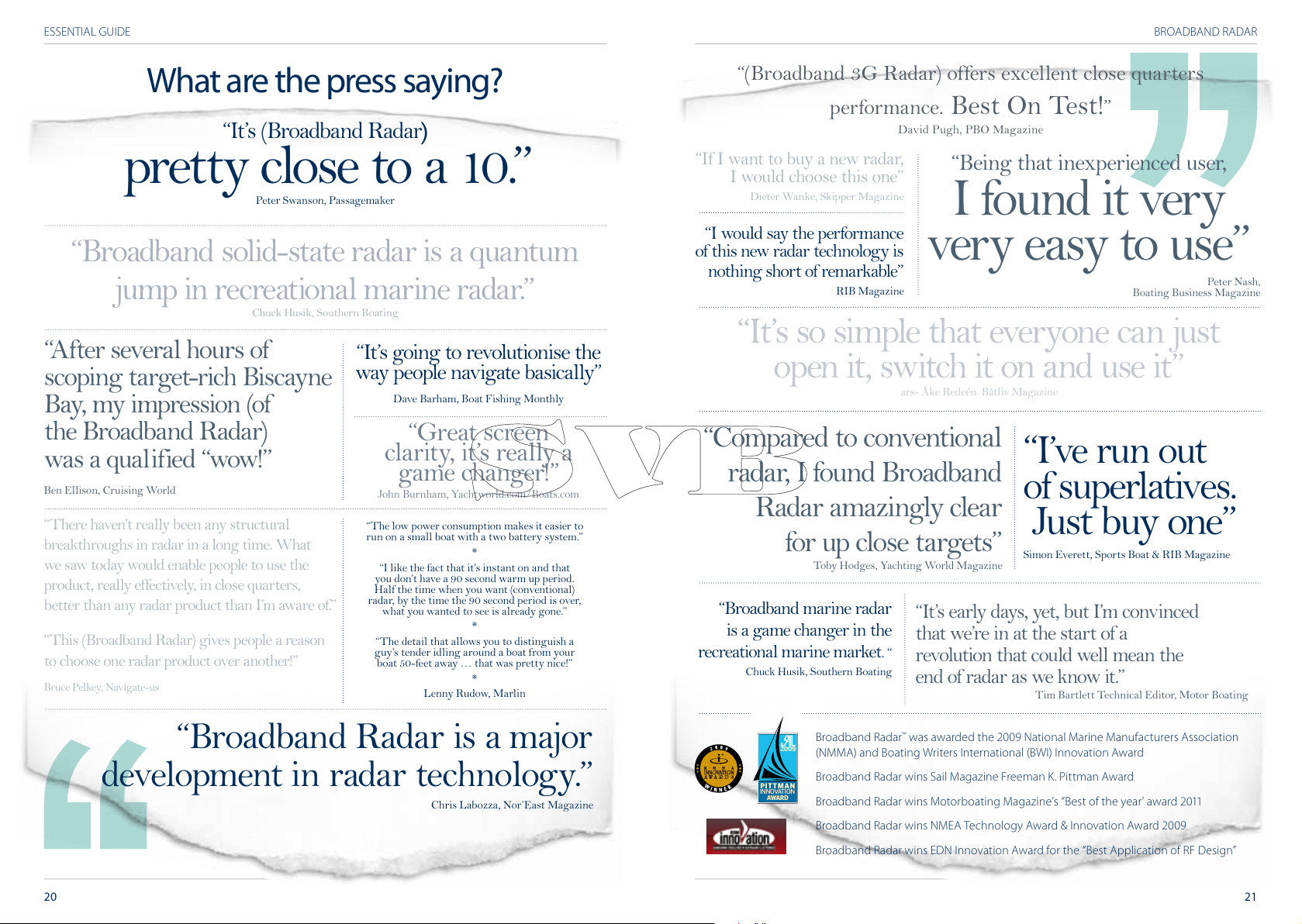
What are the press saying?
“Broadband solid-state radar is a quantum
jump in recreational marine radar.”
Chuck Husik, Southern Boating
“There haven’t really been any structural
breakthroughs in radar in a long time. What
we saw today would enable people to use the
product, really effectively, in close quarters,
better than any radar product than I’m aware of.”
“This (Broadband Radar) gives people a reason
to choose one radar product over another!”
Bruce Pelkey, Navigate-us
“It’s early days, yet, but I’m convinced
that we’re in at the start of a
revolution that could well mean the
end of radar as we know it.”
Tim Bartlett Technical Editor, Motor Boating
“Being that inexperienced user,
I found it very
very easy to use”
Peter Nash,
Boating Business Magazine
“I’ve run out
of superlatives.
Just buy one”
Simon Everett, Sports Boat & RIB Magazine
“I would say the performance
of this new radar technology is
nothing short of remarkable”
RIB Magazine
“If I want to buy a new radar,
I would choose this one”
Dieter Wanke, Skipper Magazine
“It’s so simple that everyone can just
open it, switch it on and use it”
ars- Åke Redeén. Båtliv Magazine
“Compared to conventional
radar, I found Broadband
Radar amazingly clear
for up close targets”
To by H o dg e s, Y ac ht i n g Wo rl d M ag a zi n e
“Broadband marine radar
is a game changer in the
recreational marine market
. “
Chuck Husik, Southern Boating
“It’s going to revolutionise the
way people navigate basically”
Dave Barham, Boat Fishing Monthly
“Great screen
clarity, it’s really a
game changer!”
John Burnham, Yachtworld.com/Boats.com
“After several hours of
scoping target-rich Biscayne
Bay, my impression (of
the Broadband Radar)
was a qualified “wow!”
Ben Ellison, Cruising World
“The low power consumption makes it easier to
run on a small boat with a two battery system.”
*
“I like the fact that it’s instant on and that
you don’t have a 90 second warm up period.
Half the time when you want (conventional)
radar, by the time the 90 second period is over,
what you wanted to see is already gone.”
*
“The detail that allows you to distinguish a
guy’s tender idling around a boat from your
boat 50-feet away … that was pretty nice!”
*
Lenny Rudow, Marlin
“Broadband Radar is a major
development in radar technology.”
Chris Labozza, Nor’East Magazine
“It’s (Broadband Radar)
pretty close to a 10.”
Peter Swa nson, Passa gemaker
“(Broadband 3G Radar) offers excellent close quarters
performance.
Best On Test!”
David Pugh, PBO Magazine
Broadband Radar™ was awarded the 2009 National Marine Manufacturers Association
(NMMA) and Boating Writers International (BWI) Innovation Award
Broadband Radar wins Sail Magazine Freeman K. Pittman Award
Broadband Radar wins Motorboating Magazine’s “Best of the year’ award 2011
Broadband Radar wins NMEA Technology Award & Innovation Award 2009
Broadband Radar wins EDN Innovation Award for the “Best Application of RF Design”
G@KKD8E
@EEFM8K@FE
8N8I;J
)''.
G@KKD8E
@EEFM8K@FE
)''0
G@KKD8E
@EEFM8K@FE
8N8I;
8N8I;
Page 12
Navico, Premier Way, Abbey Park, Romsey, Hampshire S051 9DH Tel: +44 (0) 1794 510010 www.navico.com
www.bandg.com
www.simrad-yachting.com
www.lowrance.com
 Loading...