

Page 1
Page 2
Preface
D-Link reserves the right to revise this publication and to make changes in the content hereof without obligation to notify any
person or organization of such revisions or changes.
Manual Revisions
Revision Date Description
1.0 April 11, 2012 • Initial release
Trademarks
D-Link and the D-Link logo are trademarks or registered trademarks of D-Link Corporation or its subsidiaries in the United
States or other countries. All other company or product names mentioned herein are trademarks or registered trademarks of
their respective companies.
Copyright © 2012 by D-Link Systems, Inc.
All rights reserved. This publication may not be reproduced, in whole or in part, without prior expressed written permission
from D-Link Systems, Inc.
iD-Link DIR-600L User Manual
Page 3

Table of Contents
Table of Contents
Preface ................................................................................. i
Manual Revisions ........................................................................... i
Trademarks ...................................................................................... i
Package Contents .............................................................. 1
System Requirements ................................................................. 1
Features ............................................................................................2
Hardware Overview ..................................................................... 3
Connections ........................................................................... 3
LEDs ........................................................................................... 4
Installation ......................................................................... 5
Before you Begin ...........................................................................5
Wireless Installation Considerations ......................................6
Manual Setup ................................................................................. 7
Conguration ..................................................................... 9
Easy Setup Wizard ........................................................................ 9
Web-based Conguration Utility ..........................................14
Internet Setup ......................................................................15
Static (assigned by ISP) ................................................15
Dynamic ............................................................................16
PPPoE ................................................................................17
PPTP ....................................................................................18
L2TP ....................................................................................19
Wireless Settings .................................................................20
Manual Wireless Setup ...................................................... 21
Wireless Security .................................................................22
What is WPA? ...................................................................22
Wireless Connection Setup Wizard..........................23
WPA/WPA2-PSK ..............................................................25
WPA/WPA2-RADIUS ......................................................26
LAN Setup ..............................................................................27
DHCP Server Settings ........................................................ 28
DHCP Reservation .........................................................29
Time and Date ......................................................................30
Parental Control ..................................................................31
Port Forwarding ..................................................................32
Application Rules ................................................................33
MAC Filtering ........................................................................34
Trac Control .......................................................................35
Firewall & DMZ .....................................................................36
Advanced Wireless .............................................................37
Advanced Network ............................................................39
Routing ...................................................................................40
Device Administration ......................................................41
Save and Restore .................................................................42
Firmware Update ................................................................43
Language Pack ................................................................43
mydlink Pack ....................................................................43
DDNS Setting .......................................................................44
System Check .......................................................................45
Schedules ..............................................................................46
iiD-Link DIR-600L User Manual
Page 4

Table of Contents
Log Settings ..........................................................................47
Device Info ............................................................................48
Log ...........................................................................................49
Trac Statistics ....................................................................50
Active Session .....................................................................50
Wireless ..................................................................................51
Help .........................................................................................52
Connect a Wireless Client to your Router ......................53
WPS Button ...................................................................................53
Windows® 7 ...................................................................................54
WPA/WPA2 ............................................................................54
WPS ..........................................................................................57
Windows Vista® ............................................................................61
WPA/WPA2 ............................................................................62
WPS/WCN 2.0 .......................................................................64
Windows® XP ................................................................................65
Networking Basics ........................................................... 77
Check your IP address ...............................................................77
Statically Assign an IP address ...............................................78
Technical Specications ..................................................79
Contacting Technical Support ........................................81
Warranty ...........................................................................82
Registration .....................................................................89
WPA/WPA2 ............................................................................66
Troubleshooting .............................................................. 68
Wireless Basics .................................................................72
What is Wireless? .........................................................................73
Tips ...................................................................................................75
Wireless Modes ............................................................................76
iiiD-Link DIR-600L User Manual
Page 5
Section 1 - Product Overview
• D-Link DIR-600L Wireless N 150 Home Cloud Router
• Power Adapter
• Quick Installation Guide
• Ethernet Cable
Note: Using a power supply with a dierent voltage rating than the one included with the DIR-600L will cause damage and void the warranty for this product.
Network Requirements
Package Contents
System Requirements
• An Ethernet-based Cable or DSL modem
• IEEE 802.11n or 802.11g wireless clients
• 10/100 Ethernet
Web-based Conguration
Utility Requirements
Computer with the following:
• Windows®, Macintosh, or Linux-based operating system
• An installed Ethernet adapter
Browser Requirements:
• Internet Explorer 7 or higher
• Firefox 3.5 or higher
• Safari 4 or higher
• Chrome 8 or higher
Windows® Users: Make sure you have the latest version of Java
installed. Visit www.java.com to download the latest version.
1D-Link DIR-600L User Manual
Page 6

Section 1 - Product Overview
• Faster Wireless Networking - The DIR-600L provides up to 150Mbps* wireless connection with other 802.11n
wireless clients. This capability allows users to participate in real-time activities online, such as video streaming,
online gaming, and real-time audio.
• Compatible with 802.11b and 802.11g Devices - The DIR-600L is still fully compatible with the IEEE 802.11b
and IEEE 802.11g standard, so it can connect with existing 802.11b and IEEE 802.11g PCI, USB and Cardbus
adapters.
• Cloud Service - The DIR-600L features a new cloud service that pushes information such as rmware upgrade
notications, user activity, and intrusion alerts to the mydlink™ app on Android and Apple mobile devices. To
insure that your router is up-to-date with the latest features, mydlink™ will notify you when an update is available
for your router. You can also monitor a user’s online activity with real-time website browsing history, maintaining
a safe and secure environment, especially for children at home.
Features
• Easy Setup Wizard - Through its easy-to-use Web-based user interface, the DIR-600L lets you control what
information is accessible to those on your wireless network, whether from the Internet or from your company’s
server. Congure your router to your specic settings within minutes.
* Maximum wireless signal rate derived from IEEE Standard 802.11g and 802.11n specications. Actual data throughput will vary. Network conditions and environmental factors,
including volume of network trac, building materials and construction, and network overhead, lower actual data throughput rate. Environmental conditions will adversely
aect wireless signal range.
2D-Link DIR-600L User Manual
Page 7
Section 1 - Product Overview
Hardware Overview
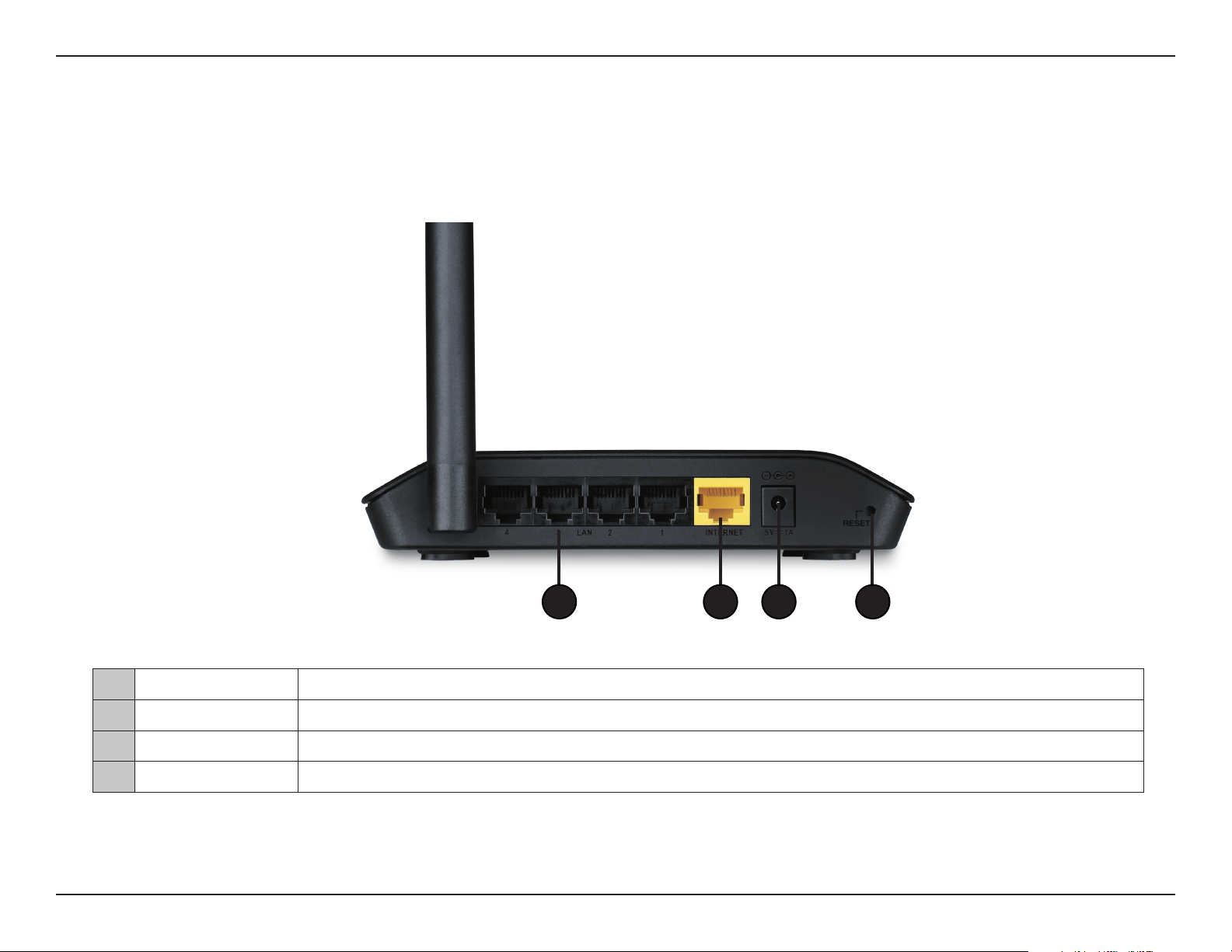
Connections
1 2 3 4
1 LAN Ports (1-4) Connect 10/100 Ethernet devices such as computers, switches, cameras, and network storage devices (NAS).
2 Internet Port Connect your broadband modem using an Ethernet cable.
3 Power Receptor Receptor for the supplied power adapter.
4 Reset Button Press and hold the reset button for 10 seconds to restore the router to its original factory default settings.
3D-Link DIR-600L User Manual
Page 8
Section 1 - Product Overview
Hardware Overview
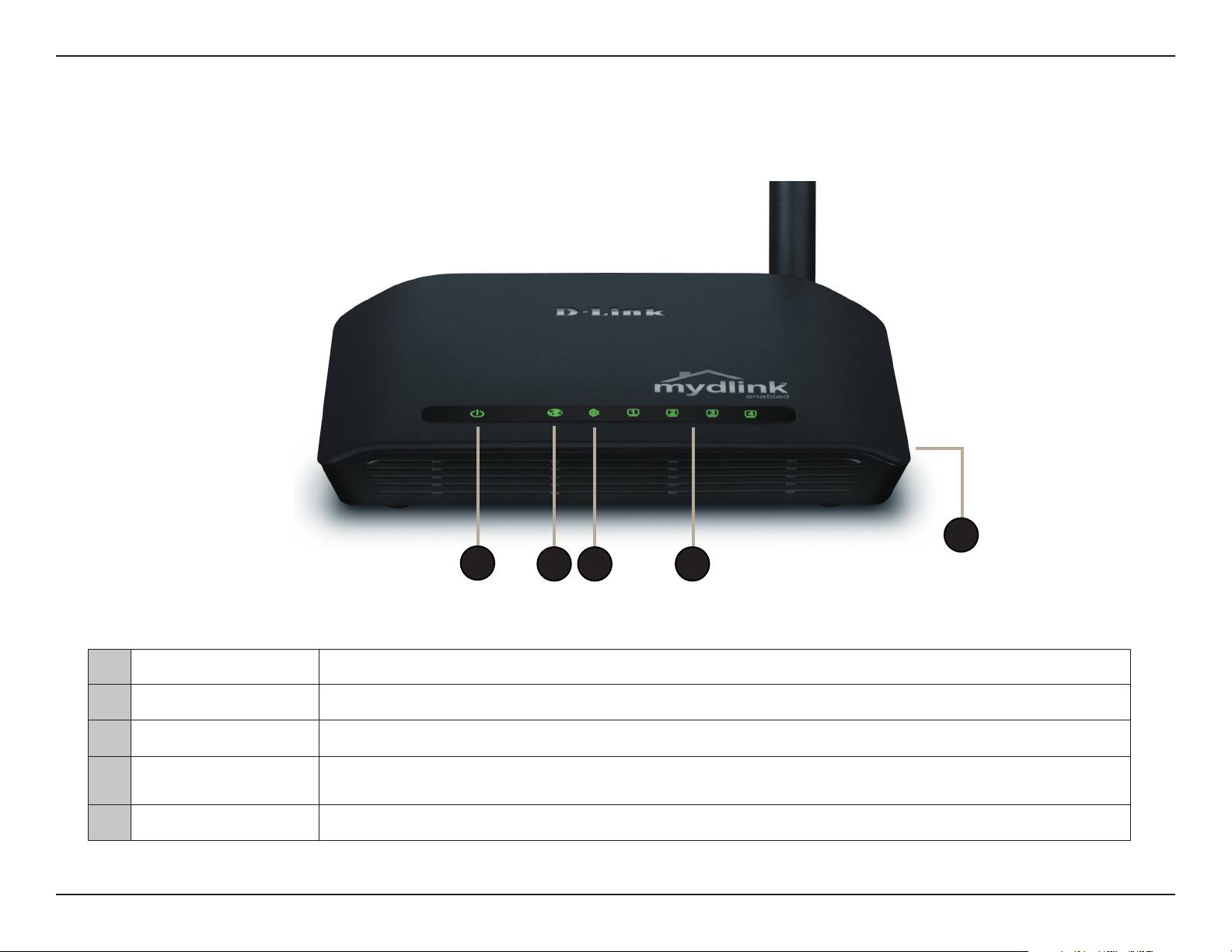
LEDs
5
1
1 Power LED A solid light indicates a proper connection to the power supply.
2 Internet LED A solid light indicates a good connection to the Internet port. This LED blinks during data transmission.
3 Wireless LED A solid light indicates that the wireless segment is ready. This LED blinks during wireless data transmission.
4 LAN LEDs (1-4)
5 WPS Button/LED Press the WPS button to begin the WPS process. The LED will blink during this process.
A solid light indicates a good connection to an Ethernet-enabled device on ports 1-4. This LED blinks
during data transmission.
2 3 4
4D-Link DIR-600L User Manual
Page 9

Section 2 - Installation
Installation
This section will walk you through the installation process. Placement of the router is very important. Do not place the router
in an enclosed area such as a closet, cabinet, or in the attic or garage.
Before you Begin
• Please congure the router with the computer that was last connected directly to your modem.
• You can only use the Ethernet port on your modem. If you were using the USB connection before using the router, then you
must turn o your modem, disconnect the USB cable and connect an Ethernet cable to the Internet port on the router, and
then turn the modem back on. In some cases, you may need to call your ISP to change connection types (USB to Ethernet).
• If you have DSL and are connecting via PPPoE, make sure you disable or uninstall any PPPoE software such as WinPoet,
Broadjump, or Enternet 300 from your computer or you will not be able to connect to the Internet.
5D-Link DIR-600L User Manual
Page 10

Section 2 - Installation
Wireless Installation Considerations
The D-Link wireless router allows you access your network using a wireless connection from virtually anywhere within the
operating range of your wireless network. Keep in mind, however, that the number, thickness and location of walls, ceilings,
or other objects that the wireless signals must pass through, may limit the range. Typical ranges vary depending on the types
of materials and background RF (radio frequency) noise in your home or business. The key to maximizing wireless range is to
follow these basic guidelines:
1. Keep the number of walls and ceilings between the D-Link router and other network devices to a minimum each wall or ceiling can reduce your adapter’s range from 3-90 feet (1-30 meters.) Position your devices so that
the number of walls or ceilings is minimized.
2. Be aware of the direct line between network devices. A wall that is 1.5 feet thick (.5 meters), at a
45-degree angle appears to be almost 3 feet (1 meter) thick. At a 2-degree angle it looks over 42 feet (14 meters)
thick! Position devices so that the signal will travel straight through a wall or ceiling (instead of at an angle) for
better reception.
3. Building Materials make a dierence. A solid metal door or aluminum studs may have a negative eect on
range. Try to position access points, wireless routers, and computers so that the signal passes through drywall
or open doorways. Materials and objects such as glass, steel, metal, walls with insulation, water (sh tanks),
mirrors, le cabinets, brick, and concrete will degrade your wireless signal.
4. Keep your product away (at least 3-6 feet or 1-2 meters) from electrical devices or appliances that generate RF
noise.
5. If you are using 2.4GHz cordless phones or X-10 (wireless products such as ceiling fans, lights, and home security
systems), your wireless connection may degrade dramatically or drop completely. Make sure your 2.4GHz phone
base is as far away from your wireless devices as possible. The base transmits a signal even if the phone in not
in use.
6D-Link DIR-600L User Manual
Page 11
Section 2 - Installation
5V
RESET
1A
INTERNET12LAN34
Manual Setup
For best results, place the router in an open area of your intended work area for better wireless coverage. Please use the
computer that you are currently connecting to the Internet with.
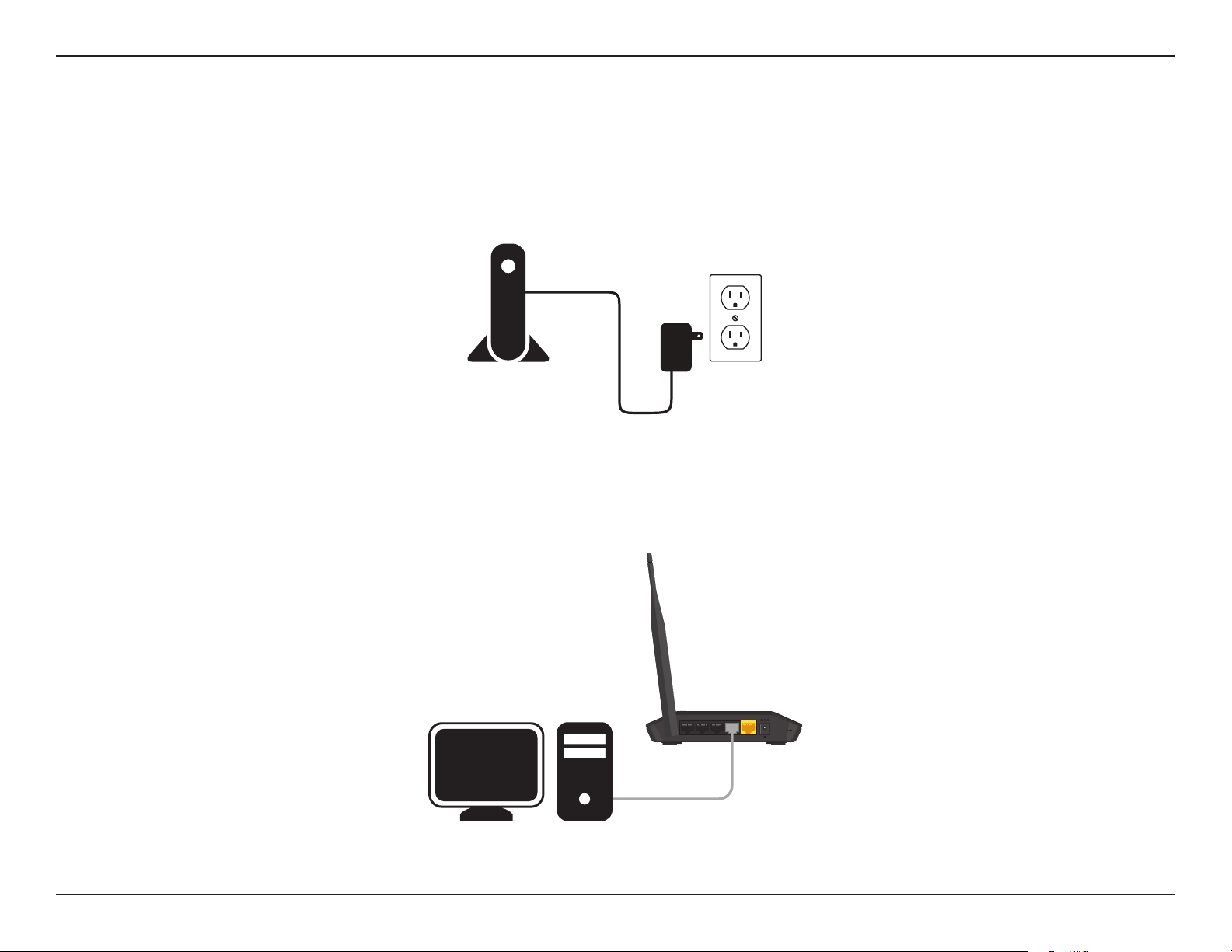
1. Unplug the power from your modem.
Modem
2. Unplug the Ethernet cable from your modem that is connected to your computer. Plug it into the LAN port
labeled 1 on the back of your router. The router is now connected to your computer.
DIR-600L
Computer
7D-Link DIR-600L User Manual
Page 12
Section 2 - Installation
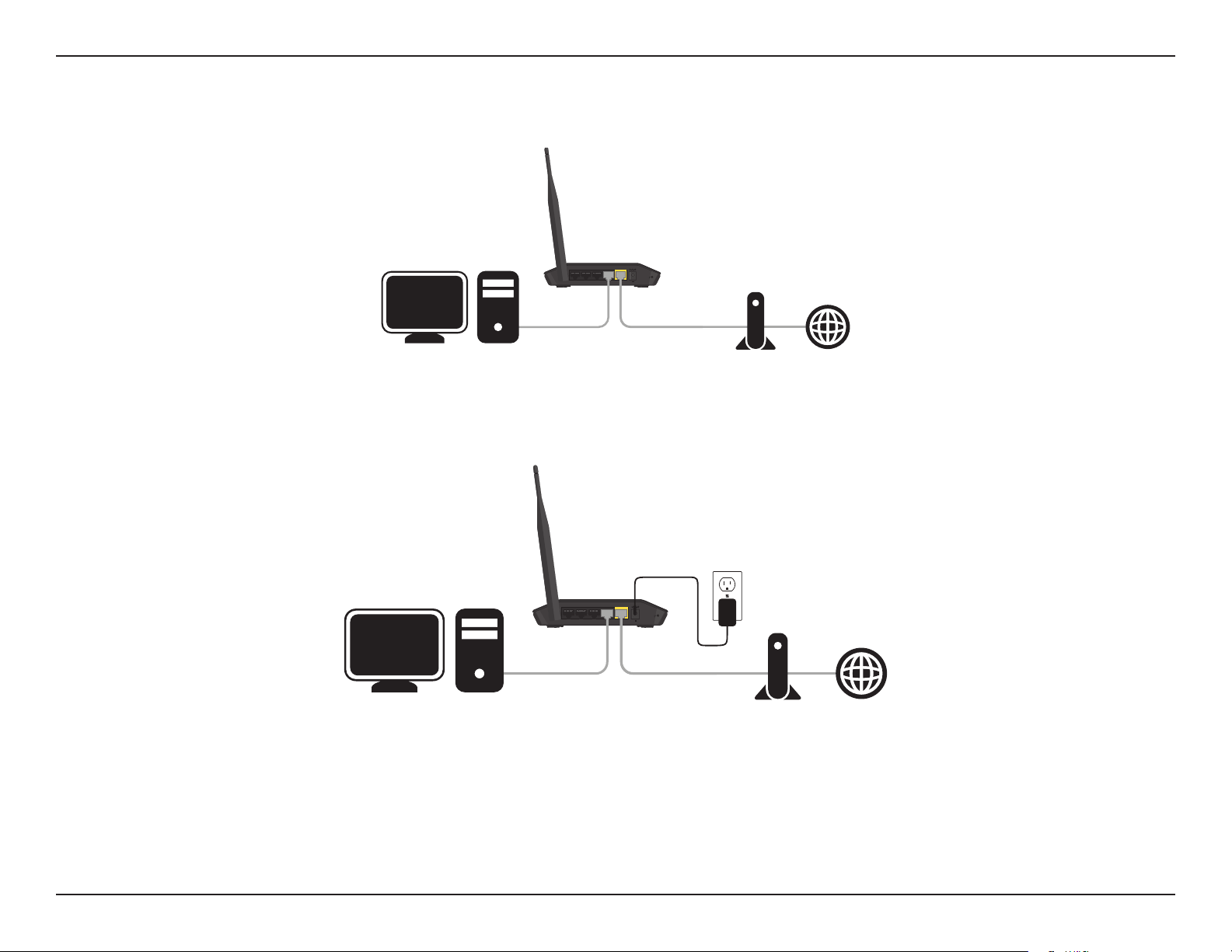
3. Use the supplied Ethernet cable and plug it into the port labeled INTERNET on the back of the router. Plug the
other end of this cable into the Ethernet port on your modem.
DIR-600L
Computer
RESET
1A
5V
INTERNET12LAN34
Modem
4. Plug the power back into the modem and power it on. Then connect the supplied power adapter into the power
receptor on the back of the router and then plug into a power outlet or surge protector. Verify the power light
is lit.
DIR-600L
RESET
1A
5V
INTERNET12LAN34
ModemComputer
5. If you are connecting to a Broadband service that uses a dynamic connection (not PPPoE), you may be online
already. Try opening a web browser and enter a web site. If you connect to a web site, you are nished with your
Internet setup. Please skip to page 14 to congure your router and use the manual setup procedure to congure
your network and wireless settings. If you did not connect to the Internet, use the Easy Setup Wizard (refer to the
next page).
8D-Link DIR-600L User Manual
Page 13
Section 3 - Conguration
Conguration
There are a couple dierent ways you can congure your router to connect to the Internet and connect to your clients:
• D-Link Easy Setup Wizard - This wizard will launch if you log into the router for the rst time. See below.
• Manual Setup - Log into the router and manually congure your router (advanced users only). Refer to page 14.
Easy Setup Wizard
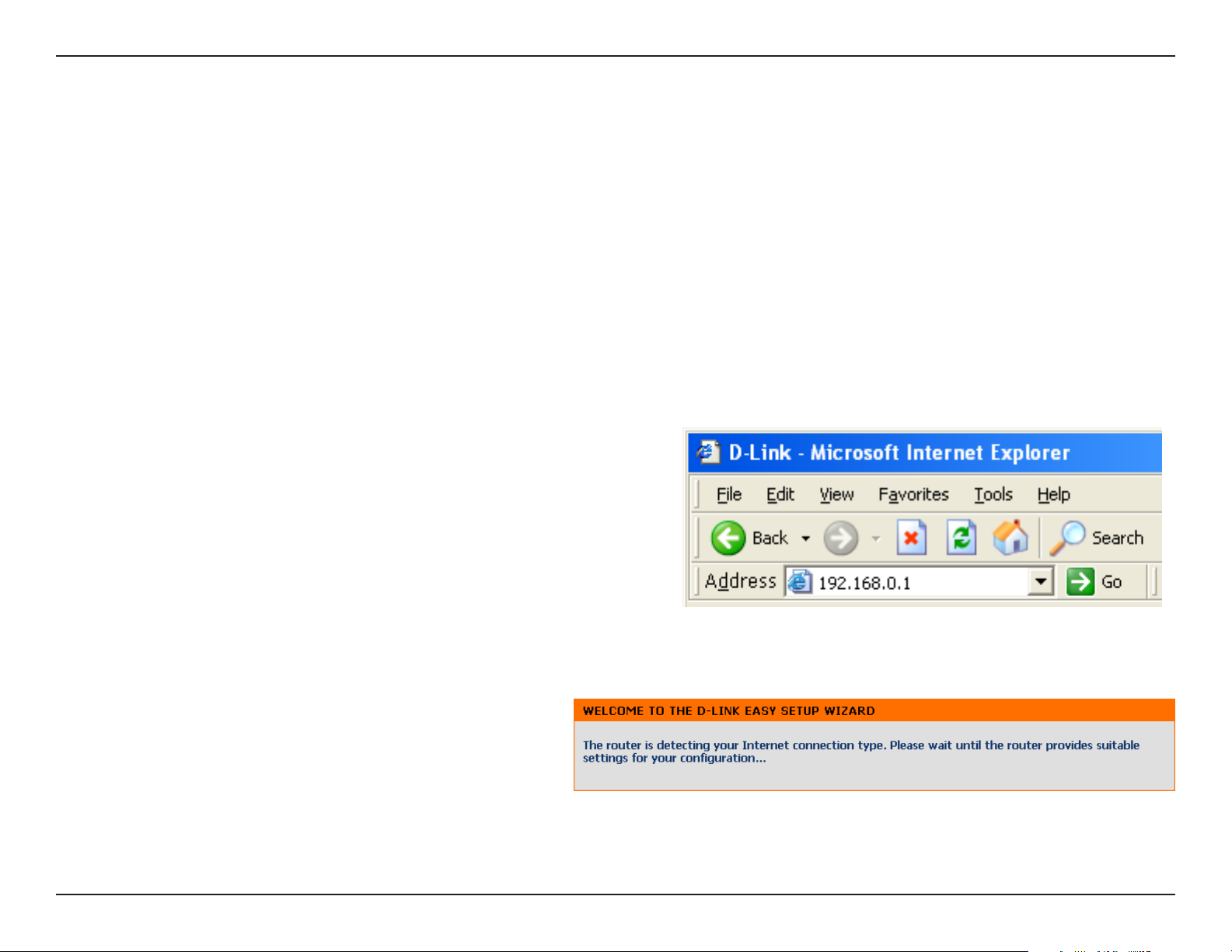
To access the configuration utility, open a web-browser such
as Internet Explorer and enter the IP address of the router
(http://192.168.0.1) or http://dlinkrouter.
You will be directed to the D-Link Easy Setup Wizard
page, which will detect your Internet connection type.
9D-Link DIR-600L User Manual
Page 14
Section 3 - Conguration
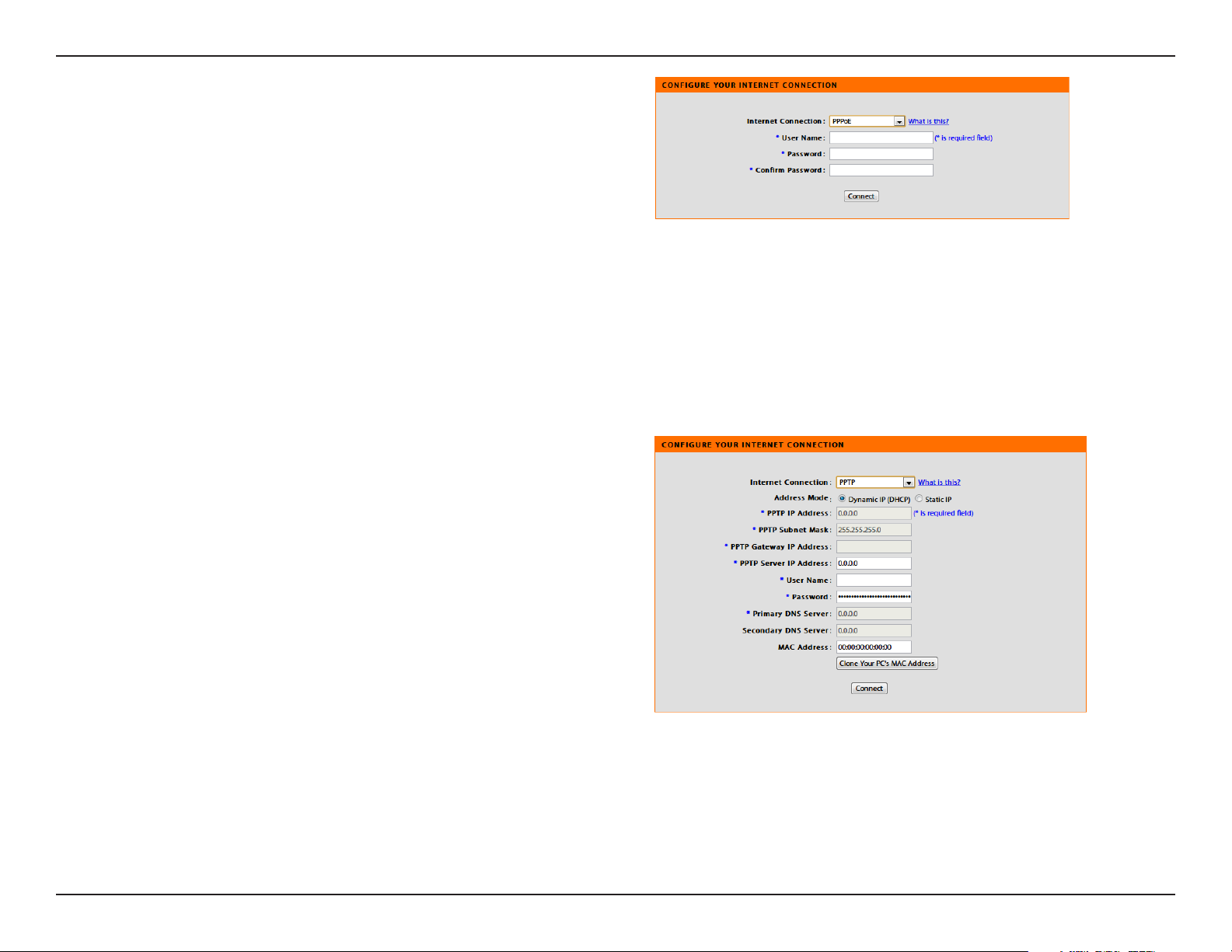
Follow the on-screen instructions to configure your Internet
settings. If your Internet connection is using DHCP, skip to the
next page.
If you are using a PPPoE connection, enter your user name and
password. Click Connect.
Note: Make sure to remove your PPPoE software from your
computer. The software is no longer needed and will not work
through a router.
If you selected PPTP, enter your PPTP username and password.
Click Next to continue.
10D-Link DIR-600L User Manual
Page 15
Section 3 - Conguration
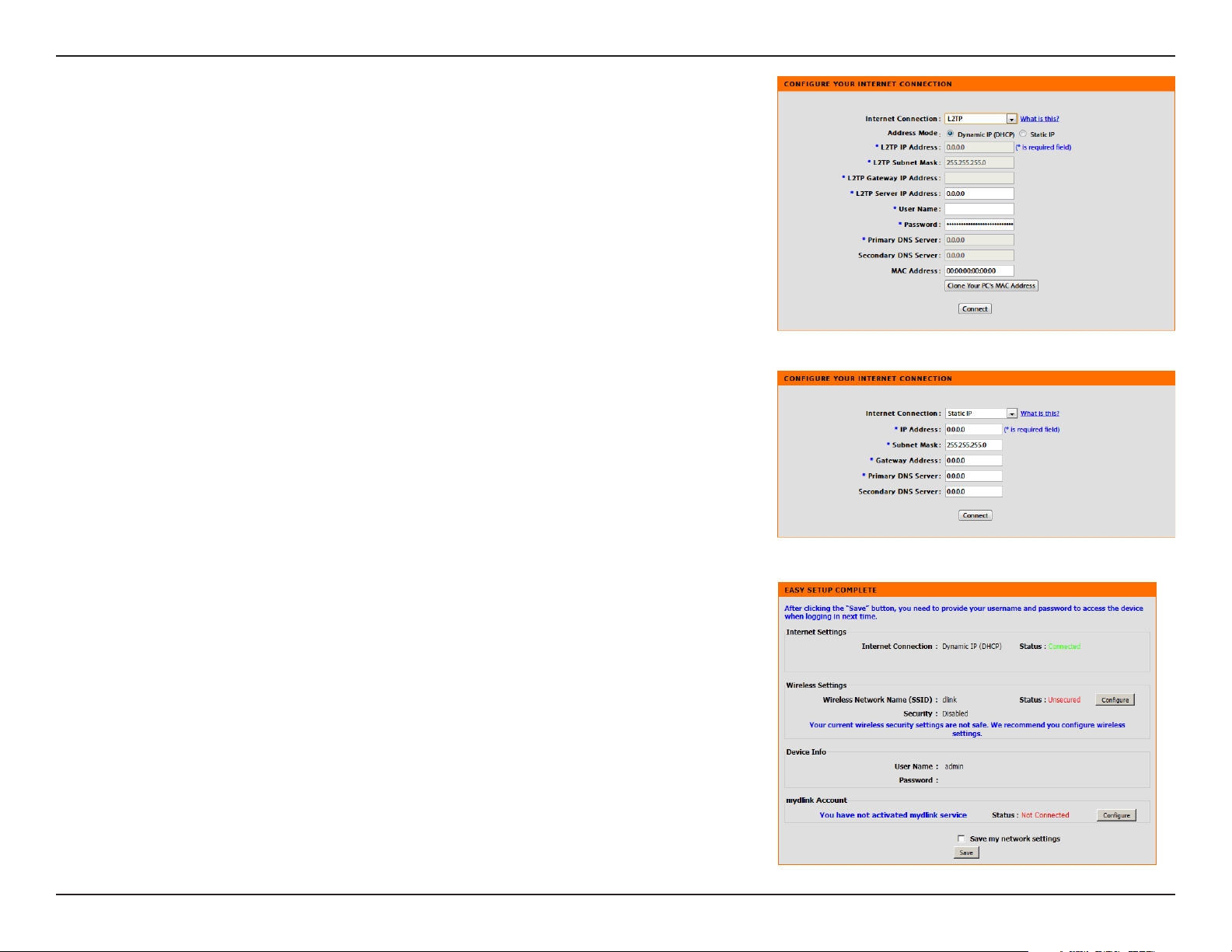
If you selected L2TP, enter your L2TP username and password. Click Next to
continue.
If you selected Static, enter your network settings supplied by your Internet
provider. Click Next to continue.
Once you are connected, the following screen will appear.
11D-Link DIR-600L User Manual
Page 16
Section 3 - Conguration
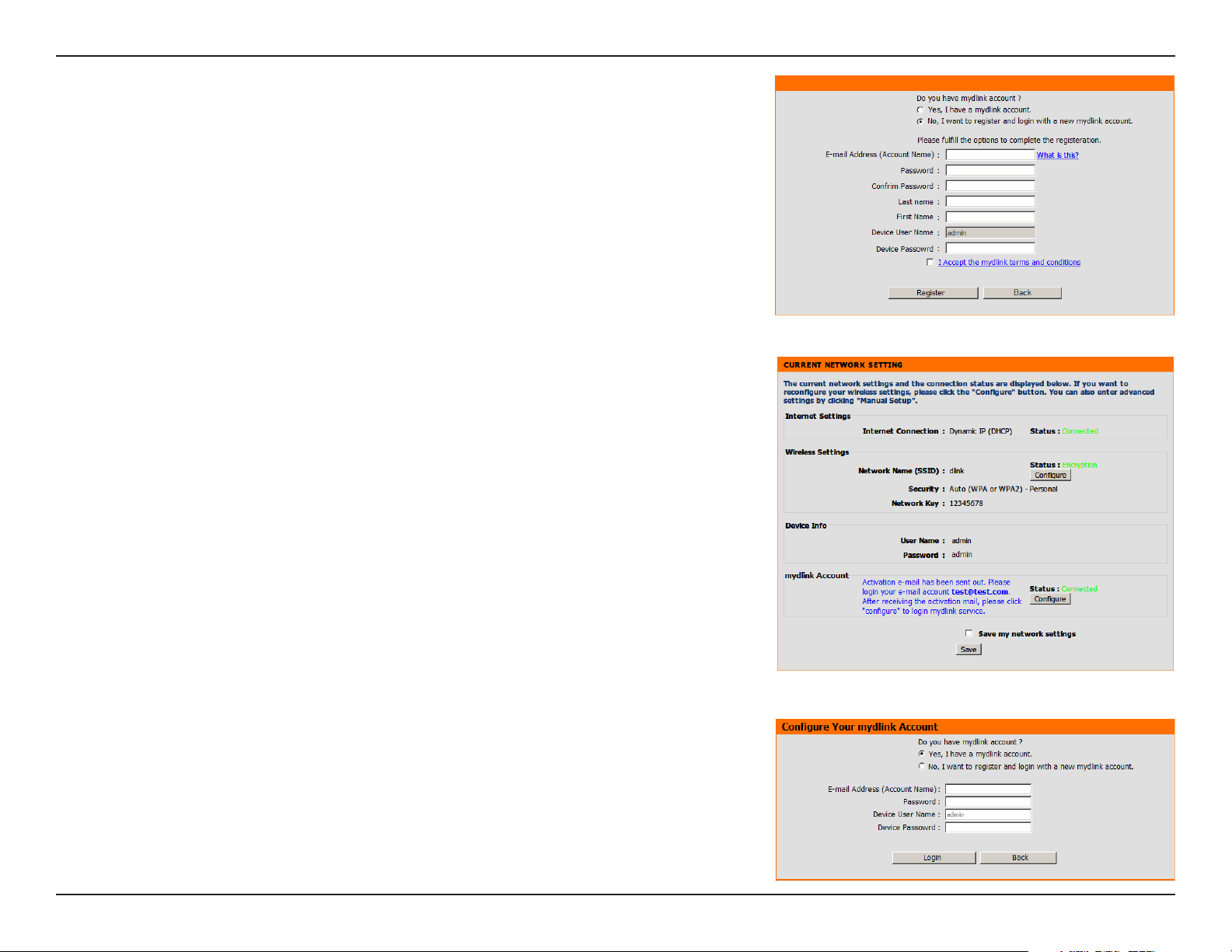
If you have not registered a mydlink account, please click Congure under
mydlink Account and complete the registration form. Once you complete
the form, click Register.
A verification e-mail will be sent to your email account. Open your email
(open a new browser window if needed) and read the email from mydlink
to nish the registration process.
Once the account verification phase is complete, click Configure under
mydlink Account.
Select Yes, I have a mydlink account, enter your information, and click Login.
12D-Link DIR-600L User Manual
Page 17
Section 3 - Conguration
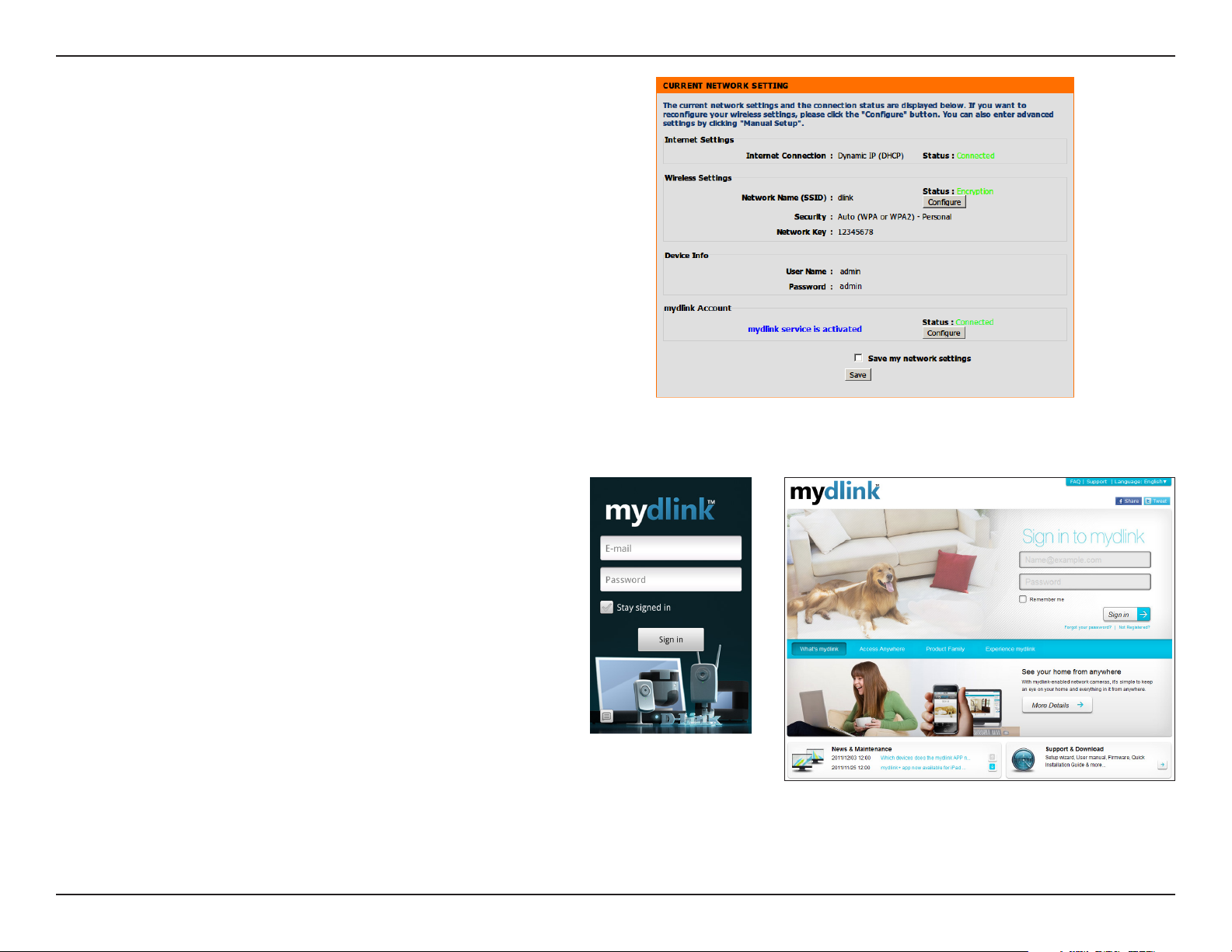
The router has successfully connected to mydlink service.
The mydlink App will allow you to receive notices,
browse network users, and configure your router
from an iPhone/iPad/iPod Touch (iOS 3.0 or higher),
Android device (1.6 or higher).
To download the "mydlink lite" app, visit the Apple
Store, Android Market.
PC and Mac users can use the mydlink portal at
http://mydlink.com.
iPhone, iPad, and iPod touch are registered trademarks of Apple Inc. Android is a trademark of Google, Inc.
13D-Link DIR-600L User Manual
Page 18
Section 3 - Conguration
Web-based Conguration Utility
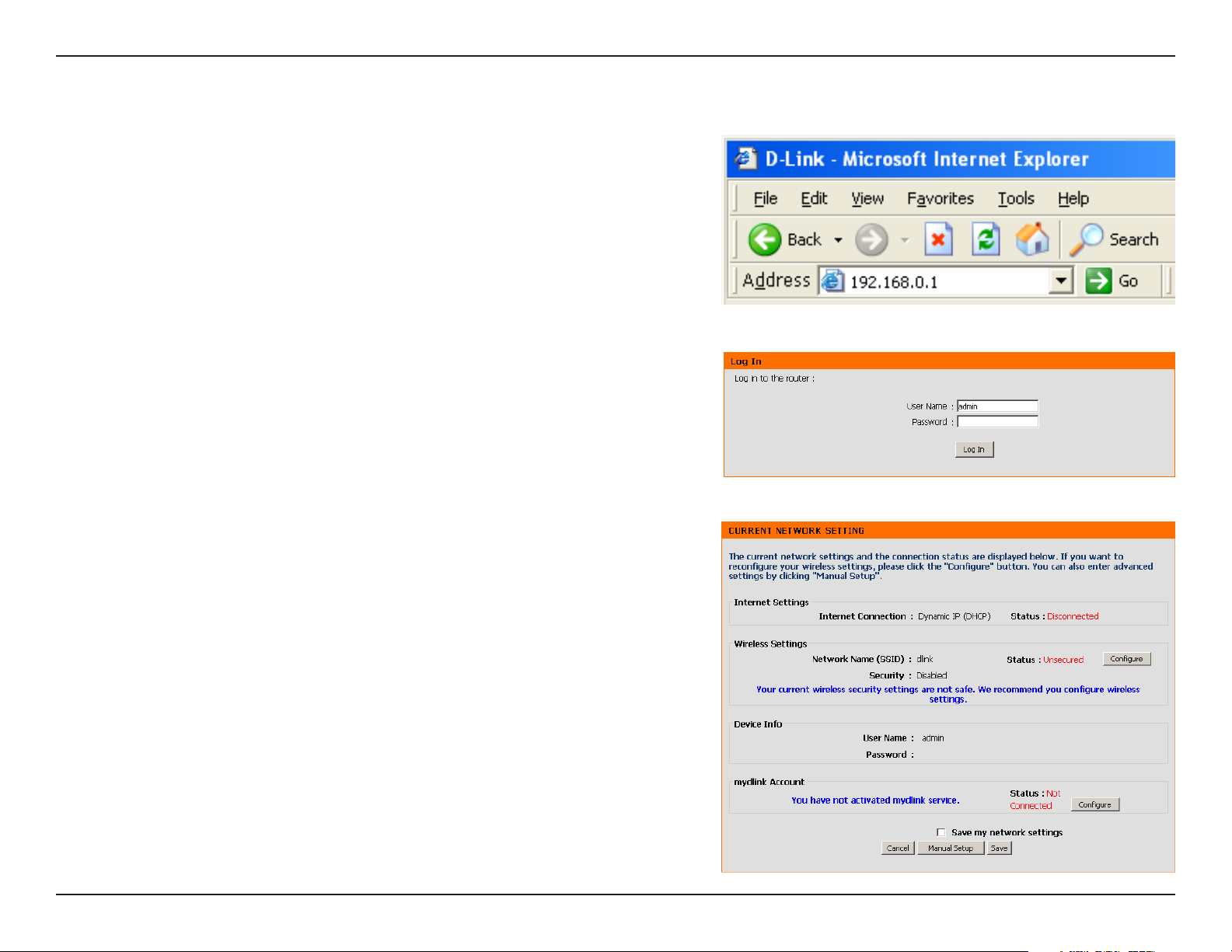
To access the conguration utility, open a web-browser such as Internet
Explorer and enter the IP address of the router (http://192.168.0.1).
Windows and Mac users may also connect by typing http://dlinkrouter
in the address bar.
Next to User Name enter Admin and then enter your password (Leave
the password blank by default). Click Log In to continue.
The Current Network Setting page will display the connection status of
the Internet, wireless settings, device information, and your mydlink
account status.
To change your wireless settings, click the Congure button next
under the Wireless Settings section. Refer to page 20.
To congure your mydlink account settings, click the Congure
button next under the mydlink Account section.
To manually congure all the settings on the router, click Manual
Setup at the bottom. You will go to the Setup > Internet Setup
page (refer to the next page).
14D-Link DIR-600L User Manual
Page 19
Section 3 - Conguration
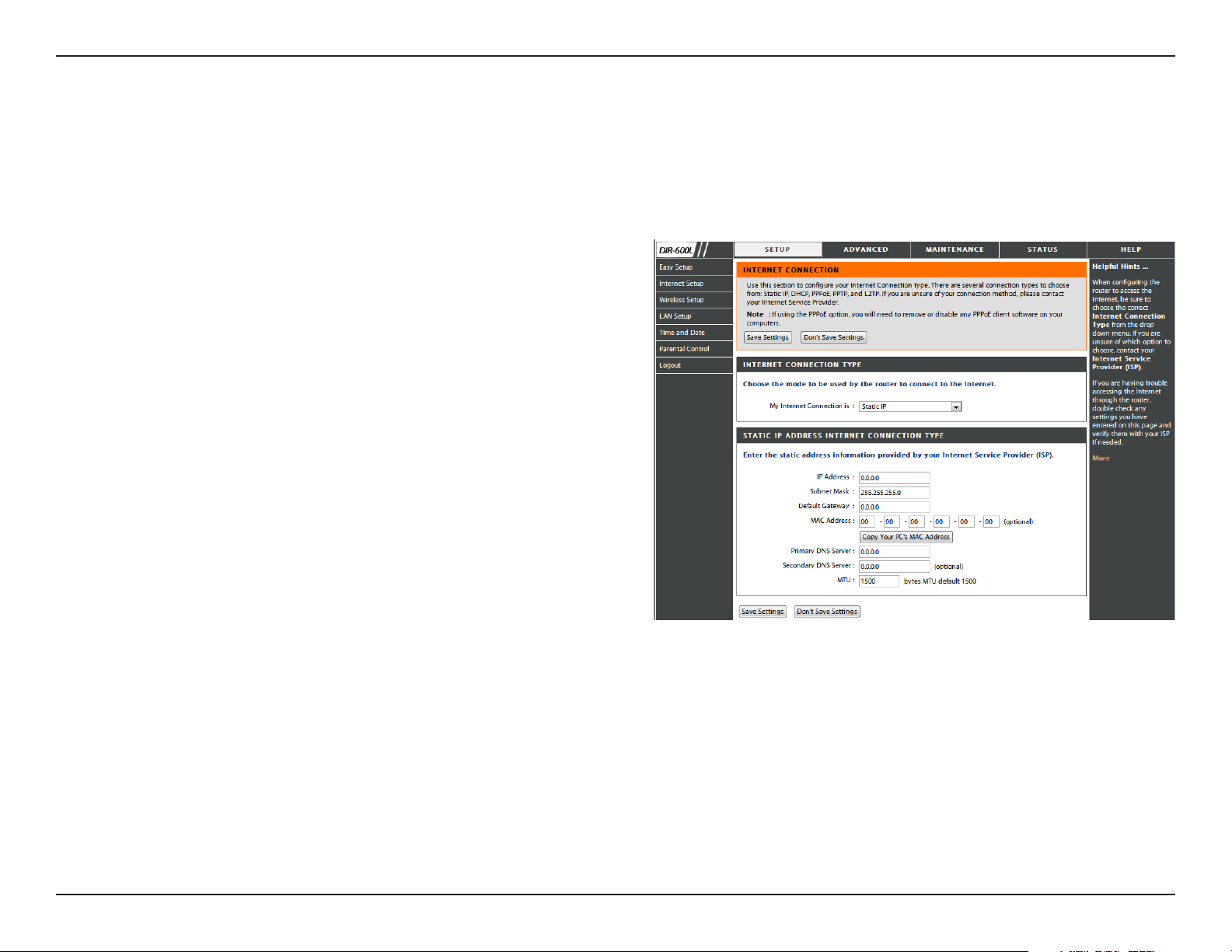
Internet Setup
Static (assigned by ISP)
Select Static IP Address if all WAN IP information is provided to you by your ISP. You will need to enter in the IP address, subnet mask, gateway
address, and DNS address(es) provided to you by your ISP. Each IP address entered in the elds must be in the appropriate IP form, which are four
octets separated by a dot (x.x.x.x). The Router will not accept the IP address if it is not in this format.
IP Address:
Subnet Mask:
Default Gateway:
MAC Address:
Copy Your PC’s
MAC Address:
Primary DNS
Address:
Secondary DNS
Address:
MTU:
Enter the IP address assigned by your ISP.
Enter the Subnet Mask assigned by your ISP.
Enter the Gateway assigned by your ISP.
The default MAC Address is set to the WAN’s physical interface
MAC address on the Broadband Router.
You can click the Copy Your PC’s MAC Address button to
copy the MAC address of the Ethernet adapter installed in
your computer to the router.
Enter the Primary DNS server IP address assigned by your ISP.
Enter the Secondary DNS server IP address. This is optional.
Maximum Transmission Unit - you may need to change the
MTU for optimal performance with your specic ISP. 1492 is
the default MTU.
15D-Link DIR-600L User Manual
Page 20

Section 3 - Conguration
Dynamic
Select Dynamic IP (DHCP) to obtain IP Address information automatically from your ISP. Select this option if your ISP did not
give you any IP settings to use. This option is most commonly used for cable modem services and some DSL services.
Host Name:
MAC Address:
Copy Your PC’s
MAC Address:
DNS
Addresses:
MTU:
The Host Name is optional but may be required by some ISPs.
The default host name is the device name of the Router and
may be changed.
The default MAC Address is set to the WAN’s physical interface
MAC address on the Broadband Router.
You can click the Copy Your PC’s MAC Address button to
copy the MAC address of the Ethernet adapter installed in
your computer to the router.
These addresses will be assigned automatically from your ISP.
You can manually enter DNS servers if you do not want to use
what is assigned to you.
Maximum Transmission Unit - You may need to change the MTU
for optimal performance with your specic ISP.
16D-Link DIR-600L User Manual
Page 21
Section 3 - Conguration
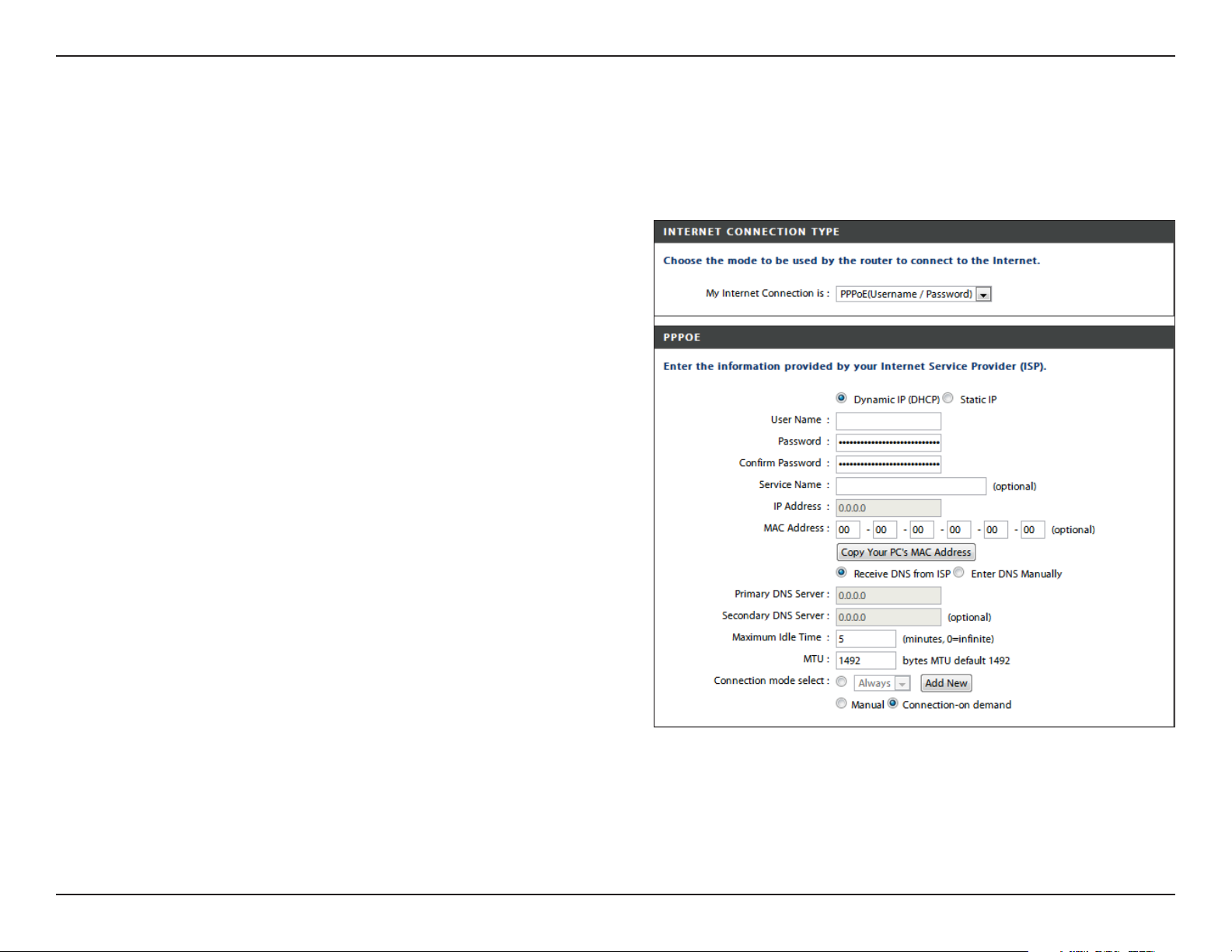
PPPoE
Choose PPPoE (Point to Point Protocol over Ethernet) if your ISP uses a PPPoE connection. Your ISP will provide you with a
username and password. This option is typically used for DSL services. Make sure to remove your PPPoE software from your
computer. The software is no longer needed and will not work through a router.
PPPoE:
User Name:
Password:
Service Name:
IP Address:
MAC Address:
Copy Your PC’s
MAC Address:
DNS Addresses:
Select Dynamic (most common) or Static. Select Static if your
ISP assigned you the IP address, subnet mask, gateway, and
DNS server addresses.
Enter your PPPoE user name.
Enter your PPPoE password and then retype the password in
the next box.
Enter the ISP Service Name (optional).
Enter the IP address (Static PPPoE only).
The default MAC Address is set to the WAN’s physical interface
MAC address on the Broadband Router.
You can click the Copy Your PC’s MAC Address button to
copy the MAC address of the Ethernet adapter installed in
your computer to the router.
Enter the Primary and Secondary DNS Server Addresses (Static
PPPoE only).
Maximum Idle
Time:
MTU:
Connection Mode
Select:
Enter a maximum idle time during which the Internet connection
is maintained during inactivity. To disable this feature, enable
Auto-reconnect.
Maximum Transmission Unit - You may need to change the MTU for optimal performance with your specic ISP. 1492 is the default MTU.
Select a schedule or click Add New to create a new one. Then select either Manual or Connection on demand.
17D-Link DIR-600L User Manual
Page 22
Section 3 - Conguration
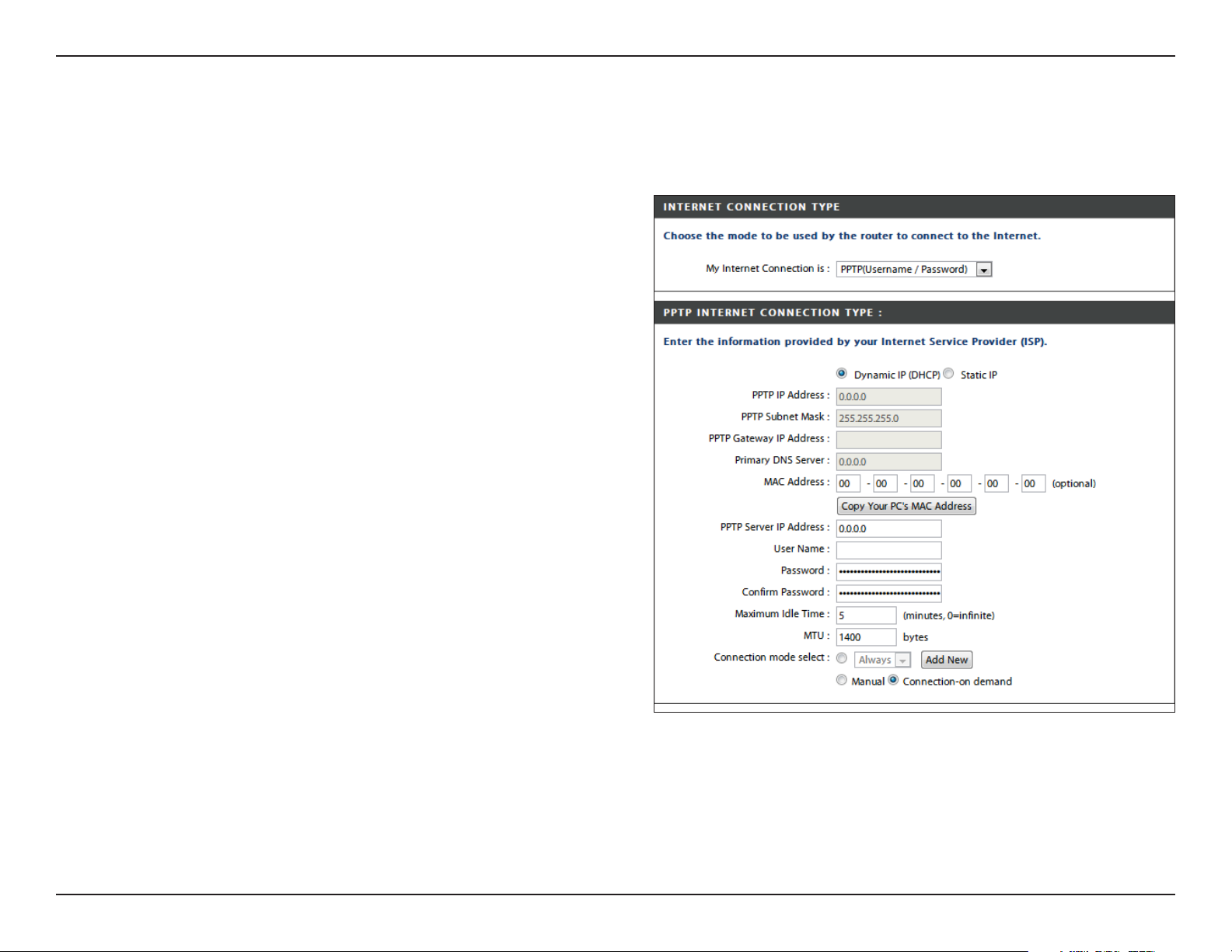
PPTP
Choose PPTP (Point-to-Point-Tunneling Protocol ) if your ISP uses a PPTP connection. Your ISP will provide you with a username
and password.
PPTP:
PPTP IP Address:
PPTP Subnet Mask:
PPTP Gateway:
Primary DNS:
MAC Address:
Copy Your PC’s
MAC Address:
PPTP Server IP:
User Name:
Select Dynamic (most common) or Static. Select Static if your ISP
assigned you the IP address, subnet mask, gateway, and DNS server
addresses.
Enter the IP address (Static PPTP only).
Enter the Primary and Secondary DNS Server Addresses (Static PPTP
only).
Enter the Gateway IP Address provided by your ISP.
The DNS server information will be supplied by your ISP (Internet
Service Provider.)
The default MAC Address is set to the WAN’s physical interface MAC
address on the Broadband Router.
You can click the Copy Your PC’s MAC Address button to copy the
MAC address of the Ethernet adapter installed in your computer to
the router.
Enter the Server IP provided by your ISP (optional).
Enter your PPTP account name.
Password:
Maximum Idle
Time:
MTU:
Connection Mode
Select:
Enter your PPTP password and then retype the password in the
Conrm Password box.
Enter a maximum idle time during which the Internet connection
is maintained during inactivity. To disable this feature, enable Autoreconnect.
Maximum Transmission Unit - You may need to change the MTU for
optimal performance.
Select a schedule or click Add New to create a new one. Then select
either Manual or Connection on demand.
18D-Link DIR-600L User Manual
Page 23
Section 3 - Conguration
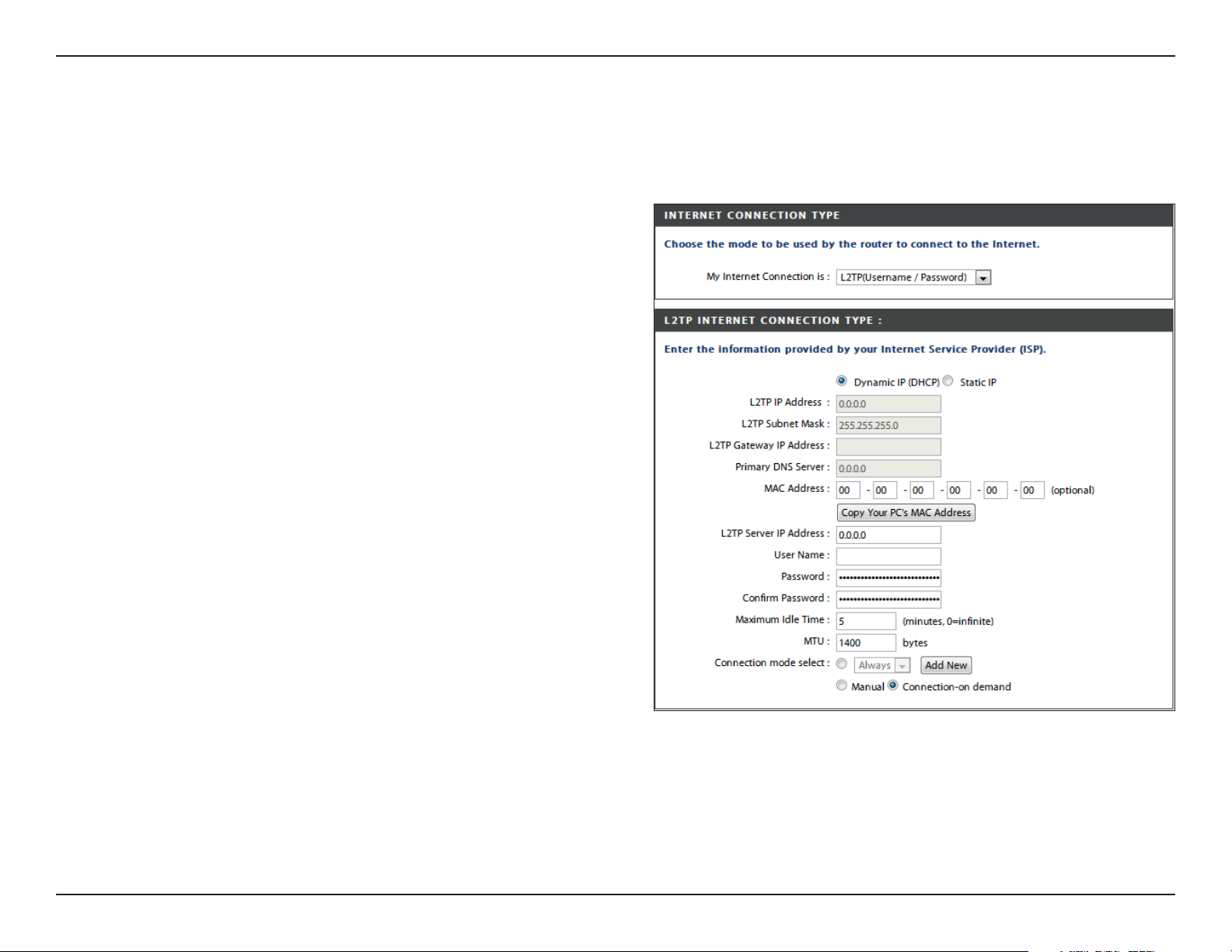
L2TP
Choose L2TP (Layer 2 Tunneling Protocol) if your ISP uses a L2TP connection. Your ISP will provide you with a username and
password. This option is typically used for DSL services.
L2TP:
L2TP IP Address:
L2TP Subnet Mask:
L2TP Gateway:
Primary DNS:
MAC Address:
Copy Your PC’s
MAC Address:
Server IP:
User Name:
Select Dynamic (most common) or Static. Select Static if your ISP
assigned you the IP address, subnet mask, gateway, and DNS server
addresses.
Enter the IP address (Static L2TP only).
Enter the Primary and Secondary DNS Server Addresses (Static L2TP
only).
Enter the Gateway IP Address provided by your ISP.
The DNS server information will be supplied by your ISP (Internet
Service Provider.)
The default MAC Address is set to the WAN’s physical interface MAC
address on the Broadband Router.
You can click the Copy Your PC’s MAC Address button to copy the
MAC address of the Ethernet adapter installed in your computer to
the router.
Enter the Server IP provided by your ISP (optional).
Enter your L2TP account name.
Password:
Maximum Idle
Time:
MTU:
Connection Mode
Select:
Enter your L2TP password and then retype the password in the
Conrm Password box.
Enter a maximum idle time during which the Internet connection
is maintained during inactivity. To disable this feature, enable Autoreconnect.
Maximum Transmission Unit - You may need to change the MTU for
optimal performance with your specic ISP.
Select a schedule or click Add New to create a new one. Then select
either Manual or Connection on demand.
19D-Link DIR-600L User Manual
Page 24
Section 3 - Conguration
Wireless Settings
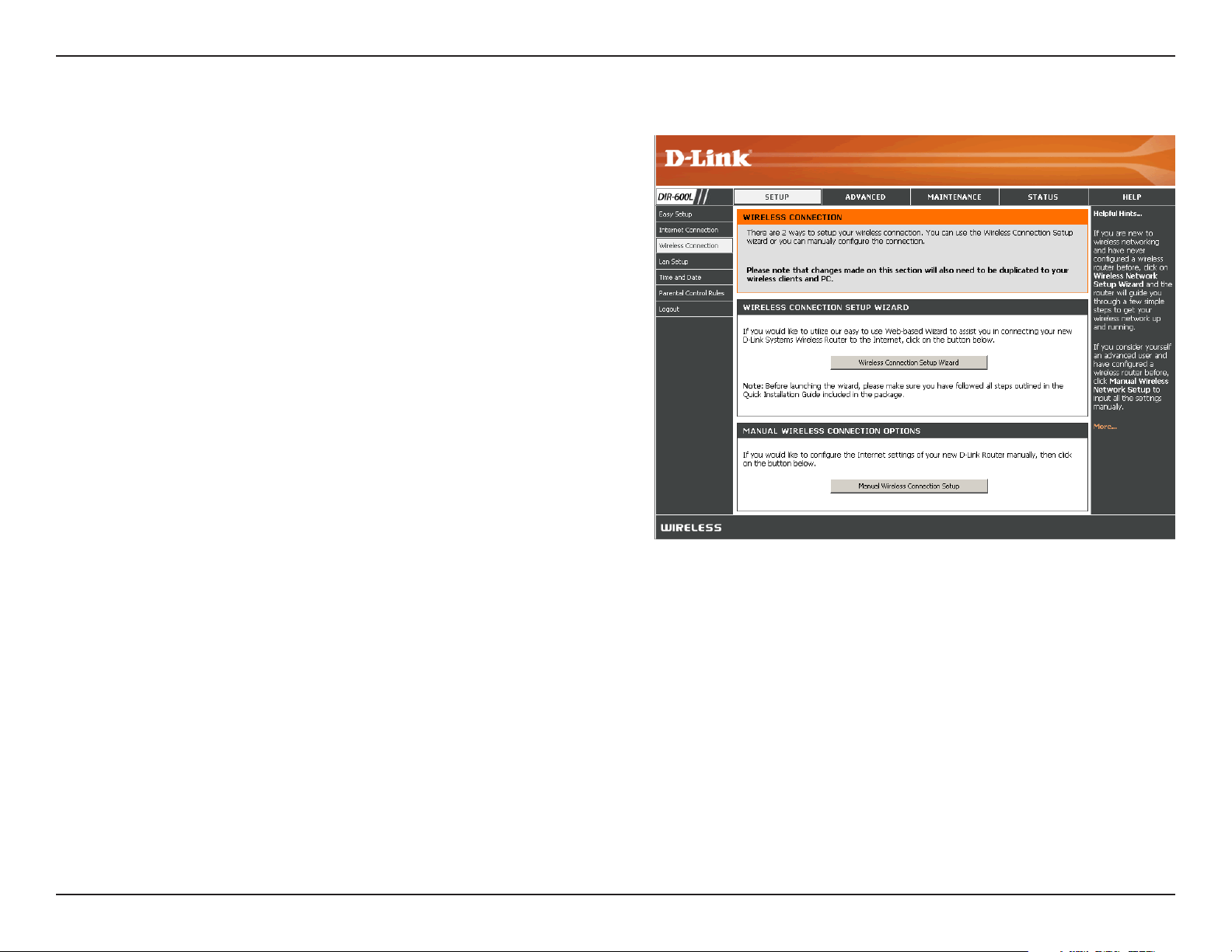
If you want to congure the wireless settings on your router
using the wizard, click Wireless Connection Setup Wizard
and skip to page 23.
If you want to manually congure the wireless settings on
your router click Manual Wireless Connection Setup and
refer to the next page.
20D-Link DIR-600L User Manual
Page 25
Section 3 - Conguration
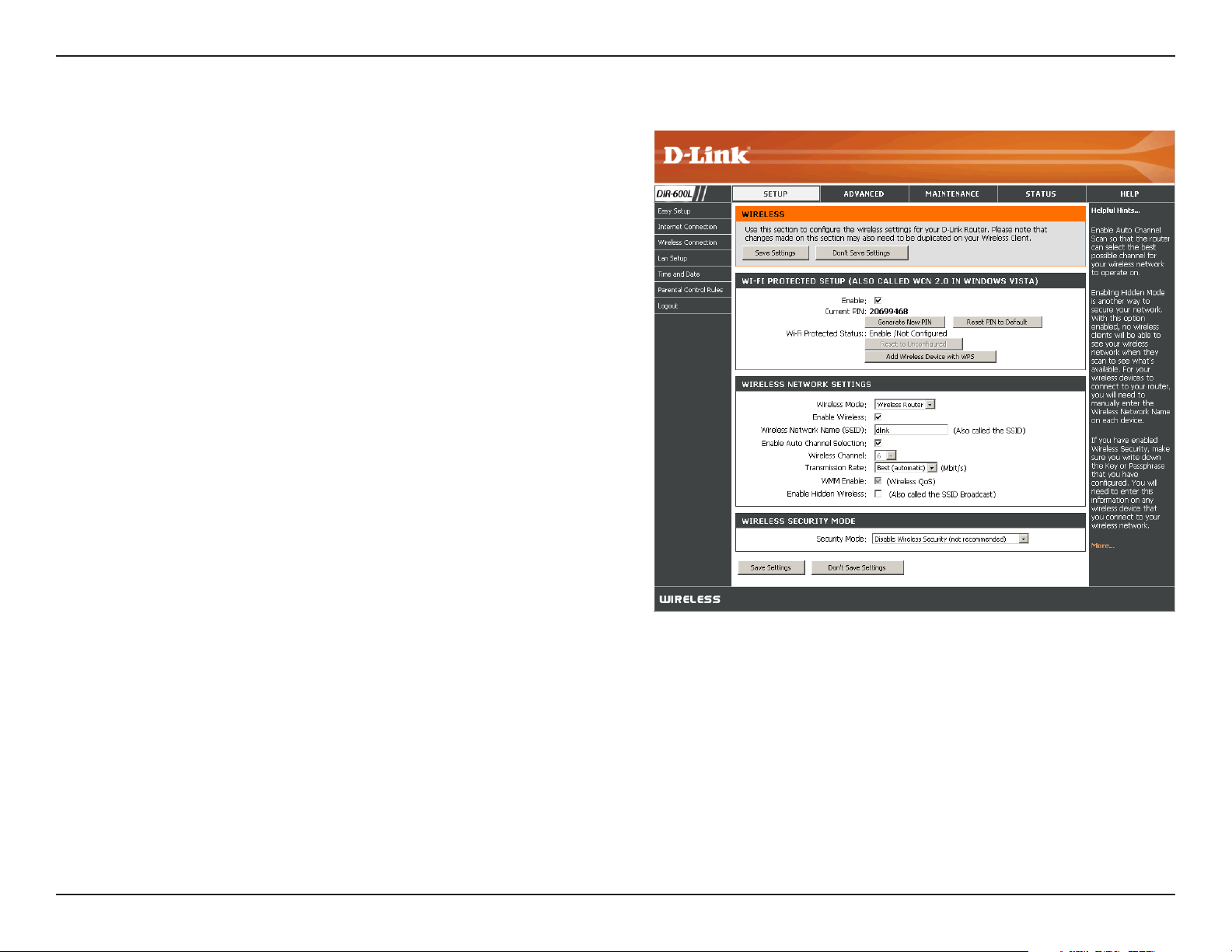
Manual Wireless Setup
Wi-Fi Protected
Setup:
Enable Wireless:
Wireless Network
Name:
Enable
Auto Channel:
Wireless Channel:
To enable WPS (WCN 2.0), check the Enable box. Click either
Generate New PIN or Reset PIN to Default, and then congure
the Wi-Fi settings below. Please see the Setting Up Wi-Fi
Protection (WCN 2.0 in Windows Vista®) section later in this
manual for detailed conguration information.
Check the box to enable the wireless function. If you do not
want to use wireless, uncheck the box to disable all the wireless
functions.
Service Set Identifier (SSID) is the name of your wireless
network. Create a name using up to 32 characters. The SSID is
case-sensitive.
Check this box to allow the DIR-600L to select the channel with
the least amount of interference automatically.
Indicates the wireless channel for the router. By default the
channel is set to 6. The Channel can be changed to t the
channel setting to customize your wireless network. If you
enabled Auto Channel Selection, this option will be greyed out.
Transmission
Rate:
WMM Enable:
Enable Hidden
Wireless:
Use the drop-down menu to select the appropriate Transmission
Rate in Mbits per second. Many users will want to use the default
setting, Best (automatic).
Enable Wi-Fi Multimedia to enjoy basic quality of service
features. WMM prioritizes traffic according to four access
categories: voice, video, best eort, and background.
Check this option if you would not like the SSID of your wireless
network to be broadcasted by the DIR-600L. If this option is
checked, the SSID of the DIR-600L will not be seen by Site Survey
utilities so your wireless clients will have to know the SSID of
your DIR-600L in order to connect to it.
21D-Link DIR-600L User Manual
Page 26

Section 3 - Conguration
Wireless Security
This section will show you the dierent levels of security you can use to protect your data from intruders. The DIR-600L oers
the following types of security:
• WPA2 (Wi-Fi Protected Access 2) • WPA2-PSK (Pre-Shared Key)
• WPA (Wi-Fi Protected Access) • WPA-PSK (Pre-Shared Key)
What is WPA?
WPA, or Wi-Fi Protected Access, is a Wi-Fi standard that was designed to improve the security features of WEP (Wired Equivalent
Privacy).
The two major improvements over WEP:
• Improved data encryption through the Temporal Key Integrity Protocol (TKIP). TKIP scrambles the keys using a
hashing algorithm and, by adding an integrity-checking feature, ensures that the keys haven’t been tampered
with. WPA2 is based on 802.11i and uses Advanced Encryption Standard (AES) instead of TKIP.
• User authentication, which is generally missing in WEP, through the extensible authentication protocol (EAP).
WEP regulates access to a wireless network based on a computer’s hardware-specic MAC address, which is
relatively simple to be snied out and stolen. EAP is built on a more secure public-key encryption system to
ensure that only authorized network users can access the network.
WPA-PSK/WPA2-PSK uses a passphrase or key to authenticate your wireless connection. The key is an alpha-numeric password
between 8 and 63 characters long. The password can include symbols (!?*&_) and spaces. This key must be the exact same key
entered on your wireless router or access point.
WPA/WPA2 incorporates user authentication through the Extensible Authentication Protocol (EAP). EAP is built on a more
secure public key encryption system to ensure that only authorized network users can access the network.
22D-Link DIR-600L User Manual
Page 27
Section 3 - Conguration
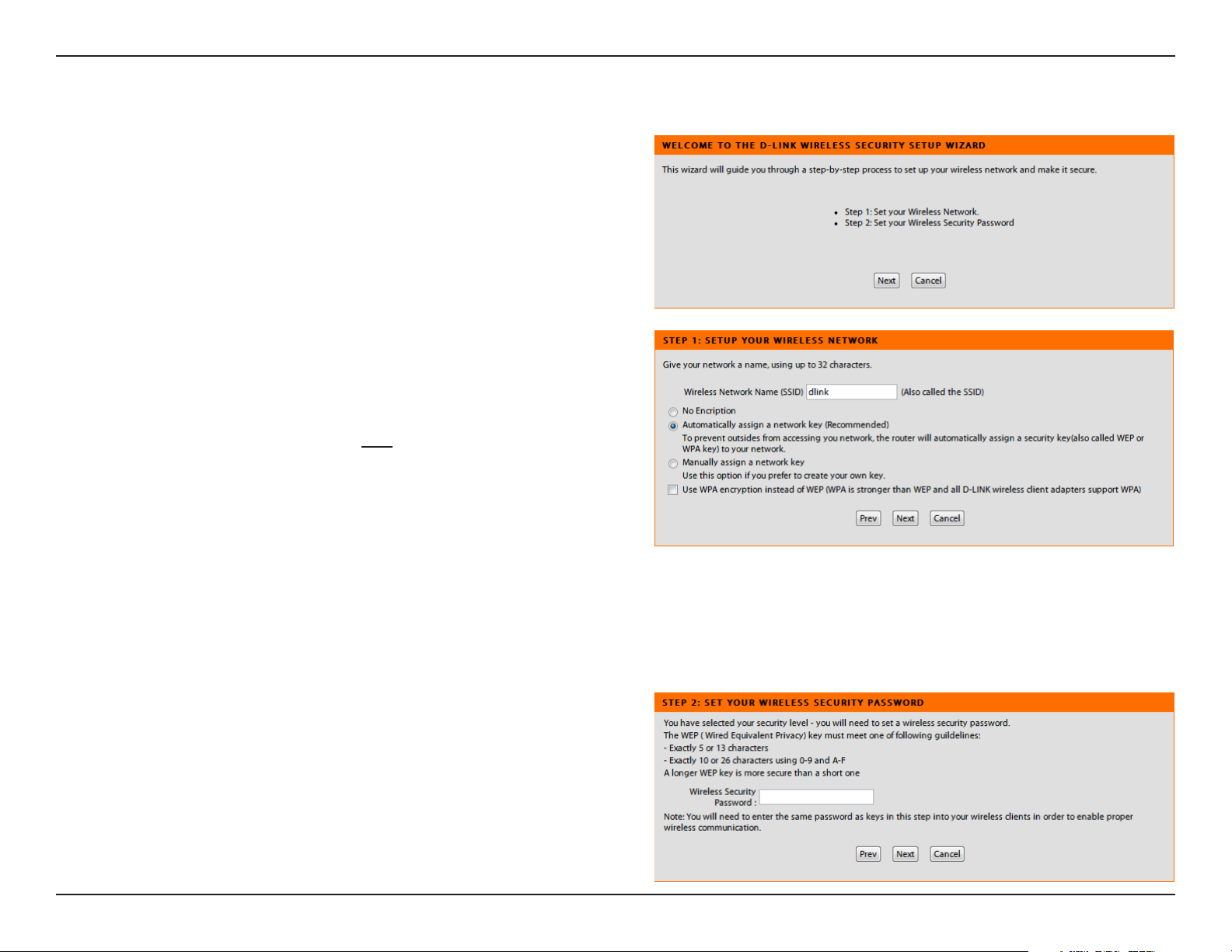
Wireless Connection Setup Wizard
Click Next to continue.
Enter a Wireless Network Name in the box, which is also
known as the SSID.
No Encryption: Select this option to disable any encryption/
security on your wireless network (not recommended).
Automatically: Select this option to automatically generate
the router’s network key.
Manually: Select this option to manually enter your network
key.
Check the Use WPA Encryption instead of WEP box to use
WPA instead of WEP encryption (strongly recommended)
and click Next to continue.
If you selected to manually enter a network key, enter it in
the box and then click Next to continue. If using WPA, the
network key must be between 8-63 characters.
23D-Link DIR-600L User Manual
Page 28
Section 3 - Conguration
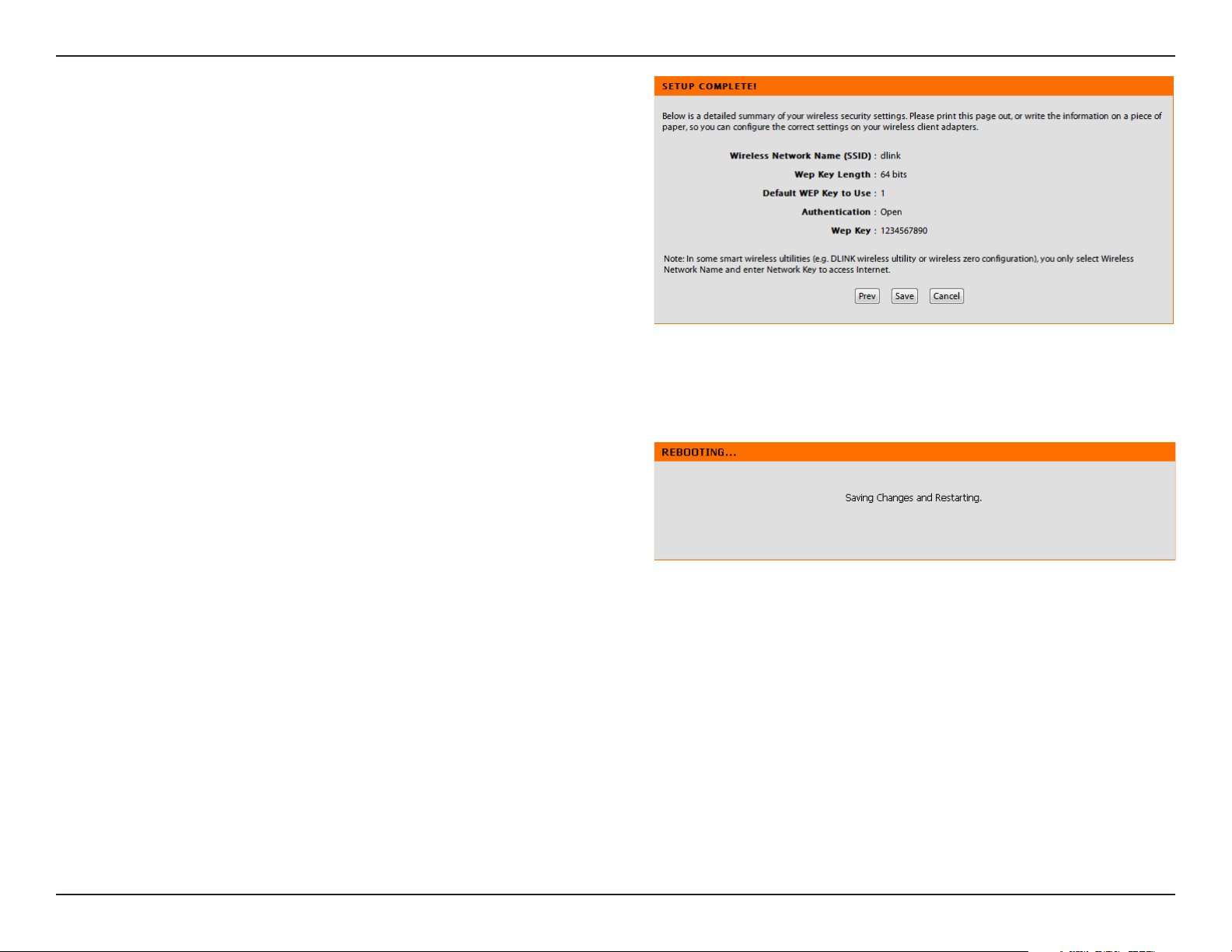
If you selected Automatically assign a network key, the
summary window will display your settings. Write down
the security key and enter this on your wireless clients. Click
Save to save your settings.
The Router will save your new settings and reboot. When
it is nished after 1-2 minutes, the opening Wireless Setup
window is displayed.
24D-Link DIR-600L User Manual
Page 29

Section 3 - Conguration
WPA/WPA2-PSK
It is recommended to enable encryption on your wireless Router before your wireless network adapters. Please establish
wireless connectivity before enabling encryption. Your wireless signal may degrade when enabling encryption due to the
added overhead.
1. Log into the web-based conguration by opening a web browser
and entering the IP address of the router (192.168.0.1). Click on
Wireless Setup on the left side.
2. Next to Security Mode, select Enable WPA/WPA2 Wireless Security
(enhanced).
3. Next to Cipher Mode, select TKIP, AES, or Both.
4. Next to PSK/EAP, select PSK.
5. Next to Network Key, enter a key (passphrase). The key is an
alpha-numeric password between 8 and 63 characters long. The
password can include symbols (!?*&_) and spaces. Make sure you
enter this key exactly the same on all other wireless clients.
6. Click Save Settings to save your settings. If you are conguring
the Router with a wireless adapter, you will lose connectivity until
you enable WPA/WPA2-PSK on your adapter and enter the same
passphrase as you did on the Router.
25D-Link DIR-600L User Manual
Page 30

Section 3 - Conguration
WPA/WPA2-RADIUS
It is recommended to enable encryption on your wireless router before your wireless network adapters. Please establish
wireless connectivity before enabling encryption. Your wireless signal may degrade when enabling encryption due to the
added overhead.
1. Log into the web-based conguration by opening a web browser and entering the IP address of the router (192.168.0.1).
Click on Wireless Settings on the left side.
2. Next to Security Mode, select Enable WPA Only Wireless Security (enhanced), Enable WPA2 Only Wireless Security (enhanced),
or Enable WPA/WPA2 Wireless Security (enhanced).
3. Next to Cipher Type, select TKIP, AES, or Auto.
4. Next to PSK/EAP, select EAP.
5. Next to RADIUS Server 1 enter the IP Address of your
RADIUS server.
6. Next to Port, enter the port you are using with your
RADIUS server. 1812 is the default port.
7. Next to Shared Secret, enter the security key.
8. If you have a secondary RADIUS server, enter its IP address,
port, and secret key.
9. Click Save Settings to save your settings.
26D-Link DIR-600L User Manual
Page 31

Section 3 - Conguration
LAN Setup
This section will allow you to change the local network settings of the router and to congure the DHCP settings.
Router IP Address:
Subnet Mask:
Local Domain
Name:
Enable DNS Relay:
Refer to the next page for DHCP information.
Enter the IP address of the router. The default IP
address is 192.168.0.1.
If you change the IP address, once you click Apply,
you will need to enter the new IP address in your
browser to get back into the conguration utility.
Enter the Subnet Mask. The default subnet mask is
255.255.255.0.
Enter the Domain name (Optional).
Check the box to transfer the DNS server information
from your ISP to your computers. If unchecked, your
computers will use the router for a DNS server.
27D-Link DIR-600L User Manual
Page 32

Section 3 - Conguration
DHCP Server Settings
DHCP stands for Dynamic Host Control Protocol. The DHCP
Server (built-in to the router) will automatically assign an IP
address to the computers and devices on your network. Be
sure to set your computers to be DHCP clients by setting
their TCP/IP settings to “Obtain an IP Address Automatically.”
When you turn your computers on, they will automatically
load the proper TCP/IP settings provided by the DIR-600L.
The DHCP Server will automatically allocate an unused
IP address from the IP address pool to the requesting
computer. You must specify the starting and ending address
of the IP address pool.
Enable DHCP
Server:
DHCP IP
Address Range:
DHCP Lease
Time:
DHCP Client List:
Avoid ARP
Attack:
Check the box to enable the DHCP server on your
router. Uncheck to disable this function.
Enter the starting and ending IP addresses for the
DHCP server’s IP assignment.
Note: If you statically (manually) assign IP addresses to
your computers or devices, make sure the IP addresses
are outside of this range or you may have an IP conict.
The length of time for the IP address lease. Enter the
Lease time in minutes (default setting is 1440).
Displays the name, IP address, MAC Address, and lease
time of devices currently assigned IP settings by the
router.
Check to defend against ARP spoong (ARP poison
routing) attacks to your local network.
28D-Link DIR-600L User Manual
Page 33

Section 3 - Conguration
DHCP Reservation
If you want a computer or device to always have the same IP address assigned, you can create a DHCP Reservation. The router
will assign the IP address only to that computer or device. Note that this IP address must be within the DHCP IP Address Range.
Enable:
Computer Name:
IP Address:
MAC Address:
Save Settings:
Check this box to enable the reservation.
Enter the computer name or select from the drop-down
menu and click <<.
Enter the IP address you want to assign to the computer
or device. This IP Address must be within the DHCP IP
Address Range.
Enter the MAC address of the computer or device. If you
want to assign an IP address to the computer you are
currently on, click this button to populate the elds.
Click Save Settings to save your entry.
29D-Link DIR-600L User Manual
Page 34

Section 3 - Conguration
Time and Date
This section will allow you to congure, update, and maintain the correct time on the internal system clock.
Time:
Time Zone:
Enable Daylight
Saving:
Sync. you computer’s
time settings:
NTP Server
Used:
Manual:
Displays the current time and date.
Select the Time Zone from the drop-down menu.
Checking this checkbox enables Daylight Saving time.
Click Sync. your computer’s time settings to copy your
PC’s time settings to the router.
Click the “Automatically synchronize with D-Link’s Internet
time server” checkbox and then use the drop-down menu
to select an NTP Server. NTP is short for Network Time
Protocol. NTP synchronizes computer clock times in a
network of computers.
To manually input the time, enter the values in these elds
for the Year, Month, Day, Hour, Minute, and Second. Click
Save Settings.
30D-Link DIR-600L User Manual
Page 35

Section 3 - Conguration
Parental Control
This feature allows you to create a list of websites that you want to either allow or deny users access.
Congure
Parental Control:
Website URL:
Schedule:
Select Turn Parental Control OFF, Turn Parental
Control ON and ALLOW computers access to ONLY
these sites, or Turn Parental Control ON and DENY
computers access to ONLY these sites.
Enter the keywords or URLs that you want to block (or
allow). Any URL with the keyword in it will be blocked
(or allowed).
The schedule of time when the parental control lter
will be enabled. The schedule may be set to Always,
which will allow the particular service to always
be enabled. You can create your own times in the
Maintenance > Schedules section.
31D-Link DIR-600L User Manual
Page 36

Section 3 - Conguration
Port Forwarding
This will allow you to open a single port or a range of ports.
Enable:
Name:
Application
Name:
IP Address:
Start Port/
End Port:
Trac Type:
Check the box to enabled the rule.
Enter a name for the rule.
You may select a pre-dened rule from the drop-down menu.
Select a rule and then click << to populate the required elds.
Enter the IP address of the computer on your local network
that you want to allow the incoming service to.
Enter the port or range of ports that you want to open. If you
want to open one port, enter the same port in both boxes.
In most cases the Public and Private ports will be exactly the
same.
Select TCP, UDP, or Any.
32D-Link DIR-600L User Manual
Page 37

Section 3 - Conguration
Application Rules
Some applications require multiple connections, such as Internet gaming, video conferencing, Internet telephony and others.
These applications may have diculties working through NAT (Network Address Translation). Special Applications makes
some of these applications work with the DIR-600L. If you need to run applications that require multiple connections, specify
the port normally associated with an application in the “Trigger” eld, select the protocol type as TCP or UDP, then enter the
rewall (public) ports associated with the trigger port to open them for inbound trac.
The DIR-600L provides some predened applications in the table on the bottom of the web page. Select the application you
want to use and enable it.
Enable:
Name:
Application:
Trigger:
Firewall:
Trac Type:
Check the box to enable the rule.
Enter a name for the rule.
You may select a pre-dened rule from the drop-down
menu. Select and click << to populate the required
elds.
This is the port used to trigger the application. It can
be either a single port or a range of ports.
This is the port number on the Internet side that will
be used to access the application. You may dene a
single port or a range of ports. You can use a comma
to add multiple ports or port ranges.
Select TCP, UDP, or Any.
33D-Link DIR-600L User Manual
Page 38

Section 3 - Conguration
MAC Filtering
Use MAC Filters to allow or deny LAN (Local Area Network) computers by their MAC addresses from accessing the Network.
You can either manually add a MAC address or select the MAC address from the list of clients that are currently connected to
the Router.
Congure MAC
Filter:
MAC Address:
DHCP Client
List:
Schedule:
Select Turn MAC Filtering OFF, Turn MAC Filtering ON and
ALLOW computers listed to access the network, or Turn
MAC Filtering ON and DENY computers listed to access
the network.
Enter the MAC address you would like to lter. To nd the
MAC address on a computer, please refer to the Networking
Basics section in this manual.
Select a DHCP client from the drop-down menu and click the
<< button to populate the required elds.
The schedule of time when the network lter will be enabled.
The schedule may be set to Always, which will allow the
particular service to always be enabled. You can create your
own times by clicking Add New.
34D-Link DIR-600L User Manual
Page 39

Section 3 - Conguration
Trac Control
Trac control can be used to distribute download bandwidth automatically according to the requirements of the users, and
the users also can setup manually.
Enable Trac Control:
Automatic Distribute
Bandwidth:
Key in download
bandwidth manually:
Key in upload
bandwidth manually:
Trac Control Rules:
Select this function to control the access bandwidth of
computer in LAN.
All the computers in LAN will be distributed bandwidth
equally.
Manually enter the download bandwidth.
Manually enter the upload bandwidth.
When the option Automatic Distribute Bandwidth is
unchecked, you can control the access bandwidth of
the specic device on your network.
35D-Link DIR-600L User Manual
Page 40

Section 3 - Conguration
Firewall & DMZ
This section will allow you to set up a DMZ host and to set up rewall rules.
Anti-Spoof
Checking:
Enable SPI:
Enable DMZ Host:
DMZ IP Address:
RTSP:
Name:
Action:
Enable this feature to protect your network from certain kinds
of “spoong” attacks.
SPI (Stateful Packet Inspection, also known as dynamic packet
ltering) helps to prevent cyber attacks by tracking more state
per session. It validates that the trac passing through the
session conforms to the protocol.
Check to enable DMZ.
Enter the IP address of the computer you would like to open all
ports to. You may enter the IP address of the computer/device
you want to open all ports to or select it from the drop-down
menu and click <<.
Allows application that uses Real Time Streaming Protocol to
receive streaming media from the Internet. QuickTime and Real
Player are some of the common applications using this protocol.
Enter a name for the rewall rule.
Select to Allow or Deny transport of the data packets according
to the criteria dened in the rule.
Source/Dest:
Schedule:
IP Address:
Protocol:
Port Range:
The Source/Destination is the TCP/UDP port on either the LAN
or WAN side.
Click Add New to access the Schedules window. Refer to
Maintenance > Schedules for more information.
Enter a beginning and ending IP address.
Select the transport protocol that will be used for the lter rule.
Enter the desired port range for the lter rule.
36D-Link DIR-600L User Manual
Page 41

Section 3 - Conguration
Advanced Wireless
This window allows you to change the behavior of the 802.11g wireless radio from the standard settings. Please be aware that any changes to the
factory default settings may adversely aect the behavior of your network.
Transmit Power:
Beacon interval:
RTS Threshold:
Fragmentation:
DTIM Interval:
Preamble Type:
Set the transmit power of the antennas.
Beacons are packets sent by an Access Point to synchronize a
wireless network. Specify a value. 100 is the default setting and is
recommended.
This value should remain at its default setting of 2346. If inconsistent
data ow is a problem, only a minor modication should be made.
The fragmentation threshold, which is specied in bytes, determines
whether packets will be fragmented. Packets exceeding the 2346
byte setting will be fragmented before transmission. 2346 is the
default setting.
(Delivery Trac Indication Message) 1 is the default setting. A DTIM
is a countdown informing clients of the next window for listening
to broadcast and multicast messages.
Select Short or Long Preamble. The Preamble denes the length of
the CRC block (Cyclic Redundancy Check is a common technique
for detecting data transmission errors) for communication between the wireless router and the roaming wireless network adapters.
Auto is the default setting. Note: High network trac areas should use the shorter preamble type.
CTS Mode:
Wireless Mode:
CTS (Clear To Send) is a function used to minimize collisions among wireless devices on a wireless local area network (LAN). CTS will make
sure the wireless network is clear before a wireless client attempts to send wireless data. Enabling CTS will add overhead and may lower
wireless through put. None: CTS is typically used in a pure 802.11g environment. If CTS is set to “None” in a mixed mode environment
populated by 802.11b clients, wireless collisions may occur frequently. Always: CTS will always be used to make sure the wireless LAN
is clear before sending data. Auto: CTS will monitor the wireless network and automatically decide whether to implement CTS based
on the amount of trac and collisions that occurs on the wireless network.
Select one of the following:
Mixed 802.11g and 802.11b - Select if you are using both 802.11b and 802.11g wireless clients.
802.11n Only - Select only if all of your wireless clients are 802.11n.
Mixed 802.11n, 802.11b, and 802.11g - Select if you are using a mix of 802.11n, 11g, and 11b wireless clients.
37D-Link DIR-600L User Manual
Page 42

Section 3 - Conguration
Band Width:
STBC:
20/40MHz Coexist:
Short Guard Interval:
Select the Band Width:
Auto 20/40 - Select if you are using both 802.11n and non-802.11n wireless devices.
20MHz - Select if you are not using any 802.11n wireless clients. This is the default setting.
Check to enable Space Time Block Coding (STBC). This will increase your wireless coverage.
Check to allow 20MHz and 40MHz to coexist.
Check this box to reduce the guard interval time therefore increasing the data capacity. However, it’s less reliable and may
create higher data loss.
38D-Link DIR-600L User Manual
Page 43

Section 3 - Conguration
Advanced Network
This window allows you to change the LAN settings. Please be aware that any changes to the factory default settings may
aect the behavior of your network.
Enable UPnP:
Enable WAN
Ping Respond:
WAN Port Speed:
Enable Multicast
Streams:
Wireless enhance
mode:
Check this box to enable Universal Plug and Play (UPnP™).
UPnP provides compatibility with networking equipment,
software and peripherals.
Check this box to allow the WAN port to be “Pinged”.
Disabling ping responses may provide some extra security
from hackers.
You may set the port speed of the WAN port to 10Mbps,
100Mbps, or 10/100Mbps Auto. Some older cable or DSL
modems may require you to set the port speed to 10Mbps.
Check the box to allow multicast trac to pass through
the router from the Internet.
Check to enable wireless enhance mode to increase data
throughput. Enabling this will cause the router to use more
processing and may cause your LAN speeds to decrease.
39D-Link DIR-600L User Manual
Page 44

Section 3 - Conguration
Routing
This option allows you to dene xed routes to dened destinations.
Enable:
Interface:
Destination:
Subnet Mask:
Gateway:
Check this box to enable xed routes to dened
destinations.
Use the drop-down menu to choose the WAN or
WAN (Physical Port) Interface the IP packet must use
to transit out of the Router.
The IP address of the packets that will take this route.
The subnet of the IP address of the packets that will
take this route.
Species the next hop to be taken if this route is used.
40D-Link DIR-600L User Manual
Page 45

Section 3 - Conguration
Device Administration
This window will allow you to change the Administrator password. You can also enable Remote Management.
Administrator
Login Name:
Administrator
Password:
Enable Remote
Management:
IP Allowed to
Access:
Enter a new Login Name for the Administrator account.
Enter a new password for the Administrator Login Name
and then retype the new password in the Conrm Password
textbox. The administrator can make changes to the settings.
Remote management allows the DIR-600L to be congured
from the Internet by a web browser. A username and
password is still required to access the Web-Management
interface. In general, only a member of your network can
browse the built-in web pages to perform Administrator tasks.
This feature enables you to perform Administrator tasks from
the remote (Internet) host.
The Internet IP address of the computer that has access to the
Broadband Router. If you input an asterisk (*) into this eld,
then any computer will be able to access the Router. Putting
an asterisk (*) into this eld would present a security risk and
is not recommended.
Port:
The port number used to access the DIR-600L. For example:
http://x.x.x.x:8080 whereas x.x.x.x is the WAN IP address of the
DIR-600L and 8080 is the port used for the Web-Management
interface.
41D-Link DIR-600L User Manual
Page 46

Section 3 - Conguration
Save and Restore
This window allows you to save your conguration le to a hard drive, load conguration settings from a hard drive, and restore
the Router’s factory default settings.
Save Settings to
Local Hard Drive:
Load Settings
from Local Hard
Drive:
Restore to
Factory Default
Settings:
Clear Language
Pack:
Use this option to save the current router conguration
settings to a le on the hard disk of the computer you are
using. First, click the Save button. You will then see a le
dialog, where you can select a location and le name for
the settings.
Use this option to load previously saved router conguration
settings. First, use the Browse control to nd a previously
save le of conguration settings. Then, click the Upload
Settings button to transfer those settings to the Router.
This option will restore all conguration settings back to
the settings that were in eect at the time the router was
shipped from the factory. Any settings that have not been
saved will be lost, including any rules that you have created.
If you want to save the current router conguration settings,
use the Save button above.
Click to remove all non-default language packs from the
router.
42D-Link DIR-600L User Manual
Page 47

Section 3 - Conguration
Firmware Update
You can upgrade the rmware of the Router here. Make sure the rmware you want to use is on the local hard drive of the
computer. Click on Browse to locate the rmware le to be used for the update. Please check the D-Link support site for rmware
updates at http://support.dlink.com. You can download rmware upgrades to your hard drive from the D-Link support site.
Firmware
Upgrade:
Browse:
Click the Check Now button (or the link at the top of
the window) to nd out if there is an updated rmware;
if so, download the new rmware to your hard drive.
After you have downloaded the new rmware, click
Browse in this window to locate the rmware update
on your hard drive. Click Save Settings to complete
the rmware upgrade.
Language Pack
You can change the language of the web UI by uploading available
language packs.
Browse:
After you have downloaded the new language pack,
click Browse to locate the language pack le on your
hard drive. Click Upload to complete the language
pack upgrade.
mydlink Pack
You can change the language of the web UI by uploading available
language packs.
Browse:
After you have downloaded the new mydlink pack,
click Browse to locate the pack le on your hard drive.
Click Upload to complete the mydlink pack upgrade.
43D-Link DIR-600L User Manual
Page 48

Section 3 - Conguration
DDNS Setting
The router supports DDNS (Dynamic Domain Name Service). The Dynamic DNS service allows a dynamic public IP address to
be associated with a static host name in any of the many domains, allowing access to a specied host from various locations on
the Internet. This is enabled to allow remote access to a host by clicking a hyperlinked URL in the form “hostname.dyndns.org”.
Many ISPs assign public IP addresses using DHCP, this can make it dicult to locate a specic host on the LAN using standard
DNS. If for example you are running a public web server or VPN server on your LAN, this ensures that the host can be located
from the Internet if the public IP address changes. DDNS requires that an account be setup with one of the supported DDNS
providers.
Enable DDNS:
Server Address:
Host Name:
Username:
Password:
DDNS Account
Testing:
Status:
Check the Enable DDNS checkbox to enable support
for DDNS.
Select one of the DDNS registration organizations form
those listed in the drop-down menu. Available servers
include dlinkddns.com (Free), DynDns.org (Custom), Dyn.
Dns.org (free), and Dyn.Dns.org (Static).
Enter the host name of the DDNS server.
Enter the username given to you by your DDNS server.
Enter the password or key given to you by your DDNS
server.
Click this button to test the connection of your DDNS
account.
Displays the connection status of your DDNS account.
44D-Link DIR-600L User Manual
Page 49

Section 3 - Conguration
System Check
This tool is used to verify the physical connectivity on both the LAN and the WAN interfaces. The Ping Test can be used to test
the status of the Internet.
VCT (Virtual
Cable Tester)
Info:
Ping Test:
Ping Result:
VCT is an advanced feature that integrates a LAN cable
tester on every Ethernet port on the router. Through
the graphical user interface (GUI), VCT can be used
to remotely diagnose and report cable faults such as
opens, shorts, swaps, and impedance mismatch. This
feature signicantly reduces service calls and returns
by allowing users to easily troubleshoot their cable
connections.
The Ping Test is used to send Ping packets to test if a
computer is on the Internet. Enter the IP Address that
you wish to Ping, and click Ping.
Displays the ping results.
45D-Link DIR-600L User Manual
Page 50

Section 3 - Conguration
Schedules
The Router allows the user the ability to manage schedule rules for various rewall and parental control features on this window.
Once you have nished conguring the new schedule rule, click the Save Settings button at the top.
Name:
Day(s):
All Day - 24 hrs:
Start Time/
End Time:
Schedule Rules
List:
Enter a name for the new schedule rule.
Choose the desired day(s), either All Week or Select Days.
If the latter is selected, please use the check boxes directly
below to specify the individual days.
Click this check box if the new schedule rule applies to the
full 24-hour period.
If the new schedule rule does not apply to the full 24-hour
period, uncheck the previous checkbox and then enter a
specic beginning and ending time.
Displays user-created rules.
46D-Link DIR-600L User Manual
Page 51

Section 3 - Conguration
Log Settings
The system log displays chronological event log data specied by the router user. You may also save a simple text le containing
the log to your computer. Click the Save button and follow the prompts to save the le.
Save Log File:
Syslog Server:
Log Type & Level:
Send by Mail:
Click on the Save button link on this window to save
the log le to your local hard drive.
Check the Enable Logging to Syslog Server box to
save the log to a syslog server on your network. Then
enter the IP address of the server or select it from the
drop-down menu.
Check the box(es) of the type of log information you
want the router to log.
Enter the your SNTP server name (or IP address) and
enter your mail address before sending your system
log by mail.
47D-Link DIR-600L User Manual
Page 52

Section 3 - Conguration
Device Info
This window displays the current information for the DIR-600L. It will display the LAN, WAN, and Wireless information.
If your WAN connection is set up for a Dynamic IP address then a DHCP Release button and a DHCP Renew button will be
displayed. Use DHCP Release to disconnect from your ISP and use DHCP Renew to connect to your ISP.
If your WAN connection is set up for PPPoE, a Connect button and a Disconnect button will be displayed. Use Disconnect to
drop the PPPoE connection and use Connect to establish the PPPoE connection.
LAN:
WAN:
Wireless 802.11N:
Displays the MAC address and the private (local) IP
settings for the router.
Displays the MAC address and the public IP settings
for the router.
Displays your wireless settings such as SSID, Channel,
and Encryption status.
48D-Link DIR-600L User Manual
Page 53

Section 3 - Conguration
Log
This window allows you to view a log of activities on the Router. This is especially helpful detecting unauthorized network usage.
First Page:
Last Page:
Previous:
Next Page:
Clear:
Link to Log
Settings:
View the rst page of the log.
View the last page of the log.
View the previous page.
View the next page.
Clear the log.
Click this button to go directly to the Log Settings
window (Maintenance > Log Settings).
49D-Link DIR-600L User Manual
Page 54

Section 3 - Conguration
Trac Statistics
The window below displays the Trac Statistics. Here you can view the amount of packets that pass through the DIR-600L on the
Internet, LAN, and Wireless segments. The trac counter will reset if the device is rebooted.
Active Session
The NAPT Active Session table displays a list of all active conversations between WAN computers and LAN computers.
50D-Link DIR-600L User Manual
Page 55

Section 3 - Conguration
Wireless
The wireless client table displays a list of current connected wireless clients. This table also displays the connection time and
MAC address of the connected wireless client.
51D-Link DIR-600L User Manual
Page 56

Section 3 - Conguration
Help
Click the desired hyperlink to get more information about how to use the Router.
52D-Link DIR-600L User Manual
Page 57

Section 4 - Security
Connect a Wireless Client to your Router
WPS Button
The easiest and most secure way to connect your wireless devices to the router is WPS (Wi-Fi Protected Setup). Most wireless
devices such as wireless adapters, media players, Blu-ray DVD players, wireless printers and cameras will have a WPS button
(or a software utility with WPS) that you can press to connect to the DIR-600L router. Please refer to your user manual for the
wireless device you want to connect to make sure you understand how to enable WPS. Once you know, follow the steps below:
Step 1 - Press the WPS button on the DIR-600L for a few seconds
until the WPS button starts blinking.
WPS Button
Step 2 - Within 2 minutes, press the WPS button on your wireless client (or launch the software utility and start the WPS process).
Step 3 - Allow up to 1 minute to congure. Once the WPS light stops blinking, you will be connected and your wireless connection
will be secure with WPA2.
53D-Link DIR-600L User Manual
Page 58

Section 4 - Security
Windows® 7
WPA/WPA2
It is recommended to enable wireless security (WPA/WPA2) on your wireless router or access point before conguring your
wireless adapter. If you are joining an existing network, you will need to know the security key or passphrase being used.
1. Click on the wireless icon in your system tray (lower-right corner).
2. The utility will display any available wireless networks in your area.
Wireless Icon
54D-Link DIR-600L User Manual
Page 59

Section 4 - Security
3. Highlight the wireless network (SSID) you would like to connect to
and click the Connect button.
If you get a good signal but cannot access the Internet, check your
TCP/IP settings for your wireless adapter. Refer to the Networking
Basics section in this manual for more information.
4. The following window appears while your computer tries to
connect to the router.
55D-Link DIR-600L User Manual
Page 60

Section 4 - Security
5. Enter the same security key or passphrase that is on your router and
click Connect. You can also connect by pushing the WPS button on
the router.
It may take 20-30 seconds to connect to the wireless network. If the
connection fails, please verify that the security settings are correct. The
key or passphrase must be exactly the same as on the wireless router.
56D-Link DIR-600L User Manual
Page 61

Section 4 - Security
WPS
The WPS feature of the DIR-600L can be congured using Windows® 7. Carry out the following steps to use Windows® 7 to
congure the WPS feature:
1. Click the Start button and select Computer from the Start menu.
2. Click Network on the left side.
57D-Link DIR-600L User Manual
Page 62

Section 4 - Security
3. Double-click the DIR-600L.
4. Input the WPS PIN number (displayed in the WPS window on the
Router’s LCD screen or in the Setup > Wireless Setup menu in
the Router’s Web UI) and click Next.
58D-Link DIR-600L User Manual
Page 63

Section 4 - Security
5. Type a name to identify the network.
6. To congure advanced settings, click the icon.
Click Next to continue.
59D-Link DIR-600L User Manual
Page 64

Section 4 - Security
7. The following window appears while the Router is being
congured.
Wait for the conguration to complete.
8. The following window informs you that WPS on the router has
been setup successfully.
Make a note of the security key as you may need to provide this
security key if adding an older wireless device to the network in
the future.
9. Click Close to complete WPS setup.
60D-Link DIR-600L User Manual
Page 65

Section 4 - Security
Windows Vista®
Windows Vista® users may use the built-in wireless utility. If you are using another company’s utility, please refer to the user
manual of your wireless adapter for help with connecting to a wireless network. Most utilities will have a “site survey” option
similar to the Windows Vista® utility as seen below.
If you receive the Wireless Networks Detected bubble, click on the
center of the bubble to access the utility.
or
Right-click on the wireless computer icon in your system tray (lower-right
corner next to the time). Select Connect to a network.
The utility will display any available wireless networks in your area. Click
on a network (displayed using the SSID) and click the Connect button.
If you get a good signal but cannot access the Internet, check you TCP/
IP settings for your wireless adapter. Refer to the Networking Basics
section in this manual for more information.
61D-Link DIR-600L User Manual
Page 66

Section 4 - Security
WPA/WPA2
It is recommended to enable wireless security (WPA/WPA2) on your wireless router or access point before conguring your
wireless adapter. If you are joining an existing network, you will need to know the security key or passphrase being used.
1. Open the Windows Vista® Wireless Utility by right-clicking on the
wireless computer icon in your system tray (lower right corner of
screen). Select Connect to a network.
2. Highlight the wireless network (SSID) you would like to connect
to and click Connect.
62D-Link DIR-600L User Manual
Page 67

Section 4 - Security
3. Enter the same security key or passphrase that is on your router and
click Connect.
It may take 20-30 seconds to connect to the wireless network. If the
connection fails, please verify that the security settings are correct. The
key or passphrase must be exactly the same as on the wireless router.
63D-Link DIR-600L User Manual
Page 68

Section 4 - Security
WPS/WCN 2.0
The router supports Wi-Fi protection, referred to as WCN 2.0 in Windows Vista®. The following instructions for setting this up
depends on whether you are using Windows Vista® to congure the router or third party software.
When you rst set up the router, Wi-Fi protection is disabled and uncongured. To enjoy the benets of Wi-Fi protection, the
router must be both enabled and congured. There are three basic methods to accomplish this: use Windows Vista’s built-in
support for WCN 2.0, use software provided by a third party, or manually congure.
If you are running Windows Vista®, log into the router and click the Enable checkbox in the Basic > Wireless section. Use the
Current PIN that is displayed on the Advanced > Wi-Fi Protected Setup section or choose to click the Generate New PIN
button or Reset PIN to Default button.
If you are using third party software to set up Wi-Fi Protection, carefully follow the directions. When you are nished, proceed
to the next section to set up the newly-congured router.
64D-Link DIR-600L User Manual
Page 69

Section 5 - Connecting to a Wireless Network
Windows® XP
Windows® XP users may use the built-in wireless utility (Zero Conguration Utility). The following instructions are for Service
Pack 2 users. If you are using another company’s utility, please refer to the user manual of your wireless adapter for help with
connecting to a wireless network. Most utilities will have a “site survey” option similar to the Windows® XP utility as seen below.
If you receive the Wireless Networks Detected bubble, click on
the center of the bubble to access the utility.
or
Right-click on the wireless computer icon in your system tray
(lower-right corner next to the time). Select View Available
Wireless Networks.
The utility will display any available wireless networks in your area.
Click on a network (displayed using the SSID) and click the Connect
button.
If you get a good signal but cannot access the Internet, check you
TCP/IP settings for your wireless adapter. Refer to the Networking
Basics section in this manual for more information.
65D-Link DIR-600L User Manual
Page 70

Section 5 - Connecting to a Wireless Network
WPA/WPA2
It is recommended to enable WPA on your wireless router or access point before conguring your wireless adapter. If you are
joining an existing network, you will need to know the WPA key being used.
1. Open the Windows® XP Wireless Utility by right-clicking on the
wireless computer icon in your system tray (lower-right corner
of screen). Select View Available Wireless Networks.
2. Highlight the wireless network (SSID) you would like to
connect to and click Connect.
66D-Link DIR-600L User Manual
Page 71

Section 5 - Connecting to a Wireless Network
3. The Wireless Network Connection box will appear. Enter the WPA-PSK
passphrase and click Connect.
It may take 20-30 seconds to connect to the wireless network. If the
connection fails, please verify that the WPA-PSK settings are correct. The
WPA-PSK passphrase must be exactly the same as on the wireless router.
67D-Link DIR-600L User Manual
Page 72

Section 12 - Troubleshooting
Troubleshooting
This chapter provides solutions to problems that can occur during the installation and operation of the DIR-600L. Read the
following descriptions if you are having problems. (The examples below are illustrated in Windows® XP. If you have a dierent
operating system, the screenshots on your computer will look similar to the following examples.)
1. Why can’t I access the web-based conguration utility?
When entering the IP address of the D-Link router (192.168.0.1 for example), you are not connecting to a website on the Internet
or have to be connected to the Internet. The device has the utility built-in to a ROM chip in the device itself. Your computer
must be on the same IP subnet to connect to the web-based utility.
• Make sure you have an updated Java-enabled web browser. We recommend the following:
• Internet Explorer 7 or higher
• Firefox 3.5 or higher
• Safari 4 or higher
• Chrome 8 or higher
• Verify physical connectivity by checking for solid link lights on the device. If you do not get a solid link light, try using a dierent
cable or connect to a dierent port on the device if possible. If the computer is turned o, the link light may not be on.
• Disable any internet security software running on the computer. Software rewalls such as Zone Alarm, Black Ice, Sygate,
Norton Personal Firewall, and Windows® XP rewall may block access to the conguration pages. Check the help les included
with your rewall software for more information on disabling or conguring it.
68D-Link DIR-600L User Manual
Page 73

Section 12 - Troubleshooting
• Congure your Internet settings:
• Go to Start > Settings > Control Panel. Double-click the Internet Options Icon. From the Security tab, click
the button to restore the settings to their defaults.
• Click the Connection tab and set the dial-up option to Never Dial a Connection. Click the LAN Settings button.
Make sure nothing is checked. Click OK.
• Go to the Advanced tab and click the button to restore these settings to their defaults. Click OK three times.
• Close your web browser (if open) and open it.
• Access the web management. Open your web browser and enter the IP address of your D-Link router in the address bar. This
should open the login page for your the web management.
• If you still cannot access the conguration, unplug the power to the router for 10 seconds and plug back in. Wait about 30
seconds and try accessing the conguration. If you have multiple computers, try connecting using a dierent computer.
2. What can I do if I forgot my password?
If you forgot your password, you must reset your router. Unfortunately this process will change all your settings back to the
factory defaults.
To reset the router, locate the reset button (hole) on the rear panel of the unit. With the router powered on, use a paperclip
to hold the button down for 10 seconds. Release the button and the router will go through its reboot process. Wait about 30
seconds to access the router. The default IP address is 192.168.0.1. When logging in, the username is admin and leave the
password box empty.
69D-Link DIR-600L User Manual
Page 74

Section 12 - Troubleshooting
3. Why can’t I connect to certain sites or send and receive emails when connecting through my router?
If you are having a problem sending or receiving email, or connecting to secure sites such as eBay, banking sites, and Hotmail,
we suggest lowering the MTU in increments of ten (Ex. 1492, 1482, 1472, etc).
Note: AOL DSL+ users must use MTU of 1400.
To nd the proper MTU Size, you’ll have to do a special ping of the destination you’re trying to go to. A destination could be
another computer, or a URL.
• Click on Start and then click Run.
• Windows® 95, 98, and Me users type in command (Windows® NT, 2000, and XP users type in cmd) and press
Enter (or click OK).
• Once the window opens, you’ll need to do a special ping. Use the following syntax:
ping [url] [-f] [-l] [MTU value]
Example: ping yahoo.com -f -l 1472
70D-Link DIR-600L User Manual
Page 75

Section 12 - Troubleshooting
You should start at 1472 and work your way down by 10 each time. Once you get a reply, go up by 2 until you get a fragmented
packet. Take that value and add 28 to the value to account for the various TCP/IP headers. For example, let’s say that 1452 was
the proper value, the actual MTU size would be 1480, which is the optimum for the network we’re working with (1452+28=1480).
Once you nd your MTU, you can now congure your router with the proper MTU size.
To change the MTU rate on your router follow the steps below:
• Open your browser, enter the IP address of your router (192.168.0.1) and click OK.
• Enter your username (admin) and password (blank by default). Click OK to enter the web conguration page
for the device.
• Click on Setup and then click Manual Congure.
• To change the MTU enter the number in the MTU eld and click the Save Settings button to save your settings.
• Test your email. If changing the MTU does not resolve the problem, continue changing the MTU in increments
of ten.
71D-Link DIR-600L User Manual
Page 76

Appendix A - Wireless Basics
Wireless Basics
D-Link wireless products are based on industry standards to provide easy-to-use and compatible high-speed wireless
connectivity within your home, business or public access wireless networks. Strictly adhering to the IEEE standard, the D-Link
wireless family of products will allow you to securely access the data you want, when and where you want it. You will be able
to enjoy the freedom that wireless networking delivers.
A wireless local area network (WLAN) is a cellular computer network that transmits and receives data with radio signals instead of
wires. Wireless LANs are used increasingly in both home and oce environments, and public areas such as airports, coee shops
and universities. Innovative ways to utilize WLAN technology are helping people to work and communicate more eciently.
Increased mobility and the absence of cabling and other xed infrastructure have proven to be benecial for many users.
Wireless users can use the same applications they use on a wired network. Wireless adapter cards used on laptop and desktop
systems support the same protocols as Ethernet adapter cards.
Under many circumstances, it may be desirable for mobile network devices to link to a conventional Ethernet LAN in order to
use servers, printers or an Internet connection supplied through the wired LAN. A Wireless Router is a device used to provide
this link.
72D-Link DIR-600L User Manual
Page 77

Appendix A - Wireless Basics
What is Wireless?
Wireless or Wi-Fi technology is another way of connecting your computer to the network without using wires. Wi-Fi uses radio
frequency to connect wirelessly, so you have the freedom to connect computers anywhere in your home or oce network.
Why D-Link Wireless?
D-Link is the worldwide leader and award winning designer, developer, and manufacturer of networking products. D-Link
delivers the performance you need at a price you can aord. D-Link has all the products you need to build your network.
How does wireless work?
Wireless works similar to how cordless phone work, through radio signals to transmit data from one point A to point B. But
wireless technology has restrictions as to how you can access the network. You must be within the wireless network range area
to be able to connect your computer. There are two dierent types of wireless networks Wireless Local Area Network (WLAN),
and Wireless Personal Area Network (WPAN).
Wireless Local Area Network (WLAN)
In a wireless local area network, a device called an Access Point (AP) connects computers to the network. The access point has
a small antenna attached to it, which allows it to transmit data back and forth over radio signals. With an indoor access point
as seen in the picture, the signal can travel up to 300 feet. With an outdoor access point the signal can reach out up to 30 miles
to serve places like manufacturing plants, industrial locations, college and high school campuses, airports, golf courses, and
many other outdoor venues.
73D-Link DIR-600L User Manual
Page 78

Appendix A - Wireless Basics
Wireless Personal Area Network (WPAN)
Bluetooth is the industry standard wireless technology used for WPAN. Bluetooth devices in WPAN operate in a range up to
30 feet away.
Compared to WLAN the speed and wireless operation range are both less than WLAN, but in return it doesn’t use nearly as
much power which makes it ideal for personal devices, such as mobile phones, PDAs, headphones, laptops, speakers, and other
devices that operate on batteries.
Who uses wireless?
Wireless technology has become so popular in recent years that almost everyone is using it, whether it’s for home, oce,
business, D-Link has a wireless solution for it.
Home
• Gives everyone at home broadband access
• Surf the web, check email, instant message, and etc
• Gets rid of the cables around the house
• Simple and easy to use
Small Oce and Home Oce
• Stay on top of everything at home as you would at oce
• Remotely access your oce network from home
• Share Internet connection and printer with multiple computers
• No need to dedicate oce space
74D-Link DIR-600L User Manual
Page 79

Appendix A - Wireless Basics
Where is wireless used?
Wireless technology is expanding everywhere not just at home or oce. People like the freedom of mobility and it’s becoming
so popular that more and more public facilities now provide wireless access to attract people. The wireless connection in public
places is usually called “hotspots”.
Using a D-Link Cardbus Adapter with your laptop, you can access the hotspot to connect to Internet from remote locations
like airports, hotels, coee shops, libraries, restaurants, and convention centers.
Wireless network is easy to setup, but if you’re installing it for the rst time it could be quite a task not knowing where to start.
That’s why we’ve put together a few setup steps and tips to help you through the process of setting up a wireless network.
Tips
Here are a few things to keep in mind, when you install a wireless network.
Centralize your router or Access Point
Make sure you place the router/access point in a centralized location within your network for the best performance. Try to
place the router/access point as high as possible in the room, so the signal gets dispersed throughout your home. If you have
a two-story home, you may need a repeater to boost the signal to extend the range.
For the wireless repeater, there are two types of repeater in D-Link for user to select:
• Universal repeater: It acts as an AP and a wireless STA at the same time. It can support all AP and wireless STA if
they work in the same wireless channel.
• AP-repeater (AP with WDS): only repeat same model or limited models which base on the same proprietary
protocol.
Please choose a universal repeater to boost the signal to extend the range.
75D-Link DIR-600L User Manual
Page 80

Appendix A - Wireless Basics
Eliminate Interference
Place home appliances such as cordless telephones, microwaves, and televisions as far away as possible from the router/access
point. This would signicantly reduce any interference that the appliances might cause since they operate on same frequency.
Security
Don’t let your next-door neighbors or intruders connect to your wireless network. Secure your wireless network by turning on
the WPA or WEP security feature on the router. Refer to product manual for detail information on how to set it up.
Wireless Modes
There are basically two modes of networking:
• Infrastructure – All wireless clients will connect to an access point or wireless router.
• Ad-Hoc – Directly connecting to another computer, for peer-to-peer communication, using wireless network
adapters on each computer.
An Infrastructure network contains an Access Point or wireless router. All the wireless devices, or clients, will connect to the
wireless router or access point.
An Ad-Hoc network contains only clients, such as laptops with wireless Cardbus adapters. All the adapters must be in Ad-Hoc
mode to communicate.
76D-Link DIR-600L User Manual
Page 81

Appendix B - Networking Basics
Networking Basics
Check your IP address
After you install your new D-Link adapter, by default, the TCP/IP settings should be set to obtain an IP address from a DHCP
server (i.e. wireless router) automatically. To verify your IP address, please follow the steps below.
Click on Start > Run. In the run box type cmd and click OK. (Windows® 7/Vista® users type cmd in the Start Search box.)
At the prompt, type ipcong and press Enter.
This will display the IP address, subnet mask, and the
default gateway of your adapter.
If the address is 0.0.0.0, check your adapter installation,
security settings, and the settings on your router.
Some rewall software programs may block a DHCP
request on newly installed adapters.
77D-Link DIR-600L User Manual
Page 82

Appendix B - Networking Basics
Statically Assign an IP address
If you are not using a DHCP capable gateway/router, or you need to assign a static IP address, please follow the steps below:
Step 1
Windows® 7 - Click on Start > Control Panel > Network and Internet > Network and Sharing Center.
Windows Vista® - Click on Start > Control Panel > Network and Internet > Network and Sharing Center > Manage Network
Connections.
Windows® XP - Click on Start > Control Panel > Network Connections.
Windows® 2000 - From the desktop, right-click My Network Places > Properties.
Step 2
Right-click on the Local Area Connection which represents your network adapter and select Properties.
Step 3
Highlight Internet Protocol (TCP/IP) and click Properties.
Step 4
Click Use the following IP address and enter an IP address that is on the same subnet
as your network or the LAN IP address on your router.
Example: If the router´s LAN IP address is 192.168.0.1, make your IP address 192.168.0.X
where X is a number between 2 and 99. Make sure that the number you choose is not
in use on the network. Set the Default Gateway the same as the LAN IP address of your
router (I.E. 192.168.0.1).
Set Primary DNS the same as the LAN IP address of your router (192.168.0.1). The
Secondary DNS is not needed or you may enter a DNS server from your ISP.
Step 5
Click OK twice to save your settings.
78D-Link DIR-600L User Manual
Page 83

Appendix C - Technical Specications
Technical Specications
Standards
• IEEE 802.11g
• IEEE 802.11b
• IEEE 802.11n
• IEEE 802.3
• IEEE 802.3u
• IEEE 802.3x
Wireless Signal Rates*
• 150Mbps
• 54Mbps • 48Mbps
• 36Mbps • 24Mbps
• 18Mbps • 12Mbps
• 11Mbps • 9Mbps
• 6Mbps • 5.5Mbps
• 2Mbps • 1Mbps
Security
• WPA - Wi-Fi Protected Access (TKIP, MIC, IV Expansion,
Shared Key Authentication)
• WPA/WPA2
Modulation Technology
• 802.11 b : DSSS / DBPSK / DQPSK / CCK
• 802.11 g : 16QAM / 64QAM / BPSK / QPSK with OFDM
• 802.11 n : 16QAM / 64QAM / BPSK / QPSK with OFDM
VPN Pass Through/ Multi-Sessions
• PPTP
• IPSec
Device Management
• Web-based Internet Explorer 8 or later, or
other Java-enabled browsers
• DHCP Server and Client
Wireless Frequency Range*
• 2.4GHz to 2.497GHz (802.11b)
• 2.4GHz to 2.4835GHZ (802.11g and 802.11n)
Wireless Operating Range
• Indoors - up to 328 ft. (100 meters)
• Outdoors- up to 1312 ft. (400 meters)
Wireless Transmit Power (AVG Power)
• 11b:17dBm(Max)
• 11g:16dBm(Max)
• 11n:13dBm(Max)
External Antenna Type
• One xed external antenna
Advanced Firewall Features
• NAT with VPN Pass-through (Network Address Translation)
• MAC Filtering
• IP Filtering
• URL Filtering
• Scheduling
Operating Temperature
• 32°F to 129 °F ( 0°C to 40°C)
79D-Link DIR-600L User Manual
Page 84

Appendix C - Technical Specications
Humidity
• 95% maximum (non-condensing)
Safety and Emissions
• FCC
• CE
• C-tick
• NCC
• CCC
LEDs
• Power
• Status
• Internet
• WLAN (Wireless Connection)
• LAN (10/100)
Dimensions
• L = 135mm
• W = 99.8mm
• H = 31.5mm
Weight
• 0.200kg
* Maximum wireless signal rate derived from IEEE Standard 802.11b, 802.11g and 802.11n specications. Actual data throughput will vary. Network conditions
and environmental factors, including volume of network trac, building materials and construction, and network overhead, lower actual data throughput rate.
Environmental factors will adversely aect wireless signal range.
80D-Link DIR-600L User Manual
Page 85

Appendix C - Technical Specications
Contacting Technical Support
U.S. and Canadian customers can contact D-Link technical support through our web site or by phone.
Before you contact technical support, please have the following ready:
• Model number of the product (e.g. DIR-600L)
• Hardware Revision (located on the label on the bottom of the router (e.g. rev A1))
• Serial Number (s/n number located on the label on the bottom of the router).
You can nd software updates and user documentation on the D-Link website as well as frequently asked questions and
answers to technical issues.
For customers within the United States:
Phone Support:
(877) 453-5465
Internet Support:
http://support.dlink.com
For customers within Canada:
Phone Support:
(800) 361-5265
Internet Support:
http://support.dlink.ca
81D-Link DIR-600L User Manual
Page 86

Appendix C - Technical Specications
Warranty
Subject to the terms and conditions set forth herein, D-Link Systems, Inc. (“D-Link”) provides this Limited Warranty:
• Only to the person or entity that originally purchased the product from D-Link or its authorized reseller or distributor, and
• Only for products purchased and delivered within the fty states of the United States, the District of Columbia, U.S. Possessions
or Protectorates, U.S. Military Installations, or addresses with an APO or FPO.
Limited Warranty:
D-Link warrants that the hardware portion of the D-Link product described below (“Hardware”) will be free from material defects in workmanship
and materials under normal use from the date of original retail purchase of the product, for the period set forth below (“Warranty Period”), except
as otherwise stated herein.
• One (1) Year Limited Warranty
The customer’s sole and exclusive remedy and the entire liability of D-Link and its suppliers under this Limited Warranty will be, at
D-Link’s option, to repair or replace the defective Hardware during the Warranty Period at no charge to the original owner or to refund the actual
purchase price paid. Any repair or replacement will be rendered by D-Link at an Authorized D-Link Service Oce. The replacement hardware
need not be new or have an identical make, model or part. D-Link may, at its option, replace the defective Hardware or any part thereof with any
reconditioned product that D-Link reasonably determines is substantially equivalent (or superior) in all material respects to the defective Hardware.
Repaired or replacement hardware will be warranted for the remainder of the original Warranty Period or ninety (90) days, whichever is longer,
and is subject to the same limitations and exclusions. If a material defect is incapable of correction, or if D-Link determines that it is not practical
to repair or replace the defective Hardware, the actual price paid by the original purchaser for the defective Hardware will be refunded by D-Link
upon return to D-Link of the defective Hardware. All Hardware or part thereof that is replaced by D-Link, or for which the purchase price is refunded,
shall become the property of D-Link upon replacement or refund.
82D-Link DIR-600L User Manual
Page 87

Appendix C - Technical Specications
Limited Software Warranty:
D-Link warrants that the software portion of the product (“Software”) will substantially conform to D-Link’s then current functional specications
for the Software, as set forth in the applicable documentation, from the date of original retail purchase of the Software for a period of ninety (90)
days (“Software Warranty Period”), provided that the Software is properly installed on approved hardware and operated as contemplated in its
documentation. D-Link further warrants that, during the Software Warranty Period, the magnetic media on which D-Link delivers the Software will be
free of physical defects. The customer’s sole and exclusive remedy and the entire liability of D-Link and its suppliers under this Limited Warranty will
be, at D-Link’s option, to replace the non-conforming Software (or defective media) with software that substantially conforms to D-Link’s functional
specications for the Software or to refund the portion of the actual purchase price paid that is attributable to the Software. Except as otherwise
agreed by D-Link in writing, the replacement Software is provided only to the original licensee, and is subject to the terms and conditions of the
license granted by D-Link for the Software. Replacement Software will be warranted for the remainder of the original Warranty Period and is subject
to the same limitations and exclusions. If a material non-conformance is incapable of correction, or if D-Link determines in its sole discretion that it
is not practical to replace the non-conforming Software, the price paid by the original licensee for the non-conforming Software will be refunded by
D-Link; provided that the non-conforming Software (and all copies thereof) is rst returned to D-Link. The license granted respecting any Software
for which a refund is given automatically terminates.
Non-Applicability of Warranty:
The Limited Warranty provided hereunder for Hardware and Software portions of D-Link’s products will not be applied to and does not cover any
refurbished product and any product purchased through the inventory clearance or liquidation sale or other sales in which D-Link, the sellers, or
the liquidators expressly disclaim their warranty obligation pertaining to the product and in that case, the product is being sold “As-Is” without any
warranty whatsoever including, without limitation, the Limited Warranty as described herein, notwithstanding anything stated herein to the contrary.
Submitting A Claim (USA):
The customer shall return the product to the original purchase point based on its return policy. In case the return policy period has expired and
the product is within warranty, the customer shall submit a claim to D-Link as outlined below:
• The customer must submit with the product as part of the claim a written description of the Hardware defect or Software
nonconformance in sucient detail to allow D-Link to conrm the same, along with proof of purchase of the product (such as a
copy of the dated purchase invoice for the product) if the product is not registered.
• The customer must obtain a Case ID Number from D-Link Technical Support at 1-877-453-5465, who will attempt to assist the
customer in resolving any suspected defects with the product. If the product is considered defective, the customer must obtain a
Return Material Authorization (“RMA”) number by completing the RMA form and entering the assigned Case ID Number at https://
rma.dlink.com/.
83D-Link DIR-600L User Manual
Page 88

Appendix C - Technical Specications
• After an RMA number is issued, the defective product must be packaged securely in the original or other suitable shipping package
to ensure that it will not be damaged in transit, and the RMA number must be prominently marked on the outside of the package.
Do not include any manuals or accessories in the shipping package. D-Link will only replace the defective portion of the product
and will not ship back any accessories.
• The customer is responsible for all in-bound shipping charges to D-Link. No Cash on Delivery (“COD”) is allowed. Products sent COD
will either be rejected by D-Link or become the property of D-Link. Products shall be fully insured by the customer and shipped
to D-Link Systems, Inc., 17595 Mt. Herrmann, Fountain Valley, CA 92708. D-Link will not be held responsible for any packages that
are lost in transit to D-Link. The repaired or replaced packages will be shipped to the customer via UPS Ground or any common
carrier selected by D-Link. Return shipping charges shall be prepaid by D-Link if you use an address in the United States, otherwise
we will ship the product to you freight collect. Expedited shipping is available upon request and provided shipping charges are
prepaid by the customer. D-Link may reject or return any product that is not packaged and shipped in strict compliance with the
foregoing requirements, or for which an RMA number is not visible from the outside of the package. The product owner agrees to
pay D-Link’s reasonable handling and return shipping charges for any product that is not packaged and shipped in accordance
with the foregoing requirements, or that is determined by D-Link not to be defective or non-conforming.
Submitting A Claim (Canada):
The customer shall return the product to the original purchase point based on its return policy. In case the return policy period has expired and
the product is within warranty, the customer shall submit a claim to D-Link as outlined below:
• Customers need to provide their receipt (proof of purchase) even if the product is registered. Without a receipt, no warranty service will
be done. The registration is not considered a proof of purchase.
• The customer must submit with the product as part of the claim a written description of the Hardware defect or Software nonconformance
in sucient detail to allow D-Link to conrm the same, along with proof of purchase of the product (such as a copy of the dated purchase
invoice for the product) if the product is not registered.
• The customer must obtain a Case ID Number from D-Link Technical Support at 1-800-361-5265, who will attempt to assist the customer
in resolving any suspected defects with the product. If the product is considered defective, the customer must obtain a Return Material
Authorization (“RMA”) number by completing the RMA form and entering the assigned Case ID Number at https://rma.dlink.ca/.
• After an RMA number is issued, the defective product must be packaged securely in the original or other suitable shipping package to
ensure that it will not be damaged in transit, and the RMA number must be prominently marked on the outside of the package. Do not
include any manuals or accessories in the shipping package. D-Link will only replace the defective portion of the product and will not ship
back any accessories.
84D-Link DIR-600L User Manual
Page 89

Appendix C - Technical Specications
• The customer is responsible for all in-bound shipping charges to D-Link. No Cash on Delivery (“COD”) is allowed. Products sent COD will
be rejected by D-Link. Products shall be fully insured by the customer and shipped to D-Link Networks, Inc., 2525 Meadowvale Boulevard
Mississauga, Ontario, L5N 5S2 Canada. D-Link will not be held responsible for any packages that are lost in transit to D-Link. The repaired
or replaced packages will be shipped to the customer via Purolator Canada or any common carrier selected by D-Link. Return shipping
charges shall be prepaid by D-Link if you use an address in Canada, otherwise we will ship the product to you freight collect. Expedited
shipping is available upon request and provided shipping charges are prepaid by the customer. D-Link may reject or return any product
that is not packaged and shipped in strict compliance with the foregoing requirements, or for which an RMA number is not visible from
the outside of the package. The product owner agrees to pay D-Link’s reasonable handling and return shipping charges for any product
that is not packaged and shipped in accordance with the foregoing requirements, or that is determined by D-Link not to be defective or
non-conforming.
• RMA phone number: 1-800-361-5265 Hours of Operation: Monday-Friday, 9:00AM – 9:00PM EST
What Is Not Covered:
The Limited Warranty provided herein by D-Link does not cover:
Products that, in D-Link’s judgment, have been subjected to abuse, accident, alteration, modication, tampering, negligence, misuse, faulty installation,
lack of reasonable care, repair or service in any way that is not contemplated in the documentation for the product, or if the model or serial number
has been altered, tampered with, defaced or removed; Initial installation, installation and removal of the product for repair, and shipping costs;
Operational adjustments covered in the operating manual for the product, and normal maintenance; Damage that occurs in shipment, due to act
of God, failures due to power surge, and cosmetic damage; Any hardware, software, rmware or other products or services provided by anyone
other than D-Link; and Products that have been purchased from inventory clearance or liquidation sales or other sales in which D-Link, the sellers,
or the liquidators expressly disclaim their warranty obligation pertaining to the product.
While necessary maintenance or repairs on your Product can be performed by any company, we recommend that you use only an Authorized D-Link
Service Oce. Improper or incorrectly performed maintenance or repair voids this Limited Warranty.
Disclaimer of Other Warranties:
EXCEPT FOR THE LIMITED WARRANTY SPECIFIED HEREIN, THE PRODUCT IS PROVIDED “AS-IS” WITHOUT ANY WARRANTY OF ANY KIND WHATSOEVER
INCLUDING, WITHOUT LIMITATION, ANY WARRANTY OF MERCHANTABILITY, FITNESS FOR A PARTICULAR PURPOSE AND NONINFRINGEMENT.
IF ANY IMPLIED WARRANTY CANNOT BE DISCLAIMED IN ANY TERRITORY WHERE A PRODUCT IS SOLD, THE DURATION OF SUCH IMPLIED WARRANTY
SHALL BE LIMITED TO THE DURATION OF THE APPLICABLE WARRANTY PERIOD SET FORTH ABOVE. EXCEPT AS EXPRESSLY COVERED UNDER THE
LIMITED WARRANTY PROVIDED HEREIN, THE ENTIRE RISK AS TO THE QUALITY, SELECTION AND PERFORMANCE OF THE PRODUCT IS WITH THE
PURCHASER OF THE PRODUCT.
85D-Link DIR-600L User Manual
Page 90

Appendix C - Technical Specications
Limitation of Liability:
TO THE MAXIMUM EXTENT PERMITTED BY LAW, D-LINK IS NOT LIABLE UNDER ANY CONTRACT, NEGLIGENCE, STRICT LIABILITY OR OTHER LEGAL
OR EQUITABLE THEORY FOR ANY LOSS OF USE OF THE PRODUCT, INCONVENIENCE OR DAMAGES OF ANY CHARACTER, WHETHER DIRECT, SPECIAL,
INCIDENTAL OR CONSEQUENTIAL (INCLUDING, BUT NOT LIMITED TO, DAMAGES FOR LOSS OF GOODWILL, LOSS OF REVENUE OR PROFIT, WORK
STOPPAGE, COMPUTER FAILURE OR MALFUNCTION, FAILURE OF OTHER EQUIPMENT OR COMPUTER PROGRAMS TO WHICH D-LINK’S PRODUCT
IS CONNECTED WITH, LOSS OF INFORMATION OR DATA CONTAINED IN, STORED ON, OR INTEGRATED WITH ANY PRODUCT RETURNED TO D-LINK
FOR WARRANTY SERVICE) RESULTING FROM THE USE OF THE PRODUCT, RELATING TO WARRANTY SERVICE, OR ARISING OUT OF ANY BREACH OF
THIS LIMITED WARRANTY, EVEN IF D-LINK HAS BEEN ADVISED OF THE POSSIBILITY OF SUCH DAMAGES. THE SOLE REMEDY FOR A BREACH OF
THE FOREGOING LIMITED WARRANTY IS REPAIR, REPLACEMENT OR REFUND OF THE DEFECTIVE OR NONCONFORMING PRODUCT. THE MAXIMUM
LIABILITY OF D-LINK UNDER THIS WARRANTY IS LIMITED TO THE PURCHASE PRICE OF THE PRODUCT COVERED BY THE WARRANTY. THE FOREGOING
EXPRESS WRITTEN WARRANTIES AND REMEDIES ARE EXCLUSIVE AND ARE IN LIEU OF ANY OTHER WARRANTIES OR REMEDIES, EXPRESS, IMPLIED
OR STATUTORY.
Governing Law:
This Limited Warranty shall be governed by the laws of the State of California. Some states do not allow exclusion or limitation of incidental or
consequential damages, or limitations on how long an implied warranty lasts, so the foregoing limitations and exclusions may not apply. This
Limited Warranty provides specic legal rights and you may also have other rights which vary from state to state.
Trademarks:
D-Link is a registered trademark of D-Link Corporation/D-Link Systems, Inc. Other trademarks or registered trademarks are the property of their
respective owners.
Copyright Statement:
No part of this publication or documentation accompanying this product may be reproduced in any form or by any means or used to make any
derivative such as translation, transformation, or adaptation without permission from D-Link Corporation/D-Link Systems, Inc., as stipulated by the
United States Copyright Act of 1976 and any amendments thereto. Contents are subject to change without prior notice.
Copyright ©2012 by D-Link Corporation/D-Link Systems, Inc. All rights reserved.
CE Mark Warning:
This is a Class B product. In a domestic environment, this product may cause radio interference, in which case the user may be required to take
adequate measures.
86D-Link DIR-600L User Manual
Page 91

Appendix E - Warranty
FCC Statement:
This equipment has been tested and found to comply with the limits for a Class B digital device, pursuant to Part 15 of the FCC Rules. These limits are
designed to provide reasonable protection against harmful interference in a residential installation. This equipment generates, uses and can radiate
radio frequency energy and, if not installed and used in accordance with the instructions, may cause harmful interference to radio communications.
However, there is no guarantee that interference will not occur in a particular installation. If this equipment does cause harmful interference to radio
or television reception, which can be determined by turning the equipment o and on, the user is encouraged to try to correct the interference by
one of the following measures:
• Reorient or relocate the receiving antenna.
• Increase the separation between the equipment and receiver.
• Connect the equipment into an outlet on a circuit dierent from that to which the receiver is connected.
• Consult the dealer or an experienced radio/TV technician for help.
This device complies with Part 15 of the FCC Rules. Operation is subject to the following two conditions: (1) This device may not cause harmful
interference, and (2) this device must accept any interference received, including interference that may cause undesired operation.
FCC Caution:
Any changes or modications not expressly approved by the party responsible for compliance could void the user’s authority to operate this
equipment.
IMPORTANT NOTICE:
FCC Radiation Exposure Statement:
This equipment complies with FCC radiation exposure limits set forth for an uncontrolled environment. This equipment should be installed and
operated with minimum distance 20cm between the radiator & your body. To maintain compliance with FCC RF exposure compliance requirements,
please avoid direct contact to the transmitting antenna during transmitting.
If this device is going to be operated in 5.15 ~ 5.25GHz frequency range, then it is restricted in indoor environment only. This transmitter must not
be co-located or operating in conjunction with any other antenna or transmitter.
The availability of some specic channels and/or operational frequency bands are country dependent and are rmware programmed at the factory
to match the intended destination. The rmware setting is not accessible by the end user.
87D-Link DIR-600L User Manual
Page 92

Appendix E - Warranty
ICC Notice:
Operation is subject to the following two conditions:
1) This device may not cause interference and
2) This device must accept any interference, including interference that may cause undesired operation of the device.
IMPORTANT NOTE:
IC Radiation Exposure Statement:
This equipment complies with IC radiation exposure limits set forth for an uncontrolled environment. End users must follow the specic operating
instructions for satisfying RF exposure compliance. This equipment should be installed and operated with minimum distance 20cm between the
radiator & your body.
This transmitter must not be co-located or operating in conjunction with any other antenna or transmitter.
(i) The device for the band 5150-5250 MHz is only for indoor usage to reduce potential for harmful interference to
co-channel mobile satellite systems;
(ii) The maximum antenna gain (2dBi) permitted (for devices in the band 5725-5825 MHz) to comply with the e.i.r.p. limits specied
for point-to-point and non point-to-point operation as appropriate, as stated in section A9.2(3).
In addition, users should also be cautioned to take note that high-power radars are allocated as primary users (meaning they have priority) of the
bands 5250-5350 MHz and 5650-5850 MHz and these radars could cause interference and/or damage to LE-LAN devices.
Règlement d’Industry Canada
Les conditions de fonctionnement sont sujettes à deux conditions:
(1) Ce périphérique ne doit pas causer d’interférence et.
(2) Ce périphérique doit accepter toute interférence, y compris les interférences pouvant perturber le bon fonctionnement de
ce périphérique.
88D-Link DIR-600L User Manual
Page 93

Appendix E - Warranty
Registration
Product registration is entirely voluntary and failure to complete or return this form will not diminish your warranty rights.
Version 1.0
April 11, 2012
89D-Link DIR-600L User Manual
 Loading...