

Page 1
VP2612
Video Multiplexer
Supersedes version in June 1995 Digital Video & DSP IC Handbook, HB3923-2 DS3511 - 3.0 June 1996
FEATURES
■ Fully integrated H261 video multiplexer
■ Inputs data direct from VP2611 source coder
■ Output to X21 line buffers
■ Line rates from 64kbits/s up to 2Mbits/s
■ 100 Pin Quad Flatpack
ASSOCIATED PRODUCTS
■ VP2611 H.261 Encoder
■ VP2615 H.261 Decoder
■ VP2614 Video Demultiplexer
■ VP520S CIF/QCIF Converter
■ VP510 Colour Space Converter
The VP2612 Video Multiplexer forms part of the Mitel
Semiconductor chip-set for video conferencing, video
telephony, and multimedia applications. This chip set
implements the H261 standard for video compression for line
rates of between 64K and 2M bits per second. With a 27MHz
clock rate full CIF resolution images can be coded at a frame
rate of up to 30Hz.
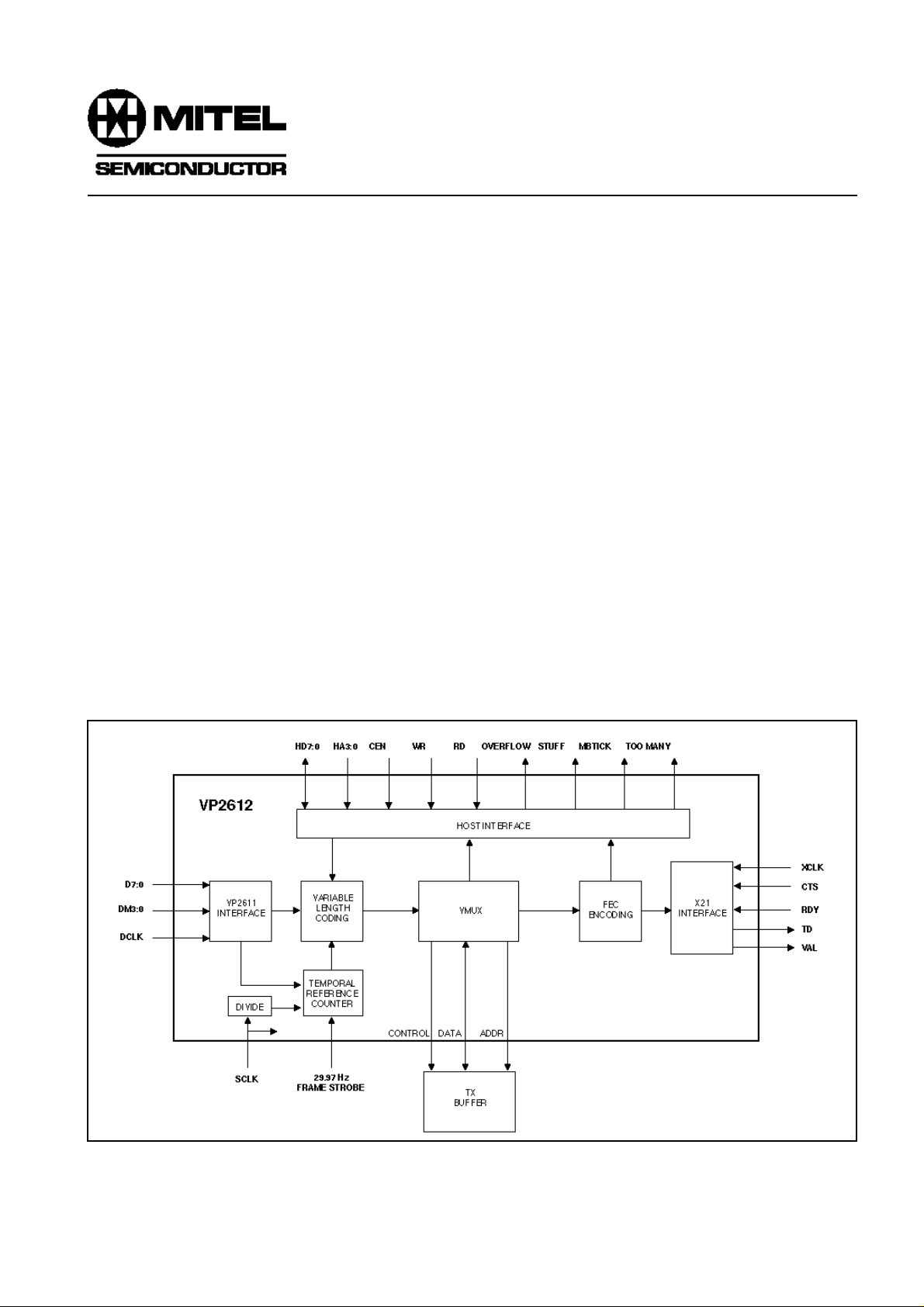
The device contains all the elements necessary to
convert the run length coded data from the VP2611 source
coder into an H261 compatible bit stream. It also calculates
the differential motion vectors and macroblock addresses
from the absolute values received from the VP2611. These
values are variable length coded, and bit packed for temporary
storage in the transmission buffer. The size of this buffer can
be either 256Kbits or 512Kbits. Data from the transmission
buffer is output through an X21 compatible serial interface,
and consists of frames containing framing bits, data, and the
BCH (511,493) forward error correction code.
The system processor interface is used to write data for
PTYPE, PSPARE, GSPARE, and to select the source of
temporal reference. The interface can also be used to monitor
the pointers into the transmission buffer, so that the buffer
fullness can be controlled using proprietary software
algorithms. In addition to the bus interface, flags are supplied
which indicate the start of each macroblock, each FEC stuffed
frame, the number of bits per picture is reaching the allowable
maximum, and impending buffer overflow.
Fig. 1. VP2612 Video Multiplexer
Page 2

VP2612
PIN DESCRIPTIONS
DBUS7:0 The input data bus from VP2611. The data type is
defined by the value present on DMODE3:0
DMODE3:0These inputs define the data type present on the
data bus D7:0. Polarities are given in Table 1.
DCLK A strobe for DM3:0 and DBUS7:0.The high
going edge latches data into the VMUX.
HD7:0 A bidirectional tri-state data bus connecting the
VMUX to the system processor.
HA3:0 Four system processor address bits used to
address internal registers.
WR An active low write strobe from the system
processor.
RD An active low read strobe from the system
processor.
CEN An active low chip select input from the system
processor.
OVR An active high output which signals impending
buffer overflow.
STUFF An active high output that signals that FEC stuffing
is occuring.
MTICK An output which pulses high for every macroblock
received.
TOOM This active high output indicates that the picture is
likely to exceed the allowable number of bits per
picture.
VAL This line is taken low to indicate that the VMUX is
ready to transmit valid data. The C line in an
X21 system.
TD This is the serial data output from the VMUX.
CTS Indicates that the receiver can accept data. The I
line in an X21 system.
RDY Indicates that the receiver can accept data. The
R line in an X21 system.
XCLK X21 line clock input. 0 to 2.048MHz.
SCLK System clock input. Only the high going edge is
used internally, apart from TXWE generation.
FS A 29.97 Hz frame strobe for the temporal reference
counter. Must be high for at least 4 SCLK periods.
If a 256kBit buffer is being used this Chip Enable
should be used.
TXE2 Active low chip enable for the Transmission buffer.
This is used for the optional second memory chip,
if a 512kBit buffer is being used.
TXWE Active low write enable for the Transmission buffer.
TXOE Active low O/P enable for the Transmission buffer.
TCK Test clock for JTAG.
TMS Test mode select.
TDI Test data I/P.
TDO Test data O/P.
TRST JTAG reset.
TOE When low ALL O/P pins are high impedance.
NOTE: "Barred" active low signals do not appear with a
bar in the main body of the text.
OPERATIONS OF MAJOR BLOCKS
Variable Length Coding
This block is responsible for ordering the data from the
VP2611 Encoder into the correct sequence for the H261 bit
stream, and for performing the variable length coding. It also
uses data supplied by the system controller and the Temporal
Reference Counter.
Data for PTYPE, PSPARE, GSPARE is only obtained
from the system controller, and only 8 bits of PSPARE and
GSPARE information can be transmitted per picture or GOB
respectively. The temporal reference can either be obtained
from an internal counter, from the VP2611 outputs, or can be
written by the system controller. The actual source is
determined by bits in a control register as described later. The
internal counter is clocked from either a frame clock with a
maximum frequency of 29.97Hz, or a 29.97Hz clock derived
from the 27MHz system clock, or it simply counts H.261
frames from the encoder.
There is no support provided for macroblock stuffing,
however FEC stuffing is implemented, and can be used to
provide bit stuffing.
This block is also responsible for converting the absolute
values that are output from the V2611 into the relative values
that are required in parts of the H261 bitstream. The VMUX
has been designed so that it can accept ±15 motion vectors,
rather than the +7/-8 motion vectors produced by the VP2611.
Thus it will be compatible with any future upgrades to the
VP2611 that increase the size of the motion estimator search
window.
VMUX Block
RES Active low reset signal. Must be low for at least 16
SCLK periods.
TXA14:0 Address output to Transmission buffer.
TXD7:0 Bidirectional data interface to Transmission buffer.
TXE1 Active low chip enable for the Transmission buffer.
2
The VMUX section performs the bit packing on the data
coming from the variable length coder. This data is in the form
of a delimiter and a variable number of valid bits. The VMUX
section packs these variable length fields into bytes for
storage in the transmission buffer.
The transmission buffer is controlled by this block. It thus
generates read and write pointers, and performs the
arbitration between read and write operations. Buffer level
Page 3
VP2612
monitoring is, however, done by the FEC block as described
later.
The two address pointers can be read by the system
processor, thus allowing the level of the buffer to be monitored.
These are provided as 16 bit words with no truncation, and thus
require two bytes. The 16 bit value is internally frozen when the
most significant byte is requested by the system processor, and
for accuracy the write pointer should be read first. There is also
a control register bit which selects a buffer size of either 256kbits
or 512kbits.
FEC Block
The FEC section performs the framing, and adds the error
correction parity bits. If sufficient data for a frame is not available
in the transmission buffer, then the frame will be stuffed
automatically. There is no absolute threshold at which the FEC
will start to stuff, as the buffer level monitor in the FEC only works
to a resolution of ±128bits. FEC stuffing can also be forced by
setting the "Force FEC stuffing" bit in the VMUX/FEC control
register.
If the buffer level reaches a threshold, internally set to 512
short of the buffer being full, the OVERFLOW output is asserted.
DMODE3:0 FUNCTION
0000 GOB Number
0001 MB Number
0010 Control Decisions
0011 Quant Value
0100 Horizontal MV
0101 Vertical MV
0110 Coded Blk Pattern
0111 Sub-Block No.
1000 Zero Run Count
1001 RLC Coefficient
1010 Not Used
1011 Not Used
1100 Not Used
1101 Not Used
1110 Not Used
1111 Wait State
Table 1
This is to warn the system processor that drastic action is
needed to avert a buffer overflow, which will result in corruption
and loss of data. Since the buffer level monitor only works to
resolution of ±128bits, then the overflow detection can only be
accurate to ±128bits.
VP2611 Interface
The VMUX has been designed to interface directly to
the VP2611 encoder, with no buffering. The interface consists
of two buses DBUS7:0 and DMODE3:0, and a strobe signal
DCLK. The value on DMODE3:0 identifies the data type on
DBUS7:0 during the same period (see Table 1).
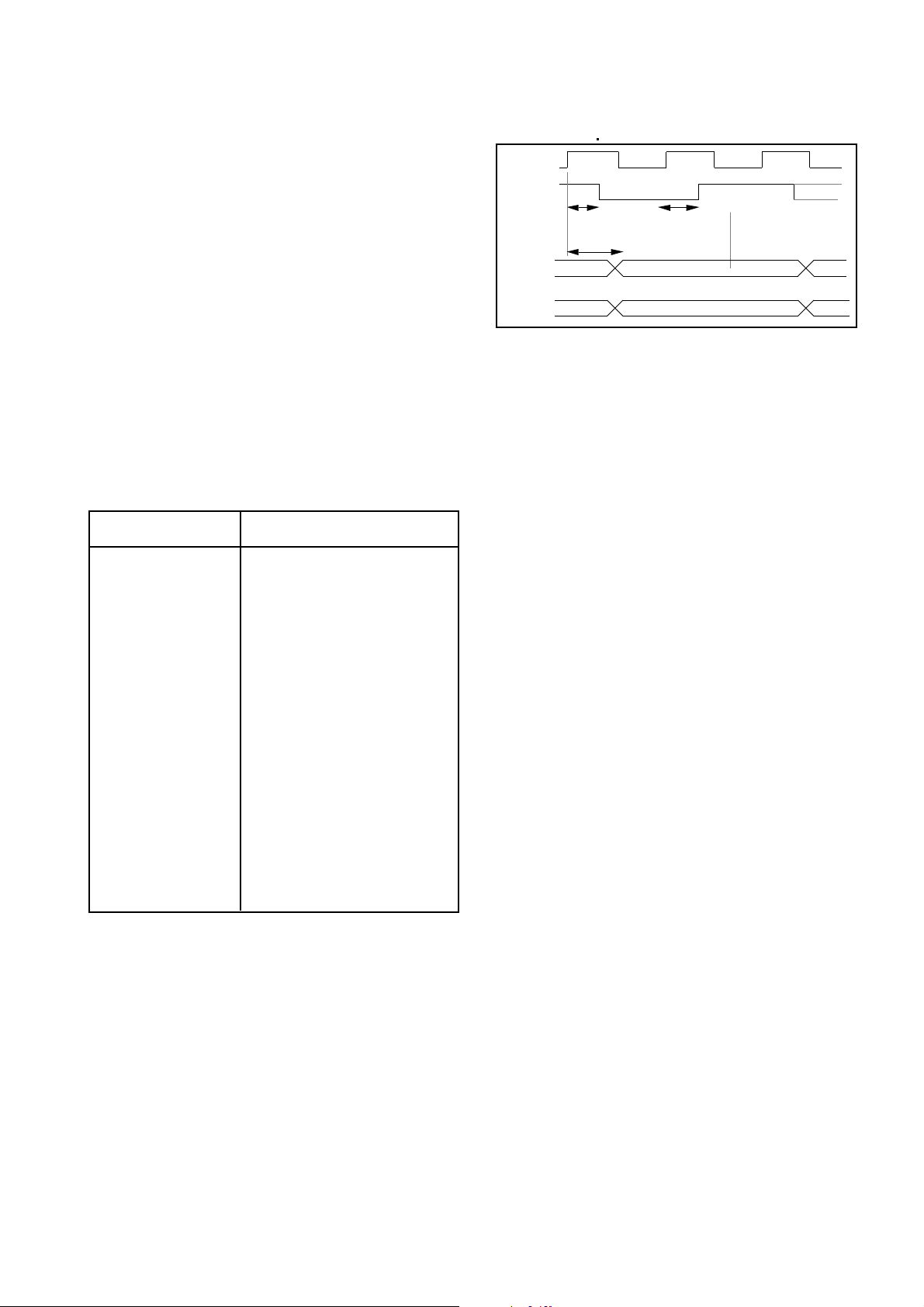
The output of the VP2611 is structured such that the
data on DBUS7:0 and DMODE3:0 is always valid for at
SCLK
DCLK
DATA FROM
VP2611
DMODE
3:0
25ns max
25ns max
20ns max
DATA VALID
DATA VALID
Figure 2. DBUS Timing
least two cycles, and DCLK is high for minimum of one
cycle. The rising DCLK edge occurs one cycle after
DBUS7:0 and DMODE3:0 are valid, as shown in Figure 2.
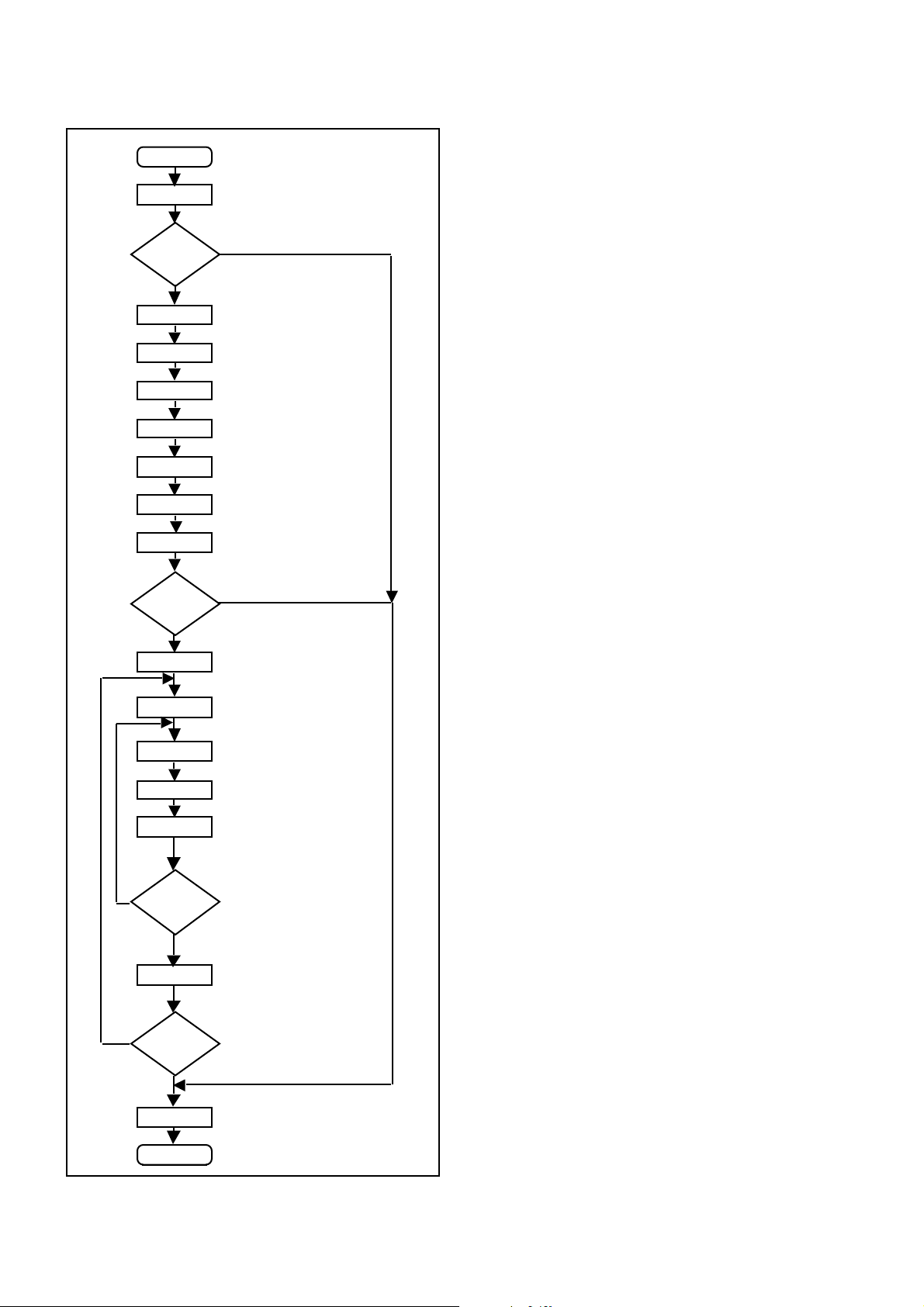
The sequence of events, and the duration of each
event, is shown in Figure 3. These duration times have
been chosen to satisfy the internal requirements of the
VP2612, and Wait States are inserted such that the time
to transfer a macroblock is always 2064 SCLK periods.
The parameters used by the VP2612 are described
in more detail below;
GOB Number : The current GOB Number is provided on
DBUS3:0 after the Control Decisions byte. (DBUS3 is
MSB).
MB Number : After the GOB Number, the macroblock
Number is provided on DBUS5:0 (DBUS5 is MSB).
Control Decisions : This byte shows which control decisions
have been taken for the forthcoming macroblock, and is
the first in the sequence. DBUS0 will be high if a Fixed
Macroblock (FIX MB) was enforced i.e. no new data will
be transmitted this macroblock. DBUS1 indicates
whether Inter (high) or Intra (low) coding was used for the
macroblock. DBUS2 will be high if the macroblock was
filtered, and DBUS3 will be high if motion compensation
was used. DBUS5 will be high if the current frame is being
coded in FAST UPDATE mode. In this mode the complete frame will be intra coded. DBUS6 will be high if the
current frame is a SKIP FRAME i.e. not being coded - so
no coefficients will be transmitted. DBUS4 and DBUS7
are not used.
Quant Value :The quantisation value used in processing the
current macroblock is provided on DBUS4:0 (DBUS4 is
MSB). This represents an actual quantisation level between 2 and 62, in steps of 2 and as defined in H.261.
Horizontal MV : If motion compensation was used the hori-
zontal component of the motion vector will be provided on
DBUS4:0 (DBUS4 is MSB). (This 5 bit value represents
a two's complement number in the range (-15 to +15)
(although only vectors in the range +7/-8 are currently
possible with the VP2611). If motion compensation was
not used this is a don't care value.
3
Page 4
VP2612
START MB
WAIT
IS IT
A DUMMY
BLOCK?
no
CONTROL (2 cycles)
GOB (2 cycles)
MB
CBP (2 cycles)
QUANT (2 cycles)
HORZ MV (2 cycles)
VERT MV
ARE
ANY BLOCKS
CODED?
yes
WAIT (32 cycles)
SUB BLK NO (15 cycles)
RUN LENGTH
(2 cycles)
yes
(2 cycles)
(2 cycles)
no
(2 cycles)
Vertical MV : If motion compensation was used the vertical
component of the motion vector will be provided on
DBUS4:0 (DBUS4 is MSB). (This 5 bit value represents a
two's complement number in the range ±15 ( although only
vectors in the range (±7) are currently possible with the
VP2611). If motion compensation was not used this is a
don't care value.
Coded Block Pattern : This byte contains a 6 bit linear code
that indicates which of the sub-blocks actually contain
coded data. DBUS6 will be high if sub-block 1 contains
coded data, through to DBUS1 being high if sub-block 6
contains coded data. DBUS7 and DBUS0 are not used.
Sub-block Number : An identifier for the run length coded
coefficients which are about to be made available.
DBUS2:0 contain the coded sub-block number from 1 to 6.
All zero sub-blocks will not be produced, and their corresponding numbers will not appear.
Zero Run Count : The number of zero valued coefficents
preceding the next non zero coefficient is provided on
DBUS5:0 (DBUS5 is MSB). Normally, DBUS7:6 are low,
except to signify the end of a Sub-block, when they will
both be high. Zero Run Count is always followed by a
coefficient, even at the end of a sub-block.
RLC Coefficient : This byte contains the 8 bit coefficient value.
It will always be a non-zero value, except when the
previous Zero Run Count signalled the end of sub-Block.
A zero value is then possible since, as stated above, the
run count is always followed by a coefficient byte, which
may be zero if the last coefficient is zero.
Wait State : This indicates that no valid data is being output
from the DBUS port during this cycle. No DCLK is produced for this state.
MAGNITUDE
WAIT
(2 cycles)
(1 cycle)
SYSTEM PROCESSOR INTERFACE
The system processor interface is a memory
mapped microprocessor compatible interface. It has been
designed for use with any system processor, and consists
of the following buses and signals:
ARE
ALL COEFFS
no
O/P?
yes
HD7:0 Processor Data Bus
HA3:0 LSBs of address bus
WR Active Low Write strobe
RD Active Low Read strobe
WAIT
(wait variable time to make total
time since start of sub-block up
to 335 cycles)
CEN Decoded Active Low chip select
Detailed interface timing is shown in Figure 4. Since there
are several internal pipeline registers which are clocked by
no
ALL BLOCKS
yes
END MB
ARE
O/P?
WAIT
(variable cycles)
SCLK, then access times and strobe widths are dependent
on the period of SCLK.
Table 2 shows the addresses used for each of the user
accessible registers, and the function of each register is
described in detail below.
Figure 3. DBUS Port Flow Chart
4
Page 5

Address
0
1
2
3
4
5
6
7
8
9
A
B
C
D
E
F
Function
PTYPE
Temporal Reference
PSPARE
TR Source
GSPARE
Not Used
Not Used
Not Used
TX-buffer Write Address MSB
TX-buffer Write Address LSB*
TX-buffer Read Address MSB
TX-buffer Read Address LSB*
FEC / VMUX status word
Bits per Picture Threshold
Not Used
Not Used
Read / Write
W
W
W
W
W
R
R
R
R
W
W
* N.B. The LSB must be read after the appropriate MSB.
Table 2. Address Locations
PTYPE This is the picture type as defined in H261.
The bits are assigned as follows:
Bit 0 Split screen indicator, "0" off, "1" on.
Bit 1 Document camera indicator, "0" off, "1" on.
Bit 2 Freeze picture release, "0" off, "1" on.
Bit 3 Source Format, "0" QCIF, "1" CIF.
Bit 4:5 Both are set to one as presently defined in the
H261 specification
[Bit 0 is LSB].
These values can be changed at will by the system processor,
and will be transmitted at the start of each picture.
VP2612
Temporal Reference If the temporal reference is being
written from the system processor, then the 5 LSB's in this
register are used to define the next temporal reference value
to be transmitted.
PSPARE This register holds 8 bits of PSPARE information
which may be transmitted for each picture. The data in the
PSPARE register will be transmitted at the start of the next
picture after it has been written. Once an item of data has been
transmitted, it will not be re-transmitted until data is written
from the system processor. It is the responsibility of the
system processor to ensure that it does not rewrite to this
register before the previous value has been transmitted. This
can be done by utilizing a frame interrupt from the video source
in conjunction with the MBTICK output from the VMUX.
TR Source The 3 LSB's in this register define the source for
the strobe used by the 5 bit temporal reference counter. When
the sytem processor is selected, the counter value is replaced
by the contents of the Temporal Reference Register.
VALUE SOURCE
0XX System Processor
100 Actual coded frames from the VP2611
are counted
101 SCLK is divided down to provide a
29.97 Hz frame strobe
110 The strobe is provided by the frame
strobe input pin (FS)
111 Illegal
GSPARE This register holds 8 bits of GSPARE information
which may be transmitted every GOB. Once written the data
is transmitted at the start of the next GOB, but will not be retransmitted until the system processor again writes to this
address. The system processor must ensure that data is not
overwritten before it is used.
TX Buffer Addresses These allow the system
processor to monitor the level of the buffer. The write pointer
should be read first to minimize the error between the the two
ADDRESS
CHIP
SELECT
READ
STROBE
DATA
OUT
READ CYCLE
Tah
Tas
Trs
CHARACTERISTIC
Addresss Set Up Time
Address Hold Time
Cip Select Set Up Time
Chip Select Hold Time
Strobe In active Time
Data Access Time
Delay to O/P's low Z
Delay to O/P's high Z
Tac
Tlz
SYMBOL
Tas
Tah
Trs
Tsh
Tri
Tac
Tlz
Thz
Tsh
Tri
Thz
Data Valid
MAX
MIN
10ns
10ns
10ns
2ns
Øns
4Øns
10 +5Øns
25ns
25ns
NOTE
Ø is the period of the
input clock
Figure 4. Host Controller Timing
ADDRESS
CHIP
SELECT
WRITE
STROBE
DATA
IN
CHARACTERISTIC
Addresss Set Up Time
Address Hold Time
Chip Select Set Up Time
Chip Select Hold Time
Strobe In active Time
Strobe Active Time
Data Set Up Time
Data Hold Time
Tws
Tas
WRITE CYCLE
Tah
Twa
SYMBOL
Tas
Tah
Tws
Tsh
Twi
Twa
Tds
Tdh
Tds
Data Valid
MIN
10ns
10ns
10ns
2ns
2Øns
2Øns
10ns
10ns
Tsh
Twi
Tdh
MAX
5
Page 6

VP2612
values. With a 2Mbits/sec line the error will increase at a rate
of 0.25 bytes per microsecond. Reading the most significant
bytes will trigger the internal latching of the least significant
bytes.
FEC / VMUX Control This register controls the
operation of the transmission buffer and the FEC block.
Actions taken when bits are set are given below;
They perform the following functions:
OVR This line signals an impending buffer overflow. When
the buffer reaches 512±128 bits from being full this line will be
taken high, and will remain high until the buffer level falls below
the threshold. It is intended that this line be used as a
processor interrupt, to signal that drastic action must be taken.
BIT FUNCTION
0 Select 512K buffer. The buffer size must
not be changed during normal operation and must
be defined within 2.4 ms of reset.
1 Enable FEC framing.The option to disable FEC
framing is only provided as a test mode.
2 Force FEC stuffing. If force FEC stuffing is selected
it will start at the beginning of the next frame and
only stop at the start of subsequent frames. The
system processor must ensure that the
transmission buffer does not overflow with forced
stuffing. In normal operation FEC stuffing only
occurs when there is insufficient data in the
transmission buffer.
Bits Per Picture Register When the number of bits which
have been coded has been subtracted from the maximum
possible ( as defined by H.261 ), and the result reaches the
value in this register, then the TOO MANY interrupt will be
generated. The programmed value thus defines in Kbits the
number of bits which may still be generated before reaching
the maximum allowed. The default value is 8 Kbits, and the
maximum number used internally changes between CIF and
QCIF.
INTERRUPT OUTPUTS
The special signals listed below are provided to drive
timers and interrupt inputs on the system processor.
OVERFLOW ( OVR )
FEC STUFF ( STUFF )
MACROBLOCK TICK ( MTICK )
TOO MANY ( TOOM )
SCLK
ADDRESS
O/P
CHIP ENABLE/
O/P ENEBALE
DATA I/P
ADDRESS
O/P
CHIP
ENABLE
DATA
O/P
WRITE
ENABLE
20ns
max
20ns max
20ns
max
ADDRESS VALID
15ns
min
Tac
WORST CASE READ CYCLE
WRITE CYCLE
DATA VALID
20ns
max
VALID
0ns
min
20ns
max
20ns
max
STUFF This line signals that FEC stuffing is occuring, and can
be used to monitor the amount of stuffing being performed. It
will pulse high once at the start of each FEC stuffed frame, the
length of the pulse being one line clock period. It is intended
that this should be used to clock a system processor counter,
to keep a running total of the number of FEC stuffed frames.
MTICK This output pulses high once for every Macroblock
received from the VP2611. The pulse is 3 clock cycles in
duration, and the leading edge will occur 6 SCLK cycles after
the Macroblock address was received from the VP2611. It is
anticipated that this should be used to clock a counter in the
system processor, so that the system processor can keep
track of which MB is being processed. In conjunction with the
frame pulse this will enable the system processor to write
information to the VP2611 at appropriate times.
TOOM This signal indicates that the present picture has
reached a threshold relative to the maximum number of bits
per picture allowed by H.261 (256k if CIF, 64k if QCIF). It is set
when the number of bits remaining before the maximum will be
exceeded reaches the value in the Bits Per Picture Register,
and stays high until the end of the current picture.
TRANSMISSION BUFFER INTERFACE
The transmission buffer can consist of either one or
two 32K x 8 bit static RAMs. Fifteen address outputs are
provided for direct connection to the memory devices, and two
RAM select pins are provided to define the device in use. If
only a single device is being used then CE2 is redundant.
An internal FIFO is provided to average out high speed bursts
of transmission buffer cycles. This allows the external SRAM
read cycles to occupy at least three SCLK periods. Detailed
timing for the buffer is given in Figure 5, and shows that with
a 27 MHz clock the RAM must have an access time of less than
39 nanoseconds. Figure 5 illustrates the worst case read
access time, which occurs when a second read cycle follows
the first without an intermediate write cycle. Chip enable and
output enable remain low from the first read cycle.
The write cycle uses two SCLK periods and requires the use
of both the falling and rising edges of SCLK. The Write Enable
output thus remains active for one SCLK period minus
differential rising and falling edge delays. These are limited to
two nanoseconds. Note that when consecutive read or write
operations take place then Chip Enable will remain active, and
not go inactive between cycles.
LINE INTERFACE
A serial interface is provided which facilitates the
operation of the encoder and decoder in a back to back
configuration. It is similar in operation to an X21 interface but
does not support balanced lines. Alternatively the interface
can be used in a simple serial manner by tying the control lines
to fixed logic levels. It uses the following signals:
6
Figure 5. Transmission Buffer Timing
Page 7

VP2612
XCLK Line rate clock
VAL Ready to send
TD Transmitted Data
CTS Clear To Send
RDY Receiver ready
Of these signals XCLK, CTS and RDY are supplied by
the receiving device, the latter two indicating that the receiver
is ready to accept data. The VAL line is used to signal that the
VMUX is ready to start transmitting valid data, and the TD line
provides the data. The signaling convention is as follows:
CTS = 1 Receiving device not ready
RDY = 0
CTS = 0 Receiving device ready to accept data
RDY = X
CTS =1 Receiving device ready to accept data
RDY =1
The VAL line is taken high by the reset input, and when
the receiving device signals that it is ready to accept data then
the VP2612 takes the VAL line low on a falling edge of an
XCLK. The data is then clocked out on subsequent falling
edges of the XCLK signal, so that it can be sampled by the
receiver on the rising edge of the clock.
If a simple serial interface is required, the CTS input
should be tied low and the RDY input tied high. It is possible
to use a variable rate clock provided the maximum
instantaneous bit rate does not exceed 8Mbits/s, and the
average clock rate over 32 bits does not exceed 2Mbits/s.
Timing delays with respect to the incoming XCLK are shown
in Figure 6.
XCLK
I/P
20 min
READY FROM
RECEIVER
DATA VALID
O/P (VAL)
DATA
O/P
RECEIVER READY R =1, I =1
25ns max
25ns max
25ns max
DATA VALID
Figure 6. Serial Interface Timing
The TAP controller used in this device does not support
a separate INTEST instruction but allows EXTEST to drive the
internals of the device as well as to drive the output pins.
Output enables are thus present in the chain which are not
connected to pins but which allow EXTEST to be used to
control the impedance of all the outputs. The JTAG signal
TXD controls the TXD bus, HD controls the HD bus, and TOPS
controls all remaining outputs. The TOE pin, which can
separately be used to control the impedance of all the outputs,
can be monitored as an input through the scan chain but
cannot be used to control the outputs through the TAP
controller.
JTAG Test Interface
The VP2612 includes a test interface consisting of a
boundary scan loop of test registers placed between the pads
and the core of the chip. The control of this loop is fully JTAG/
IEEE 1149-1 1990 compatible. Please refer to this document
for a full description of the standard.
The interface has five dedicated pins: TMS, TDI, TDO,
TCK and TRST. The TRST pin is an independent reset for the
interface controller and should be pulsed low, soon after
power up; if the JTAG interface is not to be used it can be tied
low permanently. The TDI pin is the input for shifting in serial
instruction and test data; TDO the output for test data. The
TCK pin is the independent clock for the test interface and
registers, and TMS the mode select signal.
TDI and TMS are clocked in on the rising edge of TCK,
and all output transitions on TDO happen on its falling edge.
Instructions are clocked into the 3 bit instruction register
(no parity bit) and the following instructions are available.
Instruction Register Name
( MSB first )
111 BYPASS
000 EXTEST
010 SAMPLE/PRELOAD
7
Page 8

VP2612
ABSOLUTE MAXIMUM RATINGS [See Notes]
Supply voltage VDD -0.5V to 7.0V
Input voltage V
Output voltage V
Clamp diode current per pin IK (see note 2) 18mA
Static discharge voltage (HMB) 500V
Storage temperature T
Ambient temperature with power applied T
Junction temperature 100°C
Package power dissipation 1000mW
IN
OUT
S
-0.5V to VDD + 0.5V
-0.5V to VDD+ 0.5V
-65°C to 150°C
AMB
0°C to 70°C
NOTES ON MAXIMUM RATINGS
1. Exceeding these ratings may cause permanent damage.
Functional operation under these conditions is not implied.
2. Maximum dissipation or 1 second should not be exceeded,
only one output to be tested at any one time.
3. Exposure to absolute maximum ratings for extended
periods may affect device reliablity.
4. Current is defined as negative into the device.
STATIC ELECTRICAL CHARACTERISTICS Operating Conditions (unless otherwise stated)
Tamb = 0 C to +70°C VDD = 5.0v ± 5%
Characteristic
Output high voltage
Output low voltage
Input high voltage
Input low voltage
Input leakage current
Input capacitance
Output leakage current
Output S/C current
Symbol
V
OH
V
OL
V
IH
V
IL
I
IN
C
IN
I
OZ
I
SC
Min.
2.4
-
2.0
-
-10
-50
10
Value
Typ.
10
Max.
-
0.4
-
0.8
+10
+50
300
Units
V
V
V
V
µA
pF
µA
mA
Conditions
IOH = 4mA
IOL = -4mA
3.0V for SYSCLK and DCLK
GND < VIN < V
GND < V
OUT
< V
DD
DD
PIN
1
2
3
4
5
6
7
8
9
10
11
12
13
14
15
16
17
18
19
20
FUNC
N/C
N/C
N/C
TOE
OVR
DMODE0
DMODE1
DMODE2
DMODE3
GND
VDD
DBUS0
DBUS1
DBUS2
DBUS3
DBUS4
DBUS5
DBUS6
DBUS7
VDD
PIN
21
22
23
24
25
26
27
28
29
30
31
32
33
34
35
36
37
38
39
40
FUNC
GND
DCLK
XCLK
RDY
CTS
TD
VAL
N/C
N/C
N/C
HA0
HA1
HA2
HA3
SCLK
GND
VDD
HD0
HD1
HD2
PIN
41
42
43
44
45
46
47
48
49
50
51
52
53
54
55
56
57
58
59
60
Pin Out Diagram
FUNC
HD3
HD4
HD5
HD6
HD7
VDD
GND
WR
RD
CEN
N/C
N/C
TXD7
TXD6
TXD5
TXD4
TXD3
TXD2
GND
VDD
PIN
61
62
63
64
65
66
67
68
69
70
71
72
73
74
75
76
77
78
79
80
FUNC
TXD1
TXD0
TXA14
TXA13
TXA12
TXA11
TXA10
TXA9
TXA8
TXA7
VDD
GND
TXA6
TXA5
TXA4
TXA3
TXA2
N/C
N/C
N/C
PIN
81
82
83
84
85
86
87
88
89
90
91
92
93
94
95
96
97
98
99
100
FUNC
TXA1
TXA0
TXWE
TXOE
GND
VDD
TXE2
TXE1
TDI
TMS
TRST
TCK
TDO
VDD
GND
RES
MTICK
STUFF
TOOM
FS
8
Page 9

VP2612
PAD
TXE1
TXE2
TX0E
TXWE
TXA0
TXA1
TXA2
TXA3
TXA4
TXA5
TXA6
TXA7
TXA8
TXA9
TXA10
TXA11
TXA12
TXA13
TXA14
TXD
TXD0
TXD0
TXD1
TXD1
TXD2
TXD2
TXD3
TXD3
TXD4
TXD4
TXD5
TXD5
TXD6
TXD6
TXD7
TXD7
CEN
RD
WR
HD7
HD7
HD6
HD6
HD5
TYPE
O/P
O/P
O/P
O/P
O/P
O/P
O/P
O/P
O/P
O/P
O/P
O/P
O/P
O/P
O/P
O/P
O/P
O/P
O/P
I/P
(input)
(output)
(input)
(output)
(input)
(output)
(input)
(output)
(input)
(output)
(input)
(output)
(input)
(output)
(input)
(output)
I/P
I/P
I/P
(output)
(input)
(output)
(input)
(output)
REG No.
88
87
86
85
84
83
82
81
80
79
78
77
76
75
74
73
72
71
70
69
68
67
66
65
64
63
62
61
60
59
58
57
56
55
54
53
52
51
50
49
48
47
46
45
PAD
HD5
HD4
HD4
HD3
HD3
HD2
HD2
HD1
HD1
HD0
HD0
HD
SCLK
HA3
HA2
HA1
HA0
VAL
TD
CTS
RDY
XCLK
DCLK
DBUS7
DBUS6
DBUS5
DBUS4
DBUS3
DBUS2
DBUS1
DBUS0
DMODE3
DMODE2
DMODE1
DMODE0
OVR
TOE
TOPS
TSE
DEN
FS
TOOM
STUFF
MTICK
RES
TYPE
(input)
(output)
(input)
(output)
(input)
(output)
(input)
(output)
(input)
(output)
(input)
I/P
I/P
I/P
I/P
I/P
I/P
O/P
O/P
I/P
I/P
I/P
I/P
I/P
I/P
I/P
I/P
I/P
I/P
I/P
I/P
I/P
I/P
I/P
I/P
O/P
I/P
I/P
I/P
I/P
I/P
O/P
O/P
O/P
I/P
REG No.
44
43
42
41
40
39
38
37
36
35
34
33
32
31
30
29
28
27
26
25
24
23
22
21
20
19
18
17
16
15
14
13
12
11
10
9
8
7
6
5
4
3
2
1
0
JTAG Register Allocation
ORDERING INFORMATION
VP2612 CG GPFR (Commercial - Plastic QFP package)
9
Page 10

Page 11

http://www.mitelsemi.com
World Headquarters - Canada
Tel: +1 (613) 592 2122
Fax: +1 (613) 592 6909
North America Asia/Pacific Europe, Middle East,
Tel: +1 (770) 486 0194 Tel: +65 333 6193 and Africa (EMEA)
Fax: +1 (770) 631 8213 Fax: +65 333 6192 Tel: +44 (0) 1793 518528
Fax: +44 (0) 1793 518581
Information relating to products and services furnished herein by Mitel Corporation or its subsidiaries (collectively “Mitel”) is believed to be reliable. However, Mitel assumes no
liability for errors that may appear in this publication, or for liability otherwise arising from the application or use of any such information, product or service or for any infringement of
patents or other intellectual property rights owned by third parties which may result from such application or use. Neither the supply of such information or purchase of product or
service conveys any license, either express or implied, under patents or other intellectual property rights owned by Mitel or licensed from third parties by Mitel, whatsoever.
Purchasers of products are also hereby notified that the use of product in certain ways or in combination with Mitel, or non-Mitel furnished goods or services may infringe patents or
other intellectual property rights owned by Mitel.
This publication is issued to provide information only and (unless agreed by Mitel in writing) may not be used, applied or reproduced for any pur pose nor form part of any order or
contract nor to be regarded as a representation relating to the products or services concerned. The products, their specifications, services and other information appearing in this
publication are subject to change by Mitel without notice. No warranty or guarantee express or implied is made regarding the capability, performance or suitability of any product or
service. Information concerning possible methods of use is provided as a guide only and does not constitute any guarantee that such methods of use will be satisfactory in a specific
piece of equipment. It is the user’s responsibility to fully determine the performance and suitability of any equipment using such information and to ensure that any publication or
data used is up to date and has not been superseded. Manufacturing does not necessarily include testing of all functions or parameters. These products are not suitable for use in
any medical products whose failure to perform may result in significant injury or death to the user. All products and materials are sold and services provided subject to Mitel’s
conditions of sale which are available on request.
M Mitel (design) and ST-BUS are registered trademarks of MITEL Corporation
Mitel Semiconductor is an ISO 9001 Registered Company
Copyright 1999 MITEL Corporation
All Rights Reserved
Printed in CANADA
TECHNICAL DOCUMENTATION - NOT FOR RESALE
 Loading...