

Page 1
MIC5201 Micrel
MIC5201
200mA Low-Dropout Voltage Regulator
General Description
The MIC5201 is an efficient linear voltage regulator with very
low dropout voltage (typically 17mV at light loads and 200mV
at 100mA), and very low ground current (1mA at 100mA
output), offering better than 1% initial accuracy with a logic
compatible on-off switching input.
Designed especially for hand-held battery powered devices,
the MIC5201 can be switched by a CMOS or TTL compatible
enable signal. This enable control may be connected directly
to VIN if unneeded. When disabled, power consumption
drops nearly to zero. The ground current of the MIC5201
increases only slightly in dropout, further prolonging battery
life. Key MIC5201 features include current limiting,
overtemperature shutdown, and protection against reversed
battery.
The MIC5201 is available in several fixed voltages and
accuracy configurations. It features the same pinout as the
LT1121 with better performance. Other options are available;
contact Micrel for details.
Ordering Information
Features
• High output voltage accuracy
• Variety of output voltages
• Guaranteed 200mA output
• Low quiescent current
• Low dropout voltage
• Extremely tight load and line regulation
• Very low temperature coefficient
• Current and thermal limiting
• Reversed-battery protection
• Load-dump protection (fixed voltage versions)
• Zero off-mode current
• Logic-controlled electronic enable
• Available in SO-8 and SOT-223 packages
Applications
• Cellular telephones
• Laptop, notebook, and palmtop computers
• Battery powered equipment
• PCMCIA VCC and V
• Bar code scanners
• SMPS post-regulator/ dc-to-dc modules
• High-efficiency linear power supplies
regulation/switching
PP
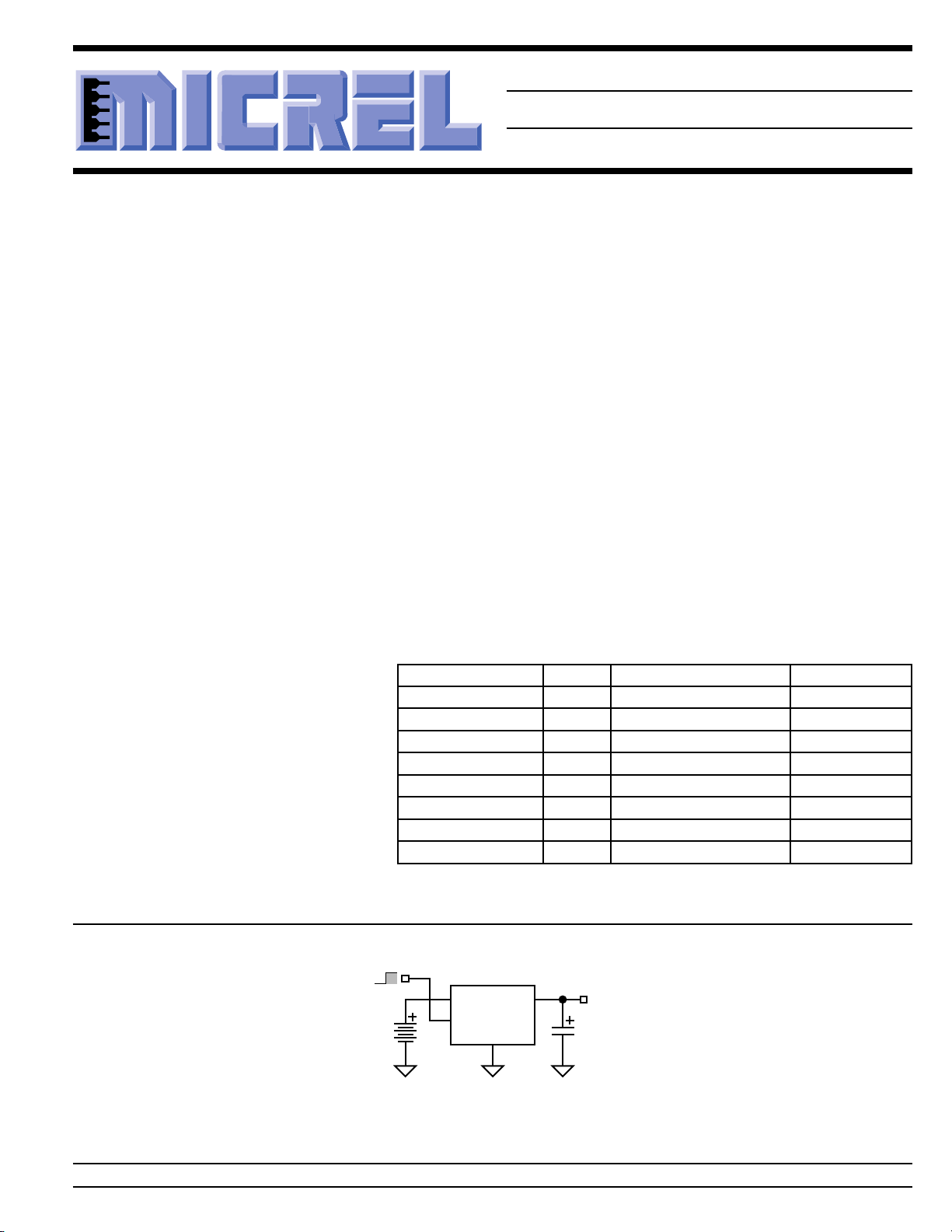
Typical Application
ENABLE
SHUTDOWN
Part Number Voltage Junction Temp. Range* Package
MIC5201BM Adj –40°C to +125°C SO-8
MIC5201-3.0BM 3.0 –40°C to +125°C SO-8
MIC5201-3.3BM 3.3 –40°C to +125°C SO-8
MIC5201-5.0BM 5.0 –40°C to +125°C SO-8
MIC5201-3.0BS 3.0 –40°C to +125°C SOT-223
MIC5201-3.3BS 3.3 –40°C to +125°C SOT-223
MIC5201-4.8BS 4.85 –40°C to +125°C SOT-223
MIC5201-5.0BS 5.0 –40°C to +125°C SOT-223
Other voltages available. Contact Micrel for details.
* Junction Temperature.
MIC5201-3.3
IN OUT
EN
GND
1µF
V
OUT
3.3V
MM8 is a trademark of Micrel, Inc.
Micrel, Inc. • 1849 Fortune Drive • San Jose, CA 95131 • USA • tel + 1 (408) 944-0800 • fax + 1 (408) 944-0970 • http://www.micrel.com
July 1998 1 MIC5201
Page 2

MIC5201 Micrel
Pin Configuration
GND
TAB
132
IN OUTGND
OUT
ADJ
GND
NC
1
2
3
4
8
IN
7
NC
6
NC
5
EN
MIC5201-x.xBS
SOT-223
Fixed
MIC5201BM
8-Lead SOIC
Adjustable
Pin Description
Pin No. Pin No. Pin No. Pin Name Pin Function
SOT-223 SO-8 Adj. SO-8 Fixed
3 1 1 OUT Regulated Output
2 ADJ Feedback Input: (Adjustable version only)
4, 6, 7 2, 4, 6, 7 NC not internally connected: Connect to ground plane for lowest thermal
resistance.
2 3 3 GND Ground
5 5 EN Enable (Input): TTL compatible input. High = enable.
Low or open = off/disable.
188 VINUnregulated Supply Input
OUT
NC
GND
NC
1
2
3
4
MIC5201-x.xBM
8-Lead SOIC
Fixed
8
IN
7
NC
6
NC
5
EN
Absolute Maximum Ratings
Supply Input Voltage (VIN) Fixed .................. –20V to +60V
Supply Input Voltage (VIN) Adjustable .......... –20V to +20V
Enable Input Voltage (VEN) Fixed ................. –20V to +60V
Enable Input Voltage (VEN) Adjustable ......... –20V to +20V
Operating Ratings
Supply Input Voltage (VIN) Fixed ................... 2.5V to +26V
Supply Input Voltage (VIN) Adjustable ........... 2.5V to +16V
Enable Input Voltage (VEN) .................................. 0V to V
Junction Temperature (TJ) .......................–40°C to +125°C
IN
Power Dissipation (PD) ............................ Internally Limited
Junction Temperature (TJ) .......................–40°C to +125°C
Lead Temperature (soldering, 5 sec.) ....................... 260°C
MIC5201 2 July 1998
Page 3

MIC5201 Micrel
Electrical Characteristics
VIN = V
Symbol Parameter Condition Min Typ Max Units
V
O
∆VO/∆T Output Voltage Temperature Coef. Note 2 40 150 ppm/°C
∆V
O/VO
∆V
O/VO
∆V
O/VO
– V
V
IN
I
GND
I
GND
PSRR Ripple Rejection 75 dB
I
GNDDO
I
LIMIT
∆VO/∆P
e
n
Enable Input
V
IL
V
IH
I
IL
I
IH
Reference (MIC5201 Adjustable Version Only)
V
REF
I
IL
General Note: Devices are ESD sensitive. Handling precautions recommended.
Note 1: Absolute maximum ratings indicate limits beyond which damage to the component may occur. Electrical specifications do not apply when
Note 2: Output voltage temperature coefficient is defined as the worst-case voltage change divided by the total temperature range.
Note 3: Regulation is measured at constant junction temperature using low duty cycle pulse testing. Parts are tested for load regulation in the load
Note 4: Dropout Voltage is defined as the input to output differential at which the output voltage drops 2% below its nominal value measured at 1V
Note 5: Ground pin current is the regulator quiescent current plus pass transistor base current. The total current drawn from the supply is the sum of
Note 6: Thermal regulation is defined as the change in output voltage at a time “t” after a change in power dissipation is applied, excluding load or line
+ 1V; IL = 100µA; CL = 3.3µF; VEN ≥ 2.0V; TJ = 25°C, bold values indicate –40°C ≤ TJ ≤ +85°C; unless noted
OUT
Output Voltage Accuracy Variation from specified V
Line Regulation, Fixed VIN = V
+ 1V to 26V 0.004 0.20 %
OUT
OUT
–1 1 %
–2 2 %
0.40 %
Line Regulation, Adjustable VIN = V
+ 1V to 16V 0.004 0.20 %
OUT
0.40 %
Load Regulation IL = 0.1mA to 200mA, Note 3 0.04 0.16 %
0.30 %
O
Dropout Voltage, Note 4 IL = 100µA17mV
I
= 20mA 130 mV
L
= 50mA 180 mV
I
L
= 100mA 225 mV
I
L
IL = 200mA 270 400 mV
Quiescent Current V
≤ 0.7V (shutdown) 0.01 µA
ENABLE
Ground Pin Current IL = 100µA 130 µA
= 20mA 270 400 µA
I
L
I
= 50mA 500 µA
L
= 100mA 1000 2000 µA
I
L
IL = 200mA 3000 µA
Ground Pin Current at Dropout VIN = 0.5V less than specified V
, 270 330 µA
OUT
IL = 100µA, Note 5
Current Limit V
D
Thermal Regulation Note 6 0.05 %/W
= 0V 280 500 mA
OUT
Output Noise 100 µV
Input Voltage Level logic low (off) 0.7 V
Input Voltage Level logic high (on) 2.0 V
Enable Input Current VIL ≤ 0.7V 0.01 1 µA
Enable Input Current VIH ≤ 2.0V 15 50 µA
Reference Voltage 1.223 1.242 1.255 V
1.217 1.267 V
Reference Voltage Temp. Coef. 20 ppm/°C
operating the device outside of its rated operating conditions. The maximum allowable power dissipation is a function of the maximum junction
temperature, T
dissipation at any ambient temperature is calculated using: P
will result in excessive die temperature, and the regulator will go into thermal shutdown. The θJC of the MIC5201-x.xBS is 15°C/W and θJA for
the MIC5201BM is 160°C/W mounted on a PC board (see “Thermal Considerations” section for further details).
range from 0.1mA to 200mA. Changes in output voltage due to heating effects are covered by the thermal regulation specification.
differential.
the load current plus the ground pin current.
regulation effects. Specifications are for a 200mA load pulse at VIN = 26V for fixed and VIN = 16V for adjustable at t = 10ms.
, the junction-to-ambient thermal resistance, θJA, and the ambient temperature, TA. The maximum allowable power
J(max)
(max)
= (T
J(max)–TA
) ÷ θJA. Exceeding the maximum allowable power dissipation
July 1998 3 MIC5201
Page 4
MIC5201 Micrel
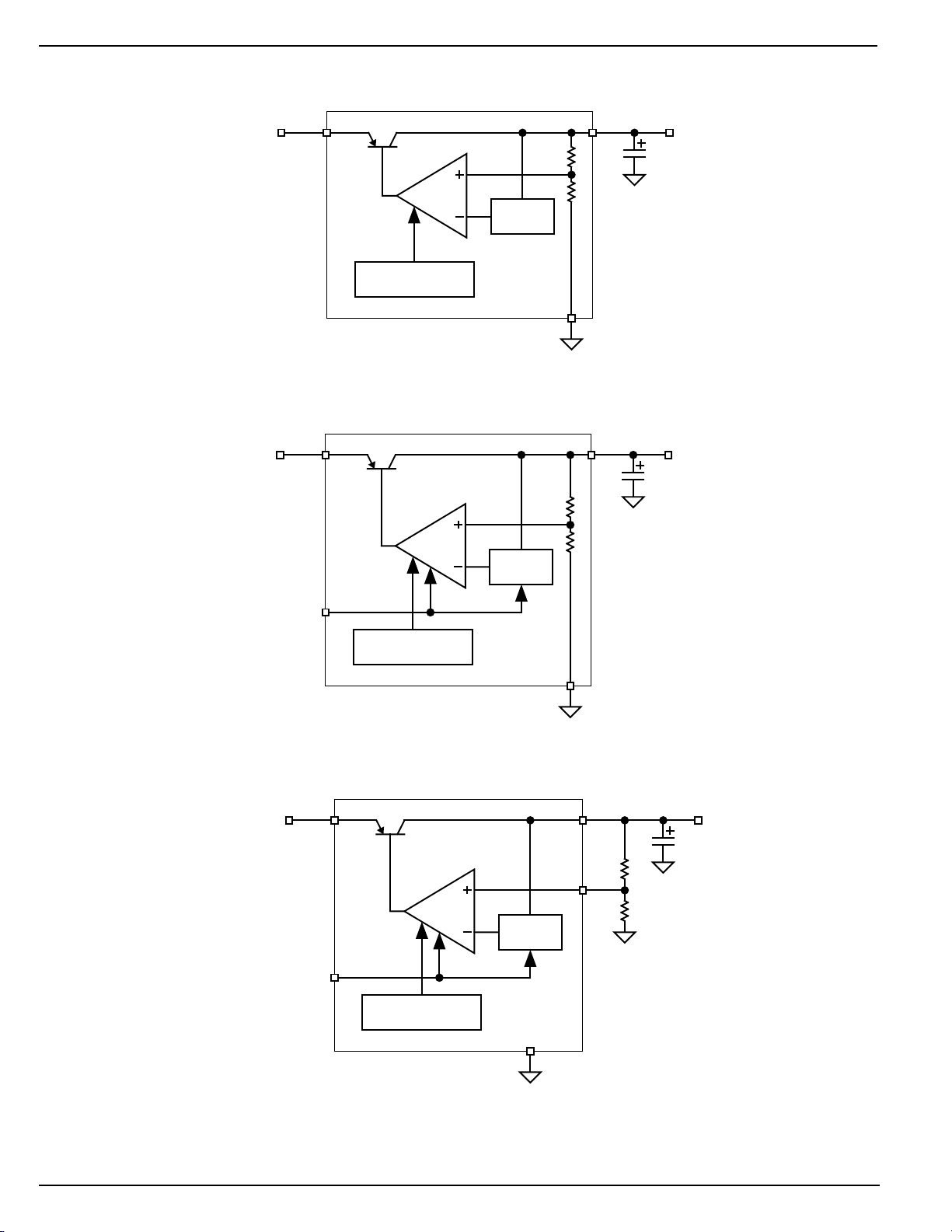
Block Diagrams
V
IN
IN
OUT
V
OUT
C
OUT
Bandgap
Ref.
Current Limit
Thermal Shutdown
MIC5201-x.xBS
GND
Fixed Regulator (SOT-223 version only)
V
IN
IN
Bandgap
Ref.
V
REF
EN
OUT
V
OUT
C
OUT
Current Limit
Thermal Shutdown
MIC5201-x.xBM
GND
Fixed Regulator
V
IN
IN
Bandgap
Ref.
V
REF
EN
Current Limit
Thermal Shutdown
MIC5201BM [adj.]
GND
OUT
ADJ
R1
R2
V
OUT
C
OUT
Adjustable Regulator
MIC5201 4 July 1998
Page 5

MIC5201 Micrel
0.0
0.1
0.2
0.3
0.4
-60 -30 0 30 60 90 120 150
DROPOUT VOLTAGE (V)
TEMPERATURE (°C)
0.0
0.2
0.4
0.6
0.8
1.0
1.2
1.4
1.6
0246810
GROUND CURRENT (mA)
SUPPLY VOLTAGE (V)
1.0
1.1
1.2
1.3
1.4
1.5
-50 0 50 100 150
GROUND CURRENT (mA)
TEMPERATURE (°C)
100
120
140
160
180
200
220
240
260
280
300
-60 -30 0 30 60 90 120 150
OUTPUT CURRENT (mA)
TEMPERATURE (°C)
Typical Characteristics
Dropout Voltage
vs. Output Current
250
200
150
100
50
DROPOUT VOLTAGE (mV)
0
0.01 0.1 1 10 100 1000
OUTPUT CURRENT (mA)
Ground Current
vs. Output Current
10
1
GROUND CURRENT (mA)
0.1
0.01 0.1 1 10 100
OUTPUT CURRENT (mA)
Dropout Voltage
vs. Temperature
IL = 100mA
IL = 1mA
Ground Current
vs. Supply Voltage
IL = 100mA
IL = 1mA
Dropout
3.5
3.0
2.5
2.0
1.5
1.0
OUTPUT VOLTAGE (V)
0.5
0.0
Characteristics
IL = 100mA
IL = 100µA, 1mA
0246810
INPUT VOLTAGE (V)
Output Voltage
vs. Output Current
3.5
3.0
2.5
2.0
1.5
1.0
OUTPUT VOLTAGE (V)
0.5
0.0
0.0 0.1 0.2 0.3
CIN = 2.2µF
= 4.7µF
C
OUT
OUTPUT CURRENT (A)
0.30
0.25
0.20
GROUND CURRENT (mA)
0.15
-60 -30 0 30 60 90 120 150
TEMPERATURE (°C)
Output Voltage vs. Temp.
3.6
CIN = 2.2µF
3.5
C
OUT
3.4
3.3
July 1998 5 MIC5201
3.2
3.1
OUTPUT VOLTAGE (V)
CURVES APPLICABLE
AT 100µA AND 100mA
3.0
-60 -30 0 30 60 90 120 150
TEMPERATURE (°C)
Ground Current
vs. Temperature
I
= 100µA
LOAD
= 2.2µF
C
IN
= 4.7µF
C
OUT
(3.3V Version)
= 4.7µF
3 DEVICES:
HI / AVG / LO
Ground Current
vs. Temperature
I
= 100mA
LOAD
= 2.2µF
C
IN
= 4.7µF
C
OUT
Output Current
vs. Temperature
V
= 3.3V
OUT
V
= 0V
OUT
(SHORT CIRCUIT)
Thermal Regulation
100
50
∆ OUTPUT (mV)
200
-50
100
LOAD (mA)
-100
(3.3V Version)
0
0
-5 0 5 10 15 20 25 30 35
CL = 4.7 µF
TIME (ms)
Minimum Input Voltage
3.30
3.29
3.28
3.27
3.26
3.25
3.24
3.23
3.22
MIN. INPUT VOLTAGE (V)
3.21
3.20
vs. Temperature
CIN = 2.2µF
= 4.7µF
C
OUT
= 1mA
I
LOAD
-60 -30 0 30 60 90 120 150
TEMPERATURE (°C)
Page 6

MIC5201 Micrel
Short Circuit Current
300
250
200
150
100
SHORT CIRCUIT CURRENT (mA)
vs. Input Voltage
CIN = 2.2µF
= 4.7µF
C
OUT
= 3.3V
50
0
1234567
V
OUT
INPUT VOLTAGE (V)
-10
-20
∆ OUTPUT (mV)
-30
300
200
100
OUTPUT (mA)
Load Transient
20
10
0
CL = 4.7µF
0
-2 0246810
TIME (ms)
Load Transient
20
10
0
-10
-20
∆ OUTPUT (mV)
-30
300
CL = 47µF
200
100
OUTPUT (mA)
0
-10 0 10203040
TIME (ms)
Supply Current vs. Supply
Voltage (3.3V Version)
120
100
80
60
40
20
SUPPLY CURRENT (mA)
0
012345678910
SUPPLY VOLTAGE (V)
RL = 33Ω
Supply Current vs. Supply
Voltage (3.3V Version)
60
50
40
30
20
10
SUPPLY CURRENT (mA)
0
01234567
RL = 66Ω
SUPPLY VOLTAGE (V)
10
∆ OUTPUT (mV)
-10
INPUT (V)
Line Transient
5
0
-5
8
6
4
2
-0.2 0 0.2 0.4 0.6 0.8
CL = 1 µF
= 1mA
I
L
TIME (ms)
Enable Transient
(3.3V Version)
5
4
3
2
1
0
OUTPUT (V)
4
-1
2
0
ENABLE (V)
-2
-50 0 50 100 150 200 250 300
CL = 4.7 µF
= 1mA
I
L
TIME (µs)
Line Transient
15
10
5
0
∆ OUTPUT (mV)
8
-5
6
4
INPUT (V)
2
-0.1 0 0.1 0.2 0.3 0.4 0.5 0.6
CL = 10 µF
= 1mA
I
L
TIME (ms)
Enable Transient
(3.3V Version)
5
4
3
2
1
0
OUTPUT (V)
4
-1
2
0
ENABLE (V)
-2
-50 0 50 100 150 200 250 300
CL = 4.7 µF
= 100mA
I
L
TIME (µs)
1000
100
0.1
0.01
OUTPUT IMPEDANCE (Ω)
0.001
Output Impedance
IL = 100µA
10
1
0
0
1x10
10x10
FREQUENCY (Hz)
IL = 1mA
IL = 100mA
0
100x10
3
1x10
3
10x10
3
100x10
6
1x10
Enable Current Threshold
vs. Temperature
35
30
25
20
15
10
5
ENABLE CURRENT (µA)
0
-5
-60 -30 0 30 60 90 120 150
CIN = 2.2µF
= 4.7µF
C
OUT
VEN = 5V
VEN = 2V
TEMPERATURE (°C)
Enable Voltage Threshold
1.6
1.4
1.2
0.8
ENABLE VOLTAGE (V)
0.6
0.4
vs. Temperature
CIN = 2.2µF
= 4.7µF
C
OUT
1
-60 -30 0 30 60 90 120 150
TEMPERATURE (°C)
ON
OFF
MIC5201 6 July 1998
Page 7

MIC5201 Micrel
0
20
40
60
80
100
10x10
0
100x10
0
1x10
3
10x10
3
100x10
3
1x10
6
RIPPLE VOLTAGE (dB)
FREQUENCY (Hz)
Ripple
0
0
10x10
vs. Frequency
IL = 100µA
0
3
1x10
100x10
FREQUENCY (Hz)
100
80
60
40
20
RIPPLE VOLTAGE (dB)
3
10x10
3
100x10
6
1x10
Ripple
vs. Frequency
IL = 1mA
Ripple
0
0
10x10
vs. Frequency
0
3
1x10
100x10
FREQUENCY (Hz)
100
80
60
40
20
RIPPLE VOLTAGE (dB)
IL = 100mA
3
10x10
3
100x10
6
1x10
July 1998 7 MIC5201
Page 8

MIC5201 Micrel
Applications Information
Figure 1 shows a basic fixed-voltage application with the
unused enable input connected to VIN.
MIC5201-x.xBM
MIC5201-x.xBS
V
IN
IN OUT
EN
GND
V
1µF
OUT
Figure 3. Decreasing Ouput Noise
V
IN
MIC5201BM
IN OUT
EN ADJ
GND
R1
R2
C
3.3µF
ADJ
V
OUT
Minimum Load
The MIC5201 will remain stable and in regulation with no load
Figure 1. Fixed Application
Adjustable regulators require two resistors to set the output
voltage. See Figure 2.
MIC5201BM
V
IN
IN OUT
EN ADJ
GND
V 1.242V 1
=+
OUT
R1
R2
R2
R1
V
OUT
3.3µF
unlike many other voltage regulators. This is especially
important in CMOS RAM keep-alive applications.
Dual-Supply Systems
When used in dual supply systems where the regulator load
is returned to a negative supply, the output voltage must be
diode clamped to ground.Thermal Considerations
Layout
The MIC5201-x.xBM (8-pin surface mount package) has the
following thermal characteristics when mounted on a single
Figure 2. Adjustable Application
layer copper-clad printed circuit board.
Resistors values are not critical because ADJ (adjust) has a
high impedance, but for best results use resistors of 470kΩ
or less.
Output Capacitors
A 1µF capacitor is recommended between the MIC5201
output and ground to prevent oscillations due to instability.
Larger values serve to improve the regulator’s transient
response. Most types of tantalum or aluminum electrolytics
will be adequate; film types will work, but are costly and
therefore not recommended. Many aluminum electrolytics
have electrolytes that freeze at about –30°C, so solid tantalums are recommended for operation below –25°C. The
important parameters of the capacitor are an effective series
resistance of about 5Ω or less and a resonant frequency
above 500kHz. The value of this capacitor may be increased
without limit.
At lower values of output current, less output capacitance is
required for output stability. The capacitor can be reduced to
0.47µF for current below 10mA or 0.33µF for currents below
1mA.
Input Capacitors
A 1µF capacitor should be placed from the MIC5201 input to
ground if there is more than 10 inches of wire between the
input and the ac filter capacitor or if a battery is used as the
input.
draoBCP
cirtceleiD
θθθθθ
AJ
4RFW/C°061
cimareCW/C°021
Multilayer boards having a ground plane, wide traces near the
pads, and large supply bus lines provide better thermal
conductivity.
The “worst case” value of 160°C/W assumes no ground
plane, minimum trace widths, and a FR4 material board.
Nominal Power Dissipation and Die Temperature
The MIC5201-x.xBM at a 25°C ambient temperature will
operate reliably at up to 625mW power dissipation when
mounted in the “worst case” manner described above. At an
ambient temperature of 55°C, the device may safely dissipate 440mW. These power levels are equivalent to a die
temperature of 125°C, the recommended maximum temperature for non-military grade silicon integrated circuits.
For MIC5201-x.xBS (SOT-223 package) heat sink characteristics, please refer to Micrel Application Hint 17,
Heat Sinking
.
P.C. Board
50 mil
Noise Reduction Capacitors
245 mil
150 mil
On adjustable devices, a capacitor from ADJ to GND will
decrease high-frequency noise on the output. See Figure 3.
30 mil 50 mil
Figure 4. Min. Recommended SO-8 PCB Pads Size
MIC5201 8 July 1998
Page 9

MIC5201 Micrel
Package Information
0.026 (0.65)
MAX)
PIN 1
0.157 (3.99)
0.150 (3.81)
0.050 (1.27)
0.064 (1.63)
0.045 (1.14)
2.41 (0.095)
2.21 (0.087)
4.7 (0.185)
4.5 (0.177)
0.10 (0.004)
0.02 (0.0008)
TYP
0.197 (5.0)
0.189 (4.8)
3.15 (0.124)
2.90 (0.114)
C
L
0.020 (0.51)
0.013 (0.33)
0.0098 (0.249)
0.0040 (0.102)
SEATING
PLANE
8-Pin SOIC (M)
C
L
6.70 (0.264)
6.30 (0.248)
DIMENSIONS:
INCHES (MM)
0°–8°
3.71 (0.146)
3.30 (0.130)
1.04 (0.041)
0.85 (0.033)
1.70 (0.067)
1.52 (0.060)
10°
MAX
0.050 (1.27)
0.016 (0.40)
0.244 (6.20)
0.228 (5.79)
7.49 (0.295)
6.71 (0.264)
16°
10°
45°
DIMENSIONS:
MM (INCH)
0.038 (0.015)
0.25 (0.010)
0.010 (0.25)
0.007 (0.18)
0.84 (0.033)
0.64 (0.025)
SOT-223 (S)
0.91 (0.036) MIN
July 1998 9 MIC5201
Page 10

MIC5201 Micrel
MIC5201 10 July 1998
Page 11

MIC5201 Micrel
July 1998 11 MIC5201
Page 12

MIC5201 Micrel
MICREL INC. 1849 FORTUNE DRIVE SAN JOSE, CA 95131 USA
TEL + 1 (408) 944-0800 FAX + 1 (408) 944-0970 WEB http://www.micrel.com
This information is believed to be accurate and reliable, however no responsibility is assumed by Micrel for its use nor for any infringement of patents or
other rights of third parties resulting from its use. No license is granted by implication or otherwise under any patent or patent right of Micrel Inc.
© 1998 Micrel Incorporated
MIC5201 12 July 1998
 Loading...