

Page 1
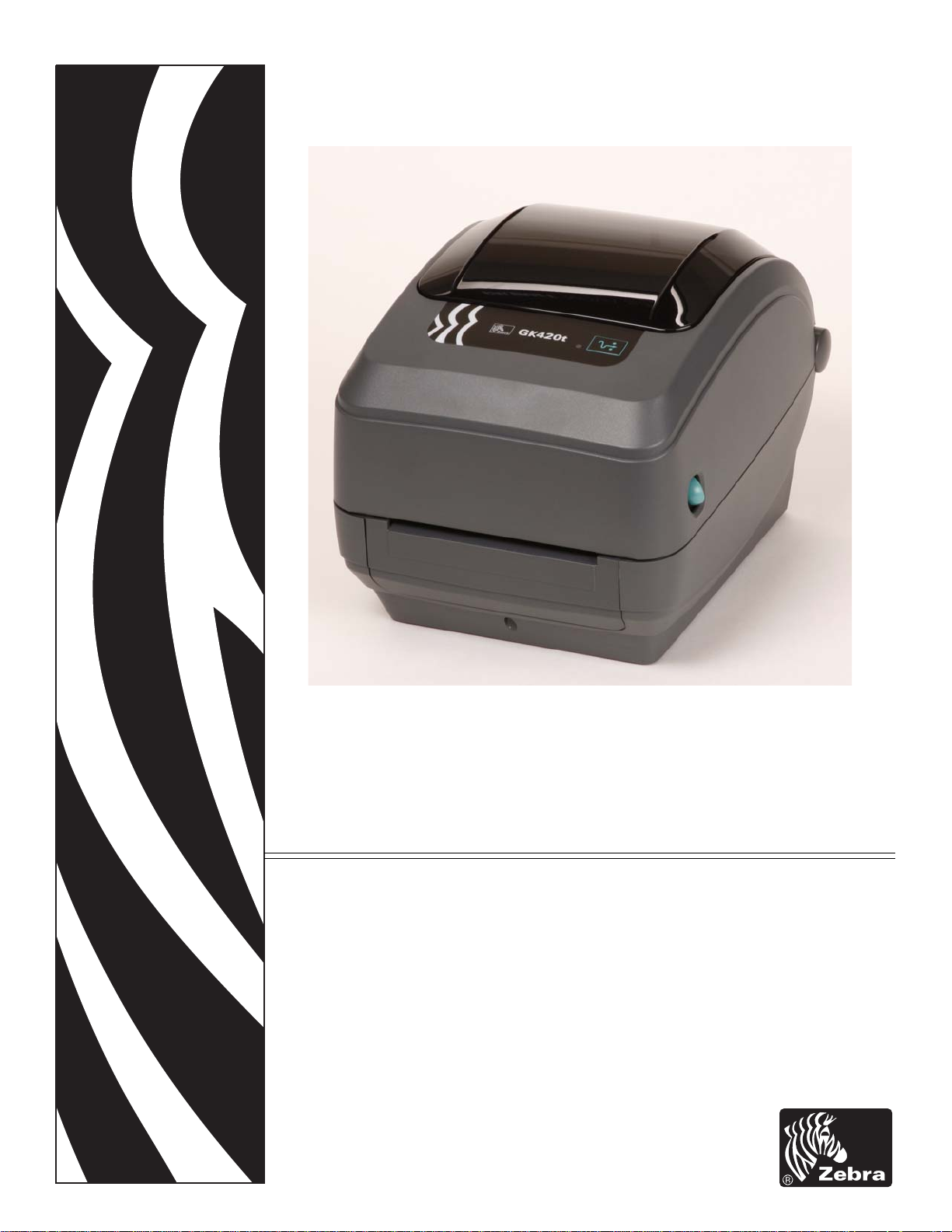
Zebra® GK420t™
Desktop Thermal Printer
User Guide
Page 2

ii
980610-001 Rev. C GK420t™ User Guide 8/4/10
Page 3

©2010 ZIH Corp. G-Series, GK420t, ZBI, ZBI 2.0, ZBI-Developer, Uni-Ribbon,
ZebraDesigner, ZebraNet, EPL, EPL2, ZPL , ZPL II, OpenACCESS and all product names
and numbers are Zebra trademarks, and Zebra, the Zebra head graphic, ZPL, ZPL II,
Element Energy Equalizer circuit, E3 Circuitand, and ZebraNet are registered trademarks
of ZIH Corp. All rights reserved. All other trademarks are the property of their respective
owners.
iii
This product may contain ZPL®, ZPL II®, and ZebraLink™ programs; Element Energy
3
Equalizer™ Circuit; E
®; and Monotype Imaging fonts. Software ©ZIH corp. All rights
reserved worldwide.
All rights reserved worldwide.Monotype®, Intellifont® and UFST® are trademarks of
Monotype Imaging, Inc. registered in the United States Patent and Trademark Office and
may be registered in certain jurisdictions.
CG Triumvirate is a trademark of Monotype Imaging, Inc. and may be registered in some
jurisdictions.
TrueType® is a trademark of Apple Computer, Inc. registered in the United States Patent
and Trademark Office and may be registered in certancertain jurisdictions.
Proprietary Statement
This manual contains proprietary information of Zebra Technologies Corporation and its
subsidiaries (“Zebra Technologies”). It is intended solely for the information and use of
parties operating and maintaining the equipment described herein. Such proprietary
information may not be used, reproduced, or disclosed to any other parties for any other
purpose without the express written permission of Zebra Technologies.
Product Improvements
Continuous improvement of products is a policy of Zebra Technologies. All specifications
and designs are subject to change without notice.
Liability Disclaimer
Zebra T echnologies takes steps to ensure that its published Engineering specifications and
manuals are correct; however, errors do occur. Zebra Technologies reserves the right to
correct any such errors and disclaims liability resulting therefrom.
Limitation of Liability
In no event shall Zebra Technologies or anyone else involved in the creation, production,
or delivery of the accompanying product (including hardware and software) be liable for
any damages whatsoever (including, without limitation, consequential damages including
loss of business profits, business interruption, or loss of business information) arising out
of the use of, the results of use of, or inability to use such product, even if Zebra
Technologies has been advised of the possibility of such damages. Some jurisdictions do
not allow the exclusion or limitation of incidental or consequential damages, so the above
limitation or exclusion may not apply to you.
Canadian DOC Compliance Statement
This Class B digital apparatus complies with Canadian ICES-003.
Cet appareil numérique de la classe B est conforme à la norme NMB-003 du Canada.
8/4/10 GK420t™ User Guide 980610-001 Rev. C
Page 4
iv
FCC Compliance Statement
This device complies with Part 15 rules. Operation is subject to the following two conditions:
1.
This device may not cause harmful interference, and
2.
This device must accept any interference received, including interference that may cause
undesired operation.
This equipment has been tested and found to comply with the limits for Class B Digital
Devices, pursuant to Part 15 of the FCC Rules. These li mits are designed to provide reasonable
protection against harmful interference when the equipment is operated in a residential
environment. This equipment generates, uses, and can radiate radio frequency energy and, if
not installed and used in accordance with the product manuals, may cau se harmful interference
to radio communications. However, there is no guarantee that interference will not occur in a
particular installation. If this equipment does cause harmful interference to ra dio or television
reception, the user is encouraged to do one or more of the following measures:
• Reorient or relocate the receiving antenna.
• Increase the separation between the equipment and receiver.
• Connect the equipment into an outlet on a circuit dif fere nt from that t o which the receiver
is connected.
• Consult the dealer or an experienced RF service technician for help.
The user is cautioned that any changes or modifications not expressly approved by Zebra
Technologies could void the user’s authority to operate the equipment. To ensure compliance ,
this printer must be used with fully shielded communication cables.
Environmental Management
Do not dispose of this product in unsorted municipal waste. This product is recyclable, and
should be recycled according to your local standards.
For more information, please see our website at:
Web address: www.zebra.com/environment
980610-001 Rev. C GK420t™ User Guide 8/4/10
Page 5

About This Document
This section provides you with contact information, document structure and organization, and
additional reference documents.
Contents
Who Should Use This Document. . . . . . . . . . . . . . . . . . . . . . . . . . . . . . . . . . . . . . . . . . . . vi
How This Document Is Organized . . . . . . . . . . . . . . . . . . . . . . . . . . . . . . . . . . . . . . . . . . . vi
Contacts. . . . . . . . . . . . . . . . . . . . . . . . . . . . . . . . . . . . . . . . . . . . . . . . . . . . . . . . . . . . . . .vii
Document Conventions . . . . . . . . . . . . . . . . . . . . . . . . . . . . . . . . . . . . . . . . . . . . . . . . . . viii
8/4/10 GK420t™ User Guide 980610-001 Rev. C
Page 6

About This Document
vi
Who Should Use This Document
Who Should Use This Document
This User Guide is intended for use by any person who needs to operate or to troubleshoot
problems with the printer.
How This Document Is Organized
The User Guide is set up as follows:
Section Description
Introduction on page 1 This section describes what you get in your
Getting Started on page 9 This section describes how to set up your printer
shipping box and provides an overview of printer
features. This section also has procedures that
describe how to open and close the printer and
report any problems.
for the first time and use the most common
operating procedures for loading media.
Print Operations on page 29 This section provides media and print handling,
font and language support, and the set up of less
common printer configurations.
Printer Options on page 45 This section covers the common printer options
and accessories with brief descriptions and how to
get you started using or configuring your printer
option or accessory.
Maintenance on page 55 This section provides routine cleaning and
maintenance procedures.
Troubleshooting on page 69 This section provides information about printer
error reporting that you might need for printer
troubleshooting. Assorted diagnostic tests are
included.
Appendix: Interface Wiring
on page 83
Appendix: Dimensions on page 89 This section provides external printer dimensions
Appendix: ZPL Configuration
on page 93
This section provides additional interface
information and wiring diagrams to assist with
printer to host system integration (typically a PC).
for the standard printer and printer with options.
This section briefly covers printer configuration
and includes a cross-reference to ZPL printer
configuration commands.
980610-001 Rev. C GK420t™ User Guide 8/4/10
Page 7

Contacts
About This Document
Technical Support via the Internet is available 24 hours per day, 365 days per year.
Contacts
vii
Web Site:
E-mail Back Technical Library:
•
•
Self Service Knowledge Base:
Online Case Registration:
Which Department
Do You Need?
Regional Headquarters
Technical Support
For questions on the
operation of Zebra
equipment and software,
please call your distributor.
For additional assistance,
contact us.
Please have your model and
serial numbers available.
Repair Service
Department
For back-to-base service and
repair.
Technical Tr aini ng
Department
For Zebra product training
courses.
Inquiry Department
For product literature and
distributor and dealer
information.
Customer Service
Department (US)
Internal Sales
Department (UK)
For printers, parts, media,
and ribbon, please call your
distributor or contact us.
Key:
T: Telephone
F: Facsimile
E: E-mail
www.zebra.com
E-mail address:
Subject line:
emb@zebra.com
Emaillist
www.zebra.com/techrequest
The Americas
Zebra Technologies In ternational, LLC
333 Corporate W oods Parkway
Vernon Hills, IL 60061-3109
U.S.A.
T: +1 847 793 2600
Toll-free +1 800 423 0422
F: +1 847 913 8766
T: +1 877 ASK ZEBRA (275 9327)
F: +1 847 913 2578
Hardware: ts1@zebra.com
Software: ts3@zebra.com
T: +1 877 ASK ZEBRA (275 9327)
F: +1 847 821 1797
E: repair@zebra.com
To request a repair in the U.S.,
go to www.zebra.com/repair
T: +1 847 793 6868
T: +1 847 793 6864
F: +1 847 913 2578
E: ttamerica@zebra.com
T: +1 877 ASK ZEBRA (275 9327)
E: inquiry4@zebra.com
T: +1 877 ASK ZEBRA (275 9327)
E: clientcare@zebra.com
www.zebra.com/knowledgebase
Europe, Africa,
Middle East, India
Zebra Technologies Europe Limited
Dukes Meadow
Millboard Road
Bourne End
Buckinghamshire, SL8 5XF
United Kingdom
T: +44 (0) 1628 556000
F: +44 (0) 1628 556001
T: +44 (0) 1628 556039
F: +44 (0) 1628 556003
.
E: Tseurope@zebra.com
T: +44 (0) 1772 693069
F: +44 (0) 1772 693046
New requests: ukrma@zebra.com
Status updates:
repairupdate@zebra.com
T: +44 (0) 1628 556000
F: +44 (0) 1628 556001
E: Eurtraining@zebra.com
T: +44 (0) 1628 556037
F: +44 (0) 1628 556005
E: mseurope@zebra.com
T: +44 (0) 1628 556032
F: +44 (0) 1628 556001
E: cseurope@zebra.com
Asia Pacific
Zebra Technologies Asia
Pacific Pte. Ltd.
120 Robinson Road
#06-01 Parakou Building
Singapore 068913
T: + 65 6858 0722
F: +65 6885 0838
T: +65 6858 0722
F: +65 6885 0838
E: China: tschina@zebra.com
All other areas:
tsasiapacific@zebra.com
T: +65 6858 0722
F: +65 6885 0838
E: China: tschina@zebra.com
All other areas:
tsasiapacific@zebra.com
T: + 65 6858 0722
F: +65 6885 0838
E: China: tschina@zebra.com
All other areas:
tsasiapacific@zebra.com
E: China: GCmarketing@zebra.com
All other areas:
AP ACChannelmarketing@zebra.com
T: +65 6858 0722
F: +65 6885 0836
E: China: order-csr@zebra.com
All other areas:
csasiapacific@zebra.com
8/4/10 GK420t™ User Guide 980610-001 Rev. C
Page 8
About This Document
viii
Document Conventions
Document Conventions
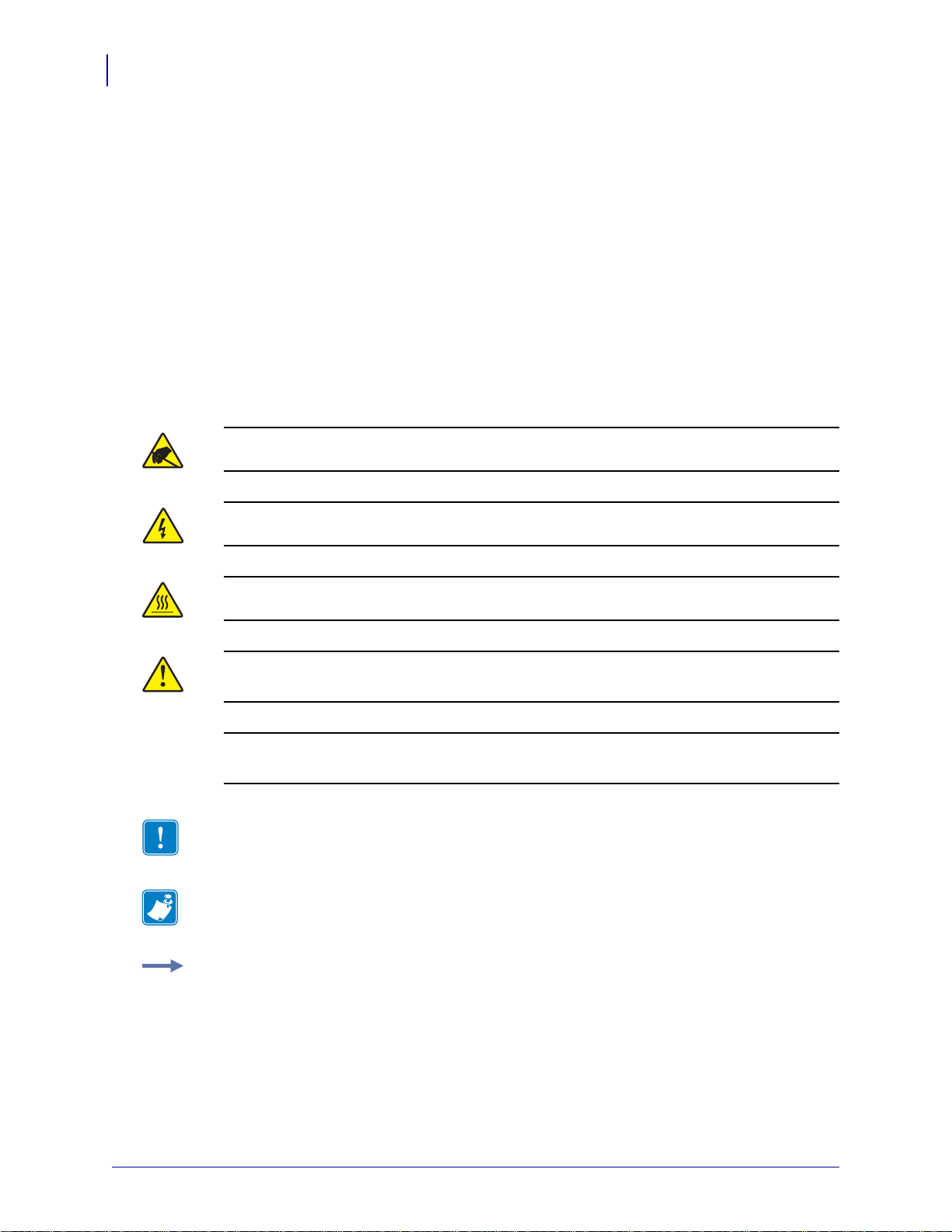
The following conventions are used throughout this document to convey certain information.
Alternate Color (online only) Cross-references contain hot links to other sections in this
guide. If you are viewing this g uide online in .pdf format, you can click the cross-reference
(blue text) to jump directly to its location.
Command Line Examples Command line examples appear in Courier New font. For
example, type
Files and Directories File names and directories appear in Courier New font. For
example, the
Icons Used
ZTools
to get to the Post-Install scripts in the
Zebra<version number>.tar
bin
file and the
directory.
/root
directory.
Caution •
Caution •
Caution •
Caution •
harm to you.
Caution •
physical harm to the hardware.
Important •
Note •
Warns you of the potential for electrostatic discharge.
Warns you of a potential electric shock situation.
Warns you of a situation where excessive heat could cause a burn.
Advises you that failure to take or avoid a specific action could result in physical
(No icon) Advises you that failure to take or avoid a specific action could result in
Advises you of information that is essential to complete a task.
Indicates neutral or positive information that emphasizes or supplements important
points of the main text.
Example •
980610-001 Rev. C GK420t™ User Guide 8/4/10
Provides an example, often a scenario, to better clarify a section of text.
Page 9

Contents
About This Document . . . . . . . . . . . . . . . . . . . . . . . . . . . . . . . . . . . . . . . . . . . . . . . v
Who Should Use This Document . . . . . . . . . . . . . . . . . . . . . . . . . . . . . . . . . . . . . . . . . . . . vi
How This Document Is Organized . . . . . . . . . . . . . . . . . . . . . . . . . . . . . . . . . . . . . . . . . . . vi
Contacts . . . . . . . . . . . . . . . . . . . . . . . . . . . . . . . . . . . . . . . . . . . . . . . . . . . . . . . . . . . . . . .vii
Document Conventions. . . . . . . . . . . . . . . . . . . . . . . . . . . . . . . . . . . . . . . . . . . . . . . . . . . viii
1 • Introduction . . . . . . . . . . . . . . . . . . . . . . . . . . . . . . . . . . . . . . . . . . . . . . . . . . . . 1
GK Series Thermal Printers . . . . . . . . . . . . . . . . . . . . . . . . . . . . . . . . . . . . . . . . . . . . . . . . 2
What’s in the Box? . . . . . . . . . . . . . . . . . . . . . . . . . . . . . . . . . . . . . . . . . . . . . . . . . . . . . . . 3
Unpack and Inspect the Printer . . . . . . . . . . . . . . . . . . . . . . . . . . . . . . . . . . . . . . . . . . 3
Your Printer. . . . . . . . . . . . . . . . . . . . . . . . . . . . . . . . . . . . . . . . . . . . . . . . . . . . . . . . . . 4
Printer Features . . . . . . . . . . . . . . . . . . . . . . . . . . . . . . . . . . . . . . . . . . . . . . . . . . . . . . 5
Operator Controls. . . . . . . . . . . . . . . . . . . . . . . . . . . . . . . . . . . . . . . . . . . . . . . . . . . . . 6
2 • Getting Started . . . . . . . . . . . . . . . . . . . . . . . . . . . . . . . . . . . . . . . . . . . . . . . . . . 9
Attaching Power . . . . . . . . . . . . . . . . . . . . . . . . . . . . . . . . . . . . . . . . . . . . . . . . . . . . . . . . 10
Loading Roll Media. . . . . . . . . . . . . . . . . . . . . . . . . . . . . . . . . . . . . . . . . . . . . . . . . . . . . . .11
Preparing Media . . . . . . . . . . . . . . . . . . . . . . . . . . . . . . . . . . . . . . . . . . . . . . . . . . . . . .11
Placing the Roll in the Media Compartment . . . . . . . . . . . . . . . . . . . . . . . . . . . . . . . . 12
Loading Transfer Ribbon. . . . . . . . . . . . . . . . . . . . . . . . . . . . . . . . . . . . . . . . . . . . . . . . . . 14
Printing a Test (Printer Configuration) Label. . . . . . . . . . . . . . . . . . . . . . . . . . . . . . . . . . . 18
Pre-install Windows® Printer Drivers . . . . . . . . . . . . . . . . . . . . . . . . . . . . . . . . . . . . . . . . 19
Connecting your Printer to a Computer . . . . . . . . . . . . . . . . . . . . . . . . . . . . . . . . . . . . . . 21
Interface Cable Requirements . . . . . . . . . . . . . . . . . . . . . . . . . . . . . . . . . . . . . . . . . . 21
After Your Printer is Connected. . . . . . . . . . . . . . . . . . . . . . . . . . . . . . . . . . . . . . . . . . . . . 27
8/4/10 GK420t™ User Guide 980610-001 Rev. C
Page 10

x
3 • Print Operations . . . . . . . . . . . . . . . . . . . . . . . . . . . . . . . . . . . . . . . . . . . . . . . 29
Determining Printer Configuration. . . . . . . . . . . . . . . . . . . . . . . . . . . . . . . . . . . . . . . . . . . 30
Localizing the Printer Status Configuration Label. . . . . . . . . . . . . . . . . . . . . . . . . . . . 30
Long Term Printer In-activity or Storage . . . . . . . . . . . . . . . . . . . . . . . . . . . . . . . . . . . . . . 30
Thermal Printing . . . . . . . . . . . . . . . . . . . . . . . . . . . . . . . . . . . . . . . . . . . . . . . . . . . . . . . . 30
Modes of Printing . . . . . . . . . . . . . . . . . . . . . . . . . . . . . . . . . . . . . . . . . . . . . . . . . . . . . . . 31
Print Media Types. . . . . . . . . . . . . . . . . . . . . . . . . . . . . . . . . . . . . . . . . . . . . . . . . . . . . . . 31
Determining Thermal Media Types. . . . . . . . . . . . . . . . . . . . . . . . . . . . . . . . . . . . . . . 33
Replacing Supplies. . . . . . . . . . . . . . . . . . . . . . . . . . . . . . . . . . . . . . . . . . . . . . . . . . . . . . 33
Adding a New Transfer Ribbon. . . . . . . . . . . . . . . . . . . . . . . . . . . . . . . . . . . . . . . . . . 33
Replacing a Partially Used Transfer Ribbon. . . . . . . . . . . . . . . . . . . . . . . . . . . . . . . . 34
Adjusting the Print Width. . . . . . . . . . . . . . . . . . . . . . . . . . . . . . . . . . . . . . . . . . . . . . . . . . 34
Adjusting the Print Quality. . . . . . . . . . . . . . . . . . . . . . . . . . . . . . . . . . . . . . . . . . . . . . . . . 34
Media Sensing . . . . . . . . . . . . . . . . . . . . . . . . . . . . . . . . . . . . . . . . . . . . . . . . . . . . . . . . . 35
Ribbon Overview. . . . . . . . . . . . . . . . . . . . . . . . . . . . . . . . . . . . . . . . . . . . . . . . . . . . . . . . 36
When to Use Ribbon. . . . . . . . . . . . . . . . . . . . . . . . . . . . . . . . . . . . . . . . . . . . . . . . . . 36
Coated Side of Ribbon . . . . . . . . . . . . . . . . . . . . . . . . . . . . . . . . . . . . . . . . . . . . . . . . 36
Printing on Fan-Fold Media. . . . . . . . . . . . . . . . . . . . . . . . . . . . . . . . . . . . . . . . . . . . . . . . 38
Printing with Externally Mounted Roll Media. . . . . . . . . . . . . . . . . . . . . . . . . . . . . . . . . . . 40
Fonts and Your Printer . . . . . . . . . . . . . . . . . . . . . . . . . . . . . . . . . . . . . . . . . . . . . . . . . . . 41
Localizing the Printer with Code Pages . . . . . . . . . . . . . . . . . . . . . . . . . . . . . . . . . . . 41
Identifying Fonts in Your Printer . . . . . . . . . . . . . . . . . . . . . . . . . . . . . . . . . . . . . . . . . 42
Stand Alone Printing . . . . . . . . . . . . . . . . . . . . . . . . . . . . . . . . . . . . . . . . . . . . . . . . . . . . . 43
Sending Files to the Printer. . . . . . . . . . . . . . . . . . . . . . . . . . . . . . . . . . . . . . . . . . . . . . . . 44
Print Meter . . . . . . . . . . . . . . . . . . . . . . . . . . . . . . . . . . . . . . . . . . . . . . . . . . . . . . . . . . . . 44
EPL Line Mode . . . . . . . . . . . . . . . . . . . . . . . . . . . . . . . . . . . . . . . . . . . . . . . . . . . . . . . . . 44
4 • Printer Options . . . . . . . . . . . . . . . . . . . . . . . . . . . . . . . . . . . . . . . . . . . . . . . . 45
Label Dispenser Option . . . . . . . . . . . . . . . . . . . . . . . . . . . . . . . . . . . . . . . . . . . . . . . . . . 46
ZebraNet® 10/100 Internal (Wired) Print Server Option. . . . . . . . . . . . . . . . . . . . . . . . . . 49
Printer Network Configuration Status Label . . . . . . . . . . . . . . . . . . . . . . . . . . . . . . . . 50
Zebra® KDU — Printer Accessory . . . . . . . . . . . . . . . . . . . . . . . . . . . . . . . . . . . . . . . . . . 51
KDU Plus™ — Printer Accessory. . . . . . . . . . . . . . . . . . . . . . . . . . . . . . . . . . . . . . . . . . . 52
ZBI 2.0™ — Zebra Basic Interpreter . . . . . . . . . . . . . . . . . . . . . . . . . . . . . . . . . . . . . . . . 53
5 • Maintenance . . . . . . . . . . . . . . . . . . . . . . . . . . . . . . . . . . . . . . . . . . . . . . . . . . . 55
Cleaning . . . . . . . . . . . . . . . . . . . . . . . . . . . . . . . . . . . . . . . . . . . . . . . . . . . . . . . . . . . . . . 56
Cleaning the Printhead. . . . . . . . . . . . . . . . . . . . . . . . . . . . . . . . . . . . . . . . . . . . . . . . 57
Media Path Considerations. . . . . . . . . . . . . . . . . . . . . . . . . . . . . . . . . . . . . . . . . . . . . 58
Platen Cleaning and Replacement . . . . . . . . . . . . . . . . . . . . . . . . . . . . . . . . . . . . . . . 60
Other Printer Maintenance . . . . . . . . . . . . . . . . . . . . . . . . . . . . . . . . . . . . . . . . . . . . . 62
Replacing the Printhead . . . . . . . . . . . . . . . . . . . . . . . . . . . . . . . . . . . . . . . . . . . . . . . . . . 63
980610-001 Rev. C GK420t™ User Guide 8/4/10
Page 11

6 • Troubleshooting . . . . . . . . . . . . . . . . . . . . . . . . . . . . . . . . . . . . . . . . . . . . . . . 69
Status Light Descriptions . . . . . . . . . . . . . . . . . . . . . . . . . . . . . . . . . . . . . . . . . . . . . . . . . 70
Status Light Error Resolutions . . . . . . . . . . . . . . . . . . . . . . . . . . . . . . . . . . . . . . . . . . . . . 71
Print Quality Problems . . . . . . . . . . . . . . . . . . . . . . . . . . . . . . . . . . . . . . . . . . . . . . . . . . . 73
Manual Calibration . . . . . . . . . . . . . . . . . . . . . . . . . . . . . . . . . . . . . . . . . . . . . . . . . . . . . . 76
Troubleshooting Tests. . . . . . . . . . . . . . . . . . . . . . . . . . . . . . . . . . . . . . . . . . . . . . . . . . . . 77
Printing a Configuration Label . . . . . . . . . . . . . . . . . . . . . . . . . . . . . . . . . . . . . . . . . . 77
Recalibration. . . . . . . . . . . . . . . . . . . . . . . . . . . . . . . . . . . . . . . . . . . . . . . . . . . . . . . . 77
Resetting the Factory Default Values . . . . . . . . . . . . . . . . . . . . . . . . . . . . . . . . . . . . . . . . 78
Communications Diagnostics . . . . . . . . . . . . . . . . . . . . . . . . . . . . . . . . . . . . . . . . . . . . . . 78
Feed Button Modes. . . . . . . . . . . . . . . . . . . . . . . . . . . . . . . . . . . . . . . . . . . . . . . . . . . . . . 80
A • Appendix: Interface Wiring . . . . . . . . . . . . . . . . . . . . . . . . . . . . . . . . . . . . . . 83
Universal Serial Bus (USB) Interface . . . . . . . . . . . . . . . . . . . . . . . . . . . . . . . . . . . . . . . . 84
Parallel Interface. . . . . . . . . . . . . . . . . . . . . . . . . . . . . . . . . . . . . . . . . . . . . . . . . . . . . . . . 85
Ethernet Interface . . . . . . . . . . . . . . . . . . . . . . . . . . . . . . . . . . . . . . . . . . . . . . . . . . . . . . . 86
Serial Port Interface . . . . . . . . . . . . . . . . . . . . . . . . . . . . . . . . . . . . . . . . . . . . . . . . . . . . . 87
xi
B • Appendix: Dimensions . . . . . . . . . . . . . . . . . . . . . . . . . . . . . . . . . . . . . . . . . . 89
External GK Printer Dimensions. . . . . . . . . . . . . . . . . . . . . . . . . . . . . . . . . . . . . . . . . . . . 90
C • Appendix: ZPL Configuration . . . . . . . . . . . . . . . . . . . . . . . . . . . . . . . . . . . . 93
Managing the ZPL Printer Configuration. . . . . . . . . . . . . . . . . . . . . . . . . . . . . . . . . . . . . . 94
ZPL Configuration Status to Command Cross-reference . . . . . . . . . . . . . . . . . . . . . . . . . 95
Printer Memory Management and Related Status Reports . . . . . . . . . . . . . . . . . . . . . . . 98
ZPL Programming for Memory Management . . . . . . . . . . . . . . . . . . . . . . . . . . . . . . . 98
8/4/10 GK420t™ User Guide 980610-001 Rev. C
Page 12

xii
Notes •
___________________________________________________________________
__________________________________________________________________________
__________________________________________________________________________
__________________________________________________________________________
__________________________________________________________________________
__________________________________________________________________________
__________________________________________________________________________
__________________________________________________________________________
__________________________________________________________________________
__________________________________________________________________________
980610-001 Rev. C GK420t™ User Guide 8/4/10
Page 13

1
Introduction
This section describes what you get in your shipping box and provides an overview of printer
features. This includes procedures that describe how to open and close the printer and report
any problems.
Contents
GK Series Thermal Printers. . . . . . . . . . . . . . . . . . . . . . . . . . . . . . . . . . . . . . . . . . . . . . . . 2
What’s in the Box?. . . . . . . . . . . . . . . . . . . . . . . . . . . . . . . . . . . . . . . . . . . . . . . . . . . . . . . 3
Unpack and Inspect the Printer . . . . . . . . . . . . . . . . . . . . . . . . . . . . . . . . . . . . . . . . . . . . . 3
Your Printer . . . . . . . . . . . . . . . . . . . . . . . . . . . . . . . . . . . . . . . . . . . . . . . . . . . . . . . . . . . . 4
Printer Features . . . . . . . . . . . . . . . . . . . . . . . . . . . . . . . . . . . . . . . . . . . . . . . . . . . . . . . . . 5
Operator Controls. . . . . . . . . . . . . . . . . . . . . . . . . . . . . . . . . . . . . . . . . . . . . . . . . . . . . . . . 6
8/4/10 GK420t™ User Guide 980610-001 Rev. C
Page 14

Introduction
2
GK Series Thermal Printers
GK Series Thermal Printers
The Zebra® GK model is the best value in a desktop thermal printer. The GK420t™ printer
provides thermal transfer and direct thermal printing at speeds up to 5 ips (inches per second)
at a 203 dpi (dots per inch) print density. The GK420t™ supports both ZPL™ and EPL™
Zebra printer programming languages and a wide variety of interface and feature options.
The G-Series™ printer features:
• Automatic printer language detection and switching between ZPL and EPL programming
and label formats.
• OpenAccess™ design for simplified media loading.
• The industry’s easiest ribbon loading design.
• Color-coded operator controls and media guides.
• Zebra™ Global Printing Solution – su pports Mic rosoft Windows keyboard encoding (and
ANSI), Unicode UTF-8 and UTF 16 (Unicode Transformation Formats), XML, ASCII (7
and 8 bit used by legacy programs and systems), basic single and double byte font
encoding, JIS and Shift-JIS (Japanese International Standa rds), Hexadecimal encoding,
and custom character maps (DAT table creation, font linking, and character remapping).
• On–The –Fly OpenType and TrueT ype fo nt scaling an d import, Unic ode, preloade d Swiss
721 Latin 1 font, one resident scalable font, and a selection of resident bitmap fonts.
• Improved printer performance: faster print speeds and a 32-bit processor.
• Adaptive auto serial port cable sensing and configuration for plug-and-play integration.
• A complete suite of free software applications and drivers to configure printer settings,
design and print labels and receipts, get printer status, import graphics and fonts, send
programming commands, update firmware, and download files. Clone printer settings and
®
send graphics, files, fonts, and firmware (updates) to one or more Zebra
Ethernet and
locally connected printers with ZebraNet™ Bridge.
• Printhead test and maintenance reporting enabled and customizable by the user.
GK printers offer these basic printer options:
• Label Dispense (Peel-Off).
• Internal 10/100 Print Server and Ethernet Interface.
®
•Zebra
ZBI™ 2 (Zebra BASIC Interpreter) programming language. ZBI allows you to
create custom printer operations that can automate processes, use peripherals (i.e.
®
scanners, scales, keyboards, Zebra
KDU or KDU Plus™, etc.) all without being attached
to a PC or network.
This users guide provides all the information you need to operate your printer on a daily basi s.
T o crea te labe l formats, re fer to your programming guides or l abel design appl ications such as
ZebraDesigner™.
Your printer, when connected to a host computer, functions as a complete system for printing
labels and tags.
Note •
Many printer settings may also be controlled by your printer’s driver or label design
software. Refer to the driver or software documentation for more information.
980610-001 Rev. C GK420t™ User Guide 8/4/10
Page 15
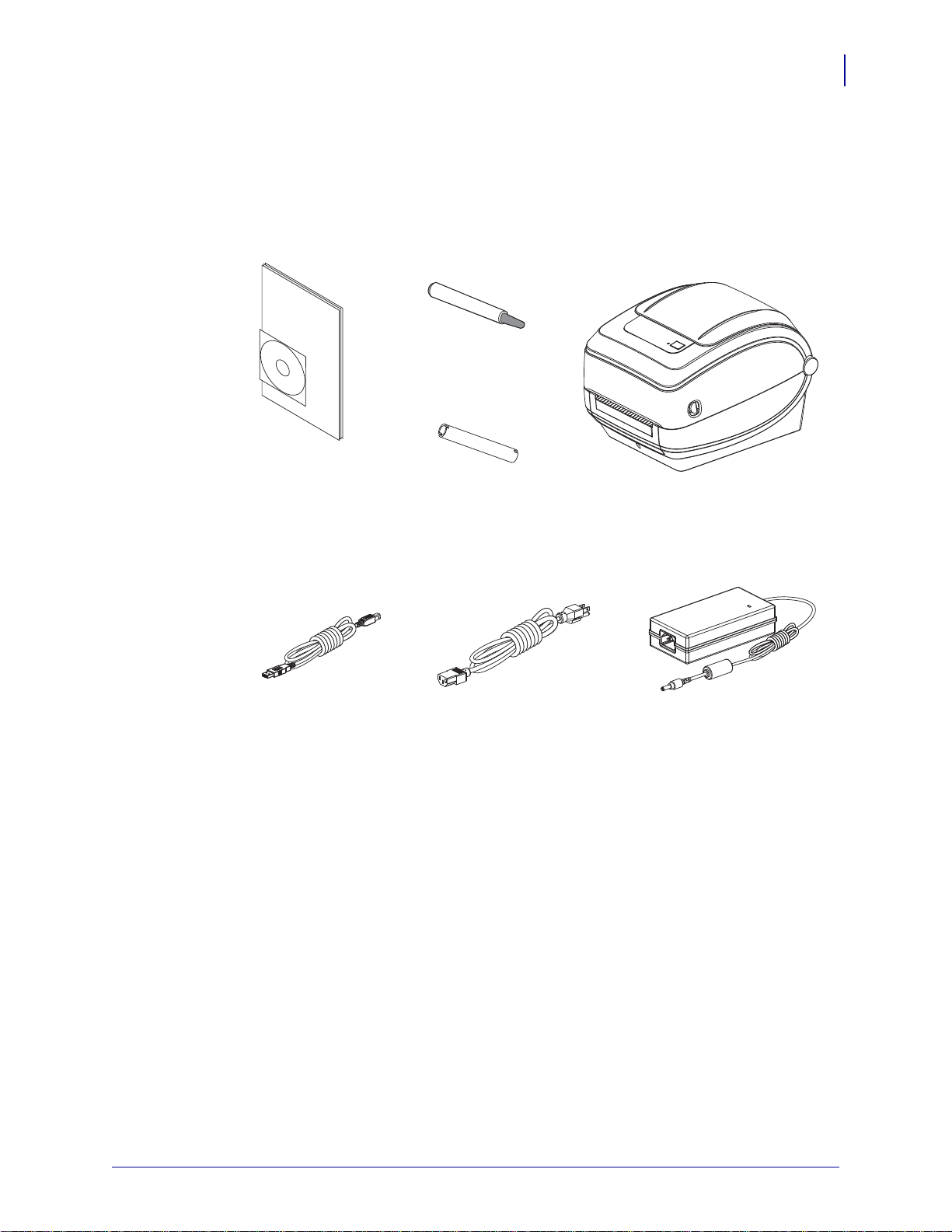
What’s in the Box?
Power Cord
varies by locale or region
Documentation
and Software
Power
Supply
USB Cable
PrinterRibbon Core
Cleaning
Pen
Save the carton and all packing materials in case you need to ship or store the printer later.
After unpacking, make sure you have all parts. Follow the procedures for inspecting the
printer to familiarize yourself with printer parts so you can follow the instructions in this book.
Introduction
What’s in the Box?
3
8/4/10 GK420t™ User Guide 980610-001 Rev. C
Unpack and Inspect the Printer
When you receive the printer, immediately unpack it and inspect for shipping damage.
• Save all packing materials.
• Check all exterior surfaces for damage.
• Open the printer and inspect the media compartment for damage to components.
If you discover shipping damage upon inspection:
• Immediately notify the shipping company and file a damage report. Zebra
Technologies Corporation is not responsible for any damage to the printer incurred
during shipment, and will not cover the repair of this damage under its warranty
policy.
• Keep all packaging material for shipping company inspection.
• Notify your authorized Zebra
®
reseller .
Page 16
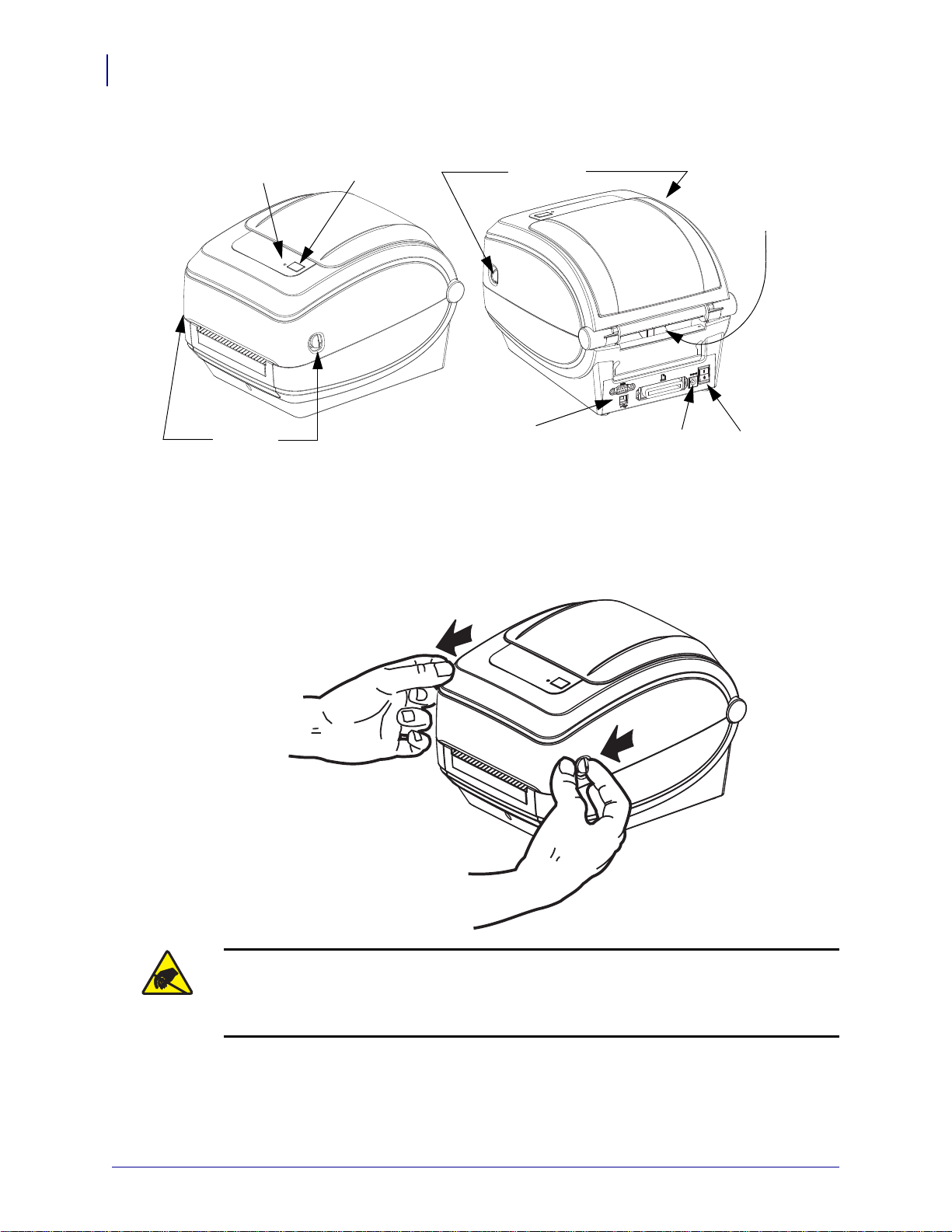
Introduction
Interface
Connectors
Feed
Button
Status
Light
Release
Latches
Release
Latches
DC Power
Receptacle
Power
Switch
Fan-Fold Media
Entry Slot
4
What’s in the Box?
Your Printer
Opening the printer
To access the media compartment, you must open the printer. Pull the release latches towards
you and lift the cover. Check the media compartment for loose or damaged components.
Caution •
human body or other surfaces can damage or destroy the printhead or electronic
components used in this device. You must observe static-safe procedures when working
with the printhead or the electronic components under the top cover.
The discharge of electrostatic energy that accumulates on the surface of the
980610-001 Rev. C GK420t™ User Guide 8/4/10
Page 17
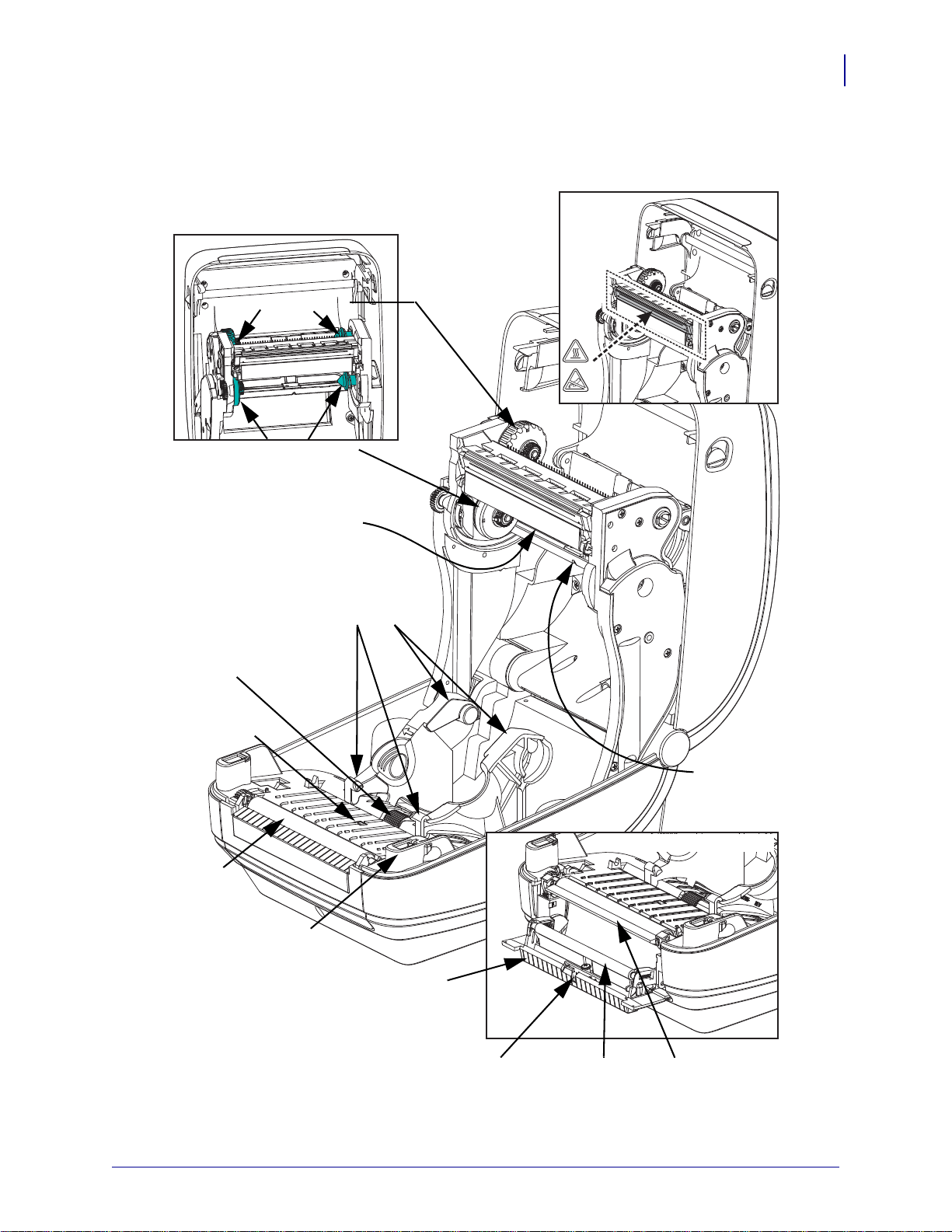
Printer Features
Sensor
Peel Bar
Platen
Roller
Printhead
BlackLine
Sensor
Ribbon Trailer Sensor
(hidden from view)
Roll Holders and
Media Guides
Head-Up Sensor
(inside)
Pinch
Roller
Dispenser Door
(open)
Take Up Spindles
Supply Spindles
Ribbon Roll Holders
Dispenser Option
Web (Gap)
Sensor
Media Guide
Stop
Introduction
What’s in the Box?
5
8/4/10 GK420t™ User Guide 980610-001 Rev. C
Page 18
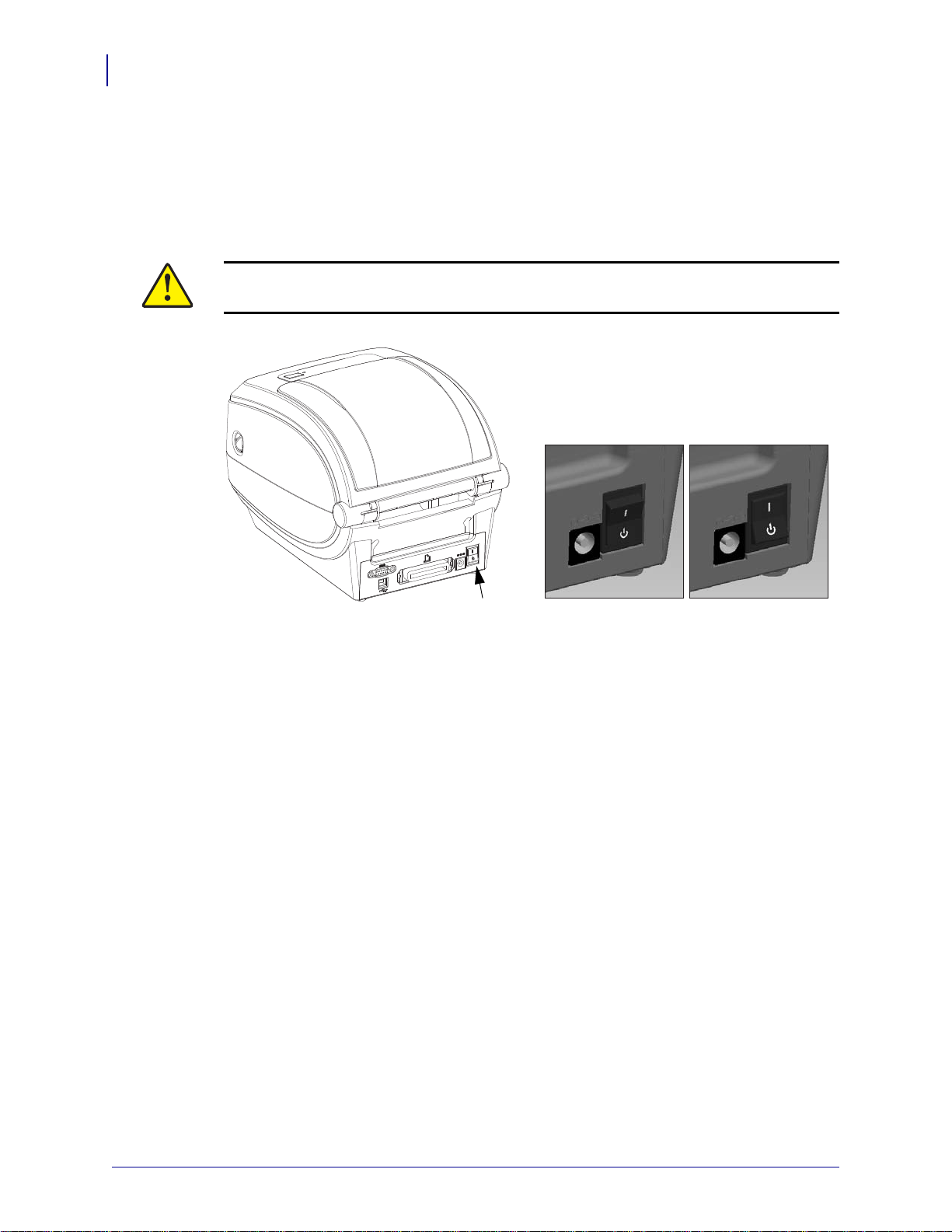
Introduction
Power OFF
Power ON
Power Switch
Power Switch
6
What’s in the Box?
Operator Controls
Power Switch
Press up to turn ON or down to turn OFF the printer.
Caution •
communications and power cables.
The printer power should be turned off before connecting or disconnecting the
980610-001 Rev. C GK420t™ User Guide 8/4/10
Page 19
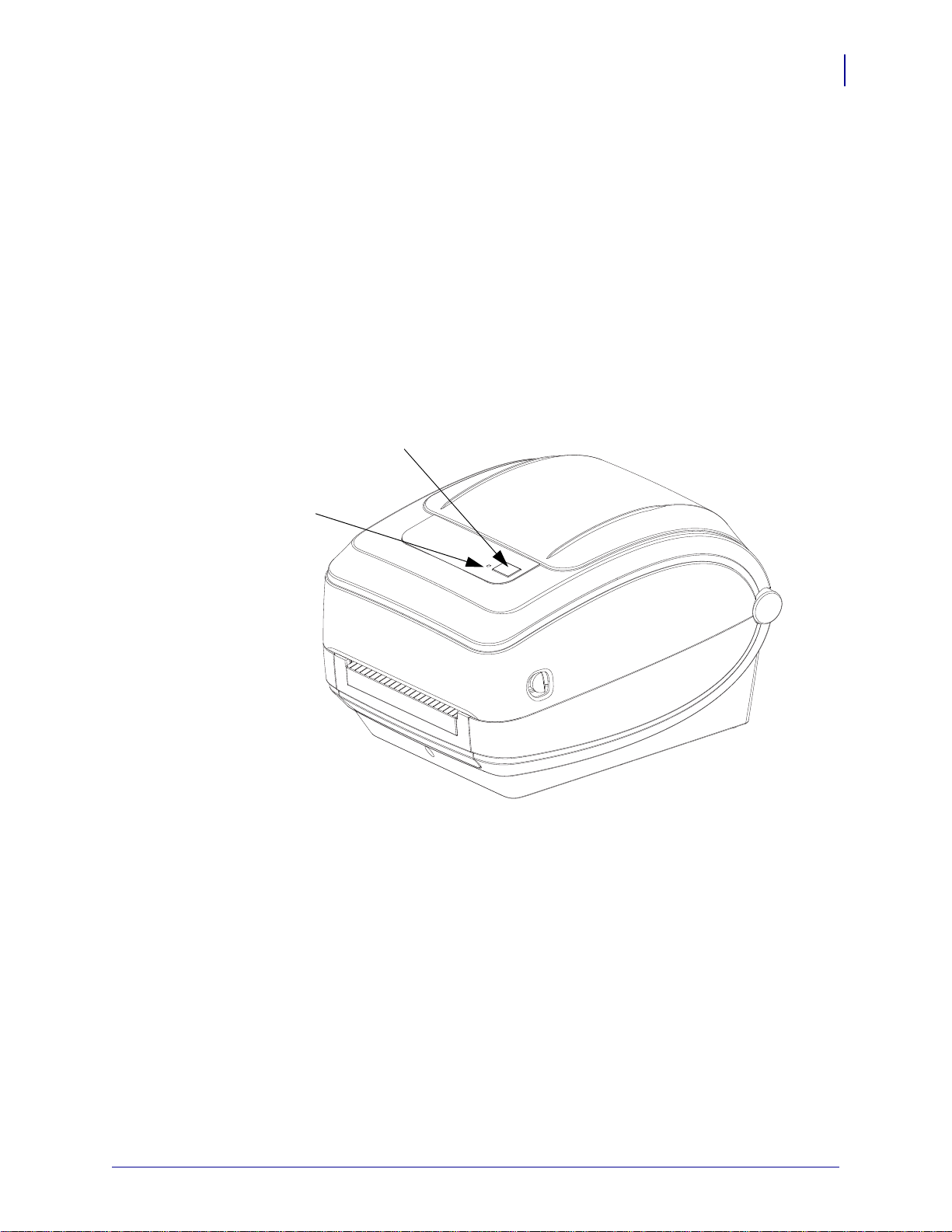
Feed Button
Feed
Button
Status
Light
• Tap the Feed button once to force the printer to feed one blank label.
• Press the Feed button to take the printer out of a “pause” condition. The printer is put into
“pause” by either a programming command or an error condition. See What the Status
Light is Telling You on page 70 in the Troubleshooting chapter.
• Use the Feed button for printer setup and status (see Feed Button Modes on page 80 in the
Troubleshooting chapter).
Status Light
Located on the top case next to the feed button, the status light functions as a printer
operational indicator (see Status Light Descriptions on page 70).
Introduction
What’s in the Box?
7
8/4/10 GK420t™ User Guide 980610-001 Rev. C
Page 20
Introduction
8
What’s in the Box?
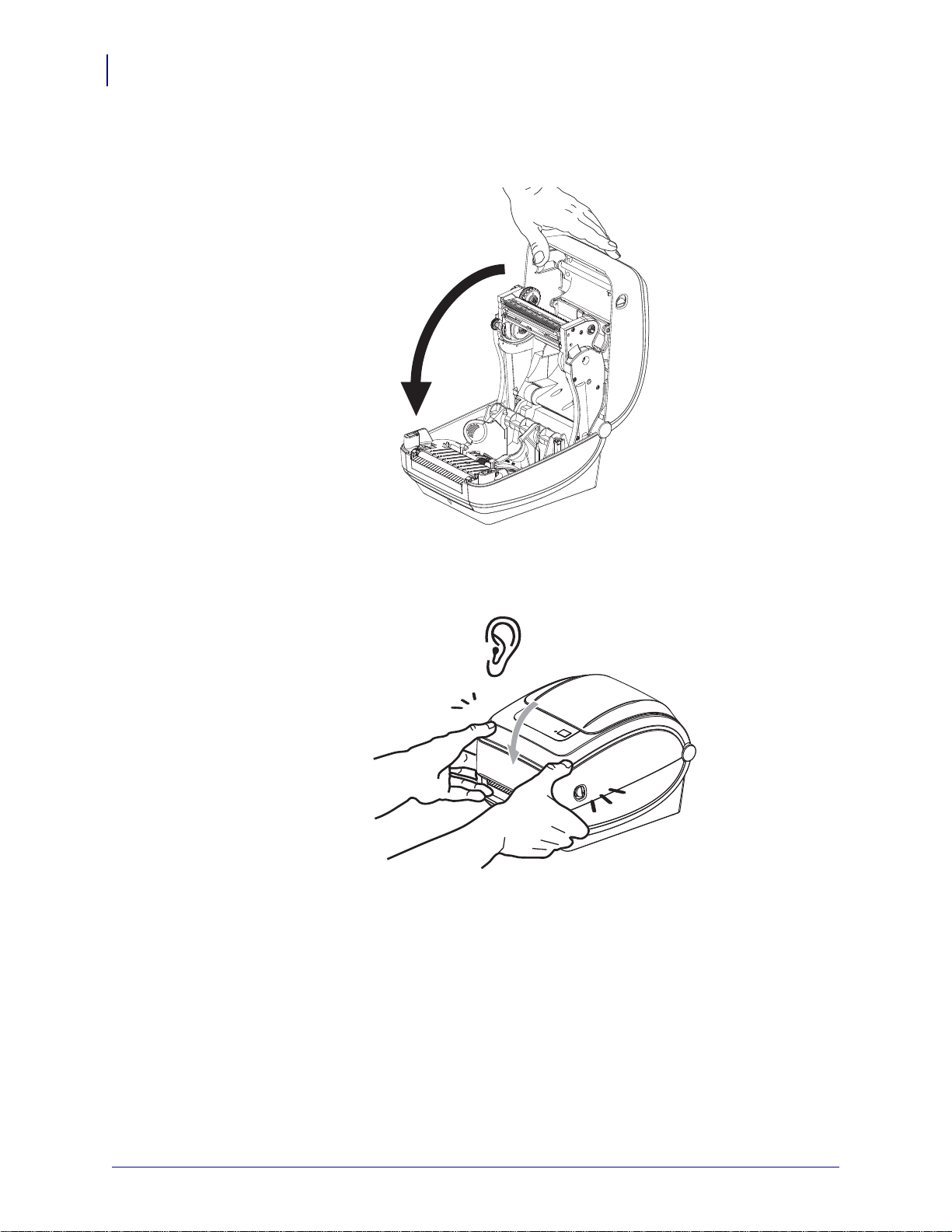
Closing the printer
1.
Lower the top cover.
2.
Press down until the cover snaps closed.
980610-001 Rev. C GK420t™ User Guide 8/4/10
Page 21

2
Getting Started
This section describes how to set up your printer for the first time and use the most common
operating procedures for loading media.
Contents
Attaching Power. . . . . . . . . . . . . . . . . . . . . . . . . . . . . . . . . . . . . . . . . . . . . . . . . . . . . . . . 10
Loading Roll Media . . . . . . . . . . . . . . . . . . . . . . . . . . . . . . . . . . . . . . . . . . . . . . . . . . . . . 11
Loading Transfer Ribbon . . . . . . . . . . . . . . . . . . . . . . . . . . . . . . . . . . . . . . . . . . . . . . . . . 14
Printing a Test (Printer Configuration) Label . . . . . . . . . . . . . . . . . . . . . . . . . . . . . . . . . . 18
Pre-install Windows® Printer Drivers. . . . . . . . . . . . . . . . . . . . . . . . . . . . . . . . . . . . . . . . 19
Connecting your Printer to a Computer . . . . . . . . . . . . . . . . . . . . . . . . . . . . . . . . . . . . . . 21
After Your Printer is Connected . . . . . . . . . . . . . . . . . . . . . . . . . . . . . . . . . . . . . . . . . . . . 27
8/4/10 GK420t™ User Guide 980610-001 Rev. C
Page 22
Getting Started
Power
Connector
Power
Switch
Plug Varies
by Country
Active Power Light
Power
Receptacle
AC
Power
Cord
Printer
Power
Supply
IEC 60320
C-13
10
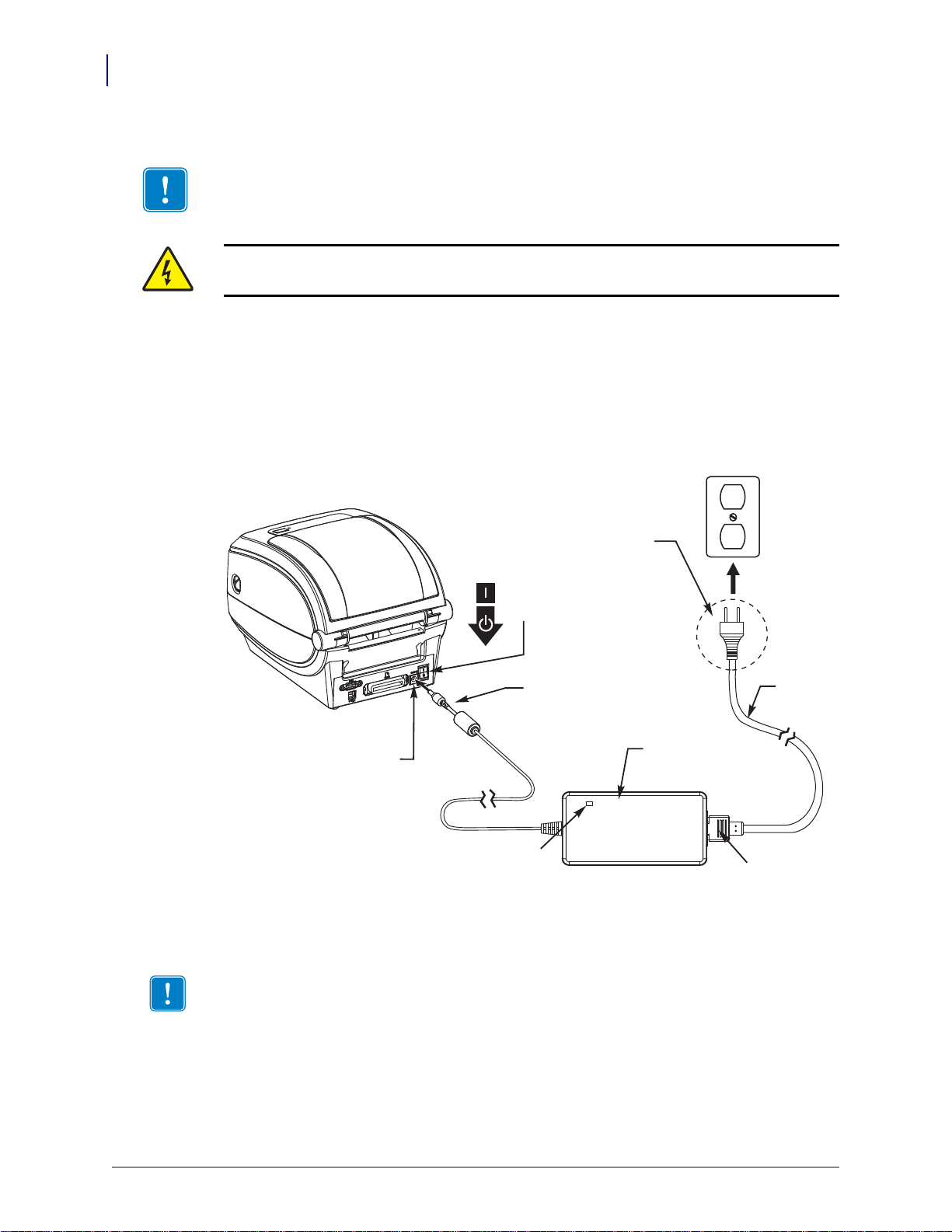
Attaching Power
Attaching Power
Important •
Set up your printer so that you can handle the power cord easily if needed. To
make certain the printer cannot carry electrical current, you must separate the power cord
from the power supply receptacle or AC electrical outlet.
Caution •
Serious personal injury could result!
1.
2.
3.
Never operate the printer and power supply in an area where they can get wet.
Make sure the printer’s power switch is in the off position (down).
Insert the AC power cord into the power supply.
Plug the other end of the cord into an appropriate AC electrical outlet. Note: The active
power light will go on if power is on at the AC outlet.
4.
Insert the power supply’s power connector into the printer’s power receptacle.
Note • Ensure the appropriate power cord with a three (3) prong plug and an IEC 60320-C13
connector are used at all times. These power cords must bear the relevant certification mark of
the country in which the product is being used.
980610-001 Rev. C GK420t™ User Guide 8/4/10
Page 23
Loading Roll Media
When you load media, you must place the roll onto the media hangers.
You must use the correct media for the type of printing you require.
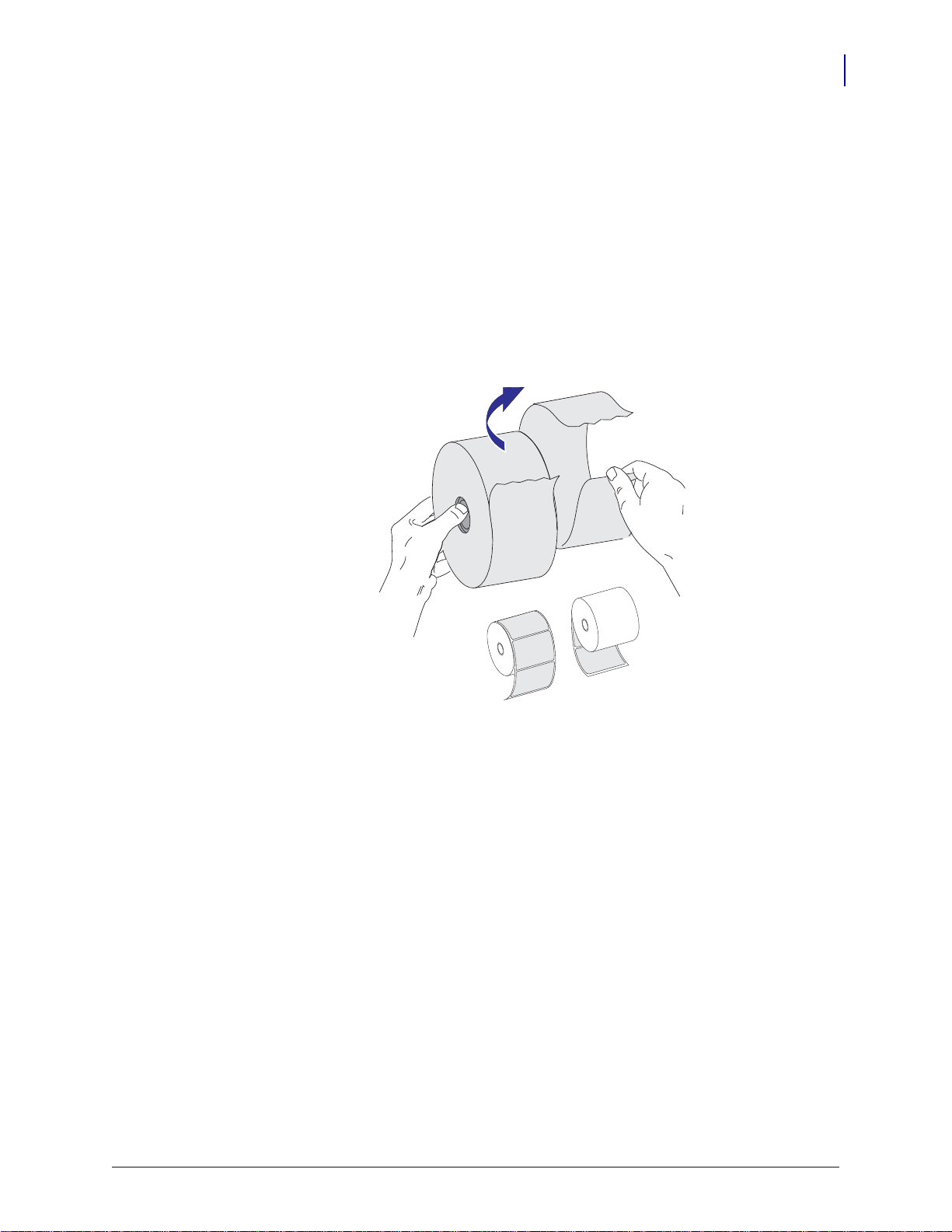
Preparing Media
Whether your roll media is inside or outside wound, you load it into the print er the same way.
• Remove the outside length of media. During shipment, handling, or storage, the roll may
become dirty or dusty. Removing the outside length of media avoids dragging adhesive or
dirty media between the printhead and platen.
Getting Started
Loading Roll Media
11
8/4/10 GK420t™ User Guide 980610-001 Rev. C
Page 24
Getting Started
12
Loading Roll Media
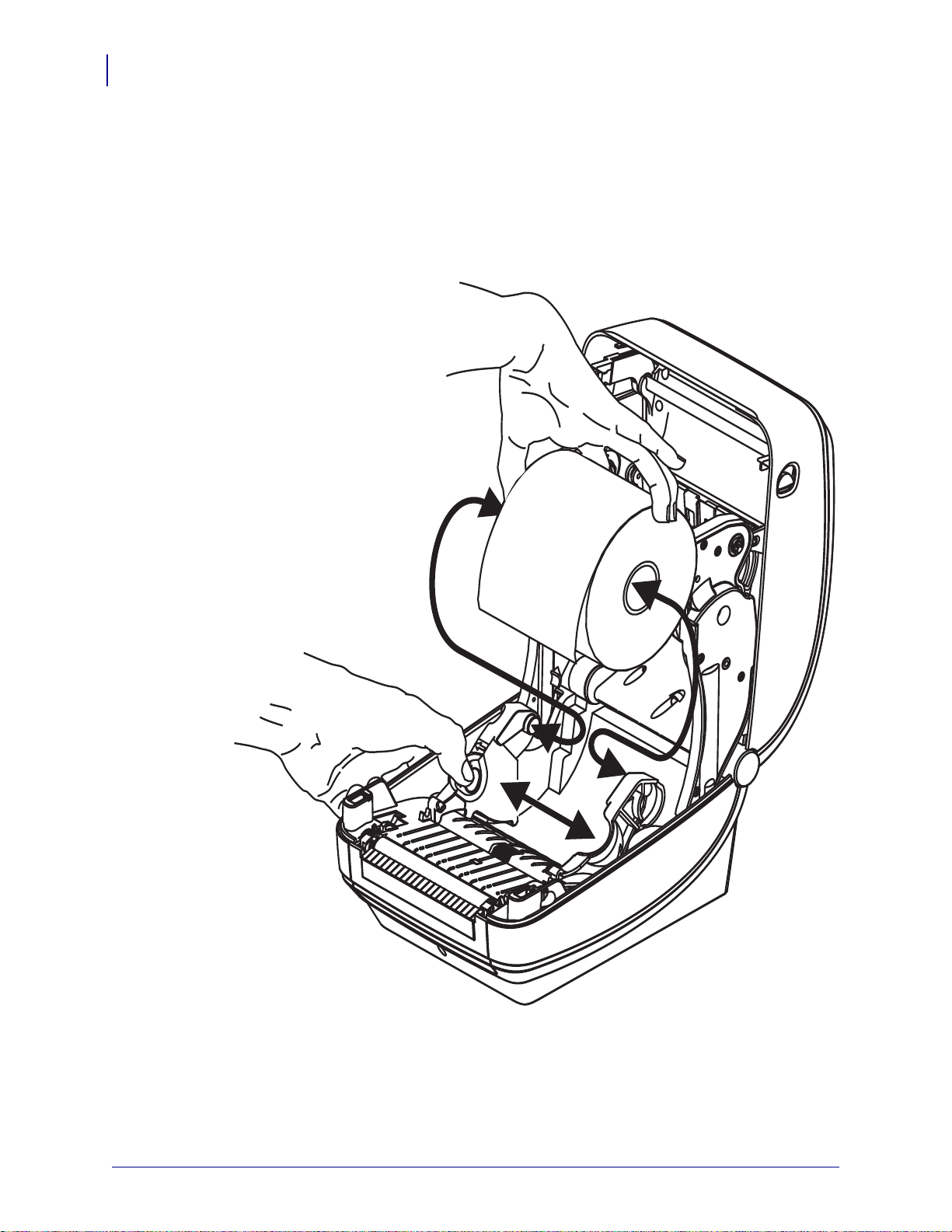
Placing the Roll in the Media Compartment
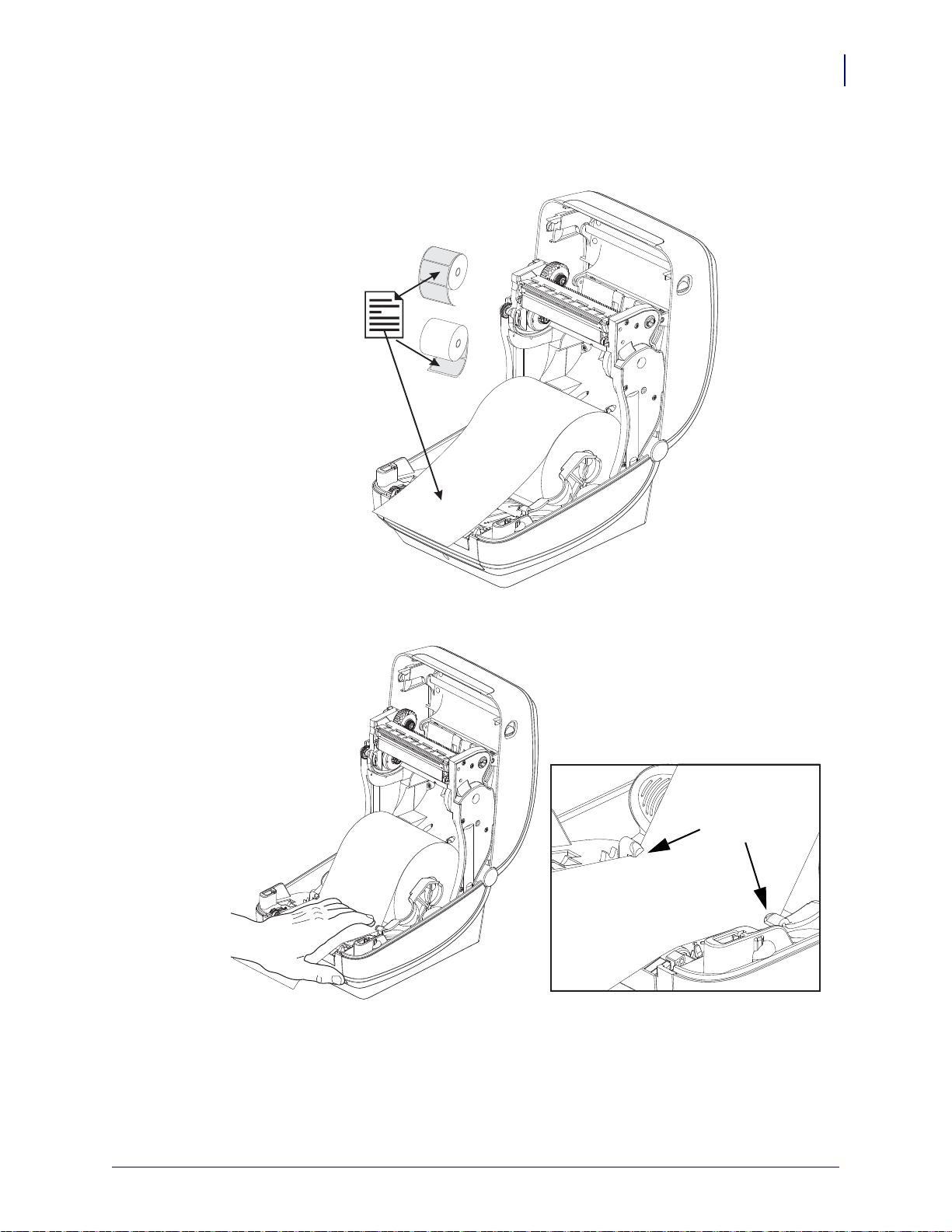
1.
Open the printer . Remember that you need to pull the release latch le vers toward the front
of the printer.
2.
Open the media roll holders. Pull the media guides open wi th your free hand and place the
media roll on the roll holders and release the guides. Orient the media roll so that its
printing surface will face up as it passes over the platen (drive) roller.
980610-001 Rev. C GK420t™ User Guide 8/4/10
Page 25
Getting Started
Under Media
Guides
Loading Roll Media
3.
Pull the media so that it extends out of the front of the printer. Verify the roll turns freely.
The roll must not sit in the bottom of the media compartment. Verify that the media’ s
printing surface is facing up.
13
4.
Push the media under both of the media guides.
5.
Close the printer. Press down until the cover snaps closed.
8/4/10 GK420t™ User Guide 980610-001 Rev. C
Page 26
Getting Started
Notch
Adhesive Strip
Right Side
(printer and roll)
14
Loading Transfer Ribbon
Loading Transfer Ribbon
Transfer ribbons come in several varieties and in some cases colors to match your application
®
needs. Genuine Zebra
brand media. Using non-Zebra media or ribbons not approved for use in your Zebra
transfer ribbons are specifically designed for your printer and Zebra
®
printer
may damage your printer or printhead.
• The media and ribbon types should be matched to provide you with optimal print results.
• Always use ribbon that is wider than the media to protect the printhead from wear.
• For direct thermal printing, do not load ribbon in the printer.
®
Y our printer needs to use Zebra
out trailer (reflector) to stop printing when empty. Zebra
®
model Zebra
desktop printers too.
Uni-Ribbon™ (universal ribbon). Uni-Ribbons have a ribbon
®
Uni-Ribbon™ will work on older
Uni-Ribbons are identified with a color coded leader.
• Blue - Performance Wax (5319)
• Silver - Premium Wax/Resin (3200)
• Gold - Performance Resin (5095) for synthetics (6 ips max. speed) and coated paper
(4 ips max. speed)
• Red - Premium Resin (5100) for synthetics (4 ips max. speed)
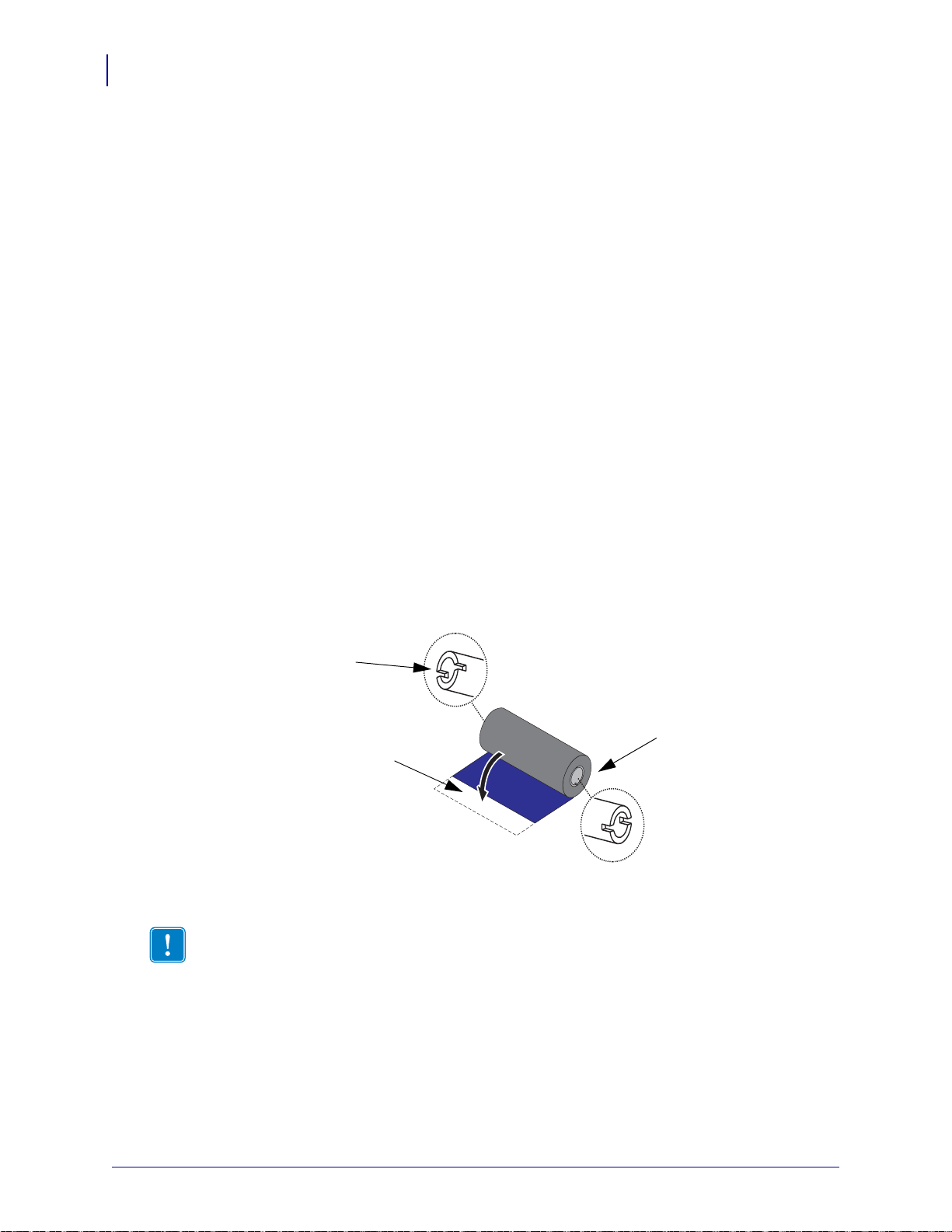
Before following these steps, prepare the ribbon by removing its wrapping and pulling its
adhesive strip free.
980610-001 Rev. C GK420t™ User Guide 8/4/10
See Ribbon Overview on page 36 for more information on ribbon use.
Important •
DO NOT USE early model desktop printer ribbon cores! The older ribbon cores
can be identified by notches on only one side of the ribbon core. These older cores are too large
and will cause take-up spool to bind.
Note •
DO NOT USE ribbon cores with damaged notches - rounded, frayed, smashed, etc. The
core notches should be square to lock the core on the spindle or the core may slip causing
ribbon wrinkle, poor end of ribbon sensing or other intermittent failures.
Page 27
Getting Started
Loading Transfer Ribbon
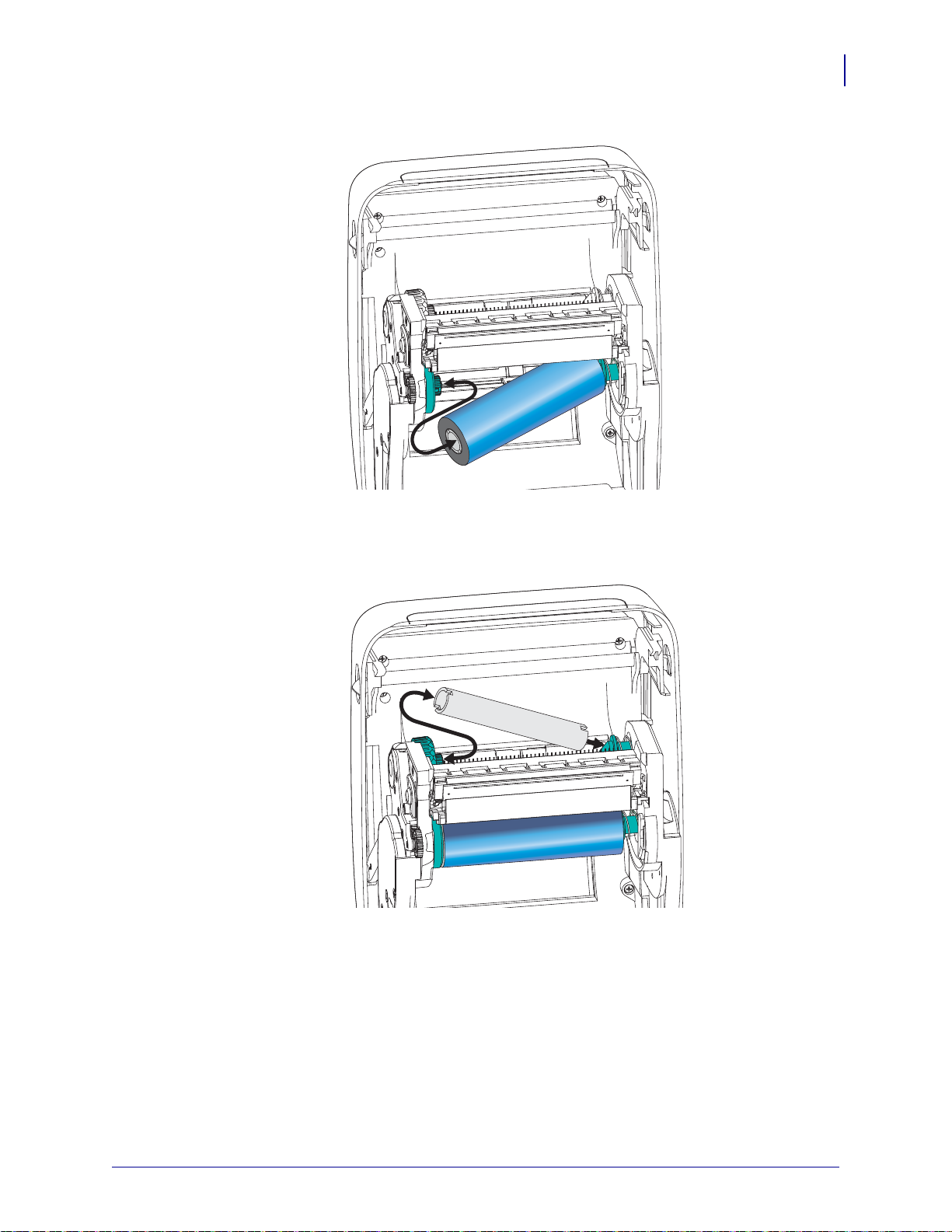
1.
With the printer open, place a new ribbon roll on printer’s lower ribbon supply spindles.
15
Rotate the roll until the notches align and lock into the left side of the supply hub.
2.
Place an empty ribbon core on printer’s take-up spindles. Rotate the ribbon core until the
notches align and lock into the left side of the take-up hub.
You can find your first ribbon take-up core in the p acking box. Subsequently, use the
empty supply core to take up the next roll of ribbon.
8/4/10 GK420t™ User Guide 980610-001 Rev. C
Page 28
Getting Started
16
Loading Transfer Ribbon
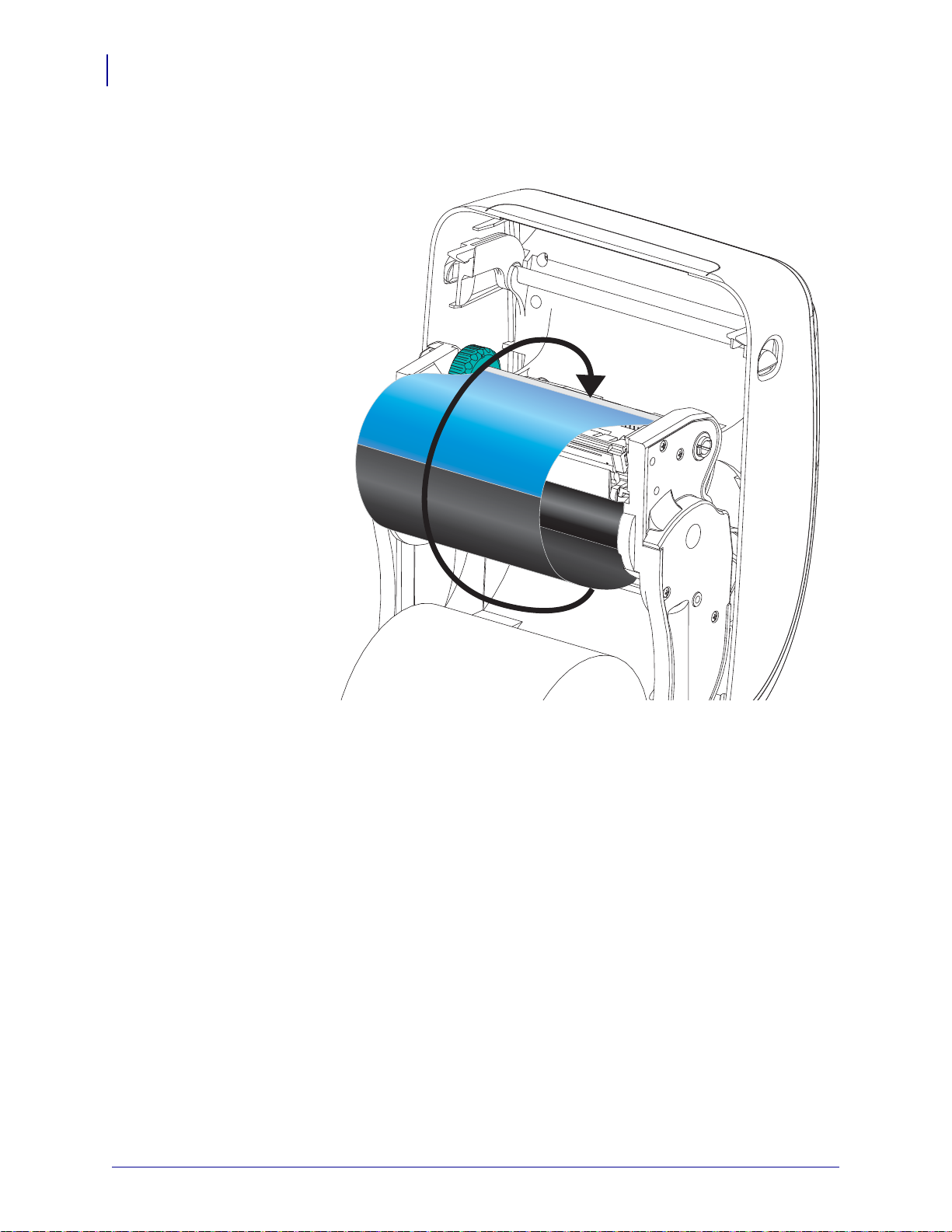
3.
Pull the transfer ribbon’s leader off the roll and attach it with the adhesive strip on the
leader to the empty ribbon core on the supply spindle. Center the ribbon on the ribbon
core.
980610-001 Rev. C GK420t™ User Guide 8/4/10
Page 29
Getting Started
Loading Transfer Ribbon
4.
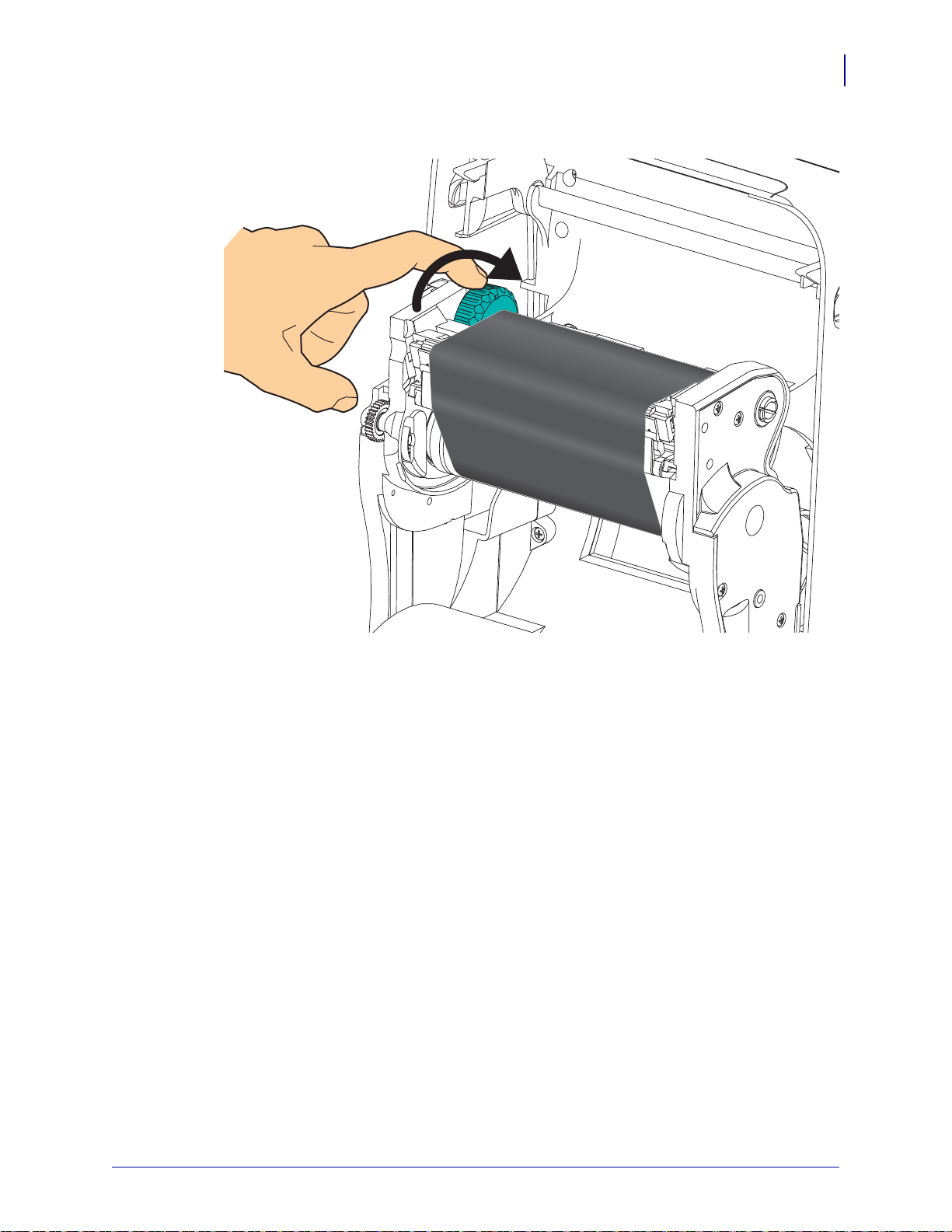
Rotate the thumb wheel on the left side of the supply spindle towards the rear of the
printer until the ribbon is pulled tight across the printhead.
17
5.
Verify that the media is loaded and ready to print and then close the printer cover.
6.
Press the Feed button to have the printer feed a minimum of 10 cm (4 inches) of media to
remove slack and ribbon wrinkle, and to align the ribbon on the spindles.
7.
Change the print mode setting from direct thermal printing to thermal transfer to set the
printer’s temperature profiles for thermal transfer medi a. This can be done with the printer
driver, application software, or printer programming commands.
• When controlling printer operations with ZPL programming, refer to the Media Type
(^MT) ZPL II command (follow the instructions in the ZPL Programming Guide).
• When controlling printer operations with EPL Page Mode, refer to the Options (O)
EPL command (follow the instructions in the EPL Page Mode Programmer’s Guide).
8.
To verify the mode change from direct thermal printing to thermal transfer printing, use
the Printing a Test (Printer Configuration) Label on page 18 to print a configuration label.
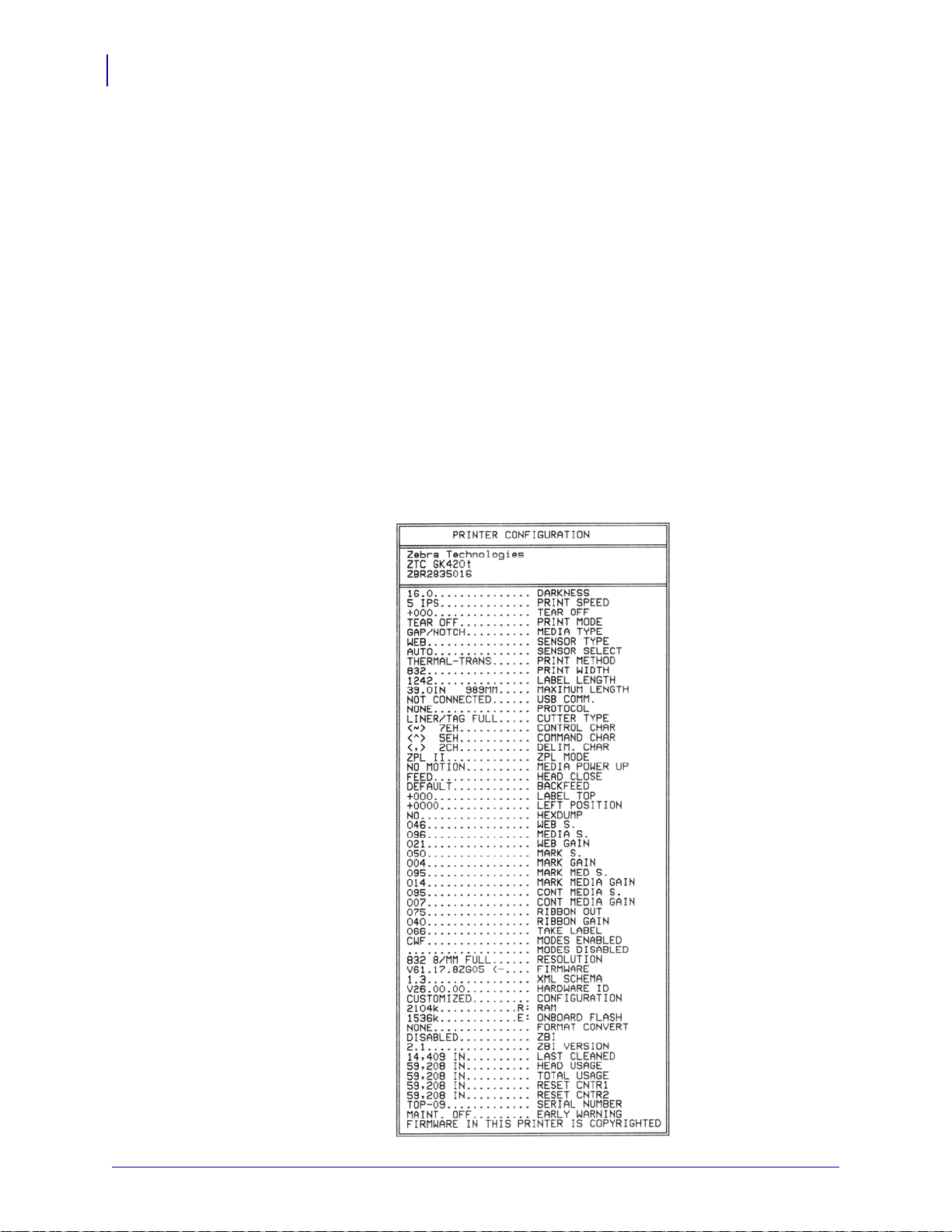
The ‘PRINT METHOD’ should read ‘THERMAL-TRANS’ on the printer configuration
status label.
Your printer is now ready to print.
8/4/10 GK420t™ User Guide 980610-001 Rev. C
Page 30
Getting Started
18
Printing a Test (Printer Configuration) Label
Printing a Test (Printer Configuration) Label
Before you connect the printer to your computer, make sure that the printer is in proper
working order.
You can do this by printing a configuration status label.
1.
Make sure the media is properly loaded and the top cover of the printer is closed. Then,
turn the printer power on if you have not already done so. If the printer initializes with the
status light blinking green (pause mode), press the Feed button once to set the printer in
Ready (to print) mode. See the Troubleshooting on page 69 if the printer’s status light
does not turn solid green (Ready).
2.
Press the Feed button two to three times to allow the printer to calibrate the printer for the
installed media. The printer may feed several labels during this process.
3.
When the status light is solid green, press and hold the Feed button until the status light
flashes once.
4.
Release the Feed button. A configuration label will print.
If you cannot get this label to print, refer to Getting Started on page 9.
980610-001 Rev. C GK420t™ User Guide 8/4/10
Page 31

Pre-install Windows® Printer Drivers
Getting Started
Pre-install Windows® Printer Drivers
19
Zebra is changing the way you install and use your printer with your Windows based PC
®
systems. We recommend that at minimum, the ZebraDesigner™ Windows
driver be pre-
installed to take advantage of the advancements in ease of use and simplicity of the Wi ndows
®
operating systems since the release of Wi ndows XP
Zebra provides the Zebra Setup Utilities (ZSU); a suite of Zebra
SP2.
®
printer drivers, utilities, and
communications and installation tools for use with most Windows PC operating systems.
Zebra Setup Utilities and Zebra Windows pri nter drivers are available on the user’ s CD and the
Zebra web site (www.zebra.com
) for latest versions.
ZebraDesigner™ Driver and Zebra Setup Utilities (includes the driver): Supports
®
Windows 7
and Windows Server
, Windows Vista®, Windows XP®, Windows® 2000®, Windows Server® 2008,
®
2003 operating systems. The driver supports 32 bit and 64 bit Windows
operating systems and is Microsoft Certified. Zebra Setup Utilities and the ZebraDesigner
driver support the following G-Series printer communication interfaces: USB, parallel, serial,
Wired and Wireless Ethernet and Bluetooth (using a Bluetoot h virtual printer po rt).
Install the Zebra Setup Utilities before
applying power to the printer connected to the PC
(running a Zebra driver supported Windows operating system). The Zebra Setup Utility will
prompt you to apply the printer power. Continue to follow the instructions to complete your
printer installation.
Plug’N’Play (PnP) Printer Detection and Windows® operating systems
More recent Windows operating systems automaticall y detect the printer when it is connected
via the USB interface. Depending on the hardware configuration and the Windows version,
your printer may be Plug-and-Play (PnP) detected when connecting to the USB, parallel, or
serial port interfaces. The printer drivers do not support serial port PnP installation at this
time.The printer’s PC interface configuration for the parallel port must support and have
bidirectional communications for PnP operations.
The operating system automatically starts a “Add new hardware’ wizard when connecting the
printer for the first time to the PC. If you have pre-loaded the driver suite with the Zebra Setup
Utility , then the printer driver will automatically install. Go to your W i ndows printer directory
and right-click and select ‘Properties’. Click on the ‘Print test page’ button to verify a
successful installation.
The Windows operating system will detect and re-link a previously installed printer if it is
reconnected to the USB interface or if printer power is turned on after the PC has finished its
restart of the operating system. Ignore the new device detected warnings and close the Task bar
prompts. Wait several seconds for the operating system to match the printer to the driver
software. The warnings will quit and the printer now should be ready to begin printing.
Universal Serial Bus (USB) Device Communications
The printer is a terminal device (not a host or hub) when using a USB interface. You can refer
to the USB Specification for details regarding this interface.
Note •
USB port) to send data to the printer.
Scanners, scales or other data input (terminal) devices must use the serial port (not the
8/4/10 GK420t™ User Guide 980610-001 Rev. C
Page 32

Getting Started
20
Pre-install Windows® Printer Drivers
Serial Port and Windows® operating systems
The Windows operating system default settings for the serial port communication closely
match the printer’s defaults settings with one exception; the data Flow Control settings. The
Windows default data Flow Contr ol setting is NONE. The G-Series printer requires data Flow
Control set to Hardware.
Note • The G-Series™ printer does not support W indows® Serial Port Plug and Play (PnP)
device detection at this time.
Ethernet
This printer option has a variety of methods and utilities to assist with printer connection to a
network (WAN or LAN) and to config ure Wired and Wire less (WiFi) printers. The Zebra
Setup Utility configuration wizards support creating a connection to the printer on a shared
network with Windows based systems by using the printer’s IP address. The printer includes
internal Web pages to provide easy access to printer and network configuration. The web
pages are accessible via the printers IP address using any web browser. The free version of
ZebraNet™ Bridge software allows you to centrally deploy , manage, and monitor your Zebra
printers with automatic Zebra
anywhere on your global network. ZebraNet™ Bridge Enterprise is available for purchase to
manage larger numbers of Zebra
®
printer discovery up to 3 printers from a single PC screen
®
printers.
®
980610-001 Rev. C GK420t™ User Guide 8/4/10
Page 33

Connecting your Printer to a Computer
The Zebra® G-Series™ printers support a variety of interface options and configurations.
These include: Universal Serial Bus (USB) interface, RS232 Serial, Parallel (IEEE 1284.4)
and 10/100 Ethernet.
• USB, Serial and Parallel
• Optional: USB, Serial, and Ethernet (Wired)
The Zebra Setup Utility is designed to assist you with installing these interfaces. The
cabling and unique parameters for each of these physical printer communication interfaces is
discussed in the following pages to assist you with making con figuration setup choic es prior to
and immediately following applying power. The Zebra Setup Utilities configuration wizards
will instruct you to turn the printe r’s power on at the appropriate time to complete the
installation of your printer .
Getting Started
Connecting your Printer to a Computer
21
Caution •
The power cord must be inserted into the power supply and the power receptacle on the
back of the printer before connecting or disconnecting the communications cables.
Keep the power switch in the OFF position when attaching the interface cable.
Interface Cable Requirements
Data cables must be of fully shielded construction and fitted with metal or metallized
connector shells. Shielded cables and connectors are required to prevent radiation and
reception of electrical noise.
To minimize electrical noise pickup in the cable:
• Keep data cables as short as possible (6 foot [1.83 m] recommended).
• Do not tightly bundle the data cables with power cords.
• Do not tie the data cables to power wire conduits.
.
Important •
Equipment, using fully shielded data cables. Use of un-shielded cables may increase radiated
emissions above the Class B limits.
This printer complies with FCC “Rules and Regulations,” Part 15, for Class B
8/4/10 GK420t™ User Guide 980610-001 Rev. C
Page 34

Getting Started
USB Cable
22
Connecting your Printer to a Computer
USB Interface Requirements
Universal Serial Bus (version 2.0 compliant) provides a fast interface that is compatible with
your existing PC hardware. USB’s “plug and play” design makes installation easy. Multiple
printers can share a single USB port/hub.
When using a USB cable (not supplied with your printer), verify that the cable or cable
packaging bears the “Certified USB™” mark (see below) to guarantee USB 2.0 compliance.
.
980610-001 Rev. C GK420t™ User Guide 8/4/10
Page 35

Serial Communications
The printer automatically detects and switches the serial port to match common serial port
cabling and signal connection configurations for DTE and DCE communications. The required
cable must have a nine-pin “D” type (DB-9P) male connector on one end whi ch plugs into the
mating (DB-9S) serial port located on the back of the printer. The other end of this signal
interface cable connects to a serial port on the host computer. This allows for the use of two
common cable types and drop-in replacement for Zebra and other printer models. Zebra
printers use a Null Modem (cross-over) cable. Early models of Zebra
running the EPL programming utilized a straight through (no cross-over) signal connections
cable. For pinout information, refer to Appendix A.
The serial port communication settings between the printer and host (typically a PC) must
match for reliable communication. The Bits per second (or Baud rate) an d Flow control are the
most common settings that get changed. The host (typically a Wi ndows PC) needs to have the
data Flow control changed to match the printer’s default communication method: Hardware
and is noted by the Host Handshake setting DTR/Xon/Xoff for legacy printer. This
combined hardware (DTR) and software (Xon/Xoff) mode may need to change depending
upon the non-Zebra application software and the serial cable variation in use.
Serial communications between the printer and the host computer can be set by:
Getting Started
Connecting your Printer to a Computer
®
®
printers (a DCE device)
23
• Autobaud synchronization
• ZPL programming ^SC command
• EPL programming Y command
• Resetting the printer to its default printer configuration.
Autobaud
Autobaud synchronization allows the printer to automatically match the communication
parameters of the host computer. To autobaud:
1. Press and hold the feed button until the green status LED flashes once, twice, and then
three times.
2. While the status LED flashes, send the ^XA^XZ command sequence to the printer.
3. When the printer and host are synchronized, the LED changes to solid green. (No labels
will print during autobaud synchronization.)
ZPL ^SC Command
Use the Set Communications (^SC) command to change the communications settings on the
printer.
1. With the host computer set at the same communications settings as the printer, send the
^SC command to change the printer to the desired settings.
2. Change the host computer settings to match the new printer settings.
Refer to the ZPL Programming Guide for more information about this command.
8/4/10 GK420t™ User Guide 980610-001 Rev. C
Page 36

Getting Started
Tighten
Serial Cable
24
Connecting your Printer to a Computer
EPL Y Command
Use the serial port setup (Y) command to change the communications settings on the printer.
1. With the host computer set at the same communications settings as the printer, send the
2. Change the host computer settings to match the new printer settings.
Refer to the EPL Page Mode Programming Guide for more information about this command.
Resetting the Default Serial Port Parameters
Do the following to reset the communications parameters on the printer to the fa ctory defaults
(serial communication settings are: 9600 baud, 8 bit word length, NO parity, 1 stop bit, and
DTR/XON/XOFF data flow control).
1. Press and hold the feed button until the green status LED flashes once, waits a moment
2. While the status LED rapidly flashes amber and green, press the feed
Y command to change the printer to the desired settings. Note: the Y command does not
support setting the data flow control, use the Xon/Xoff setting.
and flashes twice, and then waits again before flashing three times (release
immediately).
button. Serial
communications between the printer and the host computer can be set by the ZPL ^SC
command or the EPL Y command.
Note •
baud, NO
Early models of Zebra® printers running the EPL programming
language had
parity, 8 data bits, 1 stop bit and a HARDWARE and SOFTWARE (merged) data
9600
control (essentially DTR/Xon/Xoff) as the defa ul t serial port settings. The Windows operating
system flow control setting was Hardware for most applications.
980610-001 Rev. C GK420t™ User Guide 8/4/10
Page 37

Parallel Port
Parallel Cable
The required cable must have a 25 pin “D” type (DB-25P) male connector on one and a
Centronics on the end (IEEE 1284 A-B parallel interface specification). Early models of GSeries printers originally supported parallel cables with two 25 pin “D” type (DB-25P) male
connectors on both ends (IEEE 1284 A-A parallel interface specification).
Getting Started
Connecting your Printer to a Computer
25
8/4/10 GK420t™ User Guide 980610-001 Rev. C
Page 38

Getting Started
Ethernet Cable
(RJ45 Connector)
Green LED Amber LED
26
Connecting your Printer to a Computer
Ethernet
The printer requires UTP RJ45 Ethernet cable rated CAT-5 or better.
For more information on configuring your printer to run on a compatible Ethernet based
network, see the ZebraNet® 10/100 Internal Print Server manual. The printer must be
configured to run on your LAN (local area network) or WAN (wide area network). The print
server on board your printer can be accessed through the printer’s Web pages.
Ethernet Status/Activity Indicators
LED Status Description
Both OFF No Ethernet link detected
Green 100 Mbps link detected
Green with the Amber
flickering on and off
Amber 10 Mbps link detected
Amber with the Green
flickering on and off
100 Mbps link and Ethernet activity detected
10 Mbps link and Ethernet activity detected
980610-001 Rev. C GK420t™ User Guide 8/4/10
Page 39

After Your Printer is Connected
Now that you have basic communication to your printer, you may want to test printer
communications and then install other printer related applications, drivers or utilities.
Testing Communications by Printing
Verifying the print system’s operation is a relatively simple process. For Wind ows ope ratin g
systems, the Zebra Setup Utility or the Windows ‘Printers and Faxes’ Control Panel to access
and print a test label. For non-W in dows operat ion syste ms, coping a basic ASCII text fil e with
a single command (~WC) to print a configuration status label.
Test Printing with Zebra Setup Utility:
1.
Open the Zebra Setup Utility.
2.
Click on the newly install printer’s icon to select the printer and active the print er
configuration buttons below it in the window.
3.
Click the ‘Open Printer Tools’ button.
Getting Started
After Your Printer is Connected
27
4.
In the ‘Print’ tab window, click on the ‘Print configuration label’ line and click on the
‘Send’ button. The printer should print a configuration status label.
Test Printing with Windows ‘Printer and Faxes’ menu:
1.
Click on the Windows ‘Start’ menu button, to access the ‘Printers and Faxes’ menu or
‘Control Panel’ to access the ‘Printers and Faxes’ menu. Open the menu.
2.
Select the newly install printer’s icon to select the printer and right-click the mouse to
access the printer ‘Properties’ menu.
3.
From the printer’s ‘General’ tab window, click on the ‘Print Test Page’ button. The printer
should print a Windows test print page.
Test Print on a Ethernet printer connected to a network (LAN or WAN) with a
(MS-DOS) ‘Command Prompt’ (or ‘Run’ from the Windows XP Start menu):
1.
Create a text file with the following ASCII three characters: ~WC
2.
Save the file as: TEST.ZPL (an arbitrary file name and extension name).
3.
Read the IP address off the printer’s Configuration S tatus Label’s Network Status printout.
On a system that is connected to the same LAN or WAN as the printer, type the following
in the Web browser window’s address bar and enter:
fpt (IP address)
(for IP address 123.45.67.01 it would be: ftp 123.45.67.01)
4.
Type the word ‘put’ followed by the file name and enter. For this ‘test print’ file , it woul d
be: put TEST.ZPL
The printer should print a new Print Configuration Status label.
8/4/10 GK420t™ User Guide 980610-001 Rev. C
Page 40

Getting Started
28
After Your Printer is Connected
Test Print with a Copied ZPL Command File for Non-Windows Operating Systems:
1.
Create a text file with the following ASCII three characters: ~WC
2.
Save the file as: TEST.ZPL (an arbitrary file name and extension name).
3.
Copy the file to the printer. For DOS, a file sent to a printer connected to the system’s
parallel port would be as simple as:
COPY TEST.ZPL LPT1
Other interface connection types and operating systems will have different command
strings. See your operating system documentation for detailed instructions to copy to the
appropriate printer interface for this test.
980610-001 Rev. C GK420t™ User Guide 8/4/10
Page 41

3
Print Operations
This section provides media and print handling, font and language support, and the setup of
less common printer configurations.
Contents
Determining Printer Configuration . . . . . . . . . . . . . . . . . . . . . . . . . . . . . . . . . . . . . . . . . . 30
Long Term Printer In-activity or Storage. . . . . . . . . . . . . . . . . . . . . . . . . . . . . . . . . . . . . . 30
Modes of Printing. . . . . . . . . . . . . . . . . . . . . . . . . . . . . . . . . . . . . . . . . . . . . . . . . . . . . . . 31
Print Media Types . . . . . . . . . . . . . . . . . . . . . . . . . . . . . . . . . . . . . . . . . . . . . . . . . . . . . . 31
Replacing Supplies . . . . . . . . . . . . . . . . . . . . . . . . . . . . . . . . . . . . . . . . . . . . . . . . . . . . . 33
Adjusting the Print Width . . . . . . . . . . . . . . . . . . . . . . . . . . . . . . . . . . . . . . . . . . . . . . . . . 34
Adjusting the Print Quality . . . . . . . . . . . . . . . . . . . . . . . . . . . . . . . . . . . . . . . . . . . . . . . . 34
Media Sensing . . . . . . . . . . . . . . . . . . . . . . . . . . . . . . . . . . . . . . . . . . . . . . . . . . . . . . . . . 35
Ribbon Overview . . . . . . . . . . . . . . . . . . . . . . . . . . . . . . . . . . . . . . . . . . . . . . . . . . . . . . . 36
Printing on Fan-Fold Media . . . . . . . . . . . . . . . . . . . . . . . . . . . . . . . . . . . . . . . . . . . . . . . 38
Printing with Externally Mounted Roll Media . . . . . . . . . . . . . . . . . . . . . . . . . . . . . . . . . . 40
Fonts and Your Printer . . . . . . . . . . . . . . . . . . . . . . . . . . . . . . . . . . . . . . . . . . . . . . . . . . . 41
Sending Files to the Printer . . . . . . . . . . . . . . . . . . . . . . . . . . . . . . . . . . . . . . . . . . . . . . . 44
Print Meter . . . . . . . . . . . . . . . . . . . . . . . . . . . . . . . . . . . . . . . . . . . . . . . . . . . . . . . . . . . . 44
8/4/10 GK420t™ User Guide 980610-001 Rev. C
Page 42

Print Operations
30
Determining Printer Configuration
Determining Printer Configuration
The G-Series™ printer uses a ZPL printer configuration status label to report the printer’s
configuration status for both EPL and ZPL operations.The ZPL style label provides a more
intuitive and functionally descriptive naming conventions than the EPL style printer status
label. Operational status (darkness, speed, media type, etc.), installed printer options (network,
interface settings, cutter , etc.) and printer desc ription information (serial number, model name,
firmware version, etc.) are all includes on the status label. See Printing a Test (Printer
Configuration) Label on page 18 to print this label. See Appendix: ZPL Configuration
on page 93 for detail on printer configuration and the ZPL commands that control the printer
settings listed on the Printer Configuration Status Label.
To get an EPL style printer configuration status label, send the printer the EPL U command.
See the EPL programmer’s guide for more information on the various EPL U commands and
interpreting the settings displayed on these labels.
Localizing the Printer Status Configuration Label
The printer configuration status label can be localized for up to 16 languages. Use the ZPL
^KD
programming command
label.
to modify the displayed language for most status items on this
See Printing a Test (Printer Configuration) Label on page 18 or Feed Button Modes
on page 80 for information on accessing the printer configuration status label.
Long Term Printer In-activity or Storage
Overtime the printhead may stick to the platen (drive) roller. To prevent this, always store the
printer with a piece of media (a label or paper) between the printhead and platen roller. Do not
ship the printer with a roll of media installed or damage to the printer or media may result.
Thermal Printing
Caution •
printhead and risk of personal injury, avoid touching the printhead. Only use the cleaning
pen to perform printhead maintenance.
Caution •
human body or other surfaces can damage or destroy the printhead or electronic
components used in this device. You must observe static-safe procedures when working
with the printhead or the electronic components under the top cover.
The printhead becomes hot while printing. To protect from damaging the
The discharge of electrostatic energy that accumulates on the surface of the
980610-001 Rev. C GK420t™ User Guide 8/4/10
Page 43

Modes of Printing
You can operate this printer in many different modes and media configurations:
• Direct thermal printing (which uses heat sensitive media to print).
• Thermal transfer printing (which uses ribbon to heat transfer print t o t he media).
• Standard Tear-Off mode allows you to tear off each label (or batch print a strip of labels)
after it is printed.
• Label Dispense Mode: If an optional dispenser is installed, the backing material can be
peeled away from the label as it is printed. After this label is removed, the next one is
printed.
• Stand-alone: The printer can print without being connected to a computer using the
printer’s auto running label form feature (programming based) or by using a data input
device connected to the printer’s serial port. This mode accommodat es data input devices,
such as scanners, weigh scales, Zebra
Unit), etc.
• Shared network printing: Printers configured with the Ethernet interface option include an
internal print server with ZebraLink™ printer configuration web page and ZebraNet™
Bridge software for managing and monitoring status of Zebra
Print Operations
Modes of Printing
®
KDU Plus™ or Zebra® KDU (Keyboard Display
®
printers on a network.
31
Print Media Types
Important •
high-quality printing. A wide range of paper, polypropylene, polyester, and vinyl stock has
been specifically engineered to enhance the printing capabilities of the printer and to prevent
premature printhead wear. To purchase supplies, go to http://www.zebra.com/howtobuy.
Your printer can use various types of media:
• Standard media—Most standard (non-continuous) media uses an adhesive backing that
sticks individual labels or a continuous length of labels to a liner.
• Continuous roll media—Most continuous roll media is direct thermal media (similar to
FAX paper) and is used for receipt or ticket style printing.
• Linerless media—Linerless labels have an adhesive backing, but they are wound onto a
core without a liner. The media typically is perforated and may have black marks on the
bottom surface of the media to indicate label separations. The top surface of linerless
media labels have a special coating that keeps the labels from sticking to each other. The
printer must be equipped with a special Linerless option to be able to use linerless media
to keep the media from sticking to the printer.
• Tag stock—Tags are usually made from a heavy paper (up to 0.0075in./0.19mm thick).
Tag stock does not have adhesive or a liner, and it is typically perforated between tags.
For more information on basic media types, see Table 1.
Zebra strongly recommends the use of Zebra-brand supplies for continuous
The printer typically uses roll media, but you can use fan-fold or other continuous media too.
Use the correct media for the type of printing you require. You must use direct thermal
media.When printing without a ribbon, you must use direct thermal media. When using
ribbon, you must use thermal transfer media.
8/4/10 GK420t™ User Guide 980610-001 Rev. C
Page 44

Print Operations
32
Print Media Types
Table 1 • Types of Media Roll and Fanfold Media
Media Type How It Looks Description
Non-Continuous
Roll Media
Roll media is wound on a core that can be 0.5 to 1.5 in. (12.7 to
38.1 mm) in diameter. Labels have adhesive backing that sticks
them to a liner, and they are separated by gaps, holes, not ches, or
black marks. Tags are separated by perforations. Individual la bels
are separated by one or more of the following methods:
• Web media separates labels by gaps, holes, or notches.
• Black mark media uses pre-printed black marks on the back
side of the media to indicate label separations.
Non-Continuous
Fanfold Media
Continuous
Roll Media
• Perforated media has perforations that allow the labels or tags
to be separated from each other easily. The media may also
have black marks or other separations between labels or tags.
Fan-Fold media is folded in a zigzag pattern. Fanfold media can
have the same label separations as non-continuous roll media.
The separations would fall on or near the folds.
Roll media is wound on a core that can be 0.5 to 1.5 in. (12.7 to
38.1 mm) in diameter. Continuous roll media does not have gaps,
holes, notches, or black marks to indicate label separations. This
allows the image to be printed anywhere on the label. A cutter
can be used to cut apart individual labels. With continuous media,
use the transmissive (gap) sensor so the printer can detect when
the media runs out.
980610-001 Rev. C GK420t™ User Guide 8/4/10
Page 45

Determining Thermal Media Types
Thermal transfer media requires ribbon for printing while direct thermal media does not.
To determine if ribbon must be used with a particular media, perform a media scratch test.
To perform a media scratch test, complete these steps:
1.
Scratch the print surface of the media with a finger nail or pen cap. Press firmly and
quickly while dragging it across the media surface. Direct thermal media is chemically
treated to print (expose) when heat is applied. This test method uses friction heat to expose
the media.
2.
Did a black mark appear on the media?
If a black mark... Then the media is...
Does not appear on the media Thermal transfer. A ribbon is required.
Appears on the media Direct thermal. No ribbon is required.
Print Operations
Replacing Supplies
33
Replacing Supplies
If labels or ribbon run out while printing, leave the printer power on while reloadi ng (data loss
results if you turn off the printer). After you load a new label or ribbon roll, press the Feed
button to restart.
Always use high quality, approved labels, tags and ribbons. If adhesive backed labels are used
that don’t lay flat on the backing liner, the exposed edges may stick to the label guides and
rollers inside the printer, causing the label to peel off from the liner and jam the printer.
Permanent damage to the printhead may result if a non-approved ribbon is used as it may be
wound incorrectly for the printer or contain chemicals corrosive to the printhead.
Adding a New Transfer Ribbon
If ribbon runs out in the middle of a print job, the indicator lights red and the printer waits for
you to add a fresh roll.
1.
Keep the power on as you change ribbon.
2.
Open the top cover, then cut the used ribbon so you can remove the cores.
3.
Load a new ribbon roll and empty ribbon core. If necessary, review the Ribbon Loading
steps. Note: Do Not Use ribbon cores with damaged notch. The notches should have
square corners.
4.
Close the top cover.
5.
Press the Feed button to restart printing.
8/4/10 GK420t™ User Guide 980610-001 Rev. C
Page 46

Print Operations
34
Adjusting the Print Width
Replacing a Partially Used Transfer Ribbon
To remove used transfer ribbon, perfor m the following steps.
1.
Cut the ribbon from the take-up roll.
2.
Remove the take-up roll and discard used ribbon.
3.
Remove the supply roll and tape the end of any fresh ribbon to prevent it from
unwrapping. When reinstalling a partially used supply roll, tape the cut end onto the
empty take-up roll.
Adjusting the Print Width
Print width must be set when:
• You are using the printer for the first time.
• There is a change in media width.
Print width may be set by:
• The Windows printer driver or application software such as ZebraDesigner™.
• The five-flash sequence in Feed Button Modes on page 80.
• Controlling printer operations with ZPL programming; refer to the Print Width (^PW)
command (consult your ZPL Programming Guide).
• Controlling printer operations with EPL Page Mode programming, refer to the Set Label
q
Width (
) command (consult your EPL Programmer’s Guide).
Adjusting the Print Quality
Print quality is influenced by the heat (density) setting of the printhead, the print speed, and the
media in use. Experiment with these settings to find the optimal mix for your application. Print
quality can be set with the Zebra Setup Utility’s ‘Configure Print Quality’ routine.
Note • Media manufactures may have specific recommendations for speed settings for your
printer and the media. Some media types have lower maximum speeds than your printer’s
maximum speed.
The relative darkness (or density) setting can be controlled by:
• The six-flash sequence in Feed Button Modes on page 80. This will overwrite any ZPL
and EPL programmed darkness/density settings.
~SD
• The Set Darkness (
) ZPL command (consult your ZPL Programming Guide).
• The Density (D) EPL command (consult your EPL Programmer’s Guide).
If you find that the print speed needs to be adjusted, use:
• The Windows printer driver or application software such as ZebraDesigner™.
• The Print Rate (^PR) command (consult your ZPL Programming Guide).
S
• The Speed Select (
980610-001 Rev. C GK420t™ User Guide 8/4/10
) command (consult your EPL Programmer’s Guide).
Page 47

Media Sensing
The G-Series printer has automatic media sensing capability. The printer is designed to
continuously check and adjust media length sensing for minor variations. Once the printer is
printing or feeding media, the printer continually checks and adjusts the media sensing to
accommodate for minor changes in media parameters from label to label on a roll and from
roll to roll of media. The printer will automatically initiate a media length calibration if the
expected media length or the label to label gap distance has exceeded the acceptable variation
range when starting a print job or feeding media. The automatic media sensing in the G-Series
printers works the same for printer operations that use EPL and ZPL label formats and
programming.
If the printer does not detect labels or black marks (or notches with blackline sensing) after
feeding the media the default maximum label length distance of 39 inches (1 meter), then the
printer will switch to continuous (receipt) media mode. The printer will keep these setti ngs
until changed by software, programming or a manual calibration with different media.
Optionally , the printer can be set to do a short media calibration after printer power up or when
closing the printer with power on . The printer will then feed several labels while calibrating.
The printer’s media settings can be verified by printing a Printer Configuration label. See the
Printing a Test (Printer Configuration) Label on page 18 for more details.
Print Operations
Media Sensing
35
The maximum distance that the automatic media type detecti on and se nsing will check can be
reduced by using the ZPL Maximum Label Length command (^ML). It is recommended that
this distance be set to no less than two times the longest label being printed. If the la r gest label
being printed was a 4 by 6 inch label, then the maximum label (media) length detection
distance can be reduced from the default distance of 39 inches down to 12 inches.
If the printer has difficulty automatically detecting the media type and auto-calibrating, see
Manual Calibration on page 76 to perform an extensive calibration. It includes a printed graph
of sensor operation for your media. This method disables the printer’s automatic media
sensing capability until the printer’s default parameters are reset to the factory defaults with
the four flash Feed button mode. See the Feed Button Modes on page 80 for more details.
The automatic media calibration can be modified, turned on or turned off to meet your needs.
Sometimes print job conditions require that the printer use all the media on a roll. The two
automatic media conditions, power up with media loaded and closing the printer with power
on, can be controlled individually with the ZPL Media Feed command, ^MF. The feed action
discussed in the ZPL programmers guide for the ^MF command is primarily for automatic
media sensing and calibration. The automatic media calibration that controls the dynamic
media (label to label) calibration is the ^XS command. If multiple media types of different
lengths, material or detection methods (web/gap, black mark, notches or continuous) are used,
you should not change these settings.
The media calibration and detection process can also be refined to match the media type
loaded into the printer. Use the ZPL Media Tracking command (^MN) to set the media type.
Sometimes the printer can detect preprinted media as the gap between labels or the liner
backing with print as a black marks. If the ^MN parameter for continuous media is set, the n the
print does not preform the automatic calibration. The ^MN command also includes an
automatic calibration parameter (^MNA) to return the printer to its default setting to
automatically detect all media types.
8/4/10 GK420t™ User Guide 980610-001 Rev. C
Page 48

Print Operations
Outside Inside
36
Ribbon Overview
Ribbon Overview
Ribbon is a thin film that is coated on one side with wax, resin, or wax resin, which is
transferred to the media during the thermal transfer process. The media determines whether
you need to use ribbon and how wide the ribbon must be. When ribbon is used, it must be as
wide as or wider than the media being used. If the ribbon is narrower than the media, areas of
the printhead are unprotected and subject to premature wear.
When to Use Ribbon
Thermal transfer media requires ribbon for printing while direct thermal media does not.
Direct thermal media should never be used with ribbon. Bar codes and graphics can get
distorted. To determine if ribbon must be used with a particular media, perform a media
scratch test.
Coated Side of Ribbon
Ribbon can be wound with the coated side on the inside or outside. This printer can only use
ribbon that is coated on the outside. If you are unsure which side of a particular roll of ribbon
is coated, perform an adhesive test or a ribbon scratch test to determine which side is coated.
To determine which side of a ribbon is coated, complete these steps:
Ribbon Test with Adhesive
If you have labels available, perform the adhesive test to determine which side of a ribbon is
coated. This method works well for ribbon that is already installed.
To perform an adhesive test, complete these steps:
1.
Peel a label from its liner.
2.
Press a corner of the sticky side of the label to the outer surface of the roll of ribbon.
3.
Peel the label off of the ribbon.
980610-001 Rev. C GK420t™ User Guide 8/4/10
Page 49

4.
Observe the results. Did flakes or particles of ink from the ribbon adhere to the label?
If ink from the ribbon... Then...
Adhered to the label The ribbon is coated on the outside and can be used with
the G-Series printer.
Did not adhere to the label The ribbon is coated on the inside and can not be used in
the G-Series printer.
Ribbon Scratch Test
Perform the ribbon scratch test when labels are unavailable.
To perform a ribbon scratch test, complete these steps:
1.
Unroll a short length of ribbon.
2.
Place the unrolled section of ribbon on a piece of paper with the outer surface of the
ribbon in contact with the paper.
Print Operations
Ribbon Overview
37
3.
Scratch the inner surface of the unrolled ribbon with your fingernail.
4.
Lift the ribbon from the paper.
5.
Observe the results. Did the ribbon leave a mark on the paper?
If the ribbon... Then...
Left a mark on the paper The ribbon is coated on the outside and can be used with
the G-Series printer.
Did not leave a mark on the
paper
The ribbon is coated on the inside and can not be used in
the G-Series printer.
8/4/10 GK420t™ User Guide 980610-001 Rev. C
Page 50

Print Operations
Fan-Fold
Media Path
38
Printing on Fan-Fold Media
Printing on Fan-Fold Media
Printing on fan-fold media requires you to adjust the media guide’s stop position.
1.
Open the top cover.
2.
Adjust the media guide stop position with the green thumb wheel. Use a piece of the fanfold media to set the stop position. Rotate the wheel toward you to open the guides wider.
Rotate the wheel away from you to make the media guide narrower.
980610-001 Rev. C GK420t™ User Guide 8/4/10
Page 51

3.
Insert the media through the slot at the rear of the printer.
4.
Run the media between the media guide and roll holders.
Print Operations
Printing on Fan-Fold Media
39
5.
Close the top cover.
After printing or feeding several labels: If the media does not track down the center (moves
from side to side) or the sides of the media (liner , tag, pape r, etc.) are frayed or damaged when
exiting the printer, then the media guides may need further ad justment. If this does not correct
the problem, then the media can be routed over the two roll holding pins on the media guide.
An empty roll core of the same width as the stack of the fan-fold media can be placed between
the roll holders to provide additional support for thin media.
8/4/10 GK420t™ User Guide 980610-001 Rev. C
Page 52

Print Operations
40
Printing with Externally Mounted Roll Media
Printing with Externally Mounted Roll Media
The G-Series printer accommodates externally mounted roll media similar to the printer’s
support of fan-fold media. The printer requires the media roll and stand combination to have a
low initial inertia to pull the media off the roll. The G-Series™ motor has 30% more torque
than the Zebra
speed.
Zebra at this time does not offer an extern al media option for the G-Series™ prin ter.
Externally Mounted Roll Media Considerations:
• The media ideally should enter the printer directly behind the printer through the fan-fold
media slot in the rear of the printer. See Printing on Fan-Fold Media on page 38 for media
loading.
• Lower the print speed to decrease the chance of motor stalls. The roll typically has the
highest inertia when trying to start the roll moving. Larger media ro ll diameters require the
printer to have more torque applied to get the roll moving.
• The media should move smoothly and freely. The media should not slip, skip, jerk, bind
and then move, etc. when mounted on your media stand.
®
2800™ Series desktop printers to provide improved media handling and
• The printer should not touch the media roll.
• The printer should not slip or lift up off the operating surface.
980610-001 Rev. C GK420t™ User Guide 8/4/10
Page 53

Fonts and Your Printer
The G-Series™ printer supports your language and font req uirements with a variety of internal
fonts, on-board font scaling, international font sets and character code page support, Unicode
support, and font download.
The G-Series™ printer’s font capabilities are programming language dependent. The EPL™
programming language provides for basic bitmapped fonts and international code pages. The
ZPL™ programming language provides advanced font mapping and scaling technology to
support outline fonts (T rueType™ or OpenType™) and Unic ode chara cter mapping as well as
basic bitmapped fonts and character code pages. ZPL and EPL programming guides describe
and document the fonts, code pages, character access, listing fonts, and limitations for their
respective printer programming languages. See the printer programming guides for
information on Text, Fonts and Character support.
The G-Series™ printer includes utilities and application software that support font download
into the printer for both printer programming languages.
Localizing the Printer with Code Pages
Print Operations
Fonts and Your Printer
41
The G-Series™ printer supports two sets of language, region and character sets for permanent
fonts loaded into the printer for each printer programming language, ZPL and EPL. The printer
supports localization with common international character map code pages.
• For ZPL code page support, including Unicode, see the ^CI command in the ZPL
programmer’s guide.
• For EPL code page support, see the I command in the EPL programmer’s guide.
8/4/10 GK420t™ User Guide 980610-001 Rev. C
Page 54

Print Operations
42
Fonts and Your Printer
Identifying Fonts in Your Printer
Fonts and memory are shared by the programming languages in the printer. Fonts can be
loaded in many memory areas in the G-Series printer. ZPL programming can recognize EPL
and ZPL fonts. EPL programming can only recognize EPL fonts. See the respective
programmer guides for more information on fonts and printer memory.
ZPL Fonts:
• To manage and download fonts for ZPL print operation, use the Zebra Setup utility or
ZebraNet™ Bridge.
• To display all of the fonts loaded in your G-Series printer, send the printer the ZPL
command ^WD. See the ZPL Programmers Guide for details.
• Bitmap fonts in the various printer memory areas are identified by the .FNT file
extension in ZPL.
• Scalable fonts are identified with the .TTF, .TTE or .OTF file extensions in ZPL.
EPL does not support these fonts.
EPL Fonts:
• To download fonts for EPL print operations, use the Zebra Setup Utility or ZebraNet™
Bridge to send files to the printer.
• To display Soft Fonts (ext.) available to EPL, send the printer the EPL command EI.
• Optional Asian Fonts in G-Series printers are displayed as Soft Fonts, but are still
accessible as documented in the A command in the EPL programmer’s guide.
• All EPL fonts displayed are bitmap fonts. They do not include the .FNT file extension
or the horizontal (H) or vertical (V) designators that are displayed with the ZPL
command ^WD as described above in ZPL Fonts.
• To remove non Asian EPL fonts with EPL programming, use the EK command.
• To remove EPL Asian fonts from the printer, use the ZPL ^ID command.
980610-001 Rev. C GK420t™ User Guide 8/4/10
Page 55

Stand Alone Printing
Your printer can be configured to work without being attached to a computer. The printer has
the ability to automatically run a single label form. One or more downloaded label forms can
be accessed and run with a terminal or wedge device or a Zebra
to call a label form. These methods allow the developer to incorporate dat a input devices, such
as scanners or weight scales, to the printer via the serial port.
Label formats can be developed and st ored in the printer to support label s that have:
• No data entry required and print when the Feed button is pressed.
• No data entry required and print when a label is removed from the printer’s optional label
dispenser.
• One or more data variables to be entered via the terminal or wedge device. The label will
print after the last variable data field has been input.
• One or more label formats that are called by scanning bar codes containing programming
to run a label form.
• Label forms designed to work as a process chain with each label including a bar code
containing the programming to run the next label in the process sequence.
Print Operations
Stand Alone Printing
®
KDU (keyboard display unit)
43
Both printer programming languages support special label forms that will automatically run
after a power cycle or reset. The ZPL looks for a file named AUTOEXEC.ZPL and EPL
looks for a label form named AUTOFR. If both files are loaded in the G-Series printer, then
only the AUTOEXEC.ZPL will run. The EPL AUTOFR form runs until it is disabled. Both
files must be deleted from the printer followed by a reset or a power cycle to completely
remove the files.
Note • The G-Series EPL AUTOFR command can only be disabled with NULL character
(00 hex or ASCII 0). The G-Series™ printer will ignore the other character that normally
disables the AUTOFFR form operation in most other EPL printers, the XOFF character (13
hex or ASCII 19).
The G-Series™ printer can source up to 750mA through the serial port’s 5 volt line; see
Appendix A for more information on the printer’s serial port interface.
8/4/10 GK420t™ User Guide 980610-001 Rev. C
Page 56

Print Operations
44
Sending Files to the Printer
Sending Files to the Printer
Graphics, fonts and programming files can be sent to the printer from the Microsoft Windows
operating systems by using the Zebra Setup Utilities (and driver), ZebraNet™ Bridge or
®
Zebra
common for both programming languages and the G-Series printers.
ZDownloader found on the user's CD or at
Print Meter
The G-Series printer has the capability to report printhead maintenance alerts. The printer can
provide cleaning and early warning of end of calculated printhead life alerts. If t he RTC (Real
Time Clock) is installed in the printer, the printhead life and history reporting will also include
the date. By default, print metering alerts are disabled.
Many of the print meter messages and reports are customize able. See the ZPL or EPL
Programming Guides for more information on the Print Meter.
To active the Print Meter Alerts, send one of the following commands to the printer:
• EPL command oLY
www.zebra.com
. These methods are
• ZPL command ^JH,,,,,E
EPL Line Mode
Your direct thermal printer supports Line Mode printing. EPL Line Mode printing is designed
to be command compatible with EPL1 programming language used in early model LP2022
and LP2042 printers. The Zebra 2800 series direct thermal printers also included Line Mode
printer language support. The G-Series continues Zebra’s support of Line Mode.
Line mode printing is ideal for basic retail (point of sale - POS), shipping, inventory, work
flow control, and general labeling. EPL printers with Line Mode, are versatile and are capable
of printing a wide range media and bar codes.
Line Mode printing only prints single lines the height of the largest element present in the l ine
of text and data - bar code, text, a logo or simple vertical lines. Line mode has many
limitations due to the single line of print: no fine element placement, no overlapping elements,
and no horizontal (ladder) bar codes.
• Line Mode printer operation is entered by sending the printer the EPL OEPL1 command.
See the EPL Programmers Guide (Page Mode) or the EPL Line Mode Programmers
Guide.
• Line Mode printer operation is exited by sending the printer the escOEPL2 Line Mode
command. See the EPL Line Mode Programmers Guide.
• With Line Mode active, ZPL and EPL (EPL2) Page Mode programming will be pro cessed
as Line Mode programming and data.
• With the default ZPL and EPL (EPL2) Page Mode active, Line Mode programming will
be processed as ZPL and/or EPL programming and data.
• Verify printer prog ramming modes by printing out a printer configuration.
980610-001 Rev. C GK420t™ User Guide 8/4/10
Page 57

4
Printer Options
This section covers the common printer options and accessories with brief descriptions and
how to get you started using or configuring your printer option or accessory.
Contents
Label Dispenser Option . . . . . . . . . . . . . . . . . . . . . . . . . . . . . . . . . . . . . . . . . . . . . . . . . . 46
ZebraNet® 10/100 Internal (Wired) Print Server Option . . . . . . . . . . . . . . . . . . . . . . . . . 49
Zebra® KDU — Printer Accessory. . . . . . . . . . . . . . . . . . . . . . . . . . . . . . . . . . . . . . . . . . 51
KDU Plus™ — Printer Accessory . . . . . . . . . . . . . . . . . . . . . . . . . . . . . . . . . . . . . . . . . . 52
ZBI 2.0™ — Zebra Basic Interpreter . . . . . . . . . . . . . . . . . . . . . . . . . . . . . . . . . . . . . . . . 53
8/4/10 GK420t™ User Guide 980610-001 Rev. C
Page 58

Printer Options
46
Label Dispenser Option
Label Dispenser Option
The factory installed label dispenser option allows you to print a label with backing
(liner/web) being removed from the label as it prints, ready for application. When printing
multiple labels, removing the dispensed (peeled) label notifies the printer to prin t and dispense
the next label.
To use dispenser-mode correctly, use your printer driver to activate the label (taken) sensor
along with these typical label settings which include but are not limited to length, noncontinuous (gap), and web (liner). Otherwise, you must send the ZPL or EPL programming
commands to the printer.
When programming in ZPL, you can use the following command sequences shown below
and refer to your ZPL Programming Guide for more information on ZPL programming.
When programming in EPL, send the Options (O) command with the ‘P’ command
parameter (
included with the Options command string. Refer to your EPL Programmer’s Guide for more
information on programming with EPL and the Options (
OP
^XA ^MMP ^XZ
^XA ^JUS ^XZ
) to enable the Label T aken sensor. Other printer option parameters may also be
O
) command behaviors.
1.
Load your labels into the printer. Close the printer and press the Feed button until a
minimum of 4 inches or 100 millimeters of exposed labels exit the printer. Remove the
exposed labels from the liner.
980610-001 Rev. C GK420t™ User Guide 8/4/10
Page 59

2.
Lift the liner over the top of the printer and open the dispenser door.
Printer Options
Label Dispenser Option
47
3.
Insert the label liner between the dispenser door and the printer body.
8/4/10 GK420t™ User Guide 980610-001 Rev. C
Page 60

Printer Options
48
Label Dispenser Option
4.
Close the dispenser door.
5.
Press the Feed button to advance the media.
6.
During the print job, the printer will peel off the backing and present a single label. Take
the label from the printer to allow the printer to print the next label. Note: If you did not
activate the label taken sensor to detect the removal of the dispensed (peeled) label with
software commands, the printer will stack and eject peeled labels.
980610-001 Rev. C GK420t™ User Guide 8/4/10
Page 61

ZebraNet® 10/100 Internal (Wired) Print Server Option
ZebraNet® 10/100 Internal (Wired) Print Server Option
Printer Options
49
The ZebraNet® 10/100 Internal Print Server (PS) is an optional factory installed device that
TM
connects the network and your ZebraLink
with a browser interface for printer and print server settings. If you use the ZebraNet
-enabled printer. The print server provides you
TM
Bridge
Zebra network printer management software, you can easily acce ss t he speci alized features of
TM
a ZebraLink
enabled printer.
Printers with the 10/100 Internal PS provide the following features:
• Print server and printer setup using a browser
• Remote monitoring and configuration capability of the 10/100 Internal PS using a
browser
• Alerts
• The ability for you to send unsolicited printer status messages via E-mail-enabled
devices
TM
ZebraNet
Bridge — ZebraNetTM Bridge is a software program that works with the
10/100 Internal PS and enhances the features of ZebraLink resident within ZPL-based printers.
The features include the following:
TM
•ZebraNet
Bridge allows you to locate printers automatically. ZebraNetTM Bridge
searches on parameters such as IP address, subnet, printer model, printer status, and
many other user-defined characteristics.
• Remote Configuration — Manage all your Zebra label printers throughout the
enterprise without having to travel to remote sites or physically handle any printers.
Any Zebra printer connected to the enterprise network can be accessed from the
TM
ZebraNet
Bridge interface and configured remotely through an easy-to-use
graphical user interface.
TM
• Printer Alerts, Status, Heartbeat Monitoring and event Notification — ZebraNet
Bridge lets you configure multiple event alerts per device with dif ferent alerts directed
to different people. Receive alerts and notifications by e-mail, cell phone/pager, or
TM
through the ZebraNet
Bridge Events tab. V iew alerts by printer or gr oup, and fi lter
by date/time, severity, or trigger.
• Configure and Copy Printer Profiles — Copy and paste settings from one printer to
another or broadcast them to an entire group. ZebraNet™ Bridge allows you to copy
printer settings, printer-resident files (formats, fonts, and graphics), and alerts with a
click of the mouse. Create printer profiles — virtual “golden printers” — with desired
settings, objects, and alerts, and clone or broadcast them as if they were real printers,
providing extensive savings in setup time. Printer profiles are also an excellent way to
back up a printer’s configuration for crisis recovery.
8/4/10 GK420t™ User Guide 980610-001 Rev. C
Page 62

Printer Options
50
ZebraNet® 10/100 Internal (Wired) Print Server Option
Printer Network Configuration Status Label
G-Series™ printers with the ZebraNet® 10/100 Internal Print Server option on-board print an
additional printer configuration status label for information needed to establish and trouble
shoot network printing. The following printout is printed with the ZPL
~WL
command.
The regular printout of the configuration status label has some of the printer’s network settings
such as IP Address, on the lower half of the printout.
The printer’s IP address is needed to identify and configure the printer fo r operations on your
®
network. See the ZebraNet
10/100 Internal Print Server manual for more information.
980610-001 Rev. C GK420t™ User Guide 8/4/10
Page 63

Zebra® KDU — Printer Accessory
The Zebra® KDU (keyboard display unit) is a small terminal unit that interfaces with the
printer for accessing EPL label forms stored in the printer.
The KDU is strictly a terminal and does not have the capability to store data or set up
parameters. The KDU is used for the following functions:
• List label forms stored in printer
• Retrieve label forms stored in printer
• Input variable data
• Printing labels
Printer Options
Zebra® KDU — Printer Accessory
51
v
8/4/10 GK420t™ User Guide 980610-001 Rev. C
Page 64

Printer Options
45mA*
120mA*
25mA*
( 45mA + 120mA + 25mA ) + 50mA
<
Max. Current
50mA
* - Not real values
Current Draw
52
KDU Plus™ — Printer Accessory
KDU Plus™ — Printer Accessory
The KDU Plus™ is a terminal device with memory for storing files and maintaining one or
more remote printers. The KDU Plus has a larger laptop style keyboard than the Zebra’s
original KDU design.
The KDU Plus is designed for the following functions:
• List label forms stored in printer
• Retrieve label forms stored in printer
• Input variable data
• Printing labels
• File storage and transfer
The KDU Plus is designed to work with ZPL and EPL printers by dynamically detecting and
switching the printer’s communications configuration (DTE or DCE) to match your Zebra
printer. By default, the KDU Plus will start up forms mode. This is compatible with the
operation of Zebra’s original KDU. The KDU Plus is configurable to work in ZPL or terminal
modes too.
The KDU Plus has file transfer and storag e capabilities. This is great for maintaining remote
and stand alone printers with label forms, logos and smaller font sets.
The KDU Plus has two configurable serial port and a PS/2 port to connect to other data input
devices such as scanners, weigh scales, etc..
The +5 volts from the printer’s serial (pin 9) provides power for the KDU Plus and any
additional input devices attached to the KDU Plus.
Maximum total current draw for the G-S eries printer’s serial port: 750mA
The KDU Plus’s current without external input devices attached is: 50mA
Caution • The KDU Plus’s input ports (AUX1, AUX2, an d PS/2 style) are not fused.
980610-001 Rev. C GK420t™ User Guide 8/4/10
Exceeding the total current draw available could damage an input device, KDU Plus, or
the printer.
Page 65

ZBI 2.0™ — Zebra Basic Interpreter
Customize and enhance your printer with ZBI 2.0™ optional programming
language. ZBI 2.0 allows Zebra printers to run applications and take input from
scales, scanners and other peripherals—all without a PC or network connection.
ZBI 2.0 works with the ZPL printer command language so that printers can
understand non-ZPL data streams and convert them into labels. That means the
Zebra printer can create bar codes and text from input received, non-ZPL label
formats, sensors, keyboards and peripherals. Printers can also be programmed to
interact with PC based database applications to retrieve information to be used on
printed labels.
ZBI 2.0 can be activated by ordering a ZBI 2.0 Key Kit, or activated by purchasing a key from
the ZBI 2.0 store at www.zebrasoftware.com
Use the ZDownloader utility to apply the key. Zdownloader is available on the users CD or at
the Zebra Web site: www.zebra.com
.
An intuitive ZBI-Developer™ programming utility is used to create, test and
distribute ZBI 2.0 applications
www.zebra.com
.
is available on the users CD or at the Zebra Web site:
.
Printer Options
ZBI 2.0™ — Zebra Basic Interpreter
53
8/4/10 GK420t™ User Guide 980610-001 Rev. C
Page 66

Printer Options
Notes •
___________________________________________________________________
__________________________________________________________________________
__________________________________________________________________________
__________________________________________________________________________
__________________________________________________________________________
__________________________________________________________________________
__________________________________________________________________________
__________________________________________________________________________
__________________________________________________________________________
__________________________________________________________________________
54
ZBI 2.0™ — Zebra Basic Interpreter
980610-001 Rev. C GK420t™ User Guide 8/4/10
Page 67

Maintenance
This section provides routine cleaning and maintenance procedures.
5
Contents
Cleaning. . . . . . . . . . . . . . . . . . . . . . . . . . . . . . . . . . . . . . . . . . . . . . . . . . . . . . . . . . . . . . 56
Cleaning the Printhead . . . . . . . . . . . . . . . . . . . . . . . . . . . . . . . . . . . . . . . . . . . . . . . . 57
Media Path Considerations . . . . . . . . . . . . . . . . . . . . . . . . . . . . . . . . . . . . . . . . . . . . . 58
Platen Cleaning and Replacement . . . . . . . . . . . . . . . . . . . . . . . . . . . . . . . . . . . . . . . 60
Other Printer Maintenance. . . . . . . . . . . . . . . . . . . . . . . . . . . . . . . . . . . . . . . . . . . . . . 62
Replacing the Printhead. . . . . . . . . . . . . . . . . . . . . . . . . . . . . . . . . . . . . . . . . . . . . . . . . . 63
8/4/10 GK420t™ User Guide 980610-001 Rev. C
Page 68

Maintenance
56
Cleaning
Cleaning
When you clean the printer, use one of the following supplies that best suits your needs:
Cleaning Supplies
Order
Quantity
Intended Purpose
Cleaning pens (105950-035) Set of 12 Clean printhead
Cleaning swabs (105909-057) Set of 25 Clean media path, guides and sensors
You can obtain cleaning supplies at
www.zipzebra.com
.
The cleaning process takes just a couple of minutes using the steps outlined below.
Printer Part Method Interval
Printhead Let the printhead to cool for a minute, then use a
new cleaning pen to swab the dark line on the
printhead cleaning from the center to the outside
edges of the printhead.
See Cleaning the Printhead on page 57
Platen roller Remove the platen roller to clean. Clean the
When using ribbon:
after every roll of
ribbon; when using
direct thermal: after
every roll of media.
As needed.
roller thoroughly with 90% medical-grade
alcohol and a cleaning swab or lint-free cloth.
See Platen Cleaning and Replacement
on page 60
Peel bar Clean it thoroughly with 90% medical-grade
Media path
alcohol and a fiber-free cleaning swab.
Let alcohol dissipate and the printer dry
completely.
Exterior Water-dampened cloth.
Interior Gently brush out printer.
Caution •
components along the media path including the platen and printhead. This build-up can
accumulate dust and debris. Failure to clean the printhead, media path and platen roller
could result in inadvertent loss of labels, label jams and possible damage to the printer.
Important •
Adhesives and media material can over time transfer onto the printer
Using too much alcohol can result in contamination of the electronic
components requiring a much longer drying time before the printer will function prop erly.
980610-001 Rev. C GK420t™ User Guide 8/4/10
Page 69

Cleaning the Printhead
Always use a new cleaning pen on the printhead (an old pen carries contaminants from its
previous uses that may damage the printhead).
Maintenance
Cleaning
57
Caution •
printhead and risk of personal injury, avoid touching the printhead. Use only the cleaning
pen to perform maintenance.
The printhead becomes hot while printing. To protect from damaging the
When you load new media, you can also clean the printhead.
1.
Rub the cleaning pen across the dark area of the printhead. Clean from the middle to the
outside. This will move adhesive transferred from the edges of media to the printhead
outside of media path.
2.
Wait one minute before closing the printer.
8/4/10 GK420t™ User Guide 980610-001 Rev. C
Page 70

58
Media
Guides
Ridges
Platen
Peel
Bar
Pinch
Roller
Ridges
Maintenance
Cleaning
Media Path Considerations
Use a cleaning swab to remove debris, dust or crust that has built-up on the holders, guides and
media path surfaces.
1.
Use the alcohol in the cleaning swab to soak the debris to break up the adhesive.
2.
Wipe the ridges to remove accumulated debris.
3.
Wipe the inside edges of both edge guides to remove any built-up residue.
4.
Wait one minute before closing the printer.
Discard the cleaning swab after use.
980610-001 Rev. C GK420t™ User Guide 8/4/10
Page 71

Sensor Cleaning
Black-Line
Sensor
Ribbon Trailer
Sensor
Label Taken
Sensor
Gap
Sensor
Dust can accumulate on the media sensors.
1.
Gently brush away dust; if necessary, use a dry swab to brush away dust. If adhesives or
other contaminates remain, use an alcohol moistene d swab to break it up.
2.
Use a dry swab to remove any residue that may be left from the first cleaning.
3.
Repeat steps 1 and 2 as required until all residue and streaks are removed from the sensor.
Maintenance
Cleaning
.
59
8/4/10 GK420t™ User Guide 980610-001 Rev. C
Page 72

60
Platen Bearings
Maintenance
Cleaning
Platen Cleaning and Replacement
The standard platen (drive roller) normally does not require cleaning. Paper and liner dust can
accumulate without effecting print operations. Contaminates on the platen roller can damage
the printhead or cause the media to slip or stick when printing. Adhesive, dirt, general dust,
oils and other contaminates should be cleaned immediately off the platen.
Clean the platen (and media path) whenever the printer has significa ntl y poorer performance,
print quality or media handling. The platen is the print surface and drive roller for your media.
If sticking or jamming continues even after cleaning, you must replace the platen.
The platen can be cleaned with a fiber-free swab (such as a Texpad swab) or a lint free, clean,
damp cloth very lightly moistened with medical grade alcohol (90% pure or better).
1.
Open the cover (and dispenser door). Remove media from platen area.
2.
Pull the platen bearing latch release tabs on the right and left sides towards the front of the
printer and rotate them u p.
980610-001 Rev. C GK420t™ User Guide 8/4/10
Page 73

3.
Lift the platen out of the printer’s bottom frame.
Maintenance
Cleaning
61
4.
Clean the platen with the alcohol moistened swab. Clean from the center out. Repeat this
process until the all of the roller surface has been cleaned. If there has been heavy
adhesive build-up or label jam, repeat with a new swab to remove residual contaminates.
Adhesives and oils, for example, may be thinned by the initial cleaning but not comple tely
removed.
5.
Install the platen in the printer. Discard the cleaning swabs after use - do not reuse.
6.
Make sure the bearings and drive gear are on the shaft of the platen.
8/4/10 GK420t™ User Guide 980610-001 Rev. C
Page 74

62
Maintenance
Cleaning
7.
Align the platen with the gear to the left and lower it into the printer’s bottom frame.
8.
Rotate the platen bearing latch release tabs down on the right and left sides towards the
rear of the printer and snap them into place.
Allow the printer to dry for one minute before closing the dispenser door, media cover or
loading labels.
Other Printer Maintenance
There are no user level maintenance procedures beyond those detailed in this section. See the
Troubleshooting on page 69 for more information on diagnosing printer and print problems.
980610-001 Rev. C GK420t™ User Guide 8/4/10
Page 75

Replacing the Printhead
Ribbon Guide
(and printhead cover)
If you need to replace the printhead, read the procedure and review the removal and
installation steps before actually replacing the printhead.
Maintenance
Replacing the Printhead
63
Caution •
must be static-safe and include a properly grounded conductive cushioned mat to hold the
printer and a conductive wrist strap for yourself.
Caution •
printhead.
Prepare your work area by protecting against static discharge. Your work area
Turn the printer power off and unplug the power cord before replacing the
Before following the steps in this procedure, open the printer by pulling the release latches
forward then lifting the top cover.
Printhead Removal
1.
Open the printer. Remove any transfer ribbon from the printer.
2.
Use a small flat bladed screwdriver to remove the ribbon guide. Gently pry the guide
right-side tab from the ribbon frame. Pull the left side of the ribbon guide out.
8/4/10 GK420t™ User Guide 980610-001 Rev. C
Page 76

Maintenance
64
Replacing the Printhead
3.
Use a blunt tipped tool to press the release tab on the right side and then the left side of the
printhead. The tool diameter can be from 0.10 to 0.15 inches (2.5 to 3.8 mm).
Insert the tool into the ribbon fram e's printhead release access (the round) opening. Push
the release tab and gently pull the printhead bracket down.
980610-001 Rev. C GK420t™ User Guide 8/4/10
Page 77

Maintenance
Replacing the Printhead
4.
Gently but firmly pull the two printhead cable bundles’ connectors off of the printhead.
65
5.
Gently but firmly pull the green ground wire off the printhead.
8/4/10 GK420t™ User Guide 980610-001 Rev. C
Page 78

Maintenance
66
Replacing the Printhead
Replacing the Printhead
1.
Push the left side printhead connector into the printhead. The connector is keyed to only
insert one way.
2.
Connect the green ground wire to the printhead.
3.
Push the right side printhead wire connector onto the printhead.
4.
Check that the ground wire and wire bundles are still connected to the printhead.
980610-001 Rev. C GK420t™ User Guide 8/4/10
Page 79

Maintenance
Slot
Post
Spring
Slot
Tab
Spring
Slot
Spring
Post
Replacing the Printhead
5.
Insert the printhead bracket’s the tab into slot in the ribbon frame assembly. Align the
printhead spring slots to the five posts and snap the printhead into the ribbon frame.
67
8/4/10 GK420t™ User Guide 980610-001 Rev. C
Page 80

Maintenance
68
Replacing the Printhead
6.
Place the left hand side of the ribbon guide into the ribbon frame. Swing the right side of
the ribbon guide into the slot and snap it into position.
7.
Verify that the printhead moves up and down freely when pressure is applied and remains
locked when released.
8.
Clean the printhead. Use a new pen to wipe body oils (finger prints) and debris of the
printhead. Clean from the center of the printhead to the outside. See Cleaning the
Printhead on page 57.
9.
Reload media. Plug in the power cord, turn on the printer and print a status report to
ensure proper function. See Printing a Test (Printer Configuration) Label on page 18.
980610-001 Rev. C GK420t™ User Guide 8/4/10
Page 81

6
Troubleshooting
This section provides information about printer error reporting that you might need for printer
troubleshooting. Assorted diagnostic tests are included.
Contents
Status Light Descriptions . . . . . . . . . . . . . . . . . . . . . . . . . . . . . . . . . . . . . . . . . . . . . . . . . 70
Status Light Error Resolutions . . . . . . . . . . . . . . . . . . . . . . . . . . . . . . . . . . . . . . . . . . . . . 71
Print Quality Problems . . . . . . . . . . . . . . . . . . . . . . . . . . . . . . . . . . . . . . . . . . . . . . . . . . . 73
Manual Calibration. . . . . . . . . . . . . . . . . . . . . . . . . . . . . . . . . . . . . . . . . . . . . . . . . . . . . . 76
Troubleshooting Tests . . . . . . . . . . . . . . . . . . . . . . . . . . . . . . . . . . . . . . . . . . . . . . . . . . . 77
Resetting the Factory Default Values. . . . . . . . . . . . . . . . . . . . . . . . . . . . . . . . . . . . . . . . 78
Communications Diagnostics. . . . . . . . . . . . . . . . . . . . . . . . . . . . . . . . . . . . . . . . . . . . . . 78
Feed Button Modes . . . . . . . . . . . . . . . . . . . . . . . . . . . . . . . . . . . . . . . . . . . . . . . . . . . . . 80
8/4/10 GK420t™ User Guide 980610-001 Rev. C
Page 82

Troubleshooting
70
Status Light Descriptions
Status Light Descriptions
What the Status Light is Telling You
LED Status and Color Printer Status
For a Resolution,
Refer to Number:
Off Off 1
Solid Green On 2
Solid Amber Stopped 3
Flashing Green Normal Operation 4
Flashing Red Stopped 5
Double Flashing Green Paused 6
Flashing Amber Paused 7
Alternately Flashing Green and Red Needs Service 8
Flashing Red, Red and Green Needs Service 9
Flashing Red, Amber Green
(* - Do NOT reset or turn off power!)
Memory
Defragmentation
10*
980610-001 Rev. C GK420t™ User Guide 8/4/10
Page 83

Status Light Error Resolutions
The following Status Error Light Resolution numbers correspond to the Status Light
Description table on the previous page. Each error number may have one o r more resolu tion to
correct that error listed.
1. The printer is not receiving power.
• Have you turned on the printer power?
• Check power connections from the wall outlet to the power supply, and from the power
supply to the printer. See Attaching Power on page 10.
• Disconnect the printer from the wall outlet for 30 seconds and then reconnect the printer to
the wall outlet.
2. The printer is on and in an idle state.
No action necessary.
Troubleshooting
Status Light Error Resolutions
71
3. The printer has failed its power on self test (POST).
• If this error occurs right after you turn on the printer, contact an authorized reseller for
assistance. When the printer is operating normally, the printer status light will be amber
for about 10 seconds before turning green (solid or blinking).
There is a memory error.
• If this error occurs after you have been printing, turn the printer power off and on, and
then resume printing.
The printhead needs to cool down.
• If this error continues, turn the printer power off for five minutes or more, and then turn
on. If the amber light persists, then the printer requires service.
4. The printer is receiving data.
• As soon as all of the data has been received, the status LED will turn green and the printer
will automatically resume operation.
8/4/10 GK420t™ User Guide 980610-001 Rev. C
Page 84

Troubleshooting
72
Status Light Error Resolutions
5. The media is out.
The ribbon is out.
The printhead is open.
6. The printer is paused.
7. The printhead is over temperature.
• Follow the instructions for Loading Roll Media on page 11 in the Getting Started section,
and then press the Feed button to resume printing.
• The printer has sensed the end of the ribbon roll. Replace the ribbon.
• Close the top cover and then press the Feed button to resume printing.
• Press the Feed button to resume printing.
• Printing will stop until the printhead cools to an acceptable printing temperature. When it
does, the printer will automatically resume operation.
8. FLASH memory is not programmed.
• Return the printer to an authorized reseller.
9. The printhead or motor has had a critical failure.
• Return the printer to an authorized reseller.
10. The printer is defragmenting memory.
Caution •
the printer.
• Defragmentation is a normal operation of the printer – necessary to manage the memory
space for optimal use. The printer will defragment its memory both after a factory default
and when the printer detects that a defragment is required.
When the printer is in this condition, allow it to finish defragmenting. If this warning occurs
frequently, check the label formats. Formats that frequently and repeatedly write to and
erase from memory my cause the printer to defragment often. Using formats that avoid
frequent and repeated memory write/erase event will minimize the need for
defragmentation.
Do NOT turn off the printer power during defragmentation. Doing so can damage
• If this warning condition does not go away, contact Technical Support. The printer
requires service.
980610-001 Rev. C GK420t™ User Guide 8/4/10
Page 85

Print Quality Problems
No print on the label.
• The media may not be direct thermal me dia when printing without ribbon (i.e. th ermal
transfer). The media may not be direct thermal media. See the test procedure Determining
Thermal Media Types on page 33.
• For thermal transfer printers, the media may not be outside wound or approved for use in
the G-Series printer. See the following ribbon test procedures: Ribbon Test with Adhesive
on page 36 and Ribbon Scratch Test on page 37.
• Is the media loaded correctly? Follow the instructions for Loading Roll Media on page 11
in the Getting Started section. For printing using transfer ribbon, see Loading Transfer
Ribbon on page 14.
The printed image does not look right.
• The printhead is dirty. Clean the printhead.
Troubleshooting
Print Quality Problems
73
• The printhead is under temperature.
• Adjust the print darkness and/or print speed.
•Use the
Programming Guide.
•Use the
Guide.
• Manually adjust print darkness with the six-flash sequence of Feed Button Modes
on page 80.
• The Windows printer driver or application software may change these settings and
may require a change to optimize print quality.
• The media being used is incompatible with the printer. Be sure to use the recommended
media for your application, and always use Zebra-approved labels and tags.
• The printhead has worn out. The printhead is a consumable item and will wear out due to
friction between the media and printhead. Using unapproved media may shorten life or
damage your printhead. Replace the printhead.
• The platen may need cleaning or replacement. The platen (driver) roller maybe losing
traction due to:
• Foreign objects attached to its surface,
• The rubbery smooth surface has become polished and slippery, or
^PR
(speed) and
D
(darkness/density) and S (speed) commands in the EPL Programmer’s
~SD
(darkness) commands referenced in the ZPL
• There is damage to the normally smooth and flat print surface such as box knife cuts.
8/4/10 GK420t™ User Guide 980610-001 Rev. C
Page 86

Troubleshooting
74
Print Quality Problems
There are long tracks of missing print (blank vertical lines) on
several labels.
The printing does not start at the top of the label or misprinting of
one to three labels.
• The printhead is dirty. Clean the printhead.
• The printhead elements are damaged.
• The media may not be threaded correctly. Follow the instructions for Loading Roll Media
on page 11 in the Getting Started section.
• The printer needs to be calibrated. Refer to the two-flash sequence of Feed Button Modes
on page 80 in this section.
• ZPL Label Formats - The correct media sensor may not be activated. Manual calibration
^MN
selects the media sensing method for the labels being used (refer to the
the ZPL Programming Guide).
^LT
• ZPL Label Formats - Verify that the Label Top (
application (consult the ZPL Pr ogramming Guide).
) command is correctly set for your
command in
• EPL Label Formats - The correct media sensor may not be activated for label dispensing,
blackline or notch sensing, or for Gap/Web sensing. Manual calibration selects the media
O
sensing method for the labels being used (refer to the
Programmer’s Guide).
• EPL Label Formats - Verify that the Set Label Length (Q) command is correctly set for
your application (consult the EPL Programmer’s Guide).
and Q commands in the EPL
A ZPL label format was sent to, but not recognized by, the printer.
• Is the printer in pause mode? If so, press the Feed button.
• If the status LED is on or flashing, refer to What the Status Light is Te lling You on page 70.
• Make sure the data cable is correctly installed.
• A communications problem has occurred. First, make sure that the correct
communications port on the computer is selected. Refer to Connecting your Printer to a
Computer on page 21 in the Getting Started section.
• Verify the correct Format and Control Prefix on the printer match what you are using in
your ZPL programmed label format. The default Format (COMMAND CHAR) is Caret
(^) character and the Control (CONTROL CHAR) is a Tilde (~) character. Verify the
characters with the Configuration Status label printo ut. Re fe r to the one-flash sequence of
Feed Button Modes on page 80 to print this label.
980610-001 Rev. C GK420t™ User Guide 8/4/10
Page 87

Troubleshooting
Print Quality Problems
A EPL label format was sent to, but not recognized by, the printer.
• Is the printer in pause mode? If so, press the Feed button.
• If the printer has label dispensing enabled, the printer may be waiting for the label to be
removed. The liner/web must be properly threaded through the label dispenser mechanism
(peeler) to correctly operate in label dispense mode, refer to Label Dispenser Option
on page 46.
• If the status LED is on or flashing, refer to What the Status Light is Te lling You on page 70.
• Make sure the data cable is correctly installed.
• A communications problem has occurred. First, make sure that the correct
communications port (USB) on the computer is selected. Refer to Connecting your
Printer to a Computer on page 21 in the Getting Started section.
75
8/4/10 GK420t™ User Guide 980610-001 Rev. C
Page 88

Troubleshooting
76
Manual Calibration
Manual Calibration
Manual calibration is recommended whenever you are using pre-printed media or if the printer
will not correctly auto calibrate.
1.
Make sure media is loaded.
2.
Turn on the printer power.
3.
Press and hold the Feed button until the green status light flashes once, then twice and
then continuing until the flash groups reach the group of seven flashes. Release the Feed
button.
4.
The printer will set the media sensor for the label backing being used. After it is done
making this adjustment, the roll will automatically feed until a label is positioned at the
printhead. A profile of the media sensor settings (similar to the example be low) will print.
Upon completion, the printer will save the new settings in memory and the printer is ready
for normal operation.
5.
Press the Feed button. One entire blank label will feed. If this does not happen, try
defaulting (refer to the four-flash sequence in “Feed Button Modes” later in this chapter)
and recalibrating the printer.
Note •
Performing a manual calibration disables the auto calibration function. To return to
auto calibration, default the printer (refer to the four-flash sequence in Feed Button Modes
on page 80 in this section).
980610-001 Rev. C GK420t™ User Guide 8/4/10
Page 89

Troubleshooting Tests
Printing a Configuration Label
To print out a listing of the printer’s current configuration, refer to the one-flash sequence in
Feed Button Modes on page 80 in this section. See Appendix: ZPL Configuration on page 93
to interpret the label.
Troubleshooting
Troubleshooting Tests
77
Recalibration
Recalibrate the printer if it starts to display unusual symptoms, such as skipping labels. Refer
to the two-flash sequence in Feed Button Modes on page 80 in this section.
8/4/10 GK420t™ User Guide 980610-001 Rev. C
Page 90

Troubleshooting
78
Resetting the Factory Default Values
Resetting the Factory Default Values
Sometimes, resetting the printer to the factory defaults may solve some problems. Re fer to the
four-flash sequence in Feed Button Modes on page 80 in this section.
Communications Diagnostics
If there is a problem transferring data between the computer and printer, try putting the printer
in the communications diagnostics mode. The printer will print the ASCII characters and their
respective hexadecimal values (a sample is shown below) for any data receive d from the host
computer. To find out how,
There are multiple ways to enter hex data dump mode:
•The ~JD ZPL command
•The dump EPL command
• On power up with the Feed button p ressed. Refer to the power of f mode procedure in Feed
Button Modes on page 80 in this section.
The printer will print ‘Now in DUMP’ (see below) and advance to the top of the next label.
980610-001 Rev. C GK420t™ User Guide 8/4/10
Page 91

Troubleshooting
Communications Diagnostics
The following example of a communications DUMP mode printed out. The printout displays
hexadecimal data 00h-FFh (0-255 decimal) with a unique character for each hexadecimal
value displayed above the hexadecimal data.
79
The blank lines between the lines o f data are where serial port and Bluetooth data handling
errors get logged. The errors are:
•F = Frame Error
• P = Parity Error
• N = Noise Error
• O = Data Overrun Error
To exit the diagnostic mode and resume printing, turn off and then turn on the printer. An
alternate method for exiting the diagnostic mode is to press the Feed button as many times as it
takes to clear the printer’s command buffer and print ‘Out of DUMP’ on the label.
8/4/10 GK420t™ User Guide 980610-001 Rev. C
Page 92

Troubleshooting
80
Feed Button Modes
Feed Button Modes
With the printer power off, press and hold the Feed button while you turn on the power.
Flash Sequence Action
Amber - Red
Flashing
Amber
Green
Power Off Modes
Firmware Download Mode - The printer starts rapidly flashing red to denote entry into
the Firmware Download mode. Releasing the Feed button here will start initializing the
printer for download. The printer is ready to start downloading firmware when the status
light begins to slowly flash between red and green.
See Sending Files to the Printer on page 44 for more information on using the Firmware
(and File) Download utility available for use with this printer. Firmware updates for your
printer, if available, are posted on the Zebra on our web site at:
www.zebra.com
Normal Operations Mode - The printer continues into a normal printer initialization.
Releasing the Feed button here will allow the printer to start normally without firmware
download or operating in communications diagnostics mode.
Communications Diagnostic (Dump) Mode - Release the Feed button immediately after
the printer status light turns green. The printer will print ‘Now in DUMP’ at the top of the
label and then advance to the next label. After printing the first label, the printer will
automatically enter into diagnostic mode in which the printer prints out a literal
representation of all data subsequently received.
To exit the diagnostic mode and resume printing, turn off and then turn on the printer. An
alternate method for exiting the diagnostic mode is to press the Feed button as many times
as it takes to clear the printer’s command buffer and print ‘Out of DUMP’ on the label.
980610-001 Rev. C GK420t™ User Guide 8/4/10
Page 93

Troubleshooting
Feed Button Modes
Power On Modes
With the printer power on and top cover closed, press and hold the Feed button for several seconds. The green status
LED will flash a number of times in sequence. The explanation at the right (Action) shows what happens when you
release the key after the start specific number of flashes and before the next flash sequence starts.
Flash Sequence Action
Configuration Status - Prints a detailed printer configuration status label. The label can be used
*
*
**
*
**
***
*
**
***
****
*
**
***
to verify printing, assist printer to computer communication configuration, maintenance,
troubleshooting, and help us with customer care communications.
Standard Auto Media Calibration - The printer detects and sets media type and media length,
and it adjusts the media sensors for optimal performance with the installed media (equivalent ZPL
command ~JC). The printer will feed one to four labels while calibrating.
Note: Users familiar with the Zebra EPL desktop printer use this Feed mode to replace power-up
AutoSensing calibration (equivalent EPL command XA).
Serial Port Configuration - Applies only to printers with serial interface ports.
To reset the serial port communication parameters, except for Flow Control. Press and release the
Feed button while the LED rapidly flashes amber and green.
For autobaud synchronization: Send the ^XA^XZ command sequen ce to the printer while the LED
rapidly flashes amber and green. When the printer and host are synchronized, the LED changes to
solid green. NOTE: No labels will print during autobaud synchronization.
Factory Defaults - Resets the printer to the factory default settings (equivalent to ZPL command
^JUN). See Appendix: ZPL Configuration on page 93 for a description of the primary
configuration settings and their associated ZPL commands. Some configuration settings are not
returned to their initial ‘out of box’ settings. Other settings are exclusively set, viewed and
controlled by programming are also reset. The performs a standard media calibration and then.a
memory defragmentation routine.
Once the printer has entered the Factory Default mode, the status light will turn amber for
three (3) seconds. During that time you may do two things: Do nothing and the printer will reset
the factory defaults automatically as described above OR press and hold the feed button to enter a
factory default reset modes for printers with a network (Ethernet, Wi-Fi or Bluetooth) printer
option (equivalent ZPL command ^JUF). Releasing the button after the first flash resets the
network factory options only (equivalent ZPL command ^JUN). Releasing the button after the
second flash sequence (two flashes) will reset the printer defaults only. Releasing the button after
the third flash sequence (three flashes) will reset both printer and network settings (equivalent
ZPL commands ^JUN and ^JUF)
Print Width Adjustment - Prints a succession of boxes starting at the minimum print width and
ending in the printer’s maximum print width in 4mm increments. Press the Feed button once when
the printer has reached the desired maximum print width. Note that the printer driver and
applications can override this setting.
****
*****
81
*
**
***
****
*****
Print Darkness (Density) Adjustment - Prints a succession of bar code simulation patterns
starting at the minimum darkness (print density/heat) and ending in the printer’s maximum
darkness in increments of four (4) using the ZPL darkness setting range values. Press the Feed
button once the pattern is clear and legible. Do not continue to increase the darkness setting or
bar code line widths may become distorted reducing readability. Note that the printer driver and
applications can override this setting.
******
*
**
***
****
*****
Manual Media Calibration - The printer runs extensive tests to detect and set media type and
media length, and then it adjusts the media sensors for optimal performance with the installed
media (equivalent ZPL command ~JG). Manual calibration is recommended whenever you are
using pre-printed media, print on the liner or if the printer will not correctly auto calibrate. A
graphical profile of the media sensing will print. See Manual Calibration on page 76 for more
details and considerations.
******
*******
If the Feed button remains pressed after 7th flash sequence cycle finishes, the printer exits the
configuration mode when the Feed button is released.
8/4/10 GK420t™ User Guide 980610-001 Rev. C
Page 94

Troubleshooting
Notes •
___________________________________________________________________
__________________________________________________________________________
__________________________________________________________________________
__________________________________________________________________________
__________________________________________________________________________
__________________________________________________________________________
__________________________________________________________________________
__________________________________________________________________________
__________________________________________________________________________
__________________________________________________________________________
82
Feed Button Modes
980610-001 Rev. C GK420t™ User Guide 8/4/10
Page 95

A
Appendix: Interface Wiring
This section provides printer interface connection information.
Contents
Universal Serial Bus (USB) Interface. . . . . . . . . . . . . . . . . . . . . . . . . . . . . . . . . . . . . . . . 84
Parallel Interface . . . . . . . . . . . . . . . . . . . . . . . . . . . . . . . . . . . . . . . . . . . . . . . . . . . . . . . 85
Ethernet Interface. . . . . . . . . . . . . . . . . . . . . . . . . . . . . . . . . . . . . . . . . . . . . . . . . . . . . . . 86
Serial Port Interface . . . . . . . . . . . . . . . . . . . . . . . . . . . . . . . . . . . . . . . . . . . . . . . . . . . . . 87
8/4/10 GK420t™ User Guide 980610-001 Rev. C
Page 96

84
1
2
3
4
Universal Serial Bus (USB) Interface
Universal Serial Bus (USB) Interface
The figure below displays the cable wiring required to use the printer’s USB interface.
The printer requires cable or cable pa ckaging that bears the “Certified USB™” mark to
guarantee USB 2.0 compliance.
Pin Signal
1Vbus - N/C
2D3D+
4Ground
Shell Shield / Drain Wire
For printer supported operating systems and drivers, see the software and documentation CD
or visit the Zebra Web site at:
http://www.zebra.com
For information on the USB interface, go to the USB web site at:
http://www.usb.org
980610-001 Rev. C GK420t™ User Guide 8/4/10
Page 97

Parallel Interface
PRINTER
DB-25
Pin No.
Centronics
Pin No.
DB-25 to Centronics
(Cable)
HOST
STROBE~
DATA 0
DATA 1
DATA 2
DATA 3
DATA 4
DATA 5
DATA 6
DATA 7
ACK~
BUSY
PAPER ERR.
SELECT
AUTOFD~
ERROR~
N/A
N/A
N/A
SIG. GND
SIG. GND
SIG. GND
SIG. GND
SIG. GND
SIG. GND
SIG. GND
STROBE~
DATA 0
DATA 1
DATA 2
DATA 3
DATA 4
DATA 5
DATA 6
DATA 7
ACK~
BUSY
PAPER ERR.
SELECT
AUTOFD~
n/c
SIG. GND
CHAS GND
+5V
SIG. GND
SIG. GND
SIG. GND
SIG. GND
SIG. GND
SIG. GND
SIG. GND
n/c
ERROR~
SIG. GND
SIG. GND
SIG. GND
SIG. GND
SIG. GND
SIG. GND
n/c
n/c
SELECTIN~
1
2
3
4
5
6
7
8
9
10
11
12
13
14
15
16
17
18
19
20
21
22
23
24
25
1
2
3
4
5
6
7
8
9
10
11
12
13
14
15
16
17
18
19
20
21
22
23
24
25
26
27
28
29
30
31
32
33
34
35
36
The printer’s parallel interface uses the IEEE 1284-A to 1284-B parallel interface cables. the
host connector has a DB-25 pin male connector. The printer connector is a Centronics style
connector . Early model G-Series printers had DB-25 pin connector on the printer side, as well
as, the host connection side (IEEE 1284-A to A parallel cable).
Parallel Interface
85
8/4/10 GK420t™ User Guide 980610-001 Rev. C
Page 98

86
4
3
2
1
5
6
7
8
Ethernet Interface
Ethernet Interface
This interface requires a UTP RJ45 Ethernet cable rated CAT-5 or better.
The table below provides the cable’s pinout assignments.
Signal Pin Pin Signal
Tx+11Tx+
Tx-22TxRx+33Rx+
—44—
—55—
Rx-66Rx—77—
—88—
980610-001 Rev. C GK420t™ User Guide 8/4/10
Page 99

Serial Port Interface
Pin Description
1 Not used
2 RXD (receive data) input to the printer
3 TXD (transmit data) output from the printer
4 DTR (data terminal ready) output from the printer -- controls
5 Chassis ground
6 DSR (data set ready) input to the printer
7 RTS (request to send) output from the printer -- always in the
8 CTS (clear to send) - Not used by the printer
9 +5 V @ 0.75 A fused
The maximum current available through the serial and/or parallel port is not to
exceed a total of 0.75 Amps.
When XON/XOFF handshaking is selected, data flow is controlled by the ASCII
control codes DC1 (XON) and DC3 (XOFF). The DTR control lead will have no
effect.
Serial Port Interface
87
when the host may send data
ACTIVE condition when the printer is turned on
Interconnecting to DTE Devices — The printer is configured as data terminal
equipment (DTE). T o connect the printer to other DTE devices (such as the serial
port of a personal computer), use an RS-232 null modem (crossover) cable. Figure
31 shows the required cable connections.
Interconnecting to DCE Devices — When the printer is connec ted via its R S-232
interface to data communication equipment (DCE) such as a modem, a STANDARD RS-232 (straight-through) interface cable must be used. Figure 32 shows
the connections required for this cable.
Connecting to the KDU (Keyboard Di splay Unit) — The KDU was designed for
DCE printer connections and requires a Zebra custom serial port gender changing
adapter. The KDU now includes the KDU adapter and the Zebra kit part number
for the KDU Adapter is 105934-088.
8/4/10 GK420t™ User Guide 980610-001 Rev. C
Page 100

88
DB-25S
Connector
to DTE Device (PC)
DB-9P
Connector
to Printer
DB-9P
Connector
to Printer
DB-9S
Connector
to DTE Device (PC)
DB-9P
Connector
to Printer
DB-9P
Connector
to Printer
DB-25S
Connector
to DCE Device
DB-9S
Connector
to DCE Device
Serial Port Interface
Connecting the Printer to a DTE Device
Connecting the Printer to a DCE Device
980610-001 Rev. C GK420t™ User Guide 8/4/10
 Loading...