

Page 1
Using microns and a deep vacuum for extra profits Specifications
Why should you care
about Microns?
The answer is simple - if you’re not
pulling a deep vacuum to the low micron
range, the risk of in-warranty failures
and no-charge call backs increases. And
only an electronic gauge is accurate
enough to show when you reach the
necessary micron range suggested by the
system manufacturer.
Why 15 microns or better?
During new system set-up, protective
caps are removed admitting moisture
and air into system components. If air
and moisture remain in the system, they
collect on the high side reducing system
efficiency. This causes a rise in head
pressure. The discharge valve gets hotter
than normal and organic solids form
causing compressor failure.
Moisture in the system can form ice
droplets which close off openings in
expansion valves and cap tubes, and
prevent continuous cooling. Ultimately
moisture, air and heat can produce acids
and sludge which could cause failures.
During service and parts replacement,
the same contaminants can get in again,
and you could be called back for repairs
by a dissatisfied customer.
Moisture and air can even enter through
system leaks. And as the moisture in air
increases, so does the amount of
contamination. The higher the humidity,
the bigger your problem.
3
A vacuum pump pulls air, moisture and
other contaminants out of the system
before the system is damaged. The
deeper and more complete the vacuum,
the more moisture is removed. That’s
why the YELLOW JACKET®
SuperEvac™ pump is engineered for
deep vacuums of 15 microns or better.
The purpose of manometers
and built-in pump gauges
Manometers provide approximate
readings in inches of mercury. It’s a start
and better than a mechanical gauge for
measuring vacuum but cannot provide
the readings necessary to assure you of
having reached the desired vacuum.
2000 microns, for example, is equivalent
to less than 0.1” of mercury which
would not be readily noticeable on the
manometer or mechanical gauge.
YELLOW JACKET pumps feature a
built-in indicator gauge to monitor
evacuation. When the indicator is in the
green (29” - 30”) range, the gauge is
telling you to
turn on the
YELLOW
JACKET
LCD Vacuum
Gauge for the
more accurate
readings in
the micron
gauge. The LCD reading gives you the
assurance of knowing that the
system is safeguarded with a deep
enough vacuum.
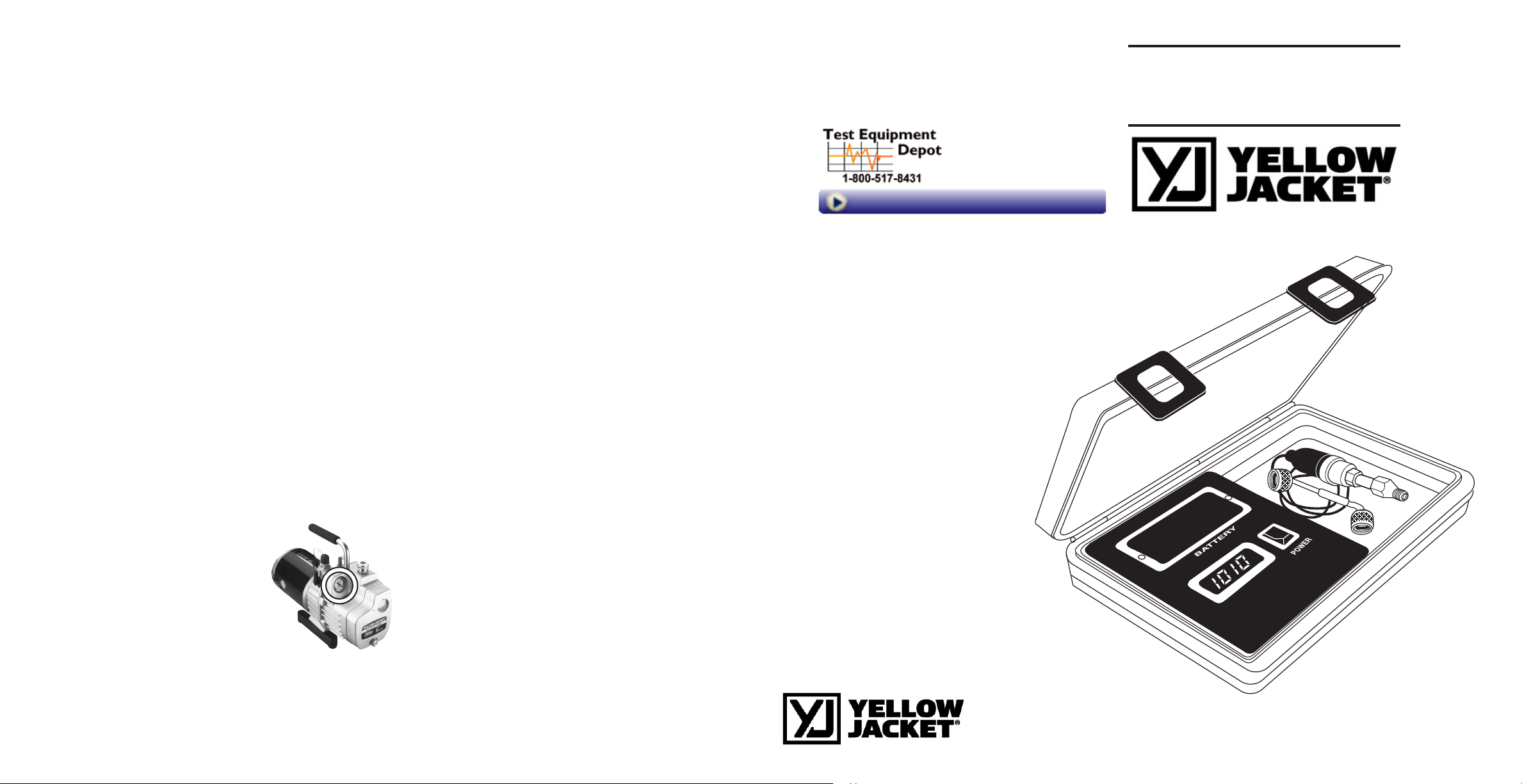
69075 Full Range SuperEvac LCD Vacuum Gauge
Micron range: 760,000 to 1
Sensor: Thermocouple 69073
Resolution: 1 micron (below 1,000 microns)
Operating Temperature: -30ºF to 125ºF
Display: 0.5” LCD
Automatic shut-off: 20 minutes after power-up
Unit size: 12.5”L x 2.4” H x 9”D
Sensor cable: coiled cable extends to 6’
Sensor thread: 1/8” MPT
Sensor adapter: 1/8” FPT x 1/4” Male Flare
Power: 1 “D” cell battery
1/4” Female Flare Coupler: 69071
Repair service
YELLOW JACKET products from Ritchie Engineering Company, Inc. are
guaranteed to be free from material and workmanship defects for a period of one
year. This guarantee does not cover products which have been altered, abused,
misused or improperly maintained.
All returns MUST have an RGA number and proof of purchase/copy of invoice.
Please obtain an RGA number from Ritchie Engineering customer service by
calling (800)769-8370. All returns must be pre-paid.
© 2002-2014 Ritchie Engineering
Printed in USA P/N 180355C
99 Washington Street
Melrose, MA 02176
Phone 781-665-1400
Toll Free 1-800-517-8431
Visit us at www.TestEquipmentDepot.com
Operation and Maintenance
Full Range SUPEREVAC
LCD Vacuum Gauge
UPC No
686800 -
.
™
®
69075
Page 2
IMPORTANT NOTICES TO PURCHASER Sensor and Gauge Installation and Operation
Check for damage immediately.
Carton contents include:
Digital 760,000 to 1 micron gauge
•
mounted on rugged housing
6’ coiled sensor cable
•
Thermocouple sensor with adapter
•
All metal coupler (69071)
•
Warranty registration card
•
Instructions
•
Warranty and Repair Policy
Prior to shipment, YELLOW JACKET
69075 Vacuum Gauges are calibrated,
tested and inspected to assure
compliance with specifications.
Manufacturer guarantees that all
products are free of manufacturing and
material defects to the original owner
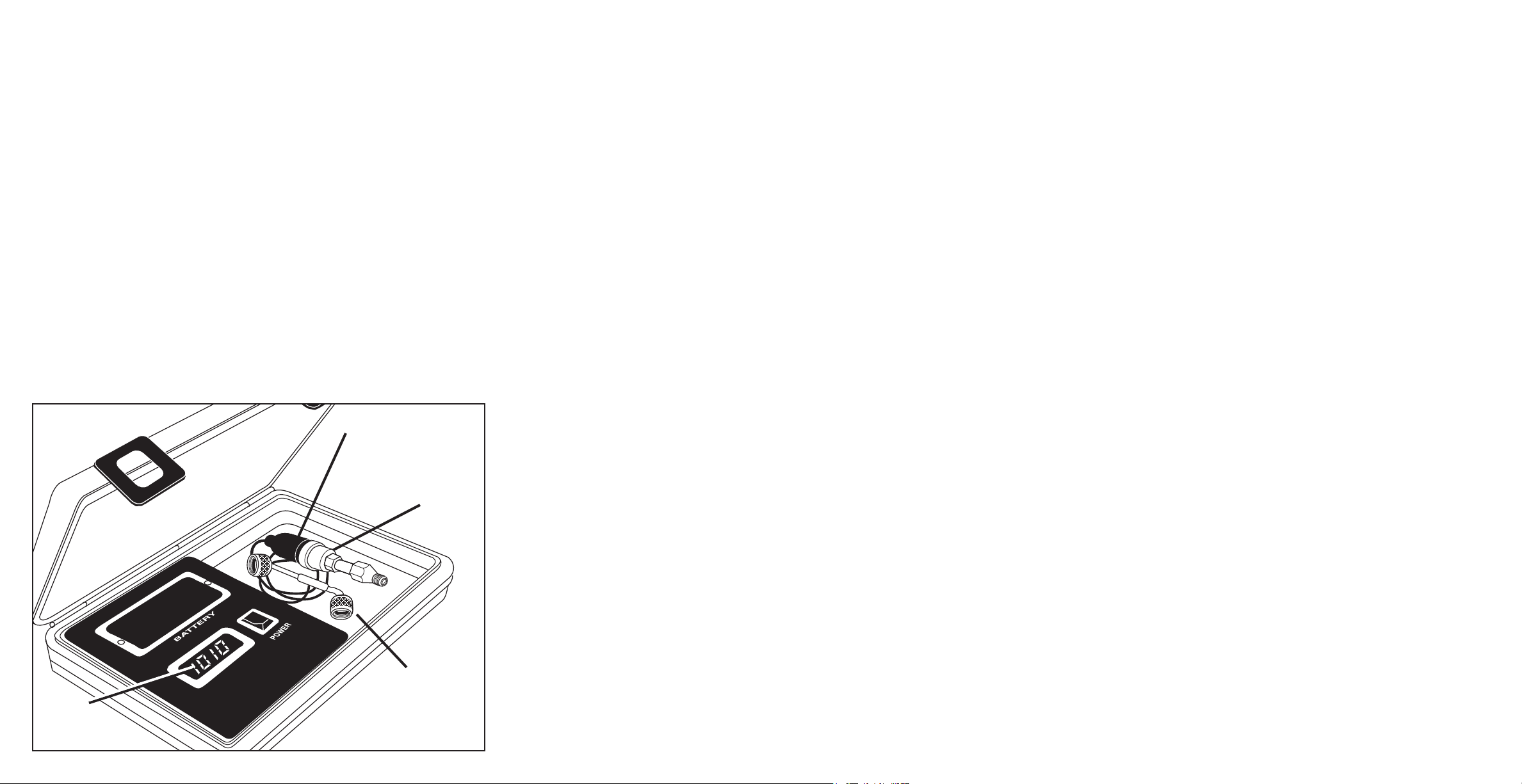
Impact resistant housing
Easy-to-read
high contrast
display
2
for one year from the purchase. In
order to protect your warranty,
return warranty card within 15
days from date of purchase. If an
instrument should fail during the
warranty period, it will be repaired or
replaced at no charge at the option of the
manufacturer. This warranty does not
apply to products that have been altered,
misused, or returned solely in need of
field service maintenance. Sensor
contamination is not covered by warran-
ty. Repairable instruments that are not
covered by the condition of the original
warranty will be repaired for a nominal
fee, F.O.B. shipping point. See back
cover for return details. Repairs will
carry an independent 90-day guarantee
of satisfaction.
Sensor plugs into
the cable connector
Thermocouple sensor is
factory calibrated and
provides consistent
accuracy
69071 coupler
Thermocouple sensor
Your new YELLOW JACKET 69075
LCD gauge system has a thermocou-
ple sensor. Thermocouple technology
has been long proven in laboratory and
industrial precision instrumentation for
sensing the lower vacuum range.
Thermocouple sensors are factory
calibrated and exhibit none of the
electronic variances of thermistor
sensors found in many other electronic
vacuum gauges.
Features of your gauge include:
Sense full micron range of
•
760,000 to 1 micron.
Ready-to-use with no adjust-
•
ments or warm-up. Pre-calibration is repeatable job after job.
Automatic ambient temperature
•
compensation.
Stays calibrated after on/off
•
switching and over long
evacuations.
Nickel-plated steel sensor
•
housing.
Sensors are interchangeable.
•
Battery condition display.
•
Automatic battery strength
•
compensation.
Automatic shut-off 20
•
minutes after power-up
The “thermo” of thermocouple relates
to the heat generated in the sensor by
electricity. As vacuum increases there
are fewer molecules of air or
contaminants to cool the thermocouple, and the temperature rises. The
change in temperature is transmitted as
input through the sensor cable to the
gauge’s circuitry.
4 5
Test Equipment Depot - 800.517.8431 - 99 Washington Street Melrose, MA 02176
YELLOW JACKET LCD Gauge
A rugged molded case protects the
gauge’s electronic circuitry. The
circuitry controls the electricity flow
that heats the sensor elements and
translates the temperature readings
into micron readings on the high
contrast LCD (liquid crystal display).
The gauge is a battery-powered
instrument. Normal handling and
jarring will not affect the LCD
reading.
Basic Set-up Sequence
1. Attach the coupler to the sensor
assembly. The coupler provides a
convenient method for connecting
to the system without adding a
significant source of additional
molecules.
2. Plug the sensor into the sensor
cable.
3. Attach the coupler, sensor and cable
to a dry part of the system. The
sensor will not work if it becomes
filled with system oil.
Always keep the sensor upright to
help prevent contamination and
ensure accurate readings.
If oil inadvertently enters the
coupler, the oil must be removed
before continuing.
4. Turn on the gauge and the LCD
illuminates immediately. If the
letters “LobA” appear in the left of
the display, the battery is not
powerful enough for use and must
be replaced.
TestEquipmentDepot.com
After the automatic battery condition
check, the number 760000 will appear
in the display. 760,000 microns is the
pressure of one atmosphere. Begin the
evacuation. The gauge will monitor
the vacuum from 760,000 to 1 micron.
Cleaning the sensor
If a sensor becomes lightly contami-
nated with oil or other foreign matter,
it may be possible to clean it. Disas-
semble the coupler and sensor from
each other. Flush or fill each with a
solvent that you know will remove the
contaminant. Before reuse, the
components should be completely
dried or flushed with a volatile solvent
to prevent contamination of the AC&R
system with moisture.
If the sensor is heavily contaminated,
you will need to purchase a 69073
replacement sensor from your
YELLOW JACKET wholesaler.
Gauge repair
The LCD gauge is designed for years
of trouble-free service. There are no
moving parts and the circuitry is
secured within the heavy-duty
molded case.
If service or recalibration of the LCD
unit does become necessary, the
instrument must be returned to the
factory. Any attempt at field service
other than replacing the sensor will
void the warranty.
Tips for best evacuation and
gauge performance
When pulling a vacuum take the
following steps:
1. If the reading on the YELLOW
JACKET pump built-in indicator
gauge stays in the mid range, there
is either high contamination or a
large leak in the system. (Through-
out the process, remember the
refrigerant recovery laws.)
If you think there is excessive
moisture, blow out the AC&R
system with dry nitrogen wherever
possible. This reduces the amount
of contaminants that must be pulled
into the pump, and increases
evacuation speed.
2. When the built-in indicator gauge
on the pump reaches the green
(29”-30”) range, it is time to turn
on the LCD vacuum gauge.
3. It is advised to purchase a 69067
ball valve to attach to the sensor.
Keeping the valve closed during
system pressurization isolates the
sensor from the system and helps
prevent damage to the sensor.
 Loading...