

Page 1
REVISION HISTORY
EG1L(GA)
CHASSIS
MODEL
PA RT NO.: 9-872-994-10
KLV-32V400A
NO. SUFFIX DATE SUPP / CORR DESCRIPTION
1 -01 2008/4 _ _ 1st Issue
2 -02 2008/7 SUPP-1 New model addition (Page 31)
3 -03 2008/7 CORR-1 Service Adjustment changes
(Page 18)(Page 19)(Page20)
4 -04 2008/8 SUPP-2 Part number change (Page 40)
5 -05 2008/8 SUPP-3 Part Information Change:
REAR COVER PART NUMBER (Page 41)
6 -06 2008/8 SUPP-4 Supplement (Wall Mount) Addition (Page 42)
7 -07 2008/9 SUPP-5 Part Information Change:
1. H4 Change to H4K (Page 44)
2. H3E Part number Change (Page 44)
8 -08 2008/10 CORR-2 1. Exploded View Changes (Page 23)(Page 24)
(Page 25)(Page 27) (Page 28)
2. Electrical Parts List Changes (Page 29)(Page 30)
9 -09 2008/11 CORR-3 Changes in Standby LED Error Display (Page 6)
10 -10 2008/12 SUPP-6 New model addition (Page 45)
Page 2
SERVICE MANUAL
EG1L(GA)
CHASSIS
MODEL COMMANDER DEST.
KLV-32V400A
KLV-32V400A/R
(Metal Red) Philippines,
KLV-32V400A/T
(Mat Brown) Philippines,
RM-GA011 E, EA, India, Iran,
ME, Philippines,
Saudi Arabia,
South Africa,
Thailand, Vietnam
RM-GA011 E, EA, ME,
Saudi Arabia,
South Africa,
Thailand
RM-GA011 E, EA, ME,
Saudi Arabia,
South Africa
MODEL COMMANDER DEST.
KLV-32V400A/W
(Pearl White) Philippines,
KLV-32V400B
RM-GA011 E, EA, ME,
Saudi Arabia,
South Africa,
Thailand
RM-GA011 Saudi Arabia,
Thailand
RM-GA011
LCD COLOR TV
Page 3

KLV-32V400A, V400B
RM-GA011
TABLE OF CONTENTS
Section Title Page
1. SAFETY NOTES
1-1. Caution Handling of LCD Panel ..................................... 3
1-2. Safety Check Out ............................................................. 3
1-3. Leakage Test .................................................................... 3
1-4. WARNING ! .................................................................... 3
1-5. LED Free Information ..................................................... 4
2. SELF DIAGNOSTIC FUNCTION
2-1. Overview of Control Buttons .......................................... 5
2-2. LED Display Specification.............................................. 5
2-3. LED Display Control ....................................................... 5
2-4. LED Pattern ..................................................................... 5
2-5. Standby LED Error Displays .......................................... 6
3. DISASSEMBLY
3-1. Rear Cover Removal........................................................ 7
3-2. Stand Assy Removal ........................................................ 7
3-3. Switch Unit Removal ...................................................... 8
3-4. GP Board and G1 Bracket Removal ............................... 9
3-5. BG1 Board & Bracket Removal.................................... 10
3-6. Vesa Frame Removal ..................................................... 11
3-7. H4, H3E Board and Speaker Bracket Removal ............ 12
3-8. LCD Panel and Bezel Assy Removal ............................ 13
4. WIRE DRESSING
4-1-1. Wire dressing overview for Non-CISPR model ........ 14
4-1-2. Wire dressing overview for CISPR model ................ 14
4-1-3. Dress LVDS cable with Sheet Core C (2X)
as shown ..................................................................... 14
4-1-4. i) Dress LVDS cable with Sheet Core C &
Shield Tape as shown
ii) Screw LVDS cable's clamp on main bracket
as shown ................................................................ 14
4-1-5. Dress Connector Assy 13P at G1 bracket's hook ...... 15
4-1-6. Dress Connector Assy 14P + 20P at G1
bracket's hook(5X) ..................................................... 15
4-1-7. Dress Connector Assy 14P + 20P with slide
clamp(2X) .................................................................. 15
4-1-8. Dress Connector Assy 14P + 20P on top of
Connector Assy 13P ................................................... 15
Section Title Page
4-1-9. Dress Connector Assy 14P + 20P & Speaker wire
with sheet core C(2X) ................................................ 15
4-1-10.i) Dress Speaker wire and Connector assy 14P + 20P
with Sheet Core C & Slide clamp
ii) Dress Speaker Wire with LCD tape ...................... 15
4-1-11.Dress Speaker Wire(L) with LCD tape(2X) ............. 16
4-1-12.Dress Connector Assy 14P + 20P with LCD tape .... 16
4-1-13.Install AC Cord Holder on AC Power Cord .............. 16
4-1-14.Install AC Cord Holder on AC Power Cord .............. 16
4-1-15.i) Screw Connector Assy 1P on BG1 Main Bracket
ii) Put Connector Assy 1P underneath
Speaker Wire ......................................................... 17
5. SERVICE ADJUSTMENTS
5-1. Accessing Diagnostic Menu .......................................... 18
5-2. Aging ............................................................................ 18
5-3. Accessing Service Menu ............................................... 18
5-4. Resetting the User Menu- Factory Reset ...................... 19
5-5. White Balance Adjustment............................................ 19
5-6. Board and Panel Replacement ...................................... 20
6. DIAGRAMS
6-1. Block Diagram ............................................................... 21
6-2. Circuit Board Location .................................................. 21
6-3. Schematic Diagram ....................................................... 22
6-4. Printed Wiring Boards ................................................... 22
6-5. Semiconductor ............................................................... 22
7. EXPLODED VIEWS
7-1. Rear Cabinet and Stand Assy ........................................ 23
7-2. Frame and Cover ...........................................................24
7-3. Chassis-1 ........................................................................ 25
7-4. Chassis-2 ........................................................................ 26
7-5. H3E & H4 Boards and Speaker .................................... 27
7-6. Bezel Assy and LCD Panel ........................................... 28
8. ELECTRICAL PARTS LIST .............................................. 29
OPERATING INSTRUCTIONS
– 2 –
Page 4
SECTION 1
SAFETY NOTES
KLV-32V400A, V400B
RM-GA011
1-1. Caution Handling of LCD Panel
When installing the LCD Panel, make sure you are grounded
with a wrist band.
When installing the LCD Panel on the wall, the panel must be
secured using the 4 mounting holes on the rear cover.
1) Do not press the panel or frame edge to avoid the risk of
electric shock.
2) Do not scratch or press on the panel with any sharp
objects.
3) Do not leave the module in high temperature or in areas of
high humidity for an extended period of time.
4) Do not expose the LCD panel to direct sunlight.
5) Avoid contact with water. It may cause short circuit within
the module.
6) Disconnect the AC adapter when replacing the backlight
(CCFL) or inverter circuit. (High voltage occurs at the inverter
circuit at 650Vrms)
7) Always clean the LCD panel with a soft cloth material.
8) Use care when handling the wires or connectors of the
inverter circuit. Damaging the wires may cause a short circuit.
9) Protect the panel from ESD to avoid damaging the electronic circuit (C-MOS).
1-2. Safety Check-Out
After correcting the original service problem, perform the
following safety checks before releasing the set to the
customer:-
1-3. Leakage Test
The AC leakage from any exposed metal part to earth
ground and from all exposed metal parts to any exposed
metal part having a return to chassis must not exceed 0.5mA
(500 microamperes). Leakage current can be measured by
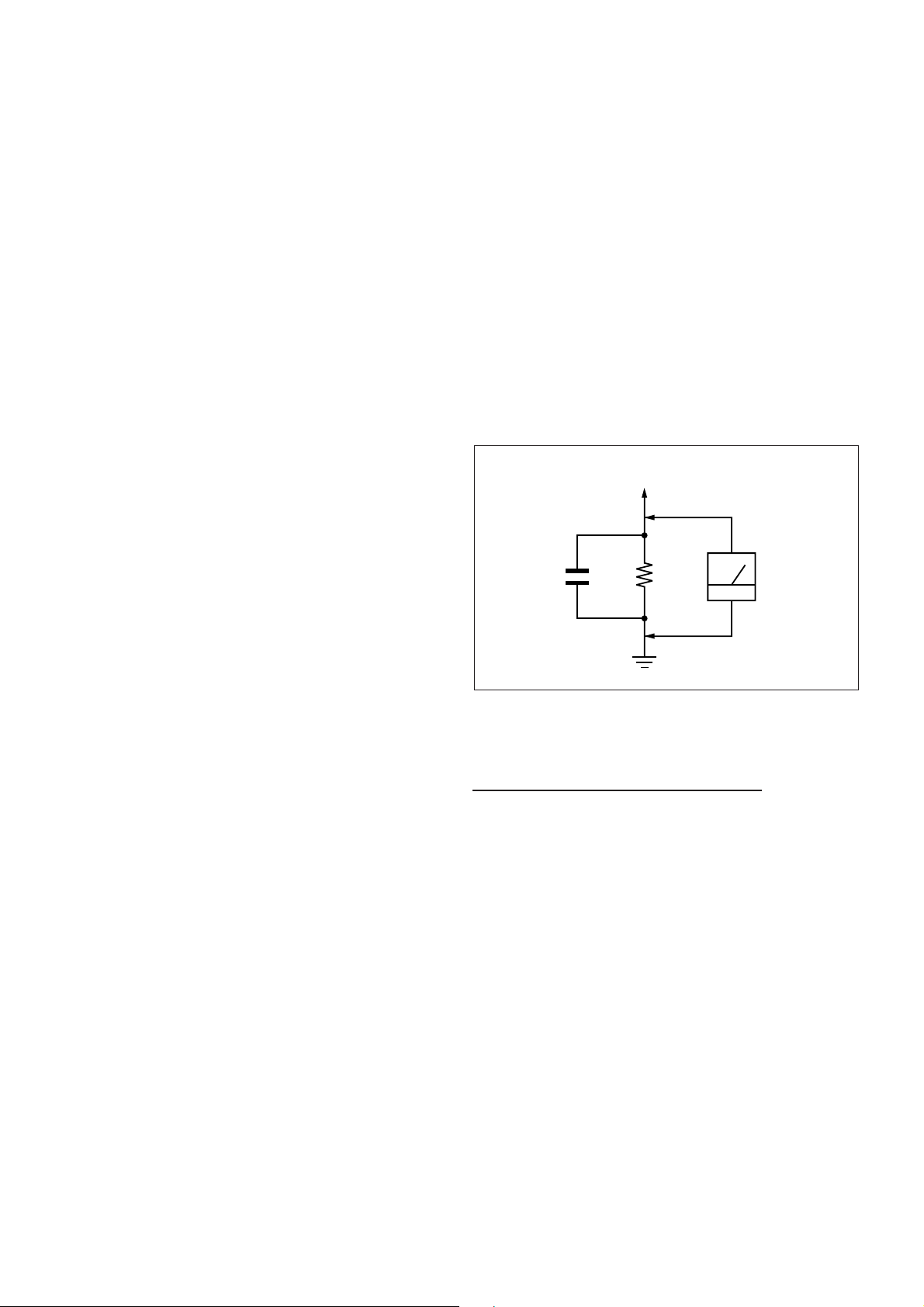
any one of the three methods:-
1. A commercial leakage tester such as the SIMPSON 229
or RCA WT-540A. Follow the manufacturers instructions to
use those instructions.
2. A battery-operated AC milliampmeter. The DATA
PRECISION 245 digital multimeter is suitable for this job.
3. Measuring the voltage drop across a resistor by means
of a VOM or battery operated AC voltmeter. The 'limit' indication is 0.75V so analog meters must have an accurate low
voltage scale. The SIMPSON'S 250 and SANWA SH-63TRD
are examples of passive VOMs that are suitable. Nearly all
battery operated digital multimeters that have a 2 VAC range
are suitable. (see FIGURE 1)
To Exposed Metal
Parts on Set
0.15 µF
1.5 k
Ω
AC
Voltmeter
(0.75 V)
1) Check the area of your repair for unsoldered or poorly
soldered connections. Check the entire board surface for
solder splashes and bridges.
2) Check the interboard wiring to ensure that no wires are
"pinched" or contact high-wattage resistors.
3)Check all control knobs, shields, covers, ground straps and
mounting hardware have been replaced. Be absolutely certain
you have replaced all the insulators.
4) Look for unauthorized replacement parts, particularly
transistors that were installed during a previous repair. Point
them out to the customer and recommend their replacement.
5) Look for parts which, though functioning show obvious
signs of deterioration. Point them out to the customer and
recommend their replacement.
6) Check the line cords for cracks and abrasion.
Recommend the replacement of any such line cord to the
customer.
7) Check the antenna terminals, metal trim, "metallized"
knobs, screws and all other exposed metal parts for AC
leakage. Check leakage test as described next.
Earth Ground
Figure 1. AC voltmeter to check AC leakage
1-4. WARNING !
SAFETY-RELATED COMPONENT WARNING!
COMPONENTS IDENTIFIED BY SHADING AND MARK
!
ON THE EXPLODED VIEWS ARE CRITICAL FOR SAFE
OPERATION. REPLACE THESE COMPONENTS WITH
SONY PARTS WHOSE PART NUMBERS APPEAR AS
SHOWN IN THIS MANUAL OR IN SUPPLEMENTS
PUBLISHED BY SONY. CIRCUIT ADJUSTMENTS THAT ARE
CRITICAL FOR SAFE OPERATION ARE IDENTIFIED IN
THIS MANUAL. FOLLOW THESE PROCEDURES
WHENEVER CRITICAL COMPONENTS ARE REPLACED
OR IMPROPER OPERATION IS SUSPECTED.
– 3 –
Page 5
KLV-32V400A, V400B
RM-GA011
1-5. LED Free Information
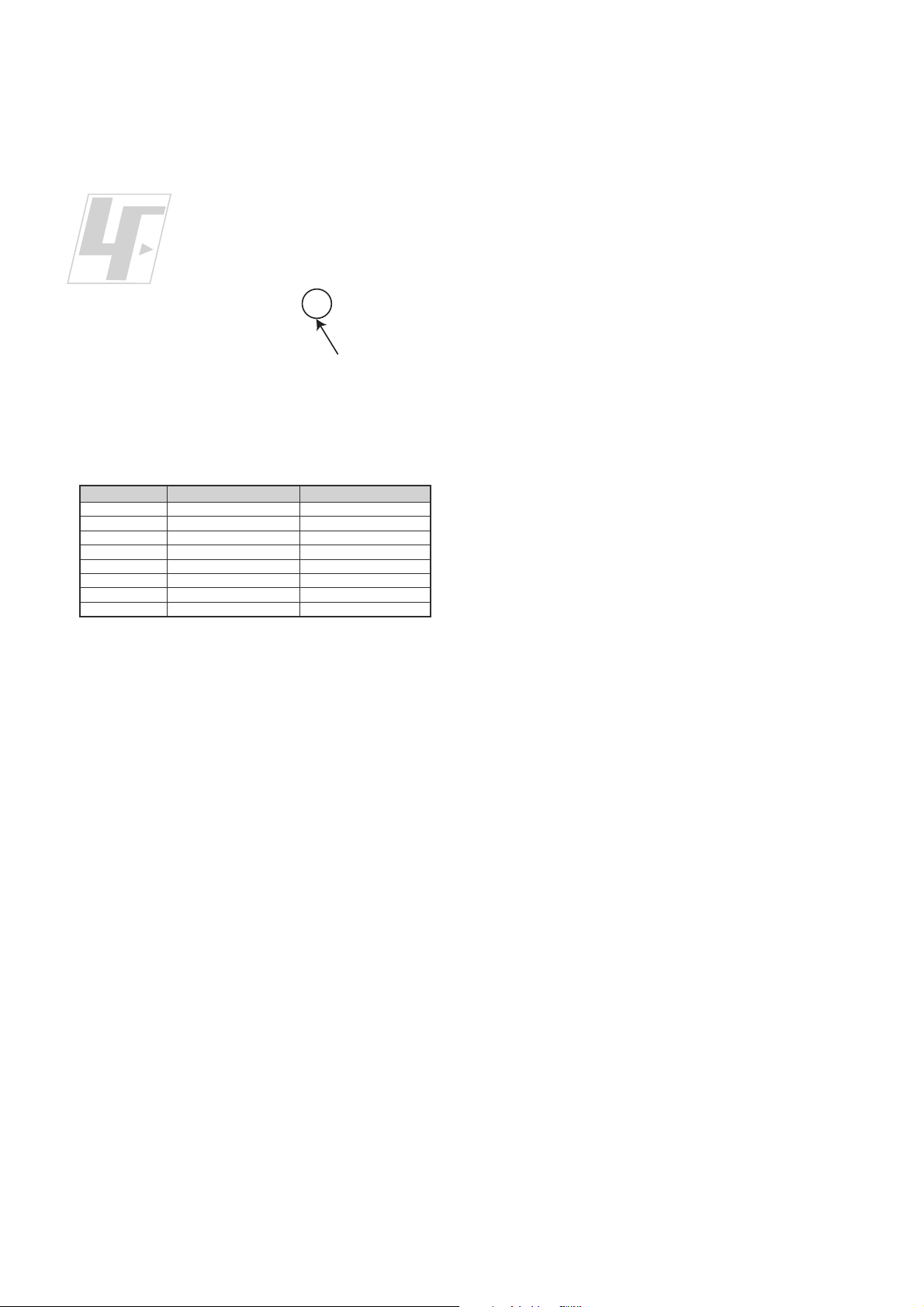
The circuit boards used in these models have been processed
using Lead Free Solder. The boards are identified by the LF
logo located close to the board designation.
Figure 2: LF logo
Figure 3: LF logo on circuit board
The servicing of these boards requires special precautions. It
is strongly recommended to use Lead Free Solder material in
order to guarantee optimal quality of new solder joints. Lead
Free Solder is available under the following part numbers:-
rebmuntraP retemaiD skrameR
7
91-500-046-mm
02-500-046-7m4.0Kg05.0
12-500-046-7m5.0Kg05.0
22-500-046-7m6.0Kg52.0
32-500-046-7m8.0Kg00.1
42-500-046-7m0.1Kg00.1
52-500-046-7m2.1Kg00.1
62-500-046-7m6.1Kg00.1
3.0Kg52.0
m
m
m
m
m
m
m
Due to high melting point of Lead Free Solder, the soldering
iron tip temperature needs to be set to 370 degrees
centigrade. This requires soldering equipment capable of
accurate temperature control coupled with a good heat
recovery characteristics.
For more information on the use of Lead Free Solder,
please refer to http://www.sony-training.com
– 4 –
Page 6
SECTION 2
SELF DIAGNOSTIC FUNCTION
KLV-32V400A, V400B
RM-GA011
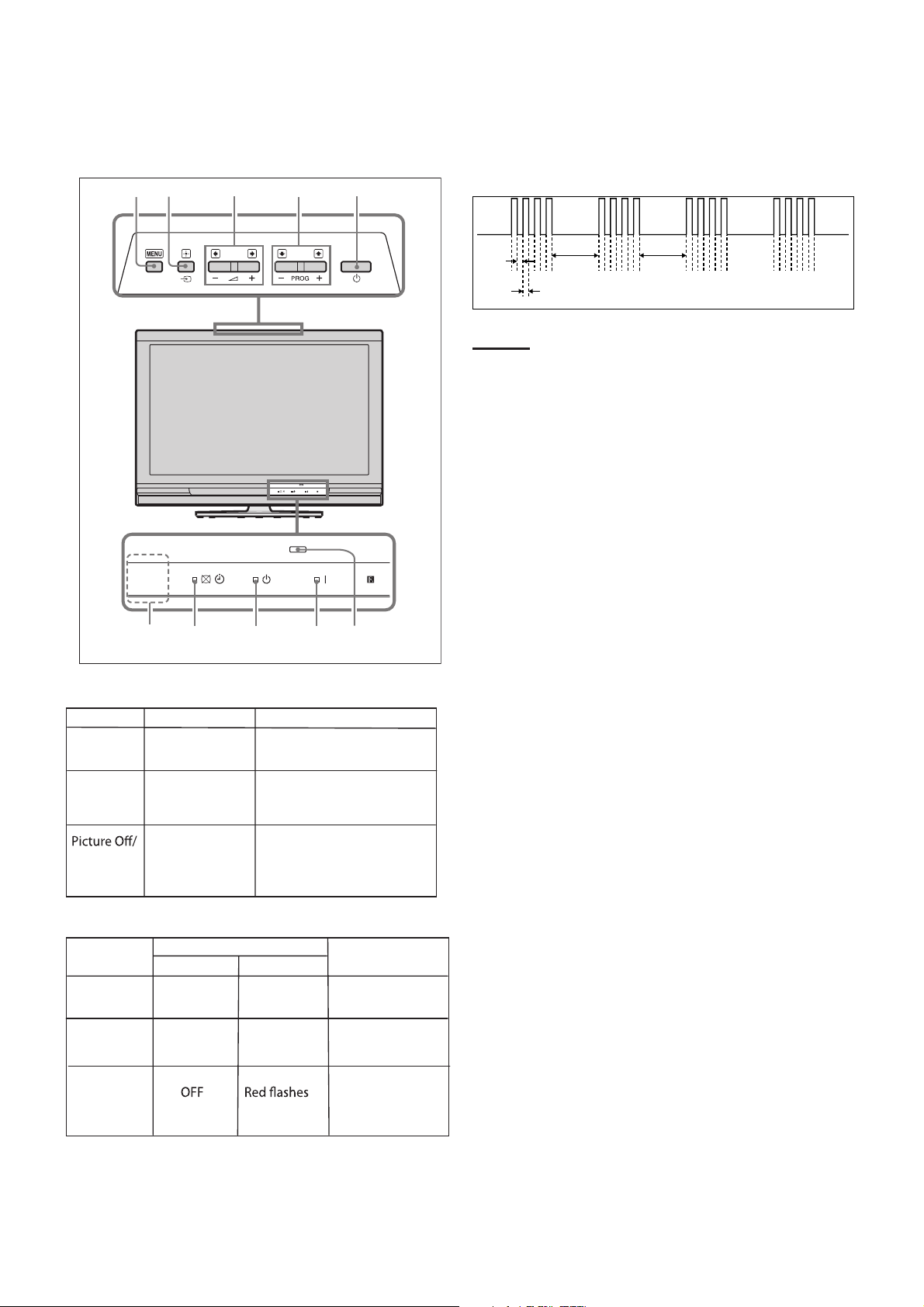
2-1. Overview of Control Buttons
MENU TV/VIDEO VOLUME CHANNEL POWER
2-4. LED Pattern
When safety shutdown occurs, Standby LED display reports the
cause by using the lightning patterns as indicated below.
0.3 sec
0.3 sec
2.0 sec 2.0 sec
Example:
The figure above shows LED display when
SHUTDOWN is caused by DC_ALERT 2. It repeats
flashing for a specified number of times in 0.3sec/
cycle and has a 2 seconds interval of lighting off.
Please note that a 2 seconds interval of lighting off
is fixed regardless of abnormal state types.
LIGHT
SENSOR
PICTURE
OFF/
TIMER
STANDBY POWER
REMOTE
SENSOR
2-2. LED Display Specification
LED Typ e Description
POWER Green: LED
Remark
Green lights at power ON.
STANDBY Red: One LED Red lights during standby.
Green lights during Picture
OFF and amber lights
Timer
Green/Amber
: Two LEDs
during Timer activation.
2-3. LED Display Control
Status
Power LED
Display
Standby LED
POWER ON Green lights OFF
STANDBY
OFF Red lights
Remark
Microcomputer is
in a normal state.
Microcomputer is
in a sleep state.
Failure
Classify the
trouble causes by
the no. of red.
– 5 –
Page 7
KLV-32V400A, V400B
RM-GA011
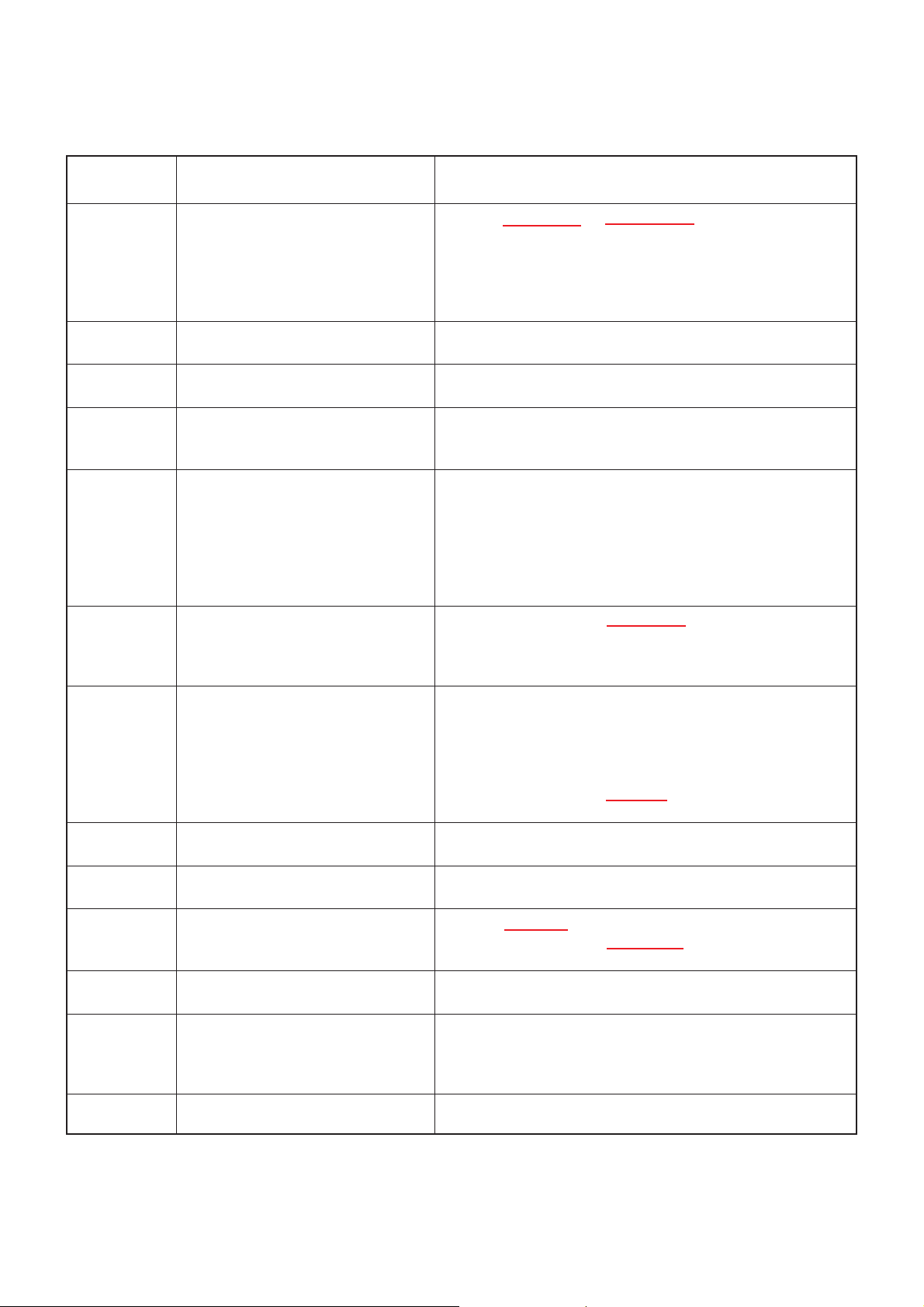
2-5. Standby LED Error Display
Perform below countermeasures according to Standby LED blinking times.
Blinking times Error Countermeasure
2 DC_DET (12V Main Voltage) Replace either/both z BG1 Board
3 DC_ALERT 1 Replace BG1 board.
4 DC_ALERT 2 Replace BG1 board.
5 DC_ALERT 3 Replace either/both z BG1 board
z GD Board (20”)
z GP Board (26" and 32")
z G2 Board (37”)
z IP5 Board (40”, 46”)
z Panel
6BACKLIGHT/ Replace either/all z GD Board (20”)
INVERTER ERROR z GP Board (26” and 32”)
z G2 Board (37”)
z IP5 Board (40”, 46”)
z BG1 Board
z Panel
7 INTERNAL TEMP Replace either/both z GP board
ERROR z BG1 board
z Panel
8AUDIO ERROR Replace either/all z GD Board (20”)
z GP Board (26” and 32”)
z G2 Board (37”)
z IP5 Board (40”, 46”)
z BG1 Board
z Speaker
9 Not used for GA —
10 Not used for GA —
11 NVM ERROR Replace either/all z BG1 Board
z GP board
12 IIC ERROR Replace BG1 board.
13 BALANCER ERROR Replace either/all z IP5 Board (40”,46”)
z BG1 Board
z Panel
14 HDMI ERROR Replace BG1 board
Note: Each of the above blinking repeats every 2 seconds.
– 6 –
Page 8

1-1. Rear Cover Removal
2 Two screws
(+BVTP 3 X 12)
3 Two screws
(+PSW M3 X 5)
1 Eighteen screws
(BVTP2 4 X 16)
KLV-32V400A, V400B
RM-GA011
SECTION 3
DISASSEMBLY
4 One screw
(PSW 5 X 8)
5 Lift to remove Rear Cover
3-2. Stand Assy Removal
1 Three screws
(+PSW 5 X 16)
2 Stand assy
3 One screw
(BVTP2 4 X 16)
4 Under Bar (M) Assy
– 7 –
Page 9
KLV-32V400A, V400B
RM-GA011
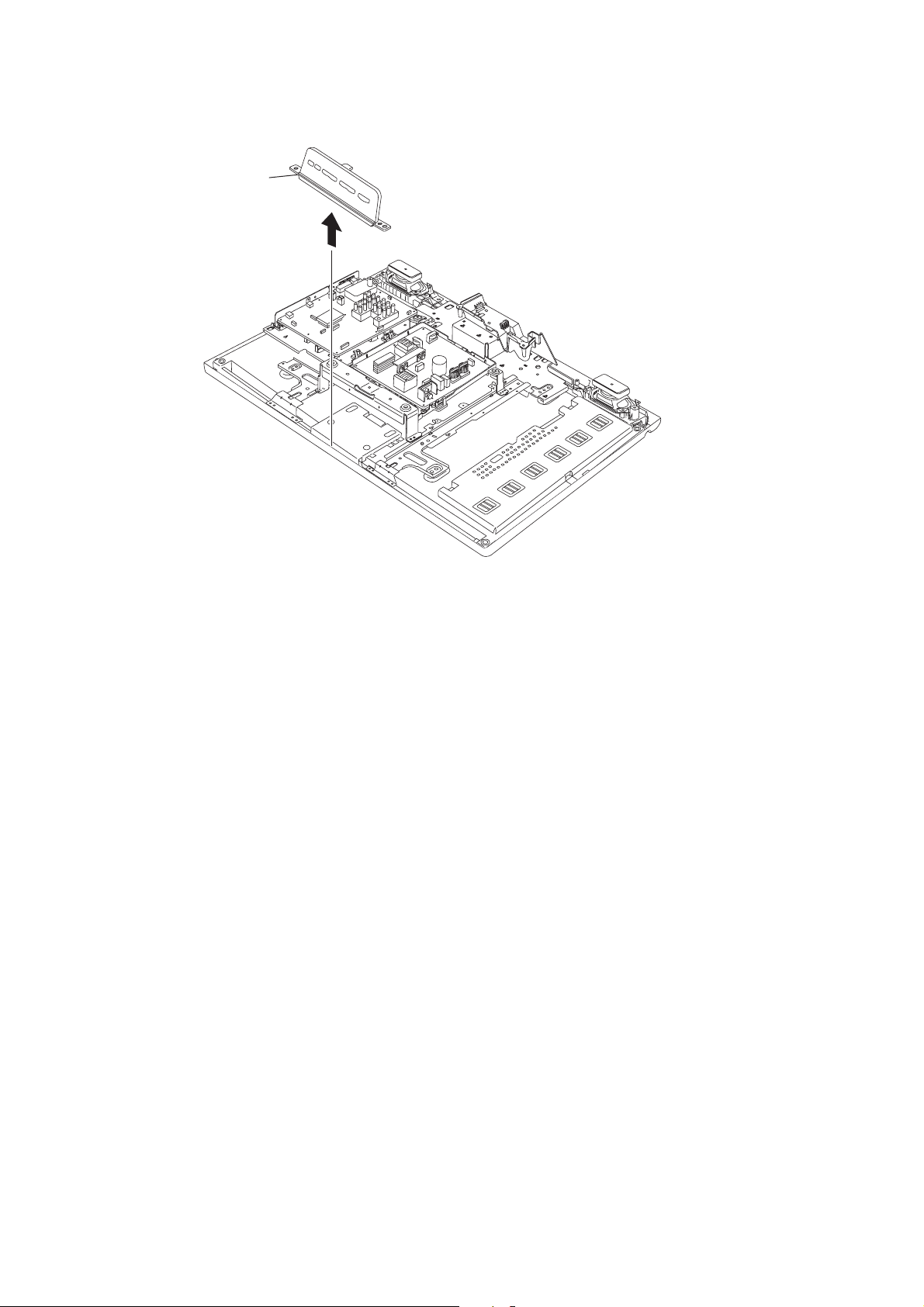
3-3. Switch Unit Removal
3
Switch unit
1
2
Lift tabs to
remove board
– 8 –
Page 10
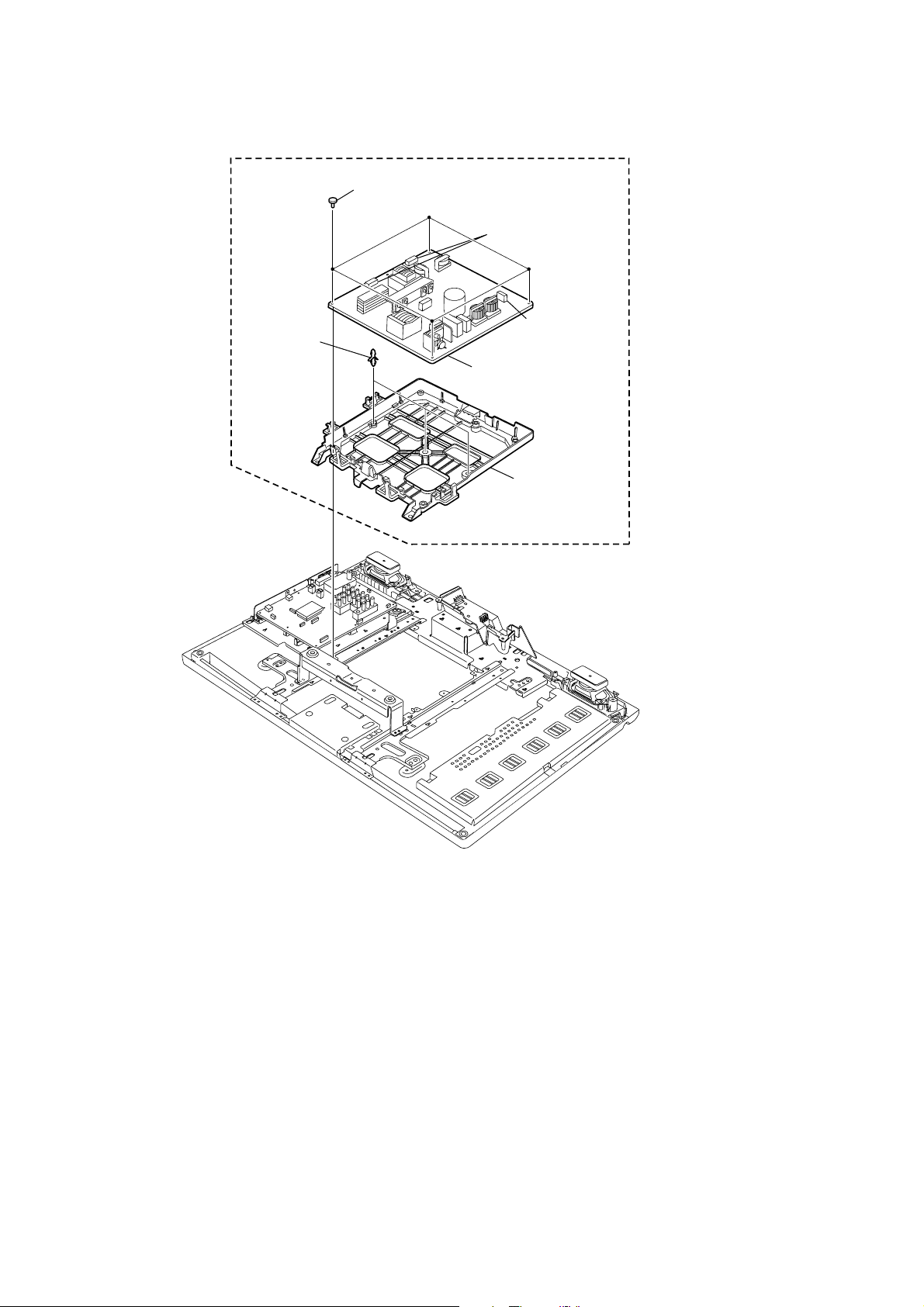
3-4. GP Board and G1 Bracket Removal
1 Four screws
(+PSW 3SG)
KLV-32V400A, V400B
RM-GA011
2 Two connectors
CN6201 and CN6202
6 Three holder
PC board
3 One connector
CN6102
4 GP board
5 G1 bracket
– 9 –
Page 11

KLV-32V400A, V400B
RM-GA011
3-5. BG1 Board and Bracket Removal
1 One screw
(+PSW 3 X 5)
3 Eight connectors
CN2000, CN2004, CN3000,
CN3003, CN7000, CN9003,
CN9200, CN9512
6 One screw
(BVTP2 4 X 16)
5 Side Jack Bracket Assy
2 Nine screws
(+BVST 3 X 8)
4 BG1 board
7 Two screws
(+BVST 3 X 8)
8 Main Bracket
– 10 –
Page 12
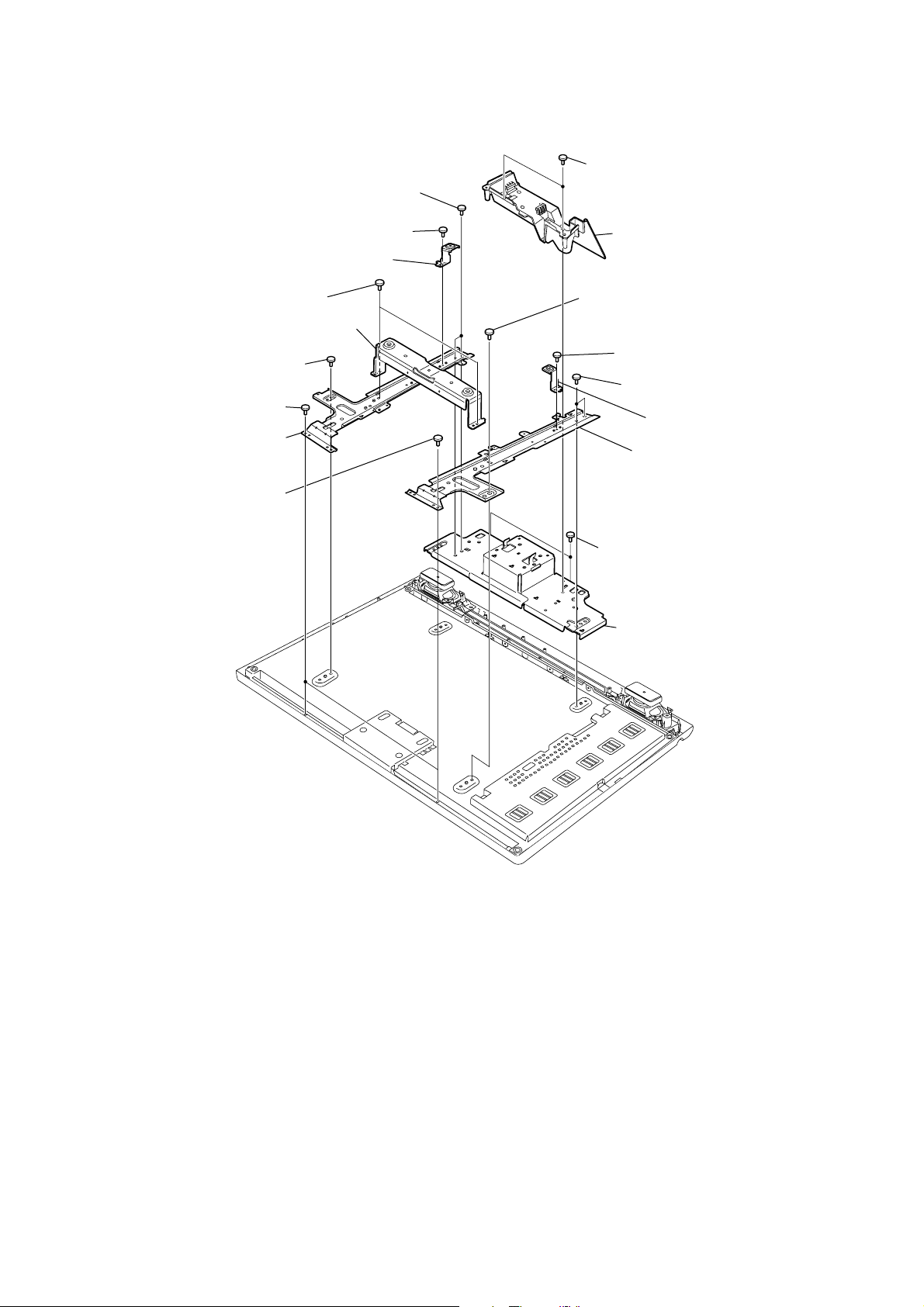
3-6. Vesa Frame Removal
KLV-32V400A, V400B
RM-GA011
3 Vesa Frame (Bottom) (32L)
qh Two screws
(+PSW M4 X 8)
2 One screw
(+PSW M4 X 8)
1 One screw
(BVTP2 4 X 16)
5 Frame, spine (32L)
qg One screw
(BVTP2 4 X 16)
6 Two screws
(+PSW M4 X 8)
4 One screw
(+PSW M4 X 8)
qj Vesa top
7 Two screws
(+BVTP 3 X 12)
8 Under Cover (M)
qh One screw
(+PSW M4 X 8)
9 One screw
(+PSW M4 X 8)
q; Two screws
(+PSW M4 X 8)
qf Vesa Frame (Bottom) (32R)
qs Frame Spine (32R)
qa Two screws
(BVTP2 4 X 16)
qd Frame Bottom (32)
– 11 –
Page 13
KLV-32V400A, V400B
RM-GA011
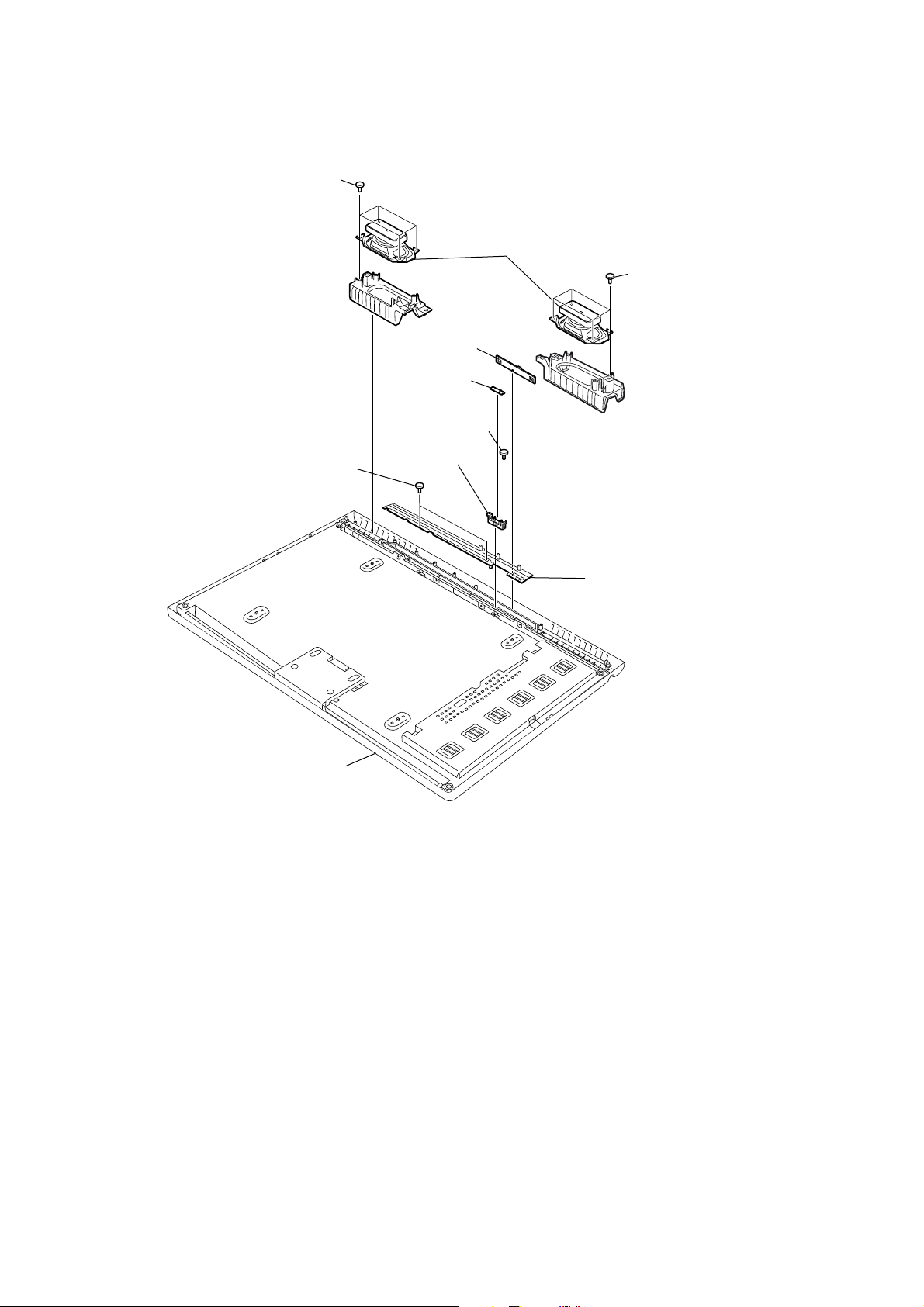
3-7. H4, H3E Board and Speaker Bracket Removal
1 Four screws
(+BVTP 4 X 12)
0 Two screws
(+BVTP2 4 X 16)
3 Loudspeaker (5.5 X 12cm)
2 Four screws
(+BVTP 3 X 12)
5 H3E board
4 H4 board
6 One screw
(+BVTP 3 X 12)
7 Guide Light
8 Bezel assy
9 Clear panel
– 12 –
Page 14
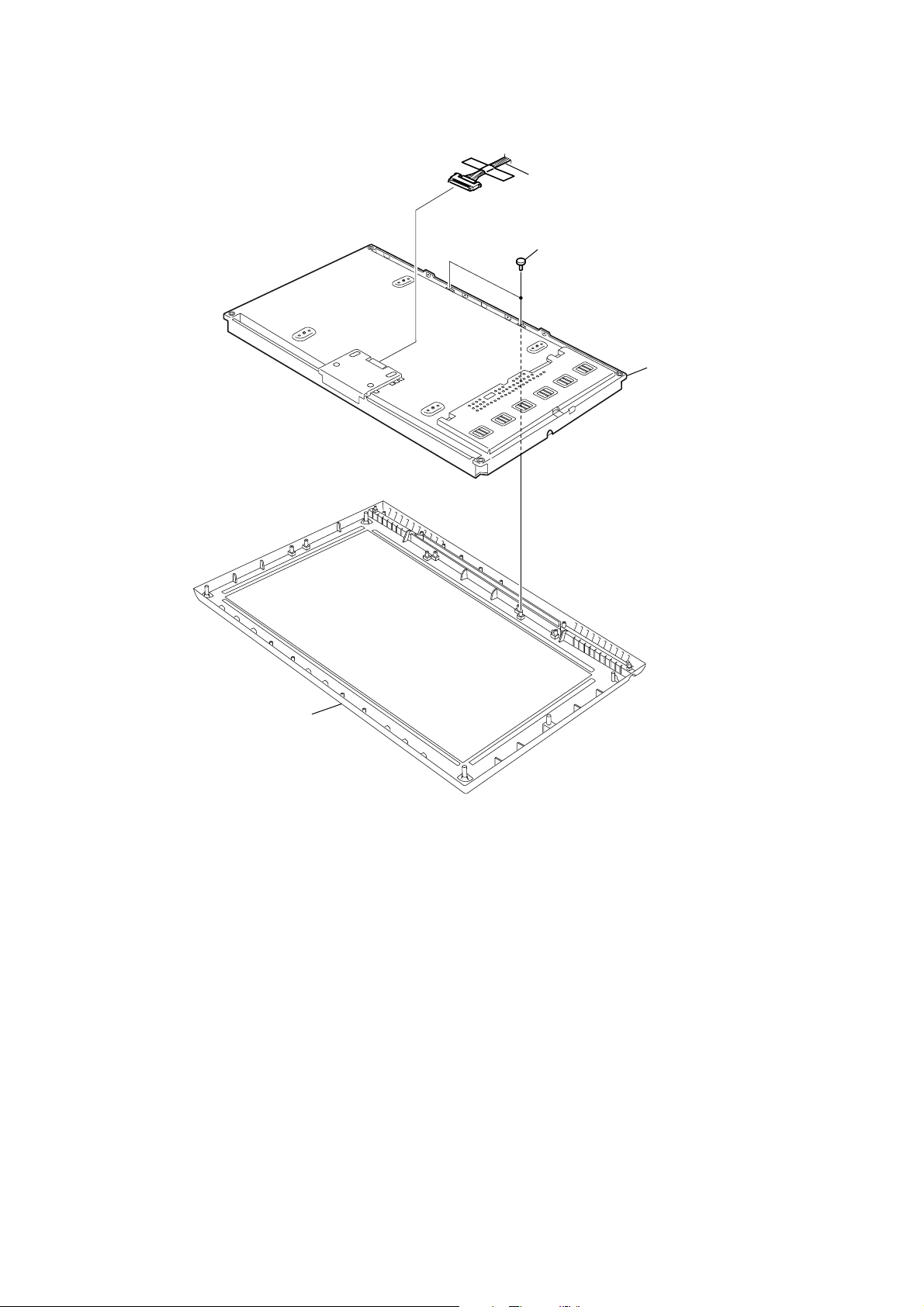
3-8. LCD Panel and Bezel Assy Removal
KLV-32V400A, V400B
RM-GA011
2 Harness
with connector
1 Two screws
(BVTP2 4 X 16)
3 LCD panel
4 Bezel assy
– 13 –
Page 15
KLV-32V400A, V400B
RM-GA011
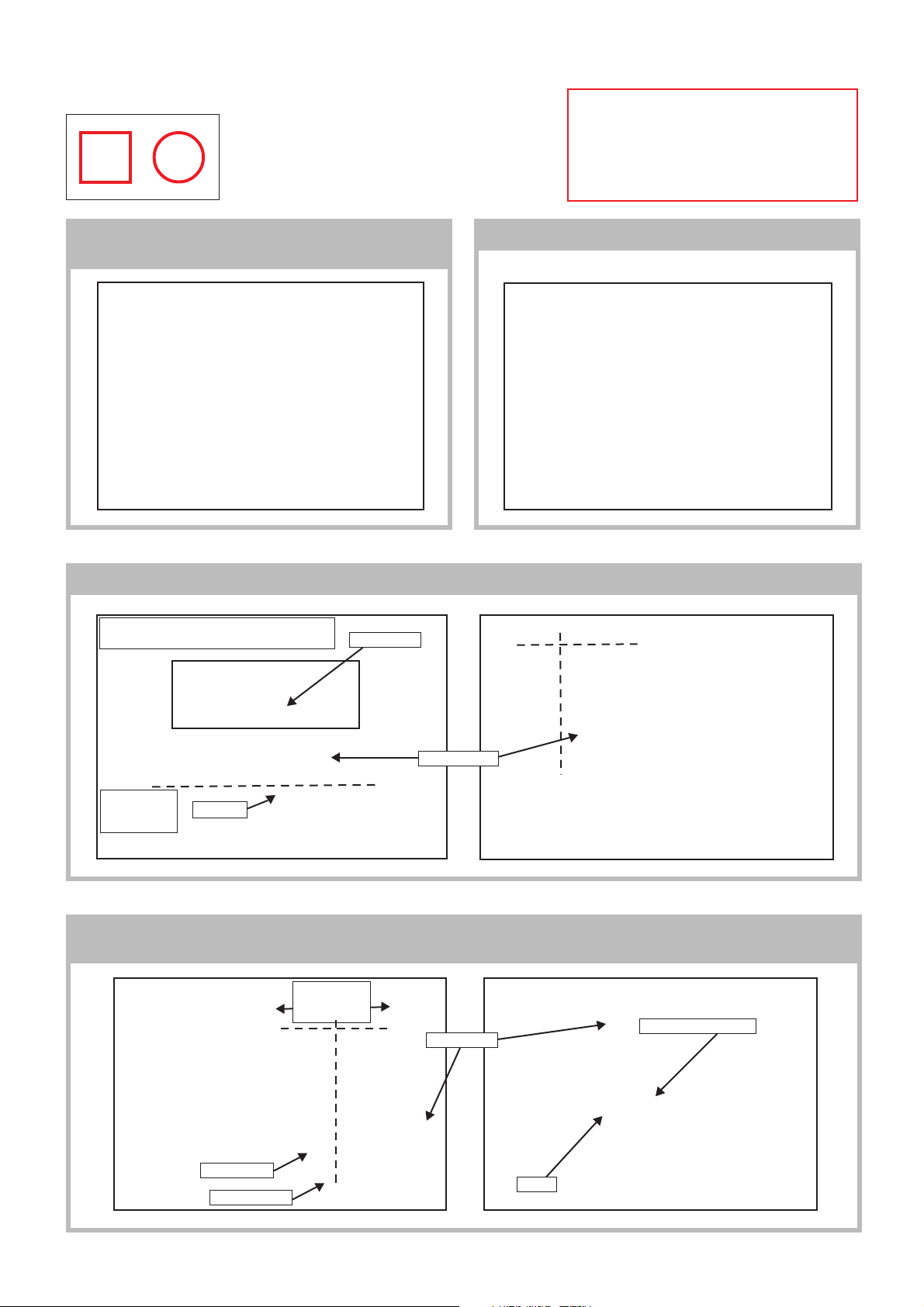
Legend
HookSlide Clamp
SECTION 4
WIRE DRESSING
CAUTION :
1. Do not overpull the wires during dressing
--> avoid disconnection of wires.
2. Make sure wires are kept away from
sharp edges, heatsinks & other
high-temperature parts.
4-1-1. Wire dressing overview for
Non-CISPR model
For Non-CISPR model only
4-1-3. Dress LVDS cable with Sheet Core C (2X) as shown
Make sure LVDS connector fully inserted
with correct direction as shown.
LVDS cable
4-1-2. Wire dressing overview for CISPR model
Datum
Datum
Sheet Core C
Use UL tape
location as
guide line
UL Tape
Datum
For CISPR model only
4-1-4. i) Dress LVDS cable with Sheet Core C & Shield Tape as shown
ii) Screw LVDS cable's clamp on main bracket as shown
Apply tape at
the middle of
Shield Tape
Sheet Core C
this area.
Datum
Datum
LVDS cable
Screw
LVDS cable's clamp
– 14 –
Page 16
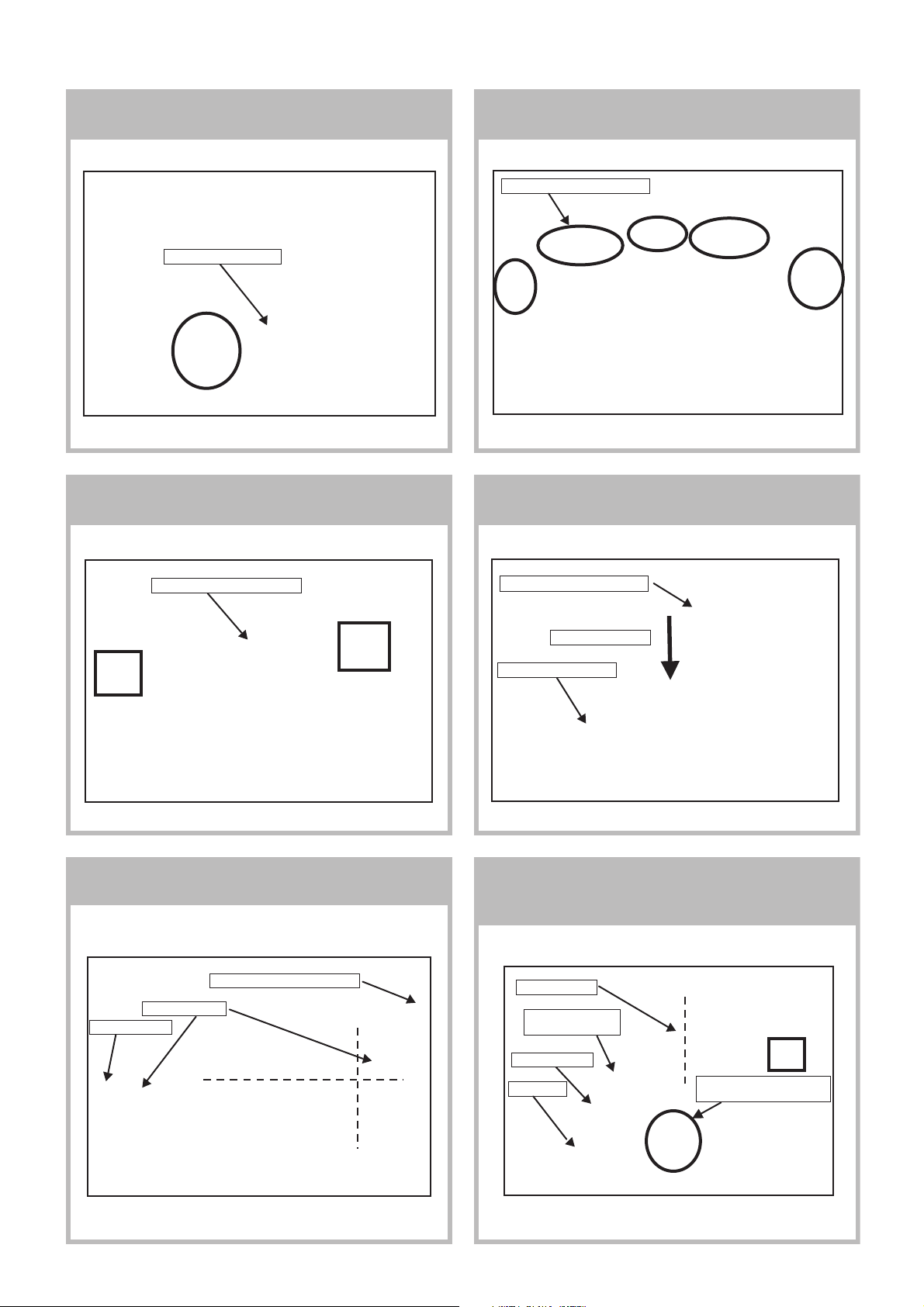
KLV-32V400A, V400B
RM-GA011
4-1-5. Dress Connector Assy 13P at
G1 bracket's hook
Connector assy 13P
4-1-7. Dress Connector Assy 14P+20P with
slide clamp(2X)
4-1-6. Dress Connector Assy 14P+20P at G1
bracket's hook(5X)
Connector assy 14P+20P
4-1-8. Dress Connector Assy 14P+20P on top of
Con
nector Assy 13P
Connector assy 14P+20P
4-1-9. Dress Connector Assy 14P+20P &
Speaker wire with sheet core C(2X)
Connector assy 14P+20P
Sheet Core C
Speaker Wire
Connector assy 14P+20P
Pull wire straight
Connector assy 13P
4-1-10. i) Dress Speaker wire and Connector assy
14P+20P with Sheet Core C & Slide clamp
ii) Dress Speaker Wire with LCD tape
Sheet Core C
Connector assy
14P+20P
Datum
Datum
Datum
– 15 –
Speaker Wire
LCD tape
Insert wire into speaker
bracket's hook
Page 17
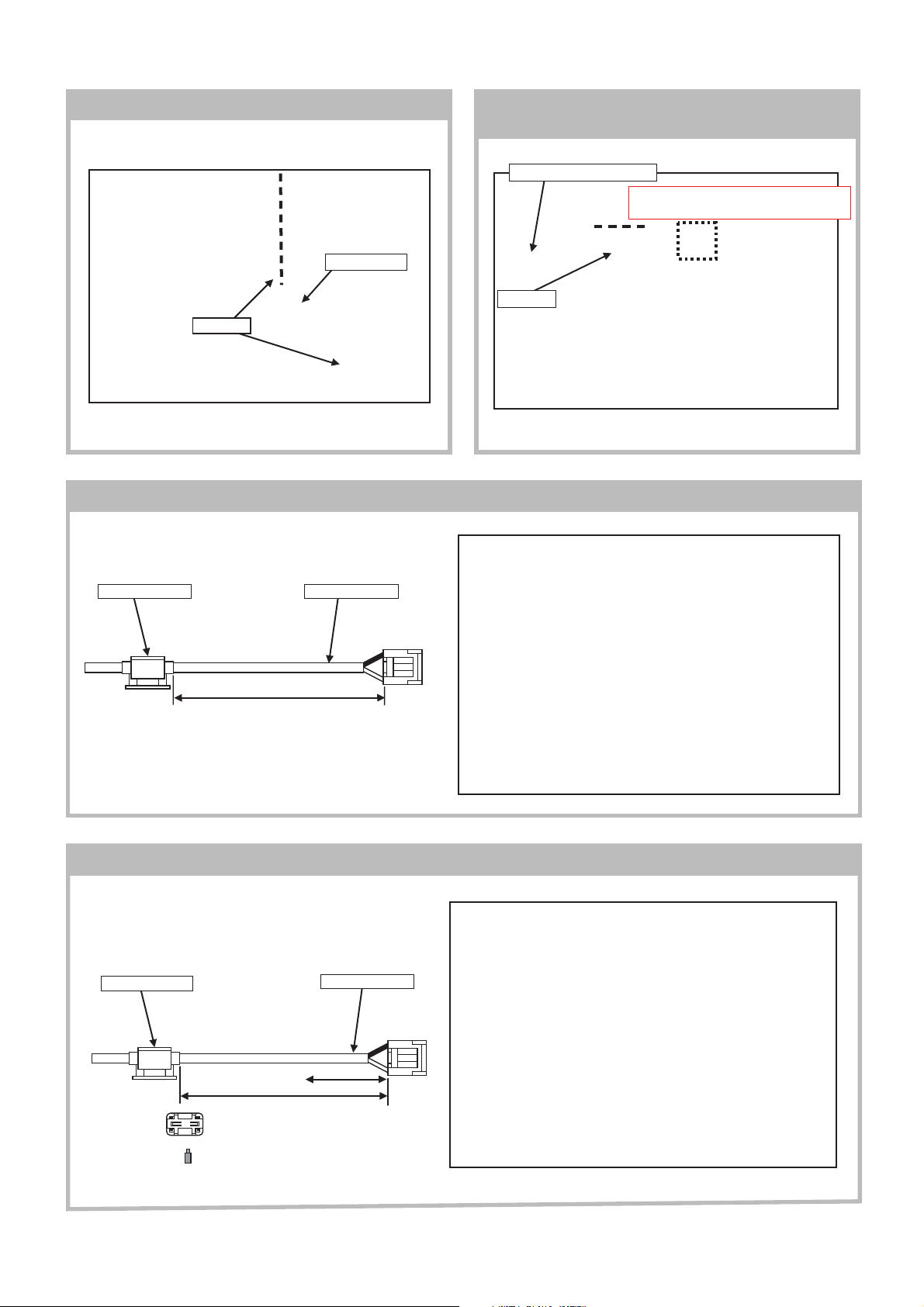
KLV-32V400A, V400B
RM-GA011
4-1-11. Dress Speaker Wire(L) with LCD tape(2X). 4-1-12. Dress Connector Assy 14P+20P with
LCD tape.
Datum
Speaker Wire
LCD tape
For Non-CISPR model only
4-1-13. Install AC Cord Holder on AC Power Cord.
AC Cord holder
AC Power Cord
Connector assy 14P+20P
Datum
LCD tape
Caution : Pull wire until cannot reach
Caution : Pull wire until cannot reach
sharp edge area when apply LCD tape.
sharp edge area when apply LCD tape.
170mm
For CISPR model only
4-1-14. Install AC Cord Holder on AC Power Cord.
AC Cord holder
170mm
Ferrite Core
AC Power Cord
70mm
Cable tie
Note : Make sure tighten cable tie and cut excess part.
– 16 –
Page 18
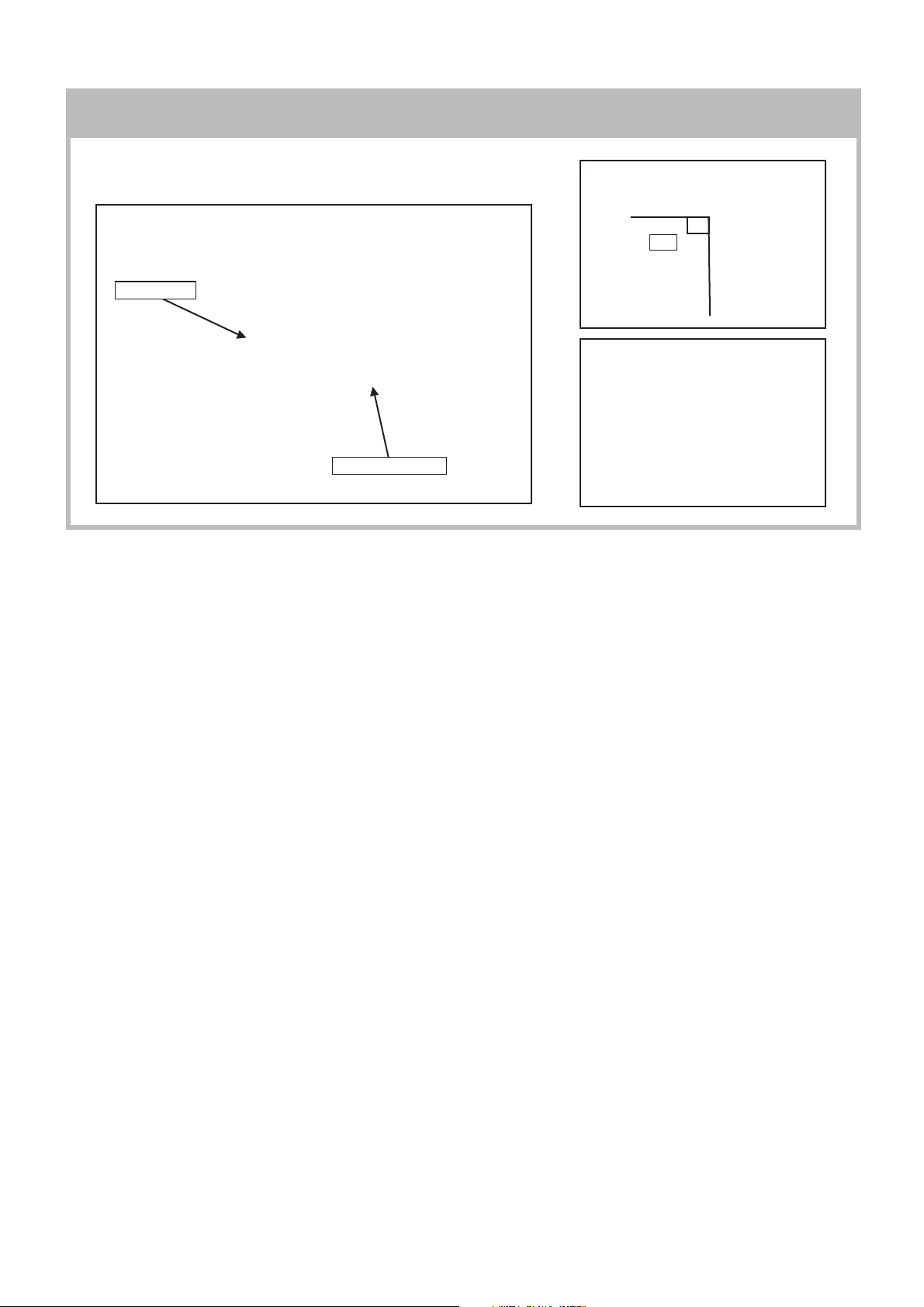
4-1-15. i) Screw Connector Assy 1P on BG1 & Main Bracket.
ii) Put Connector Assy 1P underneath Speaker Wire.
Speaker Wire
Connector Assy 1P
KLV-32V400A, V400B
RM-GA011
~90
– 17 –
Page 19
KLV-32V400A, V400B
ERROR
DC_DET
DC_ALERT1
DC_ALERT2
DC_ALERT3
BACKLIGHT
INTERNAL TEMP ERROR
AUDIO ERROR
NVM ERROR
IIC ERROR
BALANCER ERROR
HDMI ERROR
0
0
0
0
0
0
0
0
0
0
0
RESET
0
RM-GA011
SECTION 5
SERVICE ADJUSTMENTS
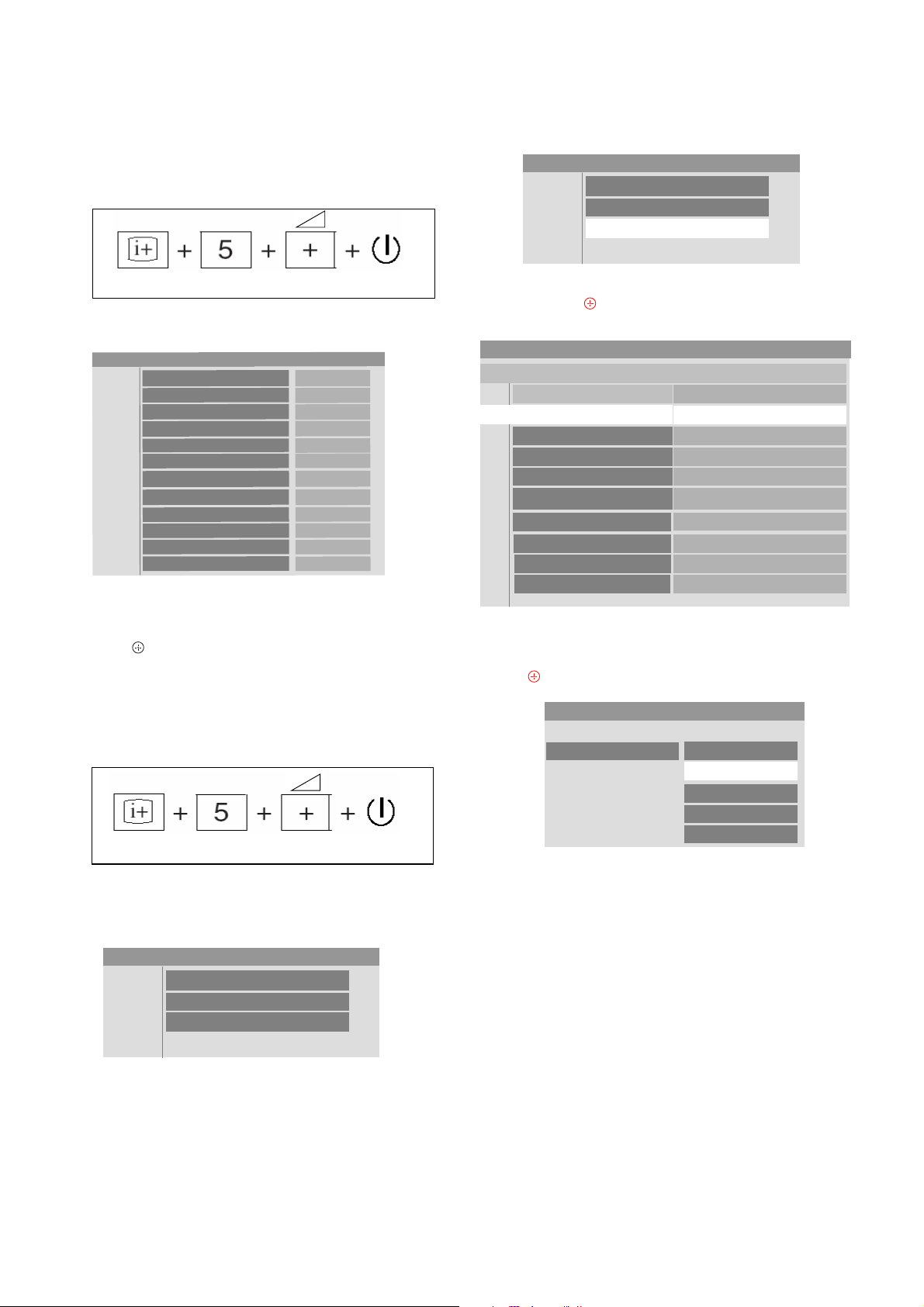
5-1. Accessing Diagnostic Menu
1. While TV set on standby, press the following sequence on
the remote commander (RM-GA011).
On screen
display
Channel 5
Volume (-)
POWER
2. The following menu will appear on the screen:
Figure 1
3. Press V/v to select ‘Service’.
Service Menu
Status
W/B
Service
Figure 4
4. Press B/b or
to view ‘Service’ category items.
Press V/v to selec /‘P ATTERN’.
Service Menu
Service
TEST RESET
PATTERN
PRODUCTION
APC
OVER MODULATION
OPTIONS
AUTOSET FACTORY
SERIAL NUMBER EDIT
ETI1 CLEAR
No Signal Mute
Cancel
WHITE PATTERN
11111111
Normal
Off
OPT 1
DEFAULT
Cancel
Off
3. To reset, select ‘RESET’ using remote commander and
press
to execute RESET.
4. To quit the diagnostic menu, turn off and on the TV set.
5-2. Aging
1. While TV set on standby, press the following sequence on
the remote commander (RM-GA011).
On screen
display
Channel 5 Volume (+)
POWER
Figure 2
2. The following menu will appear on the screen.
Service Menu
Status
W/B
Service
Figure 5
5. Then press B/b then V/v to select ‘WHITE PATTERN’
and .
Service Menu
Service
PATTERN
Off
WHITE PATTERN
RED PATTERN
GREEN PATTERN
BLUE PATTERN
Figure 6
6. The aging Condition is as the following:
a) Supply voltage : Rating
b) Time : 20 minutes or over
c) Ambient Temp : 22~28 degrees
Figure 3
– 18 –
Page 20
KLV-32V400A, V400B
RM-GA011
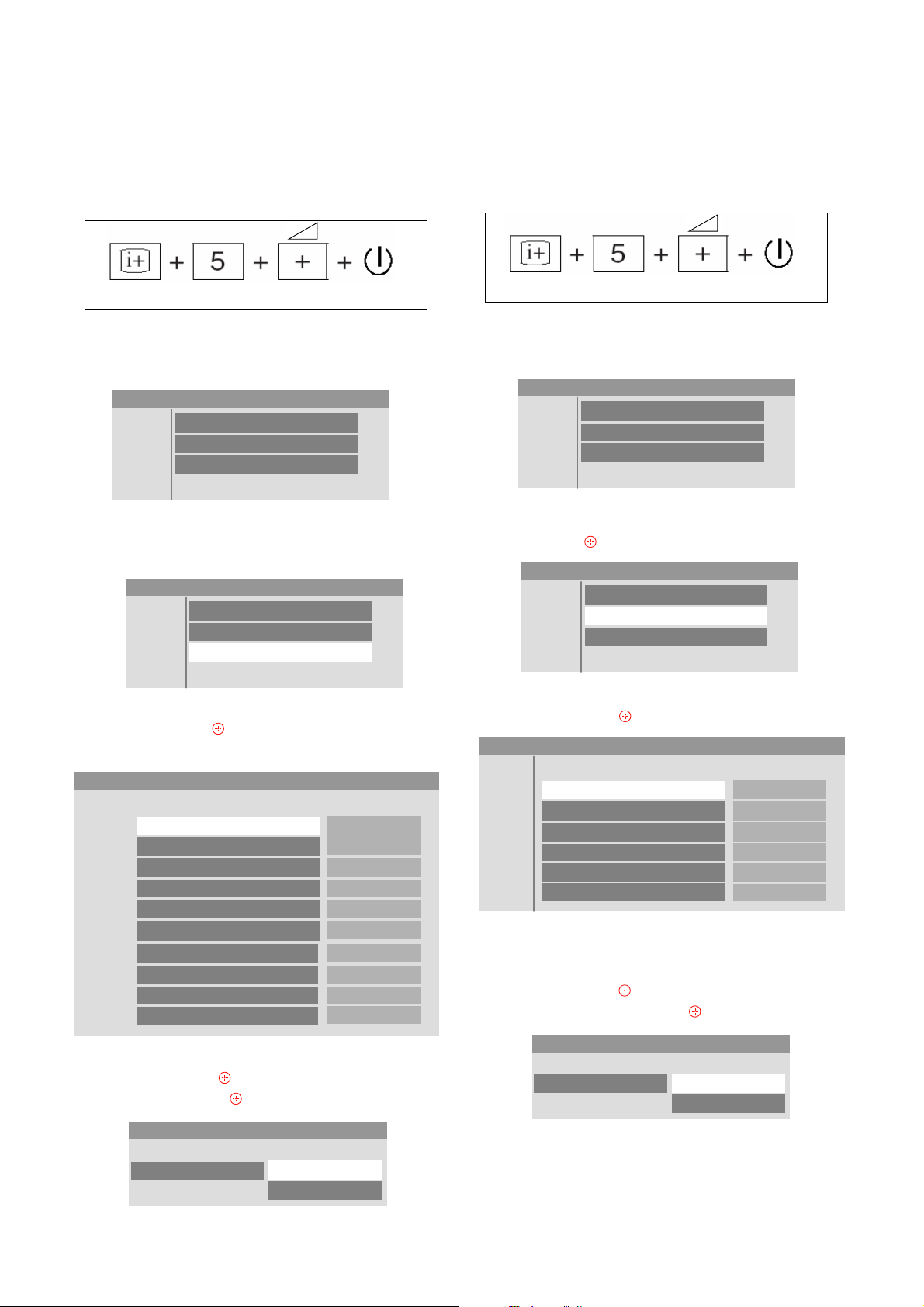
5-3. Resetting the User Menu - Factory Reset
Note: THE TEST RESET option resets all the customer
adjustable data back to factory defaults.
1. While TV set on standby, press the following sequence on
the remote commander (RM-GA011).
On screen
display
Channel 5
Volume (-)
POWER
Figure 7
2. The following menu will appear on the screen:
Service Menu
Status
W/B
Service
Figure 8
3. Press V/v to select ‘Service’.
Service Menu
Status
W/B
Service
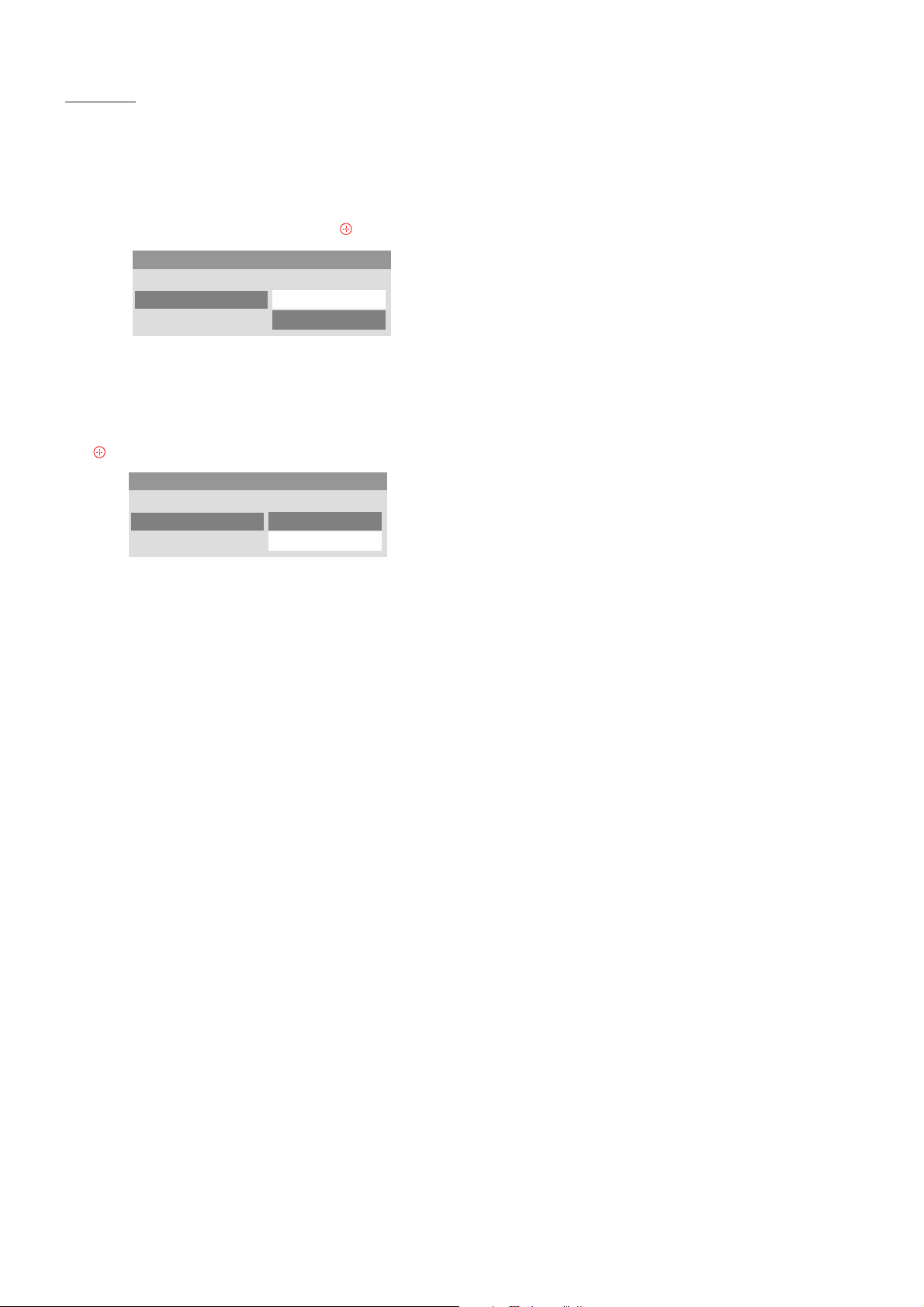
5-4. White Balance Adjustment
Note: The white balance need to be adjusted when BG1 board
and Panel is replaced.
1. While TV set on standby, press the following sequence on
the remote commander (RM-GA011).
On screen
display
Channel 5
Volume (-)
POWER
Figure 12
2. The following menu will appear on the screen:
Service Menu
Status
W/B
Service
Figure 13
3. Press B/b or
to view ‘W/B’.
Service Menu
Status
W/B
Service
Figure 9
4. Then press B/b or
to view ‘Service’ category items.
Next select ‘TEST RESET’ by pressing V/v .
Service Menu
Service
TEST RESET
PATTERN
PRODUCTION
APC
OVER MODULATION
OPTIONS
AUTOSET FACTORY
SERIAL NUMBER EDIT
ETI1 CLEAR
No Signal Mute
Cancel
Off
11111111
Normal
Off
OPT1
DEFAULT
Cancel
Off
Figure 10
5. Finally press B/b or then V/v to select ‘OK’ and confirm
selection by pressing .
Service Menu
Service
TEST RESET
OK
Cancel
Figure 14
4. Then press B/b or to view ‘W/B’ category items.
Service Menu
W/B
INITIALIZE
LEVEL
R_DRIVE
G_DRIVE
B_DRIVE 0
COLOR_SAVE
INIT START
0
0
0
Cancel
Figure 15
5. Press V/v to select ‘INITIALIZE’.
6 Then press B/b or then V/v to select ‘INIT START’ and
execute selection by pressing .
Service Menu
W/B
INITIALIZE
INIT START
INIT END
Figure 16
7. W/B need to be adjusted for all LEVEL (0~4).
Figure 11
– 19 –
Page 21
KLV-32V400A, V400B
RM-GA011
For Level 0
8. Select 'LEVEL' using V/v and choose ‘0’.Then do
adjustment for R_Drive, G_Drive and B_Drive. To increase/
decrease data value, press V/v .
9. Once adjustment has completed for R_Drive, G_Drive and
B_Drive, press V/v to select ‘COLOR SAVE’. Next press
B/b then V/v to choose ‘OK’ and press
Service Menu
W/B
COLOR_SAVE
10. Repeat step 8 and 9 for level 1~4.
11. Once W/B adjustment has been completed for all levels
(0~4), select ‘INITIALIZE’, choose ‘INT END’ and press
.
OK
Cancel
Figure 17
.
Service Menu
W/B
INITIALIZE
INIT START
INIT END
Figure 18
5-5. Board & Panel Replacement
When replacing the BG1 board and Panel, make sure to readjust
the W/B.
– 20 –
Page 22
6-1. BLOCK DIAGRAM
KLV-32V400A, V400B
RM-GA011
SECTION 6
DIAGRAMS
Due to complexity of the board, performing
component level field repairs are not recommended.
Complete board replacement is required if service is
necessary.
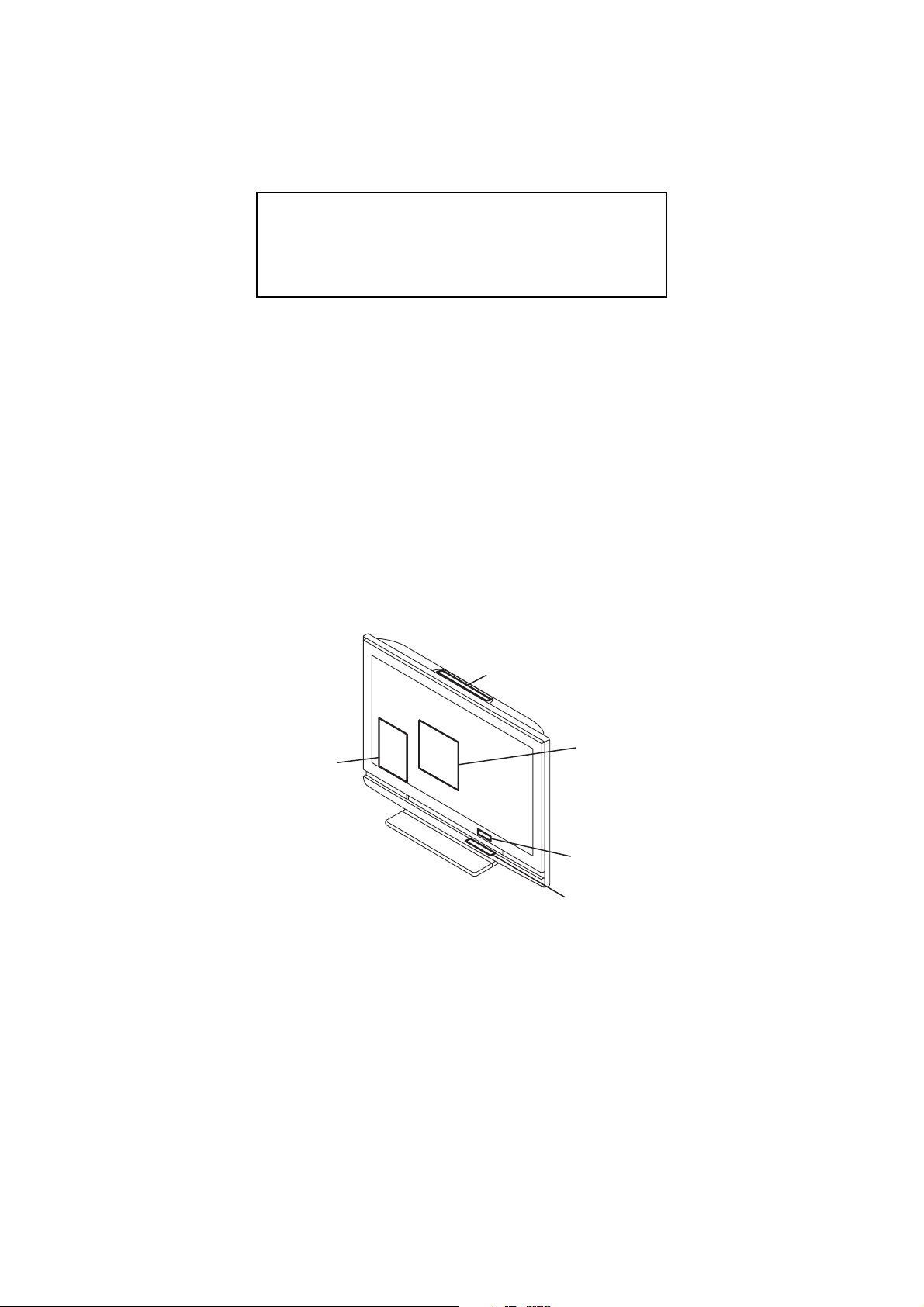
6-2. CIRCUIT BOARD LOCATION
BG1 Board
Switch Unit
GP Board
H4 Board
H3E Board
– 21 –
Page 23
KLV-32V400A, V400B
RM-GA011
6-3. SCHEMATIC DIAGRAM 6-4. PRINTED WIRING BOARDS
Board Function Note
BG1 I/O/Audio/VCTP/DDR/HDMI/ Due to complexity of the board, performing
GP Power Supply necessary.
H4 SIRCS printed wiring boards are not included.
H3E LED/Optical Sensor Exploded View or Electrical Parts List
6-5. SEMICONDUCTOR
DC-DC Converter/Tuner/Sub component level field repairs are not
Croma/STBY Micro recommended. Complete board
replacement is required if service is
Therefore schematic diagrams and
For part number information, refer to
section in this manual.
Due to complexity of the board, performing
component level field repairs are not recommended.
Complete board replacement is required if service is
necessary.
– 22 –
Page 24
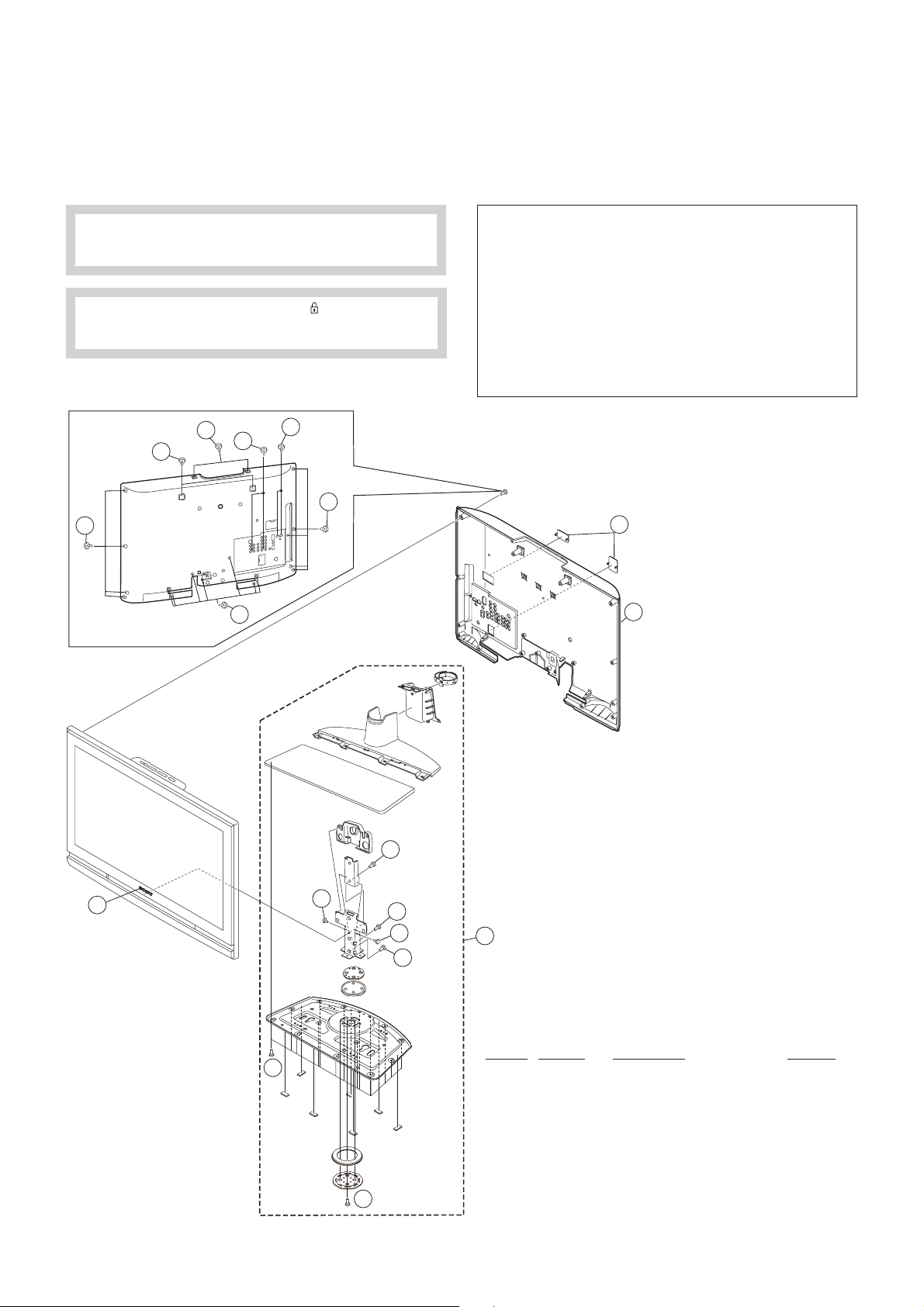
SECTION 7
EXPLODED VIEWS
KLV-32V400A, V400B
RM-GA011
• Components not identified by a part
number or description are not stocked
because they are not required for routine
service.
NOTE: The components identified by shading and ! mark are
critical for safety. Replace only with part number specified.
Note: The components identified by mark contain
confidential information. Strictly follow the instructions
whenever the components are repaired and /or replaced.
• The component parts of an assembly
are indicated by the reference numbers
in the far right column of the part list and
within the dotted lines of the diagram.
7-1. REAR CABINET AND STAND ASSY
f
f
f
a
k
f
• Item marked with an asterisk (*) are not
stocked since they are seldom required
for routine service. Some delay should
be anticipated when ordering these
components.
a 2-580-591-01 SCREW, +PSW M3X5
b 2-580-600-01 SCREW, +PSW M4X8
c 2-580-606-01 SCREW, +PSW M5X8
d 2-580-626-01 SCREW, SP 4-4O UNC
e 2-580-629-01 SCREW, +BVST 3X8
f 2-580-640-01 SCREW, +BVTP2 4X16
g 2-580-644-01 SCREW, +KTP2 3X8
h 2-674-965-31 SCREW, +PSW 3SG
i 3-873-012-01 SCREW, +PWH M5X16
j 3-873-013-01 SCREW, +PWH M5X10
k 7-685-648-79 SCREW, +BVTP 3X12 TYPE2 IT-3
l 2-580-608-01 SCREW +PSW M5 X 16
2
1#
f
1
j
4
j
j
j
3
j
g
i
REF. NO. PART NO. DESCRIPTION REMARK
1COVER, REAR
2*3-106-086-02 COVER, ECS (Except 32V400A/R/T/W(EA))
* 3-106-086-01 COVER, ECS (32V400A/R/T/W(EA))
3 X-2189-409-1 STAND(M)ASSY
(Except 32V400A/R/T/W(E,EA,ME,Philippines,
Saudi Arabia,South Africa),32V400A/R/W(Thailand))
X-2318-611-1 STAND (M)(W), ASSY
(32V400A/R/T/W(E,EA,ME,Philippines,
Saudi Arabia,South Africa),32V400A/R/W(Thailand))
4 4-103-642-21 EMBLEM, SONY NO.8
(Except 32V400A/W(E,EA,ME,Philippines,
Saudi Arabia,South Africa,Thailand))
– 23 –
Page 25
KLV-32V400A, V400B
RM-GA011
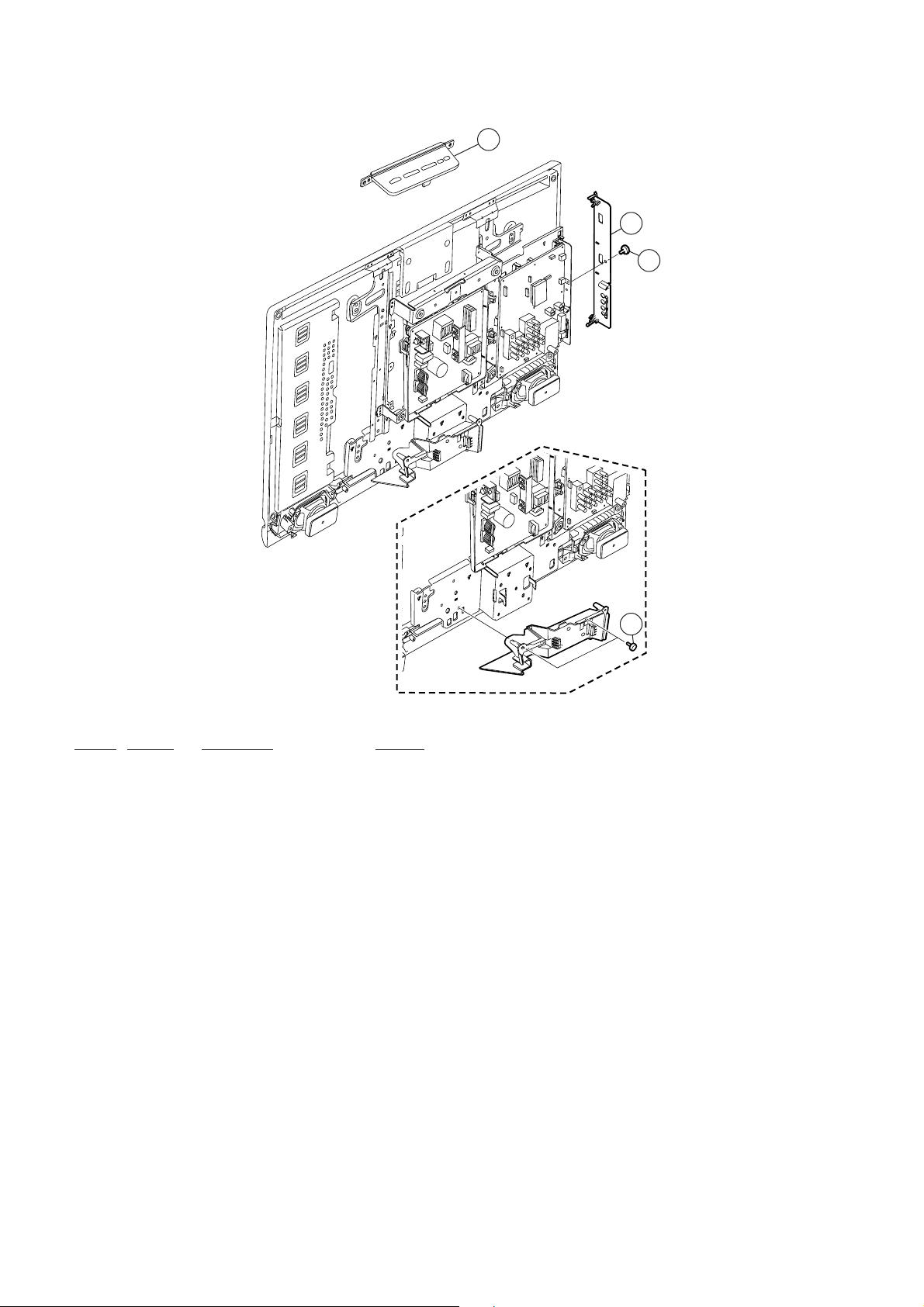
7-2. FRAME AND COVER
51
52
a
REF. NO. PART NO. DESCRIPTION REMARK
51 1-480-709-11 SWITCH UNIT
52 X-2318-678-1 BRACKET, SIDE JACK ASSY (PF1)
(32V400A/R/T/W(EA),
32V400A/T(ME,Philippines,South Africa))
k
– 24 –
Page 26
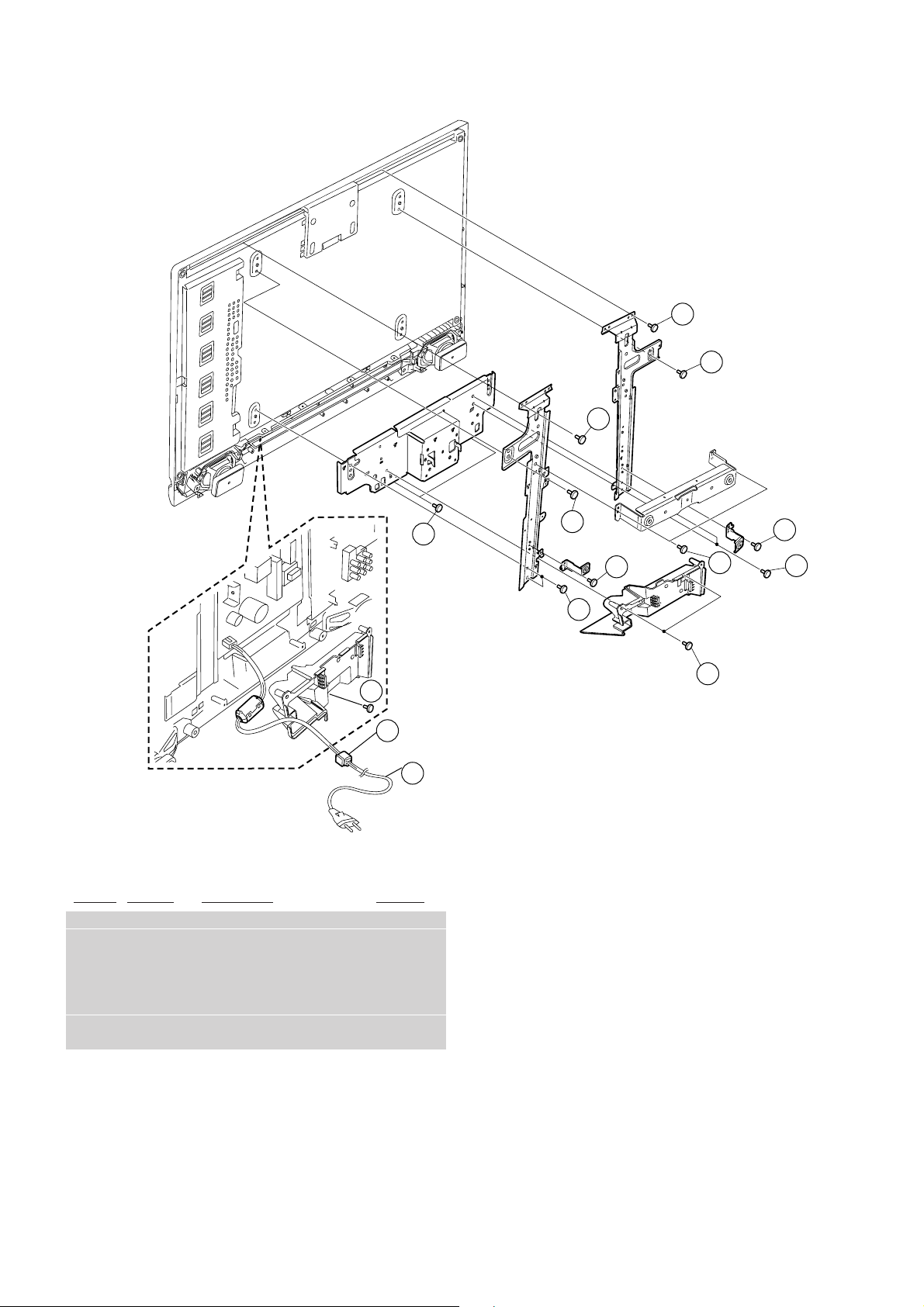
7-3. CHASSIS-1
KLV-32V400A, V400B
RM-GA011
f
b
f
f
102
101
REF. NO. PART NO. DESCRIPTION REMARK
101 ! 1-835-136-11 POWERSUPPLYCORD(WITHCONNECTER)
(Except 32V400A(India,Thailand),
32V400A/W(Thailand)/32V400B(Thailand))
! 1-835-280-11 POWERSUPPLYCORD(WITHCONNECTOR)
(32V400A(India))
! 1-835-127-11 POWERSUPPLYCORD(WITHCONNECTER)
(32V400A(Thailand),32V400A/W(Thailand)/
32V400B(Thailand))
102 4-022-115-00 HOLDER, AC CORD (Except 32V400A(Vietnam))
4-022-115-21 HOLDER, AC CORD (32V400A(Vietnam))
b
b
b
b
b
b
b
k
– 25 –
Page 27
KLV-32V400A, V400B
RM-GA011
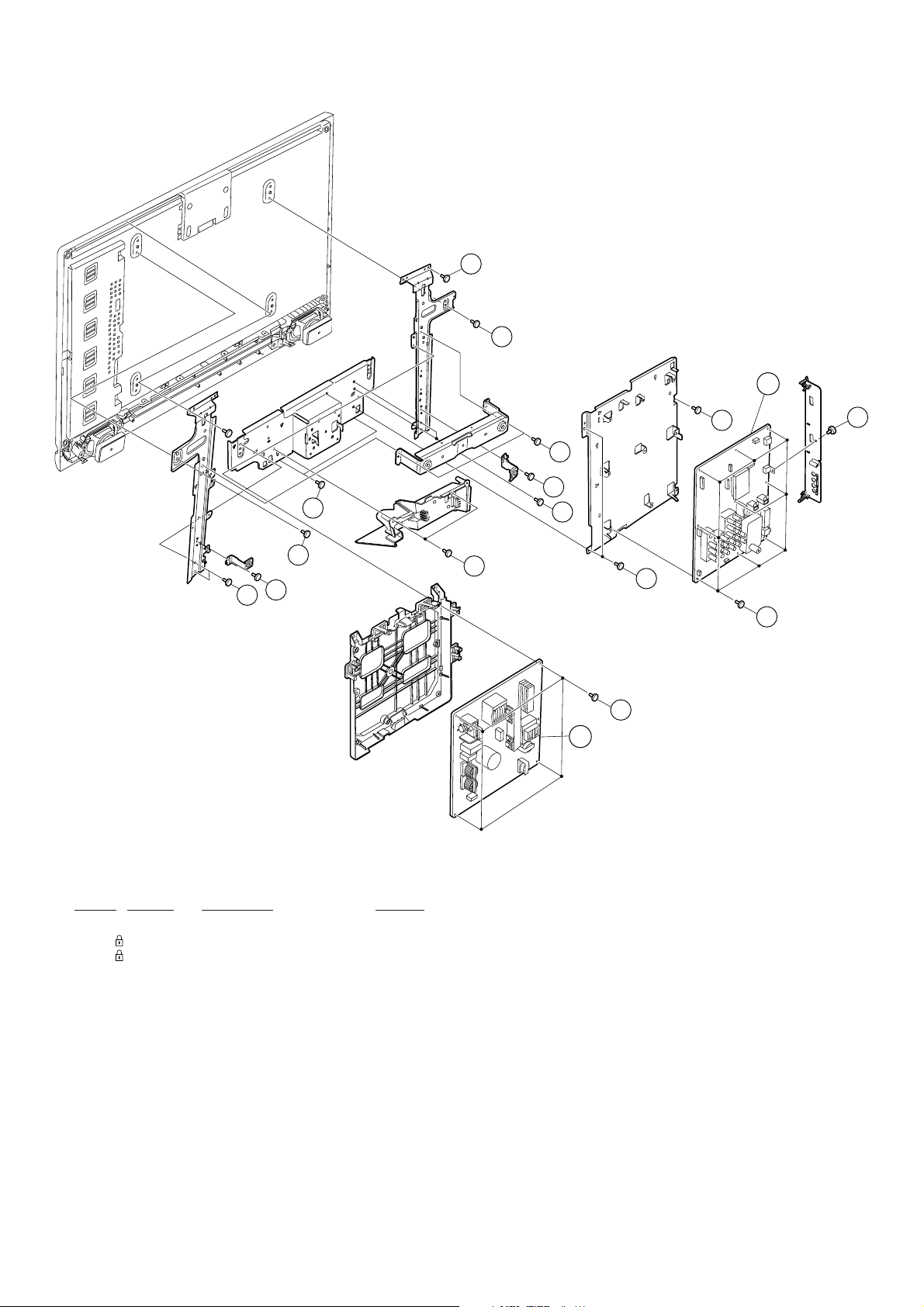
7-4. CHASSIS-2
f
b
152
f
a
b
b
b
b
b
b
k
b
e
e
h
151
REF. NO. PART NO. DESCRIPTION REMARK
151 A-1540-080-A GP COMPLETE KIT (32)
152 A-1530-495-A BG1 MOUNT SERVICE (Except KLV-32V400B)
A-1527-549-A BG1 MOUNT SERVICE (KLV-32V400B)
– 26 –
Page 28
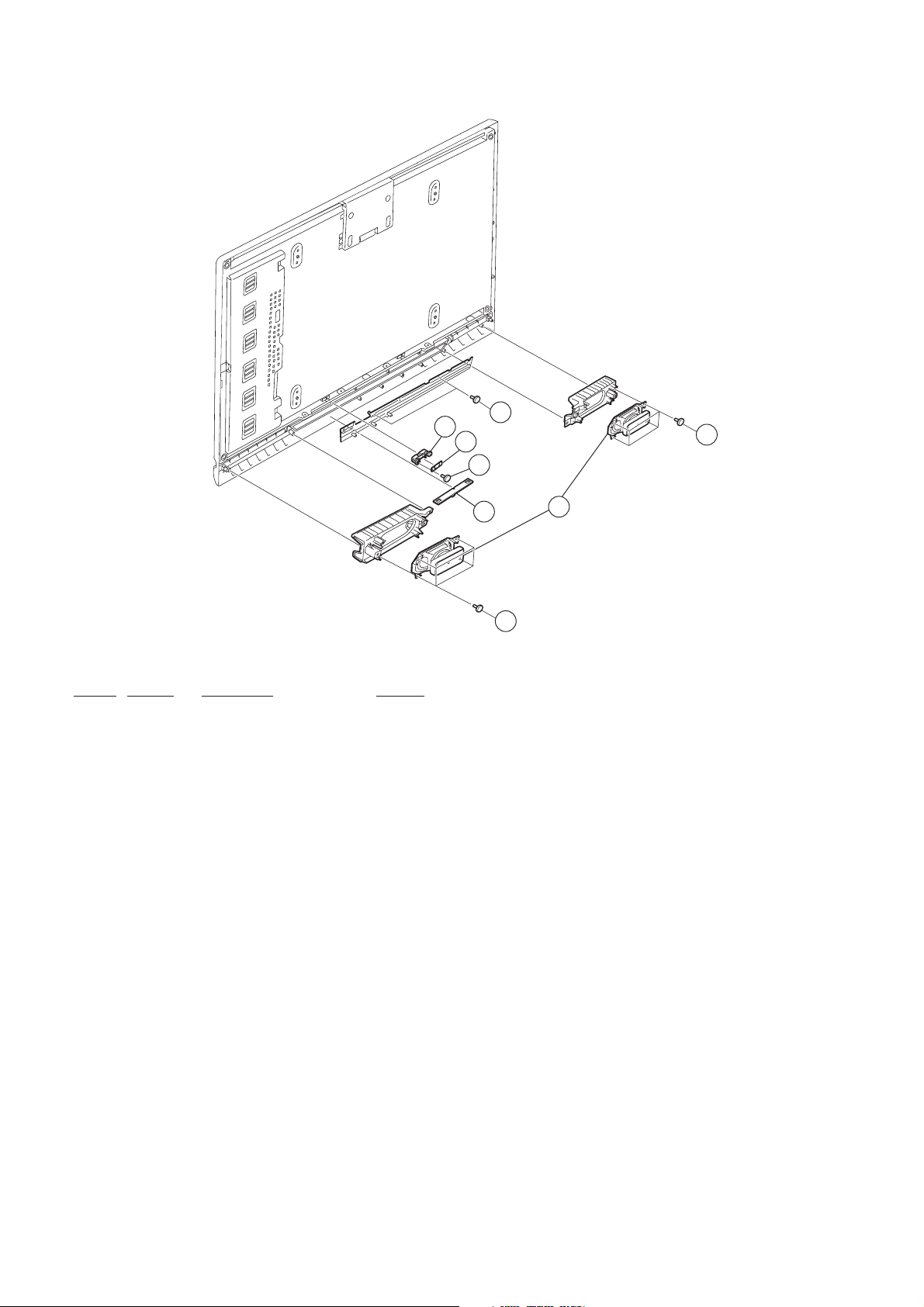
7-5. H3E & H4 BOARDS AND SPEAKER
KLV-32V400A, V400B
RM-GA011
REF. NO. PART NO. DESCRIPTION REMARK
201 * A-1530-492-A H4 MOUNT
202 * A-1535-202-A H3E MOUNT
203 1-826-892-11 LOUDSPEAKER (5.5X12CM)
203 1-826-892-21 LOUDSPEAKER (5.5X12CM)
204 * 3-290-361-01 GUIDE, LIGHT (Except 32V400A/W(EA))
* 3-290-361-11 GUIDE, LIGHT (32V400A/W(EA))
204
201
k
202
f
k
203
k
– 27 –
Page 29
KLV-32V400A, V400B
RM-GA011
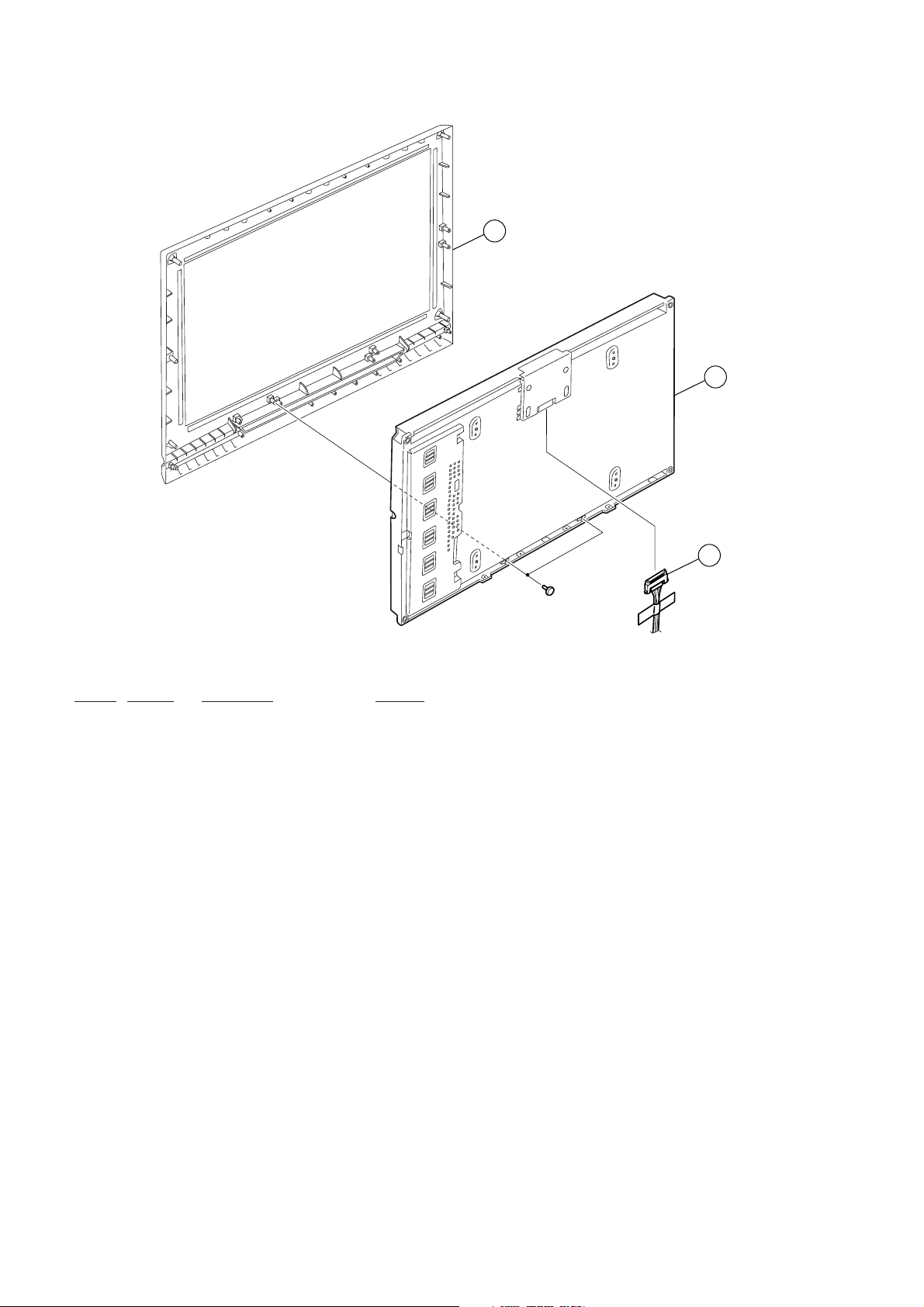
7-6. BEZEL ASSY and LCD Panel
251
252
REF. NO. PART NO. DESCRIPTION REMARK
251 X-2190-023-1 BEZEL ASSY (32AM) (32V400A,32V400B)
X-2318-766-1 BEZEL ASSY (32AM) (R)
(32V400A/R(E,EA,ME,Philippines,Saudi Arabia,
South Africa,Thailand))
X-2318-765-1 BEZEL ASSY (32AM)(T)
(32V400A/T(E,EA,ME,Philippines,Saudi Arabia,
South Africa))
X-2190-035-1 BEZEL ASSY (32AM)(W)
(32V400A/W(E,EA,ME,Philippines,
Saudi Arabia,South Africa,Thailand))
252 1-802-653-12 LCD PANEL (32 WXGA TFT)
253 1-966-101-21 HARNESS WITH CONNECTOR (LVDS)
(Except 32V400A(Iran,Vietnam))
1-966-101-31 HARNESS WITH CONNECTOR (LVDS)
(32V400A(Iran,Vietnam))
253
– 28 –
Page 30
KLV-32V400A, V400B
The components identified by shading
and mark ! are critical for safety.
Replace only with part number specified.
The components identified by mark contain
confidential information. Strictly follow the
instructions whenever the components are
repaired and /or replaced.
SECTION 8
ELECTRICAL PARTS LIST
NOTE:
REF NO. PART NO. DESCRIPTION REMARK REF NO. PART NO. DESCRIPTION REMARK
The components identified by shading
and mark ! are critical for safety.
Replace only with part number specified.
The components identified by mark contain
confidential information. Strictly follow the
instructions whenever the components are
repaired and /or replaced.
REF NO. PART NO. DESCRIPTION REMARK REF NO. PART NO. DESCRIPTION REMARK
A-1530-495-A BG1 MOUNT SERVICE (Except 32V400B)
A-1527-549-A BG1 MOUNT SERVICE (32V400B)
**********************************
A-1540-080-A GP COMPLETE KIT (32)
*********************
* A-1535-202-A H3E MOUNT
************
* A-1530-492-A H4 MOUNT
***********
Due to complexity of the board, performing component level field
repairs is not recommended.
If service is required, complete board replacement is required.
Part number information refer to the Exploded View or Electrical
Par ts Lists section of this Service Manual.
*********************************************************************
• Items marked " ∗ " are not stocked since
they are seldom required for routine
service. Some delay should be anticipated when ordering these items.
• All variable and adjustable resistors have
characteristic curve B, unless otherwise
noted.
* 3-874-911-01 CUSHION LOWER
* 3-300-886-01 INDIVIDUAL CARTON
* 3-879-145-01 INDIVIDUAL CARTON (32V400A(Iran))
* 3-874-909-01 INDIVIDUAL CARTON
* 3-878-302-01 INDIVIDUAL CARTON (32V400A(Vietnam)
* 3-879-649-01 INDIVIDUAL CARTON (32V400B(Saudi Arabia)
* 4-000-461-01 INDIVIDUAL CARTON (32V400B(Thailand))
1-821-947-11 ADAPTOR CONVERSION (EURO 3P)
• All resistors are in ohms
• F : nonflammable
CAPACITORS
• MF : µF, PF : µµF
COILS
• MMH : mH, UH : µH
(32V400A(ME,Philippines,
South Africa,Thailand),32V400A/R/T/W
(ME,Philippines,South Africa),32V400A/R/W
(Thailand),32V400B(Thailand))
(Except 32V400A(Iran,ME,Philippines,
South Africa,Thailand,Vietnam),32V400A/R/T/W
(ME,Philippines,South Africa),32V400A/R/W
(Thailand),32V400B)
(32V400A(ME,Philippines,
South Africa,Thailand),32V400A/R/T/W
(ME,Philippines,South Africa),32V400A/R/W(Thailand))
(32V400A(E),32V400A/R/T/W(E))
RM-GA011
CONNECTORS
***************
1-910-043-78 CONNECTOR ASSY 14P+20P
1-966-101-21 HARNESS WITH CONNECTOR (LVDS)
(Except 32V400A(Iran,Vietnam))
1-966-101-31 HARNESS WITH CONNECTOR (LVDS)
(32V400A(Iran,Vietnam))
*********************************************************************
ACCESSORIES AND PACKING
*****************************
* 3-289-963-01 PANEL, CLEAR (32)
* 3-295-215-01 CUSHION (UPPER)
(Except 32V400A(ME,Philippines,
South Africa,Thailand),32V400A/R/T/W
(ME,Philippines,South Africa),32V400A/R/W
(Thailand),32V400B(Thailand))
* 3-874-910-01 CUSHION UPPER
(32V400A(ME,Philippines,
South Africa,Thailand),32V400A/R/T/W
(ME,Philippines,South Africa),32V400A/R/W
(Thailand),32V400B(Thailand))
* 3-295-216-01 CUSHION (LOWER)
(Except 32V400A(ME,Philippines,
South Africa,Thailand),32V400A/R/T/W
(ME,Philippines,South Africa),32V400A/R/W
(Thailand),32V400B(Thailand))
1-569-008-22 ADAPTOR, CONVERSION 2P
(32V400A(Philippines),32V400A/R/T/W(Philippines))
1-821-926-11 PLUG CONVERSION ADAPTOR
(32V400A(South Africa),32V400A/R/T/W(South Africa))
3-214-128-13 INSTRUCTION (WALL MOUNT)
(32V400A(E,EA,India,Saudi Arabia,
South Africa),32V400A/R/T/W(E,EA,
Saudi Arabia),32V400B(Saudi Arabia))
3-214-128-32 INSTRUCTION (WALL MOUNT) (32V400A(Iran))
3-214-128-23 INSTRUCTION (WALL MOUNT)
(32V400A(ME,Philippines,
South Africa,Thailand),32V400A/R/T/W
(ME,Philippines,South Africa),32V400A/R/W
(Thailand),32V400B(Thailand))
3-219-725-13 INSTRUCTION (WALL MOUNT) (32V400A(Vietnam))
4-108-226-11 MANUAL,INSTRUCTION(WALL MOUNT)
(32V400A/R/T/W(EA))
3-300-887-11 MANUAL, INSTRUCTION
(32V400A(E,EA,India,Saudi Arabia),32V400A/R/T/W
(E,EA,Saudi Arabia))
3-300-887-21 MANUAL, INSTRUCTION
(32V400A(E),32V400A/R/T/W(E))
3-300-887-31 MANUAL, INSTRUCTION
(32V400A(EA,Saudi Arabia),
32V400A/R/T/W(EA,Saudi Arabia))
3-300-887-41 MANUAL, INSTRUCTION
(32V400A(EA),32V400A/R/T/W(EA))
3-879-152-11 MANUAL, INSTRUCTION (32V400A(Iran))
3-874-917-11 MANUAL, INSTRUCTION
(32V400A(ME,Philippines,
South Africa,Thailand),32V400A/R/T/W
(ME,Philippines,South Africa),32V400A/R/W(Thailand))
– 29 –
Page 31

KLV-32V400A, V400B
RM-GA011
The components identified by mark contain
confidential information. Strictly follow the
instructions whenever the components are
repaired and /or replaced.
The components identified by shading
and mark ! are critical for safety.
Replace only with part number specified.
REF NO. PART NO. DESCRIPTION REMARK
3-874-917-21 MANUAL, INSTRUCTION
(32V400A(Thailand),32V400A/W(Thailand))
3-874-917-31 MANUAL, INSTRUCTION (32V400A(ME),
32V400A/R/T/W(ME),32V400A/R(Thailand))
3-878-303-11 MANUAL, INSTRUCTION (32V400A(Vietnam))
3-879-650-11 MANUAL, INSTRUCTION (32V400B(Saudi Arabia))
3-879-650-21 MANUAL, INSTRUCTION (32V400B(Saudi Arabia))
3-879-650-31 MANUAL, INSTRUCTION (32V400B(Saudi Arabia))
4-000-347-11 MANUAL, INSTRUCTION (32V400B(Thailand))
4-000-347-21 MANUAL, INSTRUCTION (32V400B(Thailand))
X-2190-783-1 BAG ASSY, RUDDER LOCK
(Except 32V400A(ME,Philippines,
South Africa,Thailand),32V400A/R/T/W
(ME,Philippines,South Africa),32V400A/R/W
(Thailand),32V400B(Thailand))
*********************************************************************
REMOTE COMMANDER
************************
1-480-705-11 REMOTE COMMANDER (RM-GA011)
9-885-117-43 BATTERY COVER, REMOTE COMMANDER
REF NO. PART NO. DESCRIPTION REMARK
– 30 –
Page 32

SUPPLEMENT-1
r
EG1L (GA)
CHASSIS
MODEL COMMANDER DEST. CHASSIS NO.
MODEL COMMANDER DEST. CHASSIS NO.
KLV-32V400A RM-GA011 Egypt
KLV-32V400A/1 RM-GA011 EA
KLV-32V400A/2 RM-GA011 EA
KLV-32V400A/T RM-GA011 India
(Mat Brown)
SUBJECT : New model addition
This supplement shows only variant information for the new model(s).
Other information remains the same as in the original issue.
SECTION 3. DISASSEMBLY
3-1. Rear Cover and R2 Board Removal (refer page 7)
(For KLV-32V400A/1, /2 only)
1 Eighteen screws
(BVTP2 4 X 16)
2 Two screws
(+BVTP 3 X 12)
3 Two screws
(+PSW M3 X 5)
4 One screw
(PSW 5 X 8)
1 Remove
R Bracket (Top)
2 Disconnect
CN001
3 Two screws
(+BVTP 3 X 14)
4 R2 Board
5 Lift to remove Rear Cove
– 31 –
Page 33

SECTION 5 SERVICE ADJUSTMENT (refer page 18)
(For KLV-32V400A/1, /2 only)
Preset "Test" button on remote commander
1. Press the following buttons simultaneously on the
remote commander RM-GA011 for a few seconds.
5
+
+
Channel 5
2. Once completed, the below button operates as a TEST
button.
Entering Hotel Menu Mode
1. While TV set is on standby, press the following sequence
on the remote commander(RM-GA011).
6. The following menu appears on the screen.
Function Settings
Off
Both Controls
Use
Use
Unspecify
Use
7. Press
Hotel Mode
TV / Remote Controls
Freeze
Display Key
AC Power On Setting
Wide Mode Key
Initialize Hotel Settings
B/b to select 'Hotel Mode'.
8. Now press B/b then V/v to select 'ON' and press .
Function settings
Hotel Mode
On
Off
9. The TV set resets and restarts.
10. Now press 'Menu' on the remote commander.
11. The following menu confirms the hotel mode is ON.
On screen
display
TEST
Volume (+)
POWER
2. When the TV turns on, the indication "Hotel Mode
Settings in Progress" appears on the bottom center of
the screen.
Hotel Mode Settings in Progress
3. Press 'Menu' on the remote commander.
4. The following menu appears on the screen:
Menu
Favourites
Programme List
External Inputs
Settings
Hotel Mode Settings
Language
Sleep Timer
Exiting Hotel Menu Mode
1. While TV set is ON, press the following sequence on the
remote commander(RM-GA011).
MUTE MENU
On screen
display
2. The TV set restarts and show "Hotel Mode Settings in
Progress" on the bottom center of the screen.
Hotel Mode Settings in Progress
3. Now press 'Menu' on the remote commander.
4. The following menu confirms the hotel mode is OFF.
Volume (+)
5. Press V/v to select 'Hotel Mode Settings' and press .
Menu
Favourites
Programme List
External Inputs
Settings
Hotel Mode Settings
– 32 –
Page 34

Disable Hotel Menu Mode
1. While TV set is on standby, press the following sequence
on the remote commander(RM-GA011).
TEST
On screen
display
2. Press 'Menu' on the remote commander.
3. The below menu appears on the screen.
TEST
Volume (-)
Menu
Favourites
Programme List
External Inputs
Settings
4. This menu confirms the hotel menu mode is disabled.
POWER
SECTION 6. DIAGRAMS
6-2. Circut Board Location (refer page 21)
R2 Board
(KLV-32V400A/1, /2)
H4K Board
6-3. SCHEMATIC DIAGRAM & PRINTED WIRING BOARDS (refer page 25)
H4K & R2 Boards
Board Function Note
R2 Hotel Mode Due to complexity of the board, performing component
(KLV-32V400A/1, /2)
level field repairs are not recommended. Complete board
replacement is required if service is necessary.
Therefore schematic diagrams and printed wiring boards
are not included. For part number information, refer to
Exploded View or Electrical Parts List section in this
manual.
H4K SIRCS
– 33 –
Page 35

m 7-685-649-79 SCREW +BVTP 3X14
SECTION 7. EXPLODED VIEWS
7-1. Rear Cabinet and Stand Assy (refer page 23)
☛
☛
m
1
5
4
☛
☛
j
3
g
j
j
j
j
i
2
☛
REF. NO. PART NO. DESCRIPTION REMARK
1*3-106-086-03 COVER, ECS
2 X-2189-409-3 STAND (M) ASSY (Except 32/T)
X-2318-611-1 STAND (M) (W), ASSY (32/T)
3 4-103-642-21 EMBLEM, SONY NO 8
4 A-1565-554-A R2, MOUNT (32/1, /2)
5*4-111-643-01 R BRACKET(TOP) (32/1, /2)
– 34 –
Page 36

7-2. Frame and Cover (refer page 24)
REF. NO. PART NO. DESCRIPTION REMARK
52 X-2318-678-1 BRACKET, SIDE JACK ASSY (PF1)
7-3. CHASSIS-1 (refer page 25)
52
☛
a
f
102
101
REF. NO. PART NO. DESCRIPTION REMARK
101 !* 1-835-136-11 POWER SUPPLY CORD (WITH CONNECTOR)
(Except 32/T)
! 1-835-280-11 POWER SUPPLY CORD (WITH CONNECTOR)
(32/T)
102 4-022-115-12 HOLDER, AC CORD
b
☛
☛
– 35 –
Page 37

7-4. CHASSIS-2 (refer pager 26)
f
b
f
b
b
b
b
b
b
k
b
e
h
151
☛
152
a
e
☛
REF. NO. PART NO. DESCRIPTION REMARK
151 A-1568-990-A GP COMPLETE KIT
152 A-1530-495-B BG1 MOUNT (SERVICE) (Except 32/1, /2)
A-1565-592-A BG1 MOUNT (SERVICE) (32/1)
A-1568-769-A BG1 MOUNT (SERVICE) (32/2)
– 36 –
Page 38

7-5. H3E & H4K BOARDS AND SPEAKER (refer page 27)
☛
204
201
f
☛
k
k
REF. NO. PART NO. DESCRIPTION REMARK
201 A-1556-724-A H4K MOUNT 37
202 A-1556-723-A H3E MOUNT 37
204 3-879-107-01 GUIDE, LIGHT
202
203
k
– 37 –
Page 39

7-6. BEZEL ASSY and LCD Panel (refer page 28)
251
☛
252
253
REF. NO. PART NO. DESCRIPTION REMARK
251 X-2190-023-1 BEZEL ASSY (32AM) (Except 32/T)
X-2318-765-1 BEZEL ASSY (32AM)(T) (32/T)
– 38 –
Page 40

SECTION 8 ELECTRICAL PARTS LIST (refer page 29)
REF NO. PART NO. DESCRIPTION REMARK
A-1530-495-B BG1 MOUNT (SERVICE) (Except 32/1, /2)
A-1565-592-A BG1 MOUNT (SERVICE) (32/1)
A-1568-769-A BG1 MOUNT (SERVICE) (32/2)
A-1568-990-A GP COMPLETE KIT (32)
A-1556-723-A H3E MOUNT 37
A-1556-724-A H4K MOUNT 37
Due to complexity of the board, performing component level field
repairs are not recommended.
Complete board replacement is required if service is necessary.
For part number information refer to the Exploded View or
Electrical Parts List section of this Service Manual.
**********************************************************************
***********************************
***************************
***************************
*********************
**************
**************
ACCESSORIES AND PACKING
***************************
3-295-215-01 CUSHION (UPPER)
3-295-216-02 CUSHION (LOWER)
4-113-870-01 INDIVIDUAL CARTON
3-300-886-01 INDIVIDUAL CARTON
4-108-226-51 SUPPLEMENT (WALL MOUNT)
3-214-128-14 SUPPLEMENT (WALL MOUNT)
4-108-226-11 SUPPLEMENT (WALL MOUNT)
4-113-871-11 MANUAL, INSTRUCTION
3-300-887-12 MANUAL, INSTRUCTION
3-300-887-32 MANUAL, INSTRUCTION
3-300-887-42 MANUAL, INSTRUCTION
(Except 32/1, /2, /T)
(32/1, /2, /T)
(Except 32/1, /2, /T)
(32/1, /2, /T)
(32/1, /2, /T)
(Except 32/1, /2, /T)
(32/1, /2, /T)
(32/1, /2)
(32/1, /2)
– 39 –
Page 41

SUPPLEMENT-2
EG1L (GA)
CHASSIS
MODEL COMMANDER DEST.
KLV-32V400A
KLV-32V400A/1
KLV-32V400A/2
KLV-32V400A/R
(Metal Red) Philippines,
This Supplement applies only to the models listed above.
Other information remains the sama as in the original issue and previous supplements.
RM-GA011 E, EA, Egypt, India,
Iran, ME,
Philippines,
Saudi Arabia,
South Africa,
Thailand, Vietnam
RM-GA011 EA
RM-GA011 EA
RM-GA011 E, EA, ME,
Saudi Arabia,
South Africa,
Thailand
SUBJECT : Part number Change
MODEL COMMANDER DEST.
KLV-32V400A/T
(Mat Brown) ME,
KLV-32V400A/W
(Pearl White) Philippines,
KLV-32V400B
SECTION 7. EXPLODED VIEW
7-4. CHASSIS-2 (refer page 26)
RM-GA011 E, EA, India,
Philippines,
Saudi Arabia,
South Africa
RM-GA011 E, EA, ME,
Saudi Arabia,
South Africa,
Thailand
RM-GA011 Saudi Arabia,
Thailand
REF. NO. PART NO. DESCRIPTION REMARK
151 A-1527-466-A GP COMPL(32)
SECTION 8. ELECTRICAL PARTS LIST
REF NO. PART NO. DESCRIPTION REMARK
A-1527-466-A GP COMPL(32)
h
151
☛
– 40 –
Page 42

SUPPLEMENT-3
EG1L (GA)
CHASSIS
MODEL COMMANDER DEST.
KLV-32V400A
KLV-32V400A/1
KLV-32V400A/2
KLV-32V400A/R
(Metal Red) Philippines,
This Supplement applies only to the models listed above.
Other information remains the sama as in the original issue and previous supplements.
RM-GA011 E, EA, Egypt, India,
Iran, ME,
Philippines,
Saudi Arabia,
South Africa,
Thailand, Vietnam
RM-GA011 EA
RM-GA011 EA
RM-GA011 E, EA, ME,
Saudi Arabia,
South Africa,
Thailand
SUBJECT : Part Information Change: REAR COVER PART NUMBER
MODEL COMMANDER DEST.
KLV-32V400A/T
(Mat Brown) ME,
KLV-32V400A/W
(Pearl White) Philippines,
KLV-32V400B
SECTION 7. EXPLODED VIEW
7-1. REAR CABINET AND STAND ASSY
RM-GA011 E, EA, India,
Philippines,
Saudi Arabia,
South Africa
RM-GA011 E, EA, ME,
Saudi Arabia,
South Africa,
Thailand
RM-GA011 Saudi Arabia,
Thailand
REF. NO. PART NO. DESCRIPTION REMARK
1 3-289-960-11 COVER, REAR
(Except 32/R(EA, Philippines, South Africa, Thailand),
32/T(Philippines), 32/W(ME, Philippines, South Africa, Thailand))
3-877-315-11 COVER, REAR
(32/R(EA, Philippines, South Africa, Thailand),
32/T(Philippines), 32/W(ME, Philippines, South Africa, Thailand))
2
☛
1
– 41 –
Page 43

SUPPLEMENT-4
EG1L (GA)
CHASSIS
MODEL COMMANDER DEST.
KLV-32V400A
KLV-32V400A/1
KLV-32V400A/2
KLV-32V400A/R
(Metal Red) Philippines,
This Supplement applies only to the models listed above.
Other information remains the sama as in the original issue and previous supplements.
Note:
Supplement is necessary to add Supplement (Wall Mount) Instruction Manual.
Please refer to next page for the Supplement (Wall Mount).
RM-GA011 E, EA, Egypt, India,
Iran, ME,
Philippines,
Saudi Arabia,
South Africa,
Thailand, Vietnam
RM-GA011 EA
RM-GA011 EA
RM-GA011 E, EA, ME,
Saudi Arabia,
South Africa,
Thailand
SUBJECT : Supplement (Wall Mount) addition
MODEL COMMANDER DEST.
KLV-32V400A/T
(Mat Brown) ME,
KLV-32V400A/W
(Pearl White) Philippines,
KLV-32V400B
RM-GA011 E, EA, India,
Philippines,
Saudi Arabia,
South Africa
RM-GA011 E, EA, ME,
Saudi Arabia,
South Africa,
Thailand
RM-GA011 Saudi Arabia,
Thailand
– 42 –
Page 44

SUPPLEMENT-5
EG1L (GA)
CHASSIS
MODEL COMMANDER DEST.
KLV-32V400A
KLV-32V400A/R
(Metal Red) Philippines,
KLV-32V400A/T
(Mat Brown) Philippines,
This supplement applies only to the models listed above.
Other information remains the same as in the original issue and previous supplements.
RM-GA011 E, EA, India, Iran,
ME, Philippines,
Saudi Arabia,
South Africa,
Thailand, Vietnam
RM-GA011 E, EA, ME,
Saudi Arabia,
South Africa,
Thailand
RM-GA011 E, EA, ME,
Saudi Arabia,
South Africa
SUBJECT : Part Information Change:
1. H4 Change to H4K
2. H3E Part Number Change
MODEL COMMANDER DEST.
KLV-32V400A/W
(Pearl White) Philippines,
KLV-32V400B
RM-GA011 E, EA, ME,
Saudi Arabia,
South Africa,
Thailand
RM-GA011 Saudi Arabia,
Thailand
– 43 –
Page 45

SECTION 7. EXPLODED VIEW
7-5. H3E & H4 BOARDS AND SPEAKER
201
REF. NO. PART NO. DESCRIPTION REMARK
201 * A-1556-724-A H4K MOUNT 37
202 * A-1556-723-A H3E MOUNT 37
SECTION 8 ELECTRICAL PARTS LIST
REF NO. PART NO. DESCRIPTION REMARK
* A-1556-723-A H3E MOUNT 37
* A-1556-724-A H4K MOUNT 37
202
– 44 –
Page 46

SUPPLEMENT-6
r
EG1L (GA)
CHASSIS
MODEL COMMANDER DEST. CHASSIS NO.
MODEL COMMANDER DEST. CHASSIS NO.
KLV-32V400A/3 RM-GA011 EA
SUBJECT : New model addition
This supplement shows only variant information for the new model(s).
Other information remains the same as in the original issue.
SECTION 3. DISASSEMBLY
3-1. Rear Cover and R2 Board Removal (refer page 7)
1 Eighteen screws
(BVTP2 4 X 16)
2 Two screws
(+BVTP 3 X 12)
3 Two screws
(+PSW M3 X 5)
4 One screw
(PSW 5 X 8)
1 Remove
R Bracket (Top)
2 Disconnect
CN001
3 Two screws
(+BVTP 3 X 14)
4 R2 Board
5 Lift to remove Rear Cove
– 45 –
Page 47

SECTION 5 SERVICE ADJUSTMENT (refer page 18)
Preset "Test" button on remote commander
1. Press the following buttons simultaneously on the
remote commander RM-GA011 for a few seconds.
5
+
+
Channel 5
2. Once completed, the below button operates as a TEST
button.
Entering Hotel Menu Mode
1. While TV set is on standby, press the following sequence
on the remote commander(RM-GA011).
6. The following menu appears on the screen.
Function Settings
Off
Both Controls
Use
Use
Unspecify
Use
7. Press
Hotel Mode
TV / Remote Controls
Freeze
Display Key
AC Power On Setting
Wide Mode Key
Initialize Hotel Settings
B/b to select 'Hotel Mode'.
8. Now press B/b then V/v to select 'ON' and press .
Function settings
Hotel Mode
On
Off
9. The TV set resets and restarts.
10. Now press 'Menu' on the remote commander.
11. The following menu confirms the hotel mode is ON.
On screen
display
TEST
Volume (+)
POWER
2. When the TV turns on, the indication "Hotel Mode
Settings in Progress" appears on the bottom center of
the screen.
Hotel Mode Settings in Progress
3. Press 'Menu' on the remote commander.
4. The following menu appears on the screen:
Menu
Favourites
Programme List
External Inputs
Settings
Hotel Mode Settings
Language
Sleep Timer
Exiting Hotel Menu Mode
1. While TV set is ON, press the following sequence on the
remote commander(RM-GA011).
MUTE MENU
On screen
display
2. The TV set restarts and show "Hotel Mode Settings in
Progress" on the bottom center of the screen.
Hotel Mode Settings in Progress
3. Now press 'Menu' on the remote commander.
4. The following menu confirms the hotel mode is OFF.
Volume (+)
5. Press V/v to select 'Hotel Mode Settings' and press .
Menu
Favourites
Programme List
External Inputs
Settings
Hotel Mode Settings
– 46 –
Page 48

Disable Hotel Menu Mode
1. While TV set is on standby, press the following sequence
on the remote commander(RM-GA011).
TEST
On screen
display
2. Press 'Menu' on the remote commander.
3. The below menu appears on the screen.
TEST
Volume (-)
Menu
Favourites
Programme List
External Inputs
Settings
4. This menu confirms the hotel menu mode is disabled.
POWER
SECTION 6. DIAGRAMS
6-2. Circut Board Location (refer page 21)
R2 Board
H4K Board
6-3. SCHEMATIC DIAGRAM & PRINTED WIRING BOARDS (refer page 25)
H4K & R2 Boards
Board Function Note
R2 Hotel Mode Due to complexity of the board, performing component
level field repairs are not recommended. Complete board
replacement is required if service is necessary.
Therefore schematic diagrams and printed wiring boards
are not included. For part number information, refer to
Exploded View or Electrical Parts List section in this
manual.
H4K SIRCS
– 47 –
Page 49

m 7-685-649-79 SCREW +BVTP 3X14
SECTION 7. EXPLODED VIEWS
7-1. Rear Cabinet and Stand Assy (refer page 23)
m
2
6
5
1
4
REF. NO. PART NO. DESCRIPTION REMARK
1 3-289-960-11 COVER, REAR (32)
2*3-106-086-01 COVER, ECS
* 4-115-101-01 COVES, ECS
3 X-2189-409-3 STAND (M) ASSY
4 4-103-642-21 EMBLEM, SONY NO 8
5*A-1565-554-A R2, MOUNT
6*4-111-643-01 R BRACKET(TOP)
3
– 48 –
Page 50

7-2. Frame and Cover (refer page 24)
52
REF. NO. PART NO. DESCRIPTION REMARK
52 X-2318-678-2 BRACKET, SIDE JACK ASSY (PF1)
– 49 –
Page 51

7-3. CHASSIS-1 (refer page 25)
REF. NO. PART NO. DESCRIPTION REMARK
101 ! 1-835-136-11 POWER SUPPLY CORD (WITH CONNECTOR)
102 4-022-115-00 HOLDER, AC CORD
102
101
– 50 –
Page 52

7-4. CHASSIS-2 (refer pager 26)
153
152
REF. NO. PART NO. DESCRIPTION REMARK
151 A-1527-466-A GP COMPL (32)
152 A-1706-939-A BG1 MOUNT (SERVICE)
153 * 3-292-896-01 COVER, MS/USB
151
– 51 –
Page 53

7-5. H3E & H4K BOARDS AND SPEAKER (refer page 27)
204
201
202
REF. NO. PART NO. DESCRIPTION REMARK
201 * A-1556-724-A H4K MOUNT 37
202 * A-1556-723-A H3E MOUNT 37
204 3-879-107-01 GUIDE, LIGHT
7-6. BEZEL ASSY and LCD Panel (refer page 28)
251
252
REF. NO. PART NO. DESCRIPTION REMARK
251 X-2190-023-2 BEZEL ASSY (32AM)
252 1-802-653-21 LCD PANEL (32 WXGA TFT)
– 52 –
Page 54

SECTION 8 ELECTRICAL PARTS LIST (refer page 29)
REF NO. PART NO. DESCRIPTION REMARK
A-1706-939-A BG1 MOUNT (SERVICE)
A-1527-466-A GP COMPL (32)
* A-1556-723-A H3E MOUNT 37
* A-1556-724-A H4K MOUNT 37
Due to complexity of the board, performing component level field
repairs are not recommended.
Complete board replacement is required if service is necessary.
For part number information refer to the Exploded View or
Electrical Parts List section of this Service Manual.
**********************************************************************
* 1-910-049-38 CONNECTOR ASSY 6P
1-966-101-21 HARNESS WITH CONNECTOR (LVDS)
*********************************************************************
**********************
*********************
**************
**************
CONNECTORS
*************
ACCESSORIES AND PACKING
***************************
* 3-295-215-01 CUSHION (UPPER)
* 3-295-216-02 CUSHION (LOWER)
* 3-300-886-02 INDIVIDUAL CARTON
3-214-128-15 SUPPLEMENT (WALL MOUNT)
3-300-887-12 MANUAL, INSTRUCTION
3-300-887-32 MANUAL, INSTRUCTION
3-300-887-42 MANUAL, INSTRUCTION
*********************************************************************
MISCELLANEOUS
****************
* 3-290-353-01 BAR UNDER (M)
* 3-452-793-12 LABEL, REAR TERMINAL (PF1)
Sony Corporation
Sony EMCS (Malaysia) Sdn. Bhd.
9-872-994-10
FTVG
2008.11
– 53 –
English
Page 55

LCD Colour TV
Operating Instructions
KLV-46V400A
KLV-40V400A
KLV-32V400A
© 2008 Sony Corporation 3-300-887-11(2)
Page 56

Introduction Trademark information
Thank you for choosing this Sony product.
Before operating the TV, please read this manual
thoroughly and retain it for future reference.
The illustrations used in this manual are of the
KLV-32V400A unless otherwise stated.
• HDMI, the HDMI logo and High-Definition Multimedia
Interface are trademarks or registered trademarks of
HDMI Licensing LLC.
• “BRAVIA” and are trademarks of Sony
Corporation.
GB
2
Page 57

Table of Contents
Start-up Guide 4
Checking the accessories ...........................4
Inserting batteries into the remote...............4
1: Attaching the stand .................................4
2: Connecting an antenna/cable/VCR .........5
3: Preventing the TV from toppling over......6
4: Bundling the cables .................................6
5: Connecting the AC power cord ...............6
6: Performing the initial set-up ....................7
Selecting the language............................. 7
Auto-tuning the TV .................................... 7
Watching TV .............................................. 8
Adjusting the viewing angle of the TV .........8
Adjust the angle left and right (swivel) ..... 8
Detaching the Table-Top Stand from
the TV..........................................................9
Safety information .....................................10
Precautions ...............................................11
Overview of the remote ..........................12
Using the Tools menu ............................. 15
Overview of the TV buttons and
indicators .................................................16
17
Using Optional Equipment
22
Using MENU Functions
Navigating through menus........................ 22
Using the Favourite List ............................ 23
Settings adjustment .................................. 24
Picture menu ...........................................26
Sound menu ............................................ 27
Screen menu ........................................... 28
Set-up menu............................................ 29
PC Settings menu.................................... 32
Channel Set-up menu .............................33
35
Additional Information
Specifications ........................................... 35
Troubleshooting ........................................ 36
Connecting optional equipment.................17
Viewing pictures from the connected
equipment .................................................18
Viewing Twin Picture .................................20
Viewing PIP (Picture in Picture) ................20
Using BRAVIA Sync (Control for HDMI) ...21
To connect the equipment that is
compatible with control for HDMI ........... 21
To make the control for HDMI settings ... 21
Control for HDMI ..................................... 21
GB
3
Page 58

Start-up Guide
Checking the
accessories
AC power cord* (KLV-46/40V400A only)
Stand (1) and screws (3) (KLV-32V400A)
Stand (1) and screws (4) (KLV-46/40V400A)
Remote RM-GA011 (1)
Size AA batteries (R6 type) (2)
* For models with ferrite cores, do not remove these cores.
Inserting batteries into
the remote
Push and lift the cover to open.
1: Attaching the stand
B For KLV-46V400A/KLV-40V400A
• Observe the correct polarity when inserting
batteries.
• Do not use different types of batteries together or
mix old and new batteries.
• Dispose of batteries in an environmentally
friendly way. Certain regions may regulate the
disposal of batteries. Please consult your local
authority.
• Handle the remote with care. Do not drop or step
on it, or spill liquid of any kind onto it.
• Do not place the remote in a location near a heat
source, a place subject to direct sunlight, or a
damp room.
GB
4
Page 59

B For KLV-32V400A
2: Connecting an
antenna/cable/VCR
Connecting an antenna/cable
Antenna cable
(not supplied)
8
Connecting an antenna/cable and VCR
Start-up Guide
8
1 Place the TV onto the stand by aligning the
screw hole alignment lines over the stand
as shown.
2 Fix the TV to the stand according to the
arrow marks that guide the screw holes
using the supplied screws.
• This TV is very heavy, so two or more people
should place the TV on the stand.
• If using an electric screwdriver, set the tightening
torque at approximately 1.5N·m (15kgf·cm).
• When installing the TV onto the wall, follow step
1 to prevent the TV panel from falling over.
• Ensure the AC power cord is away from screw
holes during stand installation to avoid damage to
the AC power cord (KLV-32V400A only).
Audio/Video
cable (not
supplied)
VCR
8
8
Antenna cable
(not supplied)
S video
cable
(not
supplied)
Antenna cable
(not supplied)
GB
5
Page 60

3: Preventing the TV
from toppling over
4: Bundling the cables
5: Connecting the AC
power cord
1 Install a wood screw (4 mm in diameter, not
supplied) in the TV stand.
2 Install a machine screw (M5 x 12, not
supplied) into the screw hole of the TV.
3 Tie the wood screw and the machine screw
with a strong cord.
KLV-46/40V400A KLV-32V400A
* Type of AC power cord supplied (with or without ferrite
core) varies depending on the countries.
GB
6
Page 61

6: Performing the initial
set-up
,
1
3
Press F/f to select the language displayed
on the menu screens, then press .
English
4 Press F/f to select the country/region,
then press .
Select country
Start-up Guide
3, 4, 5, 6, 9,
10, 11
8
Selecting the language
1 Connect the TV to your AC power outlet
(110-240 V AC, 50/60 Hz).
2 Press 1 on the top edge of the TV.
When the TV is in standby mode (the 1 (standby)
indicator on the TV front panel is red), press "/1
on the remote to turn on the TV.
When you turn on the TV for the first time, the
“Language” menu appears on the screen.
• Area 1: Asia (except Philippines), Middle
East, Africa and Oceania.
• Area 2: Philippines.
5 Press F/f to select “Home”, then press .
Auto-tuning the TV
6 Press G/g to select “OK”, then press .
The TV starts searching for all available channels.
This may take some time, please be patient and do
not press any buttons on the TV or remote.
If a message appears for you to confirm the
antenna connection
No programmes found. Please connect antenna
(aerial) and select “Confirm” to start auto-tuning
again. If 100 channels are found, auto-tuning is
stopped.
Continued
GB
7
Page 62

7 When the “Programme Sorting” menu
appears on the screen, follow the steps of
“Programme Sorting” (page 33).
If you do not change the order in which the channels
are stored on the TV, go to step 8.
8 Press MENU to exit.
The TV has now tuned in all the available
channels.
9 Select day and time.
10 Select “Yes” to link the operations of the
TV and the connected equipment that is
compatible with control for HDMI
automatically.
Do you want to enable control for compatible
HDMI devices?
Watching TV
1 Press 1 on the top edge of the TV to turn
on the TV.
2 Press the number buttons or PROG +/– to
select a TV channel.
3 Press 2 +/– to adjust the volume.
Adjusting the viewing
angle of the TV
This TV can be adjusted within the angles shown
below.
Adjust the angle left and right (swivel)
Top view
11 Press G/g to select the desired setting in
“Display this menu next time?” dialogue,
then press
z •If “Yes” is selected and the TV is turned off
by pressing 1 on the TV, or is disconnected
from the AC power outlet, the initial set-up
procedure restarts the next time the TV is
turned on.
to exit.
Front
GB
8
Page 63

Detaching the TableTop Stand from the TV
Remove the screws guided by the arrow marks of
the TV.
Do not remove the Table-Top Stand for any reason
other than to wall-mount the TV.
B For KLV-46V400A/KLV-40V400A
B For KLV-32V400A
Start-up Guide
• For bracket installation, refer to the instruction
guide provided by the Wall-Mount Bracket model
for your TV. Sufficient expertise is required in
installing this TV, especially to determine the
strength of the wall for withstanding the TV’s
weight. For product protection and safety
reasons, Sony strongly recommends that you
use the Wall-Mount Bracket model designed
for your TV and the wall-mounting of your TV
should be performed by Sony dealers or
licensed contractors.
GB
9
Page 64

Safety information
Installation/Set-up
Install and use the TV set in accordance with the
instructions below in order to avoid any risk of fire,
electrical shock or damage and/or injuries.
Installation
• The TV set should be installed near an easily accessible
AC power outlet.
• Place the TV set on a stable, level surface to avoid it from
falling down and cause personal injury or damage to the
TV.
• Only qualified service personnel should carry out wall
installations.
• For safety reasons, it is strongly recommended that you
use Sony accessories, including:
Wall-mount bracket SU-WL500 and SU-WL50B
TV stand SU-FL300M
• Be sure to use the screws supplied with the Wall-mount
bracket when attaching the mounting hooks to the TV set.
The supplied screws are designed so that they are 8 mm to
12 mm in length when measured from the attaching
surface of the mounting hook.
The diameter and length of the screws differ depending on
the Wall-mount bracket model.
Use of screws other than those supplied may result in
internal damage to the TV set or cause it to fall, etc.
Installed on the wall
30 cm
10 cm 10 cm
10 cm
Leave at least this space around the set.
Installed with stand
30 cm
10 cm 10 cm 6 cm
Leave at least this space around the set.
• To ensure proper ventilation and prevent the collection of
dirt or dust:
– Do not lay the TV set flat, install upside down,
backwards, or sideways.
– Do not place the TV set on a shelf, rug, bed or in a closet.
– Do not cover the TV set with a cloth, such as curtains,
or items such as newspapers, etc.
– Do not install the TV set as shown below.
Air circulation
Air circulation is blocked.
is blocked.
8mm - 12mm
Screw (supplied with the Wall-mount
bracket)
Mounting Hook
Hook attachment on rear of TV set
Transporting
• Before transporting the TV set,
disconnect all cables.
• Two or more people are needed to
transport a large TV set.
• When transporting the TV set by
hand, hold it as shown on the right.
Do not put stress on the LCD panel.
• When lifting or moving the TV set,
hold it firmly from the bottom.
• When transporting the TV set, do
not subject it to jolts or excessive
vibration.
• When transporting the TV set for
repairs or when moving, pack it
using the original carton and
packing material.
Ventilation
• Never cover the ventilation holes or
insert anything in the cabinet.
• Leave space around the TV set as
shown below.
• It is strongly recommended that you
use a Sony wall-mount bracket in
order to provide adequate aircirculation.
GB
10
Be sure to hold
the bottom of the
panel, not the
front part.
Do not handle
with dent area.
Do not handle
with the
transparent
bottom part.
Wall
Wall
AC power cord
Handle the AC power cord and outlet as follows in
order to avoid any risk of fire, electrical shock or
damage and/or injuries:
– Use only Sony supplied AC power cords, not those of
other brands.
– Insert the plug fully into the AC power outlet.
– Operate the TV set on a 110-240 V AC supply only.
– When wiring cables, be sure to unplug the AC power
cord for your safety and take care not to catch your feet
on the cables.
– Disconnect the AC power cord from the AC power
outlet before working on or moving the TV set.
– Keep the AC power cord away from heat sources.
– Unplug the AC power plug and clean it regularly. If the
plug is covered with dust and it picks up moisture, its
insulation may deteriorate, which could result in a fire.
Notes
• Do not use the supplied AC power cord on any other
equipment.
• Do not pinch, bend, or twist the AC power cord
excessively. The core conductors may be exposed or
broken.
• Do not modify the AC power cord.
• Do not put anything heavy on the AC power cord.
• Do not pull on the AC power cord itself when
disconnecting the AC power cord.
• Do not connect too many appliances to the same AC
power outlet.
• Do not use a poor fitting AC power outlet.
Page 65

Prohibited Usage
Do not install/use the TV set in locations,
environments or situations such as those listed below,
or the TV set may malfunction and cause a fire,
electrical shock, damage and/or injuries.
Location:
Outdoors (in direct sunlight), at the seashore, on a ship or
other vessel, inside a vehicle, in medical institutions,
unstable locations, near water, rain, moisture or smoke.
Environment:
Places that are hot, humid, or excessively dusty; where
insects may enter; where it might be exposed to mechanical
vibration, near flammable objects (candles, etc). The TV
shall not be exposed to dripping or splashing and no objects
filled with liquids, such as vases, shall be placed on the TV.
Situation:
Do not use when your hands are wet, with the cabinet
removed, or with attachments not recommended by the
manufacturer. Disconnect the TV set from AC power outlet
and antenna during lightning storms.
Broken pieces:
• Do not throw anything at the TV set. The screen glass may
break by the impact and cause serious injury.
• If the surface of the TV set cracks, do not touch it until you
have unplugged the AC power cord. Otherwise electric
shock may result.
When not in use
• If you will not be using the TV set for several days, the TV
set should be disconnected from the AC power for
environmental and safety reasons.
• As the TV set is not disconnected from the AC power
when the TV set is just turned off, pull the plug from the
AC power outlet to disconnect the TV set completely.
• However, some TV sets may have features that require the
TV set to be left in standby to work correctly.
For children
• Do not allow children to climb on the TV set.
• Keep small accessories out of the reach of children, so that
they are not mistakenly swallowed.
If the following problems occur...
Turn off the TV set and unplug the AC power cord
immediately if any of the following problems occur.
Ask your dealer or Sony service centre to have it
checked by qualified service personnel.
When:
– AC power cord is damaged.
– Poor fitting of AC power outlet.
– TV set is damaged by being dropped, hit or having
something thrown at it.
– Any liquid or solid object falls through openings in the
cabinet.
Precautions
Viewing the TV
• View the TV in moderate light, as viewing the TV in poor
light or during long period of time, strains your eyes.
• When using headphones, adjust the volume so as to avoid
excessive levels, as hearing damage may result.
LCD Screen
• Although the LCD screen is made with high-precision
technology and 99.99% or more of the pixels are effective,
black dots may appear or bright points of light (red, blue,
or green) may appear constantly on the LCD screen. This
is a structural property of the LCD screen and is not a
malfunction.
• Do not push or scratch the front filter, or place objects on
top of this TV set. The image may be uneven or the LCD
screen may be damaged.
• If this TV set is used in a cold place, a smear may occur in
the picture or the picture may become dark. This does not
indicate a failure. These phenomena disappear as the
temperature rises.
• Ghosting may occur when still pictures are displayed
continuously. It may disappear after a few moments.
• The screen and cabinet get warm when this TV set is in
use. This is not a malfunction.
• The LCD screen contains a small amount of liquid crystal.
Mercury is sometimes contained depending on the kind of
fluorescent tubes. Follow your local ordinances and
regulations for disposal.
Handling and cleaning the screen surface/cabinet of
the TV set
Be sure to unplug the AC power cord connected to the TV set
from AC power outlet before cleaning.
To avoid material degradation or screen coating degradation,
observe the following precautions.
• To remove dust from the screen surface/cabinet, wipe gently
with a soft cloth. If dust is persistent, wipe with a soft cloth
slightly moistened with a diluted mild detergent solution.
• Never use any type of abrasive pad, alkaline/acid cleaner,
scouring powder, or volatile solvent, such as alcohol,
benzene, thinner or insecticide. Using such materials or
maintaining prolonged contact with rubber or vinyl
materials may result in damage to the screen surface and
cabinet material.
• When adjusting the angle of the TV set, move it slowly so
as to prevent the TV set from moving or slipping off from
its table stand.
Optional Equipment
Keep optional components or any equipment emitting
electromagnetic radiation away from the TV set. Otherwise
picture distortion and/or noisy sound may occur.
11
GB
Page 66

Overview of the remote
1 "/1 – TV standby
Turns the TV on and off from standby mode.
2 BRAVIA Sync (page 21)
• m/N/X/M/x: You can operate the BRAVIA Sync-compatible
equipment or DIGITAL MEDIA PORT-compatible equipment that is
connected to the TV.
• SYNC MENU: Displays the menu of connected HDMI CEC (Consumer
Electronics Control) equipment which is supported. While viewing other
input screens or TV programmes, “HDMI Device Selection” is displayed
when the button is pressed.
• THEATRE: You can set Theatre Mode on or off. When Theatre Mode is set
to on, the optimum audio output (if the TV is connected with an audio
system using an HDMI cable) and picture quality for film videos are
automatically set.
• Control for HDMI (BRAVIA Sync) is only available with the connected
Sony equipment that has the BRAVIA Sync logo or is compatible with
control for HDMI.
• If you turn the TV off, Theatre Mode is also turned off.
3 – Picture freeze
Freezes the TV picture. Press once to display a frozen image with the current
programme in a window. Press again to fill the screen with the frozen image.
Press third time to return to the current programme.
• The number 5, N, PROG + and
AUDIO buttons have tactile dots.
Use the tactile dots as references
when operating the TV.
Current programme
(Location of the sub
window can be moved
by pressing
F/f/G/g.)
• This function is not available for Twin Picture and PC input source.
Freeze
Frozen picture
4 AUDIO – Dual Sound (page 28)
5 / – Input select / Text hold
• Displays the connected equipment list and selects the input source
(page 18).
• In Text mode: Holds the current page.
6 F/f/G/g/ – Item select / OK
• Selects or adjusts items.
• Confirms selected items.
7 TOOLS (page 15)
8 MENU
Displays or cancels the menu.
9 Coloured buttons
In Text mode: Accesses the corresponding coloured Fastext menu quickly
and easily. The Fastext feature can be used only when the Fastext broadcast
is available.
0 Number buttons
• Selects channels. For channel numbers 10 and above, enter the second
digit quickly (page 33).
• In Text mode: Enters the three digit page number to select the page.
12
GB
Page 67

qa – Favourite list
Displays the Favourite list that you have specified (page 23).
qs PROG +/–/ /
• Selects the next (+) or previous (-) channel.
• In Text mode: Selects the next ( ) or previous ( ) page.
qd – Previous channel
Returns to the previous channel watched (for more than five seconds).
qf % – Mute
Press to mute the sound. Press again to restore the sound.
z • In standby mode, if you want to turn on the TV without sound, press this
button.
qg 2 +/– – Volume
Adjusts volume.
qh / – Text
In Text mode: Displays Text broadcast: Text t Text over the TV picture
(mix mode) t No Text (exit the Text service).
• Text language displays can be either English, Persian or French depending
on your broadcast signal.
qj RETURN
Returns to the previous screen of any displayed menu.
qk a – TV mode
Exit Text mode, or switches to a TV display when displaying external input.
ql – Twin Picture / PIP (page 20)
Displays two pictures simultaneously.
w; / – Info / Text reveal
• Displays information. Press once to display current channel number and
screen mode. Press again to display clock information. Press third time to
remove the display from the screen.
• In Text mode: Reveals hidden information (e.g. answers to a quiz).
wa – Wide Mode
Changes the picture size. Press repeatedly to select the desired wide mode.
Continued
13
GB
Page 68

For TV, Video, HD/DVD, HDMI or DIGITAL MEDIA PORT (except PC
input)
Wide Zoom* Enlarges the centre portion of the picture. The left and
right edges of the picture are stretched to fill the 16:9
screen.
Normal Displays the 4:3 picture in its original size. Side bars are
shown to fill the 16:9 screen.
Full Stretches the 4:3 picture horizontally, to fill the 16:9
screen.
Zoom* Displays cinemascopic (letter box format) broadcasts in
the correct proportions.
* Parts of the top and bottom of the picture may be cut off.
• You cannot select “Normal” for HD signal source pictures.
For PC Input
Full 1 Stretches the original picture to fill the screen vertically.
Full 2 Stretches the Full 1 picture horizontally to fill the 16:9
screen.
14
GB
Page 69

Using the Tools menu
Press TOOLS enables you to access various viewing options and change/make adjustments according to the source
and screen mode. The options displayed vary depending on the input source.
Viewing TV programme Viewing connected equipment
Options Description
Picture Mode See page 26.
Sound Mode See page 27.
Intelligent Picture See page 33.
MPEG Noise
Reduction
Speaker See page 30.
Add to Favourites You can add the current
Sleep Timer See page 31.
Power Saving See page 31.
See page 26.
channel to the favourite list.
Options Description
Picture Mode (except PC
input mode)
Display Mode (in PC input
mode only)
Sound Mode See page 27.
MPEG Noise Reduction
(except PC input mode)
Speaker See page 30.
Twin Picture (except PC and
DMPORT input mode)
PIP (in PC input mode only) See page 20.
Single Picture (in Twin
Picture and PIP mode only)
Audio Swap (in PIP mode
only)
Auto Adjustment (in PC
input mode only)
Horizontal Shift (in PC
input mode only)
Sleep Timer (except PC
input mode)
Power Saving See page 31.
Device Control
[in HDMI input mode
(except HDMI PC input)
only]
Device Control (Menu)
(in DMPORT input mode
only)
Control Panel
(in DMPORT input mode
only)
See page 26.
See page 26.
See page 26.
See page 20.
See page 20.
See page 20.
See page 32.
See page 32.
See page 31.
Displays the menu screen
to operate the connected
HDMI-compatible
equipment.
If the connected DIGITAL
MEDIA PORTcompatible equipment has
the operation menu,
displays it directly.
Displays the control panel
to operate the connected
DIGITAL MEDIA PORTcompatible equipment.
15
GB
Page 70

Overview of the TV buttons and indicators
1
Displays or cancels the menu.
2 / – Input select / OK
• Displays the connected equipment list and selects
the input source (page 18).
• In TV menu: Selects the menu or option, and
confirms the setting.
3 2 +/-/ /
• Increases (+) or decreases (-) the volume.
• In TV menu: Moves through the options right ( )
or left ( ).
4 PROG +/-/ /
• Selects the next (+) or previous (-) channel.
• In TV menu: Moves through the options up ( ) or
down ( ).
5 1 – Power
Turns the TV on or off.
• To disconnect the TV from the AC power
completely, pull the plug from the AC power
outlet.
6 Light sensor (page 31)
Do not put anything over the sensor, as its function
may be affected.
7 / – Picture Off / Timer indicator
• Lights up in green when the picture is turned off
(page 31).
• Lights up in amber when the timer is set (page 31).
8 1 – Standby indicator
Lights up in red when the TV is in standby mode.
9 " – Power indicator
• Lights up in green when the TV is turned on.
• Flashes while the remote is being operated.
0 – Remote sensor
Receives IR signals from the remote.
16
GB
Page 71

Using Optional Equipment
Connecting optional equipment
You can connect a wide range of optional equipment to your TV.
For service use only
Audio system
DIGITAL MEDIA PORT
adaptor
DMPORT
S VHS/Hi8/
DVC
camcorder
Headphones
DVD player
PC (HDMI output)
Blu-ray disc player
Digital video camera
PC
Hi-Fi audio
equipment
Using Optional Equipment
Video game equipment
DVD player without component video
output
VCR
DVD player with component video output
DVD recorder
VCR
Continued
17
GB
Page 72

Viewing pictures from the connected equipment
Turn on the connected equipment, then press / to display the connected equipment list.
Press F/f to select the desired input source, then press . (The highlighted item is selected if
2 seconds pass without any operation after pressing F/f.) When the input source is set to “Skip”
in the “Video Labels” under the “AV Set-up” menu (page 29), that input does not appear in the
list.
z • Press / on the top edge of the TV to display the connected equipment list and select the desired input source.
You can also press F/f to select the desired input source. Then wait for 2 seconds to display the selected input
source.
Jacks/
Description
Input symbol on screen
A HDMI IN 2
I HDMI IN 1 or 3
HDMI 1 or
HDMI 2 or
HDMI 3
B 2, and 2
Video 2
C i Connect to the i jack to listen to sound from the TV on headphones.
D 1 or 1 or 3,
and 1 or 3
Video 1 or
Video 1 or
Vid eo 3
E / Connect to the video output jack to record the image from the TV. Connect to the
F /1 or 2
HD/DVD 1 or
HD/DVD 2
Connect to the HDMI IN 1, 2 or 3 jack if the equipment has an HDMI jack. The digital
video and audio signals are input from the equipment. In addition, when you connect
the equipment that is compatible with control for HDMI, communication with the
connected equipment is supported. Refer to page 30 to set-up this communication. If
the equipment has a DVI jack, connect the DVI jack to the HDMI IN 3 jack through a
DVI - HDMI adaptor interface (not supplied), and connect the equipment’s audio out
jack to the audio in jack in the HDMI IN 3 jack.
• The HDMI jacks only support the following video inputs: 480i, 480p, 576i, 576p,
720p (50/60 Hz), 1080i (50/60 Hz), 1080p (50/60 Hz) and 1080/24p.
• Be sure to use only an HDMI cable that bears the HDMI logo (recommended
Sony HDMI cable).
• When connecting an audio system with HDMI jack, be sure to also connect to the
audio output jacks (refer G in page 17) to listen to the sound from the TV
on audio system.
Connect to the video jack 2, and the audio jacks 2. If you connect mono
equipment, connect to the L(MONO) jack 2.
Connect to the S video jack 1 or the video jack 1 or 3, and the audio jacks
1 or 3. To avoid picture noise, do not connect the camcorder to the video jack 1
and the S video jack 1 at the same time. If you connect mono equipment, connect
to the L(MONO) jack 1 or 3.
audio output jacks to record the sound from the TV on DVD recorder or VCR. To
turn off the sound of the TV speakers, set “Speaker” to “Audio System” (page 30). If
you connect mono equipment, connect to the L jack .
• The monitor output jacks cannot support HD/DVD, HDMI and PC signals source
pictures, also digital audio signal for sound.
Connect to the component jacks and the audio jacks / 1 or 2. For better picture
quality, component connection is recommended if your DVD player has a component
video output.
G Connect to the audio output jacks to listen to the sound from the TV on Hi-Fi audio
H PC IN (RGB)/
PC
GB
18
equipment. To turn off the sound of the TV speakers, set “Speaker” to “Audio System”
(page 30).
Connect to the PC IN (RGB) jack and the audio jack . It is recommended to
use a PC cable with ferrite core.
Page 73

Jacks/
Input symbol on screen
J DMPORT
DMPORT
Description
You can play audio or video (optional cable required) of a portable audio player that is
connected to the TV using a DIGITAL MEDIA PORT adaptor.
Depending on the connected DIGITAL MEDIA PORT adaptor, you can operate the
connected equipment using the TV as follows;
– Using the remote of the TV: N/x/X/m/M.
– Using the Tools menu function: Press TOOLS, and select “Control Panel”.
• This function may be not available for certain connected equipment. Refer to the
instruction manual of the connected equipment for details.
• Do not connect or disconnect a DIGITAL MEDIA PORT adaptor while the TV
is turned on.
• The connected equipment is not charged when the TV is turned off or in standby
mode.
Using Optional Equipment
19
GB
Page 74

Viewing Twin Picture
Viewing PIP (Picture in
You can view two pictures (external input and TV
programme) on the screen simultaneously.
Connect the optional equipment (page 17), and make
sure that images from the equipment appear on the
screen (page 18).
1 Press .
Two pictures are displayed simultaneously.
Left
Window
Twin Picture Availability
In Left Window In Right Window
HD/DVD 1
HD/DVD 2
HDMI 1 (except PC input mode)
HDMI 2 (except PC input mode)
HDMI 3 (except PC input mode)
Video 1 or S Video 1
Video 2
Video 3
Right Window
TV programme
No picture
2 Press G/g to select active picture.
3 Press number buttons or PROG +/– to
select the TV channel.
To return to single picture mode
Press or RETURN.
• This function is not available when displaying a
PC input or DIGITAL MEDIA PORT input.
• You cannot change the size of the pictures.
• The picture and sound from the monitor output
jacks / (refer E in page 17) will follow
the left picture (Video 1/S Video 1/Video 2/
Video 3 only). However, if audio output jacks
(refer G in page 17) are connected, the sound will
follow TV speaker.
• In Twin Picture mode, as picture size reduced, this
may decrease picture smoothness.
z • The picture framed in green is audible. You can
switch the audible picture by pressing G/g.
• You can also use the Twin Picture feature by
selecting “Twin Picture” from the Tools menu.
Picture)
You can view two pictures (PC input and TV
programme) on the screen simultaneously.
Connect a PC (page 17), and make sure that images
from a PC appear on the screen (page 18).
1 Press .
Two pictures are displayed simultaneously.
Sub Window
(Location of the
Main
Window
PIP Availability
In Main Window In Sub Window
PC
HDMI 1 (in PC input mode only)
HDMI 2 (in PC input mode only)
HDMI 3 (in PC input mode only)
2 Press number buttons or PROG +/– to
select the TV channel.
To return to single picture mode
Press RETURN.
• You cannot display resolutions higher than
WXGA (1360 × 768 pixels).
• “Power Management” is not available in PIP
mode (page 32).
• The sound will follow TV speaker when audio
output jacks (refer G in page 17) are
connected.
• In PIP mode, as picture size reduced, this may
decrease picture smoothness.
z • You can switch the audible picture by selecting
“Audio Swap” from the Tools menu.
• You can also use the PIP feature by selecting
“PIP” from the Tools menu.
sub window can
be moved by
pressing
F/f/G/g.)
TV programme
20
GB
Page 75

Using BRAVIA Sync
(Control for HDMI)
The control for HDMI function enables the TV to
communicate with the connected equipment that is
compatible with the function, using HDMI CEC
(Consumer Electronics Control).
For example, by connecting Sony equipment that is
compatible with control for HDMI (with HDMI
cables), you can control them together.
Be sure to connect the compatible equipment
correctly, and make the necessary settings.
To connect the equipment that is
compatible with control for HDMI
Connect the compatible equipment and the TV with an
HDMI cable. When connecting an audio system, in
addition to the HDMI cable, be sure to also connect to
the audio output jacks (refer
listen to the sound from the TV on audio system. For
details, see page 17.
To make the control for HDMI settings
The control for HDMI settings must be set on both the
TV side and the connected equipment side. See
“HDMI Set-up” on page 30 for the TV side settings.
See the operating instructions of the connected
equipment for setting details.
G in page 17) to
Using Optional Equipment
Control for HDMI
• Automatically turns the connected equipment off
when you turn the TV off.
• Automatically turns the TV on and switches the
input to the connected equipment when the
equipment starts to play.
• If you turn on a connected audio system while the
TV is on, the sound output switches from the TV
speaker to the audio system.
• Adjusts the volume (2 +/–) and mutes the sound
(%) of a connected audio system.
• You can operate the connected Sony equipment that
has the BRAVIA Sync logo by the TV remote by
pressing:
– N/x/X/m/M to operate the connected
equipment directly.
– SYNC MENU to display the menu of the connected
HDMI CEC equipment which is supported on the
screen.
After displaying the menu, you can operate the
menu screen by using F/f/G/g and .
– TOOLS to display “Device Control”, then select
options from “Menu”, “Options”, and “Content
List” to operate the equipment.
Refer to the instruction manual of the equipment for
available control.
21
GB
Page 76

Using MENU Functions
Navigating through menus
2
1
“MENU” allows you to enjoy various convenient
features of this TV. You can easily select channels or
inputs sources and change the settings for your TV.
1 Press MENU.
2 Press F/f to select an option, then press
.
To exit the menu, press MENU.
1 Favourites
Displays the favourite list (page 23).
• To watch the desired channel, select the
favourite channel number, then press .
• To add the current channel to the favourite list,
select “Add to Favourites”. When the
favourite list is full, select “Edit Favourites”
to remove any channel from your list and try
again (page 23).
2 Programme List
Displays available TV channels.
• To watch the desired channel, select the
channel, then press .
• To assign a label to a channel, select “Edit
Programme Labels”, then see page 33.
3 External Inputs
Selects equipment connected to your TV.
• To watch the desired external input, select the
input source, then press .
• To assign a label to an external input, select
“Edit Video Labels”, then see page 29.
• To select the equipment that is compatible
with control for HDMI, select “HDMI Device
Selection”.
4 Settings
Displays the “Settings” menu where most of the
advanced settings and adjustments are performed.
For details about settings, see page 24 to 25.
22
GB
Page 77

Using the Favourite List
The Favourite feature lets you select programmes
from a list of up to 16 favourite channels that you
specify.
1 Press MENU.
2 Press F/f to select “Favourites”, then
press .
3 Perform the desired operation as shown in
the following table or displayed on the
screen.
Favourite List
To Do this
Watch a channel Press F/f to select the channel number, then press .
Turn off the Favourite list Press RETURN to return to the previous screen.
Press MENU or to exit the menu.
Add a current channel to the Favourite
list
Press
F/f to select “Add to Favourites”, then press .
Using MENU Functions
Remove a channel from the Favourite
list
Press
F/f to select “Edit Favourites”, then press .
The “Favourite Set-up” screen appears. For details, see “Favourite Set-up”
on page 33.
23
GB
Page 78

Settings adjustment
You are able to change the settings of your TV from “Settings” menu.
1 Press MENU. Press F/f to select “Settings”, then press .
2 Press F/f to select a menu icon, then press .
3 Press F/f/G/g to select an option or adjust a setting, then press .
The following is an overview of the items that can be adjusted.
Picture TV
Vivid
Max
Max
40
60
Cool
18
High
Low
Set: Exit:
Dynamic
+10
+10
0
Off
0
Off
0
Mono
Set: Exit:
MENU
MENU
Sound
Picture Mode
Reset
Backlight
Picture
Brightness
Colour
Hue
Colour Temperature
Sharpness
Noise Reduction
MPEG Noise Reduction
Advanced Settings
Select:
Sound Mode
Reset
Tre ble
Bass
Balance
Intelligent Volume
Volume Offset
Surround
Voice Zoom
Sound Booster
Dual Sound
Dual Sound
Select:
Picture menu (page 26)
“Picture Mode”: “Vivid” t “Standard” t “Cinema” (except PC input mode)
“Display Mode
“Reset
”: “Video” t “Text” (in PC input mode only)
”
“Backlight”
“Picture”
“Brightness”
“Colour”
“Hue”
“Colour Temperature”: “Cool” t “Neutral” t “Warm 1” t “Warm 2”
“Sharpness”
“Noise Reduction”: “High” t “Medium” t “Low” t “Off”
“MPEG Noise Reduction”: “High” t “Medium” t “Low” t “Off”
“Advanced Settings”: “Adv. Contrast Enhancer”, “Live Colour”
TV
Sound menu (page 27)
“Sound Mode”: “Dynamic” t “Standard” t “Clear Voice”
“Reset”
“Treble”
“Bass”
“Balance”
“Intelligent Volume”: “On” t “Off”
“Volume Offset”
“Surround”: “S-FORCE Front Surround” t “Simulated Stereo” t “Off”
“Voice Zoom”
“Sound Booster”: “High” t “Low” t “Off”
“Dual Sound”
24
Screen
GB
Wide Mode
Auto Wide
4:3 Default
Display Area
Horizontal Shift
Vertical Shift
Vertical Size
Select:
Wide Zoom
Full Pixel
0
0
TV
Screen menu (page 28)
“Wide Mode”: “Wide Zoom” t “Normal” t “Full” t “Zoom”
“Auto Wide”: “On” t “Off”
“4:3 Default”: “Wide Zoom” t “Normal” t “Off”
“Display Area”: “Full Pixel” t “Normal” (KLV-46V400A/KLV-40V400A
only)
“Horizontal Shift”
“Vertical Shift”
“Vertical Size”
Set:
Exit:
MENU
Page 79

Set-up
Auto Start-up
Language
Cinema Drive
AV Set-up
HDMI Set-up
Timer Settings
Power Saving
Light Sensor
Product Information
Factory Settings
Set:
Select:
English
Off
Standard Power
Off
Exit:
MENU
TV
Set-up menu (page 29)
“Auto Start-up”
“Language”: “English” t “ ” (Chinese) t “” (Thai) t “”
(Arabic) t “ ” (Persian)
“Cinema Drive”: “Auto” t “Off”
“AV Set-up”: “Video Labels”, “Auto S Video”, “Speaker”, “Audio Out”,
“Colour System”
“HDMI Set-up”: “Control for HDMI”, “Auto Devices Off”, “Auto TV On”,
“Device List Update”, “HDMI Device List”
“Timer Settings”: “Sleep Timer”, “On Timer”, “Clock Set”
“Power Saving”: “Standard Power” t “Reduced Power” t “Picture Off”
“Light Sensor”: “On” t “Off”
“Product Information”
“Factory Settings”
PC Settings
Wide Mode
Reset
Auto Adjustment
Phase
Pitch
Horizontal Shift
Power Management
Full 1
0
0
0
Off
PC
PC Settings menu (page 32)
“Wide Mode”: “Full 1” t “Full 2”
“Reset”
“Auto Adjustment”
“Phase”
“Pitch”
“Horizontal Shift”
“Power Management”: “On” t “Off”
Resolution:
Exit:
Off
On with Indicator
MENU
TV
Channel Set-up menu (page 33)
“1 Digit Direct”: “On” t “Off”
“Favourite Set-up”
“Auto Tuning”
“Programme Sorting”
“Programme Labels”
Channel Set-up
Set:
Select:
1 Digit Direct
Favourite Set-up
Auto Tuning
Programme Sorting
Programme Labels
Programme Block
Intelligent Picture
Manual Programme Preset
“Programme Block”
“Intelligent Picture”: “On with Indicator”t “On”t “Off”
“Manual Programme Preset”: “Programme”, “TV System”, “VHF Low”/ “VHF
High”/ “UHF”, “Label”, “AFT”, “Audio Filter”,
Select:
Set:
Exit:
MENU
“Skip”, “Colour System”, “Signal Booster”,
“Signal Level”
• The options you can adjust vary depending on the situation. Unavailable options are greyed out or not displayed.
Using MENU Functions
25
GB
Page 80

Picture menu
Press MENU and select “Settings”. Make sure the “Picture” icon ( ) is selected, then press .
Picture Mode
Display Mode
Reset
Backlight
Picture
Brightness
Colour
Hue
Colour Temperature
Sharpness
Selects the picture mode except for PC input source.
“Vivid”: For enhanced picture contrast and sharpness.
“Standard”: For standard picture. Recommended for home entertainment.
“Cinema”: For optimum picture quality of film videos.
Selects the display mode for PC input source.
“Video”: For video images.
“Text”: For text, charts or tables.
• The options displayed vary depending on the input source.
Resets all the “Picture” settings except “Picture Mode” and “Display Mode” to the
factory settings.
Adjusts the brightness of the backlight.
Increases or decreases picture contrast.
Brightens or darkens the picture.
Increases or decreases colour intensity.
Increases or decreases the green tones and red tones.
• “Hue” can only be adjusted for an NTSC colour system (e.g. U.S.A. video tapes).
• “Hue” is not available for PC input, component and HDMI input source.
Adjusts the whiteness of the picture.
“Cool”: Gives the white colours a blue tint.
“Neutral”: Gives the white colours a neutral tint.
“Warm 1”/“Warm 2”: Gives the white colours a red tint. “Warm 2” gives a redder
tint than “Warm 1”.
• “Warm 1” and “Warm 2” are not available when “Picture Mode” is set to “Vivid”.
Sharpens or softens the picture.
Noise Reduction
MPEG Noise Reduction
Advanced Settings
GB
26
Reduces the picture noise (snowy picture) in a weak broadcast signal.
“High”/“Medium”/“Low”: Modifies the effect of the noise reduction.
“Off ”: Turns off the “Noise Reduction” feature.
Reduces the picture noise in MPEG-compressed video.
Choose either “High”, “Medium”, “Low” or “Off
Customises the “Picture” function in more detail. When you set “Picture Mode” to
“Standard” or “Cinema”, you can set/change these settings.
“Adv. Contrast Enhancer”: Automatically adjusts “Backlight” and “Picture” to
the most suitable settings judging from the brightness of the screen. This setting is
especially effective for dark images scenes. It will increase the contrast distinction
of the darker picture scenes.
“Live Colour”: Makes colours more vivid.
• “Advanced Settings” is not available for a PC input source or when “Picture Mode”
is set to “Vivid”.
”.
Page 81

Sound menu
Press MENU and select “Settings”. Press F/f to select the “Sound” icon ( ), then press .
Sound Mode
Reset
Treble
Bass
Balance
Intelligent Volume
Volume Offset
Surround
Voice Zoom
Sound Booster
“Dynamic”: Enhances treble and bass. Recommended for home entertainment.
“Standard”: For standard sound.
“Clear Voice”: Makes voice sound clearer.
Resets all the “Sound” settings except “Sound Mode” and “Dual Sound” to the
factory settings.
Adjusts higher-pitched sounds.
Adjusts lower-pitched sounds.
Emphasises left or right speaker balance.
Keeps a constant volume level even when volume level gaps occur (e.g. adverts tend
to be louder than programmes).
Adjusts the volume level of the current input relative to other inputs.
“S-FORCE Front Surround”: Available for normal stereo broadcast and 5.1ch
broadcast surround audio, and the audio input from connected equipment.
“Simulated Stereo”: Adds a surround-like effect to mono programmes.
“Off”: Converts and reproduces 5.1ch and other broadcast surround audio as normal
stereo audio (2ch). Reproduces the original audio of other broadcasts as it is.
Adjusts the clarity of human voices. For example, if the voice of a news announcer
is indistinct, you can turn up this setting to make the voice clearer. Conversely, if you
are watching a sports programme, you can turn down this setting to soften the voice
of the commentator.
Gives sound more impact by compensating for phase effects in speakers.
Choose either “High”, “Low” or “Off”.
• “Sound Booster” is available when “Sound Mode” is set to “Standard”.
Using MENU Functions
Continued
27
GB
Page 82

Dual Sound
Selects the sound from the speaker for a stereo or bilingual broadcast.
The selection varies, depending on the Broadcasting.
Broadcasting Selection
NICAM stereo Stereo (stereo sound)
Mono (regular sound)
NICAM bilingual Main (main sound)
Sub (sub sound)
Mono (regular sound)
NICAM monaural Main (main sound)
Mono (regular sound)
A2 (German) stereo Stereo (stereo sound)
Mono (regular sound)
A2 (German) bilingual Main (main sound)
Sub (sub sound)
• If the signal is very weak, the sound becomes monaural automatically.
• If the stereo sound is noisy when receiving a NICAM programme, select “Mono”.
The sound becomes monaural, but the noise is reduced.
• The “Dual Sound” setting is memorized for each programme position.
• You cannot receive a stereo broadcast signal when “Mono” is selected for the
programme position.
• You cannot receive stereo or dual sound when “Low” or “High” is selected in
“Audio Filter” (page 34).
z • NICAM is receivable in following countries/regions. Hong Kong, Singapore, New
Zealand, Malaysia, Thailand, etc.
• A2 (German) is receivable in following countries/regions. Australia, Malaysia,
Thailand, etc.
• If you select other equipment connected to the TV, set “Dual Sound” to “Stereo”,
“Main” or “Sub”. However, when the external equipment connected to the HDMI
jack is selected, this is fixed to “Stereo”, except HDMI IN 3 with DVI analogue
sound input.
Screen menu
Press MENU and select “Settings”. Press F/f to select the “Screen” icon ( ), then press .
• “Screen” menu is not available when receiving PC signal. When receiving PC signal, you can use “PC Settings”
menu to perform related settings (page 32).
Wide Mode
Auto Wide
4:3 Default
GB
28
For details about the wide mode, see page 14.
Automatically changes the wide mode according to the input signal from an external
equipment. To keep your setting, select “Off”.
• “Auto Wide” is not available when watching TV programmes.
z • Even if “Auto Wide” is set to “On” or “Off”, you can always modify the format of
the screen by pressing repeatedly.
Selects the default screen mode for use with 4:3 broadcasts.
“Wide Zoom”: Displays conventional 4:3 broadcasts with an imitation wide screen
effect.
“Normal”: Displays conventional 4:3 broadcasts in the correct proportions.
“Off”: Keeps the current “Wide Mode” setting when the channel or input is
changed.
• “4:3 Default” is available only if “Auto Wide” is set to “On”.
• “4:3 Default” is not available when watching TV programmes or for a HD input
signal.
Page 83

Display Area
(KLV-46V400A/
KLV-40V400A only)
Horizontal Shift
Adjusts the screen area for displaying the picture.
“Full Pixel”: Displays the picture for 1080/50i, 1080/60i, 1080/50p and 1080/60p
sources (HDMI or component input only) or 1080/24p sources (HDMI input only)
in the original size when parts of the picture are cut off.
“Normal”: Displays the recommended picture area.
• “Display Area” is available only when “Wide Mode” is set to “Full”.
Adjusts the horizontal position of the picture.
Vertical Shift
Vertical Size
Adjusts the vertical position of the picture when “Wide Mode” is set to “Wide
Zoom” or “Zoom”.
Adjusts the vertical size of the picture when “Wide Mode” is set to “Wide Zoom” or
“Zoom”.
Set-up menu
Press MENU and select “Settings”. Press F/f to select the “Set-up” icon ( ), then press .
Auto Start-up
Language
Cinema Drive
Starts the initial set-up procedure.
Usually, you do not need to do this operation because it was done when the TV was
first installed (page 7).
However, this option allows you to repeat the process (e.g. to retune the TV after
moving house, or to search for new channels that have been launched by
broadcasters).
Selects the language in which the menus are displayed.
Provides smoother picture movement when playing DVD or VCR images taken on
film, reducing picture blur and graininess.
“Auto”: Provides smoother picture movement than the original film video. Use this
setting for standard use.
“Off”: Turns off the “Cinema Drive” feature.
• If the image contains irregular signals or too much noise, “Cinema Drive” will be
automatically turned off even if “Auto” is selected.
• “Cinema Drive” is not available for a PC input source.
Using MENU Functions
AV Set-up
Video Labels
Assigns a name to any equipment connected to the side and rear jacks. The name will
be displayed briefly on the screen when the equipment is selected. You can skip input
signals from connected equipment that you do not want displayed on the screen.
1 Press F/f to select the desired input source, then press .
2 Press
Auto S Video
Selects the input signal from S video jack 1 when / 1 jacks are both
connected.
“On”: Switches automatically between the S video jack and the composite video
jacks depending on the cable connection.
“Off”: Activates the composite video jacks.
F/f to select the desired option below, then press .
Equipment labels: Uses one of the preset labels to assign a name to connected
equipment.
“Edit:”: Creates your own label. Follow steps 2 to 4 of “Programme Labels”
(page 33).
“Skip”: Skips an unnecessary input source.
Continued
29
GB
Page 84

Speaker
Turns on/off the TV’s internal speakers.
“TV Speaker”: The TV speakers are turned on in order to listen to the TV’s sound
through the TV speakers.
“Audio System”: The TV speakers are turned off in order to listen to the TV’s sound
only through your external audio equipment connected to the audio output jacks.
You can also turn on the connected equipment that is compatible with control for
HDMI, after making the appropriate settings of control for HDMI.
• All items in “Sound” menu except “Dual Sound” are not available when “Speaker”
is set to “Audio System”.
Audio Out
“Variable”: The audio output from your audio system can be controlled by the TV’s
remote.
“Fixed”: The audio output of the TV is fixed. Use your audio receiver’s volume
control to adjust the volume (and other audio settings) through your audio system.
• “Audio Out” is not available for audio system connected to the TV using the HDMI
jacks.
Colour System
Selects the colour system (“Auto”, “PAL”, “SECAM”, “NTSC3.58”, “NTSC4.43”
or “PAL60”) according to the composite video signal from the input source.
HDMI Set-up
Allows the TV to communicate with equipment that is compatible with the control
for HDMI function, and connected to the HDMI jacks of the TV. Note that
communication settings must also be made on the connected equipment.
Control for HDMI
Sets whether or not to link the operations of the TV and the connected equipment that
is compatible with control for HDMI. When set to “On”, the following menu items
can be performed.
If the specific Sony equipment that is compatible with control for HDMI is
connected, this setting is applied to the connected equipment automatically when the
“Control for HDMI” is set to “On” using the TV.
Auto Devices Off
When this is set to “On”, the connected equipment that is compatible with control for
HDMI turns off when you turn off the TV.
Auto TV On
When this is set to “On”, the TV turns on when you turn on the connected equipment
that is compatible with control for HDMI.
Device List Update
Creates or updates the “HDMI Device List”. Up to 11 compatible equipment items
can be connected, and up to 5 equipment items can be connected to a single jack. Be
sure to update the “HDMI Device List” when you change the connections or settings.
If the specific Sony equipment that is compatible with control for HDMI is
connected, this setting is applied to the connected equipment automatically when the
“Device List Update” is executed on the TV.
HDMI Device List
Displays a list of connected equipment that is compatible with control for HDMI.
• You cannot use “Control for HDMI” and “Device List Update” if the TV
operations are linked to the operations of an audio system that is compatible with
control for HDMI.
30
GB
Page 85

Timer Settings
Power Saving
Light Sensor
Product Information
Sets the timer to turn on/off the TV.
Sleep Timer
Sets a period of time after which the TV automatically switches itself into standby
mode.
When the “Sleep Timer” is activated, the (Timer) indicator on the TV front panel
lights up in amber.
z • If you turn off the TV and turn it on again, “Sleep Timer” is reset to “Off”.
• A notification message appears on the screen one minute before the TV switches
to standby mode.
On Timer
Sets the timer to turn on the TV from standby mode.
“Day”: Selects the day on which you want to activate the “On Timer”.
“Time”: Sets the time to turn on the TV.
“Duration”: Selects the time period after which the TV automatically switches to
standby mode again.
Clock Set
Allows you to adjust the clock manually.
Selects the power saving mode to reduce the power consumption of the TV.
Choose either “Standard Power”, “Reduced Power” or “Picture Off”.
When “Picture Off” is selected, the picture is turned off and the (Picture Off)
indicator on the TV front panel lights up in green. The sound remains unchanged.
“On”: Automatically optimises the picture settings according to the ambient light in
the room.
“Off”: Turns off the “Light Sensor” feature.
• Be sure not to put anything over the sensor, as its function may be affected.
Displays your TV’s product information.
Using MENU Functions
Factory Settings
Resets all settings to factory settings other than “Programme Block”, “Favourites”
settings, and the programme preset data. After completing this process, the initial
set-up screen is displayed the next time you turn on the TV. Completing auto tuning
in initial set-up will reset these settings. To keep them, select “Cancel” in the auto
tuning confirmation dialog.
• Be sure not to turn the TV off during this period (it takes about 30 seconds) or press
any buttons.
31
GB
Page 86

PC Settings menu
Press MENU and select “Settings”. Press F/f to select the “PC Settings” icon ( ), then press .
Wide Mode
Selects a screen mode for displaying input from your PC, see page 14.
“Full 1”: Enlarges the picture to fill the display area, keeping its original horizontalto-vertical aspect ratio.
“Full 2”: Enlarges the picture to fill the display area.
Reset
Resets all the “PC Settings” except “Wide Mode” and “Power Management” to the
factory settings.
Auto Adjustment
Automatically adjusts the display position and phase of the picture when the TV
receives an input signal from the connected PC.
z • “Auto Adjustment” may not work well with certain input signals. In such cases,
manually adjust “Phase” and “Horizontal Shift”.
Phase
Pitch
Horizontal Shift
Power Management
Adjusts the phase when the screen flickers.
Adjusts the pitch when the picture has unwanted vertical stripes.
Adjusts the horizontal position of the picture.
Switches the TV to standby mode if no signal is received for 30 seconds.
PC Input Signal Reference Chart for supported signals and “Resolution:” value displayed
Signals Horizontal (Pixel) Vertical (Line)
VGA 640
640
720
SVGA 800
800
XGA 1024
1024
1024
WXGA 1280
1280
1360
• This TV’s PC input does not support Sync on Green or Composite Sync.
• This TV’s PC input does not support interlaced signals.
• If input signal is not shown in above chart, then this signal may not be displayed properly or cannot be displayed
according to your settings.
• When connecting a personal computer to HDMI IN 1, 2 or 3 jack, your TV can only display the signals (boldfaced)
in the above chart with a 60 Hz vertical frequency.
z • For the best picture quality, it is recommended to use the signals (boldfaced) in the above chart with a 60 Hz vertical
frequency from a personal computer. In plug and play, signals with a 60 Hz vertical frequency will be selected
automatically.
480
480
400
600
600
768
768
768
768
768
768
Horizontal
frequency
(kHz)
31.5
37.5
31.5
37.9
46.9
48.4
56.5
60
47.4
47.8
47.7
Ver tical
frequency
(Hz)
60
75
70
60
75
60
70
75
60
60
60
Standard
VGA
VESA
VGA-T
VESA Guidelines
VESA
VESA Guidelines
VESA
VESA
VESA
VESA
VESA
32
GB
Page 87

Channel Set-up menu
Press MENU and select “Settings”. Press F/f to select the “Channel Set-up” icon ( ), then press .
1 Digit Direct
Favourite Set-up
Auto Tuning
Programme Sorting
Programme Labels
Programme Block
Intelligent Picture
When “1 Digit Direct” is set to “On”, you can select a channel using one preset
number button (0 - 9) on the remote.
• When “1 Digit Direct” is set to “On”, you cannot select channel numbers 10 and
above entering two digits using the remote.
Allows you to set your favourite channels by assigning the desired channel numbers.
1 Press
2 Press
Repeat the procedure above to set other favourite channels.
Tunes in all the available channels.
This option allows you to retune the TV after moving house, or to search for new
channels that have been launched by broadcasters.
Changes the order in which the channels are stored on the TV.
1 Press
2 Press
Assigns a channel name of your choice up to five letters or numbers. The name will
be displayed briefly on the screen when the channel is selected.
1 Press
2 Press
3 Repeat the procedure in step 2 until the name is completed.
4 Select “OK”, then press .
Blocks an individual channel from being watched.
1 Press
2 Press
“On with Indicator”: Automatically reduces the picture noise. The signal level bar
is displayed when the channel is changed or the display is changed from an input
screen to a TV programme.
“On”: Automatically reduces the picture noise.
“Off”: Turns off the “Intelligent Picture” feature.
F/f to select your favourite channel number, then press .
F/f to select your desired channel, then press .
To reset the Favourite channels
Select “_ _”, then press .
F/f to select the channel you want to move to a new position, then
press .
F/f to select the new position for your channel, then press .
F/f to select the channel you want to name, then press .
F/f to select the desired letter or number (“_” for a blank space),
then press
If you input a wrong character
Press G/g to select the wrong character. Then, press F/f to select the correct
character.
To delete all the characters
Select “Reset”, then press .
g.
F/f to select the channel you want to block, then press .
F/f to select “Block”, then press .
To watch the channel, select “Allow”.
Using MENU Functions
Continued
33
GB
Page 88

Manual Programme
Preset
Before selecting “Label”/“AFT”/“Audio Filter”/“Skip”/“Colour System”/“Signal
Booster”, press PROG +/- to select the programme number with the channel. You
cannot select a programme number that is set to “Skip” (page 34).
Programme/TV System/VHF or UHF
Presets programme channels manually.
1 Select “Programme”, then press .
2 Press
3 Press
4 Press
5 Press
6 Tune the channels as follows:
Repeat the procedure above to preset other channels manually.
Label
Assigns a name of your choice, up to five letters or numbers, to the selected channel.
This name will be displayed briefly on the screen when the channel is selected.
To input characters:
1 Press F/f to select the desired letter or number (“_” for a blank space),
2 Repeat the procedure in step 1 until the name is completed, then press
AFT
Allows you to fine-tune the selected programme number manually if you feel that a
slight tuning adjustment will improve the picture quality.
You can adjust the fine tuning over a range of -15 to +15. When “On” is selected, the
fine tuning is performed automatically.
Audio Filter
Improves the sound for individual channels in the case of distortion in mono
broadcasts. Sometimes a non-standard broadcast signal can cause sound distortion or
intermittent sound muting when watching mono programmes.
If you do not experience any sound distortion, we recommend that you leave this
option set to the factory setting “Off”.
Skip
Skips unused channels when you press PROG +/- to select channels. (You can still
select a skipped channel using the number buttons.)
Colour System
Selects the colour system (“Auto”, “PAL”, “SECAM”, “NTSC3.58”, “NTSC4.43”
or “PAL60”) according to the channel.
Signal Booster (Intelligent Signal Booster)
Improves the picture quality if the TV signal is too strong or weak.
Press
with lines; signal interference) or “Auto” if the signal is weak (snowy picture), then
press .
Signal Level
Displays the signal level for programme currently being watched.
F/f to select the programme number you want to manually tune
(if tuning a VCR, select channel 00), then press RETURN.
F/f to select “TV System”, then press .
F/f to select your TV broadcast systems, then press .
F/f to go to the frequency range indication (“VHF Low”, “VHF
High” or “UHF”), then press .
Press G/g to search for the next available channel. When a channel has been found,
the search will stop. To continue searching, press
then press
If you input a wrong character
Press G/g to select the wrong character. Then, press F/f to select the correct
character.
.
• You cannot receive stereo or dual sound when “Low” or “High” is selected.
g.
G/g.
F/f to select either “Off” if the signal is too strong (picture distorted; picture
34
GB
red
(weak)
amber
(average)
green
(good)
Page 89

Additional Information
Specifications
Model name KLV-46V400A KLV-40V400A KLV-32V400A
System
Panel System
TV System
Colour System
Channel Coverage
Sound Output
Input/Output jacks
Antenna
1
1, 2, 3
1, 2, 3
1, 2
1, 2
HDMI IN 1, 2, 3
PC IN (RGB)
PC IN
i
DMPORT
Power and others
Power Requirements
Screen Size (inches)
Display Resolution
Power Consumption
Dimensions
(w × h × d)*
with stand (mm)
without stand (mm)
Mass* with stand (kg)
without stand (kg)
Optional Accessories
Wall-Mount bracket
TV stand
LCD (Liquid Crystal Display) Panel
B/G, I, D/K, M
PAL, PAL60, SECAM, NTSC4.43, NTSC3.58
B/G: VHF: E2 to E12/ UHF: E21 to E69/ CATV: S01 to S03, S1 to S41
I: UHF: B21 to B69/ CATV: S01 to S03, S1 to S41
D/K: VHF: C1 to C12, R1 to R12/ UHF: C13 to C57, R21 to R60/ CATV: S01 to S03, S1 to S41,
Z1 to Z39
M: VHF: A2 to A13/ UHF: A14 to A79/ CATV: A-8 to A-2, A to W+4, W+6 to W+84
10 W + 10 W
75 ohm external terminal
S video input (4-pin mini DIN)
Video input (phono jack)
Audio input (phono jacks): 500 mVrms, Impedance: 47 kilohms
Supported formats: 1080p (50/60 Hz), 1080i (50/60 Hz), 720p (50/60 Hz), 576p, 576i, 480p, 480i
Y: 1 Vp-p, 75 ohms, 0.3V sync negative/P
Audio input (phono jacks): 500 mVrms, Impedance: 47 kilohms
Video output (phono jack)
Audio output (phono jacks)
Video: 1080/24p, 1080p (50/60 Hz), 1080i (50/60 Hz), 720p (50/60 Hz), 576p, 576i, 480p, 480i
Audio: Two channel linear PCM
32, 44.1 and 48 kHz, 16, 20 and 24 bits
Analogue audio input (minijack): 500 mVrms, Impedance: 47 kilohms (HDMI IN 3 only)
PC Input (D-sub 15-pin) (see page 32)
G: 0.7 Vp-p, 75 ohms, non Sync on Green/B: 0.7 Vp-p, 75 ohms/
R: 0.7 Vp-p, 75 ohms/HD: 1-5 Vp-p/VD: 1-5 Vp-p
PC audio input (minijack)
Audio output (phono jacks)
Headphones jack
DIGITAL MEDIA PORT
110–240 V AC, 50/60 Hz
46 40 32
1,920 pixels (horizontal)
Indicated on the rear of the TV.
1120 × 782 × 307 986 × 684 × 279 794 × 577 × 242
1120 × 742 × 115 986 × 646 × 110 794 × 540 × 99
29 22 16
25 19 13
SU-WL500 and SU-WL50B
SU-FL300M
B/CB: 0.7 Vp-p, 75 ohms/PR/CR: 0.7 Vp-p, 75 ohms
× 1,080 lines (vertical)
1,366 pixels (horizontal) × 768
lines (vertical)
Additional Information
* Dimensions and mass are approximate values.
Design and specifications are subject to change without notice.
35
GB
Page 90

Troubleshooting
If you find any problem while viewing your TV, you can either check the Troubleshooting guide below or
use the “Factory Settings” function (page 31). If the problem persists, contact your Sony dealer.
Check whether the 1 (standby) indicator is flashing in red.
When it is flashing
The self-diagnosis function is activated.
1 Count how many 1 (standby) indicator flashes between each two second break.
For example, the indicator flashes three times, then there is a two second break, followed by another three flashes, etc.
2 Press 1 on the top edge of the TV to turn it off, disconnect the AC power cord, and inform your dealer
or Sony service centre of how the indicator flashes (number of flashes).
When it is not flashing
1 Check the items listed below.
2 If the problem still persists, have your TV serviced by qualified service personnel.
Problem Cause/Remedy
No Picture
No picture (screen is dark) and
no sound
• Check the antenna/cable connection.
• Connect the TV to the AC power outlet, and press 1 on the top edge of the TV.
•If the 1 (standby) indicator lights up in red, press "/1.
No picture or no menu
information from equipment
connected to the video input
jack
Poor Picture
Only snow and noise appear
on the screen
Distorted picture (dotted lines
or stripes)
Picture or sound noise when
viewing a TV channel
• Press / to display the connected equipment list, then select the desired
input.
• Check the connection between the optional equipment and the TV.
• Check if the antenna is broken or bent.
• Check if the antenna has reached the end of its serviceable life (three to five years in
normal use, one to two years at the seaside).
• Keep the TV away from electrical noise sources such as cars, motorcycles, hair-
dryers or optional equipment.
• When installing optional equipment, leave some space between the optional
equipment and the TV.
• Check the antenna/cable connection.
• Keep the antenna cable away from other connecting cables.
• Broadcast signals are too strong. Set the “Signal Booster” to “Off” (page 34) or turn
off or disconnect the booster if it is in use.
• Select “Manual Programme Preset” in the “Channel Set-up” menu and adjust
“AFT” (Automatic Fine Tuning) to obtain better picture reception (page 34).
• Select “Noise Reduction” in the “Picture” menu to reduce the noise in the picture
(page 26).
36
GB
Page 91

Problem Cause/Remedy
Good picture, but noisy sound • The TV system setting is inappropriate.
• If the sound of all the channels are noisy, perform “Auto Tuning” in the “Channel
Set-up” menu to preset the channel again (page 33).
• If the sound of some channels is noisy, select the channel, then perform “Manual
Programme Preset” in the “Channel Set-up” menu, and select the appropriate TV
system (“TV System”) (page 34).
Some tiny black points and/or
bright points appear on the
screen
No colour on programmes • Select “Reset” in the “Picture” menu to return to the factory settings (page 26).
No colour or irregular colour
when viewing a signal from the
Y, P
B/CB, PR/CR jacks of /
1 or 2
Picture flashes initially when
changing to HDMI mode or
switching on the TV with HDMI
mode
• The picture of a display unit is composed of pixels. Tiny black points and/or bright
points (pixels) on the screen do not indicate a malfunction.
• Check the connection of the Y, P
• Make sure that the Y, PB/CB, PR/CR jacks of / 1 or 2 are firmly seated in their
respective jacks.
• This is probably caused by the authentication process between HDMI equipment
and the TV. It does not indicate a malfunction.
B/CB, PR/CR jacks of / 1 or 2.
Sound
No sound, but good picture • Press 2 +/– or % (Mute).
Stereo broadcast sound
switches on and off, or is
distorted; the sound switches
between stereo and monaural
frequently
• Check if the “Speaker” is set to “TV Speaker” from the “AV Set-up” menu in “Set-
up” menu (page 30).
• The antenna connection is loose or the antenna cable is damaged. Check the cable
and connection on the TV, VCR, and on the wall (page 5).
• Adjust the antenna direction for the minimum interference. Contact a Sony dealer
for advice.
• Signal transmission is low. Try using a booster. Otherwise, use the fine tuning
(“AFT”) function (page 34).
Additional Information
General
The TV turns off automatically
(the TV enters standby mode)
The TV turns on automatically • Check if the “On Timer” is activated (page 31).
Some input sources cannot be
selected
The remote does not function • Replace the batteries.
The “Store Display Mode: On”
message appears on the
screen
• Check if the “Sleep Timer” is activated, or confirm the “Duration” setting of “On
Timer” (page 31).
• Select “Video Labels” in the “AV Set-up” menu and cancel “Skip” of the input
source (page 29).
• Select “Factory Settings” in the “Set-up” menu (page 31).
Continued
37
GB
Page 92

Problem Cause/Remedy
The wide screen mode
changes spontaneously when
“Auto Wide” is “On”
• During a transition between two programmes, the TV detects the optimum wide
screen mode. During this period, an irregular wide screen mode may appear.
• The wide mode is switched automatically according to the revised signal with a
Wide ID si gnal.
• The “Auto Wide” feature stops working temporarily when you press , and
resumes after a while. To fix in the manually selected wide screen mode, set “Auto
Wide” to “Off” in the “Screen” menu (page 28).
Text display is incomplete or
garbled
Cannot play shooting games • Some shooting games which involve pointing a light beam at the TV screen with an
The TV cabinet creaks • Changes in room temperature sometimes make the TV cabinet expand or contract,
Static discharge is felt when
touching the TV cabinet
Weak signal (signal level
indicator displayed in red)
Sound does not match
pictures on the screen when
audio is output directly from
the amplifier system
• Your area may not be able to receive Text. Text is displayed only in the area that is
covered by Text services.
• The antenna connection is loose or the antenna cable is damaged. Check the cable
and connection on the TV, VCR, and on the wall (page 5).
• Adjust the antenna direction. Contact a Sony dealer for advice.
• Signal transmission is too low. Try using a booster.
• Using the fine tuning (“AFT”) function may improve the picture (page 34).
electronic gun or rifle cannot be used with your TV. For details, see the instruction
manual supplied with the video game software.
causing a noise. This does not indicate a malfunction.
• This is the same static discharge that is felt when touching metal door handles or
car doors especially when the air is dry, for example in winter. This does not
indicate a malfunction.
• Check the antenna/cable connection.
• Set the “Signal Booster” to “Auto” (page 34) or try using an external booster.
• Adjust the sound delay settings from the connected equipment to minimize the time
gap between the audio and video output.
38
GB
Page 93

Page 94

Customer support
Printed in Malaysia
Page 95

KDL-46D3100
KDL-46V3100
KLV-46D300A
KLV-46V400A
KDL-40D3100
KDL-40V3100
KLV-40D300A
KLV-40S400A
KLV-40S310A
KLV-40V400A
KDL-37S3100
KLV-37S400A
KLV-37S310A
KDL-32D3100
KDL-32S3100
KDL-32V3100
KLV-32D300A
KLV-32S400A
KLV-32S310A
KLV-32V400A
KLV-32V400B
Installing the Wall-Mount Bracket
GB
CT
AR
PR
© 2007 Sony Corporation
(1)
3-214-128-14(1)
Page 96

English
To Customers:
For product protection and safety reasons, Sony strongly
recommends that installing of your TV be performed by Sony
dealers or licensed contractors. Do not attempt to install it
yourself.
Your KDL-46D3100/KDL-46V3100/KLV-46D300A/
KLV-46V400A/KDL-40D3100/KDL-40V3100/
KLV-40D300A/KLV-40S400A/KLV-40S310A/
KLV-40V400A/KDL-37S3100/KLV-37S400A/
KLV-37S310A/KDL-32D3100/KDL-32S3100/
KDL-32V3100/KLV-32D300A/KLV-32S400A/
KLV-32S310A/KLV-32V400A/KLV-32V400B can be
installed using SU-WL500 Wall-Mount Bracket (sold
separately). Please provide your licensed contractor with this
installation supplement as well as the Instructions (supplied
with the SU-WL500 Wall-Mount Bracket). Read these
documents carefully for safety and proper installation.
To Sony Dealers and Contractors:
GB
Provide full attention to safety during the installation,
periodic maintenance and examination of this product.
Installing the TV
The TV can be installed on a wall by attaching a WallMount Bracket (sold separately).
Verify your TV’s model number and be sure to use the
bracket specified for your model only. Refer to the
steps on this manual along with the Instructions
supplied with the SU-WL500 Wall-Mount Bracket, to
properly carry out the installation.
Step 1: Checking the parts
required for the
installation
Open the Wall-Mount Bracket package and check the
contents for all required parts along with the
Instructions.
Step 2: Deciding on the
installation location
Decide where you want to install your TV. Refer to the
last 2 pages of this manual for the TV installation
dimensions and determine the location.
Refer to the Instructions for the SU-WL500.
Step 3: Installing the Base
Bracket on the wall
Refer to the Instructions for the SU-WL500.
Sufficient expertise is required for installing this
product, especially to determine the strength of the
wall for withstanding the TV’s weight. Be sure to
entrust the attachment of this product to the wall to
Sony dealers or licensed contractors and pay
adequate attention to safety during the installation.
Sony is not liable for any damage or injury caused
by mishandling or improper installation.
2 (GB)
Page 97

Step 4: Preparing for the
installation of the TV
Before detaching the Table-Top Stand, disconnect all
the cables from the TV.
1 Remove the screws from the rear of the TV.
Then detach the Table-Top Stand from the
TV.
B For KDL-46D3100/KDL-46V3100/KLV-46D300A/
KDL-40D3100/KDL-40V3100/KLV-40D300A/
KLV-40S310A/KDL-37S3100/KLV-37S310A
B For KLV-40S400A/KLV-37S400A/KLV-32S400A/
KLV-32V400A/KLV-32V400B
Soft cloth
Table-Top Stand
Do not remove any other screws from the TV.
Notes
• When removing the Table-Top Stand from the TV, lay
the display face down on a stable work surface that is
larger than the TV.
• To prevent damaging the surface of the LCD display,
make sure to place a soft cloth on the work surface.
GB
Soft cloth
Table-Top Stand
B For KLV-46V400A/KLV-40V400A
Soft cloth
Table-Top Stand
B For KDL-32D3100/KDL-32S3100/KDL-32V3100/
KLV-32D300A/KLV-32S310A
Soft cloth
Table-Top Stand
3 (GB)
Page 98

2 Referring to the Screw and Hook locations
diagram/table on last page, determine the
screw positions, and secure the Mounting
Hook to the rear of the TV.
1 Secure the Mounting Hook to the rear of the TV
temporarily, using the supplied four screws (+PSW6
× 16).
2 Be sure that both screws are securely tightened with
equal torque strength to the rear of the TV.
Screw
(+PSW6 × 16)
GB
Square hole
Mounting Hook
3 Adjust the angle of the Mounting Hook
using the supplied hexagon wrench.
When installing the TV parallel to the wall (0 degrees),
adjustment of the Mounting Hook angle (procedures
1 and 2 below) is not necessary. Make sure that each
arm base X is screwed in securely.
1 Remove the two screws from the arm base X of the
Mounting Hook. Choose the holes corresponding to
the desired angle (5, 10, 15 or 20 degrees).
2 Adjust the angles of the top Y and bottom Z arm to
fit the corresponding hole, and firmly secure each arm
using the two screws removed in the previous
procedure 1.
Hexagon wrench
Align the tab on the rear of the Mounting Hook
with the square hole on the rear of the TV as in
the illustration below.
Tab
Square hole
Note
Be sure not to use any screws other than the supplied ones
(+PSW6 × 16) when securing the Mounting Hook.
Notes
• Be sure to adjust the right and left arms to the same
angle.
• Make sure that the two arm bases are screwed in
securely.
CAUTION
Be careful not to pinch your fingers when adjusting the
angle of the Mounting Hook.
Step 5: Installing the TV on
the wall
Refer to the Instructions for the SU-WL500.
Notes
• When you put the TV back on the stand, reverse the above
steps (insert the posts of the stand, aligning with the lines
on the rear of the TV).
• When moving the TV, do not squeeze the bottom of the
front panel too strongly.
• Remove the screws or install the Mounting Hook on a
stable and level surface.
4 (GB)
Page 99

Screen centre point/
320
English
KLV-46V400A
KLV-46D300A/KDL-46D3100/
KDL-46V3100
KLV-40S400A
KLV-40V400A
KLV-40D300A/KDL-40D3100/
KDL-40V3100
Installation dimensions table
Model Name/
AR
PR
Display
dimensions/
A B C D E F G H
1120
1114
997
986
981
981
931
Screen centre
dimension/
742 84
730 106
644 122
646 122
643 157
643 157
609 139
Length for each mounting angle/
o
)/
Angle (0
487 175
505 175
465 170
474 170
505 170
505
464
171
170
o
Angle (20
384 704 521
373 705 545
354 619 507
351 614 507
338 622 543
340 623 544KLV-40S310A
342 586 506KLV-37S400A
)/
Unit: mm
KLV-37S310A/KDL-37S3100
KLV-32D300A/KDL-32D3100/
KDL-32V3100
KLV-32S310A/KDL-32S3100
Installation dimensions may differ according to how the TV is installed.
920
809
794
790
790
626 157
542 172
540 172
530 137 424 160 318 516 464
530 137 424 165 323 516 465
505
464
470
175
159
159
337 609 545
309 523 503KLV-32S400A
306 518 499KLV-32V400A/KLV-32V400B
Page 100

Screw location Hook location
.
d
a*
b
c
e
f
g
h
j
d
e
f
g
h
j
KLV-46V400A
Model Name
d
e
f
g
h
j
* Hook position “a” cannot be used for the models in the table below
*
*
*
Screw
location
Hook
location
d, g b
KLV-46D300A/KDL-46D3100/KDL-46V3100
KLV-40S400A/KLV-40V400A
KLV-40D300A/KDL-40D3100/KDL-40V3100/KLV-40S310A
KLV-37S400A
KLV-37S310A/KDL-37S3100
KLV-32S400A/KLV-32V400A/KLV-32V400B
KLV-32D300A/KDL-32D3100/KDL-32V3100/KLV-32S310A/KDL-32S3100
Printed in Malaysia
e, g b
d, g b
e, g b
d, g b
e, g b
e, g c
f, j c
 Loading...