

Page 1
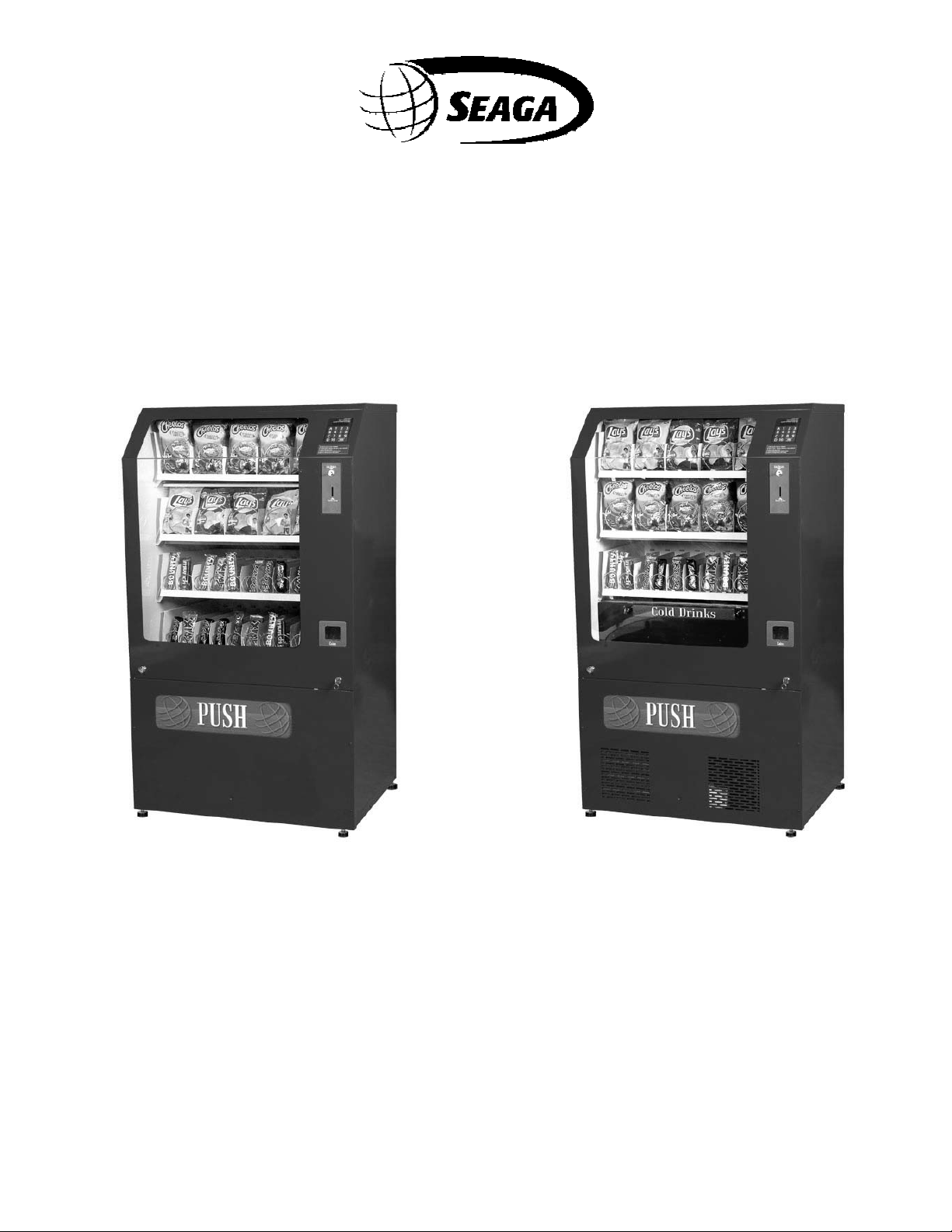
SS2000 SS4000
SS2000 F SS4000 F
Operator’s Manual
1
Page 2
g
k
The Space Saver Automatic Series Vendor
This is a User Manual for SS2000/2000F/4000/4000F Space Saver Automatic Series Vendors. The SS2000 is a non-refrigerated Snack Vendor,
whereas SS4000 is a Combo model which includes a refrigerated Beverage Can Vendor. The Standard models are for operation in the North
American markets where as the [F] versions are intended for the European and U.K markets
This O perator’s Manual is divided into four (4) main sections. These are a Brief desc ription of Space Saver Automatic series Vendor, Service Mode,
Money Mechanisms and Beverage Can vending unit
.
IMPORTANT NOTICES
Your vendor (s) are intended for indoor use only
Your vendor (s) must be set on a level, well supported location.
Always unload vendor before transporting it.
Remove the plastic cable ties from each helix coil.
Remove any protective sheets from under the Helix coil support plates before loading the vendor.
Do not load your vendor with disfigured or damaged product.
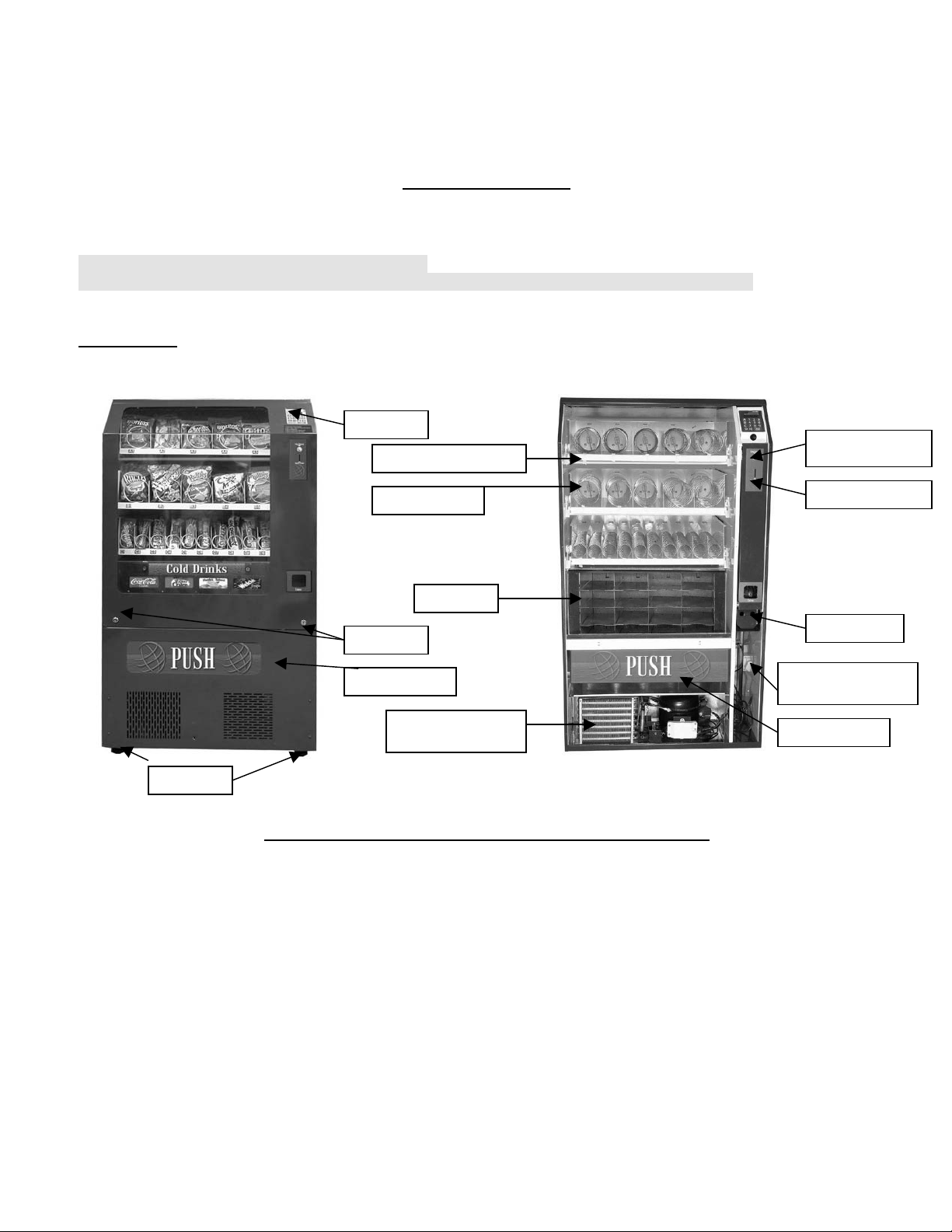
Section 1 Brief Description of your SS series Vendor
( Fig.1 SS4000) ( Fig.2 SS4000 )
Key Pad
Product Shelf
Coin return Button
Helix Coils
Coin Insert slot
Can Unit
Locks
Front Panel
Refrigeration Deck
Coin Box
Plug& Socket for
eration dec
Refri
Product Door
Levellers
HOW TO LOCK & UNLOCK THE DOOR OF SNACK VENDOR
Your S pace Saver Vendor has 2 loc ks. To open the door, unlock the right side loc k by turning the key cloc kwise. Thereafter open the left side lock
by turning the key counter clockwise. The door can now be opened and removed by raising from both the sides and lifting it until the top edge
disengages from the Vendor cabinet. (Fig.3)
To lock the door hold both sides of door half way down the door. Engage the top of the door with the Vendor cabinet while keeping the bottom away
from the machine. Lower the bottom of the door ensuring that the top of the door remains engaged with the cabinet. Lock the door by turing the left
key clockwise and the right key counter clockwise.
3
Page 3
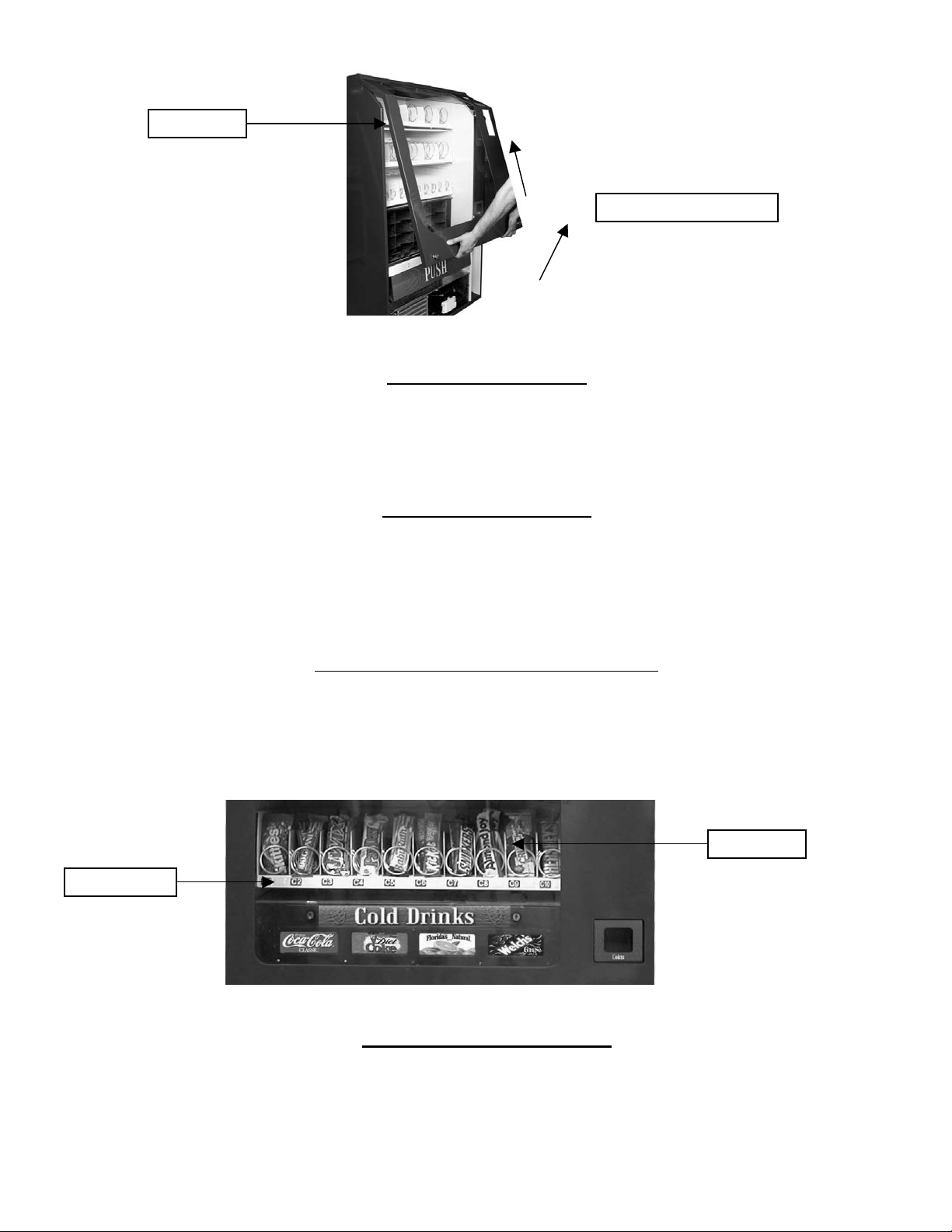
Fig. 3 – Unlocking the front door
Front Door
lift door after unlocking
LEVELING YOUR VENDOR
Once you have installed your vendor in its proper location, you will need to level it to ensure trouble free operation. The vendor is
provided with 4 threaded levellers. These can be screwed into the bottom of the vendor and can be adjusted up or down as needed
to ensure the machine is leveled properly. (Fig.1)
ELECTRICAL CONNECTION
The SS2000/4000 Snack Vendor requires one 120 VAC 60 Hz grounded outlet
The SS2000 [F]/4000 (F) Snack Vendor requires one 230 VAC 50 Hz grounded outlet
Note: The Mains cable can be coiled back into the left hand rear corner of the vendor. Pull out the cable to the extent
necessary before start up.
FIXING PRICE LABELS ON PRODUCT TRAYS
The Price and Product labels supplied with the vendor are to be fixed below the Helix Coil. (Fig.4) The Product Trays
must be marked as ‘A’ ,’B’,’C’,’D’ from the top tray downwards. In the case of SS4000 the ‘D’ marking is for the Can
Unit. The columns are numbered from the left starting with ‘1’, ‘2’, ‘3’, ‘4’, etc
Fig.4
Labels
KEYPAD AND LED DISPLAY
The Keypad is a touch sensitive operation. Light pressure will be necessary to activate each number or letter. The
vendor’s Keypad is used by the customer to make their selection, and by the operator to set and test many functions of
the vendor. (Fig. 5)
4
Page 4
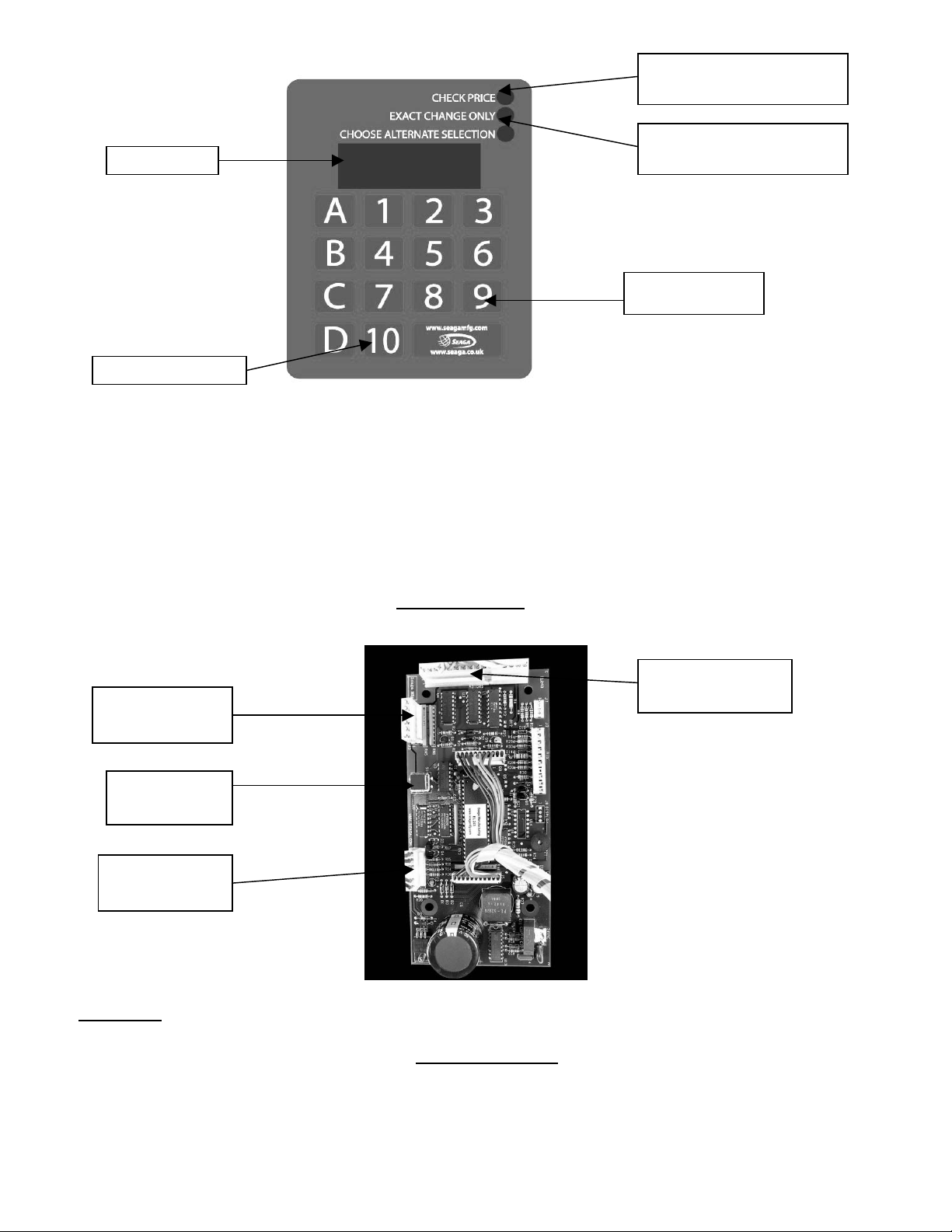
Figure 5
LED Display
Up in Service Mode
When LED is on check price
and then insert coins
When LED is on Insert exact
change only for a vend
Down in Service
Mode
The LED Display shows the customer the amount of money entered into the vendor, and the cost of their selection, it shows the
operator the Service Mode function for setting and testing the various functions of the vendor.
1. To Access Operator Functions:
A) Unlock and open the Front Door to access the Circuit Board, and enter Service
Mode by pressing the Red Service Mode Button. (Fig. 6)
CIRCUIT BOARD
(Fig. 6)
Aux. Card Main
Shelf Selection
Harness
Red Service
Mode Button
Coin Changer
Harness
Harness
Section 2
SERVICE MODE
The Service Mode is entered and exited by pressing the Red Service Mode Button on the Circuit Board. All Service Mode functions
are cycled and selected by pressing the DOWN (9) and UP (10) keys. If no action is taken within 20 seconds the display will return
to Standard Operation Mode
.
5
Page 5

MOTOR COUNT (“Cnt”)- Displays the total count of motors available in this vendor. Enter Service Mode. Cycle
through the Service Mode until the display reads “Cnt”. Press any keypad character other than the DOWN (9) or UP (10) key and
the controller will display the motors it recognizes. The total number of motors should equal the total number of selections.
BILL ESCROW (“ES”)- Optional setting that when ON will return the bill to the customer on demand, when OFF the
vendor will return coins to the customer. Enter Service Mode. Cycle through the Service Mode until the display reads “ES”. Press
any keypad character other than the DOWN (9) or UP (10) key to turn this mode ON (“ES y”) or OFF (“ES n”).
MULTI-VEND MODE (“UL”)- Optional setting that when ON allows more than one vend to be performed, provided
there is still credit remaining. Enter Service Mode. Cycle through the Service Mode until the display reads “UL”. Press any keypad
character other than the DOWN (9) or UP (10) key to turn this mode ON (“UL y”) or OFF (“UL n”).
FORCE-VEND MODE (“FC”)- Optional setting that when ON requires a purchase once credit has been deposited.
Enter Service Mode. Cycle through the Service Mode until the display reads “FC”. Press any keypad character other than the
DOWN (9) or UP (10) key to turn this mode ON (“FC y”) or OFF (“FC n”).
BEVERAGE SOLD-OUT MODE (“Can”)- Optional setting that when ON operates sold-out function for this
vendor, and will display “Sold Out” when selection is empty. Enter Service Mode. Cycle through the Service
reads “Can”. Press any keypad character other than the DOWN (9) or UP (10) key to turn this mode ON (“Can y”) or OFF (“Can n”).
Mode until the display
TEST ALL MOTORS (“Test”)- Allows user to test all motors in your vendor. Enter Service Mode.
Cycle through the Service Mode until the display reads “Test”. Press any keypad character other than the DOWN (9) or UP (10) key
to test all motors. No other function can be accessed during the test. The time this function requires will vary. Display will return to
Standard Operating Mode.
INDIVIDUAL MOTOR TESTING (“Slct”)- Allows user to individually test each motor in this vendor.
Enter Service Mode. Cycle through the Service Mode until the display reads “Slct”. Enter any selection to test it’s motor. (ex. A1)
PRICE SETTING (“Prc”)- Allows the user to set individual prices for each motor or item loaded in your vendor. Enter
Service Mode. Cycle through the Service Mode until the display reads “Prc”. Enter any selection to display current price. (ex. A1)
Press the DOWN (9) or UP (10) key to change the price for that selection. Price setting will change in 5 cent increments. Press “A”
to save the new price.
CASH HISTORY (“Cash”)- Displays total cash count.
Enter Service Mode. Cycle through the Service Mode until the display reads “Cash”. Press any keypad character other
than the DOWN (9) or UP (10) key to display the total cash count the vendor has accumulated. This function cannot be reset to
zero.
SALES HISTORY (“Sale”)-
Enter Service Mode. Cycle through the Service Mode until the display reads “Sale”. Press any keypad character other than
the DOWN (9) or UP (10) key to display the total vend count that your vendor has performed. This function cannot be reset to zero.
Displays total vend count.
COIN DISPENSING (“Coin”)- Allows user to manually dispense coins from the Coin Mechanism by coin type.
Enter Service Mode. Cycle through the Service Mode until the display reads “Coin”. Pressing keys 1-7 will dispense the
lowest through the highest denomination of coins. For American Coin Mechanisms key 1 will dispense nickels, key 2 will dispense
dimes, and key 3 will dispense quarters.
Special Note: To avoid true customer aggravation, Multi-Vend and Force-Vend should NOT be turned on at same time.
DELIVERY SYSTEM
The delivery system of your SS4000 Series Snack vendor consists of the Keypad, LED Display, Driver Motors, Product Trays Helix
Coils and Beverage Can Unit. The customer inserts money and enters their selection on the Keypad. The selected Driver Motor
turns the Helix Coil that vends the product.
6
Page 6
LOADING PRODUCT SHELVES
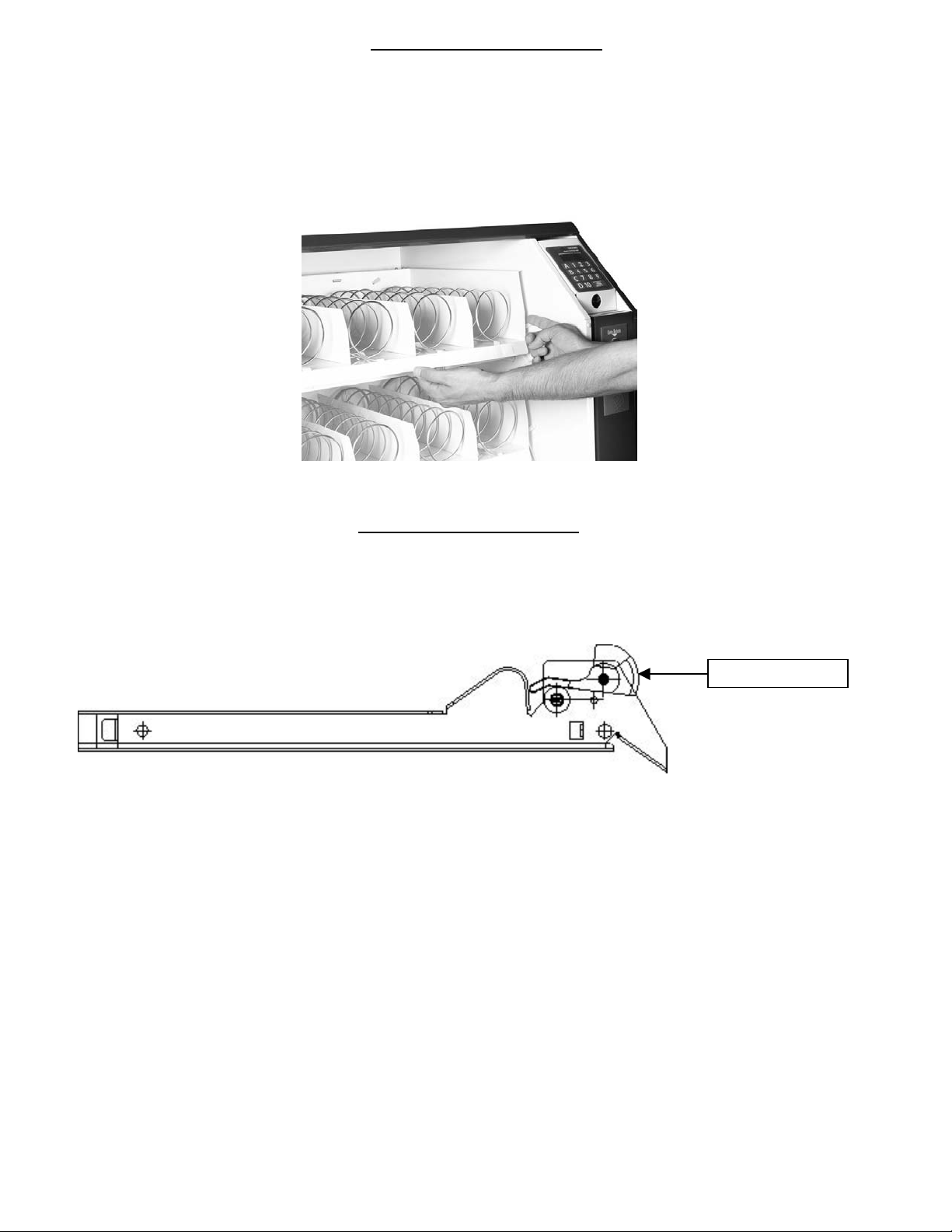
Remove the front door of vendor, and push down the plastic lock lever on the right side of shelf (fig.7) to unlock the
shelf. Holding the lever down, Grasp the Product shelf under both the front corners and lift the front of the shelf slightly
and pull forward. The shelf will slide out and then tilt down to make loading of products easier. Load only one product
shelf at a time.
Figure 7
Removing Product Shelves
Push up the plastic Cam lock lever on the right side of shelf (fig.8). Grasp the Product shelf under both the front
corners, and lift the front of the shelf slightly and pull the Tray out completely. Remove the Wiring harness connecter
located on the inside right-hand side of the Shelf.
Fig.8
Cam LockLever
To present your product in as attractive and professional manner as possible, do not load damaged items, and make
sure that the items are facing forward for easy identification by your customer.
Note: The Size of the item being vended must be larger than the Helix Coil, but smaller than the column, to vend
correctly. Never force an oversized item into the helix Coil or Column, nor attempt to vend an item that is smaller than
the Helix Coil as this will create problems and deter customers. The snack vendor ensures FIFO [First in first out ] of
product stock rotation. This is not so in the case of the Beverage Can Unit.
1. To Load Product:
a.] Pull out the desired Product Tray all the way forward. Product tray will tilt down.
Note: Pull out only one (1) Product Tray at a time
b.) Place product in proper size helix coil. Note: Bottom of product must rest on the product Tray and not on the
Helix Coil. Load each column from front to back.
Note: Fill all product trays fully; do not leave any spaces behind or between items.
7
Page 7
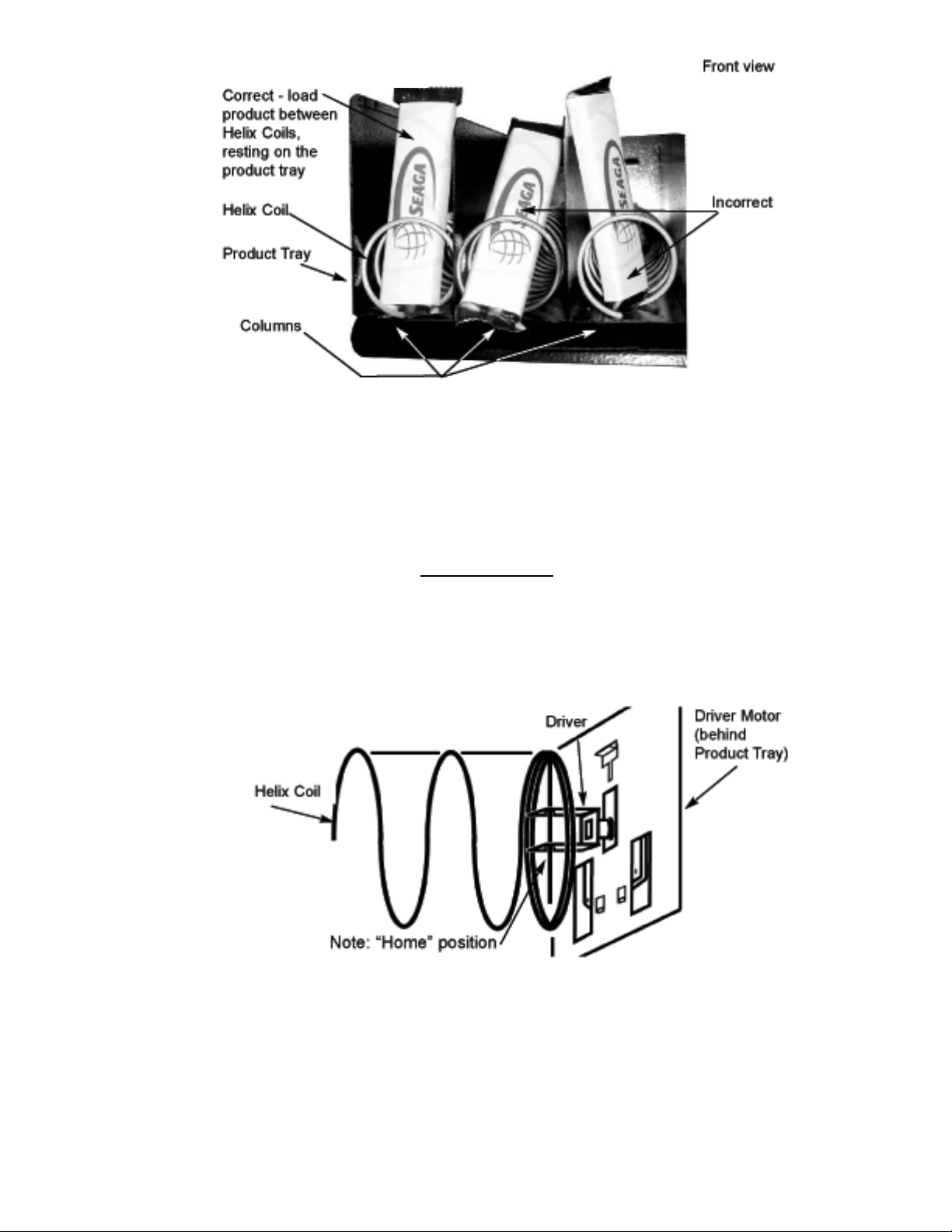
Fig.9 Loading product
c.] Once Product Tray is fully loaded, lift and push it back in.
Repeat above steps until all product Trays are fully loaded.
Special Note: We suggest that you always partially fill the vendor with product and perform at least five (5) test
vends. Test vends can be performed easily by entering Service Mode and running “Individual motors testing”.
DRIVER MOTORS
Each Selection is vended by the action of the Driver Motor. The Driver Motors are clipped onto the rear of each
Product Tray.
In the rare event of a jam a Driver Motor may need to be returned to its home position. The Home Position is when the
shaft of the helix coil that is held by the Driver is Vertical with the end of the shaft pointing down.
Figure.10 Delivery System
1. To “Home “ a Driver Motor.
a. Unlock and open the Front Door to access the Circuit Board, and enter Service Mode by pressing the
Red Service Button
b. Cycle through the Service Mode until the Display Reads “SLCT”
c. Enter the letter and number of the motor you wish to home. The Motor will rotate to its home position.
2. To Remove a Driver Motor
a. Unlock and open the front door
b. Unlock Product Tray and pull it out fully whilst keeping it level
c. Lift Product tray to release from the Track and pull it out
8
Page 8
Caution:
The wiring harness is plugged into the inside right-hand side of the Product Tray.
d. Remove Helix Coil from the driver by lifting the front end of the Helix Coil up with
one hand while guiding the rear of the Helix Coil with the other
.
Note: This operation is more difficult with smaller Helix Coils.
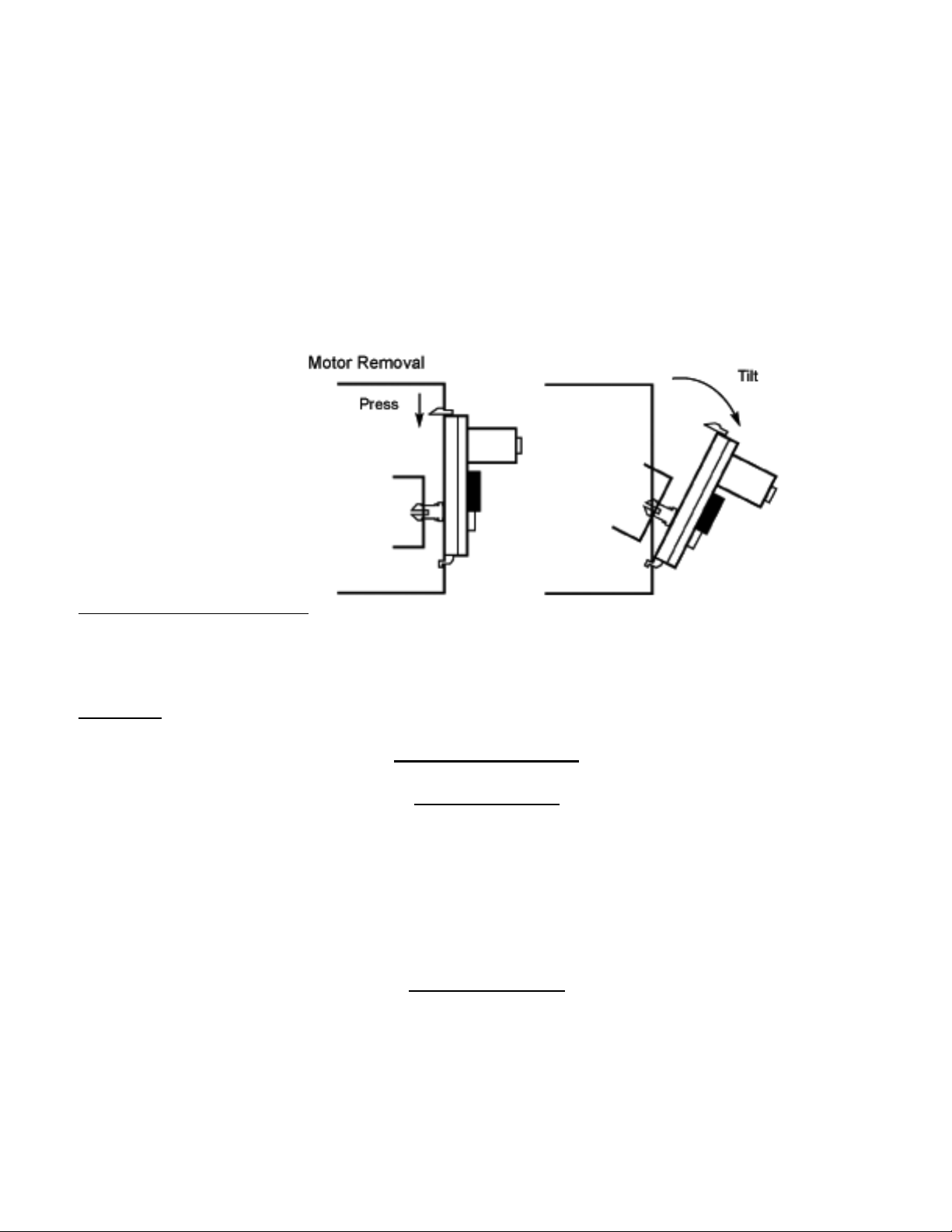
e. Depress the top tab on the Driver Motor, tilt the Driver Motor backwards, and lift
the driver motor free. (Fig.11)
f. Disconnect Wires of The driver motor
g. Replace Driver Motor by repeating above steps in reverse order.
The Product Tray Wire Harness will need to be unplugged prior to complete removal of the product tray.
Fig.11
Section 3
PAYMENT SYSTEMS
COIN CHANGER
The Coin Changer receives and returns change to customers. The Coin Changer is installed prior to delivery of the
Vendor, and will accept quarters, dimes, and nickels. The Coin Changer can be set to accept the new golden dollar.
Quarters that are not needed to maintain inventory in the quarter tube, and all other coins are diverted to the Coin
Tray. For (F) series of Vendors the Coin Changer will be present to accept U.K/ Euro coins.
It is recommended that you initially load the tubes at least half full when setting up your vendor and that you do not
allow your vendor’s coin inventory to drop below that.
COIN RETRIEVAL
Coins can be retrieved from the vendor in three (3) ways, the Coin Box, Manual Coin Retrieval Button, and the Coin
Return Button. The CoinBox Sits below the vertical shelf. The Coin Box holds all accepted coins, except for quarters
needed to maintain inventory in the Quarter Tube. (Some overflow may occur) The Manual Coin Retrieval buttons are
along side the dime tube, pressing a button will dispense one [1] of the selected coins.
9
Page 9
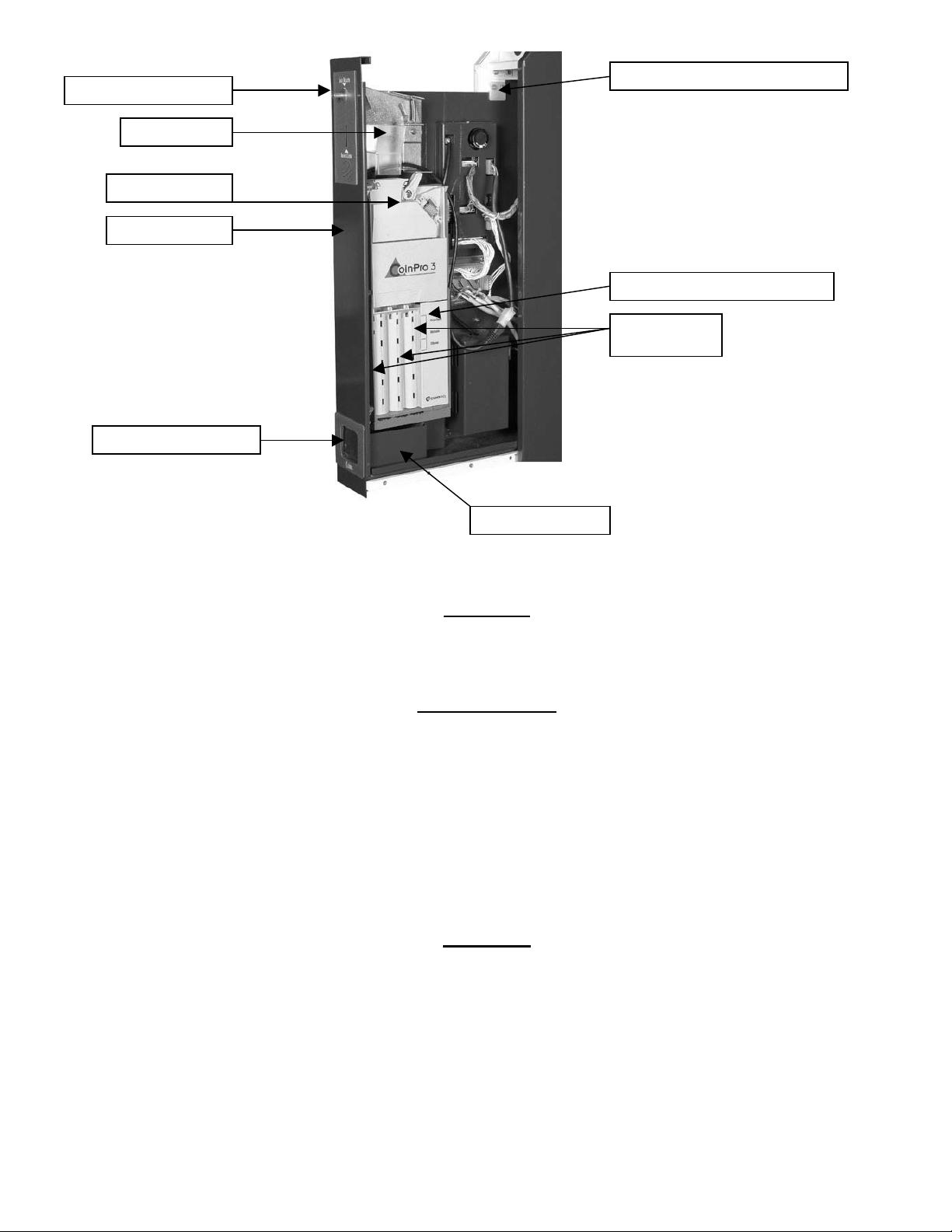
Figure 12
f
Coin return Knob
Coin Chute
Coin Hopper
Vertical shelf
Screws holding vertical shel
Manual Coin retrieval Buttons
Coin Tubes
Coin Box
The Coin Return Knob pushes the Coin Return Lever, which returns inserted coins to the customer.
CAPACITY
The Coin Changer will hold $20 in quarters, $10.60 in dimes, and $3.65 in nickels.
CLEARING JAMS
To clear a jam, remove the hopper assembly
1.To remove Hopper Assembly
a. Unlock and open the front door of Vendor. Unplug the Vendor
b. Remove the coin box, and pull the vertical shelf out.
c. Loosen the mounting screws that hold the Coin Return arm and Coin Chute to the vertical shelf, and shift
this assembly up.
d. Push the thumb Tabs up, and tilt the Coin Hopper forward
e. Lift and remove. Note: The coin hopper is still connected to the Coin Changer by the ribbon cable that can
be pulled free.
f. Clear Jam and reassemble.
CLEANING
Your Coin Changer needs to be cleaned only when the Coin Changer will no longer read coins.
1.Cleaning the Optics. You will need cotton swabs [Q-tips], and a 50/50 water/isopropyl [rubbing] alcohol solution.
a. Unlock and open the front door
b. Remove the Coin Box, and Pull the Vertical shelf out.
c. Tilt The Coin Hopper open, there are two (2) Lenses on the flap and two (2) Lenses inside the coin hopper
d. Swab the lenses with the solution, and reassemble.
10
Page 10
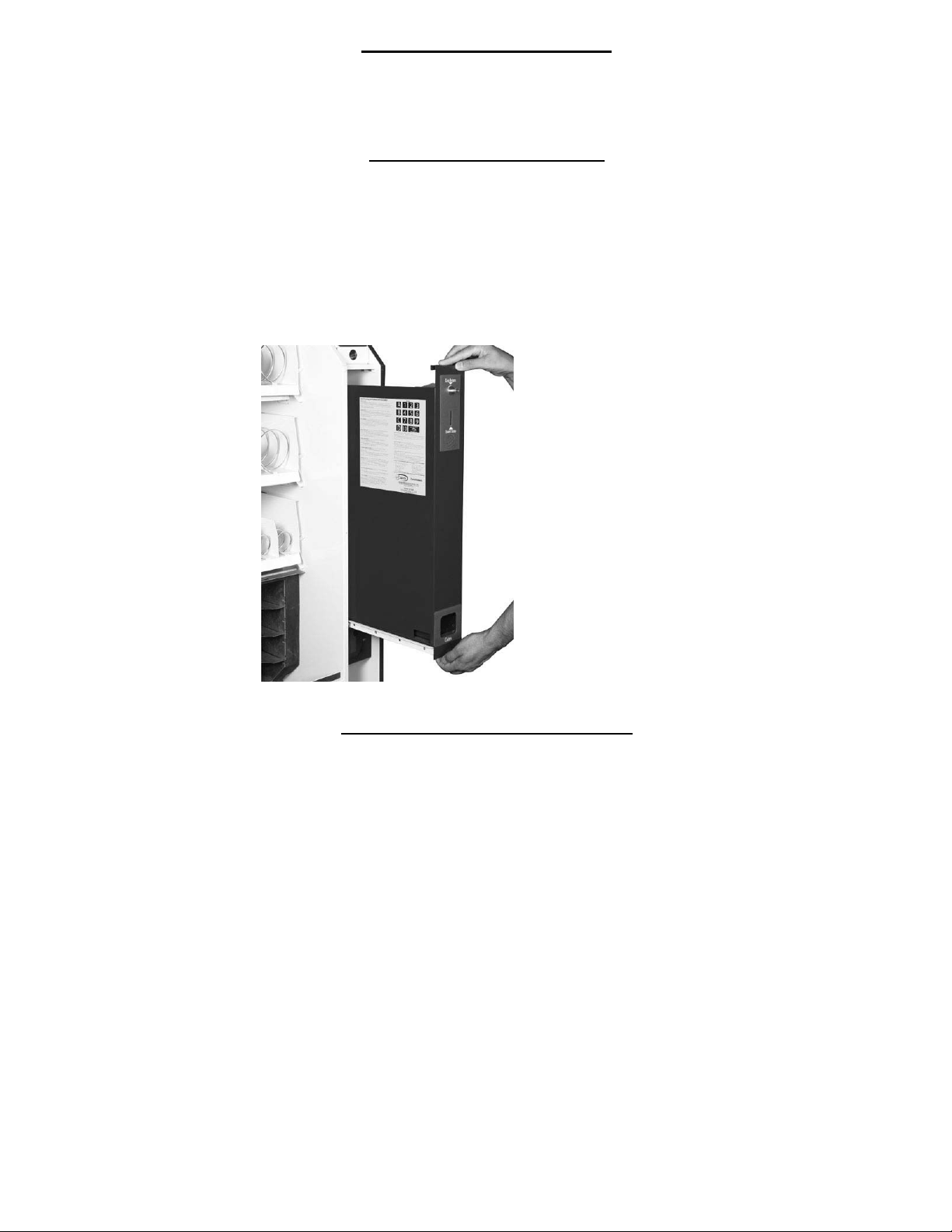
REMOVAL OF COIN CHANGER
1.To Remove the Coin Changer.
a. Remove the Coin Hopper as Above
b. Disconnect Wiring harness
c. Lift Coin Changer and remove.
VERTICAL SHELF REMOVAL
To Remove the Vertical Shelf
a. Unlock and open the Front door, unplug the Vendor
b. Slide out the Vertical Shelf completely
c. Disconnect wiring harness
d. Unscrew the two screws holding the vertical shelf using allen key at top right side of the shelf. (fig.11 )
e. Remove the vertical shelf. (Fig.13)
Figure 13
Q. How High Can I set my Prices?
A. Each selection can be priced individually up to $95.95
Q. Can Customers reach down and help themselves to product?
A. No, They Can’t. The product door is a Triangle shaped flap designed to deter reach and theft. When
pushed, the back of the triangle flap will come in contact with the bottom product tray and will
become an anti-theft wall to act as a block.
Q.Motor cycles but no product is vended
A. Check to see if the product is jammed in the Helix Coil
Check to see if the Product is damaged, and make sure it is of the proper size.
Q.In the event of a power outage, will I have to reprogram my Vendor?
A.No, Your selection prices are safely stored.
Q.Coin Changer is not accepting Coins
A. Lenses may be dirty
Coins may be damaged or worn out
Wire harness may not be connected properly
Coin Changer may not have power
COMMON QUESTIONS AND ANSWERS
11
Page 11
Section 4 BEVERAGE CAN VENDING UNIT (In SS4000 Model)
The Beverage Can Unit is available in the SS4000/4000F models. This is a refrigerated unit that is located below the
Product trays in the lower part of the Vendor. The Unit has 4 different lanes handling 26 cans in each. Total can
handling capacity is 104. The unit incorporates a self-contained pull out type refrigeration deck.
ACCESSING CAN UNIT
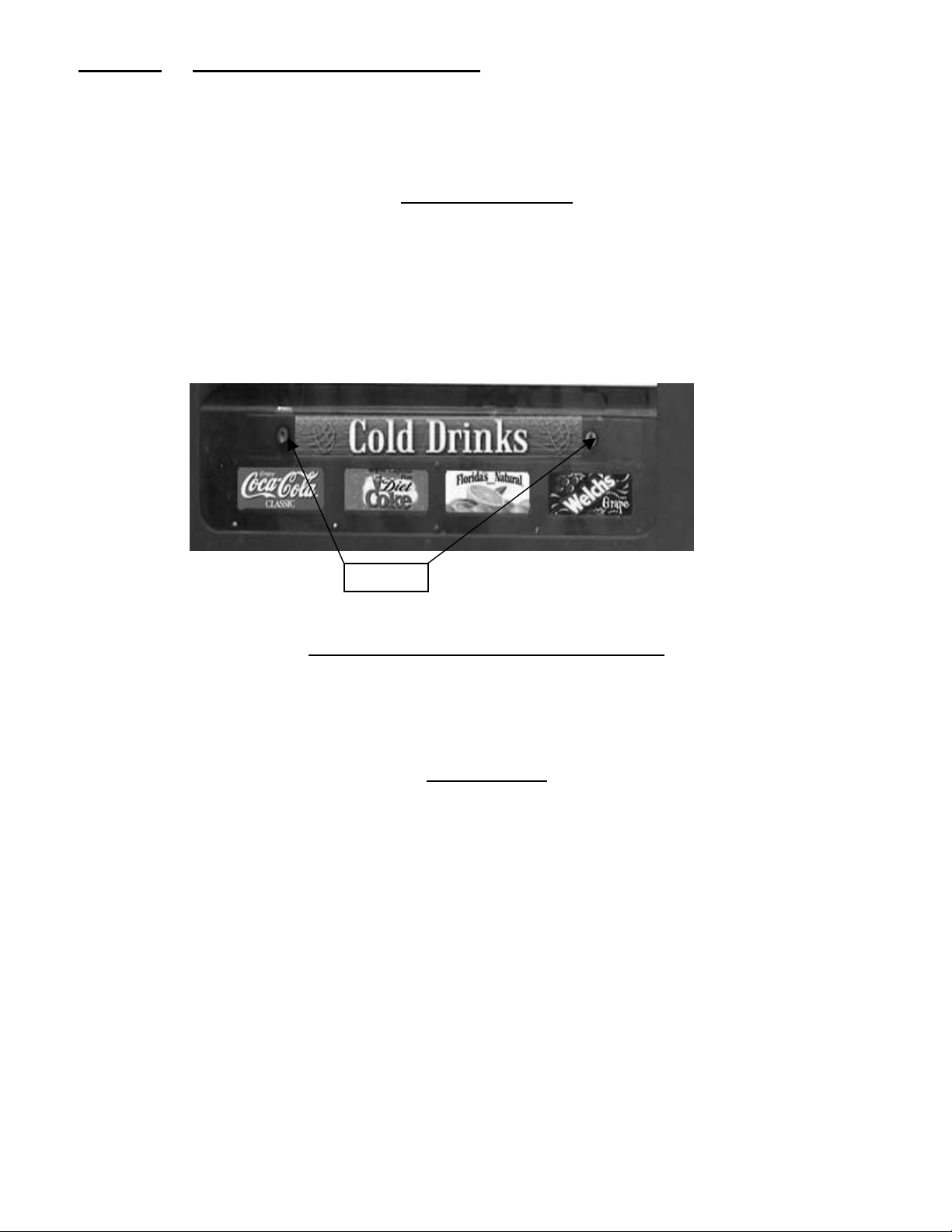
The can dispensing unit can be easily accessed by opening the two locks at the top of the can unit door (Fig.14, Below
the lower snack tray of your vendor). The door is then opened downwards. This is the area where the beverage cans
are filled in to the vendor. The door and the vending flaps of the can unit can be dislodged from the can unit. This is
done by removing two screws (use allen key no. 5 for this purpose) which are located on either side of the machine
right below the can unit door.
Figure 14
BEVERAGE SELECTION PRICING AND LABELS
The beverage selection is D1 to D4 on the key pad. The Prices can be set by entering the Service Mode. The
Selection Stickers can be put on the 4 slots available on the door of the Can Vending unit. ( Fig.14 )
LOADING CANS
The Loading pattern in machine with Serial No. up to S6040807284 is as follows;
Unlock and open the can unit door. Note: Cans must always be loaded from the bottom shelf first. Load the
bottom shelf with cans and then load 3 cans in each shelf , proceeding upwards from the third shelf. After
this load the remaining cans in the different shelves. See Schematic Diagram. Beverage Cans can be directly
loaded into the Lower shelf using the can unit door as a ramp to roll down the cans.
12
Page 12
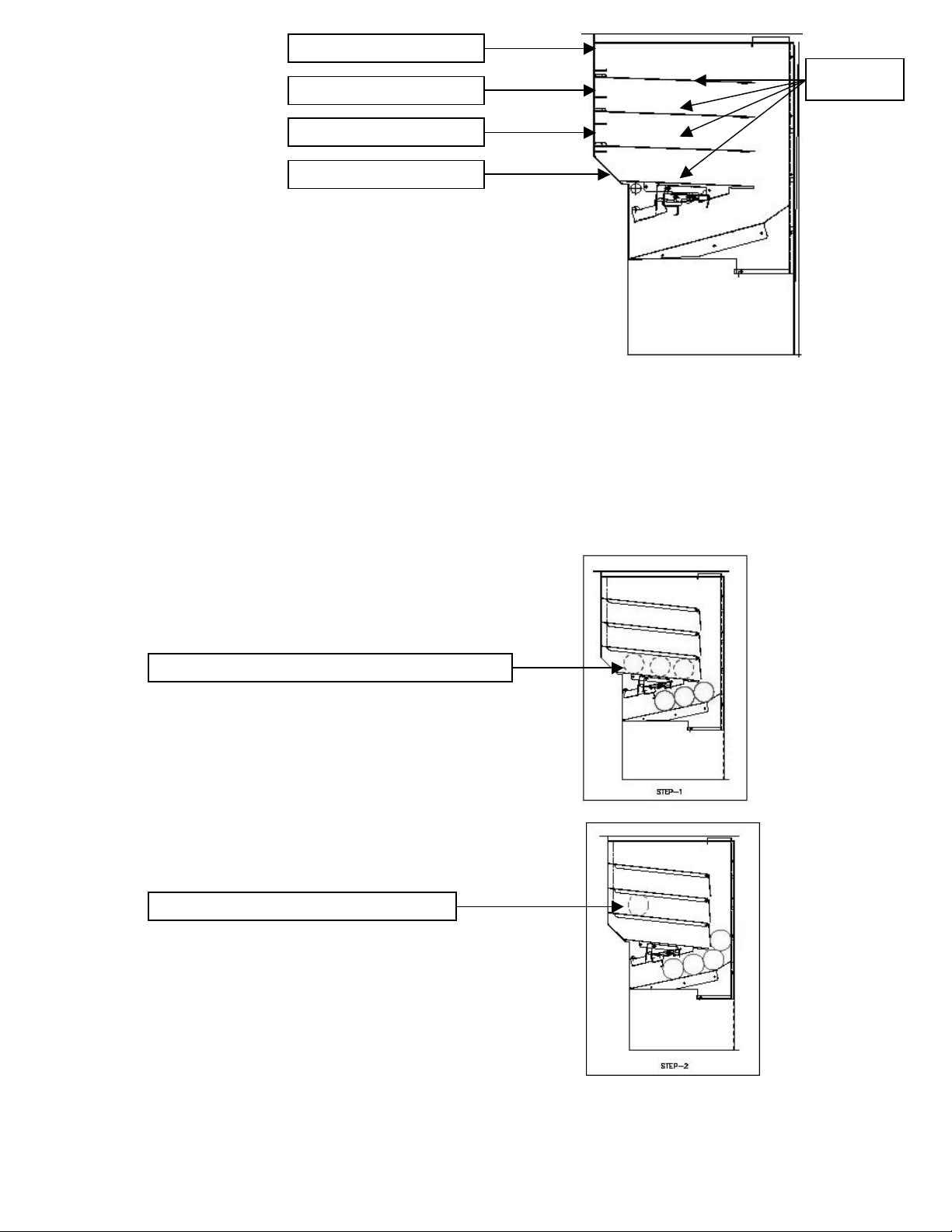
Last ly Load Cans in 1stShel
f
d
f
d
f
f
d
),
Then Load Cans in 2
Then Load Cans in 3
n
r
Shel
Shel
Shelves
Load Cans in Lower shel
fig.15
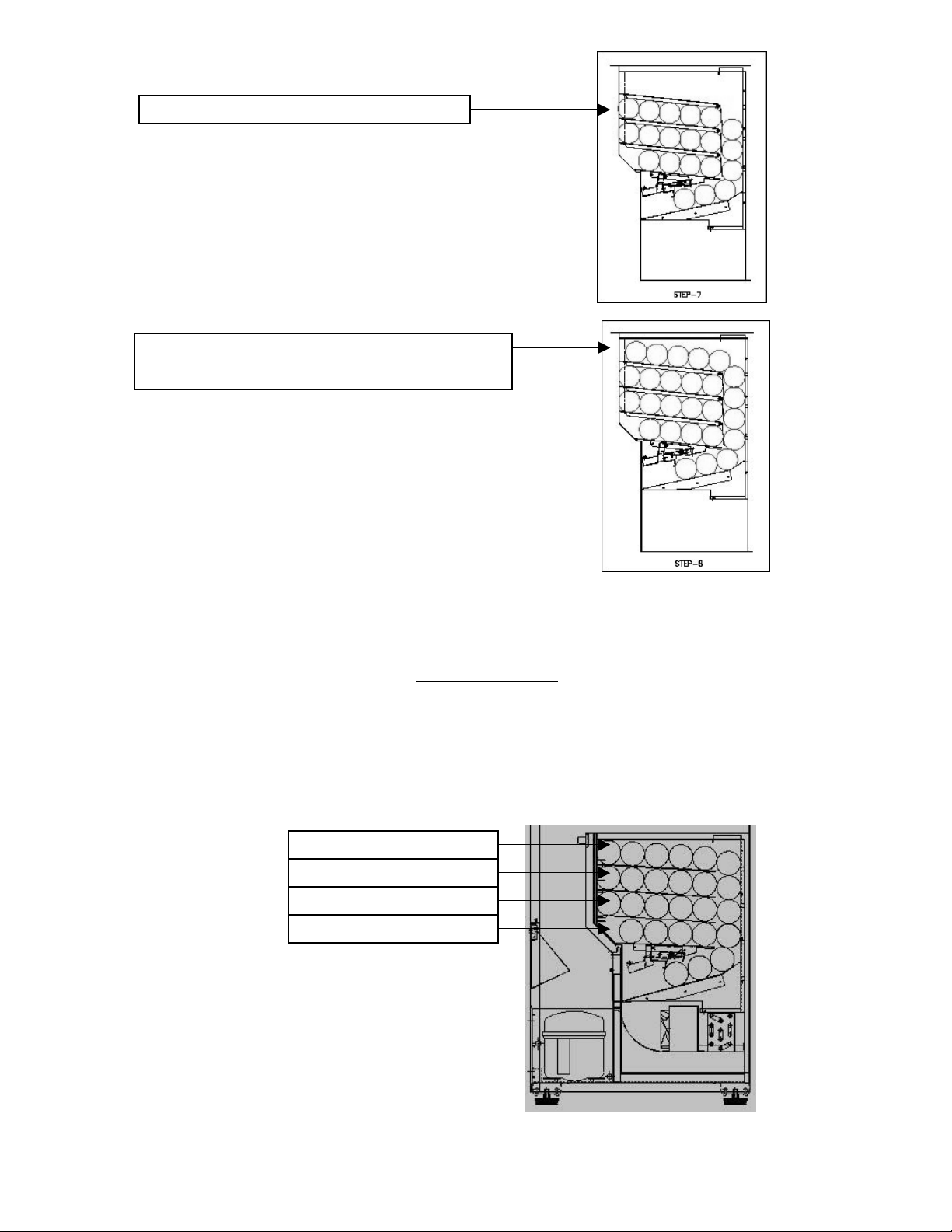
The Loading Pattern in Machines after serial No. S6040807284 is as follows (See Schematic Diagrams).
Unlock and open the can unit door. Beverage Cans can be directly loaded into the Lower shelf using the can unit
door as a ramp to roll down the cans.
First Load the bottom shelf with 3 cans (step 1)
and then load 1 can in 3
r
shelf (step 2
13
Page 13
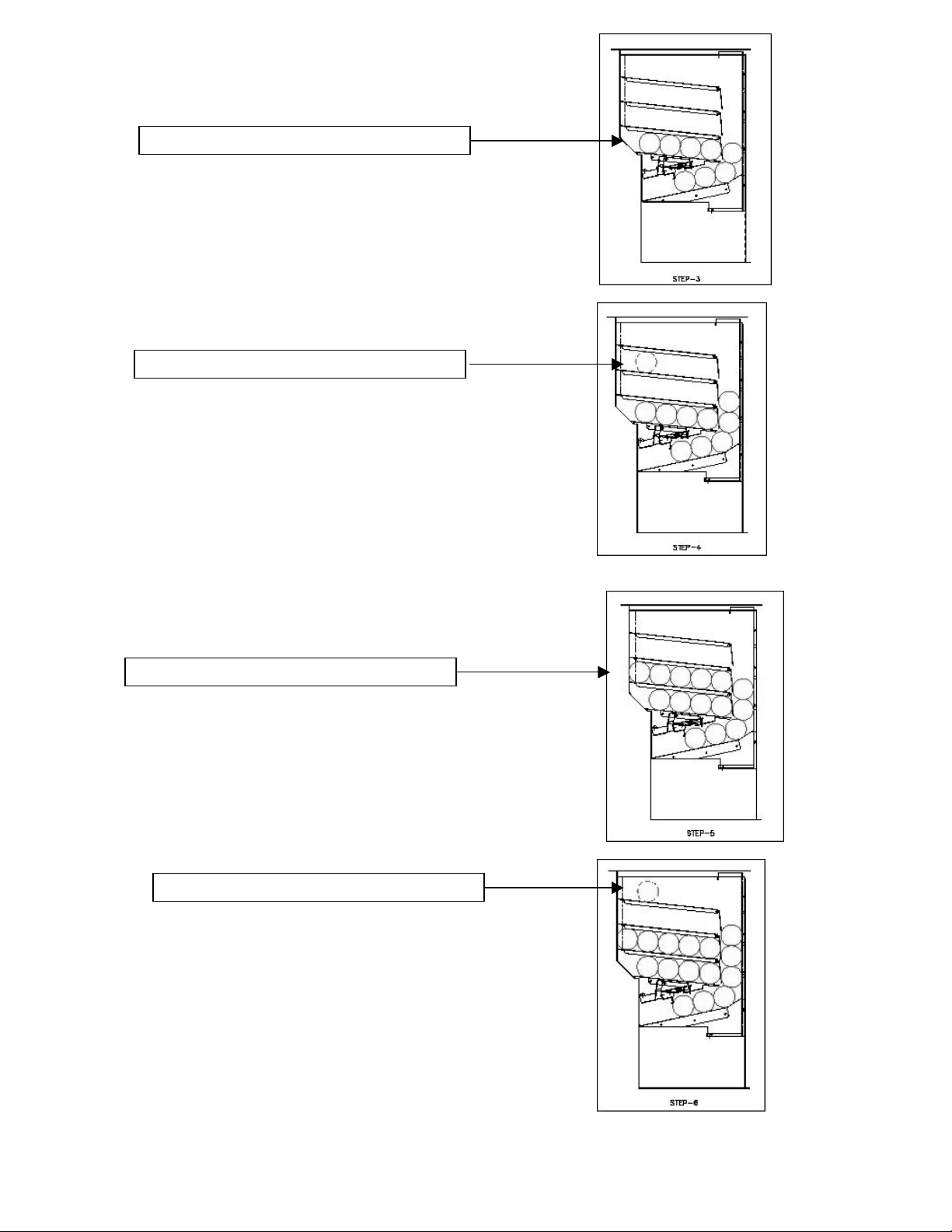
fill the bottom shelf completely (step 3
)
d
)
d
)
Now Load 1 can in 2
Load 3
r
shelf completely (step 5)
n
shelf (step 4
Load 1 can in 1 st shelf (step 6
14
Page 14
d
Load 2
n
shelf completely
After this load the remaining cans in the 1st shelf
(step 8).
Special Note:
We suggest that you always partially fill the vendor with product and perform at least five (5) test
vends. Test vends can be performed easily by entering Service Mode and running “Individual motors testing”.
STOCK ROTATION
The Beverage Can unit does not ensure FIFO (first in first out). So whenever fresh stock of cans are loaded (usually
from the upper shelves) it is likely that the lower shelves of the can unit may still be holding some older cans for an
interval of time. Although beverage cans have reasonably good shelf life, we recommend that the Beverage Can unit
be emptied once every 30 days and reloaded, so that a forced product rotation takes place.
The Cans are vended as per the schematic diagram
15
Page 15
REFRIGERATION DECK (SS4000)
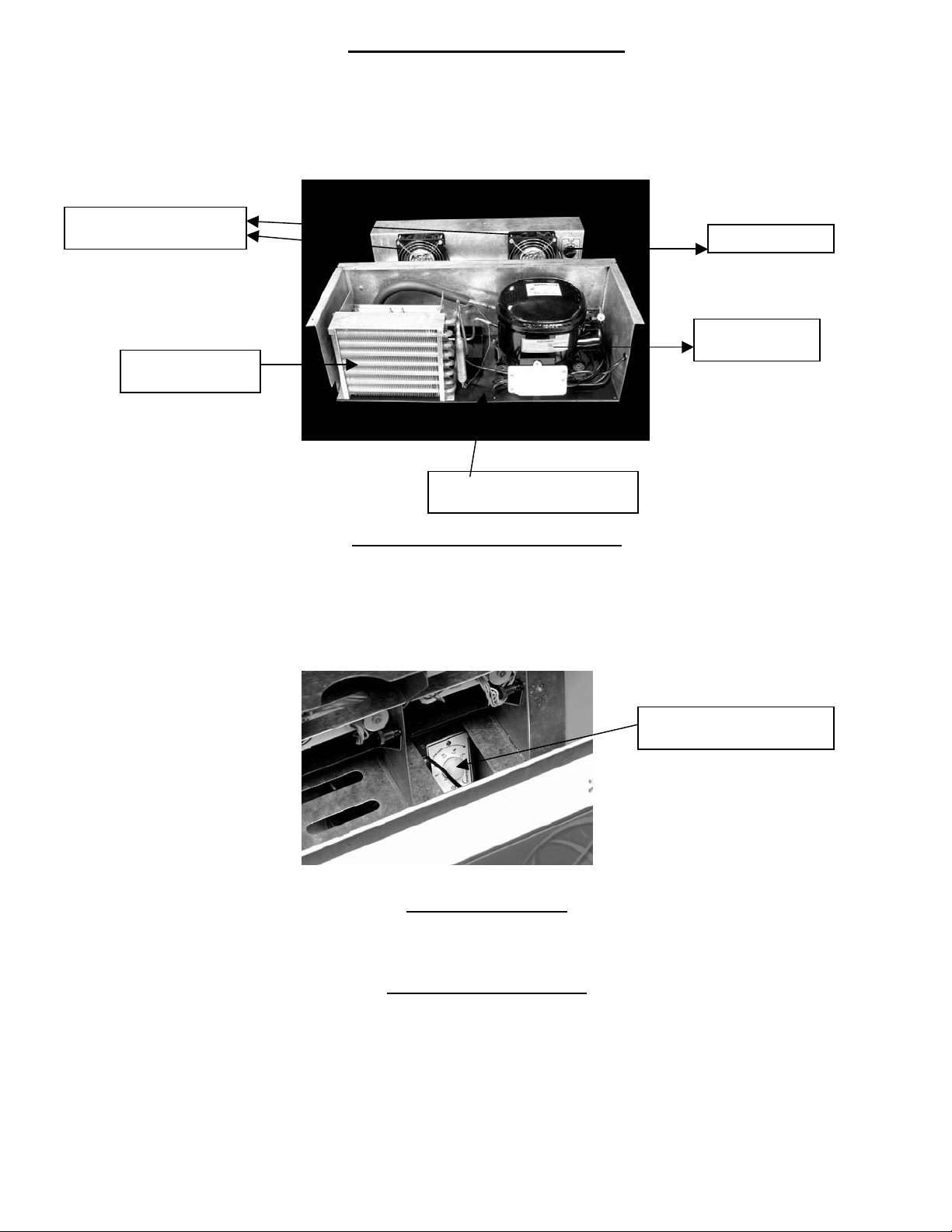
Your can vending unit incorporates of a high efficiency refrigeration system having two air circulation fans to chill the
cans. The refrigeration unit can be easily accessed by opening two screws located on the front bottom panel of the
vendor. Remove the two screws at the mid point of the Panel (see fig.17) The refrigeration Deck can now be pulled
out from the vendor.
Fig.17
Air Circulation fans
Thermostat Knob
Compressor
Condenser
Two Screws to fasten the deck to
the vendor
ACCESS POINT FOR THERMOSTAT
The Thermostat Knob can be adjusted without pulling out the refrigeration deck (Fig. 18). The Knob is accessible
through a port located on the extreme right hand side of the vend area below the fourth can dispense driver motor.
Turning the Knob clockwise will lower the temperature in the dispensing unit and vice versa.
Figure 18
Thermostat Knob
TEMPERATURE CHECK
Once your vendor is unboxed you will need to plug in your vendor and allow it to come to operating temperature. It will take about
18 hours for the vendor to reach an operating temperature of 38° F - 45° F. Temperature fluctuation is normal, and will depend upon
your location climate.
CLEANING THE CONDENSER
Dust and dirt restricts good airflow and cooling of the condenser, due to which the refrigeration unit will not chill the Cans properly.
Remove the front bottom panel of the refrigeration unit. Brush the dirt and dust from the condenser. You can also blow air on the
condenser or vacuum clean it. Do not damage the fins of the condenser while cleaning. Reassemble the front bottom panel after
cleaning.
16
 Loading...