

Page 1
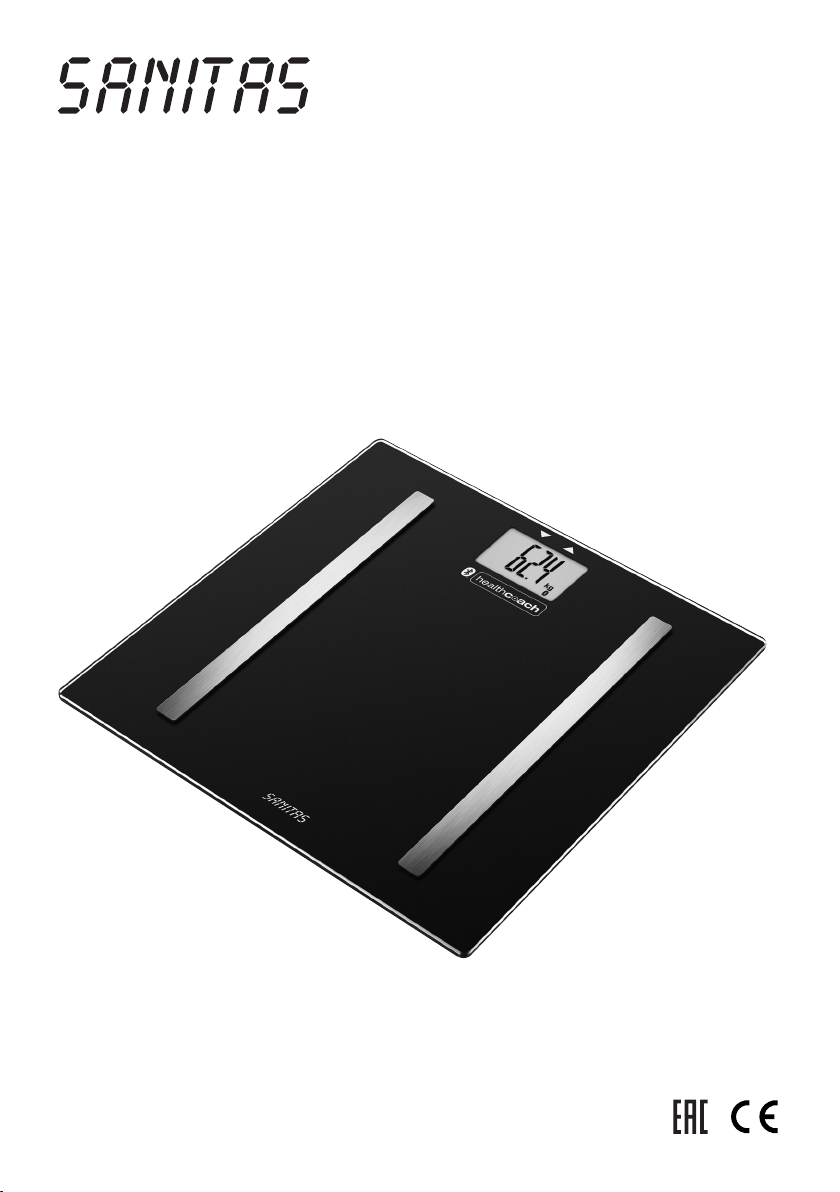
SBF 72
DE Diagnosewaage
Gebrauchsanweisung .................. 2
EN Diagnostic bathroom scale
Instructions for use .................... 15
FR Pèse-personne impédancemètre
Mode d’emploi ........................... 27
IT Bilancia parlante
Instruzioni per l´uso .................... 40
RU Диагностические весы
Инструкция поприменению .... 51
Page 2

DEUTSCH
Lesen Sie diese Gebrauchsanweisung sorgfältig durch, bewahren Sie
sie für den späteren Gebrauch auf, machen Sie sie anderen Benutzern
zugänglich und beachten Sie die Hinweise.
Inhalt
1. Lieferumfang.......................................................3
2. Zeichenerklärung ................................................ 3
3. Bestimmungsgemäßer Gebrauch .......................4
4. Warn- und Sicherheitshinweise .......................... 4
5. Gerätebeschreibung ........................................... 6
6. Inbetriebnahme ..................................................6
Zum Kennenlernen
Funktionen des Gerätes
Diese digitale Waage dient zum Wiegen und zur Diagnose Ihrer persönlichen Fitness-Daten.
Sie ist für die Eigenanwendung im privaten Bereich bestimmt.
Die Waage verfügt über folgende Funktionen, die von bis zu 8 Personen benutzt werden können:
• Körpergewicht-Messung,
• BMI,
• Ermittlung von Körperfettanteil,
• Körperwasseranteil,
• Muskelanteil,
• Knochenmasse,
• Grund- und Aktivitätsumsatz.
Außerdem verfügt die Waage über folgende weitere Funktionen:
• Umschalten zwischen Kilogramm „kg“, Pfund „lb“ und Stone „st“,
• automatische Abschaltfunktion,
• Batteriewechsel-Anzeige bei schwachen Batterien,
• automatische Benutzererkennung,
• Speicherung der letzten 30 Messungen für 8 Personen, wenn zur App nicht übertragen werden kann,
• Direktstart-Funktion: Bei Start der Waage ohne App misst die Waage das Gewicht und die BIA. Die Kör
peranalysewerte werden dann mit Standardparametern berechnet und sind daher zwangsläufig mehr
oder weniger ungenau. Diese Werte werden nicht auf der Waage gespeichert.
7. Anwendung ........................................................7
8. Reinigung und Pflege ....................................... 11
9. Was tun bei Problemen? ..................................11
10. Entsorgung ..................................................... 12
11. Technische Angaben ...................................... 13
12. Garantie/Service ............................................. 13
-
Das Messprinzip
Diese Waage arbeitet mit dem Prinzip der B.I.A., der Bioelektrischen-Impedanz-Analyse. Dabei wird inner
halb von Sekunden durch einen nicht spürbaren, völlig unbedenklichen und ungefährlichen Strom eine
Bestimmung von Körperanteilen ermöglicht.
Mit dieser Messung des elektrischen Widerstandes (Impedanz) und der Einberechnung von Konstanten
bzw. individuellen Werten (Alter, Größe, Geschlecht, Aktivitätsgrad) können der Körperfettanteil und wei
tere Größen im Körper bestimmt werden. Muskelgewebe und Wasser haben eine gute elektrische Leitfähig keit und daher einen geringeren Widerstand. Knochen und Fettgewebe hingegen haben eine geringe
Leitfähigkeit, da die Fettzellen und Knochen durch sehr hohen Widerstand den Strom kaum leiten.
Beachten Sie, dass die von der Diagnosewaage ermittelten Werte nur eine Annäherung an die medizini
schen, realen Analysewerte des Körpers darstellen. Nur der Facharzt kann mit medizinischen Methoden
(z.B. Computertomografie) eine exakte Ermittlung von Körperfett, Körperwasser, Muskelanteil und
Knochen bau durchführen.
Bei Verwendung mittels Direktstart ist die Eingabe der individuellen Werte nicht nötig. Die Berechnung
erfolgt neben Gewicht und BIA mittels Annahme von Standardparametern und es handelt sich dadurch nur
um Näherungswerte, die jedoch in der Trendbetrachtung ebenso Gültigkeit haben können.
2
-
-
-
Page 3
1. Lieferumfang
PAP
max.
180 kg
396 lb
28 st
max.
180 kg
396 lb
28 st
Überprüfen Sie das Gerät auf äußere Unversehrtheit der Verpackung und auf die Vollständigkeit des
Inhalts. Vor dem Gebrauch ist sicherzustellen, dass das Gerät und Zubehör keine sichtbaren Schäden auf
weisen und jegliches Verpackungsmaterial entfernt wird. Benutzen Sie es im Zweifelsfall nicht und wenden
Sie sich an Ihren Händler oder an die angegebene Service-Adresse.
• Kurzanleitung
• Diagnosewaage SBF 72
• 1 x 3V CR2032 Batterie
• Diese Gebrauchsanweisung
-
2. Zeichenerklärung
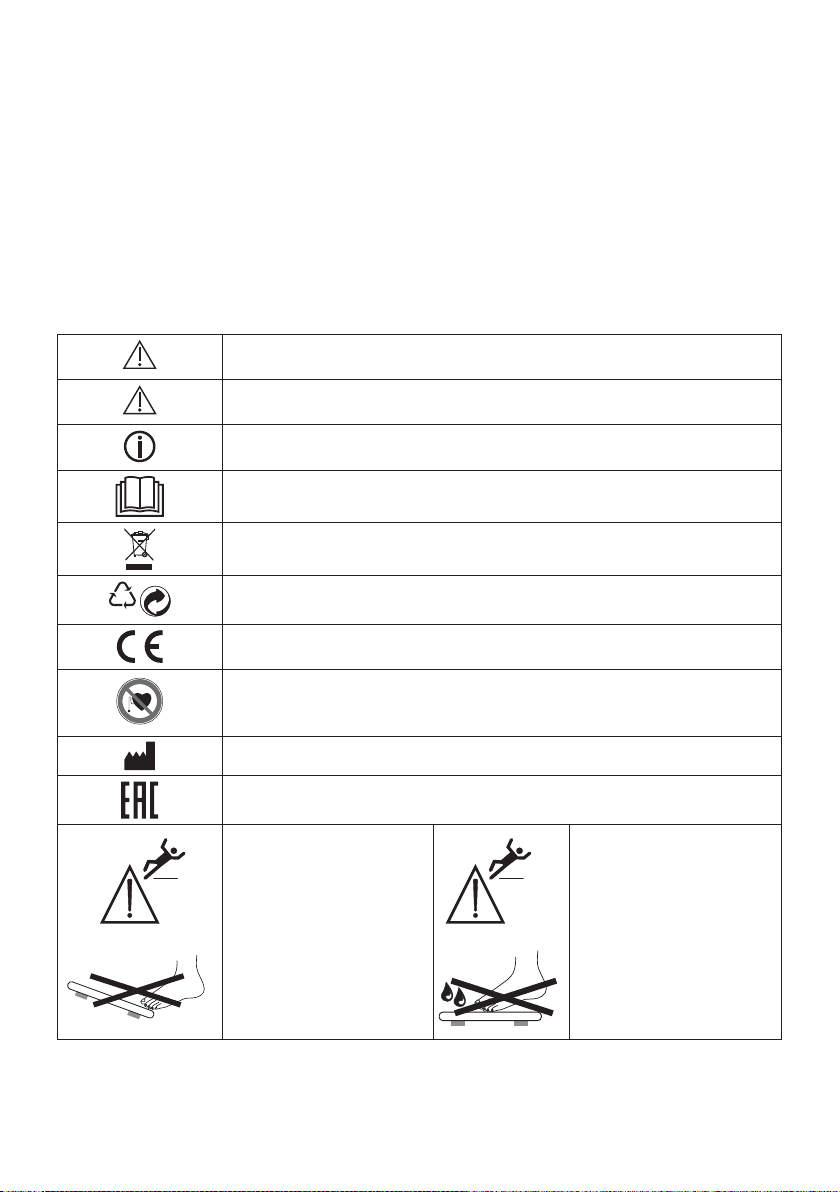
Auf dem Gerät, in der Gebrauchsanweisung, auf der Verpackung und auf dem Typschild des Geräts werden folgende Symbole verwendet:
WARNUNG
Warnhinweis auf Verletzungsgefahren oder Gefahren für Ihre Gesundheit.
ACHTUNG
Sicherheitshinweis auf mögliche Schäden am Gerät/Zubehör.
Hinweis
Hinweis auf wichtige Informationen
Gebrauchsanweisung beachten
Entsorgung gemäß Elektro- und Elektronik-Altgeräte EG-Richtlinie WEEE
(Waste Electrical and Electronic Equipment)
20
Verpackung umweltgerecht entsorgen
Dieses Produkt erfüllt die Anforderungen der geltenden europäischen und nationalen Richtlinien.
Das Gerät darf nicht von Personen mit medizinischen Implantaten (z.B. Herzschrittmacher) verwendet werden. Andernfalls kann deren Funktion beeinträchtigt sein.
Hersteller
Zertifizierungszeichen für Produkte, die in die Russische Föderation und in die
Länder der GUS exportiert werden.
Kippgefahr: Stellen Sie sich
mittig auf die Wiegefläche.
Rutschgefahr: Betreten Sie
die Waage nicht mit nassen
Füßen.
3
Page 4
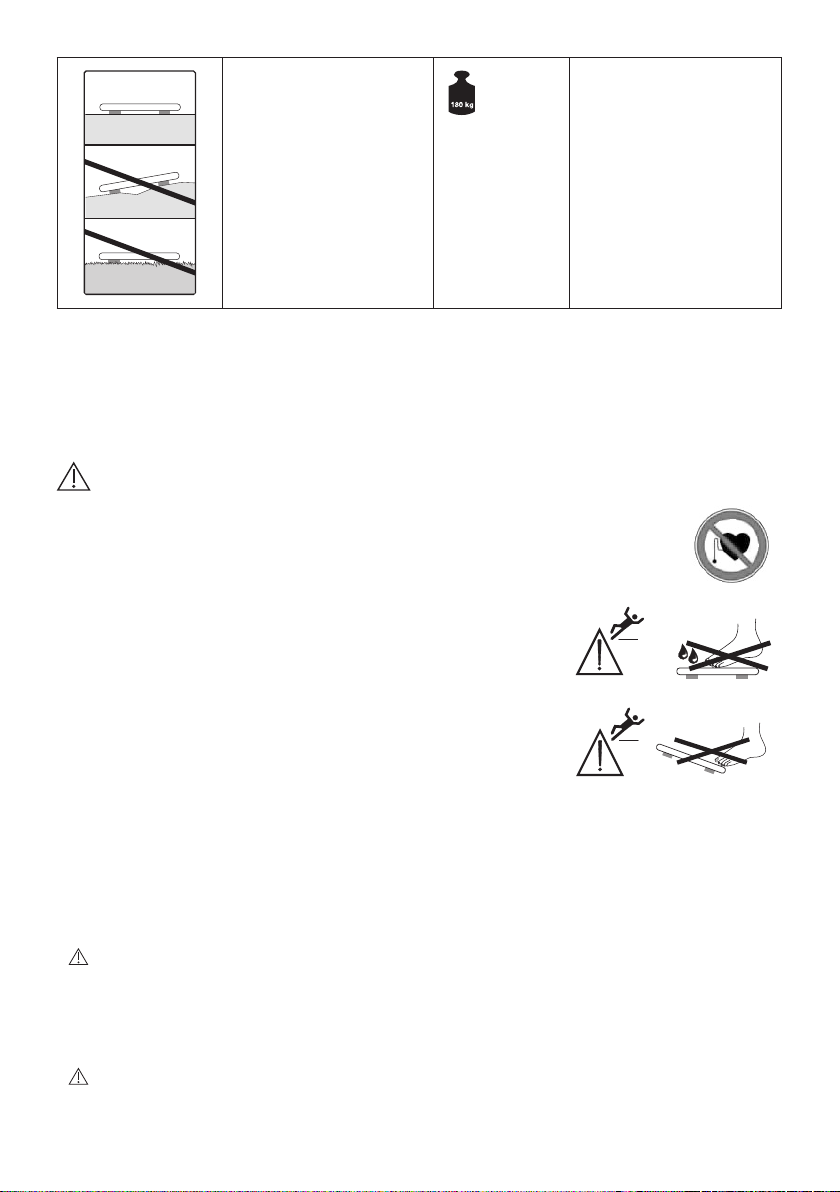
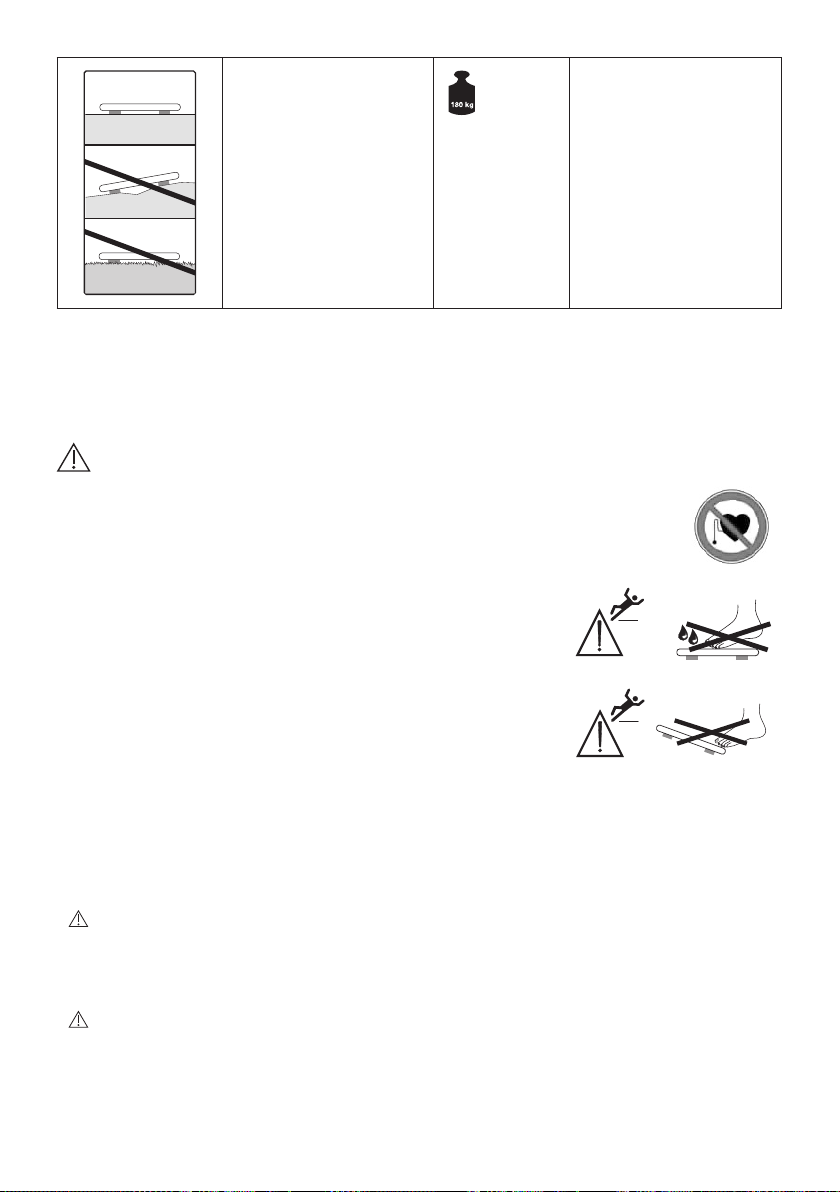
Stellen Sie die Waage auf
max.
180 kg
396 lb
28 st
max.
180 kg
396 lb
28 st
einen ebenen Untergrund.
Kein Teppich.
Belasten Sie die Waage
nicht über
180 kg / 396 lb / 28 st.
3. Bestimmungsgemäßer Gebrauch
Das Gerät ist nur zum Wiegen von Menschen und zur Aufzeichnung Ihrer persönlichen Fitness-Daten
bestimmt. Das Gerät ist nur zur Eigenanwendung, nicht für den medizinischen oder kommerziellen
Gebrauch bestimmt.
4. Warn- und Sicherheitshinweise
WARNUNG
• Die Waage darf nicht von Personen mit medizinischen Implanta
ten (z.B. Herzschrittmacher) verwendet werden. Andernfalls kann
deren Funktion beeinträchtigt sein.
• Nicht während der Schwangerschaft benutzen.
• Achtung, steigen Sie nicht mit nassen Füßen auf die Waage und
betreten Sie die Waage nicht, wenn die Oberfläche feucht ist –
Rutschgefahr!
• Steigen Sie nicht einseitig auf den äußersten Rand der Waage: Kippgefahr!
• Batterien können bei Verschlucken lebensgefährlich sein. Bewahren Sie Batterien und Waage für
Kleinkinder unerreichbar auf. Wurde eine Batterie verschluckt, nehmen Sie sofort medizinische Hilfe in
Anspruch.
• Halten Sie Kinder vom Verpackungsmaterial fern (Erstickungsgefahr).
Hinweise zum Umgang mit Batterien
• Wenn Flüssigkeit aus einer Batteriezelle mit Haut oder Augen in Kontakt kommt, die betroffene Stelle mit
Wasser auswaschen und ärztliche Hilfe aufsuchen.
Verschluckungsgefahr! Kleinkinder könnten Batterien verschlucken und daran ersticken. Daher Bat-
•
terien für Kleinkinder unerreichbar aufbewahren!
• Auf Polaritätskennzeichen Plus (+) und Minus (-) achten.
• Wenn eine Batterie ausgelaufen ist, Schutzhandschuhe anziehen und das Batteriefach mit einem trocke
nen Tuch reinigen.
• Schützen Sie Batterien vor übermäßiger Wärme.
Explosionsgefahr! Keine Batterien ins Feuer werfen.
•
• Batterien dürfen nicht geladen oder kurzgeschlossen werden.
• Bei längerer Nichtbenutzung des Geräts die Batterien aus dem Batteriefach nehmen.
-
4
Page 5
• Keine Akkus verwenden!
• Keine Batterien zerlegen, öffnen oder zerkleinern.
Allgemeine Hinweise
• Beachten Sie, dass technisch bedingt Messtoleranzen möglich sind, da es sich um keine geeichte
Waage für den professionellen, medizinischen Gebrauch handelt.
• Die Belastbarkeit der Waage beträgt max 180 kg (396 lb, 28 st ). Bei der Gewichtsmessung und bei der
Knochenmassebestimmung werden die Ergebnisse in 100-g-Schritten (0,2 lb, 0-19st: 0,2lb; 20-28st: 1lb)
angezeigt.
• Die Messergebnisse des Körperfett-, Körperwasser- und Muskelanteils werden in 0,1 %-Schritten ange
zeigt.
• Der Kalorienbedarf wird in Schritten von 1 kcal angegeben.
• Im Auslieferungszustand ist die Waage auf die Einheiten „cm“ und „kg“ eingestellt. Während der Inbe
triebnahme mit der App können Sie die Einstellungen der Einheiten ändern.
• Stellen Sie die Waage auf einen ebenen, festen Boden; ein fester Bodenbelag ist Voraussetzung für eine
korrekte Messung.
• Reparaturen dürfen nur vom Kundenservice oder autorisierten Händlern durchgeführt werden. Prüfen Sie
jedoch vor jeder Reklamation zuerst die Batterien und wechseln Sie diese gegebenenfalls aus.
Aufbewahrung und Pflege
Die Genauigkeit der Messwerte und die Lebensdauer des Gerätes hängen vom sorgfältigen Umgang ab:
ACHTUNG
• Von Zeit zu Zeit sollte das Gerät gereinigt werden. Benutzen Sie keine scharfen Reinigungsmittel und
halten Sie das Gerät niemals unter Wasser.
• Stellen Sie sicher, dass keine Flüssigkeit auf die Waage gelangt. Tauchen Sie die Waage niemals in Was
ser. Spülen Sie sie niemals unter fließendem Wasser ab.
• Stellen Sie keine Gegenstände auf die Waage, wenn sie nicht benutzt wird.
• Drücken Sie nicht mit Gewalt oder mit spitzen Gegenständen auf die Taste.
• Setzen Sie die Waage nicht hohen Temperaturen oder starken elektromagnetischen Feldern aus.
• Schützen Sie das Gerät vor Stößen, Feuchtigkeit, Staub, Chemikalien, starken Temperaturschwankun
gen und zu nahen Wärmequellen (Öfen, Heizkörper).
Allgemeine Tipps
• Wiegen Sie sich möglichst zur selben Tageszeit (am besten morgens), nach dem Toilettengang, nüchtern
und ohne Bekleidung, um vergleichbare Ergebnisse zu erzielen.
• Wichtig bei der Messung: Die Ermittlung des Körperfettes darf nur barfuß und kann zweckmäßig mit
schwach befeuchteten Fußsohlen vorgenommen werden.
Völlig trockene oder stark verhornte Fußsohlen können zu unbefriedigenden Ergebnissen führen, da
diese eine zu geringe Leitfähigkeit aufweisen.
• Stehen Sie während des Messvorgangs aufrecht und still.
• Warten Sie einige Stunden nach ungewohnter körperlicher Anstrengung.
• Warten Sie ca. 15 Minuten nach dem Aufstehen, damit sich das im Körper befindliche Wasser verteilen
kann.
• Wichtig ist, dass nur der langfristige Trend zählt. In der Regel sind kurzfristige Gewichtsabweichungen
innerhalb von wenigen Tagen durch Flüssigkeitsverlust bedingt; Körperwasser spielt jedoch für das
Wohlbefinden eine wichtige Rolle.
Einschränkungen
Bei der Ermittlung des Körperfettes und der weiteren Werte können abweichende und nicht plausible
Ergebnisse auftreten bei:
• Kindern unter ca. 10 Jahren,
• Leistungssportlern und Bodybuildern,
• Personen mit Fieber, in Dialysebehandlung, Ödem-Symptomen oder Osteoporose,
• Personen, die kardiovaskuläre Medizin einnehmen (Herz und Gefäßsystem betreffend),
• Personen, die gefäßerweiternde oder gefäßverengende Medikamente einnehmen,
• Personen mit erheblichen anatomischen Abweichungen an den Beinen bezüglich der Gesamtkörper
größe (Beinlänge erheblich verkürzt oder verlängert).
5
-
-
-
-
-
Page 6
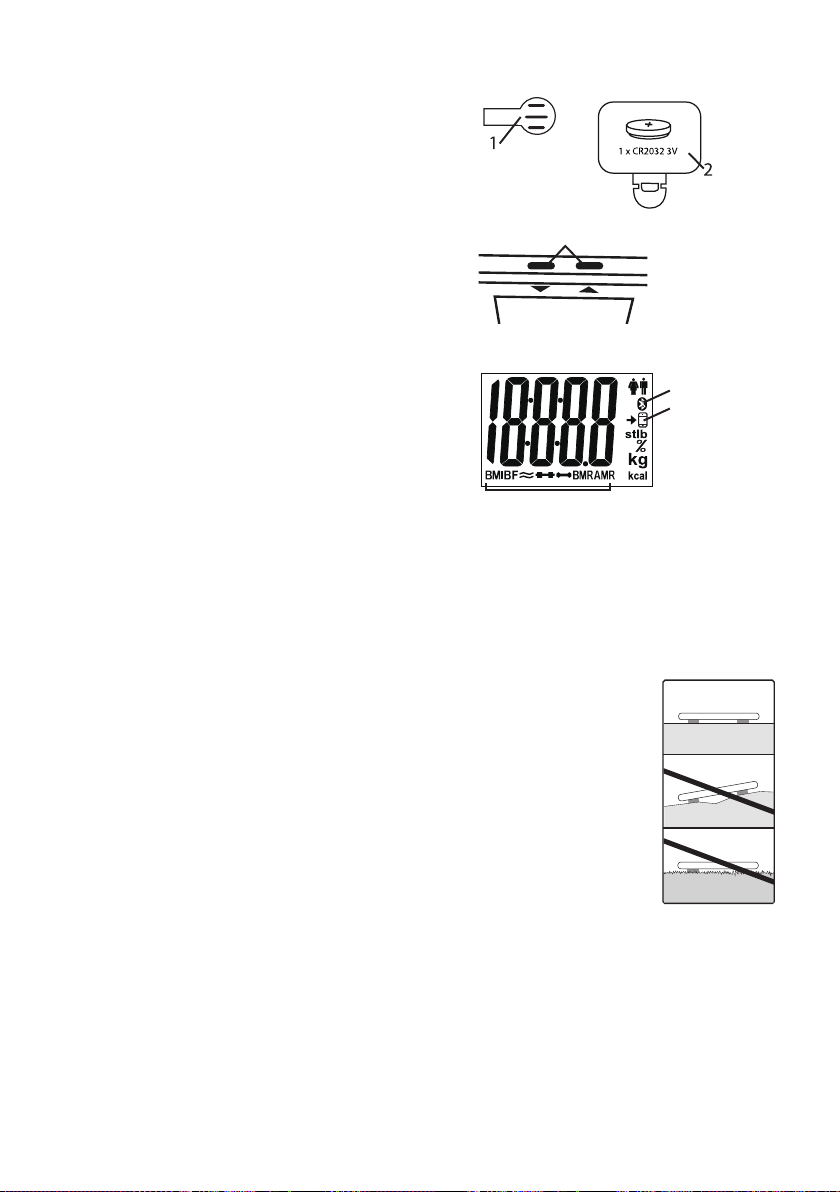
5. Gerätebeschreibung
Rückseite
1. Unit/Reset-Taste
2. Batteriefach
Unit/Reset
Stirnseite
3. Drucktasten AB / AUF
Display
4a. Bluetooth®-Symbol für Verbindung zwischen Waage
und Smartphone
4b. Synchronisierungs-Symbol beim Senden von Mes
sungen
5. Körpergewicht,
Körperdaten wie z.B. BMI, BF, ...
-
3
4a
4b
5
6. Inbetriebnahme
Batterien einlegen
Entnehmen Sie die Batterien aus dem Verpackungsschutz und setzen Sie die Batterie gemäß Polung in
die Waage ein. Zeigt die Waage keine Funktion, so entfernen Sie die Batterie komplett und setzen Sie sie
erneut ein.
Waage aufstellen
Stellen Sie die Waage auf einen ebenen, festen Boden; ein fester Bodenbelag ist
Voraus setzung für eine korrekte Messung. Stellen Sie die Waage nicht auf einen
Teppich.
6.1 Inbetriebnahme mit App
Um Ihren Körperfettanteil und weitere Körperwerte korrekt ermitteln zu können,
müssen Sie die persönlichen Benutzerdaten auf der Waage einspeichern.
Die Waage verfügt über 8 Benutzerspeicherplätze, in die Sie und beispielsweise die
Mitglieder Ihrer Familie Ihre persönlichen Einstellungen abspeichern können.
Zusätzlich können Benutzer über weitere mobile Endgeräte mit installierter „Sanitas
HealthCoach“ App oder durch Benutzerprofilwechsel in der App (siehe Einstellungen
App) in Betrieb genommen werden.
– Laden Sie die kostenlose „Sanitas HealthCoach“ App im Apple App Store (iOS) oder bei Google
Play (Android™) herunter.
– App starten und den Anweisungen folgen.
– SBF 72 in App auswählen.
6
Page 7
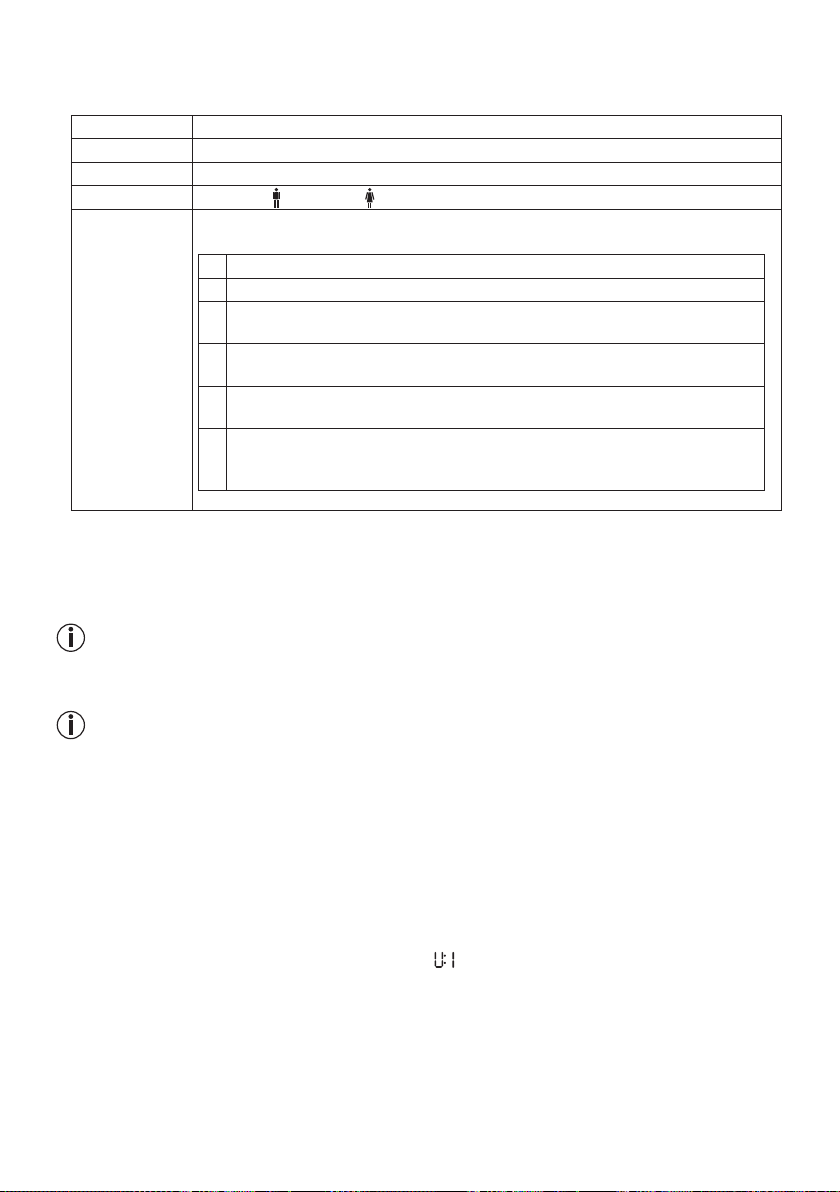
– SBF 72 bezogene Daten eingeben.
Folgende Einstellungen müssen in der App „Sanitas HealthCoach“ eingestellt sein bzw. eingegeben wer
den:
Benutzerdaten Einstellwerte
Körpergröße 100 bis 220 cm (3‘ 3,5“ bis 7‘ 2,5“)
Alter 10 bis 100 Jahre
Geschlecht männlich (
Aktivitätsgrad Bei der Auswahl des Aktivitätsgrades ist die mittel- und langfristige Betrachtung ent
scheidend.
1 Keine.
2
3
4
5
), weiblich ( )
Körperliche Aktivität
Geringe: Wenige und leichte körperliche Anstrengungen
(z.B. Spazierengehen, leichte Gartenarbeit, gymnastische Übungen).
Mittlere: Körperliche Anstrengungen, mindestens 2 bis 4 mal pro Woche,
jeweils 30 Minuten.
Hohe: Körperliche Anstrengungen, mindestens 4 bis 6 mal pro Woche,
jeweils 30 Minuten.
Sehr hohe: Intensive körperliche Anstrengungen, intensives Training oder
harte körperliche Arbeit, täglich, jeweils mindestens
1 Stunde.
-
-
– Nach Aufforderung der App die Benutzerzuordnug durchführen.
Für die automatische Personenerkennung muss die erste Messung mit Ihren persönlichen Benutzerda-
ten zugewiesen werden. Folgen Sie dazu den Anweisungen der App. Steigen Sie hierzu barfuß auf die
Waage und achten Sie darauf, dass Sie ruhig und mit gleichmäßiger Gewichtsverteilung mit beiden Bei
nen auf den Elektroden stehen.
Hinweis: Für weitergehende Betrachtungen dürfen ausschließlich nur die an der Waage angezeigten
Messwerte verwendet werden.
6.2 Nutzung ohne App: Direktstart (alternativ)
Hinweis:
Für die Anzeige der individualiserten Analysewerte empfehlen wir die Inbetriebnahme und Durchführung aller Einstellungen mit der App „Sanitas HealthCoach“. Führen Sie diesen Schritt daher nur
aus, wenn die Inbetriebnahme gänzlich ohne App durchgeführt werden soll. Bei Nutzung mit App
wechseln Sie direkt zum Kapitel „Messung durchführen“.
Direktstart-Funktion:
Bei Nutzung der Waage ohne App misst die Waage das Gewicht, sobald Sie sich auf die Trittfläche stellen.
Zur Analysemessung müssen Sie sich barfuß auf die Elektroden stellen. Die angezeigten Körperanalyse
werte wie Körperfett, BMI etc. werden mit Standardparametern berechnet und können daher von Ihren
tatsächlichen individuellen Werten abweichen, da zur Berechnung der persönlichen Körperanalysewerte
individuelle Parameter (z.B. Geschlecht, Größe usw.) benötigt werden, die jedoch nicht an der Waage,
sondern nur über die App eingestellt werden können. Diese Messwerte werden nicht auf der Waage
gespeichert, da sie nicht auf angelegte Benutzer (z.B. „
“) bezogen sind.
-
-
7. Anwendung
7.1 Messung durchführen
Stellen Sie die Waage auf einen ebenen, festen Boden; ein fester Bodenbelag ist
Voraus setzung für eine korrekte Messung. Stellen Sie die Waage nicht auf einen Teppich.
Gewicht messen, Diagnose durchführen
Steigen Sie barfuß auf die Waage und achten Sie darauf, dass Sie ruhig und mit gleichmäßiger Gewichts
verteilung mit beiden Beinen auf den Elektroden stehen.
7
-
Page 8
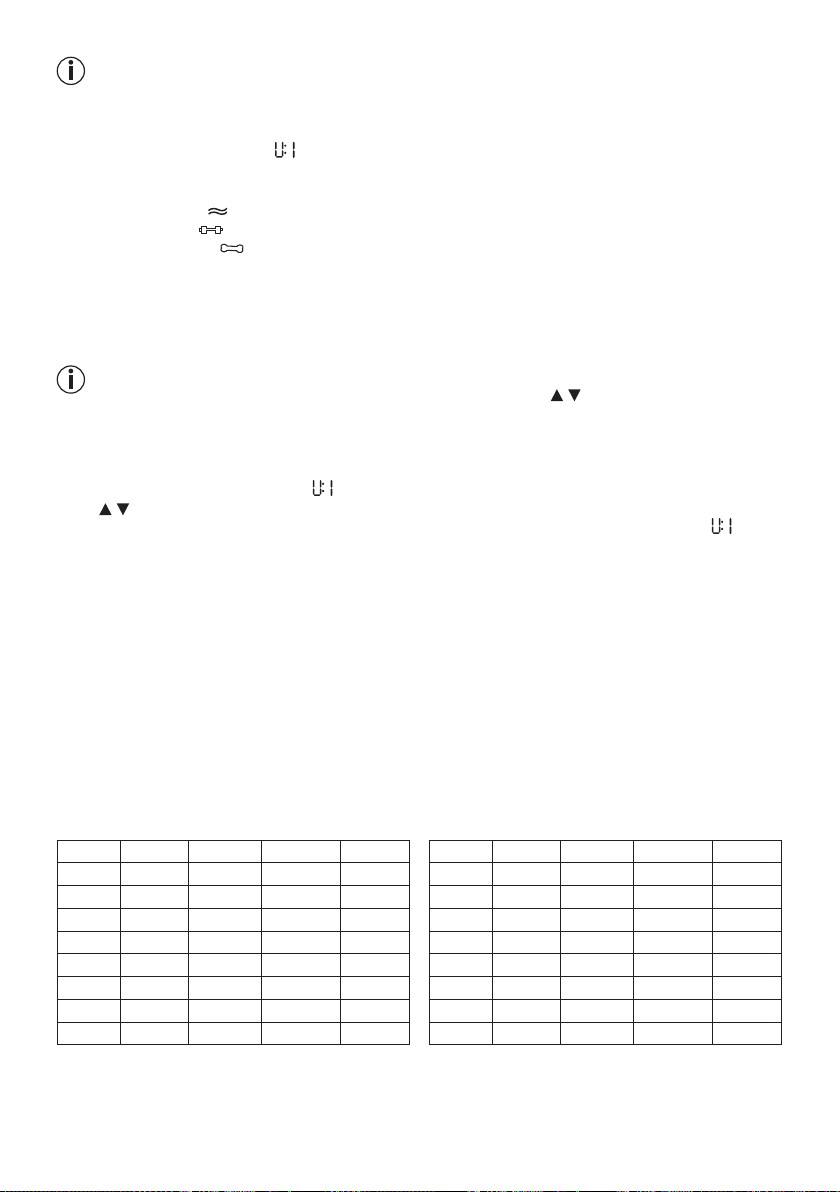
Hinweis: Falls eine Messung mit Socken durchgeführt werden sollte, ist das Messergebnis nicht
korrekt.
Es erscheinen folgende Anzeigen:
1. Gewicht in kg (bzw. lb / st)
2. Benutzerspeicherplatz (z.B. „
“)
3. BMI
4. Körperfett in % (BF)
5. Körperwasser in %
6. Muskelanteil in %
7. Knochenmasse in kg
8. Kaloriengrundumsatz in kcal (BMR)
9. Aktivitätsumsatz in kcal (AMR)
Die Messwerte werden unter dem angezeigten Benutzerspeicherplatz abgespeichert (zur späteren AppÜbertragung) oder sofort übertragen, falls die App geöffnet ist.
Hinweis: Bei zwei oder mehreren möglich erkannten Benutzern, wechselt der Benutzer in der Dis-
playanzeige. Wählen Sie Ihren Benutzer aus, indem Sie die Tasten / drücken. Ihr somit bestätigter Benutzer wird für 3 Sekunden angezeigt (in dieser Zeit könnten Sie noch wechseln). Wird kein
Benutzer ausgewählt, schaltet sich die Waage nach 40 Sekunden automatisch ab. Es wird nichts
auf der Waage gespeichert.
Wird kein Benutzer erkannt (z.B. wenn aktueller Messwert mehr als 3kg Unterschied zum vorherig
gespeichertem Wert ist), wird „
“ angezeigt. Wählen Sie Ihren Benutzer aus, indem Sie die Tasten
/ drücken.
Wurde ein Direktstart ohne Benutzer-Anlegung durchgeführt (es fehlt in der Anzeige z.B. „ “), so
werden die Ergebnisse unter Annahme von Standardparametern berechnet und nicht gespeichert.
Nur Gewicht messen
Stellen Sie sich nun mit Schuhen auf die Waage. Stehen Sie ruhig auf der Waage mit gleichmäßiger
Gewichtsverteilung auf beiden Beinen. Die Waage beginnt sofort mit der Messung.
Die BIA-Messung kann mit Schuhen nicht erfolgen. In der Anzeige werden kurz vier Striche angezeigt.
Danach erneut das Gewicht.
Waage ausschalten
Die Waage schaltet sich automatisch ab.
7.2 Ergebnisse bewerten
Körperfettanteil
Nachfolgende Körperfettwerte in % geben Ihnen eine Richtlinie (für weitere Informationen wenden Sie sich
bitte an Ihren Arzt!).
Mann Frau
Alter wenig normal mäßig viel Alter wenig normal mäßig viel
10 –14 <11 % 11–16 %
15 –19 <12 % 12 –17 %
20 – 29 <13 % 13 –18 %
30 – 39 <14 % 14 –19 %
40 – 49 <15 % 15 – 20 %
50 – 59 <16 % 16 – 21 %
60 – 69 <17 % 17– 22 %
70 –100 <18 % 18 – 23 %
16,1– 21 %
17,1– 22 %
18,1– 23 %
19,1– 24 %
20,1– 25 %
21,1– 26 %
22,1– 27 %
23,1– 28 %
>21,1 % 10 –14 <16 % 16 – 21 %
>22,1 % 15 –19 <17 % 17– 22 %
>23,1 % 20 – 29 <18 % 18 – 23 %
>24,1 % 30 – 39 <19 % 19 – 24 %
>25,1 % 40 – 49 <20 % 20 – 25 %
>26,1 % 50 – 59 <21 % 21– 26 %
>27,1 % 60 – 69 <22 % 22 – 27 %
>28,1 % 70 –100 <23 % 23 – 28 %
21,1– 26 %
22,1– 27 %
23,1– 28 %
24,1– 29 %
25,1– 30 %
26,1– 31 %
27,1– 32 %
28,1– 33 %
>26,1 %
>27,1 %
>28,1 %
>29,1 %
>30,1 %
>31,1 %
>32,1 %
>33,1 %
Bei Sportlern ist oft ein niedrigerer Wert festzustellen. Je nach betriebener Sportart, Trainingsintensität und
körperlicher Konstitution können Werte erreicht werden, die noch unterhalb der angegebenen Richtwerte lie
-
gen. Bitte beachten Sie jedoch, dass bei extrem niedrigen Werten Gesundheitsgefahren bestehen können.
8
Page 9
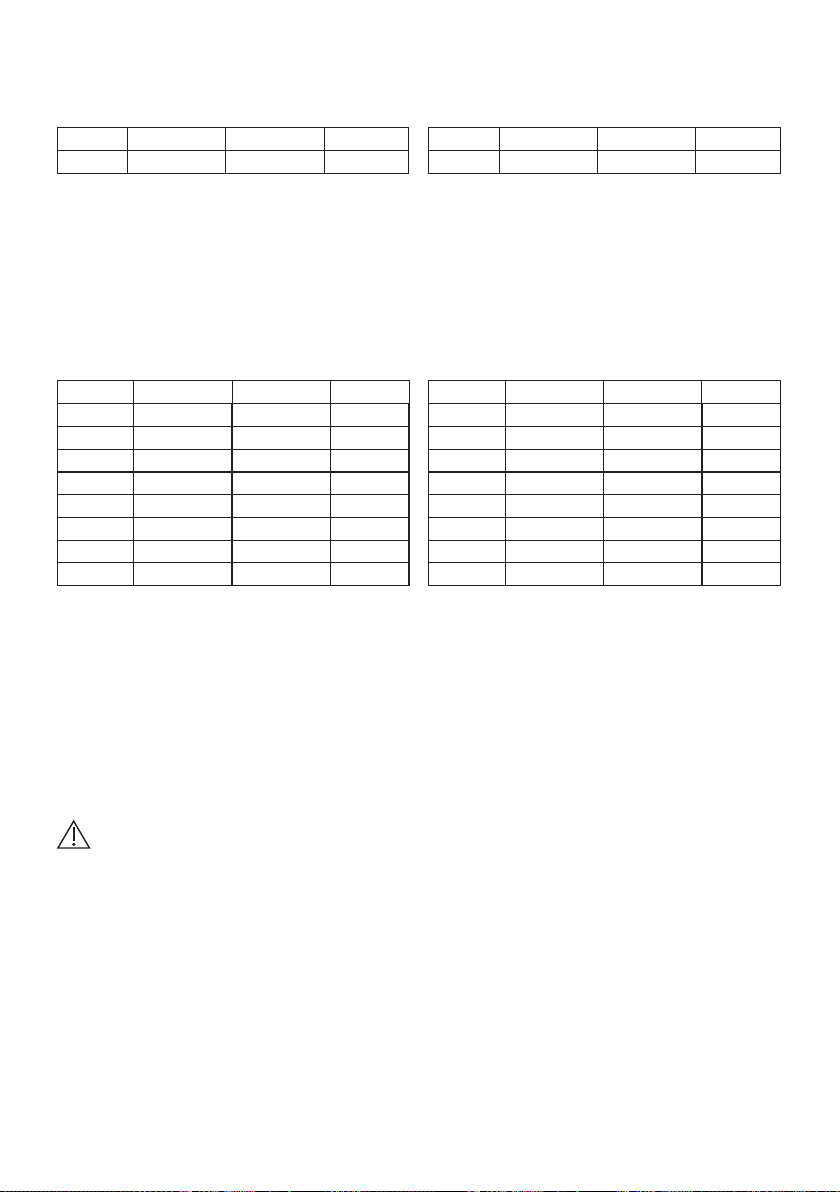
Körperwasseranteil
Der Anteil des Körperwassers in % liegt normalerweise in folgenden Bereichen:
Mann Frau
Alter schlecht gut sehr gut Alter schlecht gut sehr gut
10 –100 <50 % 50 – 65 % >65 % 10 –100 <45 % 45 – 60 % >60 %
Körperfett beinhaltet relativ wenig Wasser. Deshalb kann bei Personen mit einem hohen Körperfettanteil
der Körperwasseranteil unter den Richtwerten liegen. Bei Ausdauer-Sportlern hingegen können die Richt
werte aufgrund geringer Fettanteile und hohem Muskelanteil überschritten werden.
Die Körperwasserermittlung mit dieser Waage ist nicht dazu geeignet, medizinische Rückschlüsse auf z.B.
altersbedingte Wassereinlagerungen zu ziehen. Fragen sie gegebenenfalls Ihren Arzt. Grundsätzlich gilt es,
einen hohen Körperwasseranteil anzustreben.
Muskelanteil
Der Muskelanteil in % liegt normalerweise in folgenden Bereichen:
Mann Frau
Alter wenig normal viel Alter wenig normal viel
10 –14 <44 % 44 – 57 % >57 % 10 –14 <36 % 36 – 43 % >43 %
15 –19 <43 % 43 – 56 % >56 % 15 –19 <35 % 35 – 41 % >41 %
20 – 29 <42 % 42 – 54 % >54 % 20 – 29 <34 % 34 – 39 % >39 %
30 – 39 <41 % 41– 52 % >52 % 30 – 39 <33 % 33 – 38 % >38 %
40 – 49 <40 % 40 – 50 % >50 % 40 – 49 <31 % 31– 36 % >36 %
50 – 59 <39 % 39 – 48 % >48 % 50 – 59 <29 % 29 – 34 % >34 %
60 – 69 <38 % 38 – 47 % >47 % 60 – 69 <28 % 28 – 33 % >33 %
70 –100 <37 % 37 – 46 % >46 % 70 –100 <27 % 27 – 32 % >32 %
Knochenmasse
Unsere Knochen sind wie der Rest unseres Körpers natürlichen Aufbau-, Abbau- und Alterungsprozessen unterworfen. Die Knochenmasse nimmt im Kindesalter rasch zu und erreicht mit 30 bis 40 Jahren
das Maximum. Mit zunehmendem Alter nimmt die Knochenmasse dann wieder etwas ab. Mit gesunder
Ernährung (insbesondere Kalzium und Vitamin D) und regelmäßiger körperlicher Bewegung können Sie
diesem Abbau ein Stück weit entgegen wirken. Mit gezieltem Muskelaufbau können Sie die Stabilität Ihres
Knochen gerüs tes zusätzlich verstärken. Beachten Sie, dass diese Waage nicht die komplette Knochen
masse ausweist, sondern nur den Knochenmineralanteil (ohne Wasserinhalte und ohne organische Stoffe).
Die Knochenmasse lässt sich kaum beeinflussen, schwankt aber geringfügig innerhalb der beeinflussen
den Faktoren (Gewicht, Größe, Alter, Geschlecht). Es sind keine anerkannten Richtlinien und Empfehlungen
vorhanden.
ACHTUNG:
Bitte verwechseln Sie nicht die Knochenmasse mit der Knochendichte.
Die Knochendichte kann nur bei medizinischer Untersuchung (z.B. Computertomographie, Ultraschall) ermittelt werden. Deshalb sind Rückschlüsse auf Veränderungen der Knochen und der
Knochen härte (z.B. Osteoporose) mit dieser Waage nicht möglich.
BMR
Der Grundumsatz (BMR = Basal Metabolic Rate) ist die Energiemenge, die der Körper bei völliger Ruhe zur
Aufrechterhaltung seiner Grundfunktionen benötigt (z.B. wenn man 24 Stunden im Bett liegt). Dieser Wert
ist im wesentlichen vom Gewicht, Körpergröße und dem Alter abhängig.
Er wird bei der Diagnosewaage in der Einheit kcal/Tag angezeigt und anhand der wissenschaftlich aner
kannten Mifflin-Formel berechnet.
Diese Energiemenge benötigt Ihr Körper auf jeden Fall und muss in Form von Nahrung dem Körper wieder
zugeführt werden. Wenn Sie längerfristig weniger Energie zu sich nehmen, kann sich dies gesundheits
-
schädlich auswirken.
9
Page 10

AMR
Der Aktivitätsumsatz (AMR = Active Metabolic Rate) ist die Energiemenge, die der Körper im aktiven
Zustand pro Tag verbraucht. Der Energieverbrauch eines Menschen steigt mit zunehmender körperlicher
Aktivität an und wird bei der Diagnosewaage über den eingegebenen Aktivitätsgrad (1– 5) ermittelt.
Um das aktuelle Gewicht zu halten, muss die verbrauchte Energie dem Körper in Form von Essen und
Trinken wieder zugeführt werden.
Wird über einen längeren Zeitraum hinweg weniger Energie zugeführt als verbraucht, holt sich der Körper
die Differenz im wesentlichen aus den angelegten Fett-Speichern, das Gewicht nimmt ab. Wird hingegen
über einen längeren Zeitraum hinweg mehr Energie zugeführt als der berechnete Aktivitätsumsatz (AMR),
kann der Körper den Energieüberschuss nicht verbrennen, der Überschuss wird als Fett im Körper einge
-
lagert, das Gewicht nimmt zu.
Zeitlicher Zusammenhang der Ergebnisse
Hinweis: Beachten Sie, dass nur der langfristige Trend von Bedeutung ist. Kurzfristige Gewichtsab-
weichungen innerhalb von wenigen Tagen sind in der Regel durch Flüssigkeitsverlust bedingt.
Die Deutung der Ergebnisse richtet sich nach den Veränderungen des Gesamtgewichts und der prozentu
alen Körperfett-, Körperwasser- und Muskelanteile, sowie nach der Zeitdauer mit welcher diese Änderungen erfolgen.
Rasche Veränderungen im Bereich von Tagen sind von mittelfristigen Änderungen (im Bereich von
Wochen) und langfristigen Änderungen (Monaten) zu unterscheiden.
Als Grundregel kann gelten, dass kurzfristige Veränderungen des Gewichts fast ausschließlich Änderun
gen des Wassergehalts darstellen, während mittel- und langfristige Veränderungen auch den Fett- und
Muskelanteil betreffen können.
• Wenn kurzfristig das Gewicht sinkt, jedoch der Körperfettanteil steigt oder gleich bleibt, haben Sie ledig
lich Wasser verloren – z.B. nach einem Training, Saunagang oder einer nur auf schnellen Gewichtsverlust beschränkten Diät.
• Wenn das Gewicht mittelfristig steigt, der Körperfettanteil sinkt oder gleich bleibt, könnten Sie hingegen
wertvolle Muskelmasse aufgebaut haben.
• Wenn Gewicht und Körperfettanteil gleichzeitig sinken, funktioniert Ihre Diät – Sie verlieren Fettmasse.
• Idealerweise unterstützen Sie Ihre Diät mit körperlicher Aktivität, Fitness- oder Krafttraining. Damit kön
-
nen Sie mittelfristig Ihren Muskelanteil erhöhen.
• Körperfett, Körperwasser oder Muskelanteile dürfen nicht addiert werden (Muskelgewebe enthält auch
Bestandteile aus Körperwasser).
7.3 Weitere Funktionen
Benutzerzuweisung
Eine Benutzerzuweisung von maximal 8 angelegten Waagenbenutzern ist möglich bei einer reinen
Gewichtsmessung (mit Schuhen) und bei einer Diagnosemessung (barfuß).
Bei einer neuen Messung weist die Waage die Messung dem Benutzer zu, bei dem der letzte gespeicherte
Messwert innerhalb +/- 3kg war. Bei zwei oder mehreren möglich erkannten Benutzern, wechselt der
Benutzer in der Displayanzeige. Wählen Sie Ihren Benutzer aus, indem Sie die Tasten
/ drücken und für
3 Sekunden warten.
Speicherung der zugewiesenen Messwerte auf der Waage
Falls die App offen ist und eine aktive
Bluetooth
®
-Verbindung zur Waage besteht, werden neu zugewie-
sene Benutzermessungen sofort an die App geschickt.
Falls die App nicht offen ist, werden neu zugewiesene Benutzermessungen in der Waage gespeichert.
Maximal 30 Messungen pro Benutzer können in der Waage gespeichert werden. Die gespeicherten Mess
werte werden zur App übertragen, wenn Sie die Waage einschalten (kurz die Plattform belasten).
Eine automatische Übertragung im ausgeschalteten Zustand der Waage ist nicht möglich.
Das Synchronisierungs-Symbol im Waagen-Display erscheint, wenn neue Messungen an die App übertra
gen werden. Es erscheint nicht, wenn keine neue Messungen für diesen Benutzer gespeichert oder zugewiesen worden sind.
Bei Bedienung mittels Direktstart (ohne Benutzereinstellung in der App), werden keine Messwerte auf der
Waage gespeichert.
10
Page 11
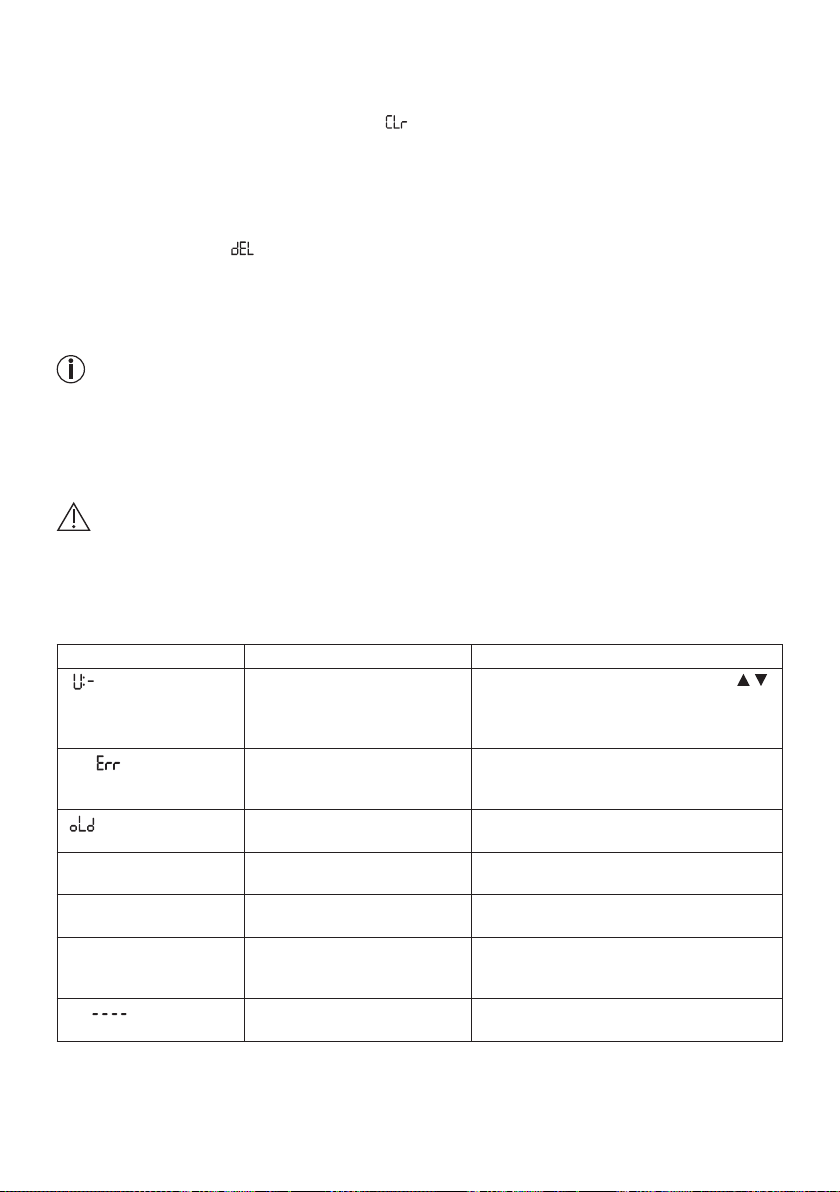
Waagendaten löschen
Möchten Sie alle Messungen und alte Benutzerdaten auf der Waage komplett löschen, schalten Sie die
Waage an und drücken Sie für ca. 6 Sekunden die Unit/Reset-Taste auf der Waagen-Rückseite.
Auf dem Display erscheint für einige Sekunden „
Dies ist notwendig, wenn Sie z.B. falsch angelegte Waagenbenutzer löschen wollen oder Waagenbenut
zer, die nicht mehr gebraucht werden.
Danach müssen Sie Kapitel 7 erneut durchführen (Benutzerzuweisung).
Einzelne Benutzer löschen
Waage anschalten, Benutzer mit AUF-Taste auswählen und auf „0.0 kg“ warten, 6 Sekunden die Unit/
Reset-Taste drücken bis „
Batterien wechseln
Ihre Waage ist mit einer Batteriewechselanzeige ausgestattet. Beim Betreiben der Waage mit zu schwa
chen Batterien erscheint auf dem Anzeigenfeld „Lo“ und die Waage schaltet sich automatisch aus. Die
Batterie müssen in diesem Fall ersetzt werden (1 x 3V CR 2032).
HINWEIS:
• Verwenden Sie keine wiederaufladbaren Akkus.
• Verwenden Sie schwermetallfreie Batterien.
“ erscheint.
“.
-
-
8. Reinigung und Pflege
Von Zeit zu Zeit sollte das Gerät gereinigt werden.
Benutzen Sie zur Reinigung ein feuchtes Tuch, auf das Sie bei Bedarf etwas Spülmittel auftragen können.
ACHTUNG
• Verwenden Sie niemals scharfe Lösungs- und Reinigungsmittel!
• Tauchen Sie das Gerät keinesfalls unter Wasser!
• Gerät nicht in der Spülmaschine reinigen!
9. Was tun bei Problemen?
Diese Handlungen werden in folgenden Fällen empfohlen:
Displayanzeige Ursache Behebung
„
“
BF- “
„
“
„
Falsches Gewicht wird
angezeigt.
Falsches Gewicht wird
angezeigt.
Falsches Gewicht wird
angezeigt.
„
BF “
Unbekannte Messung, da
außerhalb Grenze Benutzerzu
ordung oder keine eindeutige
Zuordung möglich ist.
Der Fettanteil liegt außerhalb
des messbaren Bereichs (klei
ner 3 % oder größer 65 %).
Die maximale Tragkraft von
180 kg wurde überschritten.
Kein ebener fester Boden. Stellen Sie die Waage auf einen ebenen,
Unruhiges Stehen. Stehen Sie möglichst still.
Waage hat falschen Nullpunkt. Abwarten bis Waage selbst wieder aus
Die BIA ist nicht möglich. Die Messung bitte barfuß wiederholen oder
Wählen Sie durch Drücken der Tasten
-
Ihren Benutzer aus.
Die Messung bitte barfuß wiederholen oder
-
feuchten Sie ggf. Ihre Fußsohlen leicht an.
Nur bis 180 kg belasten.
festen Boden. Nicht auf Teppich.
schaltet. Waage aktivieren, „0.0 kg“ abwarten, Messung wieder holen.
feuchten Sie ggf. Ihre Fußsohlen leicht an.
/
-
11
Page 12
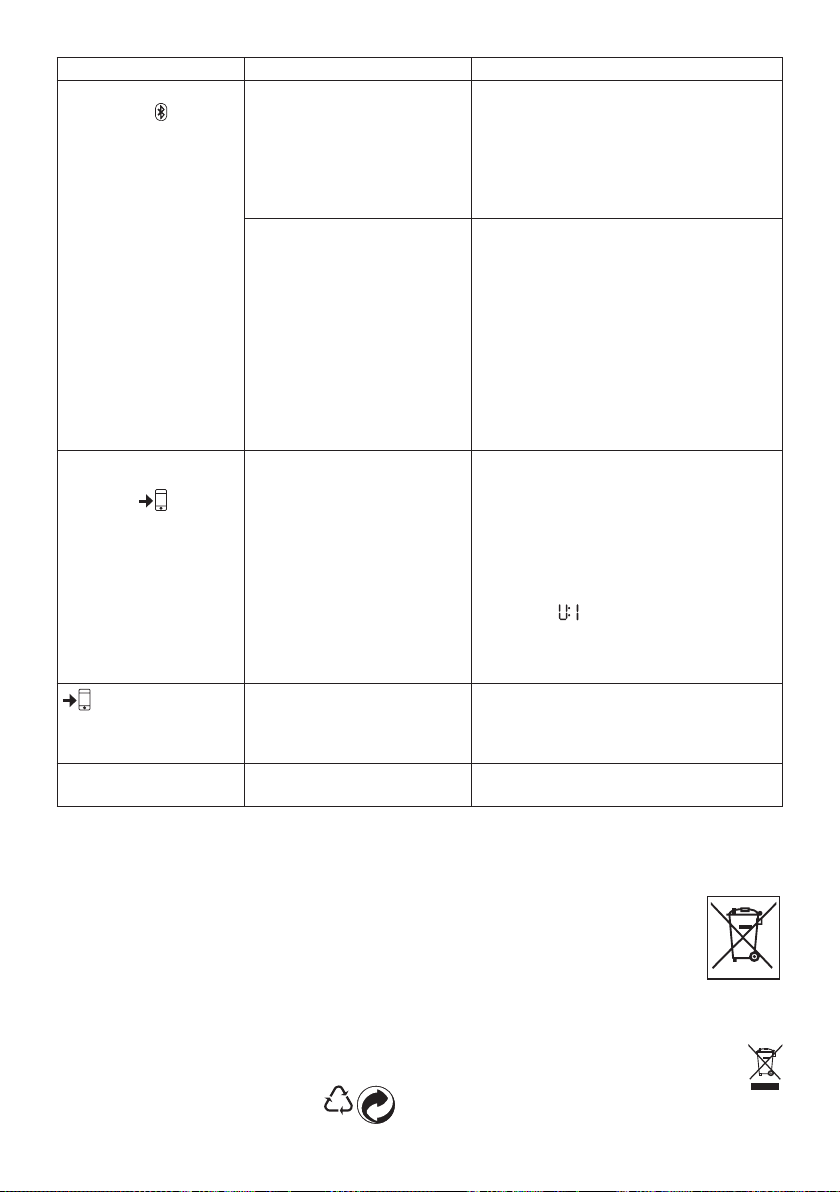
Displayanzeige Ursache Behebung
PAP
Keine Bluetooth
Verbindung (
fehlt).
®
-
-Symbol
Gerät außerhalb der Reich
weite.
Mindestreichweite im freien Feld sind ca.
10 m. Wände und Decken verringern die
Reichweite.
Andere Funkwellen können die Übertragung
stören. Stellen Sie die Waage deshalb nicht
in der Nähe von Geräten wie z.B. WIFI Rou
ter, Mikrowelle, Induktionskochfeld auf.
Keine Verbindung zur App. Schließen Sie die App komplett (auch im
Hintergrund). Schalten Sie Bluetooth
aus und wieder an. Beachten Sie dabei,
dass die Waage nicht aus den Bluetooth
Einstellungen des Betriebssystems verbun
den werden darf. Gegebenenfalls aus der
Geräteliste in den Bluetooth
entfernen und anschließend die App „Sani
tas HealthCoach“ verwenden. Schalten Sie
das Smartphone aus und wieder an. Batte
rien in der Waage kurz entfernen und wieder
einsetzen.
Messergebnisse wer
den nicht zur App
gesendet (
-Symbol
erscheint nicht)
-
Keine neue Benutzermes
sung und keine Bluetooth®Verbindung zur App.
-
Der Benutzerspeicherplatz, der auf dem
Waagendisplay erscheint, muss in Ihren
App-Einstellungen der Waage zugeord
net sein. Nur diese Messungen können
gesendet werden. Überprüfen Sie daher
Ihre Benutzerplätze und Ihre App-Einstel
lungen zu diesem Benutzer und führen Sie
eine Benutzermessung erneut durch. Dabei
muss z.B. „
werden und in der App muss dieser Benut
zer „1“ in den Geräteeinstellungen der
Waage zugeordnet sein.
-Symbol erscheint
kurz nach der Messung.
Benutzerspeicherplatz ist voll.
Die ältesten Messwerte werden
mit den neueren Messwerten
Öffnen Sie die App und schalten Sie die
Waage ein. Falls Sie keine App verwenden
möchten, ignorieren Sie diese Meldung.
überschrieben.
Lo
Die Batterien der Waage sind
Wechseln Sie die Batterien der Waage.
leer.
®
®
-Einstellungen
-
“ an der Waage angezeigt
-
®
-
-
-
-
-
-
10. Entsorgung
Die verbrauchten, vollkommen entladenen Batterien müssen Sie über speziell gekennzeichnete Sammelbehälter, Sondermüllannahmestellen oder über den Elektrohändler entsorgen. Sie sind gesetzlich dazu
verpflichtet, die Batterien zu entsorgen.
Diese Zeichen finden Sie auf schadstoffhaltigen Batterien:
Pb = Batterie enthält Blei,
Cd = Batterie enthält Cadmium,
Hg = Batterie enthält Quecksilber.
Im Interesse des Umweltschutzes darf das Gerät am Ende seiner Lebensdauer nicht mit dem Hausmüll
entsorgt werden. Die Entsorgung kann über entsprechende Sammelstellen in Ihrem Land erfolgen.
Entsorgen Sie das Gerät gemäß der Elektro- und Elektronik Altgeräte EG-Richtlinie – WEEE (Waste
Electrical and Electronic Equipment). Bei Rückfragen wenden Sie sich an die für die Entsorgung
zuständige kommunale Behörde.
Verpackung umweltgerecht entsorgen.
20
12
Page 13
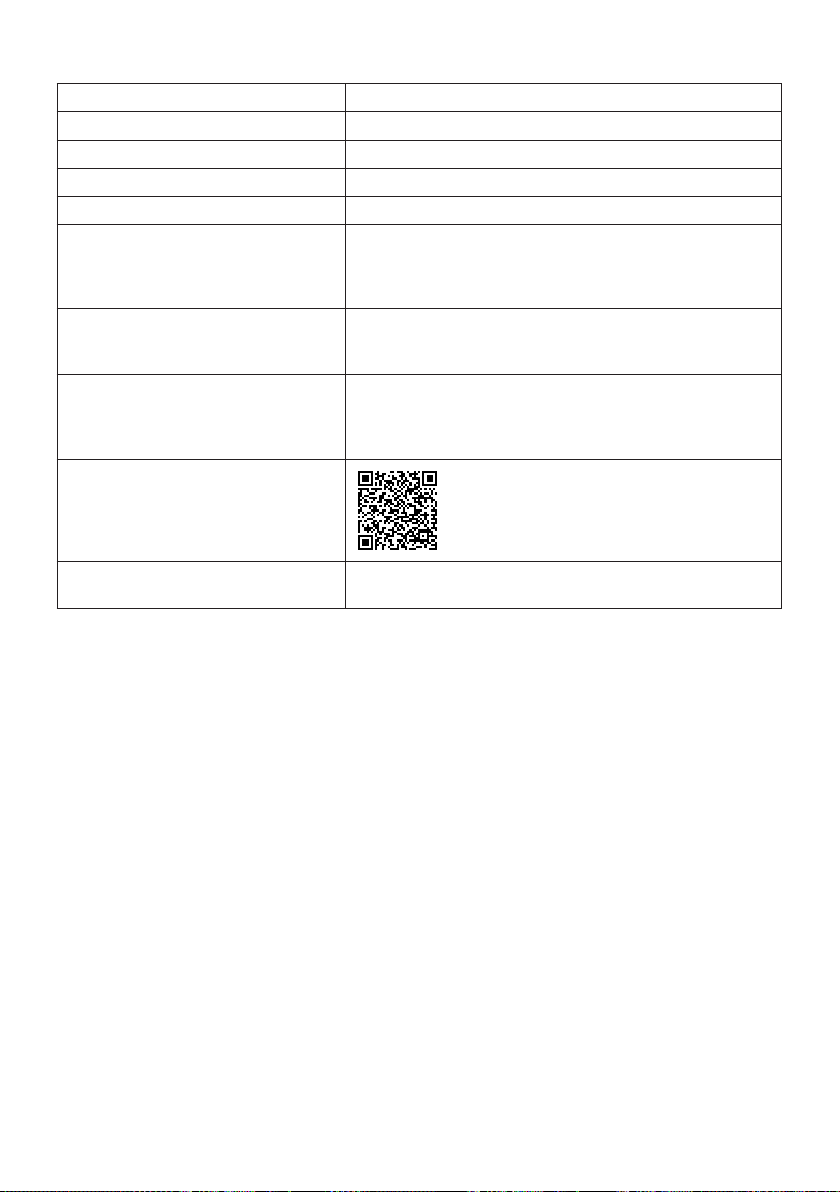
11. Technische Angaben
Modell: SBF 72
Maße: 30 x 30 x 2,1 cm
Gewicht: ca. 1,5 kg
Messbereich: 5-180 kg
Teilungswert d: Die Ablesbarkeit der Displayanzeige erfolgt in 0,1kg Schritten.
Wiederholgenauigkeit:
Absolute Genauigkeit: Der Messwert im Vergleich zu einem geeichten Gewicht
®
Datenübertragung per Bluetooth
low
energy technology
Die Liste der kompatiblen Smartpho
nes, Informationen zur Software sowie
Näheres zu den Geräten, finden Sie
unter folgendem Link: sanitas-online.de
Die Messtoleranz bei Wiederholmessungen beträgt +/- 0,4kg
(Messung mehrmals direkt hintereinander auf der selben
Waage mit möglichst gleicher Standposition von Waage und
Person).
beträgt +/- 1% +0,1kg. Z.B. bei 40kg entspricht dies +/0,5kg, bei 100kg entspricht dies +/- 1,1kg.
Das Produkt verwendet Bluetooth® low energy technology,
Frequenzband 2402 - 2480 MHz,
Sendeleistung max. 5 dBm,
kompatibel mit Bluetooth
®
≥ 4.0 Smartphones / Tablets
-
Systemvoraussetzungen für die
„Sanitas HealthCoach“ App
iOS ≥ 10.0, Android™ ≥ 5.0
Bluetooth
®
≥ 4.0.
Technische Änderungen vorbehalten.
Wir bestätigen hiermit, dass dieses Produkt der europäischen RED Richtlinie 2014/53/EU entspricht. Die
CE-Konformitätserklärung zu diesem Produkt finden Sie unter:
www.sanitas-online.de/web/de/landingpages/cedeclarationofconformity.php.
12. Garantie/Service
Wir leisten 3 Jahre Garantie ab Kaufdatum für Material- und Fabrikationsfehler des Produktes. Die Garantie gilt nicht:
• Im Falle von Schäden, die auf unsachgemäßer Bedienung beruhen.
• Für Verschleißteile.
• Bei Eigenverschulden des Kunden.
• Sobald das Gerät durch eine nicht autorisierte Werkstatt geöffnet wurde.
Die gesetzlichen Gewährleistungen des Kunden bleiben durch die Garantie unberührt. Für Geltendma
chung eines Garantiefalles innerhalb der Garantiezeit ist durch den Kunden der Nachweis des Kaufes
zu führen. Die Garantie ist innerhalb eines Zeitraumes von 3 Jahren ab Kaufdatum gegenüber der Hans
Dinslage GmbH, Uttenweiler (Germany) geltend zu machen.
Bitte wenden Sie sich im Falle von Reklamationen an unseren Service unter folgendem Kontakt:
Service Hotline:
Tel.: +49 (0) 7374-915766
E-Mail: [email protected]
www.sanitas-online.de
13
-
Page 14

Fordern wir Sie zur Übersendung des defekten Produktes auf, ist das Produkt an folgende Adresse
zu senden:
NU Service GmbH
Lessingstraße 10 b
89231 Neu-Ulm
Germany
14
Irrtum und Änderungen vorbehalten
Page 15

ENGLISH
Read these instructions for use carefully and keep them for later use,
be sure to make them accessible to other users and observe the
information they contain.
Contents
1. Included in delivery...........................................16
2. Signs and symbols ........................................... 16
3. Intended use ..................................................... 17
4. Warnings and safety notes ............................... 17
5. Device description ............................................19
6. Initial use ..........................................................19
Getting to know your device
Functions of the device
This digital scale is intended for weighing and providing a diagnosis of your personal fitness data.
It is intended for private use.
The scale is equipped with the following functions, which can be used by up to 8 people:
• Body weight measurement,
• BMI,
• Body fat percentage calculation,
• Body water content,
• Muscle percentage,
• Bone mass,
• Basal and active metabolic rate.
The scale also includes the following additional features:
• Switch between kilograms “kg”, pounds “lbs” and stones “st”,
• Automatic switch-off function,
• Low battery indicator,
• Automatic user recognition,
• Storage of the last 30 measurements for 8 users, if the data cannot be transferred to the app,
• Direct-start function: When starting the scale without the app, the scale measures the weight and the
BIA. The body analysis values are then calculated using standard parameters and are therefore inevita
bly more or less inaccurate. These values are not saved on the scale.
7. Usage ............................................................... 20
8. Cleaning and maintenance ............................... 24
9. What if there are problems? .............................24
10. Disposal ..........................................................25
11. Technical specifications .................................26
-
The measurement principle
This scale works on the principle of B.I.A. (bioelectrical impedance analysis). This involves the calculation
of body content in a matter of seconds, using a current that cannot be felt, is completely harmless and
does not pose any risk.
When this measurement of the electrical resistance (impedance) is considered alongside constants and/
or individual values (age, height, gender, activity level), the body fat percentage and other variables in the
body can be calculated. Muscle tissue and water conduct electricity well and therefore have a lower resis
tance. In contrast, bones and fat tissue have low conductivity as the fat cells and bones are barely able to
conduct the current due to very high levels of resistance.
Please note that the values calculated by the diagnostic bathroom scale only represent an approxima
tion of the actual medical analytical values for the body. Only a specialist doctor can precisely establish
the body fat, body water, muscle percentage and bone structure using medical methods (e.g. computer
tomography).
Entering the individual values is not required in the event of use with direct start. In addition to weight and
BIA, calculation is carried out based on the assumption of standard parameters; these are therefore simply
approximate values that may still be of relevance when looking at the trend.
15
-
-
Page 16
1. Included in delivery
PAP
max.
180 kg
396 lb
28 st
max.
180 kg
396 lb
28 st
Check that the device packaging has not been tampered with and make sure that all contents are present. Before use, ensure that there is no visible damage to the device or accessories and that all packaging
material has been removed. If you have any doubts, do not use the device and contact your retailer or the
specified Customer Services address.
• Quick guide
• SBF 72 diagnostic bathroom scale
• 1 x 3V CR2032 battery
• These instructions for use
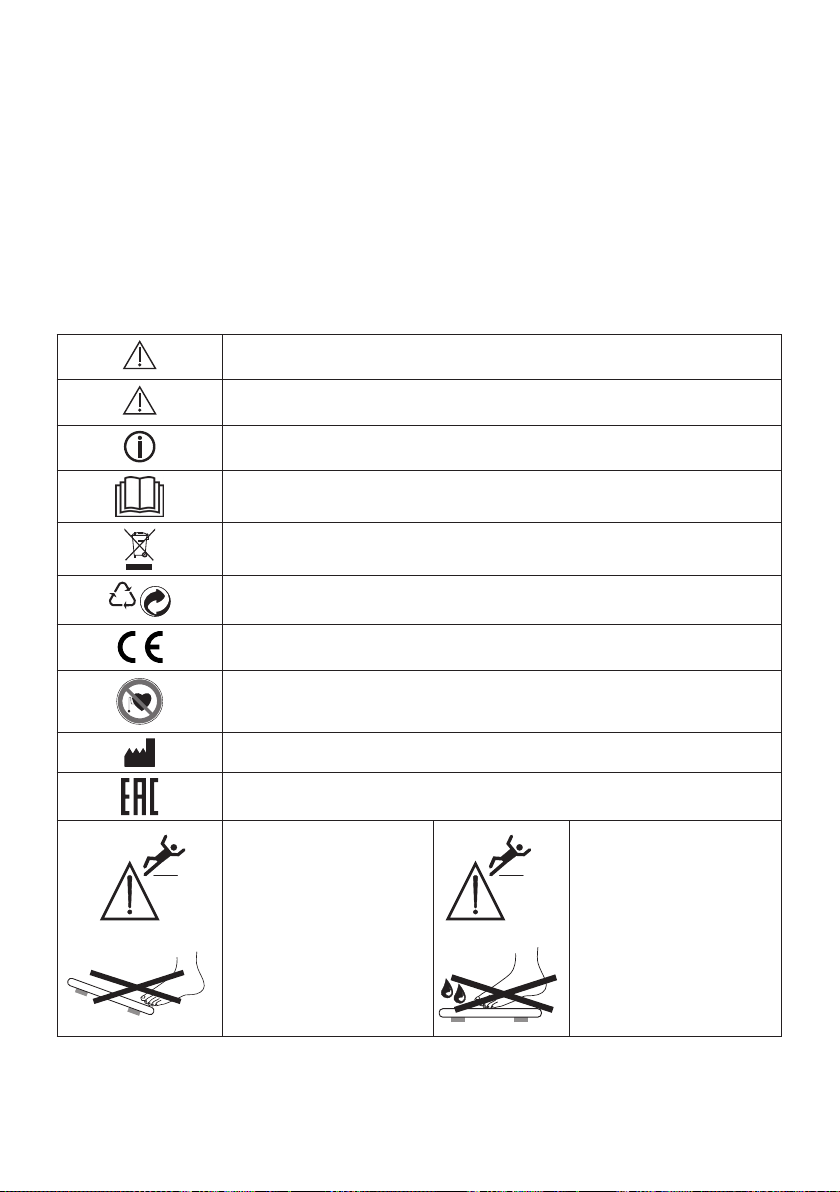
2. Signs and symbols
The following symbols are used on the device, in these instructions for use, on the packaging and on the
type plate for the device:
WARNING
Warning notice indicating a risk of injury or damage to health.
IMPORTANT
Safety note indicating possible damage to the device/accessory.
Note
Note on important information
Observe the instructions for use
Disposal in accordance with the Waste Electrical and Electronic Equipment EC
Directive – WEEE
20
Dispose of packaging in an environmentally friendly manner
This product satisfies the requirements of the applicable European and national
directives.
The device may not be used by people with medical implants (e.g. pacemakers), as this may affect their functionality.
Manufacturer
Certification symbol for products that are exported to the Russian Federation
and members of the CIS.
Danger of tipping: position
yourself in the centre of the
weighing surface.
Danger of slipping: do not
step on the scale with wet
feet.
16
Page 17
Place the scale on an even
max.
180 kg
396 lb
28 st
max.
180 kg
396 lb
28 st
surface.
Do not overload the scale
180 kg / 396 lb / 28 st.
No carpet.
3. Intended use
The device is only intended for weighing humans and for recording your personal fitness data. The device
is only intended for private use, and not for medical or commercial purposes.
4. Warnings and safety notes
WARNING
• The scale may not be used by people with medical implants (e.g.
pacemakers), as this may affect their functionality.
• Do not use during pregnancy.
• Important: do not step onto the scale with wet feet or if the surface of
the scale is damp – danger of slipping!
• Do not step onto the outer edge of the scale on just one side: danger
of tipping!
• Swallowing batteries can be extremely dangerous. Keep the batteries and scale out of the reach of
small children. Should a battery be swallowed, seek medical assistance immediately.
• Keep packaging material away from children (risk of suffocation).
Notes on handling batteries
• If your skin or eyes come into contact with battery fluid, rinse the affected areas with water and seek
medical assistance.
Choking hazard! Small children may swallow and choke on batteries. Therefore, store batteries out
•
of the reach of small children!
• Observe the plus (+) and minus (-) polarity signs.
• If a battery has leaked, put on protective gloves and clean the battery compartment with a dry cloth.
• Protect the batteries from excessive heat.
Risk of explosion! Do not throw batteries into a fire.
•
• Do not charge or short-circuit batteries.
• If the device is not to be used for a relatively long period, take the batteries out of the battery compart
ment.
• Do not use rechargeable batteries!
• Do not disassemble, open or crush the batteries.
17
-
Page 18
General notes
• Please note that measuring tolerances are possible for technical reasons, as this scale is not calibrated
for use in a professional medical context.
• The scale’s maximum capacity is 180 kg (396 lb/28 st). The results for the weight measurement and bone
mass calculation are displayed in 100-g increments (0.2 lb, 0-19st: 0,2lb; 20-28st: 1lb).
• Measurements of body fat, body water and muscle content are displayed in increments of 0.1%.
• The calorie requirement is indicated in increments of 1 kcal.
• When supplied to the customer, the scale is set to weigh and measure in “cm” and “kg”. You can change
the unit settings during initial use with the app.
• Place the scale on an even, hard surface; a hard surface is crucial for achieving accurate measurements.
• Repairs may only be carried out by Customer Services or authorised retailers. Before submitting a com
plaint, please check the batteries first and replace them if necessary.
Storage and maintenance
The accuracy of the measurements and service life of the device depend on its careful handling:
IMPORTANT
• The device should be cleaned from time to time. Do not use any abrasive cleaning products and never
submerge the device in water.
• Make sure that no liquids come into contact with the scale. Never submerge the scale in water. Never
rinse it in running water.
• Do not place any objects on the scale when it is not in use.
• Do not press the button violently or with pointed objects.
• Do not expose the scale to high temperatures or strong electromagnetic fields.
• Protect the device from knocks, damp, dust, chemicals, marked temperature fluctuations and nearby
sources of heat (ovens, heaters).
General tips
• As far as possible, weigh yourself at the same time every day (ideally in the morning), after having been
to the toilet, on an empty stomach and without clothing, in order to obtain results which can be com
pared.
• Important point regarding the measurement: the calculation of body fat may only be made when bare
foot; the soles of the feet may be lightly dampened where appropriate.
Results may be unsatisfactory if the soles of the feet are completely dry or have a large amount of hard
skin since conductivity will be impaired.
• Stand up straight and still during the measurement.
• Wait a few hours after any physical exertion to which your body is unaccustomed.
• Wait approx. 15 minutes after getting up so that the water stored in the body can disperse.
• Remember that only the long-term trend is important. Short-term changes in weight within a few days
are normally caused by loss of fluids; however, body water plays an important role in terms of well-be
ing.
Limitations
When calculating body fat and the other values, unusual and implausible results may occur in the case of:
• Children under approx. 10 years of age
• Performance athletes and body-builders
• Persons with a fever, persons undergoing dialysis, persons with oedema symptoms and persons suffer
ing from osteoporosis
• Persons taking cardiovascular medicine (affecting the heart and vascular system)
• Persons taking vasodilative or vasoconstrictive medication
• Persons with significant anatomical abnormalities in their legs compared with their overall body height
(leg length significantly shorter or longer).
-
-
-
-
-
18
Page 19
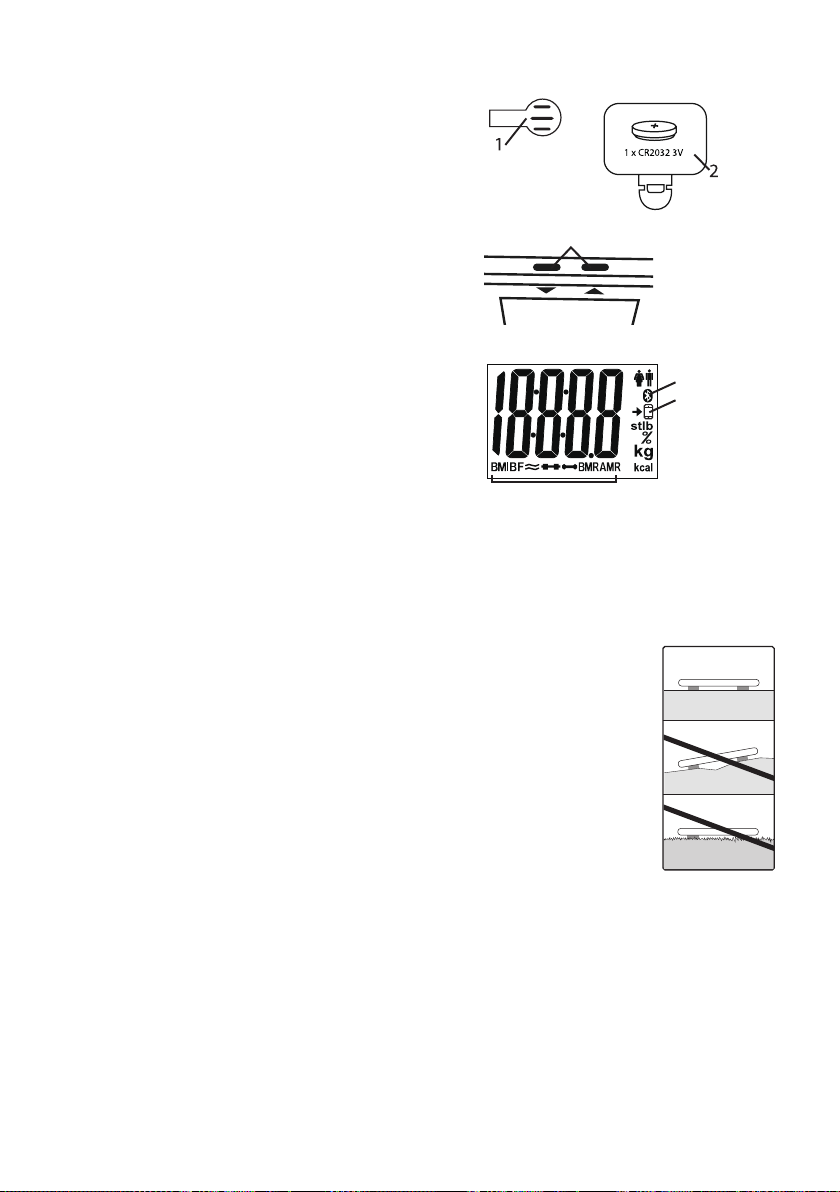
5. Device description
Rear
1. Unit/Reset button
2. Battery compartment
Unit/Reset
Front side
3. UP/DOWN pushbuttons
Display
4a. Bluetooth® symbol for connection between scale and
smartphone
4b. Synchronisation symbol when transferring measure
ments
5. Body weight,
body data, e.g. BMI, body fat, etc.
-
3
4a
4b
5
6. Initial use
Inserting the batteries
Remove the batteries from the protective packaging and insert the battery into the scale ensuring that the
battery polarity is correct. If the scale does not work, remove the battery completely and reinsert it.
Positioning the scale
Place the scale on an even, hard surface; a hard surface is crucial for achieving
accurate measurements. Do not place the scale on carpet.
6.1 Initial use with the app
To be able to calculate your body fat percentage and additional body values cor
rectly, you must save the personal user data on the scale.
The scale has 8 user memory spaces which allow, for example, you and your family
members to save personal settings.
It is also possible to activate users via other mobile end devices on which the
“Sanitas HealthCoach” app has been installed or by changing the user profile in the
app (see the app settings).
– Download the free “Sanitas HealthCoach” app from the Apple App Store
(iOS) or from Google Play (Android™).
– Start the app and follow the instructions.
– Select SBF 72 in the app.
-
19
Page 20
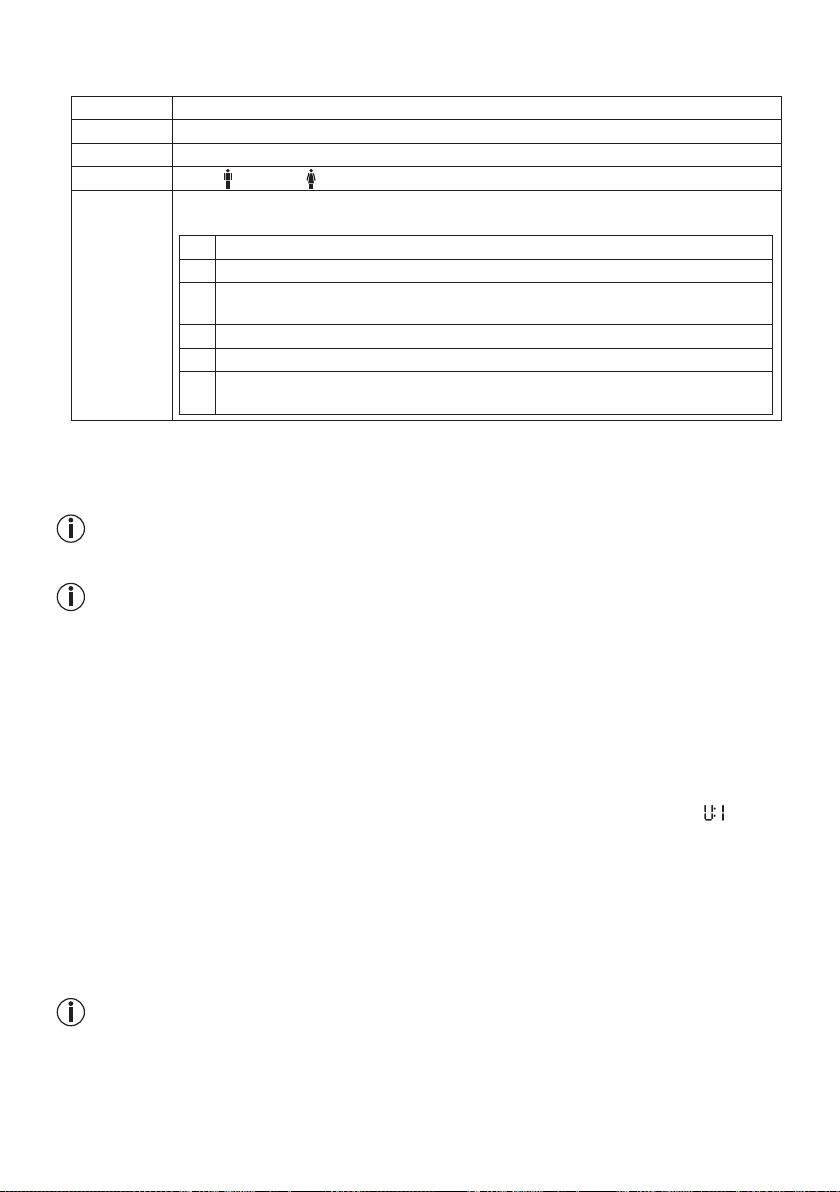
– Enter the SBF 72-related data.
The following settings must be set or entered in the “Sanitas HealthCoach” app:
User data Set values
Height 100 to 220 cm (3'3.5" to 7'2.5")
Age 10 to 100 years
Gender Male (
Activity level The medium-term and long-term perspective is decisive when selecting the activity
– Assign the user when requested to do so by the app.
For automatic personal recognition, the first measurement must be assigned to your personal user data.
Follow the app instructions for this. Step onto the scale with bare feet and ensure that you are standing
still with equal weight distribution and with both feet on the electrodes.
Note: Only the measurements displayed on the scale may be used for further observations.
6.2 Use without the app: direct start (alternative)
Note:
In order to display the personalised analysis values, we recommend initial use and making all settings with the “Sanitas HealthCoach” app. Therefore, only carry out this step if initial use is to be
carried out entirely without the app. When using the app, go directly to the “Taking measurements”
chapter.
Direct-start function:
When using the scale without the app, the scale measures the weight once you step on standing surface.
For analysis measurement you have to stand barefoot on the electrodes. The displayed body analysis val
ues such as body fat, BMI, etc. are calculated using standard parameters and may therefore differ from
your actual individual values, since individual parameters (e.g. sex, height, etc.) are required to calculate
your personal body analysis values. However, these cannot be set on the scale, but only using the app.
The measured values are not saved on the scale, as they are not related to created users (e.g. “
), female ( )
level.
Physical activity
1 None.
Low: little and light physical exertion (e.g. going for walks, light gardening, sim
2
ple gymnastics).
3 Medium: physical exertion, at least 2 to 4 times a week for 30 minutes each.
4 High: physical exertion, at least 4 to 6 times a week for 30 minutes each.
Very high: intensive physical exertion, intensive training or hard physical work
5
for at least 1 hour every day.
-
-
”).
7. Usage
7.1 Taking measurements
Place the scale on an even, hard surface; a hard surface is crucial for achieving accurate measure
ments. Do not place the scale on carpet.
Measuring your weight, carrying out diagnostics
Step onto the scale with bare feet and ensure that you are standing still with equal weight distribution and
with both feet on the electrodes.
Note: The measurement result will be incorrect if the measurement is taken with socks on.
20
-
Page 21
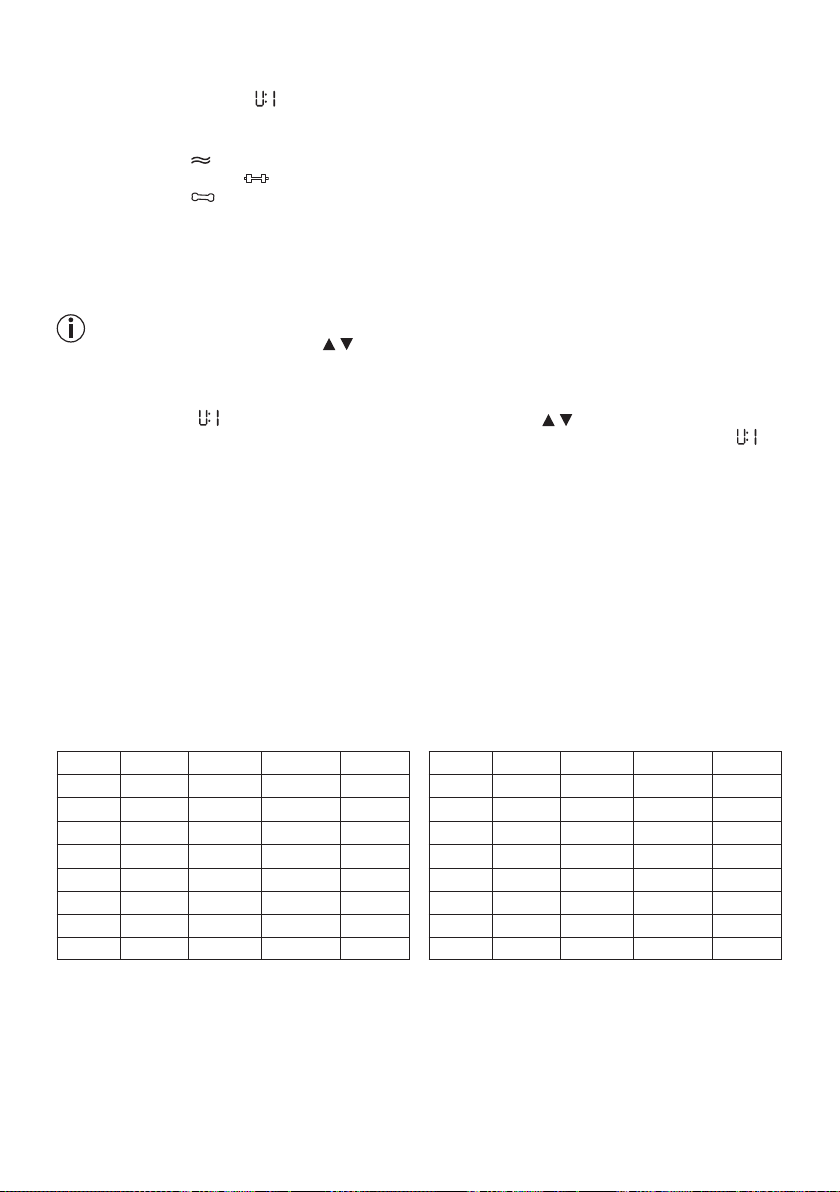
The following appears:
1. Weight in kg (or lb/st)
2. User memory space (e.g. “
”)
3. BMI
4. Body fat in % (BF)
5. Body water in %
6. Muscle percentage in %
7. Bone mass in kg
8. Basal metabolic rate in kcal (BMR)
9. Active metabolic rate in kcal (AMR)
The measured values are stored under the user memory space displayed (for later transfer to the app) or
transferred immediately if the app is open.
Note: If two or more users have potentially been recognised, the display switches between them.
Select your user by pressing the
/ buttons. The user confirmed in this manner is shown for
3 seconds (you can still change during this time). If no user is selected, the scale automatically
switches off after 40 seconds. Nothing is saved on the scale.
If no user is identified (e.g. the current measured value is more than 3 kg different to the previously
saved value), “
If a direct start has been carried out without a user being created (missing in the display, e.g. “ ”),
” is displayed. Select your user by pressing the / buttons.
the results are calculated assuming standard parameters and are not saved.
Only measuring weight
Now step onto the scale wearing shoes. Stand still with your weight distributed equally on both feet. The
scale begins to take measurements straight away.
The BIA measurement cannot be carried out whilst wearing shoes. Four dashes are briefly shown in the
display. Then the weight is shown again.
Switching off the scale
The scale switches itself off automatically.
7.2 Evaluating the results
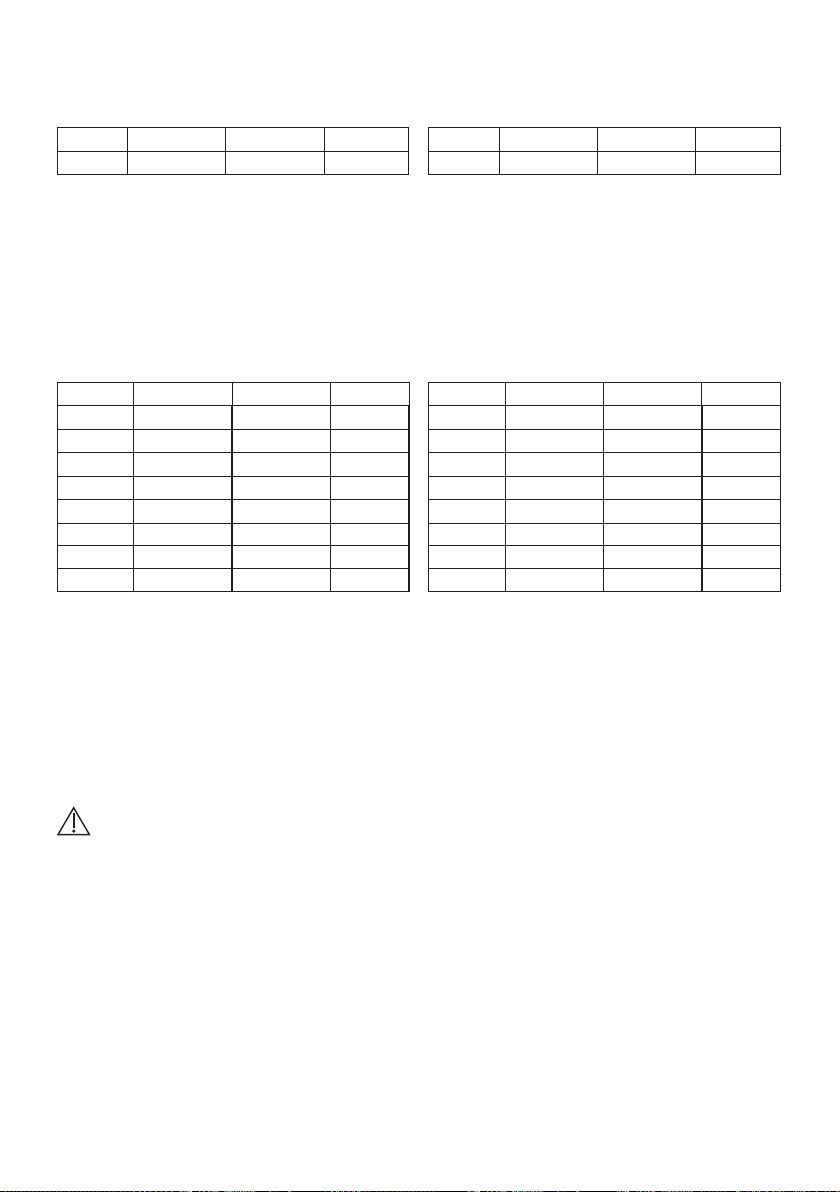
Body fat percentage
The following body fat percentages serve as a guideline (for further information please consult your doc
-
tor).
Male Female
Age Low Normal Moderate High Age Low Normal Moderate High
10–14 <11% 11–16% 16.1–21% >21.1% 10–14 <16% 16–21% 21.1–26% >26.1%
15–19 <12% 12–17% 17.1–22% >22.1% 15–19 <17% 17–22% 22.1–27% >27.1%
20–29 <13% 13–18% 18.1–23% >23.1% 20–29 <18% 18–23% 23.1–28% >28.1%
30–39 <14% 14–19% 19.1–24% >24.1% 30–39 <19% 19–24% 24.1–29% >29.1%
40–49 <15% 15–20% 20.1–25% >25.1% 40–49 <20% 20–25% 25.1–30% >30.1%
50–59 <16% 16–21% 21.1–26% >26.1% 50–59 <21% 21–26% 26.1–31% >31.1%
60–69 <17% 17–22% 22.1–27% >27.1% 60–69 <22% 22–27% 27.1–32% >32.1%
70–100 <18% 18–23% 23.1–28% >28.1% 70–100 <23% 23–28% 28.1–33% >33.1%
Values will often be lower for fitness enthusiasts. Depending on the sporting activities performed, the training intensity and the physical constitution, the results may still be below the stated standard values. Please
note, however, that there may be a risk to health in the case of extremely low values.
21
Page 22
Body water content
The body water content in % is normally within the following ranges:
Male Female
Age Poor Good Very good Age Poor Good Very good
10–100 <50% 50–65% >65% 10–100 <45% 45–60% >60%
Body fat contains relatively little water, therefore body water content may be below the standard values in
persons with a high body fat percentage. On the other hand, endurance athletes may exceed the standard
values due to having low levels of fat and a high muscle percentage.
The body water calculation performed using this scale is not suitable for drawing medical conclusions,
for example in the case of age-related water retention. Consult your doctor where necessary. A high body
water content is generally desirable.
Muscle percentage
The muscle percentage is normally within the following ranges:
Male Female
Age Low Normal High Age Low Normal High
10–14 <44% 44–57% >57% 10–14 <36% 36–43% >43%
15–19 <43% 43–56% >56% 15–19 <35% 35–41% >41%
20–29 <42% 42–54% >54% 20–29 <34% 34–39% >39%
30–39 <41% 41–52% >52% 30–39 <33% 33–38% >38%
40–49 <40% 40–50% >50% 40–49 <31% 31–36% >36%
50–59 <39% 39–48% >48% 50–59 <29% 29–34% >34%
60–69 <38% 38–47% >47% 60–69 <28% 28–33% >33%
70–100 <37% 37–46% >46% 70–100 <27% 27–32% >32%
Bone mass
Like the rest of our body, our bones are subject to natural growth, shrinking and ageing processes. Bone
mass increases rapidly during childhood and reaches its peak between the ages of 30 and 40. As we
age, our bone mass then begins to reduce. You can combat this reduction to an extent with the help of a
healthy diet (particularly calcium and vitamin D) and regular physical exercise. The stability of your skeleton
can be further increased by means of targeted muscle build-up. Please note that this scale does not iden
tify the total bone mass, but rather just the mineral content of the bone (without water content and without
organic substances). It is very difficult to influence the bone mass, although it does fluctuate slightly within
the scope of influencing factors (weight, height, age, gender). There are no recognised guidelines or recom
-
mendations.
IMPORTANT:
Please do not confuse bone mass with bone density.
The bone density can only be determined by means of a medical examination (e.g. computer
tomography, ultrasound). It is therefore not possible to draw conclusions on changes to bones and
bone hardness (e.g. osteoporosis) using this scale.
BMR
The basal metabolic rate (BMR) is the amount of energy required by the body at complete rest in order to
maintain its basic functions (e.g. when lying in bed 24 hours a day). This value is primarily dependent on
weight, height and age.
It is displayed on the diagnostic scale in the unit kcal/day and calculated using the scientifically rec
ognised Mifflin equation.
This is the amount of energy that is required by your body under all circumstances and must be re-sup
plied to the body in the form of food. If your energy intake is below this level in the longer term, this can
result in damage to health.
22
Page 23

AMR
The active metabolic rate (AMR) is the amount of energy that the active body consumes each day. An indi
vidual’s energy requirement increases when the level of physical activity increases; the diagnostic bathroom scale calculates this by means of the activity level (1–5) that has been entered.
To maintain the current weight, the energy that the body uses must be replaced in the form of food and
drink.
If less energy is taken in than is used over a long period of time, the body primarily takes the difference
from the fat stores, with resulting weight loss. However, if the amount of energy taken in exceeds the cal
culated active metabolic rate (AMR) for a longer period, the body cannot burn off the excess energy. The
excess is stored in the body as fat, leading to weight gain.
Temporal context of the results
Note: Please note that only the long-term trend is important. Brief deviations in weight within a few
days are normally caused by loss of fluids.
The interpretation of the results is based on changes in total body weight, percentage of body fat, body
water and muscle content, as well as on the length of time over which these changes occur.
Rapid changes within the scope of a few days are to be considered separately from medium-term
changes (in the scope of weeks) and long-term changes (months).
It can be said as a basic rule that short-term changes in weight are almost entirely changes in water con
tent, whereas medium-term and long-term changes may also relate to the fat percentage and the muscle
percentage.
• If your weight drops in the short term but your body fat percentage increases or stays the same, you
have only lost water, for example following a training session, visit to the sauna or a diet aimed only at
fast weight loss.
• If your weight increases in the medium term and your body fat percentage drops or stays the same, you
may have built up valuable muscle mass.
• If your weight and body fat percentage both fall at the same time, then your diet is working – you are
losing fat mass.
• Ideally, you should support your diet with physical activity, fitness or strength training. This enables you
to increase your muscle percentage in the medium term.
• Body fat, body water and muscle percentages should not be totalled (muscle tissue also contains com
-
ponents made of body water).
7.3 Other functions
User assignment
It is possible to assign up to 8 scale users for a weight-only measurement (with shoes) and for a diagnosis
measurement (bare feet).
For a new measurement, the scale assigns the measurement to the user whose most recently saved mea
surement falls within +/- 3kg. If two or more users have potentially been recognised, the display switches
between them. Select your user by pressing the
/ buttons and wait for 3 seconds.
Saving the assigned measurements on the scale
If the app is open and there is an active Bluetooth
®
connection to the scale, newly assigned user measurements are transferred immediately to the app.
If the app is not open, the newly assigned user measurements are saved on the scale. A maximum of 30
measurements per user can be saved on the scale. The saved measured values are transferred to the app
when you switch on the scale (briefly step on the platform).
It is not possible to automatically transfer data when the scale is switched off.
The synchronisation symbol on the scale display appears when new measurements are being transferred
to the app. It does not appear if no new measurements are saved or have been assigned for this user.
When operating using direct start (without user setting in the app), no measured values are saved on the
scale.
Deleting scale data
If you would like to completely delete all measurements and old user data on the scale, switch on the
scale and press the Unit/Reset-Taste on the rear of the scale for approx. 6 seconds.
” will appear on the display for several seconds.
“
23
Page 24
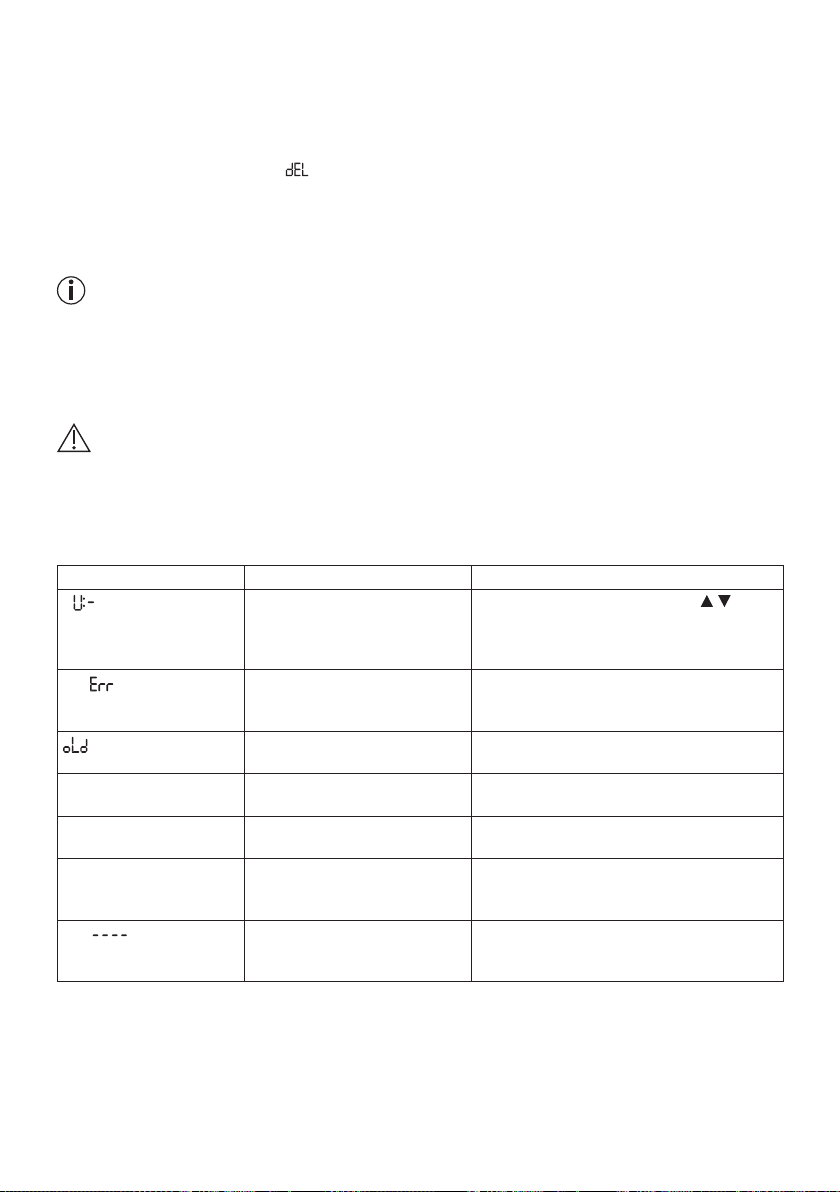
This is necessary if you would like to delete scale users who have been set up incorrectly or are no longer
required, for example.
You must then carry out the actions in chapter 7 (on user assignment) again.
Deleting individual users
Switch on the scale, select the user using the UP button and wait until “0.0 kg” appears; press the Unit/
Reset button for 6 seconds until “
Replacing the batteries
Your scale is equipped with a low battery indicator. If you operate the scale with flat batteries, “Lo” will
appear on the display and the scale will automatically switch off. In this case, the battery must be replaced
(1 x 3V CR2032).
NOTE:
• Do not use rechargeable batteries.
• Use batteries free from heavy metals.
” appears.
8. Cleaning and maintenance
The device should be cleaned from time to time.
This should be done using a damp cloth and, if necessary, a small amount of detergent.
IMPORTANT
• Never use abrasive solvents or cleaning products!
• Never submerge the device in water!
• Do not clean the device in a dishwasher!
9. What if there are problems?
These actions are recommended in the following cases:
Display Cause Solution
„
“
BF-
Incorrect weight is dis
played.
Incorrect weight is dis
played.
Incorrect weight is dis
played.
„
BF “
Unknown measurement as it
is outside the user assignment
limit or a unique assignment is
not possible.
The proportion of fat is outside
the measurable range (less
than 3% or greater than 65%).
Maximum weight capacity of
180 kg exceeded.
No even, hard surface. Place the scale on an even, hard surface.
-
Not standing still. Stand as still as possible.
-
Incorrect zero point of scale. Wait until the scale switches itself off. Acti
-
BIA is not possible. Please repeat the measurement barefoot, or
Select your user by pressing the
tons.
Please repeat the measurement barefoot, or
with the soles of the feet lightly dampened
if necessary.
Loads must not exceed 180 kg.
Not on carpet.
vate the scale, wait for “0.0 kg” to appear
and take the measurement again.
with the soles of the feet lightly dampened
if necessary.
/ but-
-
24
Page 25
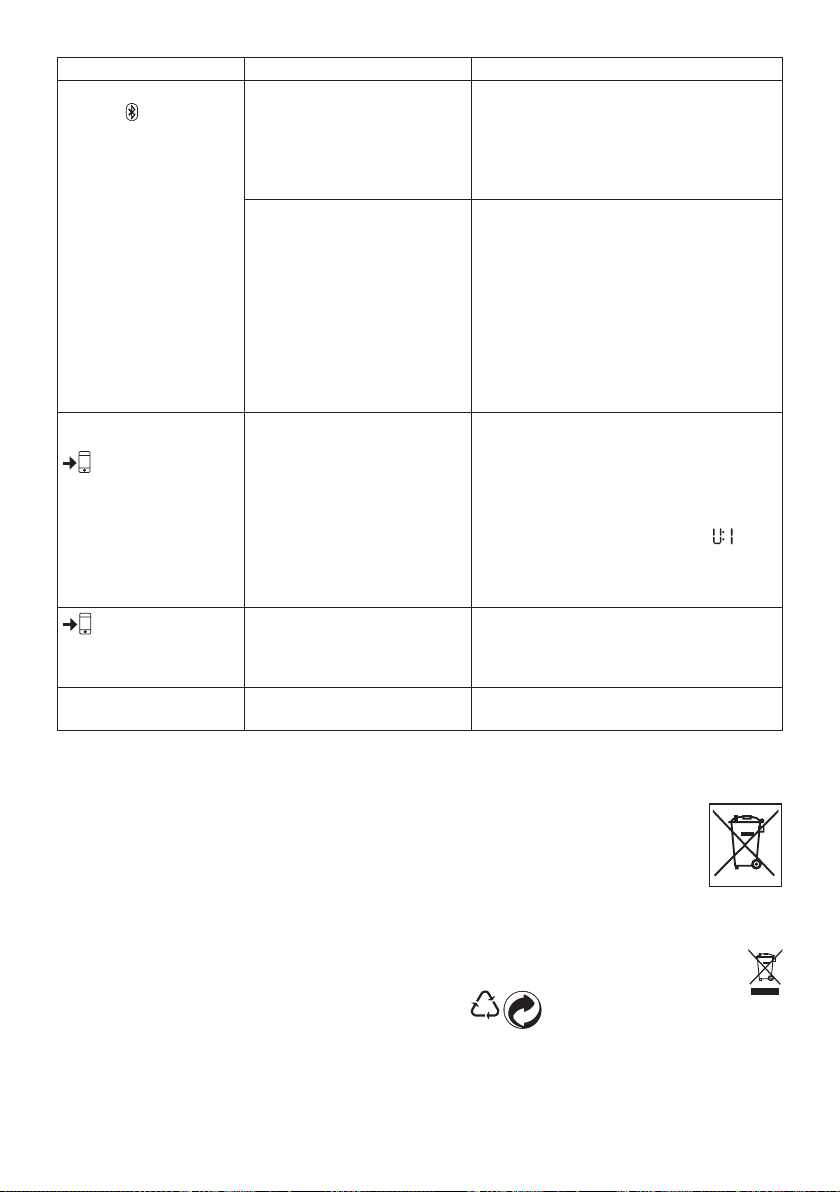
Display Cause Solution
PAP
®
No Bluetooth
connection ( symbol is
missing).
Device outside the range.
The minimum range in the open is approx.
10 m. Walls and ceilings reduce the range.
Other radio waves may interfere with the
transmission. Therefore, do not position the
scale near devices such as WiFi routers,
microwaves, induction hobs, etc.
No connection to the app.
Close the app completely (including in the
background). Switch Bluetooth
back on again. When doing so, please note
that the scale must not be connected from
the Bluetooth
tem. If need be, remove it from the devices
list in the Bluetooth
the “Sanitas HealthCoach” app. Switch the
smartphone off and back on again. Remove
the batteries in the scale for a short period
and reinsert them.
Measurements are not
transferred to the app
-symbol does not
appear)
No new user measurement and
Bluetooth® connection with
no
the app.
The user memory space which appears
on the scale display must be assigned to
the scale in your app settings. Only these
measurements can be transferred. There
fore, check your user spaces and your app
settings for this user and carry out a user
measurement again. In doing so, „
example has to be displayed on the scale
and in the app this user „1“ has to be assi
gned in the device settings of the scale.
-symbol appears
briefly after measure
ment.
Lo
User memory space is full.
The oldest measured values
-
are overwritten with newer
measured values.
The batteries in the scale are
Open the app and switch the scale on. If
you do not want to use the app, ignore this
message.
Replace the batteries in the scale.
empty.
®
off and
®
settings of the operating sys-
®
settings, and then use
“ for
-
-
10. Disposal
Empty, completely flat batteries must be disposed of through specially designated collection boxes, recycling points or electronics retailers. You are legally required to dispose of the batteries.
The codes below are printed on batteries containing harmful substances:
Pb = Battery contains lead,
Cd = Battery contains cadmium,
Hg = Battery contains mercury.
For environmental reasons, do not dispose of the device in the household waste at the end of its service
life. Dispose of the device at a suitable local collection or recycling point in your country.
Dispose of the device in accordance with EC Directive – WEEE (Waste Electrical and Electronic
Equipment). If you have any questions, please contact the local authorities responsible for waste
disposal.
Dispose of packaging in an environmentally friendly manner.
25
20
Page 26
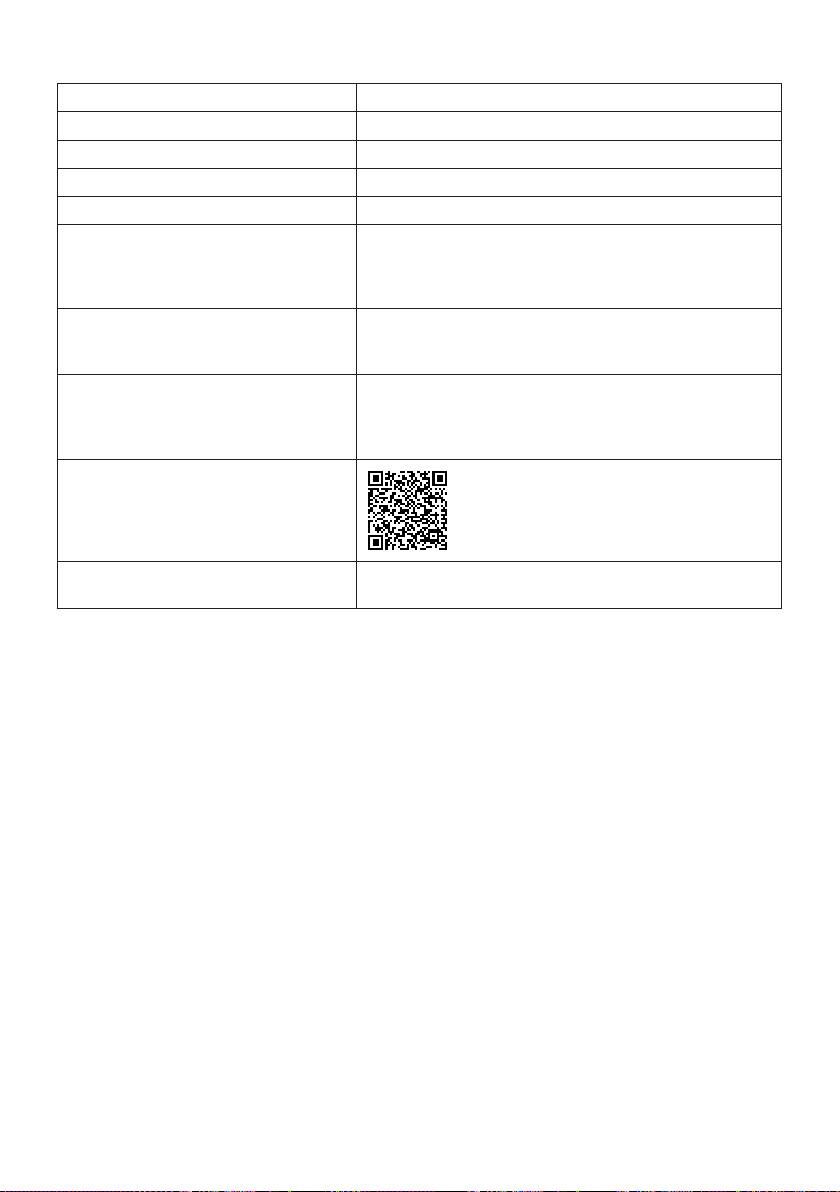
11. Technical specifications
Model: SBF 72
Dimensions: 30 x 30 x 2.1 cm
Weight: Approx. 1.5 kg
Measurement range: 5-180 kg
Scale interval d: The display can be read in increments of 0.1 kg.
Repetition accuracy: The measuring tolerance for repeated measurements is +/-
Absolute precision: In comparison with a calibrated weight, the measured value
Data transfer via
Bluetooth® low energy
technology
A list of compatible smartphones, infor
mation on software and details on the
devices can be found at the following
link: sanitas-online.de
0.4 kg (several measurements in direct succession on the
same scale with position of scale and person the same as
far as possible).
is +/-1% +0.1 kg. E.g. at 40 kg this corresponds to +/- 0.5
kg; at 100 kg this corresponds to +/-1.1 kg.
The product uses
Bluetooth® low energy technology,
Frequency band 2402 - 2480 MHz,
Max. 5 dBm transmission power,
Compatible with
Bluetooth® ≥ 4.0 smartphones/tablets
-
System requirements for the “Sanitas
HealthCoach” app
iOS ≥ 10.0, Android™ ≥ 5.0
Bluetooth
®
≥ 4.0.
Subject to technical changes.
We hereby confirm that this product complies with the European RED Directive 2014/53/EU. The CE Dec
laration of Conformity for this product can be found under:
www.sanitas-online.de/web/de/landingpages/cedeclarationofconformity.php.
26
-
Subject to errors and changes
Page 27

FRANÇAIS
Lisez attentivement ce mode d’emploi, conservez-le pour un usage
ultérieur, mettez-le à disposition des autres utilisateurs et suivez les
consignes qui y figurent.
Sommaire
1. Contenu ............................................................ 28
2. Symboles utilisés ..............................................28
3. Utilisation conforme aux recommandations .....29
4. Consignes d’avertissement et de mise en
garde ................................................................29
5. Description de l’appareil ...................................31
Familiarisation avec l’appareil
Fonctions de l’appareil
Ce pèse-personne impédancemètre numérique sert à la fois à vous peser et à diagnostiquer vos données
personnelles de fitness.
Il est conçu pour être utilisé dans un cercle privé.
Le pèse-personne dispose des fonctions suivantes pouvant être utilisées par un maximum de 8per
sonnes:
• Poids,
• IMC,
• mesure du taux de graisse corporelle,
• taux d’eau corporelle,
• taux de masse musculaire,
• masse osseuse,
• volume de base et volume d’activité.
Le pèse-personne dispose en outre des fonctionnalités suivantes:
• conversion entre kilogramme «kg», livre «lb» et stone «st»,
• fonction d’arrêt automatique,
• affichage du changement de piles en cas de piles faibles,
• reconnaissance automatique de l’utilisateur,
• enregistrement des 30dernières mesures pour 8personnes, si le transfert vers l’application est impossible,
• Fonction démarrage direct: Lors du démarrage du pèse-personne sans l’application, le pèse-personne
mesure le poids et l’IMC. Les valeurs de l’analyse corporelle sont alors calculées avec les paramètres
standard et sont donc forcément plus ou moins imprécises. Ces valeurs ne sont pas enregistrées dans
le pèse-personne.
6. Mise en service .................................................31
7. Utilisation ..........................................................32
8. Nettoyage et entretien ...................................... 36
9. Que faire en cas de problèmes?......................36
10. Élimination ...................................................... 37
11. Caractéristiques techniques ...........................38
-
Principe de mesure
Ce pèse-personne fonctionne selon le principe de la B.I.A., l’analyse bioélectrique de l’impédance. À cet
effet, un courant imperceptible, absolument sans risque et sans danger, permet de connaître en quelques
secondes le taux des tissus corporels.
La mesure de la résistance électrique (impédance) ainsi que la prise en compte de constantes ou de don
nées individuelles (âge, taille, sexe, activité physique) permettent de définir le taux de graisse corporelle
et d’autres paramètres physiques. Le tissu musculaire et l’eau ont une bonne conductibilité électrique et
présentent donc une faible résistance. Par contre, les os et le tissu adipeux ont une faible conductibilité,
car les os et les cellules adipeuses sont très peu conducteurs en raison de leur résistance très élevée.
Notez que les valeurs déterminées par le pèse-personne impédancemètre ne représentent que des
approximations par rapport aux analyses physiques effectives d’ordre médical. Seul un spécialiste équipé
de matériel médical (par exemple un tomodensitomètre) est en mesure de déterminer précisément la
graisse corporelle, l’eau corporelle, la masse musculaire et la masse osseuse.
En cas d’utilisation avec le démarrage direct, il est inutile de saisir les valeurs individuelles. En plus du
27
-
Page 28
poids et de l’IMC, le calcul se fait à l’aide de paramètres standard et il ne s’agit donc que de valeurs
PAP
max.
180 kg
396 lb
28 st
max.
180 kg
396 lb
28 st
approximatives, qui peuvent cependant être également valides pour l’observation des tendances.
1. Contenu
Vérifiez si l’emballage extérieur de l’appareil est intact et si tous les éléments sont inclus. Avant l’utilisation,
assurez-vous que l’appareil et les accessoires ne présentent aucun dommage visible et que la totalité de
l’emballage a bien été retirée. En cas de doute, ne l’utilisez pas et adressez-vous à votre revendeur ou au
service client indiqué.
• Manuel abrégé
• Pèse-personne impédancemètre SBF 72
• 1pile CR2032 de 3V
• Ce mode d’emploi
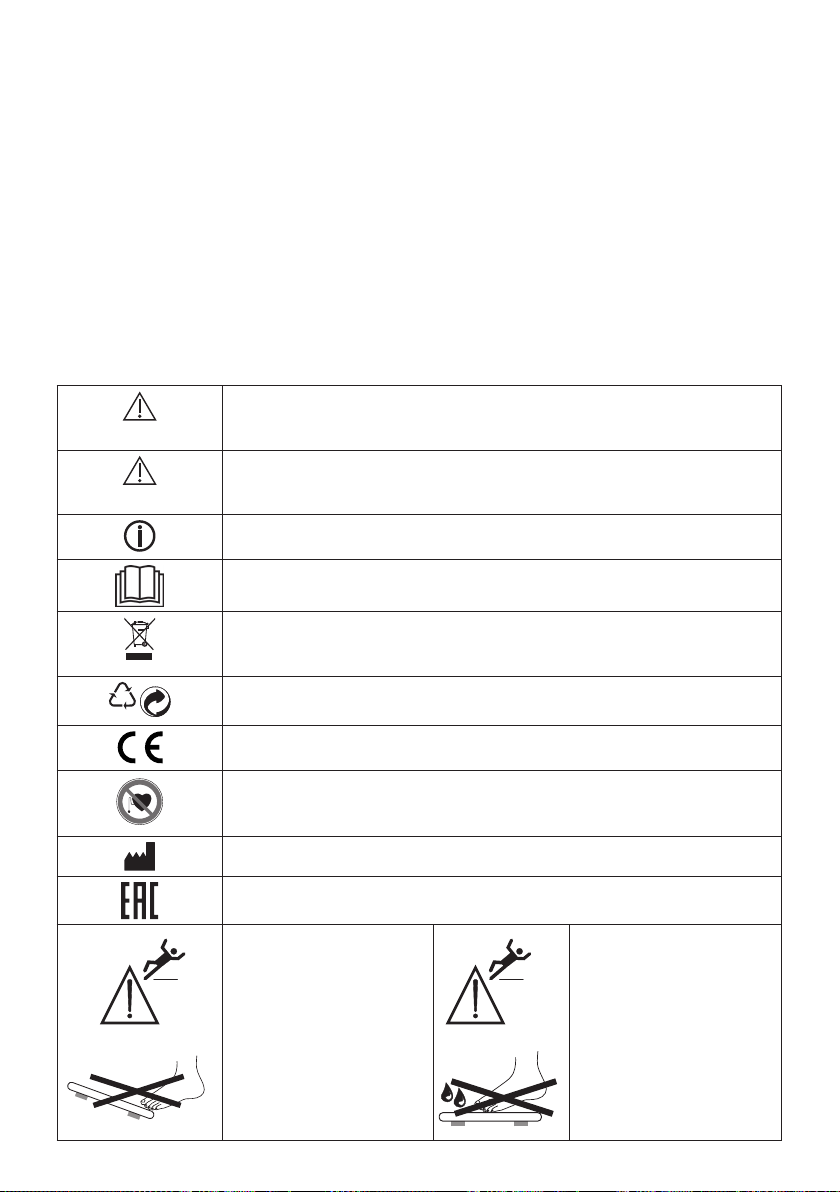
2. Symboles utilisés
Les symboles suivants sont utilisés sur le mode d’emploi, sur l’emballage et sur la plaque signalétique de
l’appareil:
AVERTISSEMENT
Ce symbole vous avertit des risques de blessures ou des dangers pour votre
santé.
ATTENTION
Ce symbole vous avertit des éventuels dommages au niveau de l’appareil ou
d’un accessoire.
Remarque
Indication d’informations importantes
Respecter les consignes du mode d’emploi
Élimination conformément à la directive européenne WEEE (Waste Electrical and
Electronic Equipment) relative aux déchets d’équipements électriques et électro
-
niques
20
Éliminer l’emballage dans le respect de l’environnement
Ce produit répond aux exigences des directives européennes et nationales en
vigueur.
L’appareil ne doit pas être utilisé par des personnes portant des implants médicaux (par ex. stimulateur cardiaque). Sinon, leur fonctionnement pourrait être
altéré.
Fabricant
Marque de certification pour les produits, qui sont exportés en Fédération de
Russie et dans les pays de la CEI.
Risque de basculement:
Montez au centre du pèsepersonne.
Risque de glissade: Ne
montez pas sur le pèse-per
sonne impédancemètre avec
les pieds mouillés.
28
Page 29
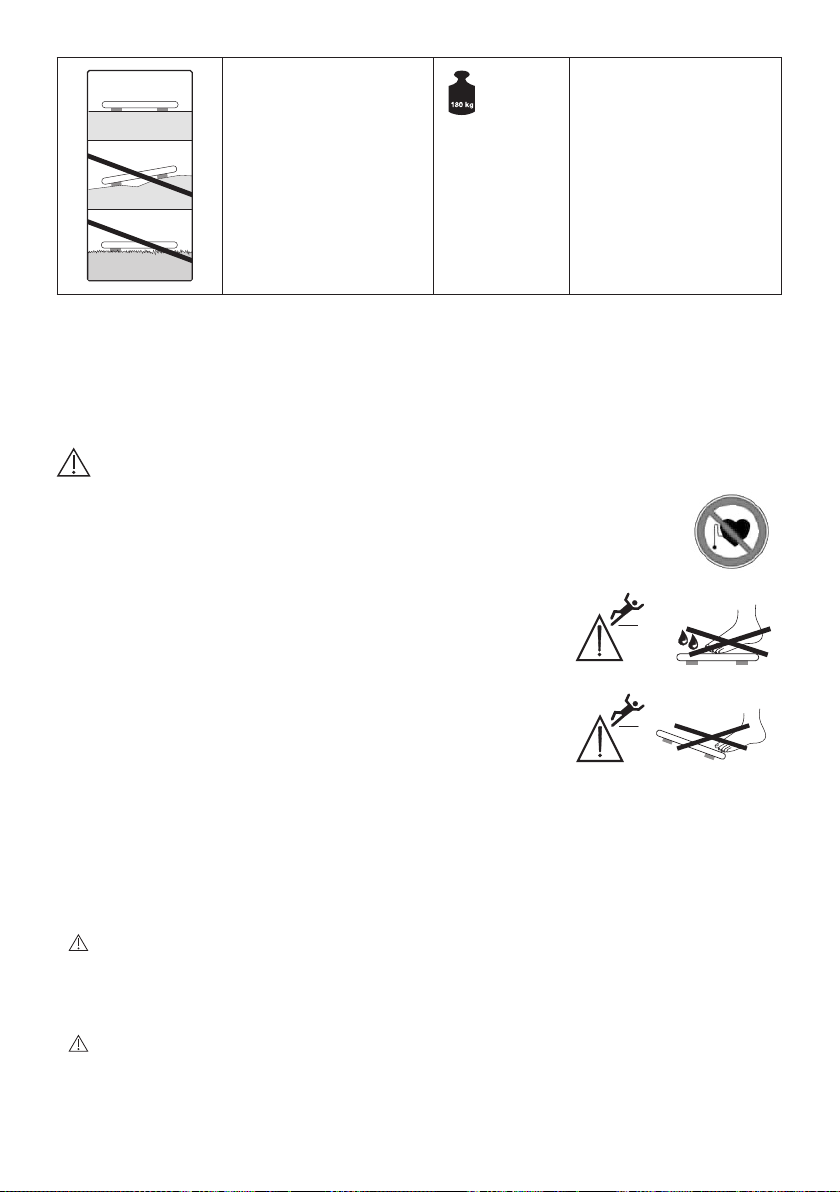
Posez le pèse-personne sur
max.
180 kg
396 lb
28 st
max.
180 kg
396 lb
28 st
une surface plate.
Pas sur un tapis.
Ne surchargez pas le pèsepersonne:
180 kg / 396 lb / 28 st.
3. Utilisation conforme aux recommandations
L’appareil est uniquement destiné à peser des personnes et à enregistrer vos données personnelles de
fitness. L’appareil est prévu pour un usage strictement personnel et non pas pour une utilisation à des fins
médicales ou commerciales.
4. Consignes d’avertissement et de mise en garde
AVERTISSEMENT
• Le pèse-personne ne doit pas être utilisé par des personnes
portant des implants médicaux (par ex. stimulateur cardiaque).
Sinon, leur fonctionnement pourrait être altéré.
• Ne pas utiliser pendant la grossesse.
• Attention, ne montez pas sur le pèse-personne les pieds mouillés,
et ne posez pas les pieds sur le plateau de pesée s’il est humide–
Risque de glissade!
• Ne pas se tenir sur le bord extérieur du pèse-personne: Risque de
basculement!
• Les piles sont extrêmement dangereuses si elles sont avalées. Conservez les piles et le pèse-personne hors de portée des enfants en bas âge. En cas d’ingestion d’une pile, consultez immédiatement un médecin.
• Conservez l’emballage hors de portée des enfants (risque d’étouffement).
Remarques relatives aux piles
• Si du liquide de la cellule de pile entre en contact avec la peau ou les yeux, rince la zone touchée avec
de l’eau et consulte un médecin.
•
Risque d’ingestion! Les enfants en bas âge peuvent avaler les piles et s’étouffer. Conserver les
piles hors de portée des enfants en bas âge!
• Respecter les signes de polarité plus (+) et moins (-).
• Si une pile a coulé, enfiler des gants de protection et nettoyer le compartiment à piles avec un chiffon sec.
• Protéger les piles d’une chaleur excessive.
•
Risque d’explosion! Ne pas jeter les piles dans le feu.
• Les piles ne doivent pas être rechargées ni court-circuitées.
• En cas de non-utilisation prolongée de l’appareil, retirer les piles du compartiment à piles.
• Ne pas utiliser de batterie!
• Ne pas démonter, ouvrir ou casser les piles.
29
Page 30
Recommandations générales
• Notez que des tolérances de mesure techniques sont possibles, car il ne s’agit pas d’un pèse-personne
calibré destiné à un usage professionnel ou médical.
• La résistance maximale du pèse-personne est de 180kg (396lb, 28st). Les résultats lors de la mesure
du poids et de l’estimation de la masse osseuse sont affichés par graduations de 100g (0,2lb, 0-19st:
0,2lb; 20-28st: 1lb).
• Les résultats de mesure des parts de graisse corporelle, d’eau corporelle et de muscle s’affichent par
graduations de 0,1 %.
• Le besoin calorique est donné par graduations de 1kcal.
• À la livraison du pèse-personne, le réglage des unités est en «cm» et «kg». Lors de la mise en service,
vous pouvez modifier les réglages des unités à l’aide de l’application.
• Posez le pèse-personne sur une surface plane et stable; un support stable est une condition préalable à
une mesure correcte.
• Seul le service client ou un opérateur autorisé peut procéder à une réparation. Cependant, avant toute
réclamation, veuillez contrôler au préalable l’état des piles et les remplacer le cas échéant.
Rangement et entretien
La précision des valeurs mesurées et la durée de vie de l’appareil dépendent d’un maniement soigné:
ATTENTION
• De temps à autre, nettoyez l’appareil. N’utilisez pas de produit de nettoyage agressif et ne mettez jamais
l’appareil sous l’eau.
• Assurez-vous qu’aucun liquide ne pénètre à l’intérieur du pèse-personne. N’immergez jamais le
pèse-personne. Ne rincez jamais sous l’eau courante.
• Quand le pèse-personne est inutilisé, aucun objet ne doit être posé sur le plateau.
• Ne pas appuyer violemment ou avec des objets pointus sur les touches.
• N’exposez pas votre pèse-personne aux températures élevées ou à de forts champs électromagné
tiques.
• Protégez l’appareil contre les coups, l’humidité, la poussière, les produits chimiques, les fortes variations
de température et les sources de chaleur trop proches (four, radiateur).
Conseils généraux
• Pesez-vous, si possible, à la même heure (de préférence le matin), après être passé aux toilettes, à jeun
et nu(e) afin d’obtenir des résultats comparables.
• Important lors de la mesure: La détermination de la graisse corporelle doit toujours être faite pieds nus;
si nécessaire, elle peut s‘effectuer la plante des pieds légèrement humide.
Il se peut que les mesures effectuées avec les pieds complètement secs ne conduisent pas à des résul
tats satisfaisants, car leur conductibilité est trop faible.
• Tenez-vous droit et ne bougez pas pendant la mesure.
• Attendez quelques heures après un effort physique inhabituel.
• Attendez 15minutes environ après le lever avant de faire la mesure pour que l‘eau puisse se répartir
dans le corps.
• Notez que seule compte la tendance à long terme. Des écarts de poids de courte durée enregistrés en
l’espace de quelques jours ne sont dus qu’à une simple perte de liquides dans la plupart des cas; l’eau
corporelle joue un rôle important dans le bien-être.
Limitations
Il se peut que la détermination de la graisse corporelle et d’autres données présente des écarts et des
résultats non plausibles dans les cas suivants:
• les enfants de moins de 10ans,
• les sportifs de haut niveau et les culturistes,
• les personnes fiévreuses, en dialyse, présentant des symptômes d‘œdèmes ou d‘ostéoporose,
• les personnes sous traitement médical cardiovasculaire (cœur et système vasculaire),
• les personnes prenant des médicaments vasodilatateurs ou vasoconstricteurs,
• les personnes présentant des écarts anatomiques sérieux des jambes par rapport à leur taille (jambes
nettement courtes ou longues).
-
-
30
Page 31
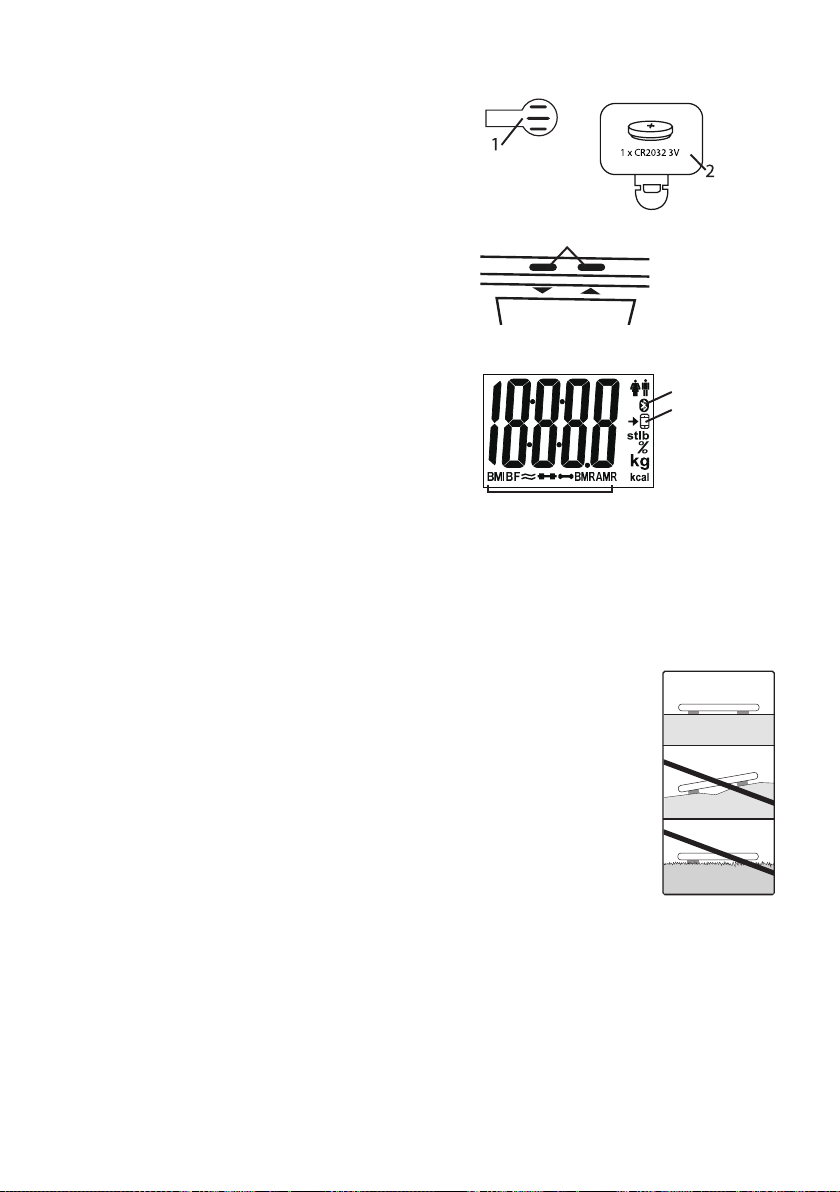
5. Description de l’appareil
Face arrière
1. Touche Unit/Reset
2. Compartiment à piles
Unit/Reset
Façade
3. Touches HAUT / BAS
Écran
4a. Symbole Bluetooth® pour la connexion entre le
pèse-personne et le smartphone
4b. Symbole de synchronisation lors de l’envoi des
mesures
5. Poids,
données corporelles, par ex. IMC, BF...
3
4a
4b
5
6. Mise en service
Insérer les piles
Retirez les piles de l’emballage et placez-les dans le pèse-personne en respectant la polarité. Si le
pèse-personne n’affiche aucune fonction, retirez complètement les piles et replacez-les à nouveau.
Poser le pèse-personne
Posez le pèse-personne sur une surface plane et stable; un support stable est une
condition préalable à une mesure correcte. Ne posez pas le pèse-personne sur un
tapis.
6.1 Mise en service avec l’application
Pour déterminer correctement le taux de graisse corporelle et les autres paramètres,
vous devez enregistrer les données individuelles de l’utilisateur sur le pèse-per
sonne.
Le pèse-personne dispose de 8emplacements de mémoire utilisateur dans
lesquels vous et les membres de votre famille pouvez, par exemple, enregistrer vos
paramètres personnels.
De plus, d’autres utilisateurs peuvent être affectés depuis des terminaux mobiles où
l’application «Sanitas HealthCoach» est installée, ou par le choix du profil utilisa
teur dans l’application (voir Paramètres de l’application).
– Télécharger l’application gratuite «Sanitas HealthCoach» sur l’App Store (iOS) ou sur Google Play
(Android™).
– Démarrer l’application et suivre les instructions.
– Sélectionner SBF 72 dans l’application.
-
-
31
Page 32
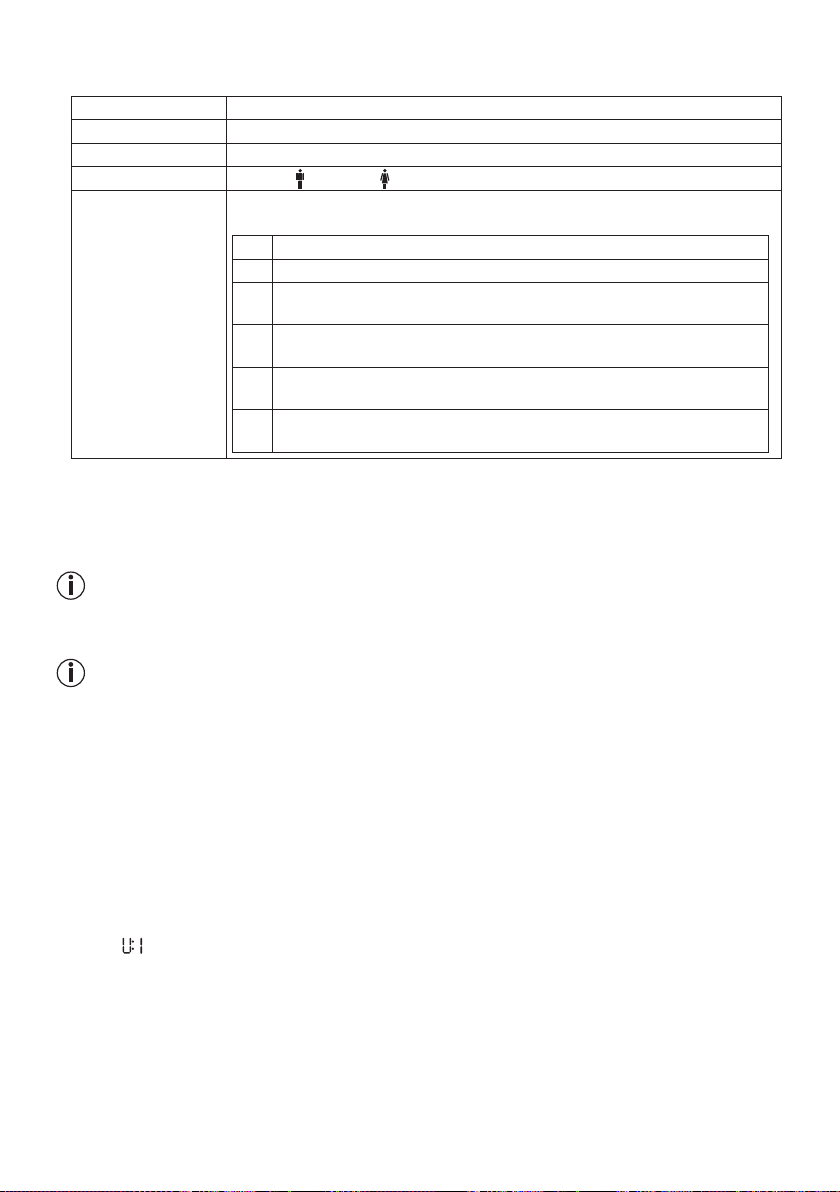
– Saisir les données de SBF 72.
Les réglages suivants doivent être effectués ou entrés dans l’application «Sanitas HealthCoach»:
Données utilisateur Valeurs de réglage
Taille 100 à 220cm (3‘ 3,5“ à 7’ 2,5“)
Âge 10 à 100ans
Sexe homme (
Niveau d’activité Le niveau d’activité sera sélectionné en fonction des perspectives à moyen et à
long terme.
1 Aucune.
2
3
4
5
), femme ( )
Activité corporelle
Faible: peu d’efforts physiques et efforts physiques légers (par ex.:
promenades, jardinage simple, exercices de gymnastique).
Moyenne: efforts physiques, au moins 30minutes, 2 à 4fois par
semaine.
Élevée: efforts physiques, au moins 30minutes, 4 à 6fois par
semaine.
Très élevée: efforts physiques intenses, entraînement intensif ou travail
physique difficile, respectivement d’au moins 1heure par jour.
– Affecter les utilisateurs à la demande de l’application.
Pour la reconnaissance automatique des personnes, leur première mesure doit être affectée à leurs don
nées d’utilisateur personnelles. Pour cela, suivez les instructions de l’application. Montez pieds nus sur
le pèse-personne et tenez-vous immobile en répartissant bien votre poids, les deux pieds positionnés
sur les électrodes.
Remarque: seules les valeurs de mesure affichées sur le pèse-personne peuvent être utilisées pour
des analyses complémentaires.
6.2 Utilisation sans l’application: Démarrage direct (alternative)
Remarque:
Pour afficher les valeurs d’analyse personnalisées, nous recommandons la mise en service et l’exécution de tous les réglages avec l’application «Sanitas HealthCoach». Par conséquent, ne suivez
cette étape que si la mise en service doit être exécutée complètement sans l’application. En cas
d’utilisation du pèse-personne avec l’application, passez directement au chapitre «Effectuer la
mesure».
Fonction démarrage direct:
en cas d’utilisation du pèse-personne sans l’application, le pèse-personne mesure le poids dès que vous
montez sur le plateau. Vous devez vous placer pieds nus sur les électrodes pour la mesure d’analyse. Les
valeurs d’analyse corporelle affichées telles que la graisse corporelle, l’IMC, etc. sont calculées avec les
paramètres standard et peuvent donc différer de leurs valeurs individuelles réelles, car des paramètres
personnels (par ex. sexe, taille, etc.) sont nécessaires au calcul des valeurs d’analyse corporelle person
nelles, mais ils ne peuvent être réglés que sur l’application et non sur le pèse-personne. Ces valeurs ne
sont pas enregistrées sur le pèse-personne, car elles ne sont pas attribuées aux utilisateurs enregistrés
(par ex. «
»).
-
-
7. Utilisation
7.1 Mesure
Posez le pèse-personne sur une surface plane et stable; un support stable est une condition préal
able à une mesure correcte. Ne posez pas le pèse-personne sur un tapis.
Mesurer le poids, établir un diagnostic
Montez pieds nus sur le pèse-personne et tenez-vous immobile en répartissant bien votre poids, les deux
pieds positionnés sur les électrodes.
-
32
Page 33
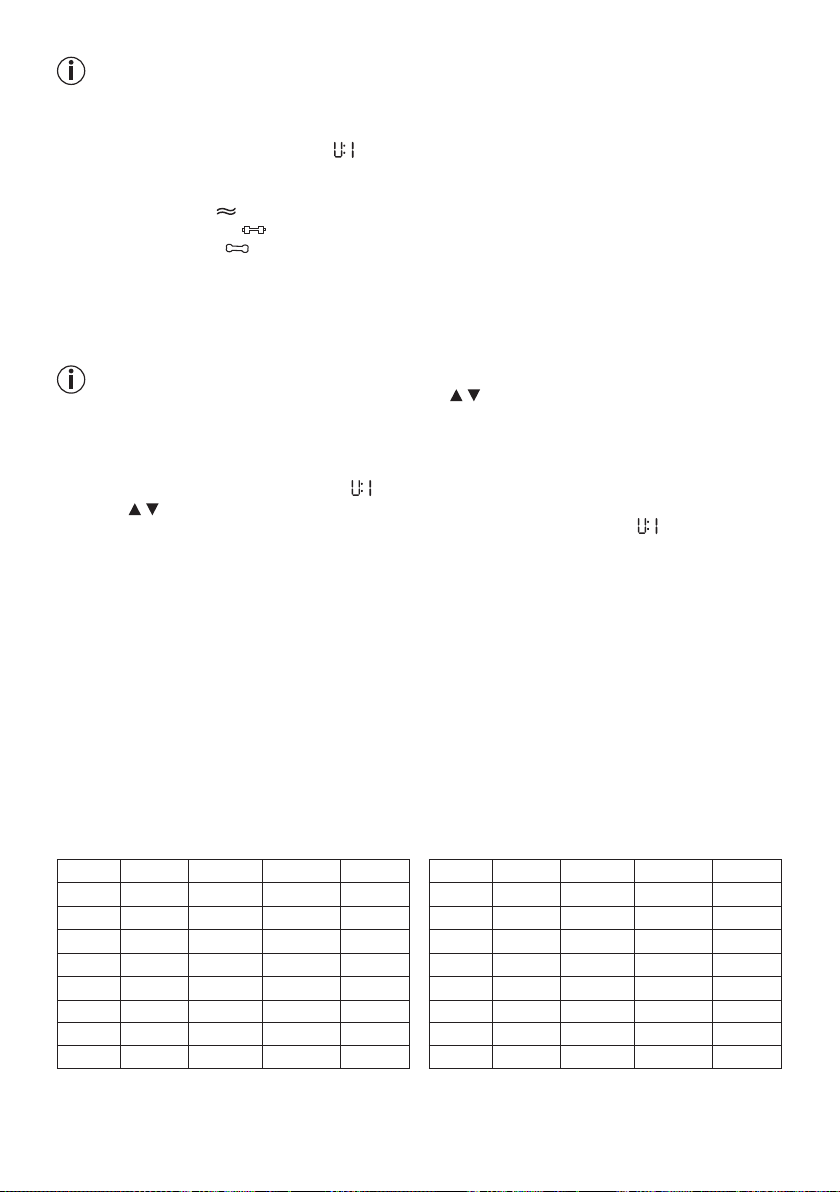
Remarque: Si la mesure est effectuée avec des chaussettes, le résultat ne sera pas correct.
Les éléments suivants s’affichent:
1. Poids en kg (ou lb/st)
2. Emplacement de sauvegarde (p. ex. «
»)
3. IMC
4. Graisse corporelle en % (BF)
5. Eau corporelle en %
6. Masse musculaire en %
7. Masse osseuse en kg
8. Taux métabolique de base en kcal (BMR)
9. Volume d’activité en kcal (AMR)
Les valeurs de mesure sont enregistrées dans la mémoire utilisateur affichée (pour le transfert ultérieur sur
l’application) ou transférées immédiatement si l’application est ouverte.
Remarque: Si deux utilisateurs potentiels ou plus sont détectés, les utilisateurs défilent à l’écran.
Sélectionnez l’utilisateur en appuyant sur la touche
/ . L’utilisateur ainsi confirmé s’affiche pendant 3secondes (vous pouvez encore changer pendant ce temps). Si aucun utilisateur n’est sélectionné, le pèse-personne s’éteint automatiquement après 40secondes. Rien n’est enregistré sur le
pèse-personne.
Si aucun utilisateur n’est reconnu (par ex. si la valeur actuelle a plus de 3kg de différence avec la
valeur enregistrée précédemment), «
» s’affiche. Sélectionnez l’utilisateur en appuyant sur la touche / .
Si un démarrage direct est effectué sans créer d’utilisateur (il manque par ex. «
») à l’écran), les
résultats sont calculés avec les paramètres standard et ne sont pas enregistrés.
Mesurer le poids uniquement
Montez sur le pèse-personne avec vos chaussures. Restez immobile sur le pèse-personne en répartis
sant votre poids de manière égale entre les deux jambes. Le pèse-personne commence tout de suite la
mesure.
La mesure de l’IMC est impossible avec des chaussures. Quatre traits s’affichent brièvement. Puis le
poids s’affiche de nouveau.
Éteindre le pèse-personne
Le pèse-personne s’éteint automatiquement.
7.2 Évaluer les résultats
Taux de graisse corporelle
Les valeurs de graisse corporelle suivantes en % vous donnent une ligne de conduite (pour de plus
amples informations, veuillez consulter votre médecin).
Homme Femme
Âge faible normal moyen élevé Âge faible normal moyen élevé
10–14 <11 % 11–16 %
15–19 <12 % 12 – 17 %
20 – 29 <13 % 13 – 18 %
30 – 39 <14 % 14 – 19 %
40 – 49 <15 % 15–20 %
50 – 59 <16 % 16–21 %
60 – 69 <17 % 17–22 %
70–100 <18 % 18–23 %
16,1–21 %
17,1–22 %
18,1–23 %
19,1–24 %
20,1–25 %
21,1–26 %
22,1–27 %
23,1–28 %
>21,1 % 10–14 <16 % 16–21 %
>22,1 % 15–19 <17 % 17–22 %
>23,1 % 20 – 29 <18 % 18–23 %
>24,1 % 30 – 39 <19 % 19–24 %
>25,1 % 40 – 49 <20 % 20–25 %
>26,1 % 50 – 59 <21 % 21–26 %
>27,1 % 60 – 69 <22 % 22–27 %
>28,1 % 70–100 <23 % 23–28 %
21,1–26 %
22,1–27 %
23,1–28 %
24,1–29 %
25,1–30 %
26,1–31 %
27,1–32 %
28,1–33 %
>26,1 %
>27,1 %
>28,1 %
>29,1 %
>30,1 %
>31,1 %
>32,1 %
>33,1 %
Chez les sportifs, on constate souvent une valeur plus faible.Selon le type de sport pratiqué, l’intensité de
l’entraînement et la constitution physique, il est possible d’atteindre des valeurs inférieures à la valeur de
33
Page 34
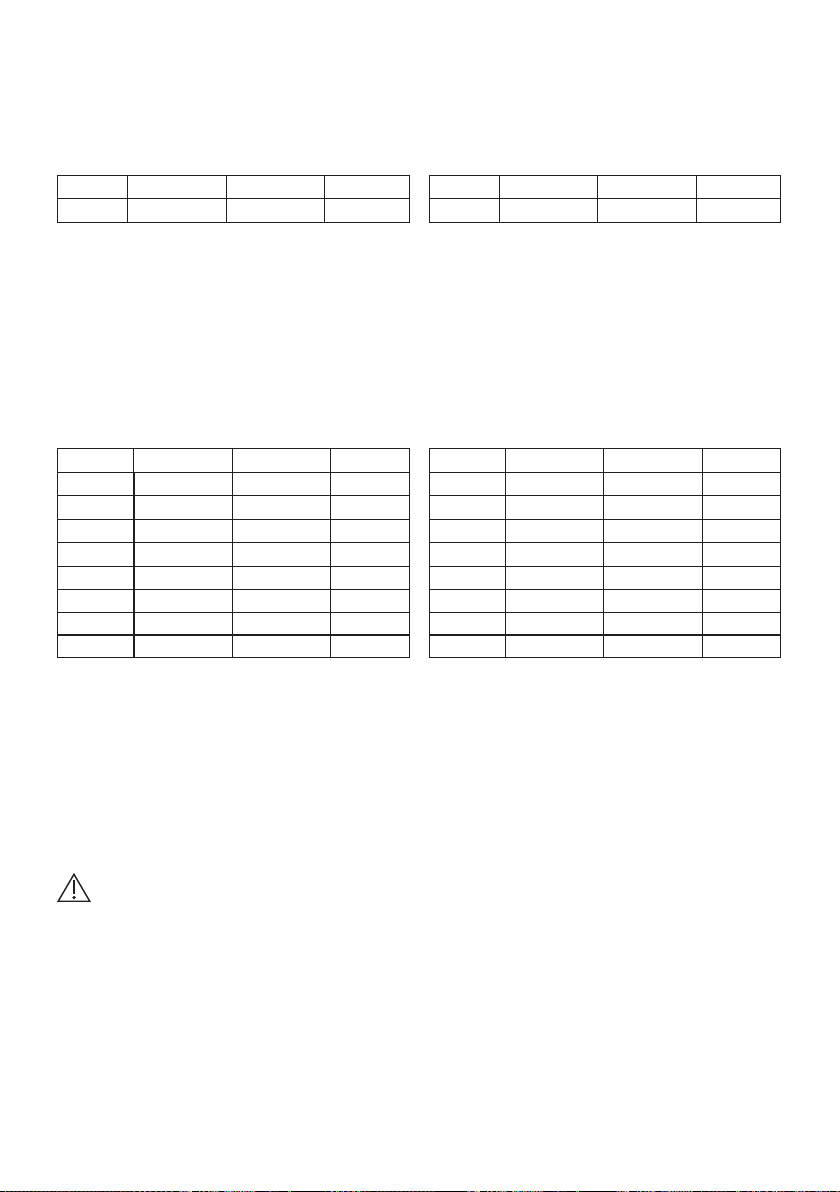
référence. Veuillez cependant noter que des valeurs extrêmement faibles peuvent entraîner des risques
pour la santé.
Taux d’eau corporelle
Le taux d’eau corporelle en % se situe normalement dans les plages suivantes:
Homme Femme
Âge mauvais bon excellent Âge mauvais bon excellent
10–100 <50 % 50–65 % >65 % 10–100 <45 % 45–60 % >60 %
La graisse corporelle contient relativement peu d’eau. C’est pourquoi, chez les personnes ayant un taux
de graisse corporelle élevé, le taux d’eau corporelle peut être inférieur aux valeurs de référence. Pour les
sportifs d’endurance, les valeurs de référence peuvent au contraire être dépassées en raison d’un taux de
graisse faible et d’un taux de masse musculaire élevé.
La détermination du taux d’eau corporelle avec ce pèse-personne ne permet pas de tirer des conclusions
médicales concernant par exemple les rétentions d’eau dues à l’âge. Le cas échéant, demandez conseil à
votre médecin. En principe, il faut chercher à avoir une part d’eau élevée.
Taux de masse musculaire
Le taux de masse musculaire en % se situe normalement dans les plages suivantes:
Homme Femme
Âge faible normal élevé Âge faible normal élevé
10–14 <44 % 44–57 % >57 % 10–14 <36 % 36–43 % >43 %
15–19 <43 % 43–56 % >56 % 15–19 <35 % 35–41 % >41 %
20 – 29 <42 % 42–54 % >54 % 20 – 29 <34 % 34–39 % >39 %
30 – 39 <41 % 41–52 % >52 % 30 – 39 <33 % 33–38 % >38 %
40 – 49 <40 % 40–50 % >50 % 40 – 49 <31 % 31–36 % >36 %
50 – 59 <39 % 39–48 % >48 % 50 – 59 <29 % 29–34 % >34 %
60 – 69 <38 % 38–47 % >47 % 60 – 69 <28 % 28–33 % >33 %
70–100 <37 % 37–46 % >46 % 70–100 <27 % 27–32 % >32 %
Masse osseuse
Comme le reste de notre corps, nos os sont soumis aux processus naturels de développement, de réduc
tion et de vieillissement. Pendant l’enfance, la masse osseuse augmente rapidement et atteint son maximum vers 30 à 40ans. Avec l’âge, la masse osseuse diminue légèrement. Avec une alimentation saine (en
particulier calcium et vitamine D) et une activité physique régulière, vous pouvez ralentir cette réduction.
Avec une construction musculaire appropriée, vous pouvez améliorer la stabilité de votre ossature. Notez
que ce pèse-personne ne vous indiquera pas la masse osseuse complète, mais permet de connaître le
poids des os (sans l’eau et dans les matières organiques). La masse osseuse est peu influençable, mais
elle varie légèrement selon certains facteurs (poids, taille, âge, sexe). Il n’existe pas de directives et recom
-
mandations reconnues.
ATTENTION:
Veillez cependant à ne pas confondre la masse osseuse avec la densité osseuse.
La densité osseuse ne peut être calculée que par un examen médical (par ex. tomographie par ordi
nateur, ultrason). C’est pourquoi des conclusions à propos de modifications des os et de la dureté
des os (par ex. ostéoporose) ne sont pas possibles avec un pèse-personne.
BMR
Le volume de base (BMR = Basal Metabolic Rate) représente la quantité d’énergie dont le corps a besoin
au repos complet pour maintenir en activité ses fonctions de base (par exemple lorsque l’on est couché
au lit pendant 24heures). Cette valeur dépend essentiellement du poids, de la taille et de l’âge.
Elle s’affiche sur le pèse-personne impédancemètre dans l’unité kcal/jour et est calculée à l’aide de la for
mule de Harris-Benedict reconnue scientifiquement.
Votre organisme a définitivement besoin de cette quantité d’énergie qui doit être apportée à l’organisme
via l’alimentation. À long terme, un apport d’énergie moindre peut avoir des effets nocifs sur votre santé.
34
Page 35

AMR
Le volume d’activité (AMR = Active Metabolic Rate) représente la quantité d’énergie dont le corps a besoin
quotidiennement lorsqu’il est actif. Les dépenses énergétiques d’une personne s’accroissent avec l’aug
mentation de l’activité physique et sont indiquées par le pèse-personne impédancemètre selon le niveau
d’activité choisi (1 à 5).
Pour maintenir son poids actuel, l’énergie dépensée doit être renouvelée sous forme de nourriture et de
boissons.
Si, sur une longue durée, le corps reçoit moins d’énergie qu’il n’en dépense, le corps compense la dif
férence en utilisant essentiellement la graisse stockée et le poids diminue. Si au contraire, pendant une
longue période de temps, le corps reçoit une quantité d’énergie supérieure au volume d’activité calculé
(AMR), il ne peut pas brûler l’excédent énergétique, qui est alors stocké sous forme de graisse et le poids
augmente.
Corrélation des résultats dans le temps
Remarque: Notez que seule compte la tendance à long terme. Des écarts de poids de courte
durée enregistrés en l‘espace de quelques jours ne sont dus qu‘à une simple perte de liquides dans
la plupart des cas.
L’interprétation des résultats se fait en fonction des modifications du poids global et des taux de graisse et
d’eau corporelles et de masse musculaire ainsi qu’en fonction de la durée selon laquelle ces modifications
se produisent.
Il faut distinguer les modifications rapides (de l‘ordre de quelques jours) des modifications à moyen terme
(de l‘ordre de quelques semaines) et à long terme (plusieurs mois).
La règle générale peut être la suivante: les modifications de poids à court terme représentent presque
exclusivement des changements de la teneur en eau, alors que les modifications à moyen et à long terme
peuvent aussi concerner le taux de graisse et de masse musculaire.
• Si votre poids diminue à court terme, alors que le taux de graisse corporelle augmente ou reste stable,
vous n‘avez perdu que de l‘eau, par exemple suite à un entraînement, une séance de sauna ou un
régime visant uniquement à une perte de poids rapide.
• Si votre poids augmente à moyen terme, alors que le taux de graisse corporelle diminue ou reste stable,
il se pourrait au contraire que vous ayez augmenté la masse musculaire.
• Si votre poids et votre taux de graisse corporelle diminuent simultanément, cela signifie que votre
régime fonctionne: vous perdez de la graisse.
• L‘activité physique, les séances de mise en forme ou de musculation seront les compléments parfaits
de votre régime. Ils vous permettent d’augmenter votre taux de masse musculaire à moyen terme.
• Il ne faut pas additionner la graisse corporelle, le taux d’eau corporelle et la masse musculaire (le tissu
musculaire contient aussi des constituants de l’eau corporelle).
7.3 Autres fonctions
Affectation des utilisateurs
Il est possible d’affecter maximum 8utilisateurs au pèse-personne pour une mesure du poids simple (avec
chaussures) et une mesure diagnostique (pieds nus).
Lors d’une nouvelle mesure, le pèse-personne affecte celle-ci à l’utilisateur pour lequel la dernière valeur
enregistrée est de +/- 3kg. Si deux utilisateurs potentiels ou plus sont détectés, les utilisateurs défilent à
l’écran. Sélectionnez l’utilisateur en appuyant sur la touche
/ et en attendant 3secondes.
Enregistrement des valeurs affectées dans le pèse-personne
Si l’application est ouverte et si une connexion
Bluetooth
®
avec le pèse-personne est active, les nouvelles
mesures utilisateur affectées sont immédiatement envoyées à l’application.
Si l’application n’est pas ouverte, les nouvelles mesures utilisateur affectées sont enregistrées sur le
pèse-personne. Un maximum de 30mesures par utilisateur peut être enregistré sur le pèse-personne. Les
valeurs mesurées sont transférées à l’application quand vous allumez le pèse-personne (appuyez briève
ment sur le plateau).
Un transfert automatique n’est pas possible quand le pèse-personne est éteint.
Le symbole de synchronisation s’affiche sur l’écran du pèse-personne lorsque de nouvelles mesures
sont transférées dans l’application. Il ne s’affiche pas quand de nouvelles mesures sont enregistrées ou
attribuées pour cet utilisateur.
35
Page 36
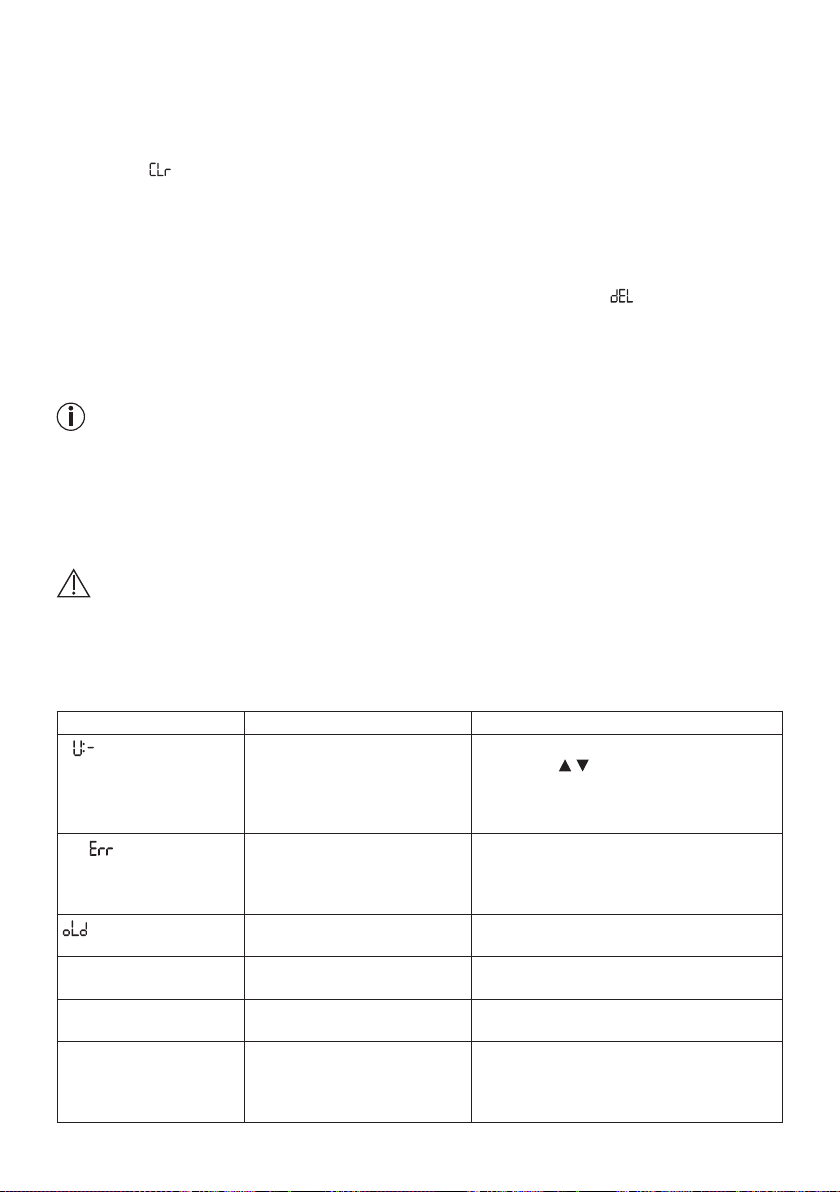
En cas d’utilisation avec démarrage direct (sans réglage d’utilisateur dans l’application), aucune valeur
n’est enregistrée dans le pèse-personne.
Supprimer les données du pèse-personne
Si vous souhaitez supprimer toutes les mesures et les anciennes données d’utilisateur du pèse-personne,
allumez-le et appuyez pendant environ 6 secondes sur la touche Unit/Reset à l’arrière du pèse-personne.
Sur l’écran, «
Ceci est nécessaire si vous souhaitez par ex. supprimer les utilisateurs mal configurés ou ceux qui n’utili
seront plus le pèse-personne.
Ensuite, vous devez de nouveau suivre la procédure du chapitre 7 (Affectation des utilisateurs).
Supprimer un utilisateur
Allumer le pèse-personne, sélectionner l’utilisateur à l’aide de la touche HAUT et attendre que «0,0kg»
s’affiche, appuyer sur la touche Unit/Reset pendant 6secondes jusqu’à ce que «
Remplacer les piles
Votre pèse-personne comporte un témoin de remplacement des piles. En cas d’utilisation du pèse-per
sonne avec des piles déchargées, le message «Lo» s’affiche et l’appareil s’éteint automatiquement. Dans
ce cas, les piles doivent être remplacées (1pile CR2032 de 3V).
REMARQUE:
• N’utilisez pas de batteries rechargeables.
• Utilisez des piles sans métaux lourds.
» s’affiche pendant quelques secondes.
-
» s’affiche.
-
8. Nettoyage et entretien
De temps à autre, nettoyez l’appareil.
Pour le nettoyage, utilisez un chiffon humide sur lequel vous pouvez mettre, au besoin, un peu de produit
vaisselle.
ATTENTION
• N’utilisez pas de solvant ni de détergent agressif!
• N’immergez jamais l’appareil!
• Ne lavez pas l’appareil au lave-vaisselle!
9. Que faire en cas de problèmes?
Ces étapes sont recommandées dans les cas suivants:
Écran Cause Solution
„
“
BF-
Un poids incorrect s’af
fiche.
Un poids incorrect s’af
fiche.
Un poids incorrect s’af
fiche.
Mesure inconnue, car elle se
situe hors de la limite d’affecta
tion utilisateur ou bien aucune
affectation unique n’est pos
sible.
Le taux de graisse dépasse les
limites de la plage mesurable
(inférieur à 3 % ou supérieur à
65 %).
La capacité de charge maximale de 180 kg est dépassée.
Le sol n’est pas plat et dur. Poser le pèse-personne sur un sol plat et
-
Position non stable. Si possible, ne bougez pas.
-
La position 0 du pèse-per
-
sonne est fausse.
36
Sélectionnez l’utilisateur en appuyant sur
les touches
-
-
Recommencer la mesure pieds nus ou
humidifier légèrement la plante des pieds.
Ne pas dépasser 180kg.
dur. Pas sur un tapis.
Attendez que le pèse-personne s’éteigne
de nouveau. Activer le pèse-personne,
attendre que «0.0 kg» s’affiche, puis
répéter la mesure.
/ .
Page 37
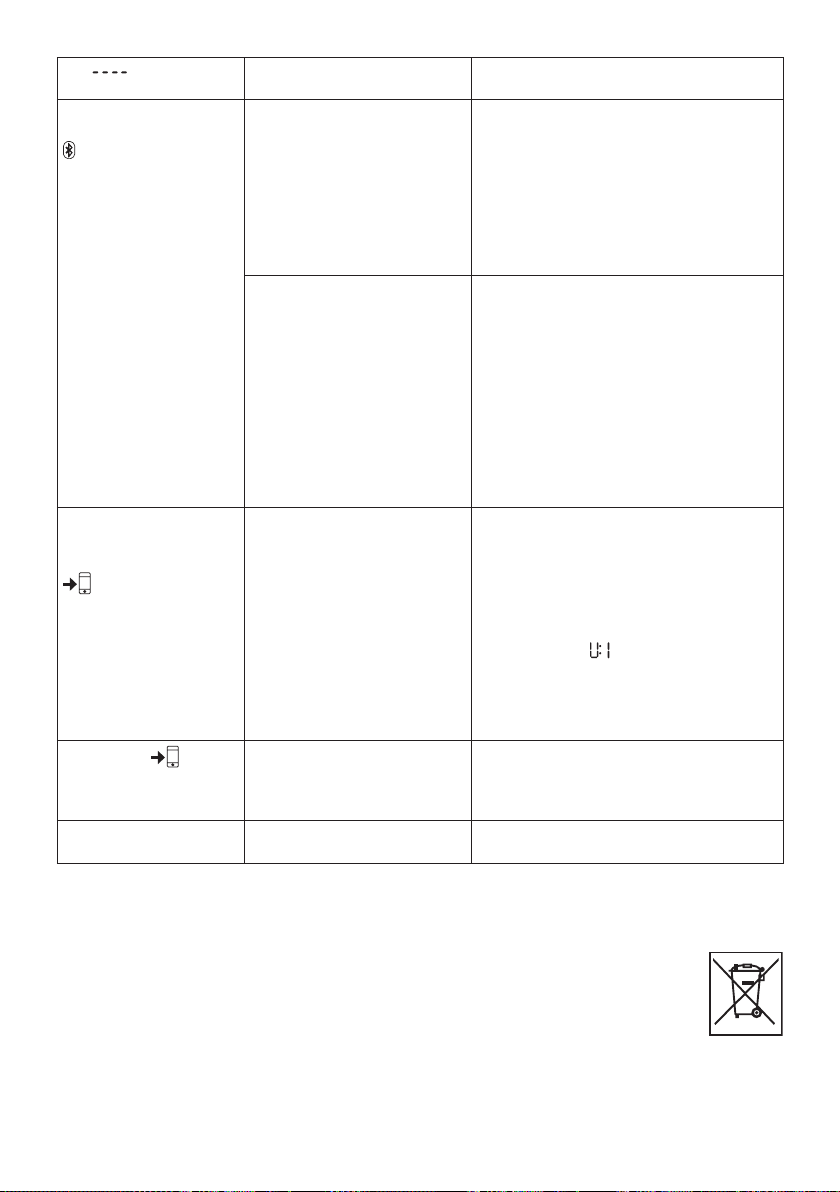
„BF “
Aucune connexion
Bluetooth
®
(le symbole
ne s’affiche pas).
Les résultats de mesure
ne sont pas envoyés à
l’application (le symbole
ne s’affiche pas)
Le symbole
s’affiche brièvement
après la mesure.
Lo
L’IMC n’est pas possible. Recommencer la mesure pieds nus ou
humidifier légèrement la plante des pieds.
Appareil hors de portée. Dans un espace dégagé, la portée est d’en
viron 10 m. Les murs et les plafonds diminuent la portée.
D’autres ondes radio peuvent perturber la
transmission. Par conséquent, ne placez
pas le pèse-personne à proximité d’appa
reils tels qu’un routeur sans fil, un microondes, des plaques de cuisson à induction,
etc.
Fermez complètement l’application (en
Aucune connexion à l’appli
cation.
arrière-plan également). Désactivez la
fonction Bluetooth
®
, puis réactivez-la.
Veuillez noter que le pèse-personne ne doit
pas être connecté depuis les paramètres
Bluetooth du système d’exploitation. Si
nécessaire, supprimez l’appareil de la liste
des appareils dans les paramètres Blue
tooth, puis utilisez l’application «beurer
HealthManager». Éteignez le smartphone
puis rallumez-le. Retirez brièvement les piles
du pèse-personne et réinsérez-les ensuite.
Pas de nouvelle mesure de
l’utilisateur et pas de connexion
Bluetooth
®
avec l’application.
La mémoire utilisateur qui s’affiche sur
l’écran du pèse-personne doit être affec
tée dans les paramètres de l’application.
-
Seules ces mesures peuvent être envoyées.
Contrôlez donc vos emplacements utili
sateurs et vos paramètres de l’application
pour cet utilisateur et refaites une mesure
de l’utilisateur. «
» doit par exemple s’afficher sur le pèse-personne et cet
utilisateur «1» doit être attribué dans
les paramètres du pèse-personne dans
l’application.
L’emplacement de mémoire
utilisateur est plein. Les plus
anciennes valeurs sont écra
Ouvrez l’application et allumez le pèsepersonne. Ignorez cette remarque si vous
-
ne voulez pas utiliser d’application.
sées par les dernières valeurs.
Les piles du pèse-personne
Changez les piles du pèse-personne.
sont vides.
-
10. Élimination
Les piles usagées et complètement déchargées doivent être mises au rebut dans des conteneurs spéciaux ou aux points de collecte réservés à cet usage ou bien déposées chez un revendeur d’appareils électriques. L’élimination des batteries est une obligation légale qui vous incombe.
Ces pictogrammes se trouvent sur les piles à substances nocives:
Pb = pile contenant du plomb,
Cd = pile contenant du cadmium,
Hg = pile contenant du mercure.
37
Page 38
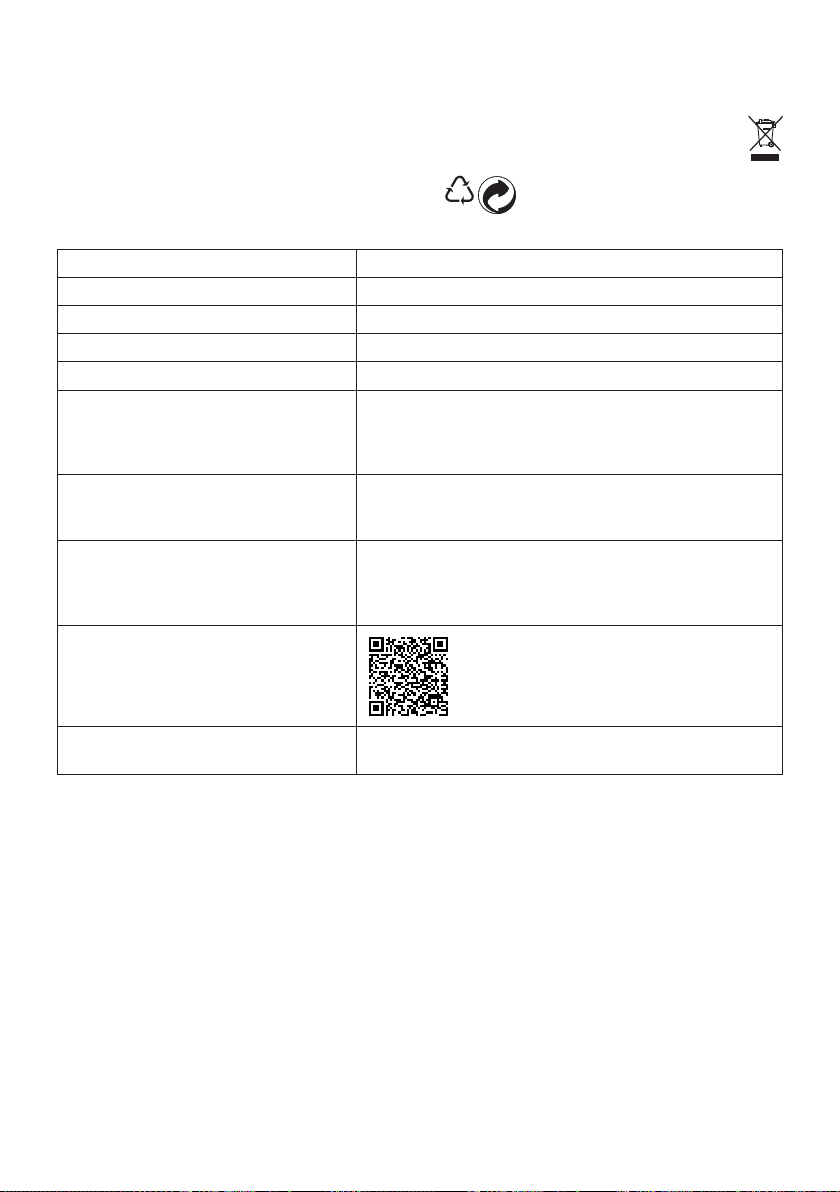
Dans l’intérêt de la protection de l’environnement, l’appareil ne doit pas être jeté avec les ordures
PAP
ménagères à la fin de sa durée de service. L’élimination doit se faire par le biais des points de collecte
compétents dans votre pays.
Éliminez l’appareil conformément à la directive européenne–WEEE (Waste Electrical and Elec
tronic Equipment) relative aux appareils électriques et électroniques usagés. Pour toute question,
adressez-vous aux collectivités locales responsables de l’élimination et du recyclage de ces pro
duits.
Éliminer l’emballage dans le respect de l’environnement.
20
-
11. Caractéristiques techniques
Modèle: SBF 72
Dimensions: 30 x 30 x 2,1 cm
Poids: env. 1,5 kg
Plage de mesure: 5 à 180kg
Valeur de la division d: Les valeurs sont exprimées par graduations de 0,1kg.
Précision de répétition: La tolérance de mesure pour la précision de répétition
Précision absolue: La valeur mesurée par rapport à un même poids est de
Transfertvia Bluetooth
®
Low Energy Le produit utilise la technologie Bluetooth® Low Energy,
Vous trouverez la liste des smartphones
compatibles, des informations sur le
logiciel et des détails sur les appareils à
l’adresse suivante: sanitas-online.de
est de +/- 0,4kg (plusieurs mesures consécutives avec le
même pèse-personne, la même position de l’appareil sur le
sol et de la personne sur le pèse-personne).
+/- 1% +0,1kg. Par ex. pour 40kg, cela correspond à +/0,5kg, pour 100kg, cela correspond à +/- 1,1kg.
Fréquence 2 402 – 2 480 MHz,
Puissance d’émission 5 dBm max.,
Compatible smartphones/tablettes Bluetooth
®
≥ 4.0
Configuration requise pour l’application
«Sanitas HealthCoach»
iOS ≥ 10.0, Android™ ≥ 5.0
Bluetooth
®
≥ 4.0.
Sous réserve de modifications techniques.
Nous garantissons par la présente que ce produit est conforme à la directive européenne RED 2014/53/
EU. Vous pouvez trouver la déclaration de conformité CE de ce produit à l’adresse suivante:
www.sanitas-online.de/web/de/landingpages/cedeclarationofconformity.php.
38
Sous réserve d’erreurs et de modifications
Page 39

ITALIANO
Leggere attentamente le presenti istruzioni per l'uso, conservarle per
impieghi futuri, renderle accessibili ad altri utenti e attenersi alle indicazioni.
Contenuto
1. Fornitura ...........................................................40
2. Spiegazione dei simboli ....................................40
3. Uso conforme ................................................... 41
4. Avvertenze e indicazioni di sicurezza ...............41
5. Descrizione dell'apparecchio ...........................43
6. Messa in funzione .............................................43
Introduzione
Funzioni dell'apparecchio
Questa bilancia digitale consente di pesarsi e di diagnosticare i dati relativi alla forma fisica dell'utente.
L'apparecchio è destinato all'uso privato.
La bilancia dispone delle seguenti funzioni, utilizzabili da un massimo di 8 persone:
• Misurazione del peso corporeo,
• IMC,
• Calcolo della massa grassa,
• Percentuale di acqua corporea,
• Percentuale di massa muscolare,
• Massa ossea,
• Tasso metabolico basale e tasso metabolico di attività.
La bilancia dispone inoltre delle seguenti funzioni:
• Commutazione tra chilogrammi "kg", libbre "lb" e Stone "st",
• Funzione di spegnimento automatico,
• Indicazione di sostituzione batterie in caso di batterie scariche,
• Riconoscimento automatico dell'utente,
• Memorizzazione delle ultime 30 misurazioni per 8 persone, se non possono essere trasferite alla app,
• Funzione di avvio diretto: Se la si accende senza app, la bilancia misura il peso e l’impedenza bio
elettrica (BIA). I valori corporei analizzati vengono quindi calcolati in base a parametri standard; per
questo motivo è inevitabile che siano imprecisi in misura più o meno elevata. Questi valori non vengono
memorizzati sulla bilancia.
7. Utilizzo .............................................................. 44
8. Pulizia e cura ....................................................48
9. Che cosa fare in caso di problemi? .................. 48
10. Smaltimento ...................................................49
11. Dati tecnici ...................................................... 50
-
Principio di misurazione
Questa bilancia utilizza il principio di misurazione B.I.A., l'analisi dell'impedenza bioelettrica. Nel giro di
pochi secondi, una corrente impercettibile, assolutamente innocua e non pericolosa, determina le diverse
percentuali corporee.
Grazie alla misurazione della resistenza elettrica (impedenza) e prendendo in considerazione costanti e/o
valori individuali (età, statura, sesso, livello di attività) è possibile determinare la percentuale di massa
grassa e altre caratteristiche corporee. I tessuti muscolari e l'acqua presentano una buona conducibilità
elettrica e di conseguenza una resistenza più bassa. Le ossa e i tessuti adiposi sono invece caratterizzati
da una scarsa conducibilità in quando le cellule adipose e le ossa presentano un'elevata resistenza che
ostacola la conduzione della corrente.
I valori rilevati dalla bilancia diagnostica si avvicinano solo ai valori reali ottenuti con analisi mediche. Solo
uno specialista è in grado di eseguire il calcolo esatto di massa grassa, percentuale di acqua, massa mus
colare e massa ossea attraverso metodi medici (ad es. la TAC).
Se si utilizza l’avvio diretto, non è necessario inserire i valori individuali. Il calcolo del peso e dell’impe
denza bioelettrica (BIA) viene eseguito con parametri standard; si tratta quindi solo di valori approssimativi
che tuttavia possono essere parimenti validi nell’osservazione della tendenza.
39
-
-
Page 40
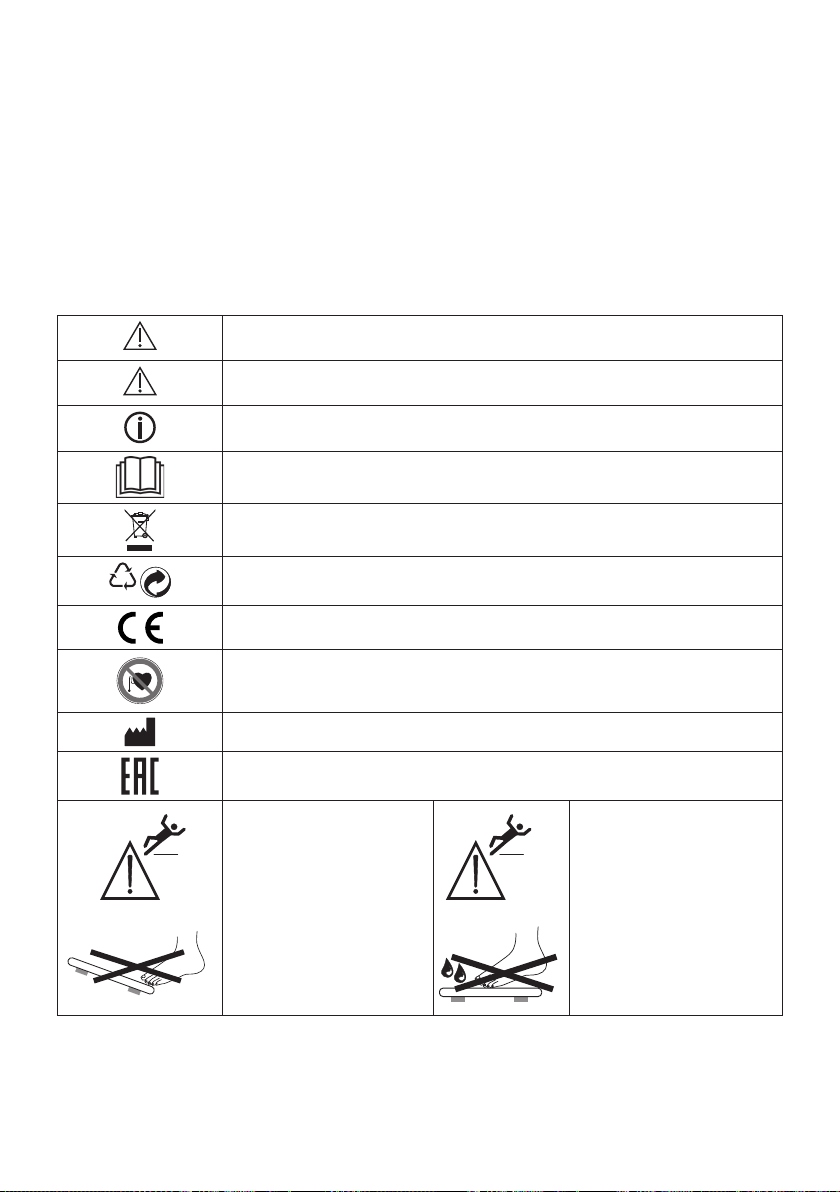
1. Fornitura
PAP
max.
180 kg
396 lb
28 st
max.
180 kg
396 lb
28 st
Controllare l'integrità esterna della confezione e del contenuto. Prima dell'uso assicurarsi che l'apparecchio e gli accessori non presentino nessun danno palese e che il materiale di imballaggio sia stato
rimosso. Nel dubbio non utilizzare l'apparecchio e consultare il proprio rivenditore o contattare il Servizio
clienti indicato.
• Guida rapida
• Bilancia diagnostica SBF 72
• 1 batteria da 3V CR2032
• Le presenti istruzioni per l'uso
2. Spiegazione dei simboli
I seguenti simboli sono utilizzati nelle istruzioni per l'uso, sull'imballo e sulla targhetta dell'apparecchio:
AVVERTENZA
Avvertimento di pericolo di lesioni o di pericoli per la salute.
ATTENZIONE
Indicazione di sicurezza per possibili danni all'apparecchio/agli accessori.
Nota
Indicazione di informazioni importanti
Seguire le istruzioni per l'uso
Smaltimento secondo le norme previste dalla Direttiva CE sui rifiuti di apparecchiature elettriche ed elettroniche (WEEE)
20
Smaltire la confezione nel rispetto dell'ambiente
Il presente prodotto soddisfa i requisiti delle direttive europee e nazionali vigenti.
L'apparecchio non può essere utilizzato da persone con impianti medicali (ad
es. pacemaker) per non comprometterne il funzionamento.
Produttore
Marchio di certificazione per i prodotti esportati nella Federazione Russa e nei
paesi CSI.
Pericolo di ribaltamento:
Posizionarsi in mezzo sulla
superficie di pesatura.
Pericolo di scivolamento:
Non salire sulla bilancia con i
piedi bagnati.
40
Page 41
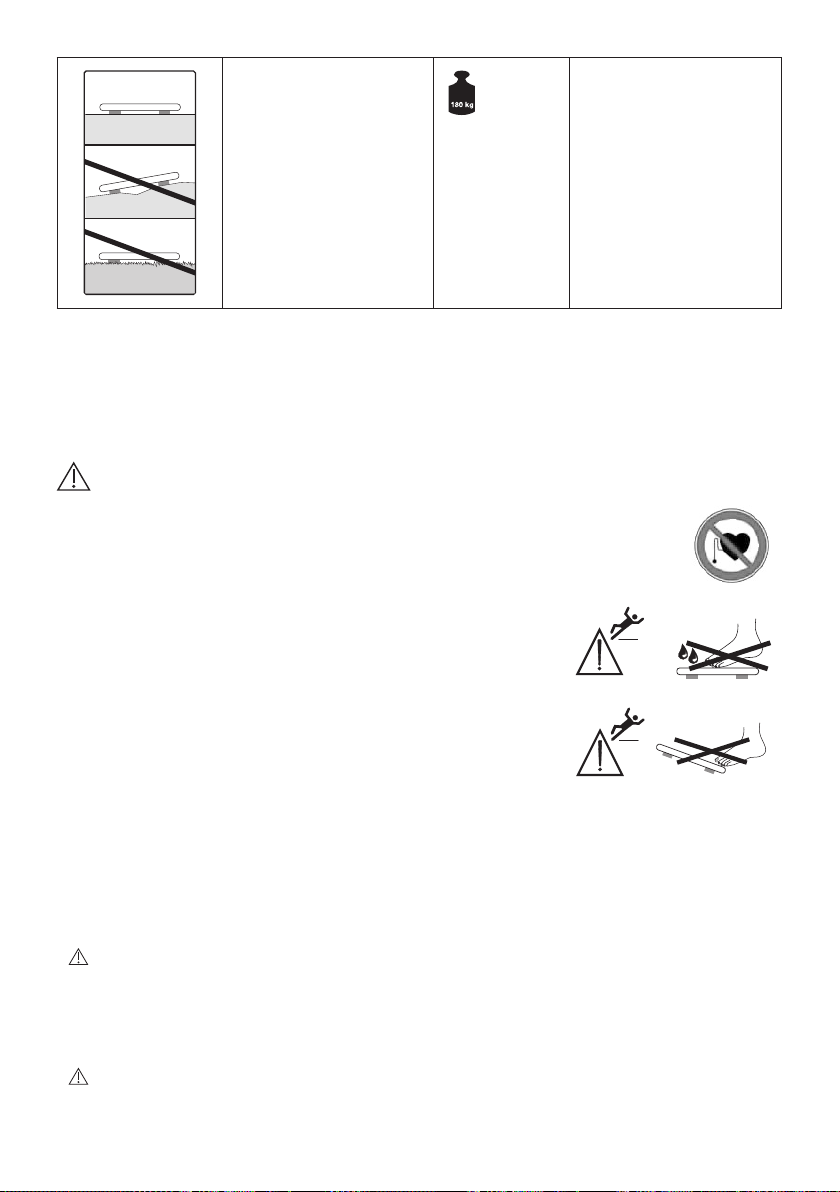
Appoggiare la bilancia su
max.
180 kg
396 lb
28 st
max.
180 kg
396 lb
28 st
una base in piano.
Non su un tappeto.
Non caricare sulla bilancia
un peso superiore a
180 kg / 396 lb / 28 st.
3. Uso conforme
L'apparecchio è adatto solo alla pesatura delle persone e a determinare i dati relativi alla forma fisica personali. L'apparecchio è adatto esclusivamente all'uso diretto da parte del cliente e non è previsto un suo
utilizzo medico o commerciale.
4. Avvertenze e indicazioni di sicurezza
AVVERTENZA
• La bilancia non può essere utilizzata da persone con impianti
medicali (ad es. pacemaker) In caso contrario potrebbe esserne
compromesso il funzionamento.
• Non utilizzare durante la gravidanza.
• Attenzione: non salire sulla bilancia con i piedi bagnati e se la superficie è umida. Pericolo di scivolamento!
• Non salire sul bordo esterno della bilancia e solo su un lato: Pericolo
di ribaltamento!
• Se ingoiate, le batterie rappresentano un pericolo mortale. Tenere le batterie e la bilancia lontano
dalla portata dei bambini. In caso di ingestione di una batteria, richiedere immediatamente assistenza
medica.
• Tenere lontani i bambini dal materiale d’imballaggio (pericolo di soffocamento).
Avvertenze sull'uso delle batterie
• Se il liquido della batteria viene a contatto con la pelle e con gli occhi, sciacquare le parti interessate con
acqua e consultare il medico.
Pericolo d'ingestione! I bambini potrebbero ingerire le batterie e soffocare. Tenerle quindi lontano
•
dalla portata dei bambini.
• Prestare attenzione alla polarità positiva (+) e negativa (-).
• In caso di fuoriuscita di liquido dalla batteria, indossare guanti protettivi e pulire il vano batterie con un
panno asciutto.
• Proteggere le batterie dal caldo eccessivo.
Rischio di esplosione! Non gettare le batterie nel fuoco.
•
• Le batterie non devono essere ricaricate o mandate in cortocircuito.
41
Page 42
• Qualora l'apparecchio non dovesse essere utilizzato per un periodo prolungato, rimuovere le batterie dal
vano batterie.
• Non utilizzare batterie ricaricabili!
• Non smontare, aprire o frantumare le batterie.
Indicazioni generali
• Tenere presente che sono possibili tolleranze di misurazione poiché non si tratta di una bilancia calibrata
per utilizzo medico professionale.
• Il carico massimo della bilancia è 180 kg (396 lb, 28 st). Le misurazioni di peso e massa ossea vengono
visualizzate in intervalli di 100 g (0,2 lb, 0-19st: 0,2lb; 20-28st: 1lb).
• I risultati relativi a massa grassa, percentuale di acqua e massa muscolare vengono visualizzati in inter
valli di 0,1%.
• Il fabbisogno calorico viene indicato in intervalli di 1 kcal.
• Al momento della consegna la bilancia è impostata sulle unità "cm" e "kg". Le impostazioni delle unità
possono essere modificate durante la messa in servizio con la app.
• Posizionare la bilancia su un fondo piano e solido; un piano solido è il presupposto per una misurazione
corretta.
• Le riparazioni possono essere effettuate solo dal Servizio clienti di o da rivenditori autorizzati. Tuttavia
prima di inoltrare eventuali reclami, testare le batterie e se necessario sostituirle.
Conservazione e cura
La precisione dei valori misurati e la durata dell'apparecchio dipendono da un utilizzo attento e scrupoloso:
ATTENZIONE
• Di tanto in tanto è opportuno pulire l'apparecchio. Non utilizzare detergenti aggressivi e non immergere
mai l'apparecchio in acqua.
• Accertarsi che non vi sia del liquido sulla bilancia. Non immergere mai la bilancia in acqua. Non sciac
quare mai sotto l'acqua corrente.
• Non posizionare alcun oggetto sulla bilancia quando non viene utilizzata.
• Non azionare il pulsante bruscamente o con oggetti appuntiti.
• Non esporre la bilancia a temperature elevate o a forti campi elettromagnetici.
• Non esporre l'apparecchio a urti, umidità, polvere, prodotti chimici, forti sbalzi di temperatura e fonti di
calore troppo vicine (forni, caloriferi).
Suggerimenti generali
• Per ottenere risultati confrontabili, è consigliabile pesarsi possibilmente sempre alla stessa ora (preferi
bilmente al mattino), a digiuno e senza vestiti.
• Importante durante la misurazione: Il calcolo della massa grassa può essere eseguito solo a piedi nudi
ed eventualmente inumidendo leggermente le piante dei piedi.
Le piante dei piedi completamente asciutte o callose possono produrre risultati insoddisfacenti in
quanto presentano una conducibilità insufficiente.
• Restare dritti e fermi durante il processo di pesatura.
• Attendere alcune ore dopo uno sforzo fisico inusuale.
• Attendere circa 15 minuti dopo essersi alzati in modo che l'acqua all'interno del corpo possa distribuirsi.
• Viene considerata solo la tendenza a lungo termine. Generalmente le variazioni di peso a breve termine
nell'arco di pochi giorni dipendono da una perdita di liquidi; tuttavia la percentuale di acqua nel corpo è
un fattore importante per il benessere.
Limitazioni
Durante il calcolo della massa grassa e di altri valori possono presentarsi risultati difformi e non plausibili in:
• Bambini al di sotto dei 10 anni circa,
• Soggetti molto allenati e soggetti che praticano bodybuilding,
• Persone con febbre, in dialisi, che presentano sintomi di edema o affette da osteoporosi,
• Persone che assumono farmaci cardiovascolari (per il sistema cardiocircolatorio),
• Persone che assumono vasodilatatori o vasocostrittori,
• Persone che presentano anomalie anatomiche alle gambe che si ripercuotono sulla statura (gambe
significativamente più lunghe o più corte).
-
-
-
42
Page 43
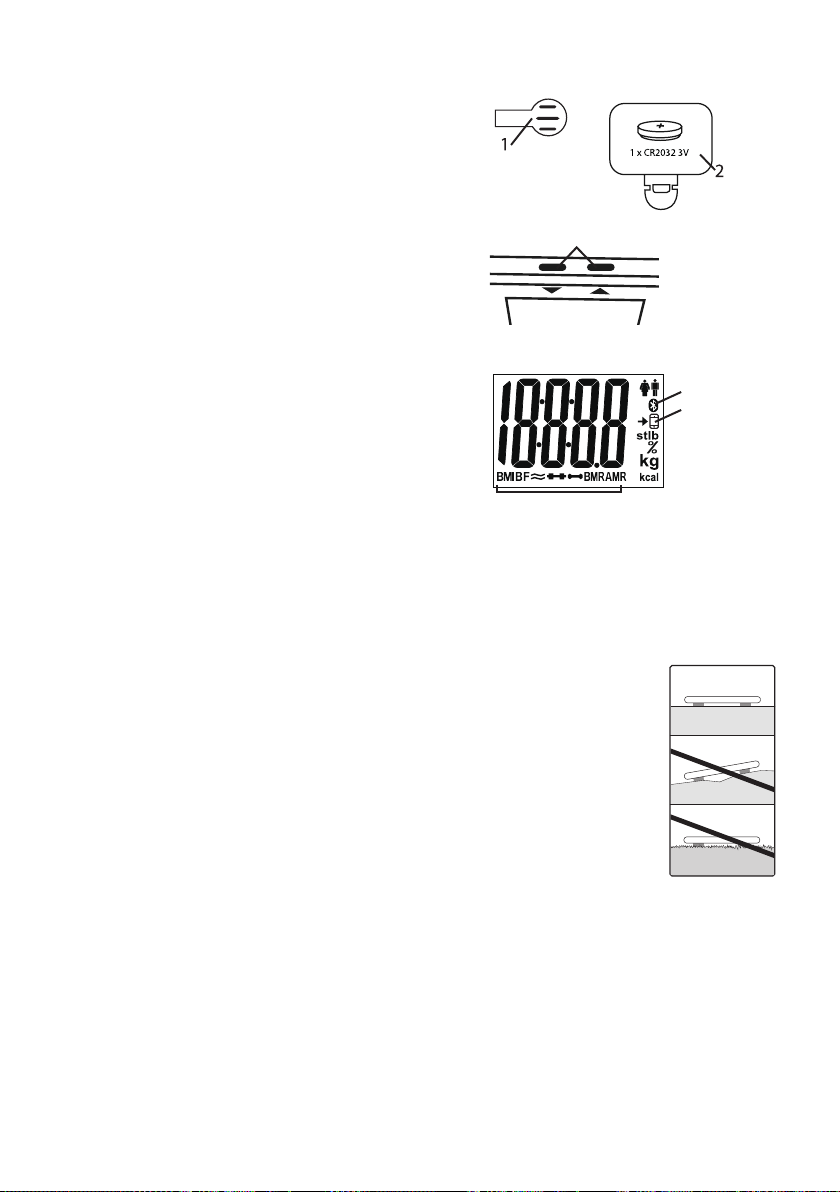
5. Descrizione dell'apparecchio
Lato posteriore
1. Pulsante Unit/Reset
2. Vano batterie
Unit/Reset
Parte frontale
3. Pulsanti GIÙ / SU
Display
4a. Simbolo Bluetooth® per il collegamento fra bilancia e
smartphone
4b Simbolo di sincronizzazione durante l'invio delle misu
razioni
5. Peso corporeo,
dati corporei come IMC, BF, ...
-
3
4a
4b
5
6. Messa in funzione
Inserimento delle batterie
Rimuovere le batterie dalla confezione e inserirle nella bilancia rispettando la polarità. Se la bilancia non
funziona, rimuovere completamente le batterie e sostituirle.
Posizionamento della bilancia
Posizionare la bilancia su un fondo piano e solido; un piano solido è il presupposto
per una misurazione corretta. Non posizionare la bilancia su un tappeto.
6.1 Messa in servizio con app
Per determinare correttamente la massa grassa e gli altri valori corporei, memorizzare
sulla bilancia i dati personali dell’utente.
La bilancia dispone di 8 posizioni di memoria in cui l'utente e i familiari possono
memorizzare impostazioni personali.
Inoltre, gli utenti possono essere attivati tramite altri dispositivi mobili dotati dell'app
"Sanitas HealthCoach" oppure tramite cambio di profilo nell'app (vedere Impostazi
oni dell'app).
– Scaricare l’app gratuita “Sanitas HealthCoach“ dall’Apple App Store (iOS) oppure da Google Play
(Android™).
– Avviare l’app e seguire le istruzioni.
– Nell’app selezionare SBF 72.
-
43
Page 44
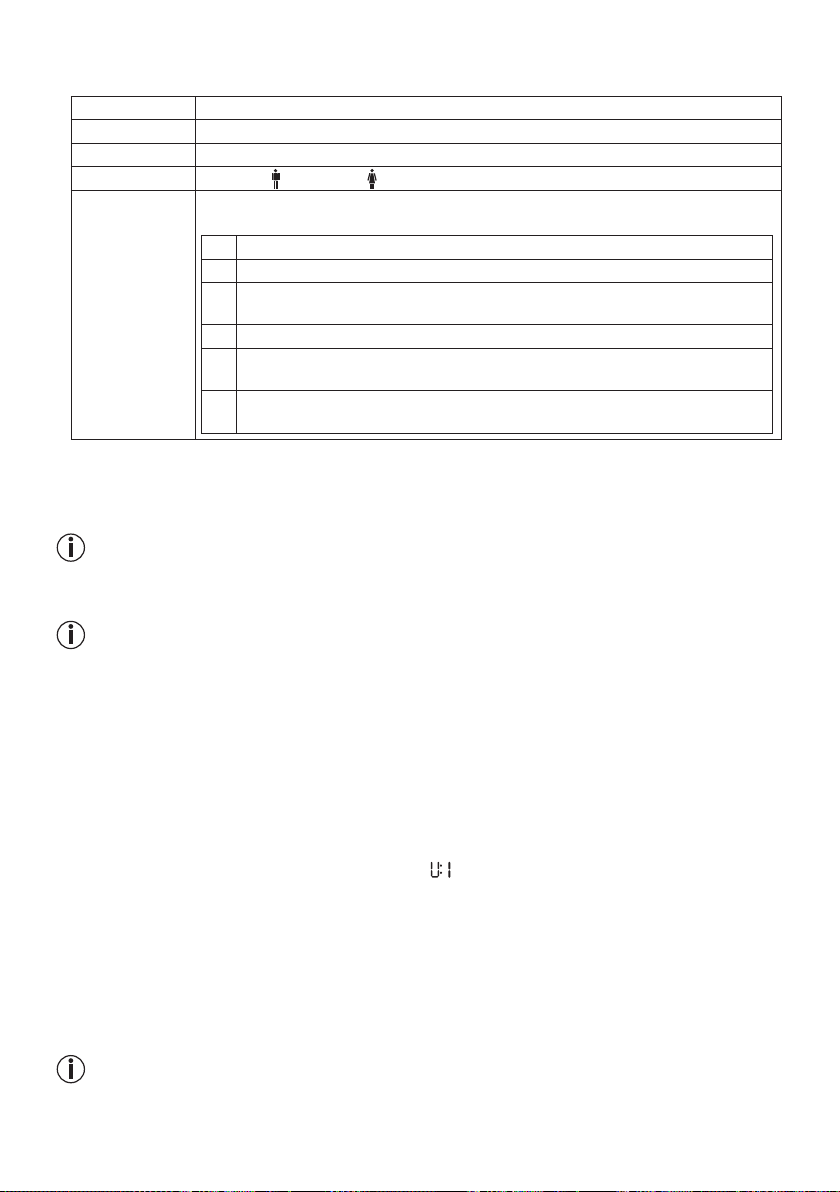
– Inserire i dati relativi a SBF 72.
Le seguenti impostazioni devono essere effettuate o inserite nella app "Sanitas HealthCoach":
Dati utente Valori di impostazione
Statura Da 100 a 220 cm (da 3‘ 3,5“ a 7‘ 2,5“)
Età Da 10 a 100 anni
Sesso Maschio (
Livello di attività Per la selezione del livello di attività si distingue fra osservazione a medio e a lungo
termine.
1 Nessuna.
2
3 Media: attività fisica, almeno 2-4 volte alla settimana, 30 minuti per sessione.
4
5
), femmina ( )
Attività fisica
Ridotta: attività fisica ridotta e leggera (ad es. passeggiare, lavori di giardi
naggio leggeri, esercizi ginnici).
Impegnativa: attività fisica, almeno 4-6 volte alla settimana, 30 minuti per
sessione.
Molto impegnativa: attività fisica intensa, allenamento intensivo o lavoro
fisico pesante, quotidiano, per almeno un'ora.
-
– Quando richiesto, eseguire l'assegnazione degli utenti.
Per il riconoscimento automatico della persona, assegnare alla prima misurazione i dati personali dell'u
tente. Seguire le istruzioni della app. Salire a piedi nudi sulla bilancia e assicurarsi di poggiare sugli elet-
trodi restando fermi e cercando di distribuire il peso in modo uniforme su entrambe le gambe.
Nota: Per ulteriori osservazioni possono essere utilizzati solo i valori misurati visualizzati sulla bilan-
cia.
6.2 Utilizzo senza app: avvio diretto (in alternativa)
Nota:
Per visualizzare i valori individuali analizzati, si consiglia di eseguire la messa in funzione e tutte le
impostazioni con l’app “Sanitas HealthCoach”. Questa procedura può essere effettuata solo se la
messa in funzione deve essere effettuata interamente senza l’app. In caso di utilizzo con app, pas
sare direttamente al capitolo “Esecuzione della misurazione”.
Funzione di avvio diretto:
in caso di utilizzo senza app, la bilancia misura il peso non appena ci si posiziona sulla superficie di
appoggio. Per eseguire la misurazione di analisi, posizionarsi a piedi nudi sugli elettrodi. I valori corporei
visualizzati, come massa grassa, IMC, ecc., vengono calcolati in base a parametri standard, pertanto pos
sono scostarsi dagli effettivi valori individuali; questo perché per calcolare i valori corporei personali sono
necessari parametri personalizzati (ad es. sesso, altezza, ecc.) che non possono essere impostati diretta
mente sulla bilancia, ma solo tramite l’app. Questi valori misurati non vengono memorizzati sulla bilancia,
perché non si riferiscono a utenti memorizzati (ad es. “
”).
-
-
-
-
7. Utilizzo
7.1. Esecuzione della misurazione
Posizionare la bilancia su un fondo piano e solido; un piano solido è il presupposto per una misu
razione corretta. Non posizionare la bilancia su un tappeto.
Misurare il peso, eseguire la diagnosi
Salire a piedi nudi sulla bilancia e assicurarsi di poggiare sugli elettrodi restando fermi e cercando di dis
tribuire il peso in modo uniforme su entrambe le gambe.
Nota: Se la misurazione è stata eseguita indossando le calze, il risultato non è corretto.
-
-
44
Page 45
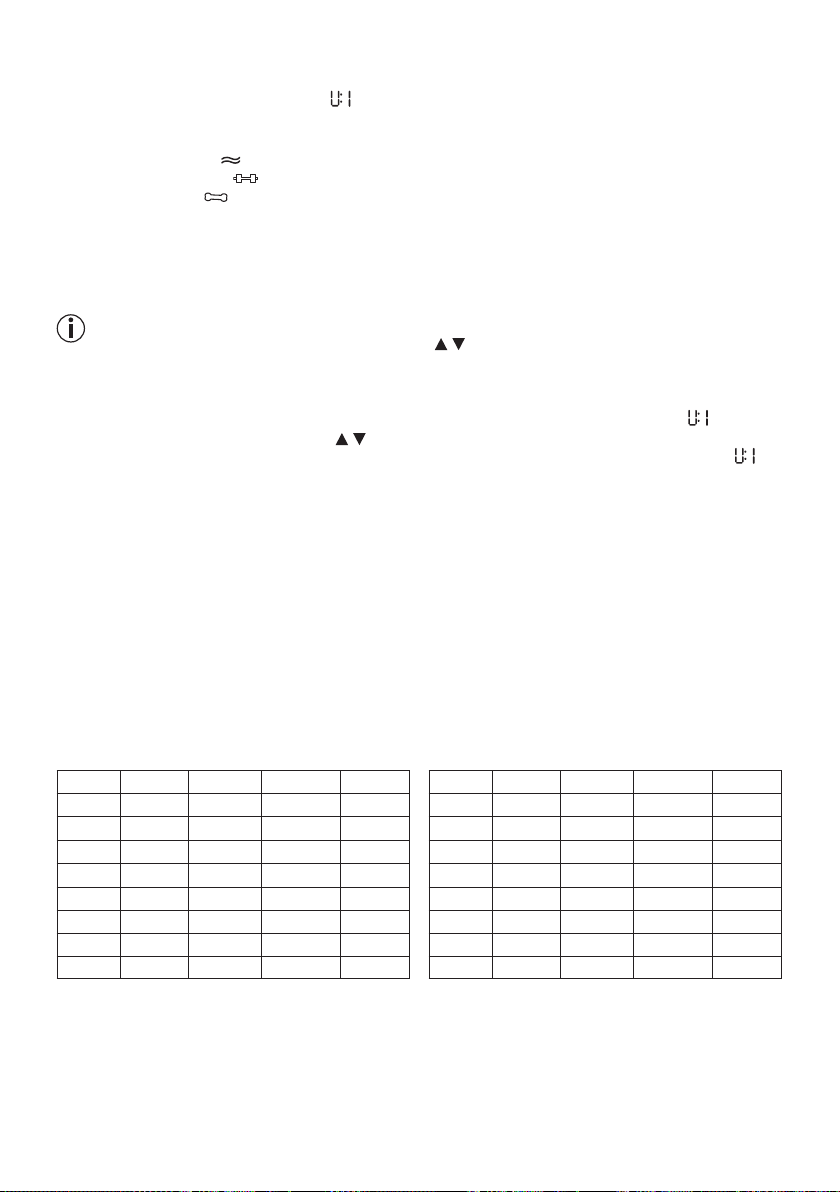
Vengono visualizzati i seguenti indicatori:
1. Peso in kg (o lb / st)
2. Posizione di memoria utente (ad es. “
”)
3. IMC
4. Massa grassa in % (BF)
5. Percentuale di acqua
6. Massa muscolare in %
7. Massa ossea in kg
8. Tasso metabolico basale in kcal (BMR)
9. Tasso metabolico di attività in kcal (AMR)
I valori misurati vengono memorizzati nella posizione di memoria utente visualizzata (per la successiva
trasmissione all’app) o trasmessi immediatamente se l’app è aperta.
Indicazione: Se è possibile riconoscere due o più utenti, nell’indicazione sul display viene cambiato
l’utente. Selezionare l’utente premendo i pulsanti
/ . L’utente così selezionato viene visualizzato
per 3 secondi (lasso di tempo in cui è ancora possibile cambiare). Se non si selezionano utenti, la
bilancia si spegne automaticamente dopo 40 secondi. Sulla bilancia non viene memorizzato nulla.
Se non viene riconosciuto alcun utente (ad es. quando il valore misurato attuale presenta una dif
ferenza di oltre 3 kg rispetto al valore memorizzato in precedenza), viene visualizzato “
-
”. Selezionare l’utente premendo i pulsanti / .
Se è stato eseguito un avvio diretto senza indicazione dell’utente (non viene visualizzato ad es. “ ”),
i
risultati vengono calcolati con parametri standard e non vengono memorizzati.
Misurazione del peso
Posizionarsi sulla bilancia indossando le scarpe. Restare fermi sulla bilancia cercando di distribuire il peso
in modo uniforme sulle gambe. La bilancia avvia subito la misurazione.
La misurazione dell’impedenza bioelettrica (BIA) non può essere eseguita indossando le scarpe. Nell’indi
-
cazione vengono visualizzate brevemente quattro linee. Quindi nuovamente il peso.
Spegnimento della bilancia
La bilancia si spegne automaticamente.
7.2 Valutazione dei risultati
Percentuale di massa grassa
Di seguito sono riportati i valori percentuali di riferimento per la massa grassa (per ulteriori informazioni,
rivolgersi al proprio medico).
Uomo Signora
Età bassa normale media alta Età bassa normale media alta
10 – 14 < 11 % 11–16 %
15 –19 < 12 % 12-17% 17,1-22% > 22,1 % 15 –19 < 17 % 17-22% 22,1-27% > 27,1 %
20 – 29 < 13 % 13-18 % 18,1-23% > 23,1 % 20 – 29 < 18 % 18 – 23 % 23,1-28% > 28,1 %
30 – 39 < 14 % 14-19 % 19,1-24% > 24,1 % 30 – 39 < 19 % 19 – 24 % 24,1-29% > 29,1 %
40 – 49 < 15 % 15 – 20 % 20,1-25% > 25,1 % 40 – 49 < 20 % 20 – 25 % 25,1-30% > 30,1 %
50 – 59 < 16 % 16 – 21 % 21,1-26% > 26,1 % 50 – 59 < 21 % 21-26% 26,1-31% > 31,1 %
60 – 69 < 17 % 17-22% 22,1-27% > 27,1 % 60 – 69 < 22 % 22 – 27 % 27,1-32% > 32,1 %
70 – 100 < 18 % 18 – 23 % 23,1-28% > 28,1 % 70 – 100 < 23 % 23 – 28 % 28,1-33% > 33,1 %
16,1– 21 %
> 21,1 % 10 – 14 < 16 % 16 – 21 % 21,1-26% > 26,1 %
Gli sportivi presentano spesso un valore ridotto. A seconda della disciplina sportiva praticata, dell'intensità
dell'allenamento e della costituzione è possibile raggiungere valori ancora inferiori ai valori di riferimento
indicati. In presenza di valori estremamente bassi possono tuttavia sussistere dei rischi per la salute.
45
Page 46
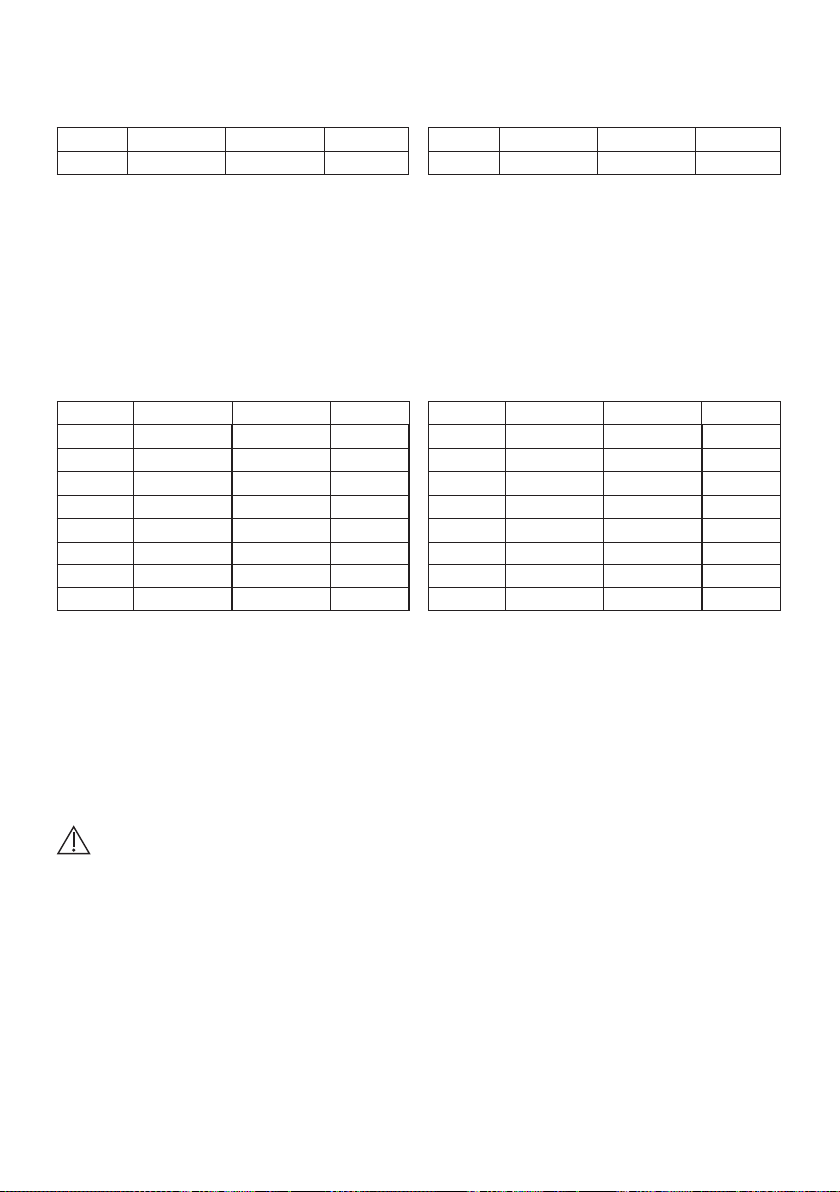
Percentuale di acqua corporea
La percentuale di acqua è generalmente compresa nei seguenti range:
Uomo Signora
Età cattiva buona ottima Età cattiva buona ottima
10 – 100 < 50 % 50 – 65 % > 65 % 10 – 100 < 45 % 45 – 60 % > 60 %
Il grasso corporeo non contiene molta acqua. Di conseguenza le persone con una massa grassa elevata
possono presentare una percentuale di acqua corporea inferiore ai valori di riferimento. In coloro che prat
icano sport di resistenza i valori di riferimento possono invece essere superati a causa della massa grassa
ridotta e dell'elevata massa muscolare.
Il calcolo dell'acqua corporea con questa bilancia non consente di trarre conclusioni mediche ad es. per
quanto riguarda la ritenzione idrica legata all'età. Consultare eventualmente il proprio medico. In generale
è consigliabile raggiungere un'elevata percentuale di acqua corporea.
Percentuale di massa muscolare
La percentuale di massa muscolare è generalmente compresa nei seguenti range:
Uomo Signora
Età bassa normale alta Età bassa normale alta
10 – 14 < 44 % 44 – 57 % > 57 % 10 – 14 < 36 % 36 – 43 % > 43 %
15 –19 < 43 % 43 – 56 % > 56 % 15 –19 < 35 % 35 – 41 % > 41 %
20 – 29 < 42 % 42 – 54% > 54 % 20 – 29 < 34 % 34 – 39 % > 39 %
30 – 39 < 41 % 41-52% > 52 % 30 – 39 < 33 % 33 – 38 % > 38 %
40 – 49 < 40 % 40 - 50% > 50 % 40 – 49 < 31 % 31-36% > 36 %
50 – 59 < 39 % 39 - 48 % > 48 % 50 – 59 < 29 % 29 - 34 % > 34 %
60 – 69 < 38 % 38 - 47 % > 47 % 60 – 69 < 28 % 28 - 33 % > 33 %
70 – 100 < 37 % 37- 46% > 46 % 70 – 100 < 27 % 27- 32 % > 32 %
Massa ossea
Come il resto del corpo, le ossa sono naturalmente sottoposte a processi di calcificazione, sgretolamento e
invecchiamento. La massa ossea cresce rapidamente durante l'infanzia e raggiunge il suo punto massimo
all'età di circa 30-40 anni per poi tendere a ridursi con il passare dell'età. Una sana alimentazione (in parti
colare un corretto apporto di calcio e vitamina D) e una regolare attività fisica possono contrastare lo sgretolamento delle ossa. Un aumento della massa muscolare consente di migliorare ulteriormente la stabilità
dello scheletro. Tenere presente che la bilancia non indica la massa ossea totale, ma solo la massa min
erale ossea (senza il contenuto d'acqua e senza la parte organica). È pressoché impossibile influire sulla
massa ossea, che però non presenta significative variazioni per quanto riguarda i fattori determinanti (peso,
statura, età, sesso). Non sono disponibili direttive e suggerimenti riconosciuti.
ATTENZIONE:
Non confondere la massa ossea con la densità ossea.
La densità ossea può essere determinata solo tramite una visita medica (ad esempio tomografia
computerizzata, ultrasuoni). La bilancia non è pertanto in grado di diagnosticare eventuali alterazioni
delle ossa e della loro durezza (ad esempio l'osteoporosi).
BMR
L'indice metabolico basale (BMR = Basal Metabolic Rate) è la quantità di energia di cui il corpo neces
sita a riposo per il mantenimento delle funzioni fisiche di base (ad es. se si rimane a letto per 24 ore). Tale
valore dipende principalmente dal peso, dalla statura e dall'età.
È visualizzato dalla bilancia diagnostica in kcal/giorno e viene calcolato sulla base della formula Har
ris-Benedict riconosciuta a livello scientifico.
Si tratta della quantità di energia di cui il corpo ha bisogno in ogni caso e deve essere reintegrata sotto
forma di cibo. L'assunzione di una quantità inferiore di energia per un periodo prolungato può causare
danni alla salute.
46
Page 47

AMR
Il tasso metabolico attivo (AMR = Active Metabolic Rate) è la quantità di energia di cui il corpo ha bisogno
ogni giorno quando è in attività. Il consumo energetico di una persona aumenta in base alla maggiore
attività fisica e viene determinato dalla bilancia diagnostica mediante il livello di attività impostato (1-5).
Per mantenere il peso attuale, l'energia consumata dal corpo deve essere reintegrata sotto forma di cibo e
di liquidi.
Se per un lungo periodo l'energia consumata supera quella reintegrata, il corpo preleva la differenza dalle
riserve di grassi accantonate e il peso diminuisce. Quando invece per un lungo periodo l'energia reinte
grata supera il tasso metabolico attivo (AMR) calcolato, il corpo non è in grado di bruciare l'eccesso di
energia che viene accumulato e il peso aumenta.
Relazione temporale dei risultati
Nota: Viene considerata solo la tendenza a lungo termine. Generalmente le variazioni di peso a
breve termine nell'arco di pochi giorni dipendono da una perdita di liquidi.
L'interpretazione dei risultati si basa sulle variazioni del peso e delle percentuali di massa grassa, acqua
corporea e massa muscolare, nonché sul tempo di realizzazione delle variazioni.
È necessario distinguere fra variazioni repentine nell'arco di pochi giorni e variazioni a medio termine
(nell'arco di settimane) e a lungo termine (mesi).
Come regola generale si può considerare che le variazioni di peso a breve termine sono determinate
esclusivamente da variazioni del contenuto di acqua mentre quelle a medio e lungo termine coinvolgono
anche la massa grassa e quella muscolare.
• Se il peso si riduce a breve termine mentre la massa grassa aumenta o resta stabile, si tratta solo di una
perdita di liquidi, ad es. dovuta ad allenamento, sauna o a una dieta volta unicamente a una rapida per
-
dita di peso.
• Se il peso aumenta a medio termine mentre la massa grassa diminuisce o resta stabile, può essere
intervenuto un aumento della massa muscolare.
• Se il peso e la massa grassa diminuiscono contemporaneamente, significa che la dieta funziona e che si
perde peso.
• La dieta deve essere integrata con attività fisica, allenamento e allenamento di potenziamento. Ciò con
-
sente di aumentare la massa muscolare a medio termine.
• La massa grassa, la percentuale di acqua o la massa muscolare non possono essere sommate (i tessuti
muscolari contengono anche una percentuale di acqua).
7.3. Ulteriori funzioni
Assegnazione degli utenti
È possibile assegnare un massimo di 8 utenti impostati con misurazione del solo peso (con scarpe) e
misurazione diagnostica (a piedi nudi).
In caso di nuova misurazione, la bilancia associa la misurazione all’utente i cui ultimi valori misurati mem
orizzati si scostano di massimo +/- 3 kg. Se è possibile riconoscere due o più utenti, nell’indicazione sul
display viene cambiato l’utente. Selezionare l’utente premendo i pulsanti
/ e attendere per 3 secondi.
Memorizzazione delle misurazione assegnate sulla bilancia
Se l’app è aperta e vi è una connessione Bluetooth
®
attiva con la bilancia, le nuove misurazioni utente
assegnate vengono immediatamente inviate all’app.
Se l’app è chiusa, le nuove misurazioni utente assegnate vengono memorizzate sulla bilancia. Nella bilan
cia può essere salvato un massimo di 30 misurazioni per utente. I valori misurati memorizzati vengono
trasmessi all’app quando si accende la bilancia (caricare brevemente la superficie di appoggio).
La trasmissione automatica non è possibile se la bilancia è spenta.
Sul display della bilancia viene visualizzato il simbolo di sincronizzazione quando vengono trasmesse
all’app nuove misurazioni. Questo non compare quando per questo utente non vengono salvate o non
sono state assegnate nuove misurazioni.
In caso di utilizzo tramite avvio diretto (senza impostazione dell’utente nell’app), i valori misurati non ven
-
gono memorizzati sulla bilancia.
Cancellazione dei dati dalla bilancia
Se si desidera eliminare completamente tutte le misurazioni e i dati vecchi degli utenti, accendere la bilan
-
cia e tenere premuto per circa 6 secondi il pulsante Unit/Reset sul retro della bilancia.
47
Page 48
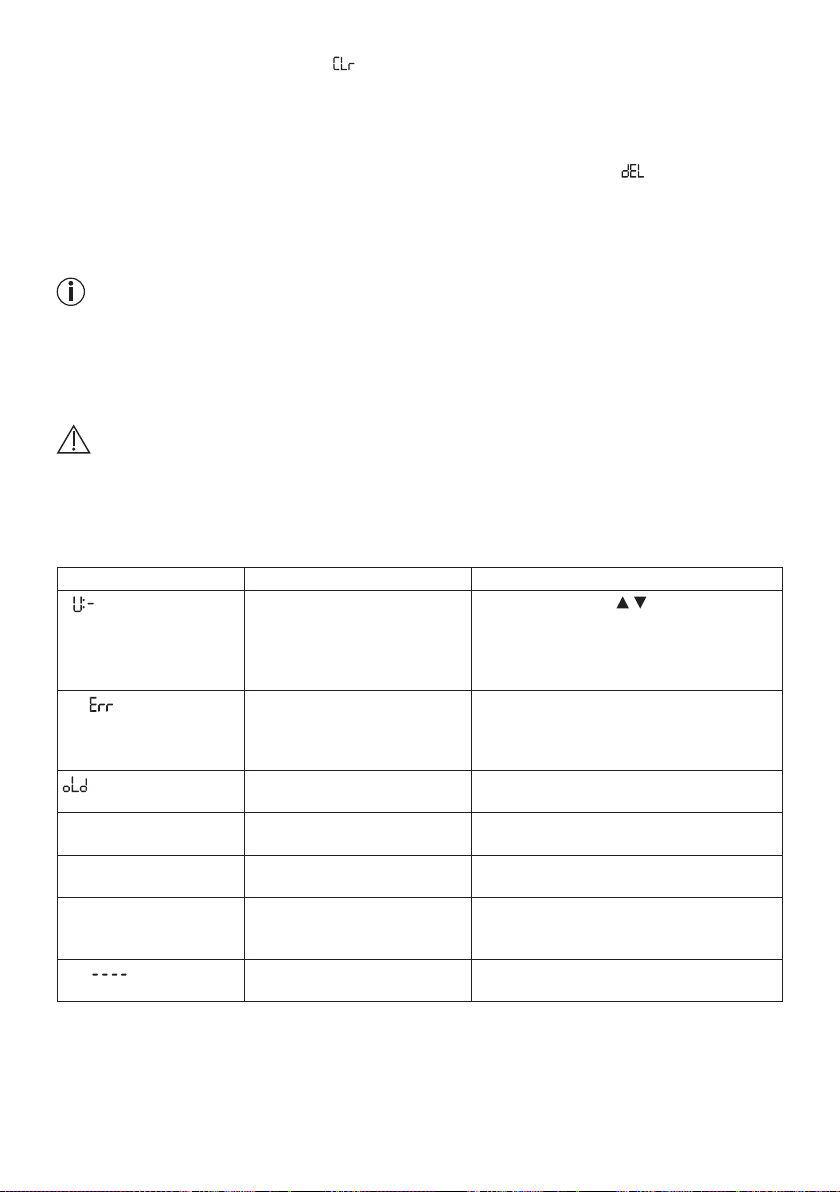
Per alcuni secondi sul display compare "
Ciò è necessario quando ad es. si desidera eliminare utenti impostati in modo errato o non più necessari.
Sarà poi necessario ripetere le operazioni descritte al capitolo 7 (assegnazione utenti).
Eliminare un singolo utente
Accendere la bilancia, selezionare l’utente con il pulsante SU e attendere che venga visualizzato “0.0 kg”;
premere per 6 secondi il pulsante Unit/Reset fino a quando non viene visualizzato “
Sostituzione delle batterie
La bilancia è dotata di un'icona di sostituzione delle batterie. In caso di batterie scariche, sul display viene
visualizzata la scritta "Lo" e la bilancia si spegne automaticamente. In questo caso è necessario sostituire
le batterie (1 batteria da 3V CR2032).
NOTA:
• Non utilizzare batterie ricaricabili.
• Utilizzare preferibilmente batterie prive di metalli pesanti.
”.
”.
8. Pulizia e cura
Di tanto in tanto è opportuno pulire l'apparecchio.
Per la pulizia utilizzare un panno leggermente inumidito e, se necessario, un po' di detergente.
ATTENZIONE
• Non utilizzare mai detergenti o solventi aggressivi!
• Non immergere mai l'apparecchio in acqua!
• Non lavare l'apparecchio in lavastoviglie!
9. Che cosa fare in caso di problemi?
Queste azioni vengono raccomandate nei seguenti casi:
Indicazione sul display Causa Soluzione
„
“
BF-
Viene visualizzato un
peso errato.
Viene visualizzato un
peso errato.
Viene visualizzato un
peso errato.
„
BF “
Misurazione sconosciuta, in
quanto al di fuori del limite di
assegnazione utente oppure
non è possibile un'assegnazi
one chiara.
La percentuale di massa
grassa non rientra nel range
misurabile (inferiore al 3% o
superiore al 65%).
È stata superata la portata
massima 180 kg.
Superficie non piana e solida. Appoggiare la bilancia su una superficie
Posizione instabile. Restare fermi il più possibile.
La bilancia presenta un valore
di base diverso da 0.0.
Non è possibile misurare
l‘impedenza bioelettrica (BIA).
Premendo i pulsanti
l’utente.
-
Ripetere la misurazione a piedi nudi o even
tualmente inumidire leggermente le piante
dei piedi.
Non caricare sulla bilancia pesi superiori a
180 kg.
piana e solida. Non su un tappeto.
Attendere che la bilancia si spenga da sola.
Accendere la bilancia, attendere che com
paia "0.0 kg" e ripetere la misurazione.
Ripetere la misurazione a piedi nudi o
inumidire leggermente le piante dei piedi.
/ selezionare
-
-
48
Page 49
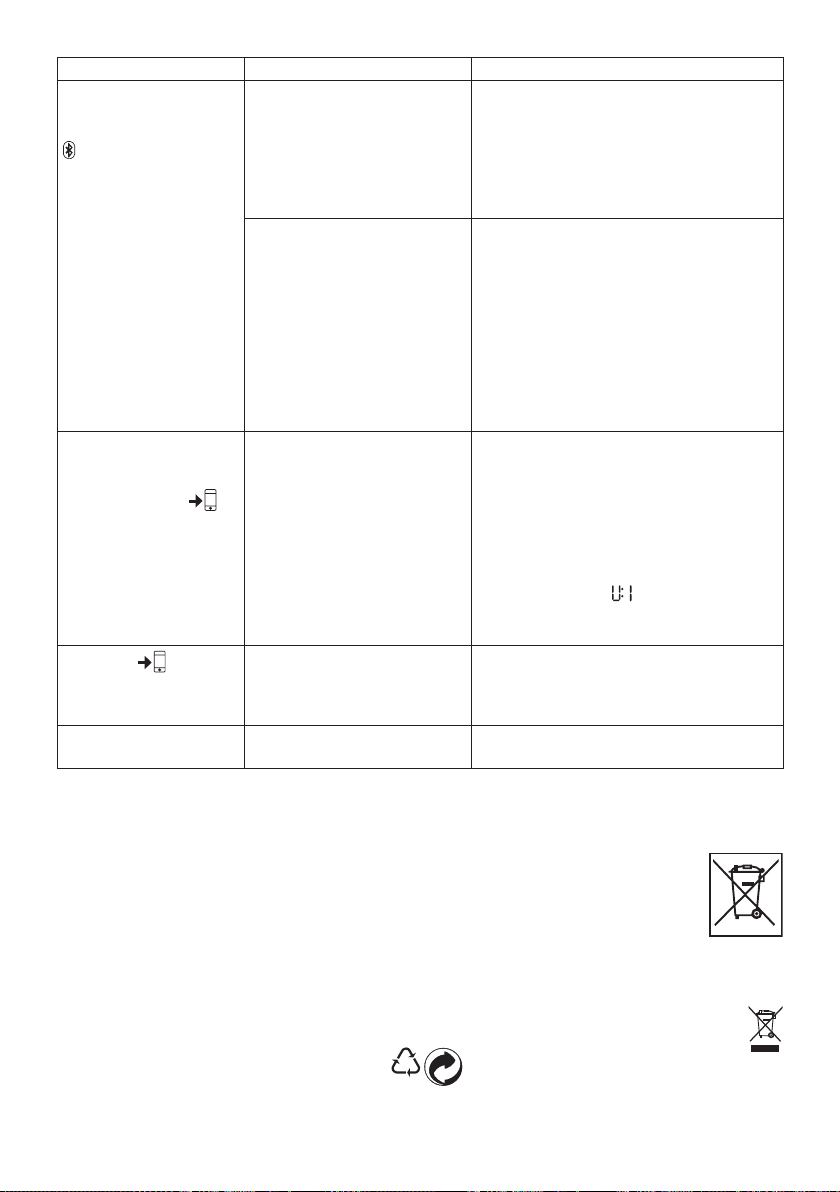
Indicazione sul display Causa Soluzione
PAP
Nessuna connessione
Bluetooth
®
(non viene
visualizzato il simbolo
).
Apparecchio fuori portata. La portata minima in campo libero è di circa
10 m. Pareti e soffitti riducono la portata.
Altre onde radio possono disturbare la
trasmissione. Non posizionare quindi la
bilancia nelle vicinanze di apparecchi come
router WLAN, microonde o piani di cottura
a induzione.
Nessuna connessione con
l'app.
Chiudere completamente l'app (anche
in background). Disattivare e riattivare il
Bluetooth
venga collegata alle impostazioni Blue
tooth® del sistema operativo. Eventualmente
rimuoverla dall'elenco dei dispositivi nelle
impostazioni Bluetooth
l'app "beurer HealthManager". Spegnere
e riaccendere lo smartphone. Rimuovere
brevemente le batterie dalla bilancia e rein
serirle.
I risultati di misurazione
non vengono trasmessi
all'app (non viene visua
lizzato il simbolo )
Pas de nouvelle mesure de
l’utilisateur et pas de connexion
-
Bluetooth
®
avec l’application.
La posizione di memoria utente visualiz
zata sul display della bilancia deve essere
assegnata nelle impostazioni dell‘app della
bilancia. Possono essere inviate solo queste
misurazioni. Controllare quindi le posizioni
utente e le impostazioni dell‘app per questo
utente ed eseguire nuovamente la misura
zione utente. Sulla bilancia si deve visualizzare, ad esempio, „ “ e nell‘app questo
utente „1“ deve essere assegnato alla bilan
cia nelle impostazioni dell‘apparecchio.
Il simbolo
viene
visualizzato poco dopo
la misurazione.
Lo
L’emplacement de mémoire
utilisateur est plein. Les plus
anciennes valeurs sont écra
sées par les dernières valeurs.
Le batterie della bilancia sono
Ouvrez l’application et allumez le pèsepersonne. Ignorez cette remarque si vous
-
ne voulez pas utiliser d’application.
Sostituire le batterie della bilancia.
scariche.
®
. Accertarsi che la bilancia non
®
e quindi utilizzare
-
-
-
-
-
10. Smaltimento
Smaltire le batterie esauste e completamente scariche presso gli appositi punti di raccolta, i punti di raccolta per rifiuti tossici o i negozi di elettronica. Lo smaltimento delle batterie è un obbligo
di legge.
Sulle batterie contenenti sostanze tossiche sono riportati i seguenti simboli:
Pb = batteria contenente piombo,
Cd = batteria contenente cadmio,
Hg = batteria contenente mercurio.
A tutela dell'ambiente, al termine del suo ciclo di vita, l'apparecchio non deve essere smaltito nei rifiuti
domestici, ma conferito negli appositi centri di raccolta.
Smaltire l'apparecchio secondo la direttiva europea sui rifiuti di apparecchiature elettriche ed
elettroniche (WEEE). In caso di dubbi, rivolgersi alle autorità comunali competenti per lo smalti
mento.
Smaltire la confezione nel rispetto dell'ambiente.
20
49
-
Page 50
11. Dati tecnici
Modello: SBF 72
Dimensioni: 30 x 30 x 2,1 cm
Peso: circa 1,5 kg
Range di misurazione: 5-180 kg
Valore di divisione d: L'unità minima di leggibilità dei valori sul display è di 0,1 kg.
Precisione di ripetibilità: La tolleranza di misurazione relativa a misurazioni ripetute
Precisione assoluta: Il valore della misurazione confrontato con un peso calibrato
Trasmissione dei dati tramite tecnologia
Bluetooth
®
low energy
L'elenco degli smartphone compatibili,
le informazioni e il software così come
maggiori dettagli sugli apparecchi sono
disponibili al seguente link:
sanitas-online.de
Requisiti di sistema per l'app "Sanitas
HealthCoach"
è di +/- 0,4 kg (misurazione ripetuta più volte consecuti
vamente sulla stessa bilancia, mantenendo il più possibile
invariata la posizione della bilancia e della persona).
è di +/- 1%+0,1kg. Ad es. per 40 kg corrisponde a +/- 0,5
kg, per 100 kg corrisponde a +/- 1,1 kg.
Il prodotto utilizza la tecnologia Bluetooth
®
low energy,
Banda di frequenza 2402 - 2480 MHz,
Potenza di trasmissione max. 5 dBm,
Compatibile con smartphone/tablet Bluetooth
iOS ≥ 10.0, Android™ ≥ 5.0
Bluetooth
®
≥ 4.0.
®
≥ 4.0
Salvo modifiche tecniche.
Confermiamo che il prodotto è conforme alla direttiva europea RED 2014/53/EU. La dichiarazione di con
formità CE relativa al presente prodotto è disponibile all'indirizzo:
www.sanitas-online.de/web/de/landingpages/cedeclarationofconformity.php.
50
-
Possibili errori e variazioni
Page 51

РУССКИЙ
Внимательно прочтите инструкцию поприменению, сохраните ее
для последующего использования, храните вдоступном для
других пользователей месте иследуйте ее указаниям.
Оглавление
1. Комплект поставки ......................................... 52
2. Пояснения ксимволам ................................... 52
3. Использование поназначению .....................53
4. Предостережения иуказания потехнике
безопасности .................................................. 53
5. Описание прибора ..........................................55
6. Подготовка кработе ....................................... 55
Ознакомительная информация
Функции прибора
Данные электронные весы используются для взвешивания идиагностики Ваших фитнес-параме
тров.
Они предназначены для домашнего использования.
Весы имеют следующие функции, которыми могут пользоваться до 8 человек:
• измерение массы тела;
• ИМТ;
• определение доли жировой массы;
• доли тканевой жидкости;
• доли мышечной массы;
• массы костей;
• значений основного обмена веществ иобмена веществ сучетом физической активности.
Кроме того, доступны следующие функции:
• переключение между единицами измерения: килограмм kg, фунт lb истоун st;
• автоматическое отключение;
• индикация необходимости замены батареек, если они разрядились;
• автоматическое распознавание пользователя;
• хранение данных 30последних измерений для 8человек, если нет возможности переноса данных
вприложение;
• Функция прямого запуска: вслучае запуска без приложения весы измеряют массу тела иBIA.
Результаты анализа содержания веществ ворганизме рассчитываются наоснове стандартных
параметров ипотому неизбежно неточны. Эти значения несохраняются впамяти весов.
7. Применение .....................................................56
8. Очистка иуход ................................................ 61
9. Что делать при возникновении проблем? ....61
10. Утилизация ....................................................62
11. Технические данные ..................................... 63
12. Гарантия/сервисное обслуживание ............ 63
-
Принцип измерения
Данные весы работают попринципу BIA (биоимпедансометрия). Засчитанные секунды спомощью
незаметного иабсолютно безопасного электрического тока определяется состав тела человека.
Посредством измерения электрического сопротивления (импеданса) сучетом постоянных величин
или индивидуальных значений (возраст, рост, пол, степень активности) можно определить долю
жировой массы или других параметров ворганизме. Мышечная ткань ивода имеют хорошую
электрическую проводимость, поэтому уровень сопротивления здесь невелик. Кости ижировая
ткань, наоборот, имеют небольшую электрическую проводимость, так как жировые клетки икости
из-за очень высокого сопротивления практически не проводят ток.
Учитывайте, что значения, определенные диагностическими весами, являются лишь
приближенными креальным медицинским значениям, полученным врезультате анализа. Долю
жировой массы, тканевой жидкости, мышечной массы истроение костей может определить только
врач, используя медицинские методы (например, компьютерную томографию).
51
Page 52
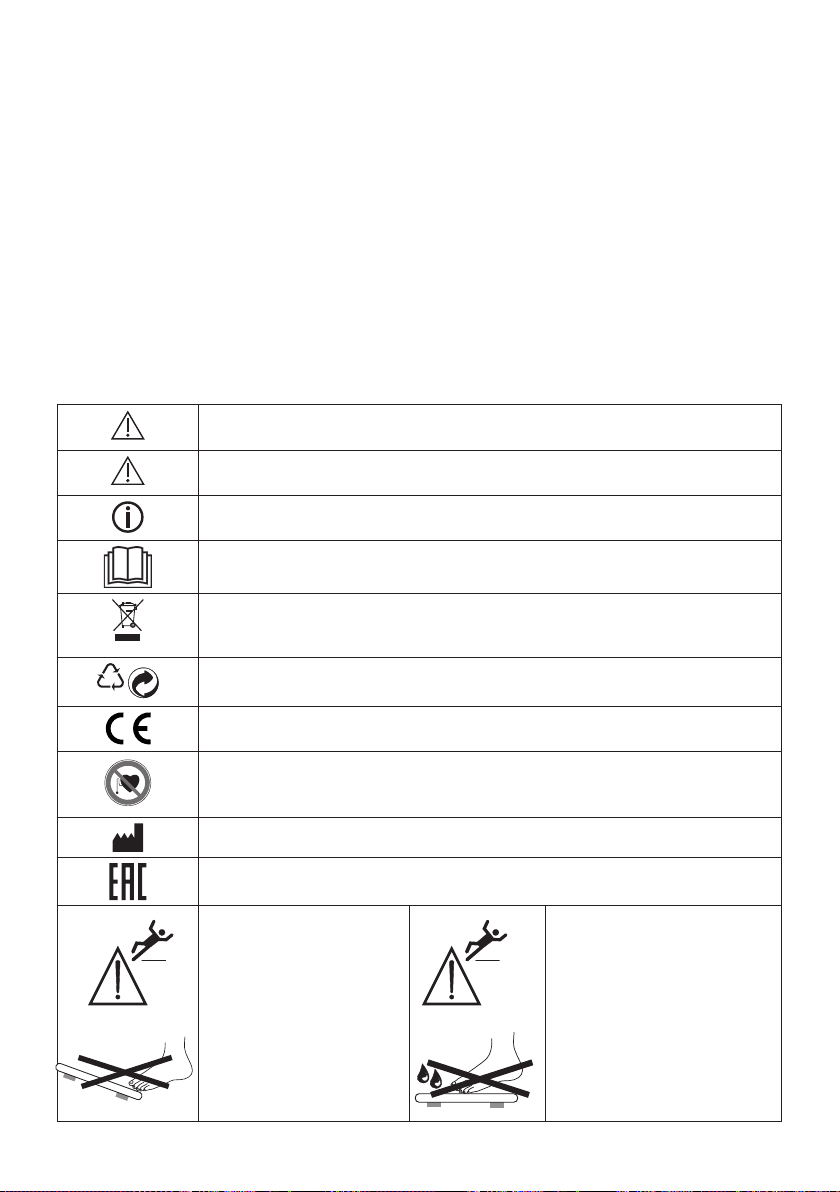
При прямом запуске вводить индивидуальные значения необязательно. Помимо массы тела иBIA,
PAP
max.
180 kg
396 lb
28 st
max.
180 kg
396 lb
28 st
врасчет включаются стандартные параметры. Потому речь идет оприблизительных значениях,
которые, однако, вполной мере могут применяться для анализа тенденции.
1. Комплект поставки
Убедитесь втом, что упаковка прибора не повреждена, ипроверьте комплектность поставки. Перед
использованием убедитесь, что прибор иего принадлежности неимеют видимых повреждений,
иудалите все упаковочные материалы. При наличии сомнений не используйте прибор иобратитесь
кпродавцу или по указанному адресу сервисной службы.
• Краткое руководство
• Диагностические весы SBF 72
• 1батарейка CR2032 3В
• Эта инструкция по применению
2. Пояснения ксимволам
На приборе, винструкции по применению, на упаковке ина фирменной табличке прибора
используются следующие символы:
ПРЕДОСТЕРЕЖЕНИЕ
Предупреждает обопасности травмирования или нанесения вреда здоровью.
ВНИМАНИЕ
Указывает на возможность повреждения прибора/принадлежностей.
Указание
Важная информация
Соблюдайте указания инструкции поприменению.
Утилизация прибора всоответствии сдирективой ЕС по отходам
электрического иэлектронного оборудования— WEEE (Waste Electrical and
Electronic Equipment)
20
Утилизация упаковки всоответствии спредписаниями поохране окружающей
среды
Это изделие соответствует требованиям действующих европейских
инациональных директив.
Запрещается применение прибора лицами cустановленными медицинскими
имплантатами (например, кардиостимулятором). Впротивном случае может
нарушиться работа имплантата.
Изготовитель
Сертификационный знак для изделий, экспортируемых в Российскую
Федерацию и страны СНГ.
Опасность
опрокидывания: вставайте
Rutschgefahr: Betreten Sie die
Waage nicht mit nassen Füßen.
поцентру весовой
платформы.
52
Page 53
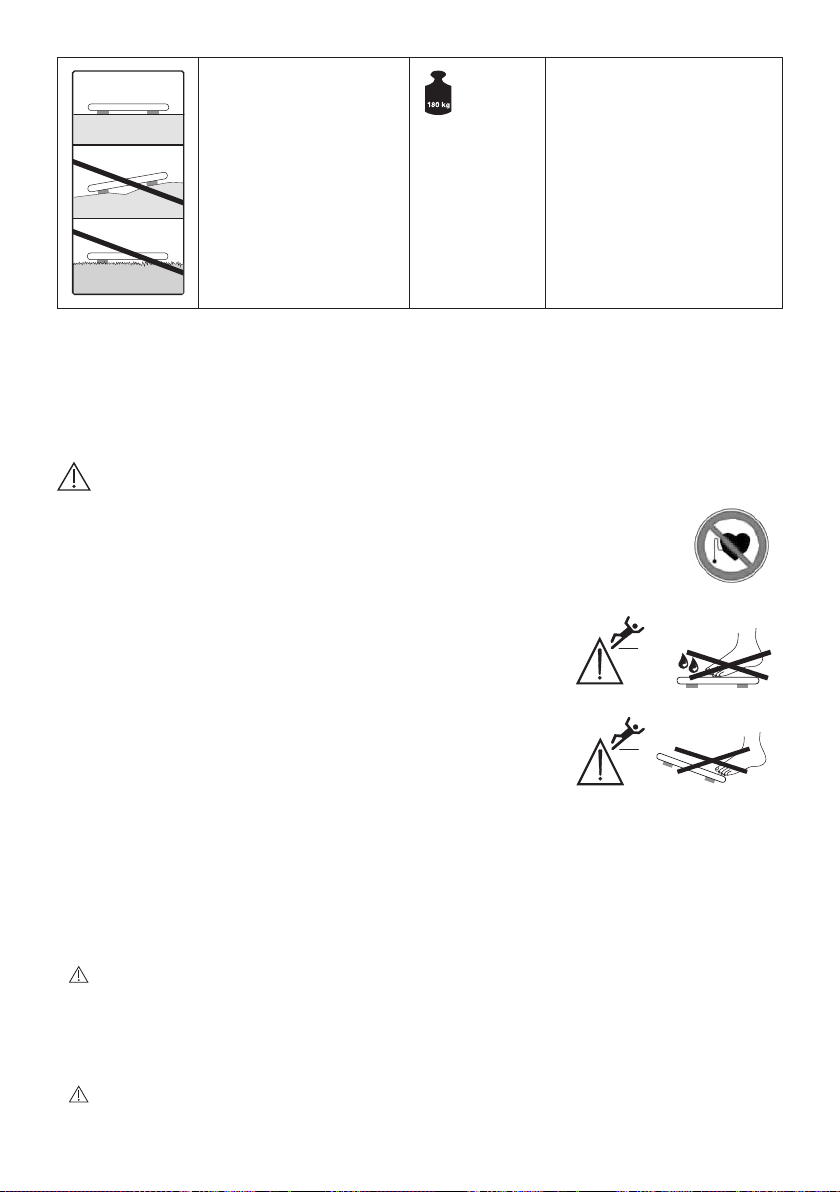
Устанавливайте весы
max.
180 kg
396 lb
28 st
max.
180 kg
396 lb
28 st
наустойчивую ровную
Неперегружайте весы
180 kg / 396 lb / 28 st.
поверхность.
Неставьте весы наковер.
3. Использование поназначению
Устройство предназначено только для взвешивания людей изаписи Ваших личных фитнеспараметров. Прибор предназначен исключительно для частного пользования, запрещается его
использование вмедицинских икоммерческих целях.
4. Предостережения иуказания потехнике безопасности
ПРЕДОСТЕРЕЖЕНИЕ
• Запрещается пользоваться весами лицам сустановленными
медицинскими имплантатами (например, кардиостимулято
ром). Впротивном случае может нарушиться работа имплантата.
• Не использовать во время беременности.
• Внимание! Невставайте навесы мокрыми ногами иневставайте
намокрую поверхность весов: Вы можете поскользнуться!
• Никогда не вставайте насамый край весов содной стороны:
опасность опрокидывания!
• Батарейки содержат вещества, которые могут представлять опасность для жизни при проглатывании. Храните батарейки ивесы внедоступном для детей месте. При проглатывании батарейки следует немедленно обратиться кврачу.
• Не давайте упаковочный материал детям (опасность удушения).
Указания по обращению сбатарейками
• При попадании жидкости изаккумулятора накожу или вглаза необходимо промыть соответству
ющий участок большим количеством воды иобратиться кврачу.
•
Опасность проглатывания мелких деталей! Маленькие дети могут проглотить батарейки
иподавиться ими. Поэтому батарейки необходимо хранить внедоступном для детей месте!
• Обращайте внимание на знаки полярности: плюс (+) иминус (-).
• Если батарейка потекла, очистите отделение для батареек сухой салфеткой, предварительно
надев защитные перчатки.
• Защищайте батарейки от перегрева.
Опасность взрыва! Небросайте батарейки вогонь.
•
• Не заряжайте ине замыкайте батарейки накоротко.
-
53
Page 54
• Если прибором длительное время непользуются, извлеките изнего батарейки.
• Неиспользуйте перезаряжаемые аккумуляторы!
• Не разбирайте, не открывайте ине разбивайте батарейки.
Общие указания
• Учтите, что потехническим причинам возможны погрешности измерений, так как речь идет не
окалиброванных весах для профессионального использования вмедицинских целях.
• Максимальная нагрузка для весов составляет 180кг (396фунтов, 28стоунов). При измерении веса
иопределении массы костей результаты отображаются сшагом 100г(0,2фунта, 0-19st: 0,2lb;
20-28st: 1lb).
• Результаты измерения доли жировой массы, тканевой жидкости имышечной массы отобража
ются сточностью до0,1 %.
• Потребность вкалориях отображается сшагом 1ккал.
• При поставке навесах установлены единицы измерения «см» и«кг». Вовремя пуска вэксплуата
цию спомощью приложения можно менять настройки единиц измерения.
• Установите весы наровную твердую поверхность; твердая поверхность является необходимым
условием для точного измерения.
• Ремонтные работы должны производиться только сервисной службой компании или авторизован
ными торговыми представителями. Перед предъявлением претензий проверьте ипри необходимости замените батарейки.
Хранение иуход
Точность измерений исрок службы прибора зависят от бережного обращения сним:
ВНИМАНИЕ
• Время от времени прибор необходимо очищать. Не используйте едкие чистящие средства ини
вкоем случае не погружайте прибор вводу.
• Убедитесь, что на весы не попадает жидкость. Никогда не погружайте весы вводу. Не промы
вайте их под проточной водой.
• Не ставьте ничего навесы, когда они не используются.
• Не нажимайте наклавишу слишком сильно инеиспользуйте для этого острые предметы.
• Неподвергайте весы воздействию высоких температур или сильных электромагнитных полей.
• Прибор следует предохранять отударов, влажности, пыли, воздействия химикатов, сильных коле
баний температуры инеустанавливать их вблизи источников тепла (печей, радиаторов отопления).
Общие советы
• Для получения сопоставимых результатов повозможности взвешивайтесь водно ито же время
суток (лучше всего утром), после того как сходите втуалет, наголодный желудок ибез одежды.
• Важно при измерении: для определения доли жировой массы вставайте на весы босыми ногами,
при этом подошвы стопы должны быть слегка увлажнены.
Абсолютно сухие подошвы стоп или подошвы стоп ссильно ороговевшими участками кожи
имеют слишком низкую проводимость, что может привести кнеудовлетворительным результатам
измерения.
• Вовремя взвешивания стойте прямо инеподвижно.
• После непривычно тяжелой физической нагрузки воздержитесь отизмерений втечение несколь
ких часов.
• Встав утром, подождите примерно 15минут, чтобы вода, содержащаяся ворганизме, распреде
лилась понему.
• Важно: значение имеют только тенденции, наблюдаемые втечение продолжительного периода
времени. Как правило, кратковременные отклонения веса втечение нескольких дней обуслов
лены потерей жидкости; однако, тканевая жидкость играет для самочувствия большую роль.
Ограничения
При определении доли жировой массы идругих значений сильные отклонения значений инедосто
верные результаты могут наблюдаться уследующих групп людей:
• Дети примерно до 10лет,
• Профессиональные спортсмены икультуристы,
-
-
-
-
-
-
-
-
-
54
Page 55
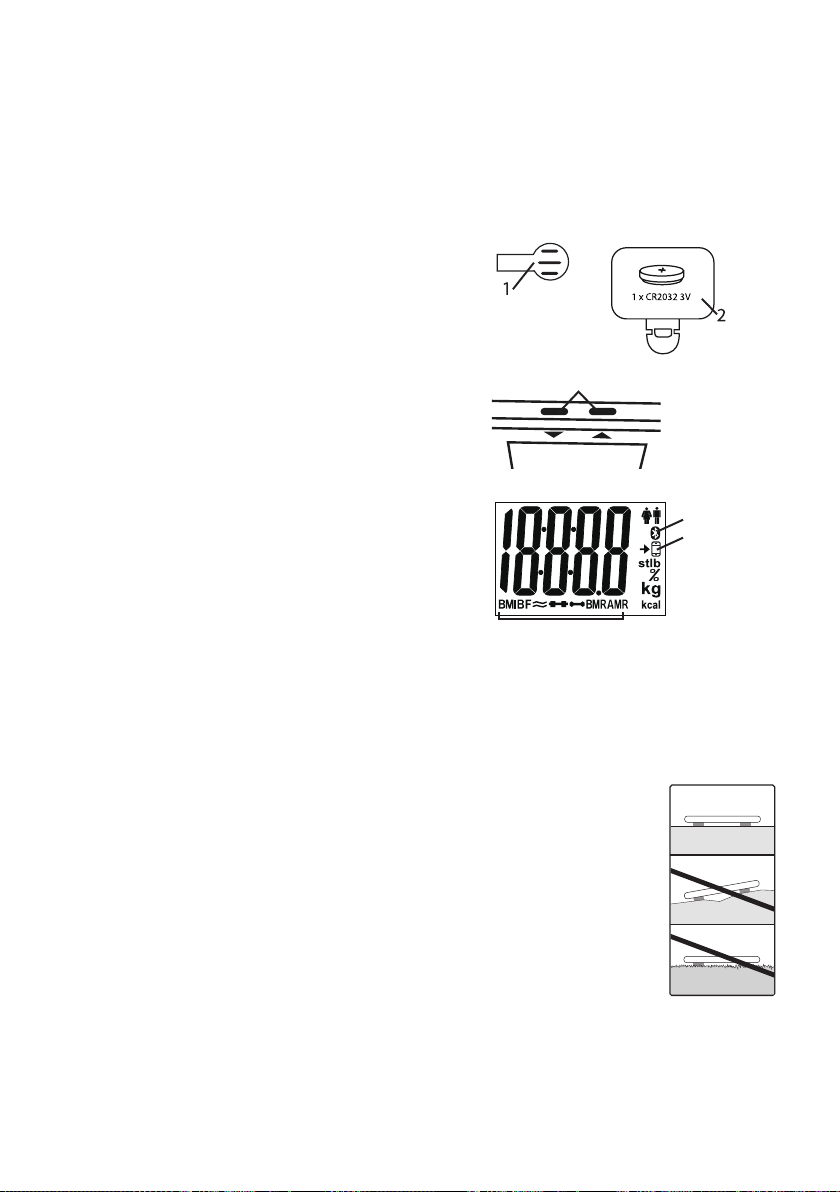
• Лица сповышенной температурой; лица, проходящие лечение диализом, атакже лица ссимпто
мами отечности или остеопороза,
• Лица, принимающие сердечно-сосудистые препараты (для лечения сердца икровеносных сосу
дов),
• Лица, принимающие сосудорасширяющие или сосудосуживающие препараты,
• Лица ссущественным анатомическими отклонениями (длина ног поотношению кросту человека
значительно меньше или значительно больше).
-
-
5. Описание прибора
Обратная сторона
1. Кнопка Unit/Reset
2. Отделение для батареек
Unit/Reset
Торец
3. Кнопки ВНИЗ/ВВЕРХ
Дисплей
4a. Символ Bluetooth® для подсоединения весов
ксмартфону
4b. Символ синхронизации при отправке измерений
5. Масса тела,
данные о теле, например ИМТ, жировая масса и др.
3
4a
4b
5
6. Подготовка кработе
Установка батареек
Извлеките батарейки изупаковки ивставьте вгнездо навесах, соблюдая полярность. Если весы
неработают, полностью извлеките батарейку ивставьте обратно.
Установка весов
Установите весы на ровную твердую поверхность; твердая поверхность
является необходимым условием для точного измерения. Неставьте весы
наковер.
6.1 Ввод вэксплуатацию при помощи приложения
Чтобы правильно определить долю жировой массы ворганизме идругие
физические показатели, необходимо сохранить впамяти весов личные данные
пользователя.
Весы оснащены 8 ячейками памяти, вкоторых Вы и, например, члены Вашей
семьи сможете хранить личные данные.
Кроме того, пользователи могут подключаться спомощью мобильных
устройств сустановленным приложением “Sanitas HealthCoach” или путем
изменения профиля пользователя вприложении (см. настройки приложения).
– Загрузите бесплатное приложение «Sanitas HealthCoach» вApple App Store (iOS) или Google
Play (Android™).
– Запустите приложение иследуйте инструкциям.
– Выберите вприложении SBF 72.
55
Page 56
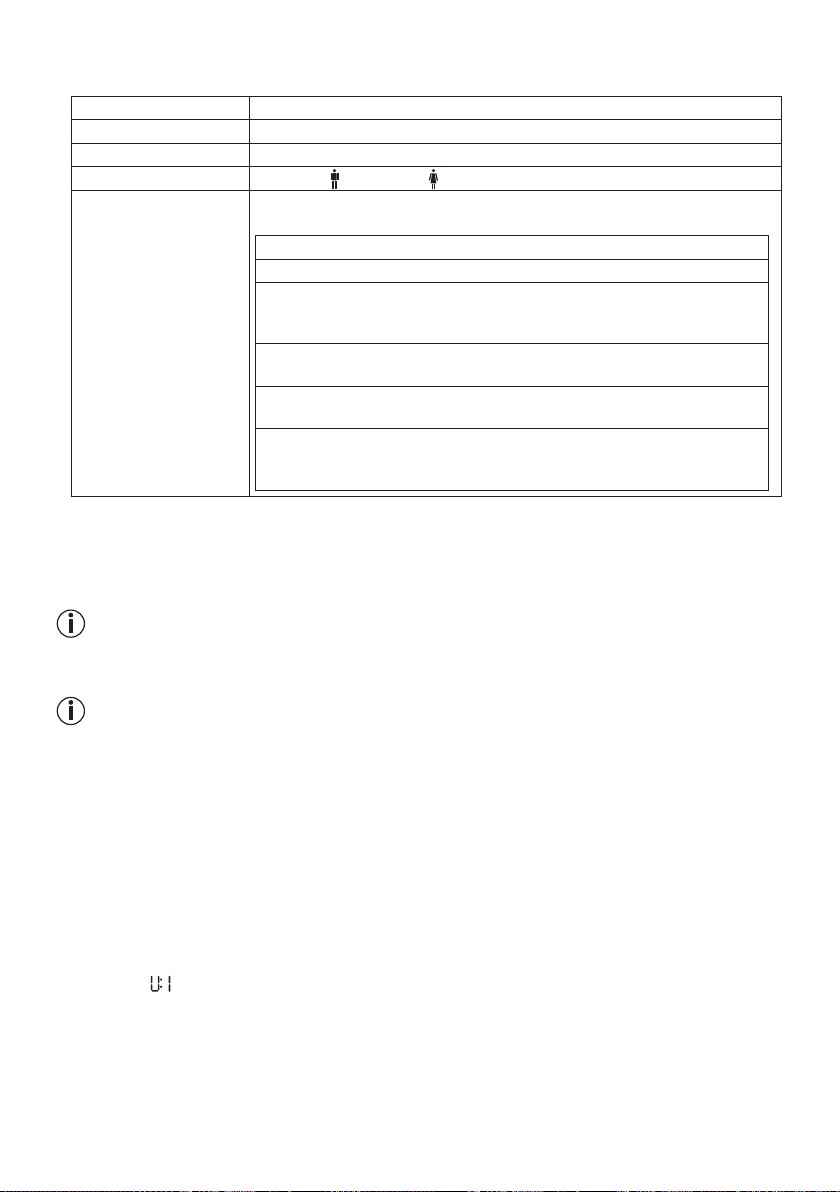
– Введите данные, касающиеся SBF 72.
Вприложении Sanitas HealthCoach должны быть выбраны следующие настройки:
Данные пользователя
Рост от 100 до 220см (от 3'3,5" до 7'2,5")
Возраст от 10 до 100лет
Пол мужской (
Уровень активности При выборе уровня активности решающим является средне- или долго
Значения настроек
), женский ( )
срочное наблюдение.
Физическая активность
Отсутствует.
Невысокая: небольшой объем легких физических нагрузок
(например, пешие прогулки, легкие работы всаду, гимнастические
упражнения).
Средняя: физические нагрузки неменее 2–4раз внеделю
по30минут.
Высокая: физические нагрузки не менее 4–6раз внеделю
по30минут.
Очень высокая: интенсивные физические нагрузки, интенсивные
тренировки или тяжелый физический труд, ежедневно неменее
1часа.
-
– Когда вприложении появится соответствующий запрос, выполните идентификацию пользо
вателей.
Для автоматического распознавания пользователя при первом измерении необходимо ввести
свои данные. Для этого следуйте указаниям приложения. Встаньте на весы босыми ногами.
Стойте спокойно на электродах, равномерно распределив вес на обе ноги.
Указание: Для дальнейшего рассмотрения следует использовать только измерения,
указанные на весах.
6.2 Использование без приложения: прямой запуск (как вариант)
Указание:
Для отображения результатов индивидуального анализа рекомендуем вводить весы
вэксплуатацию иизменять все настройки вприложении Sanitas HealthCoach. Поэтому
выполняйте этот шаг только втом случае, если ввод вэксплуатацию должен осуществляться
полностью без приложения. При использовании приложения перейдите непосредственно
кглаве «Выполнение измерения».
Функция прямого запуска:
При использовании весов без приложения вес измеряется сразу после того, как Вы встали
наплатформу весов. Для выполнения анализа встаньте босыми ногами на электроды.
Отображаемые показатели организма, втом числе процент жира, ИМТ ипр., рассчитаны наоснове
стандартных значений ипоэтому могут отличаться отфактических индивидуальных показателей,
так как для точного расчета требуется указать такие параметры, как пол, возраст и т.д. Эти
параметры невозможно настроить навесах, используйте для этого приложение. Эти измеренные
значения несохраняются впамяти весов, так как они непривязаны ксозданным пользователям
(например, «
»).
7. Применение
7.1 Выполнение измерения
Установите весы на ровную твердую поверхность; твердая поверхность является
необходимым условием для точного измерения. Stellen Sie die Waage nicht auf einen Teppich.
-
56
Page 57
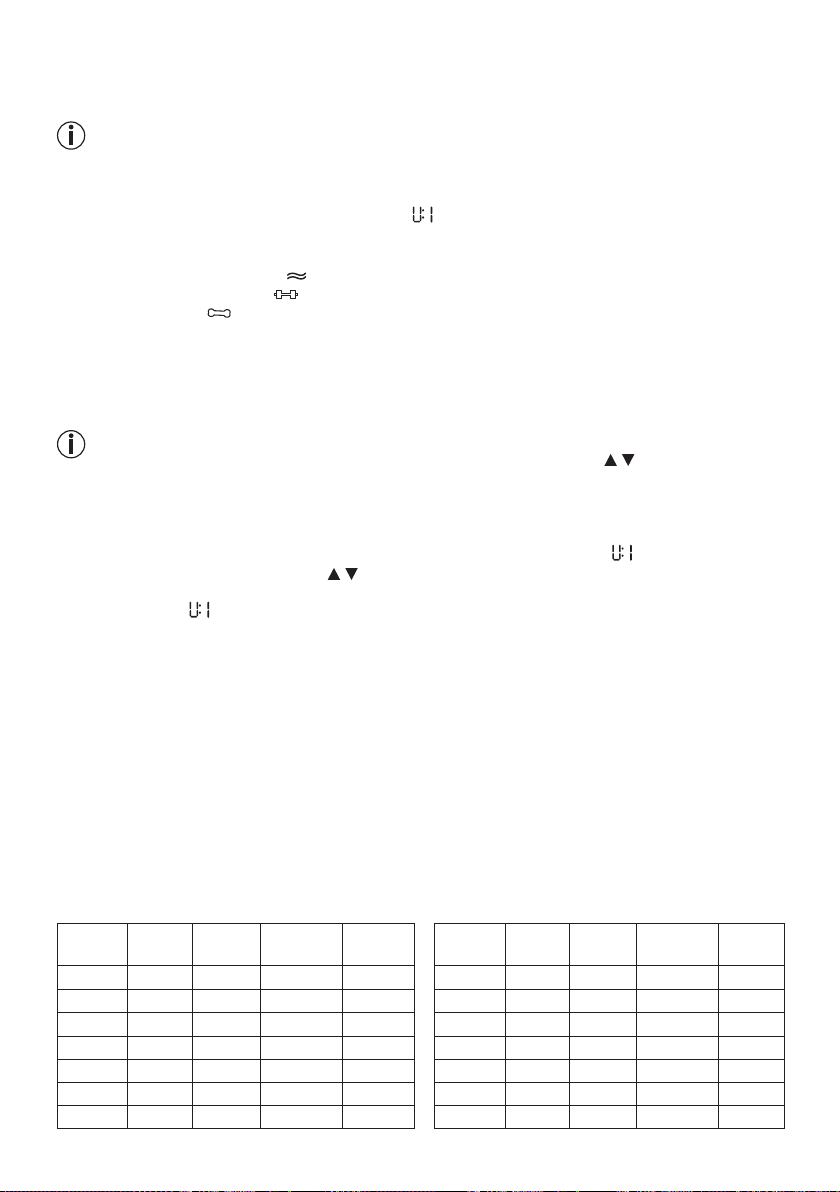
Измерение веса, проведение диагностики
Встаньте навесы босыми ногами. Стойте спокойно наэлектродах, равномерно распределив вес
наобе ноги.
Указание: Если Вы проводите измерение массы, несняв носки, результаты измерения будут
неправильными.
Появится следующая индикация:
1. Вес вкг (или вфунтах/стоунах)
2. Пользовательская ячейка памяти (например, «
»)
3. ИМТ (на дисплее весов— BMI)
4. Доля жировой массы в %(BF)
5. Доля тканевой жидкости в %
6. Доля мышечной массы в %
7. Масса костей вкг
8. Скорость основного обмена веществ вккал (BMR)
9. Скорость обмена веществ сучетом физической активности вккал (AMR)
Измеренные значения сохраняются вуказанной ячейке памяти пользователя (для последующего
переноса вприложение) либо переносятся сразу, если приложение открыто.
Указание Если обнаружены два или несколько возможных пользователей, пользователь
переключается на дисплее. Выберите пользователя, нажимая кнопки
/ . Подтвержденный
таким образом пользователь отображается втечение 3секунд (втечение этого времени
можно переключиться надругого пользователя). Если пользователь невыбран, весы
автоматически отключаются через 40секунд. Навесах ничего несохраняется.
Если пользователь неопределен (например, если текущее измеренное значение отличается
отпредыдущего значения впамяти более чем на 3кг), отображается «
пользователя, нажимая кнопки
/ .
». Выберите
При выполнении прямого запуска без создания пользователя (наэкране неотображается,
например, «
») результаты рассчитываются наосновании стандартных параметров и
несохраняются.
Только измерение веса
Теперь встаньте на весы вобуви. Стойте спокойно, равномерно распределяя вес на обе ноги. Весы
немедленно начинают измерение.
Биомпедансометрию (BIA) невозможно выполнить вобуви. Надисплее ненадолго отобразятся
четыре черточки. Затем— снова вес.
Выключение весов
Весы выключаются автоматически.
7.2 Оценка результатов
Доля жировой массы
Ориентиром являются следующие значения жировой массы в % (задополнительной информацией
обратитесь кврачу).
Мужчина Женщина
Норма-
Возраст
10–14 <11 % 11–16 % 16,1–21 % >21,1 % 10–14 <16 % 16–21 % 21,1–26 %
15–19 <12 % 12–17 % 17,1–22 % >22,1 % 15–19 <17 % 17–22 % 22,1–27 %
20–29 <13 % 13–18 % 18,1–23 % >23,1 % 20–29 <18 % 18–23 % 23,1–28 %
30–39 <14 % 14–19 % 19,1–24 % >24,1 % 30–39 <19 % 19–24 % 24,1–29 %
40–49 <15 % 15–20 % 20,1–25 % >25,1 % 40–49 <20 % 20–25 % 25,1–30 %
50–59 <16 % 16–21 % 21,1–26 % >26,1 % 50–59 <21 % 21–26 % 26,1–31 %
60–69 <17 % 17–22 % 22,1–27 % >27,1 % 60–69 <22 % 22–27 % 27,1–32 %
Низкая
льная
Умерен
ная
-
Высо
кая
Возраст Низкая
Нормальная
Умерен
ная
-
-
Высо
кая
>26,1 %
>27,1 %
>28,1 %
>29,1 %
>30,1 %
>31,1 %
>32,1 %
57
Page 58
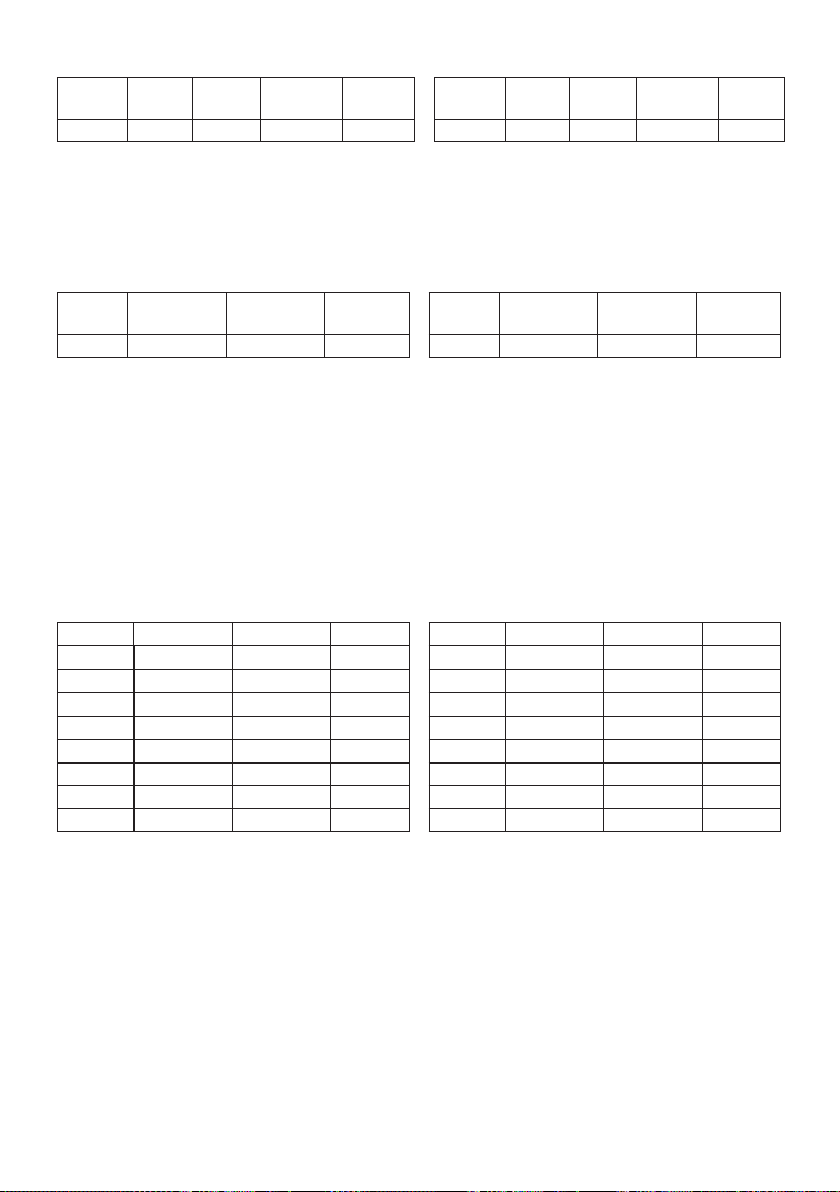
Мужчина Женщина
Норма-
Возраст
70–100 <18 % 18–23 % 23,1–28 % >28,1 % 70–100 <23 % 23–28 % 28,1–33 %
Низкая
льная
Умерен
ная
-
Высо
кая
Возраст Низкая
Нормальная
Умерен
ная
-
-
Высо
кая
>33,1 %
Успортсменов значения часто бывают ниже. Взависимости отвида спорта, интенсивности
тренировок иконституции тела значения могут быть ниже указанных ориентировочных значений.
Однако учитывайте, что чрезвычайно низкие показатели могут быть опасны для здоровья.
Доля тканевой жидкости
Доля тканевой жидкости в % обычно находится вследующих диапазонах:
Мужчина Женщина
Возраст Плохо Хорошо
10–100 <50 % 50–65 % >65 % 10–100 <45 % 45–60 % >60 %
Очень
хорошо
Возраст Плохо Хорошо
Очень
хорошо
Вжировой массе содержится сравнительно мало воды. Поэтому улюдей сбольшой долей
жировой массы доля тканевой жидкости может быть меньше ориентировочных значений. Улюдей,
занимающихся видами спорта, развивающими выносливость, ориентировочные значения,
наоборот, могут быть выше из-за небольшой доли жировой массы ибольшой доли мышечной
массы.
Наосновании определения доли тканевой жидкости наэтих весах нельзя делать какиелибо медицинские заключения, например оскоплении жидкости, связанном свозрастными
изменениями. При необходимости проконсультируйтесь сосвоим врачом. Как правило, необходимо
стремиться кбольшой доле тканевой жидкости.
Доля мышечной массы
Доля мышечной массы в % обычно находится вследующих диапазонах:
Мужчина Женщина
Возраст Низкая
Нормальная
Высокая Возраст Низкая
Нормальная
Высокая
10–14 <44 % 44–57 % >57 % 10–14 <36 % 36–43 % >43 %
15–19 <43 % 43–56 % >56 % 15–19 <35 % 35–41 % >41 %
20–29 <42 % 42–54 % >54 % 20–29 <34 % 34–39 % >39 %
30–39 <41 % 41–52 % >52 % 30–39 <33 % 33–38 % >38 %
40–49 <40 % 40–50 % >50 % 40–49 <31 % 31–36 % >36 %
50–59 <39 % 39–48 % >48 % 50–59 <29 % 29–34 % >34 %
60–69 <38 % 38–47 % >47 % 60–69 <28 % 28–33 % >33 %
70–100 <37 % 37–46 % >46 % 70–100 <27 % 27–32 % >32 %
Масса костей
Наши кости, как иостальные ткани нашего тела, подвержены естественным процессам
наращивания иуменьшения массы, атакже процессам старения. Масса костей вдетском возрасте
быстро растет идостигает к30–40 годам своего максимума. Сувеличением возраста масса
костей снова слегка снижается. Правильное питание (вчастности, прием кальция ивитаминаD)
ирегулярная двигательная активность помогут замедлить этот процесс. Целенаправленно
наращивая мускулатуру, Вы сможете дополнительно увеличить стабильность костного скелета.
Обратите внимание, что эти весы показывают не полную массу костей, атолько минеральное
содержание костей (без воды иорганических веществ). Повлиять на массу костей практически
невозможно, однако она незначительно колеблется впределах влияющих на нее факторов (вес,
рост, возраст, пол). Общепризнанных предписаний ирекомендаций не существует.
58
Page 59
ВНИМАНИЕ:
Не путайте костную массу сплотностью кости.
Плотность кости определяется только при медицинском исследовании (например,
компьютерной томографии, ультразвуковом исследовании). Поэтому делать какие-либо
заключения об изменениях костей итвердости кости (например, остеопорозе) при помощи
данных весов невозможно.
BMR (уровень основного обмена веществ)
Скорость основного обмена веществ (BMR = Basal Metabolic Rate)— это количество энергии,
которое требуется организму всостоянии полного покоя для поддержания основных функций
(например, если круглые сутки лежать впостели). Данное значение взначительной степени зависит
отвеса, роста ивозраста.
Надиагностических весах данное значение отображается вединицах «ккал/день» ирассчитывается
согласно научно признанной формуле Харриса-Бенедикта.
Этот объем энергии необходим Вашему организму влюбом случае идолжен поступать ворганизм
седой. Если Вы продолжительное время получаете меньшее количество энергии, это может
негативно отразиться наВашем здоровье.
AMR (обмен веществ сучетом физической активности)
Обмен веществ сучетом физической активности (AMR— Active Metabolic Rate)— это количество
энергии, которое организм ежедневно расходует вактивном состоянии. Расход энергии учеловека
повышается вместе сувеличением его физической активности иопределяется надиагностических
весах согласно заданной степени активности (1–5).
Для поддержания имеющегося веса затраченная энергия должна быть возвращена ворганизм
спищей инапитками.
Если втечение продолжительного времени ворганизм возвращается меньше энергии, чем
расходуется, организм начинает возмещать эту разницу восновном засчет накопленных жировых
отложений, врезультате вес снижается. Если, напротив, втечение продолжительного времени
энергии поступает больше, чем рассчитанное значение обмена веществ сучетом физической
активности (AMR), излишки энергии ворганизме не сжигаются, асохраняются вформе жировых
отложений, врезультате вес увеличивается.
Взаимосвязь результатов вовремени
Указание: Учтите, что значение имеют только долговременные тенденции. Кратковременные
отклонения веса втечение нескольких дней, как правило, обусловлены потерей жидкости.
Интерпретация результатов должна учитывать изменение общей массы тела ипроцентной доли
жировой массы, тканевой жидкости имышечной массы, атакже время, закоторое произошли
изменения.
Следует различать быстрые изменения втечение нескольких дней иизменения, происходящие
сосредней (втечение недель) ималой (втечение месяцев) скоростью.
За основной принцип принимается тот факт, что краткосрочные изменения почти всегда связаны
сизменением содержания воды ворганизме, вто время как изменения, происходящие со средней
ималой скоростью, могут касаться изменений доли жировой имышечной массы.
• Если закороткое время вес снижается, адоля жировой массы увеличивается или сохраняется,
Ваш организм всего лишь потерял жидкость (например, после тренировки, посещения сауны или
диеты, направленной набыстрое снижение веса).
• Если вес увеличивается сосредней скоростью, доля жировой массы уменьшается или сохраня
ется натом же уровне, то Вы, возможно, напротив, приобрели ценную мышечную массу.
• Если вес идоля жировой массы уменьшаются одновременно, Ваша диета работает: Вы теряете
жировую массу.
• Видеале Вы должны поддерживать эффективность диеты при помощи физической активно
сти, занятий фитнесом или силовыми видами спорта. Таким образом Вы можете увеличить долю
мышечной массы всреднесрочный период.
Значения долей жировой массы, тканевой жидкости или мышечной массы не следует складывать
•
(вмышечной ткани также содержатся компоненты, всоставе которых имеется тканевая жидкость).
-
-
59
Page 60

7.3 Прочие функции
Присвоение результатов пользователей
Присвоение результатов максимум восьми запрограммированных пользователей весов возможно
при простом взвешивании (вобуви) ипри диагностическом измерении (босиком).
При новом измерении весы записывают результаты вячейке памяти того пользователя, укоторого
последнее измеренное значение массы тела отличается отрезультата неболее чем на +/-3кг.
Если обнаружены два или несколько возможных пользователей, пользователь переключается на
дисплее. Выберите своего пользователя, нажимая кнопки
Сохранение присвоенных значений впамять весов
Если открыто приложение иустановлено активное Bluetooth®-соединение свесами, новые
присвоенные пользователю результаты измерений сразу передаются вприложение.
Если приложение неоткрыто, новые присвоенные пользователю результаты измерений
сохраняются впамяти весов. На весах можно хранить до 30результатов измерений для каждого
пользователя. Сохраненные измеренные значения переносятся вприложение после включения
весов (коротко надавите наплатформу).
Автоматический перенос данных при выключенных весах невозможен.
Символ синхронизации надисплее весов появляется, когда новые измерения передаются
вприложение. Он небудет отображаться, если для этого пользователя небыли сохранены или ему
небыли присвоены новые измерения.
Вслучае использования через прямой запуск (без настройки пользователя вприложении)
измеренные значения ввесах несохраняются.
Удаление данных из памятивесов
Если Вы хотите полностью удалить все пользовательские данные и измерения из памяти весов,
включите весы и удерживайте кнопку Unit/Reset на обратной стороне весов нажатой примерно в
течение 6 секунд.
Наэкране нанесколько секунд появится индикация «
Эта функция необходима, если Вы хотите, например, удалить неправильно настроенные или
ненужные данные пользователя.
После этого снова выполните действия, описанные вгл. 7 («Назначение пользователей»).
Удалить отдельных пользователей
Включите весы, выберите пользователя спомощью кнопки «ВВЕРХ» иподождите, пока навесах
неотобразятся цифры «0.0кг», нажмите иудерживайте кнопку Unit/Reset («единица/сброс»)
втечение 6секунд, пока непоявится индикация
Замена батареек
Весы показывают, когда необходимо заменить батарейки. Если батарейки разрядились, надисплее
отображается «Lo» ивесы автоматически отключаются. Вэтом случае необходимо заменить
батарейки (1батарейка CR2032 3В).
УКАЗАНИЕ:
• Не используйте перезаряжаемые аккумуляторы.
• Используйте батарейки, не содержащие тяжелых металлов.
.
/ и удерживая их 3секунды.
».
60
Page 61
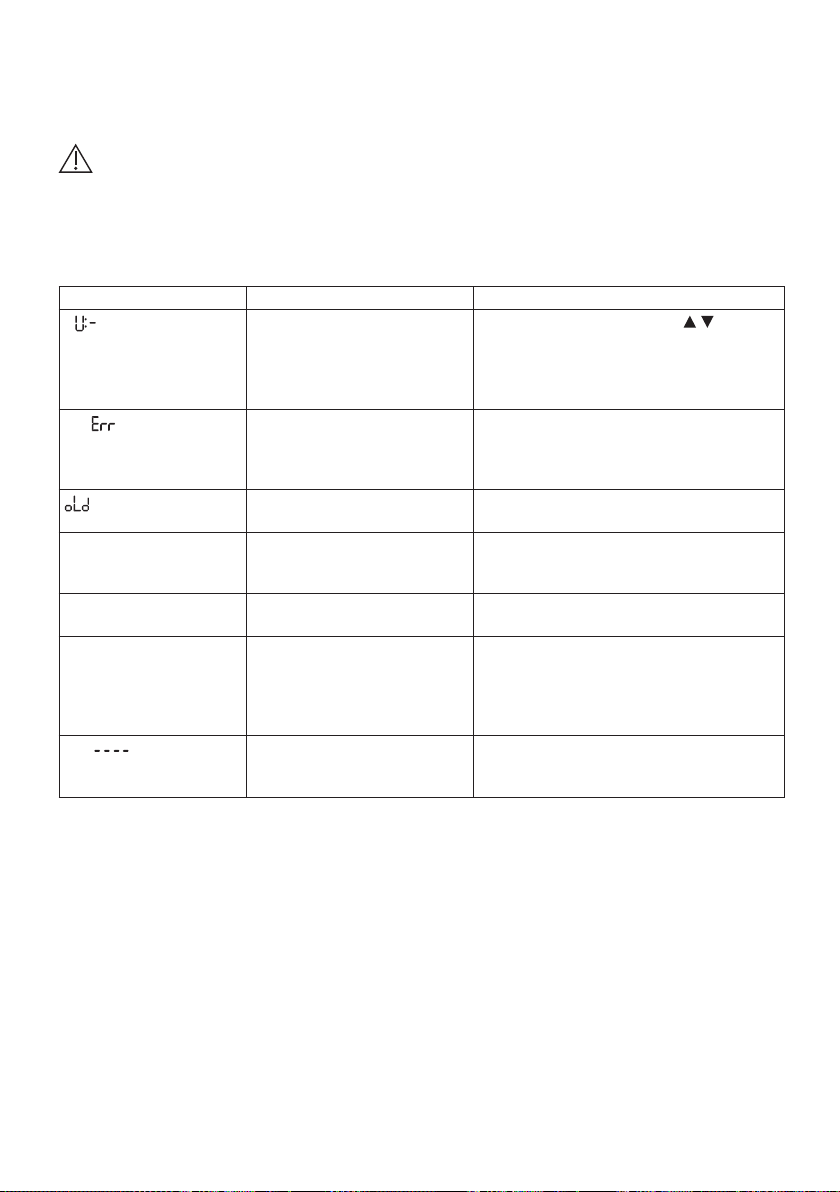
8. Очистка иуход
Время отвремени прибор необходимо очищать.
Для чистки используйте влажную салфетку, накоторую при необходимости можно нанести немного
моющего средства.
ВНИМАНИЕ
• Не используйте сильнодействующие растворители ичистящие средства!
• Не погружайте прибор вводу!
• Не мойте прибор впосудомоечной машине!
9. Что делать при возникновении проблем?
Эти действия рекомендуется выполнить вследующих случаях.
Индикация надисплее Причина Меры поустранению
„
“
BF-
Отображается
неправильный вес.
Отображается
неправильный вес.
Отображается
неправильный вес.
BF “
„
Неизвестное измерение, так
как не выполнены условия
присвоения пользователей
или однозначное присвоение
невозможно.
Доля жировой массы
находится запределами
измеряемого диапазона
(менее3 % или более 65 %).
Превышен максимальный
вес 180 кг.
Неровная или неустойчивая
поверхность.
Неустойчивое положение. Стойте неподвижно.
Навесах установлена
неверная нулевая точка.
Биомпендасометрия
невозможна.
Выберите нажатием кнопок
пользователя.
Повторите измерение, встав на весы
босыми ногами, или при необходимости
слегка смочите подошвы стоп.
При взвешивании не превышайте
максимальный вес 180кг.
Поставьте весы наровную, твердую
поверхность пола. Неставьте весы
наковер.
Подождите, пока весы снова
автоматически выключатся. Включите
весы, подождите пока появится
индикация «0.0 kg», затем повторите
измерение.
Повторите измерение, встав навесы
босыми ногами, или при необходимости
слегка увлажните подошвы стоп.
/ своего
61
Page 62
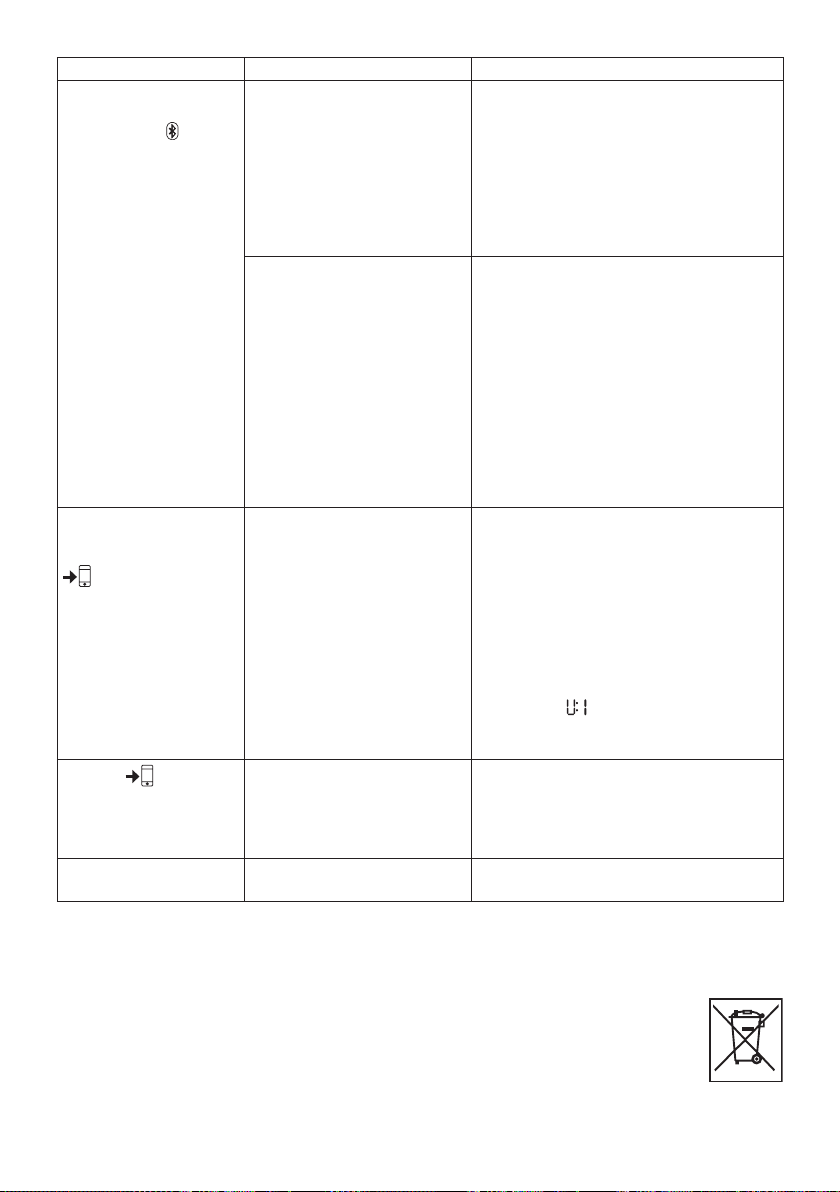
Индикация надисплее Причина Меры поустранению
Отсутствует
соединение Bluetooth
(нет символа
).
Устройство находится вне
®
радиуса действия.
Минимальный радиус действия
всвободном пространстве— около
10м. Стены иперекрытия ограничивают
радиус действия.
Передачу данных могут нарушить другие
радиоволны. Поэтому не ставьте весы
вблизи таких устройств, как WLANмаршрутизатор, микроволновая печь,
индукционная варочная панель.
Отсутствует соединение
сприложением.
Полностью выключите приложение
(вт.ч. выйдите изфонового режима).
Выключите Bluetooth
®
Учтите, что весы не должны быть
подключены через настройки Blue
tooth операционной системы. При
необходимости удалите их из списка
устройств внастройках Bluetooth,
азатем используйте приложение
Beurer HealthManager. Выключите
иснова включите смартфон. Ненадолго
извлеките из весов батарейки иснова
вставьте их.
Результаты измерений
непередаются
вприложение (символ
неотображается)
Новое измерение
пользователя иновое
соединение сприложением
через Bluetooth
®
отсутствуют.
Ячейка памяти пользователя, которая
отображается надисплее весов, должна
быть назначена весам внастройках
Вашего приложения. Только эти
измерения могут быть переданы.
Поэтому проверьте ячейки пользователя
инастройки Вашего приложения
поэтому пользователю, затем выполните
новое измерение пользователя. При этом
надисплее весов должно отображаться,
например, «
», а вприложении этот
пользователь должен быть присвоен
номеру «1» внастройках весов.
Символ
отображается вскоре
после измерения.
Пользовательская
память заполнена. Новые
измеренные значения
записываются вместо старых
Откройте приложение и включите
весы. Если Вы не хотите использовать
приложение, проигнорируйте это
сообщение.
измеренных значений.
Lo
Батарейки ввесах
Замените батарейки ввесах.
разряжены.
иснова включите.
-
10. Утилизация
Утилизируйте использованные иполностью разряженные батарейки вконтейнеры соспециальной
маркировкой, сдавайте впункты приема спецотходов или вмагазины электрооборудования. Закон
обязывает пользователей обеспечить утилизацию батареек.
Следующие знаки предупреждают оналичии вбатарейках токсичных веществ:
Pb=свинец;
Cd=кадмий;
Hg=ртуть.
62
Page 63
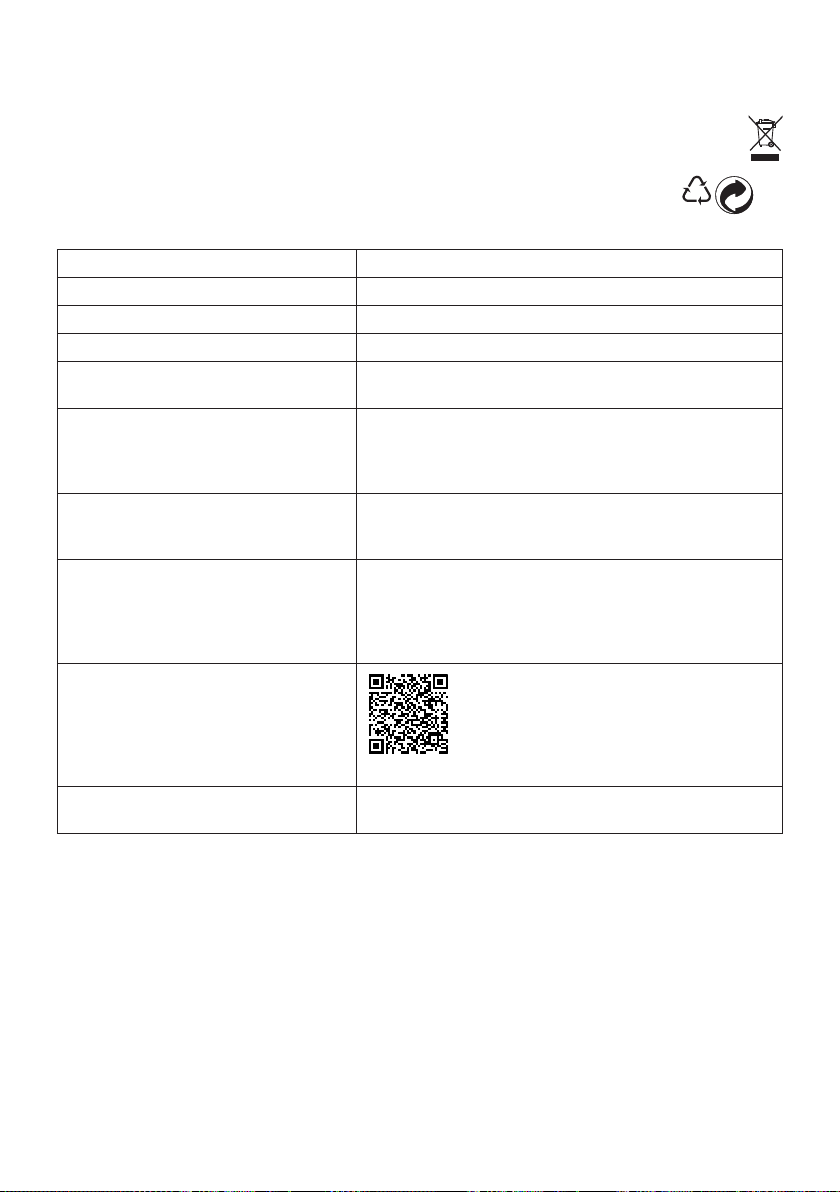
Винтересах охраны окружающей среды позавершении срока службы прибора запрещается
PAP
утилизировать его вместе сбытовыми отходами. Утилизация производится через соответствующие
пункты сбора вВашей стране.
Прибор следует утилизировать согласно директиве ЕС поотходам электрического
иэлектронного оборудования— WEEE (Waste Electrical and Electronic Equipment). При
возникновении вопросов обращайтесь вместную коммунальную службу, ответственную
заутилизацию отходов.
Утилизация упаковки всоответствии спредписаниями поохране окружающей среды.
20
11. Технические данные
Модель SBF 72
Размеры: 30x30x2,1см.
Вес: ок. 1,5кг
Диапазон измерений: 5–180кг
Цена деления d: Возможность считывания показаний дисплея сшагом
Точность при повторных измерениях: Погрешность при повторных измерениях
Абсолютная точность: Измеренное значение посравнению сэталонным
Передача данных припомощи
технологии Bluetooth
®
low energy
Список совместимых смартфонов,
информация опрограммном
обеспечении, атакже подробные
сведения оработе прибора доступны
по следующей ссылке:
sanitas-online.de
Системные требования для
приложения Sanitas HealthCoach
0,1кг.
составляет+/–0,4кг (серия измерений: измерения
выполнены подряд натех же весах смаксимально
идентичным положением весов ичеловека).
весом составляет+/–1%+0,1кг. Например, для 40кг
отклонение составит +/–0,5кг, для 100кг— +/–1,1кг.
Изделие использует технологию Bluetooth
®
low energy,
диапазон частот 2402–2480 МГц,
мощность передачи макс. 5 дБм,
совместим со смартфонами и планшетными
компьютерами, оснащенными Bluetooth
iOS ≥ 10.0, Android™ ≥ 5.0
Bluetooth
®
≥ 4.0.
®
≥ 4.0
Возможны технические изменения.
Настоящим подтверждаем, что данное изделие соответствует требованиям европейской
директивы RED2014/53/EU. Сдекларацией осоответствии стандартам CE для данного прибора
можно ознакомиться, перейдя последующей ссылке:
www.sanitas-online.de/web/de/landingpages/cedeclarationofconformity.php.
12. Гарантия/сервисное обслуживание
Более подробная информация по гарантии/сервису находится в гарантийном/сервисном талоне,
который входит в комплект поставки.
63
Возможны ошибки иизменения
Page 64
The Bluetooth® word mark and logos are registered trademarks owned by Bluetooth SIG, Inc. and any use
of such marks by Hans Dinslage GmbH is under license. Other trademarks and trade names are those of
their respective owners.
Apple and the Apple logo are trademarks of Apple Inc., registered in the U.S. and other countries. App
Store is a service mark of Apple Inc., registered in the U.S. and other countries.
Google Play and the Google Play logo are trademarks of Google LLC.
Android is a trademark of Google LLC.
Hans Dinslage GmbH, Riedlinger Straße 28, 88524 Uttenweiler, Germany
www.sanitas-online.de
64
747.30_SBF72_2020-01-14_02_IM1_SAN
 Loading...