

Page 1
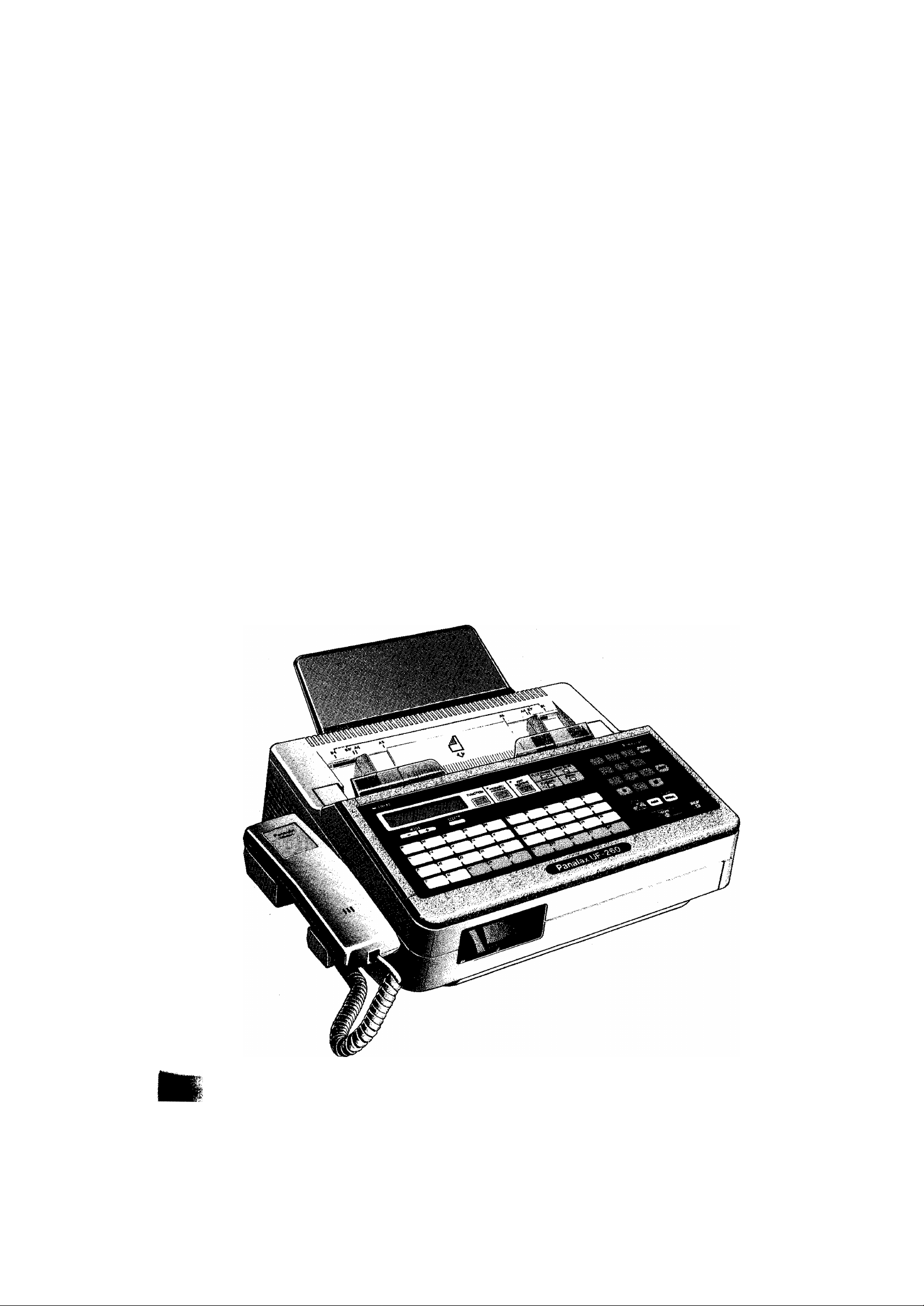
Panafax
I 1^"
User’s Guide
Panasonic
Page 2
IMPORTANT INFORMATION
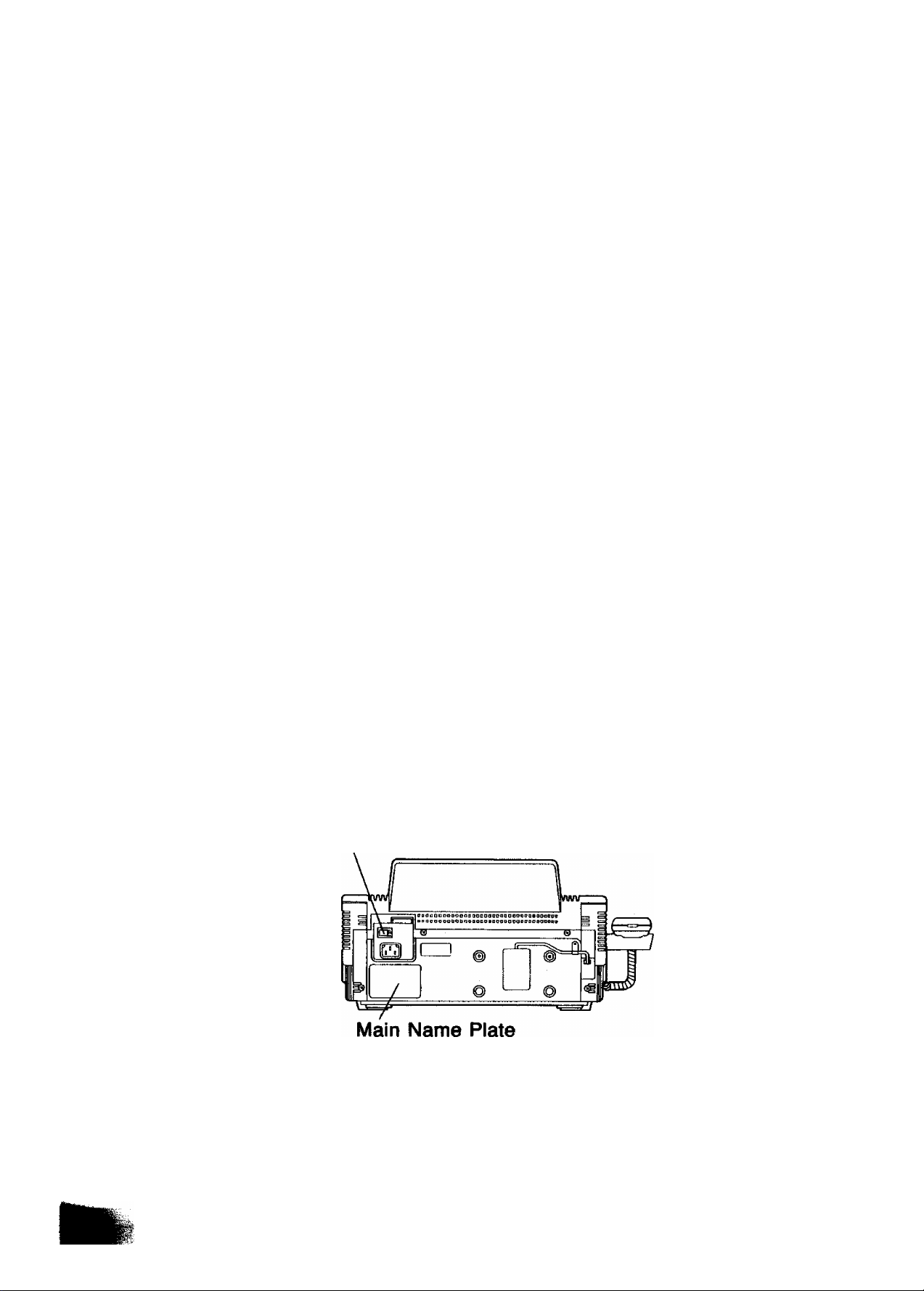
When requesting information, supplies, or service always refer to the model and
serial number of your machine. The model and serial number’s plate (Main Name
Plate) is located on the rear of the machine.
For your convenience, space is provided below to record the information you
may need in the future.
-----------
—---------------------------------------------——
MODEL NO. UF-260
Date of Purchase
Dealer
Address
Telephone Number
( )
Supplies Telephone Number
( )
Service Telephone Number
( )
SERIAL NO.
Power Switch
© 1989 by Matsushita Graphic Communication Systems, Inc.
All rights reserved.
Printed in Japan.
The contents of this manual are subject to change without- notice.
Page 3

» INTRODUCTION
The UF-260 is one of the most advanced models in the Panafax family of G3/G2
compatible, desktop facsimile machines. It features built-in memory which allows you
to store up to 20 standard pages (see Specifications) of information in the machine,
as well as use a full range of speed dialing techniques designed to make sending
faxes easier, faster and more economical.
Anyone can learn how to use the most frequently used features with a few minutes
of simple practice. However, because the UF-260 has the capacity to perform so many
different functions, not everyone will need to learn every feature.
This User’s Guide will help you to use your UF-260 quickly and easily. The Table
of Contents shows where to find information on every feature. Although we recommend
that you at least review each section briefly, you may need to read only the sections
that concern the feature(s) you are interested In.
Page 4

CONTENTS
INTRODUCTION
1. GETTING TO KNOW YOUR UE-260 ................................................................................... 5
— External View
— Control Panel................................................................................................................. 6
— Function Key.................................................................................................................
2. INSTALLING YOUR MACHINE
— Caution......................................................................................................
— Unpacking
— Battery Switch
— Installing Sub-Tray.......................................................................................................... 12
— Installing Handset and Cradle
— Removing ADF Protective Sheet.....................................................................................
— Power Switch.................................................................................................................. 14
— Setting/Replacing Recording Paper
— Setting the Dialing Method (Tone or Pulse)......................................................................... 17
— Lightning Precautions....................................................................................................... 18
— Final Installation Test........................................................................................................ 19
3. SETTING UP YOUR MACHINE....................................................................................
CHARACTER KEY LAYOUT UNDER THE ONE-TOUCH KEYS ..............
USER PARAMETERS ....................................................................................................... 21
— How to Set the Date and Time......................................................................................... 21
— How to Set Your LOGO.................................................................................................... 22
— How to Set Your ID Number............................................................................................ 23
ONE-TOUCH/ABBREVIATED NUMBERS
— Entering One-Touch/Abbreviated Dialing Numbers
— Filling Out the Station Directory Sheet............................................................................... 26
FAX PARAMETERS .......................................................................................................... 27
— Setting Fax Parameters.................................................................................................... 27
~ Parameter Table............................................................................................................... 29
USING MUTE AND ADJUSTING VOLUMES
-- Using Mute....................................................................................................................... 31
— Setting the Ringer Volume
— Setting the Speaker Volume............................................................................................. 31
4. SENDING DOCUMENTS
LOADING DOCUMENTS ..................................................................................................... 32
— Documents You Can Send
— Documents You Cannot Send........................................................................................... 32
— How to Use the Carrier Sheet
— Loading Documents......................................................................................................... 33
BASIC TRANSMISSION SETTINGS
“ Resolution ...................................................................................................................... 34
— Contrast (Original)............................................................................................................ 35
— Halftone.......................................................................................................................... 36
— Verification Stamp ........................................................................................................... 37
2
...............................................................................................................
...............................
..........................................................................................................
............................................................................................................... 11
.........................................................................................
..........
............................................................................................... 31
.....
.....................................................................
.............................................................................................. 32
.........................................................................................
.....................................................................................
........................................................................ 15
...........................................................................
..........
........................................................... 9
...................
..........
.............................
.............................................................
............................................... ............
......................
.......
5
8
9
10
12
13
20
20
24
24
31
32
32
34
Page 5

Total Pages................................................................................................................... 38
— Error Correction Mode (ECM).......................................................................................... 39
— Automatic Individual Transmission Journal (XMT JRNL)....................................................... 40
DIALING TECHNIQUES .....................................................................................................
— Direct Dialing (On-Hook Dialing)....................................................................................... 41
— Off-Hook Dialing............................................................................................................... 43
— One-Touch Dialing.......................................................................................................... 44
— Abbreviated Dialing........................................................................................................... 46
— Redialing......................................................................................................................... 48
MEMORY TRANSMISSION ............................................................................................... 49
— Memory Transmission to Single Station
— Multistation Transmission
................................
..................................................
............................................................... 51
.......................
— Multifile Transmission.................................................................................................... 53
TRANSMISSION RESERVATION ....................................................................................... 56
“ Setting Transmission Reservation......................................................................................... 56
— Setting Memory Transmission Reservation......................................................................... 57
Canceling Transmission Reservation
MAKING COPIES................................................................................................................. 60
5.
.................................................................................
— Single Copies.................................................................................................................. 60
— Multiple Copies (Using the Memory)
RECEIVING DOCUMENTS ................................................................................................ 62
6.
................................................................................. 61
AUTOMATIC RECEPTION................................................................................................... 62
MANUAL RECEPTION ........................................................................................................ 62
— How to Set Manual Reception......................................................................................... 62
— What to Do When Your Telephone Rings.......................................................................... 63
SUBSTITUTE RECEPTION (MEMORY RECEPTION)............................................................ 64
7.
POLLING ........................................................................................................................... 65
— How to Set the Polling Password....................................................................................... 65
— How to Prepare to be Polled............................................................................................ 66
— How to Poll...................................................................................................................... 67
— Turnaround Polling (Combined Transmission and Polling)................................................... 68
USING YOUR UF-260 TELEPHONE..................................................................................... 69
8.
— Making a Regular Call..................................................................................................... 69
— For Making Voice Contact after Sending/Receiving............................................................ 70
— Answering a Voice Contact Request.................................................................................. 70
— What to Do When You Hear a Voice through the Speaker................................................... 71
TIMER CONTROLLED COMMUNICATIONS
9.
................
........................................................
— Deferred Transmission................................................................................................... 72
Deferred Polling............................................................................................................ 74
— How to Cancel or Change Timer Settings.......................................................................... 75
PROGRAMMED COMMUNICATION .................................................................................. 77
10.
— Setting Program Keys....................................................................................................... 77
— How to Erase or Change Program Key Settings
— Program Key Programming Flowchart
...............................................................................
................................................................
“ Using Program Keys........................................................................................................ 87
PRINTOUT REPORTS AND LISTS...................................................................................... 88
11.
— Journal Printout.............................................................................................................. 88
— Individual Transmission Journal (XMT JRNL)...................................................................... 89
41
50
59
72
82
86
3
Page 6

— Memory Transmission Journal (COMM. JOURNAL).......................................................... 92
— One-Touch/ABBR. Dialing Number List............................................................................
— Program List.................................................................................................................... 96
— Fax Parameter List......................................................................................................... 98
— Power Failure Report.......................................................................................................100
12, PROBLEM SOLVING AND DAILY CARE.............................................................................. 101
— information Code
— Clearing a Recording Paper Jam
— Reloading a Recording Paper...........................................................................
— Clearing a Document Jam
— Cleaning or Replacing the Fluorescent Lamp...................................................
— Adjusting the Automatic Document Feeder (ADF)
— Refilling or Replacing the Verification Stamp...................................................................... 110
— Cleaning the Thermal Recording Head
13, APPENDIX ........................................................................................................................ 113
a. RELAYED (MULTI-STATION) TRANSMISSION............................................................... 113
— General Description.........................................................................................................113
— UF-260 Compatibility with Other Machines
— Relay Network
— Setting Up Your Machine for Relayed Transmission...........................................................
— Sending a Document by Relayed Transmission
— Printouts and Reports................................................................................................... 127
b. CONFIDENTIAL COMMUNICATIONS............................................................................ 131
— General Description........................................................................................................131
— UF-260 Compatibility with Other Machines........................................................................132
— Setting Up Your Machine for Confidential Communications
— Sending a Confidential Fax to a Relay Station....................................................................136
— Polling a Confidential Fax from a Relay Station
— Printouts and Reports......................................................................................................138
c, PASSWORD COMMUNICATION....................................................................................139
— Setting Transmission Password and Receiving Password...................................................140
— How to Start Password Transmission
— How to Set Password Receiving..................................................................................... 142
d, FAX ACCESS CODE................................................................................................... 143
— How to Set Fax Access Code.......................................................................................... 144
— How to Use the Machine after You Set Fax Access Code
— How to Reset Fax Access Code
14, SPECIFICATIONS ............................................................................................................. 147
...........................................................................................................
.....................................................................................
...............
..............................................................................................
.................
..............................................................
.............................................................................
......................................................................
....
......................................................................................................... 115
.................................................................
................
..............
............................................................................
.........
.......................................................................
...................................................
................
................................133
..................................145
94
101
102
103
104
107
108
112
114
119
126
137
141
146
Page 7
GETTING TO KNOW YOUR UF-260
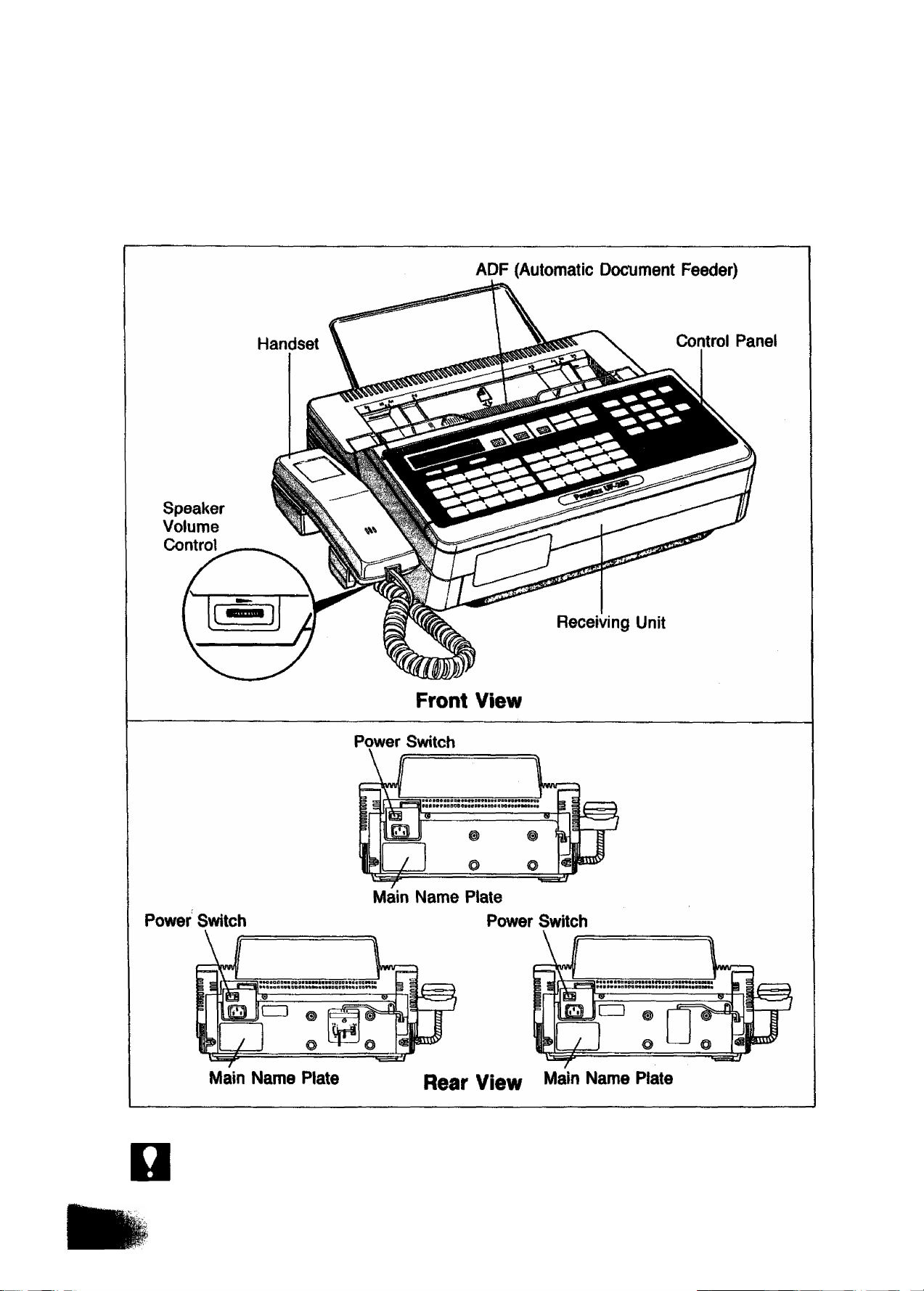
External View
NOTC
Rear view, especially connecting method of line cord, varies depending on the country.
5
Page 8
Control Panel
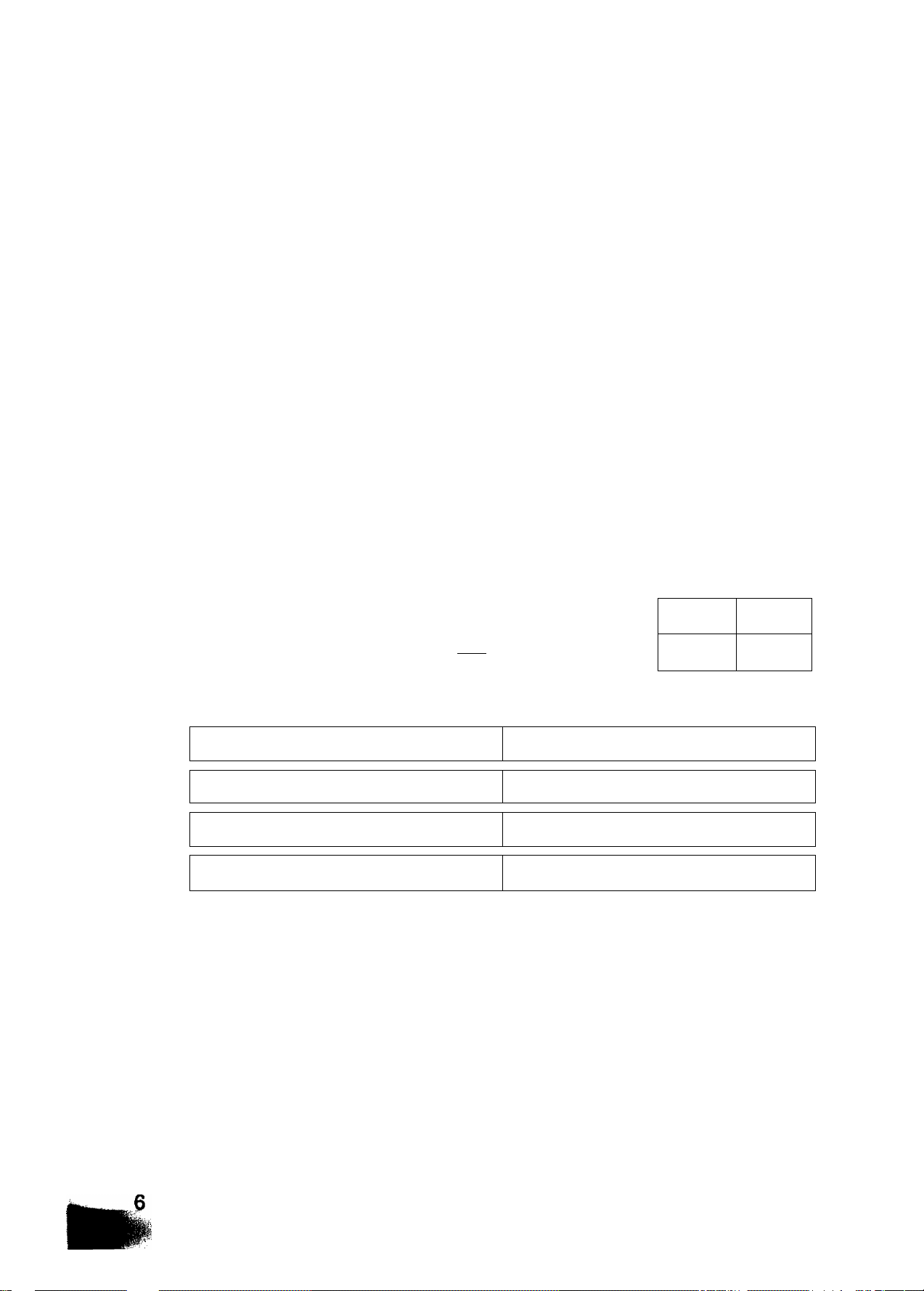
SELECT
Used to switch Basic Transmission
settings.
MOPE РП and РП
Used to set Totai Pages, individual
Transmission Uournai, etc.
Also used to select Sub-functions (i.e.,
instead of pressing the sub-function
number key, you can scroll in opposite
directions by pressing either key
repeatedly).
Display
Shows Date and Time, or the current
operation.
Power Lamp
Lights when the power is ON.
• POWER
MEMORY/MULTIFILE
Used for memory transmission, multi
station transmission, multi-file transmission,
and multi-copy.
XMT RESERVE
Used to reserve transmission when the
machine is still receiving or transmitting
from the memtwy.
RESOLUTION
Used to set Normal, Fine, or Super-Fine.
Also used as an arrow key (► ), together
with ORIGINAL (◄), to move the cursor
over recorded numbers and characters.
Г
r
__
21
31
___
___
SELECT
CZD
Jl
V14
A
¥ 24
MODE
...A
V02
___
Vl2
Л
___
2i
Vo3 ¥04
A
_JL
V23
___
V 32 ¥pi
_л_____
—
¥ P2
_
Program Keys (PI ~ P8)
Used to record long dialing
procedures, Group Number keys,
and extra One-Touch keys.
___
___
FUNCTtON
¥os
A
_____- 4
¥15
A
___
¥25
¥p3
_Jl
____
iSlIliSSiS
18ЯЯВ;;
oe
__
16
_ J A
26
J
P4
^
MEMOPY/
MULTinLE
:ss3hi:
(Ban;;:
__
' XMT
RESERVE
:i:i
inns:
¥ 07 Vos
A
___
A
¥ 18
___
¥ 27
A
¥28
A Л
u
___
___
___
RESOLUTION
»» ►
OmOINAL
я;:
¥09
V 19
¥29
A
HALF TONE
:ui
STAMP
sa«v
штшш
¥10
¥20
A
¥ Э0
A
¥ P5 ¥ P8
__л
__
_A
____
__Jl
___
_j
_____
___
ORIGINAL
Used to set Normal, Dark, or Light. Also
serves as an arrow key ('<), together with
RESOLUTION (►), to move the cursor
over recorded numbers and characters.
---
N
''
J
One-Touch/Character Keys (01-32)
Used for One-Touch Dialing and record
ing letters and symbols.
STAMP
Used to set the Verification Stamp ON or-
OFF.
HALF TONE (SHIFT)
Provides ON and OFF settings for halftone documents.
Page 9

FUNCTION
Used to start or set the following functions and
sub-functions:
1 DEFERRED COMMUNICATION
3 POLLING
4 TRANSMISSION & POLLING
5 CONFIDENTIAL COMMUNICATION
6 PRINTOUT
® JOURNAL PRINT
©ONE-TOUCH/ABBR. NOS.
® PROGRAM LIST
® FAX PARAMETER LIST
® INDIVIDUAL TRANSMISSION JOURNAL
7 SET MODE
© USER PARAMETERS
@ RELAYED TRANSMISSION & CONF.
COMM. PARAMETERS
ONE-TOUCH/ABBR. NOS.
PROGRAM KEYS
FAX PARAMETERS
§
Panasonic
NOT€
Any function can be started by first pressing
I FUNCTIONland the fenction’s number key, or by
pressing IFUNCTIOI^ repeatedly until the function
appears on the display.
Keypad
Used for Direct Dialing, recording phone numbers, and
selecting functions.
1
aCIDCDE
DCIDCE]
ИИШ
SPACE
-----------
ABBR
L
_____
START
0
V '' \
j к
PAUSE
REDIAL
_____
'J
CLEAR
COPY
fSTOPl
STOP
Used to cancel operations. When it is pressed, the machine
will return to standby.
CLEAR
Used to erase the previously entered input.
COPY
Used to make document copies.
ABBR
Used to start Abbreviated Dialing.
REDIAL or PAUSE
Used to start Redialing, or to enter a pause when recording
or dialing a telephone number.
START
Used to start or set operations.
TEL/DIAL (SPACE)
Used to start Direct Dialing, and to enter a space in
recorded telephone numbers.
Page 10

Function Key
Mooe
CZ
to orto’
FUNCTION
—Setting Total Pages
—Automatic Individual Transmission Journal ON/OFF
Setting to be Polled
Setting Password Transmission ON/OFF (see Note)
—Automatic Reception ON/OFF
—Error Correction Mode ON/OFF
—Displaying Used Memory Percentage
—[ 1 ] Deferred Communication
3 ] Poliing
Turnaround Poiling
Confidential Communication (see Note)
Journal Print
One-Touch/Abbreviated
Print Out
—^ s j—
Dialing Number List
Program List
(page 38)
(page 40)
(page 66)
(page 141)
(page 62)
(page 39)
(page 49)
(page 72)
(page 67)
(page 68)
(page 136)
(page 88)
(page 94)
(page 96)
NOT€
Set Mode
FAX Parameter List
6j Individual Transmission Journal
User
Parameters
— 2
Relayed Transmission &
Confidential Communication
—Date & Time
—Logo
ID No.
-Polling Password
(page 98)
(page 89)
(page 21)
(page 22)
(page 23)
(page 65)
Parameters (see Note) (pages 121 and 135)
One-Touch/Abbreviated Numbers
Program Keys
FAX Parameters
(page 24)
(page 77)
(page 27)
If the Fax Parameter is not preset to Valid Position, which enables you to use the
function, the display will not show the function.
Page 11
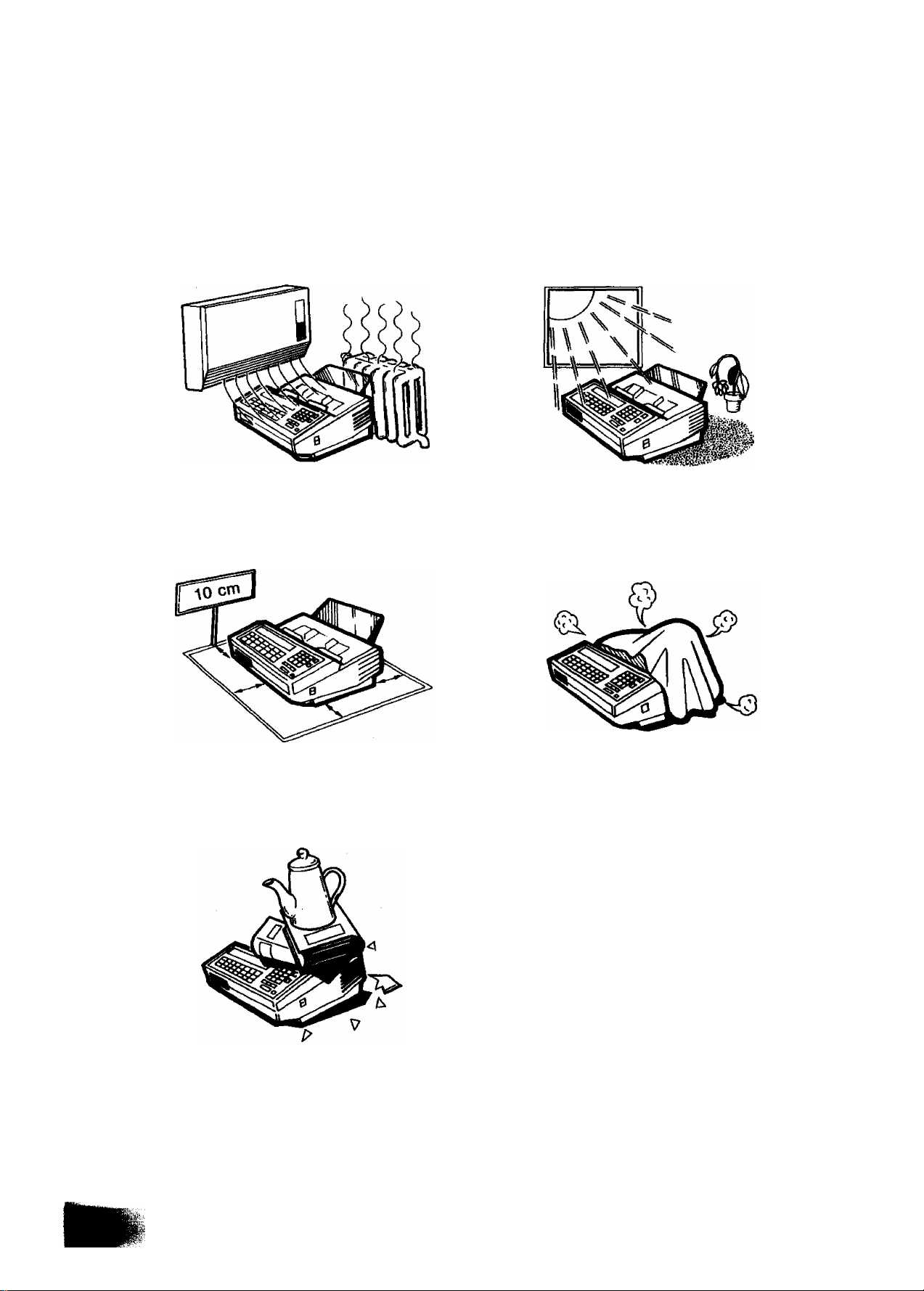
Caution
INSTALLING YOUR MACHINE
1« Do not install the machine near
heating or air conditioning units.
3. Install the machine on a flat place,
and leave at least 10 cm of space
between the machine and other
objects.
2, Avoid exposure to direct sunlight.
4. Do not block the ventilation
openings.
5. Do not place heavy objects, or spill
liquids on the machine.
Page 12
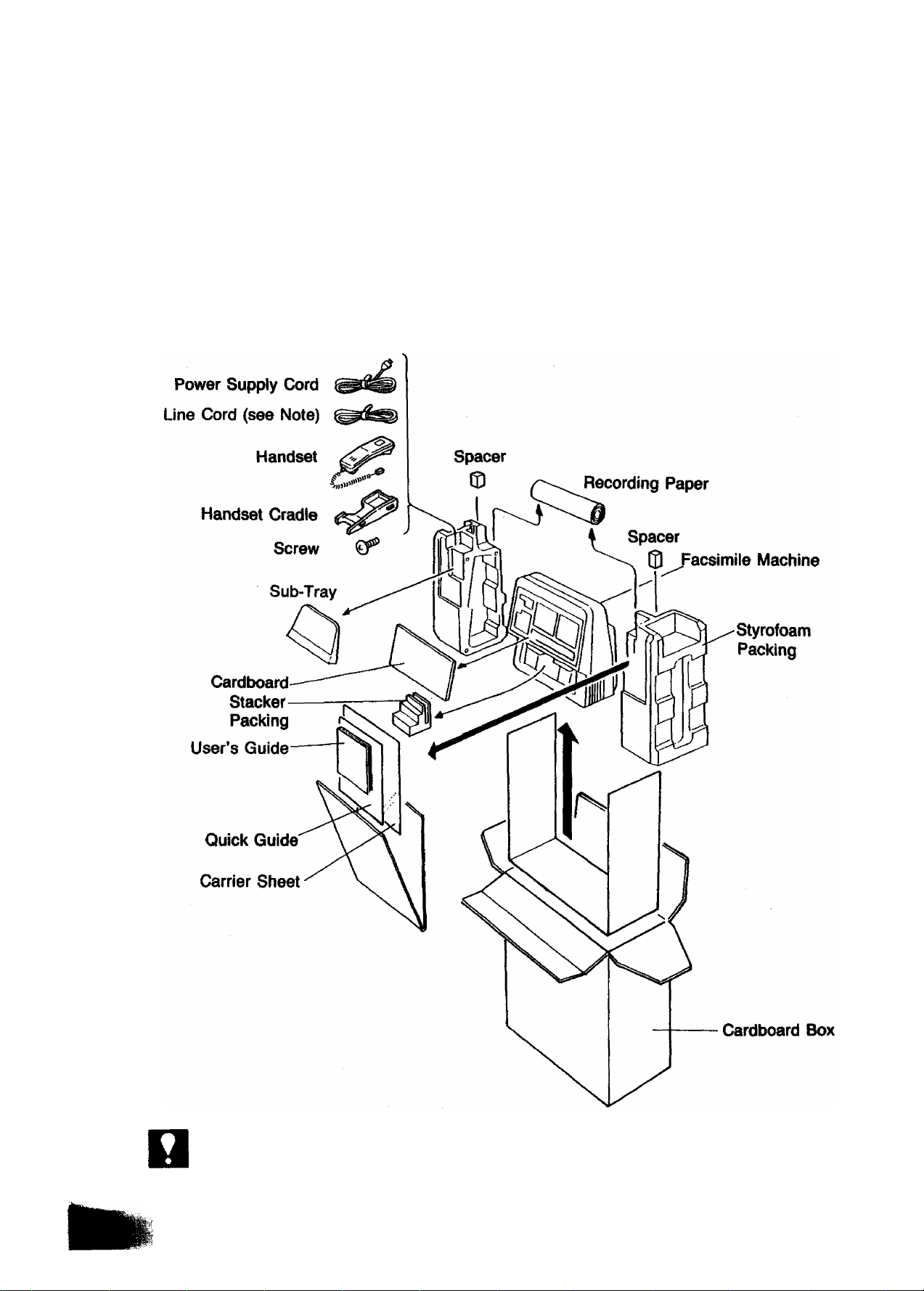
Unpacking
Unpack the cardboard box referring to the illustration shown below. Inspect the
machine for any shipping damage and check that you have all accessories illustrated.
NOT€
10
When you purchased the machine, the line cord had been connected to the machine.
Page 13
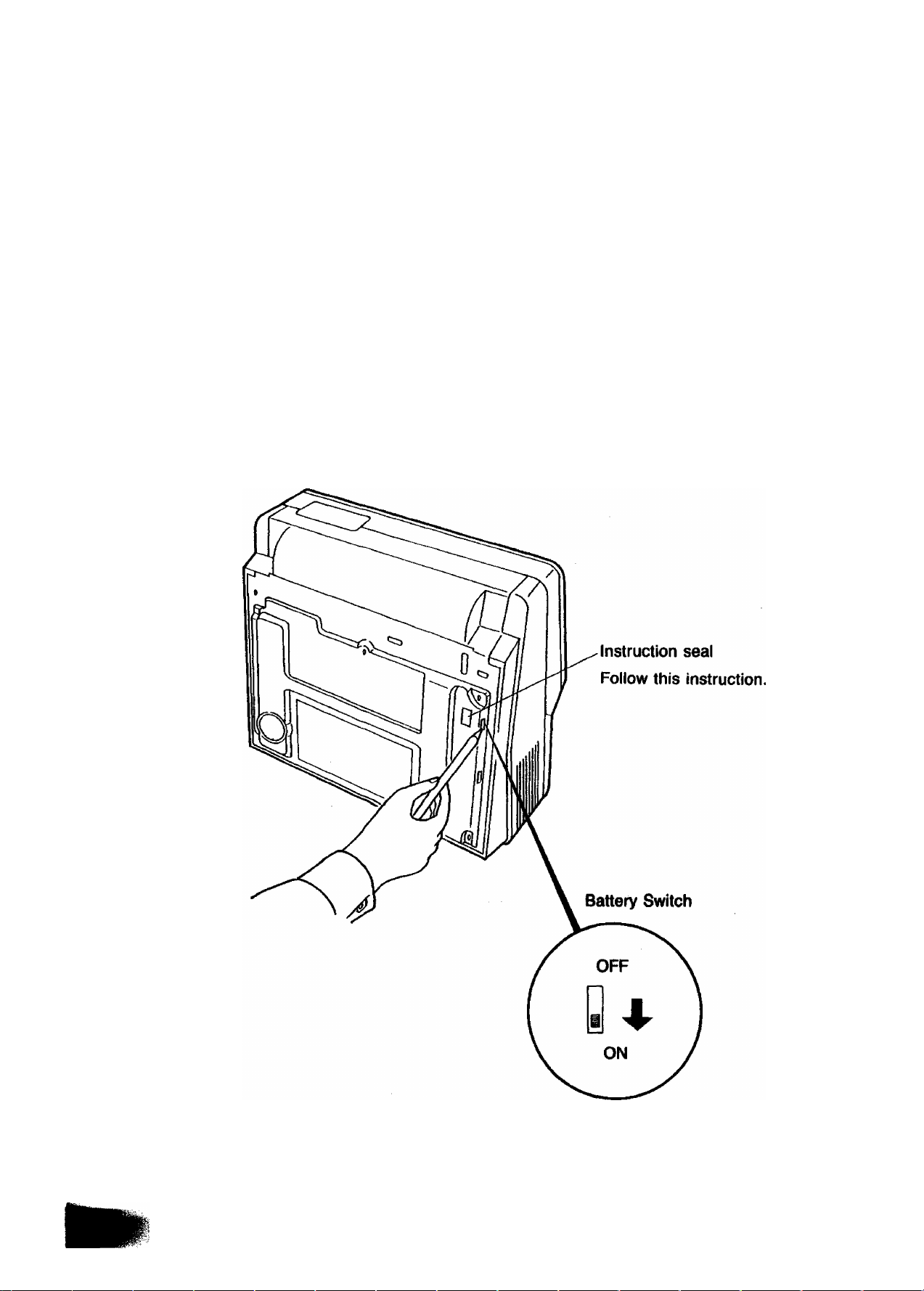
Battery Switch
The machine is equipped with a battery pack which backs up the RAM data (clock,
logo, date, abbreviated number, etc.). This battery switch must be turned ON when
the machine is installed. If it is not turned ON, all information which is programmed
will be lost when the AC power is turned OFF.
Use a pointed object (such as a pen) and slide the battery switch located on the bottom
plate to “ON" position. See the figure shown below.
11
Page 14
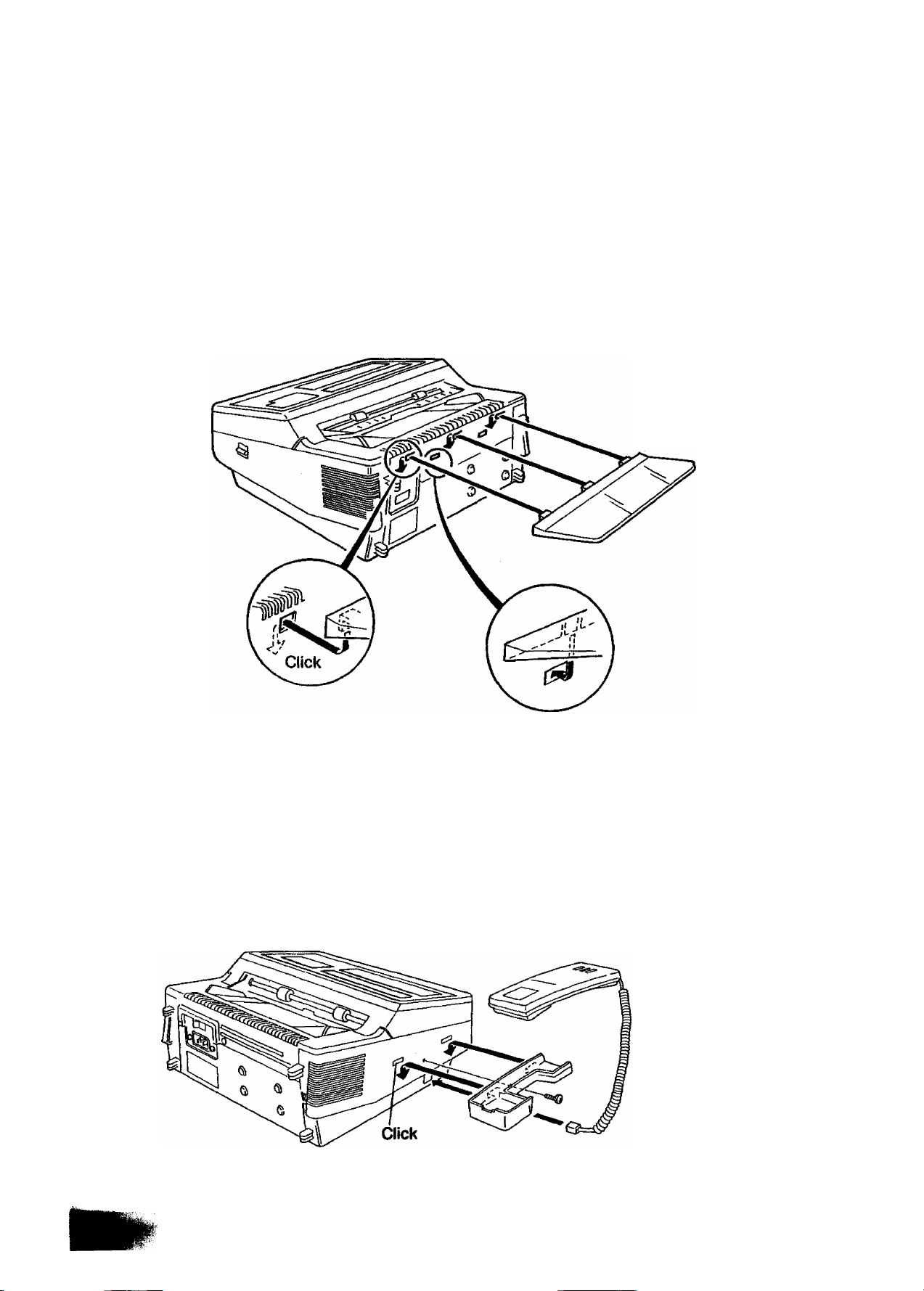
Installing Sub-Tray
The ADF tray is provided as a part of the upper cover of the machine.
Install the sub-tray by inserting its brackets into holes on rear side of the upper cover
and sliding it downwards until it locks into position. See the figure shown below.
Sub-Tray
Installing Handset and Cradle
1. Plug the telephone handset into the jack on the left side of the machine.
2. Insert the telephone cradle hooks into the two slots on the left side of the machine
and press down gently until it locks into place. Then insert the screw into the center
of the cradle and tighten with a phillips screwdriver.
Side Cover
Cradle
-4-
I
12
Page 15
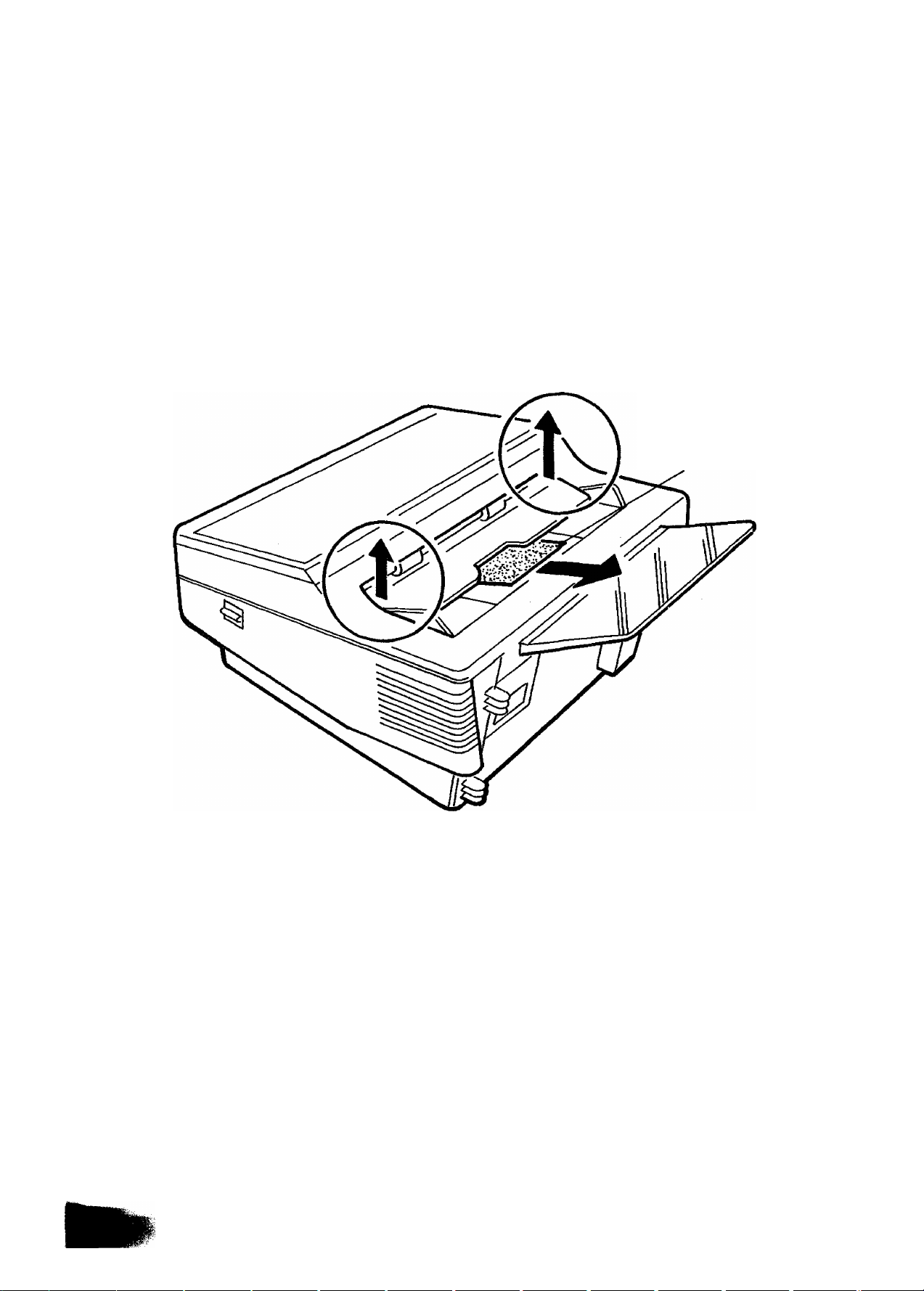
Removing ADF Protective Sheet
1. Open the transmitting guide unit by pulling up the two tabs located on both sides
of the machine, and remove the ADF protective sheet.
2. Close the transmitting guide unit by pushing down the two tabs located on both
sides of the machine.
Protective Sheet
13
Page 16
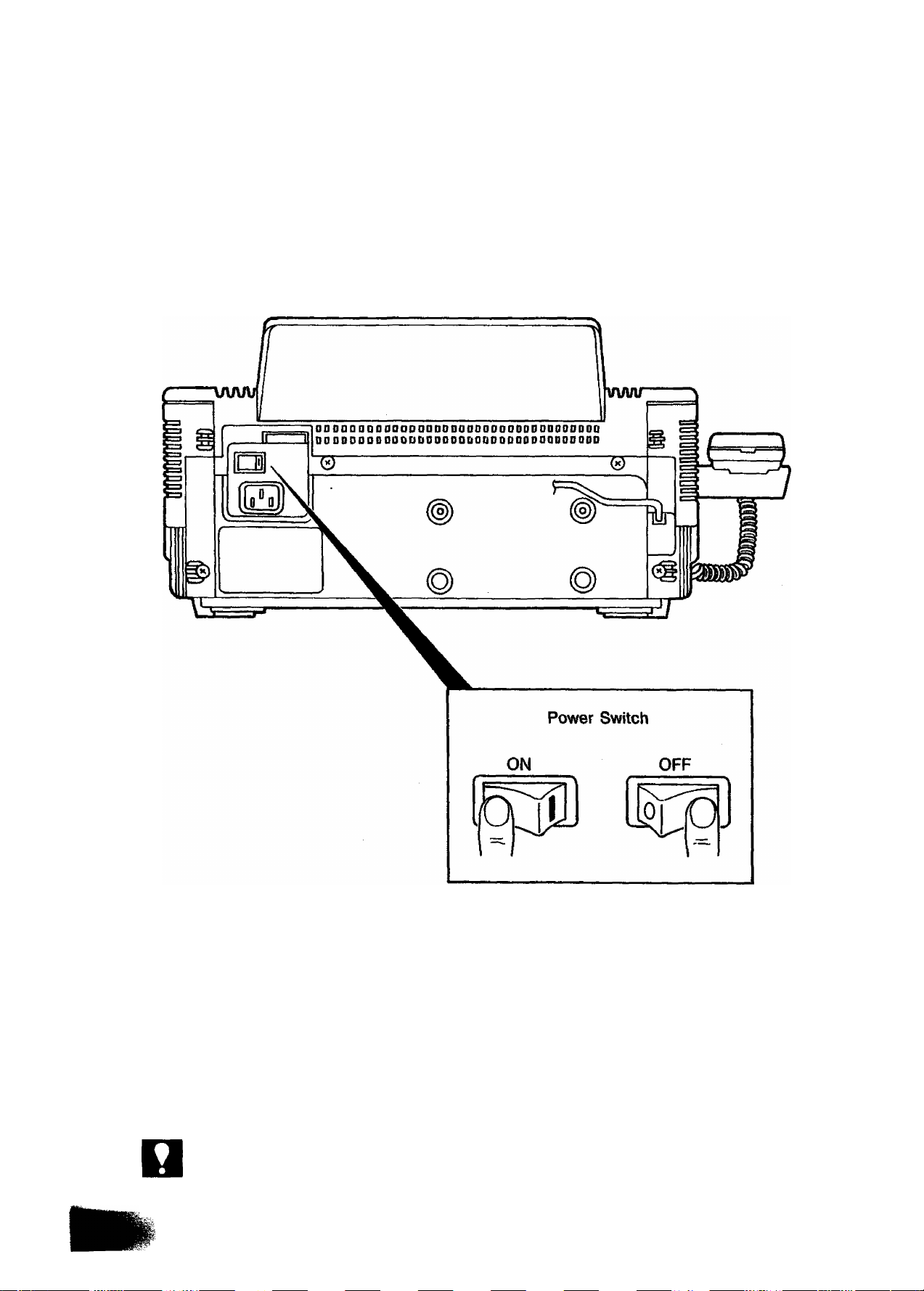
Power Switch
Before turning on the power switch, be sure to plug one end of the power supply
cord into the receptacle on the rear of the machine and the other end into an ordinary
AC outlet.
The power switch is iocated on the rear panel.
Turn the power switch to * position to turn on the power. The power lamp on the
control panel should light up.
Your machine uses little power, and you should keep it ON at all times. If you turn
the machine OFF for too long, the contents of the memory (such as ID number, logo
you registered) will be iost. (Note that the power supply to the memory is backed
up by a battery to preserve the memory contents in case of a short power failure.)
NOT€
1. When the battery is fully charged, it can support the memory 10 days.
2. Rear view varies depending on the country.
14
Page 17

Setting/Replacing Recording Paper
1, Press the latch button on the right side of the cover and open the Receiving Unit.
Remove the Head Protective Sheet.
Receiving Unit
Head Protective Sheet
Latch Button
2. Set the recording paper into the unit and feed the leading edge of the paper
between the guide plates of the cutter unit until it projects out of the unit. Make
sure that the recording paper is set correctly as shown in the figure below. If it
is set incorrectly, the machine will not reproduce images.
2. If the recording paper cannot pass between the guide plates, turn the Cam Wheel
as far as you can in the arrow direction.
15
Page 18

3. Close the Receiving Unit carefully by pressing both corners down until the cover
locks into position (you wilt hear a "click" sound).
4. The recording paper projecting from the unit will be cut automatically. Remove
this cut paper.
16
Page 19
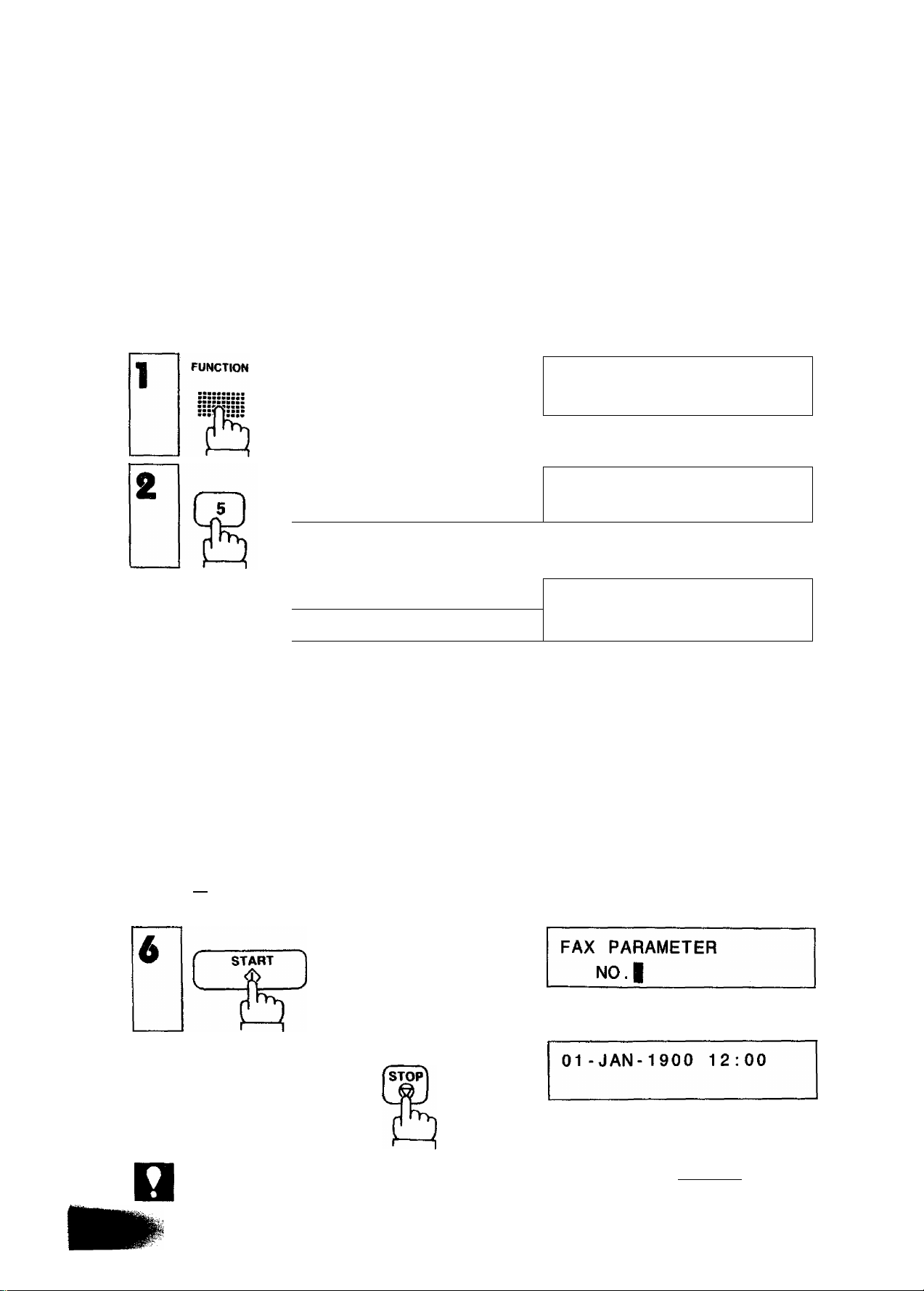
Setting the Dialing Method (Tone or Pulse)
Your facsimile machine can operate with either one of two dialing methods (Tone
or Pulse), depending on the type of telephone line you are connected to.
Your facsimile machine is preset at the factory for Pulse (Rotary) Dialing. If your
facsimile machine requires Tone Dialing, set to Tone Dialing using the following
procedure.
SET MODE
4
CD
and
MODE
CZDIZJD
, or
START
fÌ or}
----------------
s repeatedly.
c
n
Enter the two-digit Fax parameter
number.
Press [5] [7].
Enter the new setting value.
Press [T].
NO. =1
FAX PARAMETERS
FAX PARAMETER
NO.|
FAX PARAMETER
NO.07[21-1
FAX PARAMETER
NO.07[2]=B
NOT€
m changes to Tone Dialing.
To return to Pulse Dialing, press [2
To return to standby,
If you make a mistake to enter the Fax parameter number, press CLEAR I then
reenter the correct number.
17
Page 20
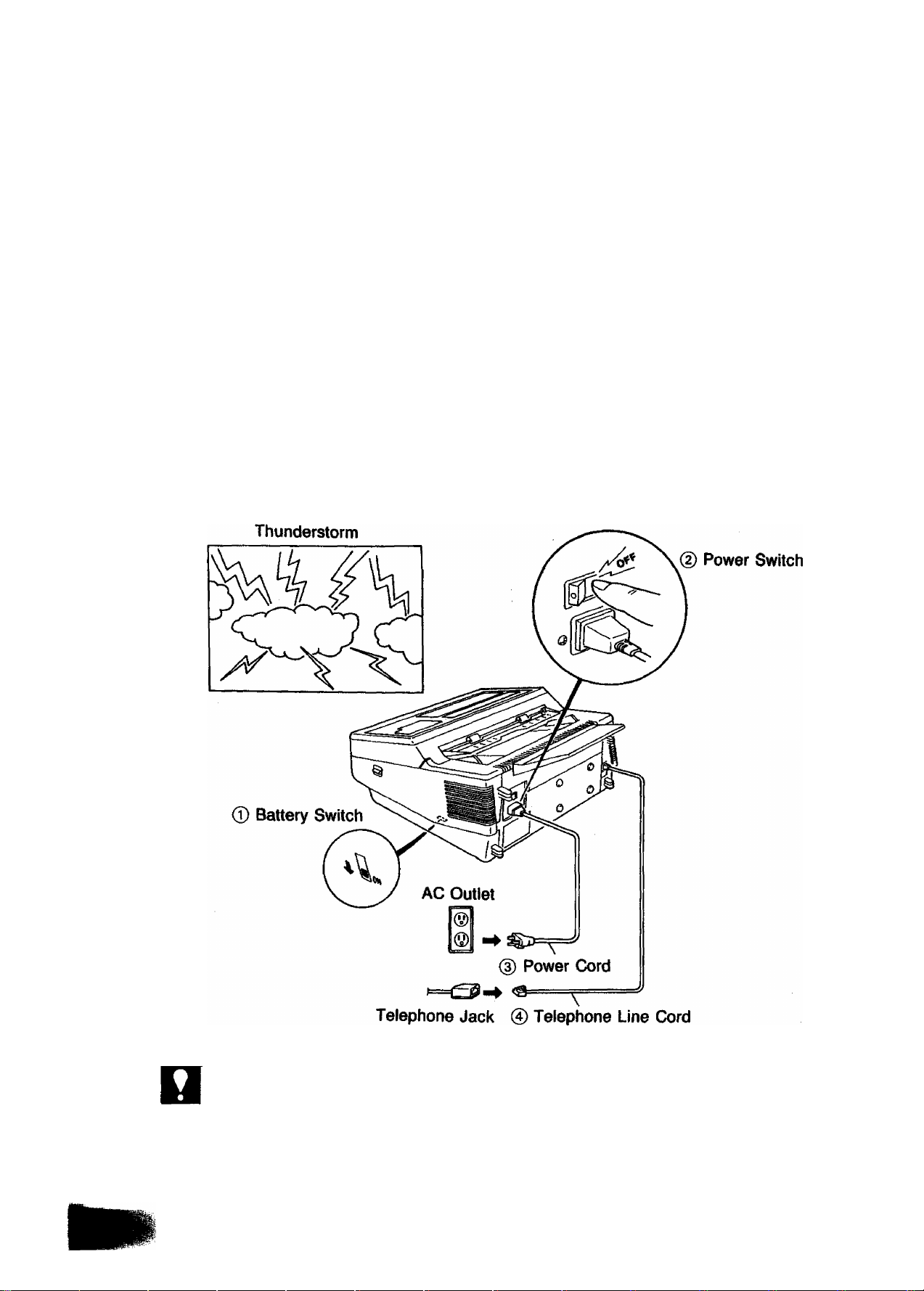
Lightning Precautions
To minimize the possibility of damage due to lightning, a surge protector is built into
your machine. Sometimes though this is not enough to protect the machine completely
when a strong lightning surge comes through the telephone line or AC power tine.
To further protect the equipment when you know that a thunderstorm is coming, we
recommend that you:
• Make sure that the battery switch is ON before turning off the power switch.
• Turn off the power switch and unplug the power cord from the AC outlet.
• Unplug the telephone line cord from the telephone jack, or from the machine
using a pointed object.
NOTC
18
1. If the battery switch is not turned ON, all memory information (i.e., clock, telephone
No., logo, ID number, etc.) may be erased immediately. The battery can back up the
memory up to approx. 10 days when fully charged. As soon as the thunderstorm is
over, plug in the AC cord and telephone line cord, then turn on the power switch.
2. Connecting method of tine cord and its type, the type of power supply cord and AC
outlet vary depending on the country.
Page 21

Final Installation Test
After installing your machine, it is advisable to make a copy or send a fax by direct
dialing to check if the machine is working properly.
1
2^
Place a document face down on the
ADF. Adjust left and right Document
Guides.
(For more details, see page 60.)
SPACE
and a full number
Ex:(5][5][I][Il[I]|I][4]
(For more details, see page 41,)
* DIALING ^
5551234|
19
Page 22
SETTING UP YOUR MACHINE
CHARACTER KEY LAYOUT UNDER THE ONE-
TOUCH KEYS
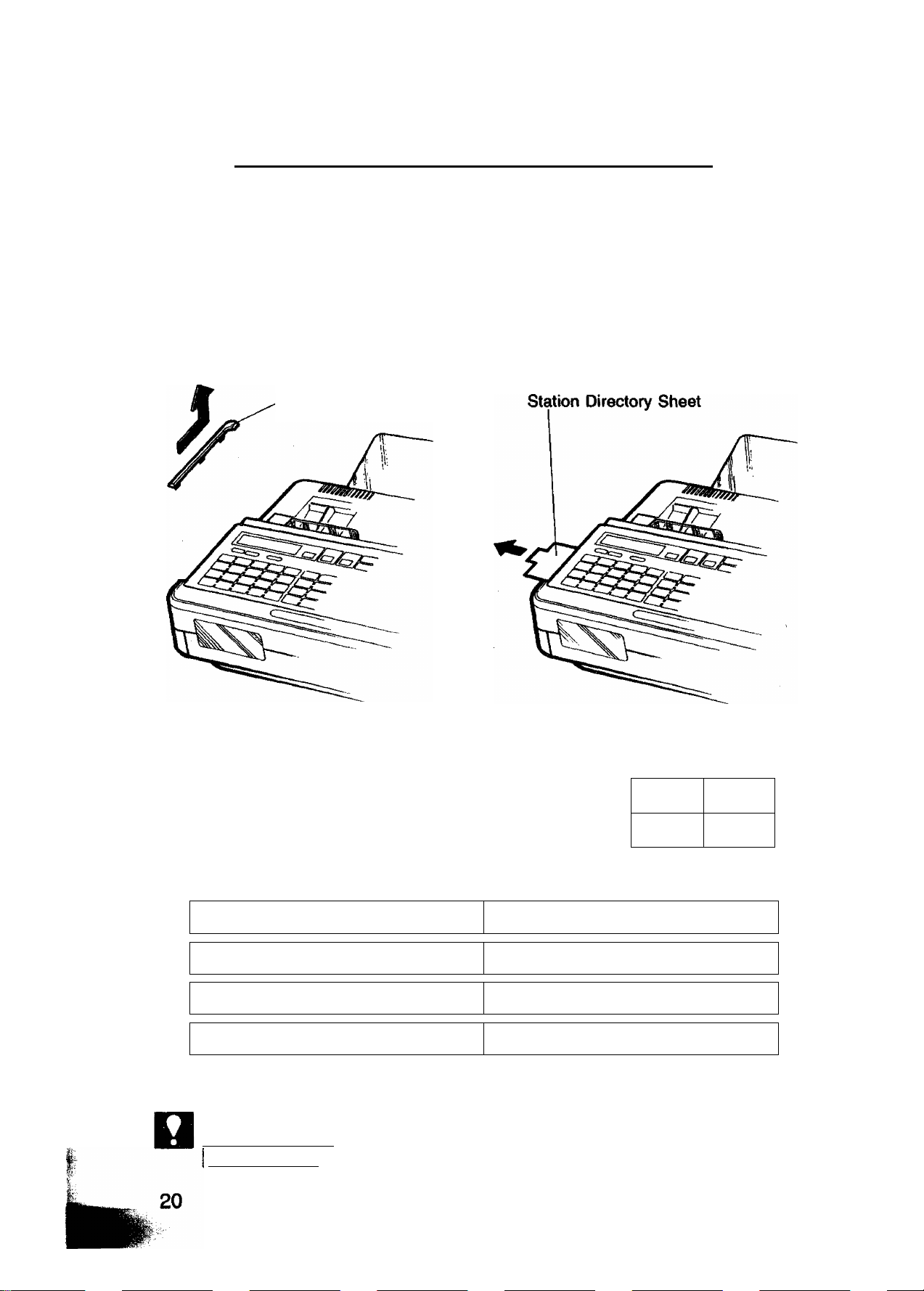
The One-Touch keys on the control panel also serve as character and symbol input
keys when you need to record your LOGO and other station names. This layout is
printed on the panel under the Station Directory Sheet, which can be pulled out as
shown below.
Station Directory Cap
NOT€
Character Key Layout
« POWER
MODE
CZDIZED
01
a lfo2
Ai
_ __
11
k If t2
21
u U22
ujl ^
31
+ 1/32 V PI
_JL_
b )f03
BJL_
1 V13
V V 23
__ _ _ _
«lA_
SELECT
( )
C V04
mtfi4
Mil
w V24
__
If P2 v^
_LA_
d Vos
DJI
n Vis
NJl
X V25
_LJL_
FUNCTION
'MEMORY/
MULTIHLE
' XMT
RESERVE
iHHm>
—
___
_ _
06
~T)iW-
FJI HA
.
_
0
16
p Vl7
9 Vos
q Vie f V 19
0 PJl___ OJl___.RJL
Z V 27
y
Y
- _ji
26
P4
ZJL
V PS V P6
_ _ _ _
& V28
A1 Afl
_ji
_ _ __
RESOLUTION
■•»MM W"
ORIGINAL
UU
h V 09
d V29
V ea*-,- Vuppers
J SPACE J
Jl A'^LOWER^
HALF TONE
»1!
STAMP
■•MM
MMMft
» V10 i
t il
__ __
s V 20 t
SI
d V 30 u
OA 0
^
Whenever One-Touch keys are changed to the character key mode (to record your LOGO
and other station names), capital letters are selected first. Use the
UPPER/LOWERI key to alternate to and from capital letters and small letters.
Page 23

USER PARAMETERS
How to Set the Date and Time
You can set or reset the date and time when your machine is in standby, or when
you have already placed some documents on the ADF. To do so,
1
FUNCTION
SET MODE
NO. =1
and
DATE & TIME
11 -01 -1900 12:00
The display will show a date and time.
Use the keypad to enter the new day (two
digits), month (two digits), year, and time
(24-hour clock).
4
Ex: 16 FEB, 1989 15:00 Q] IS E IT]
1 5 0 0
----------
If you make a mistake, use the
and I RESOLUTION
keys to move the cursor to the
incorrect number, and then enter the
new number over it.
To set the date and time.
Now you can go on and set the
LOGO, or return to standby with
STOP
DATE & TIME
16-02-1989 15:00
21
Page 24
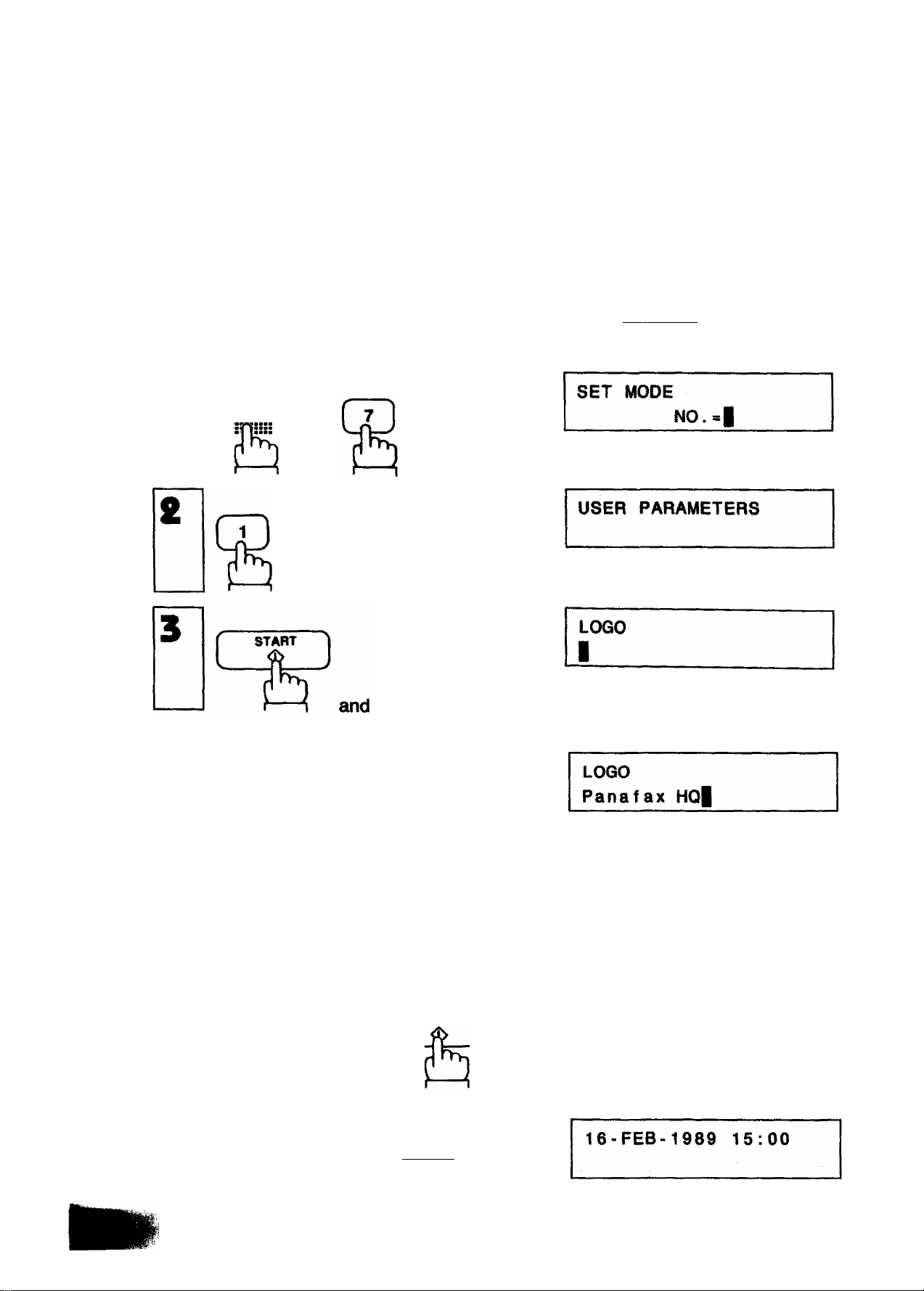
How to Set Your LOGO
The LOGO helps identify you to someone who receives your document.
To set your LOGO (25 characters max.), use the One-Touch/Character keys (see
page 20).
If you have just set the date and time and pressed I START , skip to Step
4 below. If not, start from Step 1.
FUNCTION
1
and
4
MODE
C^IZ+D
repeatedly.
Enter each letter, number and/or symbol
in your LOGO using the One-Touch/
Character Keys.
Ex: for Panafax HQ
UPPER/LOWER
SPACE UPPERA.OWER
If you enter more than 20 characters, the
display will not show the first 20 charac
ters.
an
StSLQ
START
ID NO.
22
To set the LOGO,
Now you can go on and set the ID, or
return to standby with I STOP
Page 25
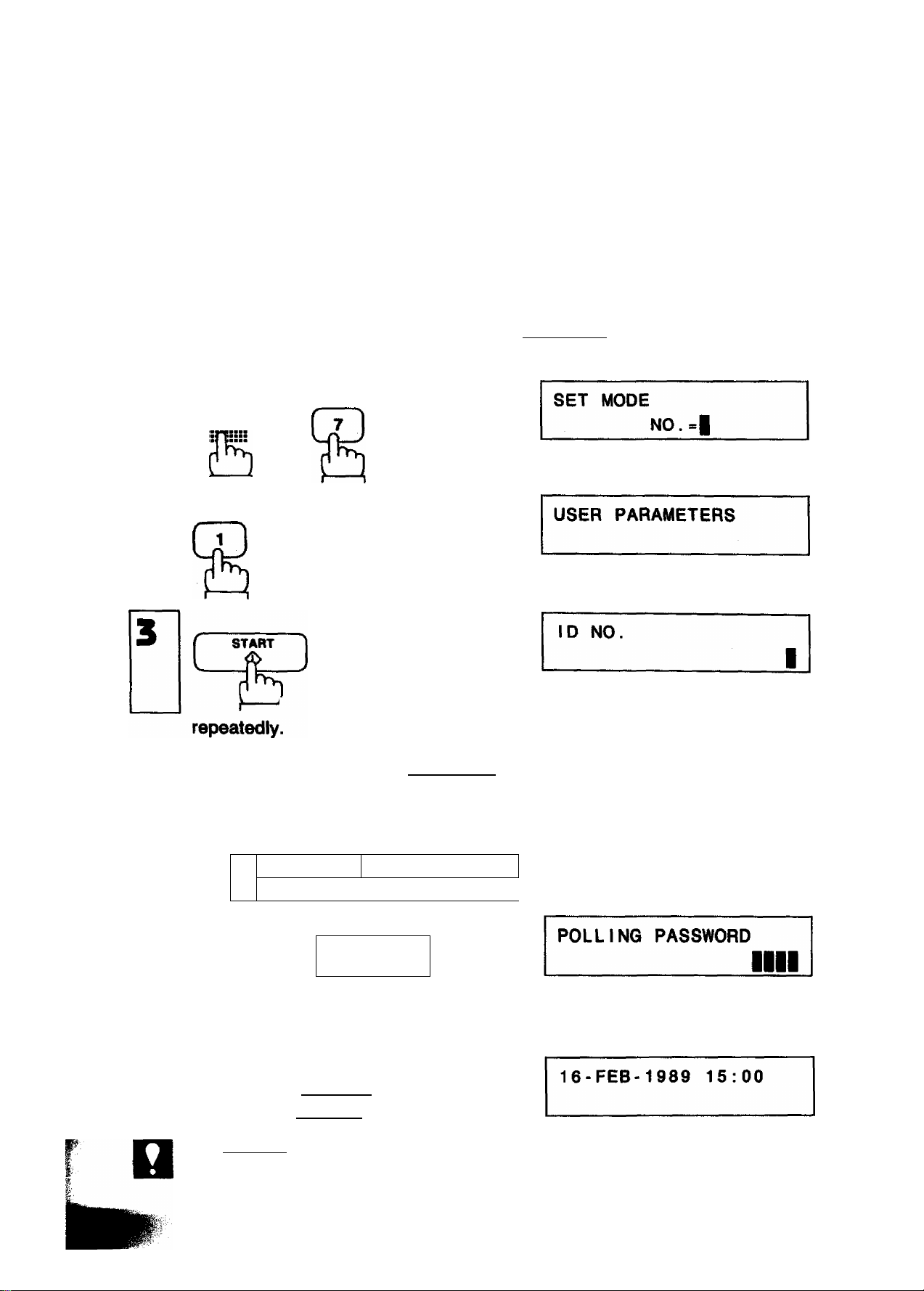
How to Set Your ID Number
When you transmit, your ID will appear on the other person's display. When you
receive documents, the sender's ID will appear on your display. We suggest you use
your facsimile telephone number as your ID, but you may use any number up to 20
digits long.
If you have just set your LOGO and pressed I START I, skip to step 4. If not,
start from Step 1.
FUNCTION
1
and
MODE
CZDIZ±3
\ and
Enter the ID digits. Use I SPACE I to
enter a space. If you try to enter more
than 20 digits you will hear a pip-pip-pip
sound.
Ex:
1 SPACE
1
T1 2 3 4
/
-----
3 SPACE 1 1
START '
■■ YL... , J
To set the ID,
D NO.
81 3 1111234
ноте
Now you can go on and set the POLLING
PASSWORD (see page 65), or return to
standby with I STOP 1.
Press \ CLEAR I to erase the number you Just entered.
23
Page 26
ONE-TOUCH/ABBREVIATED NUMBERS
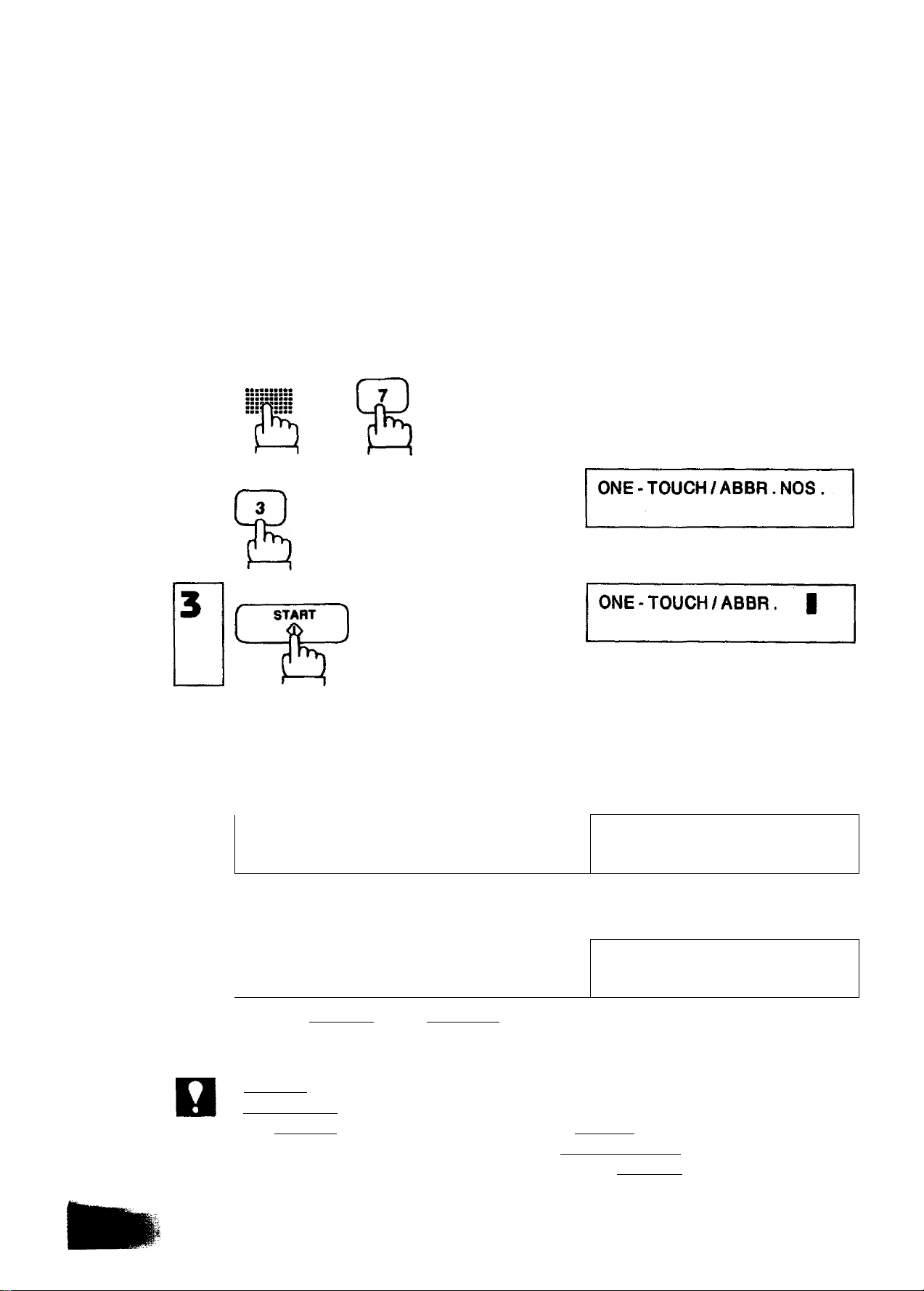
Entering One-Touch/Abbreviated Dialing Numbers
One-Touch Dialing and Abbreviated Dialing are two fast ways of dialing full numbers.
To use these dialing methods, you must first enter the full numbers using the following
procedure.
1
FUNCTION
and
To assign a One-Touch number, press
one One-Touch key.
Ex: 07
SET MODE
[07]
TELEPHONE NO
I
NO.=|
4b
NOT€
24
To assign an Abbreviated number, press
ABBr] and two keys on the keypad
to enter any code from 00 to 99.
ExilABBRlfeir^
Enter facsimile telephone number (up to
36 digits) including pauses and spaces.
Ex:
1. If you need a special access number to get an outside line, enter it first and then press
I PAUSE I. A hyphen is displayed for pause.
2. Use I SPACE] to enter a space between the numbers to make it easier to see.
3. When you input a wrong number in Step 5, press | CLEAR ! to erase the number
before the cursor, then reenter the right number and press [START 1.
PAUSE ir^[y]fyil SPACE in
3 4
[62] TELEPHONE NO.
1
[071 TELEPHONE NO.
9-555 1234|
Page 27
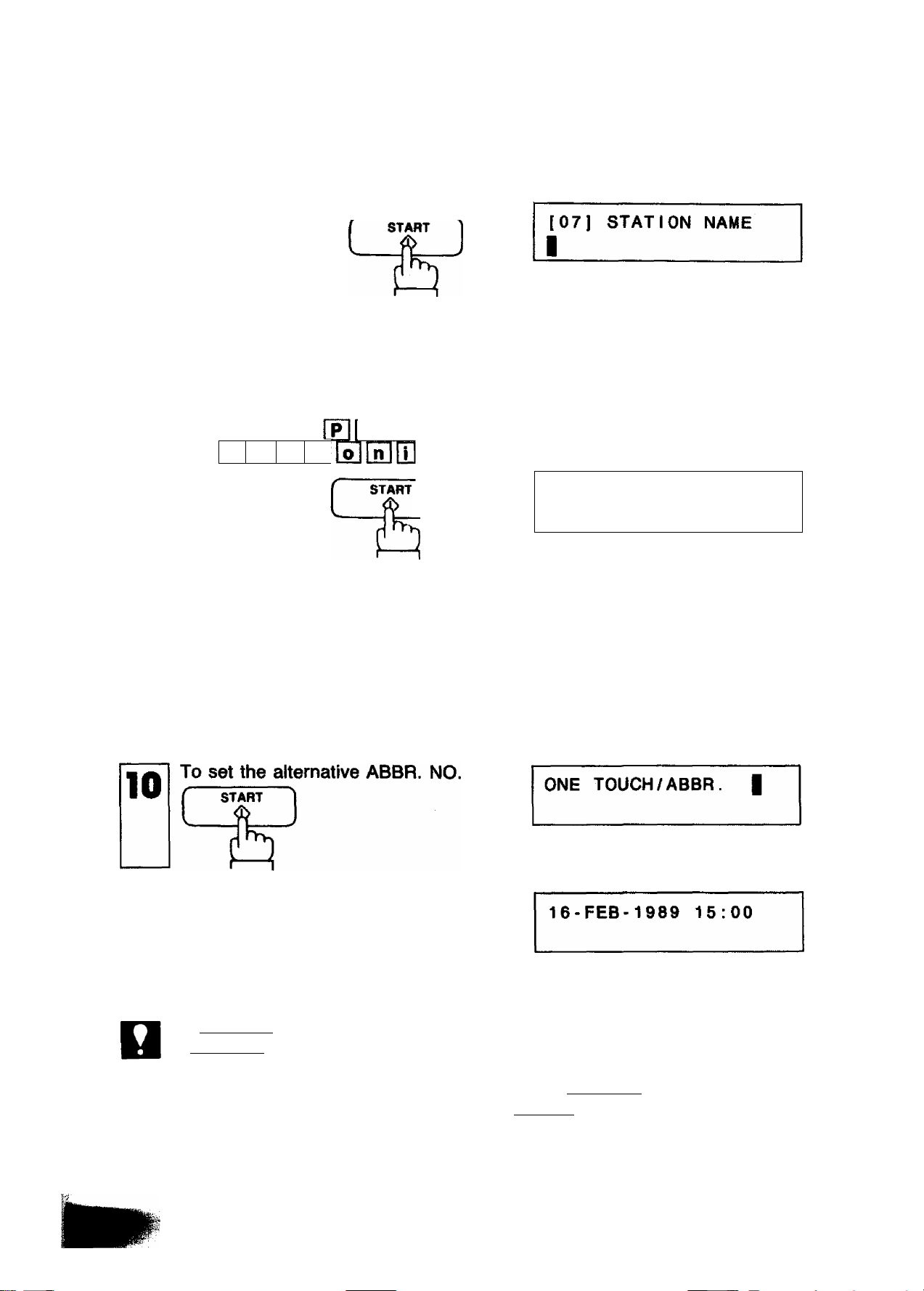
To set the number,
8
Enter receiving station's name (up to 15
characters) using One-Touch/Character
keys (see page 20).
Ex: Panasonic
a
n
a 8
To set the name,
If the receiving party has another
facsimile machine at the same location,
you can enter it here as an alternative
ABBR. NO. by pressing the One-Touch
or ABBR. key.
Ex:
m
UPPER^OWER
■N
[07] STATION NAME
Panason i c|
[07J ALT. ABBR, NO.
1
[07] ALT. ABBR. NO.
[03] (Stat i on name)
11
ноте
Repeat Steps 4 to 10 to record more
numbers, or, to return to standby press
STOP
1. If you want to go back and change anything, e.g., the telephone number, press
I START [repeatedly to skip through the preceding steps. You do not need to reenter
everything again.
2. If your machine is set for Relayed Transmission and/or Confidential Faxes, the display
will show NETWORK ADDRESS when you press I STARTl in Step 10.
3. To print out a One-Touch/ABBR. Dialing Number List, see page 94.
4. The machine does not dial the alternative ABBR. No. when you send a document
by Memory Transmission, Multistation Transmission, Polling, Reverse Polling,
Confidential Communication, and Deferred Communication.
25
Page 28
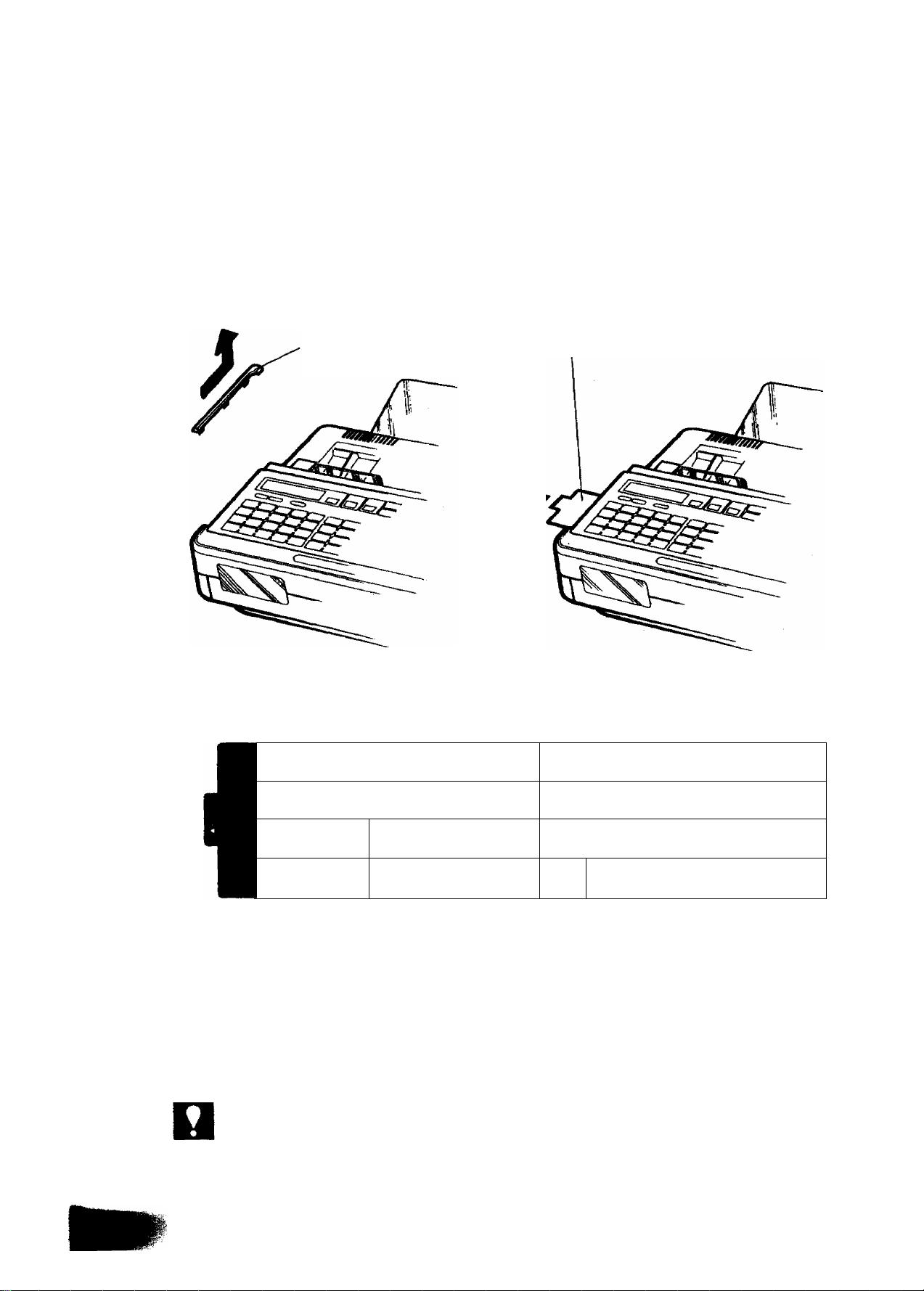
Filling Out the Station Directory Sheet
Slide the Station Directory Cap forward and pull it off. Then pull out the Station
Directory Sheet. Use a pencil or a ball-point pen to fill in the station directory with
station names corresponding to the One-Touch number keys.
Station Directory Cap
01
11
21
'02 '03
1 I
'12 '13
__1______1____
' 22
23
Station Directory Sheet
Station Directory Sheet
*04 *05 06 '07
114
1
'24 '25
’ 15
1
16
26
^7
i
U7
'08
1
'28
'09
»
M9
1
'29 >30
'10
'20
1
_
NOT€
26
31
1 32
i
if you use a pen, be sure the ink is dry. If you use a pencil, remove any excess lead
before replacing the station directory.
Page 29
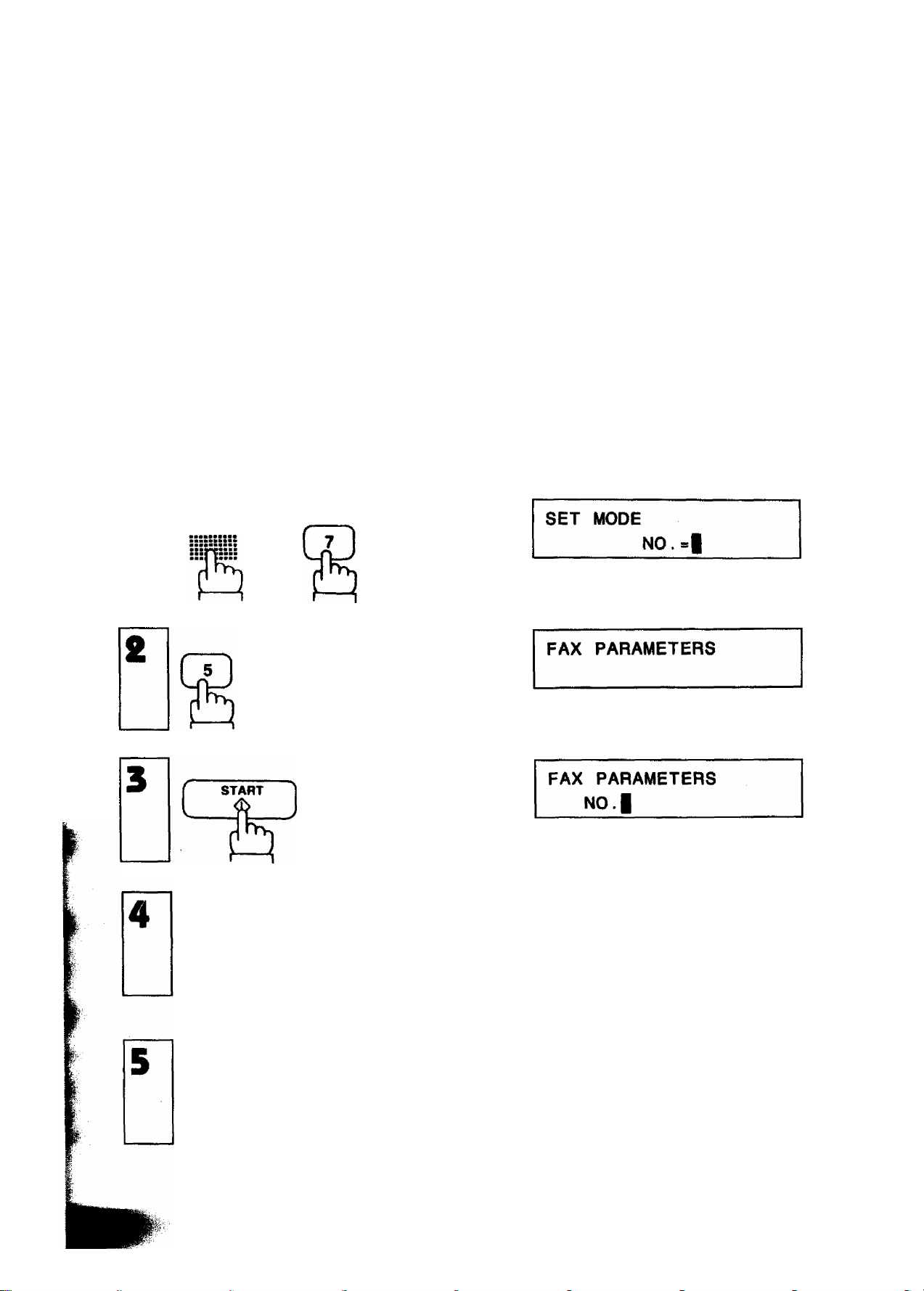
FAX PARAMETERS
Your facsimile machine has a variety of adjustable FAX parameters. These
parameters, listed in the Parameter Table, are normally preset for you and do not
need to be changed. If you do decide to change anything, read the table carefully.
Some parameters, such as the Resolution, Contrast, and Verification Stamp
parameters, can be temporarily changed by simple key operations just before a
transmission is made. When the transmission ends, however, these parameters return
to their preset values. Other parameters can only be changed by the procedure
described below.
Setting Fax Parameters
FUNCTION
1
and
MODE
CZUCZD
. or
Enter a fax parameter number (always 2
digits) from the Parameter Table (see
pages 29 and 30).
Ex: [o] [3] for Verification Stamp ON/
OFF.
Enter the new setting value.
Ex: [2] for Verification Stamp OFF.
(Note: The bracketed number is a factory
preset value which you may ignore.)
n„rQ
repeatedly.
FAX PARAMETER
N0.03(1]»B
FAX PARAMETER
NO. 03[1]=|
27
Page 30
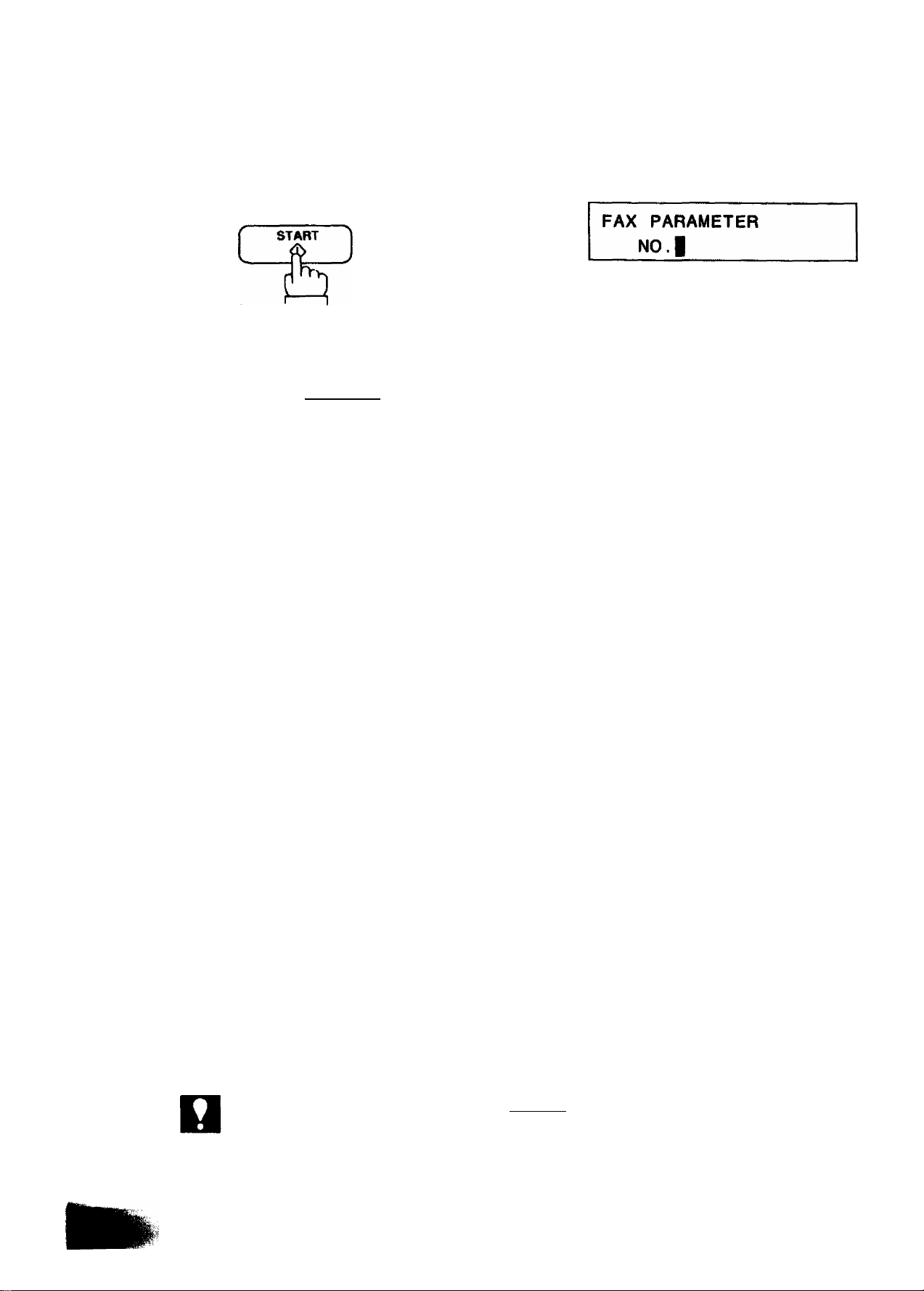
You can now return to Step 4 to set the
next parameter, or, return to standby by
pressing
STOP
16-FEB-1989 15:00
NOT€
28
1. To cancel any digit entered, press CLEAR in step 5, and then start again from
step 3.
2. To print out a Fax Parameter List, see page 98.
Page 31

Parameter Table
Parameter
number
01
02
03
04
05
06
Parameter
Resolution
Contrast
(ORIGINAL)
Verification
Stamp
Polled
Automatic
Journal Print
Printout
Heading
Setting
Number
1
2
3 Super Fine
1
2
3 Light
1
2
1
2
1
2
1
2
3
Standard
Inside copy area
Outside copy area
Not printed
Setting
Fine
Normal
Dark
ON
OFF
OFF
ON
Valid
Invalid
Standard
Setting
o
mill
o
0
o
o
o
07
08
09
11 Password XMT
12
15
Dialing
Method
Relayed XMT
Confidential Fax
Password
Reception
ECM
(Error Correction
Mode)
1
2
1
2
1
2
1
2
1
2
1
2
Tone
Pulse
Invalid
Valid
Invalid
Valid
OFF
ON
OFF
ON
OFF
ON
o
o
o
o
0
o
29
Page 32

Parameter Table
Parameter
number
17
18
19
20
21
Parameter
Substitute
Reception
Verification
Stamp for Docu-
ments Stored
into the Memory
Automatic
Individual XMT
Journal
Fax Access
Code
Password XMT
Setting
Number
1 OFF
2
1
2
1 OFF
2
1
2
1
2
Setting
ON
OFF
ON
ON
Invalid
Valid
Invalid
Valid
standard
Setting
О
о
О
О
о
NOTC
22
To use a function which has Valid/Invalid parameter, set the parameter in the Valid
position. You may then reset the function's standard setting to on or off.
Password RCV.
FUNCTION
1
2
ValidInvalid
Invalid
Valid
ON
OFF
о
Page 33

USING MUTE AND ADJUSTING VOLUMES
Using Mute
When you are using the fax machine's built-in telephone,
you can temporarily turn off the microphone in the handset.
I cyjg I on the handset. As long as you hold down
this button, your caller cannot hear you.
Setting the Ringer Volume
You can adjust the RINGER VOLUME so the fax machine
rings at a comfortable level when it receives a call. Move
the ringer control on the handset to the level desired, either
normal or reduced.
Mute Button
Ringer Volume
Setting the Speaker Volume
When the fax machine is making a call, you hear the dial
tone, the dialing signals, and the ringing or busy signal
through the built-in speaker. Rotate the SPEAKER
VOLUME control on the right side of the unit to adjust the
volume to a comfortable level. You also hear the called
person’s voice through the speaker if the other station is
set to manual reception. In this case, you can talk with
the called person, by lifting the handset and oressino
I oTrtP I / rr/v » speaker Volume
I STOP I (see page 71).
Your handset may have a different type of Mute Button and Ringer Volume from the
ones shown above.
Mute Button i MUTE 1
Ringer Volume
VOLUME
LOW o o HIGH
31
Page 34

SENDING DOCUMENTS
LOADING DOCUMENTS
Documents You Can Send
In general, your machine will send any document printed on A4’Size paper or paper
up to B4 size.
Documents You Cannot Send
You must never try to send documents that are;
• Wet
• Covered with wet ink or paste
• Wrinkled, curled or folded
• Too thin (e.g. onionskin, airmail paper, pages from some magazines, etc.)
• Too thick (e.g. card, etc.)
• Chemically processed (e.g. pressure-sensitive paper, carbon-coated paper,
etc.)
• Coated (e.g. glossy paper, etc.)
• Smaller than 148 mm(W) x 73 mm(L)
• Made of cloth or metal
To transmit these kinds of documents, make a photocopy first, and then transmit
the copy instead.
How to Use the Carrier Sheet
If you send documents wrinkled, curled, folded, too thin, or smaller than 148 mm(W)
X 73 mm(L), you can send them using the Carrier Sheet. Put them in the Carrier
Sheet, and then place the carrier in the ADF with the sealed edge first.
Multisheet : 0.06 mm to 0.10 mm
2. Transmitting documents longer than 297 mm up to 1000 mm requires operator's
assistance.
3. You cannot load the carrier sheet and other documents together on the ADF.
Page 35

Loading Documents
First, make sure that your document is free of
staples and paper clips, and is not torn, greased
or covered by any foreign objects.
Place the document face down on the Automatic
Document Feeder (ADF) with the top edge going
into the machine and slide forward until it stops.
Adjust the sliding document guides to ensure that
the document is centered on the ADF.
If you are sending two or more pages, make sure
that the bottom sheet enters first. You can also
stack up to 30 sheets on ADF at one time. If you
want to send more pages, you can place them
on top of the last page on the ADF once
transmission has started, as long as you do not
have more than 30 sheets on the ADF at any one
time.
Face down
When you set a document on the ADF the display
message will change from date and time
(standby) to DOCUMENT SET. You can now
make basic transmission settings, or begin the
dialing procedure.
33
Page 36

BASIC TRANSMISSION SETTINGS
You can temporarily change seven basic settings (Resolution, Contrast, Halftone,
Total Pages, Verification Stamp, Individual Transmission Journal and Error Correction
Mode) before any ordinary transmission. These settings can be altered before or after
you place documents on the ADF. After you finish transmission, your machine will
automatically return to the preset settings. You can also change these settings during
transmission.
Resolution
Your machine is preset to Standard resolution, which is suitable for ordinary
documents. Use FINE or Super-FINE for very detailed documents.
1
2
RESOLUTION
RESOLUTION
satisfied, go to Step 4.
RESOLUTION
To return to Standard, press
RESOLUTION again.
DOCUMENT SET
RESOLUT ION=STD
(STD = Standard)
DOCUMENT SET
RESOLUT ION=F I NE
DOCUMENT SET
RESOLUTION'S FINE
4
NOT€
34
You can now dial by pressing
TEL/DIAL] and a full number,
a One-Touch key, IABBRI and two
digits, or REDIAL
1. After changing the Resolution setting, you can
a) go to standby with [ STOP I.
b) make a copy of the document to test the new Contrast setting by pressing | COPY
c) start a different series of settings by pressing | RESOLUTION |, I HALF TONE
I STAMP I, MODE [E]C±] » or I FUNCTION
2. To change the preset Resolution position, see page 27.
Page 37

Original (Contrast)
Your machine is preset to NORMAL contrast. If you have to send a document with
dark contrast, you may get better results by changing the setting to DARK. If you
have to send a document with light contrast, it may be wise to change the setting
to LIGHT. As a test, you can make a trial copy before transmitting (see page 60).
1
2
ORIGINAL
If satisfied, go to step 4.
ORIGINAL
To return to NORMAL, press I ORIGINAL
again.
DOCUMENT SET
ORIGtNAL^NORMAL
DOCUMENT SET
ORIGINAL^DARK
DOCUMENT SET
ORIGINAL=LIGHT
4
NOT€
You can now dial by pressing
TEL/PIALI and a full number,
a One-Touch key, [ABBR I and two
digits, or REDIAL I.
1. After changing the Contrast setting, you can
a) go to standby with \ STOP .
b) make a copy of the document to test the new Contrast setting by pressing I COPY
c) start a different series of settings by pressing | RESOLUTION |, I HALF TONE |.c) start a different series of settings by pressing | RESOLUTION |, I HALF TONE
STAMP I. MODE lin . or I FUNCTION
w ■ [ f I I f ■ I I ~ - —- | •
2. To change the preset Contrast position, see page 27.
35
Page 38

Halftone
The Halftone setting is useful when sending photographs or illustrations with gray
tones. Your machine is preset to HALF TONE = OFF. To switch to HALF TONE=ON,
1
HALF TONE
■MO
TT
Your display should show HALF
TONE = OFF.
HALF TONE
■ »■
n
In this case Resolution is automatically
set at FINE. If you wish to go to HALF
TONE^OFF, press I HALF TONE laaaln.
You can now dial by pressing
and a full number, a One-Touch key,
^BBRI and two digits, or I REDIAL I.
________ __
DOCUMENT SET
HALF TONE=OFF
DOCUMENT SET
HALF TONE=ON
ноте
36
After changing the Halftone setting, you can
a) return to standby with STOP
b) make a copy of the document to test the new Halftone setting by pressing ICOPY
c) start a different series of settings by pressing I ORIGINALI , I STAMP
Q[±] . or I FUNCTION I .
MODE
Page 39

Verification Stamp
The verification stamp helps you to confirm successful transmissions by stamping
the bottom of each successfully transmitted page with a small pink mark. Your
machine is preset to STAMP = ON. To set the Verification Stamp to OFF,
1
STAMP
STAMP
• II
11
To return to STAMP = ON, press
STAMP I again.
You can now dial by pressing itEL/DiALl
and a full number, a One-Touch key,
ABBRI and two digits, or I REDIAL I.
DOCMENT SET
STAMP=ON
4
DOCUMENT SET
STAMP=OFF
NOT€
1. After changing the Stamp setting, you can
a) return to standby with I STOP |.
b) start a different series of settings by pressing I RESOLUTION I, [ORIGINAL |,
HALF TONE], MODE E][±], or [FUNCTIOjiF
2. To change the preset Stamp position, see page 27.
3. When you use memory transmission, Verification Stamp will not function. If you wish
the Verification Stamp to operate during memory transmission, see Setting Fax
Parameters (page 27).
37
Page 40

Total Pages
The page number will be printed at the top of each page you send. You can also
set, however, the total number of pages you send so that it will be printed on each
page in addition to the page number, (e.g., 01/05, 02/05, etc.)
1
2
MODE
repeatedly.
Enter any number 1-99. If you make an
error, press I CLEAR I and reenter the
correct number.
Ex;
You can now dial by pressing iTEL/PiALl
and a full number, a One-Touch key,
ABBRi and two digits, or REDIAL
DOCUMENT SET
TOTAL PAGES.>|
DOCUMENT SET
TOTAL PAGES»5|
NOT€
38
1. This setting is not required if you are storing the document into the memory, because
the machine automatically performs this function.
2. After changing the Pages setting, you can
a) return to standby with I STOP |.
b ) start a different series of settings by pressing I RESOLUTION 1,1 ORIGINALI,
I STAMP I, I HALF TONE I, MODE 0[T1. or
FUNCTION
Page 41

Error Correction Mode (ECM)
ECM mode provides error free copy when your fax machine is connected with a
receiving fax machine which has ECM mode capabiiity and your ECM mode is set
to ON. The transmission time required in the ECM mode is the same as the normal
G3 mode in most cases.
Your machine is preset to ECM=ON. If the telephone line is poor, then the
transmission wilt take longer because the machine will have to retransmit the lines
that have errors. In the case where the transmission time is more important than the
quality of the received copy, you may set your fax machine to ECM - OFF. This
will inhibit the ECM mode for the transmission regardless of the capability of the
receiving machine. To set ECM = OFF,
1
MODE
c:- II -t- )
DOCUMENT SET
ECM=ON
repeatedly.
DOCUMENT SET
ECM=OFF
To return to ECM - ON, press SELECT
again.
You can now dial by pressing TEL/PIAL
and a full number, a One-Touch key,
ABBR
and two digits, or
REDIAL
fiOT€
1. After changing the ECM setting, you can
a) return to standby with I STOP I.
b) start a different series of settings by pressing RESOLUTION 1, ORIGINAL
I STAMP I. I HALF TONE 1, MODE [□[+], or I FUNCTION
2. To change the preset ECM position, see page 27.
39
Page 42

Automatic Individual Transmission Journal (XMT JRNL)
You may want to keep a separate record of each transmission you make to some
or all your clients. Your machine can save you the trouble of writing records by printing
out a Transmission Journal for you at the end of any particular transmission. To set
XMT JRNL == ON,
1
MODE
CZHIZZD
repeatedly.
To return to XMT JRNL = OFF, press
SELECT ] again.
You can now dial by pressing I teL/DIALI
and a full number, a One-Touch key,
ABBRI and two digits, or REDIAL
DOCUMENT SET
XMT JRNL=OFF
DOCUMENT SET
XMT JRNL=>ON
NOT€
40
1. After changing the XMT JRNL setting, you can
a) return to standby with | STOP |.
b) start a different series of settings by pressing
HALF TONE I, I STAMP I MODE HE» or ] FUNCTION
2. To change the preset position, see page 27.
3. This setting is not required if you are storing the document into the memory, because
the machine automatically performs this function.
RESOLUTION1 . I ORIGINAL I.
Page 43

DIALING TECHNIQUES
This section explains how to perform the following:
• Direct Dialing
• One-Touch Dialing
• Abbreviated Dialing
• Redialing
Direct Dialing (On-Hook Dialing)
1 Place a document face down on the ADF.
Adjust left and right Document Guides.
Document Guide
1
•ц
I
3
NOTC
Use the keypad to '‘diar’ a number.
Ex: 15||5|151-Ш[2|Щ|4|
(See Note)
Your machine will dial the number. If the
line is free, your documents will be sent.
If the other station has an ID, it will appear
on the display.
If you need a special access number to get an outside line, dial it first and then press
PAUSE I to enter a pause (represented by a before dialing the full
number.
Example: [9llPAUSEHsir5lfi1[Tlf^[3lf4
* DIALING ♦
5551234|
ON LINE ^ XMT ♦
5551234
ON LINE * XMT *
ID:516 555 1234
41
Page 44

When transmission ends, the dispiay
shows the number of pages sent.
COMPLETED
TOTAL PAGES=05
If the line is busy, your machine will redial
the number for you up to twice with three
minute intervals.
If no contact is made, the dispiay will
show an Information code, (see page 101).
or
WAITING TO DIAL
5551234
INCOMPLETE
INFO C0DE=630
ноте
42
1. If the line is still busy after the second automatic try, you can start another round of
automatic dialing by pressing I REDIAL I (see page 48).
2. If you hear a voice speaking through the speaker, pick up the handset and press I STOP I
to a talk to the other party (see page 71).
Page 45

Off-Hook Dialing
1
Place a document face down on the ADF.
Adjust left and right Document Guides.
Lift the handset.
Use the keypad to diai a number.
Ex: IIlSBillilllllS]
Document Guide
DOCUMENT SET
5551234|
4
NOT€
When you hear a beep sound,
Hang up the handset.
If the other station has an ID, it will appear
on the display.
When transmission ends, the display
shows the number of pages sent.
If the line is busy, hang up the handset.
Then try again several minutes later by
pressing
If you need a special access number to get an outside line, dial it first and then
press 1 PAUSE I to enter a pause (represented by a hyphen **•") before dialing the
full number.
Example: f PAUSE I [s1 HI fTl f?l ITI
ESMnm
__________
ON LINE * XMT *
ON LINE * XMT *
ID;516 555 1234
COMPLETED
TOTAL PAGES-06
* DIALING *
5551234
5551234
43
Page 46

One-Touch Dialing
1
Place a document face down on the ADF.
Adjust left and right Document Guides.
Press a One-Touch key.
Ex: 07
The display will show the ABBR. No. and
station name. The full number (e.g. 9-555
1234) will then be dialed and shown on
the display.
Document Guide
* DIALING *
[07] (Station name)
* DIALING ^
9-555 1234
If the number dialed answers, document
transmission will start. If the other station
has an ID, it will appear on the display.
When transmission ends, the display will
show the number of pages sent.
When alternative ABBR. NO. Is set.
If the number is busy, the machine will
automatically dial the alternative ABBR.
NO. which you have already recorded.
Ex: 111 I (See page 25.)
If the alternative number is also busy, the
machine will wait three minutes and then
automatically redial the 1st number and
alternative number each up to twice in the
same way.
COMPLETED
TOTAL PAGESsOS
^ DIALING *
[11] (Station name)
WAITING TO DIAL
(071 (Station name)
44
Page 47

When altemative ABBR, NO. is not set.
If the number is busy, the machine will
wait three minutes and then automaticalty
redial the same number up to twice.
If no contact is made, the display will
show an information code (see page 101).
WAITING TO DIAL
[07] (Stat i on name)
INCOMPLETE
INFO. CODE=630
NOT€
1. To redial a busy number, see page 48.
2. The machine does not dial the alternative ABBR. No when the document is sent by
Memory Transmission or Relayed Transmission.
3. If you hear a voice speaking through the speaker, pick up the handset and then press
I
STOP i to talk to the other party (see page 71).
45
Page 48

Abbreviated Dialing
1
Place a document face down on the ADF.
Adjust left and right Document Guides.
The display will show the two-digit code
and station name. The full number (e.g.
555 1234) will then be dialed and shown
on the display.
Document Guide
* DIALING *
[62] (Station name)
* DIALING *
555 1234
If the number dialed answers, document
transmission wilt start. If the other station
has an ID, it will appear on the display.
When transmission ends, the display will
show the number of pages sent.
When alternative ABBR. NO. is set.
If the number is busy, the machine will
automatically dial the alternative ABBR.
NO. which you have already recorded.
Ex:
701 (See page 25.)
If the alternative number is also busy, the
machine will wait three minutes and then
automatically redial the 1st number and
alternative number up to twice in the
same way.
ON LINE ♦ XMT *
ID;
COMPLETED
TOTAL PAGES=05
* DIALING *
[70] (Station name)
WAITING TO DIAL
[62] (Stat i on name)
46
Page 49

When alternative ABBR. NO. is not set.
If the number is busy, the machine will
wait three minutes and then automatically
redial the same number up to twice.
WAITING TO DIAL
[62] (Station name)
If no contact is made, the display will
show an information code (see page 101).
1..^
INCOMPLETE
INFO. CODE«630
NOT€
1. To redial a busy nunftber, see page 48.
2. The machine does not dial the alternative ABBR. No when the document is sent
by Memory Transmission or Relayed Transmission.
3. If you hear a voice speaking through the speaker, pick up the handset and then
press [STOP I to talk to the other party (see page 71).
47
Page 50

Redialing
If the number you dialed is busy or there is no
answer, your machine will wait three minutes and
then automatically redial the number for you up
to twice.
If no contact is made, the display will show an
information code.
In this case, you can redial the last number (e.g.
07) by simply pressing I REDIAL I.
You can use Redial after dialing a number using
one of the following,
• One-Touch dialing
• Abbreviated dialing
• Direct dialing from the keypad
• Redialing
Your machine will redial the last number a total
of three times.
* DIALING *
[07) (Station name)
INCOMPLETE
INFO. (X>DE»630
WAITING TO DIAL
[07] (Station name)
* DIALING *
[07](St a t ion name)
I
'S-.-
Even if you make contact and succeed in sending
your documents, you can still use I REDIAL I to
contact the same number again.
48
Page 51

MEMORY TRANSMISSION
The memory function allows you to perform easily many different tasks. If you wish,
you can store your documents into memory and then have the machine transmit the
stored documents. After transmission is completed, the stored documents are erased
automatically.
The advantages of memory transmission are:
1. The same document can also be transmitted to multiple stations.
2. If communications fail when transmitting from the memory, your machine will
retransmit the remaining unsuccessful page(s) automatically.
NOT€
1. When you use memory transmission, a Memory Transmission Journal (COMM.
JOURNAL) is printed out automatically after transmission. This report lets you verify
if transmission was successful or not (see page 92).
2. If a memory overflow condition occurs while storing document(s) into the memory,
the machine will start transmitting those pages which are successfully stored. If you
wish to cancel this transmission, press I STOP I and confirm on the display (see
Specifications, page 147 for the Image Memory Capacity).
4
MEMORY
INFO
3. The File Number of the document being stored is shown at the upper right corner
of the display while storing takes place. It is also printed on the Memory Transmission
Journal (COMM. JOURNAL). The percentage of memory used is shown at the lower
right corner of the display after each page is stored.
* STORE *
4. INFO. CODE = 633 will be displayed if there is no answer at the receiving side after
the last automatic redial. The document stored for this transmission will be erased
from the memory automatically and the Memory Transmission Journal (COMM.
JOURNAL) will be printed out stating the transmission is “INC’* (Incomplete).
INCOMPLETE
INFO. CODE=633
OVERFLOW
C0DE=870
PAQES°02
NO. 003
10%
5. If a power failure occurs, the document information stored in the machine’s memory
will be lost. In this case the Power Failure Report wilt be printed out automatically
after the Power is turned ON again. The report is not printed out when there are no
documents stored in the memory (see page 100).
49
Page 52

Memory Transmission to Singie Station
If you have a number of pages to send to a single station, you can save time by using
the memory. That is, you can store the document in your machine’s memory and
then have it transmitted to the station automatically.
1
2
4
Place a document face down on the ADF.
Adjust left and right Document Guides.
MEMORY/
MULTIFILE
Dial by pressing a One-Touch key,
ABBRI and two digits, or TEL/DIAL
and a full number.
Ex: One-Touch key
To store the document into the memory
START
<
__
____^_______
DOCUMENT SET
ENTER STATION(S)
DOCUMENT SET
[011 (Station name)
♦ STORE * N0.002
PAGES^OI 01%
* STORE ♦ COMPLETED
NOTC
50
n
TOTAL PAGES=05 24%
The machine begins dialing automati
cally.
* DIALING *
[011 (Station name)
When transmission is completed, a
Memory Transmission Journal (COMM.
JOURNAL) is printed out.
If you press I STOP] while the machine is still dialing or sending a docu
ment, the machine will ask for confirmation on the display. If you select YES, the rest
of the transmission will be canceled and the documents stored in the memory wilt be
erased automatically.
Page 53

'■i $i'-
■
■■ I;
fc.--
I'
■ k:
ii.
Multistation Transmission
Using the built-in memory you can send a document to more than one station at one
time. This saves you the trouble of sending the same document to each station one
after another.
1
Place a document face down on the ADF.
Adjust left and right Document Guides.
Dial by pressing a Program key.
Ex:[PT1
(See Note 2.)
Dialing begins automatically.
When transmission ends the machine will
print out a Memory Transmission Journal
(COMM. JOURNAL) (see page 92) and
the document in the memory will be
erased automatically.
DOCUMENT SET
[P1I (Program name)
* DIALING *
[07](Stat ion name)
♦ PRINTING *
COMM. JOURNAL
NOTC
The machine returns to standby.
1. To use a Program key for Group dialing, the key must be set properly in advance
(see page 77).
2. If more than one station has been registered in the Program key, the machine will
store the document in the memory before the dialing.
51
Page 54

2b
MEMORY/
MULTIFILE
Dial by pressing a One-Touch key,
ABBR and two digits, ITEL/DiALI and
a full number, a Program key or any
combination of these.
Ex; [P2]and 1АВВВ|[УИУ
DOCUMENT SET
ENTER STATION(S)
DOCUMENT SET
(P2] (Program name)
DOCUMENT SET
[571 (Station name)
To store the document.
Dialing begins automatically.
When transmission ends the machine will
print out a Memory Transmission Journal
(COMM. JOURNAL) (see page 92) and
the document in the memory will be
erased automatically.
The machine returns to standby.
♦ STORE *
PAGES ==01
* STORE * COMPLETED
TOTAL PAGES=05 12%
* DIALING ♦
[07](St a t ion name)
* PRINTING *
COMM. JOURNAL
16-FEB-1989 15:00
N0.003
00%
NOT€
52
1. If the Program key is set for timer controlled communication or polling, the key will
not be accepted in Step 2b.
2. You can enter up to three Direct dialings by pressing [TEL/DIAL land a full number.
3. To review the entered station(s) in Step 2b before going to the next step, press MODE
El El ■ If you find an error, press I CLEAR I to erase the displayed station.
4. If you press I STOP 1 white the machine is still dialing or sending the document the
machine will ask for confirmation on the display. If you select YES, the rest of the
multistation transmission will be canceled and the document stored in the memory
will be erased automatically.
Page 55

Multifile Transmission
When you have to send several documents to different stations (or different groups
of stations), you don’t have to make separate transmissions. You can store ail the
different documents into the memory and program the machine to dial each number
(or each group of numbers) for each document, instead of sending the documents
separately, you can reserve all the procedures at one time.
Doc. A
To: • New York
• London
• Singapore
i
Doc. B
To: • Chicago
• Los Angeles
• Vancouver
I 1
UF-260’s Memory
Doc. C
To: • Geneva
• Rome
Doc. D
To: • Singapore
• Tokyo
• Hong Kong
j
f t
Dial
• New York
• London
I-
• Singapore
Dial
• Chicago
• Los Angeles
• Vancouver
Dial
Dial
• Geneva
• Rome
f
• Singapore
• Tokyo
• Hong Kong
53
Page 56

1
Place a document face down on the ADF.
Adjust left and right Document Guides.
MEMORY/
MULTIFILE
DOCUMENT SET
ENTER STATION(S)
Dial by pressing a One-Touch key,
ABBRIand two digits, ITEL/DIAL!and
a full number, a Program key, or any
combination of these.
Ex: mi and I aBBRI Q] [2]
To store the document,
’^MEMORY/
MULTIFILE
•«Ml
To send another document to other
stations, set the another document on the
ADF, then repeat Steps 3 and 4.
DOCUMENT SET
ENTER STATION(S)
DOCUMENT SET
IP11 (Program name)
DOCUMENT SET
[12] (Stat i on name)
♦ STORE *
PAGES=01
* STORE * COMPLETED
TOTAL PAGES>05 24%
N0.021
01%
54
Page 57

The machine starts dialing for each
transmission.
When all the transmissions end, the
machine wilt print out Memory
Transmission Journals (COMM.
JOURNAL) for each transmission and the
documents in the memory will be erased
automatically.
* DIALING ^
(Stat ion name)
NOT€
TEUDIAL and a full1. Y0U can enter up to three direct dialings by pressing
number for each document.
2. To use a Program key for Group Dialing, the key must be set properly in advance
(see page 77).
3. To review the entered station(s) in Step 3 before going to the next step, press MODE
[~^ or ¡3. If you find an error, press I CLEAR | to erase the displayed station.
4. If you press I STOP I while the machine is still dialing or sending a document, the
machine will ask for confirmation on the display. If you select YES, the rest of the
multistation transmission will be canceled and the documents stored in the memory
will be erased automatically.
55
Page 58

TRANSMISSION RESERVATION
If you are in a hurry to send some documents, but your facsimile machine is busy
with receiving documents or memory transmission, you can save time by reserving
the machine for transmission. “Reserving” means presetting a One-Touch,
Abbreviated Dialing, or full telephone number. Then, when the machine has finished
receiving or memory transmission, it will automatically begin to dial the number you set.
Setting Transmission Reservation
1
Place a document face down on the ADF.
Adjust left and right Document Guides.
Adjust basic settings, e.g. Resolution
(see pages 34 - 40).
XMT RESERVE
ENTER STATION
XMT RESERVE
RESOLUTION^FINE
4
56
Dial by pressing a One-Touch key,
^BBRI and two digits, or ITEL/PIAL
and a full number.
Ex: One-Touch key QE
XMT RESERVE
[15] (Station name)
ON LINE * RCV *
XMT RESERVED
Page 59

Setting Memoiy Transmission Reservation
With the memory function, you can reserve the machine to perform transmission or
another operation after the completion of the current operation.
1
2
Place a document face down on the ADF.
Adjust left and right Document Guides.
^ XMT
RESERVE
To use memory Transmission,
MEMORY/
MULTIFIU
XMT RESERVE
ENTER STATION
XMT RESERVE
ENTER STATIONfS)
XMT RESERVE
[03] (Station name)
I
NOTC
XMT RESERVE
and dial by pressing a One-Touch key,
ABBRI and two digits, ITEL/PIALI and
a full number, a program key, or any
combination of these.
Ex: One-Touch key loslfd^
1. If you press STOP while the machine is still dialing or sending the document, the
machine will ask for confirmation on the display. If you select YES, the rest of the
transmission will be canceled and the documents stored in the memory will be erased
automatically.
2. To cancel XMT reserve while your machine is still receiving documents for memory
transmission, see page 59.
[04] (Station name)
57
Page 60

transmitting from memory is completed,
the machine will begin storing the
document into the memory. Then it will
start dialing automatically. When
transmission ends, the machine wili print
out a Memory Transmission Journal.
58
Page 61

Canceling Transmission Reservation
If necessary, you can also cancel XMT RESERVE while your machine is still busy
with receiving documents or memory transmission.
1
Remove the document from ADF.
The number you reserved will appear.
ON LINE *MEM. XMT*
XMT RESERVED
or
ON LINE * RCV *
XMT RESERVED
XMT RESERVE
[15] (Station name)
XMT RESERVE
ENTER STATION
Now, when your machine finishes
receiving documents or memory
transmission it wilt automatically return to
standby.
or
59
Page 62

MAKING COPIES
Before you send a document, you can make a copy of it to see what it will probably
look like to the person who receives it.
Single Copies
1
Place a document face down on the ADF.
Adjust left and right Document Guides.
If necessary, adjust |
I
, and
(review pages 34 - 36).
RESOLUTION
HALF TONE
Document Guide
NOT€
The machine begins making a copy.
1. To stop the copy process, press [STOP
2. To make copies of more than 30 pages, add additional pages while at least one page
stilt remains on the ADF.
3. When making a copy, your machine will automatically select Fine Resolution, unless
you change the setting.
Page 63

Multiple Copies (Using the Memory)
If you want to make two or more copies of a document, use the following procedure.
1
Î'
2
Place a document face down on the ADF.
Adjust left and right Document Guides.
If necessary, adjust I RESOLUTION I ,
I ORIGINAL I , and I HALF TONEl .
(review pages 34 - 36).
^MEMORY/
MULTIFILE
-3^
DOCUMENT SET
ENTER STATION(S)
NOT€
Enter the number of copies.
EX: 3
f
START
__
^ J
V
The machine begins storing the
document, then prints out copies.
When you make multiple copies of a single>page document or multi-page docu
ment, copies are made page by page.
COPY
NO, OF C0PY=3|
* COPY *
NO. OF COPY=00/03
* COPY *
NO. OF COPY=01/03
* COPY *
NO. OF COPY=03/03
61
Page 64

RECEIVING DOCUMENTS
AUTOMATIC RECEPTION
When your facsimile machine is preset to receive documents automatically, do not
answer the telephone when it rings. The machine will soon begin receiving.
MANUAL RECEPTION
How to Set Manual Reception
If there is only one telephone line in your office and you wish to use the telephone
line for both Fax and Voice, you may set the machine to Manual Reception.
1
2
MODE
C^E±Z)
repeatedly.
SELECT
To return to RCV = AUTO, press
SELECT I again.
To return to standby
16-FEB-1989 15:00
RCV-AUTO
16-FEB-1989 15:00
RCV»MANUAL
16-FEB-1989 15:00
MANUAL RCV
Page 65

What to Do When Your Telephone Rings
If your machine is set for manual reception and the telephone rings,
1
Lift the handset.
If you hear a beep beep - beep sound,
it means someone wants to send a fax.
Or,if the caller answers and says he/she
wants to send a fax, then —
2
Remove a document from the ADF, if any.
START
Your machine starts receiving a
document.
Hang up the handset.
If the other station has an ID, it will appear
on the display.
ON LINE * RCV *
ID: 415 111 1234
63
Page 66

SUBSTITUTE RECEPTION
(MEMORY RECEPTION)
If the recording paper runs out in the middle of a page during reception, the machine
will stop recording and automatically start receiving into its image data memory. Stored
documents are automatically printed out from the top of the page that resulted in
an incomplete recording when a new roll of recording paper is loaded.
1
2
When the machine finishes the memory
reception and there is no recording paper,
an Information code appears on the
display.
Open the Receiving Unit and replace the
recording paper (see page 103).
Shut the Receiving Unit.
After loading new recording paper, the
machine will automatically start printing
out the document stored in the memory,
which will be erased when printing is
completed.
The machine will return to standby.
NO RECORDING PAPER
INFO.CODE=010.
* PRINTING *
MEMORY RCV'D DOC.
16-FEB-1989 15:20
NOT€
1. You can replace the recording paper while the machine is storing a document in the
machine’s memory.
2. When the memory overflows, the machine will stop receiving and release the
communication line. The document(s) stored in the memory up to that moment will
be printed out automatically.
3. If a power failure occurs, the document information stored in the machine’s memory
will be lost. In this case the Power Failure Report (see page 100) will be printed out
automaticatly after the Power is turned ON again. The report is not printed out when
there are no documents stored in the memory.
Page 67

POLLING
Polling means calling other station(s) to retrieve the document. The other station must
know in advance that you will call, and must have a document set on the ADF or
stored in the memory. You also need to set a polling password, shared by the other
station, to ensure security.
How to Set the Polling Password
If you have just set your ID No. and pressed
start from step 1.
FUNCTION
1
and
MODE
Œ3CHZ)
\ and
6Л
4 Enter four-digit password.
1
START , skip to step 3. If not
ноте
Ex: HEIT]E
DATE & TIME
|6-02-1989 15:00
1. Polling might not function with all fax machines. We suggest you attempt a trial polling
before you actually poll for important documents.
2. If you make a mistake in Step 4, use the \ < I or | ► | key to move the cursor to the
incorrect number, and then enter the new number over it. To erase the password,
press I CLEAR
3. If password is not set in the other station, you can poll the other station even though
your machine has a password.
_________
65
Page 68

How to Prepare to be Polled
In order to let other stations poll your machine, you must set your machine with a
document on the ADF. Be sure to set the polling password (see page 65) before setting
the document on the ADF. After being polled, your machine will automatically return
to the preset setting.
1
2
Place a document face down on the ADF.
Adjust left and right Document Guides.
MODE
repeatedly.
Document Guide
DOCUMENT SET
POLLED=OFF
DOCUMENT SET
POLLED=ON
NOT€
66
You are now set for POLLED=ON. If you
press SELECT again, the setting
will return to POLLED«OFF.
You can still receive ordinary transmissions even when set to be polled.
Page 69

How to Poll
The following procedure lets you poll one station, or up to 100 stations. However,
if you want to poll two or more stations, you must use One-Touch dialing or Abbreviated
dialing numbers. Multistation polling does not require a Relay Station. Be sure to
set the poliing password before polling (see page 65).
1
2
FUNCTION
and
Dial by pressing a One-Touch key,
ABBR and two digits, or TEL/DIAL
and a full number.
Ex: lABBRl and [3][5], or
TELyDIALir7]f7l[y]f2
To add more stations, use One-Touch
keys, or ABBR I and two digits.
Ex: One-Touch key [Ts
HSH]
POLLING
ENTER STATION(S)
POLLING
(35) (Stat i on name)
or
POLLING
7772345|
POLLING
[15] (Stat i on name)
NOT€
* DIALING *
[15] (Station name)
1. To erase or change stations set in Steps 2 or 3, press 1 CLEAR 1. If you recorded
several, use MODE or to find the station you want. Then press
CLEAR I. Add new stations with One-Touch keys, or \ ABBR \ and two digits.
2. If a polled station is busy, or does not answer, it will be skipped and the next station
will be polled. The skipped station(s) will be redialed up to twice after all registered
stations have been polled.
3. When polling ends, a Multistation Communication Journal is automatically printed out.
This journal lists the stations polled and indicates whether polling was succ^sful or not.
67
Page 70

Turnaround Polling
(Combined Transmission and Poiiing)
This procedure lets you do two operations with one call, automatically. First, your
machine will send a document to a station, and then It will poll the same station.
Be sure to set the polling password before using the following procedure (see page 65).
Place a document face down on the ADF.
1
Adjust left and right Document Guides.
Document Guide
XMT & POLLING
and
Dial by pressing a One-Touch key,
A8BR and two digits, or TEL/PIAL
and a full number.
Ex: One-Touch key ilO I, or
TEL/DIALl[y]f^fsimf^fT|f4
ENTER STATION
XMT & POLLING
[10] (Station name)
or
XMT & POLLING
S551234|
* DIALING *
[10] (Station name)
or
* DIALING *
5551234
Page 71

USING YOUR UF-260 TELEPHONE
Making a Regular Call
You can use the handset on your UF-260 to make regular calls. To do so, lift the
handset and dial a full number just as you could using on ordinary telephone. If you
wish, you can also use One-Touch/ABBR. keys.
1
Remove any document from the ADF.
Lift the handset.
Dial by pressing a One-Touch key,
ABBR land two digits, or a full number.
* DIALING *
[02] (Station name)
8
* DIALING *
555 1234|
69
Page 72

For Making Voice Contact after Sending/Receiving
You may want to talk to the other person over the telephone after sending or receiving
documents. To do so, perform Step 1 while the machine is still sending or receiving.
When sending
ON LINE * XMT * TEL
When sending/receiving is over and the other party replies the Voice Contact request,
you will har a beep-beep-beep sound coming through the monitor speaker.
ON LINE ♦ XMT ♦ TEL
OPERATOR CALLING
Lift the handset.
ON LINE ♦ RCV ♦ TEL
ON LINE ♦ RCV * TEL
OPERATOR CALLING
When receiving
Talk.
Answering a Voice Contact Request
When you hear a beep-beep-beep sound coming through the monitor speaker, it
means you are receiving a voice contact request. Reply by following the above
procedure from step 2.
Page 73

What to Do When You Hear a Voice through the Speaker 8
:e
1
if the other person’s fax machine is set
for manuai reception, you wiil hear a voice
through the speaker when you try to send
documents.
Lift the handset.
Teli the other person to prepare for
reception.
START
When you hear a beep,
The machine begins sending your
documents.
Hang up the handset.
71
Page 74

TIMER CONTROLLED
COMMUNICATIONS
You can send a document to one or more stations at any fixed time within 24 hours.
Buiit-in timers, one for Deferred Transmission and other for Deferred Foiling, make
this timer communications possible. Note that both Deferred Transmission and
Deferred Polling (see page 74) can be set independently to occur at different times.
Deferred Transmission
1
4
Place a document face down on the ADF.
Adjust left and right Document Guides.
FUNCTION
and
Select 1. XMT.
Enter start time from keypad.
(Use four-digit, 24-hour clock.)
Ex: [2]g] d][H (11:30 p.m.)
DEFERRED COMM. NO.°|
1:XMT 2:POLLING
START TIME 23:30
ENTER STATION(S) |
Dial by pressing a One-Touch key, or
ABBRI and two digits.
Ex: One-Touch key [ 021
To add more numbers (100 maximum),
repeat Step 5.
Ex; One-Touch Key ®
START TIME
[021
START
[051
(Stat ion
TIME
(Stat ion
23:30
name)|
23:30
name)|
Page 75

The documents on the ADF are fed into
the machine and stored into the memory
automaticaify with a file number.
* STORE * N0.001
PAGES*01 01%
* STORE * COMPLETED
TOTAL PAGES*05 24%
The standby display and Deferred XMT
display will flash alternately until
transmission actually takes place.
16-FEB-1989 15:00
DEFERRED XMT 23:30
[02] (Station name)
ноте
1. If you enter a wrong number in Step 4, press I CLEAR
number.
2. You cannot use Direct dialing in Step 5. All called stations for Timer Controlled
Communications must be set in advance in One-Touch/ABBR. keys.
3. When Timer Controlled Communication is set, you can still send, poll, or copy
documents. To send, poll, or copy, simply follow the normal procedure.
4. You cannot use SET MODE functions when Timer Controlled Communication is set.
5. To cancel or change the settings, see page 75.
then reenter the right
73
Page 76

Deferred Polling
1
4
FUNCTION
and
Select 2. POLLING
Enter start time from keypad.
(Use four-digit, 24-hour clock)
Ex: [a U] ID E (2:30 a.m.)
Dial by pressing a One-Touch key, or
ABBRI and two digits.
DEFERRED COMM. NO.-|
1 :XMT 2;POLLING
START TIME 02:30
ENTER STATION(S) |
START
[101
TIME
(S t a t ion
02:30
name)|
I"
Ex: One-Touch key flO I
To add more numbers (100 maximum),
repeat Step 4.
ExilABBRlandPTlfsI.
START
~W
The standby display and Deferred Poll
display will flash alternately until polling
takes place.
START
[15] (Stat ion
16-FEB-1989 15:00
DEFERRED POLL 02:30
[15] (Station name)
TIME
02:30
name)|
Page 77

How to Cancel or Change Timer Settings
FUNCTION
1
and
2
5
Select 1 or 2 depending on which function
you want to cancel or change.
To cancel Deferred XMT or Polling,
3q
fcLeARl
^—
START ^
V
__
___
Yi.
______
DEFERRED COMM. NO.=|
1:XMT 2:POLLING
START TIME I3:30
[02] (Station name)
START
(02]
^
TIME
(Stat ion
1 :
name)
To store the new setting,
The machine returns to standby or
waiting mode for Timer Communication.
The machine returns to standby or
waiting mode for Timer Communication.
75
Page 78

3c
To delete or add stations,
MODE
c^:: ICO
• To delete a station,
MODE
CZDIIZID
ori-^^^ repeatedly until the
display shows the station you want to
delete.
Ex: 05
START
102] (St at i on
START
[05]
TIME 23:30
TIME 23:30
(Stat ion
name)|
name)|
To delete more stations, repeat the
procedure above.
• To add a station, enter a station
number by pressing a One-Touch key,
or
ABBRI and two digits.
Ex: 06
To add more stations, repeat the
procedure above.
START
To Store the new setting,
START
[04]
START
[06] (Stat ion
TIME
(Stat ion
TIME 23:30
23:30
name )
name)|
76
The machine returns to standby or
waiting mode for Timer Communi
cation.
Page 79

10 PROGRAMMED COMMUNICATION
Setting Program Keys
Your UF-260 fax machine has eight Special Program Keys. These keys are useful
if you frequently need to send or poll the same group of numbers. You can use these
keys to store a sequence of stations to be polled, a deferred transmission or polling
sequence, or an additional One-Touch Key (One-Touch Group Key).
To set a number or a group of numbers in a Program key, follow the procedure below.
and
MODE
c~^r^r-)
10
repeatedly.
Press one of the Program Keys,
[Hltogr
NO. =1
1:XMT/POL
2;ABBR/GRP
Ex:fPTl
Now you can choose one Program Key mode out of the following four modes.
• Deferred Transmission
• Polling
• Deferred Polling
• Group Dialing
Go to step 5a.
Go to step 5b.
Go to step 5c.
Go to step 5d.
[PI J
NOT€
XMT/POL means Transmission or Polling. ABBR/GRP means Group dialing,
77
Page 80

To set Deferred Transmission,
Enter the starting time in four digits.
Ex: [2] g] m [a (11 ;30 p.m.)
Enter a station number by using a One-
Touch key, or IABBRI and two digits.
Ex: One-Touch key 1021
Add more station numbers, if necessary.
You may use the MODE E3 or [3
key ta review the entered station(s) before
going to the next step. If you find an error,
press I CLEAR I to erase the displayed
station.
START TIME
START TIME 23:30
ENTER STATION(S) |
START
I02]
TIME
(Stat ion
23:30
23:30
name)
To store the starting time and station
numbers,
START
Go to Step 6 (page 81).
PROGRAM NAME
1
[pi ]
Page 81

5b
To aet Normal Polling,
for XMT/POL
for Polling
10
II
DEFERRED POLL [PI]
1:YES 2:NO NO.-|
w
fc
Me
for Normal Polling
Enter a station number by using a One-
Touch key, or IaBBRI and two digits.
Ex: One-Touch key lOSi
Add more station numbers, if necessary.
You may use the MODE [3 or [±3
key to review the entered station(s) before
going to the ne)d step. If you find an error,
press ICLE^ I to erase the displayed
station.
To store station numbers,
START
L
__
n J
ENTER STN(S)
1
ENTER STN(S) [PI]
[05] (Station name)
IP11
Go to Step 6 (page 81).
79
Page 82

5c To set Deferred Polling,
DEFERRED POLL [PI]
1:YES 2:NO NO.«|
Enter the starting time in four digits.
Ex; m [2][O]S] (10:00 p.m.)
Enter a polled station number by using
a One-Touch key, or IabBRI and two
digits.
ExiCABBRlandlTlf^
Add more station numbers, if necessary.
You may use the MODE [3 or [+]
key to review the entered station(s) before
next step. If you find an error,
press I CLEAR I to erase the displayed
station.
To store the starting time and station
numbers,
START TIME 22:00
START TIME 22:00
ENTER STATION(S) |
START
[121
TIME
(S t a t ion
22:00
n ame)
START
Go to Step 6 (page 81).
■1
■1
Page 83

sd
To set a group dialing,
fc:
1
forABBR/GRP.
Enter a station number by using a One-
Touch key, or IaBBRI and two digits.
Ex:lABBRlandri1le1
Add more station numbers, if necessary.
You may use the MODE [3 [3
key to review the entered station(s) before
going to the next step. If you find an error,
press rCLEAR l to erase the dispiayed
station.
To store station numbers.
ENTER STN(S)
1
ENTER
[16]
PROGRAM NAME
STN(S)
(Stat ion
[PI]
10
[PI I
name)
[pi]
1
Enter program name using OneTouch/Character keys (see page 20).
Ex: PROG. A
START
Ч,.
.1
NOT€
You can now set another Program Key
repeating the procedures from Step 4, or
return to standby by pressing I STOP
To print out a Program List, see page 96.
^ J
PROGRAM NAME
PROG. A|
PROGRAM KEY
[pi I
1
81
Page 84

How to Erase or Change Program Key Settings
To erase the settings in a Program key, either completely or partially, and/or add
new station numbers or a new program name, use the following procedure.
FUNCTION
1
and
MODE
repeatedly.
START
6q
Press the Program key you want to erase
or change.
dv*
cx.
START
L
___
—^
t------{ repeatedly until the display
shows the setting you want to erase or
change.
To erase the Program key.
Page 85

To change the Program key function,
reset the parameter number 1 or 2, then
reenter all the rest of necessary settings.
Ex; Cancel Deferred polling.
DEFERRED POLL
1 ; YES 2 : NO
DEFERRED POLL
1 : YES 2 : NO NO. -I
[PII
NO. =1
[PII
10
6c
To erase and/or add the station number(s)
for timer programs, while the display
shows START TIME.
MODE
• To erase a station number,
MODE
(ZZJdlD
no,&
the station you want to erase.
i until the display shows
ENTER STN(S)
START TIME B3;30
[02] (Stat i on name)
START
[021
START TIME
[05J (Stat ion
TIME
(Stat ion name )
[P11
23:30
23:30
name)|
Ex; One-Touch key [ 051
[clearI
Erase more stations, if necessary.
START
[01]
TIME
(Stat ion
23:30
name)|
83
Page 86

To add a station number, press a OneTouch key or FabbrI and two digits,
while the cursor is blinking on lower
right corner of the display.
START TIME 23:30
[021 (St a t ionname)|
ExilABBRlandiTirsI
Add more station numbers, if
necessary.
• To confirm the new stations
entered by pressing MODErnorm.
To store the new station settings,
START
To erase and/or add the station number(s)
for normal Polling or Group Dialing
(ABBR/GRP), follow the procedure below.
START TIME 23:30
[45]
PROGRAM NAME
Brog. a
(Stat ion name)|
[PI]
• To erase a station number,
MODE
C^\ZED
too-ih
shows the station you want to erase.
Ex: One-Touch key 105
[cLeAR]
until the display
s
Erase more stations, if necessary.
ENTER STN(S) [P1]
[02] (Station name)
ENTER STN(S) (PI)
[05] (Station name)
ENTER
[02]
STN(S) [PI]
(Stat ion
name)
i
Page 87

• To add a station number, press a One-
Touch key or IABBRI and two digits,
while the cursor is blinking on lower
right corner of the display.
ENTER STN(S) [PI]
[02] (Station name)
ExHABBRlandlTIfsl
Add more stations, if necessary.
• To confirm the new stations entered by
pressing MODE [3 [±] •
To store the new station settings.
To change the program name, while the
display shows PROGRAM NAME, write
over the new program name using OneTouch/Character keys (see page 20).
ENTER
145] (Stat ion
PROGRAM
Brog. a
PROGRAM
Qrog. a
STN(S)
NAME
NAME
[PI]
name)
[PI ]
[PI]
10
HOW
Ex: EUROPE
PROGRAM
EUROPE
NAME
[P11
To store the new name,
PROGRAM KEY
To erase an extra character in Step 6e, move the cursor to it by pressing I ►[] or @]
and press I SPACE I.
1
85
Page 88

Program Key Programming Flowchart
FUNCTION
and Q]
0
n
I 1 I Deferred XMT
• Set Timer
G:
[~n XMT/POLL
_n
____________
,
___
I 1 I Polling
Set Timer
_n
___________
[T] POLLING
.Deferred
Set Called Station(s)
START
fc
,
___
.Normal
LiJ Polling
[TIabbr/grp
Set Program Name
START
fc
Page 89

Using Program Keys
Once you have recorded a number, or group of numbers under a Program Key (see
pages 77 ~ 81), you can use the key by following steps below.
To transmit documents using Program Keys,
1 Place a document face down on the ADF.
Adjust left and right Document Guides.
Document Guide
Press program key.
Ex: P2
Dialing automatically begins (see Note).
To poll documents using Program Keys,
Make sure no documents are on the ADF.
Press program key:
Ex: P3
DOCUMENT SET
[P2] (Program name)
♦ DIALING ♦
[20] (Station name)
16-FEB-1969 15:00
[P3] (Program name)
NOTC
Dialing automatically begins (see Note).
The display varies according to the entered mode settings.
* DIALING ♦
[21] (Station name)
87
Page 90

PRINTOUT REPORTS AND LISTS
To help you maintain records of the documents you send and receive, as welt as
lists of the numbers you record, your facsimile machine is equipped to print out the
following reports and lists: a Journal, Individual Transmission Journal, OneTouch/ABBR. No. list, Program list, and a FAX Parameter list.
Journal Printout
The “Journal" is a record of the iast 32 transactions (a transaction is performed each
time you send or receive a document). It is printed out automatically after every 32
transactions, but you can print it out manually in the following way;
FUNCTION
1
and
MODE
CZEZIC+ZD
. or
The machine starts printing a Journal out
(see page 90).
repeatedly.
* PRINTING *
JOURNAL PRINT
Page 91

Individual Transmission Journal (XMT JRNL)
An Individual Transmission Journal is printed out automatically after each transmission
if you set XMT JRNL = ON in advance (see page 40). If necessary, it can also be
obtained manually by using the following procedure.
FUNCTION
and
MODE
<^ZHZTD
11
. or
n»n
The machine begins printing out an
Individual Transmission Journal (see
page 90).
repeatedly.
* PRINTING *
XMT JOURNAL
ноте
The Individual Transmission Journal contains the information of the latest transmission.
If no transmission has been made within the last 32 transactions, the Individual
Transmission Journal with blank contents is printed out.
89
Page 92

Sample Journal Printout
-260 •*
(3)
NO. COM
01
02 S-OK
03
0*1 OK 02
05
06
07 W7
(*1)
OK 02
OK 01
OK
OK
c
)
32
OK
(5) (6)
PAGES
00
05/05
•02
00
)
05/05
DURATION
00:01 '06
00:00 '20 XMT
00:03'19
00:01 '07
00:02'38 XMT T
00:01 '09
00:00'H6
C
(
)
00:02'52
(1)
-1989 »»«11« TIME
(7)
X/R IDENTIFICATION
XMT
RCV
XMT Central Ofrine
(1*1)
RCV
xm
(
)
)
XMT T
(8)
Paris Office
GR0UP2
0*166 23 1689
London B.O.
Tokyo 8.0, (DEC-01(11:07(Stoll 80AC7800
(9)
DATE
DEC-01 10:*1*1
DEC-01
DEC-pi
DEC-01
DEC-01
DEC-01
)
555 69*19
DEC-01)12:32
(10)
TIME
10:*I5
10:*17
10:53
10:57
11:0*1
)
(3)
(11)
DIAGNOSTIC
8*I0»I80AC7800
A*IO*t80AC7800
010220200000
8*I0*I80AC7800
8*10*180AC7800
050280AC7800
(
)
8*10*180AC7800
(12)
.UF-260 Tokyo
-PANASONiC-
Sampie Individual Transmission Journal
UF-260 »**»» -JOUBNAL-
(15)
(5)
PAGES
01
-PANASOMIC-
DURATION
00:00'5*1
(3)
NO.
11 OK
VOICE CONTACT REQUESTED.
(*l)
COM
(6)
(7) (8)
X/R
XMT
IDENTIFICATION DATE
DATE 16-FEB-1989 ***** TIME 15:00
London B.O.
1-81 3 111123*1-
(1) (2)
(9)
DEC-01
(12)
-UF-260 Tokyo
-81 3 U1123*l-
(13)
(10)
TIME
10;l|(l
(13)
(11)
DIAGNOSTIC
C00*180207920
Page 93

Journal Printout Explanation
Printout date
(1)
Printout time
(2)
Communication number
(3)
(4) Communication result
(5) Number of pages
transmitted or received
(6) Duration of communication
(7) Type of communication
(8) Remote station identification
(9) Communication date
(10) Communication start time
(11) Diagnostic
(12) LOGO
(13) ID number
(14) Dialing method
(15) Call back message
Day-Month-Year
HourMinute
1 ~ 32 (Does not always begin with 1
when printed out manually.)
“OK" indicates that the transmission was
successful.
"S-OK" indicates that STOP was pressed
during communication,
Three-digit information code (see page
101) appears when there was a problem.
The two digit number is the number of
pages successfully transmitted or
received. When the Total Page function is
activated, two two-digit numbers will
appear. The first two-digit number
represents the number of pages
successfully transmitted. The second twodigit number represents the total number
of pages that were attempted to be
transmitted.
An asterisk indicates that the quality
of some received copies was poor.
Hours ; Minutes : Seconds
"XMT" means Transmission
"RCV" means Reception
A name indicates station name recorded
in this machine. A number indicates
remote station's ID number or Telephone
number. Group 2, 3 indicates that the
remote station was a CCtTT G2, G3
machine.
Day-Month
HounMinute
For service personnel only
"T" indicates direct dialing or
One-Touch/Abbreviated dialing with no
recorded station name.
Appears when voice contact was
requested.
11
91
Page 94

Memory Transmission Journai (COMM. JOURNAL)
A Memory Transmission Journal is printed out automatically when you use Memory
Transmission (Multistation Transmission).
Sampie Memory Transmission Journai
O) (2) (3)
UP-260
-CO№i. JOURNAL- DATE 16-PEB-1989 ««« TIME 23:20 «««« P.1«««
MODE = TRANSMISSION
(7)
PILE NO.
(8)
N0,
01 OR
02 OK
03
Oil
05
06 OK Ro»e
(9)
COM
OK
INC
OK
3 004
(10)
ABBR/NTWK STATION NAME/
TELEPHONE NO.
[013/1000
[023/1001 Geneva
[153/1003
[163
[273
-PANASONIC-
London
San Francisco
Vancouver
New York H. Q.
(ID
(5)
START = 16-FEB*23:.11
(12)
PAGES
05/05
05/05
05/05
01/05
05/05
05/05
(13)
PRG, NO.
CPU
[P13
[P33
CP33
END = 16-PEB 23:30
(14)
PROGRAM NAME RLY STH
Europe
Europe
North America
North America
(16)
•UF-260 Tokyo
(17)
-81 3 111123*i-
(6)
(15)
[013/1000
[013/1000
Page 95

. i.
Memory Transmission Journai Printout Expianation
f
(1) Printout date : Day-Month-Year
(2) Printout time : HourMinute
(3) Page number
: Memory transmission
: Day-Month Hour: Minute
: Day-Month Hour: Minute
: "OK" indicates that the
transmission was successful.
"INC" indicates that the
transmission was incomplete.
Two digit number indicates the
number of pages successfully
transmitted or received.
11
’!■
1
1
1I;
(4) Type of communication
(5) Memory Transmission start date
and time
(6) Memory Transmission end date
and time
(7) File number
(8) Communication number : Up to 100 listed
(9) Communication results
(10) Abbreviated number or
One-Touch number
(11) Station name and/or telephone number
recorded in the machine
(12) Number of pages transmitted
or received
(13)
(14)
machine
(15)
Relay Station's Al
Network Address
(16)
LOGO
(17)
93
Page 96

One-Touch/ABBR. Dialing Number List
To print out a list of all the facsimile numbers you recorded under One-Touch/ABBR.
Dialing numbers,
and
MODE
CZDlZiD
» or
The machine starts printing out a OneTouch/ABBR. Dialing Number List.
repeatedly.
♦ PRINTING ♦
ONE-TOUCH/ABBR.NOS
Page 97

Sample One-Touch/ABBR. Dialing Number List
««««a UF-260 a««««'One-Touoh/ABBR. NOS. aaaaa DATE 16-FEB-1989 aaaaa TIME 15:00
(*»)
ABBR.HO.
ton
[02] Nagoya B.O.
[033
[on] ABC CO., LTD.
[053 Paris Office
[06]
[07]
[08]
[09]
[10]
[24]
[30]
(5)
STATION NAME
Yokohaaa 3.0.
New York B.O.
Honk Kong
XYZ gmbH
Tokyo B.O.
Central Office
AAA CORP.
Express Trans
M.G.C.S.
(6)
TELEPHONE NO.
0456350804
0522627811
51669956808
421-568-8523
5687644
4210865
1987654
034919191
8765432
2345678 [24]
8765432
0467856940
(7)
N0. OF STATIONS =
12
(8)
-UP-260 Tokyo
(9)
-31
-PANASONIC-
3 111123*1-
(1) «)
(10)
ALT ABBR
[30]
[01]
[053
(3)
P.1
11
One-Touch/ABBR. Dialing Number List Explanation
(1) Printout date : Day-Month-Year
(2) Printout time : Hour: Minute
(3) Printout page number
(4) Abbreviated number or One-Touch number
(5) Station name recorded in the machine
(6) Telephone number recorded in the machine
(7) Number of recorded ABBR and One-Touch
numbers
(8) LOGO
(9) ID number
(10) Alternative Abbreviated Number
indicates a pause.
95
Page 98

Program List
To print out a list of all the dialing patterns stored under the program keys,
FUNCTtON
1
and
MODE
CZDOZ)
, or
The machine starts printing out a
Program List.
repeatedly.
♦ PRINTING *
PROGRAM LIST
Page 99

Sample Program List
UF-260 »»*»* -PROGRAM LIST-
i1) (2) (3)
DATE 16-FEB-1989 •»*« TIME 15:00 »«»* P. t
CM
PROGRAM
[PI]
CP2]
CP33
[P*l]
CP8] Singapore XMT
(5)
PROGRAM NAME
EUROPE XMT
U.S.A.
ASIA
L.A. OFFICE
-PANASONIC-
(6)
TYPE TIMER
POLL
ABBR/GRP
ABBR/GRP —
Program List Explanation
(1) Printout date
(2) Printout time
(3) Printout page number
(4) Program key
(5) Program name
(6) Type of communication
(7) Timer
(8) Numbers recorded in the
program
(9) LOGO
(10) ID number
(7)
23:45
—
-
- - -
22; 30
(8)
ABBR.NOS.
[013
[033.[04],[07].C093,[19],[24].[36],[55]
[053,[10].[62],[64]
[36]
[06]
(9)
-UF-260 Tokyo
C10)
-81 3 111123^-
Day-Month-Year
Hour: Minute
P1-P8
*'XMT" indicates transmission.
**POLL” indicates polling.
“A6BR/GRP” indicates that the program
key is programmed as a group key.
Indicates the starting time.
**
-------------------
»' indicates that the program
key contains **non-deferred” program.
One-Touch and ABBR numbers
11
97
Page 100

Fax Parameter List
To print out a list of the Fax Parameters (see pages 29 and 30).
FUNCTION
1
55
' START
and
, or
MODE
repeatedly.
n
The machine starts printing out a Fax
Parameter List.
* PRINTING *
FAX PARAMETER LIST
98
 Loading...