

Page 1

High Power Auto Reverse Cassette / Receiver
With Changer Control
CQ-4400U
Operating Instructions
Please read these instructions carefully before using this product and save this manual for future use.
Page 2

Page 3

2
Panasonic welcomes you to our ever growing family of electronic product owners. We know that this
product will bring you many hours of enjoyment. Our reputation is built on precise electronic and
mechanical engineering, manufactured with carefully selected components and assembled by people
who take pride in their work. Once you discover the quality, reliability, and value we have built into this
product, you too will be proud to be a member of our family.
❏
Use This Equipment Safely
When Driving
Keep the volume level low enough to be aware of road and traffic conditions.
When Vehicle Washing
Do not expose the equipment, including the speakers and tapes, to water or excessive moisture. This
could cause electrical shorts, fire, or other damage.
When Parked
Parking in direct sunlight can produce very high temperatures inside your vehicle. Give the interior a
chance to cool down before switching the unit on.
Use the Proper Power Supply
This equipment is designed to operate off a 12 volt, negative ground battery system (the normal system
in a North American vehicle.)
Protect the Tape Mechanism
Keep magnets, screwdrivers, or other metallic objects away from the tape mechanism and tape head to
prevent poor performance or malfunctions.
Use Authorized Servicenters
Do not attempt to disassemble or adjust this precision equipment. Please refer to the Servicenter list
included with this product for service assistance.
For Installation
The product should be installed in a horizontal position with the front end up at a convenient angle, but
not more than 30˚.
Notes:
• This unit can be connected to an optional CD changer (CX-DP801EUC, etc).
• For connection and operation for CD changer, please refer to the operating Instructions of that unit.
• Optional wired Remote control CA-RC350U, can be connected to this unit.
Find the model number and serial number on either the back or bottom of the unit. Please record them
in the space below and retain this booklet as a permanent record of your purchase to aid in
identification in case of theft.
MODEL NUMBER SERIAL NUMBER
DATE PURCHASED FROM
CQ-4400U
Page 4

3
Contents
Use This Equipment Safely ...................................................................Page 2
❏
Power and Sound Controls ......................................................................4
How to adjust the volume, mute, balance, and tone for best listening
❏
Radio Basics..............................................................................................6
Mode selection, manual and automatic tuning, band selection,
preset stations
❏
Cassette Tape Player Basice....................................................................9
How to load, wind, play, and eject a cassette tape
❏
CD Changer Basics.................................................................................13
Play, repeat, random and scan, error messages.
Note: CD changer controls are applicable to units with optional CD changer
unit (sold separeately).
❏
Clock Basics............................................................................................15
Setting the time, selecting the clock display, alarm operation
❏
Casette Head Cleaning Warning............................................................17
❏
Installation Guide ....................................................................................18
Step-by-step procedures
❏
Troubleshooting ......................................................................................23
Troubleshooting tips, where to get service help
Specifications .............................................................................................25
Part 15 of the FCC Rules............................................................................25
Page 5
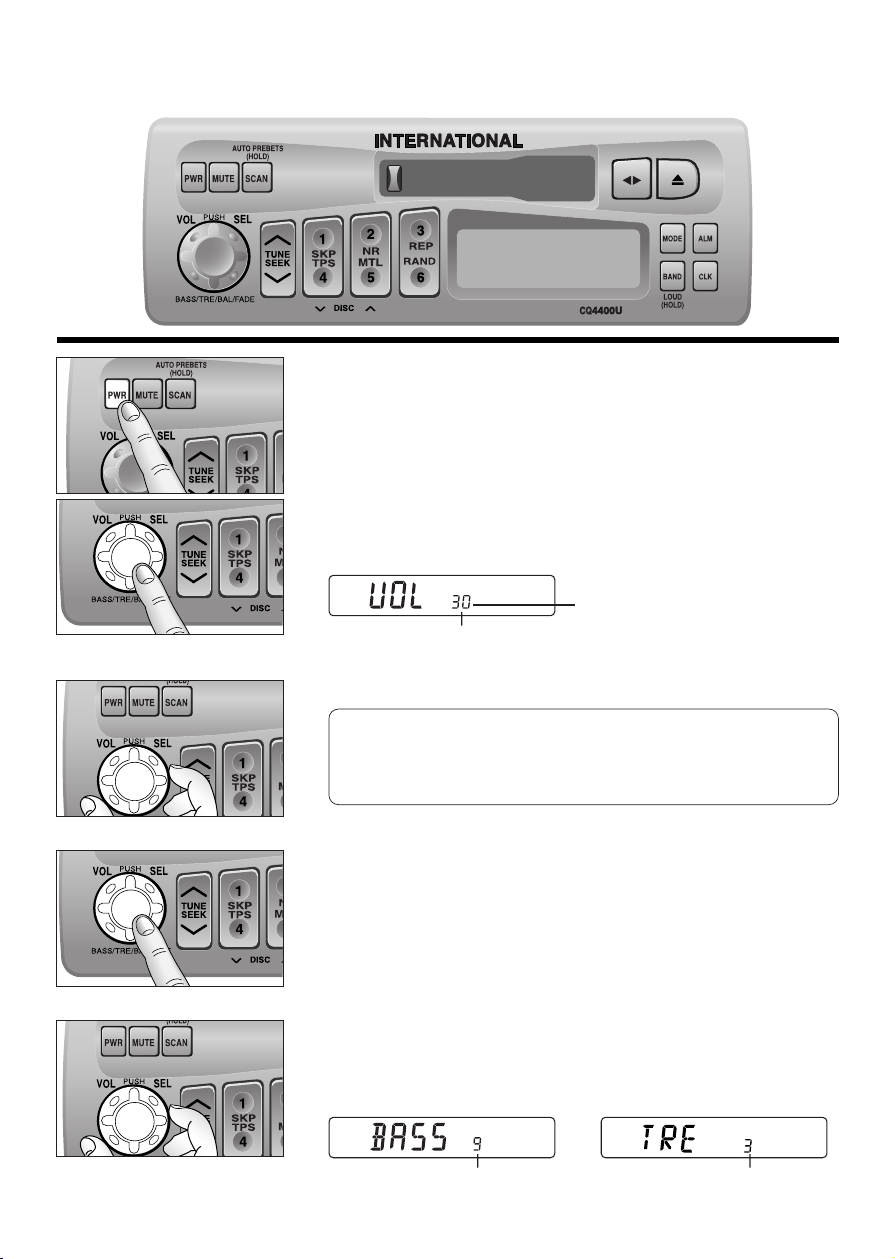
Power and Sound Controls
Power
If the vehicle is not running yet, turn the key in the ignition until the
accessory indicator lights.
Press [PWR] to switch on the power.
Changing Audio Modes
Press this knob [SEL] to change the audio mode as follows.
VOL
a
BASS
a
TRE
(Volume) (Treble)
cd
FADE
b
BAL
(Fader) (Balance)
Volume
●
Press the knob to select the volume mode and then turn it
clockwise or counterclockwise to increase or decrease the volume.
●
Turn the knob clockwise or counterclockwise more than 0.5
seconds to change the numeric level in sequence.
Bass and Treble
Press the knob to select the BASS(TREBLE) mode and then turn it
clockwise or counterclockwise to increase or decrease the
bass/ treble level.
0 to 40
-12 to 12 -12 to 12
Volume Level
Anti-Volume-Blast Circuit
This unit has a safety function which slowly raises volume level
when power is switched back on after it is turned off at a specific
level (20) or higher.
d
d
Page 6

5
Fader
Press the knob to select the FADER mode and then turn it
clockwise or counterclockwise to shift the sound volume to the front
or rear speakers.
Tone Enhancement (Loudness)
●
Press and hold [BAND] (LOUD) for more than 2 seconds to
enhance bass and treble tones when listening at low or medium
volume.
●
Press and hold [BAND] (LOUD) for more than 2 seconds again to
deactivate when listening at higher volumes.
Mute
●
Press [MUTE] to mute the sound completely.
●
Press [MUTE] again to cancel.
or R 1 to 15
Fader Center
Note: In the audio mode (BASS/TRE/BAL/FAD), the display will
be back to regular operation mode with no operation for more
than 5 seconds (2 seconds in the VOL mode).
Balance
Press the knob to select the BALANCE mode and then turn it
clockwise or counterclockwise to shift the sound volume to the right
or left speakers.
or L 1 to 15
Balance Center
Press and hold
(R: RightL, : Left)
(F: Front, R: Rear)
Page 7

6
Radio Basics
Mode Selection
Press [MODE] to change the operation mode as follows.
Radio
a
Cassette
a
CD changer (when connected)
cd
To change to the tuner mode
In case of CD changer mode or Tape mode, press [MODE].
Selecting a Band
Press [BAND] to change the band setting as follows.
FM1
a
FM2
a
W/B
a
AM
c
(Weather Band)
d
"ST" indicator lights during reception of an FM stereo broadcast.
Manual Tuning
Press [TUNE jj] or [TUNE ii] to tune in a higher or lower
frequency.
Seek Tuning
Press and hold [SEEK jj] or [SEEK ii] for more than 0.5
seconds, then release it.
Seeking will automatically stop when a signal of the next broadcast
station is received.
Hold and release
Page 8

7
Station Preset
FM1, FM2, and AM can save maximum 6 stations each in their preset station memories.
Manual Station Preset
Press [BAND] to select a desired band.
Use manual or seek tuning to find a station which is to be preset
in the memory.
Press and hold one of the preset buttons [1] to [6] until the
display blinks once.
Note: You can change the memory setting by repeating the above
procedure.
Tuning in a Preset Station
Press any of the buttons [1] to [6] to tune in the station preset by
the above.
Auto Station Preset
Select a band and press and hold [SCAN] (AUTO PRESETS) for
more than 2 seconds.
●
The 6 strongest available stations will be automatically saved in
the memory on preset buttons [1] to [6].
●
Once set, the preset stations are sequentially scanned for 5
seconds each.
Note: The stations manually preset on the select band will be
deleted.
Preset Number
Caution: To ensure safety, never attempt to preset stations while you are driving.
d
d
Press and hold
Press and hold
Page 9

8
Radio Basics
(continued)
Tuning in a Weather Band
Station
Press any of the buttons [1] to [6] to tune in the station preset by
the previous page.
Weather Band Stations
National Weather Radio Broadcasts from over 380 locations
throughout the U.S. on seven VHF/FM frequencies.
Tune to weather band to receive continuous weather information 24
hours a day on one of the following frequencies.
1. 162.550 MHz
2. 162.400 MHz
3. 162.475 MHz
4. 162.425 MHz
5. 162.450 MHz
6. 162.500 MHz
7. 162.525 MHz
Occasionally the frequency of an existing or planned station must
be changed because of unexpected radio frequency interference
with adjacent NOAA Weather Radio Stations and/or with other
Government or Commercial Operations within the area. If you have
a question concerning NOAA Weather Radio, please contact your
nearest National Weather Service Office.
Note: The weather band (CH1-6) has been preset in advance.
CH7 is selected by pressing [jj] or [ii].
WB
Weather Band Frequency(channel) Number
The frequency (162) remains unchanged.
Page 10

9
Cassette Tape Player Basics
Tape Insert
Insert the cassette with the exposed tape side facing to the right.
Play will start automatically.
Rewind and Fast Forward
Press [ii] (REW) or [jj] (FF) to activate rewind or fast forward of
the tape.
Press [] to stop.
The tape will resume playing from that position.
Changing Sides
Press [] to reverse.
Exposed Tape side
Playing Side Indicator
Top Side Playing Bottom Side Playing
Rewind
Fast Forward
Page 11

10
Cassette Tape Player Basics
(continued)
Tape Eject
Press [u] to eject the tape, and the previous mode of operation will
be resumed.
Notes:
●
Always remove the cassette tape from the unit when the cassette
tape player is not being used.
●
If power is switched off before [u] is pressed, the cassette will not
be ejected. Switch on the power again and press [u] to eject the
cassette.
Metal Tape Mode
●
Press [5 MTL] when playing metal or chromium dioxide (CrO2)
position tapes.
●
Press [5 MTL] again to cancel.
Note: Playing non-metal position tapes in MTL mode causes high
frequency imbalance, which affects tone quality.
Dolby Noise Reduction
●
Press [2 NR] to set the Dolby B NR mode.
●
Press [2 NR] again to cancel.
Note: Set the Dolby B NR mode when playing back a tape recorded
with Dolby B Noise Reduction.
Page 12

11
TPS Operation (Tape program
Search)
Press [4 TPS] to activate the tape program search mode.
To select a desired program, press [ii] or [jj] corresponding
times to go backward (up to 8) or forward (up to 9).
(Rewind:) (Fast forward:)
8019
cdcd
Ex1. To select the current program
again, press [4 TPS], and
press [ii].
Ex2. To select the previous pro-
gram, press [4 TPS], and
press [ii] twice.
Ex3. To select the next program,
press [4 TPS] and press [jj].
Ex4. To select the next 3rd pro-
gram , press [4 TPS], and
press [jj] three times.
Press [4 TPS] again to cancel.
Notes: The TPS mode may not work correctly in the following
cases. This, however, does not mean that the unit is defective.
●
There is an interval less than 4 seconds or having a high level of
noise or hum between programs.
●
There is particularly low-level passage during the program.
Notes:
●
To maintain your cassette player in top condition, avoid using tapes that are longer than 90
minutes (C-90).
●
If you insert into the unit a cassette with a loose tape caused by forcing it into cassette with a
finger or the like, the cassette may not be properly reproduced. In such a case, eject the cassette,
make the tape tight, then insert it back into the deck.
d
or
Page 13

12
Cassette Tape Player Basics
(continued)
Repeat Play
●
Press [3 REP] to repeat the current program.
●
Press [3 REP] again to cancel.
Blank Skip
●
Press [1 SKP] to skip unrecorded portions on the tape.
●
Press [1 SKP] again to cancel.
Notes:
●
When repeat is on, the blank skip does not work because the
repeat has priority over the blank skip.
●
The blank skip does not work when the unrecorded portion of the
tape is less than 15 seconds.
REPEAT
B•SKIP
Page 14

13
CD Changer Basics
Start the CD Changer
Once the CD changer has been connected, press [MODE] to
change to the CD changer mode. When a disc magazine is
inserted, CD play starts automatically.
Disc Selection
Press [4] (iDISC) or [5] (DISC j) to select a disc in descending
or ascending order.
Then, the selected disc will start to play from the first track.
Note: The number of discs you can load the CD changer with is
specific to each model.
Track Selection
●
Press [jj] to advance to the next track.
●
Press [ii] to start play from the beginning of the track now
playing.
●
Press [jj] or [ii] repeatedly to skip the desired number of
tracks.
Track Search
●
Press and hold [jj] or [ii] for more than 0.5 seconds to activate
fast forward or reverse.
●
Release [jj] or [ii] to resume regular CD changer play from the
released position.
Note: CD changer functions are designed for an optional CD changer unit.
Play
Time
Disc
Number
Tr ac k
Number
Hold and release
Page 15

0000
E 3E 1
E 2
14
Track Repeat
●
Press [3 REP] (REP: REPEAT) to repeat the current selection.
"REPEAT" indicator lights.
●
Press [3 REP] (REP: REPEAT) again to cancel.
Track Random
●
Press [6 RAND] (RAND: RANDOM). All the available tracks on all
discs in the magazine will be played in a random sequence.
●
Press [6] (RAND: RANDOM) again to cancel.
Note: The Random mode will stop and the disc select function will
operate once the [4] (iDISC) or [5] (DISCj) is pressed.
Track Scan
●
Press [SCAN]. The display blinks and the first 10 seconds of each
track on the discs play in sequence.
●
Press [4] [SCAN] again to cancel.
❏
Error Display Messages
Appears on the display when the
compact disc is dirty or inverted.
Selects the next available compact
disc.
Appears on the display when
compact disc is scratched. Selects
the next available compact disc.
Appears on the display when there
is no disc in the magazine.
Appears on the display when the CD
changer stops operating for some
reason. Please turn off the vehicle
engine (ACC off) and remove the
fuse from yellow lead for 1 minute.
Then reinstall the fuse.
CD Changer Basics
(continued)
REPEAT
RANDOM
Page 16

15
Clock Basics
(The clock system is 12-hours.)
Initial Time
Press and hold [CLK] until you have set the time. "AM 12:00"
blinks, and the time setting mode is activated.
Press [ii] to set the hour.
Press [jj] to set the minute.
(Hold [ii] or [jj] to change numbers rapidly.)
Once the time has been set, release [CLK].
Note: When the clock is not set yet, "SET" is displayed.
Resetting the Time
When you want to reset the time, repeat steps to above.
Selecting the Clock Display
Press [CLK] to display the current time.
After a few seconds, current time returns on display.
Note: The current time will be displayed at all the time even the
power of the radio is turned off.
Press and hold
d
or
Page 17

16
Alarm Time Setting
Press and hold [ALM] until you have set the alarm time. "AM
12:00" blinks, and the alarm time setting mode is activated.
Press [ii] to set the hour.
Press [jj] to set the minutes.
(Hold [ii] or [jj] to change numbers rapidly.)
When you have set the alarm time, release [ALM].
Note: When the alarm is not set yet, "AM 12:00" is displayed.
Resetting the Alarm Time
When you want to reset the alarm time, repeat steps to
above.
Alarm Operation
●
Alarm is switched to ON or OFF each time [ALM] is pressed.
●
When the alarm is switched to ON, the alarm sound will activate
at the set alarm time.
Turning off the Alarm Sound
The alarm sound will turn off automatically after 90 seconds.
Otherwise, press [ALM] once.
Cautions:
●
Be careful not to set wrong alarm time, otherwise, the alarm may sound while driving.
●
If the alarm is set, be sure to check the set alarm time by pressing and holding [ALM] for more than 2
seconds.
●
If volume is set at "0" step, the output volume will be muted. (Even when ALARM is acting.)
Clock Basics
(continued)
d
or
Alarm output Volume Selection
You can select ALARM VOL 1 (or VOL 2) by pressing [ALM] in
sequence and the display will show as follows.
ALARM TIME
a
ALM VOL 1
a
ALM VOL 2
(display 3 seconds) (display 2 seconds) (display 2 seconds)
OFF
Page 18

17
●
The display will show "TAPE
CLN" to warn you to clean the
cassette head for maintaining its top condition after accumulated
100 hours tape playing.
●
Press and hold [] for more than 2 seconds again to clear
"TAPE
CLN" displaying and resume the current TAPE mode
displaying. (It is valid only in TAPE mode.)
Cassette Head Cleaning Warning
Press and hold
Page 19

18
Installation Guide
This installation information is designed for experienced installers
and is not intended for non-technical individuals. It does not
contain warnings or cautions of potential dangers in attempting to
install this product.
Any attempt to install this product in a motor vehicle by anyone
other than qualified installer could cause damage to the electrical
system and could result in serious personal injury or death.
WARNING
❏
Overview
This equipment should be installed by a
professional. However, if you plan to install this
unit yourself, your first step is to decide where to
install it. The instructions in these pages will
guide you through the remaining steps: (Please
refer to "WARNING" statement above).
●
Identify and label the vehicle wires
●
Connect the vehicle wired connector to the
power connector
●
Install the unit in the dash
●
Check the operation of the unit
If you do encounter problems, please consult
your nearest professional installer.
Caution: This unit will operate with a 12 volt DC
negative ground auto battery system only. Do
not attempt to use it in any other system. Doing
so could cause serious damage.
Before you begin installation, look for the following
items included in the packing with your unit.
●
Installation Hardware ...... Needed for in-dash
installation
❏
Installation Hardware
No.
1
Item
Mounting Collar
Diagram Qty
Page 20

19
Installation Guide
(continued)
❏
Installation Procedures
Note: Disconnect the cable from the negative (–) battery terminal.
1
Mounting Collar
Dashboard
Mounting Tab
Screwdriver
2. Securre the rear of the unit.
a) Insert Power Connector to the unit.
b) Check the electrical connection by referring to this operating instructions.
c) Insert the unit into Mounting Collar and push it in until "click" is heard.
Unit
Power Connector8
1. Secure the Mounting Collar
.
Insert Mounting Collar into the vehicle's dashboard, and bend mounting tabs out with a
screwdriver.
●
When bending the mounting tab of the mounting collar with a screwdriver, be careful not to injure
your hands and fingers.
●
We strongly recommend you to wear gloves for installation work to protect yourself from injuries.
Page 21

20
Installation Guide
(continued)
To Remove the Unit from the vehicle's dashboard
Insert Dismounting Pins and pull both pins.
Note: Do not lose Dismounting Pins. They will be needed to remove the unit from the vehicle's
dashboard.
Dimounting Pin
(U-shaped)
Page 22

21
Cautions:
●
This product is designed to operate with a 12-volt negative ground battery system.
●
To prevent damage to the unit, be sure to follow the connection diagram below.
●
Do not insert the power connector into the unit until the wiring is completed.
●
Be sure to insulate any exposed wires from a possible short-circuit from the vehicle chassis. Bundle
all cables and keep cable terminals free from touching any metal parts.
Electrical Connections
(Rear Side)
Wired Remotoe Control Connector
(Connect to CA-RC350U)
CD Changer Control Connector
Dimmer Control Lead
Connect to vehicle dimmer lead
(Red)
ACC
(Black)
(Yellow)
Battery
Ground
Dimmer
(Orange w/White stripe)
Power Connector
(Violet)
(Violet w/black stripe)(Gray w/black stripe)
(Green)
(Green
w/black
stripe)
(White
w/black
stripe)
(Gray)(white)
Left Speaker
(Front)
Right Speaker
(Front)
Left Speaker
(Rear)
Right Speaker
(Rear)
Cassette Receiver
CQ-4400U
Antenna
Power Lead (ACC or IGN)
To ACC power, +12V DC
Ground Lead
To a clean, bare metallic part of
the vehicle chassis
Battery Lead
To the vehicle battery, continuous
+12V DC
Page 23

22
Troubleshooting
❏
Maintenance
Your product is designed and manufactured
to ensure a minimum of maintenance. Use a
soft cloth for routine exterior cleaning. Never
use benzine, thinner, or other solvent.
❏
When Something Doesn't Work
Check the charts on page 23 for possible
causes and solutions to any problem you
might be experiencing. Some simple checks
or minor adjustments may eliminate the
problem.
❏
Product Servicing
If the suggestions in the charts don't solve
the problem, we recommend that you take it
to your nearest authorized PASC
Servicenter. The unit should be serviced
only by a qualified technician.
❏
Notes on Cassette Tapes
Tape Slack:
Use a pencil or similar object to take up the
slack as shown. If a loose tape is used, this may
result in the tape becoming tangled in the
rotating parts of the unit.
Label
Pencil
Do not touch
or pull out the tape.
Page 24

23
Troubleshooting
(continued)
❏
Troubleshooting Tips
PROBLEM
Unit does not turn on.
Radio has static.
Radio memory buttons do not
work.
Tape sound quality is poor.
Inverted sound (Left/Right
connections.)
No sound from front or rear
speakers.
POSSIBLE CAUSE
Dead vehicle battery
Ignition or ACC is not on.
Bad power line connection
Fuse is blown.
Antenna not hooked up
Close to high power lines
Not holding buttons down long
enough
Heads are dirty.
Poor quality tape.
The speaker cords are inverted.
The fader control is set on the
wrong position.
PROBABLE SOLUTION
Charge vehicle battery.
Turn ignition to On or ACC.
Check connections.
Replace fuse. (Consult your dealer)
Hook up antenna.
Move away from high power lines.
Press and hold buttons for more
than 2 seconds.
Clean heads. (Ask a service
representative for advice.)
Use better quality tape.
Check the speaker cords.
Adjust the fader control of the
unit correctly.
Page 25

24
Specifications
General
Power Supply : 12 V DC (11V-16V) Test Voltage 14.4V, Negative ground
Maximum Power Output : 37 W ×4 channels at 400 Hz, Volume Control maximum
Power Output : 18 W per channel into 4 ohms, 40 to 30,000Hz at 3% THD.
Tone Action : Bass; ± 12 dB at 100 Hz
Treble; ± 12 dB at 10 kHz
Current Consumption : Less than 2.5 A (tape mode, 0.5W 4-speaker)
Speaker Impedance : 4 Ω (4-8 Ω acceptable)
Dimensions (W ×H ×D) : 7" ×1-15/16" ×5-7/8" (178 ×50 ×150 mm)
Weight : 3 lbs (1.38 kg)
AM Radio
Frequency Range : 530-1,710 kHz
Useable Sensitivity : 28 dB/µV (25 µV/ S/N 20 dB)
FM Stereo Radio
Frequency Range : 87.9-107.9 MHz
Useable Sensitivity : 12 dBf. (1.1 µV / 75Ω, S/N 30 dB)
50 dB Quienting Sensitivity : 17 dBf. (1.8 µV / 75Ω)
Frequency Response : 30-15,000 Hz ± 3 dB
Alternate Channel Selectivity : 75 dB
Stereo Separation : 35 dB at 1,000 Hz
Signal/Noise Ratio : 70 dB (Mono)
Weather Band Radio
Frequency Range : 162.40-162.55 MHz
Useable Sensitivity : 3 dB/µV (S/N 20 dB)
Signal/Noise Ratio (40 dB/µV) : 50 dB
Tape Player
Reproduction System : 4-track, 2-program stereo
Tape Speed : 1-7/8"/sec (4.76 cm/sec)
FF/REW Time : Less than 110 SEC (C-60)
Frequency Response : 35 - 14,000 Hz ± 3 dB
Wow and Flutter : 0.09% (WRMS)
Signal/Noise Ratio : 52 dB (Dolby NR on: 62 dB)
*Above specifications comply with EIA standards.
Note: Specifications and design are subject to modification without notice due to improvements in
technology.
Dobly noise reduction manufactured under license from Dolby Laboratories Licensing Corporation.
"DOLBY" and the double-D symbol Aare trademarks of Dolby Laboratories Licensing Corporation.
This unit has been manufactured under the Part 15 of the FCC Rules.
Do not attempt to make any changes or modifications to this unit.
Part 15 of the FCC Rules
Page 26

Page 27

Page 28

Panasonic Consumer Electronics
Company, Division of Matsushita
Electric Corporation of America
One Panasonic Way, Secaucus,
New Jersey 07094
YFM284C335ZA TAMACO0900-0 Printed in Taiwan
 Loading...