

Page 1

Simple Card Reader for Door Access &
Time Attendance System
User Guide
Page 2

CONTENTS
3 CHAPTER 1 • GETTING STARTED
Viewing the User Guide in the Internet
Included Accessories
Included Printed Materials
Activating m-Kadex
Registering m-Kadex
CHAPTER 2 • BASICS
4-5
Introduction to m-Kadex
m-Kadex Overview
Security Features
Restarting and Resetting m-Kadex
6-13 CHAPTER 3 • CONNECTION – SYNCING M-KADEX
Installation Guide
Communication Diagrams
Description of Available Connections
Ingress Online Activation
Installation and Setup of Ingress
Connecting Terminals to Ingress
Using USB to Download/Upload Data
Communication Key
To Download Attendance Logs Only
To Download User Data and Attendance Logs into USB Flash Disk
To Upload User Data from USB Flash Disk to m-Kadex
14-15 CHAPTER 4 • MANAGING USER
Enrolling Administrator Card
Registration of Administrator Card
Enrolling User Cards
Verifying Card for Attendance or Access
Deleting User Card
Deleting Attendance Logs in m-Kadex
Resetting to Default Factory Settings using Administrator Card
Resetting to Default Factory Settings without Administrator Card
16 CHAPTER 5 • OTHER RESOURCES
Page 3

1 • GETTING STARTED
Viewing the User Guide in the Internet
The User Guide is available in the package when you purchase FingerTec m-Kadex. The
user guide is also published online at fingertec.com and user.fingertec.com. Choose
the language you prefer to view the User Guide.
Included Accessories
A Packet of Bolts
RS232/RS485/
Wiegand Output Cable
MIFARE Card (1 pieces)
*for m-Kadex MIFARE
m-Kadex terminal
Screwdriver
USB Extension
Power Supply Cable
Door Accessories
Cable
RFID Card (5 pieces)
*for m-Kadex RFID
Included Printed Materials
• FingerTec Comprehensive DVD
• Quick Start Guide
• User Enrollment Template Form
• Warranty Card
Activating m-Kadex
Connect all the cables correctly at their specific points and turn on the power supply.
M-Kadex terminal does not have its on/off button.
Registering m-Kadex
Make sure that you register your m-Kadex’s warranty with us at www.fingertec.com/
ver2/english/e_main.html#
CONTENTS
3
Page 4

2 • BASICS
Introduction to m-Kadex
m-Kadex is a simpler version of Kadex. The terminal is designed without any keypads or
LCD. m-Kadex functions similarly like Kadex but management of the terminals have to
be done from the software. The m-Kadex can enrol new cards and delete cards at the
terminal only if the administrator card is available. Absence of administrator card would
not allow any operations to be carried out at the terminal.
m-Kadex Overview
Item What Is It For
LED Indicating status of terminal and result of verification
Green – Terminal is in standby mode, terminal has verified card
Red – Terminal has failed to verify card
Card Induction Area Area to read card
USB Port Connecting USB extension for data download into a USB flash disk
Reset button Restarting the terminal
LED
Card
Induction
Area
successfully
(pen drive)
Reset
USB Port
Reset button
4
CONTENTS
Page 5

Security Features
Security features help protecting the information from m-Kadex from being accessed
by unauthorized individual(s).
ADMINISTRATOR CARD
Registration of an administrator card to the system is important to control access into
m-Kadex. After registration of the administration card is done, nobody can do enrollment, deletion or reset on m-Kadex without the administration card.
TAMPER SWITCH
m-Kadex comes with a tamper switch located at the rear of the terminal. During installation, the tamper switch is compressed against a wall. Any attempt to dismantle
m-Kadex will trigger alarm
Restarting and Resetting m-Kadex
If something isn’t working right, try to restart or reset m-Kadex.
RESTARTING m-Kadex
Use a thin probe to push the reset button hidden at the bottom of the terminal. The
terminal will restart by itself and all the memory is retained during this operation.
RESETTING TO DEFAULT FACTORY SETTINGS BY
ADMINISTRATOR CARD
Green LED blinks > Wave Administrator card 5 times at the induction area > The terminal beeps 3 times > Red LED blinks > Wave Administrator card 1 time at the induction
area to confirm > Green LED blinks > The terminal beeps continuously for 7 seconds >
Green LED blinks
Remarks:
IP address of the terminal returns to default 192.168.1.201 after this process. The Terminal ID returns to
1 after this process.
RESETTING TO DEFAULT FACTORY SETTINGS WITHOUT
ADMINISTRATOR CARD
Green LED blinks > Detach terminal from a wall > Release security button > Wait for 35
seconds > Push and release the security button 3 times > Terminal would emit a long
beep and it will start the terminal
Remarks:
The IP address of terminal returns to default 192.168.1.201 after this process. The Terminal ID returns
to 1 after this process.
All contents of the terminal will be deleted including the contents in administrator card. The
All contents of the terminal will be deleted including the contents in administrator card.
CONTENTS
5
Page 6

3 • CONNECTION – SYNCING M-KADEX
Installation Guide
Communication Diagr
NOTE
The installation guides is for installer reference only
ams
At the rear of every terminal, there are connections available for power, communication and door access. Refer to the following diagrams for the terminals you require.
ACCESS CONNECTION
PORT
AL-
AL+
NC
For NC
or NO
door
lock
system
COM
NO
BUT
GND
SES
BELL+
BELL-
POWER SUPPLY
PORT
GND
+12V
DC12V
Power Supply
TCP/IP PORT
(Ethernet Connection)
-
TCP/IP
J7
ALAL+
NC
COM
NO
BUT
GND
SES
BELL+
BELL-
GND
+12V
J1
J2
RJ45-1
RJ45-2
RJ45-3
RJ45-6
J12
WDO
WD1
GND
RXD
TXD
GND
485A
485B
RJ45-1
RJ45-2
RJ45-3
RJ45-6
V3.6 - 09032
J7
AL-
AL+
NC
COM
NO
BUT
GND
SES
BELL+
BELL-
GND
+12V
J1
J2
RJ45-1
RJ45-2
RJ45-3
RJ45-6
J12
WDO
WD1
GND
RXD
TXD
GND
485A
V3.6 - 09032
485B
Back of Terminal
RS232/RS485/WIEGAND CONNECTION PORT
WD0
Wiegand Output
WD1
GND
RXD
RS232
TXD
GND
485A
RS485
485B
CONTENTS
6
3rd party controller
with 26 bits wiegand
input
RS232
cable
1. RS485 Single Connection
485A
485B
RX+
RX-
RS232/RS485 Data
Converter
2. RS485 Network Connection
485A
485B
485A
485B
RX+
RX-
RS232/RS485 Data
Converter
Page 7
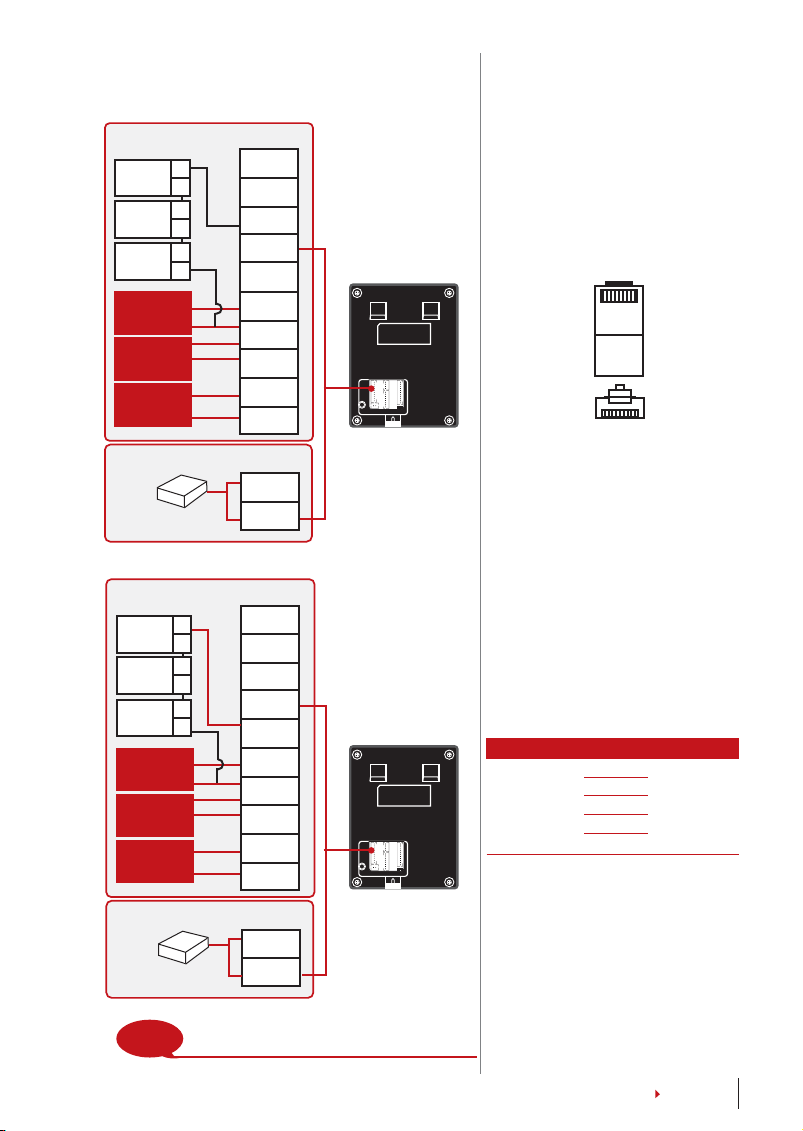
For NC (normally close) door lock system
ACCESS CONNECTION PORT
+
EM lock
(NC)
-
Emergency
2
break glass
(NC)
3
Key switch
A
(NC)
C
Release
button
Door
sensor
Doorbell
POWER SUPPLY PORT
AL-
AL+
NC
COM
NO
BUT
GND
SEN
BELL+
BELL-
J7
J2
AL-
RJ45-1
AL+
RJ45-2
NC
RJ45-3
COM
RJ45-6
NO
J12
WDO
BUT
WD1
GND
SES
GND
BELL+
RXD
BELL-
TXD
GND
+12V
GND
J1
485A
V3.6 - 09032
485B
Back of Terminal
GND
DC12V
Power Supply
+12V
For NO (normally open)door lock system
ACCESS CONNECTION PORT
+
EM lock
(NO)
-
Emergency
1
break glass
3
(NO)
B
Key switch
(NO)
D
Release
button
Door
sensor
Doorbell
POWER SUPPLY PORT
DC12V
Power Supply
Please refer to AdapTec AC Installer Manual if
NOTE
you are using AdapTec AC.
AL-
AL+
NC
COM
NO
BUT
GND
SEN
BELL+
BELL-
GND
+12V
J7
J2
AL-
RJ45-1
AL+
RJ45-2
NC
RJ45-3
COM
RJ45-6
NO
J12
WDO
BUT
WD1
GND
SES
GND
BELL+
RXD
BELL-
TXD
GND
+12V
GND
J1
485A
V3.6 - 09032
485B
Back of Terminal
Descriptions of
Available
Connections
USB PORT
Linking with USB flash disk for remote data transfer.
1 8
TOP
FRONT
1 8
TCP/IP PORT
Connect with CAT 5 cable for LAN
connection, one end to this port
and another end to the computer’s TCP/IP Port.
TCP/IP for Single Connection:
Linking the terminal to a single computer using TCP/IP requires Ethernet
10/100Base-T Crossover Cable. The
cable can be used to cascade hubs or
to connect Ethernet stations back-toback without a hub. It works with both
10Base-T and 100Base-TX.
JOINT 1 PIN JOINT 2 PIN
TX+ 1
TX- 2
RX+ 3
RX- 6
• •
• •
• •
• •
TCP/IP for Network Connection:
Linking the terminals to multiple computers using TCP/IP requires Ethernet
10/100Base-T Straight Thru Cable or
“whips”. The cable works with both
10Base-T and 100Base-TX, connecting a
network interface card to a hub or network outlet.
3 RX+
6 RX-
1 TX+
2 TX-
CONTENTS
7
Page 8

CONNECTOR PIN CABLE COLOR CONNECTOR
TX+ 1• White/Orange •1 TX+
TX- 2
RX+ 3
4
5
RX- 6
7
8
Orange •2 TX-
•
White/Green •3 RX+
•
Blue •4
•
White/Blue •5
•
Green •6 RX-
•
White/Brown •7
•
Brown •8
•
POWER SUPPLY PORT
Insert the Power Adapter point to this port for power.
RS232/RS485/WIEGAND CONNECTION PORT
RS232:
Connection to a computer using RS232 cable.
RS485 Single Connection: Connection to a single computer using RS485 wire.
RS485 Network Connection: Connection to multiple computers using Daisy Chain connection.
Wiegand Output: Connecting with third party connector or terminal(s).
ACCESS CONTROL PORT
Linking the terminal to door lock system.
BELL PORT
Linking the terminal to doorbell.
Link all cables to the correct connection point(s) be-
NOTE
fore attempting to connect the terminals to software.
Ingress Online Activation
Ingress is a genuine software by FingerTec. Every FingerTec access control model
comes bundled with a unique license key. To start using the terminal with Ingress, you
must connect the terminal to Ingress and perform online activation. Ingress reads the
serial number of your terminal and sends it for verification at the FingerTec server via
Internet.
In case you do not have an Internet connection, you would need to do offline activation. Please send the serial number and models of your terminals to your local resellers
or [email protected] to request for a product key and activation key.
Installation and Setup of Ingress
Install Ingress in a PC that fulifills Ingress’ minimum requirements. Refer to http://
www.fingertec.com/customer/download/postsales/SUM-Ingress-E.pdf for the In-
gress user guide online. Setup Wizard will require you to do online activation before
connection establish between Ingress and terminals.
CONTENTS
8
Page 9
Connecting Terminal to Ingress
THE FIRST TIME CONNECTION
When connecting the Terminal to the Ingress for the first time, you must use TCP/IP to
form the connection. The Ingress allows you to configure the communication settings
and the door lock settings. An IP address is important, as it is a unique address of the
terminal in the LAN network. Without an IP address, locating the specific terminal is not
possible.
Identify the number of your terminal to differentiate between one another. The default
IP address of the Terminal is 192.168.1.201, with the default terminal ID number being 1.
The terminal ID can only be changed after you connect it to the Ingress. Remember, each
Device ID must be paired with different IP addresses, to indicate that it is different terminal.
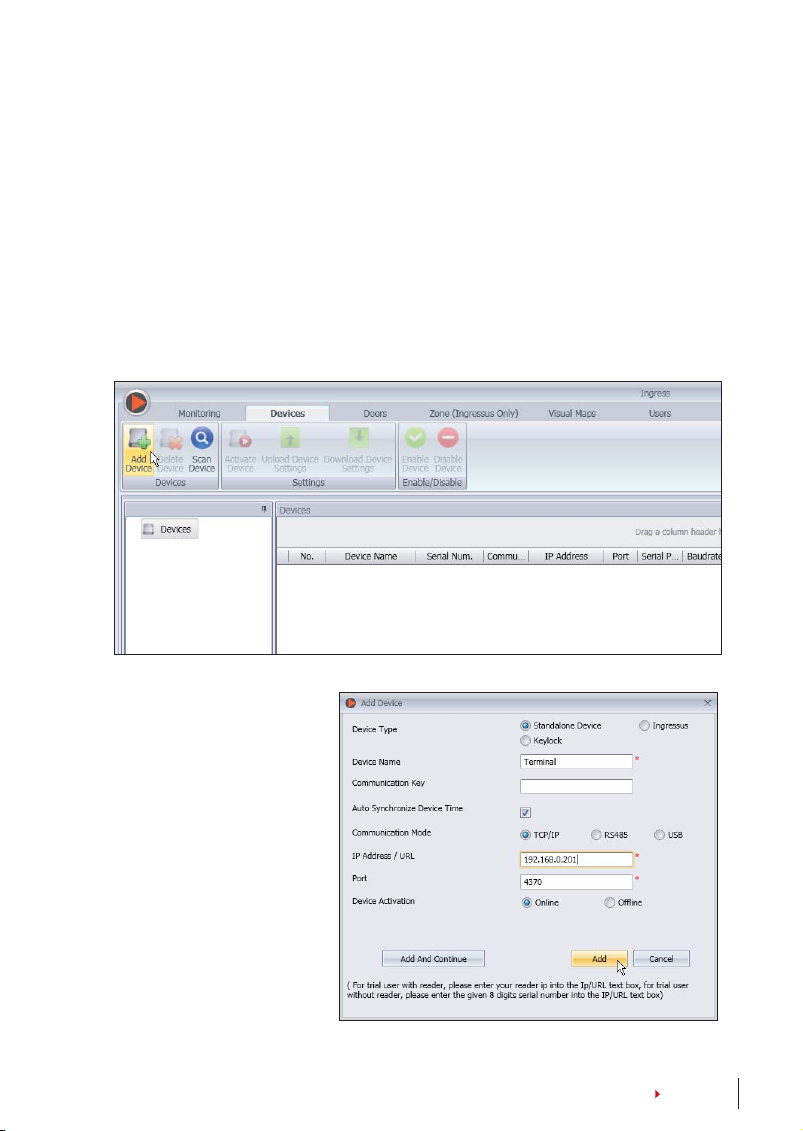
At the Devices Tab, user can
either choose to add device
via Add Device (to individually add) or Scan Device
to add multiple terminals at
one go. For single terminal,
after filling in the relevant
information, click Add and
Continue to proceed by
adding another terminal or
Add to add only one termi-
nal.
CONTENTS
9
Page 10
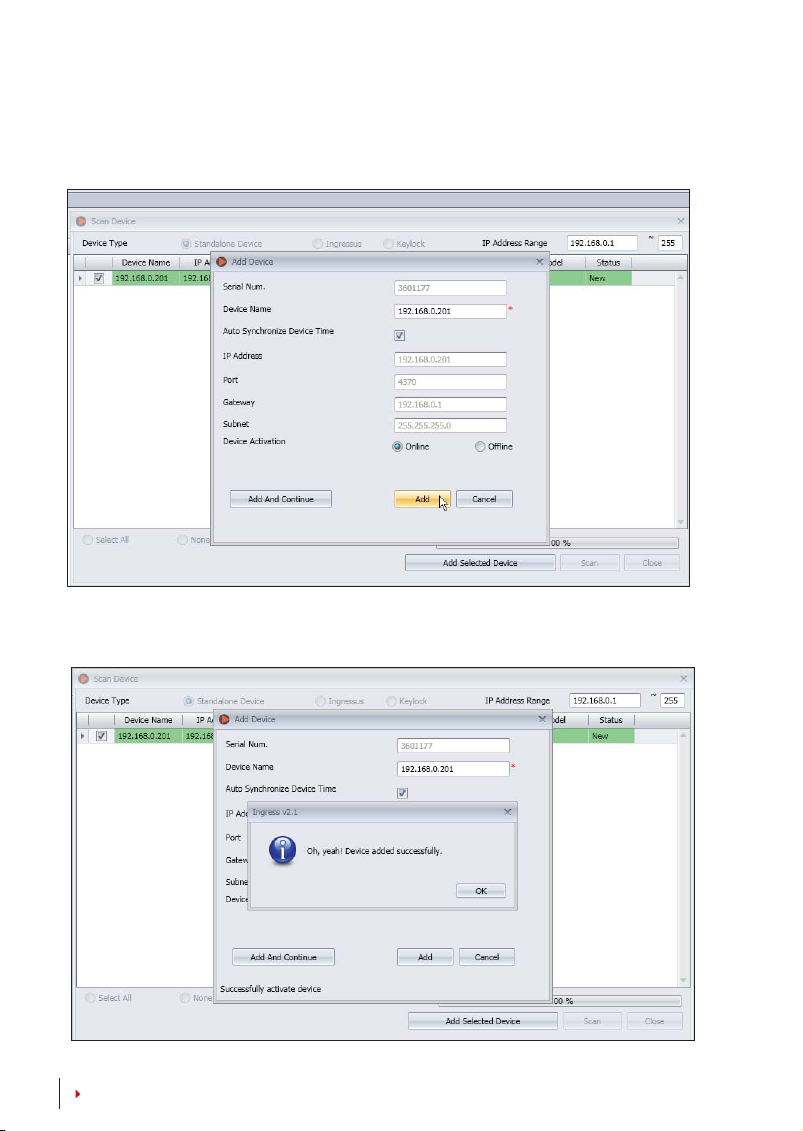
To add multiple devices at one go, click Scan Device and Scan. IP Address range can be
set to search for devices. The bigger the range of IP address, the longer time needed to
scan for devices. Devices found will be displayed on the screen. Select the preferred devices and click Add Selected Device to add them and a window containing the settings
of the terminals will pop up. Click Add to proceed.
Once the device has been added, a pop up window will appear indicating that the device has been successfully added. Click Ok to proceed.
10
CONTENTS
Page 11
HOW TO CHANGE IP ADDRESS
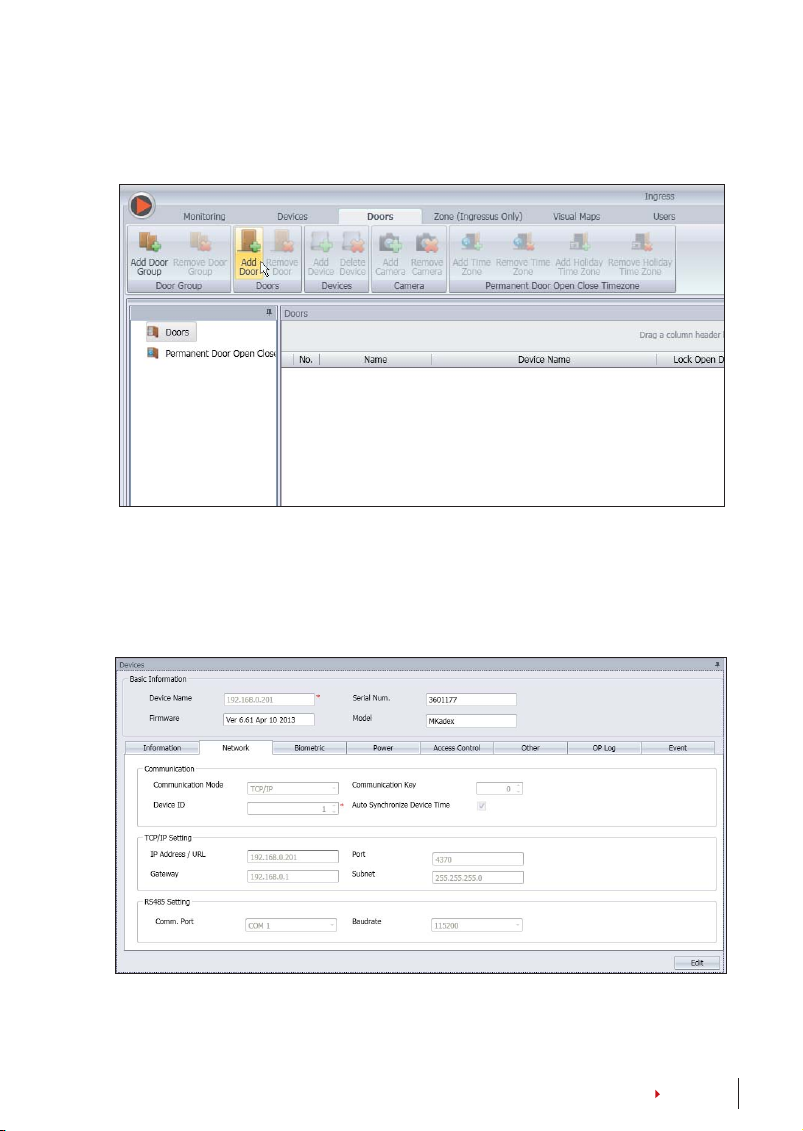
Terminal does not have a keypad thus to change the IP address users can do it via Ingress software. Steps to change IP address via Ingress are as below. Go to Doors tab and
click on Add Door.
Once the door is added, click on Add Device at the Doors tab. Check/Tick the terminal(s)
to be added to the specific door. Click OK. Double click on the device. At the Network
tab, click Edit. Change the desired IP address at the IP Address / URL column. When
done, click Save to confirm the changes made.
CONTENTS
11
Page 12
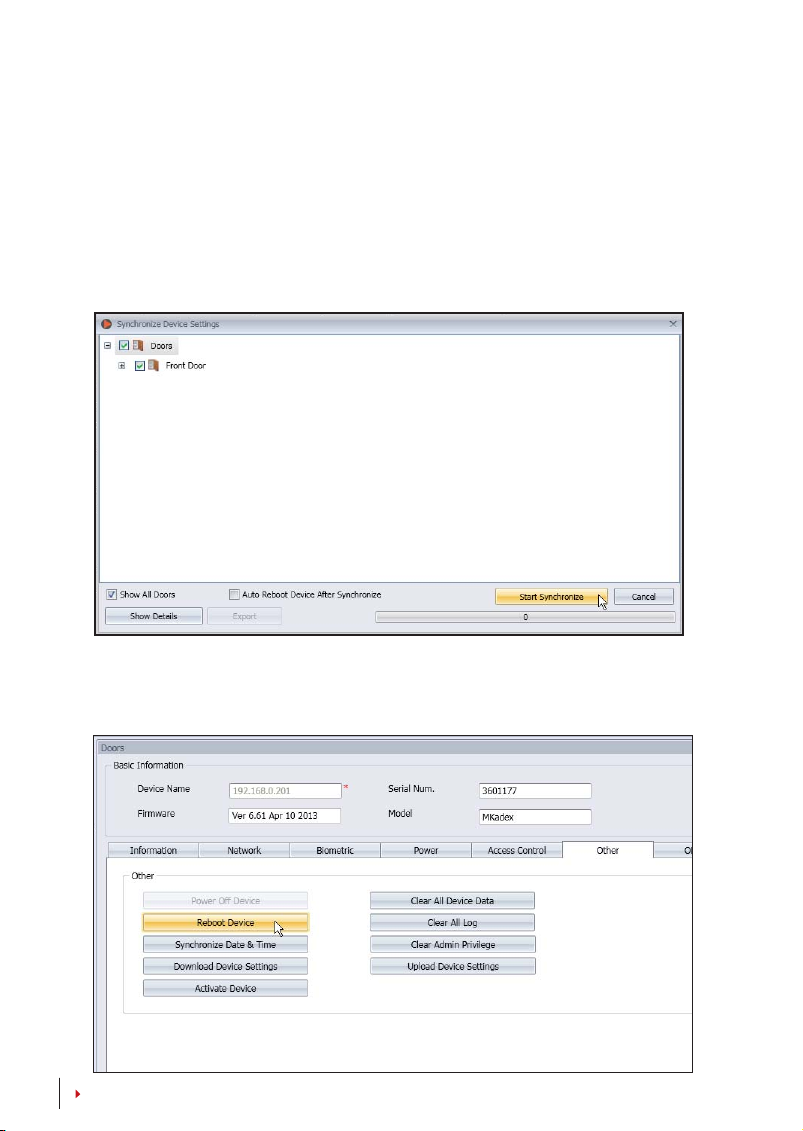
Once done, a popup window will appear indicating the update is successful. Click OK
to proceed. The Ingress software has to be synced with all relevant devices in order for
the changes to take effect. A small window will appear at the bottom left corner of the
screen once any changes are made.
Click on the underlined blue sentence to sync the terminals. Any changes made will
appear in the Synchronize Device Settings window. Check/Tick the changes needed to
be synced to the terminals. Click Start Synchronize once the selections are made. Another popup window will appear, displaying the changes made at the particular doors
affected. Click Start Synchronize once everything is confirmed.
Once synchronization is complete, click Close to proceed. Go to Other tab and click on
Reboot Device. A window will pop up, seeking confirmation on whether to restart the
device. Click Yes and the IP address for the terminal has been successfully changed.
12
CONTENTS
Page 13

Using USB Flask Disk
USB flash disk is useful in cases where the terminal is installed far from a PC or there is a
connection problem. To determine the type of USB compatible by the terminal, please
refer to this link at fingertec.com/newsletter/HL_74.html.
To Download Attendance Logs Only
Plug the USB flash disk to m-Kadex and terminal save all transaction logs into the USB
flash disk automatically.
To Download User Data and Attendance Logs into
USB Flash Disk
Plug in compatible USB flash disk into m-Kadex’s USB port > Wave an administrator card
9 times at the induction area > LED will lit up in green ito indicating that the download
process is running > The LED will blinks in green once to signal that the > Process is
completed > Unplug the USB flash disk from the m-Kadex once the process is done.
To Upload User Data from USB Flash Disk to
m-Kadex
Make sure that the user data already has been loaded into the USB flash disk before
doing this operation.
Plug in a USB flash disk into m-Kadex’s USB port > Wave the administrator card 11 times
at the induction area > LED will lit up in green to iindicate that the upload process is
running > The LED will blinks in green once > the process is completed > Unplug the
USB flash disk from the m-kadex after the upload process is done.
CONTENTS
13
Page 14

4 • MANAGING USER
Enrolling Administrator Card
Administrator card is the first card to be enrolled into the terminal. Administrator card
cannot be used to report attendance or gain access. System administrator must maintain 2 cards, an administrator card to operate terminal, and a normal card for attendance and access.
The administrator card is the key card to operate the terminal. To start or end an operation such as enrolment of new card enrollment, deletion of card, and restoration of
terminal back to default factory settings, administrator card is required.
Registration of Administrator Card
Power up terminal > Green LED blinks continuously > Wave the card at the induction
area > Terminal beeps once > Green LED blinks > Terminal is ready
Remark:
nal has already been enrolled with an Administrator card
If the Green LED blinks continuously when you turn on the power, it means that the termi-
Enrolling User Cards
Green LED blinks > Wave Administrator card twice at the induction area > Green LED
blinks > Wave the new user card at the induction area > Terminal beeps once and the
Green LED blinks > Repeat the steps to enroll next new user card > Wave the administrator card to induction area to end process > Green LED blinks
Remark:
been registered to the terminal. You can’t re-enroll with this card. Please use another card.
If the terminal beeps twice and red LED blinks after reading your card, the card has already
Verifying Card for Attendance or Access
Green LED blinks > Wave your card at the induction area > Terminal beeps once >
Green LED blinks > If the card is verified successfully, the LED blinks in green
Remark:
card has not been registered into the terminal. Register your card first before trying to verify it at the
terminal.
If the terminal beeps twice and the LED blinks in red after having read your card, your
Deleting User Card
LED blinks in green > Wave Administrator card 3 times at the induction area > LED
blinks in red > Wave the user card at the induction area > Terminal beeps once > LED
blinks green once > LED blinks in red > Repeat to wave next user card to delete >
Wave the administrator card to induction area to end process > LED blinks in green
Remark:
istered yet to the terminal. You can use this card to register with the terminal.
If the terminal beeps twice and LED blinks in red after read your card, your card is not reg-
14
CONTENTS
Page 15

Deleting attendance logs in m-Kadex
In standby mode, the m-Kadex’s LED blinks in green > Wave the administrator card 7
times at the induction area > The LED will lit up in green to indicate that the deletion
process is running > The LED will blinks in green once > the process is completed
Resetting to Default Factory Settings using
Administrator Card
Green LED blinks > Wave Administrator card 5 times at the induction area > The terminal
beeps 3 times > Red LED blinks > Wave the Administrator card once at the induction
area to confirm > Green LED blinks > Terminal beeps continuously for 7 seconds> Green
LED blinks
Remark:
IP address of the terminal returns to default 192.168.1.201 after this process. The Terminal ID returns to
1 after this process.
All contents in the terminal will be deleted including the content in administrator card. The
Resetting to Default Factory Settings Without
Administrator Card
Green LED blinks > Detach the terminal from its location on a wall > Release the security
button > Wait for 30 sec > Push and release the security button 3 times > Terminal produces a long beep > restart the terminal
CONTENTS
15
Page 16

5 • OTHER RESOURCES
Copyright Notice & Disclaimer
COPYRIGHT NOTICE
All rights reserved. No part of this book may be reproduced or transmitted in any form
or by any means, electronic or mechanical, including photocopying, recording, or by any
information storage and retrieval system, without written permission from FingerTec
Worldwide Sdn Bhd. Every precaution has been made to supply complete and accurate
information. Information in this document is subject to change without prior notice.
DISCLAIMER
No person should rely on the contents of this publication without first obtaining advice
from a qualified professional person. The company expressly disclaims all and any liability and responsibility to any terminal or user of this book, in respect of anything, and of
the consequences of anything, done by any such person in reliance, whether wholly or
partially, upon the whole or any part of the contents of this book.
FINGERTEC WORLDWIDE SDN BHD
16
CONTENTS
Page 17

© 2013 FingerTec Worldwide Sdn. Bhd. All rights reserved. • 072013
CONTENTS
 Loading...