

Page 1
CUSTOMER EXPERIENCE CENTER
1-80 0 - 3 31- 4 331
HIGHLANDER
2010
QUICK REFERENCE
GUIDE
Printed in U.S.A. 9/09
08-TCS-03070
Cert no. SGS-COC-005612
10%
00505-QRG10-HL
Page 2
2010
Highlander
This Quick Reference Guide is a summary of basic vehicle
operations. It contains brief descriptions of fundamental
operations so you can locate and use the vehicle’s main
equipment quickly and easily.
The Quick Reference Guide is not intended as a substitute for
the Owner’s Manual located in your vehicle’s glove box. We
strongly encourage you to review the Owner’s Manual and
supplementary manuals so you will have a better understanding
of your vehicle’s capabilities and limitations.
Your dealership and the entire staff of Toyota Motor Sales,
U.S.A., Inc. wish you many years of satisfied driving in your
new Highlander.
Awordaboutsafevehicleoperations
!
This Quick Reference Guide is not a full description of
Highlander operations. Every Highlander owner should review
the Owner’s Manual that accompanies this vehicle.
Pay special attention to the boxed information highlighted in
color throughout the Owner’s Manual. Each box contains safe
operating instructions to help you avoid injury or equipment
malfunction.
All information in this Quick Reference Guide is current at
the time of printing. Toyota reserves the right to make
changes at any time without notice.
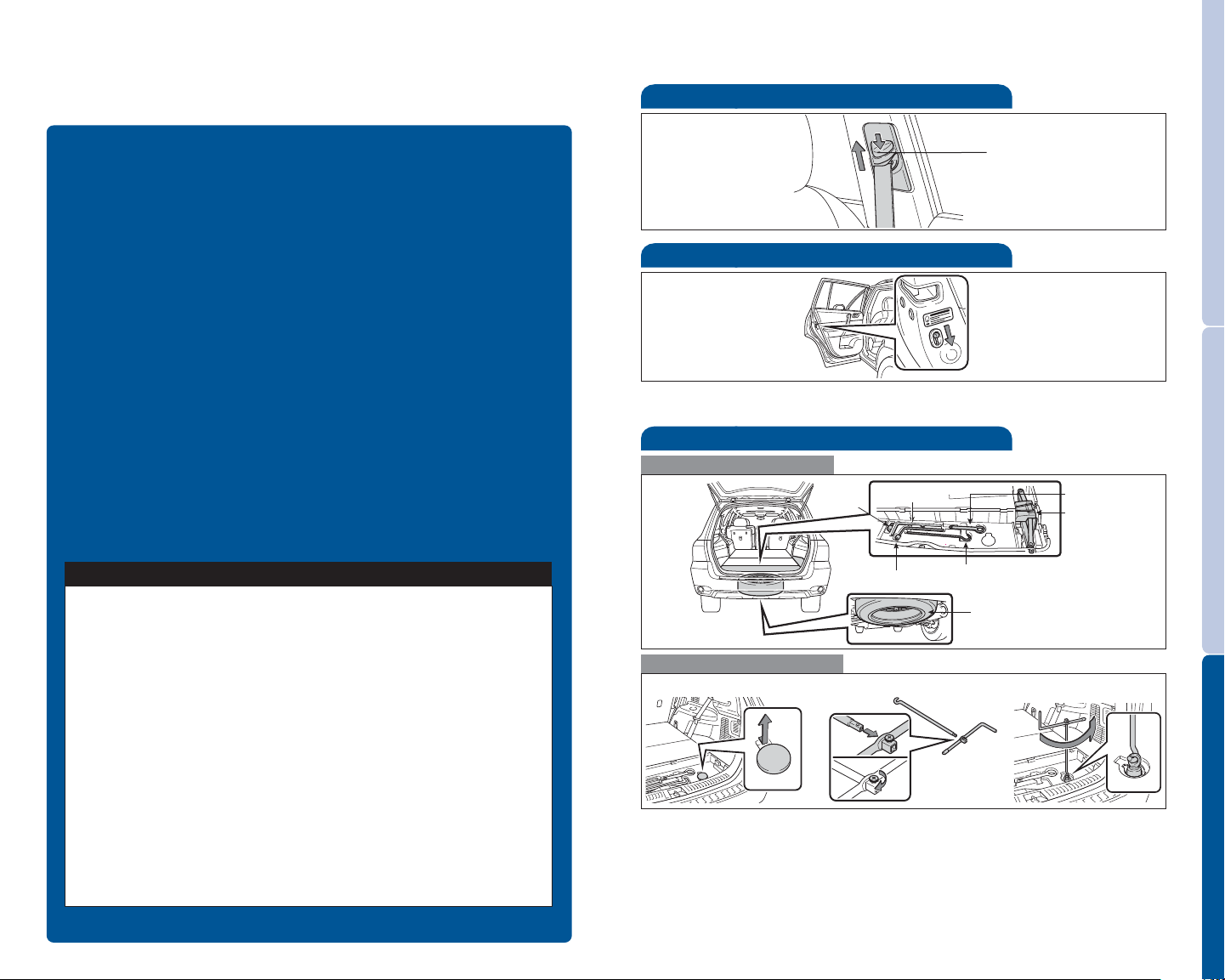
Seat belts-Shoulder belt anchor
Push up, or squeeze
lock release to lower
Doors-Child safety locks
Rear door
Moving the lever to “LOCK” will allow the door to be opened only from
the outside.
Spare tire & tools
Tool location
Socket
adapter
Jack handle
Wrench
Jack handle
Spare tire
Removing the spare tire
(1)
(1) Remove the cover under the center deck board to find the spare tire
clamp bolt.
(2) Assemble the jack handle.
(3) Put the socket adapter on the spare tire clamp bolt. Loosen the bolt
by turning it counterclockwise with the jack handle.
RefertotheOwner’s Manual for tire changing and jack positioning
procedures.
(2)
29
(3)
Towing eyelet
Jack
OVERVIEW FEATURES/OPERATIONS SAFETY AND EMERGENCY FEATURES
Page 3

INDEX
OVERVIEW
FEATURES/OPERATIONS
Engine maintenance 9
Fuel tank door release and cap 8
Hood release 8
Indicator symbols 4-5
Instrument cluster 4
Instrument panel 2-3
Keyless entry
Light control-Instrument panel 9
Smart Key system
1
1,2
6
7
Air Conditioning/Heating 20-22
Audio 24-25
Auto lock functions
1
11
Automatic Transmission 10
Clock 22
Cruise control 23
Cup holders 27
Door locks 11
Door-Power back 12
Downhill Assist Control system (DAC) 26
Garage door opener (HomeLink®)
3
23
Hill-start Assist Control (HAC) 27
Lights1& turn signals 16
Moonroof 12
Multi-information display
2
18
Parking brake 11
Power o utlets-12V DC 17
Power o utlets-115V AC 1 7
Rear seat entertainment system 26
Seat adjustments-Front 13
Seat adjustments-Rear 13
Seat heaters 22
Seats-Folding down second row seats 15
Seats-Head restraints 14
Seats-Removing Center-Stow
second row seat
TM
14
Seats-Stowing third row seats 14
Steering lock release 11
Steering wheel controls 25
Telephone controls (Bluetooth®) 19
Tilt and telescopic steering wheel 12
Windows-Power 18
Windshield wipers & washers 15
OVERVIEW FEATURES/OPERATIONS SAFETY AND EMERGENCY FEATURES
SAFETY AND
EMERGENCY FEATURES
Doors-Child safety locks 29
Seat belts 28
Seat belts-Shoulder belt anchor 29
Spare tire & tools 29
Tire Pressure Monitoring (warning) System 28
1
Visit your Toyota dealer for information on customizing this feature.
2
Programmable by customer. Refer to the Owner’s Manual for instructions and
more information.
3
HomeLink®is a registered trademark of Johnson Controls, Inc.
1
Page 4
OVERVIEW
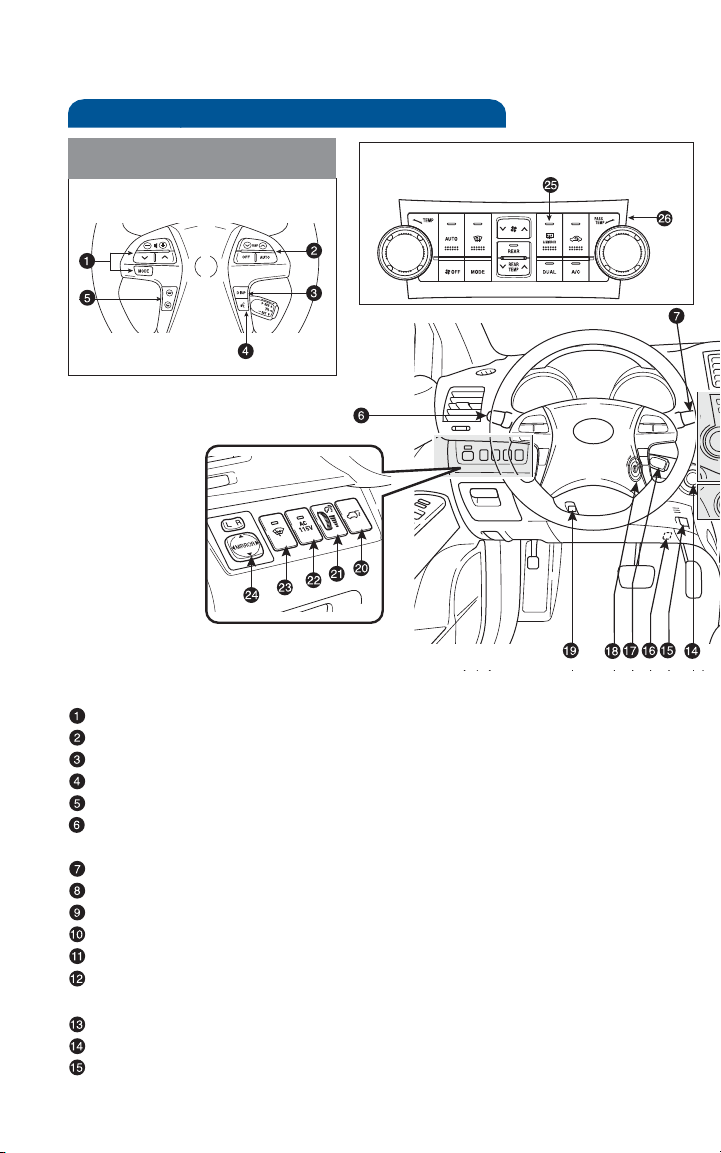
Instrument panel
Steering wheel
controls (if equipped)
Automatic Air Conditioning
Steering wheel audio controls
Steering wheel climate controls
Multi-information display button
Voice command button
Telephone controls
1,2
1
1
1
1
Headlight and turn signal controls/Headlight, turn signal and front fog
light controls
1
Wiper and washer controls
Multi-information display
Audio system or navigation system-integrated audio system
Theft deterrent system/Engine immobilizer indicator
1
1,2
1
Emergency flasher button
“AIR BAG ON” and “AIR BAG OFF” indicator and front passenger seat
belt reminder lights
Powerbackdoormainswitch
“ENGINE START STOP” button (Smart Key)
1
1
VSC/TRAC OFF switch
2
Page 5
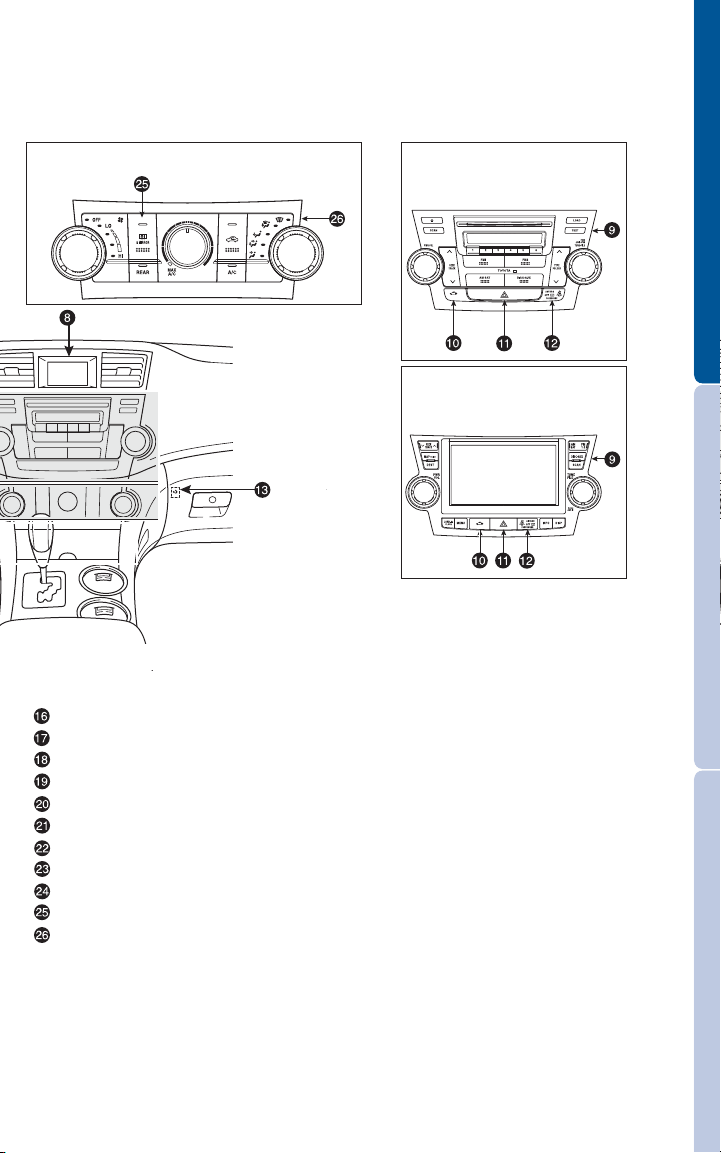
Manual Air Conditioning
Tire Pressure Monitoring (warning) System
Cruise control
Ignition (standard key)
Tilt and telescopic steering lock release
Power back door button
1
Instrument panel light control
115V AC Power outlet ON/OFF switch
Windshield wiper de-icer switch
1
Power rearview mirror control
Outside rearview mirror
1
/Rear window defogger button
Air Conditioning controls
Vehicles without
navigation system
Vehicles with
navigation system
1
OVERVIEW FEATURES/OPERATIONS SAFETY AND EMERGENCY FEATURES
1
If equipped
2
For vehicles with a navigation system, refer to the “Navigation System
Owner’s Manual.”
3
Page 6
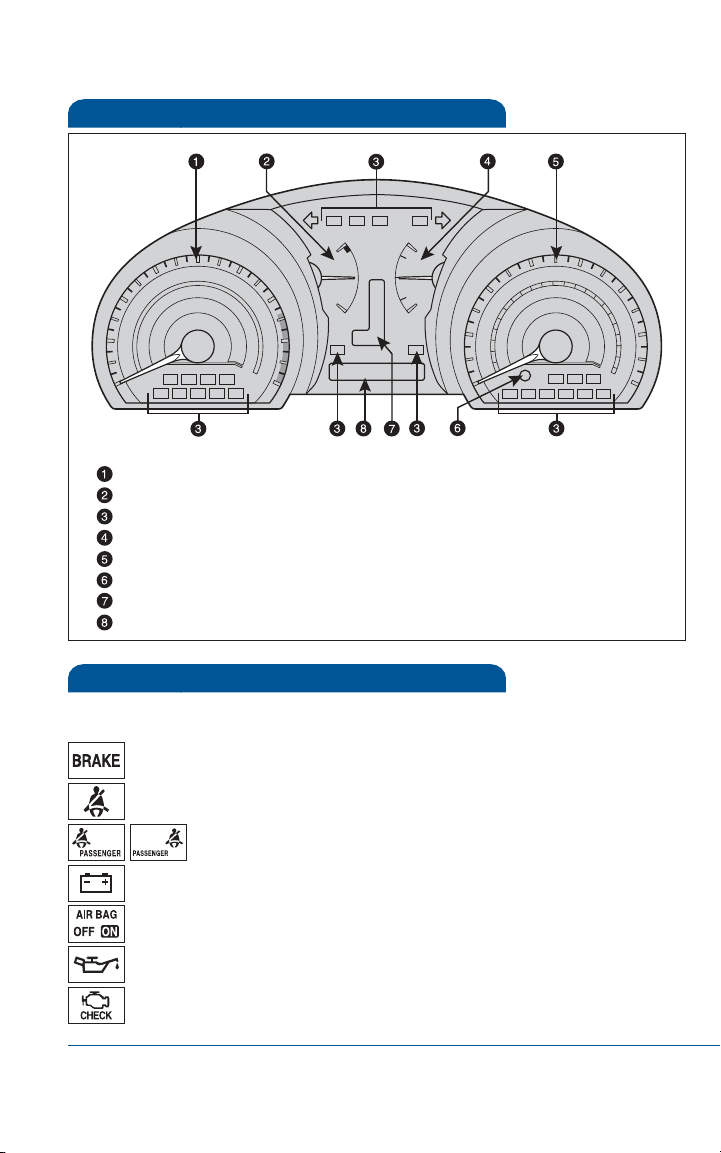
OVERVIEW
Instrument cluster
Tachometer
Engine coolant temperature
Service indicator and reminder
Fuel gauge
Speedometer
Odometer/trip meter switch and trip meter resetting button
Automatic Transmission shift position indicator
Odometer and two trip meters
Indicator symbols
For details, refer to “Indicators and warning lights,” Section 2-2, 2010
Owner’s Manual.
Brake system warning
Driver seat belt reminder
(alarm will sound if speed is over 12 mph)
Front passenger seat belt reminder
(alarm will sound if speed is over 12 mph)
Charging system warning
Front passenger occupant classification or front passenger airbag
ON/OFF indicator
Low engine oil pressure warning
Malfunction/Check Engine indicator
1
If indicator does not turn off within a few seconds of starting engine, there may
be a malfunction. Have vehicle inspected by your Toyota dealer.
1
1
1
1
1
4
Page 7
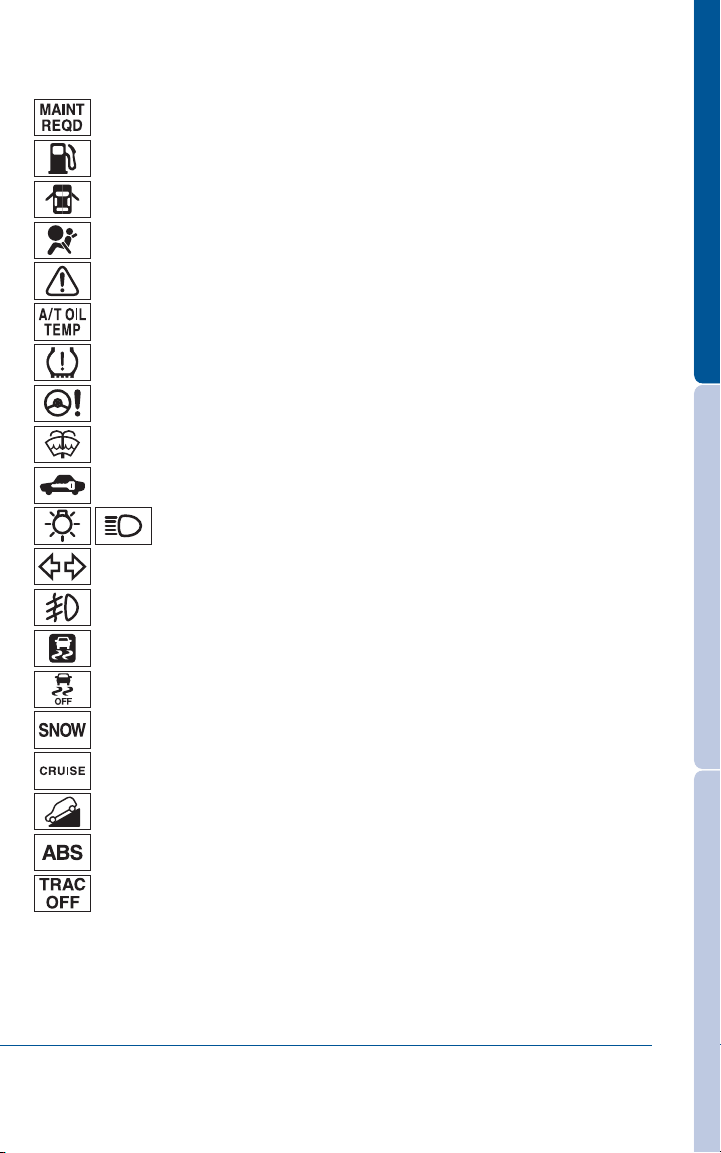
Engine oil replacement reminder
1
Low fuel level warning
Open door warning
Airbag SRS warning
1
Master warning
Automatic Transmission fluid temperature warning
Low Tire Pressure Warning
Electric power steering system warning
Low windshield washer fluid level warning
1
1
1
1
Theft deterrent/Engine immobilizer system indicator
Headlight low/high beam indicator
Turn signal indicator
Front fog light indicator
Slip indicator/Hill-start Assist Control indicator/Downhill Assist
Control indicator
Vehicle Stability Control OFF indicator
1
1
SNOW indicator
OVERVIEW FEATURES/OPERATIONS SAFETY AND EMERGENCY FEATURES
Cruise control indicator
Downhill Assist Control indicator
Anti-lock Brake System warning
Traction control OFF indicator
2
If this light flashes, refer to “Cruise control,” Section 2-4, 2010 Owner’s Manual.
2
1
1
1
5
Page 8
OVERVIEW
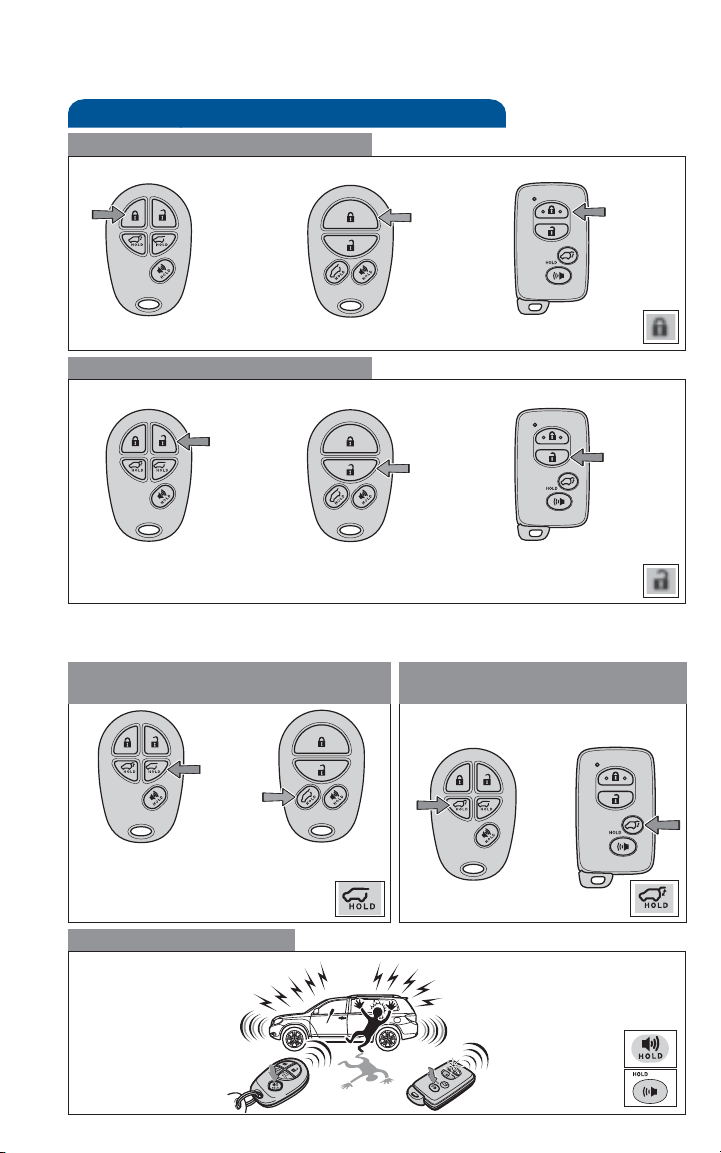
Keyless entry
Locking operation
Without Smart Key system With Smart Key system
With power back door
Without power back door
Push
Unlocking operation
Without Smart Key system With Smart Key system
With power back door
NOTE: If a door is not opened within 60 seconds of unlocking, all doors will
relock for safety.
Glass hatch operation
(if equipped)
With power
back door
Without power back door
Without power
back door
Push and hold
Push ONCE: Driver door
TWICE: All doors
Power back door operation
(if equipped)
Without Smart Key
system
With Smart Key
system
Push and hold
Panic button
Push and hold
6
Page 9
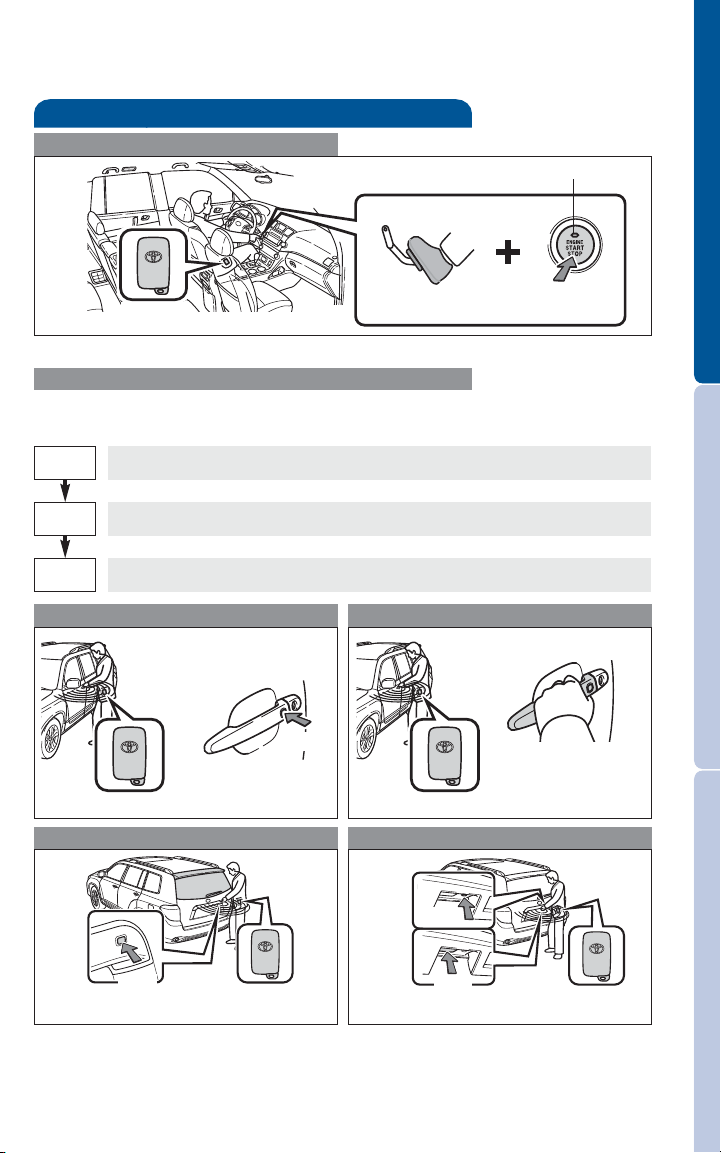
Smart Key system (if equipped)
Start function
Green indicator ON
OVERVIEW FEATURES/OPERATIONS SAFETY AND EMERGENCY FEATURES
Carrying
Depress
brake pedal
Push
NOTE: Gear shift lever must be in Park and brake pedal depressed.
Power (without starting engine)
Without depressing the brake pedal, pressing the “ENGINE START STOP”
switch will change the operation mode in succession from:
ACC
ON
OFF
Locking operation
Carry remote to lock Carry remote to unlock
Glass hatch unlock
Accessories such as the radio will operate.
Power ON; the engine not running.
All systems OFF.
Unlocking operation
Front door lock
Push
Back door lock/unlock
Front door unlock*
Grasp
Lock
Push
Unlock
Push
Carry remote to unlock Carry remote to lock/unlock
Push
* Driver door unlocking function can be programmed to unlock driver door
only, or all doors. Grasping passenger door handle will unlock all doors.
NOTE: Doors may also be locked/unlocked using remote.
7
Page 10
OVERVIEW
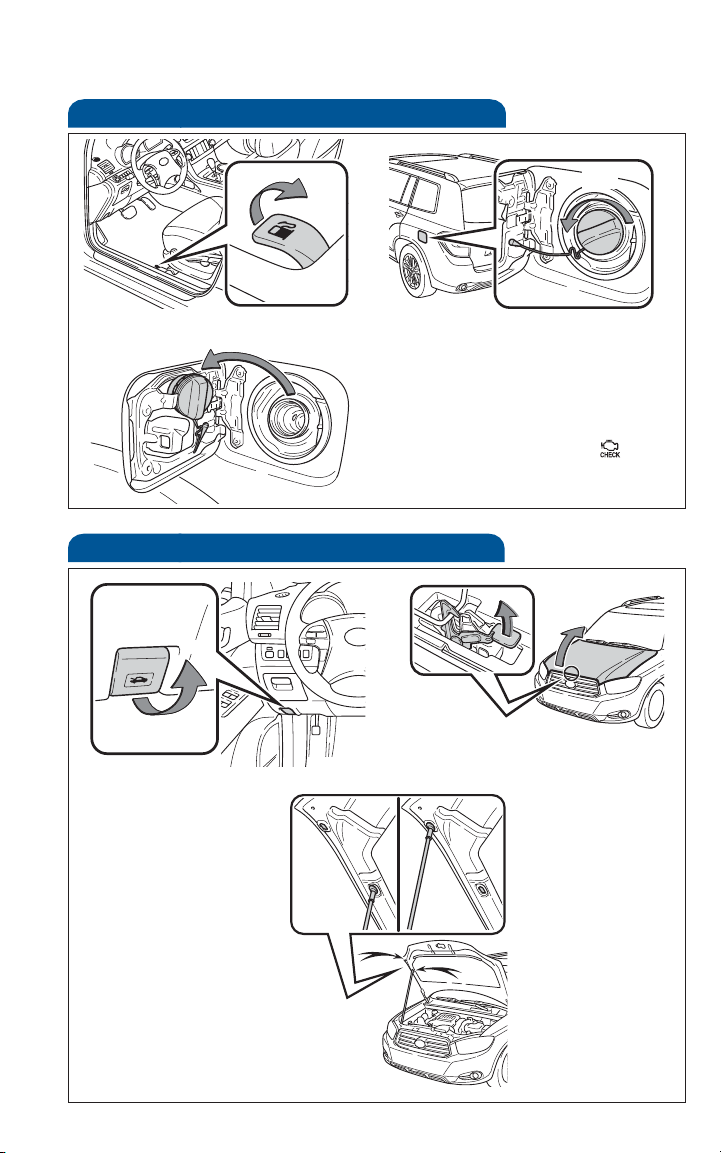
Fuel tank door release and cap
Hood release
Pull
Pull
Store
Tu r n
NOTE: Tighten until one click is
heard. If the cap is not tightened
enough, Check Engine “ ”
indicator may illuminate.
Pull up latch and
raise hood
Engage support rod
8
Page 11
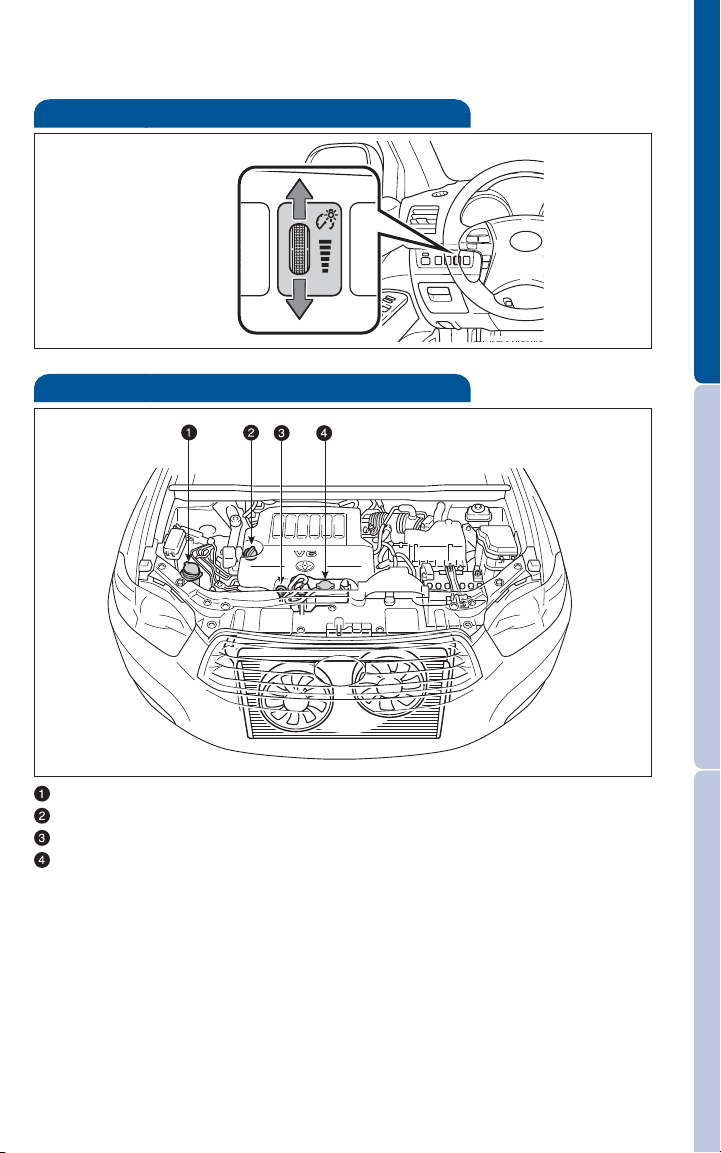
Light control-Instrument panel
+
Brightness
control
-
Engine maintenance
OVERVIEW FEATURES/OPERATIONS SAFETY AND EMERGENCY FEATURES
Windshield washer fluid tank
Engine oil filler cap
Engine oil level dipstick
Engine coolant reservoir
NOTE: Regularly scheduled maintenance, including oil changes, will
help extend the life of your vehicle and maintain performance.
Please refer to the “Warranty Maintenance Guide.”
9
Page 12
FEATURES/OPERATIONS
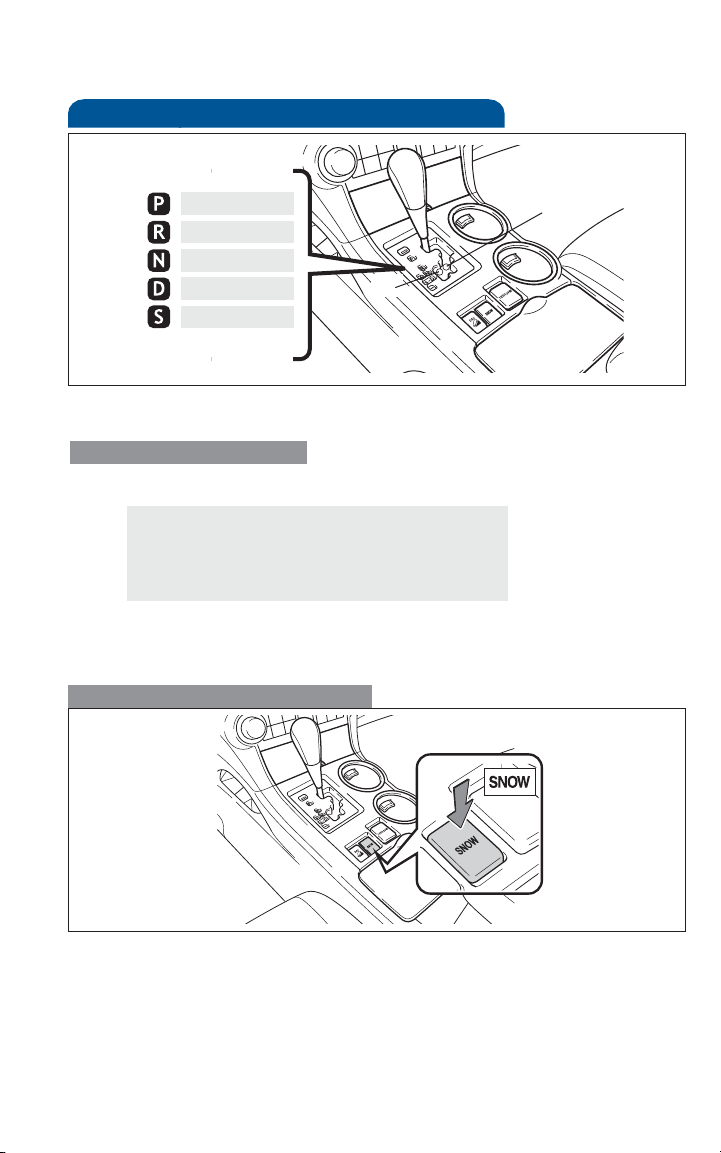
Automatic Transmission
Park*
Reverse
Neutral
Drive
“S” mode
* The ignition switch must be “ON” and the brake pedal depressed to shift
from Park.
“S”
“D”
“S” (Sequential) mode
Shift the shift lever to “S” position from “D” position.
Floor shift type:
+: Upshift (push and release)
-: Downshift (pull and release)
Downshifting increases power going uphill, or provides engine braking
downhill. For best fuel economy during normal driving conditions, always
drive with the shift lever in the “D” position.
Snow mode
Push
The snow mode prevents sudden acceleration on slippery surfaces. Use in
snowy or icy road conditions.
10
Page 13
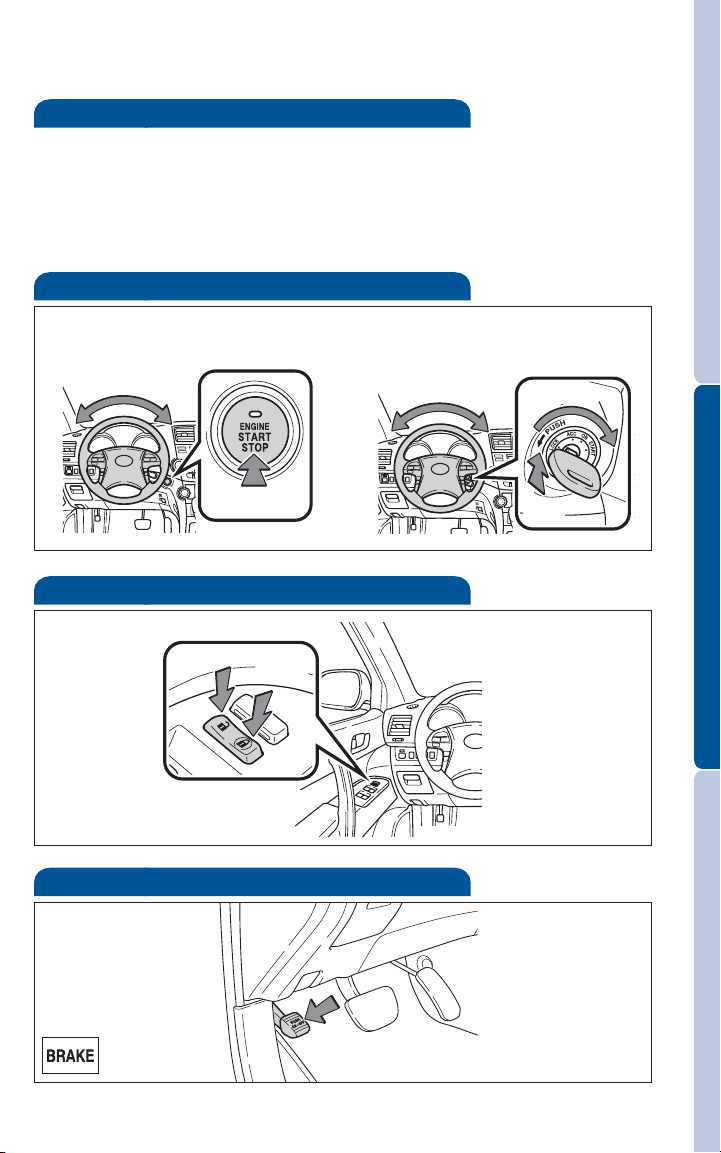
Auto lock functions
Automatic door locks can be programmed to operate in two different
modes, or turned OFF.
-Doors lock when shifting from Park.
-Doors unlock when shifting into Park.
Refer to the Owner’s Manual for more details.
Steering lock release
Smart Key system Without Smart Key system
OVERVIEW FEATURES/OPERATIONS SAFETY AND EMERGENCY FEATURES
Tu r n
Door locks
Parking brake
Unlock
Push
Lock
Tu r n
Tu r n
Push
11
Set: Depress
Release: Depress again
Page 14
FEATURES/OPERATIONS
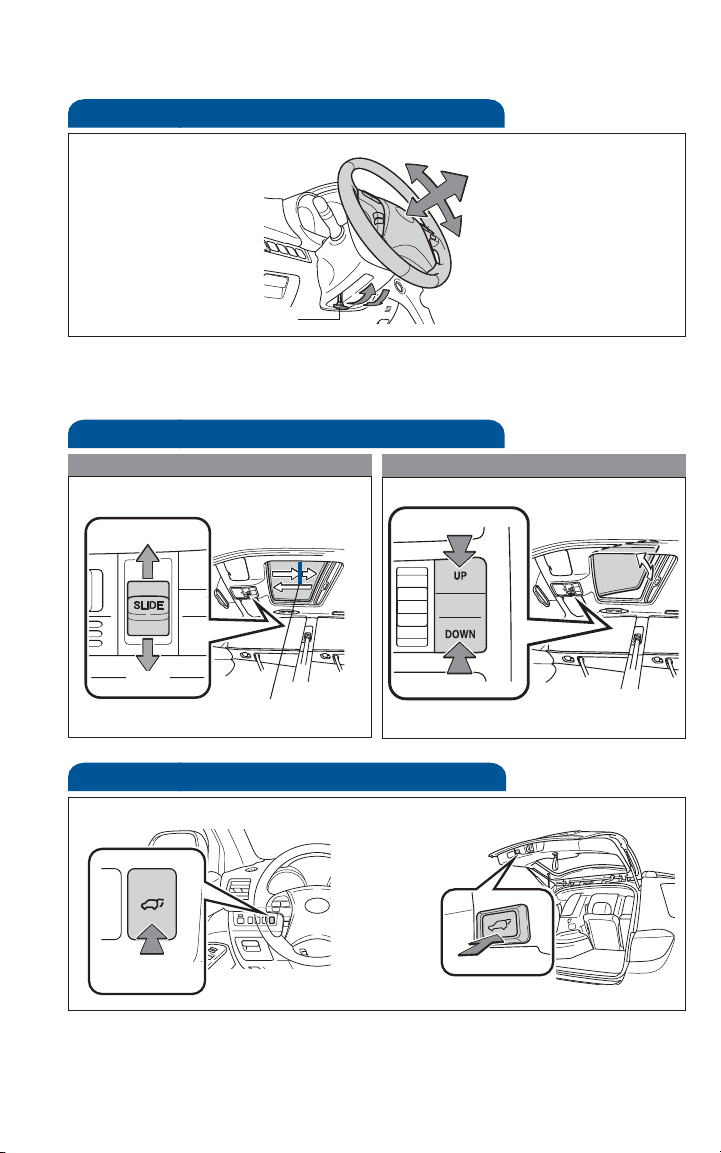
Tilt and telescopic steering wheel
Angle
Length
Lock release lever
Hold wheel, push lever down, set angle and length, and return lever.
NOTE: Do not attempt to adjust while the vehicle is in motion.
Moonroof (if equipped)
Sliding operation
Push once to open partway;
again to open completely.
Open
Tilting operation
Tilt
Close
Recommended driving position
to minimize wind noise.
Close
Door-Power back (if equipped)
Instrument panel Back door (close only)
Push and hold
Open: Push and hold
Close: Push and hold again
NOTE: If battery is disconnected, the power back door needs to be
reinitialized. Refer to the Owner’s Manual for more details.
12
Push
Page 15
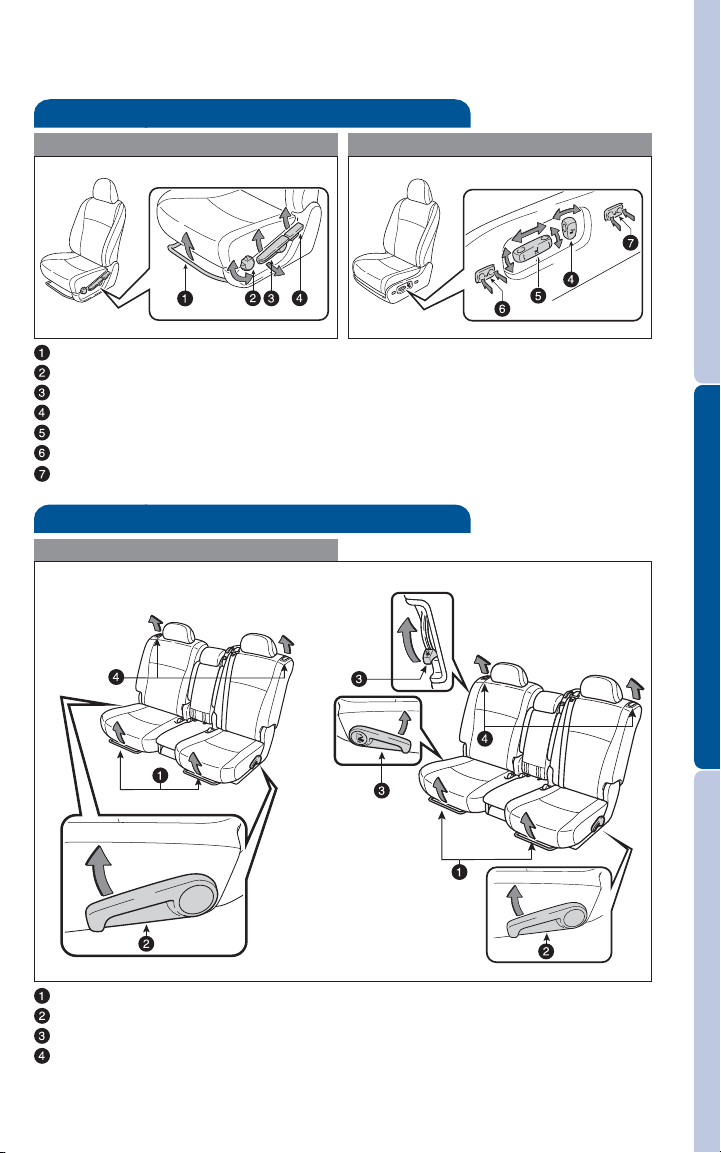
Seat adjustments-Front
Manual seat
Seat position (forward/backward)
Seat cushion angle
Height crank (driver side only)
Seatback angle
Seat position, cushion angle and height
Driver seat leg support (if equipped)
Lumbar support (driver side only)
Power seat
Seat adjustments-Rear
Second row seat
Without third seat With third seat
OVERVIEW FEATURES/OPERATIONS SAFETY AND EMERGENCY FEATURES
Seat position (forward/backward)
Seatback angle
Third seat access lever
Seatback release
Refer to the Owner’s Manual for more details.
13
Page 16
FEATURES/OPERATIONS
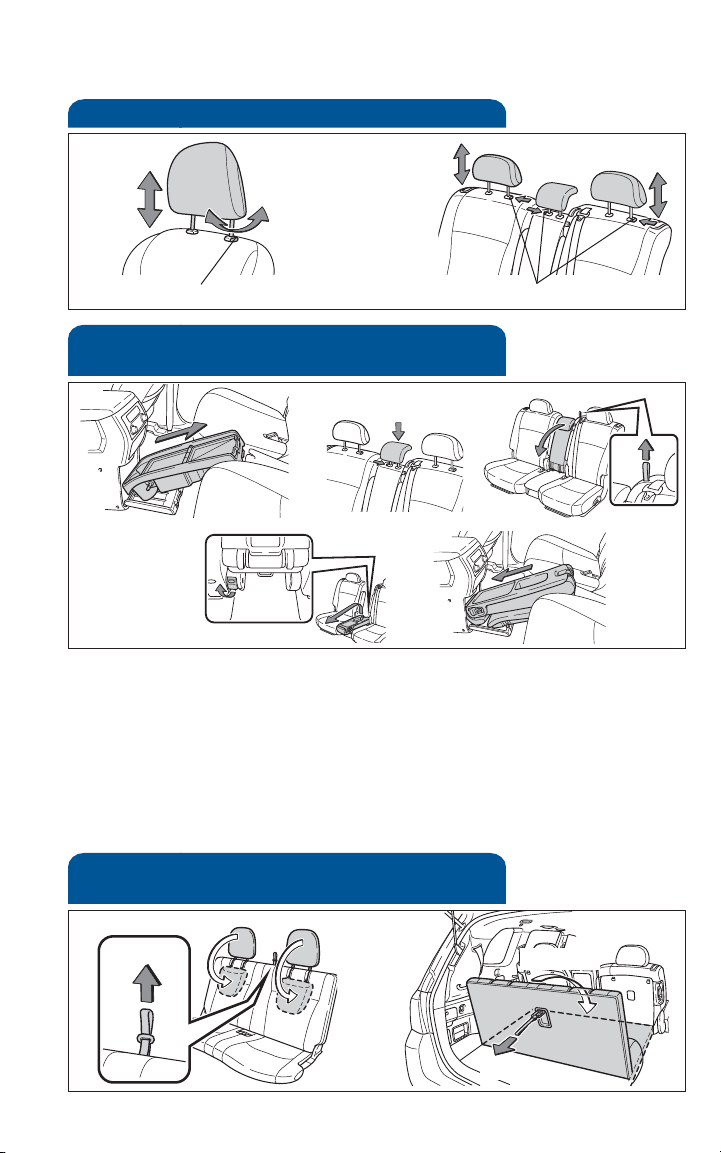
Seats-Head restraints
Front Rear
Height
Lock release button
Seats-Removing Center-Stow
Angle (if equipped)
Lock release button
TM
second row seat
(1)
(5)(4)
(1) Remove the second row console from the front center console box.
(2) Lower the center head restraint.
(3) Pull the strap, then fold down the seatback.
(4) Pull the lever behind the second center seat and lift the rear of the
seat to remove.
(5) Stow the seat in the front center console box.
(3)(2)
NOTE: The second-row console can now be installed between the second
row seats.
Seats-Stowing third row seats
(if equipped)
Pull
Refer to the Owner’s Manual for more details.
14
Fold down
Pull
Page 17
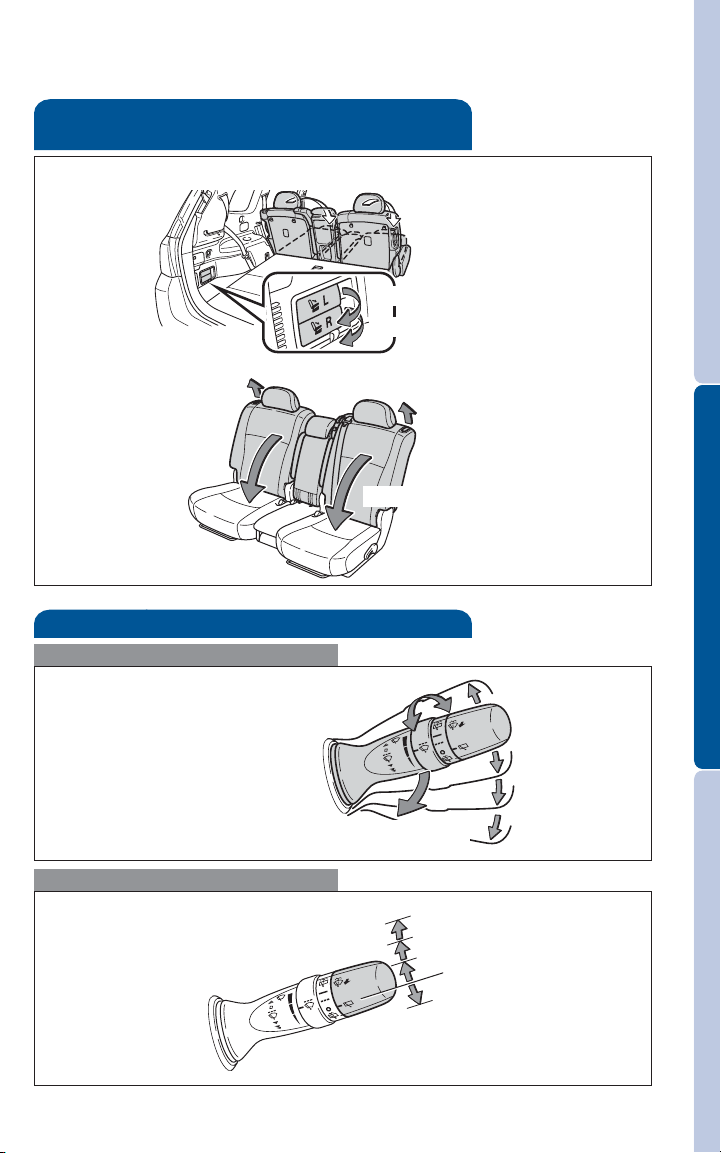
Seats-Folding down second row seats
(if equipped)
From outside
Left side/center remote seat release
Right side remote seat release
OVERVIEW FEATURES/OPERATIONS SAFETY AND EMERGENCY FEATURES
From inside
Windshield wipers & washers
Front
Adjust frequency*
* Intermittent windshield
wiper frequency adjustment
Rotate to increase/decrease
wipe frequency.
Rear
Pull to wash and wipe
(1) Pull up
(2) Fold down
Single wipe
Interval wipe
Slow
Fast
Wash and wipe
Wipe
Interval wipe
Wash and wipe
15
Page 18
FEATURES/OPERATIONS
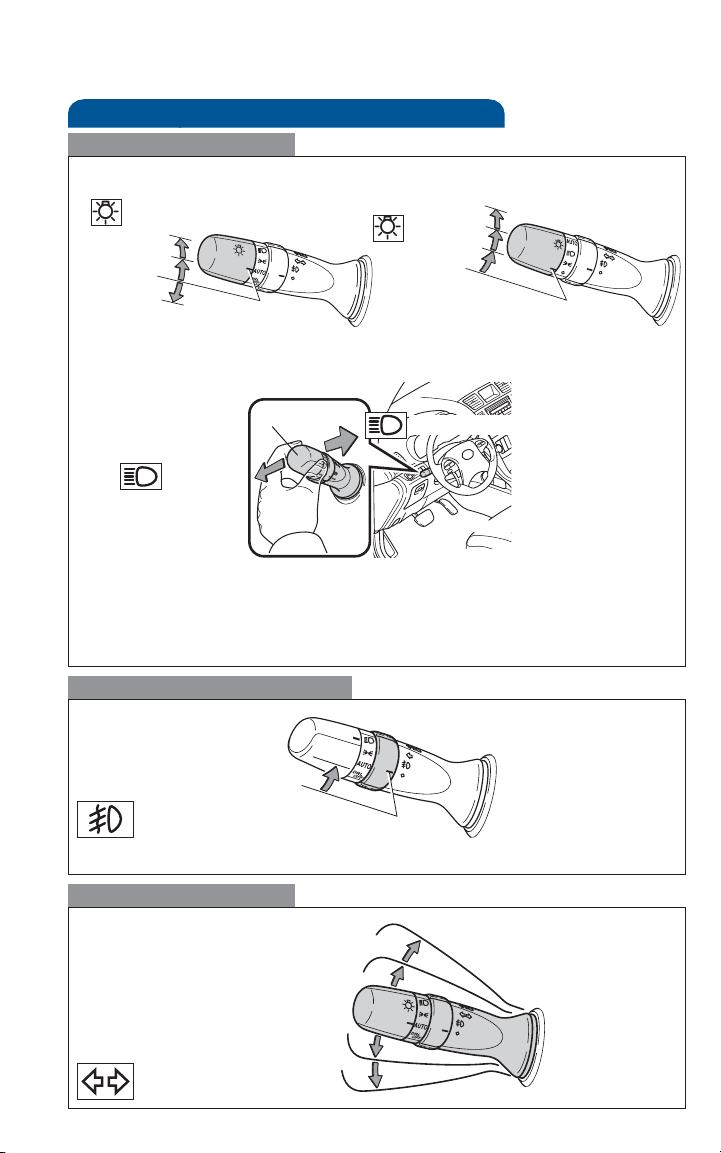
Lights & turn signals
Headlights
With DRL OFF switch
Headlights
Parking lights
Auto
DRL OFF
Without DRL OFF switch
Auto
Headlights
Parking lights
Low beam
High beam
High beam flasher
-Daytime Running Light system (DRL) (if equipped) Automatically turns
on the turn signal lights at a reduced intensity.
-Automatic light cut off system Automatically turns lights off after a
delayof30seconds.
Front fog lights (if equipped)
Tu r n
Front fog lights come on only when the headlights are on low beam.
Tu rn signals
Right turn
Lane change
Lane change
Left turn
16
Page 19
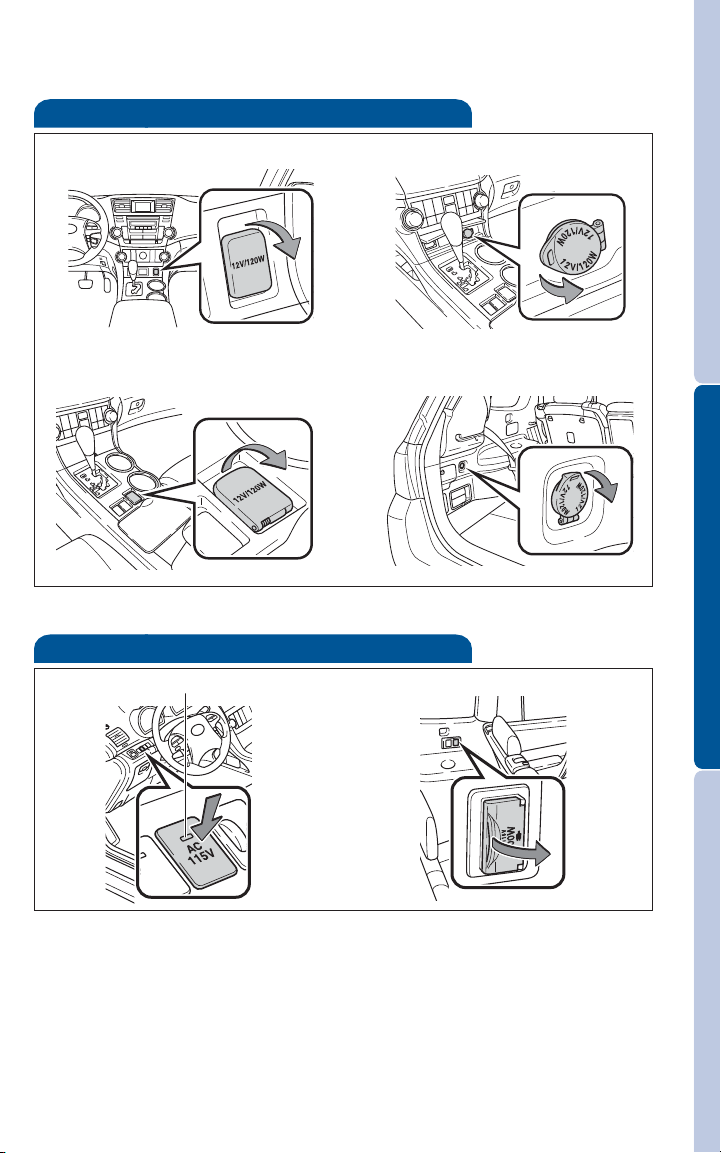
Power outlets-12V DC
Instrument panel (with seat heater)
Center console
Instrument panel (without seat heater)
Luggage compartment
Key/Engine switch must be in the “ACC” or “ON” position to be used.
Power outlets-115V AC (if equipped)
ON/OFF switch
Beside second row seat
OVERVIEW FEATURES/OPERATIONS SAFETY AND EMERGENCY FEATURES
Key/Engine switch must be in the “ON” position to be used.
17
Page 20
FEATURES/OPERATIONS
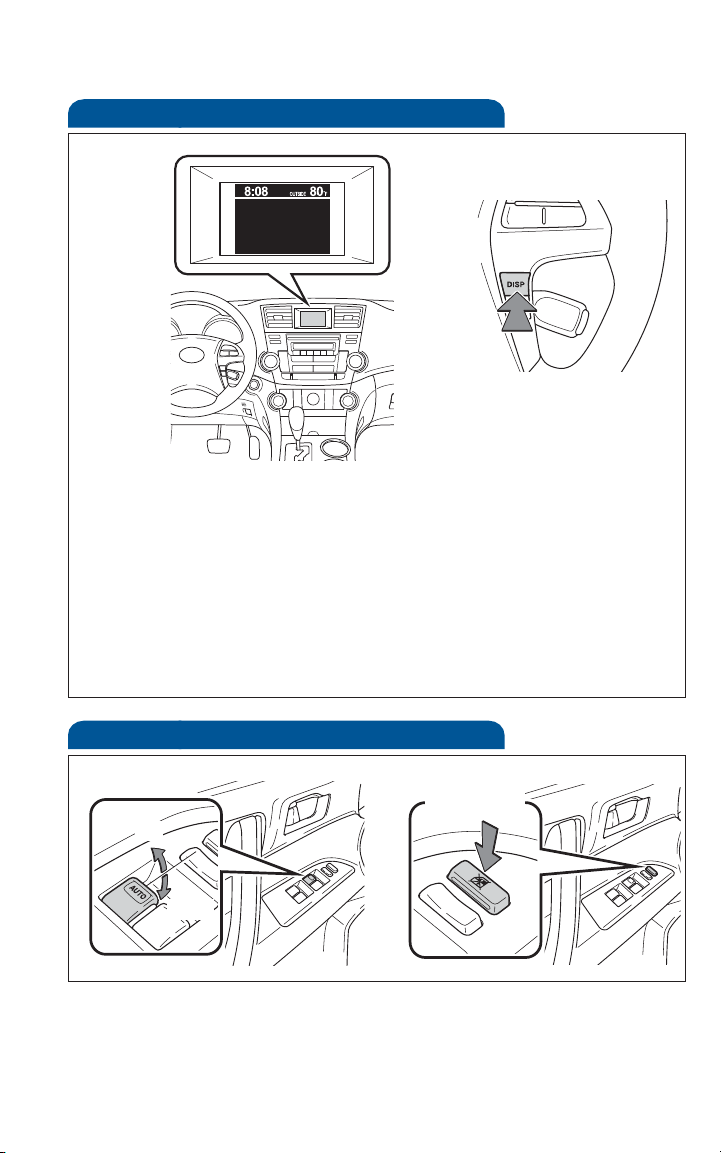
Multi-information display (if equipped)
Push “DISP” to change information in the following:
(1) Average gas mileage after refueling
(2) Current gas mileage
(3) Miles left on remaining fuel
(4) Driving distance from engine start
(5) Average gas mileage
(6) Average gas mileage history
Push and hold “DISP” to set up the displays and the rearview
monitor displays.
Windows-Power
Driver side
Window lock
switch
Up
Down
Automatic operation (driver’s window only) Push the switch completely
down or pull it completely up and release to fully open or close. To stop
window midway, lightly push the switch in the opposite direction.
Window lock switch Deactivates all passenger windows. Driver’s window
remains operable.
18
Page 21
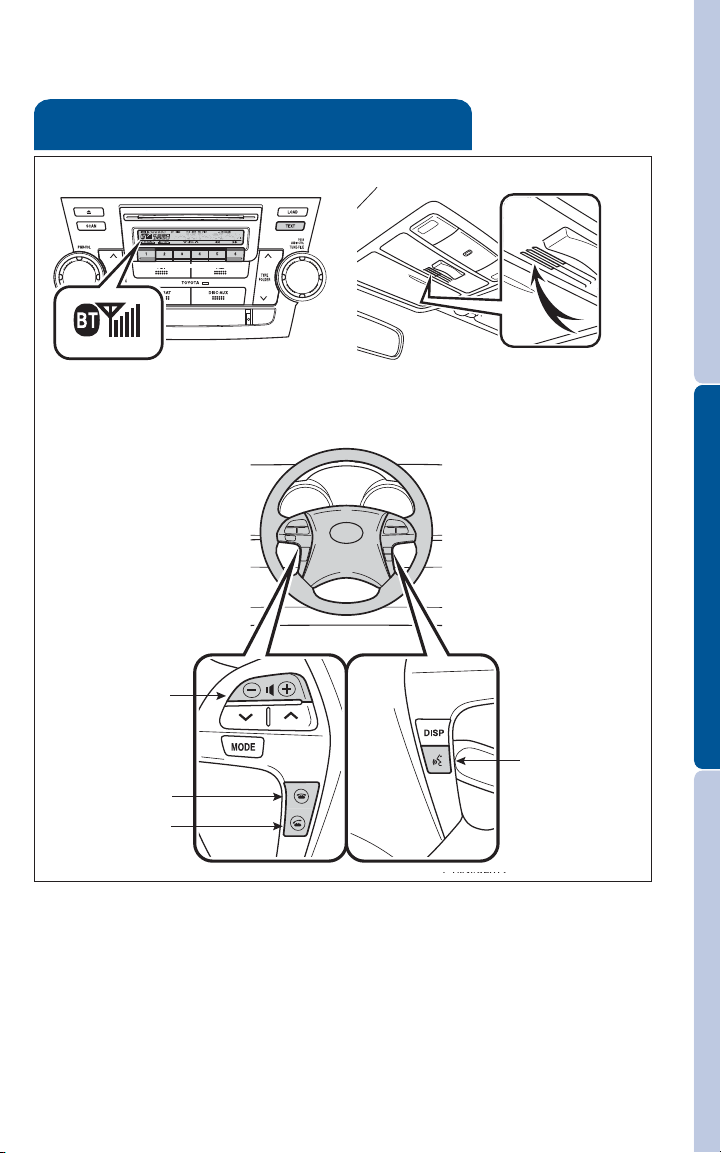
Telephone controls (Bluetooth®)
(if equipped)
Audio unit
Steering wheel telephone controls
Microphone
OVERVIEW FEATURES/OPERATIONS SAFETY AND EMERGENCY FEATURES
Vol ume
Voice command
End call
Start call
button
Bluetooth®technology allows dialing or receipt of calls without taking
hands from the steering wheel or using a cable to connect the telephone
and the system.
Refer to “Hands-free phone system (for cellular phone),” Section 3-4 in
the Owner’s Manual for more details, or go to Toyota.com and enter
“Bluetooth” in the keyword search.
19
Page 22
FEATURES/OPERATIONS
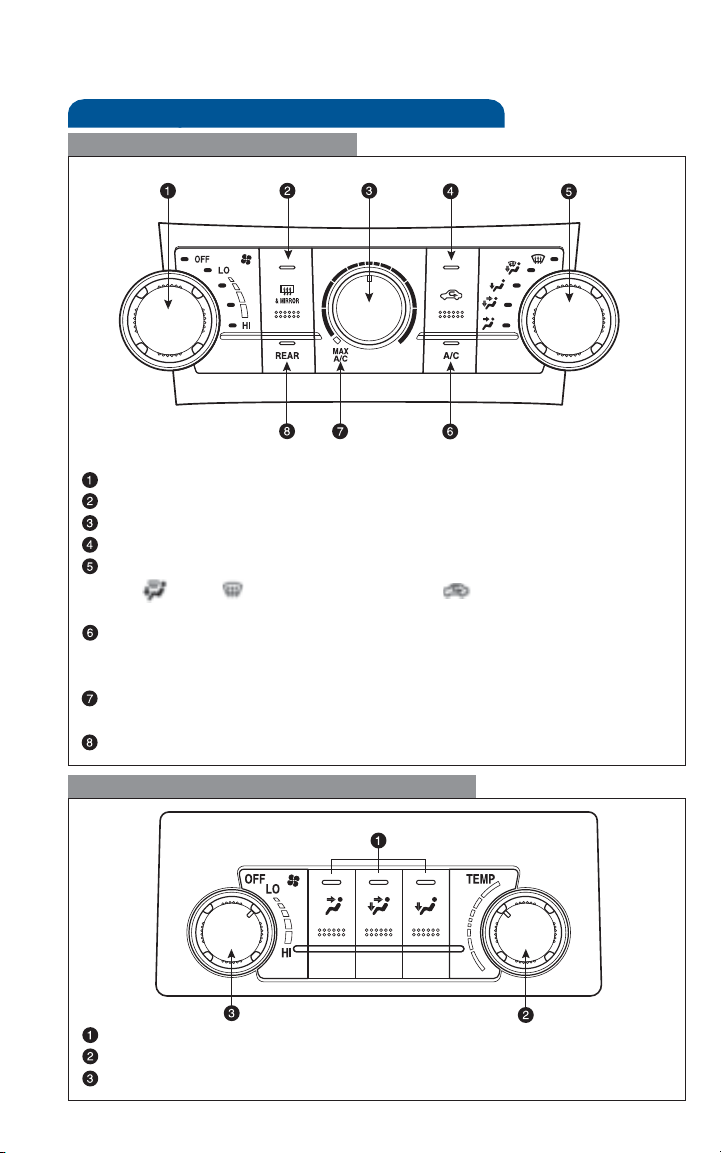
Air Conditioning/Heating
Front
manual Air Conditioning
Fan speed
Outside rearview mirror (if equipped)/Rear window defogger
Temperature selector
Fresh or recirculated cabin air
Airflow vent
In “ ” or “ ” mode, use fresh air (“ ” indicator OFF) to
reduce window fogging.
Air Conditioning ON/OFF
Use fresh air to quickly cool interior, then change to recirculate for
cooler air.
Use for quick cooling. Air intake will automatically be set to
recirculate.
Rear Air Conditioning ON/OFF
Rear manual
Airflow vent
Temperature selector
Fan speed
Air Conditioning (if equipped)
20
Page 23
Front
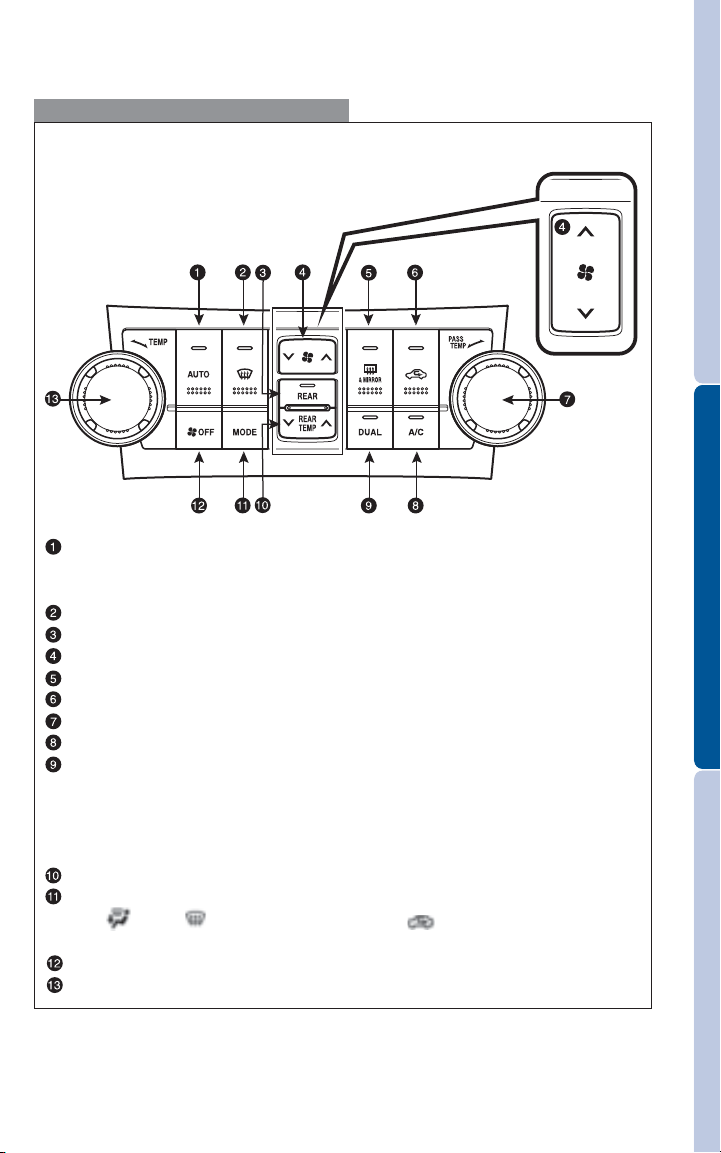
automatic Air Conditioning
With rear Air Conditioning
Without rear Air
Conditioning
Automatic climate control ON
Adjusting the temperature setting will cause the airflow vents, air
intake and fan to adjust automatically.
Windshield airflow/defogger
Rear Air Conditioning ON/OFF
Fan speed
Outside rearview mirror (if equipped)/Rear window defogger
Fresh or recirculated cabin air
Temperature selector (front passenger side)
Air Conditioning ON/OFF
“DUAL” button
Indicator ON: Separate temperature settings for driver, front
passenger and rear passengers.
Indicator OFF: Synchronize temperature settings for driver and all
passengers.
Temperature selector (rear passenger)
Airflow vent
In “ ” or “ ” mode, use fresh air (“ ” indicator OFF) to
reduce window fogging.
Climate control OFF
Temperature selector (driver side)
OVERVIEW FEATURES/OPERATIONS SAFETY AND EMERGENCY FEATURES
21
Page 24
FEATURES/OPERATIONS
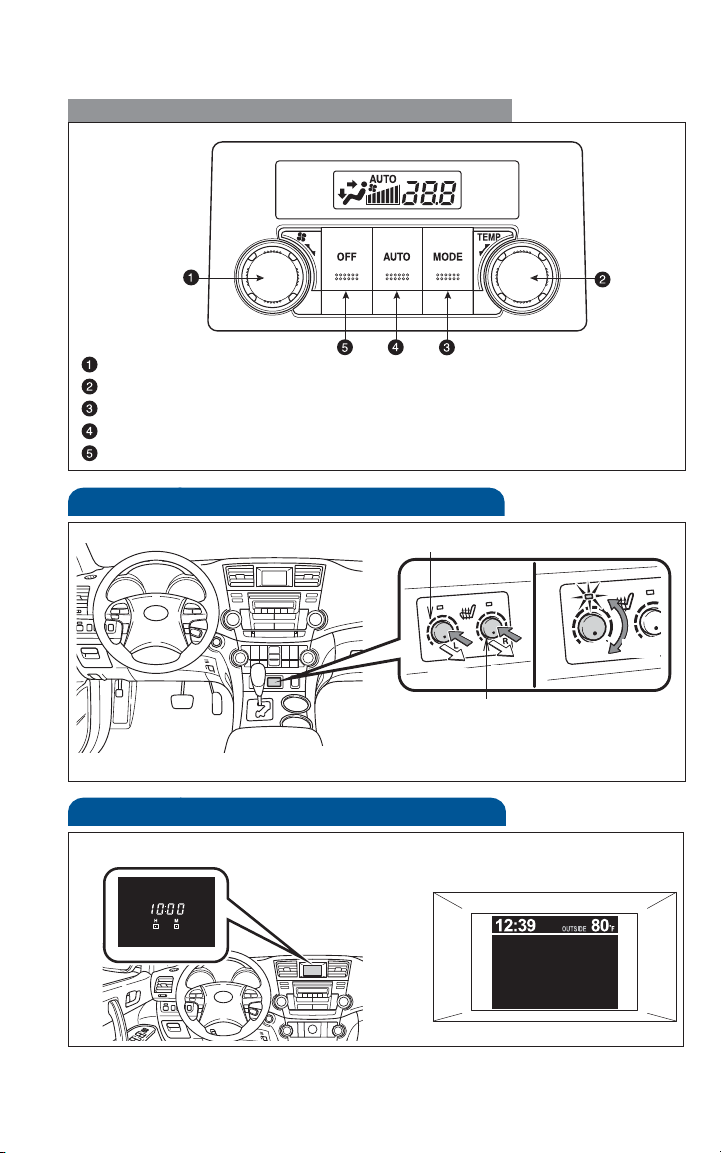
Rear automatic Air Conditioning
Fan speed
Temperature selector
Airflow vent
Automatic climate control ON
Climate control OFF
Seat heaters (if equipped)
(if equipped)
Driver’s seat
Push
Front passenger’s seat
Tu r n
Push
Push knob to pop the controller out. Turn clockwise for heater.
Clock
Without multi-information display
H-Hour set
M-Minute set
With multi-information display Press and hold “DISP” button. Select
“CLOCK” on menu screen. Adjust as indicated on screen.
22
With multi-information display
Page 25
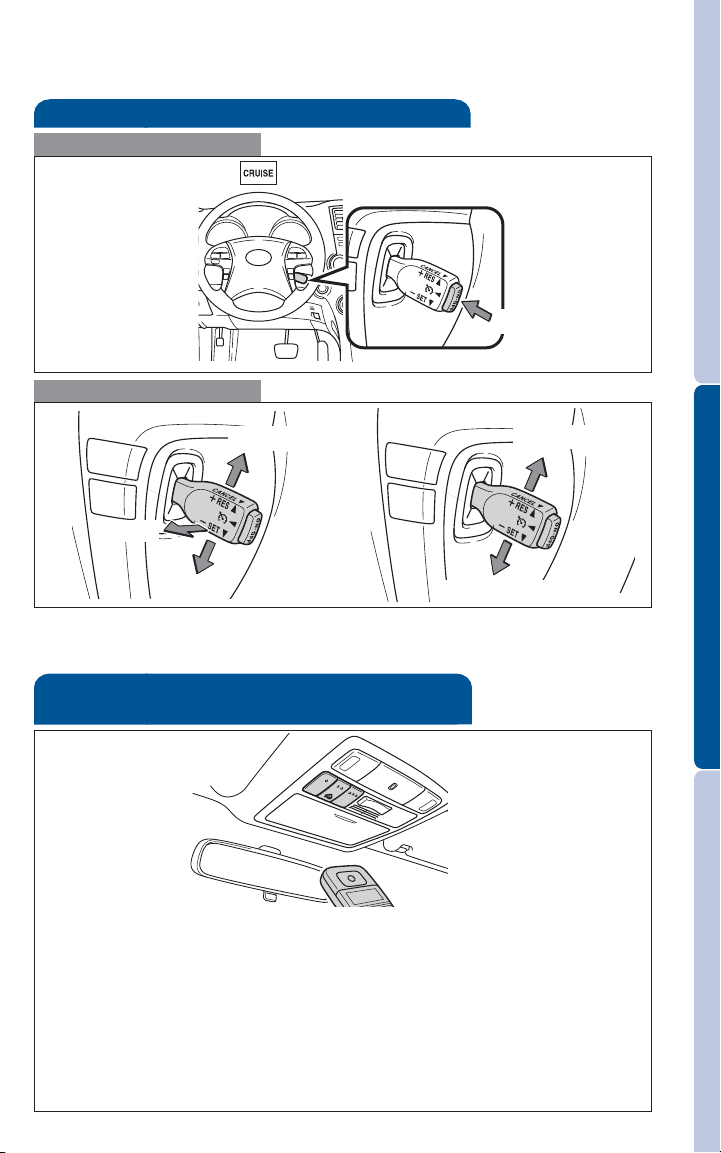
Cruise control
Turning system ON/OFF
Functions
OVERVIEW FEATURES/OPERATIONS SAFETY AND EMERGENCY FEATURES
System ON/OFF
2
Resu me
1
Cancel
Set
1
The set speed may also be cancelled by depressing the brake pedal.
2
The set speed may be resumed once vehicle speed exceeds 25 mph.
Decrease speed
Increase speed
Garage door opener (HomeLink®)*
(if equipped)
Garage door openers manufactured under license from HomeLink®*can
be programmed to operate garage doors, estate gates, security lighting, etc.
Refer to “Garage door opener,” Section 3-7 in the Owner’s Manual for
more details.
For programming assistance, contact HomeLink
visit http://www.homelink.com.
®
at 1-800-355-3515, or
*HomeLink®is a registered trademark of Johnson Controls, Inc.
23
Page 26
FEATURES/OPERATIONS
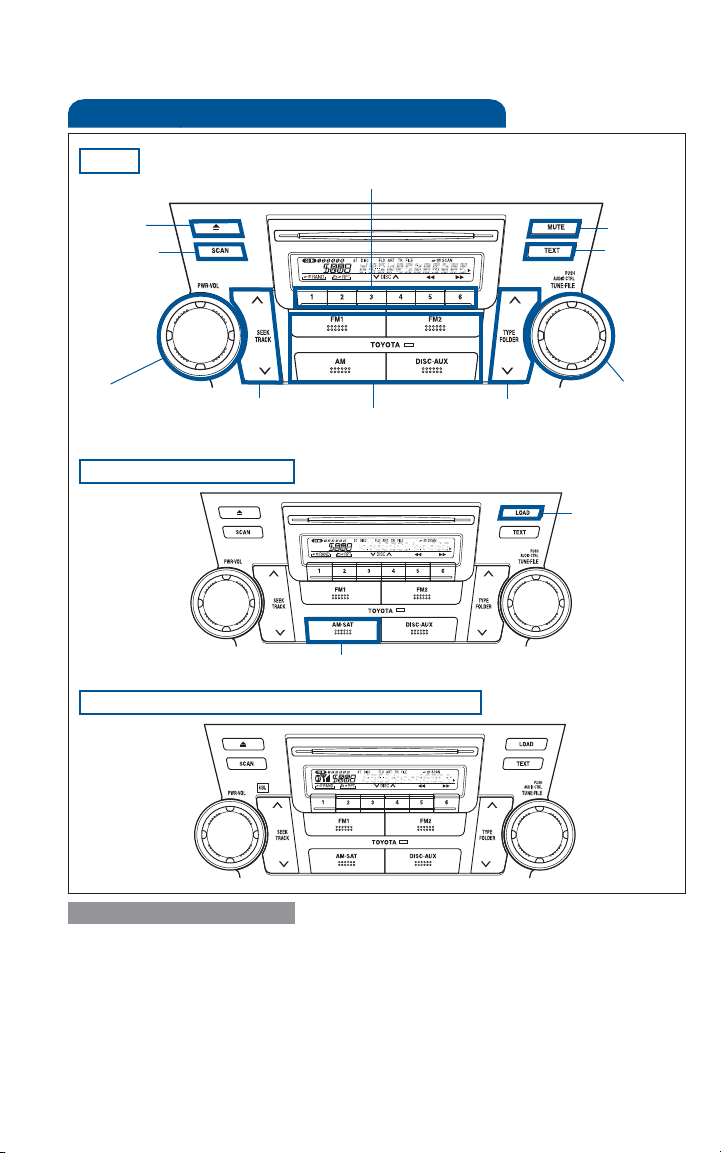
Audio
Typ e 1
Eject CD
Station/CD
track scan
Push to turn
ON/OFF
Type 2 additional functions
Type 3 (with JBL speakers and Bluetooth®function)
Seek station/
CD track select
Preset buttons - functions in other
modes indicated above number
Mode
AM/Satellite Radio
Push to skip
up/down folder and
radio category type
Mute
View CD
text
Push to
adjust tone
& balance
Load CD(s)
CD PLAYER
To scan tracks on a disc Push and hold “SCAN.” Push again to hold
selection.
CD changer (Types 2 and 3 only)
-To load one disc Push “LOAD” and insert one disc.
-To load multiple discs Push and hold “LOAD” until you hear a beep.
Insert one disc. Shutter will close and then re-open for next disc.
Toselectafile(MP3/WMAonly)Tu r n “T U N E.FILE.”
To select a folder (MP3/WMA only) Push either side of “FOLDER.”
24
Page 27
RADIO
To preset stations Tune in the desired station and hold down a preset
button (1-6) until you hear a beep. Push desired preset button (1-6) to
select.
To scan stations Push and hold “SCAN” to scan preset stations. Push again
to hold selection.
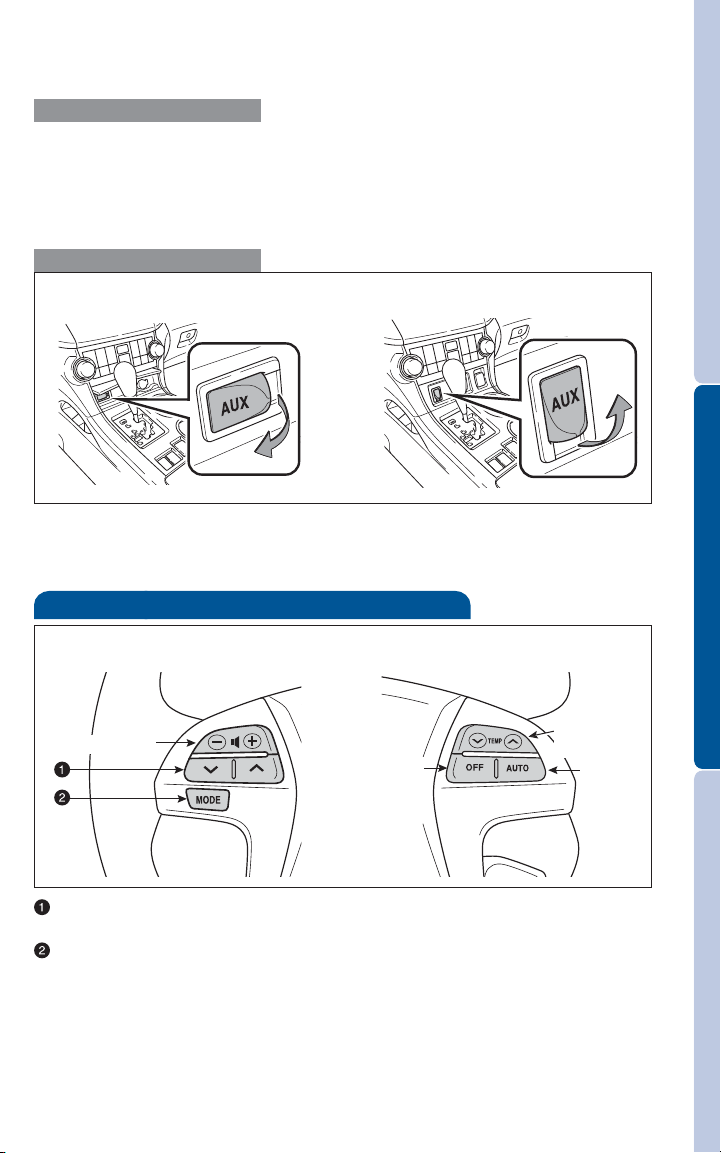
AUX audio jack
Without seat heater
By inserting a mini plug into the AUX audio jack, you can listen to music
from a portable audio device through the vehicle’s speaker system while
in AUX mode.
With seat heater
Steering wheel controls (if equipped)
Audio control
A/C control
OVERVIEW FEATURES/OPERATIONS SAFETY AND EMERGENCY FEATURES
Temperature
Volume control
v
v
“”
A/C OFF
selector
Auto A/C
ON
Use to search within the selected audio medium (radio, CD, iPod, etc.).
“MODE”
Push to turn audio ON and select an audio mode. Push and hold to turn
the audio system OFF.
25
Page 28
FEATURES/OPERATIONS
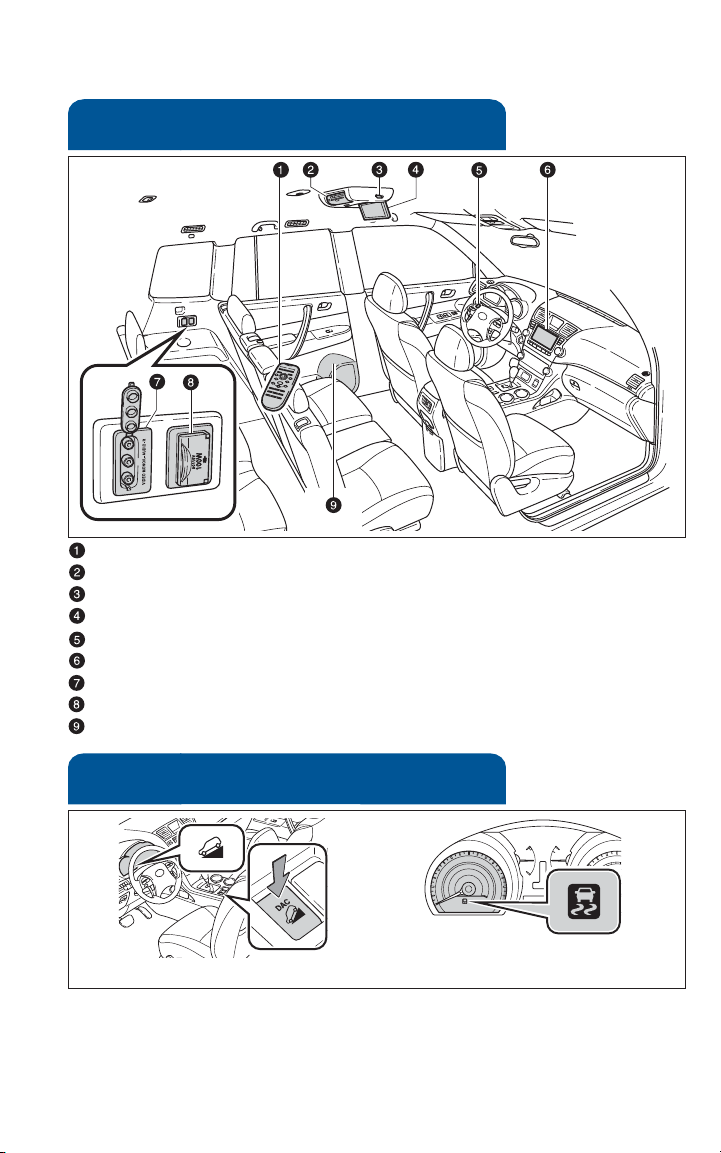
Rear seat entertainment system
(if equipped)
Remote control
DVD player
Headphone volume control and headphone jacks
DVD screen
115V AC Power outlet ON/OFF switch
Front audio system
A/V input adapter
115V AC Power outlet
Wireless headphones
Downhill Assist Control system (DAC)
(if equipped)
Slip indicator blinking, DAC indicator
DAC indicator blinking = DAC not engaged
DAC helps the vehicle to descend steep hills while maintaining a low speed
without brake pedal operation. Press the “DAC” button (system will
engage only when shifter is in S1 or R mode). Pressing the button again
will turn system off.
Refer to the Owner’s Manual for more details.
26
solid = DAC engaged
Page 29
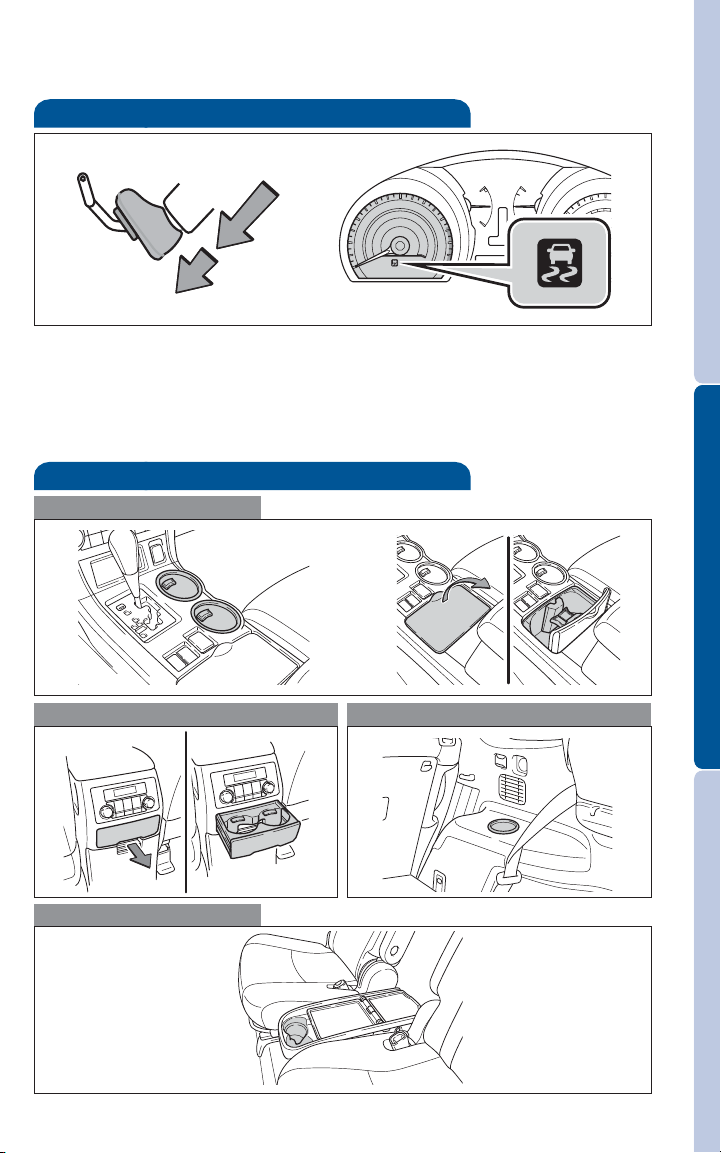
Hill-start Assist Control (HAC)
Brake
pedal
HAC helps prevent rolling backwards on an incline. To engage, push
further down on brake pedal while at a complete stop until a beep sounds
and slip indicator illuminates. HAC holds for approximately 2 seconds after
releasing brake pedal.
Refer to the Owner’s Manual for more details.
Cup holders
Front
OVERVIEW FEATURES/OPERATIONS SAFETY AND EMERGENCY FEATURES
Console box
Side table
Rear
27
Page 30
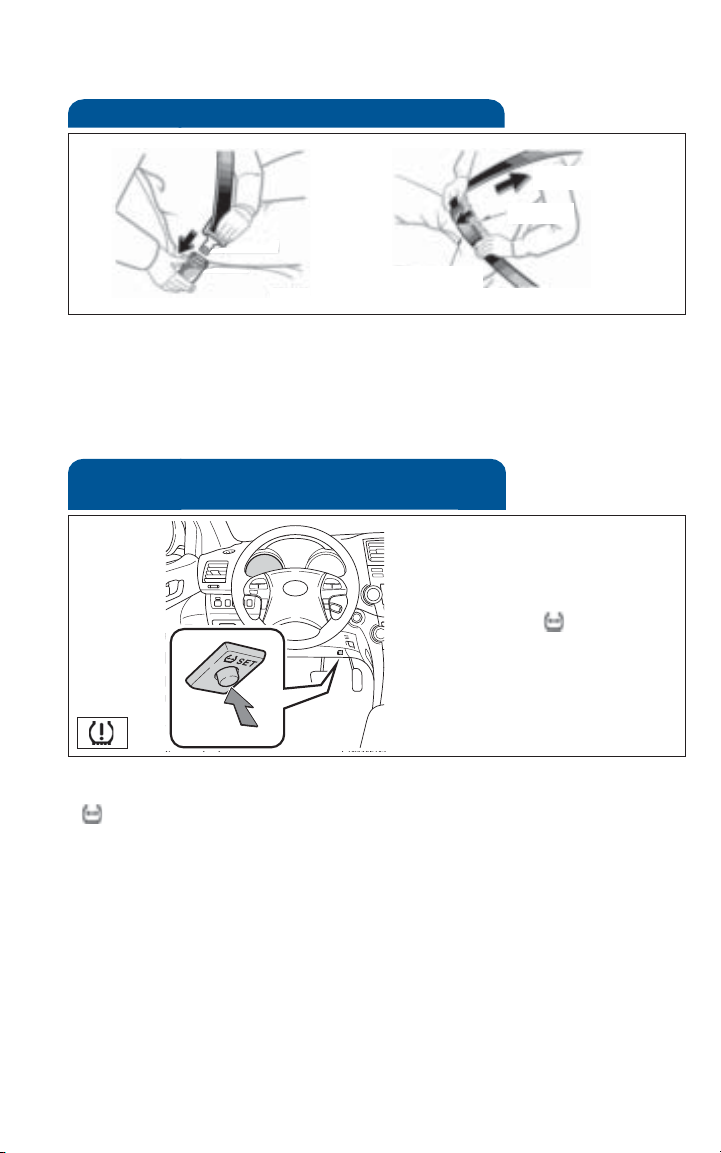
SAFETY AND EMERGENCY FEATURES
Seat belts
Take up slack
To o h i g h
Keep as low on
hips as possible
If belt is fully extended, then retracted even slightly, it cannot be
re-extended beyond that point, unless fully retracted again. This feature
is used to help hold child restraint systems securely.
To find more information about seat belts, and how to install a child
restraint system, refer to the Owner's Manual.
Tire Pressure Monitoring (warning)
System
System reset initialization
1. Push and hold “ SET” button
until the indicator blinks 3 times.
2. Wait a few minutes to allow
initialization to complete.
After adjusting tire pressures, or after tires have been rotated or
replaced, turn the ignition switch to “ON” and press and hold the
“ SET” button until indicator blinks three times. Let the vehicle sit for
a few minutes to allow initialization to complete.
Refer to the load label on the door jamb or the Owner’s Manual for tire
inflation specifications.
If the tire pressure indicator flashes for more than 60 seconds and then
remains on, take the vehicle to your local Toyota dealer.
Note: The warning light may come on due to temperature changes or
changes in tire pressure from natural air leakage. If the system has not
been initialized recently, setting the tire pressures to factory
specifications should turn off the light.
28
Page 31

Abbreviation list
Abbreviation/Acronym list
ABBREVIATIONS MEANING
2WD 2 Wheel Drive
4WD 4 Wheel Drive
A/C Air Conditioning
ABS Anti-lock Brake System
ACC Accessory
ALR Automatic Locking Retractor
CRS Child Restraint System
DAC Downhill Assist Control
DISP Display
ECU Electronic Control Unit
EDR Event Data Recorder
ELR Emergency Locking Retractor
EPS Electric Power Steering
GAWR Gross Axle Weight Rating
GVM Gross Vehicle Mass
I/M Emission Inspection and Maintenance
LATCH Lower Anchors and Tethers for Children
LED Light Emitting Diode
OBD On Board Diagnostics
SRS Supplemental Restraint System
TIN Tire Identification Number
TEMP Temperature
TPMS Tire Pressure Warning System
TRAC Traction Control
VIN Vehicle Identification Number
VSC Vehicle Stability Control
592
Page 32

For your information
Main Owner’s Manual
Please note that this manual covers all models and all equipment, including
options. Therefore, you may find some explanations for equipment not
installed on your vehicle.
All specifications provided in this manual are current at the time of printing.
However, because of the Toyota policy of continual product improvement, we
reserve the right to make changes at any time without notice.
Depending on specifications, the vehicle shown in the illustrations may differ
from your vehicle in terms of equipment.
Noise from under vehicle after turning off the engine
Approximately five hours after the engine is turned off, you may hear sound
coming from under the vehicle for several minutes. This is the sound of a fuel
evaporation leakage check and, it does not indicate a malfunction.
Accessories, spare parts and modification of your Toyota
A wide variety of non-genuine spare parts and accessories for Toyota
vehicles are currently available on the market. You should know that these
parts are not covered by Toyota warranty and that Toyota is not responsible
for their performance, repair, or replacement, or for any damage they may
cause to, or adverse effect they may have on, your Toyota vehicle.
This vehicle should not be modified with non-genuine Toyota products.
Modification with non-genuine Toyota products may affect performance,
safety or durability, and may even violate governmental regulations. In
addition, damage or performance problems resulting from the modification
may not be covered under warranty.
24
Page 33

Installation of a mobile two-way radio system
As the installation of a mobile two-way radio system in your vehicle may
affect electronic systems such as the multi-port fuel injection system/sequential multi-port fuel injection system, cruise control system, anti-lock brake
system, SRS airbag system or seat belt pretensioner system, be sure to
check with your Toyota dealer for precautionary measures or special instructions regarding installation.
Scrapping of your Toyota
The SRS airbag and seat belt pretensioner devices in your Toyota contain
explosive chemicals. If the vehicle is scrapped with the airbags and seat belt
pretensioners left as they are, this may cause an accident such as fire. Be
sure to have the systems of the SRS airbag and seat belt pretensioner
removed and disposed of by a qualified service shop or by your Toyota
dealer before you scrap your vehicle.
Perchlorate Material
Special handling may apply, See www.dtsc.ca.go v/hazardouswaste/perchlorate.
Your vehicle has components that may contain perchlorate. These compo-
nents may include airbag, seat belt pretensioners, and wireless remote control batteries.
25
Page 34

CAUTION
■ General precautions while driving
Driving under the influence: Never drive your vehicle when under the influence of alcohol or drugs that have impaired your ability to operate your vehicle. Alcohol and certain drugs delay reaction time, impair judgment and
reduce coordination, which could lead to an accident that could result in
death or serious injury.
Defensive driving: Always drive defensively. Anticipate mistakes that other
drivers or pedestrians might make and be ready to avoid accidents.
Driver distraction: Always give your full attention to driving. Anything that distracts the driver, such as adjusting controls, talking on a cellular phone or
reading can result in a collision with resulting death or serious injury to you,
your occupants or others.
■ General precaution regarding children’s safety
Never leave children unattended in the vehicle, and never allow children to
have or use the key.
Children may be able to start the vehicle or shift the vehicle into neutral.
There is also a danger that children may injure themselves by playing with
the windows, the moon roof, or other features of the vehicle. In addition, heat
build-up or extremely cold temperatures inside the vehicle can be fatal to
children.
26
Page 35

Symbols used throughout this manual
Cautions & Notices
CAUTION
This is a warning against anything which may cause death or injury to people if
the warning is ignored. You are informed about what you must or must not do
in order to reduce the risk of injury to yourself and others.
NOTICE
This is a warning against anything which may cause damage to the vehicle or
its equipment if the warning is ignored. You are informed about what you must
or must not do in order to avoid or reduce the risk of damage to your Toyota
and its equipment.
Symbols used in illustrations
Safety symbol
The symbol of a circle with a slash through it means “Do not”, “Do
not do this”, or “Do not let this happen”.
Arrows indicating operations
Indicates the action (pushing, turning,
etc.) used to operate switches and other
devices.
Indicates the outcome of an operation
(e.g. a lid opens).
27
Page 36

28
Page 37

TABLE OF CONTENTS
1
Before driving
2
When driving
Interior
3
features
Maintenance
4
and care
When trouble
5
arises
Vehicle
6
specifications
Adjusting and operating features such as door locks,
mirrors, and steering column.
Driving, stopping and safe-driving information.
Air conditioning and audio systems, as well as other
interior features for a comfortable driving experience.
Cleaning and protecting your vehicle, performing do-ityourself maintenance, and maintenance information.
What to do if the vehicle needs to be towed, gets a flat
tire, or is involved in an accident.
Detailed vehicle information.
7
For owners
Index
Reporting safety defects for U.S. owners and seat belt
instructions for Canadian owners
Alphabetical listing of information contained in this
manual.
1
Page 38

1-1. Key information
Keys
The following keys are provided with the vehicle.
Vehicles without smart key system (type A)
Master keys
Valet key
Key number plate
Vehicles without smart key system (type B)
Master keys
Valet key
Key number plate
Vehicles with smart key system
30
Electronic keys
• Operating the smart key
system (→P. 33)
• Operating the wireless
remote control function
(→P. 54)
Mechanical keys
Key number plate
Page 39

1-1. Key information
Using the mechanical key (vehicles with sm art key system)
Take out the mechanical key.
After using the mechanical key,
store it in the electronic key. Carry
the mechanical key together with
the electronic key. If the electronic
key battery is depleted, you will
need the mechanical key.
(→P. 539)
■ When required to leave a key to the vehicle with a parking attendant
Lock the glove box as circumstances demand. (→P. 376)
Vehicles without smart key system: Carry the master key for your own use
and leave the valet key only with the attendant.
Vehicles with smart key system: Remove the mechanical key for your own
use and provide the attendant with the electronic key only.
■ Key number plate
Keep the plate in a safe place such as your wallet, not in the vehicle. In the
event that a key is lost, a new key can be made by your Toy ota dealer using
the key number plate. (→P. 538)
■ When riding in an aircraft (vehicles with smart key system)
When bringing an electronic key onto an aircraft, make sure you do not
press any buttons on the electronic key while inside the aircraft cabin. If you
are carrying an electronic key in your bag etc, ensure that the buttons are
not likely to be pressed accidentally. Pressing a button may cause the electronic key to emit radio waves that could interfere with the operation of the
aircraft.
1
Before driving
31
Page 40

1-1. Key information
NOTICE
■ To prevent key damage
● Do not subject the keys to strong shocks, expose them to high tempera-
tures by placing them in direct sunlight, or get them wet.
● Do not expose the keys to electromagnetic materials or attach any mate-
rial that blocks electromagnetic waves to the key surface.
● Do not disassemble the key.
32
Page 41

1-2. Opening, closing and locking the doors
Smart key system
The following operations can be performed simply by carrying the
electronic key on your person, for example in your pocket.
(The driver should always carry the electronic key.)
∗
Locks and unlocks the
doors (→P. 34)
Starts the engine (→P. 173)
1
Before driving
∗: If equipped
33
Page 42

1-2. Opening, closing and locking the doors
Opens the glass hatch
(→P. 36)
Locks and unlocks the
doors (→P. 34)
Unlocking and locking the doors
Front door handles
34
Grip the handle to unlock the
doors.
Make sure to touch the sensor on
the back of the handle.
The door cannot be unlocked for
3 seconds after the door is
locked.
Page 43

Back door handle
1-2. Opening, closing and locking th e do o rs
Press the lock button to lock the
doors.
1
Before driving
Press the button to unlock the
door.
The door cannot be unlocked for
3 seconds after the door is
locked.
Lock the back door again when
you leave the vehicle. The back
door will not lock automatically
after it has been opened and then
closed.
Press the button to lock the door.
35
Page 44

1-2. Opening, closing and locking the doors
Opening the glass hatch
Antenna location and effective range
■ Antenna location
Press and hold the button to
open the glass hatch. The glass
hatch will pop up.
The glass hatch can be unlocked
only when the back door is
closed.
Lock the glass hatch again when
you leave the vehicle. The glass
hatch will not lock automatically
after it has been opened and then
closed.
Antennas outside the cabin
Antennas inside the cabin
Antenna outside the luggage
compartment
36
Page 45

1-2. Opening, closing and locking th e do o rs
■ Effective range (areas within which the electronic key is
detected)
When locking or unlocking
the doors
The system can be operated
when the electronic key is
within about 2.3 ft. (0.7 m) of
either of the outside front
door handles.
When starting the engine
or changing “ENGINE
START STOP” switch
modes
The system can be operated
when the electronic key is
inside the vehicle.
When opening the glass
hatch and locking or
unlocking the doors
1
Before driving
This system can be operated
when the electronic key is
within about 2.3 ft. (0.7 m) of
the back door handle.
37
Page 46

1-2. Opening, closing and locking the doors
■ Operation signals
A buzzer sounds and the emergency flashers flash to indicate that the doors
have been locked/unlocked. (Locked: Once; Unlocked: Twice)
■ Conditions affecting operation
The smart key system uses weak radio waves. In the following situations,
the communication between the electronic key and the vehicle may be
affected, preventing the smart key system and wireless remote control from
operating properly. (Ways of coping: →P. 539)
● When the electronic key battery is depleted
● Near a TV tower, electronic power plant, gas station, radio station, large
display, airport or other facility that generates strong radio waves or electrical noise
● When carrying a portable radio, cellular phone, cordless phone or other
wireless communication devices
● When the electronic key has come into contact with, or is covered by a
metallic object
● When multiple electronic keys are in the vicinity
● When carrying or using the electronic key together with the following
devices that emit radio waves
• Another vehicle’s electronic key
• A wireless key that emits radio waves
• Personal computer
● If window tint with a metallic content or metallic objects are attached to
the rear window
■ Switching the door unlock function
It is possible to set which doors the entry function unlocks.
STEP
1
Turn the “ENGINE START STOP” switch OFF.
38
STEP
2
When the indicator on the key surface is turned off, push and hold
, , or for approximately 5 seconds while pushing
on the key.
Page 47

1-2. Opening, closing and locking th e do o rs
The setting changes each time an operation is performed, as shown below.
(When changing the setting continuously, release the buttons, wait for at
least 5 seconds, and repeat step 2.)
Multi-information
display
Unlocking doors Beep
Hold the driver's door handle to unlock only the
driver's door.
Exterior: Beeps three
times
Hold the front passenger’s
Interior: Pings once
door handle to unlock all
doors.
STEP
Hold either front door handle to unlock all doors.
3
Unlock the doors using the wireless remote control and open one of
Exterior: Beeps twice
Interior: Pings once
the doors.
If a door is not opened within 60 seconds after is pressed,
the doors will be locked again and the alarm will automatically be
set.
In case that the alarm is triggered, immediately stop the alarm.
(→P. 122)
■ Battery-saving function
In the following circumstances, the entry function is disabled in order to prevent the vehicle and electronic key batteries from discharging.
● When the entry function has not been used for 2 weeks or more
● When the electronic key has been left within approximately 3 ft. (1 m) of
the vehicle for 10 minutes or more
The system will resume operation when...
● The vehicle is locked using the door handle lock button.
● The vehicle is locked/unlocked using the wireless remote control func-
tion. (→P. 54)
● The vehicle is locked/unlocked using the mechanical key. (→P. 539)
1
Before driving
39
Page 48

1-2. Opening, closing and locking the doors
■ Electronic key battery depletion
● The standard battery life is 1 to 2 years. (The battery becomes depleted
even if the electronic key is not used.) If the smart key system or the
wireless remote control function does not operate, or the detection area
becomes smaller, the battery may be depleted. Replace the battery when
necessary. (→P. 473)
● To avoid serious deterioration, do not leave the electronic key within 3 ft.
(1 m) of the following electrical appliances that produce a magnetic field.
•TVs
• Personal computers
• Recharging cellular phones or cordless phones
• Table lamps
■ To operate the system properly
Make sure to carry the electronic key when operating the system. Do not get
the electronic key too close to the vehicle when operating the system from
the outside of the vehicle.
Depending on the position and holding condition of the electronic key, the
key may not be detected correctly and the system may not operate properly.
(The alarm may go off accidentally, or the door lock prevention may not function.)
■ Note for the entry function
● Even when the electronic key is within the effective range (detection
areas), the system may not operate properly in the following cases.
• The electronic key is too close to the window or outside door handle,
near the ground, or in a high place when the doors are locked or
unlocked.
• The electronic key is on the instrument panel, luggage cover, floor or in
the glove box when the engine is started or “ENGINE START STOP”
switch modes are changed.
● As long as the electronic key is within the effective range, the doors may
be locked or unlocked by anyone.
● Even if the electronic key is not inside the vehicle, it may be possible to
start the engine if the electronic key is near the window.
40
Page 49

1-2. Opening, closing and locking th e do o rs
● The doors may unlock if a large amount of water splashes on the door
handle, such as in the rain or in a car wash. (The doors will automatically
be locked after approximately 60 seconds if the doors are not opened
and closed.)
● Gripping the door handle when wearing a glove may not unlock the door.
● If the wireless remote control is used to lock the doors when the elec-
tronic key is near the vehicle, there is a possibility that the door may not
be unlocked by the entry function. (Use the wireless remote control to
unlock the doors.)
■ When the vehicle is not driven for extended periods
To prevent theft of the vehicle, do not leave the electronic key within 6 ft. (2
m) of the vehicle.
■ Security feature
If a door is not opened within approximately 60 seconds after the vehicle is
unlocked, the security feature automatically locks the vehicle again.
■ Alarms and warning indicators
A combination of exterior and interior alarms as well as warning lights and
warning messages shown on the multi-information display are used to
reduce the chance of vehicle theft and accidents resulting from erroneous
operation.
● When any warning lights come on:
Take appropriate measures according to which warning light comes on.
(→P. 510)
● When a warning message is shown on the multi-information display:
Take appropriate measures according to the warning message on the
multi-information display. (→P. 521)
1
Before driving
41
Page 50

1-2. Opening, closing and locking the doors
● When an alarm sounds:
Take appropriate measures according to the following table.
Alarm Situation Correction procedure
Exterior alarm
sounds once for
2 seconds
Exterior alarm
sounds once for
10 seconds
Interior alarm
sounds continuously
Interior alarm
beeps repeatedly
Tried to lock the doors and
the glass hatch using the
entry function while the
electronic key is still inside
the passenger compartment.
Tried to close the glass
hatch with the electronic
key inside and all doors
were locked.
Tried to exit the vehicle
with the electronic key and
lock the doors without first
turning the “ENGINE
ST AR T ST OP” switch OFF.
Tried to lock the vehicle
using the entry function
while a door is open.
Tried to open the door and
exit the vehicle without
shifting the shift lever to P.
Switched to ACCESSORY
mode while the driver's
door is open. (Opened the
driver's door when the
“ENGINE START STOP”
switch is in ACCESSORY
mode.)
Retrieve the electronic key from the
passenger compartment and lock the
doors and the glass
hatch again.
Retrieve the electronic key and close
the glass hatch.
Turn the “ENGINE
START STOP” switch
OFF and lock the
doors again.
Close all of the doors
and lock the doors
again.
Shift the shift lever to
P.
Turn the “ENGINE
START STOP” switch
OFF and close the
driver's door.
42
Turned the “ENGINE
ST ART STOP” switch OFF
while the driver's door is
open.
Close the driver's
door.
Page 51

1-2. Opening, closing and locking th e do o rs
Alarm Situation Correction procedure
Tried to close the driver’s
Interior and exterior alarms sound
continuously.*
door after carrying the key
outside the vehicle with the
“ENGINE START STOP”
switch in IGNITION ON or
ACCESSORY mode and
without the shift lever
Shift the shift lever to
P, turn the “ENGINE
START STOP” switch
OFF and close the
driver’s door again.
being in P.
1
Before driving
Interior alarm
beeps once.*
The electronic key has a
low battery.
Tried to start the engine
without the electronic key
being present, or when the
electronic key was not
Replace the electronic
key battery.
Start the engine with
the electronic key
present.
functioning normally.
Interior alarm
beeps once and
exterior alarm
sounds 3 times.*
Tried to close the driver’s
door after carrying the key
outside the vehicle without
turning the “ENGINE
ST AR T ST OP” switch OFF.
An occupant carried the
electronic key outside the
vehicle and closed the
door when the “ENGINE
START STOP” switch was
Turn the “ENGINE
START STOP” switch
OFF and close the
driver’s door again.
Bring the electronic
key back into the vehi-
cle.
in IGNITION ON or
ACCESSORY mode.
*
: A message will be shown on the multi-information display.
■ If the smart key system does not operate properly
● Locking and unlocking the doors: Use the mechanical key. (→P. 539)
● Starting the engine. (→P. 539)
■ When the electronic key battery is fully depleted
→P. 473
43
Page 52

1-2. Opening, closing and locking the doors
■ Customization that can be configured at Toyota dealer
It is possible to deactivate the smart key system etc.
(Customizable features →P. 582)
■ Certification for the smart key system
For vehicles sold in the U.S.A.
FCC ID: NI4TMLF-3
NOTE:
This device complies with Part 15 of the FCC Rules. Operation is subject to
the following two conditions: (1) This device may not cause harmful interference, and (2) this device must accept any interference received, including
interference that may cause undesired operation.
NOTICE:
This equipment has been tested and found to comply with the limits for a
Class B digital device, pursuant to Part 15 of the FCC Rules. These limits
are designed to provide reasonable protection against harmful interference
in a residential installation. This equipment generates, uses and can radiate
radio frequency energy and, if not installed and used in accordance with the
instructions, may cause harmful interference to radio communications. However, there is no guarantee that interference will not occur in a particular
installation. If this equipment does cause harmful interference to radio or
television reception, which can be determined by turning the equipment off
and on, the user is encouraged to try to correct the interference by one or
more of the following measures:
● Reorient or relocate the receiving antenna.
● Increase the separation between the equipment and receiver.
● Connect the equipment into an outlet on a circuit different from that to
which the receiver is connected.
● Consult the dealer or an experienced radio/TV technician for help.
FCC WARNING:
Changes or modifications not expressly approved by the party responsible
for compliance could void the user's authority to operate the equipment.
44
Page 53

1-2. Opening, closing and locking th e do o rs
1
Before driving
45
Page 54

1-2. Opening, closing and locking the doors471-2. Opening, closing and locking th e do o rs
46
Page 55

1
Before driving
Page 56

1-2. Opening, closing and locking the doors
For vehicles sold in Canada
NOTE:
Operation is subject to the following two conditions: (1) this device may not
cause interference, and (2) this device must accept any interference, including interference that may cause undesired operation of the device.
48
Page 57

1-2. Opening, closing and locking th e do o rs
1
Before driving
49
Page 58

1-2. Opening, closing and locking the doors511-2. Opening, closing and locking th e do o rs
50
Page 59

1
Before driving
Page 60

1-2. Opening, closing and locking the doors531-2. Opening, closing and locking th e do o rs
52
Page 61

CAUTION
■ Caution regarding interference with electronic devices
● People with implanted pacemakers or cardiac defibrillators should keep
away from the smart key system antennas. (→P. 36) The radio waves may
affect the operation of such devices. If necessary, the entry function can
be disabled. Ask your Toyota dealer for details, such as the frequency of
radio waves and timing of emitting the radio waves. Then, consult your
doctor to see if you should disable the entry function.
● User of any electrical medical device other than implanted pacemakers
and implanted cardiac defibrillators should consult the manufacturer of the
device for information about its operation under the influence of radio
waves.
Radio waves could have unexpected effects on the operation of such
medical devices.
Ask your Toyota dealer for details for disabling the entry function.
1
Before driving
Page 62

1-2. Opening, closing and locking the doors
Wireless remote control
The wireless remote control can be used to lock and unlock the vehicle from outside the vehicle.
Vehicles without smart key system (type A)
Locks all doors
Unlocks all doors
Pressing the button unlocks
the driver’s door. Pressing the
button again within 3 seconds
unlocks the other doors.
Pushing and holding:
Opens and closes the
power back door
Pushing and holding:
Opens the glass hatch
The glass hatch can be
opened only when the back
door is closed.
54
Pushing and holding:
Sounds alarm
Page 63

1-2. Opening, closing and locking th e do o rs
Vehicles without smart key system (type B)
Locks all doors
Unlocks all doors
Pressing the button unlocks
the driver’s door. Pressing the
button again within 3 seconds
unlocks the other doors.
Pushing and holding:
Sounds alarm
Pushing and holding:
Opens the glass hatch
(vehicles with glass hatch)
The glass hatch can be
opened only when the back
door is closed.
Vehicles with smart key system
1
Before driving
Locks all doors
Unlocks all doors
Pressing the button unlocks
the driver’s door. Pressing the
button again within 3 seconds
unlocks the other doors.
Pushing and holding:
Opens and closes the
power back door (vehicles
with power back door)
Pushing and holding:
Sounds alarm
55
Page 64

1-2. Opening, closing and locking the doors
■ Operation signals
Doors: A buzzer sounds and the emergency flashers flash to indicate that
the doors have been locked/unlocked. (Locked: Once; Unlocked:
Twice)
Back door: A buzzer sounds and the emergency flashers flash twice to
indicate that the back door has been opened/closed.
■ Panic mode
Vehicles without smart key system
When is pushed for longer than
about one second, an alarm will sound for
about 60 seconds and the vehicle lights
will flash to deter any person from trying
to break into or damage your vehicle.
To stop the alarm, push any button on the
wireless remote control.
Vehicles with smart key system
When is pushed for longer than
about one second, an alarm will sound for
about 60 seconds and the vehicle lights
will flash to deter any person from trying
to break into or damage your vehicle.
To stop the alarm, push any button on the
wireless remote control.
■ Door lock buzzer
If a door is not fully closed, a buzzer sounds continuously if an attempt to
lock the door is made. Fully close the door to stop the buzzer, and lock the
vehicle once more.
56
Page 65

1-2. Opening, closing and locking th e do o rs
■ Key battery depletion
Vehicles without smart key system
The standard battery life is 1 to 2 years. (The battery becomes depleted
even if the key is not used.) If the wireless remote control function does not
operate, the battery may be depleted. Replace the battery when necessary.
(→P. 472)
Vehicles with smart key system
→P. 473
■ If the wireless remote control does not operate properly
Vehicles without smart key system
Locking and unlocking the doors: Use the key. (→P. 66)
Vehicles with smart key system
● Locking and unlocking the doors: Use the mechanical key. (→P. 539)
● Starting the engine. (→P. 173)
■ Security feature
If a door is not opened within approximately 60 seconds after the vehicle is
unlocked, the security feature automatically locks the vehicle again.
■ Alarm
Using the wireless remote control to lock the doors will set the alarm system.
(→P. 122)
1
Before driving
57
Page 66

1-2. Opening, closing and locking the doors
■ Conditions affecting operation
Vehicles without smart key system
The wireless remote control function may not operate normally in the follow-
ing situations.
● Near a TV tower, radio station, electric power plant, airport or other facil-
ity that generates strong radio waves
● When carrying a portable radio, cellular phone or other wireless commu-
nication device
● When multiple wireless keys are in the vicinity
● When the wireless key has come into contact with, or is covered by a
metallic object
● When a wireless key (that emits radio waves) is being used nearby
● When the wireless key has been left near an electrical appliance such as
a personal computer
Vehicles with smart key system
→P. 38
■ Customization that can be configured at Toyota dealer
Settings (e.g. wireless remote control) can be changed.
(Customizable features →P. 582)
■ Reversing the operation of the power back door
Pressing the wireless remote control switch again while the power back door
is operating will cause the operation to reverse. However, the reverse operation cannot be performed for the first second after automatic operation starts,
even if the wireless remote control switch is pressed again.
■ When riding in an aircraft (vehicle without smart key system)
When bringing a wireless remote control onto an aircraft, make sure you do
not press any buttons on the wireless remote control while inside the aircraft
cabin. If you are carrying a wireless remote control in your bag etc, ensure
that the buttons are not likely to be pressed accidentally. Pressing a button
may cause the wireless remote control to emit radio waves that could interfere with the operation of the aircraft.
58
Page 67

1-2. Opening, closing and locking th e do o rs
■ Certification for wireless remote control
For vehicles sold in the U.S.A.
NOTE:
This device complies with Part 15 of the FCC Rules. Operation is subject to
the following two conditions: (1) This device may not cause harmful interfer-
ence, and (2) this device must accept any interference received, including
interference that may cause undesired operation.
NOTICE:
This equipment has been tested and found to comply with the limits for a
Class B digital device, pursuant to Part 15 of the FCC Rules. These limits
are designed to provide reasonable protection against harmful interference
in a residential installation. This equipment generates, uses and can radiate
radio frequency energy and, if not installed and used in accordance with the
instructions, may cause harmful interference to radio communications. How-
ever, there is no guarantee that interference will not occur in a particular
installation. If this equipment does cause harmful interference to radio or
television reception, which can be determined by turning the equipment off
and on, the user is encouraged to try to correct the interference by one or
more of the following measures:
● Reorient or relocate the receiving antenna.
● Increase the separation between the equipment and receiver.
● Connect the equipment into an outlet on a circuit different from that to
which the receiver is connected.
● Consult the dealer or an experienced radio-TV technician for help.
FCC WARNING:
Changes or modifications not expressly approved by the party responsible
for compliance could void the user's authority to operate the equipment.
1
Before driving
59
Page 68

1-2. Opening, closing and locking the doors611-2. Opening, closing and locking th e do o rs
60
Page 69

1
Before driving
Page 70

1-2. Opening, closing and locking the doors
For vehicles sold in Canada
NOTE:
Operation is subject to the following two conditions: (1) this device may not
cause interference, and (2) this device must accept any interference, including interference that may cause undesired operation of the device.
62
Page 71

1-2. Opening, closing and locking th e do o rs
1
Before driving
63
Page 72

1-2. Opening, closing and locking the doors651-2. Opening, closing and locking th e do o rs
64
Page 73

1
Before driving
Page 74

1-2. Opening, closing and locking the doors
Side doors
The vehicle can be locked and unlocked using the entry function,
wireless remote control, key or door lock switch.
■ Entry function (vehicles with smart key system)
→P. 33
■ Wireless remote control
→P. 54
■ Key
Vehicles without smart key system
Locks all doors
Unlocks all doors
Turning the key unlocks the
driver's door. Turning the key
again unlocks the other doors.
Vehicles with smart key system
The doors can also be locked and unlocked with the mechanical
key. (→P. 539)
66
Page 75

■ Door lock switch
■ Inside lock button
1-2. Opening, closing and locking th e do o rs
Locks all doors
Unlocks all doors
1
Before driving
Locks the door
Unlocks the door
Pulling the door handle can
open the front door even if the
lock button is in the lock position.
67
Page 76

1-2. Opening, closing and locking the doors
Rear door child-protector lock
The door cannot be opened from
inside the vehicle when the lock
is set.
These locks can be set to prevent
children from opening the rear
doors. Push down on each rear
door switch to lock both rear
doors.
Automatic door locking and unlocking systems
The following functions can be set or cancelled:
Function Operation
Shift position linked
door locking function
Shift position linked
door unlocking function
Shifting the shift lever out of P locks all
doors.
Shifting the shift lever to P unlocks all doors.
■ Setting and canceling the functions
To switch between setting and canceling, follow the procedure
below:
STEP
1
Vehicles without smart key system:
Close all the doors and switch the engine switch to the “ON”
position. (Perform step 2 within 10 seconds.)
Vehicles with smart key system:
Close all the doors and switch the “ENGINE START STOP”
switch to IGNITION ON mode. (Perform step 2 within 10 seconds.)
68
Page 77

1-2. Opening, closing and locking th e do o rs
STEP
2
Shift the shift lever to P or N, and
press and hold the driver's door
lock switch ( or ) for approximately 5 seconds and then
release it.
The shift lever and switch positions corresponding to the
desired function to be set or canceled are shown in the following
table.
Function Shift lever position Switch position
Shift position linked door locking function
Shift position linked door
unlocking function
P
When the setting or canceling operation is complete, all doors are
locked and then unlocked.
■ When locking the doors using the key
Vehicles without smart key system
The door cannot be locked if the key is in the engine switch.
Vehicles with smart key system
The door cannot be locked if the “ENGINE START STOP” switch is in
ACCESSORY or IGNITION ON mode, or the electronic key is left inside
the vehicle.
Depending on the position of the electronic key, the key may not be
detected correctly and the door may be locked.
■ Customization that can be configured at Toyota dealer
Settings (e.g. door unlocking function) can be changed.
(Customizable features →P. 582)
1
Before driving
69
Page 78

1-2. Opening, closing and locking the doors
CAUTION
■ To prevent an accident
Observe the following precautions while driving the vehicle.
Failing to do so may result in a door opening and an occupant falling out,
resulting in death or serious injury.
● Always use a seat belt.
● Always lock the doors.
● Ensure that all doors are properly closed.
● Do not pull the inside handle of the doors while driving.
The doors may be opened and the passengers are thrown out of the vehicle and it may result in serious injury or death.
Be especially careful for the front doors, the doors may be opened even if
the inside lock buttons are in locked position.
● Set the rear door child protector locks when children are seated in the rear
seats.
70
Page 79

1-2. Opening, closing and locking the doors
Back door
The back door can be locked/unlocked and opened by the following
procedures.
■ Locking and unlocking the back door
Door lock switch
→P. 67
Entry function (vehicles with smart key system)
→P. 34
Wireless remote control
→P. 54
Key
→P. 66
■ Opening the back door from the outside the vehicle
Back door opener
Push up
Raise
1
Before driving
Wireless remote control (vehicles with power back door)
→P. 54
71
Page 80

1-2. Opening, closing and locking the doors
■ Opening the back door from the inside the vehicle (vehicles
with power back door)
Push and hold the switch to
open/close.
Pushing the switch again while
the power back door is operating will cause the operation to
reverse.
However, the reverse operation cannot be performed for
the first second after pushing
the switch to operate the door.
Power back door switch (vehicles with power back door)
Push the switch to close.
Pushing the switch again while
the power back door is closing
will cause it to open again.
However, the reverse operation
cannot be performed for the first
second after pushing the switch
to close the door.
A buzzer sounds and the emergency flashers flash twice to indicate
that the back door has been opened/closed.
The back door can be opened even if it is locked. Lock the back door
again when you leave the vehicle. The back door will not lock automatically after it has been opened and then closed.
72
Page 81

1-2. Opening, closing and locking th e do o rs
Canceling the power back door system (vehicles with power back door)
Turn the main switch in the glove
box off to disable the power back
door system.
1
■ Back door strap
On
Off
The back door cannot be opened
even with the wireless remote
control or power back door
switch.
Use the strap when closing.
Before driving
73
Page 82

1-2. Opening, closing and locking the doors
■ If the back door opener is inoperative
The back door can be operated from the inside.
STEP
STEP
1
2
Remove the cover.
Turn the lever.
■ The power back door can be opened when
● The “ENGINE START STOP” switch is in IGNITION ON mode, and the
shift lever is in P.
● The “ENGINE START STOP” switch is in OFF or in ACCESSOR Y mode.
The power back door can be opened even when the glass hatch is opened.
The glass hatch will not be closed when the power back door is being
closed. Close the glass hatch manually.
■ Jam protection function (vehicles with power back door)
If anything obstructs the power back door while it is closing/opening, the
back door will automatically operate in the opposite direction.
74
Page 83

1-2. Opening, closing and locking th e do o rs
■ If the power back door does not work
The back door must be initialized. To initialize, close the back door com-
pletely by hand.
■ Back door closer (vehicles with power back door)
In the event that the back door is left slightly open, the back door closer will
automatically close it to the fully closed position.
■ Fall-down protection function (vehicles with power back door)
While the power back door is opening automatically, applying excessive
force to it will stop the opening operation to prevent the power back door
from rapidly falling down.
■ Customization that can be configured at Toyota dealer
Settings (e.g. wireless remote control) can be changed.
(Customizable features →P. 582)
CAUTION
Observe the following precautions.
Failure to do so may result in death or serious injury.
■ Caution while driving
Keep the back door closed.
If the back door is open, the luggage will be thrown out and exhaust gases
will enter the vehicle.
■ Operating the power back door
● Check to make sure that passengers do not have any part of their body in
a position where it could be caught or hit when the back door is being
operated.
● Careful attention is needed so as not to get your fingers trapped as the
back door automatically closes when it has not been fully closed.
● Do not allow children to operate the back door.
Closing the back door on someone can cause serious injury, and in some
instances, even death.
1
Before driving
75
Page 84

1-2. Opening, closing and locking the doors
CAUTION
■ Jam protection function (vehicles with power back door)
● Never try jamming any part of your body to activate the jam protection
function intentionally.
● The jam protection function may not work if something gets caught just
before the back door is fully closed.
NOTICE
■ To prevent damage to the back door components
● Do not apply any force, paint or let any other foreign matter on the damper.
● Do not apply excessive force when the back door closer is operating.
● Make sure there is nothing in the doorway before closing.
76
Page 85

1-2. Opening, closing and locking the doors
Glass hatch
The glass hatch can be opened using the glass hatch opener or wire-
less remote control.
∗
■ Wireless remote control (vehicles without smart key sys-
tem)
→P. 54
■ Entry function (vehicles with smart key system)
→P. 34
■ Glass hatch opener
Press and hold the button to
pop up the glass hatch.
Raise
The glass hatch can be
opened only when the back
door is closed.
The glass hatch cannot be
opened when the back door is
locked. Unlock the back door
to open the glass hatch.
(→P. 54)
1
Before driving
■ Opening and closing the glass hatch
● Make sure that the rear wiper is switched off.
● Do not rotate the rear wiper arm while the glass hatch is opening. (If the
rear wiper arm is rotated, close the glass hatch as it is then switch on the
wiper. The rear wiper arm will return to the correct position automatically
after wiping.)
● Make sure that the back door is closed before closing the glass hatch.
∗: If equipped
77
Page 86

1-2. Opening, closing and locking the doors
CAUTION
■ Operating the glass hatch
● Do not open the glass hatch while the vehicle is moving.
● Do not open the glass hatch while the rear wiper is switched on. (If the rear
wiper is switched on while the glass hatch is opening, the wiper motor
drive disc is swinging at the door panel.)
● Do not insert any object in the wiper
motor drive disc.
● Do not close the glass hatch while the rear wiper is switched on. The rear
wiper arm must be restarted suddenly after closing the glass hatch.
If as above are not follow, it may be interfered with you then hurt you.
■ Caution while driving
Keep the back door and glass hatch closed.
This not only keeps the luggage from being thrown out but also prevents
exhaust gases from entering the vehicle.
78
Page 87

1-3. Adjustable components (seats, mirrors, steering wheel)
Front seats
Manual seat
Seat position adjustment lever
Seatback angle adjustment lever
Vertical height adjustment lever (driver’s side only)
Seat cushion (front) angle adjustment knob (driver’s side only)
Pull up the lever until the lock is completely released.
1
Before driving
79
Page 88

1-3. Adjustable components (seats, mirrors, steering wheel)
Power seat
Seat position adjustment switch
Seatback angle adjustment switch
Seat cushion (front) angle adjustment switch (driver’s side only)
Vertical height adjustment switch (driver’s side only)
Driver’s seat leg support adjustment switch (if equipped)
Seat lumbar support adjustment switch (driver’s side only)
Active head restraints
80
When the occupant’s lower back
presses against the seatback
during a rear-end collision, the
head restraint moves slightly forward and upward to help reduce
the risk of whiplash on the seat
occupant.
Page 89

1-3. Adjustable components (seats, mirrors, steering wheel)
■ Active head restraints
Even small forces applied to the seatback may cause the head restraint to
move. Pushing up a locked head restraint forcibly may appear the head
restraint inner structure. These do not indicate problems.
1
During
rear-end
Inner
structure
collision
CAUTION
■ Seat adjustment
● Be careful that the seat does not hit passengers or luggage.
● Do not recline the seat more than necessary when the vehicle is in motion
to reduce the risk of sliding under the lap belt.
If the seat is too reclined, the lap belt may slide past the hips and apply
restraint forces directly to the abdomen or your neck may contact the
shoulder belt, increasing the risk of death or serious injury in the event of
an accident.
● Manual seat only: After adjusting the seat, make sure that the seat is
locked in position.
Before driving
81
Page 90

1-3. Adjustable components (seats, mirrors, steering wheel)
Rear seats
■ Second seats
Seat position adjustment
lever
Seatback angle adjustment
lever
Pull up the lever until the lock
is completely released.
82
Page 91

1-3. Adjustable components (seats, mirrors, steering wheel)
■ Third seats (if equipped)
The third seats do not have a
seat adjustment function.
1
Before driving
Moving a second seat for third seats access (vehicles with third seats)
■ Getting in the vehicle (right side only)
Pull up the lever and fold down
the seatback. The seat will slide
forward.
Move the seat to the front-most
position.
83
Page 92

1-3. Adjustable components (seats, mirrors, steering wheel)
■ Getting out of the vehicle (right side only)
Lift the lever on the side of the
seatback and fold down the seatback. The seat will slide forward.
Move the seat to the front-most
position.
■ After passengers have entered/exited the vehicle
Lift up the seatback and slide the seat backward until it locks.
Folding down the second seats
■ Before folding down the second seats
84
STEP
STEP
1
Stow the rear center seat belt
buckle.
2
Pass the outer seat belts through
the seat belt hangers and secure
the seat belt plates.
This prevents the shoulder belt
from being damaged.
Make sure that the seat belts are
removed from the hangers before
using them.
Page 93

1-3. Adjustable components (seats, mirrors, steering wheel)
■ Folding down the second seats
From inside
From outside (if equipped)
Pull the lever to unlock the seatback and then fold the seatback
down.
Pull the lever.
L: Left side and center second
seats
R:Right side second seat
1
Before driving
■ After folding down the second seats
Slide the folded second seats to
the rear-most position.
85
Page 94

1-3. Adjustable components (seats, mirrors, steering wheel)
Folding down the third seats (vehicles with third seats)
■ Before folding down the third seats
STEP
STEP
STEP
1
2
Stow the third seat belt buckles.
Pass the seat belts through the
seat belt hangers.
This prevents the shoulder belt
from being damaged.
Make sure that the seat belts are
removed from the hangers before
using them.
3
Pull the strap to fold down the
head restraints.
86
Page 95

1-3. Adjustable components (seats, mirrors, steering wheel)
■ Folding down the third seats
Pull the strap on the third seatback fold-down lever toward you
to fold down the seatback.
Removing the second center seat
■ Before removing the second center seat
1
Before driving
STEP
1
Take out the side table from the
console box.
STEP
2
Lower the second center seat head restraint to the lowest
position. (→P. 91)
■ Removing the second center seat
STEP
1
Fold down the second center
seatback while pulling the seatback lock release strap.
87
Page 96

1-3. Adjustable components (seats, mirrors, steering wheel)
STEP
STEP
STEP
2
Pull the lock release lever to
remove the second center seat.
3
Stow the second center seat in
the console box.
4
Make sure that the seat is securely locked in position and
close the console box door.
88
Page 97

1-3. Adjustable components (seats, mirrors, steering wheel)
Installing the second center seat
■ Before installing the second center seat
STEP
1
STEP
2
Remove the side table, if used, from the second seat.
(→P. 386)
■ Installing the second center seat
STEP
1
STEP
2
Take out the second center seat
from the console box.
Fully engage the front pins
with the hooks, and swing the
second center seat downward.
Push down on the second
center seat to engage the rear
pin locks.
Unfold the seatback and lock it.
1
Before driving
Stow the side table in the console
box.
89
Page 98

1-3. Adjustable components (seats, mirrors, steering wheel)
CAUTION
■ When adjusting a rear seat or removing the second center seat
● Be careful that the seat does not hit passengers or luggage.
● Do not recline the seat more than necessary when the vehicle is in motion
to reduce the risk of sliding under the lap belt. If the seat is too reclined,
the lap belt may slide past the hips and apply restraint forces directly to the
abdomen or your neck may contact the shoulder belt, increasing the risk of
death or serious injury in the event of an accident.
● Be careful not to get your hands or feet caught in the seat.
■ Before folding down the rear seats
Do not fold down a rear seat when there are passengers sitting in the rear
seats or when there is luggage placed on the rear seats.
■ After adjusting the seats
Observe the following precautions. Failure to do so may result in death or
serious injury.
● Make sure that the seat and seatback are securely locked in position by
lightly rocking them back and forth.
● Second center seat: Make sure the seat is locked in place by trying to
shake the seatback and lift up the rear part of the seat cushion.
● Check that the seat belts are not twisted or caught under the seat.
■ Caution while driving
Keep the console box closed.
Injuries may result in the event of an accident or sudden braking.
NOTICE
■ When folding down the second seats
Do not fold the seatback forward with the luggage cover hooks attached.
■ Removed second center seat
Avoid putting heavy loads on the seat. The metallic seat pins may be damaged, and you may be unable to correctly reinstall the seat.
90
Page 99

1-3. Adjustable components (seats, mirrors, steering wheel)
Head restraints
Head restraints are provided for all seats.
■ Adjusting the head restraints
Front seats
Vertical adjustment
Up
Pull the head restraints up.
Down
Push the head restraint down
Lock release button
while pushing the lock release
button.
Angle adjustment (if equipped)
1
Before driving
Second seats
Lock release button
Up
Pull the head restraints up.
Down
Push the head restraint down
while pushing the lock release
button.
When using the center seat,
raise the head restraint from
the stowed position.
91
Page 100

1-3. Adjustable components (seats, mirrors, steering wheel)
■ When using the third seat head restraints (vehicles with
third seats)
To use
To fold
■ Adjusting the height of the head restraints (except second center seat
and third seats)
Make sure that the head restraints are
adjusted so that the center of the head
restraint is closest to the top of your ears.
■ Removing the front and second seat outer head restraints (type A)
STEP
1
Pull the head restraint up while pushing the lock release button.
STEP
2
Push a flathead screwdriver into the slot.
(The slot is located on the opposite side
of the head restraint to the lock released
button.)
STEP
3
While pushing in the screwdriver, pull up the head restraint.
92
 Loading...