

Page 1
Refrigerator
User manual
Free Standing Appliance
Untitled-19 1 2017-06-28 2:52:41
Page 2
Contents
Contents
Safety information 4
Important safety symbols and precautions: 6
Severe warning signs for transportation and site 6
Critical installation warnings 7
Installation cautions 10
Critical usage warnings 11
Usage cautions 16
Cleaning cautions 19
Critical disposal warnings 20
Additional tips for proper usage 21
Saving Energy Tips 22
This appliance is intended to be used in household and similar applications such as 23
Instructions about the WEEE 24
Installation 25
Refrigerator at a glance 25
Door removal for entrance 27
Step-by-step installation 34
Operations 41
User interface 41
Samsung Connect 50
Recommendations for voice recognition 53
Samsung Family Hub 53
Special features 55
Maintenance 60
Handle and care 60
Cleaning 64
Replacement 65
English2
Untitled-19 2 2017-06-28 2:52:42
Page 3
Troubleshooting 68
General 68
Samsung Connect 72
Samsung Family Hub 73
LCD 74
Do you hear abnormal sounds from the refrigerator? 75
Contents
English 3
Untitled-19 3 2017-06-28 2:52:42
Page 4
Safety information
• Before using your new Samsung Refrigerator, please read this
manual thoroughly to ensure that you know how to operate the
features and functions that your new appliance offers safely and
efciently.
• This appliance is not intended for use by persons (including
children) with reduced physical, sensory, or mental capabilities,
Safety information
been given supervision or instruction concerning the use of the
appliance by a person responsible for their safety.
• This appliance can be used by children aged from 8 years and
above and persons with reduced physical, sensory or mental
capabilities or lack of experience and knowledge if they have been
given supervision or instruction concerning use of the appliance
in a safe way and understand the hazards involved. Children shall
not play with the appliance. Cleaning and user maintenance shall
not be made by children without supervision.
• Warnings and Important Safety Instructions in this manual do not
cover all possible conditions and situations that may occur. It is
your responsibility to use common sense, caution, and care when
installing, maintaining, and operating your appliance.
• Because these following operating instructions cover various
models, the characteristics of your refrigerator may differ slightly
or those who lack experience and knowledge, unless they have
from those described in this manual and not all warning signs may
be applicable. If you have any questions or concerns, contact your
nearest service center or nd help and information online at www.
samsung.com.
• R-600a or R-134a is used as a refrigerant. Check the compressor
label on the rear of the appliance or the rating label inside the
fridge to see which refrigerant is used for your refrigerator. When
this product contains ammable gas (Refrigerant R-600a), contact
your local authority in regard to safe disposal of this product.
English4
Untitled-19 4 2017-06-28 2:52:42
Page 5
• In order to avoid the creation of a ammable gas-air mixture
if a leak in the refrigerating circuit occurs, the size of the room
in which the appliance may be sited depends on the amount of
refrigerant used.
• Never start up an appliance showing any signs of damage. If
in doubt, consult your dealer. The room must be 1 m³ in size
for every 8 g of R-600a refrigerant inside the appliance. The
amount of refrigerant in your particular appliance is shown on the
identication plate inside the appliance.
• Refrigerant squirting out of the pipes could ignite or cause an eye
injury. When refrigerant leaks from the pipe, avoid any naked
ames and move anything ammable away from the product and
ventilate the room immediately.
- Failing to do so may result in re or explosion.
• It is hazardous for anyone other than an Authorized Service
Person to service this appliance.
Safety information
English 5
Untitled-19 5 2017-06-28 2:52:42
Page 6
Safety information
Important safety symbols and precautions:
Please follow all safety instructions in this manual. This manual uses
the following safety symbols.
WARNING
Safety information
Hazards or unsafe practices that may result in severe personal injury,
property damage, and/or death.
CAUTION
Hazards or unsafe practices that may result in severe personal injury
and/or property damage.
NOTE
Useful information that helps users understand or benet from the
refrigerator.
These warning signs are here to prevent injury to you and others.
Please follow them carefully.
After reading this section, keep it in a safe place for future reference.
Severe warning signs for transportation and site
WARNING
• When transporting and installing the appliance, care should be
taken to ensure that no parts of the refrigerating circuit are
damaged.
- Refrigerant leaking from the pipe work could ignite or cause
an eye injury. If a leak is detected, avoid any naked ames
or potential sources of ignition and air the room in which the
appliance is standing for several minutes.
English6
Untitled-19 6 2017-06-28 2:52:42
Page 7
- This appliance contains a small amount of isobutane refrigerant
(R-600a), a natural gas with high environmental compatibility
that is, however, also combustible. When transporting and
installing the appliance, care should be taken to ensure that no
parts of the refrigerating circuit are damaged.
• When transporting and installing the refrigerator, do not touch the
water hose on the back side of the refrigerator.
- This may damage the refrigerator and as a result the water
dispenser can not be used.
Critical installation warnings
WARNING
• Do not install the refrigerator in a damp location or place where it
may come in contact with water.
- Deteriorated insulation on electrical parts may cause an electric
shock or re.
• Do not place this refrigerator in direct sunlight or expose it to the
heat from stoves, room heaters, or other appliances.
• Do not plug several appliances into the same multiple power strip.
The refrigerator should always be plugged into its own individual
Safety information
electrical outlet which has a voltage rating that matches the
voltage listed on the refrigerator’s rating plate.
- This provides the best performance and also prevents
overloading of house wiring circuits, which could cause a re
hazard from overheated wires.
• If the wall socket is loose, do not insert the power plug.
- There is a risk of electric shock of re.
• Do not use a power cord that has cracks or abrasion damage along
its length or at either end.
English 7
Untitled-19 7 2017-06-28 2:52:42
Page 8
Safety information
• Do not bend the power cord excessively or place heavy objects on
it.
• Do not pull or excessively bend the power cord.
• Do not twist or tie the power cord.
• Do not hook the power cord over a metal object, place a heavy
Safety information
object on the power cord, insert the power cord between objects,
or push the power cord into the space behind the appliance.
• When moving the refrigerator, be careful not to roll over or
damage the power cord.
- This may result in an electric shock or re.
• Never unplug your refrigerator by pulling on the power cord.
Always grip the plug rmly and pull straight out from the outlet.
- Damage to the cord may cause a short-circuit, re, and/or
electric shock.
• Do not store explosive substances such as aerosol cans with a
ammable propellant in this appliance.
• Do not install this appliance near a heater or inammable material.
• Do not install this appliance in a location where gas may leak.
- This may result in an electric shock or re.
• This refrigerator must be properly located and installed in
accordance with the instructions in this manual before you use it.
• Connect the power plug in the proper position with the cord
hanging down.
- If you connect the power plug upside down, the wire can get
cut off and cause a re or electric shock.
• Make sure that the power plug is not crushed or damaged by the
back of the refrigerator.
• Keep the packing materials out of reach of children.
- There is a risk of death from suffocation if a child puts the
packing materials on his or her head.
English8
Untitled-19 8 2017-06-28 2:52:42
Page 9
• The appliance must be positioned so that the plug is accessible
after installation.
- Failing to do so may result in an electric shock or re due to
electric leakage.
• Do not install this appliance in a humid, oily or dusty location, in a
location exposed to direct sunlight and water (rain drops).
- Deteriorated insulation of electrical parts may cause an electric
shock or re.
• If any dust or water is in the refrigerator, pull out power plug and
contact your Samsung Electronics service center.
- Otherwise there is a risk of re.
• Do not stand on top of the appliance or place objects (such as
laundry, lighted candles, lighted cigarettes, dishes, chemicals,
metal objects, etc.) on the appliance.
- This may result in an electric shock, re, problems with the
product, or injury.
• You need to remove all the protective plastic lm before you
initially plug the product in.
• Children should be supervised to ensure that they do not play with
the snap rings used for door adjustment or the water tube clips.
- There is risk of death by suffocation if a child swallows a snap
Safety information
ring or water tube clip. Keep the snap rings and water tube clips
out of children's reach.
• The refrigerator must be safely grounded.
- Always make sure that you have grounded the refrigerator
before attempting to investigate or repair any part of the
appliance. Power leakages can cause severe electric shock.
English 9
Untitled-19 9 2017-06-28 2:52:42
Page 10
Safety information
• Never use gas pipes, telephone lines, or other potential lightning
attractors as an electrical ground.
- You must ground the refrigerator to prevent any power
leakages or electric shocks caused by current leakage from the
refrigerator.
Safety information
- This may result in an electric shock, re, explosion, or problems
with the product.
• Plug the power plug into the wall socket rmly. Do not use a
damaged power plug, damaged power cord, or loose wall socket.
- This may result in an electric shock or re.
• If the power cord is damaged, have it replaced immediately by the
manufacturer or one of its service agents.
• The fuse on the refrigerator must be changed by a qualied
technician or service company.
- Failing to do so may result in an electric shock or personal
injury.
Installation cautions
CAUTION
• Allow sufcient space around the refrigerator and install it on a
at surface.
- Keep the ventilation space in the appliance enclosure or
mounting structure clear of obstructions.
• Allow the appliance to stand for 2 hours before loading foods after
installation and turning on.
• We strongly recommend you have a qualied technician or service
company install the refrigerator.
- Failing to do so may result in an electric shock, re, explosion,
problems with the product, or injury.
English10
Untitled-19 10 2017-06-28 2:52:42
Page 11
• Overload on any one door may fell the refrigerator, causing
physical injury.
Critical usage warnings
WARNING
• Do not insert the power plug into a wall socket with wet hands.
- This may result in an electric shock.
• Do not store articles on the top of the appliance.
- When you open or close the door, the articles may fall and
cause personal injury and/or material damage.
• Do not insert hands, feet or metal objects (such as chopsticks, etc.)
into the bottom or the back of the refrigerator.
- This may result in an electric shock or injury.
- Any sharp edges may cause a personal injury.
• Do not touch the inside walls of the freezer or products stored in
the freezer with wet hands.
- This may cause frostbite.
• Do not put a container lled with water on the refrigerator.
- If spilled, there is a risk of re or electric shock.
• Do not keep volatile or ammable objects or substances (benzene,
Safety information
thinner, propane gas, alcohol, ether, LP gas, and other such
products) in the refrigerator.
- This refrigerator is for storing food only.
- This may result in re or explosion.
• Children should be supervised to ensure that they do not play with
the appliance.
- Keep ngers out of “pinch point” areas. Clearances between the
doors and cabinet are necessarily small. Be careful when you
open the doors if children are in the area.
English 11
Untitled-19 11 2017-06-28 2:52:42
Page 12
Safety information
• Do not let children hang on the door or door bins. A serious injury
may occur.
• Do not let children go inside the refrigerator. They could become
trapped.
• Do not insert your hands into the bottom area under the appliance.
Safety information
- Any sharp edges may cause personal injury.
• Do not store pharmaceutical products, scientic materials, or
temperature sensitive products in the refrigerator.
- Products that require strict temperature controls must not be
stored in the refrigerator.
• Do not place or use electrical appliance inside the refrigerator/
freezer, unless they are of a type recommended by the
manufacturer.
• If you smell pharmaceutical or smoke, pull out power plug
immediately and contact your Samsung Electronics service center.
• If any dust or water is in Refrigerator, pull out power plug and
contact your Samsung Electronics service center.
- Otherwise there is a risk of re.
• Do not let children step on a drawer.
- The drawer may break and cause them to slip.
• Do not leave the doors of the refrigerator open while the
refrigerator is unattended and do not let children enter inside the
refrigerator.
• Do not allow babies or children go inside the drawer.
- It can cause death from suffocation by entrapment or personal
injury.
• Do not overll the refrigerator with food.
- When you open the door, an item may fall out and cause
personal injury or material damage.
English12
Untitled-19 12 2017-06-28 2:52:42
Page 13
• Do not spray volatile material such as insecticide onto the surface
of the appliance.
- As well as being harmful to humans, it may also result in an
electric shock, re, or problems with the product.
• Never put ngers or other objects into the water dispenser hole,
ice chute and ice maker bucket.
- It may cause a personal injury or material damage.
• Do not use or place any substances sensitive to temperature such
as ammable sprays, ammable objects, dry ice, medicine, or
chemicals near or inside of the refrigerator.
• Do not use a hair dryer to dry the inside of the refrigerator. Do
not place a lighted candle in the refrigerator for removing bad
odours.
- This may result in an electric shock or re.
• Fill the water tank, ice tray and water cubes only with potable
water (mineral water or puried water).
- Do not ll the tank with tea, juice or sports drink, this may
damage the refrigerator.
• Do not stand on top of the appliance or place objects (such as
laundry, lighted candles, lighted cigarettes, dishes, chemicals,
metal objects, etc.) on the appliance. This may result in an electric
Safety information
shock, re, problems with the product, or injury. Do not put a
container lled with water on the appliance.
- If spilled, there is a risk of re or electric shock.
• Do not use mechanical devices or any other means to accelerate
the defrosting process, other than those recommended by the
manufacturer.
• Do not damage the refrigerant circuit.
• Never stare directly at the UV LED lamp for long periods of time.
- This may result in eye strain due to the ultraviolet rays.
English 13
Untitled-19 13 2017-06-28 2:52:42
Page 14
Safety information
• Do not put fridge shelf in upside down. Shelf stopper could not
work.
- It may cause a personal injury because of glass shelf drop.
• Keep ngers out of “pinch point” areas. Clearances between the
doors and cabinet are necessarily small. Be careful when you open
Safety information
the doors if children are in the area.
• If a gas leak is detected, avoid any naked ames or potential
sources of ignition, and air the room in which the appliance is
standing for several minutes.
- Do not touch the appliance or power cord.
- Do not use a ventilating fan.
- A spark may result in explosion or re.
• Use only the LED Lamps provided by the manufacturer or its
service agents.
• Bottles should be stored tightly together so that they do not fall
out.
• This product is intended only for the storage of food in a domestic
environment.
• Never put ngers or other objects into the water dispenser hole,
ice chute and ice maker bucket.
- It may cause a personal injury or material damage.
• Do not attempt to repair, disassemble, or modify the refrigerator
yourself.
• Unauthorized modications can cause safety problems. To reverse
an unauthorized modication, we will charge the full cost of parts
and labor.
• Do not use any fuse (such as cooper, steel wire, etc.) other than a
standard fuse.
English14
Untitled-19 14 2017-06-28 2:52:42
Page 15
• If your refrigerator needs to be repaired or reinstalled, contact
your nearest service center.
- Failing to do so may result in an electric shock, re, problems
with the product, or injury.
• If the interior or exterior LED lamp has gone out, contact your
nearest service center.
• If the refrigerator emits a burning smell or smoke, unplug the
refrigerator immediately and contact your Samsung Electronics
service center.
- Failing to do so may result in an electric or re hazards.
• Pull the power plug out of the socket before changing the interior
lamps of the refrigerator
- Otherwise, there is a risk of electric shock.
• If you experience difculty changing a non-LED light, contact a
Samsung service center.
• If the product is equipped with LED lamps, do not disassemble the
Lamp Covers and LED lamps yourself.
- Contact a Samsung service center.
• Plug the power plug into the wall socket rmly.
• Do not use a damaged power plug, damaged power cord or loose
wall socket.
Safety information
- This may result in an electric shock or re.
English 15
Untitled-19 15 2017-06-28 2:52:42
Page 16
Safety information
Usage cautions
CAUTION
• Do not re-freeze frozen foods that have thawed completely. Do
not place carbonated or zzy drinks in the freezer compartment.
Do not put bottles or glass containers in the freezer.
Safety information
- When the contents freeze, the glass may break and cause
personal injury.
• Use only the ice maker provided with the refrigerator.
• Have the refrigerator’s water supply connected only to a potable
water supply. To operate the ice maker properly, water pressure of
20 ~ 125 psi (138 ~ 862 kPa) is required. If you will be away from
home for a long period of time (on vacation, for example) and
won’t be using the water or ice dispensers, close the water valve.
- Otherwise, water leakage may occur.
• If you won’t be using the refrigerator for a very long period of
time, (3 weeks or more) empty the refrigerator including the ice
bucket, unplug it, close the water valve, wipe excess moisture
from the inside walls, and leave the doors open to prevent odors
and mold.
• To get the best performance from the product:
- Do not place food too close to the vents at the rear of the
refrigerator as this can obstruct free air circulation in the
refrigerator compartment.
- Wrap food up properly or place it in airtight containers before
putting it into the refrigerator.
- Do not place glass bottles or carbonated beverages into the
freezer. They can freeze and break. Broken beverage containers
can cause injury.
- Please observe maximum storage times and expiration dates of
frozen goods.
English16
Untitled-19 16 2017-06-28 2:52:42
Page 17
- There is no need to disconnect the refrigerator from the power
supply if you will be away for less than three weeks. However,
if you will be away for more than three weeks, remove all the
food and ice in the ice bucket, unplug the refrigerator, close the
water valve, wipe excess moisture from the inside walls, and
leave the doors open to prevent odors and mold.
• Do not place glass or bottles or carbonated beverages into the
freezer.
- The container may freeze and break, and this may result in
injury.
• Do not place carbonated or zzy drinks in the freezer
compartment. Do not put bottles or glass containers in the freezer.
- When the contents freeze, the glass may break and cause
personal injury and property damage.
• Service Warranty and Modication.
- Any changes or modications performed by a 3rd party on this
nished appliance are not covered under Samsung warranty
service, nor is Samsung responsible for safety issues that result
from 3rd party modications.
• Do not block the air vents inside the refrigerator.
- If the air vents are blocked, especially with a plastic bag, the
Safety information
refrigerator can be over cooled. If a cooling period lasts too
long, the water lter may break and cause water leakage.
• Use only the ice-maker provided with the refrigerator.
• Wipe excess moisture from the inside and leave the doors open.
- Otherwise, odor and mold may develop.
• If the refrigerator is disconnected from the power supply, you
should wait for at least ve minutes before plugging it back in.
English 17
Untitled-19 17 2017-06-28 2:52:43
Page 18
Safety information
• If you have a long vacation planned or do not intend to use the
refrigerator for a long period of time, (3 weeks or more) empty the
refrigerator including the ice bucket, pull out the power plug, close
the water valve, wipe excess moisture from the inside walls, and
leave the doors open to prevent odors and mold.
Safety information
• When the refrigerator got wet by water, pull out the power plug
and contact your Samsung Electronics service center.
• Do not strike or apply excessive force to any glass surface.
- Broken glass may result in a personal injury and/or property
damage.
• Fill the water tank and ice cube trays with potable water only (tap
water, mineral water, or puried water).
- Do not ll the tank with tea or a sports drink. This may damage
the refrigerator.
• If the refrigerator is ooded, make sure to contact your nearest
service center.
- There is a risk of electric shock or re.
• Do not keep vegetable oil in your refrigerator’s door bins. The oil
can solidify, making it foul-tasting and difcult to use. In addition,
the open container can leak and the leaked oil can cause the door
bin to crack. After opening an oil container, it is best to keep the
container in a cool and shaded place such as a cupboard or pantry.
- Examples of vegetable oil: olive oil, corn oil, grape-seed oil, etc.
English18
Untitled-19 18 2017-06-28 2:52:43
Page 19
Cleaning cautions
CAUTION
• Do not spray water directly on the inside or outside the
refrigerator.
- There is a risk of re or electric shock.
• Do not use a hair dryer to dry the inside of the refrigerator.
• Do not place a lighted candle in the refrigerator to remove bad
odors.
- This may result in an electric shock or re.
• Do not spray cleaning products directly on the display.
- Printed letters on the display may come off.
• If any foreign substance such as water has entered the appliance,
unplug the power plug and contact your nearest service center.
- Failing to do so may result in an electric shock or re.
• Use a clean, dry cloth to remove any foreign matter or dust from
the power plug blades. Do not use a wet or damp cloth when
Safety information
cleaning the plug.
- Otherwise, there is a risk of re or electric shock.
• Do not clean the appliance by spraying water directly onto it.
• Do not use benzene, thinner, or Clorox, Chloride for cleaning.
- They may damage the surface of the appliance and may cause a
re.
• Before cleaning or performing maintenance, unplug the appliance
from the wall socket.
- Failing to do so may result in an electric shock or re.
• Use a clean sponge or soft cloth and a mild detergent in warm
water to clean the refrigerator.
English 19
Untitled-19 19 2017-06-28 2:52:43
Page 20
Safety information
• Do not use abrasive or harsh cleansers such as window sprays,
scouring cleansers, ammable uids, muriatic acid, cleaning
waxes, concentrated detergents, bleaches, or cleansers containing
petroleum products on exterior surfaces (doors and cabinet),
plastic parts, door and interior liners, and gaskets.
Safety information
- These can scratch or damage the material.
• Do not clean glass shelves or covers with warm water when they
are cold. Glass shelves and covers may break if exposed to sudden
temperature changes or impacts such as bumping or dropping.
Critical disposal warnings
WARNING
• Please dispose of the packaging material from this product in an
environmentally friendly manner.
• Ensure that none of the pipes on the back of the refrigerator are
damaged prior to disposal.
• R-600a or R-134a is used as a refrigerant. Check the compressor
label on the rear of the appliance or the rating label inside the
fridge to see which refrigerant is used for your refrigerator. If this
refrigerator contains ammable gas (Refrigerant R-600a), contact
your local authority in regard to safe disposal of this product.
• When disposing of this refrigerator, remove the door/door seals
and door latch so that small children or animals cannot become
trapped inside. Children should be supervised to ensure that they
do not play with the appliance. If trapped inside, a child may get
hurt or suffocate to death.
- If trapped inside, the child may become injury and suffocate to
death.
English20
Untitled-19 20 2017-06-28 2:52:43
Page 21
• Cyclopentane is used in the insulation. The gases in the insulation
material require a special disposal procedure. Please contact your
local authorities in regard to the environmentally safe disposal of
this product.
• Keep all packaging materials well out of the reach of children, as
packaging materials can be dangerous to children.
- If a child places a bag over his or her head, the child could
suffocate.
Additional tips for proper usage
• In the event of a power failure, call the local ofce of your electric
company and ask how long the failure is going to last.
- Most power failures that are corrected in an hour or two will
not affect your refrigerator temperatures. However, you should
minimize the number of door openings while the power is off.
- Should the power failure last more than 24 hours, remove and
discard all frozen food.
• The refrigerator might not operate consistently (frozen contents
can thaw or temperatures can become too warm in the frozen
food compartment) if sited for an extended period of time in a
location where ambient air temperatures are constantly below the
Safety information
temperatures for which the appliance is designed.
• In case of particular foods, keeping it under refrigeration can have
a bad effect on preservation due to its properties.
• Your appliance is frost free, which means there is no need
to manually defrost your appliance. This will be carried out
automatically.
English 21
Untitled-19 21 2017-06-28 2:52:43
Page 22
Safety information
• Temperature rise during defrosting complies with ISO
requirements. If you want to prevent an undue rise in the
temperature of frozen food while the appliance defrosts, wrap the
frozen food in several layers of newspaper.
• Do not re-freeze frozen foods that have thawed completely.
Safety information
• The temperature of two star section (sections) or compartment
(compartments) which have two star symbol ( ) is slightly higher
than other freezer compartment (compartments).
The two star section (sections) or compartment (compartments) is
(are) based on the instruction and/or the condition as delivered.
Saving Energy Tips
• Install the appliance in a cool, dry room with adequate ventilation.
Ensure that it is not exposed to direct sunlight and never put it
near a direct source of heat (a radiator, for example).
• Not to block any vents and grilles is recommended for energy
efciency.
• Allow warm food to cool down before placing it in the appliance.
• Put frozen food in the refrigerator to thaw. You can then use
the low temperatures of the frozen products to cool food in the
refrigerator.
• Do not keep the door of the refrigerator open for too long when
putting food in or taking food out. The shorter the time the door is
open, the less frost build-up you’ll have in the freezer.
• It is recommended to install the refrigerator with clearance to the
back and sides. This will help reduce power consumption and keep
your energy bills lower.
• For the most efcient use of energy, please keep the all inner
ttings such as baskets, drawers, shelves on the position supplied
by manufacturer.
English22
Untitled-19 22 2017-06-28 2:52:43
Page 23
This appliance is intended to be used in household and similar applications such as
• staff kitchen areas in shops, ofces and other working
environments;
• farm houses and by clients in hotels, motels and other residential
type environments;
• bed and breakfast type environments;
• catering and similar non-retail applications.
Safety information
English 23
Untitled-19 23 2017-06-28 2:52:43
Page 24
Safety information
Instructions about the WEEE
Safety information
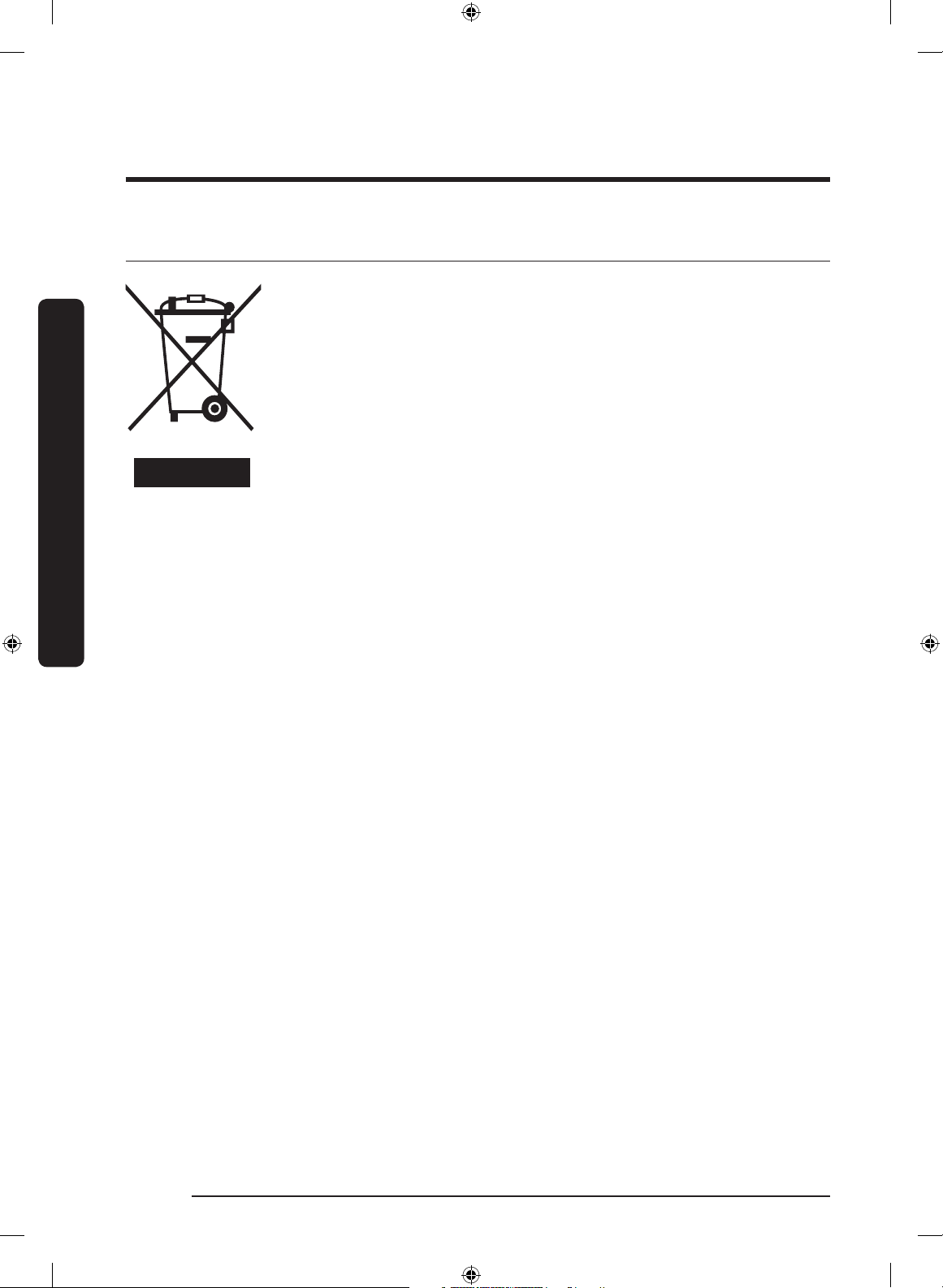
Correct Disposal of This Product (Waste Electrical & Electronic
Equipment)
(Applicable in countries with separate collection systems)
This marking on the product, accessories or literature indicates
that the product and its electronic accessories (e.g. charger,
headset, USB cable) should not be disposed of with other
household waste at the end of their working life. To prevent
possible harm to the environment or human health from
uncontrolled waste disposal, please separate these items from
other types of waste and recycle them responsibly to promote the
sustainable reuse of material resources.
Household users should contact either the retailer where they
purchased this product, or their local government ofce, for details
of where and how they can take these items for environmentally
safe recycling.
Business users should contact their supplier and check the terms
and conditions of the purchase contract. This product and its
electronic accessories should not be mixed with other commercial
wastes for disposal.
For information on Samsung’s environmental commitments and
product specic regulatory obligations e.g. REACH visit: samsung.
com/uk/aboutsamsung/samsungelectronics/corporatecitizenship/
data_corner.html
(For products sold in European countries only)
English24
Untitled-19 24 2017-06-28 2:52:43
Page 25
Installation
01
06
07
09
08
A
03
02
04
05
B C
Follow these instructions carefully to ensure a proper installation of this refrigerator and
to prevent accidents before using it.
WARNING
• Use the refrigerator only for its intended purpose as described in this manual.
• Any servicing must be performed by a qualied technician.
• Dispose of the product packaging material in compliance with the local regulations.
• To prevent electric shock, unplug the power cord before servicing or replacements.
Refrigerator at a glance
NOTE
The actual image and provided component parts of the refrigerator may differ, depending
on the model and the country.
For more information, see the Layout section.
Installation
English 25
Untitled-19 25 2017-06-28 2:52:43
Page 26
Installation
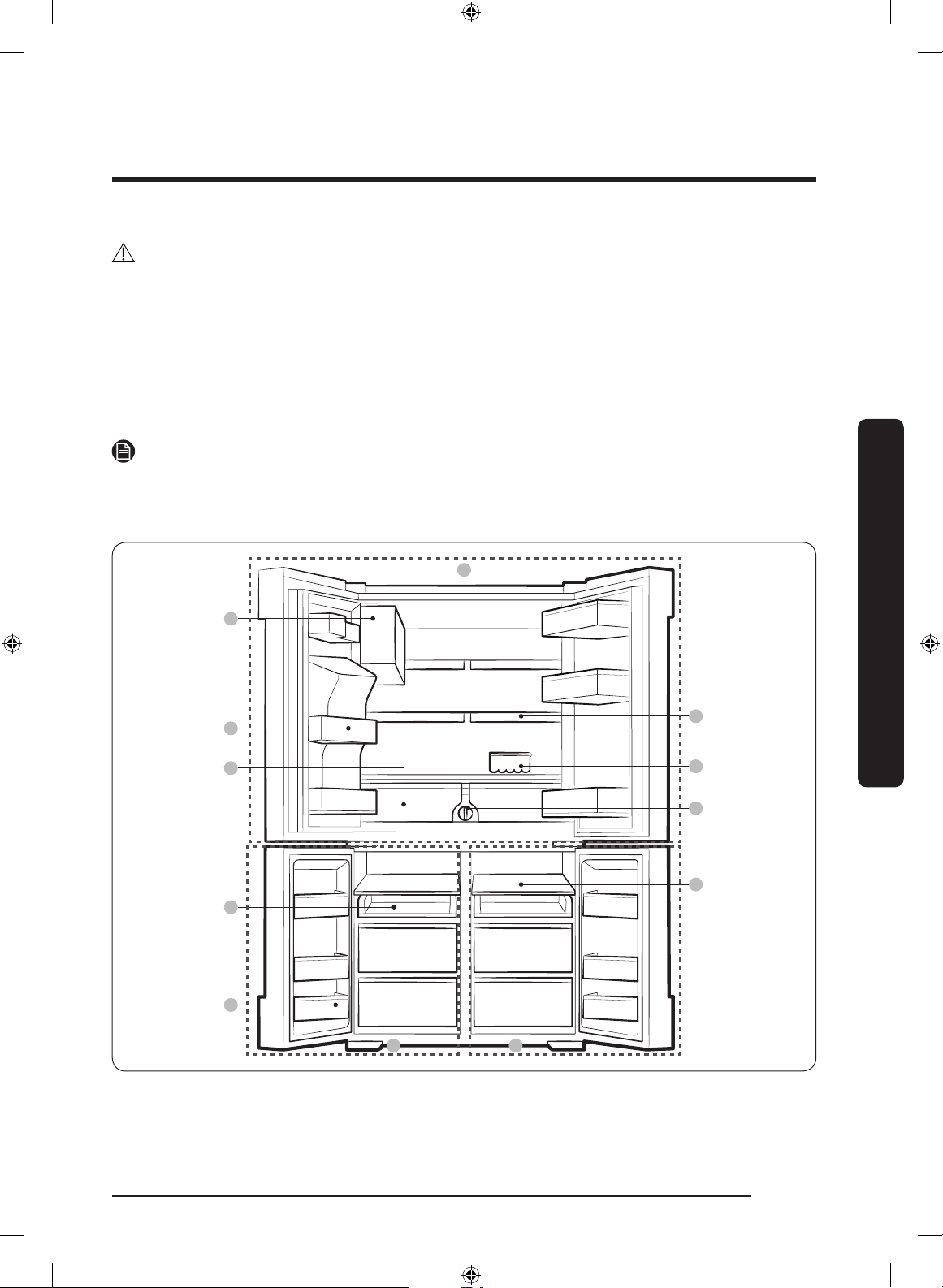
01 Auto Ice Maker (ICE MASTER)
02 Fridge door bin
03 Fresh Vegetable & Fruit Drawers
04 Sliding shelf
05 Freezer door bin
06 Quick space shelf
07 Egg tray
08 Water lter
09 Freezer Shelf (ASSY SHELF FRE)
* applicable models only
• For best energy efciency, make sure all shelves, drawers, and bins are placed in their
Installation
• When closing the door, make sure the vertical hinged section is in the correct position
• If the vertical hinged section is reversed, put it back into the correct position, and then
• Moisture may form at times on the vertical hinged section.
• If you close a door by force, the other door may open.
• When the door opens, the interlock switch automatically disables the auger motor of
• If the internal or external LED lamp is out of order, contact a local Samsung service
A. Fridge
B. Freezer
C. Cool Select+ (FlexZone)
NOTE
original position.
to avoid scratching the other door.
close the door.
the ice maker for safety reasons.
center.
English26
Untitled-19 26 2017-06-28 2:52:43
Page 27
Door removal for entrance
If the refrigerator cannot pass through the entrance due to its size, follow these
instructions:
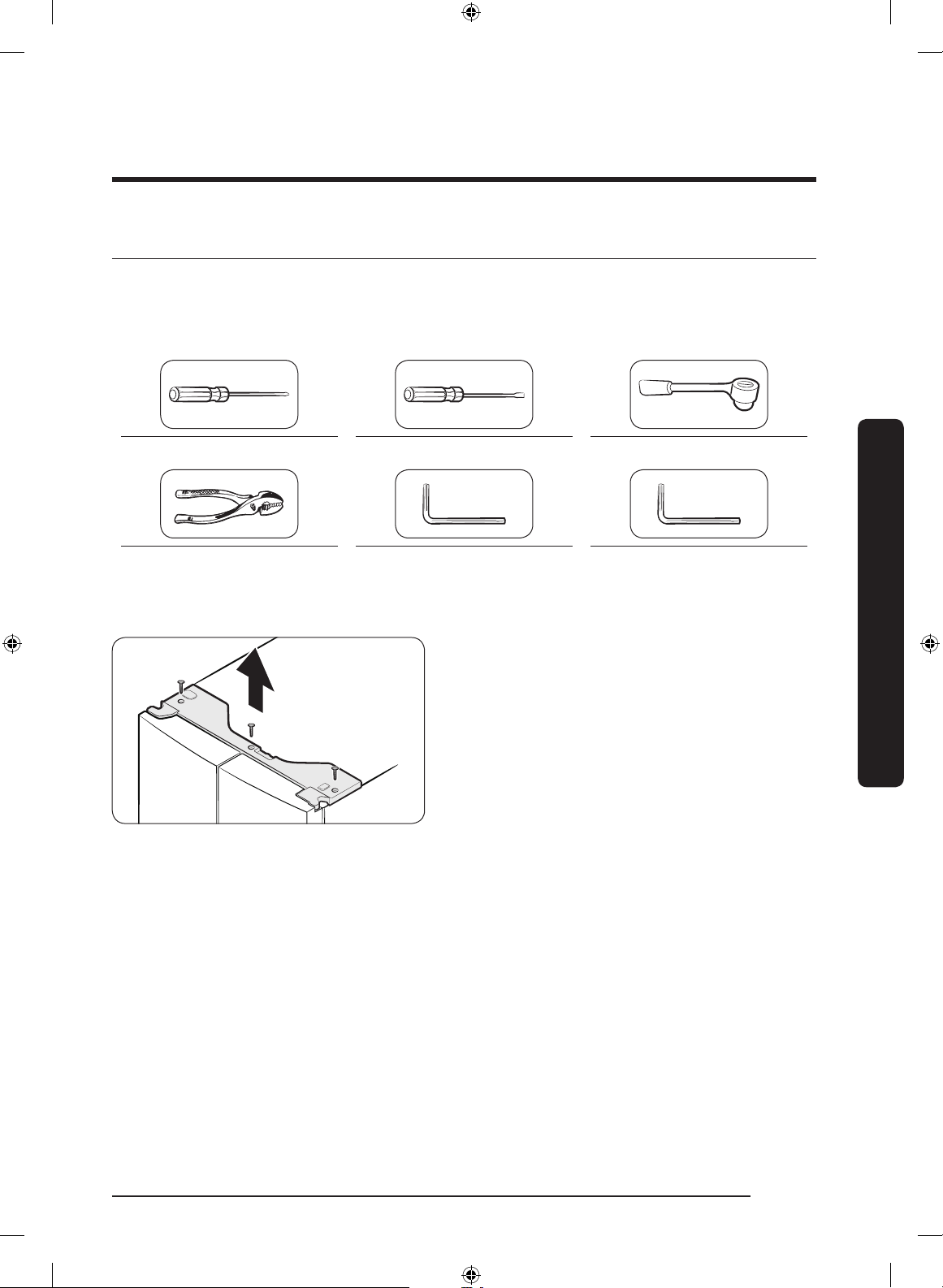
Tools required (not provided)
Phillips screwdriver Flat-heat screwdriver Socket spanner (10 mm)
Pliers Allen spanner (4 mm) Allen spanner (5 mm)
Detach the fridge doors
Installation
1. With the door closed, use a Phillips
screwdriver to remove the screws (x3)
from the top cover. Pull up and remove
the top cover with the connectors.
English 27
Untitled-19 27 2017-06-28 2:52:44
Page 28
Installation
Installation
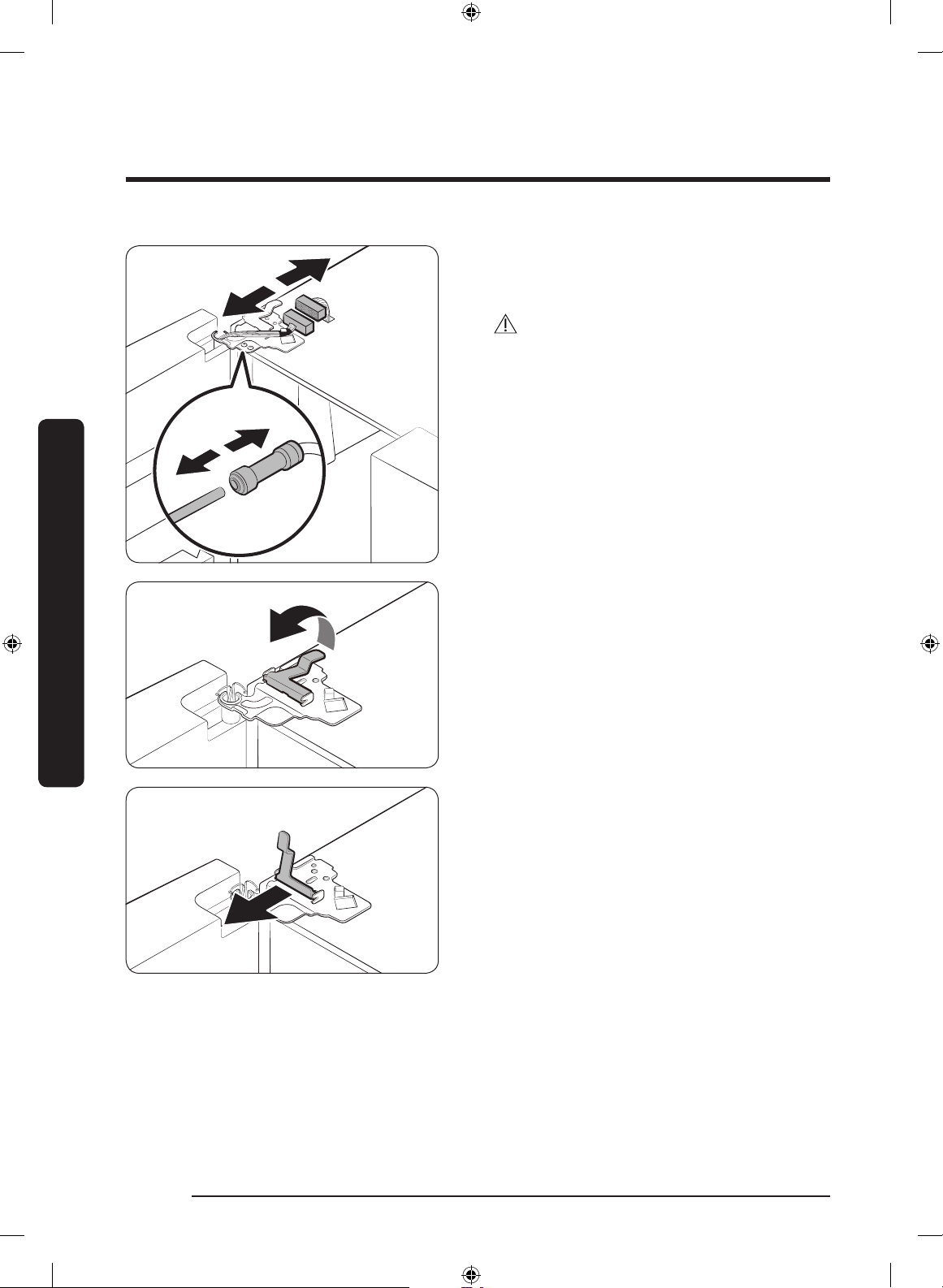
2. Disconnect the two connectors on the
left door. The position of the connectors
differs with the model.
CAUTION
• Do not remove both doors
simultaneously. Make sure to remove
one door at a time. Otherwise, any of
the doors may fall and cause physical
injury.
• Make sure the refrigerator powers off
before disconnecting the connectors.
3. Disconnect the water tube from the
coupler on the left door as shown.
4. Gently draw up the clamp in several
steps. To prevent nger injuries, do not
apply a sudden force to the clamp.
5. Pull up the clamp to remove.
English28
Untitled-19 28 2017-06-28 2:52:44
Page 29
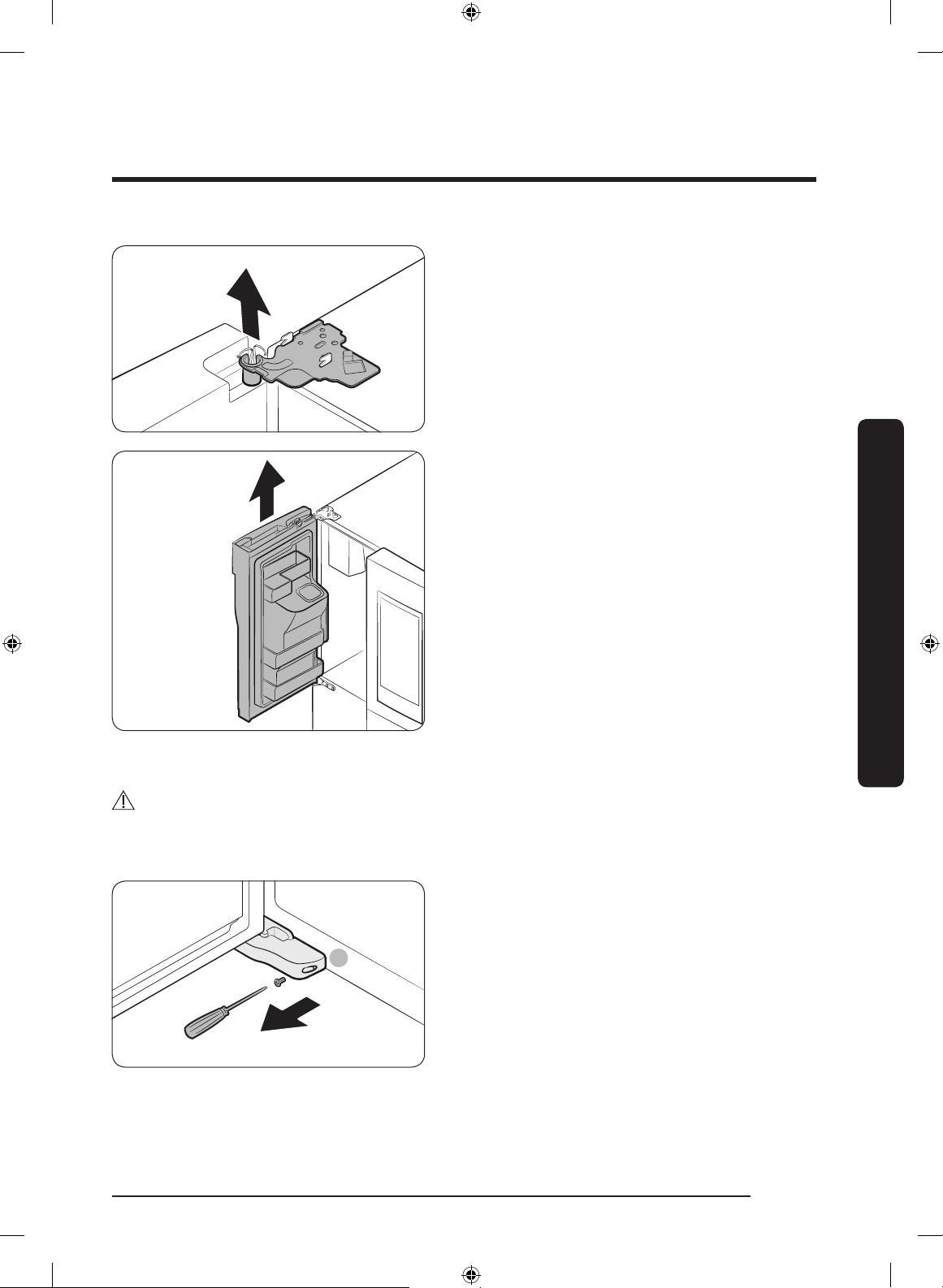
6. Open the door by 90 degrees. While
A
holding the door, remove the top hinge.
7. Gently pull up the door vertically to
remove. Do not apply excessive force
to the door. The door may fall, causing
physical injury.
8. Lay the door down on a at surface.
9. Repeat the above steps for the other
door.
Installation
Detach the freezer doors
CAUTION
• Be sure to remove the fridge doors before removing the freezer doors.
• Use caution when disconnecting the bottom connectors.
1. With the freezer door open, use a
Phillips screwdriver to remove the
screw holding the cover (A) of the
adjustable leg.
English 29
Untitled-19 29 2017-06-28 2:52:45
Page 30
Installation
Installation
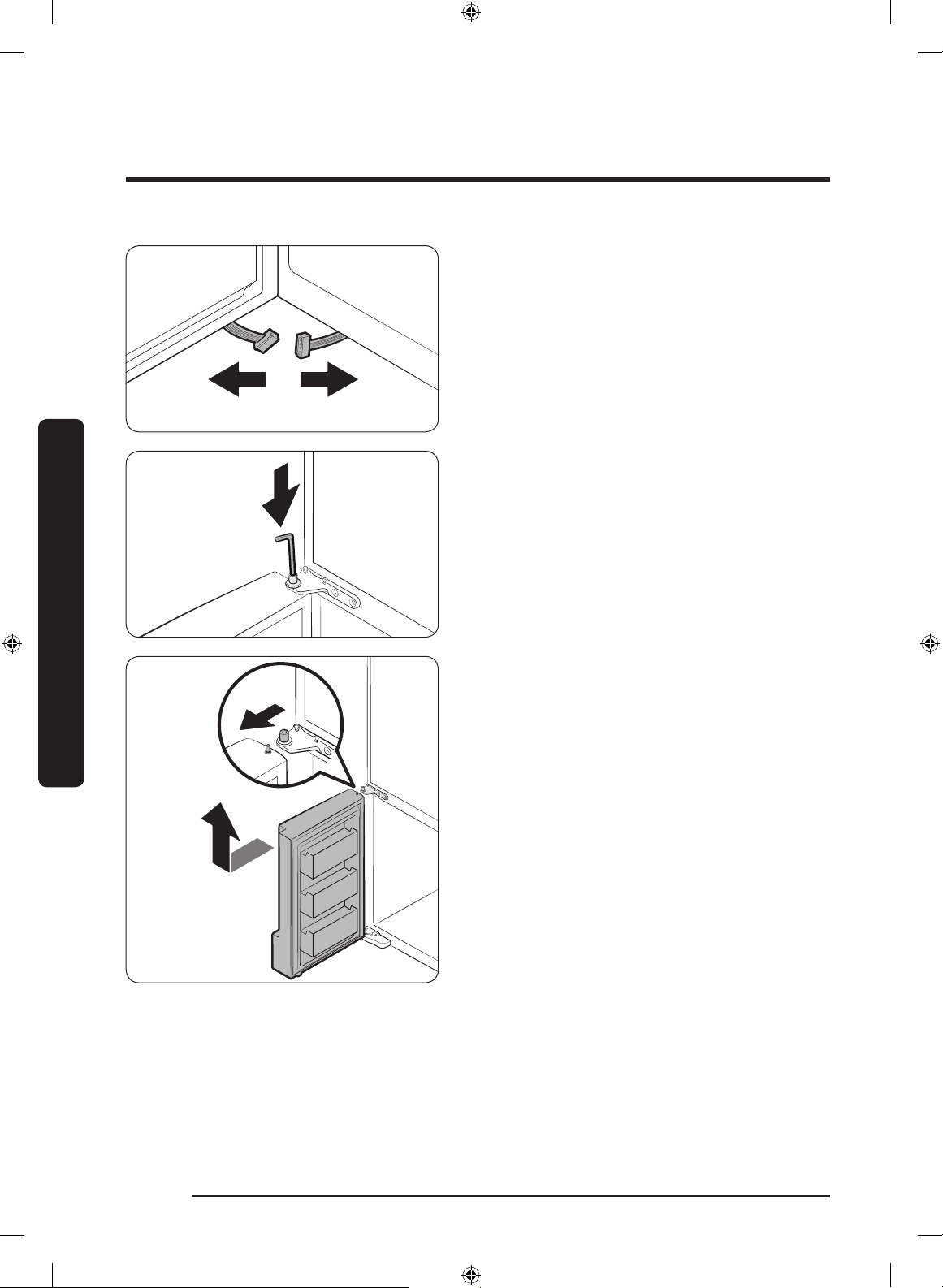
2. Then, disconnect the connectors.
3. Locate the hinge shaft. While holding
the door with one hand, use a at-head
screwdriver or wrench to press down
the shaft. Make sure to hold the door to
prevent the door from falling.
4. To prevent contact with the middle
hinge, slightly tilt the door to the front,
and then lift it up to remove.
5. Repeat the above steps for the other
door.
English30
Untitled-19 30 2017-06-28 2:52:45
Page 31
Reattach the freezer doors
CAUTION
• Before reattaching the doors, make sure all the electrical connectors are properly
connected.
• The freezer door must be reattached before the fridge door.
• Be careful not to damage or step on the wires during this process.
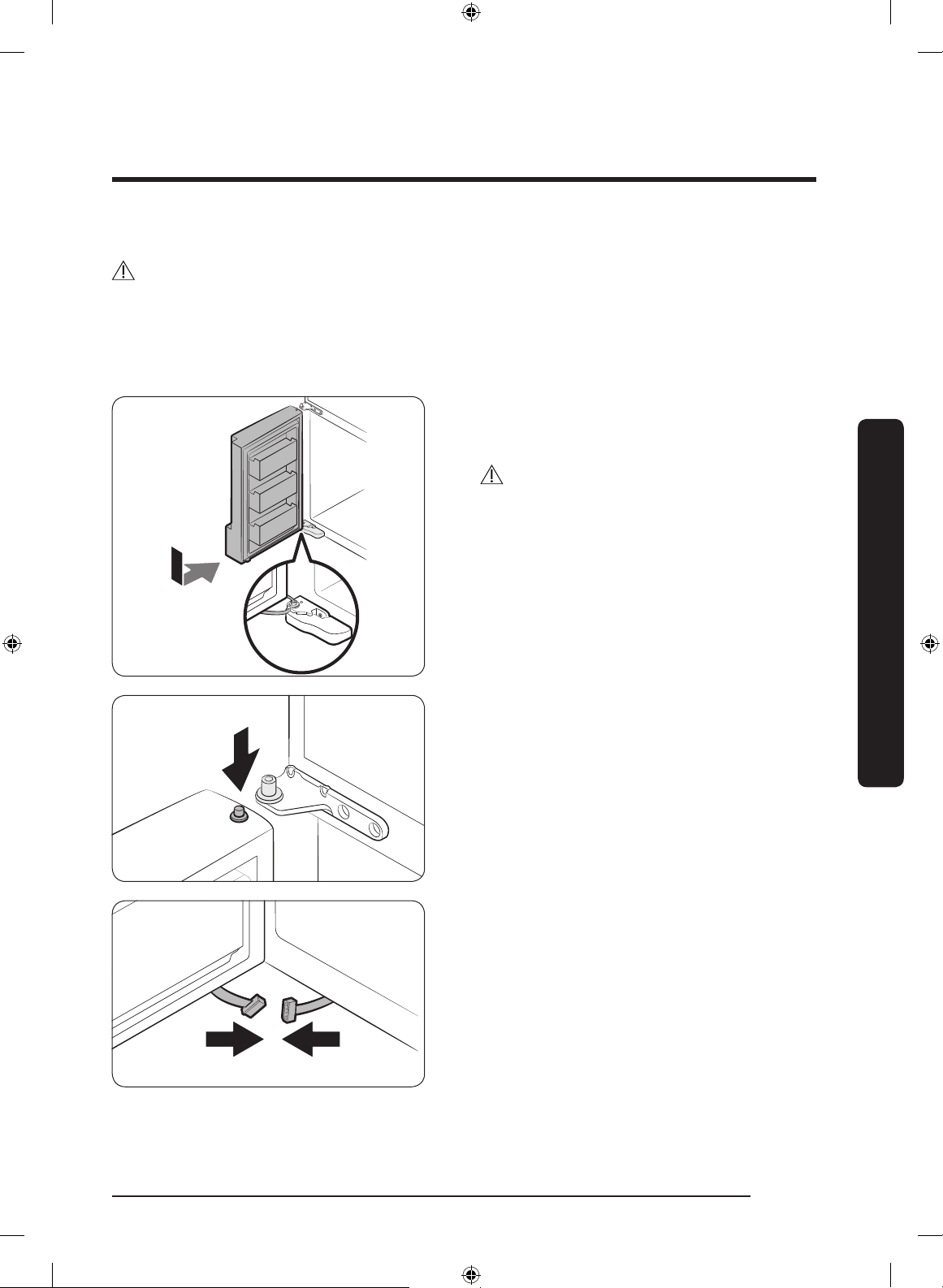
1. Insert the freezer door into the bottom
hinge while pushing the freezer door in
the arrow direction.
CAUTION
• Be careful not to damage or step on the
wires during this process.
2. While pressing down the hinge shaft
of the door, reinsert the door into the
middle hinge.
Installation
3. With the door open, connect the bottom
connectors in the arrow directions.
English 31
Untitled-19 31 2017-06-28 2:52:45
Page 32
Installation
Reattach the fridge doors
Installation
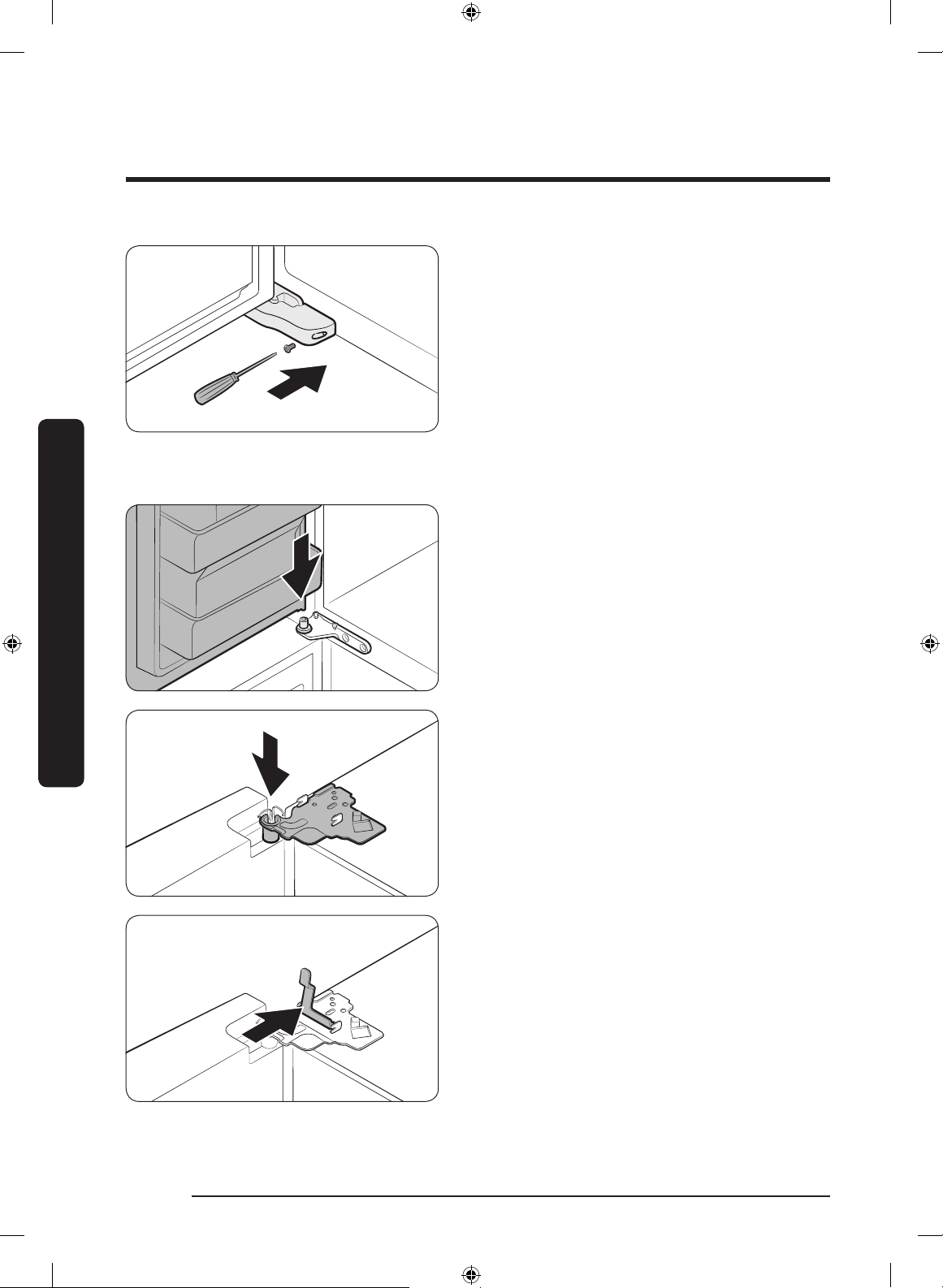
4. Attach the levelling foot cover using a
Phillips screwdriver. Use caution not to
damage or step on the connectors.
5. Repeat the above steps for the other
door.
1. While holding the door open by more
than 90 degrees, reinsert it into the
middle hinge.
2. Put the top hinge into its position, and
then insert into the top hole of the door.
3. Insert the clamp in the arrow direction.
English32
Untitled-19 32 2017-06-28 2:52:46
Page 33
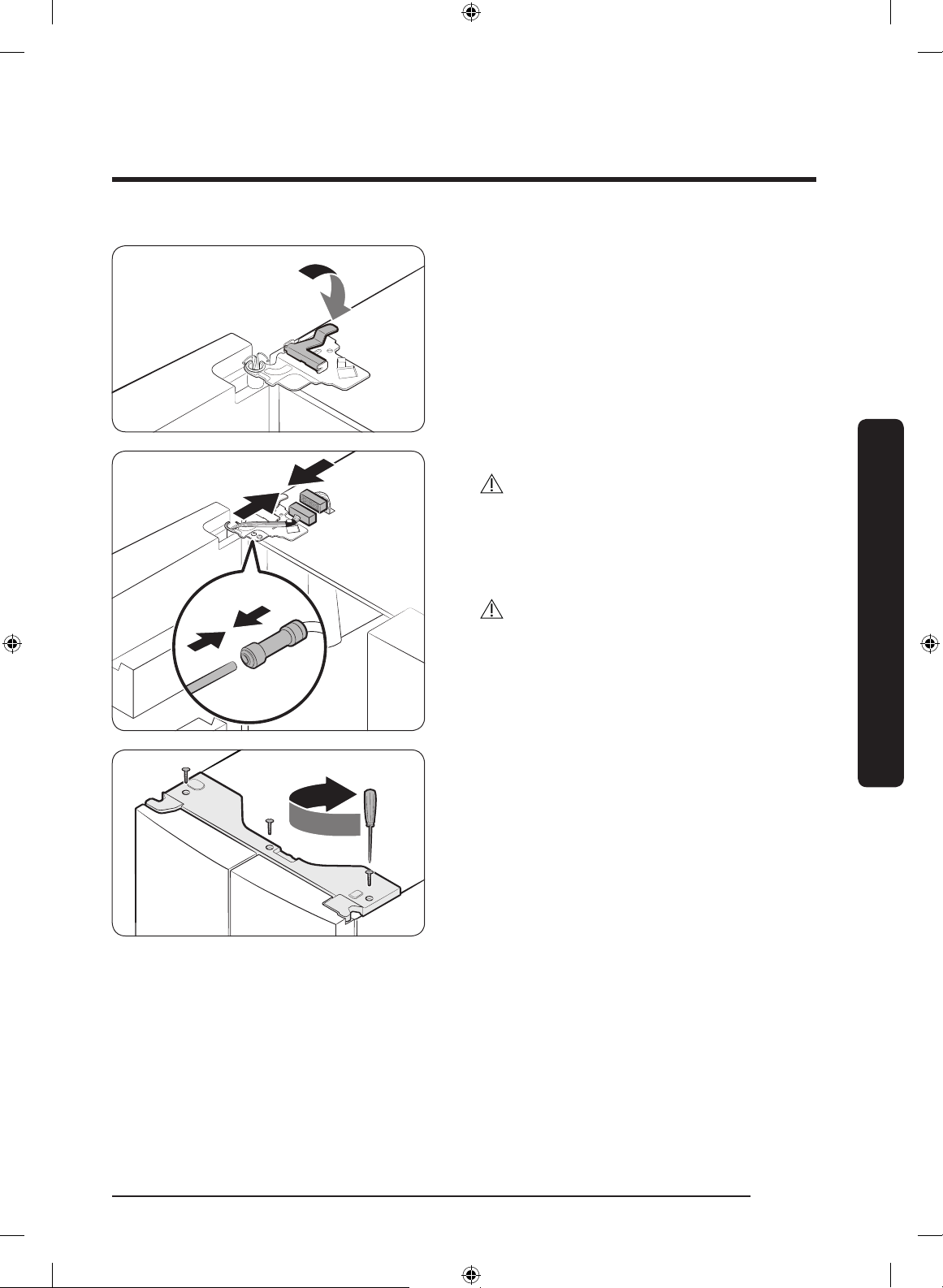
4. Draw back the clamp as shown.
5. Connect the wire connectors.
CAUTION
• Make sure the wire connectors are
connected properly. Otherwise, the
display does not operate.
6. Connect the water tube.
CAUTION
• To prevent water leaks, make sure the
red clips tighten the coupler properly.
• Keep the clips out of children’s reach.
Installation
7. Repeat the above steps for the other
door.
8. Attach the top cover with the front side
rst, and then press down on its back
to t into position. Then, tighten the
screws (x3).
English 33
Untitled-19 33 2017-06-28 2:52:46
Page 34
Installation
Step-by-step installation
STEP 1 Select a site
Site requirements:
• Solid, level surface without carpeting or ooring that may obstruct ventilation
• Away from direct sunlight
• Adequate room for opening and closing the door
• Away from a heat source
• Room for maintenance and servicing
• Temperature range: between 10 °C and 43 °C
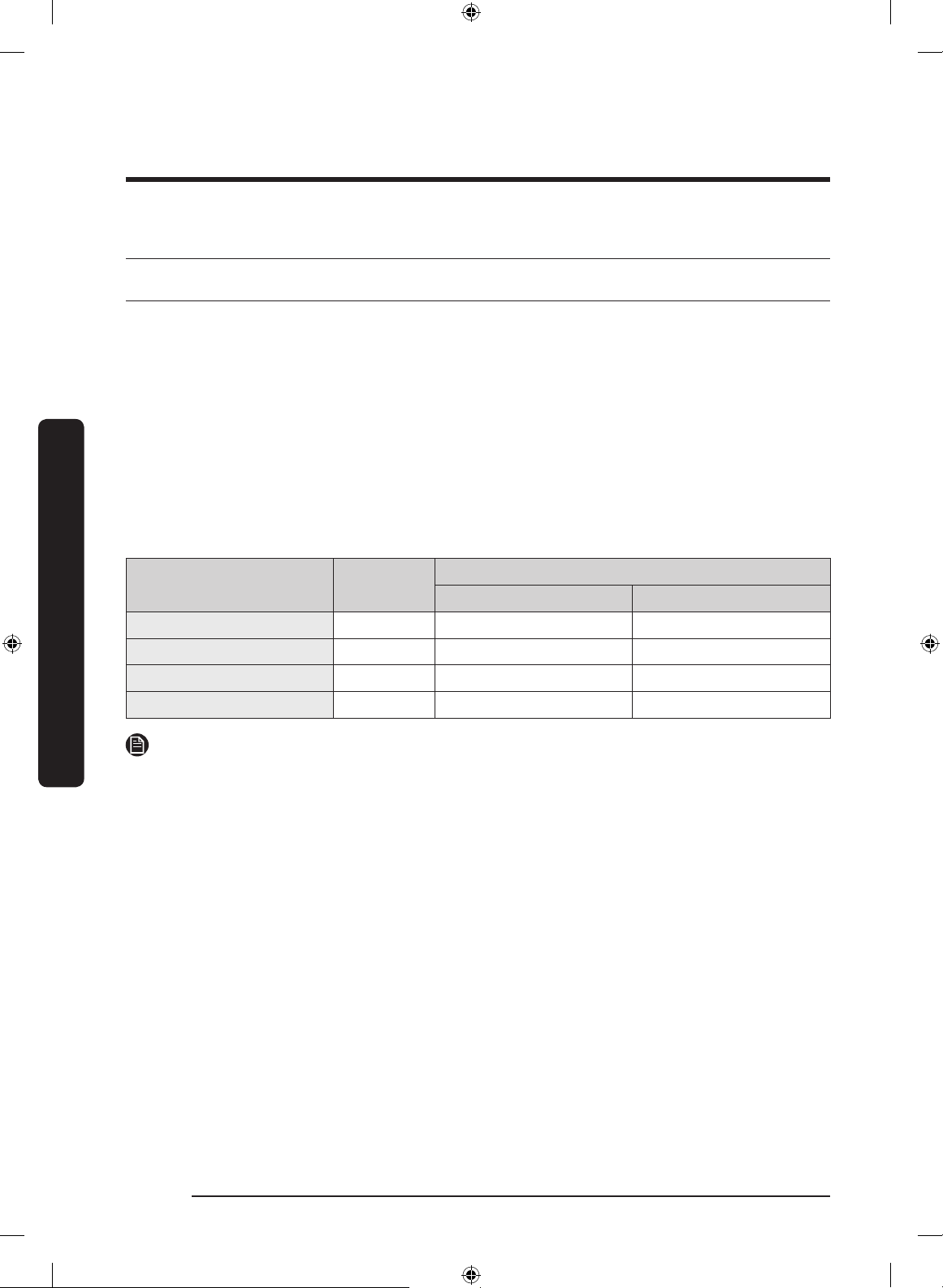
Effective temperature range
The refrigerator is designed to operate normally in the temperature range specied by its
class rating.
Installation
Class Symbol
Ambient Temperature range (°C)
IEC 62552 (ISO 15502) ISO 8561
Extended Temperate SN +10 to +32 +10 to +32
Temperate N +16 to +32 +16 to +32
Subtropical ST +16 to +38 +18 to +38
Tropical T +16 to +43 +18 to +43
NOTE
The cooling performance and power consumption of the refrigerator may be affected
by the ambient temperature, the door-opening frequency, and the location of the
refrigerator. We recommend adjusting the temperature settings as appropriate.
English34
Untitled-19 34 2017-06-28 2:52:46
Page 35
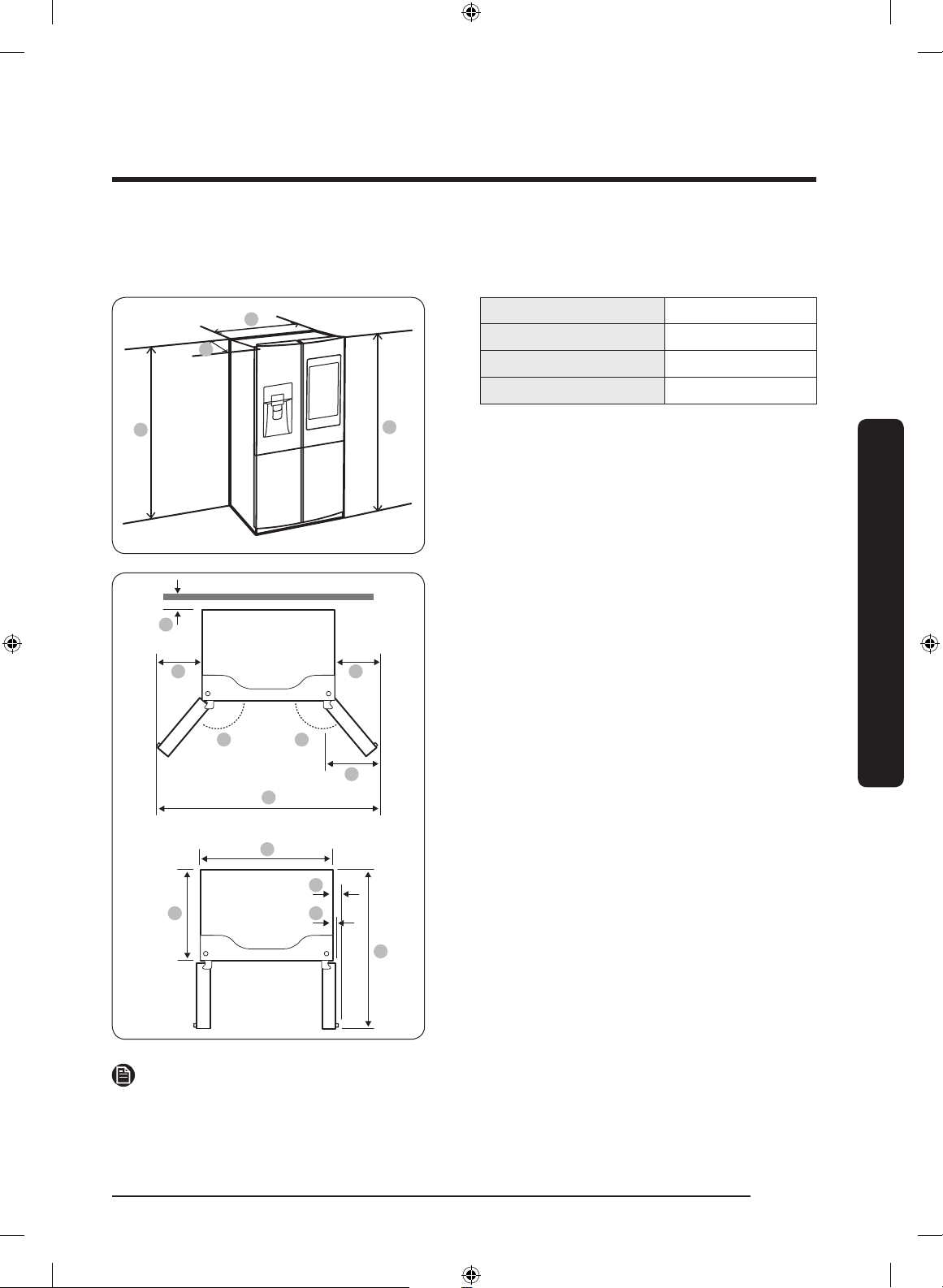
Clearance
B
C
D
A
01
02 02
04 04
05
03
06
08
0907
10
See the pictures and table below for space requirements for installation.
Depth “A” 733
Width “B” 908
Height “C” 1797
Overall Height “D” 1825
01 50 mm
02 125°
03 1515 mm
04 303 mm
05 305 mm
06 908 mm
07 610 mm
08 70 mm
09 43 mm
10 1083 mm
(unit: mm)
Installation
Untitled-19 35 2017-06-28 2:52:47
NOTE
The measurements in the above table may differ, depending on the measuring method.
English 35
Page 36
Installation
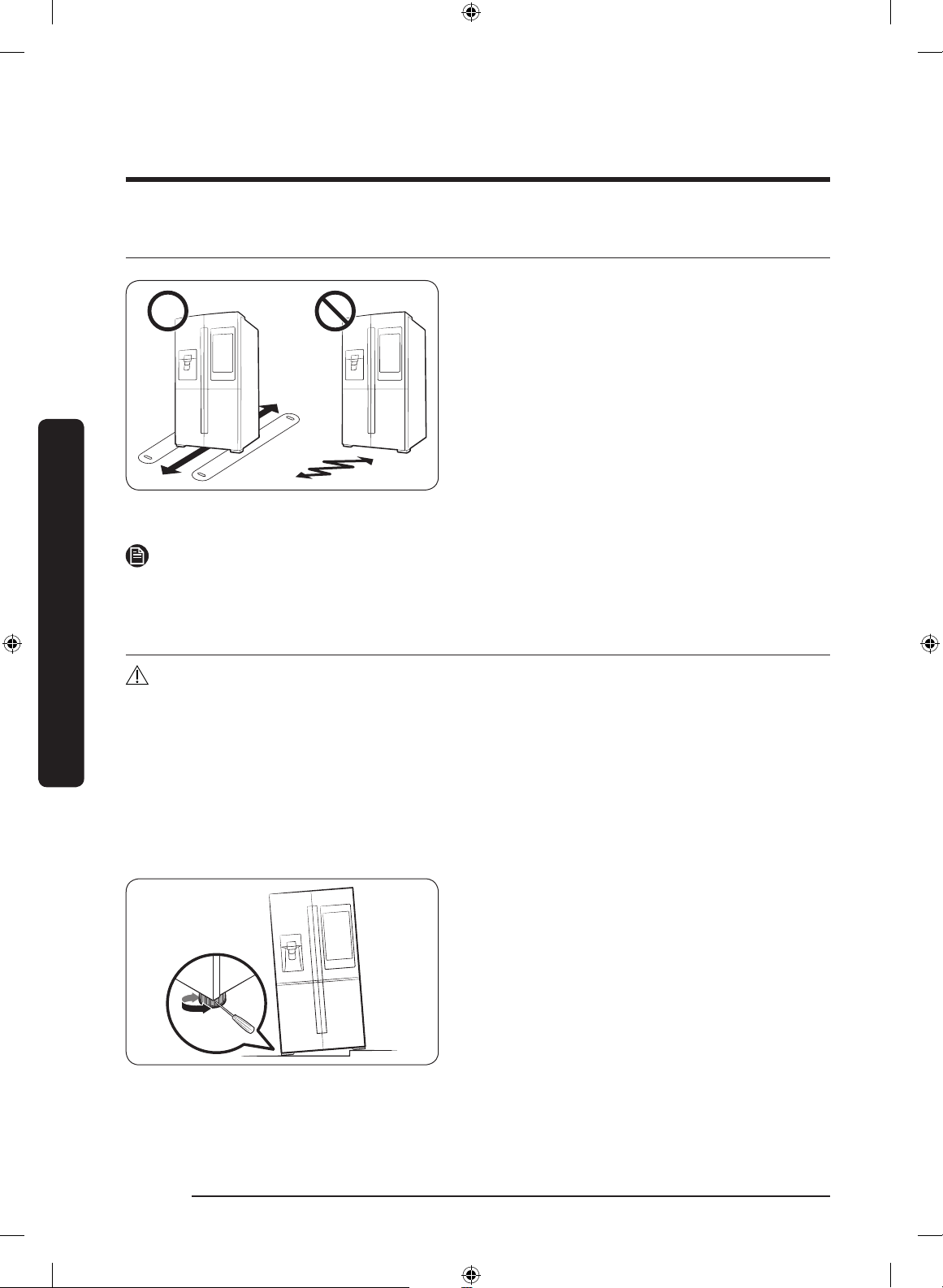
STEP 2 Flooring
• The surface to install the refrigerator
must support a fully loaded refrigerator.
• To protect the oor, put a large piece
of cardboard on each leg of the
refrigerator.
• Once the refrigerator is in its nal
position, do not move it unless
necessary to protect the oor. If you
have to, use a thick paper or cloth such
as old carpets along the movement
path.
Installation
If the refrigerator cannot pass through the entrance due to its size, see the Door removal
for entrance section in the Installation chapter.
STEP 3 Adjust the levelling legs
• The refrigerator must be levelled on a at, solid oor. Failing to do so can cause
• Levelling must be performed with an empty refrigerator. Make sure no food items
• For safety reasons, adjust the front side a little higher than the rear side.
The refrigerator can be levelled using the front legs that have a special screw (leveller) for
levelling purposes. Use a at-head screwdriver for levelling.
NOTE
CAUTION
damage to the refrigerator or physical injury.
remain inside the refrigerator.
• To adjust the height of the left side:
Insert a at-head screwdriver into the
leveller of the left side front leg. Turn
the leveller clockwise to raise, or turn it
counter clockwise to lower.
• To adjust the height of the right side:
Insert a at-head screwdriver into the
leveller of the right side front leg. Turn
the leveller clockwise to raise, or turn it
counter clockwise to lower.
English36
Untitled-19 36 2017-06-28 2:52:47
Page 37
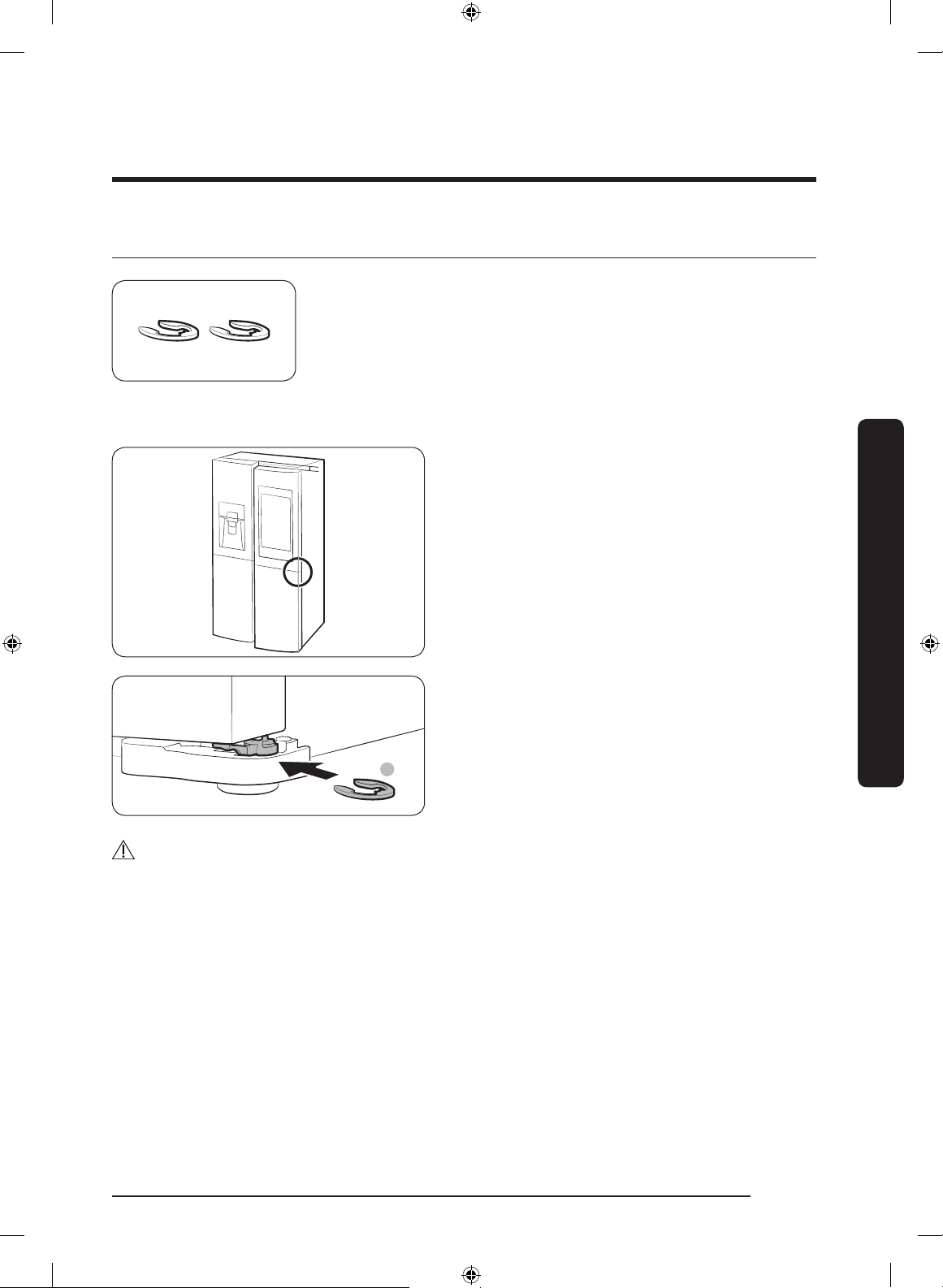
STEP 4 Adjust the door height as well as the door gap
A
Snap ring
The height of a door can be adjusted using the provided snap
rings, which come in 4 different sizes (1 mm, 1.5 mm, 2 mm,
and 2.5 mm).
To adjust the height of a door
1. Check the height difference between
the doors, and then raise and hold the
lower door.
2. Insert a suitable-sized snap ring (A)
between the door and the hinge as
shown.
Installation
CAUTION
• Insert only one snap ring for this purpose. Two or more snap rings may slip out or
make a rubbing noise.
• Keep the snap rings out of children’s reach, and keep them for future use.
• Do not raise the door too much. The door can contact and damage the top cover.
English 37
Untitled-19 37 2017-06-28 2:52:47
Page 38
Installation
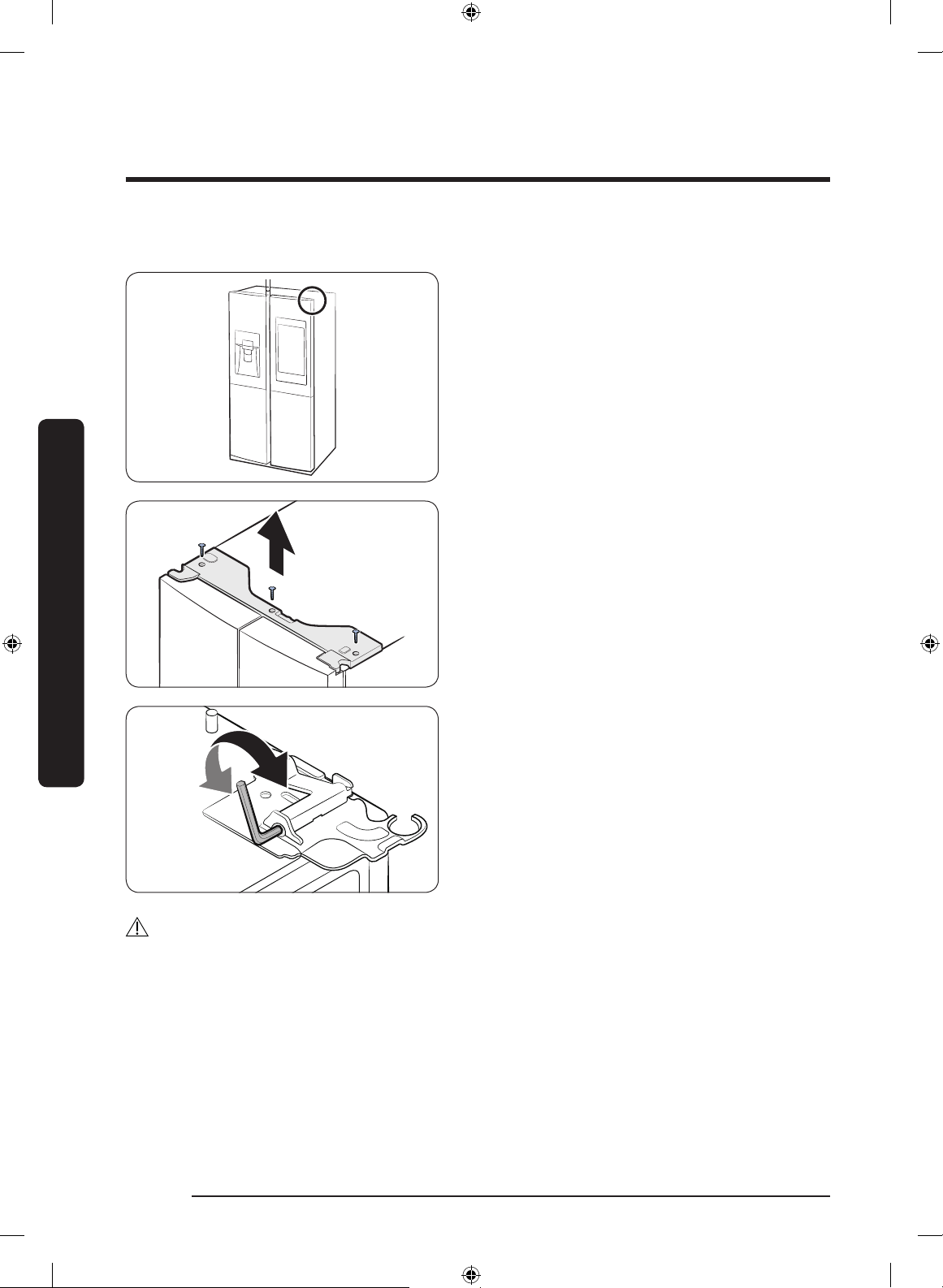
To correct the door gap
Installation
Door gaps can be corrected using the
gap bolt on the top right corner of the
refrigerator.
1. With the door closed, use a Phillips
screwdriver to remove 3 screws on the
top cover with the wire connectors.
2. Use a 4 mm Allen spanner (not
provided) to correct the door gap
between two doors.
- To widen the gap, turn the gap bolt
clockwise.
- To narrow the gap, turn the gap bolt
counter clockwise.
3. When complete, reinsert the top cover.
CAUTION
The electrical connectors must be intact during this process. Use caution not to tangle the
connector wires or peel off the coating.
English38
Untitled-19 38 2017-06-28 2:52:48
Page 39
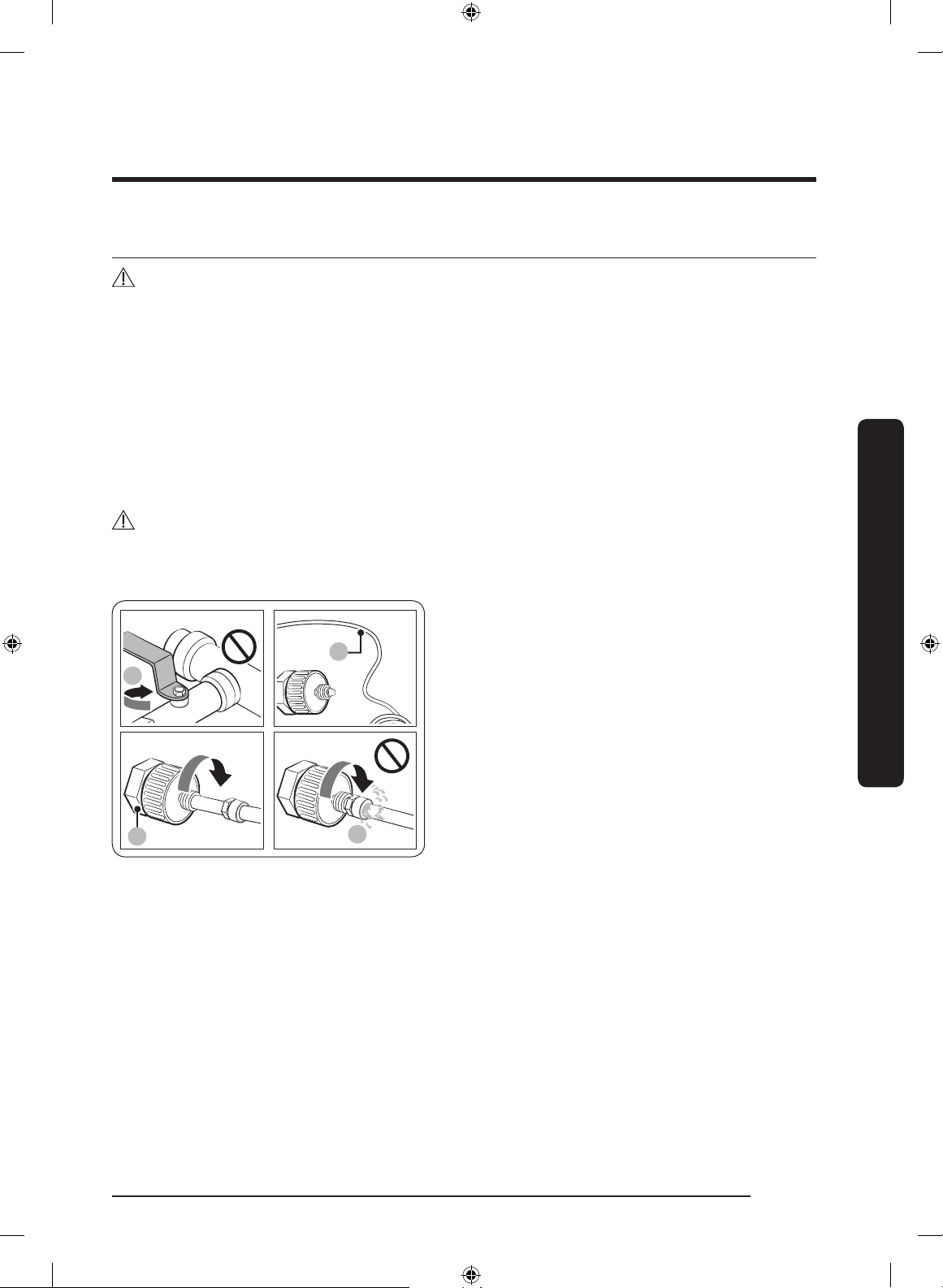
STEP 5 Connect to a water source
1
A
B
A
CAUTION
• The new hose-sets supplied with the appliance are to be used and that old hose-sets
should not be reused.
• The water line must be connected by a qualied technician.
• The warranty for your refrigerator does not cover the water line installation. The
water line installation will be performed at your own costs unless the installation fee is
included in the retailer’s price.
• Samsung takes no responsibility for the water line installation. If water leaks occur,
contact the installer of the water line.
To connect the cold water pipe to the water ltering hose
CAUTION
• Make sure the water ltering hose is connected to a cold, potable water source pipe.
Connecting to the hot water pipe may cause the purier to malfunction.
1. Shut off the water supply by closing the
main water valve.
2. Locate the cold, potable water pipe (1).
3. Follow the Water Line Installation to
connect to the water pipe.
4. When connection is complete, open the
main water valve and dispense about
3 liters of water. This is to remove
impurities inside the pipe.
Installation
A. Close Main Water pipe
B. No gap
English 39
Untitled-19 39 2017-06-28 2:52:48
Page 40
Installation
Remove cap
a
a
A
B
03
a
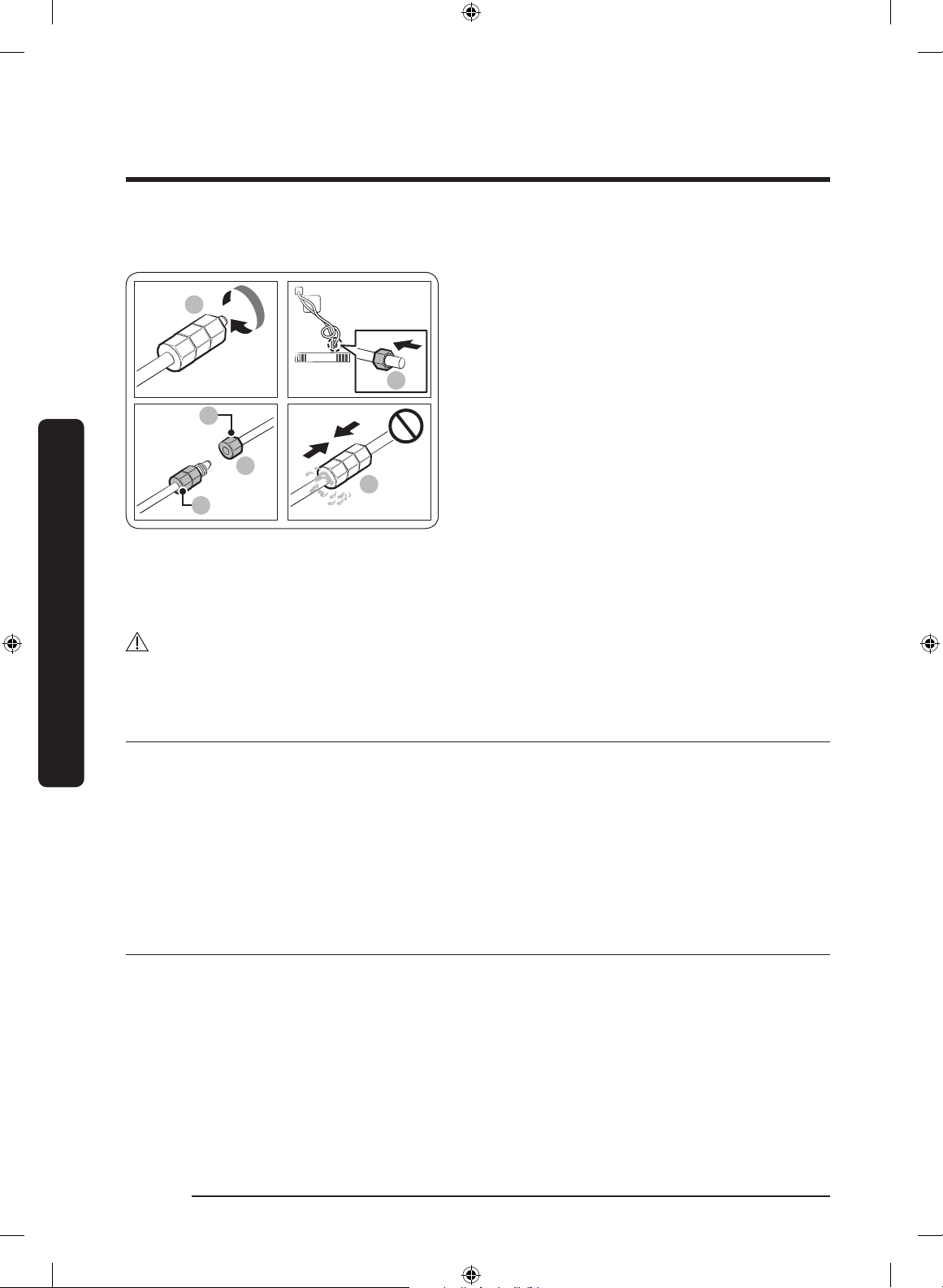
To connect the water ltering hose to the water line
Installation
A. Water Line from unit
B. Water Line from Kit
To repair the water line
The waterline must be repaired by a qualied professional. If you encounter a water leak,
contact a local Samsung service centre or the installer of the waterline.
1. Loosen and remove the compression
nut (a) from the water line of the
refrigerator, and insert it to the water
ltering hose.
2. Tighten up the compression nut (a) to
connect the water ltering hose and the
water line.
3. Open the main water valve and check
for any leaks.
4. If there are no leaks, dispense about a
3 liters of water before actually using
the refrigerator to remove impurities
inside the water ltering system.
CAUTION
STEP 6 Initial settings
By completing the following steps, the refrigerator should be fully functioning.
1. Plug the power cord into the wall socket to turn the refrigerator on.
2. Open the door, and check if the interior light lights up.
3. Set the temperature to the coldest, and wait for about an hour. Then, the freezer will be
slightly chilled, and the motor will run smoothly.
4. Wait until the refrigerator reaches the set temperature. Now the refrigerator is ready
for use.
STEP 7 Final check
When installation is complete, conrm that:
• The refrigerator is plugged into an electrical outlet and grounded properly.
• The refrigerator is installed on a at, level surface with a reasonable clearance from the
wall or the cabinet.
Untitled-19 40 2017-06-28 2:52:48
• The refrigerator is level and is sitting rmly on the oor.
• The door opens and closes freely, and the interior light turns on automatically when
you open the door.
English40
Page 41
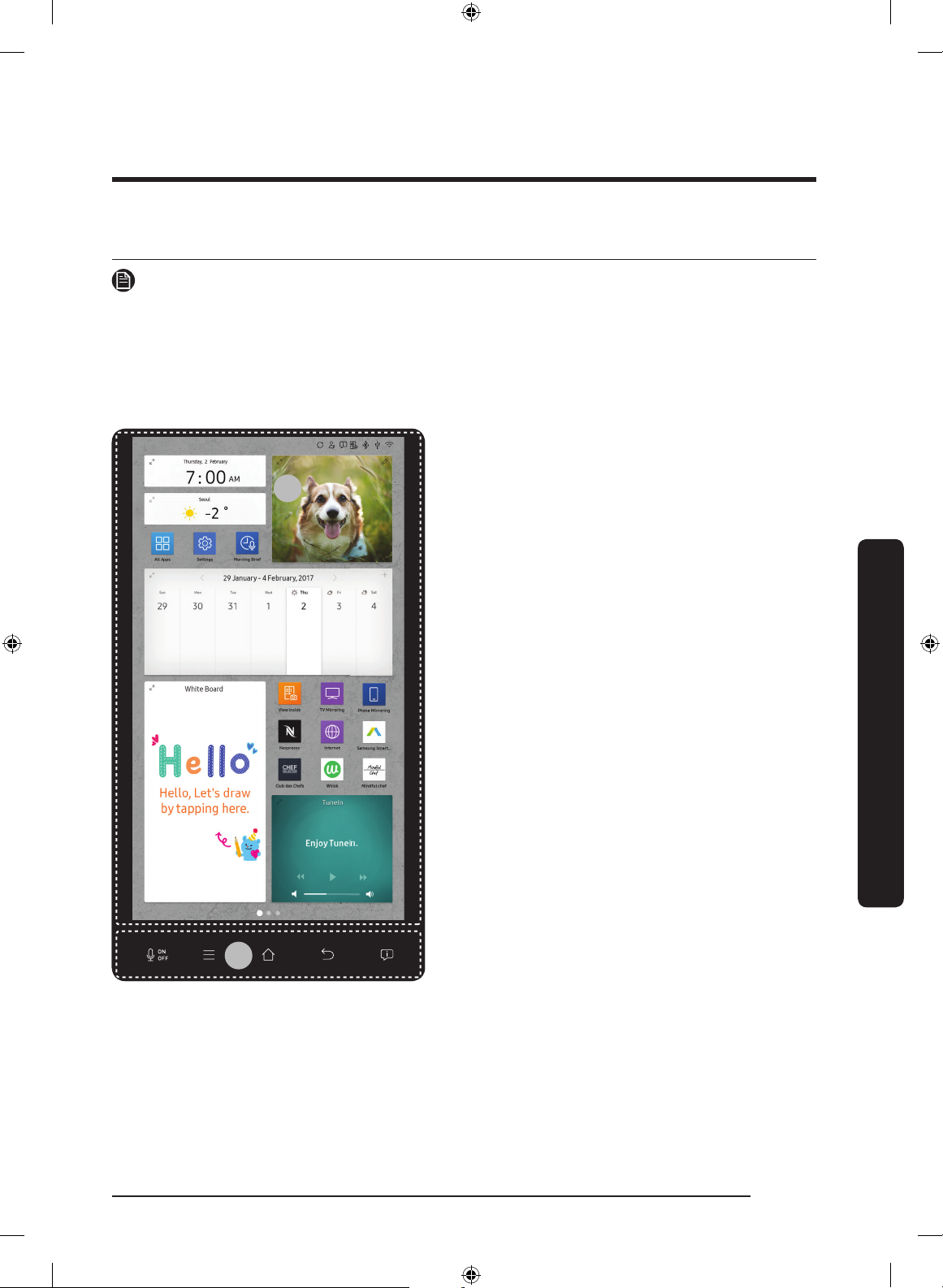
Operations
01
02
User interface
NOTE
• For more information about other menus and apps available on the Refrigerator app,
see the Online manual of your refrigerator.
• The content of apps and widgets, or their design is subject to change or support may
be discontinued without notice, depending on the content provider’s policy.
• Underage transactions with the services must be supervised by adults.
01 Home screen
02 Task bar
Operations
English 41
Untitled-19 41 2017-06-28 2:52:49
Page 42
Operations
01
02
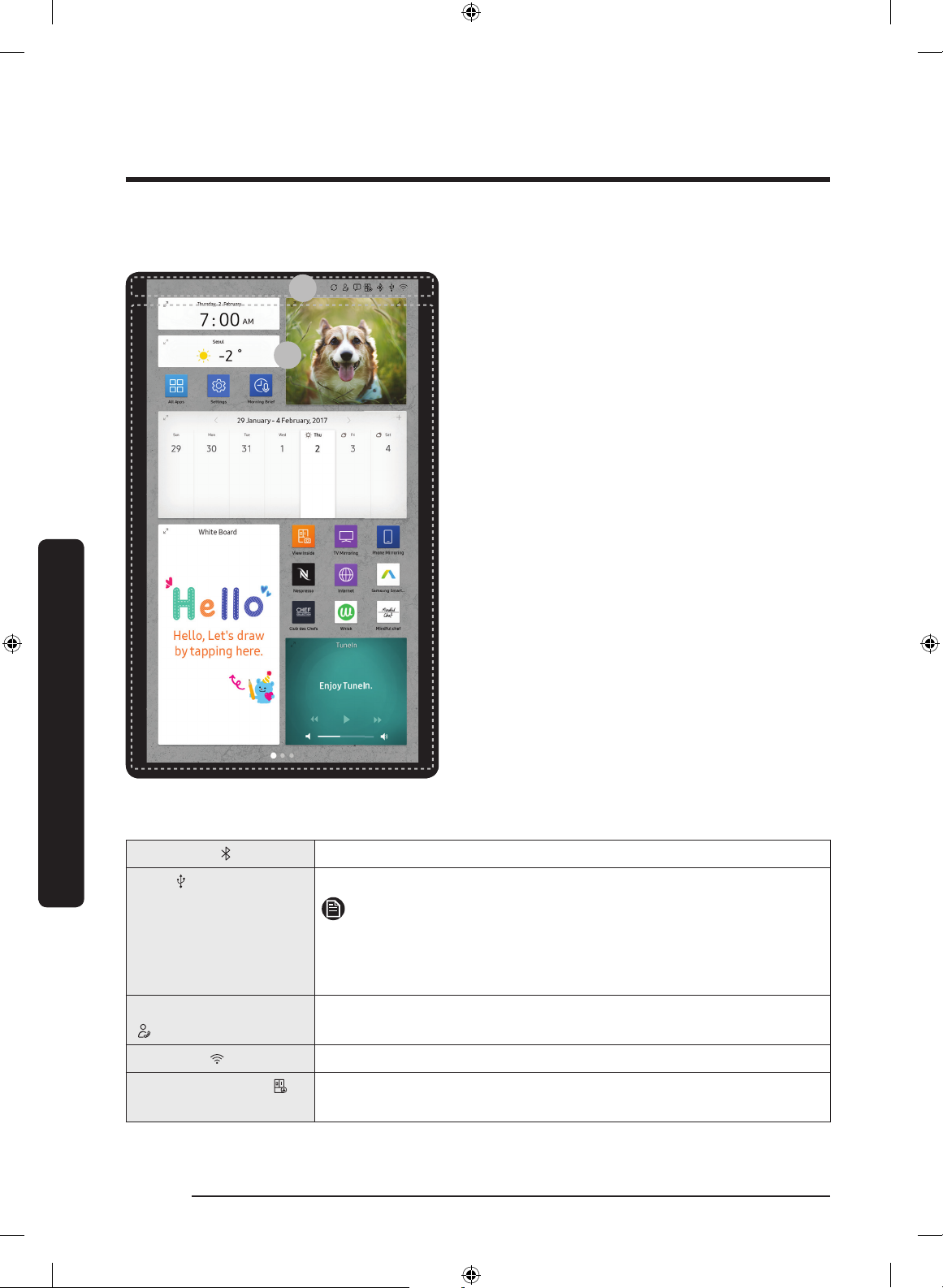
01 Home screen
01 Apps & Widgets
• Tap a desired app or widget to launch
it.
• Tap and hold an app or widget to enter
Edit mode. A grid appears. In Edit mode,
you can drag and drop an app or widget
to a new position on the grid. When you
move the app or widget to a new grid
location, the location turns blue if it is
available. If it is not available, it turns
red.
• You can add an app or widget that has
been removed from the All Apps list.
02 Status bar
• Displays the status of various functions.
(Refer to the following Icon descriptions
table.)
Operations
Icon descriptions
Bluetooth ( )
USB (
Remote Management
(
Network (
Software Update (
)
Indicates Bluetooth connection status.
)
)
Indicates USB connection status.
NOTE
The refrigerator supports USB memory that is formatted in the
FAT32 or exFAT le systems. NTFS is not supported. Be sure to
convert NTFS to FAT32 or exFAT before use.
Turns on when Remote Management is enabled and running.
Indicates network connection status in 5 levels (Off, 1-4).
Indicates the newest version of software has been downloaded
)
from the server and is ready to update.
English42
Untitled-19 42 2017-06-28 2:52:50
Page 43
Notication ( )
01 02 03 04 05
Cloud sync (
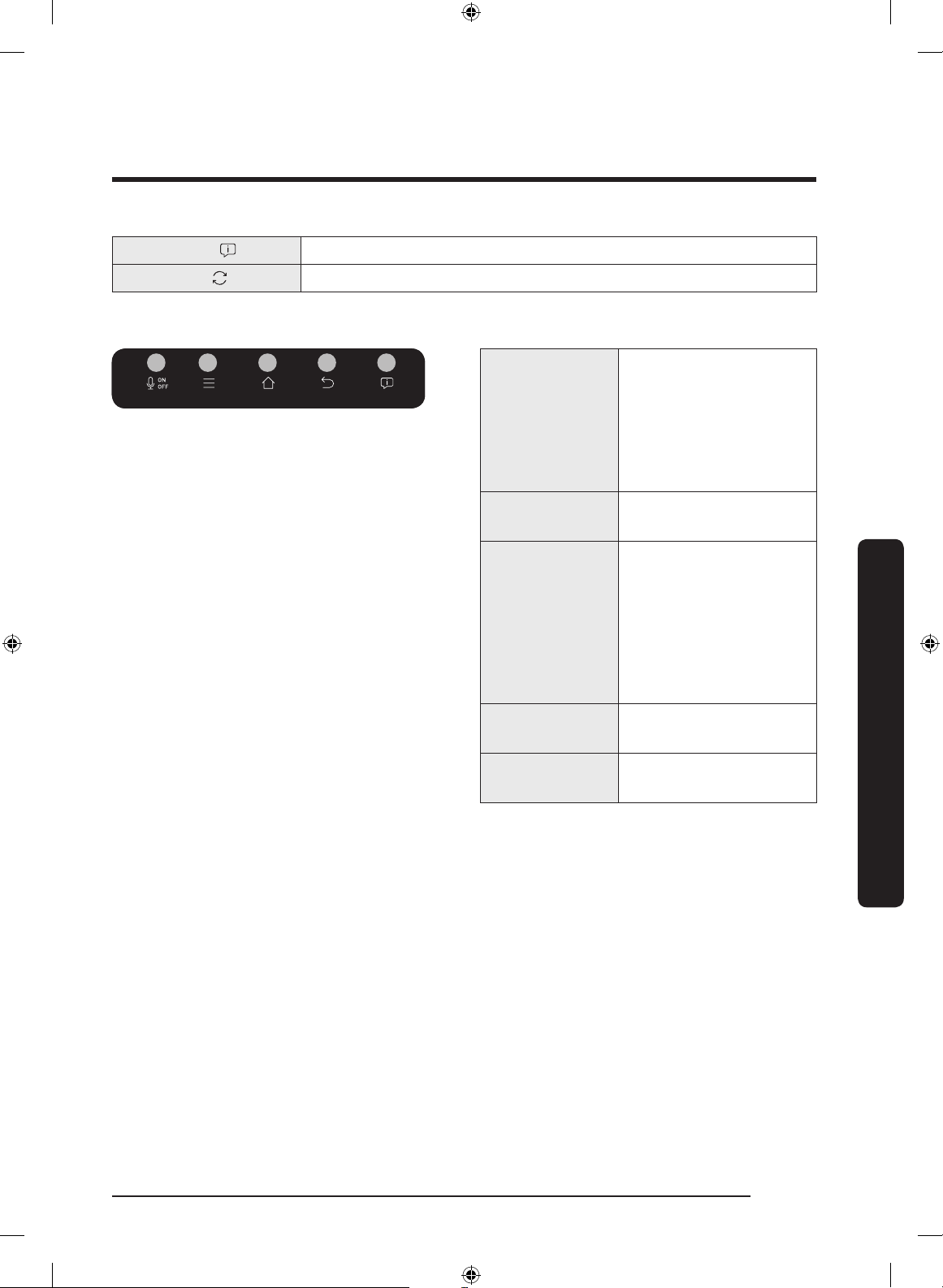
02 Task bar
Indicates there is a notication message.
)
Indicates Family Hub is receiving data from the cloud server.
Tap to turn on or off
the voice recognition
01 Microphone
function.
The microphone icon
turns red when it is
turned off.
02 Menu
Tap to display the
menus available.
• Tap to open the
Home screen.
• Tap and hold to
03 Home
open the Task
Manager. See the
Task Manager
Operations
section for details.
04 Return
05 Notication
Tap to return to the
previous screen.
Tap to display the
Quick Panel.
English 43
Untitled-19 43 2017-06-28 2:52:50
Page 44
Operations
Fridge Manager
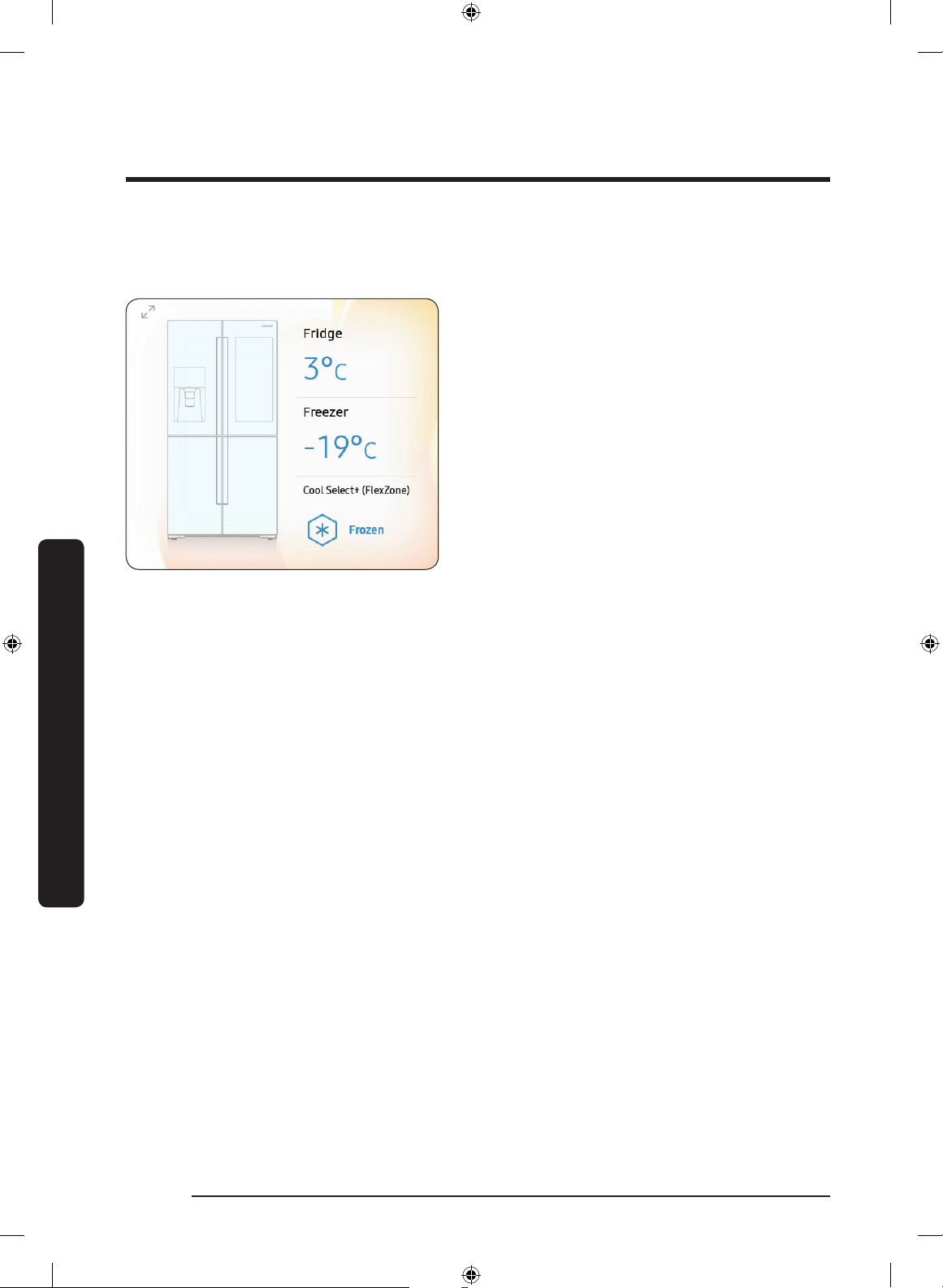
To access Fridge Manager, tap the Fridge Manager widget on the Home screen.
• On the Fridge Manager widget, the
current fridge and freezer temperatures
as well as active special functions are
displayed for quick reference.
• For detailed settings, tap the widget to
open the Fridge Manager.
Operations
English44
Untitled-19 44 2017-06-28 2:52:51
Page 45
01
02
04
03
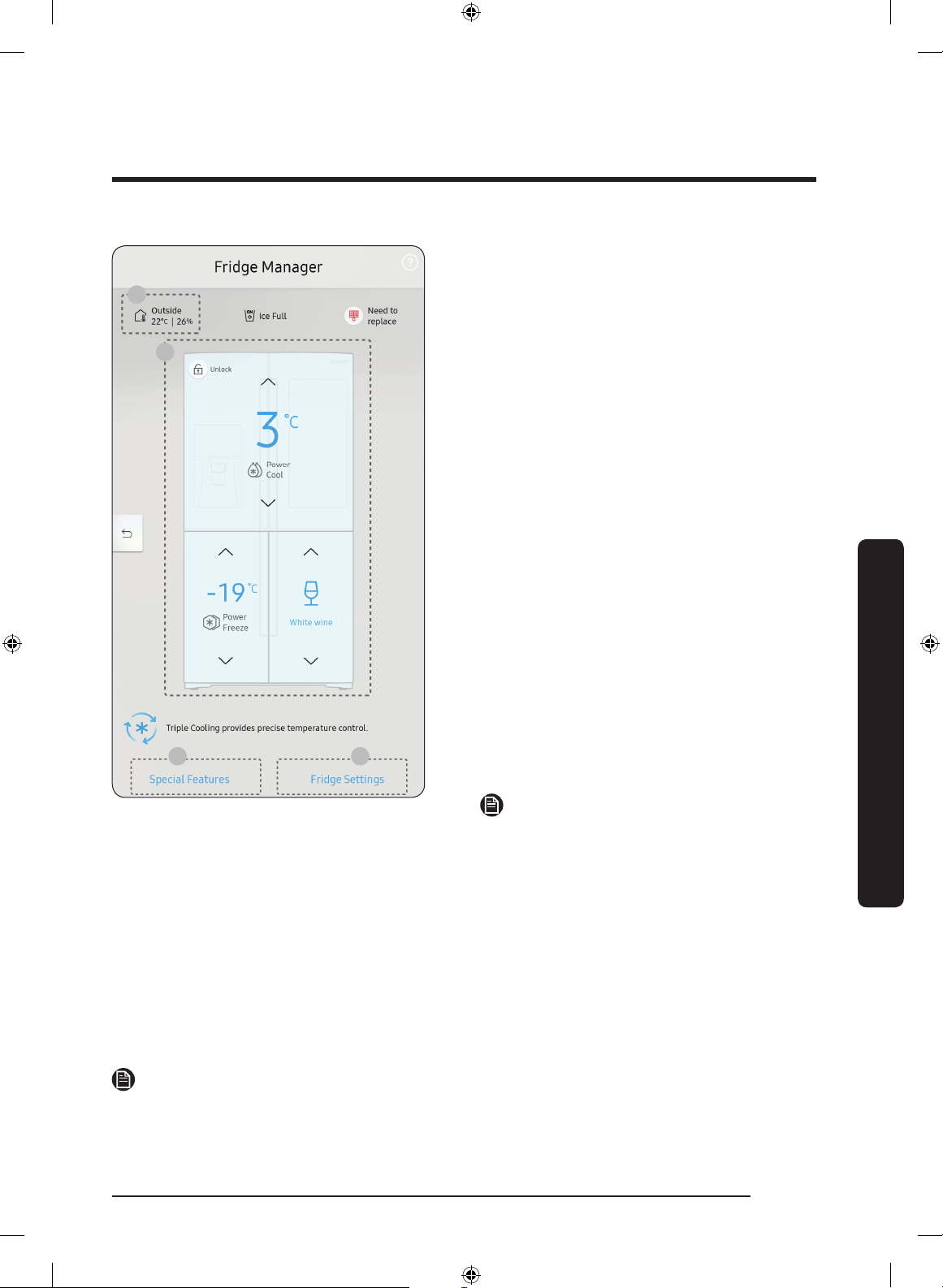
The Fridge Manager is a graphical
representation of your refrigerator.
The top half represents the refrigerator
compartment, the bottom left the freezer
compartment, and the bottom right the
Cool Select+. The temperature or mode
settings for each are displayed over each
section.Fridge Manager At a Glance
01 Temperature
Set or change the temperatures for the
fridge, freezer, and Cool Select+ with
Power mode (Power Cool or Power
Freeze).
- Power Cool and Power Freeze
speeds up the cooling and freezing
process at maximum fan speed. The
fridge and the freezer keeps running
at full speed for several hours,
and then returns to the previous
temperature.
- To freeze large amounts of food,
activate Power Freeze for at least
20 hours before putting food in the
freezer.
NOTE
Using Power Cool or Power Freeze
increases power consumption. Make sure
you turn it off to return to the previous
temperature if you do not intend to use it.
Operations
02 Special Features
Special functions available on this refrigerator are listed with a brief description.
03 Fridge Settings
See the next page for details.
04 External Conditions
Displays the external (ambient) temperature and humidity.
NOTE
The displayed conditions may differ from the actual temperature and humidity.
English 45
Untitled-19 45 2017-06-28 2:52:51
Page 46
Operations
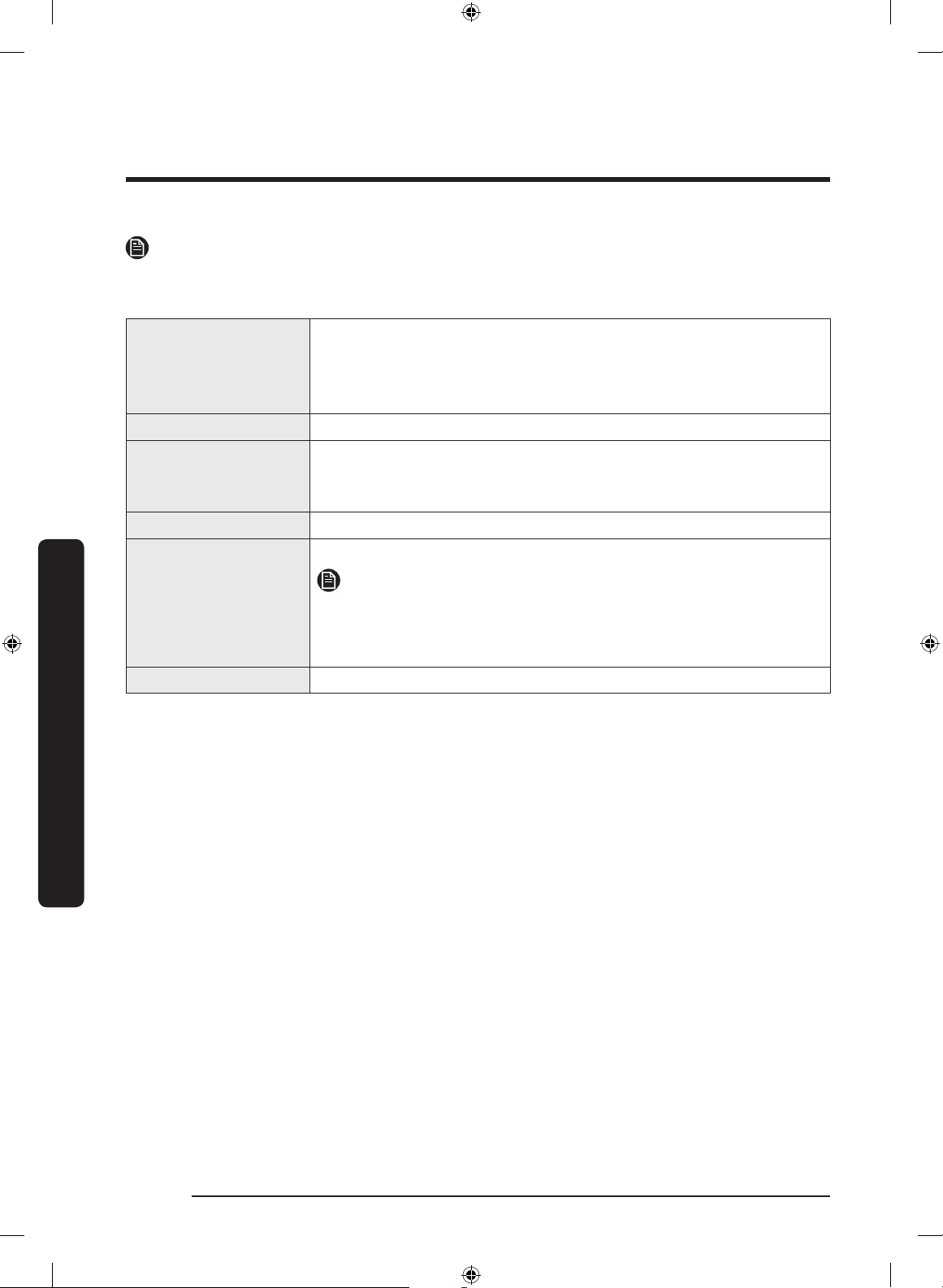
Also displayed is the Ice Maker Off (ice making off) indicator at the top, center. When the
indicator displays Ice Maker Off, the refrigerator's ice maker is turned off.
Ice Maker
Dispenser Lock Turn the Dispenser Lock on or off.
Door Alarm
Temp. Unit Switch the scale unit between Celsius and Fahrenheit.
Water Filter
Operations
Self Check Run the self-diagnosis.
NOTE
Turn the ice maker on or off. Note that if the ice bucket is full of
ice, the refrigerator does not start making ice at the press of this
button (turning the Ice Maker on), but displays the Ice Making
Off indicator on the main screen.
With the Door Alarm enabled, the door being open displays an
alert with a beep. With the Door Alarm disabled, the door being
open displays just an alert.
You will be guided to replace the lter.
NOTE
After installing the water lter for the rst time, tap Water Filter,
and then tap Reset. Tapping Reset initializes the time remaining
until the water lter needs to be replaced.
English46
Untitled-19 46 2017-06-28 2:52:51
Page 47
Settings
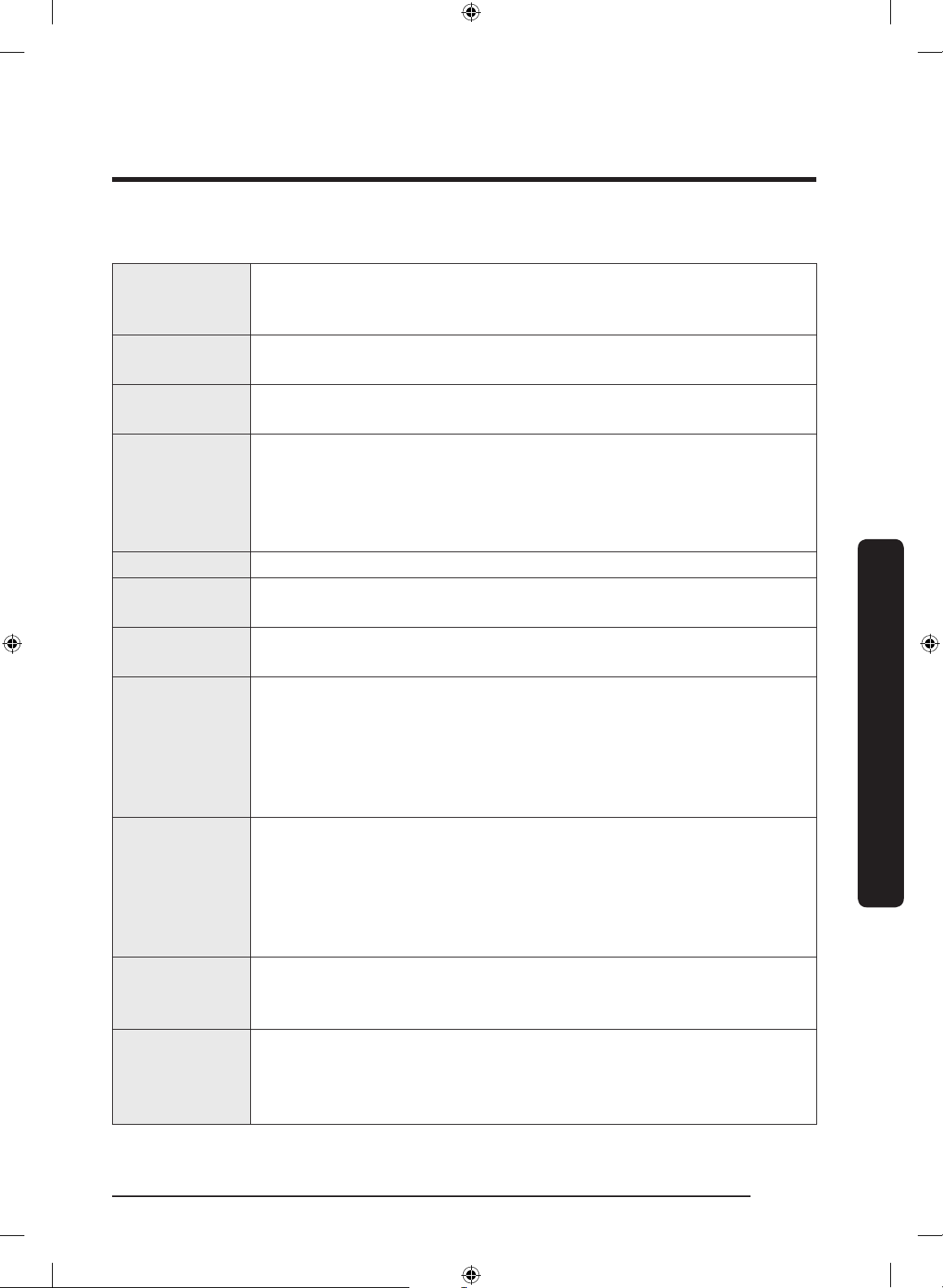
• You can set the screen brightness, background image, auto wake-
Display
up, motion detector, and theme, duration and start time of the
screen saver.
Sound
Wi-Fi
• Set the volume and equalizer and turn on or turn off the touch
sound.
• Turn on or turn off a Wi-Fi connection. The current Wi-Fi network is
listed rst in the access point (AP) list.
• Up to 4 recently paired Bluetooth devices are listed.
• To add a new device when 4 paired devices are listed, rst unpair a
Bluetooth
paired device from the device list.
• Available devices are Bluetooth-enabled headsets, headphones, and
speakers.
Prole • You can add, edit, or delete a prole.
Parental
Controls
Language
• Enable or disable restrictions on Family Hub features and apps.
• Select a preferred language. Available languages depend on the
sales region.
• Make sure the Auto update function is on with a proper Wi-Fi
network connection. Open the fridge door and locate the display
Date and Time
reset button on the inner side of the door. Press the button and
press again to reset the display. Then, the date and time will be
synced by the time server.
• You can change the time zone through the Time zone menu.
• Make sure the Software Update function is on with a proper Wi-Fi
network connection.
About Device
• When updates are available, the Update button becomes active.
When updates are complete, the refrigerator restarts automatically.
• Legal information displays the Open Source License Agreement. Tap
the list item to open the Open Source Announcement.
Easy
Connection
• Easy Connection can be used with Samsung Smartphone apps, and
allows you to connect your device to the same home Wi-Fi network
that your smartphone is connected to.
• Device Authentication can be used with Samsung Smart TV apps
Device
Authentication
where the privacy information on the refrigerator can be shared to
the TV.
• Availability of this function depends on the device model.
Operations
English 47
Untitled-19 47 2017-06-28 2:52:51
Page 48
Operations
Clean Screen
Mode
Online Manual
Factory Data
Reset
Remote
Management
Operations
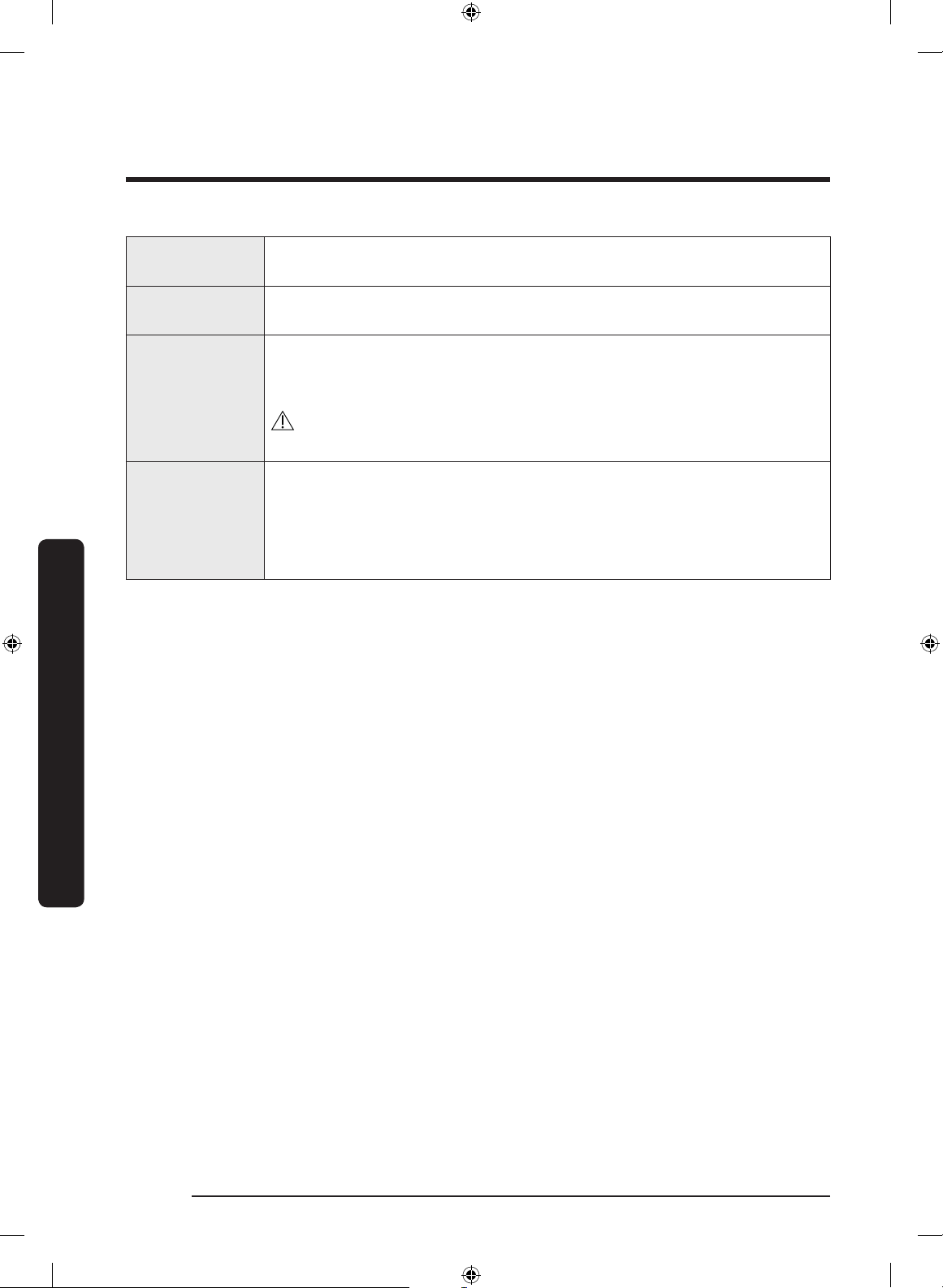
• Turn on so you can clean the screen without activating any apps.
• The online manual will walk you through various menus and apps
that the refrigerator provides directly on the display.
• Tap Reset to restart the refrigerator in Factory Data Reset mode. All
user data will be removed permanently. Data that will be removed
includes account information, memos, photos, and user settings.
CAUTION
Once factory reset is complete, no user data can be recovered.
• Use Remote Management to allow a service representative to
remotely diagnose problems and provide solutions.
• Remote Management requires a Wi-Fi connection.
• The Remote Management menu does not appear on models that do
not support Remote Management.
English48
Untitled-19 48 2017-06-28 2:52:51
Page 49
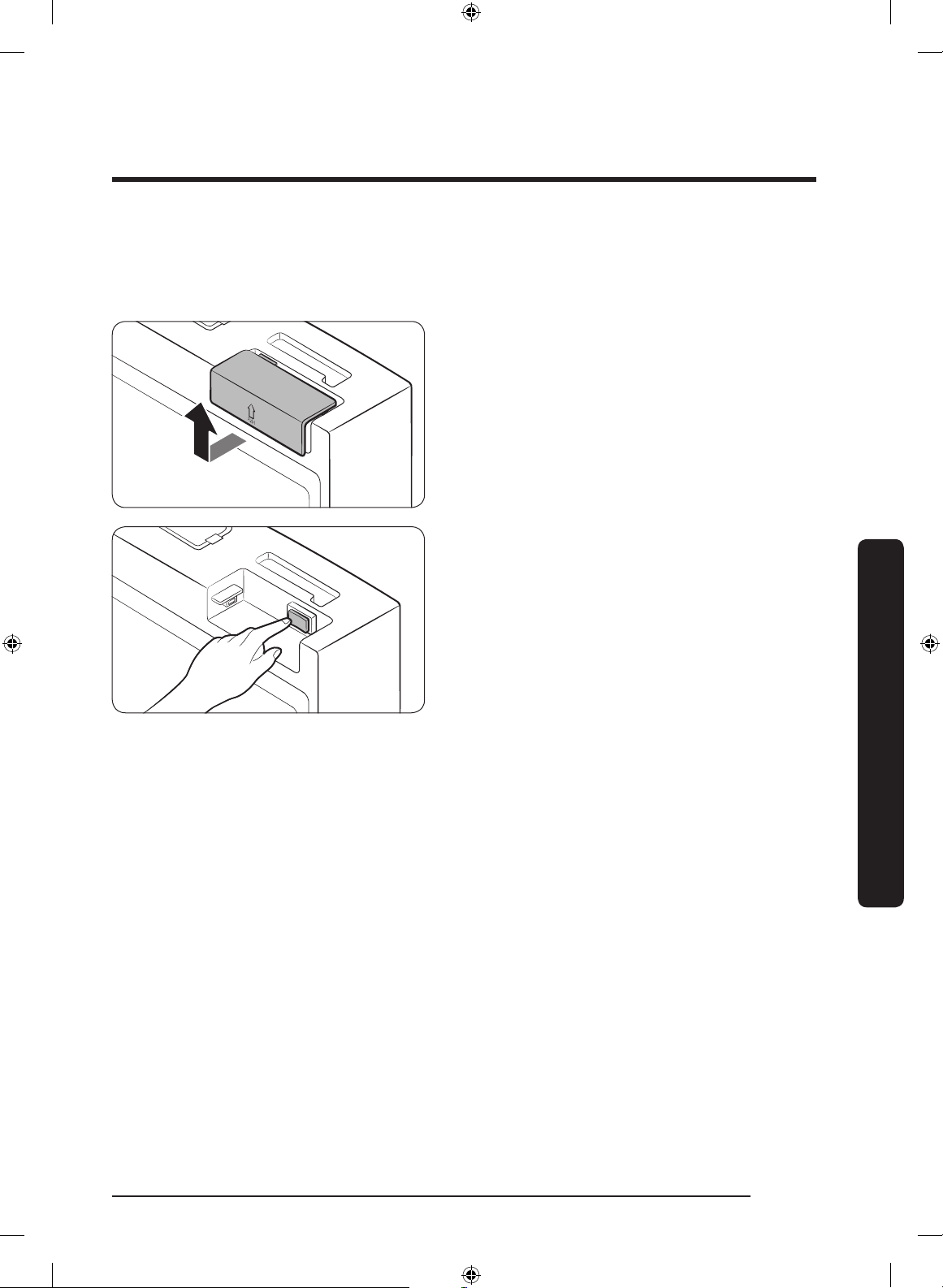
Display reset (applicable models only)
If you encounter an abnormal symptom on the display, try resetting the display. This may
solve the symptom.
1. Open the right-side fridge door and
locate the switch cover on the top right
corner of the door.
2. Push up the cover to reveal the power
switch.
3. Turn the switch off and turn it on again.
4. Reinsert the switch cover to the end
until you hear a clicking sound.
Operations
English 49
Untitled-19 49 2017-06-28 2:52:51
Page 50
Operations
Samsung Connect
Installation
Visit the Google Play Store, Galaxy Apps, or Apple App Store and search for “Samsung
Connect”. Download and install the Samsung Connect app provided by Samsung
Electronics to your smart device.
• The Samsung Connect app is designed for Android 6.0 (Marshmallow) or higher, or iOS
• For improved performance, the Samsung Connect app is subject to change without
• Recommended encryption systems include WPA/TKIP and WPA2/AES. Any newer or
• Wireless networks may be affected by the surrounding wireless communication
• If your Internet service provider has registered the MAC address of your PC or modem
Operations
• The rewall settings of your network system may prevent your Samsung Smart
• To congure the wireless access point (AP) settings, see the user manual of the AP.
• Samsung Smart Refrigerators support both Wi-Fi 2.4 GHz with IEEE 802.11 b/g/n and
• Unauthorized Wi-Fi wireless routers may fail to connect to applicable Samsung Smart
NOTE
9.0 or higher, and is optimized for Samsung smartphones (Galaxy S and Galaxy Note
series).
notice, or discontinued support according to the manufacturer’s policy.
unstandardized Wi-Fi authentication protocols are not supported.
environment.
for identication, your Samsung Smart Refrigerator may fail to connect to the Internet.
If this happens, contact your Internet service provider for technical assistance.
Refrigerator from accessing the Internet. Contact your Internet service provider for
technical assistance. If this symptom continues, contact a local Samsung service center
or retailer.
Soft-AP protocols (IEEE 802.11 n is recommended).
Refrigerators.
English50
Untitled-19 50 2017-06-28 2:52:51
Page 51
Samsung account
You are required to register your Samsung account to use the app. If you don’t have a
Samsung account, follow the app’s onscreen instructions to create a free Samsung account.
Getting started
Turn on the device you want to connect, open the Samsung Connect app on your phone,
then follow the instructions below.
If a pop-up appears saying that a new device has been found, tap ADD NOW.
If a pop-up doesn't appear, tap the + button, then select the device you want to connect
from the list of available devices.
If your device isn't in the list of available devices, add the device manually by selecting
the device type, and then selecting the specic device model.
Follow the instructions for setting up your device.
1. Sign in to your Samsung account (if not already signed in).
2. Add the device.
3. Check the connection.
4. Find and connect to a Wi-Fi network.
5. Register the device.
6. Setup is complete. Your device will now appear as a card on the My devices screen.
Refrigerator app
Operations
Integrated control
You can monitor and control your refrigerator at home and on the go.
• Tap the Refrigerator icon in the Samsung Connect to open the Refrigerator page.
• Check the operation status or notications related to your refrigerator, and change
options or settings if necessary.
NOTE
Some options or settings of the refrigerator may not be available for remote control.
English 51
Untitled-19 51 2017-06-28 2:52:51
Page 52
Operations
Monitoring
Functions
Operations
Alarms
Inside Image
Family Hub App Link
Category Item Description
Fridge temperature
Freezer temperature
Cool Select+
(FlexZone) settings
Diagnosis
Energy monitoring
Ice making
Power Cool
Power Freeze
Abnormally high
temperature
Door opening
Water lter
replacement
Displays the current temperature setting of the
fridge.
Displays the current temperature setting of the
freezer.
Displays the settings of the Cool Select+
(FlexZone).
Detects abnormal operations of the
refrigerator.
Checks the accumulated power consumption of
the refrigerator for the last 180 days.
You can turn the ice making function on or off,
and check the current settings of the function.
You can also check the status and progress of
ice making.
You can turn Power Cool on or off, and check
the current settings.
You can turn Power Freeze on or off, and
check the current settings.
This alarm is triggered when the fridge, the
freezer, or the Cool Select+ (FlexZone) has
abnormally high temperatures.
This alarm is triggered if the fridge or freezer
door or the Cool Select+ (FlexZone) door is left
open for a specic time.
This alarm reminds you that the water lter
must be replaced.
You can view the inside of the refrigerator and
you can know when to replace food items.
You can connect to the App Store and
download the Refrigerator app.
English52
Untitled-19 52 2017-06-28 2:52:52
Page 53
Recommendations for voice recognition
Around the 'MIC' marked area of the refrigerator's display is a built-in microphone.
• Speak loud and clear towards the built-in microphone within 1 m from the
refrigerator's display.
• Voice recognition may not be triggered or enabled at distances over 1 m or with low
voices.
• Speak clearly at a regular pace. Reduce ambient noises, such as from the living-room
TV.
Samsung Family Hub
Installation
Visit the Google Play Store, Galaxy Apps, or Apple App Store and search for “Samsung
Family Hub”. Download and install the Samsung Family Hub app provided by Samsung
Electronics to your smart device.
NOTE
• The Samsung Family Hub app is designed for Android 4.4 (KitKat) or higher, or iOS
8.0 or higher, and is optimized for Samsung smartphones (Galaxy S and Galaxy Note
series).
• For improved performance, the Samsung Family Hub app is subject to change without
notice or support may be discontinued according to the manufacturer’s policy.
• Wireless networks may be affected by the surrounding wireless communication
environment.
• If your Internet service provider has registered the MAC address of your PC or modem
for identication, your Samsung Smart Refrigerator may fail to connect to the Internet.
If this happens, contact your Internet service provider for technical assistance.
• The rewall settings of your network system may prevent your Samsung Smart
Refrigerator from accessing the Internet. Contact your Internet service provider for
technical assistance. If this symptom continues, contact a local Samsung service center
or retailer.
Operations
English 53
Untitled-19 53 2017-06-28 2:52:52
Page 54
Operations
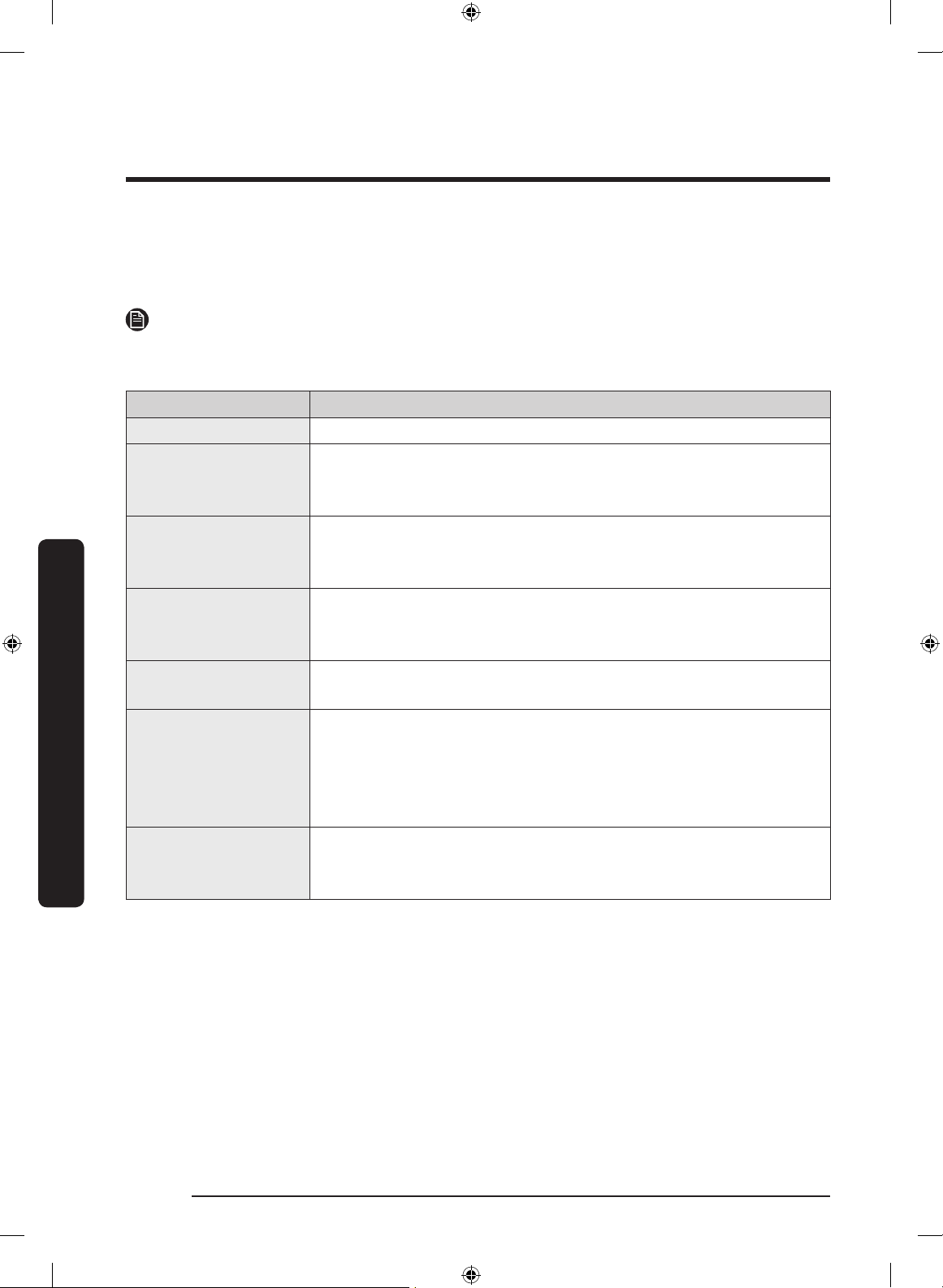
Samsung account
You are required to register your Samsung account to use the app. If you don’t have a
Samsung account, follow the app’s onscreen instructions to create a free Samsung account.
To connect your smartphone and the refrigerator, register your Samsung account in
Settings Proles.
Calendar • You can share your schedule with your family.
To Do • You can bring a To Do list from your refrigerator to your
Memo • You can bring a Memo from your refrigerator to your
Whiteboard • You can bring a White Board message from your refrigerator
Operations
Photo • You can send photos in your smartphone to the Photo Album
View Inside • You can bring a food list from your refrigerator to your
Shopping List • You can bring a shopping list from your refrigerator to your
NOTE
Item Description
smartphone or send a To Do list from your smartphone to
your refrigerator.
smartphone or send a Memo from your smartphone to your
refrigerator.
to your smartphone or send a White Board message from
your smartphone to your refrigerator.
in your refrigerator.
smartphone or send a food list from your smartphone to your
refrigerator.
• You can check the refrigerator's inside fridge image on your
smartphone.
smartphone or send a shopping from your smartphone to
your refrigerator.
English54
Untitled-19 54 2017-06-28 2:52:52
Page 55
Special features
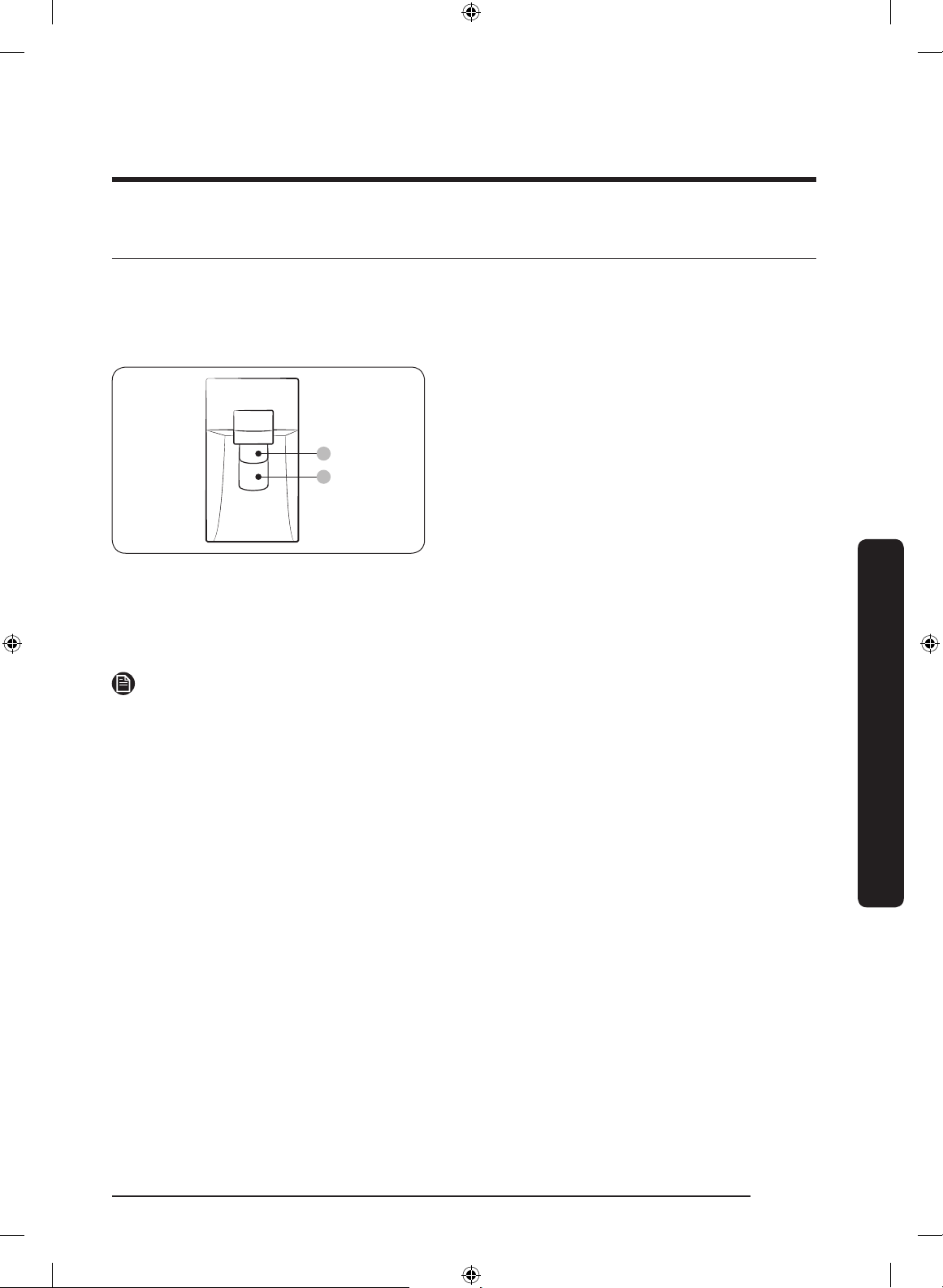
A
B
The refrigerator has features convenient for you.
Water dispenser
With the water dispenser, you can dispense water without opening the fridge door.
The water dispenser offers 3 options:
chilled water, cubed ice, and crushed ice.
If you do not want to dispense ice, simply
press water lever (B).
With the Ice Maker enabled,
1. Press to select an ice type.
2. Put a water glass on the ice lever (A)
and push it. Ice is dispensed from the
dispenser.
3. Then, put the glass on the water lever
(B) and push it. Water is dispensed from
the dispenser.
NOTE
• To get ice and water, push the ice lever (A) rst for ice, then move your glass down and
press the water lever (B) for water.
• If you push both levers at once, only the rst pushed lever operates.
• To prevent spills, wait 1 second before removing the glass after dispensing.
• Make sure the glass is in line with the dispenser to prevent the dispensed water from
spilling out.
• If you do not use the water dispenser for 2-3 days, the dispensed water may have an
abnormal smell or taste. This is not a system failure. Discard the rst 1-2 glasses of
water.
Operations
Untitled-19 55 2017-06-28 2:52:52
English 55
Page 56
Operations
Ice maker
The refrigerator has a built-in ice maker that automatically dispenses ice so that you can
enjoy ltered water with cubed or crushed ice to your preference.
Ice making
To ensure proper ice making and keep the ice bucket available with ice after using the
refrigerator for the rst time, follow these instructions:
1. Let the refrigerator operate for at least 24 hours to ensure optimal performance.
2. Dispense the rst 4 to 6 ice cubes into a glass.
3. Wait another 8 hours and dispense another 4 to 6 ice cubes.
4. Then, wait another 16 hours and dispense the rst glass-full of ice.
NOTE
• If you consume all the ice at once, you must wait 8 hours before dispensing the rst 4
to 6 cubes. This ensures that the ice bucket is lled with ice properly.
• The ice cubes generated rapidly may look white, which is normal.
Diagnosis
Operations
• If the ice making chime rings repeatedly, contact the waterline installer or a local
• Do not press the button repeatedly after the ice tray is lled with ice or water. Water
• Do not put food in the ice bucket. The frozen food may damage the ice maker,
• When the refrigerator recovers power supply after a power failure, the ice bucket may
• Do not put ngers or other objects into the dispenser hole or the ice maker. This may
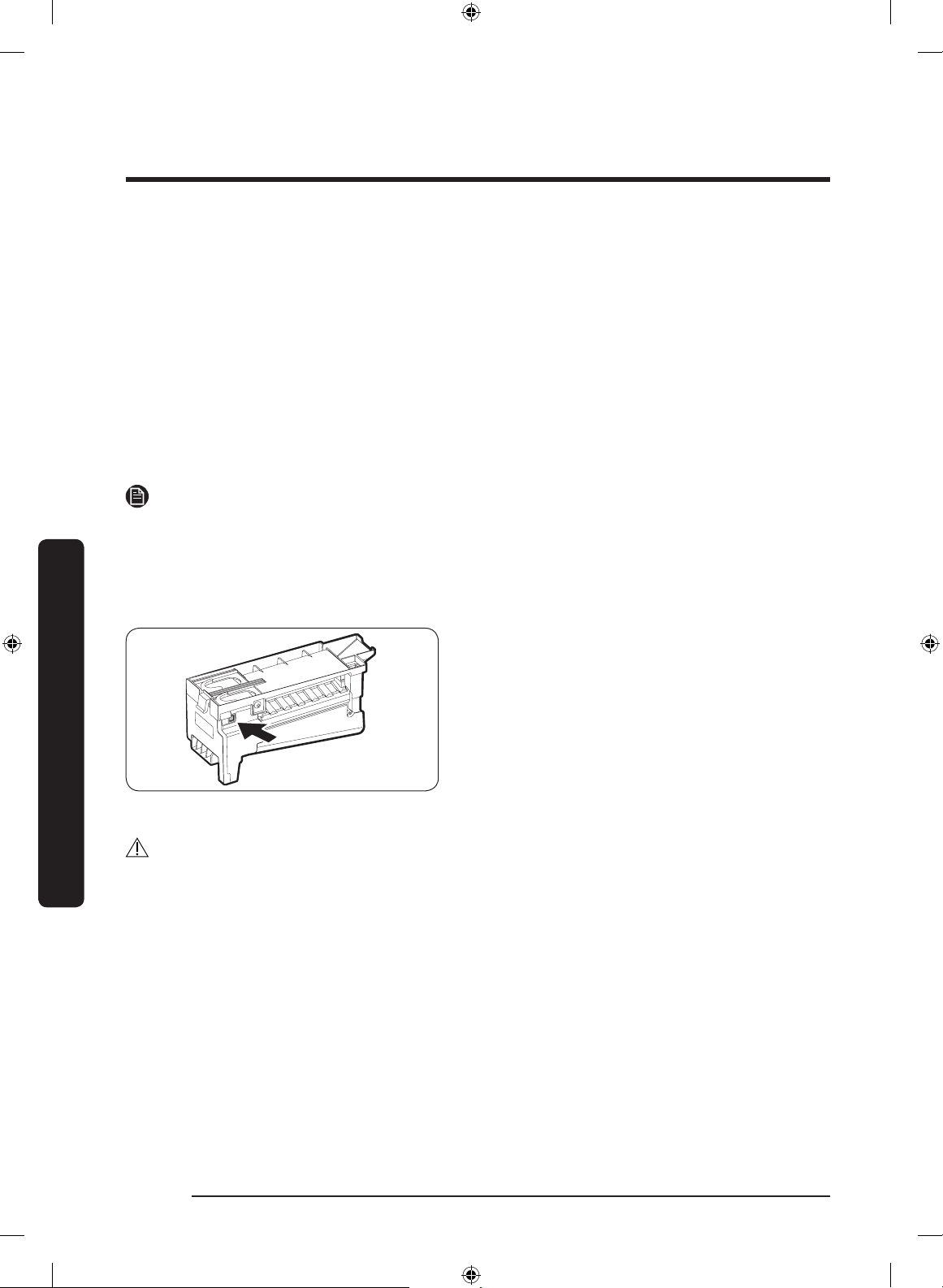
If ice does not dispense, rst check the ice
maker.
To check the ice maker
1. Press Test on the side of the ice maker.
You will hear a chime (ding-dong) at the
press of the button.
2. You will hear another chime if the ice
maker operates properly.
CAUTION
Samsung service center.
may overow or ice may jam.
especially when opening or closing the door.
contain a mix of melted and jammed ice cubes, resulting in a system failure. To prevent
this, make sure to empty the ice bucket before using the refrigerator.
cause physical injury or property damage.
English56
Untitled-19 56 2017-06-28 2:52:52
Page 57
• When reinserting the ice maker tray, make sure that the tray is properly centered at
the entrance. Otherwise, the tray may be stuck.
Ice Maker Off
To disable the icemaker, tap Fridge Manager > Fridge Settings > Ice Maker on the Home
screen, and then select Off. Make sure to empty the ice bucket.
Remaining ice cubes may clump together, making it difcult to remove them.
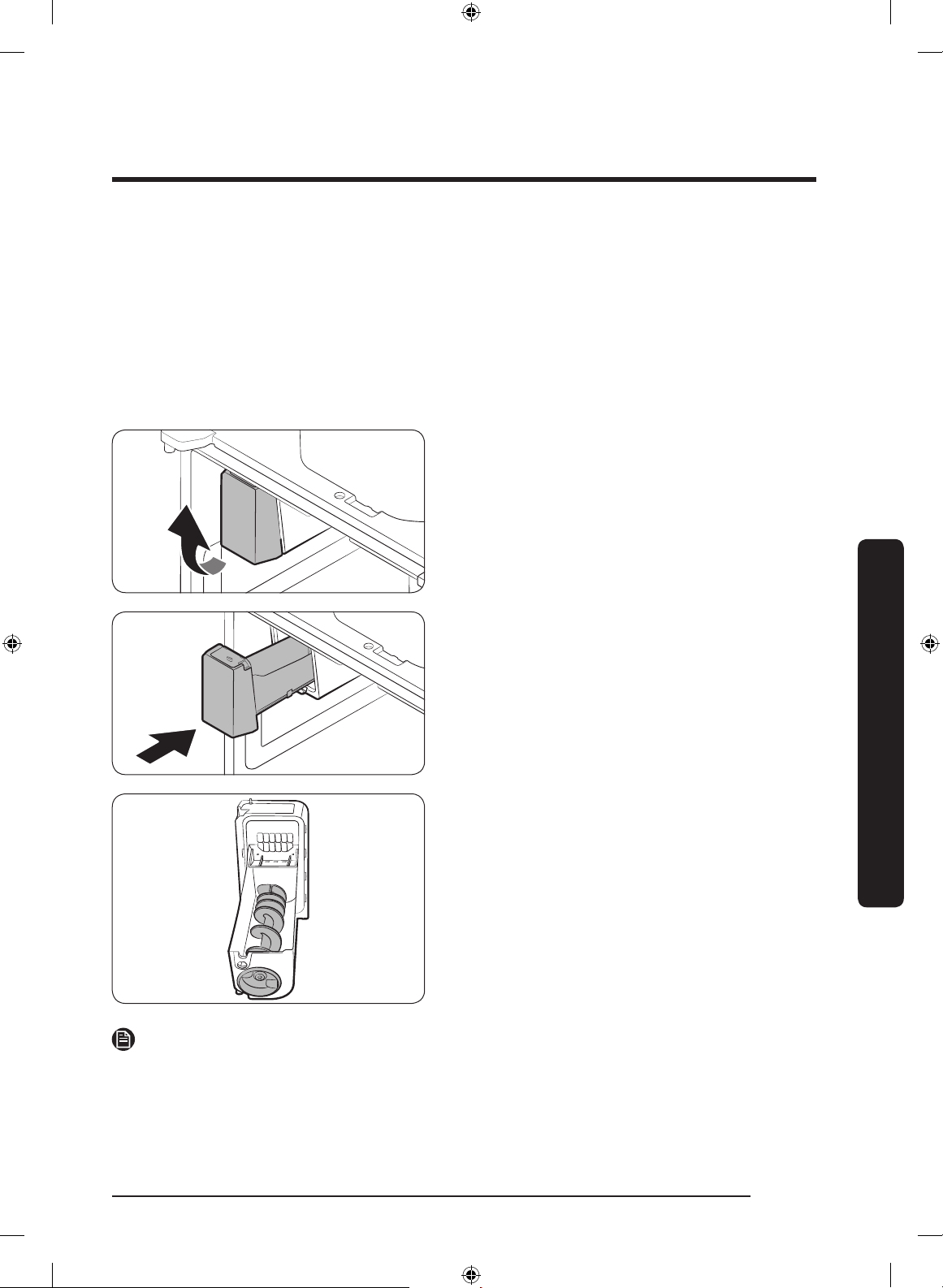
To remove the ice bucket
1. Hold the bottom of the ice bucket with
one hand and hold the side with the
other hand.
2. Gently lift up and pull out.
3. Remove the remaining ice cubes and
put the ice bucket back into place.
Operations
If the ice bucket is not rmly inserted, turn
the ice screw by 90 degrees and try again.
NOTE
• Removal of the ice bucket does not affect the thermal and mechanical performance of
the refrigerator.
English 57
Untitled-19 57 2017-06-28 2:52:52
Page 58
Operations
Water clouding
Water supplied to the refrigerator ows through a core alkaline lter of any kind. During
this ltering process, the water that has owed through the lter increases in the water
pressure and becomes saturated with oxygen and nitrogen. This causes the water to look
misty or cloudy temporarily when dispensed. This is normal and the water will look clear
after a few seconds.
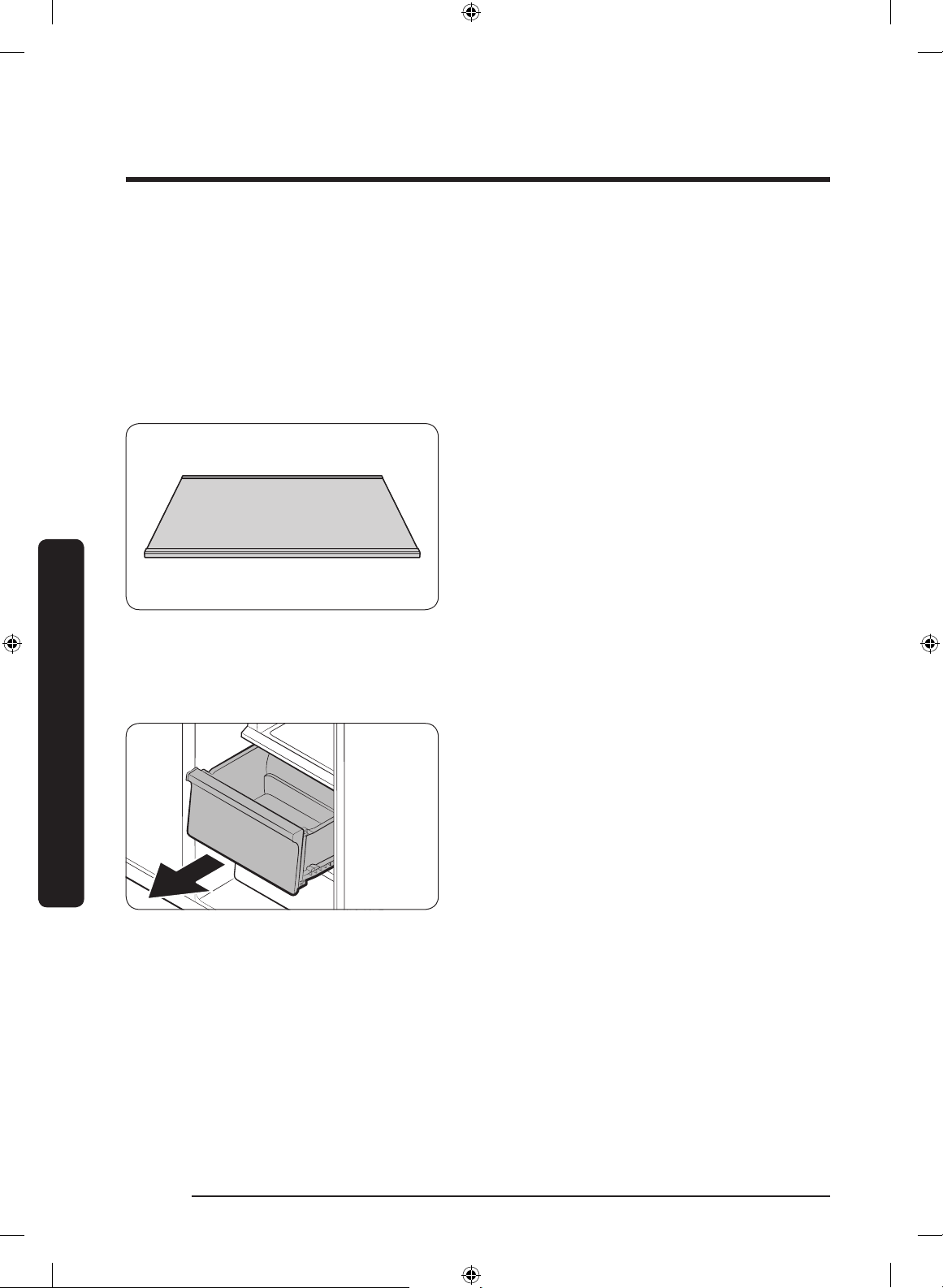
Freezer shelf (ASSY SHELF FRE)
Operations
To secure more room in the freezer or
the CoolSelect+ (FlexZone) compartment,
remove the middle drawer of the
freezer or the CoolSelect+ (FlexZone)
compartment, and then insert the freezer
shelf between the middle and bottom
drawers.
• The freezer shelf does not affect the
thermal or mechanical performance of
the refrigerator.
• Remove the protective lm on the
freezer shelf before use.
1. Slide open and remove the middle
drawer.
English58
Untitled-19 58 2017-06-28 2:52:53
Page 59
Rear
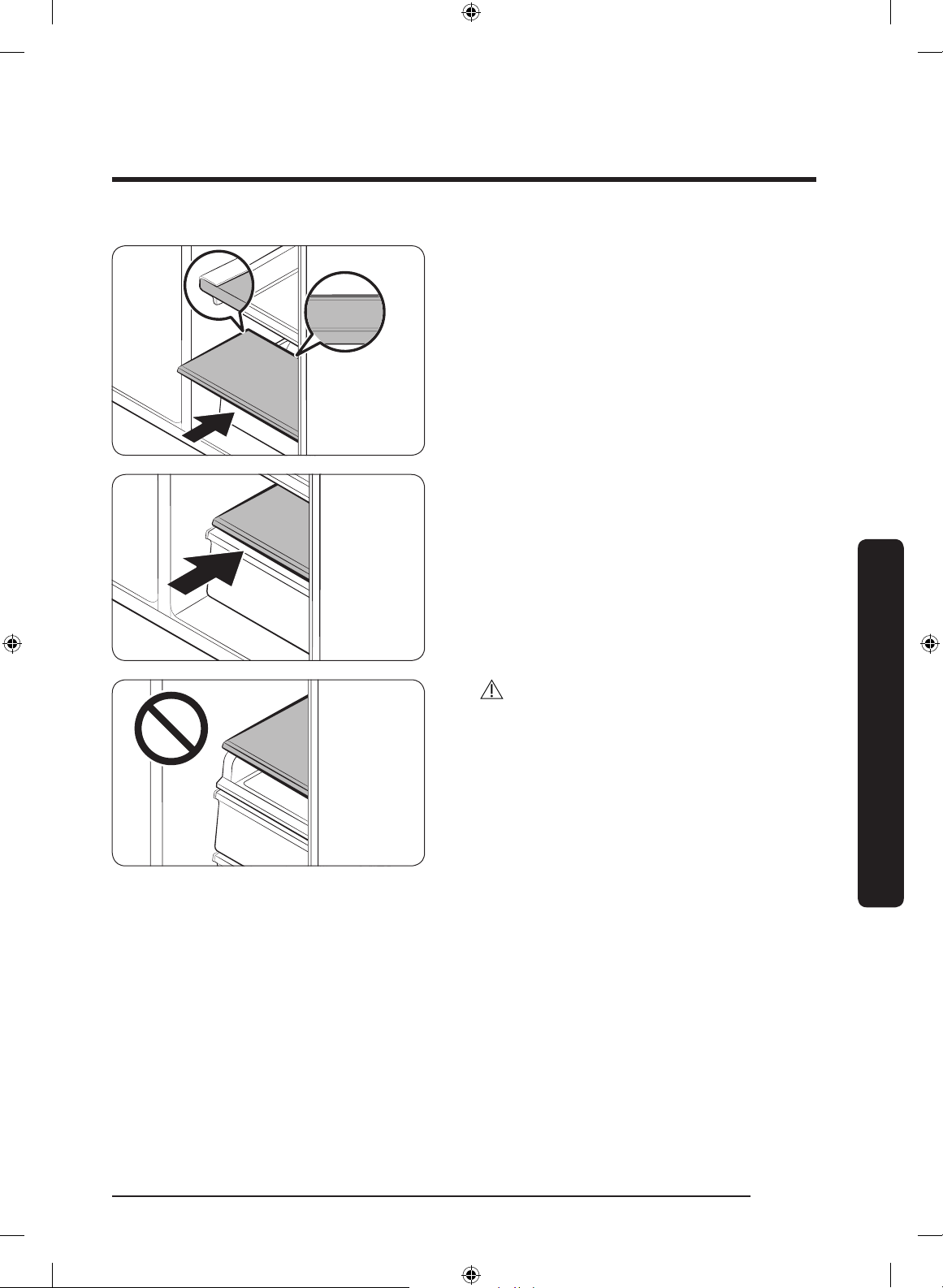
2. Insert the freezer shelf in the position
of the middle drawer. Make sure the
REAR mark faces upward, which is
located at the rear of the shelf.
CAUTION
• The freezer shelf (ASSY SHELF FRE)
is specically designed to replace the
middle drawer for additional storage
room. Do not put the freezer shelf over
on the Sliding Shelf.
• Make sure to insert the freezer shelf in
the correct direction. Otherwise, it may
be damaged.
• Keep the removed middle drawer in a
safe place for future use.
Operations
Untitled-19 59 2017-06-28 2:52:53
English 59
Page 60
Maintenance
Handle and care
Ice bucket
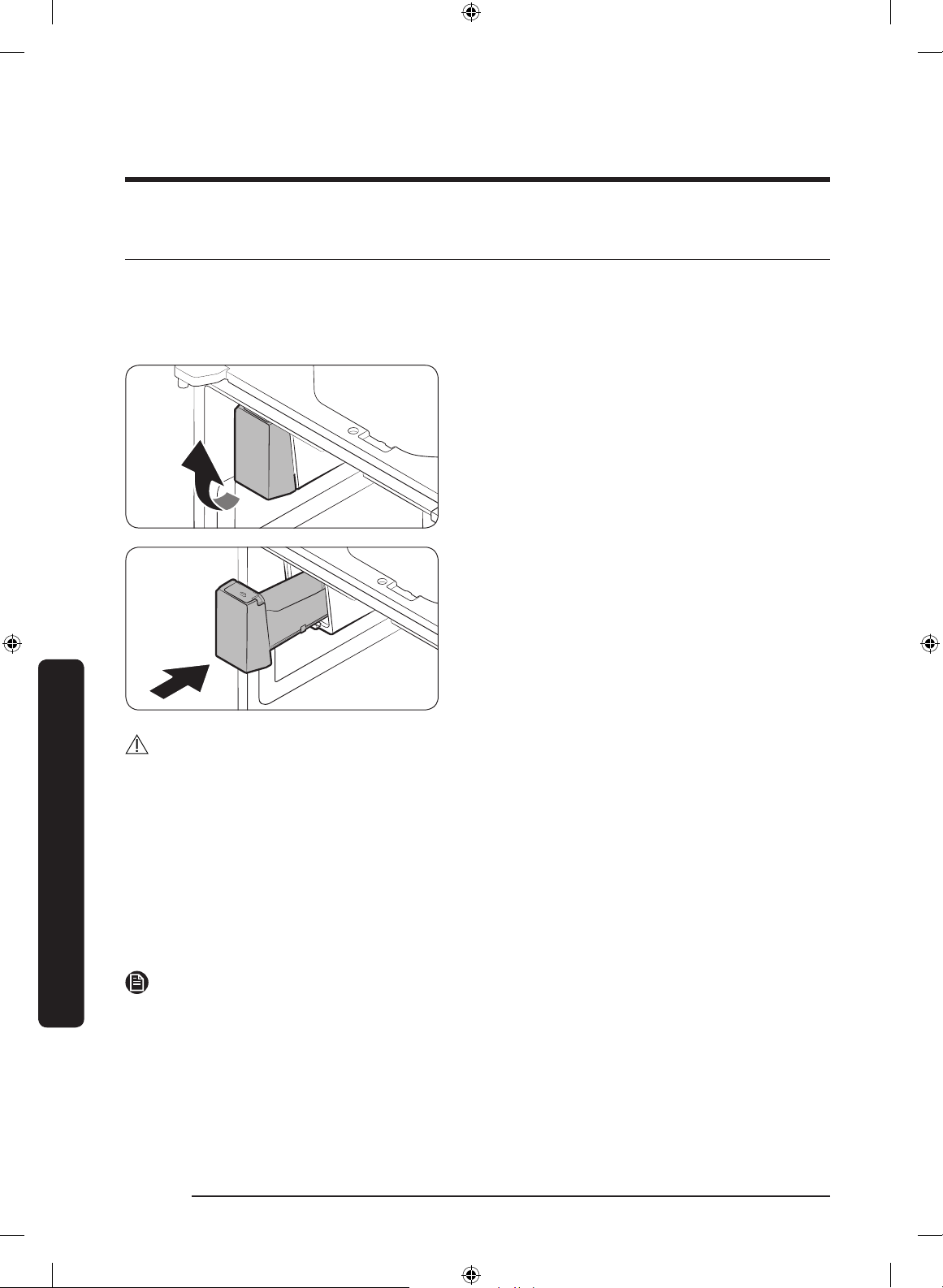
If you do not dispense ice for an extended period, ice may form clumps inside the bucket.
If this happens, remove and empty the ice bucket.
1. To remove the ice bucket, gently lift it
up and pull out slowly while holding the
bottom of the bucket with one hand and
the side with the other hand.
2. Lift up and pull the bucket out. Empty
the bucket.
3. When done, put the bucket back into
position. If the bucket does not t in,
turn the helix screw by 90 degrees and
try again.
Maintenance
• Do not apply excessive force to the bucket cover. The cover may break.
• Do not forcefully close the door. Water may spill over the ice maker.
• To prevent injury, make sure to clean up any ice or water that has fallen on the oor.
• To prevent accidents or injury, do not let children play with the water dispenser or the
ice maker.
• Do not put your hand or an object into the ice chute. This may cause physical injury or
product damage.
• Use only the provided ice bucket. Third-party ice buckets may cause a system failure.
• Use only potable water that is connected to the water supply line.
• The required water pressure for ice making is between 20 psi and 125 psi.
• Any sound from the ice maker is normal, which outputs during the ice making process.
• While the door is open, neither the ice maker nor the water dispenser operates.
English60
CAUTION
NOTE
Untitled-19 60 2017-06-28 2:52:53
Page 61
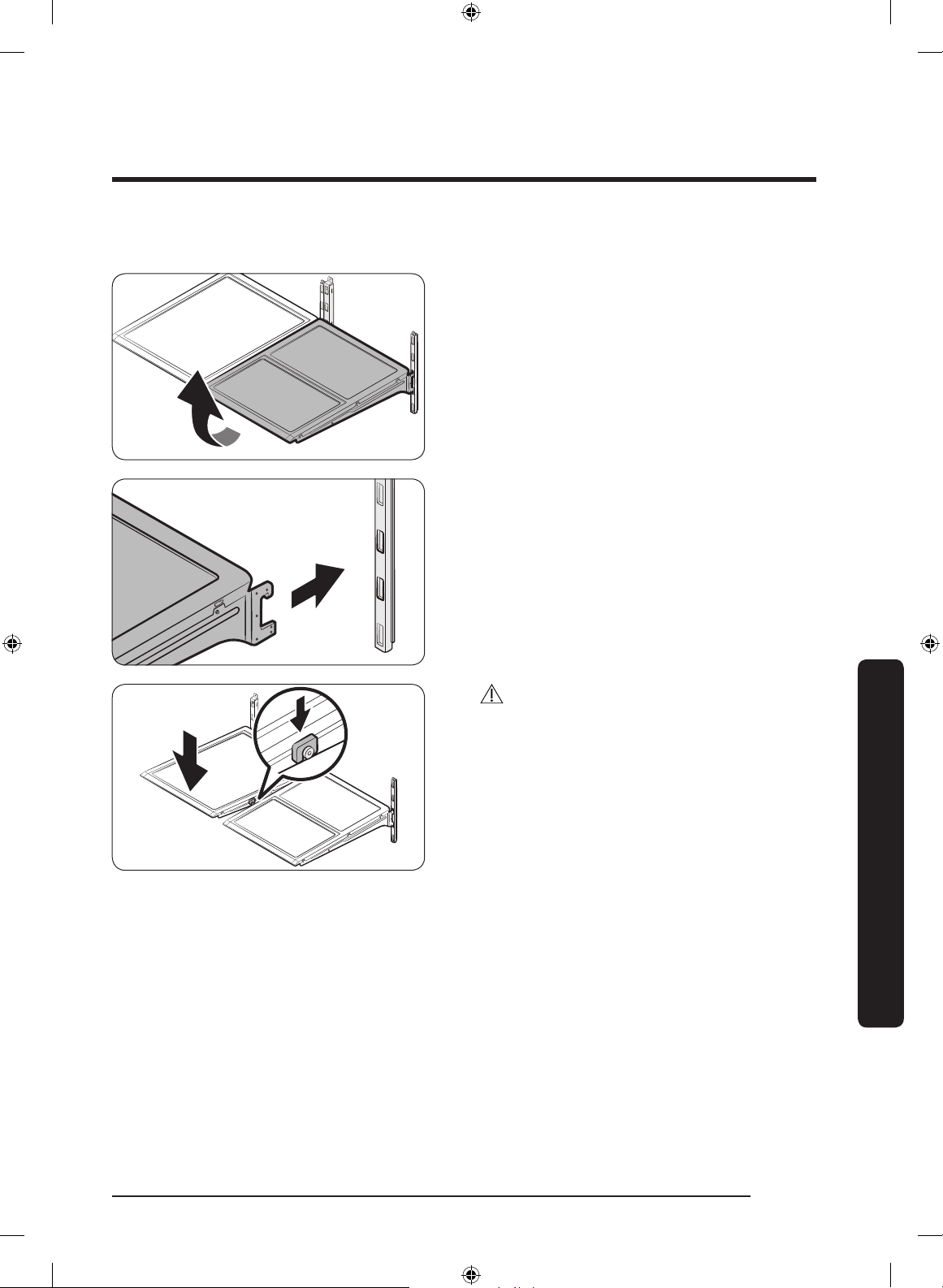
Tempered glass shelves (fridge)
• To remove a shelf, fully open the
corresponding door. Hold the front of
the shelf, and then gently lift up and
slide out.
• To reinsert, lower the rear side of the
shelf and insert into the shelf hooks.
Then, lower the front side to slide in to
the end.
CAUTION
• The tempered glass shelves are heavy.
Use caution when removing them.
• The shelf must be inserted correctly. Do
not insert upside down.
• Glass containers may scratch the
surface of glass shelves.
Maintenance
English 61
Untitled-19 61 2017-06-28 2:52:53
Page 62
Maintenance
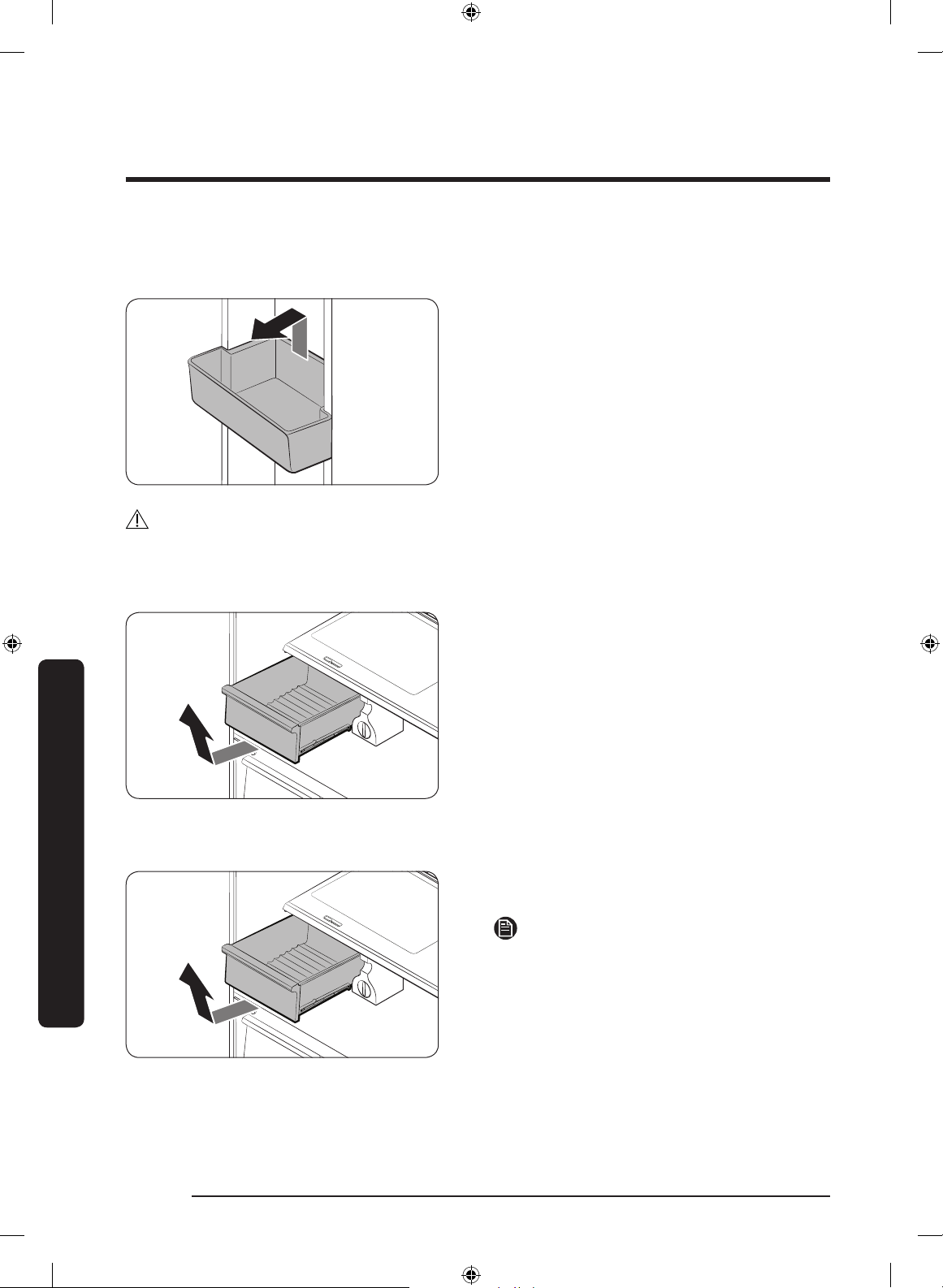
Door bins
The top door bin section has a marked line to ensure easy removal and proper reinsertion.
Lift up the door bin, and then pull out
straight.
CAUTION
Do not allow children to play with the bins. Sharp-edged corners may cause injury.
Vegetable & fruit drawers
Gently lift up the front of the drawer and
slide out.
It is recommended to remove the door
bins before removing the drawer. This is to
prevent damage to the door bins.
Maintenance
Vegetable shelf
English62
1. Slide out the left-sided vegetable
drawer.
NOTE
The actual image and provided component
parts of the refrigerator may differ,
depending on the model and the country.
Untitled-19 62 2017-06-28 2:52:54
Page 63
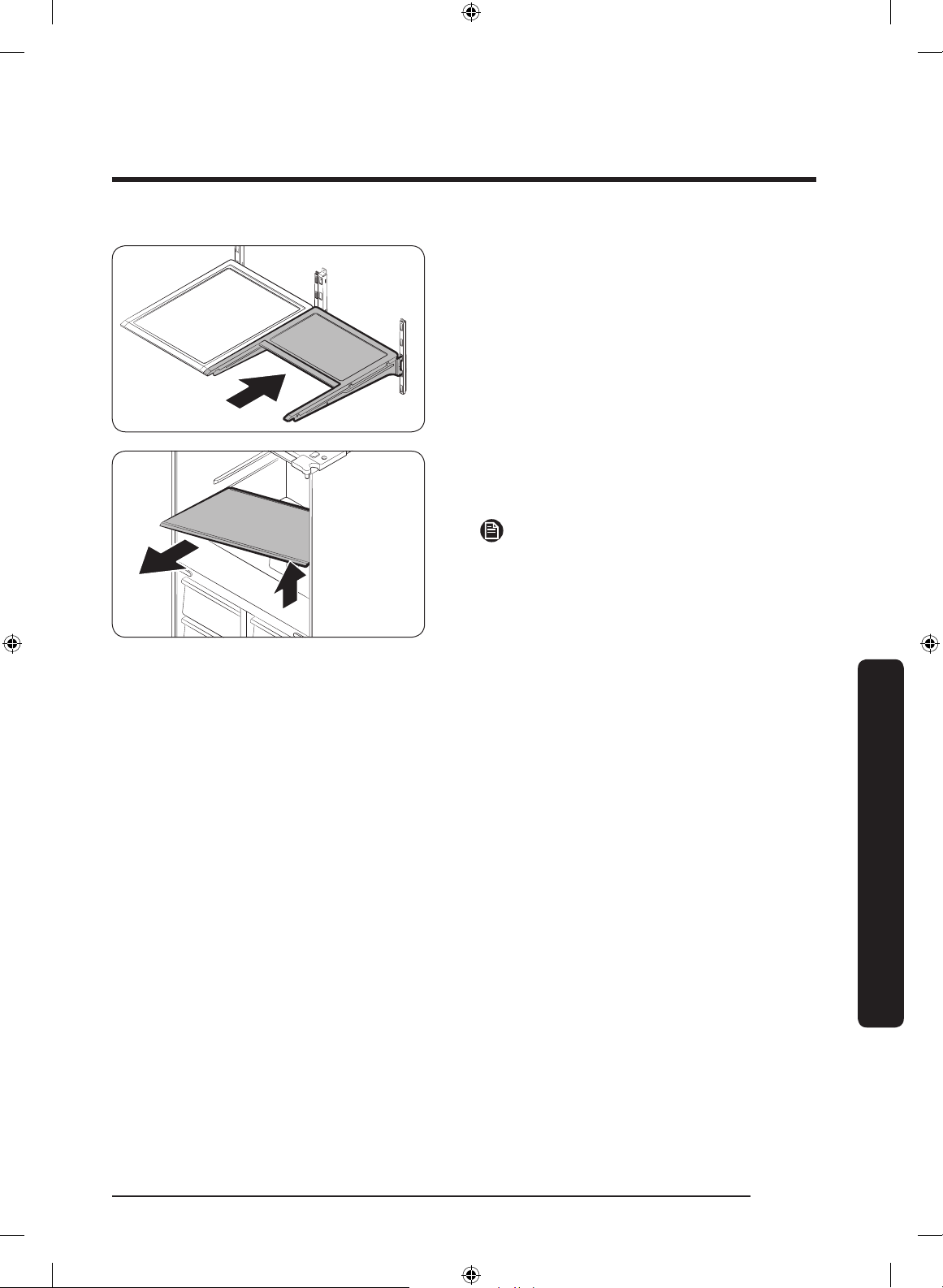
2. Slide in the right-sided foldable shelf.
3. While supporting the vegetable shelf
with one hand, slide out with the other
hand.
NOTE
Using the space that is revealed after
removing the foldable shelf, take out the
vegetable shelf.
To reinsert, follow the steps above in the
reverse order.
Ice bucket
To remove the ice bucket, see the Maintenance section on page 60.
English 63
Maintenance
Untitled-19 63 2017-06-28 2:52:54
Page 64
Maintenance
Cleaning
Interior and exterior
WARNING
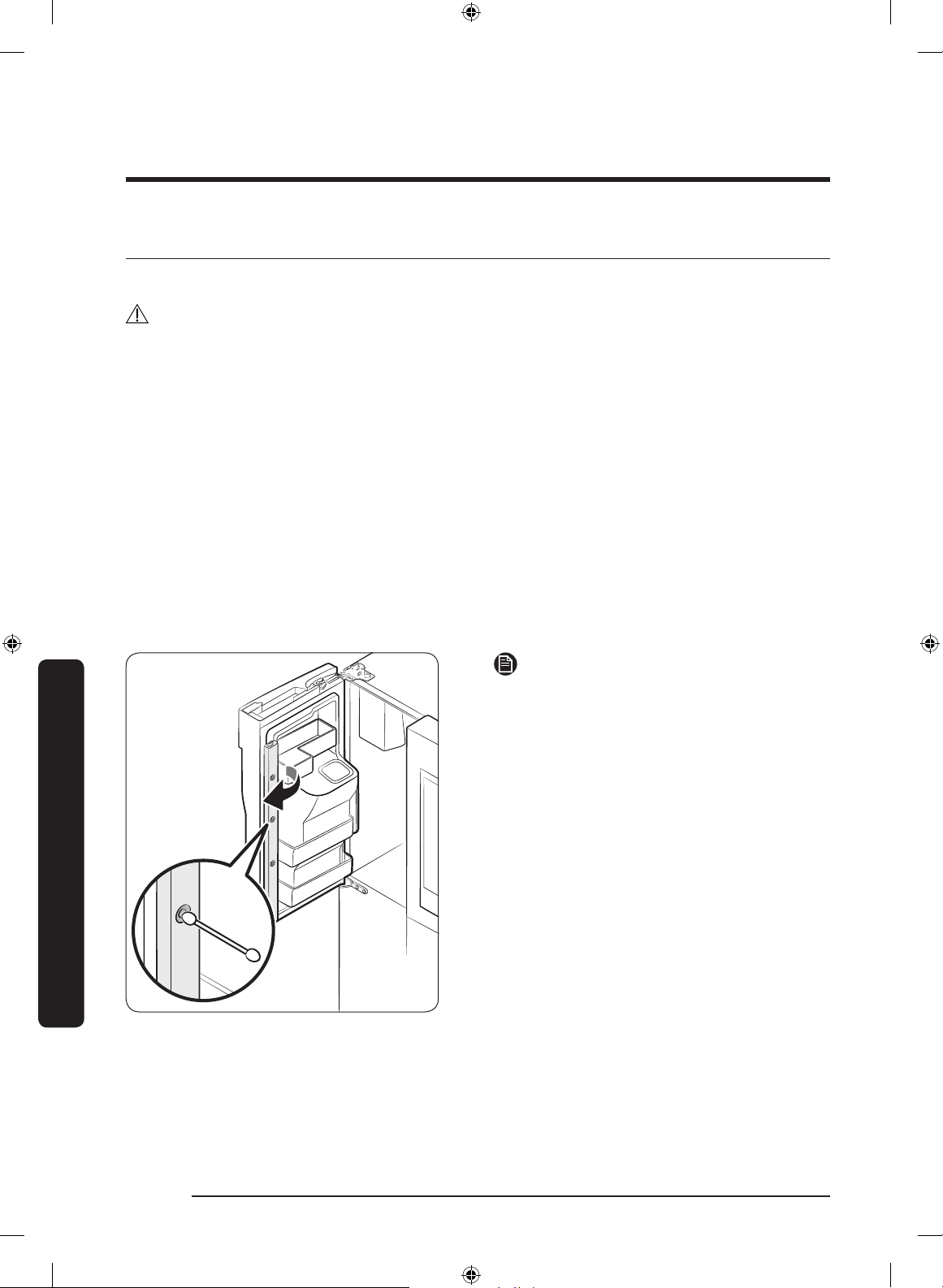
• Do not use benzene, thinner, or home/car detergent such as Clorox™ for cleaning
purposes. They may damage the surface of the refrigerator and cause a re.
• Do not spray water onto the refrigerator. This may cause electric shock.
• Do not put ngers or other objects into the dispenser hole.
Regularly use a dry cloth to remove all foreign substances such as dust or water from the
power plug terminals and contact points.
1. Unplug the power cord.
2. Use a moistened, soft, lint-free cloth or paper towel to clean the refrigerator’s interior
and exterior.
3. When done, use a dry cloth or paper towel to dry well.
4. Plug in the power cord.
Inner-view camera
Maintenance
NOTE
Use a cotton swab or microber cloth to
clean the camera on the left-side door of
the fridge.
English64
Untitled-19 64 2017-06-28 2:52:54
Page 65
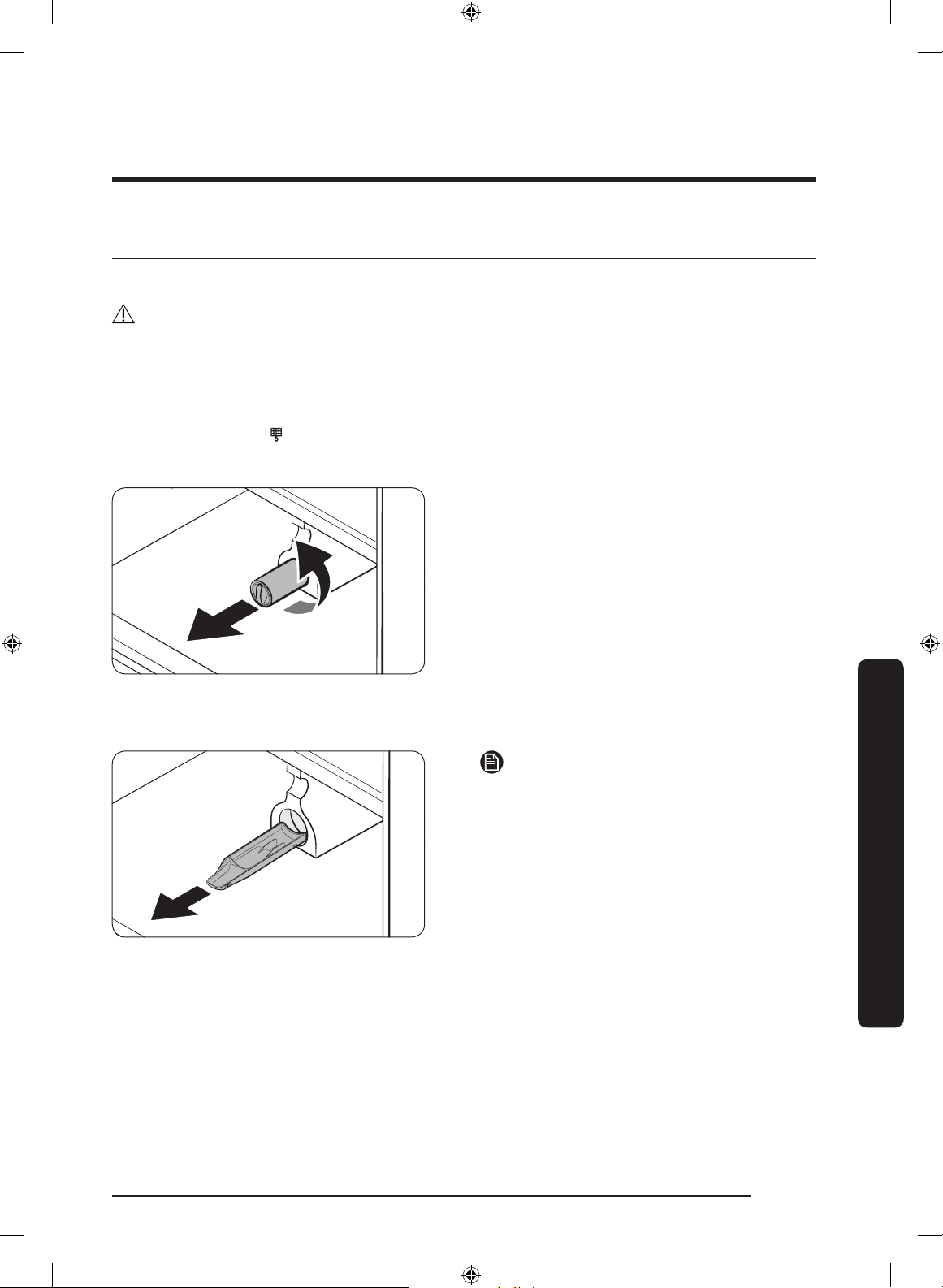
Replacement
Water lter
WARNING
• Do not use third-party water lters. Use only Samsung-provided or -approved lters.
• Unapproved lters may leak and damage the refrigerator, causing electric shock.
Samsung holds no responsibility for any damage that may occur from use of thirdparty water lters.
The lter indicator (
water lter. Before replacing the lter, make sure the water supply line is shut off.
) turns red as a reminder that lets you know it is time to replace the
1. Turn the knob of the lter cartridge
counter clockwise by 90 degrees (1/4
turn). The lter cartridge unlocks.
2. Pull out to remove the cartridge.
- If the water lter is contaminated
severely, the cartridge may not be
easily removable. In that case, pull
out by force.
- To prevent water leaks from the
opening, keep the cartridge in line
while removing it.
NOTE
To prevent overow, empty and dry the
water lter tray.
English 65
Maintenance
Untitled-19 65 2017-06-28 2:52:55
Page 66
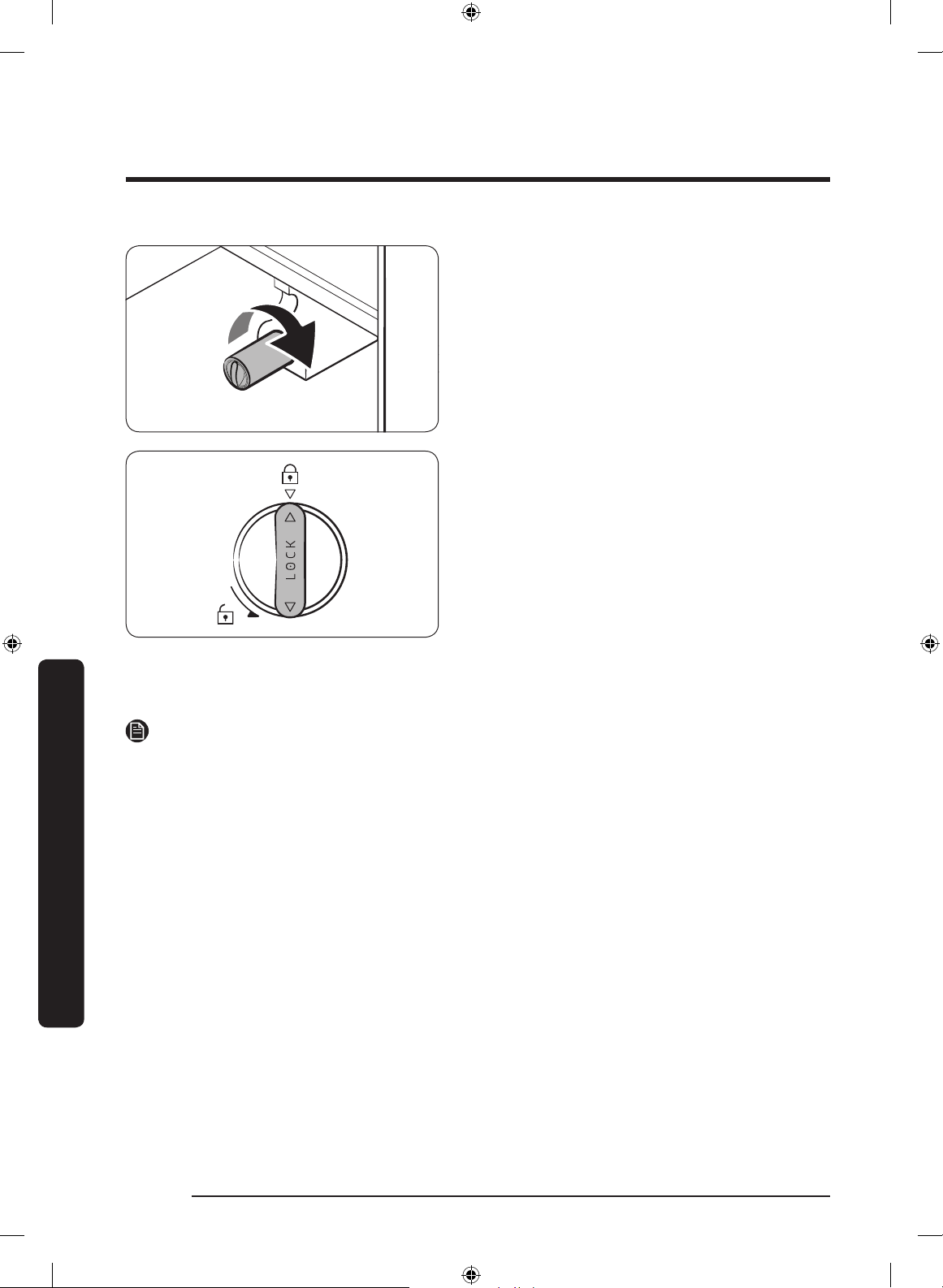
Maintenance
3. Insert a new lter cartridge. Use only
Samsung-provided or -approved lters.
4. Turn the cartridge knob clockwise to
lock into place.
5. On the Home screen, tap Fridge
Manager > Fridge Settings > Water
Filter, and then select Reset.
The lter indicator turns blue.
6. When replacing is complete, open the
water valve and run water through the
dispenser for about 7 minutes. This is
to remove impurities and air from the
water line.
• A newly installed lter may cause the water dispenser to spurt water briey. This is
Maintenance
because of air entering the waterline.
• This replacement process cause the refrigerator to drip water onto the oor. Simply
wipe up with dry cloths.
Reverse osmosis water ltration system
The water pressure of the water supply system to a reverse osmosis water ltration
system must be between 35 psi and 120 psi (241 kPa and 827 kPa).
The water pressure of the reverse osmosis water ltration system to the refrigerator’s
cold water line must be at least 40 psi (276 kPa). If the water pressure is below the
specied:
• Check if the sediment lter in the reverse osmosis system is blocked. Replace the lter
if necessary.
• Rell the water tank in the reverse osmosis system with water.
• If your refrigerator has a water lter, it may further reduce the water pressure when
used in conjunction with a reverse osmosis system. Remove the water lter.
For more information or servicing, contact a licensed plumbing professional.
English66
NOTE
Untitled-19 66 2017-06-28 2:52:55
Page 67
Ordering a new lter
To purchase a new water lter, contact a local Samsung service center.
LED Lamps
To replace the lamps of the refrigerator, contact a local Samsung service centre.
WARNING
The lamps are not user-serviceable. Do not attempt to replace a lamp yourself. This can
cause electric shock.
English 67
Maintenance
Untitled-19 67 2017-06-28 2:52:55
Page 68
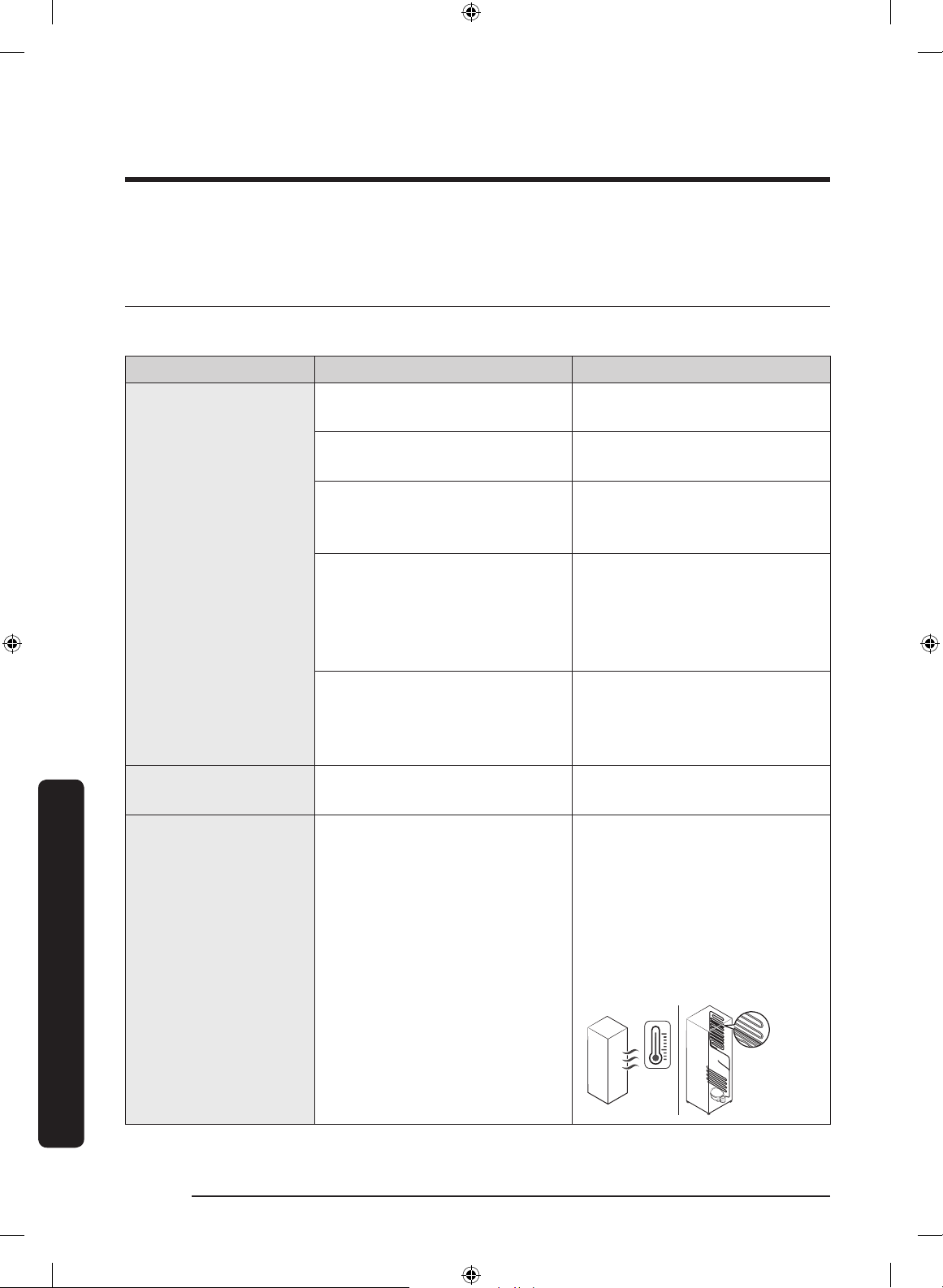
Troubleshooting
If you encounter an abnormal situation with the refrigerator, rst check the table below
and try the suggestions.
General
Temperature
Fridge/freezer does
not operate.
Fridge/freezer
temperature is warm.
Fridge/freezer is
over-cooling.
Troubleshooting
Interior wall is hot.
Symptom Possible causes Solution
• Power cord is not plugged
in properly.
• Temperature control is not
set correctly.
• Refrigerator is located near
a heat source or direct
sunlight.
• Not enough clearance
between refrigerator and
nearby walls or cabinets.
• The refrigerator is
overloaded. Food is
blocking the refrigerator
vents.
• Temperature control is not
set correctly.
• Refrigerator has heat-proof
piping in the interior wall.
• Properly plug in the power
cord.
• Set the temperature lower.
• Keep the refrigerator away
from direct sunlight or a
heat source.
• Make sure there is a gap of
at least 2.5 inches (5 cm)
between the refrigerator
back and sides and any
nearby walls or cabinets.
• Do not overload the
refrigerator. Do not allow
food to block ventilation.
• Set the temperature higher.
• To prevent condensation
from forming, the
refrigerator has heat-proof
piping in the front corners.
If the ambient temperature
rises, this equipment may
not work effectively. This is
not a system failure.
English68
Untitled-19 68 2017-06-28 2:52:55
Page 69
Odors
Symptom Possible causes Solution
Refrigerator has
odors.
Frost
Symptom Possible causes Solution
Frost around the
vents.
Frost on interior
walls.
Fruits or vegetables
are frozen.
• Spoiled food.
• Food with strong odors.
• Food is blocking the vents.
• Door is not closed properly.
• Fruits or vegetables are
stored in the Cool Select+
and the temperature was
set too low.
• Clean the refrigerator and
remove any spoiled food.
• Make sure strong smelling
food is wrapped airtight.
• Make sure no food blocks
the refrigerator vents.
• Make sure food does not
block the door. Clean the
door gasket.
• Set the temperature of
the Cool Select+ to a
temperature appropriate for
fruits or vegetables.
Condensation
Symptom Possible causes Solution
Condensation forms
on the interior walls.
• If door is left open, moisture
enters the refrigerator.
• Food with high moisture
content.
• Remove the moisture and
do not leave a door open
for extended periods of
time.
• Make sure food is wrapped
airtight.
Troubleshooting
English 69
Untitled-19 69 2017-06-28 2:52:55
Page 70
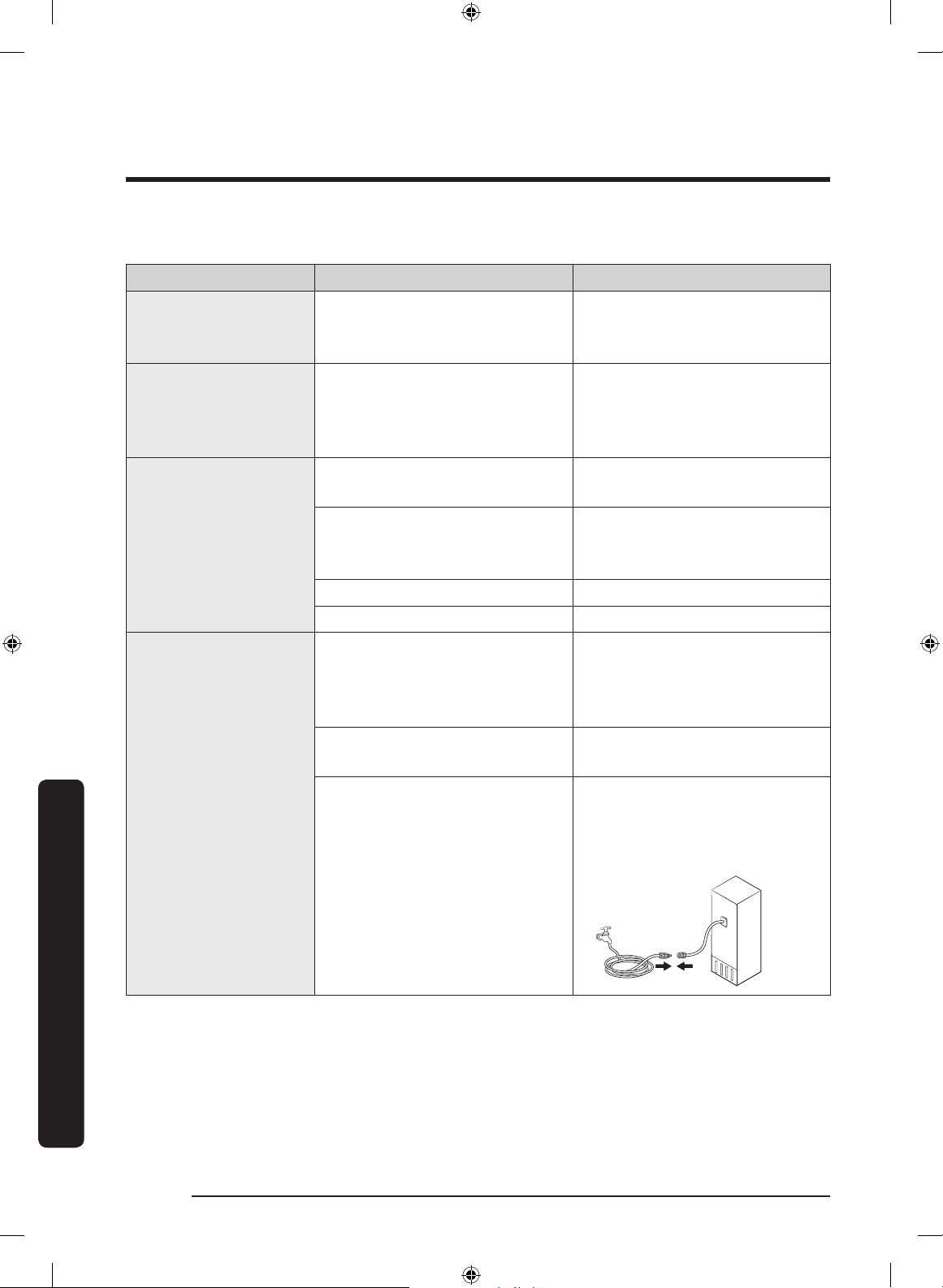
Troubleshooting
Water/ice (dispenser models only)
Water ow is weaker
than normal.
Ice maker makes a
buzzing sound.
Ice maker does not
make ice.
Ice does not dispense.
Troubleshooting
Symptom Possible causes Solution
• Make sure the water
• Water pressure is too low.
• The ice maker function is
activated, but the water
supply to the refrigerator
has not been connected.
• Ice maker has just been
installed.
• Freezer temperature is too
low.
• Dispenser Lock is activated. • Deactivate Dispenser Lock.
• Ice maker is off. • Turn on the ice maker.
• Ice may jam if the ice
dispenser is not used for a
long time (approx. 3 weeks).
• Ice bucket is not properly
inserted.
• Water line is not connected
properly or water supply is
not on.
pressure is between 20 to
120 psi.
• Turn off the ice maker.
• You must wait 12 hours for
the refrigerator to make ice.
• Set the freezer temperature
below -18 °C or -20 °C in
warm, ambient air.
• If you won't be using the
refrigerator for a long time,
empty the ice bucket and
turn off the ice maker.
• Make sure the ice bucket is
properly inserted.
• Check if the water line is
installed correctly. Check if
the water line stop cock is
closed.
English70
Untitled-19 70 2017-06-28 2:52:55
Page 71
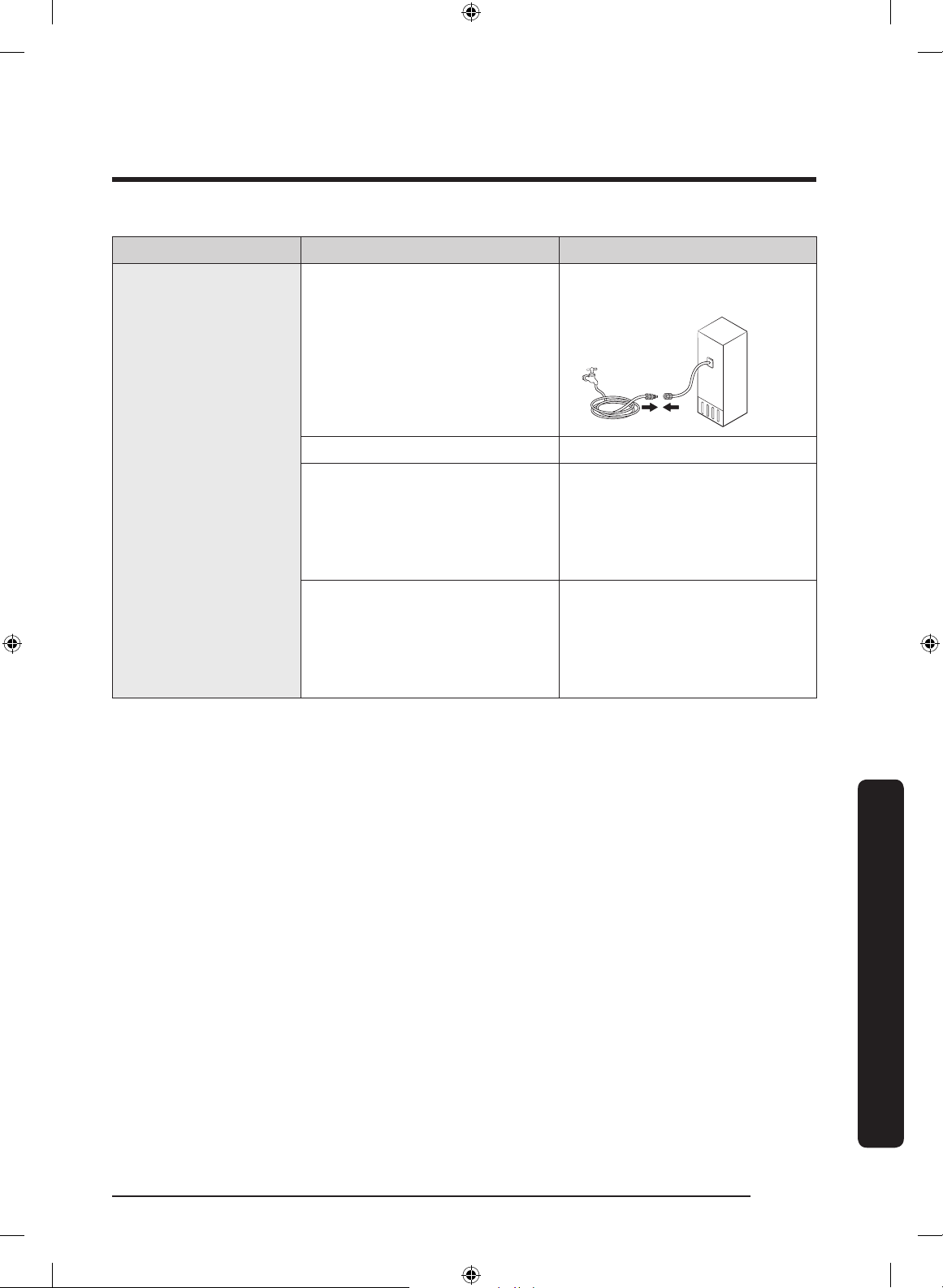
Symptom Possible causes Solution
Water does not
dispense.
• Check the water installation
conditions.
• Water line is not connected
properly or water supply is
not on.
• Dispenser Lock is activated. • Deactivate Dispenser Lock.
• Use only Samsung-provided
• A third-party water lter
was installed.
or approved lters.
• Unapproved lters may
leak and damage the
refrigerator.
• Replace the water lter.
• Water lter indicator turns
on or blinks.
After replacing, reset the
lter in Fridge Manager
> Fridge Settings > Water
Filter.
English 71
Untitled-19 71 2017-06-28 2:52:55
Troubleshooting
Page 72
Troubleshooting
Samsung Connect
Symptom Action
Could not nd
“Samsung Connect” in
the app market.
The Samsung Connect
app fails to operate.
The Samsung Connect
app is installed but is
not connected to my
refrigerator.
Could not log into the
app.
An error message
appears when I
try to register my
refrigerator.
The Samsung Connect
app is successfully
connected to my
refrigerator but does
not run.
• The Samsung Connect app is available for smartphones
that run Android 6.0 (Marshmallow) or higher, or iOS 9.0 or
higher.
• The Samsung Connect app is available for applicable models
only.
• The old Samsung Smart Refrigerator app cannot connect with
Samsung Smart Home models.
• You must log into your Samsung account to use the app.
• Make sure that your router is operating normally.
• If you have not connected your refrigerator to the Samsung
Connect App after the app was installed, you must make the
connection using the device registration function of the app.
• You must log into your Samsung account to use the app.
• If you don’t have a Samsung account, follow the app’s
onscreen instructions to create one.
• Easy Connection may fail due to the distance from your
access point (AP) or electrical interference from the
surrounding environment. Wait a moment and try again.
• Exit and restart the Samsung Connect app or disconnect and
reconnect the router.
• Unplug the power cord of the refrigerator, and then plug it in
again after 1 minute.
Troubleshooting
English72
Untitled-19 72 2017-06-28 2:52:56
Page 73
Samsung Family Hub
Symptom Action
Could not nd
“Samsung Family
Hub” in the app
market.
Could not log into the
app.
• The Samsung Family Hub app is available for smartphones
that run Android 4.4 (KitKat) or higher, or iOS 8.0 or higher.
• You must log into your Samsung account to use the app.
• If you don’t have a Samsung account, follow the app’s
onscreen instructions to create one.
English 73
Untitled-19 73 2017-06-28 2:52:56
Troubleshooting
Page 74
Troubleshooting
LCD
Symptom Action
• This refrigerator can connect only with Samsung Smart TV
Cannot connect to my
TV.
The inner view
picture looks bulged
out or incomplete.
The displayed
measurement on the
Fridge Manager is not
correct.
6400 series or higher models released since 2015. Please
check the model name of your TV rst.
• Network connections may suffer temporary interruptions.
Turn your TV off, and then try again.
• The edges of the inner view may look bulged out. The
bulging is caused by the convex lens of the camera.
• The inner view may be incomplete due to the blind spots
on the left and right corners or screened depending on the
layout of food items. Make sure to place food items in the
front center.
• The displayed conditions may differ from the actual
temperature and humidity.
Troubleshooting
English74
Untitled-19 74 2017-06-28 2:52:56
Page 75
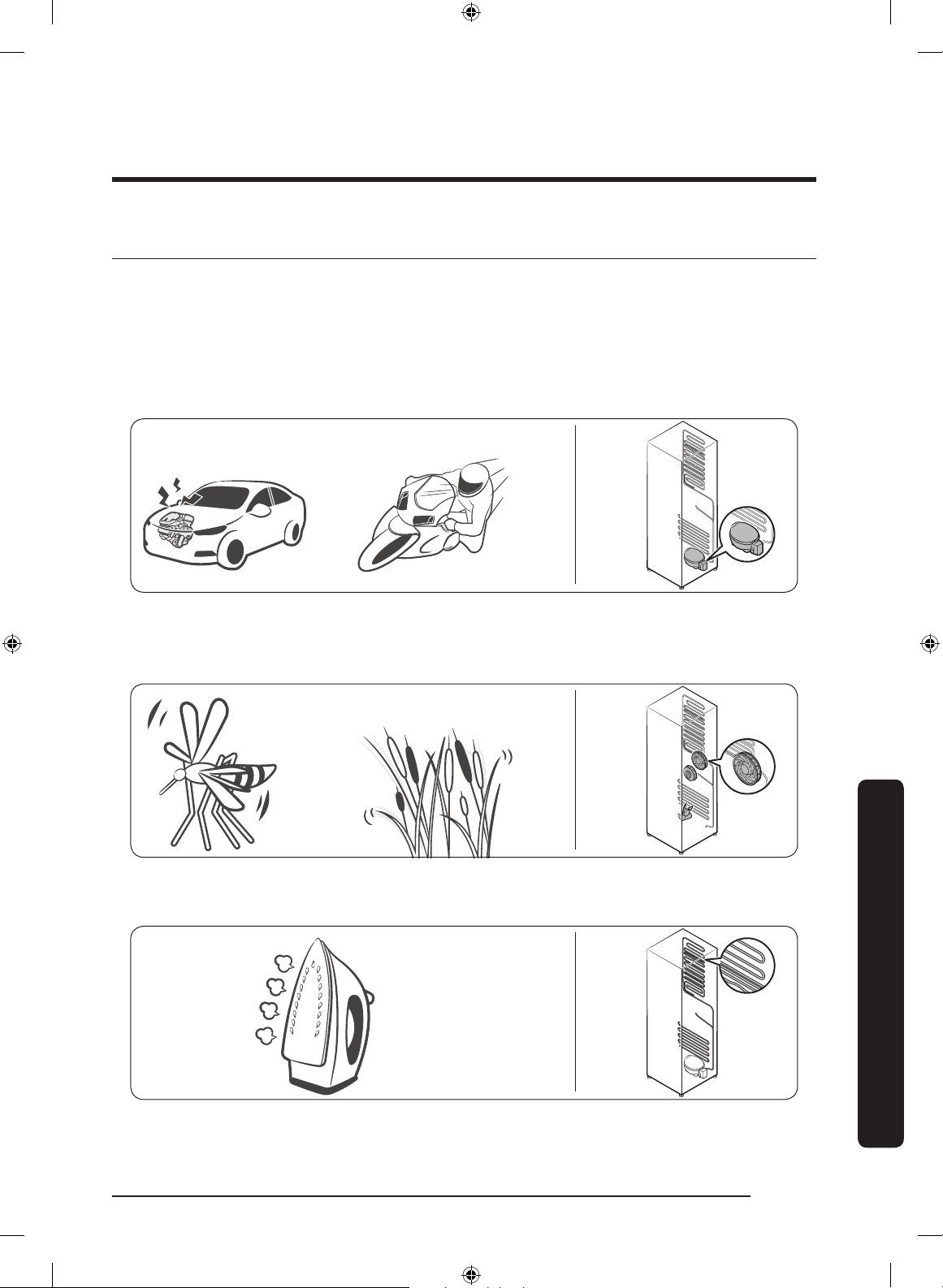
Do you hear abnormal sounds from the refrigerator?
Clicking!
or Chirping!
Buzzing!
SSSRRR!
Whir!
HiSS!
Before calling for service, review the checkpoints below. Any service calls related to
normal sounds will be charged to the user.
These sounds are normal.
• When starting or ending an operation, the refrigerator may make sounds similar to a
car engine igniting. As the operation stabilizes, the sounds will decrease.
• While the fan is operating, these sounds may occur. When the refrigerator reaches the
set temperature, no fan sound will occur.
• During a defrost cycle, water may drip on the defrost heater, causing sizzling sounds.
Untitled-19 75 2017-06-28 2:52:56
English 75
Troubleshooting
Page 76
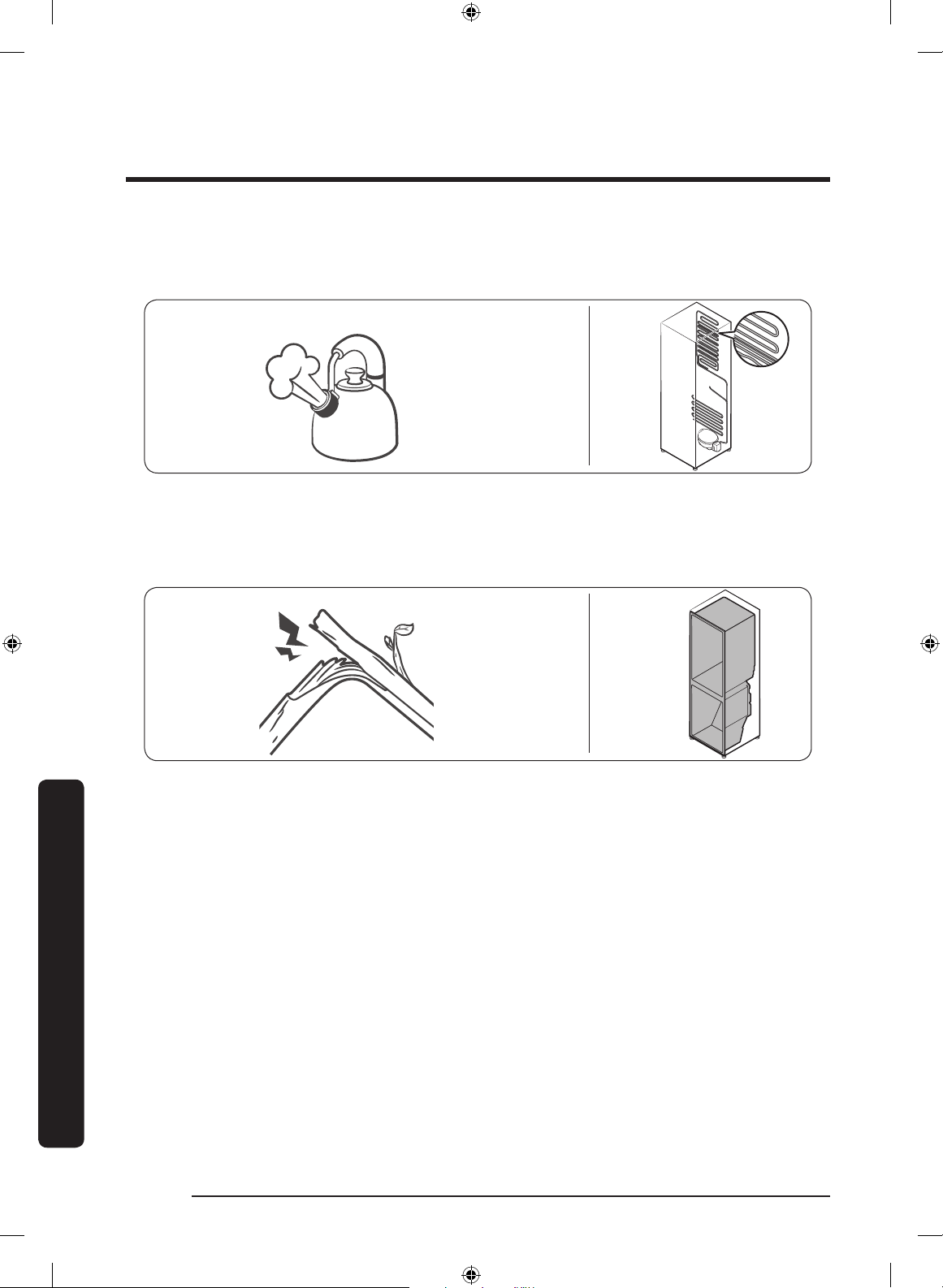
Troubleshooting
Bubbling!
Cracking!
• As the refrigerator cools or freezes, refrigerant gas moves through sealed pipes,
causing bubbling sounds.
• As the refrigerator temperature increases or decreases, plastic parts contract and
expand, creating knocking noises. These noises occur during the defrosting cycle or
when electronic parts are working.
• For ice maker models: When the water valve opens to ll the ice maker, buzzing
sounds may occur.
• Due to pressure equalizing when opening and closing the refrigerator door, whooshing
sounds may occur.
Troubleshooting
English76
Untitled-19 76 2017-06-28 2:52:56
Page 77
Memo
Untitled-19 77 2017-06-28 2:52:56
Page 78
Memo
Untitled-19 78 2017-06-28 2:52:56
Page 79
Memo
Untitled-19 79 2017-06-28 2:52:56
Page 80
NOTE
Hereby, Samsung Electronics, declares that the radio equipment type appliance is in
compliance with Directive 2014/53/EU.
The full text of the EU declaration of conformity is available at the following internet
address: The ofcial Declaration of conformity may be found at http://www.samsung.com,
go to Support > Search Product Support and enter the model name.
CAUTION
The 5 GHz WLAN function of this equipment may only be operated indoors. This
equipment may be operated in all EU countries.
Frequency range Transmitter power (Max)
2412 - 2472 MHz 20 dBm
5120 - 5250 MHz 23 dBm
Wi-Fi
5250 - 5350 MHz 20 dBm
5470 - 5725 MHz 27 dBm
5745 - 5825 MHz 14 dBm
Bluetooth 2402 - 2480 MHz 20 dBm
Contact SAMSUNG WORLD WIDE
If you have any questions or comments relating to Samsung products, please contact the
SAMSUNG customer care center.
Country Contact Center Web Site
UK 0330 SAMSUNG (7267864) www.samsung.com/uk/support
IRELAND (EIRE) 0818 717100 www.samsung.com/ie/support
GERMANY
FRANCE 01 48 63 00 00 www.samsung.com/fr/support
ITALIA 800-SAMSUNG (800.7267864) www.samsung.com/it/support
SWITZERLAND 0800 726 78 64 (0800-SAMSUNG)
NORWAY 815 56480 www.samsung.com/no/support
DENMARK 70 70 19 70 www.samsung.com/dk/support
FINLAND 030-6227 515 www.samsung.com//support
SWEDEN 0771 726 786 www.samsung.com/se/support
Untitled-19 80 2017-06-28 2:52:57
06196 9340275
[HHP] 06196 9340224
www.samsung.com/de/support
www.samsung.com/ch/support (German)
www.samsung.com/ch_fr/support (French)
DA68-03460J-04
Page 81
Kühl-/Gefrierkombination
Benutzerhandbuch
Standgerät
Untitled-18 1 2017-06-28 2:48:01
Page 82
Inhalt
Inhalt
Sicherheitsinformationen 4
Wichtige Symbole für Sicherheits- und Gefahrenhinweise: 6
Wichtige Warnhinweise für den Transport und zum Aufstellungsort 6
Kritische Warnhinweise für die Installation 7
Warnhinweise für die Installation 11
Kritische Warnhinweise für die Verwendung 11
Warnhinweise für die Verwendung 16
Warnhinweise für die Reinigung 20
Kritische Warnhinweise für die Entsorgung 21
Weitere Tipps zur ordnungsgemäßen Verwendung 22
Energiespartipps 24
Dieses Gerät ist zur Verwendung im Haushalt und ähnlichen Umgebungen bestimmt, wie z. B.: 25
Anweisungen zur WEEE-Richtlinie 26
Installation 27
Die Kühl-/Gefrierkombination auf einen Blick 27
Ausbauen der Tür beim Transport 29
Installation Schritt-für-Schritt 36
Bedienung 45
Benutzerschnittstelle 45
Samsung Connect 54
Empfehlungen für die Spracherkennung 57
Samsung Family Hub 57
Spezialfunktionen 59
Pege 64
Umbau und Pege 64
Reinigen 68
Ersetzen von Teilen 69
Deutsch2
Untitled-18 2 2017-06-28 2:48:01
Page 83
Fehlerbehebung 72
Allgemein 72
Samsung Connect 77
Samsung Family Hub 78
LCD 79
Hören Sie ungewöhnliche Geräusche aus dem Kühlschrank? 80
Inhalt
Deutsch 3
Untitled-18 3 2017-06-28 2:48:01
Page 84
Sicherheitsinformationen
• Lesen Sie dieses Handbuch sorgfältig durch, um sicherzustellen, dass Sie die
Merkmale und Funktionen dieser Kühl-/Gefrierkombination von Samsung
kennen und bedienen können und Ihr neues Gerät sicher und efzient arbeitet.
• Dieses Gerät ist nicht zum Gebrauch durch Personen (auch Kinder) mit
verminderten körperlichen, sensorischen oder geistigen Fähigkeiten oder
einem Mangel an Erfahrung und Wissen bestimmt. Von dieser Regel darf
Sicherheitsinformationen
nur abgewichen werden, wenn diese Personen unter Aufsicht stehen oder
durch eine für ihre Sicherheit verantwortliche Person eine Unterweisung zur
Bedienung des Geräts erhalten haben.
• Dieses Gerät darf von Kindern ab 8 Jahren und Personen mit verminderten
körperlichen, sensorischen oder geistigen Fähigkeiten oder einem Mangel an
Erfahrung und Wissen nur bedient werden, wenn sie unter Aufsicht stehen
oder eine Unterweisung zum sicheren Umgang mit dem Gerät erhalten haben
und die damit verbundenen Gefahren verstehen. Kinder dürfen nicht mit dem
Gerät spielen. Kinder dürfen bei Reinigung und Wartung nur dann helfen,
wenn sie dabei beaufsichtigt werden.
• Die Warnhinweise und wichtigen Sicherheitsinformationen in diesem
Benutzerhandbuch decken nicht alle denkbaren Umstände und Situationen
ab. Lassen Sie den gesunden Menschenverstand, Vorsicht und die notwendige
Sorgfalt nicht außer Acht, wenn Sie Ihr Gerät installieren, warten und
einsetzen.
• Da die folgenden Hinweise zum Betrieb für verschiedene Modelle gelten,
können sich die Eigenschaften Ihres Geräts leicht von den in diesem Handbuch
beschriebenen unterscheiden, und es kann sein, dass nicht alle Warnhinweise
zutreffen. Bei Fragen oder Problemen wenden Sie sich an Ihr nächstgelegenes
Kundendienstzentrum, oder holen Sie sich Hilfe und Informationen online
unter www.samsung.com.
Deutsch4
Untitled-18 4 2017-06-28 2:48:01
Page 85
• Als Kältemittel werden R-600a oder R-134a verwendet. Sie können dem
Kompressoraufkleber auf der Rückseite Ihres Geräts oder dem Typenschild
im Innern des Geräts entnehmen, welches Kältemittel für Ihre Kühl-/
Gefrierkombination verwendet wurde. Falls dieses Gerät entzündliche Gase
enthält (Kältemittel R-600a), wenden Sie sich an die örtlichen Behörden,
die Ihnen Informationen über die sichere Entsorgung zur Verfügung stellen
können.
• Um die Entwicklung eines entammbaren Gas-Luftgemisches bei einem Leck
des Kühlkreislaufs zu vermeiden, muss die Raumgröße entsprechend der
eingesetzten Menge an Kältemitteln im Gerät gewählt werden.
• Schalten Sie das Gerät niemals ein, wenn es Anzeichen von Beschädigungen
zeigt. Setzen Sie sich im Zweifelsfall mit Ihrem Händler in Verbindung. Der für
die Aufstellung des Geräts vorgesehene Raum muss für je 8 g des Kältemittels
R-600a im Gerät ein Raumvolumen von 1 m³ besitzen. Die Menge des in Ihrem
Gerät eingesetzten Kältemittels können Sie an dem Typenschild im Innern des
Geräts ablesen.
Sicherheitsinformationen
• Aus den Geräterohren austretendes Kältemittel kann sich entzünden oder zu
Verletzungen an den Augen führen. Wenn Kältemittel aus den Rohren austritt,
vermeiden Sie offene Flammen, und nehmen Sie entzündliche Gegenstände
aus der Reichweite des Geräts. Lüften Sie außerdem sofort den Raum.
- Andernfalls besteht Brand- oder Explosionsgefahr.
• Wartungs- oder Reparaturarbeiten dürfen nur von sachkundigem
Fachpersonal ausgeführt werden.
Deutsch 5
Untitled-18 5 2017-06-28 2:48:01
Page 86
Sicherheitsinformationen
Wichtige Symbole für Sicherheits- und Gefahrenhinweise:
Bitte beachten Sie alle Sicherheitshinweise in dieser Anleitung. In diesem
Handbuch werden die folgenden Sicherheitssymbole verwendet.
WARNUNG
Sicherheitsinformationen
Gefährliche bzw. unsichere Praktiken, die zu schweren Verletzungen,
Sachschäden und/oder zum Tod führen können.
VORSICHT
Gefährliche bzw. unsichere Praktiken, die zu schweren Verletzungen und/oder
Sachschäden führen können.
HINWEIS
Nützliche Informationen, die dem Benutzer helfen, das Gerät zu verstehen bzw.
nutzen.
Die folgenden Warnhinweise sollen Sie und andere vor Verletzungen schützen.
Befolgen Sie sie gewissenhaft.
Lesen Sie diesen Abschnitt aufmerksam durch, und bewahren Sie das Handbuch
zum späteren Nachschlagen an einem sicheren Ort auf.
Wichtige Warnhinweise für den Transport und zum Aufstellungsort
WARNUNG
• Achten Sie darauf, dass keine Teile des Kühlkreislaufs beschädigt werden,
wenn Sie das Gerät transportieren oder aufstellen.
- Aus den Geräterohren austretendes Kältemittel kann sich entzünden oder
zu Verletzungen der Augen führen. Wenn Kältemittel austritt, vermeiden
Sie offene Flammen oder potenzielle Zündquellen, und lüften Sie einige
Minuten lang den Raum, in dem sich das Gerät bendet.
Deutsch6
Untitled-18 6 2017-06-28 2:48:02
Page 87
- Bei diesem Gerät wird eine geringe Menge eines IsobutanKältemittels (R-600a) eingesetzt. Dies ist ein natürliches Gas mit hoher
Umweltverträglichkeit, das allerdings auch brennbar ist. Achten Sie darauf,
dass keine Teile des Kühlkreislaufs beschädigt werden, wenn Sie das Gerät
transportieren oder aufstellen.
• Berühren Sie beim Transport oder bei der Installation nicht den
Wasserschlauch an der Geräterückseite.
- Andernfalls kann es zu Schäden am Gerät kommen, sodass der
Wasserspender nicht mehr funktioniert.
Kritische Warnhinweise für die Installation
WARNUNG
• Stellen Sie das Gerät nicht in feuchten Räumen oder an einem Ort auf, wo es
mit Wasser in Kontakt kommen kann.
- Eine beschädigte oder veraltete Isolierung an elektrischen Teilen kann zu
Sicherheitsinformationen
einem Stromschlag oder Brand führen.
• Setzen Sie das Gerät keinem direkten Sonnenlicht aus, und stellen Sie es nicht
in der Nähe von Öfen, Heizkörpern oder anderen Wärmequellen auf.
• Stecken Sie den Netzstecker des Geräts nicht in eine Steckdosenleiste,
die auch für verschiedene andere Geräten verwendet wird. Die Kühl-/
Gefrierkombination darf immer nur an eine ausschließlich für dieses Gerät
bestimmte Steckdose angeschlossen werden, deren Spannung mit der auf dem
Typenschild am Gerät übereinstimmt.
- Dies gewährleistet eine optimale Leistung und verhindert eine Überlastung
der Stromkreise im Haus, die einen Brand aufgrund überhitzter Leitungen
auslösen könnte.
• Stecken Sie den Netzstecker nicht in eine lose Steckdose.
- Andernfalls besteht die Gefahr eines Stromschlags oder Brands.
• Verwenden Sie keine Kabel, die im Kabelverlauf oder an einem der Enden
Brüche oder Abnutzungsschäden aufweisen.
Deutsch 7
Untitled-18 7 2017-06-28 2:48:02
Page 88
Sicherheitsinformationen
• Knicken Sie das Netzkabel nicht übermäßig, und stellen Sie keine schweren
Gegenstände darauf ab.
• Ziehen Sie nicht am Netzkabel, und knicken Sie es nicht übermäßig.
• Verdrehen bzw. verknoten Sie das Netzkabel nicht.
• Verlegen Sie das Netzkabel nicht über scharfe Metallkanten, stellen Sie keine
Sicherheitsinformationen
schweren Gegenstände darauf, verlegen Sie das Netzkabel nicht zwischen
Objekten, und schieben Sie das Netzkabel nicht in den Raum hinter dem Gerät.
• Achten Sie darauf, das Gerät beim Verschieben nicht über das Netzkabel zu
fahren und dieses zu beschädigen.
- Andernfalls besteht die Gefahr eines Stromschlags oder Brands.
• Trennen Sie die Kühl-/Gefrierkombination niemals vom Netz, indem Sie am
Netzkabel ziehen. Fassen Sie stets den Stecker fest an und ziehen Sieihn
gerade aus der Steckdose heraus.
- Schäden am Kabel können Kurzschlüsse, Brände und/oder Stromschläge
verursachen.
• Bewahren Sie in diesem Gerät keine explosiven Stoffe wie zum Beispiel
Sprühdosen mit brennbarem Treibgas auf.
• Stellen Sie dieses Gerät nicht in der Nähe von Heizkörpern oder
entammbaren Materialien auf.
• Stellen Sie dieses Gerät nicht an Orten auf, an denen Gas austreten kann.
- Andernfalls besteht die Gefahr eines Stromschlags oder Brands.
• Dieses Gerät muss vor der Inbetriebnahme in Übereinstimmung mit den
Anweisungen in diesem Handbuch ordnungsgemäß aufgestellt und installiert
werden.
• Schließen Sie den Netzstecker ordnungsgemäß mit dem Kabel nach unten an
die Steckdose an.
- Wenn Sie den Netzstecker falsch herum (also mit dem Kabel nach oben)
in die Steckdose stecken, kann das Kabel durchtrennt werden und einen
Brand oder Stromschlag verursachen.
Deutsch8
Untitled-18 8 2017-06-28 2:48:02
Page 89
• Stellen Sie stets sicher, dass der Netzstecker nicht durch die Rückwand des
Geräts geknickt oder beschädigt wird.
• Bewahren Sie die Verpackungsmaterialien außerhalb der Reichweite von
Kindern auf.
- Es besteht Erstickungsgefahr, wenn Kinder sie über den Kopf ziehen.
• Das Gerät muss so aufgestellt werden, dass der Stecker nach der Installation
frei zugänglich ist.
- Andernfalls besteht die Gefahr von Stromschlägen oder eines Brands
aufgrund von Fehlströmen.
• Stellen Sie dieses Gerät weder an einem feuchten, öligen oder staubigen Ort
noch an einem Platz auf, der direktem Sonnenlicht oder Wassereinwirkungen
(z. B. Regen) ausgesetzt ist.
- Eine beschädigte oder veraltete Isolierung von elektrischen Teilen kann zu
einem Stromschlag oder Brand führen.
• Wenn sich Staub oder Wasser im Gerät angesammelt haben, trennen
Sie die Stromversorgung, und wenden Sie sich an das nächstgelegene
Sicherheitsinformationen
Kundendienstzentrum von Samsung Electronics.
- Andernfalls besteht Brandgefahr.
• Stellen Sie sich nicht auf das Gerät, und legen oder stellen Sie keine
Gegenstände (Wäsche, brennende Kerzen, brennende Zigaretten, Geschirr,
Chemikalien, Metallgegenstände usw.) auf das Gerät.
- Andernfalls besteht Verletzungs- oder Brandgefahr bzw. die Gefahr von
Stromschlägen oder Störungen des Geräts.
• Sie müssen die gesamte Schutzfolie entfernen, ehe Sie das Gerät mit der
Netzsteckdose verbinden.
Deutsch 9
Untitled-18 9 2017-06-28 2:48:02
Page 90
Sicherheitsinformationen
• Kinder müssen beaufsichtigt werden, damit sie nicht mit den Sprengringen für
die Türeinstellung oder mit den Klammern für die Wasserleitungen spielen.
- Es besteht die Gefahr von Tod durch Ersticken, wenn ein Kind einen
Sprengring oder eine Wasserrohrklammer verschluckt. Halten Sie die
Sprengringe und Wasserrohrklammern außerhalb der Reichweite von
Sicherheitsinformationen
• Die Kühl-/Gefrierkombination muss geerdet werden.
• Da Blitzableiter, Gasrohre und Telefonleitungen Blitze anziehen können,
Kindern.
- Achten Sie immer darauf, dass die Kühl-/Gefrierkombination geerdet ist,
ehe Sie ein Teil des Gerätes untersuchen oder zu reparieren versuchen.
Erdschlüsse können einen schweren elektrischen Schlag verursachen.
dürfen Sie das Gerät niemals daran erden.
- Das Gerät muss geerdet werden, um durch Leckströme verursachte
Stromverluste und Stromschläge zu verhindern.
- Andernfalls besteht die Gefahr von Stromschlägen, Brand, Explosion oder
Störungen des Geräts.
• Stecken Sie den Netzstecker fest in die Steckdose. Verwenden Sie keine
beschädigten Netzstecker bzw. Netzkabel und keine losen Steckdosen.
- Andernfalls besteht die Gefahr eines Stromschlags oder Brands.
• Wenn das Netzkabel beschädigt ist, lassen Sie es umgehend vom Hersteller
oder einem seiner Kundendienstvertreter austauschen.
• Die Sicherung des Geräts muss von einem qualizierten Techniker oder einem
dazu befugten Dienstleister durchgeführt werden.
- Andernfalls besteht die Gefahr von Stromschlägen oder Verletzungen.
Deutsch10
Untitled-18 10 2017-06-28 2:48:02
Page 91
Warnhinweise für die Installation
VORSICHT
• Lassen Sie genügend Raum um die Kühl-/Gefrierkombination frei und stellen
Sie ihn auf einer ebenen Fläche auf.
- Stellen Sie sicher, dass der Lüftungsraum des Gerätegehäuses oder der
Sicherheitsinformationen
Halterung nicht blockiert ist.
• Lassen Sie das Gerät nach dem Aufstellen und Einschalten 2 Stunden lang
ruhen, ehe Sie es mit Lebensmitteln befüllen.
• Wir empfehlen Ihnen dringend, die Kühl-/Gefrierkombination durch einen
qualizierten Techniker oder den Service installieren zu lassen.
- Andernfalls besteht Verletzungs- oder Brandgefahr bzw. die Gefahr von
Stromschlägen, Explosionen oder Störungen des Geräts.
• Wenn die Gerätetüren übermäßig beladen werden, kann das Gerät kippen und
Verletzungen verursachen.
Kritische Warnhinweise für die Verwendung
WARNUNG
• Verbinden Sie den Netzstecker nicht mit nassen Händen mit der Steckdose.
- Andernfalls besteht die Gefahr von Stromschlägen.
• Stellen Sie keine Gegenstände oben auf das Gerät.
- Die Gegenstände könnten beim Öffnen oder Schließen der Gerätetür
herunterfallen und zu Verletzungen und/oder Sachschäden führen.
• Führen Sie weder Ihre Hände und Füße noch Metallgegenstände (Essstäbchen
usw.) von unten oder von hinten in das Gerät ein.
- Andernfalls besteht die Gefahr von Stromschlägen oder Verletzungen.
- Scharfe Kanten können zu Verletzungen führen.
• Berühren Sie die Innenseiten des Geräts oder die darin aufbewahrten
Lebensmittel nicht mit nassen Händen.
- Dies kann zu Erfrierungen führen.
Deutsch 11
Untitled-18 11 2017-06-28 2:48:02
Page 92
Sicherheitsinformationen
• Stellen Sie keinen mit Wasser gefüllten Behälter auf das Gerät.
- Wenn das Wasser verschüttet wird, besteht die Gefahr eines Stromschlags
oder Brands.
• Bewahren Sie im Gerät keine üchtigen oder entammbaren Gegenstände
oder Stoffe (Reinigungsbenzin, Verdünner, Propangas, Alkohol, Äther, Erdgas
Sicherheitsinformationen
oder ähnliche Produkte) auf.
- Dieses Gerät ist ausschließlich zur Aufbewahrung von Lebensmitteln
bestimmt.
- Andernfalls besteht Brand- oder Explosionsgefahr.
• Kinder müssen beaufsichtigt werden, um zu verhindern, dass sie mit dem
Gerät spielen.
- Halten Sie Ihre Finger von „Quetschstellen“ fern: Die Abstände zwischen
den Türen und dem Schrank sind notwendigerweise klein. Öffnen Sie die
Gerätetür mit großer Vorsicht, wenn sich Kinder in der Nähe benden.
• Lassen Sie nicht zu, dass Kinder sich an die Gerätetür oder die daran
angebrachten Fächer hängen. Andernfalls kann es zu ernsthaften Verletzungen
kommen.
• Lassen Sie Kinder nicht in das Gerät hineinklettern. Sie könnten eingesperrt
werden.
• Führen Sie Ihre Hände nicht in den Bodenbereich unterhalb des Geräts ein.
- Dort benden sich scharfe Kanten, die Verletzungen verursachen können.
• Bewahren Sie keine Pharmazeutika, lebensmittelfremden Materialien oder
temperaturempndliche Produkte im Gerät auf.
- Lebensmittel, die unter streng kontrollierten Temperaturbedingungen
gelagert werden müssen, dürfen nicht in diesem Gerät aufbewahrt werden.
• Lagern bzw. verwenden Sie keine elektrischen Apparate oder Maschinen im
Gerät, sofern diese nicht vom Hersteller zugelassen sind.
• Wenn das Gerät nach Arzneimitteln oder Rauch riecht, trennen Sie
sofort die Stromversorgung und wenden Sie sich an Ihr nächstgelegenes
Kundendienstzentrum von Samsung Electronics.
Deutsch12
Untitled-18 12 2017-06-28 2:48:02
Page 93
• Wenn sich Staub oder Wasser im Gerät angesammelt haben, trennen
Sie die Stromversorgung und wenden Sie sich an das nächstgelegene
Kundendienstzentrum von Samsung Electronics.
- Andernfalls besteht Brandgefahr.
• Lassen Sie nicht zu, dass Kinder auf eine der Schubladen klettern.
- Die Schublade kann zerbrechen, sodass die Kinder stürzen.
• Lassen Sie die Türen des Geräts nicht offen stehen, wenn dieses
unbeaufsichtigt ist, und lassen Sie Kinder nicht in das Gerät hineinklettern.
• Lassen Sie Kinder oder Kleinkinder nicht in die Schubfächer klettern.
- Dies kann zum Tod durch Ersticken oder zu Verletzungen führen, wenn die
Kinder darin gefangen sind.
• Überfüllen Sie die Kühl-/Gefrierkombination nicht mit Lebensmitteln.
- Beim Öffnen der Gerätetür könnten Produkte herunterfallen und
Verletzungen und/oder Sachschäden verursachen.
• Sprühen Sie kein üchtiges Material wie z. B. Insektizide auf die Oberäche
des Geräts.
Sicherheitsinformationen
- Sie sind nicht nur gefährlich für Ihre Gesundheit, sondern es besteht
außerdem die Gefahr eines Brands, eines Stromschlags oder einer Störung
des Geräts.
• Führen Sie niemals Ihre Finger oder Gegenstände in die Öffnung des
Wasserspenders, die Eisrutsche und den Eiswürfelbehälter ein.
- Dies kann zu Verletzungen oder Sachschäden führen.
• Verwenden Sie keine temperaturempndlichen Materialien, wie z. B.
entammbare Sprays und Gegenstände, Trockeneis, Medikamente oder
Chemikalien, in der Nähe des Geräts, und bewahren Sie sie nicht in der Kühl-/
Gefrierkombination auf.
• Verwenden Sie keine Haartrockner, um das Innere des Geräts zu trocknen.
Stellen Sie keine brennende Duftkerze in das Gerät, um unangenehme Gerüche
zu beseitigen.
- Andernfalls besteht die Gefahr eines Stromschlags oder Brands.
Deutsch 13
Untitled-18 13 2017-06-28 2:48:02
Page 94
Sicherheitsinformationen
• Füllen Sie den Wassertank, das Eiswürfelfach und die Eiswürfelform nur mit
Trinkwasser (Mineralwasser oder gereinigtes Wasser).
- Füllen Sie den Wassertank nicht mit Tee, Säften oder Sportgetränken. Dies
kann zu Schäden am Gerät führen.
• Stellen Sie sich nicht auf das Gerät, und legen oder stellen Sie keine
Sicherheitsinformationen
Gegenstände (Wäsche, brennende Kerzen, brennende Zigaretten, Geschirr,
Chemikalien, Metallgegenstände usw.) auf das Gerät. Andernfalls besteht
Verletzungs- oder Brandgefahr bzw. die Gefahr von Stromschlägen oder
Störungen des Geräts. Stellen Sie keine mit Wasser gefüllten Behälter auf das
Gerät.
- Wenn das Wasser verschüttet wird, besteht die Gefahr eines Stromschlags
oder Brands.
• Verwenden Sie keine anderen als die vom Hersteller empfohlenen
mechanischen Vorrichtungen oder Hilfsmittel, um den Abtauvorgang zu
beschleunigen.
• Beschädigen Sie niemals das Kältemittelsystem.
• Schauen Sie niemals direkt für eine längere Zeit auf die LED-UV-Lampe.
- Andernfalls können Verletzungen der Augen aufgrund der UV-Strahlung
die Folge sein.
• Legen Sie die Fachböden nicht mit der Oberseite nach unten ein. Dies könnte
die Funktionsweise der Fachböden beeinträchtigen.
- Dies kann zu Verletzungen oder Sachschäden durch herunterfallende
Glasfachböden führen.
• Halten Sie Ihre Finger von „Quetschstellen“ fern: Die Abstände zwischen den
Türen und dem Schrank sind notwendigerweise klein. Öffnen Sie die Gerätetür
mit großer Vorsicht, wenn sich Kinder in der Nähe benden.
• Wenn Gas austritt, vermeiden Sie offene Flammen oder potenzielle
Zündquellen, und lüften Sie einige Minuten lang den Raum, in dem sich das
Gerät bendet.
- Berühren Sie weder das Gerät noch das Netzkabel.
Deutsch14
Untitled-18 14 2017-06-28 2:48:02
Page 95
- Verwenden Sie keinen Lüfter.
- Jeder Funke kann zu einer Explosion oder einem Brand führen.
• Verwenden Sie nur die vom Hersteller oder seinen Kundendienstvertretern
empfohlenen LED-Lampen.
• Flaschen sollten dicht nebeneinander verstaut werden, damit sie nicht aus
dem Gerät fallen.
• Dieses Gerät ist ausschließlich für die Aufbewahrung von Lebensmitteln in
Privathaushalten bestimmt.
• Führen Sie niemals Ihre Finger oder Gegenstände in die Öffnung des
Wasserspenders, die Eisrutsche und den Eiswürfelbehälter ein.
- Dies kann zu Verletzungen oder Sachschäden führen.
• Versuchen Sie nicht selbst, die Kühl-/Gefrierkombination zu reparieren,
auseinander zu nehmen oder zu verändern.
• Nicht autorisierte Änderungen können Sicherheitsprobleme verursachen.
Wenn wir eine nicht autorisierte Änderung rückgängig machen sollen,
berechnen wir die vollen Kosten für Ersatzteile und Arbeitszeit.
Sicherheitsinformationen
• Verwenden Sie ausschließlich Normsicherungen (KEINESFALLS
Überbrückungen aus Kupfer, Stahldraht usw.).
• Wenden Sie sich an Ihr nächstgelegenes Kundendienstcenter, wenn Ihre Kühl-/
Gefrierkombination repariert oder neu installiert werden muss.
- Andernfalls besteht Verletzungs- oder Brandgefahr bzw. die Gefahr von
Stromschlägen oder Störungen des Geräts.
• Wenden Sie sich an Ihr nächstgelegenes Kundendienstcenter, wenn einer der
inneren oder äußeren LED-Leuchten nicht mehr funktioniert.
• Wenn von der Kühl-/Gefrierkombination Brandgeruch oder Rauch ausgeht,
ziehen Sie sofort den Netzstecker und wenden Sie sich an das nächstgelegene
Kundendienstcenter von Samsung Electronics.
- Andernfalls besteht die Gefahr eines Stromschlags oder Brands.
Deutsch 15
Untitled-18 15 2017-06-28 2:48:02
Page 96
Sicherheitsinformationen
• Ziehen Sie den Netzstecker aus der Steckdose, bevor Sie die Beleuchtung im
Innern des Geräts austauschen.
- Andernfalls besteht die Gefahr eines Stromschlags.
• Wenden Sie sich an Ihr nächstgelegenes Kundendienstcenter, wenn Sie
Probleme mit dem Austausch einer Leuchte (keine LED) haben.
Sicherheitsinformationen
• Wenn das Gerät mit einer LED-Leuchte ausgestattet ist, entfernen Sie die
Lampenabdeckung und die Lampe an sich nicht selbst.
- Wenden Sie sich an das nächstgelegene Kundendienstcenter.
• Stecken Sie den Netzstecker fest in die Steckdose.
• Verwenden Sie keine beschädigten Netzstecker bzw. Netzkabel und keine
losen Steckdosen.
- Andernfalls besteht die Gefahr eines Stromschlags oder Brands.
Warnhinweise für die Verwendung
VORSICHT
• Frieren Sie bereits vollständig aufgetaute Lebensmittel nicht wieder ein. Legen
Sie keine kohlensäurehaltigen Getränke oder Sprudel in das Gerät. Legen Sie
keine Flaschen oder Glasbehälter in das Gerät.
- Wenn der Inhalt gefriert, kann das Glas platzen und zu Verletzungen
führen.
• Verwenden Sie nur die mit dem Gerät mitgelieferte Eismaschine.
• Lassen Sie die Wasserversorgung der Kühl-/Gefrierkombination nur an eine
Trinkwasserversorgung anschließen. Damit die Eismaschine ordnungsgemäß
arbeitet, ist ein Wasserdruck von 138 - 862 kPa erforderlich. Schließen Sie den
Wasserhahn, wenn Sie längere Zeit von zu Hause abwesend sein werden (im
Urlaub zum Beispiel) und kein Wasser oder Eis verwenden werden.
- Andernfalls kann Wasser austreten.
Deutsch16
Untitled-18 16 2017-06-28 2:48:02
Page 97
• Wenn Sie die Kühl-/Gefrierkombination längere Zeit nicht verwenden wollen
(3 Wochen oder mehr), leeren Sie das Gerät (einschließlich Eiswürfelbehälter),
ziehen Sie den Netzstecker, schließen Sie den Wasserhahn, wischen Sie
überschüssige Feuchtigkeit von den Innenwänden und lassen Sie die Türen
offen, damit sich keine Gerüche und kein Schimmel bilden.
• Um optimale Leistung des Geräts zu gewährleisten:
- Stellen Sie Lebensmittel nicht zu nah an die Belüftungsschlitze auf der
Rückseite des Geräts. Andernfalls kann die Luftzirkulation im Kühlabteil
behindert werden;
- Geben Sie die gelagerten Lebensmittel in geeignete Kunststoffbeutel oder
in luftdichte Behälter, bevor Sie sie in das Gerät legen;
- Bewahren Sie keine Glasbehälter, Flaschen oder kohlensäurehaltigen
Getränke im Gefrierabteil auf. Sie können einfrieren und platzen. Geplatzte
Getränkebehälter können Verletzungen verursachen.
- Beachten Sie die maximale Aufbewahrungsdauer und das Verfallsdatum
von tiefgefrorenen Lebensmitteln.
Sicherheitsinformationen
- Das Gerät muss nicht vom Stromnetz getrennt werden, wenn Sie weniger
als drei Wochen außer Haus sind. Wenn Sie jedoch länger als drei Wochen
abwesend sein werden, entfernen Sie sämtliche Lebensmittel und das Eis
im Eiswürfelbehälter, trennen Sie die Kühl-/Gefrierkombination vom Netz,
schließen Sie den Wasserhahn, wischen Sie überschüssige Feuchtigkeit
von den Innenwänden ab und lassen Sie die Türen offen, damit sich keine
Gerüche und kein Schimmel bilden.
• Bewahren Sie keine Glasbehälter, Flaschen oder kohlesäurehaltigen Getränke
im Gefrierabteil auf.
- Die Behälter könnten beim Einfrieren platzen und zu Verletzungen führen.
• Legen Sie keine kohlensäurehaltigen Getränke oder Sprudel in das Gerät.
Legen Sie keine Flaschen oder Glasbehälter in das Gerät.
- Wenn der Inhalt gefriert, kann das Glas platzen und Verletzungen oder
Sachschäden verursachen.
Deutsch 17
Untitled-18 17 2017-06-28 2:48:02
Page 98
Sicherheitsinformationen
• Service-Garantie und Modikationen.
- Veränderungen und Modikationen, die von einer Fremdpartei an diesem
funktionstüchtigen Gerät durchgeführt werden, sind durch die Garantie von
Samsung nicht gedeckt und Samsung haftet nicht für Sicherheitsprobleme,
die durch solche von Fremdparteien vorgenommenen Modikationen
Sicherheitsinformationen
• Verpserren Sie nicht die Lüftungsöffnungen im Innern der Kühl-/
• Verwenden Sie nur die mit dem Gerät mitgelieferte Eismaschine.
verursacht werden.
Gefrierkombination.
- Wenn die Lüftungsöffnungen, insbesondere z. B. mit einer Kunststofftüte,
versperrt werden, wird das Gerät möglicherweise zu stark gekühlt. Wenn
diese Abkühlung zu lange andauert, wird möglicherweise der Wasserlter
beschädigt und Wasser kann austreten.
• Wischen Sie überschüssige Feuchtigkeit im Innern des Geräts ab, und lassen
Sie die Gerätetür geöffnet.
- Andernfalls können sich schlechte Gerüche und Ablagerungen bilden.
• Wenn die Kühl-/Gefrierkombination von der Stromversorgung getrennt wird,
müssen Sie mindestens fünf Minuten warten, ehe sie sie wieder anschließen.
• Wenn Sie einen langen Urlaub planen und die Kühl-/Gefrierkombination
längere Zeit nicht verwenden wollen (3 Wochen oder mehr) leeren Sie das
Gerät (einschließlich Eiswürfelbehälter), ziehen Sie den Netzstecker, schließen
Sie den Wasserhahn, wischen Sie überschüssige Feuchtigkeit von den
Innenwänden und lassen Sie die Türen offen, damit sich keine Gerüche und
kein Schimmel bilden.
• Wenn das Gerät durch den Kontakt mit Wasser nass geworden ist, ziehen
Sie den Netzstecker und wenden Sie sich an den Kundendienst von Samsung
Electronics.
Deutsch18
Untitled-18 18 2017-06-28 2:48:03
Page 99
• Sie dürfen nicht auf Glasoberächen schlagen oder sie übermäßiger
Krafteinwirkung aussetzen.
- Das Glas könnte brechen und zu Verletzungen und/oder Sachschäden
führen.
• Füllen Sie den Wasserbehälter und den Eiswürfelbehälter nur mit Trinkwasser
(Leitungswasser, Mineralwasser oder geltertes Wasser).
Sicherheitsinformationen
- Füllen Sie den Tank nicht mit Tee oder Sportgetränken. Andernfalls könnten
Sie das Gerät beschädigen.
• Wenden Sie sich an Ihr nächstgelegenes Kundendienstcenter, wenn Ihre Kühl-/
Gefrierkombination überschwemmt wird.
- Andernfalls besteht die Gefahr eines Stromschlags oder Brands.
• Bewahren Sie kein Panzenöl in den Behältern der Kühlschranktür auf. Das Öl
kann zähüssig werden, sodass ungenießbar wird und schwer zu gebrauchen
ist. Darüber hinaus kann der offene Behälter auslaufen und das ausgetretene
Öl kann dazu führen, dass Türfach Risse bekommt. Nach dem Öffnen eines
Ölbehälters ist es am besten, den Behälter an einem kühlen und schattigen Ort
wie einem Schrank oder einer Speisekammer aufzubewahren.
- Beispiele für Panzenöl: Olivenöl, Maisöl, Traubenkernöl usw.
Deutsch 19
Untitled-18 19 2017-06-28 2:48:03
Page 100
Sicherheitsinformationen
Warnhinweise für die Reinigung
VORSICHT
• Sprühen Sie keinesfalls Wasser direkt auf die Kühl-/Gefrierkombination.
- Es besteht die Gefahr von Stromschlägen oder Bränden.
Sicherheitsinformationen
• Verwenden Sie keine Haartrockner, um das Innere des Geräts zu trocknen.
• Stellen Sie, um unangenehme Gerüche zu beseitigen, keinesfalls eine
brennende Duftkerze in das Gerät.
- Andernfalls besteht die Gefahr eines Stromschlags oder Brands.
• Sprühen Sie keine Reinigungsmittel direkt auf das Display.
- Andernfalls können sich die Aufdrucke auf dem Display lösen.
• Wenn ein Fremdstoff, wie z. B. Wasser, in das Gerät eingedrungen ist,
ziehen Sie den Netzstecker und wenden Sie sich an Ihr nächstgelegenes
Kundendienstzentrum.
- Andernfalls besteht die Gefahr eines Stromschlags oder Brands.
• Verwenden Sie ein sauberes, trockenes Tuch, um Fremdkörper oder Staub von
den Stiften des Netzsteckers zu entfernen. Verwenden Sie kein nasses oder
feuchtes Tuch, wenn Sie den Stecker reinigen.
- Andernfalls besteht die Gefahr von Stromschlägen oder Bränden.
• Sprühen Sie zum Reinigen kein Wasser direkt auf das Gerät.
• Reinigen Sie das Gerät niemals mit Waschbenzin, Verdünner, Bleichmittel oder
Chlor.
- Andernfalls können Schäden an der Oberäche des Geräts oder ein Brand
die Folge sein.
• Ziehen Sie den Netzstecker aus der Steckdose, bevor Sie das Gerät reinigen
oder Wartungsarbeiten durchführen.
- Andernfalls besteht die Gefahr eines Stromschlags oder Brands.
• Verwenden Sie einen sauberen Schwamm oder ein weiches Tuch, jeweils in
warmes Wasser und mildes Reinigungsmittel getränkt, um den Kühlschrank zu
reinigen.
Deutsch20
Untitled-18 20 2017-06-28 2:48:03
 Loading...