

Page 1
Refrigerator
User manual
Free Standing Appliance
Untitled-8 1 2020-12-17 1:52:49
Page 2
Contents
Safety information 3
What you need to know about the safety instructions 3
Important safety symbols and precautions: 6
Important safety precautions 7
Severe warning signs for transportation and site 10
Contents
Critical installation warnings 11
Installation cautions 15
Critical usage warnings 15
Usage cautions 20
Cleaning cautions 23
Critical disposal warnings 25
Additional tips for proper usage 26
Instructions about the WEEE 28
Installation 29
Refrigerator at a glance 29
Step-by-step installation 32
Operations 48
Main panel 48
Setting the desired temperature or function 50
Changing the temperature scale 51
Turning on or off the ice maker 51
Activating or deactivating the Sabbath mode 51
Special features 52
Maintenance 55
Handling and care 55
Cleaning 59
Replacement 60
Troubleshooting 61
General 61
Do you hear abnormal sounds from the refrigerator? 65
Appendix 67
Safety Instruction 67
Install Instruction 67
Temperature Instruction 68
Information for model and ordering spare parts 71
English2
Untitled-8 2 2020-12-17 1:52:49
Page 3
Safety information
Before using your new Samsung Refrigerator, please read this manual thoroughly to ensure
that you know how to operate the features and functions that your new appliance offers
safely and efciently.
What you need to know about the safety instructions
• Warnings and Important Safety Instructions in this manual
do not cover all possible conditions and situations that
may occur.
It is your responsibility to use common sense, caution,
and care when installing, maintaining, and operating your
appliance.
• Because these following operating instructions cover
various models, the characteristics of your refrigerator
may differ slightly from those described in this manual and
not all warning signs may be applicable. If you have any
questions or concerns, contact your nearest service center
or nd help and information online at www.samsung.com.
• R-600a or R-134a is used as a refrigerant. Check the
compressor label on the rear of the appliance or the rating
label inside the fridge to see which refrigerant is used for
your appliance. When this product contains ammable gas
(Refrigerant R-600a), contact your local authority in regard
to safe disposal of this product.
• In order to avoid the creation of a ammable gas-air
mixture if a leak in the refrigerating circuit occurs, the size
of the room in which the appliance may be sited depends
on the amount of refrigerant used.
Safety information
English 3
Untitled-8 3 2020-12-17 1:52:49
Page 4
Safety information
Safety information
• Never start up an appliance showing any signs of damage.
If in doubt, consult your dealer. The room must be 1 m3
in size for every 8 g of R-600a refrigerant inside the
appliance.
The amount of refrigerant in your particular appliance is
shown on the identication plate inside the appliance.
• Refrigerant squirting out of the pipes could ignite or cause
an eye injury. When refrigerant leaks from the pipe, avoid
any naked ames and move anything ammable away
from the product and ventilate the room immediately.
- Failing to do so may result in re or explosion.
• To avoid contamination of food, please respect the
following instructions:
- Opening the door for long periods can cause a
signicant increase of the temperature in the
compartments of the appliance.
- Clean regularly surfaces that can come in contact with
food and accessible drainage systems.
- Clean water tanks if they have not been used for 48 h;
ush the water system connected to a water supply if
water has not been drawn for 5 days.
- Store raw meat and sh in suitable containers in the
refrigerator, so that it is not in contact with or drip onto
other food.
- Two-star frozen-food compartments are suitable for
storing pre-frozen food, storing or making icecream and
making ice cubes.
- One-, two- and three-star compartments are not suitable
for the freezing of fresh food.
English4
Untitled-8 4 2020-12-17 1:52:50
Page 5

- If the refrigerating appliance is left empty for long
periods, switch off, defrost, clean, dry, and leave the
door open to prevent mould developing within the
appliance.
Safety information
English 5
Untitled-8 5 2020-12-17 1:52:50
Page 6
Safety information
Important safety symbols and precautions:
Please follow all safety instructions in this manual. This
manual uses the following safety symbols.
WARNING
Safety information
Hazards or unsafe practices that may result in severe personal
injury, property damage, and/or death.
CAUTION
Hazards or unsafe practices that may result in severe personal
injury and/or property damage.
NOTE
Useful information that helps users understand or benet
from the refrigerator.
These warning signs are here to prevent injury to you and
others.
Please follow them carefully.
After reading this section, keep it in a safe place for future
reference.
English6
Untitled-8 6 2020-12-17 1:52:50
Page 7
Important safety precautions
Warning; Risk of re / ammable materials
WARNING
• When positioning the appliance, ensure the supply cord is
not trapped or damaged.
• Do not locate multiple portable socket-outlets or portable
power supplies at the rear of the appliance.
• Fill with potable water only.
• Connect to potable water supply only.
• Keep ventilation openings, in the appliance enclosure or in
the built-in structure, clear of obstruction.
• Do not use mechanical devices or any other means
to accelerate the defrosting process, other than those
recommended by the manufacturer.
• Do not damage the refrigerant circuit.
• Do not use electrical appliances inside the food storage
compartments of the appliance, unless they are of the type
recommended by the manufacturer.
• This appliance is not intended for use by persons
(including children) with reduced physical, sensory, or
mental capabilities, or those who lack experience and
knowledge, unless they have been given supervision or
instruction concerning the use of the appliance by a person
responsible for their safety.
Safety information
English 7
Untitled-8 7 2020-12-17 1:52:50
Page 8

Safety information
Safety information
• This appliance can be used by children aged from 8 years
and above and persons with reduced physical, sensory or
mental capabilities or lack of experience and knowledge
if they have been given supervision or instruction
concerning use of the appliance in a safe way and
understand the hazards involved. Children shall not play
with the appliance. Cleaning and user maintenance shall
not be made by children without supervision. Children
aged from 3 to 8 years are allowed to load and unload
refrigerating appliances.
• If the supply cord is damaged, it must be replaced by
the manufacturer, its service agent or similarly qualied
persons in order to avoid a hazard.
• The socket must be easily accessible so that the appliance
can be quickly disconnected from the supply in an
emergency.
- It must be outside the area of the rear of the appliance.
• Do not store explosive substances such as aerosol cans
with a ammable propellant in this appliance.
• If the product is equipped with LED lamps, do not
disassemble the Lamp Covers and LED lamps yourself.
- Contact a Samsung service center.
- Use only the LED Lamps provided by the manufacturer
or its service agents.
• New hose-sets supplied with the appliance are to be used
and old hose-sets should not be reused.
• Have the refrigerator’s water supply connected only to a
potable water supply. To operate the ice maker properly,
water pressure of 206-861 kPa (30-125 psi) is required.
English8
Untitled-8 8 2020-12-17 1:52:50
Page 9
• For the most efcient use of energy, please keep the all
inner ttings such as baskets, drawers, shelves on the
position supplied by manufacturer.
• To get the best energy efciency of this product, please
leave all shelves, drawers and baskets on their original
position.
How to minimize the energy consumption
• Install the appliance in a cool, dry room with adequate
ventilation.
• Ensure that it is not exposed to direct sunlight and never
put it near a direct source of heat (radiator, for example).
- Not to block any vents or grilles is recommended for
energy efciency.
- Allow warm food to cool down before placing it in the
appliance.
- Put frozen food in the refrigerator to thaw. You can
then use the low temperatures of the frozen products to
cool food in the refrigerator.
- Do not keep the door of the appliance open for too long
when putting food in or taking food out.
- The shorter time for which the door is open, the less ice
will form in the freezer.
- Clean the rear of the refrigerator regularly. Dust
increases energy consumption.
- Do not set temperature colder than necessary.
- Ensure sufcient air exhaust at the refrigerator base
and at the back wall of the refrigerator. Do not cover air
vent openings.
Safety information
English 9
Untitled-8 9 2020-12-17 1:52:50
Page 10
Safety information
Safety information
- Allow clearance to the right, left, back and top when
installing. This will help reduce power consumption and
keep your energy bills lower.
This appliance is intended to be used in household and similar
applications such as
- staff kitchen areas in shops, ofces and other working
environments;
- farm houses and by clients in hotels, motels and other
residential type environments;
- bed and breakfast type environments;
- catering and similar non-retail applications.
Severe warning signs for transportation and site
WARNING
• When transporting and installing the appliance, care should
be taken to ensure that no parts of the refrigerating circuit
are damaged.
- Refrigerant leaking from the pipe work could ignite
or cause an eye injury. If a leak is detected, avoid any
naked ames or potential sources of ignition and air
the room in which the appliance is standing for several
minutes.
English10
Untitled-8 10 2020-12-17 1:52:50
Page 11
- This appliance contains a small amount of isobutane
refrigerant (R-600a), a natural gas with high
environmental compatibility that is, however, also
combustible. When transporting and installing the
appliance, care should be taken to ensure that no parts
of the refrigerating circuit are damaged.
• When transporting and installing the refrigerator, do not
touch the water hose on the back side of the refrigerator.
- This may damage the refrigerator and as a result the
water dispenser can not be used.
Critical installation warnings
WARNING
• Do not install the refrigerator in a damp location or place
where it may come in contact with water.
- Deteriorated insulation on electrical parts may cause an
electric shock or re.
• Do not place this refrigerator in direct sunlight or expose it
to the heat from stoves, room heaters, or other appliances.
• Do not plug several appliances into the same multiple
power strip. The refrigerator should always be plugged
into its own individual electrical outlet which has a voltage
rating that matches the voltage listed on the refrigerator’s
rating plate.
- This provides the best performance and also prevents
overloading of house wiring circuits, which could cause
a re hazard from overheated wires.
Safety information
English 11
Untitled-8 11 2020-12-17 1:52:50
Page 12
Safety information
Safety information
• If the wall socket is loose, do not insert the power plug.
- There is a risk of electric shock of re.
• Do not use a power cord that has cracks or abrasion
damage along its length or at either end.
• Do not bend the power cord excessively or place heavy
objects on it.
• Do not pull or excessively bend the power cord.
• Do not twist or tie the power cord.
• Do not hook the power cord over a metal object, place a
heavy object on the power cord, insert the power cord
between objects, or push the power cord into the space
behind the appliance.
• When moving the refrigerator, be careful not to roll over or
damage the power cord.
- This may result in an electric shock or re.
• Never unplug your refrigerator by pulling on the power
cord. Always grip the plug rmly and pull straight out from
the outlet.
- Damage to the cord may cause a short-circuit, re, and/
or electric shock.
• Do not use aerosols near the refrigerator.
- Using aerosols near the refrigerator may cause an
explosion or re.
• Do not install this appliance near a heater or inammable
material.
• Do not install this appliance in a location where gas may
leak.
- This may result in an electric shock or re.
English12
Untitled-8 12 2020-12-17 1:52:50
Page 13
• This refrigerator must be properly located and installed in
accordance with the instructions in this manual before you
use it.
• Connect the power plug in the proper position with the
cord hanging down.
- If you connect the power plug upside down, the wire
can get cut off and cause a re or electric shock.
• Make sure that the power plug is not crushed or damaged
by the back of the refrigerator.
• Keep the packing materials out of reach of children.
- There is a risk of death from suffocation if a child puts
the packing materials on his or her head.
• Do not install this appliance in a humid, oily or dusty
location, in a location exposed to direct sunlight and water
(rain drops).
- Deteriorated insulation of electrical parts may cause an
electric shock or re.
• If any dust or water is in the refrigerator, pull out power
plug and contact your Samsung Electronics service center.
- Otherwise there is a risk of re.
• Do not stand on top of the appliance or place objects (such
as laundry, lighted candles, lighted cigarettes, dishes,
chemicals, metal objects, etc.) on the appliance.
- This may result in an electric shock, re, problems with
the product, or injury.
• You need to remove all the protective plastic lm before
you initially plug the product in.
Safety information
English 13
Untitled-8 13 2020-12-17 1:52:50
Page 14
Safety information
Safety information
• Children should be supervised to ensure that they do not
play with the snap rings used for door adjustment or the
water tube clips.
- There is risk of death by suffocation if a child swallows
a snap ring or water tube clip. Keep the snap rings and
water tube clips out of children’s reach.
• The refrigerator must be safely grounded.
- Always make sure that you have grounded the
refrigerator before attempting to investigate or repair
any part of the appliance. Power leakages can cause
severe electric shock.
• Never use gas pipes, telephone lines, or other potential
lightning attractors as an electrical ground.
- You must ground the refrigerator to prevent any power
leakages or electric shocks caused by current leakage
from the refrigerator.
- This may result in an electric shock, re, explosion, or
problems with the product.
• Plug the power plug into the wall socket rmly. Do not use
a damaged power plug, damaged power cord, or loose wall
socket.
- This may result in an electric shock or re.
• The fuse on the refrigerator must be changed by a
qualied technician or service company.
- Failing to do so may result in an electric shock or
personal injury.
English14
Untitled-8 14 2020-12-17 1:52:51
Page 15
Installation cautions
CAUTION
• Allow sufcient space around the refrigerator and install it
on a at surface.
- If your refrigerator is not level, cooling efciency and
durability can be declined.
• Allow the appliance to stand for 2-3 hours before loading
foods after installation and turning on.
• We strongly recommend you have a qualied technician or
service company install the refrigerator.
- Failing to do so may result in an electric shock, re,
explosion, problems with the product, or injury.
Critical usage warnings
WARNING
• Do not insert the power plug into a wall socket with wet
hands.
- This may result in an electric shock.
• Do not store articles on the top of the appliance.
- When you open or close the door, the articles may fall
and cause personal injury and/or material damage.
• Do not insert hands, feet or metal objects (such as
chopsticks, etc.) into the bottom or the back of the
refrigerator.
- This may result in an electric shock or injury.
- Any sharp edges may cause a personal injury.
Safety information
English 15
Untitled-8 15 2020-12-17 1:52:51
Page 16
Safety information
Safety information
• Do not touch the inside walls of the freezer or products
stored in the freezer with wet hands.
- This may cause frostbite.
• Do not put a container lled with water on the refrigerator.
- If spilled, there is a risk of re or electric shock.
• Do not keep volatile or ammable objects or substances
(benzene, thinner, propane gas, alcohol, ether, LP gas, and
other such products) in the refrigerator.
- This refrigerator is for storing food only.
- This may result in re or explosion.
• Children should be supervised to ensure that they do not
play with the appliance.
- Keep ngers out of “pinch point” areas. Clearances
between the doors and cabinet are necessarily small. Be
careful when you open the doors if children are in the
area.
• Do not put your ngers or children's ngers between the
doors.
- Keep ngers out of the left and right door gaps. Be
careful when you open the doors if your ngers are in
between the doors.
• Do not let children hang on the door or door bins. A
serious injury may occur.
• Do not let children go inside the refrigerator. They could
become trapped.
• Do not insert your hands into the bottom area under the
appliance.
- Any sharp edges may cause personal injury.
English16
Untitled-8 16 2020-12-17 1:52:51
Page 17
• Do not store pharmaceutical products, scientic materials,
or temperature sensitive products in the refrigerator.
- Products that require strict temperature controls must
not be stored in the refrigerator.
• If you smell pharmaceutical or smoke, pull out power plug
immediately and contact your Samsung Electronics service
center.
• If any dust or water is in Refrigerator, pull out power plug
and contact your Samsung Electronics service center.
- Otherwise there is a risk of re.
• Do not let children step on a drawer.
- The drawer may break and cause them to slip.
• Do not leave the doors of the refrigerator open while the
refrigerator is unattended and do not let children enter
inside the refrigerator.
• Do not allow babies or children go inside the drawer.
- It can cause death from suffocation by entrapment or
personal injury.
• Do not overll the refrigerator with food.
- When you open the door, an item may fall out and
cause personal injury or material damage.
• Do not spray volatile material such as insecticide onto the
surface of the appliance.
- As well as being harmful to humans, it may also result
in an electric shock, re, or problems with the product.
• Never put ngers or other objects into the water dispenser
hole, ice chute and ice maker bucket.
- It may cause a personal injury or material damage.
Safety information
English 17
Untitled-8 17 2020-12-17 1:52:51
Page 18
Safety information
Safety information
• Do not use or place any substances sensitive to
temperature such as ammable sprays, ammable objects,
dry ice, medicine, or chemicals near or inside of the
refrigerator.
• Do not use a hair dryer to dry the inside of the
refrigerator. Do not place a lighted candle in the
refrigerator for removing bad odours.
- This may result in an electric shock or re.
• Fill the water tank, ice tray and water cubes only with
potable water (mineral water or puried water).
- Do not ll the tank with tea, juice or sports drink, this
may damage the refrigerator.
• Do not stand on top of the appliance or place objects (such
as laundry, lighted candles, lighted cigarettes, dishes,
chemicals, metal objects, etc.) on the appliance. This may
result in an electric shock, re, problems with the product,
or injury. Do not put a container lled with water on the
appliance.
- If spilled, there is a risk of re or electric shock.
• Never stare directly at the UV LED lamp for long periods of
time.
- This may result in eye strain due to the ultraviolet rays.
• Do not put shelf in upside down. Shelf stopper could not
work.
- It may cause a personal injury because of glass shelf
drop.
• Keep ngers out of “pinch point” areas. Clearances
between the doors and cabinet are necessarily small. Be
careful when you open the doors if children are in the area.
English18
Untitled-8 18 2020-12-17 1:52:51
Page 19
• If a gas leak is detected, avoid any naked ames or
potential sources of ignition, and air the room in which the
appliance is standing for several minutes.
- Do not touch the appliance or power cord.
- Do not use a ventilating fan.
- A spark may result in explosion or re.
• Bottles should be stored tightly together so that they do
not fall out.
• This product is intended only for the storage of food in a
domestic environment.
• Never put ngers or other objects into the water dispenser
hole, ice chute and ice maker bucket.
- It may cause a personal injury or material damage.
• Do not attempt to repair, disassemble, or modify the
refrigerator yourself.
• Do not use any fuse (such as cooper, steel wire, etc.) other
than a standard fuse.
• If your refrigerator needs to be repaired or reinstalled,
contact your nearest service center.
- Failing to do so may result in an electric shock, re,
problems with the product, or injury.
• If the refrigerator emits a burning smell or smoke, unplug
the refrigerator immediately and contact your Samsung
Electronics service center.
- Failing to do so may result in an electric or re hazards.
• Pull the power plug out of the socket before changing the
interior lamps of the refrigerator.
- Otherwise, there is a risk of electric shock.
• If you experience difculty changing a non-LED light,
contact a Samsung service center.
Safety information
English 19
Untitled-8 19 2020-12-17 1:52:51
Page 20

Safety information
• Plug the power plug into the wall socket rmly.
• Do not use a damaged power plug, damaged power cord or
loose wall socket.
- This may result in an electric shock or re.
Safety information
Usage cautions
CAUTION
• Do not refreeze thawed food.
- Frozen and thawed food will develop harmful bacteria
faster than fresh.
- The second thaw will break down even more cells,
leaching out moisture and changing the integrity of the
product.
• Do not thaw meat at room temperature.
- Safety will depend on whether the raw product was
handled properly.
• Do not place glass bottles or carbonated beverages into
the freezer.
- The container may freeze and break, and this may
result in injury.
• Use only the ice maker provided with the refrigerator.
• If you will be away from home for a long period of time
(on vacation, for example) and won’t be using the water or
ice dispensers, close the water valve.
- Otherwise, water leakage may occur.
English20
Untitled-8 20 2020-12-17 1:52:51
Page 21

• If you won’t be using the refrigerator for a very long
period of time, (3 weeks or more) empty the refrigerator
including the ice bucket, unplug it, close the water valve,
wipe excess moisture from the inside walls, and leave the
doors open to prevent odors and mold.
• To get the best performance from the product:
- Do not place food too close to the vents at the rear of
the refrigerator as this can obstruct free air circulation
in the refrigerator compartment.
- Wrap food up properly or place it in airtight containers
before putting it into the refrigerator.
- Please observe maximum storage times and expiration
dates of frozen goods.
- There is no need to disconnect the refrigerator from
the power supply if you will be away for less than
three weeks. However, if you will be away for more
than three weeks, remove all the food and ice in the ice
bucket, unplug the refrigerator, close the water valve,
wipe excess moisture from the inside walls, and leave
the doors open to prevent odors and mold.
• Service Warranty and Modication.
- Any changes or modications performed by a 3rd
party on this nished appliance are not covered
under Samsung warranty service, nor is Samsung
responsible for safety issues that result from 3rd party
modications.
Safety information
English 21
Untitled-8 21 2020-12-17 1:52:51
Page 22
Safety information
Safety information
• Do not block the air vents inside the refrigerator.
- If the air vents are blocked, especially with a plastic
bag, the refrigerator can be over cooled. If a cooling
period lasts too long, the water lter may break and
cause water leakage.
• Use only the ice-maker provided with the refrigerator.
• Wipe excess moisture from the inside and leave the doors
open.
- Otherwise, odor and mold may develop.
• If the refrigerator is disconnected from the power supply,
you should wait for at least ve minutes before plugging it
back in.
• When the refrigerator got wet by water, pull out the power
plug and contact your Samsung Electronics service center.
• Do not strike or apply excessive force to any glass surface.
- Broken glass may result in a personal injury and/or
property damage.
• Fill the water tank and ice cube trays with potable water
only (tap water, mineral water, or puried water).
- Do not ll the tank with tea or a sports drink. This may
damage the refrigerator.
• Be careful that your ngers are not caught in.
• If the refrigerator is ooded, make sure to contact your
nearest service center.
- There is a risk of electric shock or re.
English22
Untitled-8 22 2020-12-17 1:52:51
Page 23
• Do not keep vegetable oil in your refrigerator’s door bins.
The oil can solidify, making it foul-tasting and difcult to
use. In addition, the open container can leak and the leaked
oil can cause the door bin to crack. After opening an oil
container, it is best to keep the container in a cool and
shaded place such as a cupboard or pantry.
- Examples of vegetable oil: olive oil, corn oil, grape-seed
oil, etc.
Cleaning cautions
CAUTION
• Do not spray water directly on the inside or outside the
refrigerator.
- There is a risk of re or electric shock.
• Do not use a hair dryer to dry the inside of the
refrigerator.
• Do not place a lighted candle in the refrigerator to remove
bad odors.
- This may result in an electric shock or re.
• Do not spray cleaning products directly on the display.
- Printed letters on the display may come off.
• If any foreign substance such as water has entered the
appliance, unplug the power plug and contact your nearest
service center.
- Failing to do so may result in an electric shock or re.
Safety information
English 23
Untitled-8 23 2020-12-17 1:52:51
Page 24

Safety information
Safety information
• Use a clean, dry cloth to remove any foreign matter or dust
from the power plug blades. Do not use a wet or damp
cloth when cleaning the plug.
- Otherwise, there is a risk of re or electric shock.
• Do not clean the appliance by spraying water directly onto
it.
• Do not use benzene, thinner, or Clorox, Chloride for
cleaning.
- They may damage the surface of the appliance and may
cause a re.
• Never put ngers or other objects into the dispenser hole.
- It may cause a personal injury or material damage.
• Before cleaning or performing maintenance, unplug the
appliance from the wall socket.
- Failing to do so may result in an electric shock or re.
• Use a clean sponge or soft cloth and a mild detergent in
warm water to clean the refrigerator.
• Do not use abrasive or harsh cleansers such as window
sprays, scouring cleansers, ammable uids, muriatic
acid, cleaning waxes, concentrated detergents, bleaches,
or cleansers containing petroleum products on exterior
surfaces (doors and cabinet), plastic parts, door and interior
liners, and gaskets.
- These can scratch or damage the material.
• Do not clean glass shelves or covers with warm water
when they are cold. Glass shelves and covers may break if
exposed to sudden temperature changes or impacts such
as bumping or dropping.
English24
Untitled-8 24 2020-12-17 1:52:51
Page 25
Critical disposal warnings
WARNING
• Please dispose of the packaging material from this product
in an environmentally friendly manner.
• Ensure that none of the pipes on the back of the
refrigerator are damaged prior to disposal.
• R-600a or R-134a is used as a refrigerant. Check the
compressor label on the rear of the appliance or the rating
label inside the fridge to see which refrigerant is used for
your refrigerator. If this refrigerator contains ammable
gas (Refrigerant R-600a), contact your local authority in
regard to safe disposal of this product.
• When disposing of this refrigerator, remove the door/
door seals and door latch so that small children or
animals cannot become trapped inside. Children should
be supervised to ensure that they do not play with the
appliance. If trapped inside, a child may get hurt or
suffocate to death.
- If trapped inside, the child may become injury and
suffocate to death.
• Cyclopentane is used in the insulation. The gases in the
insulation material require a special disposal procedure.
Please contact your local authorities in regard to the
environmentally safe disposal of this product.
• Keep all packaging materials well out of the reach of
children, as packaging materials can be dangerous to
children.
- If a child places a bag over his or her head, the child
could suffocate.
Safety information
English 25
Untitled-8 25 2020-12-17 1:52:51
Page 26
Safety information
Safety information
Additional tips for proper usage
• In the event of a power failure, call the local ofce of your
electric company and ask how long the failure is going to
last.
- Most power failures that are corrected in an hour or two
will not affect your refrigerator temperatures. However,
you should minimize the number of door openings
while the power is off.
- Should the power failure last more than 24 hours,
remove and discard all frozen food.
• The refrigerator might not operate consistently (frozen
contents can thaw or temperatures can become too
warm in the frozen food compartment) if sited for an
extended period of time in a location where ambient air
temperatures are constantly below the temperatures for
which the appliance is designed.
• In case of particular foods, keeping it under refrigeration
can have a bad effect on preservation due to its properties.
• Your appliance is frost free, which means there is no need
to manually defrost your appliance. This will be carried out
automatically.
• Temperature rise during defrosting complies with ISO
requirements. If you want to prevent an undue rise in the
temperature of frozen food while the appliance defrosts,
wrap the frozen food in several layers of newspaper.
• Do not re-freeze frozen foods that have thawed
completely.
English26
Untitled-8 26 2020-12-17 1:52:51
Page 27

• The temperature of two star section (sections) or
compartment (compartments) which have two star symbol
( ) is slightly higher than other freezer compartment
(compartments).
The two star section (sections) or compartment
(compartments) is (are) based on the instruction and/or the
condition as delivered.
Safety information
English 27
Untitled-8 27 2020-12-17 1:52:51
Page 28
Safety information
Safety information
Instructions about the WEEE
Correct Disposal of This Product (Waste Electrical & Electronic Equipment)
(Applicable in countries with separate collection systems)
This marking on the product, accessories or literature indicates that the
product and its electronic accessories (e.g. charger, headset, USB cable)
should not be disposed of with other household waste at the end of their
working life. To prevent possible harm to the environment or human
health from uncontrolled waste disposal, please separate these items
from other types of waste and recycle them responsibly to promote the
sustainable reuse of material resources.
Household users should contact either the retailer where they purchased
this product, or their local government ofce, for details of where and
how they can take these items for environmentally safe recycling.
Business users should contact their supplier and check the terms and
conditions of the purchase contract. This product and its electronic
accessories should not be mixed with other commercial wastes for
disposal.
For information on Samsung’s environmental commitments
and product regulatory obligations, e.g. REACH, WEEE or
Batteries, visit our sustainability page available via www.
samsung.com
(For products sold in European countries and in the UK only)
English28
Untitled-8 28 2020-12-17 1:52:51
Page 29
Installation
01
02
04
03
06
05
Follow these instructions carefully to ensure a proper installation of this refrigerator and to
prevent accidents before using it.
WARNING
• Use the refrigerator only for its intended purpose as described in this manual.
• Any servicing must be performed by a qualied technician.
• Dispose of the product packaging material in compliance with the local regulations.
• To prevent electric shock, unplug the power plug before servicing or replacing parts.
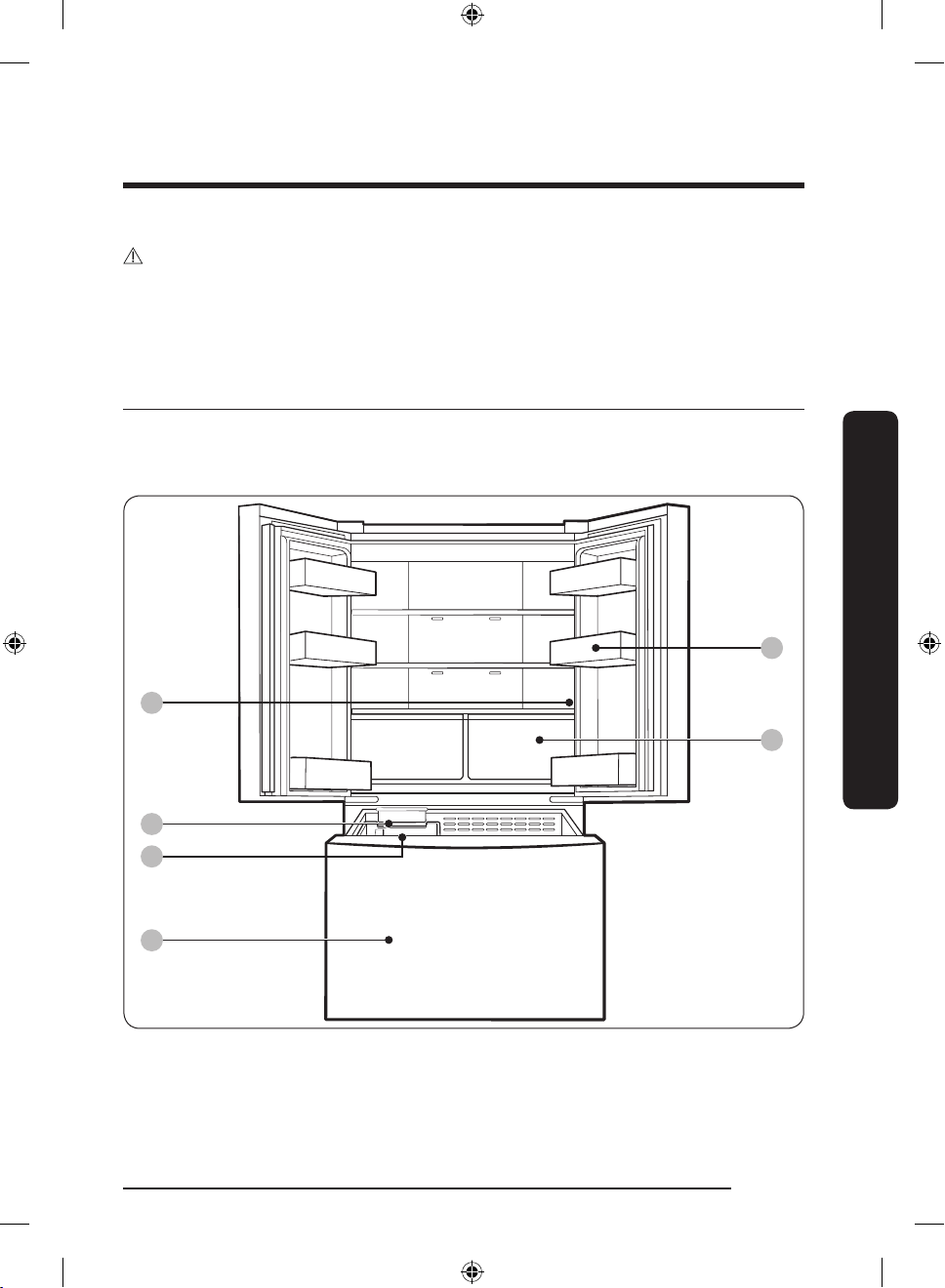
Refrigerator at a glance
The actual refrigerator and provided parts of your refrigerator may differ from the
illustrations in this manual, depending on the model and the country.
Type A
Installation
Untitled-8 29 2020-12-17 1:52:52
English 29
Page 30
Installation
01
02
04
07
03
06
05
Installation
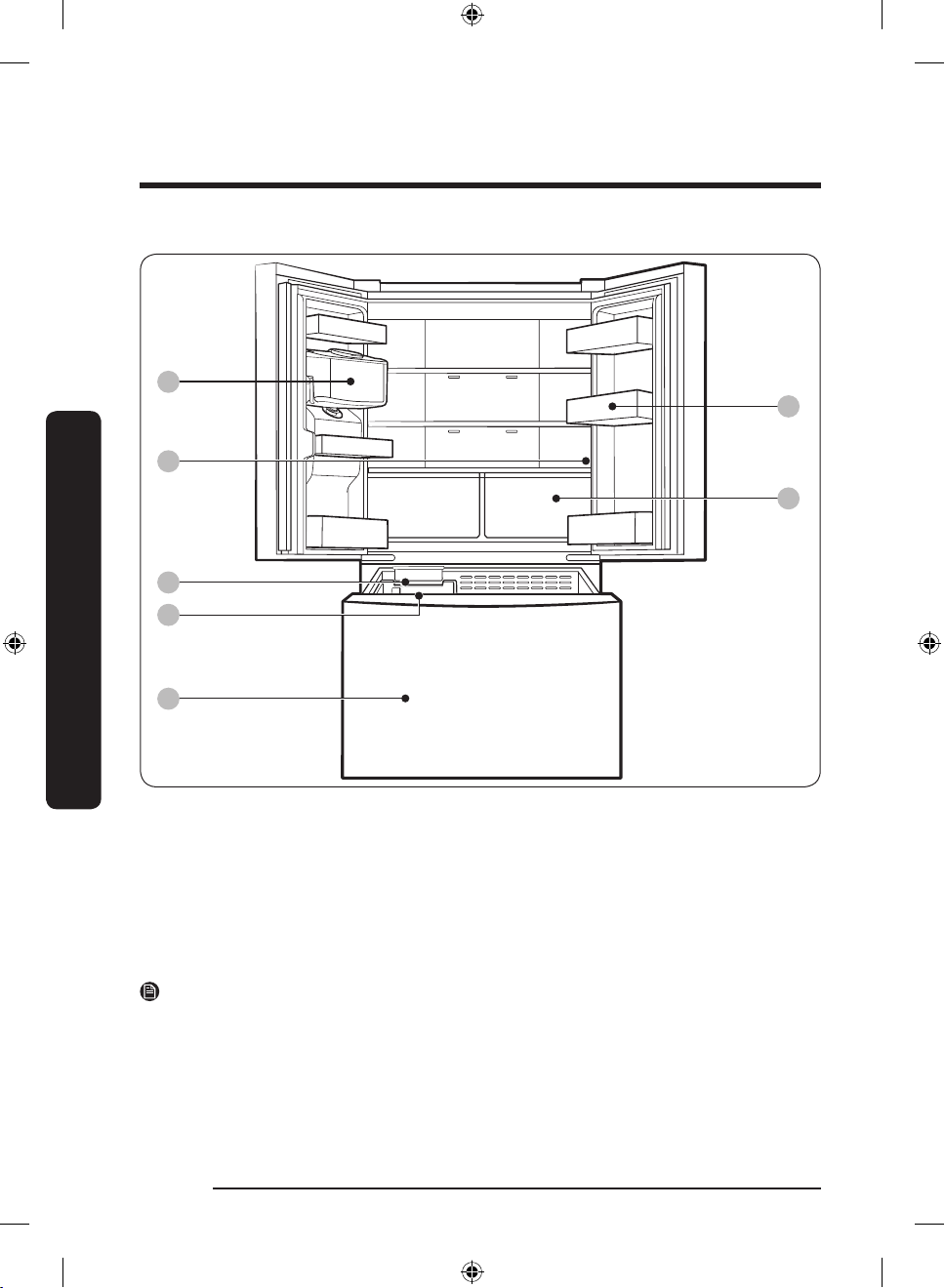
Type B
01 Main panel 02 Freezer
03 Door bins 04 Ice Maker
05 Ice bucket 06 Fridge drawers
07 Water Tank *
* applicable models only
NOTE
• For energy efciency, keep all shelves, drawers, and baskets in their original positions.
• When closing the door, make sure the vertical hinged section is in the correct position
to avoid scratching the other door.
• If the vertical hinged section is reversed, put it back into the correct position, and then
close the door.
• Moisture may form at times on the vertical hinged section.
• If you close a door forcefully, the other door may open.
English30
Untitled-8 30 2020-12-17 1:52:52
Page 31
• If the internal or external LED lamp is out of order, contact a local Samsung service
center.
• If the door is left open for too long, the top internal LED will blink. This is normal.
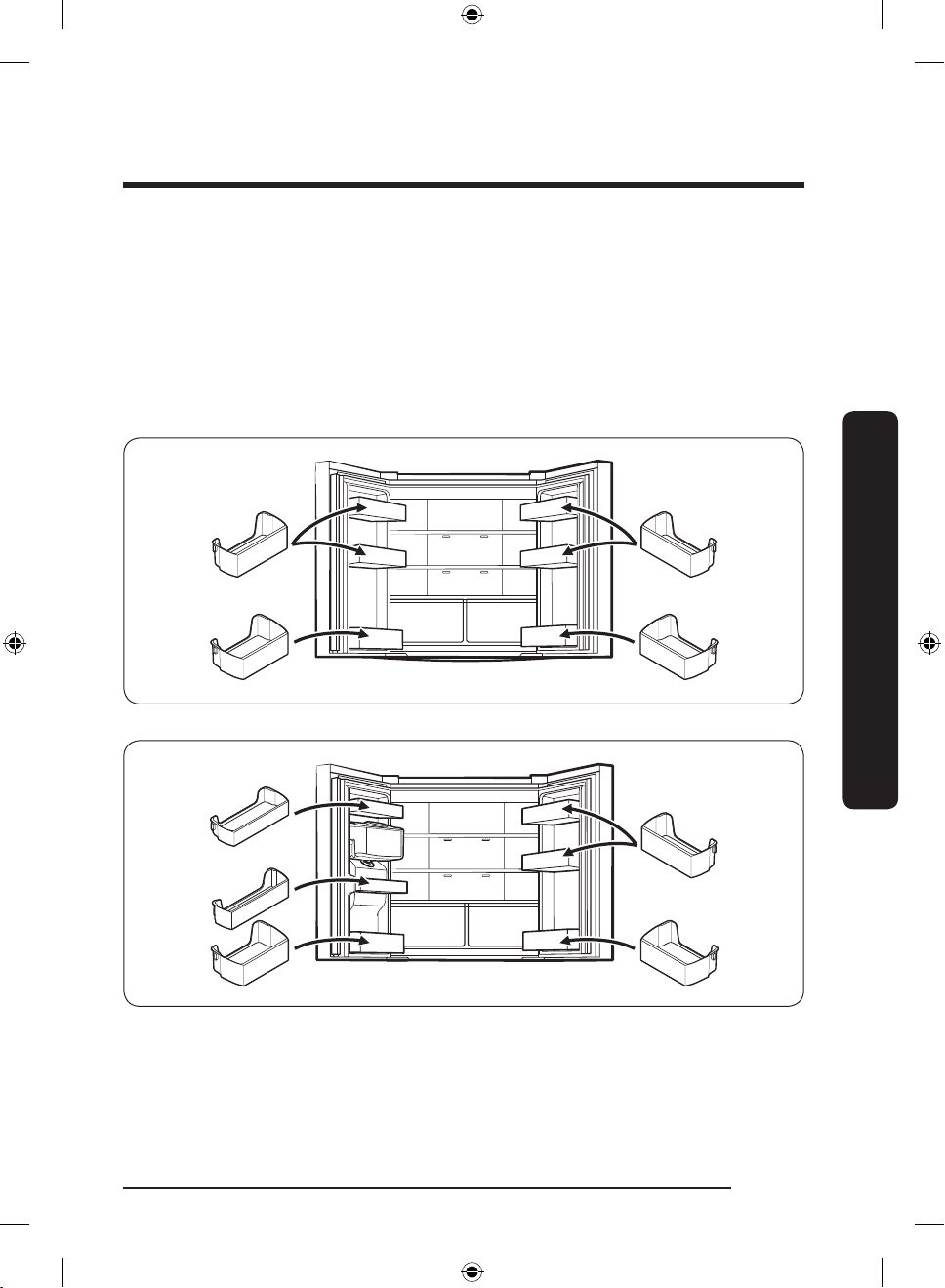
Door bins
Your refrigerator ships with door bins of different types and sizes. If the door bins for your
refrigerator were packaged separately, use the gure below to help you position the bins
properly.
The number of door bins provided may differ with the model.
Type A
Type B
Installation
English 31
Untitled-8 31 2020-12-17 1:52:52
Page 32
Installation
C
D
B
A
Step-by-step installation
STEP 1 Select a site
Select a site that:
• Has a solid, level surface without carpeting or ooring that may obstruct ventilation
• Is away from direct sunlight
• Has adequate room for opening and closing the door
• Is away from any heat sources
• Provides room for maintenance and servicing
• Has a temperature range between 10 °C and 43 °C
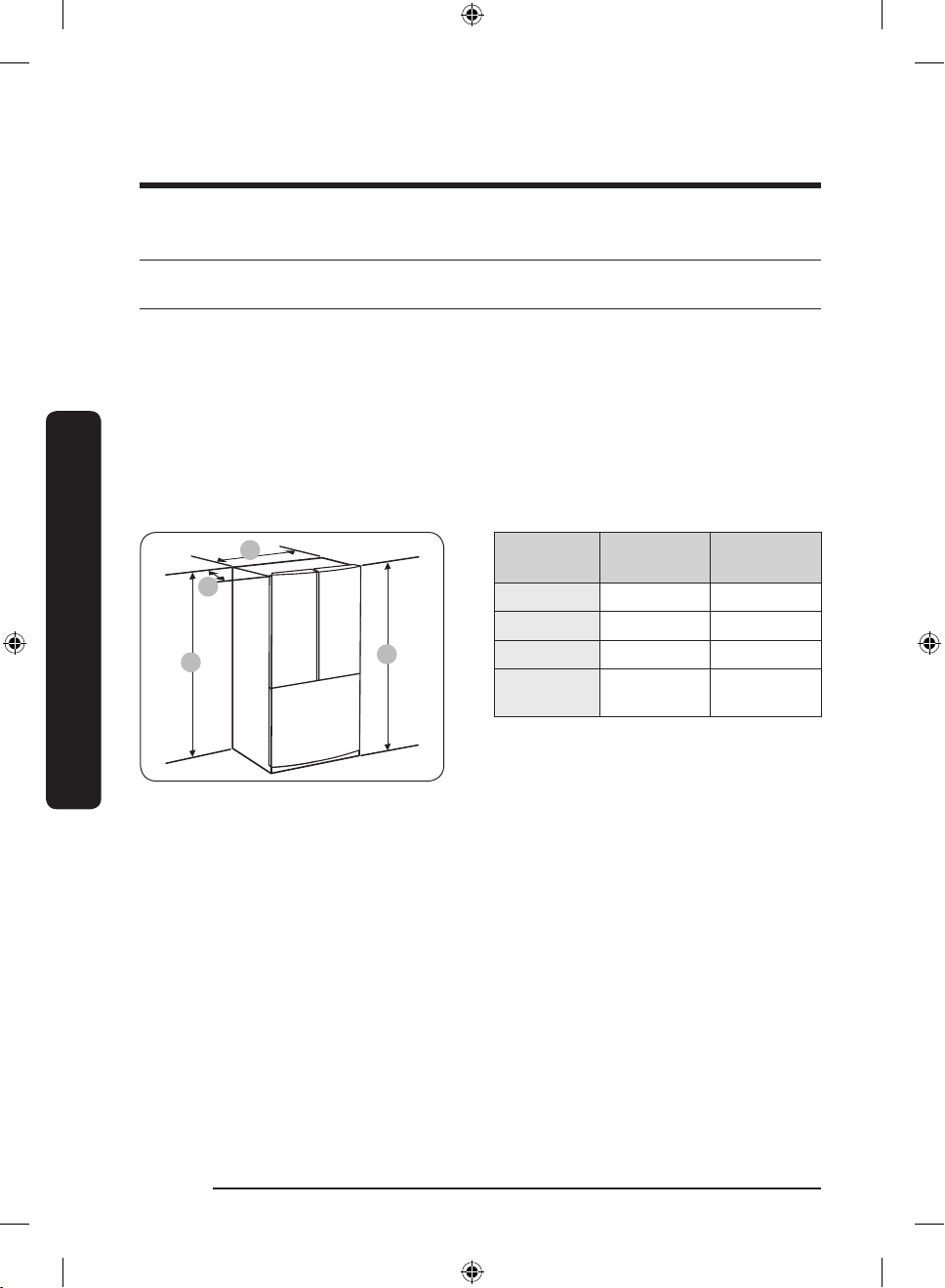
Clearance
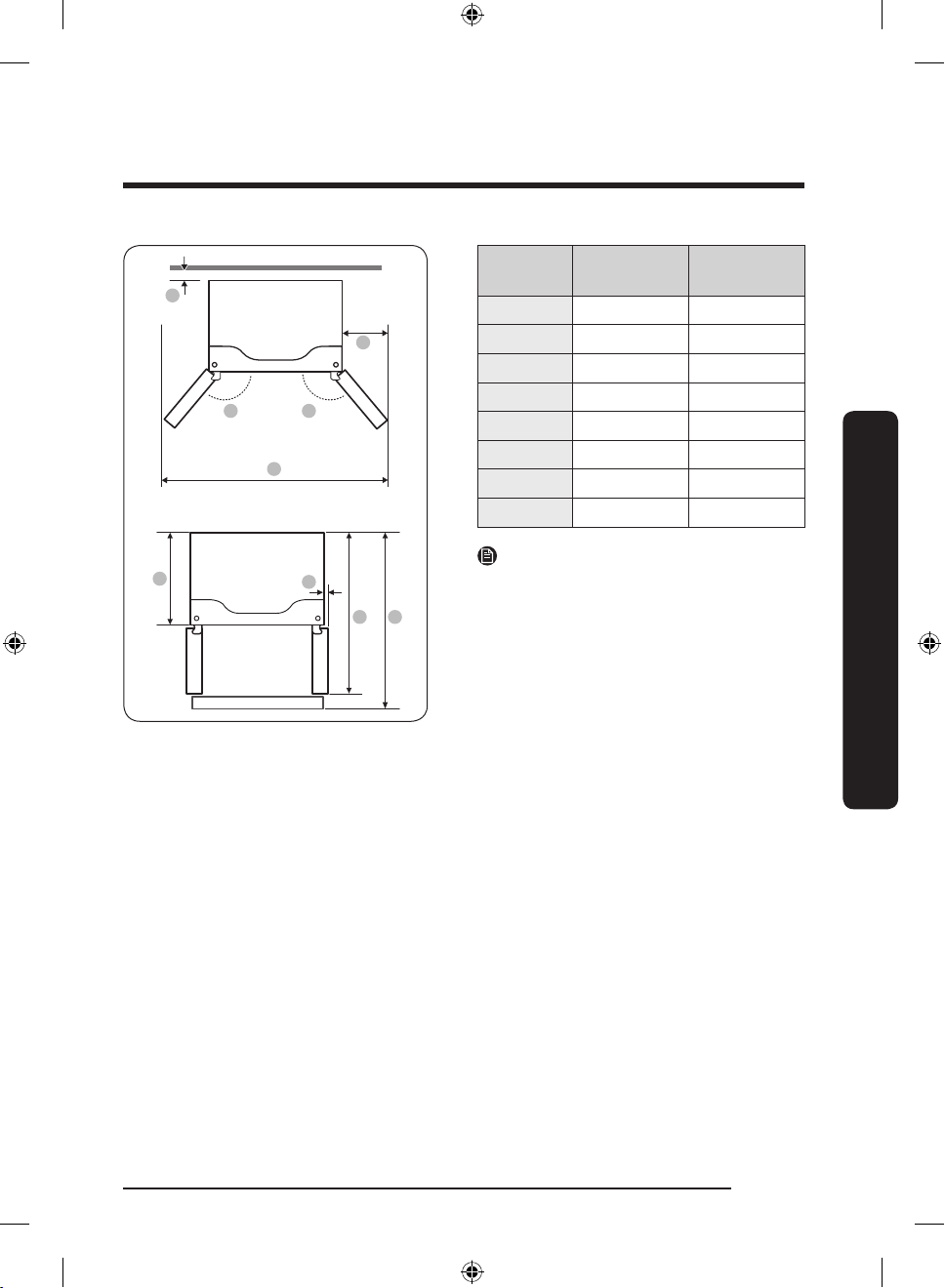
See the following gures and tables for space requirements for installation.
Installation
Model
Depth “A” 715 mm 765 mm
Width “B” 817 mm 817 mm
Height “C” 1749 mm 1749 mm
Overall
Height “D”
RF44A*
RF50A*
1776 mm 1776 mm
RF49A*
RF57A*
English32
Untitled-8 32 2020-12-17 1:52:52
Page 33
01
02 02
04
03
05
07 08
06
Model
RF44A*
RF50A*
RF49A*
RF57A*
01 50 mm 50 mm
02 135° 135°
03 1393 mm 1393 mm
04 291 mm 291 mm
05 625 mm 675 mm
06 31.5 mm 31.5 mm
07 1056 mm 1101 mm
08 1082 mm 1132 mm
NOTE
Installation
The measurements in the table above
may differ slightly from the actual
measurements, depending on the
measuring and rounding method.
Untitled-8 33 2020-12-17 1:52:53
English 33
Page 34
Installation
Installation
STEP 2 Flooring
If the refrigerator cannot pass through the entrance due to its size, see STEP 3 Door
removal for entrance.
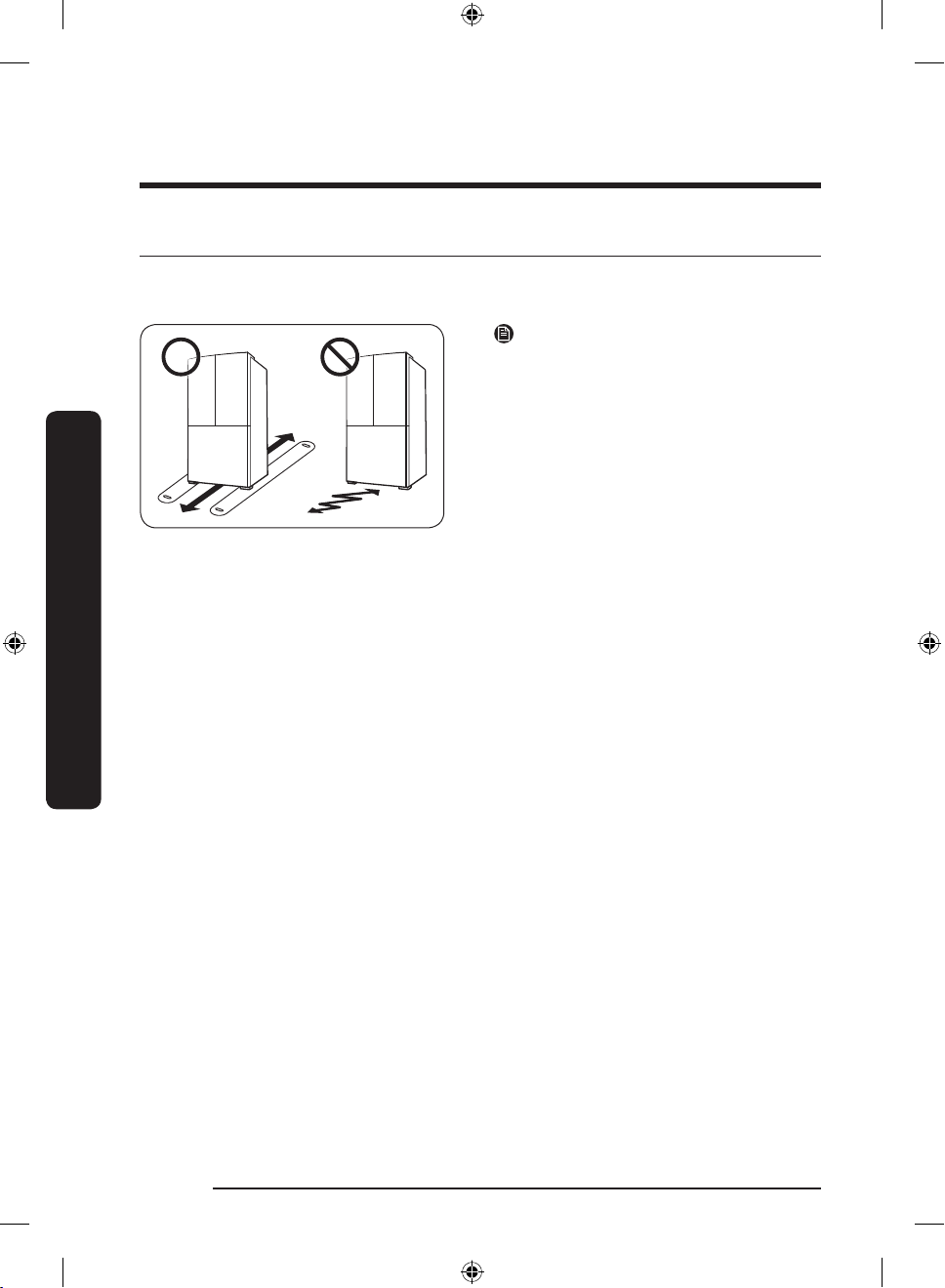
NOTE
To prevent oor damage, make sure the
front leveling legs are in the upright
position.
• The surface you install the refrigerator
on must support a fully loaded
refrigerator.
• To protect the oor, put a large piece
of cardboard along the path to the
refrigerator's nal installation location.
• Once the refrigerator is in its nal
position, do not move it unless
necessary to protect the oor. If you
have to move the refrigerator, place
thick paper or cloth such as old carpets
along the path of movement.
English34
Untitled-8 34 2020-12-17 1:52:53
Page 35
STEP 3 Door removal for entrance
If the refrigerator cannot pass through the entrance to your home or kitchen due to its
size, follow these instructions to remove and then re-install the refrigerator's doors. If you
do not need to remove the doors, go to page 41 to continue the installation procedure.
WARNING
Unplug the power cord of the refrigerator before removing the doors.
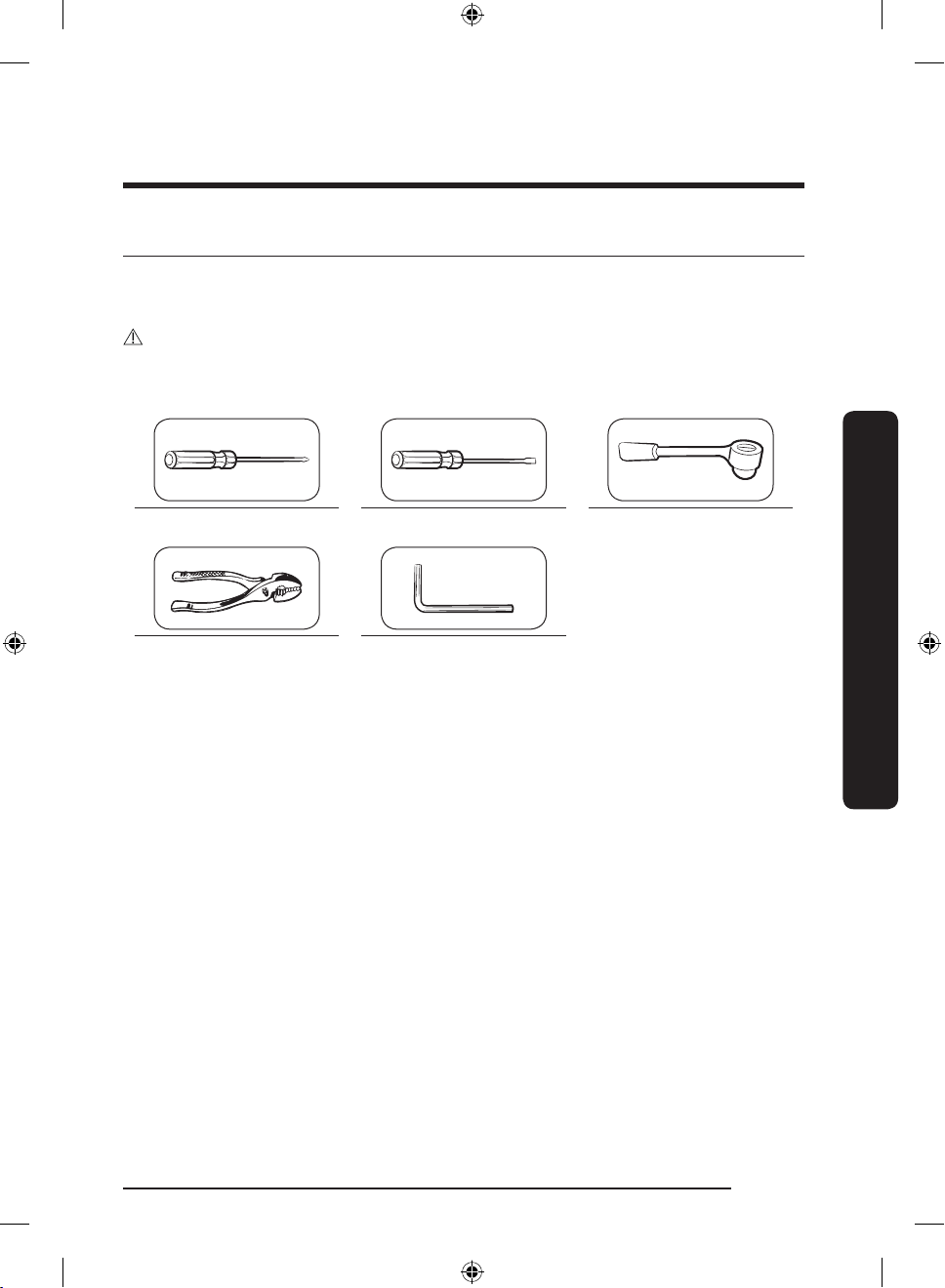
Tools required (not provided)
Phillips screwdriver Flat-head screwdriver Socket wrench 10 mm
Pliers Allen wrench 5 mm
Installation
English 35
Untitled-8 35 2020-12-17 1:52:53
Page 36
Installation
A
B
C
Installation
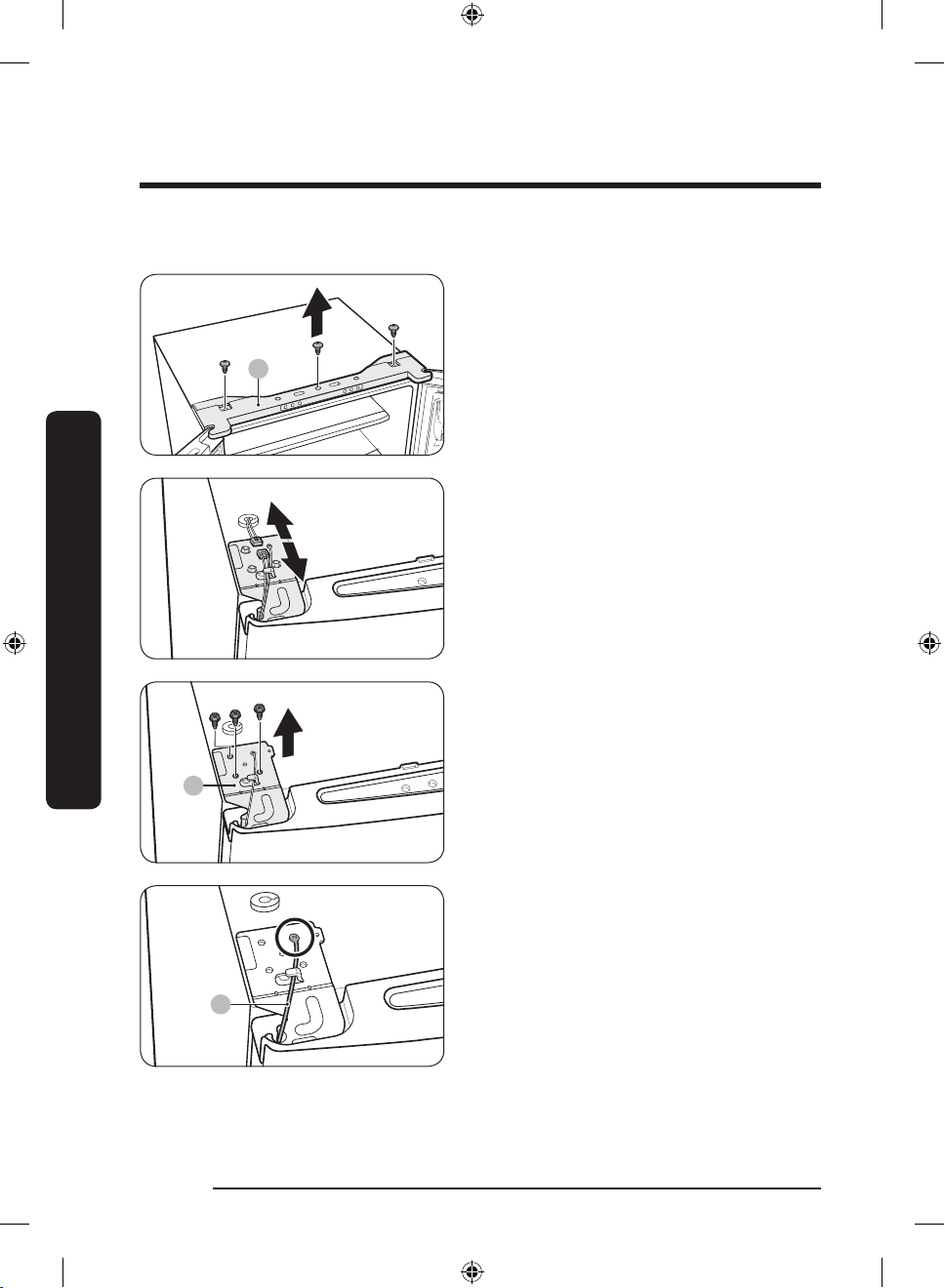
Detach the fridge doors
1. Use a Phillips screwdriver to remove the
screws fastening the top cover (A).
2. Disconnect the wires on the top of the
refrigerator.
3. Use a socket wrench (10 mm) to remove
the screws fastening the top hinge (B).
4. Use a Phillips screwdriver to remove the
screw fastening the ground wire (C).
English36
Untitled-8 36 2020-12-17 1:52:54
Page 37
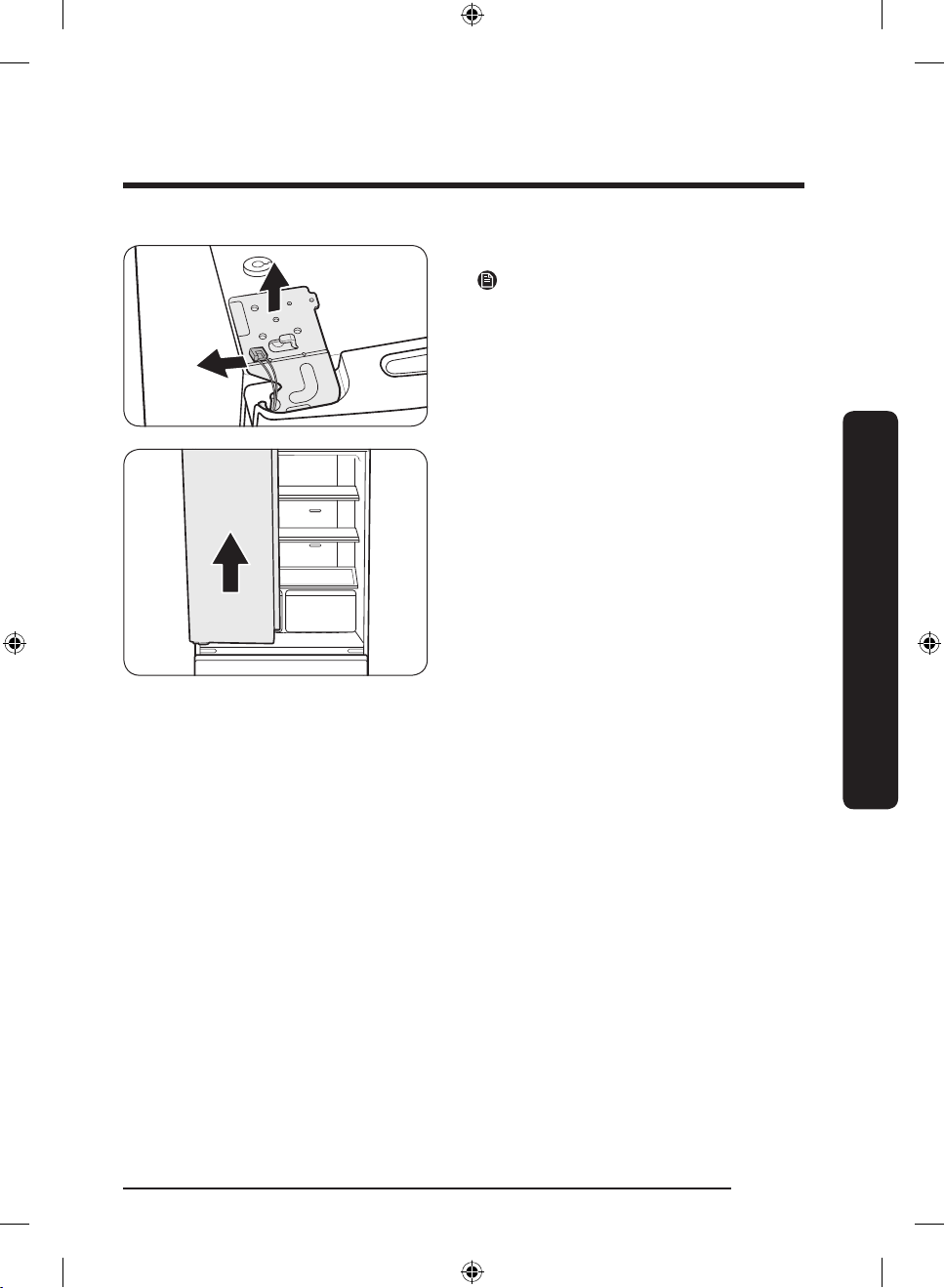
5. Remove the top hinge from the door.
NOTE
Remove the top hinge carefully. The wires
from the door are arranged through the
hinge shaft.
6. Gently pull up the fridge door to
remove. Do not apply excessive force
to the door. The door may fall, causing
physical injury.
7. Lay the door down on a at surface.
To reattach the fridge doors
After moving the refrigerator to its nal location, reattach the doors by following the
removal instructions in the reversed order.
Installation
English 37
Untitled-8 37 2020-12-17 1:52:54
Page 38
Installation
A
Installation
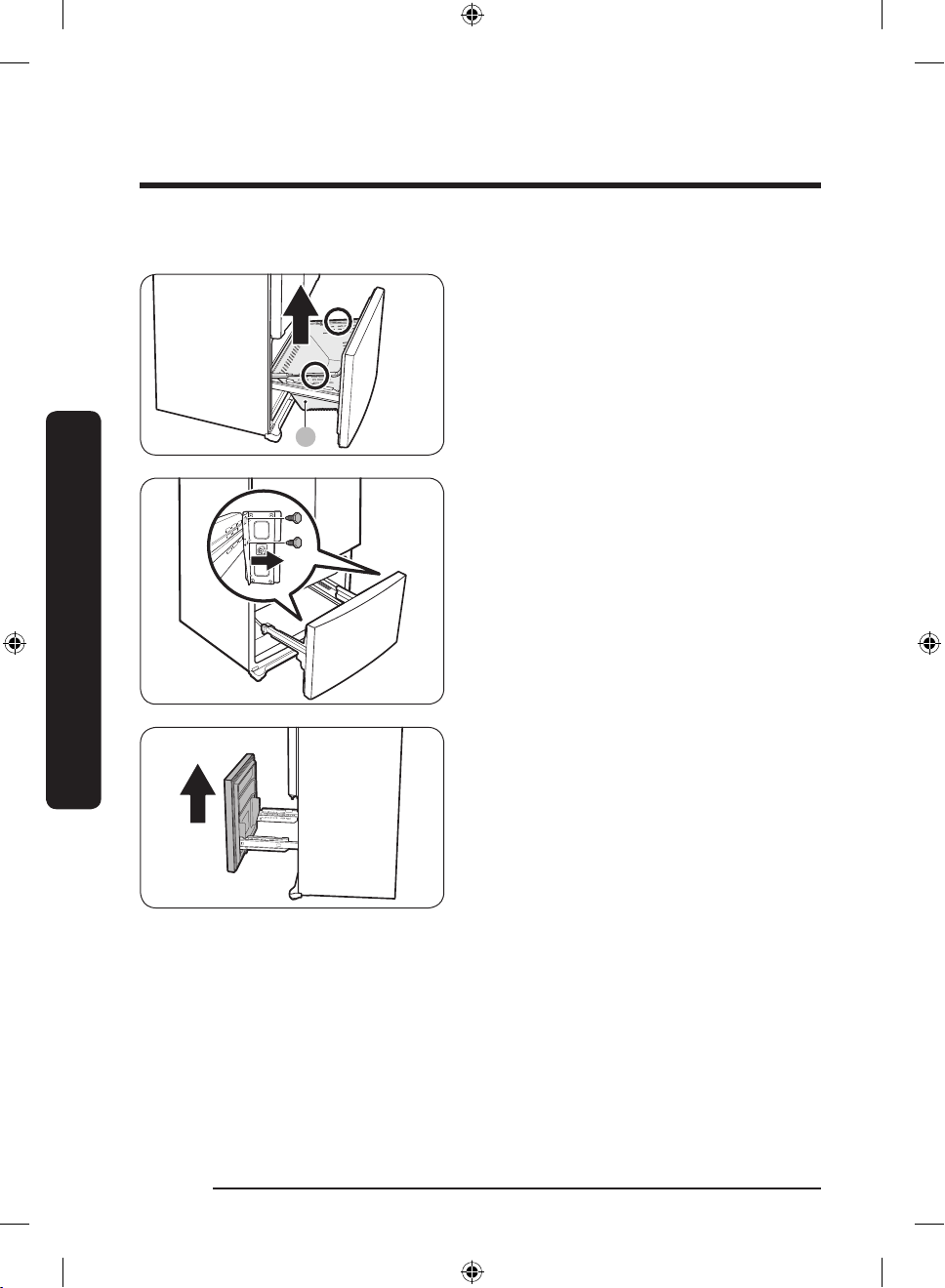
Detach the freezer drawer
1. Fully open the freezer drawer, and then
lift the drawer basket (A) to remove.
2. Use a socket wrench (10 mm) to remove
the 4 screws fastening the door.
3. Lift the freezer door from the rails to
remove.
English38
Untitled-8 38 2020-12-17 1:52:55
Page 39

To reattach the freezer drawer
A
CAUTION
• Be careful not to scratch or dent the rail
assembly.
• Make sure you mount the freezer
baskets in the correct position.
Otherwise, the door will not open or
close properly, which causes frost to
build up.
• Do not store too much food in the
freezer drawer. This prevents the freezer
drawer from closing properly, resulting
in frost buildup.
1. Fully pull out the freezer drawer rails.
Installation
2. Attach the freezer door to the slots (A)
at the side of the rails.
English 39
Untitled-8 39 2020-12-17 1:52:55
Page 40
Installation
Installation
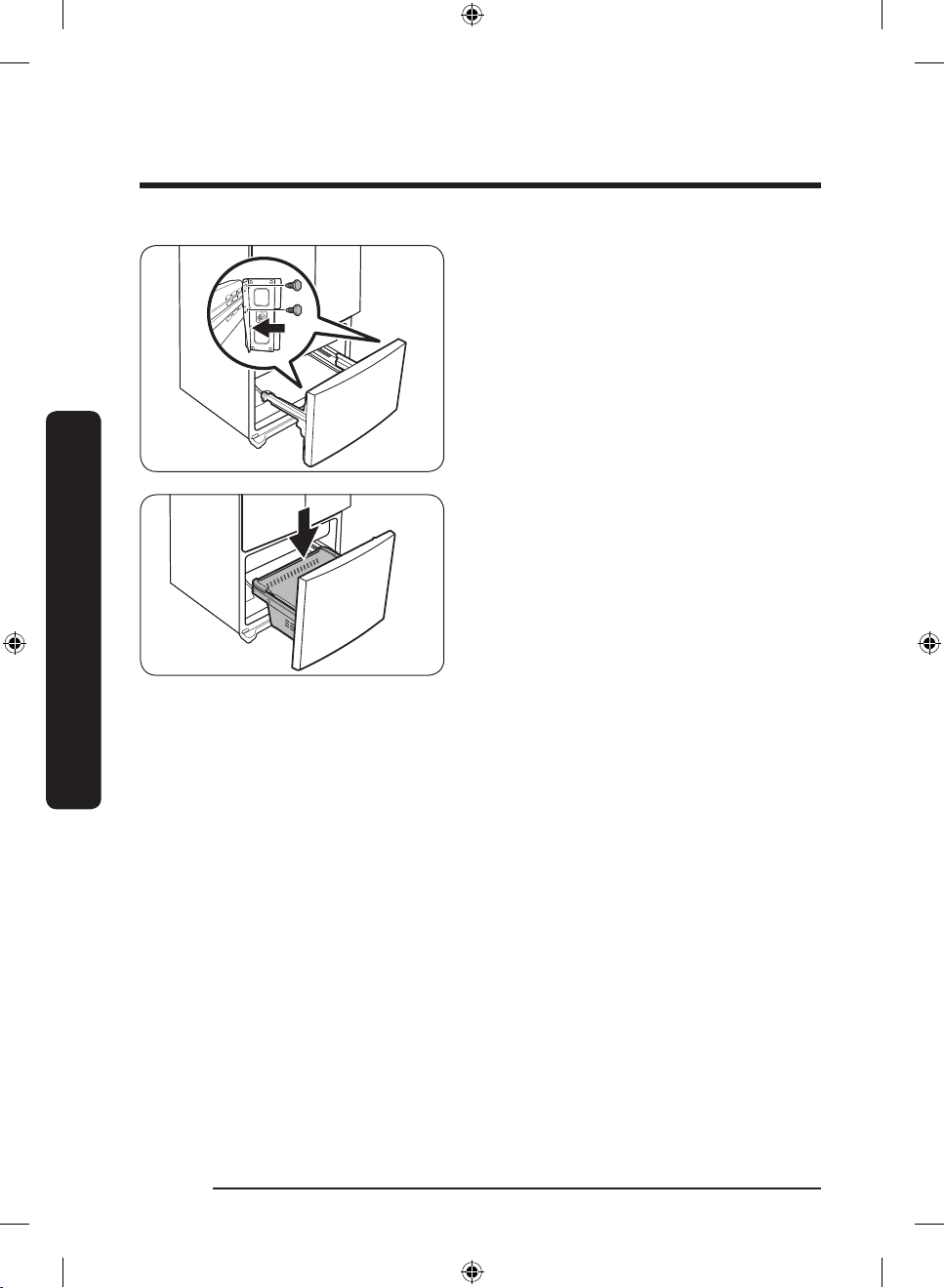
3. Use a socket wrench (10 mm) to fasten
the door to the rail with 4 screws.
4. Insert the freezer basket back into its
position.
English40
Untitled-8 40 2020-12-17 1:52:56
Page 41
STEP 4 Leveling the refrigerator
CAUTION
• When installed, the refrigerator must be leveled on a at, solid oor. Not leveling the
refrigerator can cause damage to the refrigerator or physical injury.
• Leveling must be performed with the refrigerator empty. Make sure no food items are
inside the refrigerator.
• For safety reasons, adjust the front a little higher than the rear.
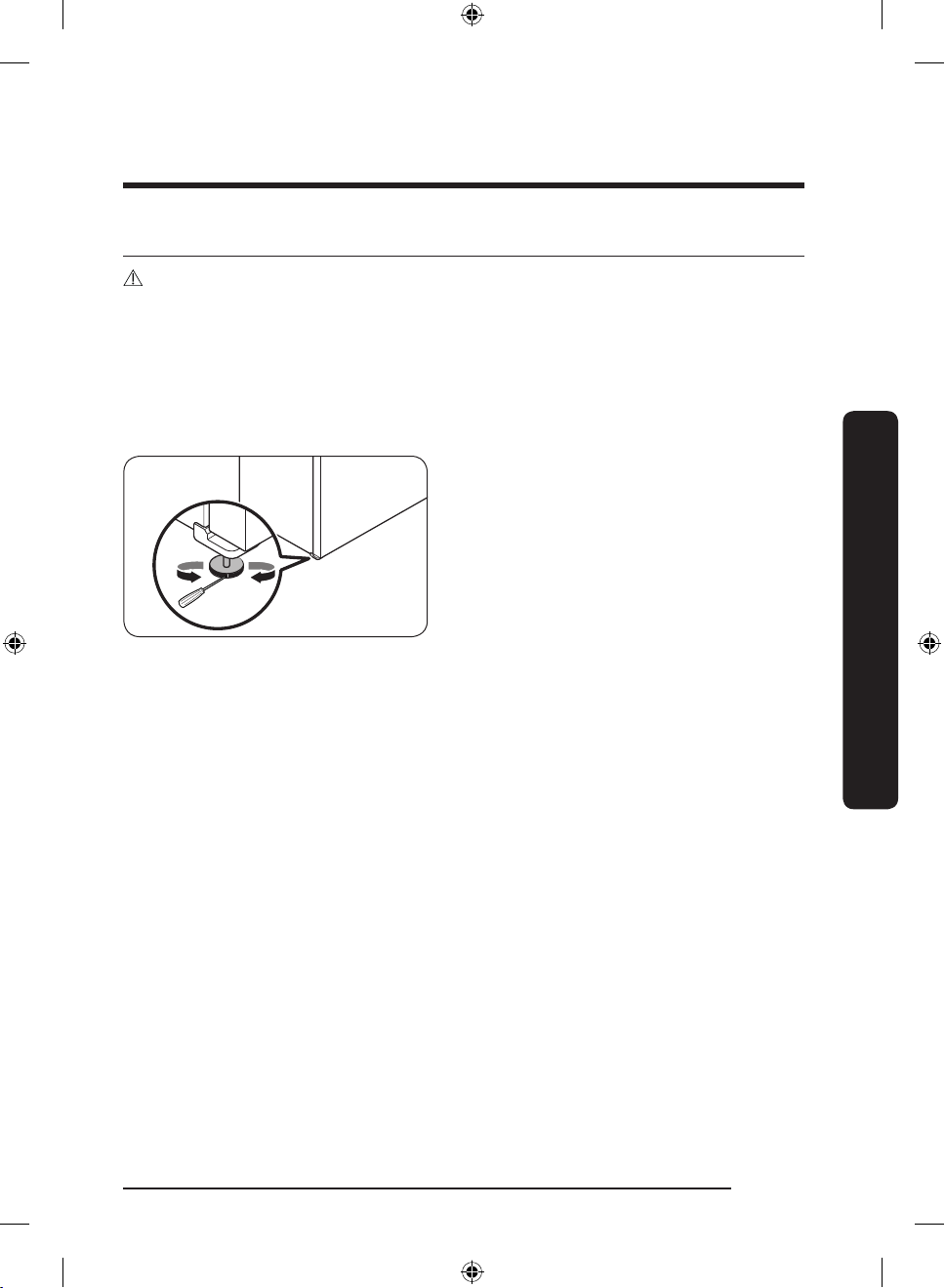
Level the refrigerator using the special screws (levelers) on the front legs. Use a at-head
screwdriver to turn the levelers.
• To adjust the height of the left side:
Insert a at-head screwdriver into the
leveler of the left side front leg. Turn the
leveler clockwise to raise the left side or
turn it counterclockwise to lower.
• To adjust the height of the right side:
Insert a at-head screwdriver into the
leveler of the right side front leg. Turn
the leveler clockwise to raise the right
side or turn it counterclockwise to lower.
Installation
English 41
Untitled-8 41 2020-12-17 1:52:56
Page 42
Installation
A
B
C
D
C
Installation
STEP 5 Align the fridge doors
• Before aligning the fridge doors, make
sure the refrigerator is level. Refer to
the “Leveling the refrigerator” section
for detailed instruction.
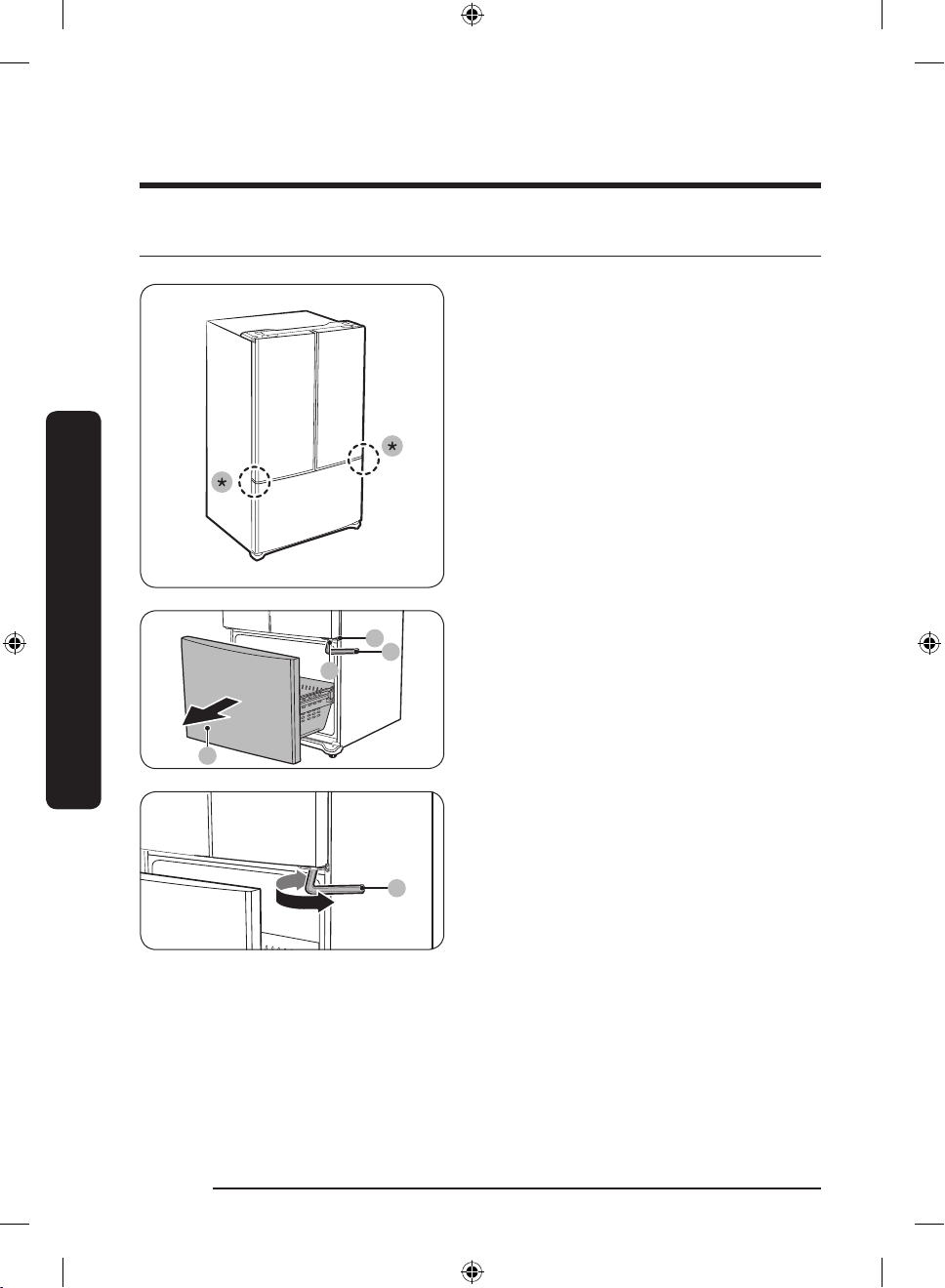
• You can use the adjustment parts (*) at
the bottom of both fridge doors to raise
or lower the door.
1. Fully open the freezer drawer (A), and
then nd the middle hinge (B).
2. Insert the Allen wrench (C) into the shaft
(D) of the middle hinge.
3. Turn the Allen wrench (C) clockwise or
counterclockwise to raise or lower the
door.
English42
Untitled-8 42 2020-12-17 1:52:56
Page 43
C
G
F
E
D
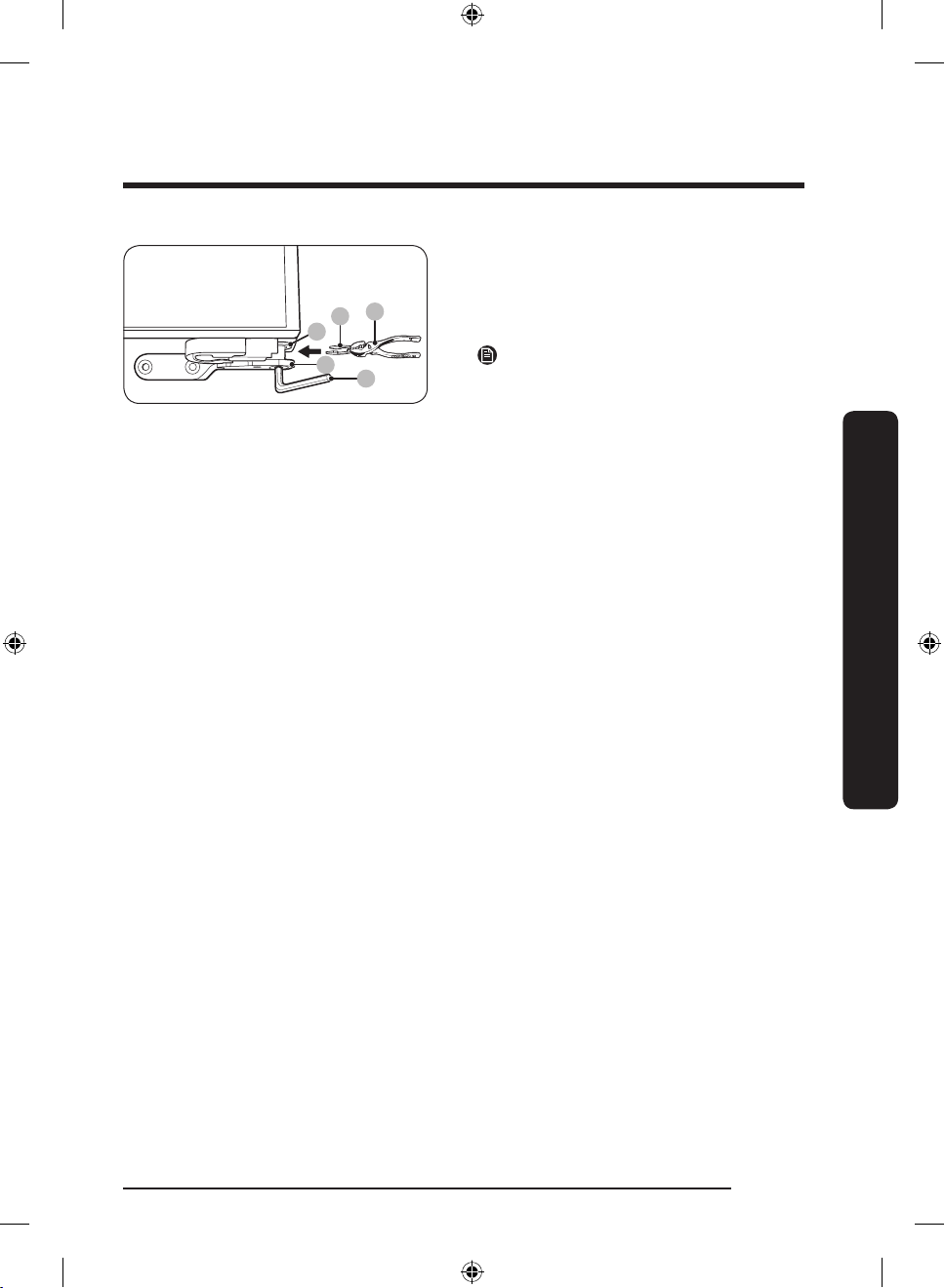
4. Use the Pliers (D) to insert the provided
snap ring (E) in the gap between the
hinge-grommet (F) and the middle hinge
(G). The number of snap rings depends
on the gap.
NOTE
Two 0.04” snap rings are provided with the
product.
Installation
Untitled-8 43 2020-12-17 1:52:56
English 43
Page 44
Installation
A
B
C
A
B
Installation
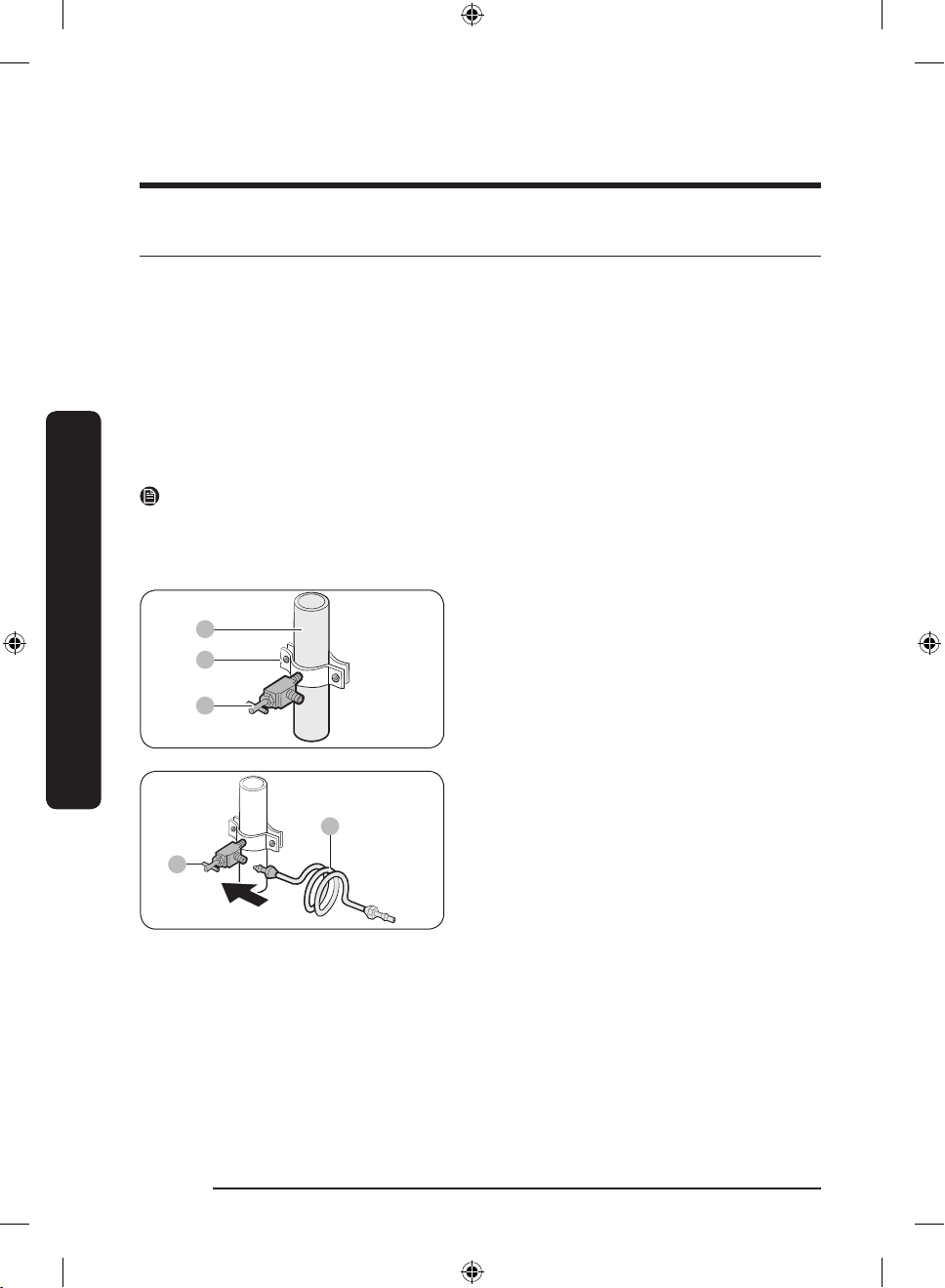
STEP 6 Connect the water dispenser line (applicable models only)
A water dispenser with a lter is one of the helpful features on your new refrigerator. To
help promote better health, the water lter removes unwanted particles from your water.
However, it does not sterilize or destroy microorganisms. You may need to purchase a
water purifying system to do that.
The water line also connects to the ice maker. For the ice maker to operate properly, water
pressure of 206 to 827 kPa is required.
If the refrigerator is installed in an area with low water pressure (below 30 psi / 206 kPa),
you can install a booster pump to compensate for the low pressure.
After you have connected the water line, make sure the water storage tank inside the
refrigerator is properly lled. To do this, press the water dispenser lever until water runs
from the water outlet.
NOTE
• Water line installation kits are available at extra cost from your retailer. We recommend
using a water line installation kit that contains copper tubing and a 6 mm compression
nut.
1. Shut off the main water source.
2. Insert the pipe clamp (B) and the shutoff
valve (C) into the cold water line (A).
3. Connect the water line installation kit
(A) to the shutoff valve (B).
Untitled-8 44 2020-12-17 1:52:57
English44
Page 45

Connect the water supply line to the refrigerator
A
01
02
03 08
04
05
06
07
B
C
There are several items you must purchase to complete this connection. You may nd these
items sold as a kit at your local hardware store.
Copper Tubing
Plastic Tubing
• 1/4" copper tubing
• 1/4" compression nut (1 pc)
• Ferrule (2 pc)
• 1/4" plastic tubing Molded end (Bulb)
• 1/4" compression nut (1 pc)
A. Refrigerator
B. Household water supply line
C. Water Line: must be kept straight.
01 Compression Nut (1/4") (Assembled)
02 Ferrule (Not supplied)
03 Copper tubing (Not supplied)
04 Plastic Tubing (Assembled)
05 Compression Fitting (Assembled)
06 Molded end (Bulb)
07 Compression nut (1/4") (Not supplied)
08 Plastic Tubing (Not supplied)
NOTE
If you have to relocate the refrigerator
after connecting the water line (C), make
sure the joined section of the water line is
straight.
Installation
Untitled-8 45 2020-12-17 1:52:57
English 45
Page 46
Installation
Installation
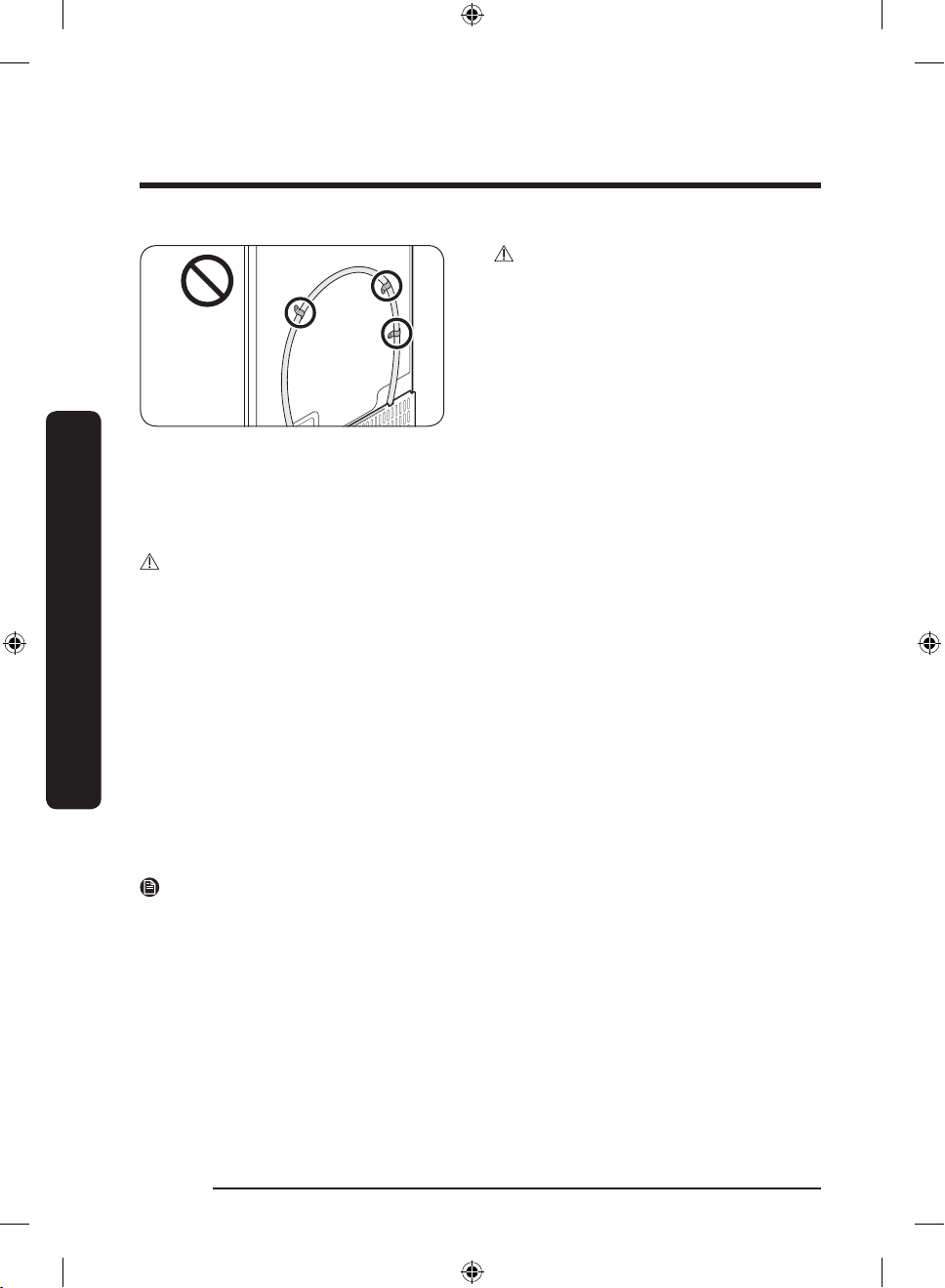
CAUTION
Do not mount the water lter on any part
of the refrigerator. This may damage the
refrigerator.
1. Connect the household water line to the assembled compression tting.
- If you are using copper tubing, slip the compression nut (07) (not supplied) and
ferrule (not supplied) on the copper tubing (not supplied) as shown.
- If you are using plastic tubing (08), insert the molded end (Bulb) of the plastic tubing
(08) into the compression tting.
CAUTION
• If you use plastic tubing (08), do not use it without the molded end (Bulb).
• Leaving the water line disconnected may cause the water valve to produce a buzzing
sound over time. If this is the case, make sure that the ice making function is turned
“OFF” and do not attempt to use the water dispenser.
2. Tighten the compression nut (07) onto the compression tting. Do not over-tighten the
compression nut (07).
3. Turn the water on and check for any leakage. If you nd water drops or leakage in
the connection areas, turn off the main water supply. Check the connections and, if
necessary, tighten.
4. Flush 1 gallon of water through the lter before drinking or using the water from the
refrigerator. (Flush approximately 6 minutes.) To ush, press a large glass or cup against
the water dispenser lever. Fill the glass, empty it, and then repeat.
5. After you turn on the refrigerator, let the ice maker make ice for 1 to 2 days. Over that
period of time, throw out the rst 1 or 2 buckets of ice the ice maker makes to ensure
all impurities have been removed from the water line.
NOTE
Only connect the water line to a potable water source.
• If you have to repair or disassemble the water line, cut off 1/4“ of the plastic tubing to
make sure you get a snug, leak-free connection.
• You can test the water line quickly using a paper cup. Under normal conditions, the
water dispenser can ll a 170 cc cup in about 10 seconds.
English46
Untitled-8 46 2020-12-17 1:52:57
Page 47
STEP 7 Initial settings
By completing the following steps, the refrigerator should be fully functioning.
1. Plug the power cord into the wall socket to turn the refrigerator on.
2. Open the door, and check if the interior light lights up.
3. Set the temperature to the coldest setting, and wait for about an hour. Then, the freezer
will be slightly chilled, and the motor should be running smoothly.
4. Wait until the refrigerator reaches the set temperature. Now the refrigerator is ready
for use.
STEP 8 Final check
When installation is complete, conrm that:
• The refrigerator is plugged into an electrical outlet and grounded properly.
• The refrigerator is installed on a at, level surface with a reasonable clearance from
walls and cabinets.
• The refrigerator is level and is sitting rmly on the oor.
• The door opens and closes freely, and the interior light turns on automatically when you
open the door.
Installation
English 47
Untitled-8 47 2020-12-17 1:52:57
Page 48

Operations
Operations
Main panel
01
02
03
04
05
01 Fridge indicator
02 Freezer indicator
03 Door open
indicator
04 Ice Maker indicator
English48
Untitled-8 48 2020-12-17 1:52:58
• Displays the current or desired temperature of the fridge.
• indicates that the Power Cool function is on.
• indicates that the Vacation function is on.
• Displays the current or desired temperature of the freezer.
• indicates that the Power Freeze function is on.
• This indicator blinks with an alarm if the door is left open
for more than 2 minutes.
• Displays the status of the ice maker.
• To enable ice making, you must turn on the ice maker.
Page 49
• When the display is off, tap any button to wake up the
display.
05 Buttons
• Tap to select the desired item on the main panel and to
conrm any setting changes.
• Tap or to change the settings of the selected item on
the main panel.
* applicable models only
NOTE
• The control panel is designed to stay off when the refrigerator is not in use. It only
becomes active and lights up when you open the door or tap the buttons.
• If the door is left open for 5 minutes, the internal light will blink for 5 minutes and turn
off to alert deaf and hard of hearing users that a door is open. Note that this function is
normal.
Operations
English 49
Untitled-8 49 2020-12-17 1:52:58
Page 50
Operations
Operations
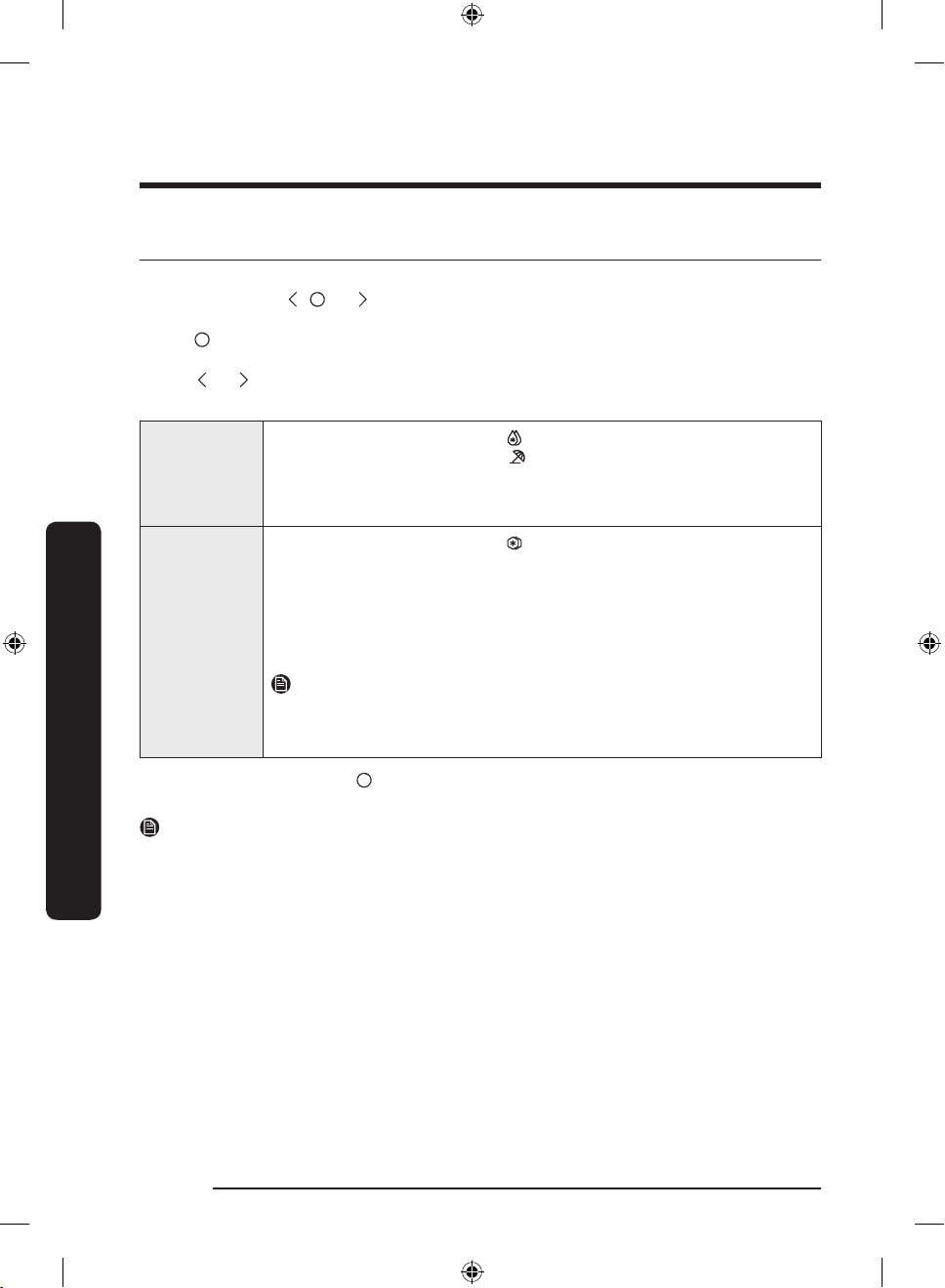
Setting the desired temperature or function
Select the fridge or freezer and set the desired temperature or function of your choice.
1. Tap any button ( , , or ) to wake up the display.
- This step may not apply to some models.
2. Tap until the fridge or freezer indicator blinks.
- The selected compartment’s indicator blinks.
3. Tap or to select the desired temperature or function.
- Refer to the table for available selection for each compartment.
• Available selection (Celsius): (Power Cool) 1 °C 2 °C 3 °C
Fridge
Freezer
4 °C 5 °C 6 °C 7 °C (Vacation)
• Power Cool speeds up the cooling process at maximum fan speed.
The fridge keeps running at full speed for two and a half hours and
then returns to the previous temperature.
• Available selection (Celsius): (Power Freeze) -23 °C -22 °C
-21 °C -20 °C -19 °C -18 °C -17 °C -16 °C -15 °C
• Power Freeze speeds up the freezing process at maximum fan speed.
• The freezer keeps running at full speed for 50 hours and then
returns to the previous temperature. To freeze large amounts of food,
activate Power Freeze for at least 20 hours before putting food in the
freezer.
NOTE
When you use this function, the energy consumption of the refrigerator
will increase. Remember to turn it off when you do not need it and
return the freezer to your original temperature setting.
4. Wait for 5 seconds or tap to conrm your selection.
- The selected compartment’s indicator stops blinking.
NOTE
• Using Power Cool or Power Freeze increases power consumption.
• When you change the temperature on the panel, the panel displays the actual
temperature inside the refrigerator until the temperature matches the temperature you
set. Then, the panel displays the new set temperature. Note that it will take time for the
refrigerator to reach the new temperature. This is normal. During this time, you do not
need to set the temperature again.
• To ensure optimal performance, we recommend setting the temperature to -19 °C for
the freezer, and 3 °C for the fridge.
• The temperature in the refrigerator may rise if you open the door frequently or put
a large amount of food into the refrigerator. If this happens, the temperature display
blinks until the refrigerator returns to the specied temperature settings. If the blinking
continues for an extended time, contact a local Samsung service center for technical
assistance.
English50
Untitled-8 50 2020-12-17 1:52:59
Page 51
Changing the temperature scale
You can switch the temperature scale between Fahrenheit and Celsius.
1. Tap any button ( , , or ) to wake up the display.
- This step may not apply to some models.
2. Tap until the °F and °C symbols on the fridge or freezer blink.
3. Tap or to select the desired temperature scale.
- Tap to select Fahrenheit.
- Tap to select Celsius.
4. Wait for 5 seconds or tap to conrm your selection.
- The °F and °C symbols stop blinking.
Turning on or off the ice maker
You can turn on or off the auto ice maker in the freezer.
1. Tap any button ( , , or ) to wake up the display.
- This step may not apply to some models.
2. Tap until the Ice Maker indicator blinks.
3. Tap or to turn on or off the ice maker.
- Tap to turn it on.
- Tap to turn it off.
4. Wait for 5 seconds or tap to conrm your selection.
- The Ice Maker indicator stops blinking.
Activating or deactivating the Sabbath mode
The Sabbath mode stays active for 85 hours once it is activated. After that, it will be
deactivated automatically.
• To activate or deactivate the Sabbath Mode, tap and hold and simultaneously for 6
seconds. Then, when the display blinks, tap .
- When the refrigerator is in the Sabbath mode, the buttons, display, and internal
lights do not function. The refrigerator and freezer, however, continue to cool.
NOTE
• If the refrigerator powers off and restarts (for example, if there is a power failure),
the Sabbath mode remains active. To end Sabbath Mode, you must deactivate it as
instructed above.
Operations
English 51
Untitled-8 51 2020-12-17 1:52:59
Page 52

Operations
Operations
Special features
Ice maker
The refrigerator has a built-in ice maker that automatically dispenses ice so that you can
enjoy ltered water with cubed or crushed ice.
Ice Maker Operation
• The ice maker will produce 8 cubes per
cycle - approximately 100~130 cubes
in a 24-hour period, depending on
freezer compartment temperature, room
temperature, number of door openings,
and other use conditions.
• Throw away the rst few batches of ice
to allow the water line to clear.
• Be sure nothing interferes with the
sweep of the feeler arm. When the bin
lls to the level of the feeler arm, the ice
maker will stop producing ice.
• After the ice maker has been turned on
again, there will be a time delay before
the ice maker resumes operation.
• It is normal for several cubes to be
joined together.
• If ice is not used frequently, old ice
cubes will become cloudy, taste stale,
and shrink. If you do not want to make
ice, turn the ice maker off. (For detailed
instructions on turning the ice maker on
or off, see the “Turning on or off the ice
maker” section on page 51.)
NOTE
When the ice maker is on, the temperature of the freezer will be lower than the set
temperature. If you do not need to use the ice maker, turn off the ice maker.
If You Turn the Ice Maker Off
If you turn the ice maker off, make sure to remove all ice cubes from the ice bucket. The
remaining ice cubes may clump together, making it difcult to remove.
English52
Untitled-8 52 2020-12-17 1:52:59
Page 53

Water dispenser (applicable models only)
With the water dispenser, you can dispense water without opening the fridge door. The
water tank must be lled with potable water before use.
To ll the water tank with potable water
Open the door and locate the water tank that is located in the door shelf area.
1. Hold the handgrips on both sides of the
water tank and lift up to remove.
2. Fill the water tank with potable water
up to 4 liters. You can remove either the
top cap or the cover and pour water.
NOTE
For rst-time use, clean inside the water
tank.
3. Reinsert the water tank and close the
door. Make sure the water outlet of the
water tank faces forward.
Operations
English 53
Untitled-8 53 2020-12-17 1:52:59
Page 54

Operations
Operations
4. Put a water glass under the water outlet
of the dispenser, and gently push the
dispenser lever to dispense water. Make
sure the water dispenser is unlocked.
CAUTION
• The water dispenser is designed to dispense potable water. Fill the water tank only with
potable water. Do not ll with any other liquids.
• Do not ll the water tank excessively, which causes an overow.
• Do not try to ll the water tank without removing it from the door.
• Make sure that water tank is seated properly.
• Do not use the refrigerator without the water tank. This may reduce performance and
efciency.
• To prevent water bouncing, make sure the glass is in line with the dispenser lever.
NOTE
To secure more room, you can use the water tank to store food. In this case, remove the lid
of the tank.
English54
Untitled-8 54 2020-12-17 1:53:00
Page 55
Maintenance
Handling and care
Shelves
CAUTION
• The shelf must be inserted correctly. Do not insert upside down.
• Glass containers may scratch the surface of glass shelves.
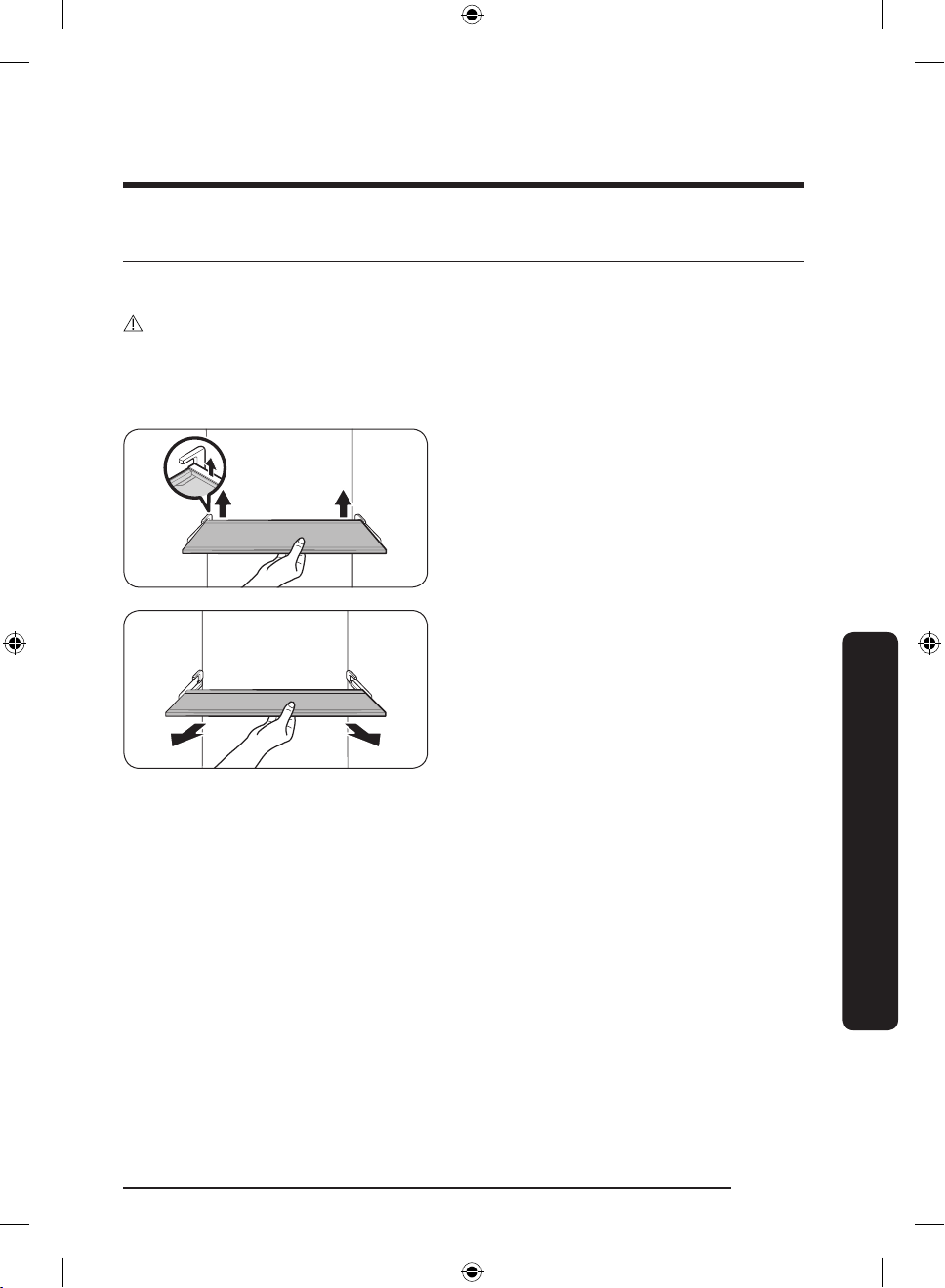
Fridge shelves
To remove a shelf, fully open the fridge
door. Hold the front of the shelf and gently
lift up and slide out.
1. Fully open the fridge door.
2. Hold the front of the shelf lift the back
of the shelf to release the hook from the
groove.
3. Pull out to remove.
English 55
Untitled-8 55 2020-12-17 1:53:00
Maintenance
Page 56

Maintenance
Vegetable shelves
1. Fully open the fridge door.
2. Lift up the front of the shelf and pull it
to release the shelf from the holder at
the rear wall.
3. Pull out to remove.
Door bins
• To remove the door bin, hold the front
sides of the bin, and then gently lift up
to remove.
Maintenance
• To reinsert, insert the door bin slightly
above its nal location making sure that
the back of the bin is against the door.
Hold the rear of the door bin with both
hands, and then press down so that it
ts snugly.
CAUTION
• Do not remove a bin that is lled with
food. Empty the bin beforehand.
• Use caution when opening the door if
the bottom bin contains larger bottles,
which may fall over.
• Do not allow children to play with the
bins. Sharp corners of the bin may cause
injury.
English56
Untitled-8 56 2020-12-17 1:53:01
Page 57
Fridge drawers
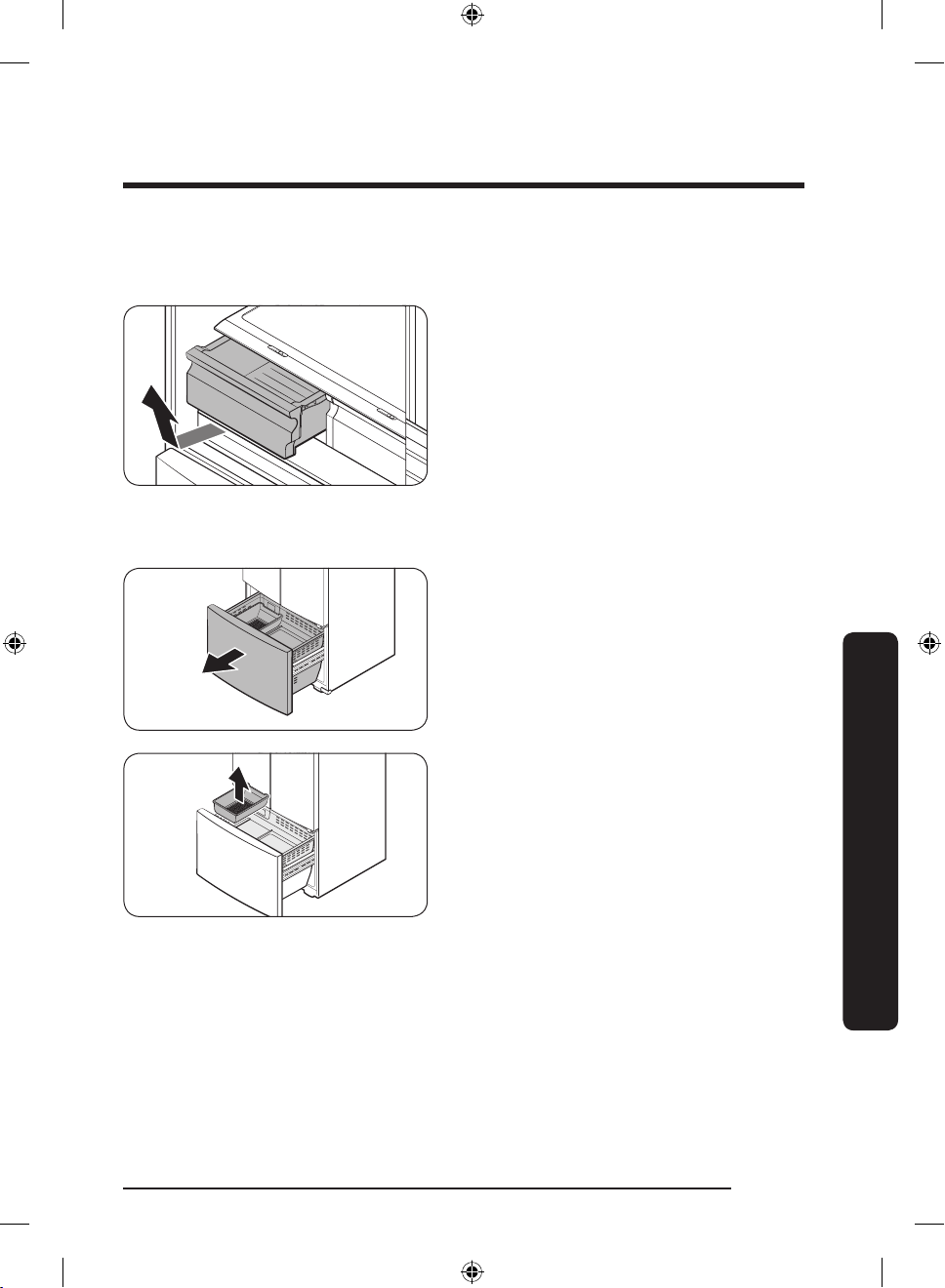
Vegetable / fruit drawers
Freezer baskets
Gently lift up the front of the drawer and
slide out.
• We recommend that you remove the
door bins before removing the drawer.
This is to prevent damage to the door
bins.
• To reinsert, insert the drawer into the
frame rails and then slide inward.
1. Fully open the freezer drawer.
2. Lift the ice bucket to remove.
English 57
Untitled-8 57 2020-12-17 1:53:01
Maintenance
Page 58
Maintenance
Upper basket
Lower basket
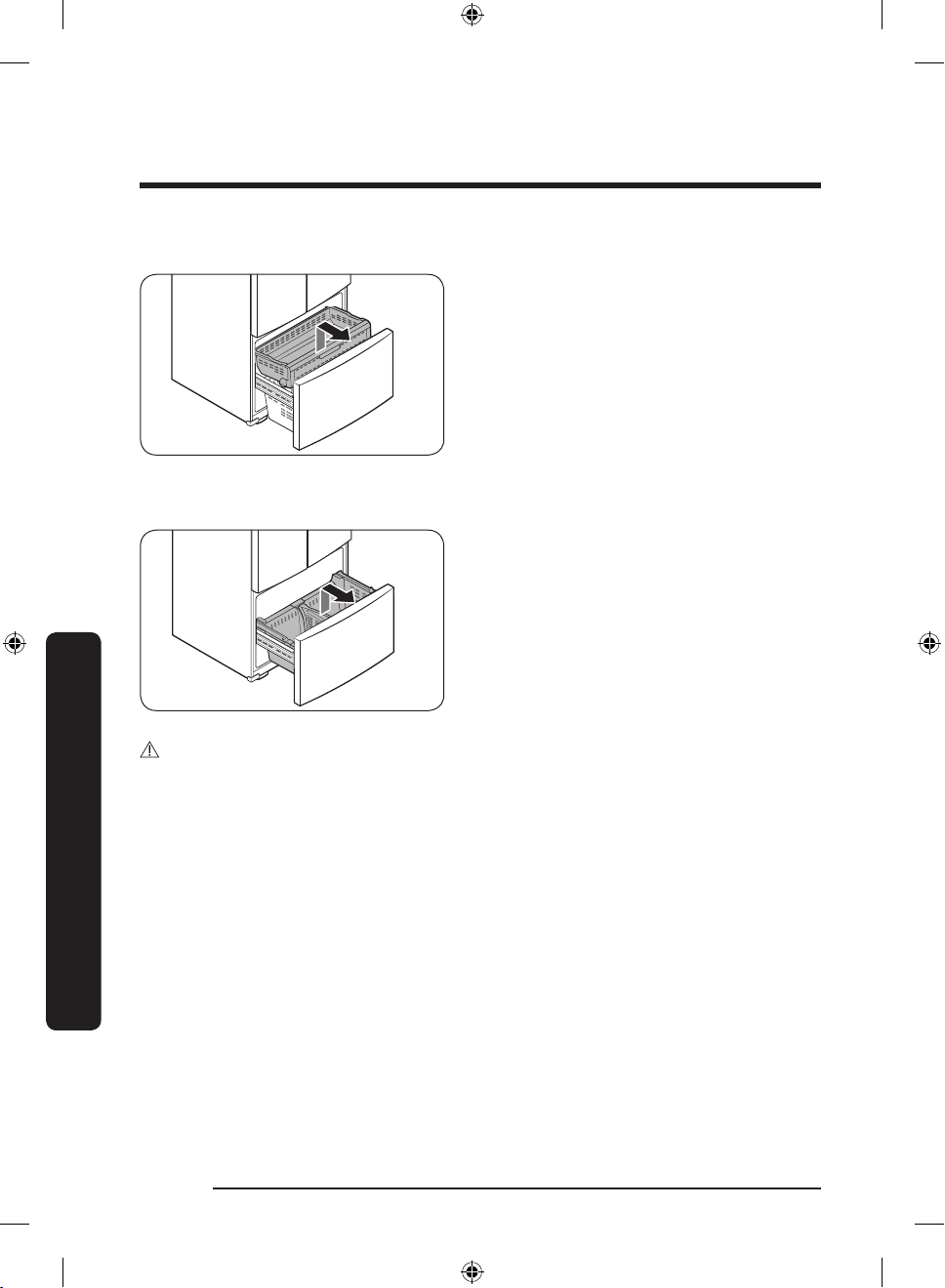
• To remove, fully slide open the freezer
drawer. Lift up the front of the upper
basket and pull to remove.
• To reinsert, align the front wheels of the
upper basket with the end of the lower
basket. Slide the upper basket to the
front.
• To remove, rst remove the upper
basket. Then, tilt up the front of the
lower basket to pull out.
• To reinsert, put the basket onto the rail
assembly rear side rst.
CAUTION
Maintenance
• Do not twist the basket when removing or reinserting the basket. The basket can be
scratched.
• To prevent physical injury, property damage, or suffocation, keep children away from
freezer baskets that have been removed.
• Do not remove the divider.
• Put the wheels of the upper basket on the end of the rails of the lower basket. Then,
slide the upper basket all the way to the front. Otherwise, the drawer will not open or
close properly, which will cause frost to build up.
English58
Untitled-8 58 2020-12-17 1:53:01
Page 59
Cleaning
Interior and exterior
WARNING
• Do not use benzene, thinner, home/car detergent, or Clorox™ to clean the refrigerator.
They may damage the surface of the refrigerator and cause a re.
• Do not spray water onto the refrigerator. This may cause electric shock.
Regularly use a dry cloth to remove all foreign substances such as dust or water from the
power plug terminals and contact points.
1. Unplug the power cord.
2. Use a moistened, soft, lint-free cloth or paper towel to clean the refrigerator’s interior
and exterior.
3. When done, use a dry cloth or paper towel to dry well.
4. Plug in the power cord.
Rubber seals
If the rubber seals of a door become dirty, the door may not close properly and reducing
refrigerator performance and efciency. Use a mild detergent and damp cloth to clean the
rubber seals. Then, dry well with a cloth.
Rear panel
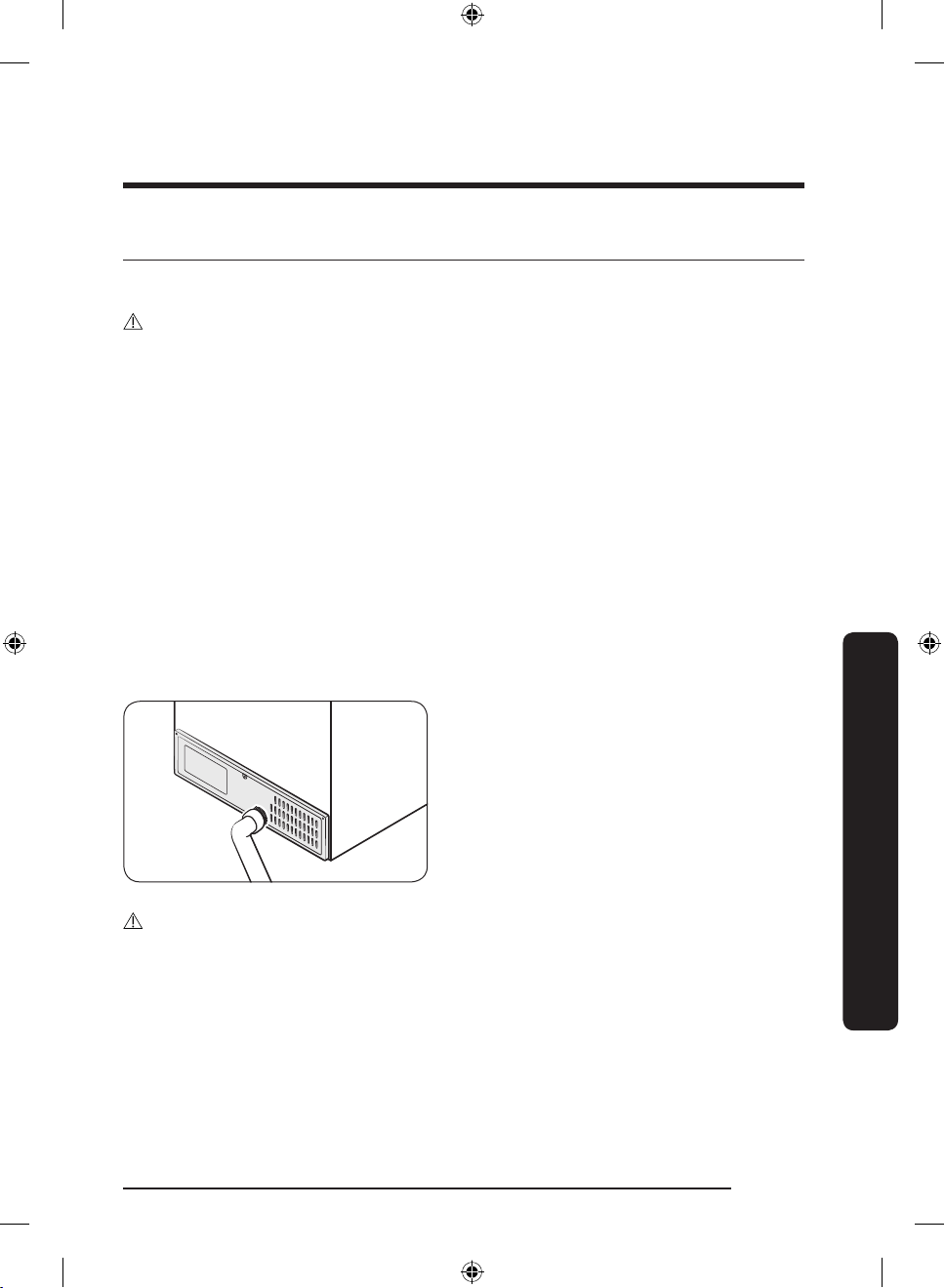
To keep cords and exposed parts of the
rear panel free of dirt, vacuum the panel
once or twice a year.
Maintenance
CAUTION
Do not remove the rear panel cover. Electric shock may occur.
English 59
Untitled-8 59 2020-12-17 1:53:02
Page 60
Maintenance
Replacement
LED Lamps
To replace the lamps of the refrigerator, contact a local Samsung service center.
WARNING
• The lamps are not user-serviceable. Do not attempt to replace a lamp yourself. This can
cause electric shock.
Maintenance
English60
Untitled-8 60 2020-12-17 1:53:02
Page 61
Troubleshooting
Before calling for service, review the checkpoints below. Any service calls regarding
normal situations (No Defect Cases) will be charged to users.
General
Temperature
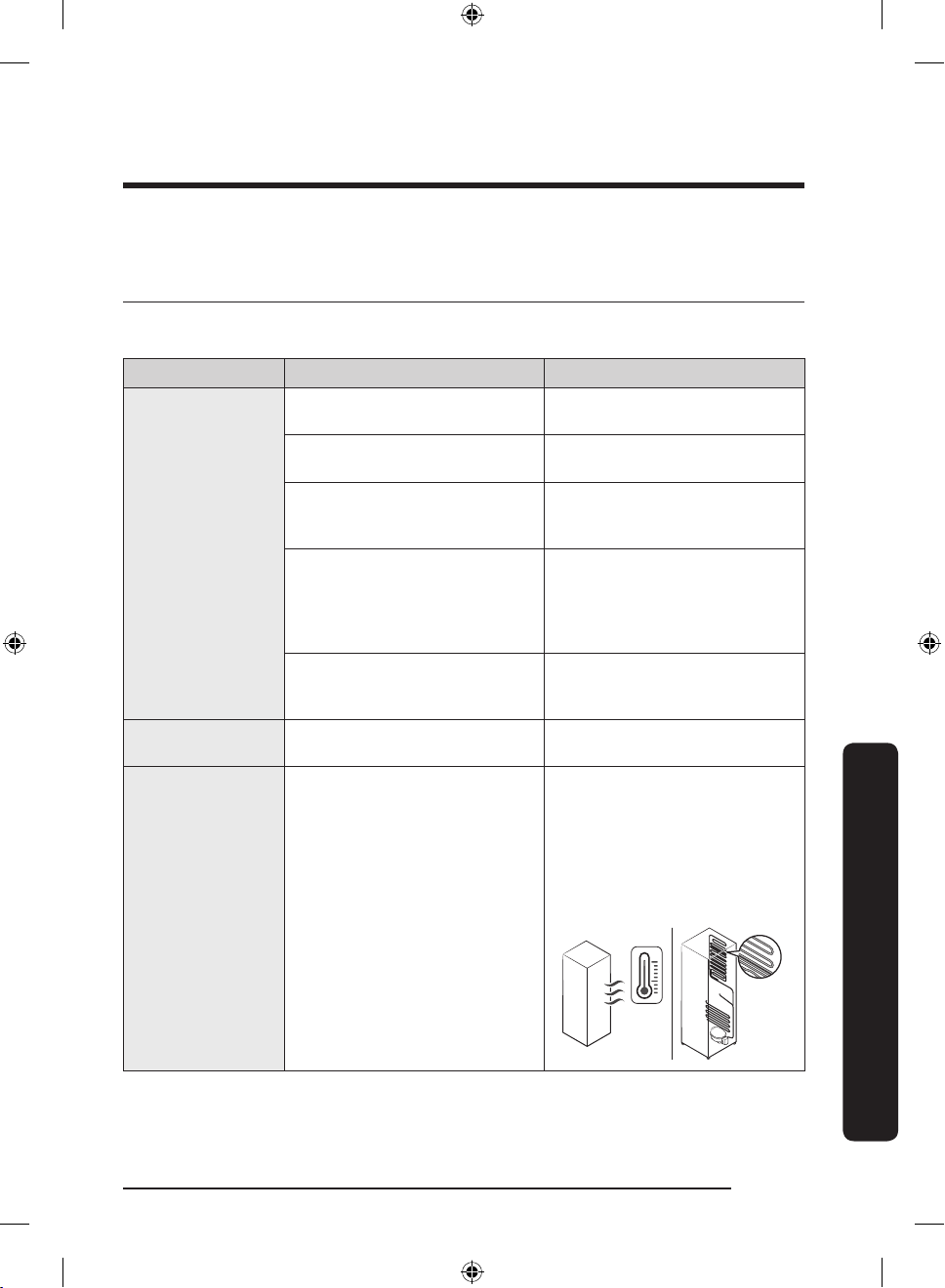
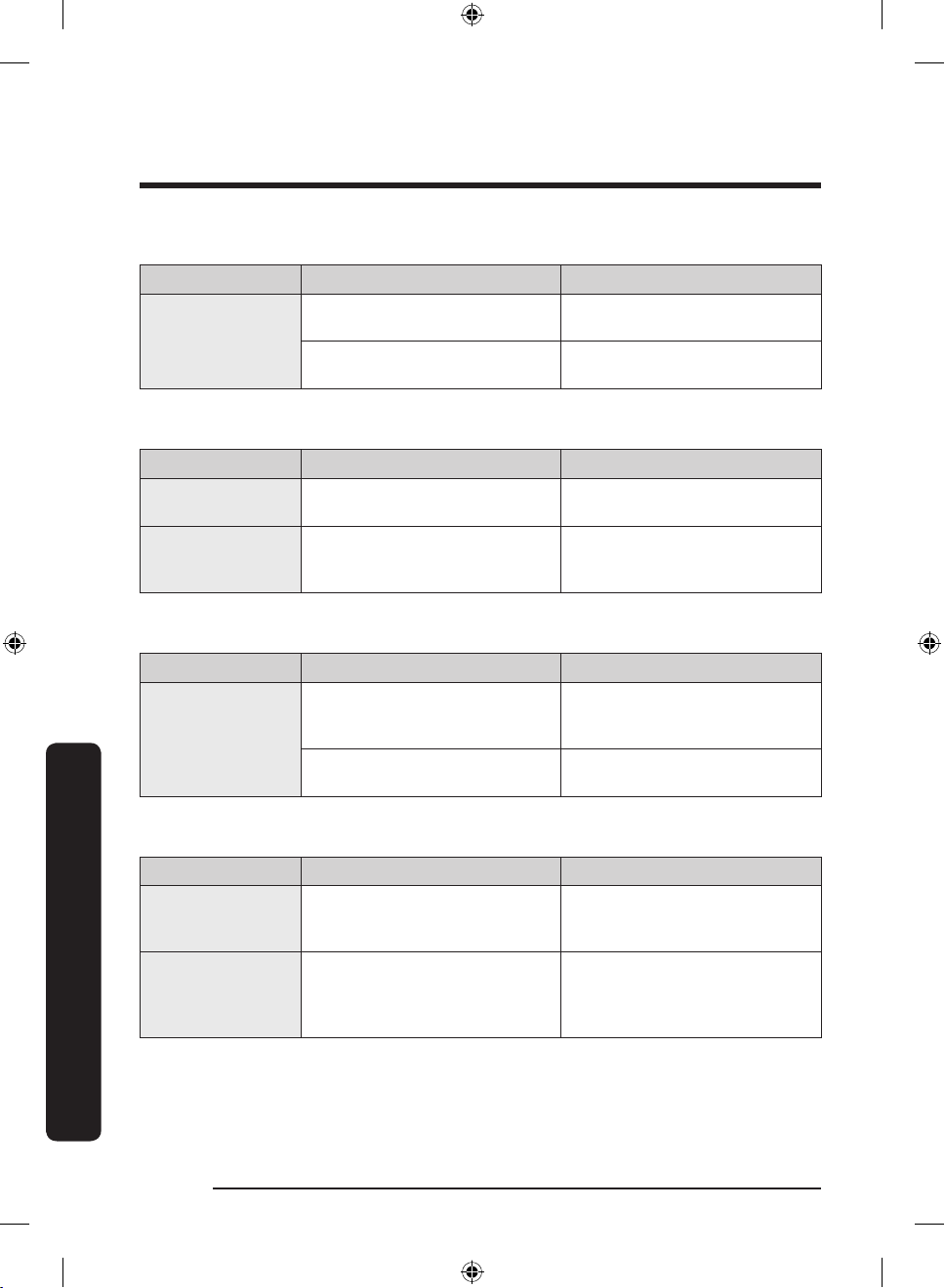
Symptom Possible causes Solution
Fridge/freezer
does not operate.
Fridge/freezer
temperature is
warm.
Fridge/freezer is
over-cooling.
Interior wall is hot.
• Power cord is not plugged in
properly.
• Temperature control is not
set correctly.
• Refrigerator is located near a
heat source or direct sunlight.
• Not enough clearance
between refrigerator and
nearby walls or cabinets.
• The refrigerator is
overloaded. Food is blocking
the refrigerator vents.
• Temperature control is not
set correctly.
• Refrigerator has heat-proof
piping in the interior wall.
• Properly plug in the power
cord.
• Set the temperature lower.
• Keep the refrigerator away
from direct sunlight or a heat
source.
• Make sure there is a gap of
at least 2.5 inches (5 cm)
between the refrigerator
back and sides and any
nearby walls or cabinets.
• Do not overload the
refrigerator. Do not allow
food to block vents.
• Set the temperature higher.
• To prevent condensation
from forming, the
refrigerator has heat-proof
piping in the front corners.
If the ambient temperature
rises, this equipment may not
work effectively. This is not a
system failure.
Troubleshooting
English 61
Untitled-8 61 2020-12-17 1:53:02
Page 62
Troubleshooting
Odors
Symptom Possible causes Solution
Refrigerator has
odors.
• Spoiled food.
• Food with strong odors.
Frost
Symptom Possible causes Solution
Frost around the
vents.
Frost on interior
walls.
• Food is blocking the vents.
• Door is not closed properly.
Condensation
Symptom Possible causes Solution
Condensation
forms on the
interior walls.
• If door is left open, moisture
enters the refrigerator.
• Food with high moisture
content.
• Clean the refrigerator and
remove any spoiled food.
• Make sure strong smelling
food is wrapped airtight.
• Make sure no food blocks the
refrigerator vents.
• Make sure food does not
block the door. Clean the
door gasket.
• Remove the moisture and
do not leave a door open for
extended periods of time.
• Make sure food is wrapped
airtight.
Water/ice (dispenser models only)
Troubleshooting
Untitled-8 62 2020-12-17 1:53:02
Symptom Possible causes Solution
Water ow is
weaker than
normal.
Ice maker makes a
buzzing sound.
English62
• Water pressure is too low.
• The Ice Maker function is
activated, but the water
supply to the refrigerator has
not been connected.
• Make sure the water pressure
is between 30 to 120 psi
(206 to 827 kPa).
• Press Ice Maker.
Page 63

Symptom Possible causes Solution
• You must wait for 12 hours
for the refrigerator to make
ice.
• Set the freezer temperature
below 0 °F (-18 °C) or -4 °F
(-20 °C) in warm ambient air.
• Deactivate dispenser panel
Lock.
Ice maker does not
make ice.
• Ice maker has just been
installed.
• Freezer temperature is too
high.
• Dispenser panel Lock is
activated.
• Ice maker is off. • Turn on the ice maker.
• Ice may jam if the ice
dispenser is not used for a
long time (approx. 3 weeks).
• Ice bucket is not properly
inserted.
• If you won't be using the
refrigerator for a long time,
empty the ice bucket and
turn off the ice maker.
• Make sure the ice bucket is
properly inserted.
• Check if the water line is
Ice does not
dispense.
installed correctly. Check if
the water line stop cock is
closed.
• Water line is not connected
properly or water supply is
not on.
English 63
Untitled-8 63 2020-12-17 1:53:02
Troubleshooting
Page 64

Troubleshooting
Symptom Possible causes Solution
• Check if the water line is
installed correctly. Check if
the water line stop cock is
closed.
• Water line is not connected
properly or water supply is
not on.
Water does not
dispense.
• Dispenser panel Lock is
activated.
• A third-party water lter was
installed.
• Water lter indicator turns
on or blinks.
• Deactivate dispenser panel
Lock.
• Use only Samsung-provided
or approved lters.
• Unapproved lters may leak
and damage the refrigerator.
• Replace the water lter. After
replacing, reset the lter
indicator sensor.
Troubleshooting
English64
Untitled-8 64 2020-12-17 1:53:02
Page 65
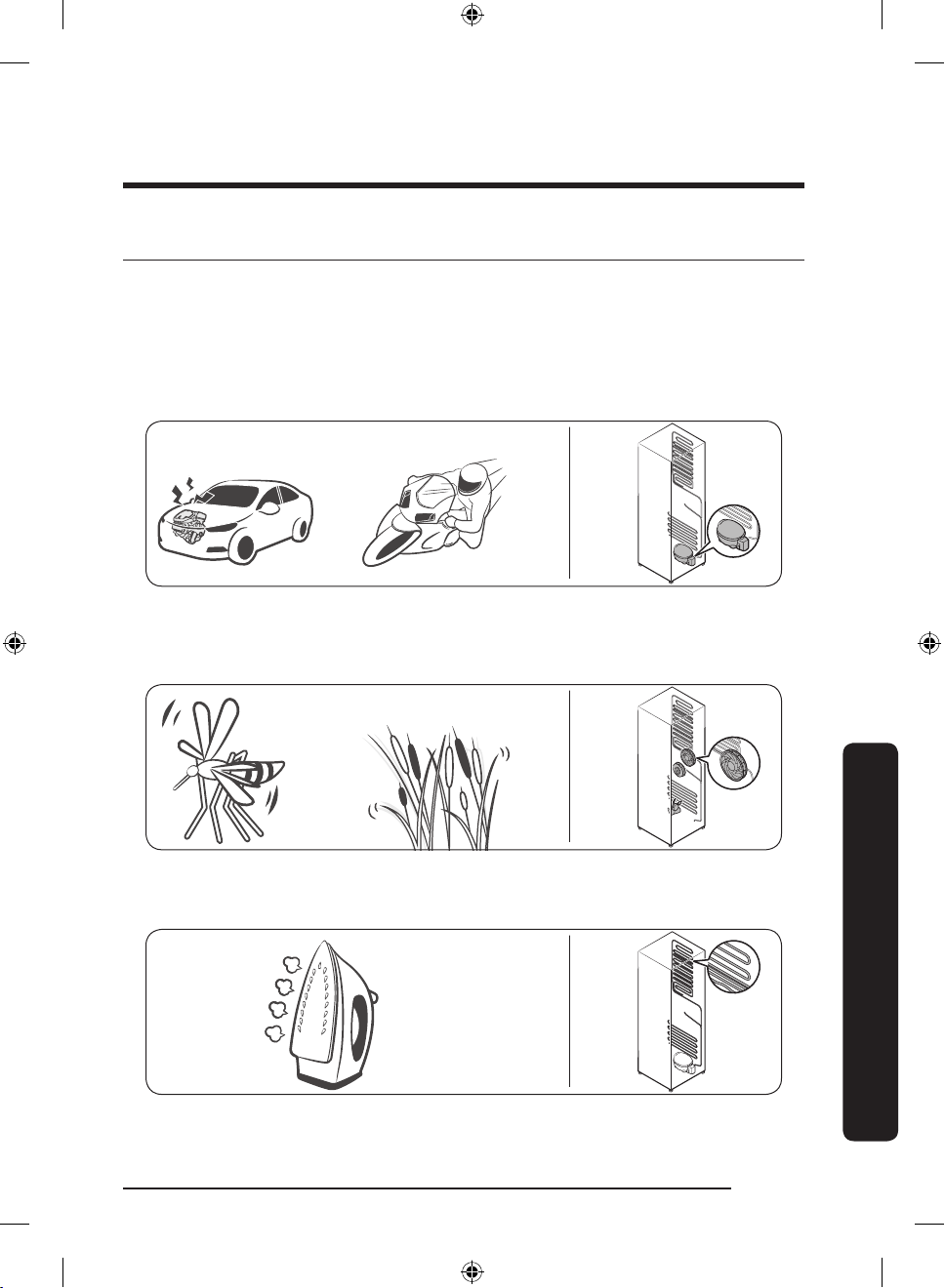
Do you hear abnormal sounds from the refrigerator?
Clicking!
or Chirping!
Buzzing!
SSSRRR!
Whir!
HiSS!
Before calling for service, review the checkpoints below. Any service calls related to
normal sounds will be charged to the user.
These sounds are normal.
• When starting or ending an operation, the refrigerator may make sounds similar to a
car engine igniting. As the operation stabilizes, the sounds will decrease.
• While the fan is operating, these sounds may occur. When the refrigerator reaches the
set temperature, no fan sound will occur.
• During a defrost cycle, water may drip on the defrost heater, causing sizzling sounds.
English 65
Untitled-8 65 2020-12-17 1:53:03
Troubleshooting
Page 66
Troubleshooting
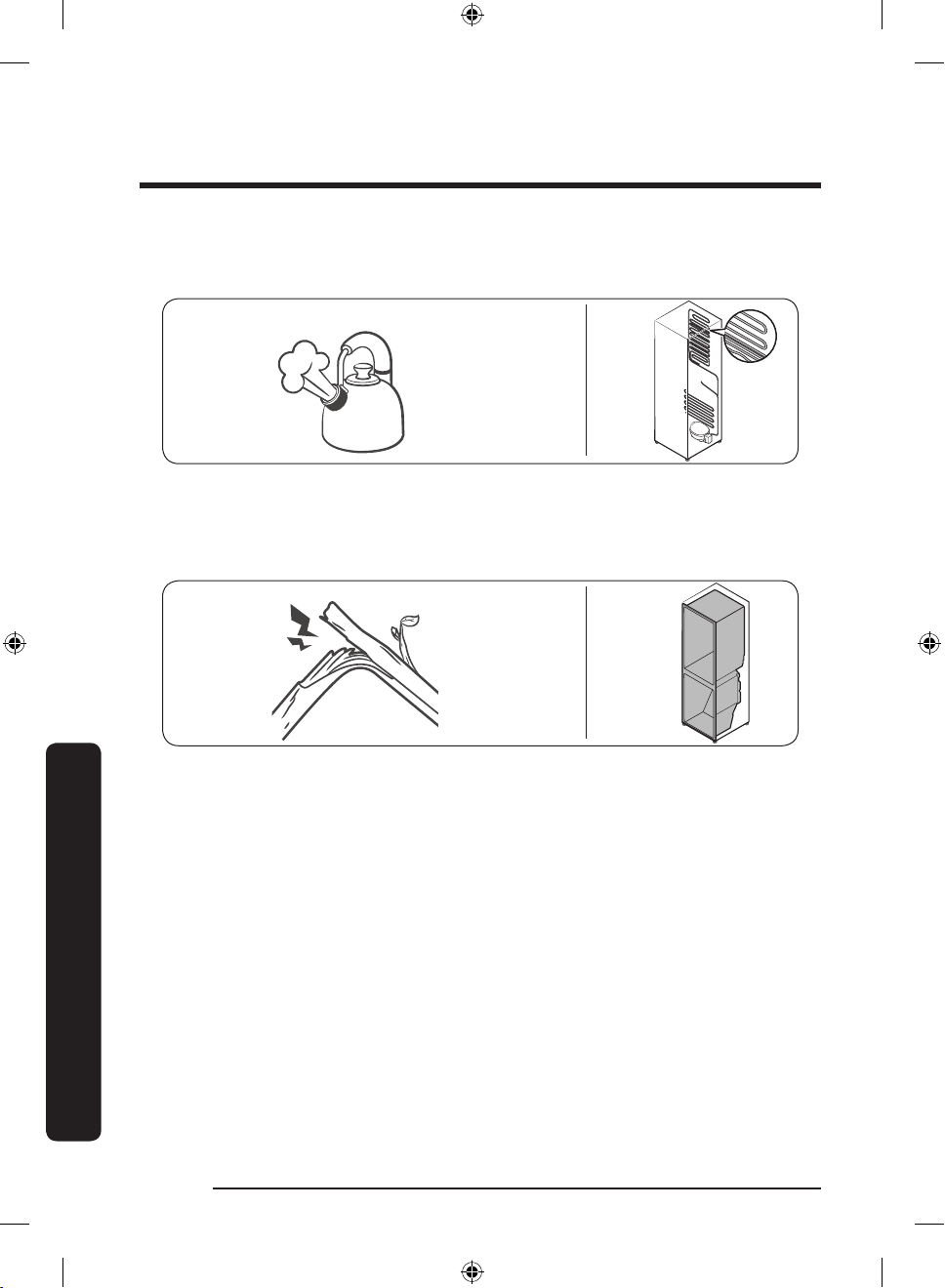
Bubbling!
Cracking!
• As the refrigerator cools or freezes, refrigerant gas moves through sealed pipes, causing
bubbling sounds.
• As the refrigerator temperature increases or decreases, plastic parts contract and
expand, creating knocking noises. These noises occur during the defrosting cycle or
when electronic parts are working.
• For ice maker models: When the water valve opens to ll the ice maker, buzzing sounds
may occur.
• Due to pressure equalizing when opening and closing the refrigerator door, whooshing
Troubleshooting
Untitled-8 66 2020-12-17 1:53:03
sounds may occur.
English66
Page 67
Appendix
Safety Instruction
• For the most efcient use of energy, please keep the all inner ttings such as baskets,
drawers, shelves and ice cube tray on the position supplied by manufacturer.
• This refrigerating appliance is not intended to be used as a built-in appliance.
Install Instruction
For refrigerating appliances with climate class
Depending on the climate class, This refrigerating appliance is intended to be used at
ambient temperatures range as specied following table.
The climate class can be found on the rating plate. The product may not operate properly
at temperatures outside of the specic range.
You can nd climate class on label inside of your refrigerator
Effective temperature range
The refrigerator is designed to operate normally in the temperature range specied by its
class rating.
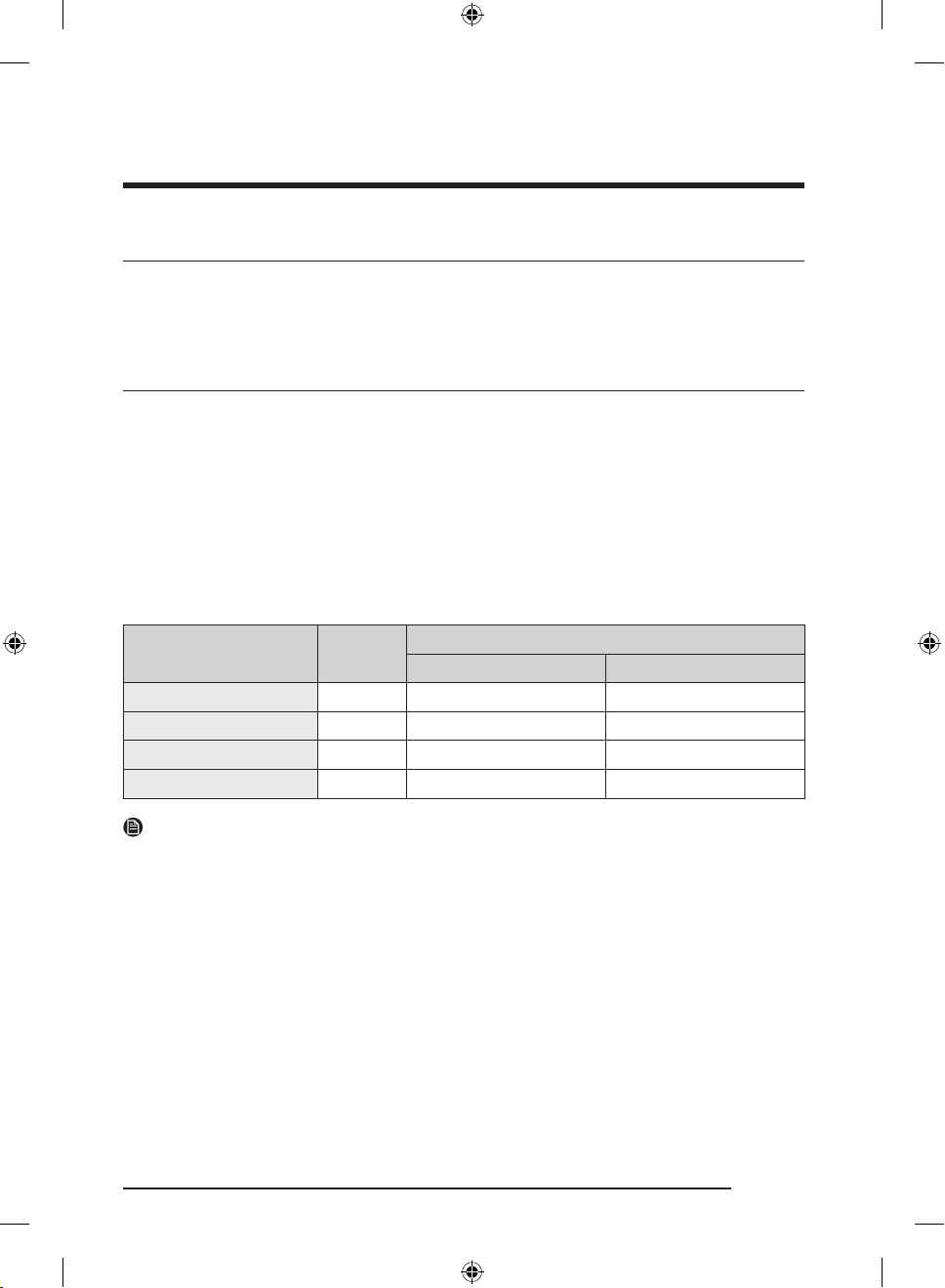
Class Symbol
Extended Temperate SN +10 to +32 +10 to +32
Temperate N +16 to +32 +16 to +32
Subtropical ST +16 to +38 +18 to +38
Tropical T +16 to +43 +18 to +43
NOTE
The cooling performance and power consumption of the refrigerator may be affected by
the ambient temperature, the door-opening frequency, and the location of the refrigerator.
We recommend adjusting the temperature settings as appropriate.
IEC 62552 (ISO 15502) ISO 8561
Ambient Temperature range (°C)
English 67
Untitled-8 67 2020-12-17 1:53:03
Page 68
Appendix
Temperature Instruction
Recommended Temperature
The optimal temperature setting for food storage:
• Fridge: 3 °C
• Freezer: -19 °C
NOTE
The optimal temperature setting of each compartment depends on the ambient
temperature. Above optimal temperature is based on the ambient temperature of 25 °C.
Power Cool
Power Cool speeds up the cooling process at maximum fan speed. The fridge keeps running
at full speed for two and a half hours and then returns to the previous temperature.
Power Freeze
Power Freeze speeds up the freezing process at maximum fan speed. The freezer keeps
running at full speed for 50 hours and then returns to the previous temperature. To freeze
large amounts of food, activate Power Freeze for at least 20 hours before putting food in
the freezer.
NOTE
When you use this function the energy consumption of the refrigerator will increase.
Remember to turn it off when you don’t need it and return the freezer to your original
temperature setting.
How to store for best preservation (applicable models only)
Cover foods to retain moisture and prevent them from picking up odors from other foods.
A large pot of food like soup or stew should be divided into small portions and put in
shallow containers before being refrigerated. A large cut of meat or whole poultry should
be divided into smaller pieces or placed in shallow containers before refrigerating.
Placement of Foods
Shelves
Specialized compartment
(applicable models only)
English68
Untitled-8 68 2020-12-17 1:53:03
Shelves should be adjustable to accommodate a variety of
packages.
Sealed crisper drawers provide an optimal storage
environment for fruits and vegetables. Vegetables require
higher humidity conditions while fruits require lower
humidity conditions.
Crispers are equipped with controls devices to control
the humidity level. (*Depending on model and options)
An adjustable temperature meat drawer maximizes the
storage time of meats and cheeses.
Page 69
Don’t store perishable foods in the door. Eggs should
be stored in the carton on a shelf. The temperature of
Stored on the door
the storage bins in the door uctuate more than the
temperature in the cabinet. Keep the door closed as much
as possible.
Freezer Compartment
You can store frozen food, make ice cubes and freeze fresh
food in the freezer compartment.
NOTE
Freeze fresh, undamaged food only. Keep food which is to be frozen away from food
which is already frozen. To prevent food from losing its avour or drying out, place in
airtight containers.
Refrigerator & Freezer Storage Chart
The freshness longevity depends on temperature and exposure to moisture. Since product
dates aren't a guide for safe use of a product, consult this chart and follow these tips.
Milk products
Product Refrigerator Freezer
Milk 1 week 1 month
Butter 2 weeks 12 months
Ice cream - 2-3 weeks
Natural cheese 1 month 4-6 months
Cream cheese 2 weeks Not recommended
Yogurt 1 month -
Meat
Product Refrigerator Freezer
Fresh roasts, steaks, chops 3-4 days 2-3 months
Fresh ground meat, stew
meat
1-2 days 3-4 months
Bacon 7 days 1 month
Sausage, Raw from pork,
beef, turkey
1-2 days 1-2 months
English 69
Untitled-8 69 2020-12-17 1:53:03
Page 70
Appendix
Poultry / Eggs
Product Refrigerator Freezer
Fresh poultry 2 days 6-8 months
Poultry salad 1 day -
Eggs, Fresh in shell 2-4 weeks Not recommended
Fish / Seafood
Product Refrigerator Freezer
Fresh sh 1-2 days 3-6 months
Cooked sh 3-4 days 1 month
Fish salad 1 day Not recommended
Dried or pickled sh 3-4 weeks -
Fruits
Product Refrigerator Freezer
Apples 1 month -
Peaches 2-3 weeks -
Pineapple 1 week -
Other fresh fruit 3-5 days 9-12 months
Vegetables
Product Refrigerator Freezer
Asparagus 2-3 days -
Broccoli, Brussels sprouts,
green peas, mushrooms
Cabbage, cauliower, celery,
cucumbers, lettuce
Carrots, beets, radishes 2 weeks -
English70
Untitled-8 70 2020-12-17 1:53:03
3-5 days -
1 week -
Page 71
Information for model and ordering spare parts
Model information
To access the EPREL registration of the model :
1. Go to https://eprel.ec.europa.eu
2. Get the model identier from the energy label of the product and type it in the search
box
3. Energy Labelling information of the model is shown
Part information
• The minimum period during which spare parts, necessary for the repair of the
appliance, are available
- 7 Years thermostats, temperature sensors, printed circuit boards and light sources,
door handles, door hinges, trays, baskets (boxes or drawers)
- 10 Years door gaskets
• The minimum duration of the guarantee of the refrigerating appliance offered by the
manufacturer 24 Months.
• Relevant information for ordering spare parts, directly or through other channels
provided by the manufacturer, importer or authorized representative
• You can nd professional repair information on http://samsung.com/support.
You can nd user servicing manual on http://samsung.com/support.
English 71
Untitled-8 71 2020-12-17 1:53:03
Page 72
Contact SAMSUNG WORLD WIDE
If you have any questions or comments relating to Samsung products, please contact the
SAMSUNG customer care center.
Country Contact Center Web Site
CYPRUS 8009 4000 only from landline, toll free
GREECE
ITALIA 800-SAMSUNG (800.7267864) www.samsung.com/it/support
PORTUGAL 808 207 267 www.samsung.com/pt/support
SPAIN 91 175 00 15 www.samsung.com/es/support
80111-SAMSUNG (80111 726 7864) only
(+30) 210 6897691 from mobile and land line
from land line
www.samsung.com/gr/support
DA68-04132K-01
Untitled-8 72 2020-12-17 1:53:04
Page 73
Frigorifero
Manuale dell'utente
Apparecchio a libera installazione
Untitled-11 1 2020-12-17 1:59:14
Page 74
Indice
Informazioni di sicurezza 3
Cosa è necessario sapere sulle istruzioni di sicurezza 3
Simboli di sicurezza e precauzioni importanti: 6
Importanti istruzioni di sicurezza 7
Simboli relativi a importanti avvertenze per il trasporto e il luogo di installazione 11
Indice
Avvertenze per installazioni critiche 12
Precauzioni per l'installazione 16
Importanti avvertenze per l'uso 16
Precauzioni per l'uso 21
Avvertenze per la pulizia 25
Importanti avvertenze per la pulizia 27
Ulteriori suggerimenti per un uso corretto 28
Istruzioni su WEEE 30
Installazione 31
Il frigorifero in breve 31
Passaggi di installazione 34
Funzionamento 50
Pannello principale 50
Impostare la temperatura o la funzione desiderata 52
Cambiare la scala della temperatura 53
Attivare o disattivare l'Ice maker 53
Attivare e disattivare la modalità Sabbath 53
Funzioni speciali 54
Manutenzione 57
Pulizia e manutenzione 57
Pulizia 61
Sostituzione 62
Risoluzione dei problemi 63
Generale 63
Si avvertono rumori anomali provenire dal frigorifero? 67
Appendice 69
Istruzioni di sicurezza 69
Istruzioni di installazione 69
Istruzioni sulla temperatura 70
Informazioni sul modello e l'ordinazione di parti di ricambio 73
Italiano2
Untitled-11 2 2020-12-17 1:59:14
Page 75
Informazioni di sicurezza
Prima di utilizzare il nuovo frigorifero Samsung, leggere completamente questo manuale in modo da
conoscerne le caratteristiche e le funzioni così da utilizzare l'apparecchio in modo sicuro ed efciente.
Cosa è necessario sapere sulle istruzioni di sicurezza
• Le avvertenze e le importanti istruzioni di sicurezza
riportate in questo manuale non coprono tutte le possibili
condizioni e situazioni che possono vericarsi.
E' responsabilità dell'utente utilizzare l'apparecchio con
buonsenso, prestando la massima attenzione e cura in fase
di installazione, manutenzione e funzionamento.
• Poiché le seguenti istruzioni operative coprono i vari
modelli disponibili, le caratteristiche del frigorifero
possono differire da quelle descritte in questo manuale e
non tutti i simboli di avvertenza possono essere applicabili.
In caso di dubbi o domande rivolgersi al centro assistenza
di zona o visitare il sito www.samsung.com per reperire le
informazioni necessarie.
• Come refrigerante vengono utilizzati i gas R-600a
o R-134a. Controllare l’etichetta del compressore
sul retro dell’apparecchio e l’etichetta della potenza
nominale all’interno del frigorifero per individuare il
tipo di refrigerante utilizzato. Se il prodotto contiene gas
inammabile (refrigerante R-600a), contattare l'ente locale
preposto per lo smaltimento sicuro di questo prodotto.
• Per evitare la possibile formazione di una miscela di aria
e gas inammabile, in caso di una perdita nel circuito
di raffreddamento, la dimensione del locale in cui viene
installato il prodotto deve essere adeguata alla quantità di
refrigerante utilizzato.
Informazioni di sicurezza
Italiano 3
Untitled-11 3 2020-12-17 1:59:14
Page 76
Informazioni di sicurezza
• Non attivare mai un apparecchio che mostri chiari segni
di danni. In caso di dubbi, consultare il rivenditore.
La dimensione del locale dovrebbe essere calcolata
considerando 1 m3 di spazio per ogni 8 g di refrigerante
R600a contenuto nell’apparecchio.
Informazioni di sicurezza
La quantità di refrigerante utilizzata nell'apparecchio è
indicata nella targhetta identicativa all'interno dell'unità.
• Eventuali schizzi di refrigerante fuoriuscito dalle tubazioni
possono provocare incendio o lesioni oculari. In caso di
perdita di refrigerante dalle tubazioni, evitare il contatto
del prodotto con amme libere o qualsiasi altra fonte
inammabile e ventilare immediatamente il locale.
- La mancata osservanza di questa precauzione può
causare un incendio o una esplosione.
• Al ne di evitare una contaminazione dei cibi, rispettare le
seguenti istruzioni:
- L'apertura per lunghi periodi di tempo della porta
può provocare un signicativo innalzamento della
temperatura interna.
- Pulire regolarmente la supercie interna che entra a
contatto con i cibi ed i sistemi di scolo accessibili.
- Pulire i serbatoi dell'acqua qualora non vengano
utilizzati per 48 ore; azionare i sistemi di erogazione
dell'acqua collegati alle tubazioni di mandata qualora
non vengano utilizzati per 5 giorni.
- Conservare la carne ed il pesce in idonei contenitori
all'interno del frigorifero, così che non possano colare
liquidi o possano entrare in contatto con altri cibi.
Italiano4
Untitled-11 4 2020-12-17 1:59:14
Page 77
- Gli scomparti a due stelle per il congelamento dei cibi
sono idonei alla conservazione di cibi pre-congelati, la
conservazione o produzione di gelati e la formazione o
conservazione di cubetti di ghiaccio.
- Gli scomparti a una, due o tre stelle non sono idonei per
il congelamento di cibi freschi.
- Se il frigorifero viene lasciato vuoto per lunghi periodi
di tempo, spegnerlo, scongelarlo, pulirlo ed asciugarlo
lasciando la porta aperta al ne di prevenire la
formazione di muffa al suo interno.
Informazioni di sicurezza
Italiano 5
Untitled-11 5 2020-12-17 1:59:14
Page 78
Informazioni di sicurezza
Simboli di sicurezza e precauzioni importanti:
Seguire le istruzioni per la sicurezza riportate in questo
manuale. Questo manuale utilizza la seguente simbologia di
sicurezza.
Informazioni di sicurezza
AVVERTENZA
Pericoli o pratiche non sicure che possono causare lesioni
personali gravi e/o danni alla proprietà, o causare la morte.
ATTENZIONE
Pericoli o pratiche non sicure che possono causare lesioni
personali gravi e/o danni alla proprietà.
NOTA
Informazioni utili che aiutano l'utente a comprendere o
beneciare dell'uso del frigorifero.
Questi simboli di avvertenza hanno lo scopo di prevenire
lesioni personali.
Seguire attentamente le istruzioni ad essi associate.
Una volta letto, si raccomanda di conservare il manuale in un
luogo sicuro per future consultazioni.
Italiano6
Untitled-11 6 2020-12-17 1:59:14
Page 79
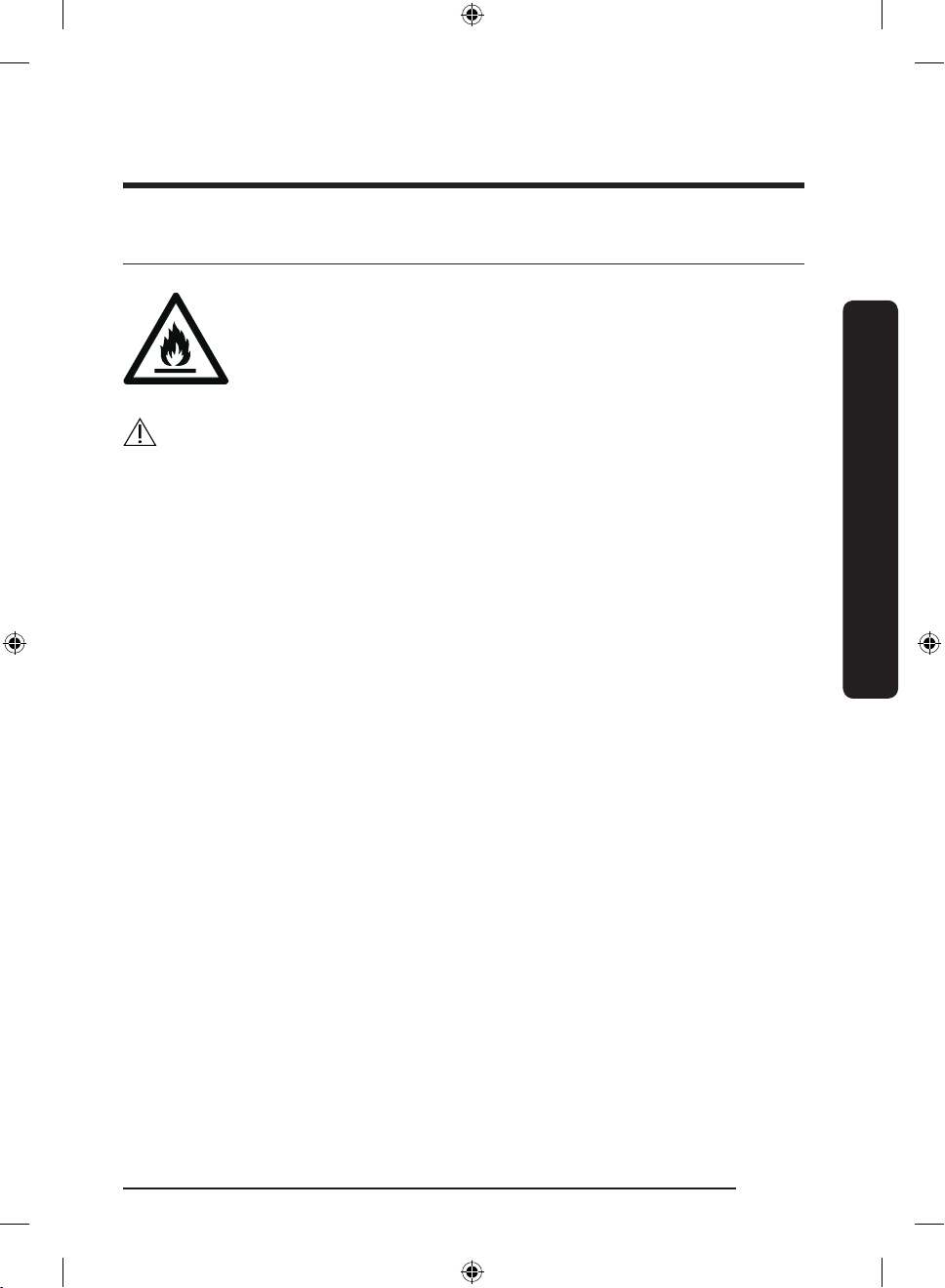
Importanti istruzioni di sicurezza
Avvertenza; Rischio di incendio / materiali
inammabili
AVVERTENZA
• Nel posizionare l'apparecchio, assicurarsi che il cavo di
alimentazione non sia impigliato o danneggiato.
• Non posizionare multiprese o alimentatori portatili sul
retro dell'apparecchio.
• Riempire solo con acqua potabile.
• Collegare solo alla tubazione dell'acqua potabile.
• Mantenere libere le aperture predisposte nella struttura
di montaggio o nel mobile a incasso per la ventilazione
dell'apparecchio.
• Per accelerare il processo di sbrinamento, non utilizzare
dispositivi meccanici o altri mezzi diversi da quelli
consigliati dal costruttore.
• Non danneggiare il circuito refrigerante.
• Non usare apparecchi elettrici all'interno dei comparti di
conservazione del cibo, a meno che non siano consigliati
dal costruttore.
Informazioni di sicurezza
Italiano 7
Untitled-11 7 2020-12-17 1:59:14
Page 80
Informazioni di sicurezza
• Questo apparecchio non è inteso per l’uso da parte di
persone (bambini inclusi) che abbiano ridotte capacità
siche, sensoriali o mentali, o siano prive di esperienza o
conoscenza, a meno che siano state fornite loro istruzioni
per l’uso da parte di una persona responsabile della loro
Informazioni di sicurezza
sicurezza o che sovrintenda all'uso dell'apparecchio.
• Questo apparecchio può essere utilizzato da bambini
di età superiore agli 8 anni e da persone con ridotte
capacità siche, sensoriali o mentali o senza esperienza o
conoscenza del prodotto solo sotto la supervisione di una
persona responsabile o nel caso in cui abbiano ricevuto
informazioni speciche sull'uso sicuro dell'apparecchio
e ne abbiano compreso i rischi ad esso associati. Non
consentire ai bambini di giocare con l'apparecchio. La
pulizia e la manutenzione dell'apparecchio non devono
essere eseguite da bambini senza la supervisione di un
adulto. L'inserimento e l'estrazione del cibo nel frigorifero è
consentito ai bambini tra i 3 e gli 8 anni.
• Se il cavo di alimentazione è danneggiato, richiederne la
sostituzione al produttore, a un tecnico dell'assistenza o un
tecnico specializzato al ne di evitare potenziali pericoli
• La presa deve essere sempre facilmente accessibile in
modo da poter rapidamente scollegare l'apparecchio dalla
corrente elettrica in caso di una emergenza.
- Deve essere situata al di fuori dell'area posteriore del
frigorifero.
• Non conservare sostanze potenzialmente esplosive, come
bombolette spray contenenti gas inammabili, all'interno
di questo apparecchio.
Italiano8
Untitled-11 8 2020-12-17 1:59:14
Page 81
• Se il prodotto è dotato di lampadine LED, non
disassemblare l'assieme coprilampada/lampada LED
autonomamente.
- Contattare un Centro di assistenza Samsung.
- Utilizzare solo lampade LED fornite dal costruttore o dal
centro assistenza.
• Utilizzare il nuovo set di tubi fornito in dotazione
eliminando il precedente set senza riutilizzarlo.
• Collegare la mandata dell'acqua solo ad una sorgente di
acqua potabile. Perché la macchine del ghiaccio funzioni
correttamente la pressione dell'acqua deve essere
compresa tra 206 e 861 kPa (30-125 psi).
• Per i migliori risultati in termini di efcienza energetica,
tenere tutti gli accessori interni quali cestelli, cassetti e
ripiani nella posizione indicata dal costruttore.
• Perché questo prodotto mantenga la migliore efcienza
energetica, lasciare tutti i ripiani, i cassetti e i cestelli nella
loro posizione originaria.
Informazioni di sicurezza
Come ridurre al minimo il consumo energetico
• Installare l'apparecchio in un luogo fresco, asciutto e dotato
di adeguata ventilazione.
• Accertarsi che non sia esposto a luce solare diretta e
non sia installato vicino a una fonte diretta di calore (un
calorifero, ad esempio).
- Si raccomanda di non ostruire le ventole e le griglie di
ventilazione per garantire l'efcienza energetica.
- Lasciare che il cibo caldo si raffreddi prima di riporlo
nell'apparecchio.
Italiano 9
Untitled-11 9 2020-12-17 1:59:14
Page 82
Informazioni di sicurezza
- Per scongelare i surgelati, collocarli in frigorifero. Le
basse temperature dei surgelati consentono inoltre
di rinfrescare ulteriormente gli alimenti presenti in
frigorifero.
- Nel riporre o estrarre gli alimenti, non tenere per molto
Informazioni di sicurezza
tempo la porta aperta.
- Minore è il tempo di apertura, minore è il ghiaccio che si
forma nel freezer.
- Pulire il retro del frigorifero regolarmente. La polvere
che si accumula aumenta il consumo di corrente.
- Non impostare una temperatura più bassa del
necessario.
- Garantire una ventilazione sufciente alla base e
sul retro del frigorifero. Non coprire le aperture di
ventilazione.
- Durante l’installazione, lasciare sufciente spazio sui
lati, sul retro e in alto per consentire la circolazione
dell’aria. Ciò consentirà di ridurre sia il consumo
energetico sia il costo della bolletta elettrica.
Questo apparecchio è progettato per un uso domestico o
applicazioni simili quali
- angoli cottura per il personale di punti vendita, ufci e
altri ambienti lavorativi;
- fattorie/aziende agricole e per l'uso dei clienti in hotel,
motel e altri ambiti residenziali;
- ambienti di tipo bed and breakfast;
- catering e applicazioni simili non-retail.
Italiano10
Untitled-11 10 2020-12-17 1:59:14
Page 83
Simboli relativi a importanti avvertenze per il trasporto e il luogo di installazione
AVVERTENZA
• Durante il trasporto e l’installazione dell’apparecchio,
prestare attenzione a non danneggiare alcuna parte del
circuito refrigerante.
- Una perdita di refrigerante dalla tubazione può
inammarsi o causare lesioni oculari. Se si rileva una
perdita, evitare l'uso di amme libere o potenziali fonti
di accensione nei pressi e aerare il locale per alcuni
minuti.
- Questo apparecchio contiene come refrigerante una
minima quantità di isobutano (R-600a), il quale,
nonostante sia un gas naturale a basso impatto
ambientale, è comunque combustibile. Durante il
trasporto e l’installazione dell’apparecchio, prestare
attenzione a non danneggiare alcuna parte del circuito
refrigerante.
• Durante il trasporto e l'installazione del frigorifero, non
toccare il tubo dell'acqua posizionato sul retro.
- Ciò potrebbe danneggiare il frigorifero e impedire l'uso
del dispenser dell'acqua.
Informazioni di sicurezza
Italiano 11
Untitled-11 11 2020-12-17 1:59:14
Page 84
Informazioni di sicurezza
Avvertenze per installazioni critiche
AVVERTENZA
• Non installare il frigorifero in un luogo umido o dove possa
entrare a contatto con acqua.
Informazioni di sicurezza
- L'usura del rivestimento isolante delle parti elettriche
può causare scariche elettriche o un incendio.
• Non collocare il frigorifero in una posizione esposta alla
luce solare diretta o al calore di stufe, radiatori o altri
apparecchi di riscaldamento.
• Non collegare più apparecchi a una presa multipla. Il
frigorifero deve essere sempre collegato a una presa
elettrica separata in grado di sostenere una tensione
corrispondente a quanto riportato sull’etichetta apposto sul
frigorifero.
- Ciò consente di ottenere le migliori prestazioni e
prevenire il sovraccarico dell'impianto domestico
che potrebbe causare un incendio a causa del
surriscaldamento dei cavi.
• Se la presa elettrica è allentata, non inserire la spina.
- Rischio di incendio o scariche elettriche.
• Non utilizzare un cavo con evidenti segni di usura o
abrasione lungo il rivestimento o alle estremità.
• Non piegare eccessivamente il cavo di alimentazione né
posizionarvi sopra oggetti pesanti.
• Non piegare o tirare eccessivamente il cavo di
alimentazione.
• Non torcere o annodare il cavo di alimentazione.
Italiano12
Untitled-11 12 2020-12-17 1:59:14
Page 85
• Non agganciare il cavo elettrico a oggetti metallici, non
collocarvi sopra oggetti pesanti, non far correre il cavo tra
oggetti, né spingere il cavo dietro l'apparecchio.
• Durante lo spostamento del frigorifero, prestare attenzione
a non schiacciare o danneggiare il cavo di alimentazione.
- Ciò può portare a scariche elettriche o un incendio.
• Non scollegare mai l'alimentazione dal frigorifero tirando
il cavo di alimentazione. Afferrare sempre la spina e tirarla
verso di sé per estrarla dalla presa.
- Un cavo danneggiato può causare un cortocircuito, un
incendio o una scarica elettrica.
• Non utilizzare spray nei pressi del frigorifero.
- L'uso di spray vicino al frigorifero può causare una
esplosione o un incendio.
• Non installare l'apparecchio vicino ad una fonte di calore o
materiale inammabile
• Non installare l'apparecchio in un locale in cui possa
vericarsi una perdita di gas.
- Ciò può portare a scariche elettriche o un incendio.
• Questo frigorifero deve essere posizionato correttamente
ed installato seguendo le istruzioni fornite in questo
manuale prima dell'uso.
• Collegare la spina inserendola nella posizione corretta con
il cavo rivolto verso il basso.
- Collegando la spina elettrica al contrario, il cavo
potrebbe danneggiarsi e causare scariche elettriche o
un incendio.
• Accertarsi che la spina non sia schiacciata o danneggiata
dal retro del frigorifero.
Informazioni di sicurezza
Italiano 13
Untitled-11 13 2020-12-17 1:59:14
Page 86
Informazioni di sicurezza
• Tenere i materiali di imballaggio lontano dalla portata dei
bambini.
- Sussiste il rischio di morte a causa di soffocamento
qualora un bambino inserisca la testa nei materiali da
imballaggio.
Informazioni di sicurezza
• Non installare l'apparecchio in un locale soggetto a umidità,
fumi d'olio o polvere, luce solare diretta o acqua (pioggia).
- L'usura del rivestimento isolante delle parti elettriche
può causare scariche elettriche o un incendio.
• Qualora si riscontri la presenza all'interno del frigorifero di
polvere o acqua, estrarre la spina dalla presa di corrente e
contattare un Centro di assistenza autorizzato Samsung.
- In caso contrario, potrebbe vericarsi un incendio.
• Non salire sul prodotto né appoggiarvi sopra oggetti
(biancheria, candele e sigarette accese, piatti, sostanze
chimiche, oggetti metallici, ecc.).
- Ciò può provocare scariche elettriche, un incendio o
problemi al prodotto o lesioni personali.
• Prima di collegare alla presa di corrente per la prima volta
il frigorifero è necessario rimuovere tutte le pellicole
protettive.
• Sorvegliare i bambini per accertarsi che non giochino con
le cerniere a scatto usate per regolare lo sportello o i fermi
del tubo dell'acqua.
- Qualora un anello di ritenuta o un fermo del tubo
dell'acqua venga ingerito da un bambino, potrebbe
soffocarlo. Tenere gli anelli di ritenuta ed i fermi del
tubo dell'acqua fuori dalla portata dei bambini.
Italiano14
Untitled-11 14 2020-12-17 1:59:15
Page 87
• Il frigorifero deve essere collegato alla terra.
- Accertarsi sempre che il frigorifero sia correttamente
collegato alla terra prima di tentare di riparare eventuali
malfunzionamenti. Eventuali dispersioni di corrente
possono provocare serie scariche elettriche.
• Per il collegamento a terra non utilizzare condotte del gas,
linee telefoniche o altri tubi e barre che potenzialmente
potrebbero fungere da parafulmini.
- Per evitare dispersioni di corrente o scariche elettriche
causate dalle dispersioni del frigorifero, collegare
l'apparecchio alla terra.
- La mancata osservanza di questa precauzione può
causare scariche elettriche, incendio, esplosione o
malfunzionamenti del prodotto.
• Inserire saldamente la spina nella presa di corrente. Non
usare prese di corrente o cavi di alimentazione danneggiati
o prese di corrente allentate.
- Ciò può portare a scariche elettriche o un incendio.
• Il fusibile del frigorifero deve essere sostituito da un
tecnico qualicato o da un centro assistenza autorizzato.
- Il mancato rispetto di questa precauzione può causare
scariche elettriche o lesioni personali.
Informazioni di sicurezza
Italiano 15
Untitled-11 15 2020-12-17 1:59:15
Page 88

Informazioni di sicurezza
Precauzioni per l'installazione
ATTENZIONE
• Lasciare sufciente spazio intorno al frigorifero ed
installarlo su una supercie piana e stabile.
Informazioni di sicurezza
- Se il frigorifero non è livellato, non è possibile garantire
una durata ed una efcienza nel raffreddamento.
• Lasciare riposare l'apparecchio per 2-3 ore dopo
l'installazione prima di inserire il cibo al suo interno ed
accenderlo.
• Si consiglia caldamente di far eseguire l'installazione del
frigorifero ad un tecnico qualicato.
- Il mancato rispetto di questa precauzione può
causare scariche elettriche, incendio, esplosione,
malfunzionamenti o lesioni.
Importanti avvertenze per l'uso
AVVERTENZA
• Non toccare la spina elettrica con le mani bagnate.
- La mancata osservanza di questa precauzione può
causare una scarica elettrica.
• Non collocare alcun oggetto sopra il frigorifero.
- Durante l’apertura o la chiusura della porta, un articolo
potrebbe cadere provocando lesioni o danni.
• Non inserire mani, piedi, oggetti metallici (per esempio
spiedini, ecc.) sul fondo o sul retro del frigorifero.
- La mancata osservanza di questa precauzione può
causare scariche elettriche o lesioni.
Italiano16
Untitled-11 16 2020-12-17 1:59:15
Page 89
- I bordi taglienti possono causare lesioni.
• Non toccare le pareti interne del freezer o i prodotti
surgelati con le mani bagnate.
- Ciò potrebbe causare il congelamento delle dita.
• Non conservare sul frigorifero contenitori pieni d'acqua.
- In caso di fuoriuscita, l'acqua potrebbe causare scariche
elettriche o un incendio.
• Non conservare all'interno del frigorifero oggetti
inammabili o sostanze volatili (benzene, diluenti, gas
propano, alcol, etere, GPL e sostanze simili).
- Il frigorifero è idoneo solo alla conservazione di
alimenti.
- La mancata osservanza di questa precauzione può
causare un incendio o una esplosione.
• Sorvegliare i bambini afnché non giochino con
l’apparecchio.
- Tenere le dita lontano dalle aree di "possibile
schiacciamento". Lo spazio tra le porte e la struttura
è necessariamente ristretto. Prestare attenzione
all'apertura delle porte in presenza di bambini.
• Non inserire le dita o lasciare che i bambini inseriscano le
dita tra le porte.
- Tenere le dita lontane dalle aperture delle porte sinistra
e destra. Prestare attenzione all'apertura delle porte
avendo inserito le dita tra le porte.
• Non permettere ai bambini di appendersi alle porte o
ai cassetti. In caso contrario, potrebbero riportare gravi
lesioni.
• Non permettere ai bambini di accedere al frigorifero.
Potrebbero restare intrappolati all'interno.
Informazioni di sicurezza
Italiano 17
Untitled-11 17 2020-12-17 1:59:15
Page 90
Informazioni di sicurezza
• Non inserire le mani nell'area inferiore sotto l'apparecchio.
- I bordi taglienti possono causare lesioni.
• Non conservare in frigorifero prodotti medicinali, materiale
scientico o prodotti sensibili alla temperatura.
- I prodotti che necessitano di severi controlli della
Informazioni di sicurezza
• Se si avverte un odore di medicinale o si nota del fumo
• Se all'interno del frigorifero è penetrata polvere o acqua,
• Non lasciare che i bambini salgano sui cassetti.
• Non lasciare le porte del frigorifero aperte senza
• Non lasciare che neonati o bambini penetrino all'interno
• Non riempire eccessivamente il frigorifero.
temperatura non devono essere conservati in
frigorifero.
uscire dall’apparecchio, staccare la spina dalla presa e
chiamare il Centro assistenza Samsung Electronics.
scollegare la spina dalla presa di corrente e rivolgersi al
centro assistenza Samsung Electronics.
- In caso contrario, potrebbe vericarsi un incendio.
- Il cassetto potrebbe rompersi e farli cadere.
sorveglianza e non permettere ai bambini di entrare
all'interno dell'apparecchio.
del vano frigo o dei cassetti.
- In caso contrario, potrebbero riportare lesioni o morire
per soffocamento.
- L'apertura dello sportello potrebbe provocare la caduta
di un prodotto causando lesioni personali o danni
materiali.
Italiano18
Untitled-11 18 2020-12-17 1:59:15
Page 91
• Non spruzzare sostanze volatili come per esempio
insetticidi sulla supercie dell'apparecchio.
- Oltre ad essere dannosi per l'uomo, possono causare
scariche elettriche, incendio o malfunzionamenti.
• Non inserire mai le dita o altri oggetti nel foro del
dispenser dell'acqua, nel comparto e nel foro di uscita del
ghiaccio.
- Ciò potrebbe causare lesioni personali o danni materiali.
• Non utilizzare né collocare sostanze sensibili alla
temperatura, come ad esempio spray e oggetti
inammabili, ghiaccio secco, farmaci o sostanze chimiche
vicino o dentro il frigorifero.
• Non utilizzare un asciugacapelli per asciugare l'interno del
frigorifero. Non inserirvi candele accese per eliminare i
cattivi odori.
- Ciò può portare a scariche elettriche o un incendio.
• Riempire il serbatoio dell'acqua, il vassoio del ghiaccio ed i
cubetti di ghiaccio solo con acqua potabile (acqua minerale
o puricata).
- Non riempire il serbatoio con tè, succhi di frutta o
bevande energetiche, in caso contrario il frigorifero
potrebbe subire danni.
• Non salire sul prodotto né appoggiarvi sopra oggetti
(biancheria, candele e sigarette accese, piatti, sostanze
chimiche, oggetti metallici, ecc.). Ciò può provocare
scariche elettriche, un incendio o problemi al prodotto
o lesioni personali. Non appoggiare sull'apparecchio
contenitori pieni di acqua.
- In caso di fuoriuscita, l'acqua potrebbe causare scariche
elettriche o un incendio.
Informazioni di sicurezza
Italiano 19
Untitled-11 19 2020-12-17 1:59:15
Page 92

Informazioni di sicurezza
• Non guardare direttamente la lampadina LED per un lungo
periodo di tempo.
- In caso contrario i raggi ultravioletti potrebbero causare
un affaticamento della vista.
• Non inserire i ripiani capovolti. I ne corsa dei ripiani non
Informazioni di sicurezza
funzionerebbero.
- Ciò potrebbe causare lesioni personali causate dalla
caduta dei ripiani in vetro.
• Tenere le dita lontano dalle aree di "possibile
schiacciamento". Lo spazio tra le porte e la struttura è
necessariamente ristretto. Prestare attenzione all'apertura
delle porte in presenza di bambini.
• Se si rileva una perdita di gas, evitare l'uso di amme
libere o potenziali fonti di accensione nei pressi e aerare il
locale per alcuni minuti.
- Non toccare né l'apparecchio né il cavo di alimentazione.
- Non utilizzare ventilatori o aspiratori elettrici.
- Una scintilla può causare una esplosione o un incendio.
• Riporre le bottiglie una vicina all'altra nel medesimo
scomparto in modo che non possano cadere all'apertura
della porta.
• Questo prodotto è inteso solo per la conservazione di
alimenti in ambito domestico.
• Non inserire mai le dita o altri oggetti nel foro del
dispenser dell'acqua, nel comparto e nel foro di uscita del
ghiaccio.
- Ciò potrebbe causare lesioni personali o danni materiali.
• Non tentare di riparare, disassemblare o modicare
l'apparecchio autonomamente.
Italiano20
Untitled-11 20 2020-12-17 1:59:15
Page 93
• Non utilizzare fusibili diversi (quali cavi di rame, acciaio,
ecc) diversi dai fusibili standard.
• Se l'apparecchio deve essere riparato o reinstallato,
rivolgersi al più vicino centro di assistenza.
- Il mancato rispetto di questa precauzione può causare
scariche elettriche, incendio, malfunzionamenti del
prodotto o lesioni.
• Qualora si avverta un odore di medicinale o si noti del
fumo uscire dall’apparecchio, staccare la spina dalla presa e
chiamare un Centro di assistenza Samsung Electronics.
- Il mancato rispetto di questa precauzione può causare
scariche elettriche o un incendio.
• Prima di sostituire le lampadine interne del frigorifero,
scollegare l'apparecchio dalla presa elettrica.
- In caso contrario, vi è il rischio di scariche elettriche.
• In caso di difcoltà nella sostituzione di una lampadina non
a LED, rivolgersi ad un Centro di assistenza Samsung.
• Inserire saldamente la spina nella presa di corrente.
• Non utilizzare spine, prese di corrente o cavi di
alimentazione danneggiati.
- Ciò può portare a scariche elettriche o un incendio.
Informazioni di sicurezza
Precauzioni per l'uso
ATTENZIONE
• Non congelare di nuovo il cibo già scongelato.
- I cibi congelati e poi scongelati sviluppano batteri nocivi
più velocemente dei cibi freschi.
Italiano 21
Untitled-11 21 2020-12-17 1:59:15
Page 94
Informazioni di sicurezza
- Il secondo congelamento romperebbe una maggiore
quantità di cellule, lasciando fuoriuscire liquidi ed
alterando l'integrità dei prodotti.
• Non scongelare la carne a temperatura ambiente.
- La sicurezza dipenderà da quanto il prodotto all'origine
Informazioni di sicurezza
• Non collocare bicchieri, bottiglie o bevande gassate nel
• Usare solo l'ice maker fornito insieme al frigorifero.
• In caso di una prolungata assenza da casa (ad esempio
• In caso di un prolungato inutilizzo del frigorifero (3 o più
• Per ottenere le migliori prestazioni dal prodotto:
sia stato trattato correttamente.
freezer.
- Questi contenitori potrebbero congelarsi e rompersi,
provocando lesioni.
in vacanza) e qualora non si desideri usare il dispenser
dell'acqua o del ghiaccio, chiudere la valvola di mandata
dell'acqua.
- In caso contrario potrebbero vericarsi perdite d'acqua.
settimane) vuotarlo, compreso la vaschetta di raccolta del
ghiaccio, scollegarlo dalla presa di corrente, chiudere la
valvola di mandata dell'acqua, asciugare l'umidità residua
dalle pareti interne del frigorifero e lasciare le porte aperte
al ne di prevenire eventuali odori e muffa.
- Non collocare alimenti davanti alle aperture di
ventilazione sul retro del frigorifero per evitare
di ostruire la circolazione dell'aria all'interno del
frigorifero.
- Avvolgere i cibi adeguatamente o riporli in contenitori
sottovuoto prima di conservarli nel frigorifero.
Italiano22
Untitled-11 22 2020-12-17 1:59:15
Page 95
- Rispettare i tempi di conservazione massimi e le date di
scadenza degli alimenti congelati.
- Non è necessario scollegare il frigorifero dalla presa di
corrente se si prevede di non utilizzare l’apparecchio
per meno di tre settimane. Qualora l'assenza sia
maggiore di tre settimane, rimuovere tutto il cibo
ed il ghiaccio dalla vaschetta di raccolta, scollegarlo
dalla presa di corrente, chiudere la valvola di mandata
dell'acqua, asciugare l'umidità residua dalle pareti
interne del frigorifero e lasciare le porte aperte al ne
di prevenire eventuali odori e muffa.
• Garanzia di assistenza e modiche.
- Eventuali modiche eseguite da terzi su questo
apparecchio non saranno coperte dalla garanzia
Samsung, inoltre Samsung non potrà essere ritenuta
responsabile per problemi di sicurezza e danni risultanti
da modiche eseguite da terzi.
• Non ostruire le aperture di ventilazione situate all'interno
del frigorifero.
- Se le aperture di ventilazione sono ostruite, per
esempio da un sacchetto di plastica, il frigorifero
potrebbe raffreddarsi eccessivamente. Se il periodo
di raffreddamento è troppo lungo, il ltro dell'acqua
potrebbe rompersi e causare una perdita d'acqua.
• Usare solo l'ice maker fornito insieme al frigorifero.
• Asciugare all'interno l'umidità in eccesso e lasciare le porte
aperte.
- In caso contrario, all'interno possono svilupparsi cattivi
odori e muffe.
Informazioni di sicurezza
Italiano 23
Untitled-11 23 2020-12-17 1:59:15
Page 96
Informazioni di sicurezza
• Se il frigorifero viene scollegato dalla presa elettrica,
attendere almeno cinque minuti prima di collegarlo
nuovamente.
• Se il frigorifero entra a contatto con l'acqua, scollegare la
spina di alimentazione dalla presa di corrente e contattare
Informazioni di sicurezza
il centro assistenza Samsung Electronics.
• Non urtare o applicare una forza eccessiva sulle superci
in vetro.
- La rottura del vetro può provocare lesioni personali e/o
danni alla proprietà.
• Riempire il serbatoio dell'acqua e le vaschette dei cubetti di
ghiaccio con acqua potabile (acqua dall'acquedotto, acqua
minerale o puricata).
- Non riempire il serbatoio con tè o bevande sportive. Ciò
potrebbe danneggiare il frigorifero.
• Prestare attenzione a non schiacciarsi le dita.
• Se sull'apparecchio è stata versata dell'acqua, contattare il
più vicino centro di assistenza.
- Sussiste il rischio di incendio o di scariche elettriche.
• Non conservare olii vegetali nei balconcini della porta del
frigorifero. L'olio potrebbe solidicarsi ed il suo sapore ne
risulterebbe alterato, rendendo l'olio difcile da utilizzare.
Inoltre, il contenitore aperto potrebbe perdere, nel qual
caso l'olio fuoriuscito potrebbe, solidicandosi, provocare
la rottura del balconcino. Una volta aperto il contenitore
dell'olio, si consiglia di conservarlo in un luogo fresco e
al riparo dalla luce, quale ad esempio una credenza o un
ripostiglio.
- Esempi di olii vegetali: olio di oliva, di semi, vinacciolo,
ecc.
Italiano24
Untitled-11 24 2020-12-17 1:59:15
Page 97
Avvertenze per la pulizia
ATTENZIONE
• Non spruzzare acqua direttamente sull'interno o l'esterno
del frigorifero.
- Pericolo di scariche elettriche o incendi.
• Non utilizzare un asciugacapelli per asciugare l'interno del
frigorifero.
• Non collocarvi candele accese per eliminare i cattivi odori.
- Ciò può portare a scariche elettriche o un incendio.
• Non spruzzare prodotti per la pulizia direttamente sul
display.
- Le lettere stampate sul display potrebbero non essere
più visibili.
• Se sostanze estranee, per esempio acqua, penetrano
all'interno dell'apparecchio, scollegare la spina di
alimentazione e rivolgersi al più vicino centro di
assistenza.
- Il mancato rispetto di questa precauzione può causare
scariche elettriche o un incendio.
• Usare un panno morbido e pulito per rimuovere eventuali
sostanze estranee o polvere dai contatti della spina del
cavo di alimentazione. Non utilizzare un panno bagnato o
umido durante la pulizia della presa.
- In caso contrario, sussiste il pericolo di scariche
elettriche o incendi.
• Non pulire l'apparecchio spruzzandovi direttamente sopra
acqua.
Informazioni di sicurezza
Italiano 25
Untitled-11 25 2020-12-17 1:59:15
Page 98
Informazioni di sicurezza
• Non usare benzene, diluenti o prodotti per la pulizia quali
Clorox o a base di cloruro.
- L'uso di questi prodotti potrebbe danneggiare la
supercie dell'apparecchio e causare un incendio.
• Non inserire mai le dita o altri oggetti nel foro del
Informazioni di sicurezza
dispenser.
- Ciò potrebbe causare lesioni personali o danni materiali.
• Prima di eseguire la pulizia o la manutenzione
dell'apparecchio, scollegare la spina dalla presa di corrente.
- Il mancato rispetto di questa precauzione può causare
scariche elettriche o un incendio.
• Per pulire il frigorifero usare una spugna pulita o un panno
morbido ed un detergente non aggressivo in acqua calda.
• Non usare detergenti abrasivi o aggressivi quali detergenti
per vetri, pagliette abrasive, liquidi inammabili, acido
muriatico, pasta abrasiva, detersivi concentrati, candeggina
o detergenti contenenti petrolio sulla supercie esterna
(porte e carrozzeria), parti in plastica, porte e rivestimenti
interni, e cestelli.
- Tali prodotti possono infatti grafare o danneggiare i
materiali.
• Non pulire i ripiani di vetro o coperchi con acqua calda
quando sono freddi. I coperchi ed i ripiani di vetro possono
rompersi se esposti ad un repentino cambiamento di
temperatura, urtati o lasciati cadere.
Italiano26
Untitled-11 26 2020-12-17 1:59:15
Page 99
Importanti avvertenze per la pulizia
AVVERTENZA
• Si raccomanda di smaltire e riciclare i materiali di
imballaggio di questo prodotto secondo quanto previsto
dalle norme vigenti.
• Vericare l'integrità delle tubazioni sul retro
dell’apparecchio prima di smaltirlo.
• Come refrigerante vengono utilizzati i gas R-600a
o R-134a. Controllare l’etichetta del compressore
sul retro dell’apparecchio e l’etichetta della potenza
nominale all’interno del frigorifero per individuare il
tipo di refrigerante utilizzato. Se il prodotto contiene gas
inammabile (refrigerante R-600a), contattare l'ente locale
preposto per lo smaltimento sicuro di questo prodotto.
• Per lo smaltimento di questo prodotto o di altri frigoriferi,
rimuovere le porte, le guarnizioni e le chiusure delle porte
in modo che bambini o animali non possano rimanere
intrappolati all'interno. Sorvegliare i bambini afnché
non giochino con l’apparecchio. Se i bambini rimangono
intrappolati all'interno dell'apparecchio, possono morire per
soffocamento.
- Se un bambino, giocando, rimane intrappolato
all’interno dell'apparecchio potrebbe ferirsi e morire per
soffocamento.
• L'isolante utilizzato è il ciclopentano. I gas contenuti
nel materiale isolante richiedono speciali procedure di
smaltimento. Contattare l'autorità locale competente per
informazioni sul corretto smaltimento di questo prodotto.
Informazioni di sicurezza
Italiano 27
Untitled-11 27 2020-12-17 1:59:15
Page 100
Informazioni di sicurezza
• Tenere tutti i materiali di imballaggio lontano dalla portata
dei bambini, poiché possono essere pericolosi.
- Qualora un bambino inserisca la testa in uno di essi,
potrebbe soffocare.
Informazioni di sicurezza
Ulteriori suggerimenti per un uso corretto
• In caso di interruzione di corrente, chiamare la compagnia
elettrica locale e chiedere il tempo previsto per il ripristino
dell’elettricità.
- La maggior parte delle interruzioni elettriche
ripristinate in una o due ore non hanno alcuna inuenza
sulla temperatura interna del frigorifero. Tuttavia,
durante l'interruzione di corrente limitare al minimo
l'apertura del frigorifero.
- Se l'interruzione di corrente si protrae per oltre 24 ore,
rimuovere tutti i surgelati dal freezer.
• Il frigorifero potrebbe funzionare in modo costante (i cibi
surgelati possono sciogliersi o le temperature del reparto
dei surgelati possono innalzarsi troppo) se posizionato
a lungo in un luogo dove la temperatura dell'aria è
costantemente inferiore alle temperature operative per le
quali il frigorifero è stato progettato.
• La conservazione in frigorifero di alcuni alimenti particolari
può comportarne un deterioramento a causa delle loro
proprietà intrinseche.
Italiano28
Untitled-11 28 2020-12-17 1:59:15
 Loading...