

Page 1
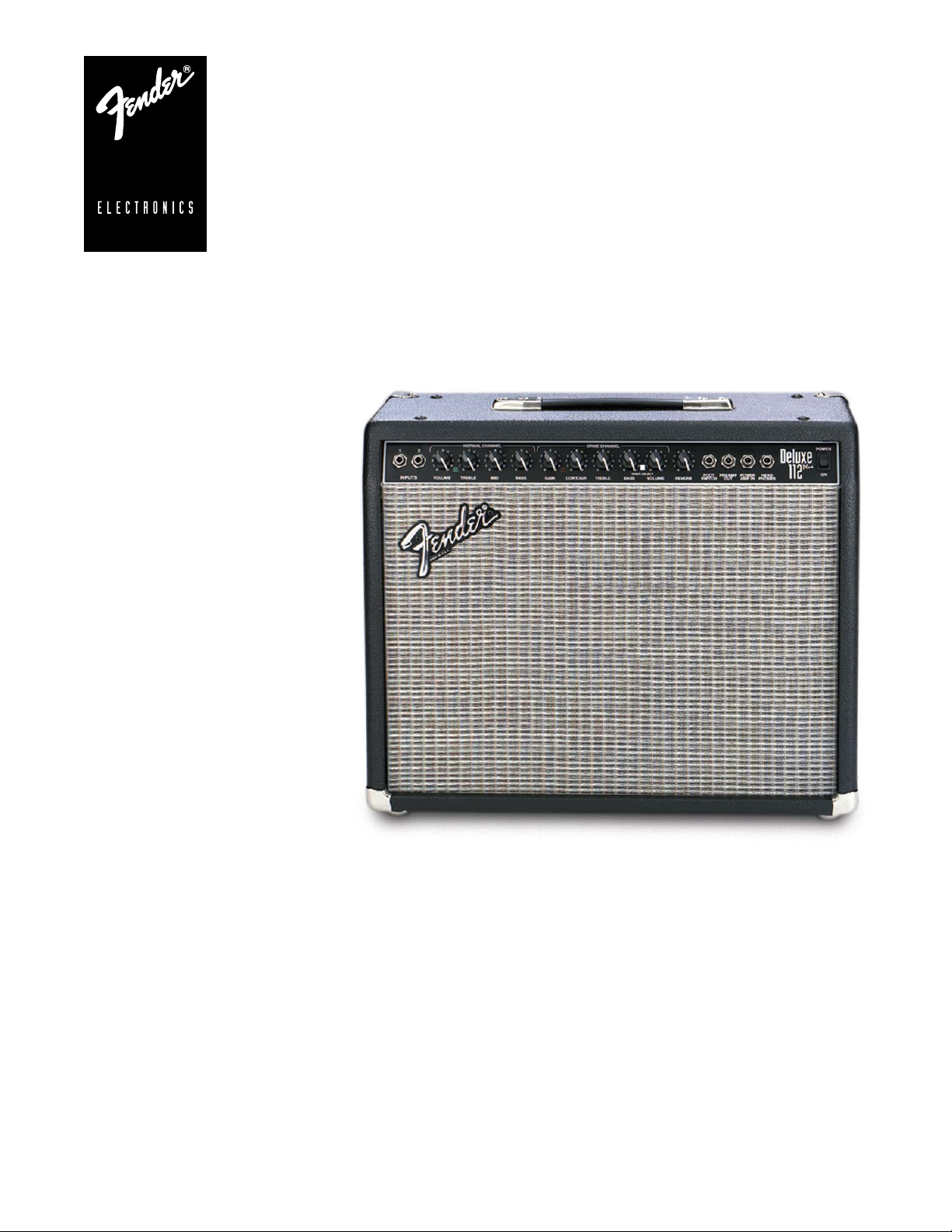
DELUXE 112 PLUS
p/n 022-6702-000 (120V)
SERVICE MANUAL
CONTENTS:
Notices
Specifications
Theory of operation
Parts lists:
PCB assembly
Chassis assembly
Footswitch assembly
Cabinet assembly
Miscellaneous
Schematics/diagrams
Fender Musical Instruments Corp. 7975 North Hayden Road Scottsdale, AZ 85258
Page 2

DELUXE 112 PLUS
(This is the model name for warranty claims)
SERVICE MANUAL
APRIL 1995 REV A
IMPORTANT NOTICE:
The information contained herein is CONFIDENTIAL and PROPRIETARY to Fender Musical Instruments Corp. It is
disclosed solely for use by qualified technicians for purposes of equipment maintenance and service. It is not to be
disclosed to others without the expressed permission of Fender Musical Instruments Co. All specifications subject to
change without notice.
For warranty repair service, only Fender specified part numbers are to be used. It is recommended they also be used
for post-warranty maintenance and repair.
Parts marked with an asterisk (
and SAFETY requirements. DO NOT USE A SUBSTITUTE!
A coded naming convention is used in the description of certain parts. The codes and what they mean are as follows:
CAPACITOR CODES HARDWARE CODES
CAP AE = Aluminum Electrolytic BLX = Black Oxide
CAP CA = Ceramic Axial CR = Chrome Plated
CAP CD = Ceramic Disk HWH = Hex Washer Head
CAP MPF = Metalized Polyester Film M = Machine Screw
CAP MY = Mylar NI = Nickel Plated
CAP PFF = Polyester Film/Foil OHP = Oval Head Phillips
RESISTOR CODES
RES CC = Carbon Comp SMA = Sheet Metal "A" Point
RES CF = Carbon Film SMB = Sheet Metal "B" Point
RES FP = Flame Proof SS = Stainless Steel
RES MF = Metal Film TF = Thread Forming
RES WW = Wire Wound ZI = Zinc Plated
*
) indicate the required use of that specific part. This is necessary for RELIABILITY
PB = Particle Board
PHP = Pan Head Phillips
PHPS = Pan Head Phillips Sems
Page 3

DELUXE 112 PLUS
SPECIFICATIONS
Product Release No.: PR 291 (This is not a model number)
Part Number: 120V Version : 22-6702
100V : 22-6772
230V : 22-6762
Power Requirements: 180-120VAC, 50-60 Hz, 360W max.
230-240VAC, 50 Hz, 360w max.
Input impedance: Input 1: 850kΩ
Input 2: 66kΩ
Power output: 94 watts RMS into 4Ω at 5% THD
Effects Loop: Preamp Output Impedance: 1kΩ
Power Amp Input Impedance: 44kΩ
Power Amp Sensitivity: 1.0V for Clipping
Dimensions: Height:16 1/2" (41.9 cm)
Width: 20 5/8" (50.5 cm)
Depth: 9" (22.9 cm)
Weight: 33 lbs. (14.9 kg)
Product specifications are subject to change without notice
Page 4

DELUXE 112 PLUS
THEORY OF OPERATION
Input 1 is a high sensitivity input. Input 2 is a low sensitivity input. Inputs 1 and 2 contain series switches
that connect to +16Vdc via a third series switch located within the Power Amp in jack (J5). From the input
jacks, this series circuit terminates at the gate of JFET Q7. Q7 is part of a muting /turn on delay circuit for
the input of the power amp. Therefore the input signal to the power amp will remain muted until a plug is
inserted into either Input 1,2 or the Power Amp in jack.
The first stage (U2A) sets up the initial response of the amplifier. It provides a second order high pass filter
with a 3dB down point at 60Hz, and a gain of about 3.8. The output of U2A splits to feed the clean and
overdrive channel. For the clean channel, the signal feeds the Treble, Bass and Mid controls that provide
boost and cut respectively. The signal then flows to U7A. U7A is a buffer for the adjustable high pass filter
made up by C59, C60, R108 and R109. The inverted signal at U5A is sensed through R109 and fed back
to the junction of C59 and C60. As the Volume control is turned up, the feedback from R109 provides
–6dB of attenuation at 30Hz. This prevents the speaker from flapping at very low frequencies. U2B is an
Auto-pad circuit. It provides excellent headroom and low noise.
The signal split from U1A feeds the overdrive channel through a special tone shaping circuit located just
prior to U2A. This circuit is a third order bandpass filter with a peak boost at 2.2kHz. It provides the
optimum frequency response for the following distortion circuit. U2A provides the variable gain adjustment
that drives the distortion circuit. It also acts as a bandpass filter with 3dB down points at 90Hz and 4kHz.
U2B is the distortion circuit. LD1 and LD2 provide diode distortion.
The Contour control adjusts the overall tone quality of the overdrive channel by emphasizing or notching
the mid range frequencies. In the fully CCW position the response is fairly flat up to about 2kHz, where a
gentle roll-off occurs. In the fully CW position, the circuit provides a –20db notch at about 1kHz. The
signal then feeds the overdrive volume control and the treble and bass controls.
The signal from the Clean and Drive channels sum at U5A via JFETs Q4 and Q5. The output from U5A
feeds the reverb drive circuit (U6A) and summing amp U5B. U6B is the reverb sensing circuit. The output
of U6B drives the Reverb volume control and then sums with the dry signal at U5B. The output of U5B
drives the preamp out jack, is normalled through the power amp in jack, and feeds the power amp input.
CHANNEL SWITCHING
The AC voltage from the power transformer secondary is tapped off through resistor R82, and presented to
the footswitch jack (Approx 20 V RMS). By rectifying the positive or negative side of the waveform, we
create a DC control voltage that is sensed by comparators U4A and U4B. Diode’s CR20 and CR21 set up
the reference voltages for the comparators. Therefore the control voltage must toggle between +15Vdc
and –15Vdc. The comparator output controls the JFETs and the indicator LEDs. Without the footswitch
connected to the footswitch jack, CR15 rectifies the negative half of the waveform. U4B senses the DC
control voltage, and provides –15Vdc to the gate of Q6, allowing the reverb output to function.
POWER AMP
U1 is a high voltage op-amp that provides voltage gain for the power amplifier. CR3 and CR4 act as
differential protection diodes that prevent the positive and negative inputs of U1 from becoming more than
0.6 volts apart. Bootstrap Capacitors C37 and C38 sense the output through R69. This provides more
voltage swing for the opamp with respect to ground.
Diodes’ CR5-CR8 (BYV26D) make up the Fixed Bias circuit for the output transistors. The Bias Diodes
mount through a hole in the transistor heatsink. This ensures the Diodes will properly track the
temperature of the output transistors. These Diodes were selected because they exhibit a 2mV decrease
in Knee Voltage for every 1 degree (Celsius) increase in temperature. Pin 6 of U1 is at 0 Vdc. Therefore
the Bias Diodes provide 2 voltage drops (+/- 1.2volts) to the Base of Darlington Transistors Q1,Q2, Q10
and Q11.
Page 5

DELUXE 112 PLUS
THEORY OF OPERATION (CONT)
Diodes’ CR9-CR12 make up a voltage clamp protection circuit. Q8 and Q9 make up a current limiting
protection circuit. If the output is shorted, the voltage at the emitters of Q10 and Q11 will increase. This
voltage is sensed through R100 and R107 and presented to the bases of Q10 and Q11. When Q10 and
Q11 turn on, the drive current and bias to the output transistors is removed, which shuts down the output
section of the amplifier.
The output signal feeds through the Headphone jack circuit, before driving the speaker. With headphones
connected to the headphone jack the speakers are muted.
PARTS LIST
PRINTED CIRCUIT BOARD ASSEMBLY
QTY PART # DESCRIPTION REFERENCE DESIGNATION
1 048873001 PCB ASSY DELUXE 112 PLUS (STUFFED)
1 031910 BREAKER THERMAL 15A 155/195DEG TS1
1 048451 BUTTON PUSH OFF WHITE @S1
1 028577 CABLE REVERB 30” @P1-4
2 031756 CAP AE 4700uF 50v C47,48
1 028458 CAP AE RDL 1uF 50V 20% C53
4 028459 CAP AE RDL 2.2uF 50v 20% C11,33,34,36
1 028460 CAP AE RDL 4.7uF 50V 20% C35
6 028465 CAP AE RDL 22uF 50V 20% C6,12,25,27,39,40
4 028471 CAP AE RDL 47uF 50V 20% C37,38,49,50
2 025787 CAP AE RDL MINI 100uF 16V NP C57,58
1 039255 CAP CA 10PF 100V C10
1 038698 CAP CA 47PF 100V C29
1 038873 CAP CA 22PF 100V C26
1 038699 CAP CA 100PF 100V C23
1 038701 CAP CA 470PF 50V C14
1 038874 CA[ CA 560PF 50V C17
2 039263 CAP CA 100PF 100V C3,32
2 039268 CAP CA 4700PF 100V C1,2
4 027278 CAP MPF .1uF 63V 10% C41,42,59,60
2 027281 CAP MPF .22uF 63V C5,30
5 027286 CAP MPF .47uF 63V C4,15,16,43,44
1 033579 CAP PFF RDL .0015uF 100V 10% C21
2 033580 CAP PFF RDL .0022uF 100V 10% C13,28
1 033581 CAP PFF RDL .0033uF 100V 10% C20
1 036234 CAP PFF RDL .015uF 100V 10% C31
1 033590 CAP PFF RDL .022uF 100V 10% C19
6 033591 CAP PFF RDL .033uF 100V 10% C7,8,9,24,45,46
5 033592 CAP PFF RDL .047uF 100V 10% C18,22,51,52,56
2 033596 CAP PFF RDL .068uF 100V 10% C54,55
1 024853 CAP PFF RDL .1uF 250V 10% C61
2 027947 CONTROL SNAPIN 100K 30C TAPER R26,35 (GAIN, TREBLE-DRIVE CH)
1 027949 CONTROL SNAPIN 250K 30C TAPER R38 (BASS-DRIVE CHANNEL)
1 027397 CONTROL SNAPIN 2K 15A TAPER
2 027940 CONTROL SNAPIN 50K 15A TAPER R12,13 (CLEAN CH TREBLE, BASS)
1 027943 CONTROL SNAPIN 50K 30C TAPER R24 (CLEAN CHANNEL VOLUME)
3 027941 CONTROL SNAPIN 50K B TAPER
2 064089 DIODE 1N4003 CR13,14
26 006260 DIODE 1N4448 SIGNAL CR1-4,9,11,15-21,28-36,39-42
4 029045 DIODE 6A 400V 6A4 LEAD FORMED CRC22,23,24,25
4 028776 DIODE BIAS BYV26D LEAD FORMED CR5,6,7,8
2 027327 DIODE ZEN 1N5234B 6.2V 5% CR10,12
2 028119 DIODE ZEN 1N5353B 16V 5W 5% CR26,27
12 025802 FSTN TAB MALE .250X.032 PCB MT CR1-5,7-11,13,14
2 026000 FSTN TAB MALE PCB MT .187X.032 CP6,12
2 025996 FUSE CLIP PCB .250&5MM FUSE XF1
1 039982 FUSE QA 1-1/4X1/4 250V 4A F1 (100/120V ONLY)
R14 (MID)
R33,34,56 (CONTOUR REVERB DRIVE CHANNEL VOL.)
Page 6

DELUXE 112 PLUS
PRINTED CIRCUIT BOARD ASSEMBLY (CONT)
QTY PART # DESCRIPTION REFERENCE DESIGNATION
1 020794 FUSE QA 20mmX5mm 250V 2 AMP F1 (230/240V ONLY)
1 031725 HEATSINK PLATE (TRANSISTOR MOUNT)
5 016795 IC DUAL OP AMP TL072 U2,3,5,6,7
1 031611 IC DUAL OP AMP PC4560 U4
1 028047 IC OP AMP MC1436/SG1436Y U1
4 040903 INSULATOR MICA TO-218 @Q1,2,10,11
2 037036 JACK PHONE PCB MONO CA PREMIUM J3,4 (FOOTSWITCH PREAMP OUT)
4 031570 JACK PHONE PCB STEREO PREMIUM J1,2,5,6 (INPUTS, POWER AMP IN
HEADPHONE)
5 026043 JUMPER WIRE 18GA .8X.175 JP1-5
60 020888 JUMPER WIRE 22GA W1-60
1 028098 LED 5X5MM GREEN SLB-55MG3 LD4
1 028039 LED RED 5X5MM SLB-55VR3 LD3
2 9902202281 LED RED LUMEX CS02 LD1,2
1 048872 PCB FAB DELUXE 112 PLUS (RAW BOARD)
3 024947
2 024957
1 029604
7 024965 RES CF 1/4W 5% 1K R17,30,48,52,99,100,107
3 024971 RES CF 1/4W 5% 2.2K R23,71,72
3 024973 RES CF 1/4W 5% 3.3K R25,27,54
2 024975 RES CF 1/4W 5% 3.9K R61,77
1 024977 RES CF 1/4W 5% 4.7K R44
1 028034 RES CF 1/4W 5% 5.1K R8
1 024979 RES CF 1/4W 5% 6.8K R9
1 024942 RES CF 1/4W 5% 7.5K R22
1 024980 RES CF 1/4W 5% 8.2K R20
5 024981 RES CF 1/4W 5% 10K R53,86,87,93,94
2 024985 RES CF 1/4W 5% 15K R10,40
2 029006 RES CF 1/4W 5% 20K R102,104
5 024987 RES CF 1/4W 5% 22K R11,15,18,19,37
3 024988 RES CF 1/4W 5% 27K R60,62,66
2 024989 RES CF 1/4W 5% 33K R2,3
5 024993 RES CF 1/4W 5% 47K R31,32,36,39,59
1 026507 RES CF 1/4W 5% 62K
2 029613 RES CF 1/4W 5% 91K R41,50
2 024997 RES CF 1/4W 5% 100K R47,58
1 025058 RES CF 1/4W 5% 180K R16
6 025059 RES CF 1/4W 5% 220K R21,29,42,43,108,109
3 025065 RES CF 1/4W 5% 470K R28,46,55
2 028018 RES CF 1/4W 5% 510K R6,7
1 025067 RES CF 1/4W 5% 680K R65
2 029618 RES CF 1/4W 5% 910K R51,57
8 025069 RES CF 1/4W 5% 1M R1,49,85,88,91,92,95,96
1 026493 RES CF 1/2W 5% 2.7k R83
2 036926 RES CF 1/2W 5% 4.7k R70,73
1 028045
2 028030
3 028029 RES FILM 1W 5% 1.5K R64,68,82
2 028038 RES FILM 1W 5% 3.9K R89,90
1 028022
2 028021
4 039210
2 028037
1 027479
4 027638 SCREW TF 4-40X3/8 HWHS ZI .1” HD @Q1,2,10,11
6 032908 SCRW TF 6-32X3/8 PHP ZI HEATSNK/BREAKER
2 9904701440 SPACER LED .7X.125 BLUE @LD3,4 @LD3,4
1 028091 SWITCH PUSH SLFLK SHORT STROKE S1 (DRIVE SELECT)
1 028503 THERMISTOR 10 OHM 5A C60-11 TH1
4 028169 WSHR SHLDR NYL 5/32X1/4 (@Q1,2,10,11)
5 014689 XSTR N-CH JFET J111 TO-92 Q3,4,5,6,7
1 016739 XSTR NPN 2N4401 TO-92 Q8
2 028114 XSTR NPN TIP 142 TO-218AC Q1,10
RES CF 1/4W 5% 47Ω
RES CF 1/4W 5% 270Ω
RES CF 1/4W 5% 300Ω
RES FILM 1W 5% 220Ω
RES FILM 1W 5% 680Ω
RES FILM 2W 5% 120Ω
RES FILM 2W 5% 470Ω
RES WW 5W 10% .47Ω
RES WW BT 5W 10% 330Ω
RES WW BT 10W 10% .1Ω
R4,5,45
R101,106
R84
R78
R69
R63,67
R79
R80,81
R74,75,103,105
R97,98
R76
Page 7

DELUXE 112 PLUS
PRINTED CIRCUIT BOARD ASSEMBLY (CONT)
QTY PART # DESCRIPTION REFERENCE DESIGNATION
1 016742 XSTR PNP 2N4403 TO-92 Q9
2 028115 XSTR PNP TIP 147 TO-218AC Q2,11
CHASSIS ASSEMBLY
QTY PART # DESCRIPTION REFERENCE DESIGNATION
1 048879 CHS ASSY DELUXE 112 PLUS (COMPLETE CHASSIS 120V)
1 021709 BUSHING SR .437X.062X 13/32 BLK (@ SPEAKER CABLE)
1 026116 BUSHING SR .500X.063X7/16 BLK (@ REVERB CABLE)
1 026038 BUSHING SR .625X.062X37/64 BLK (@ POWER CABLE)
1 010401 BUSHING SR .625X.125X37/64 WHT (@ POWER CABLE 230/240V)
1 026527 CABLE ASSY PWR 120V .187 TABS (POWER CABLE 120V ONLY)
1 048465 CABLE ASSY PWR .187 TAB 100V (POWER CABLE 100V ONLY)
1 026528 CABLE ASSY PWR 230V .187 TAB (POWER CABLE 230V ONLY)
1 036479 CABLE ASSY PWR AUST .187 TABS (PWR CABLE AUSTRALIA ONLY)
1 040992 CABLE ASSY PWR 5A U.K. .187 TAB (PWR CABLE UNITED KINGDOM)
1 048874 CHS DELUE 112 PLUS (RAW CHASSIS)
1 028560 END BELL XFMR 85W (TRANSFORMER MOUNT
1 031726 HEATSINK BAR M-80 (COUPLER TO CHASSIS)
10 026402 KNOB POINTER BLACK
4 028591 NUT ACORN 8-32 (TRANSFORMER MOUNT)
1 048875 PANEL FRONT DELUXE 112 PLUS
1 048876 PANEL REAR DELUXE 112 PLUS
1 038900 SCRW TF 6-32X1*4 PHP ZI (@ GROUND LUG)
2 028937 SCRW TF 6-32X5/8 PHP ZI TAPTYT (PCB TO CHASSIS MOUNT)
5 028500 SCRW TF 8-32X3/4 HWH SLTD ZI (HEATSINK TO CHASSIS MOUNT)
2 025936 STANDOFF NYLON PCB SNAPIN 3/8” (PCB MOUNT)
1 025935 SWITCH DPST .187 TAB (DOM) (POWER SWITCH)
4 030007 WSHR LCK INTL 8X.330X.02 ZI (TRANSFORMER MOUNT)
1 027668 XFMR PWR 120V 85W (120V DOMESTIC ONLY)
1 039357 XFMR PWR EXP DELUXE 112 (100V/115V/230V/240V)
FOOTSWITCH ASSEMBLY
QTY PART # DESCRIPTION REFERENCE DESIGNATION
1 028/122 FOOTSWITCH 2 BTN REVERB F/LOGO (COMPLETE FOOTSWITCH)
2 006260 DIODE 1N4448/1N914B SIGNAL CR1,2
1 037036 JACK PHONE PCB MONO CA PREMIUM J1
2 028039 LED RED 5X5MM SLB-55VR3 LD1,2
2 028714 SWITCH PUSH SPDT S1,2
CABINET ASSEMBLY
QTY PART # DESCRIPTION REFERENCE DESIGNATION
1 041485 CAB ASSY PERFORMER 650 (CABINET ONLY)
1 022491 CLAMP CABLE NYL SCRW MNT 5-16 (@ REVERB CABLE)
4 026566 CORNER 2 HOLE W/TAB NI
2 026568 CORNER 3 HOLE NI
4 019276 GLIDE CAB 1.24X.335 NI (NO INSERT)
1 040051 GRILLE ASSY DELUXE 112 (GRILLE ONLY)
1 027846 HANDLE 9.25” NO LOGO (RUBBER ONLY, NO INSERT)
2 019279 HANDLE CAP 2 HOLE NICKEL (HANDLE MOUNT)
4 019275 INSERT GLIDE CUSHION 1.27 DIA (RUBBER ONLY)
1 032524 INSERT HANDLE (SPRING STEEL)
1 011298 NAMEPLATE FENDER SMALL (LOGO)
8 021972 NUT T 10-32X3/4 STR 3 PRNG BLX (SPEAKER/HANDLE MOUNT)
1 028055 REVERB UNIT 800 OHM 8EB2C1B DN (PAN)
4 026577 SCRW M 10-32C1 PHP BLX (SPEAKER MOUNT)
4 022244 SCRW M 10-32X1-1/8 OHP NI (HANDLE MOUNT)
6 036199 SCRW M 8-32X1-3/16 OHP BLX CP (CHASSIS MOUNT)
5 029828 SCRW PB 8X3/4 PHP ZI (REVERB PAN MOUNT)
2 018113 SCRW SMA 4X1/2 OHP BLX (LOGO MOUNT)
2 011678 SCRW SMA 8X1-1/2 OHP BLX (GRILLE MOUNT)
10 026571 SCRW SMA 8X1/2 THP NI (CORNER MOUNT)
4 026625 SCRW WOOD 8X1 FH (GLIDE MOUNT)
Page 8

DELUXE 112 PLUS
CABINET ASSEMBLY (CONT)
QTY PART # DESCRIPTION REFERENCE DESIGNATION
6 029527 WSHR FNSH 8-5/8 FLNGD BLX WX (CHASSIS MOUNT)
MISCELLANEOUS
QTY PART # DESCRIPTION REFERENCE DESIGNATION
1 048877 MANUAL OWNERS DLX 112 PLUS
1 048871 SCHEM REDU DLX 112 PLUS W/ SERV
Page 9

Page 10

 Loading...