

Page 1

Features
Type R
VND830P-E 60 mΩ
1. Per each channel.
DS(on)
(1)
I
OUT
6A
(1)
V
CC
36 V
VND830P-E
Double channel high-side driver
■ ECOPACK
■ Automotive Grade: compliance with AEC
®
: lead free and RoHS compliant
guidelines
■ Very low standby current
■ CMOS compatible input
■ On-state open-load detection
■ Off-state open-load detection
■ Thermal shutdown protection and diagnosis
■ Undervoltage shutdown
■ Overvoltage clamp
■ Output stuck to V
■ Load current limitation
■ Reverse battery protection
■ Electrostatic discharge protection
detection
CC
Table 1. Device summary
Description
The VND830P-E is a monolithic device made by
using STMicroelectronics™ VIPower™ M0-3
technology, intended for driving any kind of load
with one side connected to ground.
Active V
against low energy spikes (see ISO7637 transient
compatibility table).
Active current limitation combined with thermal
shutdown and automatic restart protects the
device against overload. The device detects
open-load condition both is on-state and off-state.
Output shorted to V
Device automatically turns-off in case of ground
pin disconnection.
pin voltage clamp protects the devices
CC
is detected in the off-state.
CC
Order codes
Package
Tube Tape and reel
SO-16L VND830P-E VND830PTR-E
September 2010 Doc ID 17546 Rev 2 1/27
www.st.com
1
Page 2

VND830P-E Contents
Contents
1 Block diagram and pin description . . . . . . . . . . . . . . . . . . . . . . . . . . . . . 5
2 Electrical specifications . . . . . . . . . . . . . . . . . . . . . . . . . . . . . . . . . . . . . . 6
2.1 Absolute maximum ratings . . . . . . . . . . . . . . . . . . . . . . . . . . . . . . . . . . . . . 6
2.2 Thermal data . . . . . . . . . . . . . . . . . . . . . . . . . . . . . . . . . . . . . . . . . . . . . . . 7
2.3 Electrical characteristics . . . . . . . . . . . . . . . . . . . . . . . . . . . . . . . . . . . . . . . 7
2.4 Electrical characteristics curves . . . . . . . . . . . . . . . . . . . . . . . . . . . . . . . . 13
3 Application information . . . . . . . . . . . . . . . . . . . . . . . . . . . . . . . . . . . . . 16
3.1 GND protection network against reverse battery . . . . . . . . . . . . . . . . . . . 16
3.1.1 Solution 1: a resistor in the ground line (RGND only) . . . . . . . . . . . . . . 16
3.1.2 Solution 2: a diode (D
3.2 Load dump protection . . . . . . . . . . . . . . . . . . . . . . . . . . . . . . . . . . . . . . . . 17
) in the ground line . . . . . . . . . . . . . . . . . . . . 17
GND
3.3 MCU I/O protection . . . . . . . . . . . . . . . . . . . . . . . . . . . . . . . . . . . . . . . . . . 17
3.4 Open-load detection in off-state . . . . . . . . . . . . . . . . . . . . . . . . . . . . . . . . 18
3.5 Maximum demagnetization energy . . . . . . . . . . . . . . . . . . . . . . . . . . . . . 19
4 Package and PCB thermal data . . . . . . . . . . . . . . . . . . . . . . . . . . . . . . . 20
4.1 SO-16L thermal data . . . . . . . . . . . . . . . . . . . . . . . . . . . . . . . . . . . . . . . . 20
5 Package and packing information . . . . . . . . . . . . . . . . . . . . . . . . . . . . . 23
5.1 ECOPACK® packages . . . . . . . . . . . . . . . . . . . . . . . . . . . . . . . . . . . . . . . 23
5.2 SO-16L package information . . . . . . . . . . . . . . . . . . . . . . . . . . . . . . . . . . 23
5.3 SO-16L packing information . . . . . . . . . . . . . . . . . . . . . . . . . . . . . . . . . . . 25
6 Revision history . . . . . . . . . . . . . . . . . . . . . . . . . . . . . . . . . . . . . . . . . . . 26
Doc ID 17546 Rev 2 2/27
Page 3

VND830P-E List of tables
List of tables
Table 1. Device summary . . . . . . . . . . . . . . . . . . . . . . . . . . . . . . . . . . . . . . . . . . . . . . . . . . . . . . . . . . 1
Table 2. Suggested connections for unused and not connected pins . . . . . . . . . . . . . . . . . . . . . . . . 5
Table 3. Absolute maximum ratings . . . . . . . . . . . . . . . . . . . . . . . . . . . . . . . . . . . . . . . . . . . . . . . . . . 6
Table 4. Thermal data (per island) . . . . . . . . . . . . . . . . . . . . . . . . . . . . . . . . . . . . . . . . . . . . . . . . . . . 7
Table 5. Power output. . . . . . . . . . . . . . . . . . . . . . . . . . . . . . . . . . . . . . . . . . . . . . . . . . . . . . . . . . . . . 7
Table 6. Protections . . . . . . . . . . . . . . . . . . . . . . . . . . . . . . . . . . . . . . . . . . . . . . . . . . . . . . . . . . . . . . 8
Table 7. V
Table 8. Status pin . . . . . . . . . . . . . . . . . . . . . . . . . . . . . . . . . . . . . . . . . . . . . . . . . . . . . . . . . . . . . . . 8
Table 9. Switching (V
Table 10. Open-load detection . . . . . . . . . . . . . . . . . . . . . . . . . . . . . . . . . . . . . . . . . . . . . . . . . . . . . . . 9
Table 11. Logic input . . . . . . . . . . . . . . . . . . . . . . . . . . . . . . . . . . . . . . . . . . . . . . . . . . . . . . . . . . . . . . 9
Table 12. Truth table. . . . . . . . . . . . . . . . . . . . . . . . . . . . . . . . . . . . . . . . . . . . . . . . . . . . . . . . . . . . . . 10
Table 13. Electrical transient requirements on V
Table 14. Electrical transient requirements on V
Table 15. Electrical transient requirements on V
Table 16. Thermal parameters . . . . . . . . . . . . . . . . . . . . . . . . . . . . . . . . . . . . . . . . . . . . . . . . . . . . . . 22
Table 17. SO-16L mechanical data . . . . . . . . . . . . . . . . . . . . . . . . . . . . . . . . . . . . . . . . . . . . . . . . . . 24
Table 18. Document revision history . . . . . . . . . . . . . . . . . . . . . . . . . . . . . . . . . . . . . . . . . . . . . . . . . 26
- output diode . . . . . . . . . . . . . . . . . . . . . . . . . . . . . . . . . . . . . . . . . . . . . . . . . . . . . . . . 8
CC
= 13 V) . . . . . . . . . . . . . . . . . . . . . . . . . . . . . . . . . . . . . . . . . . . . . . . . . . . . . 9
CC
pin (part 1) . . . . . . . . . . . . . . . . . . . . . . . . . . . . . 11
CC
pin (part 2) . . . . . . . . . . . . . . . . . . . . . . . . . . . . . 11
CC
pin (part 3) . . . . . . . . . . . . . . . . . . . . . . . . . . . . . 11
CC
Doc ID 17546 Rev 2 3/27
Page 4

VND830P-E List of figures
List of figures
Figure 1. Block diagram . . . . . . . . . . . . . . . . . . . . . . . . . . . . . . . . . . . . . . . . . . . . . . . . . . . . . . . . . . . . 5
Figure 2. Configuration diagram (top view) . . . . . . . . . . . . . . . . . . . . . . . . . . . . . . . . . . . . . . . . . . . . . 5
Figure 3. Current and voltage conventions . . . . . . . . . . . . . . . . . . . . . . . . . . . . . . . . . . . . . . . . . . . . . 7
Figure 4. Switching time waveforms . . . . . . . . . . . . . . . . . . . . . . . . . . . . . . . . . . . . . . . . . . . . . . . . . 10
Figure 5. Waveforms . . . . . . . . . . . . . . . . . . . . . . . . . . . . . . . . . . . . . . . . . . . . . . . . . . . . . . . . . . . . . 12
Figure 6. Off-state output current . . . . . . . . . . . . . . . . . . . . . . . . . . . . . . . . . . . . . . . . . . . . . . . . . . . . 13
Figure 7. High level input current . . . . . . . . . . . . . . . . . . . . . . . . . . . . . . . . . . . . . . . . . . . . . . . . . . . . 13
Figure 8. Input clamp voltage. . . . . . . . . . . . . . . . . . . . . . . . . . . . . . . . . . . . . . . . . . . . . . . . . . . . . . . 13
Figure 9. Status leakage current . . . . . . . . . . . . . . . . . . . . . . . . . . . . . . . . . . . . . . . . . . . . . . . . . . . . 13
Figure 10. Status low output voltage . . . . . . . . . . . . . . . . . . . . . . . . . . . . . . . . . . . . . . . . . . . . . . . . . . 13
Figure 11. Status clamp voltage . . . . . . . . . . . . . . . . . . . . . . . . . . . . . . . . . . . . . . . . . . . . . . . . . . . . . 13
Figure 12. Overvoltage shutdown . . . . . . . . . . . . . . . . . . . . . . . . . . . . . . . . . . . . . . . . . . . . . . . . . . . . 14
Figure 13. I
Figure 14. Turn-on voltage slope . . . . . . . . . . . . . . . . . . . . . . . . . . . . . . . . . . . . . . . . . . . . . . . . . . . . . 14
Figure 15. Turn-off voltage slope . . . . . . . . . . . . . . . . . . . . . . . . . . . . . . . . . . . . . . . . . . . . . . . . . . . . . 14
Figure 16. On-state resistance vs
Figure 17. On-state resistance vs V
Figure 18. Input high level . . . . . . . . . . . . . . . . . . . . . . . . . . . . . . . . . . . . . . . . . . . . . . . . . . . . . . . . . . 15
Figure 19. Input low level . . . . . . . . . . . . . . . . . . . . . . . . . . . . . . . . . . . . . . . . . . . . . . . . . . . . . . . . . . . 15
Figure 20. Open-load on-state detection threshold . . . . . . . . . . . . . . . . . . . . . . . . . . . . . . . . . . . . . . . 15
Figure 21. Open-load off-state detection threshold . . . . . . . . . . . . . . . . . . . . . . . . . . . . . . . . . . . . . . . 15
Figure 22. Input hysteresis voltage . . . . . . . . . . . . . . . . . . . . . . . . . . . . . . . . . . . . . . . . . . . . . . . . . . . 15
Figure 23. Application schematic . . . . . . . . . . . . . . . . . . . . . . . . . . . . . . . . . . . . . . . . . . . . . . . . . . . . . 16
Figure 24. Open-load detection in off-state . . . . . . . . . . . . . . . . . . . . . . . . . . . . . . . . . . . . . . . . . . . . . 18
Figure 25. SO-16L maximum turn-off current versus load inductance. . . . . . . . . . . . . . . . . . . . . . . . . 19
Figure 26. SO-16L PC board . . . . . . . . . . . . . . . . . . . . . . . . . . . . . . . . . . . . . . . . . . . . . . . . . . . . . . . . 20
Figure 27. Rthj-amb vs PCB copper area in open box free air condition . . . . . . . . . . . . . . . . . . . . . . 20
Figure 28. SO-16 L thermal impedance junction ambient single pulse . . . . . . . . . . . . . . . . . . . . . . . . 21
Figure 29. Thermal fitting model of a quad channel HSD in SO-16L . . . . . . . . . . . . . . . . . . . . . . . . . . 21
Figure 30. SO-16L package dimensions . . . . . . . . . . . . . . . . . . . . . . . . . . . . . . . . . . . . . . . . . . . . . . . 23
Figure 31. SO-16L tube shipment (no suffix) . . . . . . . . . . . . . . . . . . . . . . . . . . . . . . . . . . . . . . . . . . . . 25
Figure 32. Tape and reel shipment (suffix “TR”) . . . . . . . . . . . . . . . . . . . . . . . . . . . . . . . . . . . . . . . . . 25
LIM
vs T
. . . . . . . . . . . . . . . . . . . . . . . . . . . . . . . . . . . . . . . . . . . . . . . . . . . . . . . . . . . . 14
case
. . . . . . . . . . . . . . . . . . . . . . . . . . . . . . . . . . . . . . . . . . . . . . . . 14
Tcase
. . . . . . . . . . . . . . . . . . . . . . . . . . . . . . . . . . . . . . . . . . . . . . . . . 14
CC
Doc ID 17546 Rev 2 4/27
Page 5

VND830P-E Block diagram and pin description
1 Block diagram and pin description
Figure 1. Block diagram
V
cc
V
GND
INPUT1
STATUS1
INPUT2
STATUS2
cc
CLAMP
OVERT EMP. 1
OVERT EMP. 2
LOGIC
OVERVOLTAGE
UNDERVOLTAGE
CLAMP 1
DRIVER 1
CURRENT LIMITER 1
OPEN-LOAD ON 1
OPEN-LOAD OFF 1
CLAMP 2
DRIVER 2
CURRENT LIMITER 2
OPEN-LOAD ON 2
OPEN-LOAD OFF 2
OUTPUT1
OUTPUT2
Figure 2. Configuration diagram (top view)
V
CC
1
16
N.C.
GND
INPUT 1
STATUS 1
STATUS 2
INPUT 2
V
CC
Table 2. Suggested connections for unused and not connected pins
Connection / pin Status N.C. Output Input
Floating X X X X
To ground - X -
8
9
V
CC
OUTPUT 1
OUTPUT 1
OUTPUT 1
OUTPUT 2
OUTPUT 2
OUTPUT 2
V
CC
Through 10 KΩ
resistor
Doc ID 17546 Rev 2 5/27
Page 6

VND830P-E Electrical specifications
2 Electrical specifications
2.1 Absolute maximum ratings
Stressing the device above the rating listed in Tabl e 3 may cause permanent damage to the
device. These are stress ratings only and operation of the device at these or any other
conditions above those indicated in the operating sections of this specification is not implied.
Exposure to absolute maximum rating conditions for extended periods may affect device
reliability. Refer also to the STMicroelectronics SURE Program and other relevant quality
document.
Table 3. Absolute maximum ratings
Symbol Parameter Value Unit
V
- V
- I
I
- I
I
STAT
V
E
P
T
CC
CC
GND
OUT
OUT
I
IN
ESD
MAX
tot
T
j
T
c
stg
DC supply voltage 41 V
Reverse DC supply voltage - 0.3 V
DC reverse ground pin current - 200 mA
DC output current Internally limited A
Reverse DC output current - 6 A
DC input current +/- 10 mA
DC status current +/- 10 mA
Electrostatic discharge (Human Body Model: R=1.5 KΩ;
C = 100 pF)
- INPUT
- STATUS
- OUTPUT
- V
CC
4000
4000
5000
5000
V
V
V
V
Maximum switching energy
(L = 1.8 mH; R
= 9 A)
I
L
= 0 Ω; V
L
Power dissipation T
= 13.5 V; T
bat
=25°C 8.3 W
lead
= 150 °C;
jstart
102 mJ
Junction operating temperature Internally limited °C
Case operating temperature - 40 to 150 °C
Storage temperature - 55 to 150 °C
Doc ID 17546 Rev 2 6/27
Page 7
VND830P-E Electrical specifications
2.2 Thermal data
Table 4. Thermal data (per island)
Symbol Parameter Value Unit
R
thj-lead
R
thj-amb
1. When mounted on a standard single-sided FR-4 board with 0.5 cm2 of Cu (at least 35 µm thick) connected to all VCC pins.
Horizontal mounting and no artificial air flow.
2. When mounted on a standard single-sided FR-4 board with 6 cm
Horizontal mounting and no artificial air flow.
Thermal resistance junction-lead (max) 15 °C/W
Thermal resistance junction-ambient (max) 65
2
of Cu (at least 35 µm thick) connected to all VCC pins.
(1)
48
(2)
°C/W
2.3 Electrical characteristics
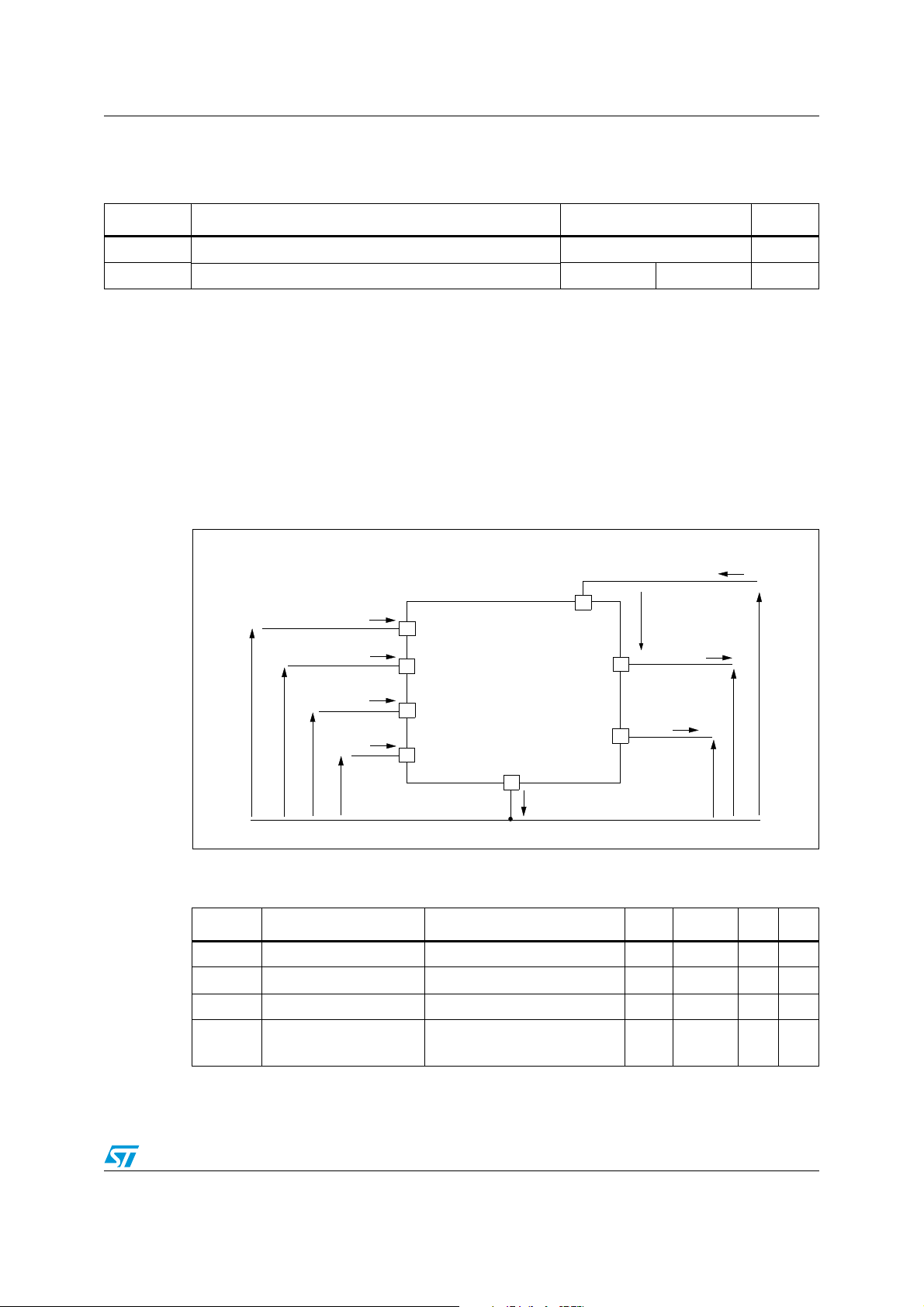
Values specified in this section are for 8 V < V
otherwise stated.
(Per each channel)
Figure 3. Current and voltage conventions
I
IN1
INPUT 1
I
V
IN1
STAT1
STATUS 1
V
STAT1
I
IN2
INPUT 2
I
V
STAT2
IN2
STATUS 2
V
STAT2
< 36 V; -40 °C < Tj < 150 °C, unless
CC
(1)
V
F1
V
CC
I
OUT1
OUTPUT 1
V
OUT1
I
OUT2
OUTPUT 2
V
OUT2
GND
I
GND
I
S
V
CC
1. VFn = V
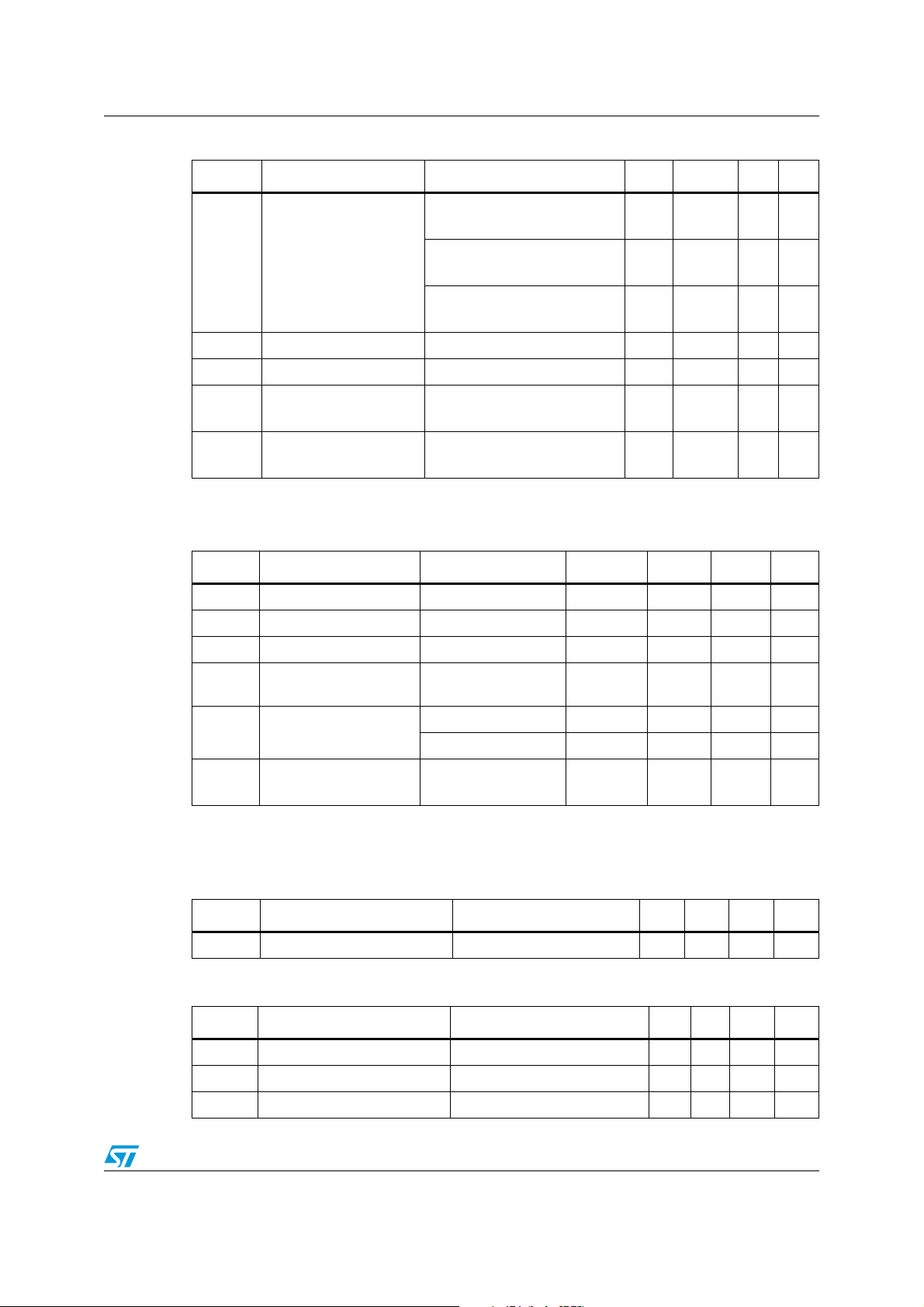
Table 5. Power output
CCn
- V
during reverse battery condition.
OUTn
Symbol Parameter Test conditions Min. Typ. Max. Unit
(1)
Operating supply voltage 5.5 13 36 V
(1)
Undervoltage shutdown 3 4 5.5 V
(1)
Overvoltage shutdown 36 V
I
= 2 A; Tj = 25 °C
On-state resistance
ON
OUT
I
OUT
= 2 A; V
CC
> 8 V
60
120mΩmΩ
V
V
USD
V
R
CC
OV
Doc ID 17546 Rev 2 7/27
Page 8
VND830P-E Electrical specifications
Table 5. Power output (continued)
Symbol Parameter Test conditions Min. Typ. Max. Unit
(1)
I
S
I
L(off1)
I
L(off2)
I
L(off3)
I
L(off4)
1. Per device.
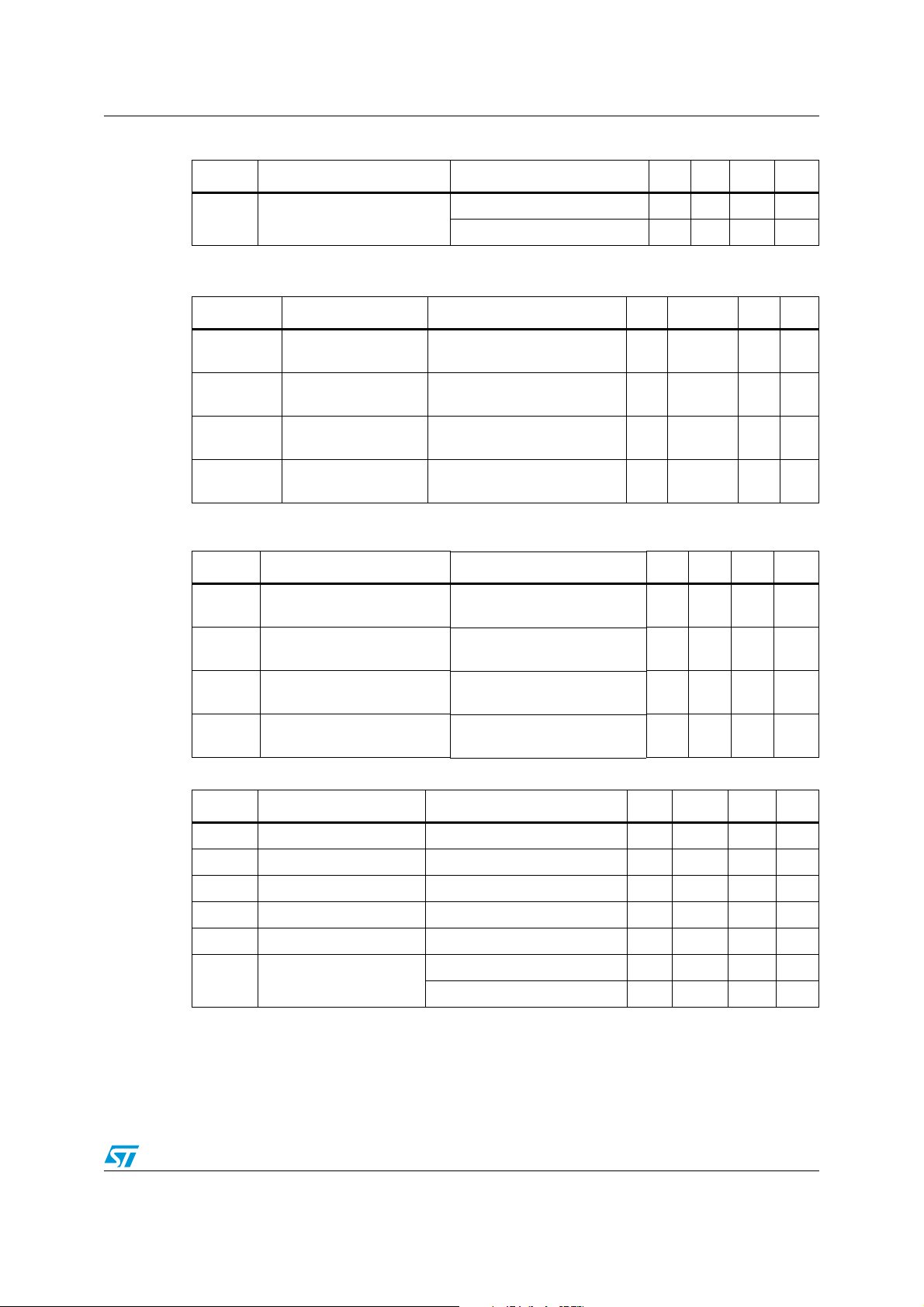
Table 6. Protections
Supply current
Off-state output current V
Off-state output current V
Off-state output current
Off-state output current
(1)
Off-state; V
= V
V
IN
Off-state; V
= V
V
IN
On-state; V
= 5 V; I
V
IN
= V
IN
= 0 V; V
IN
V
= V
IN
= 125 °C
T
j
V
= V
IN
=25 °C
T
j
= 13 V;
CC
= 0 V
OUT
= 13 V;
CC
= 0 V; Tj = 25°C
OUT
= 13 V;
CC
= 0 A
OUT
= 0 V 0 50 µA
OUT
= 3.5 V -75 0 µA
OUT
OUT
OUT
= 0 V; V
= 0 V; V
CC
CC
= 13 V;
= 13 V;
12 40 µA
12 25 µA
57mA
5µA
3µA
Symbol Parameter Test conditions Min. Typ. Max. Unit
T
T
T
Shutdown temperature 150 175 200 °C
TSD
Reset temperature 135 °C
T
R
Thermal hysteresis 7 15 °C
hyst
Status delay in overload
SDL
conditions
T
> T
j
TSD
20 µs
V
= 13 V 6 9 15 A
I
V
demag
1. To ensure long term reliability under heavy overload or short circuit conditions, protection and related
diagnostic signals must be used together with a proper software strategy. If the device is subjected to
abnormal conditions, this software must limit the duration and number of activation cycles.
Tabl e 7. VCC - output diode
Current limitation
lim
Turn-off output clamp
voltage
CC
5.5 V < V
I
OUT
< 36 V 15 A
CC
= 2 A; L = 6 mH V
-41 V
CC
CC
-48 V
-55 V
CC
Symbol Parameter Test conditions Min. Typ. Max. Unit
V
Forward on voltage -I
F
Table 8. Status pin
=1.3 A; Tj=150°C - - 0.6 V
OUT
Symbol Parameter Test conditions Min. Typ. Max. Unit
V
STAT
I
LSTAT
C
STAT
Status low output voltage I
= 1.6 mA 0.5 V
STAT
Status leakage current Normal operation; V
Status pin input capacitance Normal operation; V
= 5 V 10 µA
STAT
= 5 V 100 pF
STAT
Doc ID 17546 Rev 2 8/27
Page 9
VND830P-E Electrical specifications
Table 8. Status pin (continued)
Symbol Parameter Test conditions Min. Typ. Max. Unit
I
= 1 mA 6 6.8 8 V
V
Table 9. Switching (V
Status clamp voltage
SCL
CC
= 13 V)
Symbol Parameter Test conditions Min. Typ. Max. Unit
t
d(on)
t
d(off)
dV/dt
dV/dt
Table 10. Open-load detection
Turn-on delay time
Turn-off delay time
Turn-on voltage slope
(on)
Turn-off voltage slope
(off)
STAT
I
= - 1 mA -0.7 V
STAT
= 6.5 Ω from VIN rising
R
L
edge to V
R
= 6.5 Ω from VIN falling
L
edge to V
= 6.5 Ω from V
R
L
to V
OUT
= 6.5 Ω from V
R
L
to V
OUT
= 1.3 V
OUT
= 11.7 V
OUT
= 10.4 V
= 1.3 V
OUT
OUT
= 1.3 V
= 11.7 V
-30-µs
-30-µs
See
-
-
Figure 14
See
Figure 15
-V/µs
-V/µs
Symbol Parameter Test conditions Min. Typ. Max. Unit
I
t
DOL(on)
V
t
DOL(off)
Table 11. Logic input
Open-load on-state detection
OL
threshold
Open-load on-state detection
delay
Open-load off-state voltage
OL
detection threshold
Open-load detection delay at
turn-off
= 5 V 50 100 200 mA
V
IN
= 0 A 200 µs
I
OUT
V
= 0 V 1.5 2.5 3.5 V
IN
1000 µs
Symbol Parameter Test conditions Min. Typ. Max. Unit
V
V
I
V
V
Input low level 1.25 V
IL
I
Low level input current V
IL
Input high level 3.25 V
IH
High level input current V
IH
Input hysteresis voltage 0.5 V
hyst
Input clamp voltage
ICL
= 1.25 V 1 µA
IN
= 3.25 V 10 µA
IN
I
= 1 mA 6 6.8 8 V
IN
= -1 mA -0.7 V
I
IN
Doc ID 17546 Rev 2 9/27
Page 10

VND830P-E Electrical specifications
Figure 4. Switching time waveforms
Table 12. Truth table
Conditions Input Output Sense
Normal operation
Current limitation
Overtemperature
Undervoltage
Overvoltage
Output voltage > V
Output current < I
OL
OL
L
H
L
H
H
L
H
L
H
L
H
L
H
L
H
L
H
L
X
X
L
L
L
L
L
L
H
H
L
H
(T
(T
< T
j
> T
j
TSD
TSD
H
H
H
) H
) L
H
L
X
X
H
H
L
H
H
L
Doc ID 17546 Rev 2 10/27
Page 11

VND830P-E Electrical specifications
Table 13. Electrical transient requirements on V
ISO T/R
7637/1
test pulse
I II III IV Delays and impedance
1 -25 V -50 V -75 V -100 V
2 +25 V +50 V +75 V +100 V
3a -25 V -50 V -100 V -150 V
3b +25 V +50 V +75 V +100 V 0.1 µs, 50 Ω
4 -4 V -5 V -6 V -7 V 100 ms, 0.01 Ω
5 +26.5V +46.5V +66.5V +86.5V 400ms, 2Ω
Table 14. Electrical transient requirements on VCC pin (part 2)
Test levels
pin (part 1)
CC
2ms, 10Ω
0.2 ms, 10 Ω
0.1 µs, 50 Ω
ISO T/R
Test levels results
7637/1
test pulse
I II III IV
1 CCCC
2 CCCC
3a CCCC
3b CCCC
4 CCCC
5CEEE
Table 15. Electrical transient requirements on VCC pin (part 3)
Class Contents
C
E
All functions of the device are performed as designed after exposure to
disturbance.
One or more functions of the device is not performed as designed after
exposure to disturbance and cannot be returned to proper operation without
replacing the device.
Doc ID 17546 Rev 2 11/27
Page 12

VND830P-E Electrical specifications
Figure 5. Waveforms
NORMAL OPERATION
INPUT
n
OUTPUT VOLTAGE
STATUS
n
V
CC
INPUT
n
OUTPUT VOLTAGE
STATUS
V
CC
INPUT
n
OUTPUT VOLTAGE
STATUS
n
n
n
n
V
USD
VCC<V
UNDERVOLTAGE
OVERVOLTAGE
OV
V
USDhyst
undefined
V
> V
CC
OV
INPUT
n
OUTPUT VOLTAGE
STATUS
n
INPUT
n
OUTPUT VOLTAGE
STATUS
n
T
j
INPUT
n
OUTPUT CURRENT
STATUS
n
OPEN-LOAD with external pull-up
V
> V
n
V
OL
OUT
OL
OPEN-LOAD without external pull-up
n
T
TSD
T
R
n
OVERTEMPERATURE
Doc ID 17546 Rev 2 12/27
Page 13

VND830P-E Electrical specifications
2.4 Electrical characteristics curves
Figure 6. Off-state output current Figure 7. High level input current
IL(off1) (uA)
2.5
2.25
2
1.75
1.5
1.25
0.75
0.5
0.25
0
Figure 8. Input clamp voltage Figure 9. Status leakage current
Off state
Vcc=36V
Vin=Vout=0V
1
-50 -25 0 25 50 75 100 125 150 175
Tc (°C)
Vicl (V)
8
7.8
7.6
7.4
7.2
7
6.8
6.6
6.4
6.2
6
Iin=1mA
-50 -25 0 25 50 75 100 125 150 175
Tc (°C)
Iih (uA)
5
4.5
3.5
2.5
1.5
0.5
Vin=3.25V
4
3
2
1
0
-50 -25 0 25 50 75 100 125 150 175
Tc (°C)
Ilstat (uA)
0.05
0.04
Vstat=5V
0.03
0.02
0.01
0
-50 -25 0 25 50 75 100 125 150 175
Tc (°C)
Figure 10. Status low output voltage Figure 11. Status clamp voltage
Vstat (V)
0.8
0.7
Istat=1.6mA
0.6
0.5
0.4
0.3
0.2
0.1
0
-50 -25 0 25 50 75 100 125 150 175
Tc (°C)
Vscl (V)
8
7.8
7.6
7.4
7.2
6.8
6.6
6.4
6.2
Istat=1mA
7
6
-50 -25 0 25 50 75 100 125 150 175
Tc (°C)
Doc ID 17546 Rev 2 13/27
Page 14

VND830P-E Electrical specifications
Figure 12. Overvoltage shutdown Figure 13. I
Vov (V)
50
48
46
44
42
40
38
36
34
32
30
-50 -25 0 25 50 75 100 125 150 175
Ilim (A)
20
18
16
14
12
10
8
6
4
2
0
-50 -25 0 25 50 75 100 125 150 175
Tc (°C)
Figure 14. Turn-on voltage slope Figure 15. Turn-off voltage slope
dVout/dt(on) (V/ms)
800
700
600
500
400
300
200
100
Vcc=13V
Rl=6.5Ohm
0
-50 -25 0 25 50 75 100 125 150 175
dVout/dt(off) (V/ms)
600
550
500
450
400
350
300
250
200
-50 -25 0 25 50 75 100 125 150 175
Tc (ºC)
vs T
LIM
Vcc=13V
Vcc=13V
Rl=6.5Ohm
case
Tc (°C)
Tc (ºC)
Figure 16. On-state resistance vs T
Ron (mOhm)
160
140
120
100
80
60
40
20
0
-50 -25 0 25 50 75 100 125 150 175
Iout=2A
Vcc=8V; 13V & 36V
Tc (°C)
case
Figure 17. On-state resistance vs V
CC
Ron (mOhm)
120
110
100
90
80
70
60
50
40
30
20
10
0
5 10152025303540
Tc=150°C
Tc=25°C
Tc= - 40°C
Iout=5A
Vcc (V)
Doc ID 17546 Rev 2 14/27
Page 15

VND830P-E Electrical specifications
Figure 18. Input high level Figure 19. Input low level
Vih (V)
3.6
3.4
3.2
3
2.8
2.6
2.4
2.2
-50 -25 0 25 50 75 100 125 150 175
Tc ( ° C)
Figure 20. Open-load on-state detection
threshold
Iol (mA)
150
140
130
120
110
100
90
80
70
Vcc=13V
Vin=5V
-50 -25 0 25 50 75 100 125 150 175
Tc ( ° C)
Vil (V)
2.6
2.4
2.2
2
1.8
1.6
1.4
1.2
1
-50 -25 0 25 50 75 100 125 150 175
Tc (° C)
Figure 21. Open-load off-state detection
threshold
Vol (V)
5
4.5
4
3.5
3
2.5
2
1.5
1
0.5
0
Vin=0V
-50 -25 0 25 50 75 100 125 150 175
Tc (°C)
Figure 22. Input hysteresis voltage
Vhyst (V)
1.5
1.4
1.3
1.2
1.1
1
0.9
0.8
0.7
0.6
0.5
-50 -25 0 25 50 75 100 125 150 175
Tc (°C)
Doc ID 17546 Rev 2 15/27
Page 16

VND830P-E Application information
3 Application information
Figure 23. Application schematic
+5V
+5V
+5V
μ
R
prot
C
R
prot
R
prot
R
prot
STATUS1
INPUT1
STATUS2
INPUT2
V
CC
D
ld
OUTPUT1
D
OUTPUT2
GND
GND
R
V
GND
GND
3.1 GND protection network against reverse battery
This section provides two solutions for implementing a ground protection network against
reverse battery.
3.1.1 Solution 1: a resistor in the ground line (R
This can be used with any type of load.
The following shows how to dimension the R
1. R
2. R
where - I
≤ 600 mV / (I
GND
≥ (-VCC) / (-I
GND
is the DC reverse ground pin current and can be found in the absolute
GND
S(on)max
GND
)
)
maximum rating section of the device’s datasheet.
GND
resistor:
GND
only)
Power dissipation in R
P
=(-VCC)2/R
D
(when VCC< 0 during reverse battery situations) is:
GND
GND
This resistor can be shared amongst several different HSD. Please note that the value of this
resistor should be calculated with formula (1) where I
S(on)max
becomes the sum of the
maximum on-state currents of the different devices.
Doc ID 17546 Rev 2 16/27
Page 17

VND830P-E Application information
Please note that, if the microprocessor ground is not common with the device ground, then
the R
produces a shift (I
GND
S(on)max
* R
) in the input thresholds and the status output
GND
values. This shift varies depending on how many devices are ON in the case of several highside drivers sharing the same R
GND
.
If the calculated power dissipation requires the use of a large resistor, or several devices
have to share the same resistor, then ST suggests using Section 3.1.2 described below.
3.1.2 Solution 2: a diode (D
A resistor (R
=1kΩ) should be inserted in parallel to D
GND
) in the ground line
GND
inductive load. This small signal diode can be safely shared amongst several different HSD.
Also in this case, the presence of the ground network produce a shift (~600 mV) in the input
threshold and the status output values if the microprocessor ground is not common with the
device ground. This shift does not vary if more than one HSD shares the same
diode/resistor network. Series resistor in INPUT and STATUS lines are also required to
prevent that, during battery voltage transient, the current exceeds the absolute maximum
rating. Safest configuration for unused INPUT and STATUS pin is to leave them
unconnected.
3.2 Load dump protection
Dld is necessary (Voltage Transient Suppressor) if the load dump peak voltage exceeds the
V
maximum DC rating. The same applies if the device is subjected to transients on the
CC
V
line that are greater than those shown in Tab l e 1 3 .
CC
3.3 MCU I/O protection
If a ground protection network is used and negative transients are present on the VCC line,
the control pins are pulled negative. ST suggests to insert a resistor (R
the microcontroller I/O pins from latching up.
if the device is driving an
GND
) in line to prevent
prot
The value of these resistors is a compromise between the leakage current of microcontroller
and the current required by the HSD I/Os (Input levels compatibility) with the latch-up limit of
microcontroller I/Os:
-V
CCpeak
/ I
latchup
≤ R
prot
≤ (V
OHμC
- V
IH
- V
GND
) / I
IHmax
Example
For the following conditions:
V
CCpeak
I
latchup
V
OHμC
5kΩ ≤ R
The recommended values are:
R
prot
= -100 V
≥ 20 mA
≥ 4.5 V
prot
= 10 kΩ
≤ 65 kΩ.
Doc ID 17546 Rev 2 17/27
Page 18

VND830P-E Application information
3.4 Open-load detection in off-state
Off-state open-load detection requires an external pull-up resistor (RPU) connected between
OUTPUT pin and a positive supply voltage (V
microprocessor.
The external resistor has to be selected according to the following requirements:
1. No false open-load indication when load is connected: in this case
it needs to avoid V
V
OUT
= (V
/ (RL + RPU))RL < V
PU
to be higher than V
OUT
Olmin.
2. No misdetection when load is disconnected: in this case the V
V
Because I
up resistor R
; this results in the following condition R
OLmax
may significantly increase if V
s(OFF)
should be connected to a supply that is switched OFF when the module is in
PU
standby.
) like the +5 V line used to supply the
PU
; this results in the following condition
Olmin
has to be higher than
< (V
PU
is pulled high (up to several mA), the pull-
out
PU
- V
OUT
OLmax
) / I
L(off2)
.
The values of V
OLmin
, V
OLmax
and I
are available in Chapter 2: Electrical specifications.
L(off2)
Figure 24. Open-load detection in off-state
IN PUT
STATUS
DRIVER
+
LOGIC
+
-
GROUND
V batt. VPU
V
CC
I
L(o ff2)
OUT
R
V
OL
R
PU
R
L
Doc ID 17546 Rev 2 18/27
Page 19

VND830P-E Application information
3.5 Maximum demagnetization energy
Figure 25. SO-16L maximum turn-off current versus load inductance
I
LM A X ( A)
100
10
A
B
C
1
0,1 1 10 100
A = single pulse at T
Jstart
B= repetitive pulse at T
C= repetitive pulse at T
Conditions:
= 13.5 V
V
CC
VIN, I
L
Note:
Values are generated with RL = 0 Ω.
In case of repetitive pulses, T
specified above for curves B and C.
Demagnetization
(at beginning of each demagnetization) of every pulse must not exceed the temperature
jstart
= 150 °C
Jstart
Jstart
= 100 °C
= 125 °C
L( m H )
Demagnetization
Demagnetization
t
Doc ID 17546 Rev 2 19/27
Page 20

VND830P-E Package and PCB thermal data
4 Package and PCB thermal data
4.1 SO-16L thermal data
Figure 26. SO-16L PC board
Note:
Layout condition of R
35 µm, Copper areas: 0.5 cm
Figure 27. R
RTH j-amb (°C/W)
70
and Zth measurements (PCB FR4 area = 41 mm x 48 mm, PCB thickness = 2 mm, Cu thickness =
th
2
, 6 cm2).
vs PCB copper area in open box free air condition
thj-amb
65
(1)
60
55
50
45
40
01234567
PCB Cu heatsink area (cm^2)
Doc ID 17546 Rev 2 20/27
Page 21

VND830P-E Package and PCB thermal data
Figure 28. SO-16 L thermal impedance junction ambient single pulse
Equation 1
Z
THδ
where
: pulse calculation formula
RTHδ Z
THtp
1 δ–()+⋅=
δ tpT⁄=
Figure 29. Thermal fitting model of a quad channel HSD in SO-16L
Tj_1
Pd1
Tj_2
C1
C1 C2
R1
Pd2
C3 C4
R3R1 R6R5R2
R2
R4
T_amb
C5 C6C2
Doc ID 17546 Rev 2 21/27
Page 22

VND830P-E Package and PCB thermal data
Table 16. Thermal parameters
Area/ island (cm2) Footprint 6
R1 (°C/W) 0.05
R2 (°C/W) 0.3
R3 (°C/W) 2.2
R4 (°C/W) 12
R5 (°C/W) 15
R6 (°C/W) 37 22
C1 (W.s/°C) 0.001
C2 (W.s/°C) 5.00E-03
C3 (W.s/°C) 0.02
C4 (W.s/°C) 0.3
C5 (W.s/°C) 1
C6 (W.s/°C) 3 5
Doc ID 17546 Rev 2 22/27
Page 23

VND830P-E Package and packing information
5 Package and packing information
5.1 ECOPACK® packages
In order to meet environmental requirements, ST offers these devices in different grades of
ECOPACK
specifications, grade definitions and product status are available at: www.st.com.
ECOPACK
®
packages, depending on their level of environmental compliance. ECOPACK®
®
is an ST trademark.
5.2 SO-16L package information
Figure 30. SO-16L package dimensions
Doc ID 17546 Rev 2 23/27
Page 24

VND830P-E Package and packing information
Table 17. SO-16L mechanical data
mm.
DIM.
Min. Typ. Max.
A 2.65
a1 0.1 0.2
a2 2.45
b 0.35 0.49
b1 0.23 0.32
C0.5
c1 45° (typ.)
D 10.1 10.5
E 10.0 10.65
e1.27
e3 8.89
F7.4 7.6
L 0.5 1.27
M 0.75
S 8° (max.)
Doc ID 17546 Rev 2 24/27
Page 25

VND830P-E Package and packing information
5.3 SO-16L packing information
Figure 31. SO-16L tube shipment (no suffix)
Base Q.ty 50
Bulk Q.ty 1000
C
B
A
Figure 32. Tape and reel shipment (suffix “TR”)
Tube length (± 0.5) 532
A 3.5
B 13.8
C (± 0.1) 0.6
Reel dimensions
Base Q.ty 1000
Bulk Q.ty 1000
A (max) 330
B (min) 1.5
C (± 0.2) 13
F 20.2
G (+ 2 / -0) 16.4
N (min) 60
T (max) 22.4
Tape dimensions
According to Electronic Industries Association
(EIA) Standard 481 rev. A, Feb. 1986
Tape width W 16
Tape Hole Spacing P0 (± 0.1) 4
Component Spacing P 12
Hole Diameter D (± 0.1/-0) 1.5
Hole Diameter D1 (min) 1.5
Hole Position F (± 0.05) 7.5
Compartment Depth K (max) 6.5
Hole Spacing P1 (± 0.1) 2
All dimensions are in mm.
Top
cover
tape
End
500mm min
Empty components pockets
saled with cover tape.
User direction of feed
Start
No componentsNo components Components
500mm min
Doc ID 17546 Rev 2 25/27
Page 26

VND830P-E Revision history
6 Revision history
Table 18. Document revision history
Date Revision Changes
25-May-2010 1 Initial release.
22-Sep-2010 2 Changed document status from preliminary data to datasheet.
Doc ID 17546 Rev 2 26/27
Page 27

VND830P-E
Please Read Carefully:
Information in this document is provided solely in connection with ST products. STMicroelectronics NV and its subsidiaries (“ST”) reserve the
right to make changes, corrections, modifications or improvements, to this document, and the products and services described herein at any
time, without notice.
All ST products are sold pursuant to ST’s terms and conditions of sale.
Purchasers are solely responsible for the choice, selection and use of the ST products and services described herein, and ST assumes no
liability whatsoever relating to the choice, selection or use of the ST products and services described herein.
No license, express or implied, by estoppel or otherwise, to any intellectual property rights is granted under this document. If any part of this
document refers to any third party products or services it shall not be deemed a license grant by ST for the use of such third party products
or services, or any intellectual property contained therein or considered as a warranty covering the use in any manner whatsoever of such
third party products or services or any intellectual property contained therein.
UNLESS OTHERWISE SET FORTH IN ST’S TERMS AND CONDITIONS OF SALE ST DISCLAIMS ANY EXPRESS OR IMPLIED
WARRANTY WITH RESPECT TO THE USE AND/OR SALE OF ST PRODUCTS INCLUDING WITHOUT LIMITATION IMPLIED
WARRANTIES OF MERCHANTABILITY, FITNESS FOR A PARTICULAR PURPOSE (AND THEIR EQUIVALENTS UNDER THE LAWS
OF ANY JURISDICTION), OR INFRINGEMENT OF ANY PATENT, COPYRIGHT OR OTHER INTELLECTUAL PROPERTY RIGHT.
UNLESS EXPRESSLY APPROVED IN WRITING BY AN AUTHORIZED ST REPRESENTATIVE, ST PRODUCTS ARE NOT
RECOMMENDED, AUTHORIZED OR WARRANTED FOR USE IN MILITARY, AIR CRAFT, SPACE, LIFE SAVING, OR LIFE SUSTAINING
APPLICATIONS, NOR IN PRODUCTS OR SYSTEMS WHERE FAILURE OR MALFUNCTION MAY RESULT IN PERSONAL INJURY,
DEATH, OR SEVERE PROPERTY OR ENVIRONMENTAL DAMAGE. ST PRODUCTS WHICH ARE NOT SPECIFIED AS "AUTOMOTIVE
GRADE" MAY ONLY BE USED IN AUTOMOTIVE APPLICATIONS AT USER’S OWN RISK.
Resale of ST products with provisions different from the statements and/or technical features set forth in this document shall immediately void
any warranty granted by ST for the ST product or service described herein and shall not create or extend in any manner whatsoever, any
liability of ST.
ST and the ST logo are trademarks or registered trademarks of ST in various countries.
Information in this document supersedes and replaces all information previously supplied.
The ST logo is a registered trademark of STMicroelectronics. All other names are the property of their respective owners.
© 2010 STMicroelectronics - All rights reserved
STMicroelectronics group of companies
Australia - Belgium - Brazil - Canada - China - Czech Republic - Finland - France - Germany - Hong Kong - India - Israel - Italy - Japan -
Malaysia - Malta - Morocco - Philippines - Singapore - Spain - Sweden - Switzerland - United Kingdom - United States of America
www.st.com
Doc ID 17546 Rev 2 27/27
 Loading...