

Page 1

INTEGRATED CIRCUITS
DATA SH EET
TEA5591
AM/FM radio receiver circuit
Product specification
File under Integrated Circuits, IC01
June 1989
Page 2

Philips Semiconductors Product specification
AM/FM radio receiver circuit TEA5591
GENERAL DESCRIPTION
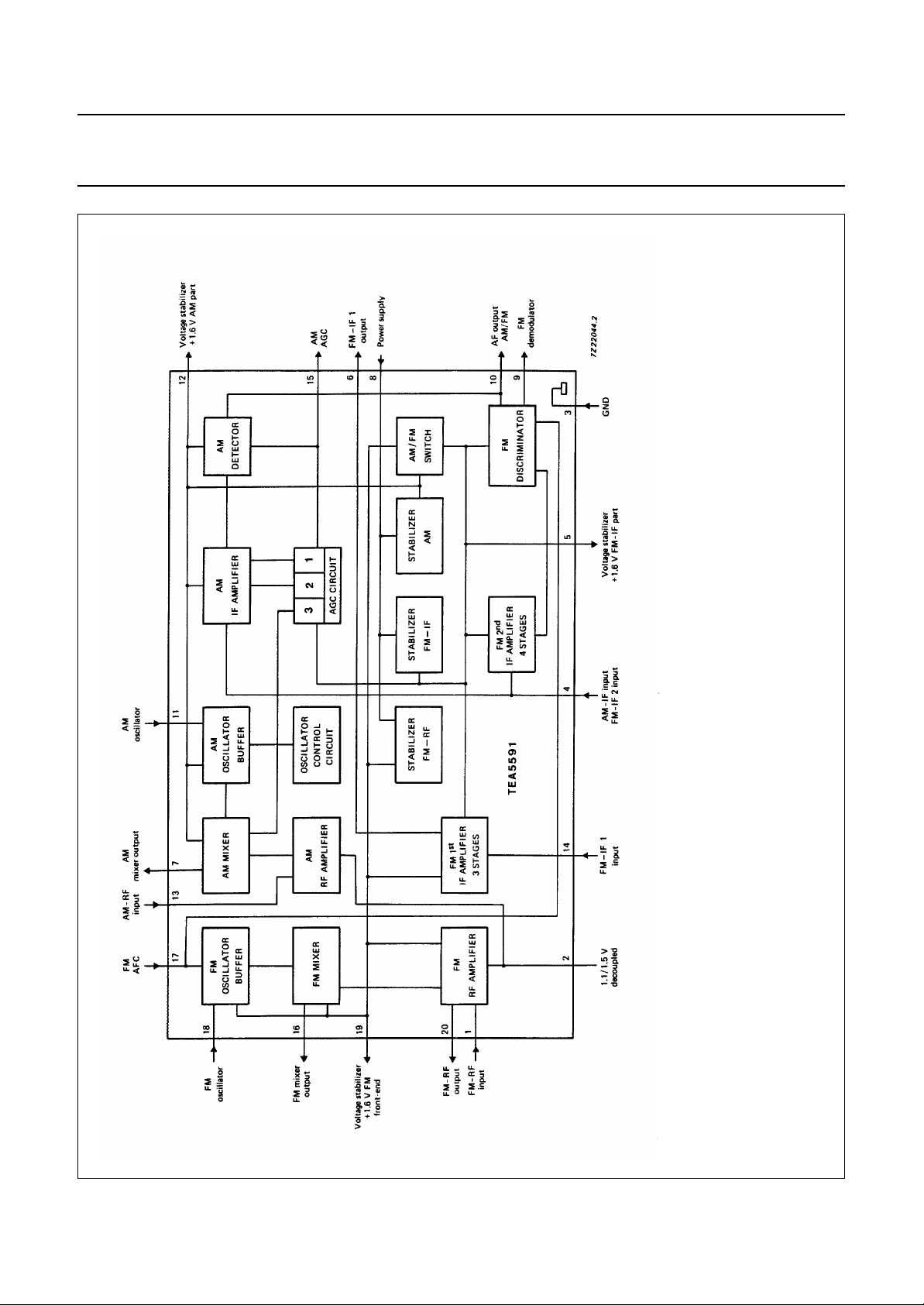
The TEA5591 is an integrated radio circuit which is designed for use in portable receivers and clock radios. The IC is
also applicable to mains-fed AM an AM/FM receivers and car radio-receivers. The main advantage of this IC is its ability
to operate over a wide range of supply voltages without loss of performance. The AM circuit incorporates a balanced
mixer and a ‘one-pin’ oscillator, which operates in the 0.6 MHz to 30 MHz frequency range, with amplitude control. The
circuit also includes an IF amplifier, a detector and an AGC circuit which controls the IF amplifier and the mixer. The FM
circuit incorporates an RF amplifier, a balanced mixer and a ‘one-pin’ oscillator together with two AC coupled IF amplifiers
(with distributed selectivity), a quadrature demodulator for the ceramic filter and internal AFC.
Features
• DC AM/FM switch facility
• Three internal separate stabilizers to enable operation over a wide range of supply voltages (1.8 to 15 V)
• All pins (except pin 9) are ESD protected.
QUICK REFERENCE DATA
PARAMETER CONDITIONS SYMBOL MIN. TYP. MAX. UNIT
Supply voltage (pin 8) V
P
Supply current
AM part I
FM part I
Operating ambient temperature range T
AM performance (pin 13)
m = 0.3
(AM) − 14 19 mA
P
(FM) − 17 23 mA
P
amb
RF sensitivity
RF input voltage V
RF input voltage (S+N)/N = 26 dB V
Signal plus noise-to-noise ratio V
AF output voltage V
= 10 mV V
o
= 1 mV (S+N)/N − 48 − dB
i
i
i
o
Total harmonic distortion THD − 0.7 − %
FM performance (pin 1)
∆f = 22.5 kHz
RF sensitivity
RF input voltage
−3 dB before limiting V
i
Signal plus noise-to-noise ratio for:
RF input signal voltage (V
)V
i
AF output voltage V
= 3.0 µV(S+N)/N 23 26 − dB
i
= 1 mV (S+N)/N − 60 − dB
V
i
= 100 µVV
i
o
Total harmonic distortion THD − 0.8 − %
1.8 3.0 15 V
−15 −+60 °C
− 3.5 −µV
− 17 −µV
− 50 − mV
− 2.3 4.0 µV
75 90 − mV
PACKAGE OUTLINE
20-lead DIL; plastic (SOT146); SOT146-1; 1996 August 14.
June 1989 2
Page 3
Philips Semiconductors Product specification
AM/FM radio receiver circuit TEA5591
June 1989 3
Fig.1 Block diagram.
Page 4
Philips Semiconductors Product specification
AM/FM radio receiver circuit TEA5591
June 1989 4
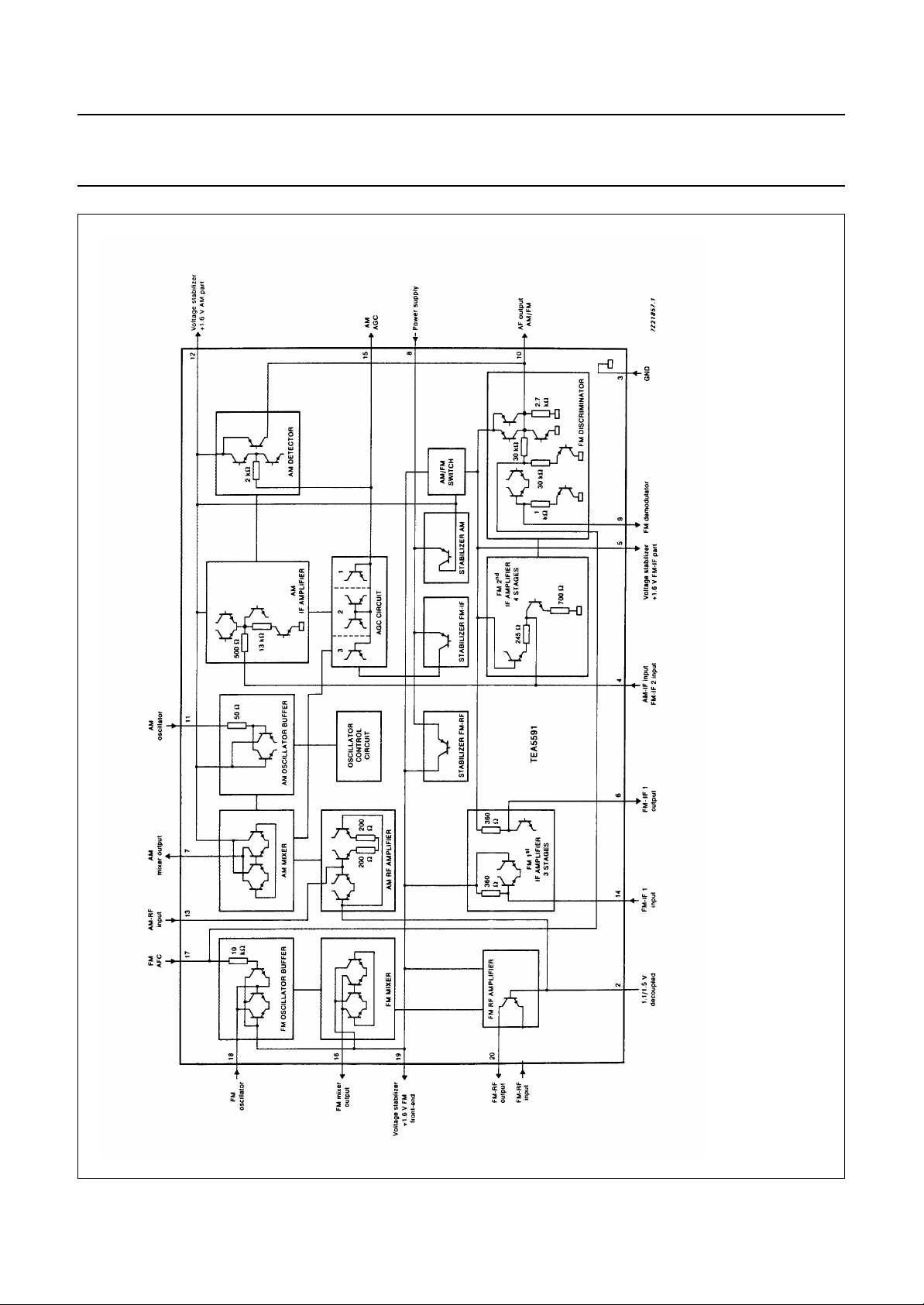
Fig.2 Equivalent circuit diagram.
Page 5
Philips Semiconductors Product specification
AM/FM radio receiver circuit TEA5591
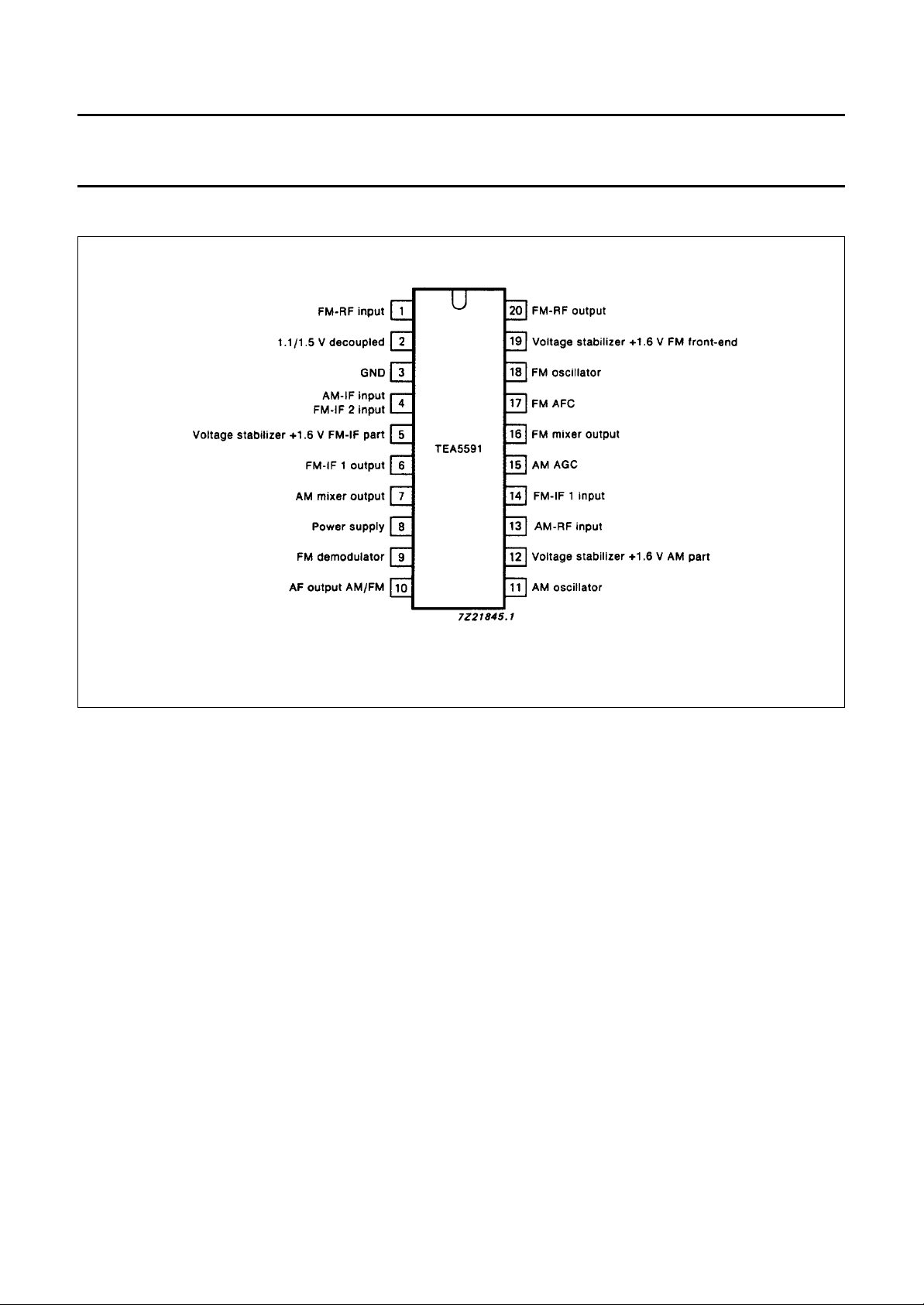
PINNING
Fig.3 Pinning diagram.
June 1989 5
Page 6
Philips Semiconductors Product specification
AM/FM radio receiver circuit TEA5591
RATINGS
Limiting values in accordance with the Absolute Maximum System (IEC 134)
PARAMETER CONDITIONS SYMBOL MIN. MAX. UNIT
Supply voltage (pin 8) V
Storage temperature range T
Operating ambient temperature range T
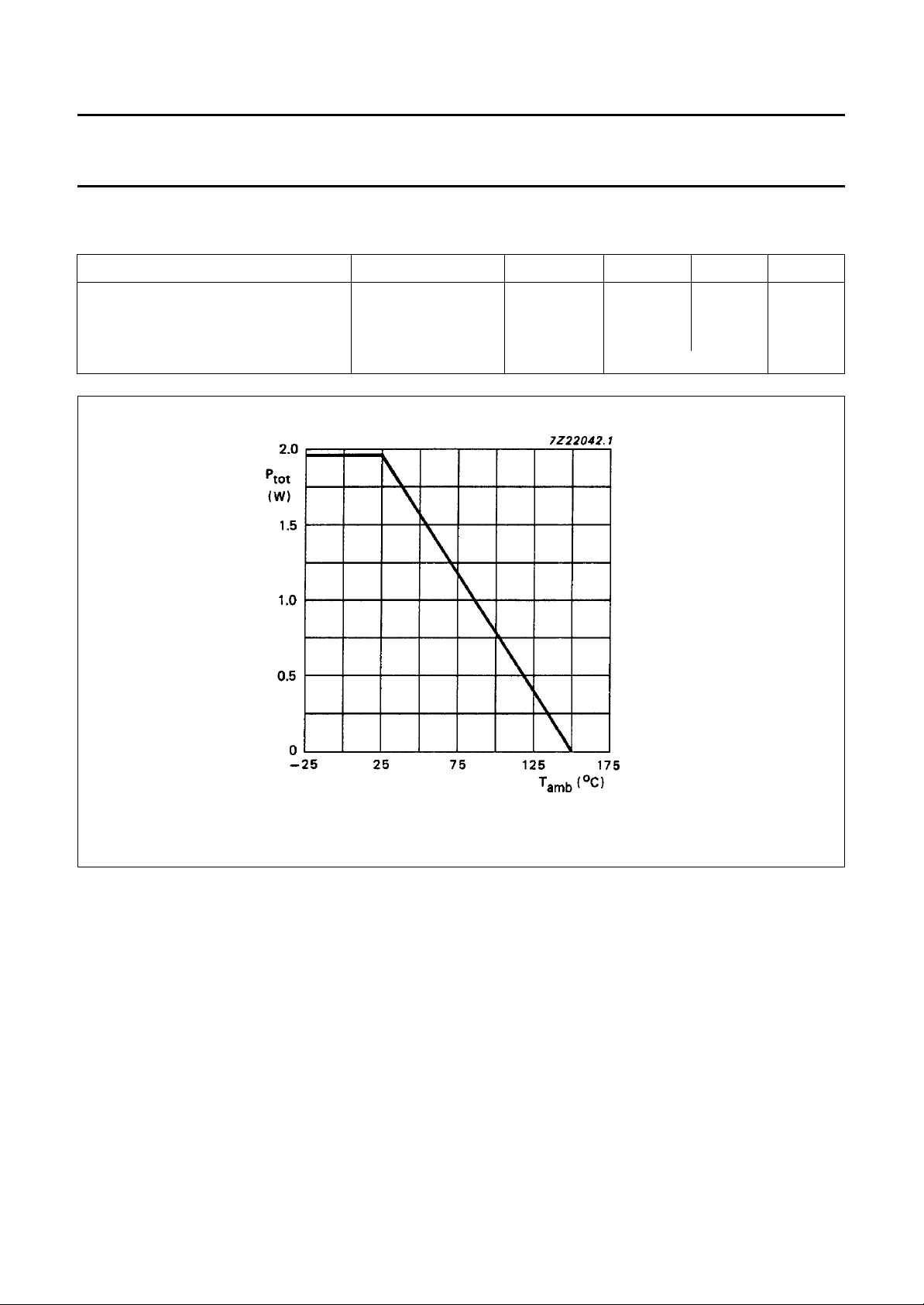
Total power dissipation P
P
stg
amb
tot
− 18 V
−65 + 150 °C
−15 + 60 °C
see Fig.4
Fig.4 Power derating curve.
June 1989 6
Page 7

Philips Semiconductors Product specification
AM/FM radio receiver circuit TEA5591
DC CHARACTERISTICS
All voltages are referenced to pin 3; all input currents are positive; all parameters are measured in Fig.5 at nominal
supply voltage V
= 3 V; T
P
PARAMETER CONDITIONS SYMBOL MIN. TYP. MAX. UNIT
Supply voltage V
Voltages (FM)
pin 1 V
pin 2 V
pin 4 V
pin 5 V
pin 6 V
pin 9 V
pin 14 V
pin 17 V
pin 19 V
Voltages (AM)
pin 2 V
pin 12 V
pin 15 V
Supply current
AM part I
FM part I
= 25 °C unless otherwise specified
amb
P
1
2
4
5
6
9
14
17
19
2
12
15
P(AM)
P(FM)
1.8 3.0 15 V
− 0.90 − V
− 1.60 − V
− 0.85 − V
1.5 1.60 1.75 V
− 1.48 − V
− 1.05 − V
− 1.63 − V
− 0.60 − V
− 1.60 − V
− 1.10 − V
− 1.60 − V
− 1.54 − V
− 14 19 mA
− 17 23 mA
June 1989 7
Page 8

Philips Semiconductors Product specification
AM/FM radio receiver circuit TEA5591
AC CHARACTERISTICS
= 3 V; T
V
P
AM PART
Input conductance pin 4 f = 0.5 MHz g
Input capacitance pin 4 f = 0.5 MHz C
= 25 °C unless otherwise specified
amb
PARAMETER CONDITIONS SYMBOL MIN. TYP. MAX. UNIT
ie
ie
− 1.7 − ms
− 5 − pF
Input conductance pin 13 f = 1.0 MHz g
Input capacitance pin 13 f = 1.0 MHz C
Output conductance pin 7 f = 0.5 MHz g
Output capacitance pin 7 f = 0.5 MHz C
Conductance pin 11 f = 1.5 MHz g
Capacitance pin 11 f = 1.5 MHz C
FM PART
Input conductance pin 4 f = 10.7 MHz g
Input capacitance pin 4 f = 10.7 MHz C
Input conductance pin 14 f = 10.7 MHz g
Input capacitance pin 14 f = 10.7 MHz C
Output conductance pin 6 f = 10.7 MHz g
Output capacitance pin 6 f = 10.7 MHz C
Output conductance pin 16 f = 10.7 MHz g
Output capacitance pin 16 f = 10.7 MHz C
ie
ie
oe
oe
e
e
ie
ie
ie
ie
oe
oe
oe
oe
− 230 −µs
− 13 − pF
− 4 −µs
− 4.7 − pF
−−6.8 − ms
− 25 − pF
− 2.7 − ms
− 6 − pF
− 2.8 − ms
− 2.5 − pF
− 2.8 − ms
− 3.0 − pF
− 1.6 −µs
− 4.5 − pF
Conductance pin 9 f = 10.7 MHz g
Capacitance pin 9 f = 10.7 MHz C
Conductance pin 18 f = 100 MHz g
Capacitance pin 18 f = 100 MHz C
e
e
e
e
June 1989 8
− 880 −µs
− 3.6 − pF
−−4−ms
− 10 − pF
Page 9

Philips Semiconductors Product specification
AM/FM radio receiver circuit TEA5591
AC CHARACTERISTICS
All parameters are measured in Fig.5 at nominal supply voltage V
RF conditions: Input frequency 1 MHz; 30% modulation where f
= 3 V; T
P
= 1 kHz; unless otherwise specified
mod
PARAMETER CONDITIONS SYMBOL MIN. TYP. MAX. UNIT
AM PERFORMANCE
RF sensitivity
AF output voltage for:
= 7.5 µV no AGC V
V
i
o
Noise
Signal plus noise-to-noise
ratio for:
RF input signal voltage of
= 17 µV(S+N)/N 23 26 − dB
V
i
= 1 mV (S + N)/N − 48 − dB
V
i
Optimum source impedance Z
S
Noise factor optimum noise impedance NF − 4 − dB
= 25 °C unless otherwise specified.
amb
16 30 40 mV
− 1.8 − kΩ
AGC
Change in RF input voltage
for 10 dB change in output
voltage V
AF output voltage
Total harmonic distortion
= 100 mV Vi1/V
i1
= 100 µVV
V
i
V
= 100 µV to 10 mV THD − 0.7 1.5 %
i
V
= 100 µV to 10 mV;
i
i2
o
80 86 − dB
40 50 60 mV
m = 0.8 THD − 35%
= 80 mV; m = 0.8 THD −−8%
V
i
June 1989 9
Page 10

Philips Semiconductors Product specification
AM/FM radio receiver circuit TEA5591
PARAMETER CONDITIONS SYMBOL MIN. TYP. MAX. UNIT
IF suppression
(note 1) V
Oscillator (pin 11)
Input voltage f
Temperature behaviour
Sensitivity ∆V
Output voltage V
Oscillator frequency
LW ∆f
MW ∆f
SW ∆f
Supply voltage behaviour
Sensitivity ∆V
Output voltage V
Oscillator frequency
LW ∆f
MW ∆f
SW ∆f
Transimpedance (Ztr) = V4/i7= 900Ω.
= 30 mV α−20 − dB
o
= 1.5 MHz V
osc
= 30.5 MHz V
f
osc
= 1.5 V V
V
P
osc
osc
osc
− 150 190 mV
− 150 − mV
100 −−mV
−15 to + 60 °C
(only the IC)
−−2−dB
− 1 − dB
− 500 − Hz
− 300 − Hz
− 100 − kHz
− 0 − dB
− 0.5 − dB
− 6 − kHz
− 0.1 − kHz
− 30 − kHz
= 1 mV ∆V
i
V
= 1.8 to 15 V
P
= 1 mV ∆V
i
i
o
osc
osc
osc
i
o
osc
osc
osc
June 1989 10
Page 11

Philips Semiconductors Product specification
AM/FM radio receiver circuit TEA5591
AC CHARACTERISTICS
All parameters are measured in Fig.5 at nominal supply voltage V
= 3 V; T
P
RF conditions: Input frequency 100 MHz; frequency deviation f = ± 22,5 kHz and f
PARAMETER CONDITIONS SYMBOL MIN. TYP. MAX. UNIT
FM PERFORMANCE
RF sensitivity
RF input voltage −3 dB before
limiting V
iFM
Noise
Signal plus noise-to-noise
ratio for:
RF input signal voltage (V
V
= 3.0 µV(S+N)/N 23 26 − dB
i
= 1 mV (S + N)/N − 60 − dB
V
i
Optimum source impedance Z
)
i
source
Noise factor optimum noise
impedance NF − 6 − dB
AF output voltage
i
o
= 100 µVV
V
Total harmonic
distortion V
= 30 µV
i
to 50 mV THD − 0.8 − %
= 1 mV;
V
i
∆f = 75 kHz THD − 3 − %
= 100 mV;
V
i
∆f = 75 kHz THD − 3 − %
AM suppression
RF input signal V
note 2
= 100 µV to
i
10 mV AMS − 50 − dB
Oscillator voltage (pin 18) f
IF rejection ratio IF
AFC
= 100 MHz V
osc
= 1.5 V V
V
P
= 111.2 MHz
f
osc
V
= 1.4 V ∆f −−620 − kHz
17
= 0.2 V ∆f −+420 − kHz
V
17
osc
osc
rr
= 25 °C unless otherwise specified
amb
= 1 kHz
mod
− 2.3 4.0 µV
− 50 −Ω
75 90 − mV
− 220 − mV
100 −−mV
− 60 − dB
June 1989 11
Page 12

Philips Semiconductors Product specification
AM/FM radio receiver circuit TEA5591
PARAMETER CONDITIONS SYMBOL MIN. TYP. MAX. UNIT
Temperature behaviour
RF sensitivity −3 dB limiting ∆V
Output voltage V
Oscillator frequency ∆f
−15 to + 60 °C
(only the IC)
= 100 µV ∆V
i
osc
i
o
−−6−dB
−−2−dB
−−0.3 − %
Supply voltage behaviour
VP = 1.8 to 15 V
RF sensitivity −3 dB limiting ∆V
Output voltage V
= 100 µV ∆V
i
Oscillator frequency ∆f
Oscillator voltage ∆V
Notes to the AC characteristics
at fi455 kHz=
V
1. .
i
α
=
---------------------------------------------V
at fi1MHz=
i
2. AM suppression is measured at:
f
= 400 Hz, m = 0.3 for AM;
mod
f
= 1 kHz, ∆f = 75 kHz for FM.
mod
osc
i
o
osc
− 6 − dB
− 0.5 − dB
− 100 − kHz
− 1.0 − dB
June 1989 12
Page 13

Philips Semiconductors Product specification
AM/FM radio receiver circuit TEA5591
June 1989 13
Fig.5 Test circuit.
Page 14

Philips Semiconductors Product specification
AM/FM radio receiver circuit TEA5591
APPLICATION INFORMATION
June 1989 14
Fig.6 Application diagram.
Page 15

Philips Semiconductors Product specification
AM/FM radio receiver circuit TEA5591
Component data
N1 = 4.5
L = 0.12 µH
Wire = 0.8 mm diameter
diameter = 4.5 mm
Fig.7 FM BFP coil (L1).
N1 = 132
N2 = 14
N3 = 9
C = 180 pF (internal)
Lprim = 660 µH
fo = 468 kHz
Wire = 0.07 mm diameter
Coil type 7P-TOKO
Material 7MCS
N1 = 86
N2 = 11
Lprim = 270 µH
Wire = 0.07 mm diameter
Coil type 7P-TOKO
Material 7BRS
Fig.8 AM IF coil (L2). TOKO sample no. 7MCS-7P.
Fig.9 Oscillator coil (L3). TOKO sample no. 7BRS-7P.
June 1989 15
Page 16

Philips Semiconductors Product specification
AM/FM radio receiver circuit TEA5591
N1 = 11
N2 = 2
C = 85 pF (internal)
f
= 10.7 MHz
o
Fig.10 FM IF coil (L5). TOKO equivalent no. 119ACS-30120M.
N1 = 1.5
L = 0.03 µH
Fig.11 Oscillator coil (L6). TOKO equivalent no. 301 SN-0100.
N1 = 2.5
L = 0.05 µH
Fig.12 FM RF coil (L7). TOKO equivalent no. 301 SN-0200.
June 1989 16
Page 17

Philips Semiconductors Product specification
AM/FM radio receiver circuit TEA5591
FERROCEPTOR COIL
L4: N1 = 105; N2 = 10; L = 625 µH
ERAMIC FILTERS
C
AM IF (K1). SFZ468 HL.
FM IF (K2). SFE10 . 7 MS2.
FM detector (K3). CDA10 . 7 MC1.
UNING CAPACITORS
T
AM 140/82 pF
FM 2 × 20 pF
June 1989 17
Page 18

Philips Semiconductors Product specification
AM/FM radio receiver circuit TEA5591
Physical dimensions of the printed circuit board = 5.0 × 8.1 cm.
Fig.13 Printed-circuit board component side, showing component layout. For circuit diagram see Fig.6.
Fig.14 Printed-circuit board showing track side.
June 1989 18
Page 19

Philips Semiconductors Product specification
AM/FM radio receiver circuit TEA5591
Fig.15 AM signal levels.
June 1989 19
Fig.16 FM signal levels.
Page 20

Philips Semiconductors Product specification
AM/FM radio receiver circuit TEA5591
Fig.17 Signal and noise (V
as a function of input voltage (Vi) at pin 13. Measured in test circuit Fig.5. AM AGC is measured at fi= MHz;
f
= 1 kHz; m = 0.3. AM distortion is measured at fi= 1 MHz; f
mod
), noise (VoN); reference level 0 dB = 100 mV, and total harmonic distortion (THD)
oAF
= 1 kHz.
mod
Fig.18 Signal and noise (V
), noise (VoN); reference level 0 dB = 100 mV; AM suppression (AMS) and total
oAF
harmonic distortion (THD) as a function of input voltage (V) at pin 1. Measured in test circuit Fig.5 at
fi= 98 MHz; f
f
= 1 kHz, ∆f = 75 kHz for FM.
mod
= 1 kHz; ∆f 22.5 kHz. AM suppression is measured at f
mod
June 1989 20
= 400 Hz, m= 0.3 for AM;
mod
Page 21

Philips Semiconductors Product specification
AM/FM radio receiver circuit TEA5591
PACKAGE OUTLINE
DIP20: plastic dual in-line package; 20 leads (300 mil)
D
seating plane
L
Z
20
pin 1 index
e
b
SOT146-1
M
E
A
2
A
A
1
w M
b
1
11
E
c
(e )
1
M
H
1
0 5 10 mm
scale
DIMENSIONS (inch dimensions are derived from the original mm dimensions)
A
A
A
UNIT
inches
Note
1. Plastic or metal protrusions of 0.25 mm maximum per side are not included.
max.
mm
OUTLINE
VERSION
SOT146-1
1 2
min.
max.
1.73
1.30
0.068
0.051
IEC JEDEC EIAJ
SC603
b
b
1
0.53
0.38
0.021
0.015
0.014
0.009
REFERENCES
cD E e M
0.36
0.23
(1) (1)
26.92
26.54
1.060
1.045
June 1989 21
6.40
6.22
0.25
0.24
10
(1)
M
e
L
1
3.60
8.25
3.05
7.80
0.14
0.32
0.12
0.31
EUROPEAN
PROJECTION
H
E
10.0
0.2542.54 7.62
8.3
0.39
0.010.10 0.30
0.33
ISSUE DATE
w
92-11-17
95-05-24
Z
max.
2.04.2 0.51 3.2
0.0780.17 0.020 0.13
Page 22

Philips Semiconductors Product specification
AM/FM radio receiver circuit TEA5591
SOLDERING
Introduction
There is no soldering method that is ideal for all IC
packages. Wave soldering is often preferred when
through-hole and surface mounted components are mixed
on one printed-circuit board. However, wave soldering is
not always suitable for surface mounted ICs, or for
printed-circuits with high population densities. In these
situations reflow soldering is often used.
This text gives a very brief insight to a complex technology.
A more in-depth account of soldering ICs can be found in
“IC Package Databook”
our
Soldering by dipping or by wave
The maximum permissible temperature of the solder is
260 °C; solder at this temperature must not be in contact
with the joint for more than 5 seconds. The total contact
time of successive solder waves must not exceed
5 seconds.
DEFINITIONS
(order code 9398 652 90011).
The device may be mounted up to the seating plane, but
the temperature of the plastic body must not exceed the
specified maximum storage temperature (T
printed-circuit board has been pre-heated, forced cooling
may be necessary immediately after soldering to keep the
temperature within the permissible limit.
Repairing soldered joints
Apply a low voltage soldering iron (less than 24 V) to the
lead(s) of the package, below the seating plane or not
more than 2 mm above it. If the temperature of the
soldering iron bit is less than 300 °C it may remain in
contact for up to 10 seconds. If the bit temperature is
between 300 and 400 °C, contact may be up to 5 seconds.
stg max
). If the
Data sheet status
Objective specification This data sheet contains target or goal specifications for product development.
Preliminary specification This data sheet contains preliminary data; supplementary data may be published later.
Product specification This data sheet contains final product specifications.
Limiting values
Limiting values given are in accordance with the Absolute Maximum Rating System (IEC 134). Stress above one or
more of the limiting values may cause permanent damage to the device. These are stress ratings only and operation
of the device at these or at any other conditions above those given in the Characteristics sections of the specification
is not implied. Exposure to limiting values for extended periods may affect device reliability.
Application information
Where application information is given, it is advisory and does not form part of the specification.
LIFE SUPPORT APPLICATIONS
These products are not designed for use in life support appliances, devices, or systems where malfunction of these
products can reasonably be expected to result in personal injury. Philips customers using or selling these products for
use in such applications do so at their own risk and agree to fully indemnify Philips for any damages resulting from such
improper use or sale.
June 1989 22
 Loading...